EP1729702B1 - Cerebral temperature control - Google Patents
Cerebral temperature control Download PDFInfo
- Publication number
- EP1729702B1 EP1729702B1 EP05722228.3A EP05722228A EP1729702B1 EP 1729702 B1 EP1729702 B1 EP 1729702B1 EP 05722228 A EP05722228 A EP 05722228A EP 1729702 B1 EP1729702 B1 EP 1729702B1
- Authority
- EP
- European Patent Office
- Prior art keywords
- fluid
- another
- reservoir
- lumen
- temperature
- Prior art date
- Legal status (The legal status is an assumption and is not a legal conclusion. Google has not performed a legal analysis and makes no representation as to the accuracy of the status listed.)
- Expired - Lifetime
Links
Images



Classifications
-
- A—HUMAN NECESSITIES
- A61—MEDICAL OR VETERINARY SCIENCE; HYGIENE
- A61F—FILTERS IMPLANTABLE INTO BLOOD VESSELS; PROSTHESES; DEVICES PROVIDING PATENCY TO, OR PREVENTING COLLAPSING OF, TUBULAR STRUCTURES OF THE BODY, e.g. STENTS; ORTHOPAEDIC, NURSING OR CONTRACEPTIVE DEVICES; FOMENTATION; TREATMENT OR PROTECTION OF EYES OR EARS; BANDAGES, DRESSINGS OR ABSORBENT PADS; FIRST-AID KITS
- A61F7/00—Heating or cooling appliances for medical or therapeutic treatment of the human body
- A61F7/12—Devices for heating or cooling internal body cavities
- A61F7/123—Devices for heating or cooling internal body cavities using a flexible balloon containing the thermal element
-
- A—HUMAN NECESSITIES
- A61—MEDICAL OR VETERINARY SCIENCE; HYGIENE
- A61M—DEVICES FOR INTRODUCING MEDIA INTO, OR ONTO, THE BODY; DEVICES FOR TRANSDUCING BODY MEDIA OR FOR TAKING MEDIA FROM THE BODY; DEVICES FOR PRODUCING OR ENDING SLEEP OR STUPOR
- A61M19/00—Local anaesthesia; Hypothermia
-
- A—HUMAN NECESSITIES
- A61—MEDICAL OR VETERINARY SCIENCE; HYGIENE
- A61F—FILTERS IMPLANTABLE INTO BLOOD VESSELS; PROSTHESES; DEVICES PROVIDING PATENCY TO, OR PREVENTING COLLAPSING OF, TUBULAR STRUCTURES OF THE BODY, e.g. STENTS; ORTHOPAEDIC, NURSING OR CONTRACEPTIVE DEVICES; FOMENTATION; TREATMENT OR PROTECTION OF EYES OR EARS; BANDAGES, DRESSINGS OR ABSORBENT PADS; FIRST-AID KITS
- A61F7/00—Heating or cooling appliances for medical or therapeutic treatment of the human body
- A61F2007/0001—Body part
- A61F2007/0002—Head or parts thereof
- A61F2007/0006—Nose
-
- A—HUMAN NECESSITIES
- A61—MEDICAL OR VETERINARY SCIENCE; HYGIENE
- A61F—FILTERS IMPLANTABLE INTO BLOOD VESSELS; PROSTHESES; DEVICES PROVIDING PATENCY TO, OR PREVENTING COLLAPSING OF, TUBULAR STRUCTURES OF THE BODY, e.g. STENTS; ORTHOPAEDIC, NURSING OR CONTRACEPTIVE DEVICES; FOMENTATION; TREATMENT OR PROTECTION OF EYES OR EARS; BANDAGES, DRESSINGS OR ABSORBENT PADS; FIRST-AID KITS
- A61F7/00—Heating or cooling appliances for medical or therapeutic treatment of the human body
- A61F2007/0054—Heating or cooling appliances for medical or therapeutic treatment of the human body with a closed fluid circuit, e.g. hot water
-
- A—HUMAN NECESSITIES
- A61—MEDICAL OR VETERINARY SCIENCE; HYGIENE
- A61F—FILTERS IMPLANTABLE INTO BLOOD VESSELS; PROSTHESES; DEVICES PROVIDING PATENCY TO, OR PREVENTING COLLAPSING OF, TUBULAR STRUCTURES OF THE BODY, e.g. STENTS; ORTHOPAEDIC, NURSING OR CONTRACEPTIVE DEVICES; FOMENTATION; TREATMENT OR PROTECTION OF EYES OR EARS; BANDAGES, DRESSINGS OR ABSORBENT PADS; FIRST-AID KITS
- A61F7/00—Heating or cooling appliances for medical or therapeutic treatment of the human body
- A61F2007/0095—Heating or cooling appliances for medical or therapeutic treatment of the human body with a temperature indicator
Definitions
- the present invention refers to devices for the control of the temperature of the brain of a human being, and especially to cooling of the brain.
- the body temperature or the temperature of body parts cf a human being influences the healing process and the risk of permanent damage.
- Cancer cells for example, are heat sensitive and a local heating of the blood flow around a cancer tumor may for some types of cancer constitute a treatment resulting in restrained tumor growth or in some cases even in a shrinking of the tumor. In other cases cooling of a body part may be important to reduce adverse secondary symptoms of the pathological condition, this is primarily intended for the treatment of brain ischemia.
- the brain can suffer permanent damage if the arrest exceeds a time period of about 5-15 minutes. However, if the temperature of the brain is lowered before, during or after the arrest, the brain damage is diminished.
- US 5,906,588 discloses a method and a device for heart-lung bypass and cooling of a specific body part. This disclosure primarily relates to complicated heart surgery and organ transplantation.
- the patent document US 2002/0161349 A1 discloses a first phase comprising the step of introducing an infusion catheter for infusion of a temperature controlled infusion solution or perfusate into a vein initiating quick general body hypothermia.
- An optional second phase may be used, wherein a second infusion catheter is introduced into an artery of the human being, the second infusion catheter being configured to provide selective temperature control of the brain and infusion of other important substrates and pharmacological compounds into the brain.
- a third phase is also disclosed, wherein an extra-corporeal circuit is established between a vein and an artery. Blood is withdrawn from the vein, and the temperature of the blood is modified outside the body and the blood is returned to the body through the artery.
- the brain can be protected from overheating by heat exchange over the rete mirabile at the base of the brain.
- a fine network of the carotid artery is in close connection to a similar network of veins draining the brain. Respiratory evaporation from the surfaces of the nostrils and the epipharynx cools veins in this region flowing towards the rete mirabile whereby heat exchange can occur between arteries and veins.
- a variation of more or less complicated scrolls of conchae in the nasal cavity enhances evaporation and the heat exchange.
- Document DE 19952440 A1 discloses a cooling device suited to be introduced into the sinus sphenoidalis, which is a space arranged in close proximity to the brain tissue and is accessible via the nose or via the nostrils. This can be accomplished in particular after performing a first computer tomography, since a sufficient level of knowledge is then present over respective anatomical conditions and the possible access roads. Then, the cooling device can be inserted for example by proven endoscopic methods and equipment.
- Document US 2002/0138121 A1 discloses a method of treating cancer and other diseases by modulating body temperature.
- Heat may directed to the hypothalamus of a warm-blooded animal to cool the animal, utilizing the physiological mechanisms that regulate body temperature to effect a compensatory cooling response, thereby lowering body temperature (hypothermia), and rendering other methods of lowering body temperature more effective.
- Heat may be withdrawn from the hypothalamus of an animal, cooling the hypothalamus, inducing a compensatory increase in body temperature (hyperthermia), and rendering other methods of raising body temperature more effective.
- Body temperature may be directly modulated by heat-exchange catheter positioned within a blood vessel of a patient.
- the device relates generally to methods of treating cancer by inducing hypothermia by directing heat to the hypothalamus, optionally maintaining cancerous tissue at or near to normal body temperature, and optionally applying another cancer treatment.
- This other cancer treatment may be radiation therapy, chemotherapy, a combination of radiation and chemotherapy, or some other cancer treatment.
- the invention relates generally to methods of treating diseases including cancer, viral infections, and other diseases, comprising inducing hyperthermia by cooling the hypothalamus, and optionally applying another treatment, for example radiation, chemotherapy, antiviral therapy, or a combination of therapies.
- a double lumen catheter for circulating heating fluid the catheter being suited for insertion into the sphenoid sinus.
- a distendible balloon is arranged at the tip of said catheter, which balloon can expand under the positive pressure head following partial occlusion of the outflow.
- the present invention is based on the discovery that the cerebral arteries can temper the human brain by remnants of the venous carotid rete, i.e. the cavernous and other sinuses, surrounding the carotid and other cerebral arteries, such as vertebral arteries, before entering the brain.
- Cold air or fluids in the nasal cavities including the epipharynx are in close thermal contact with the veins draining to the dense venous plexus surrounding the internal carotid and vertebral arteries and to the cavernous sinus.
- the sub mucosal position of the carotid arteries in the epipharynx might play an additional role in this heat exchange.
- a device for selective hypothermia treatment of the brain in patients with brain ischemia, such as stroke and cardiac arrest is disclosed.
- An object of the present invention is to provide a system for quick and efficient control of the temperature of the brain without substantially changing the temperature of the rest of the body.
- Another object of the invention is to provide a system that is simple and initially does not require specialized personnel acquainted with for example radiology or other diagnostic imaging techniques.
- a system for indirect temperature regulation by cooling of the brain of a human being via a nasal cavity thereof comprising a double lumen catheter means suited to be introduced through a nostril of a human being and placed with its tip adjacent the back of said nasal cavities, said double lumen catheter means comprising a first lumen and a second lumen, said first and second lumens being in fluid communication by means of a set of openings, said second lumen forming a membrane suited to be arranged in contact with a surface of said nasal cavity, said membrane defining an expandable balloon; an inlet means for introducing cooling fluid into said expandable balloon; an outlet means for removing cooling fluid frcm said expandable balloon; and means for circulating said cooling fluid into said expandable balloon via said inlet means and out of said expandable balloon via said outlet means said means comprising a set of tubings configured to connect said catheter means to a reservoir; said inlet means being in fluid communication with said reservoir and with said first lumen, said inlet means being configured
- the system may comprise a temperature regulator connected to said reservoir, said regulator being configured to regulate the temperature of said fluid, via a cooling device.
- said inlet means and outlet means may be arranged at a proximal portion of the catheter means.
- the circulation of said fluid may be accomplished by means of hydrostatic pressure of said fluid in said reservoir.
- the means for circulating said fluid may comprise a pumping means arranged between said reservoir and said catheter means.
- the means for circulating the fluid may be configured to provide a flow rate of approximately 25 - 1000 ml/min.
- the pressure regulating nozzles may be variable.
- the system may further comprise a temperature monitoring device configured to, indirectly or directly, register the temperature of the brain and to automatically control said temperature regulator to regulate the temperature of said fluid in said reservoir, via a heat exchanging device, in order to maintain the temperature of the brain at a desired level.
- the temperature monitoring device may be an IR thermistor, a MR device, a Near Infra Red device or an impedance spectroscopy device.
- the temperature monitoring device may be arranged on a forehead of the human being or in an auditory canal of the human being.
- the temperature of the brain may be approximately 10 - 41° C, such as 20 - 35° C.
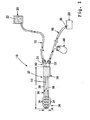
- Fig 1 discloses an embodiment of a single system 1C for cerebral temperature control of a human being, in which the system comprises one double lumen catheter means 30.
- Fig 2 shows schematically a second embodiment of the inventive system, which system comprises two double lumen catheters means 30a, 30b to be introduced in respective nostril of a human being.
- temperature regulation may be accomplished more effectively and quicker.
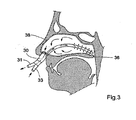
- the system 10 comprises a double lumen balloon catheter means 30, 30a, 30b configured to be introduced through a nostril of a human being and to be placed with its tip at the level of the back of the nasal cavities, as shown in Fig 3 . Pushing a sleeve or sheath 39 backward or forward may vary the length of double lumen balloon catheter.
- the double lumen catheter means 30, 30a, 30b comprises a first lumen 32, 32a, 32b and a second lumen 38, 38a, 38b.
- the first and second lumens are arranged in fluid communication with each other by means of a set of end openings 34, 34a, and 34b.
- the second lumen 38, 38a, 38b is configured as an expandable balloon.
- the system 10 could also comprise a temperature regulator 24, shown in Fig 2 , connected to a reservoir 20 comprising a fluid 22.
- the temperature regulator 24 is configured to regulate the temperature of the fluid 22 comprised in the reservoir.
- the fluid 22 is for example a saline solution.
- the temperature regulator controls a heat exchanging device, namely a cooling device, for temperature regulating the fluid.
- Means are arranged in the form of tubes 12, 12a, 12b, 14, 16, 16a, 16b for circulating said temperature regulated fluid 22 from the reservoir 20 to the catheter means 30, 30a, and 30b.
- the means 12, 12a, 12b, 14, 16, 16a, 16b are configured to circulate the fluid 22 into the first lumen 32, 32a, 32b of the catheter means 30, 30a, 30b, from the first lumen 32, 32a, 32b into the second lumen 38, 38a, 38b, and from the second lumen 38, 38a, 38b back to said reservoir 20, or vice versa.
- the circulation means 12, 12a, 12b, 14, 16, 16a, 16b for circulating said temperature regulated fluid 22 comprises a set of tubings 12, 12a, 12b, 14, 16, 16a, 16b configured to connect the catheter means 30, 30a, 30b to the reservoir 20.
- the second catheter 38, 38a, 38b is expanded more or less as a balloon to completely or almost completely cover the inner surface of the nose and epipharynx, as shown in Fig 3 , whereby the naso-pharyngeal membranes may be temperature regulated.
- the temperature is transferred to adjacent arterial and venous structures, which are transferring the temperature to the brain.
- the temperature regulated fluid 22 circulates in a closed fluid system 12, 12a, 12b; 14; 16, 16a, 16b; 30a, 30b; 20.
- the double lumen catheter means 30, 30a, 30b comprises an inlet 31, 31a, 31b arranged to provide fluid communication with the reservoir 20 and with the first lumen 32, 32a, and 32b.
- the inlet 31, 31a, 31b is further configured to receive an amount of the temperature regulated fluid 22 from the reservoir 20.
- the first lumen 32, 32a, 32b has a set of distal end openings 34, 34a, 34b in a front-end portion 36, 36a, 36b of the catheter means 30, 30a, and 30b.
- the end openings 34, 34a, 34b being arranged to provide fluid communication with said second lumen 38, 38a, and 38b.
- the catheter means 30, 30a, 30b further comprises an outlet 33, 33a, 33b configured to provide fluid communication with the second lumen 38, 38a, 38b and with the reservoir 20.
- the inlet 31, 31a, 31b and the outlet 33, 33a, 33b are arranged at an end portion 40, 40a, 40b of the catheter means 30, 30a, 30b.
- the second lumen 38, 38a, 38b has a variable length L of approximately 5 - 25 cm.
- the sleeve 39 around the shaft of the catheter can reduce the length L of the second lumen when the sleeve is moved backward or forward.
- the diameter A of the second lumen at a front part 36, 36a, 36b of the second lumen is approximately 2 - 4 cm and the diameter B of the second lumen at a base part 37, 37a, 37b of the second lumen is approximately 1 - 3 cm, but these measures can vary if the balloon pressure is increased.
- the catheter means 30, 30a, 30b could be manufactured of a flexible material such as plastic, synthetic latex, silicone or Gore-Tex.
- the material may be coated with a substance resulting in a hydrophilic surface.
- An anesthetic agent may also cover the surface.
- the circulation of the fluid 22 is accomplished by means of the hydrostatic pressure of the fluid 22 in the reservoir 20.
- the reservoir 20 is arranged at a level, which is higher than the nasal cavity of the human being under treatment, and a waste bag 29 is arranged below the same level. Thence, the cold fluid flows by gravity from the reservoir and to the catheter device and further to the waste bag.
- the means 12, 14, 16 for circulating the temperature regulated fluid 22 further comprises a pumping means 18 arranged between the reservoir 20 and the catheter means 30, 30a, 30b by means of tubings 12, 12a, 12b, 14.
- a pumping means 18 arranged between the reservoir 20 and the catheter means 30, 30a, 30b by means of tubings 12, 12a, 12b, 14.
- the circulation means for circulating the fluid is preferably configured to provided a fluid flow rate of 25 - 1000 ml/min.
- the system can also comprise a pressure regulating nozzle 26, 26a, 26b, shown in Figs 1 and 2 , arranged at the tubings 16, 16a, and 16b.
- the pressure regulating nozzle 26, 26a, 26b is arranged close to the reservoir 20 or the waste bag 29 and being configured to provide a resistance in the tubings, whereby the fluid flowing in the system is able to expand the second lumen 38, 38a, 38b.
- the nozzle may be a clamp that is adjustable.
- pressure sensors 49 may be arranged for measuring the pressure in the second lumen, as shown in Fig 1 .
- a pressure sensor may be a similar construction as the second lumen arranged in a side branch. By means of the pressure sensor, it can be assured that the pressure will not be too high, which may be experienced Lo be uncomfortable.
- the pressure sensor may as well be conventional pressure meters.
- the technique according to the present invention involves the following, as shown in Fig 3 .
- Two double lumen thin walled balloon catheters are inserted into the nostrils of the patient.
- fluid e.g. saline
- the balloons When inflated and circulated with fluid, e.g. saline, at a temperature of ⁇ 0 to 41°C, preferably 20-35°C, at a rate of 25 to 1000 ml per min, the lower range for neonate, the balloons will cover the inner surfaces of the nose and the epipharynx, collectively named the nasal cavities.
- Circulation can be performed in either direction. Cooling of the nasal cavities can then be accomplished without any fluids entering the trachea or the esophagus.
- Different sizes of catheters and balloons will fit neonates to adults and a sheath or sleeve around the shaft of the catheter can reduce the length of the ballcon when the sheath is moved forward.
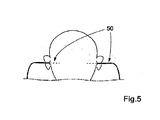
- the system can also comprise a temperature sensor 50, which is connectable to the temperature regulator 24 and configured to register or estimate the temperature of the brain and to automatically control the temperature regulator 24 to regulate the temperature of the fluid in the reservoir 20 in order to maintain the temperature of the brain at a desired level.
- the temperature sensor is for example an IR thermistor, which could be arranged in an auditory canal of the human being or on the skin, such as the forehead, of the human being.
- the temperature could also be monitored by a MR device, a Near Infrared device or an impedance spectroscopy device.
- the desired brain temperature level may be approximately 10 - 35°C. The temperature level depends on the degree of hypothermia, which is clinically relevant. If the brain temperature is increased it should be closely monitored.
- the present invention also relates to a kit of disposables for use in the inventive system.
- the kit comprises a plurality of tubings, and the double lumen catheter means 30, 30a, 30b.
- Fig 4 schematically shows how the registered temperature in the left and right brain hemisphere is reduced after the onset of the inventive method, while the registered temperature in the rectum remains almost unchanged.
- a double lumen catheter means was introduced in respective nostril of an experimental animal.
- the temperature regulator controls the fluid temperature to desired level through a cooling element. Circulation of cold fluid started approximately at 10:18 and stopped approximately at 10:41 (after 23 minutes).
- Circulation of cold fluid started approximately at 10:18 and stopped approximately at 10:41 (after 23 minutes).
- the registered temperature in the left and right brain hemisphere is reduced within a short period of time after the start and increases again after the stop. Further, the temperature of the rectum is almost unchanged.
- a selectively cooling of the brain is accomplished.
- Paramedic's start at the site an intravenous infusion of ice cooled lactated Ringers solution, possibly combined with naso-pharyngeal cooling or the treatment starts with naso-pharyngeal cooling alone.
- Fig 6 Patients with naso-pharyngeal cooling or retro perfusion treatment at the admission unit are later referred to the ward for future treatment according to Fig 6 .
- the tissue in the nose and epipharynx are cooled, via a membrane in contact with the tissue.
- the expression "nasal cavity” is used to mean all inside surface of the nose (via both nostrils) and including the epipharynx. In some embodiments, only a portion of the nasal cavity surfaces is used for cooling purpose, and this is intended to be within the scope of the invention.
- the cooling effect of the fluid can be monitored by measuring the inlet and outlet temperature of the fluid as well as the flow rate. By calorimetric calculations, the cooling effect can be calculated. If it is presumed that the heat generation of the brain or tissue inside the head is relatively constant, the temperature decrease can be calculated or predicted. Furthermore, temperature measurements at different places of the body and with different methods as indicated above, can provide further data for a closer prediction of the brain temperature.
- the intention of the invention is to cool substantially only the brain, including adjacent tissue, but maintain the temperature of the rest of the body at normal temperature. It may be that the body temperature may also be lowered and this tendency may be counteracted by covering part of the body by a blanket or by providing slightly heated warm air.
Landscapes
- Health & Medical Sciences (AREA)
- General Health & Medical Sciences (AREA)
- Animal Behavior & Ethology (AREA)
- Engineering & Computer Science (AREA)
- Biomedical Technology (AREA)
- Heart & Thoracic Surgery (AREA)
- Veterinary Medicine (AREA)
- Life Sciences & Earth Sciences (AREA)
- Public Health (AREA)
- Physics & Mathematics (AREA)
- Thermal Sciences (AREA)
- Vascular Medicine (AREA)
- Anesthesiology (AREA)
- Hematology (AREA)
- Thermotherapy And Cooling Therapy Devices (AREA)
Applications Claiming Priority (2)
| Application Number | Priority Date | Filing Date | Title |
|---|---|---|---|
| US10/708,624 US7189253B2 (en) | 2004-03-16 | 2004-03-16 | Cerebral temperature control |
| PCT/SE2005/000382 WO2005087156A1 (en) | 2004-03-16 | 2005-03-16 | Cerebral temperature control |
Publications (2)
| Publication Number | Publication Date |
|---|---|
| EP1729702A1 EP1729702A1 (en) | 2006-12-13 |
| EP1729702B1 true EP1729702B1 (en) | 2013-09-11 |
Family
ID=34975288
Family Applications (1)
| Application Number | Title | Priority Date | Filing Date |
|---|---|---|---|
| EP05722228.3A Expired - Lifetime EP1729702B1 (en) | 2004-03-16 | 2005-03-16 | Cerebral temperature control |
Country Status (7)
| Country | Link |
|---|---|
| US (1) | US7189253B2 (https=) |
| EP (1) | EP1729702B1 (https=) |
| JP (1) | JP4871256B2 (https=) |
| CN (1) | CN1946359B (https=) |
| AU (1) | AU2005221602B2 (https=) |
| CA (1) | CA2559625A1 (https=) |
| WO (1) | WO2005087156A1 (https=) |
Cited By (2)
| Publication number | Priority date | Publication date | Assignee | Title |
|---|---|---|---|---|
| US9320644B2 (en) | 2011-07-25 | 2016-04-26 | Neurosave, Inc. | Non-invasive systems, devices, and methods for selective brain cooling |
| US11285072B2 (en) | 2017-03-28 | 2022-03-29 | Abilion Medical Systems Ab | Devices, systems and methods for mechanical tissue stimulation |
Families Citing this family (48)
| Publication number | Priority date | Publication date | Assignee | Title |
|---|---|---|---|---|
| US20050131501A1 (en) * | 2003-12-15 | 2005-06-16 | Rowland Robert A.Iii | Apparatus and method for prevention and treatment of infection |
| US20050152844A1 (en) * | 2004-01-09 | 2005-07-14 | Barbut Denise R. | Transpulmonary systemic cooling using liquid mists |
| US20050154430A1 (en) * | 2004-01-09 | 2005-07-14 | Benecool, Inc. | Transpulmonary systemic cooling using liquid mists |
| US8721699B2 (en) | 2005-05-13 | 2014-05-13 | Benechill, Inc. | Methods and devices for non-invasive cerebral and systemic cooling |
| US9358150B2 (en) | 2005-05-13 | 2016-06-07 | Benechill, Inc. | Methods and devices for non-invasive cerebral and systemic cooling alternating liquid mist/gas for induction and gas for maintenance |
| US7824436B2 (en) * | 2005-05-13 | 2010-11-02 | Benechill, Inc. | Methods and devices for non-invasive cerebral and systemic cooling |
| WO2008063179A1 (en) * | 2006-11-22 | 2008-05-29 | Benechill, Inc. | Methods and devices for non-invasive cerebral and systemic cooling |
| WO2008094509A1 (en) * | 2007-01-26 | 2008-08-07 | William Cook Europe Aps | Apparatus and method for cooling the brain using a liquid |
| US8308786B2 (en) * | 2007-02-28 | 2012-11-13 | Benechill, Inc. | Methods and devices for non-invasive cerebral and systemic cooling via the nasal cavity |
| WO2009004635A2 (en) * | 2007-07-04 | 2009-01-08 | Eliahu Arad | System and method for manipulating a temperature of a patient |
| EP2716266B1 (en) | 2008-01-25 | 2019-01-02 | Neurosave, Inc. | Rapid cooling of body and/or brain by irrigating aerodigestive tract with cooling liquid |
| US20090234325A1 (en) * | 2008-03-17 | 2009-09-17 | Allan Rozenberg | Methods and devices for non-invasive cerebral and systemic cooling |
| US8167923B2 (en) * | 2008-10-10 | 2012-05-01 | Benechill Inc. | Cooling of localized areas of the body for cerebral blood flow augmentation |
| WO2010054249A1 (en) * | 2008-11-07 | 2010-05-14 | Benechill, Inc. | Methods of nasopharyngeal cooling for augmenting coronary perfusion pressure |
| CA2757132A1 (en) * | 2009-03-30 | 2010-10-07 | Steve Andre Beaudin | Apparatus. system and methods for extracorporeal blood processing for selectively cooling the brain relative to the body during hyperthermic treatment or to induce hypothermia of the brain |
| US8157767B2 (en) * | 2009-06-19 | 2012-04-17 | Benechill, Inc. | Devices for cooling the nasal cavity |
| EP2322126B1 (en) * | 2009-11-16 | 2013-08-14 | Koray Tutav | Device and method for controlling nasal exudation |
| US9744071B2 (en) | 2010-02-16 | 2017-08-29 | The Johns Hopkins University | Method and device for non-invasive anatomical and systemic cooling and neuroprotection |
| US9629745B2 (en) | 2010-02-16 | 2017-04-25 | The Johns Hopkins University | Method and device for non-invasive anatomical and systemic cooling and neuroprotection |
| JP5468414B2 (ja) * | 2010-02-22 | 2014-04-09 | 国立大学法人 岡山大学 | 脳冷却装置及びこれに適した脳冷却用具 |
| US8888832B2 (en) * | 2011-09-28 | 2014-11-18 | Zoll Circulation, Inc. | System and method for doubled use of patient temperature control catheter |
| US20140088457A1 (en) * | 2012-09-26 | 2014-03-27 | Covidien Lp | Bleeding containment device |
| NL2010911C2 (en) * | 2013-06-04 | 2014-12-08 | Vithèr Hyperthermia B V | An apparatus for controlling the inner temperature of a patient. |
| CN104546279A (zh) * | 2015-01-05 | 2015-04-29 | 张茂 | 人体降温装置 |
| BR102015002008A2 (pt) * | 2015-01-28 | 2016-08-23 | Bernardo Lembo Conde De Paiva | cateter |
| CN105640691B (zh) * | 2015-12-29 | 2019-02-01 | 浙江大学 | 一种大鼠颅脑低温实验平台及温度控制方法 |
| CA3026394A1 (en) * | 2016-06-01 | 2017-12-07 | Neurosave, Inc. | Non-invasive, single use system and methods for selective brain cooling |
| US20190374780A1 (en) * | 2016-09-09 | 2019-12-12 | The Board Of Trustees Of The University Of Arkansas | Medical implants powered by reverse electrodialysis |
| SE1651341A1 (en) | 2016-10-13 | 2017-11-14 | Quickcool Ab | An annular heat exchanger, a bag for use in the heat exchanger and a system for hypothermia treatment |
| JP6985394B2 (ja) * | 2017-01-06 | 2021-12-22 | カーディオフォーカス,インコーポレーテッド | バルーンカテーテルおよびその流体管理システム |
| US11207505B2 (en) * | 2017-01-06 | 2021-12-28 | Cardiofocus, Inc. | Balloon catheter and fluid management system thereof |
| US10926067B2 (en) | 2017-01-06 | 2021-02-23 | Cardiofocus, Inc. | Balloon catheter and fluid management system thereof |
| US10806910B2 (en) | 2017-04-14 | 2020-10-20 | Cardiofocus, Inc. | Balloon catheter and fluid management system thereof |
| WO2019023420A1 (en) * | 2017-07-26 | 2019-01-31 | Dubois Brian R | DEVICES AND METHODS FOR TREATING EPISTAXIS |
| AU2018347242A1 (en) * | 2017-10-11 | 2020-08-13 | TEQCool AB | System for hypothermia treatment of a patient |
| EP3743142A1 (en) * | 2018-01-23 | 2020-12-02 | Quickcool AB | System for hypothermia treatment of a patient |
| CN110478225B (zh) * | 2019-09-06 | 2024-12-17 | 江苏省肿瘤医院 | 一种洗鼻器 |
| KR102307375B1 (ko) * | 2019-10-30 | 2021-10-01 | 가톨릭대학교 산학협력단 | 냉각 풍선을 활용한 구강 냉각 장치 |
| SE543991C2 (en) * | 2019-11-13 | 2021-10-19 | TEQCool AB | Device and method for cerebral temperature control |
| EP4252723A1 (en) | 2020-03-27 | 2023-10-04 | Quickcool AB | Removable liquid heat exchanging element for use in a device for temperature control treatment |
| CN111685927B (zh) * | 2020-06-29 | 2022-03-15 | 北京中关村水木医疗科技有限公司 | 温度控制系统及该系统的操作方法 |
| CN111658304B (zh) * | 2020-06-29 | 2022-03-15 | 北京中关村水木医疗科技有限公司 | 下位机的控制方法、下位机及可读介质 |
| US20240000608A1 (en) * | 2020-11-26 | 2024-01-04 | Ajou University Industry-Academic Cooperation Foundation | Nasopharyngeal airway management device for brain-nasal cavity cooling |
| KR102659431B1 (ko) * | 2020-11-26 | 2024-04-23 | 아주대학교산학협력단 | 뇌-비강 냉각을 위한 비강인두 기도유지장치 |
| CN113180911A (zh) * | 2021-06-04 | 2021-07-30 | 河南三好医疗科技有限公司 | 一种用于选择性脑部目标温度管理的鼻咽腔冷却导管 |
| JP2023062765A (ja) * | 2021-10-22 | 2023-05-09 | 大研医器株式会社 | 冷却装置、冷却ユニット、および頭部装着冷却セット |
| CN113892994A (zh) * | 2021-11-16 | 2022-01-07 | 四川省肿瘤医院 | 一种鼻咽大出血的止血装置及止血方法 |
| WO2025174806A1 (en) * | 2024-02-13 | 2025-08-21 | University Of Vermont And State Agricultural College | Devices, systems, and methods for selectively cooling the brain of living humans and certain living animals |
Family Cites Families (20)
| Publication number | Priority date | Publication date | Assignee | Title |
|---|---|---|---|---|
| GB1340788A (en) * | 1971-02-04 | 1974-01-30 | Matburn Holdings Ltd | Nasal tampons |
| CN85202075U (zh) * | 1985-05-31 | 1986-03-19 | 南京大学 | 带有减压室的闭式循环热管型医用冷动器 |
| US4949718B1 (en) * | 1988-09-09 | 1998-11-10 | Gynelab Products | Intrauterine cauterizing apparatus |
| US5324392A (en) * | 1989-04-18 | 1994-06-28 | Nippon Filcon Co., Ltd. | Extendable and heat shrinkable polyamide mono-filament for endless fabric and endless fabric |
| IL93842A (en) * | 1990-03-22 | 1995-10-31 | Argomed Ltd | Device for local treatment of mammals using heat |
| US5624392A (en) * | 1990-05-11 | 1997-04-29 | Saab; Mark A. | Heat transfer catheters and methods of making and using same |
| US5269758A (en) * | 1992-04-29 | 1993-12-14 | Taheri Syde A | Intravascular catheter and method for treatment of hypothermia |
| US5735817A (en) * | 1995-05-19 | 1998-04-07 | Shantha; T. R. | Apparatus for transsphenoidal stimulation of the pituitary gland and adjoining brain structures |
| US6156057A (en) * | 1995-08-12 | 2000-12-05 | Fox; James Allan | Method for inducing hypothermia |
| US5794629A (en) * | 1996-11-27 | 1998-08-18 | The Regents Of The University Of California | Method for treating ischemic brain stroke |
| US6736837B2 (en) * | 1997-08-12 | 2004-05-18 | James A. Fox | Method for inducing hypothermia for treating neurological disorders |
| US6188930B1 (en) * | 1998-09-11 | 2001-02-13 | Medivance Incorporated | Method and apparatus for providing localized heating of the preoptic anterior hypothalamus |
| DE19952440A1 (de) * | 1999-10-30 | 2001-05-03 | Michael Lieke | Therapeutisches Notfall-Set bei Schlaganfall zur Erzielung einer moderaten Hypothermie |
| SE0002100D0 (sv) * | 2000-06-05 | 2000-06-05 | Jostra Ab | Cerebral temperering |
| JP2004529676A (ja) * | 2000-11-13 | 2004-09-30 | ダブリュ アイ ティー アイ ピー コーポレーション | 断熱領域を有する治療カテーテル |
| US6641602B2 (en) * | 2001-04-13 | 2003-11-04 | Alsius Corporation | Method and device including a colo-rectal heat exchanger |
| US6647930B2 (en) * | 2002-02-11 | 2003-11-18 | L'Air Liquide-Societe Anonyme à Directoire et Conseil de Surveillance pour l'Etude et l'Exploitation des Procedes Georges Claude | Ammonia vapor generation |
| US7004961B2 (en) * | 2003-01-09 | 2006-02-28 | Edward Wong | Medical device and method for temperature control and treatment of the brain and spinal cord |
| US7758623B2 (en) * | 2003-03-17 | 2010-07-20 | The Board Of Trustees Of The Leland Stanford Junior University | Transesophageal heat exchange catheter for cooling of the heart |
| US20040049154A1 (en) * | 2003-07-09 | 2004-03-11 | Seacoast Technologies, Inc. | Inflatable device for treating tissue |
-
2004
- 2004-03-16 US US10/708,624 patent/US7189253B2/en not_active Expired - Lifetime
-
2005
- 2005-03-16 CA CA002559625A patent/CA2559625A1/en not_active Abandoned
- 2005-03-16 AU AU2005221602A patent/AU2005221602B2/en not_active Ceased
- 2005-03-16 CN CN200580013232XA patent/CN1946359B/zh not_active Expired - Lifetime
- 2005-03-16 WO PCT/SE2005/000382 patent/WO2005087156A1/en not_active Ceased
- 2005-03-16 JP JP2007503864A patent/JP4871256B2/ja not_active Expired - Fee Related
- 2005-03-16 EP EP05722228.3A patent/EP1729702B1/en not_active Expired - Lifetime
Cited By (3)
| Publication number | Priority date | Publication date | Assignee | Title |
|---|---|---|---|---|
| US9320644B2 (en) | 2011-07-25 | 2016-04-26 | Neurosave, Inc. | Non-invasive systems, devices, and methods for selective brain cooling |
| US11285072B2 (en) | 2017-03-28 | 2022-03-29 | Abilion Medical Systems Ab | Devices, systems and methods for mechanical tissue stimulation |
| US11806307B2 (en) | 2017-03-28 | 2023-11-07 | Abilion Medical Systems Ab | Devices, systems and methods for mechanical tissue stimulation |
Also Published As
| Publication number | Publication date |
|---|---|
| CA2559625A1 (en) | 2005-09-22 |
| AU2005221602A1 (en) | 2005-09-22 |
| JP2007529267A (ja) | 2007-10-25 |
| CN1946359B (zh) | 2011-03-23 |
| EP1729702A1 (en) | 2006-12-13 |
| JP4871256B2 (ja) | 2012-02-08 |
| US7189253B2 (en) | 2007-03-13 |
| WO2005087156A1 (en) | 2005-09-22 |
| US20050209662A1 (en) | 2005-09-22 |
| CN1946359A (zh) | 2007-04-11 |
| AU2005221602B2 (en) | 2010-05-20 |
Similar Documents
| Publication | Publication Date | Title |
|---|---|---|
| EP1729702B1 (en) | Cerebral temperature control | |
| EP1808151B1 (en) | System for regional and whole body temperature modification | |
| US7172586B1 (en) | Method of inotropic treatment of circulatory failure using hypothermia | |
| US8409265B2 (en) | Multiple lumen heat exchange catheters | |
| US7896009B2 (en) | Method for gastric cooling using balloon catheter | |
| JP4718089B2 (ja) | 多重ルーメン熱交換カテーテル | |
| US10420675B2 (en) | Apparatus and method for esophageal cooling | |
| US7144418B1 (en) | Method, and system for selective cerebral hypothermia | |
| CA2476382A1 (en) | Cerebral temperature control | |
| AU2007242941B2 (en) | Methods and apparatus for regional and whole body temperature modification |
Legal Events
| Date | Code | Title | Description |
|---|---|---|---|
| PUAI | Public reference made under article 153(3) epc to a published international application that has entered the european phase |
Free format text: ORIGINAL CODE: 0009012 |
|
| 17P | Request for examination filed |
Effective date: 20061012 |
|
| AK | Designated contracting states |
Kind code of ref document: A1 Designated state(s): AT BE BG CH CY CZ DE DK EE ES FI FR GB GR HU IE IS IT LI LT LU MC NL PL PT RO SE SI SK TR |
|
| DAX | Request for extension of the european patent (deleted) | ||
| 17Q | First examination report despatched |
Effective date: 20111014 |
|
| RIN1 | Information on inventor provided before grant (corrected) |
Inventor name: LUNDERQVIST, ANDERS Inventor name: WIELOCH, TADEUSZ Inventor name: ALLERS, MATS Inventor name: BORIS-MOELLER, FREDRIK |
|
| GRAP | Despatch of communication of intention to grant a patent |
Free format text: ORIGINAL CODE: EPIDOSNIGR1 |
|
| RAP1 | Party data changed (applicant data changed or rights of an application transferred) |
Owner name: QUICKCOOL AB |
|
| INTG | Intention to grant announced |
Effective date: 20130404 |
|
| GRAS | Grant fee paid |
Free format text: ORIGINAL CODE: EPIDOSNIGR3 |
|
| GRAA | (expected) grant |
Free format text: ORIGINAL CODE: 0009210 |
|
| AK | Designated contracting states |
Kind code of ref document: B1 Designated state(s): AT BE BG CH CY CZ DE DK EE ES FI FR GB GR HU IE IS IT LI LT LU MC NL PL PT RO SE SI SK TR |
|
| REG | Reference to a national code |
Ref country code: GB Ref legal event code: FG4D |
|
| REG | Reference to a national code |
Ref country code: CH Ref legal event code: EP |
|
| REG | Reference to a national code |
Ref country code: AT Ref legal event code: REF Ref document number: 631194 Country of ref document: AT Kind code of ref document: T Effective date: 20130915 |
|
| REG | Reference to a national code |
Ref country code: IE Ref legal event code: FG4D |
|
| REG | Reference to a national code |
Ref country code: DE Ref legal event code: R096 Ref document number: 602005041189 Country of ref document: DE Effective date: 20131031 |
|
| REG | Reference to a national code |
Ref country code: SE Ref legal event code: TRGR |
|
| PG25 | Lapsed in a contracting state [announced via postgrant information from national office to epo] |
Ref country code: LT Free format text: LAPSE BECAUSE OF FAILURE TO SUBMIT A TRANSLATION OF THE DESCRIPTION OR TO PAY THE FEE WITHIN THE PRESCRIBED TIME-LIMIT Effective date: 20130911 Ref country code: CY Free format text: LAPSE BECAUSE OF FAILURE TO SUBMIT A TRANSLATION OF THE DESCRIPTION OR TO PAY THE FEE WITHIN THE PRESCRIBED TIME-LIMIT Effective date: 20130710 |
|
| REG | Reference to a national code |
Ref country code: NL Ref legal event code: VDEP Effective date: 20130911 |
|
| REG | Reference to a national code |
Ref country code: AT Ref legal event code: MK05 Ref document number: 631194 Country of ref document: AT Kind code of ref document: T Effective date: 20130911 |
|
| REG | Reference to a national code |
Ref country code: LT Ref legal event code: MG4D |
|
| PG25 | Lapsed in a contracting state [announced via postgrant information from national office to epo] |
Ref country code: GR Free format text: LAPSE BECAUSE OF FAILURE TO SUBMIT A TRANSLATION OF THE DESCRIPTION OR TO PAY THE FEE WITHIN THE PRESCRIBED TIME-LIMIT Effective date: 20131212 Ref country code: SI Free format text: LAPSE BECAUSE OF FAILURE TO SUBMIT A TRANSLATION OF THE DESCRIPTION OR TO PAY THE FEE WITHIN THE PRESCRIBED TIME-LIMIT Effective date: 20130911 Ref country code: FI Free format text: LAPSE BECAUSE OF FAILURE TO SUBMIT A TRANSLATION OF THE DESCRIPTION OR TO PAY THE FEE WITHIN THE PRESCRIBED TIME-LIMIT Effective date: 20130911 |
|
| PG25 | Lapsed in a contracting state [announced via postgrant information from national office to epo] |
Ref country code: BE Free format text: LAPSE BECAUSE OF FAILURE TO SUBMIT A TRANSLATION OF THE DESCRIPTION OR TO PAY THE FEE WITHIN THE PRESCRIBED TIME-LIMIT Effective date: 20130911 Ref country code: CY Free format text: LAPSE BECAUSE OF FAILURE TO SUBMIT A TRANSLATION OF THE DESCRIPTION OR TO PAY THE FEE WITHIN THE PRESCRIBED TIME-LIMIT Effective date: 20130911 |
|
| PG25 | Lapsed in a contracting state [announced via postgrant information from national office to epo] |
Ref country code: RO Free format text: LAPSE BECAUSE OF FAILURE TO SUBMIT A TRANSLATION OF THE DESCRIPTION OR TO PAY THE FEE WITHIN THE PRESCRIBED TIME-LIMIT Effective date: 20130911 Ref country code: NL Free format text: LAPSE BECAUSE OF FAILURE TO SUBMIT A TRANSLATION OF THE DESCRIPTION OR TO PAY THE FEE WITHIN THE PRESCRIBED TIME-LIMIT Effective date: 20130911 Ref country code: IS Free format text: LAPSE BECAUSE OF FAILURE TO SUBMIT A TRANSLATION OF THE DESCRIPTION OR TO PAY THE FEE WITHIN THE PRESCRIBED TIME-LIMIT Effective date: 20140111 Ref country code: CZ Free format text: LAPSE BECAUSE OF FAILURE TO SUBMIT A TRANSLATION OF THE DESCRIPTION OR TO PAY THE FEE WITHIN THE PRESCRIBED TIME-LIMIT Effective date: 20130911 Ref country code: SK Free format text: LAPSE BECAUSE OF FAILURE TO SUBMIT A TRANSLATION OF THE DESCRIPTION OR TO PAY THE FEE WITHIN THE PRESCRIBED TIME-LIMIT Effective date: 20130911 Ref country code: EE Free format text: LAPSE BECAUSE OF FAILURE TO SUBMIT A TRANSLATION OF THE DESCRIPTION OR TO PAY THE FEE WITHIN THE PRESCRIBED TIME-LIMIT Effective date: 20130911 |
|
| PG25 | Lapsed in a contracting state [announced via postgrant information from national office to epo] |
Ref country code: AT Free format text: LAPSE BECAUSE OF FAILURE TO SUBMIT A TRANSLATION OF THE DESCRIPTION OR TO PAY THE FEE WITHIN THE PRESCRIBED TIME-LIMIT Effective date: 20130911 Ref country code: PL Free format text: LAPSE BECAUSE OF FAILURE TO SUBMIT A TRANSLATION OF THE DESCRIPTION OR TO PAY THE FEE WITHIN THE PRESCRIBED TIME-LIMIT Effective date: 20130911 Ref country code: ES Free format text: LAPSE BECAUSE OF FAILURE TO SUBMIT A TRANSLATION OF THE DESCRIPTION OR TO PAY THE FEE WITHIN THE PRESCRIBED TIME-LIMIT Effective date: 20130911 |
|
| REG | Reference to a national code |
Ref country code: DE Ref legal event code: R097 Ref document number: 602005041189 Country of ref document: DE |
|
| PG25 | Lapsed in a contracting state [announced via postgrant information from national office to epo] |
Ref country code: PT Free format text: LAPSE BECAUSE OF FAILURE TO SUBMIT A TRANSLATION OF THE DESCRIPTION OR TO PAY THE FEE WITHIN THE PRESCRIBED TIME-LIMIT Effective date: 20140113 |
|
| PLBE | No opposition filed within time limit |
Free format text: ORIGINAL CODE: 0009261 |
|
| STAA | Information on the status of an ep patent application or granted ep patent |
Free format text: STATUS: NO OPPOSITION FILED WITHIN TIME LIMIT |
|
| 26N | No opposition filed |
Effective date: 20140612 |
|
| PG25 | Lapsed in a contracting state [announced via postgrant information from national office to epo] |
Ref country code: IT Free format text: LAPSE BECAUSE OF FAILURE TO SUBMIT A TRANSLATION OF THE DESCRIPTION OR TO PAY THE FEE WITHIN THE PRESCRIBED TIME-LIMIT Effective date: 20130911 |
|
| REG | Reference to a national code |
Ref country code: DE Ref legal event code: R097 Ref document number: 602005041189 Country of ref document: DE Effective date: 20140612 |
|
| PG25 | Lapsed in a contracting state [announced via postgrant information from national office to epo] |
Ref country code: DK Free format text: LAPSE BECAUSE OF FAILURE TO SUBMIT A TRANSLATION OF THE DESCRIPTION OR TO PAY THE FEE WITHIN THE PRESCRIBED TIME-LIMIT Effective date: 20130911 |
|
| PG25 | Lapsed in a contracting state [announced via postgrant information from national office to epo] |
Ref country code: LU Free format text: LAPSE BECAUSE OF FAILURE TO SUBMIT A TRANSLATION OF THE DESCRIPTION OR TO PAY THE FEE WITHIN THE PRESCRIBED TIME-LIMIT Effective date: 20140316 |
|
| REG | Reference to a national code |
Ref country code: IE Ref legal event code: MM4A |
|
| PG25 | Lapsed in a contracting state [announced via postgrant information from national office to epo] |
Ref country code: IE Free format text: LAPSE BECAUSE OF NON-PAYMENT OF DUE FEES Effective date: 20140316 |
|
| REG | Reference to a national code |
Ref country code: FR Ref legal event code: PLFP Year of fee payment: 12 |
|
| PG25 | Lapsed in a contracting state [announced via postgrant information from national office to epo] |
Ref country code: MC Free format text: LAPSE BECAUSE OF FAILURE TO SUBMIT A TRANSLATION OF THE DESCRIPTION OR TO PAY THE FEE WITHIN THE PRESCRIBED TIME-LIMIT Effective date: 20130911 Ref country code: BG Free format text: LAPSE BECAUSE OF FAILURE TO SUBMIT A TRANSLATION OF THE DESCRIPTION OR TO PAY THE FEE WITHIN THE PRESCRIBED TIME-LIMIT Effective date: 20130911 |
|
| PGFP | Annual fee paid to national office [announced via postgrant information from national office to epo] |
Ref country code: SE Payment date: 20160315 Year of fee payment: 12 |
|
| PG25 | Lapsed in a contracting state [announced via postgrant information from national office to epo] |
Ref country code: TR Free format text: LAPSE BECAUSE OF FAILURE TO SUBMIT A TRANSLATION OF THE DESCRIPTION OR TO PAY THE FEE WITHIN THE PRESCRIBED TIME-LIMIT Effective date: 20130911 Ref country code: HU Free format text: LAPSE BECAUSE OF FAILURE TO SUBMIT A TRANSLATION OF THE DESCRIPTION OR TO PAY THE FEE WITHIN THE PRESCRIBED TIME-LIMIT; INVALID AB INITIO Effective date: 20050316 |
|
| REG | Reference to a national code |
Ref country code: FR Ref legal event code: PLFP Year of fee payment: 13 |
|
| REG | Reference to a national code |
Ref country code: SE Ref legal event code: EUG |
|
| PG25 | Lapsed in a contracting state [announced via postgrant information from national office to epo] |
Ref country code: SE Free format text: LAPSE BECAUSE OF NON-PAYMENT OF DUE FEES Effective date: 20170317 |
|
| REG | Reference to a national code |
Ref country code: FR Ref legal event code: PLFP Year of fee payment: 14 |
|
| PGFP | Annual fee paid to national office [announced via postgrant information from national office to epo] |
Ref country code: CH Payment date: 20210318 Year of fee payment: 17 |
|
| PGFP | Annual fee paid to national office [announced via postgrant information from national office to epo] |
Ref country code: DE Payment date: 20210317 Year of fee payment: 17 |
|
| REG | Reference to a national code |
Ref country code: DE Ref legal event code: R119 Ref document number: 602005041189 Country of ref document: DE |
|
| REG | Reference to a national code |
Ref country code: CH Ref legal event code: PL |
|
| PG25 | Lapsed in a contracting state [announced via postgrant information from national office to epo] |
Ref country code: LI Free format text: LAPSE BECAUSE OF NON-PAYMENT OF DUE FEES Effective date: 20220331 Ref country code: DE Free format text: LAPSE BECAUSE OF NON-PAYMENT OF DUE FEES Effective date: 20221001 Ref country code: CH Free format text: LAPSE BECAUSE OF NON-PAYMENT OF DUE FEES Effective date: 20220331 |
|
| PGFP | Annual fee paid to national office [announced via postgrant information from national office to epo] |
Ref country code: FR Payment date: 20230228 Year of fee payment: 19 |
|
| PGFP | Annual fee paid to national office [announced via postgrant information from national office to epo] |
Ref country code: GB Payment date: 20230228 Year of fee payment: 19 |
|
| GBPC | Gb: european patent ceased through non-payment of renewal fee |
Effective date: 20240316 |
|
| PG25 | Lapsed in a contracting state [announced via postgrant information from national office to epo] |
Ref country code: GB Free format text: LAPSE BECAUSE OF NON-PAYMENT OF DUE FEES Effective date: 20240316 |
|
| PG25 | Lapsed in a contracting state [announced via postgrant information from national office to epo] |
Ref country code: FR Free format text: LAPSE BECAUSE OF NON-PAYMENT OF DUE FEES Effective date: 20240331 |
|
| PG25 | Lapsed in a contracting state [announced via postgrant information from national office to epo] |
Ref country code: GB Free format text: LAPSE BECAUSE OF NON-PAYMENT OF DUE FEES Effective date: 20240316 Ref country code: FR Free format text: LAPSE BECAUSE OF NON-PAYMENT OF DUE FEES Effective date: 20240331 |