EP1722311A1 - Simulation system for functions of biological organs and recording medium in which program therefor is recorded - Google Patents
Simulation system for functions of biological organs and recording medium in which program therefor is recorded Download PDFInfo
- Publication number
- EP1722311A1 EP1722311A1 EP06009333A EP06009333A EP1722311A1 EP 1722311 A1 EP1722311 A1 EP 1722311A1 EP 06009333 A EP06009333 A EP 06009333A EP 06009333 A EP06009333 A EP 06009333A EP 1722311 A1 EP1722311 A1 EP 1722311A1
- Authority
- EP
- European Patent Office
- Prior art keywords
- functions
- insulin
- model block
- glucose
- model
- Prior art date
- Legal status (The legal status is an assumption and is not a legal conclusion. Google has not performed a legal analysis and makes no representation as to the accuracy of the status listed.)
- Withdrawn
Links
- 230000006870 function Effects 0.000 title claims abstract description 41
- 238000004088 simulation Methods 0.000 title claims abstract description 22
- 210000000056 organ Anatomy 0.000 title claims abstract description 19
- 210000004185 liver Anatomy 0.000 claims abstract description 29
- 230000010224 hepatic metabolism Effects 0.000 claims abstract description 22
- 230000003908 liver function Effects 0.000 claims abstract description 13
- 238000013178 mathematical model Methods 0.000 claims abstract description 8
- NOESYZHRGYRDHS-UHFFFAOYSA-N insulin Chemical compound N1C(=O)C(NC(=O)C(CCC(N)=O)NC(=O)C(CCC(O)=O)NC(=O)C(C(C)C)NC(=O)C(NC(=O)CN)C(C)CC)CSSCC(C(NC(CO)C(=O)NC(CC(C)C)C(=O)NC(CC=2C=CC(O)=CC=2)C(=O)NC(CCC(N)=O)C(=O)NC(CC(C)C)C(=O)NC(CCC(O)=O)C(=O)NC(CC(N)=O)C(=O)NC(CC=2C=CC(O)=CC=2)C(=O)NC(CSSCC(NC(=O)C(C(C)C)NC(=O)C(CC(C)C)NC(=O)C(CC=2C=CC(O)=CC=2)NC(=O)C(CC(C)C)NC(=O)C(C)NC(=O)C(CCC(O)=O)NC(=O)C(C(C)C)NC(=O)C(CC(C)C)NC(=O)C(CC=2NC=NC=2)NC(=O)C(CO)NC(=O)CNC2=O)C(=O)NCC(=O)NC(CCC(O)=O)C(=O)NC(CCCNC(N)=N)C(=O)NCC(=O)NC(CC=3C=CC=CC=3)C(=O)NC(CC=3C=CC=CC=3)C(=O)NC(CC=3C=CC(O)=CC=3)C(=O)NC(C(C)O)C(=O)N3C(CCC3)C(=O)NC(CCCCN)C(=O)NC(C)C(O)=O)C(=O)NC(CC(N)=O)C(O)=O)=O)NC(=O)C(C(C)CC)NC(=O)C(CO)NC(=O)C(C(C)O)NC(=O)C1CSSCC2NC(=O)C(CC(C)C)NC(=O)C(NC(=O)C(CCC(N)=O)NC(=O)C(CC(N)=O)NC(=O)C(NC(=O)C(N)CC=1C=CC=CC=1)C(C)C)CC1=CN=CN1 NOESYZHRGYRDHS-UHFFFAOYSA-N 0.000 claims description 248
- 102000004877 Insulin Human genes 0.000 claims description 124
- 108090001061 Insulin Proteins 0.000 claims description 124
- 229940125396 insulin Drugs 0.000 claims description 124
- WQZGKKKJIJFFOK-GASJEMHNSA-N Glucose Natural products OC[C@H]1OC(O)[C@H](O)[C@@H](O)[C@@H]1O WQZGKKKJIJFFOK-GASJEMHNSA-N 0.000 claims description 115
- 239000008103 glucose Substances 0.000 claims description 115
- 210000004369 blood Anatomy 0.000 claims description 43
- 239000008280 blood Substances 0.000 claims description 43
- 230000002440 hepatic effect Effects 0.000 claims description 41
- 230000002093 peripheral effect Effects 0.000 claims description 38
- 210000000496 pancreas Anatomy 0.000 claims description 25
- 230000004190 glucose uptake Effects 0.000 claims description 19
- 238000004590 computer program Methods 0.000 claims description 15
- 230000003914 insulin secretion Effects 0.000 claims description 15
- 238000010521 absorption reaction Methods 0.000 claims description 12
- 210000001035 gastrointestinal tract Anatomy 0.000 claims description 11
- 230000004060 metabolic process Effects 0.000 claims description 10
- 238000013334 tissue model Methods 0.000 claims description 9
- WQZGKKKJIJFFOK-VFUOTHLCSA-N beta-D-glucose Chemical compound OC[C@H]1O[C@@H](O)[C@H](O)[C@@H](O)[C@@H]1O WQZGKKKJIJFFOK-VFUOTHLCSA-N 0.000 claims description 8
- 230000004203 pancreatic function Effects 0.000 claims description 5
- 238000009825 accumulation Methods 0.000 claims description 3
- 238000010586 diagram Methods 0.000 description 17
- 230000000638 stimulation Effects 0.000 description 12
- 206010012601 diabetes mellitus Diseases 0.000 description 8
- 210000002966 serum Anatomy 0.000 description 8
- 239000000470 constituent Substances 0.000 description 5
- 230000001419 dependent effect Effects 0.000 description 4
- 230000007170 pathology Effects 0.000 description 4
- 230000028327 secretion Effects 0.000 description 4
- 230000001629 suppression Effects 0.000 description 4
- 230000008827 biological function Effects 0.000 description 2
- 238000003745 diagnosis Methods 0.000 description 2
- 230000004153 glucose metabolism Effects 0.000 description 2
- 230000007102 metabolic function Effects 0.000 description 2
- 238000000034 method Methods 0.000 description 2
- 230000035945 sensitivity Effects 0.000 description 2
- 230000004936 stimulating effect Effects 0.000 description 2
- 230000037396 body weight Effects 0.000 description 1
- 238000004364 calculation method Methods 0.000 description 1
- 230000023852 carbohydrate metabolic process Effects 0.000 description 1
- 238000006243 chemical reaction Methods 0.000 description 1
- 238000007599 discharging Methods 0.000 description 1
- 230000002526 effect on cardiovascular system Effects 0.000 description 1
- 238000007689 inspection Methods 0.000 description 1
- 238000011835 investigation Methods 0.000 description 1
- 239000000203 mixture Substances 0.000 description 1
- 230000001575 pathological effect Effects 0.000 description 1
- 230000035479 physiological effects, processes and functions Effects 0.000 description 1
- 230000003248 secreting effect Effects 0.000 description 1
Images





Classifications
-
- G—PHYSICS
- G16—INFORMATION AND COMMUNICATION TECHNOLOGY [ICT] SPECIALLY ADAPTED FOR SPECIFIC APPLICATION FIELDS
- G16H—HEALTHCARE INFORMATICS, i.e. INFORMATION AND COMMUNICATION TECHNOLOGY [ICT] SPECIALLY ADAPTED FOR THE HANDLING OR PROCESSING OF MEDICAL OR HEALTHCARE DATA
- G16H50/00—ICT specially adapted for medical diagnosis, medical simulation or medical data mining; ICT specially adapted for detecting, monitoring or modelling epidemics or pandemics
- G16H50/50—ICT specially adapted for medical diagnosis, medical simulation or medical data mining; ICT specially adapted for detecting, monitoring or modelling epidemics or pandemics for simulation or modelling of medical disorders
-
- G—PHYSICS
- G16—INFORMATION AND COMMUNICATION TECHNOLOGY [ICT] SPECIALLY ADAPTED FOR SPECIFIC APPLICATION FIELDS
- G16Z—INFORMATION AND COMMUNICATION TECHNOLOGY [ICT] SPECIALLY ADAPTED FOR SPECIFIC APPLICATION FIELDS, NOT OTHERWISE PROVIDED FOR
- G16Z99/00—Subject matter not provided for in other main groups of this subclass
Definitions
- the invention relates to a simulation system for simulating functions of biological organs, in particular, absorption, accumulation and metabolism functions of glucose by organs, and secretion, transportation and operation functions of insulin by organs by using a computer, and a recording medium in which program therefor is recorded.
- composition concentration in a body in particular, blood glucose level and serum insulin concentration, it has been hitherto attempted to describe by using numerical models from the medical reason represented by diagnosis of diabetes mellitus.
- Usable models include, for example, a minimal model by Bergman (see, for example, Bergman et al., American Journal of Physiology, Vol. 236, No. 6, pp. E-667-77, 1979 , or Bergman et al., Journal of Clinical Investigation, Vol. 68, No. 6, pp. 1456-67, 1981 ).
- This minimal model operates on variables, such as blood glucose level, plasma insulin concentration, and insulin action amount at insulin action point of peripheral tissue, that is, remote insulin. Supposing, at time t, the blood glucose level to be G (t), plasma insulin concentration to be I (t), and remote insulin to be X (t), the values of G (t), I (t), and X (t) are expressed in the following differential equations with the time differential values being taken on the left side.
- the blood glucose is controlled by mutual relation of four model blocks, that is, the pancreas for secreting insulin depending on stimulation of blood glucose, the liver for uptaking glucose from the blood and discharging glucose into the blood depending on the insulin concentration and blood glucose, the cardiovascular kinetic system for distributing insulin in peripheral tissues, and the peripheral tissues for receiving the action of insulin and metabolizing the glucose.
- constituent elements of models are abstract models not corresponding to four model blocks of the body, and it is hard to consider the simulation results of blood glucose variations and insulin concentration variations in the body in relation to four model blocks of the body.
- the invention is devised in the light of the above background, and it is hence an object thereof to present a simulation system capable of knowing the hepatic function status (pathology) useful for glycometabolism in the liver, especially treatment of diabetes mellitus, and a recording medium in which program therefor is recorded.
- the simulation system of the invention is a simulation system for simulating functions of biological organs, comprising:
- the recording medium of the invention is a recording medium for recording a computer program which enables a computer to function as a simulation system of functions of biological organs
- the computer program comprises a program code which operates the computer to function as a hepatic metabolism model block having specified input and output relating to hepatic function, in order to simulate functions of biological organs by using a biological model in which the functions of the biological organs are expressed by mathematical models, and wherein the program code operates the computer to calculate the output value by using measurable status variables of a liver based on input value to the hepatic metabolism model block.
- system embodiments of the simulation system (hereinafter, also referred to as “system") of the invention are specifically described below.
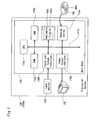
- Fig. 1 is a block diagram of hardware configuration of system according to one embodiment of the invention.
- the system 100 in this embodiment includes a computer 110a mainly composed of a main body 110, a display 120, and an input device 130.
- the main body 110 is mainly composed of CPU 110a, ROM 110b, RAM 110c, hard disk 110d, reading device 110e, input and output interface 110f, communication interface 110g, and image output interface 110h, and the CPU 110a, ROM 110b, RAM 110c, hard disk 110d, reading device 110e, input and output interface 110f, and image output interface 110h are connected so as to exchange data with each other by means of bus 110i.
- the CPU 110a can execute the computer program stored in the ROM 110b, and the computer program loaded in the RAM 110c.
- an application program 140a described below is executed by the CPU 110a, the function blocks described below are realized, and the computer 100a functions as the system 100.
- the ROM 110b comprises mask ROM, PROM, EPROM, EEPROM and the like, and stores the computer program to be executed by the CPU 110a and the data used therefor.
- the RAM 110c comprises SRAM, DRAM and the like.
- the RAM 110c is used in reading of computer program stored in the ROM 110b and hard disk 110d. When executing these computer programs, it is also used as the working area of CPU 110a.
- the hard disk 110d there are installed various computer programs to be executed by the CPU 110a such as operating system and application programs, and data to be used in execution of aforementioned computer programs.
- the application program 140a described below is also installed in this hard disk 110d.
- the reading device 110e comprises flexible disk drive, CD-ROM drive, DVD-ROM drive and the like, and is capable of reading out the computer program or data recorded in a portable recording medium 140.
- the portable recording medium 140 stores the application program 140a for functioning the computer as the system of the invention, and the computer 100a can read out the application program 140a relating to the invention from the portable recording medium 140, to install the application program 140a in the hard disk 110d.
- the aforementioned application program 140a can be presented not only by the portable recording medium 140, but also from an external device connected to the computer 100a to communicate with each other through an electric communication line (wired or wireless).
- the aforementioned application program 140a is stored in the hard disk of server computer on the Internet, and the computer 100a accesses this server computer to download the aforementioned computer program, to install the computer program in the hard disk 110d.
- the operating system for presenting graphical user interface environment such as Windows (registered trademark) of Microsoft Corporation of the United States is installed.
- Windows registered trademark
- the application program 140a of the embodiment operates on this operating system.
- the input and output interface 110f comprises, for example, Parallel interface such as USB, IEEE1394 or RS-232C, parallel interface such as SCSI, IDE or IEEE1284, and analog interface composed of D/A converter and A/D converter.
- An input device 130 having keyboard and mouse is connected to the input and output interface 110f, and the user handles the aforementioned input device 130, and can enter data in the computer 100a.
- the image output interface 110h is connected to a display 120 comprising LCD, CRT and the like and outputs the video signal depending on the image data given from the CPU 110a to the display 120.
- the display 120 shows the image (screen) according to the given video signal.
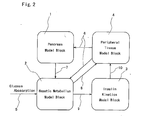
- Fig. 2 is a block diagram of entire configuration of an example of biological model used in the system of the invention.
- the biological model of the system of the invention is composed of a pancreas model block 1, a hepatic metabolism model block 2, an insulin kinetics model block 3, and a peripheral tissue model block 4, and each block has its own input and output. That is, the pancreas model block 1 receives a serum glucose concentration 6, and issues an insulin secretion speed 7.
- the hepatic metabolism model block 2 receives the glucose absorption 5 from digestive tract, serum glucose concentration 6, and insulin secretion speed 7, and issues the net glucose release 8 and posthepatic insulin 9.
- the insulin kinetics model block 3 receives the posthepatic insulin 9, and issues the insulin concentration 10 in peripheral tissues.
- the peripheral tissue model block 4 receives the net glucose release 8 and insulin concentration 10 in peripheral tissues, and issues the serum glucose concentration 6.
- the glucose absorption 5 is the data given from outside, and this function is realized, for example, by the user's input operation of inspection data by using the input device 130.
- These functional blocks 1 to 4 are realized by the computer program 140a executed by the CPU 110a.
- the biological model includes the pancreas model block 1 expressing the pancreatic functions, insulin kinetics model block 3 expressing functions of insulin kinetics, and peripheral tissue model block 4 expressing the functions of peripheral tissues, and when the hepatic metabolism model block 2 is a model of three inputs and two outputs, receiving glucose from digestive tract, blood glucose, and insulin secretion from pancreas model block, and issuing net glucose release from liver and insulin concentration, it includes blocks corresponding to the pancreas, liver, insulin kinetics, and peripheral tissues relating to control of blood glucose as constituent elements.
- these functions are expressed in the unit system equivalent to the measured values, so that a simulation easy to understand the meaning thereof medically can be realized.
- the entire function of biological organs relating to the liver can be simulated, and sugar metabolism in the liver, especially the pathological information about diabetes mellitus can be obtained comprehensively. A proper treatment can be given according to the obtained information.
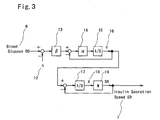
- pancreas model block 1 can be expressed in differential equation (1). It can be also expressed by using a block diagram expressed in Fig. 3, equivalent to differential equation (1).
- the blood glucose 6, an input to the pancreas model block 1, corresponds to BG (t), and insulin secretion speed 7, an output, corresponds to SR (t).
- reference numeral 6 is blood glucose BG (t)
- 7 is insulin secretion speed SR (t) from pancreas
- 12 is threshold h of glucose concentration capable of stimulating insulin supply
- 13 is susceptibility ⁇ to glucose stimulation
- 14 is following performance ⁇ to glucose stimulation
- 15 is integral element
- 16 is insulin supply speed Y (t) newly supplied to glucose stimulation
- 17 is integral element
- 18 is total insulin X (t) that can be secreted from pancreas
- 19 is secretion speed M per unit concentration.
- the input-output relation of hepatic metabolism model block 2 can be expressed in the following differential equation (2). It can be also expressed by using a block diagram expressed in Fig. 4, equivalent to differential equation (2).
- G B f 1 provided F
- Func 1 F G B f 4 ⁇ f 5 • F G B ⁇ f 6 Func 2
- Inputs to hepatic metabolism model block in Fig. 2 that is, glucose absorption 5 from digestive tract corresponds to RG (t), blood glucose 6 to BG (t), and insulin secretion speed 7 to SR (t), respectively.
- Outputs, net glucose release 8 corresponds to SGO (t), and posthepatic insulin 9 to SRpost (t), respectively.
- reference numeral 5 is glucose absorption RG (t) from digestive tract
- 6 is blood glucose BG (t)
- 7 is insulin secretion speed SR (t) from pancreas
- 8 is net glucose SGO (t) from liver
- 9 is posthepatic insulin SRpost (t)
- 24 is insulin passing rate (1-A7) in liver
- 25 is propagation efficiency ⁇ 2 to hepatic insulin
- 26 is posthepatic insulin distribution speed A3
- 27 is integral element
- 28 is hepatic insulin concentration I 4 (t)
- 9 is insulin-dependent hepatic glucose uptake distribution rate (1-r)
- 30 is hepatic glucose uptake speed Kh per unit insulin or unit glucose
- 31 is insulin-independent hepatic glucose uptake distribution rate r
- 32 is hepatic glucose uptake rate Func1 (FGB) to glucose stimulation from digestive tract
- 33 is adjustment term b1 (I 4 (t)) relating to hepatic glucose uptake rate
- 34 is hepati
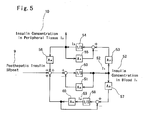
- the input-output relation of insulin kinetics secretion can be expressed in the following differential equation (3). It can be also expressed by using a block diagram expressed in Fig. 5, equivalent to differential equation (3).
- reference numeral 9 is posthepatic insulin SRpost (t)
- 10 is insulin concentration I 3 (t) in peripheral tissues
- 50 is integral element
- 51 is posthepatic insulin distribution speed A 3
- 52 is insulin concentration in blood I 1 (t)
- 53 is insulin distribution rate A 2 to peripheral tissues
- 54 is integral element
- 55 is insulin loss speed A1 in peripheral tissues
- 56 is postperipheral insulin flow-out speed A 4
- 57 is insulin distribution rate A 6 to insulin-independent tissues
- 58 is integral element
- 59 is insulin concentration I 2 (t) in insulin-independent tissues
- 60 is insulin loss speed A 5 in insulin-independent tissues, respectively.
- peripheral tissue model block 4 can be expressed in the following differential equation (4). It can be also expressed by using a block diagram expressed in Fig. 6, equivalent to differential equation (4).
- peripheral tissue model block in Fig. 2 insulin concentration in peripheral tissues 10 corresponds to I 3 (t), and net glucose from liver 8 to SGO (t), and as the output, blood glucose 6 corresponds to BG (t).
- reference numeral 6 is blood glucose BG (t)
- 8 is net glucose SGO (t) from liver
- 10 is insulin concentration I 3 (t) in peripheral tissues
- 70 is insulin-independent glucose consumption speed to basal metabolism u*Goff (FGB)
- 71 is integral element
- 72 is insulin-independent glucose consumption speed Kb in peripheral tissues
- 73 is insulin-dependent glucose consumption speed Kp in peripheral tissues per unit insulin or unit glucose
- 74 is unit conversion constant Ws/DVg.
- the input and output between blocks for constituting the system are mutually connected, and by applying the glucose absorption 5 from the digestive tract, the time-series changes of blood glucose and insulin concentration can be calculated according to the formula and simulated.
- the sequentially calculated blood glucose and insulin concentration can be shown in the display 120.
- This system can be employed as sub-system for simulating the biological functions in the medical system such as diagnostic support system of diabetes mellitus.
- the calculated time-series changes of blood glucose and insulin concentration can be transferred to other constituent elements of the medical support system, and medical information of high reliability such as diagnosis support information for diabetes mellitus can be obtained on the basis of the blood glucose and insulin concentration calculated by this system.
- E-Cell the software laid open by Keio University
- MatLab product of The MathWorks, Inc.
- Table 1 Parameter Value Unit Pancreas h 92.43 [mg/dl] ⁇ 0.228 [1/min] ⁇ 0.357 [( ⁇ U/ml) ⁇ (dl/mg) ⁇ (1/min)] M 1 [1/min] Insulin Kinetics A 1 0.025 [1/min] A 2 0.042 [1/min] A 3 0.435 [1/min] A 4 0.02 [1/min] A 5 0.394 [1/min] A 6 0.142 [1/min] Peripheral Tissues Kb 0.009 [1/min] Kp 5.28E-05 [(ml/ ⁇ U) ⁇ (1/min) ⁇ (dl/kg)] u 0.6 Liver A 7 0.47 Kh 0. 0000462 [(ml/ ⁇ U) ⁇ (1
- Table 2 Initial Value Value Unit Pancreas X(0) 336.4 [ ⁇ U/ml] Y(0) 4.4 [( ⁇ U/ml) ⁇ (1/min)] Insulin Kinetics I 1 (0) 8 [ ⁇ U/ml] I 2 (0) I 1 (0)*(A 2 /A 1 ) [ ⁇ U/ml] I 3 (0) I 1 (0)*(A 6 /A 5 ) [ ⁇ U/ml] I 4 (0) 4 [ ⁇ U/ml] Liver FBG 115 [mg/dl]
- Table 3 Constant Value Unit Function f1 1. 8 [(mg/kg) ⁇ (1/m in) ] f2 0.02 [(dl/kg) ⁇ (1/min)] f3 140 [mg/dl] f4 0. 525 f5 0. 005 [(dl/mg)] f6 80 [mg/dl] f7 13.2 [(ml/ ⁇ U) ⁇ (mg/dl) ⁇ (mg/kg) ⁇ (1/min)] f8 0.9 f9 0. 0001 Reference Ws 70 [kg] DVg 154 [dl] DVi 3.52 [I]
- time-series variations of blood glucose 6 are shown in Fig. 8
- time-series variations of serum insulin concentration 52 are shown in Fig. 9
- time-series variations of hepatic glucose uptake are shown in Fig. 10
- time-series variations of hepatic glucose release are shown in Fig. 11.
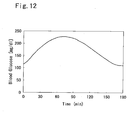
- the blood glucose for reference is given in Fig. 12, and the serum insulin concentration for reference is given in Fig. 13.
- the time-series variations of blood glucose due to glucose absorption, insulin concentration, hepatic glucose uptake, and hepatic glucose release can be reproduced in variations similar to physiological variations.
- the models used in this system include blocks corresponding to pancreas, liver, insulin kinetics and peripheral tissues relating to control of blood glucose as constituent elements, and hence the meaning is easy to understand from the medical aspect.
- the simulation system of the invention uses mathematical models describing the biological functions, and hence can reproduce time-series variations of blood glucose in the body, insulin concentration, hepatic glucose uptake and hepatic glucose release. If measurable status variations of the liver include hepatic glucose uptake and hepatic glucose release in hepatic model block, it is possible to obtain hepatic glucose uptake and hepatic glucose release by simulation which are important hepatic functions closely related to the diabetes mellitus, so that the information relating to pathology of diabetes mellitus can be obtained easily. On the basis of the information relating to the pathology, an appropriate treatment can be given. Besides, since mathematical models include blocks corresponding to pancreas, liver, insulin kinetics and peripheral tissues relating to control of blood glucose as constituent elements, it is useful for simulation of which meaning is easy to understand from the medical aspect.
Landscapes
- Medical Informatics (AREA)
- Engineering & Computer Science (AREA)
- Public Health (AREA)
- Health & Medical Sciences (AREA)
- Pathology (AREA)
- Databases & Information Systems (AREA)
- Data Mining & Analysis (AREA)
- Biomedical Technology (AREA)
- Epidemiology (AREA)
- General Health & Medical Sciences (AREA)
- Primary Health Care (AREA)
- Measurement Of The Respiration, Hearing Ability, Form, And Blood Characteristics Of Living Organisms (AREA)
- Measuring And Recording Apparatus For Diagnosis (AREA)
- Investigating Or Analysing Biological Materials (AREA)
- Management, Administration, Business Operations System, And Electronic Commerce (AREA)
Abstract
Description
- The invention relates to a simulation system for simulating functions of biological organs, in particular, absorption, accumulation and metabolism functions of glucose by organs, and secretion, transportation and operation functions of insulin by organs by using a computer, and a recording medium in which program therefor is recorded.
- To express a composition concentration in a body, in particular, blood glucose level and serum insulin concentration, it has been hitherto attempted to describe by using numerical models from the medical reason represented by diagnosis of diabetes mellitus.
- Usable models include, for example, a minimal model by Bergman (see, for example, Bergman et al., American Journal of Physiology, Vol. 236, No. 6, pp. E-667-77, 1979, or Bergman et al., Journal of Clinical Investigation, Vol. 68, No. 6, pp. 1456-67, 1981).
- This minimal model operates on variables, such as blood glucose level, plasma insulin concentration, and insulin action amount at insulin action point of peripheral tissue, that is, remote insulin. Supposing, at time t, the blood glucose level to be G (t), plasma insulin concentration to be I (t), and remote insulin to be X (t), the values of G (t), I (t), and X (t) are expressed in the following differential equations with the time differential values being taken on the left side.


In these equations, parameters are: - p1:
- insulin-independent glucose metabolism speed
- Gb:
- basal glucose level
- p2:
- insulin uptake capacity at insulin action point
- p3:
- insulin consumption rate to insulin-dependent glucose metabolism
- Ib:
- basal insulin concentration
- n:
- insulin consumption per unit time
- γ:
- insulin secretion sensitivity to glucose stimulation
- h:
- blood glucose threshold to start insulin secretion
- In the human body, by nature, the blood glucose is controlled by mutual relation of four model blocks, that is, the pancreas for secreting insulin depending on stimulation of blood glucose, the liver for uptaking glucose from the blood and discharging glucose into the blood depending on the insulin concentration and blood glucose, the cardiovascular kinetic system for distributing insulin in peripheral tissues, and the peripheral tissues for receiving the action of insulin and metabolizing the glucose. On the other hand, in the above minimal model, constituent elements of models are abstract models not corresponding to four model blocks of the body, and it is hard to consider the simulation results of blood glucose variations and insulin concentration variations in the body in relation to four model blocks of the body.
- Other reproducing techniques for blood glucose include prediction of blood glucose in diabetic patients (see, for example,
Japanese Unexamined Patent Application No. 296598/1999
According to this method, the blood glucose can be predicted, but the status of the organs relating to control of blood glucose cannot be known. - The invention is devised in the light of the above background, and it is hence an object thereof to present a simulation system capable of knowing the hepatic function status (pathology) useful for glycometabolism in the liver, especially treatment of diabetes mellitus, and a recording medium in which program therefor is recorded.
- The simulation system of the invention is a simulation system for simulating functions of biological organs, comprising:
- a biological model in which the functions of the biological organs are expressed by mathematical models,
- The recording medium of the invention is a recording medium for recording a computer program which enables a computer to function as a simulation system of functions of biological organs,
wherein the computer program comprises a program code which operates the computer to function as a hepatic metabolism model block having specified input and output relating to hepatic function, in order to simulate functions of biological organs by using a biological model in which the functions of the biological organs are expressed by mathematical models, and
wherein the program code operates the computer to calculate the output value by using measurable status variables of a liver based on input value to the hepatic metabolism model block. -
- Fig. 1 is a block diagram of hardware configuration of system according to one embodiment of the invention;
- Fig. 2 is a block diagram of entire configuration of an example of biological model used in the system of the invention;
- Fig. 3 is a block diagram of configuration of pancreas model in an example of biological model used in the system of the invention;
- Fig. 4 is a block diagram of configuration of hepatic metabolism model in an example of biological model used in the system of the invention;
- Fig. 5 is a block diagram of configuration of insulin kinetics model in an example of biological model used in the system of the invention;
- Fig. 6 is a block diagram of configuration of peripheral metabolism model in an example of biological model used in the system of the invention;
- Fig. 7 is a graph of glucose absorption speed used as input in an example of the invention;
- Fig. 8 is a graph of blood glucose simulated in an example of the invention;
- Fig. 9 is a graph of serum insulin concentration simulated in an example of the invention;
- Fig. 10 is a graph of hepatic sugar uptake simulated in an example of the invention;
- Fig. 11 is a graph of hepatic sugar release simulated in an example of the invention;
- Fig. 12 is a graph of blood glucose for reference;
- Fig. 13 is a graph of serum insulin concentration for reference; and
- Fig. 14 is a diagram of an overall configuration of an example of biological model used in the invention.
- Referring now to the accompanying drawings, embodiments of the simulation system (hereinafter, also referred to as "system") of the invention are specifically described below.
- Fig. 1 is a block diagram of hardware configuration of system according to one embodiment of the invention. The
system 100 in this embodiment includes acomputer 110a mainly composed of amain body 110, adisplay 120, and aninput device 130. Themain body 110 is mainly composed ofCPU 110a,ROM 110b,RAM 110c,hard disk 110d,reading device 110e, input andoutput interface 110f, communication interface 110g, andimage output interface 110h, and theCPU 110a,ROM 110b,RAM 110c,hard disk 110d,reading device 110e, input andoutput interface 110f, andimage output interface 110h are connected so as to exchange data with each other by means ofbus 110i. - The
CPU 110a can execute the computer program stored in theROM 110b, and the computer program loaded in theRAM 110c. When anapplication program 140a described below is executed by theCPU 110a, the function blocks described below are realized, and thecomputer 100a functions as thesystem 100. - The
ROM 110b comprises mask ROM, PROM, EPROM, EEPROM and the like, and stores the computer program to be executed by theCPU 110a and the data used therefor. - The
RAM 110c comprises SRAM, DRAM and the like. TheRAM 110c is used in reading of computer program stored in theROM 110b andhard disk 110d. When executing these computer programs, it is also used as the working area ofCPU 110a. - In the
hard disk 110d, there are installed various computer programs to be executed by theCPU 110a such as operating system and application programs, and data to be used in execution of aforementioned computer programs. Theapplication program 140a described below is also installed in thishard disk 110d. - The
reading device 110e comprises flexible disk drive, CD-ROM drive, DVD-ROM drive and the like, and is capable of reading out the computer program or data recorded in aportable recording medium 140. Theportable recording medium 140 stores theapplication program 140a for functioning the computer as the system of the invention, and thecomputer 100a can read out theapplication program 140a relating to the invention from theportable recording medium 140, to install theapplication program 140a in thehard disk 110d. - The
aforementioned application program 140a can be presented not only by theportable recording medium 140, but also from an external device connected to thecomputer 100a to communicate with each other through an electric communication line (wired or wireless). For example, theaforementioned application program 140a is stored in the hard disk of server computer on the Internet, and thecomputer 100a accesses this server computer to download the aforementioned computer program, to install the computer program in thehard disk 110d. - In the
hard disk 110d, the operating system for presenting graphical user interface environment such as Windows (registered trademark) of Microsoft Corporation of the United States is installed. In the following explanation, it is supposed that theapplication program 140a of the embodiment operates on this operating system. - The input and
output interface 110f comprises, for example, Parallel interface such as USB, IEEE1394 or RS-232C, parallel interface such as SCSI, IDE or IEEE1284, and analog interface composed of D/A converter and A/D converter. Aninput device 130 having keyboard and mouse is connected to the input andoutput interface 110f, and the user handles theaforementioned input device 130, and can enter data in thecomputer 100a. - The
image output interface 110h is connected to adisplay 120 comprising LCD, CRT and the like and outputs the video signal depending on the image data given from theCPU 110a to thedisplay 120. Thedisplay 120 shows the image (screen) according to the given video signal. - Fig. 2 is a block diagram of entire configuration of an example of biological model used in the system of the invention. As shown in Fig. 2, the biological model of the system of the invention is composed of a
pancreas model block 1, a hepaticmetabolism model block 2, an insulinkinetics model block 3, and a peripheraltissue model block 4, and each block has its own input and output. That is, thepancreas model block 1 receives aserum glucose concentration 6, and issues aninsulin secretion speed 7. The hepaticmetabolism model block 2 receives theglucose absorption 5 from digestive tract,serum glucose concentration 6, andinsulin secretion speed 7, and issues thenet glucose release 8 andposthepatic insulin 9. The insulinkinetics model block 3 receives theposthepatic insulin 9, and issues theinsulin concentration 10 in peripheral tissues. The peripheraltissue model block 4 receives thenet glucose release 8 andinsulin concentration 10 in peripheral tissues, and issues theserum glucose concentration 6. Theglucose absorption 5 is the data given from outside, and this function is realized, for example, by the user's input operation of inspection data by using theinput device 130. Thesefunctional blocks 1 to 4 are realized by thecomputer program 140a executed by theCPU 110a. - In the system of the invention, since output values are issued by using status variables that can be measured by the hepatic metabolism model block for simulating the function of the liver, by comparing the simulation results with the actually measured status variables, parameters of mathematical model for expressing the hepatic functions can be optimized. As a result, a model expressing the hepatic functions closely is realized, and hepatic functions relating to pathology of the liver can be simulated accurately.
- Together with the hepatic
metabolism model block 2, the biological model includes thepancreas model block 1 expressing the pancreatic functions, insulinkinetics model block 3 expressing functions of insulin kinetics, and peripheraltissue model block 4 expressing the functions of peripheral tissues, and when the hepaticmetabolism model block 2 is a model of three inputs and two outputs, receiving glucose from digestive tract, blood glucose, and insulin secretion from pancreas model block, and issuing net glucose release from liver and insulin concentration, it includes blocks corresponding to the pancreas, liver, insulin kinetics, and peripheral tissues relating to control of blood glucose as constituent elements. Thus, these functions are expressed in the unit system equivalent to the measured values, so that a simulation easy to understand the meaning thereof medically can be realized. At the same time, the entire function of biological organs relating to the liver can be simulated, and sugar metabolism in the liver, especially the pathological information about diabetes mellitus can be obtained comprehensively. A proper treatment can be given according to the obtained information. - The detail of each block mentioned above is discussed below. Herein, FGB and Ws respectively represent the fasting blood glucose (FGB = BG (0)) and the assumed body weight, and DVg and DVi are distribution volume to glucose and distribution volume to insulin.
- The input-output relation of
pancreas model block 1 can be expressed in differential equation (1). It can be also expressed by using a block diagram expressed in Fig. 3, equivalent to differential equation (1).
Variables: - BG (t): blood glucose
- X (t): total insulin that can be secreted from pancreas
- Y (t): insulin supply speed newly supplied to glucose stimulation
- SR (t): insulin secretion speed from pancreas
- h: threshold of glucose concentration capable of stimulating insulin supply
- α: following performance to glucose stimulation
- β: sensitivity to glucose stimulation
- M: secretion speed per unit concentration
- In Fig. 2, the
blood glucose 6, an input to thepancreas model block 1, corresponds to BG (t), andinsulin secretion speed 7, an output, corresponds to SR (t). - In the block diagram in Fig. 3,
reference numeral 6 is blood glucose BG (t), 7 is insulin secretion speed SR (t) from pancreas, 12 is threshold h of glucose concentration capable of stimulating insulin supply, 13 is susceptibility β to glucose stimulation, 14 is following performance α to glucose stimulation, 15 is integral element, 16 is insulin supply speed Y (t) newly supplied to glucose stimulation, 17 is integral element, 18 is total insulin X (t) that can be secreted from pancreas, and 19 is secretion speed M per unit concentration. - The input-output relation of hepatic
metabolism model block 2 can be expressed in the following differential equation (2). It can be also expressed by using a block diagram expressed in Fig. 4, equivalent to differential equation (2).

Variables: - BG (t): blood glucose
- SR (t): insulin secretion speed from pancreas
- SRpost (t): posthepatic insulin
- RG (t): glucose absorption from digestive tract
- HGP (t): hepatic glucose release
- HGU (t): hepatic glucose uptake
- SGO (t): net glucose from liver
- I4 (t): liver insulin concentration
- Kh: hepatic glucose uptake speed per unit insulin or per unit glucose
- A7: insulin uptake rate in liver
- Goff: glucose release speed to basal metabolism
- b2: adjustment term relating to hepatic glucose release suppression rate
- r: insulin-independent hepatic glucose uptake distribution rate
- α2: propagation efficiency to hepatic insulin
- I4off: threshold of insulin concentration suppressing hepatic glucose release
- Goff (FGB): glucose release speed to basal metabolism
- Func1 (FGB): hepatic glucose uptake rate to glucose stimulation from digestive tract
- Func2 (FGB): hepatic glucose release suppression rate to insulin stimulation
- f1 to f9: constants used in expression of three elements above
- b1 (I4 (t)): adjustment term relating to hepatic glucose uptake rate
- Inputs to hepatic metabolism model block in Fig. 2, that is,
glucose absorption 5 from digestive tract corresponds to RG (t),blood glucose 6 to BG (t), andinsulin secretion speed 7 to SR (t), respectively. Outputs,net glucose release 8 corresponds to SGO (t), andposthepatic insulin 9 to SRpost (t), respectively. - In the block diagram in Fig. 4, reference numeral 5 is glucose absorption RG (t) from digestive tract, 6 is blood glucose BG (t), 7 is insulin secretion speed SR (t) from pancreas, 8 is net glucose SGO (t) from liver, 9 is posthepatic insulin SRpost (t), 24 is insulin passing rate (1-A7) in liver, 25 is propagation efficiency α 2 to hepatic insulin, 26 is posthepatic insulin distribution speed A3, 27 is integral element, 28 is hepatic insulin concentration I4 (t), 9 is insulin-dependent hepatic glucose uptake distribution rate (1-r), 30 is hepatic glucose uptake speed Kh per unit insulin or unit glucose, 31 is insulin-independent hepatic glucose uptake distribution rate r, 32 is hepatic glucose uptake rate Func1 (FGB) to glucose stimulation from digestive tract, 33 is adjustment term b1 (I4 (t)) relating to hepatic glucose uptake rate, 34 is hepatic glucose uptake HGU (t), 35 is threshold of insulin concentration I4off suppressing hepatic glucose release, 36 is hepatic glucose release suppression rate Func2 (FGB) to insulin stimulation, 37 is adjustment term b2 relating to hepatic glucose release suppression rate, 38 is glucose release speed to basal metabolism, 39 is hepatic glucose release HGP (t), and 40 is insulin uptake rate A7 in liver, respectively.
- The input-output relation of insulin kinetics secretion can be expressed in the following differential equation (3). It can be also expressed by using a block diagram expressed in Fig. 5, equivalent to differential equation (3).

Variables: - SRpost (t): posthepatic insulin
- I1 (t) insulin concentration in blood
- I2 (t) : insulin concentration in insulin-independent tissues
- I3 (t): insulin concentration in peripheral tissues
- A1: insulin loss speed in peripheral tissues
- A2: insulin distribution rate to peripheral tissues
- A3: posthepatic insulin distribution speed
- A4: postperipheral insulin flow-out speed
- A5: insulin loss speed in insulin-independent tissues
- A6: insulin distribution rate in insulin-independent tissues
- As the input to the insulin kinetics model block in Fig. 2,
posthepatic insulin 9 corresponds to SRpost (t), and as the output,insulin concentration 10 in peripheral tissues corresponds to I3 (t). - In the block diagram in Fig. 5,
reference numeral 9 is posthepatic insulin SRpost (t), 10 is insulin concentration I3 (t) in peripheral tissues, 50 is integral element, 51 is posthepatic insulin distribution speed A3, 52 is insulin concentration in blood I1 (t), 53 is insulin distribution rate A2 to peripheral tissues, 54 is integral element, 55 is insulin loss speed A1 in peripheral tissues, 56 is postperipheral insulin flow-out speed A4, 57 is insulin distribution rate A6 to insulin-independent tissues, 58 is integral element, 59 is insulin concentration I2 (t) in insulin-independent tissues, and 60 is insulin loss speed A5 in insulin-independent tissues, respectively. - The input-output relation of peripheral
tissue model block 4 can be expressed in the following differential equation (4). It can be also expressed by using a block diagram expressed in Fig. 6, equivalent to differential equation (4).
Variables: - BG' (t): blood glucose (provided BG [mg/dl], BG' [mg/kg])
- SGO (t): net glucose from liver
- I3 (t): insulin concentration in peripheral tissues
- Kb: insulin-independent glucose consumption speed in peripheral tissues
- Kp: insulin-dependent glucose consumption speed in peripheral tissues per unit insulin or unit glucose
- u: rate occupied by insulin-independent glucose consumption to basal metabolism, in glucose release speed to basal metabolism Functions:
- Goff (FGB): glucose release speed to basal metabolism
- f1 to f3: constants used in expression of Goff
- As the inputs to the peripheral tissue model block in Fig. 2, insulin concentration in
peripheral tissues 10 corresponds to I3 (t), and net glucose fromliver 8 to SGO (t), and as the output,blood glucose 6 corresponds to BG (t). - In the block diagram in Fig. 6,
reference numeral 6 is blood glucose BG (t), 8 is net glucose SGO (t) from liver, 10 is insulin concentration I3 (t) in peripheral tissues, 70 is insulin-independent glucose consumption speed to basal metabolism u*Goff (FGB), 71 is integral element, 72 is insulin-independent glucose consumption speed Kb in peripheral tissues, 73 is insulin-dependent glucose consumption speed Kp in peripheral tissues per unit insulin or unit glucose, and 74 is unit conversion constant Ws/DVg. - As shown in Fig. 2, the input and output between blocks for constituting the system are mutually connected, and by applying the
glucose absorption 5 from the digestive tract, the time-series changes of blood glucose and insulin concentration can be calculated according to the formula and simulated. - The sequentially calculated blood glucose and insulin concentration can be shown in the
display 120. As a result, the user can easily recognize the result simulating the biological organs. This system can be employed as sub-system for simulating the biological functions in the medical system such as diagnostic support system of diabetes mellitus. In this case, the calculated time-series changes of blood glucose and insulin concentration can be transferred to other constituent elements of the medical support system, and medical information of high reliability such as diagnosis support information for diabetes mellitus can be obtained on the basis of the blood glucose and insulin concentration calculated by this system. - For calculation of differential equation in this system, for example, E-Cell (the software laid open by Keio University) or MatLab (product of The MathWorks, Inc.) may be used, but other computation systems may be alternatively used.
- The following is the simulated example of time-series changes of blood glucose, insulin concentration, hepatic glucose uptake and hepatic glucose release measured by using the system of the invention. In this example, values shown in Table 1 are used as parameters of blocks.
Table 1 Parameter Value Unit Pancreas h 92.43 [mg/dl] α 0.228 [1/min] β 0.357 [(µU/ml) · (dl/mg) · (1/min)] M 1 [1/min] Insulin Kinetics A1 0.025 [1/min] A2 0.042 [1/min] A3 0.435 [1/min] A4 0.02 [1/min] A5 0.394 [1/min] A6 0.142 [1/min] Peripheral Tissues Kb 0.009 [1/min] Kp 5.28E-05 [(ml/µU) · (1/min) · (dl/kg)] u 0.6 Liver A7 0.47 Kh 0. 0000462 [(ml/µU) · (1/min) · (dl/kg)] b2 1.1 r 0.98 α2 0.228 I4off 5 [µU/ml] - For calculating the differential equations, values in Table 2 are used as examples of initial values of variables.
Table 2 Initial Value Value Unit Pancreas X(0) 336.4 [µU/ml] Y(0) 4.4 [(µU/ml) · (1/min)] Insulin Kinetics I1(0) 8 [µU/ml] I2(0) I1(0)*(A2/A1) [µU/ml] I3(0) I1(0)*(A6/A5) [µU/ml] I4(0) 4 [µU/ml] Liver FBG 115 [mg/dl] - As examples of constants and reference values used in these examples, the values in Table 3 are used.
Table 3 Constant Value Unit Function f1 1. 8 [(mg/kg) · (1/m in) ] f2 0.02 [(dl/kg) · (1/min)] f3 140 [mg/dl] f4 0. 525 f5 0. 005 [(dl/mg)] f6 80 [mg/dl] f7 13.2 [(ml/µU) · (mg/dl) · (mg/kg) · (1/min)] f8 0.9 f9 0. 0001 Reference Ws 70 [kg] DVg 154 [dl] DVi 3.52 [I] - As the glucose absorption speed from digestive tract, the value shown in Fig. 7 is used.
- Among the simulation results in the above condition, the time-series variations of
blood glucose 6 are shown in Fig. 8, time-series variations ofserum insulin concentration 52 are shown in Fig. 9, time-series variations of hepatic glucose uptake are shown in Fig. 10, and time-series variations of hepatic glucose release are shown in Fig. 11. The blood glucose for reference is given in Fig. 12, and the serum insulin concentration for reference is given in Fig. 13. - Thus, by using this system, the time-series variations of blood glucose due to glucose absorption, insulin concentration, hepatic glucose uptake, and hepatic glucose release can be reproduced in variations similar to physiological variations. The models used in this system include blocks corresponding to pancreas, liver, insulin kinetics and peripheral tissues relating to control of blood glucose as constituent elements, and hence the meaning is easy to understand from the medical aspect.
- The simulation system of the invention uses mathematical models describing the biological functions, and hence can reproduce time-series variations of blood glucose in the body, insulin concentration, hepatic glucose uptake and hepatic glucose release. If measurable status variations of the liver include hepatic glucose uptake and hepatic glucose release in hepatic model block, it is possible to obtain hepatic glucose uptake and hepatic glucose release by simulation which are important hepatic functions closely related to the diabetes mellitus, so that the information relating to pathology of diabetes mellitus can be obtained easily. On the basis of the information relating to the pathology, an appropriate treatment can be given. Besides, since mathematical models include blocks corresponding to pancreas, liver, insulin kinetics and peripheral tissues relating to control of blood glucose as constituent elements, it is useful for simulation of which meaning is easy to understand from the medical aspect.
wherein the system further comprises arithmetic means for calculating an output value by using measurable status variables of a liver based on input value to the hepatic metabolism model block.
Claims (12)
- A simulation system for simulating functions of biological organs, comprising:a biological model in which the functions of the biological organs are expressed by mathematical models,wherein the biological model comprises a hepatic metabolism model block having specified input and output relating to hepatic function for simulating the hepatic function, and
wherein the system comprises arithmetic means for calculating an output value by using measurable status variables of the liver on the basis of an input value to the hepatic metabolism model block. - The simulation system of claim 1, wherein the biological model expresses the functions of glucose absorption, accumulation and metabolism.
- The simulation system of claim 1 or 2, wherein the biological model expresses the functions of insulin secretion, transportation, and action.
- The simulation system of any one of claims 1 to 3, wherein the status variables comprise the hepatic glucose uptake and hepatic glucose release in the hepatic metabolism model block.
- The simulation system of any one of claims 1 to 4, wherein the biological model comprises at least one of pancreas model block expressing the pancreatic functions, insulin kinetics model block expressing functions of insulin kinetics, and peripheral tissue model block expressing the functions of peripheral tissues.
- The simulation system of any one of claims 1 to 4, wherein the biological model block further comprises pancreas model block expressing the pancreatic functions, insulin kinetics model block expressing functions of insulin kinetics, and peripheral tissue model block expressing the functions of peripheral tissues, and the hepatic metabolism model block is a model of three inputs and two outputs, receiving glucose from digestive tract, blood glucose, and insulin secretion from pancreas model block, and issuing net glucose release from liver and insulin concentration.
- A recording medium for recording a computer program which enables a computer to function as a simulation system of functions of biological organs,
wherein the computer program comprises a program code which operates the computer to function as a hepatic metabolism model block having specified input and output relating to hepatic function, in order to simulate functions of biological organs by using a biological model in which the functions of the biological organs are expressed by mathematical models, and
wherein the program code operates the computer to calculate the output value by using measurable status variables of a liver based on input value to the hepatic metabolism model block. - The recording medium of claim 7, wherein the biological model expresses the functions of glucose absorption, accumulation and metabolism.
- The recording medium of claim 7 or 8, wherein the biological model expresses the functions of insulin secretion, transportation, and action.
- The recording medium of any one of claims 7 to 9, wherein the status variables comprise the hepatic glucose uptake and hepatic glucose release in the hepatic metabolism model block.
- The recording medium of any one of claims 7 to 10, wherein the biological model comprises at least one of pancreas model block expressing the pancreatic functions, insulin kinetics model block expressing functions of insulin kinetics, and peripheral tissue model block expressing the functions of peripheral tissues.
- The recording medium of any one of claims 7 to 10, wherein the biological model block further comprises pancreas model block expressing the pancreatic functions, insulin kinetics model block expressing functions of insulin kinetics, and peripheral tissue model block expressing the functions of peripheral tissues, and the hepatic metabolism model block is a model of three inputs and two outputs, receiving glucose from digestive tract, blood glucose, and insulin secretion from pancreas model block, and issuing net glucose release from liver and insulin concentration.
Applications Claiming Priority (1)
| Application Number | Priority Date | Filing Date | Title |
|---|---|---|---|
| JP2005136182A JP2006313481A (en) | 2005-05-09 | 2005-05-09 | Function simulation system for organ of organism, and program therefor |
Publications (1)
| Publication Number | Publication Date |
|---|---|
| EP1722311A1 true EP1722311A1 (en) | 2006-11-15 |
Family
ID=36617291
Family Applications (1)
| Application Number | Title | Priority Date | Filing Date |
|---|---|---|---|
| EP06009333A Withdrawn EP1722311A1 (en) | 2005-05-09 | 2006-05-05 | Simulation system for functions of biological organs and recording medium in which program therefor is recorded |
Country Status (4)
| Country | Link |
|---|---|
| US (1) | US20060277015A1 (en) |
| EP (1) | EP1722311A1 (en) |
| JP (1) | JP2006313481A (en) |
| CN (1) | CN100559380C (en) |
Cited By (1)
| Publication number | Priority date | Publication date | Assignee | Title |
|---|---|---|---|---|
| WO2016160207A1 (en) * | 2015-03-28 | 2016-10-06 | Intel Corporation | Technologies for manufacturing an engineered bio-system |
Families Citing this family (2)
| Publication number | Priority date | Publication date | Assignee | Title |
|---|---|---|---|---|
| JP4918285B2 (en) * | 2006-05-24 | 2012-04-18 | シスメックス株式会社 | Biological organ function simulation system and program thereof |
| JP5388564B2 (en) | 2008-12-22 | 2014-01-15 | シスメックス株式会社 | Diabetes care support system, computer program, and recording medium |
Citations (3)
| Publication number | Priority date | Publication date | Assignee | Title |
|---|---|---|---|---|
| WO2002087506A2 (en) * | 2001-05-02 | 2002-11-07 | Entelos, Inc. | Method and apparatus for computer modeling diabetes |
| US20050071141A1 (en) * | 2001-09-06 | 2005-03-31 | Richard Butler | Modelling metabolic systems |
| EP1598766A2 (en) * | 2004-05-11 | 2005-11-23 | Sysmex Corporation | Simulation system for simulating material concentration in a living body and storage medium |
Family Cites Families (3)
| Publication number | Priority date | Publication date | Assignee | Title |
|---|---|---|---|---|
| FI112545B (en) * | 1997-05-30 | 2003-12-15 | Nokia Corp | Method and system for predicting the level of a glycosylated hemoglobin component in a patient's blood |
| JPH11296598A (en) * | 1998-04-07 | 1999-10-29 | Seizaburo Arita | System and method for predicting blood-sugar level and record medium where same method is recorded |
| JP4289869B2 (en) * | 2002-11-06 | 2009-07-01 | シスメックス株式会社 | Diabetes diagnosis support system |
-
2005
- 2005-05-09 JP JP2005136182A patent/JP2006313481A/en active Pending
-
2006
- 2006-05-05 EP EP06009333A patent/EP1722311A1/en not_active Withdrawn
- 2006-05-09 CN CNB2006100803250A patent/CN100559380C/en not_active Expired - Fee Related
- 2006-05-09 US US11/430,557 patent/US20060277015A1/en not_active Abandoned
Patent Citations (3)
| Publication number | Priority date | Publication date | Assignee | Title |
|---|---|---|---|---|
| WO2002087506A2 (en) * | 2001-05-02 | 2002-11-07 | Entelos, Inc. | Method and apparatus for computer modeling diabetes |
| US20050071141A1 (en) * | 2001-09-06 | 2005-03-31 | Richard Butler | Modelling metabolic systems |
| EP1598766A2 (en) * | 2004-05-11 | 2005-11-23 | Sysmex Corporation | Simulation system for simulating material concentration in a living body and storage medium |
Non-Patent Citations (2)
| Title |
|---|
| ERZEN F C ET AL: "Glucosim: a simulator for education on the dynamics of diabetes mellitus", PROCEEDINGS OF THE 23RD. ANNUAL INTERNATIONAL CONFERENCE OF THE IEEE ENGINEERING IN MEDICINE AND BIOLOGY SOCIETY. 2001 CONFERENCE PROCEEDINGS. (EMBS). INSTANBUL, TURKEY, OCT. 25 - 28, 2001, ANNUAL INTERNATIONAL CONFERENCE OF THE IEEE ENGINEERING IN M, vol. VOL. 1 OF 4. CONF. 23, 25 October 2001 (2001-10-25), pages 3163 - 3166, XP010593771, ISBN: 0-7803-7211-5 * |
| SANO A, NAITO Y, OHNO H, NAKAJIMA H & TOMITA M: "A Simulation Model of Cardiovascular System for Diabetes Pathophysiological Model Using E-Cell System", PROCEEDINGS OF THE INTERNATIONAL CONFERENCE ON GENOME INFORMATICS, UNIVERSAL ACADEMY PRESS,TOKYO, 2002, vol. 13, 16 December 2002 (2002-12-16) - 18 December 2002 (2002-12-18), pages 480 - 481, XP002389543 * |
Cited By (1)
| Publication number | Priority date | Publication date | Assignee | Title |
|---|---|---|---|---|
| WO2016160207A1 (en) * | 2015-03-28 | 2016-10-06 | Intel Corporation | Technologies for manufacturing an engineered bio-system |
Also Published As
| Publication number | Publication date |
|---|---|
| CN1862552A (en) | 2006-11-15 |
| CN100559380C (en) | 2009-11-11 |
| JP2006313481A (en) | 2006-11-16 |
| US20060277015A1 (en) | 2006-12-07 |
Similar Documents
| Publication | Publication Date | Title |
|---|---|---|
| US8073629B2 (en) | Simulation system of function of biological organ | |
| US8793144B2 (en) | Treatment effect prediction system, a treatment effect prediction method, and a computer program product thereof | |
| Lehmann et al. | Application of computers in diabetes carea review. I. Computers for data collection and interpretation | |
| EP2203112B1 (en) | Method, system and computer simulation environment for testing of monitoring and control strategies in diabetes | |
| US20090177453A1 (en) | Medical diagnosis support computer system, computer program, and server computer | |
| EP1580682A2 (en) | Diagnostic support system for diabetes and storage medium | |
| US20080288228A1 (en) | Biological simulation system and computer program product | |
| EP2223248A1 (en) | Simulating patient-specific outcomes | |
| US20120130698A1 (en) | System, Method and Computer Simulation Environment For In Silico Trials in Pre-Diabetes and Type 2 Diabetes | |
| EP1859731B1 (en) | Biological response prediction system, method for predicting biological response and computer program product | |
| US20070118347A1 (en) | Medical simulation system and computer program product | |
| JP4901226B2 (en) | Medical simulation system and computer program thereof | |
| JP5102439B2 (en) | Simulation system and computer program | |
| CN101763464B (en) | Treatment of diabetes assisting system | |
| Wadehn et al. | A multiscale, model-based analysis of the multi-tissue interplay underlying blood glucose regulation in type I diabetes | |
| Portela et al. | Intelligent data acquisition and scoring system for intensive medicine | |
| US20060277015A1 (en) | Simulation system for functions of biological organs and recording medium in which program therefor is recorded | |
| US20050256690A1 (en) | Simulation system for simulating material concentration in a living body and storage medium | |
| García-Jaramillo et al. | Insulin dosage optimization based on prediction of postprandial glucose excursions under uncertain parameters and food intake | |
| Imamović et al. | Modelling and simulation of blood glucose dynamics | |
| Caraballo et al. | Trustworthiness of a machine learning early warning model in medical and surgical inpatients | |
| US20070179771A1 (en) | Medical simulation system, computer system and computer program product | |
| Ntritsos et al. | Impact of polygenic risk score (PRS) for coronary artery disease on physician decision-making and patient care | |
| Frary | Sex-and age-related differences in the long-term cardiovascular predictive value of circulating biomarkers and arterial stiffness assessed by pulse wave velocity in apparently healthy individuals from the MONI10 cohort | |
| JP2007272427A (en) | Artificial test computer system for living body, computer program thereof, and artificial test method of living body |
Legal Events
| Date | Code | Title | Description |
|---|---|---|---|
| PUAI | Public reference made under article 153(3) epc to a published international application that has entered the european phase |
Free format text: ORIGINAL CODE: 0009012 |
|
| AK | Designated contracting states |
Kind code of ref document: A1 Designated state(s): AT BE BG CH CY CZ DE DK EE ES FI FR GB GR HU IE IS IT LI LT LU LV MC NL PL PT RO SE SI SK TR |
|
| AX | Request for extension of the european patent |
Extension state: AL BA HR MK YU |
|
| 17P | Request for examination filed |
Effective date: 20070418 |
|
| AKX | Designation fees paid |
Designated state(s): AT BE BG CH CY CZ DE DK EE ES FI FR GB GR HU IE IS IT LI LT LU LV MC NL PL PT RO SE SI SK TR |
|
| 17Q | First examination report despatched |
Effective date: 20070808 |
|
| STAA | Information on the status of an ep patent application or granted ep patent |
Free format text: STATUS: THE APPLICATION IS DEEMED TO BE WITHDRAWN |
|
| 18D | Application deemed to be withdrawn |
Effective date: 20111201 |