EP1715542A1 - Polymer electrolyte for a lithium secondary battery - Google Patents
Polymer electrolyte for a lithium secondary battery Download PDFInfo
- Publication number
- EP1715542A1 EP1715542A1 EP06112896A EP06112896A EP1715542A1 EP 1715542 A1 EP1715542 A1 EP 1715542A1 EP 06112896 A EP06112896 A EP 06112896A EP 06112896 A EP06112896 A EP 06112896A EP 1715542 A1 EP1715542 A1 EP 1715542A1
- Authority
- EP
- European Patent Office
- Prior art keywords
- polymer electrolyte
- group
- groups
- secondary battery
- lithium secondary
- Prior art date
- Legal status (The legal status is an assumption and is not a legal conclusion. Google has not performed a legal analysis and makes no representation as to the accuracy of the status listed.)
- Granted
Links
Images

Classifications
-
- H—ELECTRICITY
- H01—ELECTRIC ELEMENTS
- H01M—PROCESSES OR MEANS, e.g. BATTERIES, FOR THE DIRECT CONVERSION OF CHEMICAL ENERGY INTO ELECTRICAL ENERGY
- H01M4/00—Electrodes
- H01M4/02—Electrodes composed of, or comprising, active material
-
- H—ELECTRICITY
- H01—ELECTRIC ELEMENTS
- H01M—PROCESSES OR MEANS, e.g. BATTERIES, FOR THE DIRECT CONVERSION OF CHEMICAL ENERGY INTO ELECTRICAL ENERGY
- H01M10/00—Secondary cells; Manufacture thereof
- H01M10/05—Accumulators with non-aqueous electrolyte
- H01M10/056—Accumulators with non-aqueous electrolyte characterised by the materials used as electrolytes, e.g. mixed inorganic/organic electrolytes
- H01M10/0564—Accumulators with non-aqueous electrolyte characterised by the materials used as electrolytes, e.g. mixed inorganic/organic electrolytes the electrolyte being constituted of organic materials only
- H01M10/0565—Polymeric materials, e.g. gel-type or solid-type
-
- C—CHEMISTRY; METALLURGY
- C08—ORGANIC MACROMOLECULAR COMPOUNDS; THEIR PREPARATION OR CHEMICAL WORKING-UP; COMPOSITIONS BASED THEREON
- C08G—MACROMOLECULAR COMPOUNDS OBTAINED OTHERWISE THAN BY REACTIONS ONLY INVOLVING UNSATURATED CARBON-TO-CARBON BONDS
- C08G63/00—Macromolecular compounds obtained by reactions forming a carboxylic ester link in the main chain of the macromolecule
- C08G63/02—Polyesters derived from hydroxycarboxylic acids or from polycarboxylic acids and polyhydroxy compounds
- C08G63/12—Polyesters derived from hydroxycarboxylic acids or from polycarboxylic acids and polyhydroxy compounds derived from polycarboxylic acids and polyhydroxy compounds
- C08G63/16—Dicarboxylic acids and dihydroxy compounds
- C08G63/20—Polyesters having been prepared in the presence of compounds having one reactive group or more than two reactive groups
- C08G63/21—Polyesters having been prepared in the presence of compounds having one reactive group or more than two reactive groups in the presence of unsaturated monocarboxylic acids or unsaturated monohydric alcohols or reactive derivatives thereof
-
- C—CHEMISTRY; METALLURGY
- C08—ORGANIC MACROMOLECULAR COMPOUNDS; THEIR PREPARATION OR CHEMICAL WORKING-UP; COMPOSITIONS BASED THEREON
- C08G—MACROMOLECULAR COMPOUNDS OBTAINED OTHERWISE THAN BY REACTIONS ONLY INVOLVING UNSATURATED CARBON-TO-CARBON BONDS
- C08G63/00—Macromolecular compounds obtained by reactions forming a carboxylic ester link in the main chain of the macromolecule
- C08G63/91—Polymers modified by chemical after-treatment
-
- H—ELECTRICITY
- H01—ELECTRIC ELEMENTS
- H01M—PROCESSES OR MEANS, e.g. BATTERIES, FOR THE DIRECT CONVERSION OF CHEMICAL ENERGY INTO ELECTRICAL ENERGY
- H01M10/00—Secondary cells; Manufacture thereof
- H01M10/05—Accumulators with non-aqueous electrolyte
-
- H—ELECTRICITY
- H01—ELECTRIC ELEMENTS
- H01M—PROCESSES OR MEANS, e.g. BATTERIES, FOR THE DIRECT CONVERSION OF CHEMICAL ENERGY INTO ELECTRICAL ENERGY
- H01M10/00—Secondary cells; Manufacture thereof
- H01M10/05—Accumulators with non-aqueous electrolyte
- H01M10/052—Li-accumulators
- H01M10/0525—Rocking-chair batteries, i.e. batteries with lithium insertion or intercalation in both electrodes; Lithium-ion batteries
-
- H—ELECTRICITY
- H01—ELECTRIC ELEMENTS
- H01M—PROCESSES OR MEANS, e.g. BATTERIES, FOR THE DIRECT CONVERSION OF CHEMICAL ENERGY INTO ELECTRICAL ENERGY
- H01M2300/00—Electrolytes
- H01M2300/0017—Non-aqueous electrolytes
- H01M2300/0065—Solid electrolytes
- H01M2300/0082—Organic polymers
-
- H—ELECTRICITY
- H01—ELECTRIC ELEMENTS
- H01M—PROCESSES OR MEANS, e.g. BATTERIES, FOR THE DIRECT CONVERSION OF CHEMICAL ENERGY INTO ELECTRICAL ENERGY
- H01M4/00—Electrodes
- H01M4/02—Electrodes composed of, or comprising, active material
- H01M4/13—Electrodes for accumulators with non-aqueous electrolyte, e.g. for lithium-accumulators; Processes of manufacture thereof
- H01M4/131—Electrodes based on mixed oxides or hydroxides, or on mixtures of oxides or hydroxides, e.g. LiCoOx
-
- H—ELECTRICITY
- H01—ELECTRIC ELEMENTS
- H01M—PROCESSES OR MEANS, e.g. BATTERIES, FOR THE DIRECT CONVERSION OF CHEMICAL ENERGY INTO ELECTRICAL ENERGY
- H01M4/00—Electrodes
- H01M4/02—Electrodes composed of, or comprising, active material
- H01M4/13—Electrodes for accumulators with non-aqueous electrolyte, e.g. for lithium-accumulators; Processes of manufacture thereof
- H01M4/133—Electrodes based on carbonaceous material, e.g. graphite-intercalation compounds or CFx
-
- H—ELECTRICITY
- H01—ELECTRIC ELEMENTS
- H01M—PROCESSES OR MEANS, e.g. BATTERIES, FOR THE DIRECT CONVERSION OF CHEMICAL ENERGY INTO ELECTRICAL ENERGY
- H01M4/00—Electrodes
- H01M4/02—Electrodes composed of, or comprising, active material
- H01M4/36—Selection of substances as active materials, active masses, active liquids
- H01M4/48—Selection of substances as active materials, active masses, active liquids of inorganic oxides or hydroxides
- H01M4/52—Selection of substances as active materials, active masses, active liquids of inorganic oxides or hydroxides of nickel, cobalt or iron
- H01M4/525—Selection of substances as active materials, active masses, active liquids of inorganic oxides or hydroxides of nickel, cobalt or iron of mixed oxides or hydroxides containing iron, cobalt or nickel for inserting or intercalating light metals, e.g. LiNiO2, LiCoO2 or LiCoOxFy
-
- Y—GENERAL TAGGING OF NEW TECHNOLOGICAL DEVELOPMENTS; GENERAL TAGGING OF CROSS-SECTIONAL TECHNOLOGIES SPANNING OVER SEVERAL SECTIONS OF THE IPC; TECHNICAL SUBJECTS COVERED BY FORMER USPC CROSS-REFERENCE ART COLLECTIONS [XRACs] AND DIGESTS
- Y02—TECHNOLOGIES OR APPLICATIONS FOR MITIGATION OR ADAPTATION AGAINST CLIMATE CHANGE
- Y02E—REDUCTION OF GREENHOUSE GAS [GHG] EMISSIONS, RELATED TO ENERGY GENERATION, TRANSMISSION OR DISTRIBUTION
- Y02E60/00—Enabling technologies; Technologies with a potential or indirect contribution to GHG emissions mitigation
- Y02E60/10—Energy storage using batteries
Definitions
- the present invention relates to a polymer electrolyte for lithium secondary batteries, a lithium secondary battery comprising same and a monomer for polymerization of the polymer electrolyte.
- the lithium secondary battery having an inventive electrolyte endures external physical impact and maintains mechanical strength after storage at high temperature.
- lithium-transition metal oxides are used as the positive active material and crystalline or amorphous carbon or carbon complexes are used as the negative active material.
- Positive and negative electrodes are formed by coating the appropriate active material slurry or applying the appropriate active material film onto current collectors to a desired thickness and length.
- An electrode assembly is fabricated by positioned an insulative separator between the positive and negative electrodes and spiral-winding or laminating the electrodes and the separator.
- the lithium secondary battery cell is fabricated by inserting the electrode assembly into a battery case, such as a metal can or metal laminated pouch, and injecting an electrolyte solution in the battery case.
- Battery pouches afford the batteries shape freedom and increased battery capacity relative to cans. However, pouches are easily modified and damaged by external physical impact and swell during storage at high temperature. These problems are more serious in lithium secondary batteries using liquid electrolyte solutions than they are in lithium secondary batteries using polymer electrolyte solutions. Therefore, batteries using pouches generally use polymer electrolyte solutions.
- Polymer electrolyte lithium secondary batteries have advantages such as leak prevention, safety, high temperature stability, durability against external physical impact and the like. Much research has been conducted into improving the stability of such batteries against external physical impact and reducing the deterioration of physical strength during high temperature storage.
- a polymer electrolyte for a lithium secondary battery comprising:
- the polymer is being obtained by polymerization of the at least first monomer and a second monomer selected from the group represented by Formulas 2 through 7:
- CH 2 CR1-O-X (3)
- CH 2 CH-CH 2 -O-X (5)
- R1 is selected from the group consisting of H, C 1 to C 10 hydrocarbons and C 6 to C 10 aromatic hydrocarbons
- X is selected from the group consisting of C 1 to C 20 hydrocarbons, C 1 to C 20 halogenated hydrocarbons, C 6 to C 20 aromatic hydrocarbons and C 6 to C 20 halogenated aromatic hydrocarbons.
- the second monomer is selected from the group consisting of monomers
- the at least one alcohol is selected from the group consisting of polyethylene glycol, polypropylene glycol, alkanediol, ethoxylated alkanediol, propoxylated alkanediol, trimethylolpropane, ethoxylated trimethylolpropane, propoxylated trimethylolpropane, ditrimethylolpropane, ethoxylated ditrimethylolpropane, propoxylated ditrimethylolpropane, pentaerythritol, ethoxylated pentaerythritol, propoxylated pentaerythritol, dipentaerythritol, ethoxylated dipentaerythritol, propoxylated dipentaerythritol, bisphenol A, ethoxylated bisphenol A, propoxylated bisphenol A.
- each of A and B is selected from the group consisting of (meth)acryl groups, vinyl groups, allyl groups, vinylsulfonyl groups, urethane(meth)acryl groups, and combinations thereof.
- the lithium salt is selected from the group consisting of LiPF 6 , LiBF 4 , lithium bis(oxalato) borate, LiSbF 6 , LiAsF 6 , LiClO 4 , LiCF 3 SO 3 , LiN(CF 3 SO 2 ) 2 , LiN(C 2 F 5 SO 2 ) 2 , LiAlO 4 , LiAlCl 4 , LiN(C x F 2x+1 SO 2 )(C y F 2y+1 SO 2 ) wherein x and y are natural numbers, LiSO 3 CF 3 , and combinations thereof.
- the non-aqueous organic solvent is selected from the group consisting of carbonates, esters, ethers, ketones, nitriles, and combinations thereof.
- the non-aqueous organic solvent may comprise a carbonate-based solvent and an aromatic hydrocarbon-based organic solvent.
- the aromatic hydrocarbon-based organic solvent is an aromatic compound represented by Formula 9: wherein R2 is selected from the group consisting of halogens, C 1 to C 10 alkyls and combinations thereof, and q is an integer ranging from 0 to 6.
- the aromatic hydrocarbon-based organic solvent is selected from the group consisting of benzene, fluorobenzene, toluene, fluorotoluene, trifluorotoluene, xylene, and combinations thereof.
- the polymer electrolyte further comprises a carbonate additive selected from the group consisting of vinylene carbonate, divinylsulfone, ethylene sulfite, carbonates having substituents selected from the group consisting of halogens, cyano (CN) groups, nitro (NO 2 ) groups and combinations thereof. More preferred, the carbonate additive is selected from the group consisting of carbonates having substituents selected from the group consisting of halogens, cyano (CN) groups and nitro (NO 2 ) groups.
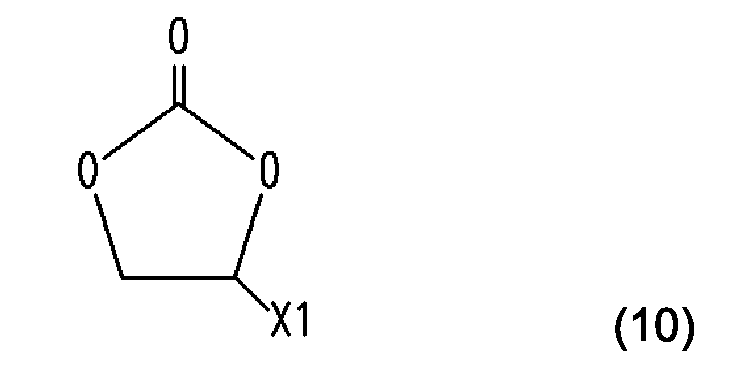
- the carbonate additive is preferably selected from the group consisting of compounds represented by Formula 10: wherein X1 is selected from the group consisting of halogens, cyano (CN) groups and nitro (NO 2 ) groups.
- the carbonate additive is fluoroethylene carbonate.
- a lithium secondary battery comprising:
- the polymer electrolyte may have a shear strength relative to the positive electrode of about 0.7N/mm or greater.
- the shear strength relative to the positive electrode is ranging from about 0.7N/mm to about 1.5N/mm, more preferably ranging from about 1.0N/mm to about 1.5N/mm, most preferably ranging from about 1.2N/mm to about 1.5N/mm.
- the polymer electrolyte may have a shear strength relative to the positive electrode of about 0.7N/mm or greater and a peel strength relative to the positive electrode of about 0.002N/mm or greater.
- the shear strength relative to the positive electrode is ranging from about 0.7N/mm to about 1.5N/mm and the polymer electrolyte has a peel strength relative to the positive electrode ranging from about 0.002 to about 0.07N/mm.
- the shear strength relative to the positive electrode is ranging from about 1.0N/mm to about 1.5N/mm and the polymer electrolyte has a peel strength relative to the positive electrode ranging from about 0.015 to 0.07N/mm.
- the shear strength relative to the positive electrode is ranging from about 1.2N/mm to about 1.5N/mm and the polymer electrolyte has a peel strength relative to the positive electrode ranging from about 0.035 to 0.07N/mm.
- the negative active material is a carbon-based material.
- the positive active material is a lithiated intercalation compound.
- the lithium secondary battery includes the inventive polymer electrolyte which is durable against external physical impact and which maintains physical strength during high temperature storage.
- the lithium secondary battery includes a positive electrode having a positive electrode active material capable of intercalating and deintercalating lithium ions, a negative electrode having a negative electrode active material capable of intercalating and deintercalating lithium ions, and a polymer electrolyte comprising a polymer, a non-aqueous organic solvent, and a lithium salt.
- the polymer electrolyte has a shear strength relative to the positive electrode of about 0.7N/mm or greater. Further, the polymer electrolyte has a peel strength relative to the positive electrode of about 0.002N/mm or greater.
- a lithium secondary battery in one embodiment, includes a metal laminated pouch as the battery case.
- the pouch affords the battery shape freedom and increased battery capacity relative to a metal can, but has less mechanical strength than the can.
- the lithium secondary battery includes a polymer electrolyte that preserves battery performance, prevents leaking, and improves mechanical properties, safety, and storage characteristics at high temperature.
- the lithium secondary battery includes a positive electrode having a positive active material capable of intercalating and deintercalating lithium ions, a negative electrode having a negative active material capable of intercalating and deintercalating lithium ions, and a polymer electrolyte.
- the polymer electrolyte may have a shear strength relative to the positive electrode of about 0.7N/mm or greater, preferred ranging from about 0.7 to about 1.5N/mm, more preferred ranging from about 1.0 to about 1.5N/mm, most preferred ranging from about 1.2 to about 1.5N/mm.
- the polymer electrolyte may have a shear strength relative to the positive electrode of about 0.7N/mm or greater and a peel strength relative to the positive electrode of about 0.002N/mm or greater.
- the polymer electrolyte has a shear strength relative to the positive electrode ranging from about 0.7 to about 1.5N/mm and a peel strength relative to the positive electrode of about 0.006 to about 0.07N/mm.
- the polymer electrolyte has a shear strength relative to the positive electrode ranging from about 1.0 to about 1.5N/mm and a peel strength relative to the positive electrode of about 0.015 to about 0.07N/mm.
- the polymer electrolyte has a shear strength relative to the positive electrode ranging from about 1.2 to about 1.5N/mm and a peel strength relative to the positive electrode ranging from about 0.035 to about 0.07N/mm.
- the shear strength is less than about 0.7N/mm, or when the shear strength and peel strength are outside the above-described ranges, the mechanical strength of the battery and battery performance are deteriorated.
- the polymer electrolyte includes a polymer obtained by polymerization of a first monomer represented by the following Formula 1: A-polyesterpolyol-B (1)
- the polyesterpolyol is produced by a condensation reaction of at least one alcohol having 2 to 6 OH groups and at least one dicarboxylic acid.
- the polyesterpolyol has a weight average molecular weight ranging from about 100 to about 10,000,000.
- a and B are linked to the terminal OH groups of the polyesterpolyol and can be the same or different.
- the polymer electrolyte is being obtained by polymerization of the first monomer represented by Formula (1) and a second monomer represented by one of Formulas 2 through 7:
- CH 2 CR1-O-X (3)
- CH 2 CH-CH 2 -O-X (5)
- R1 is selected from the group consisting of H, C 1 to C 10 hydrocarbons and C 6 to C 10 aromatic hydrocarbons
- X is selected from the group consisting of C 1 to C 20 hydrocarbons, C 1 to C 20 halogenated hydrocarbons, C 6 to C 20 aromatic hydrocarbons and C 6 to C 20 halogenated aromatic hydrocarbons.
- the second monomer is selected from the group consisting of compounds represented by Formulas 3, 6 and 7.
- Compounds represented by Formula 1 include polyethylene glycol, polypropylene glycol, alkanediol, ethoxylated alkanediol, propoxylated alkanediol, trimethylolpropane, ethoxylated trimethylolpropane, propoxylated trimethylolpropane, ditrimethylolpropane, ethoxylated ditrimethylolpropane, propoxylated ditrimethylolpropane, pentaerythritol, ethoxylated pentaerythritol, propoxylated pentaerythritol, dipentaerythritol, ethoxylated dipentaerythritol, propoxylated dipentaerythritol, bisphenol A, ethoxylated bisphenol A, and propoxylated bisphenol A.
- polyesterpolyol is represented by the following Formula 8.
- X, Y, and Z can be the same or different, and are repeating units which can be divalent (or higher valence) alkylene oxides, alkylene imines or repeating units thereof.
- X, Y and Z can also be an alkylene group.
- each of x, y, and z is an integer ranging from 1 to 20, and each of l, m, and n is 0 or 1 or greater and is controlled based on the molecular weight of the target polymer.
- a and B can be the same or different and each is selected from the group consisting of (meth)acryl groups, vinyl groups, allyl groups, vinylsulfonyl groups, urethane(meth)acryl groups and combinations thereof.
- each of A and B is selected from the group consisting of (meth)acryl groups, vinyl groups, vinylsulfonyl groups, urethane(meth)acryl groups and combinations thereof.
- the polymer is present in the polymer electrolyte in an amount ranging from about 1 to about 30 wt%, more preferred ranging from about 3 to about 25 wt%.
- the polymer is present in an amount less than about 1 wt%, battery strength deteriorates.
- the polymer is present in an amount greater than about 30 wt%, battery performance deteriorates.
- first and second monomers are preferably used in a weight ratio ranging from about 1:1 to about 1:60. More preferred, the weight ratio of the first and second monomers ranges from about 1:5 to about 1:40. When the weight ratio is outside these ranges, battery strength and performance deteriorate.
- the polymerization initiator may be any material capable of easily initiating polymerization of the monomers and which does not deteriorate battery performance.
- suitable polymerization initiators include organic peroxides and azo-based compounds.
- Organic peroxides for use as the polymerization initiator can include peroxy dicarbonates, diacyl peroxides and peroxy esters.
- suitable peroxy esters include di(4-t-butylcyclohexyl) peroxydicarbonate, di-2-ethylhexyl peroxy dicarbonate, di-isopropyl peroxy dicarbonate, di-3-methoxy butyl peroxy dicarbonate, t-butyl peroxy isopropyl carbonate, t-butyl peroxy 2-ethylhexyl carbonate, 1,6-bis(t-butyl peroxycarbonyloxy)hexane, diethylene glycol-bis(t-butyl peroxy carbonate) and the like.
- Nonlimiting examples of suitable diacyl peroxides include diacetyl peroxide, dibenzoyl peroxide, dilauroyl peroxide, and bis-3,5,5-trimethyl hexanoyl peroxide.
- suitable peroxy esters include perhexyl pivalate, t-butyl peroxypivalate, t-amyl peroxypivalate, t-butyl peroxy-2-ethyl-hexanoate, t-hexylperoxy pivalate, t-butyl peroxy neodecanoate, t-butyl peroxy neoheptanoate, t-hexylperoxy pivalate, 1,1,3,3-tetra methyl butyl peroxy neodecanoate, 1,1,3,3-tetramethyl butyl peroxy 2-ethylhexanoate, t-amyl peroxy 2-ethyl hexanoate,
- Nonlimiting examples of suitable azo-based compounds for use as the polymerization initiator include 2,2'-azo-bis(isobutyronitrile), 2,2'-azo-bis(2,4-dimethylvaleronitrile), and 1,1'-azo-bis(cyanocyclohexane).
- the polymerization initiator is used in an amount sufficient to initiate polymerization of the monomers.
- the polymerization initiator is used in an amount ranging from about 0.01 to about 5 wt% based on the total weight of the monomers.
- the polymer electrolyte composition further includes a non-aqueous organic solvent and a lithium salt, both of which are generally provided in a liquid electrolyte solution.
- the lithium salt acts as a source of lithium ions in the battery, enabling the basic operation of the lithium battery.
- lithium salts examples include LiPF 6 , LiBF 4 , lithium bis(oxalato) borate (LiBOB), LiSbF 6 , LiAsF 6 , LiClO 4 , LiCF 3 SO 3 , LiN(CF 3 SO 2 ) 2 , LiN(C 2 F 5 SO 2 ) 2 , LiAlO 4 , LiAlCl 4 , LiN(C x F 2x+1 SO 2 )(C y F 2y+1 SO 2 ) (where, x and y are natural numbers), LiSO 3 CF 3 and mixtures thereof.
- the concentration of the lithium salt ranges from about 0.6 to about 2.0M, more preferred from about 0.7 to about 1.6M.
- concentration of the lithium salt is less than about 0.6M, electrolyte conductivity and performance decrease.
- concentration of the lithium salt is greater than about 2.0M, the viscosity of the electrolyte increases and the mobility of lithium ions decreases.
- suitable non-aqueous organic solvents include carbonates, esters, ethers, ketones, nitriles and mixtures thereof.
- the carbonates can include dimethyl carbonate, ethyl methyl carbonate, diethyl carbonate, dipropyl carbonate, dibutyl carbonate, ethylene carbonate, propylene carbonate, butylene carbonate and the like.
- the esters can include methyl acetate, ethyl acetate, methyl hexanoate, methyl formate and the like.
- the ketones can include ⁇ -butyrolactone, ⁇ -valerolactone, ⁇ -caprolactone, ⁇ -valerolactone, ⁇ -caprolactone and the like.
- the nitriles can include acetonitrile and the like.
- a carbonate-based solvent is used as the non-aqueous organic solvent
- a mixture of cyclic and linear carbonates can be used in a volume ratio ranging from about 1:1 to about 1:9.
- electrolyte performance improves.
- the non-aqueous organic solvent can further include an aromatic hydrocarbon-based organic solvent.
- the aromatic hydrocarbon-based organic solvent is represented by the following Formula 9.
- R2 is selected from the group consisting of halogens, C 1 to C 10 alkyls and combinations thereof, and q is an integer ranging from 0 to 6.
- aromatic hydrocarbon-based compounds examples include benzene, fluorobenzene, toluene, fluorotoluene, trifluorotoluene, and xylene.
- the polymer electrolyte composition further includes an additive.
- the additive can be a carbonate additive having a substituent selected from the group consisting of halogens, cyano (CN) groups, nitro (NO 2 ) groups, vinylene carbonate, divinylsulfone, and ethylene sulfite.
- the additive inhibits swelling at high temperatures, and improves electrochemical properties such as capacity, cycle-life, low temperature characteristics, and the like.
- the carbonate additive can comprise an ethylene carbonate derivative represented by the following Formula 10:
- X1 is selected from the group consisting of halogens, cyano (CN) groups, and nitro (NO 2 ) groups.
- CN cyano
- NO 2 nitro
- fluoroethylene carbonate is used as the additive.
- the carbonate additive is present in an amount ranging from about 0.01 to about 10 parts by weight based on 100 parts by weight of the polymer electrolyte composition.
- the additive is present in an amount ranging from about 0.01 to about 5 parts by weight based on 100 parts by weight of the polymer electrolyte composition.
- the carbonate additive is present in an amount less than about 0.01 parts by weight, inhibition of gas generation inside the battery is difficult.
- the additive is present in an amount greater than about 10 parts by weight, the cycle-life of the battery at high temperature deteriorates and the battery swells at high temperature.
- a lithium secondary battery according to the present invention is fabricated by first forming an electrode assembly by winding a positive electrode, a negative electrode and a separator.
- the electrode assembly is inserted into a battery case, and the polymer electrolyte composition is injected into the case. After injecting the case with the electrolyte composition, the composition is cured.
- the process by which the composition is cured is well-known in the art.
- the polymerization of the monomers of the polymer electrolyte composition is initiated by a polymerization initiator.
- the resulting battery has a polymer-type electrolyte.
- the battery case may be a metal can or a metal-laminated pouch. However, the effects of the polymer electrolyte composition are improved when it is injected into a pouch type battery case.
- the positive electrode includes a positive active material capable of intercalating and deintercalating lithium ions.
- a positive active material can include lithiated intercalation compounds selected from the group consisting of compounds represented by the following Formulas 11 through 22.
- Li x Mn 1-y M y C 2 (11) Li x Mn 1-y M y O 2-z D z (12) Li x Mn 2 O 4-z D z (13) Li x Co 1-y M y C 2 (14) Li x Co 1-y M y O 2-z D z (15) Li x Ni 1-y M y C 2 (16) Li x Ni 1-y M y O 2-z C z (17) Li x Ni 1-y Co y O 2-z D z (18) Li x Ni 1-y-z Co y M z C ⁇ (19) Li x Ni 1-y-z Co y M z O 2- ⁇ D ⁇ (20) Li x Ni 1-y-z Mn y M z C ⁇ (21) Li x Ni 1-y-z Mn
- M is selected from the group consisting of Al, Ni, Co, Mn, Cr, Fe, Mg, Sr, V, rare earth elements and mixtures thereof
- C is selected from the group consisting of O, F, S and P
- D is selected from the group consisting of F, S and P.
- the negative electrode includes a negative active material capable of intercalating and deintercalating lithium ions.
- suitable negative active materials include carbon-based negative active materials such as crystalline or amorphous carbon and carbon complexes.
- the positive and negative electrodes are fabricated by first preparing active material compositions by mixing the active material, a conductive agent, and a binder in a solvent to form a slurry. The slurry is then coated on a current collector as is well known in the art.
- the conductive agent may comprise any material which does not induce chemical modification and which is electrically conductive.
- suitable conductive agents include carbon black, acetylene black, ketjen black, carbon fibers, metal powders and metal fibers including metals such as copper, nickel, aluminum, silver, and the like.
- the binder may include any material capable of firmly attaching the active materials and conductive agents to the current collector.
- suitable binders include polyvinylalcohol, carboxylmethylcellulose, hydroxypropylenecellulose, diacetylenecellulose, polyvinylchloride, polyvinylpyrrolidone, polytetrafluoroethylene, polyvinylidene fluoride, polyethylene, polypropylene and the like.
- the solvent can include any solvent capable of dispersing the active material, conductive agent and binder.
- One Example of the solvent is N-methylpyrrolidone.
- FIG. 1 One embodiment of a non-aqueous electrolyte secondary battery according to the present invention is illustrated in FIG. 1.
- the battery is a pouch-type lithium ion battery 1 fabricated by inserting an electrode assembly 9 into a battery case 15.
- the electrode assembly 9 includes a negative electrode 3, a positive electrode 5, and a separator 7 positioned between the positive and negative electrodes.
- An electrolyte solution is injected into the battery case 15 and impregnates the electrode assembly 9.
- Conductive leads 10 and 13 collect the current generated when the battery is operated, and are attached to the positive and negative electrodes, respectively.
- the conductive leads 10 and 13 carry the current the positive and negative electrodes to the positive and negative terminals.
- the lithium secondary battery can have any shape.
- the 0.02mol of polyesterpolyol, 30g of methylene chloride as a reaction solvent, and 0.04mol of triethylamine as a catalyst were placed in a cooling bath and agitated to obtain a first mixed solution.
- a second mixed solution of 0.04mol of acrylol chloride and 15g methylene chloride was added to the first mixed solution in a dropwise fashion to obtain a third mixed solution.
- the third mixed solution was heated to 40°C and agitated for 6 hours to deposit salt.
- the deposited salt was filtered off and methylene chloride was removed by distillation to prepare a target monomer SP1 having a weight average molecular weight of about 25,000 and which is represented by the following Formula 23.
- each of l, m, and n is 0, 1 or greater, and is controlled so that the weight average molecular weight of the monomer is about 25,000.
- a first mixed solution of 0.04mol of isocyanatoethyl methacrylate and 15g of methylene chloride was added in a dropwise fashion to a second mixed solution of 0.02mol of the polyesterpolyol used in Synthesis Example 1, 30g of methylene chloride as a reaction solvent, and 0.0002mol of dibutyltin dilaurate.
- the resulting solution was agitated for 6 hours at room temperature and the agitated again for 2 hours at 50°C to deposit salt.
- the deposited salt was filtered off and methylene chloride was removed by distillation to prepare a target monomer SP2 having a weight average molecular weight of about 25,000 and which is represented by the following Formula 24.
- each of l, m, and n is 0, 1 or greater, and is controlled so that the weight average molecular weight of the monomer is about 25,000.
- a monomer SP3 having a weight average molecular weight of about 25,000 and which is represented by the following Formula 25 was prepared as in Synthesis Example 1, except that the polyesterpolyol was prepared by condensation of diethylene glycol and adipic acid.
- n 0, 1 or greater, and is controlled so that the weight average molecular weight of the monomer is about 25,000.
- a lithium battery cell was fabricated by winding the positive electrode, negative electrode and separator to form an electrode assembly and placing the electrode assembly into a battery case. 2.7 g of the polymer electrolyte composition was injected into the battery case, and the battery case was allowed to stand for 16 hours. The resulting battery case was sealed under vacuum and heat-treated in a 70°C oven for 2 hours and 30 minutes to form a lithium secondary battery cell.
- the positive electrode was fabricated using a LiCoO 2 positive active material, ketjen black as a conductive material, and a polyvinylidene fluoride binder in a weight ratio of 96:2:2.
- the negative electrode was fabricated using artificial graphite as a negative active material and a polyvinylidene fluoride binder in a weight ratio of 94:6.
- a lithium battery cell was fabricated as in Example 1, except that 5 wt% of the SP1 monomer prepared as in Synthesis Example 1 and 95 wt% of the electrolyte solution were used.
- a lithium battery cell was fabricated as in Example 1, except that 3 wt% of the SP1 monomer prepared as in Synthesis Example 1 and 97 wt% of the electrolyte solution were used.
- a lithium battery cell was fabricated as in Example 1, except that 10 wt% of the SP1 monomer prepared as in Synthesis Example 1 and 90 wt% of the electrolyte solution were used.
- a lithium battery cell was fabricated as in Example 1, except that 20 wt% of the SP1 monomer prepared as in Synthesis Example 1 and 80 wt% of the electrolyte solution were used.
- a lithium battery cell was fabricated as in Example 1, except that 30 wt% of the SP1 monomer prepared as in Synthesis Example 1 and 70 wt% of the electrolyte solution were used.
- a lithium battery cell was fabricated as in Example 1, except that 7 wt% of the SP1 monomer prepared as in Synthesis Example 1, 90 wt% of the electrolyte solution, and 3 wt% of a fluoroethylene carbonate additive were used.
- a lithium battery cell was fabricated as in Example 1, except that 9 wt% of the SP1 monomer prepared as in Synthesis Example 1 as a first monomer, 1 wt% of hexylacrylate (HA) as a second monomer, 87 wt% of the electrolyte solution, and 3 wt% of a fluoroethylene carbonate additive were used.
- a lithium battery cell was fabricated as in Example 1, except that 6 wt% of the SP1 monomer prepared as in Synthesis Example 1 as a first monomer, 4 wt% of HA as a second monomer, 87 wt% of the electrolyte solution, and 3 wt% of a fluoroethylene carbonate additive were used.
- a lithium battery cell was fabricated as in Example 1, except that 6 wt% of the SP1 monomer prepared as in Synthesis Example 1 as a first monomer, and 1 wt% of HA as a second monomer were used.
- a lithium battery cell was fabricated as in Example 1, except that 5 wt% of the SP1 monomer prepared as in Synthesis Example 1 as a first monomer, and 2 wt% of HA as a second monomer were used.
- a lithium battery cell was fabricated as in Example 1, except that 4 wt% of the SP1 monomer prepared in Synthesis Example 1 as a first monomer, and 3 wt% of HA as a second monomer were used.
- a lithium battery cell was fabricated as in Example 1, except that 3 wt% of the SP1 monomer prepared as in Synthesis Example 1 as a first monomer, and 4 wt% of HA as a second monomer were used.
- a lithium battery cell was fabricated as in Example 1, except that 5 wt% of the SP1 monomer prepared as in Synthesis Example 1 as a first monomer, and 2 wt% of butylacrylate as a second monomer were used.
- a lithium battery cell was fabricated as in Example 1, except that 5 wt% of SP1 monomer prepared as in Synthesis Example 1 as a first monomer, and 2 wt% of isodecylacrylate as a second monomer were used.
- a lithium battery cell was fabricated as in Example 1, except that 5 wt% of the SP1 monomer prepared as in Synthesis Example 1 as a first monomer, and 2 wt% of ethylene glycol methylether acrylate as a second monomer were used.
- a lithium battery cell was fabricated as in Example 1, except that 5 wt% of the SP2 monomer prepared as in Synthesis Example 2 as a first monomer, 2 wt% of HA as a second monomer, and 3 wt% of fluoroethylene carbonate as an additive were used.
- a lithium battery cell was fabricated as in Example 1, except that 5 wt% of the SP3 monomer prepared as in Synthesis Example 3 as a first monomer, 2 wt% of HA as a second monomer, and 3 wt% of fluoroethylene carbonate as an additive were used.
- a lithium battery cell was fabricated as in Example 1, except that a polypropylene glycol diacrylate monomer was used.
- the lithium battery cells according to Examples 1 through 18 and Comparative Example 1 were evaluated by the following methods.
- Each lithium battery cell was charged and discharged according to the following conditions. First, each lithium battery cell was charged at 0.2C to the cut-off condition of 4.2V/20mA and discharged at 0.2C to 2.75V. Second, each lithium battery cell was charged at 0.5C to the cut-off condition of 4.2V/20mA and discharged at 0.2C to 2.75V. Third, the lithium battery cell was charged at 0.5C on the cut-off condition of 4.2V/0.1C and discharged at 0.5C to 3V. The discharge capacity was measured at the third charge-discharge cycle.
- Each lithium battery cell was charged at 1C to the cut-off condition of 4.2V/0.1C and discharged at 1C to 3V. Each battery cell was charged and discharged 300 times. The capacity after the 300th charge-discharge cycle was measured and its percentage of the capacity after the first cycle was recorded.
- Each electrode was adhered to a separator to form a specimen having a width of 20mm and a length of 100mm. 10mm of the separator was then peeled from the electrode. The peeled ends of the separator were gripped on the top and bottom and the separator was peeled in the opposite direction to measure the peel strength.
- a 1.5 cm X 1.5 cm specimen in which the electrode and separator were attached was prepared. The specimen was gripped on the top and bottom and pulled in the opposite direction to measure shear strength.
- Each lithium battery cell was charged at 0.2C to the cut-off condition of 4.2V, 20mAh and discharged at 0.2C to the cut-off voltage of 2.75V. Each cell was then charged under constant-current to the cut-off condition of 1C/36min. Each lithium battery cell was measured using the Universal Test Machine (Instron) by the 3 point bending mode. The Maximum Stress (N) when bending at the speed of 5mm/min to 3mm in the length direction was measured.
- Each lithium battery cell was charged at 0.2C to the cut-off condition of 4.2V, 20mAh, and discharged at 0.2C to the cut-off voltage of 2.75V. Then, each cell was charged at 0.5C to the cut-off condition of 4.2V, 0.1C and placed at 90°C for 4 hours. Each cell was then placed at room temperature for more than 6 hours. The strength of the lithium battery cell after placement at 90°C was measured by the same method used to measure the strength at room temperature.
- Each lithium battery cell was charged at 0.2C to the cut-off condition of 4.2V, 20mAh, and discharged at 0.2C to the cut-off voltage of 2.75V. Then, each cell was charged at 1C to the cut-off condition of 4.2V, 20mA, and placed at 80°C for 120 hours and then placed at room temperature for more than 6 hours. The strength of the lithium battery cell after placement at 80°C was measured by the same method used to measure the strength at room temperature.
- Example 1 Normal temperature strength (N) High temperature strength -1 (N) High temperature strength -2 (N) Peel strength (N/mm) Shear strenth (N/mm) Capacity (mAh) Cycle-life (%)
- Example 1 75 77 74 0.01 1.0 830 85
- Example 2 70 65 0.006 0.85 832 88
- Example 3 65 60 50 0.002 0.74 834 91
- Example 4 90 95 85 0.015 1.07 800 85
- Example 5 105 105 96 0.021 1.11 760 -
- Example 6 110 108 95 0.022 1.15 730 -
- Example 7 90 91 75 0.016 1.1 835 90
- Example 8 170 168 168 0.045 1.45 800 84
- Example 9 171 169 160 0.044 1.40 805
- Example 10 146 147 140 0.035 1.35 835 85
- Example 11 145 146 144 0.067 1.36 834 95
- Example 12 147 144 145 0.035 1.33 835 95
- the lithium battery cells according to Examples 1 through 18 were 1.4 to 4.3 times stronger after storage at room temperature and high temperatures than the cell of Comparative Example 1. Also, the peel strength of each of Examples 1 through 18 were significantly higher than Comparative Example 1. The shear strength of each of Examples 1 through 18 were also remarkably high, whereas that of Comparative Example 1 was so low it could not be measured.
- the lithium secondary batteries of the present invention have comparable battery performance characteristics to lithium secondary batteries employing conventional non-aqueous electrolytes.
- the lithium batteries according to the present invention have significantly improved strength characteristics at room and high temperatures.
Landscapes
- Chemical & Material Sciences (AREA)
- Chemical Kinetics & Catalysis (AREA)
- General Chemical & Material Sciences (AREA)
- Engineering & Computer Science (AREA)
- Electrochemistry (AREA)
- Manufacturing & Machinery (AREA)
- Medicinal Chemistry (AREA)
- Health & Medical Sciences (AREA)
- Polymers & Plastics (AREA)
- Organic Chemistry (AREA)
- Materials Engineering (AREA)
- Physics & Mathematics (AREA)
- Condensed Matter Physics & Semiconductors (AREA)
- Dispersion Chemistry (AREA)
- General Physics & Mathematics (AREA)
- Inorganic Chemistry (AREA)
- Secondary Cells (AREA)
- Battery Electrode And Active Subsutance (AREA)
Abstract
a non-aqueous organic solvent;
a lithium salt; and
a polymer being obtained by polymerization of at least one monomer represented by Formula 1:

wherein the polyesterpolyol is being obtained by condensation of at least one alcohol having from 2 to 6 OH groups and at least one dicarboxylic acid, the polyesterpolyol having a weight average molecular weight ranging from about 100 to about 10,000,000, and each of A and B are linked to terminal OH groups of the polyesterpolyol, each of A and B being selected from the group consisting of CH2=CR-C(=O)-, CH2=CR-O-CH2-, CH2=CR-, CH2=CR-O-C(=O)-, CH2=CH-CH2-O-, CH2=CH-S(=O)2-, and CH2=CR-C(=O)-O-CH2CH2-NH-C(=O)-, wherein R is selected from the group consisting of C1 to C10 hydrocarbons and C6 to C10 aromatic hydrocarbons.
Description
- The present invention relates to a polymer electrolyte for lithium secondary batteries, a lithium secondary battery comprising same and a monomer for polymerization of the polymer electrolyte. The lithium secondary battery having an inventive electrolyte endures external physical impact and maintains mechanical strength after storage at high temperature.
- Recently, reductions in the size and weight of portable electronic equipment have led to the development of batteries for use in such equipment. Batteries having high energy density are used as the power sources for this portable equipment, and lithium secondary batteries have been actively researched.
- In a lithium secondary battery cell, lithium-transition metal oxides are used as the positive active material and crystalline or amorphous carbon or carbon complexes are used as the negative active material. Positive and negative electrodes are formed by coating the appropriate active material slurry or applying the appropriate active material film onto current collectors to a desired thickness and length. An electrode assembly is fabricated by positioned an insulative separator between the positive and negative electrodes and spiral-winding or laminating the electrodes and the separator. The lithium secondary battery cell is fabricated by inserting the electrode assembly into a battery case, such as a metal can or metal laminated pouch, and injecting an electrolyte solution in the battery case.
- Battery pouches afford the batteries shape freedom and increased battery capacity relative to cans. However, pouches are easily modified and damaged by external physical impact and swell during storage at high temperature. These problems are more serious in lithium secondary batteries using liquid electrolyte solutions than they are in lithium secondary batteries using polymer electrolyte solutions. Therefore, batteries using pouches generally use polymer electrolyte solutions.
- Polymer electrolyte lithium secondary batteries have advantages such as leak prevention, safety, high temperature stability, durability against external physical impact and the like. Much research has been conducted into improving the stability of such batteries against external physical impact and reducing the deterioration of physical strength during high temperature storage.
- According to a first aspect of the invention there is provided a polymer electrolyte for a lithium secondary battery comprising:
- a non-aqueous organic solvent;
- a lithium salt; and
- a polymer being obtained by polymerization of at least one monomer represented by Formula 1:
A-polyesterpolyol-B (1)
wherein the polyesterpolyol is being obtained by condensation of at least one alcohol having from 2 to 6 OH groups and at least one dicarboxylic acid, the polyesterpolyol having a weight average molecular weight ranging from about 100 to about 10,000,000, and each of A and B are linked to terminal OH groups of the polyesterpolyol, each of A and B being selected from the group consisting of CH2=CR-C(=O)-, CH2=CR-O-CH2-, CH2=CR-, CH2=CR-O-C(=O)-, CH2=CH-CH2-O-, CH2=CH-S(=O)2-, and CH2=CR-C(=O)-O-CH2CH2-NH-C(=O)-, wherein R is selected from the group consisting of C1 to C10 hydrocarbons and C6 to C10 aromatic hydrocarbons. - Preferably, the polymer is being obtained by polymerization of the at least first monomer and a second monomer selected from the group represented by Formulas 2 through 7:
CH2=CR1-C(=O)-O-X (2)
CH2=CR1-O-X (3)
CH2=CR1-O-C(=O)-X (4)
CH2=CH-CH2-O-X (5)
CH2=CH-S(=O)2-X (6)
CH2=CR1-C(=O)-O-CH2CH2-N H-C(=O)-O-X (7)
wherein R1 is selected from the group consisting of H, C1 to C10 hydrocarbons and C6 to C10 aromatic hydrocarbons, and X is selected from the group consisting of C1 to C20 hydrocarbons, C1 to C20 halogenated hydrocarbons, C6 to C20 aromatic hydrocarbons and C6 to C20 halogenated aromatic hydrocarbons. More preferred, the second monomer is selected from the group consisting of monomers represented by Formulas (3), (6) and (7). - Preferably, the at least one alcohol is selected from the group consisting of polyethylene glycol, polypropylene glycol, alkanediol, ethoxylated alkanediol, propoxylated alkanediol, trimethylolpropane, ethoxylated trimethylolpropane, propoxylated trimethylolpropane, ditrimethylolpropane, ethoxylated ditrimethylolpropane, propoxylated ditrimethylolpropane, pentaerythritol, ethoxylated pentaerythritol, propoxylated pentaerythritol, dipentaerythritol, ethoxylated dipentaerythritol, propoxylated dipentaerythritol, bisphenol A, ethoxylated bisphenol A, propoxylated bisphenol A.
- Preferably, each of A and B is selected from the group consisting of (meth)acryl groups, vinyl groups, allyl groups, vinylsulfonyl groups, urethane(meth)acryl groups, and combinations thereof.
- Preferably, the lithium salt is selected from the group consisting of LiPF6, LiBF4, lithium bis(oxalato) borate, LiSbF6, LiAsF6, LiClO4, LiCF3SO3, LiN(CF3SO2)2, LiN(C2F5SO2)2, LiAlO4, LiAlCl4, LiN(CxF2x+1SO2)(CyF2y+1SO2) wherein x and y are natural numbers, LiSO3CF3, and combinations thereof.
- Preferably, the non-aqueous organic solvent is selected from the group consisting of carbonates, esters, ethers, ketones, nitriles, and combinations thereof. Alternatively, the non-aqueous organic solvent may comprise a carbonate-based solvent and an aromatic hydrocarbon-based organic solvent. Preferably, the aromatic hydrocarbon-based organic solvent is an aromatic compound represented by Formula 9:

- Preferably, the polymer electrolyte further comprises a carbonate additive selected from the group consisting of vinylene carbonate, divinylsulfone, ethylene sulfite, carbonates having substituents selected from the group consisting of halogens, cyano (CN) groups, nitro (NO2) groups and combinations thereof. More preferred, the carbonate additive is selected from the group consisting of carbonates having substituents selected from the group consisting of halogens, cyano (CN) groups and nitro (NO2) groups. The carbonate additive is preferably selected from the group consisting of compounds represented by Formula 10:
- According to a second aspect of the invention there is provided a lithium secondary battery comprising:
- a positive electrode comprising a positive active material capable of intercalating and deintercalating lithium ions;
- a negative electrode including a negative active material capable of intercalating and deintercalating lithium ions; and
- the inventive polymer electrolyte as described above.
- The polymer electrolyte may have a shear strength relative to the positive electrode of about 0.7N/mm or greater. Preferably, the shear strength relative to the positive electrode is ranging from about 0.7N/mm to about 1.5N/mm, more preferably ranging from about 1.0N/mm to about 1.5N/mm, most preferably ranging from about 1.2N/mm to about 1.5N/mm.
- The polymer electrolyte may have a shear strength relative to the positive electrode of about 0.7N/mm or greater and a peel strength relative to the positive electrode of about 0.002N/mm or greater. Preferably, the shear strength relative to the positive electrode is ranging from about 0.7N/mm to about 1.5N/mm and the polymer electrolyte has a peel strength relative to the positive electrode ranging from about 0.002 to about 0.07N/mm. More preferred, the shear strength relative to the positive electrode is ranging from about 1.0N/mm to about 1.5N/mm and the polymer electrolyte has a peel strength relative to the positive electrode ranging from about 0.015 to 0.07N/mm. Most preferred, the shear strength relative to the positive electrode is ranging from about 1.2N/mm to about 1.5N/mm and the polymer electrolyte has a peel strength relative to the positive electrode ranging from about 0.035 to 0.07N/mm.
- Preferably, the negative active material is a carbon-based material.
- Preferably, the positive active material is a lithiated intercalation compound.
- According to a third aspect of the invention there is provided a monomer for a polymer electrolyte represented by Formula 1:
A-polyesterpolyol-B (1)
wherein the polyesterpolyol is being obtained by condensation of at least one alcohol having from 2 to 6 OH groups, the polyesterpolyol is having a weight average molecular weight ranging from about 100 to about 10,000,000, and each of A and B are linked to terminal OH groups of the polyesterpolyol, each of A and B being selected from the group consisting of CH2=CR-C(=O)-, CH2=CR-O-CH2-, CH2=CR-, CH2=CR-O-C(=O)-, CH2=CH-CH2-O-, CH2=CH-S(=O)2-, and CH2=CR-C(=O)-O-CH2CH2-NH-C(=O)-, wherein R is selected from the group consisting of C1 to C10 hydrocarbons and C6 to C10 aromatic hydrocarbons. - According to the invention, the lithium secondary battery includes the inventive polymer electrolyte which is durable against external physical impact and which maintains physical strength during high temperature storage. The lithium secondary battery includes a positive electrode having a positive electrode active material capable of intercalating and deintercalating lithium ions, a negative electrode having a negative electrode active material capable of intercalating and deintercalating lithium ions, and a polymer electrolyte comprising a polymer, a non-aqueous organic solvent, and a lithium salt. The polymer electrolyte has a shear strength relative to the positive electrode of about 0.7N/mm or greater. Further, the polymer electrolyte has a peel strength relative to the positive electrode of about 0.002N/mm or greater.
- The above and other features and advantages of the present invention will become more apparent by reference to the following detailed description when considered in conjunction with the accompanying drawings wherein:
- FIG. 1 is a schematic perspective view of a lithium secondary battery according to one embodiment of the present invention.
- In one embodiment of the present invention, a lithium secondary battery includes a metal laminated pouch as the battery case. The pouch affords the battery shape freedom and increased battery capacity relative to a metal can, but has less mechanical strength than the can. The lithium secondary battery includes a polymer electrolyte that preserves battery performance, prevents leaking, and improves mechanical properties, safety, and storage characteristics at high temperature.
- The lithium secondary battery includes a positive electrode having a positive active material capable of intercalating and deintercalating lithium ions, a negative electrode having a negative active material capable of intercalating and deintercalating lithium ions, and a polymer electrolyte. The polymer electrolyte may have a shear strength relative to the positive electrode of about 0.7N/mm or greater, preferred ranging from about 0.7 to about 1.5N/mm, more preferred ranging from about 1.0 to about 1.5N/mm, most preferred ranging from about 1.2 to about 1.5N/mm.
- According to the present invention, the polymer electrolyte may have a shear strength relative to the positive electrode of about 0.7N/mm or greater and a peel strength relative to the positive electrode of about 0.002N/mm or greater. In another embodiment, the polymer electrolyte has a shear strength relative to the positive electrode ranging from about 0.7 to about 1.5N/mm and a peel strength relative to the positive electrode of about 0.006 to about 0.07N/mm. In yet another embodiment, the polymer electrolyte has a shear strength relative to the positive electrode ranging from about 1.0 to about 1.5N/mm and a peel strength relative to the positive electrode of about 0.015 to about 0.07N/mm. In still another embodiment, the polymer electrolyte has a shear strength relative to the positive electrode ranging from about 1.2 to about 1.5N/mm and a peel strength relative to the positive electrode ranging from about 0.035 to about 0.07N/mm.
- When the shear strength is less than about 0.7N/mm, or when the shear strength and peel strength are outside the above-described ranges, the mechanical strength of the battery and battery performance are deteriorated.
- The shear strength and peel strength of the electrolyte depend on the polymer used in the electrolyte. According to the present invention, the polymer electrolyte includes a polymer obtained by polymerization of a first monomer represented by the following Formula 1:
A-polyesterpolyol-B (1)
- In Formula 1, the polyesterpolyol is produced by a condensation reaction of at least one alcohol having 2 to 6 OH groups and at least one dicarboxylic acid. The polyesterpolyol has a weight average molecular weight ranging from about 100 to about 10,000,000. A and B are linked to the terminal OH groups of the polyesterpolyol and can be the same or different. A and B are each selected from the group consisting of CH2=CR-C(=O)-, CH2=CR-O-CH2-, CH2=CR-, CH2=CR-O-C(=O)-, CH2=CH-CH2-O-, CH2=CH-S(=O)2-, or CH2=CR-C(=O)-O-CH2CH2-NH-C(=O)-, where R is a C1 to C10 hydrocarbon or a C6 to C10 aromatic hydrocarbon.
- Preferably, the polymer electrolyte is being obtained by polymerization of the first monomer represented by Formula (1) and a second monomer represented by one of Formulas 2 through 7:
CH2=CR1-C(=O)-O-X (2)
CH2=CR1-O-X (3)
CH2=CR1-O-C(=O)-X (4)
CH2=CH-CH2-O-X (5)
CH2=CH-S(=O)2-X (6)
CH2=CR1-C(=O)-O-CH2CH2-NH-C(=O)-O-X (7)
- In Formulas 2 through 7, R1 is selected from the group consisting of H, C1 to C10 hydrocarbons and C6 to C10 aromatic hydrocarbons, and X is selected from the group consisting of C1 to C20 hydrocarbons, C1 to C20 halogenated hydrocarbons, C6 to C20 aromatic hydrocarbons and C6 to C20 halogenated aromatic hydrocarbons. Preferably, the second monomer is selected from the group consisting of compounds represented by
Formulas - Compounds represented by Formula 1 include polyethylene glycol, polypropylene glycol, alkanediol, ethoxylated alkanediol, propoxylated alkanediol, trimethylolpropane, ethoxylated trimethylolpropane, propoxylated trimethylolpropane, ditrimethylolpropane, ethoxylated ditrimethylolpropane, propoxylated ditrimethylolpropane, pentaerythritol, ethoxylated pentaerythritol, propoxylated pentaerythritol, dipentaerythritol, ethoxylated dipentaerythritol, propoxylated dipentaerythritol, bisphenol A, ethoxylated bisphenol A, and propoxylated bisphenol A.
- One example of polyesterpolyol is represented by the following Formula 8.

- In Formula 8, X, Y, and Z can be the same or different, and are repeating units which can be divalent (or higher valence) alkylene oxides, alkylene imines or repeating units thereof. X, Y and Z can also be an alkylene group. In the Formula, each of x, y, and z is an integer ranging from 1 to 20, and each of l, m, and n is 0 or 1 or greater and is controlled based on the molecular weight of the target polymer.
- In Formula 1, A and B can be the same or different and each is selected from the group consisting of (meth)acryl groups, vinyl groups, allyl groups, vinylsulfonyl groups, urethane(meth)acryl groups and combinations thereof. Preferably, each of A and B is selected from the group consisting of (meth)acryl groups, vinyl groups, vinylsulfonyl groups, urethane(meth)acryl groups and combinations thereof.
- In one preferred embodiment of the present invention, the polymer is present in the polymer electrolyte in an amount ranging from about 1 to about 30 wt%, more preferred ranging from about 3 to about 25 wt%. When the polymer is present in an amount less than about 1 wt%, battery strength deteriorates. When the polymer is present in an amount greater than about 30 wt%, battery performance deteriorates.
- When first and second monomers are used, they are preferably used in a weight ratio ranging from about 1:1 to about 1:60. More preferred, the weight ratio of the first and second monomers ranges from about 1:5 to about 1:40. When the weight ratio is outside these ranges, battery strength and performance deteriorate.
- To initiate polymerization of the monomers, a polymerization initiator is used. The polymerization initiator may be any material capable of easily initiating polymerization of the monomers and which does not deteriorate battery performance. Nonlimiting examples of suitable polymerization initiators include organic peroxides and azo-based compounds.
- Organic peroxides for use as the polymerization initiator can include peroxy dicarbonates, diacyl peroxides and peroxy esters. Nonlimiting examples of suitable peroxy esters include di(4-t-butylcyclohexyl) peroxydicarbonate, di-2-ethylhexyl peroxy dicarbonate, di-isopropyl peroxy dicarbonate, di-3-methoxy butyl peroxy dicarbonate, t-butyl peroxy isopropyl carbonate, t-butyl peroxy 2-ethylhexyl carbonate, 1,6-bis(t-butyl peroxycarbonyloxy)hexane, diethylene glycol-bis(t-butyl peroxy carbonate) and the like. Nonlimiting examples of suitable diacyl peroxides include diacetyl peroxide, dibenzoyl peroxide, dilauroyl peroxide, and bis-3,5,5-trimethyl hexanoyl peroxide. Nonlimiting examples of suitable peroxy esters include perhexyl pivalate, t-butyl peroxypivalate, t-amyl peroxypivalate, t-butyl peroxy-2-ethyl-hexanoate, t-hexylperoxy pivalate, t-butyl peroxy neodecanoate, t-butyl peroxy neoheptanoate, t-hexylperoxy pivalate, 1,1,3,3-tetra methyl butyl peroxy neodecanoate, 1,1,3,3-tetramethyl butyl peroxy 2-ethylhexanoate, t-amyl peroxy 2-ethyl hexanoate, t-butyl peroxy isobutyrate, t-
amylperoxy butyl peroxy - Nonlimiting examples of suitable azo-based compounds for use as the polymerization initiator include 2,2'-azo-bis(isobutyronitrile), 2,2'-azo-bis(2,4-dimethylvaleronitrile), and 1,1'-azo-bis(cyanocyclohexane).
- The polymerization initiator is used in an amount sufficient to initiate polymerization of the monomers. Preferably, the polymerization initiator is used in an amount ranging from about 0.01 to about 5 wt% based on the total weight of the monomers.
- The polymer electrolyte composition further includes a non-aqueous organic solvent and a lithium salt, both of which are generally provided in a liquid electrolyte solution. The lithium salt acts as a source of lithium ions in the battery, enabling the basic operation of the lithium battery. Examples of suitable lithium salts include LiPF6, LiBF4, lithium bis(oxalato) borate (LiBOB), LiSbF6, LiAsF6, LiClO4, LiCF3SO3, LiN(CF3SO2)2, LiN(C2F5SO2)2, LiAlO4, LiAlCl4, LiN(CxF2x+1SO2)(CyF2y+1SO2) (where, x and y are natural numbers), LiSO3CF3 and mixtures thereof.
- Preferably, the concentration of the lithium salt ranges from about 0.6 to about 2.0M, more preferred from about 0.7 to about 1.6M. When the concentration of the lithium salt is less than about 0.6M, electrolyte conductivity and performance decrease. When the concentration of the lithium salt is greater than about 2.0M, the viscosity of the electrolyte increases and the mobility of lithium ions decreases.
- Examples of suitable non-aqueous organic solvents include carbonates, esters, ethers, ketones, nitriles and mixtures thereof. The carbonates can include dimethyl carbonate, ethyl methyl carbonate, diethyl carbonate, dipropyl carbonate, dibutyl carbonate, ethylene carbonate, propylene carbonate, butylene carbonate and the like. The esters can include methyl acetate, ethyl acetate, methyl hexanoate, methyl formate and the like. The ketones can include γ-butyrolactone, γ-valerolactone, γ-caprolactone, δ-valerolactone, ε-caprolactone and the like. The nitriles can include acetonitrile and the like.
- When a carbonate-based solvent is used as the non-aqueous organic solvent, a mixture of cyclic and linear carbonates can be used in a volume ratio ranging from about 1:1 to about 1:9. When cyclic and linear carbonates are used within this volume ratio range, electrolyte performance improves.
- The non-aqueous organic solvent can further include an aromatic hydrocarbon-based organic solvent. Preferably, the aromatic hydrocarbon-based organic solvent is represented by the following
Formula 9.
- In
Formula 9, R2 is selected from the group consisting of halogens, C1 to C10 alkyls and combinations thereof, and q is an integer ranging from 0 to 6. - Examples of suitable aromatic hydrocarbon-based compounds include benzene, fluorobenzene, toluene, fluorotoluene, trifluorotoluene, and xylene.
- Preferably, the polymer electrolyte composition further includes an additive. The additive can be a carbonate additive having a substituent selected from the group consisting of halogens, cyano (CN) groups, nitro (NO2) groups, vinylene carbonate, divinylsulfone, and ethylene sulfite. The additive inhibits swelling at high temperatures, and improves electrochemical properties such as capacity, cycle-life, low temperature characteristics, and the like. The carbonate additive can comprise an ethylene carbonate derivative represented by the following Formula 10:

- In
Formula 10, X1 is selected from the group consisting of halogens, cyano (CN) groups, and nitro (NO2) groups. Preferably, fluoroethylene carbonate is used as the additive. - The carbonate additive is present in an amount ranging from about 0.01 to about 10 parts by weight based on 100 parts by weight of the polymer electrolyte composition. Preferably, the additive is present in an amount ranging from about 0.01 to about 5 parts by weight based on 100 parts by weight of the polymer electrolyte composition. When the carbonate additive is present in an amount less than about 0.01 parts by weight, inhibition of gas generation inside the battery is difficult. When the additive is present in an amount greater than about 10 parts by weight, the cycle-life of the battery at high temperature deteriorates and the battery swells at high temperature.
- A lithium secondary battery according to the present invention is fabricated by first forming an electrode assembly by winding a positive electrode, a negative electrode and a separator. The electrode assembly is inserted into a battery case, and the polymer electrolyte composition is injected into the case. After injecting the case with the electrolyte composition, the composition is cured. The process by which the composition is cured is well-known in the art. During curing, the polymerization of the monomers of the polymer electrolyte composition is initiated by a polymerization initiator. After curing, the resulting battery has a polymer-type electrolyte. The battery case may be a metal can or a metal-laminated pouch. However, the effects of the polymer electrolyte composition are improved when it is injected into a pouch type battery case.
- The positive electrode includes a positive active material capable of intercalating and deintercalating lithium ions. Such a positive active material can include lithiated intercalation compounds selected from the group consisting of compounds represented by the following Formulas 11 through 22.
LixMn1-yMyC2 (11)
LixMn1-yMyO2-zDz (12)
LixMn2O4-zDz (13)
LixCo1-yMyC2 (14)
LixCo1-yMyO2-zDz (15)
LixNi1-yMyC2 (16)
LixNi1-yMyO2-zCz (17)
LixNi1-yCoyO2-zDz (18)
LixNi1-y-zCoyMzCα (19)
LixNi1-y-zCoyMzO2-αDα (20)
LixNi1-y-zMnyMzCα (21)
LixNi1-y-zMnyMzO2-αDα (22)
- In Formulas 11 through 22, 0.90 ≤ x ≤ 1.1, 0 ≤ y ≤ 0.5, 0 ≤ z ≤ 0.5, 0 ≤ α ≤ 2, M is selected from the group consisting of Al, Ni, Co, Mn, Cr, Fe, Mg, Sr, V, rare earth elements and mixtures thereof, C is selected from the group consisting of O, F, S and P, and D is selected from the group consisting of F, S and P.
- The negative electrode includes a negative active material capable of intercalating and deintercalating lithium ions. Examples of suitable negative active materials include carbon-based negative active materials such as crystalline or amorphous carbon and carbon complexes.
- The positive and negative electrodes are fabricated by first preparing active material compositions by mixing the active material, a conductive agent, and a binder in a solvent to form a slurry. The slurry is then coated on a current collector as is well known in the art.
- The conductive agent may comprise any material which does not induce chemical modification and which is electrically conductive. Examples of suitable conductive agents include carbon black, acetylene black, ketjen black, carbon fibers, metal powders and metal fibers including metals such as copper, nickel, aluminum, silver, and the like.
- The binder may include any material capable of firmly attaching the active materials and conductive agents to the current collector. Examples of suitable binders include polyvinylalcohol, carboxylmethylcellulose, hydroxypropylenecellulose, diacetylenecellulose, polyvinylchloride, polyvinylpyrrolidone, polytetrafluoroethylene, polyvinylidene fluoride, polyethylene, polypropylene and the like.
- The solvent can include any solvent capable of dispersing the active material, conductive agent and binder. One Example of the solvent is N-methylpyrrolidone.
- One embodiment of a non-aqueous electrolyte secondary battery according to the present invention is illustrated in FIG. 1. The battery is a pouch-type lithium ion battery 1 fabricated by inserting an
electrode assembly 9 into abattery case 15. Theelectrode assembly 9 includes anegative electrode 3, apositive electrode 5, and aseparator 7 positioned between the positive and negative electrodes. An electrolyte solution is injected into thebattery case 15 and impregnates theelectrode assembly 9. Conductive leads 10 and 13 collect the current generated when the battery is operated, and are attached to the positive and negative electrodes, respectively. The conductive leads 10 and 13 carry the current the positive and negative electrodes to the positive and negative terminals. Although illustrated as having a generally square or rectangular shape, it is understood that the lithium secondary battery can have any shape. - The following examples illustrate certain exemplary embodiment of the present invention.
- 0.02mol of polyesterpolyol (DR1515 having a Mn=1500 available from DAERYUNG Enterprise Co. Ltd.) was prepared by condensation of ethylene glycol (EG), diethylene glycol (DEG), trimethylolpropane (TMP), and adipic acid. The 0.02mol of polyesterpolyol, 30g of methylene chloride as a reaction solvent, and 0.04mol of triethylamine as a catalyst were placed in a cooling bath and agitated to obtain a first mixed solution. A second mixed solution of 0.04mol of acrylol chloride and 15g methylene chloride was added to the first mixed solution in a dropwise fashion to obtain a third mixed solution. The third mixed solution was heated to 40°C and agitated for 6 hours to deposit salt. The deposited salt was filtered off and methylene chloride was removed by distillation to prepare a target monomer SP1 having a weight average molecular weight of about 25,000 and which is represented by the following Formula 23.

- In Formula 23, each of l, m, and n is 0, 1 or greater, and is controlled so that the weight average molecular weight of the monomer is about 25,000.
- A first mixed solution of 0.04mol of isocyanatoethyl methacrylate and 15g of methylene chloride was added in a dropwise fashion to a second mixed solution of 0.02mol of the polyesterpolyol used in Synthesis Example 1, 30g of methylene chloride as a reaction solvent, and 0.0002mol of dibutyltin dilaurate. The resulting solution was agitated for 6 hours at room temperature and the agitated again for 2 hours at 50°C to deposit salt. The deposited salt was filtered off and methylene chloride was removed by distillation to prepare a target monomer SP2 having a weight average molecular weight of about 25,000 and which is represented by the following Formula 24.

- In Formula 24, each of l, m, and n is 0, 1 or greater, and is controlled so that the weight average molecular weight of the monomer is about 25,000.
- A monomer SP3 having a weight average molecular weight of about 25,000 and which is represented by the following Formula 25 was prepared as in Synthesis Example 1, except that the polyesterpolyol was prepared by condensation of diethylene glycol and adipic acid.

- In Formula 25, n is 0, 1 or greater, and is controlled so that the weight average molecular weight of the monomer is about 25,000.
- 7 wt% of the SP1 monomer prepared as in Synthesis Example 1 and 93 wt% of an electrolyte solution comprising 1.3M LiPF6 dissolved in an ethylene carbonate:ethyl methyl carbonate:propylene carbonate:fluorobenzene (30:55:5:15 wt%) mixed solvent were mixed to form a mixed solution. A polymer electrolyte composition was prepared by adding perhexyl pivalate as a polymerization initiator in an amount of 2 wt% based on the weight of the monomers.
- A lithium battery cell was fabricated by winding the positive electrode, negative electrode and separator to form an electrode assembly and placing the electrode assembly into a battery case. 2.7 g of the polymer electrolyte composition was injected into the battery case, and the battery case was allowed to stand for 16 hours. The resulting battery case was sealed under vacuum and heat-treated in a 70°C oven for 2 hours and 30 minutes to form a lithium secondary battery cell.
- The positive electrode was fabricated using a LiCoO2 positive active material, ketjen black as a conductive material, and a polyvinylidene fluoride binder in a weight ratio of 96:2:2. The negative electrode was fabricated using artificial graphite as a negative active material and a polyvinylidene fluoride binder in a weight ratio of 94:6.
- A lithium battery cell was fabricated as in Example 1, except that 5 wt% of the SP1 monomer prepared as in Synthesis Example 1 and 95 wt% of the electrolyte solution were used.
- A lithium battery cell was fabricated as in Example 1, except that 3 wt% of the SP1 monomer prepared as in Synthesis Example 1 and 97 wt% of the electrolyte solution were used.
- A lithium battery cell was fabricated as in Example 1, except that 10 wt% of the SP1 monomer prepared as in Synthesis Example 1 and 90 wt% of the electrolyte solution were used.
- A lithium battery cell was fabricated as in Example 1, except that 20 wt% of the SP1 monomer prepared as in Synthesis Example 1 and 80 wt% of the electrolyte solution were used.
- A lithium battery cell was fabricated as in Example 1, except that 30 wt% of the SP1 monomer prepared as in Synthesis Example 1 and 70 wt% of the electrolyte solution were used.
- A lithium battery cell was fabricated as in Example 1, except that 7 wt% of the SP1 monomer prepared as in Synthesis Example 1, 90 wt% of the electrolyte solution, and 3 wt% of a fluoroethylene carbonate additive were used.
- A lithium battery cell was fabricated as in Example 1, except that 9 wt% of the SP1 monomer prepared as in Synthesis Example 1 as a first monomer, 1 wt% of hexylacrylate (HA) as a second monomer, 87 wt% of the electrolyte solution, and 3 wt% of a fluoroethylene carbonate additive were used.
- A lithium battery cell was fabricated as in Example 1, except that 6 wt% of the SP1 monomer prepared as in Synthesis Example 1 as a first monomer, 4 wt% of HA as a second monomer, 87 wt% of the electrolyte solution, and 3 wt% of a fluoroethylene carbonate additive were used.
- A lithium battery cell was fabricated as in Example 1, except that 6 wt% of the SP1 monomer prepared as in Synthesis Example 1 as a first monomer, and 1 wt% of HA as a second monomer were used.
- A lithium battery cell was fabricated as in Example 1, except that 5 wt% of the SP1 monomer prepared as in Synthesis Example 1 as a first monomer, and 2 wt% of HA as a second monomer were used.
- A lithium battery cell was fabricated as in Example 1, except that 4 wt% of the SP1 monomer prepared in Synthesis Example 1 as a first monomer, and 3 wt% of HA as a second monomer were used.
- A lithium battery cell was fabricated as in Example 1, except that 3 wt% of the SP1 monomer prepared as in Synthesis Example 1 as a first monomer, and 4 wt% of HA as a second monomer were used.
- A lithium battery cell was fabricated as in Example 1, except that 5 wt% of the SP1 monomer prepared as in Synthesis Example 1 as a first monomer, and 2 wt% of butylacrylate as a second monomer were used.
- A lithium battery cell was fabricated as in Example 1, except that 5 wt% of SP1 monomer prepared as in Synthesis Example 1 as a first monomer, and 2 wt% of isodecylacrylate as a second monomer were used.
- A lithium battery cell was fabricated as in Example 1, except that 5 wt% of the SP1 monomer prepared as in Synthesis Example 1 as a first monomer, and 2 wt% of ethylene glycol methylether acrylate as a second monomer were used.
- A lithium battery cell was fabricated as in Example 1, except that 5 wt% of the SP2 monomer prepared as in Synthesis Example 2 as a first monomer, 2 wt% of HA as a second monomer, and 3 wt% of fluoroethylene carbonate as an additive were used.
- A lithium battery cell was fabricated as in Example 1, except that 5 wt% of the SP3 monomer prepared as in Synthesis Example 3 as a first monomer, 2 wt% of HA as a second monomer, and 3 wt% of fluoroethylene carbonate as an additive were used.
- A lithium battery cell was fabricated as in Example 1, except that a polypropylene glycol diacrylate monomer was used.
- The lithium battery cells according to Examples 1 through 18 and Comparative Example 1 were evaluated by the following methods.
- Each lithium battery cell was charged and discharged according to the following conditions. First, each lithium battery cell was charged at 0.2C to the cut-off condition of 4.2V/20mA and discharged at 0.2C to 2.75V. Second, each lithium battery cell was charged at 0.5C to the cut-off condition of 4.2V/20mA and discharged at 0.2C to 2.75V. Third, the lithium battery cell was charged at 0.5C on the cut-off condition of 4.2V/0.1C and discharged at 0.5C to 3V. The discharge capacity was measured at the third charge-discharge cycle.
- Each lithium battery cell was charged at 1C to the cut-off condition of 4.2V/0.1C and discharged at 1C to 3V. Each battery cell was charged and discharged 300 times. The capacity after the 300th charge-discharge cycle was measured and its percentage of the capacity after the first cycle was recorded.
- Each electrode was adhered to a separator to form a specimen having a width of 20mm and a length of 100mm. 10mm of the separator was then peeled from the electrode. The peeled ends of the separator were gripped on the top and bottom and the separator was peeled in the opposite direction to measure the peel strength.
- A 1.5 cm X 1.5 cm specimen in which the electrode and separator were attached was prepared. The specimen was gripped on the top and bottom and pulled in the opposite direction to measure shear strength.
- Each lithium battery cell was charged at 0.2C to the cut-off condition of 4.2V, 20mAh and discharged at 0.2C to the cut-off voltage of 2.75V. Each cell was then charged under constant-current to the cut-off condition of 1C/36min. Each lithium battery cell was measured using the Universal Test Machine (Instron) by the 3 point bending mode. The Maximum Stress (N) when bending at the speed of 5mm/min to 3mm in the length direction was measured.
- Each lithium battery cell was charged at 0.2C to the cut-off condition of 4.2V, 20mAh, and discharged at 0.2C to the cut-off voltage of 2.75V. Then, each cell was charged at 0.5C to the cut-off condition of 4.2V, 0.1C and placed at 90°C for 4 hours. Each cell was then placed at room temperature for more than 6 hours. The strength of the lithium battery cell after placement at 90°C was measured by the same method used to measure the strength at room temperature.
- Each lithium battery cell was charged at 0.2C to the cut-off condition of 4.2V, 20mAh, and discharged at 0.2C to the cut-off voltage of 2.75V. Then, each cell was charged at 1C to the cut-off condition of 4.2V, 20mA, and placed at 80°C for 120 hours and then placed at room temperature for more than 6 hours. The strength of the lithium battery cell after placement at 80°C was measured by the same method used to measure the strength at room temperature.
- The results of the above measurements are shown in Table 1 below.
Table 1 Normal temperature strength (N) High temperature strength -1 (N) High temperature strength -2 (N) Peel strength (N/mm) Shear strenth (N/mm) Capacity (mAh) Cycle-life (%) Example 1 75 77 74 0.01 1.0 830 85 Example 2 70 70 65 0.006 0.85 832 88 Example 3 65 60 50 0.002 0.74 834 91 Example 4 90 95 85 0.015 1.07 800 85 Example 5 105 105 96 0.021 1.11 760 - Example 6 110 108 95 0.022 1.15 730 - Example 7 90 91 75 0.016 1.1 835 90 Example 8 170 168 168 0.045 1.45 800 84 Example 9 171 169 160 0.044 1.40 805 85 Example 10 146 147 140 0.035 1.35 835 85 Example 11 145 146 144 0.067 1.36 834 95 Example 12 147 144 145 0.035 1.33 835 95 Example 13 110 114 110 0.023 1.14 832 90 Example 14 146 146 145 0.038 1.34 836 94 Example 15 145 143 142 0.035 1.29 834 94 Example 16 120 110 105 0.020 1.10 829 84 Example 17 146 145 140 0.036 1.35 835 95 Example 18 147 146 146 0.037 1.37 834 96 Comp. Example 1 45 40 - 0.005 - 830 92 - As shown in Table 1, the lithium battery cells according to Examples 1 through 18 were 1.4 to 4.3 times stronger after storage at room temperature and high temperatures than the cell of Comparative Example 1. Also, the peel strength of each of Examples 1 through 18 were significantly higher than Comparative Example 1. The shear strength of each of Examples 1 through 18 were also remarkably high, whereas that of Comparative Example 1 was so low it could not be measured.
- The physical strength of the lithium battery cells of Examples 1 through 18 were excellent compared to the cell of Comparative Example 1, and the capacity and cycle-life characteristics of Examples 1 through 18 were comparable to that of Comparative Example 1.
- The lithium secondary batteries of the present invention have comparable battery performance characteristics to lithium secondary batteries employing conventional non-aqueous electrolytes. However, the lithium batteries according to the present invention have significantly improved strength characteristics at room and high temperatures.
Claims (34)
- A polymer electrolyte for a lithium secondary battery comprising:a non-aqueous organic solvent;a lithium salt; anda polymer being obtained by polymerization of at least one monomer represented by Formula 1:
A-polyesterpolyol-B (1)
wherein the polyesterpolyol is being obtained by condensation of at least one alcohol having from 2 to 6 OH groups and at least one dicarboxylic acid, the polyesterpolyol having a weight average molecular weight ranging from about 100 to about 10,000,000, and each of A and B are linked to terminal OH groups of the polyesterpolyol, each of A and B being selected from the group consisting of CH2=CR-C(=O)-, CH2=CR-O-CH2-, CH2=CR-, CH2=CR-O-C(=O)-, CH2=CH-CH2-O-, CH2=CH-S(=O)2-, and CH2=CR-C(=O)-O-CH2CH2-NH-C(=O)-, wherein R is selected from the group consisting of C1 to C10 hydrocarbons and C6 to C10 aromatic hydrocarbons. - The polymer electrolyte of claim 1, wherein the polymer is being obtained by polymerization of the at least first monomer and a second monomer selected from the group represented by Formulas 2 through 7:
CH2=CR1-C(=O)-O-X (2)
CH2=CR1-O-X (3)
CH2=CR1-O-C(=O)-X (4)
CH2=CH-CH2-O-X (5)
CH2=CH-S(=O)2-X (6)
CH2=CR1-C(=O)-O-CH2CH2-NH-C(=O)-O-X (7)
wherein R1 is selected from the group consisting of H, C1 to C10 hydrocarbons and C6 to C10 aromatic hydrocarbons, and X is selected from the group consisting of C1 to C20 hydrocarbons, C1 to C20 halogenated hydrocarbons, C6 to C20 aromatic hydrocarbons and C6 to C20 halogenated aromatic hydrocarbons. - The polymer electrolyte of claim 1, wherein the at least one alcohol is selected from the group consisting of polyethylene glycol, polypropylene glycol, alkanediol, ethoxylated alkanediol, propoxylated alkanediol, trimethylolpropane, ethoxylated trimethylolpropane, propoxylated trimethylolpropane, ditrimethylolpropane, ethoxylated ditrimethylolpropane, propoxylated ditrimethylolpropane, pentaerythritol, ethoxylated pentaerythritol, propoxylated pentaerythritol, dipentaerythritol, ethoxylated dipentaerythritol, propoxylated dipentaerythritol, bisphenol A, ethoxylated bisphenol A, propoxylated bisphenol A.
- The polymer electrolyte of claim 1, wherein each of A and B is selected from the group consisting of (meth)acryl groups, vinyl groups, allyl groups, vinylsulfonyl groups, urethane(meth)acryl groups, and combinations thereof.
- The polymer electrolyte of claim 2, wherein the second monomer is selected from the group consisting of monomers represented by Formulas (3), (6) and (7).
- The polymer electrolyte of claim 1, wherein the lithium salt is selected from the group consisting of LiPF6, LiBF4, lithium bis(oxalato) borate, LiSbF6, LiAsF6, LiClO4, LiCF3SO3, LiN(CF3SO2)2, LiN(C2F5SO2)2, LiAlO4, LiAlCl4, LiN(CxF2x+1SO2)(CyF2y+1SO2) wherein x and y are natural numbers, LiSO3CF3, and combinations thereof.
- The polymer electrolyte of claim 1, wherein the non-aqueous organic solvent is selected from the group consisting of carbonates, esters, ethers, ketones, nitriles, and combinations thereof.
- The polymer electrolyte of claim 1, wherein the non-aqueous organic solvent comprises a carbonate-based solvent and an aromatic hydrocarbon-based organic solvent.
- The polymer electrolyte of claim 8, wherein the aromatic hydrocarbon-based organic solvent is an aromatic compound represented by Formula 9:

- The polymer electrolyte of claim 9, wherein the aromatic hydrocarbon-based organic solvent is selected from the group consisting of benzene, fluorobenzene, toluene, fluorotoluene, trifluorotoluene, xylene, and combinations thereof.
- The polymer electrolyte of claim 1, wherein the polymer electrolyte further comprises a carbonate additive selected from the group consisting of vinylene carbonate, divinylsulfone, ethylene sulfite, carbonates having substituents selected from the group consisting of halogens, cyano (CN) groups, nitro (NO2) groups and combinations thereof.
- The polymer electrolyte of claim 11, wherein the carbonate additive is selected from the group consisting of carbonates having substituents selected from the group consisting of halogens, cyano (CN) groups and nitro (NO2) groups.
- The polymer electrolyte of claim 12, wherein the carbonate additive is selected from the group consisting of compounds represented by Formula 10:

- The polymer electrolyte of claim 13, wherein the carbonate additive is fluoroethylene carbonate.
- A lithium secondary battery comprising:a positive electrode comprising a positive active material capable of intercalating and deintercalating lithium ions;a negative electrode including a negative active material capable of intercalating and deintercalating lithium ions; anda polymer electrolyte according to any of the claims 1 to 14.
- The lithium secondary battery of claim 15, wherein the polymer electrolyte has a shear strength relative to the positive electrode of about 0.7N/mm or greater.
- The lithium secondary battery of claim 16, wherein the polymer electrolyte has a shear strength relative to the positive electrode ranging from about 0.7N/mm to about 1.5N/mm.
- The lithium secondary battery of claim 17, wherein the polymer electrolyte has a shear strength relative to the positive electrode ranging from about 1.0N/mm to about 1.5N/mm.
- The lithium secondary battery of claim 18, wherein the polymer electrolyte has a shear strength relative to the positive electrode ranging from about 1.2N/mm to about 1.5N/mm.
- The lithium secondary battery of claim 16, wherein the polymer electrolyte has a peel strength relative to the positive electrode of about 0.002N/mm or greater.
- The lithium secondary battery of claim 17, wherein the polymer electrolyte has a peel strength relative to the positive electrode ranging from about 0.002 to about 0.07N/mm.
- The lithium secondary battery of claim 18, wherein the polymer electrolyte has a peel strength relative to the positive electrode ranging from about 0.015 to 0.07N/mm.
- The lithium secondary battery of claim 19, wherein the polymer electrolyte has a peel strength relative to the positive electrode ranging from about 0.035 to 0.07N/mm.
- The lithium secondary battery of claim 15, wherein the negative active material is a carbon-based material.
- The lithium secondary battery of claim 15, wherein the positive active material is a lithiated intercalation compound.
- A monomer for a polymer electrolyte represented by Formula 1:
A-polyesterpolyol-B (1)
wherein the polyesterpolyol is being obtained by condensation of at least one alcohol having from 2 to 6 OH groups, the polyesterpolyol is having a weight average molecular weight ranging from about 100 to about 10,000,000, and each of A and B are linked to terminal OH groups of the polyesterpolyol, each of A and B being selected from the group consisting of CH2=CR-C(=O)-, CH2=CR-O-CH2-, CH2=CR-, CH2=CR-O-C(=O)-, CH2=CH-CH2-O-, CH2=CH-S(=O)2-, and CH2=CR-C(=O)-O-CH2CH2-NH-C(=O)-, wherein R is selected from the group consisting of C1 to C10 hydrocarbons and C6 to C10 aromatic hydrocarbons. - A lithium secondary battery comprising:a positive electrode comprising a positive active material capable of intercalating and deintercalating lithium ions;a negative electrode comprising a negative active material capable of intercalating and deintercalating lithium ions; anda polymer electrolyte comprising a polymer, a non-aqueous organic solvent, and a lithium salt, wherein the polymer electrolyte has a shear strength relative to the positive electrode of about 0.7N/mm or greater.
- The lithium secondary battery of claim 27, wherein the polymer electrolyte has a shear strength relative to the positive electrode ranging from about 0.7 to about 1.5N/mm.
- The lithium secondary battery of claim 28, wherein the polymer electrolyte has a shear strength relative to the positive electrode ranging from about 1.0 to about 1.5N/mm.
- The lithium secondary battery of claim 29, wherein the polymer electrolyte has a shear strength relative to the positive electrode ranging from about 1.2 to about 1.5N/mm.
- The lithium secondary battery of claim 27, wherein the polymer comprises at least one monomer selected from the group consisting of:monomers represented by Formula 1:
A-polyesterpolyol-B (1)
wherein the polyesterpolyol is produced by condensation of at least one alcohol derivative having from 2 to 6 OH groups and at least one dicarboxylic acid derivative, the polyesterpolyol having a weight average molecular weight ranging from about 100 to about 10,000,000, and each of A and B are linked to terminal OH groups of the polyesterpolyol, each of A and B being selected from the group consisting of CH2=CR-C(=O)-, CH2=CR-O-CH2-, CH2=CR-, CH2=CR-O-C(=O)-, CH2=CH-CH2-O-, CH2=CH-S(=O)2-, or CH2=CR-C(=O)-O-CH2CH2-NH-C(=O)-, wherein R is selected from the group consisting of C1 to C10 hydrocarbons and C6 to C10 aromatic hydrocarbons; and
monomers represented by Formulas 2 through 7:
CH2=CR1-C(=O)-O-X (2)
CH2=CR1-O-X (3)
CH2=CR1-O-C(=O)-X (4)
CH2=CH-CH2-O-X (5)
CH2=CH-S(=O)2-X (6)
CH2=CR1-C(=O)-O-CH2CH2-NH-C(=O)-O-X (7)
wherein R1 is selected from the group consisting of H, C1 to C10 hydrocarbons and C6 to C10 aromatic hydrocarbons, and X is selected from the group consisting of C1 to C20 hydrocarbons, C1 to C20 halogenated hydrocarbons, C6 to C20 aromatic hydrocarbons and C6 to C20 halogenated aromatic hydrocarbons. - The lithium secondary battery of claim 31, wherein the at least one alcohol derivative is selected from the group consisting of polyethylene glycol, polypropylene glycol, alkanediol, ethoxylated alkanediol, propoxylated alkanediol, trimethylolpropane, ethoxylated trimethylolpropane, propoxylated trimethylolpropane, ditrimethylolpropane, ethoxylated ditrimethylolpropane, propoxylated ditrimethylolpropane, pentaerythritol, ethoxylated pentaerythritol, propoxylated pentaerythritol, dipentaerythritol, ethoxylated dipentaerythritol, propoxylated dipentaerythritol, bisphenol A, ethoxylated bisphenol A, propoxylated bisphenol A, and combinations thereof.
- The lithium secondary battery of claim 32, wherein each of A and B is selected from the group consisting of (meth)acryl groups, vinyl groups, allyl groups, vinylsulfonyl groups, urethane(meth)acryl groups, and combinations thereof.
- The lithium secondary battery of claim 31, wherein the second monomer is selected from the group consisting of monomers represented by Formulas (3), (6) and (7).
Applications Claiming Priority (1)
| Application Number | Priority Date | Filing Date | Title |
|---|---|---|---|
| KR1020050033084A KR100759377B1 (en) | 2005-04-21 | 2005-04-21 | Lithium secondary battery |
Publications (2)
| Publication Number | Publication Date |
|---|---|
| EP1715542A1 true EP1715542A1 (en) | 2006-10-25 |
| EP1715542B1 EP1715542B1 (en) | 2008-09-10 |
Family
ID=36539271
Family Applications (1)
| Application Number | Title | Priority Date | Filing Date |
|---|---|---|---|
| EP06112896A Ceased EP1715542B1 (en) | 2005-04-21 | 2006-04-21 | Polymer electrolyte for a lithium secondary battery |
Country Status (6)
| Country | Link |
|---|---|
| US (1) | US7745053B2 (en) |
| EP (1) | EP1715542B1 (en) |
| JP (1) | JP4955295B2 (en) |
| KR (1) | KR100759377B1 (en) |
| CN (1) | CN1855604B (en) |
| DE (1) | DE602006002640D1 (en) |
Cited By (6)
| Publication number | Priority date | Publication date | Assignee | Title |
|---|---|---|---|---|
| EP1758199A3 (en) * | 2005-08-25 | 2007-04-18 | Samsung SDI Co., Ltd. | Lithium rechargeable battery |
| EP2323212A1 (en) * | 2009-11-13 | 2011-05-18 | Samsung SDI Co., Ltd. | Rechargeable lithium battery |
| EP2333892A1 (en) * | 2009-12-14 | 2011-06-15 | Samsung SDI Co., Ltd | Lithium secondary battery and method of controlling short circuit resistance thereof |
| US20140079986A1 (en) * | 2012-09-20 | 2014-03-20 | Samsung Sdi Co., Ltd. | Electrolyte for rechargeable lithium battery and rechargeable lithium battery including same |
| EP2712017A1 (en) * | 2012-09-20 | 2014-03-26 | Samsung SDI Co., Ltd. | Electrolyte for rechargeable lithium battery and rechargeable lithium battery including same |
| US9450270B2 (en) | 2009-11-13 | 2016-09-20 | Samsung Sdi Co., Ltd. | Rechargeable lithium battery |
Families Citing this family (27)
| Publication number | Priority date | Publication date | Assignee | Title |
|---|---|---|---|---|
| KR100859628B1 (en) * | 2007-04-03 | 2008-09-23 | 삼성에스디아이 주식회사 | Rectangular lithium secondary battery comprising a polymer nonaqueous electrolyte and a method of manufacturing the secondary battery |
| KR101181837B1 (en) * | 2010-06-25 | 2012-09-11 | 삼성에스디아이 주식회사 | Gel electrolyte for lithium secondary battery including additives, and lithium secondary battery including the same |
| KR101686269B1 (en) * | 2012-09-05 | 2016-12-13 | 삼성에스디아이 주식회사 | Polymer electrolyte and lithium recheabable battery comprising the same |
| KR101985757B1 (en) * | 2012-09-07 | 2019-06-04 | 삼성에스디아이 주식회사 | Pouch-type non-aquious rechargeable lithium battery |
| AU2014248900C1 (en) | 2013-03-12 | 2017-06-08 | Apple Inc. | High voltage, high volumetric energy density Li-ion battery using advanced cathode materials |
| KR20150010481A (en) * | 2013-07-19 | 2015-01-28 | 삼성에스디아이 주식회사 | Pouch battery and manufacturing method thereof |
| KR102163732B1 (en) | 2013-10-10 | 2020-10-12 | 삼성전자주식회사 | Lithium air battery |
| US9716265B2 (en) | 2014-08-01 | 2017-07-25 | Apple Inc. | High-density precursor for manufacture of composite metal oxide cathodes for Li-ion batteries |
| WO2017058650A1 (en) | 2015-09-30 | 2017-04-06 | Hongli Dai | Cathode-active materials, their precursors, and methods of preparation |
| WO2017160856A1 (en) | 2016-03-14 | 2017-09-21 | Apple Inc. | Cathode active materials for lithium-ion batteries |
| WO2018057584A1 (en) | 2016-09-20 | 2018-03-29 | Apple Inc. | Cathode active materials having improved particle morphologies |
| JP2019530630A (en) | 2016-09-21 | 2019-10-24 | アップル インコーポレイテッドApple Inc. | Surface-stabilized cathode material for lithium ion battery and synthesis method thereof |
| US10263257B2 (en) * | 2016-09-22 | 2019-04-16 | Grst International Limited | Electrode assemblies |
| US10084178B2 (en) * | 2016-09-22 | 2018-09-25 | Grst International Limited | Method of preparing electrode assemblies |
| EP3654436B1 (en) * | 2017-11-28 | 2024-08-28 | LG Energy Solution, Ltd. | Composition for gel polymer electrolyte, and gel polymer electrolyte and lithium secondary battery including the same |
| KR102217107B1 (en) * | 2017-11-30 | 2021-02-18 | 주식회사 엘지화학 | Composition for gel polymer electrolyte, gel polymer electrolyte and lithium secondary battery comprising the same |
| US11695108B2 (en) | 2018-08-02 | 2023-07-04 | Apple Inc. | Oxide mixture and complex oxide coatings for cathode materials |
| KR102434069B1 (en) * | 2018-08-16 | 2022-08-19 | 주식회사 엘지에너지솔루션 | Electrolyte for lithium secondary battery |
| US11749799B2 (en) | 2018-08-17 | 2023-09-05 | Apple Inc. | Coatings for cathode active materials |
| WO2020196041A1 (en) * | 2019-03-28 | 2020-10-01 | 富士フイルム株式会社 | Solid electrolyte composition, sheet for all-solid-state secondary batteries, all-solid-state secondary battery, method for producing sheet for all-solid-state secondary batteries, and method for producing all-solid-state secondary battery |
| ES2975435T3 (en) | 2019-08-19 | 2024-07-05 | Lg Energy Solution Ltd | Electrode for secondary battery and secondary lithium battery comprising the same |
| US12206100B2 (en) | 2019-08-21 | 2025-01-21 | Apple Inc. | Mono-grain cathode materials |
| US12074321B2 (en) | 2019-08-21 | 2024-08-27 | Apple Inc. | Cathode active materials for lithium ion batteries |
| US11757096B2 (en) | 2019-08-21 | 2023-09-12 | Apple Inc. | Aluminum-doped lithium cobalt manganese oxide batteries |
| KR102877675B1 (en) * | 2020-03-06 | 2025-10-27 | 삼성에스디아이 주식회사 | Catholyte for lithium metal battery, composite cathode for lithium metal battery including the same, preparing method thereof, and lithium metal battery comprising the same |
| US20230261260A1 (en) * | 2020-09-18 | 2023-08-17 | Lg Energy Solution, Ltd. | Composition for gel polymer electrolyte and lithium secondary battery including gel polymer electrolyte formed therefrom |
| US20240204253A1 (en) * | 2022-11-29 | 2024-06-20 | Sila Nanotechnologies, Inc. | Compounds for enhancing the solid-electrolyte interphase (sei) of silicon-based anode materials in lithium-ion batteries, and electrolytes, batteries, and methods relating thereto |
Citations (3)
| Publication number | Priority date | Publication date | Assignee | Title |
|---|---|---|---|---|
| EP1347462A1 (en) * | 2000-11-30 | 2003-09-24 | Nippon Kayaku Kabushiki Kaisha | Resin composition for solid polymer electrolyte, solid polymer electrolyte, and polymer cell |
| EP1508934A1 (en) * | 2003-08-20 | 2005-02-23 | Samsung SDI Co., Ltd. | Electrolyte for rechargeable lithium battery and rechargeable lithium battery comprising the same |
| EP1524709A2 (en) * | 2003-10-16 | 2005-04-20 | Samsung SDI Co., Ltd. | Pouch type secondary battery |
Family Cites Families (12)
| Publication number | Priority date | Publication date | Assignee | Title |
|---|---|---|---|---|
| US5718989A (en) | 1995-12-29 | 1998-02-17 | Japan Storage Battery Co., Ltd. | Positive electrode active material for lithium secondary battery |
| JP3897387B2 (en) * | 1995-12-29 | 2007-03-22 | 株式会社ジーエス・ユアサコーポレーション | Method for producing positive electrode active material for lithium secondary battery |
| JP3580523B2 (en) * | 1998-03-18 | 2004-10-27 | 株式会社リコー | Ion conductive polymer gel electrolyte and battery containing the gel electrolyte |
| JP3880750B2 (en) * | 1999-02-24 | 2007-02-14 | 三井化学株式会社 | Polymer solid electrolyte |
| JP3877581B2 (en) * | 2000-11-30 | 2007-02-07 | 日本化薬株式会社 | Resin composition for polymer solid electrolyte, polymer solid electrolyte, and polymer battery |
| JP4014816B2 (en) | 2001-04-13 | 2007-11-28 | シャープ株式会社 | Lithium polymer secondary battery |
| JP2003068138A (en) * | 2001-08-23 | 2003-03-07 | Nippon Kayaku Co Ltd | Resin composition for polymer solid electrolyte, polymer slid electrolyte and polymer battery |
| JP2003064237A (en) * | 2001-08-27 | 2003-03-05 | Nippon Kayaku Co Ltd | Resin composition for solid polymer electrolyte, solid polymer electrolyte and polymer battery |
| JP3854511B2 (en) * | 2002-01-23 | 2006-12-06 | 三洋化成工業株式会社 | Gel polymer electrolyte and electrochemical device using the same |
| KR100440939B1 (en) | 2002-02-16 | 2004-07-21 | 삼성에스디아이 주식회사 | Polymer electrolyte and lithium battery employing the same |
| JP4671589B2 (en) * | 2003-07-15 | 2011-04-20 | 三星エスディアイ株式会社 | Electrolyte for lithium secondary battery and lithium secondary battery |
| KR100612272B1 (en) * | 2003-07-31 | 2006-08-11 | 삼성에스디아이 주식회사 | Non-aqueous electrolyte and lithium secondary battery comprising same |
-
2005
- 2005-04-21 KR KR1020050033084A patent/KR100759377B1/en not_active Expired - Lifetime
-
2006
- 2006-04-06 JP JP2006105448A patent/JP4955295B2/en not_active Expired - Fee Related
- 2006-04-17 CN CN2006100724795A patent/CN1855604B/en not_active Expired - Fee Related
- 2006-04-18 US US11/406,773 patent/US7745053B2/en active Active
- 2006-04-21 DE DE602006002640T patent/DE602006002640D1/en not_active Expired - Lifetime
- 2006-04-21 EP EP06112896A patent/EP1715542B1/en not_active Ceased
Patent Citations (3)
| Publication number | Priority date | Publication date | Assignee | Title |
|---|---|---|---|---|
| EP1347462A1 (en) * | 2000-11-30 | 2003-09-24 | Nippon Kayaku Kabushiki Kaisha | Resin composition for solid polymer electrolyte, solid polymer electrolyte, and polymer cell |
| EP1508934A1 (en) * | 2003-08-20 | 2005-02-23 | Samsung SDI Co., Ltd. | Electrolyte for rechargeable lithium battery and rechargeable lithium battery comprising the same |
| EP1524709A2 (en) * | 2003-10-16 | 2005-04-20 | Samsung SDI Co., Ltd. | Pouch type secondary battery |
Cited By (11)
| Publication number | Priority date | Publication date | Assignee | Title |
|---|---|---|---|---|
| EP1758199A3 (en) * | 2005-08-25 | 2007-04-18 | Samsung SDI Co., Ltd. | Lithium rechargeable battery |
| US8592070B2 (en) | 2005-08-25 | 2013-11-26 | Samsung Sdi Co., Ltd. | Lithium rechargeable battery |
| EP2323212A1 (en) * | 2009-11-13 | 2011-05-18 | Samsung SDI Co., Ltd. | Rechargeable lithium battery |
| US9059479B2 (en) | 2009-11-13 | 2015-06-16 | Samsung Sdi Co., Ltd. | Rechargeable lithium battery |
| US9450270B2 (en) | 2009-11-13 | 2016-09-20 | Samsung Sdi Co., Ltd. | Rechargeable lithium battery |
| EP2333892A1 (en) * | 2009-12-14 | 2011-06-15 | Samsung SDI Co., Ltd | Lithium secondary battery and method of controlling short circuit resistance thereof |
| US20110143174A1 (en) * | 2009-12-14 | 2011-06-16 | Samsung Sdi Co., Ltd. | Lithium secondary battery and method of controlling short resistance thereof |
| US8541119B2 (en) | 2009-12-14 | 2013-09-24 | Samsung Sdi Co., Ltd. | Lithium secondary battery and method of controlling short resistance thereof |
| US20140079986A1 (en) * | 2012-09-20 | 2014-03-20 | Samsung Sdi Co., Ltd. | Electrolyte for rechargeable lithium battery and rechargeable lithium battery including same |
| EP2712017A1 (en) * | 2012-09-20 | 2014-03-26 | Samsung SDI Co., Ltd. | Electrolyte for rechargeable lithium battery and rechargeable lithium battery including same |
| US9293788B2 (en) * | 2012-09-20 | 2016-03-22 | Samsung Sdi Co., Ltd. | Electrolyte for rechargeable lithium battery and rechargeable lithium battery including same |
Also Published As
| Publication number | Publication date |
|---|---|
| US7745053B2 (en) | 2010-06-29 |
| US20060240326A1 (en) | 2006-10-26 |
| KR20060110635A (en) | 2006-10-25 |
| CN1855604A (en) | 2006-11-01 |
| JP4955295B2 (en) | 2012-06-20 |
| CN1855604B (en) | 2010-05-12 |
| KR100759377B1 (en) | 2007-09-19 |
| JP2006302885A (en) | 2006-11-02 |
| EP1715542B1 (en) | 2008-09-10 |
| DE602006002640D1 (en) | 2008-10-23 |
Similar Documents
| Publication | Publication Date | Title |
|---|---|---|
| EP1715542B1 (en) | Polymer electrolyte for a lithium secondary battery | |
| EP1508934B1 (en) | Electrolyte for rechargeable lithium battery and rechargeable lithium battery comprising the same | |
| US7981551B2 (en) | Electrolyte for lithium ion rechargeable battery and lithium ion rechargeable battery comprising the same | |
| US20130344398A1 (en) | Lithium secondary battery and method of controlling short resistance thereof | |
| KR102828355B1 (en) | Copolymer for polymer electrolyte, gel polymer electrolyte comprising the same and lithium secondary battery | |
| KR100573109B1 (en) | Organic electrolyte and lithium battery employing the same | |
| US8632916B2 (en) | Lithium ion polymer battery | |
| KR20200034373A (en) | Composition for gel polymer electrolyte and lithium secondary battery comprising the gel polymer electrolyte formed therefrom | |
| KR102828354B1 (en) | Copolymer for polymer electrolyte, gel polymer electrolyte comprising the same and lithium secondary battery | |
| KR100578873B1 (en) | Electrolyte for lithium secondary battery and lithium secondary battery comprising same | |
| JP2022536290A (en) | In-situ polymerized polymer electrolyte for lithium-ion batteries | |
| US7452634B2 (en) | Polymer electrolyte composition for rechargeable lithium battery and rechargeable lithium battery fabricated using same | |
| KR20200052241A (en) | Composition for gel polymer electrolyte and lithium secondary battery comprising the gel polymer electrolyte formed therefrom | |
| KR20200020169A (en) | Electrolyte for lithium secondary battery | |
| KR102434069B1 (en) | Electrolyte for lithium secondary battery | |
| KR102544264B1 (en) | Polymer for electrolyte, electrolyte composition comprising the same and gel polymer electrolyte formed therefrom | |
| KR101156537B1 (en) | Lithium polymer battery | |
| KR101373093B1 (en) | Electrolyte for lithium secondary battery and lithium secondary battery comprising same | |
| KR102846664B1 (en) | Composition for electrolyte of lithium secondary battery, gel polymer electrolyte and lithium secondary battery comprising the same | |
| EP4718555A1 (en) | Composition for forming solid electrolyte, solid electrolyte and lithium secondary battery | |
| KR101686269B1 (en) | Polymer electrolyte and lithium recheabable battery comprising the same |
Legal Events
| Date | Code | Title | Description |
|---|---|---|---|
| PUAI | Public reference made under article 153(3) epc to a published international application that has entered the european phase |
Free format text: ORIGINAL CODE: 0009012 |
|
| 17P | Request for examination filed |
Effective date: 20060421 |
|
| AK | Designated contracting states |
Kind code of ref document: A1 Designated state(s): AT BE BG CH CY CZ DE DK EE ES FI FR GB GR HU IE IS IT LI LT LU LV MC NL PL PT RO SE SI SK TR |
|
| AX | Request for extension of the european patent |
Extension state: AL BA HR MK YU |
|
| AKX | Designation fees paid |
Designated state(s): DE FI FR GB |
|
| GRAP | Despatch of communication of intention to grant a patent |
Free format text: ORIGINAL CODE: EPIDOSNIGR1 |
|
| GRAS | Grant fee paid |
Free format text: ORIGINAL CODE: EPIDOSNIGR3 |
|
| RIN1 | Information on inventor provided before grant (corrected) |
Inventor name: SONG, EUI-HWAN Inventor name: CHEONG, KWANG-JO Inventor name: LEE, YONG-BEOM |
|
| GRAA | (expected) grant |
Free format text: ORIGINAL CODE: 0009210 |
|
| AK | Designated contracting states |
Kind code of ref document: B1 Designated state(s): DE FI FR GB |
|
| REG | Reference to a national code |
Ref country code: GB Ref legal event code: FG4D |
|
| REF | Corresponds to: |
Ref document number: 602006002640 Country of ref document: DE Date of ref document: 20081023 Kind code of ref document: P |
|
| PLBE | No opposition filed within time limit |
Free format text: ORIGINAL CODE: 0009261 |
|
| STAA | Information on the status of an ep patent application or granted ep patent |
Free format text: STATUS: NO OPPOSITION FILED WITHIN TIME LIMIT |
|
| 26N | No opposition filed |
Effective date: 20090611 |
|
| REG | Reference to a national code |
Ref country code: FR Ref legal event code: PLFP Year of fee payment: 11 |
|
| REG | Reference to a national code |
Ref country code: FR Ref legal event code: PLFP Year of fee payment: 12 |
|
| REG | Reference to a national code |
Ref country code: FR Ref legal event code: PLFP Year of fee payment: 13 |
|
| P01 | Opt-out of the competence of the unified patent court (upc) registered |
Effective date: 20230528 |
|
| PGFP | Annual fee paid to national office [announced via postgrant information from national office to epo] |
Ref country code: FR Payment date: 20240328 Year of fee payment: 19 |
|
| PGFP | Annual fee paid to national office [announced via postgrant information from national office to epo] |
Ref country code: GB Payment date: 20240402 Year of fee payment: 19 |
|
| PGFP | Annual fee paid to national office [announced via postgrant information from national office to epo] |
Ref country code: DE Payment date: 20240328 Year of fee payment: 19 |
|
| PGFP | Annual fee paid to national office [announced via postgrant information from national office to epo] |
Ref country code: FI Payment date: 20240412 Year of fee payment: 19 |
|
| REG | Reference to a national code |
Ref country code: DE Ref legal event code: R119 Ref document number: 602006002640 Country of ref document: DE |
|
| GBPC | Gb: european patent ceased through non-payment of renewal fee |
Effective date: 20250421 |
|
| PG25 | Lapsed in a contracting state [announced via postgrant information from national office to epo] |
Ref country code: DE Free format text: LAPSE BECAUSE OF NON-PAYMENT OF DUE FEES Effective date: 20251104 |
|
| PG25 | Lapsed in a contracting state [announced via postgrant information from national office to epo] |
Ref country code: GB Free format text: LAPSE BECAUSE OF NON-PAYMENT OF DUE FEES Effective date: 20250421 |
|
| PG25 | Lapsed in a contracting state [announced via postgrant information from national office to epo] |
Ref country code: FI Free format text: LAPSE BECAUSE OF NON-PAYMENT OF DUE FEES Effective date: 20250421 |
|
| PG25 | Lapsed in a contracting state [announced via postgrant information from national office to epo] |
Ref country code: FR Free format text: LAPSE BECAUSE OF NON-PAYMENT OF DUE FEES Effective date: 20250430 |