EP1708671B1 - Verfahren und vorrichtung zur verringerung der roaming-latenz in einem mobilknoten - Google Patents
Verfahren und vorrichtung zur verringerung der roaming-latenz in einem mobilknoten Download PDFInfo
- Publication number
- EP1708671B1 EP1708671B1 EP04818050.9A EP04818050A EP1708671B1 EP 1708671 B1 EP1708671 B1 EP 1708671B1 EP 04818050 A EP04818050 A EP 04818050A EP 1708671 B1 EP1708671 B1 EP 1708671B1
- Authority
- EP
- European Patent Office
- Prior art keywords
- trigger
- network device
- recited
- mobile node
- roaming
- Prior art date
- Legal status (The legal status is an assumption and is not a legal conclusion. Google has not performed a legal analysis and makes no representation as to the accuracy of the status listed.)
- Expired - Lifetime
Links
- 238000000034 method Methods 0.000 title claims description 57
- 230000001960 triggered effect Effects 0.000 claims description 27
- 230000007423 decrease Effects 0.000 claims description 10
- 238000012545 processing Methods 0.000 claims description 4
- 230000008569 process Effects 0.000 description 12
- 230000015654 memory Effects 0.000 description 11
- 238000004891 communication Methods 0.000 description 10
- 238000010586 diagram Methods 0.000 description 6
- 238000005516 engineering process Methods 0.000 description 4
- 230000006870 function Effects 0.000 description 4
- 230000001413 cellular effect Effects 0.000 description 3
- 230000007246 mechanism Effects 0.000 description 3
- 230000003287 optical effect Effects 0.000 description 3
- 230000008901 benefit Effects 0.000 description 2
- 238000004590 computer program Methods 0.000 description 2
- 238000013500 data storage Methods 0.000 description 2
- 230000001419 dependent effect Effects 0.000 description 2
- 238000007726 management method Methods 0.000 description 2
- 238000013459 approach Methods 0.000 description 1
- 230000009286 beneficial effect Effects 0.000 description 1
- 230000003247 decreasing effect Effects 0.000 description 1
- 230000000694 effects Effects 0.000 description 1
- 238000005538 encapsulation Methods 0.000 description 1
- 230000003203 everyday effect Effects 0.000 description 1
- 238000012986 modification Methods 0.000 description 1
- 230000004048 modification Effects 0.000 description 1
- 230000008450 motivation Effects 0.000 description 1
- 230000000737 periodic effect Effects 0.000 description 1
- 230000002093 peripheral effect Effects 0.000 description 1
- 230000004044 response Effects 0.000 description 1
- 230000035945 sensitivity Effects 0.000 description 1
- 230000005641 tunneling Effects 0.000 description 1
Images


Classifications
-
- H—ELECTRICITY
- H04—ELECTRIC COMMUNICATION TECHNIQUE
- H04W—WIRELESS COMMUNICATION NETWORKS
- H04W36/00—Hand-off or reselection arrangements
- H04W36/24—Reselection being triggered by specific parameters
- H04W36/32—Reselection being triggered by specific parameters by location or mobility data, e.g. speed data
- H04W36/324—Reselection being triggered by specific parameters by location or mobility data, e.g. speed data by mobility data, e.g. speed data
-
- H—ELECTRICITY
- H04—ELECTRIC COMMUNICATION TECHNIQUE
- H04W—WIRELESS COMMUNICATION NETWORKS
- H04W64/00—Locating users or terminals or network equipment for network management purposes, e.g. mobility management
- H04W64/006—Locating users or terminals or network equipment for network management purposes, e.g. mobility management with additional information processing, e.g. for direction or speed determination
Definitions
- the present invention relates to network technology. More particularly, the present invention relates to reducing roaming latency in a network device.
- wireless Local Area Networks The major motivation and benefit from wireless LANs is increased mobility. Untethered by conventional network connections, network users can move about almost without restriction and access LANs from nearly anywhere. In addition to increased mobility, wireless LANs offer increased flexibility. Moreover, sometimes it is more economical to use a wireless LAN. Thus, wireless LANs offer the connectivity and the convenience of wired LANs without the need for expensive wiring or rewiring.
- IEEE 802.11 refers to a family of specifications developed by the IEEE for wireless LAN technology. IEEE 802.11 specifies an over-the-air interface between a wireless client (e.g., Mobile Node) and a base station (e.g., Access Point) or between two wireless clients.
- a wireless client e.g., Mobile Node
- a base station e.g., Access Point
- Mobile IP is another protocol which allows laptop computers or other mobile computer units (referred to as "Mobile Nodes" herein) to roam between various sub-networks at various locations--while maintaining internet and/or WAN connectivity. Without Mobile IP or a related protocol, a Mobile Node would be unable to stay connected while roaming through various sub-networks. This is because the IP address required for any node to communicate over the internet is location specific. Each IP address has a field that specifies the particular sub-network on which the node resides. If a user desires to take a computer which is normally attached to one node and roam with it so that it passes through different sub-networks, it cannot use its home base IP address. As a result, a business person traveling across the country cannot merely roam with his or her computer across geographically disparate network segments or wireless nodes while remaining connected over the internet. This is not an acceptable state-of-affairs in the age of portable computational devices.
- Mobile IP protocol has been developed and implemented.
- An implementation of Mobile IP is described in RFC 2002 of the Network Working Group, C. Perkins, Ed. , October 1996 .
- Mobile IP is also described in the text " Mobile IP Unplugged" by J. Solomon, Prentice Hall .
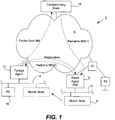
- a Mobile IP environment 2 includes the internet (or a WAN) 4 over which a Mobile Node 6 can communicate remotely via mediation by a Home Agent 8 and a Foreign Agent 10.
- the Home Agent and Foreign Agent are routers or other network connection devices performing appropriate Mobile IP functions as implemented by software, hardware, and/or firmware.
- a particular Mobile Node e. g. , a laptop computer
- plugged into its home network segment connects with the internet through its designated Home Agent.
- the Mobile Node roams, it communicates via the internet through an available Foreign Agent.
- Mobile Node 6 normally resides on (or is"based at") a network segment 12 which allows its network entities to communicate over the internet 4 through Home Agent 8 (an appropriately configured router denoted R2).
- Home Agent 8 need not directly connect to the internet.
- it may be connected through another router (a router R1 in this case).
- Router R1 may, in turn, connect one or more other routers (e.g., a router R3) with the internet.
- Network segment 14 may include various other nodes such as a PC 16.
- the nodes on network segment 14 communicate with the internet through a router which doubles as Foreign Agent 10.
- Mobile Node 6 may identify Foreign Agent 10 through various solicitations and advertisements which form part of the Mobile IP protocol.
- Foreign Agent 10 relays a registration request to Home Agent 8 (as indicated by the dotted line "Registration").
- the Home and Foreign Agents may then negotiate the conditions of the Mobile Node's attachment to Foreign Agent 10. For example, the attachment may be limited to a period of time, such as two hours.
- Home Agent 8 updates an internal "mobility binding table" which specifies the care-of address (e.g., a collocated care-of address or the Foreign Agent's IP address) in association with the identity of Mobile Node 6. Further, the Foreign Agent 10 updates an internal "visitor table" which specifies the Mobile Node address, Home Agent address, etc. In effect, the Mobile Node's home base IP address (associated with segment 12) has been shifted to the Foreign Agent's IP address (associated with segment 14).
- care-of address e.g., a collocated care-of address or the Foreign Agent's IP address
- Mobile Node 6 wishes to send a message to a corresponding node 18 from its new location.
- a message from the Mobile Node is then packetized and forwarded through Foreign Agent 10 over the internet 4 and to corresponding node 18 (as indicated by the dotted line "packet from MN") according to a standard internet protocol.
- corresponding node 18 wishes to send a message to Mobile Node -- whether in reply to a message from the Mobile Node or for any other reason -- it addresses that message to the IP address of Mobile Node 6 on sub-network 12.
- the packets of that message are then forwarded over the internet 4 and to router R1 and ultimately to Home Agent 8 as indicated by the dotted line ("packet to MN(1)").
- Home Agent 8 recognizes that Mobile Node 6 is no longer attached to network segment 12. It then encapsulates the packets from corresponding node 18 (which are addressed to Mobile Node 6 on network segment 12) according to a Mobile IP protocol and forwards these encapsulated packets to a "care of" address for Mobile Node 6 as shown by the dotted line ("packet to MN (2) ").
- the care-of address may be, for example, the IP address of Foreign Agent 10.
- Foreign Agent 10 then strips the encapsulation and forwards the message to Mobile Node 6 on sub-network 14.
- the packet forwarding mechanism implemented by the Home and Foreign Agents is often referred to as "tunneling.”
- a Mobile Node may roam from one Foreign Agent to another Foreign Agent. Similarly, the Mobile Node may roam from one Access Point to another Access Point.
- An Access Point may be defined as a point of connectivity in a wireless or non-wireless network. During roaming, the Mobile Node registers with its Home Agent to notify the Home Agent of its new location.
- EP 0 660 627 discloses a radio telephone that is operable in a cordless telephone system or in a cellular telephone system.
- the telephone incorporates circuitry to detect user velocity so that when the user travels more quickly the telephone automatically transfers from cordless mode, which is the preferred mode, to cellular mode.
- WO 97/21318 discloses a method of measuring speed of a mobile unit for use in a wireless communication system.
- a speed of the network device is detected (e. g. periodically) by the network device or a device associated therewith.
- the satisfaction of a particular trigger event triggers the roaming of the network device.
- one or more trigger values e. g. , maximum or minimum trigger values
- trigger values may include the maximum number of beacons that can be missed by the network device before roaming is triggered.
- one or more trigger counters e.g., number of beacons that have been missed
- Roaming of the network device is then triggered when one of the trigger counters associated with one of the trigger events is equal to or exceeds (or, alternatively, is less than or equal to) one of the trigger values corresponding to the trigger event at the speed of the network device.
- the trigger values are ascertained from a profile configured at the network device.
- the profile includes a set of trigger values at a plurality of different speeds or ranges of speeds.
- the appropriate maximum or minimum trigger values may be ascertained.
- a speed of the network device is detected.
- One or more trigger values corresponding to one or more trigger events are modified such that the one or more trigger values correspond to the speed of the network device.
- the trigger values may be modified using a scale factor appropriate to the speed of the network device and/or the trigger event.
- One or more trigger counters associated with the one or more trigger events are maintained. Roaming of the network device is then triggered when one of the trigger counters associated with one of the trigger events is equal to or exceeds (or, alternatively, is less than or equal to) one of the trigger values corresponding to the trigger event at the speed of the network device.
- the embodiments of the invention may be implemented in software, hardware, or a combination of hardware and software.
- the invention can also be embodied as computer readable code on a computer readable medium.
- data structures disclosed are also part of the invention.
- Embodiments of the invention support implementation of a speed sensitive mobile network device such as a Mobile Node.
- a speed sensitive mobile network device such as a Mobile Node.
- a device such as a Global Positioning System (GPS)
- GPS Global Positioning System
- the Mobile Node may trigger roaming at a rate corresponding to the speed of the Mobile Node.
- IEEE 802.11 specifies that roaming is caused by one of a plurality of roaming events. Specifically, a roaming event indicates that the Mobile Node is outside the coverage area of a particular Access Point. As a result, the Mobile Node needs to register with the New Access Point. In addition, the Mobile Node may de-register with its previous Access Point to indicate that it is no longer located at the prior Access Point. Thus, each roaming event may indicate to the Mobile Node that it needs to associate with its new Access Point so that it is within the coverage area of the new Access Point.
- the trigger events use an event counter or timer.
- events e.g., high values
- these values are generally used to trigger roaming when clients are traveling at low speeds.
- these values inhibit faster roaming at higher speeds.
- a counter may be incremented to determine whether a specific trigger value is exceeded, it is also possible to decrement a counter to determine whether a specific trigger value has been reached.
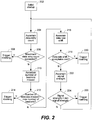
- FIG. 2 is a process flow diagram illustrating a method of triggering roaming.
- Roaming may be triggered at various points during the operation of a Mobile Node. Specifically, at initial startup of the Mobile Node as shown at 202, it is possible to trigger roaming in accordance with various trigger events, as will be described in further detail below.
- Various trigger events may trigger roaming when one of the trigger events occurs. These events may occur individually or in combination with one another.
- a data retry count trigger counter is maintained and periodically updated. Specifically, when a data packet cannot be sent by the Mobile Node, the data retry count is incremented. When the data retry count exceeds a maximum data retry count (e.g., 64) at block 206, this triggers roaming of the Mobile Node at block 208.
- a maximum data retry count e.g. 64
- a network device such as an Access Point typically transmits beacons so that a mobile network device associated to or in the vicinity of the Access Point knows of the existence of the network device.
- the Mobile Node first associates with the Access Point.
- the Mobile Node may then send a registration request to its Home Agent via the network device.
- the Mobile Node maintains a trigger counter indicating the number of consecutive beacons that have been missed (i.e., undetected) by the Mobile Node, and may therefore be ascertained as shown at block 210.
- the number of beacons that have been missed exceeds the maximum number of beacons that can be missed as shown at block 212, roaming of the Mobile Node is triggered at block 214.
- Another roaming event may occur dependent upon the signal level of the Access Point that is detected by the Mobile Node.
- the Mobile Node may be configured to detect when the signal level drops below a certain level. For instance, the Mobile Node may be configured to roam once the signal level has dropped below 50%.
- a signal strength may be ascertained at block 222. When the signal strength is less than the minimum acceptable signal strength at block 224, roaming is triggered at block 226.
- a trigger event such as that described above may indicate that the Mobile Node has reached, is nearing the perimeter, or is outside of the coverage area of a particular network device (e.g., Access Point), thereby triggering roaming of the Mobile Node. Until one of these events occurs, the process continues at block 204, and the Mobile Node continues to receive packets via its current network device (e.g., Access Point).
- a particular network device e.g., Access Point
- the Mobile Node is speed sensitive. In other words, the speed of the Mobile Node is detected.
- the parameters or trigger counters that are used to trigger roaming of the Mobile Node are modified in accordance with the detected speed or, alternatively, the parameters or trigger counters associated with the detected speed are ascertained.
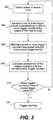
- FIG. 3 is a process flow diagram illustrating a method of triggering roaming in accordance with one embodiment of the invention.
- the speed of the Mobile Node is detected.
- the speed of the Mobile Node may be detected via a Global Positioning System (GPS) or other mechanism.
- GPS Global Positioning System
- One or more trigger values corresponding to one or more trigger events at the speed of the Mobile Node are ascertained at block 304.
- the trigger events may include at least one of maximum data retry count is exceeded, maximum number of beacons missed is exceeded, data rate shift, and signal strength.
- the trigger values associated with the trigger events are maximum data retry count, maximum number of beacons missed, maximum data rate shift, and minimum signal strength, respectively.
- the Mobile Node maintains the one or more trigger counters associated with the one or more trigger events as shown at block 306. Roaming is triggered when one of the trigger counters associated with one of the trigger events is equal to or exceeds (or is less than or equal to) one of the trigger values corresponding to the trigger event at the speed of the Mobile Node. Specifically, at least one of the trigger counters is compared with the corresponding trigger value(s) at block 308. If the trigger counter(s) meet or exceed the corresponding trigger value(s) (or is less than or equal to the corresponding trigger value(s)) at block 310, roaming is triggered at block 312. Otherwise, the process continues at block 302.
- the speed of the Mobile Node may be detected periodically. Moreover, the speed of the Mobile Node may be detected at a pre-configured rate or merely while the Mobile Node is in motion.
- the Mobile Node When roaming is triggered, the Mobile Node searches for a new Access Point and associates with it. Specifically, the Mobile Node should be within the coverage area of the new Access Point. The Mobile Node may also de-register with the previous Access Point such that the Mobile Node is no longer associated with its prior location (e.g., Access Point).
- the Mobile Node may be in a coverage area of a new Foreign Agent.
- the Mobile Node may then send a registration request to its Home Agent via the new Foreign Agent in order to register with its Home Agent.
- the Mobile Node may also de-register with the Home Agent (e.g., via its new Foreign Agent) such that the Mobile Node is no longer associated with its prior location (e.g., Foreign Agent).
- the Mobile Node may communicate to its Home Agent that it is no longer within the coverage area of the prior Foreign Agentvia which the Mobile Node has registered with its Home Agent.
- the trigger value(s) used to trigger roaming depend upon the speed of the Mobile Node.
- the trigger value(s) corresponding to the appropriate speed or speed range is ascertained. This may be accomplished via a look-up table (e.g., profile) or by modifying trigger value(s) by a scale factor (e.g., percentage, fraction or other numerical value) based upon the speed of the Mobile Node.
- FIG. 4 is an exemplary profile or look-up table indicating maximum or minimum trigger values corresponding to various speeds or speed ranges in accordance with one embodiment of the invention. As shown, various speeds or speed ranges are identified. In this manner, the appropriate trigger value(s) may be identified at the particular speed of the Mobile Node. As shown, the maximum data retry count trigger value, maximum missed beacons trigger value, maximum data rate shift trigger value, and minimum signal strength trigger value are specified. Thus, through the identification of the appropriate column in the profile, the maximum/minimum trigger value(s) may be identified. In this manner, the value(s) that trigger roaming of a Mobile Node may be ascertained.
- a speed of 1.5 mph would indicate that the maximum data retry count trigger value is 8, the maximum missed beacons trigger value is 3, the maximum data rate shift trigger value is 15, and the minimum signal strength trigger value is 12.5.
- the trigger values decrease, thereby increasing the rate at which the Mobile Node roams to a closer network device (e.g., Access Point).
- trigger values may be modified depending upon the detected speed of the Mobile Node.
- FIG. 5 is an exemplary profile indicating scale factors (e.g., multiplication factors) corresponding to various speeds or speed ranges, as well as trigger events, in accordance with one embodiment of the invention. As shown in this example, when the speed of the Mobile Node is 1.5 mph, the multiplication factor for the maximum data retry count trigger value is 2/3, the multiplication factor for the maximum missed beacons trigger value is 3 ⁇ 4, the multiplication factor for the maximum data rate shift trigger value is 1 ⁇ 2, and the multiplication factor for the minimum signal strength trigger value is 1 ⁇ 2.
- the multiplication factor for the maximum data retry count trigger value is 2/3
- the multiplication factor for the maximum missed beacons trigger value is 3 ⁇ 4
- the multiplication factor for the maximum data rate shift trigger value is 1 ⁇ 2
- the multiplication factor for the minimum signal strength trigger value is 1 ⁇ 2.
- each of the trigger values has a different multiplying factor corresponding to the corresponding trigger event at the speed of the Mobile Node.
- the trigger values at a particular speed may all be multiplied by a single multiplying factor (e.g., 1 ⁇ 2).
- the multiplying factors also decrease as the speed of the Mobile Node increases, thereby decreasing the associated trigger value(s).
- the multiplying factors increase as the speed of the Mobile Node decreases, thereby increasing the associated trigger value(s).
- the present invention improves the operation of a mobile network device such as a Mobile Node at higher traveling speeds. This is accomplished through modifying the rate at which roaming is performed. Accordingly, roaming is performed at a higher frequency rate as the speed of the Mobile Node increases.
- the invention can also be embodied as computer readable code on a computer readable medium.
- the computer readable medium is any data storage device that can store data which can thereafter be read by a computer system. Examples of the computer readable medium include read-only memory, random-access memory, CD-ROMs, magnetic tape, and optical data storage devices.
- the apparatus e.g. Mobile Node, Access Point, Home Agent, or Foreign Agent
- the apparatus may be specially constructed for the required purposes, or may be a general purpose programmable machine selectively activated or reconfigured by a computer program stored in memory.
- the processes presented herein are not inherently related to any particular router or other apparatus.
- any of the Home and Foreign Agents of this invention may be specially configured routers such as specially configured router models 2500, 2600, 3600, 4000, 4500, 4700, 7200, and 7500 available from Cisco Systems, Inc. of San Jose, California.
- any of the Access Points of this invention may be specially configured routers such as specially configured router models 350, 1100, 1200 and 1400 available from Cisco Systems, Inc.
- the Mobile Node of this invention may be a specially configured router such as specially configured router model 3200 available from Cisco Systems, Inc. of San Jose, California. A general structure for some of these machines will appear from the description given below.
- the roaming technique of the present invention may be implemented on software and/or hardware.
- it can be implemented in an operating system kernel, in a separate user process, in a library package bound into network applications, on a specially constructed machine, or on a network interface card.
- the technique of the present invention is implemented in software such as an operating system or in an application running on an operating system.
- a software or software/hardware hybrid roaming system of this invention is preferably implemented on a general-purpose programmable machine selectively activated or reconfigured by a computer program stored in memory.
- Such programmable machine may be a network device designed to handle network traffic.
- Such network devices typically have multiple network interfaces including frame relay, ISDN, and wireless interfaces, for example.
- Specific examples of such network devices include routers and switches.
- the roaming systems of this invention may be specially configured routers such as specially configured router models 350, 1100, 1200, 1400, 1600, 2500, 2600, 3200, 3600, 4500, 4700, 7200, 7500, and 12000 available from Cisco Systems, Inc. of San Jose, California.
- the roaming system may be implemented on a general-purpose network host machine such as a personal computer or workstation.
- the invention may be at least partially implemented on a card (e.g., an interface card) for a network device or a general-purpose computing device.
- a router 1110 suitable for implementing the present invention includes a master central processing unit (CPU) 1162, interfaces 1168, and a bus 1115 (e.g., a PCI bus).
- the CPU 1162 is responsible for such router tasks as routing table computations and network management. It may also be responsible for updating mobility binding and visitor tables, etc. It preferably accomplishes all these functions under the control of software including an operating system (e.g., the Internetwork Operating System (IOS®) of Cisco Systems, Inc.) and any appropriate applications software.
- CPU 1162 may include one or more processors 1163 such as a processor from the Motorola family of microprocessors or the MIPS family of microprocessors.
- processor 1163 is specially designed hardware for controlling the operations of router 1110.
- a memory 1161 (such as non-volatile RAM and/or ROM) also forms part of CPU 1162.
- memory 1161 such as non-volatile RAM and/or ROM
- CPU 1162 there are many different ways in which memory could be coupled to the system.
- the interfaces 1168 are typically provided as interface cards (sometimes referred to as "line cards"). Generally, they control the sending and receiving of data packets over the network and sometimes support other peripherals used with the router 1110.
- interfaces that may be provided are Ethernet interfaces, frame relay interfaces, cable interfaces, DSL interfaces, token ring interfaces, wireless interfaces, and the like.
- various very high-speed interfaces may be provided such as fast Ethernet interfaces, Gigabit Ethernet interfaces, ATM interfaces, HSSI interfaces, POS interfaces, FDDI interfaces and the like.
- these interfaces may include ports appropriate for communication with the appropriate media. In some cases, they may also include an independent processor and, in some instances, volatile RAM.
- the independent processors may control such communications intensive tasks as packet switching, media control and management. By providing separate processors for the communications intensive tasks, these interfaces allow the master microprocessor 1162 to efficiently perform routing computations, network diagnostics, security functions, etc.
- router architecture on which the present invention can be implemented.
- an architecture having a single processor that handles communications as well as routing computations, etc. is often used.
- other types of interfaces and media could also be used with the router.
- network device may employ one or more memories or memory modules (including memory 1161) configured to store program instructions for the general-purpose network operations and mechanisms for roaming and routing functions described herein.
- the program instructions may control the operation of an operating system and/or one or more applications, for example.
- the memory or memories may also be configured to store tables such as mobility binding, registration, and association tables, etc.
- the present invention relates to machine readable media that include program instructions, state information, etc. for performing various operations described herein.
- machine-readable media include, but are not limited to, magnetic media such as hard disks, floppy disks, and magnetic tape; optical media such as CD-ROM disks; magneto-optical media such as floptical disks; and hardware devices that are specially configured to store and perform program instructions, such as read-only memory devices (ROM) and random access memory (RAM).
- ROM read-only memory devices
- RAM random access memory
- the invention may also be embodied in a carrier wave travelling over an appropriate medium such as airwaves, optical lines, electric lines, etc.
- program instructions include both machine code, such as produced by a compiler, and files containing higher level code that may be executed by the computer using an interpreter.
Landscapes
- Engineering & Computer Science (AREA)
- Computer Networks & Wireless Communication (AREA)
- Signal Processing (AREA)
- Mobile Radio Communication Systems (AREA)
Claims (32)
- Verfahren zum Auslösen von Roaming in einem Netzwerkgerät, das Folgendes beinhaltet:Erkennen (302), durch ein Netzwerkgerät, einer Geschwindigkeit des Netzwerkgeräts;Feststellen (304), durch das Netzwerkgerät, von einem oder mehreren Auslösewerten entsprechend einem oder mehreren Auslöseereignissen bei der Geschwindigkeit des Netzwerkgeräts von einem am Netzwerkgerät konfigurierten Profil, wobei das Profil einen Satz von Auslösewerten bei mehreren unterschiedlichen Geschwindigkeiten oder Geschwindigkeitsbereichen beinhaltet;Feststellen (306), durch das Netzwerkgerät, von einem oder mehreren mit den ein oder mehreren Auslöseereignissen assoziierten Auslösezählern; undAuslösen (312) von Roaming des Netzwerkgeräts, wenn (310) einer der mit einem der Auslöseereignisse assoziierten Auslösezähler gleich oder höher ist als einer der Auslösewerte, die dem einen der Auslösewerte und der Geschwindigkeit des Netzwerkgeräts entsprechen.
- Verfahren nach Anspruch 1, wobei das Netzwerkgerät ein in einer 802.11 Umgebung implementierter mobiler Knoten ist.
- Verfahren nach Anspruch 1, wobei das Netzwerkgerät ein Mobile IP unterstützender mobiler Knoten ist.
- Verfahren nach Anspruch 1, wobei Roaming ausgelöst wird, wenn das Netzwerkgerät einen Rand eines Abdeckungsbereichs eines Zugangspunkts, mit dem das Netzwerkgerät assoziiert ist, oder eines Foreign Agent, über den das Netzwerkgerät bei seinem Home Agent registriert ist, erreicht hat oder sich ihm nähert.
- Verfahren nach Anspruch 1, wobei Roaming ausgelöst wird, wenn das Netzwerkgerät sich nicht mehr in einem Abdeckungsbereich eines Zugangspunkts befindet, mit dem das Netzwerkgerät assoziiert ist, oder eines Foreign Agent, über den das Netzwerkgerät bei seinem Home Agent registriert ist.
- Verfahren nach Anspruch 1, wobei die Rate, mit der das Netzwerkgerät roamt, mit zunehmender Geschwindigkeit des Netzwerkgeräts zunimmt.
- Verfahren nach Anspruch 1, wobei die Auslösewerte mit zunehmender Geschwindigkeit des Netzwerkgeräts abnehmen.
- Verfahren nach Anspruch 1 oder Anspruch 7, wobei die Auslöseereignisse wenigstens eines aus Überschreiten einer maximalen Datenwiederholungszahl, Überschreiten einer maximalen Anzahl von verpassten Beacons, Datenratenverschiebung oder Signalstärke beinhalten.
- Verfahren nach Anspruch 8, wobei die Auslösewerte wenigstens eines aus Überschreiten einer maximalen Datenwiederholungszahl, Überschreiten einer maximalen Anzahl von verpassten Beacons, Datenratenverschiebung oder Signalstärke beinhalten.
- Verfahren nach Anspruch 9, wobei Roaming ausgelöst wird, wenn einer der mit der maximalen Datenwiederholungszahl assoziierten Auslösezähler überschritten wird, das Auslöseereignis gleich oder höher ist als der maximale Datenwiederholungszahl-Auslösewert.
- Verfahren nach Anspruch 9, wobei Roaming ausgelöst wird, wenn einer der mit der maximalen Anzahl von verpassten Beacons assoziierten Auslösezähler überschritten wird, das Auslöseereignis gleich oder höher ist als der Auslösewert für die maximale Anzahl von verpassten Beacons.
- Verfahren nach Anspruch 9, wobei Roaming ausgelöst wird, wenn einer der mit dem Datenratenverschiebungs-Auslöseereignis assoziierten Auslösezähler gleich oder höher ist als der maximale Datenratenverschiebungs-Auslösewert.
- Verfahren nach Anspruch 9, wobei Roaming ausgelöst wird, wenn einer der mit dem Signalstärke-Auslöseereignis assoziierten Auslösezähler kleiner ist als der minimale Signalstärke-Auslösewert.
- Verfahren nach Anspruch 1, wobei das Erkennen einer Geschwindigkeit des Netzwerkgeräts mit einem GPS erfolgt.
- Verfahren nach Anspruch 1, wobei das Netzwerkgerät ein mobiler Knoten ist, wobei das Verfahren ferner Folgendes beinhaltet:Registrieren bei einem Home Agent über einen neuen Foreign Agent mittels eines neuen Zugangspunkts, wenn Roaming ausgelöst ist, wobei sich der mobile Knoten innerhalb eines Abdeckungsbereichs des neuen Foreign Agent und des neuen Zugangspunkts befindet.
- Verfahren nach Anspruch 15, das ferner Folgendes beinhaltet:Deregistrieren bei dem Home Agent über einen neuen Foreign Agent mit einem neuen Zugangspunkt, wobei sich der mobile Knoten nicht mehr innerhalb eines Abdeckungsbereichs des vorherigen Foreign Agent befindet.
- Verfahren nach Anspruch 1, wobei das Netzwerkgerät ein mobiler Knoten ist, und wobei, wenn Roaming ausgelöst ist, der mobile Knoten sich nicht mehr innerhalb eines Abdeckungsbereichs eines Foreign Agent befindet, über den der mobile Knoten bei seinem Home Agent registriert ist.
- Verfahren nach Anspruch 1, wobei, wenn Roaming ausgelöst wird, das Netzwerkgerät sich nicht mehr innerhalb eines Abdeckungsbereichs eines Zugangspunkts befindet, der das Netzwerkgerät bedient.
- Verfahren nach Anspruch 1, das ferner Folgendes beinhaltet:Modifizieren von einem oder mehreren Auslösewerten in einem aus der Mehrzahl von Sätzen von Auslösewerten.
- Verfahren nach Anspruch 19, wobei das Modifizieren von einem oder mehreren Auslösewerten Folgendes beinhaltet:Multiplizieren der ein oder mehreren Auslösewerte mit einem oder mehreren Multiplikationsfaktoren, wobei jeder der Multiplikationsfaktoren der Geschwindigkeit des Netzwerkgeräts entspricht.
- Verfahren nach Anspruch 20, wobei jeder der Multiplikationsfaktoren die ein oder mehreren Auslösewerte verringert, wenn die Geschwindigkeit des Netzwerkgeräts zunimmt.
- Verfahren nach Anspruch 20, wobei jeder der Multiplikationsfaktoren die ein oder mehreren Auslösewerte erhöht, wenn die Geschwindigkeit des Netzwerkgeräts abnimmt.
- Verfahren nach Anspruch 20, das ferner Folgendes beinhaltet:Feststellen der Multiplikationsfaktoren entsprechend der Geschwindigkeit des Netzwerkgeräts.
- Verfahren nach Anspruch 20, wobei das Multiplizieren Folgendes beinhaltet:Multiplizieren der ein oder mehreren Auslösewerte mit einem einzigen Multiplikationsfaktor.
- Verfahren nach Anspruch 20, wobei das Multiplizieren Folgendes beinhaltet:Multiplizieren jedes der Auslösewerte mit einem anderen Multiplikationsfaktor, wobei der Multiplikationsfaktor dem Auslöseereignis entspricht.
- Verfahren nach Anspruch 1, wobei das Netzwerkgerät ein mobiler Knoten ist, wobei das Verfahren ferner Folgendes beinhaltet:Registrieren bei einem Home Agent über einen Foreign Agent, wenn Roaming ausgelöst ist, wobei sich der mobile Knoten innerhalb eines Abdeckungsbereichs des Foreign Agent befindet.
- Verfahren nach Anspruch 26, das ferner Folgendes beinhaltet:Deregistrieren beim Home Agent über einen neuen Foreign Agent, wenn sich der mobile Knoten nicht mehr innerhalb eines Abdeckungsbereichs des vorherigen Foreign Agent befindet.
- Verfahren nach Anspruch 1, wobei das Netzwerkgerät ein mobiler Knoten ist und wobei, wenn Roaming ausgelöst ist, der mobile Knoten sich nicht mehr innerhalb eines Abdeckungsbereichs eines Foreign Agent befindet, über den der mobile Knoten bei seinem Home Agent registriert ist.
- Verfahren zum Auslösen von Roaming in einem Netzwerkgerät, das Folgendes beinhaltet:Erkennen, durch ein Netzwerkgerät, einer Geschwindigkeit des Netzwerkgeräts;Feststellen, durch das Netzwerkgerät, von einem oder mehreren Auslösewerten entsprechend einem oder mehreren Auslöseereignissen und der Geschwindigkeit des Netzwerkgeräts von einem Profil, wobei das Profil einen Satz von Auslösewerten bei mehreren unterschiedlichen Geschwindigkeiten oder Geschwindigkeitsbereichen beinhaltet;Feststellen, durch das Netzwerkgerät, von einem oder mehreren mit den ein oder mehreren Auslöseereignissen assoziierten Auslösezählern; undAuslösen von Roaming des Netzwerkgeräts, wenn einer der mit einem der Auslöseereignisse assoziierten Auslösezähler gleich oder kleiner ist als einer der Auslösewerte, die dem einen der Auslöseereignisse und der Geschwindigkeit des Netzwerkgeräts entsprechen.
- Verfahren zum Auslösen von Roaming in einem Netzwerkgerät, das Folgendes beinhaltet:Erkennen einer Geschwindigkeit des Netzwerkgeräts;Modifizieren von einem oder mehreren Auslösewerten entsprechend einem oder mehreren Auslöseereignissen, so dass die ein oder mehreren Auslösewerte der Geschwindigkeit des Netzwerkgeräts entsprechen; wobei die ein oder mehreren Auslösewerte mit einem Satz von Auslösewerten bei mehreren unterschiedlichen Geschwindigkeiten oder Geschwindigkeitsbereichen in einem am Netzwerkgerät konfigurierten Profil assoziiert sind;Feststellen von einem oder mehreren mit den ein oder mehreren Auslöseereignissen assoziierten Auslösezählern; undAuslösen von Roaming, wenn einer der mit einem der Auslöseereignisse assoziierten Auslösezähler gleich oder kleiner ist als einer der Auslösewerte, die dem einen der Auslöseereignisse und der Geschwindigkeit des Netzwerkgeräts entsprechen.
- Computerlesbares Medium, auf dem computerlesbare Befehle zur Ausführung durch ein Verarbeitungssystem gespeichert sind, die bei Ausführung durch das Verarbeitungssystem bewirken, dass das Verarbeitungssystem alle Schritte eines Verfahrens zum Auslösen von Roaming in einem Netzwerkgerät nach einem der vorherigen Ansprüche ausführt.
- Vorrichtung zum Auslösen von Roaming in einem Netzwerkgerät, die Folgendes umfasst:Mittel zum Ausführen aller Schritte eines Verfahrens nach einem der Ansprüche 1 bis 30.
Applications Claiming Priority (2)
| Application Number | Priority Date | Filing Date | Title |
|---|---|---|---|
| US10/749,727 US8064903B2 (en) | 2003-12-30 | 2003-12-30 | Methods and apparatus for reducing roaming latency in a mobile node |
| PCT/US2004/042452 WO2005065210A2 (en) | 2003-12-30 | 2004-12-16 | Methods and apparatus for reducing roaming latency in a mobile node |
Publications (3)
| Publication Number | Publication Date |
|---|---|
| EP1708671A2 EP1708671A2 (de) | 2006-10-11 |
| EP1708671A4 EP1708671A4 (de) | 2012-05-09 |
| EP1708671B1 true EP1708671B1 (de) | 2018-02-14 |
Family
ID=34711121
Family Applications (1)
| Application Number | Title | Priority Date | Filing Date |
|---|---|---|---|
| EP04818050.9A Expired - Lifetime EP1708671B1 (de) | 2003-12-30 | 2004-12-16 | Verfahren und vorrichtung zur verringerung der roaming-latenz in einem mobilknoten |
Country Status (7)
| Country | Link |
|---|---|
| US (1) | US8064903B2 (de) |
| EP (1) | EP1708671B1 (de) |
| CN (1) | CN101444128B (de) |
| AU (1) | AU2004311765A1 (de) |
| CA (1) | CA2546626A1 (de) |
| DE (1) | DE202004021268U1 (de) |
| WO (1) | WO2005065210A2 (de) |
Families Citing this family (8)
| Publication number | Priority date | Publication date | Assignee | Title |
|---|---|---|---|---|
| US7844266B2 (en) | 2003-09-30 | 2010-11-30 | Intel Corporation | Wireless network roaming timer method and apparatus |
| US20070004407A1 (en) * | 2005-06-30 | 2007-01-04 | Biggs Robert A | System and method for selecting a network based on the velocity of a wireless device |
| US7633917B2 (en) | 2006-03-10 | 2009-12-15 | Cisco Technology, Inc. | Mobile network device multi-link optimizations |
| CN102804857B (zh) * | 2009-06-26 | 2016-01-13 | 奥普蒂斯无线技术有限责任公司 | 用于移动性管理的方法和设备 |
| US9055159B2 (en) * | 2009-12-14 | 2015-06-09 | Raymond Maurice Smit | Mobile communication device and method for selectively turning on an additional wireless transceiver |
| WO2012020485A1 (ja) * | 2010-08-11 | 2012-02-16 | 富士通株式会社 | 無線通信システム、制御局及び制御方法 |
| CN109275198B (zh) * | 2018-09-30 | 2020-07-17 | Oppo广东移动通信有限公司 | 移动终端的控制方法、装置、存储介质及移动终端 |
| CN113630828B (zh) * | 2021-10-11 | 2022-02-08 | 东集技术股份有限公司 | 一种无线漫游方法、装置、计算机设备和存储介质 |
Citations (3)
| Publication number | Priority date | Publication date | Assignee | Title |
|---|---|---|---|---|
| US5913168A (en) * | 1995-06-16 | 1999-06-15 | France Telecom | Method of controlling handover in a multicellular radio communications network, and speed estimation methods relating thereto |
| US6400953B1 (en) * | 1997-08-11 | 2002-06-04 | Nec Corporation | CDMA type mobile radio communication system capable of realizing an effective system operation without excess and deficiency of radio base stations simultaneously connected |
| WO2002093813A1 (en) * | 2001-05-15 | 2002-11-21 | Nokia Corporation | A method of channel allocation for a mobile terminal moving in a cellular communication network |
Family Cites Families (34)
| Publication number | Priority date | Publication date | Assignee | Title |
|---|---|---|---|---|
| US5239667A (en) * | 1990-01-31 | 1993-08-24 | Nec Corporation | Method of controlling handoff in cellular mobile radio communications system |
| GB2285198B (en) * | 1993-12-22 | 1998-03-04 | Nokia Mobile Phones Ltd | Multi-mode radio telephone |
| TW347616B (en) * | 1995-03-31 | 1998-12-11 | Qualcomm Inc | Method and apparatus for performing fast power control in a mobile communication system a method and apparatus for controlling transmission power in a mobile communication system is disclosed. |
| GB2301733B (en) * | 1995-05-27 | 1999-09-22 | Motorola Inc | Method for determining handover in a multicellular communications system |
| US5787348A (en) | 1995-12-06 | 1998-07-28 | Motorola, Inc. | Method of measuring speed of a mobile unit and a receiver for use in a wireless communication system |
| JPH09267663A (ja) * | 1996-03-29 | 1997-10-14 | Komatsu Ltd | 車両運行制御装置 |
| US6201962B1 (en) * | 1997-05-14 | 2001-03-13 | Telxon Corporation | Seamless roaming among multiple networks including seamless transitioning between multiple devices |
| CN1224318A (zh) * | 1997-10-14 | 1999-07-28 | 美国电报电话公司 | 具有备用基站和卫星站的蜂窝网络 |
| JP3137083B2 (ja) * | 1998-06-29 | 2001-02-19 | 日本電気株式会社 | 移動体通信システム、通信装置、通信方法、並びに記録媒体 |
| SE516837C2 (sv) * | 1998-12-18 | 2002-03-12 | Ericsson Telefon Ab L M | Förfarande och medel för att fastställa handovers i ett cellulärt radiokommunikationssystems |
| US6556553B1 (en) * | 1999-04-12 | 2003-04-29 | Intermec Ip Corp. | Method for determining when a communication device should rate shift or roam in a wireless environment |
| KR100350476B1 (ko) * | 1999-12-30 | 2002-08-28 | 삼성전자 주식회사 | 이동통신시스템의 핸드오프 수행장치 및 방법 |
| US6721572B1 (en) * | 2000-03-24 | 2004-04-13 | International Business Machines Corporation | Mobile communication optimization near wireless dead zone regions |
| US6430395B2 (en) * | 2000-04-07 | 2002-08-06 | Commil Ltd. | Wireless private branch exchange (WPBX) and communicating between mobile units and base stations |
| US7082114B1 (en) * | 2000-08-18 | 2006-07-25 | Nortel Networks Limited | System and method for a wireless unit acquiring a new internet protocol address when roaming between two subnets |
| FR2813488B1 (fr) * | 2000-08-31 | 2003-07-04 | Cit Alcatel | Dispositif de reception pour unite de radiocommunication mobile mettant en oeuvre un estimateur de vitesse |
| US7106783B2 (en) * | 2000-12-19 | 2006-09-12 | Lg Electronics Inc. | Method and apparatus for searching multipaths of mobile communication system |
| JP2002199428A (ja) * | 2000-12-27 | 2002-07-12 | Toshiba Corp | 移動通信端末装置とそのハンドオーバ制御方法及び制御プログラム |
| JP2002198900A (ja) * | 2000-12-27 | 2002-07-12 | Fujitsu Ltd | 下り送信電力制御方法、移動通信システム、基地局、移動局、交換局側装置 |
| US20020168983A1 (en) * | 2001-05-10 | 2002-11-14 | Krishnan Kumaran | Assigning frequency channels in a cellular system |
| US6615044B2 (en) * | 2001-06-06 | 2003-09-02 | Nokia Mobile Phones, Ltd. | Method of WCDMA coverage based handover triggering |
| JP3982604B2 (ja) * | 2001-07-10 | 2007-09-26 | 株式会社エヌ・ティ・ティ・ドコモ | 位置登録方法、位置登録システム、移動端末、及び、位置登録エリア設定装置、位置登録エリア設定プログラム |
| JP4287604B2 (ja) * | 2001-08-27 | 2009-07-01 | 富士通株式会社 | 移動体通信システム並びに無線基地局,無線装置及び移動端末 |
| TW545076B (en) * | 2001-10-02 | 2003-08-01 | Quanta Comp Inc | Method and system for channel allocation in multi-frequency wireless network |
| JP2003134031A (ja) * | 2001-10-23 | 2003-05-09 | Oki Electric Ind Co Ltd | 通信装置 |
| US7054646B2 (en) * | 2002-10-17 | 2006-05-30 | Nokia Corporation | Transmission method in a communication system |
| US7123917B2 (en) * | 2002-12-17 | 2006-10-17 | Kyocera Wireless Corp. | System and method for determining when to exit an existing wireless communications coverage network |
| US20050043026A1 (en) * | 2003-01-22 | 2005-02-24 | Jacco Brok | System and method for establishing and/or maintaining a data session across packet data networks |
| US7035640B2 (en) * | 2003-05-15 | 2006-04-25 | Motorola, Inc. | Method for improving the reliability of low latency handoffs |
| US7710874B2 (en) * | 2003-06-04 | 2010-05-04 | International Business Machines Corporation | System and method for automatic management of many computer data processing system pipes |
| US7522529B2 (en) * | 2003-07-21 | 2009-04-21 | Qlogic, Corporation | Method and system for detecting congestion and over subscription in a fibre channel network |
| US7536186B2 (en) * | 2003-08-26 | 2009-05-19 | Motorola, Inc. | System to improve handover behavior |
| US7844266B2 (en) * | 2003-09-30 | 2010-11-30 | Intel Corporation | Wireless network roaming timer method and apparatus |
| US7142861B2 (en) * | 2003-12-12 | 2006-11-28 | Telefonaktiebolaget Lm Ericsson (Publ) | Mobile communications in a hierarchical cell structure |
-
2003
- 2003-12-30 US US10/749,727 patent/US8064903B2/en active Active
-
2004
- 2004-12-16 DE DE202004021268U patent/DE202004021268U1/de not_active Expired - Lifetime
- 2004-12-16 WO PCT/US2004/042452 patent/WO2005065210A2/en not_active Ceased
- 2004-12-16 AU AU2004311765A patent/AU2004311765A1/en not_active Abandoned
- 2004-12-16 CA CA002546626A patent/CA2546626A1/en not_active Abandoned
- 2004-12-16 CN CN2004800335298A patent/CN101444128B/zh not_active Expired - Lifetime
- 2004-12-16 EP EP04818050.9A patent/EP1708671B1/de not_active Expired - Lifetime
Patent Citations (3)
| Publication number | Priority date | Publication date | Assignee | Title |
|---|---|---|---|---|
| US5913168A (en) * | 1995-06-16 | 1999-06-15 | France Telecom | Method of controlling handover in a multicellular radio communications network, and speed estimation methods relating thereto |
| US6400953B1 (en) * | 1997-08-11 | 2002-06-04 | Nec Corporation | CDMA type mobile radio communication system capable of realizing an effective system operation without excess and deficiency of radio base stations simultaneously connected |
| WO2002093813A1 (en) * | 2001-05-15 | 2002-11-21 | Nokia Corporation | A method of channel allocation for a mobile terminal moving in a cellular communication network |
Also Published As
| Publication number | Publication date |
|---|---|
| CA2546626A1 (en) | 2005-07-21 |
| EP1708671A2 (de) | 2006-10-11 |
| WO2005065210A2 (en) | 2005-07-21 |
| CN101444128B (zh) | 2011-07-06 |
| DE202004021268U1 (de) | 2007-05-24 |
| EP1708671A4 (de) | 2012-05-09 |
| CN101444128A (zh) | 2009-05-27 |
| US8064903B2 (en) | 2011-11-22 |
| WO2005065210A3 (en) | 2008-12-04 |
| US20050148328A1 (en) | 2005-07-07 |
| AU2004311765A1 (en) | 2005-07-21 |
Similar Documents
| Publication | Publication Date | Title |
|---|---|---|
| EP1574010B1 (de) | Inter proxy kommunikationsprotokoll für mobile ip | |
| US7130629B1 (en) | Enabling services for multiple sessions using a single mobile node | |
| US6621810B1 (en) | Mobile IP intra-agent mobility | |
| EP1618723B1 (de) | Verfahren und vorrichtungen zum sichern der proxy-mobil-ip | |
| EP1479211B1 (de) | Verfahren und vorrichtung zur clusterbildung von mobile ip home agents | |
| US8422467B2 (en) | Methods and apparatus for supporting proxy mobile IP registration in a wireless local area network | |
| US20060059264A1 (en) | Enabling push technologies for mobile IP | |
| EP1700445B1 (de) | Verfahren und Vorrichtungen zum implementieren eines geschwindigkeitsempfindlchen Mobilrouters | |
| US20150327058A1 (en) | Mobile network device multi-link optimizations | |
| WO2004032396A9 (en) | Method, device and system for distributing server requests among a cluster of servers that have registered as mobile nodes | |
| US7447188B1 (en) | Methods and apparatus for supporting mobile IP proxy registration in a system implementing mulitple VLANs | |
| US8064903B2 (en) | Methods and apparatus for reducing roaming latency in a mobile node | |
| EP1554859B1 (de) | Verfahren und gerät zur verwaltung von adressen in einem heimagenten für nai basierte mobilknoten | |
| EP1941748B1 (de) | Verfahren zur unterstützung der mobilität für dynamische windows-clients in einem kabellosen lan-netzwerk | |
| US7295551B1 (en) | Support mobile device in asymmetric link environment | |
| US7362742B1 (en) | Methods and apparatus for synchronizing subnet mapping tables | |
| US8036184B2 (en) | Method to dynamically provide link specific information to mobile clients | |
| US7535871B1 (en) | Mobile IP intra-agent mobility |
Legal Events
| Date | Code | Title | Description |
|---|---|---|---|
| PUAI | Public reference made under article 153(3) epc to a published international application that has entered the european phase |
Free format text: ORIGINAL CODE: 0009012 |
|
| 17P | Request for examination filed |
Effective date: 20060731 |
|
| AK | Designated contracting states |
Kind code of ref document: A2 Designated state(s): AT BE BG CH CY CZ DE DK EE ES FI FR GB GR HU IE IS IT LI LT LU MC NL PL PT RO SE SI SK TR |
|
| AX | Request for extension of the european patent |
Extension state: AL BA HR LV MK YU |
|
| DAX | Request for extension of the european patent (deleted) | ||
| PUAK | Availability of information related to the publication of the international search report |
Free format text: ORIGINAL CODE: 0009015 |
|
| A4 | Supplementary search report drawn up and despatched |
Effective date: 20120405 |
|
| RIC1 | Information provided on ipc code assigned before grant |
Ipc: H04W 36/32 20090101AFI20120330BHEP Ipc: H04W 28/18 20090101ALN20120330BHEP Ipc: H04W 64/00 20090101ALN20120330BHEP |
|
| 17Q | First examination report despatched |
Effective date: 20150928 |
|
| GRAP | Despatch of communication of intention to grant a patent |
Free format text: ORIGINAL CODE: EPIDOSNIGR1 |
|
| RIC1 | Information provided on ipc code assigned before grant |
Ipc: H04W 36/32 20090101AFI20170228BHEP Ipc: H04W 28/18 20090101ALN20170228BHEP Ipc: H04W 64/00 20090101ALN20170228BHEP |
|
| INTG | Intention to grant announced |
Effective date: 20170317 |
|
| RIC1 | Information provided on ipc code assigned before grant |
Ipc: H04W 36/32 20090101AFI20170306BHEP Ipc: H04W 28/18 20090101ALN20170306BHEP Ipc: H04W 64/00 20090101ALN20170306BHEP |
|
| GRAJ | Information related to disapproval of communication of intention to grant by the applicant or resumption of examination proceedings by the epo deleted |
Free format text: ORIGINAL CODE: EPIDOSDIGR1 |
|
| REG | Reference to a national code |
Ref country code: DE Ref legal event code: R079 Ref document number: 602004052367 Country of ref document: DE Free format text: PREVIOUS MAIN CLASS: A61K0006000000 Ipc: H04W0036320000 |
|
| INTC | Intention to grant announced (deleted) | ||
| GRAP | Despatch of communication of intention to grant a patent |
Free format text: ORIGINAL CODE: EPIDOSNIGR1 |
|
| RIC1 | Information provided on ipc code assigned before grant |
Ipc: H04W 28/18 20090101ALN20170803BHEP Ipc: H04W 64/00 20090101ALN20170803BHEP Ipc: H04W 36/32 20090101AFI20170803BHEP |
|
| INTG | Intention to grant announced |
Effective date: 20170831 |
|
| GRAS | Grant fee paid |
Free format text: ORIGINAL CODE: EPIDOSNIGR3 |
|
| GRAA | (expected) grant |
Free format text: ORIGINAL CODE: 0009210 |
|
| AK | Designated contracting states |
Kind code of ref document: B1 Designated state(s): AT BE BG CH CY CZ DE DK EE ES FI FR GB GR HU IE IS IT LI LT LU MC NL PL PT RO SE SI SK TR |
|
| REG | Reference to a national code |
Ref country code: GB Ref legal event code: FG4D |
|
| REG | Reference to a national code |
Ref country code: CH Ref legal event code: EP |
|
| REG | Reference to a national code |
Ref country code: IE Ref legal event code: FG4D |
|
| REG | Reference to a national code |
Ref country code: DE Ref legal event code: R096 Ref document number: 602004052367 Country of ref document: DE Ref country code: AT Ref legal event code: REF Ref document number: 970633 Country of ref document: AT Kind code of ref document: T Effective date: 20180315 |
|
| REG | Reference to a national code |
Ref country code: NL Ref legal event code: MP Effective date: 20180214 |
|
| REG | Reference to a national code |
Ref country code: AT Ref legal event code: MK05 Ref document number: 970633 Country of ref document: AT Kind code of ref document: T Effective date: 20180214 |
|
| PG25 | Lapsed in a contracting state [announced via postgrant information from national office to epo] |
Ref country code: FI Free format text: LAPSE BECAUSE OF FAILURE TO SUBMIT A TRANSLATION OF THE DESCRIPTION OR TO PAY THE FEE WITHIN THE PRESCRIBED TIME-LIMIT Effective date: 20180214 Ref country code: CY Free format text: LAPSE BECAUSE OF FAILURE TO SUBMIT A TRANSLATION OF THE DESCRIPTION OR TO PAY THE FEE WITHIN THE PRESCRIBED TIME-LIMIT Effective date: 20180214 Ref country code: NL Free format text: LAPSE BECAUSE OF FAILURE TO SUBMIT A TRANSLATION OF THE DESCRIPTION OR TO PAY THE FEE WITHIN THE PRESCRIBED TIME-LIMIT Effective date: 20180214 Ref country code: ES Free format text: LAPSE BECAUSE OF FAILURE TO SUBMIT A TRANSLATION OF THE DESCRIPTION OR TO PAY THE FEE WITHIN THE PRESCRIBED TIME-LIMIT Effective date: 20180214 Ref country code: LT Free format text: LAPSE BECAUSE OF FAILURE TO SUBMIT A TRANSLATION OF THE DESCRIPTION OR TO PAY THE FEE WITHIN THE PRESCRIBED TIME-LIMIT Effective date: 20180214 |
|
| PG25 | Lapsed in a contracting state [announced via postgrant information from national office to epo] |
Ref country code: BG Free format text: LAPSE BECAUSE OF FAILURE TO SUBMIT A TRANSLATION OF THE DESCRIPTION OR TO PAY THE FEE WITHIN THE PRESCRIBED TIME-LIMIT Effective date: 20180514 Ref country code: GR Free format text: LAPSE BECAUSE OF FAILURE TO SUBMIT A TRANSLATION OF THE DESCRIPTION OR TO PAY THE FEE WITHIN THE PRESCRIBED TIME-LIMIT Effective date: 20180515 Ref country code: AT Free format text: LAPSE BECAUSE OF FAILURE TO SUBMIT A TRANSLATION OF THE DESCRIPTION OR TO PAY THE FEE WITHIN THE PRESCRIBED TIME-LIMIT Effective date: 20180214 Ref country code: SE Free format text: LAPSE BECAUSE OF FAILURE TO SUBMIT A TRANSLATION OF THE DESCRIPTION OR TO PAY THE FEE WITHIN THE PRESCRIBED TIME-LIMIT Effective date: 20180214 |
|
| PG25 | Lapsed in a contracting state [announced via postgrant information from national office to epo] |
Ref country code: PL Free format text: LAPSE BECAUSE OF FAILURE TO SUBMIT A TRANSLATION OF THE DESCRIPTION OR TO PAY THE FEE WITHIN THE PRESCRIBED TIME-LIMIT Effective date: 20180214 Ref country code: EE Free format text: LAPSE BECAUSE OF FAILURE TO SUBMIT A TRANSLATION OF THE DESCRIPTION OR TO PAY THE FEE WITHIN THE PRESCRIBED TIME-LIMIT Effective date: 20180214 Ref country code: RO Free format text: LAPSE BECAUSE OF FAILURE TO SUBMIT A TRANSLATION OF THE DESCRIPTION OR TO PAY THE FEE WITHIN THE PRESCRIBED TIME-LIMIT Effective date: 20180214 Ref country code: IT Free format text: LAPSE BECAUSE OF FAILURE TO SUBMIT A TRANSLATION OF THE DESCRIPTION OR TO PAY THE FEE WITHIN THE PRESCRIBED TIME-LIMIT Effective date: 20180214 |
|
| REG | Reference to a national code |
Ref country code: DE Ref legal event code: R097 Ref document number: 602004052367 Country of ref document: DE |
|
| PG25 | Lapsed in a contracting state [announced via postgrant information from national office to epo] |
Ref country code: CZ Free format text: LAPSE BECAUSE OF FAILURE TO SUBMIT A TRANSLATION OF THE DESCRIPTION OR TO PAY THE FEE WITHIN THE PRESCRIBED TIME-LIMIT Effective date: 20180214 Ref country code: DK Free format text: LAPSE BECAUSE OF FAILURE TO SUBMIT A TRANSLATION OF THE DESCRIPTION OR TO PAY THE FEE WITHIN THE PRESCRIBED TIME-LIMIT Effective date: 20180214 Ref country code: SK Free format text: LAPSE BECAUSE OF FAILURE TO SUBMIT A TRANSLATION OF THE DESCRIPTION OR TO PAY THE FEE WITHIN THE PRESCRIBED TIME-LIMIT Effective date: 20180214 |
|
| PLBE | No opposition filed within time limit |
Free format text: ORIGINAL CODE: 0009261 |
|
| STAA | Information on the status of an ep patent application or granted ep patent |
Free format text: STATUS: NO OPPOSITION FILED WITHIN TIME LIMIT |
|
| 26N | No opposition filed |
Effective date: 20181115 |
|
| PG25 | Lapsed in a contracting state [announced via postgrant information from national office to epo] |
Ref country code: SI Free format text: LAPSE BECAUSE OF FAILURE TO SUBMIT A TRANSLATION OF THE DESCRIPTION OR TO PAY THE FEE WITHIN THE PRESCRIBED TIME-LIMIT Effective date: 20180214 |
|
| REG | Reference to a national code |
Ref country code: CH Ref legal event code: PL |
|
| PG25 | Lapsed in a contracting state [announced via postgrant information from national office to epo] |
Ref country code: MC Free format text: LAPSE BECAUSE OF FAILURE TO SUBMIT A TRANSLATION OF THE DESCRIPTION OR TO PAY THE FEE WITHIN THE PRESCRIBED TIME-LIMIT Effective date: 20180214 Ref country code: LU Free format text: LAPSE BECAUSE OF NON-PAYMENT OF DUE FEES Effective date: 20181216 |
|
| REG | Reference to a national code |
Ref country code: IE Ref legal event code: MM4A |
|
| REG | Reference to a national code |
Ref country code: BE Ref legal event code: MM Effective date: 20181231 |
|
| PG25 | Lapsed in a contracting state [announced via postgrant information from national office to epo] |
Ref country code: IE Free format text: LAPSE BECAUSE OF NON-PAYMENT OF DUE FEES Effective date: 20181216 |
|
| PG25 | Lapsed in a contracting state [announced via postgrant information from national office to epo] |
Ref country code: BE Free format text: LAPSE BECAUSE OF NON-PAYMENT OF DUE FEES Effective date: 20181231 |
|
| PG25 | Lapsed in a contracting state [announced via postgrant information from national office to epo] |
Ref country code: CH Free format text: LAPSE BECAUSE OF NON-PAYMENT OF DUE FEES Effective date: 20181231 Ref country code: LI Free format text: LAPSE BECAUSE OF NON-PAYMENT OF DUE FEES Effective date: 20181231 |
|
| PG25 | Lapsed in a contracting state [announced via postgrant information from national office to epo] |
Ref country code: TR Free format text: LAPSE BECAUSE OF FAILURE TO SUBMIT A TRANSLATION OF THE DESCRIPTION OR TO PAY THE FEE WITHIN THE PRESCRIBED TIME-LIMIT Effective date: 20180214 |
|
| PG25 | Lapsed in a contracting state [announced via postgrant information from national office to epo] |
Ref country code: PT Free format text: LAPSE BECAUSE OF FAILURE TO SUBMIT A TRANSLATION OF THE DESCRIPTION OR TO PAY THE FEE WITHIN THE PRESCRIBED TIME-LIMIT Effective date: 20180214 |
|
| PG25 | Lapsed in a contracting state [announced via postgrant information from national office to epo] |
Ref country code: HU Free format text: LAPSE BECAUSE OF FAILURE TO SUBMIT A TRANSLATION OF THE DESCRIPTION OR TO PAY THE FEE WITHIN THE PRESCRIBED TIME-LIMIT; INVALID AB INITIO Effective date: 20041216 |
|
| PG25 | Lapsed in a contracting state [announced via postgrant information from national office to epo] |
Ref country code: IS Free format text: LAPSE BECAUSE OF FAILURE TO SUBMIT A TRANSLATION OF THE DESCRIPTION OR TO PAY THE FEE WITHIN THE PRESCRIBED TIME-LIMIT Effective date: 20180614 |
|
| P01 | Opt-out of the competence of the unified patent court (upc) registered |
Effective date: 20230525 |
|
| PGFP | Annual fee paid to national office [announced via postgrant information from national office to epo] |
Ref country code: GB Payment date: 20231222 Year of fee payment: 20 |
|
| PGFP | Annual fee paid to national office [announced via postgrant information from national office to epo] |
Ref country code: FR Payment date: 20231226 Year of fee payment: 20 Ref country code: DE Payment date: 20231212 Year of fee payment: 20 |
|
| REG | Reference to a national code |
Ref country code: DE Ref legal event code: R071 Ref document number: 602004052367 Country of ref document: DE |
|
| REG | Reference to a national code |
Ref country code: GB Ref legal event code: PE20 Expiry date: 20241215 |
|
| PG25 | Lapsed in a contracting state [announced via postgrant information from national office to epo] |
Ref country code: GB Free format text: LAPSE BECAUSE OF EXPIRATION OF PROTECTION Effective date: 20241215 |
|
| PG25 | Lapsed in a contracting state [announced via postgrant information from national office to epo] |
Ref country code: GB Free format text: LAPSE BECAUSE OF EXPIRATION OF PROTECTION Effective date: 20241215 |