EP1708033A2 - Method of manufacturing a lithographic printing plate - Google Patents
Method of manufacturing a lithographic printing plate Download PDFInfo
- Publication number
- EP1708033A2 EP1708033A2 EP06006125A EP06006125A EP1708033A2 EP 1708033 A2 EP1708033 A2 EP 1708033A2 EP 06006125 A EP06006125 A EP 06006125A EP 06006125 A EP06006125 A EP 06006125A EP 1708033 A2 EP1708033 A2 EP 1708033A2
- Authority
- EP
- European Patent Office
- Prior art keywords
- lithographic printing
- image recording
- recording layer
- acid
- printing plate
- Prior art date
- Legal status (The legal status is an assumption and is not a legal conclusion. Google has not performed a legal analysis and makes no representation as to the accuracy of the status listed.)
- Granted
Links
- 238000007639 printing Methods 0.000 title claims abstract description 110
- 238000004519 manufacturing process Methods 0.000 title description 26
- 238000000034 method Methods 0.000 claims abstract description 120
- 239000007864 aqueous solution Substances 0.000 claims abstract description 52
- 239000003945 anionic surfactant Substances 0.000 claims abstract description 27
- 239000002736 nonionic surfactant Substances 0.000 claims abstract description 25
- 239000010410 layer Substances 0.000 claims description 156
- 150000001875 compounds Chemical class 0.000 claims description 90
- 125000004432 carbon atom Chemical group C* 0.000 claims description 76
- 229920000642 polymer Polymers 0.000 claims description 51
- 239000004094 surface-active agent Substances 0.000 claims description 33
- 239000011230 binding agent Substances 0.000 claims description 31
- 230000002209 hydrophobic effect Effects 0.000 claims description 30
- 125000003118 aryl group Chemical group 0.000 claims description 27
- 239000011241 protective layer Substances 0.000 claims description 26
- 125000001424 substituent group Chemical group 0.000 claims description 20
- 239000003094 microcapsule Substances 0.000 claims description 18
- 239000003505 polymerization initiator Substances 0.000 claims description 17
- 229920003169 water-soluble polymer Polymers 0.000 claims description 14
- 239000004615 ingredient Substances 0.000 claims description 13
- 125000002947 alkylene group Chemical group 0.000 claims description 7
- 150000008378 aryl ethers Chemical class 0.000 claims description 7
- QAOWNCQODCNURD-UHFFFAOYSA-L Sulfate Chemical compound [O-]S([O-])(=O)=O QAOWNCQODCNURD-UHFFFAOYSA-L 0.000 claims description 6
- 125000000129 anionic group Chemical group 0.000 claims description 4
- 238000011161 development Methods 0.000 abstract description 26
- 239000002351 wastewater Substances 0.000 abstract description 16
- 230000002378 acidificating effect Effects 0.000 abstract description 8
- 230000002829 reductive effect Effects 0.000 abstract description 3
- -1 polyethylene Polymers 0.000 description 213
- 238000011282 treatment Methods 0.000 description 138
- 229910052782 aluminium Inorganic materials 0.000 description 121
- XAGFODPZIPBFFR-UHFFFAOYSA-N aluminium Chemical compound [Al] XAGFODPZIPBFFR-UHFFFAOYSA-N 0.000 description 104
- XLYOFNOQVPJJNP-UHFFFAOYSA-N water Substances O XLYOFNOQVPJJNP-UHFFFAOYSA-N 0.000 description 90
- 239000007921 spray Substances 0.000 description 63
- 239000000243 solution Substances 0.000 description 59
- 239000000049 pigment Substances 0.000 description 43
- 239000000975 dye Substances 0.000 description 39
- 238000005530 etching Methods 0.000 description 38
- 238000000576 coating method Methods 0.000 description 36
- 239000011248 coating agent Substances 0.000 description 35
- 235000014113 dietary fatty acids Nutrition 0.000 description 35
- 239000000194 fatty acid Substances 0.000 description 35
- 229930195729 fatty acid Natural products 0.000 description 35
- VEXZGXHMUGYJMC-UHFFFAOYSA-N Hydrochloric acid Chemical compound Cl VEXZGXHMUGYJMC-UHFFFAOYSA-N 0.000 description 29
- QAOWNCQODCNURD-UHFFFAOYSA-N Sulfuric acid Chemical compound OS(O)(=O)=O QAOWNCQODCNURD-UHFFFAOYSA-N 0.000 description 26
- 229920003171 Poly (ethylene oxide) Polymers 0.000 description 25
- 239000002253 acid Substances 0.000 description 23
- 239000003513 alkali Substances 0.000 description 20
- 125000000217 alkyl group Chemical group 0.000 description 20
- 229920001577 copolymer Polymers 0.000 description 20
- 239000003921 oil Substances 0.000 description 20
- 239000007787 solid Substances 0.000 description 20
- 239000000126 substance Substances 0.000 description 19
- 230000005611 electricity Effects 0.000 description 18
- 239000000203 mixture Substances 0.000 description 17
- 230000008569 process Effects 0.000 description 17
- GRYLNZFGIOXLOG-UHFFFAOYSA-N Nitric acid Chemical compound O[N+]([O-])=O GRYLNZFGIOXLOG-UHFFFAOYSA-N 0.000 description 16
- 239000010408 film Substances 0.000 description 16
- 239000012530 fluid Substances 0.000 description 16
- 230000036961 partial effect Effects 0.000 description 16
- PEDCQBHIVMGVHV-UHFFFAOYSA-N Glycerine Chemical compound OCC(O)CO PEDCQBHIVMGVHV-UHFFFAOYSA-N 0.000 description 15
- HEMHJVSKTPXQMS-UHFFFAOYSA-M Sodium hydroxide Chemical compound [OH-].[Na+] HEMHJVSKTPXQMS-UHFFFAOYSA-M 0.000 description 15
- 239000003795 chemical substances by application Substances 0.000 description 15
- 229910017604 nitric acid Inorganic materials 0.000 description 15
- 238000007743 anodising Methods 0.000 description 14
- 238000006116 polymerization reaction Methods 0.000 description 14
- 235000019422 polyvinyl alcohol Nutrition 0.000 description 14
- 229920002451 polyvinyl alcohol Polymers 0.000 description 14
- 150000003839 salts Chemical class 0.000 description 14
- QGKMIGUHVLGJBR-UHFFFAOYSA-M (4z)-1-(3-methylbutyl)-4-[[1-(3-methylbutyl)quinolin-1-ium-4-yl]methylidene]quinoline;iodide Chemical compound [I-].C12=CC=CC=C2N(CCC(C)C)C=CC1=CC1=CC=[N+](CCC(C)C)C2=CC=CC=C12 QGKMIGUHVLGJBR-UHFFFAOYSA-M 0.000 description 13
- 238000006243 chemical reaction Methods 0.000 description 13
- 239000000463 material Substances 0.000 description 13
- 238000012545 processing Methods 0.000 description 13
- CURLTUGMZLYLDI-UHFFFAOYSA-N Carbon dioxide Chemical compound O=C=O CURLTUGMZLYLDI-UHFFFAOYSA-N 0.000 description 12
- FBPFZTCFMRRESA-FSIIMWSLSA-N D-Glucitol Natural products OC[C@H](O)[C@H](O)[C@@H](O)[C@H](O)CO FBPFZTCFMRRESA-FSIIMWSLSA-N 0.000 description 12
- FBPFZTCFMRRESA-JGWLITMVSA-N D-glucitol Chemical compound OC[C@H](O)[C@@H](O)[C@H](O)[C@H](O)CO FBPFZTCFMRRESA-JGWLITMVSA-N 0.000 description 12
- 239000004372 Polyvinyl alcohol Substances 0.000 description 12
- DNIAPMSPPWPWGF-UHFFFAOYSA-N Propylene glycol Chemical compound CC(O)CO DNIAPMSPPWPWGF-UHFFFAOYSA-N 0.000 description 12
- 150000001408 amides Chemical class 0.000 description 12
- QVGXLLKOCUKJST-UHFFFAOYSA-N atomic oxygen Chemical compound [O] QVGXLLKOCUKJST-UHFFFAOYSA-N 0.000 description 12
- 239000008151 electrolyte solution Substances 0.000 description 12
- 238000005516 engineering process Methods 0.000 description 12
- 150000002148 esters Chemical class 0.000 description 12
- 238000005259 measurement Methods 0.000 description 12
- 229910052760 oxygen Inorganic materials 0.000 description 12
- 239000001301 oxygen Substances 0.000 description 12
- 150000003254 radicals Chemical class 0.000 description 12
- 239000000600 sorbitol Substances 0.000 description 12
- 229910019142 PO4 Inorganic materials 0.000 description 11
- 239000006096 absorbing agent Substances 0.000 description 11
- 125000003545 alkoxy group Chemical group 0.000 description 11
- 235000021317 phosphate Nutrition 0.000 description 11
- 238000004381 surface treatment Methods 0.000 description 11
- RTZKZFJDLAIYFH-UHFFFAOYSA-N Diethyl ether Chemical compound CCOCC RTZKZFJDLAIYFH-UHFFFAOYSA-N 0.000 description 10
- 125000004435 hydrogen atom Chemical group [H]* 0.000 description 10
- 229920001477 hydrophilic polymer Polymers 0.000 description 10
- ZWEHNKRNPOVVGH-UHFFFAOYSA-N 2-Butanone Chemical compound CCC(C)=O ZWEHNKRNPOVVGH-UHFFFAOYSA-N 0.000 description 9
- LYCAIKOWRPUZTN-UHFFFAOYSA-N Ethylene glycol Chemical compound OCCO LYCAIKOWRPUZTN-UHFFFAOYSA-N 0.000 description 9
- MUBZPKHOEPUJKR-UHFFFAOYSA-N Oxalic acid Chemical compound OC(=O)C(O)=O MUBZPKHOEPUJKR-UHFFFAOYSA-N 0.000 description 9
- 239000003929 acidic solution Substances 0.000 description 9
- 125000000751 azo group Chemical group [*]N=N[*] 0.000 description 9
- KRKNYBCHXYNGOX-UHFFFAOYSA-N citric acid Chemical compound OC(=O)CC(O)(C(O)=O)CC(O)=O KRKNYBCHXYNGOX-UHFFFAOYSA-N 0.000 description 9
- 125000005843 halogen group Chemical group 0.000 description 9
- 239000003112 inhibitor Substances 0.000 description 9
- 239000000178 monomer Substances 0.000 description 9
- 239000002245 particle Substances 0.000 description 9
- 238000007789 sealing Methods 0.000 description 9
- 159000000000 sodium salts Chemical class 0.000 description 9
- 229920002134 Carboxymethyl cellulose Polymers 0.000 description 8
- XEEYBQQBJWHFJM-UHFFFAOYSA-N Iron Chemical compound [Fe] XEEYBQQBJWHFJM-UHFFFAOYSA-N 0.000 description 8
- ZLMJMSJWJFRBEC-UHFFFAOYSA-N Potassium Chemical group [K] ZLMJMSJWJFRBEC-UHFFFAOYSA-N 0.000 description 8
- 125000003342 alkenyl group Chemical group 0.000 description 8
- 235000010948 carboxy methyl cellulose Nutrition 0.000 description 8
- 239000003086 colorant Substances 0.000 description 8
- 150000004665 fatty acids Chemical class 0.000 description 8
- 229920001519 homopolymer Polymers 0.000 description 8
- 150000002430 hydrocarbons Chemical group 0.000 description 8
- 239000007788 liquid Substances 0.000 description 8
- 125000000962 organic group Chemical group 0.000 description 8
- VLTRZXGMWDSKGL-UHFFFAOYSA-M perchlorate Chemical compound [O-]Cl(=O)(=O)=O VLTRZXGMWDSKGL-UHFFFAOYSA-M 0.000 description 8
- 239000011591 potassium Chemical group 0.000 description 8
- 229910052700 potassium Inorganic materials 0.000 description 8
- 229960003975 potassium Drugs 0.000 description 8
- 229910052783 alkali metal Inorganic materials 0.000 description 7
- 125000004104 aryloxy group Chemical group 0.000 description 7
- 239000006185 dispersion Substances 0.000 description 7
- 238000001035 drying Methods 0.000 description 7
- 150000002433 hydrophilic molecules Chemical class 0.000 description 7
- 239000010954 inorganic particle Substances 0.000 description 7
- 125000002496 methyl group Chemical group [H]C([H])([H])* 0.000 description 7
- 230000035945 sensitivity Effects 0.000 description 7
- ARXJGSRGQADJSQ-UHFFFAOYSA-N 1-methoxypropan-2-ol Chemical compound COCC(C)O ARXJGSRGQADJSQ-UHFFFAOYSA-N 0.000 description 6
- RYGMFSIKBFXOCR-UHFFFAOYSA-N Copper Chemical compound [Cu] RYGMFSIKBFXOCR-UHFFFAOYSA-N 0.000 description 6
- XEKOWRVHYACXOJ-UHFFFAOYSA-N Ethyl acetate Chemical compound CCOC(C)=O XEKOWRVHYACXOJ-UHFFFAOYSA-N 0.000 description 6
- OKKJLVBELUTLKV-UHFFFAOYSA-N Methanol Chemical compound OC OKKJLVBELUTLKV-UHFFFAOYSA-N 0.000 description 6
- 229920000881 Modified starch Polymers 0.000 description 6
- NBIIXXVUZAFLBC-UHFFFAOYSA-N Phosphoric acid Chemical compound OP(O)(O)=O NBIIXXVUZAFLBC-UHFFFAOYSA-N 0.000 description 6
- XUIMIQQOPSSXEZ-UHFFFAOYSA-N Silicon Chemical compound [Si] XUIMIQQOPSSXEZ-UHFFFAOYSA-N 0.000 description 6
- 239000011260 aqueous acid Substances 0.000 description 6
- 239000001569 carbon dioxide Substances 0.000 description 6
- 229910002092 carbon dioxide Inorganic materials 0.000 description 6
- 125000003178 carboxy group Chemical group [H]OC(*)=O 0.000 description 6
- 239000000470 constituent Substances 0.000 description 6
- 239000010949 copper Substances 0.000 description 6
- 229910052802 copper Inorganic materials 0.000 description 6
- PESYEWKSBIWTAK-UHFFFAOYSA-N cyclopenta-1,3-diene;titanium(2+) Chemical class [Ti+2].C=1C=C[CH-]C=1.C=1C=C[CH-]C=1 PESYEWKSBIWTAK-UHFFFAOYSA-N 0.000 description 6
- MTHSVFCYNBDYFN-UHFFFAOYSA-N diethylene glycol Chemical compound OCCOCCO MTHSVFCYNBDYFN-UHFFFAOYSA-N 0.000 description 6
- 229940052303 ethers for general anesthesia Drugs 0.000 description 6
- 125000000524 functional group Chemical group 0.000 description 6
- RKJUIXBNRJVNHR-UHFFFAOYSA-N indolenine group Chemical group N1=CCC2=CC=CC=C12 RKJUIXBNRJVNHR-UHFFFAOYSA-N 0.000 description 6
- 238000004255 ion exchange chromatography Methods 0.000 description 6
- 229910052751 metal Inorganic materials 0.000 description 6
- 239000002184 metal Substances 0.000 description 6
- 235000019426 modified starch Nutrition 0.000 description 6
- 125000005010 perfluoroalkyl group Chemical group 0.000 description 6
- 239000004014 plasticizer Substances 0.000 description 6
- 229920001223 polyethylene glycol Polymers 0.000 description 6
- 229910052710 silicon Inorganic materials 0.000 description 6
- 239000010703 silicon Substances 0.000 description 6
- 244000215068 Acacia senegal Species 0.000 description 5
- NIXOWILDQLNWCW-UHFFFAOYSA-M Acrylate Chemical compound [O-]C(=O)C=C NIXOWILDQLNWCW-UHFFFAOYSA-M 0.000 description 5
- LFQSCWFLJHTTHZ-UHFFFAOYSA-N Ethanol Chemical compound CCO LFQSCWFLJHTTHZ-UHFFFAOYSA-N 0.000 description 5
- 229920000084 Gum arabic Polymers 0.000 description 5
- PXHVJJICTQNCMI-UHFFFAOYSA-N Nickel Chemical compound [Ni] PXHVJJICTQNCMI-UHFFFAOYSA-N 0.000 description 5
- 239000002202 Polyethylene glycol Substances 0.000 description 5
- 238000010521 absorption reaction Methods 0.000 description 5
- 235000010489 acacia gum Nutrition 0.000 description 5
- 239000000205 acacia gum Substances 0.000 description 5
- 125000000304 alkynyl group Chemical group 0.000 description 5
- 125000003710 aryl alkyl group Chemical group 0.000 description 5
- 230000004888 barrier function Effects 0.000 description 5
- 125000002915 carbonyl group Chemical group [*:2]C([*:1])=O 0.000 description 5
- 239000003792 electrolyte Substances 0.000 description 5
- 150000002170 ethers Chemical class 0.000 description 5
- 235000011187 glycerol Nutrition 0.000 description 5
- 239000010452 phosphate Substances 0.000 description 5
- 239000003755 preservative agent Substances 0.000 description 5
- 239000000047 product Substances 0.000 description 5
- 229920005989 resin Polymers 0.000 description 5
- 239000011347 resin Substances 0.000 description 5
- 229920002554 vinyl polymer Polymers 0.000 description 5
- VVBLNCFGVYUYGU-UHFFFAOYSA-N 4,4'-Bis(dimethylamino)benzophenone Chemical compound C1=CC(N(C)C)=CC=C1C(=O)C1=CC=C(N(C)C)C=C1 VVBLNCFGVYUYGU-UHFFFAOYSA-N 0.000 description 4
- 229910000838 Al alloy Inorganic materials 0.000 description 4
- QGZKDVFQNNGYKY-UHFFFAOYSA-N Ammonia Chemical compound N QGZKDVFQNNGYKY-UHFFFAOYSA-N 0.000 description 4
- NLXLAEXVIDQMFP-UHFFFAOYSA-N Ammonia chloride Chemical compound [NH4+].[Cl-] NLXLAEXVIDQMFP-UHFFFAOYSA-N 0.000 description 4
- 235000011960 Brassica ruvo Nutrition 0.000 description 4
- UFCZZIQUJXFBFR-UHFFFAOYSA-N C[Ti](C)C1C=CC=C1 Chemical compound C[Ti](C)C1C=CC=C1 UFCZZIQUJXFBFR-UHFFFAOYSA-N 0.000 description 4
- CERQOIWHTDAKMF-UHFFFAOYSA-N Methacrylic acid Chemical compound CC(=C)C(O)=O CERQOIWHTDAKMF-UHFFFAOYSA-N 0.000 description 4
- VYPSYNLAJGMNEJ-UHFFFAOYSA-N Silicium dioxide Chemical compound O=[Si]=O VYPSYNLAJGMNEJ-UHFFFAOYSA-N 0.000 description 4
- CDBYLPFSWZWCQE-UHFFFAOYSA-L Sodium Carbonate Chemical compound [Na+].[Na+].[O-]C([O-])=O CDBYLPFSWZWCQE-UHFFFAOYSA-L 0.000 description 4
- PPBRXRYQALVLMV-UHFFFAOYSA-N Styrene Chemical compound C=CC1=CC=CC=C1 PPBRXRYQALVLMV-UHFFFAOYSA-N 0.000 description 4
- RTAQQCXQSZGOHL-UHFFFAOYSA-N Titanium Chemical compound [Ti] RTAQQCXQSZGOHL-UHFFFAOYSA-N 0.000 description 4
- GSEJCLTVZPLZKY-UHFFFAOYSA-N Triethanolamine Chemical compound OCCN(CCO)CCO GSEJCLTVZPLZKY-UHFFFAOYSA-N 0.000 description 4
- 125000004423 acyloxy group Chemical group 0.000 description 4
- 125000001931 aliphatic group Chemical group 0.000 description 4
- 150000005215 alkyl ethers Chemical class 0.000 description 4
- VSCWAEJMTAWNJL-UHFFFAOYSA-K aluminium trichloride Chemical compound Cl[Al](Cl)Cl VSCWAEJMTAWNJL-UHFFFAOYSA-K 0.000 description 4
- 150000001412 amines Chemical class 0.000 description 4
- 239000002280 amphoteric surfactant Substances 0.000 description 4
- IISBACLAFKSPIT-UHFFFAOYSA-N bisphenol A Chemical compound C=1C=C(O)C=CC=1C(C)(C)C1=CC=C(O)C=C1 IISBACLAFKSPIT-UHFFFAOYSA-N 0.000 description 4
- 150000001732 carboxylic acid derivatives Chemical class 0.000 description 4
- 150000001735 carboxylic acids Chemical class 0.000 description 4
- 239000003518 caustics Substances 0.000 description 4
- 239000007795 chemical reaction product Substances 0.000 description 4
- 125000000753 cycloalkyl group Chemical group 0.000 description 4
- 238000000151 deposition Methods 0.000 description 4
- 230000000694 effects Effects 0.000 description 4
- 230000002708 enhancing effect Effects 0.000 description 4
- 125000001495 ethyl group Chemical group [H]C([H])([H])C([H])([H])* 0.000 description 4
- 229920000591 gum Polymers 0.000 description 4
- 230000007062 hydrolysis Effects 0.000 description 4
- 238000006460 hydrolysis reaction Methods 0.000 description 4
- 229910052742 iron Inorganic materials 0.000 description 4
- 239000012948 isocyanate Substances 0.000 description 4
- KFZMGEQAYNKOFK-UHFFFAOYSA-N isopropyl alcohol Natural products CC(C)O KFZMGEQAYNKOFK-UHFFFAOYSA-N 0.000 description 4
- JVTAAEKCZFNVCJ-UHFFFAOYSA-N lactic acid Chemical compound CC(O)C(O)=O JVTAAEKCZFNVCJ-UHFFFAOYSA-N 0.000 description 4
- 125000005397 methacrylic acid ester group Chemical group 0.000 description 4
- 125000001624 naphthyl group Chemical group 0.000 description 4
- 150000007524 organic acids Chemical class 0.000 description 4
- 125000001997 phenyl group Chemical group [H]C1=C([H])C([H])=C(*)C([H])=C1[H] 0.000 description 4
- 125000002467 phosphate group Chemical group [H]OP(=O)(O[H])O[*] 0.000 description 4
- 229920000036 polyvinylpyrrolidone Polymers 0.000 description 4
- 235000013855 polyvinylpyrrolidone Nutrition 0.000 description 4
- BWHMMNNQKKPAPP-UHFFFAOYSA-L potassium carbonate Chemical compound [K+].[K+].[O-]C([O-])=O BWHMMNNQKKPAPP-UHFFFAOYSA-L 0.000 description 4
- WVIICGIFSIBFOG-UHFFFAOYSA-N pyrylium Chemical class C1=CC=[O+]C=C1 WVIICGIFSIBFOG-UHFFFAOYSA-N 0.000 description 4
- 230000009257 reactivity Effects 0.000 description 4
- 239000011734 sodium Substances 0.000 description 4
- 229910052708 sodium Inorganic materials 0.000 description 4
- VWDWKYIASSYTQR-UHFFFAOYSA-N sodium nitrate Chemical compound [Na+].[O-][N+]([O-])=O VWDWKYIASSYTQR-UHFFFAOYSA-N 0.000 description 4
- 238000005507 spraying Methods 0.000 description 4
- 238000003860 storage Methods 0.000 description 4
- 238000012719 thermal polymerization Methods 0.000 description 4
- 239000010936 titanium Substances 0.000 description 4
- 125000000391 vinyl group Chemical group [H]C([*])=C([H])[H] 0.000 description 4
- JIHQDMXYYFUGFV-UHFFFAOYSA-N 1,3,5-triazine Chemical group C1=NC=NC=N1 JIHQDMXYYFUGFV-UHFFFAOYSA-N 0.000 description 3
- PAWQVTBBRAZDMG-UHFFFAOYSA-N 2-(3-bromo-2-fluorophenyl)acetic acid Chemical compound OC(=O)CC1=CC=CC(Br)=C1F PAWQVTBBRAZDMG-UHFFFAOYSA-N 0.000 description 3
- NIXOWILDQLNWCW-UHFFFAOYSA-N 2-Propenoic acid Natural products OC(=O)C=C NIXOWILDQLNWCW-UHFFFAOYSA-N 0.000 description 3
- PYSRRFNXTXNWCD-UHFFFAOYSA-N 3-(2-phenylethenyl)furan-2,5-dione Chemical compound O=C1OC(=O)C(C=CC=2C=CC=CC=2)=C1 PYSRRFNXTXNWCD-UHFFFAOYSA-N 0.000 description 3
- QTBSBXVTEAMEQO-UHFFFAOYSA-N Acetic acid Chemical compound CC(O)=O QTBSBXVTEAMEQO-UHFFFAOYSA-N 0.000 description 3
- HRPVXLWXLXDGHG-UHFFFAOYSA-N Acrylamide Chemical compound NC(=O)C=C HRPVXLWXLXDGHG-UHFFFAOYSA-N 0.000 description 3
- 241000894006 Bacteria Species 0.000 description 3
- UHOVQNZJYSORNB-UHFFFAOYSA-N Benzene Chemical compound C1=CC=CC=C1 UHOVQNZJYSORNB-UHFFFAOYSA-N 0.000 description 3
- 229920000742 Cotton Polymers 0.000 description 3
- KCXVZYZYPLLWCC-UHFFFAOYSA-N EDTA Chemical compound OC(=O)CN(CC(O)=O)CCN(CC(O)=O)CC(O)=O KCXVZYZYPLLWCC-UHFFFAOYSA-N 0.000 description 3
- 239000004593 Epoxy Substances 0.000 description 3
- IMROMDMJAWUWLK-UHFFFAOYSA-N Ethenol Chemical group OC=C IMROMDMJAWUWLK-UHFFFAOYSA-N 0.000 description 3
- WSFSSNUMVMOOMR-UHFFFAOYSA-N Formaldehyde Chemical compound O=C WSFSSNUMVMOOMR-UHFFFAOYSA-N 0.000 description 3
- 244000068988 Glycine max Species 0.000 description 3
- 235000010469 Glycine max Nutrition 0.000 description 3
- FYYHWMGAXLPEAU-UHFFFAOYSA-N Magnesium Chemical compound [Mg] FYYHWMGAXLPEAU-UHFFFAOYSA-N 0.000 description 3
- ZMXDDKWLCZADIW-UHFFFAOYSA-N N,N-Dimethylformamide Chemical compound CN(C)C=O ZMXDDKWLCZADIW-UHFFFAOYSA-N 0.000 description 3
- 239000004698 Polyethylene Substances 0.000 description 3
- KWYUFKZDYYNOTN-UHFFFAOYSA-M Potassium hydroxide Chemical compound [OH-].[K+] KWYUFKZDYYNOTN-UHFFFAOYSA-M 0.000 description 3
- OFOBLEOULBTSOW-UHFFFAOYSA-N Propanedioic acid Natural products OC(=O)CC(O)=O OFOBLEOULBTSOW-UHFFFAOYSA-N 0.000 description 3
- 239000004115 Sodium Silicate Substances 0.000 description 3
- 229920000147 Styrene maleic anhydride Polymers 0.000 description 3
- YXFVVABEGXRONW-UHFFFAOYSA-N Toluene Chemical compound CC1=CC=CC=C1 YXFVVABEGXRONW-UHFFFAOYSA-N 0.000 description 3
- ZJCCRDAZUWHFQH-UHFFFAOYSA-N Trimethylolpropane Chemical compound CCC(CO)(CO)CO ZJCCRDAZUWHFQH-UHFFFAOYSA-N 0.000 description 3
- 235000010724 Wisteria floribunda Nutrition 0.000 description 3
- 150000001252 acrylic acid derivatives Chemical class 0.000 description 3
- 125000005396 acrylic acid ester group Chemical group 0.000 description 3
- 125000002252 acyl group Chemical group 0.000 description 3
- 238000007259 addition reaction Methods 0.000 description 3
- 229910052910 alkali metal silicate Inorganic materials 0.000 description 3
- 125000003282 alkyl amino group Chemical group 0.000 description 3
- 125000005037 alkyl phenyl group Chemical group 0.000 description 3
- 229910000147 aluminium phosphate Inorganic materials 0.000 description 3
- 150000003863 ammonium salts Chemical class 0.000 description 3
- 150000001450 anions Chemical class 0.000 description 3
- PYKYMHQGRFAEBM-UHFFFAOYSA-N anthraquinone Natural products CCC(=O)c1c(O)c2C(=O)C3C(C=CC=C3O)C(=O)c2cc1CC(=O)OC PYKYMHQGRFAEBM-UHFFFAOYSA-N 0.000 description 3
- 125000002029 aromatic hydrocarbon group Chemical group 0.000 description 3
- 239000012298 atmosphere Substances 0.000 description 3
- 239000000987 azo dye Substances 0.000 description 3
- IOJUPLGTWVMSFF-UHFFFAOYSA-N benzothiazole Chemical class C1=CC=C2SC=NC2=C1 IOJUPLGTWVMSFF-UHFFFAOYSA-N 0.000 description 3
- 230000015572 biosynthetic process Effects 0.000 description 3
- 229920001400 block copolymer Polymers 0.000 description 3
- 239000006229 carbon black Substances 0.000 description 3
- 239000001768 carboxy methyl cellulose Substances 0.000 description 3
- 150000001733 carboxylic acid esters Chemical class 0.000 description 3
- 125000002057 carboxymethyl group Chemical group [H]OC(=O)C([H])([H])[*] 0.000 description 3
- 239000008112 carboxymethyl-cellulose Substances 0.000 description 3
- 239000004359 castor oil Substances 0.000 description 3
- 239000003093 cationic surfactant Substances 0.000 description 3
- 239000002738 chelating agent Substances 0.000 description 3
- 235000015165 citric acid Nutrition 0.000 description 3
- 239000000084 colloidal system Substances 0.000 description 3
- 238000001816 cooling Methods 0.000 description 3
- LDHQCZJRKDOVOX-NSCUHMNNSA-N crotonic acid Chemical compound C\C=C\C(O)=O LDHQCZJRKDOVOX-NSCUHMNNSA-N 0.000 description 3
- ZXJXZNDDNMQXFV-UHFFFAOYSA-M crystal violet Chemical compound [Cl-].C1=CC(N(C)C)=CC=C1[C+](C=1C=CC(=CC=1)N(C)C)C1=CC=C(N(C)C)C=C1 ZXJXZNDDNMQXFV-UHFFFAOYSA-M 0.000 description 3
- 125000004093 cyano group Chemical group *C#N 0.000 description 3
- 125000004663 dialkyl amino group Chemical group 0.000 description 3
- SZXQTJUDPRGNJN-UHFFFAOYSA-N dipropylene glycol Chemical compound OCCCOCCCO SZXQTJUDPRGNJN-UHFFFAOYSA-N 0.000 description 3
- 239000000839 emulsion Substances 0.000 description 3
- 125000004185 ester group Chemical group 0.000 description 3
- JVICFMRAVNKDOE-UHFFFAOYSA-M ethyl violet Chemical compound [Cl-].C1=CC(N(CC)CC)=CC=C1C(C=1C=CC(=CC=1)N(CC)CC)=C1C=CC(=[N+](CC)CC)C=C1 JVICFMRAVNKDOE-UHFFFAOYSA-M 0.000 description 3
- FWQHNLCNFPYBCA-UHFFFAOYSA-N fluoran Chemical compound C12=CC=CC=C2OC2=CC=CC=C2C11OC(=O)C2=CC=CC=C21 FWQHNLCNFPYBCA-UHFFFAOYSA-N 0.000 description 3
- 150000004676 glycans Chemical class 0.000 description 3
- 125000005842 heteroatom Chemical group 0.000 description 3
- 125000002887 hydroxy group Chemical group [H]O* 0.000 description 3
- 238000007654 immersion Methods 0.000 description 3
- 230000002401 inhibitory effect Effects 0.000 description 3
- 239000003999 initiator Substances 0.000 description 3
- LDHQCZJRKDOVOX-IHWYPQMZSA-N isocrotonic acid Chemical compound C\C=C/C(O)=O LDHQCZJRKDOVOX-IHWYPQMZSA-N 0.000 description 3
- 150000002513 isocyanates Chemical class 0.000 description 3
- ZFSLODLOARCGLH-UHFFFAOYSA-N isocyanuric acid Chemical compound OC1=NC(O)=NC(O)=N1 ZFSLODLOARCGLH-UHFFFAOYSA-N 0.000 description 3
- 229910052749 magnesium Inorganic materials 0.000 description 3
- 239000011777 magnesium Substances 0.000 description 3
- 229940107698 malachite green Drugs 0.000 description 3
- FDZZZRQASAIRJF-UHFFFAOYSA-M malachite green Chemical compound [Cl-].C1=CC(N(C)C)=CC=C1C(C=1C=CC=CC=1)=C1C=CC(=[N+](C)C)C=C1 FDZZZRQASAIRJF-UHFFFAOYSA-M 0.000 description 3
- 229910044991 metal oxide Inorganic materials 0.000 description 3
- 150000004706 metal oxides Chemical class 0.000 description 3
- FQPSGWSUVKBHSU-UHFFFAOYSA-N methacrylamide Chemical compound CC(=C)C(N)=O FQPSGWSUVKBHSU-UHFFFAOYSA-N 0.000 description 3
- LVHBHZANLOWSRM-UHFFFAOYSA-N methylenebutanedioic acid Natural products OC(=O)CC(=C)C(O)=O LVHBHZANLOWSRM-UHFFFAOYSA-N 0.000 description 3
- 150000007522 mineralic acids Chemical class 0.000 description 3
- 229910052759 nickel Inorganic materials 0.000 description 3
- 229920001778 nylon Polymers 0.000 description 3
- 150000002896 organic halogen compounds Chemical class 0.000 description 3
- 239000003960 organic solvent Substances 0.000 description 3
- 235000006408 oxalic acid Nutrition 0.000 description 3
- WXZMFSXDPGVJKK-UHFFFAOYSA-N pentaerythritol Chemical compound OCC(CO)(CO)CO WXZMFSXDPGVJKK-UHFFFAOYSA-N 0.000 description 3
- 230000035699 permeability Effects 0.000 description 3
- 150000003009 phosphonic acids Chemical class 0.000 description 3
- 229920000768 polyamine Polymers 0.000 description 3
- 229920000728 polyester Polymers 0.000 description 3
- 229920006267 polyester film Polymers 0.000 description 3
- 229920000573 polyethylene Polymers 0.000 description 3
- 229920005862 polyol Polymers 0.000 description 3
- 229920002503 polyoxyethylene-polyoxypropylene Polymers 0.000 description 3
- 229920001282 polysaccharide Polymers 0.000 description 3
- 239000005017 polysaccharide Substances 0.000 description 3
- 239000001267 polyvinylpyrrolidone Substances 0.000 description 3
- 239000004065 semiconductor Substances 0.000 description 3
- NTHWMYGWWRZVTN-UHFFFAOYSA-N sodium silicate Chemical compound [Na+].[Na+].[O-][Si]([O-])=O NTHWMYGWWRZVTN-UHFFFAOYSA-N 0.000 description 3
- 229910052911 sodium silicate Inorganic materials 0.000 description 3
- 239000002904 solvent Substances 0.000 description 3
- 125000000472 sulfonyl group Chemical group *S(*)(=O)=O 0.000 description 3
- 229910052717 sulfur Inorganic materials 0.000 description 3
- 125000004001 thioalkyl group Chemical group 0.000 description 3
- 125000005000 thioaryl group Chemical group 0.000 description 3
- YRHRIQCWCFGUEQ-UHFFFAOYSA-N thioxanthen-9-one Chemical compound C1=CC=C2C(=O)C3=CC=CC=C3SC2=C1 YRHRIQCWCFGUEQ-UHFFFAOYSA-N 0.000 description 3
- 229910052719 titanium Inorganic materials 0.000 description 3
- 229920003176 water-insoluble polymer Polymers 0.000 description 3
- 239000000080 wetting agent Substances 0.000 description 3
- 239000011701 zinc Substances 0.000 description 3
- JNYAEWCLZODPBN-JGWLITMVSA-N (2r,3r,4s)-2-[(1r)-1,2-dihydroxyethyl]oxolane-3,4-diol Chemical compound OC[C@@H](O)[C@H]1OC[C@H](O)[C@H]1O JNYAEWCLZODPBN-JGWLITMVSA-N 0.000 description 2
- BNGXYYYYKUGPPF-UHFFFAOYSA-M (3-methylphenyl)methyl-triphenylphosphanium;chloride Chemical compound [Cl-].CC1=CC=CC(C[P+](C=2C=CC=CC=2)(C=2C=CC=CC=2)C=2C=CC=CC=2)=C1 BNGXYYYYKUGPPF-UHFFFAOYSA-M 0.000 description 2
- BJEPYKJPYRNKOW-REOHCLBHSA-N (S)-malic acid Chemical compound OC(=O)[C@@H](O)CC(O)=O BJEPYKJPYRNKOW-REOHCLBHSA-N 0.000 description 2
- AIGNCQCMONAWOL-UHFFFAOYSA-N 1,3-benzoselenazole Chemical class C1=CC=C2[se]C=NC2=C1 AIGNCQCMONAWOL-UHFFFAOYSA-N 0.000 description 2
- SMZOUWXMTYCWNB-UHFFFAOYSA-N 2-(2-methoxy-5-methylphenyl)ethanamine Chemical compound COC1=CC=C(C)C=C1CCN SMZOUWXMTYCWNB-UHFFFAOYSA-N 0.000 description 2
- DVZCOQQFPCMIPO-UHFFFAOYSA-N 2-Methoxyxanthone Chemical compound C1=CC=C2C(=O)C3=CC(OC)=CC=C3OC2=C1 DVZCOQQFPCMIPO-UHFFFAOYSA-N 0.000 description 2
- INQDDHNZXOAFFD-UHFFFAOYSA-N 2-[2-(2-prop-2-enoyloxyethoxy)ethoxy]ethyl prop-2-enoate Chemical compound C=CC(=O)OCCOCCOCCOC(=O)C=C INQDDHNZXOAFFD-UHFFFAOYSA-N 0.000 description 2
- HCLJOFJIQIJXHS-UHFFFAOYSA-N 2-[2-[2-(2-prop-2-enoyloxyethoxy)ethoxy]ethoxy]ethyl prop-2-enoate Chemical compound C=CC(=O)OCCOCCOCCOCCOC(=O)C=C HCLJOFJIQIJXHS-UHFFFAOYSA-N 0.000 description 2
- TXBCBTDQIULDIA-UHFFFAOYSA-N 2-[[3-hydroxy-2,2-bis(hydroxymethyl)propoxy]methyl]-2-(hydroxymethyl)propane-1,3-diol Chemical compound OCC(CO)(CO)COCC(CO)(CO)CO TXBCBTDQIULDIA-UHFFFAOYSA-N 0.000 description 2
- XLLIQLLCWZCATF-UHFFFAOYSA-N 2-methoxyethyl acetate Chemical compound COCCOC(C)=O XLLIQLLCWZCATF-UHFFFAOYSA-N 0.000 description 2
- SVTBMSDMJJWYQN-UHFFFAOYSA-N 2-methylpentane-2,4-diol Chemical compound CC(O)CC(C)(C)O SVTBMSDMJJWYQN-UHFFFAOYSA-N 0.000 description 2
- KUDUQBURMYMBIJ-UHFFFAOYSA-N 2-prop-2-enoyloxyethyl prop-2-enoate Chemical compound C=CC(=O)OCCOC(=O)C=C KUDUQBURMYMBIJ-UHFFFAOYSA-N 0.000 description 2
- 125000003903 2-propenyl group Chemical group [H]C([*])([H])C([H])=C([H])[H] 0.000 description 2
- BTXXTMOWISPQSJ-UHFFFAOYSA-N 4,4,4-trifluorobutan-2-one Chemical class CC(=O)CC(F)(F)F BTXXTMOWISPQSJ-UHFFFAOYSA-N 0.000 description 2
- YEJRWHAVMIAJKC-UHFFFAOYSA-N 4-Butyrolactone Chemical compound O=C1CCCO1 YEJRWHAVMIAJKC-UHFFFAOYSA-N 0.000 description 2
- JOOXCMJARBKPKM-UHFFFAOYSA-N 4-oxopentanoic acid Chemical compound CC(=O)CCC(O)=O JOOXCMJARBKPKM-UHFFFAOYSA-N 0.000 description 2
- IZSHZLKNFQAAKX-UHFFFAOYSA-N 5-cyclopenta-2,4-dien-1-ylcyclopenta-1,3-diene Chemical group C1=CC=CC1C1C=CC=C1 IZSHZLKNFQAAKX-UHFFFAOYSA-N 0.000 description 2
- DLFVBJFMPXGRIB-UHFFFAOYSA-N Acetamide Chemical compound CC(N)=O DLFVBJFMPXGRIB-UHFFFAOYSA-N 0.000 description 2
- 229920000178 Acrylic resin Polymers 0.000 description 2
- 239000004925 Acrylic resin Substances 0.000 description 2
- QGZKDVFQNNGYKY-UHFFFAOYSA-O Ammonium Chemical compound [NH4+] QGZKDVFQNNGYKY-UHFFFAOYSA-O 0.000 description 2
- IJGRMHOSHXDMSA-UHFFFAOYSA-N Atomic nitrogen Chemical compound N#N IJGRMHOSHXDMSA-UHFFFAOYSA-N 0.000 description 2
- KXDAEFPNCMNJSK-UHFFFAOYSA-N Benzamide Chemical compound NC(=O)C1=CC=CC=C1 KXDAEFPNCMNJSK-UHFFFAOYSA-N 0.000 description 2
- IRIAEXORFWYRCZ-UHFFFAOYSA-N Butylbenzyl phthalate Chemical compound CCCCOC(=O)C1=CC=CC=C1C(=O)OCC1=CC=CC=C1 IRIAEXORFWYRCZ-UHFFFAOYSA-N 0.000 description 2
- JUQPZRLQQYSMEQ-UHFFFAOYSA-N CI Basic red 9 Chemical compound [Cl-].C1=CC(N)=CC=C1C(C=1C=CC(N)=CC=1)=C1C=CC(=[NH2+])C=C1 JUQPZRLQQYSMEQ-UHFFFAOYSA-N 0.000 description 2
- GAWIXWVDTYZWAW-UHFFFAOYSA-N C[CH]O Chemical group C[CH]O GAWIXWVDTYZWAW-UHFFFAOYSA-N 0.000 description 2
- OKTJSMMVPCPJKN-UHFFFAOYSA-N Carbon Chemical compound [C] OKTJSMMVPCPJKN-UHFFFAOYSA-N 0.000 description 2
- RGHNJXZEOKUKBD-SQOUGZDYSA-N D-gluconic acid Chemical compound OC[C@@H](O)[C@@H](O)[C@H](O)[C@@H](O)C(O)=O RGHNJXZEOKUKBD-SQOUGZDYSA-N 0.000 description 2
- 229920001353 Dextrin Chemical class 0.000 description 2
- 239000004375 Dextrin Chemical class 0.000 description 2
- FEWJPZIEWOKRBE-JCYAYHJZSA-N Dextrotartaric acid Chemical compound OC(=O)[C@H](O)[C@@H](O)C(O)=O FEWJPZIEWOKRBE-JCYAYHJZSA-N 0.000 description 2
- RWSOTUBLDIXVET-UHFFFAOYSA-N Dihydrogen sulfide Chemical class S RWSOTUBLDIXVET-UHFFFAOYSA-N 0.000 description 2
- NIQCNGHVCWTJSM-UHFFFAOYSA-N Dimethyl phthalate Chemical compound COC(=O)C1=CC=CC=C1C(=O)OC NIQCNGHVCWTJSM-UHFFFAOYSA-N 0.000 description 2
- ROSDSFDQCJNGOL-UHFFFAOYSA-N Dimethylamine Chemical compound CNC ROSDSFDQCJNGOL-UHFFFAOYSA-N 0.000 description 2
- IAZDPXIOMUYVGZ-UHFFFAOYSA-N Dimethylsulphoxide Chemical compound CS(C)=O IAZDPXIOMUYVGZ-UHFFFAOYSA-N 0.000 description 2
- QXNVGIXVLWOKEQ-UHFFFAOYSA-N Disodium Chemical class [Na][Na] QXNVGIXVLWOKEQ-UHFFFAOYSA-N 0.000 description 2
- SNRUBQQJIBEYMU-UHFFFAOYSA-N Dodecane Natural products CCCCCCCCCCCC SNRUBQQJIBEYMU-UHFFFAOYSA-N 0.000 description 2
- QUSNBJAOOMFDIB-UHFFFAOYSA-N Ethylamine Chemical compound CCN QUSNBJAOOMFDIB-UHFFFAOYSA-N 0.000 description 2
- IAYPIBMASNFSPL-UHFFFAOYSA-N Ethylene oxide Chemical group C1CO1 IAYPIBMASNFSPL-UHFFFAOYSA-N 0.000 description 2
- KRHYYFGTRYWZRS-UHFFFAOYSA-N Fluorane Chemical compound F KRHYYFGTRYWZRS-UHFFFAOYSA-N 0.000 description 2
- 108010010803 Gelatin Proteins 0.000 description 2
- ZRALSGWEFCBTJO-UHFFFAOYSA-N Guanidine Chemical compound NC(N)=N ZRALSGWEFCBTJO-UHFFFAOYSA-N 0.000 description 2
- MHAJPDPJQMAIIY-UHFFFAOYSA-N Hydrogen peroxide Chemical compound OO MHAJPDPJQMAIIY-UHFFFAOYSA-N 0.000 description 2
- QIGBRXMKCJKVMJ-UHFFFAOYSA-N Hydroquinone Chemical compound OC1=CC=C(O)C=C1 QIGBRXMKCJKVMJ-UHFFFAOYSA-N 0.000 description 2
- DGAQECJNVWCQMB-PUAWFVPOSA-M Ilexoside XXIX Chemical compound C[C@@H]1CC[C@@]2(CC[C@@]3(C(=CC[C@H]4[C@]3(CC[C@@H]5[C@@]4(CC[C@@H](C5(C)C)OS(=O)(=O)[O-])C)C)[C@@H]2[C@]1(C)O)C)C(=O)O[C@H]6[C@@H]([C@H]([C@@H]([C@H](O6)CO)O)O)O.[Na+] DGAQECJNVWCQMB-PUAWFVPOSA-M 0.000 description 2
- BAVYZALUXZFZLV-UHFFFAOYSA-N Methylamine Chemical compound NC BAVYZALUXZFZLV-UHFFFAOYSA-N 0.000 description 2
- 125000005118 N-alkylcarbamoyl group Chemical group 0.000 description 2
- 229930192627 Naphthoquinone Natural products 0.000 description 2
- 239000004677 Nylon Substances 0.000 description 2
- ISWSIDIOOBJBQZ-UHFFFAOYSA-N Phenol Chemical compound OC1=CC=CC=C1 ISWSIDIOOBJBQZ-UHFFFAOYSA-N 0.000 description 2
- 239000004743 Polypropylene Substances 0.000 description 2
- 229920001214 Polysorbate 60 Polymers 0.000 description 2
- 239000004793 Polystyrene Substances 0.000 description 2
- SMWDFEZZVXVKRB-UHFFFAOYSA-N Quinoline Chemical compound N1=CC=CC2=CC=CC=C21 SMWDFEZZVXVKRB-UHFFFAOYSA-N 0.000 description 2
- 240000004808 Saccharomyces cerevisiae Species 0.000 description 2
- 239000006087 Silane Coupling Agent Substances 0.000 description 2
- FAPWRFPIFSIZLT-UHFFFAOYSA-M Sodium chloride Chemical compound [Na+].[Cl-] FAPWRFPIFSIZLT-UHFFFAOYSA-M 0.000 description 2
- 229920002125 Sokalan® Polymers 0.000 description 2
- 229930006000 Sucrose Natural products 0.000 description 2
- CZMRCDWAGMRECN-UGDNZRGBSA-N Sucrose Chemical compound O[C@H]1[C@H](O)[C@@H](CO)O[C@@]1(CO)O[C@@H]1[C@H](O)[C@@H](O)[C@H](O)[C@@H](CO)O1 CZMRCDWAGMRECN-UGDNZRGBSA-N 0.000 description 2
- FEWJPZIEWOKRBE-UHFFFAOYSA-N Tartaric acid Natural products [H+].[H+].[O-]C(=O)C(O)C(O)C([O-])=O FEWJPZIEWOKRBE-UHFFFAOYSA-N 0.000 description 2
- GWEVSGVZZGPLCZ-UHFFFAOYSA-N Titan oxide Chemical compound O=[Ti]=O GWEVSGVZZGPLCZ-UHFFFAOYSA-N 0.000 description 2
- QYKIQEUNHZKYBP-UHFFFAOYSA-N Vinyl ether Chemical compound C=COC=C QYKIQEUNHZKYBP-UHFFFAOYSA-N 0.000 description 2
- HCHKCACWOHOZIP-UHFFFAOYSA-N Zinc Chemical compound [Zn] HCHKCACWOHOZIP-UHFFFAOYSA-N 0.000 description 2
- XQAXGZLFSSPBMK-UHFFFAOYSA-M [7-(dimethylamino)phenothiazin-3-ylidene]-dimethylazanium;chloride;trihydrate Chemical compound O.O.O.[Cl-].C1=CC(=[N+](C)C)C=C2SC3=CC(N(C)C)=CC=C3N=C21 XQAXGZLFSSPBMK-UHFFFAOYSA-M 0.000 description 2
- 150000001241 acetals Chemical class 0.000 description 2
- 150000007513 acids Chemical class 0.000 description 2
- 229920006322 acrylamide copolymer Polymers 0.000 description 2
- 125000004442 acylamino group Chemical group 0.000 description 2
- 239000000654 additive Substances 0.000 description 2
- 125000004453 alkoxycarbonyl group Chemical group 0.000 description 2
- 150000003973 alkyl amines Chemical class 0.000 description 2
- 150000008051 alkyl sulfates Chemical class 0.000 description 2
- 229910045601 alloy Inorganic materials 0.000 description 2
- 239000000956 alloy Substances 0.000 description 2
- HSFWRNGVRCDJHI-UHFFFAOYSA-N alpha-acetylene Natural products C#C HSFWRNGVRCDJHI-UHFFFAOYSA-N 0.000 description 2
- BJEPYKJPYRNKOW-UHFFFAOYSA-N alpha-hydroxysuccinic acid Natural products OC(=O)C(O)CC(O)=O BJEPYKJPYRNKOW-UHFFFAOYSA-N 0.000 description 2
- 125000003368 amide group Chemical group 0.000 description 2
- 125000003277 amino group Chemical group 0.000 description 2
- 229910021529 ammonia Inorganic materials 0.000 description 2
- 235000019270 ammonium chloride Nutrition 0.000 description 2
- LFVGISIMTYGQHF-UHFFFAOYSA-N ammonium dihydrogen phosphate Chemical compound [NH4+].OP(O)([O-])=O LFVGISIMTYGQHF-UHFFFAOYSA-N 0.000 description 2
- BFNBIHQBYMNNAN-UHFFFAOYSA-N ammonium sulfate Chemical compound N.N.OS(O)(=O)=O BFNBIHQBYMNNAN-UHFFFAOYSA-N 0.000 description 2
- 229910052921 ammonium sulfate Inorganic materials 0.000 description 2
- 235000011130 ammonium sulphate Nutrition 0.000 description 2
- 150000004056 anthraquinones Chemical class 0.000 description 2
- 239000008346 aqueous phase Substances 0.000 description 2
- SRSXLGNVWSONIS-UHFFFAOYSA-N benzenesulfonic acid Chemical compound OS(=O)(=O)C1=CC=CC=C1 SRSXLGNVWSONIS-UHFFFAOYSA-N 0.000 description 2
- 229940092714 benzenesulfonic acid Drugs 0.000 description 2
- ISAOCJYIOMOJEB-UHFFFAOYSA-N benzoin Chemical compound C=1C=CC=CC=1C(O)C(=O)C1=CC=CC=C1 ISAOCJYIOMOJEB-UHFFFAOYSA-N 0.000 description 2
- RWCCWEUUXYIKHB-UHFFFAOYSA-N benzophenone Chemical compound C=1C=CC=CC=1C(=O)C1=CC=CC=C1 RWCCWEUUXYIKHB-UHFFFAOYSA-N 0.000 description 2
- 239000012965 benzophenone Substances 0.000 description 2
- 125000001797 benzyl group Chemical group [H]C1=C([H])C([H])=C(C([H])=C1[H])C([H])([H])* 0.000 description 2
- 229910052796 boron Inorganic materials 0.000 description 2
- 150000001639 boron compounds Chemical class 0.000 description 2
- GKRVGTLVYRYCFR-UHFFFAOYSA-N butane-1,4-diol;2-methylidenebutanedioic acid Chemical compound OCCCCO.OC(=O)CC(=C)C(O)=O.OC(=O)CC(=C)C(O)=O GKRVGTLVYRYCFR-UHFFFAOYSA-N 0.000 description 2
- 238000005251 capillar electrophoresis Methods 0.000 description 2
- 229910052799 carbon Inorganic materials 0.000 description 2
- 150000001728 carbonyl compounds Chemical class 0.000 description 2
- 238000010349 cathodic reaction Methods 0.000 description 2
- 229920002678 cellulose Polymers 0.000 description 2
- 235000010980 cellulose Nutrition 0.000 description 2
- KRVSOGSZCMJSLX-UHFFFAOYSA-L chromic acid Substances O[Cr](O)(=O)=O KRVSOGSZCMJSLX-UHFFFAOYSA-L 0.000 description 2
- 238000005097 cold rolling Methods 0.000 description 2
- 238000006482 condensation reaction Methods 0.000 description 2
- 239000000356 contaminant Substances 0.000 description 2
- 238000004132 cross linking Methods 0.000 description 2
- 239000013078 crystal Substances 0.000 description 2
- JHIVVAPYMSGYDF-UHFFFAOYSA-N cyclohexanone Chemical compound O=C1CCCCC1 JHIVVAPYMSGYDF-UHFFFAOYSA-N 0.000 description 2
- HGCIXCUEYOPUTN-UHFFFAOYSA-N cyclohexene Chemical group C1CCC=CC1 HGCIXCUEYOPUTN-UHFFFAOYSA-N 0.000 description 2
- PAFZNILMFXTMIY-UHFFFAOYSA-N cyclohexylamine Chemical compound NC1CCCCC1 PAFZNILMFXTMIY-UHFFFAOYSA-N 0.000 description 2
- 230000007423 decrease Effects 0.000 description 2
- 230000007547 defect Effects 0.000 description 2
- 238000001514 detection method Methods 0.000 description 2
- 235000019425 dextrin Nutrition 0.000 description 2
- MNNHAPBLZZVQHP-UHFFFAOYSA-N diammonium hydrogen phosphate Chemical compound [NH4+].[NH4+].OP([O-])([O-])=O MNNHAPBLZZVQHP-UHFFFAOYSA-N 0.000 description 2
- 239000012954 diazonium Substances 0.000 description 2
- 150000001989 diazonium salts Chemical class 0.000 description 2
- DOIRQSBPFJWKBE-UHFFFAOYSA-N dibutyl phthalate Chemical compound CCCCOC(=O)C1=CC=CC=C1C(=O)OCCCC DOIRQSBPFJWKBE-UHFFFAOYSA-N 0.000 description 2
- FLKPEMZONWLCSK-UHFFFAOYSA-N diethyl phthalate Chemical compound CCOC(=O)C1=CC=CC=C1C(=O)OCC FLKPEMZONWLCSK-UHFFFAOYSA-N 0.000 description 2
- MGWAVDBGNNKXQV-UHFFFAOYSA-N diisobutyl phthalate Chemical compound CC(C)COC(=O)C1=CC=CC=C1C(=O)OCC(C)C MGWAVDBGNNKXQV-UHFFFAOYSA-N 0.000 description 2
- ALOUNLDAKADEEB-UHFFFAOYSA-N dimethyl sebacate Chemical compound COC(=O)CCCCCCCCC(=O)OC ALOUNLDAKADEEB-UHFFFAOYSA-N 0.000 description 2
- USIUVYZYUHIAEV-UHFFFAOYSA-N diphenyl ether Chemical compound C=1C=CC=CC=1OC1=CC=CC=C1 USIUVYZYUHIAEV-UHFFFAOYSA-N 0.000 description 2
- CZZYITDELCSZES-UHFFFAOYSA-N diphenylmethane Chemical compound C=1C=CC=CC=1CC1=CC=CC=C1 CZZYITDELCSZES-UHFFFAOYSA-N 0.000 description 2
- 239000012153 distilled water Substances 0.000 description 2
- UKMSUNONTOPOIO-UHFFFAOYSA-N docosanoic acid Chemical compound CCCCCCCCCCCCCCCCCCCCCC(O)=O UKMSUNONTOPOIO-UHFFFAOYSA-N 0.000 description 2
- ILRSCQWREDREME-UHFFFAOYSA-N dodecanamide Chemical compound CCCCCCCCCCCC(N)=O ILRSCQWREDREME-UHFFFAOYSA-N 0.000 description 2
- 238000000635 electron micrograph Methods 0.000 description 2
- 230000007613 environmental effect Effects 0.000 description 2
- 239000003822 epoxy resin Substances 0.000 description 2
- LZCLXQDLBQLTDK-UHFFFAOYSA-N ethyl 2-hydroxypropanoate Chemical compound CCOC(=O)C(C)O LZCLXQDLBQLTDK-UHFFFAOYSA-N 0.000 description 2
- 150000002222 fluorine compounds Chemical class 0.000 description 2
- 229960004279 formaldehyde Drugs 0.000 description 2
- 230000006870 function Effects 0.000 description 2
- AWJWCTOOIBYHON-UHFFFAOYSA-N furo[3,4-b]pyrazine-5,7-dione Chemical compound C1=CN=C2C(=O)OC(=O)C2=N1 AWJWCTOOIBYHON-UHFFFAOYSA-N 0.000 description 2
- 239000008273 gelatin Substances 0.000 description 2
- 229920000159 gelatin Polymers 0.000 description 2
- 235000019322 gelatine Nutrition 0.000 description 2
- 235000011852 gelatine desserts Nutrition 0.000 description 2
- 125000002791 glucosyl group Chemical group C1([C@H](O)[C@@H](O)[C@H](O)[C@H](O1)CO)* 0.000 description 2
- 150000002334 glycols Chemical class 0.000 description 2
- 229920000578 graft copolymer Polymers 0.000 description 2
- 229910052736 halogen Inorganic materials 0.000 description 2
- 150000002367 halogens Chemical class 0.000 description 2
- HSEMFIZWXHQJAE-UHFFFAOYSA-N hexadecanamide Chemical compound CCCCCCCCCCCCCCCC(N)=O HSEMFIZWXHQJAE-UHFFFAOYSA-N 0.000 description 2
- XMBWDFGMSWQBCA-UHFFFAOYSA-N hydrogen iodide Chemical class I XMBWDFGMSWQBCA-UHFFFAOYSA-N 0.000 description 2
- XLYOFNOQVPJJNP-UHFFFAOYSA-M hydroxide Chemical compound [OH-] XLYOFNOQVPJJNP-UHFFFAOYSA-M 0.000 description 2
- IQPQWNKOIGAROB-UHFFFAOYSA-N isocyanate group Chemical group [N-]=C=O IQPQWNKOIGAROB-UHFFFAOYSA-N 0.000 description 2
- 229960004592 isopropanol Drugs 0.000 description 2
- 125000001449 isopropyl group Chemical group [H]C([H])([H])C([H])(*)C([H])([H])[H] 0.000 description 2
- 150000002576 ketones Chemical class 0.000 description 2
- 239000004310 lactic acid Substances 0.000 description 2
- 235000014655 lactic acid Nutrition 0.000 description 2
- KWGKDLIKAYFUFQ-UHFFFAOYSA-M lithium chloride Chemical compound [Li+].[Cl-] KWGKDLIKAYFUFQ-UHFFFAOYSA-M 0.000 description 2
- YIXJRHPUWRPCBB-UHFFFAOYSA-N magnesium nitrate Chemical compound [Mg+2].[O-][N+]([O-])=O.[O-][N+]([O-])=O YIXJRHPUWRPCBB-UHFFFAOYSA-N 0.000 description 2
- 150000002688 maleic acid derivatives Chemical class 0.000 description 2
- 239000001630 malic acid Substances 0.000 description 2
- 235000011090 malic acid Nutrition 0.000 description 2
- WPBNNNQJVZRUHP-UHFFFAOYSA-L manganese(2+);methyl n-[[2-(methoxycarbonylcarbamothioylamino)phenyl]carbamothioyl]carbamate;n-[2-(sulfidocarbothioylamino)ethyl]carbamodithioate Chemical compound [Mn+2].[S-]C(=S)NCCNC([S-])=S.COC(=O)NC(=S)NC1=CC=CC=C1NC(=S)NC(=O)OC WPBNNNQJVZRUHP-UHFFFAOYSA-L 0.000 description 2
- 239000011159 matrix material Substances 0.000 description 2
- 239000000155 melt Substances 0.000 description 2
- QSHDDOUJBYECFT-UHFFFAOYSA-N mercury Chemical compound [Hg] QSHDDOUJBYECFT-UHFFFAOYSA-N 0.000 description 2
- 125000001434 methanylylidene group Chemical group [H]C#[*] 0.000 description 2
- 238000002156 mixing Methods 0.000 description 2
- 125000002950 monocyclic group Chemical group 0.000 description 2
- 150000002791 naphthoquinones Chemical class 0.000 description 2
- 229910052757 nitrogen Inorganic materials 0.000 description 2
- WWZKQHOCKIZLMA-UHFFFAOYSA-N octanoic acid Chemical compound CCCCCCCC(O)=O WWZKQHOCKIZLMA-UHFFFAOYSA-N 0.000 description 2
- 235000005985 organic acids Nutrition 0.000 description 2
- 150000001451 organic peroxides Chemical class 0.000 description 2
- 229920000620 organic polymer Polymers 0.000 description 2
- 239000003208 petroleum Substances 0.000 description 2
- 239000012071 phase Substances 0.000 description 2
- NBIIXXVUZAFLBC-UHFFFAOYSA-K phosphate Chemical compound [O-]P([O-])([O-])=O NBIIXXVUZAFLBC-UHFFFAOYSA-K 0.000 description 2
- IEQIEDJGQAUEQZ-UHFFFAOYSA-N phthalocyanine Chemical compound N1C(N=C2C3=CC=CC=C3C(N=C3C4=CC=CC=C4C(=N4)N3)=N2)=C(C=CC=C2)C2=C1N=C1C2=CC=CC=C2C4=N1 IEQIEDJGQAUEQZ-UHFFFAOYSA-N 0.000 description 2
- 238000005554 pickling Methods 0.000 description 2
- 229920003023 plastic Polymers 0.000 description 2
- 239000004033 plastic Substances 0.000 description 2
- 239000002985 plastic film Substances 0.000 description 2
- 229920006255 plastic film Polymers 0.000 description 2
- 229920002401 polyacrylamide Polymers 0.000 description 2
- 229920000515 polycarbonate Polymers 0.000 description 2
- 239000004417 polycarbonate Substances 0.000 description 2
- 125000003367 polycyclic group Chemical group 0.000 description 2
- 229920000647 polyepoxide Polymers 0.000 description 2
- 229920000223 polyglycerol Polymers 0.000 description 2
- 229920001228 polyisocyanate Polymers 0.000 description 2
- 239000005056 polyisocyanate Substances 0.000 description 2
- 229920006324 polyoxymethylene Polymers 0.000 description 2
- 229920001155 polypropylene Polymers 0.000 description 2
- 229920001451 polypropylene glycol Polymers 0.000 description 2
- 229920002223 polystyrene Polymers 0.000 description 2
- 229920002635 polyurethane Polymers 0.000 description 2
- 239000004814 polyurethane Substances 0.000 description 2
- 229910000027 potassium carbonate Inorganic materials 0.000 description 2
- 235000011181 potassium carbonates Nutrition 0.000 description 2
- FGIUAXJPYTZDNR-UHFFFAOYSA-N potassium nitrate Chemical compound [K+].[O-][N+]([O-])=O FGIUAXJPYTZDNR-UHFFFAOYSA-N 0.000 description 2
- 229910052913 potassium silicate Inorganic materials 0.000 description 2
- 235000019353 potassium silicate Nutrition 0.000 description 2
- 238000002360 preparation method Methods 0.000 description 2
- 230000002335 preservative effect Effects 0.000 description 2
- KCXFHTAICRTXLI-UHFFFAOYSA-N propane-1-sulfonic acid Chemical class CCCS(O)(=O)=O KCXFHTAICRTXLI-UHFFFAOYSA-N 0.000 description 2
- 125000001436 propyl group Chemical group [H]C([*])([H])C([H])([H])C([H])([H])[H] 0.000 description 2
- WQGWDDDVZFFDIG-UHFFFAOYSA-N pyrogallol Chemical compound OC1=CC=CC(O)=C1O WQGWDDDVZFFDIG-UHFFFAOYSA-N 0.000 description 2
- 150000003242 quaternary ammonium salts Chemical class 0.000 description 2
- 229920005604 random copolymer Polymers 0.000 description 2
- 230000009467 reduction Effects 0.000 description 2
- PYWVYCXTNDRMGF-UHFFFAOYSA-N rhodamine B Chemical compound [Cl-].C=12C=CC(=[N+](CC)CC)C=C2OC2=CC(N(CC)CC)=CC=C2C=1C1=CC=CC=C1C(O)=O PYWVYCXTNDRMGF-UHFFFAOYSA-N 0.000 description 2
- 229940043267 rhodamine b Drugs 0.000 description 2
- YGSDEFSMJLZEOE-UHFFFAOYSA-N salicylic acid Chemical compound OC(=O)C1=CC=CC=C1O YGSDEFSMJLZEOE-UHFFFAOYSA-N 0.000 description 2
- 239000002002 slurry Substances 0.000 description 2
- 150000003384 small molecules Chemical class 0.000 description 2
- 229910000029 sodium carbonate Inorganic materials 0.000 description 2
- 235000017550 sodium carbonate Nutrition 0.000 description 2
- AJPJDKMHJJGVTQ-UHFFFAOYSA-M sodium dihydrogen phosphate Chemical group [Na+].OP(O)([O-])=O AJPJDKMHJJGVTQ-UHFFFAOYSA-M 0.000 description 2
- PUZPDOWCWNUUKD-UHFFFAOYSA-M sodium fluoride Chemical compound [F-].[Na+] PUZPDOWCWNUUKD-UHFFFAOYSA-M 0.000 description 2
- 239000004317 sodium nitrate Substances 0.000 description 2
- 235000010344 sodium nitrate Nutrition 0.000 description 2
- GEHJYWRUCIMESM-UHFFFAOYSA-L sodium sulfite Chemical compound [Na+].[Na+].[O-]S([O-])=O GEHJYWRUCIMESM-UHFFFAOYSA-L 0.000 description 2
- AUPJTDWZPFFCCP-GMFCBQQYSA-M sodium;2-[methyl-[(z)-octadec-9-enyl]amino]ethanesulfonate Chemical compound [Na+].CCCCCCCC\C=C/CCCCCCCCN(C)CCS([O-])(=O)=O AUPJTDWZPFFCCP-GMFCBQQYSA-M 0.000 description 2
- 239000010935 stainless steel Substances 0.000 description 2
- 229910001220 stainless steel Inorganic materials 0.000 description 2
- 125000004079 stearyl group Chemical group [H]C([*])([H])C([H])([H])C([H])([H])C([H])([H])C([H])([H])C([H])([H])C([H])([H])C([H])([H])C([H])([H])C([H])([H])C([H])([H])C([H])([H])C([H])([H])C([H])([H])C([H])([H])C([H])([H])C([H])([H])C([H])([H])[H] 0.000 description 2
- 238000003756 stirring Methods 0.000 description 2
- 238000005728 strengthening Methods 0.000 description 2
- 238000006467 substitution reaction Methods 0.000 description 2
- 239000005720 sucrose Substances 0.000 description 2
- 150000003871 sulfonates Chemical class 0.000 description 2
- 125000004434 sulfur atom Chemical group 0.000 description 2
- 150000003467 sulfuric acid derivatives Chemical class 0.000 description 2
- 239000003760 tallow Substances 0.000 description 2
- 239000011975 tartaric acid Substances 0.000 description 2
- 235000002906 tartaric acid Nutrition 0.000 description 2
- CIHOLLKRGTVIJN-UHFFFAOYSA-N tert‐butyl hydroperoxide Chemical compound CC(C)(C)OO CIHOLLKRGTVIJN-UHFFFAOYSA-N 0.000 description 2
- 229920001169 thermoplastic Polymers 0.000 description 2
- 239000010409 thin film Substances 0.000 description 2
- 150000003573 thiols Chemical class 0.000 description 2
- OGIDPMRJRNCKJF-UHFFFAOYSA-N titanium oxide Inorganic materials [Ti]=O OGIDPMRJRNCKJF-UHFFFAOYSA-N 0.000 description 2
- JOXIMZWYDAKGHI-UHFFFAOYSA-N toluene-4-sulfonic acid Chemical compound CC1=CC=C(S(O)(=O)=O)C=C1 JOXIMZWYDAKGHI-UHFFFAOYSA-N 0.000 description 2
- LDHQCZJRKDOVOX-UHFFFAOYSA-N trans-crotonic acid Natural products CC=CC(O)=O LDHQCZJRKDOVOX-UHFFFAOYSA-N 0.000 description 2
- 229910052723 transition metal Inorganic materials 0.000 description 2
- 238000002834 transmittance Methods 0.000 description 2
- URAYPUMNDPQOKB-UHFFFAOYSA-N triacetin Chemical compound CC(=O)OCC(OC(C)=O)COC(C)=O URAYPUMNDPQOKB-UHFFFAOYSA-N 0.000 description 2
- 125000005270 trialkylamine group Chemical group 0.000 description 2
- 125000003866 trichloromethyl group Chemical group ClC(Cl)(Cl)* 0.000 description 2
- ZIBGPFATKBEMQZ-UHFFFAOYSA-N triethylene glycol Chemical compound OCCOCCOCCO ZIBGPFATKBEMQZ-UHFFFAOYSA-N 0.000 description 2
- 230000001960 triggered effect Effects 0.000 description 2
- GETQZCLCWQTVFV-UHFFFAOYSA-N trimethylamine Chemical compound CN(C)C GETQZCLCWQTVFV-UHFFFAOYSA-N 0.000 description 2
- 150000003673 urethanes Chemical class 0.000 description 2
- ROVRRJSRRSGUOL-UHFFFAOYSA-N victoria blue bo Chemical compound [Cl-].C12=CC=CC=C2C(NCC)=CC=C1C(C=1C=CC(=CC=1)N(CC)CC)=C1C=CC(=[N+](CC)CC)C=C1 ROVRRJSRRSGUOL-UHFFFAOYSA-N 0.000 description 2
- 229960000834 vinyl ether Drugs 0.000 description 2
- JNELGWHKGNBSMD-UHFFFAOYSA-N xanthone Chemical compound C1=CC=C2C(=O)C3=CC=CC=C3OC2=C1 JNELGWHKGNBSMD-UHFFFAOYSA-N 0.000 description 2
- 229910052725 zinc Inorganic materials 0.000 description 2
- DTGKSKDOIYIVQL-WEDXCCLWSA-N (+)-borneol Chemical group C1C[C@@]2(C)[C@@H](O)C[C@@H]1C2(C)C DTGKSKDOIYIVQL-WEDXCCLWSA-N 0.000 description 1
- PUPZLCDOIYMWBV-UHFFFAOYSA-N (+/-)-1,3-Butanediol Chemical compound CC(O)CCO PUPZLCDOIYMWBV-UHFFFAOYSA-N 0.000 description 1
- WRXCBRHBHGNNQA-UHFFFAOYSA-N (2,4-dichlorobenzoyl) 2,4-dichlorobenzenecarboperoxoate Chemical compound ClC1=CC(Cl)=CC=C1C(=O)OOC(=O)C1=CC=C(Cl)C=C1Cl WRXCBRHBHGNNQA-UHFFFAOYSA-N 0.000 description 1
- VMHYWKBKHMYRNF-UHFFFAOYSA-N (2-chlorophenyl)-phenylmethanone Chemical compound ClC1=CC=CC=C1C(=O)C1=CC=CC=C1 VMHYWKBKHMYRNF-UHFFFAOYSA-N 0.000 description 1
- CKGKXGQVRVAKEA-UHFFFAOYSA-N (2-methylphenyl)-phenylmethanone Chemical compound CC1=CC=CC=C1C(=O)C1=CC=CC=C1 CKGKXGQVRVAKEA-UHFFFAOYSA-N 0.000 description 1
- HGXJDMCMYLEZMJ-UHFFFAOYSA-N (2-methylpropan-2-yl)oxy 2,2-dimethylpropaneperoxoate Chemical compound CC(C)(C)OOOC(=O)C(C)(C)C HGXJDMCMYLEZMJ-UHFFFAOYSA-N 0.000 description 1
- LIZLYZVAYZQVPG-UHFFFAOYSA-N (3-bromo-2-fluorophenyl)methanol Chemical compound OCC1=CC=CC(Br)=C1F LIZLYZVAYZQVPG-UHFFFAOYSA-N 0.000 description 1
- JIRHAGAOHOYLNO-UHFFFAOYSA-N (3-cyclopentyloxy-4-methoxyphenyl)methanol Chemical compound COC1=CC=C(CO)C=C1OC1CCCC1 JIRHAGAOHOYLNO-UHFFFAOYSA-N 0.000 description 1
- ZORJPNCZZRLEDF-UHFFFAOYSA-N (3-methoxy-3-methylbutoxy)carbonyloxy (3-methoxy-3-methylbutyl) carbonate Chemical compound COC(C)(C)CCOC(=O)OOC(=O)OCCC(C)(C)OC ZORJPNCZZRLEDF-UHFFFAOYSA-N 0.000 description 1
- URBLVRAVOIVZFJ-UHFFFAOYSA-N (3-methylphenyl)-phenylmethanone Chemical compound CC1=CC=CC(C(=O)C=2C=CC=CC=2)=C1 URBLVRAVOIVZFJ-UHFFFAOYSA-N 0.000 description 1
- KEOLYBMGRQYQTN-UHFFFAOYSA-N (4-bromophenyl)-phenylmethanone Chemical compound C1=CC(Br)=CC=C1C(=O)C1=CC=CC=C1 KEOLYBMGRQYQTN-UHFFFAOYSA-N 0.000 description 1
- WXPWZZHELZEVPO-UHFFFAOYSA-N (4-methylphenyl)-phenylmethanone Chemical compound C1=CC(C)=CC=C1C(=O)C1=CC=CC=C1 WXPWZZHELZEVPO-UHFFFAOYSA-N 0.000 description 1
- OAKFFVBGTSPYEG-UHFFFAOYSA-N (4-prop-2-enoyloxycyclohexyl) prop-2-enoate Chemical compound C=CC(=O)OC1CCC(OC(=O)C=C)CC1 OAKFFVBGTSPYEG-UHFFFAOYSA-N 0.000 description 1
- 229920002818 (Hydroxyethyl)methacrylate Polymers 0.000 description 1
- DNIAPMSPPWPWGF-GSVOUGTGSA-N (R)-(-)-Propylene glycol Chemical class C[C@@H](O)CO DNIAPMSPPWPWGF-GSVOUGTGSA-N 0.000 description 1
- FGTUGLXGCCYKPJ-SPIKMXEPSA-N (Z)-but-2-enedioic acid 2-[2-(2-hydroxyethoxy)ethoxy]ethanol Chemical compound OC(=O)\C=C/C(O)=O.OC(=O)\C=C/C(O)=O.OCCOCCOCCO FGTUGLXGCCYKPJ-SPIKMXEPSA-N 0.000 description 1
- SORHAFXJCOXOIC-CCAGOZQPSA-N (z)-4-[2-[(z)-3-carboxyprop-2-enoyl]oxyethoxy]-4-oxobut-2-enoic acid Chemical compound OC(=O)\C=C/C(=O)OCCOC(=O)\C=C/C(O)=O SORHAFXJCOXOIC-CCAGOZQPSA-N 0.000 description 1
- AVQQQNCBBIEMEU-UHFFFAOYSA-N 1,1,3,3-tetramethylurea Chemical compound CN(C)C(=O)N(C)C AVQQQNCBBIEMEU-UHFFFAOYSA-N 0.000 description 1
- NALFRYPTRXKZPN-UHFFFAOYSA-N 1,1-bis(tert-butylperoxy)-3,3,5-trimethylcyclohexane Chemical compound CC1CC(C)(C)CC(OOC(C)(C)C)(OOC(C)(C)C)C1 NALFRYPTRXKZPN-UHFFFAOYSA-N 0.000 description 1
- HSLFISVKRDQEBY-UHFFFAOYSA-N 1,1-bis(tert-butylperoxy)cyclohexane Chemical compound CC(C)(C)OOC1(OOC(C)(C)C)CCCCC1 HSLFISVKRDQEBY-UHFFFAOYSA-N 0.000 description 1
- OVQPFRKYCXCKNG-UHFFFAOYSA-N 1,1-dibromo-1-nitropropan-2-ol Chemical compound CC(O)C(Br)(Br)[N+]([O-])=O OVQPFRKYCXCKNG-UHFFFAOYSA-N 0.000 description 1
- BEQKKZICTDFVMG-UHFFFAOYSA-N 1,2,3,4,6-pentaoxepane-5,7-dione Chemical compound O=C1OOOOC(=O)O1 BEQKKZICTDFVMG-UHFFFAOYSA-N 0.000 description 1
- JYEUMXHLPRZUAT-UHFFFAOYSA-N 1,2,3-triazine Chemical compound C1=CN=NN=C1 JYEUMXHLPRZUAT-UHFFFAOYSA-N 0.000 description 1
- MYWOJODOMFBVCB-UHFFFAOYSA-N 1,2,6-trimethylphenanthrene Chemical compound CC1=CC=C2C3=CC(C)=CC=C3C=CC2=C1C MYWOJODOMFBVCB-UHFFFAOYSA-N 0.000 description 1
- WSLDOOZREJYCGB-UHFFFAOYSA-N 1,2-Dichloroethane Chemical compound ClCCCl WSLDOOZREJYCGB-UHFFFAOYSA-N 0.000 description 1
- MWXBQWFBDQWGAT-UHFFFAOYSA-N 1,2-bis(2-ethenoxyethoxy)benzene Chemical compound C=COCCOC1=CC=CC=C1OCCOC=C MWXBQWFBDQWGAT-UHFFFAOYSA-N 0.000 description 1
- KABXCMUKNKDRHI-UHFFFAOYSA-N 1,2-dimethoxypropan-2-yl hydroxy carbonate Chemical compound COCC(C)(OC)OC(=O)OO KABXCMUKNKDRHI-UHFFFAOYSA-N 0.000 description 1
- WDZHRYLXZIUETG-UHFFFAOYSA-N 1,3,5-tris(2-ethenoxyethoxy)benzene Chemical compound C=COCCOC1=CC(OCCOC=C)=CC(OCCOC=C)=C1 WDZHRYLXZIUETG-UHFFFAOYSA-N 0.000 description 1
- VDYWHVQKENANGY-UHFFFAOYSA-N 1,3-Butyleneglycol dimethacrylate Chemical compound CC(=C)C(=O)OC(C)CCOC(=O)C(C)=C VDYWHVQKENANGY-UHFFFAOYSA-N 0.000 description 1
- BCMCBBGGLRIHSE-UHFFFAOYSA-N 1,3-benzoxazole Chemical compound C1=CC=C2OC=NC2=C1 BCMCBBGGLRIHSE-UHFFFAOYSA-N 0.000 description 1
- 150000000183 1,3-benzoxazoles Chemical class 0.000 description 1
- QFGQQQYBIDSQDV-UHFFFAOYSA-N 1,3-bis(2-ethenoxyethoxy)benzene Chemical compound C=COCCOC1=CC=CC(OCCOC=C)=C1 QFGQQQYBIDSQDV-UHFFFAOYSA-N 0.000 description 1
- XDWRKTULOHXYGN-UHFFFAOYSA-N 1,3-bis(ethenoxy)-2,2-bis(ethenoxymethyl)propane Chemical compound C=COCC(COC=C)(COC=C)COC=C XDWRKTULOHXYGN-UHFFFAOYSA-N 0.000 description 1
- RTTZISZSHSCFRH-UHFFFAOYSA-N 1,3-bis(isocyanatomethyl)benzene Chemical compound O=C=NCC1=CC=CC(CN=C=O)=C1 RTTZISZSHSCFRH-UHFFFAOYSA-N 0.000 description 1
- AZQWKYJCGOJGHM-UHFFFAOYSA-N 1,4-benzoquinone Chemical compound O=C1C=CC(=O)C=C1 AZQWKYJCGOJGHM-UHFFFAOYSA-N 0.000 description 1
- USUVZXVXRBAIEE-UHFFFAOYSA-N 1,4-bis(2-ethenoxyethoxy)benzene Chemical compound C=COCCOC1=CC=C(OCCOC=C)C=C1 USUVZXVXRBAIEE-UHFFFAOYSA-N 0.000 description 1
- PSYJRBNUURIIBC-UHFFFAOYSA-N 1,4-bis(2-ethenoxyethoxy)naphthalene Chemical compound C1=CC=C2C(OCCOC=C)=CC=C(OCCOC=C)C2=C1 PSYJRBNUURIIBC-UHFFFAOYSA-N 0.000 description 1
- MWZJGRDWJVHRDV-UHFFFAOYSA-N 1,4-bis(ethenoxy)butane Chemical compound C=COCCCCOC=C MWZJGRDWJVHRDV-UHFFFAOYSA-N 0.000 description 1
- UEIPWOFSKAZYJO-UHFFFAOYSA-N 1-(2-ethenoxyethoxy)-2-[2-(2-ethenoxyethoxy)ethoxy]ethane Chemical compound C=COCCOCCOCCOCCOC=C UEIPWOFSKAZYJO-UHFFFAOYSA-N 0.000 description 1
- BEWFATAMCWSJRR-UHFFFAOYSA-N 1-(2-ethenoxyethoxy)-4-[2-[4-(2-ethenoxyethoxy)phenyl]propan-2-yl]benzene Chemical compound C=1C=C(OCCOC=C)C=CC=1C(C)(C)C1=CC=C(OCCOC=C)C=C1 BEWFATAMCWSJRR-UHFFFAOYSA-N 0.000 description 1
- GXQFZEHHPMFLTC-UHFFFAOYSA-N 1-(2-ethenoxyethoxy)-4-[4-(2-ethenoxyethoxy)phenyl]benzene Chemical group C1=CC(OCCOC=C)=CC=C1C1=CC=C(OCCOC=C)C=C1 GXQFZEHHPMFLTC-UHFFFAOYSA-N 0.000 description 1
- OGBWMWKMTUSNKE-UHFFFAOYSA-N 1-(2-methylprop-2-enoyloxy)hexyl 2-methylprop-2-enoate Chemical compound CCCCCC(OC(=O)C(C)=C)OC(=O)C(C)=C OGBWMWKMTUSNKE-UHFFFAOYSA-N 0.000 description 1
- QJUNJXPLWBRTPH-UHFFFAOYSA-N 1-(ethenoxymethoxy)-4-[2-[4-(ethenoxymethoxy)phenyl]propan-2-yl]benzene Chemical compound C=1C=C(OCOC=C)C=CC=1C(C)(C)C1=CC=C(OCOC=C)C=C1 QJUNJXPLWBRTPH-UHFFFAOYSA-N 0.000 description 1
- CRGSUAQLKYRWDA-UHFFFAOYSA-N 1-[4-(dimethylamino)phenyl]-3-(4-methylphenyl)prop-2-en-1-one Chemical compound C1=CC(N(C)C)=CC=C1C(=O)C=CC1=CC=C(C)C=C1 CRGSUAQLKYRWDA-UHFFFAOYSA-N 0.000 description 1
- CZAVRNDQSIORTH-UHFFFAOYSA-N 1-ethenoxy-2,2-bis(ethenoxymethyl)butane Chemical compound C=COCC(CC)(COC=C)COC=C CZAVRNDQSIORTH-UHFFFAOYSA-N 0.000 description 1
- SAMJGBVVQUEMGC-UHFFFAOYSA-N 1-ethenoxy-2-(2-ethenoxyethoxy)ethane Chemical compound C=COCCOCCOC=C SAMJGBVVQUEMGC-UHFFFAOYSA-N 0.000 description 1
- YOTSWLOWHSUGIM-UHFFFAOYSA-N 1-ethenoxy-4-[2-(4-ethenoxyphenyl)propan-2-yl]benzene Chemical compound C=1C=C(OC=C)C=CC=1C(C)(C)C1=CC=C(OC=C)C=C1 YOTSWLOWHSUGIM-UHFFFAOYSA-N 0.000 description 1
- OTHANJXFOXIOLL-UHFFFAOYSA-N 1-hydroxy-1-(2-methylphenyl)propan-2-one Chemical compound CC(=O)C(O)C1=CC=CC=C1C OTHANJXFOXIOLL-UHFFFAOYSA-N 0.000 description 1
- 239000012956 1-hydroxycyclohexylphenyl-ketone Substances 0.000 description 1
- IXPNQXFRVYWDDI-UHFFFAOYSA-N 1-methyl-2,4-dioxo-1,3-diazinane-5-carboximidamide Chemical compound CN1CC(C(N)=N)C(=O)NC1=O IXPNQXFRVYWDDI-UHFFFAOYSA-N 0.000 description 1
- VOBUAPTXJKMNCT-UHFFFAOYSA-N 1-prop-2-enoyloxyhexyl prop-2-enoate Chemical compound CCCCCC(OC(=O)C=C)OC(=O)C=C VOBUAPTXJKMNCT-UHFFFAOYSA-N 0.000 description 1
- RYHQDYUGPBZCFQ-UHFFFAOYSA-N 2'-anilino-3'-methyl-6'-piperidin-1-ylspiro[2-benzofuran-3,9'-xanthene]-1-one Chemical compound CC1=CC=2OC3=CC(N4CCCCC4)=CC=C3C3(C4=CC=CC=C4C(=O)O3)C=2C=C1NC1=CC=CC=C1 RYHQDYUGPBZCFQ-UHFFFAOYSA-N 0.000 description 1
- JFNWGAYGVJGNBG-UHFFFAOYSA-N 2'-anilino-3'-methyl-6'-pyrrolidin-1-ylspiro[2-benzofuran-3,9'-xanthene]-1-one Chemical compound CC1=CC=2OC3=CC(N4CCCC4)=CC=C3C3(C4=CC=CC=C4C(=O)O3)C=2C=C1NC1=CC=CC=C1 JFNWGAYGVJGNBG-UHFFFAOYSA-N 0.000 description 1
- CEGHCPGGKKWOKF-UHFFFAOYSA-N 2'-anilino-6'-[cyclohexyl(methyl)amino]-3'-methylspiro[2-benzofuran-3,9'-xanthene]-1-one Chemical compound C=1C=C(C2(C3=CC=CC=C3C(=O)O2)C2=CC(NC=3C=CC=CC=3)=C(C)C=C2O2)C2=CC=1N(C)C1CCCCC1 CEGHCPGGKKWOKF-UHFFFAOYSA-N 0.000 description 1
- KGRVJHAUYBGFFP-UHFFFAOYSA-N 2,2'-Methylenebis(4-methyl-6-tert-butylphenol) Chemical compound CC(C)(C)C1=CC(C)=CC(CC=2C(=C(C=C(C)C=2)C(C)(C)C)O)=C1O KGRVJHAUYBGFFP-UHFFFAOYSA-N 0.000 description 1
- SUFSXWBMZQUYOC-UHFFFAOYSA-N 2,2-bis(ethenoxymethyl)propane-1,3-diol Chemical compound C=COCC(CO)(CO)COC=C SUFSXWBMZQUYOC-UHFFFAOYSA-N 0.000 description 1
- HQOVXPHOJANJBR-UHFFFAOYSA-N 2,2-bis(tert-butylperoxy)butane Chemical compound CC(C)(C)OOC(C)(CC)OOC(C)(C)C HQOVXPHOJANJBR-UHFFFAOYSA-N 0.000 description 1
- FMNZAHDAULEOSO-UHFFFAOYSA-N 2,2-dibromo-2-nitroethanol Chemical compound OCC(Br)(Br)[N+]([O-])=O FMNZAHDAULEOSO-UHFFFAOYSA-N 0.000 description 1
- PIZHFBODNLEQBL-UHFFFAOYSA-N 2,2-diethoxy-1-phenylethanone Chemical compound CCOC(OCC)C(=O)C1=CC=CC=C1 PIZHFBODNLEQBL-UHFFFAOYSA-N 0.000 description 1
- KWVGIHKZDCUPEU-UHFFFAOYSA-N 2,2-dimethoxy-2-phenylacetophenone Chemical compound C=1C=CC=CC=1C(OC)(OC)C(=O)C1=CC=CC=C1 KWVGIHKZDCUPEU-UHFFFAOYSA-N 0.000 description 1
- AEQDJSLRWYMAQI-UHFFFAOYSA-N 2,3,9,10-tetramethoxy-6,8,13,13a-tetrahydro-5H-isoquinolino[2,1-b]isoquinoline Chemical compound C1CN2CC(C(=C(OC)C=C3)OC)=C3CC2C2=C1C=C(OC)C(OC)=C2 AEQDJSLRWYMAQI-UHFFFAOYSA-N 0.000 description 1
- QWQNFXDYOCUEER-UHFFFAOYSA-N 2,3-ditert-butyl-4-methylphenol Chemical compound CC1=CC=C(O)C(C(C)(C)C)=C1C(C)(C)C QWQNFXDYOCUEER-UHFFFAOYSA-N 0.000 description 1
- RICRAVHJCLFPFF-UHFFFAOYSA-N 2,4,6-tris(chloromethyl)-1,3,5-triazine Chemical compound ClCC1=NC(CCl)=NC(CCl)=N1 RICRAVHJCLFPFF-UHFFFAOYSA-N 0.000 description 1
- CCZNFGBAORROPB-UHFFFAOYSA-N 2,4,6-tris(dibromomethyl)-1,3,5-triazine Chemical compound BrC(Br)C1=NC(C(Br)Br)=NC(C(Br)Br)=N1 CCZNFGBAORROPB-UHFFFAOYSA-N 0.000 description 1
- LNRJBPCTMHMOFA-UHFFFAOYSA-N 2,4,6-tris(dichloromethyl)-1,3,5-triazine Chemical compound ClC(Cl)C1=NC(C(Cl)Cl)=NC(C(Cl)Cl)=N1 LNRJBPCTMHMOFA-UHFFFAOYSA-N 0.000 description 1
- URJAUSYMVIZTHC-UHFFFAOYSA-N 2,4,6-tris(tribromomethyl)-1,3,5-triazine Chemical compound BrC(Br)(Br)C1=NC(C(Br)(Br)Br)=NC(C(Br)(Br)Br)=N1 URJAUSYMVIZTHC-UHFFFAOYSA-N 0.000 description 1
- DXUMYHZTYVPBEZ-UHFFFAOYSA-N 2,4,6-tris(trichloromethyl)-1,3,5-triazine Chemical compound ClC(Cl)(Cl)C1=NC(C(Cl)(Cl)Cl)=NC(C(Cl)(Cl)Cl)=N1 DXUMYHZTYVPBEZ-UHFFFAOYSA-N 0.000 description 1
- BRKORVYTKKLNKX-UHFFFAOYSA-N 2,4-di(propan-2-yl)thioxanthen-9-one Chemical compound C1=CC=C2C(=O)C3=CC(C(C)C)=CC(C(C)C)=C3SC2=C1 BRKORVYTKKLNKX-UHFFFAOYSA-N 0.000 description 1
- BTJPUDCSZVCXFQ-UHFFFAOYSA-N 2,4-diethylthioxanthen-9-one Chemical compound C1=CC=C2C(=O)C3=CC(CC)=CC(CC)=C3SC2=C1 BTJPUDCSZVCXFQ-UHFFFAOYSA-N 0.000 description 1
- LCHAFMWSFCONOO-UHFFFAOYSA-N 2,4-dimethylthioxanthen-9-one Chemical compound C1=CC=C2C(=O)C3=CC(C)=CC(C)=C3SC2=C1 LCHAFMWSFCONOO-UHFFFAOYSA-N 0.000 description 1
- QQJVKDKULJAGRO-UHFFFAOYSA-N 2,5-bis(2-ethenoxyethoxy)-1h-imidazole Chemical compound C=COCCOC1=CN=C(OCCOC=C)N1 QQJVKDKULJAGRO-UHFFFAOYSA-N 0.000 description 1
- DAAPXLCYMRKTMA-UHFFFAOYSA-N 2,5-bis(2-ethenoxyethoxy)furan Chemical compound C=COCCOC1=CC=C(OCCOC=C)O1 DAAPXLCYMRKTMA-UHFFFAOYSA-N 0.000 description 1
- YPAVUCDNVROUTK-UHFFFAOYSA-N 2,5-bis(2-ethenoxyethoxy)thiophene Chemical compound C=COCCOC1=CC=C(OCCOC=C)S1 YPAVUCDNVROUTK-UHFFFAOYSA-N 0.000 description 1
- DMWVYCCGCQPJEA-UHFFFAOYSA-N 2,5-bis(tert-butylperoxy)-2,5-dimethylhexane Chemical compound CC(C)(C)OOC(C)(C)CCC(C)(C)OOC(C)(C)C DMWVYCCGCQPJEA-UHFFFAOYSA-N 0.000 description 1
- JGBAASVQPMTVHO-UHFFFAOYSA-N 2,5-dihydroperoxy-2,5-dimethylhexane Chemical compound OOC(C)(C)CCC(C)(C)OO JGBAASVQPMTVHO-UHFFFAOYSA-N 0.000 description 1
- KJGPMAHVCDFRBN-UHFFFAOYSA-N 2,6-dichloroanthracene-9,10-dione Chemical compound ClC1=CC=C2C(=O)C3=CC(Cl)=CC=C3C(=O)C2=C1 KJGPMAHVCDFRBN-UHFFFAOYSA-N 0.000 description 1
- HXYORIGKNOKFTR-UHFFFAOYSA-N 2,6-dimethylhepta-2,5-dienediamide Chemical compound NC(=O)C(C)=CCC=C(C)C(N)=O HXYORIGKNOKFTR-UHFFFAOYSA-N 0.000 description 1
- BQDBORJXHYJUIV-UHFFFAOYSA-N 2-(2-bromophenyl)-2-[2-(2-bromophenyl)-4,5-diphenylimidazol-2-yl]-4,5-diphenylimidazole Chemical compound BrC1=CC=CC=C1C1(C2(N=C(C(=N2)C=2C=CC=CC=2)C=2C=CC=CC=2)C=2C(=CC=CC=2)Br)N=C(C=2C=CC=CC=2)C(C=2C=CC=CC=2)=N1 BQDBORJXHYJUIV-UHFFFAOYSA-N 0.000 description 1
- MYSSRTPFZFYMLM-UHFFFAOYSA-N 2-(2-chlorophenyl)-2-[2-(2-chlorophenyl)-4,5-bis(3-methoxyphenyl)imidazol-2-yl]-4,5-bis(3-methoxyphenyl)imidazole Chemical compound COC1=CC=CC(C=2C(=NC(N=2)(C=2C(=CC=CC=2)Cl)C2(N=C(C(=N2)C=2C=C(OC)C=CC=2)C=2C=C(OC)C=CC=2)C=2C(=CC=CC=2)Cl)C=2C=C(OC)C=CC=2)=C1 MYSSRTPFZFYMLM-UHFFFAOYSA-N 0.000 description 1
- GBOJZXLCJZDBKO-UHFFFAOYSA-N 2-(2-chlorophenyl)-2-[2-(2-chlorophenyl)-4,5-diphenylimidazol-2-yl]-4,5-diphenylimidazole Chemical compound ClC1=CC=CC=C1C1(C2(N=C(C(=N2)C=2C=CC=CC=2)C=2C=CC=CC=2)C=2C(=CC=CC=2)Cl)N=C(C=2C=CC=CC=2)C(C=2C=CC=CC=2)=N1 GBOJZXLCJZDBKO-UHFFFAOYSA-N 0.000 description 1
- GYQVIILSLSOFDA-UHFFFAOYSA-N 2-(2-methylphenyl)-2-[2-(2-methylphenyl)-4,5-diphenylimidazol-2-yl]-4,5-diphenylimidazole Chemical compound CC1=CC=CC=C1C1(C2(N=C(C(=N2)C=2C=CC=CC=2)C=2C=CC=CC=2)C=2C(=CC=CC=2)C)N=C(C=2C=CC=CC=2)C(C=2C=CC=CC=2)=N1 GYQVIILSLSOFDA-UHFFFAOYSA-N 0.000 description 1
- FNHQLSVILKHZNI-UHFFFAOYSA-N 2-(2-nitrophenyl)-2-[2-(2-nitrophenyl)-4,5-diphenylimidazol-2-yl]-4,5-diphenylimidazole Chemical compound [O-][N+](=O)C1=CC=CC=C1C1(C2(N=C(C(=N2)C=2C=CC=CC=2)C=2C=CC=CC=2)C=2C(=CC=CC=2)[N+]([O-])=O)N=C(C=2C=CC=CC=2)C(C=2C=CC=CC=2)=N1 FNHQLSVILKHZNI-UHFFFAOYSA-N 0.000 description 1
- DQMOHZLFVGYNAN-UHFFFAOYSA-N 2-(2-phenylethenyl)-4,6-bis(trichloromethyl)-1,3,5-triazine Chemical compound ClC(Cl)(Cl)C1=NC(C(Cl)(Cl)Cl)=NC(C=CC=2C=CC=CC=2)=N1 DQMOHZLFVGYNAN-UHFFFAOYSA-N 0.000 description 1
- XMNIXWIUMCBBBL-UHFFFAOYSA-N 2-(2-phenylpropan-2-ylperoxy)propan-2-ylbenzene Chemical compound C=1C=CC=CC=1C(C)(C)OOC(C)(C)C1=CC=CC=C1 XMNIXWIUMCBBBL-UHFFFAOYSA-N 0.000 description 1
- JAHNSTQSQJOJLO-UHFFFAOYSA-N 2-(3-fluorophenyl)-1h-imidazole Chemical compound FC1=CC=CC(C=2NC=CN=2)=C1 JAHNSTQSQJOJLO-UHFFFAOYSA-N 0.000 description 1
- FVNIIPIYHHEXQA-UHFFFAOYSA-N 2-(4-methoxynaphthalen-1-yl)-4,6-bis(trichloromethyl)-1,3,5-triazine Chemical compound C12=CC=CC=C2C(OC)=CC=C1C1=NC(C(Cl)(Cl)Cl)=NC(C(Cl)(Cl)Cl)=N1 FVNIIPIYHHEXQA-UHFFFAOYSA-N 0.000 description 1
- MPNIGZBDAMWHSX-UHFFFAOYSA-N 2-(4-methylphenyl)-4,6-bis(trichloromethyl)-1,3,5-triazine Chemical compound C1=CC(C)=CC=C1C1=NC(C(Cl)(Cl)Cl)=NC(C(Cl)(Cl)Cl)=N1 MPNIGZBDAMWHSX-UHFFFAOYSA-N 0.000 description 1
- XLQIRWWNVOTDQS-UHFFFAOYSA-N 2-(7-oxabicyclo[4.1.0]hepta-1(6),2,4-trien-4-yl)-4,6-bis(trichloromethyl)-1,3,5-triazine Chemical compound ClC(Cl)(Cl)C1=NC(C(Cl)(Cl)Cl)=NC(C=2C=C3OC3=CC=2)=N1 XLQIRWWNVOTDQS-UHFFFAOYSA-N 0.000 description 1
- HZAXFHJVJLSVMW-UHFFFAOYSA-N 2-Aminoethan-1-ol Chemical compound NCCO HZAXFHJVJLSVMW-UHFFFAOYSA-N 0.000 description 1
- XNWFRZJHXBZDAG-UHFFFAOYSA-N 2-METHOXYETHANOL Chemical compound COCCO XNWFRZJHXBZDAG-UHFFFAOYSA-N 0.000 description 1
- LBLYYCQCTBFVLH-UHFFFAOYSA-N 2-Methylbenzenesulfonic acid Chemical compound CC1=CC=CC=C1S(O)(=O)=O LBLYYCQCTBFVLH-UHFFFAOYSA-N 0.000 description 1
- APJRQJNSYFWQJD-GGWOSOGESA-N 2-[(e)-but-2-enoyl]oxyethyl (e)-but-2-enoate Chemical compound C\C=C\C(=O)OCCOC(=O)\C=C\C APJRQJNSYFWQJD-GGWOSOGESA-N 0.000 description 1
- APJRQJNSYFWQJD-GLIMQPGKSA-N 2-[(z)-but-2-enoyl]oxyethyl (z)-but-2-enoate Chemical compound C\C=C/C(=O)OCCOC(=O)\C=C/C APJRQJNSYFWQJD-GLIMQPGKSA-N 0.000 description 1
- LCZVSXRMYJUNFX-UHFFFAOYSA-N 2-[2-(2-hydroxypropoxy)propoxy]propan-1-ol Chemical compound CC(O)COC(C)COC(C)CO LCZVSXRMYJUNFX-UHFFFAOYSA-N 0.000 description 1
- YJGHMLJGPSVSLF-UHFFFAOYSA-N 2-[2-(2-octanoyloxyethoxy)ethoxy]ethyl octanoate Chemical compound CCCCCCCC(=O)OCCOCCOCCOC(=O)CCCCCCC YJGHMLJGPSVSLF-UHFFFAOYSA-N 0.000 description 1
- MCNPOZMLKGDJGP-UHFFFAOYSA-N 2-[2-(4-methoxyphenyl)ethenyl]-4,6-bis(trichloromethyl)-1,3,5-triazine Chemical compound C1=CC(OC)=CC=C1C=CC1=NC(C(Cl)(Cl)Cl)=NC(C(Cl)(Cl)Cl)=N1 MCNPOZMLKGDJGP-UHFFFAOYSA-N 0.000 description 1
- HLUNXDCPKMLNMH-UHFFFAOYSA-N 2-[2-(4-propoxyphenyl)ethenyl]-4,6-bis(trichloromethyl)-1,3,5-triazine Chemical compound C1=CC(OCCC)=CC=C1C=CC1=NC(C(Cl)(Cl)Cl)=NC(C(Cl)(Cl)Cl)=N1 HLUNXDCPKMLNMH-UHFFFAOYSA-N 0.000 description 1
- HWSSEYVMGDIFMH-UHFFFAOYSA-N 2-[2-[2-(2-methylprop-2-enoyloxy)ethoxy]ethoxy]ethyl 2-methylprop-2-enoate Chemical compound CC(=C)C(=O)OCCOCCOCCOC(=O)C(C)=C HWSSEYVMGDIFMH-UHFFFAOYSA-N 0.000 description 1
- URDCARMUOSMFFI-UHFFFAOYSA-N 2-[2-[bis(carboxymethyl)amino]ethyl-(2-hydroxyethyl)amino]acetic acid Chemical compound OCCN(CC(O)=O)CCN(CC(O)=O)CC(O)=O URDCARMUOSMFFI-UHFFFAOYSA-N 0.000 description 1
- RILZRCJGXSFXNE-UHFFFAOYSA-N 2-[4-(trifluoromethoxy)phenyl]ethanol Chemical compound OCCC1=CC=C(OC(F)(F)F)C=C1 RILZRCJGXSFXNE-UHFFFAOYSA-N 0.000 description 1
- VIYWVRIBDZTTMH-UHFFFAOYSA-N 2-[4-[2-[4-[2-(2-methylprop-2-enoyloxy)ethoxy]phenyl]propan-2-yl]phenoxy]ethyl 2-methylprop-2-enoate Chemical compound C1=CC(OCCOC(=O)C(=C)C)=CC=C1C(C)(C)C1=CC=C(OCCOC(=O)C(C)=C)C=C1 VIYWVRIBDZTTMH-UHFFFAOYSA-N 0.000 description 1
- MDKVDJZIHRFUBO-UHFFFAOYSA-N 2-amino-3-benzoyl-4-(2-benzoylphenyl)iminocyclohexa-2,5-dien-1-one Chemical compound C1=CC=C(C=C1)C(=O)C2=CC=CC=C2N=C3C=CC(=O)C(=C3C(=O)C4=CC=CC=C4)N MDKVDJZIHRFUBO-UHFFFAOYSA-N 0.000 description 1
- FGTYTUFKXYPTML-UHFFFAOYSA-N 2-benzoylbenzoic acid Chemical compound OC(=O)C1=CC=CC=C1C(=O)C1=CC=CC=C1 FGTYTUFKXYPTML-UHFFFAOYSA-N 0.000 description 1
- QEMUVGKPNFMGAZ-UHFFFAOYSA-N 2-benzylsulfanyl-4,6-bis(trichloromethyl)-1,3,5-triazine Chemical compound ClC(Cl)(Cl)C1=NC(C(Cl)(Cl)Cl)=NC(SCC=2C=CC=CC=2)=N1 QEMUVGKPNFMGAZ-UHFFFAOYSA-N 0.000 description 1
- PTVAPTQIJMLNKJ-UHFFFAOYSA-N 2-bromo-10h-anthracen-9-one Chemical compound C1=CC=C2C(=O)C3=CC(Br)=CC=C3CC2=C1 PTVAPTQIJMLNKJ-UHFFFAOYSA-N 0.000 description 1
- 125000000143 2-carboxyethyl group Chemical group [H]OC(=O)C([H])([H])C([H])([H])* 0.000 description 1
- RBPGISZOPGTNMV-UHFFFAOYSA-N 2-chlorofluoren-9-one Chemical compound C1=CC=C2C(=O)C3=CC(Cl)=CC=C3C2=C1 RBPGISZOPGTNMV-UHFFFAOYSA-N 0.000 description 1
- ZCDADJXRUCOCJE-UHFFFAOYSA-N 2-chlorothioxanthen-9-one Chemical compound C1=CC=C2C(=O)C3=CC(Cl)=CC=C3SC2=C1 ZCDADJXRUCOCJE-UHFFFAOYSA-N 0.000 description 1
- KRDXTHSSNCTAGY-UHFFFAOYSA-N 2-cyclohexylpyrrolidine Chemical compound C1CCNC1C1CCCCC1 KRDXTHSSNCTAGY-UHFFFAOYSA-N 0.000 description 1
- KMNCBSZOIQAUFX-UHFFFAOYSA-N 2-ethoxy-1,2-diphenylethanone Chemical compound C=1C=CC=CC=1C(OCC)C(=O)C1=CC=CC=C1 KMNCBSZOIQAUFX-UHFFFAOYSA-N 0.000 description 1
- VGZZAZYCLRYTNQ-UHFFFAOYSA-N 2-ethoxyethoxycarbonyloxy 2-ethoxyethyl carbonate Chemical compound CCOCCOC(=O)OOC(=O)OCCOCC VGZZAZYCLRYTNQ-UHFFFAOYSA-N 0.000 description 1
- JHTIRPSWNPNDDC-UHFFFAOYSA-N 2-ethyl-10h-anthracen-9-one Chemical compound C1=CC=C2C(=O)C3=CC(CC)=CC=C3CC2=C1 JHTIRPSWNPNDDC-UHFFFAOYSA-N 0.000 description 1
- SJEBAWHUJDUKQK-UHFFFAOYSA-N 2-ethylanthraquinone Chemical compound C1=CC=C2C(=O)C3=CC(CC)=CC=C3C(=O)C2=C1 SJEBAWHUJDUKQK-UHFFFAOYSA-N 0.000 description 1
- YJQMXVDKXSQCDI-UHFFFAOYSA-N 2-ethylthioxanthen-9-one Chemical compound C1=CC=C2C(=O)C3=CC(CC)=CC=C3SC2=C1 YJQMXVDKXSQCDI-UHFFFAOYSA-N 0.000 description 1
- MIRQGKQPLPBZQM-UHFFFAOYSA-N 2-hydroperoxy-2,4,4-trimethylpentane Chemical compound CC(C)(C)CC(C)(C)OO MIRQGKQPLPBZQM-UHFFFAOYSA-N 0.000 description 1
- SQERDRRMCKKWIL-UHFFFAOYSA-N 2-hydroperoxy-2-oxoacetic acid Chemical compound OOC(=O)C(O)=O SQERDRRMCKKWIL-UHFFFAOYSA-N 0.000 description 1
- IEVADDDOVGMCSI-UHFFFAOYSA-N 2-hydroxybutyl 2-methylprop-2-enoate Chemical compound CCC(O)COC(=O)C(C)=C IEVADDDOVGMCSI-UHFFFAOYSA-N 0.000 description 1
- 125000000954 2-hydroxyethyl group Chemical group [H]C([*])([H])C([H])([H])O[H] 0.000 description 1
- OMIGHNLMNHATMP-UHFFFAOYSA-N 2-hydroxyethyl prop-2-enoate Chemical compound OCCOC(=O)C=C OMIGHNLMNHATMP-UHFFFAOYSA-N 0.000 description 1
- BQZJOQXSCSZQPS-UHFFFAOYSA-N 2-methoxy-1,2-diphenylethanone Chemical compound C=1C=CC=CC=1C(OC)C(=O)C1=CC=CC=C1 BQZJOQXSCSZQPS-UHFFFAOYSA-N 0.000 description 1
- XYKPEDAFWPOVCY-UHFFFAOYSA-N 2-methoxy-4,6-bis(tribromomethyl)-1,3,5-triazine Chemical compound COC1=NC(C(Br)(Br)Br)=NC(C(Br)(Br)Br)=N1 XYKPEDAFWPOVCY-UHFFFAOYSA-N 0.000 description 1
- 125000004200 2-methoxyethyl group Chemical group [H]C([H])([H])OC([H])([H])C([H])([H])* 0.000 description 1
- LWRBVKNFOYUCNP-UHFFFAOYSA-N 2-methyl-1-(4-methylsulfanylphenyl)-2-morpholin-4-ylpropan-1-one Chemical compound C1=CC(SC)=CC=C1C(=O)C(C)(C)N1CCOCC1 LWRBVKNFOYUCNP-UHFFFAOYSA-N 0.000 description 1
- GOTIJEQQGSMAIN-UHFFFAOYSA-N 2-methyl-4,6-bis(tribromomethyl)-1,3,5-triazine Chemical compound CC1=NC(C(Br)(Br)Br)=NC(C(Br)(Br)Br)=N1 GOTIJEQQGSMAIN-UHFFFAOYSA-N 0.000 description 1
- LETDRANQSOEVCX-UHFFFAOYSA-N 2-methyl-4,6-bis(trichloromethyl)-1,3,5-triazine Chemical compound CC1=NC(C(Cl)(Cl)Cl)=NC(C(Cl)(Cl)Cl)=N1 LETDRANQSOEVCX-UHFFFAOYSA-N 0.000 description 1
- KXXOMIPLRDTZCC-UHFFFAOYSA-N 2-methylfluoren-9-one Chemical compound C1=CC=C2C(=O)C3=CC(C)=CC=C3C2=C1 KXXOMIPLRDTZCC-UHFFFAOYSA-N 0.000 description 1
- GDHSRTFITZTMMP-UHFFFAOYSA-N 2-methylidenebutanedioic acid;propane-1,2-diol Chemical compound CC(O)CO.OC(=O)CC(=C)C(O)=O.OC(=O)CC(=C)C(O)=O GDHSRTFITZTMMP-UHFFFAOYSA-N 0.000 description 1
- UWHSVIYYROIHDN-UHFFFAOYSA-N 2-methylxanthen-9-one Chemical compound C1=CC=C2C(=O)C3=CC(C)=CC=C3OC2=C1 UWHSVIYYROIHDN-UHFFFAOYSA-N 0.000 description 1
- PZBLUWVMZMXIKZ-UHFFFAOYSA-N 2-o-(2-ethoxy-2-oxoethyl) 1-o-ethyl benzene-1,2-dicarboxylate Chemical compound CCOC(=O)COC(=O)C1=CC=CC=C1C(=O)OCC PZBLUWVMZMXIKZ-UHFFFAOYSA-N 0.000 description 1
- YJERZJLSXBRUDQ-UHFFFAOYSA-N 2-o-(3,4-dihydroxybutyl) 1-o-methyl benzene-1,2-dicarboxylate Chemical compound COC(=O)C1=CC=CC=C1C(=O)OCCC(O)CO YJERZJLSXBRUDQ-UHFFFAOYSA-N 0.000 description 1
- 125000000094 2-phenylethyl group Chemical group [H]C1=C([H])C([H])=C(C([H])=C1[H])C([H])([H])C([H])([H])* 0.000 description 1
- RCUOAHPSDFRHOR-UHFFFAOYSA-N 2-phenylsulfanyl-4,6-bis(trichloromethyl)-1,3,5-triazine Chemical compound ClC(Cl)(Cl)C1=NC(C(Cl)(Cl)Cl)=NC(SC=2C=CC=CC=2)=N1 RCUOAHPSDFRHOR-UHFFFAOYSA-N 0.000 description 1
- VFZKVQVQOMDJEG-UHFFFAOYSA-N 2-prop-2-enoyloxypropyl prop-2-enoate Chemical compound C=CC(=O)OC(C)COC(=O)C=C VFZKVQVQOMDJEG-UHFFFAOYSA-N 0.000 description 1
- KTALPKYXQZGAEG-UHFFFAOYSA-N 2-propan-2-ylthioxanthen-9-one Chemical compound C1=CC=C2C(=O)C3=CC(C(C)C)=CC=C3SC2=C1 KTALPKYXQZGAEG-UHFFFAOYSA-N 0.000 description 1
- DOSGQNSHFPTAOA-UHFFFAOYSA-N 2-propyl-4,6-bis(trichloromethyl)-1,3,5-triazine Chemical compound CCCC1=NC(C(Cl)(Cl)Cl)=NC(C(Cl)(Cl)Cl)=N1 DOSGQNSHFPTAOA-UHFFFAOYSA-N 0.000 description 1
- HXIQYSLFEXIOAV-UHFFFAOYSA-N 2-tert-butyl-4-(5-tert-butyl-4-hydroxy-2-methylphenyl)sulfanyl-5-methylphenol Chemical compound CC1=CC(O)=C(C(C)(C)C)C=C1SC1=CC(C(C)(C)C)=C(O)C=C1C HXIQYSLFEXIOAV-UHFFFAOYSA-N 0.000 description 1
- YTPSFXZMJKMUJE-UHFFFAOYSA-N 2-tert-butylanthracene-9,10-dione Chemical compound C1=CC=C2C(=O)C3=CC(C(C)(C)C)=CC=C3C(=O)C2=C1 YTPSFXZMJKMUJE-UHFFFAOYSA-N 0.000 description 1
- BCHZICNRHXRCHY-UHFFFAOYSA-N 2h-oxazine Chemical compound N1OC=CC=C1 BCHZICNRHXRCHY-UHFFFAOYSA-N 0.000 description 1
- AGIJRRREJXSQJR-UHFFFAOYSA-N 2h-thiazine Chemical compound N1SC=CC=C1 AGIJRRREJXSQJR-UHFFFAOYSA-N 0.000 description 1
- GRIKUIPJBHJPPN-UHFFFAOYSA-N 3',6'-dimethoxyspiro[2-benzofuran-3,9'-xanthene]-1-one Chemical compound O1C(=O)C2=CC=CC=C2C21C1=CC=C(OC)C=C1OC1=CC(OC)=CC=C21 GRIKUIPJBHJPPN-UHFFFAOYSA-N 0.000 description 1
- JZEPXWWZAJGALH-UHFFFAOYSA-N 3,3-bis(1-butyl-2-methylindol-3-yl)-2-benzofuran-1-one Chemical compound C1=CC=C2C(C3(C4=CC=CC=C4C(=O)O3)C3=C(C)N(C4=CC=CC=C43)CCCC)=C(C)N(CCCC)C2=C1 JZEPXWWZAJGALH-UHFFFAOYSA-N 0.000 description 1
- CONFUNYOPVYVDC-UHFFFAOYSA-N 3,3-bis(1-ethyl-2-methylindol-3-yl)-2-benzofuran-1-one Chemical compound C1=CC=C2C(C3(C4=CC=CC=C4C(=O)O3)C3=C(C)N(C4=CC=CC=C43)CC)=C(C)N(CC)C2=C1 CONFUNYOPVYVDC-UHFFFAOYSA-N 0.000 description 1
- FRIBMENBGGCKPD-UHFFFAOYSA-N 3-(2,3-dimethoxyphenyl)prop-2-enal Chemical compound COC1=CC=CC(C=CC=O)=C1OC FRIBMENBGGCKPD-UHFFFAOYSA-N 0.000 description 1
- XYFRHHAYSXIKGH-UHFFFAOYSA-N 3-(5-methoxy-2-methoxycarbonyl-1h-indol-3-yl)prop-2-enoic acid Chemical compound C1=C(OC)C=C2C(C=CC(O)=O)=C(C(=O)OC)NC2=C1 XYFRHHAYSXIKGH-UHFFFAOYSA-N 0.000 description 1
- HOUWRQXIBSGOHF-UHFFFAOYSA-N 3-[4-(diethylamino)phenyl]-3-(1-ethyl-2-methylindol-3-yl)-2-benzofuran-1-one Chemical compound C1=CC(N(CC)CC)=CC=C1C1(C=2C3=CC=CC=C3N(CC)C=2C)C2=CC=CC=C2C(=O)O1 HOUWRQXIBSGOHF-UHFFFAOYSA-N 0.000 description 1
- ILRVMZXWYVQUMN-UHFFFAOYSA-N 3-ethenoxy-2,2-bis(ethenoxymethyl)propan-1-ol Chemical compound C=COCC(CO)(COC=C)COC=C ILRVMZXWYVQUMN-UHFFFAOYSA-N 0.000 description 1
- DQYSALLXMHVJAV-UHFFFAOYSA-M 3-heptyl-2-[(3-heptyl-4-methyl-1,3-thiazol-3-ium-2-yl)methylidene]-4-methyl-1,3-thiazole;iodide Chemical compound [I-].CCCCCCCN1C(C)=CS\C1=C\C1=[N+](CCCCCCC)C(C)=CS1 DQYSALLXMHVJAV-UHFFFAOYSA-M 0.000 description 1
- GNSFRPWPOGYVLO-UHFFFAOYSA-N 3-hydroxypropyl 2-methylprop-2-enoate Chemical compound CC(=C)C(=O)OCCCO GNSFRPWPOGYVLO-UHFFFAOYSA-N 0.000 description 1
- QZPSOSOOLFHYRR-UHFFFAOYSA-N 3-hydroxypropyl prop-2-enoate Chemical compound OCCCOC(=O)C=C QZPSOSOOLFHYRR-UHFFFAOYSA-N 0.000 description 1
- FQMIAEWUVYWVNB-UHFFFAOYSA-N 3-prop-2-enoyloxybutyl prop-2-enoate Chemical compound C=CC(=O)OC(C)CCOC(=O)C=C FQMIAEWUVYWVNB-UHFFFAOYSA-N 0.000 description 1
- JIGUICYYOYEXFS-UHFFFAOYSA-N 3-tert-butylbenzene-1,2-diol Chemical compound CC(C)(C)C1=CC=CC(O)=C1O JIGUICYYOYEXFS-UHFFFAOYSA-N 0.000 description 1
- VVXLFFIFNVKFBD-UHFFFAOYSA-N 4,4,4-trifluoro-1-phenylbutane-1,3-dione Chemical compound FC(F)(F)C(=O)CC(=O)C1=CC=CC=C1 VVXLFFIFNVKFBD-UHFFFAOYSA-N 0.000 description 1
- XOJWAAUYNWGQAU-UHFFFAOYSA-N 4-(2-methylprop-2-enoyloxy)butyl 2-methylprop-2-enoate Chemical compound CC(=C)C(=O)OCCCCOC(=O)C(C)=C XOJWAAUYNWGQAU-UHFFFAOYSA-N 0.000 description 1
- MKTOIPPVFPJEQO-UHFFFAOYSA-N 4-(3-carboxypropanoylperoxy)-4-oxobutanoic acid Chemical compound OC(=O)CCC(=O)OOC(=O)CCC(O)=O MKTOIPPVFPJEQO-UHFFFAOYSA-N 0.000 description 1
- KTZOPXAHXBBDBX-FCXRPNKRSA-N 4-[(e)-but-2-enoyl]oxybutyl (e)-but-2-enoate Chemical compound C\C=C\C(=O)OCCCCOC(=O)\C=C\C KTZOPXAHXBBDBX-FCXRPNKRSA-N 0.000 description 1
- MGUKYHHAGPFJMC-UHFFFAOYSA-N 4-[3-(4-hydroxy-2,5-dimethylphenyl)-1,1-dioxo-2,1$l^{6}-benzoxathiol-3-yl]-2,5-dimethylphenol Chemical compound C1=C(O)C(C)=CC(C2(C3=CC=CC=C3S(=O)(=O)O2)C=2C(=CC(O)=C(C)C=2)C)=C1C MGUKYHHAGPFJMC-UHFFFAOYSA-N 0.000 description 1
- OLQIKGSZDTXODA-UHFFFAOYSA-N 4-[3-(4-hydroxy-2-methylphenyl)-1,1-dioxo-2,1$l^{6}-benzoxathiol-3-yl]-3-methylphenol Chemical compound CC1=CC(O)=CC=C1C1(C=2C(=CC(O)=CC=2)C)C2=CC=CC=C2S(=O)(=O)O1 OLQIKGSZDTXODA-UHFFFAOYSA-N 0.000 description 1
- WCKQPPQRFNHPRJ-UHFFFAOYSA-N 4-[[4-(dimethylamino)phenyl]diazenyl]benzoic acid Chemical compound C1=CC(N(C)C)=CC=C1N=NC1=CC=C(C(O)=O)C=C1 WCKQPPQRFNHPRJ-UHFFFAOYSA-N 0.000 description 1
- DBCAQXHNJOFNGC-UHFFFAOYSA-N 4-bromo-1,1,1-trifluorobutane Chemical compound FC(F)(F)CCCBr DBCAQXHNJOFNGC-UHFFFAOYSA-N 0.000 description 1
- NDWUBGAGUCISDV-UHFFFAOYSA-N 4-hydroxybutyl prop-2-enoate Chemical compound OCCCCOC(=O)C=C NDWUBGAGUCISDV-UHFFFAOYSA-N 0.000 description 1
- IICHURGZQPGTRD-UHFFFAOYSA-N 4-phenyldiazenylnaphthalen-1-amine Chemical compound C12=CC=CC=C2C(N)=CC=C1N=NC1=CC=CC=C1 IICHURGZQPGTRD-UHFFFAOYSA-N 0.000 description 1
- JHWGFJBTMHEZME-UHFFFAOYSA-N 4-prop-2-enoyloxybutyl prop-2-enoate Chemical compound C=CC(=O)OCCCCOC(=O)C=C JHWGFJBTMHEZME-UHFFFAOYSA-N 0.000 description 1
- CDSULTPOCMWJCM-UHFFFAOYSA-N 4h-chromene-2,3-dione Chemical class C1=CC=C2OC(=O)C(=O)CC2=C1 CDSULTPOCMWJCM-UHFFFAOYSA-N 0.000 description 1
- DUMYZVKQCMCQHJ-UHFFFAOYSA-N 5-chloro-1,3-benzoselenazole Chemical compound ClC1=CC=C2[se]C=NC2=C1 DUMYZVKQCMCQHJ-UHFFFAOYSA-N 0.000 description 1
- YTSFYTDPSSFCLU-UHFFFAOYSA-N 5-chloro-1,3-benzothiazole Chemical compound ClC1=CC=C2SC=NC2=C1 YTSFYTDPSSFCLU-UHFFFAOYSA-N 0.000 description 1
- UBIAVBGIRDRQLD-UHFFFAOYSA-N 5-methyl-1,3-benzoxazole Chemical compound CC1=CC=C2OC=NC2=C1 UBIAVBGIRDRQLD-UHFFFAOYSA-N 0.000 description 1
- NIFNXGHHDAXUGO-UHFFFAOYSA-N 5-phenyl-1,3-benzoxazole Chemical compound C=1C=C2OC=NC2=CC=1C1=CC=CC=C1 NIFNXGHHDAXUGO-UHFFFAOYSA-N 0.000 description 1
- AIBQGOMAISTKSR-UHFFFAOYSA-N 6-chloro-1,3-benzothiazole Chemical compound ClC1=CC=C2N=CSC2=C1 AIBQGOMAISTKSR-UHFFFAOYSA-N 0.000 description 1
- DYLDFHFXBPRKRE-UHFFFAOYSA-N 6-methoxy-1,3-benzoselenazole Chemical compound COC1=CC=C2N=C[se]C2=C1 DYLDFHFXBPRKRE-UHFFFAOYSA-N 0.000 description 1
- RCVMSMLWRJESQC-UHFFFAOYSA-N 7-[4-(diethylamino)-2-ethoxyphenyl]-7-(1-ethyl-2-methylindol-3-yl)furo[3,4-b]pyridin-5-one Chemical compound CCOC1=CC(N(CC)CC)=CC=C1C1(C=2C3=CC=CC=C3N(CC)C=2C)C2=NC=CC=C2C(=O)O1 RCVMSMLWRJESQC-UHFFFAOYSA-N 0.000 description 1
- HUKPVYBUJRAUAG-UHFFFAOYSA-N 7-benzo[a]phenalenone Chemical compound C1=CC(C(=O)C=2C3=CC=CC=2)=C2C3=CC=CC2=C1 HUKPVYBUJRAUAG-UHFFFAOYSA-N 0.000 description 1
- ZCYVEMRRCGMTRW-UHFFFAOYSA-N 7553-56-2 Chemical compound [I] ZCYVEMRRCGMTRW-UHFFFAOYSA-N 0.000 description 1
- LPEKGGXMPWTOCB-UHFFFAOYSA-N 8beta-(2,3-epoxy-2-methylbutyryloxy)-14-acetoxytithifolin Natural products COC(=O)C(C)O LPEKGGXMPWTOCB-UHFFFAOYSA-N 0.000 description 1
- RZVHIXYEVGDQDX-UHFFFAOYSA-N 9,10-anthraquinone Chemical compound C1=CC=C2C(=O)C3=CC=CC=C3C(=O)C2=C1 RZVHIXYEVGDQDX-UHFFFAOYSA-N 0.000 description 1
- 229940076442 9,10-anthraquinone Drugs 0.000 description 1
- GJCOSYZMQJWQCA-UHFFFAOYSA-N 9H-xanthene Chemical compound C1=CC=C2CC3=CC=CC=C3OC2=C1 GJCOSYZMQJWQCA-UHFFFAOYSA-N 0.000 description 1
- ATRRKUHOCOJYRX-UHFFFAOYSA-N Ammonium bicarbonate Chemical compound [NH4+].OC([O-])=O ATRRKUHOCOJYRX-UHFFFAOYSA-N 0.000 description 1
- 239000004254 Ammonium phosphate Substances 0.000 description 1
- 235000021357 Behenic acid Nutrition 0.000 description 1
- 239000005711 Benzoic acid Substances 0.000 description 1
- WPYMKLBDIGXBTP-UHFFFAOYSA-N Benzoic acid Natural products OC(=O)C1=CC=CC=C1 WPYMKLBDIGXBTP-UHFFFAOYSA-N 0.000 description 1
- 239000004342 Benzoyl peroxide Substances 0.000 description 1
- OMPJBNCRMGITSC-UHFFFAOYSA-N Benzoylperoxide Chemical compound C=1C=CC=CC=1C(=O)OOC(=O)C1=CC=CC=C1 OMPJBNCRMGITSC-UHFFFAOYSA-N 0.000 description 1
- ZOXJGFHDIHLPTG-UHFFFAOYSA-N Boron Chemical compound [B] ZOXJGFHDIHLPTG-UHFFFAOYSA-N 0.000 description 1
- WKBOTKDWSSQWDR-UHFFFAOYSA-N Bromine atom Chemical compound [Br] WKBOTKDWSSQWDR-UHFFFAOYSA-N 0.000 description 1
- LVDKZNITIUWNER-UHFFFAOYSA-N Bronopol Chemical compound OCC(Br)(CO)[N+]([O-])=O LVDKZNITIUWNER-UHFFFAOYSA-N 0.000 description 1
- NDKYEUQMPZIGFN-UHFFFAOYSA-N Butyl dodecanoate Chemical compound CCCCCCCCCCCC(=O)OCCCC NDKYEUQMPZIGFN-UHFFFAOYSA-N 0.000 description 1
- GOJCZVPJCKEBQV-UHFFFAOYSA-N Butyl phthalyl butylglycolate Chemical compound CCCCOC(=O)COC(=O)C1=CC=CC=C1C(=O)OCCCC GOJCZVPJCKEBQV-UHFFFAOYSA-N 0.000 description 1
- LAKGQRZUKPZJDH-GLIMQPGKSA-N C\C=C/C(=O)OCC(CO)(CO)COC(=O)\C=C/C Chemical compound C\C=C/C(=O)OCC(CO)(CO)COC(=O)\C=C/C LAKGQRZUKPZJDH-GLIMQPGKSA-N 0.000 description 1
- 101100501963 Caenorhabditis elegans exc-4 gene Proteins 0.000 description 1
- 101100501966 Caenorhabditis elegans exc-6 gene Proteins 0.000 description 1
- KXDHJXZQYSOELW-UHFFFAOYSA-N Carbamic acid Chemical class NC(O)=O KXDHJXZQYSOELW-UHFFFAOYSA-N 0.000 description 1
- 229920001747 Cellulose diacetate Polymers 0.000 description 1
- DQEFEBPAPFSJLV-UHFFFAOYSA-N Cellulose propionate Chemical compound CCC(=O)OCC1OC(OC(=O)CC)C(OC(=O)CC)C(OC(=O)CC)C1OC1C(OC(=O)CC)C(OC(=O)CC)C(OC(=O)CC)C(COC(=O)CC)O1 DQEFEBPAPFSJLV-UHFFFAOYSA-N 0.000 description 1
- 229920002284 Cellulose triacetate Polymers 0.000 description 1
- VEXZGXHMUGYJMC-UHFFFAOYSA-M Chloride anion Chemical compound [Cl-] VEXZGXHMUGYJMC-UHFFFAOYSA-M 0.000 description 1
- ZAMOUSCENKQFHK-UHFFFAOYSA-N Chlorine atom Chemical compound [Cl] ZAMOUSCENKQFHK-UHFFFAOYSA-N 0.000 description 1
- VYZAMTAEIAYCRO-UHFFFAOYSA-N Chromium Chemical compound [Cr] VYZAMTAEIAYCRO-UHFFFAOYSA-N 0.000 description 1
- IPAJDLMMTVZVPP-UHFFFAOYSA-N Crystal violet lactone Chemical compound C1=CC(N(C)C)=CC=C1C1(C=2C=CC(=CC=2)N(C)C)C2=CC=C(N(C)C)C=C2C(=O)O1 IPAJDLMMTVZVPP-UHFFFAOYSA-N 0.000 description 1
- RGHNJXZEOKUKBD-UHFFFAOYSA-N D-gluconic acid Natural products OCC(O)C(O)C(O)C(O)C(O)=O RGHNJXZEOKUKBD-UHFFFAOYSA-N 0.000 description 1
- MQIUGAXCHLFZKX-UHFFFAOYSA-N Di-n-octyl phthalate Natural products CCCCCCCCOC(=O)C1=CC=CC=C1C(=O)OCCCCCCCC MQIUGAXCHLFZKX-UHFFFAOYSA-N 0.000 description 1
- 239000004641 Diallyl-phthalate Substances 0.000 description 1
- PQUCIEFHOVEZAU-UHFFFAOYSA-N Diammonium sulfite Chemical compound [NH4+].[NH4+].[O-]S([O-])=O PQUCIEFHOVEZAU-UHFFFAOYSA-N 0.000 description 1
- PYGXAGIECVVIOZ-UHFFFAOYSA-N Dibutyl decanedioate Chemical compound CCCCOC(=O)CCCCCCCCC(=O)OCCCC PYGXAGIECVVIOZ-UHFFFAOYSA-N 0.000 description 1
- VOWAEIGWURALJQ-UHFFFAOYSA-N Dicyclohexyl phthalate Chemical compound C=1C=CC=C(C(=O)OC2CCCCC2)C=1C(=O)OC1CCCCC1 VOWAEIGWURALJQ-UHFFFAOYSA-N 0.000 description 1
- RDOFJDLLWVCMRU-UHFFFAOYSA-N Diisobutyl adipate Chemical compound CC(C)COC(=O)CCCCC(=O)OCC(C)C RDOFJDLLWVCMRU-UHFFFAOYSA-N 0.000 description 1
- ZVFDTKUVRCTHQE-UHFFFAOYSA-N Diisodecyl phthalate Chemical compound CC(C)CCCCCCCOC(=O)C1=CC=CC=C1C(=O)OCCCCCCCC(C)C ZVFDTKUVRCTHQE-UHFFFAOYSA-N 0.000 description 1
- XTHFKEDIFFGKHM-UHFFFAOYSA-N Dimethoxyethane Chemical compound COCCOC XTHFKEDIFFGKHM-UHFFFAOYSA-N 0.000 description 1
- ORAWFNKFUWGRJG-UHFFFAOYSA-N Docosanamide Chemical compound CCCCCCCCCCCCCCCCCCCCCC(N)=O ORAWFNKFUWGRJG-UHFFFAOYSA-N 0.000 description 1
- 102000004190 Enzymes Human genes 0.000 description 1
- 108090000790 Enzymes Proteins 0.000 description 1
- BRLQWZUYTZBJKN-UHFFFAOYSA-N Epichlorohydrin Chemical compound ClCC1CO1 BRLQWZUYTZBJKN-UHFFFAOYSA-N 0.000 description 1
- VGGSQFUCUMXWEO-UHFFFAOYSA-N Ethene Chemical compound C=C VGGSQFUCUMXWEO-UHFFFAOYSA-N 0.000 description 1
- 239000005977 Ethylene Substances 0.000 description 1
- DBVJJBKOTRCVKF-UHFFFAOYSA-N Etidronic acid Chemical compound OP(=O)(O)C(O)(C)P(O)(O)=O DBVJJBKOTRCVKF-UHFFFAOYSA-N 0.000 description 1
- PXGOKWXKJXAPGV-UHFFFAOYSA-N Fluorine Chemical compound FF PXGOKWXKJXAPGV-UHFFFAOYSA-N 0.000 description 1
- WOBHKFSMXKNTIM-UHFFFAOYSA-N Hydroxyethyl methacrylate Chemical compound CC(=C)C(=O)OCCO WOBHKFSMXKNTIM-UHFFFAOYSA-N 0.000 description 1
- IMQLKJBTEOYOSI-GPIVLXJGSA-N Inositol-hexakisphosphate Chemical compound OP(O)(=O)O[C@H]1[C@H](OP(O)(O)=O)[C@@H](OP(O)(O)=O)[C@H](OP(O)(O)=O)[C@H](OP(O)(O)=O)[C@@H]1OP(O)(O)=O IMQLKJBTEOYOSI-GPIVLXJGSA-N 0.000 description 1
- 238000012695 Interfacial polymerization Methods 0.000 description 1
- OWYWGLHRNBIFJP-UHFFFAOYSA-N Ipazine Chemical compound CCN(CC)C1=NC(Cl)=NC(NC(C)C)=N1 OWYWGLHRNBIFJP-UHFFFAOYSA-N 0.000 description 1
- OAZWDJGLIYNYMU-UHFFFAOYSA-N Leucocrystal Violet Chemical compound C1=CC(N(C)C)=CC=C1C(C=1C=CC(=CC=1)N(C)C)C1=CC=C(N(C)C)C=C1 OAZWDJGLIYNYMU-UHFFFAOYSA-N 0.000 description 1
- 240000003183 Manihot esculenta Species 0.000 description 1
- 235000016735 Manihot esculenta subsp esculenta Nutrition 0.000 description 1
- 229920000877 Melamine resin Polymers 0.000 description 1
- UEZVMMHDMIWARA-UHFFFAOYSA-N Metaphosphoric acid Chemical compound OP(=O)=O UEZVMMHDMIWARA-UHFFFAOYSA-N 0.000 description 1
- WWKGVZASJYXZKN-UHFFFAOYSA-N Methyl violet 2B Chemical compound [Cl-].C1=CC(N(C)C)=CC=C1C(C=1C=CC(N)=CC=1)=C1C=CC(=[N+](C)C)C=C1 WWKGVZASJYXZKN-UHFFFAOYSA-N 0.000 description 1
- 239000004368 Modified starch Substances 0.000 description 1
- FXHOOIRPVKKKFG-UHFFFAOYSA-N N,N-Dimethylacetamide Chemical compound CN(C)C(C)=O FXHOOIRPVKKKFG-UHFFFAOYSA-N 0.000 description 1
- QPCDCPDFJACHGM-UHFFFAOYSA-N N,N-bis{2-[bis(carboxymethyl)amino]ethyl}glycine Chemical compound OC(=O)CN(CC(O)=O)CCN(CC(=O)O)CCN(CC(O)=O)CC(O)=O QPCDCPDFJACHGM-UHFFFAOYSA-N 0.000 description 1
- CNCOEDDPFOAUMB-UHFFFAOYSA-N N-Methylolacrylamide Chemical compound OCNC(=O)C=C CNCOEDDPFOAUMB-UHFFFAOYSA-N 0.000 description 1
- SECXISVLQFMRJM-UHFFFAOYSA-N N-Methylpyrrolidone Chemical compound CN1CCCC1=O SECXISVLQFMRJM-UHFFFAOYSA-N 0.000 description 1
- CHJJGSNFBQVOTG-UHFFFAOYSA-N N-methyl-guanidine Natural products CNC(N)=N CHJJGSNFBQVOTG-UHFFFAOYSA-N 0.000 description 1
- NHNBFGGVMKEFGY-UHFFFAOYSA-N Nitrate Chemical compound [O-][N+]([O-])=O NHNBFGGVMKEFGY-UHFFFAOYSA-N 0.000 description 1
- 239000000020 Nitrocellulose Substances 0.000 description 1
- HJRBEHGGICYUDN-UHFFFAOYSA-N O=S.[B+3] Chemical class O=S.[B+3] HJRBEHGGICYUDN-UHFFFAOYSA-N 0.000 description 1
- YDMUKYUKJKCOEE-SPIKMXEPSA-N OC(=O)\C=C/C(O)=O.OC(=O)\C=C/C(O)=O.OCC(CO)(CO)CO Chemical compound OC(=O)\C=C/C(O)=O.OC(=O)\C=C/C(O)=O.OCC(CO)(CO)CO YDMUKYUKJKCOEE-SPIKMXEPSA-N 0.000 description 1
- BEAWHIRRACSRDJ-UHFFFAOYSA-N OCC(CO)(CO)CO.OC(=O)CC(=C)C(O)=O.OC(=O)CC(=C)C(O)=O Chemical compound OCC(CO)(CO)CO.OC(=O)CC(=C)C(O)=O.OC(=O)CC(=C)C(O)=O BEAWHIRRACSRDJ-UHFFFAOYSA-N 0.000 description 1
- 240000007594 Oryza sativa Species 0.000 description 1
- 235000007164 Oryza sativa Nutrition 0.000 description 1
- ZCQWOFVYLHDMMC-UHFFFAOYSA-N Oxazole Chemical compound C1=COC=N1 ZCQWOFVYLHDMMC-UHFFFAOYSA-N 0.000 description 1
- AMFGWXWBFGVCKG-UHFFFAOYSA-N Panavia opaque Chemical compound C1=CC(OCC(O)COC(=O)C(=C)C)=CC=C1C(C)(C)C1=CC=C(OCC(O)COC(=O)C(C)=C)C=C1 AMFGWXWBFGVCKG-UHFFFAOYSA-N 0.000 description 1
- 229930040373 Paraformaldehyde Natural products 0.000 description 1
- QLZHNIAADXEJJP-UHFFFAOYSA-N Phenylphosphonic acid Chemical compound OP(O)(=O)C1=CC=CC=C1 QLZHNIAADXEJJP-UHFFFAOYSA-N 0.000 description 1
- ABLZXFCXXLZCGV-UHFFFAOYSA-N Phosphorous acid Chemical compound OP(O)=O ABLZXFCXXLZCGV-UHFFFAOYSA-N 0.000 description 1
- IMQLKJBTEOYOSI-UHFFFAOYSA-N Phytic acid Natural products OP(O)(=O)OC1C(OP(O)(O)=O)C(OP(O)(O)=O)C(OP(O)(O)=O)C(OP(O)(O)=O)C1OP(O)(O)=O IMQLKJBTEOYOSI-UHFFFAOYSA-N 0.000 description 1
- 229920002845 Poly(methacrylic acid) Polymers 0.000 description 1
- 239000004952 Polyamide Substances 0.000 description 1
- 229920002396 Polyurea Polymers 0.000 description 1
- HLCFGWHYROZGBI-JJKGCWMISA-M Potassium gluconate Chemical compound [K+].OC[C@@H](O)[C@@H](O)[C@H](O)[C@@H](O)C([O-])=O HLCFGWHYROZGBI-JJKGCWMISA-M 0.000 description 1
- 239000004111 Potassium silicate Substances 0.000 description 1
- QOSMNYMQXIVWKY-UHFFFAOYSA-N Propyl levulinate Chemical compound CCCOC(=O)CCC(C)=O QOSMNYMQXIVWKY-UHFFFAOYSA-N 0.000 description 1
- GOOHAUXETOMSMM-UHFFFAOYSA-N Propylene oxide Chemical group CC1CO1 GOOHAUXETOMSMM-UHFFFAOYSA-N 0.000 description 1
- 239000004373 Pullulan Substances 0.000 description 1
- 229920001218 Pullulan Polymers 0.000 description 1
- JUJWROOIHBZHMG-UHFFFAOYSA-N Pyridine Chemical compound C1=CC=NC=C1 JUJWROOIHBZHMG-UHFFFAOYSA-N 0.000 description 1
- NRCMAYZCPIVABH-UHFFFAOYSA-N Quinacridone Chemical compound N1C2=CC=CC=C2C(=O)C2=C1C=C1C(=O)C3=CC=CC=C3NC1=C2 NRCMAYZCPIVABH-UHFFFAOYSA-N 0.000 description 1
- 240000004274 Sarcandra glabra Species 0.000 description 1
- 235000010842 Sarcandra glabra Nutrition 0.000 description 1
- BUGBHKTXTAQXES-UHFFFAOYSA-N Selenium Chemical group [Se] BUGBHKTXTAQXES-UHFFFAOYSA-N 0.000 description 1
- 229920002323 Silicone foam Polymers 0.000 description 1
- PMZURENOXWZQFD-UHFFFAOYSA-L Sodium Sulfate Chemical compound [Na+].[Na+].[O-]S([O-])(=O)=O PMZURENOXWZQFD-UHFFFAOYSA-L 0.000 description 1
- 239000004288 Sodium dehydroacetate Substances 0.000 description 1
- 244000061456 Solanum tuberosum Species 0.000 description 1
- 235000002595 Solanum tuberosum Nutrition 0.000 description 1
- 229920002472 Starch Polymers 0.000 description 1
- 244000028419 Styrax benzoin Species 0.000 description 1
- 235000000126 Styrax benzoin Nutrition 0.000 description 1
- NINIDFKCEFEMDL-UHFFFAOYSA-N Sulfur Chemical compound [S] NINIDFKCEFEMDL-UHFFFAOYSA-N 0.000 description 1
- 235000008411 Sumatra benzointree Nutrition 0.000 description 1
- YSMRWXYRXBRSND-UHFFFAOYSA-N TOTP Chemical compound CC1=CC=CC=C1OP(=O)(OC=1C(=CC=CC=1)C)OC1=CC=CC=C1C YSMRWXYRXBRSND-UHFFFAOYSA-N 0.000 description 1
- ATJFFYVFTNAWJD-UHFFFAOYSA-N Tin Chemical compound [Sn] ATJFFYVFTNAWJD-UHFFFAOYSA-N 0.000 description 1
- DOOTYTYQINUNNV-UHFFFAOYSA-N Triethyl citrate Chemical compound CCOC(=O)CC(O)(C(=O)OCC)CC(=O)OCC DOOTYTYQINUNNV-UHFFFAOYSA-N 0.000 description 1
- SLINHMUFWFWBMU-UHFFFAOYSA-N Triisopropanolamine Chemical compound CC(O)CN(CC(C)O)CC(C)O SLINHMUFWFWBMU-UHFFFAOYSA-N 0.000 description 1
- DAKWPKUUDNSNPN-UHFFFAOYSA-N Trimethylolpropane triacrylate Chemical compound C=CC(=O)OCC(CC)(COC(=O)C=C)COC(=O)C=C DAKWPKUUDNSNPN-UHFFFAOYSA-N 0.000 description 1
- OKKRPWIIYQTPQF-UHFFFAOYSA-N Trimethylolpropane trimethacrylate Chemical compound CC(=C)C(=O)OCC(CC)(COC(=O)C(C)=C)COC(=O)C(C)=C OKKRPWIIYQTPQF-UHFFFAOYSA-N 0.000 description 1
- 235000021307 Triticum Nutrition 0.000 description 1
- 244000098338 Triticum aestivum Species 0.000 description 1
- 229920001807 Urea-formaldehyde Polymers 0.000 description 1
- 240000008042 Zea mays Species 0.000 description 1
- 235000005824 Zea mays ssp. parviglumis Nutrition 0.000 description 1
- 235000002017 Zea mays subsp mays Nutrition 0.000 description 1
- QCWXUUIWCKQGHC-UHFFFAOYSA-N Zirconium Chemical compound [Zr] QCWXUUIWCKQGHC-UHFFFAOYSA-N 0.000 description 1
- NNLVGZFZQQXQNW-ADJNRHBOSA-N [(2r,3r,4s,5r,6s)-4,5-diacetyloxy-3-[(2s,3r,4s,5r,6r)-3,4,5-triacetyloxy-6-(acetyloxymethyl)oxan-2-yl]oxy-6-[(2r,3r,4s,5r,6s)-4,5,6-triacetyloxy-2-(acetyloxymethyl)oxan-3-yl]oxyoxan-2-yl]methyl acetate Chemical compound O([C@@H]1O[C@@H]([C@H]([C@H](OC(C)=O)[C@H]1OC(C)=O)O[C@H]1[C@@H]([C@@H](OC(C)=O)[C@H](OC(C)=O)[C@@H](COC(C)=O)O1)OC(C)=O)COC(=O)C)[C@@H]1[C@@H](COC(C)=O)O[C@@H](OC(C)=O)[C@H](OC(C)=O)[C@H]1OC(C)=O NNLVGZFZQQXQNW-ADJNRHBOSA-N 0.000 description 1
- FJWGYAHXMCUOOM-QHOUIDNNSA-N [(2s,3r,4s,5r,6r)-2-[(2r,3r,4s,5r,6s)-4,5-dinitrooxy-2-(nitrooxymethyl)-6-[(2r,3r,4s,5r,6s)-4,5,6-trinitrooxy-2-(nitrooxymethyl)oxan-3-yl]oxyoxan-3-yl]oxy-3,5-dinitrooxy-6-(nitrooxymethyl)oxan-4-yl] nitrate Chemical compound O([C@@H]1O[C@@H]([C@H]([C@H](O[N+]([O-])=O)[C@H]1O[N+]([O-])=O)O[C@H]1[C@@H]([C@@H](O[N+]([O-])=O)[C@H](O[N+]([O-])=O)[C@@H](CO[N+]([O-])=O)O1)O[N+]([O-])=O)CO[N+](=O)[O-])[C@@H]1[C@@H](CO[N+]([O-])=O)O[C@@H](O[N+]([O-])=O)[C@H](O[N+]([O-])=O)[C@H]1O[N+]([O-])=O FJWGYAHXMCUOOM-QHOUIDNNSA-N 0.000 description 1
- CBMCZKMIOZYAHS-NSCUHMNNSA-N [(e)-prop-1-enyl]boronic acid Chemical compound C\C=C\B(O)O CBMCZKMIOZYAHS-NSCUHMNNSA-N 0.000 description 1
- GQPVFBDWIUVLHG-UHFFFAOYSA-N [2,2-bis(hydroxymethyl)-3-(2-methylprop-2-enoyloxy)propyl] 2-methylprop-2-enoate Chemical compound CC(=C)C(=O)OCC(CO)(CO)COC(=O)C(C)=C GQPVFBDWIUVLHG-UHFFFAOYSA-N 0.000 description 1
- CQHKDHVZYZUZMJ-UHFFFAOYSA-N [2,2-bis(hydroxymethyl)-3-prop-2-enoyloxypropyl] prop-2-enoate Chemical compound C=CC(=O)OCC(CO)(CO)COC(=O)C=C CQHKDHVZYZUZMJ-UHFFFAOYSA-N 0.000 description 1
- ULQMPOIOSDXIGC-UHFFFAOYSA-N [2,2-dimethyl-3-(2-methylprop-2-enoyloxy)propyl] 2-methylprop-2-enoate Chemical compound CC(=C)C(=O)OCC(C)(C)COC(=O)C(C)=C ULQMPOIOSDXIGC-UHFFFAOYSA-N 0.000 description 1
- JUDXBRVLWDGRBC-UHFFFAOYSA-N [2-(hydroxymethyl)-3-(2-methylprop-2-enoyloxy)-2-(2-methylprop-2-enoyloxymethyl)propyl] 2-methylprop-2-enoate Chemical compound CC(=C)C(=O)OCC(CO)(COC(=O)C(C)=C)COC(=O)C(C)=C JUDXBRVLWDGRBC-UHFFFAOYSA-N 0.000 description 1
- HVVWZTWDBSEWIH-UHFFFAOYSA-N [2-(hydroxymethyl)-3-prop-2-enoyloxy-2-(prop-2-enoyloxymethyl)propyl] prop-2-enoate Chemical compound C=CC(=O)OCC(CO)(COC(=O)C=C)COC(=O)C=C HVVWZTWDBSEWIH-UHFFFAOYSA-N 0.000 description 1
- LAKGQRZUKPZJDH-GGWOSOGESA-N [2-[[(e)-but-2-enoyl]oxymethyl]-3-hydroxy-2-(hydroxymethyl)propyl] (e)-but-2-enoate Chemical compound C\C=C\C(=O)OCC(CO)(CO)COC(=O)\C=C\C LAKGQRZUKPZJDH-GGWOSOGESA-N 0.000 description 1
- SWHLOXLFJPTYTL-UHFFFAOYSA-N [2-methyl-3-(2-methylprop-2-enoyloxy)-2-(2-methylprop-2-enoyloxymethyl)propyl] 2-methylprop-2-enoate Chemical compound CC(=C)C(=O)OCC(C)(COC(=O)C(C)=C)COC(=O)C(C)=C SWHLOXLFJPTYTL-UHFFFAOYSA-N 0.000 description 1
- HSZUHSXXAOWGQY-UHFFFAOYSA-N [2-methyl-3-prop-2-enoyloxy-2-(prop-2-enoyloxymethyl)propyl] prop-2-enoate Chemical compound C=CC(=O)OCC(C)(COC(=O)C=C)COC(=O)C=C HSZUHSXXAOWGQY-UHFFFAOYSA-N 0.000 description 1
- ZKURGBYDCVNWKH-UHFFFAOYSA-N [3,7-bis(dimethylamino)phenothiazin-10-yl]-phenylmethanone Chemical compound C12=CC=C(N(C)C)C=C2SC2=CC(N(C)C)=CC=C2N1C(=O)C1=CC=CC=C1 ZKURGBYDCVNWKH-UHFFFAOYSA-N 0.000 description 1
- MPIAGWXWVAHQBB-UHFFFAOYSA-N [3-prop-2-enoyloxy-2-[[3-prop-2-enoyloxy-2,2-bis(prop-2-enoyloxymethyl)propoxy]methyl]-2-(prop-2-enoyloxymethyl)propyl] prop-2-enoate Chemical compound C=CC(=O)OCC(COC(=O)C=C)(COC(=O)C=C)COCC(COC(=O)C=C)(COC(=O)C=C)COC(=O)C=C MPIAGWXWVAHQBB-UHFFFAOYSA-N 0.000 description 1
- IDLJKTNBZKSHIY-UHFFFAOYSA-N [4-(diethylamino)phenyl]-phenylmethanone Chemical compound C1=CC(N(CC)CC)=CC=C1C(=O)C1=CC=CC=C1 IDLJKTNBZKSHIY-UHFFFAOYSA-N 0.000 description 1
- BEUGBYXJXMVRFO-UHFFFAOYSA-N [4-(dimethylamino)phenyl]-phenylmethanone Chemical compound C1=CC(N(C)C)=CC=C1C(=O)C1=CC=CC=C1 BEUGBYXJXMVRFO-UHFFFAOYSA-N 0.000 description 1
- IIOBAWYKQQMMEQ-UHFFFAOYSA-N [B+3].I Chemical class [B+3].I IIOBAWYKQQMMEQ-UHFFFAOYSA-N 0.000 description 1
- RJRZPEGSCQEPNL-UHFFFAOYSA-N [B+3].P Chemical class [B+3].P RJRZPEGSCQEPNL-UHFFFAOYSA-N 0.000 description 1
- IRXUPISPXFFGEO-UHFFFAOYSA-N [B+3].S Chemical class [B+3].S IRXUPISPXFFGEO-UHFFFAOYSA-N 0.000 description 1
- YDONNITUKPKTIG-UHFFFAOYSA-N [Nitrilotris(methylene)]trisphosphonic acid Chemical compound OP(O)(=O)CN(CP(O)(O)=O)CP(O)(O)=O YDONNITUKPKTIG-UHFFFAOYSA-N 0.000 description 1
- 238000002679 ablation Methods 0.000 description 1
- 238000002835 absorbance Methods 0.000 description 1
- 239000011354 acetal resin Substances 0.000 description 1
- DHKHKXVYLBGOIT-UHFFFAOYSA-N acetaldehyde Diethyl Acetal Natural products CCOC(C)OCC DHKHKXVYLBGOIT-UHFFFAOYSA-N 0.000 description 1
- 235000011054 acetic acid Nutrition 0.000 description 1
- 150000008062 acetophenones Chemical class 0.000 description 1
- 125000002777 acetyl group Chemical group [H]C([H])([H])C(*)=O 0.000 description 1
- YRKCREAYFQTBPV-UHFFFAOYSA-N acetylacetone Natural products CC(=O)CC(C)=O YRKCREAYFQTBPV-UHFFFAOYSA-N 0.000 description 1
- 230000001154 acute effect Effects 0.000 description 1
- 125000005073 adamantyl group Chemical group C12(CC3CC(CC(C1)C3)C2)* 0.000 description 1
- 238000012644 addition polymerization Methods 0.000 description 1
- 230000002411 adverse Effects 0.000 description 1
- 238000007605 air drying Methods 0.000 description 1
- 238000007754 air knife coating Methods 0.000 description 1
- 150000001298 alcohols Chemical class 0.000 description 1
- 229910000288 alkali metal carbonate Inorganic materials 0.000 description 1
- 150000008041 alkali metal carbonates Chemical class 0.000 description 1
- 125000004466 alkoxycarbonylamino group Chemical group 0.000 description 1
- 229940045714 alkyl sulfonate alkylating agent Drugs 0.000 description 1
- OBETXYAYXDNJHR-UHFFFAOYSA-N alpha-ethylcaproic acid Natural products CCCCC(CC)C(O)=O OBETXYAYXDNJHR-UHFFFAOYSA-N 0.000 description 1
- 150000004645 aluminates Chemical class 0.000 description 1
- PNEYBMLMFCGWSK-UHFFFAOYSA-N aluminium oxide Inorganic materials [O-2].[O-2].[O-2].[Al+3].[Al+3] PNEYBMLMFCGWSK-UHFFFAOYSA-N 0.000 description 1
- DIZPMCHEQGEION-UHFFFAOYSA-H aluminium sulfate (anhydrous) Chemical compound [Al+3].[Al+3].[O-]S([O-])(=O)=O.[O-]S([O-])(=O)=O.[O-]S([O-])(=O)=O DIZPMCHEQGEION-UHFFFAOYSA-H 0.000 description 1
- MKSISPKJEMTIGI-LWTKGLMZSA-K aluminum (Z)-oxido-oxidoimino-phenylazanium Chemical compound [Al+3].[O-]\N=[N+](/[O-])c1ccccc1.[O-]\N=[N+](/[O-])c1ccccc1.[O-]\N=[N+](/[O-])c1ccccc1 MKSISPKJEMTIGI-LWTKGLMZSA-K 0.000 description 1
- ANBBXQWFNXMHLD-UHFFFAOYSA-N aluminum;sodium;oxygen(2-) Chemical compound [O-2].[O-2].[Na+].[Al+3] ANBBXQWFNXMHLD-UHFFFAOYSA-N 0.000 description 1
- 150000001409 amidines Chemical class 0.000 description 1
- 235000001014 amino acid Nutrition 0.000 description 1
- 150000001413 amino acids Chemical class 0.000 description 1
- 239000001099 ammonium carbonate Substances 0.000 description 1
- 235000012501 ammonium carbonate Nutrition 0.000 description 1
- 229940010556 ammonium phosphate Drugs 0.000 description 1
- 229910000148 ammonium phosphate Inorganic materials 0.000 description 1
- 229940070336 ammonium phosphate,monobasic Drugs 0.000 description 1
- 235000019289 ammonium phosphates Nutrition 0.000 description 1
- 238000004458 analytical method Methods 0.000 description 1
- 238000000137 annealing Methods 0.000 description 1
- 125000005427 anthranyl group Chemical group 0.000 description 1
- 239000001000 anthraquinone dye Substances 0.000 description 1
- RJGDLRCDCYRQOQ-UHFFFAOYSA-N anthrone Chemical compound C1=CC=C2C(=O)C3=CC=CC=C3CC2=C1 RJGDLRCDCYRQOQ-UHFFFAOYSA-N 0.000 description 1
- 125000005428 anthryl group Chemical group [H]C1=C([H])C([H])=C2C([H])=C3C(*)=C([H])C([H])=C([H])C3=C([H])C2=C1[H] 0.000 description 1
- 229940053200 antiepileptics fatty acid derivative Drugs 0.000 description 1
- 229910052787 antimony Inorganic materials 0.000 description 1
- WATWJIUSRGPENY-UHFFFAOYSA-N antimony atom Chemical compound [Sb] WATWJIUSRGPENY-UHFFFAOYSA-N 0.000 description 1
- XKRFYHLGVUSROY-UHFFFAOYSA-N argon Substances [Ar] XKRFYHLGVUSROY-UHFFFAOYSA-N 0.000 description 1
- 229910052786 argon Inorganic materials 0.000 description 1
- VUEDNLCYHKSELL-UHFFFAOYSA-N arsonium Chemical class [AsH4+] VUEDNLCYHKSELL-UHFFFAOYSA-N 0.000 description 1
- 125000005161 aryl oxy carbonyl group Chemical group 0.000 description 1
- 125000004429 atom Chemical group 0.000 description 1
- JPIYZTWMUGTEHX-UHFFFAOYSA-N auramine O free base Chemical compound C1=CC(N(C)C)=CC=C1C(=N)C1=CC=C(N(C)C)C=C1 JPIYZTWMUGTEHX-UHFFFAOYSA-N 0.000 description 1
- 239000002585 base Substances 0.000 description 1
- 150000007514 bases Chemical class 0.000 description 1
- 229940052223 basic fuchsin Drugs 0.000 description 1
- 229940116226 behenic acid Drugs 0.000 description 1
- 230000009286 beneficial effect Effects 0.000 description 1
- DUZWNKDFSDMOHT-UHFFFAOYSA-N benzene-1,3-diol;formaldehyde;urea Chemical compound O=C.NC(N)=O.OC1=CC=CC(O)=C1 DUZWNKDFSDMOHT-UHFFFAOYSA-N 0.000 description 1
- WURBFLDFSFBTLW-UHFFFAOYSA-N benzil Chemical compound C=1C=CC=CC=1C(=O)C(=O)C1=CC=CC=C1 WURBFLDFSFBTLW-UHFFFAOYSA-N 0.000 description 1
- DMSMPAJRVJJAGA-UHFFFAOYSA-N benzo[d]isothiazol-3-one Chemical compound C1=CC=C2C(=O)NSC2=C1 DMSMPAJRVJJAGA-UHFFFAOYSA-N 0.000 description 1
- AMTXUWGBSGZXCJ-UHFFFAOYSA-N benzo[e][1,3]benzoselenazole Chemical class C1=CC=C2C(N=C[se]3)=C3C=CC2=C1 AMTXUWGBSGZXCJ-UHFFFAOYSA-N 0.000 description 1
- KXNQKOAQSGJCQU-UHFFFAOYSA-N benzo[e][1,3]benzothiazole Chemical class C1=CC=C2C(N=CS3)=C3C=CC2=C1 KXNQKOAQSGJCQU-UHFFFAOYSA-N 0.000 description 1
- WMUIZUWOEIQJEH-UHFFFAOYSA-N benzo[e][1,3]benzoxazole Chemical class C1=CC=C2C(N=CO3)=C3C=CC2=C1 WMUIZUWOEIQJEH-UHFFFAOYSA-N 0.000 description 1
- 235000010233 benzoic acid Nutrition 0.000 description 1
- 229960002130 benzoin Drugs 0.000 description 1
- 150000008366 benzophenones Chemical class 0.000 description 1
- 125000003354 benzotriazolyl group Chemical class N1N=NC2=C1C=CC=C2* 0.000 description 1
- 125000003236 benzoyl group Chemical group [H]C1=C([H])C([H])=C(C([H])=C1[H])C(*)=O 0.000 description 1
- 235000019400 benzoyl peroxide Nutrition 0.000 description 1
- FAJDWNKDRFAWLS-UHFFFAOYSA-N benzyl-[9-(diethylamino)benzo[a]phenoxazin-5-ylidene]azanium;chloride Chemical compound [Cl-].O1C2=CC(N(CC)CC)=CC=C2N=C(C2=CC=CC=C22)C1=CC2=[NH+]CC1=CC=CC=C1 FAJDWNKDRFAWLS-UHFFFAOYSA-N 0.000 description 1
- 229910052790 beryllium Inorganic materials 0.000 description 1
- ATBAMAFKBVZNFJ-UHFFFAOYSA-N beryllium atom Chemical compound [Be] ATBAMAFKBVZNFJ-UHFFFAOYSA-N 0.000 description 1
- BJQHLKABXJIVAM-UHFFFAOYSA-N bis(2-ethylhexyl) phthalate Chemical compound CCCCC(CC)COC(=O)C1=CC=CC=C1C(=O)OCC(CC)CCCC BJQHLKABXJIVAM-UHFFFAOYSA-N 0.000 description 1
- HSUIVCLOAAJSRE-UHFFFAOYSA-N bis(2-methoxyethyl) benzene-1,2-dicarboxylate Chemical compound COCCOC(=O)C1=CC=CC=C1C(=O)OCCOC HSUIVCLOAAJSRE-UHFFFAOYSA-N 0.000 description 1
- YGWAFVKXCAQAGJ-UHFFFAOYSA-N bis(2-methylpentan-2-yl) 4-[3,4-bis(2-methylpentan-2-ylperoxycarbonyl)benzoyl]benzene-1,2-dicarboperoxoate Chemical group C1=C(C(=O)OOC(C)(C)CCC)C(C(=O)OOC(C)(C)CCC)=CC=C1C(=O)C1=CC=C(C(=O)OOC(C)(C)CCC)C(C(=O)OOC(C)(C)CCC)=C1 YGWAFVKXCAQAGJ-UHFFFAOYSA-N 0.000 description 1
- ZFMQKOWCDKKBIF-UHFFFAOYSA-N bis(3,5-difluorophenyl)phosphane Chemical compound FC1=CC(F)=CC(PC=2C=C(F)C=C(F)C=2)=C1 ZFMQKOWCDKKBIF-UHFFFAOYSA-N 0.000 description 1
- QUDWYFHPNIMBFC-UHFFFAOYSA-N bis(prop-2-enyl) benzene-1,2-dicarboxylate Chemical compound C=CCOC(=O)C1=CC=CC=C1C(=O)OCC=C QUDWYFHPNIMBFC-UHFFFAOYSA-N 0.000 description 1
- MQDJYUACMFCOFT-UHFFFAOYSA-N bis[2-(1-hydroxycyclohexyl)phenyl]methanone Chemical compound C=1C=CC=C(C(=O)C=2C(=CC=CC=2)C2(O)CCCCC2)C=1C1(O)CCCCC1 MQDJYUACMFCOFT-UHFFFAOYSA-N 0.000 description 1
- FAMJVEVTWNPFSF-UHFFFAOYSA-N bis[2-(2-hydroxypropan-2-yl)-4-propan-2-ylphenyl]methanone Chemical compound CC(O)(C)C1=CC(C(C)C)=CC=C1C(=O)C1=CC=C(C(C)C)C=C1C(C)(C)O FAMJVEVTWNPFSF-UHFFFAOYSA-N 0.000 description 1
- LZZMTLWFWQRJIS-UHFFFAOYSA-N bis[2-(4-propan-2-ylphenyl)propan-2-yl] 4-[3,4-bis[2-(4-propan-2-ylphenyl)propan-2-ylperoxycarbonyl]benzoyl]benzene-1,2-dicarboperoxoate Chemical group C1=CC(C(C)C)=CC=C1C(C)(C)OOC(=O)C1=CC=C(C(=O)C=2C=C(C(C(=O)OOC(C)(C)C=3C=CC(=CC=3)C(C)C)=CC=2)C(=O)OOC(C)(C)C=2C=CC(=CC=2)C(C)C)C=C1C(=O)OOC(C)(C)C1=CC=C(C(C)C)C=C1 LZZMTLWFWQRJIS-UHFFFAOYSA-N 0.000 description 1
- 229910052797 bismuth Inorganic materials 0.000 description 1
- JCXGWMGPZLAOME-UHFFFAOYSA-N bismuth atom Chemical compound [Bi] JCXGWMGPZLAOME-UHFFFAOYSA-N 0.000 description 1
- 239000001055 blue pigment Substances 0.000 description 1
- 150000001642 boronic acid derivatives Chemical class 0.000 description 1
- GDTBXPJZTBHREO-UHFFFAOYSA-N bromine Substances BrBr GDTBXPJZTBHREO-UHFFFAOYSA-N 0.000 description 1
- 229910052794 bromium Inorganic materials 0.000 description 1
- 239000001058 brown pigment Substances 0.000 description 1
- 244000309464 bull Species 0.000 description 1
- OZQCLFIWZYVKKK-UHFFFAOYSA-N butane-1,3-diol 2-methylidenebutanedioic acid Chemical compound CC(O)CCO.OC(=O)CC(=C)C(O)=O.OC(=O)CC(=C)C(O)=O OZQCLFIWZYVKKK-UHFFFAOYSA-N 0.000 description 1
- 125000004369 butenyl group Chemical group C(=CCC)* 0.000 description 1
- 125000004063 butyryl group Chemical group O=C([*])C([H])([H])C([H])([H])C([H])([H])[H] 0.000 description 1
- 235000010410 calcium alginate Nutrition 0.000 description 1
- 239000000648 calcium alginate Substances 0.000 description 1
- 229960002681 calcium alginate Drugs 0.000 description 1
- OKHHGHGGPDJQHR-YMOPUZKJSA-L calcium;(2s,3s,4s,5s,6r)-6-[(2r,3s,4r,5s,6r)-2-carboxy-6-[(2r,3s,4r,5s,6r)-2-carboxylato-4,5,6-trihydroxyoxan-3-yl]oxy-4,5-dihydroxyoxan-3-yl]oxy-3,4,5-trihydroxyoxane-2-carboxylate Chemical compound [Ca+2].O[C@@H]1[C@H](O)[C@H](O)O[C@@H](C([O-])=O)[C@H]1O[C@H]1[C@@H](O)[C@@H](O)[C@H](O[C@H]2[C@H]([C@@H](O)[C@H](O)[C@H](O2)C([O-])=O)O)[C@H](C(O)=O)O1 OKHHGHGGPDJQHR-YMOPUZKJSA-L 0.000 description 1
- 239000003990 capacitor Substances 0.000 description 1
- 125000003917 carbamoyl group Chemical group [H]N([H])C(*)=O 0.000 description 1
- 125000005587 carbonate group Chemical group 0.000 description 1
- BVKZGUZCCUSVTD-UHFFFAOYSA-N carbonic acid Chemical compound OC(O)=O BVKZGUZCCUSVTD-UHFFFAOYSA-N 0.000 description 1
- 150000004649 carbonic acid derivatives Chemical class 0.000 description 1
- 125000005626 carbonium group Chemical group 0.000 description 1
- 229920003064 carboxyethyl cellulose Polymers 0.000 description 1
- 239000005018 casein Substances 0.000 description 1
- BECPQYXYKAMYBN-UHFFFAOYSA-N casein, tech. Chemical compound NCCCCC(C(O)=O)N=C(O)C(CC(O)=O)N=C(O)C(CCC(O)=N)N=C(O)C(CC(C)C)N=C(O)C(CCC(O)=O)N=C(O)C(CC(O)=O)N=C(O)C(CCC(O)=O)N=C(O)C(C(C)O)N=C(O)C(CCC(O)=N)N=C(O)C(CCC(O)=N)N=C(O)C(CCC(O)=N)N=C(O)C(CCC(O)=O)N=C(O)C(CCC(O)=O)N=C(O)C(COP(O)(O)=O)N=C(O)C(CCC(O)=N)N=C(O)C(N)CC1=CC=CC=C1 BECPQYXYKAMYBN-UHFFFAOYSA-N 0.000 description 1
- 235000021240 caseins Nutrition 0.000 description 1
- 238000005266 casting Methods 0.000 description 1
- 235000019438 castor oil Nutrition 0.000 description 1
- 239000001913 cellulose Chemical class 0.000 description 1
- 229920002301 cellulose acetate Polymers 0.000 description 1
- 229920006217 cellulose acetate butyrate Polymers 0.000 description 1
- 229920001727 cellulose butyrate Polymers 0.000 description 1
- 229920006218 cellulose propionate Polymers 0.000 description 1
- 230000005591 charge neutralization Effects 0.000 description 1
- 239000013522 chelant Substances 0.000 description 1
- VYXSBFYARXAAKO-WTKGSRSZSA-N chembl402140 Chemical compound Cl.C1=2C=C(C)C(NCC)=CC=2OC2=C\C(=N/CC)C(C)=CC2=C1C1=CC=CC=C1C(=O)OCC VYXSBFYARXAAKO-WTKGSRSZSA-N 0.000 description 1
- 239000000460 chlorine Substances 0.000 description 1
- 229910052801 chlorine Inorganic materials 0.000 description 1
- 229910052804 chromium Inorganic materials 0.000 description 1
- 239000011651 chromium Substances 0.000 description 1
- 239000003593 chromogenic compound Substances 0.000 description 1
- 238000005354 coacervation Methods 0.000 description 1
- 239000008119 colloidal silica Substances 0.000 description 1
- 230000001010 compromised effect Effects 0.000 description 1
- 239000012141 concentrate Substances 0.000 description 1
- IQFVPQOLBLOTPF-HKXUKFGYSA-L congo red Chemical compound [Na+].[Na+].C1=CC=CC2=C(N)C(/N=N/C3=CC=C(C=C3)C3=CC=C(C=C3)/N=N/C3=C(C4=CC=CC=C4C(=C3)S([O-])(=O)=O)N)=CC(S([O-])(=O)=O)=C21 IQFVPQOLBLOTPF-HKXUKFGYSA-L 0.000 description 1
- 238000011109 contamination Methods 0.000 description 1
- 150000004696 coordination complex Chemical class 0.000 description 1
- 238000007334 copolymerization reaction Methods 0.000 description 1
- 235000005822 corn Nutrition 0.000 description 1
- 238000012937 correction Methods 0.000 description 1
- 230000007797 corrosion Effects 0.000 description 1
- 238000005260 corrosion Methods 0.000 description 1
- OBRMNDMBJQTZHV-UHFFFAOYSA-N cresol red Chemical compound C1=C(O)C(C)=CC(C2(C3=CC=CC=C3S(=O)(=O)O2)C=2C=C(C)C(O)=CC=2)=C1 OBRMNDMBJQTZHV-UHFFFAOYSA-N 0.000 description 1
- SPTHWAJJMLCAQF-UHFFFAOYSA-M ctk4f8481 Chemical compound [O-]O.CC(C)C1=CC=CC=C1C(C)C SPTHWAJJMLCAQF-UHFFFAOYSA-M 0.000 description 1
- 238000007766 curtain coating Methods 0.000 description 1
- 125000000596 cyclohexenyl group Chemical group C1(=CCCCC1)* 0.000 description 1
- 125000000113 cyclohexyl group Chemical group [H]C1([H])C([H])([H])C([H])([H])C([H])(*)C([H])([H])C1([H])[H] 0.000 description 1
- 125000004956 cyclohexylene group Chemical group 0.000 description 1
- 125000000640 cyclooctyl group Chemical group [H]C1([H])C([H])([H])C([H])([H])C([H])([H])C([H])(*)C([H])([H])C([H])([H])C1([H])[H] 0.000 description 1
- 125000001511 cyclopentyl group Chemical group [H]C1([H])C([H])([H])C([H])([H])C([H])(*)C1([H])[H] 0.000 description 1
- MAWOHFOSAIXURX-UHFFFAOYSA-N cyclopentylcyclopentane Chemical group C1CCCC1C1CCCC1 MAWOHFOSAIXURX-UHFFFAOYSA-N 0.000 description 1
- 125000001559 cyclopropyl group Chemical group [H]C1([H])C([H])([H])C1([H])* 0.000 description 1
- YWJUZWOHLHBWQY-UHFFFAOYSA-N decanedioic acid;hexane-1,6-diamine Chemical compound NCCCCCCN.OC(=O)CCCCCCCCC(O)=O YWJUZWOHLHBWQY-UHFFFAOYSA-N 0.000 description 1
- 125000002704 decyl group Chemical group [H]C([H])([H])C([H])([H])C([H])([H])C([H])([H])C([H])([H])C([H])([H])C([H])([H])C([H])([H])C([H])([H])C([H])([H])* 0.000 description 1
- 230000018044 dehydration Effects 0.000 description 1
- 238000006297 dehydration reaction Methods 0.000 description 1
- 230000032798 delamination Effects 0.000 description 1
- 230000008021 deposition Effects 0.000 description 1
- 230000006866 deterioration Effects 0.000 description 1
- 229940116349 dibasic ammonium phosphate Drugs 0.000 description 1
- 229940111685 dibasic potassium phosphate Drugs 0.000 description 1
- 229940061607 dibasic sodium phosphate Drugs 0.000 description 1
- WMKGGPCROCCUDY-PHEQNACWSA-N dibenzylideneacetone Chemical compound C=1C=CC=CC=1\C=C\C(=O)\C=C\C1=CC=CC=C1 WMKGGPCROCCUDY-PHEQNACWSA-N 0.000 description 1
- JBSLOWBPDRZSMB-FPLPWBNLSA-N dibutyl (z)-but-2-enedioate Chemical compound CCCCOC(=O)\C=C/C(=O)OCCCC JBSLOWBPDRZSMB-FPLPWBNLSA-N 0.000 description 1
- ZBCBWPMODOFKDW-UHFFFAOYSA-N diethanolamine Chemical compound OCCNCCO ZBCBWPMODOFKDW-UHFFFAOYSA-N 0.000 description 1
- HPNMFZURTQLUMO-UHFFFAOYSA-N diethylamine Chemical compound CCNCC HPNMFZURTQLUMO-UHFFFAOYSA-N 0.000 description 1
- GPLRAVKSCUXZTP-UHFFFAOYSA-N diglycerol Chemical compound OCC(O)COCC(O)CO GPLRAVKSCUXZTP-UHFFFAOYSA-N 0.000 description 1
- 229940031769 diisobutyl adipate Drugs 0.000 description 1
- 239000000539 dimer Substances 0.000 description 1
- FBSAITBEAPNWJG-UHFFFAOYSA-N dimethyl phthalate Natural products CC(=O)OC1=CC=CC=C1OC(C)=O FBSAITBEAPNWJG-UHFFFAOYSA-N 0.000 description 1
- 229940014772 dimethyl sebacate Drugs 0.000 description 1
- SWSQBOPZIKWTGO-UHFFFAOYSA-N dimethylaminoamidine Natural products CN(C)C(N)=N SWSQBOPZIKWTGO-UHFFFAOYSA-N 0.000 description 1
- 229960001826 dimethylphthalate Drugs 0.000 description 1
- XWVQUJDBOICHGH-UHFFFAOYSA-N dioctyl nonanedioate Chemical compound CCCCCCCCOC(=O)CCCCCCCC(=O)OCCCCCCCC XWVQUJDBOICHGH-UHFFFAOYSA-N 0.000 description 1
- PPSZHCXTGRHULJ-UHFFFAOYSA-N dioxazine Chemical compound O1ON=CC=C1 PPSZHCXTGRHULJ-UHFFFAOYSA-N 0.000 description 1
- 238000003618 dip coating Methods 0.000 description 1
- ZPWVASYFFYYZEW-UHFFFAOYSA-L dipotassium hydrogen phosphate Chemical compound [K+].[K+].OP([O-])([O-])=O ZPWVASYFFYYZEW-UHFFFAOYSA-L 0.000 description 1
- BNIILDVGGAEEIG-UHFFFAOYSA-L disodium hydrogen phosphate Chemical compound [Na+].[Na+].OP([O-])([O-])=O BNIILDVGGAEEIG-UHFFFAOYSA-L 0.000 description 1
- SUXCALIDMIIJCK-UHFFFAOYSA-L disodium;4-amino-3-[[4-[4-[(1-amino-4-sulfonatonaphthalen-2-yl)diazenyl]-3-methylphenyl]-2-methylphenyl]diazenyl]naphthalene-1-sulfonate Chemical compound [Na+].[Na+].C1=CC=CC2=C(N)C(N=NC3=CC=C(C=C3C)C=3C=C(C(=CC=3)N=NC=3C(=C4C=CC=CC4=C(C=3)S([O-])(=O)=O)N)C)=CC(S([O-])(=O)=O)=C21 SUXCALIDMIIJCK-UHFFFAOYSA-L 0.000 description 1
- 238000010494 dissociation reaction Methods 0.000 description 1
- 230000005593 dissociations Effects 0.000 description 1
- KGGOIDKBHYYNIC-UHFFFAOYSA-N ditert-butyl 4-[3,4-bis(tert-butylperoxycarbonyl)benzoyl]benzene-1,2-dicarboperoxoate Chemical group C1=C(C(=O)OOC(C)(C)C)C(C(=O)OOC(C)(C)C)=CC=C1C(=O)C1=CC=C(C(=O)OOC(C)(C)C)C(C(=O)OOC(C)(C)C)=C1 KGGOIDKBHYYNIC-UHFFFAOYSA-N 0.000 description 1
- YCZJVRCZIPDYHH-UHFFFAOYSA-N ditridecyl benzene-1,2-dicarboxylate Chemical compound CCCCCCCCCCCCCOC(=O)C1=CC=CC=C1C(=O)OCCCCCCCCCCCCC YCZJVRCZIPDYHH-UHFFFAOYSA-N 0.000 description 1
- 229960000878 docusate sodium Drugs 0.000 description 1
- 125000003438 dodecyl group Chemical group [H]C([H])([H])C([H])([H])C([H])([H])C([H])([H])C([H])([H])C([H])([H])C([H])([H])C([H])([H])C([H])([H])C([H])([H])C([H])([H])C([H])([H])* 0.000 description 1
- ODQWQRRAPPTVAG-GZTJUZNOSA-N doxepin Chemical compound C1OC2=CC=CC=C2C(=C/CCN(C)C)/C2=CC=CC=C21 ODQWQRRAPPTVAG-GZTJUZNOSA-N 0.000 description 1
- 238000005868 electrolysis reaction Methods 0.000 description 1
- 238000001962 electrophoresis Methods 0.000 description 1
- 238000004049 embossing Methods 0.000 description 1
- 230000001804 emulsifying effect Effects 0.000 description 1
- 125000003700 epoxy group Chemical group 0.000 description 1
- DAOJMFXILKTYRL-UHFFFAOYSA-N ethane-1,2-diol;2-methylidenebutanedioic acid Chemical compound OCCO.OC(=O)CC(=C)C(O)=O.OC(=O)CC(=C)C(O)=O DAOJMFXILKTYRL-UHFFFAOYSA-N 0.000 description 1
- CVDUUPMTIHXQKC-UHFFFAOYSA-N ethene 1,3,5-triazinane-2,4,6-trione Chemical group C=C.O=C1NC(=O)NC(=O)N1 CVDUUPMTIHXQKC-UHFFFAOYSA-N 0.000 description 1
- 125000001033 ether group Chemical group 0.000 description 1
- 238000006266 etherification reaction Methods 0.000 description 1
- 125000005677 ethinylene group Chemical group [*:2]C#C[*:1] 0.000 description 1
- XPKFLEVLLPKCIW-UHFFFAOYSA-N ethyl 4-(diethylamino)benzoate Chemical compound CCOC(=O)C1=CC=C(N(CC)CC)C=C1 XPKFLEVLLPKCIW-UHFFFAOYSA-N 0.000 description 1
- UHESRSKEBRADOO-UHFFFAOYSA-N ethyl carbamate;prop-2-enoic acid Chemical class OC(=O)C=C.CCOC(N)=O UHESRSKEBRADOO-UHFFFAOYSA-N 0.000 description 1
- 125000004494 ethyl ester group Chemical group 0.000 description 1
- 229940116333 ethyl lactate Drugs 0.000 description 1
- HNPDNOZNULJJDL-UHFFFAOYSA-N ethyl n-ethenylcarbamate Chemical class CCOC(=O)NC=C HNPDNOZNULJJDL-UHFFFAOYSA-N 0.000 description 1
- STVZJERGLQHEKB-UHFFFAOYSA-N ethylene glycol dimethacrylate Substances CC(=C)C(=O)OCCOC(=O)C(C)=C STVZJERGLQHEKB-UHFFFAOYSA-N 0.000 description 1
- 238000011156 evaluation Methods 0.000 description 1
- 238000011049 filling Methods 0.000 description 1
- 238000001914 filtration Methods 0.000 description 1
- YLQWCDOCJODRMT-UHFFFAOYSA-N fluoren-9-one Chemical compound C1=CC=C2C(=O)C3=CC=CC=C3C2=C1 YLQWCDOCJODRMT-UHFFFAOYSA-N 0.000 description 1
- 239000011737 fluorine Substances 0.000 description 1
- 229910052731 fluorine Inorganic materials 0.000 description 1
- 239000006260 foam Substances 0.000 description 1
- NVVZQXQBYZPMLJ-UHFFFAOYSA-N formaldehyde;naphthalene-1-sulfonic acid Chemical compound O=C.C1=CC=C2C(S(=O)(=O)O)=CC=CC2=C1 NVVZQXQBYZPMLJ-UHFFFAOYSA-N 0.000 description 1
- 239000000499 gel Substances 0.000 description 1
- 229910052732 germanium Inorganic materials 0.000 description 1
- GNPVGFCGXDBREM-UHFFFAOYSA-N germanium atom Chemical compound [Ge] GNPVGFCGXDBREM-UHFFFAOYSA-N 0.000 description 1
- 239000000174 gluconic acid Substances 0.000 description 1
- 235000012208 gluconic acid Nutrition 0.000 description 1
- ZEMPKEQAKRGZGQ-XOQCFJPHSA-N glycerol triricinoleate Natural products CCCCCC[C@@H](O)CC=CCCCCCCCC(=O)OC[C@@H](COC(=O)CCCCCCCC=CC[C@@H](O)CCCCCC)OC(=O)CCCCCCCC=CC[C@H](O)CCCCCC ZEMPKEQAKRGZGQ-XOQCFJPHSA-N 0.000 description 1
- 230000005484 gravity Effects 0.000 description 1
- 239000001056 green pigment Substances 0.000 description 1
- 238000009499 grossing Methods 0.000 description 1
- 239000003673 groundwater Substances 0.000 description 1
- 150000002357 guanidines Chemical class 0.000 description 1
- 229940083094 guanine derivative acting on arteriolar smooth muscle Drugs 0.000 description 1
- 235000019382 gum benzoic Nutrition 0.000 description 1
- LNEPOXFFQSENCJ-UHFFFAOYSA-N haloperidol Chemical compound C1CC(O)(C=2C=CC(Cl)=CC=2)CCN1CCCC(=O)C1=CC=C(F)C=C1 LNEPOXFFQSENCJ-UHFFFAOYSA-N 0.000 description 1
- 238000010438 heat treatment Methods 0.000 description 1
- 125000000623 heterocyclic group Chemical group 0.000 description 1
- 125000004051 hexyl group Chemical group [H]C([H])([H])C([H])([H])C([H])([H])C([H])([H])C([H])([H])C([H])([H])* 0.000 description 1
- 229940051250 hexylene glycol Drugs 0.000 description 1
- 238000007602 hot air drying Methods 0.000 description 1
- 238000005098 hot rolling Methods 0.000 description 1
- 230000005660 hydrophilic surface Effects 0.000 description 1
- QWPPOHNGKGFGJK-UHFFFAOYSA-N hypochlorous acid Chemical compound ClO QWPPOHNGKGFGJK-UHFFFAOYSA-N 0.000 description 1
- 150000002460 imidazoles Chemical class 0.000 description 1
- 150000002462 imidazolines Chemical class 0.000 description 1
- 230000006872 improvement Effects 0.000 description 1
- 239000012535 impurity Substances 0.000 description 1
- 238000011065 in-situ storage Methods 0.000 description 1
- 230000005764 inhibitory process Effects 0.000 description 1
- 230000000977 initiatory effect Effects 0.000 description 1
- 239000001023 inorganic pigment Substances 0.000 description 1
- 229910017053 inorganic salt Inorganic materials 0.000 description 1
- 229940079865 intestinal antiinfectives imidazole derivative Drugs 0.000 description 1
- 239000011630 iodine Substances 0.000 description 1
- 229910052740 iodine Inorganic materials 0.000 description 1
- PXZQEOJJUGGUIB-UHFFFAOYSA-N isoindolin-1-one Chemical compound C1=CC=C2C(=O)NCC2=C1 PXZQEOJJUGGUIB-UHFFFAOYSA-N 0.000 description 1
- 238000002218 isotachophoresis Methods 0.000 description 1
- MGIYRDNGCNKGJU-UHFFFAOYSA-N isothiazolinone Chemical class O=C1C=CSN1 MGIYRDNGCNKGJU-UHFFFAOYSA-N 0.000 description 1
- 238000010030 laminating Methods 0.000 description 1
- 229940040102 levulinic acid Drugs 0.000 description 1
- QDLAGTHXVHQKRE-UHFFFAOYSA-N lichenxanthone Natural products COC1=CC(O)=C2C(=O)C3=C(C)C=C(OC)C=C3OC2=C1 QDLAGTHXVHQKRE-UHFFFAOYSA-N 0.000 description 1
- 230000000670 limiting effect Effects 0.000 description 1
- CDOSHBSSFJOMGT-UHFFFAOYSA-N linalool Chemical compound CC(C)=CCCC(C)(O)C=C CDOSHBSSFJOMGT-UHFFFAOYSA-N 0.000 description 1
- SXQCTESRRZBPHJ-UHFFFAOYSA-M lissamine rhodamine Chemical compound [Na+].C=12C=CC(=[N+](CC)CC)C=C2OC2=CC(N(CC)CC)=CC=C2C=1C1=CC=C(S([O-])(=O)=O)C=C1S([O-])(=O)=O SXQCTESRRZBPHJ-UHFFFAOYSA-M 0.000 description 1
- 229920002521 macromolecule Polymers 0.000 description 1
- ZLNQQNXFFQJAID-UHFFFAOYSA-L magnesium carbonate Chemical compound [Mg+2].[O-]C([O-])=O ZLNQQNXFFQJAID-UHFFFAOYSA-L 0.000 description 1
- 239000001095 magnesium carbonate Substances 0.000 description 1
- 229910000021 magnesium carbonate Inorganic materials 0.000 description 1
- 239000000395 magnesium oxide Substances 0.000 description 1
- CPLXHLVBOLITMK-UHFFFAOYSA-N magnesium oxide Inorganic materials [Mg]=O CPLXHLVBOLITMK-UHFFFAOYSA-N 0.000 description 1
- AXZKOIWUVFPNLO-UHFFFAOYSA-N magnesium;oxygen(2-) Chemical compound [O-2].[Mg+2] AXZKOIWUVFPNLO-UHFFFAOYSA-N 0.000 description 1
- VZCYOOQTPOCHFL-UPHRSURJSA-N maleic acid Chemical compound OC(=O)\C=C/C(O)=O VZCYOOQTPOCHFL-UPHRSURJSA-N 0.000 description 1
- 239000011976 maleic acid Substances 0.000 description 1
- 239000011572 manganese Substances 0.000 description 1
- 230000007246 mechanism Effects 0.000 description 1
- DZVCFNFOPIZQKX-LTHRDKTGSA-M merocyanine Chemical compound [Na+].O=C1N(CCCC)C(=O)N(CCCC)C(=O)C1=C\C=C\C=C/1N(CCCS([O-])(=O)=O)C2=CC=CC=C2O\1 DZVCFNFOPIZQKX-LTHRDKTGSA-M 0.000 description 1
- 150000002734 metacrylic acid derivatives Chemical class 0.000 description 1
- 150000002736 metal compounds Chemical class 0.000 description 1
- 229910001507 metal halide Inorganic materials 0.000 description 1
- 150000005309 metal halides Chemical class 0.000 description 1
- 150000002739 metals Chemical class 0.000 description 1
- 229940051142 metanil yellow Drugs 0.000 description 1
- NYGZLYXAPMMJTE-UHFFFAOYSA-M metanil yellow Chemical compound [Na+].[O-]S(=O)(=O)C1=CC=CC(N=NC=2C=CC(NC=3C=CC=CC=3)=CC=2)=C1 NYGZLYXAPMMJTE-UHFFFAOYSA-M 0.000 description 1
- 125000005641 methacryl group Chemical group 0.000 description 1
- 125000005395 methacrylic acid group Chemical group 0.000 description 1
- VNWKTOKETHGBQD-UHFFFAOYSA-N methane Natural products C VNWKTOKETHGBQD-UHFFFAOYSA-N 0.000 description 1
- YDKNBNOOCSNPNS-UHFFFAOYSA-N methyl 1,3-benzoxazole-2-carboxylate Chemical compound C1=CC=C2OC(C(=O)OC)=NC2=C1 YDKNBNOOCSNPNS-UHFFFAOYSA-N 0.000 description 1
- 229920000609 methyl cellulose Polymers 0.000 description 1
- 150000004702 methyl esters Chemical class 0.000 description 1
- DWCZIOOZPIDHAB-UHFFFAOYSA-L methyl green Chemical compound [Cl-].[Cl-].C1=CC(N(C)C)=CC=C1C(C=1C=CC(=CC=1)[N+](C)(C)C)=C1C=CC(=[N+](C)C)C=C1 DWCZIOOZPIDHAB-UHFFFAOYSA-L 0.000 description 1
- 229940057867 methyl lactate Drugs 0.000 description 1
- 229940012189 methyl orange Drugs 0.000 description 1
- STZCRXQWRGQSJD-GEEYTBSJSA-M methyl orange Chemical compound [Na+].C1=CC(N(C)C)=CC=C1\N=N\C1=CC=C(S([O-])(=O)=O)C=C1 STZCRXQWRGQSJD-GEEYTBSJSA-M 0.000 description 1
- 239000001923 methylcellulose Substances 0.000 description 1
- 235000010981 methylcellulose Nutrition 0.000 description 1
- SNVLJLYUUXKWOJ-UHFFFAOYSA-N methylidenecarbene Chemical compound C=[C] SNVLJLYUUXKWOJ-UHFFFAOYSA-N 0.000 description 1
- 229960000907 methylthioninium chloride Drugs 0.000 description 1
- 230000004048 modification Effects 0.000 description 1
- 238000012986 modification Methods 0.000 description 1
- 229940045641 monobasic sodium phosphate Drugs 0.000 description 1
- 235000019796 monopotassium phosphate Nutrition 0.000 description 1
- 229910000403 monosodium phosphate Inorganic materials 0.000 description 1
- 235000019799 monosodium phosphate Nutrition 0.000 description 1
- LNOPIUAQISRISI-UHFFFAOYSA-N n'-hydroxy-2-propan-2-ylsulfonylethanimidamide Chemical compound CC(C)S(=O)(=O)CC(N)=NO LNOPIUAQISRISI-UHFFFAOYSA-N 0.000 description 1
- ZIUHHBKFKCYYJD-UHFFFAOYSA-N n,n'-methylenebisacrylamide Chemical compound C=CC(=O)NCNC(=O)C=C ZIUHHBKFKCYYJD-UHFFFAOYSA-N 0.000 description 1
- SHXOKQKTZJXHHR-UHFFFAOYSA-N n,n-diethyl-5-iminobenzo[a]phenoxazin-9-amine;hydrochloride Chemical compound [Cl-].C1=CC=C2C3=NC4=CC=C(N(CC)CC)C=C4OC3=CC(=[NH2+])C2=C1 SHXOKQKTZJXHHR-UHFFFAOYSA-N 0.000 description 1
- 125000004108 n-butyl group Chemical group [H]C([H])([H])C([H])([H])C([H])([H])C([H])([H])* 0.000 description 1
- RMHJJUOPOWPRBP-UHFFFAOYSA-N naphthalene-1-carboxamide Chemical compound C1=CC=C2C(C(=O)N)=CC=CC2=C1 RMHJJUOPOWPRBP-UHFFFAOYSA-N 0.000 description 1
- 125000001038 naphthoyl group Chemical group C1(=CC=CC2=CC=CC=C12)C(=O)* 0.000 description 1
- 125000004923 naphthylmethyl group Chemical group C1(=CC=CC2=CC=CC=C12)C* 0.000 description 1
- 125000005186 naphthyloxy group Chemical group C1(=CC=CC2=CC=CC=C12)O* 0.000 description 1
- 230000007935 neutral effect Effects 0.000 description 1
- 238000006386 neutralization reaction Methods 0.000 description 1
- LGQLOGILCSXPEA-UHFFFAOYSA-L nickel sulfate Chemical compound [Ni+2].[O-]S([O-])(=O)=O LGQLOGILCSXPEA-UHFFFAOYSA-L 0.000 description 1
- 229910000363 nickel(II) sulfate Inorganic materials 0.000 description 1
- MGFYIUFZLHCRTH-UHFFFAOYSA-N nitrilotriacetic acid Chemical compound OC(=O)CN(CC(O)=O)CC(O)=O MGFYIUFZLHCRTH-UHFFFAOYSA-N 0.000 description 1
- 125000000449 nitro group Chemical group [O-][N+](*)=O 0.000 description 1
- 229920001220 nitrocellulos Polymers 0.000 description 1
- 125000004433 nitrogen atom Chemical group N* 0.000 description 1
- 125000000018 nitroso group Chemical group N(=O)* 0.000 description 1
- 125000002868 norbornyl group Chemical group C12(CCC(CC1)C2)* 0.000 description 1
- 230000000269 nucleophilic effect Effects 0.000 description 1
- LYRFLYHAGKPMFH-UHFFFAOYSA-N octadecanamide Chemical compound CCCCCCCCCCCCCCCCCC(N)=O LYRFLYHAGKPMFH-UHFFFAOYSA-N 0.000 description 1
- 229920002114 octoxynol-9 Polymers 0.000 description 1
- 125000002347 octyl group Chemical group [H]C([*])([H])C([H])([H])C([H])([H])C([H])([H])C([H])([H])C([H])([H])C([H])([H])C([H])([H])[H] 0.000 description 1
- 239000001053 orange pigment Substances 0.000 description 1
- 150000002894 organic compounds Chemical class 0.000 description 1
- WCPAKWJPBJAGKN-UHFFFAOYSA-N oxadiazole Chemical group C1=CON=N1 WCPAKWJPBJAGKN-UHFFFAOYSA-N 0.000 description 1
- 150000004866 oxadiazoles Chemical group 0.000 description 1
- 150000004893 oxazines Chemical class 0.000 description 1
- 150000002916 oxazoles Chemical group 0.000 description 1
- 125000006353 oxyethylene group Chemical group 0.000 description 1
- 125000004430 oxygen atom Chemical group O* 0.000 description 1
- NWVVVBRKAWDGAB-UHFFFAOYSA-N p-methoxyphenol Chemical compound COC1=CC=C(O)C=C1 NWVVVBRKAWDGAB-UHFFFAOYSA-N 0.000 description 1
- 125000000913 palmityl group Chemical group [H]C([*])([H])C([H])([H])C([H])([H])C([H])([H])C([H])([H])C([H])([H])C([H])([H])C([H])([H])C([H])([H])C([H])([H])C([H])([H])C([H])([H])C([H])([H])C([H])([H])C([H])([H])C([H])([H])[H] 0.000 description 1
- FJKROLUGYXJWQN-UHFFFAOYSA-N papa-hydroxy-benzoic acid Natural products OC(=O)C1=CC=C(O)C=C1 FJKROLUGYXJWQN-UHFFFAOYSA-N 0.000 description 1
- FZUGPQWGEGAKET-UHFFFAOYSA-N parbenate Chemical compound CCOC(=O)C1=CC=C(N(C)C)C=C1 FZUGPQWGEGAKET-UHFFFAOYSA-N 0.000 description 1
- 229960003330 pentetic acid Drugs 0.000 description 1
- DGBWPZSGHAXYGK-UHFFFAOYSA-N perinone Chemical compound C12=NC3=CC=CC=C3N2C(=O)C2=CC=C3C4=C2C1=CC=C4C(=O)N1C2=CC=CC=C2N=C13 DGBWPZSGHAXYGK-UHFFFAOYSA-N 0.000 description 1
- 150000002978 peroxides Chemical class 0.000 description 1
- 125000002080 perylenyl group Chemical group C1(=CC=C2C=CC=C3C4=CC=CC5=CC=CC(C1=C23)=C45)* 0.000 description 1
- CSHWQDPOILHKBI-UHFFFAOYSA-N peryrene Natural products C1=CC(C2=CC=CC=3C2=C2C=CC=3)=C3C2=CC=CC3=C1 CSHWQDPOILHKBI-UHFFFAOYSA-N 0.000 description 1
- 150000002989 phenols Chemical class 0.000 description 1
- 150000004714 phosphonium salts Chemical class 0.000 description 1
- 150000003014 phosphoric acid esters Chemical class 0.000 description 1
- 150000003018 phosphorus compounds Chemical class 0.000 description 1
- XNGIFLGASWRNHJ-UHFFFAOYSA-L phthalate(2-) Chemical compound [O-]C(=O)C1=CC=CC=C1C([O-])=O XNGIFLGASWRNHJ-UHFFFAOYSA-L 0.000 description 1
- 150000003021 phthalic acid derivatives Chemical class 0.000 description 1
- 239000001007 phthalocyanine dye Substances 0.000 description 1
- 229940068041 phytic acid Drugs 0.000 description 1
- 235000002949 phytic acid Nutrition 0.000 description 1
- 239000000467 phytic acid Substances 0.000 description 1
- 229920002454 poly(glycidyl methacrylate) polymer Polymers 0.000 description 1
- 229920000162 poly(ureaurethane) Polymers 0.000 description 1
- 229920002037 poly(vinyl butyral) polymer Polymers 0.000 description 1
- 239000004584 polyacrylic acid Substances 0.000 description 1
- 229920002647 polyamide Polymers 0.000 description 1
- 229920006122 polyamide resin Polymers 0.000 description 1
- 238000006068 polycondensation reaction Methods 0.000 description 1
- 229920001225 polyester resin Polymers 0.000 description 1
- 239000004645 polyester resin Substances 0.000 description 1
- 229920000570 polyether Polymers 0.000 description 1
- 229920000139 polyethylene terephthalate Polymers 0.000 description 1
- 239000005020 polyethylene terephthalate Substances 0.000 description 1
- 229920005596 polymer binder Polymers 0.000 description 1
- 239000002491 polymer binding agent Substances 0.000 description 1
- 238000000710 polymer precipitation Methods 0.000 description 1
- ODGAOXROABLFNM-UHFFFAOYSA-N polynoxylin Chemical compound O=C.NC(N)=O ODGAOXROABLFNM-UHFFFAOYSA-N 0.000 description 1
- 229920001296 polysiloxane Polymers 0.000 description 1
- 229920005749 polyurethane resin Polymers 0.000 description 1
- 229920002689 polyvinyl acetate Polymers 0.000 description 1
- 239000011736 potassium bicarbonate Substances 0.000 description 1
- 235000015497 potassium bicarbonate Nutrition 0.000 description 1
- 229910000028 potassium bicarbonate Inorganic materials 0.000 description 1
- GNSKLFRGEWLPPA-UHFFFAOYSA-M potassium dihydrogen phosphate Chemical compound [K+].OP(O)([O-])=O GNSKLFRGEWLPPA-UHFFFAOYSA-M 0.000 description 1
- 239000004224 potassium gluconate Substances 0.000 description 1
- 235000013926 potassium gluconate Nutrition 0.000 description 1
- 229960003189 potassium gluconate Drugs 0.000 description 1
- TYJJADVDDVDEDZ-UHFFFAOYSA-M potassium hydrogencarbonate Chemical compound [K+].OC([O-])=O TYJJADVDDVDEDZ-UHFFFAOYSA-M 0.000 description 1
- 229940086066 potassium hydrogencarbonate Drugs 0.000 description 1
- 239000004323 potassium nitrate Substances 0.000 description 1
- 235000010333 potassium nitrate Nutrition 0.000 description 1
- 159000000001 potassium salts Chemical class 0.000 description 1
- NNHHDJVEYQHLHG-UHFFFAOYSA-N potassium silicate Chemical compound [K+].[K+].[O-][Si]([O-])=O NNHHDJVEYQHLHG-UHFFFAOYSA-N 0.000 description 1
- OTYBMLCTZGSZBG-UHFFFAOYSA-L potassium sulfate Chemical compound [K+].[K+].[O-]S([O-])(=O)=O OTYBMLCTZGSZBG-UHFFFAOYSA-L 0.000 description 1
- 229910052939 potassium sulfate Inorganic materials 0.000 description 1
- 235000011151 potassium sulphates Nutrition 0.000 description 1
- KVOIJEARBNBHHP-UHFFFAOYSA-N potassium;oxido(oxo)alumane Chemical compound [K+].[O-][Al]=O KVOIJEARBNBHHP-UHFFFAOYSA-N 0.000 description 1
- 229920001592 potato starch Polymers 0.000 description 1
- 239000000843 powder Substances 0.000 description 1
- 125000002924 primary amino group Chemical group [H]N([H])* 0.000 description 1
- 238000003672 processing method Methods 0.000 description 1
- DOKHEARVIDLSFF-UHFFFAOYSA-N prop-1-en-1-ol Chemical group CC=CO DOKHEARVIDLSFF-UHFFFAOYSA-N 0.000 description 1
- BDERNNFJNOPAEC-UHFFFAOYSA-N propan-1-ol Chemical compound CCCO BDERNNFJNOPAEC-UHFFFAOYSA-N 0.000 description 1
- BWJUFXUULUEGMA-UHFFFAOYSA-N propan-2-yl propan-2-yloxycarbonyloxy carbonate Chemical compound CC(C)OC(=O)OOC(=O)OC(C)C BWJUFXUULUEGMA-UHFFFAOYSA-N 0.000 description 1
- 125000001325 propanoyl group Chemical group O=C([*])C([H])([H])C([H])([H])[H] 0.000 description 1
- QLNJFJADRCOGBJ-UHFFFAOYSA-N propionamide Chemical compound CCC(N)=O QLNJFJADRCOGBJ-UHFFFAOYSA-N 0.000 description 1
- 229940080818 propionamide Drugs 0.000 description 1
- LLHKCFNBLRBOGN-UHFFFAOYSA-N propylene glycol methyl ether acetate Chemical compound COCC(C)OC(C)=O LLHKCFNBLRBOGN-UHFFFAOYSA-N 0.000 description 1
- 230000001681 protective effect Effects 0.000 description 1
- 235000019423 pullulan Nutrition 0.000 description 1
- 239000008262 pumice Substances 0.000 description 1
- 238000005086 pumping Methods 0.000 description 1
- JEXVQSWXXUJEMA-UHFFFAOYSA-N pyrazol-3-one Chemical compound O=C1C=CN=N1 JEXVQSWXXUJEMA-UHFFFAOYSA-N 0.000 description 1
- 150000003222 pyridines Chemical class 0.000 description 1
- 229940079877 pyrogallol Drugs 0.000 description 1
- IZMJMCDDWKSTTK-UHFFFAOYSA-N quinoline yellow Chemical compound C1=CC=CC2=NC(C3C(C4=CC=CC=C4C3=O)=O)=CC=C21 IZMJMCDDWKSTTK-UHFFFAOYSA-N 0.000 description 1
- 239000001008 quinone-imine dye Substances 0.000 description 1
- 230000005855 radiation Effects 0.000 description 1
- 238000010526 radical polymerization reaction Methods 0.000 description 1
- 239000001054 red pigment Substances 0.000 description 1
- 238000007670 refining Methods 0.000 description 1
- 230000004044 response Effects 0.000 description 1
- 235000009566 rice Nutrition 0.000 description 1
- RAPZEAPATHNIPO-UHFFFAOYSA-N risperidone Chemical compound FC1=CC=C2C(C3CCN(CC3)CCC=3C(=O)N4CCCCC4=NC=3C)=NOC2=C1 RAPZEAPATHNIPO-UHFFFAOYSA-N 0.000 description 1
- 239000010731 rolling oil Substances 0.000 description 1
- 238000007788 roughening Methods 0.000 description 1
- 238000004439 roughness measurement Methods 0.000 description 1
- 229960004889 salicylic acid Drugs 0.000 description 1
- 239000004576 sand Substances 0.000 description 1
- 229920006395 saturated elastomer Polymers 0.000 description 1
- 125000002914 sec-butyl group Chemical group [H]C([H])([H])C([H])([H])C([H])(*)C([H])([H])[H] 0.000 description 1
- 229910052711 selenium Inorganic materials 0.000 description 1
- SPVXKVOXSXTJOY-UHFFFAOYSA-O selenonium Chemical class [SeH3+] SPVXKVOXSXTJOY-UHFFFAOYSA-O 0.000 description 1
- 238000000926 separation method Methods 0.000 description 1
- 239000000377 silicon dioxide Substances 0.000 description 1
- 239000013514 silicone foam Substances 0.000 description 1
- 238000002791 soaking Methods 0.000 description 1
- 239000000344 soap Substances 0.000 description 1
- 235000010413 sodium alginate Nutrition 0.000 description 1
- 239000000661 sodium alginate Substances 0.000 description 1
- 229940005550 sodium alginate Drugs 0.000 description 1
- 229910001388 sodium aluminate Inorganic materials 0.000 description 1
- WBHQBSYUUJJSRZ-UHFFFAOYSA-M sodium bisulfate Chemical compound [Na+].OS([O-])(=O)=O WBHQBSYUUJJSRZ-UHFFFAOYSA-M 0.000 description 1
- 229910000342 sodium bisulfate Inorganic materials 0.000 description 1
- 239000011780 sodium chloride Substances 0.000 description 1
- 235000019259 sodium dehydroacetate Nutrition 0.000 description 1
- 229940079839 sodium dehydroacetate Drugs 0.000 description 1
- 239000011775 sodium fluoride Substances 0.000 description 1
- 235000013024 sodium fluoride Nutrition 0.000 description 1
- 239000000176 sodium gluconate Substances 0.000 description 1
- 235000012207 sodium gluconate Nutrition 0.000 description 1
- 229940005574 sodium gluconate Drugs 0.000 description 1
- GCLGEJMYGQKIIW-UHFFFAOYSA-H sodium hexametaphosphate Chemical compound [Na]OP1(=O)OP(=O)(O[Na])OP(=O)(O[Na])OP(=O)(O[Na])OP(=O)(O[Na])OP(=O)(O[Na])O1 GCLGEJMYGQKIIW-UHFFFAOYSA-H 0.000 description 1
- 235000019982 sodium hexametaphosphate Nutrition 0.000 description 1
- 235000019795 sodium metasilicate Nutrition 0.000 description 1
- 235000019794 sodium silicate Nutrition 0.000 description 1
- 229910052938 sodium sulfate Inorganic materials 0.000 description 1
- 235000011152 sodium sulphate Nutrition 0.000 description 1
- 235000010265 sodium sulphite Nutrition 0.000 description 1
- 235000019832 sodium triphosphate Nutrition 0.000 description 1
- DSOWAKKSGYUMTF-GZOLSCHFSA-M sodium;(1e)-1-(6-methyl-2,4-dioxopyran-3-ylidene)ethanolate Chemical compound [Na+].C\C([O-])=C1/C(=O)OC(C)=CC1=O DSOWAKKSGYUMTF-GZOLSCHFSA-M 0.000 description 1
- 230000003381 solubilizing effect Effects 0.000 description 1
- 238000004528 spin coating Methods 0.000 description 1
- 238000001694 spray drying Methods 0.000 description 1
- 239000008107 starch Substances 0.000 description 1
- 235000019698 starch Nutrition 0.000 description 1
- 239000007858 starting material Substances 0.000 description 1
- 150000003440 styrenes Chemical class 0.000 description 1
- 125000000547 substituted alkyl group Chemical group 0.000 description 1
- SEEPANYCNGTZFQ-UHFFFAOYSA-N sulfadiazine Chemical compound C1=CC(N)=CC=C1S(=O)(=O)NC1=NC=CC=N1 SEEPANYCNGTZFQ-UHFFFAOYSA-N 0.000 description 1
- IIACRCGMVDHOTQ-UHFFFAOYSA-N sulfamic acid Chemical compound NS(O)(=O)=O IIACRCGMVDHOTQ-UHFFFAOYSA-N 0.000 description 1
- 125000000446 sulfanediyl group Chemical group *S* 0.000 description 1
- 125000000020 sulfo group Chemical group O=S(=O)([*])O[H] 0.000 description 1
- HXJUTPCZVOIRIF-UHFFFAOYSA-N sulfolane Chemical compound O=S1(=O)CCCC1 HXJUTPCZVOIRIF-UHFFFAOYSA-N 0.000 description 1
- BDHFUVZGWQCTTF-UHFFFAOYSA-M sulfonate Chemical compound [O-]S(=O)=O BDHFUVZGWQCTTF-UHFFFAOYSA-M 0.000 description 1
- 125000001273 sulfonato group Chemical group [O-]S(*)(=O)=O 0.000 description 1
- 125000001174 sulfone group Chemical group 0.000 description 1
- 150000003460 sulfonic acids Chemical class 0.000 description 1
- 239000011593 sulfur Substances 0.000 description 1
- 239000000725 suspension Substances 0.000 description 1
- 229940042055 systemic antimycotics triazole derivative Drugs 0.000 description 1
- NMOALOSNPWTWRH-UHFFFAOYSA-N tert-butyl 7,7-dimethyloctaneperoxoate Chemical compound CC(C)(C)CCCCCC(=O)OOC(C)(C)C NMOALOSNPWTWRH-UHFFFAOYSA-N 0.000 description 1
- JZFHXRUVMKEOFG-UHFFFAOYSA-N tert-butyl dodecaneperoxoate Chemical compound CCCCCCCCCCCC(=O)OOC(C)(C)C JZFHXRUVMKEOFG-UHFFFAOYSA-N 0.000 description 1
- 125000000999 tert-butyl group Chemical group [H]C([H])([H])C(*)(C([H])([H])[H])C([H])([H])[H] 0.000 description 1
- BWSZXUOMATYHHI-UHFFFAOYSA-N tert-butyl octaneperoxoate Chemical compound CCCCCCCC(=O)OOC(C)(C)C BWSZXUOMATYHHI-UHFFFAOYSA-N 0.000 description 1
- 238000012360 testing method Methods 0.000 description 1
- CBXCPBUEXACCNR-UHFFFAOYSA-N tetraethylammonium Chemical compound CC[N+](CC)(CC)CC CBXCPBUEXACCNR-UHFFFAOYSA-N 0.000 description 1
- DXIGZHYPWYIZLM-UHFFFAOYSA-J tetrafluorozirconium;dihydrofluoride Chemical compound F.F.F[Zr](F)(F)F DXIGZHYPWYIZLM-UHFFFAOYSA-J 0.000 description 1
- LFQCEHFDDXELDD-UHFFFAOYSA-N tetramethyl orthosilicate Chemical compound CO[Si](OC)(OC)OC LFQCEHFDDXELDD-UHFFFAOYSA-N 0.000 description 1
- RYCLIXPGLDDLTM-UHFFFAOYSA-J tetrapotassium;phosphonato phosphate Chemical compound [K+].[K+].[K+].[K+].[O-]P([O-])(=O)OP([O-])([O-])=O RYCLIXPGLDDLTM-UHFFFAOYSA-J 0.000 description 1
- 239000001577 tetrasodium phosphonato phosphate Substances 0.000 description 1
- UEUXEKPTXMALOB-UHFFFAOYSA-J tetrasodium;2-[2-[bis(carboxylatomethyl)amino]ethyl-(carboxylatomethyl)amino]acetate Chemical compound [Na+].[Na+].[Na+].[Na+].[O-]C(=O)CN(CC([O-])=O)CCN(CC([O-])=O)CC([O-])=O UEUXEKPTXMALOB-UHFFFAOYSA-J 0.000 description 1
- 125000001544 thienyl group Chemical group 0.000 description 1
- 125000000101 thioether group Chemical group 0.000 description 1
- JOUDBUYBGJYFFP-FOCLMDBBSA-N thioindigo Chemical compound S\1C2=CC=CC=C2C(=O)C/1=C1/C(=O)C2=CC=CC=C2S1 JOUDBUYBGJYFFP-FOCLMDBBSA-N 0.000 description 1
- 125000003396 thiol group Chemical group [H]S* 0.000 description 1
- PRZSXZWFJHEZBJ-UHFFFAOYSA-N thymol blue Chemical compound C1=C(O)C(C(C)C)=CC(C2(C3=CC=CC=C3S(=O)(=O)O2)C=2C(=CC(O)=C(C(C)C)C=2)C)=C1C PRZSXZWFJHEZBJ-UHFFFAOYSA-N 0.000 description 1
- 229910052718 tin Inorganic materials 0.000 description 1
- 238000004448 titration Methods 0.000 description 1
- 125000003944 tolyl group Chemical group 0.000 description 1
- 125000005424 tosyloxy group Chemical group S(=O)(=O)(C1=CC=C(C)C=C1)O* 0.000 description 1
- VZCYOOQTPOCHFL-UHFFFAOYSA-N trans-butenedioic acid Natural products OC(=O)C=CC(O)=O VZCYOOQTPOCHFL-UHFFFAOYSA-N 0.000 description 1
- 230000007704 transition Effects 0.000 description 1
- 150000003624 transition metals Chemical class 0.000 description 1
- 239000001069 triethyl citrate Substances 0.000 description 1
- VMYFZRTXGLUXMZ-UHFFFAOYSA-N triethyl citrate Natural products CCOC(=O)C(O)(C(=O)OCC)C(=O)OCC VMYFZRTXGLUXMZ-UHFFFAOYSA-N 0.000 description 1
- 235000013769 triethyl citrate Nutrition 0.000 description 1
- 125000004953 trihalomethyl group Chemical group 0.000 description 1
- 239000013638 trimer Substances 0.000 description 1
- XZZNDPSIHUTMOC-UHFFFAOYSA-N triphenyl phosphate Chemical compound C=1C=CC=CC=1OP(OC=1C=CC=CC=1)(=O)OC1=CC=CC=C1 XZZNDPSIHUTMOC-UHFFFAOYSA-N 0.000 description 1
- AAAQKTZKLRYKHR-UHFFFAOYSA-N triphenylmethane Chemical compound C1=CC=CC=C1C(C=1C=CC=CC=1)C1=CC=CC=C1 AAAQKTZKLRYKHR-UHFFFAOYSA-N 0.000 description 1
- WFKWXMTUELFFGS-UHFFFAOYSA-N tungsten Chemical compound [W] WFKWXMTUELFFGS-UHFFFAOYSA-N 0.000 description 1
- 229910052721 tungsten Inorganic materials 0.000 description 1
- 239000010937 tungsten Substances 0.000 description 1
- 229910052720 vanadium Inorganic materials 0.000 description 1
- GPPXJZIENCGNKB-UHFFFAOYSA-N vanadium Chemical compound [V]#[V] GPPXJZIENCGNKB-UHFFFAOYSA-N 0.000 description 1
- ZTWTYVWXUKTLCP-UHFFFAOYSA-N vinylphosphonic acid Chemical class OP(O)(=O)C=C ZTWTYVWXUKTLCP-UHFFFAOYSA-N 0.000 description 1
- 230000000007 visual effect Effects 0.000 description 1
- 239000001993 wax Substances 0.000 description 1
- 229910052724 xenon Inorganic materials 0.000 description 1
- FHNFHKCVQCLJFQ-UHFFFAOYSA-N xenon atom Chemical compound [Xe] FHNFHKCVQCLJFQ-UHFFFAOYSA-N 0.000 description 1
- 239000008096 xylene Substances 0.000 description 1
- 239000001052 yellow pigment Substances 0.000 description 1
- 229910052726 zirconium Inorganic materials 0.000 description 1
Images
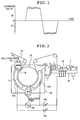
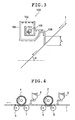
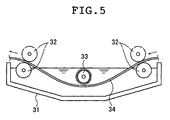
Classifications
-
- G—PHYSICS
- G03—PHOTOGRAPHY; CINEMATOGRAPHY; ANALOGOUS TECHNIQUES USING WAVES OTHER THAN OPTICAL WAVES; ELECTROGRAPHY; HOLOGRAPHY
- G03F—PHOTOMECHANICAL PRODUCTION OF TEXTURED OR PATTERNED SURFACES, e.g. FOR PRINTING, FOR PROCESSING OF SEMICONDUCTOR DEVICES; MATERIALS THEREFOR; ORIGINALS THEREFOR; APPARATUS SPECIALLY ADAPTED THEREFOR
- G03F7/00—Photomechanical, e.g. photolithographic, production of textured or patterned surfaces, e.g. printing surfaces; Materials therefor, e.g. comprising photoresists; Apparatus specially adapted therefor
- G03F7/26—Processing photosensitive materials; Apparatus therefor
- G03F7/30—Imagewise removal using liquid means
- G03F7/32—Liquid compositions therefor, e.g. developers
-
- B—PERFORMING OPERATIONS; TRANSPORTING
- B41—PRINTING; LINING MACHINES; TYPEWRITERS; STAMPS
- B41N—PRINTING PLATES OR FOILS; MATERIALS FOR SURFACES USED IN PRINTING MACHINES FOR PRINTING, INKING, DAMPING, OR THE LIKE; PREPARING SUCH SURFACES FOR USE AND CONSERVING THEM
- B41N3/00—Preparing for use and conserving printing surfaces
- B41N3/03—Chemical or electrical pretreatment
- B41N3/034—Chemical or electrical pretreatment characterised by the electrochemical treatment of the aluminum support, e.g. anodisation, electro-graining; Sealing of the anodised layer; Treatment of the anodic layer with inorganic compounds; Colouring of the anodic layer
Definitions
- the present invention relates to a method of manufacturing a lithographic printing plate that is capable of being developed with an acidic to weakly alkaline developer.
- Lithographic printing plates generally comprise oleophilic image areas which are receptive to ink during the printing operation and hydrophilic non-image areas which are receptive to dampening water.
- Lithographic printing is a process that utilizes the mutual repellence between water and printing ink by having the oleophilic image areas of the printing plate serving as ink-receptive areas and having the hydrophilic non-image areas serving as dampening water-receptive areas (non-ink-receptive areas), thus creating differences in the ability of ink to adhere to the surface of the plate and allowing the ink to be deposited only in the image areas.
- the ink that has been selectively deposited on the plate is then transferred to a printing medium such as paper.
- Presensitized plates comprising an oleophilic photosensitive resin layer (image recording layer) on a hydrophilic support are widely used to make such lithographic printing plates.
- the lithographic printing plate is obtained by a platemaking process in which the presensitized plate is exposed to light through an original on lith film, then the portions of the image recording layer in image areas are left intact, whereas the rest of the image recording layer, which is not needed, is dissolved and removed with an alkaline developer or an organic solvent, thereby revealing the surface of the hydrophilic support and forming non-image areas.
- development processes known in the art generally consist of three steps: development of the plate with an aqueous alkali solution having a pH of 10 or more, followed in turn by rinsing of the alkaline agent from the plate in a rinsing bath, then treatment with a gum solution composed primarily of a hydrophilic resin. Where necessary, the process also includes a step of adding a replenishing solution to offset a decrease in pH owing to the absorption of carbon dioxide.
- JP 2002-91016 A the term “JP XXXX-XXXXX A” as used herein means an “unexamined published Japanese patent application”: "A method of manufacturing a lithographic printing plate, comprising imagewise exposing a photosensitive lithographic printing plate having, on an aluminum support, a photosensitive layer made of a photopolymerizable photosensitive composition containing a compound having ethylenically unsaturated double bonds, a photopolymerization initiator and a polymer binder; then developing the exposed plate with a developer which includes an inorganic alkaline agent and a polyoxyalkylene ether group-bearing nonionic surfactant and has a pH of 10.0 to 12.5 and a conductivity of 3 to 30 mS/cm.”
- JP 2938397 B (the term “JP XXXXXXX B" as used herein means a "Japanese patent”) describes: "A method of manufacturing a lithographic printing plate, which method includes the steps of (1) imagewise exposing an image-forming element which includes (i) an image-forming layer that lies on a hydrophilic surface of a plate base and includes hydrophobic thermoplastic polymer particles which are capable of coalescing under the influence of heat and are dispersed in a hydrophilic binder, and (ii) a compound which is present in the image-forming layer or its neighboring layer and is capable of converting light to heat; then (2) developing the resulting imagewise-exposed image-forming element by mounting the element on the printing cylinder of a printing press and feeding dampening water and/or ink to the image-forming layer while rotating the printing cylinder".
- the hydrophobic thermoplastic polymer particles are caused by heat to coalesce and form an image upon imagewise exposure using an infrared laser, and the exposed plate, when subsequently mounted on the cylinder of the printing press, can be developed on-press with dampening water and/or ink, the lithographic printing plate thus obtained has a very low image strength (adhesion to the support), resulting in a less than adequate press life.
- CTP computer-to-plate
- the inventor of the invention has found that this object can be achieved by subjecting a presensitized plate comprising a lithographic printing plate support having a specific grained shape at the surface and an image recording layer on the support to imagewise exposure so as to form an image, then developing the exposed plate using an aqueous solution which contains a given amount of a specific surfactant and has a pH of 2 to 10.
- the invention provides the platemaking method to obtain a lithographic printing plate in the following aspects (1) to (9).
- the invention provides a platemaking method to obtain a lithographic printing plate which has a long press life and a good scumming resistance, which can be developed with an acidic to weakly alkaline developer, and which enables the amount of wastewater associated with development to be reduced.
- the invention is highly useful from the standpoint of the environment and safety. Moreover, the developer employed is not degraded by carbon dioxide and always has a uniform developing ability, enabling printing plates of a uniform quality to be manufactured.
- the inventive method of manufacturing lithographic printing plates includes the steps of recording an image, by imagewise exposure, on a presensitized plate comprising a lithographic printing plate support and an image recording layer formed on the support; then developing the presensitized plate on which the image has been recorded so as to obtain a lithographic printing plate.
- the lithographic printing plate support has an arithmetical mean roughness R a of less than 0.4 ⁇ m and has on a surface thereof a grained shape with a structure bearing recessed portions with an average opening diameter of 0.01 to 2.0 ⁇ m.
- the developing step is carried out using an aqueous solution which contains at least 1 wt% of a nonionic surfactant and/or an anionic surfactant and has a pH of 2 to 10.
- the presensitized plate (particularly the lithographic printing plate support and the image recording layer) used in the inventive platemaking method as well as the image recording step (particularly imagewise exposure) and the developing step (particularly the developer) is described in detail below.
- the presensitized plate used in the inventive platemaking method comprises a lithographic printing plate support having thereon an image recording layer on which an image is recorded by imagewise exposure.
- a protective layer may be provided on the image recording layer.
- the components e.g., lithographic printing plate support, image recording layer, protective layer
- ingredients making up the presensitized plate are described below.
- the lithographic printing plate support used in the inventive platemaking method is not subject to any particular limitation, provided it has an arithmetical mean roughness R a of less than 0.4 ⁇ m and has on a surface thereof a grained shape with a structure bearing recessed portions with an average opening diameter of 0.01 to 2.0 ⁇ m.
- R a arithmetical mean roughness
- an arithmetical mean roughness R a within the above-indicated range is essential because it provides the lithographic printing plate with a good scumming resistance, and an average opening diameter within the above-indicated range is essential because it provides the printing plate with a long press life.
- the most likely reason is that, even though the arithmetical mean roughness R a is made small in this way to achieve a good scumming resistance, the support having recessed portions with an average opening diameter of 0.01 to 2.0 ⁇ m enables enhancement of the adhesion to the subsequently described image recording layer that is removable with a developer, thus enhancing the press life.
- the arithmetical mean roughness R a of the lithographic printing plate support is preferably from 0.25 to 0.35 ⁇ m and the average opening diameter is preferably from 0.05 to 2.0 ⁇ m, and more preferably from 0.1 to 0.5 ⁇ m.
- the support to further improve the adhesion between the surface of the lithographic printing plate support and the image recording layer, it is preferable for the support to have recessed portions with a depth which is greater than the opening diameter.
- the ratio of the depth to the opening diameter is preferably at least 0.1, more preferably at least 0.2, and most preferably from 0.4 to 0.6.
- the method used to measure the arithmetical mean roughness R a at the surface of the lithographic printing plate support is as follows:
- Two-dimensional roughness measurement is carried out using a stylus-type roughness tester (e.g., Surfcom 575, manufactured by Tokyo Seimitsu Co., Ltd.), the mean roughness as defined in ISO 4287 is measured five times, and the average of the five resulting values is treated as the arithmetical mean roughness R a .
- a stylus-type roughness tester e.g., Surfcom 575, manufactured by Tokyo Seimitsu Co., Ltd.
- the conditions when measuring the two-dimensional roughness are as follows: cutoff value, 0.8 mm; slope correction, FLAT-ML; measurement length, 3 mm; longitudinal magnification, 10,000X; scan rate, 0.3 mm/s; stylus tip diameter, 2 ⁇ m.
- the average opening diameter is determined by using an electron microscope to obtain a direct overhead image of the support surface at a magnification of 2,000X, selecting at least 50 pits having a medium wave structure (medium-wave pits) with continuous ring-like edges in the resulting electron micrograph, reading off the diameter of each pit as an opening diameter, and computing the average of these values.
- equivalent circle diameter measurement can also be carried out using commercially available image analysis software.
- image analysis software In this case, the above electron micrographs are scanned and digitized, then converted to binary values with the software, following which the equivalent circle diameters are determined.
- the inventor carried out measurement of the average opening diameter and obtained substantially the same results from both visual measurement and digital processing.
- lithographic printing plate supports include paper, paper laminated with plastic (e.g., polyethylene, polypropylene, polystyrene), sheet metal (e.g., aluminum, zinc, copper), plastic film (e.g., cellulose diacetate, cellulose triacetate, cellulose propionate, cellulose butyrate, cellulose acetate butyrate, cellulose nitrate, polyethylene terephthalate, polyethylene, polystyrene, polypropylene, polycarbonate, polyvinyl acetal), and paper or plastic film onto which a metal (e.g., iron in the form of stainless steel) has been laminated or vapor deposited.
- plastic e.g., polyethylene, polypropylene, polystyrene
- sheet metal e.g., aluminum, zinc, copper
- plastic film e.g., cellulose diacetate, cellulose triacetate, cellulose propionate, cellulose butyrate, cellulose acetate butyrate, cellulose nitrate,
- polyester film and aluminum plate are preferred.
- Aluminum plate is especially preferred for its good dimensional stability and relatively low cost.
- the aluminum plate may be a pure aluminum plate, an alloy plate composed primarily of aluminum and containing small amounts of other elements, or a thin film of aluminum or aluminum alloy onto which plastic has been laminated.
- Other elements which may be present in the aluminum alloy include silicon, iron, manganese, copper, magnesium, chromium, zinc, bismuth, nickel and titanium.
- the content of other elements in the alloy is preferably not more than 10 wt%.
- Aluminum plates suitable for use in the invention are not specified here as to composition, but include known materials that are used in the art.
- the lithographic printing plate support used in the inventive platemaking method has a thickness of preferably 0.1 to 0.6 mm, more preferably 0.15 to 0.4 mm, and even more preferably 0.2 to 0.3 mm. This thickness can be changed as appropriate based on such considerations as the size of the printing press, the size of the printing plate and the desires of the user.
- the lithographic printing plate support used in the inventive platemaking method can be surface-treated or coated with finely divided particles so as to impart an arithmetical mean roughness R a of less than 0.4 ⁇ m and to form on the surface thereof a grained shape with a structure bearing recessed portions with an average opening diameter of 0.01 to 2.0 ⁇ m.
- the aluminum plate Prior to use, the aluminum plate is preferably subjected to surface treatments such as graining treatment and anodizing treatment.
- the surface treatments improve the hydrophilic properties and easily ensure good adhesion between the image recording layer and the support.
- the surface Before the aluminum plate is subjected to graining treatment, the surface may be degreased if desired with a surfactant, organic solvent, alkaline aqueous solution or the like to remove rolling oils from the surface.
- a surfactant organic solvent, alkaline aqueous solution or the like to remove rolling oils from the surface.
- Graining treatment of the aluminum plate surface may be carried out by various methods, such as mechanical graining, electrochemical graining (in which the surface is electrochemically dissolved) and chemical graining (in which the surface is selectively dissolved chemically).
- Known methods of mechanical graining may be used, such as ball graining, brush graining, blast finishing or buffing.
- Suitable methods for electrochemical graining include methods carried out with alternating current or direct current in an electrolytic solution containing an acid such as hydrochloric aid or nitric acid. Also suitable is a method using a mixed acid, as described in JP 54-63902 A . Specifically, a method which involves first electrochemical graining treatment, first etching treatment, first desmutting treatment, second electrochemical graining treatment, second etching treatment and second desmutting treatment described below is preferred.
- electrochemical graining is carried out by passing an alternating current through the aluminum plate in an acid-containing aqueous solution.
- the acid added to the aqueous solution is preferably nitric acid.
- the nitric acid concentration in the aqueous solution is preferably from 1 to 100 g/L. Within this range, the pits will have a good uniformity.
- the aqueous solution has a temperature of preferably 20 to 80°C, and more preferably 30 to 60°C. At a temperature of at least 20°C, the cost of running a refrigerating unit for cooling is reduced to a modest level and the amount of ground water used for cooling can be minimized. At a temperature of not more than 80°C, the corrosion resistance of the equipment is readily ensured.
- the aqueous solution can be used after adding thereto a nitrate ion-containing compound, such as aluminum nitrate, sodium nitrate or ammonium nitrate, or a chloride ion-containing compound, such as aluminum chloride, sodium chloride or ammonium chloride.
- a nitrate ion-containing compound such as aluminum nitrate, sodium nitrate or ammonium nitrate
- a chloride ion-containing compound such as aluminum chloride, sodium chloride or ammonium chloride.
- Metals which are present in the aluminum alloy may be dissolved in the aqueous solution, as exemplified by iron, copper, manganese, nickel, titanium, magnesium and silicon. From 1 to 100 g/L of hypochlorous acid or hydrogen peroxide may also be added.
- a compound such as aluminum chloride or aluminum nitrate is preferably added to the aqueous solution to an aluminum ion concentration of 3 to 50 g/L.
- an aluminum ion concentration in the above range the pit uniformity is improved and the replenishment amount of the aqueous solution is not increased too much.
- Compounds capable of forming a complex with copper include ammonia; amines obtained by substituting a hydrogen atom on ammonia with an (aliphatic or aromatic) hydrocarbon group, such as methylamine, ethylamine, dimethylamine, diethylamine, trimethylamine, cyclohexylamine, triethanolamine, triisopropanolamine and ethylenediaminetetraacetic acid (EDTA); and metal carbonates such as sodium carbonate, potassium carbonate and potassium hydrogencarbonate.
- an (aliphatic or aromatic) hydrocarbon group such as methylamine, ethylamine, dimethylamine, diethylamine, trimethylamine, cyclohexylamine, triethanolamine, triisopropanolamine and ethylenediaminetetraacetic acid (EDTA)
- metal carbonates such as sodium carbonate, potassium carbonate and potassium hydrogencarbonate.
- ammonium salts such as ammonium nitrate, ammonium chloride, ammonium sulfate, ammonium phosphate and ammonium carbonate.
- the solution has a temperature of preferably 10 to 60°C, and more preferably 20 to 50°C.
- concentrations of the respective ingredients in the aqueous solution are preferably controlled using a multi-component concentration measurement process, in combination with feedforward control and feedback control. In this way, precise concentration control of the aqueous solution used as the electrolytic solution is possible.
- Illustrative examples of the multi-component concentration measurement process include a process in which the concentrations are measured using the ultrasonic wave propagation velocity in the aqueous solution and the electrical conductivity of the electrolytic solution, neutralization titration, capillary electrophoretic analysis, isotachophoretic analysis, and ion chromatography.
- Ion chromatography is classified according to the type of detector as, for example, ion chromatography for absorbance detection, non-suppressed ion chromatography for conductometric detection, and suppressed ion chromatography. Of these, suppressed ion chromatography is preferable for ensuring the stability of measurement.
- the first electrochemical graining treatment may be carried out in accordance with, for example, the electrochemical graining processes (electrolytic graining processes) described in JP 48-28123 B ("JP XX-XXXXX B" as used herein means an "examined published Japanese patent publication") and GB 896,563 B .
- These electrolytic graining processes use an alternating current having a sinusoidal waveform, but they may also be carried out using special waveforms like those described in JP 52-58602 A . Use can also be made of the waveforms described in JP 3-79799 A .
- the power supply may be, for example, one which uses commercial AC power or may be an inverter-controlled power supply.
- an inverter-controlled power supply which uses an insulated gate bipolar transistor (IGBT) is preferred because of its excellent load-following ability when carrying out control to keep the current value (current density of aluminum plate) constant in response to such factors as the width and thickness of the aluminum plate and fluctuations in the concentrations of ingredients in the electrolytic solution.
- IGBT insulated gate bipolar transistor
- waveform of the alternating current used in the first electrochemical graining treatment No particular limitation is imposed on the waveform of the alternating current used in the first electrochemical graining treatment.
- a sinusoidal, square, trapezoidal or triangular waveform may be used.
- Trapezoidal waveform refers herein to a waveform like that shown in FIG. 1.
- the amount of electricity in the first electrochemical graining treatment is preferably in the range of 1 to 1000 C/dm 2 and more preferably 50 to 300 C/dm 2 in terms of the total amount of electricity when the aluminum plate serves as an anode.
- the current density is preferably 10 to 100 A/dm 2 . At a current density of at least 10 A/dm 2 , the productivity is enhanced. At a current density of not more than 100 A/dm 2 , the voltage is not so high and the power capacity is not increased so much, which may lead to the reduction of the power supply cost.
- FIG. 2 is a side view of a radial electrolytic cell that is used to carry out electrochemical graining treatment using alternating current during the manufacture of a lithographic printing plate support in the present invention.
- FIG. 2 shows an aluminum plate 11, a radial drum roller 12, main electrodes 13a and 13b, an electrolytic treatment solution 14, a solution feed inlet 15, a slit 16, a solution channel 17, an auxiliary anode 18, thyristors 19a and 19b, an AC power supply 20, a main electrolytic cell 40 and an auxiliary anode cell 50.
- the current ratio (ratio between the total amount of electricity when the aluminum plate serves as an anode and the total amount of electricity when the aluminum plate serves as an cathode) is preferably 0.9 to 3 and more preferably 0.9 to 1.0.
- Any known electrolytic cell employed for surface treatment including vertical, flat and radial type electrolytic cells, may be used to carry out electrochemical graining treatment.
- Radial-type electrolytic cells such as those described in JP 5-195300 A are especially preferred.
- the electrolytic solution is passed through the electrolytic cell either parallel or counter to the direction in which the aluminum web advances.
- Rinsing treatment is preferably carried out using a spray line.
- the spray line used in rinsing treatment is typically one having a plurality of spray tips, each of which discharges a fan-like spray of water and is situated along the width of the aluminum plate.
- the interval between the spray tips is preferably 20 to 100 mm, and the amount of water discharged per spray tip is preferably 1 to 20 L/min. Rinsing with a plurality of spray lines is preferred.
- the purpose of the first etching treatment carried out between the first electrochemical graining treatment and the second electrochemical graining treatment is to dissolve smut that arises in the first electrochemical graining treatment by bringing it into contact with the aqueous alkali solution, and to dissolve the edges of the pits formed by the first electrochemical graining treatment by bringing them into contact with the aqueous alkali solution.
- the present step dissolves the edges of the large pits formed by the first electrochemical graining treatment, smoothing the surface and discouraging ink from catching on such edges. As a result, presensitized plates of excellent scumming resistance can be obtained.
- the amount of material removed by etching is preferably from 0.1 to 10 g/m 2 , and more preferably from 0.1 to 5 g/m 2 . In an etching amount falling within this range, the diameter of the pits formed in the first electrochemical graining treatment can be maintained within the desired range.
- Alkalis that may be used in the aqueous alkali solution are exemplified by caustic alkalis and alkali metal salts.
- suitable caustic alkalis include sodium hydroxide and potassium hydroxide.
- suitable alkali metal salts include alkali metal silicates such as sodium metasilicate, sodium silicate, potassium metasilicate and potassium silicate; alkali metal carbonates such as sodium carbonate and potassium carbonate; alkali metal aluminates such as sodium aluminate and potassium aluminate; alkali metal aldonates such as sodium gluconate and potassium gluconate; and alkali metal hydrogenphosphates such as sodium secondary phosphate, potassium secondary phosphate, sodium primary phosphate and potassium primary phosphate.
- caustic alkali solutions and solutions containing both a caustic alkali and an alkali metal aluminate are preferred on account of the high etch rate and low cost.
- An aqueous solution of sodium hydroxide is
- the aqueous alkali solution has preferably a concentration of 1 to 50 wt% and more preferably 10 to 35 wt%.
- the aqueous alkali solution prefferably contains aluminum ions.
- the aluminum ion concentration is preferably 0.01 to 10 wt% and more preferably 3 to 8 wt%.
- the aqueous alkali solution temperature is preferably 20 to 90°C.
- the treatment time is preferably 1 to 120 seconds.
- Illustrative examples of methods for bringing the aluminum plate after first electrochemical graining treatment into contact with the aqueous alkali solution include a method in which the aluminum plate is passed through a tank filled with an aqueous alkali solution, a method in which the aluminum plate is immersed in a tank filled with an aqueous alkali solution, and a method in which the surface of the aluminum plate is sprayed with an aqueous alkali solution.
- the most desirable of these is a method that involves spraying the surface of the aluminum plate with an aqueous alkali solution.
- a method in which the etching solution is sprayed onto the aluminum plate at a rate of 10 to 100 L/min per spray line from preferably a plurality of spray lines bearing 2 to 5 mm diameter openings at a pitch of 10 to 50 mm is especially desirable.
- etching solution from the aluminum plate with nip rollers, subject the plate to rinsing treatment with water for 1 to 10 seconds, then remove the water with nip rollers.
- Rinsing treatment is preferably carried out by rinsing with a rinsing apparatus that uses a free-falling curtain of water and also by rinsing with spray lines.
- FIG. 3 is a schematic cross-sectional view of an apparatus 100 which carries out rinsing with a free-falling curtain of water.
- the apparatus 100 that carries out rinsing treatment with a free-falling curtain of water has a water holding tank 104 that holds water 102, a pipe 106 that feeds water to the water holding tank 104, and a flow distributor 108 that supplies a free-falling curtain of water from the water holding tank 104 to an aluminum plate 1.
- the pipe 106 feeds water 102 to the water holding tank 104.
- the water 102 in the water holding tank 104 overflows, it is distributed by the flow distributor 108 and the free-falling curtain of water is supplied to the aluminum plate 1.
- a flow rate of 10 to 100 L/min is preferred when this apparatus 100 is used.
- the distance L over which the water 102 between the apparatus 100 and the aluminum plate 1 exists as a free-falling curtain of liquid is preferably from 20 to 50 mm.
- the aluminum plate can be uniformly rinsed. This in turn makes it possible to enhance the uniformity of treatment carried out prior to rinsing.
- rinsing may be carried out with a spray line having a plurality of spray tips that discharge fan-like sprays of water and are disposed along the width of the aluminum plate.
- the interval between the spray tips is preferably 20 to 100 mm, and the amount of water discharged per spray tip is preferably 0.5 to 20 L/min.
- the use of a plurality of spray lines is preferred.
- first desmutting treatment After the first etching treatment, it is preferable to carry out acid pickling (first desmutting treatment) to remove contaminants (smut) remaining on the surface of the aluminum plate. Desmutting treatment is carried out by bringing an aqueous acid solution into contact with the aluminum plate.
- acids examples include nitric acid, sulfuric acid, hydrochloric acid, chromic acid, phosphoric acid, hydrofluoric acid and fluoroboric acid. More specifically, wastewater from the aqueous sulfuric acid solution used in the anodizing treatment step to be described later, wastewater from the aqueous nitric acid solution used in the first electrochemical graining treatment, and wastewater from the aqueous hydrochloric acid solution used in the second electrochemical graining treatment can be preferably used.
- the first desmutting treatment it is preferable to use an acidic solution containing 0.5 to 30 wt% of an acid and 0.5 to 10 wt% of aluminum ions.
- the first desmutting treatment is carried out by bringing the aluminum plate after the first etching treatment into contact with an acidic solution containing 0.5 to 30 wt% of an acid such as hydrochloric acid, nitric acid or sulfuric acid (and 0.01 to 5 wt% of aluminum ions).
- the temperature of the acidic solution is preferably 25°C to 90°C and the treatment time is preferably 1 to 180 seconds.
- Illustrative examples of the method of bringing the aluminum plate after the first etching treatment into contact with the acidic solution include passing the aluminum plate through a tank filled with the acidic solution, immersing the aluminum plate in a tank filled with the acidic solution, and spraying the acidic solution onto the surface of the aluminum plate.
- a method in which the acidic solution is sprayed onto the surface of the aluminum plate is preferred. More specifically, a method in which the acidic solution is sprayed from at least one spray line, and preferably two or more spray lines, each having 2 to 5 mm diameter openings spaced at a pitch of 10 to 50 mm, at a rate of 10 to 100 L/min per spray line is desirable.
- Rinsing treatment is the same as rinsing treatment following etching treatment with an aqueous alkali solution. However, it is preferable for the amount of water used per spray tip to be from 1 to 20 L/min.
- an alternating current is passed through the aluminum plate in an acid-containing aqueous solution for electrochemical graining treatment.
- the acid to be added to the aqueous solution is preferably hydrochloric acid.
- the second electrochemical graining treatment using an aqueous solution containing hydrochloric acid is capable of obtaining the aluminum plate on the surface of which pits having an average opening diameter of 0.01 to 0.2 ⁇ m are formed.
- the second electrochemical graining treatment is basically the same as the first electrochemical graining treatment. Different points from the first electrochemical graining treatment will be mainly described below.
- the aqueous solution has preferably a hydrochloric acid concentration of 1 to 100 g/L. When the concentration falls within the above range, uniformity of the pits formed on the surface of the aluminum plate is enhanced.
- the aqueous solution contains preferably 0.05 to 10 g/L of sulfuric acid or nitric acid. Sulfuric acid and nitric acid form an oxide film through an anodic reaction. The surface having uniform asperities can be thus formed.
- the aluminum ion concentration in the aqueous solution is preferably 3 to 50 g/L.
- uniformity of the pits formed is enhanced and the replenishment amount of the aqueous solution is not increased too much.
- AC power supply waveform used in the second electrochemical graining treatment No particular limitation is imposed on the AC power supply waveform used in the second electrochemical graining treatment.
- a sinusoidal, square, trapezoidal or triangular waveform may be used.
- the amount of electricity in the second electrochemical graining treatment is preferably at least 20 C/dm 2 , more preferably 20 to 100 C/dm 2 and even more preferably 30 to 70 C/dm 2 in terms of the total amount of electricity when the aluminum plate serves as an anode.
- the purpose of the second etching treatment carried out after the second electrochemical graining treatment is to dissolve smut that arises in the second electrochemical graining treatment and to dissolve the edges of the pits formed by the second electrochemical graining treatment.
- the second etching treatment is basically the same as the first etching treatment.
- the etching amount is preferably 0.01 to 0.08 g/m 2 , more preferably 0.02 to 0.06 g/m 2 , and even more preferably 0.03 to 0.05 g/m 2 .
- etching amount falling within the above range it is easy to obtain a surface area ratio ⁇ S 5(0.02-0.2) of from 50 to 90% and a surface arithmetical mean roughness R a of less than 0.4 ⁇ m, thus facilitating the production of a lithographic printing plate having a long press life and good scumming resistance.
- second desmutting treatment acid pickling (second desmutting treatment) to remove contaminants (smut) remaining on the surface of the aluminum plate.
- the second desmutting treatment can be carried out basically in the same way as the first desmutting treatment.
- the second desmutting treatment is preferably carried out in an electrolytic cell of an anodizing apparatus used in anodizing treatment to be described later where the aluminum plate is to be subjected to cathodic reaction.
- This configuration eliminates the necessity for providing an independent desmutting bath for the second desmutting treatment, which may lead to equipment cost reduction.
- the aluminum plate that has been grained may optionally be subjected to anodizing treatment to enhance the wear resistance.
- electrolytes capable of forming a porous anodized layer may be used in anodizing treatment of the aluminum plate.
- sulfuric acid, hydrochloric acid, phosphoric acid, oxalic acid, chromic acid, sulfamic acid, benzenesulfonic acid and amidosulfonic acid may be used singly or in combination of two or more thereof.
- concentrations of these electrolytes are determined as appropriate according to the type of electrolyte.
- the anodizing treatment conditions vary empirically according to the electrolyte used, although it is generally suitable for the solution to have an electrolyte concentration of 1 to 80 wt% and a temperature of 5 to 70°C, and for the current density to be 5 to 60 A/dm 2 , the voltage to be 1 to 100 V, and the electrolysis time to be 10 seconds to 5 minutes.
- the weight of the anodized layer formed is preferably 1.0 to 5.0 g/m 2 and more preferably 1.5 to 4.0 g/m 2 .
- the weight is less than 1 g/m 2 , scratches are readily formed on the plate.
- a weight of 5 g/m 2 or more requires a large amount of electric power, which is economically disadvantageous.
- An anodized layer weight of 1.5 to 4 g/m 2 is more preferred. It is also desirable for anodizing treatment to be carried out in such a way that the difference in the anodized layer weight between the center of the aluminum plate and the areas near the edges is not more than 1 g/m 2 .
- a treatment for enlarging micropores of the anodized layer, a treatment for sealing the micropores of the anodized layer, and a surface hydrophilizing treatment in which the support is immersed in an aqueous solution containing a hydrophilic compound as described in JP 2001-253181 A and JP 2001-322365 A are preferably carried out as needed in terms of adhesion to the image recording layer to be described later, hydrophilic properties, scumming resistance and heat insulating properties.
- sealing methods include steam sealing, sealing treatment with an aqueous solution containing an inorganic fluorine compound (e.g., treatment with hexafluorozirconic acid alone, treatment with sodium fluoride), steam sealing which involves the addition of lithium chloride, and sealing treatment with hot water.
- an inorganic fluorine compound e.g., treatment with hexafluorozirconic acid alone, treatment with sodium fluoride
- steam sealing which involves the addition of lithium chloride
- sealing treatment with an aqueous solution containing an inorganic fluorine compound sealing treatment with steam, and sealing treatment with hot water are preferred.
- Suitable hydrophilizing treatments include alkali metal silicate processes as described in US 2,714,066 , US 3,181,461 , US 3,280,734 and US 3,902,734 .
- the support is subjected to immersion or electrolytic treatment in an aqueous solution of, for example, sodium silicate.
- hydrophilizing treatment examples include treatment with potassium hexafluorozirconate described in JP 36-22063 B , and treatment with polyvinylphosphonic acid described in US 3,276,868 , US 4,153,461 and 4,689,272 .
- a support having a surface of insufficient hydrophilicity such as a polyester film
- hydrophilic layer examples include hydrophilic layers obtained by applying a coating fluid containing a colloid of an oxide or hydroxide of at least one element selected from the group consisting of beryllium, magnesium, aluminum, silicon, titanium, boron, germanium, tin, zirconium, iron, vanadium, antimony and transition metals, as described in JP 2001-199175 A ; hydrophilic layers having an organic hydrophilic matrix obtained by crosslinking or pseudo-crosslinking an organic hydrophilic polymer, as described in JP 2002-79772 A ; hydrophilic layers having an inorganic hydrophilic matrix obtained by a sol-gel transition consisting of the hydrolysis of a polyalkoxysilane, titanate, zirconate or aluminate, and a condensation reaction; and hydrophilic layers composed of inorganic thin films having a metal oxide-containing surface.
- hydrophilic layer obtained by applying a coating fluid containing a colloid of an oxide or hydroxide of silicon is preferred.
- an antistatic layer on the hydrophilic layer side of the lithographic printing layer support, on the opposite side, or on both sides thereof.
- providing an antistatic layer between the lithographic printing plate support and the hydrophilic layer is more preferred because it also helps to enhance adhesion between the lithographic printing plate support and the hydrophilic layer.
- Specific antistatic layers of this type which may be used include the polymer layer containing a finely divided metal oxide or a flatting agent dispersed therein which is described in JP 2002-79772 A .
- the lithographic printing plate support obtained by such surface treatment has a color density, given as the reflection density, of preferably 0.15 to 0.65. At a reflection density within this range, there can be obtained both a good image-forming ability due to an anti-halation effect during imagewise exposure, and good image visibility following development.
- the image recording layer of the presensitized plate used in the platemaking method of the invention is not subject to any particular limitation, provided it is a hydrophilic image recording layer on which an image can be recorded by the subsequently described imagewise exposure and which can be developed using the subsequently described developer.
- such an image recording layer includes a polymerization initiator, a polymerizable compound and a hydrophobic binder polymer.
- the polymerization initiator, polymerizable compound and hydrophobic binder polymer are described below.
- Polymerization initiators which may be used in the invention are compounds that generate a radical or an acid under light or heat energy, and initiate or promote the polymerization of a compound having a polymerizable unsaturated group.
- Such polymerization initiators may be suitably selected from among known radical generators, acid generators, and compounds having a small bond dissociation energy.
- Compounds which generate a radical or an acid include organic halogen compounds, carbonyl compounds, organic peroxides, azo compounds, azide compounds, metallocene compounds, hexaarylbiimidazole compounds, organic boron compounds, disulfone compounds, oxime ester compounds and onium salt compounds.
- Organic halogen compounds that may be used include those mentioned in, for example, Wakabayashi et al.: Bull. Chem. Soc. Japan 42, 2924 (1969 ), US 3,905,815 , JP 46-4605 B , JP 48-36281 A , JP 53-133428 A , JP 55-32070 A , JP 60-239736 A , JP 61-169835 A , JP 61-169837 A , JP 62-58241 A , JP 62-212401 A , JP 63-70243 A , JP 63-298339 A , and M.P. Hutt: Journal of Heterocyclic Chemistry 1, No. 3 (1970 ).
- oxazole compounds and s-triazine compounds substituted with a trihalomethyl group is preferred.
- s-triazine derivatives having at least one mono-, di-or trihalogenated methyl group attached to the s-triazine ring, and oxadiazole derivatives having at least one such group attached to the oxadiazole ring is more preferred.
- Compounds that may be used include, more specifically, 2,4,6-tris(monochloromethyl)-s-triazine, 2,4,6-tris(dichloromethyl)-s-triazine, 2,4,6-tris(trichloromethyl)-s-triazine, 2-methyl-4,6-bis(trichloromethyl)-s-triazine, 2-n-propyl-4,6-bis(trichloromethyl)-s-triazine, 2-( ⁇ , ⁇ , ⁇ -trichloroethyl)-4,6-bis(trichloromethyl)-s-triazine, 2-(3,4-epoxyphenyl)-4,6-bis(trichloromethyl)-s-triazine, 2-[1-(p-methoxyphenyl)-2,4-butadienyl]-4,6-bis(trichloromethyl)-s-triazine, 2-styryl-4,6-bis(trichloromethyl)
- azo compounds examples include the azo compounds mentioned in JP 8-108621 A .
- organic peroxides examples include trimethylcyclohexanone peroxide, acetylacetone peroxide, 1,1-bis(tert-butylperoxy)-3,3,5-trimethylcyclohexane, 1,1-bis(tert-butylperoxy)cyclohexane, 2,2-bis(tert-butylperoxy)butane, tert-butyl hydroperoxide, cumene hydroperoxide, diisopropylbenzene hydroperoxide, 2,5-dimethylhexane-2,5-dihydroperoxide, 1,1,3,3-tetramethylbutyl hydroperoxide, tert-butylcumyl peroxide, dicumyl peroxide, 2,5-dimethyl-2,5-di(tert-butylperoxy)hexane, 2,5-oxanoyl peroxide, succinic acid peroxide, benzoyl peroxide, 2,4-
- Metallocene compounds that may be used include various titanocene compounds mentioned in, for example, JP 59-152396 A , JP 61-151197 A , JP 63-41484 A , JP 2-249 A , JP 2-4705 A and JP 5-83588 A , such as dicyclopentadienyltitanium bisphenyl, dicyclopantadienyltitanium bis-2,6-difluorophen-1-yl, dicyclopentadienyltitanium bis-2,4-difluorophen-1-yl, dicyclopentadienyltitanium bis-2,4,6-trifluorophen-1-yl, dicyclopentadienyltitanium bis-2,3,5,6-tetrafluorophen-1-yl, dicyclopentadienyltitanium bis-2,3,4,5,6-pentafluorophen-1-yl, dimethylcyclopen
- Hexaarylbiimidazole compounds that may be used include various compounds mentioned in, for example, JP 6-29285 B , US 3,479,185 , US 4,311,783 and US 4,622,286 .
- organic boron compounds examples include the organic borates mentioned in, for example, JP 62-143044 A , JP 62-150242 A , JP 9-188685 A , JP 9-188686 A , JP 9-188710 A , JP 2000-131837 A , JP 2002-107916 A , JP 2764769 B , JP 2002-116539 A and by Martin Kunz in Rad Tech' 98.
- disulfone compounds examples include the compounds mentioned in, for example, JP 61-166544 A and JP 2003-328465 A .
- oxime ester compounds examples include the compounds mentioned in, for example, JCS Perkin II (1979) 1653-1660 , JCS Perkin II (1979) 156-162 , Journal of Photopolymer Science and Technology (1995) 202-232 , JP 2000-66385 A and JP 2000-80068 A .
- onium salt compounds that may be used include the diazonium salts mentioned by S.I. Schlesinger in Photogr. Sci. Eng. 18, 387 (1974 ) and by T.S. Bal et al. in Polymer 21, 423 (1980 ); the ammonium salts mentioned in US 4,069,055 and JP 4-365049 A ; the phosphonium salts mentioned in US 4,069,055 and US 4,069,056 ; the iodonium salts mentioned in EP 104,143 B , JP 2-150848 A and JP 2-296514 A ; the sulfonium salts mentioned in EP 370,693 B , EP 233,567 B , EP 297,443 B , EP 297,442 B , US 4,933,377 , US 4,760,013 , US 4,734,444 , US 2,833,827 , DE 2,904,626 , DE 3,604,580 and DE 3,604,581 ; the sel
- Onium salts preferred for use in the invention are the onium salts represented by the formulas (RI-I) to (RI-III) below.
- Ar 11 is an aryl group of up to 20 carbon atoms which may have 1 to 6 substituents.
- Preferred substituents include alkyl groups of 1 to 12 carbon atoms, alkenyl groups of 1 to 12 carbon atoms, alkynyl groups of 1 to 12 carbon atoms, aryl groups of 1 to 12 carbon atoms, alkoxy groups of 1 to 12 carbon atoms, aryloxy groups of 1 to 12 carbon atoms, halogen atoms, alkylamino groups of 1 to 12 carbon atoms, dialkylamino groups of 1 to 12 carbon atoms, alkylamide or arylamide groups of 1 to 12 carbon atoms, carbonyl group, carboxy group, cyano group, sulfonyl group, thioalkyl groups of 1 to 12 carbon atoms and thioaryl groups of 1 to 12 carbon atoms.
- Z 11 - is a monovalent anion, specific examples of which include halide ions, perchlorate ions, hexafluorophosphate ions, tetrafluoroborate ions, sulfonate ions, sulfinate ions, thiosulfonate ions and sulfate ions.
- perchlorate ions, hexafluorophosphate ions, tetrafluoroborate ions, sulfonate ions and sulfinate ions are preferred for good stability.
- Ar 21 and Ar 22 are each independently an aryl group of up to 20 carbon atoms which may have 1 to 6 substituents.
- Preferred substituents include alkyl groups of 1 to 12 carbon atoms, alkenyl groups of 1 to 12 carbon atoms, alkynyl groups of 1 to 12 carbon atoms, aryl groups of 1 to 12 carbon atoms, alkoxy groups of 1 to 12 carbon atoms, aryloxy groups of 1 to 12 carbon atoms, halogen atoms, alkylamino groups of 1 to 12 carbon atoms, dialkylamino groups of 1 to 12 carbon atoms, alkylamide or arylamide groups of 1 to 12 carbon atoms, carbonyl group, carboxy group, cyano group, sulfonyl group, thioalkyl groups of 1 to 12 carbon atoms and thioaryl groups of 1 to 12 carbon atoms.
- Z 21 - is a monovalent anion, specific examples of which include halide ions, perchlorate ions, hexafluorophosphate ions, tetrafluoroborate ions, sulfonate ions, sulfinate ions, carboxylate ions, thiosulfonate ions and sulfate ions.
- perchlorate ions, hexafluorophosphate ions, tetrafluoroborate ions, sulfonate ions, sulfinate ions and carboxylate ions are preferred for good stability and reactivity.
- R 31 , R 32 and R 33 are each independently an aryl, alkyl, alkenyl or alkynyl group of up to 20 carbon atoms which may have 1 to 6 substituents. Of these, aryl groups are preferred for good reactivity and stability.
- Preferred substituents include alkyl groups of 1 to 12 carbon atoms, alkenyl groups of 1 to 12 carbon atoms, alkynyl groups of 1 to 12 carbon atoms, aryl groups of 1 to 12 carbon atoms, alkoxy groups of 1 to 12 carbon atoms, aryloxy groups of 1 to 12 carbon atoms, halogen atoms, alkylamino groups of 1 to 12 carbon atoms, dialkylamino groups of 1 to 12 carbon atoms, alkylamide or arylamide groups of 1 to 12 carbon atoms, carbonyl group, carboxy group, cyano group, sulfonyl group, thioalkyl groups of 1 to 12 carbon atoms and thioaryl groups of 1 to 12 carbon atoms.
- Z 31 - is a monovalent anion, specific examples of which include halide ions, perchlorate ions, hexafluorophosphate ions, tetrafluoroborate ions, sulfonate ions, sulfinate ions, carboxylate ions, thiosulfonate ions, and sulfate ions.
- perchlorate ions, hexafluorophosphate ions, tetrafluoroborate ions, sulfonate ions, sulfinate ions and carboxylate ions are preferred for good stability and reactivity.
- the carboxylate ions mentioned in JP 2001-343742 A are more preferred, and the carboxylate ions mentioned in JP 2002-148790 A are most preferred.
- the polymerization initiator is not limited to the above-described compounds which generate a radical or an acid. However, for good reactivity and stability, the polymerization initiator is more preferably a triazine initiator, an organic halogen compound, an oxime ester compound, a diazonium salt, an iodonium salt or a sulfonium salt.
- these polymerization initiators may be used singly or in combination of two or more thereof.
- These polymerization initiators may be added to the layer that includes the other ingredients or may be added to a separately provided layer.
- polymerization initiators are added in a proportion, based on all the solid ingredients making up the image recording layer, of preferably 0.1 to 50 wt%, more preferably 0.5 to 30 wt%, and most preferably 0.8 to 20 wt%.
- Polymerizable compounds that can be used in the invention are addition polymerizable compounds having at least one ethylenically unsaturated double bond, and are selected from compounds having at least one, and preferably two or more, ethylenically unsaturated bonds. Use can be made of any addition polymerizable compound known in the prior art, without particular limitation.
- the polymerizable compound includes compounds having a variety of chemical forms, including monomers, prepolymers such as dimers, trimers and oligomers, mixtures of any of the above, and copolymers of any of the above.
- the monomers and copolymers are exemplified by unsaturated carboxylic acids (e.g., acrylic acid, methacrylic acid, itaconic acid, crotonic acid, isocrotonic acid, maleic acid) and esters and amides thereof.
- unsaturated carboxylic acids e.g., acrylic acid, methacrylic acid, itaconic acid, crotonic acid, isocrotonic acid, maleic acid
- esters and amides thereof it is preferable to use an ester of an unsaturated carboxylic acid with an aliphatic polyol or an amide of an unsaturated carboxylic acid with an aliphatic polyamine compound.
- Preferred use can also be made of the addition reaction product of an unsaturated carboxylic acid ester or amide having a nucleophilic substituent such as a hydroxy, amino or mercapto group with a monofunctional or polyfunctional isocyanate or epoxy compound; the dehydration condensation reaction product of the foregoing ester or amide with a monofunctional or polyfunctional carboxylic acid; the addition reaction product of an unsaturated carboxylic acid ester or amide having an electrophilic substituent such as an isocyanate or epoxy group with a monofunctional or polyfunctional alcohol, amine or thiol; or the substitution reaction product of an unsaturated carboxylic acid ester or amide having a removable substituent such as a halogen atom or a tosyloxy group with a monofunctional or polyfunctional alcohol, amine or thiol.
- use can also be made of compound groups in which a suitable compound such as unsaturated phosphonic acid, styrene or vinyl ether is substituted for the above-menti
- Illustrative examples of monomers which are esters of unsaturated carboxylic acids and aliphatic polyol compounds include acrylic acid esters, methacrylic acid esters, itaconic acid esters, crotonic acid esters, isocrotonic acid esters and maleic acid esters. These may be used singly or in combination of two or more thereof.
- acrylic acid esters include ethylene glycol diacrylate, triethylene glycol diacrylate, 1,3-butanediol diacrylate, tetramethylene glycol diacrylate, propylene glycol diacrylate, neopentyl glycol diacrylate, trimethylolpropane triacrylate, trimethylolpropane tri(acryloyloxypropyl)ether, trimethylolethane triacrylate, hexanediol diacrylate, 1,4-cyclohexanediol diacrylate, tetraethylene glycol diacrylate, pentaerythritol diacrylate, pentaerythritol triacrylate, pentaerythritol tetraacrylate, dipentaerythritol diacrylate, dipentaerythritol hexaacrylate, sorbitol triacrylate, sorbitol tetraacrylate, sorbitol pentaacrylate,
- methacrylic acid esters include tetramethylene glycol dimethacrylate, triethylene glycol dimethacrylate, neopentyl glycol dimethacrylate, trimethylolpropane trimethacrylate, trimethylolethane trimethacrylate, ethylene glycol dimethacrylate, 1,3-butanediol dimethacrylate, hexanediol dimethacrylate, pentaerythritol dimethacrylate, pentaerythritol trimethacrylate, pentaerythritol tetramethacrylate, dipentaerythritol dimethacrylate, dipentaerythritol hexamethacrylate, sorbitol trimethacrylate, sorbitol tetramethacrylate, bis[p-(3-methacryloxy-2-hydroxypropoxy)phenyl]dimethylmethane and bis[p-(p-
- Itaconic acid esters include ethylene glycol diitaconate, propylene glycol diitaconate, 1,3-butanediol diitaconate, 1,4-butanediol diitaconate, tetramethylene glycol diitaconate, pentaerythritol diitaconate and sorbitol tetraitaconate.
- Crotonic acid esters include ethylene glycol dicrotonate, tetramethylene glycol dicrotonate, pentaerythritol dicrotonate and sorbitol tetradicrotonate.
- Isocrotonic acid esters include ethylene glycol diisocrotonate, pentaerythritol diisocrotonate and sorbitol tetraisocrotonate.
- Maleic acid esters include ethylene glycol dimaleate, triethylene glycol dimaleate, pentaerythritol dimaleate and sorbitol tetramaleate.
- esters which may be used as monomers include the aliphatic alcohol esters mentioned in JP 51-47334 B and JP 57-196231 A ; esters having aromatic skeletons such as those mentioned in JP 59-5240 A , JP 59-5241 A and JP 2-226149 A ; and the amino group-bearing esters mentioned in JP 1-165613 A .
- amides of unsaturated carboxylic acids with aliphatic polyamines that may be used as monomers include methylenebis(acrylamide), methylenebis(methacrylamide), 1,6-hexamethylenebis(acrylamide), 1,6-hexamethylenebis(methacrylamide), diethylenetriaminetris(acrylamide), xylylenebis(acrylamide) and xylylenebis(methacrylamide). These may be used singly or in combination of two or more thereof.
- Suitable amide-type monomers include those having a cyclohexylene structure which are mentioned in JP 54-21726 B .
- Urethane-type addition polymerizable compounds prepared using an addition reaction between an isocyanate group and a hydroxy group are also suitable as the polymerizable compound used in the invention.
- Specific examples include the vinylurethane compounds having two or more polymerizable vinyl groups per molecule that are obtained by adding a hydroxy group-bearing vinyl monomer of the formula (A) below to the polyisocyanate compounds having two or more isocyanate groups per molecule mentioned in JP 48-41708 B .
- CH 2 C(R 4 )COOCH 2 CH(R 5 )OH (A)
- R 4 and R 5 each independently represent -H or -CH 3 .
- Urethane acrylates such as those mentioned in JP 51-37193 A , JP 2-32293 B and JP 2-16765 B , and the urethane compounds having an ethylene oxide-type skeleton mentioned in JP 58-49860 B , JP 56-17654 B , JP 62-39417 B and JP 62-39418 B are also suitable as polymerzable compounds that can be used in the invention.
- addition polymerizable compounds By using such addition polymerizable compounds, photopolymerizable compositions of exceptional sensitivity (speed) can be obtained.
- Further examples include the specific unsaturated compounds mentioned in JP 46-43946 B , JP 1-40337 B and JP 1-40336 B , and the vinylphosphonic acid compounds mentioned in JP 2-25493 A .
- Use can also be made of the photocurable monomers and oligomers mentioned in Nippon Setchaku Kyokaishi, Vol. 20, No. 7, 300-308 (1984) .
- Exemplary vinyl ether group-bearing compounds that may be used in the invention include those mentioned in JP 2002-029162 A .
- Specific, non-limiting, examples include tetramethylene glycol divinyl ether, trimethylolpropane trivinyl ether, tetraethylene glycol divinyl ether, pentaerythritol divinyl ether, pentaerythritol trivinyl ether, pentaerythritol tetravinyl ether, 1,4-bis[2-(vinyloxy)ethyloxy]benzene, 1,2-bis[2-(vinyloxy)ethyloxy]benzene, 1,3-bis[2-(vinyloxy)ethyloxy]benzene, 1,3,5-tris[2-(vinyloxy)ethyloxy]benzene, 4,4'-bis[2-(vinyloxy)ethyloxy]biphenyl, 4,4'-bis[2-
- details concerning use of the polymerizable compound for example, what type of structure it should have, whether to use one such compound alone or a combination of two or more thereof, and the amount of addition can be selected as desired in accordance with the performance characteristics ultimately intended for the presensitized plate. For example, selection may be based on the following criteria.
- a structure having a high unsaturated group content per molecule is preferred.
- a functionally of at least two is desirable.
- a functionally of three or more is preferred.
- Also effective are methods in which both the sensitivity and strength are adjusted by using in combination compounds having differing numbers of functional groups or differing polymerizable groups e.g., acrylic acid esters, methacrylic acid esters, styrene compounds, vinyl ether compounds).
- the polymerizable compound and how it is used are also important factors affecting both the compatibility and dispersibility of the compound with respect to other ingredients in the image recording layer (e.g., water-insoluble polymers, initiators, colorants). For instance, sometimes the compatibility can be enhanced by using a low-purity compound or by using together two or more polymerizable compounds. It is also possible to select a specific structure so as to enhance adhesion to the support or the subsequently described protective layer.
- such polymerizable compounds may be used singly or in combination of two or more thereof.
- Such a polymerizable compound is added in a proportion, with respect to the total solids making up the image recording layer, of preferably 5 to 80 wt%, and more preferably 25 to 75 wt%.
- Hydrophobic binder polymers that can be used in the invention are preferably water-insoluble polymers.
- hydrophobic binder polymers that can be used in the invention are preferably insoluble in water and aqueous solutions having a pH of at least 10. Specifically, it is preferable for the hydrophobic binder polymer to have a solubility in water and aqueous solutions with a pH of at least 10 ot not more than 0.5 wt%, and more preferably not more than 0.1 wt%.
- a hydrophobic binder polymer By using such a hydrophobic binder polymer, the film strength, water resistance and ink receptivity of the image recording layer are improved, enabling an longer press life to be achieved.
- hydrophobic binder polymers which have a solubility within the above-indicated range and are known in the prior art may be suitably used as the above-described hydrophobic binder polymers.
- the use of linear organic polymers having film formability is preferred.
- Exemplary hydrophobic binder polymers include acrylic resins, polyvinyl acetal resins, polyurethane resins, polyamide resins, epoxy resins, methacrylic resins, styrene resins, and polyester resins. Any one or combinations of two or more thereof may be used. Of these, the use of an acrylic resin is preferred.
- a (meth)acrylate copolymer is preferred.
- a copolymer of an alkyl (meth)acrylate or an aralkyl ester with a (meth)acrylic acid ester containing a -CH 2 CH 2 O- unit or a -CH 2 CH 2 NH- unit as R on the ester residue (-COOR) of the (meth)acrylic acid ester is especially preferred.
- the alkyl group on the alkyl (meth)acrylate is preferably an alkyl group of 1 to 5 carbon atoms, and more preferably methyl.
- An exemplary aralkyl (meth)acrylate is benzyl (meth)acrylate.
- crosslinkability can be imparted to the hydrophobic binder polymer to enhance the film strength in image areas.
- crosslinkable functional groups such as ethylenically unsaturated bonds may be introduced into the polymer.
- the crosslinkable functional groups may be introduced by copolymerization.
- hydrophobic binder polymers having ethylenically unsaturated bonds in the molecule include polymers of acrylic acid or methacrylic acid esters or amides, in which polymers the ester or amide residues (the R' in -COOR' or -CONHR') have an ethylenically unsaturated bond.
- the hydrophobic binder polymer having crosslinkability is cured by, for example, the addition of free radicals (polymerization initiating radicals, or propagation radicals during polymerization of the polymerizable compound) to the crosslinkable functional groups on the polymer to effect addition polymerization, either directly between polymers or via chain polymerization of the polymerizable compounds, so as to form crosslinks between the polymer molecules.
- the hydrophobic binder polymer having crosslinkability is cured when atoms in the polymer (e.g., hydrogen atoms on carbon atoms adjacent to the crosslinkable functional groups) are pulled off by free radicals, thereby forming polymer radicals which bond together, resulting in the formation of crosslinks between the polymer molecules.
- the crosslinkable group content in the hydrophobic binder polymer is preferably 0.1 to 10.0 mmol, more preferably 1.0 to 7.0 mmol, and most preferably 2.0 to 5.5 mmol, per gram of the hydrophobic binder polymer.
- the hydrophobic binder polymer preferably has hydrophilic groups to enhance the ability of the image recording layer to be developed by an aqueous solution. Moreover, for enhancing press life, it is important that the hydrophobic binder polymer have a good compatibility with the polymerizable compound in the image recording layer; in other words, it is also preferable for the hydrophobic binder polymer to have oleophilic groups.
- hydrophilic groups and oleophilic groups in the hydrophobic binder polymer.
- hydrophilic groups include hydroxy, carboxylate, hydroxyethyl, ethyleneoxy, hydroxypropyl, polyoxyethyl, polyoxypropyl, amino, aminoethyl, aminopropyl, ammonium, amide and carboxymethyl groups.
- the hydrophobic binder polymer has a weight-average molecular weight of preferably at least 5,000, and more preferably from 10,000 to 300,000, and has a number-average molecular weight of preferably at least 1,000, and more preferably from 2,000 to 250,000.
- the polydispersity is preferably from 1.1 to 10.
- the hydrophobic binder polymer may be a random polymer, a block polymer or a graft polymer. A random polymer is preferred.
- the hydrophobic binder polymers may be used singly or as a mixture of two or more thereof.
- the content of such hydrophobic binder polymer is preferably 5 to 90 wt%, more preferably 10 to 70 wt%, and most preferably 10 to 60 wt%, based on the total solids in the image recording layer. When the content falls within this range, the resulting presensitized plate exhibits excellent image forming properties and a high image area strength.
- an infrared absorber may be used in combination with the above-described polymerization initiator in the image recording layer of the presensitized plate employed in the inventive platemaking method.
- the function of the infrared absorber is to convert absorbed infrared light into heat.
- the heat obtained by conversion of the infrared light causes the polymerization initiator to thermally decompose, generating radicals.
- the infrared absorber used in the invention is a dye or pigment having an absorption maximum in a wavelength range of 760 to 1200 nm.
- Dyes which may be used include commercial dyes and known dyes that are mentioned in the technical literature, such as Senryo Binran [Handbook of Dyes] (The Society of Synthetic Organic Chemistry, Japan, 1970 ).
- Suitable dyes include azo dyes, metal complex azo dyes, pyrazolone azo dyes, naphthoquinone dyes, anthraquinone dyes, phthalocyanine dyes, carbonium dyes, quinoneimine dyes, methine dyes, cyanine dyes, squarylium dyes, pyrylium salts, and metal-thiolate complexes (e.g., nickel thiolate complexes).
- Preferred dyes include the cyanine dyes mentioned in JP 58-125246 A , JP 59-84356 A , JP 60-78787 A and GB 434,875 B ; the methine dyes mentioned in JP 58-173696 A , JP 58-181690 A and JP 58-194595 A ; the naphthoquinone dyes mentioned in JP 58-112793 A , JP 58-224793 A , JP 59-48187 A , JP 59-73996 A , JP 60-52940 A and JP 60-63744 A ; and the squarylium dyes mentioned in JP 58-112792 A .
- the near-infrared absorbing sensitizers mentioned in US 5,156,938 can also be advantageously used.
- Other compounds that are suitable for use in this way include the substituted arylbenzo(thio)pyrylium salts mentioned in US 3,881,924 ; the trimethinethiapyrylium salts mentioned in JP 57-142645 A ( US 4,327,169 ), the pyrylium compounds mentioned in JP 58-181051 A , JP 58-220143 A , JP 59-41363 A , JP 59-84248 A , JP 59-84249 A , JP 59-146063 A and JP 59-146061 A ; the cyanine dyes mentioned in JP 59-216146 A ; the pentamethinethiopyrylium salts mentioned in US 4,283,475 ; and the pyrylium compounds mentioned in JP 5-13514 B and JP 5-19702 B .
- cyanine dyes Of these known dyes and pigments, cyanine dyes, squarylium dyes, pyrylium salts, nickel-thiolate complexes and indolenine cyanine dyes are preferred, cyanine dyes and indolenine cyanine dyes are more preferred, and cyanine dyes of the formula (II) below are most preferred.
- X 1 is a hydrogen atom, a halogen atom, -NPh 2 (where "Ph” represents a phenyl group), -X 2 -L 1 , or a group of the following formula.
- X 2 is an oxygen atom, a nitrogen atom or a sulfur atom
- L 1 is a hydrocarbon group of 1 to 12 carbon atoms, an aromatic ring having a heteroatom, or a hydrocarbon group of 1 to 12 carbon atoms having a heteroatom.
- Heteroatom refers to a nitrogen, sulfur, oxygen, halogen or selenium atom.
- Xa - is defined in the same way as Za - described below; and R a is a hydrogen atom, alkyl group, aryl group, substituted or unsubstituted amino group or halogen atom.
- R 1 and R 2 are each independently a hydrocarbon group of 1 to 12 carbon atoms which may be mutually bonded to form a ring.
- R 1 and R 2 each to be a hydrocarbon group having at least two carbon atoms. It is especially preferable for R 1 and R 2 to be bonded together so as to form a 5- or 6-membered ring.
- Ar 1 and Ar 2 are each independently an aromatic hydrocarbon group that may be substituted.
- Preferred aromatic hydrocarbon groups include benzene and naphthalene rings.
- Preferred substituents include hydrocarbon groups of up to 12 carbon atoms, halogen atoms, and alkoxy groups of up to 12 carbon atoms.
- Y 1 and Y 2 are each independently a sulfur atom or a dialkylmethylene group of up to 12 carbon atoms.
- R 3 and R 4 are each independently a hydrocarbon group of up to 20 carbon atoms which may be substituted. Preferred substituents include alkoxy groups of up to 12 carbon atoms, carboxy group and sulfo group.
- R 5 , R 6 , R 7 and R 8 are each independently a hydrogen atom or a hydrocarbon group of up to 12 carbon atoms. In consideration of the availability of the starting materials, it is preferable for each of R 5 to R 8 to be a hydrogen atom.
- Za - represents a counteranion. In cases where the cyanine dye of the formula (II) has an anionic substituent in the structure and there is no need for charge neutralization, Za - is unnecessary.
- preferred examples of Za - include halide ions, perchlorate ions, tetrafluoroborate ions, hexafluorophosphate ions and sulfonate ions. Of these, perchlorate ions, hexafluorophosphate ions and arylsulfonate ions are more preferred.
- cyanine dyes of the formula (II) that may be preferably used in the invention include those described in Paragraphs [0017] to [0019] of JP 2001-133969 A .
- cyanine dyes of the formula (II) include the specific indolenine cyanine dyes mentioned in JP 2002-278057 A .
- Pigments which may be used as the infrared absorber include commercial pigments and pigments mentioned in the technical literature, such as the Colour Index, Saishin Ganryo Binran [Latest Handbook of Pigments] (Japan Association of Pigment Technology, 1977 ), Saishin Ganryo Oyo Gijutsu [Recent Pigment Applications Technology] (CMC Publishing Co., Ltd., 1986 ), and Insatsu Inki Gijutsu [Printing Ink Technology] (CMC Publishing Co., Ltd., 1984 ).
- Suitable pigments include black pigments, yellow pigments, orange pigments, brown pigments, red pigments, violet pigments, blue pigments, green pigments, fluorescent pigments, metal powder pigments and polymer-bonded dyes.
- pigments include insoluble azo pigments, azo lake pigments, condensed azo pigments, chelate azo pigments, phthalocyanine pigments, anthraquinone pigments, perylene and perinone pigments, thioindigo pigments, quinacridone pigments, dioxazine pigments, isoindolinone pigments, quinophthalone pigments, lake pigments, azine pigments, nitroso pigments, nitro pigments, natural pigments, fluorescent pigments, inorganic pigments and carbon black. Of these, carbon black is preferred.
- the pigments may be used without being surface treated or may be used after surface treatment.
- surface treatment methods include surface coating with a resin or wax, surfactant deposition, and bonding a reactive substance (e.g., a silane coupling agent, an epoxy compound or a polyisocyanate) to the pigment surface.
- a reactive substance e.g., a silane coupling agent, an epoxy compound or a polyisocyanate
- the pigment has a particle size which is in a range of preferably 0.01 to 10 ⁇ m, more preferably 0.05 to 1 ⁇ m, and even more preferably 0.1 to 1 ⁇ m.
- the particle size of the pigment is within the above range, the pigment dispersion has a good stability in the image recording layer-forming coating fluid, and an image recording layer obtained has a good uniformity.
- dispersion techniques such as those which can be used in ink production or toner production, may be employed as the method for dispersing the pigment.
- Illustrative examples of equipment that may be used for this purpose include an ultrasonic disperser, a sand mill, an attritor, a pearl mill, a super mill, a ball mill, an impeller, a disperser, a KD mill, a colloid mill, a dynatron, a three-roll mill and a pressure kneader.
- such infrared absorbers may be used singly or in combination of two or more thereof.
- these infrared absorbers are added in a proportion, based on the total solids in the image recording layer, of preferably 0.001 to 50 wt%, more preferably 0.005 to 30 wt%, and most preferably 0.01 to 10 wt%.
- a high sensitivity can be achieved without adversely affecting the uniformity or film strength of the image recording layer.
- the radical-generating efficiency can be increased by using a sensitizer in combination with the polymerization initiator in the image recording layer of the presensitized plate employed in the inventive platemaking method.
- sensitizers include benzoin, benzoin methyl ether, benzoin ethyl ether, 9-fluorenone, 2-chloro-9-fluorenone, 2-methyl-9-fluorenone, 9-anthrone, 2-bromo-9-anthrone, 2-ethyl-9-anthrone, 9,10-anthraquinone, 2-ethyl-9,10-anthraquinone, 2-t-butyl-9,10-anthraquinone, 2,6-dichloro-9,10-anthraquinone, xanthone, 2-methylxanthone, 2-methoxyxanthone, thioxanthone, benzil, dibenzalacetone, p-(dimethylamino)phenyl styryl ketone, p-(dimethylamino)phenyl p-methylstyryl ketone, benzophenone, p-(dimethylamino
- Preferred examples of the sensitizer are the compounds of the formula (III) below mentioned in JP 51-48516 B .
- R 14 is an alkyl group (e.g., methyl, ethyl, propyl) or a substituted alkyl group (e.g., 2-hydroxyethyl, 2-methoxyethyl, carboxymethyl, 2-carboxyethyl).
- R 15 is an alkyl group (e.g., methyl, ethyl) or an aryl group (e.g., phenyl, p-hydroxyphenyl, naphthyl, thienyl).
- Z 2 is a non-metallic atomic group required to form the nitrogen-containing heterocyclic nucleus generally used in a cyanine dye.
- Specific examples include benzothiazoles (e.g., benzothiazole, 5-chlorobenzothiazole, 6-chlorobenzothiazole), naphthothiazoles (e.g., ⁇ -naphthothiazole, ⁇ -naphthothiazole), benzoselenazoles (e.g., benzoselenazole, 5-chlorobenzoselenazole, 6-methoxybenzoselenazole), naphthoselenazoles (e.g., ⁇ -naphthoselenazole, ⁇ -naphthoselenazole), benzoxazoles (e.g., benzoxazole, 5-methylbenzoxazole, 5-phenylbenzoxazole), and naphthoxazoles (e.g.
- the compounds of the formula (III) are exemplified by compounds with a chemical structure that combines these Z 2 , R 14 , and R 15 groups, and may be suitably selected and used from among many known substances that exist.
- Suitable examples of the sensitizer include also the merocyanine dyes mentioned in JP 5-47095 B and ketocoumarin compounds of the formula (IV) below.
- R 16 is an alkyl group, such as methyl or ethyl.
- such sensitizers may be used singly or as a combination of two or more.
- Such sensitizers are added in a proportion, based on the total solids in the image recording layer, of preferably 0.1 to 50 wt%, more preferably 0.5 to 30 wt%, and most preferably 0.8 to 20 wt%.
- various additives may also be included in the image recording layer of the presensitized plate employed in the inventive platemaking method. These are described below.
- a hydrophilic polymer may be included in the image recording layer of the presensitized plate employed in the inventive platemaking method so as to improve developability and enhance the dispersion stability of microcapsules.
- hydrophilic polymers include those having hydrophilic groups, such as hydroxy, carboxy, carboxylate, hydroxyethyl, polyoxyethyl, hydroxypropyl, polyoxypropyl, amino, aminoethyl, aminopropyl, ammonium, amide, carboxymethyl, sulfonate and phosphate groups. Such polymers may be used singly or in combination of two or more.
- polymers and copolymers of hydroxyethyl methacrylate homopolymers and copolymers of hydroxyethyl acrylate, homopolymers and copolymers of hydroxypropyl methacrylate, homopolymers and copolymers of hydroxypropyl acrylate, homopolymers and copolymers of hydroxybutyl methacrylate, homopolymers and copolymers of hydroxybutyl acrylate, polyethylene glycols, hydroxypropylene polymers, polyvinyl alcohols, hydrolyzed polyvinyl acetates having a degree of hydrolysis of at least 60 mol%, and
- the hydrophilic polymer used in the invention has a weight-average molecular weight of preferably at least 5,000, and more preferably from 10,000 to 300,000.
- the hydrophilic polymer may be a random polymer, a block polymer, or a graft polymer.
- hydrophilic polymers may be used alone or as a combinations of two or more thereof.
- the content of the hydrophilic polymer in the image recording layer is preferably not more than 20 wt%, and more preferably not more than 10 wt%.
- a surfactant may be included in the image recording layer of the presensitized plate employed in the inventive platemaking method.
- Exemplary surfactants include nonionic surfactants, anionic surfactants, cationic surfactants, amphoteric surfactants and fluorochemical surfactants. Use may be made of a single surfactant or of a combination of two or more surfactants.
- any known nonionic surfactant may be used in the invention without particular limitation.
- Specific examples include polyoxyethylene alkyl ethers, polyoxyethylene alkyl phenyl ethers, polyoxyethylene polystyrylphenyl ethers, polyoxyethylene polyoxypropylene alkyl ethers, partial fatty acid esters of glycerol, partial fatty acid esters of sorbitan, partial fatty acid esters of pentaerythritol, fatty acid monoesters of propylene glycol, partial fatty acid esters of sucrose, partial fatty acid esters of polyoxyethylene sorbitan, partial fatty acid esters of polyoxyethylene sorbitol, fatty acid esters of polyethylene glycol, partial fatty acid esters of polyglycerol, polyoxyethylenated castor oils, partial fatty acid esters of polyoxyethylene glycerol, fatty acid diethanolamides, N,N-bis-2-hydroxyalkylamines, polyoxyethylene alkyl
- anionic surfactant may be used in the invention without particular limitation.
- Specific examples include fatty acid salts, abietic acid salts, hydroxyalkanesulfonates, alkanesulfonates, dialkylsulfosuccinates, linear alkylbenzenesulfonates, branched alkylbenzenesulfonates, alkylnaphthalenesulfonates, alkylphenoxypolyoxyethylene propylsulfonates, polyoxyethylene alkylsulfophenyl ether salts, sodium N-methyl-N-oleyltaurate, the disodium salts of N-alkylsulfosuccinic acid monoamides, petroleum sulfonates, sulfated tallow oil, sulfates of fatty acid alkyl esters, alkyl sulfates, polyoxyethylene alkyl ether sulfates, fatty acid monoglyceride sulfates, polyoxy
- Any known cationic surfactant may be used in the invention without particular limitation.
- Examples include alkylamine salts, quaternary ammonium salts, polyoxyethylene alkylamine salts and polyethylene polyamine derivatives.
- amphoteric surfactant may be used in the invention without particular limitation.
- examples include carboxybetaines, aminocarboxylic acids, sulfobetaines, aminosulfates and imidazolines.
- polyoxyethylene may be substituted with the more general term “polyoxyalkylene,” additional examples of which include polyoxymethylene, polyoxypropylene and polyoxybutylene. Surfactants containing these latter polyoxyalkylene groups can likewise be used in the present invention.
- Fluorochemical surfactants having perfluoroalkyl groups in the molecule are also suitable as the surfactant.
- fluorochemical surfactants include anionic surfactants such as perfluoroalkylcarboxylates, perfluoroalkylsulfonates and perfluoroalkylphosphates; amphoteric surfactants such as perfluoroalkylbetain; cationic surfactants such as perfluoroalkyltrimethylammonium salts; and nonionic surfactants such as perfluoroalkylamine oxides, perfluoroalkyl-ethylene oxide adducts, oligomers containing perfluoroalkyl groups and hydrophilic groups, oligomers containing perfluoroalkyl groups and lipophilic groups, oligomers containing perfluoroalkyl groups, hydrophilic groups and lipophilic groups, and urethanes containing perfluoroalkyl groups and lipophilic groups.
- surfactants may be used singly or as a combination of two or more thereof.
- the surfactant content in the image recording layer is preferably 0.001 to 10 wt%, and more preferably 0.01 to 7 wt%, based on the total solids in the image recording layer.
- Dyes having a large absorption in the visible light range can be used as image colorants in the image recording layer of the presensitized plate employed in the inventive platemaking method.
- Oil Yellow #101, Oil Yellow #103, Oil Pink #312, Oil Green BG, Oil Blue BOS, Oil Blue #603, Oil Black BY, Oil Black BS and Oil Black T-505 all of which are produced by Orient Chemical Industries, Ltd.
- Victoria Pure Blue Crystal Violet (CI 42555), Methyl Violet (CI 42535), Ethyl Violet, Rhodamine B (CI 145170B), Malachite Green (CI 42000), Methylene Blue (CI 52015), and the dyes mentioned in JP 62-293247 A .
- Preferred use can also be made of pigments such as phthalocyanine pigments, azo pigments, carbon black and titanium oxide.
- colorants may be used singly or in combination of two or more.
- the amount of colorant added to the image recording layer is preferably 0.01 to 10 wt %, based on the total solids in the image recording layer.
- An acid or radical-responsive chromogenic compound may be added to the image recording layer of the presensitized plate employed in the inventive platemaking method in order to form a print-out image.
- Examples of compounds which can be effectively used as such a printing-out agent include diphenylmethane, triphenylmethane, thiazine, oxazine, xanthene, anthraquinone, iminoquinone, azo and azomethine dyes.
- dyes such as Brilliant Green, Ethyl Violet, Methyl Green, Crystal Violet, Basic Fuchsin, Methyl Violet 2B, Quinaldine Red, Rose Bengal, Metanil Yellow, thymolsulfophthalein, Xylenol Blue, Methyl Orange, Paramethyl Red, Congo Red, Benzopurpurin 4B, ⁇ -Naphthyl Red, Nile Blue 2B, Nile Blue A, Methyl Violet, Malachite Green, Parafuchsin, Victoria Pure Blue BOH (produced by Hodogaya Chemical Co., Ltd.), Oil Blue #603 (Orient Chemical Industries, Ltd.), Oil Pink #312 (Orient Chemical Industries, Ltd.), Oil Red 5B (Orient Chemical Industries, Ltd.), Oil Scarlet #308 (Orient Chemical Industries, Ltd.), Oil Red OG (Orient Chemical Industries, Ltd.), Oil Red RR (Orient Chemical Industries, Ltd.), Oil Green #502 (Orient Chemical Industries, Ltd.), Spiron Red BEH Special (Hodogayaya
- leuco dyes known to be used in heat-sensitive or pressure-sensitive paper may also be advantageously used as a printing-out agent.
- Specific examples include Crystal Violet Lactone, Malachite Green Lactone, Benzoyl Leucomethylene Blue, 2-(N-phenyl-N-methylamino)-6-(N-p-tolyl-N-ethyl)aminofluoran, 2-anilino-3-methyl-6-(N-ethyl-p-toluidino)fluoran, 3,6-dimethoxyfluoran, 3-(N,N-diethylamino)-5-methyl-7-(N,N-dibenzylamino)fluoran, 3-(N-cyclohexyl-N-methylamino)-6-methyl-7-anilinofluoran, 3-(N,N-diethylamino)-6-methyl-7-anilinofluoran, 3-(N,N-diethylamino)-6-methyl-7-anilin
- printing-out agents may be used singly or in combination of two or more.
- the amount of printing-out agent added to the image recording layer is preferably 0.01 to 15 wt%, based on the total solids in the image recording layer.
- thermo polymerization inhibitor To prevent unwanted thermal polymerization of the radical polymerizable compound during production or storage of the image recording layer, it is desirable to add a small amount of a thermal polymerization inhibitor to the image recording layer of the presensitized plate employed in the inventive platemaking method.
- thermal polymerization inhibitor examples include hydroquinone, p-methoxyphenol, di-t-butyl-p-cresol, pyrogallol, t-butylcatechol, benzoquinone, 4,4'-thiobis(3-methyl-6-t-butylphenol), 2,2'-methylenebis(4-methyl-6-t-butylphenol) and aluminum N-nitroso-N-phenylhydroxylamine.
- polymerization inhibitors may be used singly or in combination of two or more.
- the amount of polymerization inhibitor added to the image recording layer is preferably from about 0.01 wt% to about 5 wt %, based on the total solids in the image recording layer.
- a higher fatty acid derivative such as behenic acid or behenamide may be added and induced to concentrate primarily at the surface of the image recording layer as the layer dries after coating.
- such higher fatty acid derivatives may be used singly or in combination of two or more.
- the higher fatty acid derivative is included in the image recording layer in an amount of preferably about 0.1 to about 10 wt%, based on the total solids in the image recording layer.
- the image recording layer of the presensitized plate employed in the inventive platemaking method may contain a plasticizer.
- plasticizer examples include phthalic acid esters such as dimethyl phthalate, diethyl phthalate, dibutyl phthalate, diisobutyl phthalate, dioctyl phthalate, octylcapryl phthalate, dicyclohexyl phthalate, ditridecyl phthalate, butylbenzyl phthalate, diisodecyl phthalate and diallyl phthalate; glycol esters such as dimethyl glycol phthalate, ethyl phthalyl ethyl glycolate, methyl phthalyl ethyl glycolate, butyl phthalyl butyl glycolate, and triethylene glycol dicaprylate; phosphoric acid esters such as tricresyl phosphate and triphenyl phosphate; dibasic fatty acid esters such as diisobutyl adipate, dioctyl adipate, dimethyl sebacate, dibutyl
- plasticizers may be used singly or in combination of two or more.
- the plasticizer content in the image recording layer is preferably not more than about 30 wt%, based on the total solids in the image recording layer.
- the image recording layer of the presensitized plate employed in the inventive platemaking method may contain fine inorganic particles to improve the strength of the cured film in image areas.
- Preferred examples include finely divided silica, alumina, magnesium oxide, titanium oxide, magnesium carbonate, calcium alginate, and mixtures thereof. Even if these do not convert light to heat, they can be used for such purposes as strengthening the film and strengthening interfacial adhesion due to surface roughening.
- the fine inorganic particles have an average size of preferably 5 nm to 10 ⁇ m, and more preferably 0.5 ⁇ m to 3 ⁇ m. Within this range, they disperse stably in the image recording layer, enabling the image recording layer to maintain a sufficient degree of film strength and enabling the formation of non-image areas having excellent hydrophilic properties that are not prone to scumming during printing.
- Fine inorganic particles of this type are readily available as commercial products, such as in the form of colloidal silica dispersions.
- the content of these fine inorganic particles in the image recording layer is preferably not more than 20 wt%, and more preferably not more than 10 wt%, based on the total solids in the image recording layer.
- the image recording layer of the presensitized plate employed in the inventive platemaking method may contain a low-molecular-weight hydrophilic compound.
- suitable low-molecular-weight hydrophilic compounds include the following water-soluble organic compounds: glycols such as ethylene glycol, diethylene glycol, triethylene glycol, propylene glycol, dipropylene glycol and tripropylene glycol, as well as ether or ester derivatives thereof; polyhydroxy compounds such as glycerol and pentaerythritol; organic amines such as triethanolamine, diethanolamine and monoethanolamine, as well as salts thereof; organic sulfonic acids such as toluenesulfonic acid and benzenesulfonic acid, as well as salts thereof; organic phosphonic acids such as phenylphosphonic acid, as well as salts thereof; and organic carboxylic acids such as tartaric acid, oxalic acid, citric acid, malic acid, lactic acid, gluconic acid and amino acids, as well as salts thereof.
- glycols such as ethylene glycol, diethylene glycol, triethylene glycol, propylene glycol,
- Such low-molecular-weight hydrophilic compounds may be used singly or in combination of two or more thereof in the invention.
- the content of such low-molecular-weight hydrophilic compound in the image recording layer is preferably not more than 20 wt%, and more preferably not more than 10 wt%, based on the total solids in the image recording layer.
- the respective constituents may be included inside and outside the microcapsules in an arbitrarily determined ratio.
- Microcapsule walls preferred for use in this invention are those which have three-dimensional crosslinkages and are solvent-swellable. Accordingly, it is preferable for the microcapsule wall material to be at least one selected from the group consisting of polyurea, polyurethane, polyester, polycarbonate and polyamide. Polyurea and/or polyurethane are especially preferred.
- the microcapsule wall may include therein a compound having a crosslinkable functional group such as an ethylenically unsaturated bond that can be introduced into the above-described water-insoluble polymer.
- the microcapsule is preferably one having an average particle size of 0.01 to 3.0 ⁇ m, more preferably 0.05 to 2.0 ⁇ m, and most preferably 0.10 to 1.0 ⁇ m. At a microcapsule average particle size within this range, it is possible to obtain a good resolution and a good stability over time.
- the image recording layer of the presensitized plate employed in the inventive platemaking method can be formed by coating the lithographic printing plate support with a coating fluid prepared by dispersing or dissolving the various above-described constituents in a solvent.
- the image recording layer can be formed by dispersing or dissolving the same or different constituents from among those described above in the same or different solvents to prepare a plurality of coating fluids, applying the prepared coating fluids a plurality of times, and repeatedly drying.
- the solvent include ethylene dichloride, cyclohexanone, methyl ethyl ketone, methanol, ethanol, propanol, ethylene glycol monomethyl ether, 1-methoxy-2-propanol, 2-methoxyethyl acetate, 1-methoxy-2-propyl acetate, dimethoxyethane, methyl lactate, ethyl lactate, N,N-dimethylacetamide, N,N-dimethylformamide, tetramethylurea, N-methylpyrrolidone, dimethylsulfoxide, sulfolane, ⁇ -butyrolactone, toluene and water. These may be used alone or as mixtures of two or more thereof.
- the coating fluid used in the invention has a solids concentration of preferably 1 to 50 wt%.
- any of various coating methods may be used in the practice of the invention.
- suitable methods of coating include bar coating, spin coating, spray coating, curtain coating, dip coating, air knife coating, blade coating and roll coating.
- the image recording layer coating weight (solids content) on the support obtained after coating and drying varies depending on the intended application, although an amount of 0.3 to 3.0 g/m 2 is generally preferred. At an image recording layer coating weight within this range, a good sensitivity and good image recording layer film properties are obtained.
- the image recording layer is provided on the undercoat layer.
- the undercoat layer strengthens adhesion between the support and the image recording layer.
- the undercoat layer facilities separation of the image recording layer from the support, thus improving the developability.
- the undercoat layer include the addition polymerizable ethylenic double bond reactive group-bearing silane coupling agents mentioned in JP 10-282679 A , and the ethylenic double bond reactive group-bearing phosphorus compounds mentioned in JP 2-304441 A .
- Compounds having a polymerizable group, such as methacryl or allyl, and a group that adsorbs to the support, such as a sulfonate group, phosphate or phosphate ester group are more preferred.
- Compounds which also have, in addition to a polymerizable group and a group which adsorbs to the support, a hydrophilicity imparting group such as an ethylene oxide group are also preferred.
- the coating weight (solids) of the undercoat layer is preferably from 0.1 to 100 mg/m 2 , and more preferably from 1 to 30 mg/m 2 .
- the image recording layer may optionally have a protective layer formed thereon to prevent scuffing and other damage to the image recording layer, to serve as an oxygen barrier, and to prevent ablation during exposure to a high-intensity laser.
- imagewise exposure in the subsequently described image recording step is ordinarily carried out under conditions open to the atmosphere.
- a protective layer prevents oxygen and low-molecular-weight compounds such as basic substances which are present in the atmosphere and would interfere with the radical polymerization reactions triggered by light exposure in the image recording layer from entering the image recording layer, thus keeping the image-forming reactions triggered by exposure under open-air conditions from being hindered. Therefore the properties desired of the protective layer preferably include a low permeability of oxygen and low-molecular-weight compounds such as basic compounds, good transmittance of the light used for exposure, excellent adhesion to the image recording layer, and ready removal with an aqueous solution during a simple developing step following exposure.
- Materials that may be used in the protective layer include water-soluble polymeric compounds having a relatively good crystallinity, such as polyvinyl alcohol (PVA), polyvinyl pyrrolidone, acidic celluloses, gelatin, gum arabic and polyacrylic acid.
- PVA polyvinyl alcohol
- polyvinyl pyrrolidone polyvinyl pyrrolidone
- acidic celluloses gelatin, gum arabic and polyacrylic acid.
- the polyvinyl alcohol includes unsubstituted vinyl alcohol units which provide the protective layer with the required oxygen barrier properties and water solubility, some of the vinyl alcohol units may be substituted with esters, ethers or acetals, and the layer may include also other copolymerizable components.
- the polyvinyl alcohol prefferably be 71 to 100% hydrolyzed and to have a degree of polymerization in a range of 300 to 2,400.
- Specific examples of such polyvinyl alcohols include the following, all produced by Kuraray Co., Ltd.: PVA-105, PVA-110, PVA-117, PVA-117H, PVA-120, PVA-124, PVA-124H, PVA-CS, PVA-CST, PVA-HC, PVA-203, PVA-204, PVA-205, PVA-210, PVA-217, PVA-220, PVA-224, PVA-217EE, PVA-217E, PVA-220E, PVA-224E, PVA-405, PVA-420, PVA-613 and L-8.
- conditions such as the protective layer ingredients (choice of PVA, use of additives, etc.) and coating weight may be suitably selected after taking into consideration not only the oxygen barrier properties and the removability during development, but also other characteristics, including the antifogging properties, adhesion, and scuff resistance of the protective layer.
- a higher percent hydrolysis of the PVA i.e., a higher content of unsubstituted vinyl alcohol units in the protective layer
- a greater film thickness provides higher oxygen barrier properties, resulting in better sensitivity.
- the oxygen permeability it is preferable for the oxygen permeability to be not too high. Specifically, an oxygen permeability A at 25°C and a pressure of not more than one atmosphere such that 0.2 ⁇ A ⁇ 20 cc/m 2 ⁇ day is preferred.
- the protective layer may include other ingredients such as glycerol and dipropylene glycol in an amount corresponding to several weight percent based on the above-described water-soluble polymeric compound.
- the protective layer may include other ingredients such as glycerol and dipropylene glycol in an amount corresponding to several weight percent based on the above-described water-soluble polymeric compound.
- anionic surfactants such as sodium alkylsulfates and sodium alkylsulfonates
- amphoteric surfactants such as alkyl aminocarboxylates and alkyl aminodicarboxylates
- nonionic surfactants such as polyoxyethylene alkyl phenyl ethers
- the protective layer which is hydrophilic because it contains a water-soluble polymeric compound, is laminated onto the oleophilic image recording layer, the protective layer has a tendency to delaminate owing to out-of-contact defects. In areas of delamination, defects such as poor curing of the film may arise due to the inhibition of polymerization caused by oxygen.
- properties such as adhesion of the protective layer to image areas and scuff resistance, are also very important in the handling of the presensitized plate.
- JP 49-70702 A and GB 1,303,578 B mention that sufficient adhesion can be achieved by mixing 20 to 60 wt% of an acrylic emulsion or a water-insoluble vinyl pyrrolidone-vinyl acetate copolymer into a hydrophilic polymer composed primarily of polyvinyl alcohol, and laminating the resulting mixture onto the image recording layer. Any such known art may be employed for this purpose when working the present invention.
- a colorant e.g., a water-soluble dye
- a colorant which has an excellent transmittance of the infrared light used for exposure and can efficiently absorb light of other wavelengths
- the amenability of the presensitized plate to handling under a safelight can be improved without lowering the sensitivity.
- the protective film has a film thickness of preferably 0.1 to 5 ⁇ m, and more preferably 0.2 to 2 ⁇ m.
- a back coat may be provided on the back side of the lithographic printing plate support.
- the back coat is preferably a metal oxide coat obtained by the hydrolysis and polycondensation of the organic polymeric compounds mentioned in JP 5-45885 A or the organic or inorganic metal compounds mentioned in JP 6-35174 A .
- alkoxy compounds of silicon such as Si(OCH 3 ) 4 , Si (OC 2 H 5 ) 4 , Si(OC 3 H 7 ) 4 and Si (OC 4 H 9 ) 4 , are preferred because they are inexpensive and readily available.
- the inventive platemaking method includes an image recording step in which an image is recorded on the presensitized plate by imagewise exposure, and a developing step in which a lithographic printing plate is obtained by using a specific aqueous solution (developer) to carry out development on the presensitized plate on which an image has been recorded.
- the image recording step and developing step are described in detail below.
- an image is recorded onto the above-described presensitized plate by imagewise exposure.
- imagewise exposure refers to exposure in an image-wise manner through a transparent original bearing, for example, a line image or a halftone image, or exposure in an image-wise manner as by laser scanning based on digital data.
- suitable light sources for exposure include carbon arc lamps, mercury vapor lamps (particularly high-pressure mercury vapor lamps), xenon lamps, metal halide lamps, fluorescent lamps, tungsten lamps, halogen lamps, strobe lights, ultraviolet lasers, visible light lasers, and infrared lasers.
- a laser is especially preferred.
- preferred lasers include solid-state lasers and semiconductor lasers which emit infrared light at a wavelength of 760 to 1200 nm, UV semiconductor lasers which emit light at wavelengths of 250 to 420 nm, argon ion lasers which emit visible light, and FD-YAG lasers.
- a laser which emits infrared or ultraviolet light that allows one to work under a white light or a yellow light is preferred.
- the presensitized plate on which an image has been recorded in the foregoing image recording step is developed using a specific aqueous solution (developer), thereby giving a lithographic printing plate.
- the specific developer used in the platemaking method of the invention is an aqueous solution containing at least 1 wt%, preferably at least 3 wt%, of a nonionic surfactant and/or an anionic surfactant, and having a pH of 2 to 10, preferably 4 to 9.
- the most likely reason is that the developer has a better ability to penetrate the image recording layer, in addition to which the dispersibility in the developer of the image recording layer components removed by development can be maintained, thus inhibiting the re-deposition of image recording layer components onto non-image areas.
- anionic surfactants and nonionic surfactants may be included in the developer used in the platemaking method of the invention.
- anionic surfactants include fatty acid salts, abietic acid salts, hydroxyalkanesulfonates, alkanesulfonates, dialkylsulfosuccinates, linear alkylbenezenesulfonates, branched alkylbenzenesulfonates, alkylnaphthalenesulfonates, alkylphenoxypolyoxyethylene propylsulfonates, polyoxyethylene alkylsulfophenyl ether salts, sodium N-methyl-N-oleyltaurate, the disodium salts of N-alkylsulfosuccinic acid monoamides, petroleum sulfonates, sulfated castor oil, sulfated tallow oil, sulfates of fatty acid alkyl esters, alkyl sulfates, polyoxyethylene alkyl ether sulfates, fatty acid monoglyceride sulfates, polyoxyethylene alkyl
- the anionic surfactant is preferably one having a sulfonate anionic group or a sulfate monoester anionic group and also having an aromatic group which may be substituted.
- Preferred examples of such anionic surfactants include compounds of the formula (I) or (II) below.
- R 1 and R 2 are each an alkyl, cycloalkyl, alkenyl, aralkyl or aryl group which may be substituted.
- the alkyl group is exemplified by alkyl groups of 1 to 20 carbon atoms, suitable examples of which include methyl, ethyl, propyl, n-butyl, sec-butyl, hexyl, 2-ethylhexyl, octyl, decyl, dodecyl, hexadecyl and stearyl.
- the cycloalkyl group may be monocyclic or polycyclic.
- Monocyclic cycloalkyl groups preferably have 3 to 8 carbon atoms; specific examples include cyclopropyl, cyclopentyl, cyclohexyl and cyclooctyl.
- Suitable examples of polycyclic cycloalkyl groups include adamantyl, norbornyl, isobornyl, camphanyl, dicyclopentyl, ⁇ -pinel and tricyclodecanyl.
- the alkenyl group is preferably an alkenyl group having 2 to 20 carbon atoms, suitable examples of which include vinyl, allyl, butenyl, and cyclohexenyl.
- the aralkyl group is preferably an aralkyl group having 7 to 12 carbon atoms, suitable examples of which include benzyl, phenethyl and naphthylmethyl.
- the aryl group is preferably an aryl group having 6 to 15 carbon atoms, suitable examples of which include phenyl, tolyl, dimethylphenyl, 2,4,6-trimethylphenyl, naphthyl, anthryl and 9,10-dimethoxyanthryl.
- Substituents that may be used include monovalent non-metallic atomic groups other than hydrogen atoms. Suitable examples include halogen atoms (fluorine, bromine, chlorine, iodine), hydroxy group, alkoxy groups, aryloxy groups, acyl groups, amide groups, ester groups, acyloxy groups, carboxy group, carboxylate anionic group and sulfonate anionic group.
- halogen atoms fluorine, bromine, chlorine, iodine
- hydroxy group alkoxy groups, aryloxy groups, acyl groups, amide groups, ester groups, acyloxy groups, carboxy group, carboxylate anionic group and sulfonate anionic group.
- alkoxy groups in such substituents include ones having 1 to 40 carbon atoms, and preferably 1 to 20 carbon atoms, such as methoxy, ethoxy, propyloxy, isopropyloxy, butyloxy, pentyloxy, hexyloxy, dodecyloxy, stearyloxy, methoxyethoxy, poly(ethyleneoxy) and poly(propyleneoxy).
- aryloxy groups include ones with 6 to 18 carbon atoms, such as phenoxy, tolyloxy, xylyloxy, mesityloxy, cumenyloxy, methoxyphenyloxy, ethoxyphenyloxy, chlorophenyloxy, bromophenyloxy and naphthyloxy.
- acyl groups include ones having 2 to 24 carbon atoms, such as acetyl, propanoyl, butanoyl, benzoyl and naphthoyl.
- amide groups include ones having 2 to 24 carbon atoms, such as acetamide, propionamide, dodecanamide, palmitamide, stearylamide, benzamide and naphthamide.
- acyloxy groups include ones having 2 to 20 carbon atoms, such as acetoxy, propanoyloxy, benzoyloxy and naphthoyloxy.
- ester groups include ones having 1 to 24 carbon atoms, such as methyl ester, ethyl ester, propyl ester, hexyl ester, octyl ester, dodecyl ester and stearyl ester groups. Use may also be made of combinations of two or more of these substituents.
- the anionic surfactant to be a compound of the formula (I-A) or (I-B) below.
- R 3 and R 5 are each a linear or branched alkylene group of 1 to 5 carbon atoms;
- R 4 and R 6 are each a linear or branched alkylene group of 1 to 20 carbon atoms;
- the letters p and q are each 0, 1 or 2;
- X 1 and X 2 are each a single bond or an alkylene group of 1 to 10 carbon atoms;
- the letters r and s are each integers from 1 to 100. If the letters r or s is 2 or more, two or more different groups may be selected as R 3 or R 5 .
- x and y in the above examples are integers from 1 to 20 (each being average values) which indicate the number of repeating ethyleneoxy chains and propyleneoxy chains, respectively.
- the anionic surfactant content based on the total weight of the developer, is preferably from 1 to 10 wt%, and more preferably from 2 to 10 wt%.
- the developer has an improved ability to penetrate the image recording layer and thus has an excellent developability (ability to dissolve the image recording layer).
- the dispersibility in the developer of image recording layer components removed by development is easy to maintain, inhibiting the re-deposition ot image recording layer components onto non-image areas.
- the lithographic printing plate obtained following development has a good scumming resistance.
- the compounds of the formulas (I) and (II) used as the anionic surfactant are generally commercially available. Such commercial products are manufactured by, inter alia, Asahi Denka Co., Ltd., Kao Corporation, Sanyo Chemical Industries, Ltd., New Japan Chemical Co., Ltd., Dai-ichi Kogyo Seiyaku Co., Ltd., Takemoto Oil & Fat Co., Ltd., Toho Chemical Industry Co., Ltd., and NOF Corporation.
- nonionic surfactants include polyoxyethylene alkyl ethers, polyoxyethylene alkyl phenyl ethers, polyoxyethylene polyoxypropylene alkyl ethers, polyoxyethylene polystyrylphenyl ethers, partial fatty acid esters of glycerol, partial fatty acid esters of sorbitan, partial fatty acid esters of pentaerythritol, fatty acid monoesters of propylene glycol, partial fatty acid esters of sucrose, partial fatty acid esters of polyoxyethylene sorbitan, partial fatty acid esters of polyoxyethylene sorbitol, fatty acid esters of polyethylene glycol, partial fatty acid esters of polyglycerol, polyoxyethylenated castor oils, partial fatty acid esters of polyoxyethylene glycerol, polyoxyethylene diglycerols, fatty acid diethanolamides, N,N-bis-2-hydroxyalkylamines, polyoxyethylene alkyl amines
- the nonionic surfactant is preferably a nonionic aromatic ether surfactant of the following formula (1) X-Y-O-(A) n -(B) m -H
- X is an aromatic group which may have substituents
- Y is a single bond or an alkylene group of 1 to 10 carbon atoms
- a and B are mutually differing groups and represent -CH 2 CH 2 O- or -CH 2 CH(CH 3 )O-; and the letters n and m are both integers from 0 to 100, with the proviso that n+m ⁇ 2.
- aromatic group represented by X in the formula examples include phenyl, naphthyl and anthranyl. These aromatic groups may have substituents exemplified by organic groups of 1 to 100 carbon atoms. Examples of such organic groups include all organic groups of the formula (1-A) or (1-B) below. In the formula (1), when m ⁇ 1 and n ⁇ 1, A and B may each be a random copolymer or a block copolymer.
- nonionic aromatic ether surfactants of the formula (1) compounds of the formulas (1-A) and (1-B) below are preferred as the nonionic surfactant.
- R 10 and R 20 are each a hydrogen atom or an organic group of 1 to 100 carbon atoms; the letters t and u each represent the integer 1 or 2; Y 1 and Y 2 are each a single bond or an alkylene group of 1 to 10 carbon atoms; and the letters v, w, v' and w' independently represent an integer from 0 to 100, with the proviso that v+w ⁇ 2 and v'+w' ⁇ 2.
- R 10 is an organic group of 1 to 100 carbon atoms
- the two R 10 groups may be the same or different and taken together to form a single ring.
- R 20 is an organic group of 1 to 100 carbon atoms
- the two R 20 groups may be the same or different and taken together to form a single ring.
- the organic groups of 1 to 100 carbon atoms represented by R 10 and R 20 in the above formulas are exemplified by aliphatic hydrocarbon groups and aromatic hydrocarbon groups which may be saturated or unsaturated and may be linear or branched.
- Illustrative examples include alkyl groups, alkenyl groups, alkynyl groups, aryl groups, aralkyl groups, alkoxy groups, aryloxy groups, N-alkylamino groups, N,N-dialkylamino groups, N-arylamino groups, N,N-diarylamino groups, N-alkyl-N-arylamino groups, acyloxy groups, carbamoyloxy group, N-alkylcarbamoyloxy groups, N-arylcarbamoyloxy groups, N,N-dialkylcarbamoyloxy groups, N,N-diarylcarbamoyloxy groups, N-alkyl-N-arylcarbamoyloxy groups
- R 10 and R 20 groups include hydrogen atoms, linear or branched alkyl groups of 1 to 10 carbon atoms; alkoxy, alkoxycarbonyl, N-alkylamino, N,N-dialkylamino, N-alkylcarbamoyl, acyloxy or acylamino groups of 1 to 10 carbon atoms; polyoxyalkylene chains having about 5 to 20 recurring units, aryl groups of 6 to 20 carbon atoms, and aryl groups to which a polyoxyalkylene chain having about 5 to 20 recurring units is bonded.
- v and v' are preferably from 3 to 50, and more preferably from 5 to 30.
- w and w' are preferably from 0 to 10, and more preferably from 0 to 5.
- the polyoxyethylene moieties represented by v and v' and the polyoxypropylene moieties represented by w and w' may each be a random copolymer or a block copolymer.
- nonionic aromatic ether surfactants of the formula (1-A) include polyoxyethylene phenyl ether, polyoxyethylene methyl phenyl ether, polyoxyethylene octyl phenyl ether and polyoxyethylene nonyl phenyl ether.
- nonionic aromatic ether surfactants of the formula (1-B) include polyoxyethylene naphthyl ether, polyoxyethylene methyl naphthyl ether, polyoxyethylene octyl naphthyl ether and polyoxyethylene nonyl naphthyl ether.
- nonionic aromatic ether surfactants of the formula (1-A) or (1-B) include the following.
- the nonionic surfactant content is preferably from 1 to 20 wt%, and more preferably from 2 to 10 wt%, based on the total weight of the developer.
- the developer has an improved ability to penetrate the image recording layer and thus has an excellent developability (ability to dissolve the image recording layer).
- the dispersibility in the developer of image recording layer components removed by development is easy to maintain, minimizing the re-deposition of image recording layer components onto non-image areas.
- the lithographic printing plate obtained following development has a good scumming resistance.
- acetylene glycol- or acetylene alcohol-based oxyethylene addition products and fluorochemical or silicon-based anionic or nonionic surfactants may likewise be used as these surfactants (anionic surfactant and nonionic surfactant).
- Such surfactants may also be used in combination of two or more. For example, it may be advantageous to use in combination two or more mutually differing anionic surfactants or nonionic surfactants, or to use in combination one or more anionic surfactants with one or more nonionic surfactants.
- a nonionic surfactant and/or an anionic surfactant is included, based on the total weight of the developer.
- the presence of a water-soluble polymeric compound in the developer used in the inventive platemaking method is desirable for further enhancing the scumming resistance. This is because the water-soluble polymeric compound adsorbs onto non-image areas during development and, during operations such as mounting of the lithographic printing plate onto the press following development, serves to protect from contamination non-image areas that lie exposed.
- water-soluble polymeric compounds include soybean polysaccharides, modified starches, gum arabic, dextrin, cellulose derivatives (e.g., carboxymethyl cellulose, carboxyethyl cellulose, methyl cellulose) and modified forms thereof, pullulan, polyvinyl alcohol and derivatives thereof, polyvinyl pyrrolidone, polyacrylamide and acrylamide copolymers, vinyl methyl ether-maleic anhydride copolymers, vinyl acetate-maleic anhydride copolymers and styrene-maleic anhydride copolymers.
- soybean polysaccharides e.g., carboxymethyl cellulose, carboxyethyl cellulose, methyl cellulose
- cellulose derivatives e.g., carboxymethyl cellulose, carboxyethyl cellulose, methyl cellulose
- pullulan e.g., polyvinyl alcohol and derivatives thereof, polyvinyl pyrrolidone, polyacrylamide and acrylamide copolymers
- soybean polysaccharides Any known soybean polysaccharides may be used.
- various grades of Soyafibe manufactured by Fuji Oil Co., Ltd.
- the use of those having a viscosity, as a 10 wt% aqueous solution, of 10 to 100 mPa/s is preferred.
- modified starches include those of the formula (I) below.
- Specific examples of the modified starches of formula (I) include corn, potato, tapioca, rice and wheat. Modification to achieve such modified starches is carried out by dissolving starch with an acid, enzyme or the like to about 5 to 30 glucose residues per molecule, then adding oxypropylene in an alkali.
- the degree of etherification (degree of substitution) is from 0.05 to 1.2 per glucose unit
- the letter n represents an integer from 3 to 30
- the letter m represents an integer from 1 to 3.
- Especially preferred water-soluble polymeric compounds include soybean polysaccharides, modified starch, gum arabic, dextrin, carboxymethyl cellulose and polyvinyl alcohol.
- water-soluble polymeric compounds may be used singly or in combination of two or more thereof.
- the content of the water-soluble polymeric compound is preferably from 0.1 to 20 wt%, and more preferably from 0.5 to 10 wt%.
- the developer used in the inventive platemaking method may also include wetting agents, preservatives, chelating compounds, antiforming agents, organic acids, organic solvents, inorganic acids and inorganic salts.
- Preferred wetting agents include ethylene glycol, propylene glycol, triethylene glycol, butylene glycol, hexylene glycol, diethylene glycol, dipropylene glycol, glycerol, trimethylolpropane and diglycerol. These may be used singly, or in combination of two or more thereof.
- the content of the above wetting agent is preferably from 0.1 to 5 wt%.
- Preferred preservatives include phenol and phenol derivatives, formalin, imidazole derivatives, sodium dehydroacetate, 4-isothiazolin-3-one derivatives, benzoisothiazolin-3-one, benzotriazole derivatives, amidine and guanidine derivatives, quaternary ammonium salts, derivatives of pyridine, quinoline and guanidine, diazine, triazole derivatives, oxazole, oxazine derivatives, and nitrobromo alcohols such as 2-bromo-2-nitropropan-1,3-diol, 1,1-dibromo-1-nitro-2-ethanol and 1,1-dibromo-1-nitro-2-propanol.
- the content of the above-described preservative which is an amount in which stable potency is exhibited against bacteria, molds, yeasts and the like, will vary depending on the type of bacterium, mold or yeast. Generally, a preservative content of 0.01 to 4 wt%, based on the total weight of the developer, is preferred.
- chelating compounds include organic phosphonic acids and phosphonoalkanetricarboxylic acids such as ethylenediaminetetraacetic acid and its potassium and sodium salts; diethylenetriaminepentaacetic acid and its potassium and sodium salts; triethylenetetraminehexaacetic acid and its potassium and sodium salts; hydroxyethylethylenediaminetriacetic acid and its potassium and sodium salts; nitrilotriacetic acid and its sodium salt; 1-hydroxyethane-1,1-diphosphonic acid and its potassium and sodium salts; and aminotri(methylenephosphonic acid) and its potassium and sodium salts.
- Organic amine salts of the above chelating agents may be effectively used instead of sodium and potassium salts.
- such chelating agents may be suitably selected from among those which are stable in developer compositions and do not compromise the printability.
- the content of such a chelating agent is preferably from 0.001 to 1.0 wt%.
- Antiforming agents that may be used include ordinary silicone-based self-emulsifying, or emulsifying, antiforming agents, and nonionic surfactant-type compounds having an HLB of 5 or less. Of these, a silicone foam inhibitor is preferred. Either an emulsion dispersing or a solubilizing type foam inhibitor may be used.
- the content of such an antiforming agent is preferably in a range of 0.001 to 1.0 wt%.
- organic acids include citric acid, acetic acid, oxalic acid, malonic acid, salicylic acid, octanoic acid, tartaric acid, malic acid, lactic acid, levulinic acid, p-toluenesulfonic acid, xylenesulfonic acid, phytic acid and organic phosphonic acid.
- the organic acid may be used in the form of an alkali metal salt or ammonium salt thereof.
- the content of such an organic acid is preferably from 0.01 to 0.5 wt%.
- Illustrative examples of inorganic acids and inorganic salts include phosphoric acid, metaphosphoric acid, monobasic ammonium phosphate, dibasic ammonium phosphate, monobasic sodium phosphate, dibasic sodium phosphate, monobasic potassium phosphate, dibasic potassium phosphate, sodium tripolyphosphate, potassium pyrophosphate, sodium hexametaphosphate, magnesium nitrate, sodium nitrate, potassium nitrate, ammonium nitrate, sodium sulfate, potassium sulfate, ammonium sulfate, sodium sulfite, ammonium sulfite, sodium bisulfate and nickel sulfate.
- the content of such an inorganic acid and an inorganic salt, based on the total weight of the developer, is preferably from 0.01 to 0.5 wt%.
- the developer used in the inventive platemaking method may be obtained by dissolving or dispersing the above components in water.
- the solids concentration in the developer is preferably from 1 to 20 wt%. It is also possible to prepare the developer in a concentrated form and dilute it with water at the time of use.
- examples of methods for bringing such a developer into contact with the presensitized plate in the developing step include manual processing, immersion processing and machine processing.
- One method of manual processing involves thoroughly soaking a sponge or absorbent cotton with the developer, processing the plate while wiping the entire surface with the soaked sponge or cotton, then thoroughly rinsing the surface with water.
- An example of an immersion processing method involves immersing the presensitized plate for about 60 seconds in a vat or deep tank filled with developer, stirring the developer, then thoroughly rinsing the plate with water while wiping it with absorbent cotton or a sponge.
- Machine processing can be carried out using a gum coater or automatic processor of a type known to be used on conventional presensitized plates and CTP plates.
- Exemplary automatic processors include machines which carry out processing by pumping up developer from a development tank and spraying it onto the plate from a spray nozzle, machines which use guide rolls or the like to immerse the printed plate in the developer within a tank filled with developer and to pass the plate through the developer, and machines which carry out what may be referred to as "disposable" processing in which substantially unused developer is fed to each plate in exactly the required amount.
- it preferably has a rubbing mechanism that uses a brush or a Moulton roller.
- Use can also be made of an integrated apparatus which also includes therein a laser exposure section and an automated developer section.
- the inventive platemaking method to have a contacting step in which the lithographic printing plate obtained from the foregoing developing step is brought into contact with an aqueous solution containing the above-described water-soluble polymeric compound.
- the reason for this is believed to be the same as the reason for the improvement in scumming resistance that results from including the water-soluble polymeric compound described earlier in the developer.
- a drying step in which the lithographic printing plate obtained from the developing step described above is dried.
- Exemplary drying methods include air drying or hot-air drying in which the plate is held in a drying chamber, and methods involving the use of a dryer that accompanies the gum coater or automatic processor.
- the resulting lithographic printing plate will have both a good press life and a good scumming resistance.
- the support having recessed portions with an average opening diameter of 0.01 to 2.0 ⁇ m enables enhancement of the adhesion to the image recording layer that is removable with a developer to be described later, thus enhancing the press life.
- a specific developer having a pH of 2 to 10 and containing at least 1 wt% of a nonionic surfactant and/or an anionic surfactant is highly useful from the standpoint of the environment and safety.
- the developer employed is not degraded by carbon dioxide and always has a uniform developability, printing plates of a uniform quality and improved scumming resistance can be manufactured.
- the reasons for this appear to be that the developer employed has an acidic to weakly alkaline pH of 2 to 10, which eliminates the necessity for using a replenisher to offset a decline in pH due to the absorption of carbon dioxide, and also that, following development, non-image areas are further hydrophilized.
- melts were prepared from aluminum alloys containing the various ingredients shown in Table 1 below (wt%), with the balance being aluminum and inadvertent impurities.
- the melts were subjected to molten metal treatment and filtration, then were cast into 500 mm thick, 1,200 mm wide ingots by a direct chill casting process.
- the ingots were scalped with a scalping machine, removing an average of 10 mm of material from the surface, then soaked and held at 550°C for about 5 hours. When the temperature had fallen to 400°C, the ingots were rolled on a hot rolling mill to a thickness of 2.7 mm.
- heat treatment was carried out at 500°C in a continuous annealing furnace, following which cold rolling was carried out to a final thickness of 0.3 mm and a sheet width of 1060 mm, thereby giving Aluminum Plates 1 to 3.
- an Aluminum Plate 4 was obtained in the same way as Aluminum Plate 1, except that an embossing roll was used in cold rolling.
- FIG. 4 shows an aluminum plate 1, roller-type brushes 2 and 4, an abrasive slurry 3, and support rollers 5, 6, 7 and 8.
- the abrasive had an average particle size of 30 ⁇ m.
- the brushes were made of nylon 6/10 and had a bristle length of 50 mm and a bristle diameter of 0.3 mm.
- Each nylon brush was constructed of a 300 mm diameter stainless steel cylinder in which holes had been formed and bristles densely set. Three rotating brushes were used.
- Etching was carried out by using a spray line to spray the aluminum plate with an aqueous solution having a sodium hydroxide concentration of 370 g/L, an aluminum ion concentration of 100 g/L, and a temperature of 70°C.
- the amount of material removed by etching from the surface of the aluminum plate to be subsequently electrochemically grained was 5 g/m 2 .
- the etching solution was then removed from the aluminum plate with nip rollers, following which the sheet was rinsed with water for 5 seconds using a spray line having spray tips which discharge a fan-like spray of water, and the water was removed with nip rollers.
- Desmutting was carried out by using a spray line to spray the aluminum plate with an aqueous solution having a sulfuric acid concentration of 170 g/L, an aluminum ion concentration of 5 g/L, and a temperature of 50°C from a spray line for 5 seconds. Wastewater from the subsequently described anodizing treatment step (j) was used as the aqueous sulfuric acid solution.
- the desmutting solution was then removed from the aluminum plate with nip rollers, following which the plate was rinsed with water for 5 seconds using a spray line having spray tips which discharge a fan-like spray of water, and the water was removed with nip rollers.
- the aluminum plate was electrochemically grained using as the electrolytic solution an aqueous solution (temperature, 35°C) having the hydrochloric acid, nitric acid and aluminum ion concentrations shown in Table 2, and using a power supply capable of generating an alternating current of the desired waveform by controlling the electrical current with an inverter that uses an IGBT device.
- the waveform of the electrical current used, the rise time when the waveform is trapezoidal, the frequency of the electrical current used, the amount of electricity and the current ratio are each shown in Table 2.
- the amount of electricity is the total amount of electricity used during the reaction when the aluminum plate serves as the anode
- the current ratio is the ratio of the total amount of electricity during the reaction when the aluminum plate serves as the cathode to the total amount of electricity during the reaction when the aluminum plate serves as the anode.
- electrochemical graining treatment in an amount of electricity of 50 C/dm 2 was carried out eight times.
- the current density (peak value of alternating current) during the reaction when the aluminum plate served as the anode was 50 A/dm 2 , and the duty ratio was 0.5.
- Concentration control of the electrolytic solution was carried out by adding the hydrochloric acid, nitric acid and water in amounts proportional to the amount of current to be passed through, based on a data table prepared beforehand, carrying out multi-component concentration measurement using capillary electrophoresis and, based on the results of measurement, correcting the amounts of hydrochloric acid, nitric acid and water added.
- the solution was then removed from the aluminum plate with nip rollers, following which the plate was rinsed with water for 5 seconds using a spray line having spray tips which discharge a fan-like spray of water, and the water was removed with nip rollers.
- Etching was carried out by using a spray line to spray the aluminum plate with an aqueous solution having a sodium hydroxide concentration of 50 g/L, an aluminum ion concentration of 5 g/L, and a temperature of 35°C.
- the amount of material removed by etching from the surface of the electrochemically grained aluminum plate is shown in Table 2.
- the etching solution was then removed from the aluminum plate with nip rollers, following which the plate was rinsed with water for 5 seconds using a spray line having spray tips which discharge a fan-like spray of water, and the water was removed with nip rollers.
- Desmutting was carried out by using a spray line to spray the aluminum plate with an aqueous solution having a sulfuric acid concentration of 170 g/L, an aluminum ion concentration of 5 g/L, and a temperature of 50°C from a spray line for 5 seconds. Wastewater from the subsequently described anodizing treatment step (j) was used as the aqueous sulfuric acid solution.
- the desmutting solution was then removed from the aluminum plate with nip rollers, following which the plate was rinsed with water for 5 seconds using a spray line having spray tips which discharge a fan-like spray of water, and the water was removed with nip rollers.
- the aluminum plate was electrochemically grained using as the electrolytic solution an aqueous solution (temperature, 35°C) having the hydrochloric acid, nitric acid and aluminum ion concentrations shown in Table 2, and using a power supply capable of generating an alternating current of the desired waveform by controlling the electrical current with an inverter that uses an IGBT device.
- the waveform of the electrical current used, the rise time when the waveform is trapezoidal, the frequency of the electrical current used, the amount of electricity and the current ratio are each shown in Table 2.
- the amount of electricity is the total amount of electricity used during the reaction when the aluminum plate serves as the anode
- the current ratio is the ratio of the total amount of electricity during the reaction when the aluminum plate serves as the cathode to the total amount of electricity during the reaction when the aluminum plate serves as the anode.
- the current density (peak value of alternating current) during the reaction when the aluminum plate served as the anode was 50 A/dm 2 , and the duty ratio was 0.5.
- Concentration control of the electrolytic solution was carried out by adding the hydrochloric acid, nitric acid and water in amounts proportional to the amount of current to be passed through, based on a data table prepared beforehand, carrying out multi-component concentration measurement using capillary electrophoresis and, based on the results of measurement, correcting the amounts of hydrochloric acid, nitric acid and water added.
- the solution was then removed from the aluminum plate with nip rollers, following which the plate was rinsed with water for 5 seconds using a spray line having spray tips which discharge a fan-like spray of water, and the water was removed with nip rollers.
- Etching was carried out by using a spray line to spray the aluminum plate with an aqueous solution having a sodium hydroxide concentration of 50 g/L, an aluminum ion concentration of 5 g/L, and a temperature of 35°C.
- the amount of material removed by etching from the surface of the electrochemically grained aluminum plate is shown in Table 2.
- the etching solution was then removed from the aluminum plate with nip rollers, following which the plate was rinsed with water for 5 seconds using a spray line having spray tips which discharge a fan-like spray of water, and the water was removed with nip rollers.
- Desmutting was carried out by using a spray line to spray the aluminum plate with an aqueous solution having a sulfuric acid concentration of 170 g/L, an aluminum ion concentration of 5 g/L, and a temperature of 50°C from a spray line for 5 seconds. Wastewater from the subsequently described anodizing treatment step (j) was used as the aqueous sulfuric acid solution.
- the desmutting solution was then removed from the aluminum plate with nip rollers, following which the plate was rinsed with water for 5 seconds using a spray line having spray tips which discharge a fan-like spray of water, and the water was removed with nip rollers.
- a solution prepared by dissolving aluminum sulfate in an aqueous solution having a sulfuric acid concentration of 170 g/L to an aluminum ion concentration of 5 g/L was used as the electrolytic solution (temperature, 50°C).
- Anodizing treatment was carried out in such a way that the average current density during the anode reaction on the aluminum plate was 15 A/dm 2 .
- the weight of the anodized layer ultimately obtained was 2.7 g/m 2 .
- the electrolytic solution was then removed from the aluminum plate with nip rollers, following which the plate was rinsed with water for 5 seconds using a spray line having spray tips which discharge a fan-like spray of water, and the water was removed with nip rollers.
- a dash (-) indicates that the particular treatment in question was not carried out or that the particular component in question was not included.
- each of the lithographic printing plate supports obtained were examined under a scanning electron microscope (JSM-5500, manufactured by JEOL, Ltd.; the same applies below) at a magnification of 50,000X, whereupon fine asperities having a diameter of 0.01 to 2.0 ⁇ m were found to have uniformly and densely formed on the surface.
- Table 3 gives the arithmetical mean roughness R a of the support surface and indicates whether or not recessed portions are present and the diameter of the recessed portions.
- An image recording layer coating fluid (1) was bar-coated onto Lithographic Printing Plate Supports 1 to 10 obtained as described above, then oven dried at 100°C for 75 seconds so as to form an image recording layer having a coating weight when dry of 1.0 g/m 2 .
- a protective layer coating fluid of the composition indicated below was applied with a bar onto the image recording layer to a coating weight when dry of 1.0 g/m 2 , then dried in an oven at 100°C for 90 seconds, thereby giving presensitized plates A1 to A10.
- an undercoat layer was formed by applying onto the lithographic printing plate support an undercoating solution (1) of the composition indicated below and drying at 80°C for 15 seconds. The undercoat layer formed had a coating weight when dry of 15 mg/m 2 .
- the image recording layer coating fluid (1) was prepared by mixing and stirring together Photosensitive Solution (1) and Microcapsule Liquid (1) below just prior to coating.
- Microcapsule liquid prepared as described below (solids equivalent) 2.640 g Water 2.425 g
- An oil phase component was prepared by dissolving 10 g of an addition product of trimethylolpropane with xylene diisocyanate (Takenate D-110N, available as a 75% ethyl acetate solution from Mitsui Takeda Chemicals, Inc.), 6.00 g of Aronix M-215 (available from Toagosei Co., Ltd.), and 0.12 g of a surfactant (Pionin A-41C, available from Takemoto Oil & Fat Co., Ltd.) in 16.67 g of ethyl acetate. In addition, 37.5 g of an aqueous solution containing 4 wt% of PVA-205 was prepared as an aqueous phase component.
- the oil phase component and the aqueous phase component were mixed together, then emulsified using a homogenizer at 12,000 rpm for 10 minutes.
- the resulting emulsion was added to 25 g of distilled water, following which the mixture was stirred, first at room temperature for 30 minutes, then at 40°C for 2 hours.
- the microcapsule liquid thus obtained was then diluted with distilled water to a solids concentration of 15 wt%.
- the microcapsules had an average particle size of 0.2 ⁇ m.
- An image recording layer coating fluid (2) of the composition indicated below was bar-coated onto Lithographic Printing Plate Supports 1 to 10 obtained as described above, then oven dried at 100°C for 60 seconds so as to form an image recording layer having a coating weight when dry of 1.4 g/m 2 .
- a protective layer coating fluid of the same composition as that described above was applied onto the image recording layer to a coating weight when dry of 0.5 g/m 2 , then dried in an oven at 120°C for 1 minute, thereby giving presensitized plates B1 to B10.
- Binder Polymer (1) described above 2.0 g Polymerizable compound (EO-modified triacrylate of isocyanuric acid; Aronix M-315; Toagosei Co., Ltd.) 1.5 g Compound (1) below 0.15 g Compound (2) below 0.20 g Compound (3) below 0.4 g Ethyl Violet 0.1 g Thermal polymerization inhibitor (aluminum N-nitrosophenylhydroxylamine) 0.1 g Above-mentioned water-soluble fluorochemical surfactant (1) 0.02 g Tetraethylamine hydrochloride 0.06 g 1-Methoxy-2-propanol 17.5 g Methyl ethyl ketone 19.0 g
- Developers 1 to 6 having the compositions and pH values shown in Table 4 below were prepared. The units in the table are grams. Table 4 Developer 1 2 3 4 5 6 Water 9590 9590 9550 9370 8970 8970 Anionic surfactant (II-13) 400 200 400 Nonionic surfactant (Y-1) 400 200 400 Ethylene glycol 50 Gum arabic 150 150 150 Acid-modified potato starch 400 400 400 Sodium salt of dioctylsulfosuccinic acid ester 50 50 50 Monobasic ammonium phosphate 10 10 10 Citric acid 10 10 10 Tetrasodium salt of EDTA 10 10 10 10 10 Total 10,000 10,000 10,000 10,000 10,000 10,000 10,000 10,000 10,000 10,000 10,000 pH 8 8 8 5 5 5 5
- Each of the presensitized plates obtained was imagewise exposed using a Trendsetter 3244 VX (Creo Inc.) equipped with a water-cooled 40 W infrared semiconductor laser at an output of 9 W, an external drum speed of 210 rpm, and a resolution of 2,400 dpi.
- the presensitized plates were subjected to development using the prepared Developers 1 to 6 or water.
- Development was carried out using a processor like that shown in FIG. 5 by filling the developing tank 31 with one of Developers 1 to 6, or water, having a liquid temperature of 25°C, and passing the presensitized plate 34 through the liquid so as to form a lithographic printing plate. Also shown in FIG. 5 are delivery rollers 32. The time it takes for the plate to pass from the tank inlet to the tank outlet was set to 15 seconds. Additionally shown in FIG. 5 is a rotating brush 33, which was rotated at a speed of 280 mm/s in a positive direction relative to the direction in which the presensitized plate 34 was conveyed. Each of the lithographic printing plates discharged from the developing tank 31 was air-dried. In Table 5 below, the designation "1/4" at the top of one of the columns under "Developability" signifies that the plate was developed with Developer 1, then additionally developed with Developer 4. The same applies to the designation "3/4" elsewhere.
- each air-dried lithographic printing plate was mounted in turn on the plate cylinder of a SOR-M printing press (Heidelberger Druckmaschinen AG).
- TRANS-G N black ink (Dainippon Ink and Chemicals, Inc.) were supplied to the plate, following which 500 impressions were printed at a press speed of 6,000 impressions per hour.
- the scumming resistance was rated as "Good” if normal impressions free of scumming in non-image areas were obtained in less than 30 copies after printing had begun, and was rated as “Fair” if it took 30 or more copies to start obtaining impressions free of scumming in non-image areas. The results are shown in Table 5.
- each air-dried lithographic printing plate was mounted in turn on the plate cylinder of a SOR-M printing press (Heidelberger Druckmaschinen AG).
- TRANS-G N black ink (Dainippon Ink and Chemicals, Inc.) were supplied to the plate, following which 500 impressions were printed at a press speed of 6,000 impressions per hour.
- the press life was rated by counting the number of clean impressions obtained after the start of printing; that is, the number of impressions that were free of scumming in non-image areas.
- the number of clean impressions in the case of the presensitized plate A9 was assigned an arbitrary value of 100, and the number of clean impressions obtained from the other lithographic printing plates were expressed relative to this value. The results are given in Table 5.
- Table 5 Support Presensitized plate Developability Scumming resistance (3/4) Press life (3/4) Developer No.
Landscapes
- Physics & Mathematics (AREA)
- General Physics & Mathematics (AREA)
- Photosensitive Polymer And Photoresist Processing (AREA)
- Printing Plates And Materials Therefor (AREA)
Abstract
Description
- The present invention relates to a method of manufacturing a lithographic printing plate that is capable of being developed with an acidic to weakly alkaline developer.
- Lithographic printing plates generally comprise oleophilic image areas which are receptive to ink during the printing operation and hydrophilic non-image areas which are receptive to dampening water. Lithographic printing is a process that utilizes the mutual repellence between water and printing ink by having the oleophilic image areas of the printing plate serving as ink-receptive areas and having the hydrophilic non-image areas serving as dampening water-receptive areas (non-ink-receptive areas), thus creating differences in the ability of ink to adhere to the surface of the plate and allowing the ink to be deposited only in the image areas. The ink that has been selectively deposited on the plate is then transferred to a printing medium such as paper.
- Presensitized plates comprising an oleophilic photosensitive resin layer (image recording layer) on a hydrophilic support are widely used to make such lithographic printing plates. Generally, the lithographic printing plate is obtained by a platemaking process in which the presensitized plate is exposed to light through an original on lith film, then the portions of the image recording layer in image areas are left intact, whereas the rest of the image recording layer, which is not needed, is dissolved and removed with an alkaline developer or an organic solvent, thereby revealing the surface of the hydrophilic support and forming non-image areas.
- Specifically, development processes known in the art generally consist of three steps: development of the plate with an aqueous alkali solution having a pH of 10 or more, followed in turn by rinsing of the alkaline agent from the plate in a rinsing bath, then treatment with a gum solution composed primarily of a hydrophilic resin. Where necessary, the process also includes a step of adding a replenishing solution to offset a decrease in pH owing to the absorption of carbon dioxide.
- Accordingly, drawbacks associated with the development processes have included the need for a large amount of space to accommodate the automatic processor itself, the generation of increased amounts of wastewater (e.g., wastewater from development, wastewater from rinsing, gum wastewater) and the need to treat such wastewater, and problems relating to the environmental impact and running costs.
- Because the methods of manufacturing lithographic printing plates have thus required, following light exposure, a step in which unnecessary areas of the image recording layer are dissolved and removed with a developer or the like, environmental and safety considerations have given rise to the question of how to carry out processing with a developer having a more neutral pH and how to reduce the amount of wastewater generated in such processing. Specifically, there is a strong desire for, among other things, greater simplicity in the processing step, the use of developers that are weakly alkaline, and compatibility with requirements for a smaller footprint and lower running costs. Recently, the need for a solution to these problems is all the more acute because the treatment of wastewater discharged in connection with wet processing has become a major issue throughout the industrial world owing to concerns over the global environment.
- Addressing the above problems, the present applicant has disclosed, in
JP 2002-91016 A - However, in the platemaking method described in
JP 2002-91016 A - In addition,
JP 2938397 B - Yet, concerning the presensitized plate used in the manufacturing method described in
JP 2938397 B - In recent years, the use of digitizing technology to electronically process, store and output image information by means of computers has become very widespread, and various new image output systems adapted to such digitizing technology have come into use. Most notably, these trends have given rise to computer-to-plate (CTP) technology in which digitized image information is carried on a highly convergent beam of radiation such as laser light which is used to scan a presensitized plate through exposure, thus directly producing a lithographic printing plate without relying on the use of lith film. One major technical challenge has been addressed to obtain presensitized plates suitable for CTP technology.
- It is therefore an object of the present invention to provide a method of manufacturing a lithographic printing plate which has a long press life and a good scumming resistance, which can be developed with an acidic to weakly alkaline developer, and which is able to reduce the amount of wastewater associated with development.
- The inventor of the invention has found that this object can be achieved by subjecting a presensitized plate comprising a lithographic printing plate support having a specific grained shape at the surface and an image recording layer on the support to imagewise exposure so as to form an image, then developing the exposed plate using an aqueous solution which contains a given amount of a specific surfactant and has a pH of 2 to 10.
- Accordingly, the invention provides the platemaking method to obtain a lithographic printing plate in the following aspects (1) to (9).
- (1) A platemaking method to obtain a lithographic printing plate, comprising the steps of:
- recording an image, by imagewise exposure, on a presensitized plate comprising a lithographic printing plate support and an image recording layer on the support, then
- developing the presensitized plate on which the image has been recorded so as to obtain a lithographic printing plate; wherein the lithographic printing plate support has an arithmetical mean roughness Ra of less than 0.4 µm and has on a surface thereof a grained shape with a structure bearing recessed portions (small waves) with an average opening diameter of 0.01 to 2.0 µm, and the developing step is carried out using an aqueous solution which contains at least 1 wt% of a nonionic surfactant and/or an anionic surfactant and has a pH of 2 to 10.
- (2) The platemaking method of (1) above, wherein the aqueous solution used in the developing step contains a water-soluble polymeric compound.
- (3) The platemaking method of (1) or (2) above, wherein the anionic surfactant has a sulfonate anionic group or a sulfate monoester anionic group and has an aromatic group which may have a substituent.
- (4) The platemaking method of any one of (1) to (3) above, wherein the nonionic surfactant is a nonionic aromatic ether surfactant of the formula (1) below
X-Y-O-(A)n-(B)m-H (1)
where X is an aromatic group which may have a substituent; Y is a single bond or an alkylene group of 1 to 10 carbon atoms; A and B, which mutually differ, are -CH2CH2O- or -CH2CH(CH3)O-; and n and m are both integers from 0 to 100, with the proviso that n+m ≥ 2. - (5) The platemaking method of any one of (1) to (4) above, wherein the image recording layer contains a polymerization initiator, a polymerizable compound, and a hydrophobic binder polymer.
- (6) The platemaking method of any one of (1) to (5) above, wherein the presensitized plate additionally has a protective layer on the image recording layer.
- (7) The platemaking method of any one of (1) to (6) above, wherein a laser which emits light at a wavelength of 760 to 1200 nm is used in the imagewise exposure.
- (8) The platemaking method of any one of (1) to (6) above, wherein a laser which emits light at a wavelength of 250 to 420 nm is used in the imagewise exposure.
- (9) The platemaking method of any one of (1) to (8) above, wherein some or all of ingredients which form the image recording layer are encapsulated in microcapsules.
- The invention provides a platemaking method to obtain a lithographic printing plate which has a long press life and a good scumming resistance, which can be developed with an acidic to weakly alkaline developer, and which enables the amount of wastewater associated with development to be reduced.
- Accordingly, the invention is highly useful from the standpoint of the environment and safety. Moreover, the developer employed is not degraded by carbon dioxide and always has a uniform developing ability, enabling printing plates of a uniform quality to be manufactured.
- In the accompanying drawings:
- FIG. 1 is a graph showing an example of an alternating current waveform that may be used in electrochemical graining treatment during the manufacture of a lithographic printing plate support;
- FIG. 2 is a side view showing an example of a radial electrolytic cell that is used in electrochemical graining treatment with alternating current during the manufacture of a lithographic printing plate support;
- FIG. 3 is a schematic cross-sectional view of an apparatus which carries out rinsing with a free-falling curtain of water that is used for rinsing during the manufacture of a lithographic printing plate support;
- FIG. 4 is a schematic side view of a mechanical graining treatment step during the manufacture of a lithographic printing plate support; and
- FIG. 5 is a schematic cross-sectional view of the processor used in the developing step in the examples described in the specification.
- The inventive method of manufacturing lithographic printing plates (referred to below as "the inventive platemaking method") includes the steps of recording an image, by imagewise exposure, on a presensitized plate comprising a lithographic printing plate support and an image recording layer formed on the support; then developing the presensitized plate on which the image has been recorded so as to obtain a lithographic printing plate. The lithographic printing plate support has an arithmetical mean roughness Ra of less than 0.4 µm and has on a surface thereof a grained shape with a structure bearing recessed portions with an average opening diameter of 0.01 to 2.0 µm. The developing step is carried out using an aqueous solution which contains at least 1 wt% of a nonionic surfactant and/or an anionic surfactant and has a pH of 2 to 10.
- The presensitized plate (particularly the lithographic printing plate support and the image recording layer) used in the inventive platemaking method as well as the image recording step (particularly imagewise exposure) and the developing step (particularly the developer) is described in detail below.
- The presensitized plate used in the inventive platemaking method comprises a lithographic printing plate support having thereon an image recording layer on which an image is recorded by imagewise exposure. In addition, if necessary, a protective layer may be provided on the image recording layer. The components (e.g., lithographic printing plate support, image recording layer, protective layer) and ingredients making up the presensitized plate are described below.
- The lithographic printing plate support used in the inventive platemaking method is not subject to any particular limitation, provided it has an arithmetical mean roughness Ra of less than 0.4 µm and has on a surface thereof a grained shape with a structure bearing recessed portions with an average opening diameter of 0.01 to 2.0 µm. A dimensionally stable plate-type hydrophilic support will suffice.
- In the lithographic printing plate support, an arithmetical mean roughness Ra within the above-indicated range is essential because it provides the lithographic printing plate with a good scumming resistance, and an average opening diameter within the above-indicated range is essential because it provides the printing plate with a long press life. The most likely reason is that, even though the arithmetical mean roughness Ra is made small in this way to achieve a good scumming resistance, the support having recessed portions with an average opening diameter of 0.01 to 2.0 µm enables enhancement of the adhesion to the subsequently described image recording layer that is removable with a developer, thus enhancing the press life.
- In the practice of the invention, to further enhance the press life and scumming resistance, the arithmetical mean roughness Ra of the lithographic printing plate support is preferably from 0.25 to 0.35 µm and the average opening diameter is preferably from 0.05 to 2.0 µm, and more preferably from 0.1 to 0.5 µm.
- In the invention, to further improve the adhesion between the surface of the lithographic printing plate support and the image recording layer, it is preferable for the support to have recessed portions with a depth which is greater than the opening diameter. Specifically, the ratio of the depth to the opening diameter (depth/opening diameter) is preferably at least 0.1, more preferably at least 0.2, and most preferably from 0.4 to 0.6.
- In the practice of the invention, the method used to measure the arithmetical mean roughness Ra at the surface of the lithographic printing plate support is as follows:
- Two-dimensional roughness measurement is carried out using a stylus-type roughness tester (e.g., Surfcom 575, manufactured by Tokyo Seimitsu Co., Ltd.), the mean roughness as defined in ISO 4287 is measured five times, and the average of the five resulting values is treated as the arithmetical mean roughness Ra.
- The conditions when measuring the two-dimensional roughness are as follows: cutoff value, 0.8 mm; slope correction, FLAT-ML; measurement length, 3 mm; longitudinal magnification, 10,000X; scan rate, 0.3 mm/s; stylus tip diameter, 2 µm.
- In the practice of the invention, the average opening diameter is determined by using an electron microscope to obtain a direct overhead image of the support surface at a magnification of 2,000X, selecting at least 50 pits having a medium wave structure (medium-wave pits) with continuous ring-like edges in the resulting electron micrograph, reading off the diameter of each pit as an opening diameter, and computing the average of these values.
- To minimize the variability of measurement, equivalent circle diameter measurement can also be carried out using commercially available image analysis software. In this case, the above electron micrographs are scanned and digitized, then converted to binary values with the software, following which the equivalent circle diameters are determined.
- The inventor carried out measurement of the average opening diameter and obtained substantially the same results from both visual measurement and digital processing.
- Illustrative examples of such lithographic printing plate supports include paper, paper laminated with plastic (e.g., polyethylene, polypropylene, polystyrene), sheet metal (e.g., aluminum, zinc, copper), plastic film (e.g., cellulose diacetate, cellulose triacetate, cellulose propionate, cellulose butyrate, cellulose acetate butyrate, cellulose nitrate, polyethylene terephthalate, polyethylene, polystyrene, polypropylene, polycarbonate, polyvinyl acetal), and paper or plastic film onto which a metal (e.g., iron in the form of stainless steel) has been laminated or vapor deposited.
- Of these, polyester film and aluminum plate are preferred. Aluminum plate is especially preferred for its good dimensional stability and relatively low cost.
- The aluminum plate may be a pure aluminum plate, an alloy plate composed primarily of aluminum and containing small amounts of other elements, or a thin film of aluminum or aluminum alloy onto which plastic has been laminated. Other elements which may be present in the aluminum alloy include silicon, iron, manganese, copper, magnesium, chromium, zinc, bismuth, nickel and titanium. The content of other elements in the alloy is preferably not more than 10 wt%.
- In the practice of the invention, the use of a pure aluminum plate is preferred. However, because completely pure aluminum is difficult to manufacture for reasons having to do with refining technology, the presence of small amounts of other elements is also acceptable. Aluminum plates suitable for use in the invention are not specified here as to composition, but include known materials that are used in the art.
- The lithographic printing plate support used in the inventive platemaking method has a thickness of preferably 0.1 to 0.6 mm, more preferably 0.15 to 0.4 mm, and even more preferably 0.2 to 0.3 mm. This thickness can be changed as appropriate based on such considerations as the size of the printing press, the size of the printing plate and the desires of the user.
- The lithographic printing plate support used in the inventive platemaking method can be surface-treated or coated with finely divided particles so as to impart an arithmetical mean roughness Ra of less than 0.4 µm and to form on the surface thereof a grained shape with a structure bearing recessed portions with an average opening diameter of 0.01 to 2.0 µm.
- The surface treatment typically carried out when the above-described aluminum plate serves as the support is described below.
- Prior to use, the aluminum plate is preferably subjected to surface treatments such as graining treatment and anodizing treatment. The surface treatments improve the hydrophilic properties and easily ensure good adhesion between the image recording layer and the support.
- Before the aluminum plate is subjected to graining treatment, the surface may be degreased if desired with a surfactant, organic solvent, alkaline aqueous solution or the like to remove rolling oils from the surface.
- Graining treatment of the aluminum plate surface may be carried out by various methods, such as mechanical graining, electrochemical graining (in which the surface is electrochemically dissolved) and chemical graining (in which the surface is selectively dissolved chemically).
- Known methods of mechanical graining may be used, such as ball graining, brush graining, blast finishing or buffing.
- Suitable methods for electrochemical graining include methods carried out with alternating current or direct current in an electrolytic solution containing an acid such as hydrochloric aid or nitric acid. Also suitable is a method using a mixed acid, as described in
JP 54-63902 A - In the first electrochemical graining treatment, electrochemical graining is carried out by passing an alternating current through the aluminum plate in an acid-containing aqueous solution. The acid added to the aqueous solution is preferably nitric acid. By carrying out the first electrochemical graining treatment using a nitric acid-containing aqueous solution (nitric acid electrolytic graining treatment), pits having an average opening diameter of 0.5 to 2 µm are formed on the surface of the aluminum plate.
- The nitric acid concentration in the aqueous solution is preferably from 1 to 100 g/L. Within this range, the pits will have a good uniformity.
- The aqueous solution has a temperature of preferably 20 to 80°C, and more preferably 30 to 60°C. At a temperature of at least 20°C, the cost of running a refrigerating unit for cooling is reduced to a modest level and the amount of ground water used for cooling can be minimized. At a temperature of not more than 80°C, the corrosion resistance of the equipment is readily ensured.
- The aqueous solution can be used after adding thereto a nitrate ion-containing compound, such as aluminum nitrate, sodium nitrate or ammonium nitrate, or a chloride ion-containing compound, such as aluminum chloride, sodium chloride or ammonium chloride. Metals which are present in the aluminum alloy may be dissolved in the aqueous solution, as exemplified by iron, copper, manganese, nickel, titanium, magnesium and silicon.
From 1 to 100 g/L of hypochlorous acid or hydrogen peroxide may also be added. - A compound such as aluminum chloride or aluminum nitrate is preferably added to the aqueous solution to an aluminum ion concentration of 3 to 50 g/L. At an aluminum ion concentration in the above range, the pit uniformity is improved and the replenishment amount of the aqueous solution is not increased too much.
- Moreover, by adding and using a compound capable of forming a complex with copper, uniform graining treatment may be carried out even on an aluminum plate having a high copper content. Compounds capable of forming a complex with copper include ammonia; amines obtained by substituting a hydrogen atom on ammonia with an (aliphatic or aromatic) hydrocarbon group, such as methylamine, ethylamine, dimethylamine, diethylamine, trimethylamine, cyclohexylamine, triethanolamine, triisopropanolamine and ethylenediaminetetraacetic acid (EDTA); and metal carbonates such as sodium carbonate, potassium carbonate and potassium hydrogencarbonate. Additional compounds suitable for this purpose include ammonium salts such as ammonium nitrate, ammonium chloride, ammonium sulfate, ammonium phosphate and ammonium carbonate. The solution has a temperature of preferably 10 to 60°C, and more preferably 20 to 50°C.
- The concentrations of the respective ingredients in the aqueous solution are preferably controlled using a multi-component concentration measurement process, in combination with feedforward control and feedback control. In this way, precise concentration control of the aqueous solution used as the electrolytic solution is possible.
- Illustrative examples of the multi-component concentration measurement process include a process in which the concentrations are measured using the ultrasonic wave propagation velocity in the aqueous solution and the electrical conductivity of the electrolytic solution, neutralization titration, capillary electrophoretic analysis, isotachophoretic analysis, and ion chromatography.
- Ion chromatography is classified according to the type of detector as, for example, ion chromatography for absorbance detection, non-suppressed ion chromatography for conductometric detection, and suppressed ion chromatography. Of these, suppressed ion chromatography is preferable for ensuring the stability of measurement.
- The first electrochemical graining treatment may be carried out in accordance with, for example, the electrochemical graining processes (electrolytic graining processes) described in
JP 48-28123 B GB 896,563 B JP 52-58602 A JP 3-79799 A JP 55-158298 A JP 56-28898 A JP 52-58602 A JP 52-152302 A JP 54-85802 A JP 60-190392 A JP 58-120531 A JP 63-176187 A JP 1-5889 A JP 1-280590 A JP 1-118489 A JP 1-148592 A JP 1-178496 A JP 1-188315 A JP 1-154797 A JP 2-235794 A JP 3-260100 A JP 3-253600 A JP 4-72079 A JP 4-72098 A JP 3-267400 A JP 1-141094 A US 4,276,129 andUS 4,676,879 . - Various electrolytic cells and power supplies have been proposed for use in electrolytic treatment. For example, use may be made of those described in
US 4,203,637 ,JP 56-123400 A JP 57-59770 A JP 53-12738 A JP 53-32821 A JP 53-32822 A JP 53-32823 A JP 55-122896 A JP 55-132884 A JP 62-127500 A JP 1-52100 A JP 1-52098 A JP 60-67700 A JP 1-230800 A JP 3-257199 A JP 52-58602 A JP 52-152302 A JP 53-12738 A JP 53-12739 A JP 53-32821 A JP 53-32822 A JP 53-32833 A JP 53-32824 A JP 53-32825 A JP 54-85802 A JP 55-122896 A JP 55-132884 A JP 48-28123 B JP 51-7081 B JP 52-133838 A JP 52-133840 A JP 52-133844 A JP 52-133845 A JP 53-149135 A JP 54-146234 A - The power supply may be, for example, one which uses commercial AC power or may be an inverter-controlled power supply. Of these, an inverter-controlled power supply which uses an insulated gate bipolar transistor (IGBT) is preferred because of its excellent load-following ability when carrying out control to keep the current value (current density of aluminum plate) constant in response to such factors as the width and thickness of the aluminum plate and fluctuations in the concentrations of ingredients in the electrolytic solution.
- No particular limitation is imposed on the waveform of the alternating current used in the first electrochemical graining treatment. For example, a sinusoidal, square, trapezoidal or triangular waveform may be used. "Trapezoidal waveform" refers herein to a waveform like that shown in FIG. 1.
- The amount of electricity in the first electrochemical graining treatment is preferably in the range of 1 to 1000 C/dm2 and more preferably 50 to 300 C/dm2 in terms of the total amount of electricity when the aluminum plate serves as an anode. The current density is preferably 10 to 100 A/dm2. At a current density of at least 10 A/dm2, the productivity is enhanced. At a current density of not more than 100 A/dm2, the voltage is not so high and the power capacity is not increased so much, which may lead to the reduction of the power supply cost.
- FIG. 2 is a side view of a radial electrolytic cell that is used to carry out electrochemical graining treatment using alternating current during the manufacture of a lithographic printing plate support in the present invention.
- One or more AC power supplies may be connected to the electrolytic cell. To control the anode/cathode current ratio of the alternating current applied to the aluminum plate opposite to the main electrodes and thereby carry out uniform graining and to dissolve carbon from the main electrodes, it is advantageous to provide an auxiliary anode and divert some of the alternating current as shown in FIG. 2. FIG. 2 shows an
aluminum plate 11, aradial drum roller 12,main electrodes electrolytic treatment solution 14, asolution feed inlet 15, aslit 16, asolution channel 17, anauxiliary anode 18,thyristors 19a and 19b, anAC power supply 20, a mainelectrolytic cell 40 and anauxiliary anode cell 50. By using a rectifying or switching device to divert some of the current as direct current to the auxiliary anode provided in the separate cell from that containing the two main electrodes, it is possible to control the ratio between the current value furnished for the anodic reaction which acts on the aluminum plate opposite to the main electrodes and the current value furnished for the cathodic reaction. The current ratio (ratio between the total amount of electricity when the aluminum plate serves as an anode and the total amount of electricity when the aluminum plate serves as an cathode) is preferably 0.9 to 3 and more preferably 0.9 to 1.0. - Any known electrolytic cell employed for surface treatment, including vertical, flat and radial type electrolytic cells, may be used to carry out electrochemical graining treatment. Radial-type electrolytic cells such as those described in
JP 5-195300 A - Following completion of the first electrochemical graining treatment, it is desirable to remove the solution from the aluminum plate with nip rollers, rinse the plate with water for 1 to 10 seconds, then remove the water with nip rollers.
- Rinsing treatment is preferably carried out using a spray line. The spray line used in rinsing treatment is typically one having a plurality of spray tips, each of which discharges a fan-like spray of water and is situated along the width of the aluminum plate. The interval between the spray tips is preferably 20 to 100 mm, and the amount of water discharged per spray tip is preferably 1 to 20 L/min. Rinsing with a plurality of spray lines is preferred.
- The purpose of the first etching treatment carried out between the first electrochemical graining treatment and the second electrochemical graining treatment is to dissolve smut that arises in the first electrochemical graining treatment by bringing it into contact with the aqueous alkali solution, and to dissolve the edges of the pits formed by the first electrochemical graining treatment by bringing them into contact with the aqueous alkali solution. The present step dissolves the edges of the large pits formed by the first electrochemical graining treatment, smoothing the surface and discouraging ink from catching on such edges. As a result, presensitized plates of excellent scumming resistance can be obtained.
- In the first etching treatment, the amount of material removed by etching (also referred to below as the "etching amount") is preferably from 0.1 to 10 g/m2, and more preferably from 0.1 to 5 g/m2. In an etching amount falling within this range, the diameter of the pits formed in the first electrochemical graining treatment can be maintained within the desired range.
- Alkalis that may be used in the aqueous alkali solution are exemplified by caustic alkalis and alkali metal salts. Specific examples of suitable caustic alkalis include sodium hydroxide and potassium hydroxide. Specific examples of suitable alkali metal salts include alkali metal silicates such as sodium metasilicate, sodium silicate, potassium metasilicate and potassium silicate; alkali metal carbonates such as sodium carbonate and potassium carbonate; alkali metal aluminates such as sodium aluminate and potassium aluminate; alkali metal aldonates such as sodium gluconate and potassium gluconate; and alkali metal hydrogenphosphates such as sodium secondary phosphate, potassium secondary phosphate, sodium primary phosphate and potassium primary phosphate. Of these, caustic alkali solutions and solutions containing both a caustic alkali and an alkali metal aluminate are preferred on account of the high etch rate and low cost. An aqueous solution of sodium hydroxide is especially preferred.
- In the first etching treatment, the aqueous alkali solution has preferably a concentration of 1 to 50 wt% and more preferably 10 to 35 wt%.
- It is preferable for the aqueous alkali solution to contain aluminum ions. The aluminum ion concentration is preferably 0.01 to 10 wt% and more preferably 3 to 8 wt%.
- The aqueous alkali solution temperature is preferably 20 to 90°C. The treatment time is preferably 1 to 120 seconds.
- Illustrative examples of methods for bringing the aluminum plate after first electrochemical graining treatment into contact with the aqueous alkali solution include a method in which the aluminum plate is passed through a tank filled with an aqueous alkali solution, a method in which the aluminum plate is immersed in a tank filled with an aqueous alkali solution, and a method in which the surface of the aluminum plate is sprayed with an aqueous alkali solution.
- The most desirable of these is a method that involves spraying the surface of the aluminum plate with an aqueous alkali solution. A method in which the etching solution is sprayed onto the aluminum plate at a rate of 10 to 100 L/min per spray line from preferably a plurality of spray lines bearing 2 to 5 mm diameter openings at a pitch of 10 to 50 mm is especially desirable.
- Following the completion of etching treatment with the aqueous alkali solution, it is desirable to remove the etching solution from the aluminum plate with nip rollers, subject the plate to rinsing treatment with water for 1 to 10 seconds, then remove the water with nip rollers.
- Rinsing treatment is preferably carried out by rinsing with a rinsing apparatus that uses a free-falling curtain of water and also by rinsing with spray lines.
- FIG. 3 is a schematic cross-sectional view of an
apparatus 100 which carries out rinsing with a free-falling curtain of water. As shown in FIG. 3, theapparatus 100 that carries out rinsing treatment with a free-falling curtain of water has awater holding tank 104 that holdswater 102, apipe 106 that feeds water to thewater holding tank 104, and aflow distributor 108 that supplies a free-falling curtain of water from thewater holding tank 104 to analuminum plate 1. - In this
apparatus 100, thepipe 106 feedswater 102 to thewater holding tank 104. When thewater 102 in thewater holding tank 104 overflows, it is distributed by theflow distributor 108 and the free-falling curtain of water is supplied to thealuminum plate 1. A flow rate of 10 to 100 L/min is preferred when thisapparatus 100 is used. The distance L over which thewater 102 between theapparatus 100 and thealuminum plate 1 exists as a free-falling curtain of liquid is preferably from 20 to 50 mm. Moreover, it is preferable for the aluminum plate to be inclined at an angle α to the horizontal of 30 to 80°. - By using an apparatus like that in FIG. 3 which rinses the aluminum plate with a free-falling curtain of water, the aluminum plate can be uniformly rinsed. This in turn makes it possible to enhance the uniformity of treatment carried out prior to rinsing.
- A preferred example of an apparatus that carries out rinsing treatment with a free-falling curtain of water is described in
JP 2003-96584 A - Alternatively, rinsing may be carried out with a spray line having a plurality of spray tips that discharge fan-like sprays of water and are disposed along the width of the aluminum plate. The interval between the spray tips is preferably 20 to 100 mm, and the amount of water discharged per spray tip is preferably 0.5 to 20 L/min. The use of a plurality of spray lines is preferred.
- After the first etching treatment, it is preferable to carry out acid pickling (first desmutting treatment) to remove contaminants (smut) remaining on the surface of the aluminum plate. Desmutting treatment is carried out by bringing an aqueous acid solution into contact with the aluminum plate.
- Examples of acids that may be used include nitric acid, sulfuric acid, hydrochloric acid, chromic acid, phosphoric acid, hydrofluoric acid and fluoroboric acid. More specifically, wastewater from the aqueous sulfuric acid solution used in the anodizing treatment step to be described later, wastewater from the aqueous nitric acid solution used in the first electrochemical graining treatment, and wastewater from the aqueous hydrochloric acid solution used in the second electrochemical graining treatment can be preferably used.
- In the first desmutting treatment, it is preferable to use an acidic solution containing 0.5 to 30 wt% of an acid and 0.5 to 10 wt% of aluminum ions. The first desmutting treatment is carried out by bringing the aluminum plate after the first etching treatment into contact with an acidic solution containing 0.5 to 30 wt% of an acid such as hydrochloric acid, nitric acid or sulfuric acid (and 0.01 to 5 wt% of aluminum ions).
- In the first desmutting treatment, the temperature of the acidic solution is preferably 25°C to 90°C and the treatment time is preferably 1 to 180 seconds.
- Illustrative examples of the method of bringing the aluminum plate after the first etching treatment into contact with the acidic solution include passing the aluminum plate through a tank filled with the acidic solution, immersing the aluminum plate in a tank filled with the acidic solution, and spraying the acidic solution onto the surface of the aluminum plate.
- Of these, a method in which the acidic solution is sprayed onto the surface of the aluminum plate is preferred. More specifically, a method in which the acidic solution is sprayed from at least one spray line, and preferably two or more spray lines, each having 2 to 5 mm diameter openings spaced at a pitch of 10 to 50 mm, at a rate of 10 to 100 L/min per spray line is desirable.
- After desmutting treatment, it is preferable to remove the solution with nip rollers, then to carry out rinsing treatment with water for 1 to 10 seconds and again remove the water with nip rollers.
- Rinsing treatment is the same as rinsing treatment following etching treatment with an aqueous alkali solution. However, it is preferable for the amount of water used per spray tip to be from 1 to 20 L/min.
- In the second electrochemical graining treatment, an alternating current is passed through the aluminum plate in an acid-containing aqueous solution for electrochemical graining treatment. The acid to be added to the aqueous solution is preferably hydrochloric acid. The second electrochemical graining treatment using an aqueous solution containing hydrochloric acid (electrolytic graining treatment with hydrochloric acid) is capable of obtaining the aluminum plate on the surface of which pits having an average opening diameter of 0.01 to 0.2 µm are formed.
- The second electrochemical graining treatment is basically the same as the first electrochemical graining treatment. Different points from the first electrochemical graining treatment will be mainly described below.
- The aqueous solution has preferably a hydrochloric acid concentration of 1 to 100 g/L. When the concentration falls within the above range, uniformity of the pits formed on the surface of the aluminum plate is enhanced.
- The aqueous solution contains preferably 0.05 to 10 g/L of sulfuric acid or nitric acid. Sulfuric acid and nitric acid form an oxide film through an anodic reaction. The surface having uniform asperities can be thus formed.
- The aluminum ion concentration in the aqueous solution is preferably 3 to 50 g/L. When the aluminum ion concentration falls within the above range, uniformity of the pits formed is enhanced and the replenishment amount of the aqueous solution is not increased too much.
- No particular limitation is imposed on the AC power supply waveform used in the second electrochemical graining treatment. For example, a sinusoidal, square, trapezoidal or triangular waveform may be used.
- The amount of electricity in the second electrochemical graining treatment is preferably at least 20 C/dm2, more preferably 20 to 100 C/dm2 and even more preferably 30 to 70 C/dm2 in terms of the total amount of electricity when the aluminum plate serves as an anode.
- In an amount of electricity within the above range, it is easy to obtain a surface area ratio ΔS5(0.02-0.2) in the lithographic printing plate support of from 50 to 90% and an arithmetical mean roughness Ra on the surface of 0.35 µm or less, thus facilitating the production of a lithographic printing plate having a long press life and good scumming resistance.
- In the present specification, ΔS5(0.02-0.2)is determined by the formula:

wherein, Sx 5(0.02-0.2) is the actual surface area of a 5 µm square surface region as determined by three-point approximation based on data obtained by extracting 0.02 to 0.2 µm wavelength components from three-dimensional data on the surface region measured with an atomic force microscope at 512 x 512 points and S0 5 is the geometrically measured surface area of the same 5 µm square surface region. - The purpose of the second etching treatment carried out after the second electrochemical graining treatment is to dissolve smut that arises in the second electrochemical graining treatment and to dissolve the edges of the pits formed by the second electrochemical graining treatment.
- The second etching treatment is basically the same as the first etching treatment. The etching amount is preferably 0.01 to 0.08 g/m2, more preferably 0.02 to 0.06 g/m2, and even more preferably 0.03 to 0.05 g/m2.
- In an etching amount falling within the above range, it is easy to obtain a surface area ratio ΔS5(0.02-0.2) of from 50 to 90% and a surface arithmetical mean roughness Ra of less than 0.4 µm, thus facilitating the production of a lithographic printing plate having a long press life and good scumming resistance.
- After the second etching treatment has been carried out, it is preferable to carry out acid pickling (second desmutting treatment) to remove contaminants (smut) remaining on the surface of the aluminum plate. The second desmutting treatment can be carried out basically in the same way as the first desmutting treatment.
- When the same type of the electrolytic solution as that used in the subsequent anodizing treatment is used for the desmutting solution in the second desmutting treatment, solution removal with nip rollers and rinsing with water that are to be carried out after the desmutting treatment can be omitted.
- The second desmutting treatment is preferably carried out in an electrolytic cell of an anodizing apparatus used in anodizing treatment to be described later where the aluminum plate is to be subjected to cathodic reaction. This configuration eliminates the necessity for providing an independent desmutting bath for the second desmutting treatment, which may lead to equipment cost reduction.
- The aluminum plate that has been grained may optionally be subjected to anodizing treatment to enhance the wear resistance.
- Various electrolytes capable of forming a porous anodized layer may be used in anodizing treatment of the aluminum plate. Generally, sulfuric acid, hydrochloric acid, phosphoric acid, oxalic acid, chromic acid, sulfamic acid, benzenesulfonic acid and amidosulfonic acid may be used singly or in combination of two or more thereof. The concentrations of these electrolytes are determined as appropriate according to the type of electrolyte.
- The anodizing treatment conditions vary empirically according to the electrolyte used, although it is generally suitable for the solution to have an electrolyte concentration of 1 to 80 wt% and a temperature of 5 to 70°C, and for the current density to be 5 to 60 A/dm2, the voltage to be 1 to 100 V, and the electrolysis time to be 10 seconds to 5 minutes.
- The weight of the anodized layer formed is preferably 1.0 to 5.0 g/m2 and more preferably 1.5 to 4.0 g/m2. When the weight is less than 1 g/m2, scratches are readily formed on the plate. A weight of 5 g/m2 or more requires a large amount of electric power, which is economically disadvantageous. An anodized layer weight of 1.5 to 4 g/m2 is more preferred. It is also desirable for anodizing treatment to be carried out in such a way that the difference in the anodized layer weight between the center of the aluminum plate and the areas near the edges is not more than 1 g/m2.
- To further improve the properties of the lithographic printing plate support used in the inventive platemaking method, a treatment for enlarging micropores of the anodized layer, a treatment for sealing the micropores of the anodized layer, and a surface hydrophilizing treatment in which the support is immersed in an aqueous solution containing a hydrophilic compound as described in
JP 2001-253181 A JP 2001-322365 A - Illustrative examples of sealing methods that may used include steam sealing, sealing treatment with an aqueous solution containing an inorganic fluorine compound (e.g., treatment with hexafluorozirconic acid alone, treatment with sodium fluoride), steam sealing which involves the addition of lithium chloride, and sealing treatment with hot water.
- Of these, sealing treatment with an aqueous solution containing an inorganic fluorine compound, sealing treatment with steam, and sealing treatment with hot water are preferred.
- Suitable hydrophilizing treatments include alkali metal silicate processes as described in
US 2,714,066 ,US 3,181,461 ,US 3,280,734 andUS 3,902,734 . In these alkali metal silicate processes, the support is subjected to immersion or electrolytic treatment in an aqueous solution of, for example, sodium silicate. - Other types of hydrophilizing treatment include treatment with potassium hexafluorozirconate described in
JP 36-22063 B US 3,276,868 ,US 4,153,461 and4,689,272 . - If a support having a surface of insufficient hydrophilicity, such as a polyester film, is used as the lithographic printing plate support, it is desirable to apply a hydrophilic layer onto the support so as to render the surface hydrophilic.
- Suitable examples of the hydrophilic layer include hydrophilic layers obtained by applying a coating fluid containing a colloid of an oxide or hydroxide of at least one element selected from the group consisting of beryllium, magnesium, aluminum, silicon, titanium, boron, germanium, tin, zirconium, iron, vanadium, antimony and transition metals, as described in
JP 2001-199175 A JP 2002-79772 A - Of these, a hydrophilic layer obtained by applying a coating fluid containing a colloid of an oxide or hydroxide of silicon is preferred.
- When a polyester film or the like is used, it is preferable to provide an antistatic layer on the hydrophilic layer side of the lithographic printing layer support, on the opposite side, or on both sides thereof. In particular, providing an antistatic layer between the lithographic printing plate support and the hydrophilic layer is more preferred because it also helps to enhance adhesion between the lithographic printing plate support and the hydrophilic layer.
- Specific antistatic layers of this type which may be used include the polymer layer containing a finely divided metal oxide or a flatting agent dispersed therein which is described in
JP 2002-79772 A - The lithographic printing plate support obtained by such surface treatment has a color density, given as the reflection density, of preferably 0.15 to 0.65. At a reflection density within this range, there can be obtained both a good image-forming ability due to an anti-halation effect during imagewise exposure, and good image visibility following development.
- The image recording layer of the presensitized plate used in the platemaking method of the invention is not subject to any particular limitation, provided it is a hydrophilic image recording layer on which an image can be recorded by the subsequently described imagewise exposure and which can be developed using the subsequently described developer.
- To facilitate development and provide a long press life, it is preferable for such an image recording layer to include a polymerization initiator, a polymerizable compound and a hydrophobic binder polymer. The polymerization initiator, polymerizable compound and hydrophobic binder polymer are described below.
- Polymerization initiators which may be used in the invention are compounds that generate a radical or an acid under light or heat energy, and initiate or promote the polymerization of a compound having a polymerizable unsaturated group.
- Such polymerization initiators may be suitably selected from among known radical generators, acid generators, and compounds having a small bond dissociation energy.
- Compounds which generate a radical or an acid include organic halogen compounds, carbonyl compounds, organic peroxides, azo compounds, azide compounds, metallocene compounds, hexaarylbiimidazole compounds, organic boron compounds, disulfone compounds, oxime ester compounds and onium salt compounds.
- Organic halogen compounds that may be used include those mentioned in, for example, Wakabayashi et al.: Bull. Chem. Soc. Japan 42, 2924 (1969),
US 3,905,815 ,JP 46-4605 B JP 48-36281 A JP 53-133428 A JP 55-32070 A JP 60-239736 A JP 61-169835 A JP 61-169837 A JP 62-58241 A JP 62-212401 A JP 63-70243 A JP 63-298339 A - Specifically, the use of oxazole compounds and s-triazine compounds substituted with a trihalomethyl group is preferred. The use of s-triazine derivatives having at least one mono-, di-or trihalogenated methyl group attached to the s-triazine ring, and oxadiazole derivatives having at least one such group attached to the oxadiazole ring is more preferred.
- Compounds that may be used include, more specifically, 2,4,6-tris(monochloromethyl)-s-triazine, 2,4,6-tris(dichloromethyl)-s-triazine, 2,4,6-tris(trichloromethyl)-s-triazine, 2-methyl-4,6-bis(trichloromethyl)-s-triazine, 2-n-propyl-4,6-bis(trichloromethyl)-s-triazine, 2-(α,α,β-trichloroethyl)-4,6-bis(trichloromethyl)-s-triazine, 2-(3,4-epoxyphenyl)-4,6-bis(trichloromethyl)-s-triazine, 2-[1-(p-methoxyphenyl)-2,4-butadienyl]-4,6-bis(trichloromethyl)-s-triazine, 2-styryl-4,6-bis(trichloromethyl)-s-triazine, 2-(p-methoxystyryl)-4,6-bis(trichloromethyl)-s-triazine, 2-(p-i-propyloxystyryl)-4,6-bis(trichloromethyl)-s-triazine, 2-(p-tolyl)-4,6-bis(trichloromethyl)-s-triazine, 2-(4-methoxynaphthyl)-4,6-bis(trichloromethyl)-s-triazine, 2-phenylthio-4,6-bis(trichloromethyl)-s-triazine, 2-benzylthio-4,6-bis(trichloromethyl)-s-triazine, 2,4,6-tris(dibromomethyl)-s-triazine, 2,4,6-tris(tribromomethyl)-s-triazine, 2-methyl-4,6-bis(tribromomethyl)-s-triazine, 2-methoxy-4,6-bis(tribromomethyl)-s-triazine and the following compounds.


- Specific examples of carbonyl compounds that may be used include benzophenone and benzophenone derivatives such as Michler's ketone, 2-methylbenzophenone, 3-methylbenzophenone, 4-methylbenzophenone, 2-chlorobenzophenone, 4-bromobenzophenone and 2-carboxybenzophenone; acetophenone derivatives such as 2,2-dimethoxy-2-phenylacetophenone, 2,2-diethoxyacetophenone, 1-hydroxycyclohexyl phenyl ketone, α-hydroxy-2-methyl phenyl propanone, 1-hydroxy-1-methylethyl-(p-isopropylphenyl) ketone, 1-hydroxy-1-(p-dodecylphenyl)ketone, 2-methyl-(4'-(methylthio)phenyl)-2-morpholino-1-propanone and 1,1,1-trichloromethyl-(p-butylphenyl)ketone; thioxanthone and thioxanthone derivatives such as 2-ethylthioxanthone, 2-isopropylthioxanthone, 2-chlorothioxanthone, 2,4-dimethylthioxanthone, 2,4-diethylthioxanthone and 2,4-diisopropylthioxanthone; and benzoic acid ester derivatives such as ethyl p-dimethylaminobenzoate and ethyl p-diethylaminobenzoate.
- Examples of azo compounds that may be used include the azo compounds mentioned in
JP 8-108621 A - Specific examples of organic peroxides that may be used include trimethylcyclohexanone peroxide, acetylacetone peroxide, 1,1-bis(tert-butylperoxy)-3,3,5-trimethylcyclohexane, 1,1-bis(tert-butylperoxy)cyclohexane, 2,2-bis(tert-butylperoxy)butane, tert-butyl hydroperoxide, cumene hydroperoxide, diisopropylbenzene hydroperoxide, 2,5-dimethylhexane-2,5-dihydroperoxide, 1,1,3,3-tetramethylbutyl hydroperoxide, tert-butylcumyl peroxide, dicumyl peroxide, 2,5-dimethyl-2,5-di(tert-butylperoxy)hexane, 2,5-oxanoyl peroxide, succinic acid peroxide, benzoyl peroxide, 2,4-dichlorobenzoyl peroxide, diisopropyl peroxydicarbonate, di-2-ethylhexyl peroxydicarbonate, di-2-ethoxyethyl peroxydicarbonate, dimethoxyisopropyl peroxycarbonate, di(3-methyl-3-methoxybutyl) peroxydicarbonate, tert-butyl peroxyacetate, tert-butyl peroxypivalate, tert-butyl peroxyneodecanoate, tert-butyl peroxyoctanoate, tert-butyl peroxylaurate, tertiary carbonate, 3,3',4,4'-tetra-(t-butylperoxycarbonyl)benzophenone, 3,3',4,4'-tetra-(t-hexyl peroxycarbonyl)benzophenone, 3,3',4,4'-tetra-(p-isopropylcumyl peroxycarbonyl)benzophenone, carbonyl di(t-butyl peroxydihydrogendiphthalate) and carbonyl di(t-hexyl peroxydihydrogendiphthalate).
- Metallocene compounds that may be used include various titanocene compounds mentioned in, for example,
JP 59-152396 A JP 61-151197 A JP 63-41484 A JP 2-249 A JP 2-4705 A JP 5-83588 A JP 1-304453 A JP 1-152109 A - Hexaarylbiimidazole compounds that may be used include various compounds mentioned in, for example,
JP 6-29285 B US 3,479,185 ,US 4,311,783 andUS 4,622,286 . - Specific examples include 2,2'-bis(o-chlorophenyl)-4,4',5,5'-tetraphenylbiimidazole, 2,2'-bis(o-bromophenyl)-4,4',5,5'-tetraphenylbiimidazole, 2,2'-bis(o,p-dichlorophenyl)-4,4',5,5'-tetraphenylbiimidazole, 2,2'-bis(o-chlorophenyl)-4,4',5,5'-tetra(m-methoxyphenyl)biimidazole, 2,2'-bis(o,o'-dichlorophenyl)-4,4',5,5'-tetraphenylbiimidazole, 2,2'-bis(o-nitrophenyl)-4,4',5,5'-tetraphenylbiimidazole, 2,2'-bis(o-methylphenyl)-4,4',5,5'-tetraphenylbiimidazole and 2,2'-bis(o-trifluorophenyl)-4,4',5,5'-tetraphenylbiimidazole.
- Examples of organic boron compounds that may be used include the organic borates mentioned in, for example,
JP 62-143044 A JP 62-150242 A JP 9-188685 A JP 9-188686 A JP 9-188710 A JP 2000-131837 A JP 2002-107916 A JP 2764769 B JP 2002-116539 A JP 6-157623 A JP 6-175564 A JP 6-175561 A JP 6-175554 A JP 6-175553 A JP 9-188710 A JP 6-348011 A JP 7-128785 A JP 7-140589 A JP 7-306527 A JP 7-292014 A - Examples of disulfone compounds that may be used include the compounds mentioned in, for example,
JP 61-166544 A JP 2003-328465 A - Examples of oxime ester compounds that may be used include the compounds mentioned in, for example, JCS Perkin II (1979) 1653-1660, JCS Perkin II (1979) 156-162, Journal of Photopolymer Science and Technology (1995) 202-232,
JP 2000-66385 A JP 2000-80068 A - Specific examples include the compounds having the following structural formulas.




- Specific examples of onium salt compounds that may be used include the diazonium salts mentioned by S.I. Schlesinger in Photogr. Sci. Eng. 18, 387 (1974) and by T.S. Bal et al. in Polymer 21, 423 (1980); the ammonium salts mentioned in
US 4,069,055 andJP 4-365049 A US 4,069,055 andUS 4,069,056 ; the iodonium salts mentioned inEP 104,143 B JP 2-150848 A JP 2-296514 A EP 370,693 B EP 233,567 B EP 297,443 B EP 297,442 B US 4,933,377 ,US 4,760,013 ,US 4,734,444 ,US 2,833,827 ,DE 2,904,626 ,DE 3,604,580 andDE 3,604,581 ; the selenonium salts mentioned by J.V. Crivello et al. in Macromolecules 10 (6), 1307 (1977) and by J.V. Crivello et al. in J. Polymer Sci., Polymer Chem. Ed. 17, 1047 (1979); and the arsonium salts mentioned by C.S. Wen at al. in Teh, Proc. Conf. Rad. Curing ASIA, p. 478 (October 1988, Tokyo). - Onium salts preferred for use in the invention are the onium salts represented by the formulas (RI-I) to (RI-III) below.


- In the formula (RI-I), Ar11 is an aryl group of up to 20 carbon atoms which may have 1 to 6 substituents. Preferred substituents include alkyl groups of 1 to 12 carbon atoms, alkenyl groups of 1 to 12 carbon atoms, alkynyl groups of 1 to 12 carbon atoms, aryl groups of 1 to 12 carbon atoms, alkoxy groups of 1 to 12 carbon atoms, aryloxy groups of 1 to 12 carbon atoms, halogen atoms, alkylamino groups of 1 to 12 carbon atoms, dialkylamino groups of 1 to 12 carbon atoms, alkylamide or arylamide groups of 1 to 12 carbon atoms, carbonyl group, carboxy group, cyano group, sulfonyl group, thioalkyl groups of 1 to 12 carbon atoms and thioaryl groups of 1 to 12 carbon atoms.
- Z11- is a monovalent anion, specific examples of which include halide ions, perchlorate ions, hexafluorophosphate ions, tetrafluoroborate ions, sulfonate ions, sulfinate ions, thiosulfonate ions and sulfate ions. Of these, perchlorate ions, hexafluorophosphate ions, tetrafluoroborate ions, sulfonate ions and sulfinate ions are preferred for good stability.
- In the formula (RI-II), Ar21 and Ar22 are each independently an aryl group of up to 20 carbon atoms which may have 1 to 6 substituents. Preferred substituents include alkyl groups of 1 to 12 carbon atoms, alkenyl groups of 1 to 12 carbon atoms, alkynyl groups of 1 to 12 carbon atoms, aryl groups of 1 to 12 carbon atoms, alkoxy groups of 1 to 12 carbon atoms, aryloxy groups of 1 to 12 carbon atoms, halogen atoms, alkylamino groups of 1 to 12 carbon atoms, dialkylamino groups of 1 to 12 carbon atoms, alkylamide or arylamide groups of 1 to 12 carbon atoms, carbonyl group, carboxy group, cyano group, sulfonyl group, thioalkyl groups of 1 to 12 carbon atoms and thioaryl groups of 1 to 12 carbon atoms.
- Z21 - is a monovalent anion, specific examples of which include halide ions, perchlorate ions, hexafluorophosphate ions, tetrafluoroborate ions, sulfonate ions, sulfinate ions, carboxylate ions, thiosulfonate ions and sulfate ions. Of these, perchlorate ions, hexafluorophosphate ions, tetrafluoroborate ions, sulfonate ions, sulfinate ions and carboxylate ions are preferred for good stability and reactivity.
- In the formula (RI-III) , R31, R32 and R33 are each independently an aryl, alkyl, alkenyl or alkynyl group of up to 20 carbon atoms which may have 1 to 6 substituents. Of these, aryl groups are preferred for good reactivity and stability. Preferred substituents include alkyl groups of 1 to 12 carbon atoms, alkenyl groups of 1 to 12 carbon atoms, alkynyl groups of 1 to 12 carbon atoms, aryl groups of 1 to 12 carbon atoms, alkoxy groups of 1 to 12 carbon atoms, aryloxy groups of 1 to 12 carbon atoms, halogen atoms, alkylamino groups of 1 to 12 carbon atoms, dialkylamino groups of 1 to 12 carbon atoms, alkylamide or arylamide groups of 1 to 12 carbon atoms, carbonyl group, carboxy group, cyano group, sulfonyl group, thioalkyl groups of 1 to 12 carbon atoms and thioaryl groups of 1 to 12 carbon atoms.
- Z31 - is a monovalent anion, specific examples of which include halide ions, perchlorate ions, hexafluorophosphate ions, tetrafluoroborate ions, sulfonate ions, sulfinate ions, carboxylate ions, thiosulfonate ions, and sulfate ions. Of these, perchlorate ions, hexafluorophosphate ions, tetrafluoroborate ions, sulfonate ions, sulfinate ions and carboxylate ions are preferred for good stability and reactivity. The carboxylate ions mentioned in
JP 2001-343742 A JP 2002-148790 A - Specific structural formulas of onium salts represented by the formulas (RI-I) to (RI-III) are shown below.


- The polymerization initiator is not limited to the above-described compounds which generate a radical or an acid. However, for good reactivity and stability, the polymerization initiator is more preferably a triazine initiator, an organic halogen compound, an oxime ester compound, a diazonium salt, an iodonium salt or a sulfonium salt.
- In the practice of the invention, these polymerization initiators may be used singly or in combination of two or more thereof.
- These polymerization initiators may be added to the layer that includes the other ingredients or may be added to a separately provided layer.
- These polymerization initiators are added in a proportion, based on all the solid ingredients making up the image recording layer, of preferably 0.1 to 50 wt%, more preferably 0.5 to 30 wt%, and most preferably 0.8 to 20 wt%.
- Polymerizable compounds that can be used in the invention are addition polymerizable compounds having at least one ethylenically unsaturated double bond, and are selected from compounds having at least one, and preferably two or more, ethylenically unsaturated bonds. Use can be made of any addition polymerizable compound known in the prior art, without particular limitation.
- In the practice of the invention, the polymerizable compound includes compounds having a variety of chemical forms, including monomers, prepolymers such as dimers, trimers and oligomers, mixtures of any of the above, and copolymers of any of the above.
- The monomers and copolymers are exemplified by unsaturated carboxylic acids (e.g., acrylic acid, methacrylic acid, itaconic acid, crotonic acid, isocrotonic acid, maleic acid) and esters and amides thereof. Of these, it is preferable to use an ester of an unsaturated carboxylic acid with an aliphatic polyol or an amide of an unsaturated carboxylic acid with an aliphatic polyamine compound. Preferred use can also be made of the addition reaction product of an unsaturated carboxylic acid ester or amide having a nucleophilic substituent such as a hydroxy, amino or mercapto group with a monofunctional or polyfunctional isocyanate or epoxy compound; the dehydration condensation reaction product of the foregoing ester or amide with a monofunctional or polyfunctional carboxylic acid; the addition reaction product of an unsaturated carboxylic acid ester or amide having an electrophilic substituent such as an isocyanate or epoxy group with a monofunctional or polyfunctional alcohol, amine or thiol; or the substitution reaction product of an unsaturated carboxylic acid ester or amide having a removable substituent such as a halogen atom or a tosyloxy group with a monofunctional or polyfunctional alcohol, amine or thiol. Moreover, use can also be made of compound groups in which a suitable compound such as unsaturated phosphonic acid, styrene or vinyl ether is substituted for the above-mentioned unsaturated carboxylic acid.
- Illustrative examples of monomers which are esters of unsaturated carboxylic acids and aliphatic polyol compounds include acrylic acid esters, methacrylic acid esters, itaconic acid esters, crotonic acid esters, isocrotonic acid esters and maleic acid esters. These may be used singly or in combination of two or more thereof.
- Specific examples of acrylic acid esters include ethylene glycol diacrylate, triethylene glycol diacrylate, 1,3-butanediol diacrylate, tetramethylene glycol diacrylate, propylene glycol diacrylate, neopentyl glycol diacrylate, trimethylolpropane triacrylate, trimethylolpropane tri(acryloyloxypropyl)ether, trimethylolethane triacrylate, hexanediol diacrylate, 1,4-cyclohexanediol diacrylate, tetraethylene glycol diacrylate, pentaerythritol diacrylate, pentaerythritol triacrylate, pentaerythritol tetraacrylate, dipentaerythritol diacrylate, dipentaerythritol hexaacrylate, sorbitol triacrylate, sorbitol tetraacrylate, sorbitol pentaacrylate, sorbitol hexaacrylate, tri(acryloyloxyethyl) isocyanurate, polyester acrylate oligomer and isocyanuric acid ethylene oxide-modified triacrylate.
- Specific examples of methacrylic acid esters include tetramethylene glycol dimethacrylate, triethylene glycol dimethacrylate, neopentyl glycol dimethacrylate, trimethylolpropane trimethacrylate, trimethylolethane trimethacrylate, ethylene glycol dimethacrylate, 1,3-butanediol dimethacrylate, hexanediol dimethacrylate, pentaerythritol dimethacrylate, pentaerythritol trimethacrylate, pentaerythritol tetramethacrylate, dipentaerythritol dimethacrylate, dipentaerythritol hexamethacrylate, sorbitol trimethacrylate, sorbitol tetramethacrylate, bis[p-(3-methacryloxy-2-hydroxypropoxy)phenyl]dimethylmethane and bis[p-(methacryloxyethoxy)phenyl]dimethylmethane.
- Itaconic acid esters include ethylene glycol diitaconate, propylene glycol diitaconate, 1,3-butanediol diitaconate, 1,4-butanediol diitaconate, tetramethylene glycol diitaconate, pentaerythritol diitaconate and sorbitol tetraitaconate.
- Crotonic acid esters include ethylene glycol dicrotonate, tetramethylene glycol dicrotonate, pentaerythritol dicrotonate and sorbitol tetradicrotonate.
- Isocrotonic acid esters include ethylene glycol diisocrotonate, pentaerythritol diisocrotonate and sorbitol tetraisocrotonate.
- Maleic acid esters include ethylene glycol dimaleate, triethylene glycol dimaleate, pentaerythritol dimaleate and sorbitol tetramaleate.
- Preferred examples of other esters which may be used as monomers include the aliphatic alcohol esters mentioned in
JP 51-47334 B JP 57-196231 A JP 59-5240 A JP 59-5241 A JP 2-226149 A JP 1-165613 A - Specific examples of amides of unsaturated carboxylic acids with aliphatic polyamines that may be used as monomers include methylenebis(acrylamide), methylenebis(methacrylamide), 1,6-hexamethylenebis(acrylamide), 1,6-hexamethylenebis(methacrylamide), diethylenetriaminetris(acrylamide), xylylenebis(acrylamide) and xylylenebis(methacrylamide). These may be used singly or in combination of two or more thereof.
- Other suitable amide-type monomers include those having a cyclohexylene structure which are mentioned in
JP 54-21726 B - Urethane-type addition polymerizable compounds prepared using an addition reaction between an isocyanate group and a hydroxy group are also suitable as the polymerizable compound used in the invention. Specific examples include the vinylurethane compounds having two or more polymerizable vinyl groups per molecule that are obtained by adding a hydroxy group-bearing vinyl monomer of the formula (A) below to the polyisocyanate compounds having two or more isocyanate groups per molecule mentioned in
JP 48-41708 B
CH2=C(R4)COOCH2CH(R5)OH (A)
In the formula (A), R4 and R5 each independently represent -H or -CH3. - Urethane acrylates such as those mentioned in
JP 51-37193 A JP 2-32293 B JP 2-16765 B JP 58-49860 B JP 56-17654 B JP 62-39417 B JP 62-39418 B - Other polymerizable compounds that may be used in the invention include the addition polymerizable compounds having in the molecule an amino structure or a sulfide structure that are mentioned in
JP 63-277653 A JP 63-260909 A JP 1-105238 A - Other polymerizable compounds that can be used in the invention include polyfunctional acrylates and methacrylates, such as the polyester acrylates mentioned in
JP 48-64183 A JP 49-43191 B JP 52-30490 B JP 46-43946 B JP 1-40337 B JP 1-40336 B JP 2-25493 A JP 61-22048 A - Exemplary vinyl ether group-bearing compounds that may be used in the invention include those mentioned in
JP 2002-029162 A - In the practice of the invention, details concerning use of the polymerizable compound, for example, what type of structure it should have, whether to use one such compound alone or a combination of two or more thereof, and the amount of addition can be selected as desired in accordance with the performance characteristics ultimately intended for the presensitized plate. For example, selection may be based on the following criteria.
- For good sensitivity, a structure having a high unsaturated group content per molecule is preferred. In most cases, a functionally of at least two is desirable. To increase the strength of image areas (i.e., the cured film), a functionally of three or more is preferred. Also effective are methods in which both the sensitivity and strength are adjusted by using in combination compounds having differing numbers of functional groups or differing polymerizable groups (e.g., acrylic acid esters, methacrylic acid esters, styrene compounds, vinyl ether compounds).
- Selection of the polymerizable compound and how it is used are also important factors affecting both the compatibility and dispersibility of the compound with respect to other ingredients in the image recording layer (e.g., water-insoluble polymers, initiators, colorants). For instance, sometimes the compatibility can be enhanced by using a low-purity compound or by using together two or more polymerizable compounds. It is also possible to select a specific structure so as to enhance adhesion to the support or the subsequently described protective layer.
- In the practice of the invention, such polymerizable compounds may be used singly or in combination of two or more thereof.
- Such a polymerizable compound is added in a proportion, with respect to the total solids making up the image recording layer, of preferably 5 to 80 wt%, and more preferably 25 to 75 wt%.
- Hydrophobic binder polymers that can be used in the invention are preferably water-insoluble polymers. Ones which contain substantially no acid groups, such as carboxy group, sulfone group or phosphate group, are preferred.
- That is, hydrophobic binder polymers that can be used in the invention are preferably insoluble in water and aqueous solutions having a pH of at least 10. Specifically, it is preferable for the hydrophobic binder polymer to have a solubility in water and aqueous solutions with a pH of at least 10 ot not more than 0.5 wt%, and more preferably not more than 0.1 wt%. By using such a hydrophobic binder polymer, the film strength, water resistance and ink receptivity of the image recording layer are improved, enabling an longer press life to be achieved.
- Insofar as the performance of the lithographic printing plate obtained by the inventive platemaking method is not compromised, hydrophobic binder polymers which have a solubility within the above-indicated range and are known in the prior art may be suitably used as the above-described hydrophobic binder polymers. The use of linear organic polymers having film formability is preferred.
- Exemplary hydrophobic binder polymers include acrylic resins, polyvinyl acetal resins, polyurethane resins, polyamide resins, epoxy resins, methacrylic resins, styrene resins, and polyester resins. Any one or combinations of two or more thereof may be used. Of these, the use of an acrylic resin is preferred.
- More specifically, a (meth)acrylate copolymer is preferred. A copolymer of an alkyl (meth)acrylate or an aralkyl ester with a (meth)acrylic acid ester containing a -CH2CH2O- unit or a -CH2CH2NH- unit as R on the ester residue (-COOR) of the (meth)acrylic acid ester is especially preferred. The alkyl group on the alkyl (meth)acrylate is preferably an alkyl group of 1 to 5 carbon atoms, and more preferably methyl. An exemplary aralkyl (meth)acrylate is benzyl (meth)acrylate.
- In the practice of the invention, crosslinkability can be imparted to the hydrophobic binder polymer to enhance the film strength in image areas. To impart crosslinkability to the hydrophobic binder polymer, crosslinkable functional groups such as ethylenically unsaturated bonds may be introduced into the polymer. The crosslinkable functional groups may be introduced by copolymerization.
- Examples of hydrophobic binder polymers having ethylenically unsaturated bonds in the molecule include polymers of acrylic acid or methacrylic acid esters or amides, in which polymers the ester or amide residues (the R' in -COOR' or -CONHR') have an ethylenically unsaturated bond.
- Exemplary residues (the above-mentioned R') having ethylenically unsaturated bonds include - (CH2)nCR1=CR2R3, - (CH2O)nCH2CR1=CR2R3, - (CH2CH2O)nCH2CR1=CR2R3, -(CH2)nNH-CO-O-CH2CR1=CR2R3, - (CH2)n-O-CO-CR1=CR2R3 and -(CH2CH2O)2-X (wherein each of R1 to R3 represents a hydrogen atom, a halogen atom, or an alkyl, aryl, alkoxy or aryloxy group of 1 to 20 carbon atoms, and R1 and R2 or R3 may be bonded together to form a ring; the letter n is an integer from 1 to 10; and X is a dicyclopentadienyl residue).
- Specific examples of suitable ester residues include -CH2CH=CH2 (mentioned in
JP 7-21633 B - Specific examples of suitable amide residues include -CH2CH=CH2, -CH2CH2-Y (wherein Y is a cyclohexene residue) and -CH2CH2-OCO-CH=CH2.
- The hydrophobic binder polymer having crosslinkability is cured by, for example, the addition of free radicals (polymerization initiating radicals, or propagation radicals during polymerization of the polymerizable compound) to the crosslinkable functional groups on the polymer to effect addition polymerization, either directly between polymers or via chain polymerization of the polymerizable compounds, so as to form crosslinks between the polymer molecules. Alternatively, the hydrophobic binder polymer having crosslinkability is cured when atoms in the polymer (e.g., hydrogen atoms on carbon atoms adjacent to the crosslinkable functional groups) are pulled off by free radicals, thereby forming polymer radicals which bond together, resulting in the formation of crosslinks between the polymer molecules.
- The crosslinkable group content in the hydrophobic binder polymer (content of radical-polymerizable unsaturated double bonds, as determined by iodometry) is preferably 0.1 to 10.0 mmol, more preferably 1.0 to 7.0 mmol, and most preferably 2.0 to 5.5 mmol, per gram of the hydrophobic binder polymer.
- In the practice of the invention, the hydrophobic binder polymer preferably has hydrophilic groups to enhance the ability of the image recording layer to be developed by an aqueous solution. Moreover, for enhancing press life, it is important that the hydrophobic binder polymer have a good compatibility with the polymerizable compound in the image recording layer; in other words, it is also preferable for the hydrophobic binder polymer to have oleophilic groups.
- Therefore, in the practice of the invention, to enhance the developability and lengthen the press life, it is effective to copolymerize hydrophilic groups and oleophilic groups in the hydrophobic binder polymer. Suitable examples of the hydrophilic groups include hydroxy, carboxylate, hydroxyethyl, ethyleneoxy, hydroxypropyl, polyoxyethyl, polyoxypropyl, amino, aminoethyl, aminopropyl, ammonium, amide and carboxymethyl groups.
- The hydrophobic binder polymer has a weight-average molecular weight of preferably at least 5,000, and more preferably from 10,000 to 300,000, and has a number-average molecular weight of preferably at least 1,000, and more preferably from 2,000 to 250,000. The polydispersity (weight-average molecular weight/number-average molecular weight) is preferably from 1.1 to 10.
- The hydrophobic binder polymer may be a random polymer, a block polymer or a graft polymer. A random polymer is preferred.
- In the present invention, the hydrophobic binder polymers may be used singly or as a mixture of two or more thereof.
- The content of such hydrophobic binder polymer is preferably 5 to 90 wt%, more preferably 10 to 70 wt%, and most preferably 10 to 60 wt%, based on the total solids in the image recording layer. When the content falls within this range, the resulting presensitized plate exhibits excellent image forming properties and a high image area strength.
- In the practice of the invention, when imagewise exposure is carried out using a light source that emits infrared light, an infrared absorber may be used in combination with the above-described polymerization initiator in the image recording layer of the presensitized plate employed in the inventive platemaking method. The function of the infrared absorber is to convert absorbed infrared light into heat. The heat obtained by conversion of the infrared light causes the polymerization initiator to thermally decompose, generating radicals.
- The infrared absorber used in the invention is a dye or pigment having an absorption maximum in a wavelength range of 760 to 1200 nm.
- Dyes which may be used include commercial dyes and known dyes that are mentioned in the technical literature, such as Senryo Binran [Handbook of Dyes] (The Society of Synthetic Organic Chemistry, Japan, 1970). Suitable dyes include azo dyes, metal complex azo dyes, pyrazolone azo dyes, naphthoquinone dyes, anthraquinone dyes, phthalocyanine dyes, carbonium dyes, quinoneimine dyes, methine dyes, cyanine dyes, squarylium dyes, pyrylium salts, and metal-thiolate complexes (e.g., nickel thiolate complexes).
- Preferred dyes include the cyanine dyes mentioned in
JP 58-125246 A JP 59-84356 A JP 60-78787 A GB 434,875 B JP 58-173696 A JP 58-181690 A JP 58-194595 A JP 58-112793 A JP 58-224793 A JP 59-48187 A JP 59-73996 A JP 60-52940 A JP 60-63744 A JP 58-112792 A - The near-infrared absorbing sensitizers mentioned in
US 5,156,938 can also be advantageously used. Other compounds that are suitable for use in this way include the substituted arylbenzo(thio)pyrylium salts mentioned inUS 3,881,924 ; the trimethinethiapyrylium salts mentioned inJP 57-142645 A US 4,327,169 ), the pyrylium compounds mentioned inJP 58-181051 A JP 58-220143 A JP 59-41363 A JP 59-84248 A JP 59-84249 A JP 59-146063 A JP 59-146061 A JP 59-216146 A US 4,283,475 ; and the pyrylium compounds mentioned inJP 5-13514 B JP 5-19702 B - Additional suitable examples include the near-infrared absorbing dyes of the formulas (I) and (II) in
US 4,756,993 . - Of these known dyes and pigments, cyanine dyes, squarylium dyes, pyrylium salts, nickel-thiolate complexes and indolenine cyanine dyes are preferred, cyanine dyes and indolenine cyanine dyes are more preferred, and cyanine dyes of the formula (II) below are most preferred.

- In the formula (II), X1 is a hydrogen atom, a halogen atom, -NPh2 (where "Ph" represents a phenyl group), -X2-L1, or a group of the following formula.

- In the above formula, X2 is an oxygen atom, a nitrogen atom or a sulfur atom; L1 is a hydrocarbon group of 1 to 12 carbon atoms, an aromatic ring having a heteroatom, or a hydrocarbon group of 1 to 12 carbon atoms having a heteroatom. "Heteroatom," as used herein, refers to a nitrogen, sulfur, oxygen, halogen or selenium atom.
- Xa- is defined in the same way as Za- described below; and Ra is a hydrogen atom, alkyl group, aryl group, substituted or unsubstituted amino group or halogen atom.
- In the formula (II), R1 and R2 are each independently a hydrocarbon group of 1 to 12 carbon atoms which may be mutually bonded to form a ring. For good storage stability of the image recording layer-forming coating fluid, it is preferable for R1 and R2 each to be a hydrocarbon group having at least two carbon atoms. It is especially preferable for R1 and R2 to be bonded together so as to form a 5- or 6-membered ring.
- In the formula (II), Ar1 and Ar2 are each independently an aromatic hydrocarbon group that may be substituted. Preferred aromatic hydrocarbon groups include benzene and naphthalene rings. Preferred substituents include hydrocarbon groups of up to 12 carbon atoms, halogen atoms, and alkoxy groups of up to 12 carbon atoms.
- Y1 and Y2 are each independently a sulfur atom or a dialkylmethylene group of up to 12 carbon atoms.
- R3 and R4 are each independently a hydrocarbon group of up to 20 carbon atoms which may be substituted. Preferred substituents include alkoxy groups of up to 12 carbon atoms, carboxy group and sulfo group.
- R5, R6, R7 and R8 are each independently a hydrogen atom or a hydrocarbon group of up to 12 carbon atoms. In consideration of the availability of the starting materials, it is preferable for each of R5 to R8 to be a hydrogen atom.
- Za- represents a counteranion. In cases where the cyanine dye of the formula (II) has an anionic substituent in the structure and there is no need for charge neutralization, Za- is unnecessary. For good storage stability of the image recording layer-forming coating fluid, preferred examples of Za- include halide ions, perchlorate ions, tetrafluoroborate ions, hexafluorophosphate ions and sulfonate ions. Of these, perchlorate ions, hexafluorophosphate ions and arylsulfonate ions are more preferred.
- Specific examples of cyanine dyes of the formula (II) that may be preferably used in the invention include those described in Paragraphs [0017] to [0019] of
JP 2001-133969 A - Other preferred examples of the cyanine dyes of the formula (II) include the specific indolenine cyanine dyes mentioned in
JP 2002-278057 A - Pigments which may be used as the infrared absorber include commercial pigments and pigments mentioned in the technical literature, such as the Colour Index, Saishin Ganryo Binran [Latest Handbook of Pigments] (Japan Association of Pigment Technology, 1977), Saishin Ganryo Oyo Gijutsu [Recent Pigment Applications Technology] (CMC Publishing Co., Ltd., 1986), and Insatsu Inki Gijutsu [Printing Ink Technology] (CMC Publishing Co., Ltd., 1984).
- Suitable pigments include black pigments, yellow pigments, orange pigments, brown pigments, red pigments, violet pigments, blue pigments, green pigments, fluorescent pigments, metal powder pigments and polymer-bonded dyes.
- Specific examples of such pigments include insoluble azo pigments, azo lake pigments, condensed azo pigments, chelate azo pigments, phthalocyanine pigments, anthraquinone pigments, perylene and perinone pigments, thioindigo pigments, quinacridone pigments, dioxazine pigments, isoindolinone pigments, quinophthalone pigments, lake pigments, azine pigments, nitroso pigments, nitro pigments, natural pigments, fluorescent pigments, inorganic pigments and carbon black. Of these, carbon black is preferred.
- The pigments may be used without being surface treated or may be used after surface treatment. Examples of surface treatment methods include surface coating with a resin or wax, surfactant deposition, and bonding a reactive substance (e.g., a silane coupling agent, an epoxy compound or a polyisocyanate) to the pigment surface. Surface treatment methods that may be used include those described in Kinzoku Sekken no Seishitsu to Oyo [Properties and Applications of Metallic Soaps] (Saiwai Shobo), Insatsu Inki Gijutsu [Printing Ink Technology] (CMC Publishing Co., Ltd., 1984), and Saishin Ganryo Oyo Gijutsu [Recent Pigment Applications Technology] (CMC Publishing Co., Ltd., 1986).
- The pigment has a particle size which is in a range of preferably 0.01 to 10 µm, more preferably 0.05 to 1 µm, and even more preferably 0.1 to 1 µm. When the particle size of the pigment is within the above range, the pigment dispersion has a good stability in the image recording layer-forming coating fluid, and an image recording layer obtained has a good uniformity.
- Known dispersion techniques, such as those which can be used in ink production or toner production, may be employed as the method for dispersing the pigment. Illustrative examples of equipment that may be used for this purpose include an ultrasonic disperser, a sand mill, an attritor, a pearl mill, a super mill, a ball mill, an impeller, a disperser, a KD mill, a colloid mill, a dynatron, a three-roll mill and a pressure kneader. These methods of dispersion and dispersion apparatuses are described in Saishin Ganryo Oyo Gijutsu [Recent Pigment Applications Technology] (CMC Publishing Co., Ltd., 1986).
- In the practice of the invention, such infrared absorbers may be used singly or in combination of two or more thereof.
- To inhibit side effects which may interfere with the polymerization reaction, it is preferable to add such infrared absorbers to the image recording layer in the minimum required amount.
- In the invention, these infrared absorbers are added in a proportion, based on the total solids in the image recording layer, of preferably 0.001 to 50 wt%, more preferably 0.005 to 30 wt%, and most preferably 0.01 to 10 wt%. When the addition ratio of the infrared absorber falls within the above range, a high sensitivity can be achieved without adversely affecting the uniformity or film strength of the image recording layer.
- In the practice of the invention, when imagewise exposure is carried out using a light source that emits light at a wavelength of 250 to 420 nm, the radical-generating efficiency can be increased by using a sensitizer in combination with the polymerization initiator in the image recording layer of the presensitized plate employed in the inventive platemaking method.
- Specific examples of sensitizers include benzoin, benzoin methyl ether, benzoin ethyl ether, 9-fluorenone, 2-chloro-9-fluorenone, 2-methyl-9-fluorenone, 9-anthrone, 2-bromo-9-anthrone, 2-ethyl-9-anthrone, 9,10-anthraquinone, 2-ethyl-9,10-anthraquinone, 2-t-butyl-9,10-anthraquinone, 2,6-dichloro-9,10-anthraquinone, xanthone, 2-methylxanthone, 2-methoxyxanthone, thioxanthone, benzil, dibenzalacetone, p-(dimethylamino)phenyl styryl ketone, p-(dimethylamino)phenyl p-methylstyryl ketone, benzophenone, p-(dimethylamino)benzophenone (or Michler's ketone), p-(diethylamino)benzophenone and benzanthrone. These may be used singly or in combination of two or more thereof.
- Preferred examples of the sensitizer are the compounds of the formula (III) below mentioned in
JP 51-48516 B 
- In the formula (III), R14 is an alkyl group (e.g., methyl, ethyl, propyl) or a substituted alkyl group (e.g., 2-hydroxyethyl, 2-methoxyethyl, carboxymethyl, 2-carboxyethyl). R15 is an alkyl group (e.g., methyl, ethyl) or an aryl group (e.g., phenyl, p-hydroxyphenyl, naphthyl, thienyl).
- In the formula (III), Z2 is a non-metallic atomic group required to form the nitrogen-containing heterocyclic nucleus generally used in a cyanine dye. Specific examples include benzothiazoles (e.g., benzothiazole, 5-chlorobenzothiazole, 6-chlorobenzothiazole), naphthothiazoles (e.g., α-naphthothiazole, β-naphthothiazole), benzoselenazoles (e.g., benzoselenazole, 5-chlorobenzoselenazole, 6-methoxybenzoselenazole), naphthoselenazoles (e.g., α-naphthoselenazole, β-naphthoselenazole), benzoxazoles (e.g., benzoxazole, 5-methylbenzoxazole, 5-phenylbenzoxazole), and naphthoxazoles (e.g., α-naphthoxazole, β-naphthoxazole).
- The compounds of the formula (III) are exemplified by compounds with a chemical structure that combines these Z2, R14, and R15 groups, and may be suitably selected and used from among many known substances that exist.
- Suitable examples of the sensitizer include also the merocyanine dyes mentioned in
JP 5-47095 B 
- In the formula (IV), R16 is an alkyl group, such as methyl or ethyl.
- In the practice of the invention, such sensitizers may be used singly or as a combination of two or more.
- Such sensitizers are added in a proportion, based on the total solids in the image recording layer, of preferably 0.1 to 50 wt%, more preferably 0.5 to 30 wt%, and most preferably 0.8 to 20 wt%.
- In addition, if necessary, various additives may also be included in the image recording layer of the presensitized plate employed in the inventive platemaking method. These are described below.
- A hydrophilic polymer may be included in the image recording layer of the presensitized plate employed in the inventive platemaking method so as to improve developability and enhance the dispersion stability of microcapsules.
- Suitable examples of hydrophilic polymers include those having hydrophilic groups, such as hydroxy, carboxy, carboxylate, hydroxyethyl, polyoxyethyl, hydroxypropyl, polyoxypropyl, amino, aminoethyl, aminopropyl, ammonium, amide, carboxymethyl, sulfonate and phosphate groups. Such polymers may be used singly or in combination of two or more.
- Specific examples include gum arabic, casein, gelatin, starch derivatives, carboxymethyl cellulose and its sodium salt, cellulose acetate, sodium alginate, vinyl acetate-maleic acid copolymers, styrene-maleic acid copolymers, polyacrylic acids and their salts, polymethacrylic acids and their salts, homopolymers and copolymers of hydroxyethyl methacrylate, homopolymers and copolymers of hydroxyethyl acrylate, homopolymers and copolymers of hydroxypropyl methacrylate, homopolymers and copolymers of hydroxypropyl acrylate, homopolymers and copolymers of hydroxybutyl methacrylate, homopolymers and copolymers of hydroxybutyl acrylate, polyethylene glycols, hydroxypropylene polymers, polyvinyl alcohols, hydrolyzed polyvinyl acetates having a degree of hydrolysis of at least 60 mol%, and preferably at least 80 mol%, polyvinyl formal, polyvinyl butyral, polyvinyl pyrrolidone, acrylamide homopolymers and copolymers, methacrylamide homopolymers and copolymers, N-methylolacrylamide homopolymers and copolymers, polyvinylpyrrolidones, alcohol-soluble nylons, and polyethers of 2,2-bis(4-hydroxyphenyl)propane with epichlorohydrin.
- The hydrophilic polymer used in the invention has a weight-average molecular weight of preferably at least 5,000, and more preferably from 10,000 to 300,000. The hydrophilic polymer may be a random polymer, a block polymer, or a graft polymer.
- In the practice of the invention, such hydrophilic polymers may be used alone or as a combinations of two or more thereof.
- The content of the hydrophilic polymer in the image recording layer, based on the total solids in the image recording layer, is preferably not more than 20 wt%, and more preferably not more than 10 wt%.
- To promote the developability of the exposed plate and enhance the coating surface shape, a surfactant may be included in the image recording layer of the presensitized plate employed in the inventive platemaking method.
- Exemplary surfactants include nonionic surfactants, anionic surfactants, cationic surfactants, amphoteric surfactants and fluorochemical surfactants. Use may be made of a single surfactant or of a combination of two or more surfactants.
- Any known nonionic surfactant may be used in the invention without particular limitation. Specific examples include polyoxyethylene alkyl ethers, polyoxyethylene alkyl phenyl ethers, polyoxyethylene polystyrylphenyl ethers, polyoxyethylene polyoxypropylene alkyl ethers, partial fatty acid esters of glycerol, partial fatty acid esters of sorbitan, partial fatty acid esters of pentaerythritol, fatty acid monoesters of propylene glycol, partial fatty acid esters of sucrose, partial fatty acid esters of polyoxyethylene sorbitan, partial fatty acid esters of polyoxyethylene sorbitol, fatty acid esters of polyethylene glycol, partial fatty acid esters of polyglycerol, polyoxyethylenated castor oils, partial fatty acid esters of polyoxyethylene glycerol, fatty acid diethanolamides, N,N-bis-2-hydroxyalkylamines, polyoxyethylene alkyl amines, fatty acid esters of triethanolamine, trialkylamine oxides, polyethylene glycol, and copolymers of polyethylene glycol and polypropylene glycol.
- Any known anionic surfactant may be used in the invention without particular limitation. Specific examples include fatty acid salts, abietic acid salts, hydroxyalkanesulfonates, alkanesulfonates, dialkylsulfosuccinates, linear alkylbenzenesulfonates, branched alkylbenzenesulfonates, alkylnaphthalenesulfonates, alkylphenoxypolyoxyethylene propylsulfonates, polyoxyethylene alkylsulfophenyl ether salts, sodium N-methyl-N-oleyltaurate, the disodium salts of N-alkylsulfosuccinic acid monoamides, petroleum sulfonates, sulfated tallow oil, sulfates of fatty acid alkyl esters, alkyl sulfates, polyoxyethylene alkyl ether sulfates, fatty acid monoglyceride sulfates, polyoxyethylene alkylphenyl ether sulfates, polyoxyethylene styrylphenyl ether sulfates, alkyl phosphates, polyoxyethylene alkyl ether phosphates, polyoxyethylene alkylphenyl ether phosphates, partially saponified styrene-maleic anhydride copolymers, partially saponified olefin-maleic anhydride copolymers and naphthalenesulfonic acid-formalin condensates.
- Any known cationic surfactant may be used in the invention without particular limitation. Examples include alkylamine salts, quaternary ammonium salts, polyoxyethylene alkylamine salts and polyethylene polyamine derivatives.
- Any known amphoteric surfactant may be used in the invention without particular limitation. Examples include carboxybetaines, aminocarboxylic acids, sulfobetaines, aminosulfates and imidazolines.
- In the surfactants mentioned above, the term "polyoxyethylene" may be substituted with the more general term "polyoxyalkylene," additional examples of which include polyoxymethylene, polyoxypropylene and polyoxybutylene. Surfactants containing these latter polyoxyalkylene groups can likewise be used in the present invention.
- Fluorochemical surfactants having perfluoroalkyl groups in the molecule are also suitable as the surfactant. Examples of such fluorochemical surfactants include anionic surfactants such as perfluoroalkylcarboxylates, perfluoroalkylsulfonates and perfluoroalkylphosphates; amphoteric surfactants such as perfluoroalkylbetain; cationic surfactants such as perfluoroalkyltrimethylammonium salts; and nonionic surfactants such as perfluoroalkylamine oxides, perfluoroalkyl-ethylene oxide adducts, oligomers containing perfluoroalkyl groups and hydrophilic groups, oligomers containing perfluoroalkyl groups and lipophilic groups, oligomers containing perfluoroalkyl groups, hydrophilic groups and lipophilic groups, and urethanes containing perfluoroalkyl groups and lipophilic groups. Preferred examples include the fluorochemical surfactants mentioned in
JP 62-170950 A JP 62-226143 A JP 60-168144 A - In the practice of the invention, such surfactants may be used singly or as a combination of two or more thereof.
- The surfactant content in the image recording layer is preferably 0.001 to 10 wt%, and more preferably 0.01 to 7 wt%, based on the total solids in the image recording layer.
- Dyes having a large absorption in the visible light range can be used as image colorants in the image recording layer of the presensitized plate employed in the inventive platemaking method.
- Specific examples include Oil Yellow #101, Oil Yellow #103, Oil Pink #312, Oil Green BG, Oil Blue BOS, Oil Blue #603, Oil Black BY, Oil Black BS and Oil Black T-505 (all of which are produced by Orient Chemical Industries, Ltd.); and also Victoria Pure Blue, Crystal Violet (CI 42555), Methyl Violet (CI 42535), Ethyl Violet, Rhodamine B (CI 145170B), Malachite Green (CI 42000), Methylene Blue (CI 52015), and the dyes mentioned in
JP 62-293247 A - The addition of these colorants is desirable because they enable image areas and non-image areas to be easily distinguished from each other following image formation.
- In the practice of the invention, such colorants may be used singly or in combination of two or more.
- The amount of colorant added to the image recording layer is preferably 0.01 to 10 wt %, based on the total solids in the image recording layer.
- An acid or radical-responsive chromogenic compound may be added to the image recording layer of the presensitized plate employed in the inventive platemaking method in order to form a print-out image.
- Examples of compounds which can be effectively used as such a printing-out agent include diphenylmethane, triphenylmethane, thiazine, oxazine, xanthene, anthraquinone, iminoquinone, azo and azomethine dyes.
- Specific examples include dyes such as Brilliant Green, Ethyl Violet, Methyl Green, Crystal Violet, Basic Fuchsin, Methyl Violet 2B, Quinaldine Red, Rose Bengal, Metanil Yellow, thymolsulfophthalein, Xylenol Blue, Methyl Orange, Paramethyl Red, Congo Red, Benzopurpurin 4B, α-Naphthyl Red, Nile Blue 2B, Nile Blue A, Methyl Violet, Malachite Green, Parafuchsin, Victoria Pure Blue BOH (produced by Hodogaya Chemical Co., Ltd.), Oil Blue #603 (Orient Chemical Industries, Ltd.), Oil Pink #312 (Orient Chemical Industries, Ltd.), Oil Red 5B (Orient Chemical Industries, Ltd.), Oil Scarlet #308 (Orient Chemical Industries, Ltd.), Oil Red OG (Orient Chemical Industries, Ltd.), Oil Red RR (Orient Chemical Industries, Ltd.), Oil Green #502 (Orient Chemical Industries, Ltd.), Spiron Red BEH Special (Hodogaya Chemical Co., Ltd.), m-Cresol Purple, Cresol Red, Rhodamine B, Rhodamine 6G, Sulforhodamine B, Auramine, 4-p-diethylaminophenyliminonaphthoquinone, 2-carboxyanilino-4-p-diethylaminophenyliminonaphthoquinone, 2-carboxystearylamino-4-p-N,N-bis(hydroxyethyl)aminophenyliminonaphthoquinone, 1-phenyl-3-methyl-4-p-diethylaminophenylimino-5-pyrazolone and 1-β-naphthyl-4-p-diethylaminophenylimino-5-pyrazolone; and leuco dyes such as p,p',p"-hexamethyltriaminotriphenylmethane (Leuco Crystal Violet) and Pergascript Blue SRB (Ciba Geigy).
- In addition to the above, leuco dyes known to be used in heat-sensitive or pressure-sensitive paper may also be advantageously used as a printing-out agent. Specific examples include Crystal Violet Lactone, Malachite Green Lactone, Benzoyl Leucomethylene Blue, 2-(N-phenyl-N-methylamino)-6-(N-p-tolyl-N-ethyl)aminofluoran, 2-anilino-3-methyl-6-(N-ethyl-p-toluidino)fluoran, 3,6-dimethoxyfluoran, 3-(N,N-diethylamino)-5-methyl-7-(N,N-dibenzylamino)fluoran, 3-(N-cyclohexyl-N-methylamino)-6-methyl-7-anilinofluoran, 3-(N,N-diethylamino)-6-methyl-7-anilinofluoran, 3-(N,N-diethylamino)-6-methyl-7-xylidinofluoran, 3-(N,N-diethylamino)-6-methyl-7-chlorofluoran, 3-(N,N-diethylamino)-6-methoxy-7-aminofluoran, 3-(N,N-diethylamino)-7-(4-chloroanilino)fluoran, 3-(N,N-diethylamino)-7-chlorofluoran, 3-(N,N-diethylamino)-7-benzylaminofluoran, 3-(N,N-diethylamino)-7,8-benzofluoran, 3-(N,N-dibutylamino)-6-methyl-7-anilinofluoran, 3-(N,N-dibutylamino)-6-methyl-7-xylidinofluoran, 3-piperidino-6-methyl-7-anilinofluoran, 3-pyrrolidino-6-methyl-7-anilinofluoran, 3,3-bis(1-ethyl-2-methylindol-3-yl)phthalide, 3,3-bis(1-n-butyl-2-methylindol-3-yl)phthalide, 3,3-bis(p-dimethylaminophenyl)-6-dimethylaminophthalide, 3-(4-diethylamino-2-ethoxyphenyl)-3-(1-ethyl-2-methylindol-3-yl)-4-azaphthalide and 3-(4-diethylaminophenyl)-3-(1-ethyl-2-methylindol-3-yl)phthalide.
- In the practice of the invention, such printing-out agents may be used singly or in combination of two or more.
- The amount of printing-out agent added to the image recording layer is preferably 0.01 to 15 wt%, based on the total solids in the image recording layer.
- To prevent unwanted thermal polymerization of the radical polymerizable compound during production or storage of the image recording layer, it is desirable to add a small amount of a thermal polymerization inhibitor to the image recording layer of the presensitized plate employed in the inventive platemaking method.
- Preferred examples of the thermal polymerization inhibitor include hydroquinone, p-methoxyphenol, di-t-butyl-p-cresol, pyrogallol, t-butylcatechol, benzoquinone, 4,4'-thiobis(3-methyl-6-t-butylphenol), 2,2'-methylenebis(4-methyl-6-t-butylphenol) and aluminum N-nitroso-N-phenylhydroxylamine.
- In the practice of the invention, such polymerization inhibitors may be used singly or in combination of two or more.
- The amount of polymerization inhibitor added to the image recording layer is preferably from about 0.01 wt% to about 5 wt %, based on the total solids in the image recording layer.
- In the image recording layer of the presensitized plate employed in the inventive platemaking method, to prevent oxygen from inhibiting polymerization, a higher fatty acid derivative such as behenic acid or behenamide may be added and induced to concentrate primarily at the surface of the image recording layer as the layer dries after coating.
- In the practice of the invention, such higher fatty acid derivatives may be used singly or in combination of two or more.
- The higher fatty acid derivative is included in the image recording layer in an amount of preferably about 0.1 to about 10 wt%, based on the total solids in the image recording layer.
- The image recording layer of the presensitized plate employed in the inventive platemaking method may contain a plasticizer.
- Preferred examples of the plasticizer include phthalic acid esters such as dimethyl phthalate, diethyl phthalate, dibutyl phthalate, diisobutyl phthalate, dioctyl phthalate, octylcapryl phthalate, dicyclohexyl phthalate, ditridecyl phthalate, butylbenzyl phthalate, diisodecyl phthalate and diallyl phthalate; glycol esters such as dimethyl glycol phthalate, ethyl phthalyl ethyl glycolate, methyl phthalyl ethyl glycolate, butyl phthalyl butyl glycolate, and triethylene glycol dicaprylate; phosphoric acid esters such as tricresyl phosphate and triphenyl phosphate; dibasic fatty acid esters such as diisobutyl adipate, dioctyl adipate, dimethyl sebacate, dibutyl sebacate, dioctyl azelate and dibutyl maleate; and polyglycidyl methacrylate, triethyl citrate, triacetyl glycerine and butyl laurate.
- In the practice of the invention, such plasticizers may be used singly or in combination of two or more.
- The plasticizer content in the image recording layer is preferably not more than about 30 wt%, based on the total solids in the image recording layer.
- The image recording layer of the presensitized plate employed in the inventive platemaking method may contain fine inorganic particles to improve the strength of the cured film in image areas.
- Preferred examples include finely divided silica, alumina, magnesium oxide, titanium oxide, magnesium carbonate, calcium alginate, and mixtures thereof. Even if these do not convert light to heat, they can be used for such purposes as strengthening the film and strengthening interfacial adhesion due to surface roughening.
- The fine inorganic particles have an average size of preferably 5 nm to 10 µm, and more preferably 0.5 µm to 3 µm. Within this range, they disperse stably in the image recording layer, enabling the image recording layer to maintain a sufficient degree of film strength and enabling the formation of non-image areas having excellent hydrophilic properties that are not prone to scumming during printing.
- Fine inorganic particles of this type are readily available as commercial products, such as in the form of colloidal silica dispersions.
- Any one type or combinations of two or more types of such fine inorganic particles may be used in the practice of the invention.
- The content of these fine inorganic particles in the image recording layer is preferably not more than 20 wt%, and more preferably not more than 10 wt%, based on the total solids in the image recording layer.
- To improve developability, the image recording layer of the presensitized plate employed in the inventive platemaking method may contain a low-molecular-weight hydrophilic compound.
- Illustrative examples of suitable low-molecular-weight hydrophilic compounds include the following water-soluble organic compounds: glycols such as ethylene glycol, diethylene glycol, triethylene glycol, propylene glycol, dipropylene glycol and tripropylene glycol, as well as ether or ester derivatives thereof; polyhydroxy compounds such as glycerol and pentaerythritol; organic amines such as triethanolamine, diethanolamine and monoethanolamine, as well as salts thereof; organic sulfonic acids such as toluenesulfonic acid and benzenesulfonic acid, as well as salts thereof; organic phosphonic acids such as phenylphosphonic acid, as well as salts thereof; and organic carboxylic acids such as tartaric acid, oxalic acid, citric acid, malic acid, lactic acid, gluconic acid and amino acids, as well as salts thereof.
- Such low-molecular-weight hydrophilic compounds may be used singly or in combination of two or more thereof in the invention.
- The content of such low-molecular-weight hydrophilic compound in the image recording layer is preferably not more than 20 wt%, and more preferably not more than 10 wt%, based on the total solids in the image recording layer.
- In the practice of the invention, suitable methods for incorporating the above constituents (polymerization initiator, polymerizable compound, and hydrophobic binder polymer, as well as the following ingredients which may be added if desired:
- infrared absorber, sensitizer, hydrophilic polymer, surfactant, colorant, printing-out agent, polymerization inhibitor, higher fatty acid derivative, plasticizer, fine inorganic particles and low-molecular-weight hydrophilic compound) in the image recording layer include methods, like those described in
JP 2001-277740 A JP 2001-277742 A - In the practice of the invention, when microcapsules are used, the respective constituents may be included inside and outside the microcapsules in an arbitrarily determined ratio.
- Other known methods may be used for microencapsulating the constituents of the image recording layer. Illustrative examples include the methods involving the use of coacervation described in
US 2,800,457 andUS 2,800,458 ; the methods that rely on interfacial polymerization described inUS 3,287,154 ,JP 38-19574 B JP 42-446 B US 3,418,250 andUS 3,660,304 ; the method that uses an isocyanate polyol wall material described inUS 3,796,669 ; the method that uses an isocyanate wall material described inUS 3,914,511 ; the methods that use a ureaformaldehyde or urea formaldehyde-resorcinol wall-forming material which are described inUS 4,001,140 ,4,087,376 and4,089,802 ; the method which uses wall materials such as melamine-formaldehyde resins and hydroxycellulose that is described inUS 4,025,445 ; the in situ methods involving monomer polymerization that are taught inJP 36-9163 B JP 51-9079 B GB 930,422 B US 3,111,407 ; and the electrolytic dispersion cooling processes described inGB 952,807 B GB 967,074 B - Microcapsule walls preferred for use in this invention are those which have three-dimensional crosslinkages and are solvent-swellable. Accordingly, it is preferable for the microcapsule wall material to be at least one selected from the group consisting of polyurea, polyurethane, polyester, polycarbonate and polyamide. Polyurea and/or polyurethane are especially preferred.
- The microcapsule wall may include therein a compound having a crosslinkable functional group such as an ethylenically unsaturated bond that can be introduced into the above-described water-insoluble polymer.
- In the practice of the invention, the microcapsule is preferably one having an average particle size of 0.01 to 3.0 µm, more preferably 0.05 to 2.0 µm, and most preferably 0.10 to 1.0 µm. At a microcapsule average particle size within this range, it is possible to obtain a good resolution and a good stability over time.
- The image recording layer of the presensitized plate employed in the inventive platemaking method can be formed by coating the lithographic printing plate support with a coating fluid prepared by dispersing or dissolving the various above-described constituents in a solvent. Alternatively, the image recording layer can be formed by dispersing or dissolving the same or different constituents from among those described above in the same or different solvents to prepare a plurality of coating fluids, applying the prepared coating fluids a plurality of times, and repeatedly drying.
- Specific examples of the solvent include ethylene dichloride, cyclohexanone, methyl ethyl ketone, methanol, ethanol, propanol, ethylene glycol monomethyl ether, 1-methoxy-2-propanol, 2-methoxyethyl acetate, 1-methoxy-2-propyl acetate, dimethoxyethane, methyl lactate, ethyl lactate, N,N-dimethylacetamide, N,N-dimethylformamide, tetramethylurea, N-methylpyrrolidone, dimethylsulfoxide, sulfolane, γ-butyrolactone, toluene and water. These may be used alone or as mixtures of two or more thereof.
- The coating fluid used in the invention has a solids concentration of preferably 1 to 50 wt%.
- Any of various coating methods may be used in the practice of the invention. Examples of suitable methods of coating include bar coating, spin coating, spray coating, curtain coating, dip coating, air knife coating, blade coating and roll coating.
- The image recording layer coating weight (solids content) on the support obtained after coating and drying varies depending on the intended application, although an amount of 0.3 to 3.0 g/m2 is generally preferred. At an image recording layer coating weight within this range, a good sensitivity and good image recording layer film properties are obtained.
- In the presensitized plate employed in the inventive platemaking method, it is desirable to provide an undercoat layer of a polymerizable group-bearing compound on the lithographic printing plate support.
- When an undercoat layer is provided, the image recording layer is provided on the undercoat layer. In exposed areas, the undercoat layer strengthens adhesion between the support and the image recording layer. In unexposed areas, the undercoat layer facilities separation of the image recording layer from the support, thus improving the developability.
- Preferred examples of the undercoat layer include the addition polymerizable ethylenic double bond reactive group-bearing silane coupling agents mentioned in
JP 10-282679 A JP 2-304441 A - The coating weight (solids) of the undercoat layer is preferably from 0.1 to 100 mg/m2, and more preferably from 1 to 30 mg/m2.
- In the presensitized plate used in the inventive platemaking method, the image recording layer may optionally have a protective layer formed thereon to prevent scuffing and other damage to the image recording layer, to serve as an oxygen barrier, and to prevent ablation during exposure to a high-intensity laser.
- In the practice of the invention, imagewise exposure in the subsequently described image recording step is ordinarily carried out under conditions open to the atmosphere. A protective layer prevents oxygen and low-molecular-weight compounds such as basic substances which are present in the atmosphere and would interfere with the radical polymerization reactions triggered by light exposure in the image recording layer from entering the image recording layer, thus keeping the image-forming reactions triggered by exposure under open-air conditions from being hindered. Therefore the properties desired of the protective layer preferably include a low permeability of oxygen and low-molecular-weight compounds such as basic compounds, good transmittance of the light used for exposure, excellent adhesion to the image recording layer, and ready removal with an aqueous solution during a simple developing step following exposure.
- Various protective layers endowed with such properties have been investigated and are closely described in, for example,
US 3,458,311 andJP 55-49729 B - Materials that may be used in the protective layer include water-soluble polymeric compounds having a relatively good crystallinity, such as polyvinyl alcohol (PVA), polyvinyl pyrrolidone, acidic celluloses, gelatin, gum arabic and polyacrylic acid. Of these, the use of polyvinyl alcohol as the primary component provides the best results with respect to basic properties such as the oxygen barrier properties and removability of the protective layer during development.
- So long as the polyvinyl alcohol includes unsubstituted vinyl alcohol units which provide the protective layer with the required oxygen barrier properties and water solubility, some of the vinyl alcohol units may be substituted with esters, ethers or acetals, and the layer may include also other copolymerizable components.
- It is preferable for the polyvinyl alcohol to be 71 to 100% hydrolyzed and to have a degree of polymerization in a range of 300 to 2,400. Specific examples of such polyvinyl alcohols include the following, all produced by Kuraray Co., Ltd.: PVA-105, PVA-110, PVA-117, PVA-117H, PVA-120, PVA-124, PVA-124H, PVA-CS, PVA-CST, PVA-HC, PVA-203, PVA-204, PVA-205, PVA-210, PVA-217, PVA-220, PVA-224, PVA-217EE, PVA-217E, PVA-220E, PVA-224E, PVA-405, PVA-420, PVA-613 and L-8.
- In the practice of the invention, conditions such as the protective layer ingredients (choice of PVA, use of additives, etc.) and coating weight may be suitably selected after taking into consideration not only the oxygen barrier properties and the removability during development, but also other characteristics, including the antifogging properties, adhesion, and scuff resistance of the protective layer.
- In general, a higher percent hydrolysis of the PVA (i.e., a higher content of unsubstituted vinyl alcohol units in the protective layer) and a greater film thickness provides higher oxygen barrier properties, resulting in better sensitivity. Moreover, to prevent undesirable polymerization reactions from occurring during production and storage, to prevent fogging during imagewise exposure, and to prevent thick image lines and other unwanted effects, it is preferable for the oxygen permeability to be not too high. Specifically, an oxygen permeability A at 25°C and a pressure of not more than one atmosphere such that 0.2 ≤ A ≤ 20 cc/m2·day is preferred.
- To enhance its flexibility, the protective layer may include other ingredients such as glycerol and dipropylene glycol in an amount corresponding to several weight percent based on the above-described water-soluble polymeric compound. Moreover, several weight percent, based on the above water-soluble polymeric compound, of anionic surfactants such as sodium alkylsulfates and sodium alkylsulfonates; amphoteric surfactants such as alkyl aminocarboxylates and alkyl aminodicarboxylates; and nonionic surfactants such as polyoxyethylene alkyl phenyl ethers may be added.
- When such a protective layer, which is hydrophilic because it contains a water-soluble polymeric compound, is laminated onto the oleophilic image recording layer, the protective layer has a tendency to delaminate owing to out-of-contact defects. In areas of delamination, defects such as poor curing of the film may arise due to the inhibition of polymerization caused by oxygen.
- Therefore, in the practice of the invention, properties such as adhesion of the protective layer to image areas and scuff resistance, are also very important in the handling of the presensitized plate.
- Various proposals have been made for improving adhesion between the image recording layer and the protective layer. For example,
JP 49-70702 A GB 1,303,578 B - Other functions may also be imparted to the protective layer. For example, by adding a colorant (e.g., a water-soluble dye) which has an excellent transmittance of the infrared light used for exposure and can efficiently absorb light of other wavelengths, the amenability of the presensitized plate to handling under a safelight can be improved without lowering the sensitivity.
- In the practice of the invention, the protective film has a film thickness of preferably 0.1 to 5 µm, and more preferably 0.2 to 2 µm.
- Specific examples of methods that may be used to apply the protective layer are described in
US 3,458,311 andJP 55-49729 B - In the presensitized plate employed in the inventive platemaking method, if necessary, after the lithographic printing plate support has been surface-treated or an undercoat has been formed thereon, a back coat may be provided on the back side of the lithographic printing plate support.
- The back coat is preferably a metal oxide coat obtained by the hydrolysis and polycondensation of the organic polymeric compounds mentioned in
JP 5-45885 A JP 6-35174 A - The inventive platemaking method includes an image recording step in which an image is recorded on the presensitized plate by imagewise exposure, and a developing step in which a lithographic printing plate is obtained by using a specific aqueous solution (developer) to carry out development on the presensitized plate on which an image has been recorded.
- The image recording step and developing step are described in detail below.
- In the image recording step, an image is recorded onto the above-described presensitized plate by imagewise exposure.
- Here, "imagewise exposure" refers to exposure in an image-wise manner through a transparent original bearing, for example, a line image or a halftone image, or exposure in an image-wise manner as by laser scanning based on digital data. Specific examples of suitable light sources for exposure include carbon arc lamps, mercury vapor lamps (particularly high-pressure mercury vapor lamps), xenon lamps, metal halide lamps, fluorescent lamps, tungsten lamps, halogen lamps, strobe lights, ultraviolet lasers, visible light lasers, and infrared lasers.
- Of these, the use of a laser is especially preferred. Specific examples of preferred lasers include solid-state lasers and semiconductor lasers which emit infrared light at a wavelength of 760 to 1200 nm, UV semiconductor lasers which emit light at wavelengths of 250 to 420 nm, argon ion lasers which emit visible light, and FD-YAG lasers. Of these, to simplify platemaking, a laser which emits infrared or ultraviolet light that allows one to work under a white light or a yellow light is preferred.
- Moreover, when a laser is used, scanning and exposure in an imagewise manner based on digital data is preferred. To shorten the exposure time, it is desirable to use a multi-beam laser device.
- In the developing step, the presensitized plate on which an image has been recorded in the foregoing image recording step is developed using a specific aqueous solution (developer), thereby giving a lithographic printing plate.
- Here, the specific developer used in the platemaking method of the invention is an aqueous solution containing at least 1 wt%, preferably at least 3 wt%, of a nonionic surfactant and/or an anionic surfactant, and having a pH of 2 to 10, preferably 4 to 9.
- Using such a specific developer makes the inventive platemaking method highly beneficial in terms of the environment and safety. Moreover, because carbon dioxide does not cause deterioration and the developability remains unchanged, printing plates of a uniform quality can be produced. This is probably because the developer has a pH of 2 to 10 and is thus acidic to weakly alkaline, and also because, owing to the fact that the developer is acidic to weakly alkaline, there is no need for the use of a replenisher to offset a drop in pH due to the absorption of carbon dioxide. In addition, using such a specific developer improves the developability of the presensitized plate and also improves the scumming resistance of the lithographic printing plate. The most likely reason is that the developer has a better ability to penetrate the image recording layer, in addition to which the dispersibility in the developer of the image recording layer components removed by development can be maintained, thus inhibiting the re-deposition of image recording layer components onto non-image areas.
- The developer is described below.
- The following anionic surfactants and nonionic surfactants may be included in the developer used in the platemaking method of the invention.
- Exemplary anionic surfactants include fatty acid salts, abietic acid salts, hydroxyalkanesulfonates, alkanesulfonates, dialkylsulfosuccinates, linear alkylbenezenesulfonates, branched alkylbenzenesulfonates, alkylnaphthalenesulfonates, alkylphenoxypolyoxyethylene propylsulfonates, polyoxyethylene alkylsulfophenyl ether salts, sodium N-methyl-N-oleyltaurate, the disodium salts of N-alkylsulfosuccinic acid monoamides, petroleum sulfonates, sulfated castor oil, sulfated tallow oil, sulfates of fatty acid alkyl esters, alkyl sulfates, polyoxyethylene alkyl ether sulfates, fatty acid monoglyceride sulfates, polyoxyethylene alkylphenyl ether sulfates, polyoxyethylene styrylphenyl ether sulfates, alkyl phosphates, polyoxyethylene alkyl ether phosphates, polyoxyethylene alkylphenyl ether phosphates, partially saponified styrene-maleic anhydride copolymers, partially saponified olefin-maleic anhydride copolymers and naphthalenesulfonate-formalin condensates.
- In the practice of the invention, the anionic surfactant is preferably one having a sulfonate anionic group or a sulfate monoester anionic group and also having an aromatic group which may be substituted. Preferred examples of such anionic surfactants include compounds of the formula (I) or (II) below.

- In the above formulas, R1 and R2 are each an alkyl, cycloalkyl, alkenyl, aralkyl or aryl group which may be substituted.
- The alkyl group is exemplified by alkyl groups of 1 to 20 carbon atoms, suitable examples of which include methyl, ethyl, propyl, n-butyl, sec-butyl, hexyl, 2-ethylhexyl, octyl, decyl, dodecyl, hexadecyl and stearyl.
- The cycloalkyl group may be monocyclic or polycyclic. Monocyclic cycloalkyl groups preferably have 3 to 8 carbon atoms; specific examples include cyclopropyl, cyclopentyl, cyclohexyl and cyclooctyl. Suitable examples of polycyclic cycloalkyl groups include adamantyl, norbornyl, isobornyl, camphanyl, dicyclopentyl, α-pinel and tricyclodecanyl.
- The alkenyl group is preferably an alkenyl group having 2 to 20 carbon atoms, suitable examples of which include vinyl, allyl, butenyl, and cyclohexenyl.
- The aralkyl group is preferably an aralkyl group having 7 to 12 carbon atoms, suitable examples of which include benzyl, phenethyl and naphthylmethyl.
- The aryl group is preferably an aryl group having 6 to 15 carbon atoms, suitable examples of which include phenyl, tolyl, dimethylphenyl, 2,4,6-trimethylphenyl, naphthyl, anthryl and 9,10-dimethoxyanthryl.
- Substituents that may be used include monovalent non-metallic atomic groups other than hydrogen atoms. Suitable examples include halogen atoms (fluorine, bromine, chlorine, iodine), hydroxy group, alkoxy groups, aryloxy groups, acyl groups, amide groups, ester groups, acyloxy groups, carboxy group, carboxylate anionic group and sulfonate anionic group.
- Specific examples of the alkoxy groups in such substituents include ones having 1 to 40 carbon atoms, and preferably 1 to 20 carbon atoms, such as methoxy, ethoxy, propyloxy, isopropyloxy, butyloxy, pentyloxy, hexyloxy, dodecyloxy, stearyloxy, methoxyethoxy, poly(ethyleneoxy) and poly(propyleneoxy). Specific examples of the aryloxy groups include ones with 6 to 18 carbon atoms, such as phenoxy, tolyloxy, xylyloxy, mesityloxy, cumenyloxy, methoxyphenyloxy, ethoxyphenyloxy, chlorophenyloxy, bromophenyloxy and naphthyloxy. Specific examples of the acyl groups include ones having 2 to 24 carbon atoms, such as acetyl, propanoyl, butanoyl, benzoyl and naphthoyl. Specific examples of the amide groups include ones having 2 to 24 carbon atoms, such as acetamide, propionamide, dodecanamide, palmitamide, stearylamide, benzamide and naphthamide. Specific examples of the acyloxy groups include ones having 2 to 20 carbon atoms, such as acetoxy, propanoyloxy, benzoyloxy and naphthoyloxy. Specific examples of the ester groups include ones having 1 to 24 carbon atoms, such as methyl ester, ethyl ester, propyl ester, hexyl ester, octyl ester, dodecyl ester and stearyl ester groups. Use may also be made of combinations of two or more of these substituents.
- Of the compounds of the formulas (I) and (II), to further enhance the scumming resistance of the lithographic printing plate obtained by the inventive platemaking method, it is preferable for the anionic surfactant to be a compound of the formula (I-A) or (I-B) below.


- In the above formulas, R3 and R5 are each a linear or branched alkylene group of 1 to 5 carbon atoms; R4 and R6 are each a linear or branched alkylene group of 1 to 20 carbon atoms; the letters p and q are each 0, 1 or 2; X1 and X2 are each a single bond or an alkylene group of 1 to 10 carbon atoms; and the letters r and s are each integers from 1 to 100. If the letters r or s is 2 or more, two or more different groups may be selected as R3 or R5.
- Specific examples of compounds of the formulas (I) and (II) that are suitable as the anionic surfactant include the following.


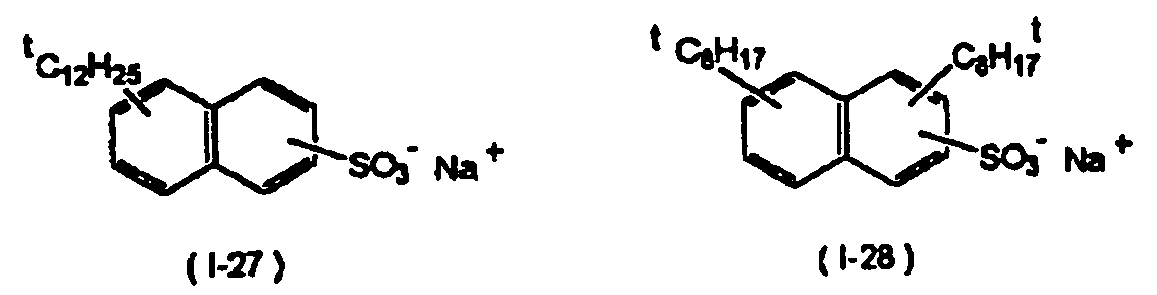


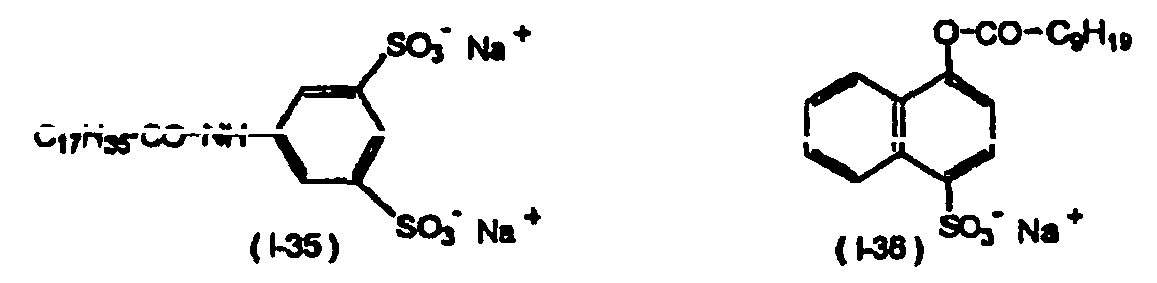


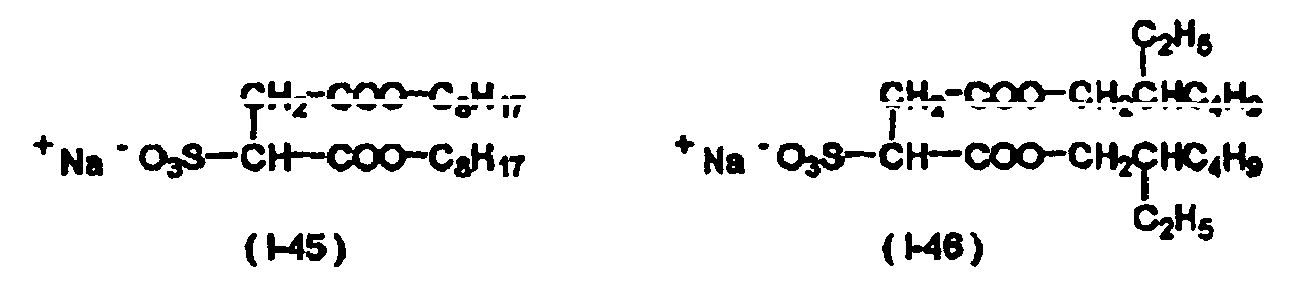


- The letters x and y in the above examples are integers from 1 to 20 (each being average values) which indicate the number of repeating ethyleneoxy chains and propyleneoxy chains, respectively.
- In the practice of the invention, the anionic surfactant content, based on the total weight of the developer, is preferably from 1 to 10 wt%, and more preferably from 2 to 10 wt%. When the anionic surfactant content falls within this range, the developer has an improved ability to penetrate the image recording layer and thus has an excellent developability (ability to dissolve the image recording layer). Moreover, the dispersibility in the developer of image recording layer components removed by development is easy to maintain, inhibiting the re-deposition ot image recording layer components onto non-image areas. As a result, the lithographic printing plate obtained following development has a good scumming resistance.
- The compounds of the formulas (I) and (II) used as the anionic surfactant are generally commercially available. Such commercial products are manufactured by, inter alia, Asahi Denka Co., Ltd., Kao Corporation, Sanyo Chemical Industries, Ltd., New Japan Chemical Co., Ltd., Dai-ichi Kogyo Seiyaku Co., Ltd., Takemoto Oil & Fat Co., Ltd., Toho Chemical Industry Co., Ltd., and NOF Corporation.
- Illustrative examples of nonionic surfactants include polyoxyethylene alkyl ethers, polyoxyethylene alkyl phenyl ethers, polyoxyethylene polyoxypropylene alkyl ethers, polyoxyethylene polystyrylphenyl ethers, partial fatty acid esters of glycerol, partial fatty acid esters of sorbitan, partial fatty acid esters of pentaerythritol, fatty acid monoesters of propylene glycol, partial fatty acid esters of sucrose, partial fatty acid esters of polyoxyethylene sorbitan, partial fatty acid esters of polyoxyethylene sorbitol, fatty acid esters of polyethylene glycol, partial fatty acid esters of polyglycerol, polyoxyethylenated castor oils, partial fatty acid esters of polyoxyethylene glycerol, polyoxyethylene diglycerols, fatty acid diethanolamides, N,N-bis-2-hydroxyalkylamines, polyoxyethylene alkyl amines, fatty acid esters of triethanolamine, trialkylamine oxides and polyoxyethylene-polyoxypropylene block copolymers.
- In the practice of the invention, the nonionic surfactant is preferably a nonionic aromatic ether surfactant of the following formula (1)
X-Y-O-(A)n-(B)m-H (1)
In the formula (1), X is an aromatic group which may have substituents; Y is a single bond or an alkylene group of 1 to 10 carbon atoms; A and B are mutually differing groups and represent -CH2CH2O- or -CH2CH(CH3)O-; and the letters n and m are both integers from 0 to 100, with the proviso that n+m ≥ 2. - Specific examples of the aromatic group represented by X in the formula include phenyl, naphthyl and anthranyl. These aromatic groups may have substituents exemplified by organic groups of 1 to 100 carbon atoms. Examples of such organic groups include all organic groups of the formula (1-A) or (1-B) below. In the formula (1), when m ≥ 1 and n ≥ 1, A and B may each be a random copolymer or a block copolymer.
- Of the nonionic aromatic ether surfactants of the formula (1), compounds of the formulas (1-A) and (1-B) below are preferred as the nonionic surfactant.


- In the formulas (1-A) and (1-B), R10 and R20 are each a hydrogen atom or an organic group of 1 to 100 carbon atoms; the letters t and u each represent the
integer - In the formula (1-A), if the letter t is 2 and R10 is an organic group of 1 to 100 carbon atoms, the two R10 groups may be the same or different and taken together to form a single ring.
- Also, in the formula (1-B), if the letter u is 2 and R20 is an organic group of 1 to 100 carbon atoms, the two R20 groups may be the same or different and taken together to form a single ring.
- Here, the organic groups of 1 to 100 carbon atoms represented by R10 and R20 in the above formulas are exemplified by aliphatic hydrocarbon groups and aromatic hydrocarbon groups which may be saturated or unsaturated and may be linear or branched. Illustrative examples include alkyl groups, alkenyl groups, alkynyl groups, aryl groups, aralkyl groups, alkoxy groups, aryloxy groups, N-alkylamino groups, N,N-dialkylamino groups, N-arylamino groups, N,N-diarylamino groups, N-alkyl-N-arylamino groups, acyloxy groups, carbamoyloxy group, N-alkylcarbamoyloxy groups, N-arylcarbamoyloxy groups, N,N-dialkylcarbamoyloxy groups, N,N-diarylcarbamoyloxy groups, N-alkyl-N-arylcarbamoyloxy groups, acylamino groups, N-alkylacylamino groups, N-arylacylamino groups, acyl groups, alkoxycarbonylamino groups, alkoxycarbonyl groups, aryloxycarbonyl groups, carbamoyl group, N-alkylcarbamoyl groups, -N,N-dialkylcarbamoyl groups, N-arylcarbamoyl groups, N,N-diarylcarbamoyl groups, N-alkyl-N-arylcarbamoyl groups, polyoxyalkylene chains, and any of the foregoing organic groups to which a polyoxyalkylene chain is bonded. The alkyl groups mentioned above may be linear or branched.
- Preferred examples of these R10 and R20 groups include hydrogen atoms, linear or branched alkyl groups of 1 to 10 carbon atoms; alkoxy, alkoxycarbonyl, N-alkylamino, N,N-dialkylamino, N-alkylcarbamoyl, acyloxy or acylamino groups of 1 to 10 carbon atoms; polyoxyalkylene chains having about 5 to 20 recurring units, aryl groups of 6 to 20 carbon atoms, and aryl groups to which a polyoxyalkylene chain having about 5 to 20 recurring units is bonded.
- In the formulas (1-A) and (1-B), v and v' are preferably from 3 to 50, and more preferably from 5 to 30. Similarly, w and w' are preferably from 0 to 10, and more preferably from 0 to 5. The polyoxyethylene moieties represented by v and v' and the polyoxypropylene moieties represented by w and w' may each be a random copolymer or a block copolymer.
- Specific examples of nonionic aromatic ether surfactants of the formula (1-A) include polyoxyethylene phenyl ether, polyoxyethylene methyl phenyl ether, polyoxyethylene octyl phenyl ether and polyoxyethylene nonyl phenyl ether.
- Specific examples of nonionic aromatic ether surfactants of the formula (1-B) include polyoxyethylene naphthyl ether, polyoxyethylene methyl naphthyl ether, polyoxyethylene octyl naphthyl ether and polyoxyethylene nonyl naphthyl ether.
- Other illustrative examples of nonionic aromatic ether surfactants of the formula (1-A) or (1-B) include the following.
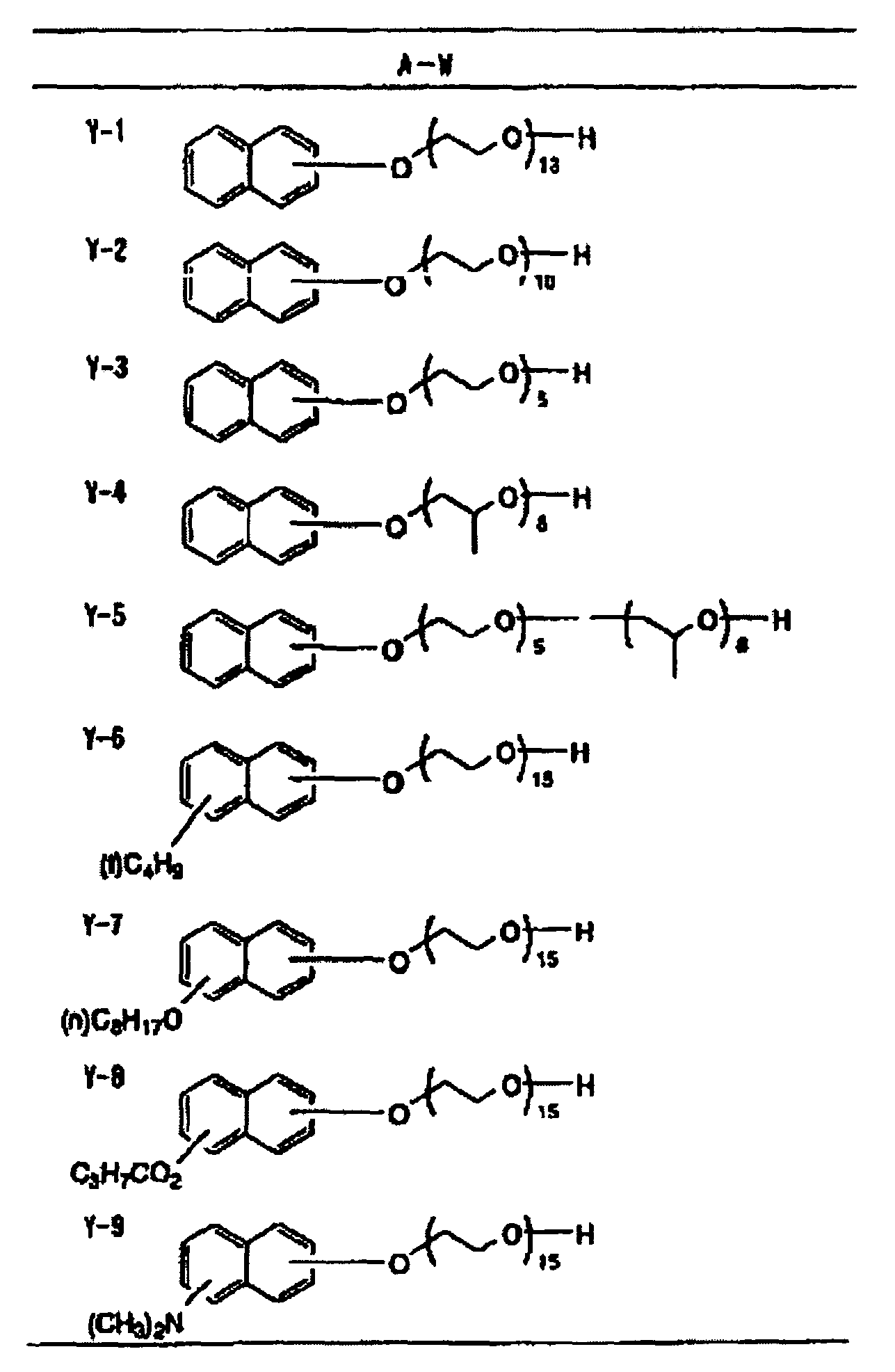


- In the practice of the invention, the nonionic surfactant content is preferably from 1 to 20 wt%, and more preferably from 2 to 10 wt%, based on the total weight of the developer. When the nonionic surfactant content falls within this range, the developer has an improved ability to penetrate the image recording layer and thus has an excellent developability (ability to dissolve the image recording layer). Moreover, the dispersibility in the developer of image recording layer components removed by development is easy to maintain, minimizing the re-deposition of image recording layer components onto non-image areas. As a result, the lithographic printing plate obtained following development has a good scumming resistance.
- In the practice of the invention, acetylene glycol- or acetylene alcohol-based oxyethylene addition products and fluorochemical or silicon-based anionic or nonionic surfactants may likewise be used as these surfactants (anionic surfactant and nonionic surfactant).
- Such surfactants may also be used in combination of two or more. For example, it may be advantageous to use in combination two or more mutually differing anionic surfactants or nonionic surfactants, or to use in combination one or more anionic surfactants with one or more nonionic surfactants.
- Moreover, it is desirable to suitably select and use such surfactants while taking into consideration their impact on the environment. As noted above, at least 1 wt% of a nonionic surfactant and/or an anionic surfactant is included, based on the total weight of the developer.
- In addition to the above-described surfactants, the presence of a water-soluble polymeric compound in the developer used in the inventive platemaking method is desirable for further enhancing the scumming resistance. This is because the water-soluble polymeric compound adsorbs onto non-image areas during development and, during operations such as mounting of the lithographic printing plate onto the press following development, serves to protect from contamination non-image areas that lie exposed.
- Specific examples of water-soluble polymeric compounds include soybean polysaccharides, modified starches, gum arabic, dextrin, cellulose derivatives (e.g., carboxymethyl cellulose, carboxyethyl cellulose, methyl cellulose) and modified forms thereof, pullulan, polyvinyl alcohol and derivatives thereof, polyvinyl pyrrolidone, polyacrylamide and acrylamide copolymers, vinyl methyl ether-maleic anhydride copolymers, vinyl acetate-maleic anhydride copolymers and styrene-maleic anhydride copolymers.
- Any known soybean polysaccharides may be used. For example, various grades of Soyafibe (manufactured by Fuji Oil Co., Ltd.), which are well known as commercial products, may be used. The use of those having a viscosity, as a 10 wt% aqueous solution, of 10 to 100 mPa/s is preferred.
- Preferred examples of modified starches include those of the formula (I) below. Specific examples of the modified starches of formula (I) include corn, potato, tapioca, rice and wheat. Modification to achieve such modified starches is carried out by dissolving starch with an acid, enzyme or the like to about 5 to 30 glucose residues per molecule, then adding oxypropylene in an alkali.

- In the formula (I), the degree of etherification (degree of substitution) is from 0.05 to 1.2 per glucose unit, the letter n represents an integer from 3 to 30, and the letter m represents an integer from 1 to 3.
- Especially preferred water-soluble polymeric compounds include soybean polysaccharides, modified starch, gum arabic, dextrin, carboxymethyl cellulose and polyvinyl alcohol.
- In the practice of the invention, such water-soluble polymeric compounds may be used singly or in combination of two or more thereof.
- The content of the water-soluble polymeric compound, based on the total weight of the developer, is preferably from 0.1 to 20 wt%, and more preferably from 0.5 to 10 wt%.
- In addition to the above components, the developer used in the inventive platemaking method may also include wetting agents, preservatives, chelating compounds, antiforming agents, organic acids, organic solvents, inorganic acids and inorganic salts.
- Preferred wetting agents include ethylene glycol, propylene glycol, triethylene glycol, butylene glycol, hexylene glycol, diethylene glycol, dipropylene glycol, glycerol, trimethylolpropane and diglycerol. These may be used singly, or in combination of two or more thereof.
- In the practice of the invention, the content of the above wetting agent, based on the total weight of the developer, is preferably from 0.1 to 5 wt%.
- Preferred preservatives include phenol and phenol derivatives, formalin, imidazole derivatives, sodium dehydroacetate, 4-isothiazolin-3-one derivatives, benzoisothiazolin-3-one, benzotriazole derivatives, amidine and guanidine derivatives, quaternary ammonium salts, derivatives of pyridine, quinoline and guanidine, diazine, triazole derivatives, oxazole, oxazine derivatives, and nitrobromo alcohols such as 2-bromo-2-nitropropan-1,3-diol, 1,1-dibromo-1-nitro-2-ethanol and 1,1-dibromo-1-nitro-2-propanol.
- In the invention, the use of combinations of two or more of the above preservatives is preferred for efficacy against various molds and bacteria.
- The content of the above-described preservative, which is an amount in which stable potency is exhibited against bacteria, molds, yeasts and the like, will vary depending on the type of bacterium, mold or yeast. Generally, a preservative content of 0.01 to 4 wt%, based on the total weight of the developer, is preferred.
- Illustrative examples of chelating compounds include organic phosphonic acids and phosphonoalkanetricarboxylic acids such as ethylenediaminetetraacetic acid and its potassium and sodium salts; diethylenetriaminepentaacetic acid and its potassium and sodium salts; triethylenetetraminehexaacetic acid and its potassium and sodium salts; hydroxyethylethylenediaminetriacetic acid and its potassium and sodium salts; nitrilotriacetic acid and its sodium salt; 1-hydroxyethane-1,1-diphosphonic acid and its potassium and sodium salts; and aminotri(methylenephosphonic acid) and its potassium and sodium salts. Organic amine salts of the above chelating agents may be effectively used instead of sodium and potassium salts.
- In the practice of the invention, such chelating agents may be suitably selected from among those which are stable in developer compositions and do not compromise the printability.
- The content of such a chelating agent, based on the total weight of the developer, is preferably from 0.001 to 1.0 wt%.
- Antiforming agents that may be used include ordinary silicone-based self-emulsifying, or emulsifying, antiforming agents, and nonionic surfactant-type compounds having an HLB of 5 or less. Of these, a silicone foam inhibitor is preferred. Either an emulsion dispersing or a solubilizing type foam inhibitor may be used.
- In the practice of the invention, the content of such an antiforming agent, based on the total weight of the developer, is preferably in a range of 0.001 to 1.0 wt%.
- Illustrative examples of organic acids include citric acid, acetic acid, oxalic acid, malonic acid, salicylic acid, octanoic acid, tartaric acid, malic acid, lactic acid, levulinic acid, p-toluenesulfonic acid, xylenesulfonic acid, phytic acid and organic phosphonic acid. The organic acid may be used in the form of an alkali metal salt or ammonium salt thereof.
- In the practice of the invention, the content of such an organic acid, based on the total weight of the developer, is preferably from 0.01 to 0.5 wt%.
- Illustrative examples of inorganic acids and inorganic salts include phosphoric acid, metaphosphoric acid, monobasic ammonium phosphate, dibasic ammonium phosphate, monobasic sodium phosphate, dibasic sodium phosphate, monobasic potassium phosphate, dibasic potassium phosphate, sodium tripolyphosphate, potassium pyrophosphate, sodium hexametaphosphate, magnesium nitrate, sodium nitrate, potassium nitrate, ammonium nitrate, sodium sulfate, potassium sulfate, ammonium sulfate, sodium sulfite, ammonium sulfite, sodium bisulfate and nickel sulfate.
- In the practice of the invention, the content of such an inorganic acid and an inorganic salt, based on the total weight of the developer, is preferably from 0.01 to 0.5 wt%.
- If necessary, the developer used in the inventive platemaking method may be obtained by dissolving or dispersing the above components in water. The solids concentration in the developer is preferably from 1 to 20 wt%. It is also possible to prepare the developer in a concentrated form and dilute it with water at the time of use.
- In the inventive platemaking method, examples of methods for bringing such a developer into contact with the presensitized plate in the developing step include manual processing, immersion processing and machine processing.
- One method of manual processing involves thoroughly soaking a sponge or absorbent cotton with the developer, processing the plate while wiping the entire surface with the soaked sponge or cotton, then thoroughly rinsing the surface with water.
- An example of an immersion processing method involves immersing the presensitized plate for about 60 seconds in a vat or deep tank filled with developer, stirring the developer, then thoroughly rinsing the plate with water while wiping it with absorbent cotton or a sponge.
- Machine processing can be carried out using a gum coater or automatic processor of a type known to be used on conventional presensitized plates and CTP plates.
- Exemplary automatic processors include machines which carry out processing by pumping up developer from a development tank and spraying it onto the plate from a spray nozzle, machines which use guide rolls or the like to immerse the printed plate in the developer within a tank filled with developer and to pass the plate through the developer, and machines which carry out what may be referred to as "disposable" processing in which substantially unused developer is fed to each plate in exactly the required amount. Regardless of which type of automatic processor is used, it preferably has a rubbing mechanism that uses a brush or a Moulton roller. Use can also be made of an integrated apparatus which also includes therein a laser exposure section and an automated developer section.
- To further improve the scumming resistance, it is preferable for the inventive platemaking method to have a contacting step in which the lithographic printing plate obtained from the foregoing developing step is brought into contact with an aqueous solution containing the above-described water-soluble polymeric compound. The reason for this is believed to be the same as the reason for the improvement in scumming resistance that results from including the water-soluble polymeric compound described earlier in the developer.
- To facilitate subsequent handling, it is also preferable to include in the platemaking method of the invention a drying step in which the lithographic printing plate obtained from the developing step described above is dried. Exemplary drying methods include air drying or hot-air drying in which the plate is held in a drying chamber, and methods involving the use of a dryer that accompanies the gum coater or automatic processor.
- In the inventive platemaking method, by using a lithographic printing plate support which has an arithmetical mean roughness Ra of less than 0.4 µm and on a surface thereof a specific grained shape bearing recessed portions with an average opening diameter of 0.01 to 2.0 µm, the resulting lithographic printing plate will have both a good press life and a good scumming resistance. This is most likely because, as mentioned above, even when a small arithmetical mean roughness Ra is provided in this way to achieve a good scumming resistance, the support having recessed portions with an average opening diameter of 0.01 to 2.0 µm enables enhancement of the adhesion to the image recording layer that is removable with a developer to be described later, thus enhancing the press life.
- Also, in the inventive platemaking method, employing a specific developer having a pH of 2 to 10 and containing at least 1 wt% of a nonionic surfactant and/or an anionic surfactant is highly useful from the standpoint of the environment and safety. Moreover, because the developer employed is not degraded by carbon dioxide and always has a uniform developability, printing plates of a uniform quality and improved scumming resistance can be manufactured. As already noted above, the reasons for this appear to be that the developer employed has an acidic to weakly alkaline pH of 2 to 10, which eliminates the necessity for using a replenisher to offset a decline in pH due to the absorption of carbon dioxide, and also that, following development, non-image areas are further hydrophilized.
- Examples are given below by way of illustration and not by way of limitation.
- Melts were prepared from aluminum alloys containing the various ingredients shown in Table 1 below (wt%), with the balance being aluminum and inadvertent impurities. The melts were subjected to molten metal treatment and filtration, then were cast into 500 mm thick, 1,200 mm wide ingots by a direct chill casting process. The ingots were scalped with a scalping machine, removing an average of 10 mm of material from the surface, then soaked and held at 550°C for about 5 hours. When the temperature had fallen to 400°C, the ingots were rolled on a hot rolling mill to a thickness of 2.7 mm. In addition, heat treatment was carried out at 500°C in a continuous annealing furnace, following which cold rolling was carried out to a final thickness of 0.3 mm and a sheet width of 1060 mm, thereby giving
Aluminum Plates 1 to 3. - In addition, an
Aluminum Plate 4 was obtained in the same way asAluminum Plate 1, except that an embossing roll was used in cold rolling.Table 1 Material Composition (wt %) Si Fe Cu Mn Mg Cr Zn Ti Aluminum 1 0.080 0.300 0.001 0.001 0.000 0.001 0.003 0.021 Aluminum 20.076 0.270 0.023 0.001 0.000 0.001 0.003 0.021 Aluminum 30.278 0.413 0.201 0.892 0.783 0.022 0.122 0.034 - The aluminum plates obtained above were subjected to the surface treatment described below, thereby forming Lithographic
Printing Plate Supports 1 to 10. - Surface treatment was effected by carrying out the following treatment operations (a) to (j) on the aluminum plates without interruption.
- Using an apparatus like that shown in FIG. 4, mechanical graining treatment was carried out with a rotating roller-type nylon brush while feeding an abrasive slurry consisting of a suspension (specific gravity, 1.12) of abrasive (pumice) and water to the surface of each aluminum plate. FIG. 4 shows an
aluminum plate 1, roller-type brushes 2 and 4, anabrasive slurry 3, andsupport rollers nylon 6/10 and had a bristle length of 50 mm and a bristle diameter of 0.3 mm. Each nylon brush was constructed of a 300 mm diameter stainless steel cylinder in which holes had been formed and bristles densely set. Three rotating brushes were used. Two support rollers (200 mm diameter) were provided below each brush and spaced 300 mm apart. The brushes were rotated at a speed of 200 rpm in the same direction as the direction in which the aluminum plate was moved. Following mechanical graining treatment, the aluminum plate had an arithmetical mean roughness Ra of 0.45 µm. - Etching was carried out by using a spray line to spray the aluminum plate with an aqueous solution having a sodium hydroxide concentration of 370 g/L, an aluminum ion concentration of 100 g/L, and a temperature of 70°C. The amount of material removed by etching from the surface of the aluminum plate to be subsequently electrochemically grained was 5 g/m2.
- The etching solution was then removed from the aluminum plate with nip rollers, following which the sheet was rinsed with water for 5 seconds using a spray line having spray tips which discharge a fan-like spray of water, and the water was removed with nip rollers.
- Desmutting was carried out by using a spray line to spray the aluminum plate with an aqueous solution having a sulfuric acid concentration of 170 g/L, an aluminum ion concentration of 5 g/L, and a temperature of 50°C from a spray line for 5 seconds. Wastewater from the subsequently described anodizing treatment step (j) was used as the aqueous sulfuric acid solution.
- The desmutting solution was then removed from the aluminum plate with nip rollers, following which the plate was rinsed with water for 5 seconds using a spray line having spray tips which discharge a fan-like spray of water, and the water was removed with nip rollers.
- After being subjected to treatment (c), the aluminum plate was electrochemically grained using as the electrolytic solution an aqueous solution (temperature, 35°C) having the hydrochloric acid, nitric acid and aluminum ion concentrations shown in Table 2, and using a power supply capable of generating an alternating current of the desired waveform by controlling the electrical current with an inverter that uses an IGBT device.
- The waveform of the electrical current used, the rise time when the waveform is trapezoidal, the frequency of the electrical current used, the amount of electricity and the current ratio are each shown in Table 2. The amount of electricity is the total amount of electricity used during the reaction when the aluminum plate serves as the anode, and the current ratio is the ratio of the total amount of electricity during the reaction when the aluminum plate serves as the cathode to the total amount of electricity during the reaction when the aluminum plate serves as the anode. In the fabrication of the
support 5, electrochemical graining treatment in an amount of electricity of 50 C/dm2 was carried out eight times. - The current density (peak value of alternating current) during the reaction when the aluminum plate served as the anode was 50 A/dm2, and the duty ratio was 0.5.
- Concentration control of the electrolytic solution was carried out by adding the hydrochloric acid, nitric acid and water in amounts proportional to the amount of current to be passed through, based on a data table prepared beforehand, carrying out multi-component concentration measurement using capillary electrophoresis and, based on the results of measurement, correcting the amounts of hydrochloric acid, nitric acid and water added.
- The solution was then removed from the aluminum plate with nip rollers, following which the plate was rinsed with water for 5 seconds using a spray line having spray tips which discharge a fan-like spray of water, and the water was removed with nip rollers.
- Etching was carried out by using a spray line to spray the aluminum plate with an aqueous solution having a sodium hydroxide concentration of 50 g/L, an aluminum ion concentration of 5 g/L, and a temperature of 35°C. The amount of material removed by etching from the surface of the electrochemically grained aluminum plate is shown in Table 2.
- The etching solution was then removed from the aluminum plate with nip rollers, following which the plate was rinsed with water for 5 seconds using a spray line having spray tips which discharge a fan-like spray of water, and the water was removed with nip rollers.
- Desmutting was carried out by using a spray line to spray the aluminum plate with an aqueous solution having a sulfuric acid concentration of 170 g/L, an aluminum ion concentration of 5 g/L, and a temperature of 50°C from a spray line for 5 seconds. Wastewater from the subsequently described anodizing treatment step (j) was used as the aqueous sulfuric acid solution.
- The desmutting solution was then removed from the aluminum plate with nip rollers, following which the plate was rinsed with water for 5 seconds using a spray line having spray tips which discharge a fan-like spray of water, and the water was removed with nip rollers.
- After being subjected to treatment (f), the aluminum plate was electrochemically grained using as the electrolytic solution an aqueous solution (temperature, 35°C) having the hydrochloric acid, nitric acid and aluminum ion concentrations shown in Table 2, and using a power supply capable of generating an alternating current of the desired waveform by controlling the electrical current with an inverter that uses an IGBT device.
- The waveform of the electrical current used, the rise time when the waveform is trapezoidal, the frequency of the electrical current used, the amount of electricity and the current ratio are each shown in Table 2. The amount of electricity is the total amount of electricity used during the reaction when the aluminum plate serves as the anode, and the current ratio is the ratio of the total amount of electricity during the reaction when the aluminum plate serves as the cathode to the total amount of electricity during the reaction when the aluminum plate serves as the anode.
- The current density (peak value of alternating current) during the reaction when the aluminum plate served as the anode was 50 A/dm2, and the duty ratio was 0.5.
- Concentration control of the electrolytic solution was carried out by adding the hydrochloric acid, nitric acid and water in amounts proportional to the amount of current to be passed through, based on a data table prepared beforehand, carrying out multi-component concentration measurement using capillary electrophoresis and, based on the results of measurement, correcting the amounts of hydrochloric acid, nitric acid and water added.
- The solution was then removed from the aluminum plate with nip rollers, following which the plate was rinsed with water for 5 seconds using a spray line having spray tips which discharge a fan-like spray of water, and the water was removed with nip rollers.
- Etching was carried out by using a spray line to spray the aluminum plate with an aqueous solution having a sodium hydroxide concentration of 50 g/L, an aluminum ion concentration of 5 g/L, and a temperature of 35°C. The amount of material removed by etching from the surface of the electrochemically grained aluminum plate is shown in Table 2.
- The etching solution was then removed from the aluminum plate with nip rollers, following which the plate was rinsed with water for 5 seconds using a spray line having spray tips which discharge a fan-like spray of water, and the water was removed with nip rollers.
- Desmutting was carried out by using a spray line to spray the aluminum plate with an aqueous solution having a sulfuric acid concentration of 170 g/L, an aluminum ion concentration of 5 g/L, and a temperature of 50°C from a spray line for 5 seconds. Wastewater from the subsequently described anodizing treatment step (j) was used as the aqueous sulfuric acid solution.
- The desmutting solution was then removed from the aluminum plate with nip rollers, following which the plate was rinsed with water for 5 seconds using a spray line having spray tips which discharge a fan-like spray of water, and the water was removed with nip rollers.
- A solution prepared by dissolving aluminum sulfate in an aqueous solution having a sulfuric acid concentration of 170 g/L to an aluminum ion concentration of 5 g/L was used as the electrolytic solution (temperature, 50°C). Anodizing treatment was carried out in such a way that the average current density during the anode reaction on the aluminum plate was 15 A/dm2. The weight of the anodized layer ultimately obtained was 2.7 g/m2.
- The electrolytic solution was then removed from the aluminum plate with nip rollers, following which the plate was rinsed with water for 5 seconds using a spray line having spray tips which discharge a fan-like spray of water, and the water was removed with nip rollers.
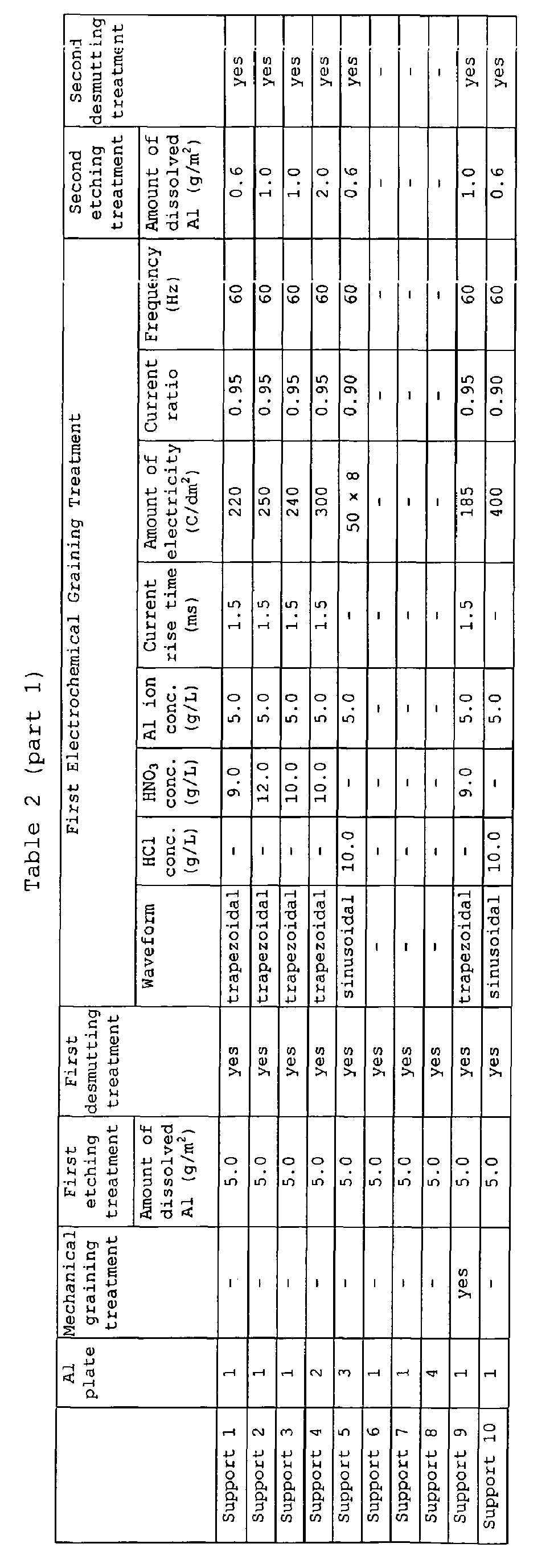

- In Table 2, a dash (-) indicates that the particular treatment in question was not carried out or that the particular component in question was not included.
- The surface shapes of each of the lithographic printing plate supports obtained were examined under a scanning electron microscope (JSM-5500, manufactured by JEOL, Ltd.; the same applies below) at a magnification of 50,000X, whereupon fine asperities having a diameter of 0.01 to 2.0 µm were found to have uniformly and densely formed on the surface. Table 3 gives the arithmetical mean roughness Ra of the support surface and indicates whether or not recessed portions are present and the diameter of the recessed portions.
- In Table 3, the entry "1.8/0.21" for
Support 3 in the "Opening diameter" column signifies recessed portions of differing diameters (i.e., 1.8 µm and 0.21 µm) that together have a superposed structure. The same applies also to the data provided forSupports 4 and 9.Table 3 Ra (µm) Recessed portions (0.01 to 2.0 µm) Present/Absent Opening diameter (µm) Support 10.24 present 0.8 Support 20.23 present 1.4 Support 30.27 present 1.8/0.21 Support 40.34 present 2.8/0.16 Support 50.22 present 0.08 Support 60.20 present 0.1 Support 70.21 absent - Support 80.54 absent 3.7 Support 9 0.45 present 1.2/0.18 Support 10 0.44 present 0.2 - An image recording layer coating fluid (1) was bar-coated onto Lithographic
Printing Plate Supports 1 to 10 obtained as described above, then oven dried at 100°C for 75 seconds so as to form an image recording layer having a coating weight when dry of 1.0 g/m2. In addition, a protective layer coating fluid of the composition indicated below was applied with a bar onto the image recording layer to a coating weight when dry of 1.0 g/m2, then dried in an oven at 100°C for 90 seconds, thereby giving presensitized plates A1 to A10. Before providing the image recording layer, an undercoat layer was formed by applying onto the lithographic printing plate support an undercoating solution (1) of the composition indicated below and drying at 80°C for 15 seconds. The undercoat layer formed had a coating weight when dry of 15 mg/m2. - The image recording layer coating fluid (1) was prepared by mixing and stirring together Photosensitive Solution (1) and Microcapsule Liquid (1) below just prior to coating.
-
Undercoating Compound (1) of the following formula 0.017 g 
Methanol 9.00 g Water 1.00 g -
Binder Polymer (1) of the following formula 0.162 g 
Polymerization Initiator (1) of the following formula 0.100 g 
Infrared Absorber (1) of the following formula 0.020 g 
Polymerizable Compound (Aronix M-215; Toagosei Co., Ltd.) 0.385 g Fluorochemical Surfactant (1) of the following formula 0.044 g 
Methyl ethyl ketone 1.091 g 1 Methoxy 2 propanol8.609 g -
Microcapsule liquid prepared as described below (solids equivalent) 2.640 g Water 2.425 g - An oil phase component was prepared by dissolving 10 g of an addition product of trimethylolpropane with xylene diisocyanate (Takenate D-110N, available as a 75% ethyl acetate solution from Mitsui Takeda Chemicals, Inc.), 6.00 g of Aronix M-215 (available from Toagosei Co., Ltd.), and 0.12 g of a surfactant (Pionin A-41C, available from Takemoto Oil & Fat Co., Ltd.) in 16.67 g of ethyl acetate. In addition, 37.5 g of an aqueous solution containing 4 wt% of PVA-205 was prepared as an aqueous phase component. The oil phase component and the aqueous phase component were mixed together, then emulsified using a homogenizer at 12,000 rpm for 10 minutes. The resulting emulsion was added to 25 g of distilled water, following which the mixture was stirred, first at room temperature for 30 minutes, then at 40°C for 2 hours. The microcapsule liquid thus obtained was then diluted with distilled water to a solids concentration of 15 wt%. The microcapsules had an average particle size of 0.2 µm.
-
Water 88 g Polyvinyl alcohol (PVA 105; Kuraray Co., Ltd.) 10 g Polyethylene glycol (molecular weight, 2000) 2 g Surfactant of the following formula 1 g 
- An image recording layer coating fluid (2) of the composition indicated below was bar-coated onto Lithographic
Printing Plate Supports 1 to 10 obtained as described above, then oven dried at 100°C for 60 seconds so as to form an image recording layer having a coating weight when dry of 1.4 g/m2. In addition, a protective layer coating fluid of the same composition as that described above was applied onto the image recording layer to a coating weight when dry of 0.5 g/m2, then dried in an oven at 120°C for 1 minute, thereby giving presensitized plates B1 to B10. -
Binder Polymer (1) described above 2.0 g Polymerizable compound (EO-modified triacrylate of isocyanuric acid; Aronix M-315; Toagosei Co., Ltd.) 1.5 g Compound (1) below 0.15 g Compound (2) below 0.20 g Compound (3) below 0.4 g 

Ethyl Violet 0.1 g Thermal polymerization inhibitor (aluminum N-nitrosophenylhydroxylamine) 0.1 g Above-mentioned water-soluble fluorochemical surfactant (1) 0.02 g Tetraethylamine hydrochloride 0.06 g 1-Methoxy-2-propanol 17.5 g Methyl ethyl ketone 19.0 g -
Developers 1 to 6 having the compositions and pH values shown in Table 4 below were prepared. The units in the table are grams.Table 4 Developer 1 2 3 4 5 6 Water 9590 9590 9550 9370 8970 8970 Anionic surfactant (II-13) 400 200 400 Nonionic surfactant (Y-1) 400 200 400 Ethylene glycol 50 Gum arabic 150 150 150 Acid-modified potato starch 400 400 400 Sodium salt of dioctylsulfosuccinic acid ester 50 50 50 Monobasic ammonium phosphate 10 10 10 Citric acid 10 10 10 Tetrasodium salt of EDTA 10 10 10 10 10 Total 10,000 10,000 10,000 10,000 10,000 10,000 pH 8 8 8 5 5 5 - Each of the presensitized plates obtained was imagewise exposed using a Trendsetter 3244 VX (Creo Inc.) equipped with a water-cooled 40 W infrared semiconductor laser at an output of 9 W, an external drum speed of 210 rpm, and a resolution of 2,400 dpi.
- Following imagewise exposure, the presensitized plates were subjected to development using the
prepared Developers 1 to 6 or water. - Development was carried out using a processor like that shown in FIG. 5 by filling the developing
tank 31 with one ofDevelopers 1 to 6, or water, having a liquid temperature of 25°C, and passing thepresensitized plate 34 through the liquid so as to form a lithographic printing plate. Also shown in FIG. 5 aredelivery rollers 32. The time it takes for the plate to pass from the tank inlet to the tank outlet was set to 15 seconds. Additionally shown in FIG. 5 is a rotatingbrush 33, which was rotated at a speed of 280 mm/s in a positive direction relative to the direction in which thepresensitized plate 34 was conveyed. Each of the lithographic printing plates discharged from the developingtank 31 was air-dried. In Table 5 below, the designation "1/4" at the top of one of the columns under "Developability" signifies that the plate was developed withDeveloper 1, then additionally developed withDeveloper 4. The same applies to the designation "3/4" elsewhere. - The developability was rated as "Exc" when the
presensitized plate 34 was clearly developed just after passing through the rotatingbrush 33, as "Good" when the portion that emerged after passing through thedelivery rollers 32 was developed, and as "NG" when residual portions of the image recording layer clearly remained after the plate had been discharged from the processor. The results are shown below in Table 5. - After development with
Developers - The scumming resistance was rated as "Good" if normal impressions free of scumming in non-image areas were obtained in less than 30 copies after printing had begun, and was rated as "Fair" if it took 30 or more copies to start obtaining impressions free of scumming in non-image areas. The results are shown in Table 5.
- As in the scumming resistance test, after development with
Developers - The press life was rated by counting the number of clean impressions obtained after the start of printing; that is, the number of impressions that were free of scumming in non-image areas. The number of clean impressions in the case of the presensitized plate A9 was assigned an arbitrary value of 100, and the number of clean impressions obtained from the other lithographic printing plates were expressed relative to this value. The results are given in Table 5.
Table 5 Support Presensitized plate Developability Scumming resistance (3/4) Press life (3/4) Developer No. 1 2 3 1/4 3/4 5 6 Water 1 A1 Exc Exc Exc Exc Exc Exc Exc NG Fair 120 2 A2 Exc Exc Exc Exc Exc Exc Exc NG Fair 105 3 A3 Exc Exc Exc Exc Exc Exc Exc NG Good 100 4 A4 Exc Exc Exc Exc Exc Exc Exc NG Good 110 5 A5 Exc Exc Exc Exc Exc Exc Exc NG Good 40 6 A6 Exc Exc Exc Exc Exc Exc Exc NG Good 40 7 A7 Exc Exc Exc Exc Exc Exc Exc NG Fair 0 8 A8 Good Good Good Good Good Good Good NG Fair 40 9 A9 Good Good Good Good Good Good Good NG Good 100 10 A10 Good Good Good Good Good Good Good NG Good 80 1 B1 Exc Exc Exc 2 B2 Exc Exc Exc 3 B3 Exc Exc Exc 4 B4 Exc Exc Exc 5 B5 Exc Exc Exc 6 B6 Exc Exc Exc 7 B7 Exc Exc Exc 8 B8 Good Good Good 9 B9 Good Good Good 10 B10 Good Good Good - As is apparent from the results in Table 5, when use was made of a presensitized plate having an image recording layer formed on a specific lithographic printing plate support having an arithmetical mean roughness Ra of less than 0.4 µm and having on the surface thereof a grained shape with a structure bearing recessed portions having an average opening diameter of 0.01 to 2.0 µm, and of specific aqueous solutions (developers) having a pH of 2 to 10, the developability was better, and the scumming resistance and press life were comparable to or better than those in cases where the arithmetical mean roughness Ra was too large or recessed portions with an average opening diameter of 0.01 to 2.0 µm were absent.
Claims (9)
- A platemaking method to obtain a lithographic printing plate, comprising the steps of:recording an image, by imagewise exposure, on a presensitized plate comprising a lithographic printing plate support and an image recording layer on the support, thendeveloping the presensitized plate on which the image has been recorded so as to obtain a lithographic printing plate; wherein the lithographic printing plate support has an arithmetical mean roughness Ra of less than 0.4 µm and has on a surface thereof a grained shape with a structure bearing recessed portions with an average opening diameter of 0.01 to 2.0 µm, and the developing step is carried out using an aqueous solution which contains at least 1 wt% of a nonionic surfactant and/or an anionic surfactant and has a pH of 2 to 10.
- The platemaking method according to claim 1, wherein the aqueous solution used in the developing step contains a water-soluble polymeric compound.
- The platemaking method according to claim 1 or 2, wherein the anionic surfactant has a sulfonate anionic group or a sulfate monoester anionic group and has an aromatic group which may have a substituent.
- The platemaking method according to any one of claims 1 to 3, wherein the nonionic surfactant is a nonionic aromatic ether surfactant of the formula (1) below
X-Y-O-(A)n-(B)m-H (1)
where X is an aromatic group which may have a substituent; Y is a single bond or an alkylene group of 1 to 10 carbon atoms; A and B, which mutually differ, are -CH2CH2O- or -CH2CH (CH3) O-; and n and m are both integers from 0 to 100, with the proviso that n+m ≥ 2. - The platemaking method according to any one of claims 1 to 4, wherein the image recording layer contains a polymerization initiator, a polymerizable compound, and a hydrophobic binder polymer.
- The platemaking method according to any one of claims 1 to 5, wherein the presensitized plate additionally has a protective layer on the image recording layer.
- The platemaking method according to any one of claims 1 to 6, wherein a laser which emits light at a wavelength of 760 to 1200 nm is used in the imagewise exposure.
- The platemaking method according to any one of claims 1 to 6, wherein a laser which emits light at a wavelength of 250 to 420 nm is used in the imagewise exposure.
- The platemaking method according to any one of claims 1 to 8, wherein some or all of ingredients which form the image recording layer are encapsulated in microcapsules.
Applications Claiming Priority (1)
| Application Number | Priority Date | Filing Date | Title |
|---|---|---|---|
| JP2005095132 | 2005-03-29 |
Publications (3)
| Publication Number | Publication Date |
|---|---|
| EP1708033A2 true EP1708033A2 (en) | 2006-10-04 |
| EP1708033A3 EP1708033A3 (en) | 2009-04-22 |
| EP1708033B1 EP1708033B1 (en) | 2011-10-05 |
Family
ID=36691794
Family Applications (1)
| Application Number | Title | Priority Date | Filing Date |
|---|---|---|---|
| EP06006125A Expired - Lifetime EP1708033B1 (en) | 2005-03-29 | 2006-03-24 | Method of manufacturing a lithographic printing plate |
Country Status (2)
| Country | Link |
|---|---|
| EP (1) | EP1708033B1 (en) |
| AT (1) | ATE527581T1 (en) |
Cited By (4)
| Publication number | Priority date | Publication date | Assignee | Title |
|---|---|---|---|---|
| EP2196851A1 (en) | 2008-12-12 | 2010-06-16 | Eastman Kodak Company | Negative working lithographic printing plate precursors comprising a reactive binder containing aliphatic bi- or polycyclic moieties |
| WO2011023627A1 (en) | 2009-08-25 | 2011-03-03 | Agfa Graphics Nv | A set for developing a lithographic printing plate |
| WO2021204651A1 (en) * | 2020-04-06 | 2021-10-14 | Merck Patent Gmbh | Electronic device manufacturing aqueous solution, method for manufacturing resist pattern and method for manufacturing device |
| CN115748233A (en) * | 2022-11-16 | 2023-03-07 | 澳蓝(福建)实业有限公司 | Self-cleaning mildew-proof wet curtain and preparation method thereof |
Citations (1)
| Publication number | Priority date | Publication date | Assignee | Title |
|---|---|---|---|---|
| JP2938397B2 (en) | 1995-10-24 | 1999-08-23 | アグフア−ゲヴエルト・ナームローゼ・フエンノートシヤツプ | Method for producing a lithographic printing plate including on-press development |
Family Cites Families (6)
| Publication number | Priority date | Publication date | Assignee | Title |
|---|---|---|---|---|
| DE2530502C2 (en) * | 1974-07-22 | 1985-07-18 | American Hoechst Corp., Bridgewater, N.J. | Process for the simultaneous development and preservation of printing plates as well as a suitable treatment solution therefor |
| US4865951A (en) * | 1987-10-22 | 1989-09-12 | Eastman Kodak Company | Bilayered anodized aluminum support, method for the preparation thereof and lithographic printing plate containing same |
| US6806031B2 (en) * | 2000-05-15 | 2004-10-19 | Fuji Photo Film Co., Ltd. | Support for lithographic printing plate and presensitized plate |
| US7118848B2 (en) * | 2001-04-03 | 2006-10-10 | Fuji Photo Film Co., Ltd. | Support for lithographic printing plate and original forme for lithographic printing plate |
| US6902865B2 (en) * | 2002-07-22 | 2005-06-07 | Gary Ganghui Teng | Non-alkaline aqueous development of thermosensitive lithographic printing plates |
| JP2005049542A (en) * | 2003-07-31 | 2005-02-24 | Fuji Photo Film Co Ltd | Picture forming method and developer |
-
2006
- 2006-03-24 EP EP06006125A patent/EP1708033B1/en not_active Expired - Lifetime
- 2006-03-24 AT AT06006125T patent/ATE527581T1/en not_active IP Right Cessation
Patent Citations (1)
| Publication number | Priority date | Publication date | Assignee | Title |
|---|---|---|---|---|
| JP2938397B2 (en) | 1995-10-24 | 1999-08-23 | アグフア−ゲヴエルト・ナームローゼ・フエンノートシヤツプ | Method for producing a lithographic printing plate including on-press development |
Cited By (4)
| Publication number | Priority date | Publication date | Assignee | Title |
|---|---|---|---|---|
| EP2196851A1 (en) | 2008-12-12 | 2010-06-16 | Eastman Kodak Company | Negative working lithographic printing plate precursors comprising a reactive binder containing aliphatic bi- or polycyclic moieties |
| WO2011023627A1 (en) | 2009-08-25 | 2011-03-03 | Agfa Graphics Nv | A set for developing a lithographic printing plate |
| WO2021204651A1 (en) * | 2020-04-06 | 2021-10-14 | Merck Patent Gmbh | Electronic device manufacturing aqueous solution, method for manufacturing resist pattern and method for manufacturing device |
| CN115748233A (en) * | 2022-11-16 | 2023-03-07 | 澳蓝(福建)实业有限公司 | Self-cleaning mildew-proof wet curtain and preparation method thereof |
Also Published As
| Publication number | Publication date |
|---|---|
| EP1708033A3 (en) | 2009-04-22 |
| ATE527581T1 (en) | 2011-10-15 |
| EP1708033B1 (en) | 2011-10-05 |
Similar Documents
| Publication | Publication Date | Title |
|---|---|---|
| JP4792253B2 (en) | Planographic printing plate making method | |
| JP5172097B2 (en) | Planographic printing plate precursor and method for producing lithographic printing plate precursor | |
| JP5265955B2 (en) | Plane printing plate aluminum alloy plate, planographic printing plate support, planographic printing plate precursor, and method for producing planographic printing plate aluminum alloy plate | |
| JP5453333B2 (en) | Planographic printing plate making method | |
| US20090293748A1 (en) | Platemaking method for lithographic printing plate precursor and planographic printing method | |
| JP5087701B2 (en) | Planographic printing method | |
| JP4505242B2 (en) | Planographic printing method | |
| JP2005119273A (en) | Lithographic printing original plate and lithographic printing method | |
| US8067145B2 (en) | Developing solution and method for producing lithography printing plate | |
| JP2007206348A (en) | Development processing solution for lithographic printing plate and plate making method of lithographic printing plate | |
| EP1708033B1 (en) | Method of manufacturing a lithographic printing plate | |
| EP1645912B1 (en) | Lithographic printing method | |
| EP2110261B1 (en) | Aluminum alloy plate for lithographic printing plate, ligthographic printing plate support, presensitized plate, method of manufacturing aluminum alloy plate for lithographic printing plate and method of manufacturing lithographic printing plate support | |
| EP2145772A2 (en) | Method of manufacturing aluminum alloy plate for lithographic printing plate, aluminum alloy plate for lithographic printing plate, lithographic printing plate support and presensitized plate | |
| JP2010058315A (en) | Method of manufacturing lithographic printing plate support, lithographic printing plate support, and original plate for lithographic printing plate | |
| JP2005186505A (en) | Lithographic printing plate original plate and lithographic printing method | |
| JP2005219393A (en) | On press developing method of lithographic printing form original plate | |
| JP2009214496A (en) | Original lithographic printing plate | |
| JP2006309160A (en) | Platemaking method of lithographic printing plate | |
| JP4909532B2 (en) | Planographic printing plate making method | |
| JP2005212317A (en) | Original plate of lithographic printing plate, and lithographic printing method using the same | |
| JP2009210639A (en) | Developing liquid for planographic printing plate and platemaking method of planographic printing plate | |
| JP2005186300A (en) | Lithographic printing plate original plate and lithographic printing method | |
| JP2005246828A (en) | Lithographic printing method | |
| JP2009233987A (en) | Original plate for planographic printing plate |
Legal Events
| Date | Code | Title | Description |
|---|---|---|---|
| PUAI | Public reference made under article 153(3) epc to a published international application that has entered the european phase |
Free format text: ORIGINAL CODE: 0009012 |
|
| AK | Designated contracting states |
Kind code of ref document: A2 Designated state(s): AT BE BG CH CY CZ DE DK EE ES FI FR GB GR HU IE IS IT LI LT LU LV MC NL PL PT RO SE SI SK TR |
|
| AX | Request for extension of the european patent |
Extension state: AL BA HR MK YU |
|
| RAP1 | Party data changed (applicant data changed or rights of an application transferred) |
Owner name: FUJIFILM CORPORATION |
|
| PUAL | Search report despatched |
Free format text: ORIGINAL CODE: 0009013 |
|
| AK | Designated contracting states |
Kind code of ref document: A3 Designated state(s): AT BE BG CH CY CZ DE DK EE ES FI FR GB GR HU IE IS IT LI LT LU LV MC NL PL PT RO SE SI SK TR |
|
| AX | Request for extension of the european patent |
Extension state: AL BA HR MK YU |
|
| RIC1 | Information provided on ipc code assigned before grant |
Ipc: G03F 7/16 20060101ALI20090319BHEP Ipc: B41N 3/03 20060101ALI20090319BHEP Ipc: G03F 7/32 20060101AFI20060731BHEP |
|
| 17P | Request for examination filed |
Effective date: 20091022 |
|
| AKX | Designation fees paid |
Designated state(s): AT BE BG CH CY CZ DE DK EE ES FI FR GB GR HU IE IS IT LI LT LU LV MC NL PL PT RO SE SI SK TR |
|
| GRAP | Despatch of communication of intention to grant a patent |
Free format text: ORIGINAL CODE: EPIDOSNIGR1 |
|
| GRAS | Grant fee paid |
Free format text: ORIGINAL CODE: EPIDOSNIGR3 |
|
| GRAA | (expected) grant |
Free format text: ORIGINAL CODE: 0009210 |
|
| AK | Designated contracting states |
Kind code of ref document: B1 Designated state(s): AT BE BG CH CY CZ DE DK EE ES FI FR GB GR HU IE IS IT LI LT LU LV MC NL PL PT RO SE SI SK TR |
|
| REG | Reference to a national code |
Ref country code: GB Ref legal event code: FG4D |
|
| REG | Reference to a national code |
Ref country code: CH Ref legal event code: EP |
|
| REG | Reference to a national code |
Ref country code: IE Ref legal event code: FG4D |
|
| REG | Reference to a national code |
Ref country code: DE Ref legal event code: R096 Ref document number: 602006024785 Country of ref document: DE Effective date: 20111208 |
|
| REG | Reference to a national code |
Ref country code: NL Ref legal event code: VDEP Effective date: 20111005 |
|
| PG25 | Lapsed in a contracting state [announced via postgrant information from national office to epo] |
Ref country code: SI Free format text: LAPSE BECAUSE OF FAILURE TO SUBMIT A TRANSLATION OF THE DESCRIPTION OR TO PAY THE FEE WITHIN THE PRESCRIBED TIME-LIMIT Effective date: 20111005 |
|
| LTIE | Lt: invalidation of european patent or patent extension |
Effective date: 20111005 |
|
| REG | Reference to a national code |
Ref country code: AT Ref legal event code: MK05 Ref document number: 527581 Country of ref document: AT Kind code of ref document: T Effective date: 20111005 |
|
| PG25 | Lapsed in a contracting state [announced via postgrant information from national office to epo] |
Ref country code: IS Free format text: LAPSE BECAUSE OF FAILURE TO SUBMIT A TRANSLATION OF THE DESCRIPTION OR TO PAY THE FEE WITHIN THE PRESCRIBED TIME-LIMIT Effective date: 20120205 Ref country code: LT Free format text: LAPSE BECAUSE OF FAILURE TO SUBMIT A TRANSLATION OF THE DESCRIPTION OR TO PAY THE FEE WITHIN THE PRESCRIBED TIME-LIMIT Effective date: 20111005 Ref country code: BE Free format text: LAPSE BECAUSE OF FAILURE TO SUBMIT A TRANSLATION OF THE DESCRIPTION OR TO PAY THE FEE WITHIN THE PRESCRIBED TIME-LIMIT Effective date: 20111005 |
|
| PG25 | Lapsed in a contracting state [announced via postgrant information from national office to epo] |
Ref country code: PT Free format text: LAPSE BECAUSE OF FAILURE TO SUBMIT A TRANSLATION OF THE DESCRIPTION OR TO PAY THE FEE WITHIN THE PRESCRIBED TIME-LIMIT Effective date: 20120206 Ref country code: LV Free format text: LAPSE BECAUSE OF FAILURE TO SUBMIT A TRANSLATION OF THE DESCRIPTION OR TO PAY THE FEE WITHIN THE PRESCRIBED TIME-LIMIT Effective date: 20111005 Ref country code: SE Free format text: LAPSE BECAUSE OF FAILURE TO SUBMIT A TRANSLATION OF THE DESCRIPTION OR TO PAY THE FEE WITHIN THE PRESCRIBED TIME-LIMIT Effective date: 20111005 Ref country code: GR Free format text: LAPSE BECAUSE OF FAILURE TO SUBMIT A TRANSLATION OF THE DESCRIPTION OR TO PAY THE FEE WITHIN THE PRESCRIBED TIME-LIMIT Effective date: 20120106 Ref country code: NL Free format text: LAPSE BECAUSE OF FAILURE TO SUBMIT A TRANSLATION OF THE DESCRIPTION OR TO PAY THE FEE WITHIN THE PRESCRIBED TIME-LIMIT Effective date: 20111005 |
|
| PG25 | Lapsed in a contracting state [announced via postgrant information from national office to epo] |
Ref country code: CY Free format text: LAPSE BECAUSE OF FAILURE TO SUBMIT A TRANSLATION OF THE DESCRIPTION OR TO PAY THE FEE WITHIN THE PRESCRIBED TIME-LIMIT Effective date: 20111005 |
|
| PG25 | Lapsed in a contracting state [announced via postgrant information from national office to epo] |
Ref country code: BG Free format text: LAPSE BECAUSE OF FAILURE TO SUBMIT A TRANSLATION OF THE DESCRIPTION OR TO PAY THE FEE WITHIN THE PRESCRIBED TIME-LIMIT Effective date: 20120105 Ref country code: EE Free format text: LAPSE BECAUSE OF FAILURE TO SUBMIT A TRANSLATION OF THE DESCRIPTION OR TO PAY THE FEE WITHIN THE PRESCRIBED TIME-LIMIT Effective date: 20111005 Ref country code: DK Free format text: LAPSE BECAUSE OF FAILURE TO SUBMIT A TRANSLATION OF THE DESCRIPTION OR TO PAY THE FEE WITHIN THE PRESCRIBED TIME-LIMIT Effective date: 20111005 Ref country code: SK Free format text: LAPSE BECAUSE OF FAILURE TO SUBMIT A TRANSLATION OF THE DESCRIPTION OR TO PAY THE FEE WITHIN THE PRESCRIBED TIME-LIMIT Effective date: 20111005 Ref country code: CZ Free format text: LAPSE BECAUSE OF FAILURE TO SUBMIT A TRANSLATION OF THE DESCRIPTION OR TO PAY THE FEE WITHIN THE PRESCRIBED TIME-LIMIT Effective date: 20111005 |
|
| PLBE | No opposition filed within time limit |
Free format text: ORIGINAL CODE: 0009261 |
|
| STAA | Information on the status of an ep patent application or granted ep patent |
Free format text: STATUS: NO OPPOSITION FILED WITHIN TIME LIMIT |
|
| PG25 | Lapsed in a contracting state [announced via postgrant information from national office to epo] |
Ref country code: PL Free format text: LAPSE BECAUSE OF FAILURE TO SUBMIT A TRANSLATION OF THE DESCRIPTION OR TO PAY THE FEE WITHIN THE PRESCRIBED TIME-LIMIT Effective date: 20111005 Ref country code: RO Free format text: LAPSE BECAUSE OF FAILURE TO SUBMIT A TRANSLATION OF THE DESCRIPTION OR TO PAY THE FEE WITHIN THE PRESCRIBED TIME-LIMIT Effective date: 20111005 Ref country code: IT Free format text: LAPSE BECAUSE OF FAILURE TO SUBMIT A TRANSLATION OF THE DESCRIPTION OR TO PAY THE FEE WITHIN THE PRESCRIBED TIME-LIMIT Effective date: 20111005 |
|
| 26N | No opposition filed |
Effective date: 20120706 |
|
| PG25 | Lapsed in a contracting state [announced via postgrant information from national office to epo] |
Ref country code: MC Free format text: LAPSE BECAUSE OF NON-PAYMENT OF DUE FEES Effective date: 20120331 |
|
| REG | Reference to a national code |
Ref country code: DE Ref legal event code: R097 Ref document number: 602006024785 Country of ref document: DE Effective date: 20120706 Ref country code: CH Ref legal event code: PL |
|
| REG | Reference to a national code |
Ref country code: FR Ref legal event code: ST Effective date: 20121130 |
|
| REG | Reference to a national code |
Ref country code: IE Ref legal event code: MM4A |
|
| PG25 | Lapsed in a contracting state [announced via postgrant information from national office to epo] |
Ref country code: CH Free format text: LAPSE BECAUSE OF NON-PAYMENT OF DUE FEES Effective date: 20120331 Ref country code: LI Free format text: LAPSE BECAUSE OF NON-PAYMENT OF DUE FEES Effective date: 20120331 Ref country code: FR Free format text: LAPSE BECAUSE OF NON-PAYMENT OF DUE FEES Effective date: 20120402 Ref country code: IE Free format text: LAPSE BECAUSE OF NON-PAYMENT OF DUE FEES Effective date: 20120324 Ref country code: AT Free format text: LAPSE BECAUSE OF FAILURE TO SUBMIT A TRANSLATION OF THE DESCRIPTION OR TO PAY THE FEE WITHIN THE PRESCRIBED TIME-LIMIT Effective date: 20111005 |
|
| PG25 | Lapsed in a contracting state [announced via postgrant information from national office to epo] |
Ref country code: ES Free format text: LAPSE BECAUSE OF FAILURE TO SUBMIT A TRANSLATION OF THE DESCRIPTION OR TO PAY THE FEE WITHIN THE PRESCRIBED TIME-LIMIT Effective date: 20120116 |
|
| PG25 | Lapsed in a contracting state [announced via postgrant information from national office to epo] |
Ref country code: FI Free format text: LAPSE BECAUSE OF FAILURE TO SUBMIT A TRANSLATION OF THE DESCRIPTION OR TO PAY THE FEE WITHIN THE PRESCRIBED TIME-LIMIT Effective date: 20111005 |
|
| PG25 | Lapsed in a contracting state [announced via postgrant information from national office to epo] |
Ref country code: TR Free format text: LAPSE BECAUSE OF FAILURE TO SUBMIT A TRANSLATION OF THE DESCRIPTION OR TO PAY THE FEE WITHIN THE PRESCRIBED TIME-LIMIT Effective date: 20111005 |
|
| PG25 | Lapsed in a contracting state [announced via postgrant information from national office to epo] |
Ref country code: LU Free format text: LAPSE BECAUSE OF NON-PAYMENT OF DUE FEES Effective date: 20120324 |
|
| PG25 | Lapsed in a contracting state [announced via postgrant information from national office to epo] |
Ref country code: HU Free format text: LAPSE BECAUSE OF FAILURE TO SUBMIT A TRANSLATION OF THE DESCRIPTION OR TO PAY THE FEE WITHIN THE PRESCRIBED TIME-LIMIT Effective date: 20060324 |
|
| PGFP | Annual fee paid to national office [announced via postgrant information from national office to epo] |
Ref country code: DE Payment date: 20200310 Year of fee payment: 15 Ref country code: GB Payment date: 20200311 Year of fee payment: 15 |
|
| REG | Reference to a national code |
Ref country code: DE Ref legal event code: R119 Ref document number: 602006024785 Country of ref document: DE |
|
| GBPC | Gb: european patent ceased through non-payment of renewal fee |
Effective date: 20210324 |
|
| PG25 | Lapsed in a contracting state [announced via postgrant information from national office to epo] |
Ref country code: DE Free format text: LAPSE BECAUSE OF NON-PAYMENT OF DUE FEES Effective date: 20211001 Ref country code: GB Free format text: LAPSE BECAUSE OF NON-PAYMENT OF DUE FEES Effective date: 20210324 |