EP1707570A1 - Preparation of cyclic oligosiloxane - Google Patents
Preparation of cyclic oligosiloxane Download PDFInfo
- Publication number
- EP1707570A1 EP1707570A1 EP06251752A EP06251752A EP1707570A1 EP 1707570 A1 EP1707570 A1 EP 1707570A1 EP 06251752 A EP06251752 A EP 06251752A EP 06251752 A EP06251752 A EP 06251752A EP 1707570 A1 EP1707570 A1 EP 1707570A1
- Authority
- EP
- European Patent Office
- Prior art keywords
- substituted
- monovalent hydrocarbon
- hydrocarbon group
- unsubstituted monovalent
- catalyst
- Prior art date
- Legal status (The legal status is an assumption and is not a legal conclusion. Google has not performed a legal analysis and makes no representation as to the accuracy of the status listed.)
- Granted
Links
- 0 C*NC(C)*(C)C Chemical compound C*NC(C)*(C)C 0.000 description 1
Classifications
-
- C—CHEMISTRY; METALLURGY
- C07—ORGANIC CHEMISTRY
- C07F—ACYCLIC, CARBOCYCLIC OR HETEROCYCLIC COMPOUNDS CONTAINING ELEMENTS OTHER THAN CARBON, HYDROGEN, HALOGEN, OXYGEN, NITROGEN, SULFUR, SELENIUM OR TELLURIUM
- C07F7/00—Compounds containing elements of Groups 4 or 14 of the Periodic Table
- C07F7/02—Silicon compounds
- C07F7/08—Compounds having one or more C—Si linkages
- C07F7/0834—Compounds having one or more O-Si linkage
- C07F7/0838—Compounds with one or more Si-O-Si sequences
- C07F7/0872—Preparation and treatment thereof
- C07F7/0874—Reactions involving a bond of the Si-O-Si linkage
Definitions
- This invention relates to methods for preparing cyclic oligosiloxanes from high molecular weight organopolysiloxanes.
- Cyclic oligosiloxanes are used as the raw material for high molecular weight polysiloxanes such as silicone fluid and gum, and when having Si-H bonds, as the raw material for organohydrogenpolysiloxanes, the raw material for adhesive aids having organic functional groups bonded thereto, and the like.
- One process known in the art for the preparation of cyclic oligosiloxanes is by hydrolysis of a silane having two hydrolyzable groups such as dimethyldichlorosilane, as described in JP-A 54-74900 and USP 4,447,630 ( JP-A 60-90220 ).
- a silane having two hydrolyzable groups such as dimethyldichlorosilane
- JP-A 60-90220 JP-A 60-90220
- JP-A 2000-159783 JP-A 2000-159784 , and JP-A 2000-169488 that cyclic oligosiloxanes are produced through disproportionation reaction of high molecular weight siloxanes in the presence of catalysts.
- JP-A 7-316167 discloses the use of anhydrous aluminum chloride catalyst for producing cyclic tetramer siloxane.
- the anhydrous aluminum chloride suffers from extreme difficulty of handling and a likelihood of generating hydrochloric acid in the system.
- An object of the present invention is to provide a method for preparing cyclic oligosiloxanes of high purity in high yields from high molecular weight siloxanes.
- the invention relates to a process for producing cyclic oligosiloxane through disproportionation reaction of higher or high MW organopolysiloxane in the presence of a catalyst.
- the inventor has found that production of cyclic oligosiloxane of high purity in high yields can be achieved by using a catalyst having the general formula (4): wherein M is a metal selected from among aluminum, titanium, zirconium, tin and zinc, p is the valence of the metal M, and R 4 is each independently a substituted or unsubstituted monovalent hydrocarbon group or a group of the formula (5): wherein R 5 is each independently a substituted or unsubstituted monovalent hydrocarbon group and h is an integer of 0 to 100.
- the use of the catalyst having formula (4) not only enables cyclic oligosiloxane of high purity to be produced in high yields from high molecular weight organopolysiloxane without leaving BOD loads, but also minimizes formation of molecules having a silicon-alkoxide bond which are problematic in the semiconductor and electric/electronic applications.
- the invention provides a method for preparing a cyclic oligosiloxane having the general formula (3), comprising reacting an organopolysiloxane having the general formula (1) and/or an organopolysiloxane having the general formula (2) in the presence of a catalyst wherein the catalyst has the general formula (4).
- R 1 is each independently hydrogen, hydroxyl or a substituted or unsubstituted monovalent hydrocarbon group
- the catalyst is present in an amount of 0.001 to 10 parts by weight per 100 parts by weight of the starting organopolysiloxane(s).
- the catalyst has the general formula (4a): wherein R 4 is as defined above.
- the cyclic oligosiloxane has the general formula (3a): wherein k is as defined above.
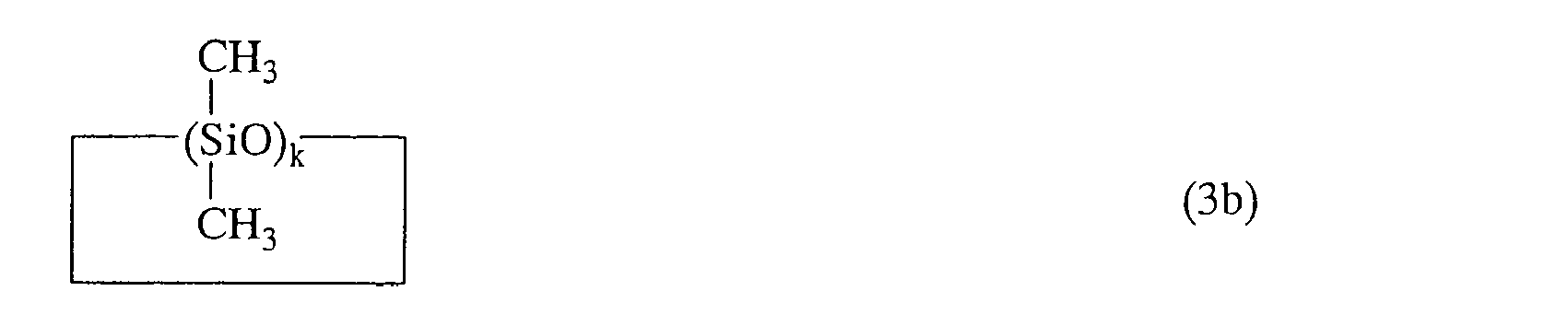
- the cyclic oligosiloxane has the general formula (3b): wherein k is as defined above.
- the method for preparing cyclic oligosiloxane is by reacting an organopolysiloxane having the general formula (1) and/or an organopolysiloxane having the general formula (2) in the presence of a catalyst.
- R 1 is each independently hydrogen, hydroxyl or a substituted or unsubstituted monovalent hydrocarbon group
- R 2 is each independently a substituted or unsubstituted monovalent hydrocarbon group
- R 3 is hydrogen or a substituted or unsubstituted monovalent hydrocarbon group
- n is an integer of 2 to 10,000.
- R 2 is each independently a substituted or unsubstituted monovalent hydrocarbon group
- R 3 is hydrogen or a substituted or unsubstituted monovalent hydrocarbon group
- m is an integer of 4 to 15.
- R 1 which may be the same or different is a hydrogen atom, a hydroxyl group or a substituted or unsubstituted monovalent hydrocarbon group.
- Suitable monovalent hydrocarbon groups include those of 1 to 12 carbon atoms, preferably 1 to 10 carbon atoms, for example, alkyl groups such as methyl, ethyl, n-propyl, isopropyl, n-butyl, isobutyl and t-butyl, cycloalkyl groups such as cyclohexyl, alkenyl groups such as vinyl, allyl and propenyl, aryl groups such as phenyl and tolyl, aralkyl groups such as benzyl and phenylethyl, and substituted forms of the foregoing groups in which one or more hydrogen atoms are substituted by halogen atoms or the like, such as 3,3,3-trifluoropropyl.
- hydrogen, methyl and phenyl are preferred,
- R 2 which may be the same or different is a substituted or unsubstituted monovalent hydrocarbon group, examples of which are the same as described for R 1 .
- R 1 methyl and phenyl are preferred, with the methyl being most preferred.
- R 3 is a hydrogen atom or a substituted or unsubstituted monovalent hydrocarbon group, examples of which are the same as described for R 1 .
- R 1 is a hydrogen atom or a substituted or unsubstituted monovalent hydrocarbon group, examples of which are the same as described for R 1 .
- R 3 is a hydrogen atom or a substituted or unsubstituted monovalent hydrocarbon group, examples of which are the same as described for R 1 .
- hydrogen, methyl and phenyl are preferred, with the hydrogen and methyl being most preferred.
- n is an integer of 2 to 10,000, preferably 10 to 2,000, more preferably 20 to 1,500.
- m is an integer of 4 to 15, preferably 4 to 10.
- the method for preparing cyclic oligosiloxane according to the invention favors use of an organopolysiloxane having formula (1) as the starting reactant.
- an organopolysiloxane having formula (2) can also be formed.
- the resulting organopolysiloxane mixture may be used without separation.
- the organopolysiloxane having formula (1) and the organopolysiloxane having formula (2) are present preferably in a ratio from 100:0 to 20:80, and more preferably from 100:0 to 30:70 by weight.
- a catalyst having the general formula (4) is used for reaction of the reactants.
- M is a metal selected from among aluminum, titanium, zirconium, tin and zinc
- p is the valence of the metal M
- R 4 is each independently a substituted or unsubstituted monovalent hydrocarbon group or a group of the formula (5).
- R 5 is each independently a substituted or unsubstituted monovalent hydrocarbon group. Examples of monovalent hydrocarbon groups represented by R 5 are as will be described for R 4 , and are typically methyl, ethyl, propyl and phenyl, with methyl being most preferred.
- the subscript h is an integer of 0 to 100, preferably 0 to 50, and more preferably 0 to 20.
- R 4 which may be the same or different is a substituted or unsubstituted monovalent hydrocarbon group, preferably of 1 to 12 carbon atoms, more preferably 1 to 10 carbon atoms.
- Examples include alkyl groups such as methyl, ethyl, n-propyl, isopropyl, n-butyl, isobutyl and t-butyl, cycloalkyl groups such as cyclohexyl, alkenyl groups such as vinyl, allyl and propenyl, aryl groups such as phenyl and tolyl, aralkyl groups such as benzyl and phenylethyl, and substituted forms of the foregoing groups in which one or more hydrogen atoms are substituted by halogen atoms or the like, such as 3,3,3-trifluoropropyl.
- alkyl groups of 1 to 4 carbon atoms and phenyl are preferred, with methyl being most preferred.
- M is as defined above, with aluminum being preferred.
- An appropriate amount of the catalyst having formula (4) is 0.001 to 10 parts by weight, more preferably 0.01 to 5 parts by weight per 100 parts by weight of the reactants, organopolysiloxanes having formula (1) and/or (2).
- the reaction is preferably carried out at a temperature of room temperature to 250°C, more preferably 130°C to 200°C, when R 3 is hydrogen, and at a temperature of 200°C to 350°C, more preferably 240°C to 300°C, when R 3 is a monovalent hydrocarbon group.
- the reaction may be carried out either under atmospheric pressure or under reduced pressure, preferably under a reduced pressure of up to 500 mmHg, more preferably 10 to 300 mmHg. If necessary, the reaction is followed by distillation.
- the disproportionation reaction according to the invention produces a cyclic oligosiloxane having the general formula (3):
- R 2 is each independently a substituted or unsubstituted monovalent hydrocarbon group
- R 3 is hydrogen or a substituted or unsubstituted monovalent hydrocarbon group
- k is an integer of 3 to 8, preferably 4 to 6, with the proviso that k ⁇ m when the organopolysiloxane of formula (2) is used.
- the cyclic oligosiloxane is generally produced as a mixture of cyclic oligosiloxanes having different degrees of polymerization.
- a catalyst having formula (i) was synthesized according to the teaching of A. A. Zhdanov, J. Polymer Sci., 30, 513 (1958 ).
- a 1-L four-necked flask equipped with a thermometer, stirrer, column packed with cylindrical glass of about 1 ⁇ 1 mm to a height of 500 mm, water-cooled condenser, outlet tube, and distillate receiver was connected to a vacuum pump.
- 500 g of trimethylsilyl end-capped polymethylhydrogensiloxane having the formula: and 0.5 g of the catalyst (i) synthesized above after which agitation was commenced.
- the flask interior was kept under a reduced pressure of 50 mmHg, the flask was heated at 170-180°C in an oil bath.
- a fraction that distilled out for 2 hours was collected (398 g). The majority of this fraction was 1,3,5,7-tetramethylcyclotetrasiloxane.
- the residue (40 g) was a clear liquid.
- a 1-L four-necked flask equipped with a thermometer, stirrer, column packed with cylindrical glass of about 1 ⁇ 1 mm to a height of 500 mm, water-cooled condenser, outlet tube, and distillate receiver was connected to a vacuum pump.
- 500 g of trimethylsilyl end-capped polymethylhydrogensiloxane having the formula: and 0.1 g of the catalyst (i) synthesized above was fed to the flask.
- 500 g of trimethylsilyl end-capped polymethylhydrogensiloxane having the formula: and 0.1 g of the catalyst (i) synthesized above after which agitation was commenced.
- the flask interior was kept under a reduced pressure of 100 mmHg, the flask was heated at 160-170°C in an oil bath.
- a fraction that distilled out for 2 hours was collected (356 g). The majority of this fraction was 1,3,5,7-tetramethylcyclotetrasiloxane.
- a 1-L four-necked flask equipped with a thermometer, stirrer, column packed with cylindrical glass of about 1x1 mm to a height of 500 mm, water-cooled condenser, outlet tube, and distillate receiver was connected to a vacuum pump.
- To the flask were fed 100 g of trimethylsiloxy end-capped dimethylpolysiloxane having a viscosity of 10,000 centistokes at 25°C and 1.0 g of the catalyst (i) synthesized above, after which agitation was commenced.
- the flask interior was kept under a reduced pressure of 50 mmHg, the flask was heated at 250-260°C using a mantle heater. A fraction that distilled out for 14 hours was collected (45 g).
- the residue (31 g) was a clear liquid.
- a 1-L four-necked flask equipped with a thermometer, stirrer, column packed with cylindrical glass of about 1x1 mm to a height of 500 mm, water-cooled condenser, outlet tube, and distillate receiver was connected to a vacuum pump.
- the flask interior was kept under a reduced pressure of 100 mmHg, the flask was heated at 160-170°C in an oil bath.
- a fraction that distilled out for 2 hours was collected (460 g). The majority of this fraction was 1,3,5,7-tetramethylcyclotetrasiloxane.
Landscapes
- Chemical & Material Sciences (AREA)
- Organic Chemistry (AREA)
- Chemical Kinetics & Catalysis (AREA)
- Low-Molecular Organic Synthesis Reactions Using Catalysts (AREA)
- Silicon Polymers (AREA)
Abstract

Description
- This invention relates to methods for preparing cyclic oligosiloxanes from high molecular weight organopolysiloxanes.
- Cyclic oligosiloxanes are used as the raw material for high molecular weight polysiloxanes such as silicone fluid and gum, and when having Si-H bonds, as the raw material for organohydrogenpolysiloxanes, the raw material for adhesive aids having organic functional groups bonded thereto, and the like.
- One process known in the art for the preparation of cyclic oligosiloxanes is by hydrolysis of a silane having two hydrolyzable groups such as dimethyldichlorosilane, as described in
JP-A 54-74900 USP 4,447,630 (JP-A 60-90220 - It is known from
JP-A 2000-159783 JP-A 2000-159784 JP-A 2000-169488 - The methods described in these patents use metal alkoxides as the catalyst for helping produce cyclic oligosiloxanes under milder conditions. During the process, however, molecules having a silicon-alkoxide bond originating from the metal alkoxide catalyst form in addition to the cyclic oligosiloxane. When the oligosiloxane produced is used as the raw material, these molecules become impurities adversely affecting the properties of the end product. A high-performance fractional distillation unit is necessary for separating the molecules having a silicon-alkoxide bond from the cyclic oligosiloxane.
-
JP-A 7-316167 - An object of the present invention is to provide a method for preparing cyclic oligosiloxanes of high purity in high yields from high molecular weight siloxanes.
- The invention relates to a process for producing cyclic oligosiloxane through disproportionation reaction of higher or high MW organopolysiloxane in the presence of a catalyst. The inventor has found that production of cyclic oligosiloxane of high purity in high yields can be achieved by using a catalyst having the general formula (4):


- The use of the catalyst having formula (4) not only enables cyclic oligosiloxane of high purity to be produced in high yields from high molecular weight organopolysiloxane without leaving BOD loads, but also minimizes formation of molecules having a silicon-alkoxide bond which are problematic in the semiconductor and electric/electronic applications.
- As discussed above, in one prior art process wherein the desired cyclic oligosiloxane is recovered from a hydrolyzate of a silane having two hydrolyzable groups, fractional distillation is necessary. In the other prior art process, when it is desired to selectively produce the desired cyclic oligosiloxane, the inclusion of alcohol during hydrolysis is a common practice, leaving the problems of low pot yields and increased BOD loads of the water discharge. In the further prior art process wherein cyclic oligosiloxane is produced through disproportionation reaction of high molecular weight siloxane in the presence of metal alkoxide catalyst, additional molecules having a silicon-alkoxide bond form and are difficult to separate from the desired cyclic oligosiloxane. If the cyclic oligosiloxane contaminated with such molecules is used as the raw material in a subsequent process, they can have negative impact on the properties of the end product. Making extensive investigations to avoid formation of silicon-alkoxide molecules in the process of preparing cyclic oligosiloxane from high molecular weight siloxane in the presence of a catalyst, the inventor has discovered that a catalyst of formula (4) has an outstanding capability of avoiding formation of silicon-alkoxide molecules.
- The invention provides a method for preparing a cyclic oligosiloxane having the general formula (3), comprising reacting an organopolysiloxane having the general formula (1) and/or an organopolysiloxane having the general formula (2) in the presence of a catalyst wherein the catalyst has the general formula (4).


- R2 is each independently a substituted or unsubstituted monovalent hydrocarbon group,
- R3 is hydrogen or a substituted or unsubstituted monovalent hydrocarbon group,
- n is an integer of 2 to 10,000,
- m is an integer of 4 to 15, and
- k is an integer of 3 to 8, with the proviso that k < m when the organopolysiloxane of formula (2) is used.

- In a preferred embodiment, the catalyst is present in an amount of 0.001 to 10 parts by weight per 100 parts by weight of the starting organopolysiloxane(s).
- In another preferred embodiment, the catalyst has the general formula (4a):

- In a further preferred embodiment, the cyclic oligosiloxane has the general formula (3a):

- In a further preferred embodiment, the cyclic oligosiloxane has the general formula (3b):
- We find that these methods are successful in producing cyclic oligosiloxane without forming impurities such as molecules having a silicon-alkoxide bond. Thus the cyclic oligosiloxane of high purity is obtained in high yields.
- The method for preparing cyclic oligosiloxane is by reacting an organopolysiloxane having the general formula (1) and/or an organopolysiloxane having the general formula (2) in the presence of a catalyst.


- More particularly, R1 which may be the same or different is a hydrogen atom, a hydroxyl group or a substituted or unsubstituted monovalent hydrocarbon group. Suitable monovalent hydrocarbon groups include those of 1 to 12 carbon atoms, preferably 1 to 10 carbon atoms, for example, alkyl groups such as methyl, ethyl, n-propyl, isopropyl, n-butyl, isobutyl and t-butyl, cycloalkyl groups such as cyclohexyl, alkenyl groups such as vinyl, allyl and propenyl, aryl groups such as phenyl and tolyl, aralkyl groups such as benzyl and phenylethyl, and substituted forms of the foregoing groups in which one or more hydrogen atoms are substituted by halogen atoms or the like, such as 3,3,3-trifluoropropyl. Of these, hydrogen, methyl and phenyl are preferred, with the methyl and hydrogen being most preferred. Methyl and hydrogen are preferred particularly when R3 is hydrogen, and methyl is preferred particularly when R3 is a monovalent hydrocarbon group.
- R2 which may be the same or different is a substituted or unsubstituted monovalent hydrocarbon group, examples of which are the same as described for R1. Inter alia, methyl and phenyl are preferred, with the methyl being most preferred.
- R3 is a hydrogen atom or a substituted or unsubstituted monovalent hydrocarbon group, examples of which are the same as described for R1. Inter alia, hydrogen, methyl and phenyl are preferred, with the hydrogen and methyl being most preferred.
- In formula (1), n is an integer of 2 to 10,000, preferably 10 to 2,000, more preferably 20 to 1,500. In formula (2), m is an integer of 4 to 15, preferably 4 to 10.
- The method for preparing cyclic oligosiloxane according to the invention favors use of an organopolysiloxane having formula (1) as the starting reactant. In preparing the organopolysiloxane having formula (1), an organopolysiloxane having formula (2) can also be formed. The resulting organopolysiloxane mixture may be used without separation. In this mixture, the organopolysiloxane having formula (1) and the organopolysiloxane having formula (2) are present preferably in a ratio from 100:0 to 20:80, and more preferably from 100:0 to 30:70 by weight.
- For reaction of the reactants, organopolysiloxanes having formula (1) and/or (2), a catalyst having the general formula (4) is used.


- In formula (4), R4 which may be the same or different is a substituted or unsubstituted monovalent hydrocarbon group, preferably of 1 to 12 carbon atoms, more preferably 1 to 10 carbon atoms. Examples include alkyl groups such as methyl, ethyl, n-propyl, isopropyl, n-butyl, isobutyl and t-butyl, cycloalkyl groups such as cyclohexyl, alkenyl groups such as vinyl, allyl and propenyl, aryl groups such as phenyl and tolyl, aralkyl groups such as benzyl and phenylethyl, and substituted forms of the foregoing groups in which one or more hydrogen atoms are substituted by halogen atoms or the like, such as 3,3,3-trifluoropropyl. Of these, alkyl groups of 1 to 4 carbon atoms and phenyl are preferred, with methyl being most preferred.
- M is as defined above, with aluminum being preferred.
- Illustrative examples of the catalyst having formula (4) are given below.


- No particular limit is imposed on the technique of preparing the catalyst having formula (4). It may be prepared by the technique described in A. A. Zhdanov, J. Polymer Sci., 30, 513 (1958), for example.
- An appropriate amount of the catalyst having formula (4) is 0.001 to 10 parts by weight, more preferably 0.01 to 5 parts by weight per 100 parts by weight of the reactants, organopolysiloxanes having formula (1) and/or (2).
- The reaction is preferably carried out at a temperature of room temperature to 250°C, more preferably 130°C to 200°C, when R3 is hydrogen, and at a temperature of 200°C to 350°C, more preferably 240°C to 300°C, when R3 is a monovalent hydrocarbon group. Also, the reaction may be carried out either under atmospheric pressure or under reduced pressure, preferably under a reduced pressure of up to 500 mmHg, more preferably 10 to 300 mmHg. If necessary, the reaction is followed by distillation.
- The disproportionation reaction according to the invention produces a cyclic oligosiloxane having the general formula (3):

- Examples and Comparative Examples are given below for further illustrating the invention, but are not intended to limit the invention.
- A catalyst having formula (i) was synthesized according to the teaching of A. A. Zhdanov, J. Polymer Sci., 30, 513 (1958).

- A 0.5-L three-necked flask equipped with a stirrer and condenser was charged with 40 g of sodium trimethylsilanolate, after which 160 mL of benzene was added for dissolving the silanolate. At room temperature, a suspension of 12.4 g of aluminum chloride in 70 mL of benzene was added over one hour whereby the temperature increased from 20°C to 40°C. At the end of the exothermic reaction, the reaction solution was filtered through a paper filter. The filtrate was added to a 1-L flask which was heated in an oil bath, distilling off the benzene at atmospheric pressure. The solidified flask contents were purified by sublimation under vacuum, obtaining the target substance. Its structure was identified by proton-NMR.
- A 1-L four-necked flask equipped with a thermometer, stirrer, column packed with cylindrical glass of about 1×1 mm to a height of 500 mm, water-cooled condenser, outlet tube, and distillate receiver was connected to a vacuum pump. To the flask were fed 500 g of trimethylsilyl end-capped polymethylhydrogensiloxane having the formula:


- k=4: 54%
- k=5: 31%
- k=6: 6%
- A 1-L four-necked flask equipped with a thermometer, stirrer, column packed with cylindrical glass of about 1×1 mm to a height of 500 mm, water-cooled condenser, outlet tube, and distillate receiver was connected to a vacuum pump. To the flask were fed 500 g of trimethylsilyl end-capped polymethylhydrogensiloxane having the formula:


- k=4: 51%
- k=5: 32%
- k=6: 7%
- A 1-L four-necked flask equipped with a thermometer, stirrer, column packed with cylindrical glass of about 1x1 mm to a height of 500 mm, water-cooled condenser, outlet tube, and distillate receiver was connected to a vacuum pump. To the flask were fed 100 g of trimethylsiloxy end-capped dimethylpolysiloxane having a viscosity of 10,000 centistokes at 25°C and 1.0 g of the catalyst (i) synthesized above, after which agitation was commenced. While the flask interior was kept under a reduced pressure of 50 mmHg, the flask was heated at 250-260°C using a mantle heater. A fraction that distilled out for 14 hours was collected (45 g). The residue (31 g) was a clear liquid.

- k=3: 5%
- k=4: 52%
- k=5: 30%
- A 1-L four-necked flask equipped with a thermometer, stirrer, column packed with cylindrical glass of about 1x1 mm to a height of 500 mm, water-cooled condenser, outlet tube, and distillate receiver was connected to a vacuum pump. To the flask were fed 500 g of trimethylsilyl end-capped polymethylhydrogensiloxane having the formula:


- k=3: 7%
- k=4: 46%
- k=5: 28%
- An analysis by gas chromatography revealed that by-products having added thereto an isopropoxide group originating from the catalyst, represented by the following formulae (a) and (b), formed in amounts of about 1.5% and about 0.5%, respectively. The residue (32 g) was a clear liquid.


- In none of Examples 1 to 3 was alkoxy group bonded to Si detected on analysis of the fractions by gas chromatography.

Claims (5)
- A method for preparing cyclic oligosiloxane, comprising reacting organopolysiloxane having the general formula (1):


said catalyst has the general formula (4):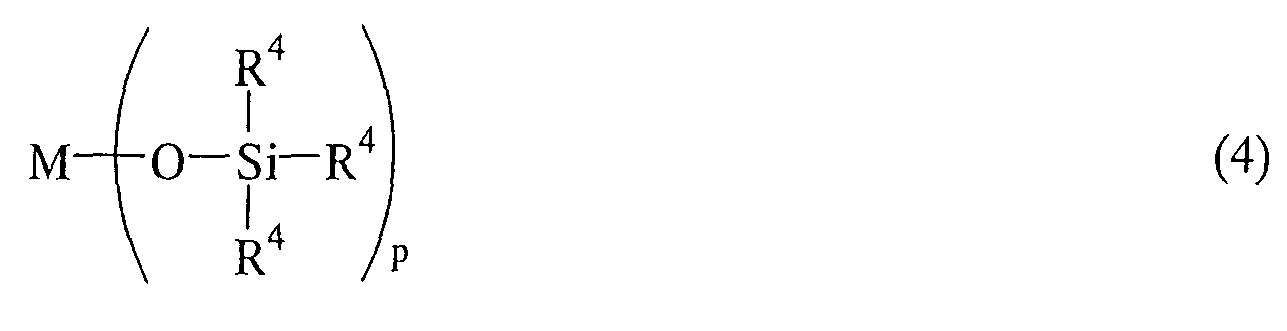
aluminum, titanium, zirconium, tin and zinc, p is the valence of M, and groups R4 are each, independently, substituted or unsubstituted monovalent hydrocarbon group or a group of the formula (5):
- A method of claim 1, wherein said catalyst is present in an amount of 0.001 to 10 parts by weight per 100 parts by weight of the starting organopolysiloxane(s).
- A method of claim 1 or 2, wherein said catalyst has the general formula (4a):

- The method of any one of claims 1 to 3, wherein the cyclic oligosiloxane has the general formula (3a):

- The method of any one of claims 1 to 3, wherein the cyclic oligosiloxane has the general formula (3b):

Applications Claiming Priority (1)
| Application Number | Priority Date | Filing Date | Title |
|---|---|---|---|
| JP2005097780A JP4488219B2 (en) | 2005-03-30 | 2005-03-30 | Method for producing cyclic oligosiloxane |
Publications (2)
| Publication Number | Publication Date |
|---|---|
| EP1707570A1 true EP1707570A1 (en) | 2006-10-04 |
| EP1707570B1 EP1707570B1 (en) | 2008-05-28 |
Family
ID=36636930
Family Applications (1)
| Application Number | Title | Priority Date | Filing Date |
|---|---|---|---|
| EP06251752A Ceased EP1707570B1 (en) | 2005-03-30 | 2006-03-30 | Preparation of cyclic oligosiloxane |
Country Status (4)
| Country | Link |
|---|---|
| US (1) | US7678871B2 (en) |
| EP (1) | EP1707570B1 (en) |
| JP (1) | JP4488219B2 (en) |
| DE (1) | DE602006001313D1 (en) |
Cited By (2)
| Publication number | Priority date | Publication date | Assignee | Title |
|---|---|---|---|---|
| WO2007039366A1 (en) * | 2005-09-26 | 2007-04-12 | Symrise Gmbh & Co. Kg | Intramolecular prins reaction and catalysts suitable therefor (citronellal to isopulegol) |
| EP4549504A1 (en) | 2023-11-05 | 2025-05-07 | Universität Hamburg | Method for the depolymerization of silicone |
Families Citing this family (2)
| Publication number | Priority date | Publication date | Assignee | Title |
|---|---|---|---|---|
| CN103145751B (en) | 2007-11-09 | 2016-06-08 | 株式会社钟化 | The preparation method of cyclic polyorganosiloxane, solidifying agent, solidification compound and cured article thereof |
| CN112552334A (en) * | 2020-12-08 | 2021-03-26 | 江西贝特利新材料有限公司 | Preparation method of hexamethylcyclotrisilazane |
Citations (3)
| Publication number | Priority date | Publication date | Assignee | Title |
|---|---|---|---|---|
| EP0361274A2 (en) * | 1988-09-26 | 1990-04-04 | General Electric Company | Method for making cyclic poly(siloxane)s |
| US5491249A (en) * | 1995-04-20 | 1996-02-13 | Hercules Incorporated | Process for preparing cyclic polysiloxanes from linear polysiloxanes |
| EP0990660A1 (en) * | 1997-06-11 | 2000-04-05 | Kaneka Corporation | Process for preparing cyclic oligosiloxanes |
Family Cites Families (11)
| Publication number | Priority date | Publication date | Assignee | Title |
|---|---|---|---|---|
| US4078104A (en) * | 1975-02-28 | 1978-03-07 | Sws Silicones Corporation | Release composition for bituminous materials |
| JPS5474900A (en) | 1977-11-28 | 1979-06-15 | Shin Etsu Chem Co Ltd | Preparation of vinyl-containing cyclic polysiloxane |
| US4447630A (en) * | 1983-08-29 | 1984-05-08 | General Electric Company | Method for making cyclopolydimethylsiloxanes |
| US5663269A (en) * | 1992-03-31 | 1997-09-02 | Loctite Corporation | Organosiloxane fluids prepared using organo-lithium reagents |
| JP3616660B2 (en) | 1994-05-25 | 2005-02-02 | 東レ・ダウコーニング・シリコーン株式会社 | Method for producing cyclic tetramer siloxane |
| US5698653A (en) * | 1996-05-10 | 1997-12-16 | General Electric Company | Non-corrosive translucent RTV compositions |
| US5861472A (en) * | 1996-07-05 | 1999-01-19 | Dow Corning Corporation | Method of making silicone pressure sensitive adhesives |
| JP2000159784A (en) | 1998-11-26 | 2000-06-13 | Kanegafuchi Chem Ind Co Ltd | Method for producing cyclic oligosiloxane |
| JP2000159783A (en) | 1998-11-26 | 2000-06-13 | Kanegafuchi Chem Ind Co Ltd | Method for producing cyclic oligosiloxane |
| JP3816683B2 (en) | 1998-12-04 | 2006-08-30 | 株式会社カネカ | Method for producing cyclic oligosiloxane |
| US6265514B1 (en) * | 2000-02-17 | 2001-07-24 | Dow Corning Corporation | Poly(siloxane-acrylate) elastomers with oxycarbonylethyleneimino-containing organic group and method of making the same |
-
2005
- 2005-03-30 JP JP2005097780A patent/JP4488219B2/en not_active Expired - Fee Related
-
2006
- 2006-03-29 US US11/277,855 patent/US7678871B2/en active Active
- 2006-03-30 EP EP06251752A patent/EP1707570B1/en not_active Ceased
- 2006-03-30 DE DE602006001313T patent/DE602006001313D1/en not_active Expired - Lifetime
Patent Citations (3)
| Publication number | Priority date | Publication date | Assignee | Title |
|---|---|---|---|---|
| EP0361274A2 (en) * | 1988-09-26 | 1990-04-04 | General Electric Company | Method for making cyclic poly(siloxane)s |
| US5491249A (en) * | 1995-04-20 | 1996-02-13 | Hercules Incorporated | Process for preparing cyclic polysiloxanes from linear polysiloxanes |
| EP0990660A1 (en) * | 1997-06-11 | 2000-04-05 | Kaneka Corporation | Process for preparing cyclic oligosiloxanes |
Non-Patent Citations (3)
| Title |
|---|
| CRIVELLO, J. V. ET AL: "Synthesis of cyclic siloxanes by the thermal depolymerization of linear poly(siloxanes)", CHEMISTRY OF MATERIALS , 1(4), 445-51 CODEN: CMATEX; ISSN: 0897-4756, 1989, XP002390282 * |
| LAMBERT, JOSEPH B. ET AL: "Redistribution of cyclosiloxanes to favor formation of decamethylcyclopentasiloxane", JOURNAL OF POLYMER SCIENCE, PART A: POLYMER CHEMISTRY , 31(7), 1697-1700 CODEN: JPACEC; ISSN: 0887-624X, 1993, XP009069406 * |
| XIN, SHIXUAN ET AL: "Redistribution reactions of alkoxy- and siloxysilanes, catalyzed by dimethyltitanocene", CANADIAN JOURNAL OF CHEMISTRY , 68(3), 471-6 CODEN: CJCHAG; ISSN: 0008-4042, 1990, XP009069429 * |
Cited By (2)
| Publication number | Priority date | Publication date | Assignee | Title |
|---|---|---|---|---|
| WO2007039366A1 (en) * | 2005-09-26 | 2007-04-12 | Symrise Gmbh & Co. Kg | Intramolecular prins reaction and catalysts suitable therefor (citronellal to isopulegol) |
| EP4549504A1 (en) | 2023-11-05 | 2025-05-07 | Universität Hamburg | Method for the depolymerization of silicone |
Also Published As
| Publication number | Publication date |
|---|---|
| DE602006001313D1 (en) | 2008-07-10 |
| US7678871B2 (en) | 2010-03-16 |
| JP2006273784A (en) | 2006-10-12 |
| US20060223963A1 (en) | 2006-10-05 |
| EP1707570B1 (en) | 2008-05-28 |
| JP4488219B2 (en) | 2010-06-23 |
Similar Documents
| Publication | Publication Date | Title |
|---|---|---|
| US6008396A (en) | Hot oil process for producing isocyanato organosilanes | |
| CN103958534A (en) | Process for the production of cyclosiloxanes | |
| JPH0739495B2 (en) | Method for producing organo (poly) siloxane | |
| US5068383A (en) | Catalyzed redistribution of polyorganosiloxanes | |
| EP1707570B1 (en) | Preparation of cyclic oligosiloxane | |
| JP5429745B2 (en) | Catalyst for dehydrogenation silylation reaction, and method for producing organosilicon compound | |
| JPH05310753A (en) | Organopolysiloxane and method for producing the same | |
| US6998437B2 (en) | Preparation of polydiorganosiloxanes | |
| JP4886772B2 (en) | Method for producing diorganopolysiloxane | |
| US7459514B2 (en) | Process for the preparation of organopolysiloxanes having silanol groups | |
| CA1273351A (en) | Method for making silylaroylhalides and reaction products | |
| US20180201633A1 (en) | Organosilicon compounds having (meth)acrylate groups and a process for preparation thereof | |
| US20100029972A1 (en) | Method for the production of polymerizable silicones | |
| EP1149837B1 (en) | Organosilicon compounds | |
| US20150183808A1 (en) | Oxasilacycles and method for the production thereof | |
| JP3529858B2 (en) | Method for producing alkoxysilane | |
| JP3616660B2 (en) | Method for producing cyclic tetramer siloxane | |
| Sprung et al. | The partial hydrolysis of methyltriethoxysilane | |
| US6262289B1 (en) | Process for preparing cyclic oligosiloxanes | |
| JPH06192275A (en) | Azasilacycloalkyl-functional alkoxysilane and azasilacycloalkyl-functional tetramethyldisiloxane | |
| EP0990660B1 (en) | Process for preparing cyclic oligosiloxanes | |
| JP3580403B2 (en) | Method for producing cyclic oligosiloxane | |
| RU2687736C1 (en) | Method of producing symmetric methylphenyl disiloxanes and hexaphenyl disiloxane by dehydro-condensation of triorganosilanes | |
| JP3341923B2 (en) | Method for producing alkoxysilane | |
| JP3125655B2 (en) | Organosilicon compound having cyclic ether group and method for producing the same |
Legal Events
| Date | Code | Title | Description |
|---|---|---|---|
| PUAI | Public reference made under article 153(3) epc to a published international application that has entered the european phase |
Free format text: ORIGINAL CODE: 0009012 |
|
| AK | Designated contracting states |
Kind code of ref document: A1 Designated state(s): AT BE BG CH CY CZ DE DK EE ES FI FR GB GR HU IE IS IT LI LT LU LV MC NL PL PT RO SE SI SK TR |
|
| AX | Request for extension of the european patent |
Extension state: AL BA HR MK YU |
|
| 17P | Request for examination filed |
Effective date: 20070129 |
|
| 17Q | First examination report despatched |
Effective date: 20070301 |
|
| AKX | Designation fees paid |
Designated state(s): DE FR GB |
|
| GRAP | Despatch of communication of intention to grant a patent |
Free format text: ORIGINAL CODE: EPIDOSNIGR1 |
|
| GRAS | Grant fee paid |
Free format text: ORIGINAL CODE: EPIDOSNIGR3 |
|
| GRAA | (expected) grant |
Free format text: ORIGINAL CODE: 0009210 |
|
| AK | Designated contracting states |
Kind code of ref document: B1 Designated state(s): DE FR GB |
|
| REG | Reference to a national code |
Ref country code: GB Ref legal event code: FG4D |
|
| REF | Corresponds to: |
Ref document number: 602006001313 Country of ref document: DE Date of ref document: 20080710 Kind code of ref document: P |
|
| PLBE | No opposition filed within time limit |
Free format text: ORIGINAL CODE: 0009261 |
|
| STAA | Information on the status of an ep patent application or granted ep patent |
Free format text: STATUS: NO OPPOSITION FILED WITHIN TIME LIMIT |
|
| 26N | No opposition filed |
Effective date: 20090303 |
|
| REG | Reference to a national code |
Ref country code: FR Ref legal event code: PLFP Year of fee payment: 11 |
|
| REG | Reference to a national code |
Ref country code: FR Ref legal event code: PLFP Year of fee payment: 12 |
|
| REG | Reference to a national code |
Ref country code: FR Ref legal event code: PLFP Year of fee payment: 13 |
|
| PGFP | Annual fee paid to national office [announced via postgrant information from national office to epo] |
Ref country code: DE Payment date: 20240206 Year of fee payment: 19 Ref country code: GB Payment date: 20240208 Year of fee payment: 19 |
|
| PGFP | Annual fee paid to national office [announced via postgrant information from national office to epo] |
Ref country code: FR Payment date: 20240213 Year of fee payment: 19 |
|
| REG | Reference to a national code |
Ref country code: DE Ref legal event code: R119 Ref document number: 602006001313 Country of ref document: DE |
|
| GBPC | Gb: european patent ceased through non-payment of renewal fee |
Effective date: 20250330 |
|
| PG25 | Lapsed in a contracting state [announced via postgrant information from national office to epo] |
Ref country code: DE Free format text: LAPSE BECAUSE OF NON-PAYMENT OF DUE FEES Effective date: 20251001 |
|
| PG25 | Lapsed in a contracting state [announced via postgrant information from national office to epo] |
Ref country code: GB Free format text: LAPSE BECAUSE OF NON-PAYMENT OF DUE FEES Effective date: 20250330 |
|
| PG25 | Lapsed in a contracting state [announced via postgrant information from national office to epo] |
Ref country code: FR Free format text: LAPSE BECAUSE OF NON-PAYMENT OF DUE FEES Effective date: 20250331 |