EP1703263A2 - Heating resistor flow sensor or acceleration sensor - Google Patents
Heating resistor flow sensor or acceleration sensor Download PDFInfo
- Publication number
- EP1703263A2 EP1703263A2 EP06003148A EP06003148A EP1703263A2 EP 1703263 A2 EP1703263 A2 EP 1703263A2 EP 06003148 A EP06003148 A EP 06003148A EP 06003148 A EP06003148 A EP 06003148A EP 1703263 A2 EP1703263 A2 EP 1703263A2
- Authority
- EP
- European Patent Office
- Prior art keywords
- resistor
- resistance component
- vertical
- horizontal
- physical quantity
- Prior art date
- Legal status (The legal status is an assumption and is not a legal conclusion. Google has not performed a legal analysis and makes no representation as to the accuracy of the status listed.)
- Granted
Links
- 230000001133 acceleration Effects 0.000 title claims description 14
- 238000010438 heat treatment Methods 0.000 title description 47
- 239000000758 substrate Substances 0.000 claims abstract description 30
- 229910021420 polycrystalline silicon Inorganic materials 0.000 claims description 18
- 239000012535 impurity Substances 0.000 claims description 2
- 239000004065 semiconductor Substances 0.000 description 13
- VYPSYNLAJGMNEJ-UHFFFAOYSA-N Silicium dioxide Chemical compound O=[Si]=O VYPSYNLAJGMNEJ-UHFFFAOYSA-N 0.000 description 12
- 238000005259 measurement Methods 0.000 description 10
- 229910021419 crystalline silicon Inorganic materials 0.000 description 9
- 238000009826 distribution Methods 0.000 description 9
- 230000000694 effects Effects 0.000 description 9
- 238000005530 etching Methods 0.000 description 9
- 238000000034 method Methods 0.000 description 8
- 238000005229 chemical vapour deposition Methods 0.000 description 7
- 238000010586 diagram Methods 0.000 description 7
- BASFCYQUMIYNBI-UHFFFAOYSA-N platinum Chemical compound [Pt] BASFCYQUMIYNBI-UHFFFAOYSA-N 0.000 description 6
- 239000000377 silicon dioxide Substances 0.000 description 6
- 238000011144 upstream manufacturing Methods 0.000 description 6
- 239000012530 fluid Substances 0.000 description 5
- -1 e.g. Substances 0.000 description 4
- 239000011347 resin Substances 0.000 description 4
- 229920005989 resin Polymers 0.000 description 4
- XUIMIQQOPSSXEZ-UHFFFAOYSA-N Silicon Chemical compound [Si] XUIMIQQOPSSXEZ-UHFFFAOYSA-N 0.000 description 3
- 239000000853 adhesive Substances 0.000 description 3
- 230000001070 adhesive effect Effects 0.000 description 3
- 238000004519 manufacturing process Methods 0.000 description 3
- 229910052751 metal Inorganic materials 0.000 description 3
- 239000002184 metal Substances 0.000 description 3
- 229910052697 platinum Inorganic materials 0.000 description 3
- 239000000565 sealant Substances 0.000 description 3
- 229910052710 silicon Inorganic materials 0.000 description 3
- 239000010703 silicon Substances 0.000 description 3
- 235000012239 silicon dioxide Nutrition 0.000 description 3
- 239000004593 Epoxy Substances 0.000 description 2
- 238000002485 combustion reaction Methods 0.000 description 2
- 238000001514 detection method Methods 0.000 description 2
- 238000009792 diffusion process Methods 0.000 description 2
- BHEPBYXIRTUNPN-UHFFFAOYSA-N hydridophosphorus(.) (triplet) Chemical compound [PH] BHEPBYXIRTUNPN-UHFFFAOYSA-N 0.000 description 2
- 238000005468 ion implantation Methods 0.000 description 2
- 230000003647 oxidation Effects 0.000 description 2
- 238000007254 oxidation reaction Methods 0.000 description 2
- 239000013466 adhesive and sealant Substances 0.000 description 1
- 229910052782 aluminium Inorganic materials 0.000 description 1
- XAGFODPZIPBFFR-UHFFFAOYSA-N aluminium Chemical compound [Al] XAGFODPZIPBFFR-UHFFFAOYSA-N 0.000 description 1
- 230000001419 dependent effect Effects 0.000 description 1
- 230000006866 deterioration Effects 0.000 description 1
- 230000002542 deteriorative effect Effects 0.000 description 1
- 238000005516 engineering process Methods 0.000 description 1
- 239000000446 fuel Substances 0.000 description 1
- 238000009413 insulation Methods 0.000 description 1
- 238000005459 micromachining Methods 0.000 description 1
- 238000000059 patterning Methods 0.000 description 1
- 230000035945 sensitivity Effects 0.000 description 1
- 229910052724 xenon Inorganic materials 0.000 description 1
- FHNFHKCVQCLJFQ-UHFFFAOYSA-N xenon atom Chemical compound [Xe] FHNFHKCVQCLJFQ-UHFFFAOYSA-N 0.000 description 1
Images






Classifications
-
- G—PHYSICS
- G01—MEASURING; TESTING
- G01C—MEASURING DISTANCES, LEVELS OR BEARINGS; SURVEYING; NAVIGATION; GYROSCOPIC INSTRUMENTS; PHOTOGRAMMETRY OR VIDEOGRAMMETRY
- G01C9/00—Measuring inclination, e.g. by clinometers, by levels
-
- G—PHYSICS
- G01—MEASURING; TESTING
- G01F—MEASURING VOLUME, VOLUME FLOW, MASS FLOW OR LIQUID LEVEL; METERING BY VOLUME
- G01F1/00—Measuring the volume flow or mass flow of fluid or fluent solid material wherein the fluid passes through a meter in a continuous flow
- G01F1/68—Measuring the volume flow or mass flow of fluid or fluent solid material wherein the fluid passes through a meter in a continuous flow by using thermal effects
- G01F1/684—Structural arrangements; Mounting of elements, e.g. in relation to fluid flow
- G01F1/6845—Micromachined devices
-
- G—PHYSICS
- G01—MEASURING; TESTING
- G01F—MEASURING VOLUME, VOLUME FLOW, MASS FLOW OR LIQUID LEVEL; METERING BY VOLUME
- G01F1/00—Measuring the volume flow or mass flow of fluid or fluent solid material wherein the fluid passes through a meter in a continuous flow
- G01F1/68—Measuring the volume flow or mass flow of fluid or fluent solid material wherein the fluid passes through a meter in a continuous flow by using thermal effects
- G01F1/684—Structural arrangements; Mounting of elements, e.g. in relation to fluid flow
- G01F1/688—Structural arrangements; Mounting of elements, e.g. in relation to fluid flow using a particular type of heating, cooling or sensing element
- G01F1/69—Structural arrangements; Mounting of elements, e.g. in relation to fluid flow using a particular type of heating, cooling or sensing element of resistive type
-
- G—PHYSICS
- G01—MEASURING; TESTING
- G01P—MEASURING LINEAR OR ANGULAR SPEED, ACCELERATION, DECELERATION, OR SHOCK; INDICATING PRESENCE, ABSENCE, OR DIRECTION, OF MOVEMENT
- G01P15/00—Measuring acceleration; Measuring deceleration; Measuring shock, i.e. sudden change of acceleration
- G01P15/006—Measuring acceleration; Measuring deceleration; Measuring shock, i.e. sudden change of acceleration by making use of fluid seismic masses
- G01P15/008—Measuring acceleration; Measuring deceleration; Measuring shock, i.e. sudden change of acceleration by making use of fluid seismic masses by using thermal pick-up
Definitions
- the present invention relates to a sensor including a resistor formed on a substrate and detecting a predetermined physical quantity. More particularly, the present invention relates to a physical quantity sensor which is applied to, for example, a flow sensor for detecting the flow rate of a fluid, an acceleration sensor, and an inclination sensor.
- a flow sensor for detecting an intake air amount in an internal combustion engine such as an automobile it is proposed to manufacture a sensor device on a semiconductor substrate made of, e.g., silicon (Si) by using the micromachining technology.
- That type of flow sensor is advantageous in that it can be mass-produced at a low cost, has a small size, and can be driven with low electric power.
- That type of flow sensor is mainly practiced as an air flow sensor employing a heating resistor, which can directly measure a mass flow rate.
- Patent Document 1 JP,A 2001-021401
- a silicon substrate is partly removed to form a diaphragm structure having a cavity, and a heating resistor and a temperature compensation resistor are formed on the diaphragm.
- the sensor of such a structure has the problem that the mechanical strength is low and flexion may occur due to unbalance among internal stresses in a diaphragm section.
- a rigid member is disposed in the diaphragm section to suppress flexion of the diaphragm, thereby improving reliability of a sensor device and increasing accuracy in measurement of the air flow rate.
- a sensor device In many physical quantity sensors, a sensor device is fixed using an adhesive. Also, a sealant made of, e.g., epoxy is used to protect wire bonding through which an electric signal is taken out from the sensor device. Those adhesive and sealant are expanded and contracted depending on changes of the ambient temperature, thus generating stresses. Further, stresses imposed from a mount member containing a drive circuit, etc. of the sensor device are also transmitted to the sensor device. If stresses are caused in the sensor device, the stresses are applied to a resistor formed on the sensor device, and a resistance value of the resistor is changed. Particularly, when the resistor is made of a semiconductor such as silicon, it has a larger piezoresistance coefficient and causes a larger resistance change. The larger resistance change becomes a factor deterioraing the measurement accuracy.
- a sealant made of, e.g., epoxy is used to protect wire bonding through which an electric signal is taken out from the sensor device.
- Those adhesive and sealant are expanded and contracted depending on changes of the ambient temperature
- the thermal air flow sensor disclosed in JP,A 2001-021401 is intended to suppress flexion caused by unbalance among internal stresses generated in the diaphragm.
- the flexion caused by the internal stresses is therefore reduced, but stresses imposed from the exterior are not taken into consideration.
- the stresses applied from the mount member to the sensor device affect the whole of the sensor device in addition to the diaphragm section. Accordingly, those stresses affect not only the resistor used for detecting the physical quantity, but also a wiring section for taking out the electric signal. In other words, the influence of stresses generated from the member for mounting the sensor device is not yet overcome.
- An object of the present invention is to provide a physical quantity sensor which can reduce resistance changes due to stresses imposed on a sensor device and can ensure highly accurate measurement.
- the physical quantity sensor of the present invention is basically intended to achieve the above object with the following features.
- the resistor has a horizontal resistance component Rl and a vertical resistance component Rt.
- a resistance value ratio of the horizontal resistance component Rl to the vertical resistance component Rt may be set substantially equal to an absolute value of the ratio of the piezoresistance coefficient ⁇ t to nl (R1/Rt ⁇
- Rt : Rl may be set within the range of from n : 1 to n : 1 ⁇ 0.5.
- variations of resistance values can be reduced by forming the resistor including Rl and Rt so as to have a substantially constant line width.
- the resistance value ratio of Rl to Rt can be simply adjusted by a method of changing respective lengths or widths of the resistance components Rt and Rl.
- the resistance value ratio of Rl to Rt is preferably adjusted by changing the resistance lengths while the resistance widths may be kept the same. The reason is as follows. To suppress a reduction in sensitivity of the wiring resistance, the resistance value of a detection section of the sensor is required to be increased and the line width of the resistor is narrowed correspondingly.
- a physical quantity sensor which may include a resistor formed on a substrate (the resistor being formed of one resistor or two or more serial resistors), a power-supply side terminal and/or a ground side terminal of the resistor may be branched to at least four terminals in total.
- a feedback device for maintaining a power supply voltage and/or a ground voltage can be connected to the power-supply side terminal and/or the ground side terminal of each of the resistors, which may be connected in series, through the branched terminals.
- a drive circuit can be constituted such that even when the wiring resistance on the power supply side and the wiring resistance on the ground side of the resistor are changed due to stress distortions, etc., the changes caused by distortions of the wiring resistances of the resistor can be ignored. As a result, the influence generated by stresses imposed on a wiring section of the sensor can be reduced.
- the physical quantity sensor is provided which can reduce effects of stresses imposed on the sensor device and ensure highly accurate measurement.
- the above features can be combined partly or as a whole in any way.
- the first embodiment represents, as one example of the physical quantity sensor, a thermal air flow sensor for measuring the flow rate of intake air in an internal combustion engine of an automobile, etc.
- Fig. 1 is a schematic plan view of a sensor device of the thermal air flow sensor according to the first embodiment
- Fig. 2 is a sectional view taken along the line A-A in Fig. 1.
- a sensor device 1 is formed on a semiconductor substrate (base) 2 made of a single-crystalline silicon (Si) wafer as follows.
- a cavity 3 is formed in a part of the semiconductor substrate 2 by anisotropic etching.
- the cavity 3 is in the form of a rectangular hole as viewed in a plan.
- a diaphragm 4 is formed at one side of the cavity 3.
- the diaphragm 4 is made of an electric insulating film 5 of silicon dioxide (SiO 2 ) that is formed on one surface of the semiconductor substrate 2 by thermal oxidation or CVD (Chemical Vapor Deposition).
- a heating resistor 6 and temperature sensitive resistors 7a, 7b, 8a and 8b, each having temperature dependent characteristics, are formed on the diaphragm 4. Further, another temperature sensitive resistor 9 for compensating air temperature is formed in a position away from the diaphragm 4. Wiring 10 for those resistors is also formed on the substrate 2. Those resistors and wiring are made of polycrystalline silicon and are each formed through steps of forming a polycrystalline silicon layer on the electric insulating film 5 by CVD, for example, and etching it into the desired shape.
- those resistors are formed by doping phosphorous (P) in n-type polycrystalline silicon by thermal diffusion or ion implantation, for example, so that the desired resistance values and resistance-temperature coefficients are obtained.
- P phosphorous
- the temperature sensitive resistors 7a and 7b are arranged upstream of the heating resistor 6, and the temperature sensitive resistors 8a and 8b are arranged downstream of the heating resistor 6.
- Each of the temperature sensitive resistors 7a, 7b, 8a and 8b is formed in combination of a vertical resistance component 29 and a horizontal resistance component 28 which are orthogonal to each other.
- One example of the combination is shown in Fig. 5.
- a parallel direction is defined to be a horizontal direction (X-direction) and a perpendicular direction is defined to be a vertical direction (Y-direction).
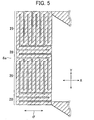
- Fig. 5 shows the shape of one (8a) of the temperature sensitive resistors 7a, 7b, 8a and 8b.
- the temperature sensitive resistor 8a is formed to have such a shape (or length) that a ratio of a resistance value of the vertical resistance component 29 extended in a vertical direction (Y-direction) while being folded repeatedly (i.e., a vertical resistance component Rt) to a resistance value of the horizontal resistance component 28 extended in a horizontal direction (X-direction) while being folded repeatedly (i.e., a horizontal resistance component Rl) is substantially equal to a ratio (n : 1) of a piezoresistance coefficient nl of the horizontal resistance component R1 to a piezoresistance coefficient ⁇ t of the vertical resistance component Rt.
- the other temperature sensitive resistors 7a, 7b and 8b are also formed in the same manner. The concrete shape of each temperature sensitive resistor will be described in detail later.
- An electric insulating film 11 is formed to protect those resistors.
- the electric insulating film 11 is obtained by a method of forming silicon dioxide (SiO 2 ) by CVD, for example. Further, aluminum electrodes 12 are formed for connection to respective electrodes of the resistors.
- the heating resistor 6 is electrically heated and controlled by a bridge circuit, an operational amplifier 15, and a transistor 16 for controlling a heating current, shown in Fig. 3, so that the temperature of the heating resistor 6 is always held higher than the temperature of the temperature compensation resistor 9 for sensing the air temperature by a constant value (details of the circuits will be described later).
- a constant value the temperature difference between the temperature sensitive resistors 7 (7a and 7b) and the temperature sensitive resistors 8 (8a and 8b) disposed upstream and downstream of the heating resistor 6, respectively, is measured.
- a drive circuit for driving the sensor device 1 and measuring the air flow rate will be described below.
- Fig. 3A shows a feedback circuit for controlling the temperature of the heating resistor 6.
- the feedback circuit has a bridge circuit made up of the heating resistor 6, the temperature compensation resistor 9, and fixed resistors 13 and 14.
- a differential voltage of the bridge circuit is detected by the operational amplifier 15, and the heating current is controlled through the transistor 16.
- the temperature of the heating resistor 6 rises with the heating current, and the resistance value of the heating resistor 6 is changed correspondingly.
- a resistance value ratio of the heating resistor 6 to the temperature compensation resistor 9 can be adjusted by adjusting respective resistance values of the fixed resistors 13 and 14.
- the temperature of the temperature compensation resistor 9 is substantially equal to the air temperature.
- the resistance value ratio of the heating resistor 6 to the temperature compensation resistor 9 corresponds to the relationship between the temperature of the heating resistor 6 and the air temperature. Accordingly, the temperature of the heating resistor 6 can be always held higher than the air temperature by a constant value.
- Fig. 3B shows a circuit for detecting a temperature difference between the upstream and downstream sides of the heating resistor 6, and outputting an electric signal representing the air flow rate.
- This circuit is in the form of a bridge circuit made up of the temperature sensitive resistors 7a, 7b, 8a and 8b, and the detected signal is outputted through a computing unit 17.
- the resistance values of the temperature sensitive resistors 7a and 7b are reduced with a lowering of the temperature, and the resistance values of the temperature sensitive resistors 8a and 8b are increased with a rise of the temperature. Therefore, a differential voltage corresponding to the air flow rate is generated in the bridge circuit.
- the computing unit 17 can be given with the function of outputting the output of the bridge circuit after modifying it.
- the casing 21 is mounted to a wall surface 23 of the intake pipe by using a support 22.
- a circuit board 24 is disposed in the casing 21.
- the drive circuit for driving the sensor device 1 and taking out an air flow signal is mounted on the circuit board 24.
- the sensor device 1 is mechanically supported by the casing 21 and is electrically connected to the drive circuit on the circuit board 24 by bonding wires 26.
- electrodes of the sensor device 1 and the circuit board 24 are covered with a resin, e.g., epoxy.
- the air flow signal detected by the thermal air flow sensor including the sensor device 1 is taken out through a connector 25 and is supplied to an engine control computer, though not shown, for use in control of a fuel supply amount.
- an adhesive is coated on the rear side of the sensor device 1 for mounting of the sensor device 1, and a sealant 27 is applied for protection of the bonding wires 26.
- the resin has to be hardened in a high-temperature furnace after being applied.
- the hardening step the resin is expanded and contracted, thus generating stresses.
- the generated stresses are imposed on the sensor device 1.
- the plurality of resistors 7a, 7b, 8a and 8b are formed on the sensor device 1, and the stresses are applied to those resistors.
- ⁇ R/R represents a resistance change rate
- ⁇ l represents a piezoresistance coefficient when stress ⁇ is applied to the horizontal resistance component 28
- nt represents a piezoresistance coefficient when the stress ⁇ is applied to the vertical resistance component 29.
- Fig. 5 is a plan view showing the shape of the temperature sensitive resistor 8a.
- the other temperature sensitive resistors 7a, 7b and 8b also have the same shape.
- the resistor is formed such that it has a strip-like shape with a constant width and the vertical resistance component 29 (perpendicular to the stress ⁇ ) as viewed on the drawing has a length about triple that of the horizontal resistance component 28 (parallel to the stress ⁇ ).
- ⁇ shown in Fig. 5 represents the stress applied to the temperature sensitive resistor 8a.
- the resistance change caused by the stress can be reduced by setting the ratio of the resistance value of the vertical resistance component R29 to the resistance value of the horizontal resistance component R28 to be substantially equal to the ratio of the piezoresistance coefficient ⁇ l to ⁇ t.
- the forming process includes patterning by etching.
- the etching amount varies and so does the resistance value because of, for example, narrowing of the resistor width (i.e., overetching).
- the resistance value ratio of the vertical resistance component R29 to the horizontal resistance component R28 is kept constant even with variations of the etching amount, whereby high accuracy can be ensured.
- n-type polycrystalline silicon as the resistors formed on the sensor device 1
- the same effect as that described above can also be obtained with the use of p-type polycrystalline silicon, n-type single-crystalline silicon, or p-type single-crystalline silicon by adjusting the resistance value ratio of the vertical resistance component to the horizontal resistance component to be substantially equal to the ratio of the piezoresistance coefficient ⁇ l to ⁇ t.
- the same effect can be obtained in the case of using the resistors made of a metal, e.g., platinum.
- the temperature sensitive resistor 8a in a pattern extending oblique to the direction of the stress ⁇ which is maximum in the stress distribution, it is also possible to make the resistance value ratio of the vertical resistance component to the horizontal resistance component of each resistor substantially equal to the ratio of the piezoresistance coefficient nl to ⁇ t, and hence to obtain the same effect as that described above with reference to Fig. 5.
- FIG. 7 A second embodiment will be described below with reference to Fig. 7. This embodiment also represents the case where the present invention is applied to the thermal air flow meter. Since the basic principle and structure are the same as those in the first embodiment, only different points are described here and a description of common points is omitted.
- Fig. 7 is a plan view showing shapes of the temperature sensitive resistors 8a and 8b in this second embodiment. While in the first embodiment the temperature sensitive resistors 8a and 8b are arranged in separate areas divided in the vertical direction along the length of the heating resistor 6, the temperature sensitive resistors 8a and 8b in the second embodiment are arranged in such a way that the respective vertical resistance components and the respective horizontal resistance components of the temperature sensitive resistors 8a and 8b are extended in interdigitated (or interlaced) relation in parallel as shown.
- each of the temperature sensitive resistors 8a and 8b the vertical resistance component (perpendicular to ⁇ ) and the horizontal resistance component (parallel to ⁇ ), as viewed in the drawing, are formed to have a resistance value ratio between them which is substantially equal to the ratio of the piezoresistance coefficient ⁇ l to ⁇ t as in the first embodiment.
- each resistor is in the form of a strip having a constant width.
- resistivity of a polycrystalline silicon film forming each resistor varies within a wafer due to variations in the manufacturing steps, thus generating a distribution of resistivity in some cases.
- the temperature sensitive resistors 8a and 8b are formed in the separated areas in a divided way as in the first embodiment, the resistance value ratios of the temperature sensitive resistors 8a and 8b may vary to some extent due to the influence of such a resistivity distribution.
- the thermal air flow sensor of this embodiment has the bridge circuit made up of four temperature sensitive resistors and obtains an electric output depending on the air flow rate. Accordingly, if the resistance values of the temperature sensitive resistors 8a and 8b vary, the symmetry of the bridge circuit is changed, thus resulting in deterioration of the measurement accuracy.
- the temperature sensitive resistors 8a and 8b can be formed substantially in the same area. Accordingly, even if the resistivity distribution is generated within the wafer, the resistance value ratios between the temperature sensitive resistors 8a and 8b can be held substantially constant and the symmetry of the bridge circuit can be maintained.
- the temperature sensitive resistors 8a and 8b are exposed to substantially the same temperature, and therefore the balance of the bridge circuit can be kept in a symmetrical state.
- this second embodiment uses n-type polycrystalline silicon as the resistors formed on the sensor device 1
- the same effect as that described above can also be obtained with the use of p-type polycrystalline silicon, n-type single-crystalline silicon, or p-type single-crystalline silicon by adjusting the resistance value ratio of the vertical resistance component to the horizontal resistance component of each resistor to be substantially equal to the ratio of the piezoresistance coefficient ⁇ l to ⁇ t.
- the same effect can be obtained in the case of using the resistors made of a metal, e.g., platinum.
- a third embodiment will be described below. This embodiment represents the case where the present invention is applied to an acceleration sensor of the type employing a heating resistor, which can be used as an acceleration sensor and an inclination sensor in an automobile, etc.
- Fig. 8 is a schematic plan view of a sensor device of a thermal acceleration sensor according to the second embodiment
- Fig. 9 is a sectional view taken along the line B-B in Fig. 8.
- a sensor device 30 is mounted in an enclosed container which is filled with a fluid having a small thermal conductivity, such as air or xenon (Xe).
- a fluid having a small thermal conductivity such as air or xenon (Xe).
- the sensor device 30 is entirely formed by using, as a base, a semiconductor substrate 31 made of a single-crystalline silicon (Si) wafer.
- a cavity 34 is formed in a part of the semiconductor substrate 31.
- the cavity 3 is in the form of a rectangular hole as viewed in a plan.
- Doubly supported beams 35a, 35b and 35c are formed at one side of the cavity 34.
- a heating resistor 36 and temperature sensitive resistors 37a, 37b, 38a and 38b are formed on the doubly supported beams 35a, 35b and 35c as shown.
- Those resistors are made of polycrystalline silicon and are each formed through steps of forming a polycrystalline silicon layer on an electric insulating film 32 by CVD, for example, and etching it into the desired shape. More specifically, those resistors are formed, for example, by doping phosphorous (P) in n-type polycrystalline silicon by thermal diffusion or ion implantation so that the desired resistance values and resistance-temperature coefficients are obtained.
- the temperature sensitive resistor 37a has combined resistance of resistance components in two vertical and horizontal directions orthogonal to each other, and is formed such that a ratio of a resistance value of the vertical resistance component to a resistance value of the horizontal resistance component is substantially equal to the ratio of the piezoresistance coefficient nl to ⁇ t.
- the other temperature sensitive resistors 37a, 37b and 38b are also formed in the same manner.
- the concrete shape of each temperature sensitive resistor will be described in detail later with reference to Fig. 11.
- an electric insulating film 33 is formed to protect those resistors.
- the doubly supported beams 35a, 35b and 35c and the resistors formed on them are manufactured as follows.
- One surface of the semiconductor substrate 31 is initially entirely coated with the electric insulating film 32.
- the electric insulating film 32 is silicon dioxide (SiO 2 ) formed by thermal oxidation or CVD (Chemical Vapor Deposition).
- the heating resistor 36 and the temperature sensitive resistors 37a, 37b, 38a and 38b are formed on the electric insulating film 32, and another electric insulating film 33 is formed on those resistors. Further, the electric insulating films 32 and 33 are partly removed by etching to have the desired shape. Then, the other surface of the semiconductor substrate 31 is partly removed by anisotropic etching to form the cavity 34.
- the sensor device 30 is manufactured.
- the operating principle of the sensor device 30 will be described below.
- a current is supplied to the heating resistor 36 for heating it, the temperature of an ambient fluid rises and the density of the ambient fluid reduces.
- an acceleration G is applied in that state in a direction indicated by an arrow in Fig. 9, the fluid is relatively moved in a direction opposed to the acceleration G, thus causing convection. Accordingly, the temperature distribution in the enclosed container is changed such that the temperature of the temperature sensitive resistors 37a and 37b is higher than that of the temperature sensitive resistors 38a and 38b.
- a signal corresponding to the acceleration G can be obtained by taking out, as an electric signal, changes in the resistance values of the temperature sensitive resistors 37a, 37b, 38a and 38b caused by the temperature changes thereof.
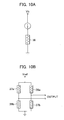
- Figs. 10A and 10B show a drive circuit for driving the sensor device 30 and obtaining a signal corresponding to the acceleration.
- Fig. 10A shows a circuit for supplying a current to the heating resistor 36 for heating it
- Fig. 10B shows a bridge circuit for detecting the temperature difference between the temperature sensitive resistors 37a, 37b and the temperature sensitive resistors 38a and 38b.
- the heating resistor 36 and the temperature sensitive resistors 37a, 37b, 38a and 38b are formed on doubly supported beams 35a, 35b and 35c to ensure satisfactory thermal insulation for those resistors.
- the doubly supported beams have low mechanical strength and are susceptible to stresses. Therefore, the resistance value of each of the resistors formed on the doubly supported beams is changed with the piezoresistance effect.
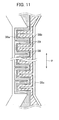
- Fig. 11 shows shapes of the temperature sensitive resistors arranged so as to reduce the influence of stress ⁇ indicated in the drawing.
- the temperature sensitive resistors 38a and 38b each having a constant width are formed such that their respective vertical resistance components 29 and respective horizontal resistance components 28 are extended in interdigitated (or interlaced) relation in parallel.
- a ratio of the resistance value of the vertical resistance component (perpendicular to ⁇ ) to the resistance value of the horizontal resistance component (parallel to ⁇ ), as viewed in the drawing, is substantially equal to the ratio of the piezoresistance coefficient nl to ⁇ t.
- the temperature sensitive resistors 38a and 38b are each formed of polycrystalline silicon and the relationship between the piezo-resistance coefficient ⁇ l and ⁇ t is expressed by the above-mentioned formula (2). Accordingly, the temperature sensitive resistors 38a and 38b in this embodiment are each formed such that the length of the vertical resistance component 29 is triple the length of the horizontal resistance component 28. With such an arrangement, the influence of the stress ⁇ is canceled and changes of the resistance values are reduced, whereby the measurement accuracy of the heating-resistor acceleration sensor is improved.
- this third embodiment uses n-type polycrystalline silicon as the resistors formed on the sensor device 30, the same effect as that described above can also be obtained with the use of p-type polycrystalline silicon, n-type single-crystalline silicon, or p-type single-crystalline silicon by adjusting the resistance value ratio of the vertical resistance component to the horizontal resistance component to be substantially equal to the ratio of the piezo-resistance coefficient ⁇ l to ⁇ t. Further, the same effect can be obtained in the case of using the resistors made of a metal, e.g., platinum.
- this third embodiment can also reduce variations of the resistance value ratio caused by overetching because the temperature sensitive resistors 38a and 38b are formed in shapes having a constant width.
- This embodiment represents the case of preventing a reduction in accuracy of the flow rate measurement, which is caused by distortion of wiring resistances of the heating-resistor flow sensor, by employing a different method from that in the above-described embodiments. More specifically, if wiring portions of the resistors formed on the sensor device are distorted by stresses and resistance values of the wiring portions are changed correspondingly, an error is caused in the detected flow rate. This embodiment is intended to reduce such an error in the detected flow rate.
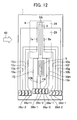
- Fig. 12 is a schematic plan view of a sensor device of a flow sensor according to this embodiment
- Fig. 13 is a diagram showing an electric circuit for controlling the heating temperature of a heating resistor 6 on the sensor device according to this embodiment
- Fig. 14 is a diagram showing an electric circuit for detecting the temperature difference between the upstream and downstream sides of the heating resistor 6 by using temperature sensitive resistors 7a and 8a, and for obtaining an electric signal corresponding to an air flow rate. Since the basic operating principle, etc. of the flow sensor are the same as those in the first embodiment, only different points are described here.
- the circuit of Fig. 13 for driving the heating resistor has a basically similar circuit configuration to that of the drive circuit shown in Fig. 3A.
- the drive circuit of Fig. 13 differs from the circuit of Fig. 3A in that one power-supply side terminal 39a of the heating resistor 6 and the temperature compensation resistor 9 connected in series is branched to two terminals 39a-1 and 39a-2 via wires 10n and 10m, and the other ground side terminal 39b is also similarly branched to two terminals 39b-1 and 39b-2 via wires 10k and 101.
- the power-supply side terminal and the ground side terminal of the resistors connected in series are branched to at least four terminals in total.
- the one wire 10n led from the one power-supply side terminal (positive side) 39a of the heating resistor 6 is connected to an inverted input terminal of a differential amplifier 40 through the terminal 39a-1, and a power supply potential 39c is connected to a non-inverted input terminal of the differential amplifier 40.
- An output terminal of the differential amplifier 40 is connected through the terminal 39a-2 to the other wire 10m led from the one power-supply side terminal 39a of the heating resistor 6.
- reference numerals 10n' and 10m' represent the wiring resistances of the wires 10n and 10m, respectively.
- the one wire 101 led from the other ground side terminal 39b of the temperature compensation resistor 9 is connected to an inverted input terminal of a differential amplifier 41 through the terminal 39b-2, and the ground potential is connected to a non-inverted input terminal of the differential amplifier 41.
- An output terminal of the differential amplifier 41 is connected to the other wire 10k led from the temperature compensation resistor 9 (i.e., to the other ground side terminal 39a) through the terminal 39b-1.
- reference numerals 101' and 10k' represent the wiring resistances of the wires 101 and 10k, respectively.
- a midpoint potential between the heating resistor 6 and the temperature compensation resistor 9 is connected to the differential amplifier 15 via a wire 10j.
- Reference numeral 10j' represents the wiring resistance of the wire 10j.
- the flow-rate measuring circuit of Fig. 14 is basically similar to the circuit of Fig. 3B except that the temperature sensitive resistor 7a and the temperature sensitive resistor 8a arranged respectively upstream and downstream of the heating resistor 6 are each constituted by one resistor.
- potentials at both terminals of the temperature sensitive resistor 7a and potentials at both terminals of the temperature sensitive resistor 8a are inputted to a differential detection circuit 42 via wires 10a and 10b and wires 10g and 10h, respectively.
- the flow rate and direction of an air flow can be detected from the potential difference between the potentials across those resistors.
- one power-supply side terminal 39c of one 7a of the two temperature sensitive resistors 7a and 8a, which are connected in series, is branched to two terminals 39c-1 and 39c-2 via wires 10c and 10d, and the other ground side terminal 39d is also similarly branched to two terminals 39d-1 and 39d-2 via wires 10f and 10e.
- the power-supply side terminal and the ground side terminal of the resistors connected in series are branched to at least four terminals in total.
- the one wire 10d led from the one terminal 39c of the temperature sensitive resistor 7a is connected to an inverted input terminal of a differential amplifier 44 through the terminal 39c-1, and a reference potential Vref of a power supply is connected to a non-inverted input terminal of the differential amplifier 44.
- An output terminal of the differential amplifier 44 is connected to the one terminal 39c of the temperature sensitive resistor 7a through the terminal 39c-2 and the other wire 10c.
- reference numerals 10c' and 10d' represent the wiring resistances of the wires 10c and 10d, respectively.
- the one wire 10e led from the other ground side terminal 39d of the temperature sensitive resistor 8a is connected to an inverted input terminal of a differential amplifier 45 through the terminal 39d-2, and the ground potential is connected to a non-inverted input terminal of the differential amplifier 45.
- An output terminal of the differential amplifier 45 is connected to the other wire 10f led from the temperature sensitive resistor 8a (i.e., to the other ground side terminal 39d) through the terminal 39d-1.
- reference numerals 10e' and 10f' represent the wiring resistances of the wires 10e and 10f, respectively.
- the heating resistor 6, the temperature compensation resistor 9, and the temperature sensitive resistors 7a and 8a are formed, and the terminals 39a-1, 39a-2, 39b-1, 39b-2, 39c-1, 39c-2, 39d-1 and 39d-2 connected to the above-mentioned feedback devices are formed.
- this fourth embodiment with any of the first to third embodiments, it is possible to reduce the influence of stresses in both the detecting section and the wiring section, and to further increase the measurement accuracy.
- the above mentioned features and embodiments may be combined partly or as a whole in any way.
Landscapes
- Physics & Mathematics (AREA)
- General Physics & Mathematics (AREA)
- Fluid Mechanics (AREA)
- Engineering & Computer Science (AREA)
- Radar, Positioning & Navigation (AREA)
- Remote Sensing (AREA)
- Measuring Volume Flow (AREA)
- Pressure Sensors (AREA)
Abstract
Description
- The present invention relates to a sensor including a resistor formed on a substrate and detecting a predetermined physical quantity. More particularly, the present invention relates to a physical quantity sensor which is applied to, for example, a flow sensor for detecting the flow rate of a fluid, an acceleration sensor, and an inclination sensor.
- As a flow sensor for detecting an intake air amount in an internal combustion engine such as an automobile, it is proposed to manufacture a sensor device on a semiconductor substrate made of, e.g., silicon (Si) by using the micromachining technology. That type of flow sensor is advantageous in that it can be mass-produced at a low cost, has a small size, and can be driven with low electric power. That type of flow sensor is mainly practiced as an air flow sensor employing a heating resistor, which can directly measure a mass flow rate.
- In known heating-resistor flow sensors of semiconductor type, as disclosed in, e.g., Patent Document 1 (
JP,A 2001-021401 Patent Document 1, a rigid member is disposed in the diaphragm section to suppress flexion of the diaphragm, thereby improving reliability of a sensor device and increasing accuracy in measurement of the air flow rate. - In many physical quantity sensors, a sensor device is fixed using an adhesive. Also, a sealant made of, e.g., epoxy is used to protect wire bonding through which an electric signal is taken out from the sensor device. Those adhesive and sealant are expanded and contracted depending on changes of the ambient temperature, thus generating stresses. Further, stresses imposed from a mount member containing a drive circuit, etc. of the sensor device are also transmitted to the sensor device. If stresses are caused in the sensor device, the stresses are applied to a resistor formed on the sensor device, and a resistance value of the resistor is changed. Particularly, when the resistor is made of a semiconductor such as silicon, it has a larger piezoresistance coefficient and causes a larger resistance change. The larger resistance change becomes a factor deterioraing the measurement accuracy.
- The thermal air flow sensor disclosed in
JP,A 2001-021401 - An object of the present invention is to provide a physical quantity sensor which can reduce resistance changes due to stresses imposed on a sensor device and can ensure highly accurate measurement.
- The physical quantity sensor of the present invention is basically intended to achieve the above object with the following features.
- (1) According to one aspect of the present invention, a physical quantity sensor in which a resistor for measuring a physical quantity may be formed on a substrate in a pattern of strips may be constituted as follows.
- Stresses are imposed on a substrate in various directions. Assuming, with respect to stress σ imposed in predetermined one of the various directions (e.g., direction in which maximum stress is imposed), a parallel direction to be a horizontal direction and a perpendicular direction to be a vertical direction, the resistor has a horizontal resistance component Rl and a vertical resistance component Rt. When a ratio of a piezoresistance coefficient πl of the horizontal resistance component Rl, which is provided when the stress imposed on the substrate is applied to the horizontal resistance component Rl, to a piezoresistance coefficient πt of the vertical resistance component Rt, which is provided when the stress imposed on the substrate is applied to the vertical resistance component Rt, is π1 : πt = - n : 1 (i.e., πt/π1 = -1/n, n: integer), a resistance value ratio of the horizontal resistance component Rl to the vertical resistance component Rt may be set substantially equal to an absolute value of the ratio of the piezoresistance coefficient πt to nl (R1/Rt ≈ |πt/π1|).
- When the resistor is made of, e.g., polycrystalline silicon doped with impurities, the relationship between πl and πt may be given by nl = - 3nt. Stated another way, with respect to the stress σ imposed on the substrate, the piezoresistance coefficient πl of the horizontal resistance component Rl may be changed in a negative direction at a rate triple that at which the piezoresistance coefficient πt of the vertical resistance component Rt is changed (i.e., π1 : πt = - 3 : 1).
- Accordingly, by setting the resistance value ratio of the vertical resistance component Rt to the horizontal resistance component Rl to be Rt : R1 = 3 : 1, the resistance changes caused by the stress σ can be canceled and total change of the resistor can be reduced. This can be expressed by the following formula:

- In the case of π1 : πt being n : 1 (e.g., 3 : 1), by setting Rt : Rl to be n : 1 ± 0.5 (e.g., 2 : 1 or 3 : 0.5), an error can be halved (ΔR = 0.5σ). Therefore, when it is desired to reduce a stress error of the sensor by at least half, Rt : Rl may be set within the range of from n : 1 to n : 1 ± 0.5.
- Further, when the resistor is formed on a semiconductor substrate, variations of resistance values can be reduced by forming the resistor including Rl and Rt so as to have a substantially constant line width. The resistance value ratio of Rl to Rt can be simply adjusted by a method of changing respective lengths or widths of the resistance components Rt and Rl. However, the resistance value ratio of Rl to Rt is preferably adjusted by changing the resistance lengths while the resistance widths may be kept the same. The reason is as follows. To suppress a reduction in sensitivity of the wiring resistance, the resistance value of a detection section of the sensor is required to be increased and the line width of the resistor is narrowed correspondingly. When the resistor having a thinner pattern is etched, the influence of variations (overetching) in etching amount becomes larger. By forming the resistor so as to have a substantially constant line width, the resistance ratio of Rl to Rt can be kept the same in spite of overetching, whereby high accuracy is ensured. - (2) According to another aspect of the present invention, in a physical quantity sensor which may include a resistor formed on a substrate (the resistor being formed of one resistor or two or more serial resistors), a power-supply side terminal and/or a ground side terminal of the resistor may be branched to at least four terminals in total. By branching the power-supply side terminal and/or the ground side terminal to four or more terminals, a feedback device for maintaining a power supply voltage and/or a ground voltage can be connected to the power-supply side terminal and/or the ground side terminal of each of the resistors, which may be connected in series, through the branched terminals.
- Therefore, a drive circuit can be constituted such that even when the wiring resistance on the power supply side and the wiring resistance on the ground side of the resistor are changed due to stress distortions, etc., the changes caused by distortions of the wiring resistances of the resistor can be ignored. As a result, the influence generated by stresses imposed on a wiring section of the sensor can be reduced.
- According to the present invention, the physical quantity sensor is provided which can reduce effects of stresses imposed on the sensor device and ensure highly accurate measurement. The above features can be combined partly or as a whole in any way.
-
- Fig. 1 is a schematic plan view of a sensor device according to a first embodiment of the present invention;
- Fig. 2 is a sectional view of the sensor device according to the first embodiment;
- Figs. 3A and 3B are diagrams showing a drive circuit for the sensor device according to the first embodiment;
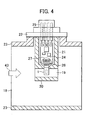
- Fig. 4 is a vertical sectional view showing the mount structure for the sensor device according to the first embodiment;
- Fig. 5 is a plan view showing one shape of a temperature sensitive resistor in the first embodiment;
- Fig. 6 is a plan view showing another shape of the temperature sensitive resistor in the first embodiment;
- Fig. 7 is a plan view showing shapes of temperature sensitive resistors in a second embodiment of the present invention;
- Fig. 8 is a schematic plan view of a sensor device according to a third embodiment of the present invention;
- Fig. 9 is a vertical sectional view of the sensor device according to the third embodiment;
- Figs. 10A and 10B are diagrams showing a drive circuit for the sensor device according to the third embodiment;
- Fig. 11 is a plan view showing shapes of temperature sensitive resistors in the third embodiment;
- Fig. 12 is a schematic plan view of a sensor device according to a fourth embodiment of the present invention;
- Fig. 13 is a diagram showing a part of a drive circuit for the sensor device according to the fourth embodiment; and
- Fig. 14 is a diagram showing a part of the drive circuit for the sensor device according to the fourth embodiment.
- Preferred embodiments of a physical quantity sensor according to the present invention will be described below with reference to the drawings.
- The first embodiment represents, as one example of the physical quantity sensor, a thermal air flow sensor for measuring the flow rate of intake air in an internal combustion engine of an automobile, etc.
- Fig. 1 is a schematic plan view of a sensor device of the thermal air flow sensor according to the first embodiment, and Fig. 2 is a sectional view taken along the line A-A in Fig. 1. As shown in these drawings, a
sensor device 1 is formed on a semiconductor substrate (base) 2 made of a single-crystalline silicon (Si) wafer as follows. - A
cavity 3 is formed in a part of thesemiconductor substrate 2 by anisotropic etching. Thecavity 3 is in the form of a rectangular hole as viewed in a plan. Adiaphragm 4 is formed at one side of thecavity 3. Thediaphragm 4 is made of an electricinsulating film 5 of silicon dioxide (SiO2) that is formed on one surface of thesemiconductor substrate 2 by thermal oxidation or CVD (Chemical Vapor Deposition). - A
heating resistor 6 and temperaturesensitive resistors diaphragm 4. Further, another temperaturesensitive resistor 9 for compensating air temperature is formed in a position away from thediaphragm 4.Wiring 10 for those resistors is also formed on thesubstrate 2. Those resistors and wiring are made of polycrystalline silicon and are each formed through steps of forming a polycrystalline silicon layer on the electricinsulating film 5 by CVD, for example, and etching it into the desired shape. - More specifically, those resistors are formed by doping phosphorous (P) in n-type polycrystalline silicon by thermal diffusion or ion implantation, for example, so that the desired resistance values and resistance-temperature coefficients are obtained.
- Assuming that air flows from the left to right on the drawing as indicated by 43, the temperature
sensitive resistors heating resistor 6, and the temperaturesensitive resistors heating resistor 6. Each of the temperaturesensitive resistors vertical resistance component 29 and ahorizontal resistance component 28 which are orthogonal to each other. One example of the combination is shown in Fig. 5. Here, with respect to stress σ imposed on thesubstrate 2 in a predetermined direction (the predetermined direction is preferably matched with a direction in which a stress distribution is maximized), a parallel direction is defined to be a horizontal direction (X-direction) and a perpendicular direction is defined to be a vertical direction (Y-direction). - Fig. 5 shows the shape of one (8a) of the temperature
sensitive resistors sensitive resistor 8a is formed to have such a shape (or length) that a ratio of a resistance value of thevertical resistance component 29 extended in a vertical direction (Y-direction) while being folded repeatedly (i.e., a vertical resistance component Rt) to a resistance value of thehorizontal resistance component 28 extended in a horizontal direction (X-direction) while being folded repeatedly (i.e., a horizontal resistance component Rl) is substantially equal to a ratio (n : 1) of a piezoresistance coefficient nl of the horizontal resistance component R1 to a piezoresistance coefficient πt of the vertical resistance component Rt. The other temperaturesensitive resistors - An electric insulating
film 11 is formed to protect those resistors. The electric insulatingfilm 11 is obtained by a method of forming silicon dioxide (SiO2) by CVD, for example. Further,aluminum electrodes 12 are formed for connection to respective electrodes of the resistors. - The principle for measurement of an air flow rate using the
sensor device 1 will be described below. To measure the air flow rate, theheating resistor 6 is electrically heated and controlled by a bridge circuit, anoperational amplifier 15, and atransistor 16 for controlling a heating current, shown in Fig. 3, so that the temperature of theheating resistor 6 is always held higher than the temperature of thetemperature compensation resistor 9 for sensing the air temperature by a constant value (details of the circuits will be described later). In such a controlled state, the temperature difference between the temperature sensitive resistors 7 (7a and 7b) and the temperature sensitive resistors 8 (8a and 8b) disposed upstream and downstream of theheating resistor 6, respectively, is measured. When air does not flow, a temperature distribution over thediaphragm 4 is symmetrical about theheating resistor 6. Accordingly, no temperature difference occurs between the temperaturesensitive resistors sensitive resistors sensitive resistors heating resistor 6 is lowered and the temperature of the temperaturesensitive resistors heating resistor 6 is raised, thus causing a temperature difference therebetween. Since resistance values of the temperaturesensitive resistors - Also, when air flows in a direction opposed to the direction of the
air flow 43, a temperature distribution is reversed to that obtained in the above-mentioned state. The direction of the air flow can be therefore discriminated by comparing the resistance value of the temperaturesensitive resistors sensitive resistors - A drive circuit for driving the
sensor device 1 and measuring the air flow rate will be described below. - Fig. 3A shows a feedback circuit for controlling the temperature of the
heating resistor 6. The feedback circuit has a bridge circuit made up of theheating resistor 6, thetemperature compensation resistor 9, and fixedresistors operational amplifier 15, and the heating current is controlled through thetransistor 16. The temperature of theheating resistor 6 rises with the heating current, and the resistance value of theheating resistor 6 is changed correspondingly. A resistance value ratio of theheating resistor 6 to thetemperature compensation resistor 9 can be adjusted by adjusting respective resistance values of the fixedresistors temperature compensation resistor 9 is substantially equal to the air temperature. The resistance value ratio of theheating resistor 6 to thetemperature compensation resistor 9 corresponds to the relationship between the temperature of theheating resistor 6 and the air temperature. Accordingly, the temperature of theheating resistor 6 can be always held higher than the air temperature by a constant value. - Fig. 3B shows a circuit for detecting a temperature difference between the upstream and downstream sides of the
heating resistor 6, and outputting an electric signal representing the air flow rate. This circuit is in the form of a bridge circuit made up of the temperaturesensitive resistors computing unit 17. When an air flow is generated in the direction as indicated by 43 in Fig. 1, the resistance values of the temperaturesensitive resistors sensitive resistors computing unit 17 can be given with the function of outputting the output of the bridge circuit after modifying it. - Fig. 4 is a sectional view showing the mount structure for the
sensor device 1 when thesensor device 1 is mounted to an intake pipe of an automobile engine to measure the flow rate of intake air. The intake air flows through amain passage 18 of the intake pipe as indicated by anarrow 43, and thesensor device 1 is installed in a sub-passage 19 provided in the form projecting into themain passage 18. Amember 20 constituting the sub-passage 19 is supported by acasing 21. - The
casing 21 is mounted to awall surface 23 of the intake pipe by using asupport 22. Acircuit board 24 is disposed in thecasing 21. The drive circuit for driving thesensor device 1 and taking out an air flow signal is mounted on thecircuit board 24. - The
sensor device 1 is mechanically supported by thecasing 21 and is electrically connected to the drive circuit on thecircuit board 24 bybonding wires 26. To protect thebonding wires 26, electrodes of thesensor device 1 and thecircuit board 24 are covered with a resin, e.g., epoxy. The air flow signal detected by the thermal air flow sensor including thesensor device 1 is taken out through aconnector 25 and is supplied to an engine control computer, though not shown, for use in control of a fuel supply amount. - In the thermal air flow sensor thus constructed, an adhesive is coated on the rear side of the
sensor device 1 for mounting of thesensor device 1, and asealant 27 is applied for protection of thebonding wires 26. When the adhesive and thesealant 27 each made of resin are provided in place, the resin has to be hardened in a high-temperature furnace after being applied. In the hardening step, the resin is expanded and contracted, thus generating stresses. The generated stresses are imposed on thesensor device 1. The plurality ofresistors sensor device 1, and the stresses are applied to those resistors. - Upon application of the stresses, the resistance value of each resistor is.changed as expressed by the following formula:

- In the formula (1), ΔR/R represents a resistance change rate, πl represents a piezoresistance coefficient when stress σ is applied to the
horizontal resistance component 28, and nt represents a piezoresistance coefficient when the stress σ is applied to thevertical resistance component 29. Although stresses act on the sensor device from various directions, the stress σ in a direction indicated by an arrow in Figs. 1 and 5 is maximum from the structure of the sensor device. Because each resistor in this embodiment is made of polycrystalline silicon, the relationship between the piezoresistance coefficients nl and πt is expressed by:
Particularly, in the case of a semiconductor such as single-crystalline silicon or polycrystalline silicon, the piezoresistance coefficient is relatively large. This means that the stress imposed on thesensor device 1 may become a factor deteriorating the measurement accuracy of the thermal air flow sensor. - A practical method for reducing such an influence of the stress will be described below. In this embodiment, the influence of the stress is reduced by applying the present invention to the temperature
sensitive resistors sensitive resistor 8a. The other temperaturesensitive resistors vertical resistance component 29 and a resistance value R28 of thehorizontal resistance component 28 is expressed by:
A ratio of R29 to R28 corresponds to a ratio between the two piezoresistance coefficients expressed by the formula (2). - Also, σ shown in Fig. 5 represents the stress applied to the temperature
sensitive resistor 8a. An amount ΔR of resistance change of the temperaturesensitive resistor 8a caused by the stress σ is expressed by:
By putting the relationships of the formulae (2) and (3) in the above formula (4), ΔR = 0 is resulted. Thus, the resistance change caused by the stress can be reduced by setting the ratio of the resistance value of the vertical resistance component R29 to the resistance value of the horizontal resistance component R28 to be substantially equal to the ratio of the piezoresistance coefficient πl to πt. - When forming the resistors such as the temperature
sensitive resistor 8a, the forming process includes patterning by etching. However, the etching amount varies and so does the resistance value because of, for example, narrowing of the resistor width (i.e., overetching). By forming the resistor at a constant width, the resistance value ratio of the vertical resistance component R29 to the horizontal resistance component R28 is kept constant even with variations of the etching amount, whereby high accuracy can be ensured. - While this embodiment uses n-type polycrystalline silicon as the resistors formed on the
sensor device 1, the same effect as that described above can also be obtained with the use of p-type polycrystalline silicon, n-type single-crystalline silicon, or p-type single-crystalline silicon by adjusting the resistance value ratio of the vertical resistance component to the horizontal resistance component to be substantially equal to the ratio of the piezoresistance coefficient πl to πt. Further, the same effect can be obtained in the case of using the resistors made of a metal, e.g., platinum. - Alternatively, by forming, as shown in Fig. 6, the temperature
sensitive resistor 8a in a pattern extending oblique to the direction of the stress σ which is maximum in the stress distribution, it is also possible to make the resistance value ratio of the vertical resistance component to the horizontal resistance component of each resistor substantially equal to the ratio of the piezoresistance coefficient nl to πt, and hence to obtain the same effect as that described above with reference to Fig. 5. - A second embodiment will be described below with reference to Fig. 7. This embodiment also represents the case where the present invention is applied to the thermal air flow meter. Since the basic principle and structure are the same as those in the first embodiment, only different points are described here and a description of common points is omitted.
- Fig. 7 is a plan view showing shapes of the temperature
sensitive resistors sensitive resistors heating resistor 6, the temperaturesensitive resistors sensitive resistors sensitive resistors - In manufacturing steps using the semiconductor process, resistivity of a polycrystalline silicon film forming each resistor varies within a wafer due to variations in the manufacturing steps, thus generating a distribution of resistivity in some cases. When the temperature
sensitive resistors sensitive resistors sensitive resistors - With this embodiment, because of the temperature sensitive resistors having the interlaced shapes shown in Fig. 7, the temperature
sensitive resistors sensitive resistors - Further, even when a temperature distribution is generated in the lengthwise direction of the
heating resistor 6, the temperaturesensitive resistors - Thus, according to this embodiment, it is possible to reduce variations of the resistance values and to measure the air flow rate with high accuracy.
- Similarly to the first embodiment, while this second embodiment uses n-type polycrystalline silicon as the resistors formed on the
sensor device 1, the same effect as that described above can also be obtained with the use of p-type polycrystalline silicon, n-type single-crystalline silicon, or p-type single-crystalline silicon by adjusting the resistance value ratio of the vertical resistance component to the horizontal resistance component of each resistor to be substantially equal to the ratio of the piezoresistance coefficient πl to πt. Further, the same effect can be obtained in the case of using the resistors made of a metal, e.g., platinum. - A third embodiment will be described below. This embodiment represents the case where the present invention is applied to an acceleration sensor of the type employing a heating resistor, which can be used as an acceleration sensor and an inclination sensor in an automobile, etc.
- One example of the known heating-resistor acceleration sensor is disclosed in
U.S. Patent No. 5,581,034 . - Fig. 8 is a schematic plan view of a sensor device of a thermal acceleration sensor according to the second embodiment, and Fig. 9 is a sectional view taken along the line B-B in Fig. 8. Though not shown in these drawings, a
sensor device 30 is mounted in an enclosed container which is filled with a fluid having a small thermal conductivity, such as air or xenon (Xe). - As shown in Figs. 8 and 9, the
sensor device 30 is entirely formed by using, as a base, asemiconductor substrate 31 made of a single-crystalline silicon (Si) wafer. Acavity 34 is formed in a part of thesemiconductor substrate 31. Thecavity 3 is in the form of a rectangular hole as viewed in a plan. Doubly supportedbeams cavity 34. Aheating resistor 36 and temperaturesensitive resistors beams - Those resistors are made of polycrystalline silicon and are each formed through steps of forming a polycrystalline silicon layer on an electric insulating
film 32 by CVD, for example, and etching it into the desired shape. More specifically, those resistors are formed, for example, by doping phosphorous (P) in n-type polycrystalline silicon by thermal diffusion or ion implantation so that the desired resistance values and resistance-temperature coefficients are obtained. - Looking at, by way of example, the temperature
sensitive resistor 37a, it has combined resistance of resistance components in two vertical and horizontal directions orthogonal to each other, and is formed such that a ratio of a resistance value of the vertical resistance component to a resistance value of the horizontal resistance component is substantially equal to the ratio of the piezoresistance coefficient nl to πt. The other temperaturesensitive resistors film 33 is formed to protect those resistors. - The doubly supported
beams semiconductor substrate 31 is initially entirely coated with the electric insulatingfilm 32. The electric insulatingfilm 32 is silicon dioxide (SiO2) formed by thermal oxidation or CVD (Chemical Vapor Deposition). Theheating resistor 36 and the temperaturesensitive resistors film 32, and another electric insulatingfilm 33 is formed on those resistors. Further, the electric insulatingfilms semiconductor substrate 31 is partly removed by anisotropic etching to form thecavity 34. Through the above-described process, thesensor device 30 is manufactured. - The operating principle of the
sensor device 30 will be described below. When a current is supplied to theheating resistor 36 for heating it, the temperature of an ambient fluid rises and the density of the ambient fluid reduces. When an acceleration G is applied in that state in a direction indicated by an arrow in Fig. 9, the fluid is relatively moved in a direction opposed to the acceleration G, thus causing convection. Accordingly, the temperature distribution in the enclosed container is changed such that the temperature of the temperaturesensitive resistors sensitive resistors sensitive resistors - Figs. 10A and 10B show a drive circuit for driving the
sensor device 30 and obtaining a signal corresponding to the acceleration. Specifically, Fig. 10A shows a circuit for supplying a current to theheating resistor 36 for heating it, and Fig. 10B shows a bridge circuit for detecting the temperature difference between the temperaturesensitive resistors sensitive resistors - In the heating-resistor acceleration sensor thus constructed, the
heating resistor 36 and the temperaturesensitive resistors beams - Fig. 11 shows shapes of the temperature sensitive resistors arranged so as to reduce the influence of stress σ indicated in the drawing. As shown, the temperature
sensitive resistors vertical resistance components 29 and respectivehorizontal resistance components 28 are extended in interdigitated (or interlaced) relation in parallel. Further, for each of the temperaturesensitive resistors sensitive resistors sensitive resistors vertical resistance component 29 is triple the length of thehorizontal resistance component 28. With such an arrangement, the influence of the stress σ is canceled and changes of the resistance values are reduced, whereby the measurement accuracy of the heating-resistor acceleration sensor is improved. - Similarly to the first and second embodiments, while this third embodiment uses n-type polycrystalline silicon as the resistors formed on the
sensor device 30, the same effect as that described above can also be obtained with the use of p-type polycrystalline silicon, n-type single-crystalline silicon, or p-type single-crystalline silicon by adjusting the resistance value ratio of the vertical resistance component to the horizontal resistance component to be substantially equal to the ratio of the piezo-resistance coefficient πl to πt. Further, the same effect can be obtained in the case of using the resistors made of a metal, e.g., platinum. - Moreover, similarly to the first and second embodiments, this third embodiment can also reduce variations of the resistance value ratio caused by overetching because the temperature
sensitive resistors - A fourth embodiment will be described below with reference to Figs. 12-14.
- This embodiment represents the case of preventing a reduction in accuracy of the flow rate measurement, which is caused by distortion of wiring resistances of the heating-resistor flow sensor, by employing a different method from that in the above-described embodiments. More specifically, if wiring portions of the resistors formed on the sensor device are distorted by stresses and resistance values of the wiring portions are changed correspondingly, an error is caused in the detected flow rate. This embodiment is intended to reduce such an error in the detected flow rate.
- Fig. 12 is a schematic plan view of a sensor device of a flow sensor according to this embodiment, Fig. 13 is a diagram showing an electric circuit for controlling the heating temperature of a
heating resistor 6 on the sensor device according to this embodiment, and Fig. 14 is a diagram showing an electric circuit for detecting the temperature difference between the upstream and downstream sides of theheating resistor 6 by using temperaturesensitive resistors - Prior to explaining the sensor device shown in Fig. 12, the circuit diagrams shown in Figs. 13 and 14 are first described.
- The circuit of Fig. 13 for driving the heating resistor has a basically similar circuit configuration to that of the drive circuit shown in Fig. 3A. The drive circuit of Fig. 13 differs from the circuit of Fig. 3A in that one power-
supply side terminal 39a of theheating resistor 6 and thetemperature compensation resistor 9 connected in series is branched to twoterminals 39a-1 and 39a-2 viawires ground side terminal 39b is also similarly branched to twoterminals 39b-1 and 39b-2 viawires - The one
wire 10n led from the one power-supply side terminal (positive side) 39a of theheating resistor 6 is connected to an inverted input terminal of adifferential amplifier 40 through the terminal 39a-1, and a power supply potential 39c is connected to a non-inverted input terminal of thedifferential amplifier 40. An output terminal of thedifferential amplifier 40 is connected through the terminal 39a-2 to theother wire 10m led from the one power-supply side terminal 39a of theheating resistor 6. - With such an arrangement, even when the
wires supply side terminal 39a of theheating resistor 6 are distorted and the wiring resistances are changed, the potential at the one power-supply side terminal 39a of theheating resistor 6 can be always held equal to the power supply potential 39c with the function of the differential amplifier (feedback device) 40 disposed as shown. Incidentally,reference numerals 10n' and 10m' represent the wiring resistances of thewires - Likewise, the one
wire 101 led from the otherground side terminal 39b of thetemperature compensation resistor 9 is connected to an inverted input terminal of adifferential amplifier 41 through the terminal 39b-2, and the ground potential is connected to a non-inverted input terminal of thedifferential amplifier 41. An output terminal of thedifferential amplifier 41 is connected to theother wire 10k led from the temperature compensation resistor 9 (i.e., to the otherground side terminal 39a) through the terminal 39b-1. - With such an arrangement, even when the
wires ground side terminal 39b of thetemperature compensation resistor 9 are distorted and the wiring resistances are changed, the potential at the otherground side terminal 39b of thetemperature compensation resistor 9 can be always held at the ground potential with the function of the differential amplifier (feedback device) 41 disposed as shown. Incidentally,reference numerals 101' and 10k' represent the wiring resistances of thewires heating resistor 6 and thetemperature compensation resistor 9 is connected to thedifferential amplifier 15 via awire 10j.Reference numeral 10j' represents the wiring resistance of thewire 10j. - The flow-rate measuring circuit of Fig. 14 is basically similar to the circuit of Fig. 3B except that the temperature
sensitive resistor 7a and the temperaturesensitive resistor 8a arranged respectively upstream and downstream of theheating resistor 6 are each constituted by one resistor. - Looking at the operating principle, potentials at both terminals of the temperature
sensitive resistor 7a and potentials at both terminals of the temperaturesensitive resistor 8a are inputted to adifferential detection circuit 42 viawires wires - Also, in this embodiment, one power-
supply side terminal 39c of one 7a of the two temperaturesensitive resistors terminals 39c-1 and 39c-2 viawires ground side terminal 39d is also similarly branched to twoterminals 39d-1 and 39d-2 viawires - The one
wire 10d led from the oneterminal 39c of the temperaturesensitive resistor 7a is connected to an inverted input terminal of adifferential amplifier 44 through the terminal 39c-1, and a reference potential Vref of a power supply is connected to a non-inverted input terminal of thedifferential amplifier 44. An output terminal of thedifferential amplifier 44 is connected to the oneterminal 39c of the temperaturesensitive resistor 7a through the terminal 39c-2 and theother wire 10c. - With such an arrangement, even when the
wires supply side terminal 39c of the temperaturesensitive resistor 7a are distorted and the wiring resistances are changed, the potential at the one power-supply side terminal 39c of the temperaturesensitive resistor 7a can be always held equal to Vref with the function of the differential amplifier (feedback device) 44. Incidentally,reference numerals 10c' and 10d' represent the wiring resistances of thewires - Likewise, the one
wire 10e led from the otherground side terminal 39d of the temperaturesensitive resistor 8a is connected to an inverted input terminal of adifferential amplifier 45 through the terminal 39d-2, and the ground potential is connected to a non-inverted input terminal of thedifferential amplifier 45. An output terminal of thedifferential amplifier 45 is connected to theother wire 10f led from the temperaturesensitive resistor 8a (i.e., to the otherground side terminal 39d) through the terminal 39d-1. - With such an arrangement, even when the
wires ground side terminal 39d of the temperaturesensitive resistor 8a are distorted and the wiring resistances are changed, the potential at the otherground side terminal 39d of the temperaturesensitive resistor 8a can be always held at the ground potential with the function of the differential amplifier (feedback device) 45 disposed as shown. Incidentally,reference numerals 10e' and 10f' represent the wiring resistances of thewires - Thus, according to the sensor device constructed as described above, even when the resistance values of the
wires 10a to 10n are changed with the occurrence of stresses, the voltages applied to theheating resistor 6 and the temperaturesensitive resistors - In the sensor device shown in Fig. 12, the
heating resistor 6, thetemperature compensation resistor 9, and the temperaturesensitive resistors terminals 39a-1, 39a-2, 39b-1, 39b-2, 39c-1, 39c-2, 39d-1 and 39d-2 connected to the above-mentioned feedback devices are formed. - Further, by combining this fourth embodiment with any of the first to third embodiments, it is possible to reduce the influence of stresses in both the detecting section and the wiring section, and to further increase the measurement accuracy.
The above mentioned features and embodiments may be combined partly or as a whole in any way.
Claims (8)
- A physical quantity sensor (1) including a resistor (6) for measuring a physical quantity, said resistor being formed on a substrate (2) in a pattern of strips,
wherein assuming, with respect to stress imposed on said substrate (2) in a predetermined direction, a parallel direction to be a horizontal direction and a perpendicular direction to be a vertical direction, said resistor (6) has a horizontal resistance component Rl and a vertical resistance component Rt, and
when a ratio of a piezoresistance coefficient πt of the vertical resistance component Rt, which is provided when the stress imposed on said substrate (2) in the predetermined direction is applied to the vertical resistance component Rt, to a piezoresistance coefficient πl of the horizontal resistance component Rl, which is provided when the stress imposed on said substrate (2) in the predetermined direction is applied to the horizontal resistance component Rl, is πt/πl = -1/n (n: integer), a resistance value ratio of the horizontal resistance component Rl to the vertical resistance component Rt is set substantially equal to an absolute value of the ratio of the piezoresistance coefficient πt to πl (Rl/Rt ≈ |πt/π1|). - A physical quantity sensor (1) including a resistor (6) for measuring a physical quantity, said resistor (6) being formed on a substrate (2) in a pattern of strips,
wherein assuming, with respect to stress imposed on said substrate (2) in a predetermined direction, a parallel direction to be a horizontal direction and a perpendicular direction to be a vertical direction, said resistor (6) has a horizontal resistance component Rl and a vertical resistance component Rt, and
when piezoresistance coefficient πt of the vertical resistance component Rt, which is provided when the stress imposed on said substrate (2) in the predetermined direction is applied to the vertical resistance component Rt, to a piezoresistance coefficient πl of the horizontal resistance component Rl, which is provided when the stress imposed on said substrate (2) in the predetermined direction is applied to the horizontal resistance component Rl, to is πt/π1 = - 1/n (n: integer), a resistance value ratio of the horizontal resistance component Rl to the vertical resistance component Rt is set to be within the range of R1/Rt ≈ (1 ± 0.5)/n. - The physical quantity sensor (1) according to Claim 1 or 2, wherein said resistor (6) is made of polycrystalline silicon doped with impurities, and the resistance value ratio of the horizontal resistance component Rl to the vertical resistance component Rt is set to be within the range of R1/Rt ≈ (1 ± 0.5)/3.
- The physical quantity sensor (1) according to at least one of Claims 1 to 3, wherein said resistor (6) is formed in plural, each of the plurality of resistors having a vertical resistance component Rt and a horizontal resistance component Rl, and the respective vertical resistance components and the respective horizontal resistance components of the plurality of resistors are formed in interdigitated relation in parallel.
- A physical quantity sensor (1) including a resistor (6) for measuring a physical quantity, said resistor (6) being formed on a substrate (2),
wherein a power-supply (39a, 39c) side terminal and a ground side terminal (39b,39d) of said resistor (6) are branched to at least four terminals (39a-1, 39a-2, 39b-1, 39b-2) in total. - The physical quantity sensor (1) according to Claim 5, wherein said resistor (6) is formed of one resistor or two or more serial resistors, and a feedback device for maintaining a power supply voltage and a ground voltage is connected to the power-supply side terminal (39a, 39c) and the ground side terminal (39b, 39d) of each resistor.
- A heating-resistor air flow sensor constituted by the physical quantity sensor according to at least one of Claims 1 to 6.
- A heating-resistor acceleration sensor constituted by the physical quantity sensor according to at least one of Claims 1 to 6.
Applications Claiming Priority (1)
| Application Number | Priority Date | Filing Date | Title |
|---|---|---|---|
| JP2005072818A JP4975972B2 (en) | 2005-03-15 | 2005-03-15 | Physical quantity sensor |
Publications (3)
| Publication Number | Publication Date |
|---|---|
| EP1703263A2 true EP1703263A2 (en) | 2006-09-20 |
| EP1703263A3 EP1703263A3 (en) | 2008-11-26 |
| EP1703263B1 EP1703263B1 (en) | 2016-07-27 |
Family
ID=36572479
Family Applications (1)
| Application Number | Title | Priority Date | Filing Date |
|---|---|---|---|
| EP06003148.1A Expired - Lifetime EP1703263B1 (en) | 2005-03-15 | 2006-02-16 | Heating resistor flow sensor or acceleration sensor |
Country Status (4)
| Country | Link |
|---|---|
| US (1) | US7555944B2 (en) |
| EP (1) | EP1703263B1 (en) |
| JP (1) | JP4975972B2 (en) |
| CN (1) | CN100437043C (en) |
Cited By (4)
| Publication number | Priority date | Publication date | Assignee | Title |
|---|---|---|---|---|
| WO2009153099A1 (en) * | 2008-05-27 | 2009-12-23 | Siemens Aktiengesellschaft | Silicon-based microflow sensor for gas analysis and method for production thereof silizium-basierter mikroströmungsfühler für die gasanalyse und verfahren zu dessen herstellung |
| EP2505970A1 (en) * | 2011-03-31 | 2012-10-03 | JUMO GmbH & Co. KG | Calorimetric sensor |
| EP2629065A4 (en) * | 2010-10-13 | 2017-12-13 | Hitachi Automotive Systems, Ltd. | Flow sensor and production method therefor, and flow sensor module and production method therefor |
| EP3486635A1 (en) * | 2017-11-16 | 2019-05-22 | Atlas Material Testing Technology GmbH | Sensor unit comprising an air flow sensor for a weathering device |
Families Citing this family (20)
| Publication number | Priority date | Publication date | Assignee | Title |
|---|---|---|---|---|
| CN102833603B (en) * | 2005-03-02 | 2016-02-10 | 乐威指南公司 | Playlist in interactive media guidance application system and bookmark |
| JP4836864B2 (en) * | 2007-05-16 | 2011-12-14 | 日立オートモティブシステムズ株式会社 | Thermal flow meter |
| JP2008292361A (en) * | 2007-05-25 | 2008-12-04 | Denso Corp | Flow measuring device |
| JP5156671B2 (en) | 2009-02-27 | 2013-03-06 | 株式会社日立製作所 | Magnetic field detection device and measurement device |
| JP5527019B2 (en) * | 2010-05-28 | 2014-06-18 | セイコーエプソン株式会社 | Physical quantity sensor and electronic equipment |
| JP5315304B2 (en) * | 2010-07-30 | 2013-10-16 | 日立オートモティブシステムズ株式会社 | Thermal flow meter |
| DE102011002947B3 (en) | 2011-01-20 | 2012-01-26 | Siemens Aktiengesellschaft | Measuring arrangement with arranged in gas paths electrically heated resistors |
| CN103597330B (en) * | 2011-05-31 | 2016-08-24 | 独立行政法人科学技术振兴机构 | The temperature compensation of sensor, the operation program of this temperature compensation, arithmetic processing apparatus and sensor |
| US8640552B2 (en) * | 2011-09-06 | 2014-02-04 | Honeywell International Inc. | MEMS airflow sensor die incorporating additional circuitry on the die |
| TWI456201B (en) * | 2011-11-29 | 2014-10-11 | Univ Chung Hua | Wireless thermal bubble type accelerometer and method of manufacturing the same |
| CN103185810B (en) * | 2011-12-31 | 2015-11-25 | 中华大学 | Wireless hot bubble type accelerometer and preparation method thereof |
| JP5904910B2 (en) * | 2012-08-31 | 2016-04-20 | ルネサスエレクトロニクス株式会社 | Acceleration detection element |
| WO2014041648A1 (en) * | 2012-09-12 | 2014-03-20 | ルネサスエレクトロニクス株式会社 | Semiconductor device |
| CN103148975B (en) * | 2013-02-04 | 2014-12-03 | 江苏大学 | Test device used for ultrasonic field shear force measurement |
| TWI477779B (en) * | 2013-06-11 | 2015-03-21 | Univ Chung Hua | Thermal convection type linear accelerometer |
| WO2016092984A1 (en) * | 2014-12-08 | 2016-06-16 | 日立オートモティブシステムズ株式会社 | Physical quantity detection device |
| US12478261B2 (en) * | 2017-05-09 | 2025-11-25 | Yale University | Multiplexed implantable sensor probe |
| JP2019027881A (en) * | 2017-07-28 | 2019-02-21 | アズビル株式会社 | measuring device |
| CN110864736B (en) * | 2019-11-22 | 2020-12-15 | 清华大学 | Flexible sensor strain and temperature compensation method and multi-sensing integrated sensor |
| US11994443B2 (en) * | 2022-03-24 | 2024-05-28 | Sensata Technologies, Inc. | Sensing device with gauge |
Citations (4)
| Publication number | Priority date | Publication date | Assignee | Title |
|---|---|---|---|---|
| JP2001021401A (en) | 1999-07-08 | 2001-01-26 | Hitachi Ltd | Thermal air flow meter |
| US6626037B1 (en) | 1999-09-03 | 2003-09-30 | Denso Corporation | Thermal flow sensor having improved sensing range |
| US20040103720A1 (en) | 2002-11-29 | 2004-06-03 | Chou Bruce C. S. | Thermal bubble type micro inertial sensor |
| JP2004205498A (en) | 2002-12-13 | 2004-07-22 | Denso Corp | Flow sensor |
Family Cites Families (12)
| Publication number | Priority date | Publication date | Assignee | Title |
|---|---|---|---|---|
| FR2473789A1 (en) * | 1980-01-09 | 1981-07-17 | Ibm France | TEST METHODS AND STRUCTURES FOR SEMICONDUCTOR INTEGRATED CIRCUITS FOR ELECTRICALLY DETERMINING CERTAIN TOLERANCES DURING PHOTOLITHOGRAPHIC STAGES |
| JPS63177023A (en) * | 1987-01-19 | 1988-07-21 | Nippon Soken Inc | Flow rate sensor |
| FR2620820B1 (en) * | 1987-09-22 | 1992-06-19 | Degussa | HEATING ELECTRIC RESISTOR FOR RHEOMETER |
| JPH0645896Y2 (en) * | 1990-02-19 | 1994-11-24 | 山武ハネウエル株式会社 | Accelerometer |
| JPH08313320A (en) * | 1995-05-19 | 1996-11-29 | Hitachi Ltd | Measuring element for thermal air flow meter and thermal air flow meter including the same |
| JPH1019622A (en) * | 1996-07-02 | 1998-01-23 | Ricoh Co Ltd | Thermal flow sensor and its driving circuit |
| JP3461469B2 (en) * | 1999-07-27 | 2003-10-27 | 株式会社日立製作所 | Thermal air flow sensor and internal combustion engine controller |
| JP3468731B2 (en) | 2000-01-14 | 2003-11-17 | 株式会社日立製作所 | Thermal air flow sensor, element, and internal combustion engine controller |
| JP2003035580A (en) * | 2001-07-19 | 2003-02-07 | Denso Corp | Flow sensor |
| JP4608843B2 (en) * | 2002-02-19 | 2011-01-12 | 株式会社デンソー | Flow measuring device |
| JP3698679B2 (en) * | 2002-03-27 | 2005-09-21 | 株式会社日立製作所 | Gas flow meter and manufacturing method thereof |
| JP3817497B2 (en) * | 2002-06-10 | 2006-09-06 | 株式会社日立製作所 | Thermal flow meter |
-
2005
- 2005-03-15 JP JP2005072818A patent/JP4975972B2/en not_active Expired - Fee Related
-
2006
- 2006-01-19 CN CNB2006100059180A patent/CN100437043C/en not_active Expired - Fee Related
- 2006-02-15 US US11/353,937 patent/US7555944B2/en not_active Expired - Lifetime
- 2006-02-16 EP EP06003148.1A patent/EP1703263B1/en not_active Expired - Lifetime
Patent Citations (4)
| Publication number | Priority date | Publication date | Assignee | Title |
|---|---|---|---|---|
| JP2001021401A (en) | 1999-07-08 | 2001-01-26 | Hitachi Ltd | Thermal air flow meter |
| US6626037B1 (en) | 1999-09-03 | 2003-09-30 | Denso Corporation | Thermal flow sensor having improved sensing range |
| US20040103720A1 (en) | 2002-11-29 | 2004-06-03 | Chou Bruce C. S. | Thermal bubble type micro inertial sensor |
| JP2004205498A (en) | 2002-12-13 | 2004-07-22 | Denso Corp | Flow sensor |
Cited By (5)
| Publication number | Priority date | Publication date | Assignee | Title |
|---|---|---|---|---|
| WO2009153099A1 (en) * | 2008-05-27 | 2009-12-23 | Siemens Aktiengesellschaft | Silicon-based microflow sensor for gas analysis and method for production thereof silizium-basierter mikroströmungsfühler für die gasanalyse und verfahren zu dessen herstellung |
| EP2629065A4 (en) * | 2010-10-13 | 2017-12-13 | Hitachi Automotive Systems, Ltd. | Flow sensor and production method therefor, and flow sensor module and production method therefor |
| EP2505970A1 (en) * | 2011-03-31 | 2012-10-03 | JUMO GmbH & Co. KG | Calorimetric sensor |
| EP3486635A1 (en) * | 2017-11-16 | 2019-05-22 | Atlas Material Testing Technology GmbH | Sensor unit comprising an air flow sensor for a weathering device |
| US10962468B2 (en) | 2017-11-16 | 2021-03-30 | Atlas Material Testing Technology Gmbh | Sensor device with an air mass sensor for a weathering device |
Also Published As
| Publication number | Publication date |
|---|---|
| EP1703263A3 (en) | 2008-11-26 |
| EP1703263B1 (en) | 2016-07-27 |
| US20060220662A1 (en) | 2006-10-05 |
| JP4975972B2 (en) | 2012-07-11 |
| US7555944B2 (en) | 2009-07-07 |
| CN100437043C (en) | 2008-11-26 |
| JP2006258455A (en) | 2006-09-28 |
| CN1834592A (en) | 2006-09-20 |
Similar Documents
| Publication | Publication Date | Title |
|---|---|---|
| EP1703263B1 (en) | Heating resistor flow sensor or acceleration sensor | |
| EP1816446B1 (en) | Thermal type flow sensor | |
| EP2280251B1 (en) | Thermal flow meter | |
| EP1116939B1 (en) | Thermal type air flow sensor | |
| EP1643219B1 (en) | Thermal type fluid flow sensor | |
| US7337661B2 (en) | Thermal fluid flow meter having heat-generating resistor and temperature adjuster therefor | |
| US6470742B1 (en) | Flow sensor | |
| EP1698864B1 (en) | Thermal flowmeter of fluid | |
| US11047822B2 (en) | Sensor device | |
| CN101308036A (en) | Thermal Flow Meter | |
| JP2001041790A (en) | Thermal air flow sensor and internal combustion engine controller | |
| WO2012043164A1 (en) | Thermal flow rate sensor | |
| US6935172B2 (en) | Thermal type flow measuring device | |
| WO2012014956A1 (en) | Thermal flow meter | |
| US6684693B2 (en) | Heat generation type flow sensor | |
| EP1870681B1 (en) | Thermal type flow rate measuring apparatus | |
| KR20010006630A (en) | Thermo-sensitive flow rate sensor | |
| JPH11258021A (en) | Thermal air flow sensor | |
| JPH1183580A (en) | Thermal air flow sensor | |
| JP2842485B2 (en) | Thermal flow sensor |
Legal Events
| Date | Code | Title | Description |
|---|---|---|---|
| PUAI | Public reference made under article 153(3) epc to a published international application that has entered the european phase |
Free format text: ORIGINAL CODE: 0009012 |
|
| AK | Designated contracting states |
Kind code of ref document: A2 Designated state(s): AT BE BG CH CY CZ DE DK EE ES FI FR GB GR HU IE IS IT LI LT LU LV MC NL PL PT RO SE SI SK TR |
|
| AX | Request for extension of the european patent |
Extension state: AL BA HR MK YU |
|
| 17P | Request for examination filed |
Effective date: 20080328 |
|
| PUAL | Search report despatched |
Free format text: ORIGINAL CODE: 0009013 |
|
| AK | Designated contracting states |
Kind code of ref document: A3 Designated state(s): AT BE BG CH CY CZ DE DK EE ES FI FR GB GR HU IE IS IT LI LT LU LV MC NL PL PT RO SE SI SK TR |
|
| AX | Request for extension of the european patent |
Extension state: AL BA HR MK YU |
|
| 17Q | First examination report despatched |
Effective date: 20090227 |
|
| AKX | Designation fees paid |
Designated state(s): DE FR |
|
| RIC1 | Information provided on ipc code assigned before grant |
Ipc: G01C 9/00 20060101ALI20151211BHEP Ipc: G01F 1/684 20060101AFI20151211BHEP Ipc: G01P 15/00 20060101ALI20151211BHEP Ipc: G01F 1/69 20060101ALI20151211BHEP |
|
| GRAP | Despatch of communication of intention to grant a patent |
Free format text: ORIGINAL CODE: EPIDOSNIGR1 |
|
| INTG | Intention to grant announced |
Effective date: 20160210 |
|
| RIN1 | Information on inventor provided before grant (corrected) |
Inventor name: NAKADA, KEIICHI Inventor name: NAKANO, HIROSHI Inventor name: MATSUMOTO, MASAHIRO Inventor name: WATANABE, IZUMI Inventor name: YAMADA, MASAMICHI |
|
| GRAS | Grant fee paid |
Free format text: ORIGINAL CODE: EPIDOSNIGR3 |
|
| GRAA | (expected) grant |
Free format text: ORIGINAL CODE: 0009210 |
|
| AK | Designated contracting states |
Kind code of ref document: B1 Designated state(s): DE FR |
|
| REG | Reference to a national code |
Ref country code: DE Ref legal event code: R096 Ref document number: 602006049703 Country of ref document: DE |
|
| REG | Reference to a national code |
Ref country code: DE Ref legal event code: R097 Ref document number: 602006049703 Country of ref document: DE |
|
| PLBE | No opposition filed within time limit |
Free format text: ORIGINAL CODE: 0009261 |
|
| STAA | Information on the status of an ep patent application or granted ep patent |
Free format text: STATUS: NO OPPOSITION FILED WITHIN TIME LIMIT |
|
| 26N | No opposition filed |
Effective date: 20170502 |
|
| REG | Reference to a national code |
Ref country code: FR Ref legal event code: ST Effective date: 20171031 |
|
| PG25 | Lapsed in a contracting state [announced via postgrant information from national office to epo] |
Ref country code: FR Free format text: LAPSE BECAUSE OF NON-PAYMENT OF DUE FEES Effective date: 20170228 |
|
| REG | Reference to a national code |
Ref country code: DE Ref legal event code: R081 Ref document number: 602006049703 Country of ref document: DE Owner name: HITACHI ASTEMO, LTD., HITACHINAKA-SHI, JP Free format text: FORMER OWNER: HITACHI AUTOMOTIVE SYSTEMS, LTD., HITACHINAKA-SHI, IBARAKI, JP Ref country code: DE Ref legal event code: R081 Ref document number: 602006049703 Country of ref document: DE Owner name: HITACHI ASTEMO, LTD., HITACHINAKA-SHI, JP Free format text: FORMER OWNER: HITACHI, LTD., TOKYO, JP |
|
| PGFP | Annual fee paid to national office [announced via postgrant information from national office to epo] |
Ref country code: DE Payment date: 20211230 Year of fee payment: 17 |
|
| REG | Reference to a national code |
Ref country code: DE Ref legal event code: R119 Ref document number: 602006049703 Country of ref document: DE |
|
| PG25 | Lapsed in a contracting state [announced via postgrant information from national office to epo] |
Ref country code: DE Free format text: LAPSE BECAUSE OF NON-PAYMENT OF DUE FEES Effective date: 20230901 |