EP1702824A1 - Torque control in a 4-wheel-drive vehicle with a 4WD control unit and a vehicle stability assist control unit - Google Patents
Torque control in a 4-wheel-drive vehicle with a 4WD control unit and a vehicle stability assist control unit Download PDFInfo
- Publication number
- EP1702824A1 EP1702824A1 EP06005257A EP06005257A EP1702824A1 EP 1702824 A1 EP1702824 A1 EP 1702824A1 EP 06005257 A EP06005257 A EP 06005257A EP 06005257 A EP06005257 A EP 06005257A EP 1702824 A1 EP1702824 A1 EP 1702824A1
- Authority
- EP
- European Patent Office
- Prior art keywords
- torque
- vehicle
- wheel
- control unit
- vehicle stability
- Prior art date
- Legal status (The legal status is an assumption and is not a legal conclusion. Google has not performed a legal analysis and makes no representation as to the accuracy of the status listed.)
- Granted
Links
- 238000000034 method Methods 0.000 claims abstract description 23
- 230000008859 change Effects 0.000 claims description 10
- 230000010354 integration Effects 0.000 abstract description 5
- 230000009467 reduction Effects 0.000 description 23
- 238000004364 calculation method Methods 0.000 description 1
- 230000008094 contradictory effect Effects 0.000 description 1
- 230000003247 decreasing effect Effects 0.000 description 1
- 230000001627 detrimental effect Effects 0.000 description 1
- 230000006872 improvement Effects 0.000 description 1
- 230000004048 modification Effects 0.000 description 1
- 238000012986 modification Methods 0.000 description 1
- 230000008569 process Effects 0.000 description 1
- 230000004044 response Effects 0.000 description 1
- 230000002195 synergetic effect Effects 0.000 description 1
Images


Classifications
-
- B—PERFORMING OPERATIONS; TRANSPORTING
- B60—VEHICLES IN GENERAL
- B60W—CONJOINT CONTROL OF VEHICLE SUB-UNITS OF DIFFERENT TYPE OR DIFFERENT FUNCTION; CONTROL SYSTEMS SPECIALLY ADAPTED FOR HYBRID VEHICLES; ROAD VEHICLE DRIVE CONTROL SYSTEMS FOR PURPOSES NOT RELATED TO THE CONTROL OF A PARTICULAR SUB-UNIT
- B60W10/00—Conjoint control of vehicle sub-units of different type or different function
- B60W10/119—Conjoint control of vehicle sub-units of different type or different function including control of all-wheel-driveline means, e.g. transfer gears or clutches for dividing torque between front and rear axle
-
- B—PERFORMING OPERATIONS; TRANSPORTING
- B60—VEHICLES IN GENERAL
- B60W—CONJOINT CONTROL OF VEHICLE SUB-UNITS OF DIFFERENT TYPE OR DIFFERENT FUNCTION; CONTROL SYSTEMS SPECIALLY ADAPTED FOR HYBRID VEHICLES; ROAD VEHICLE DRIVE CONTROL SYSTEMS FOR PURPOSES NOT RELATED TO THE CONTROL OF A PARTICULAR SUB-UNIT
- B60W40/00—Estimation or calculation of non-directly measurable driving parameters for road vehicle drive control systems not related to the control of a particular sub unit, e.g. by using mathematical models
- B60W40/10—Estimation or calculation of non-directly measurable driving parameters for road vehicle drive control systems not related to the control of a particular sub unit, e.g. by using mathematical models related to vehicle motion
-
- B—PERFORMING OPERATIONS; TRANSPORTING
- B60—VEHICLES IN GENERAL
- B60W—CONJOINT CONTROL OF VEHICLE SUB-UNITS OF DIFFERENT TYPE OR DIFFERENT FUNCTION; CONTROL SYSTEMS SPECIALLY ADAPTED FOR HYBRID VEHICLES; ROAD VEHICLE DRIVE CONTROL SYSTEMS FOR PURPOSES NOT RELATED TO THE CONTROL OF A PARTICULAR SUB-UNIT
- B60W50/00—Details of control systems for road vehicle drive control not related to the control of a particular sub-unit, e.g. process diagnostic or vehicle driver interfaces
- B60W50/02—Ensuring safety in case of control system failures, e.g. by diagnosing, circumventing or fixing failures
- B60W50/038—Limiting the input power, torque or speed
-
- B—PERFORMING OPERATIONS; TRANSPORTING
- B60—VEHICLES IN GENERAL
- B60W—CONJOINT CONTROL OF VEHICLE SUB-UNITS OF DIFFERENT TYPE OR DIFFERENT FUNCTION; CONTROL SYSTEMS SPECIALLY ADAPTED FOR HYBRID VEHICLES; ROAD VEHICLE DRIVE CONTROL SYSTEMS FOR PURPOSES NOT RELATED TO THE CONTROL OF A PARTICULAR SUB-UNIT
- B60W50/00—Details of control systems for road vehicle drive control not related to the control of a particular sub-unit, e.g. process diagnostic or vehicle driver interfaces
- B60W2050/0001—Details of the control system
- B60W2050/0002—Automatic control, details of type of controller or control system architecture
- B60W2050/0004—In digital systems, e.g. discrete-time systems involving sampling
- B60W2050/0006—Digital architecture hierarchy
-
- B—PERFORMING OPERATIONS; TRANSPORTING
- B60—VEHICLES IN GENERAL
- B60W—CONJOINT CONTROL OF VEHICLE SUB-UNITS OF DIFFERENT TYPE OR DIFFERENT FUNCTION; CONTROL SYSTEMS SPECIALLY ADAPTED FOR HYBRID VEHICLES; ROAD VEHICLE DRIVE CONTROL SYSTEMS FOR PURPOSES NOT RELATED TO THE CONTROL OF A PARTICULAR SUB-UNIT
- B60W50/00—Details of control systems for road vehicle drive control not related to the control of a particular sub-unit, e.g. process diagnostic or vehicle driver interfaces
- B60W2050/0001—Details of the control system
- B60W2050/0002—Automatic control, details of type of controller or control system architecture
- B60W2050/0012—Feedforward or open loop systems
-
- B—PERFORMING OPERATIONS; TRANSPORTING
- B60—VEHICLES IN GENERAL
- B60W—CONJOINT CONTROL OF VEHICLE SUB-UNITS OF DIFFERENT TYPE OR DIFFERENT FUNCTION; CONTROL SYSTEMS SPECIALLY ADAPTED FOR HYBRID VEHICLES; ROAD VEHICLE DRIVE CONTROL SYSTEMS FOR PURPOSES NOT RELATED TO THE CONTROL OF A PARTICULAR SUB-UNIT
- B60W50/00—Details of control systems for road vehicle drive control not related to the control of a particular sub-unit, e.g. process diagnostic or vehicle driver interfaces
- B60W2050/0001—Details of the control system
- B60W2050/0019—Control system elements or transfer functions
- B60W2050/0022—Gains, weighting coefficients or weighting functions
- B60W2050/0025—Transfer function weighting factor
-
- B—PERFORMING OPERATIONS; TRANSPORTING
- B60—VEHICLES IN GENERAL
- B60W—CONJOINT CONTROL OF VEHICLE SUB-UNITS OF DIFFERENT TYPE OR DIFFERENT FUNCTION; CONTROL SYSTEMS SPECIALLY ADAPTED FOR HYBRID VEHICLES; ROAD VEHICLE DRIVE CONTROL SYSTEMS FOR PURPOSES NOT RELATED TO THE CONTROL OF A PARTICULAR SUB-UNIT
- B60W2710/00—Output or target parameters relating to a particular sub-units
- B60W2710/10—Change speed gearings
- B60W2710/105—Output torque
-
- B—PERFORMING OPERATIONS; TRANSPORTING
- B60—VEHICLES IN GENERAL
- B60W—CONJOINT CONTROL OF VEHICLE SUB-UNITS OF DIFFERENT TYPE OR DIFFERENT FUNCTION; CONTROL SYSTEMS SPECIALLY ADAPTED FOR HYBRID VEHICLES; ROAD VEHICLE DRIVE CONTROL SYSTEMS FOR PURPOSES NOT RELATED TO THE CONTROL OF A PARTICULAR SUB-UNIT
- B60W50/00—Details of control systems for road vehicle drive control not related to the control of a particular sub-unit, e.g. process diagnostic or vehicle driver interfaces
- B60W50/0098—Details of control systems ensuring comfort, safety or stability not otherwise provided for
Definitions
- the present invention is directed toward a method of receiving torque reduction or torque limitation requests in a vehicle control system.
- a top level electronic control unit having a top level algorithm evaluates and controls the overall strategy for vehicle dynamics such as traction control, stability control, body motion control, etc.
- the top level ECU then controls ECUs within individual vehicle control systems to meet the goals of the overall strategy.
- the cooperative control system may include a vehicle stability assist (hereinafter VSA) individual control system.
- VSA vehicle stability assist
- the VSA system is controlled by an ECU subordinate to the top level ECU.
- the VSA system works by controlling brake pressure, engine torque, and/or individual wheel torque to help maintain traction between the vehicle wheels and a road surface. Specifically, detrimental effects caused by oversteer and understeer can be combated through adjustment of the torques and brake pressure.
- the VSA system ECU sends commands and requests to other systems, for example, the vehicle's four-wheel-drive (4WD) system.
- An ECU dedicated to the 4WD system receives and implements the commands and requests sent by the VSA ECU.
- the present invention provides an improvement over the prior art by providing a method that provides a better rounded performance envelops between the VSA system and 4WD system. Additionally, requests sent from the VSA system to the 4WD system must pass additional scrutiny before being implemented.
- the present invention is directed toward a method of deploying torque reduction and torque limitation commands from a VSA ECU to a vehicle 4WD system that avoids any conditions that could become unsafe.
- a method for deploying torque commands from a vehicle stability assist control system to a four wheel drive system in a vehicle includes the step of utilizing a firewall within a four wheel drive system electronic control unit to analyze commands sent from a vehicle stability assist electronic control unit to the four wheel drive electronic control unit. Additionally, the method includes the step of integrating the commands from the vehicle stability assist electronic control unit, when the vehicle control system is in operation, with commands independently generated by the four wheel drive electronic control unit, and generating resultant wheel torque commands to be provided to each individual wheel in the four wheel drive system.
- the commands sent from the vehicle stability assist control system may be requests to reduce vehicle torque or limit vehicle torque.
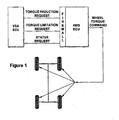
- Figure 1 is a schematic representation of request deployment within the present invention
- FIG. 2 is a flowchart showing method steps of the present invention
- FIG. 3 is a flowchart showing integration within the present invention.
- FIGS 4-8 are schematic representations of system embodiments of the present invention.
- This invention provides a deployment firewall that screens request signals sent by a vehicle VSA ECU and prevents any signal that would place the vehicle into an unstable condition from being implemented by a vehicle 4WD ECU without modification.
- the VSA ECU and 4WD ECU are Installed on a vehicle having four wheel drive and means for adjusting the torque at each wheel.
- Request signals are sent from the VSA ECU to the 4WD ECU, the request signals include torque reduction requests, torque limitation requests and status requests.
- the request Before the 4WD ECU can act on the requests sent by the VSA ECU the request must pass through a virtual firewall.
- the requests are integrated with torque requests from the 4WD ECU that were generated independent from the VSA ECU.
- the resultant torque requests are then implemented as instructions to vary the torque at individual wheels.
- Minimum Torque Value and “Maximum Allowable Control Release Rate”: The system continuously calculates a "minimum allowable torque” value and a “maximum allowable control release rate". The values for minimum allowable torque and maximum allowable control release rate vary depending upon the drive torque requested by the 4WD ECU alone and the vehicle speed. Specifically, the minimum allowable torque is calculated based on the status of the 4WD system, vehicle dynamics, etc.
- Control Permission Speeds are used as thresholds for implementing two Speed Range Coefficients (see below) that prevent high speed mis-operation of the cooperative control system.
- Control permission speed is the sum of wheel speed signals received from each of the four vehicle wheels minus the sum of maximum and minimum values of the same wheel speed signals. The sum is divided by two. ⁇ Speeds ( wheel 1 - 4 ) - ( Max . whell speed + Min . whell speed ) 2 This calculation reduces the influence of a single wheel speed sensor failure on the calculated control permission speed.
- Speed Range Coefficients For the purposes of low speed traction and stability, and to avoid high-speed mis-operation of the cooperative VSA and 4WD systems, a speed range coefficient is calculated to scale both incoming torque limitation and reduction requests from the VSA ECU.
- the VSA torque reduction request is scaled down within certain ranges of calculated control permission speed by multiplying the VSA torque reduction request value by a weighting factor having a value between 1.0 and zero.
- the weighting factor is 1.0 from a control permission speed of zero to a lower threshold vehicle permission speed. Between the lower threshold permission speed and an upper threshold permission speed, the weighting factor moves linearly from 1.0 to zero. Above the upper threshold permission speed the weighting factor is zero, causing the VSA torque reduction request to be zero as well.
- the VSA torque limitation request is also scaled down within certain ranges of calculated control permission speed.
- the VSA torque limitation request value is multiplied by a weighting factor having a value between 1.0 and zero. Similar to the weighting factor used with the VSA torque reduction request, the torque limitation scaling factor is 1.0 from a vehicle control permission speed of zero to a lower threshold control permission speed.
- the lower threshold control permission speed may be the same speed or a different speed as compared to the speed where the torque reduction weighting factor begins decreasing. Between the lower threshold permission speed and an upper threshold permission speed, the weighting factor moves linearly to zero. Above the upper threshold permission speed the weighting factor is zero.
- the upper threshold vehicle permission speed may be the same speed or a different speed as compared to the speed where the torque reduction weighting factor reaches zero.
- Torque Release Rate The system includes a torque release rate that limits how fast the resultant torque can change when, during vehicle operation, the VSA system fails or is turned off. In this situation an existing torque request from the VSA system is instantaneously removed. The change from the VSA requested torque level to the level without any VSA request often can not be instantaneous, however, for safety reasons. Thus, a maximum torque release rate dictates how fast the level change occurs.
- a firewall in a system deploying a torque reduction or torque limitation request is shown.
- the reduction or limitation request is sent by the VSA ECU.
- the operational status of the VSA system is confirmed. Only if the VSA system is in an operational state will the request be implemented.
- the request is scaled based on the speed coefficients and control permission speed, as described above.
- the request is compared to a maximum torque release rate level, if present, for the reasons described above, and integrated with the 4WD wheel torque requests to provide a resultant individual wheel torque command.
- FIG. 3 the process of integration is illustrated for embodiments where a torque reduction request is sent by the VSA ECU.
- the 4WD torque request is multiplied by 1 minus the minimum allowable torque percentage and compared to the VSA torque request.
- the minimum value of this comparison is subtracted from the 4WD torque request and compared to the 4WD torque request multiplied times the minimum allowable torque percentage.
- the maximum value of this comparison is the resultant torque request.
- Figures 4-8 illustrate the system of the present invention comparison and integration steps in different embodiments, for example the VSA ECU requests torque limitation or torque reduction, the system embodiment optionally including a minimum allowable torque and/or torque release rate. It will be appreciated that within Figures 4-8 lines/curves representing equivalent values are shown directly adjacent to one another and not in an overlapping fashion.
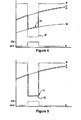
- FIG. 4 a system embodiment is shown wherein the VSA ECU requests torque limitation, the system also including a minimum allowable torque value.
- Curve A illustrates the individual wheel torque requested by the 4WD ECU alone.
- Line B illustrates the individual wheel torque requested by the VSA ECU alone,
- Line S shows the operational status (On/Off) of the VSA system.
- the VSA monitors operating parameters of the vehicle and, in response to these parameters, is activated to request torque limitation for individual wheels so as to selectively modify the torque of each wheel. Note when the VSA is operational, a request to limit torque is generated, thus, the torque requested by the VSA system (line B) drops.from a constant higher value (no limiting) to a lower value (limiting requested).
- Curve M illustrates the minimum allowable torque imposed by the 4WD.
- the resultant torque request shown as line “C” is the torque requested by the 4WD ECU alone.
- the resultant torque request "C” is equivalent to the minimum allowable torque.
- the resultant torque request "C” returns to a value equivalent to the request made by the 4WD ECU alone.
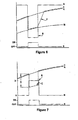
- a system embodiment that includes a minimum allowable torque value and a maximum rate of control release.
- the control release rate is the amount of resultant torque request change from when the VSA system is operating to when the VSA is not operating divided by the time in which this torque request change is implemented.
- the embodiments of Figures 4 and 5 illustrate systems where there was no limit on the control release rate, thus, when the VSA system became non-operational, the torque requested changed instantaneously from the minimum allowable torque ( Figure 4) or VSA requested torque ( Figure 5) to the 4WD requested torque.
- the change is not instantaneous, but rather is defined by the slope of line "C", specifically the maximum slope of line "C" immediately after the VSA system is turned off.
- the resultant torque "C” is equivalent to the torque requested by the 4WD ECU.
- the resultant torque "C” is equivalent to the minimum allowable torque "M”.
- the VSA is turned off the resultant torque "C” proceeds back to the torque requested by the 4WD ECU at the rate of control release.
- Curve A illustrates the individual wheel torque requested by the 4WD ECU alone.
- Line B illustrates the individual wheel torque reduction amount requested by the VSA ECU.
- Line S shows the operational status (On/Off) of the VSA system. Note when the VSA is operational, a request to reduce torque is generated, thus, the reduction rises from zero to X.
- the resultant torque request, shown as line "C" is equivalent the individual wheel torque requested by the 4WD ECU alone minus the reduction amount, X.
- a system embodiment is shown wherein the VSA system again requests torque reduction, the system also including a minimum allowable torque value.
- Curve A illustrates the individual wheel torque requested by the 4WD ECU alone.
- Line B illustrates the individual wheel torque reduction amount requested by the VSA ECU alone.
- Curve M illustrates the minimum allowable torque. Because the minimum allowable torque is a value greater than the resultant torque caused by the reduction requested by the VSA ECU, when the VSA ECU is operational, the resultant torque request, shown as line "C", is equivalent to the minimum allowable torque.
- the system embodiment also includes a minimum rate of control release.
- the control release rate is the amount of torque request change from when the VSA system is operating to when the VSA is not operating divided by the time in which this torque change is implemented.
Landscapes
- Engineering & Computer Science (AREA)
- Automation & Control Theory (AREA)
- Transportation (AREA)
- Mechanical Engineering (AREA)
- Combustion & Propulsion (AREA)
- Physics & Mathematics (AREA)
- Chemical & Material Sciences (AREA)
- Mathematical Physics (AREA)
- Human Computer Interaction (AREA)
- Control Of Driving Devices And Active Controlling Of Vehicle (AREA)
- Arrangement And Driving Of Transmission Devices (AREA)
- Combined Controls Of Internal Combustion Engines (AREA)
- Regulating Braking Force (AREA)
Abstract
Description
- The present invention is directed toward a method of receiving torque reduction or torque limitation requests in a vehicle control system.
- Synergistic operation of multipie vehicle control systems is preferred and a method to provide such operation is provided through a cooperative control system. In a typical cooperative control system design, a top level electronic control unit (ECU) having a top level algorithm evaluates and controls the overall strategy for vehicle dynamics such as traction control, stability control, body motion control, etc. The top level ECU then controls ECUs within individual vehicle control systems to meet the goals of the overall strategy.
- The cooperative control system may include a vehicle stability assist (hereinafter VSA) individual control system. The VSA system is controlled by an ECU subordinate to the top level ECU. The VSA system works by controlling brake pressure, engine torque, and/or individual wheel torque to help maintain traction between the vehicle wheels and a road surface. Specifically, detrimental effects caused by oversteer and understeer can be combated through adjustment of the torques and brake pressure. The VSA system ECU, in turn, sends commands and requests to other systems, for example, the vehicle's four-wheel-drive (4WD) system. An ECU dedicated to the 4WD system receives and implements the commands and requests sent by the VSA ECU.
- However, because the 4WD system is strongly manipulated by feed-forward control whereas the VSA system is not, requests sent from the VSA system to the 4WD system are often contradictory to requests provided directly by the 4WD system. As a result, in combination, the VSA and 4WD systems may not perform efficiently. Additionally, erroneous requests supplied by the VSA system can be implemented by the 4WD system without being checked.
- The present invention provides an improvement over the prior art by providing a method that provides a better rounded performance envelops between the VSA system and 4WD system. Additionally, requests sent from the VSA system to the 4WD system must pass additional scrutiny before being implemented. The present invention is directed toward a method of deploying torque reduction and torque limitation commands from a VSA ECU to a vehicle 4WD system that avoids any conditions that could become unsafe.
- According to the present invention, a method for deploying torque commands from a vehicle stability assist control system to a four wheel drive system in a vehicle is provided that includes the step of utilizing a firewall within a four wheel drive system electronic control unit to analyze commands sent from a vehicle stability assist electronic control unit to the four wheel drive electronic control unit. Additionally, the method includes the step of integrating the commands from the vehicle stability assist electronic control unit, when the vehicle control system is in operation, with commands independently generated by the four wheel drive electronic control unit, and generating resultant wheel torque commands to be provided to each individual wheel in the four wheel drive system.
- The commands sent from the vehicle stability assist control system may be requests to reduce vehicle torque or limit vehicle torque. These and other aspects of the invention are herein described in particularized detail with reference to the accompanying figures.
- Figure 1 is a schematic representation of request deployment within the present invention;
- Figure 2 is a flowchart showing method steps of the present invention;
- Figure 3 is a flowchart showing integration within the present invention; and
- Figures 4-8 are schematic representations of system embodiments of the present invention.
- This invention provides a deployment firewall that screens request signals sent by a vehicle VSA ECU and prevents any signal that would place the vehicle into an unstable condition from being implemented by a vehicle 4WD ECU without modification.
- With reference to Figure 1, a system for deploying torque reduction and torque limitation commands is illustrated. The VSA ECU and 4WD ECU are Installed on a vehicle having four wheel drive and means for adjusting the torque at each wheel. Request signals are sent from the VSA ECU to the 4WD ECU, the request signals include torque reduction requests, torque limitation requests and status requests. Before the 4WD ECU can act on the requests sent by the VSA ECU the request must pass through a virtual firewall.
- After the torque requests from the VSA ECU have been modified, if necessary, the requests are integrated with torque requests from the 4WD ECU that were generated independent from the VSA ECU. The resultant torque requests are then implemented as instructions to vary the torque at individual wheels.
- "Minimum Torque Value" and "Maximum Allowable Control Release Rate": The system continuously calculates a "minimum allowable torque" value and a "maximum allowable control release rate". The values for minimum allowable torque and maximum allowable control release rate vary depending upon the drive torque requested by the 4WD ECU alone and the vehicle speed. Specifically, the minimum allowable torque is calculated based on the status of the 4WD system, vehicle dynamics, etc.
- "Control Permission Speeds": Control permission speeds are used as thresholds for implementing two Speed Range Coefficients (see below) that prevent high speed mis-operation of the cooperative control system. Control permission speed is the sum of wheel speed signals received from each of the four vehicle wheels minus the sum of maximum and minimum values of the same wheel speed signals. The sum is divided by two.

- "Speed Range Coefficients": For the purposes of low speed traction and stability, and to avoid high-speed mis-operation of the cooperative VSA and 4WD systems, a speed range coefficient is calculated to scale both incoming torque limitation and reduction requests from the VSA ECU.
- The VSA torque reduction request is scaled down within certain ranges of calculated control permission speed by multiplying the VSA torque reduction request value by a weighting factor having a value between 1.0 and zero. The weighting factor is 1.0 from a control permission speed of zero to a lower threshold vehicle permission speed. Between the lower threshold permission speed and an upper threshold permission speed, the weighting factor moves linearly from 1.0 to zero. Above the upper threshold permission speed the weighting factor is zero, causing the VSA torque reduction request to be zero as well.
- The VSA torque limitation request is also scaled down within certain ranges of calculated control permission speed. The VSA torque limitation request value is multiplied by a weighting factor having a value between 1.0 and zero. Similar to the weighting factor used with the VSA torque reduction request, the torque limitation scaling factor is 1.0 from a vehicle control permission speed of zero to a lower threshold control permission speed. The lower threshold control permission speed may be the same speed or a different speed as compared to the speed where the torque reduction weighting factor begins decreasing. Between the lower threshold permission speed and an upper threshold permission speed, the weighting factor moves linearly to zero. Above the upper threshold permission speed the weighting factor is zero. The upper threshold vehicle permission speed may be the same speed or a different speed as compared to the speed where the torque reduction weighting factor reaches zero.
- "Torque Release Rate": The system includes a torque release rate that limits how fast the resultant torque can change when, during vehicle operation, the VSA system fails or is turned off. In this situation an existing torque request from the VSA system is instantaneously removed. The change from the VSA requested torque level to the level without any VSA request often can not be instantaneous, however, for safety reasons. Thus, a maximum torque release rate dictates how fast the level change occurs.
- Referring to Figure 2, general operation of a firewall in a system deploying a torque reduction or torque limitation request is shown. In a first step, the reduction or limitation request is sent by the VSA ECU. In a second step, the operational status of the VSA system is confirmed. Only if the VSA system is in an operational state will the request be implemented, In a third step, the request is scaled based on the speed coefficients and control permission speed, as described above. In a fourth step, the request is compared to a maximum torque release rate level, if present, for the reasons described above, and integrated with the 4WD wheel torque requests to provide a resultant individual wheel torque command.
- Referring to Figure 3, the process of integration is illustrated for embodiments where a torque reduction request is sent by the VSA ECU. The 4WD torque request is multiplied by 1 minus the minimum allowable torque percentage and compared to the VSA torque request. The minimum value of this comparison is subtracted from the 4WD torque request and compared to the 4WD torque request multiplied times the minimum allowable torque percentage. The maximum value of this comparison is the resultant torque request A similar integration method is used for both torque limitation requests and reduction requests.
- Figures 4-8 illustrate the system of the present invention comparison and integration steps in different embodiments, for example the VSA ECU requests torque limitation or torque reduction, the system embodiment optionally including a minimum allowable torque and/or torque release rate. It will be appreciated that within Figures 4-8 lines/curves representing equivalent values are shown directly adjacent to one another and not in an overlapping fashion.
- Referring to Figure 4, a system embodiment is shown wherein the VSA ECU requests torque limitation, the system also including a minimum allowable torque value. Curve A illustrates the individual wheel torque requested by the 4WD ECU alone. Line B illustrates the individual wheel torque requested by the VSA ECU alone, Line S shows the operational status (On/Off) of the VSA system. The VSA monitors operating parameters of the vehicle and, in response to these parameters, is activated to request torque limitation for individual wheels so as to selectively modify the torque of each wheel. Note when the VSA is operational, a request to limit torque is generated, thus, the torque requested by the VSA system (line B) drops.from a constant higher value (no limiting) to a lower value (limiting requested). Curve M illustrates the minimum allowable torque imposed by the 4WD. Before the VSA is turned on the resultant torque request shown as line "C" is the torque requested by the 4WD ECU alone. In the illustrated embodiment, because the minimum allowable torque is a value greater than the torque requested by the VSA ECU, when the VSA ECU is operational, the resultant torque request "C", is equivalent to the minimum allowable torque. When the VSA is turned off, the resultant torque request "C" returns to a value equivalent to the request made by the 4WD ECU alone.
- Referring to Figure 5, a similar embodiment is shown wherein the VSA system requests torque limitation; however, the embodiment does not include a minimum allowable torque. Thus, when the VSA is active the resultant torque request "C" is equivalent to the torque requested by the VSA ECU, "B".
- Referring to Figure 6, a system embodiment is shown that includes a minimum allowable torque value and a maximum rate of control release. The control release rate is the amount of resultant torque request change from when the VSA system is operating to when the VSA is not operating divided by the time in which this torque request change is implemented. The embodiments of Figures 4 and 5 illustrate systems where there was no limit on the control release rate, thus, when the VSA system became non-operational, the torque requested changed instantaneously from the minimum allowable torque (Figure 4) or VSA requested torque (Figure 5) to the 4WD requested torque. In the system illustrated in Figure 6, the change is not instantaneous, but rather is defined by the slope of line "C", specifically the maximum slope of line "C" immediately after the VSA system is turned off. Thus, prior to the VSA being turned on, the resultant torque "C" is equivalent to the torque requested by the 4WD ECU. When the VSA is turned on, the resultant torque "C" is equivalent to the minimum allowable torque "M". When the VSA is turned off the resultant torque "C" proceeds back to the torque requested by the 4WD ECU at the rate of control release.
- Referring to Figure 7, a system embodiment is shown wherein the VSA ECU requests torque reduction as opposed to limitation. Curve A illustrates the individual wheel torque requested by the 4WD ECU alone. Line B illustrates the individual wheel torque reduction amount requested by the VSA ECU. Line S shows the operational status (On/Off) of the VSA system. Note when the VSA is operational, a request to reduce torque is generated, thus, the reduction rises from zero to X. The resultant torque request, shown as line "C", is equivalent the individual wheel torque requested by the 4WD ECU alone minus the reduction amount, X.
- Referring to Figure 8, a system embodiment is shown wherein the VSA system again requests torque reduction, the system also including a minimum allowable torque value. Curve A illustrates the individual wheel torque requested by the 4WD ECU alone. Line B illustrates the individual wheel torque reduction amount requested by the VSA ECU alone. Curve M illustrates the minimum allowable torque. Because the minimum allowable torque is a value greater than the resultant torque caused by the reduction requested by the VSA ECU, when the VSA ECU is operational, the resultant torque request, shown as line "C", is equivalent to the minimum allowable torque. The system embodiment also includes a minimum rate of control release. The control release rate is the amount of torque request change from when the VSA system is operating to when the VSA is not operating divided by the time in which this torque change is implemented.
- Although the invention has been shown and described with reference to certain preferred and alternate embodiments, the invention is not limited to these specific embodiments. Minor variations and insubstantial differences in the various combinations of materials and methods of application may occur to those of ordinary skill in the art while remaining within the scope of the invention as claimed and equivalents.
Claims (12)
- A method for deploying torque commands from a vehicle stability assist control system to a four wheel drive system in a vehicle comprising the steps of:utilizing a firewall within a four wheel drive system electronic control unit to analyze commands sent from a vehicle stability assist electronic control unit to the four wheel drive electronic control unit;integrating the commands from the vehicle stability assist electronic control unit, when the vehicle control system is in operation, with commands independently generated by the four wheel drive electronic control unit; andgenerating resultant wheel torque commands to be provided to each individual wheel in the four wheel drive system.
- The method of claim 1, wherein analysis performed by the firewall includes confirming that the vehicle control system is operating.
- The method of claim 1 or 2, further including the step of scaling the torque commands from the vehicle stability assist electronic control unit based on the speed of the vehicle.
- The method of any one of claims 1 to 3, wherein the commands sent from the vehicle stability assist control system are requests to limit wheel torques.
- The method of any one of claims 1 to 4, wherein the commands sent from the vehicle stability assist control system are requests to reduce wheel torques.
- The method of claim 4 or 5, wherein when the vehicle stability assist control system is operational the resultant wheel torque command is the vehicle stability assist command.
- The method of claim 4 or 5, further including the step of calculating a minimum torque value and wherein when the vehicle stability assist control system is operational the resultant wheel torque command is the greater of the vehicle stability assist command and the minimum torque value.
- The method of any one of claims 4 to 7, further including the step of calculating a maximum torque release rate and when the operational status of the VSA changes from operational to non-operational, maintaining the rate of resultant torque change below the maximum torque release rate.
- The method of claim 5, wherein when the vehicle stability assist control system is operational the resultant wheel torque command is torque value of the command independently generated by the four wheel drive electronic control unit minus the torque value of vehicle stability assist command.
- The method of claim 5, further including the step of calculating a minimum torque value and wherein when the vehicle stability assist control system is operational the resultant wheel torque command is the greater torque value of the command independently generated by the four wheel drive electronic control unit minus the torque value of vehicle stability assist command and the minimum torque value.
- The method of claim 5, further including the step of calculating a maximum torque release rate and when the operational status of the VSA changes from operational to non-operational, maintaining the rate of resultant torque change below the maximum torque release rate.
- The method of claim 3, wherein the speed of the vehicle is a control permission speed calculated by the steps of:adding the values of wheel speed signals received from each of the vehicle's four wheels to provide a first speed sum;adding the value of the maximum and minimum speed signals of said four wheel speed signals to provide a second speed sum; andsubtracting the second speed sum from the first speed sum and dividing the difference by two.
Applications Claiming Priority (2)
| Application Number | Priority Date | Filing Date | Title |
|---|---|---|---|
| US66338505P | 2005-03-18 | 2005-03-18 | |
| US11/328,910 US7634342B2 (en) | 2005-03-18 | 2006-01-10 | Method for deploying a torque reduction and torque limitation command through per wheel torque control of a controllable 4-wheel-drive system |
Publications (2)
| Publication Number | Publication Date |
|---|---|
| EP1702824A1 true EP1702824A1 (en) | 2006-09-20 |
| EP1702824B1 EP1702824B1 (en) | 2009-08-12 |
Family
ID=36581613
Family Applications (1)
| Application Number | Title | Priority Date | Filing Date |
|---|---|---|---|
| EP06005257A Expired - Lifetime EP1702824B1 (en) | 2005-03-18 | 2006-03-15 | Torque control in a 4-wheel-drive vehicle with a 4WD control unit and a vehicle stability assist control unit |
Country Status (4)
| Country | Link |
|---|---|
| US (1) | US7634342B2 (en) |
| EP (1) | EP1702824B1 (en) |
| JP (1) | JP4358196B2 (en) |
| DE (1) | DE602006008366D1 (en) |
Families Citing this family (14)
| Publication number | Priority date | Publication date | Assignee | Title |
|---|---|---|---|---|
| US7769520B2 (en) * | 2003-10-27 | 2010-08-03 | Ford Global Technologies, Llc | Tractive force map |
| US8055425B2 (en) * | 2008-03-14 | 2011-11-08 | Ford Global Technologies, Llc | Increased capability modular vehicle-dynamics control architecture |
| DE102010014971B4 (en) * | 2010-04-14 | 2016-05-04 | Audi Ag | Method for operating a motor vehicle with at least two drives and motor vehicle with at least two drives |
| US8548642B2 (en) | 2011-03-30 | 2013-10-01 | Nissin Kogyo Co., Ltd. | Control device for controlling drive force that acts on vehicle |
| US8386143B2 (en) | 2011-03-30 | 2013-02-26 | Nissin Kogyo Co., Ltd. | Control device for controlling drive force that operates on vehicle |
| US8554435B2 (en) | 2011-03-30 | 2013-10-08 | Nissin Kogyo Co., Ltd. | Control device for controlling drive force that operates on vehicle |
| US8725377B2 (en) | 2011-03-30 | 2014-05-13 | Nissin Kogyo Co., Ltd. | Control device for controlling drive force that operates on vehicle |
| US8219296B1 (en) | 2011-03-30 | 2012-07-10 | Nissin Kogyo Co., Ltd. | Control device for controlling drive force that operates on vehicle |
| US8744710B2 (en) * | 2011-03-30 | 2014-06-03 | Nissin Kogyo Co., Ltd. | Control device for controlling drive force that operates on vehicle |
| US8332112B2 (en) * | 2011-03-30 | 2012-12-11 | Nissin Kogyo Co., Ltd. | Control device for controlling drive force that operates on vehicle |
| US8682556B2 (en) * | 2011-03-30 | 2014-03-25 | Nissin Kogyo Co., Ltd. | Control device for controlling drive force that operates on vehicle |
| US9434251B2 (en) | 2014-07-17 | 2016-09-06 | Honda Motor Co., Ltd. | All-wheel drive failsafe action axle torque calculation method |
| JP6649478B2 (en) * | 2016-05-27 | 2020-02-19 | 本田技研工業株式会社 | Electric vehicle |
| US11794588B2 (en) | 2021-02-04 | 2023-10-24 | Ford Global Technologies, Llc | Feedforward torque limit for electrified powertrain |
Citations (6)
| Publication number | Priority date | Publication date | Assignee | Title |
|---|---|---|---|---|
| US6254204B1 (en) * | 1998-08-07 | 2001-07-03 | Toyota Jidosha Kabushiki Kaisha | Device for measuring longitudinal acceleration of vehicle immune to static and dynamic errors |
| US20020002436A1 (en) * | 2000-04-06 | 2002-01-03 | Honda Giken Kogyo Kabushiki Kaisha | Driving force control system for four-wheel drive vehicles |
| US6397282B1 (en) * | 1998-04-07 | 2002-05-28 | Honda Giken Kogyo Kabushikikaisha | Communication controller for transferring data in accordance with the data type |
| DE10241455A1 (en) * | 2002-09-07 | 2004-03-18 | Robert Bosch Gmbh | Velocity regulation method for automobile with limitation of maximal required acceleration delivered by distance and velocity regulator during operation of drive slip regulation system |
| DE10244519A1 (en) * | 2002-09-25 | 2004-04-15 | Bayerische Motoren Werke Ag | Method for regulating and / or controlling an engine transmission unit in a motor vehicle |
| EP1493608A2 (en) * | 2003-07-04 | 2005-01-05 | HONDA MOTOR CO., Ltd. | Control apparatus for hybrid vehicle |
Family Cites Families (24)
| Publication number | Priority date | Publication date | Assignee | Title |
|---|---|---|---|---|
| JP3095076B2 (en) * | 1990-07-09 | 2000-10-03 | 日産自動車株式会社 | Vehicle traction control device |
| JPH04240997A (en) * | 1991-01-25 | 1992-08-28 | Fuji Heavy Ind Ltd | Control method for on-vehicle electronic device |
| JP3409439B2 (en) * | 1994-06-17 | 2003-05-26 | 日産自動車株式会社 | Driving force distribution control system for left and right wheels and front and rear wheels |
| US6059065A (en) * | 1996-08-06 | 2000-05-09 | Denso Corporation | Driving torque control method and apparatus for a four-wheel drive vehicle |
| JPH10287201A (en) * | 1997-04-15 | 1998-10-27 | Kansei Corp | Multiple communication device |
| JP4215861B2 (en) | 1997-08-11 | 2009-01-28 | 富士重工業株式会社 | Power distribution control device for four-wheel drive vehicles |
| DE69935090T2 (en) * | 1998-06-09 | 2007-11-15 | Fuji Jukogyo K.K. | Torque distribution control system for a four-wheel drive vehicle |
| US6161071A (en) * | 1999-03-12 | 2000-12-12 | Navigation Technologies Corporation | Method and system for an in-vehicle computing architecture |
| CA2339448C (en) | 2000-03-30 | 2007-11-06 | Honda Giken Kogyo Kabushiki Kaisha | Driving force control system for four-wheel drive vehicles |
| JP4456748B2 (en) | 2000-10-27 | 2010-04-28 | 富士重工業株式会社 | Power distribution control device for four-wheel drive vehicles |
| JP3840061B2 (en) | 2001-04-16 | 2006-11-01 | 株式会社ジェイテクト | Four-wheel drive vehicle |
| JP3994821B2 (en) * | 2001-10-19 | 2007-10-24 | 株式会社デンソー | Vehicle communication system |
| JP3867585B2 (en) | 2001-12-05 | 2007-01-10 | 日産自動車株式会社 | Driving force distribution control device for four-wheel drive vehicle |
| JP3794318B2 (en) * | 2001-12-11 | 2006-07-05 | 日産自動車株式会社 | Driving force distribution control device for four-wheel drive vehicle |
| EP1356975B1 (en) | 2002-04-23 | 2009-12-16 | Jtekt Corporation | Torque distribution control device for four-wheel drive vehicle |
| WO2003095261A1 (en) * | 2002-05-07 | 2003-11-20 | Kabushiki Kaisha Bridgestone | Method and device for controlling vehicle |
| KR100514832B1 (en) | 2002-09-10 | 2005-09-14 | 현대자동차주식회사 | method for controlling safe mode in 4 wheel drive vehicle |
| JP2004106649A (en) * | 2002-09-17 | 2004-04-08 | Fuji Heavy Ind Ltd | Power distribution control device for four-wheel drive vehicle |
| JP3903923B2 (en) * | 2003-01-30 | 2007-04-11 | 株式会社デンソー | Control system and charge control system |
| US7092808B2 (en) * | 2003-02-26 | 2006-08-15 | Ford Global Technologies, Llc | Integrated sensing system for an automotive system |
| US6909959B2 (en) * | 2003-03-07 | 2005-06-21 | Stephen James Hallowell | Torque distribution systems and methods for wheeled vehicles |
| US6923514B1 (en) * | 2003-03-12 | 2005-08-02 | Kelsey-Hayes Company | Electronic brake control system |
| US6862511B1 (en) | 2003-09-11 | 2005-03-01 | Ford Global Technologies, Llc | Vehicle torque coordination |
| US6907337B2 (en) * | 2003-09-11 | 2005-06-14 | Ford Global Technologies, Llc | Vehicle torque resolution |
-
2006
- 2006-01-10 US US11/328,910 patent/US7634342B2/en active Active
- 2006-03-15 EP EP06005257A patent/EP1702824B1/en not_active Expired - Lifetime
- 2006-03-15 DE DE602006008366T patent/DE602006008366D1/en not_active Expired - Lifetime
- 2006-03-15 JP JP2006071405A patent/JP4358196B2/en not_active Expired - Fee Related
Patent Citations (6)
| Publication number | Priority date | Publication date | Assignee | Title |
|---|---|---|---|---|
| US6397282B1 (en) * | 1998-04-07 | 2002-05-28 | Honda Giken Kogyo Kabushikikaisha | Communication controller for transferring data in accordance with the data type |
| US6254204B1 (en) * | 1998-08-07 | 2001-07-03 | Toyota Jidosha Kabushiki Kaisha | Device for measuring longitudinal acceleration of vehicle immune to static and dynamic errors |
| US20020002436A1 (en) * | 2000-04-06 | 2002-01-03 | Honda Giken Kogyo Kabushiki Kaisha | Driving force control system for four-wheel drive vehicles |
| DE10241455A1 (en) * | 2002-09-07 | 2004-03-18 | Robert Bosch Gmbh | Velocity regulation method for automobile with limitation of maximal required acceleration delivered by distance and velocity regulator during operation of drive slip regulation system |
| DE10244519A1 (en) * | 2002-09-25 | 2004-04-15 | Bayerische Motoren Werke Ag | Method for regulating and / or controlling an engine transmission unit in a motor vehicle |
| EP1493608A2 (en) * | 2003-07-04 | 2005-01-05 | HONDA MOTOR CO., Ltd. | Control apparatus for hybrid vehicle |
Also Published As
| Publication number | Publication date |
|---|---|
| JP2006256605A (en) | 2006-09-28 |
| US20060212173A1 (en) | 2006-09-21 |
| US7634342B2 (en) | 2009-12-15 |
| JP4358196B2 (en) | 2009-11-04 |
| DE602006008366D1 (en) | 2009-09-24 |
| EP1702824B1 (en) | 2009-08-12 |
Similar Documents
| Publication | Publication Date | Title |
|---|---|---|
| US8740317B2 (en) | Closed-loop control for trailer sway mitigation | |
| EP1702824A1 (en) | Torque control in a 4-wheel-drive vehicle with a 4WD control unit and a vehicle stability assist control unit | |
| US20040267428A1 (en) | Method for coordinating a vehicle dynamics control system with an active normal force adjustment system | |
| US9895978B2 (en) | Braking force control method for vehicle | |
| US20100056338A1 (en) | Method for Compensating the Braking Deceleration in a Vehicle Control | |
| KR102881929B1 (en) | Electronic stability control method for vehicle | |
| JP2005529788A (en) | Method and apparatus for cooperatively controlling at least two systems that affect the driving behavior of an automobile | |
| US10744875B2 (en) | Control device for torque distributor | |
| KR102805124B1 (en) | Wheel slip control method for vehicle | |
| US7698034B2 (en) | Integrating active front steering and vehicle stability brake control | |
| JP5080712B2 (en) | Method and apparatus for controlling at least one vehicle motion parameter | |
| KR101288749B1 (en) | Driving condition adapted to the steering engagement based on vehicle dynamic control | |
| US7502675B2 (en) | Feedforward control of motor vehicle roll angle | |
| WO2006093244A1 (en) | Braking-driving force control device of vehicle | |
| JP5630087B2 (en) | Vehicle behavior control apparatus and method | |
| US11548393B2 (en) | Braking method and system for an electric vehicle | |
| US8204669B2 (en) | Method and device for regulating the driving dynamics of a vehicle | |
| US20060155454A1 (en) | Method for improving the handling characteristic of a vehicle during emergency braked driving | |
| US6691014B2 (en) | Method and device for controlling the cornering speed of a vehicle | |
| CN101107154A (en) | Device and method for controlling driving dynamics in a vehicle | |
| US6757595B1 (en) | Method to mitigate vehicle roll oscillations by limiting the rate of recovery of the lateral component of the tire force vector | |
| CN102458950B (en) | Method for generating a differential torque acting on the vehicle wheels of a vehicle | |
| JP2008517224A (en) | Method and apparatus for controlling the lock level of an electronically controllable differential lock mechanism | |
| US8500219B2 (en) | Method and device for stabilizing a vehicle | |
| JP2019116142A (en) | Vehicle behavior control device |
Legal Events
| Date | Code | Title | Description |
|---|---|---|---|
| PUAI | Public reference made under article 153(3) epc to a published international application that has entered the european phase |
Free format text: ORIGINAL CODE: 0009012 |
|
| AK | Designated contracting states |
Kind code of ref document: A1 Designated state(s): AT BE BG CH CY CZ DE DK EE ES FI FR GB GR HU IE IS IT LI LT LU LV MC NL PL PT RO SE SI SK TR |
|
| AX | Request for extension of the european patent |
Extension state: AL BA HR MK YU |
|
| 17P | Request for examination filed |
Effective date: 20070316 |
|
| AKX | Designation fees paid |
Designated state(s): DE FR GB |
|
| 17Q | First examination report despatched |
Effective date: 20070504 |
|
| GRAP | Despatch of communication of intention to grant a patent |
Free format text: ORIGINAL CODE: EPIDOSNIGR1 |
|
| GRAS | Grant fee paid |
Free format text: ORIGINAL CODE: EPIDOSNIGR3 |
|
| GRAA | (expected) grant |
Free format text: ORIGINAL CODE: 0009210 |
|
| AK | Designated contracting states |
Kind code of ref document: B1 Designated state(s): DE FR GB |
|
| REG | Reference to a national code |
Ref country code: GB Ref legal event code: FG4D |
|
| REF | Corresponds to: |
Ref document number: 602006008366 Country of ref document: DE Date of ref document: 20090924 Kind code of ref document: P |
|
| PLBE | No opposition filed within time limit |
Free format text: ORIGINAL CODE: 0009261 |
|
| STAA | Information on the status of an ep patent application or granted ep patent |
Free format text: STATUS: NO OPPOSITION FILED WITHIN TIME LIMIT |
|
| 26N | No opposition filed |
Effective date: 20100517 |
|
| PGFP | Annual fee paid to national office [announced via postgrant information from national office to epo] |
Ref country code: FR Payment date: 20130325 Year of fee payment: 8 Ref country code: GB Payment date: 20130313 Year of fee payment: 8 |
|
| GBPC | Gb: european patent ceased through non-payment of renewal fee |
Effective date: 20140315 |
|
| REG | Reference to a national code |
Ref country code: FR Ref legal event code: ST Effective date: 20141128 |
|
| PG25 | Lapsed in a contracting state [announced via postgrant information from national office to epo] |
Ref country code: FR Free format text: LAPSE BECAUSE OF NON-PAYMENT OF DUE FEES Effective date: 20140331 Ref country code: GB Free format text: LAPSE BECAUSE OF NON-PAYMENT OF DUE FEES Effective date: 20140315 |
|
| PGFP | Annual fee paid to national office [announced via postgrant information from national office to epo] |
Ref country code: DE Payment date: 20220118 Year of fee payment: 17 |
|
| REG | Reference to a national code |
Ref country code: DE Ref legal event code: R119 Ref document number: 602006008366 Country of ref document: DE |
|
| PG25 | Lapsed in a contracting state [announced via postgrant information from national office to epo] |
Ref country code: DE Free format text: LAPSE BECAUSE OF NON-PAYMENT OF DUE FEES Effective date: 20231003 |