EP1701522B1 - Vorrichtung zum manuellen Funktionstest eines drahtlosen Gerätes - Google Patents
Vorrichtung zum manuellen Funktionstest eines drahtlosen Gerätes Download PDFInfo
- Publication number
- EP1701522B1 EP1701522B1 EP05101729A EP05101729A EP1701522B1 EP 1701522 B1 EP1701522 B1 EP 1701522B1 EP 05101729 A EP05101729 A EP 05101729A EP 05101729 A EP05101729 A EP 05101729A EP 1701522 B1 EP1701522 B1 EP 1701522B1
- Authority
- EP
- European Patent Office
- Prior art keywords
- wireless device
- retainer
- battery
- fixture
- base
- Prior art date
- Legal status (The legal status is an assumption and is not a legal conclusion. Google has not performed a legal analysis and makes no representation as to the accuracy of the status listed.)
- Expired - Lifetime
Links
Images




Classifications
-
- H—ELECTRICITY
- H04—ELECTRIC COMMUNICATION TECHNIQUE
- H04M—TELEPHONIC COMMUNICATION
- H04M1/00—Substation equipment, e.g. for use by subscribers
- H04M1/24—Arrangements for testing
-
- H—ELECTRICITY
- H04—ELECTRIC COMMUNICATION TECHNIQUE
- H04M—TELEPHONIC COMMUNICATION
- H04M1/00—Substation equipment, e.g. for use by subscribers
- H04M1/02—Constructional features of telephone sets
- H04M1/0202—Portable telephone sets, e.g. cordless phones, mobile phones or bar type handsets
- H04M1/026—Details of the structure or mounting of specific components
- H04M1/0262—Details of the structure or mounting of specific components for a battery compartment
Definitions
- This invention relates to the field of wireless device functional testing, and more specifically, to a fixture for manual functional testing of assembled wireless devices.
- Wireless mobile communication devices include microprocessors, memory, soundcards, and run one or more software applications. Examples of software applications used in these wireless devices include micro-browsers, address books, email clients, and wavetable instruments. Additionally, wireless devices have access to a plurality of services via the Internet. A wireless device may, for example, be used to browse web sites on the Internet, to transmit and receive graphics, and to execute streaming audio and/or video applications.
- Wireless devices are typically fully tested before being shipped from a manufacturer's factory. This is especially important for the newer generations of wireless devices which have increased functionality as described above.
- test stages may include the following: manual testing (e.g., keyboard, buttons, the functions initiated by each, etc.), radio frequency ("RF") testing, electrical and software tests (e.g., charger, vibrator, software applications, display, etc.), audio testing (e.g. internal microphone, internal speaker, buzzer, etc.), environmental testing, etc.
- manual testing e.g., keyboard, buttons, the functions initiated by each, etc.
- RF radio frequency
- electrical and software tests e.g., charger, vibrator, software applications, display, etc.
- audio testing e.g. internal microphone, internal speaker, buzzer, etc.
- a fixture for functional testing of an assembled wireless device the wireless device having a data port and a removable casing concealing a battery cavity having battery contacts
- the fixture comprising: a base having an opening formed therein for receiving a retainer, the retainer being rotatably mounted in the opening for rotating from a first position to a second position, the retainer for receiving the wireless device with the removable casing removed while in the first position; a connector mounted in the retainer for engaging the data port of the wireless device when the wireless device is received by the retainer in the first position, the connector for communicating test signals with external test equipment; and a battery emulator insert rotatably mounted on the base, the battery emulator insert having power contacts for engaging the battery contacts in the battery cavity of the wireless device when the retainer is rotated to the second position, the power contacts for providing power from the external test equipment.
- the removable casing is a battery pack.
- the fixture further includes a spring coupled between the battery emulator insert and the base for controlling rotation of the battery emulator insert.
- the fixture further includes an adjustable element mounted on the base and coupled to the battery emulator insert for adjusting the battery emulator insert's position.
- the fixture further includes a plunger screw mounted on the base for engaging a ball bearing mounted on the retainer for locking the retainer in the second position.
- the fixture further includes a pair of pins mounted on the retainer for engaging a mating set of holes formed in the base to allow the retainer to rotate in the opening in the base.
- the retainer has one or more adjustable elements for engaging one or more sides of the wireless device to retain the wireless device in the retainer.
- the data port is a universal serial bus ("USB") port and the connector is a USB connector.
- USB universal serial bus
- the wireless device when received by the retainer is approximately thirty degrees from a perpendicular to the base and approximately parallel to the perpendicular to the base when the retainer is in the first and second positions, respectively.
- the serial port and removable casing are on a side and back of the wireless device, respectively.
- the fixture further includes means for attachment to an arm assembly of the external test equipment for manipulating the wireless device during the functional testing.
- the wireless device includes memory for storing a test application for directing the wireless device in response to the test signals.
- a method functional testing of an assembled wireless device comprising the steps of: providing a fixture having a base having an opening formed therein and a retainer rotatably mounted in the opening; receiving the wireless device in the retainer in a first position, the wireless device having the removable casing removed; engaging a connector for communicating test signals with external test equipment in the data port of the wireless device, the connector being mounted in the retainer; rotating the retainer to a second position; engaging power contacts of a battery emulator insert with the battery contacts of the wireless device in the battery cavity of the wireless device; providing power from the external test equipment through the power contacts; and applying the test signals to the connector.
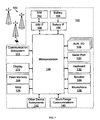
- FIG. 1 is a block diagram illustrating a wireless device adapted in accordance with an embodiment of the invention
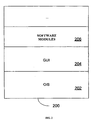
- FIG. 2 is a block diagram illustrating a memory of the wireless device of FIG. 1;
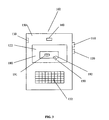
- FIG. 3 is a front view illustrating the wireless device of FIG. 1;
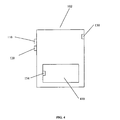
- FIG. 4 is a rear view illustrating the wireless device of FIG. 1;
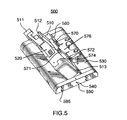
- FIG. 5 is a front perspective view illustrating a test fixture for the wireless device in accordance with an embodiment of the invention.
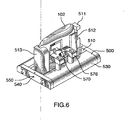
- FIG. 6 is a rear perspective view illustrating the test fixture of FIG. 4 with the wireless device installed in accordance with an embodiment of the invention
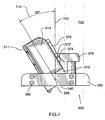
- FIG. 7 is a right side view illustrating a first position for the installation of the wireless device in the text fixture in accordance with an embodiment of the invention
- FIG. 8 is a right side view illustrating a second position for the installation of the wireless device in the text fixture in accordance with an embodiment of the invention.
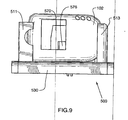
- FIG. 9 is a front view illustrating the test fixture of FIG. 4 with the wireless device installed
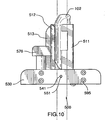
- FIG. 10 is a left side view illustrating the test fixture of FIG. 4 with the wireless device installed;
- FIG. 11 is a right side view illustrating the test fixture of FIG. 4 with the wireless device installed;
- FIG. 12 is a rear view illustrating the test fixture of FIG. 4 with the wireless device installed;
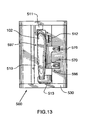
- FIG. 13 is a top view illustrating the test fixture of FIG. 4 with the wireless device installed;
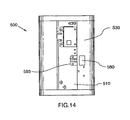
- FIG. 14 is a bottom view illustrating the test fixture of FIG. 4 with the wireless device installed.
- FIG. 15 is a bottom detail view illustrating the locking mechanism of the test fixture of FIG. 4 in accordance with an embodiment of the invention.
- FIG. 1 is a block diagram illustrating a wireless device 102 adapted in accordance with an embodiment of the invention.
- the wireless device 102 is a handheld device 102.
- the wireless device 102 is a two-way communication device having at least voice and advanced data communication capabilities, including the capability to communicate with other computer systems. Depending on the functionality provided by the device 102, it may be referred to as a data messaging device, a two-way pager, a cellular telephone with data messaging capabilities, a wireless Internet appliance, or a data communication device (with or without telephony capabilities).
- the device 102 may communicate with any one of a plurality of fixed transceiver stations 100 within its geographic coverage area.
- the wireless device 102 will normally incorporate a communication subsystem 111, which includes a RF receiver, a RF transmitter, and associated components, such as one or more (preferably embedded or internal) antenna elements and, local oscillators ("LOs"), and a processing module such as a digital signal processor (“DSP”) (all not shown).
- a communication subsystem 111 which includes a RF receiver, a RF transmitter, and associated components, such as one or more (preferably embedded or internal) antenna elements and, local oscillators (“LOs”), and a processing module such as a digital signal processor (“DSP”) (all not shown).
- LOs local oscillators
- DSP digital signal processor
- the device 102 is a battery-powered device so it also includes a battery IF 154 for receiving one or more rechargeable batteries 156. Such a battery 156 provides electrical power to most if not all electrical circuitry in the device 102, and the battery IF 154 provides for a mechanical and electrical connection for it.
- the battery IF 154 is coupled to a regulator (not shown) which provides power to the circuitry of the device 102.
- the wireless device 102 includes a microprocessor (or central processing system (“CPU”)) 138 which controls overall operation of the device 102. Communication functions, including at least data and voice communications, are performed through the communication subsystem 111.
- the microprocessor 138 also interacts with additional device subsystems such as a display 122, a flash memory 124 or other persistent store, a random access memory (“RAM”) 126, auxiliary input/output (“I/O") subsystems 128, a serial port 130, a keyboard 132, a speaker 134, a microphone 136, a short-range communications subsystem 140, and any other device subsystems generally designated at 142.
- additional device subsystems such as a display 122, a flash memory 124 or other persistent store, a random access memory (“RAM”) 126, auxiliary input/output (“I/O") subsystems 128, a serial port 130, a keyboard 132, a speaker 134, a microphone 136, a short-range communications subsystem 140, and any other
- Operating system software used by the microprocessor 138 is preferably stored in a persistent store such as the flash memory 124, which may alternatively be a read-only memory (“ROM”) or similar storage element (not shown).
- ROM read-only memory
- the microprocessor 138 in addition to its operating system functions, preferably enables execution of software applications on the device 102.
- a preferred application that may be loaded onto the device 102 may be a personal information manager (“PIM”) application having the ability to organize and manage data items relating to the user such as, but not limited to, instant messaging (“IM”), email, calendar events, voice mails, appointments, and task items.
- PIM personal information manager
- IM instant messaging
- SIM 162 to facilitate storage of PIM data items and other information.
- the PIM application preferably has the ability to send and receive data items via the wireless network 100.
- PIM data items are seamlessly integrated, synchronized, and updated via the wireless network 100, with the user's corresponding data items stored and/or associated with a host computer system (not shown) thereby creating a mirrored host computer on the device 102 with respect to such items. This is especially advantageous where the host computer system is the user's office computer system (not shown).
- Additional applications may also be loaded onto the device 102 through the network 100, an auxiliary I/O subsystem 128, serial port 130, short-range communications subsystem 140, or any other suitable subsystem 142, and installed by a user in RAM 126 or preferably in a non-volatile store (e.g., flash memory 124) for execution by the microprocessor 138.
- a non-volatile store e.g., flash memory 124.
- secure communication applications may enable electronic commerce functions and other such financial transactions to be performed using the wireless device 102.
- a received signal such as a text message, an email message, or web page download will be processed by the communication subsystem 111 and input to the microprocessor 138.
- the microprocessor 138 will preferably further process the signal for output to the display 122 and/or to the auxiliary I/O device 128.
- a user of the wireless device 102 may also compose data items, such as email messages, for example, using the keyboard 132 in conjunction with the display 122 and possibly the auxiliary I/O device 128. These composed items may be transmitted over a communication network 100 through the communication subsystem 111 or the short range communication subsystem 140.
- the keyboard 132 is preferably a complete alphanumeric keyboard and/or telephone-type keypad.
- the keyboard 132 is a QWERTY keyboard including a full set of keys or buttons corresponding to those on a standard English computer keyboard or typewriter.
- the keyboard 132 may be a modified QWERTY keyboard including a modified arrangement or subset of the QWERTY keyboard.
- the keyboard 132 may be a Dvorak keyboard or modified Dvorak keyboard.
- the Dvorak keyboard is designed so that the middle row of keys includes the most common letters.
- common letter combinations are positioned in such a way that they can be typed quickly.
- the keyboard 132 may be a combination of a telephone style keypad and QWERTY style keyboard.
- the keyboard 132 may have a 5x5 array of keys or buttons on which, unlike a traditional telephone layout that has letters overlaid on numbers in alphabetical order for text entry, the overlay for the keyboard may be in QWERTY order.
- the keyboard 132 allows users to quickly and accurately dial or type either using single-handed operation or two-handed thumb-typing without the limitations associated with traditional telephone keypads. For example, the user need not learn a new way to type.
- the keyboard 132 may be a predictive text keyboard having associated with it a predictive text software module 206 that allows QWERTY style typing, using a built-in dictionary and set of rules, to select the correct letter based on context.
- the predictive text software module 206 includes intuitive software with a word list (e.g., over 30,000 words) and the ability to increase that list based on the frequency of use and the names in the handheld's address book. It also has the ability to recognize character letter sequences that are common in the English language, such as "-ing".
- the software 206 "understands" what a user is typing, the user can concentrate on composing his or her message rather than on the input method.
- the overall operation of the wireless device 102 is substantially similar, except that the received signals would be output to the speaker 134 and signals for transmission would be generated by the microphone 136.
- Alternative voice or audio I/O subsystems such as a voice message recording subsystem, may also be implemented on the device 102.
- voice or audio signal output is preferably accomplished primarily through the speaker 134, the display 122 may also be used to provide, for example, an indication of the identity of a calling party, duration of a voice call, or other voice call related information.
- the serial port 130 shown in FIG. 1 is normally implemented in a personal digital assistant ("PDA")-type communication device for which synchronization with a user's desktop computer is a desirable, albeit optional, component.
- PDA personal digital assistant
- the serial port 130 enables a user to set preferences through an external device or software application and extends the capabilities of the device 102 by providing for information or software downloads to the device 102 other than through a wireless communication network 100.
- the alternate download path may, for example, be used to load an encryption key onto the device 102 through a direct and thus reliable and trusted connection to thereby provide secure device communication.
- the short-range communications subsystem 140 shown in FIG. 1 is an additional optional component which provides for communication between the device 102 and different systems or devices (not shown), which need not necessarily be similar devices.
- the subsystem 140 may include an infrared device and associated circuits and components, or a Bluetooth TM communication module to provide for communication with similarly-enabled systems and devices.
- Bluetooth TM is a registered trademark of Bluetooth SIG, Inc.
- FIG. 2 is a block diagram illustrating a memory 200 of the wireless device 102 of FIG. 1.
- the memory 200 has various software components for controlling the device 102 and may include flash memory 124, RAM 126, or ROM (not shown), for example.
- the wireless device 102 is intended to be a multi-tasking wireless communications device configured for sending and receiving data items and for making and receiving voice calls.
- an operating system (“O/S”) 202 resident on the device 102 provides a basic set of operations for supporting various applications typically operable through a graphical user interface (“GUI”) 204.
- GUI graphical user interface
- the O/S 202 provides basic input/output system features to obtain input from the auxiliary I/O 128, keyboard 132, and the like, and for facilitating output to the user.
- software modules 206 for testing of the wireless device as will be described below.
- one or more applications for managing communications or for providing personal digital assistant like functions may also be included.
- the wireless device 102 includes computer executable programmed instructions for directing the device 102 to implement the embodiments of the present invention.
- the programmed instructions may be embodied in one or more software modules 206 resident in the memory 200 of the wireless device 102.
- the programmed instructions may be embodied on a computer readable medium (such as a CD disk or floppy disk) which may be used for transporting the programmed instructions to the memory 200 of the wireless device 102.
- the programmed instructions may be embedded in a computer-readable, signal-bearing medium that is uploaded to a network by a vendor or supplier of the programmed instructions, and this signal-bearing medium may be downloaded through an interface 111, 130, 140 to the wireless device 102 from the network by end users or potential buyers.
- FIG. 3 is a front view illustrating the wireless device 102 of FIG. 1.
- the wireless device 102 can be a data and voice-enabled handheld device.
- the wireless device 102 includes a casing 150, a display screen 122, a graphical user interface ("GUI") 180, a keyboard (or keypad) 132, a thumbwheel (or trackwheel) 110, various select buttons 120, and various signal inputs/outputs 160 (e.g., power connector input, microphone, speaker, data interface input, etc.).
- GUI graphical user interface
- the wireless device 102 includes one or more circuit boards, a CPU 138, memory 200, a battery 156, an antenna, etc. (not shown), which are coupled to the signal inputs/outputs 160, keyboard 132, display screen 122, etc.
- the microprocessor 138 of the wireless device 102 is typically coupled to one or more devices 110, 120, 132 for receiving user commands or queries and for displaying the results of these commands or queries to the user on the display 122. For example, user queries may be transformed into a combination of commands for producing one or more tables of output data which may be incorporated in one or more display pages for presentation to the user.
- the microprocessor 138 is coupled to memory 200 for containing software modules 206 and data such as database tables and test parameters. As mentioned, the memory 200 may include a variety of storage devices typically arranged in a hierarchy of storage as understood to those skilled in the art.
- GUIs are supported by common operating systems and provide a display format which enables a user to choose commands, execute application programs, manage computer files, and perform other functions by selecting pictorial representations known as icons, or items from a menu through use of an input or pointing device such as a thumbwheel 110 and keyboard 132.
- a GUI is used to convey information to and receive commands from users and generally includes a variety of GUI objects or controls, including icons, toolbars, drop-down menus, pop-up menus, text, dialog boxes, buttons, and the like.
- a user typically interacts with a GUI 180 presented on a display 122 by using an input or pointing device (e.g., a thumbwheel 110, a keyboard 132, etc.) to position a pointer or cursor 190 over an object 191 (i.e., "pointing" at the object) and by "clicking" on the object 191. (e.g., by depressing the thumbwheel 110, by depressing a button on the keyboard 132, etc.). This is often referred to as a point-and-click operation or a selection operation.
- the object 191 may be hilighted (e.g., shaded) when it is pointed at.
- a GUI based system presents application, system status, and other information to the user in "windows" appearing on the display 122.
- a window 192 is a more or less rectangular area within the display 122 in which a user may view an application or a document. Such a window 192 may be open, closed, displayed full screen, reduced to an icon, increased or reduced in size, or moved to different areas of the display 122. Multiple windows may be displayed simultaneously, such as: windows included within other windows, windows overlapping other windows, or windows tiled within the display area.
- FIG. 4 is a rear view illustrating the wireless device 102 of FIG. 1.
- the wireless device 102 has a removable rear casing, or portion of casing 410, for concealing a battery cavity (not shown) and battery contacts (i.e., interface) 154 for the battery 156.
- the battery 156 may be a battery pack including the portion of the casing 410.
- FIG. 5 is a front perspective view illustrating a test fixture 500 for the wireless device 102 in accordance with an embodiment of the invention.
- the test fixture 500 allows the installed wireless device 102, or device under test (“DUT") 102, to be powered-up through the wireless device's internal battery contacts 154. This is facilitated by installing the DUT 102 in the text fixture 500 with a combination of linear and rotary movements of the DUT 102.
- the text fixture 500 does not require the use of industry standard pneumatic/electrical drivers at the power-up stage. This results in lower costs for the test fixture 500 and higher mobility within a test station area.
- FIG. 6 is a rear perspective view illustrating the test fixture 500 of FIG. 5 with the DUT 102 installed in accordance with an embodiment of the invention. Additional views of the text fixture 500 of FIG. 5 with the DUT 102 installed are provided in FIGS. 9-15 as follows: FIG. 9 is a front view; FIG. 10 is a left side view; FIG. 11 is a right side view; FIG. 12 is a rear view; FIG. 13 is a top view; FIG. 14 is a bottom view; and, FIG. 15 is a bottom detail view.
- the test fixture 500 has a retainer 510 for receiving the wireless device 102, generally after the battery 156 and battery cover 410 of the wireless device 102 are removed. As mentioned, the battery 156 may incorporate the battery cover 410.
- the retainer 510 has one or more adjustable elements 511, 512, 513 for engaging one or more sides of the wireless device 102 to retain the wireless device 102 in the retainer 510.
- the retainer 510 includes a universal serial bus (“USB”) connector 520 mounted thereon, or formed therein, for connecting to test equipment (not shown) via a cable (not shown).
- the USB connector 520 shown in FIG. 5 is a USB plug connector. As will be understood by those of ordinary skill in the art, the USB connector 520 may be another form of serial connector.
- the USB connector 520 has pin contacts (not shown) for engaging corresponding socket contacts on a mating USB receptacle connector (i.e., the serial port) 130 on the wireless device 102 when the wireless device 102 is inserted into the retainer 510. Through the USB connector 520, test signals are passed to and from the test equipment and the wireless device 102.
- the USB connector 520 may be mounted to the retainer 510 with some play.
- the retainer 510 is rotatably mounted on a base 530.
- the base 530 has an opening 560 formed therein for receiving the retainer 510.
- the retainer 510 has a pair of axial pins 540, 541, one at either end of the retainer 510, which engage corresponding holes 550, 551 formed in the base 530.
- the pins 540, 541 and mating holes 550, 551 allow the retainer 510 to rotate in the opening 560 in the base 530.
- the retainer 510 may be hinge mounted on the base 530.
- the fixture 500 has a battery emulator insert 570 that is rotatably mounted on the base (e.g. with pins 572, 573 and mating holes 574, 575).
- the battery emulator insert 570 is for emulating the function of the wireless device's battery 156 in conjunction with the external test equipment.
- the battery emulator insert 570 has power contacts 571 for engaging the battery contacts 154 in the battery cavity of the wireless device 102.
- the power contacts 571 are for providing power from the external test equipment to the wireless device 102.
- a spring (not shown) may be coupled between the battery emulator insert 570 and the base 530 for controlling rotation of the battery emulator insert 570.
- An adjustable element 576 may be mounted on the base 530 and coupled with pins 572, 573 and mating holes 574, 575 to the battery emulator insert 570 for adjusting the battery emulator insert's position.
- the adjustable element 576 on the base 530 and the adjustable elements 511, 512, 513 on the retainer 510 may be repositioned to suit the wireless device 102 under test by using a number of mounting holes 596, 597 formed in the base 530 and retainer 510, respectively (see FIG. 12).
- the adjustable elements 511, 512, 513, 576 have formed thereon, or installed therein, pegs or pins (not shown) for mating with the mounting holes 596, 597.
- the adjustable elements 511, 512, 513, 576 may have various shapes and sized to suit the DUT 102.
- FIG. 7 is a right side view illustrating a first position 700 for the installation of the wireless device 102 in the text fixture 500 in accordance with an embodiment of the invention.
- the USB connector 520 of the retainer 510 is inserted into the serial port 130 of the wireless device 102.
- the retainer 510 is at an angle 710 of approximately 30 degrees from a perpendicular 720 (e.g., drawn vertically from the pin 540 and mating hole 550) of the base 530.
- this angle 710 may be greater or less than 30 degrees.
- FIG. 8 is a right side view illustrating a second position 800 for the installation of the wireless device 102 in the text fixture 500 in accordance with an embodiment of the invention.
- the fixture 500 has a plunger screw 581 mounted on the base 530 for engaging a ball bearing 591 mounted on the retainer 510 for locking the retainer 510 in the second position 800.
- the plunger screw 581 is mounted in a housing 580 fixed to the base 530.
- the ball bearing 591 is rotatably mounted to the retainer 510 with a pin 592 and pin retainer 593.
- other suitable means may be used to lock the retainer 510 in the second position.
- the fixture 500 may include means (e.g., mounting holes 595, etc.) for attachment to an arm assembly of the external test equipment for manipulating the wireless device 102 during functional testing.
- the wireless device 102 may have stored in its memory 200 a test application 206 for directing the wireless device 102 in response to test signals received from the external test equipment through the USB connector 520.
Landscapes
- Engineering & Computer Science (AREA)
- Signal Processing (AREA)
- Mobile Radio Communication Systems (AREA)
- Selective Calling Equipment (AREA)
- Transceivers (AREA)
- Stand-By Power Supply Arrangements (AREA)
- Monitoring And Testing Of Transmission In General (AREA)
- Testing Electric Properties And Detecting Electric Faults (AREA)
- Radar Systems Or Details Thereof (AREA)
- Alarm Systems (AREA)
Claims (26)
- Eine Vorrichtung (500) zur Funktionsprüfung eines montierten Funkgeräts (102), wobei das Funkgerät einen Datenanschluss (130) sowie ein abnehmbares Gehäuse hat, unter dem sich eine Aussparung für Batteriekontakte verbirgt (154), und folgendes umfasst:Eine Basis (530) mit einer Öffnung (560), die für die Aufnahme einer Halterung (510) im Inneren gestaltet ist, wobei die Halterung (510) in der Öffnung (560) schwenkbar eingebaut ist, um von einer ersten Position (700) in eine zweite (800) geschwenkt werden zu können, wobei die Halterung (510) für die Aufnahme des Funkgeräts (102) mit dem abnehmbaren Gehäuse (410), das in der ersten Position entfernt ist, konzipiert ist;Ein Anschlussstück (520), eingebaut in die Halterung (510) für das Einrasten des Datenanschlusses (130) des Funkgeräts (102), wenn das Funkgerät (102) von der Halterung in der ersten Position (700) aufgenommen wird, das Anschlussstück zur Kommunikation der Testsignale mit externen Testanlagen; undEine Batterieemulator-Anschlussbuchse (570) schwenkbar auf der Basis (530) montiert, wobei die Batterieemulator-Anschlussbuchse (570) die Stromkontakte für das Einbringen der Batteriekontakte (154) in der Batterieaussparung des Funkgeräts (102) besitzt, wenn die Halterung (510) in die zweite Position (800) geschwenkt wird und die Stromkontakte zur Stromversorgung aus der externen Testanlage dienen.
- Die Vorrichtung (500) des Anspruchs 1, die des Weiteren eine Feder umfasst, die zwischen der Batterieemulator-Anschlussbuchse (570) und der Basis (530) eingefügt ist und der Kontrolle der Schwenkbewegung der Batterieemulator-Anschlussbuchse dient.
- Die Vorrichtung (500) von Anspruch 1 oder 2, die des Weiteren ein Justierelement (576) umfasst, montiert auf der Basis (530) und verkoppelt mit der Batterieemulator-Anschlussbuchse (570) zur Justierung der Position der Batterieemulator-Anschlussbuchse.
- Die Vorrichtung (500) gemäß einem der Ansprüche 1, 2 oder 3, die des Weiteren eine auf der Basis (530) montierte Kolbenschraube (581) umfasst, die dazu dient, ein auf der Halterung (510) montiertes Kugellager (591) greifen zu lassen, das die Halterung in der zweiten Position (800) arretiert.
- Die Vorrichtung (500) eines jeden der vorangehenden Ansprüche, die des Weiteren ein Paar Stifte (540, 541) umfasst, die auf der Halterung (510) montiert sind, um in entsprechende Öffnungen (550, 551) eingefügt zu werden, die in der Basis eingelassen sind, um es der Halterung (510) zu gestatten, in der Öffnung (560) der Basis (530) geschwenkt werden zu können.
- Die Vorrichtung (500) eines jeden der vorangehenden Ansprüche, bei denen die Halterung (510) ein oder mehrere Justierelemente (511, 512, 513) zum Festhalten von einer oder mehreren Seiten des Funkgeräts (102) hat, um das Funkgerät in der Halterung (510) zu fixieren.
- Die Vorrichtung (500) eines jeden der vorangegangenen Ansprüche, wobei der Stecker ein universeller Serienbus (USB)-Stecker ist.
- Die Vorrichtung (500) eines jeden der vorangegangenen Ansprüche, wobei sich das Funkgerät (102), wenn es in der Halterung (510) eingefügt ist, in einem Winkel von etwa dreißig Grad zur Senkrechten (720) der Basis (530) und etwa parallel zur Senkrechten der Basis (530) befindet, wenn sich die Halterung (510) in der ersten Position (700) bzw. der zweiten Position (800) befindet.
- Die Vorrichtung (500) eines jeden der vorangegangenen Ansprüche, die des Weiteren Mittel für das Anfügen eines Kipphebels der externen Testanlage zur Handhabung des Funkgeräts (102) während des Funktionstests aufweist.
- Eine Kombination der Vorrichtung (500) aus jedem der vorangegangenen Ansprüche und eines darin aufgenommenen montierten Funkgeräts (102) wobei das Funkgerät einen Datenanschluss (130) und ein abnehmbares Gehäuse (410) hat, das eine Batterieaussparung mit Batteriekontakten (154) verdeckt.
- Die Kombination aus Anspruch 10 wobei das abnehmbare Gehäuse (510) ein Akkumulator ist.
- Die Kombination aus Anspruch 10 und 11, wobei der Datenanschluss (130) ein universeller Serienbus (USB)-Anschluss ist.
- Die Kombination eines jeden der Ansprüche 10 bis 12, wobei der Datenanschluss (130) und das abnehmbare Gehäuse (410) sich auf einer Seite bzw. der Rückseite des Funkgeräts (102) befinden.
- Die Kombination eines jeden der Ansprüche 10 bis 13, wobei das Funkgerät (102) einen Speicher (200) zur Speicherung der Testanwendung umfasst, die als Antwort auf Testsignale der Lenkung des Funkgeräts (102) dient.
- Ein Verfahren für den Funktionstest eines montierten Funkgeräts (102), wobei das Funkgerät (103) einen Datenanschluss (130) hat sowie ein abnehmbares Gehäuse (410), das eine Aussparung für Batterien mit Batteriekontakten (154) verdeckt, wobei das Verfahren folgende Schritte umfasst:Bereitstellung einer Vorrichtung (500) mit Basis (530) mit einer darin eingelassenen Öffnung und einer Halterung (510), die schwenkbar in der Öffnung montiert ist;Einsetzen des Funkgeräts (102) in die Halterung (510) in einer ersten Position (700), bei der das abnehmbare Gehäuse (410) des Funkgeräts (102) entfernt ist;Anschluss eines Anschlussstücks (520) für die Kommunikation von Testsignalen mit einer externen Testanlage im Datenanschluss (130) des Funkgeräts (102), wobei das Anschlussstück (520) in der Halterung (510) montiert ist;Schwenken der Halterung (510) in eine zweite Position (800);Verbinden der Stromkontakte eines Batterieemulator-Anschlusses (570) mit den Batteriekontakten (154) des Funkgeräts (102) in der Batterieaussparung des Funkgeräts (102);Bereitstellung von Strom aus externen Testanlagen durch die StromkontakteAnwenden der Testsignale beim Anschlussstück (520);
- Das Verfahren von Anspruch 15, wobei das Funkgerät (102) mit einem abnehmbaren Gehäuse (410), das einen Akkumulator (156) umfasst, versehen ist.
- Das Verfahren von Anspruch 15 oder 16, wobei eine Feder der Vorrichtung zwischen dem Batterieemulator-Anschluss (570) und der Basis (530) zur Schwenkkontrolle des Batterieemulator-Anschlusses (570) angebracht ist.
- Das Verfahren eines jeden der Ansprüche 15 bis 17, wobei ein Justierelement (576) der Vorrichtung (500) auf der Basis (530) montiert ist und mit dem Batterieemulator-Anschluss (570) zur Justierung der Position des Batterieemulator-Anschlusses verbunden ist.
- Das Verfahren eines jeden der Ansprüche 15 bis 18, wobei die Halterung (510) in der zweiten Position (800) für den Test arretiert ist.
- Die Verfahren eines jeden der Ansprüche 15 bis 19, wobei ein Paar Stifte (540, 541) der Vorrichtung (500) auf der Halterung (510) montiert sind, um in entsprechende Öffnungen (550, 551), die in der Basis (530) eingelassen sind, eingefügt zu werden, um es der Halterung (510) zu gestatten, in der Öffnung der Basis (530) geschwenkt zu werden.
- Das Verfahren eines jeden der Ansprüche 15 bis 20, gekennzeichnet dadurch, dass ein oder mehrere Justierelemente (511, 512, 513) der Halterung (510) dazu dienen, eine oder mehrere Seiten des Funkgeräts (102) einzufügen um das Funkgerät (102) in der Halterung (510) festzuhalten.
- Das Verfahren eines jeden der Ansprüche 15 bis 21, wobei der Datenanschluss (130) eine USB (universeller Serienbus)-Anschlussbuchse ist und das Anschlussstück (520) ein USB-Stecker ist.
- Das Verfahren eines jeden der Ansprüche 15 bis 22, wobei das Funkgerät (102) von einer Halterung (510) in einem Winkel von ungefähr 30 Grad zur Senkrechten (720) der Basis (300) und ungefähr parallel zur Senkrechten der Basis (530) aufgenommen ist, wenn die Halterung sich in der ersten (700) bzw. zweiten Position (800) befindet.
- Das Verfahren eines jeden der Ansprüche 15 bis 23, wobei der Datenanschluss (130) und das abnehmbare Gehäuse (410) auf einer Seite bzw. der Rückseite des Funkgeräts (102) angebracht sind.
- Das Verfahren eines jeden der Ansprüche 15 bis 24, wobei die Vorrichtung (500) Mittel für das Anfügen eines Kipphebels der externen Testanlage zur Handhabung des Funkgeräts (102) während des Funktionstests aufweist.
- Das Verfahren eines jeden der Ansprüche 15 bis 25, wobei das Funkgerät (102) einen Speicher (200) zur Speicherung der Testanwendung umfasst, die als Antwort auf Testsignale der Lenkung des Funkgeräts (102) dient.
Priority Applications (5)
| Application Number | Priority Date | Filing Date | Title |
|---|---|---|---|
| AT05101729T ATE360951T1 (de) | 2005-03-07 | 2005-03-07 | Vorrichtung zum manuellen funktionstest eines drahtlosen gerätes |
| EP05101729A EP1701522B1 (de) | 2005-03-07 | 2005-03-07 | Vorrichtung zum manuellen Funktionstest eines drahtlosen Gerätes |
| DE602005000989T DE602005000989T2 (de) | 2005-03-07 | 2005-03-07 | Vorrichtung zum manuellen Funktionstest eines drahtlosen Gerätes |
| CA2537399A CA2537399C (en) | 2005-03-07 | 2006-02-22 | Fixture for manual functional testing of wireless devices |
| HK07101513.9A HK1094391B (en) | 2007-02-08 | Fixture for manual functional testing of wireless devices |
Applications Claiming Priority (1)
| Application Number | Priority Date | Filing Date | Title |
|---|---|---|---|
| EP05101729A EP1701522B1 (de) | 2005-03-07 | 2005-03-07 | Vorrichtung zum manuellen Funktionstest eines drahtlosen Gerätes |
Publications (2)
| Publication Number | Publication Date |
|---|---|
| EP1701522A1 EP1701522A1 (de) | 2006-09-13 |
| EP1701522B1 true EP1701522B1 (de) | 2007-04-25 |
Family
ID=34938911
Family Applications (1)
| Application Number | Title | Priority Date | Filing Date |
|---|---|---|---|
| EP05101729A Expired - Lifetime EP1701522B1 (de) | 2005-03-07 | 2005-03-07 | Vorrichtung zum manuellen Funktionstest eines drahtlosen Gerätes |
Country Status (4)
| Country | Link |
|---|---|
| EP (1) | EP1701522B1 (de) |
| AT (1) | ATE360951T1 (de) |
| CA (1) | CA2537399C (de) |
| DE (1) | DE602005000989T2 (de) |
Family Cites Families (4)
| Publication number | Priority date | Publication date | Assignee | Title |
|---|---|---|---|---|
| JPH0611456Y2 (ja) * | 1988-05-31 | 1994-03-23 | 日本電気株式会社 | 電子機器の接続端子構造 |
| JP3620483B2 (ja) * | 2001-08-09 | 2005-02-16 | 株式会社デンソー | シールドボックス |
| TW586466U (en) * | 2003-05-14 | 2004-05-01 | Benq Corp | Fixture for screwing screws |
| US6929255B2 (en) * | 2003-06-24 | 2005-08-16 | Agilent Technologies, Inc. | Two-stage actuation clamp for electrical device under test (DUT) with DUT-linked double action |
-
2005
- 2005-03-07 AT AT05101729T patent/ATE360951T1/de not_active IP Right Cessation
- 2005-03-07 DE DE602005000989T patent/DE602005000989T2/de active Active
- 2005-03-07 EP EP05101729A patent/EP1701522B1/de not_active Expired - Lifetime
-
2006
- 2006-02-22 CA CA2537399A patent/CA2537399C/en active Active
Also Published As
| Publication number | Publication date |
|---|---|
| DE602005000989T2 (de) | 2007-09-06 |
| EP1701522A1 (de) | 2006-09-13 |
| CA2537399A1 (en) | 2006-09-07 |
| CA2537399C (en) | 2013-01-08 |
| HK1094391A1 (en) | 2007-03-30 |
| DE602005000989D1 (de) | 2007-06-06 |
| ATE360951T1 (de) | 2007-05-15 |
Similar Documents
| Publication | Publication Date | Title |
|---|---|---|
| US7528596B2 (en) | Fixture for manual functional testing of wireless devices | |
| US8543745B2 (en) | Accessory for a portable computing device | |
| US10133453B2 (en) | Alternative inputs of a mobile communications device | |
| US7320112B2 (en) | Information processing apparatus and method, and information processing program | |
| US20160360024A1 (en) | Mobile Communications Device having Moveable Housings | |
| CN1158834C (zh) | 便携式通信设备以及用于便携式通信设备的辅助设备 | |
| US20060183477A1 (en) | Network selection user interface for wireless devices | |
| US8463326B2 (en) | Handheld electronic device transitionable between different configurations | |
| EP1691260A1 (de) | Benutzeroberfläche für die Netzwerkauswahl in einem drahtlosen Gerät | |
| US20070024235A1 (en) | Method and system for battery authentication for wireless and other devices | |
| EP1701522B1 (de) | Vorrichtung zum manuellen Funktionstest eines drahtlosen Gerätes | |
| HK1094391B (en) | Fixture for manual functional testing of wireless devices | |
| CA2688591C (en) | Handheld electronic device transitionable between different configurations | |
| US10156953B2 (en) | Method for presenting data on a small screen | |
| EP1755097B1 (de) | Verfahren und System zur Batterie Authentifizierung für drahtlose und andere Geräte | |
| TWI538467B (zh) | 行動通訊裝置的替代輸入及其方法 | |
| CN100472386C (zh) | 信息处理装置和方法 | |
| CA2514276C (en) | A method and system for battery authentication for wireless and other devices | |
| AU2012101006B4 (en) | Accessory for a portable computing device | |
| CA2673839C (en) | Method for presenting data on a small screen | |
| HK1091923A (en) | Network selection user interface for wireless devices |
Legal Events
| Date | Code | Title | Description |
|---|---|---|---|
| PUAI | Public reference made under article 153(3) epc to a published international application that has entered the european phase |
Free format text: ORIGINAL CODE: 0009012 |
|
| 17P | Request for examination filed |
Effective date: 20050318 |
|
| AK | Designated contracting states |
Kind code of ref document: A1 Designated state(s): AT BE BG CH CY CZ DE DK EE ES FI FR GB GR HU IE IS IT LI LT LU MC NL PL PT RO SE SI SK TR |
|
| AX | Request for extension of the european patent |
Extension state: AL BA HR LV MK YU |
|
| GRAP | Despatch of communication of intention to grant a patent |
Free format text: ORIGINAL CODE: EPIDOSNIGR1 |
|
| GRAS | Grant fee paid |
Free format text: ORIGINAL CODE: EPIDOSNIGR3 |
|
| GRAA | (expected) grant |
Free format text: ORIGINAL CODE: 0009210 |
|
| REG | Reference to a national code |
Ref country code: HK Ref legal event code: DE Ref document number: 1094391 Country of ref document: HK |
|
| AK | Designated contracting states |
Kind code of ref document: B1 Designated state(s): AT BE BG CH CY CZ DE DK EE ES FI FR GB GR HU IE IS IT LI LT LU MC NL PL PT RO SE SI SK TR |
|
| AX | Request for extension of the european patent |
Extension state: AL BA HR LV MK YU |
|
| PG25 | Lapsed in a contracting state [announced via postgrant information from national office to epo] |
Ref country code: LI Free format text: LAPSE BECAUSE OF FAILURE TO SUBMIT A TRANSLATION OF THE DESCRIPTION OR TO PAY THE FEE WITHIN THE PRESCRIBED TIME-LIMIT Effective date: 20070425 Ref country code: FI Free format text: LAPSE BECAUSE OF FAILURE TO SUBMIT A TRANSLATION OF THE DESCRIPTION OR TO PAY THE FEE WITHIN THE PRESCRIBED TIME-LIMIT Effective date: 20070425 Ref country code: CH Free format text: LAPSE BECAUSE OF FAILURE TO SUBMIT A TRANSLATION OF THE DESCRIPTION OR TO PAY THE FEE WITHIN THE PRESCRIBED TIME-LIMIT Effective date: 20070425 |
|
| REG | Reference to a national code |
Ref country code: GB Ref legal event code: FG4D |
|
| AKX | Designation fees paid |
Designated state(s): AT BE BG CH CY CZ DE DK EE ES FI FR GB GR HU IE IS IT LI LT LU MC NL PL PT RO SE SI SK TR |
|
| AXX | Extension fees paid |
Extension state: MK Payment date: 20050318 Extension state: LV Payment date: 20050318 Extension state: AL Payment date: 20050318 Extension state: YU Payment date: 20050318 Extension state: BA Payment date: 20050318 Extension state: HR Payment date: 20050318 |
|
| REG | Reference to a national code |
Ref country code: IE Ref legal event code: FG4D |
|
| REG | Reference to a national code |
Ref country code: CH Ref legal event code: EP |
|
| REF | Corresponds to: |
Ref document number: 602005000989 Country of ref document: DE Date of ref document: 20070606 Kind code of ref document: P |
|
| REG | Reference to a national code |
Ref country code: HK Ref legal event code: GR Ref document number: 1094391 Country of ref document: HK |
|
| PG25 | Lapsed in a contracting state [announced via postgrant information from national office to epo] |
Ref country code: SE Free format text: LAPSE BECAUSE OF FAILURE TO SUBMIT A TRANSLATION OF THE DESCRIPTION OR TO PAY THE FEE WITHIN THE PRESCRIBED TIME-LIMIT Effective date: 20070725 |
|
| PG25 | Lapsed in a contracting state [announced via postgrant information from national office to epo] |
Ref country code: ES Free format text: LAPSE BECAUSE OF FAILURE TO SUBMIT A TRANSLATION OF THE DESCRIPTION OR TO PAY THE FEE WITHIN THE PRESCRIBED TIME-LIMIT Effective date: 20070805 |
|
| PG25 | Lapsed in a contracting state [announced via postgrant information from national office to epo] |
Ref country code: IS Free format text: LAPSE BECAUSE OF FAILURE TO SUBMIT A TRANSLATION OF THE DESCRIPTION OR TO PAY THE FEE WITHIN THE PRESCRIBED TIME-LIMIT Effective date: 20070825 |
|
| PG25 | Lapsed in a contracting state [announced via postgrant information from national office to epo] |
Ref country code: PT Free format text: LAPSE BECAUSE OF FAILURE TO SUBMIT A TRANSLATION OF THE DESCRIPTION OR TO PAY THE FEE WITHIN THE PRESCRIBED TIME-LIMIT Effective date: 20070925 |
|
| ET | Fr: translation filed | ||
| REG | Reference to a national code |
Ref country code: CH Ref legal event code: PL |
|
| NLV1 | Nl: lapsed or annulled due to failure to fulfill the requirements of art. 29p and 29m of the patents act | ||
| PG25 | Lapsed in a contracting state [announced via postgrant information from national office to epo] |
Ref country code: AT Free format text: LAPSE BECAUSE OF FAILURE TO SUBMIT A TRANSLATION OF THE DESCRIPTION OR TO PAY THE FEE WITHIN THE PRESCRIBED TIME-LIMIT Effective date: 20070425 Ref country code: PL Free format text: LAPSE BECAUSE OF FAILURE TO SUBMIT A TRANSLATION OF THE DESCRIPTION OR TO PAY THE FEE WITHIN THE PRESCRIBED TIME-LIMIT Effective date: 20070425 |
|
| PG25 | Lapsed in a contracting state [announced via postgrant information from national office to epo] |
Ref country code: BE Free format text: LAPSE BECAUSE OF FAILURE TO SUBMIT A TRANSLATION OF THE DESCRIPTION OR TO PAY THE FEE WITHIN THE PRESCRIBED TIME-LIMIT Effective date: 20070425 |
|
| PG25 | Lapsed in a contracting state [announced via postgrant information from national office to epo] |
Ref country code: SI Free format text: LAPSE BECAUSE OF FAILURE TO SUBMIT A TRANSLATION OF THE DESCRIPTION OR TO PAY THE FEE WITHIN THE PRESCRIBED TIME-LIMIT Effective date: 20070425 Ref country code: BG Free format text: LAPSE BECAUSE OF FAILURE TO SUBMIT A TRANSLATION OF THE DESCRIPTION OR TO PAY THE FEE WITHIN THE PRESCRIBED TIME-LIMIT Effective date: 20070725 Ref country code: DK Free format text: LAPSE BECAUSE OF FAILURE TO SUBMIT A TRANSLATION OF THE DESCRIPTION OR TO PAY THE FEE WITHIN THE PRESCRIBED TIME-LIMIT Effective date: 20070425 Ref country code: CZ Free format text: LAPSE BECAUSE OF FAILURE TO SUBMIT A TRANSLATION OF THE DESCRIPTION OR TO PAY THE FEE WITHIN THE PRESCRIBED TIME-LIMIT Effective date: 20070425 Ref country code: NL Free format text: LAPSE BECAUSE OF FAILURE TO SUBMIT A TRANSLATION OF THE DESCRIPTION OR TO PAY THE FEE WITHIN THE PRESCRIBED TIME-LIMIT Effective date: 20070425 |
|
| PG25 | Lapsed in a contracting state [announced via postgrant information from national office to epo] |
Ref country code: LT Free format text: LAPSE BECAUSE OF FAILURE TO SUBMIT A TRANSLATION OF THE DESCRIPTION OR TO PAY THE FEE WITHIN THE PRESCRIBED TIME-LIMIT Effective date: 20070425 Ref country code: SK Free format text: LAPSE BECAUSE OF FAILURE TO SUBMIT A TRANSLATION OF THE DESCRIPTION OR TO PAY THE FEE WITHIN THE PRESCRIBED TIME-LIMIT Effective date: 20070425 |
|
| PLBE | No opposition filed within time limit |
Free format text: ORIGINAL CODE: 0009261 |
|
| STAA | Information on the status of an ep patent application or granted ep patent |
Free format text: STATUS: NO OPPOSITION FILED WITHIN TIME LIMIT |
|
| 26N | No opposition filed |
Effective date: 20080128 |
|
| PG25 | Lapsed in a contracting state [announced via postgrant information from national office to epo] |
Ref country code: IT Free format text: LAPSE BECAUSE OF FAILURE TO SUBMIT A TRANSLATION OF THE DESCRIPTION OR TO PAY THE FEE WITHIN THE PRESCRIBED TIME-LIMIT Effective date: 20070425 Ref country code: GR Free format text: LAPSE BECAUSE OF FAILURE TO SUBMIT A TRANSLATION OF THE DESCRIPTION OR TO PAY THE FEE WITHIN THE PRESCRIBED TIME-LIMIT Effective date: 20070726 |
|
| PG25 | Lapsed in a contracting state [announced via postgrant information from national office to epo] |
Ref country code: RO Free format text: LAPSE BECAUSE OF FAILURE TO SUBMIT A TRANSLATION OF THE DESCRIPTION OR TO PAY THE FEE WITHIN THE PRESCRIBED TIME-LIMIT Effective date: 20070425 |
|
| PG25 | Lapsed in a contracting state [announced via postgrant information from national office to epo] |
Ref country code: MC Free format text: LAPSE BECAUSE OF NON-PAYMENT OF DUE FEES Effective date: 20080331 |
|
| PG25 | Lapsed in a contracting state [announced via postgrant information from national office to epo] |
Ref country code: EE Free format text: LAPSE BECAUSE OF FAILURE TO SUBMIT A TRANSLATION OF THE DESCRIPTION OR TO PAY THE FEE WITHIN THE PRESCRIBED TIME-LIMIT Effective date: 20070425 Ref country code: IE Free format text: LAPSE BECAUSE OF NON-PAYMENT OF DUE FEES Effective date: 20080307 |
|
| PG25 | Lapsed in a contracting state [announced via postgrant information from national office to epo] |
Ref country code: CY Free format text: LAPSE BECAUSE OF FAILURE TO SUBMIT A TRANSLATION OF THE DESCRIPTION OR TO PAY THE FEE WITHIN THE PRESCRIBED TIME-LIMIT Effective date: 20070425 |
|
| PG25 | Lapsed in a contracting state [announced via postgrant information from national office to epo] |
Ref country code: LU Free format text: LAPSE BECAUSE OF NON-PAYMENT OF DUE FEES Effective date: 20080307 Ref country code: HU Free format text: LAPSE BECAUSE OF FAILURE TO SUBMIT A TRANSLATION OF THE DESCRIPTION OR TO PAY THE FEE WITHIN THE PRESCRIBED TIME-LIMIT Effective date: 20071026 |
|
| PG25 | Lapsed in a contracting state [announced via postgrant information from national office to epo] |
Ref country code: TR Free format text: LAPSE BECAUSE OF FAILURE TO SUBMIT A TRANSLATION OF THE DESCRIPTION OR TO PAY THE FEE WITHIN THE PRESCRIBED TIME-LIMIT Effective date: 20070425 |
|
| REG | Reference to a national code |
Ref country code: DE Ref legal event code: R082 Ref document number: 602005000989 Country of ref document: DE Representative=s name: MERH-IP MATIAS ERNY REICHL HOFFMANN, DE |
|
| REG | Reference to a national code |
Ref country code: DE Ref legal event code: R082 Ref document number: 602005000989 Country of ref document: DE Representative=s name: MERH-IP MATIAS ERNY REICHL HOFFMANN, DE Effective date: 20140925 Ref country code: DE Ref legal event code: R081 Ref document number: 602005000989 Country of ref document: DE Owner name: BLACKBERRY LIMITED, WATERLOO, CA Free format text: FORMER OWNER: RESEARCH IN MOTION LTD., WATERLOO, ONTARIO, CA Effective date: 20140925 Ref country code: DE Ref legal event code: R082 Ref document number: 602005000989 Country of ref document: DE Representative=s name: MERH-IP MATIAS ERNY REICHL HOFFMANN PATENTANWA, DE Effective date: 20140925 |
|
| REG | Reference to a national code |
Ref country code: FR Ref legal event code: PLFP Year of fee payment: 12 |
|
| REG | Reference to a national code |
Ref country code: FR Ref legal event code: PLFP Year of fee payment: 13 |
|
| REG | Reference to a national code |
Ref country code: FR Ref legal event code: PLFP Year of fee payment: 14 |
|
| PGFP | Annual fee paid to national office [announced via postgrant information from national office to epo] |
Ref country code: DE Payment date: 20240328 Year of fee payment: 20 Ref country code: GB Payment date: 20240319 Year of fee payment: 20 |
|
| REG | Reference to a national code |
Ref country code: DE Ref legal event code: R082 Ref document number: 602005000989 Country of ref document: DE Ref country code: DE Ref legal event code: R081 Ref document number: 602005000989 Country of ref document: DE Owner name: MALIKIE INNOVATIONS LTD., IE Free format text: FORMER OWNER: BLACKBERRY LIMITED, WATERLOO, ONTARIO, CA |
|
| PGFP | Annual fee paid to national office [announced via postgrant information from national office to epo] |
Ref country code: FR Payment date: 20240327 Year of fee payment: 20 |
|
| REG | Reference to a national code |
Ref country code: DE Ref legal event code: R071 Ref document number: 602005000989 Country of ref document: DE |
|
| REG | Reference to a national code |
Ref country code: GB Ref legal event code: PE20 Expiry date: 20250306 |
|
| PG25 | Lapsed in a contracting state [announced via postgrant information from national office to epo] |
Ref country code: GB Free format text: LAPSE BECAUSE OF EXPIRATION OF PROTECTION Effective date: 20250306 |