EP1700927A1 - Plasmagespritzte Schichten aus Aluminiumoxid - Google Patents
Plasmagespritzte Schichten aus Aluminiumoxid Download PDFInfo
- Publication number
- EP1700927A1 EP1700927A1 EP05112923A EP05112923A EP1700927A1 EP 1700927 A1 EP1700927 A1 EP 1700927A1 EP 05112923 A EP05112923 A EP 05112923A EP 05112923 A EP05112923 A EP 05112923A EP 1700927 A1 EP1700927 A1 EP 1700927A1
- Authority
- EP
- European Patent Office
- Prior art keywords
- plasma
- aluminum oxide
- layers
- sprayed
- substrate
- Prior art date
- Legal status (The legal status is an assumption and is not a legal conclusion. Google has not performed a legal analysis and makes no representation as to the accuracy of the status listed.)
- Granted
Links
- PNEYBMLMFCGWSK-UHFFFAOYSA-N aluminium oxide Inorganic materials [O-2].[O-2].[O-2].[Al+3].[Al+3] PNEYBMLMFCGWSK-UHFFFAOYSA-N 0.000 title claims description 19
- TWNQGVIAIRXVLR-UHFFFAOYSA-N oxo(oxoalumanyloxy)alumane Chemical compound O=[Al]O[Al]=O TWNQGVIAIRXVLR-UHFFFAOYSA-N 0.000 claims abstract description 30
- 238000000034 method Methods 0.000 claims abstract description 20
- 239000000758 substrate Substances 0.000 claims abstract description 17
- 239000000843 powder Substances 0.000 claims abstract description 15
- 239000002245 particle Substances 0.000 claims abstract description 14
- 229910018072 Al 2 O 3 Inorganic materials 0.000 claims description 12
- 230000001698 pyrogenic effect Effects 0.000 claims description 5
- XLYOFNOQVPJJNP-UHFFFAOYSA-N water Substances O XLYOFNOQVPJJNP-UHFFFAOYSA-N 0.000 claims description 3
- 238000000576 coating method Methods 0.000 abstract description 4
- 238000004519 manufacturing process Methods 0.000 abstract description 3
- 239000011248 coating agent Substances 0.000 abstract 2
- 239000010410 layer Substances 0.000 description 43
- 239000007789 gas Substances 0.000 description 17
- OKTJSMMVPCPJKN-UHFFFAOYSA-N Carbon Chemical compound [C] OKTJSMMVPCPJKN-UHFFFAOYSA-N 0.000 description 7
- 239000008187 granular material Substances 0.000 description 7
- 238000007750 plasma spraying Methods 0.000 description 7
- 239000000463 material Substances 0.000 description 5
- 239000007921 spray Substances 0.000 description 5
- 239000000126 substance Substances 0.000 description 5
- 229910000831 Steel Inorganic materials 0.000 description 4
- 230000015556 catabolic process Effects 0.000 description 4
- 239000000919 ceramic Substances 0.000 description 4
- 230000007797 corrosion Effects 0.000 description 4
- 238000005260 corrosion Methods 0.000 description 4
- 239000011148 porous material Substances 0.000 description 4
- 238000005245 sintering Methods 0.000 description 4
- 239000010959 steel Substances 0.000 description 4
- 230000007547 defect Effects 0.000 description 3
- 239000001301 oxygen Substances 0.000 description 3
- 229910052760 oxygen Inorganic materials 0.000 description 3
- 239000002243 precursor Substances 0.000 description 3
- VYPSYNLAJGMNEJ-UHFFFAOYSA-N silicon dioxide Inorganic materials O=[Si]=O VYPSYNLAJGMNEJ-UHFFFAOYSA-N 0.000 description 3
- XKRFYHLGVUSROY-UHFFFAOYSA-N Argon Chemical compound [Ar] XKRFYHLGVUSROY-UHFFFAOYSA-N 0.000 description 2
- IJGRMHOSHXDMSA-UHFFFAOYSA-N Atomic nitrogen Chemical compound N#N IJGRMHOSHXDMSA-UHFFFAOYSA-N 0.000 description 2
- 229910002061 Ni-Cr-Al alloy Inorganic materials 0.000 description 2
- 229910010413 TiO 2 Inorganic materials 0.000 description 2
- 239000005388 borosilicate glass Substances 0.000 description 2
- 239000012159 carrier gas Substances 0.000 description 2
- 239000003795 chemical substances by application Substances 0.000 description 2
- 238000001035 drying Methods 0.000 description 2
- 230000007062 hydrolysis Effects 0.000 description 2
- 238000006460 hydrolysis reaction Methods 0.000 description 2
- 125000002524 organometallic group Chemical group 0.000 description 2
- 239000011164 primary particle Substances 0.000 description 2
- 239000010453 quartz Substances 0.000 description 2
- 229910002012 Aerosil® Inorganic materials 0.000 description 1
- 229910004298 SiO 2 Inorganic materials 0.000 description 1
- 238000003917 TEM image Methods 0.000 description 1
- 229910052782 aluminium Inorganic materials 0.000 description 1
- XAGFODPZIPBFFR-UHFFFAOYSA-N aluminium Chemical compound [Al] XAGFODPZIPBFFR-UHFFFAOYSA-N 0.000 description 1
- VSCWAEJMTAWNJL-UHFFFAOYSA-K aluminium trichloride Chemical compound Cl[Al](Cl)Cl VSCWAEJMTAWNJL-UHFFFAOYSA-K 0.000 description 1
- 229910052786 argon Inorganic materials 0.000 description 1
- QVGXLLKOCUKJST-UHFFFAOYSA-N atomic oxygen Chemical compound [O] QVGXLLKOCUKJST-UHFFFAOYSA-N 0.000 description 1
- 238000006243 chemical reaction Methods 0.000 description 1
- 230000015271 coagulation Effects 0.000 description 1
- 238000005345 coagulation Methods 0.000 description 1
- 238000009833 condensation Methods 0.000 description 1
- 230000005494 condensation Effects 0.000 description 1
- 238000001816 cooling Methods 0.000 description 1
- 230000005611 electricity Effects 0.000 description 1
- 238000010285 flame spraying Methods 0.000 description 1
- 239000002737 fuel gas Substances 0.000 description 1
- 239000011521 glass Substances 0.000 description 1
- UQEAIHBTYFGYIE-UHFFFAOYSA-N hexamethyldisiloxane Chemical compound C[Si](C)(C)O[Si](C)(C)C UQEAIHBTYFGYIE-UHFFFAOYSA-N 0.000 description 1
- 230000005660 hydrophilic surface Effects 0.000 description 1
- 238000009413 insulation Methods 0.000 description 1
- 150000002500 ions Chemical class 0.000 description 1
- 239000002346 layers by function Substances 0.000 description 1
- 239000007788 liquid Substances 0.000 description 1
- 238000005259 measurement Methods 0.000 description 1
- 238000002844 melting Methods 0.000 description 1
- 229910052751 metal Inorganic materials 0.000 description 1
- 239000002184 metal Substances 0.000 description 1
- 150000002736 metal compounds Chemical class 0.000 description 1
- 229910044991 metal oxide Inorganic materials 0.000 description 1
- 150000004706 metal oxides Chemical class 0.000 description 1
- 150000002739 metals Chemical class 0.000 description 1
- 238000002156 mixing Methods 0.000 description 1
- 239000002086 nanomaterial Substances 0.000 description 1
- 239000002105 nanoparticle Substances 0.000 description 1
- 229910052757 nitrogen Inorganic materials 0.000 description 1
- 150000002902 organometallic compounds Chemical class 0.000 description 1
- 239000002244 precipitate Substances 0.000 description 1
- 238000002360 preparation method Methods 0.000 description 1
- 239000000047 product Substances 0.000 description 1
- 239000007787 solid Substances 0.000 description 1
- 239000000725 suspension Substances 0.000 description 1
Images


Classifications
-
- B—PERFORMING OPERATIONS; TRANSPORTING
- B82—NANOTECHNOLOGY
- B82Y—SPECIFIC USES OR APPLICATIONS OF NANOSTRUCTURES; MEASUREMENT OR ANALYSIS OF NANOSTRUCTURES; MANUFACTURE OR TREATMENT OF NANOSTRUCTURES
- B82Y30/00—Nanotechnology for materials or surface science, e.g. nanocomposites
-
- B—PERFORMING OPERATIONS; TRANSPORTING
- B82—NANOTECHNOLOGY
- B82Y—SPECIFIC USES OR APPLICATIONS OF NANOSTRUCTURES; MEASUREMENT OR ANALYSIS OF NANOSTRUCTURES; MANUFACTURE OR TREATMENT OF NANOSTRUCTURES
- B82Y40/00—Manufacture or treatment of nanostructures
-
- C—CHEMISTRY; METALLURGY
- C23—COATING METALLIC MATERIAL; COATING MATERIAL WITH METALLIC MATERIAL; CHEMICAL SURFACE TREATMENT; DIFFUSION TREATMENT OF METALLIC MATERIAL; COATING BY VACUUM EVAPORATION, BY SPUTTERING, BY ION IMPLANTATION OR BY CHEMICAL VAPOUR DEPOSITION, IN GENERAL; INHIBITING CORROSION OF METALLIC MATERIAL OR INCRUSTATION IN GENERAL
- C23C—COATING METALLIC MATERIAL; COATING MATERIAL WITH METALLIC MATERIAL; SURFACE TREATMENT OF METALLIC MATERIAL BY DIFFUSION INTO THE SURFACE, BY CHEMICAL CONVERSION OR SUBSTITUTION; COATING BY VACUUM EVAPORATION, BY SPUTTERING, BY ION IMPLANTATION OR BY CHEMICAL VAPOUR DEPOSITION, IN GENERAL
- C23C4/00—Coating by spraying the coating material in the molten state, e.g. by flame, plasma or electric discharge
- C23C4/04—Coating by spraying the coating material in the molten state, e.g. by flame, plasma or electric discharge characterised by the coating material
- C23C4/10—Oxides, borides, carbides, nitrides or silicides; Mixtures thereof
- C23C4/11—Oxides
-
- C—CHEMISTRY; METALLURGY
- C23—COATING METALLIC MATERIAL; COATING MATERIAL WITH METALLIC MATERIAL; CHEMICAL SURFACE TREATMENT; DIFFUSION TREATMENT OF METALLIC MATERIAL; COATING BY VACUUM EVAPORATION, BY SPUTTERING, BY ION IMPLANTATION OR BY CHEMICAL VAPOUR DEPOSITION, IN GENERAL; INHIBITING CORROSION OF METALLIC MATERIAL OR INCRUSTATION IN GENERAL
- C23C—COATING METALLIC MATERIAL; COATING MATERIAL WITH METALLIC MATERIAL; SURFACE TREATMENT OF METALLIC MATERIAL BY DIFFUSION INTO THE SURFACE, BY CHEMICAL CONVERSION OR SUBSTITUTION; COATING BY VACUUM EVAPORATION, BY SPUTTERING, BY ION IMPLANTATION OR BY CHEMICAL VAPOUR DEPOSITION, IN GENERAL
- C23C4/00—Coating by spraying the coating material in the molten state, e.g. by flame, plasma or electric discharge
- C23C4/12—Coating by spraying the coating material in the molten state, e.g. by flame, plasma or electric discharge characterised by the method of spraying
- C23C4/134—Plasma spraying
Definitions
- the invention relates to plasma-sprayed layers of aluminum oxide on a substrate and to a process for producing plasma-sprayed layers of aluminum oxide.
- Plasma-sprayed layers of aluminum oxide are used to protect components of ships and aircraft from corrosion or wear (Herbert Hermann, Spektrum dermaschine, November 1988, page 102). These aluminum mixed oxide layers have cracks. It is furthermore known to produce aluminum oxide layers by means of the plasma spray process ( S. Jiansirisomboon et al., Journal of the European Ceramic Socicty 23, (2003) 961-976 ). These layers also show cracks.
- the pore sizes may be in the range of 20 to 40 microns.
- non-agglomerated nanostructured (n-ceramic) powders are prepared from organometallic precursors by thermally decomposing the organometallic precursors in a carrier gas stream in a hot fluidized bed reactor.
- n-SiCxN 4 hexamethyldisiloxane powder of the formula n-SiCxN 4 .
- the document does not describe a pyrogenic process in which vaporizable metal oxide / metal compounds in the hydrogen-oxygen flame are hydrolyzed to the pure oxides.
- non-agglomerated nanoparticle oxidic powders are prepared by mixing a vaporized organometallic compound with an oxygen-containing fuel gas stream, passing that gas stream to a flame where it is burned, maintaining a pressure of 1-50 mbar in the reaction chamber.
- the non-agglomerated oxides produced may be applied to a cooled roll, or directly, when the flame is shaped as a plasma flame, on a substrate to form a solid layer on the substrate.
- the known Al 2 O 3 layers may disadvantageously have defects, such as pores and cracks. This residual porosity can negatively affect microhardness and wear resistance.
- the invention relates to plasma-sprayed layers of aluminum oxide on a substrate, which are characterized in that the particles of aluminum oxide in the layer have a size of 20 to 30 nm (nanometers) and are predominantly present in the ⁇ -phase.
- a pyrogenically produced aluminum oxide is used to produce the plasma-sprayed layers.
- the aluminum oxide layers according to the invention can be applied to a substrate consisting of steel or borosilicate glasses.
- Another object of the invention is a process for the preparation of the plasma-sprayed layer of alumina, which is characterized in that one uses in a conventional plasma spraying process as a starting powder, a pyrogenic aluminum oxide.
- the pyrogenically produced (fumed) aluminum oxide can be prepared by the known process of flame or high-temperature hydrolysis, in particular flame hydrolysis, for the production of pyrogenically prepared oxides ( Ullmann's Encyclopedia of Techn. Chemistry, 4th Edition, Volume 21, page 464 (1982 ).
- the pyrogenically produced aluminum oxide can be produced, for example, from aluminum trichloride, which evaporated, mixed with dry air and hydrolyzed in a hydrogen-oxygen flame to alumina.
- the pyrogenically produced alumina may have a primary particle size of 13 ⁇ 5 microns. It can have a tamped density of 50 ⁇ 25 g / l. Furthermore, it may have a content of alumina of more than 99.6 wt .-%.
- the pyrogenically produced aluminum oxide C can be used as alumina.
- the physicochemical data of alumina C are listed in Table 1.
- a pyrogenic alumina granules which is prepared by dispersing pyrogenically prepared aluminum oxide in water and then spray-dried.
- This product is known from WO 03/014021 , It is a granulate based on pyrogenically produced aluminum oxide having an average particle diameter of 5.0 to 150 .mu.m and a tamped density of 300 to 1200 g / l.
- This alumina granulate is produced under the name AEROPERL® Alu 100/30 by Degussa AG. ⁇ u> Table 1 ⁇ / u> Alumina C Behavior towards water hydrophilic Surface according to BET 1) m 2 / g 100 ⁇ 15 Mean size of the primary particles nm 13 Tamped density approx. Value 2) compacted goods g / l approx.
- the plasma spraying method is known from S. Jiansirisomboon et al. Journal of European Ceramic Society 23 (2003), 961-976 ,
- Plasma spraying is one of the thermal spray processes.
- a plasma is generated from a gas (primary gas) by means of a direct current between a water-cooled anode and a water-cooled cathode.
- This gas is, for example, nitrogen or forming gas.
- different temperatures can be generated in the plasma flame.
- the high temperature a few 10000 K is obtained by recombining the dissociated ions in the plasma.
- the gas velocity can be varied and increased by introducing an additional gas (secondary gas).
- high-melting materials such as Al 2 O 3 , can be processed.
- the starting powder is injected either axially or radially directly into the plasma flame by means of a gas flow.
- the scheme of the method is shown in FIG.
- the following parameters can be varied during atmospheric flame spraying, which increases the properties the layers are given: electrical power (flame temperature), primary gas flow (flame temperature, gas outlet velocity), secondary gas flow (gas outlet velocity), powder delivery rate (layer application rate), distance substrate - plasma gun (residence time of the particles in the flame).
- the layer thicknesses of the plasma-sprayed layers can be in the range of a few ⁇ m to a few cm.
- the plasma-sprayed layer serves to cause an improvement in the property of the substrate material.
- the wear resistance, the thermal insulation or the corrosion resistance can be improved by the Al 2 O 3 layer according to the invention.
- metals eg steels
- ceramics eg Al 2 O 3 or ZrO 2
- glasses eg borosilicate glass
- the linear expansion coefficients of the substrates and the layers should be coordinated to prevent the layer from flaking off. With very different expansion coefficients, it is possible to work with intermediate layers (for example Ni-Cr-Al) whose coefficients of expansion lie between those of the substrates and the actual functional layers.
- intermediate layers for example Ni-Cr-Al
- Al 2 O 3 layers can be used as an intermediate layer based on aluminum oxide granules advantageously, for example, Ni-Cr-Al, if steel is used as the substrate.
- the inventive production of plasma-sprayed Al 2 O 3 layers using alumina granules has the advantage that the layers are sintered simultaneously during application.
- the AEROXIDE® Alu C particles have a particle size of approx. 13 nm.
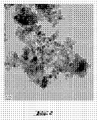
- the particles in the plasma-sprayed layer according to the invention have a particle size of 20 ⁇ 30 nm, as can be seen from the TEM image of FIG.
- the plasma spraying was carried out with a power of 35 kw and a substrate-gun distance of 13 cm.
- the layers produced by the plasma process according to the invention mainly show the desired ⁇ -phase (FIG. 3).
- the known sintering method (sintering in the furnace) requires a longer sintering time and the particles grow very strongly up to a particle size of a few hundred nanometers.
- the plasma-sprayed layers of aluminum oxide according to the invention can be used in the field of wear or corrosion protection, for example in the case of components for ships or aircraft.
- the properties of these layers can be designed so that a higher wear and corrosion resistance is given.
- the basis for this is the minimization of defects, such as cracks and pores, within the layer.
- the inventive method also has the advantage that in particular the conveyor systems do not clog due to the advantageous flow properties of the alumina granules used.
- the spray tests were carried out with AEROPERL® Alu 100/30, a granulate based on pyrogenically produced aluminum oxide (manufactured by Degussa AG) with APS (Metco F4).
- the powder was sprayed on steel blanks (ST37, 110 mm ⁇ ). Using a mask, layers in the range 100 - 160 ⁇ m were sprayed (100 mm ⁇ ).
- the order output was in the range of approx. 22 - 33%.
- the powder delivery rates are due to the low density of the material at about 2.8 - 3.2 g / min (Degussa Al 2 O 3 ).
- the Promoted powder volume was comparable to broken grades.
- Table 2 sample Argon (l / min) H2 (l / min) Electricity (A) Conveying gas AR (l / min) Flow rate (gr / min) Layer thickness ( ⁇ m) Order performance (%) Degussa 3 40 5 650 5 about 2.8 ⁇ 160 about 33 Degussa 4 40 12 650 5 about 2.8 ⁇ 160 about 33 Degussa 5 40 8th 650 10 about 3.2 ⁇ 130 about 25 Degussa 6 50 8th 650 5 about 2.8 ⁇ 130 about 28
- Electro breakdown tests were performed on the APS sprayed layers. The breakdown capabilities are in the range of normal plasma-sprayed aluminum oxide layers. The events are listed in Table 3. Table 3: Measurements of the dielectric strength of the APS sprayed samples. The leakage currents for 500 V (DC) are also indicated. Sample no.
Landscapes
- Engineering & Computer Science (AREA)
- Chemical & Material Sciences (AREA)
- Physics & Mathematics (AREA)
- Nanotechnology (AREA)
- Plasma & Fusion (AREA)
- Materials Engineering (AREA)
- Organic Chemistry (AREA)
- Metallurgy (AREA)
- Mechanical Engineering (AREA)
- Condensed Matter Physics & Semiconductors (AREA)
- General Physics & Mathematics (AREA)
- Crystallography & Structural Chemistry (AREA)
- Chemical Kinetics & Catalysis (AREA)
- Manufacturing & Machinery (AREA)
- Composite Materials (AREA)
- Coating By Spraying Or Casting (AREA)
- Compounds Of Alkaline-Earth Elements, Aluminum Or Rare-Earth Metals (AREA)
Abstract
Description
- Die Erfindung betrifft plasmagespritzte Schichten aus Aluminiumoxid auf einem Substrat sowie ein Verfahren zur Herstellung von plasmagespritzten Schichten aus Aluminiumoxid.
- Plasmagespritzte Schichten aus Aluminiumoxid werden verwendet, um Bauteile von Schiffen und Flugzeugen vor Korrosion oder Verschleiß zu schützen (Herbert Hermann, Spektrum der Wissenschaft, November 1988, Seite 102).Diese Aluminiummischoxidschichten weisen Risse auf. Es ist weiterhin bekannt, Aluminiumoxidschichten mittels des Plasmasprühverfahrens herzustellen (S. Jiansirisomboon et al., Journal of the European Ceramic Socicty 23, (2003) 961 - 976). Auch diese Schichten weisen Risse auf.
- Es ist bekannt, plasmagespritzte Schichten aus Aluminiumoxid aus mikrometerskaligen Pulvern herzustellen. Die Porengrößen können dabei in dem Bereich von 20 bis 40 µm liegen.
- Es ist bekannt, aus nanoskaligem A1203/Ti02-Pulvern Beschichtungen mittels des Plasmaverfahrens herzustellen (
US 6, 723, 387 ). - Hierzu ist es bekannt, nanoskaliges Aluminiumoxidpulver mittels der Chemical Vapor Condensation (CVC) herzustellen. Dabei wird die Vorstufe zusammen mit dem Tragegasstrom an einer heißen Wand oder in einem Flammenreaktor umgesetzt (
US 6,723,387 ). Die dort verwendeten Reaktoren werden in den DokumentenUS 5,514,350 undUS 5,876,683 beschrieben. - Gemäß
US 5,514,350 werden nicht-agglomerierte nanostrukturierte (n-ceramic) Pulver aus metallorganischen Vorstufen hergestellt, indem man die metallorganischen Vorstufen in einem Tragegasstrom in einem heißen Wirbelbettreaktor thermisch zersetzt. Insbesondere werden aus Hexamethyldisiloxan Pulver der Formel n-SiCxN4 erhalten. - Das Dokument beschreibt kein pyrogenes Verfahren, bei dem verdampfbare Metalloxid/Metallverbindungen in der Wasserstoff-Sauerstoff-Flamme zu den reinen Oxiden hydrolysiert werden.
- Gemäß
US 5,876,683 werden nicht-agglomerierte oxidische Pulver in der Größe von Nanopartikel hergestellt, indem man eine verdampfte metallorganische Verbindung mit einem sauerstoffenthaltenden Brenngasstrom vermischt, diesen Gasstrom einer Flamme zuführt und dort verbrennt, wobei in der Reaktionskammer ein Druck von 1 bis 50 mbar eingehalten wird. - Die erzeugten nicht-agglomerierten Oxide können auf einer gekühlten Walze oder direkt, wenn die Flamme als Plasmaflamme gestaltet wird, auf einem Substrat aufgetragen werden, wobei eine feste Schicht auf dem Substrat gebildet wird.
- Es ist weiterhin bekannt, nanostrukturiertes Aluminiumoxid, das mittels der CVC-Methode in einem Heisswandreaktor hergestellt wurde, in einer organischen Flüssigkeit zu suspendieren und diese Suspension mittels des Plasmaspritzverfahrens zu verarbeiten (
US 2003/0077398 A1 ). - Es ist weiterhin bekannt, mechanisch stabile, rißfreie, durch Flammspritzen erzeugte Schichten aus Aluminiumoxid von einer Dicke von 50 bis 1000 µm herzustellen, um die Stabilität von Bauteilen aus Quarz, wie zum Beispiel Quarztiegeln, zu erhöhen. Angaben zu der Struktur der Al2O3-Schicht werden nicht gemacht (
WO 02/092525 A1 - Es ist weiterhin bekannt, ein amorphes Material mittels des Plasmaspritzens herzustellen, indem man Aluminiumoxid im Gemisch mit anderen Oxiden dem Plasma zuführt (
WO 2004/016821 ). - Die bekannten Al2O3-Schichten können nachteiligerweise Defekte, wie Poren und Risse aufweisen. Diese Restporosität kann sich negativ auf die Mikrohärte und die Verschleißbeständigkeit auswirken.
- Es besteht somit die Aufgabe, plasmagespritzte Schichten aus Aluminiumoxid herzustellen, die ein Minimum an Defekten, wie Risse und Poren innerhalb der Schicht, und eine hohe Verschleißbeständigkeit aufweisen.
- Gegenstand der Erfindung sind plasmagespritzte Schichten aus Aluminiumoxid auf einem Substrat, welche dadurch gekennzeichnet sind, daß die Partikel des Aluminiumoxides in der Schicht eine Größe von 20 bis 30 nm (Nanometer) aufweisen und überwiegend in der α-Phase vorliegen. In einer besonderen Ausführungsform der Erfindung wird zur Herstellung der plasmagespritzten Schichten ein pyrogen hergestelltes Aluminiumoxid eingesetzt.
- Die erfindungsgemäßen Schichten aus Aluminiumoxid können auf einem Substrat, bestehend aus Stahl oder aus Borosilikatgläsern, aufgebracht sein.
- Ein weiterer Gegenstand der Erfindung ist ein Verfahren zur Herstellung der plasmagespritzten Schicht aus Aluminiumoxid, welches dadurch gekennzeichnet ist, daß man in einem an sich bekannten Plasmaspritzverfahren als Ausgangspulver ein pyrogen hergestelltes Aluminiumoxid einsetzt.
- Das pyrogen hergestellte (fumed) Aluminiumoxid kann mit dem bekannten Verfahren der Flammen- oder Hochtemperaturhydrolyse, insbesondere der Flammenhydrolyse zur Herstellung von pyrogen hergestellten Oxiden, hergestellt werden (Ullmann's Enzyklopädie der techn. Chemie, 4. Auflage, Band 21, Seite 464 (1982).
- Das pyrogen hergestellte Aluminiumoxid kann beispielsweise aus Aluminiumtrichlorid hergestellt werden, welches verdampft, mit trockener Luft vermischt und in einer Wasserstoff-Sauerstoff-Flamme zu Aluminiumoxid hydrolysiert wird.
- Das Aluminiumoxid fällt als Aerosil an und wird durch eine Kühl- oder Koagulationsstrecke geleitet, wo das Aluminiumoxid koaguliert beziehungsweise agglomeriert und ausflockt.
- Das pyrogen hergestellte Aluminiumoxid kann eine Primärteilchengröße von 13 ± 5 µm aufweisen. Es kann eine Stampfdichte von 50 ± 25 g/l aufweisen. Weiterhin kann es einen Gehalt an Aluminiumoxid von mehr als 99,6 Gew.-% aufweisen.
- Als Aluminiumoxid kann beispielsweise das pyrogen hergestellte Aluminiumoxid C eingesetzt werden. Die physikalisch-chemischen Daten von Aluminiumoxid C sind in der Tabelle 1 aufgeführt.
- In einer Ausführungsform der Erfindung kann man ein pyrogen hergestelltes Aluminiumoxid einsetzen, welches granuliert wurde.
- In einer weiteren Ausführungsform der Erfindung kann man als Ausgangspulver ein pyrogen hergestelltes Aluminiumoxidgranulat einsetzen, welches hergestellt wird, indem pyrogen hergestelltes Aluminiumoxid in Wasser dispergiert und dann sprühgetrocknet wird.
- Dieses Produkt ist bekannt aus
WO 03/014021 - Dieses Aluminiumoxidgranulat wird unter dem Namen AEROPERL® Alu 100/30 von der Degussa AG hergestellt.
Tabelle 1 Aluminiumoxid C Verhalten gegenüber Wasser hydrophil Oberfläche nach BET1) m2/g 100 ± 15 Mittlere Größe der Primärteilchen nm 13 Stampfdichte ca. Wert 2) verdichtete Ware g/l ca. 50 Spezifisches Gewicht 10) g/ml ca. 3,2 Trocknungsverlust3) bei Verlassen des Lieferwerkes % < 5,0 (2 Stunden bei 105°C) Glühverlust4)7) (2 Stunden bei 1000°C)% < 3 pH-Wert 5) 4,5-5,5 SiO2 8) < 0,1 Al2O3 8) < 99,6 Fe2O3 8) < 0,2 TiO2 8) > 0,1 HCI 8) 9) < 0,5 Siebrückstand 6) (nach Mocker, 45 µm) % < 0,05 1) nach DIN 66131 2) nach DIN ISO 787/XI, JIS K 5101/18 (nicht gesiebt) 3) nach DIN ISO 787/II, ASTM D 280, JIS K 5101/21 4) nach DIN 55921, ASTM D 1208, JIS K 5101/23 5) nach DIN ISO 787/IX;ASTM D !"=(; JIS K 5101/24 6) nach DIN ISO 787/XVIII; JIS K 5101/20 7) bezogen auf die 2 Stunden bei 105°C getrocknete Substanz 8) bezogen auf die 2 Stunden bei 1000°C geglühte Substanz 9) HCI-Gehalt ist Bestandteil des Glühverlustes - Das Plasmaspritzverfahren ist bekannt aus S. Jiansirisomboon et al. Journal of European Ceramic Society 23 (2003), 961-976.
- Das Plasmaspritzen gehört zu den thermischen Spritzverfahren.
- Bei dem atmosphärischen Plasmaspritzen (APS) wird mit Hilfe eines Gleichstromes zwischen einer was-sergekühlten Anode und einer wassergekühlten Kathode ein Plasma aus einem Gas (Primärgas) erzeugt. Bei diesem Gas handelt es sich um zum Beispiel Stickstoff oder Formiergas. Je nach Art des Gases können unterschiedliche Temperaturen in der Plasmaflamme erzeugt werden. Bei dieser Art des Plasmas (thermisches Plasma) wird die hohe Temperatur (einige 10000 K) dadurch erhalten, daß die dissoziierten Ionen im Plasma rekombinieren.
- Zusätzlich zu der hohen Temperatur des Plasmas treten sehr hohe Gasaustrittsgeschwindigkeiten aus der Plasmapistole auf. Diese können im Bereich von einigen 100 m/s liegen. Dadurch treffen die Partikel, die in der Flamme aufgeschmolzen werden, mit hoher Geschwindigkeit auf das Substrat auf. Dabei wird ein Teil der Auftreffenergie in Wärme umgewandelt.
- Die Gasgeschwindigkeit kann durch Einleiten eines zusätzlichen Gases (Sekundärgas) variiert und erhöht werden.
- Durch die hohen Flammtemperaturen und die hohen Gasgeschwindigkeiten können hochschmelzende Materialien, wie zum Beispiel Al2O3, verarbeitet werden.
- Das Ausgangspulver wird mit Hilfe eines Gasstromes entweder axial oder radial direkt in die Plasmaflamme eingegeben. Das Schema des Verfahrens ist in Figur 1 dargestellt. Folgende Parameter können beim atmosphärischen Flammenspritzen variiert werden, wodurch die Eigenschaften der Schichten vorgegeben werden: Elektrische Leistung (Flammtemperatur), Primärgasfluß (Flammtemperatur, Gasaustrittsgeschwindigkeit), Sekundärgasfluß (Gasaustrittsgeschwindigkeit), Pulverförderrate (Schichtauftragsrate), Abstand Substrat - Plasmapistole (Verweilzeit der Partikel in der Flamme).
- Die Schichtdicken der plasmagespritzten Schichten können im Bereich von einigen µm bis einigen cm liegen.
- Je nach Art der gespritzten Schicht und der Anwendung kommen unterschiedliche Substratwerkstoffe in Frage. Meist dient die plasmagespritzte Schicht dazu, eine Eigenschaftsverbesserung des Substratmaterials hervorzurufen.
- So kann durch die erfindungsgemäßen Al2O3-Schicht die Verschleißbeständigkeit, die thermische Isolation oder die Korrosionsbeständigkeit verbessert werden. Es kommen sowohl Metalle (z.B. Stähle), Keramiken (z.B. Al2O3 oder ZrO2) als auch Gläser (z.B. Borosilikatglas) als Substrate in Frage.
- Die linearen Ausdehnungskoeffizienten der Substrate und der Schichten sollten aufeinander abgestimmt sein, um ein Abplatzen der Schicht zu verhindern. Bei stark unterschiedlichen Ausdehnungskoeffizienten kann mit Zwischenschichten (z.B. Ni-Cr-Al) gearbeitet werden, deren Ausdehnungskoeffizienten zwischen denen der Substrate und den eigentlichen funktionalen Schichten liegen.
- Bei den erfindungsgemäßen Al2O3-Schichten kann auf Basis von Aluminiumoxidgranulat vorteilhafterweise zum Beispiel mit Ni-Cr-Al als Zwischenschicht gearbeitet werden, wenn Stahl als Substrat verwendet wird.
- Die erfindungsgemäße Herstellung von plasmagespritzten Al2O3-Schichten unter Verwendung von Aluminiumoxidgranulat hat den Vorteil, daß die Schichten gleichzeitig beim Aufbringen gesintert werden.
- Wegen der kurzen Sinterzeit ist die Korngröße der Partikel nur leicht gestiegen. Die AEROXIDE® Alu C-Partikel weisen eine Partikelgröße von ca. 13 nm auf.
- Die Partikel in der erfindungsgemäßen plasmagespritzten Schicht weisen - wie der TEM-Aufnahme gemäß Figur 2 entnommen werden kann - eine Partikelgröße von 20 ~ 30 nm auf.
- Das Plasmaspritzen wurde mit einer Leistung von 35 kw und einem Abstand Substrat-Pistole von 13 cm durchgeführt .
- Die erfindungsgemäß nach dem Plasma-Verfahren hergestellten Schichten zeigen hauptsächlich die erwünschte α-Phase (Figur 3).
- Bei der bekannten Sintermethode (Sintern im Ofen) braucht man eine längere Sinterzeit, und die Partikel wachsen sehr stark bis zu einer Partikelgröße von einigen Hundert Nanometern.
- Die erfindungsgemäßen plasmagespritzten Schichten aus Aluminiumoxid können im Bereich des Verschleiß- oder Korrosionsschutzes, zum Beispiel bei Bauteilen für Schiffe oder Flugzeuge angewandt werden. Durch den Einsatz der erfindungsgemäßen plasmagespritzten Schichten mit nanoskaligem Gefüge können die Eigenschaften dieser Schichten so gestaltet werden, daß eine höhere Verschleiß- und Korrosionsbeständigkeit gegeben ist. Grundlage hierfür ist die Minimierung der Defekte, wie Risse und Poren, innerhalb der Schicht.
- Das erfindungsgemäße Verfahren weist zudem den Vorteil auf, daß insbesondere die Förderanlagen auf Grund der vorteilhaften Rieselfähigkeitseigenschaften des eingesetzten Aluminiumoxidgranulates nicht verstopfen.
- Die Spritzversuche wurden mit AEROPERL® Alu 100/30, einem Granulat auf Basis von pyrogen hergestelltem Aluminiumoxid (Herstellung Degussa AG) mit APS (Metco F4), durchgeführt.
- Das AEROPERL® Alu 100/30 weist die folgenden physikalisch-chemischen Kenndaten auf:
Einheiten Richtwerte Spezifische Oberfläche (BET) m2/g 85 - 115 pH-Wert 4,0 - 6,0 Trocknungsverlust % < = 2,5 Stampfdichte (ca.-Wert) in Anl. n DIN ISO 787/CI, Aug. 1983 g/l 500 Glühverlust 2h bei 1000°C, bezogen auf die getrocknete Substanz (2 h bei 105°C) % < = 4,5 Al2O3-Gehalt (1) % > = 99,6 (1) bezogen auf die geglühte Substanz Cilas d50 µm 30 - Mit dem Pulver wurden Spritzversuche auf Stahlronden (ST37, 110 mm Ø) durchgeführt. Mit Hilfe einer Maske wurden Schichten im Bereich 100 - 160 µm gespritzt (100 mm Ø).
- Die Auftragsleistung lag je nach Spritzparameter im Bereich bei ca. 22 - 33 %.
- Die Pulverförderraten liegen auf Grund der geringen Dichte des Materials bei ca. 2.8 - 3.2 g/min (Degussa Al2O3). Das geförderte Pulvervolumen war vergleichbar mit gebrochenen Qualitäten.
- Die den Proben zugeordneten Spritzparameter sind in der Tabelle 2 aufgeführt. Es wurden insgesamt nur vier Ronden gespritzt.
Tabelle 2 Probe Argon (l/min) H2 (l/min) Strom (A) Fördergas AR (l/min) Fördermenge (gr/min) Schichtstärke (µm) Auftragsleistung (%) Degussa 3 40 5 650 5 ca. 2,8 ~ 160 ca. 33 Degussa 4 40 12 650 5 ca. 2,8 ~ 160 ca. 33 Degussa 5 40 8 650 10 ca. 3,2 ~ 130 ca. 25 Degussa 6 50 8 650 5 ca. 2,8 ~ 130 ca. 28 - Von den APS gespritzten Schichten wurden elektrische Durchschlagtests durchgeführt. Die Durchschlagsfähigkeiten liegen im Bereich normaler plasmagespritzten Aluminiumoxidschichten. Die Ereignisse sind in der Tabelle 3 aufgeführt.
Tabelle 3: Messwerte der Durchschlagfestigkeit der APS gespritzten Proben. Es sind auch die Ableitströme für 500 V (DC) angegeben. Proben-Nr. Schichtdicke Ableitstrom (µA) Durchschlagspannung [kV] Mittelwert (Ableitstrom bzw. Durchschlagspannung) Messposition Spannung Anfang Ende 1 118 500 V 293 51 1 500 V 268 49 2 500 V 234 47 49 3 1,2 4 1,1 5 1,1 1,13 6 2 158 500 V 369 53 1 500 V 315 57 2 500 V 236 55 55 3 1,6 4 1,7 5 1,5 6 3 121 500 V 161 42 39 1 500 V 163 38 2 500 V 168 38 3 1,2 4 1,3 5 1,2 6 4 108 500 V 426 124 1 500 V 435 113 2 500 V 398 119 119 3 1,2 4 1,2 5 1, 1 1,17 6
Claims (4)
- Plasmagespritzte Schichten aus Aluminiumoxid auf einem Substrat, dadurch gekennzeichnet, daß die Partikel des Aluminiumoxides in der Schicht eine Größe von 20 bis 30 nm (Nanometer) aufweisen und überwiegend in der α-Al2O3-Phase vorliegen.
- Verfahren zur Herstellung der plasmagespritzten Schicht aus Aluminiumoxid auf einem Substrat gemäß Anspruch 1, dadurch gekennzeichnet, daß man als Ausgangspulver ein pyrogen hergestelltes Aluminiumoxid einsetzt.
- Verfahren gemäß Anspruch 2, dadurch gekennzeichnet, daß man ein pyrogen hergestelltes Aluminiumoxid einsetzt, welches granuliert wurde.
- Verfahren gemäß Anspruch 3, dadurch gekennzeichnet, daß man ein pyrogen hergestelltes Aluminiumoxid einsetzt, welches in Wasser dispergiert und sprühgetrocknet wurde.
Priority Applications (4)
| Application Number | Priority Date | Filing Date | Title |
|---|---|---|---|
| EP05112923A EP1700927B1 (de) | 2005-03-09 | 2005-12-23 | Plasmagespritzte Schichten aus Aluminiumoxid |
| US11/371,156 US7887923B2 (en) | 2005-03-09 | 2006-03-09 | Plasma-sprayed layers of aluminium oxide |
| JP2006064696A JP4518410B2 (ja) | 2005-03-09 | 2006-03-09 | プラズマ溶射された酸化アルミニウム層 |
| US12/629,640 US8007870B2 (en) | 2005-03-09 | 2009-12-02 | Plasma-sprayed layers of aluminum oxide |
Applications Claiming Priority (2)
| Application Number | Priority Date | Filing Date | Title |
|---|---|---|---|
| EP05005097A EP1700926A1 (de) | 2005-03-09 | 2005-03-09 | Plasmagespritzte Schichten aus Aluminiumoxid |
| EP05112923A EP1700927B1 (de) | 2005-03-09 | 2005-12-23 | Plasmagespritzte Schichten aus Aluminiumoxid |
Publications (2)
| Publication Number | Publication Date |
|---|---|
| EP1700927A1 true EP1700927A1 (de) | 2006-09-13 |
| EP1700927B1 EP1700927B1 (de) | 2011-05-04 |
Family
ID=34934148
Family Applications (2)
| Application Number | Title | Priority Date | Filing Date |
|---|---|---|---|
| EP05005097A Withdrawn EP1700926A1 (de) | 2005-03-09 | 2005-03-09 | Plasmagespritzte Schichten aus Aluminiumoxid |
| EP05112923A Expired - Lifetime EP1700927B1 (de) | 2005-03-09 | 2005-12-23 | Plasmagespritzte Schichten aus Aluminiumoxid |
Family Applications Before (1)
| Application Number | Title | Priority Date | Filing Date |
|---|---|---|---|
| EP05005097A Withdrawn EP1700926A1 (de) | 2005-03-09 | 2005-03-09 | Plasmagespritzte Schichten aus Aluminiumoxid |
Country Status (4)
| Country | Link |
|---|---|
| EP (2) | EP1700926A1 (de) |
| CN (1) | CN101033534A (de) |
| AT (1) | ATE508214T1 (de) |
| DE (1) | DE502005011328D1 (de) |
Cited By (1)
| Publication number | Priority date | Publication date | Assignee | Title |
|---|---|---|---|---|
| DE102021210412A1 (de) | 2021-09-20 | 2023-03-23 | BSH Hausgeräte GmbH | Verfahren zum Herstellen eines Heizelements zur Installation in einer Wasserpumpe |
Families Citing this family (3)
| Publication number | Priority date | Publication date | Assignee | Title |
|---|---|---|---|---|
| CN101580938B (zh) * | 2009-06-19 | 2012-10-03 | 吉林大学 | 一种氧化铝陶瓷颗粒增强金属基复合材料涂层制备方法 |
| CN106947934A (zh) * | 2017-05-09 | 2017-07-14 | 中国科学院兰州化学物理研究所 | 一种等离子喷涂制备α‑Al2O3涂层的方法 |
| CN118291909A (zh) * | 2024-04-16 | 2024-07-05 | 哈尔滨工业大学 | 一种高α相含量的氧化铝涂层的制备方法 |
Citations (8)
| Publication number | Priority date | Publication date | Assignee | Title |
|---|---|---|---|---|
| US5514350A (en) | 1994-04-22 | 1996-05-07 | Rutgers, The State University Of New Jersey | Apparatus for making nanostructured ceramic powders and whiskers |
| US5876683A (en) | 1995-11-02 | 1999-03-02 | Glumac; Nicholas | Combustion flame synthesis of nanophase materials |
| WO2002092525A1 (de) | 2001-03-23 | 2002-11-21 | Heraeus Quarzglas Gmbh & Co. Kg | Bauteil aus quarzglas sowie verfahren zur herstellung desselben |
| WO2003014021A1 (en) | 2001-08-06 | 2003-02-20 | Degussa Ag | Granules based on pyrogenically produced aluminium oxide, their production process and use |
| US20030077398A1 (en) | 1995-11-13 | 2003-04-24 | Peter R. Strutt | Nanostructured feeds for thermal spray systems, method of manufacture, and coatings formed therefrom |
| US20030108680A1 (en) * | 2001-07-09 | 2003-06-12 | Maurice Gell | Duplex coatings and bulk materials, and methods of manufacture thereof |
| WO2004016821A2 (en) | 2002-08-02 | 2004-02-26 | 3M Innovative Properties Company | Plasma projection |
| US6723387B1 (en) | 1999-08-16 | 2004-04-20 | Rutgers University | Multimodal structured hardcoatings made from micro-nanocomposite materials |
-
2005
- 2005-03-09 EP EP05005097A patent/EP1700926A1/de not_active Withdrawn
- 2005-12-23 EP EP05112923A patent/EP1700927B1/de not_active Expired - Lifetime
- 2005-12-23 DE DE502005011328T patent/DE502005011328D1/de not_active Expired - Lifetime
- 2005-12-23 AT AT05112923T patent/ATE508214T1/de active
-
2006
- 2006-03-09 CN CNA2006100739413A patent/CN101033534A/zh active Pending
Patent Citations (8)
| Publication number | Priority date | Publication date | Assignee | Title |
|---|---|---|---|---|
| US5514350A (en) | 1994-04-22 | 1996-05-07 | Rutgers, The State University Of New Jersey | Apparatus for making nanostructured ceramic powders and whiskers |
| US5876683A (en) | 1995-11-02 | 1999-03-02 | Glumac; Nicholas | Combustion flame synthesis of nanophase materials |
| US20030077398A1 (en) | 1995-11-13 | 2003-04-24 | Peter R. Strutt | Nanostructured feeds for thermal spray systems, method of manufacture, and coatings formed therefrom |
| US6723387B1 (en) | 1999-08-16 | 2004-04-20 | Rutgers University | Multimodal structured hardcoatings made from micro-nanocomposite materials |
| WO2002092525A1 (de) | 2001-03-23 | 2002-11-21 | Heraeus Quarzglas Gmbh & Co. Kg | Bauteil aus quarzglas sowie verfahren zur herstellung desselben |
| US20030108680A1 (en) * | 2001-07-09 | 2003-06-12 | Maurice Gell | Duplex coatings and bulk materials, and methods of manufacture thereof |
| WO2003014021A1 (en) | 2001-08-06 | 2003-02-20 | Degussa Ag | Granules based on pyrogenically produced aluminium oxide, their production process and use |
| WO2004016821A2 (en) | 2002-08-02 | 2004-02-26 | 3M Innovative Properties Company | Plasma projection |
Non-Patent Citations (4)
| Title |
|---|
| "ULLMANN'S ENZYKLOPÄDIE DER TECHN. CHEMIE", vol. 21, 1982, pages: 464 |
| S. JIANSIRISOMBOON, JOURNAL OF EUROPEAN CERAMIC SOCIETY, vol. 23, 2003, pages 961 - 976 |
| S. JIANSIRISOMBOON, JOURNAL OF THE EUROPEAN CERAMIC SOCICTY, vol. 23, 2003, pages 961 - 976 |
| VARATHARAJAN K ET AL: "Synthesis of nanocrystalline alpha-Al2O3 by ultrasonic flame pyrolysis", MATERIALS RESEARCH BULLETIN, ELSEVIER, KIDLINGTON, GB, vol. 38, no. 4, 24 March 2003 (2003-03-24), pages 577 - 583, XP004417137, ISSN: 0025-5408 * |
Cited By (1)
| Publication number | Priority date | Publication date | Assignee | Title |
|---|---|---|---|---|
| DE102021210412A1 (de) | 2021-09-20 | 2023-03-23 | BSH Hausgeräte GmbH | Verfahren zum Herstellen eines Heizelements zur Installation in einer Wasserpumpe |
Also Published As
| Publication number | Publication date |
|---|---|
| DE502005011328D1 (de) | 2011-06-16 |
| CN101033534A (zh) | 2007-09-12 |
| ATE508214T1 (de) | 2011-05-15 |
| EP1700927B1 (de) | 2011-05-04 |
| EP1700926A1 (de) | 2006-09-13 |
Similar Documents
| Publication | Publication Date | Title |
|---|---|---|
| EP1243552B1 (de) | Mit einer Hülle umgebene, dotierte Oxidpartikeln | |
| US8007870B2 (en) | Plasma-sprayed layers of aluminum oxide | |
| EP2300630B1 (de) | Verfahren zur herstellung von thermisch gespritzten al2o3-schichten mit einem hohen korundgehalt ohne eigenschaftsmindernde zusätze | |
| US6328944B1 (en) | Doped, pyrogenically prepared oxides | |
| EP1236773B1 (de) | Oberflächenmodifizierte, dotierte, pyrogen hergestellte Oxide | |
| US7700152B2 (en) | Liquid feed flame spray modification of nanoparticles | |
| EP1934384B1 (de) | Verfahren zum beschichten der oberfläche von metalloxid mit superfeinen metalloxidteilchen und daraus hergestellte beschichtung | |
| US20020189402A1 (en) | Nickel powder dispersion, method of producing nickel power dispersion and method of producing conductive paste | |
| Milošević et al. | Synthesis of BaTiO3 and ZnO varistor precursor powders by reaction spray pyrolysis | |
| TW201736617A (zh) | 鎳粉末 | |
| EP1438361A1 (de) | Beschichtete titandioxid-teilchen | |
| EP1700927B1 (de) | Plasmagespritzte Schichten aus Aluminiumoxid | |
| EP1321444B1 (de) | Schicht erhalten aus einer wässerigen Dispersion enthaltend flammenhydrolytisch hergestelltes Silicium-Titan-Mischoxidpulver | |
| TWI807892B (zh) | 球狀氟氧化釔基粉末、其製備方法及氟氧化釔基塗層 | |
| CN111101086B (zh) | 一种用于热喷涂的Fe3O4-Co3O4粉末的制备方法 | |
| FI131339B1 (en) | Method for producing powder mixture for ceramic coating and its use | |
| JP4981292B2 (ja) | 溶射用粉末及び溶射皮膜の形成方法 | |
| Gadow et al. | Combined metallurgical and ceramic coating in the development of tubular ozone generators | |
| DE10000979C1 (de) | Beschichtungspulver auf der Basis von Titansuboxiden | |
| KR100486064B1 (ko) | 구형의 다공성 티타니아 분말의 개선된 제조방법 | |
| Choi et al. | Characteristics of BaO–B2O3–SiO2 nano glass powders prepared by flame spray pyrolysis as the sintering agent of BaTiO3 ceramics | |
| Friedrich et al. | Thermally sprayed multilayer coatings as electrodes and dielectrics in high efficiency ozonizer tubes | |
| Camelot et al. | Production of various ceramic powders using bipolar mixing | |
| JP2005076074A (ja) | チタン化合物被覆ニッケル粉末およびこれを用いた導電ペースト | |
| KR20250143237A (ko) | 열차폐 코팅용 코어쉘 복합체 분말 및 그 제조 방법 |
Legal Events
| Date | Code | Title | Description |
|---|---|---|---|
| PUAI | Public reference made under article 153(3) epc to a published international application that has entered the european phase |
Free format text: ORIGINAL CODE: 0009012 |
|
| 17P | Request for examination filed |
Effective date: 20051223 |
|
| AK | Designated contracting states |
Kind code of ref document: A1 Designated state(s): AT BE BG CH CY CZ DE DK EE ES FI FR GB GR HU IE IS IT LI LT LU LV MC NL PL PT RO SE SI SK TR |
|
| AX | Request for extension of the european patent |
Extension state: AL BA HR MK YU |
|
| 17Q | First examination report despatched |
Effective date: 20061205 |
|
| RAP1 | Party data changed (applicant data changed or rights of an application transferred) |
Owner name: DEGUSSA GMBH |
|
| 17Q | First examination report despatched |
Effective date: 20061205 |
|
| AKX | Designation fees paid |
Designated state(s): AT BE BG CH CY CZ DE DK EE ES FI FR GB GR HU IE IS IT LI LT LU LV MC NL PL PT RO SE SI SK TR |
|
| RAP1 | Party data changed (applicant data changed or rights of an application transferred) |
Owner name: EVONIK DEGUSSA GMBH |
|
| APBN | Date of receipt of notice of appeal recorded |
Free format text: ORIGINAL CODE: EPIDOSNNOA2E |
|
| APBR | Date of receipt of statement of grounds of appeal recorded |
Free format text: ORIGINAL CODE: EPIDOSNNOA3E |
|
| APAF | Appeal reference modified |
Free format text: ORIGINAL CODE: EPIDOSCREFNE |
|
| RAP1 | Party data changed (applicant data changed or rights of an application transferred) |
Owner name: EVONIK DEGUSSA GMBH |
|
| APBT | Appeal procedure closed |
Free format text: ORIGINAL CODE: EPIDOSNNOA9E |
|
| GRAP | Despatch of communication of intention to grant a patent |
Free format text: ORIGINAL CODE: EPIDOSNIGR1 |
|
| RIC1 | Information provided on ipc code assigned before grant |
Ipc: C23C 4/12 20060101ALI20101022BHEP Ipc: C23C 4/10 20060101AFI20101022BHEP |
|
| GRAS | Grant fee paid |
Free format text: ORIGINAL CODE: EPIDOSNIGR3 |
|
| GRAA | (expected) grant |
Free format text: ORIGINAL CODE: 0009210 |
|
| AK | Designated contracting states |
Kind code of ref document: B1 Designated state(s): AT BE BG CH CY CZ DE DK EE ES FI FR GB GR HU IE IS IT LI LT LU LV MC NL PL PT RO SE SI SK TR |
|
| REG | Reference to a national code |
Ref country code: GB Ref legal event code: FG4D Free format text: NOT ENGLISH |
|
| REG | Reference to a national code |
Ref country code: CH Ref legal event code: EP |
|
| REG | Reference to a national code |
Ref country code: IE Ref legal event code: FG4D Free format text: LANGUAGE OF EP DOCUMENT: GERMAN |
|
| REF | Corresponds to: |
Ref document number: 502005011328 Country of ref document: DE Date of ref document: 20110616 Kind code of ref document: P |
|
| REG | Reference to a national code |
Ref country code: DE Ref legal event code: R096 Ref document number: 502005011328 Country of ref document: DE Effective date: 20110616 |
|
| REG | Reference to a national code |
Ref country code: NL Ref legal event code: VDEP Effective date: 20110504 |
|
| PG25 | Lapsed in a contracting state [announced via postgrant information from national office to epo] |
Ref country code: LT Free format text: LAPSE BECAUSE OF FAILURE TO SUBMIT A TRANSLATION OF THE DESCRIPTION OR TO PAY THE FEE WITHIN THE PRESCRIBED TIME-LIMIT Effective date: 20110504 Ref country code: SE Free format text: LAPSE BECAUSE OF FAILURE TO SUBMIT A TRANSLATION OF THE DESCRIPTION OR TO PAY THE FEE WITHIN THE PRESCRIBED TIME-LIMIT Effective date: 20110504 Ref country code: PT Free format text: LAPSE BECAUSE OF FAILURE TO SUBMIT A TRANSLATION OF THE DESCRIPTION OR TO PAY THE FEE WITHIN THE PRESCRIBED TIME-LIMIT Effective date: 20110905 |
|
| PG25 | Lapsed in a contracting state [announced via postgrant information from national office to epo] |
Ref country code: SI Free format text: LAPSE BECAUSE OF FAILURE TO SUBMIT A TRANSLATION OF THE DESCRIPTION OR TO PAY THE FEE WITHIN THE PRESCRIBED TIME-LIMIT Effective date: 20110504 Ref country code: IS Free format text: LAPSE BECAUSE OF FAILURE TO SUBMIT A TRANSLATION OF THE DESCRIPTION OR TO PAY THE FEE WITHIN THE PRESCRIBED TIME-LIMIT Effective date: 20110904 Ref country code: GR Free format text: LAPSE BECAUSE OF FAILURE TO SUBMIT A TRANSLATION OF THE DESCRIPTION OR TO PAY THE FEE WITHIN THE PRESCRIBED TIME-LIMIT Effective date: 20110805 Ref country code: ES Free format text: LAPSE BECAUSE OF FAILURE TO SUBMIT A TRANSLATION OF THE DESCRIPTION OR TO PAY THE FEE WITHIN THE PRESCRIBED TIME-LIMIT Effective date: 20110815 Ref country code: FI Free format text: LAPSE BECAUSE OF FAILURE TO SUBMIT A TRANSLATION OF THE DESCRIPTION OR TO PAY THE FEE WITHIN THE PRESCRIBED TIME-LIMIT Effective date: 20110504 Ref country code: CY Free format text: LAPSE BECAUSE OF FAILURE TO SUBMIT A TRANSLATION OF THE DESCRIPTION OR TO PAY THE FEE WITHIN THE PRESCRIBED TIME-LIMIT Effective date: 20110504 Ref country code: LV Free format text: LAPSE BECAUSE OF FAILURE TO SUBMIT A TRANSLATION OF THE DESCRIPTION OR TO PAY THE FEE WITHIN THE PRESCRIBED TIME-LIMIT Effective date: 20110504 |
|
| REG | Reference to a national code |
Ref country code: IE Ref legal event code: FD4D |
|
| PG25 | Lapsed in a contracting state [announced via postgrant information from national office to epo] |
Ref country code: NL Free format text: LAPSE BECAUSE OF FAILURE TO SUBMIT A TRANSLATION OF THE DESCRIPTION OR TO PAY THE FEE WITHIN THE PRESCRIBED TIME-LIMIT Effective date: 20110504 |
|
| PG25 | Lapsed in a contracting state [announced via postgrant information from national office to epo] |
Ref country code: IE Free format text: LAPSE BECAUSE OF FAILURE TO SUBMIT A TRANSLATION OF THE DESCRIPTION OR TO PAY THE FEE WITHIN THE PRESCRIBED TIME-LIMIT Effective date: 20110504 Ref country code: EE Free format text: LAPSE BECAUSE OF FAILURE TO SUBMIT A TRANSLATION OF THE DESCRIPTION OR TO PAY THE FEE WITHIN THE PRESCRIBED TIME-LIMIT Effective date: 20110504 Ref country code: CZ Free format text: LAPSE BECAUSE OF FAILURE TO SUBMIT A TRANSLATION OF THE DESCRIPTION OR TO PAY THE FEE WITHIN THE PRESCRIBED TIME-LIMIT Effective date: 20110504 |
|
| PG25 | Lapsed in a contracting state [announced via postgrant information from national office to epo] |
Ref country code: DK Free format text: LAPSE BECAUSE OF FAILURE TO SUBMIT A TRANSLATION OF THE DESCRIPTION OR TO PAY THE FEE WITHIN THE PRESCRIBED TIME-LIMIT Effective date: 20110504 Ref country code: SK Free format text: LAPSE BECAUSE OF FAILURE TO SUBMIT A TRANSLATION OF THE DESCRIPTION OR TO PAY THE FEE WITHIN THE PRESCRIBED TIME-LIMIT Effective date: 20110504 Ref country code: PL Free format text: LAPSE BECAUSE OF FAILURE TO SUBMIT A TRANSLATION OF THE DESCRIPTION OR TO PAY THE FEE WITHIN THE PRESCRIBED TIME-LIMIT Effective date: 20110504 Ref country code: RO Free format text: LAPSE BECAUSE OF FAILURE TO SUBMIT A TRANSLATION OF THE DESCRIPTION OR TO PAY THE FEE WITHIN THE PRESCRIBED TIME-LIMIT Effective date: 20110504 |
|
| PLBE | No opposition filed within time limit |
Free format text: ORIGINAL CODE: 0009261 |
|
| STAA | Information on the status of an ep patent application or granted ep patent |
Free format text: STATUS: NO OPPOSITION FILED WITHIN TIME LIMIT |
|
| 26N | No opposition filed |
Effective date: 20120207 |
|
| PG25 | Lapsed in a contracting state [announced via postgrant information from national office to epo] |
Ref country code: IT Free format text: LAPSE BECAUSE OF FAILURE TO SUBMIT A TRANSLATION OF THE DESCRIPTION OR TO PAY THE FEE WITHIN THE PRESCRIBED TIME-LIMIT Effective date: 20110504 |
|
| REG | Reference to a national code |
Ref country code: DE Ref legal event code: R097 Ref document number: 502005011328 Country of ref document: DE Effective date: 20120207 |
|
| BERE | Be: lapsed |
Owner name: EVONIK DEGUSSA G.M.B.H. Effective date: 20111231 |
|
| PG25 | Lapsed in a contracting state [announced via postgrant information from national office to epo] |
Ref country code: MC Free format text: LAPSE BECAUSE OF NON-PAYMENT OF DUE FEES Effective date: 20111231 |
|
| REG | Reference to a national code |
Ref country code: CH Ref legal event code: PL |
|
| GBPC | Gb: european patent ceased through non-payment of renewal fee |
Effective date: 20111223 |
|
| REG | Reference to a national code |
Ref country code: FR Ref legal event code: ST Effective date: 20120831 |
|
| PG25 | Lapsed in a contracting state [announced via postgrant information from national office to epo] |
Ref country code: CH Free format text: LAPSE BECAUSE OF NON-PAYMENT OF DUE FEES Effective date: 20111231 Ref country code: BE Free format text: LAPSE BECAUSE OF NON-PAYMENT OF DUE FEES Effective date: 20111231 Ref country code: GB Free format text: LAPSE BECAUSE OF NON-PAYMENT OF DUE FEES Effective date: 20111223 Ref country code: LI Free format text: LAPSE BECAUSE OF NON-PAYMENT OF DUE FEES Effective date: 20111231 |
|
| REG | Reference to a national code |
Ref country code: AT Ref legal event code: MM01 Ref document number: 508214 Country of ref document: AT Kind code of ref document: T Effective date: 20111223 |
|
| PG25 | Lapsed in a contracting state [announced via postgrant information from national office to epo] |
Ref country code: FR Free format text: LAPSE BECAUSE OF NON-PAYMENT OF DUE FEES Effective date: 20120102 |
|
| PG25 | Lapsed in a contracting state [announced via postgrant information from national office to epo] |
Ref country code: LU Free format text: LAPSE BECAUSE OF NON-PAYMENT OF DUE FEES Effective date: 20111223 |
|
| PG25 | Lapsed in a contracting state [announced via postgrant information from national office to epo] |
Ref country code: AT Free format text: LAPSE BECAUSE OF NON-PAYMENT OF DUE FEES Effective date: 20111223 Ref country code: BG Free format text: LAPSE BECAUSE OF FAILURE TO SUBMIT A TRANSLATION OF THE DESCRIPTION OR TO PAY THE FEE WITHIN THE PRESCRIBED TIME-LIMIT Effective date: 20110804 |
|
| PG25 | Lapsed in a contracting state [announced via postgrant information from national office to epo] |
Ref country code: TR Free format text: LAPSE BECAUSE OF FAILURE TO SUBMIT A TRANSLATION OF THE DESCRIPTION OR TO PAY THE FEE WITHIN THE PRESCRIBED TIME-LIMIT Effective date: 20110504 |
|
| PG25 | Lapsed in a contracting state [announced via postgrant information from national office to epo] |
Ref country code: HU Free format text: LAPSE BECAUSE OF FAILURE TO SUBMIT A TRANSLATION OF THE DESCRIPTION OR TO PAY THE FEE WITHIN THE PRESCRIBED TIME-LIMIT Effective date: 20110504 |
|
| PGFP | Annual fee paid to national office [announced via postgrant information from national office to epo] |
Ref country code: DE Payment date: 20131220 Year of fee payment: 9 |
|
| REG | Reference to a national code |
Ref country code: DE Ref legal event code: R119 Ref document number: 502005011328 Country of ref document: DE |
|
| PG25 | Lapsed in a contracting state [announced via postgrant information from national office to epo] |
Ref country code: DE Free format text: LAPSE BECAUSE OF NON-PAYMENT OF DUE FEES Effective date: 20150701 |