EP1700860A1 - Polycyclic fused ring type pi-conjugated organic materials, intermediate therefor, process for producing polycyclic fused ring type pi-conjugated organic materials, and process for producing intermediate for polycyclic fused ring type pi-conjugated organic materials - Google Patents
Polycyclic fused ring type pi-conjugated organic materials, intermediate therefor, process for producing polycyclic fused ring type pi-conjugated organic materials, and process for producing intermediate for polycyclic fused ring type pi-conjugated organic materials Download PDFInfo
- Publication number
- EP1700860A1 EP1700860A1 EP04818199A EP04818199A EP1700860A1 EP 1700860 A1 EP1700860 A1 EP 1700860A1 EP 04818199 A EP04818199 A EP 04818199A EP 04818199 A EP04818199 A EP 04818199A EP 1700860 A1 EP1700860 A1 EP 1700860A1
- Authority
- EP
- European Patent Office
- Prior art keywords
- group
- substituted
- silyl
- silyloxy
- aryl
- Prior art date
- Legal status (The legal status is an assumption and is not a legal conclusion. Google has not performed a legal analysis and makes no representation as to the accuracy of the status listed.)
- Granted
Links
- 0 **c(c(C#Cc1ccccc1)c1)cc(C#Cc2ccccc2)c1N Chemical compound **c(c(C#Cc1ccccc1)c1)cc(C#Cc2ccccc2)c1N 0.000 description 3
Images

Classifications
-
- C—CHEMISTRY; METALLURGY
- C07—ORGANIC CHEMISTRY
- C07F—ACYCLIC, CARBOCYCLIC OR HETEROCYCLIC COMPOUNDS CONTAINING ELEMENTS OTHER THAN CARBON, HYDROGEN, HALOGEN, OXYGEN, NITROGEN, SULFUR, SELENIUM OR TELLURIUM
- C07F7/00—Compounds containing elements of Groups 4 or 14 of the Periodic Table
- C07F7/02—Silicon compounds
- C07F7/08—Compounds having one or more C—Si linkages
-
- H—ELECTRICITY
- H05—ELECTRIC TECHNIQUES NOT OTHERWISE PROVIDED FOR
- H05B—ELECTRIC HEATING; ELECTRIC LIGHT SOURCES NOT OTHERWISE PROVIDED FOR; CIRCUIT ARRANGEMENTS FOR ELECTRIC LIGHT SOURCES, IN GENERAL
- H05B33/00—Electroluminescent light sources
- H05B33/12—Light sources with substantially two-dimensional [2D] radiating surfaces
- H05B33/14—Light sources with substantially two-dimensional [2D] radiating surfaces characterised by the chemical or physical composition or the arrangement of the electroluminescent material, or by the simultaneous addition of the electroluminescent material in or onto the light source
-
- C—CHEMISTRY; METALLURGY
- C07—ORGANIC CHEMISTRY
- C07F—ACYCLIC, CARBOCYCLIC OR HETEROCYCLIC COMPOUNDS CONTAINING ELEMENTS OTHER THAN CARBON, HYDROGEN, HALOGEN, OXYGEN, NITROGEN, SULFUR, SELENIUM OR TELLURIUM
- C07F7/00—Compounds containing elements of Groups 4 or 14 of the Periodic Table
- C07F7/02—Silicon compounds
-
- C—CHEMISTRY; METALLURGY
- C07—ORGANIC CHEMISTRY
- C07F—ACYCLIC, CARBOCYCLIC OR HETEROCYCLIC COMPOUNDS CONTAINING ELEMENTS OTHER THAN CARBON, HYDROGEN, HALOGEN, OXYGEN, NITROGEN, SULFUR, SELENIUM OR TELLURIUM
- C07F7/00—Compounds containing elements of Groups 4 or 14 of the Periodic Table
- C07F7/02—Silicon compounds
- C07F7/08—Compounds having one or more C—Si linkages
- C07F7/0803—Compounds with Si-C or Si-Si linkages
- C07F7/0805—Compounds with Si-C or Si-Si linkages comprising only Si, C or H atoms
- C07F7/0807—Compounds with Si-C or Si-Si linkages comprising only Si, C or H atoms comprising Si as a ring atom
-
- C—CHEMISTRY; METALLURGY
- C09—DYES; PAINTS; POLISHES; NATURAL RESINS; ADHESIVES; COMPOSITIONS NOT OTHERWISE PROVIDED FOR; APPLICATIONS OF MATERIALS NOT OTHERWISE PROVIDED FOR
- C09K—MATERIALS FOR MISCELLANEOUS APPLICATIONS, NOT PROVIDED FOR ELSEWHERE
- C09K11/00—Luminescent materials, e.g. electroluminescent or chemiluminescent
- C09K11/06—Luminescent materials, e.g. electroluminescent or chemiluminescent containing organic luminescent materials
-
- C—CHEMISTRY; METALLURGY
- C09—DYES; PAINTS; POLISHES; NATURAL RESINS; ADHESIVES; COMPOSITIONS NOT OTHERWISE PROVIDED FOR; APPLICATIONS OF MATERIALS NOT OTHERWISE PROVIDED FOR
- C09K—MATERIALS FOR MISCELLANEOUS APPLICATIONS, NOT PROVIDED FOR ELSEWHERE
- C09K2211/00—Chemical nature of organic luminescent or tenebrescent compounds
- C09K2211/10—Non-macromolecular compounds
- C09K2211/1018—Heterocyclic compounds
- C09K2211/1025—Heterocyclic compounds characterised by ligands
- C09K2211/1096—Heterocyclic compounds characterised by ligands containing other heteroatoms
Definitions
- the present invention relates to (i) a polycyclic fused ring type ⁇ -conjugated organic material which can be applied to an organic electroluminescence (EL) element and which has highly efficient light-emitting and charge-transporting properties, (ii) an intermediate therefor, (iii) a method (process) for producing the polycyclic fused ring type ⁇ -conjugated organic material, and (iv) a method (process) for producing the intermediate.
- EL organic electroluminescence
- a display device using an electroluminescence (EL) element makes it possible to attain lower power consumption and thinner thickness, and therefore has been variously studied.
- the EL element made of an organic material makes it easy to attain lighter weight and larger size, and therefore has been vigorously studied.
- Non-patent Document 1 M. Serby, S. Ijadi-Maghsoodi, and T. J. Barton, XXXIIIrd Symposium on Organosilicon Chemistry, Abstract No. PA-35, April 6-8, 2000, Saginaw, Michigan, USA .
- the present invention has been made in view of the foregoing problems. It is an object of the present invention to provide (i) a novel polycyclic fused ring type ⁇ -conjugated organic material which exhibits excellent properties and which can be applied to a light-emitting material or charge-transporting material used for an organic electroluminescence (EL) element, (ii) an intermediate therefor, (iii) a method for producing the polycyclic fused ring type ⁇ -conjugated organic material, and (iv) a method for producing the intermediate.
- EL organic electroluminescence
- the inventors of the present invention studied diligently in order to attain the foregoing object. As a result, the inventors found novel compounds respectively having structures represented by following formulas (1) through (3) and methods for producing the compounds, and found that the compounds exhibit good light-emitting properties. Based on these finding, the inventors have accomplished the present invention.
- a polycyclic fused ring type ⁇ -conjugated organic material according to the present invention has a structure represented by following formula (1):
- the polycyclic fused ring type ⁇ -conjugated organic material may have a structure represented by following formula (2):
- Another polycyclic fused ring type ⁇ -conjugated organic material according to the present invention has a structure represented by following formula (3):
- the polycyclic fused ring type ⁇ -conjugated organic material may have a structure represented by following formula (4):
- an intermediate according to the present invention for synthesis of a polycyclic fused ring type ⁇ -conjugated organic material has a structure represented by following formula (5):
- the intermediate may have a structure represented by following formula (6):
- Another intermediate according to the present invention for synthesis of a polycyclic fused ring type ⁇ -conjugated organic material has a structure represented by following formula (7):
- the intermediate may have a structure represented by following formula (8):
- a method according to the present invention for producing a polycyclic fused ring type ⁇ -conjugated organic material includes the steps of: producing a dianion intermediate by allowing the intermediate described above in formula (5) to react with a metal reductant; and obtaining the polycyclic fused ring type ⁇ -conjugated organic material described above in formula (1) by trapping the dianion intermediate by using an electrophile.
- Another method according to the present invention for producing a polycyclic fused ring type ⁇ -conjugated organic material includes the steps of: producing a dianion intermediate by allowing the intermediate described above in formula (7) to react with a metal reductant; and obtaining the polycyclic fused ring type ⁇ -conjugated organic material described above in formula (3) by trapping the dianion intermediate by using an electrophile.
- a method according to the present invention for producing an intermediate for synthesis of a polycyclic fused ring type ⁇ -conjugated organic material includes the steps of: dimetalating, by using an organometallic base, a material having a structure represented by following formula (9); and producing the intermediate described above in formula (5) by trapping, by using an organosilicon reagent, the material thus dimetalated.
- Another method according to the present invention for producing an intermediate for synthesis of a polycyclic fused ring type ⁇ -conjugated organic material includes the steps of: dimetalating, by using an organometallic base, a material having a structure represented by following formula (10); and producing the intermediate described above in formula (7) by trapping, by using an organosilicon reagent, the material thus dimetalated.
- Another polycyclic fused ring type ⁇ -conjugated organic material has a structure represented by following formula (11):
- Another polycyclic fused ring type ⁇ -conjugated organic material has a structure represented by following formula (12):
- Another polycyclic fused ring type ⁇ -conjugated organic material has a structure represented by following formula (14):
- Another polycyclic fused ring type ⁇ -conjugated organic material has a structure represented by following formula (15):
- Another polycyclic fused ring type ⁇ -conjugated organic material has a structure represented by following formula (17):
- Another polycyclic fused ring type ⁇ -conjugated organic material has a structure represented by following formula (18):
- Ar 1 is an arylene group, a substituted arylene group, an oligoarylene group, a substituted oligoarylene group, a bivalent heterocyclic group, a bivalent substituted heterocyclic group, a bivalent oligoheterocyclic group, or a bivalent substituted oligoheterocyclic group.
- Ar 3 is an aryl group, a substituted aryl group, a monovalent oligoarylene group, a monovalent substituted oligoarylene group, a monovalent heterocyclic group, a monovalent substituted heterocyclic group, a monovalent oligoheterocyclic group, or a monovalent substituted oligoheterocyclic group.
- R 1 and R 2 are independently a hydrogen atom, an alkyl group, an alkoxy group, an alkylthio group, an aryl group, an aryloxy group, an arylthio group, an arylalkyl group, an arylalkoxy group, an arylalkylthio group, an arylalkenyl group, an arylalkynyl group, an allyl group, an amio group, a substituted amino group, a silyl group, a substituted silyl group, a silyloxy group, a substituted silyloxy group, an arylsulfonyloxy group, an alkylsulfonyloxy group, a monovalent heterocyclic group, or a halogen atom.
- R 3 is a hydrogen group, an alkyl group, an alkylthio group, an aryl group, an arylthio group, an arylalkyl group, an arylalkylthio group, an arylalkenyl group, an arylalkynyl group, an allyl group, a hydroxyalkyl group, a hydroxymethyl group, a substituted hydroxymethyl group, a silyl group, a substituted silyl group, a stannyl group, a substituted stannyl group, magnesium halide, zinc halide, boronic acid, boronic ester, a boryl group, a monovalent heterocyclic group, or a halogen atom.
- R 4 and R 5 are independently a hydrogen atom, an alkyl group, an alkoxy group, an alkylthio group, an aryl group, an aryloxy group, an arylthio group, an arylalkyl group, an arylalkoxy group, an arylalkylthio group, an arylalkenyl group, an arylalkynyl group, an allyl group, an amio group, a substituted amino group, a silyl group, a substituted silyl group, a silyloxy group, a substituted silyloxy group, an arylsulfonyloxy group, an alkylsulfonyloxy group, a boryl group, a substituted boryl group, a monovalent heterocyclic group, or a halogen atom.
- R 6 and R 7 are either (i) independently a hydrogen atom, an alkyl group, an aryl group, a monovalent heterocyclic group, an alkoxy group, an aryloxy group, an arylalkyl group, an arylalkoxy group, an arylalkenyl group, an arylalkynyl group, or an allyl group, or (ii) mutually a bivalent biaryl group.
- R 8 and R 9 are either (a) independently a hydrogen atom, an alkyl group, an alkoxy group, an alkylthio group, an aryl group, a substituted aryl group, an arylalkyl group, an arylalkenyl group, an arylalkynyl group, an allyl group, a silyl group, a substituted silyl group, an acyl group, or a monovalent heterocyclic group, or (b) mutually a bivalent biaryl group.
- n and m are independently an integer of 0 to 4.
- o is an integer of 0 to 2.
- n is an integer of 0 to 5 in formulas (4) and (8).
- X is a hydrogen atom, a halogen atom, an alkoxy group, an alkylthio group, an aryloxy group, an arylthio group, a silyl group, a substituted silyl group, a stannyl group, a substituted stannyl group, a silyloxy group, a substituted silyloxy group, an arylsulfonyloxy group, or an alkylsulfonyloxy group.
- Z is a bromine atom or an iodine atom.
- An example of the designing of a material capable of exhibiting good light-emitting and charge-transporting properties is to build a molecular having a highly planar ⁇ -conjugated skeleton.
- the inventors of the present invention has found a method for synthesizing a compound having, as a basic structure, the following planar silicon cross-linked stillbene skeleton in which trans-stillbene skeletons are cross-linked by substituted silicon groups.
- each of the materials contains organic silicon, and is a compound which is given flexibility in structure modification but which retains the characteristics of the skeleton, e.g., good light-emitting properties and the like.
- the compound as such can be used as a high-performance electronic material such as a highly efficient light-emitting organic material or charge-transporting material.
- the compound is expected to useful as a novel constitutional unit of a polymer.
- Non-patent Document 1 An example of the compound containing organic silicon is 5,5,10,10-tetramethyl-5,10-disila-5,10-dihydroindeno[2,1-a]inden, which is known to be obtained by a synthetic method shown in Non-patent Document 1.
- the synthetic method makes use of a special high-temperature thermal decomposition reaction. Therefore, the synthetic method has the following fatal restrictions (1) through (3) in terms of synthesis: (1) the method is not suitable for mass synthesis; (2) the method is not suitable to synthesis of a derivative having a functional group necessary for synthesis of a polymer; (3) the method cannot be applied to synthesis of a polycyclic fused ring type compound.
- the producing method shown in the present invention makes use of an intramolecular reductive cyclization reaction, and is the first effective general method for producing a polycyclic fused ring type ⁇ -conjugated organic material having a silainden skeleton as a basic structure.
- Fig. 1 is a graph showing results of examining: (a) wavelengths at which (i) Targeted Compound Xe, which is a fused ring type ⁇ -conjugated organic material according to the present invention, (ii) Targeted Compound Xib, which is another fused ring type ⁇ -conjugated organic material according to the present invention, and (iii) Comparative Compound Comp., which is used for comparison with the two targeted compounds, exhibit absorption maximums, respectively; and (b) respective fluorescence properties of the three compounds.
- a polycyclic fused ring type ⁇ -conjugated organic material according to the present invention is obtained in the following manner. That is, as shown in the following formulas, a starting material is dimetalated by using an organometallic base. The starting material thus dimetalated is trapped by using an organosilicon reagent. As a result, an intermediate is obtained. Thereafter, the intermediate is allowed to react with a metal reductant. This causes an intramolecular reductive cyclization reaction. As a result, a dianion intermediate is produced. Thereafter, the dianion intermediate is trapped by using an electrophile. In this way, the fused ring type ⁇ -conjugated organic material according to the present invention is obtained.
- Each of the materials respectively represented by formulas (9) or (10) is dimetalated by a halogen-metal exchange reaction using an organometallic base. Thereafter, the material thus dimetalated is trapped by using an organosilicon reagent represented by general formula R 1 R 2 SiXY. As a result, the intermediate represented by formulas (5) or (7) can be synthesized.
- organometallic base examples include:
- X and Y are independently a hydrogen atom, a halogen atom, an alkoxy group, an alkylthio group, an aryloxy group, an arylthio group, a silyl group, a substituted silyl group, a silyloxy group, a substituted silyloxy group, an arylsulfonyloxy group, an alkylsulfonyloxy group, a stannyl group, or a substituted stannyl group.
- X is a hydrogen atom or an alkoxy group.
- R 1 R 2 SiH 2 or R 1 R 2 SiHCl, as the organosilicon reagent R 1 R 2 SiXY.
- R 1 R 2 Si(OR) 2 or R 1 R 2 SiCl(NR 2 ) as the organosilicon reagent R 1 R 2 SiXY.
- R 1 R 2 SiCl(NR 2 ) a targeted product can be obtained by allowing the dimetalated starting material to react with R 1 R 2 SiCl(NR 2 ) and subsequently, without isolating the product of the reaction, performing alkoholysis of the product of the reaction in the presence of an acid catalyst such as ammonium chloride.
- the compound represented by formula (5) or (7) is allowed to react with a metal reductant. This causes an intramolecular reductive cyclization reaction to proceed. As a result, a dianion intermediate is produced. The dianion intermediate is trapped with an electrophile. As a result, the cyclized product represented by formula (1) or (3) is obtained as a polycyclic fused ring type ⁇ -conjugated organic material according to the present invention.
- metal reductant used herein examples include lithium, lithium-naphthalenide, lithium-biphenylide, lithium(4,4'-di-tert-butylbiphenylide), lithium[8-(N,N-dimethylamino)naphthalenide], lithium/liquefied ammonium, sodium, sodium-naphthalenide, sodium-biphenylide, sodium(4,4-di-tert-butylbiphenylide), sodium[8-(N,N-dimethylamino)naphthalenide], sodium/liquefied ammonium, potassium, potassium graphite, and the like.
- Examples of the solvent used for the reaction include (i) THF and (ii) an ether solvent such as diethylether, dimethylether, or 1,2-dimetoxyethane.
- the reaction temperature may be within a range of from -78°C to 50°C, preferably within a range of from -20°C to 30°C.
- the reaction has following characteristics (1) and (2): (1) a dianion intermediate is produced; and (2) various substituents R 3 can be introduced by using various electrophiles.
- Typical examples of the electrophile include: (i) a normal carbon electrophile such as alkyl halide or a carbonyl compound; (ii) an electrophilic halogenating agent such as ICH 2 CH 2 I, I 2 , Br 2 , ICl, NIS, NBS, BrCH 2 CH 2 Br, BrCl 2 CCCl 2 Br, or BrF 2 CCF 2 Br; and (iii) an electrophilic metalating agent such as Me 3 SnCl, Bu 3 SnCl, Ph 3 SnCl, R 3 SiCl, R 2 Si(OR)Cl, RSi(OR) 2 Cl, Si(OR) 3 Cl, R 2 SiF 2 , RSiF 3 , B(OR) 3 , (iPrO)B(-OCMe 2 CMe 2 O-), CIB
- formulas (2'), (4'), (14), and (17) can be converted to formulas (11), (12), (15), and (18), respectively, by using a normal Lewis acid such as BF 3 ⁇ OEt 2 , BAr 3 , AlCl 3 , AlBr 3 , EtAlCl 2 , or Et 2 AlCl.
- a normal Lewis acid such as BF 3 ⁇ OEt 2 , BAr 3 , AlCl 3 , AlBr 3 , EtAlCl 2 , or Et 2 AlCl.
- chlorodimethylsilane (7.4 mL, 66.63 mmol) was added using a syringe. Then, the reaction mixture was stirred for 22 hours while the temperature was allowed to slowly rise to room temperature.
- chlorodimethylsilane (7.4 mL, 66.63 mmol) was added using a syringe. Then, the reaction mixture was stirred for 8 hours while the temperature was allowed to slowly rise to room temperature.
- Targeted Compound (VIIa) The properties of Targeted Compound (VIIa) are as follows. 1 H NMR (CDCl 3 ): ⁇ 0.50 (s, 12H), 7.22 (m, 2H), 7.33 (m, 4H), 7.52 (s, 4H), 7.56 (m, 4H). 13 C NMR (CDCl 3 ): ⁇ -3.06, 124.34, 126.64,126.95, 130.08, 131.73, 137.94, 138.34, 140.82, 144.91, 148.99.
- Targeted Compound (VIIc) was synthesized in the same manner as Targeted Compound (VIIb), except that dimethylchlorosilane was used instead of dimethyl sulfate as an electrophile.
- Targeted Compound (VIIc) which is a polycyclic fused ring type ⁇ -conjugated organic material of the present invention, was obtained in an 87% yield.
- Targeted Compound (VIId) was synthesized in the same manner as Targeted Compound (VIIb), except that 1-isopropoxy-4,4,5,5-tetramethyl-1,3,2-dioxaborolane was used instead of dimethyl sulfate as an electrophile.
- Targeted Compound (VIId) which is a polycyclic fused ring type ⁇ -conjugated organic material of the present invention, was obtained in a 43% yield.
- Targeted Compound Vile
- Targeted Compounds (VIIf, VIIIb, VIIIc, VIIId, XIII, XVI) were synthesized in the same manner as Targeted Compound (VIIe).
- the properties of each of those compounds are as follows.
- Targeted Compound VIIIb 85% yield, white solid.
- 1 H NMR (270 MHz, CDCl 3 ). ⁇ 0.03 (s, 12H), 3.02 (s, 2H), 6.71 (d, J 6.9 Hz, 4H), 6.94 (s, 2H), 6.96-7.06 (m, 6H), 7.20-7.24 (m, 10H), 7.33-7.36 (m, 10H).
- Targeted Compound Xe The properties of Targeted Compound Xe are as follows. 1 H NMR (270 MHz, CDCl 3 ): ⁇ 0.38 (s, 12H), 6.98-7.06 (m, 8H), 7.14-7.24 (m, 12H), 7.30-7.35 (m, 8H), 7.44 (m, 2H). 13 C NMR (67.8 MHz, CDCl 3 ): ⁇ -3.83, 66.65, 118.13, 123.27, 125.94, 126.57, 128.10, 129.11, 129.20, 131.10, 142.05, 142.37, 142.42, 144.55, 145.72, 157.18, 170.25.
- Targeted Compounds Xf, XIb, XIc, XId, XIV, and XVII were synthesized in the same manner as Target Compound Xe (see Schemes 4 through 7).
- the properties of each of those compounds are as follows.
- Targeted Compound Xf 89% yield, yellow solid.
- Targeted Compound XIb 75% yield, yellow solid. Mp. 202-204°C.
- Targeted Compound XIV 92%, yellow solid.
- Targeted Compound XVII yellow solid.
- 1 H NMR (270 MHz, CDCl 3 ): ⁇ 0.70-0.75 (m, 32H), 0.89-0.95 (m, 8H), 1.00-1.21 (m, 48H), 1.32-1.37 (m, 8H), 1.92-1.98 (m, 8H), 7.18-7.28 (m, 22H), 7.32-7.36 (m, 8H), 7.53 (d, J 6.5 Hz, 2H), 7.61 (s, 2H).
- Fig. 1 is a graph showing results of examining: (a) wavelengths at which (i) Targeted Compound Xe, (ii) Targeted Compound Xib, and (iii) Comparative Compound Comp., which is used for comparison with the two targeted compounds, exhibit absorption maximums, respectively; and (b) respective fluorescence properties of the three compounds. Thank you for all your trouble. Please add Compounds (19) to (21) and XIX to XXI stored in the attached PDF file to the specification. The properties of each of Compounds XVIII to XX are as follows. Again to trouble you with last-minute notice. Thank you for your help.
- Targeted Compound XXI was synthesized in the same manner as Targeted Compound Xe, so as to be synthesized from Compound XIX, serving as a starting material, via Compound XX, serving as an intermediate (see Schemes 4 through 7).
- a polycyclic fused ring type ⁇ -conjugated organic material according to the present invention is a novel compound which can be applied to a light-emitting material and a charge-transporting material. Further, the polycyclic fused ring type ⁇ -conjugated organic material exhibits highly efficient light-emitting and charge-transporting properties, and therefore can be applied to a field such as EL. Further, an intermediate according to the present invention for synthesis of the polycyclic fused ring type ⁇ -conjugated organic material and a method according to the present invention for producing the polycyclic fused ring type ⁇ -conjugated organic material can be suitably used for producing the polycyclic fused ring type ⁇ -conjugated organic material.
Landscapes
- Chemical & Material Sciences (AREA)
- Organic Chemistry (AREA)
- Engineering & Computer Science (AREA)
- Materials Engineering (AREA)
- Electroluminescent Light Sources (AREA)
- Polyoxymethylene Polymers And Polymers With Carbon-To-Carbon Bonds (AREA)
- Heterocyclic Carbon Compounds Containing A Hetero Ring Having Oxygen Or Sulfur (AREA)
Abstract
Description
- The present invention relates to (i) a polycyclic fused ring type π-conjugated organic material which can be applied to an organic electroluminescence (EL) element and which has highly efficient light-emitting and charge-transporting properties, (ii) an intermediate therefor, (iii) a method (process) for producing the polycyclic fused ring type π-conjugated organic material, and (iv) a method (process) for producing the intermediate.
- Conventionally, a display device using an electroluminescence (EL) element makes it possible to attain lower power consumption and thinner thickness, and therefore has been variously studied. Further, the EL element made of an organic material makes it easy to attain lighter weight and larger size, and therefore has been vigorously studied.
- Particularly, vigorous studies have been thus far conducted for the purpose of developing (i) an organic material which has a property of emitting light having a color such as blue, which is one of the three primary colors, and (ii) an organic material which has a capability of transporting charges such as holes and electrons (i.e., has a possibility of serving as a semiconductor or a superconductor), regardless of whether such an organic material is a polymer compound or a low-molecular compound.
- (Non-patent Document 1) M. Serby, S. Ijadi-Maghsoodi, and T. J. Barton, XXXIIIrd Symposium on Organosilicon Chemistry, Abstract No. PA-35, April 6-8, 2000, Saginaw, Michigan, USA.
- However, there are still only a few organic materials having really excellent properties in terms of color purity, light-emitting efficiency, carrier mobility, and carrier injection. In this filed, it is currently one of the tasks of highest priority to develop such a material.
- The present invention has been made in view of the foregoing problems. It is an object of the present invention to provide (i) a novel polycyclic fused ring type π-conjugated organic material which exhibits excellent properties and which can be applied to a light-emitting material or charge-transporting material used for an organic electroluminescence (EL) element, (ii) an intermediate therefor, (iii) a method for producing the polycyclic fused ring type π-conjugated organic material, and (iv) a method for producing the intermediate.
- The inventors of the present invention studied diligently in order to attain the foregoing object. As a result, the inventors found novel compounds respectively having structures represented by following formulas (1) through (3) and methods for producing the compounds, and found that the compounds exhibit good light-emitting properties. Based on these finding, the inventors have accomplished the present invention.
- In order to solve the foregoing problems, a polycyclic fused ring type π-conjugated organic material according to the present invention has a structure represented by following formula (1):

- The polycyclic fused ring type π-conjugated organic material may have a structure represented by following formula (2):

- In order to solve the foregoing problems, another polycyclic fused ring type π-conjugated organic material according to the present invention has a structure represented by following formula (3):

- The polycyclic fused ring type π-conjugated organic material may have a structure represented by following formula (4):

- In order to solve the foregoing problems, an intermediate according to the present invention for synthesis of a polycyclic fused ring type π-conjugated organic material has a structure represented by following formula (5):

- The intermediate may have a structure represented by following formula (6):

- In order to solve the foregoing problems, another intermediate according to the present invention for synthesis of a polycyclic fused ring type π-conjugated organic material has a structure represented by following formula (7):

- The intermediate may have a structure represented by following formula (8):

- A method according to the present invention for producing a polycyclic fused ring type π-conjugated organic material includes the steps of: producing a dianion intermediate by allowing the intermediate described above in formula (5) to react with a metal reductant; and obtaining the polycyclic fused ring type π-conjugated organic material described above in formula (1) by trapping the dianion intermediate by using an electrophile.
- Another method according to the present invention for producing a polycyclic fused ring type π-conjugated organic material includes the steps of: producing a dianion intermediate by allowing the intermediate described above in formula (7) to react with a metal reductant; and obtaining the polycyclic fused ring type π-conjugated organic material described above in formula (3) by trapping the dianion intermediate by using an electrophile.
- A method according to the present invention for producing an intermediate for synthesis of a polycyclic fused ring type π-conjugated organic material includes the steps of: dimetalating, by using an organometallic base, a material having a structure represented by following formula (9); and producing the intermediate described above in formula (5) by trapping, by using an organosilicon reagent, the material thus dimetalated.

- Another method according to the present invention for producing an intermediate for synthesis of a polycyclic fused ring type π-conjugated organic material includes the steps of: dimetalating, by using an organometallic base, a material having a structure represented by following formula (10); and producing the intermediate described above in formula (7) by trapping, by using an organosilicon reagent, the material thus dimetalated.

- In order to solve the foregoing problems, another polycyclic fused ring type π-conjugated organic material has a structure represented by following formula (11):

- In order to solve the foregoing problems, another polycyclic fused ring type π-conjugated organic material has a structure represented by following formula (12):

- In order to solve the foregoing problems, another intermediate according to the present invention for synthesis of a polycyclic fused ring type π-conjugated organic material has a structure represented by following formula (13):

- In order to solve the foregoing problems, another polycyclic fused ring type π-conjugated organic material has a structure represented by following formula (14):

- In order to solve the foregoing problems, another polycyclic fused ring type π-conjugated organic material has a structure represented by following formula (15):

- In order to solve the foregoing problems, another intermediate according to the present invention for synthesis of a polycyclic fused ring type π-conjugated organic material has a structure represented by following formula (16):

- In order to solve the foregoing problems, another polycyclic fused ring type π-conjugated organic material has a structure represented by following formula (17):

- In order to solve the foregoing problems, another polycyclic fused ring type π-conjugated organic material has a structure represented by following formula (18):

- The meanings of the symbols used in any one of formulas (1) through (18) are as follows.
- Ar1 is an arylene group, a substituted arylene group, an oligoarylene group, a substituted oligoarylene group, a bivalent heterocyclic group, a bivalent substituted heterocyclic group, a bivalent oligoheterocyclic group, or a bivalent substituted oligoheterocyclic group.
- Ar3 is an aryl group, a substituted aryl group, a monovalent oligoarylene group, a monovalent substituted oligoarylene group, a monovalent heterocyclic group, a monovalent substituted heterocyclic group, a monovalent oligoheterocyclic group, or a monovalent substituted oligoheterocyclic group.
- R1 and R2 are independently a hydrogen atom, an alkyl group, an alkoxy group, an alkylthio group, an aryl group, an aryloxy group, an arylthio group, an arylalkyl group, an arylalkoxy group, an arylalkylthio group, an arylalkenyl group, an arylalkynyl group, an allyl group, an amio group, a substituted amino group, a silyl group, a substituted silyl group, a silyloxy group, a substituted silyloxy group, an arylsulfonyloxy group, an alkylsulfonyloxy group, a monovalent heterocyclic group, or a halogen atom.
- R3 is a hydrogen group, an alkyl group, an alkylthio group, an aryl group, an arylthio group, an arylalkyl group, an arylalkylthio group, an arylalkenyl group, an arylalkynyl group, an allyl group, a hydroxyalkyl group, a hydroxymethyl group, a substituted hydroxymethyl group, a silyl group, a substituted silyl group, a stannyl group, a substituted stannyl group, magnesium halide, zinc halide, boronic acid, boronic ester, a boryl group, a monovalent heterocyclic group, or a halogen atom.
- R4 and R5 are independently a hydrogen atom, an alkyl group, an alkoxy group, an alkylthio group, an aryl group, an aryloxy group, an arylthio group, an arylalkyl group, an arylalkoxy group, an arylalkylthio group, an arylalkenyl group, an arylalkynyl group, an allyl group, an amio group, a substituted amino group, a silyl group, a substituted silyl group, a silyloxy group, a substituted silyloxy group, an arylsulfonyloxy group, an alkylsulfonyloxy group, a boryl group, a substituted boryl group, a monovalent heterocyclic group, or a halogen atom.
- R6 and R7 are either (i) independently a hydrogen atom, an alkyl group, an aryl group, a monovalent heterocyclic group, an alkoxy group, an aryloxy group, an arylalkyl group, an arylalkoxy group, an arylalkenyl group, an arylalkynyl group, or an allyl group, or (ii) mutually a bivalent biaryl group.
- R8 and R9 are either (a) independently a hydrogen atom, an alkyl group, an alkoxy group, an alkylthio group, an aryl group, a substituted aryl group, an arylalkyl group, an arylalkenyl group, an arylalkynyl group, an allyl group, a silyl group, a substituted silyl group, an acyl group, or a monovalent heterocyclic group, or (b) mutually a bivalent biaryl group.
- 1 is an integer of 0 or 1. n and m are independently an integer of 0 to 4. o is an integer of 0 to 2. However, n is an integer of 0 to 5 in formulas (4) and (8).
- X is a hydrogen atom, a halogen atom, an alkoxy group, an alkylthio group, an aryloxy group, an arylthio group, a silyl group, a substituted silyl group, a stannyl group, a substituted stannyl group, a silyloxy group, a substituted silyloxy group, an arylsulfonyloxy group, or an alkylsulfonyloxy group. Z is a bromine atom or an iodine atom.
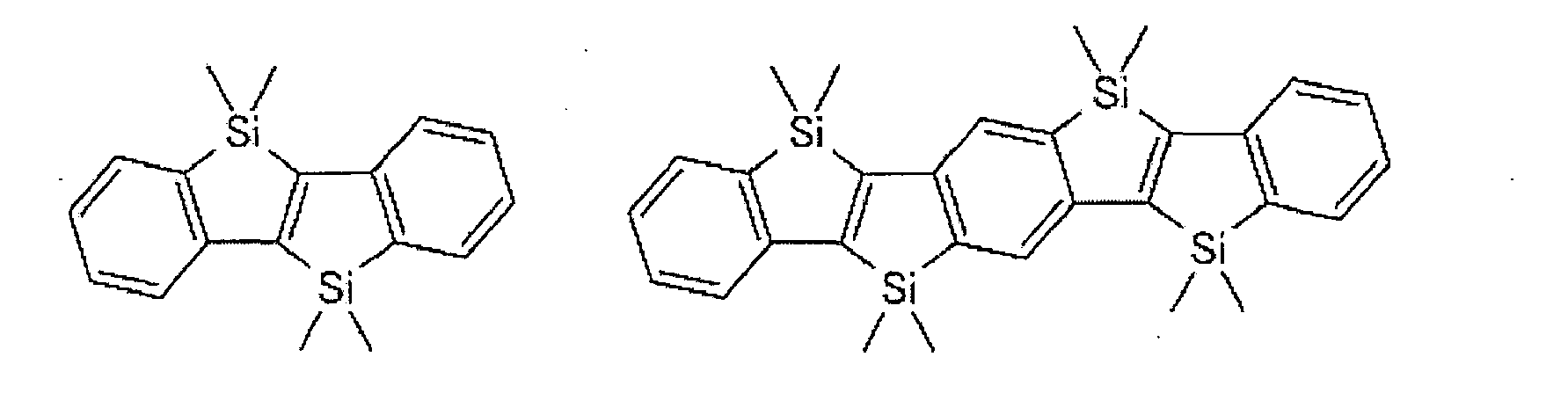
- An example of the designing of a material capable of exhibiting good light-emitting and charge-transporting properties is to build a molecular having a highly planar π-conjugated skeleton. For example, the inventors of the present invention has found a method for synthesizing a compound having, as a basic structure, the following planar silicon cross-linked stillbene skeleton in which trans-stillbene skeletons are cross-linked by substituted silicon groups.
- Furthermore, the inventors have found polycyclic fused ring type π-conjugated organic materials respectively represented by formulas (1) through (3) shown above. Each of the materials contains organic silicon, and is a compound which is given flexibility in structure modification but which retains the characteristics of the skeleton, e.g., good light-emitting properties and the like.
- The compound as such can be used as a high-performance electronic material such as a highly efficient light-emitting organic material or charge-transporting material. In addition, the compound is expected to useful as a novel constitutional unit of a polymer.
- An example of the compound containing organic silicon is 5,5,10,10-tetramethyl-5,10-disila-5,10-dihydroindeno[2,1-a]inden, which is known to be obtained by a synthetic method shown in Non-patent Document 1.
- However, the synthetic method makes use of a special high-temperature thermal decomposition reaction. Therefore, the synthetic method has the following fatal restrictions (1) through (3) in terms of synthesis: (1) the method is not suitable for mass synthesis; (2) the method is not suitable to synthesis of a derivative having a functional group necessary for synthesis of a polymer; (3) the method cannot be applied to synthesis of a polycyclic fused ring type compound.
- Therefore, there has been no effective method for synthesizing the compounds, i.e., the polycyclic fused ring type π-conjugated organic materials containing organic silicon.
- In order to overcome the foregoing problems, the inventors made an effort to develop a conceptually novel method for, producing organic materials respectively represented by formulas (1) through (4) shown above. As a result, the inventors have come up with a producing method of the present invention. The producing method shown in the present invention makes use of an intramolecular reductive cyclization reaction, and is the first effective general method for producing a polycyclic fused ring type π-conjugated organic material having a silainden skeleton as a basic structure.
- Fig. 1 is a graph showing results of examining: (a) wavelengths at which (i) Targeted Compound Xe, which is a fused ring type π-conjugated organic material according to the present invention, (ii) Targeted Compound Xib, which is another fused ring type π-conjugated organic material according to the present invention, and (iii) Comparative Compound Comp., which is used for comparison with the two targeted compounds, exhibit absorption maximums, respectively; and (b) respective fluorescence properties of the three compounds.
- An embodiment of the present invention will be described below.
- A polycyclic fused ring type π-conjugated organic material according to the present invention is obtained in the following manner. That is, as shown in the following formulas, a starting material is dimetalated by using an organometallic base. The starting material thus dimetalated is trapped by using an organosilicon reagent. As a result, an intermediate is obtained. Thereafter, the intermediate is allowed to react with a metal reductant. This causes an intramolecular reductive cyclization reaction. As a result, a dianion intermediate is produced. Thereafter, the dianion intermediate is trapped by using an electrophile. In this way, the fused ring type π-conjugated organic material according to the present invention is obtained.
- First, the following explains methods for synthesizing intermediates represented by following formula (5) and (7), respectively.
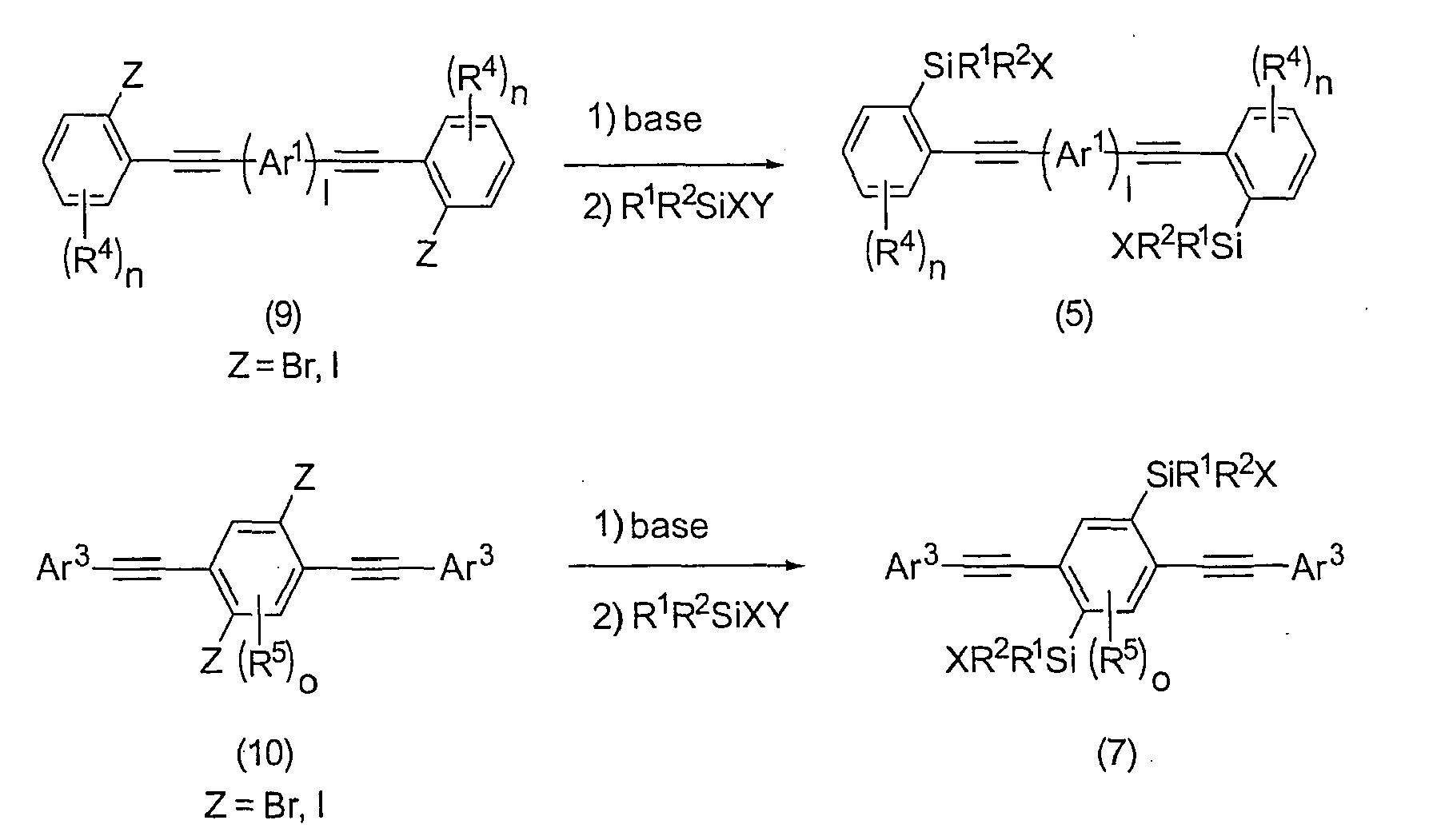
- Each of the materials respectively represented by formulas (9) or (10) is dimetalated by a halogen-metal exchange reaction using an organometallic base. Thereafter, the material thus dimetalated is trapped by using an organosilicon reagent represented by general formula R1R2SiXY. As a result, the intermediate represented by formulas (5) or (7) can be synthesized.
- Examples of the organometallic base used herein include:
- (i) an organolithium reagent such as n-BuLi, s-BuLi, or t-BuLi;
- (ii) an organomagnesium reagent such as an alkyl Grignard reagent or alkylmagnesium amide; and (iii) an alkyl zinc reagent. Metalation in THF using t-BuLi gives the highest yield.
- Further, in the organosilicon reagent R1R2SiXY, X and Y are independently a hydrogen atom, a halogen atom, an alkoxy group, an alkylthio group, an aryloxy group, an arylthio group, a silyl group, a substituted silyl group, a silyloxy group, a substituted silyloxy group, an arylsulfonyloxy group, an alkylsulfonyloxy group, a stannyl group, or a substituted stannyl group.
- In formulas (5) and (7), it is particularly advantageous that X is a hydrogen atom or an alkoxy group. In the synthesis of a compound having a hydrogen atom as X, it is possible to use R1R2SiH2, or R1R2SiHCl, as the organosilicon reagent R1R2SiXY.
- In the synthesis of a compound having an alkoxy group as X, it is possible to use R1R2Si(OR)2 or R1R2SiCl(NR2) as the organosilicon reagent R1R2SiXY. In a case where R1R2SiCl(NR2) is used, a targeted product can be obtained by allowing the dimetalated starting material to react with R1R2SiCl(NR2) and subsequently, without isolating the product of the reaction, performing alkoholysis of the product of the reaction in the presence of an acid catalyst such as ammonium chloride.

- The following explains the intramolecular reductive cyclization reaction in accordance with the above reaction formulas. the compound represented by formula (5) or (7) is allowed to react with a metal reductant. This causes an intramolecular reductive cyclization reaction to proceed. As a result, a dianion intermediate is produced. The dianion intermediate is trapped with an electrophile. As a result, the cyclized product represented by formula (1) or (3) is obtained as a polycyclic fused ring type π-conjugated organic material according to the present invention.
- Examples of the metal reductant used herein include lithium, lithium-naphthalenide, lithium-biphenylide, lithium(4,4'-di-tert-butylbiphenylide), lithium[8-(N,N-dimethylamino)naphthalenide], lithium/liquefied ammonium, sodium, sodium-naphthalenide, sodium-biphenylide, sodium(4,4-di-tert-butylbiphenylide), sodium[8-(N,N-dimethylamino)naphthalenide], sodium/liquefied ammonium, potassium, potassium graphite, and the like.
- Examples of the solvent used for the reaction include (i) THF and (ii) an ether solvent such as diethylether, dimethylether, or 1,2-dimetoxyethane. The reaction temperature may be within a range of from -78°C to 50°C, preferably within a range of from -20°C to 30°C.
- The reaction has following characteristics (1) and (2): (1) a dianion intermediate is produced; and (2) various substituents R3 can be introduced by using various electrophiles. Typical examples of the electrophile include: (i) a normal carbon electrophile such as alkyl halide or a carbonyl compound; (ii) an electrophilic halogenating agent such as ICH2CH2I, I2, Br2, ICl, NIS, NBS, BrCH2CH2Br, BrCl2CCCl2Br, or BrF2CCF2Br; and (iii) an electrophilic metalating agent such as Me3SnCl, Bu3SnCl, Ph3SnCl, R3SiCl, R2Si(OR)Cl, RSi(OR)2Cl, Si(OR)3Cl, R2SiF2, RSiF3, B(OR)3, (iPrO)B(-OCMe2CMe2O-), CIB(NR2)2, MgCl2, MgBr2, MgI2, ZnCl2, ZnBr2, ZnI2, or ZnCl2(tmen) (provided that R is an alkyl group or an aryl group). Further, the use of a fluorine compound such as aryl fluoride allows the direct introduction of an aryl group, a heterocyclic group, or a fluorine-substituted alkyl group.
- As shown in the following reaction formulas, formulas (2'), (4'), (14), and (17) can be converted to formulas (11), (12), (15), and (18), respectively, by using a normal Lewis acid such as BF3·OEt2, BAr3, AlCl3, AlBr3, EtAlCl2, or Et2AlCl.


- In the following, Examples will be described, by which the present invention will be described more specifically. It should be noted that the present invention is not limited to these
-

- In the following, a method for synthesizing Intermediate (II) (i.e., 1,4-Bis[(2-dimethylsilylphenyl)ethynyl]benzene) will be described with reference to Scheme 1 shown above. First, to a solution in which 1,4-Bis[(2-bromophenyl)ethynyl]benzene (I) (7.01 g, 16.07 mmol) was mixed with THF (150 mL), a pentane solution of tert-butyllithium (1.44 M, 46.0 mL, 66.24 mmol) was added dropwise at -78°C. The reaction mixture was stirred for 1 hour at the same temperature. Thereafter, to the reaction mixture, chlorodimethylsilane (7.4 mL, 66.63 mmol) was added using a syringe. Then, the reaction mixture was stirred for 22 hours while the temperature was allowed to slowly rise to room temperature.
- Thereafter, the solvent was distilled off under reduced pressure. To the resulting product, ether was added. The insoluble was filtered out. The filtrate was concentrated, and was then separated and purified by silica gel column chromatography (developing solvent: hexane/ethyl acetate, 100/1, Rf = 0.38). As a result, targeted Intermediate (II) was obtained (6.06 g, 15.35 mmol) in a 96% yield.
- The properties of Intermediate (II) are as follows. 1H NMR (CDCl3): δ 0.48 (d, J = 3.9 Hz, 12H), 4.65 (m, J = 2.7 Hz, 2H), 7.37 (m, 4H), 7.54 (s, 4H), 7.58 (m, 4H). 13C NMR (CDCl3): δ -3.87, 91.88, 92.12, 123.24, 127.76, 128.48, 129.23, 131.32, 131.93, 137.74, 140.19.
- Note the symbols i and ii respectively put beside the downward arrows which indicates the reactions and which are shown in Scheme 1. The symbols i and ii indicate abbreviations for solvents and reaction conditions. Specifically, the symbol i indicates (1) n-BuLi or t-BuLi and (2) NMe2SiCl, and the symbol ii indicates (1) LiNaph, THF, 5 minutes at room temperature (rt) and (2) electrophile or NH4Cl. These abbreviations apply to Schemes 2 and 3 shown below.
-

- In the following, a method for synthesizing Intermediate (IV) (i.e., 1,4-Bis(phenylethynyl)-2,5-bis(dimethylsilyl)benzene) will be described with reference to Scheme 2 shown above. First, to a solution in which 2,5-Bis(phenylethynyl)-1,4-dibromobenzene (III) (1.00 g, 2.29 mmol) was mixed with THF (20 mL), a pentane solution of tert-butyllithium (1.45 M, 6.4 mL, 9.28 mmol) was added dropwise at -78°C. The reaction mixture was stirred for 1 hour at the same temperature. Thereafter, to the reaction mixture, chlorodimethylsilane (7.4 mL, 66.63 mmol) was added using a syringe. Then, the reaction mixture was stirred for 8 hours while the temperature was allowed to slowly rise to room temperature.
- Thereafter, the solvent was distilled off under reduced pressure. To the resulting product, ether was added. The insoluble was filtered out. The filtrate was concentrated, and was then separated and purified by silica gel column chromatography (developing solvent: hexane/ethyl acetate, 100/1, Rf = 0.50). As a result, targeted Intermediate (IV) was obtained (0.75 g, 1.90 mmol) in an 83% yield.
- The properties of Intermediate (IV) are as follows. 1H NMR (CDCl3): δ 0.48 (d, J = 3.6 Hz, 12H), 4.63 (m, J = 3.6 Hz, 2H), 7.37 (m, 6H), 7.55 (m, 4H), 7.73 (s, 2H).
-

- In the following, a method for synthesizing Intermediate (VI) (i.e., 1,4-Bis(2-dimethylsilylphenyl)-1,3-butadiyne) will be described with reference to Scheme 3 shown above. First, to a solution in which 1,4-Bis(2-bromophenyl)-1,3-butadiyne (7.00 g, 19.44 mmol) was mixed with ether (195 mL), a hexane solution of n-butyllithium (1.6 M, 26.0 mL, 41.6 mmol) was added dropwise at -78°C. The reaction mixture was stirred for 1.5 hour at the same temperature. Thereafter, to the reaction mixture, chlorodimethylsilane (5.5 mL, 49.57 mmol) was added using a syringe. Then, the reaction mixture was stirred for 6 hours while the temperature was allowed to slowly rise to room temperature. Thereafter, the solvent was distilled off under reduced pressure. The mixture so obtained was separated and purified by silica gel column chromatography (developing solvent: hexane, Rf = 0.53). As a result, targeted Intermediate (VI) was obtained (5.50 g, 17.26 mmol, 89% yield) in the form of a light yellow liquid.
- The properties of Intermediate (VI) are as follows. 1H NMR (CDCl3): δ 0.45 (d, J = 3.9 Hz, 12H), 4.56 (m, J = 3.6 Hz, 2H), 7.35 (m, 4H), 7.56 (m, 4H).
- In the following, a method for synthesizing 1,4-Bis(1,1-dimethyl-1H-1-silainden-2-yl)benzene (VIIa) will be described with reference to Scheme 1 shown above. First, a mixture of lithium (28 mg, 4.03 mmol) and naphthalene (519 mg, 4.05 mmol) was stirred in THF (4.5 mL) at room temperature for 4 hours. As a result, a lithium-naphthalenide solution was prepared. To the solution, a solution in which Intermediate (II) (396 mg, 1.00 mmol) was mixed with THF (2 mL) was added at room temperature. Immediately after the reaction mixture had been stirred for 5 minutes, a saturated ammonium chloride solution was added to the reaction mixture. Then, the reaction mixture was extracted with ether.
- The organic solvent layer so obtained was washed with saturated saline, and then was dried using anhydrous MgSO4. Then, the anhydrous MgSO4 was filtered out. Thereafter, the solvent was distilled off under reduced pressure. The mixture so obtained was separated and purified by silica gel column chromatography (developing solvent: CHCl3). As a result, Targeted Compound (VIIa) (205 mg, 0.52 mmol), which is a polycyclic fused ring type π-conjugated organic material of the present invention, was obtained in a 52% yield.
- The properties of Targeted Compound (VIIa) are as follows. 1H NMR (CDCl3): δ 0.50 (s, 12H), 7.22 (m, 2H), 7.33 (m, 4H), 7.52 (s, 4H), 7.56 (m, 4H). 13C NMR (CDCl3): δ -3.06, 124.34, 126.64,126.95, 130.08, 131.73, 137.94, 138.34, 140.82, 144.91, 148.99.
- In the following, a method for synthesizing 1,4-Bis(1,1,3-trimethyl-1H-1-silainden-2-yl)benzene (VIIb) will be described with reference to Scheme 1 shown above. A mixture of lithium (9 mg, 1.30 mmol) and naphthalene (166 mg, 1.30 mmol) was stirred in THF (2 mL) at room temperature for 4 hours. As a result, a lithium-naphthalenide solution was prepared. To the solution, a solution in which Intermediate (II) (105 mg, 0.26 mmol) was mixed with THF (1 mL) was added at room temperature. Immediately after the reaction mixture had been stirred for 5 minutes, the reaction mixture was cooled down to -78°C and then mixed with dimethyl sulfate. Then, the reaction mixture was stirred for 4 hours while the temperature was allowed to rise to room temperature.
- A saturated ammonium chloride solution was added to the reaction mixture. Thereafter, the reaction mixture extracted with chloroform. The organic solvent layer so obtained was washed with saturated saline, and then was dried using anhydrous MgSO4. Then, the anhydrous MgSO4 was filtered out. Thereafter, the solvent was distilled off under reduced pressure. To the mixture so obtained, hexane was added. Then, the insoluble was collected by filtration. As a result, Targeted Compound (VIIb) (93 mg, 0.22 mmol), which is a polycyclic fused ring type π-conjugated organic material of the present invention, was obtained in an 83% yield.
- The properties of Targeted Compound (VIIb) are as follows. 1H NMR (CDCl3): δ 0.38 (s, 12H), 2.21 (s, 6H), 7.18 (s, 4H), 7.26 (m, 2H), 7.42 (m, 4H), 7.57 (d, J = 7.2 Hz, 2H).
- In the following, a method for synthesizing 1,4-Bis(1,1-dimethyl-3-dimethylsilyl-1H-1-silainden-2-yl)benzen e (VIIc) will be described with reference to Scheme 1 shown above.
- Targeted Compound (VIIc) was synthesized in the same manner as Targeted Compound (VIIb), except that dimethylchlorosilane was used instead of dimethyl sulfate as an electrophile. As a result, Targeted Compound (VIIc), which is a polycyclic fused ring type π-conjugated organic material of the present invention, was obtained in an 87% yield.
- The properties of Targeted Compound (VIIc) are as follows. 1H NMR (CDCl3): δ 0.21 (d, J = 3.6 Hz, 12H), 0.35 (s, 12H), 4.38 (m, J = 4.0 Hz, 2H), 7.06 (s, 4H), 7.23 (t, J = 7.2 Hz, 2H), 7.39 (t, J = 7.6 Hz, 2H), 7.60 (t, 4H). 13C NMR (CDCl3): δ -4.23, -2.63, 124.98, 126.01, 126.73, 129.90, 131.82, 138.28, 140.62, 152.61, 153.80, 163.93.
- In the following, a method for synthesizing 1,4-Bis[1,1-dimethyl-3-(4,4,5,5-tetramethyl-1,3,2-dioxaborolany 1)-1H-1-silainden-2-yl]benezene (VIId) will be described with reference to Scheme 1 shown above.
- Targeted Compound (VIId) was synthesized in the same manner as Targeted Compound (VIIb), except that 1-isopropoxy-4,4,5,5-tetramethyl-1,3,2-dioxaborolane was used instead of dimethyl sulfate as an electrophile. As a result, Targeted Compound (VIId), which is a polycyclic fused ring type π-conjugated organic material of the present invention, was obtained in a 43% yield.
- The properties of Targeted Compound (VIId) are as follows. 1H NMR (CDCl3): δ 0.36 (s, 12H), 1.30 (s, 24H), 7.18 (t, J = 7.2 Hz, 2H), 7.26 (s, 4H), 7.34 (t, J = 7.2 Hz, 2H), 7.47 (d, J = 7.2 Hz, 2H), 7.52 (d, J = 6.8 Hz, 2H). 13C NMR (CDCl3): δ -3.86, 24.95, 83.93, 124.72, 126.16, 127.10, 130.00, 131.67, 138.20, 140.09, 151.58, 158.89. 29Si NMR (CDCl3): δ 5.20
- In the following, a method for synthesizing 1,1,5,5-Tetramethyl-2,6-diphenyl-1,5-dihydro-1,5-disila-s-indac ene (VIII) will be described with reference to Scheme 2 shown above.
- A mixture of lithium (15.2 mg, 2.19 mmol) and naphthalene (280.2 mg, 2.19 mmol) was stirred in THF (2 mL) at room temperature for 4 hours. As a result, a lithium-naphthalenide solution was prepared. To the solution, a solution in which Compound (IV) (200.0 mg, 0.51 mmol) was mixed with THF (1.5 mL) was added at room temperature.
- Immediately after the reaction mixture had been stirred for 5 minutes, a saturated ammonium chloride solution was added to the reaction mixture. Then, the reaction mixture was extracted with ether. The organic solvent layer so obtained was washed with saturated saline, and then was dried using anhydrous MgSO4. Then, the anhydrous MgSO4 was filtered out. Thereafter, the solvent was distilled off under reduced pressure. The mixture so obtained was separated and purified by silica gel column chromatography (developing solvent: hexane/ethyl acetate, 100/1, Rf = 0.20). As a result, Targeted Compound (VIII) (177.7 mg, 0.45 mmol), which is a polycyclic fused ring type π-conjugated organic material of the present invention, was obtained in a 90% yield.
- The properties of Targeted Compound (VIII) are as follows. 1H NMR (CDCl3): δ 0.51 (s, 12H), 7.26 (m, 2H), 7.38 (t, J = 7.6 Hz, 4H), 7.52 (m, 6H), 7.60 (s, 2H).
- In the following, a method for synthesizing 1,1,1',1'-Tetramethyl-bi(1H-1-silainden-2-yl) (IX) will be described with reference to Scheme 3 shown above.
- A mixture of lithium (12 mg, 1.73 mmol) and naphthalene (222 mg, 1.73 mmol) was stirred in THF (2.5 mL) at room temperature for 4 hours. As a result, a lithium-naphthalenide solution was prepared. To the solution, a solution in which Intermediate (VI) (130 mg, 0.41 mmol) was mixed with THF (1 mL) was added at room temperature. Immediately after the reaction mixture had been stirred for 5 minutes, the reaction mixture was mixed with a saturated ammonium chloride solution.
- Then, the reaction mixture was extracted with ether. The organic solvent layer so obtained was washed with saturated saline, and then was dried using anhydrous MgSO4. Then, the anhydrous MgSO4 was filtered out. Thereafter, the solvent was distilled off under reduced pressure. The mixture so obtained was separated and purified by silica gel column chromatography (developing solvent: hexane, Rf = 0.24). As a result, Targeted Compound (IX) (45 mg, 0.14 mmol), which is a polycyclic fused ring type π-conjugated organic material of the present invention, was obtained in a 34% yield.
- The properties of Targeted Compound (IX) are as follows. 1H NMR (CDCl3): δ 0.47 (s, 12H), 7.12 (s, 2H), 7.25 (m, 6H), 7.52 (d, J = 6.9 Hz, 2H).
- All of the compounds so obtained exhibited good fluorescence properties. For example, in THF, Compounds (IX), (VIIa), and (VIII) exhibit absorption maximums at 364 nm, 375 nm, and 398 nm, respectively. Further, Compounds (IX), (VIIa), and (VIII) exhibit fluorescence properties at 417 nm, 437 nm, and 445 nm, respectively. Furthermore, Compounds (IX), (VIIa), and (VIII) have fluorescence quantum yields of 0.49 (anthracene), 0.86 (9,10-diphenylanthracene), and 0.73 (perylene), respectively. Note that the substances in the parentheses are standard substances used for calculating the fluorescence quantum yields.
- In the following, an example of the synthesis of Targeted Compound (VIIe) will be described with reference to Scheme 4 shown below. This is a typical example of the synthesis of a diol compound.

- First, a mixture of lithium (22.7 mg, 3.26 mmol) and naphthalene (0.417 g, 3.26 mmol) was stirred in THF (2.5 mL) at room temperature for 4 hours. As a result, a lithium-naphthalenide solution was prepared. To the solution, a solution in which Compound (II) (0.300 g, 0.76 mmol) was mixed with THF (2 mL) was added at room temperature. Note that the molar quantity ratio of the mixture to Compound (II) is approximately 4:1. The reaction mixture was stirred for 5 minutes at room temperature. Thereafter, benzophenone (0.595 g, 3.26 mmol) was added to the reaction mixture, and then the reaction mixture was stirred for 10 minutes. Thereafter, a saturated ammonium chloride solution was added to the reaction mixture, and then the reaction mixture was extracted with ether.
- The organic layer so obtained was washed with saturated saline, and then was dried using anhydrous MgSO4. Then, the anhydrous MgSO4 was filtered out. Thereafter, the solvent was distilled off under reduced pressure. The mixture so obtained was separated and purified by silica gel column chromatography (hexane/AcOEt 10/1, Rf = 0.10). As a result, Targeted Compound (VIIe) (0.487 g, 0.64 mmol, 84% yield) was obtained in the form of a white solid.
- The properties of Targeted Compound (Vile) are as follows. Mp. 295-297°C. 1H NMR (270 MHz, CDCl3). δ 0.28 (s, 12H), 2.99 (s, 2H), 6.53 (s, 4H), 6.90-7.12 (m, 6H), 7.19-7.23 (m, 12H), 7.32-7.36 (m, 8H), 7.52 (d, J = 6.9 Hz, 2H). 13C NMR (67.8 MHz, CDCl3): δ -4.53, 83.14, 125.63, 126.05, 127.38, 127.56, 127.99, 128.28, 129.09, 131.21, 137.48, 138.45, 145.68, 147.48, 149.62, 153.49. Elemental Anal. Cal. for C52H46O2Si2, C, 82.28; H, 6.11; Found; C, 82.10, H, 6.23.
- In the following, examples of the synthesis of other Targeted Compounds (VIIf, VIIIb, VIIIc, VIIId, XIII, XVI) will be described with reference to Scheme 4 shown above and Schemes 5 through 7 shown below. These are other examples of the synthesis of a diol compound.


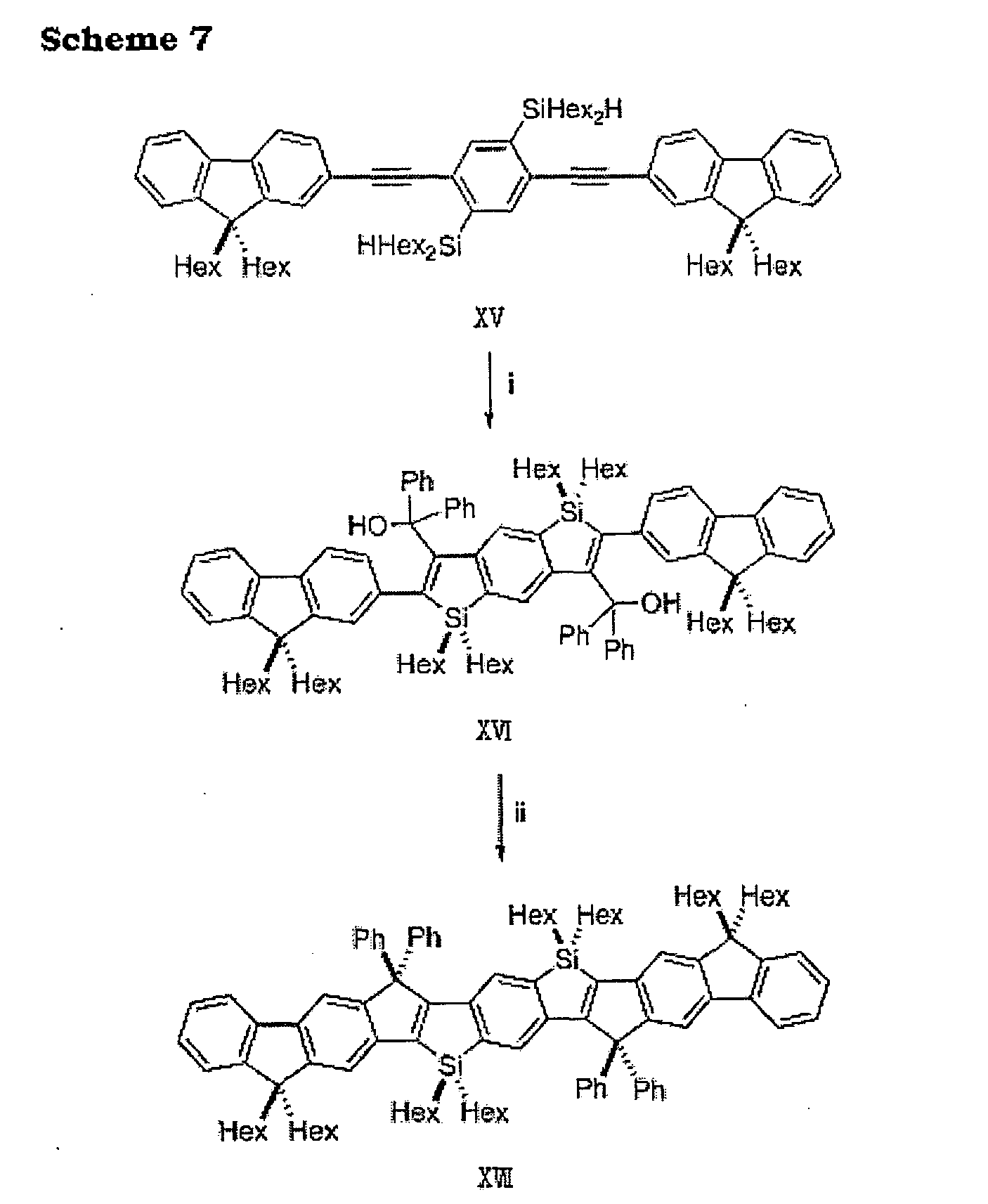
- In the following, Targeted Compounds (VIIf, VIIIb, VIIIc, VIIId, XIII, XVI) were synthesized in the same manner as Targeted Compound (VIIe). The properties of each of those compounds are as follows.
- Targeted Compound VIIf: 80% yield, yellow solid. 1H NMR (270 MHz, CDCl3): δ 0.71-0.88 (m, 20H), 1.20-1.40 (m, 32H), 2.98 (s, 2H), 6.57 (s, 4H), 6.85 (d, J = 8.1 Hz, 2H), 6.97 (t, J = 7.6 Hz, 2H), 7.07 (t, J = 7.0 Hz, 2H), 7.20-7.23 (m, 12H), 7.35-7.38 (m, 8H), 7.49 (d, J = 6.8 Hz, 2H); 13C NMR (67.8 MHz, C6D6): δ 12.61, 15.13, 23.75, 24.89, 32.56, 34.25, 84.45, 126.59, 127.30, 128.46, 128.77, 129.12, 129.54, 130.09, 132.63, 137.93, 139.56, 146.80, 147.38, 151.81, 156.68.
- Targeted Compound VIIIb: 85% yield, white solid. 1H NMR (270 MHz, CDCl3). δ 0.03 (s, 12H), 3.02 (s, 2H), 6.71 (d, J = 6.9 Hz, 4H), 6.94 (s, 2H), 6.96-7.06 (m, 6H), 7.20-7.24 (m, 10H), 7.33-7.36 (m, 10H). 13C NMR (67.8 MHz, CDCl3). δ -4.98, 83.23, 125.02, 126.17, 127.23, 127.79, 128.15, 128.31, 129.81, 139.49, 140.98, 145.97, 146.80, 147.50, 153.84.
- Targeted Compound VIIIc: 81% yield, yellow solid. 1H NMR (400 MHz, C6D6): δ 0.70-0.85 (m, 8H), 0.91 (t, J = 7.08), 1.20-1.28 (m, 32H), 3.14 (s, 2H), 6.81 (t, J = 7.08, 2H), 6.92-7.13 (m, 20H), 7.53 (s, 2H), 7.63 (d, J = 7.32, 8H). 13C NMR (67.8 MHz, C6D6). δ 12.20, 15.01, 23.58, 24.68, 32.51, 33.98, 84.60, 126.26, 127.25, 128.73, 129.30, 129.56, 132.18, 139.13, 143.02, 147.03, 147.74, 148.65, 157.13. Elemental Anal. Cal. for C72H86O2Si2, C, 83.18; H, 8.34; Found; C, 83.31, H, 8.30.
- Targeted Compound VIIId: 71% yield, yellow solid. 1H NMR (270 MHz, CD2Cl2). δ -0.13 (s, 12H), 6.23 (s, 2H), 7.18-7.24 (m, 10H), 7.30-7.40(m, 12H), 7.72 (d, J = 7.6 Hz, 4H). 13C NMR (100.4 MHz, CD2Cl2) δ -5.73, 86.54, 120.31, 123.93, 125.41, 125.86, 126.69, 128.36, 128.47, 129.33, 140.13, 140.27, 141.98, 144.39, 148.12, 148.36, 148.89. HRMS(EI): 754.2749 (M+), Cal. For C52H42O2Si2+: 754.2723.
- Targeted Compound XIII: 43% yield. 1H NMR (400 MHz, C6D6) 0.81 (t, J = 6.8 Hz, 8H), 0.88 (t, J = 6.8 Hz, 12H), 1.02 (t, J = 8.0 Hz, 8H), 1.13-1.26 (m, 38H), 1.40-1.50 (m, 4H), 1.55-1.67 (m, 4H), 1.82 (br, 4H), 6.91 (t, J = 8.0 Hz, 2H), 6.95 (t, J = 7.2 Hz, 2H), 7.02-7.15 (m, 16H), 7.20 (d, J = 8.0 Hz, 2H), 7.25 (d, J = 8.0 Hz, 2H), 7.50 (d, J = 6.8 Hz, 2H), 7.70 (d, J = 7.6 Hz, 8H). 13C NMR (67.8 MHz, C6D6): δ 12.58, 14.89, 14.96, 23.60, 24.84, 25.13, 31.00, 32.52, 32.80, 34.16, 37.92, 41.54, 55.78, 84.86, 120.90, 121.71, 126.21, 126.60, 128.84, 129.68, 130.17, 132.71, 137.94, 139.65, 141.74, 147.20, 151.82, 152.18, 157.74.
- In the following, an example of the synthesis of Targeted Compound Xe will be described with reference to Scheme 4. This is a typical example of the synthesis carried out by subjecting a diol compound to a cyclization reaction in which Lewis acid is used.
- First, to a solution in which Compound VIIe (0.248 g, 0.330 mmol) was mixed with CH2Cl2 (35 mL), BF3·OEt2 (90 mL) was added at room temperature. The reaction mixture was stirred for 15 minutes. To the reaction mixture, water was added. Thereafter, the organic layer was extracted with ether. The organic solvent layer so obtained was washed with saturated saline, and then was dried using anhydrous MgSO4. Then, the anhydrous MgSO4 was filtered out. Thereafter, the solvent was distilled off under reduced pressure. The mixture so obtained was washed with hexane, and then was dried under reduced pressure. As a result, Targeted Compound Xe (0.226 g, 0.313 mmol, 96% yield) was obtained in the form of a yellow solid.
- The properties of Targeted Compound Xe are as follows. 1H NMR (270 MHz, CDCl3): δ 0.38 (s, 12H), 6.98-7.06 (m, 8H), 7.14-7.24 (m, 12H), 7.30-7.35 (m, 8H), 7.44 (m, 2H). 13C NMR (67.8 MHz, CDCl3): δ -3.83, 66.65, 118.13, 123.27, 125.94, 126.57, 128.10, 129.11, 129.20, 131.10, 142.05, 142.37, 142.42, 144.55, 145.72, 157.18, 170.25.
- In the following, Targeted Compounds Xf, XIb, XIc, XId, XIV, and XVII were synthesized in the same manner as Target Compound Xe (see Schemes 4 through 7). The properties of each of those compounds are as follows.
- Targeted Compound Xf: 89% yield, yellow solid. 1H NMR (400 MHz, CDCl3): δ 0.77-0.80(m, 12H), 0.90-0.95 (m, 8H), 1.10-1.20 (m, 24H), 1.27-1.34 (m, 8H), 7.06 (m, 8H), 7.18-7.24 (m, 10H), 7.30-7.35 (m, 10H), 7.45 (m, 2H).
- Targeted Compound XIb: 75% yield, yellow solid. Mp. 202-204°C. 1H NMR (400 MHz, CDCl3): δ 0.34 (s, 12H), 7.06-7.10 (m, 2H), 7.16-7.25 (m, 16H), 7.30-7.33 (m, 12H). 13C NMR (100.4 MHz, CDCl3): -4.28, 67.20, 121.86, 124.39, 125.58, 126.68, 127.08, 127.11, 128.07, 128.97, 142.41, 142.53, 143.75, 144.89, 157.49, 171.10.
- Targeted Compound XIc: 72%, yellow solid. 1H NMR (400 MHz, CDCl3): δ 0.76-0.90 (m, 20H), 1.08-1.30 (m, 32H), 7.07 (t, J = 7.8 Hz, 2H), 7.16-7.24 (m, 16H), 7.26-7.35 (m, 12H). 13C NMR (100.4 MHz, CDCl3): 11.71, 14.02, 22.49, 24.07, 31.33, 32.84, 67.07, 122.08, 124.24, 125.40, 126.58, 127.10, 127.92, 127.98, 128.94, 142.34, 143.81, 144.22, 157.59, 171.94. Elemental Anal. Cal. for C72H82Si2, C, 86.17; H, 8.24; Found; C, 85.89, H, 8.19.
- Targeted Compound XId: 77%, yellow solid. 1H NMR (400 MHz, CDCl3): δ 0.21 (s, 12H), 6.08 (s, 2H), 6.61 (d, J = 7.6 Hz, 2H), 0.76 (d, J = 7.2 Hz, 4H), 6.92 (t, J = 7.6 Hz, 2H), 7.06 (t, J = 7.6 Hz, 4H), 7.21 (t, J = 7.6 Hz, 2H), 7.34-7.38 (m, 6H), 7.89 (d, J = 7.2 Hz, 4H).
- Targeted Compound XIV: 92%, yellow solid. 1H NMR (270 MHz, CDCl3): δ 0.74-0.82 (m, 18H), 1.04-1.28 (m, 36H), 1.38-1.44 (m, 8H), 1.97 (m, 4H), 7.0-7.1 (m, 6H), 7.17-7.34 (m, 22H), 7.43-7.48 (m, 4H).
- Targeted Compound XVII: yellow solid. 1H NMR (270 MHz, CDCl3): δ 0.70-0.75 (m, 32H), 0.89-0.95 (m, 8H), 1.00-1.21 (m, 48H), 1.32-1.37 (m, 8H), 1.92-1.98 (m, 8H), 7.18-7.28 (m, 22H), 7.32-7.36 (m, 8H), 7.53 (d, J = 6.5 Hz, 2H), 7.61 (s, 2H).
- Fig. 1 is a graph showing results of examining: (a) wavelengths at which (i) Targeted Compound Xe, (ii) Targeted Compound Xib, and (iii) Comparative Compound Comp., which is used for comparison with the two targeted compounds, exhibit absorption maximums, respectively; and (b) respective fluorescence properties of the three compounds. Thank you for all your trouble. Please add Compounds (19) to (21) and XIX to XXI stored in the attached PDF file to the specification. The properties of each of Compounds XVIII to XX are as follows. Sorry to trouble you with last-minute notice. Thank you for your help.
- In the following, Targeted Compound XXI was synthesized in the same manner as Targeted Compound Xe, so as to be synthesized from Compound XIX, serving as a starting material, via Compound XX, serving as an intermediate (see Schemes 4 through 7).

- The properties of each of Targeted Compounds XIX and XXI are as follows.
- Compound XIX. 44% yield, Mp. 164-166°C. 1H NMR (400 MHz, CDCl3): δ 81-0.94 (m, 36H), 1.14-1.36 (m, 68H), 2.97 (s, 2H), 3.13 (s, 2H), 6.76-6.81 (m, 8H), 6.88 (td, J = 7.6 Hz, 1.2 Hz, 2H), 6.94 (td, J = 7.0 Hz, 1.2 Hz, 2H), 7.00-7.15 (m, 24H), 7.30 (s, 2H), 7.31 (d, J = 8.0 Hz), 7.46 (dd, J = 7.0 Hz, 1.2 Hz), 7.55 (dd, J = 8.0 Hz, 1.2 Hz, 8H), 7.62 (dd, J = 8.0 Hz, 1.2 Hz, 8H). 13C NMR (100.4 MHz, CDCl3): δ 12.35, 14.91, 15.01, 23.56, 23.60, 24.66, 32.36, 32.47, 34.02, 34.05, 84.22, 84.22, 126.60, 127.21, 127.44, 128.22, 128.27, 128.50, 128.74, 129.13, 129.19, 129.50, 130.10, 132.08, 132.64, 137.96, 139.08, 139.47, 139.88, 146.78, 147.00, 147.34, 147.86, 148.85, 151.76, 156.36, 157.25. HRMS (FAB): Calculated for C138H166O4Si4+: 1999.1863; found 1999.1893.
- Compound XXI. 52% yield, Mp. 255-258°C. 1H NMR (400 MHz, CDCl3): δ 0.73-0.80 (m, 32H), 0.90-0.94 (m, 8H), 1.06-1.18 (m, 56H), 1.26-1.34 (m, 8H), 7.01-7.06 (m, 6H), 7.14-7.22 (m, 28H), 7.30-7.33 (m, 18H), 7.44-7.46 (m, 2H). 13C NMR (100.4 MHz, CDCl3): δ 11.63, 11.83, 14.04, 22.45, 22.47, 24.05, 24.16, 31.28, 31.35, 32.80, 32.94, 66.76, 118.16, 118.46, 123.23, 125.65, 126.46, 127.56, 127.88, 127.99, 129.07, 129.11, 132.39, 141.35, 141.98, 142.44, 142.64, 142.73, 142.96, 144.44, 145.16, 145.24, 156.96, 157.22, 170.62, 171.09. Anal. Cal for C138H158Si4: C 85.92, H 8.26; found: C 85.41, H 8.29. HRMS (FAB): Calculated for C138H158Si4: 1927.1441; found 1927.1466.
- When the synthetic scheme under which Compound XIX is converted to Compound XXI is generalized, the following scheme under which Compound (19) is converted to Compound (21) is obtained. Note that R1, R2, R6, R7, and X shown in chemical formulas respectively representing Compounds (19) through (21) are the same as those described above.

- A polycyclic fused ring type π-conjugated organic material according to the present invention is a novel compound which can be applied to a light-emitting material and a charge-transporting material. Further, the polycyclic fused ring type π-conjugated organic material exhibits highly efficient light-emitting and charge-transporting properties, and therefore can be applied to a field such as EL. Further, an intermediate according to the present invention for synthesis of the polycyclic fused ring type π-conjugated organic material and a method according to the present invention for producing the polycyclic fused ring type π-conjugated organic material can be suitably used for producing the polycyclic fused ring type π-conjugated organic material.
Claims (20)
- A polycyclic fused ring type π-conjugated organic material having a structure represented by following formula (1):

- A polycyclic fused ring type π-conjugated organic material having a structure represented by following formula (2):

- A polycyclic fused ring type π-conjugated organic material having a structure represented by following formula (3):

- A polycyclic fused ring type π-conjugated organic material having a structure represented by following formula (4):

- An intermediate for synthesis of a polycyclic fused ring type π-conjugated organic material, the intermediate having a structure represented by following formula (5):

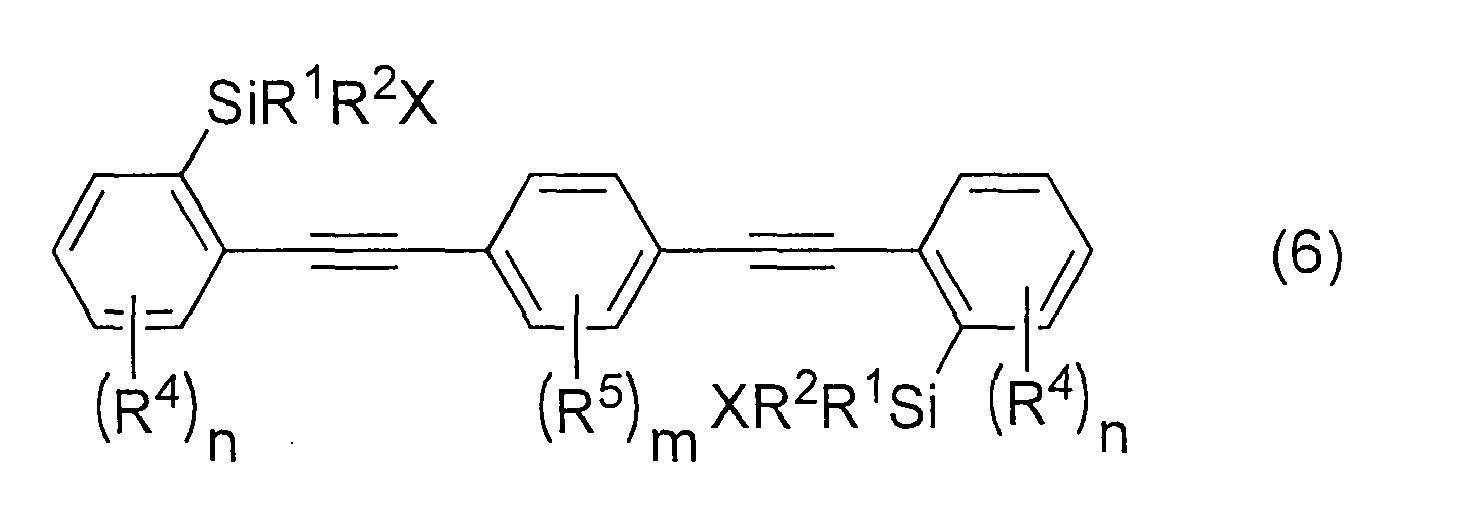
- An intermediate for synthesis of a polycyclic fused ring type π-conjugated organic material, the intermediate having a structure represented by following formula (6):
- An intermediate for synthesis of a polycyclic fused ring type π-conjugated organic material, the intermediate having a structure represented by following formula (7):

- An intermediate for synthesis of a polycyclic fused ring type π-conjugated organic material, the intermediate having a structure represented by following formula (8):

- A process for producing a polycyclic fused ring type π-conjugated organic material, the process comprising the steps of:producing a dianion intermediate by allowing the intermediate as set forth in claim 5 to react with a metal reductant; andobtaining the polycyclic fused ring type π-conjugated organic material as set forth in claim 1 by trapping the dianion intermediate by using an electrophile.
- A process for producing a polycyclic fused ring type π-conjugated organic material, the process comprising the steps of:producing a dianion intermediate by allowing the intermediate as set forth in claim 7 to react with a metal reductant; andobtaining the polycyclic fused ring type π-conjugated organic material as set forth in claim 3 by trapping the dianion intermediate by using an electrophile.
- A process for producing an intermediate for synthesis of a polycyclic fused ring type π-conjugated organic material, the process comprising the step of:dimetalating, by using an organometallic base, a material having a structure represented by following formula (9), where Z is a bromine atom or an iodine atom; R4 is a hydrogen atom, an alkyl group, an alkoxy group, an alkylthio group, an aryl group, an aryloxy group, an arylthio group, an arylalkyl group, an arylalkoxy group, an arylalkylthio group, an arylalkenyl group, an arylalkynyl group, an allyl group, an amio group, a substituted amino group, a silyl group, a substituted silyl group, a silyloxy group, a substituted silyloxy group, an arylsulfonyloxy group, an alkylsulfonyloxy group, a boryl group, a substituted boryl group, a monovalent heterocyclic group, or a halogen atom; and 1 is an integer of 0 or 1; andobtaining the intermediate as set forth in claim 5 by trapping, by using an organosilicon reagent, the material thus dimetalated.

- A process for producing an intermediate for synthesis of a polycyclic fused ring type π-conjugated organic material, the process comprising the steps of:dimetalating, by using an organometallic base, a material having a structure represented by following formula (10), where Z is a bromine atom or an iodine atom; Ar3 is an aryl group, a substituted aryl group, a monovalent oligoarylene group, a monovalent substituted oligoarylene group, a monovalent heterocyclic group, a monovalent substituted heterocyclic group, a monovalent oligoheterocyclic group, or a monovalent substituted oligoheterocyclic group; R5 is a hydrogen atom, an alkyl group, an alkoxy group, an alkylthio group, an aryl group, an aryloxy group, an arylthio group, an arylalkyl group, an arylalkoxy group, an arylalkylthio group, an arylalkenyl group, an arylalkynyl group, an allyl group, an amio group, a substituted amino group, a silyl group, a substituted silyl group, a silyloxy group, a substituted silyloxy group, an arylsulfonyloxy group, an alkylsulfonyloxy group, a boryl group, a substituted boryl group, a monovalent heterocyclic group, or a halogen atom; and o is an integer of 0 to 2; andobtaining the intermediate as set forth in claim 7 by trapping, by using an organosilicon reagent, the material thus dimetalated.

- A polycyclic fused ring type π-conjugated organic material having a structure represented by following formula (11):

- A polycyclic fused ring type π-conjugated organic material having a structure represented by following formula (12):

- An intermediate for synthesis of a polycyclic fused ring type π-conjugated organic material having a structure represented by following formula (13):

- A polycyclic fused ring type π-conjugated organic material having a structure represented by following formula (14):

- A polycyclic fused ring type π-conjugated organic material having a structure represented by following formula (15):

- An intermediate for synthesis of a polycyclic fused ring type π-conjugated organic material having a structure represented by following formula (16):

- A polycyclic fused ring type π-conjugated organic material having a structure represented by following formula (17):

- A polycyclic fused ring type π-conjugated organic material having a structure represented by following formula (18):

Applications Claiming Priority (3)
| Application Number | Priority Date | Filing Date | Title |
|---|---|---|---|
| JP2003378923 | 2003-11-07 | ||
| JP2004224771A JP4552023B2 (en) | 2003-11-07 | 2004-07-30 | Polycyclic fused-ring π-conjugated organic material, synthetic intermediate thereof, method for producing polycyclic fused-ring π-conjugated organic material, and method for producing synthetic intermediate of polycyclic fused-ring π-conjugated organic material |
| PCT/JP2004/016433 WO2005044826A1 (en) | 2003-11-07 | 2004-11-05 | POLYCYCLIC FUSED RING TYPE π-CONJUGATED ORGANIC MATERIALS, INTERMEDIATE THEREFOR, PROCESS FOR PRODUCING POLYCYCLIC FUSED RING TYPE π-CONJUGATED ORGANIC MATERIALS, AND PROCESS FOR PRODUCING INTERMEDIATE FOR POLYCYCLIC FUSED RING TYPE π-CONJUGATED ORGANIC MATERIALS |
Publications (3)
| Publication Number | Publication Date |
|---|---|
| EP1700860A1 true EP1700860A1 (en) | 2006-09-13 |
| EP1700860A4 EP1700860A4 (en) | 2009-08-19 |
| EP1700860B1 EP1700860B1 (en) | 2011-07-27 |
Family
ID=34575937
Family Applications (1)
| Application Number | Title | Priority Date | Filing Date |
|---|---|---|---|
| EP04818199A Expired - Lifetime EP1700860B1 (en) | 2003-11-07 | 2004-11-05 | Polycyclic fused ring type pi-conjugated organic materials, intermediate therefor, process for producing polycyclic fused ring type pi-conjugated organic materials, and process for producing intermediate for polycyclic fused ring type pi-conjugated organic materials |
Country Status (8)
| Country | Link |
|---|---|
| US (1) | US7973190B2 (en) |
| EP (1) | EP1700860B1 (en) |
| JP (1) | JP4552023B2 (en) |
| KR (1) | KR100757636B1 (en) |
| CN (2) | CN100457761C (en) |
| CA (1) | CA2544427C (en) |
| TW (1) | TWI366593B (en) |
| WO (1) | WO2005044826A1 (en) |
Cited By (1)
| Publication number | Priority date | Publication date | Assignee | Title |
|---|---|---|---|---|
| GB2472413A (en) * | 2009-08-05 | 2011-02-09 | Cambridge Display Tech Ltd | Semiconducting compounds useful for organic thin film resistors |
Families Citing this family (7)
| Publication number | Priority date | Publication date | Assignee | Title |
|---|---|---|---|---|
| JP2007096102A (en) * | 2005-09-29 | 2007-04-12 | Fujifilm Corp | Organic electroluminescence device |
| JP5007988B2 (en) * | 2005-10-27 | 2012-08-22 | 国立大学法人名古屋大学 | Polycyclic fused-ring compounds, production methods thereof, and organic electroluminescent devices using the polycyclic fused-ring compounds |
| JP4660767B2 (en) * | 2006-02-28 | 2011-03-30 | 国立大学法人名古屋大学 | Organic luminescent material |
| JP4900670B2 (en) * | 2006-05-01 | 2012-03-21 | Jnc株式会社 | Organic electroluminescence device |
| JP5024655B2 (en) * | 2006-12-22 | 2012-09-12 | 国立大学法人名古屋大学 | Cross-linked stilbene derivatives and organic electroluminescent devices using them |
| JP5521252B2 (en) * | 2008-10-21 | 2014-06-11 | 国立大学法人京都工芸繊維大学 | Benzene compounds |
| TWI863941B (en) | 2018-11-15 | 2024-12-01 | 美商寬騰矽公司 | Methods and compositions for protein sequencing |
Family Cites Families (3)
| Publication number | Priority date | Publication date | Assignee | Title |
|---|---|---|---|---|
| EP1143538B1 (en) * | 1995-07-17 | 2005-09-14 | Chisso Corporation | Organic electroluminescent element containing a silacyclopentadiene derivative |
| US7705174B2 (en) * | 2002-08-23 | 2010-04-27 | Japan Science And Technology Agency | Condensed polycyclic π-conjugated organic material, intermediate product therefor, and method of manufacturing condensed polycyclic π-conjugated organic material |
| JP4282016B2 (en) | 2004-09-28 | 2009-06-17 | Tdk株式会社 | Manufacturing method of rare earth sintered magnet |
-
2004
- 2004-07-30 JP JP2004224771A patent/JP4552023B2/en not_active Expired - Fee Related
- 2004-11-05 KR KR1020067011173A patent/KR100757636B1/en not_active Expired - Fee Related
- 2004-11-05 CN CNB2004800316507A patent/CN100457761C/en not_active Expired - Fee Related
- 2004-11-05 CA CA2544427A patent/CA2544427C/en not_active Expired - Fee Related
- 2004-11-05 CN CN2008101845283A patent/CN101456876B/en not_active Expired - Fee Related
- 2004-11-05 WO PCT/JP2004/016433 patent/WO2005044826A1/en not_active Ceased
- 2004-11-05 TW TW093133787A patent/TWI366593B/en not_active IP Right Cessation
- 2004-11-05 US US10/578,352 patent/US7973190B2/en not_active Expired - Fee Related
- 2004-11-05 EP EP04818199A patent/EP1700860B1/en not_active Expired - Lifetime
Cited By (9)
| Publication number | Priority date | Publication date | Assignee | Title |
|---|---|---|---|---|
| GB2472413A (en) * | 2009-08-05 | 2011-02-09 | Cambridge Display Tech Ltd | Semiconducting compounds useful for organic thin film resistors |
| WO2012017184A1 (en) * | 2009-08-05 | 2012-02-09 | Cambridge Display Technology Limited | Organic semiconductors |
| CN102482291A (en) * | 2009-08-05 | 2012-05-30 | 剑桥显示技术有限公司 | Organic semiconductors |
| JP2013501076A (en) * | 2009-08-05 | 2013-01-10 | ケンブリッジ ディスプレイ テクノロジー リミテッド | Organic semiconductor |
| GB2472413B (en) * | 2009-08-05 | 2014-04-23 | Cambridge Display Tech Ltd | Organic semiconductors |
| US8853679B2 (en) | 2009-08-05 | 2014-10-07 | Cambridge Display Technology Limited | Organic semiconductors |
| JP2015227461A (en) * | 2009-08-05 | 2015-12-17 | ケンブリッジ ディスプレイ テクノロジー リミテッド | Organic semiconductor |
| EP3447057A1 (en) * | 2009-08-05 | 2019-02-27 | Cambridge Display Technology Limited | Organic semiconductors |
| EP3524610A1 (en) * | 2009-08-05 | 2019-08-14 | Cambridge Display Technology Limited | Organic semiconductors |
Also Published As
| Publication number | Publication date |
|---|---|
| US7973190B2 (en) | 2011-07-05 |
| TW200525008A (en) | 2005-08-01 |
| JP4552023B2 (en) | 2010-09-29 |
| CA2544427C (en) | 2011-03-08 |
| WO2005044826A1 (en) | 2005-05-19 |
| JP2005154410A (en) | 2005-06-16 |
| TWI366593B (en) | 2012-06-21 |
| CN100457761C (en) | 2009-02-04 |
| CN1875024A (en) | 2006-12-06 |
| KR20060111560A (en) | 2006-10-27 |
| EP1700860A4 (en) | 2009-08-19 |
| CA2544427A1 (en) | 2005-05-19 |
| CN101456876A (en) | 2009-06-17 |
| US20090143605A1 (en) | 2009-06-04 |
| KR100757636B1 (en) | 2007-09-10 |
| CN101456876B (en) | 2010-12-29 |
| EP1700860B1 (en) | 2011-07-27 |
Similar Documents
| Publication | Publication Date | Title |
|---|---|---|
| JP4408416B2 (en) | Polycyclic fused-ring π-conjugated organic material, synthetic intermediate thereof, and method for producing polycyclic fused-ring π-conjugated organic material | |
| EP1700860B1 (en) | Polycyclic fused ring type pi-conjugated organic materials, intermediate therefor, process for producing polycyclic fused ring type pi-conjugated organic materials, and process for producing intermediate for polycyclic fused ring type pi-conjugated organic materials | |
| JP5521252B2 (en) | Benzene compounds | |
| JP4320434B2 (en) | Organoboron π-electron compound and material containing the same | |
| JPWO2005087780A1 (en) | Chalcogen-containing fused-ring polycyclic organic material and method for producing the same | |
| JP4420660B2 (en) | Organic borazine compound and process for producing the same | |
| JP3817632B2 (en) | Functional 9-metal substituted fluorene derivative and method for producing the same | |
| KR20140105633A (en) | Novel organic compounds for organic light-emitting diode and organic light-emitting diode including the same | |
| JP5147103B2 (en) | Method for synthesizing benzometall and novel diyne compound | |
| JP4231929B2 (en) | Phosphorus cross-linked stilbene and process for producing the same | |
| Sanji et al. | An alternative convergent synthesis of dendrimers with 2, 5-diarylsilole at the core | |
| JP6842696B2 (en) | Compounds, compound synthesis methods and organic semiconductor materials | |
| JP5633873B2 (en) | Fullerene dimer and method for producing the same | |
| JP2010064976A (en) | New silole compound and method for producing the same | |
| JP4853506B2 (en) | White light emitting organic electroluminescence device | |
| JP2004256468A (en) | Novel 9-oxo-9-phosphafluorene derivative, process for producing the same and use thereof | |
| JPH07309882A (en) | New organohalosilane compound | |
| JP6682115B2 (en) | Fluorene compound, method for producing fluorene compound, and organic light emitting device | |
| JPH08295695A (en) | Novel organic halosilane compound | |
| JPH09323996A (en) | Thiophene derivative | |
| JP2009040689A (en) | Luminescent metal complex and method for producing the same |
Legal Events
| Date | Code | Title | Description |
|---|---|---|---|
| PUAI | Public reference made under article 153(3) epc to a published international application that has entered the european phase |
Free format text: ORIGINAL CODE: 0009012 |
|
| 17P | Request for examination filed |
Effective date: 20060602 |
|
| AK | Designated contracting states |
Kind code of ref document: A1 Designated state(s): DE FR GB NL |
|
| DAX | Request for extension of the european patent (deleted) | ||
| RBV | Designated contracting states (corrected) |
Designated state(s): DE FR GB NL |
|
| A4 | Supplementary search report drawn up and despatched |
Effective date: 20090721 |
|
| GRAP | Despatch of communication of intention to grant a patent |
Free format text: ORIGINAL CODE: EPIDOSNIGR1 |
|
| GRAS | Grant fee paid |
Free format text: ORIGINAL CODE: EPIDOSNIGR3 |
|
| GRAA | (expected) grant |
Free format text: ORIGINAL CODE: 0009210 |
|
| RAP1 | Party data changed (applicant data changed or rights of an application transferred) |
Owner name: JAPAN SCIENCE AND TECHNOLOGY AGENCY |
|
| RIN1 | Information on inventor provided before grant (corrected) |
Inventor name: XU, CAIHONG Inventor name: YAMAGUCHI, SHIGEHIRO |
|
| AK | Designated contracting states |
Kind code of ref document: B1 Designated state(s): DE FR GB NL |
|
| REG | Reference to a national code |
Ref country code: GB Ref legal event code: FG4D |
|
| REG | Reference to a national code |
Ref country code: NL Ref legal event code: T3 |
|
| REG | Reference to a national code |
Ref country code: DE Ref legal event code: R096 Ref document number: 602004033715 Country of ref document: DE Effective date: 20110922 |
|
| PLBE | No opposition filed within time limit |
Free format text: ORIGINAL CODE: 0009261 |
|
| STAA | Information on the status of an ep patent application or granted ep patent |
Free format text: STATUS: NO OPPOSITION FILED WITHIN TIME LIMIT |
|
| 26N | No opposition filed |
Effective date: 20120502 |
|
| REG | Reference to a national code |
Ref country code: DE Ref legal event code: R097 Ref document number: 602004033715 Country of ref document: DE Effective date: 20120502 |
|
| REG | Reference to a national code |
Ref country code: FR Ref legal event code: PLFP Year of fee payment: 12 |
|
| REG | Reference to a national code |
Ref country code: FR Ref legal event code: PLFP Year of fee payment: 13 |
|
| REG | Reference to a national code |
Ref country code: FR Ref legal event code: PLFP Year of fee payment: 14 |
|
| PGFP | Annual fee paid to national office [announced via postgrant information from national office to epo] |
Ref country code: NL Payment date: 20181120 Year of fee payment: 15 |
|
| PGFP | Annual fee paid to national office [announced via postgrant information from national office to epo] |
Ref country code: DE Payment date: 20181120 Year of fee payment: 15 |
|
| PGFP | Annual fee paid to national office [announced via postgrant information from national office to epo] |
Ref country code: FR Payment date: 20181123 Year of fee payment: 15 Ref country code: GB Payment date: 20181120 Year of fee payment: 15 |
|
| REG | Reference to a national code |
Ref country code: DE Ref legal event code: R119 Ref document number: 602004033715 Country of ref document: DE |
|
| REG | Reference to a national code |
Ref country code: NL Ref legal event code: MM Effective date: 20191201 |
|
| GBPC | Gb: european patent ceased through non-payment of renewal fee |
Effective date: 20191105 |
|
| PG25 | Lapsed in a contracting state [announced via postgrant information from national office to epo] |
Ref country code: NL Free format text: LAPSE BECAUSE OF NON-PAYMENT OF DUE FEES Effective date: 20191201 |
|
| PG25 | Lapsed in a contracting state [announced via postgrant information from national office to epo] |
Ref country code: DE Free format text: LAPSE BECAUSE OF NON-PAYMENT OF DUE FEES Effective date: 20200603 Ref country code: FR Free format text: LAPSE BECAUSE OF NON-PAYMENT OF DUE FEES Effective date: 20191130 Ref country code: GB Free format text: LAPSE BECAUSE OF NON-PAYMENT OF DUE FEES Effective date: 20191105 |