EP1699898B1 - Polymere, phosphoreszierende, organisch halbleitende emittermaterialien auf basis perarylierter borane, verfahren zu deren herstellung und verwendungen davon - Google Patents
Polymere, phosphoreszierende, organisch halbleitende emittermaterialien auf basis perarylierter borane, verfahren zu deren herstellung und verwendungen davon Download PDFInfo
- Publication number
- EP1699898B1 EP1699898B1 EP04816282A EP04816282A EP1699898B1 EP 1699898 B1 EP1699898 B1 EP 1699898B1 EP 04816282 A EP04816282 A EP 04816282A EP 04816282 A EP04816282 A EP 04816282A EP 1699898 B1 EP1699898 B1 EP 1699898B1
- Authority
- EP
- European Patent Office
- Prior art keywords
- phosphorescent
- arylene
- substituted
- substituents
- diphenyl
- Prior art date
- Legal status (The legal status is an assumption and is not a legal conclusion. Google has not performed a legal analysis and makes no representation as to the accuracy of the status listed.)
- Ceased
Links
- 0 CC(C1)(C1(C)*1c2)c(cccc3cc4)c3c1c4cc2-c1ccc(*)cc1 Chemical compound CC(C1)(C1(C)*1c2)c(cccc3cc4)c3c1c4cc2-c1ccc(*)cc1 0.000 description 4
- RZCYUOWKJNUVBF-KAMYIIQDSA-N O/C(/c1ccccc1)=C\C(c1ccccc1)=O Chemical compound O/C(/c1ccccc1)=C\C(c1ccccc1)=O RZCYUOWKJNUVBF-KAMYIIQDSA-N 0.000 description 1
- SIOXPEMLGUPBBT-UHFFFAOYSA-N OC(c1ncccc1)=O Chemical compound OC(c1ncccc1)=O SIOXPEMLGUPBBT-UHFFFAOYSA-N 0.000 description 1
Classifications
-
- C—CHEMISTRY; METALLURGY
- C09—DYES; PAINTS; POLISHES; NATURAL RESINS; ADHESIVES; COMPOSITIONS NOT OTHERWISE PROVIDED FOR; APPLICATIONS OF MATERIALS NOT OTHERWISE PROVIDED FOR
- C09K—MATERIALS FOR MISCELLANEOUS APPLICATIONS, NOT PROVIDED FOR ELSEWHERE
- C09K11/00—Luminescent materials, e.g. electroluminescent or chemiluminescent
- C09K11/06—Luminescent materials, e.g. electroluminescent or chemiluminescent containing organic luminescent materials
-
- C—CHEMISTRY; METALLURGY
- C07—ORGANIC CHEMISTRY
- C07F—ACYCLIC, CARBOCYCLIC OR HETEROCYCLIC COMPOUNDS CONTAINING ELEMENTS OTHER THAN CARBON, HYDROGEN, HALOGEN, OXYGEN, NITROGEN, SULFUR, SELENIUM OR TELLURIUM
- C07F15/00—Compounds containing elements of Groups 8, 9, 10 or 18 of the Periodic Table
- C07F15/0006—Compounds containing elements of Groups 8, 9, 10 or 18 of the Periodic Table compounds of the platinum group
- C07F15/0033—Iridium compounds
-
- C—CHEMISTRY; METALLURGY
- C08—ORGANIC MACROMOLECULAR COMPOUNDS; THEIR PREPARATION OR CHEMICAL WORKING-UP; COMPOSITIONS BASED THEREON
- C08G—MACROMOLECULAR COMPOUNDS OBTAINED OTHERWISE THAN BY REACTIONS ONLY INVOLVING UNSATURATED CARBON-TO-CARBON BONDS
- C08G79/00—Macromolecular compounds obtained by reactions forming a linkage containing atoms other than silicon, sulfur, nitrogen, oxygen, and carbon with or without the latter elements in the main chain of the macromolecule
-
- C—CHEMISTRY; METALLURGY
- C08—ORGANIC MACROMOLECULAR COMPOUNDS; THEIR PREPARATION OR CHEMICAL WORKING-UP; COMPOSITIONS BASED THEREON
- C08G—MACROMOLECULAR COMPOUNDS OBTAINED OTHERWISE THAN BY REACTIONS ONLY INVOLVING UNSATURATED CARBON-TO-CARBON BONDS
- C08G79/00—Macromolecular compounds obtained by reactions forming a linkage containing atoms other than silicon, sulfur, nitrogen, oxygen, and carbon with or without the latter elements in the main chain of the macromolecule
- C08G79/08—Macromolecular compounds obtained by reactions forming a linkage containing atoms other than silicon, sulfur, nitrogen, oxygen, and carbon with or without the latter elements in the main chain of the macromolecule a linkage containing boron
-
- C—CHEMISTRY; METALLURGY
- C08—ORGANIC MACROMOLECULAR COMPOUNDS; THEIR PREPARATION OR CHEMICAL WORKING-UP; COMPOSITIONS BASED THEREON
- C08G—MACROMOLECULAR COMPOUNDS OBTAINED OTHERWISE THAN BY REACTIONS ONLY INVOLVING UNSATURATED CARBON-TO-CARBON BONDS
- C08G79/00—Macromolecular compounds obtained by reactions forming a linkage containing atoms other than silicon, sulfur, nitrogen, oxygen, and carbon with or without the latter elements in the main chain of the macromolecule
- C08G79/14—Macromolecular compounds obtained by reactions forming a linkage containing atoms other than silicon, sulfur, nitrogen, oxygen, and carbon with or without the latter elements in the main chain of the macromolecule a linkage containing two or more elements other than carbon, oxygen, nitrogen, sulfur and silicon
-
- H—ELECTRICITY
- H10—SEMICONDUCTOR DEVICES; ELECTRIC SOLID-STATE DEVICES NOT OTHERWISE PROVIDED FOR
- H10K—ORGANIC ELECTRIC SOLID-STATE DEVICES
- H10K10/00—Organic devices specially adapted for rectifying, amplifying, oscillating or switching; Organic capacitors or resistors having potential barriers
-
- H—ELECTRICITY
- H10—SEMICONDUCTOR DEVICES; ELECTRIC SOLID-STATE DEVICES NOT OTHERWISE PROVIDED FOR
- H10K—ORGANIC ELECTRIC SOLID-STATE DEVICES
- H10K85/00—Organic materials used in the body or electrodes of devices covered by this subclass
- H10K85/10—Organic polymers or oligomers
- H10K85/111—Organic polymers or oligomers comprising aromatic, heteroaromatic, or aryl chains, e.g. polyaniline, polyphenylene or polyphenylene vinylene
-
- H—ELECTRICITY
- H10—SEMICONDUCTOR DEVICES; ELECTRIC SOLID-STATE DEVICES NOT OTHERWISE PROVIDED FOR
- H10K—ORGANIC ELECTRIC SOLID-STATE DEVICES
- H10K85/00—Organic materials used in the body or electrodes of devices covered by this subclass
- H10K85/30—Coordination compounds
- H10K85/321—Metal complexes comprising a group IIIA element, e.g. Tris (8-hydroxyquinoline) gallium [Gaq3]
-
- H—ELECTRICITY
- H10—SEMICONDUCTOR DEVICES; ELECTRIC SOLID-STATE DEVICES NOT OTHERWISE PROVIDED FOR
- H10K—ORGANIC ELECTRIC SOLID-STATE DEVICES
- H10K85/00—Organic materials used in the body or electrodes of devices covered by this subclass
- H10K85/30—Coordination compounds
- H10K85/341—Transition metal complexes, e.g. Ru(II)polypyridine complexes
- H10K85/342—Transition metal complexes, e.g. Ru(II)polypyridine complexes comprising iridium
-
- C—CHEMISTRY; METALLURGY
- C09—DYES; PAINTS; POLISHES; NATURAL RESINS; ADHESIVES; COMPOSITIONS NOT OTHERWISE PROVIDED FOR; APPLICATIONS OF MATERIALS NOT OTHERWISE PROVIDED FOR
- C09K—MATERIALS FOR MISCELLANEOUS APPLICATIONS, NOT PROVIDED FOR ELSEWHERE
- C09K2211/00—Chemical nature of organic luminescent or tenebrescent compounds
- C09K2211/10—Non-macromolecular compounds
- C09K2211/1003—Carbocyclic compounds
- C09K2211/1007—Non-condensed systems
-
- C—CHEMISTRY; METALLURGY
- C09—DYES; PAINTS; POLISHES; NATURAL RESINS; ADHESIVES; COMPOSITIONS NOT OTHERWISE PROVIDED FOR; APPLICATIONS OF MATERIALS NOT OTHERWISE PROVIDED FOR
- C09K—MATERIALS FOR MISCELLANEOUS APPLICATIONS, NOT PROVIDED FOR ELSEWHERE
- C09K2211/00—Chemical nature of organic luminescent or tenebrescent compounds
- C09K2211/10—Non-macromolecular compounds
- C09K2211/1003—Carbocyclic compounds
- C09K2211/1011—Condensed systems
-
- C—CHEMISTRY; METALLURGY
- C09—DYES; PAINTS; POLISHES; NATURAL RESINS; ADHESIVES; COMPOSITIONS NOT OTHERWISE PROVIDED FOR; APPLICATIONS OF MATERIALS NOT OTHERWISE PROVIDED FOR
- C09K—MATERIALS FOR MISCELLANEOUS APPLICATIONS, NOT PROVIDED FOR ELSEWHERE
- C09K2211/00—Chemical nature of organic luminescent or tenebrescent compounds
- C09K2211/10—Non-macromolecular compounds
- C09K2211/1018—Heterocyclic compounds
- C09K2211/1022—Heterocyclic compounds bridged by heteroatoms, e.g. N, P, Si or B
-
- C—CHEMISTRY; METALLURGY
- C09—DYES; PAINTS; POLISHES; NATURAL RESINS; ADHESIVES; COMPOSITIONS NOT OTHERWISE PROVIDED FOR; APPLICATIONS OF MATERIALS NOT OTHERWISE PROVIDED FOR
- C09K—MATERIALS FOR MISCELLANEOUS APPLICATIONS, NOT PROVIDED FOR ELSEWHERE
- C09K2211/00—Chemical nature of organic luminescent or tenebrescent compounds
- C09K2211/10—Non-macromolecular compounds
- C09K2211/1018—Heterocyclic compounds
- C09K2211/1025—Heterocyclic compounds characterised by ligands
- C09K2211/1029—Heterocyclic compounds characterised by ligands containing one nitrogen atom as the heteroatom
-
- C—CHEMISTRY; METALLURGY
- C09—DYES; PAINTS; POLISHES; NATURAL RESINS; ADHESIVES; COMPOSITIONS NOT OTHERWISE PROVIDED FOR; APPLICATIONS OF MATERIALS NOT OTHERWISE PROVIDED FOR
- C09K—MATERIALS FOR MISCELLANEOUS APPLICATIONS, NOT PROVIDED FOR ELSEWHERE
- C09K2211/00—Chemical nature of organic luminescent or tenebrescent compounds
- C09K2211/10—Non-macromolecular compounds
- C09K2211/1018—Heterocyclic compounds
- C09K2211/1025—Heterocyclic compounds characterised by ligands
- C09K2211/1044—Heterocyclic compounds characterised by ligands containing two nitrogen atoms as heteroatoms
-
- C—CHEMISTRY; METALLURGY
- C09—DYES; PAINTS; POLISHES; NATURAL RESINS; ADHESIVES; COMPOSITIONS NOT OTHERWISE PROVIDED FOR; APPLICATIONS OF MATERIALS NOT OTHERWISE PROVIDED FOR
- C09K—MATERIALS FOR MISCELLANEOUS APPLICATIONS, NOT PROVIDED FOR ELSEWHERE
- C09K2211/00—Chemical nature of organic luminescent or tenebrescent compounds
- C09K2211/10—Non-macromolecular compounds
- C09K2211/1018—Heterocyclic compounds
- C09K2211/1025—Heterocyclic compounds characterised by ligands
- C09K2211/1044—Heterocyclic compounds characterised by ligands containing two nitrogen atoms as heteroatoms
- C09K2211/1051—Heterocyclic compounds characterised by ligands containing two nitrogen atoms as heteroatoms with sulfur
-
- C—CHEMISTRY; METALLURGY
- C09—DYES; PAINTS; POLISHES; NATURAL RESINS; ADHESIVES; COMPOSITIONS NOT OTHERWISE PROVIDED FOR; APPLICATIONS OF MATERIALS NOT OTHERWISE PROVIDED FOR
- C09K—MATERIALS FOR MISCELLANEOUS APPLICATIONS, NOT PROVIDED FOR ELSEWHERE
- C09K2211/00—Chemical nature of organic luminescent or tenebrescent compounds
- C09K2211/14—Macromolecular compounds
- C09K2211/1408—Carbocyclic compounds
- C09K2211/1416—Condensed systems
-
- C—CHEMISTRY; METALLURGY
- C09—DYES; PAINTS; POLISHES; NATURAL RESINS; ADHESIVES; COMPOSITIONS NOT OTHERWISE PROVIDED FOR; APPLICATIONS OF MATERIALS NOT OTHERWISE PROVIDED FOR
- C09K—MATERIALS FOR MISCELLANEOUS APPLICATIONS, NOT PROVIDED FOR ELSEWHERE
- C09K2211/00—Chemical nature of organic luminescent or tenebrescent compounds
- C09K2211/14—Macromolecular compounds
- C09K2211/1408—Carbocyclic compounds
- C09K2211/1425—Non-condensed systems
-
- C—CHEMISTRY; METALLURGY
- C09—DYES; PAINTS; POLISHES; NATURAL RESINS; ADHESIVES; COMPOSITIONS NOT OTHERWISE PROVIDED FOR; APPLICATIONS OF MATERIALS NOT OTHERWISE PROVIDED FOR
- C09K—MATERIALS FOR MISCELLANEOUS APPLICATIONS, NOT PROVIDED FOR ELSEWHERE
- C09K2211/00—Chemical nature of organic luminescent or tenebrescent compounds
- C09K2211/14—Macromolecular compounds
- C09K2211/1441—Heterocyclic
- C09K2211/1458—Heterocyclic containing sulfur as the only heteroatom
-
- C—CHEMISTRY; METALLURGY
- C09—DYES; PAINTS; POLISHES; NATURAL RESINS; ADHESIVES; COMPOSITIONS NOT OTHERWISE PROVIDED FOR; APPLICATIONS OF MATERIALS NOT OTHERWISE PROVIDED FOR
- C09K—MATERIALS FOR MISCELLANEOUS APPLICATIONS, NOT PROVIDED FOR ELSEWHERE
- C09K2211/00—Chemical nature of organic luminescent or tenebrescent compounds
- C09K2211/14—Macromolecular compounds
- C09K2211/1441—Heterocyclic
- C09K2211/1466—Heterocyclic containing nitrogen as the only heteroatom
-
- C—CHEMISTRY; METALLURGY
- C09—DYES; PAINTS; POLISHES; NATURAL RESINS; ADHESIVES; COMPOSITIONS NOT OTHERWISE PROVIDED FOR; APPLICATIONS OF MATERIALS NOT OTHERWISE PROVIDED FOR
- C09K—MATERIALS FOR MISCELLANEOUS APPLICATIONS, NOT PROVIDED FOR ELSEWHERE
- C09K2211/00—Chemical nature of organic luminescent or tenebrescent compounds
- C09K2211/14—Macromolecular compounds
- C09K2211/1441—Heterocyclic
- C09K2211/1475—Heterocyclic containing nitrogen and oxygen as heteroatoms
-
- C—CHEMISTRY; METALLURGY
- C09—DYES; PAINTS; POLISHES; NATURAL RESINS; ADHESIVES; COMPOSITIONS NOT OTHERWISE PROVIDED FOR; APPLICATIONS OF MATERIALS NOT OTHERWISE PROVIDED FOR
- C09K—MATERIALS FOR MISCELLANEOUS APPLICATIONS, NOT PROVIDED FOR ELSEWHERE
- C09K2211/00—Chemical nature of organic luminescent or tenebrescent compounds
- C09K2211/14—Macromolecular compounds
- C09K2211/1441—Heterocyclic
- C09K2211/1483—Heterocyclic containing nitrogen and sulfur as heteroatoms
-
- C—CHEMISTRY; METALLURGY
- C09—DYES; PAINTS; POLISHES; NATURAL RESINS; ADHESIVES; COMPOSITIONS NOT OTHERWISE PROVIDED FOR; APPLICATIONS OF MATERIALS NOT OTHERWISE PROVIDED FOR
- C09K—MATERIALS FOR MISCELLANEOUS APPLICATIONS, NOT PROVIDED FOR ELSEWHERE
- C09K2211/00—Chemical nature of organic luminescent or tenebrescent compounds
- C09K2211/18—Metal complexes
- C09K2211/185—Metal complexes of the platinum group, i.e. Os, Ir, Pt, Ru, Rh or Pd
-
- H—ELECTRICITY
- H10—SEMICONDUCTOR DEVICES; ELECTRIC SOLID-STATE DEVICES NOT OTHERWISE PROVIDED FOR
- H10K—ORGANIC ELECTRIC SOLID-STATE DEVICES
- H10K85/00—Organic materials used in the body or electrodes of devices covered by this subclass
- H10K85/10—Organic polymers or oligomers
- H10K85/151—Copolymers
Definitions
- the invention relates to luminophore compounds having semiconducting properties and to their preparation and their use in organic light emitting diodes (OLEDs).
- a disadvantage of the small molecules is that they are difficult to apply because individual molecules can not be produced as OLED layers by spin coating or other coating methods, but require costly application methods.
- the object of the invention is to provide new organic, polymeric semiconducting emitters and transport materials that can be used in organic light-emitting diodes or light-emitting diode displays, which are easily accessible and readily processable in mass production processes.
- HT is a hole transportable substituted 2-aminothiophene or -thiazol
- HT a substituted (2,2'diamino-5,5'-bis-thienyl) -4,4'-ylene structure
- HT a substituted bis-N, N '- (thien-2-yl) - or bis-N, N' - (1,3-thiazol-2-yl) diaminoarylene structure
- HT (c) is a substituted (2,2'-diamino) bis (4,4'-thienyl) -arylene-5,5'-ylene structure, each being formulas as shown below, wherein the substituents R 2 , R 3 and R 4 are aryl groups Ar , which in turn may be substituted by any additional arrangement of one or more unbranched and / or branched alkyl substituents and / or alkoxy substituents R , but the meanings of the substituents
- the HT component is used for optimum adjustment of the hole transport properties and longer-term emission correction of the copolymer TE is a bivalent phosphorescent organometallic complex, having the structure: Me has the meaning of a metal of the 8th subgroup (iridium, ruthenium, osmium or platinum), preferably iridium.
- Ar 5 is a complexable with the metal arylene ligand, which also carries a function for polymeric attachment, the ligand (LX) does not apply to platinum complexes, in all other metal complexes are also compexierbare arylene ligands (a), 1,3-diketonatliganden (b), bis-thiazolylmethane or bis-thiazolylamine ligands (c), picolinate (d), N-Alkylsalicylaldimino- (e) or 8-hydroxyquinolate ligand (f) introduced, prefers the following structures: a) Single-core complexes: TE (a) TE (b) TE (c) TE (d) Tea) b) binuclear complexes: TE (f) TE (g) associated LX ligands: b1 b2 d e f c1 c2 c3 c4 a1 a2 a3 a4 a5 a
- Ar is a carbocyclic or heterocyclic aryl radical whose hydrogen atoms may also be replaced as desired by one or more branched or unbranched alkyl radicals or alkoxy radicals (C1 to C10) and also phenyl radicals and / or diphenyl or naphthylphenylamino groups; preferably mesityl, phenyl, biphenylyl, 1-naphthyl, 2-naphthyl, 2-diphenyl- and 2-naphthyl-phenylamino-3,4-diphenyl-thien-5-yl- and 2-diphenyl- or 2-naphthyl-phenylamino-3, 4-diphenyl-1,3-thiazol-5-yl.
- the invention further provides a process for the preparation of the phosphorescent co-polyarylborane type K according to the general production scheme.
- the bromine-substituted arylene components M the hole-transporting components HT and the bromine-substituted phosphorescent organometallic complexes TE , these are either reversed in a Grignard reaction (see scheme) or by lithiation and subsequently substituted by boron; in the products H of this reaction, the halogens again become replaced by organic radicals R at the boron by means of a Grignard reagent (see scheme) or a corresponding lithiated reagent.
- the invention relates to the use of co-polyarylborane type K in organic light-emitting diodes as triplet-emitting and electron-transporting layer.
- copolyarylboranes K as blends of single-component polymers, ie for the case where two of the relative variables x, y and / or z have the value zero, is also disclosed.
- X, y, and z are the ratios indicating the proportions in which the polymeric single components are copolymerized.
- the polymeric individual components can also be used in each case as a material for an electroluminescent layer.
- Grignard reactions are carried out with magnesium tetrahydrofuran or lithiations with BuLi in ether.
- the Grignard products or the lithium organyls D, E and F are then reacted individually or in any desired ratios in the boiling heat of the THF with a boron halide G (for example Bortrifuoridetherat) so that the molar sum of the Grignard components and / or.
- Lithium organyls corresponds to the molar amount of boron halide.
- the reaction of the bifunctional Grignard components at about 70 ° C only leads to a linear co-Polyfluorarylenboran H.
- the phosphorescent polyaryl borane derivatives K are also obtained if, instead of the Grignard compound I, the corresponding lithiated component is synthesized by dry ice cooling in ether and / or tetrahydrofuran and reacted with the previously synthesized co-polyfluoroarylene borane H.
- aryl systems are not commercially available, they are represented by known C-C coupling reactions (for example Suzuki coupling), previously alkylations or alkoxylations are carried out on at least one coupling unit in order to ensure good solubility of the resulting to aim for polymeric materials.
- C-C coupling reactions for example Suzuki coupling
- previously alkylations or alkoxylations are carried out on at least one coupling unit in order to ensure good solubility of the resulting to aim for polymeric materials.
- reaction mixture is extracted three times with ether and water and the organic phase separated. After distilling off all solvents (ether, DMSO, heptanol), the product is present as a yellow oil (HPLC control), it is further processed as a crude product.
- solvents ether, DMSO, heptanol
- the product is present as a yellow oil (HPLC control), it is further processed as a crude product.
- alkyl bromides R-Br R, for example, decyl or 2-ethylhexyl group
- the new materials are suitable for the generation of electroluminescent diodes in the different colors of the visible spectral range (blue to red). Likewise, these materials can be converted by poly-co-reactions in appropriate proportions into materials that electroluminesce at or in the vicinity of the white point.
- polymeric materials can be processed by all methods that can be applied from solution (eg spin coating, knife coating, screen printing, inkjet printing).
- the materials are preparatively accessible in high yields and are derived from triplet-emitting emitters embedded in arylated boranes, the choice of the arylene fragments (donor / acceptor structure) influencing the electronic properties and therefore the color of the respective compound ,
- Straight white emitting materials are of great interest for the production of light sources and full-color displays in which the full color is achieved by filtering.
- the advantage of white-light-driven full-color displays is the color-independent aging of the emitting material.
Landscapes
- Chemical & Material Sciences (AREA)
- Organic Chemistry (AREA)
- Engineering & Computer Science (AREA)
- Materials Engineering (AREA)
- Medicinal Chemistry (AREA)
- Chemical Kinetics & Catalysis (AREA)
- Health & Medical Sciences (AREA)
- Polymers & Plastics (AREA)
- Inorganic Chemistry (AREA)
- Crystallography & Structural Chemistry (AREA)
- Electroluminescent Light Sources (AREA)
- Polymers With Sulfur, Phosphorus Or Metals In The Main Chain (AREA)
- Organic Low-Molecular-Weight Compounds And Preparation Thereof (AREA)
- Polyoxymethylene Polymers And Polymers With Carbon-To-Carbon Bonds (AREA)
Description
- Die Erfindung betrifft luminophore Verbindungen mit halbleitenden Eigenschaften sowie deren Herstellung und ihre Anwendung in organischen Leuchtdioden (OLEDS).
- Bekannt sind sogenannte "small molecules" (also Einzelmoleküle mit luminophoren Eigenschaften für OLED-Anwendungen) mit perarylierten Boranstrukturen beispielsweise aus der Veröffentlichung von M. Kinoshita et al./"Boron containing materials for Blue/blue-violet Electroluminescence".
Ebenso sind auch Luminophore bekannt, die als "small molecule"-OLED-Anwendungen insbesondere phosphoreszieren, beispielsweise Veröffentlichungen und Patente von M. E. Thompson und S. R. Forrest. - Nachteilig an den small molecules ist, dass sie schlecht applizierbar sind, weil sich Einzelmoleküle als OLED-Schichten nicht durch spin coating oder andere Beschichtungsmethoden herstellen lassen, sondern kostspielige Aufbringungsmethoden erfordern.
- In der
US 6,057,078 wird Polymesitylboran, sowie seine Verwendung als Elektronenakzeptor und Thermalinitiator beschrieben.US 2003/0091862 A1 offenbart phosphoreszierende Verbindungen und ihre Verwendung in organischen Leuchtdioden.US 5,681,870 A beschreibt Keramiken mit organischen Borpolymeren und diePCT-Patentanmeldung WO 03/091355 A2 - Aufgabe der Erfindung ist es, neue organische, polymere halbleitende Emitter- und Transportmaterialien zu schaffen, die in organischen Leuchtdioden bzw. Leuchtdiodendisplays verwendet werden können, die präperativ gut zugänglich und in Massenfertigungsprozessen leicht verarbeitbar sind.
- Gegenstand der Erfindung sind phosphoreszierende Copolyarylborane des Typs K,

- x,y und z sind molare Teile von Komponenten und ergeben in Summe gleich 1, wobei der Anteil z einen Wert von 0,01 bis 0,1 hat und die Verhältnisse der Teile x und y im Bereich der Differenz zu 1 frei wählbar sind,
- an den Enden sind Wasserstoff-Atome gebunden,
M, HT und TE stehen für die Art der jeweiligen Arylenkomponente im Copolymer, - dabei dient M als Matrixstruktur und hat eine Arylenstruktur, bevorzugt die 2,7-Fluorenylenstruktur, die in 9-Position leicht durch unverzweigte und/oder verzweigte Alkylreste (C1 bis C10) substituiert werden kann, wobei unter dem Begriff Arylenstruktur eine beliebige bivalent verbindende ein- oder mehrkernige aromatische und/oder heteroaromatische Struktur verstanden wird, wie beispielsweise in Tabelle 1 (a - x) angegeben ist,
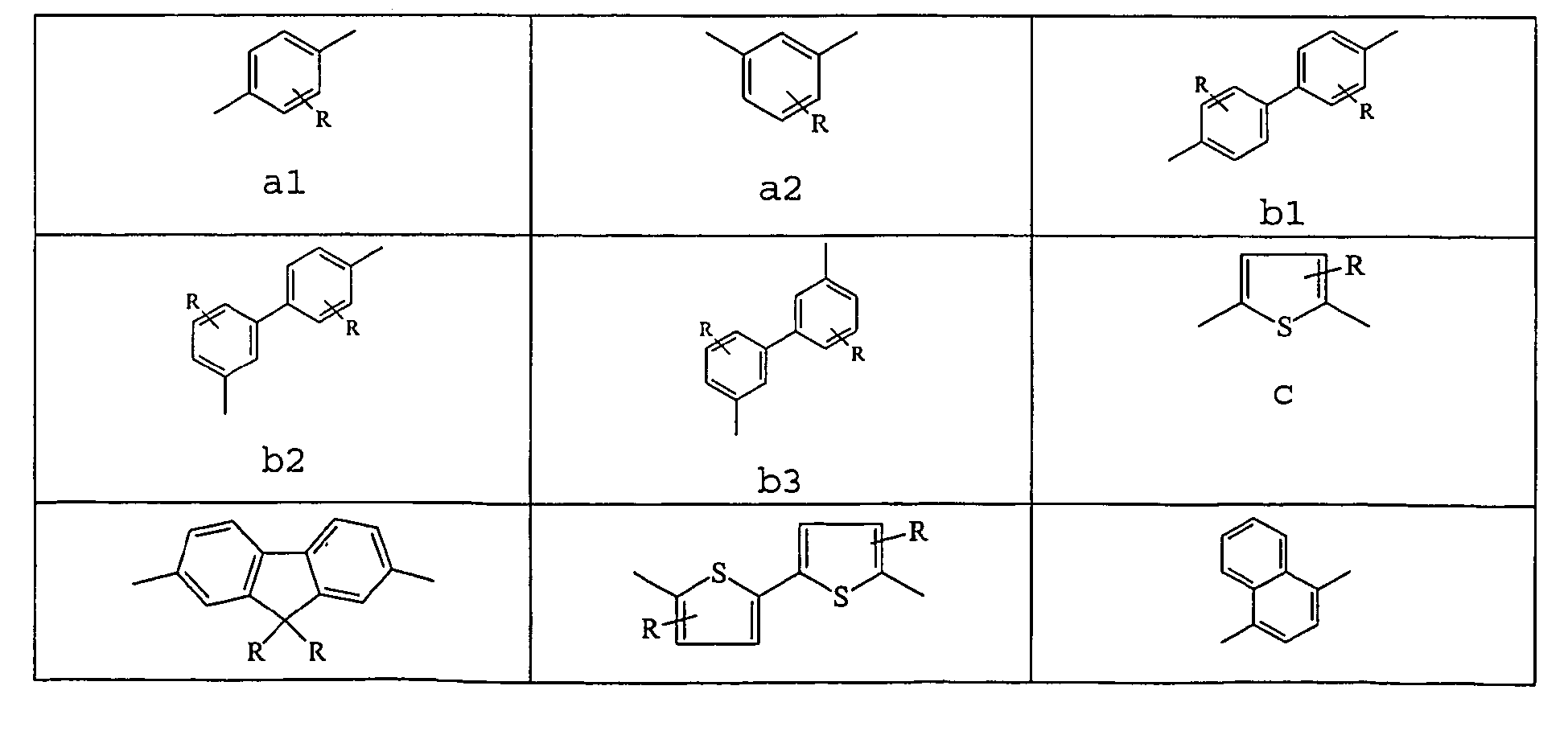

- HT ist eine lochtransportfähige substituierte 2-Aminothiophen bzw. -thiazolstruktur mit den Variationsmöglichkeiten dass
HT(a), eine substituierte (2,2'diamino-5,5'bisthienyl)-4,4'-ylen-struktur,
HT(b) eine substituierte Bis-N,N'-(thien-2-yl)- bzw. Bis-N,N'-(1,3-thiazol-2-yl)-diaminoarylen-strukur und
HT(c) eine substituierte (2,2'-Diamino)-bis-(4,4'thienyl)-arylen-5,5'-ylen-struktur ist, jeweils gemäß unten gezeigten Formeln sein kann,
wobei die Substituenten R2 , R3 und R4 Arylgruppierungen Ar darstellen, die wiederum durch zu sätzliche beliebige Anordnung von einem oder mehreren unverzweigten und/oder verzweigten Alkylsubstituenten bzw. und/oder Alkoxysubstituenten R substituiert sein können, dabei sind aber die Bedeutungen der Substituenten Rn mit gleichem Index n identisch und die der Substituenten R1 gleichbedeutend mit der Substituentenauswahl für die Arylenkomponente Md;
dabei gilt für HT(b) zusätzlich, dass X gleich N oder C-R ist. Die HT-Komponente dient zur optimalen Einstellung der Lochtransporteigenschaften und zur längerwelligen Emissionskorrektur des Copolymers


der Ligand (L-X) gilt nicht für Platinkomplexe,
bei allen anderen Metallkomplexen sind ebenfalls kompexierbare Arylenliganden (a), 1,3-Diketonatliganden (b), Bis-thiazolylmethan- bzw. Bis-thiazolylamin-Liganden (c), Picolinat- (d), N-Alkylsalicylaldimino- (e) oder 8-Hyroxychinolat-Liganden (f) eingeführt,
bevorzugt die folgenden Strukturen:
a) Einkernkomplexe:

TE (a) TE (b) 
TE(c) 

TE (d) TE (e)
b) Zweikernkomplexe:
TE(f) 
TE(g) 


b1 b2 d 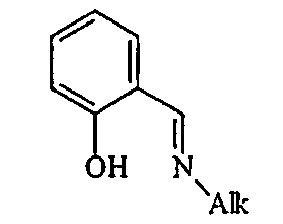


E f c1 


c2 c3 c4 


a1 a2 a3 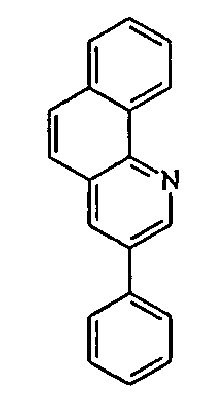
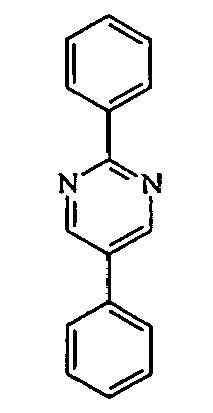


a4 a5 a6 a7 - Ar ist ein carbocyclischer oder heterocyclischer Arylrest, dessen Wasserstoffatome auch beliebig durch einen oder mehrere verzweigte oder unverzweigte Alkylreste oder Alkoxyreste (C1 bis C10) sowie Phenylresten und/oder Diphenyl- bzw. Naphthylphenyl-amino-gruppierungen ersetzt sein können; bevorzugt Mesityl, Phenyl, Biphenylyl, 1-Naphthyl, 2-Naphthyl, 2-Diphenyl- bzw. 2-Naphthylphenylamino-3,4-diphenyl-thien-5-yl- und 2-Diphenyl- bzw. 2-Naphthylphenylamino-3,4-diphenyl-1,3-thiazol-5-yl.
- Weiterhin ist Gegenstand der Erfindung ein Verfahren zur Herstellung der phosphoreszierenden Co-polyarylborane des Typs K nach dem allgemeinen Herstellungsschema.

- Schließlich ist Gegenstand der Erfindung die Verwendung der Co-polyarylborane des Typs K in organischen Leuchtdioden als triplett-emittierende und Elektronen transportierende Schicht.
- Offenbart ist darüber hinaus auch die Verwendung der Copolyarylborane K als Blends von Einzelkomponentenpolymeren, also für den Fall, dass zwei der Verhältnisvariablen x,y und/oder z den Wert Null haben.
- X,y,und z sind die Verhältniszahlen, die angeben, in welchen Verhältnissen zueinander die polymeren Einzelkomponenten copolymerisiert werden. Die polymeren Einzelkomponenten können auch jeweils als Material für eine elektrolumineszierende Schicht genutzt werden.
- Ausgehend von den Ausgangssynthons, A,B und C, werden Grignardreaktionen mit Magnesium Tetrahydrofuran oder Lithiierungen mit BuLi in Ether durchgeführt. Die Grignardprodukte bzw. die Lithiumorganyle D, E und F werden dann einzeln oder in beliebigen gewünschten Verhältnissen in der Siedehitze des THF mit einem Borhalogenid G (beispielsweise Bortrifuoridetherat) so umgesetzt, daß die molare Summe der Grignardkomponenten und/bzw. Lithiumorganyle der molaren Menge des Borhalogenids entspricht. Dabei führt die Reaktion der bifunktionellen Grignardkomponenten bei ca. 70°C nur zu einem linearen Co-Polyfluorarylenboran H.
- Danach synthetisiert man eine weitere monofunktionelle Grignardkomponente I, die man nach Austausch des Lösungsmittel THF duch Toluol (nun in der Siedehitze des Toluols) im molaren Verhältnis zutropft. Nach 5-stündigem Sieden bei ca. 120°C führt dies zur Substitution des restlichen Fluors durch den Arylrest der Grignardkomponente I unter Bildung eines phosphoreszierenden Co-Polyarylboranderivats K, welches aufgrund der Komponentenverhältnisse maßgeschneiderte elektrische und optische Eigenschaften besitzt.
- Die phosphoreszierenden Polyarylboranderivate K erhält man auch, wenn man anstelle der Grignardverbinung I die entsprechende lithiierte Komponente unter Trockeneiskühlung in Ether und/oder Tetrahydrofuran synthetisiert und mit dem zuvor synthetisierten Co-Polyfluorarylenboran H umsetzt.
- Für den Fall, dass die benötigten Arylsysteme nicht kommerziell verfügbar sind, werden sie durch bekannte C-C-Verknüpfungs-reaktionen (beispielsweise Suzuki-Kupplung) dargestellt, zuvor werden an mindestens einem Kupplungsbaustein Alkylierungen bzw. Alkoxylierungen durchgeführt, um eine gute Löslichkeit der daraus zu bildenden polymeren Materialien anzustreben.
- Darstellung von 9,9-diheptyl-2,7-dibromfluorenen

- 0.2 mol Fluoren werden in 300 ml DMSO bei 80°C gelöst. Zur Lösung werden 0.01 mol Phasentransferkatalysator (Aliquot) gegeben und weitere 5 Minuten gerührt. Für die Alkylierung werden 0.5 mol 50%ige Natronlauge und 0.5 mol Heptylbromid benötigt. Die Zugabe erfolgt in drei Stufen, wobei mit der Zugabe von ein Drittel der eingesetzten Menge Natronlage begonnen wird. Die Lösung verfärbt sich ins Tiefrote und wird nach Zugabe von Heptylbromid langsam gelb. Wenn die Lösung gelb geworden ist, wird das zweite Drittel Natronlauge zugegeben usw. Das Ende der Reaktion wird mittels DC an RP18 in Acetonitril kontrolliert.
Das Reaktionsgemisch wird dreimal mit Ether und Wasser extrahiert und die organische Phase abgetrennt.
Nach abdestillieren aller Lösungsmittel (Ether, DMSO, Heptanol) liegt das Produkt als gelbes Öl vor (HPLC-Kontrolle), es wird als Rohprodukt weiterverarbeitet. Zur Darstellung von 9, 9- Dialkylfluorenen mit anderen Alkylgruppen als der Heptylgruppe werden dementsprechend Alkylbromide R-Br (R z. B. Decyl- oder 2-Ethylhexyl-Gruppe) eingesetzt. - 0.2 mol Diheptylfluoren werden in 300 ml Chloroform gelöst und zum Sieden erhitzt. In der Dunkelheit werden langsam 0.4 mol Brom, gelöst in Chloroform zugetropft. Die Reaktion wird ca. 12 Stunden in der Siedehitze gerührt. Wenn sich die Reaktionslösung entfärbt hat, ist die Bromierung beendet (DC-Kontrolle an RP 18 in Acetonitril). Nach Erkalten der Lösung wird das gesamte Chloroform abdestilliert und das Produkt in Methanol als weiße Kristalle gefällt. Nach Chromatographie des Produktes an Silicagel in Cyclohexan erhält man HPLCreines Produkt, mp: 45-6°C.
- 0,1 mol 2-Bromfluoren werden in DMSO unter Stickstoffatmosphäre bei ca. 50°C unter ständigem Rühren gelöst. Das gelöste 2-Bromfluoren wird mit 0,25 mol Kalium-tert.-butylat versetzt, woraufhin sich das Reaktionsgemisch dunkelrot färbt. Nach 5 Minuten werden 0,25 mol ein Alkylbromid R-Br zugegeben; die Reaktion läuft bei Raumtemperatur über Nacht und ist zu Ende, wenn ein Farbumschlag von rot nach hellgelb eintritt.
Die DMSO-Phase wird mit Wasser gewaschen und mit Ether extrahiert. Der Ether wird mittels Rotationsverdampfer abdestilliert und das Produkt in Form hellgelber Kristalle mit Methanol gefällt. - 1a) 2-Brom-9,9-diheptylfluoren

Auf diese Art wird beispielsweise 2-Brom-9,9-diheptylfluoren (mp: 32°C) aus 2-Bromfluoren und Heptylbromid in Gegenwart von Kalium-tert.-butylat hergestellt. - 0,1 mol 9,9-Diheptyl-2-bromfluoren werden in Methylenchlorid vorgelegt und mit flüssigem Stickstoff auf -15°C gekühlt. Bei -15°C werden 0,15 mol Chloracetylchlorid und daraufhin 0,3 mol Aluminiumchlorid langsam zugegeben. Die Reaktion wird nun über Nacht (mindestens 12h) gerührt.
- Das Gemisch wird in Eis/Wasser/HCl (500ml:500ml:50ml) geschüttet und 20 Minuten gerührt. Danach wird nochmals mit Wasser gewaschen. Die organsiche Phase wird abgetrennt und das Lösungsmittel abdestilliert. Das Produkt fällt in Form weißer Kristalle in Methanol aus.
- 2a) 2-Brom-7-chloracetyl-9,9-diheptylfluoren

Auf diese Art wird beispielsweise 2-Brom-7-chloracetyl-9,9-diheptylfluoren (mp: 83-4°C) aus 2-Brom-9,9-diheptylfluoren und Chloracetylchlorid unter Friedel-Crafts-Bedingungen hergestellt. - In einem 2 l-Dreihalskolben mit Rückflusskühler, Magnetrührer, Tropftrichter und Inertgasdurchfluss wird jeweils 1 mol eines sekundären Diarylamins in 600 ml Dioxan gelöst. Das jeweils benötigte Carbonsäurehalogenid wird danach in äquivalenter Menge zugetropft. Anschließend wird das Reaktionsgemisch unter Rückfluss erhitzt, bis die gesamte Menge des bei der Reaktion entstehenden Hydrohalogenids vom Inertgasstrom entfernt worden ist. Durch dünnschichtchromatographische Kontrolle kann das Ende der Reaktion zusätzlich detektiert werden. Die Reaktionslösung wird dann abgekühlt und in mindestens die 2-fache Menge Wasser eingerührt. Dabei scheidet sich in den meisten Fällen ein Öl ab, welches nach einigen Stunden erstarrt ist. Die wässrige Phase wird abgetrennt und das Rohprodukt aus Ethanol umkristallisiert. Die Ausbeute beträgt jeweils mindestens 90%.

- 3a) Auf diese Art wird beispielsweise 2-Phenylessigsäurephenyl-1-naphthylamid (Fp.:85 -88°C) aus Phenyl-1-naphthylamin und 2-Phenylacetylchlorid hergestellt.

- 3b) Auf diese Art wird beispielsweise 2-Phenylessigsäurediphenylamid (Fp.: 71-72°C) aus Diphenylamin und 2-Phenylacetylchlorid hergestellt.
- 0,5 mol des jeweiligen arylierten Carbonsäureamids und die äquivalente Menge Lawesson-Reagenz (hergestellt aus Anisol und Phosphorpentasulfid) werden in einer Rückflussapparatur mit Inertgasdurchfluss in 750 ml Diglykoldiethylether suspendiert, und dann wird 6 h bei 100°C gerührt. Dabei bildet sich eine klare Lösung, aus der in der Kälte in einigen Fällen das Reaktionsprodukt auskristallisiert. Um das Produkt vollständig zu isolieren, wird die Reaktionsmischung in die doppelte Menge Wasser eingerührt, die sich oft bildende ölige Phase lässt man dann kristallisieren. Danach wird das Produkt von der wässrigen Phase abgetrennt und aus Methanol umkristallisiert. Die Ausbeute beträgt jeweils mindestens 90%.

- 4a) Auf diese Art wird beispielsweise 2-Phenylthioessigsäurephenyl-1-naphthylamid (Fp.: 100 - 103°C) aus 2-Phenylessigsäurephenyl-1-naphthylamid und dem Lawesson-Reagenz hergestellt.

- 4b) Auf diese Art wird beispielsweise 2-Phenylthioessigsäurediphenylamid (Fp.: 142-144°C) aus 2-Phenylessigsäurediphenylamid und dem Lawesson-Reagenz hergestellt.
- 0,1 mol Haloacylarylderivat werden mit 0,1 mol 2-Phenylthioessigsäurediarylamid (Beispiel 4b) in Tetrahydrofuran vorgelegt und 30 Minuten unter Stickstoffatmosphäre refluxiert. Nach 30 Minuten werden 0,1mol Trimethylamin zugegeben und nochmals 30 Minuten refluxiert. Das Produkt wird in Form gelblicher Kristalle in Methanol gefällt.
- 5a) 2-(Phenyl-1-naphthylamino)-3-phenyl-4-p-bromphenylthiophen

Auf diese Art wird beispielsweise 2-(Phenyl-1-naphthylamino)-3-phenyl-4-p-bromphenylthiophen (ESI-MS: M+1+ = 532) aus 2-Phenylthioessigsäurephenyl-1-naphthylamid und p-Bromphenacylbromid hergestellt. - 5b) 2-(Phenyl-1-naphthylamino)-3-phenyl-4-(7-brom-9,9-diheptyl-fluoren-2-yl)-thiophen

- Auf diese Art wird beispielsweise 2-(Phenyl-1-naphthylamino)-3-phenyl-4-(7-brom-9,9-diheptyl-fluoren-2-yl)-thiophen mit R= Heptyl (ESI-MS: M+1+ = 816) aus 2-Phenylthioessigsäurephenyl-1-naphthylamid und 2-Chloracetyl-7-brom-9,9-diheptyl-fluoren hergestellt.
- 0,1 mol 2-Aminothiophenderivat werden mit 0,5 mol FeCl3 in Methylenchlorid vorgelegt und einen Tag gerührt. Das Produkt wird mit Wasser und 0,1 mol Triethylamin versetzt und das organische Lösungsmittel abdestilliert. Das Produkt fällt nun in Form von gelben Kristallen in der zurückbleibenden Wasserphase aus. Reinigung durch Säulenchromatographie an Silicagel mit Toluol)
- 6a) Bis-[2-(Phenyl-1-naphthylamino)-3-phenyl-4-(7-brom-9,9-diheptyl-fluoren-2-yl]-5,5'-thienyl

Auf diese Art wird beispielsweise Bis-[2-(Phenyl-1-naphthylamino)-3-phenyl-4-(7-brom-9,9-dialkyl-fluoren-2-yl]-5,5'-thienyl mit R= Heptyl (ESI-MS: M+1+ = 1629) aus 2-(Phenyl-1-naphthylamino)-3-phenyl-4-(7-brom-9,9-diheptylfluoren-2-yl-thiophen und Eisen-III-chlorid hergestellt. - 6b) Bis-[2-(Phenyl-1-naphthylamino)-3-phenyl-4-(4-bromphenyl)]-5,5'-thienyl

- Auf diese Art wird beispielsweise Bis-[2-(Phenyl-1-naphthylamino)-3-phenyl-4-(4-bromphenyl)]-5,5'-thienyl (mp: 133-4°C), (ESI-MS: M+1+ = 1061) aus 2-(Phenyl-1-naphthylamino)-3-phenyl-4-(4-bromphenyl)-thiophen und Eisen-III-chlorid hergestellt.
- In einem 2 1-Dreihalskolben mit Rückflusskühler, Magnetrührer, Tropftrichter und Inertgasdurchfluss wird jeweils 1 mol eines sekundären arylierten Bisamins in 600 ml Dioxan gelöst. Das jeweils benötigte Carbonsäurehalogenid wird danach in äquivalenter Menge zugetropft. Anschließend wird das Reaktionsgemisch unter Rückfluss erhitzt, bis die gesamte Menge des bei der Reaktion entstehenden Hydrohalogenids vom Inertgasstrom entfernt worden ist. Durch dünnschichtchromatographische Kontrolle kann das Ende der Reaktion zusätzlich detektiert werden. Die Reaktionslösung wird dann abgekühlt und in mindestens die 2-fache Menge Wasser eingerührt. Dabei scheidet sich in den meisten Fällen ein Öl ab, welches nach einigen Stunden erstarrt ist. Die wässrige Phase wird abgetrennt und das Rohprodukt aus Ethanol umkristallisiert. Die Ausbeute beträgt jeweils mindestens 90%.

- 1a) Auf diese Art wird beispielsweise N,N'-Di(2-phenylacetyl)-N,N'-diphenyl-phenylen-1,4-diamin (Fp.: 190°C) aus N,N'Diphenyl-p-phenylendiamin und 2-Phenylacetylchlorid hergestellt.
- 0,5 mol des jeweiligen arylierten Biscarbonsäureamids und die äquivalente Menge Lawesson-Reagenz (hergestellt aus Anisol und Phosphorpentasulfid) werden in einer Rückflussapparatur mit Inertgasdurchfluss in 750 ml Diglykoldiethylether suspendiert, und dann wird 6 h bei 100°C gerührt. Dabei bildet sich eine klare Lösung, aus der in der Kälte in einigen Fällen das Reaktionsprodukt auskristallisiert. Um das Produkt vollständig zu isolieren, wird die Reaktionsmischung in die doppelte Menge Wasser eingerührt, die sich oft bildende ölige Phase lässt man dann kristallisieren. Danach wird das Produkt von der wässrigen Phase abgetrennt und aus Methanol umkristallisiert. Die Ausbeute beträgt jeweils mindestens 90%.

- 2a) Auf diese Art wird beispielsweise N,N'-Di(2-phenylthioacetyl)-N,N'-diphenyl-phenylen-1,4-diamin (Fp.:224 - 227°C) aus N,N'-Di(2-phenylacetyl)-N,N'-diphenyl-phenylen-1,4-diamin und dem Lawesson-Reagenz hergestellt.
- 0,2 mol Haloacylarylderivat werden mit 0,1 mol N,N'-Di(2-phenylthio-acetyl)-N,N'-diphenyl-phenylen-1,4-diamin in Tetrahydrofuran vorgelegt und 30 Minuten unter Stickstoffatmosphäre refluxiert. Nach 30 Minuten werden 0,2mol Trimethylamin zugegeben und nochmals 30 Minuten refluxiert. Das Produkt wird in Form hellgelber Kristalle in Methanol gefällt.

- 3a) Auf diese Art wird beispielsweise N,N'-Diphenyl-N,N'-dithien-3,4-diphenyl-2-yl-phenylen-1,4-diamin (Fp.:266-268°C) aus N,N'-Di(2-phenylthio-acetyl)-N,N'-diphenyl-phenylen-1,4-diamin und Phenacylbromid hergestellt.
- 0,1 mol Bis-(haloacyl)-arylenderivat werden mit 0,2 mol 2-Aryl-thioessigsäurediarylamid in Tetrahydrofuran vorgelegt und 30 Minuten unter Stickstoffatmosphäre refluxiert. Nach 30 Minuten werden 0,2mol Trimethylamin zugegeben und nochmals 30 Minuten refluxiert. Das Produkt wird in Form farbloser Kristalle in Methanol gefällt.

- 1a) Auf diese Art wird beispielsweise 2,2'-Diphenylamino-3,3'-diphenyl-4,4'-bisthienyl-p-phenylen (Fp.:232-235°C) aus 2-Phenyl-thioessigsäurediphenylamid und Bis-ω-Bromacetyl-p-phenylen hergestellt.
-
- a1) Darstellung von 2-(4-Bromphenyl)-N,N,N',N'-tetramethylvinamidinium-perchlorat:
0,1 mol 4-Bromphenylessigsäure wird mit frisch bereiteten Vilsmeyer-Komplex (DMF/POCl3) 3h bei 80°C erwärmt. Nach dem Abdestillieren des DMF im Vakuum wird die Reaktionsmischung in eine 0,1 mol Natriumperchlorat enthaltende kalte wässrige Lösung gegeben. Das ausgefallene Salz wird abgesaugt und mit etwas Ethanol und Ether gewaschen und trocken gesaugt.
weiße Kristalle Fp: 145-7°C
- a2) Darstellung von 3-(4-Bromphenyl)-h-benzochinolin 0,05 mol Vinamidiniumsalz a1 werden mit 0,55 mol 1-Naphthylamin in DMF am Rückfluß erhitzt, nach 4-5h läßt man abkühlen und saugt den ausgefallenen Kristallbrei ab, wäscht abschließend mit Ethanol und Ether.
weiße fluoreszierende Kristalle Fp: 160°C
- a3) Darstellung von 5-(4-Bromphenyl)-2-phenylpyrimidin 0,05 mol Vinamidiniumsalz a1 werden mit 0,055 mol Benzamidinhydrochlorid in Pyridin am Rückfluß erhitzt, nach 12h läßt man abkühlen destilliert das Pyridin ab und versetzt die Reaktionsmischung mit Methanol. Die ausgefallenen Kristalle saugt man ab, wäscht abschließend mit Ethanol und Ether.
weiße fluoreszierende Kristalle Fp: 194°C
- a4) Darstellung von 3-(4-Bromphenyl)-f,h-dibenzochinolin 0,05 mol Vinamidiniumsalz 1 werden mit 0,055 mol 9-Aminophenanthren in DMF am Rückfluß erhitzt, nach 4-5h läßt man abkühlen und saugt den ausgefallenen Kristallbrei ab, wäscht abschließend mit Ethanol und Ether.
fluoreszierende Kristalle Fp: °C
- 0,01 mol Iridiumchlorid werden mit 2,1 Äquivalenten eines 2-Phenyl-pyridin-strukturelements (z.B. die Liganden a2, a3) in 100ml Methoxyethanol und 25ml Wasser am Rückfluß erhitzt. Nach 12h wird nach dem Abkühlen ein gelbes Produkt abgesaugt und mit Methanol/Ether gewaschen.
- 1a) Auf diese Art wird beispielsweise ein Komplex des Typs (C^N)2=Ir-µCl2-Ir=(C^N)2 gebildet mit (C^N)= 3- (4-Bromphenyl) - h-benzochinolin in einer Ausbeute von 65%.
(Fp.:>300°C, λmax =462nm THF, ESI-MS = 1783,7).
- 2) Allgemeine Vorschrift zur Synthese von (C^N)2=Ir-(LX[b-f])-Komplexen:
0,005 mol Ir-µ-chloro-komplex werden mit 2,1 Äquivalenten eines anionischen LX-Liganden (b-f) und 0,005 mol Natriumcarbonat in 30ml Ethoxyethanol refluxiert. Nach 12h rührt man das Produkt in die 5-fache Menge Methanol ein, saugt ab, wäscht mit Methanol/Ether und trocknet das Produkt. - 2a) Auf diese Art wird beispielsweise ein Komplex des Typs (C^N)2=Ir-(LX) gebildet mit (C^N)= 3-(4-Bromphenyl)-h-benzochinolin und LX = Acetylaceton in einer Ausbeute von 93%
(Fp.:>300°C, λmax Emission=587nm THF, ESI-MS = 956,1).
- 0,005 mol (C^N)2=Ir-(acac)-komplex werden mit 1,1 Äquivalenten eines LX-Liganden des Typs (a) in 30ml Glycerin refluxiert. Nach 12h rührt man das Produkt in die 5-fache Menge Methanol ein, saugt ab, wäscht mit Methanol/Ether und trocknet das Produkt.
- 3a) Auf diese Art wird beispielsweise ein Komplex des Typs (C^N)2=Ir-(LX) gebildet mit (C^N)= 3-(4-Bromphenyl)-h-benzochinolin und LX = Phenylpyridin in einer Ausbeute von 74%
(Fp.:>300°C, λmax Emission=585nm THF, ESI-MS = 1011,2).
- 0,25 mol frisch geätzte Magnesiumspäne werden unter Argonatmosphäre in trockenem Ether vorgelegt. Unter Rühren und Refluxieren werden 0,1 mol hochgereinigte und getrocknete Dibrom-arylenkomponente M (A) oder TE (C) gelöst in 300 ml THF so zugetropft, daß die Reaktionsmischung nach dem Reaktionsstart beim Sieden gehalten wird. Die Reaktion wird über Nacht fortgesetzt. Die Synthese der benötigten Grignardverbindungen sollte möglichst parallel durchgeführt werden, so daß sie am nächsten Tag zur Verfügung stehen.
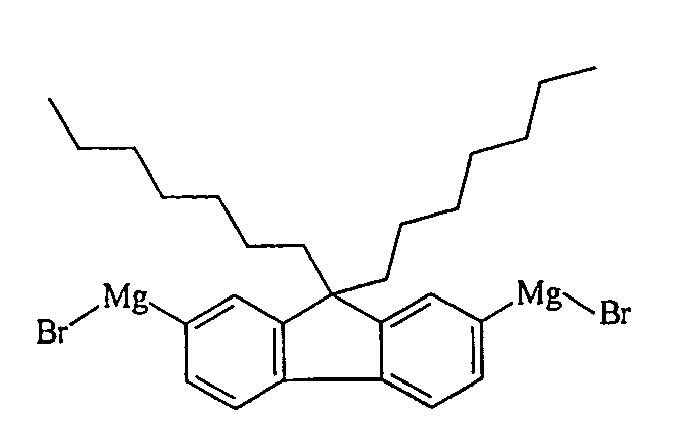
- 1a) Auf diese Art wird beispielsweise 9,9-Diheptyl-2,7-fluoren-ylen-magnesiumbromid aus 9,9-Diheptyl-2,7-dibromfluoren und Magnesium hergestellt.

- 1b) Auf diese Art wird beispielsweise ein grignardierter Komplex des Typs (C^N)2=Ir-(LX) gebildet mit (C^N)= 3-(Phenyl-4-yl-magnesiumbromid)-h-benzochinolin und LX = Phenylpyridin
- 0,1 mol hochgereinigte und getrocknete Dibrom-arylenkomponente M (A) oder TE (C) bzw. die unbromierte Arylenkomponente HT (B) gelöst in 300 ml trockenem Ether/Toluol 1:1 werden unter Argonatmosphäre vorgelegt. Unter Rühren bei Raumtemperatur wird die jeweils äquivalente Menge Butyl-Lithium durch ein Septum eingespritzt. Die Synthesen der benötigten lithiierten Verbindungen sind nach 2h abgeschlossen und werden sofort den Folgereaktionen zugeführt.

- 1a) Auf diese Art wird beispielsweise 9,9-Diheptyl-2,7-fluoren-ylen-lithium aus 9,9-Diheptyl-2,7-dibromfluoren und Butyllithium hergestellt.

- 1b) Auf diese Art wird beispielsweise 2,2'-Diphenylamino-3,3'-diphenyl-5,5'-dilithio-4,4'-bisthienyl-p-phenylen aus 2,2'-Diphenylamino-3,3'-diphenyl-4,4'-bisthienyl-p-phenylen und Butyllithium hergestellt.

- 1c) Auf diese Art wird beispielsweise N,N'-Diphenyl-N,N'-di-[(3,4-diphenyl-5-yl-lithium)-thien-2yl]-phenylen-1,4-diamin aus N,N'-Diphenyl-N,N'-di-[(3,4-diphenyl)-thien-2yl]-phenylen-1,4-diamin und Butyllithium hergestellt.

- 1d) Auf diese Art wird beispielsweise ein lithiierter Komplex des Typs (C^N)2=Ir-(LX) gebildet mit (C^N)= 3-(Phenyl-4-yl-lithium)-h-benzochinolin und LX = Phenylpyridin.
- Die gewünschten Anteile der vorbereiteten Grignardverbindungen bzw. alternativ lithiierten Verbindungen(D, E und F) gelöst in THF bzw. Ether/Toluol 1:1 werden unter Argon und Feuchtigkeitsausschluß in einen Kolben überführt, der mit Tropftrichter, Rückflußkühler, Rührer und Argonatmosphäre ausgestattet ist. Über ein Septum wird Bortrifuoridetherat entsprechend der Summe der molaren Anteile der metallorganischen Verbindungen in den Reaktionskolben über einen Zeitraum von 30 min eingespritzt und bei 60°C gerührt. Nach 2h Reaktionszeit steht das nun gebildete Co-polyfluorarylenboran H der nächsten Reaktion zur Verfügung.

- 1a) Auf diese Art wird beispielsweise ein copolymeres Polyfluor-arylen-boran mit 98% HT- und 2% TE-Komponente aus den entsprechenden lithiierten HT- und TE-Komponenten (Beispiele s.o.) und Bortrifluoridetherat gebildet.
- 0,15 mol frisch geätzte Magnesiumspäne werden unter Argonatmosphäre in trockenem Ether vorgelegt. Unter Rühren und Refluxieren werden 0,1 mol hochgereinigtes und getrocknetes Arylbromid gelöst in 150 ml THF so zugetropft, daß die Reaktionsmischung nach dem Reaktionsstart beim Sieden gehalten wird. Die Reaktion wird über Nacht fortgesetzt. Die auf diese Weise synthetisierte Grignardverbindung I sollte nach der Fertigstellung des Co-polyfluorarylenborans H zur Verfügung stehen.

- 1a) Auf diese Art wird beispielsweise die Mesityl-grignardverbindung aus Mesitylbromid und Magnesium hergestellt.
- 0,01 mol hochgereinigte und getrocknete Arylkomponente I gelöst in 50 ml trockenem Ether/Toluol 1:1 werden unter Argonatmosphäre vorgelegt. Unter Rühren bei Raumtemperatur wird die äquivalente Menge Butyl-Lithium durch ein Septum eingespritzt. Die Synthese der benötigten lithiierten Verbindung ist nach 2h abgeschlossen und wird sofort der Folgereaktion zugeführt.

- 1a) Auf diese Art wird beispielsweise 2-Diphenylamino-3,4-diphenyl-thien-5-yl-lithium aus beispielsweise 2-Diphenylamino-3,4-diphenyl-thiophen und Butyllithium hergestellt.
- Voraussetzung ist die Apparatur mit dem bereitgestellten Co-polyfluorarylenboran H und eine metall-organische Verbindung I.
Zuerst wird der Rückflußkühler der Apparatur durch eine Destillationsbrücke ersetzt und das Lösungsmittel THF abdestilliert. Gleichzeitig wird der Tropftrichter etwa volumengleich der Reaktionsmischung mit trockenem Toluol befüllt und als Lösungsmittel anstelle des THF zugetropft. Nach Abschluß des Lösungsmittelaustausches wird die gewünschte gelöste Grignardverbindung I bzw. alternativ eine lithiierte Verbindung I unter Argonatmosphäre und Feuchtigkeitsausschluß in stöchiometrischem Verhältnis bezogen auf das Co-polyfluorarylenboran H in den Tropftrichter dosiert und bei leicht siedendem Toluol langsam zugetropft. Dabei destilliert man gleichzeitig das Lösungsmittel (THF oder Ether) der zutropfenden metallorganischen Verbindung I ab. Nach Abtrennung des THF bzw. Ether tauscht man die Destillationsbrücke wieder gegen den Rückflußkühler und erhitzt noch weitere 5h am Rückfluß. Die Reaktionsmischung wird nach Abkühlung auf Eis/HCl gegossen und die Toluolphase abgetrennt. Das Toluol wird am Rotationsverdampfer vollständig abdestilliert, danach der Rückstand in wenig THF gelöst und unter Rühren in Ethanol gefällt. Weitere Reinigung des Produktes erfolgt durch wiederholtes Lösen in THF und erneutes Ausfällen in Ethanol. Beispiel 30:
- a) Auf diese Art wird beispielsweise ein Iridiumkomplexhaltiges, phosphoeszierendes Co-Polyboran K mit einem Komponentenverhältnis von M:HT:TE=0:49:1, Tg:85°C, λmax =480nm, GPC: Mw=24500g/mol aus dem Co-polyfluorarylenboran H (1a) und 2-Diphenylamino-3,4-diphenyl-thien-5-yllithium I hergestellt.
- Eine OLED wurde durch folgende Schichtreihenfolge aufgebaut:
- Anode: ITO (Indium-Zinnoxid)
- 120nm Pedot
- 80nm Emitter (nach Beispiel Copolyboran K a)
- 35nm Alq3
- Kathode 3nm LiF, 150nm Al
-

-

- Die neuen Materialien eignen sich zur Erzeugung von elektrolumineszierenden Dioden in den verschiedenen Farben des sichtbaren Spektralbereiches (blau bis rot). Ebenso lassen sich diese Materialien durch Poly-co-reaktionen in entsprechenden Verhältnissen in Materialien umwandeln, die am bzw. in der Nähe des Weißpunktes elektrolumineszieren.
- Diese polymeren Materialien lassen sich durch alle aus Lösung applizierbaren Verfahren verarbeiten (z. B. spin coating, Rakeln, Siebdrucken, Tintenstrahldrucken).
- Die Materialien sind präperativ in hohen Ausbeuten zugänglich und leiten sich von triplett-emittierenden Emittern, die in arylierte Borane eingebunden sind ab, wobei durch die Wahl der Arylenfragmente (Donor/Akzeptor-Struktur) die elektronischen Eigenschaften und damit die Farbe der jeweiligen Verbindung beeinflußt wird.
- Insbesondere ist hervorzuheben, dass zum Aufbau dieser polymeren Materialien keine wie sonst übliche metallkatalyse-basierende Kupplungsreaktionen benötigt werden, (damit entfällt auch die aufwendige Abtrennung des Katalysators sowie die Gefahr der Verunreinigung des Polymers durch Quencherpartikel), was die Kosten für die Synthese, infolge der nicht benötigten teuren Palladiumkatalysatoren und deren Abtrennung, stark reduziert.
- Gerade weiß emittierende Materialien sind für die Herstellung von Leuchtquellen und vollfarbigen Displays, bei welchen die Vollfarbigkeit durch Filterung erreicht wird, von großem Interesse. Der Vorteil bei den Weißlicht getriebenen vollfarbigen Displays besteht in der farbunabhängigen Alterung des emittierenden Materials.
Claims (10)
- Phosphoreszierende Copolyarylborane des Typs K,
 x,y und z sind molare Teile von Komponenten und ergeben in Summe gleich 1,an den Enden sind Wasserstoff-Atome gebunden,M, HT und TE stehen für die Art der jeweiligen Arylenkomponente im Copolymer,
dabei dient M als Matrixstruktur und hat eine Arylenstruktur, wobei unter dem Begriff Arylenstruktur eine beliebige bivalent verbindende ein- oder mehrkernige aromatische und/oder heteroaromatische Struktur verstanden wird,HT ist eine lochtransportfähige substituierte 2-Aminothiophen bzw. -thiazolstruktur,TE ist ein bivalenter phosphoreszierender Organometallkomplex, folgender Struktur: Me hat die Bedeutung eines Metalls der 8. Nebengruppe (Iridium, Ruthenium, Osmium oder Platin),Ar5 ist ein mit dem Metall komplexierbarer Arylenligand, der gleichzeitig auch eine Funktion zur polymeren Anbindung trägt,
der Ligand (L-X) gilt nicht für Platinkomplexe,
bei allen anderen Metallkomplexen hat L-X die Bedeutung eines komplexierbaren Arylenliganden
undAr ist ein carbocyclischer oder heterocyclischer Arylrest, dessen Wasserstoffatome auch beliebig durch einen oder mehrere verzweigte oder unverzweigte Alkylreste oder Alkoxyreste (C1 bis C10) sowie Phenylreste und/oder Diphenyl- bzw. Naphthylphenyl-amino-gruppierungen ersetzt sein können. - Phosphoreszierende Copolyarylborane nach Anspruch 1, wobei der Anteil z einen Wert von 0,01 bis 0,1 haben kann und die Verhältnisse der Teile x und y im Bereich der Differenz zu 1 frei wählbar sind.
- Phosphoreszierende Copolyarylborane nach einem der Ansprüche 1 oder 2, wobei die Arylenstruktur M bevorzugt die 2,7-Fluorenylenstruktur, die in 9-Position durch unverzweigte und/oder verzweigte Alkylreste (C1 bis C10) substituiert sein kann, ist.
- Phosphoreszierende Copolyarylborane nach einem der vorstehenden Ansprüche, wobei die Arylenstruktur M ausgewählt ist aus der Gruppe der folgenden Verbindungen a bis x
 deren Löslichkeit in organischen Lösungsmitteln durch zusätzliche beliebige Anordnung von einem oder mehreren unverzweigten und/oder verzweigten Alkylsubstituenten und/oder Alkoxysubstituenten R und/oder aber auch durch alkylsubstituierte Arylen-Substituenten R1 modifizierbar ist, wobei bevorzugt einfach synthetisierbare mit verzweigten oder unverzweigten Alkylgruppierungen von C5 bis C10 ausgerüstete 2,7-disubstituierte 9,9-Dialkylflüorenylenstrukuren angewandt werden.
- Phosphoreszierende Copolymere nach einem der vorstehenden Ansprüche, wobei die lochtransportfähige substituierte 2-Amino-thiophen oder -thiazolstruktur HT ausgewählt ist aus der Gruppe folgender Strukturen HT(a) bis HT(c), wobei
HT(a) eine substituierte (2,2'diamino-5,5'bisthienyl)-4,4'-ylen-Struktur,
HT(b) eine substituierte Bis-N,N'-(thien-2-yl)- bzw. Bis-N,N'-(1,3-thiazol-2-yl)-diaminoarylen-Struktur und
HT(c) eine substituierte (2,2'-Diamino)-bis-(4,4'thienyl)-arylen-5,5'-ylen-Struktur, jeweils gemäß den unten gezeigten Formeln, ist,
wobei die Substituenten R2 , R3 und R4 Arylgruppierungen Ar darstellen, die wiederum durch zusätzliche beliebige Anordnung von einem oder mehreren unverzweigten und/oder verzweigten Alkylsubstituenten und/oder Alkoxysubstituenten R substituierbar sind, dabei sind die Bedeutungen der Substituenten Rn mit gleichem Index n identisch und die der Substituenten R1 gleichbedeutend mit der Substituentenauswahl für die Arylenkomponente Md; und es gilt für HT(b) zusätzlich, dass X gleich N oder C-R ist


- Phosphoreszierendes Copolymer nach einem der vorstehenden Ansprüche, wobei der carbocyclische oder heterocyclische Arylrest Ar ausgewählt ist aus der Gruppe folgender Verbindungen: Mesityl-, Phenyl-, Biphenylyl-, 1-Naphthyl, 2-Naphthyl-, 2-Diphenyl- bzw. 2-Naphthylphenylamino-3,4-diphenyl-thien-5-yl- und 2-Diphenyl- bzw. 2-Naphthylphenylamino-3,4-diphenyl-1,3-thiazol-5-yl.
- Phosphoreszierendes Copolymer nach einem der vorstehenden Ansprüche, wobei der bivalente phosphoreszierende Organometallkomplex TE als Zentralatom Me Iridium hat.
- Phosphoreszierendes Copolymer nach einem der vorstehenden Ansprüche, wobei der bivalente phosphoreszierende Organometallkomplex TE ausgewählt ist aus der Gruppe folgender Verbindungen TE(a) bis TE(g) und wobei der Ligand L-X ausgewählt ist aus der Gruppe der Verbindungen (a) bis (f), wobei (a) die Gruppe komplexierbarer Arylenliganden, (b) die der 1,3-Diketonatliganden, (c) die der Bis-thiazolylmethan- oder Bis-thiazolylamin-Liganden, (d) die der Picolinat-, (e) die der N-Alkylsalicylaldimino- und/oder (f) die der 8-Hyroxychinolat-Liganden umfasst:a) Einkernkomplexe TE(a) bis TE(g):


TE(a) TE (b) 
TE(c) 

TE(d) TE(e) b) Zweikernkomplexe:dazugehörige L-X-Liganden:
TE(f) 
TE(g) 
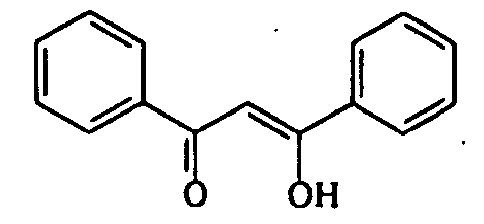

b1 b2 d 


e f c1 


c2 c3 c4 


a1 a2 a3 


a4 a5 a6 a7 - Verfahren zur Herstellung eines phosphoreszierenden Copolyarylborans vom Typ K nach dem allgemeinen Herstellungsschema

- Verwendung eines Copolyarylborans vom Typ K in organischen Leuchtdioden als triplett-emittierende und/oder Elektronen transportierende Schicht.
Applications Claiming Priority (2)
| Application Number | Priority Date | Filing Date | Title |
|---|---|---|---|
| DE10361385A DE10361385B4 (de) | 2003-12-29 | 2003-12-29 | Polymere, phosphoreszierende, organisch halbleitende Emittermaterialien auf Basis perarylierter Borane, Verfahren zu deren Herstellung und Verwendungen davon |
| PCT/DE2004/002833 WO2005063919A1 (de) | 2003-12-29 | 2004-12-29 | Polymere, phosphoreszierende, organisch halbleitende emittermaterialien auf basis perarylierter borane, verfahren zu deren herstellung und verwendungen davon |
Publications (2)
| Publication Number | Publication Date |
|---|---|
| EP1699898A1 EP1699898A1 (de) | 2006-09-13 |
| EP1699898B1 true EP1699898B1 (de) | 2008-10-29 |
Family
ID=34716211
Family Applications (1)
| Application Number | Title | Priority Date | Filing Date |
|---|---|---|---|
| EP04816282A Ceased EP1699898B1 (de) | 2003-12-29 | 2004-12-29 | Polymere, phosphoreszierende, organisch halbleitende emittermaterialien auf basis perarylierter borane, verfahren zu deren herstellung und verwendungen davon |
Country Status (8)
| Country | Link |
|---|---|
| US (1) | US7858724B2 (de) |
| EP (1) | EP1699898B1 (de) |
| JP (1) | JP5294560B2 (de) |
| KR (1) | KR101249413B1 (de) |
| CN (1) | CN1902295A (de) |
| DE (2) | DE10361385B4 (de) |
| TW (1) | TWI327590B (de) |
| WO (1) | WO2005063919A1 (de) |
Families Citing this family (17)
| Publication number | Priority date | Publication date | Assignee | Title |
|---|---|---|---|---|
| US20070215864A1 (en) | 2006-03-17 | 2007-09-20 | Luebben Silvia D | Use of pi-conjugated organoboron polymers in thin-film organic polymer electronic devices |
| DE102006017485B4 (de) * | 2006-04-13 | 2014-06-05 | Merck Patent Gmbh | Biphenyl-Metallkomplexe - Monomere und Oligomere Triplett-Emitter für OLED-Anwendungen |
| JP5238227B2 (ja) * | 2006-12-27 | 2013-07-17 | 株式会社半導体エネルギー研究所 | 有機金属錯体および有機金属錯体を用いた発光素子、発光装置、並びに電子機器 |
| JP5446096B2 (ja) * | 2007-02-06 | 2014-03-19 | 住友化学株式会社 | 組成物及び該組成物を用いてなる発光素子 |
| DE102007031261A1 (de) * | 2007-07-05 | 2009-01-08 | Universtität Regensburg | Lumineszierende Metallkomplexe mit sperrigen Hilfsliganden |
| WO2009069535A1 (en) * | 2007-11-30 | 2009-06-04 | Semiconductor Energy Laboratory Co., Ltd. | Light-emitting element, light-emitting device, and electronic device |
| WO2009157498A1 (en) * | 2008-06-25 | 2009-12-30 | Semiconductor Energy Laboratory Co., Ltd. | Organometallic complex, and lighting apparatus, and electronic device using the organometallic complex |
| US9169281B2 (en) * | 2010-03-04 | 2015-10-27 | Osaka University | Mononuclear metal complex, hydrogenation reduction catalyst, dehydrogenation catalyst, method for producing hydrogenation reduction product, method for producing hydrogen (H2), and method for producing dehydrogenation reaction product |
| KR20130007162A (ko) | 2011-06-29 | 2013-01-18 | 삼성디스플레이 주식회사 | 신규한 헤테로고리 화합물 및 이를 포함한 유기발광 소자 |
| KR101940103B1 (ko) | 2011-06-29 | 2019-01-21 | 삼성디스플레이 주식회사 | 신규한 헤테로고리 화합물 및 이를 포함한 유기발광 소자 |
| EP2543685A1 (de) * | 2011-07-08 | 2013-01-09 | cynora GmbH | Verfahren zur kovalenten Bindung eines Metallkomplexes an ein Polymer |
| US9309223B2 (en) | 2011-07-08 | 2016-04-12 | Semiconductor Energy Laboratory Co., Ltd. | Heterocyclic compound, light-emitting element, light-emitting device, electronic device, and lighting device |
| JP5750762B2 (ja) | 2011-08-31 | 2015-07-22 | 住友化学株式会社 | ボラン化合物と共役高分子化合物とを含む組成物及び素子 |
| US9450195B2 (en) * | 2014-12-17 | 2016-09-20 | Universal Display Corporation | Organic electroluminescent materials and devices |
| US9525134B1 (en) * | 2015-08-11 | 2016-12-20 | E I Du Pont De Nemours And Company | Hole transport materials |
| WO2017146083A1 (ja) * | 2016-02-25 | 2017-08-31 | 住友化学株式会社 | 発光素子及び該発光素子に用いる高分子化合物 |
| CN111153822B (zh) * | 2020-01-08 | 2021-07-20 | 北京航空航天大学 | 苯酰基修饰的聚集诱导发光型苯胺齐聚物及其制备方法 |
Family Cites Families (49)
| Publication number | Priority date | Publication date | Assignee | Title |
|---|---|---|---|---|
| US3100181A (en) * | 1961-02-16 | 1963-08-06 | Nalco Chemical Co | Preparation of organoboranes |
| US3213136A (en) * | 1961-10-30 | 1965-10-19 | American Potash & Chem Corp | Borimidazoles |
| US3311662A (en) * | 1962-11-30 | 1967-03-28 | American Potash & Chem Corp | Tetraarylboron compounds |
| US4239738A (en) * | 1979-12-07 | 1980-12-16 | Ppg Industries, Inc. | Method for producing boron trichloride |
| US5502142A (en) * | 1990-03-09 | 1996-03-26 | The Trustees Of The University Of Pennsylvania | Direct thermal synthesis and ceramic applications of poly(borazylenes) |
| TW466256B (en) | 1995-11-24 | 2001-12-01 | Ciba Sc Holding Ag | Borate photoinitiator compounds and compositions comprising the same |
| US5681870A (en) * | 1996-07-26 | 1997-10-28 | The United States Of America As Represented By The Secretary Of The Navy | High temperature thermosets/ceramics from novel hybrid copolymer containing random distribution of boranyl, silyl, or siloxyl, and acetylenic units |
| US6830828B2 (en) * | 1998-09-14 | 2004-12-14 | The Trustees Of Princeton University | Organometallic complexes as phosphorescent emitters in organic LEDs |
| US6129863A (en) * | 1998-12-18 | 2000-10-10 | Albemarle Corporation | Clean generation of a perfluoroaryl grignard reagent |
| WO2000040586A1 (en) * | 1999-01-08 | 2000-07-13 | Chisso Corporation | Borane derivatives and organic electroluminescents |
| JP4026273B2 (ja) | 1999-04-05 | 2007-12-26 | 東洋インキ製造株式会社 | 有機エレクトロルミネッセンス素子用材料およびそれを使用した有機エレクトロルミネッセンス素子 |
| TW484341B (en) * | 1999-08-03 | 2002-04-21 | Sumitomo Chemical Co | Polymeric fluorescent substance and polymer light emitting device |
| US8206838B2 (en) * | 2000-06-12 | 2012-06-26 | Sumitomo Chemical Co., Ltd. | Polymer matrix electroluminescent materials and devices |
| US7357989B2 (en) * | 2000-08-07 | 2008-04-15 | Osram Opto Semiconductors Gmbh | Di(het)arylaminothiazole derivatives and their use in organic light-emitting diodes(OLEDs) and organic photovoltaic components |
| US6727372B2 (en) * | 2000-08-07 | 2004-04-27 | Eastman Chemical Company | Colorant compounds containing copolymerizable vinyl groups |
| EP1217668A1 (de) * | 2000-12-22 | 2002-06-26 | Covion Organic Semiconductors GmbH | Verwendung von Bor- und Aluminium-Verbindungen in Elektronik-Bauteilen |
| DE10109027A1 (de) * | 2001-02-24 | 2002-09-05 | Covion Organic Semiconductors | Rhodium- und Iridium-Komplexe |
| GB0104700D0 (en) * | 2001-02-26 | 2001-04-11 | Isis Innovation | Luminescent polymers |
| WO2002071813A1 (en) | 2001-03-02 | 2002-09-12 | The Trustees Of Princeton University | Double doped-layer, phosphorescent organic light emitting devices |
| AU2002306698A1 (en) | 2001-03-14 | 2002-09-24 | The Trustees Of Princeton University | Materials and devices for blue phosphorescence based organic light emitting diodes |
| US6597012B2 (en) * | 2001-05-02 | 2003-07-22 | Junji Kido | Organic electroluminescent device |
| GB0111549D0 (en) * | 2001-05-11 | 2001-07-04 | Cambridge Display Tech Ltd | Polymers, their preparation and uses |
| AU2002345362A1 (en) * | 2001-06-20 | 2003-01-08 | Showa Denko K.K. | Light emitting material and organic light-emitting device |
| JP4804662B2 (ja) | 2001-07-11 | 2011-11-02 | コニカミノルタホールディングス株式会社 | 有機エレクトロルミネッセンス素子及び表示装置 |
| KR100407250B1 (ko) * | 2001-08-31 | 2003-11-28 | 네오뷰코오롱 주식회사 | 유기 발광 화합물 및 이를 이용한 유기 전계발광 소자 |
| US7250226B2 (en) * | 2001-08-31 | 2007-07-31 | Nippon Hoso Kyokai | Phosphorescent compound, a phosphorescent composition and an organic light-emitting device |
| EP1426399A4 (de) * | 2001-09-04 | 2005-07-13 | Canon Kk | Hochmolekulare verbindungen und organische lumineszierende vorrichtungen |
| DE10143353A1 (de) * | 2001-09-04 | 2003-03-20 | Covion Organic Semiconductors | Konjugierte Polymere enthaltend Spirobifluoren-Einheiten und deren Verwendung |
| AU2002349587A1 (en) * | 2001-11-30 | 2003-06-10 | National Institute Of Advanced Industrial Science And Technology | Electroluminescent element |
| SG125077A1 (en) * | 2001-12-19 | 2006-09-29 | Sumitomo Chemical Co | Copolymer, polymer composition and polymer light-emitting device |
| SG128438A1 (en) * | 2002-03-15 | 2007-01-30 | Sumitomo Chemical Co | Polymer compound and polymer light emitting deviceusing the same |
| TWI277617B (en) * | 2002-03-26 | 2007-04-01 | Sumitomo Chemical Co | Metal complexes and organic electro luminescence elements |
| GB0209652D0 (en) * | 2002-04-26 | 2002-06-05 | Univ Cambridge Tech | Solution-processable phosphorescent materials |
| US20060093852A1 (en) * | 2002-06-04 | 2006-05-04 | Dirk Marsitzky | Phosphorescent and luminescent conjugated polymers and their use in electroluminescent assemblies |
| JP4288895B2 (ja) * | 2002-06-04 | 2009-07-01 | コニカミノルタホールディングス株式会社 | 有機エレクトロルミネッセンスの製造方法 |
| AU2003269913A1 (en) * | 2002-07-15 | 2004-02-02 | Massachusetts Institute Of Technology | Emissive, high charge transport polymers |
| JP4526776B2 (ja) * | 2003-04-02 | 2010-08-18 | 株式会社半導体エネルギー研究所 | 発光装置及び電子機器 |
| US20040202892A1 (en) * | 2003-04-08 | 2004-10-14 | Jsr Corporation | Polymer, polymer for forming organic electroluminescence device, polymer composition for organic electroluminescence device and organic electroluminescence device |
| DE102004001865A1 (de) * | 2003-05-08 | 2004-12-16 | Siemens Ag | Nicht konjugierte polymere perarylierte Borane, deren Verwendung als organisch halbleitende Emitter und/oder Transportmaterialien, Verfahren zu deren Herstellung und Anwendungen davon |
| US7951874B2 (en) * | 2003-05-08 | 2011-05-31 | Osram Opto Semiconductors Gmbh | Non-conjugated polymeric perarylated boranes, use thereof as organically semiconductor transmitters and/or transport materials, methods for producing same and uses thereof |
| DE10337077A1 (de) * | 2003-08-12 | 2005-03-10 | Covion Organic Semiconductors | Konjugierte Copolymere, deren Darstellung und Verwendung |
| US7906224B2 (en) * | 2003-08-21 | 2011-03-15 | Konica Minolta Holdings, Inc. | Organic electroluminescent device, display, and illuminating device |
| TW200526694A (en) * | 2003-08-29 | 2005-08-16 | Showa Denko Kk | Phosphorescent polymer compound and organic light emitting device using the same |
| US7239766B2 (en) * | 2003-10-27 | 2007-07-03 | Mississippi State University | Optical sensing elements for nitrogen dioxide (NO2) gas detection, a sol-gel method for making the sensing elements and fiber optic sensors incorporating nitrogen dioxide gas optical sensing elements |
| US20050123794A1 (en) * | 2003-12-05 | 2005-06-09 | Deaton Joseph C. | Organic electroluminescent devices |
| US7208627B2 (en) * | 2003-12-18 | 2007-04-24 | Nippon Shokubai Co., Ltd | Alkylborazine compound and production method for the same |
| JP4854956B2 (ja) * | 2003-12-19 | 2012-01-18 | 昭和電工株式会社 | ホウ素を含有する高分子化合物およびこれを用いた有機発光素子 |
| US7169483B2 (en) * | 2004-04-12 | 2007-01-30 | General Electric Company | Opto-electroactive device comprising a metallocene and method |
| US20060134461A1 (en) * | 2004-12-17 | 2006-06-22 | Shouquan Huo | Organometallic materials and electroluminescent devices |
-
2003
- 2003-12-29 DE DE10361385A patent/DE10361385B4/de not_active Expired - Fee Related
-
2004
- 2004-11-26 TW TW093136553A patent/TWI327590B/zh not_active IP Right Cessation
- 2004-12-29 US US10/585,182 patent/US7858724B2/en not_active Expired - Fee Related
- 2004-12-29 EP EP04816282A patent/EP1699898B1/de not_active Ceased
- 2004-12-29 CN CNA2004800394116A patent/CN1902295A/zh active Pending
- 2004-12-29 KR KR1020067015183A patent/KR101249413B1/ko not_active Expired - Fee Related
- 2004-12-29 DE DE502004008367T patent/DE502004008367D1/de not_active Expired - Lifetime
- 2004-12-29 WO PCT/DE2004/002833 patent/WO2005063919A1/de not_active Ceased
- 2004-12-29 JP JP2006545917A patent/JP5294560B2/ja not_active Expired - Fee Related
Also Published As
| Publication number | Publication date |
|---|---|
| DE502004008367D1 (de) | 2008-12-11 |
| KR20060127101A (ko) | 2006-12-11 |
| WO2005063919A1 (de) | 2005-07-14 |
| DE10361385B4 (de) | 2011-07-28 |
| US7858724B2 (en) | 2010-12-28 |
| EP1699898A1 (de) | 2006-09-13 |
| JP2007522271A (ja) | 2007-08-09 |
| DE10361385A1 (de) | 2005-10-13 |
| TW200525010A (en) | 2005-08-01 |
| TWI327590B (en) | 2010-07-21 |
| JP5294560B2 (ja) | 2013-09-18 |
| KR101249413B1 (ko) | 2013-04-03 |
| CN1902295A (zh) | 2007-01-24 |
| US20070191587A1 (en) | 2007-08-16 |
Similar Documents
| Publication | Publication Date | Title |
|---|---|---|
| EP2046916B1 (de) | Oxazol-triplett-emitter für oled-anwendungen | |
| JP5230940B2 (ja) | 二座(Bipodal)配位子を有する金属錯体 | |
| EP1819717B1 (de) | Verwendung von übergangsmetall-carbenkomplexen in organischen licht-emittierenden dioden (oleds) | |
| EP2035526B1 (de) | Verwendung von übergangsmetallcarbenkomplexen, die keine cyclometallierung über nicht-carbene enthalten, in oleds | |
| EP2251396B1 (de) | Zur Emission befähigte organische Verbindungen und Elektronikbauteile diese enthaltend | |
| EP1675929B1 (de) | Metallkomplexe | |
| DE10361385B4 (de) | Polymere, phosphoreszierende, organisch halbleitende Emittermaterialien auf Basis perarylierter Borane, Verfahren zu deren Herstellung und Verwendungen davon | |
| EP2007779B1 (de) | Heteroleptische übergangsmetall-carben-komplexe und deren verwendung in organischen leuchtdioden (oleds) | |
| DE112004001675T5 (de) | Dendrimerverbindung und diese verwendendes organisches lumineszierendes Element | |
| WO2006056465A1 (de) | Phenothiazine, -s-oxide und s, s-dioxide sowie phenoxazine als emitter für oleds | |
| EP1618170A2 (de) | Mischungen von organischen zur emission befähigten halbleitern und matrixmaterialien, deren verwendung und elektronikbauteile enthaltend diese mischungen | |
| TWI425075B (zh) | 有機發光二極體,顯示器與照明裝置 | |
| US20200176691A1 (en) | Transition metal luminescent complexes and methods of use | |
| Ho et al. | Metallophosphors of iridium (III) containing borylated oligothiophenes with electroluminescence down to the near-infrared region | |
| DE112020004796B4 (de) | Metallkoordinationsverbindung und deren Anwendung | |
| DE112007000426T5 (de) | Metallkomplex, Polymerverbindung und sie enthaltende Vorrichtung | |
| EP1817805A1 (de) | Verwendung von phenothiazin-s-oxiden und -s,s-dioxiden als matrixmaterialien f]r organische leuchtdioden | |
| US12116378B2 (en) | Transition metal luminescent complexes and methods of use | |
| EP1620492B9 (de) | Nicht konjugierte polymere perarylierte borane, deren verwendung als organisch halbleitende emitter und/oder transportmaterialien, verfahren zu deren herstellung und anwendungen davon | |
| DE602005000031T2 (de) | Phenyl pyridine-iridium Metal-Komplexverbindungen für organische elektroluminizierende Vorrichtung, Verfahren zur Herstellung der Verbindungen und organische elektroluminizierende Vorrichtung, die diese Verbindungen verwendet | |
| DE102004001865A1 (de) | Nicht konjugierte polymere perarylierte Borane, deren Verwendung als organisch halbleitende Emitter und/oder Transportmaterialien, Verfahren zu deren Herstellung und Anwendungen davon | |
| CN100516165C (zh) | 发光聚合物组合物 |
Legal Events
| Date | Code | Title | Description |
|---|---|---|---|
| PUAI | Public reference made under article 153(3) epc to a published international application that has entered the european phase |
Free format text: ORIGINAL CODE: 0009012 |
|
| 17P | Request for examination filed |
Effective date: 20060503 |
|
| AK | Designated contracting states |
Kind code of ref document: A1 Designated state(s): DE |
|
| DAX | Request for extension of the european patent (deleted) | ||
| RBV | Designated contracting states (corrected) |
Designated state(s): DE |
|
| 17Q | First examination report despatched |
Effective date: 20070430 |
|
| RAP1 | Party data changed (applicant data changed or rights of an application transferred) |
Owner name: OSRAM OPTO SEMICONDUCTORS GMBH |
|
| RAP1 | Party data changed (applicant data changed or rights of an application transferred) |
Owner name: OSRAM OPTO SEMICONDUCTORS GMBH |
|
| GRAP | Despatch of communication of intention to grant a patent |
Free format text: ORIGINAL CODE: EPIDOSNIGR1 |
|
| GRAS | Grant fee paid |
Free format text: ORIGINAL CODE: EPIDOSNIGR3 |
|
| GRAA | (expected) grant |
Free format text: ORIGINAL CODE: 0009210 |
|
| AK | Designated contracting states |
Kind code of ref document: B1 Designated state(s): DE |
|
| REF | Corresponds to: |
Ref document number: 502004008367 Country of ref document: DE Date of ref document: 20081211 Kind code of ref document: P |
|
| PLBE | No opposition filed within time limit |
Free format text: ORIGINAL CODE: 0009261 |
|
| STAA | Information on the status of an ep patent application or granted ep patent |
Free format text: STATUS: NO OPPOSITION FILED WITHIN TIME LIMIT |
|
| 26N | No opposition filed |
Effective date: 20090730 |
|
| REG | Reference to a national code |
Ref country code: DE Ref legal event code: R082 Ref document number: 502004008367 Country of ref document: DE Representative=s name: EPPING HERMANN FISCHER, PATENTANWALTSGESELLSCH, DE |
|
| REG | Reference to a national code |
Ref country code: DE Ref legal event code: R081 Ref document number: 502004008367 Country of ref document: DE Owner name: OSRAM OLED GMBH, DE Free format text: FORMER OWNER: OSRAM OPTO SEMICONDUCTORS GMBH, 93055 REGENSBURG, DE Effective date: 20150209 Ref country code: DE Ref legal event code: R082 Ref document number: 502004008367 Country of ref document: DE Representative=s name: EPPING HERMANN FISCHER, PATENTANWALTSGESELLSCH, DE Effective date: 20150209 Ref country code: DE Ref legal event code: R082 Ref document number: 502004008367 Country of ref document: DE Representative=s name: EPPING HERMANN FISCHER PATENTANWALTSGESELLSCHA, DE Effective date: 20150209 |
|
| PGFP | Annual fee paid to national office [announced via postgrant information from national office to epo] |
Ref country code: DE Payment date: 20211216 Year of fee payment: 18 |
|
| REG | Reference to a national code |
Ref country code: DE Ref legal event code: R119 Ref document number: 502004008367 Country of ref document: DE |
|
| PG25 | Lapsed in a contracting state [announced via postgrant information from national office to epo] |
Ref country code: DE Free format text: LAPSE BECAUSE OF NON-PAYMENT OF DUE FEES Effective date: 20230701 |