EP1684780B1 - The use of a polyphenol for the treatment of a cancerous or pre-cancerous lesion of the skin - Google Patents
The use of a polyphenol for the treatment of a cancerous or pre-cancerous lesion of the skin Download PDFInfo
- Publication number
- EP1684780B1 EP1684780B1 EP04790231A EP04790231A EP1684780B1 EP 1684780 B1 EP1684780 B1 EP 1684780B1 EP 04790231 A EP04790231 A EP 04790231A EP 04790231 A EP04790231 A EP 04790231A EP 1684780 B1 EP1684780 B1 EP 1684780B1
- Authority
- EP
- European Patent Office
- Prior art keywords
- mixture
- gallate
- use according
- epigallocatechol
- epicatechol
- Prior art date
- Legal status (The legal status is an assumption and is not a legal conclusion. Google has not performed a legal analysis and makes no representation as to the accuracy of the status listed.)
- Expired - Lifetime
Links
- 0 *C(C1)C(c2cc(O)c(*)c(*)c2)Oc2c1c(O)cc(O)c2 Chemical compound *C(C1)C(c2cc(O)c(*)c(*)c2)Oc2c1c(O)cc(O)c2 0.000 description 1
Classifications
-
- A—HUMAN NECESSITIES
- A61—MEDICAL OR VETERINARY SCIENCE; HYGIENE
- A61K—PREPARATIONS FOR MEDICAL, DENTAL OR TOILETRY PURPOSES
- A61K31/00—Medicinal preparations containing organic active ingredients
- A61K31/33—Heterocyclic compounds
- A61K31/335—Heterocyclic compounds having oxygen as the only ring hetero atom, e.g. fungichromin
- A61K31/35—Heterocyclic compounds having oxygen as the only ring hetero atom, e.g. fungichromin having six-membered rings with one oxygen as the only ring hetero atom
- A61K31/352—Heterocyclic compounds having oxygen as the only ring hetero atom, e.g. fungichromin having six-membered rings with one oxygen as the only ring hetero atom condensed with carbocyclic rings, e.g. methantheline
- A61K31/353—3,4-Dihydrobenzopyrans, e.g. chroman, catechin
-
- A—HUMAN NECESSITIES
- A61—MEDICAL OR VETERINARY SCIENCE; HYGIENE
- A61K—PREPARATIONS FOR MEDICAL, DENTAL OR TOILETRY PURPOSES
- A61K31/00—Medicinal preparations containing organic active ingredients
- A61K31/70—Carbohydrates; Sugars; Derivatives thereof
- A61K31/7042—Compounds having saccharide radicals and heterocyclic rings
- A61K31/7048—Compounds having saccharide radicals and heterocyclic rings having oxygen as a ring hetero atom, e.g. leucoglucosan, hesperidin, erythromycin, nystatin, digitoxin or digoxin
-
- A—HUMAN NECESSITIES
- A61—MEDICAL OR VETERINARY SCIENCE; HYGIENE
- A61K—PREPARATIONS FOR MEDICAL, DENTAL OR TOILETRY PURPOSES
- A61K36/00—Medicinal preparations of undetermined constitution containing material from algae, lichens, fungi or plants, or derivatives thereof, e.g. traditional herbal medicines
- A61K36/18—Magnoliophyta (angiosperms)
- A61K36/185—Magnoliopsida (dicotyledons)
- A61K36/82—Theaceae (Tea family), e.g. camellia
-
- A—HUMAN NECESSITIES
- A61—MEDICAL OR VETERINARY SCIENCE; HYGIENE
- A61P—SPECIFIC THERAPEUTIC ACTIVITY OF CHEMICAL COMPOUNDS OR MEDICINAL PREPARATIONS
- A61P17/00—Drugs for dermatological disorders
-
- A—HUMAN NECESSITIES
- A61—MEDICAL OR VETERINARY SCIENCE; HYGIENE
- A61P—SPECIFIC THERAPEUTIC ACTIVITY OF CHEMICAL COMPOUNDS OR MEDICINAL PREPARATIONS
- A61P17/00—Drugs for dermatological disorders
- A61P17/02—Drugs for dermatological disorders for treating wounds, ulcers, burns, scars, keloids, or the like
-
- A—HUMAN NECESSITIES
- A61—MEDICAL OR VETERINARY SCIENCE; HYGIENE
- A61P—SPECIFIC THERAPEUTIC ACTIVITY OF CHEMICAL COMPOUNDS OR MEDICINAL PREPARATIONS
- A61P35/00—Antineoplastic agents
Definitions
- the present invention refers to a pharmaceutically effective amount of a mixture of polyphenols for the treatment of a pre-cancerous lesion of the skin, wherein said lesion is selected from actinic keratosis, solar keratosis, Bowen's disease, actinic cheilitis and/or leukoplakia of a patient, and wherein said mixture of polyphenols is a mixture of catechols containing, 2-20 % (w/w) epicatechol, 2-20 % (w/w) epicatechol gallate, 1-25 % (w/w) epigallocatechol, 40-75 % (w/w) epigallocatechol gallate, 0.05-5 % (w/w) gallocatechol and/or 0.5-20 % (w/w) gallocatechol gallate.
- Skin cancer is a disease in which malignant (cancer) cells are formed in the tissues of the skin.
- the skin is the body's largest organ. It protects against heat, sunlight, injury, and infection, helps to control the body temperature and stores water, fat, and vitamin D.
- the skin has several layers, but the two main layers are the epidermis (upper or outer layer) and the dermis (lower or inner layer).
- Skin cancer usually starts growing in the epidermis, which is made up of three kinds of cells.
- the squamous cells are thin, flat cells that form the top layer of the epidermis.
- the basal cells are round cells below the squamous cells and melanocytes are found in the lower part of the epidermis. These cells produce melanin, the pigment that is responsible for the natural color of the skin. When skin is exposed to the sun, melanocytes are induced to produce more pigment causing the skin to tan or darken.
- Skin cancer can occur anywhere but it is most common in skin that has been exposed to sunlight, such as the face, ears, neck, bald scalp, hands, shoulders, arms and/or the back.
- Actinic keratosis is a skin condition that sometimes develops into squamous cell carcinoma.
- Basal cell carcinoma or basalioma is the most common form of skin cancer affecting 800,000 Americans each year. In fact, it is the most common of all cancers.
- BCC basal cell carcinomas often referred to by the abbreviation
- These cancers arise in the basal cells which are at the bottom of the epidermis (outer skin layer).
- those people which were most often affected were older people, particularly men who had worked outdoors.
- the number of new cases has increased sharply each year in the last few decades, the average age of onset of the disease has steadily decreased. More women are getting BCC than in the past. Nonetheless, men still outnumber them greatly.
- Squamous cell carcinoma the second most common skin cancer after basal cell carcinoma, afflicts more than 200,000 Americans each year. It arises from the epidermis and resembles the squamous cells that comprise most of the upper layers of skin. Squamous cell cancers may occur on all areas of the body including the mucous membranes, but are most common in areas exposed to the sun. Although squamous cell carcinomas usually remain confined to the epidermis for some time, they eventually penetrate the underlying tissues if not treated. In a small percentage of cases they spread (metastasize) to distant tissues and organs which can be fatal for the person afflicted.
- SCC Squamous cell carcinoma
- squamous cell carcinomas most often arise on sites of chronic inflammatory skin conditions or on the mucous membranes or lips. Chronic exposure to sunlight causes most cases of squamous cell carcinoma because tumors appear most frequently on sun-exposed parts of the body. The rim of the ear and the lower lip are especially vulnerable to the development of these cancers. Squamous cell carcinomas may also occur where skin has suffered certain kinds of injury such as bums, scars, long-standing sores, sites previously exposed to X-rays and/or certain chemicals such as arsenic and petroleum byproducts. In addition, chronic skin inflammation or medical conditions that suppress the immune system over an extended period of time may encourage development of squamous cell carcinoma. Occasionally, squamous cell carcinoma arises spontaneously on what appears to be normal, healthy or undamaged skin. Some researchers believe that a tendency to develop this cancer may be inherited.
- Certain precursor conditions are sometimes associated with the later development of squamous cell carcinoma. They include actinic keratoses, actinic cheilitis, leukoplakia and Bowen's disease.
- Actinic keratosis also known as a solar keratosis, arises on the skin surface. AK appears as rough, scaly crusty and/or slightly raised growths that range in color from brown to red and may be up to one inch in diameter. It appears most often in older people.
- the base may be light or dark, tan, pink, red or a combination of these or has the same color as the skin itself.
- the scale or crust is horny, dry and rough and is often recognized by touch rather than sight. Occasionally, it itches or produces a pricking or tender sensation. It can also become inflamed and surrounded by redness. In rare instances, actinic keratoses can even bleed.
- AK can be the first step in the development of skin cancer. It is thus a precursor of cancer or a precancer. If treated early, almost all AKs can be eliminated without becoming skin cancers. But untreated, about two to five percent of these lesions may progress to squamous cell carcinomas. In fact, some scientists now believe that AK is the earliest form of Squamous Cell Carcinoma (SCC). These cancers are usually not life-threatening, provided they are detected and treated in the early stages. However, if this is not done, they can grow large and invade the surrounding tissues and, on rare occasions, metastasize or spread to the internal organs.
- SCC Squamous Cell Carcinoma
- Actinic cheilitis is another form of actinic keratosis which occurrs on the lips and causes them to become dry, cracked, scaly and pale or white. It mainly affects the lower lip, which typically receives more sun exposure than the upper lip, and may evolve into a type of SCC that can spread rapidly to other parts of the body.
- AK chronic sun exposure
- Sun damage to the skin accumulates over time, so that even a brief exposure adds to the lifetime total.
- the likelihood of developing AK is highest in regions near the equator.
- everyone is exposed to the sun.
- About 80 percent of solar UV rays can pass through clouds. These rays can also bounce off sand, snow and other reflective surfaces giving you extra exposure.
- AKs can also appear on skin that has been frequently exposed to artificial sources of UV light, such as tanning devices. More rarely, they may be caused by extensive exposure to X-rays or specific industrial chemicals.
- Individuals whose immune systems are weakened as a result of cancer chemotherapy, AIDS or organ transplantation are also at higher risk.
- AK is the most common type of precancerous skin lesion. Older people are more likely than younger ones to develop these lesions because cumulative sun exposure increases with the years.
- Leukoplakia another precursor condition, are white patches on the tongue or inside of the mouth having the potential to develop into squamous cell carcinoma.
- Bowen's disease is generally considered to be a superficial squamous cell cancer that has not yet spread. It appears as a persistent red-brown, scaly patch which may resemble psoriasis or eczema. If untreated, it may invade deeper structures.
- the standard therapies used in pre-cancerous or cancerous lesions of the skin might not be applicable in all patients, e.g. surgery in patients with severe concomitant diseases, or have severe side-effects and may result in skin breakdown, discoloration, irritation, damage to surrounding normal skin, swelling and/or scars.
- the problem underlying the present invention resides in providing an alternative therapy for pre-cancerous or cancerous lesions of the skin for at least most of the group of patients.
- One subject-matter of the present invention is, therefore, a pharmaceutically effective amount of a mixture of polyphenols for the treatment of a pre-cancerous lesion of the skin, wherein said lesion is selected from the group consisting of actinic keratosis, solar keratosis, Bowen's disease, actinic cheilitis and/or leukoplakia of a patient, and wherein said mixture of polyphenols is a mixture of catechols containing about 2-20 % (w/w) epicatechol, about 2-20 % (w/w) epicatechol gallate, about 1-25 % (w/w) epigallocatechol, about 40-75 % (w/w) epigallocatechol gallate, about 0.05-5 % (w/w) gallocatechol and/or about 0.5-20 % (w/w) gallocatechol gallate.
- pharmaceutically effective amount means an amount of at least one polyphenol which causes a positive effect on the lesion of the skin of the patient, e.g. causes a reduction or disappearance of the lesion, in particular with the aim to improve or cure the disease of the patient.
- Pharmaceutically effective amounts are e.g. formulations, preferably ointments, containing about 2% (w/w) to about 50% (w/w), especially about 5% (w/w) to about 20% (w/w), in particular about 10% (w/w) to about 15% (w/w) and most preferred about 10% (w/w) or about 15% (w/w) of at least one polyphenol or of a mixture of several (different) polyphenols. These amounts can be applied once or several times, e.g. 3 to 5 times a week for 6 to 12 weeks, until the positive effect on the lesion of the skin of the patient occurs.
- Polyphenols are naturally accurring phenolic compounds, preferably with 1, 2 or 3 aromatic rings, in particular with 2 aromatic rings, carrying at least two hydroxyl groups, such as catechols, fl arms, flavonoids and/or anthocyanidins, e.g. pelargonidin, cyanidin, delphinidin, paonidin, petunidin, malvidin and/or hirsutidin, whereas catechols are naturally occurring polyphenols usually found in resins and/or lignins.
- catechols are naturally occurring polyphenols usually found in resins and/or lignins.
- Alternative names used in the literature for catechols are catechins, pyrocatechols or 1,2-dihydroxybenzenes.
- the polyphenols, in particular the catechols employed in the present invention may be obtained either synthetically or from natural sources.
- the natural sources which may especially be mentioned are tea plants, in particular green tea.
- the natural constituents may be present in differing concentrations depending on the species and variety.
- the polyphenols,in particular the catechols which are employed are preferably isolated or extracted from Camellia sinensis, Camellia asamica, Camellia bohea, Camellia chinensis and/or Camellia oleosa. All the components of tea plants, in particular the leaves, can be used for isolating or extracting the polyphenols, in particular the catechols.
- the polyphenols, in particular the catechols which are employed are preferably isolated from a tea extract, in particular from a green tea extract or easily extracted from a tea, in particular from a green tea. Suitable methods for the isolation or extraction of polyphenols, in particular catechols are described e.g. in U.S. 4,613,672 , U.S. 4,673,530 , U.S. 4,913,909 , U.S. 6,096,359 or U.S. 4,248,789 .
- polyphenols examples are:
- the catechol is selected from epicatechol, epicatechol gallate, epigallocatechol, epigallocatechol gallate, gallocatechol and/or gallocatechol gallate and in particular from (+)-epicatechol, (-)-epicatechol, (+)-epicatechol gallate, (-)-epicatechol gallate, (+)-epigallocatechol, (-)-epigallocatechol, (+)-epigallocatechol gallate, (-)-epigallocatechol gallate, (+)-gallocatechol, (-)-gallocatechol, (+)-gallocatechol gallate and (-)-gallocatechol gallate.
- the mixture of polyphenols is a mixture of catechols, especially containing epicatechol, epicatechol gallate, epigallocatechol, epigallocatechol gallate, gallocatechol and/or gallocatechol gallate, preferably in the stereochemistry as defined above.
- the preferred catechols are in particular the gallates of epicatechol, epigallocatechol or of gallocatechol.
- the present invention is directed to mixtures of the particular gallates containing more than about 40% (w/w), preferably more than about 50% (w/w), especially more than about 60% (w/w) and in particular more than 65% (w/w) of the particular gallates.
- These gallates may be (-) or (+) stereoisomers wherein the (-) stereoisomers are preferred.
- Preferred catechols employed in the present invention are (-)-epicatechol, (-)-epicatechol gallate, (-)-epigallocatechol, (-)-epigallocatechol gallate, (+)-gallocatechol and/or (-)-gallocatechol gallate, in particular in form of a mixture containing about 2-20% (w/w) epicatechol, about 2-20% (w/w), epicatechol gallate, about 1-25% (w/w) epigallocatechol, about 40-75% (w/w) epigallocatechol gallate, about 0.05-5% (w/w) gallocatechol and/or about 0.5-20% (w/w) gallocatechol gallate, especially a mixture containing about 10.8% (w/w) of epicatechol, about 6.5% (w/w) of epicatechol gallate, about 9.2% (w/w) of epigallocatechol, about 54.8% (w/w) of epigallocatechol gallate and/or about 4.0% (w/
- the mixture of catechols contains about 2-12% (w/w), preferably about 5-8% (w/w) epicatechol, about 4-15% (w/w), preferably about 5-7% (w/w), in particular about 5-6% (w/w) epicatechol gallate, about 1-8% (w/w), preferably about 2-3% (w/w), in particular about 6-8% (w/w) epigallocatechol, about 60-68% (w/w), preferably about 61-65% (w/w) epigallocatechol gallate, about 0.05-1% (w/w) gallocatechol and about 1-7% (w/w), preferably about 2-4% (w/w) gallocatechol gallate.
- catechols can be used in the form of mixtures having different compositions as specified above.
- a composition known under the tradename Polyphenon ® 100 is composed of about 5.9% (w/w) of (-)-epicatechol, about 12.6% (w/w) of (-)-epicatechol gallate, about 17.6% (w/w) of (-)-epigallocatechol, about 53.9% (w/w) of (-)-epigallocatechol gallate and/or about 1.4% (w/w) of (-)-gallocatechol.
- composition known under the tradename Polyphenon ® E is composed of about 10.8% (w/w) of (-)-epicatechol, about 6.5% (w/w) of (-)-epicatechol gallate, about 9.2% (w/w) of (-)-epigallocatechol, about 54.8% (w/w) of (-)-epigallocatechol gallate and/or about 4.0% (w/w) of (-)-gallocatechol gallate.
- the familiar methods of pharmaceutical technology are used, in a customary manner, for preparing pharmaceuticals which comprise one or more compounds according to the present invention and/or for using these pharmaceuticals in the application according to the invention.
- the active compounds are worked up, together with one or more suitable, pharmaceutically acceptable additives, if necessary, into the medicinal forms which are suitable for the different indications and sites of administration.
- the pharmaceuticals can be prepared such that the rate of release in each case desired, for example a rapid accumulation and/or a delayed-release or depot effect, is achieved.
- another embodiment of the present invention is directed to the use of a pharmaceutical effective amount of a mixture of polyphenols, in particular a mixture of catechols, as specified above, for the production of a medicament for the treatment of pre-cancerous, lesions of the skin, wherein said lesion is selected from actinic Keratosis, Bowen's disease, actinic cheilitic and/or leukoplakia of a patient, preferably for the topical administration of the polyphenol, in particular catechol, or in particular catechol mixture.
- suitable additives are sodium alginate, as a gelatinizing agent for preparing a suitable base, or cellulose derivatives, such as guar or xanthan gum, inorganic gelatinizing agents, such as aluminum hydroxide or bentonites (what are termed thixotropic gel-formers), polyacrylic acid derivatives, such as Carbopol®, polyvinylpyrrolidone, microcrystalline cellulose and carboxymethylcellulose. Amphiphilic low molecular weight and higher molecular weight compounds, and also phospholipids, are also suitable.
- the gels can be present either as water-based hydrogels or as hydrophobic organogels, for example based on mixtures of low and high molecular weight paraffin hydrocarbons and vaseline.
- the hydrophilic organogels can be prepared, for example, on the basis of high molecular weight polyethylene glycols. These gelatinous forms are washable.
- the organogels which are preferred are the hydrophobic organogels.
- hydrophobic additives such as petroleum jelly, wax, oleyl alcohol, propylene glycol monostearate and/or propylene glycol monopalmitostearate, in particular isopropyl myristate.
- skin-sedating and/or inflammation-inhibiting additives which are known to the skilled person, such as synthetically prepared active compounds and/or extracts and/or active compounds from medicinal plants, in particular bisobolol and panthenol.
- dyes for example yellow and/or red iron oxide and/or titanium dioxide for the purpose of matching as regards color.
- the mixture of polyphenols, in particular catechols is contained in a carrier, e.g. in the form of an emulsion, a gel, a cream or an ointment.
- Customary emulsions, gels, creams and ointments of the mixed-phase or amphiphilic emulsion systems oil/water-water/oil mixed phase
- liposomes and transfersomes or plasters preferably ointments and creams, particularly preferably an ointment
- the catechol is preferably applied locally in the region in which there is pre-cancerous skin lesion.
- Emulsifiers which can be employed are anionic, cationic or neutral surfactants, for example alkali metal soaps, metal soaps, amine soaps, sulphurated and sulphonated compounds, invert soaps, higher fatty alcohols, partial fatty acid esters of sorbitan and polyoxyethylene sorbitan, e.g. lanette types, wool wax, lanolin or other synthetic products for preparing the oil/water and/or water/oil emulsions.
- anionic, cationic or neutral surfactants for example alkali metal soaps, metal soaps, amine soaps, sulphurated and sulphonated compounds, invert soaps, higher fatty alcohols, partial fatty acid esters of sorbitan and polyoxyethylene sorbitan, e.g. lanette types, wool wax, lanolin or other synthetic products for preparing the oil/water and/or water/oil emulsions.
- vaseline natural or synthetic waxes, fatty acids, fatty alcohols, fatty acid esters, for example as monoglycerides, diglycerides or triglycerides, paraffin oil or vegetable oils, hydrogenated castor oil or coconut oil, hog fat, synthetic fats, for example based on, caprylic acid, capric acid, lauric acid or stearic acid, such as Softisan®, or triglyceride mixtures, such as Miglyol®, can be used as lipids, in the form of fatty and/or oleaginous and/or waxy components for preparing the ointments, creams or emulsions.
- osmotically active acids and alkaline solutions for example hydrochloric acid, citric acid, sodium hydroxide solution, potassium hydroxide solution, sodium hydrogen carbonate, and, in addition, buffer systems, such as citrate, phosphate, tris buffer or triethanolamine, for adjusting the pH.
- buffer systems such as citrate, phosphate, tris buffer or triethanolamine, for adjusting the pH.
- preservatives such as methyl benzoate or propyl benzoate (parabens) or sorbic acid, for increasing the stability.
- Pastes, powders and solutions may be mentioned as additional forms which can be applied topically.
- the pastes frequently contain hydrophobic and hydrophilic auxiliary substances, preferably, however, hydrophobic auxiliary substances containing a very high proportion of solids.
- the powders or topically applicable powders can, for example, contain starch species, such as wheat or rice starch, flame-dispersed silicon dioxide or siliceous earth, which also serve as diluent.
- the medicinal forms which are in each case suitable can be produced on the basis of pharmaceutico-physical principles in conformity with formulation guidelines and methods known to a skilled person.
- the pharmaceutical employed in the present invention preferably comprises about 35% (w/w) of isopropyl myristate, about 15% (w/w) of at least one catechol, about 24.5% (w/w) of petroleum jelly, about 20% (w/w) of wax, about 5% (w/w) of propylene glycol monostearate or propylene glycol monopalmitostearate and about 0.5% (w/w) of oleyl alcohol.
- An alternative embodiment of the present invention is directed to a combination therapy.
- the present invention also encompasses said treatment, as specified above, in combination with a different anticancer treatment and the preparation of a corresponding medicament.
- the administration of the different anticancer agent can be simultaneous with, prior to or after the administration of the mixture of polyphenols, in particular catechols.
- the term "different anticancer treatment” refers preferably to surgery, electrodessication, curettage, excision, Mohs micrographic surgery, radiation, proton therapy, chemotherapy, photodynamic therapy, cryosurgery, laser, immunotherapy, vaccine therapy and/or biologic therapy.
- Preferred chemotherapeutic treatments encompass the use of podophyllin, 5-fluorouracil, bleomycin, interferon or imiquimod, and mixtures thereof.
- a preferred radiotherapy is X-ray radiation and/or ⁇ -radiation.
- the skin lesions referred to in the present invention are preferably actinic or solar keratosis, Bowen's disease, actinic cheilitis and/or leukoplakia of a patient.
- one of the most preferred embodiments of the present invention is the use of a pharmaceutical formulation containing a mixture of different polyphenols as disclosed above in an amount of about 10% (w/w) to about 15% (w/w) in the pharmaceutical formulation for the treatment of actinic keratosis, and or solar keratosis.
- the mixture of different polyphenols contains in particular more than 60% (w/w), especially more than 65% (w/w) gallates of epicatechol, epigallocatechol or of gallocatechol.
- Preferred mixtures of different polyphenols are Polyphenon ® 100 or Polyphenon ® E as specified above.
- a preferred pharmaceutical formulation comprises about 35% (w/w) of isopropyl myristate, about 15% (w/w) of at least a mixture of different polyphenols as specified in this paragraph, in particular Polyphenon ® 100 or Polyphenon ® E, about 24.5% (w/w) of petroleum jelly, about 20% (w/w) of wax, about 5% (w/w) of propylene glycol monostearate or propylene glycol monopalmitostearate and about 0.5% (w/w) of oleyl alcohol which can be used in the treatment of actinic keratosis, and/or solar keratosis.
- the patient was treated with Polyphenon ® E (15% ointment containing 35% (w/w) isopropyl myristate, 15% (w/w) catechol extract, 24.5% (w/w) petroleum jelly, 20% (w/w) wax, 5% (w/w) propylene glycol monostearate and 0.5% (w/w) oleyl alcohol):
- the patient was treated with Polyphenon ® E (15% ointment containing 35% (w/w) isopropyl myristate, 15% (w/w) catechol extract, 24.5% (w/w) petroleum jelly, 20% (w/w) wax, 5% (w/w) propylene glycol monostearate and 0.5% (w/w) oleyl alcohol):
Landscapes
- Health & Medical Sciences (AREA)
- Life Sciences & Earth Sciences (AREA)
- Veterinary Medicine (AREA)
- Chemical & Material Sciences (AREA)
- Medicinal Chemistry (AREA)
- Pharmacology & Pharmacy (AREA)
- Animal Behavior & Ethology (AREA)
- General Health & Medical Sciences (AREA)
- Public Health (AREA)
- Natural Medicines & Medicinal Plants (AREA)
- Epidemiology (AREA)
- Engineering & Computer Science (AREA)
- Organic Chemistry (AREA)
- General Chemical & Material Sciences (AREA)
- Chemical Kinetics & Catalysis (AREA)
- Nuclear Medicine, Radiotherapy & Molecular Imaging (AREA)
- Botany (AREA)
- Alternative & Traditional Medicine (AREA)
- Biotechnology (AREA)
- Medical Informatics (AREA)
- Microbiology (AREA)
- Mycology (AREA)
- Molecular Biology (AREA)
- Dermatology (AREA)
- Bioinformatics & Cheminformatics (AREA)
- Pharmaceuticals Containing Other Organic And Inorganic Compounds (AREA)
- Acyclic And Carbocyclic Compounds In Medicinal Compositions (AREA)
Abstract
Description
- The present invention refers to a pharmaceutically effective amount of a mixture of polyphenols for the treatment of a pre-cancerous lesion of the skin, wherein said lesion is selected from actinic keratosis, solar keratosis, Bowen's disease, actinic cheilitis and/or leukoplakia of a patient, and wherein said mixture of polyphenols is a mixture of catechols containing, 2-20 % (w/w) epicatechol, 2-20 % (w/w) epicatechol gallate, 1-25 % (w/w) epigallocatechol, 40-75 % (w/w) epigallocatechol gallate, 0.05-5 % (w/w) gallocatechol and/or 0.5-20 % (w/w) gallocatechol gallate.
- Skin cancer is a disease in which malignant (cancer) cells are formed in the tissues of the skin. The skin is the body's largest organ. It protects against heat, sunlight, injury, and infection, helps to control the body temperature and stores water, fat, and vitamin D. The skin has several layers, but the two main layers are the epidermis (upper or outer layer) and the dermis (lower or inner layer). Skin cancer usually starts growing in the epidermis, which is made up of three kinds of cells. The squamous cells are thin, flat cells that form the top layer of the epidermis. The basal cells are round cells below the squamous cells and melanocytes are found in the lower part of the epidermis. These cells produce melanin, the pigment that is responsible for the natural color of the skin. When skin is exposed to the sun, melanocytes are induced to produce more pigment causing the skin to tan or darken.
- Skin cancer can occur anywhere but it is most common in skin that has been exposed to sunlight, such as the face, ears, neck, bald scalp, hands, shoulders, arms and/or the back. There are several types of cancer that start in the skin. The most common types are basal cell carcinoma and squamous cell carcinoma which are non melanoma skin cancers. Actinic keratosis is a skin condition that sometimes develops into squamous cell carcinoma.
- Basal cell carcinoma or basalioma is the most common form of skin cancer affecting 800,000 Americans each year. In fact, it is the most common of all cancers. One out of every three new cancers is a skin cancer and the vast majority are basal cell carcinomas often referred to by the abbreviation, BCC. These cancers arise in the basal cells which are at the bottom of the epidermis (outer skin layer). Until recently, those people which were most often affected, were older people, particularly men who had worked outdoors. Although the number of new cases has increased sharply each year in the last few decades, the average age of onset of the disease has steadily decreased. More women are getting BCC than in the past. Nonetheless, men still outnumber them greatly. Chronic exposure to sunlight is the cause of almost all basal cell carcinomas which occur most frequently on exposed parts of the body. Rarely, however, tumors develop on non-exposed areas. In a few cases, contact with arsenic, exposure to radiation and complications of burns, scars, vaccinations or even tattoos are contributing factors.
- Squamous cell carcinoma (SCC), the second most common skin cancer after basal cell carcinoma, afflicts more than 200,000 Americans each year. It arises from the epidermis and resembles the squamous cells that comprise most of the upper layers of skin. Squamous cell cancers may occur on all areas of the body including the mucous membranes, but are most common in areas exposed to the sun. Although squamous cell carcinomas usually remain confined to the epidermis for some time, they eventually penetrate the underlying tissues if not treated. In a small percentage of cases they spread (metastasize) to distant tissues and organs which can be fatal for the person afflicted. Metastasing squamous cell carcinomas most often arise on sites of chronic inflammatory skin conditions or on the mucous membranes or lips. Chronic exposure to sunlight causes most cases of squamous cell carcinoma because tumors appear most frequently on sun-exposed parts of the body. The rim of the ear and the lower lip are especially vulnerable to the development of these cancers. Squamous cell carcinomas may also occur where skin has suffered certain kinds of injury such as bums, scars, long-standing sores, sites previously exposed to X-rays and/or certain chemicals such as arsenic and petroleum byproducts. In addition, chronic skin inflammation or medical conditions that suppress the immune system over an extended period of time may encourage development of squamous cell carcinoma. Occasionally, squamous cell carcinoma arises spontaneously on what appears to be normal, healthy or undamaged skin. Some researchers believe that a tendency to develop this cancer may be inherited.
- Certain precursor conditions, some of which result from extensive sun damage, are sometimes associated with the later development of squamous cell carcinoma. They include actinic keratoses, actinic cheilitis, leukoplakia and Bowen's disease.
- Actinic keratosis (AK), also known as a solar keratosis, arises on the skin surface. AK appears as rough, scaly crusty and/or slightly raised growths that range in color from brown to red and may be up to one inch in diameter. It appears most often in older people. The base may be light or dark, tan, pink, red or a combination of these or has the same color as the skin itself. The scale or crust is horny, dry and rough and is often recognized by touch rather than sight. Occasionally, it itches or produces a pricking or tender sensation. It can also become inflamed and surrounded by redness. In rare instances, actinic keratoses can even bleed. The skin abnormality or lesion develops slowly and generally reaches a size from an eighth to a quarter of an inch. Early on, it may disappear only to reappear later. Several Aks can often been seen at a time and are most likely to appear on the parts of the body most often exposed to sunshine. The growths may be flat and pink or raised and rough. AK can be the first step in the development of skin cancer. It is thus a precursor of cancer or a precancer. If treated early, almost all AKs can be eliminated without becoming skin cancers. But untreated, about two to five percent of these lesions may progress to squamous cell carcinomas. In fact, some scientists now believe that AK is the earliest form of Squamous Cell Carcinoma (SCC). These cancers are usually not life-threatening, provided they are detected and treated in the early stages. However, if this is not done, they can grow large and invade the surrounding tissues and, on rare occasions, metastasize or spread to the internal organs.
- Actinic cheilitis is another form of actinic keratosis which occurrs on the lips and causes them to become dry, cracked, scaly and pale or white. It mainly affects the lower lip, which typically receives more sun exposure than the upper lip, and may evolve into a type of SCC that can spread rapidly to other parts of the body.
- Chronic sun exposure is the cause of almost all AKs. Sun damage to the skin accumulates over time, so that even a brief exposure adds to the lifetime total. The likelihood of developing AK is highest in regions near the equator. However, regardless of climate, everyone is exposed to the sun. About 80 percent of solar UV rays can pass through clouds. These rays can also bounce off sand, snow and other reflective surfaces giving you extra exposure. AKs can also appear on skin that has been frequently exposed to artificial sources of UV light, such as tanning devices. More rarely, they may be caused by extensive exposure to X-rays or specific industrial chemicals. Individuals whose immune systems are weakened as a result of cancer chemotherapy, AIDS or organ transplantation are also at higher risk. AK is the most common type of precancerous skin lesion. Older people are more likely than younger ones to develop these lesions because cumulative sun exposure increases with the years. Some experts believe that the majority of people who live to the age of 80 will have AK.
- Leukoplakia, another precursor condition, are white patches on the tongue or inside of the mouth having the potential to develop into squamous cell carcinoma.
- Bowen's disease is generally considered to be a superficial squamous cell cancer that has not yet spread. It appears as a persistent red-brown, scaly patch which may resemble psoriasis or eczema. If untreated, it may invade deeper structures.
- The standard therapies used in pre-cancerous or cancerous lesions of the skin might not be applicable in all patients, e.g. surgery in patients with severe concomitant diseases, or have severe side-effects and may result in skin breakdown, discoloration, irritation, damage to surrounding normal skin, swelling and/or scars.
- Consequently, the problem underlying the present invention resides in providing an alternative therapy for pre-cancerous or cancerous lesions of the skin for at least most of the group of patients.
- Surprisingly, it has been found that the treatment of the skin with at least one polyphenol, in particular with at least one catechin elicits a positive effect on pre-cancerous or cancerous lesions of the skin.
- One subject-matter of the present invention is, therefore, a pharmaceutically effective amount of a mixture of polyphenols for the treatment of a pre-cancerous lesion of the skin, wherein said lesion is selected from the group consisting of actinic keratosis, solar keratosis, Bowen's disease, actinic cheilitis and/or leukoplakia of a patient, and wherein said mixture of polyphenols is a mixture of catechols containing about 2-20 % (w/w) epicatechol, about 2-20 % (w/w) epicatechol gallate, about 1-25 % (w/w) epigallocatechol, about 40-75 % (w/w) epigallocatechol gallate, about 0.05-5 % (w/w) gallocatechol and/or about 0.5-20 % (w/w) gallocatechol gallate.
- The term "pharmaceutically effective amount" means an amount of at least one polyphenol which causes a positive effect on the lesion of the skin of the patient, e.g. causes a reduction or disappearance of the lesion, in particular with the aim to improve or cure the disease of the patient. Pharmaceutically effective amounts are e.g. formulations, preferably ointments, containing about 2% (w/w) to about 50% (w/w), especially about 5% (w/w) to about 20% (w/w), in particular about 10% (w/w) to about 15% (w/w) and most preferred about 10% (w/w) or about 15% (w/w) of at least one polyphenol or of a mixture of several (different) polyphenols. These amounts can be applied once or several times, e.g. 3 to 5 times a week for 6 to 12 weeks, until the positive effect on the lesion of the skin of the patient occurs.
- The term "about" means according to the invention a general error range of +/- 20%, especially +/- 10%, in particular +/- 5%.
- Polyphenols are naturally accurring phenolic compounds, preferably with 1, 2 or 3 aromatic rings, in particular with 2 aromatic rings, carrying at least two hydroxyl groups, such as catechols, flavons, flavonoids and/or anthocyanidins, e.g. pelargonidin, cyanidin, delphinidin, paonidin, petunidin, malvidin and/or hirsutidin, whereas catechols are naturally occurring polyphenols usually found in resins and/or lignins. Alternative names used in the literature for catechols are catechins, pyrocatechols or 1,2-dihydroxybenzenes.
- The polyphenols, in particular the catechols employed in the present invention may be obtained either synthetically or from natural sources. The natural sources which may especially be mentioned are tea plants, in particular green tea. In this context, the natural constituents may be present in differing concentrations depending on the species and variety. In this connection, the polyphenols,in particular the catechols which are employed are preferably isolated or extracted from Camellia sinensis, Camellia asamica, Camellia bohea, Camellia chinensis and/or Camellia oleosa. All the components of tea plants, in particular the leaves, can be used for isolating or extracting the polyphenols, in particular the catechols. The polyphenols, in particular the catechols which are employed are preferably isolated from a tea extract, in particular from a green tea extract or easily extracted from a tea, in particular from a green tea. Suitable methods for the isolation or extraction of polyphenols, in particular catechols are described e.g. in
U.S. 4,613,672 ,U.S. 4,673,530 ,U.S. 4,913,909 ,U.S. 6,096,359 orU.S. 4,248,789 . - Generally, the polyphenols have the formula (I)

R1, R2 and R6 are independently from each other -H or -OH,
R3 is -H or =O,
R4 is independently from each other -H, -OH or a group of the formula (III)
and the catechols have the formula (II)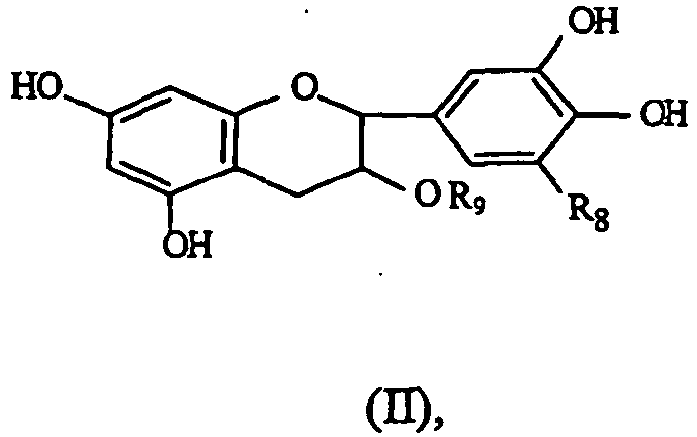
R8 is -H or -OH, and
R9 is -H or a group of the formula (III)
- Examples of polyphenols are:
- Polyphenol derivatives of flavan with the formula (IV):

- Polyphenol derivatives of flavan-3-ol with the formula (V):

- Polyphenol derivatives of flavanon with the formula (VI):

- Polyphenol derivatives of flavon with the formula (VII):

- Polyphenol derivatives of flavonol with the formula (VIII):

- Polyphenol derivatives of chalcon with the formula (IX):

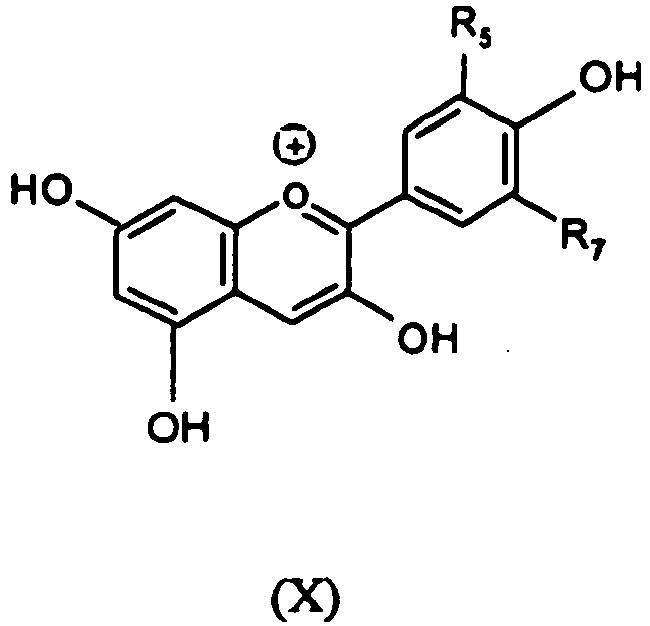
- Preferably, the catechol is selected from epicatechol, epicatechol gallate, epigallocatechol, epigallocatechol gallate, gallocatechol and/or gallocatechol gallate and in particular from (+)-epicatechol, (-)-epicatechol, (+)-epicatechol gallate, (-)-epicatechol gallate, (+)-epigallocatechol, (-)-epigallocatechol, (+)-epigallocatechol gallate, (-)-epigallocatechol gallate, (+)-gallocatechol, (-)-gallocatechol, (+)-gallocatechol gallate and (-)-gallocatechol gallate.
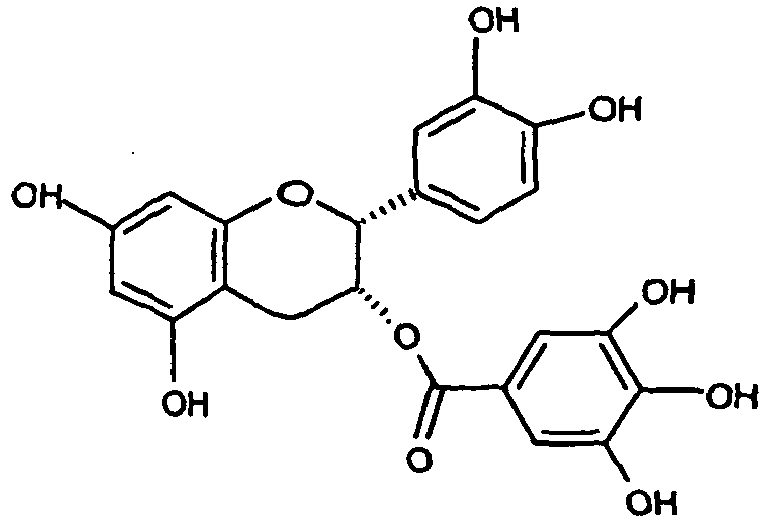
- The structural formula of the most preferred catechols are:
- For (-)-epigallocatechol gallate (-)-EGCG:

- For (-)-epigallocatechol (-)-EGC:

- For (-)-epicatechol gallate (-)-ECG:
- For (-)-epicatechol (-)-EC:

- For (+)-epicatechol (+)-EC:

- For (-)-gallocatechol gallate (-)-GCG:

- For (+)-gallocatechol (+)-GC:
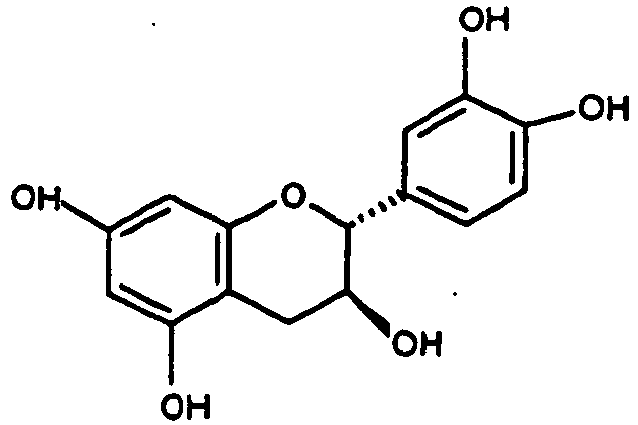
- For (-)-gallocatechol (-)-GC:

- According to the present invention the mixture of polyphenols is a mixture of catechols, especially containing epicatechol, epicatechol gallate, epigallocatechol, epigallocatechol gallate, gallocatechol and/or gallocatechol gallate, preferably in the stereochemistry as defined above. The preferred catechols are in particular the gallates of epicatechol, epigallocatechol or of gallocatechol. In particular, the present invention is directed to mixtures of the particular gallates containing more than about 40% (w/w), preferably more than about 50% (w/w), especially more than about 60% (w/w) and in particular more than 65% (w/w) of the particular gallates. These gallates may be (-) or (+) stereoisomers wherein the (-) stereoisomers are preferred.
- Preferred catechols employed in the present invention are (-)-epicatechol, (-)-epicatechol gallate, (-)-epigallocatechol, (-)-epigallocatechol gallate, (+)-gallocatechol and/or (-)-gallocatechol gallate, in particular in form of a mixture containing about 2-20% (w/w) epicatechol, about 2-20% (w/w), epicatechol gallate, about 1-25% (w/w) epigallocatechol, about 40-75% (w/w) epigallocatechol gallate, about 0.05-5% (w/w) gallocatechol and/or about 0.5-20% (w/w) gallocatechol gallate, especially a mixture containing about 10.8% (w/w) of epicatechol, about 6.5% (w/w) of epicatechol gallate, about 9.2% (w/w) of epigallocatechol, about 54.8% (w/w) of epigallocatechol gallate and/or about 4.0% (w/w) of gallocatechol gallate, all of them preferably in the stereochemistry as defined above, in particular in form of a mixture containing about 10.8% (w/w) of (-)-epicatechol, about 6.5% (w/w) of (-)-epicatechol gallate, about 9.2% (w/w) of (-)-epigallocatechol, about 54.8% (w/w) of (-)-epigallocatechol gallate and/or about 4.0% (w/w) of (-)-gallocatechol gallate.
- Alternatively, the mixture of catechols contains about 2-12% (w/w), preferably about 5-8% (w/w) epicatechol, about 4-15% (w/w), preferably about 5-7% (w/w), in particular about 5-6% (w/w) epicatechol gallate, about 1-8% (w/w), preferably about 2-3% (w/w), in particular about 6-8% (w/w) epigallocatechol, about 60-68% (w/w), preferably about 61-65% (w/w) epigallocatechol gallate, about 0.05-1% (w/w) gallocatechol and about 1-7% (w/w), preferably about 2-4% (w/w) gallocatechol gallate.
- Consequently, the catechols can be used in the form of mixtures having different compositions as specified above. For example, a composition known under the tradename Polyphenon® 100 is composed of about 5.9% (w/w) of (-)-epicatechol, about 12.6% (w/w) of (-)-epicatechol gallate, about 17.6% (w/w) of (-)-epigallocatechol, about 53.9% (w/w) of (-)-epigallocatechol gallate and/or about 1.4% (w/w) of (-)-gallocatechol. As another example, a composition known under the tradename Polyphenon® E is composed of about 10.8% (w/w) of (-)-epicatechol, about 6.5% (w/w) of (-)-epicatechol gallate, about 9.2% (w/w) of (-)-epigallocatechol, about 54.8% (w/w) of (-)-epigallocatechol gallate and/or about 4.0% (w/w) of (-)-gallocatechol gallate.
- The familiar methods of pharmaceutical technology are used, in a customary manner, for preparing pharmaceuticals which comprise one or more compounds according to the present invention and/or for using these pharmaceuticals in the application according to the invention. For this, the active compounds are worked up, together with one or more suitable, pharmaceutically acceptable additives, if necessary, into the medicinal forms which are suitable for the different indications and sites of administration. In this context, the pharmaceuticals can be prepared such that the rate of release in each case desired, for example a rapid accumulation and/or a delayed-release or depot effect, is achieved.
- Consequently, another embodiment of the present invention is directed to the use of a pharmaceutical effective amount of a mixture of polyphenols, in particular a mixture of catechols, as specified above, for the production of a medicament for the treatment of pre-cancerous, lesions of the skin, wherein said lesion is selected from actinic Keratosis, Bowen's disease, actinic cheilitic and/or leukoplakia of a patient, preferably for the topical administration of the polyphenol, in particular catechol, or in particular catechol mixture.
- Examples of suitable additives are sodium alginate, as a gelatinizing agent for preparing a suitable base, or cellulose derivatives, such as guar or xanthan gum, inorganic gelatinizing agents, such as aluminum hydroxide or bentonites (what are termed thixotropic gel-formers), polyacrylic acid derivatives, such as Carbopol®, polyvinylpyrrolidone, microcrystalline cellulose and carboxymethylcellulose. Amphiphilic low molecular weight and higher molecular weight compounds, and also phospholipids, are also suitable. The gels can be present either as water-based hydrogels or as hydrophobic organogels, for example based on mixtures of low and high molecular weight paraffin hydrocarbons and vaseline. The hydrophilic organogels can be prepared, for example, on the basis of high molecular weight polyethylene glycols. These gelatinous forms are washable. However, the organogels which are preferred are the hydrophobic organogels. Particular preference is given to hydrophobic additives, such as petroleum jelly, wax, oleyl alcohol, propylene glycol monostearate and/or propylene glycol monopalmitostearate, in particular isopropyl myristate. It is, of course, likewise possible to add skin-sedating and/or inflammation-inhibiting additives which are known to the skilled person, such as synthetically prepared active compounds and/or extracts and/or active compounds from medicinal plants, in particular bisobolol and panthenol. It is furthermore also possible to add dyes, for example yellow and/or red iron oxide and/or titanium dioxide for the purpose of matching as regards color.
- Generally, the mixture of polyphenols, in particular catechols, is contained in a carrier, e.g. in the form of an emulsion, a gel, a cream or an ointment.
- Customary emulsions, gels, creams and ointments of the mixed-phase or amphiphilic emulsion systems (oil/water-water/oil mixed phase), and also liposomes and transfersomes or plasters, preferably ointments and creams, particularly preferably an ointment, may be mentioned for conventional application to the skin. The catechol is preferably applied locally in the region in which there is pre-cancerous skin lesion.
- Emulsifiers which can be employed are anionic, cationic or neutral surfactants, for example alkali metal soaps, metal soaps, amine soaps, sulphurated and sulphonated compounds, invert soaps, higher fatty alcohols, partial fatty acid esters of sorbitan and polyoxyethylene sorbitan, e.g. lanette types, wool wax, lanolin or other synthetic products for preparing the oil/water and/or water/oil emulsions.
- It is possible to use vaseline, natural or synthetic waxes, fatty acids, fatty alcohols, fatty acid esters, for example as monoglycerides, diglycerides or triglycerides, paraffin oil or vegetable oils, hydrogenated castor oil or coconut oil, hog fat, synthetic fats, for example based on, caprylic acid, capric acid, lauric acid or stearic acid, such as Softisan®, or triglyceride mixtures, such as Miglyol®, can be used as lipids, in the form of fatty and/or oleaginous and/or waxy components for preparing the ointments, creams or emulsions.
- It is possible to use, for example, osmotically active acids and alkaline solutions, for example hydrochloric acid, citric acid, sodium hydroxide solution, potassium hydroxide solution, sodium hydrogen carbonate, and, in addition, buffer systems, such as citrate, phosphate, tris buffer or triethanolamine, for adjusting the pH. It is possible to add preservatives as well, such as methyl benzoate or propyl benzoate (parabens) or sorbic acid, for increasing the stability.
- Pastes, powders and solutions may be mentioned as additional forms which can be applied topically. As consistency-imparting bases, the pastes frequently contain hydrophobic and hydrophilic auxiliary substances, preferably, however, hydrophobic auxiliary substances containing a very high proportion of solids. In order to increase dispersity, and also flowability and slipperiness, and also to prevent agglomerates, the powders or topically applicable powders can, for example, contain starch species, such as wheat or rice starch, flame-dispersed silicon dioxide or siliceous earth, which also serve as diluent.
- The medicinal forms which are in each case suitable can be produced on the basis of pharmaceutico-physical principles in conformity with formulation guidelines and methods known to a skilled person.
- As a further example, the pharmaceutical employed in the present invention preferably comprises about 35% (w/w) of isopropyl myristate, about 15% (w/w) of at least one catechol, about 24.5% (w/w) of petroleum jelly, about 20% (w/w) of wax, about 5% (w/w) of propylene glycol monostearate or propylene glycol monopalmitostearate and about 0.5% (w/w) of oleyl alcohol.
- An alternative embodiment of the present invention is directed to a combination therapy.
- Therefore, the present invention also encompasses said treatment, as specified above, in combination with a different anticancer treatment and the preparation of a corresponding medicament. The administration of the different anticancer agent can be simultaneous with, prior to or after the administration of the mixture of polyphenols, in particular catechols.
- According to the present invention the term "different anticancer treatment" refers preferably to surgery, electrodessication, curettage, excision, Mohs micrographic surgery, radiation, proton therapy, chemotherapy, photodynamic therapy, cryosurgery, laser, immunotherapy, vaccine therapy and/or biologic therapy. Preferred chemotherapeutic treatments encompass the use of podophyllin, 5-fluorouracil, bleomycin, interferon or imiquimod, and mixtures thereof. A preferred radiotherapy is X-ray radiation and/or γ-radiation.
- The skin lesions referred to in the present invention are preferably actinic or solar keratosis, Bowen's disease, actinic cheilitis and/or leukoplakia of a patient.
- Taken together, one of the most preferred embodiments of the present invention is the use of a pharmaceutical formulation containing a mixture of different polyphenols as disclosed above in an amount of about 10% (w/w) to about 15% (w/w) in the pharmaceutical formulation for the treatment of actinic keratosis, and or solar keratosis.
- The mixture of different polyphenols contains in particular more than 60% (w/w), especially more than 65% (w/w) gallates of epicatechol, epigallocatechol or of gallocatechol. Preferred mixtures of different polyphenols are Polyphenon® 100 or Polyphenon® E as specified above. Finally, a preferred pharmaceutical formulation comprises about 35% (w/w) of isopropyl myristate, about 15% (w/w) of at least a mixture of different polyphenols as specified in this paragraph, in particular Polyphenon® 100 or Polyphenon® E, about 24.5% (w/w) of petroleum jelly, about 20% (w/w) of wax, about 5% (w/w) of propylene glycol monostearate or propylene glycol monopalmitostearate and about 0.5% (w/w) of oleyl alcohol which can be used in the treatment of actinic keratosis, and/or solar keratosis.
- The following examples are intended to clarify the invention,
- Patient: 65 years old, male with actinic keratoses known since 10 years;
- The patient was treated with Polyphenon® E (15% ointment containing 35% (w/w) isopropyl myristate, 15% (w/w) catechol extract, 24.5% (w/w) petroleum jelly, 20% (w/w) wax, 5% (w/w) propylene glycol monostearate and 0.5% (w/w) oleyl alcohol):
- Treated area: about 5 cm2 on the forehead
- Treatment schedule: 5 times a week (each with 10 hours)
- Treatment period: 6 weeks
- Treatment progression:
- ➢ after about 13 days of treatment skin irritation of the treated area (more precisely treated areas afflicted by actinic keratoses) occurred
- ➢ also an up-regulation of subclinical lesions occurred
- ➢ skin irritation ameliorated during further treatment
- ➢ after 12 weeks of treatment actinic keratoses have disappeared completely
- Patient: 73 years old, male with actinic keratoses known since about 15 years, multiply pre-treated;
- The patient was treated with Polyphenon® E (15% ointment containing 35% (w/w) isopropyl myristate, 15% (w/w) catechol extract, 24.5% (w/w) petroleum jelly, 20% (w/w) wax, 5% (w/w) propylene glycol monostearate and 0.5% (w/w) oleyl alcohol):
- Treated area: about 5 cm2 on the head
- Treatment schedule: 3 times a week
- Treatment period: 12 weeks
- Treatment progression:
- ➢ after 3.5 weeks of treatment skin irritation of the treated area afflicted by actinic keratoses occurred (but less intense than that of the patient of Example 1)
- ➢ after 12 weeks of treatment only single actinic keratoses have been left and after 16 weeks of treatment actinic keratoses have disappeared completely
Claims (22)
- A pharmaceutically effective amount of a mixture of polyphenols for use in the treatment of a pre-cancerous lesion of the skin, wherein said lesion is selected from actinic keratosis, solar keratosis, Bowen's disease, actinic cheilitis and/or leukoplakia of a patient, and wherein said mixture of polyphenols is a mixture of catechols containing 2-20 % (w/w) epicatechol, 2-20 % (w/w) epicatechol gallate, 1-25 % (w/w) epigallocatechol, 40-75 % (w/w) epigallocatechol gallate, 0.05-5 % (w/w) gallocatechol and/or 0.5-20 % (w/w) gallocatechol gallate.
- The mixture for use according to claim 1, wherein the patient is a human.
- The mixture for use according to claim 1, wherein the polyphenols are isolated from tea.
- The mixture for use according to claim 1, wherein the polyphenols are extracted from a tea.
- The mixture for use according to claim 4, wherein the tea is a green tea.
- The mixture for use according to claim 1, wherein the polyphenols are isolated from a tea extract.
- The mixture for use according to claim 1, wherein the catechol is selected from (+)-epicatechol, (-)-epicatechol, (+)-epicatechol gallate, (-)-epicatechol gallate, (+)-epigallocatechol, (-)-epigallocatechol, (+)-epigallocatechol gallate, (-)-epigallocatechol gallate, (+)-gallocatechol, (-)-gallocatechol, (+)-gallocatechol gallate and/or (-)-gallocatechol gallate.
- The mixture for use according to claim 1, wherein the mixture of polyphenols is a tea extract.
- The mixture for use according to claim 8, wherein the tea extract is a green tea extract.
- The mixture for use according to claim 1, wherein the mixture of catechols contains 10.8 % (w/w) of epicatechol, 6.5 % (w/w) of epicatechol gallate, 9.2 % (w/w) of epigallocatechol, 54.8 % (w/w) of epigallocatechol gallate and/or 4.0 % (w/w) of gallocatechol gallate.
- The mixture for use according to claim 1, wherein the mixture of catechols contains 10.8 % (w/w) of (-)-epicatechol, 6.5 % (w/w) of (-)-epicatechol gallate, 9.2 % (w/w) of (-)-epigallocatechol, 54.8 % (w/w) of (-)-epigallocatechol gallate and 4.0 % (w/w) of (-)-gallocatechol gallate.
- The mixture for use according to claim 1, wherein the mixture of catechols contains 2-12 % (w/w) epicatechol, 4-15% (w/w) epicatechol gallate, 1-8% (w/w) epigallocatechol, 60-68 % (w/w) epigallocatechol gallate, 0.05-1% (w/w) gallocatechol and/or 1-7 % (w/w) gallocatechol gallate.
- The mixture for use according to claim 1, wherein the mixture of catechols contains 5-8 % (w/w) epicatechol, 5-7 % (w/w) epicatechol gallate, 2-3 % (w/w) epigallocatechol, 61-65 % (w/w) epigallocatechol gallate and/or 2-4 % (w/w) of gallocatechol gallate.
- The mixture for use according to claim 1, wherein the mixture of catechols contains 5-8% (w/w) epicatechol, 5-6% (w/w) epicatechol gallate, 6-8% (w/w) epigallocatechol, 61-65 % (w/w) epigallocatechol gallate and/or 2-4 % (w/w) of gallocatechol gallate.
- The mixture for use according to claim 1, wherein the polyphenol is combined with an additive.
- The mixture for use according to claim 15, wherein the additive is selected from petroleum jelly, wax, oleyl alcohol, propylene glycol monostearate, propylene glycol monopalmitostearate and/or isopropyl myristate.
- The mixture for use according to claim 1, wherein the polyphenol is administered topically.
- The mixture for use according to claim 1, wherein the polyphenol is contained in a carrier selected from an emulsion, a gel, a cream and/or an ointment.
- The mixture for use according to claim 1, wherein the treatment of said lesions is combined with a different anticancer treatment.
- The mixture for use according to claim 19, wherein the different anticancer treatment is selected from surgery, electrodessication, curettage, excision, Mohs micrographic surgery, radiation, proton therapy, chemotherapy, photodynamic therapy, cryosurgery, laser, immunotherapy, vaccine therapy and/or biologic therapy.
- The mixture for use according to claim 20, wherein the chemotherapy is carried out with an agent selected from podophyllin, 5-fluorouracil, bleomycin, interferon, imiquimod, and mixtures thereof.
- The mixture for use according to claim 21, wherein the radiation is selected from X-ray radiation and γ-radiation.
Priority Applications (1)
| Application Number | Priority Date | Filing Date | Title |
|---|---|---|---|
| EP10012395A EP2292226A3 (en) | 2003-10-09 | 2004-10-08 | The use of a polyphenol for the treatment of a cancerous or pre-cancerous lesion of the skin |
Applications Claiming Priority (2)
| Application Number | Priority Date | Filing Date | Title |
|---|---|---|---|
| US51010103P | 2003-10-09 | 2003-10-09 | |
| PCT/EP2004/011300 WO2005037300A1 (en) | 2003-10-09 | 2004-10-08 | The use of a polyphenol for the treatment of a cancerous or pre-cancerous lesion of the skin |
Related Child Applications (1)
| Application Number | Title | Priority Date | Filing Date |
|---|---|---|---|
| EP10012395.9 Division-Into | 2010-09-30 |
Publications (2)
| Publication Number | Publication Date |
|---|---|
| EP1684780A1 EP1684780A1 (en) | 2006-08-02 |
| EP1684780B1 true EP1684780B1 (en) | 2012-07-25 |
Family
ID=34465119
Family Applications (2)
| Application Number | Title | Priority Date | Filing Date |
|---|---|---|---|
| EP04790231A Expired - Lifetime EP1684780B1 (en) | 2003-10-09 | 2004-10-08 | The use of a polyphenol for the treatment of a cancerous or pre-cancerous lesion of the skin |
| EP10012395A Ceased EP2292226A3 (en) | 2003-10-09 | 2004-10-08 | The use of a polyphenol for the treatment of a cancerous or pre-cancerous lesion of the skin |
Family Applications After (1)
| Application Number | Title | Priority Date | Filing Date |
|---|---|---|---|
| EP10012395A Ceased EP2292226A3 (en) | 2003-10-09 | 2004-10-08 | The use of a polyphenol for the treatment of a cancerous or pre-cancerous lesion of the skin |
Country Status (13)
| Country | Link |
|---|---|
| US (3) | US7910138B2 (en) |
| EP (2) | EP1684780B1 (en) |
| AR (1) | AR045865A1 (en) |
| AU (1) | AU2004281525B2 (en) |
| BR (1) | BRPI0415215B8 (en) |
| CA (1) | CA2541405C (en) |
| ES (1) | ES2391561T3 (en) |
| IL (1) | IL174434A0 (en) |
| MX (1) | MXPA06003404A (en) |
| NZ (1) | NZ546323A (en) |
| RU (1) | RU2366447C2 (en) |
| WO (1) | WO2005037300A1 (en) |
| ZA (1) | ZA200602544B (en) |
Families Citing this family (19)
| Publication number | Priority date | Publication date | Assignee | Title |
|---|---|---|---|---|
| EP2055300B1 (en) * | 2001-11-19 | 2016-01-27 | Medigene AG | Medicament comprising isopropylmyristate and a catechin |
| US20050079235A1 (en) * | 2003-10-09 | 2005-04-14 | Eggert Stockfleth | Use of a polyphenol for the treatment of actinic keratosis |
| AU2006222556B2 (en) * | 2005-03-11 | 2011-09-29 | Armaron Bio Pty Ltd | Flavonoid compounds and uses thereof |
| RU2375089C1 (en) * | 2008-07-14 | 2009-12-10 | Государственное образовательное учреждение высшего профессионального образования "БАШКИРСКИЙ ГОСУДАРСТВЕННЫЙ МЕДИЦИНСКИЙ УНИВЕРСИТЕТ Федерального Агентства по здравоохранению и социальному развитию" (ГОУ ВПО БГМУ РОСЗДРАВА) | Skin-retaining radical therapy of epidermoid skin cancer without metastases in regional lymph nodes |
| RU2413484C1 (en) * | 2009-11-10 | 2011-03-10 | Федеральное государственное учреждение "Межотраслевой научно-технический комплекс "Микрохирургия глаза" имени академика С.Н. Федорова Федерального агентства по высокотехнологичной медицинской помощи" | Method of surgical management of benign eyelid growths |
| RU2437671C1 (en) * | 2010-06-11 | 2011-12-27 | Сергей Владимирович Енгашев | Method of green tea extract purification, based on it medication and method of prevention and treatment of skin disease |
| RU2437672C1 (en) * | 2010-06-11 | 2011-12-27 | Сергей Владимирович Енгашев | Method of green tea extract purification, based on it medication and method of prevention and treatment of skin diseases |
| US10258810B2 (en) | 2013-09-27 | 2019-04-16 | Mevion Medical Systems, Inc. | Particle beam scanning |
| WO2015090853A1 (en) * | 2013-12-20 | 2015-06-25 | Unilever N.V. | Sunless tanning |
| US9962560B2 (en) | 2013-12-20 | 2018-05-08 | Mevion Medical Systems, Inc. | Collimator and energy degrader |
| US10675487B2 (en) | 2013-12-20 | 2020-06-09 | Mevion Medical Systems, Inc. | Energy degrader enabling high-speed energy switching |
| US9661736B2 (en) | 2014-02-20 | 2017-05-23 | Mevion Medical Systems, Inc. | Scanning system for a particle therapy system |
| US10786689B2 (en) | 2015-11-10 | 2020-09-29 | Mevion Medical Systems, Inc. | Adaptive aperture |
| EP3906968A1 (en) | 2016-07-08 | 2021-11-10 | Mevion Medical Systems, Inc. | Treatment planning |
| US11103730B2 (en) | 2017-02-23 | 2021-08-31 | Mevion Medical Systems, Inc. | Automated treatment in particle therapy |
| JP6940676B2 (en) | 2017-06-30 | 2021-09-29 | メビオン・メディカル・システムズ・インコーポレーテッド | Configurable collimator controlled using a linear motor |
| JP2022524103A (en) | 2019-03-08 | 2022-04-27 | メビオン・メディカル・システムズ・インコーポレーテッド | Irradiation by column and generation of treatment plan for it |
| IT201900003843A1 (en) * | 2019-03-15 | 2020-09-15 | Lo Li Pharma Srl | Treatment of fibroids with vitamin D and an agent such as epigallocatechin gallate (EGCG) |
| EP4792817A1 (en) * | 2023-10-13 | 2026-08-19 | EnKang Pharmaceuticals (Guangzhou), Ltd. | Compound and method for treating and/or preventing skin cancer or precancerous lesion thereof |
Family Cites Families (63)
| Publication number | Priority date | Publication date | Assignee | Title |
|---|---|---|---|---|
| US4002775A (en) | 1973-07-09 | 1977-01-11 | Kabara Jon J | Fatty acids and derivatives of antimicrobial agents |
| JPS55105677A (en) | 1979-02-07 | 1980-08-13 | Norin Suisansyo Chiyagiyou Shikenjo | Production of catechins |
| US4306568A (en) * | 1979-12-04 | 1981-12-22 | Torre Douglas P | Method and apparatus for congelation cryometry in cryosurgery |
| EP0087161A3 (en) | 1982-02-24 | 1984-04-04 | Key Pharmaceuticals, Inc. | Isopropylmyristate 4-alkyl-2,6-(bis-tert-butyl)-phenol medicament |
| JPS59219384A (en) | 1983-05-30 | 1984-12-10 | Mitsui Norin Kk | Preparation of natural antioxidant |
| JPS6013780A (en) | 1983-07-05 | 1985-01-24 | Mitsui Norin Kk | Production of tea catechin compound |
| JPS61238728A (en) | 1985-04-16 | 1986-10-24 | Mitsui Norin Kk | Complex substance of extract of tea leaf and active aluminum hydroxide |
| US4672810A (en) | 1985-10-15 | 1987-06-16 | Marlowe Christian P | Hydraulic transmission device and method of using it |
| SE462894B (en) | 1985-10-28 | 1990-09-17 | Biogram Ab | MICROCAPPLES, PROCEDURES FOR PREPARING THEREOF AND USING |
| US4863970A (en) | 1986-11-14 | 1989-09-05 | Theratech, Inc. | Penetration enhancement with binary system of oleic acid, oleins, and oleyl alcohol with lower alcohols |
| US5204089A (en) | 1989-08-30 | 1993-04-20 | Mitsui Norin Co., Ltd. | Method of preventing the formation or aggrevation of dental plaque and method for reducing cariogenesis |
| JP2727471B2 (en) | 1989-09-14 | 1998-03-11 | 三井農林株式会社 | Influenza virus infection prevention agent |
| JP2888554B2 (en) | 1989-09-20 | 1999-05-10 | 三井農林株式会社 | Mycoplasma infection preventive agent |
| US5318986A (en) | 1989-10-19 | 1994-06-07 | Mitsui Norin Co., Ltd. | Method of inhibiting the activity of α-amylase |
| US5063787A (en) * | 1989-11-22 | 1991-11-12 | General Electric Company | Venturi arrangement |
| US5358713A (en) | 1990-02-23 | 1994-10-25 | Mitsui Norin Co., Ltd. | Method of preventing the transmission of infection caused by methicillin-resistant Staphylococcus aureus |
| JP3019996B2 (en) | 1990-03-01 | 2000-03-15 | 三井農林株式会社 | Ringworm treatment |
| JPH04253918A (en) | 1991-02-05 | 1992-09-09 | Mitsui Norin Kk | Hyperglycemic inhibitor |
| US5303486A (en) * | 1992-05-04 | 1994-04-19 | Dell Gay D | Quilting hoop |
| DK0644766T3 (en) | 1992-06-08 | 1999-10-11 | Pitmy Int Nv | Nitrous oxide-containing dermatological preparation |
| US5306486A (en) | 1993-03-01 | 1994-04-26 | Elizabeth Arden Co., Division Of Conopco, Inc. | Cosmetic sunscreen composition containing green tea and a sunscreen |
| JP3333584B2 (en) | 1993-04-19 | 2002-10-15 | 三井農林株式会社 | Composition for enhancing acid resistance of teeth |
| US5670154A (en) | 1994-01-10 | 1997-09-23 | Mitsui Norin Co., Ltd. | Reducing tyrosinase activity |
| FR2718022B1 (en) | 1994-04-01 | 1996-04-26 | Roussel Uclaf | Cosmetic or dermatological compositions and their preparation. |
| IL115156A (en) | 1994-09-06 | 2000-07-16 | Univ Georgia | Pharmaceutical compositions for the treatment of cancer comprising 1-(2-hydroxymethyl-1,3-dioxolan-4-yl) cytosines |
| JP2718653B2 (en) | 1995-01-31 | 1998-02-25 | 日本配合飼料株式会社 | New egg and egg quality improvement method |
| IT1275905B1 (en) | 1995-03-14 | 1997-10-24 | Indena Spa | POLYPHENOLIC FRACTIONS OF TEA, THEIR USE AND FORMULATIONS THAT CONTAIN THEM |
| US5888527A (en) | 1995-05-11 | 1999-03-30 | Matsushita Seiko Co., Ltd. | Gargling cup, antiviral mask, antiviral filter, antifungal, antibacterial, and antiviral filter air cleaner and air-cleaner humidifier |
| GB2300578B (en) | 1995-05-11 | 1998-01-14 | Matsushita Seiko Kk | Gargling cup,antiviral mask,antiviral filter,antifungal,antibacterial,and antiviral filter air cleaner and air-cleaner-humidifier |
| JPH09132532A (en) | 1995-09-06 | 1997-05-20 | Mitsui Norin Kk | Method of enhancing antibacterial activity of antibiotics |
| US6127393A (en) | 1995-12-29 | 2000-10-03 | Novactyl, Inc. | Antiproliferative, antiinfective, antiinflammatory, autologous immunization agent and method |
| US5804567A (en) | 1996-07-18 | 1998-09-08 | Cancer Institute (Hospital), Chinese Academy Of Medical Sciences | Method of increasing the effectiveness of anti-metabolites |
| US6337320B1 (en) * | 1996-10-11 | 2002-01-08 | Thione International, Inc. | Reparatives for ultraviolet radiation skin damage |
| DE69739583D1 (en) | 1996-11-14 | 2009-10-29 | Lipomedica Ehf | TOPICAL COMPOSITIONS CONTAIN AS A THERAPEUTICALLY ACTIVE AGENT A MONOGLYCERIDE FOR THE TREATMENT OF SLEW-TONE INFECTIONS |
| US5968973A (en) | 1996-11-18 | 1999-10-19 | Cancer Institute (Hospital), Chinese Academy Of Medical Sciences | Method for treating hyperplasia |
| JP3213557B2 (en) | 1996-11-18 | 2001-10-02 | 三井農林株式会社 | A remedy for condyloma acuminatum containing tea catechin as an active ingredient |
| US6197808B1 (en) | 1996-11-18 | 2001-03-06 | Cancer Instititute (Hospital), Chinese Academy Of Medical Sciences | Methods for treating hyperplasia |
| WO1998036773A1 (en) * | 1997-02-20 | 1998-08-27 | Yale University | Therapeutic uses for antioxidants |
| JP3202938B2 (en) | 1997-03-18 | 2001-08-27 | 三井農林株式会社 | Chewing gum and method for producing the same |
| US5910308A (en) | 1997-03-19 | 1999-06-08 | Sante International Inc. | Herbal extract composition containing gynostemma pentaphyllum, crataegus pinnatifida and camellia sinensis |
| US6372234B1 (en) | 1997-05-27 | 2002-04-16 | Sembiosys Genetics Inc. | Products for topical applications comprising oil bodies |
| US6696484B2 (en) | 1997-10-31 | 2004-02-24 | University Of Chicago Office Of Technology And Intellectual Property | Method and compositions for regulation of 5-alpha reductase activity |
| KR20010031501A (en) | 1997-10-31 | 2001-04-16 | 추후제출 | Methods and compositions for regulation of 5-alpha reductase activity |
| AU741244B2 (en) | 1998-04-21 | 2001-11-29 | Mitsui Norin Co., Ltd. | Anti-chlamydia agents |
| US20020006447A1 (en) | 1998-04-21 | 2002-01-17 | Mitsui Norin Co., Ltd. | Anti-chlamydia agent |
| DE19827624A1 (en) | 1998-06-20 | 1999-12-23 | Beiersdorf Ag | Use of catechols or plant extracts containing them in intensifying natural skin tanning or in stimulating melanogenesis |
| SE9803929D0 (en) | 1998-11-18 | 1998-11-18 | Medivir Ab | Antiviral formulation |
| KR100319973B1 (en) | 1998-12-05 | 2002-04-22 | 이인수 | Cervical epithelial tumor prophylaxis or treatment composition using green tea catechin as an active ingredient |
| US6210679B1 (en) | 1999-01-07 | 2001-04-03 | Hauser, Inc. | Method for isolation of caffeine-free catechins from green tea |
| DE19962369A1 (en) | 1999-12-23 | 2001-06-28 | Beiersdorf Ag | Composition of ascorbyl compound and catechin, or extract containing it, useful for improving barrier properties of skin |
| US6248341B1 (en) * | 2000-01-14 | 2001-06-19 | Color Access, Inc. | Method of treating topical angiogenesis-related disorders |
| US20020031535A1 (en) * | 2000-09-11 | 2002-03-14 | Sheffield Felix H. | Topical formulation to treat skin disorders |
| US6538023B1 (en) * | 2000-09-15 | 2003-03-25 | Tsuyoshi Ohnishi | Therapeutic uses of green tea polyphenols for sickle cell disease |
| US6713506B2 (en) * | 2000-10-11 | 2004-03-30 | University Of South Florida | Tea polyphenol esters and analogs thereof for cancer prevention and treatment |
| EP2055300B1 (en) | 2001-11-19 | 2016-01-27 | Medigene AG | Medicament comprising isopropylmyristate and a catechin |
| US20030143165A1 (en) * | 2002-01-25 | 2003-07-31 | Allan Evans | NSAID-containing topical formulations that demonstrate chemopreventive activity |
| US20030166583A1 (en) | 2002-02-22 | 2003-09-04 | Oliver Yoa-Pu Hu | Dermal cytochrome P450 1A inhibitors and enhancers |
| US6723750B2 (en) * | 2002-03-15 | 2004-04-20 | Allergan, Inc. | Photodynamic therapy for pre-melanomas |
| BRPI0204130B8 (en) * | 2002-09-18 | 2021-05-25 | Fund De Amparo A Pesquisa Do Estado De Sao Paulo Fapesp | gel composition based on pothomorphe umbellata extract, its uses and non-therapeutic cosmetic method. |
| AU2003297840A1 (en) | 2002-12-10 | 2004-06-30 | Stephen Hsu | Chemopreventive and therapeutic aspects of polyphenolic compositions and assays |
| US6817511B2 (en) * | 2002-12-16 | 2004-11-16 | Dana Corporation | Method for joining axle components |
| WO2004080293A2 (en) | 2003-03-13 | 2004-09-23 | 3M Innovative Properties Company | Methods for diagnosing skin lesions |
| US20050079235A1 (en) | 2003-10-09 | 2005-04-14 | Eggert Stockfleth | Use of a polyphenol for the treatment of actinic keratosis |
-
2004
- 2004-10-08 WO PCT/EP2004/011300 patent/WO2005037300A1/en not_active Ceased
- 2004-10-08 MX MXPA06003404A patent/MXPA06003404A/en active IP Right Grant
- 2004-10-08 US US10/574,422 patent/US7910138B2/en not_active Expired - Fee Related
- 2004-10-08 RU RU2006115603/15A patent/RU2366447C2/en active
- 2004-10-08 ZA ZA200602544A patent/ZA200602544B/en unknown
- 2004-10-08 ES ES04790231T patent/ES2391561T3/en not_active Expired - Lifetime
- 2004-10-08 EP EP04790231A patent/EP1684780B1/en not_active Expired - Lifetime
- 2004-10-08 AU AU2004281525A patent/AU2004281525B2/en not_active Expired
- 2004-10-08 AR ARP040103652A patent/AR045865A1/en unknown
- 2004-10-08 CA CA2541405A patent/CA2541405C/en not_active Expired - Lifetime
- 2004-10-08 EP EP10012395A patent/EP2292226A3/en not_active Ceased
- 2004-10-08 BR BRPI0415215A patent/BRPI0415215B8/en not_active IP Right Cessation
- 2004-10-08 NZ NZ546323A patent/NZ546323A/en not_active IP Right Cessation
-
2006
- 2006-03-21 IL IL174434A patent/IL174434A0/en active IP Right Grant
-
2011
- 2011-03-18 US US13/051,593 patent/US8455022B2/en not_active Expired - Fee Related
-
2013
- 2013-05-07 US US13/888,949 patent/US9060998B2/en not_active Expired - Fee Related
Also Published As
| Publication number | Publication date |
|---|---|
| RU2366447C2 (en) | 2009-09-10 |
| NZ546323A (en) | 2009-04-30 |
| AR045865A1 (en) | 2005-11-16 |
| EP1684780A1 (en) | 2006-08-02 |
| AU2004281525B2 (en) | 2010-01-28 |
| RU2006115603A (en) | 2007-11-27 |
| BRPI0415215A (en) | 2006-12-05 |
| IL174434A0 (en) | 2006-08-01 |
| US8455022B2 (en) | 2013-06-04 |
| BRPI0415215B8 (en) | 2021-05-25 |
| US20130245113A1 (en) | 2013-09-19 |
| US20110166219A1 (en) | 2011-07-07 |
| MXPA06003404A (en) | 2006-06-27 |
| BRPI0415215B1 (en) | 2021-02-23 |
| CA2541405A1 (en) | 2005-04-28 |
| US7910138B2 (en) | 2011-03-22 |
| EP2292226A3 (en) | 2011-08-10 |
| WO2005037300A1 (en) | 2005-04-28 |
| AU2004281525A1 (en) | 2005-04-28 |
| EP2292226A2 (en) | 2011-03-09 |
| ES2391561T3 (en) | 2012-11-27 |
| US9060998B2 (en) | 2015-06-23 |
| US20070059387A1 (en) | 2007-03-15 |
| CA2541405C (en) | 2014-07-29 |
| ZA200602544B (en) | 2007-06-27 |
Similar Documents
| Publication | Publication Date | Title |
|---|---|---|
| US8455022B2 (en) | Use of a polyphenol for the treatment of a cancerous or precancerous lesion of the skin | |
| US20050079235A1 (en) | Use of a polyphenol for the treatment of actinic keratosis | |
| US20210275466A1 (en) | Bakuchiol compositions for treatment of post inflammatory hyperpigmentation | |
| KR102156731B1 (en) | Bakuchiol compositions for treatment of post inflammatory hyperpigmentation | |
| US10765641B2 (en) | Cosmetic composition comprising a combination of pongamia oil and 4-t-butylcyclohexanol for the treatment of rosacea | |
| US11918547B2 (en) | Bakuchiol compositions for treatment of post inflammatory hyperpigmentation | |
| KR101397107B1 (en) | Treatment and/or prevention of inflammation and cutaneous photodamage and photoprotection of the skin with a water-soluble extract from plant of Solanum genus | |
| US10881702B2 (en) | Celastrol and derivatives thereof for the treatment of tumours and precancerous diseases of the skin | |
| KR101894521B1 (en) | Topical pharmaceutical composition for treating scar | |
| WO2007081190A1 (en) | Novel use of 1,2,3,4,6-penta-o-galloyl-beta-d-glucose | |
| Lofgren et al. | Efficacy of intravenous delta-aminolaevulinic acid photodynamic therapy on rabbit papillomas | |
| KR101301012B1 (en) | Skin agent composition containing Ilex paraguariensis extract using microbial fermentation | |
| ES2214066T3 (en) | PREPARATION OF KHELLINA FOR THE TOPICAL THERAPY OF PSORIASIS, ITS SUBTIPOS, SPECIAL FORMS, AS WELL AS THE TOPIC THERAPY OF ECZEMAS. | |
| EP1517691B1 (en) | Use of dopamine receptor agonists for the treatment of cutaneous tumors, warts, and scars | |
| CA2794919C (en) | Formulations and methods for preventing eyebrow hair loss | |
| WO2026020084A1 (en) | Combination of topical kinase inhibitors to achieve synergistic clearance of skin cancers and related lesions | |
| US20220143119A1 (en) | Croton lechleri compositions for use in the treatment of skin cancer | |
| EP2730270A1 (en) | Formulations and methods for preventing eyebrow hair loss |
Legal Events
| Date | Code | Title | Description |
|---|---|---|---|
| PUAI | Public reference made under article 153(3) epc to a published international application that has entered the european phase |
Free format text: ORIGINAL CODE: 0009012 |
|
| 17P | Request for examination filed |
Effective date: 20060504 |
|
| AK | Designated contracting states |
Kind code of ref document: A1 Designated state(s): AT BE BG CH CY CZ DE DK EE ES FI FR GB GR HU IE IT LI LU MC NL PL PT RO SE SI SK TR |
|
| DAX | Request for extension of the european patent (deleted) | ||
| REG | Reference to a national code |
Ref country code: HK Ref legal event code: DE Ref document number: 1096575 Country of ref document: HK |
|
| 17Q | First examination report despatched |
Effective date: 20070803 |
|
| GRAP | Despatch of communication of intention to grant a patent |
Free format text: ORIGINAL CODE: EPIDOSNIGR1 |
|
| GRAS | Grant fee paid |
Free format text: ORIGINAL CODE: EPIDOSNIGR3 |
|
| GRAA | (expected) grant |
Free format text: ORIGINAL CODE: 0009210 |
|
| AK | Designated contracting states |
Kind code of ref document: B1 Designated state(s): AT BE BG CH CY CZ DE DK EE ES FI FR GB GR HU IE IT LI LU MC NL PL PT RO SE SI SK TR |
|
| REG | Reference to a national code |
Ref country code: GB Ref legal event code: FG4D |
|
| REG | Reference to a national code |
Ref country code: CH Ref legal event code: EP |
|
| REG | Reference to a national code |
Ref country code: IE Ref legal event code: FG4D Ref country code: AT Ref legal event code: REF Ref document number: 567425 Country of ref document: AT Kind code of ref document: T Effective date: 20120815 |
|
| REG | Reference to a national code |
Ref country code: DE Ref legal event code: R096 Ref document number: 602004038675 Country of ref document: DE Effective date: 20120920 |
|
| REG | Reference to a national code |
Ref country code: ES Ref legal event code: FG2A Ref document number: 2391561 Country of ref document: ES Kind code of ref document: T3 Effective date: 20121127 |
|
| REG | Reference to a national code |
Ref country code: NL Ref legal event code: VDEP Effective date: 20120725 |
|
| REG | Reference to a national code |
Ref country code: AT Ref legal event code: MK05 Ref document number: 567425 Country of ref document: AT Kind code of ref document: T Effective date: 20120725 |
|
| PG25 | Lapsed in a contracting state [announced via postgrant information from national office to epo] |
Ref country code: AT Free format text: LAPSE BECAUSE OF FAILURE TO SUBMIT A TRANSLATION OF THE DESCRIPTION OR TO PAY THE FEE WITHIN THE PRESCRIBED TIME-LIMIT Effective date: 20120725 Ref country code: FI Free format text: LAPSE BECAUSE OF FAILURE TO SUBMIT A TRANSLATION OF THE DESCRIPTION OR TO PAY THE FEE WITHIN THE PRESCRIBED TIME-LIMIT Effective date: 20120725 Ref country code: BE Free format text: LAPSE BECAUSE OF FAILURE TO SUBMIT A TRANSLATION OF THE DESCRIPTION OR TO PAY THE FEE WITHIN THE PRESCRIBED TIME-LIMIT Effective date: 20120725 Ref country code: CY Free format text: LAPSE BECAUSE OF FAILURE TO SUBMIT A TRANSLATION OF THE DESCRIPTION OR TO PAY THE FEE WITHIN THE PRESCRIBED TIME-LIMIT Effective date: 20120725 |
|
| PG25 | Lapsed in a contracting state [announced via postgrant information from national office to epo] |
Ref country code: SE Free format text: LAPSE BECAUSE OF FAILURE TO SUBMIT A TRANSLATION OF THE DESCRIPTION OR TO PAY THE FEE WITHIN THE PRESCRIBED TIME-LIMIT Effective date: 20120725 Ref country code: GR Free format text: LAPSE BECAUSE OF FAILURE TO SUBMIT A TRANSLATION OF THE DESCRIPTION OR TO PAY THE FEE WITHIN THE PRESCRIBED TIME-LIMIT Effective date: 20121026 Ref country code: PT Free format text: LAPSE BECAUSE OF FAILURE TO SUBMIT A TRANSLATION OF THE DESCRIPTION OR TO PAY THE FEE WITHIN THE PRESCRIBED TIME-LIMIT Effective date: 20121126 Ref country code: PL Free format text: LAPSE BECAUSE OF FAILURE TO SUBMIT A TRANSLATION OF THE DESCRIPTION OR TO PAY THE FEE WITHIN THE PRESCRIBED TIME-LIMIT Effective date: 20120725 Ref country code: SI Free format text: LAPSE BECAUSE OF FAILURE TO SUBMIT A TRANSLATION OF THE DESCRIPTION OR TO PAY THE FEE WITHIN THE PRESCRIBED TIME-LIMIT Effective date: 20120725 |
|
| PG25 | Lapsed in a contracting state [announced via postgrant information from national office to epo] |
Ref country code: NL Free format text: LAPSE BECAUSE OF FAILURE TO SUBMIT A TRANSLATION OF THE DESCRIPTION OR TO PAY THE FEE WITHIN THE PRESCRIBED TIME-LIMIT Effective date: 20120725 |
|
| PG25 | Lapsed in a contracting state [announced via postgrant information from national office to epo] |
Ref country code: DK Free format text: LAPSE BECAUSE OF FAILURE TO SUBMIT A TRANSLATION OF THE DESCRIPTION OR TO PAY THE FEE WITHIN THE PRESCRIBED TIME-LIMIT Effective date: 20120725 Ref country code: RO Free format text: LAPSE BECAUSE OF FAILURE TO SUBMIT A TRANSLATION OF THE DESCRIPTION OR TO PAY THE FEE WITHIN THE PRESCRIBED TIME-LIMIT Effective date: 20120725 Ref country code: CZ Free format text: LAPSE BECAUSE OF FAILURE TO SUBMIT A TRANSLATION OF THE DESCRIPTION OR TO PAY THE FEE WITHIN THE PRESCRIBED TIME-LIMIT Effective date: 20120725 Ref country code: EE Free format text: LAPSE BECAUSE OF FAILURE TO SUBMIT A TRANSLATION OF THE DESCRIPTION OR TO PAY THE FEE WITHIN THE PRESCRIBED TIME-LIMIT Effective date: 20120725 |
|
| PG25 | Lapsed in a contracting state [announced via postgrant information from national office to epo] |
Ref country code: MC Free format text: LAPSE BECAUSE OF NON-PAYMENT OF DUE FEES Effective date: 20121031 Ref country code: IT Free format text: LAPSE BECAUSE OF FAILURE TO SUBMIT A TRANSLATION OF THE DESCRIPTION OR TO PAY THE FEE WITHIN THE PRESCRIBED TIME-LIMIT Effective date: 20120725 Ref country code: SK Free format text: LAPSE BECAUSE OF FAILURE TO SUBMIT A TRANSLATION OF THE DESCRIPTION OR TO PAY THE FEE WITHIN THE PRESCRIBED TIME-LIMIT Effective date: 20120725 |
|
| PLBE | No opposition filed within time limit |
Free format text: ORIGINAL CODE: 0009261 |
|
| REG | Reference to a national code |
Ref country code: CH Ref legal event code: PL |
|
| STAA | Information on the status of an ep patent application or granted ep patent |
Free format text: STATUS: NO OPPOSITION FILED WITHIN TIME LIMIT |
|
| 26N | No opposition filed |
Effective date: 20130426 |
|
| REG | Reference to a national code |
Ref country code: IE Ref legal event code: MM4A |
|
| PG25 | Lapsed in a contracting state [announced via postgrant information from national office to epo] |
Ref country code: LI Free format text: LAPSE BECAUSE OF NON-PAYMENT OF DUE FEES Effective date: 20121031 Ref country code: IE Free format text: LAPSE BECAUSE OF NON-PAYMENT OF DUE FEES Effective date: 20121008 Ref country code: CH Free format text: LAPSE BECAUSE OF NON-PAYMENT OF DUE FEES Effective date: 20121031 Ref country code: BG Free format text: LAPSE BECAUSE OF FAILURE TO SUBMIT A TRANSLATION OF THE DESCRIPTION OR TO PAY THE FEE WITHIN THE PRESCRIBED TIME-LIMIT Effective date: 20121025 |
|
| REG | Reference to a national code |
Ref country code: DE Ref legal event code: R097 Ref document number: 602004038675 Country of ref document: DE Effective date: 20130426 |
|
| PG25 | Lapsed in a contracting state [announced via postgrant information from national office to epo] |
Ref country code: TR Free format text: LAPSE BECAUSE OF FAILURE TO SUBMIT A TRANSLATION OF THE DESCRIPTION OR TO PAY THE FEE WITHIN THE PRESCRIBED TIME-LIMIT Effective date: 20120725 |
|
| PG25 | Lapsed in a contracting state [announced via postgrant information from national office to epo] |
Ref country code: LU Free format text: LAPSE BECAUSE OF NON-PAYMENT OF DUE FEES Effective date: 20121008 |
|
| PG25 | Lapsed in a contracting state [announced via postgrant information from national office to epo] |
Ref country code: HU Free format text: LAPSE BECAUSE OF FAILURE TO SUBMIT A TRANSLATION OF THE DESCRIPTION OR TO PAY THE FEE WITHIN THE PRESCRIBED TIME-LIMIT Effective date: 20041008 |
|
| REG | Reference to a national code |
Ref country code: GB Ref legal event code: S117 Free format text: REQUEST FILED; REQUEST FOR CORRECTION UNDER SECTION 117 FILED ON 21 AUGUST 2015 |
|
| REG | Reference to a national code |
Ref country code: GB Ref legal event code: S117 Free format text: CORRECTIONS ALLOWED; REQUEST FOR CORRECTION UNDER SECTION 117 FILED ON 21 AUGUST 2015, ALLOWED ON 16 SEPTEMBER 2015 |
|
| REG | Reference to a national code |
Ref country code: FR Ref legal event code: PLFP Year of fee payment: 12 |
|
| REG | Reference to a national code |
Ref country code: HK Ref legal event code: WD Ref document number: 1096575 Country of ref document: HK |
|
| REG | Reference to a national code |
Ref country code: FR Ref legal event code: PLFP Year of fee payment: 13 |
|
| REG | Reference to a national code |
Ref country code: FR Ref legal event code: PLFP Year of fee payment: 14 |
|
| REG | Reference to a national code |
Ref country code: FR Ref legal event code: PLFP Year of fee payment: 15 |
|
| REG | Reference to a national code |
Ref country code: DE Ref legal event code: R082 Ref document number: 602004038675 Country of ref document: DE Representative=s name: FORTMANN TEGETHOFF PATENT- UND RECHTSANWAELTE , DE Ref country code: DE Ref legal event code: R082 Ref document number: 602004038675 Country of ref document: DE Representative=s name: 24IP LAW GROUP SONNENBERG FORTMANN, DE Ref country code: DE Ref legal event code: R082 Ref document number: 602004038675 Country of ref document: DE Representative=s name: 24IP LAW GROUP, DE Ref country code: DE Ref legal event code: R082 Ref document number: 602004038675 Country of ref document: DE Representative=s name: FORTMANN TEGETHOFF PATENT- UND RECHTSANWAELTE, DE |
|
| REG | Reference to a national code |
Ref country code: DE Ref legal event code: R082 Ref document number: 602004038675 Country of ref document: DE Representative=s name: FORTMANN TEGETHOFF PATENT- UND RECHTSANWAELTE , DE Ref country code: DE Ref legal event code: R082 Ref document number: 602004038675 Country of ref document: DE Representative=s name: 24IP LAW GROUP, DE Ref country code: DE Ref legal event code: R082 Ref document number: 602004038675 Country of ref document: DE Representative=s name: FORTMANN TEGETHOFF PATENT- UND RECHTSANWAELTE, DE |
|
| REG | Reference to a national code |
Ref country code: DE Ref legal event code: R082 Ref document number: 602004038675 Country of ref document: DE Representative=s name: FORTMANN TEGETHOFF PATENT- UND RECHTSANWAELTE , DE Ref country code: DE Ref legal event code: R082 Ref document number: 602004038675 Country of ref document: DE Representative=s name: FORTMANN TEGETHOFF PATENT- UND RECHTSANWAELTE, DE |
|
| REG | Reference to a national code |
Ref country code: DE Ref legal event code: R081 Ref document number: 602004038675 Country of ref document: DE Owner name: ARESUS PHARMA GMBH, DE Free format text: FORMER OWNER: MEDIGENE AG, 82152 PLANEGG, DE |
|
| REG | Reference to a national code |
Ref country code: GB Ref legal event code: 732E Free format text: REGISTERED BETWEEN 20211028 AND 20211103 |
|
| REG | Reference to a national code |
Ref country code: ES Ref legal event code: PC2A Owner name: ARESUS PHARMA GMBH Effective date: 20220421 |
|
| PGFP | Annual fee paid to national office [announced via postgrant information from national office to epo] |
Ref country code: GB Payment date: 20231025 Year of fee payment: 20 |
|
| PGFP | Annual fee paid to national office [announced via postgrant information from national office to epo] |
Ref country code: ES Payment date: 20231117 Year of fee payment: 20 |
|
| PGFP | Annual fee paid to national office [announced via postgrant information from national office to epo] |
Ref country code: FR Payment date: 20231023 Year of fee payment: 20 Ref country code: DE Payment date: 20231018 Year of fee payment: 20 |
|
| REG | Reference to a national code |
Ref country code: DE Ref legal event code: R071 Ref document number: 602004038675 Country of ref document: DE |
|
| REG | Reference to a national code |
Ref country code: GB Ref legal event code: PE20 Expiry date: 20241007 |
|
| REG | Reference to a national code |
Ref country code: ES Ref legal event code: FD2A Effective date: 20241104 |
|
| PG25 | Lapsed in a contracting state [announced via postgrant information from national office to epo] |
Ref country code: GB Free format text: LAPSE BECAUSE OF EXPIRATION OF PROTECTION Effective date: 20241007 |
|
| PG25 | Lapsed in a contracting state [announced via postgrant information from national office to epo] |
Ref country code: ES Free format text: LAPSE BECAUSE OF EXPIRATION OF PROTECTION Effective date: 20241009 |
|
| PG25 | Lapsed in a contracting state [announced via postgrant information from national office to epo] |
Ref country code: GB Free format text: LAPSE BECAUSE OF EXPIRATION OF PROTECTION Effective date: 20241007 Ref country code: ES Free format text: LAPSE BECAUSE OF EXPIRATION OF PROTECTION Effective date: 20241009 |