EP1683866B1 - Deletion forms of IgE-dependent histamine releasing factor having histamine-releasing activity, HRF-binding peptides and the uses thereof - Google Patents
Deletion forms of IgE-dependent histamine releasing factor having histamine-releasing activity, HRF-binding peptides and the uses thereof Download PDFInfo
- Publication number
- EP1683866B1 EP1683866B1 EP06001565.8A EP06001565A EP1683866B1 EP 1683866 B1 EP1683866 B1 EP 1683866B1 EP 06001565 A EP06001565 A EP 06001565A EP 1683866 B1 EP1683866 B1 EP 1683866B1
- Authority
- EP
- European Patent Office
- Prior art keywords
- hrf
- seq
- dimer
- protein
- histamine
- Prior art date
- Legal status (The legal status is an assumption and is not a legal conclusion. Google has not performed a legal analysis and makes no representation as to the accuracy of the status listed.)
- Expired - Lifetime
Links
Images



Classifications
-
- C—CHEMISTRY; METALLURGY
- C07—ORGANIC CHEMISTRY
- C07K—PEPTIDES
- C07K14/00—Peptides having more than 20 amino acids; Gastrins; Somatostatins; Melanotropins; Derivatives thereof
- C07K14/435—Peptides having more than 20 amino acids; Gastrins; Somatostatins; Melanotropins; Derivatives thereof from animals; from humans
- C07K14/46—Peptides having more than 20 amino acids; Gastrins; Somatostatins; Melanotropins; Derivatives thereof from animals; from humans from vertebrates
- C07K14/47—Peptides having more than 20 amino acids; Gastrins; Somatostatins; Melanotropins; Derivatives thereof from animals; from humans from vertebrates from mammals
-
- C—CHEMISTRY; METALLURGY
- C07—ORGANIC CHEMISTRY
- C07K—PEPTIDES
- C07K14/00—Peptides having more than 20 amino acids; Gastrins; Somatostatins; Melanotropins; Derivatives thereof
- C07K14/435—Peptides having more than 20 amino acids; Gastrins; Somatostatins; Melanotropins; Derivatives thereof from animals; from humans
- C07K14/52—Cytokines; Lymphokines; Interferons
-
- A—HUMAN NECESSITIES
- A61—MEDICAL OR VETERINARY SCIENCE; HYGIENE
- A61P—SPECIFIC THERAPEUTIC ACTIVITY OF CHEMICAL COMPOUNDS OR MEDICINAL PREPARATIONS
- A61P33/00—Antiparasitic agents
- A61P33/02—Antiprotozoals, e.g. for leishmaniasis, trichomoniasis, toxoplasmosis
- A61P33/06—Antimalarials
-
- A—HUMAN NECESSITIES
- A61—MEDICAL OR VETERINARY SCIENCE; HYGIENE
- A61P—SPECIFIC THERAPEUTIC ACTIVITY OF CHEMICAL COMPOUNDS OR MEDICINAL PREPARATIONS
- A61P37/00—Drugs for immunological or allergic disorders
- A61P37/08—Antiallergic agents
-
- A—HUMAN NECESSITIES
- A61—MEDICAL OR VETERINARY SCIENCE; HYGIENE
- A61P—SPECIFIC THERAPEUTIC ACTIVITY OF CHEMICAL COMPOUNDS OR MEDICINAL PREPARATIONS
- A61P43/00—Drugs for specific purposes, not provided for in groups A61P1/00-A61P41/00
-
- C—CHEMISTRY; METALLURGY
- C12—BIOCHEMISTRY; BEER; SPIRITS; WINE; VINEGAR; MICROBIOLOGY; ENZYMOLOGY; MUTATION OR GENETIC ENGINEERING
- C12N—MICROORGANISMS OR ENZYMES; COMPOSITIONS THEREOF; PROPAGATING, PRESERVING, OR MAINTAINING MICROORGANISMS; MUTATION OR GENETIC ENGINEERING; CULTURE MEDIA
- C12N15/00—Mutation or genetic engineering; DNA or RNA concerning genetic engineering, vectors, e.g. plasmids, or their isolation, preparation or purification; Use of hosts therefor
- C12N15/09—Recombinant DNA-technology
- C12N15/11—DNA or RNA fragments; Modified forms thereof; Non-coding nucleic acids having a biological activity
-
- A—HUMAN NECESSITIES
- A61—MEDICAL OR VETERINARY SCIENCE; HYGIENE
- A61K—PREPARATIONS FOR MEDICAL, DENTAL OR TOILETRY PURPOSES
- A61K38/00—Medicinal preparations containing peptides
-
- Y—GENERAL TAGGING OF NEW TECHNOLOGICAL DEVELOPMENTS; GENERAL TAGGING OF CROSS-SECTIONAL TECHNOLOGIES SPANNING OVER SEVERAL SECTIONS OF THE IPC; TECHNICAL SUBJECTS COVERED BY FORMER USPC CROSS-REFERENCE ART COLLECTIONS [XRACs] AND DIGESTS
- Y02—TECHNOLOGIES OR APPLICATIONS FOR MITIGATION OR ADAPTATION AGAINST CLIMATE CHANGE
- Y02A—TECHNOLOGIES FOR ADAPTATION TO CLIMATE CHANGE
- Y02A50/00—TECHNOLOGIES FOR ADAPTATION TO CLIMATE CHANGE in human health protection, e.g. against extreme weather
- Y02A50/30—Against vector-borne diseases, e.g. mosquito-borne, fly-borne, tick-borne or waterborne diseases whose impact is exacerbated by climate change
-
- Y—GENERAL TAGGING OF NEW TECHNOLOGICAL DEVELOPMENTS; GENERAL TAGGING OF CROSS-SECTIONAL TECHNOLOGIES SPANNING OVER SEVERAL SECTIONS OF THE IPC; TECHNICAL SUBJECTS COVERED BY FORMER USPC CROSS-REFERENCE ART COLLECTIONS [XRACs] AND DIGESTS
- Y10—TECHNICAL SUBJECTS COVERED BY FORMER USPC
- Y10S—TECHNICAL SUBJECTS COVERED BY FORMER USPC CROSS-REFERENCE ART COLLECTIONS [XRACs] AND DIGESTS
- Y10S530/00—Chemistry: natural resins or derivatives; peptides or proteins; lignins or reaction products thereof
- Y10S530/862—Chemistry: natural resins or derivatives; peptides or proteins; lignins or reaction products thereof involving IgE or IgD
-
- Y—GENERAL TAGGING OF NEW TECHNOLOGICAL DEVELOPMENTS; GENERAL TAGGING OF CROSS-SECTIONAL TECHNOLOGIES SPANNING OVER SEVERAL SECTIONS OF THE IPC; TECHNICAL SUBJECTS COVERED BY FORMER USPC CROSS-REFERENCE ART COLLECTIONS [XRACs] AND DIGESTS
- Y10—TECHNICAL SUBJECTS COVERED BY FORMER USPC
- Y10S—TECHNICAL SUBJECTS COVERED BY FORMER USPC CROSS-REFERENCE ART COLLECTIONS [XRACs] AND DIGESTS
- Y10S530/00—Chemistry: natural resins or derivatives; peptides or proteins; lignins or reaction products thereof
- Y10S530/868—Chemistry: natural resins or derivatives; peptides or proteins; lignins or reaction products thereof involving autoimmunity, allergy, immediate hypersensitivity, delayed hypersensitivity, immunosuppression, or immunotolerance
Definitions
- the present invention relates to IgE dependent histamine releasing factor (HRF) and HRF-binding peptides, more precisely, deletion forms of HRF which are able to be formed as dimers containing amino acid sequence represented by SEQ. ID. No: 3, novel HRF-binding peptides inhibiting HRF activity and the uses of the same particularly in the field of medicine.
- HRF IgE dependent histamine releasing factor
- HRF-binding peptides more precisely, deletion forms of HRF which are able to be formed as dimers containing amino acid sequence represented by SEQ. ID. No: 3, novel HRF-binding peptides inhibiting HRF activity and the uses of the same particularly in the field of medicine.
- LPR late-phase reaction
- HRF histamine is secreted by cytokines such as MCP-3 (Monocyte Chemotatic Protein-3), MCP-1 (Monocyte Chemotatic Protein-1) or RANTES (Regulated upon Activation Normal T-cell Expressed and Secreted), but in fact, only the protein named "HRF” has been proved to secrete histamine in basophils under IgE-dependent LPR ( MacDonald et al., Science, 269, 688-690, 1995 ). Nevertheless, the mechanism of HRF inducing secretion of histamine in basophils has not been disclosed yet.
- HRF is a well-known protein composed of 172 amino acids, and is found in every cytoplasm ( Bohm et al., Biochem. Int., 19, 277-286, 1989 ). Among these HRF forming amino acids, 79 - 123 amino acids form a basic domain, which shows 46% homology with MAP-1B (microtubule-associated protein-1B). Thus, it is presumed that the protein is capable of binding to microtubule. Gachet et al observed under confocal microscope that HRF distribution is consistent with cytoskeleton network distribution, suggesting that HRF is bound to cytoskeleton ( Gachet et al., J. Cell Sci., 112, 1257-1271, 1999 ).
- HRF is a hydrophilic protein residing in cytoplasm, but has been found in outside of cytoplasm by MacDonald et al. Besides, high level of HRF is detected in serum of a LPR patient, indicating that HRF is extracellular secreted by apoptosis or any other mechanism so as to release histamine through HRF receptors residing on cell membrane ( MacDonald et al., Science, 269, 688-690, 1995 ). HRF has known to stimulate IgE-sensitized basophils to secrete histamine, yet concrete IgE mechanism involved in the secretion has not been explained.
- HRF might cause inflammatory reaction in IgE receptor defected cells, suggesting that HRF is not bound directly to IgE but bound to a specific cell membrane receptor ( Bheekha-Escura et al., Blood, 96, 2191-2198, 2000 ).
- HRF can pass through cell membrane even though it is a hydrophilic protein
- ii) HRF receptor is confirmed by yeast two-hybrid assay to be the third cytoplasmic domain (CD3) of (Na,K)ATPase (Korean Patent Application Nos. 2001-27896 and 2001-27921 ).
- CD3 third cytoplasmic domain of (Na,K)ATPase
- the present inventors found peptide which i) intercepts HRF's passing through the cell and/or ii) intercepts HRF's binding to (Na, K)ATPase to inhibit histamine secretion, and confirmed that such peptide can be useful for the prevention or the treatment of allergic diseases (Korean Patent Application No. 2001-27896 ).
- HRFmn histamine releasing activity of HRF isolated from activated monocyte culture supernatant is different from that of recombinant HRF (rHRF), which suggests that HRFmn is not identical factor to rHRF ( Budde et al., Ann. Allergy Asthma Immunol., 89, 606-612, 2002 ).
- HRF was not detected in HRFmn from human HRF specific ELISA (enzyme-linked immunoabsorbant assay), which suggests that HRFmn has a different structure from rHRF.
- the present inventors tried to separate HRF having histamine releasing activity, and as a result, the present inventors found out deletion forms of HRF having better activity than wild type HRF. These deletion forms of HRF, unlike wild type HRF, have intermolecular disulfide bond, by which dimerization is induced and HRF is activated accordingly.
- the present inventors also prepared novel HRF-binding peptides, and confirmed that the bond of novel HRF-binding peptides to the deletion forms of HRF results in the inhibition of histamine and IL-8 secretion.
- modified HRF binding peptides can be bound to deletion forms of HRF to inhibit histamine and IL-8 releasing activity of HRF, and thus completed this invention by further confirming that deletion forms of HRF and HRF binding peptides can be effectively used for the development of an anti-allergy drug.
- the present invention provides recombinant deletion forms of IgE-dependent histamine releasing factor (HRF) having enhanced histamine and IL-8 releasing activities by forming dimers with N-terminal deletion in wild type IgE-dependent HRF.
- HRF histamine releasing factor
- the present invention provides the following embodiments 1-8 as defined below:
- the present disclosure also provides deletion forms of HRF which are able to be formed as dimers containing amino acid sequence represented by SEQ. ID. No: 3.
- the present disclosure further provides HRF homo- or hetero-dimers formed between wild type IgE-dependent histamine releasing factors and/or recombinant deletion forms of IgE-dependent histamine releasing factors and a method for preparing the same.
- the present disclosure also provides genes encoding the deletion forms of HRF, a recombinant expression vector harboring the gene, and a transformant transformed with the expression vector.
- the present disclosure also provides histamine and IL-8 releasing inducer containing the deletion forms of HRF as an effective ingredient.
- the present disclosure also provides a method for screening a medicine which inhibits HRF-induced allergy by using the deletion forms of HRF.
- the present disclosure also provides a method for detecting HRF in serum of an allergy patient by using the deletion forms of HRF.
- the present disclosure also provides a novel HRF-binding peptide having the sequence of (V, Y, E or A)-(T, V, F or A)-(Y, P or A)-(P, G or K)-(A, L, S or W)-(A, P or M).
- the present disclosure also provides a pharmaceutical composition for the prevention and the treatment of allergy containing the HRF-binding peptide as an effective ingredient.
- the present disclosure also provides a method for preventing or treating allergy in a mammalian subject comprising administering to the subject a therapeutically effective amount of the HRF-binding peptide of the present invention.
- the present disclosure also provides an allergy diagnostic kit containing the HRF-binding peptide and anti-HRF monoclonal antibody.
- the present disclosure also provides a pharmaceutical composition for the prevention and the treatment of malarial infection comprising the HRF-binding peptide as an effective ingredient.
- the present disclosure also provides a method for preventing or treating malarial infection in a mammalian subject comprising administering to the subject a therapeutically effective amount of the HRF-binding peptide disclosed herein.
- the present disclosure provides a method for identification of an HRF-specific receptor using the deletion forms of HRF or the HRF homo- or hetero-dimers disclosed herein comprising analysing protein-protein interaction between HRF and the HRF-specific receptor.
- the present disclosure provides recombinant deletion forms of IgE-dependent histamine releasing factor (HRF) having enhanced histamine and IL-8 releasing activities by forming dimers with N-terminal deletion in wild type IgE-dependent HRF.
- HRF histamine releasing factor
- Deletion forms of HRF can easily be synthesized with the sequences provided by the present invention.
- deletion forms of HRF can also be prepared by recombinant DNA technique using an expression vector having a foreign DNA containing a base sequence encoding the deletion forms of HRF disclosed herein.
- the expression vector is designed to reside in vivo and transfect host cells according to a method of Sambrook et al, so as to be expressed in those cells under proper conditions ( Sambrook et al., Molecular cloning, 1989, Cold Spring Harbor, Cold Spring Harbor Laboratory Press ).
- Deletion forms of HRF can further be prepared by using a fusion protein containing amino acid sequence disclosed herein.
- deletion forms of HRF can be modified by the conventional techniques known to those skilled in the art.
- deletion forms of HRF can be modified by adding or reducing the number of amino acids.
- deletion forms of HRF can be modified by replacing a specific residue or rearrange the order of residues as long as such modification does not reduce the activity of deletion forms of HRF.
- deletion forms of HRF disclosed herein can be modified by the conventional techniques as long as the modification does not change the histamine releasing activity of deletion forms of HRF (neither increase nor decrease.
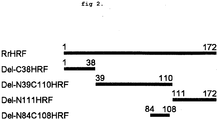
- genes encoding the above fragments were isolated from rat HRF total-length sequence (Accession number U20525) represented by SEQ. ID. No: 9, which were cloned into pRSET-A vector (see Fig. 1 - Fig. 4 ) to transform E. coli. Then, the gene expressed therein was separated and purified.
- IL-8 releasing activity in BEAS-2B cells (see Fig. 5 ) and histamine releasing activity in basophils (see Fig. 6 ) of each deletion form of HRF were compared according to N-terminal deletion type.
- IL-8 releasing activities of 'Del-N11HRF' represented by SEQ. ID. No: 2, in which 10 amino acid residues in N-terminal of wild type HRF are deleted and 'Del-N35HRF', represented by SEQ. ID. No: 3, in which 34 amino acid residues in N-terminal of wild type HRF are deleted were greater in BEAS-2B cells than that of wild type HRF.
- N-terminal an important part playing a key role in activity of HRF is covered by N-terminal, and thus it is presumed that histamine and IL-8 secretion inducing active HRF is included in LPR allergy patients.
- the importance of N-terminal of HRF in regulation of HRF functions is also supported by the fact that histamine releasing activity is increased when some of amino acid residues of N-terminal is removed (Del-N11HRF and Del-N35HRF) but is as much as that of wild type HRF when C-terminal is eliminated (Del-C112HRF).
- a deletion form of HRF is provided which is able to be formed as a dimer containing amino acid sequence represented by SEQ. ID. No: 3 (Del-N35HRF).
- the deletion form of HRF represented by SEQ. ID. No: 3 has 34 deletions in N-terminal of full-length HRF amino acid sequence of rat ( Rattus norvegicus ) , represented by SEQ. ID. No: 1, and the deletion form of HRF containing the deleted amino acid sequence has been confirmed to have excellent histamine and IL-8 releasing activity and further the activity is confirmed to be attributed to dimerization by intermolecular disulfide bond.
- the present disclosure further provides HRF homo- or hetero-dimers formed between wild type IgE-dependent histamine releasing factors and/or recombinant deletion forms of IgE-dependent histamine releasing factors and a method for preparing the same.
- HRF contains cysteine at residues 28 and 172, and these amino acids were replaced with serine, resulting in pRSET-A-Del-N11HRF. Another mutation was induced by replacing only the cysteine in residue 172 with serine to produce pRSET-A-Del-N35HRF. The mobility of those mutants was compared in non-reducing SDS-PAGE (see Fig. 9 and Fig. 11 ).
- IL-8 secretion in BEAS-2B cells of each was measured for comparison (see Fig. 10 and Fig. 12 ).
- IL-8 secretion induced by pRSET-A-Del-N11HRF-C172S was 46% of wild type
- IL-8 secretion induced by pRSET-A-Del-N35HRF-C172S was 26% of wild type.
- cysteine at residue 172 plays a bigger role in activation of HRF than cysteine at residue 28, which is consistent with the result of mobility test in PAGE.
- the results indicate that the deletion forms of HRF, unlike wild type HRF, exist in the forms of dimer by intermolecular disulfide bond and the structural difference between them is a major cause of difference in activities.
- the present inventors examined using a crosslinker whether wild type HRF could form a dimer ( Fig. 13 ). As a result, unlike deletion form of HRF, wild type HRF could hardly form an intermolecular disulfide bond, although wild type HRF could form an intramolecular disulfide bond. This result supports the structural difference between the deletion forms of HRF and wild type HRF and suggests that N-terminal deletion plays a key role in the activation of HRF rather than chemical cross-linking.
- the present disclosure includes homo-dimers of wild type HRF produced by other methods besides those using dimerization with disulfide bond or hetero-dimers formed between deletion forms of HRF in different lengths and wild type HRF, in addition to homo- or hetero-dimers formed between deletion forms of HRF in different lengths.
- the method for preparing HRF homo- or hetero-dimers is not limited to specific one, and all methods for preparing protein dimers, which have been known to a skilled person in the art, are available. Among these methods, however, the methods described in EP0261616A2 , JP1993-032941A , JP1986-069759 , WO05/105994A1 and WO92/013965A1 are preferred.
- the deletion form of HRF disclosed herein forms a dimer by treating a crosslinker after prepared using the sequence provided herein.
- a dimer is produced by cross-linking sulfur using a crosslinker targeting -SH.
- the crosslinker comprises 1,4-Di-[3'-(2'pyridyldithio)propionamido]butane (DPDPB), 1,8-Bis- maleimidodiethylene glycol (BM[PEO]2), 1,11- B i s- maleimidotriethylene glycol (BM[PEO]3), Bis -maleimidoethane (BMOE), 1,4- Bis -maleimidobutane (BMB), Bis- maleimidohexane(BMH), 1,6-Hexane-bis-vinylsulfone (HBVS), Dithio-bis-maleimidoethane (DTME) or 1,4-bismaleimidyl-2,3-dihydroxybutane (BMDB).
- the present disclosure also provides genes encoding the deletion forms of HRF.
- the nucleotide sequence of a gene encoding a deletion form of HRF can be any nucleotide sequence selected from a group consisting of SEQ. ID. No: 10, No: 11, No: 12, No: 13, No: 14, No: 15 and No: 16. However, it is preferred that the nucleotide sequence includes a sequence represented by SEQ. ID. No: 11. And nucleotide sequence represented by SEQ. ID. No: 10 or 11 is more preferred.
- the present disclosure further provides recombinant expression vectors containing genes encoding the deletion forms of HRF disclosed herein.
- the recombinant expression vectors are not limited to specific ones and any recombinant expression vector for the transformation of a microorganism, a plant or an animal can be used as long as it contains a gene encoding a deletion form of HRF.
- Recombinant vectors pRSET-A-RrHRF, pRSET-A-Del-N11HRF, pRSET-A-Del-N35HRF, pRSET-A-Del-C112HRF, pRSET-A-Del-N39C110HRF, pRSET-A-Del-C38HRF, pRSET-A-Del-N111HRF and pRSET-A-Del-N84C108HRF were constructed by cloning a gene selected from a group consisting of nucleotide sequences each represented by SEQ. ID. No: 9, No: 10, No: 11, No: 12, No: 13, No: 14, No: 15 and No: 16 into E. coli expression vector pRSET-A.
- the present disclosure also provides transformants transformed with the above recombinant expression vectors.
- the transformants are not limited to specific ones, and E. coli, plants or animals can be used herein as long as they can be transfected with the recombinant expression vectors containing genes encoding deletion forms of HRF disclosed herein.
- the present inventors generated transformants by introducing the recombinant expression vectors above into E . coli BL21(DE3) or BL21(DE3)pLysS strain. Precisely, BL21(DE3)-pRSET-A-Del-N11HRF and BL21(DE3)pLysS-pRSET-A-Del-N11HRF were constructed by transfecting BL21(DE3) and BL21(DE3)pLysS strains with the recombinant expression vector 'pRSET-A-Del-N11HRF'.
- BL21(DE3)-pRSET-A-Del-N35HRF and BL21(DE3)pLysS-pRSET-A-Del-N35HRF were constructed by transfecting BL21(DE3) and BL21(DE3)pLysS strains with the recombinant expression vector 'pRSET-A-Del-N35HRF'.
- T7 RNA polymerase was supposed to be transcribed only under the control of lac UV5 promoter, so when IPTG (isopropyl- ⁇ -D-thiogalactopyranoside) was added, T7 RNA polymerase was expressed and deletion forms of HRF were transcribed accordingly.
- IPTG isopropyl- ⁇ -D-thiogalactopyranoside
- the present disclosure also provides a histamine and IL-8 releasing inducer containing the deletion forms of HRF or the HRF homo- or hetero-dimers as an effective ingredient.
- the deletion forms of HRF having amino acid sequences each represented by SEQ. ID. No: 2 and No: 3 showed increased IL-8 releasing activity in BEAS-2B cells, compared with wild type HRF and similarly induced histamine releasing in human basophils.
- the deletion forms of HRF can be effectively used as an IL-8 and histamine releasing inducer.
- the IL-8 and histamine releasing inducer can provide an experimental model for the development of an anti-allergy drug. That is, the inducer disclosed herein can be effectively used for the development and test of an anti-allergy drug requiring huge amount of allergens.
- the present disclosure also provides a method for screening a drug inhibiting HRF-mediated allergy comprising contacting a drug candidate with the deletion form of HRF or the HRF homo- or hetero-dimer disclosed herein and determining whether the durg candidate binds the deletion form of HRF or the HRF homo- or hetero-dimer.
- the deletion forms of HRF or the HRF homo- or hetero-dimers disclosed herein can provide a binding site for HRF-binding peptides, so that they can be used for the development of an anti-allergy drug effective by inhibiting HRF activity.
- Affinity was investigated by using HBP2 peptide (Korean Registered Patent No: 457350 ).
- deletion forms of HRF having amino acid sequences each represented by SEQ. ID. No: 5 and No: 8 were proved to have excellent affinities to the peptide (see Fig. 9 ). Therefore, HRF peptide having the amino acid sequence can be used for detecting a substance of a compound binding to HRF peptide, making the substance and the compound as a useful candidate for an anti-allergy drug.
- the deletion forms of HRF are isolated from cells transfected with recombinant vectors containing genes encoding deletion forms of HRF by competitive binding assay, which will be reacted with test drugs and other factors known to interact with deletion forms of HRF [for example, HRF-binding peptide (Korean Patent Application No. 2001-27896 )].
- test drugs for example, HRF-binding peptide (Korean Patent Application No. 2001-27896 )].
- a drug reducing interaction between deletion forms of HRF and HRF-binding peptide is selected.
- a drug which has a similar structure to HRF-binding peptide and inhibits HRF-induced histamine secretion in cells is screened.
- the present disclosure also provides a method for detecting HRF in serum of a patient comprising preparing serum from the patent; detecting level of HRF by an immunoassay using the deletion form of HRF or the HRF homo- or heterodimer disclosed herein and an antibody thereof.
- the antibody comprises a polyclonal antibody or a monoclonal antibody, but the monoclonal antibody is prefered.
- a monoclonal antibody against anti-deletion forms of HRF can be prepared by the conventional art by using the deletion forms of HRF.
- the produced anti-deletion forms of HRF monoclonal antibody are also disclosed herein.
- HRF-binding peptide or anti-deletion form of HRF monoclonal antibody is coated on bottom, which will be reacted with blood sample. Then, anti-deletion form of HRF monoclonal antibody or anti-HRF monoclonal antibody conjugated with a marker [HRP (horse reddish peroxidase), alkaline phosphatase, fluorescein or dye] is added thereto. If the blood sample includes active HRF, it will be colored or fluorescent, indicating that the patient has a potential for allergic disease even without an allergen.
- HRP human reddish peroxidase
- alkaline phosphatase alkaline phosphatase
- fluorescein or dye a marker
- the present disclosure also provides a novel HRF-binding peptide inhibiting histamine releasing by binding to HRF with high affinity.
- the HRF-binding peptide disclosed herein has amino acid sequence of (V, Y, E or A)-(T, V, F or A)-(Y, P or A)-(P, G or K)-(A, L, S or W)-(A, P or M), and preferably has the sequence of YVYPSM represented by SEQ. ID. No: 17.
- the HRF-binding peptide disclosed herein can be modified by replacing some of residues or rearranging the order of the residues except some residues which are directly involved in the binding or should be reserved, as long as the activity of the peptide does not decrease.
- L- ⁇ -amino acid but also ⁇ , ⁇ , and ⁇ amino acids as well as D- ⁇ -amino acid derivatives are available for the modification.
- residues might cause important changes in functions of the peptide of the invention.
- characteristic changes electrophoric residue
- hydrophobic residue such as leucine, isoleucine, phenylalanine, valine or alanine
- residue with positive charge such as lysine
- arginine or histidine is replaced with residue with negative charge such as glutamic acid or aspartic acid, or when amino acid without a side chain structure like glycine is replaced with residue with a big side chain.
- the present inventors obtained the peptide by phage display library screening and re-confirmed by synthetic peptide.
- the peptide disclosed herein can be prepared by chemical synthesis or genetic recombination technique. Domain forming the peptide can be prepared from blood protein or a part of it.
- the peptide can also be prepared by recombinant DNA technique using an expression vector harboring a foreign DNA having a nucleotide sequence encoding the peptide. The vector transfects proper host cells and is expressed therein under proper conditions according to the method of Sambrook et al (Molecular Cloning, 1989, Cold Spring Harbor, Cold Spring Harbor Laboratory Press ).
- the peptide disclosed herein can be prepared by using a fusion protein containing the amino acid sequence disclosed herein.
- the present disclosure also provides a pharmaceutical composition for the prevention and the treatment of allergy or malaria containing the HRF-binding peptide disclosed herein as an effective ingredient.
- the HRF-binding peptide disclosed herein was confirmed to have histamine or IL-8 releasing activity by binding to HRF (see Fig. 16, Fig. 17 and Fig. 18 ), so it can be effectively used for the prevention and the treatment of allergy.
- HRF has been called translationlly controlled tumor protein, and it was disclosed in 1998 by Bhisutthibhan et al . that anti-malaria drug artemisinin was effective by binding to malarian HRF ( Bhisutthibhan et al., J. Biol. Chem., 1998, 273(26):16192-8 ). Accordingly, the HRF-binding peptides disclosed herein, which has HRF-binding activity, can also be used for the prevention and the treatment of malarial infection as artemisinin can.
- Effective dosage of the HRF-binding peptide is 30 ⁇ g ⁇ 1 mg/kg.
- a composition as disclosed herein can be directly injected in the form of solution or micelle, or administered in various pharmaceutical formulations.
- a composition as disclosed herein can be administered to human parenterally or locally such as intravenous injection, hypodermic injection, endothelial injection, muscular injection, etc. To do so, the peptide disclosed herein can be suspended or dissolved in pharmaceutically acceptable carriers, and at this time, a water-soluble carrier is preferred.
- the present disclosure provides a diagnostic kit for allergy comprising the HRF-binding peptide and the antibody specific HRF disclosed herein.
- the present disclosure provides a method for identification of an HRF-specific receptor using the deletion forms of HRF or the HRF homo- or hetero-dimers described herein comprising analysing protein-protein interaction between HRF and the HRF-specific receptor.
- a method for identification of an HRF-specific receptor using the deletion forms of HRF or the HRF homo- or hetero-dimers described herein comprising analysing protein-protein interaction between HRF and the HRF-specific receptor.
- conventional known protein-protein interaction analysis methods can be used.
- the analysis methods preferably include a co-purification system, a yeast two-hybrid system or a protein chip system, but are not limited thereto.
- said co-purification system comprises i) isolating an HRF-HRF-specific receptor complex; ii) purifying the complex; iii) identifying the HRF-specific receptor from the purified complex.
- step i comprises one dimensional (1D) or two dimensional (2D) gel electrophoresis or a liquid chromatography.
- step ii comprises a conventional affinity chromatography selected from a group consisting of an immunoprecipitation ( Barrett et al., J. Lab. Clin. Med.
- step iii comprises a peptide fingerprinting such as a matrix-assisted laser desorption/ ionization time-of-flight mass spectrometry (MALDI-TOF MS, Hill et al., Rapid Commun. Mass Spectrom., 1991, 5(9):395-9 ) or a tandem mass spectrometry (tandem MS) selected from a group consisting of a nanoelectrospray ionization (nanoES)-MS/MS ( Shevchenko et al., Proc. Natl. Acad. Sci. USA., 1996, 93(25):14440-5 ), a nanoLC-MS/MS ( Oosterkamp et al., J. Mass Spectrom. 1998, 33(10):976-83 ) and a LC/LC-MS/MS.
- a peptide fingerprinting such as a matrix-assisted laser desorption/ ionization time-of-flight mass spectrometry (
- the method for identification of an HRF-specific receptor of the present invention optionally comprises the following step: iv) determining whether the HRF receptor takes part in a histamine releasing process mediated by HRF in vitro or in vivo actually.
- said step iv comprises all known methods for analysing functions of a protein.
- the step iv can be achieved by cloning a gene encoding the identified HRF receptor; constructing a recombinant expression vector comprising the gene; transfecting a histamine releasing cell line with the expression vector; determining whether level of histamine released increases significantly after treatment of the deletion forms of HRF or the HRF homo- or hetero-dimer disclosed herein compared with a control cell line which is transfected with mock vector.
- the step iv can be achieved by preparing a knock-out animal or a cell line having a genome comprising homozygotic disruption in a gene encoding the identified HRF-specific receptor and determining whether level of histamine released decreases significantly after treatment of the deletion forms of HRF or the HRF homo- or hetero-dimers disclosed herein compared with a wild type.
- Yeast two hybrid system ( Fields S. and Song O., Nature., 1989, 340(6230):245-6 ) is an analysis system using that it is possible to express a reporter gene through an interaction between two proteins (X and Y) and a reconstruction of the proteins into a transcription factor although said proteins are expressed in separated physically, if genes encoding a DNA binding domain (DBD) and a transcription activation domain (TAD) is isolated with a genetic recombination method respectively; fusion gene constructs are prepared by genes encoding X and Y are cloned into the genes encoding DBD and TAD respectively and then expression of the fusion gene constructs is induced in yeast.
- DBD DNA binding domain
- TAD transcription activation domain
- said reporter gene comprises a gene for color selection encoding an enzyme such as ⁇ -galactosidase (LacZ), ⁇ -galactosidase (MEL1), ⁇ -glucuronidase (gusA), green fluorescence protein (GFP) and glucoamylase or a gene for growth selection encoding an enzyme such as imidazoleglycerol-phosphate dehydratase (HIS3), phosphoribosylaminoimidazole-carboxylase (ADE2), ⁇ -aminoadipate reductase (LYS2), ⁇ -isopropylmalate dehydrogenase (LEU2) and orotidine-5'-phosphate decarboxylase (URA3).
- an enzyme such as ⁇ -galactosidase (LacZ), ⁇ -galactosidase (MEL1), ⁇ -glucuronidase (gusA), green fluorescence protein (GFP) and glucoamy
- a protein chip is a biochip used for analysis of an interaction between proteins spotted on a solid support with a microarrayer and other molecules such as a protein, a nucleotide, a carbohydrate, a lipid, a cholesterol or other small compounds. Since BIAcore's sensor chip which can be used for detection of an inter-biomolecular interaction was commercialized in 1990s, development of protein chips was accelerated. Because protein chip technology can be applied in various fields such as a diagnosis of diseases, a study on protein activity, a screening of new drug candidates, an assay for interaction of biomolecules, it is being embossed as a key technology of proteomics.
- the method for identification of an HRF-specific receptor of the present invention using a protein chip can be achieved by a detection method such as surface plasmon resonance (SPR) assay, surface enhanced laser desorption/ionization time of flight mass spectrometry (SELDI-TOF), fluorescent analysis and electrochemical analysis.
- a detection method such as surface plasmon resonance (SPR) assay, surface enhanced laser desorption/ionization time of flight mass spectrometry (SELDI-TOF), fluorescent analysis and electrochemical analysis.
- said protein chip system comprises
- various methods for analyzing protein-protein interactions known to a skilled person in the art can be used as a method for identification of an HRF-specific receptor.
- methods described in EP1003853B1 , EP1098967B1 , EP1184463A1 , EP1224324B1 , US6114111 , US6562576 , US6828112 , US20020094519A1 , US20020106693A1 , US20020106698A1 , US20020142348A1 , US20020177217A1 , US20030003439A1 , US20030040012A1 , US20030170723A1 , US20030211523A1 , US20040146931A1 , US20040157279A1 , US20050106636A1 , US20050176005A1 or US20050221280A1 can be used for the present invention.
- cDNA of a gene encoding HRF was prepared according to the method described in Korean Patent Application No. 2001-27896 and No. 2001-27921 . Particularly, total RNA was extracted from skeletal muscle of a rat ( Rattus norvegicus ). cDNA library was constructed by using pJG4-5 vector (Invitrogen, Inc., USA) for yeast 2-hybrid assay. CD3 region was inserted into LexA DNA binding domain of pEG202 vector ( Brent, R., and Finley, R. L., Jr. Annu. Rev. Genet. 31: 663-704, 1997 ) by using ⁇ 2-subunit of (Na,K)ATPase, which was used as a bait for screening. Reporter gene activated positive clones were selected. Then, sequence analysis was performed by sequencing, restriction enzyme mapping and BLAST search. One of those clones was completely identical to IgE-dependent histamine releasing factor (HRF).
- HRF IgE-dependent histamine releasing factor
- a gene encoding rat HRF full-length sequence represented by SEQ. ID. No: 1 (Accession number U20525, amino acids 1 - 172) is represented by SEQ. ID. No: 9
- a gene encoding fragment of amino acids 11 - 172 represented by SEQ. ID. No: 2 is represented by SEQ. ID. No: 10
- a gene encoding fragment of amino acids 35 - 172 represented by SEQ. ID. No: 3 is represented by SEQ. ID. No: 11
- a gene encoding fragment of amino acids 1 - 112 represented by SEQ. ID. No: 4 is represented by SEQ. ID. No: 12
- No: 5 is represented by SEQ. ID. No: 13
- a gene encoding fragment of amino acids 1 - 38 represented by SEQ. ID. No: 6 is represented by SEQ. ID. No: 14
- a gene encoding fragment of amino acids 111 - 172 represented by SEQ. ID. No: 7 is represented by SEQ. ID. No: 15
- a gene encoding fragment of amino acids 84 - 108 represented by SEQ. ID. No: 8 is represented by SEQ. ID. No: 16, and each of those gene was amplified by PCR ( Fig. 1 and Fig. 2 ).
- PCRs were performed as follows; predenaturation at 94 ⁇ for 5 minutes, denaturation at 940 for 1 minute, annealing at 45-50 ⁇ for 1 minute, elongation at 72 ⁇ for 1 minute, 30 cycles from denaturation to polymerization, and post-elongation at 72 ⁇ for 7 minutes.
- Primer sequences used for PCR were as mentioned hereinbefore.
- Example ⁇ 1-2> To overexpress each of those deletion forms of HRF, the recombinant expression vectors constructed in Example ⁇ 1-2> were introduced into E. coli BL21(DE3) (Novagen) or BL21(DE3)pLysS (Novagen).
- the E. coli transformants were cultured in LB medium containing ampicillin or ampicillin and chloramphnicol, and IPTG (isopropyl ⁇ -D-thiogalactoside) was added at the concentration of 0.4 mM when OD reached 0.6. After culturing three more hours, centrifugation was performed at 5,500 x g for 5 minutes. The recovered E. coli cells were resuspended in binding buffer (5 mM imidazole, 500 mM NaCl, 20 mM Tris-HCl, pH 7.9), followed by ultrasonification. The lysed E. coli cells were centrifuged at 39,000 x g, and then supernatant was purified by using Ni column (Novagen).
- Example 2 IL-8 releasing activity in BEAS-2B cells according to HRF forms
- Example 3 Histamine releasing activity in human basophils according to HRF forms
- the recovered leukocytes were washed twice with PAG-EDTA (4 mM EDTA, 25 mM PIPES, 110 mM NaCl, 5 mM KCl, 0.003% HSA, 0.1% D-glucose), which were left in cold lactate buffer (13.4 mM lactic acid, 140 mM NaCl, 5 mM KCl, pH 3.9) for 3 - 5 minutes to eliminate IgE adhered on the surface of cells.
- the cells were washed with 30 ml of PAG-EDTA twice and resuspended in PAG-EDTA, followed by IgE-sensitization (1 ⁇ g/ml, Serotec) for 2 hours.
- Example ⁇ 1-3> each recombinant protein (rHRF or each deletion form of HRF) prepared in Example ⁇ 1-3> was added by 20 ⁇ g/ml. 15 minutes later, human anti-IgE antibody was added thereto. Four hours later, supernatant was obtained. The isolated histamine was measured by histamine analyzer (Astoria Analyzer, Series 300 system) ( Fig. 6 ).
- Del-N11HRF in which 11 amino acid residues in N-terminal are deleted, represented by SEQ. ID. No: 2
- Del-N35HRF in which 35 amino acid residues in N-terminal are deleted, represented by SEQ. ID. No: 3 have been confirmed to have histamine releasing activities in BEAS-2B cells more effectively than wild type HRF.
- Proteins having deletions in N-terminals were observed moving toward dimer position, unlike wild type HRF and proteins having deletions in C-terminals. The result indicates that deletion forms of HRF having deletions in N-terminals have different structures from wild type HRF and N-terminal of HRF plays a key role in regulation of HRF functions. In addition, those proteins having deletions in N-terminals have intermolecular disulfide bond.
- a mutant was prepared by using site-directed mutagenesis kit (Stratagene) to investigate the HRF activity under the inhibition of the formation of disulfide bond by replacing cysteine residue in N-terminal deletion form of HRF with serine.
- HRF contains cysteines at 28 th and 172 nd residues, so primers CG GAC GGG CTG TCT CTG GAG GTG GA (SEQ. ID. No: 19) and TC CAC CTC CAG AGA CAG CCC GTC CG (SEQ. ID. No: 20) were used to construct pRSET-A-Del-N11HRF-C28S. Other primers GAG ATG GAA AAA TCT AAG CTT GAT CCG (SEQ. ID.
- PCR amplification was performed using DNA polymerase (Pfu DNA polymerase, Stratagene) as follows; predenaturation of the primer set and template at 95°C for 5 minutes, denaturation at 95°C for 1 minute, annealing at 55 ⁇ for 1 minute, polymerization at 68 ⁇ for 7 minutes, 16 cycles from denaturation to polymerization, and final extension at 680 for 7 minutes.
- DNA polymerase Pfu DNA polymerase, Stratagene
- Dpn I (Stratagene) was added to the PCR product and reacted at 37°C for 1 hour to digest template DNA selectively.
- XL1-blue was transfected with the DNA.
- a crosslinker was used to compare the dimerizations of wild type HRF and deletion form of HRF.
- Wild type HRF was cross-linked with Del-D35HRF by using -SH targeting crosslinkers, BMOE and BM(PEO)3 (Pierce, USA).
- BMOE -SH targeting crosslinkers
- BM(PEO)3 Pieris, USA
- DTT Vivaspin column
- Quintuple crosslinkers were treated and each reaction solution stood respectively at 4 ⁇ for 4 hours (treated with BMOE) and at 37 ⁇ for 30 minutes (treated with BM(PEO)3).
- Each deletion form of HRF was immobilized on a plastic well, to which phage expressing HRF-binding peptide was added in order to investigate binding capacity of each HRF.
- each deletion form of HRF dissolved in coating buffer (0.1 M NaHCO 3 , pH 8.6) at the concentration of 20 ⁇ g/ml was placed on polystyrene microtiter plate by 50 ⁇ l, followed by coating at 4 ⁇ for overnight and nonspecific binding was blocked with BSA.
- the plate was washed with 0.1% tween/TBS (TBST) 6 times, to which 30 ⁇ l of phage solution diluted in 30 ⁇ l of 6% BSA/PBS was added. The solution stood at room temperature for 2 hours.
- HRFs showed different affinities to phage expressing HRF-binding heptamer peptide. While RrHRF and Del-C112HRF showed very weak affinities to the phage, Del-N11HRF and Del-N35HRF showed very strong affinities ( Fig. 14 ). These results are consistent with the results of investigation of histamine releasing activity and suggest that usable HRF forms for the development of an anti-allergy drug targeting HRF are limited to some deletion forms of HRF.
- HRF was cut into three pieces and affinities to HRF-binding peptide of those pieces were compared.
- Del-N39C110HRF showed similar level of affinity to that of deletion form of HRF and Del-N84C108HRF, in which more amino acids were deleted, showed high affinity as well ( Fig. 15 ).
- RBL-2H3 cells (ATCC) were cultured in 24-well plate at the concentration of 5 ⁇ 10 4 cells/well, followed by sensitization with rat IgE antibody (0.2 ⁇ g/ml, Serotec) for 60 minutes.
- the cells were treated with 1.56 mM of recombinant HRF protein in 5% FBS/MEM medium (positive control).
- the cells were treated with heptamer peptide (Korean Patent Application No. 2001-27896 ) with different concentrations (0.0156 - 15.6 mM). 15 minutes later, rat anti-IgE antibody was added thereto. 4 hours later, supernatant was obtained and the isolated histamine was measured by using histamine analyzer (Astoria Analyzer, Series 300 system).
- HRF-binding peptide inhibits histamine releasing by deletion forms of HRF dose-dependently in RBL-2H3 cells, and also inhibits IL-8 secretion by deletion forms of HRF dose-dependently in BEAS-2B cells.
- HRF-binding peptide having the sequence of WYVYPSM has different activity according to the location of modified amino acids. Precisely, when 2 nd and 6 th amino acid residues from N-terminal are replaced with alanine, HRF-binding peptide loses the activity of inhibiting deletion forms of HRF, from which was presumed that serine and tyrosine residues are key factors for the functions of HRF-binding peptides ( Fig.
- HRF-binding peptide of the present invention represented by SEQ. ID. No: 17 (HBP2-D1), in which tryptophan residue of N-terminal was deleted, was also investigated. As a result, the HRF-binding peptide showed similar activity to that of original 7-mer peptide, supporting the confirmation that residue 2 - residue 6 have the activity of inhibiting active HRF.
- deletion forms of HRF which are able to be formed as dimers of the present invention can be effectively used for the development of an anti-allergy drug targeting HRF and for the construction of a kit for detecting HRF in serum of blood sample of an allergy patient by providing active HRF.
- deletion forms of HRF of the present invention inhibit IL-8 and histamine releasing in cells, so that they can be effectively used for the development of a preventive or therapeutic agent for malaria and allergic diseases of animals including asthma or rhinitis, etc.
Landscapes
- Health & Medical Sciences (AREA)
- Chemical & Material Sciences (AREA)
- Life Sciences & Earth Sciences (AREA)
- Organic Chemistry (AREA)
- General Health & Medical Sciences (AREA)
- Genetics & Genomics (AREA)
- Medicinal Chemistry (AREA)
- Engineering & Computer Science (AREA)
- Molecular Biology (AREA)
- Zoology (AREA)
- Biophysics (AREA)
- Veterinary Medicine (AREA)
- Biochemistry (AREA)
- Bioinformatics & Cheminformatics (AREA)
- Pharmacology & Pharmacy (AREA)
- Chemical Kinetics & Catalysis (AREA)
- Public Health (AREA)
- Gastroenterology & Hepatology (AREA)
- Animal Behavior & Ethology (AREA)
- Nuclear Medicine, Radiotherapy & Molecular Imaging (AREA)
- General Chemical & Material Sciences (AREA)
- Toxicology (AREA)
- Proteomics, Peptides & Aminoacids (AREA)
- Biomedical Technology (AREA)
- General Engineering & Computer Science (AREA)
- Tropical Medicine & Parasitology (AREA)
- Wood Science & Technology (AREA)
- Biotechnology (AREA)
- Physics & Mathematics (AREA)
- Immunology (AREA)
- Plant Pathology (AREA)
- Microbiology (AREA)
- Pulmonology (AREA)
- Peptides Or Proteins (AREA)
- Micro-Organisms Or Cultivation Processes Thereof (AREA)
- Medicines That Contain Protein Lipid Enzymes And Other Medicines (AREA)
- Investigating Or Analysing Biological Materials (AREA)
- Measuring Or Testing Involving Enzymes Or Micro-Organisms (AREA)
- Preparation Of Compounds By Using Micro-Organisms (AREA)
Description
- The present invention relates to IgE dependent histamine releasing factor (HRF) and HRF-binding peptides, more precisely, deletion forms of HRF which are able to be formed as dimers containing amino acid sequence represented by SEQ. ID. No: 3, novel HRF-binding peptides inhibiting HRF activity and the uses of the same particularly in the field of medicine.
- It has been generally known that allergic reactions such as asthma, rhinitis, urticaria, anaphylaxis, allergic bronchiectasis, allergy caused by food · drug · pollen · bug, hay fever, cold urticaria, and atopic dermatitis, are attributed to unbalance between cytokine involved in the regulation of IgE (Immunoglobulin E) secretion and IgE (Immunoglobulin E) over-expressed by hypersensitive reaction against allergen (Bachert et al., Clinical and Experimental Allergy, 28, 15-19, 1998; MacDonald and Lichtenstein, Springer Semin Immunopathol., 12, 415-428, 1990).
- Once exposed on allergen, immediate reaction occurs, and then cells involved in inflammation are gathered around allergen exposed area by the action of cytokine secreted in mast cells. Few hours later, late-phase reaction (referred as "LPR" hereinafter) occurs owing to various cytokines and histamine secreted from basophils, eosinophils and lymphocytes, and the LPR is progressed in half of allergy patients. Under LPR, histamine is secreted from basophils. And in that case, there is No: allergen causing immediate reaction, so searching for a cause of histamine secretion and progress to LPR has been a major concern. It has been known that histamine is secreted by cytokines such as MCP-3 (Monocyte Chemotatic Protein-3), MCP-1 (Monocyte Chemotatic Protein-1) or RANTES (Regulated upon Activation Normal T-cell Expressed and Secreted), but in fact, only the protein named "HRF" has been proved to secrete histamine in basophils under IgE-dependent LPR (MacDonald et al., Science, 269, 688-690, 1995). Nevertheless, the mechanism of HRF inducing secretion of histamine in basophils has not been disclosed yet.
- HRF is a well-known protein composed of 172 amino acids, and is found in every cytoplasm (Bohm et al., Biochem. Int., 19, 277-286, 1989). Among these HRF forming amino acids, 79 - 123 amino acids form a basic domain, which shows 46% homology with MAP-1B (microtubule-associated protein-1B). Thus, it is presumed that the protein is capable of binding to microtubule. Gachet et al observed under confocal microscope that HRF distribution is consistent with cytoskeleton network distribution, suggesting that HRF is bound to cytoskeleton (Gachet et al., J. Cell Sci., 112, 1257-1271, 1999). In the meantime, Sanchez et al reported that HRF is bound to Ca2+ although HRF does not belong to calcium binding protein family. It was additionally reported that yeast could survive even when HRF gene was defected in Saccaromyces cerevisiae (Sanchez et al., Electrophoresis, 18, 150-155, 1997). The reports indicate that HRF belongs to a gene family which has redundant pathway.
- HRF is a hydrophilic protein residing in cytoplasm, but has been found in outside of cytoplasm by MacDonald et al. Besides, high level of HRF is detected in serum of a LPR patient, indicating that HRF is extracellular secreted by apoptosis or any other mechanism so as to release histamine through HRF receptors residing on cell membrane (MacDonald et al., Science, 269, 688-690, 1995). HRF has known to stimulate IgE-sensitized basophils to secrete histamine, yet concrete IgE mechanism involved in the secretion has not been explained. According to Bheekha-Escura et al, HRF might cause inflammatory reaction in IgE receptor defected cells, suggesting that HRF is not bound directly to IgE but bound to a specific cell membrane receptor (Bheekha-Escura et al., Blood, 96, 2191-2198, 2000).
- The present inventors have previously reported that i) HRF can pass through cell membrane even though it is a hydrophilic protein, and ii) HRF receptor is confirmed by yeast two-hybrid assay to be the third cytoplasmic domain (CD3) of (Na,K)ATPase (Korean Patent Application Nos.
2001-27896 2001-27921 - The present inventors found peptide which i) intercepts HRF's passing through the cell and/or ii) intercepts HRF's binding to (Na, K)ATPase to inhibit histamine secretion, and confirmed that such peptide can be useful for the prevention or the treatment of allergic diseases (Korean Patent Application No.
2001-27896 - According to recent report by Budde et al, histamine releasing activity of HRF (HRFmn) isolated from activated monocyte culture supernatant is different from that of recombinant HRF (rHRF), which suggests that HRFmn is not identical factor to rHRF (Budde et al., Ann. Allergy Asthma Immunol., 89, 606-612, 2002). In addition, the report also mentioned that HRF was not detected in HRFmn from human HRF specific ELISA (enzyme-linked immunoabsorbant assay), which suggests that HRFmn has a different structure from rHRF.
- Under the judgment that the difference in activity between HRFmn and rHRF is attributed to protease which is massively distributed in allergy patient's blood, the present inventors tried to separate HRF having histamine releasing activity, and as a result, the present inventors found out deletion forms of HRF having better activity than wild type HRF. These deletion forms of HRF, unlike wild type HRF, have intermolecular disulfide bond, by which dimerization is induced and HRF is activated accordingly. The present inventors also prepared novel HRF-binding peptides, and confirmed that the bond of novel HRF-binding peptides to the deletion forms of HRF results in the inhibition of histamine and IL-8 secretion. The present inventors also confirmed that modified HRF binding peptides can be bound to deletion forms of HRF to inhibit histamine and IL-8 releasing activity of HRF, and thus completed this invention by further confirming that deletion forms of HRF and HRF binding peptides can be effectively used for the development of an anti-allergy drug.
- It is an object of the present invention to provide deletion forms of HRF which are able to be formed as dimers which have histamine and IL-8 releasing activity, novel HRF-binding peptides inhibiting HRF and the uses of the same.
- In order to achieve the above object, the present invention provides recombinant deletion forms of IgE-dependent histamine releasing factor (HRF) having enhanced histamine and IL-8 releasing activities by forming dimers with N-terminal deletion in wild type IgE-dependent HRF.
- The present invention provides the following embodiments 1-8 as defined below:
- 1. A dimer of an N-terminal deletion form of a histamine releasing factor (HRF) having enhanced histamine and IL-8 releasing activities as compared to wild type HRF, wherein the N-terminal deletion is a deletion of the first consecutive 10 to 34 N-terminal amino acid residues of SEQ ID NO: 1.
- 2. The dimer as set forth in
item 1, wherein the N-terminal deletion form consists of theamino acid residues 35 to 172 of SEQ ID NO: 1. - 3. The dimer as set forth in
item 1, wherein the N-terminal deletion form consists of a polypeptide of the amino acid sequence of SEQ ID NO: 2 or SEQ ID NO: 3. - 4. A method for screening a drug inhibiting HRF-mediated allergy comprising contacting a drug candidate with the dimer of any one of items 1-3 and determining whether the drug candidate binds the dimer.
- 5. Use of the dimer of any one of items 1-3 for developing a medicament for treating allergy or malaria.
- 6. An in vitro method for identification of an HRF-specific receptor using the dimer of any one of items 1-3 comprising analysing the protein-protein interaction between the dimer and a potential HRF-specific receptor, wherein the protein-protein interaction is performed by comprising a co-purification system, a yeast two-hybrid system or a protein chip system.
- 7. The method as set forth in item 6, wherein the co-purification system comprises the following steps:
- 1) isolating the complex formed between the dimer and the potential HRF-specific receptor;
- 2) purifying the complex; and
- 3) identifying the HRF-specific receptor from the purified complex.
- 8. The method as set forth in item 6, wherein the protein chip system comprises the following steps:
- 1) applying the dimer of HRF on the protein chip whereon various proteins whose functions are known or unknown are spotted; and
- 2) determining whether a protein-protein interaction occurs with or without an antibody specific to the dimer of HRF.
- The present disclosure also provides deletion forms of HRF which are able to be formed as dimers containing amino acid sequence represented by SEQ. ID. No: 3.
- The present disclosure further provides HRF homo- or hetero-dimers formed between wild type IgE-dependent histamine releasing factors and/or recombinant deletion forms of IgE-dependent histamine releasing factors and a method for preparing the same.
- The present disclosure also provides genes encoding the deletion forms of HRF, a recombinant expression vector harboring the gene, and a transformant transformed with the expression vector.
- The present disclosure also provides histamine and IL-8 releasing inducer containing the deletion forms of HRF as an effective ingredient.
- The present disclosure also provides a method for screening a medicine which inhibits HRF-induced allergy by using the deletion forms of HRF.
- The present disclosure also provides a method for detecting HRF in serum of an allergy patient by using the deletion forms of HRF.
- The present disclosure also provides a novel HRF-binding peptide having the sequence of (V, Y, E or A)-(T, V, F or A)-(Y, P or A)-(P, G or K)-(A, L, S or W)-(A, P or M).
- The present disclosure also provides a pharmaceutical composition for the prevention and the treatment of allergy containing the HRF-binding peptide as an effective ingredient.
- The present disclosure also provides a method for preventing or treating allergy in a mammalian subject comprising administering to the subject a therapeutically effective amount of the HRF-binding peptide of the present invention.
- The present disclosure also provides an allergy diagnostic kit containing the HRF-binding peptide and anti-HRF monoclonal antibody.
- The present disclosure also provides a pharmaceutical composition for the prevention and the treatment of malarial infection comprising the HRF-binding peptide as an effective ingredient.
- The present disclosure also provides a method for preventing or treating malarial infection in a mammalian subject comprising administering to the subject a therapeutically effective amount of the HRF-binding peptide disclosed herein.
- Further, the present disclosure provides a method for identification of an HRF-specific receptor using the deletion forms of HRF or the HRF homo- or hetero-dimers disclosed herein comprising analysing protein-protein interaction between HRF and the HRF-specific receptor.
- Hereinafter, the present invention is described in detail.
- The present disclosure provides recombinant deletion forms of IgE-dependent histamine releasing factor (HRF) having enhanced histamine and IL-8 releasing activities by forming dimers with N-terminal deletion in wild type IgE-dependent HRF.
- Deletion forms of HRF can easily be synthesized with the sequences provided by the present invention. In addition to the chemical synthesis, deletion forms of HRF can also be prepared by recombinant DNA technique using an expression vector having a foreign DNA containing a base sequence encoding the deletion forms of HRF disclosed herein. The expression vector is designed to reside in vivo and transfect host cells according to a method of Sambrook et al, so as to be expressed in those cells under proper conditions (Sambrook et al., Molecular cloning, 1989, Cold Spring Harbor, Cold Spring Harbor Laboratory Press). Deletion forms of HRF can further be prepared by using a fusion protein containing amino acid sequence disclosed herein.
- The amino acid sequences of deletion forms of HRF can be modified by the conventional techniques known to those skilled in the art. For example, deletion forms of HRF can be modified by adding or reducing the number of amino acids. And deletion forms of HRF can be modified by replacing a specific residue or rearrange the order of residues as long as such modification does not reduce the activity of deletion forms of HRF. Not only natural L-α-amino acid but also β, γ, and δ amino acids as well as D-α-amino acid derivatives are available for the modification.
- Therefore, it is generally understood to those skilled in the art that deletion forms of HRF disclosed herein can be modified by the conventional techniques as long as the modification does not change the histamine releasing activity of deletion forms of HRF (neither increase nor decrease.
- To produce various deletion forms of HRF each having a total-length of rat HRF represented by SEQ. ID. No: 1 (Accession number U20525, amino acid 1-172), amino acid 11 - 172 fragment represented by SEQ. ID. No: 2, amino acid 35 - 172 fragment represented by SEQ. ID. No: 3, amino acid 1 - 112 fragment represented by SEQ. ID. No: 4, amino acid 39 - 110 fragment represented by SEQ. ID. No: 5, amino acid 1 - 38 fragment represented by SEQ. ID. No: 6, amino acid 111- 172 fragment represented by SEQ. ID. No: 7, and amino acid 84 - 108 fragment represented by SEQ. ID. No: 8, genes encoding the above fragments were isolated from rat HRF total-length sequence (Accession number U20525) represented by SEQ. ID. No: 9, which were cloned into pRSET-A vector (see
Fig. 1 - Fig. 4 ) to transform E. coli. Then, the gene expressed therein was separated and purified. - IL-8 releasing activity in BEAS-2B cells (see
Fig. 5 ) and histamine releasing activity in basophils (seeFig. 6 ) of each deletion form of HRF were compared according to N-terminal deletion type. As a result, IL-8 releasing activities of 'Del-N11HRF' represented by SEQ. ID. No: 2, in which 10 amino acid residues in N-terminal of wild type HRF are deleted and 'Del-N35HRF', represented by SEQ. ID. No: 3, in which 34 amino acid residues in N-terminal of wild type HRF are deleted were greater in BEAS-2B cells than that of wild type HRF. In particular, even under the low level of HRF (1 µg/Mℓ), which is lower than minimum level of HRF for the secretion of IL-8 in wild type HRF, IL-8 releasing activity was detected. Deletion forms of HRF showed increased histamine releasing activity in IgE sensitized human basophils, compared with wild type HRF. - Therefore, it is concluded that an important part playing a key role in activity of HRF is covered by N-terminal, and thus it is presumed that histamine and IL-8 secretion inducing active HRF is included in LPR allergy patients. The importance of N-terminal of HRF in regulation of HRF functions is also supported by the fact that histamine releasing activity is increased when some of amino acid residues of N-terminal is removed (Del-N11HRF and Del-N35HRF) but is as much as that of wild type HRF when C-terminal is eliminated (Del-C112HRF).
- Deletion forms of HRF showed different affinities to the phage expressing HRF specific heptamer peptides. Precisely, wild type HRF and Del-C112HRF showed weak affinities to phage, while Del-N11HRF and Del-N35HRF showed very strong affinities (see
Fig. 14 ). The results are consistent with the difference of activities of each HRF proteins and accordingly was confirmed that there is a limitation in HRF deletion forms to be used for the development of an anti-allergy drug targeting HRF. - Since the active deletion forms of HRF and the mechanisms of them were disclosed herein, it has been understood by those skilled in the art that active HRF can be easily identified from rat, human, rabbit and chicken. So, active HRF forms separated from rat, human, rabbit and chicken can also be included in the scope of the present disclosure.
- A deletion form of HRF is provided which is able to be formed as a dimer containing amino acid sequence represented by SEQ. ID. No: 3 (Del-N35HRF).
- The deletion form of HRF represented by SEQ. ID. No: 3 has 34 deletions in N-terminal of full-length HRF amino acid sequence of rat (Rattus norvegicus), represented by SEQ. ID. No: 1, and the deletion form of HRF containing the deleted amino acid sequence has been confirmed to have excellent histamine and IL-8 releasing activity and further the activity is confirmed to be attributed to dimerization by intermolecular disulfide bond.
- The present disclosure further provides HRF homo- or hetero-dimers formed between wild type IgE-dependent histamine releasing factors and/or recombinant deletion forms of IgE-dependent histamine releasing factors and a method for preparing the same.
- Thus, based on the assumption that there is a structural difference between deletion forms of HRF and wild type HRF, the present inventors investigated the changes of mobility according to the presence or absence of a reducing agent β-mercaptoethanol (see
Fig. 7 andFig. 8 ). From non-reducing SDS-PAGE, it was confirmed that deletion forms of HRF showing a high level of activity were observed in dimer site, unlike wild type HRF or C-terminal deleted HRF which show comparatively low levels of activities, indicating that N-terminal deleted deletion forms of HRF have a dimer structure based on intermolecular sulfide bond. HRF contains cysteine atresidues 28 and 172, and these amino acids were replaced with serine, resulting in pRSET-A-Del-N11HRF. Another mutation was induced by replacing only the cysteine inresidue 172 with serine to produce pRSET-A-Del-N35HRF. The mobility of those mutants was compared in non-reducing SDS-PAGE (seeFig. 9 andFig. 11 ). While pRSET-A-Del-N11HRF, pRSET-A-Del-N11HRF-C28S and pRSET-A-Del-N35HRF moved to the dimer position, pRSET-A-Del-N11HRF-C172S and pRSET-A-Del-N35HRF-C172S moved to monomer position, which suggests that cysteine atresidue 172 plays an important role in dimerization of HRF. - To investigate the involvement of dimerization of HRF on its activity, IL-8 secretion in BEAS-2B cells of each was measured for comparison (see
Fig. 10 andFig. 12 ). IL-8 secretion induced by pRSET-A-Del-N11HRF-C172S was 46% of wild type, and IL-8 secretion induced by pRSET-A-Del-N35HRF-C172S was 26% of wild type. The results indicate that cysteine atresidue 172 plays a bigger role in activation of HRF than cysteine at residue 28, which is consistent with the result of mobility test in PAGE. The results indicate that the deletion forms of HRF, unlike wild type HRF, exist in the forms of dimer by intermolecular disulfide bond and the structural difference between them is a major cause of difference in activities. - The present inventors examined using a crosslinker whether wild type HRF could form a dimer (
Fig. 13 ). As a result, unlike deletion form of HRF, wild type HRF could hardly form an intermolecular disulfide bond, although wild type HRF could form an intramolecular disulfide bond. This result supports the structural difference between the deletion forms of HRF and wild type HRF and suggests that N-terminal deletion plays a key role in the activation of HRF rather than chemical cross-linking. - Since the failure in dimer formation in wild type HRF is attributed to the absence of intramolecular disulfide bond, there is still a possibility of producing homo-dimers of wild type HRF having improved histamine and IL-8 releasing activities by other methods for in vitro dimerization besides those using dimerization with disulfide bond. Thus, it is clearly understood that the present disclosure includes homo-dimers of wild type HRF produced by other methods besides those using dimerization with disulfide bond or hetero-dimers formed between deletion forms of HRF in different lengths and wild type HRF, in addition to homo- or hetero-dimers formed between deletion forms of HRF in different lengths.
- The method for preparing HRF homo- or hetero-dimers is not limited to specific one, and all methods for preparing protein dimers, which have been known to a skilled person in the art, are available. Among these methods, however, the methods described in
EP0261616A2 ,JP1993-032941A JP1986-069759 WO05/105994A1 WO92/013965A1 - The deletion form of HRF disclosed herein forms a dimer by treating a crosslinker after prepared using the sequence provided herein. For example, a dimer is produced by cross-linking sulfur using a crosslinker targeting -SH. The crosslinker comprises 1,4-Di-[3'-(2'pyridyldithio)propionamido]butane (DPDPB), 1,8-Bis-maleimidodiethylene glycol (BM[PEO]2), 1,11-Bis-maleimidotriethylene glycol (BM[PEO]3), Bis-maleimidoethane (BMOE), 1,4-Bis-maleimidobutane (BMB), Bis-maleimidohexane(BMH), 1,6-Hexane-bis-vinylsulfone (HBVS), Dithio-bis-maleimidoethane (DTME) or 1,4-bismaleimidyl-2,3-dihydroxybutane (BMDB).
- The present disclosure also provides genes encoding the deletion forms of HRF.
- Genes encoding various deletion forms of HRF represented by SEQ. ID. No: 10 - No: 16 were cloned from full-length sequence of rat HRF represented by SEQ. ID. No: 9 by using the following primer sequences:
- Forward primer for cloning of SEQ. ID. No: 9: CG GGATCC (BamH I) ATG ATT ATC TAC CGG GAC (SEQ. ID. No: 22) ;
- Reverse primer for cloning of SEQ. ID. No: 9: CCG CTCGAG (Xho I) TGT CCT AAG TCC TGG TGT(SEQ. ID. No: 23);
- Forward primer for cloning of SEQ. ID. No: 10: CG GGATCC (BamH I) GAC GAG CTG TCC TCC GAC AT (SEQ. ID. No: 24);
- Reverse primer for cloning of SEQ. ID. No: 10: CCC AAGCTT (Hind III) ACA TTT TTC CAT CTC TAA(SEQ. ID. No: 25);
- Forward primer for cloning of SEQ. ID. No: 11: CG GGATCC (BamH I) AGT GTC AGT AGA ACA GAG(SEQ. ID. No: 26);
- Reverse primer for cloning of SEQ. ID. No: 11: CCC AAGCTT (Hind III) ACA TTT TTC CAT CTC TAA(SEQ. ID. No: 27);
- Forward primer for cloning of SEQ. ID. No: 12: TAACAAATTGGATCTATCGCCCGCGGAC(SEQ. ID. No: 28);
- Reverse primer for cloning of SEQ. ID. No: 12: CTTTACCCTTTCTGGTTTCTGTTCTTC(SEQ. ID. No: 29);
- Forward primer for cloning of SEQ. ID. No: 13: CG GGATCC (BamH I) ACA GAG GGT GCC ATC GA(SEQ. ID. No: 30);
- Reverse primer for cloning of SEQ. ID. No: 13: G GAATTC (EcoR I) CCT TTC TGG TTT CTG TT(SEQ. ID. No: 31);
- Forward primer for cloning of SEQ. ID. No: 14: CG GGATCC (BamH I) ATG ATT ATC TAC CGG GAC(SEQ. ID. No: 32);
- Reverse primer for cloning of SEQ. ID. No: 14: G GAATTC (EcoR I) TCT ACT GAC CAT CTT GC(SEQ. ID. No: 33);
- Forward primer for cloning of SEQ. ID. No: 15: CG GGATCC (BamH□I) GTA AAG CCT TTT ATG ACT(SEQ. ID. No: 34);
- Reverse primer for cloning of SEQ. ID. No: 15: CCC AAGCTT (Hind III) ACA TTT TTC CAT CTC TAA(SEQ. ID. No: 35);
- Forward primer for cloning of SEQ. ID. No: 16: CG GGATCC (BamH I) ACA AAA GAG GCC TAC AAA(SEQ. ID. No: 36); and
- Reverse primer for cloning of SEQ. ID. No: 16: CG GGATCC (BamH I) TGG TTT CTG TTC TTC AAG(SEQ. ID. No: 37).
- SEQ. ID. No: 10 is a nucleotide sequence of a gene encoding a fragment of amino acids 11 - 172 represented by SEQ. ID. No: 2;
- SEQ. ID. No: 11 is a nucleotide sequence of a gene encoding a fragment of amino acids 35 - 172 represented by SEQ. ID. No: 3;
- SEQ. ID. No: 12 is a nucleotide sequence of a gene encoding a fragment of amino acids 1 - 112 represented by SEQ. ID. No: 4;
- SEQ. ID. No: 13 is a nucleotide sequence of a gene encoding a fragment of amino acids 39 - 110 represented by SEQ. ID. No: 5;
- SEQ. ID. No: 14 is a nucleotide sequence of a gene encoding a fragment of amino acids 1 - 38 represented by SEQ. ID. No: 6;
- SEQ. ID. No: 15 is a nucleotide sequence of a gene encoding a fragment of amino acids 111 - 172 represented by SEQ. ID. No: 7; and
- SEQ. ID. No: 16 is a nucleotide sequence of a gene encoding a fragment of amino acids 84 - 108 represented by SEQ. ID. No: 8.
- The nucleotide sequence of a gene encoding a deletion form of HRF can be any nucleotide sequence selected from a group consisting of SEQ. ID. No: 10, No: 11, No: 12, No: 13, No: 14, No: 15 and No: 16. However, it is preferred that the nucleotide sequence includes a sequence represented by SEQ. ID. No: 11. And nucleotide sequence represented by SEQ. ID. No: 10 or 11 is more preferred.
- The present disclosure further provides recombinant expression vectors containing genes encoding the deletion forms of HRF disclosed herein.
- The recombinant expression vectors are not limited to specific ones and any recombinant expression vector for the transformation of a microorganism, a plant or an animal can be used as long as it contains a gene encoding a deletion form of HRF.
- Recombinant vectors pRSET-A-RrHRF, pRSET-A-Del-N11HRF, pRSET-A-Del-N35HRF, pRSET-A-Del-C112HRF, pRSET-A-Del-N39C110HRF, pRSET-A-Del-C38HRF, pRSET-A-Del-N111HRF and pRSET-A-Del-N84C108HRF were constructed by cloning a gene selected from a group consisting of nucleotide sequences each represented by SEQ. ID. No: 9, No: 10, No: 11, No: 12, No: 13, No: 14, No: 15 and No: 16 into E. coli expression vector pRSET-A.
- The present disclosure also provides transformants transformed with the above recombinant expression vectors.
- The transformants are not limited to specific ones, and E. coli, plants or animals can be used herein as long as they can be transfected with the recombinant expression vectors containing genes encoding deletion forms of HRF disclosed herein.
- The present inventors generated transformants by introducing the recombinant expression vectors above into E. coli BL21(DE3) or BL21(DE3)pLysS strain. Precisely, BL21(DE3)-pRSET-A-Del-N11HRF and BL21(DE3)pLysS-pRSET-A-Del-N11HRF were constructed by transfecting BL21(DE3) and BL21(DE3)pLysS strains with the recombinant expression vector 'pRSET-A-Del-N11HRF'. BL21(DE3)-pRSET-A-Del-N35HRF and BL21(DE3)pLysS-pRSET-A-Del-N35HRF were constructed by transfecting BL21(DE3) and BL21(DE3)pLysS strains with the recombinant expression vector 'pRSET-A-Del-N35HRF'. In those E. coli, T7 RNA polymerase was supposed to be transcribed only under the control of lacUV5 promoter, so when IPTG (isopropyl-β-D-thiogalactopyranoside) was added, T7 RNA polymerase was expressed and deletion forms of HRF were transcribed accordingly. During the purification process, the deficiency of lon protease and omp T outer membrane protease which can decompose protein leads to the mass-production of the deletion forms of HRF.
- The present disclosure also provides a histamine and IL-8 releasing inducer containing the deletion forms of HRF or the HRF homo- or hetero-dimers as an effective ingredient.
- The deletion forms of HRF having amino acid sequences each represented by SEQ. ID. No: 2 and No: 3 showed increased IL-8 releasing activity in BEAS-2B cells, compared with wild type HRF and similarly induced histamine releasing in human basophils. Thus, the deletion forms of HRF can be effectively used as an IL-8 and histamine releasing inducer. The IL-8 and histamine releasing inducer can provide an experimental model for the development of an anti-allergy drug. That is, the inducer disclosed herein can be effectively used for the development and test of an anti-allergy drug requiring huge amount of allergens.
- The present disclosure also provides a method for screening a drug inhibiting HRF-mediated allergy comprising contacting a drug candidate with the deletion form of HRF or the HRF homo- or hetero-dimer disclosed herein and determining whether the durg candidate binds the deletion form of HRF or the HRF homo- or hetero-dimer.
- The deletion forms of HRF or the HRF homo- or hetero-dimers disclosed herein can provide a binding site for HRF-binding peptides, so that they can be used for the development of an anti-allergy drug effective by inhibiting HRF activity. Affinity was investigated by using HBP2 peptide (Korean Registered Patent No:
457350 Fig. 9 ). Therefore, HRF peptide having the amino acid sequence can be used for detecting a substance of a compound binding to HRF peptide, making the substance and the compound as a useful candidate for an anti-allergy drug. - The deletion forms of HRF are isolated from cells transfected with recombinant vectors containing genes encoding deletion forms of HRF by competitive binding assay, which will be reacted with test drugs and other factors known to interact with deletion forms of HRF [for example, HRF-binding peptide (Korean Patent Application No.
2001-27896 - The present disclosure also provides a method for detecting HRF in serum of a patient comprising preparing serum from the patent; detecting level of HRF by an immunoassay using the deletion form of HRF or the HRF homo- or heterodimer disclosed herein and an antibody thereof.
- The antibody comprises a polyclonal antibody or a monoclonal antibody, but the monoclonal antibody is prefered. A monoclonal antibody against anti-deletion forms of HRF can be prepared by the conventional art by using the deletion forms of HRF. The produced anti-deletion forms of HRF monoclonal antibody are also disclosed herein.
- A method for detecting HRF in serum of an allergy patient is described in detail hereinafter. HRF-binding peptide or anti-deletion form of HRF monoclonal antibody is coated on bottom, which will be reacted with blood sample. Then, anti-deletion form of HRF monoclonal antibody or anti-HRF monoclonal antibody conjugated with a marker [HRP (horse reddish peroxidase), alkaline phosphatase, fluorescein or dye] is added thereto. If the blood sample includes active HRF, it will be colored or fluorescent, indicating that the patient has a potential for allergic disease even without an allergen.
- The present disclosure also provides a novel HRF-binding peptide inhibiting histamine releasing by binding to HRF with high affinity.
- The HRF-binding peptide disclosed herein has amino acid sequence of (V, Y, E or A)-(T, V, F or A)-(Y, P or A)-(P, G or K)-(A, L, S or W)-(A, P or M), and preferably has the sequence of YVYPSM represented by SEQ. ID. No: 17.
- The HRF-binding peptide disclosed herein can be modified by replacing some of residues or rearranging the order of the residues except some residues which are directly involved in the binding or should be reserved, as long as the activity of the peptide does not decrease. Not only natural L-α-amino acid but also β, γ, and δ amino acids as well as D-α-amino acid derivatives are available for the modification.
- The effect of electrostatic force or affinity on the binding was investigated by using a peptide in which at least one of amino acid was replaced. As a result, it was typical that binding capacity was sensitively changed when amino acids with either positive charge (Ex: Lys, Arg) or negative charge (Ex: Glu) were replaced. The numbers or the forms of residues to be added or replaced depend on the space required for binding and functions such as hydrophilicity or hydrophobicity. The affinity of a peptide disclosed herein to a target protein can be increased by such replacement.
- The replacement of residues might cause important changes in functions of the peptide of the invention. According to chosen residue, characteristic changes (electrogram or hydrophobicity of a molecule) and structural changes (side chain or helical structure) occur. In general, major changes in peptide properties are observed when hydrophilic residue such as serine is replaced with hydrophobic residue such as leucine, isoleucine, phenylalanine, valine or alanine, or when residue with positive charge such as lysine, arginine or histidine is replaced with residue with negative charge such as glutamic acid or aspartic acid, or when amino acid without a side chain structure like glycine is replaced with residue with a big side chain.
- The present inventors obtained the peptide by phage display library screening and re-confirmed by synthetic peptide. The peptide disclosed herein can be prepared by chemical synthesis or genetic recombination technique. Domain forming the peptide can be prepared from blood protein or a part of it. The peptide can also be prepared by recombinant DNA technique using an expression vector harboring a foreign DNA having a nucleotide sequence encoding the peptide. The vector transfects proper host cells and is expressed therein under proper conditions according to the method of Sambrook et al (Molecular Cloning, 1989, Cold Spring Harbor, Cold Spring Harbor Laboratory Press). The peptide disclosed herein can be prepared by using a fusion protein containing the amino acid sequence disclosed herein.
- The present disclosure also provides a pharmaceutical composition for the prevention and the treatment of allergy or malaria containing the HRF-binding peptide disclosed herein as an effective ingredient.
- The HRF-binding peptide disclosed herein was confirmed to have histamine or IL-8 releasing activity by binding to HRF (see
Fig. 16, Fig. 17 andFig. 18 ), so it can be effectively used for the prevention and the treatment of allergy. - In the meantime, HRF has been called translationlly controlled tumor protein, and it was disclosed in 1998 by Bhisutthibhan et al. that anti-malaria drug artemisinin was effective by binding to malarian HRF (Bhisutthibhan et al., J. Biol. Chem., 1998, 273(26):16192-8). Accordingly, the HRF-binding peptides disclosed herein, which has HRF-binding activity, can also be used for the prevention and the treatment of malarial infection as artemisinin can.
- Effective dosage of the HRF-binding peptide is 30 µg ∼ 1 mg/kg. A composition as disclosed herein can be directly injected in the form of solution or micelle, or administered in various pharmaceutical formulations. A composition as disclosed herein can be administered to human parenterally or locally such as intravenous injection, hypodermic injection, endothelial injection, muscular injection, etc. To do so, the peptide disclosed herein can be suspended or dissolved in pharmaceutically acceptable carriers, and at this time, a water-soluble carrier is preferred.
- The present disclosure provides a diagnostic kit for allergy comprising the HRF-binding peptide and the antibody specific HRF disclosed herein.
- In the test with the diagnostic kit for allergy containing the HRF-binding peptide and the anti-HRF monoclonal antibody disclosed herein, if blood is judged as positive to reaction, there is a potential for allergy development even without an allergen. That is, since HRF is floating in blood of LPR allergy patient, blood test with this kit can judge by detecting HRF in blood whether a patient is LPR or not. In the kit HRF-binding peptide is coated on the bottom, which will be reacted with blood sample. And, an anti-HRF monoclonal antibody conjugated with a marker is added thereto for the detection.
- Further, the present disclosure provides a method for identification of an HRF-specific receptor using the deletion forms of HRF or the HRF homo- or hetero-dimers described herein comprising analysing protein-protein interaction between HRF and the HRF-specific receptor. As an analysis of said protein-protein interaction, conventional known protein-protein interaction analysis methods can be used. Particularly, the analysis methods preferably include a co-purification system, a yeast two-hybrid system or a protein chip system, but are not limited thereto.
- In an example said co-purification system comprises i) isolating an HRF-HRF-specific receptor complex; ii) purifying the complex; iii) identifying the HRF-specific receptor from the purified complex.
- In a preferred example step i comprises one dimensional (1D) or two dimensional (2D) gel electrophoresis or a liquid chromatography. In another preferred example, step ii comprises a conventional affinity chromatography selected from a group consisting of an immunoprecipitation (Barrett et al., J. Lab. Clin. Med. 1960, 55:605-15) comprising purifying an endogenous protein complex using antibodies thereof or purifying the same after epitope tagging, a non-immunological affinity chromatography such as a GST-pulldown assay (Magnaghi-Jaulin et al., Nucleic Acids Res., 1996, 24(6):1052-8) and a multi-tag affinity purification method such as a tandem affinity purification (TAP) system (Russell et al., Infect Immun., 1980 29(3):999-1006) which uses at least 2 tags for suppressing nonspecific reactions and enhancing recovery yield and reproducibility.
- In another example , step iii comprises a peptide fingerprinting such as a matrix-assisted laser desorption/ ionization time-of-flight mass spectrometry (MALDI-TOF MS, Hill et al., Rapid Commun. Mass Spectrom., 1991, 5(9):395-9) or a tandem mass spectrometry (tandem MS) selected from a group consisting of a nanoelectrospray ionization (nanoES)-MS/MS (Shevchenko et al., Proc. Natl. Acad. Sci. USA., 1996, 93(25):14440-5), a nanoLC-MS/MS (Oosterkamp et al., J. Mass Spectrom. 1998, 33(10):976-83) and a LC/LC-MS/MS.
- In a preferred example the method for identification of an HRF-specific receptor of the present invention optionally comprises the following step: iv) determining whether the HRF receptor takes part in a histamine releasing process mediated by HRF in vitro or in vivo actually. In a more preferred example said step iv comprises all known methods for analysing functions of a protein. Particularly, the step iv can be achieved by cloning a gene encoding the identified HRF receptor; constructing a recombinant expression vector comprising the gene; transfecting a histamine releasing cell line with the expression vector; determining whether level of histamine released increases significantly after treatment of the deletion forms of HRF or the HRF homo- or hetero-dimer disclosed herein compared with a control cell line which is transfected with mock vector. Alternatively, the step iv can be achieved by preparing a knock-out animal or a cell line having a genome comprising homozygotic disruption in a gene encoding the identified HRF-specific receptor and determining whether level of histamine released decreases significantly after treatment of the deletion forms of HRF or the HRF homo- or hetero-dimers disclosed herein compared with a wild type.
- Yeast two hybrid system (Fields S. and Song O., Nature., 1989, 340(6230):245-6) is an analysis system using that it is possible to express a reporter gene through an interaction between two proteins (X and Y) and a reconstruction of the proteins into a transcription factor although said proteins are expressed in separated physically, if genes encoding a DNA binding domain (DBD) and a transcription activation domain (TAD) is isolated with a genetic recombination method respectively; fusion gene constructs are prepared by genes encoding X and Y are cloned into the genes encoding DBD and TAD respectively and then expression of the fusion gene constructs is induced in yeast. The system is useful for a highthroughput analysis of protein-protein interaction, since the system is based on genetic recombination and it is possible to screen protein-protein interaction regardless properties of proteins.
- In a preferred example, said reporter gene comprises a gene for color selection encoding an enzyme such as β-galactosidase (LacZ), α-galactosidase (MEL1), β-glucuronidase (gusA), green fluorescence protein (GFP) and glucoamylase or a gene for growth selection encoding an enzyme such as imidazoleglycerol-phosphate dehydratase (HIS3), phosphoribosylaminoimidazole-carboxylase (ADE2), α-aminoadipate reductase (LYS2), β-isopropylmalate dehydrogenase (LEU2) and orotidine-5'-phosphate decarboxylase (URA3).
- A protein chip is a biochip used for analysis of an interaction between proteins spotted on a solid support with a microarrayer and other molecules such as a protein, a nucleotide, a carbohydrate, a lipid, a cholesterol or other small compounds. Since BIAcore's sensor chip which can be used for detection of an inter-biomolecular interaction was commercialized in 1990s, development of protein chips was accelerated. Because protein chip technology can be applied in various fields such as a diagnosis of diseases, a study on protein activity, a screening of new drug candidates, an assay for interaction of biomolecules, it is being embossed as a key technology of proteomics. In a preferred embodiment, the method for identification of an HRF-specific receptor of the present invention using a protein chip can be achieved by a detection method such as surface plasmon resonance (SPR) assay, surface enhanced laser desorption/ionization time of flight mass spectrometry (SELDI-TOF), fluorescent analysis and electrochemical analysis.
- In an example said the protein chip system comprises
- 1) applying the deletion form of HRF or the HRF homo- or hetero-dimer disclosed herein on the protein chip whereon various proteins whose functions are known or unknown are spotted; and
- 2) determining whether a protein-protein interaction occurs with or without the antibody of the deletion forms of HRF or the HRF homo- or hetero-dimer.
- Besides, various methods for analyzing protein-protein interactions known to a skilled person in the art can be used as a method for identification of an HRF-specific receptor. For example, methods described in
EP1003853B1 ,EP1098967B1 ,EP1184463A1 ,EP1224324B1 ,US6114111 ,US6562576 ,US6828112 ,US20020094519A1 ,US20020106693A1 ,US20020106698A1 ,US20020142348A1 ,US20020177217A1 ,US20030003439A1 ,US20030040012A1 ,US20030170723A1 ,US20030211523A1 ,US20040146931A1 ,US20040157279A1 ,US20050106636A1 ,US20050176005A1 orUS20050221280A1 can be used for the present invention. - The application of the preferred embodiments of the present invention is best understood with reference to the accompanying drawings, wherein:
-
Fig. 1 andFig. 2 are schematic diagrams showing the various deletion forms of HRF prepared, -
Fig. 3 is a schematic diagram showing the genetic map of pRSET-A vector for the construction of each recombinant deletion form of HRF (pRSET-A-RrHRF, pRSET-A-Del-N11HRF, pRSET-A-Del-N35HRF, pRSET-A-Del-C112HRF, pRSET-A-Del-N39C110HRF, pRSET-A-Del-C38HRF, pRSET-A-Del-N111HRF, pRSET-A-Del-N84C108HRF), -
Fig. 4 shows nucleotide sequence corresponding to multiple cloning site (MCS) of pREST-A vector described inFig. 3 and amino acid sequence corresponding to the coding region of the gene, -
Fig. 5 is a graph showing the comparison of IL-8 secretions in BEAS-2B cells induced by deletion forms of HRF presented inFig. 1 , -
Fig. 6 is a graph showing the comparison of histamine secretions in human basophils in the presence of IgE, which were induced by deletion forms of HRF presented inFig. 1 , -
Fig. 7 is a gel electrophoresis photograph showing mobility of RrHRF ofFig. 1 in the presence or absence of a reducing agent, -
Fig. 8 is a gel electrophoresis photograph showing the difference of mobility of deletion forms of HRF presented inFig. 1 in the presence or absence of a reducing agent, -
Fig. 9 is a gel electrophoresis photograph showing 'pRSET-A-Del-N11HRF' a recombinant deletion form of HRF and its mutants `pRSET-A-Del-N11HRF-C28S' and 'pRSET-A-Del-N11HRF-C172S', -
Fig. 10 is a graph showing the comparison of IL-8 secretions in BEAS-2B cells induced by 'pRSET-A-Del-N11HRF' a recombinant deletion form of HRF and its mutants 'pRSET-A-Del-N11HRF-C28S' and 'pRSET-A-Del-N11HRF-C172S', -
Fig. 11 is a gel electrophoresis photograph showing 'pRSET-A-Del-N35HRF' a recombinant deletion form of HRF and its mutant 'pRSET-A-Del-N35HRF-C172S', -
Fig. 12 is a graph showing the comparison of IL-8 secretions in BEAS-2B cells induced by 'pRSET-A-Del-N35HRF' a recombinant deletion form of HRF and its mutant 'pRSET-A-Del-N35HRF-C172S', -
Fig. 13 is a SDS-PAGE photograph showing the dimer forming activities of wild type HRF and deletion forms of HRF, -
Fig. 14 is a graph showing the affinity of the deletion forms of HRF ofFig. 1 to the phage Φ-HBP-2 expressing HRF-binding peptide, -
Fig. 15 is a graph showing the affinity of the deletion forms of HRF ofFig. 2 to the phage Φ-HBP-2 expressing HRF-binding peptide, -
Fig. 16 is a graph showing that an HRF-binding peptide HBP-2 inhibits IL-8 secretion in BEAS-2B cells, which is induced by deletion forms of HRF, -
Fig. 17 is a graph showing that an HRF-binding peptide HBP-2 inhibits histamine secretion in RBL-2H3 cells, which is induced by deletion forms of HRF, -
Fig. 18 is a graph showing the comparison of IL-8 secretion inhibition each induced by an HRF-binding peptide HBP-2, its alanine substitutes (HBP2-M1,HBP2-M2, HBP2-M3, HBP2-M4, HBP2-M5, HBP2-M6, HBP2-M7) and 6mer HRF-binding peptide (HBP2-D1) in which 1st residue is deleted. - Practical and presently preferred embodiments of the present invention are illustrative as shown in the following Examples.
- cDNA of a gene encoding HRF was prepared according to the method described in Korean Patent Application No.
2001-27896 2001-27921 - Among rHRF cDNA genes, a gene encoding rat HRF full-length sequence represented by SEQ. ID. No: 1 (Accession number U20525, amino acids 1 - 172) is represented by SEQ. ID. No: 9, a gene encoding fragment of amino acids 11 - 172 represented by SEQ. ID. No: 2 is represented by SEQ. ID. No: 10, a gene encoding fragment of amino acids 35 - 172 represented by SEQ. ID. No: 3 is represented by SEQ. ID. No: 11, a gene encoding fragment of amino acids 1 - 112 represented by SEQ. ID. No: 4 is represented by SEQ. ID. No: 12, a gene encoding fragment of amino acids 39 - 110 represented by SEQ. ID. No: 5 is represented by SEQ. ID. No: 13, a gene encoding fragment of amino acids 1 - 38 represented by SEQ. ID. No: 6 is represented by SEQ. ID. No: 14, a gene encoding fragment of amino acids 111 - 172 represented by SEQ. ID. No: 7 is represented by SEQ. ID. No: 15, a gene encoding fragment of amino acids 84 - 108 represented by SEQ. ID. No: 8 is represented by SEQ. ID. No: 16, and each of those gene was amplified by PCR (
Fig. 1 andFig. 2 ). All the PCRs were performed as follows; predenaturation at 94□ for 5 minutes, denaturation at 940 for 1 minute, annealing at 45-50□ for 1 minute, elongation at 72□ for 1 minute, 30 cycles from denaturation to polymerization, and post-elongation at 72□ for 7 minutes. Primer sequences used for PCR were as mentioned hereinbefore. - Genes each represented by SEQ. ID. No: 9 - No: 16, amplified by PCR in Example <1-1>, were cloned into pRSET-A vector (Invitrogen) respectively to construct recombinant expression vectors, which were named as pRSET-A-RrHRF, pRSET-A-Del-N11HRF, pRSET-A-Del-N35HRF, pRSET-A-Del-C112HRF, pRSET-A-Del-N39C110HRF, pRSET-A-Del-C38HRF, pRSET-A-Del-N111HRF and pRSET-A-Del-N84C108HRF (
Fig. 3 andFig.4 ). - To overexpress each of those deletion forms of HRF, the recombinant expression vectors constructed in Example <1-2> were introduced into E. coli BL21(DE3) (Novagen) or BL21(DE3)pLysS (Novagen).
- The E. coli transformants were cultured in LB medium containing ampicillin or ampicillin and chloramphnicol, and IPTG (isopropyl β-D-thiogalactoside) was added at the concentration of 0.4 mM when OD reached 0.6. After culturing three more hours, centrifugation was performed at 5,500 x g for 5 minutes. The recovered E. coli cells were resuspended in binding buffer (5 mM imidazole, 500 mM NaCl, 20 mM Tris-HCl, pH 7.9), followed by ultrasonification. The lysed E. coli cells were centrifuged at 39,000 x g, and then supernatant was purified by using Ni column (Novagen). Deletion forms of HRF cloned into pRSET-A vector had 6 histidines in N-terminal, so that they could be attached to HIS-binding column charged with Ni. The proteins were extracted by using illusion buffer containing high concentration of imidazole (1 M imidazole, 500 mM NaCl, 20 mM Tris-Hcl, pH 7.9), and salts therein were eliminated by using PD-10 column. The purified deletion forms of HRF were purified again through mono-Q anion exchange column (Amersham Pharmacia Biotech) using NaCl density gradient, which would be used to stimulate BEAS-2B cells (ATCC) and human basophils in following examples.
- The activities of different deletion forms of HRF were compared by investigating IL-8 secretions in BEAS-2B cells (ATCC). BEAS-2B cells were cultured in 48-well plate until they were 70% grown up. Then, the cells were washed with 1% penicillin-streptomycin/BEBM (Clonetics) twice, to which each recombinant protein (RrHRF or each deletion form of HRF) separated in Example <1-3> was added by 1 µg/mℓ or 10 µg/mℓ. 48 or 24 hours later, supernatant was obtained and IL-8 therein was measured by PIERCE (
Fig. 5 ). - The activities of different deletion forms of HRF were compared by investigating histamine secretions in human basophils. 40 mℓ of venous blood was taken from a donor with atopic dermatitis. To the blood sample was added 10 mM of EDTA, an anticoagulant, and 10 mℓ of dextran containing 6% saline. The solution stood at room temperature for 90 minutes and then supernatant containing leukocytes was separated, followed by centrifugation at 150 x g for 8 minutes. The recovered leukocytes were washed twice with PAG-EDTA (4 mM EDTA, 25 mM PIPES, 110 mM NaCl, 5 mM KCl, 0.003% HSA, 0.1% D-glucose), which were left in cold lactate buffer (13.4 mM lactic acid, 140 mM NaCl, 5 mM KCl, pH 3.9) for 3 - 5 minutes to eliminate IgE adhered on the surface of cells. The cells were washed with 30 mℓ of PAG-EDTA twice and resuspended in PAG-EDTA, followed by IgE-sensitization (1 µg/mℓ, Serotec) for 2 hours. Then, the cells were washed with IMDM medium (Gibco BRL) supplemented with 5% FBS twice, to which each recombinant protein (rHRF or each deletion form of HRF) prepared in Example <1-3> was added by 20 µg/mℓ. 15 minutes later, human anti-IgE antibody was added thereto. Four hours later, supernatant was obtained. The isolated histamine was measured by histamine analyzer (Astoria Analyzer, Series 300 system) (
Fig. 6 ). - As a result, Del-N11HRF, in which 11 amino acid residues in N-terminal are deleted, represented by SEQ. ID. No: 2 and Del-N35HRF, in which 35 amino acid residues in N-terminal are deleted, represented by SEQ. ID. No: 3 have been confirmed to have histamine releasing activities in BEAS-2B cells more effectively than wild type HRF.
- Mobility changes according to deletion in N-terminal of each deletion form of HRF prepared in Example <1-3> and wild type HRF were investigated on electrophoresis (
Fig. 7 andFig. 8 ). SDS-PAGE was performed based on Laemmli's method (Laemmli U.K., Nature, 227, 680-685) with modification. Each protein was mixed with reducing sample buffer [0.125 M Tris-HCl, pH 6.8, 4% (w/v) SDS, 20% (v/v) glycerol, and 2% β-mercaptoethanol (β-ME)] or non-reducing sample buffer, resulting in 15% gel. Proteins having deletions in N-terminals were observed moving toward dimer position, unlike wild type HRF and proteins having deletions in C-terminals. The result indicates that deletion forms of HRF having deletions in N-terminals have different structures from wild type HRF and N-terminal of HRF plays a key role in regulation of HRF functions. In addition, those proteins having deletions in N-terminals have intermolecular disulfide bond. - A mutant was prepared by using site-directed mutagenesis kit (Stratagene) to investigate the HRF activity under the inhibition of the formation of disulfide bond by replacing cysteine residue in N-terminal deletion form of HRF with serine. HRF contains cysteines at 28th and 172nd residues, so primers CG GAC GGG CTG TCT CTG GAG GTG GA (SEQ. ID. No: 19) and TC CAC CTC CAG AGA CAG CCC GTC CG (SEQ. ID. No: 20) were used to construct pRSET-A-Del-N11HRF-C28S. Other primers GAG ATG GAA AAA TCT AAG CTT GAT CCG (SEQ. ID. No: 21) and CGG ATC AAG CTT AGA TTT TTC CAT CTC (SEQ. ID. No: 22) were used to construct pRSET-A-Del-N11HRF-C172S and pRSET-A-Del-N35HRF-C172S. PCR amplification was performed using DNA polymerase (Pfu DNA polymerase, Stratagene) as follows; predenaturation of the primer set and template at 95°C for 5 minutes, denaturation at 95°C for 1 minute, annealing at 55□ for 1 minute, polymerization at 68□ for 7 minutes, 16 cycles from denaturation to polymerization, and final extension at 680 for 7 minutes. DpnI (Stratagene) was added to the PCR product and reacted at 37°C for 1 hour to digest template DNA selectively. XL1-blue was transfected with the DNA.
- The constructs were examined by DNA sequencing to confirm their being mutated. They were inserted into BL21(DE3)/pLysS, which were separated and purified by the same manner as described in Example <1-3>. Among those mutants, pRSET-A-Del-N35HRF-C172S was confirmed by non-reducing SDS-PAGE not to form an intermolecular disulfide bond and to have reduced IL-8 releasing activity in BEAS-2B cell line (
Fig. 11 andFig. 12 ). The results indicate that intermolecular disulfide bond by cysteine at 172nd residue plays a key role in activity of N-terminal deletion form of HRF, that is, dimerization is very importantly involved in HRF activity. - A crosslinker was used to compare the dimerizations of wild type HRF and deletion form of HRF. Wild type HRF was cross-linked with Del-D35HRF by using -SH targeting crosslinkers, BMOE and BM(PEO)3 (Pierce, USA). To prepare -SH reactable with a crosslinker, Del-N35HRF was treated with 20 mM DTT to reduce intermolecular disulfide bond and then DTT was eliminated using Vivaspin column (Vivascience, USA), followed by changing buffer composition with PBS. Quintuple crosslinkers were treated and each reaction solution stood respectively at 4□ for 4 hours (treated with BMOE) and at 37□ for 30 minutes (treated with BM(PEO)3). Over-dose of each crosslinker was eliminated by using Vivaspin column. The resultant protein was quantified, followed by SDS-PAGE (
Fig. 13 ). While reduced Del-N35HRF formed intramolecular disulfide bond by the crosslinker, wild type HRF formed intermolecular disulfide bond, but neither formed a dimer by the crosslinker. - Each deletion form of HRF was immobilized on a plastic well, to which phage expressing HRF-binding peptide was added in order to investigate binding capacity of each HRF.
- Particularly, each deletion form of HRF dissolved in coating buffer (0.1 M NaHCO3, pH 8.6) at the concentration of 20 µg/mℓ was placed on polystyrene microtiter plate by 50 µℓ, followed by coating at 4□ for overnight and nonspecific binding was blocked with BSA. The plate was washed with 0.1% tween/TBS (TBST) 6 times, to which 30 µℓ of phage solution diluted in 30 µℓ of 6% BSA/PBS was added. The solution stood at room temperature for 2 hours. After washing with PBST five times, 100 µℓ of HRF-conjugated anti-M13 antibody (Pharmacia), diluted in 3% BSA/PBS at the ratio of 1:5000, was added to the solution, followed by standing at room temperature for one hour. After washing 6 times with PBST and once more with PBS, 100 µℓ of peroxidase substrate solution was added and color development was measured at 405 nm by using ELISA reader (Bio-Rad).
- As a result, HRFs showed different affinities to phage expressing HRF-binding heptamer peptide. While RrHRF and Del-C112HRF showed very weak affinities to the phage, Del-N11HRF and Del-N35HRF showed very strong affinities (
Fig. 14 ). These results are consistent with the results of investigation of histamine releasing activity and suggest that usable HRF forms for the development of an anti-allergy drug targeting HRF are limited to some deletion forms of HRF. - To investigate a binding site to HRF-binding peptide in HRF, HRF was cut into three pieces and affinities to HRF-binding peptide of those pieces were compared. Del-N39C110HRF showed similar level of affinity to that of deletion form of HRF and Del-N84C108HRF, in which more amino acids were deleted, showed high affinity as well (
Fig. 15 ). These results indicate that HRF-binding peptide is adhered to 84 - 108 region of amino acid of HRF and thus, this region can be useful for screening an anti-allergy drug inhibiting HRF activity. - RBL-2H3 cells (ATCC) were cultured in 24-well plate at the concentration of 5×10⁴ cells/well, followed by sensitization with rat IgE antibody (0.2 µg/mℓ, Serotec) for 60 minutes. The cells were treated with 1.56 mM of recombinant HRF protein in 5% FBS/MEM medium (positive control). The cells were treated with heptamer peptide (Korean Patent Application No.
2001-27896 - The interactions between HRF-binding peptides and deletion forms of HRF were investigated in BEAS-2B cells. Del-N35HRF (61 nM) was treated to BEAS-2B cells by the same manner as described in Example 3. At that time, HRF-binding peptide and its mutant in which alanine was replaced (Korean Patent Application No.
2001-27896 amino acid 1 or 7 was deleted were added to Del-N35HRF with different concentrations (6.1 - 610 nM), followed by standing at room temperature for 10 minutes, which would be added to the cell lines. 24 hours later, supernatant was obtained and the released IL-8 was quantified by PIERCE. - As shown in
Fig. 16 and Fig. 17 , HRF-binding peptide inhibits histamine releasing by deletion forms of HRF dose-dependently in RBL-2H3 cells, and also inhibits IL-8 secretion by deletion forms of HRF dose-dependently in BEAS-2B cells. HRF-binding peptide having the sequence of WYVYPSM has different activity according to the location of modified amino acids. Precisely, when 2nd and 6th amino acid residues from N-terminal are replaced with alanine, HRF-binding peptide loses the activity of inhibiting deletion forms of HRF, from which was presumed that serine and tyrosine residues are key factors for the functions of HRF-binding peptides (Fig. 18 ). The activity of HRF-binding peptide of the present invention represented by SEQ. ID. No: 17 (HBP2-D1), in which tryptophan residue of N-terminal was deleted, was also investigated. As a result, the HRF-binding peptide showed similar activity to that of original 7-mer peptide, supporting the confirmation that residue 2 - residue 6 have the activity of inhibiting active HRF. - As described hereinbefore, deletion forms of HRF which are able to be formed as dimers of the present invention can be effectively used for the development of an anti-allergy drug targeting HRF and for the construction of a kit for detecting HRF in serum of blood sample of an allergy patient by providing active HRF. In addition, deletion forms of HRF of the present invention inhibit IL-8 and histamine releasing in cells, so that they can be effectively used for the development of a preventive or therapeutic agent for malaria and allergic diseases of animals including asthma or rhinitis, etc.
-
- <110> Ewha university-Industry collaboration Foundation
- <120> Deletion forms of IgE-dependent histamine releasing factor having histamine releasing activity, HRF-binding peptides and the uses thereof
- <130>
EP38259 - <140> not yet assigned
<141> herewith - <150>
KR 10-2005-0006712
<151> 2005-01-25 - <160> 37
- <170> KopatentIn 1.71
- <210> 1
<211> 172
<212> PRT
<213> Rattus norvegicus - <400> 1

- <210> 2
<211> 162
<212> PRT
<213> Rattus norvegicus - <400> 2


- <210> 3
<211> 138
<212> PRT
<213> Rattus norvegicus - <400> 3

- <210> 4
<211> 112
<212> PRT
<213> Rattus norvegicus - <400>

- <210> 5
<211> 72
<212> PRT
<213> Rattus norvegicus - <400>

- <210> 6
<211> 38
<212> PRT
<213> Rattus norvegicus - <400>

- <210> 7
<211> 62
<212> PRT
<213> Rattus norvegicus - <400> 7

- <210> 8
<211> 25
<212> PRT
<213> Rattus norvegicus - <400> 8

- <210> 9
<211> 519
<212> DNA
<213> Rattus norvegicus - <400> 9

- <210> 10
<211> 489
<212> DNA
<213> Rattus norvegicus - <400> 10


- <210> 11
<211> 417
<212> DNA
<213> Rattus norvegicus - <400> 11

- <210> 12
<211> 336
<212> DNA
<213> Rattus norvegicus - <400> 12

- <210> 13
<211> 216
<212> DNA
<213> Rattus norvegicus - <400> 13

- <210> 14
<211> 114
<212> DNA
<213> Rattus norvegicus - <400> 14

- <210> 15
<211> 189
<212> DNA
<213> Rattus norvegicus - <400> 15

- <210> 16
<211> 74
<212> DNA
<213> Rattus norvegicus - <400> 16

- <210> 17
<211> 6
<212> PRT
<213> Artificial sequence - <220>
<223> HBP2-D1 - <400> 17

- <210> 18
<211> 25
<212> DNA
<213> Artificial Sequence - <220>
<223> primer for C28S mutaion - <400> 18
cggacgggct gtctctggag gtgga 25 - <210> 19
<211> 25
<212> DNA
<213> Artificial sequence - <220>
<223> primer for C28S mutation - <400> 19
tccacctcca gagacagccc gtccg 25 - <210> 20
<211> 27
<212> DNA
<213> Artificial sequence - <220>
<223> primer for C172S mutaion - <400> 20
gagatggaaa aatctaagct tgatccg 27 - <210> 21
<211> 27
<212> DNA
<213> Artificial sequence - <220>
<223> primer for C172S mutaion - <400> 21
cggatcaagc ttagattttt ccatctc 27 - <210> 22
<211> 26
<212> DNA
<213> Artificial sequence - <220>
<223> primer for sequnce number 9 - <400> 22
cgggatccat gattatctac cgggac 26 - <210> 23
<211> 27
<212> DNA
<213> Artificial sequence - <220>
<223> primer for sequnce number 9 - <400> 23
ccgctcgagt gtcctaagtc ctggtgt 27 - <210> 24
<211> 28
<212> DNA
<213> Artificial sequence - <220>
<223> primer forsequnce number 10 - <400> 24
cgggatccga cgagctgtcc tccgacat 28 - <210> 25
<211> 27
<212> DNA
<213> Artificial Sequence - <220>
<223> primer forsequnce number 10 - <400> 25
cccaagctta catttttcca tctctaa 27 - <210> 26
<211> 26
<212> DNA
<213> Artificial sequence - <220>
<223> primer forsequnce number 11 - <400> 26
cgggatccag tgtcagtaga acagag 26 - <210> 27
<211> 27
<212> DNA
<213> Artificial sequence - <220>
<223> primer forsequnce number 11 - <400> 27
cccaagctta catttttcca tctctaa 27 - <210> 28
<211> 28
<212> DNA
<213> Artificial sequence - <220>
<223> primer for sequnce number 12 - <400> 28
taacaaattg gatctatcgc ccgcggac 28 - <210> 29
<211> 27
<212> DNA
<213> Artificial sequence - <220>
<223> primer for sequnce number 12 - <400> 29
ctttaccctt tctggtttct gttcttc 27 - <210> 30
<211> 25
<212> DNA
<213> Artificial Sequence - <220>
<223> primer for sequnce number 13 - <400> 30
cgggatccac agagggtgcc atcga 25 - <210> 31
<211> 24
<212> DNA
<213> Artificial Sequence - <220>
<223> primer for sequnce number 13 - <400> 31
ggaattccct ttctggtttc tgtt 24 - <210> 32
<211> 26
<212> DNA
<213> Artificial sequence - <220>
<223> primer for sequnce number 14 - <400> 32
cgggatccat gattatctac cgggac 26 - <210> 33
<211> 24
<212> DNA
<213> Artificial sequence - <220>
<223> primer for sequnce number 14 - <400> 33
ggaattctct actgaccatc ttgc 24 - <210> 34
<211> 26
<212> DNA
<213> Artificial sequence - <220>
<223> primer for sequnce number 15 - <400> 34
cgggatccgt aaagcctttt atgact 26 - <210> 35
<211> 27
<212> DNA
<213> Artificial sequence - <220>
<223> primer for sequnce number 15 - <400> 35
cccaagctta catttttcca tctctaa 27 - <210> 36
<211> 26
<212> DNA
<213> Artificial sequence - <220>
<223> primer for sequnce number 16 - <400> 36
cgggatccac aaaagaggcc tacaaa 26 - <210> 37
<211> 26
<212> DNA
<213> Artificial sequence - <220>
<223> primer for sequnce number 16 - <400> 37
cgggatcctg gtttctgttc ttcaag 26
Claims (8)
- A dimer of an N-terminal deletion form of a histamine releasing factor (HRF) having enhanced histamine and IL-8 releasing activities as compared to wild type HRF, wherein the N-terminal deletion is a deletion of the first consecutive 10 to 34 N-terminal amino acid residues of SEQ ID NO: 1.
- The dimer as set forth in claim 1, wherein the N-terminal deletion form consists of the amino acid residues 35 to 172 of SEQ ID NO: 1.
- The dimer as set forth in claim 1, wherein the N-terminal deletion form consists of a polypeptide of the amino acid sequence of SEQ ID NO: 2 or SEQ ID NO: 3.
- A method for screening a drug inhibiting HRF-mediated allergy comprising contacting a drug candidate with the dimer of any one of claims 1-3 and determining whether the drug candidate binds the dimer.
- Use of the dimer of any one of claims 1-3 for developing a medicament for treating allergy or malaria.
- An in vitro method for identification of an HRF-specific receptor using the dimer of any one of claims 1-3 comprising analysing the protein-protein interaction between the dimer and a potential HRF-specific receptor, wherein the protein-protein interaction is performed by comprising a co-purification system, a yeast two-hybrid system or a protein chip system.
- The method as set forth in claim 6, wherein the co-purification system comprises the following steps:1) isolating the complex formed between the dimer and the potential HRF-specific receptor;2) purifying the complex; and3) identifying the HRF-specific receptor from the purified complex.
- The method as set forth in claim 6, wherein the protein chip system comprises the following steps:1) applying the dimer of HRF on the protein chip whereon various proteins whose functions are known or unknown are spotted; and2) determining whether a protein-protein interaction occurs with or without an antibody specific to the dimer of HRF.
Applications Claiming Priority (1)
| Application Number | Priority Date | Filing Date | Title |
|---|---|---|---|
| KR20050006712 | 2005-01-25 |
Publications (3)
| Publication Number | Publication Date |
|---|---|
| EP1683866A2 EP1683866A2 (en) | 2006-07-26 |
| EP1683866A3 EP1683866A3 (en) | 2006-08-02 |
| EP1683866B1 true EP1683866B1 (en) | 2017-03-01 |
Family
ID=36051401
Family Applications (1)
| Application Number | Title | Priority Date | Filing Date |
|---|---|---|---|
| EP06001565.8A Expired - Lifetime EP1683866B1 (en) | 2005-01-25 | 2006-01-25 | Deletion forms of IgE-dependent histamine releasing factor having histamine-releasing activity, HRF-binding peptides and the uses thereof |
Country Status (4)
| Country | Link |
|---|---|
| US (1) | US7772368B2 (en) |
| EP (1) | EP1683866B1 (en) |
| JP (2) | JP4564926B2 (en) |
| KR (1) | KR100780255B1 (en) |
Families Citing this family (10)
| Publication number | Priority date | Publication date | Assignee | Title |
|---|---|---|---|---|
| WO2007097561A1 (en) * | 2006-02-20 | 2007-08-30 | Ewha University - Industry Collaboration Foundation | Peptide having cell membrane penetrating activity |
| WO2011123697A2 (en) * | 2010-03-31 | 2011-10-06 | La Jolla Institute For Allergy And Immunology | Histamine-releasing factor (hrf), hrf-receptor and methods of modulating inflammation |
| WO2015102418A2 (en) * | 2014-01-03 | 2015-07-09 | 이화여자대학교 산학협력단 | Peptidomimetic compound and pharmaceutical composition for treating allergic disorders including same |
| KR101804291B1 (en) * | 2014-06-16 | 2018-01-10 | 이화여자대학교 산학협력단 | TCTP-derived FL domain inhibiting the binding of TCTP dimer type IgE-dependent histamine releasing factor to its receptor and the use |
| US20160109460A1 (en) * | 2014-10-16 | 2016-04-21 | The Board Of Regents Of The University Of Texas System | Methods And Compositions For Determining Fortilin Levels |
| KR20160148362A (en) * | 2015-06-16 | 2016-12-26 | 이화여자대학교 산학협력단 | IgE-dependent histamine releasing factor(HRF) binding peptides and nucleic acids encoding the same, and use thereof |
| WO2020102108A1 (en) * | 2018-11-12 | 2020-05-22 | La Jolla Institute For Allergy And Immunology | Compositions and methods of modulating inflammation |
| KR102522579B1 (en) * | 2021-02-08 | 2023-04-18 | 중앙대학교 산학협력단 | Peptide binding histamine specifically and compound for detecting histamine using the same |
| KR20240006464A (en) * | 2022-07-05 | 2024-01-15 | 이화여자대학교 산학협력단 | Antibodies that bind IgE-dependent histamine-releasing factor and uses thereof |
| KR20250075464A (en) | 2023-11-20 | 2025-05-28 | 이화여자대학교 산학협력단 | CD300c, a receptor of dimeric Translationally Controlled Tumor Protein, and uses thereof |
Family Cites Families (23)
| Publication number | Priority date | Publication date | Assignee | Title |
|---|---|---|---|---|
| CA1335748C (en) | 1986-09-25 | 1995-05-30 | Jeffrey Lawrence Finnan | Crosslinked gelatins |
| US5439829A (en) | 1991-01-30 | 1995-08-08 | Eli Lilly And Company | Immobilization of biologically active molecules by changing the Oxidation state of a chelated transition metal ion |
| ATE311443T1 (en) | 1997-09-03 | 2005-12-15 | Biovation Ltd | METHODS FOR SCREENING PROTEINS |
| US20050221280A1 (en) * | 1998-02-02 | 2005-10-06 | Odyssey Thera, Inc. | Protein-protein interactions for pharmacological profiling |
| US6114111A (en) * | 1998-03-30 | 2000-09-05 | Rigel Pharmaceuticals, Inc. | Mammalian protein interaction cloning system |
| IL128017A0 (en) | 1998-07-22 | 1999-11-30 | Technion Res & Dev Foundation | Method for detecting protein-protein interactions and a kit therefor |
| CA2372794A1 (en) * | 1999-05-14 | 2000-11-23 | Mcgill University | Protein-protein interactions and methods for identifying interacting proteins and the amino acid sequence at the site of interaction |
| GB9921155D0 (en) | 1999-09-08 | 1999-11-10 | Medical Res Council | Selection system |
| JP2001327296A (en) * | 2000-03-15 | 2001-11-27 | Japan Science & Technology Corp | Method for detecting protein-protein interaction |
| US20030044787A1 (en) * | 2000-05-16 | 2003-03-06 | Joung J. Keith | Methods and compositions for interaction trap assays |
| KR100457350B1 (en) | 2000-06-01 | 2004-11-16 | 이경림 | IgE-dependent histamine-releasing factor(HRF) receptor, HRF-binding peptides and nucleic acids encoding the same, and uses thereof |
| WO2002036624A2 (en) * | 2000-10-30 | 2002-05-10 | Board Of Regents, The University Of Texas System | Methods, compositions and therapeutic applications relating to fortilin (= translationally controlled tumor protein, tctp) and modulators thereof |
| US6551786B2 (en) * | 2001-01-04 | 2003-04-22 | Myriad Genetics, Inc. | Screen assay for selecting protein-protein interaction modulators |
| US20020177217A1 (en) * | 2001-03-26 | 2002-11-28 | Massachusetts Institute Of Technology | Method for studying protein-protein interactions |
| EP1377828A4 (en) * | 2001-04-10 | 2006-11-15 | Childrens Medical Center | METHOD FOR THE ANALYSIS AND MARKING OF PROTEIN-PROTEIN INTERACTIONS |
| KR100457351B1 (en) | 2001-05-22 | 2004-11-16 | 이경림 | Uses of IgE-dependent histamine-releasing factor(HRF) and peptides binding thereto |
| US6841352B2 (en) * | 2001-06-29 | 2005-01-11 | Myriad Genetics, Inc. | Mating-based method for detecting protein—protein interaction |
| US20050176005A1 (en) * | 2002-01-16 | 2005-08-11 | Spear Matthew A. | Functional ligand display |
| US20030211523A1 (en) * | 2002-02-01 | 2003-11-13 | Shuang Zhang | Two-hybrid double screening system and method |
| US6743630B2 (en) * | 2002-03-06 | 2004-06-01 | The Trustees Of Columbia University In The City Of New York | Method of preparing a protein array based on biochemical protein-protein interaction |
| US20020094519A1 (en) * | 2002-03-07 | 2002-07-18 | Agencourt Bioscience Corporation | Detection of protein interactions |
| DE60216721T2 (en) * | 2002-03-28 | 2007-10-18 | Dualsystems Biotech Ag | Method for detecting protein-protein interactions in membranes |
| KR20070015216A (en) | 2004-04-30 | 2007-02-01 | 가부시키가이샤 포스트 게놈 겐큐쇼 | Disulfide crosslinking in vitro protein synthesis method |
-
2006
- 2006-01-24 JP JP2006015614A patent/JP4564926B2/en not_active Expired - Lifetime
- 2006-01-25 US US11/307,141 patent/US7772368B2/en active Active
- 2006-01-25 KR KR1020060007663A patent/KR100780255B1/en not_active Expired - Lifetime
- 2006-01-25 EP EP06001565.8A patent/EP1683866B1/en not_active Expired - Lifetime
-
2010
- 2010-02-18 JP JP2010033371A patent/JP2010158246A/en active Pending
Non-Patent Citations (1)
| Title |
|---|
| None * |
Also Published As
| Publication number | Publication date |
|---|---|
| JP2006212029A (en) | 2006-08-17 |
| KR100780255B1 (en) | 2007-11-28 |
| KR20060086867A (en) | 2006-08-01 |
| US7772368B2 (en) | 2010-08-10 |
| EP1683866A2 (en) | 2006-07-26 |
| JP4564926B2 (en) | 2010-10-20 |
| EP1683866A3 (en) | 2006-08-02 |
| US20060165677A1 (en) | 2006-07-27 |
| JP2010158246A (en) | 2010-07-22 |
Similar Documents
| Publication | Publication Date | Title |
|---|---|---|
| JP2010158246A (en) | DELETED IgE-DEPENDENT HISTAMINE RELEASING FACTOR WITH HISTAMINE SECRETION PROPERTY, HRF-BINDING PEPTIDE AND USE THEREOF | |
| Bulinski et al. | Peptide antibody specific for the amino terminus of skeletal muscle alpha-actin. | |
| CA2158047C (en) | Allergenic protein and peptides from house dust mite and uses therefor | |
| JP2011093907A (en) | Novel bee venom polypeptide and method of use thereof | |
| KR20010109481A (en) | Ige-dependent histamine-releasing factor(hrf) receptor, hrf-binding peptides and nucleic acids encoding the same, and uses thereof | |
| JP2001518296A (en) | Amino-terminal truncated MCP-2 as chemokine antagonist | |
| JP2001512667A (en) | Human orphan receptor NTR-1 | |
| HU227959B1 (en) | Methods for designing recombitope peptides | |
| CN101282989A (en) | Method for diagnosing rheumatic diseases | |
| Lecomte et al. | Chemical synthesis and structure–activity relationships of Ts κ, a novel scorpion toxin acting on apamin‐sensitive SK channel | |
| US20070117138A1 (en) | Splice variant cannabinoid receptor (cb1b) | |
| JPH09510083A (en) | Nucleic acids encoding Der pIII, a household dust mite allergen, and uses thereof | |
| JP5099943B2 (en) | Polypeptide, polynucleotide and use thereof | |
| US5741651A (en) | Assays for identifiying compounds that bind to the gastrin releasing peptide receptor | |
| US5652111A (en) | Binding assay utilizing a nucleic acid encoding apamin binding protein | |
| JP4512273B2 (en) | New peptides | |
| JP5311117B2 (en) | Functional peptide having immune cell stimulating activity | |
| CA2723031C (en) | Polypeptides having neutrophil stimulating activity | |
| KR100733887B1 (en) | Isolated Nucleic Acids Encoding DerpIII Protein Allergens | |
| US7189523B2 (en) | Methods of identifying compounds that modulate IL-4 receptor-mediated IgE synthesis utilizing a B-cell associated protein | |
| JPWO2003035872A1 (en) | Human and mammalian stem cell-derived neural survival factors | |
| JPWO2001066734A1 (en) | Polypeptides with neutrophil-stimulating activity | |
| JPH085917B2 (en) | Novel protein and method for producing the same | |
| JPWO1998017800A1 (en) | Novel human CC-type chemokine LARC | |
| JPH1112298A (en) | Ige-fc fragment-binding peptide |
Legal Events
| Date | Code | Title | Description |
|---|---|---|---|
| PUAI | Public reference made under article 153(3) epc to a published international application that has entered the european phase |
Free format text: ORIGINAL CODE: 0009012 |
|
| PUAL | Search report despatched |
Free format text: ORIGINAL CODE: 0009013 |
|
| 17P | Request for examination filed |
Effective date: 20060125 |
|
| AK | Designated contracting states |
Kind code of ref document: A2 Designated state(s): AT BE BG CH CY CZ DE DK EE ES FI FR GB GR HU IE IS IT LI LT LU LV MC NL PL PT RO SE SI SK TR |
|
| AX | Request for extension of the european patent |
Extension state: AL BA HR MK YU |
|
| AK | Designated contracting states |
Kind code of ref document: A3 Designated state(s): AT BE BG CH CY CZ DE DK EE ES FI FR GB GR HU IE IS IT LI LT LU LV MC NL PL PT RO SE SI SK TR |
|
| AX | Request for extension of the european patent |
Extension state: AL BA HR MK YU |
|
| AKX | Designation fees paid |
Designated state(s): AT BE BG CH CY CZ DE DK EE ES FI FR GB GR HU IE IS IT LI LT LU LV MC NL PL PT RO SE SI SK TR |
|
| 17Q | First examination report despatched |
Effective date: 20070315 |
|
| GRAP | Despatch of communication of intention to grant a patent |
Free format text: ORIGINAL CODE: EPIDOSNIGR1 |
|
| INTG | Intention to grant announced |
Effective date: 20161027 |
|
| GRAS | Grant fee paid |
Free format text: ORIGINAL CODE: EPIDOSNIGR3 |
|
| GRAA | (expected) grant |
Free format text: ORIGINAL CODE: 0009210 |
|
| AK | Designated contracting states |
Kind code of ref document: B1 Designated state(s): AT BE BG CH CY CZ DE DK EE ES FI FR GB GR HU IE IS IT LI LT LU LV MC NL PL PT RO SE SI SK TR |
|
| REG | Reference to a national code |
Ref country code: GB Ref legal event code: FG4D |
|
| REG | Reference to a national code |
Ref country code: CH Ref legal event code: EP Ref country code: AT Ref legal event code: REF Ref document number: 871388 Country of ref document: AT Kind code of ref document: T Effective date: 20170315 |
|
| REG | Reference to a national code |
Ref country code: IE Ref legal event code: FG4D |
|
| REG | Reference to a national code |
Ref country code: DE Ref legal event code: R096 Ref document number: 602006051802 Country of ref document: DE |
|
| REG | Reference to a national code |
Ref country code: NL Ref legal event code: MP Effective date: 20170301 |
|
| REG | Reference to a national code |
Ref country code: LT Ref legal event code: MG4D |
|
| REG | Reference to a national code |
Ref country code: AT Ref legal event code: MK05 Ref document number: 871388 Country of ref document: AT Kind code of ref document: T Effective date: 20170301 |
|
| PG25 | Lapsed in a contracting state [announced via postgrant information from national office to epo] |
Ref country code: FI Free format text: LAPSE BECAUSE OF FAILURE TO SUBMIT A TRANSLATION OF THE DESCRIPTION OR TO PAY THE FEE WITHIN THE PRESCRIBED TIME-LIMIT Effective date: 20170301 Ref country code: LT Free format text: LAPSE BECAUSE OF FAILURE TO SUBMIT A TRANSLATION OF THE DESCRIPTION OR TO PAY THE FEE WITHIN THE PRESCRIBED TIME-LIMIT Effective date: 20170301 Ref country code: GR Free format text: LAPSE BECAUSE OF FAILURE TO SUBMIT A TRANSLATION OF THE DESCRIPTION OR TO PAY THE FEE WITHIN THE PRESCRIBED TIME-LIMIT Effective date: 20170602 |
|
| PG25 | Lapsed in a contracting state [announced via postgrant information from national office to epo] |
Ref country code: BG Free format text: LAPSE BECAUSE OF FAILURE TO SUBMIT A TRANSLATION OF THE DESCRIPTION OR TO PAY THE FEE WITHIN THE PRESCRIBED TIME-LIMIT Effective date: 20170601 Ref country code: LV Free format text: LAPSE BECAUSE OF FAILURE TO SUBMIT A TRANSLATION OF THE DESCRIPTION OR TO PAY THE FEE WITHIN THE PRESCRIBED TIME-LIMIT Effective date: 20170301 Ref country code: SE Free format text: LAPSE BECAUSE OF FAILURE TO SUBMIT A TRANSLATION OF THE DESCRIPTION OR TO PAY THE FEE WITHIN THE PRESCRIBED TIME-LIMIT Effective date: 20170301 Ref country code: ES Free format text: LAPSE BECAUSE OF FAILURE TO SUBMIT A TRANSLATION OF THE DESCRIPTION OR TO PAY THE FEE WITHIN THE PRESCRIBED TIME-LIMIT Effective date: 20170301 Ref country code: AT Free format text: LAPSE BECAUSE OF FAILURE TO SUBMIT A TRANSLATION OF THE DESCRIPTION OR TO PAY THE FEE WITHIN THE PRESCRIBED TIME-LIMIT Effective date: 20170301 |
|
| PG25 | Lapsed in a contracting state [announced via postgrant information from national office to epo] |
Ref country code: NL Free format text: LAPSE BECAUSE OF FAILURE TO SUBMIT A TRANSLATION OF THE DESCRIPTION OR TO PAY THE FEE WITHIN THE PRESCRIBED TIME-LIMIT Effective date: 20170301 |
|
| PG25 | Lapsed in a contracting state [announced via postgrant information from national office to epo] |
Ref country code: RO Free format text: LAPSE BECAUSE OF FAILURE TO SUBMIT A TRANSLATION OF THE DESCRIPTION OR TO PAY THE FEE WITHIN THE PRESCRIBED TIME-LIMIT Effective date: 20170301 Ref country code: EE Free format text: LAPSE BECAUSE OF FAILURE TO SUBMIT A TRANSLATION OF THE DESCRIPTION OR TO PAY THE FEE WITHIN THE PRESCRIBED TIME-LIMIT Effective date: 20170301 Ref country code: CZ Free format text: LAPSE BECAUSE OF FAILURE TO SUBMIT A TRANSLATION OF THE DESCRIPTION OR TO PAY THE FEE WITHIN THE PRESCRIBED TIME-LIMIT Effective date: 20170301 Ref country code: SK Free format text: LAPSE BECAUSE OF FAILURE TO SUBMIT A TRANSLATION OF THE DESCRIPTION OR TO PAY THE FEE WITHIN THE PRESCRIBED TIME-LIMIT Effective date: 20170301 |
|
| PG25 | Lapsed in a contracting state [announced via postgrant information from national office to epo] |
Ref country code: PT Free format text: LAPSE BECAUSE OF FAILURE TO SUBMIT A TRANSLATION OF THE DESCRIPTION OR TO PAY THE FEE WITHIN THE PRESCRIBED TIME-LIMIT Effective date: 20170703 Ref country code: IS Free format text: LAPSE BECAUSE OF FAILURE TO SUBMIT A TRANSLATION OF THE DESCRIPTION OR TO PAY THE FEE WITHIN THE PRESCRIBED TIME-LIMIT Effective date: 20170701 Ref country code: PL Free format text: LAPSE BECAUSE OF FAILURE TO SUBMIT A TRANSLATION OF THE DESCRIPTION OR TO PAY THE FEE WITHIN THE PRESCRIBED TIME-LIMIT Effective date: 20170301 |
|
| REG | Reference to a national code |
Ref country code: DE Ref legal event code: R097 Ref document number: 602006051802 Country of ref document: DE |
|
| PLBE | No opposition filed within time limit |
Free format text: ORIGINAL CODE: 0009261 |
|
| STAA | Information on the status of an ep patent application or granted ep patent |
Free format text: STATUS: NO OPPOSITION FILED WITHIN TIME LIMIT |
|
| REG | Reference to a national code |
Ref country code: FR Ref legal event code: PLFP Year of fee payment: 13 |
|
| PG25 | Lapsed in a contracting state [announced via postgrant information from national office to epo] |
Ref country code: DK Free format text: LAPSE BECAUSE OF FAILURE TO SUBMIT A TRANSLATION OF THE DESCRIPTION OR TO PAY THE FEE WITHIN THE PRESCRIBED TIME-LIMIT Effective date: 20170301 |
|
| 26N | No opposition filed |
Effective date: 20171204 |
|
| PG25 | Lapsed in a contracting state [announced via postgrant information from national office to epo] |
Ref country code: IT Free format text: LAPSE BECAUSE OF FAILURE TO SUBMIT A TRANSLATION OF THE DESCRIPTION OR TO PAY THE FEE WITHIN THE PRESCRIBED TIME-LIMIT Effective date: 20170301 Ref country code: SI Free format text: LAPSE BECAUSE OF FAILURE TO SUBMIT A TRANSLATION OF THE DESCRIPTION OR TO PAY THE FEE WITHIN THE PRESCRIBED TIME-LIMIT Effective date: 20170301 |
|
| REG | Reference to a national code |
Ref country code: CH Ref legal event code: PL |
|
| PG25 | Lapsed in a contracting state [announced via postgrant information from national office to epo] |
Ref country code: LU Free format text: LAPSE BECAUSE OF NON-PAYMENT OF DUE FEES Effective date: 20180125 |
|
| REG | Reference to a national code |
Ref country code: IE Ref legal event code: MM4A |
|
| REG | Reference to a national code |
Ref country code: BE Ref legal event code: MM Effective date: 20180131 |
|
| PG25 | Lapsed in a contracting state [announced via postgrant information from national office to epo] |
Ref country code: BE Free format text: LAPSE BECAUSE OF NON-PAYMENT OF DUE FEES Effective date: 20180131 Ref country code: CH Free format text: LAPSE BECAUSE OF NON-PAYMENT OF DUE FEES Effective date: 20180131 Ref country code: LI Free format text: LAPSE BECAUSE OF NON-PAYMENT OF DUE FEES Effective date: 20180131 |
|
| PG25 | Lapsed in a contracting state [announced via postgrant information from national office to epo] |
Ref country code: IE Free format text: LAPSE BECAUSE OF NON-PAYMENT OF DUE FEES Effective date: 20180125 |
|
| PG25 | Lapsed in a contracting state [announced via postgrant information from national office to epo] |
Ref country code: MC Free format text: LAPSE BECAUSE OF FAILURE TO SUBMIT A TRANSLATION OF THE DESCRIPTION OR TO PAY THE FEE WITHIN THE PRESCRIBED TIME-LIMIT Effective date: 20170301 |
|
| PG25 | Lapsed in a contracting state [announced via postgrant information from national office to epo] |
Ref country code: TR Free format text: LAPSE BECAUSE OF FAILURE TO SUBMIT A TRANSLATION OF THE DESCRIPTION OR TO PAY THE FEE WITHIN THE PRESCRIBED TIME-LIMIT Effective date: 20170301 |
|
| PG25 | Lapsed in a contracting state [announced via postgrant information from national office to epo] |
Ref country code: HU Free format text: LAPSE BECAUSE OF FAILURE TO SUBMIT A TRANSLATION OF THE DESCRIPTION OR TO PAY THE FEE WITHIN THE PRESCRIBED TIME-LIMIT; INVALID AB INITIO Effective date: 20060125 |
|
| PG25 | Lapsed in a contracting state [announced via postgrant information from national office to epo] |
Ref country code: CY Free format text: LAPSE BECAUSE OF FAILURE TO SUBMIT A TRANSLATION OF THE DESCRIPTION OR TO PAY THE FEE WITHIN THE PRESCRIBED TIME-LIMIT Effective date: 20170301 |
|
| PGFP | Annual fee paid to national office [announced via postgrant information from national office to epo] |
Ref country code: DE Payment date: 20250106 Year of fee payment: 20 |
|
| PGFP | Annual fee paid to national office [announced via postgrant information from national office to epo] |
Ref country code: FR Payment date: 20250107 Year of fee payment: 20 |
|
| PGFP | Annual fee paid to national office [announced via postgrant information from national office to epo] |
Ref country code: GB Payment date: 20250106 Year of fee payment: 20 |
|
| REG | Reference to a national code |
Ref country code: DE Ref legal event code: R071 Ref document number: 602006051802 Country of ref document: DE |
|
| REG | Reference to a national code |
Ref country code: GB Ref legal event code: PE20 Expiry date: 20260124 |