EP1680646B1 - Supplement to mines by which the time period within which the activation of mines after their placing is possible, is limited - Google Patents
Supplement to mines by which the time period within which the activation of mines after their placing is possible, is limited Download PDFInfo
- Publication number
- EP1680646B1 EP1680646B1 EP04769078A EP04769078A EP1680646B1 EP 1680646 B1 EP1680646 B1 EP 1680646B1 EP 04769078 A EP04769078 A EP 04769078A EP 04769078 A EP04769078 A EP 04769078A EP 1680646 B1 EP1680646 B1 EP 1680646B1
- Authority
- EP
- European Patent Office
- Prior art keywords
- mines
- ampoule
- placing
- sharp point
- time period
- Prior art date
- Legal status (The legal status is an assumption and is not a legal conclusion. Google has not performed a legal analysis and makes no representation as to the accuracy of the status listed.)
- Expired - Lifetime
Links
- 239000013589 supplement Substances 0.000 title claims description 13
- 230000004913 activation Effects 0.000 title claims description 7
- 239000003708 ampul Substances 0.000 claims abstract description 32
- 230000003213 activating effect Effects 0.000 claims abstract description 24
- 239000002360 explosive Substances 0.000 claims abstract description 18
- 230000000977 initiatory effect Effects 0.000 claims description 28
- 239000000463 material Substances 0.000 claims description 4
- 239000000203 mixture Substances 0.000 claims description 4
- 238000001704 evaporation Methods 0.000 claims description 2
- 230000007797 corrosion Effects 0.000 claims 2
- 238000005260 corrosion Methods 0.000 claims 2
- 230000008020 evaporation Effects 0.000 claims 1
- 239000007788 liquid Substances 0.000 abstract description 4
- 238000004880 explosion Methods 0.000 description 13
- 238000004519 manufacturing process Methods 0.000 description 3
- 239000000126 substance Substances 0.000 description 3
- OAICVXFJPJFONN-UHFFFAOYSA-N Phosphorus Chemical compound [P] OAICVXFJPJFONN-UHFFFAOYSA-N 0.000 description 2
- 238000001514 detection method Methods 0.000 description 2
- 230000004048 modification Effects 0.000 description 2
- 238000012986 modification Methods 0.000 description 2
- 239000002904 solvent Substances 0.000 description 2
- SPSSULHKWOKEEL-UHFFFAOYSA-N 2,4,6-trinitrotoluene Chemical compound CC1=C([N+]([O-])=O)C=C([N+]([O-])=O)C=C1[N+]([O-])=O SPSSULHKWOKEEL-UHFFFAOYSA-N 0.000 description 1
- USXDFAGDIOXNML-UHFFFAOYSA-N Fulminate Chemical compound [O-][N+]#[C-] USXDFAGDIOXNML-UHFFFAOYSA-N 0.000 description 1
- 241001465754 Metazoa Species 0.000 description 1
- 239000002253 acid Substances 0.000 description 1
- 239000003513 alkali Substances 0.000 description 1
- XAGFODPZIPBFFR-UHFFFAOYSA-N aluminium Chemical compound [Al] XAGFODPZIPBFFR-UHFFFAOYSA-N 0.000 description 1
- 229910052782 aluminium Inorganic materials 0.000 description 1
- 239000004411 aluminium Substances 0.000 description 1
- 230000003466 anti-cipated effect Effects 0.000 description 1
- 230000000712 assembly Effects 0.000 description 1
- 238000000429 assembly Methods 0.000 description 1
- 239000012141 concentrate Substances 0.000 description 1
- 230000006378 damage Effects 0.000 description 1
- 230000002498 deadly effect Effects 0.000 description 1
- 230000001419 dependent effect Effects 0.000 description 1
- 230000000694 effects Effects 0.000 description 1
- QSHDDOUJBYECFT-UHFFFAOYSA-N mercury Chemical compound [Hg] QSHDDOUJBYECFT-UHFFFAOYSA-N 0.000 description 1
- 238000000034 method Methods 0.000 description 1
- 229920003023 plastic Polymers 0.000 description 1
- 239000004033 plastic Substances 0.000 description 1
- 230000001105 regulatory effect Effects 0.000 description 1
- 150000003839 salts Chemical class 0.000 description 1
- 230000009897 systematic effect Effects 0.000 description 1
Images



Classifications
-
- F—MECHANICAL ENGINEERING; LIGHTING; HEATING; WEAPONS; BLASTING
- F42—AMMUNITION; BLASTING
- F42C—AMMUNITION FUZES; ARMING OR SAFETY MEANS THEREFOR
- F42C15/00—Arming-means in fuzes; Safety means for preventing premature detonation of fuzes or charges
- F42C15/44—Arrangements for disarming, or for rendering harmless, fuzes after arming, e.g. after launch
-
- F—MECHANICAL ENGINEERING; LIGHTING; HEATING; WEAPONS; BLASTING
- F42—AMMUNITION; BLASTING
- F42C—AMMUNITION FUZES; ARMING OR SAFETY MEANS THEREFOR
- F42C14/00—Mechanical fuzes characterised by the ammunition class or type
- F42C14/08—Mechanical fuzes characterised by the ammunition class or type for land mines
Definitions
- This invention is applicable for all kinds of mines, and at its use, when placing the mines, the time period within which it is possible to activate the mines is determined. By the elapsing of this time period the mine activation is disabled.
- the enemy armies place the mines in front of their defence lines, aside of them but also in their background.
- the program of forbidding the production and placement of anti-infantry mines the occupied positions are efficiently protected by the mines, and the objects, roads and possible attack directions of the enemy vehicles are secured; therefore it can be expected that also in the future situations of the war danger various types of mines will be used.
- the plans of the established mine fields are made, according to which the mines could be evacuated after the war, but some of the plans get lost in the war and some of the mines are placed without being evidenced.
- the mines are composed of the body, the explosive, the initiation part that initiates the explosive ignition, the mechanical assembly that after the shift or pressure initiates the ignition of the initial part in a mechanical way, and nowadays also by means of electronic assemblies. After placing and disguising it, from the mines the securer is taken out, and they explode after a shift or pressure is employed on the activating mechanism.
- the mines have no time limitation, and the possibility of their activating is permanent, therefore it is necessary before all to discover them and then to put in the securer again and finally to remove them or destroy them by the explosion.
- the solvent corrodes the outer wall, i.e. the casing (the body) of the mine, and when it is corroded through, the white phosphorus, with which the mine is filled, comes into contact with the air. Due to this, the white phosphorus begins to burn and causes the explosion and the mine destruction without any influence from outside.
- the self-destruction of the mines by explosion is solved, but none of them is used. The reason for this is that in case of an error in the system for the self-destruction it is not possible to deactivate the mine any more, because it can explode in any moment. Such a mine field cannot be searched through, and the unexploded mines cannot be deactivated and removed.
- the secondary scope of the invention is:
- the further scope of the invention is, that the ground contaminated by the mines can be used after a certain time, what is very essential at the agriculture ground, in the urban parts the return of the population is accelerated and in the industrial zones the industrial activities are actuated.
- the next scope is the simple use, safe action and few parts and therefore a cheap production.
- the next scope is, that by the use of the invention, after discovering and taking the mines, it is necessary only to replace the initial part and the ampoule, and the mines can be used again.
- a new part has to be produced, but it is possible to modify the already made mines in an economically acceptable and simple way.
- the invention enables, that, after placing the mines, the time within which the mine could be activated is limited and after that it becomes harmless, and this possibility of the mine activating time limitation did not exist until now.
- Mines are composed of mine body (3) inside of which there is explosive (4) (usually cast), initiation part (2) by which the ignition of the explosive filling is initiated, and of activating mechanism (1) by which initiation part (2) is ignited.
- Initiation part (2) or initiation cap is filled with a small amount of explosive matter, which is easily initiated to an explosion and which explosion is sufficiently strong to provoke the ignition and explosion of explosive (4) in mine body (3).
- Explosive (4) by which mine body (3) is filled, is resistant to self-ignition, and it's explosion can be initiated only by the explosion of some other explosive that is activated in direct proximity or is placed inside of it.
- the mine explosive filling usually trinitrotoluol is used, which is melt on a temperature between 80° and 90° Celsius and filled into mine body (3). It is very resistant, and its explosion can be provoked neither by the fire nor by the pressure or bullet. Its explosion is initiated by the explosion of initiation part (2).
- Initiation part (2) consists of a cylindrically shaped body closed at the lower sidle, made of aluminium or sometimes also of plastics and filled with highly sensitive explosive, which explosion is easily accomplished. Usually, for the filling the quicksilver fulminate is used.
- the initiation explosives are in powdery state and, in contact with some liquids or matters; its explosive property is neutralized. The invention is based on that property of the initiation means.
- the invention consists of: little pipe with sharp point (A) of cylindrical shape with a hat shaped widening on its upper end, and by this hat it leans against the body of the ignition mechanism, at the lower side it is made in the form of a sharp point and along the wall it has the openings; cylindrical housing (B) having on the upper part a hat shaped widening, and by this hat it leans against the bore in mine (6), on its bottom it has made a container for the aggressive liquid, ampoule (C) filled with the aggressive matter (acid, alkali, salt or gel), and after being filled it is closed at the lower side by disc shaped cover (C1).
- the invention works in the following way: before placing the ignition mechanism into the mine, into bore (6) for placing the ignition mechanism cylindrical housing (B) is set, on which bottom there is ampoule (C) filled with the aggressive matter. On ignition mechanism (1) little pipe with the sharp point (A) is placed, which completely embraces initiation part (2). When activating mechanism (1) is screwed into mine body (3), little pipe with the sharp point (A) is lowered to ampoule (C) filled with the aggressive matter, presses it and breaks its upper wall, which is for an easier breaking thinned by annular groove (C2).
- the aggressive matter exits from broken ampoule (C) and fills the space of cylindrical housing (B), where now also little pipe with the sharp point (A) is placed and inside of which initiation part (2) is placed.
- the aggressive matter passes through the openings on little pipe with the sharp point (A), comes to initiation part (2) that is now immersed into the aggressive matter that starts to corrode it.
- the time necessary for the corroding-through of the body wall of initiation part (2) by the aggressive matter is determined by the concentration of the aggressive matter, so that its higher concentration reduces the time for corroding-through the body of initiation part (2).
- the aggressive matter corrodes through the body of initiation part (2), it comes to the initial explosive placed inside of it, soaks it, and in that instant the initial mixture is not explosive any more and the mine cannot be activated any more.
- the time period of the mine activating is determined by the concentration of the aggressive matter that fills ampoule (C). At the filling of ampoule (C), the filling of various concentrates or various kinds of aggressive matter can be chosen, what results in a longer or shorter mine activating time period.
- initiation part (2B) is designed and manufactured in such a way, that it enables a safe breaking of ampoule (C) at the placement of activating mechanism (1) into mine body (3).
- the aggressive substance comes out from broken ampoule (C) and fills the space of cylindrical casing (B), where it comes to initiation part (2B) that is now immersed into aggressive substance, which starts to corrode its walls.
- the time period within which the mine can be activated is determined by the concentration or the kind of the aggressive substance, as well as by the kind of material used for making initiation part (2B) and by the wall thickness of initiation part (2B).
- the time period within which the mines can be activated after they have been placed is limited. For that, in the time period where the activating is permitted, the mines retain all their present characteristics: the safety at placing, the disturbless and safe activating and the same level of the possible detection by various systems for the mine detection. After the expiring of the presumed time period, which can be changed as desired (to determine the longer or shorter time period within which it is possible to activate the mines), it is not possible to activate the mines any more and they become harmless.
- the invention is applicable for all kinds of mines and assigned for limiting the time period within which it is possible to activate the mines after being placed.
- the part of this invention can be produced in series by a simple industrial procedure.
Landscapes
- Engineering & Computer Science (AREA)
- General Engineering & Computer Science (AREA)
- Pressure Vessels And Lids Thereof (AREA)
- Catching Or Destruction (AREA)
- Aiming, Guidance, Guns With A Light Source, Armor, Camouflage, And Targets (AREA)
- Pharmaceuticals Containing Other Organic And Inorganic Compounds (AREA)
- Carbon And Carbon Compounds (AREA)
- Adhesives Or Adhesive Processes (AREA)
- Medicines Containing Antibodies Or Antigens For Use As Internal Diagnostic Agents (AREA)
- Medicinal Preparation (AREA)
Abstract
Description
- This invention is applicable for all kinds of mines, and at its use, when placing the mines, the time period within which it is possible to activate the mines is determined. By the elapsing of this time period the mine activation is disabled.
- During the wars the enemy armies place the mines in front of their defence lines, aside of them but also in their background. Although a lot of effort is made for the program of forbidding the production and placement of anti-infantry mines, the occupied positions are efficiently protected by the mines, and the objects, roads and possible attack directions of the enemy vehicles are secured; therefore it can be expected that also in the future situations of the war danger various types of mines will be used. At placing the mines the plans of the established mine fields are made, according to which the mines could be evacuated after the war, but some of the plans get lost in the war and some of the mines are placed without being evidenced.
- After the war the mines remain hidden and it is necessary to find, deactivate and remove them. This requires a lot of time, money, engaged means and people, because a part of the ground presumably mined can be cleared of mines only manually. During the time before the mine clearing-out is performed, a lot of people, particularly many children meet with an accident. Once a mine is placed, it represents a permanent danger and at present it can be removed only by being destroyed, what is carried out by the use of various machines for mine clearing-out or by a systematic searching of the ground and then by a manual deactivating and finally by removing the discovered mines, at a risk that some of the mines will not be discovered and they remain as an eternal danger.
- Today, there exist many technical solutions for deactivating or removing mines, like innovation
US 3667 387 A by Mr J.P. Picard. Anyhow, mines are still mostly produced and applied without the possibility of deactivating or self-destruction. - The mines are composed of the body, the explosive, the initiation part that initiates the explosive ignition, the mechanical assembly that after the shift or pressure initiates the ignition of the initial part in a mechanical way, and lately also by means of electronic assemblies. After placing and disguising it, from the mines the securer is taken out, and they explode after a shift or pressure is employed on the activating mechanism. The mines have no time limitation, and the possibility of their activating is permanent, therefore it is necessary before all to discover them and then to put in the securer again and finally to remove them or destroy them by the explosion.
- According to the notational solution of Mr J.P. Picard from year 1971,
US3667 387 A , the solution of this problem is offered. Although the innovation is assigned only for mines that are thrown (spread) from an aeroplane, the basic idea is very interesting, and it is a pity that it has not been further developed. Beside the fact that the use of the innovation due to a specific way of setting is limited only to a limited party of mines, the disadvantage is the great danger at the storage and transportation as well as the anticipated self-destruction of the mine by explosion. The invention is directed to the fact that the mine should explode after a certain time interval has passed. The self-destruction happens due to the breaking of the container filled with a solvent at the mine setting. The solvent corrodes the outer wall, i.e. the casing (the body) of the mine, and when it is corroded through, the white phosphorus, with which the mine is filled, comes into contact with the air. Due to this, the white phosphorus begins to burn and causes the explosion and the mine destruction without any influence from outside. There are many quality inventions where the self-destruction of the mines by explosion is solved, but none of them is used. The reason for this is that in case of an error in the system for the self-destruction it is not possible to deactivate the mine any more, because it can explode in any moment. Such a mine field cannot be searched through, and the unexploded mines cannot be deactivated and removed. - The invention is set out in the independent claim. Preferred or optional features are set out in the dependent claims.
- The primary scope of the invention is
- 1) To enable, that the placed mines after expiring of a certain time, which length can be regulated, become harmless.
- 2) To enable the security for the placed underwater mines, which can freely float when getting loose from the mooring.
- 3) To enable, that the already produced mines are simply modified, so that after the modification their activating possibility is time limited.
- 4) To enable, that the modification of already produced mines as well as the introduction of new parts in the mine producing is financially acceptable.
- 5) To prevent the exposure of people and animals from accidents after the termination of war operations.
- The secondary scope of the invention is:
- To increase the mine clearing-out speed after the expiring of the presumed time period.
- The further scope of the invention is, that the ground contaminated by the mines can be used after a certain time, what is very essential at the agriculture ground, in the urban parts the return of the population is accelerated and in the industrial zones the industrial activities are actuated.
- The next scope is the simple use, safe action and few parts and therefore a cheap production.
- Each of the confronted sides hopes for a victory and of possessing the occupied ground, and they know in advance that after the end of the enmity they will face the problem of the mine removing, what will financially burden the country exhausted from the war strains, make difficult the normal life and decelerate the return of the civilians into the area of the war operations. Therefore, it exists a justified interest of both confronted sides that the mines that are placed have the limited time of the deadly effect.
- The next scope is, that by the use of the invention, after discovering and taking the mines, it is necessary only to replace the initial part and the ampoule, and the mines can be used again.
- According to the invention, a new part has to be produced, but it is possible to modify the already made mines in an economically acceptable and simple way. The invention enables, that, after placing the mines, the time within which the mine could be activated is limited and after that it becomes harmless, and this possibility of the mine activating time limitation did not exist until now.
-
- Fig.1
- Side cross-section of the "classical" anti-infantry mine.
- Fig.2
- Side cross-section of the supplement according to the invention, by which the time period within which it is possible to activate the placed mine is limited assigned for installing in the existing mines.
- Fig.3
- Side cross-section of the supplement according to the invention by which the period within which the activating of the placed mine is possible is limited, assigned for installing in the existing mines, placed on the position before the fuse is put into the mine.
- Fig.4
- Side cross-section of the supplement according to the invention, by which the time period within which the activating of the placed mine is possible limited, assigned for installing in the existing mines after putting the fuse into the mine.
- Fig.5
- Side cross-section of the supplement according to the invention, by which the time period within which the activating of the already placed mine is possible, is limited, assigned for new made mines.
- Fig.6
- Side cross-section of the supplement according to the invention, by which the time period within which the activating of the mine is possible, is limited, assigned for new made mines after putting the fuse into the mines.
- Mines are composed of mine body (3) inside of which there is explosive (4) (usually cast), initiation part (2) by which the ignition of the explosive filling is initiated, and of activating mechanism (1) by which initiation part (2) is ignited. Initiation part (2) or initiation cap is filled with a small amount of explosive matter, which is easily initiated to an explosion and which explosion is sufficiently strong to provoke the ignition and explosion of explosive (4) in mine body (3). Explosive (4), by which mine body (3) is filled, is resistant to self-ignition, and it's explosion can be initiated only by the explosion of some other explosive that is activated in direct proximity or is placed inside of it. As the mine explosive filling usually trinitrotoluol is used, which is melt on a temperature between 80° and 90° Celsius and filled into mine body (3). It is very resistant, and its explosion can be provoked neither by the fire nor by the pressure or bullet. Its explosion is initiated by the explosion of initiation part (2).
- Initiation part (2) consists of a cylindrically shaped body closed at the lower sidle, made of aluminium or sometimes also of plastics and filled with highly sensitive explosive, which explosion is easily accomplished. Usually, for the filling the quicksilver fulminate is used. The initiation explosives are in powdery state and, in contact with some liquids or matters; its explosive property is neutralized. The invention is based on that property of the initiation means.
- Invention by which the time period within which the activating of the already placed mine is possible is limited.
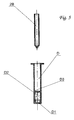
- The invention consists of: little pipe with sharp point (A) of cylindrical shape with a hat shaped widening on its upper end, and by this hat it leans against the body of the ignition mechanism, at the lower side it is made in the form of a sharp point and along the wall it has the openings; cylindrical housing (B) having on the upper part a hat shaped widening, and by this hat it leans against the bore in mine (6), on its bottom it has made a container for the aggressive liquid, ampoule (C) filled with the aggressive matter (acid, alkali, salt or gel), and after being filled it is closed at the lower side by disc shaped cover (C1).
- The invention works in the following way: before placing the ignition mechanism into the mine, into bore (6) for placing the ignition mechanism cylindrical housing (B) is set, on which bottom there is ampoule (C) filled with the aggressive matter. On ignition mechanism (1) little pipe with the sharp point (A) is placed, which completely embraces initiation part (2). When activating mechanism (1) is screwed into mine body (3), little pipe with the sharp point (A) is lowered to ampoule (C) filled with the aggressive matter, presses it and breaks its upper wall, which is for an easier breaking thinned by annular groove (C2).
- The aggressive matter exits from broken ampoule (C) and fills the space of cylindrical housing (B), where now also little pipe with the sharp point (A) is placed and inside of which initiation part (2) is placed. The aggressive matter passes through the openings on little pipe with the sharp point (A), comes to initiation part (2) that is now immersed into the aggressive matter that starts to corrode it. The time necessary for the corroding-through of the body wall of initiation part (2) by the aggressive matter is determined by the concentration of the aggressive matter, so that its higher concentration reduces the time for corroding-through the body of initiation part (2). When the aggressive matter corrodes through the body of initiation part (2), it comes to the initial explosive placed inside of it, soaks it, and in that instant the initial mixture is not explosive any more and the mine cannot be activated any more.
- The time period of the mine activating is determined by the concentration of the aggressive matter that fills ampoule (C). At the filling of ampoule (C), the filling of various concentrates or various kinds of aggressive matter can be chosen, what results in a longer or shorter mine activating time period.
- Little pipe with the sharp point (A) is made with a conical widening in its upper part and, during the activating mechanism (1) screwing into mine body (3), little pipe with the sharp point (A) enters into cylindrical housing (B), so that its conical widening is pressed into conical widening (B), and by that the impermeability is secured and the undesired leaking or evaporating of the aggressive liquid spilled after the breaking of ampoule (C) is prevented.
- When the invention is applied at the manufacturing of new mines, little pipe with the pointed edge (A) is not necessary. Then, initiation part (2B) is designed and manufactured in such a way, that it enables a safe breaking of ampoule (C) at the placement of activating mechanism (1) into mine body (3). After breaking the upper wall of ampoule (C), the aggressive substance comes out from broken ampoule (C) and fills the space of cylindrical casing (B), where it comes to initiation part (2B) that is now immersed into aggressive substance, which starts to corrode its walls. The time period within which the mine can be activated is determined by the concentration or the kind of the aggressive substance, as well as by the kind of material used for making initiation part (2B) and by the wall thickness of initiation part (2B).
- By this invention the time period within which the mines can be activated after they have been placed is limited. For that, in the time period where the activating is permitted, the mines retain all their present characteristics: the safety at placing, the disturbless and safe activating and the same level of the possible detection by various systems for the mine detection. After the expiring of the presumed time period, which can be changed as desired (to determine the longer or shorter time period within which it is possible to activate the mines), it is not possible to activate the mines any more and they become harmless.
- The invention is applicable for all kinds of mines and assigned for limiting the time period within which it is possible to activate the mines after being placed.
- The part of this invention can be produced in series by a simple industrial procedure.
Claims (6)
- Supplement to mines by which the time period within which the activation of mines after their placing is possible, is limited, wherein, for a limited time interval, the fuse can be activated and ignite the mixture filled in initiation part (2) in a way that initiation part (2) is brought in contact with an aggressive matter, which corrodes its walls and comes in contact with the initiation mixture filled in initiation part (2), mixes with it and neutralizes it, characterised in that the aggressive matter prevents the ignition of the initial mixture and the supplement to mines consists of:little pipe with sharp point (A, 2B) and cylindrical housing (B, D), which has in its lower part ampoule (C, D2) filled with aggressive matter, and the upper wall of ampoule (C, D2) is thinned by annular groove (C2, D3), while at the lower side the ampoule (C, D2) is closed by disc shaped cover (C1, D1).
- Supplement to mines by which the time period within which the activating of mines after their placing is possible is limited according to claim 1, characterized by that mentioned little pipe with sharp point (A) is put on initiation part (2) and serves to breake the wall of ampoule (C) by its sharp point and that during the breaking of ampoule (C) it protects initiation part (2) that is sensitive to the pressure, it is of cylindrical shape, in the lower side made in pyramid form and with this sharp point it breaks ampoule (C), it is made of a material that is resistant to the corrosion by the aggressive matter filled in ampoule (C), on its upper end it has a hat shaped widening and by this hat it leans against mine activating mechanism (1), in its upper part it is made with the conical widening of the outer wall in a way that at the screwing-in of activating mechanism (1) the little pipe with sharp point enters into cylindrical housing (B) and by that the impermeability is ensured and the undesired leakage or evaporation of the aggressive matter split after the breaking of ampoule (C) is prevented, little pipe with sharp point (A) has on its body the bores through which the aggressive matter after the breaking of ampoule (C) enters into little pipe with sharp point (A), comes to initial part (2) and corrodes it walls.
- Supplement to mines by which the time period within which the activation of mines after their placing is possible is limited according to claim 2. characterized by that mentioned cylindrical housing (B) serves for placing ampoule (C) and retaining the aggressive matter after the breaking of ampoule (C), it is made of a material resistant to the corrosion of the aggressive matter filled in ampoule (C), it is of cylindrical shape with a hat shaped widening on its upper part and by this hat it leans against the bore for the placement of activating mechanism (6) into which cylindrical housing (B) is placed, and, as its part, from the inner side the upper wall of ampoule (C) is made, which is thinned by annular groove (C2) for its easier breaking.
- Supplement to mines by which the time period within which the activation of mines after their placing is possible is limited according to claim 3, characterized by that mentioned ampoule (C) is placed on the bottom of cylindrical housing (B) and made as its part, it serves for storing the aggressive matter that after its breaking slowly corrodes the wall of initiation part (2).
- Supplement to mines by which the time period within which the activation of mines after their placing is possible is limited according to claim 1 , characterized by that mentioned cover (C1) is placed at the lower side of cylindrical housing (B) and serves for closing cylindrical housing (B) after being filled with the aggressive matter.
- Supplement to mines by which the time period within which the activation of mines after their placing is possible is limited according to claim 1, characterized by that mentioned initiation part (2B) serves for storing the initial explosive and for breaking ampoule (D2), it is of cylindrical shape and at the lower side made in the form of a sharp point by which it breaks through ampoule (C), it is made of a material that can be corroded through by the aggressive matter filled in ampoule (C), it is part of the assembly of activating mechanism (1) and, when activating mechanism (1) is screwed into mine body (3), the sharp point of initiation part (2B) is pointed into the upper wall of the ampoule and breaks it.
Applications Claiming Priority (2)
| Application Number | Priority Date | Filing Date | Title |
|---|---|---|---|
| HR20030841A HRP20030841A2 (en) | 2003-10-16 | 2003-10-16 | Supplement to mines by which the time period is limited within which the activation of mines after their placing is possible |
| PCT/HR2004/000040 WO2005036094A1 (en) | 2003-10-16 | 2004-10-15 | Supplement to mines by which the time period is limited within which the activation of mines after their placing is possible |
Publications (2)
| Publication Number | Publication Date |
|---|---|
| EP1680646A1 EP1680646A1 (en) | 2006-07-19 |
| EP1680646B1 true EP1680646B1 (en) | 2008-11-05 |
Family
ID=34430657
Family Applications (1)
| Application Number | Title | Priority Date | Filing Date |
|---|---|---|---|
| EP04769078A Expired - Lifetime EP1680646B1 (en) | 2003-10-16 | 2004-10-15 | Supplement to mines by which the time period within which the activation of mines after their placing is possible, is limited |
Country Status (9)
| Country | Link |
|---|---|
| US (1) | US7849799B2 (en) |
| EP (1) | EP1680646B1 (en) |
| CN (1) | CN100529647C (en) |
| AT (1) | ATE413583T1 (en) |
| DE (1) | DE602004017634D1 (en) |
| ES (1) | ES2317037T3 (en) |
| HR (1) | HRP20030841A2 (en) |
| RU (1) | RU2336491C2 (en) |
| WO (1) | WO2005036094A1 (en) |
Families Citing this family (2)
| Publication number | Priority date | Publication date | Assignee | Title |
|---|---|---|---|---|
| US7690287B2 (en) * | 2006-07-18 | 2010-04-06 | Maegerlein Stephen D | Explosive neutralizer and method |
| US8904937B2 (en) | 2012-04-13 | 2014-12-09 | C-2 Innovations Inc. | Line charge |
Family Cites Families (21)
| Publication number | Priority date | Publication date | Assignee | Title |
|---|---|---|---|---|
| US537390A (en) * | 1895-04-09 | Combination-horses hoe | ||
| US2426269A (en) * | 1942-03-09 | 1947-08-26 | Raymonde Briggs Hopkins | Explosive device |
| US3115834A (en) * | 1944-05-31 | 1963-12-31 | Arthur H Schwarz | Self-winding arming and sterilizing mechanism for a mine |
| US3175055A (en) * | 1963-03-11 | 1965-03-23 | Magnavox Co | Adjustable electrolytically actuated time-delay switch |
| US3447461A (en) * | 1967-11-16 | 1969-06-03 | Ray Lapof | Antipersonnel device |
| US3513778A (en) * | 1968-02-09 | 1970-05-26 | Us Army | Self-sterilizing fuze |
| US3568601A (en) * | 1968-07-26 | 1971-03-09 | Us Army | Mine fuse safing system |
| NL144882B (en) * | 1969-12-10 | 1975-02-17 | Metaverpa Nv | WIRE OR BAND TIE DEVICE. |
| US3667387A (en) * | 1971-01-19 | 1972-06-06 | Us Army | Self-destruct land mine |
| US3750527A (en) * | 1972-05-11 | 1973-08-07 | Us Army | Fail-safe device for chemically armed mines |
| US4046055A (en) * | 1975-07-18 | 1977-09-06 | The United States Of America As Represented By The Secretary Of The Army | Apparatus for safely neutralizing explosive devices |
| SE441703B (en) * | 1984-12-17 | 1985-10-28 | Ffv Affersverket | MARKING BODY ON RE-REPAIRABLE MINES |
| FR2691799B1 (en) * | 1992-06-02 | 1995-08-11 | Giat Ind Sa | AMMUNITION IN PARTICULAR SUB-AMMUNITION FOR EJECTING A CARRIER PROJECTILE. |
| DE69314849T2 (en) * | 1992-06-02 | 1998-04-30 | Giat Ind Sa | Self-dismantling system for submunition using chemical etching |
| US5423266A (en) * | 1994-08-18 | 1995-06-13 | Adams; Keith R. | Land mine |
| US5714707A (en) * | 1996-05-13 | 1998-02-03 | Talon Manufacturing Company, Inc. | Process and apparatus for demilitarization of small caliber primed cartridge cases |
| CN1085829C (en) * | 1998-04-20 | 2002-05-29 | 黄金富 | Controllable mine and its explosion controlling system |
| US6298763B1 (en) * | 1999-01-20 | 2001-10-09 | The United States Of America As Represented By The Secretary Of The Navy | Explosive device neutralization system |
| RU2154800C1 (en) * | 1999-09-15 | 2000-08-20 | Аверченко Александр Миронович | Method for demilitarization of ammunition |
| FR2824901B1 (en) * | 2001-05-21 | 2003-09-12 | Poudres & Explosifs Ste Nale | METHOD AND INSTALLATION FOR ROCKET DESTRUCTION MOUNTED ON AMMUNITION |
| US7213518B2 (en) * | 2003-02-21 | 2007-05-08 | Engel Ballistic Research, Inc. | Modular electronic fuze |
-
2003
- 2003-10-16 HR HR20030841A patent/HRP20030841A2/en not_active Application Discontinuation
-
2004
- 2004-10-15 EP EP04769078A patent/EP1680646B1/en not_active Expired - Lifetime
- 2004-10-15 CN CNB2004800301022A patent/CN100529647C/en not_active Expired - Fee Related
- 2004-10-15 ES ES04769078T patent/ES2317037T3/en not_active Expired - Lifetime
- 2004-10-15 RU RU2006117299/02A patent/RU2336491C2/en not_active IP Right Cessation
- 2004-10-15 AT AT04769078T patent/ATE413583T1/en active
- 2004-10-15 WO PCT/HR2004/000040 patent/WO2005036094A1/en not_active Ceased
- 2004-10-15 DE DE602004017634T patent/DE602004017634D1/en not_active Expired - Lifetime
- 2004-10-15 US US10/595,347 patent/US7849799B2/en not_active Expired - Fee Related
Also Published As
| Publication number | Publication date |
|---|---|
| EP1680646A1 (en) | 2006-07-19 |
| ATE413583T1 (en) | 2008-11-15 |
| ES2317037T3 (en) | 2009-04-16 |
| RU2336491C2 (en) | 2008-10-20 |
| RU2006117299A (en) | 2007-11-27 |
| US7849799B2 (en) | 2010-12-14 |
| WO2005036094A1 (en) | 2005-04-21 |
| CN100529647C (en) | 2009-08-19 |
| CN1867810A (en) | 2006-11-22 |
| DE602004017634D1 (en) | 2008-12-18 |
| HRP20030841A2 (en) | 2006-04-30 |
| US20070101890A1 (en) | 2007-05-10 |
Similar Documents
| Publication | Publication Date | Title |
|---|---|---|
| US7690287B2 (en) | Explosive neutralizer and method | |
| US5511482A (en) | Environmentally degradable munitions | |
| US8689695B2 (en) | Area denial device | |
| US2362738A (en) | Cartridge | |
| US3695141A (en) | Explosive ordnance demolition weapon | |
| US20120037028A1 (en) | Stationary self-destruct fuze mechanism | |
| US7849799B2 (en) | Supplement to mines by which the time period is limited within which the activation of mines after their placing is possible | |
| US3616753A (en) | Out of line fuze mechanism | |
| US1898073A (en) | Delay fuse for drop bombs | |
| BRPI1002280B1 (en) | HAND GRENADE | |
| US9784546B2 (en) | Area denial system | |
| EP2898243B1 (en) | Pressure discharge valve | |
| Rottman | World War II Allied Sabotage Devices and Booby Traps | |
| ES2361454T3 (en) | ENERGY CHARGED CONTROLLED DECONFINATION AND AMMUNITION EQUIPPED WITH SUCH LOAD. | |
| JP2009264679A (en) | Explosive neutralizing device | |
| JP2001349700A (en) | Mine | |
| WO2001020247A1 (en) | Method for the demilitarization of ammunition | |
| Carton et al. | US Chemical Weapons and Related Materiel Reference Guide | |
| Patel | Can Currently Developed Deflagration Systems Neutralize Hard Case Mines? | |
| IL157871A (en) | Non-lethal land mines | |
| Fabisiak | Chemical weapons dumped in the Polish sea areas–technical possibilities of its remediation and legal restrictions | |
| KR950002802A (en) | Fire extinguishing method and equipment | |
| Dullum et al. | On the retention and acquisition of cluster munitions | |
| Колосков et al. | Characteristics of the impact of munitions explosion sites on the ecological condition of the surrounding area | |
| Дідовець et al. | Characteristics of the impact of munitions explosion sites on the ecological condition of the surrounding area |
Legal Events
| Date | Code | Title | Description |
|---|---|---|---|
| PUAI | Public reference made under article 153(3) epc to a published international application that has entered the european phase |
Free format text: ORIGINAL CODE: 0009012 |
|
| 17P | Request for examination filed |
Effective date: 20060505 |
|
| AK | Designated contracting states |
Kind code of ref document: A1 Designated state(s): AT BE BG CH CY CZ DE DK EE ES FI FR GB GR HU IE IT LI LU MC NL PL PT RO SE SI SK TR |
|
| DAX | Request for extension of the european patent (deleted) | ||
| 17Q | First examination report despatched |
Effective date: 20070316 |
|
| GRAP | Despatch of communication of intention to grant a patent |
Free format text: ORIGINAL CODE: EPIDOSNIGR1 |
|
| RTI1 | Title (correction) |
Free format text: SUPPLEMENT TO MINES BY WHICH THE TIME PERIOD WITHIN WHICH THE ACTIVATION OF MINES AFTER THEIR PLACING IS POSSIBLE, IS LIMITED |
|
| GRAS | Grant fee paid |
Free format text: ORIGINAL CODE: EPIDOSNIGR3 |
|
| GRAA | (expected) grant |
Free format text: ORIGINAL CODE: 0009210 |
|
| AK | Designated contracting states |
Kind code of ref document: B1 Designated state(s): AT BE BG CH CY CZ DE DK EE ES FI FR GB GR HU IE IT LI LU MC NL PL PT RO SE SI SK TR |
|
| REG | Reference to a national code |
Ref country code: GB Ref legal event code: FG4D |
|
| REG | Reference to a national code |
Ref country code: CH Ref legal event code: EP |
|
| REG | Reference to a national code |
Ref country code: IE Ref legal event code: FG4D |
|
| REF | Corresponds to: |
Ref document number: 602004017634 Country of ref document: DE Date of ref document: 20081218 Kind code of ref document: P |
|
| REG | Reference to a national code |
Ref country code: CH Ref legal event code: NV Representative=s name: KIRKER & CIE S.A. |
|
| REG | Reference to a national code |
Ref country code: SE Ref legal event code: TRGR |
|
| NLV1 | Nl: lapsed or annulled due to failure to fulfill the requirements of art. 29p and 29m of the patents act | ||
| REG | Reference to a national code |
Ref country code: ES Ref legal event code: FG2A Ref document number: 2317037 Country of ref document: ES Kind code of ref document: T3 |
|
| PG25 | Lapsed in a contracting state [announced via postgrant information from national office to epo] |
Ref country code: SI Free format text: LAPSE BECAUSE OF FAILURE TO SUBMIT A TRANSLATION OF THE DESCRIPTION OR TO PAY THE FEE WITHIN THE PRESCRIBED TIME-LIMIT Effective date: 20081105 Ref country code: PL Free format text: LAPSE BECAUSE OF FAILURE TO SUBMIT A TRANSLATION OF THE DESCRIPTION OR TO PAY THE FEE WITHIN THE PRESCRIBED TIME-LIMIT Effective date: 20081105 Ref country code: NL Free format text: LAPSE BECAUSE OF FAILURE TO SUBMIT A TRANSLATION OF THE DESCRIPTION OR TO PAY THE FEE WITHIN THE PRESCRIBED TIME-LIMIT Effective date: 20081105 Ref country code: FI Free format text: LAPSE BECAUSE OF FAILURE TO SUBMIT A TRANSLATION OF THE DESCRIPTION OR TO PAY THE FEE WITHIN THE PRESCRIBED TIME-LIMIT Effective date: 20081105 |
|
| PG25 | Lapsed in a contracting state [announced via postgrant information from national office to epo] |
Ref country code: RO Free format text: LAPSE BECAUSE OF FAILURE TO SUBMIT A TRANSLATION OF THE DESCRIPTION OR TO PAY THE FEE WITHIN THE PRESCRIBED TIME-LIMIT Effective date: 20081105 Ref country code: EE Free format text: LAPSE BECAUSE OF FAILURE TO SUBMIT A TRANSLATION OF THE DESCRIPTION OR TO PAY THE FEE WITHIN THE PRESCRIBED TIME-LIMIT Effective date: 20081105 Ref country code: BG Free format text: LAPSE BECAUSE OF FAILURE TO SUBMIT A TRANSLATION OF THE DESCRIPTION OR TO PAY THE FEE WITHIN THE PRESCRIBED TIME-LIMIT Effective date: 20090205 Ref country code: DK Free format text: LAPSE BECAUSE OF FAILURE TO SUBMIT A TRANSLATION OF THE DESCRIPTION OR TO PAY THE FEE WITHIN THE PRESCRIBED TIME-LIMIT Effective date: 20081105 Ref country code: BE Free format text: LAPSE BECAUSE OF FAILURE TO SUBMIT A TRANSLATION OF THE DESCRIPTION OR TO PAY THE FEE WITHIN THE PRESCRIBED TIME-LIMIT Effective date: 20081105 |
|
| PG25 | Lapsed in a contracting state [announced via postgrant information from national office to epo] |
Ref country code: PT Free format text: LAPSE BECAUSE OF FAILURE TO SUBMIT A TRANSLATION OF THE DESCRIPTION OR TO PAY THE FEE WITHIN THE PRESCRIBED TIME-LIMIT Effective date: 20090406 |
|
| PLBE | No opposition filed within time limit |
Free format text: ORIGINAL CODE: 0009261 |
|
| STAA | Information on the status of an ep patent application or granted ep patent |
Free format text: STATUS: NO OPPOSITION FILED WITHIN TIME LIMIT |
|
| PG25 | Lapsed in a contracting state [announced via postgrant information from national office to epo] |
Ref country code: SK Free format text: LAPSE BECAUSE OF FAILURE TO SUBMIT A TRANSLATION OF THE DESCRIPTION OR TO PAY THE FEE WITHIN THE PRESCRIBED TIME-LIMIT Effective date: 20081105 |
|
| 26N | No opposition filed |
Effective date: 20090806 |
|
| PG25 | Lapsed in a contracting state [announced via postgrant information from national office to epo] |
Ref country code: MC Free format text: LAPSE BECAUSE OF NON-PAYMENT OF DUE FEES Effective date: 20091031 |
|
| REG | Reference to a national code |
Ref country code: IE Ref legal event code: MM4A |
|
| PG25 | Lapsed in a contracting state [announced via postgrant information from national office to epo] |
Ref country code: GR Free format text: LAPSE BECAUSE OF FAILURE TO SUBMIT A TRANSLATION OF THE DESCRIPTION OR TO PAY THE FEE WITHIN THE PRESCRIBED TIME-LIMIT Effective date: 20090206 Ref country code: IE Free format text: LAPSE BECAUSE OF NON-PAYMENT OF DUE FEES Effective date: 20091015 |
|
| PGFP | Annual fee paid to national office [announced via postgrant information from national office to epo] |
Ref country code: AT Payment date: 20101027 Year of fee payment: 7 Ref country code: FR Payment date: 20101104 Year of fee payment: 7 |
|
| PGFP | Annual fee paid to national office [announced via postgrant information from national office to epo] |
Ref country code: CH Payment date: 20101029 Year of fee payment: 7 Ref country code: CZ Payment date: 20101022 Year of fee payment: 7 Ref country code: DE Payment date: 20101026 Year of fee payment: 7 |
|
| PGFP | Annual fee paid to national office [announced via postgrant information from national office to epo] |
Ref country code: TR Payment date: 20101022 Year of fee payment: 7 Ref country code: GB Payment date: 20101021 Year of fee payment: 7 Ref country code: IT Payment date: 20101027 Year of fee payment: 7 Ref country code: SE Payment date: 20101029 Year of fee payment: 7 |
|
| PG25 | Lapsed in a contracting state [announced via postgrant information from national office to epo] |
Ref country code: LU Free format text: LAPSE BECAUSE OF NON-PAYMENT OF DUE FEES Effective date: 20091015 |
|
| PG25 | Lapsed in a contracting state [announced via postgrant information from national office to epo] |
Ref country code: HU Free format text: LAPSE BECAUSE OF FAILURE TO SUBMIT A TRANSLATION OF THE DESCRIPTION OR TO PAY THE FEE WITHIN THE PRESCRIBED TIME-LIMIT Effective date: 20090506 |
|
| PGFP | Annual fee paid to national office [announced via postgrant information from national office to epo] |
Ref country code: ES Payment date: 20101026 Year of fee payment: 7 |
|
| PG25 | Lapsed in a contracting state [announced via postgrant information from national office to epo] |
Ref country code: CY Free format text: LAPSE BECAUSE OF FAILURE TO SUBMIT A TRANSLATION OF THE DESCRIPTION OR TO PAY THE FEE WITHIN THE PRESCRIBED TIME-LIMIT Effective date: 20081105 |
|
| REG | Reference to a national code |
Ref country code: CH Ref legal event code: PL |
|
| GBPC | Gb: european patent ceased through non-payment of renewal fee |
Effective date: 20111015 |
|
| REG | Reference to a national code |
Ref country code: SE Ref legal event code: EUG |
|
| REG | Reference to a national code |
Ref country code: FR Ref legal event code: ST Effective date: 20120629 |
|
| PG25 | Lapsed in a contracting state [announced via postgrant information from national office to epo] |
Ref country code: LI Free format text: LAPSE BECAUSE OF NON-PAYMENT OF DUE FEES Effective date: 20111031 Ref country code: CH Free format text: LAPSE BECAUSE OF NON-PAYMENT OF DUE FEES Effective date: 20111031 Ref country code: DE Free format text: LAPSE BECAUSE OF NON-PAYMENT OF DUE FEES Effective date: 20120501 Ref country code: CZ Free format text: LAPSE BECAUSE OF NON-PAYMENT OF DUE FEES Effective date: 20111015 |
|
| PG25 | Lapsed in a contracting state [announced via postgrant information from national office to epo] |
Ref country code: GB Free format text: LAPSE BECAUSE OF NON-PAYMENT OF DUE FEES Effective date: 20111015 Ref country code: FR Free format text: LAPSE BECAUSE OF NON-PAYMENT OF DUE FEES Effective date: 20111102 Ref country code: IT Free format text: LAPSE BECAUSE OF NON-PAYMENT OF DUE FEES Effective date: 20111015 |
|
| REG | Reference to a national code |
Ref country code: AT Ref legal event code: MM01 Ref document number: 413583 Country of ref document: AT Kind code of ref document: T Effective date: 20111015 |
|
| REG | Reference to a national code |
Ref country code: DE Ref legal event code: R119 Ref document number: 602004017634 Country of ref document: DE Effective date: 20120501 |
|
| PG25 | Lapsed in a contracting state [announced via postgrant information from national office to epo] |
Ref country code: SE Free format text: LAPSE BECAUSE OF NON-PAYMENT OF DUE FEES Effective date: 20111016 |
|
| PG25 | Lapsed in a contracting state [announced via postgrant information from national office to epo] |
Ref country code: AT Free format text: LAPSE BECAUSE OF NON-PAYMENT OF DUE FEES Effective date: 20111015 |
|
| REG | Reference to a national code |
Ref country code: ES Ref legal event code: FD2A Effective date: 20130418 |
|
| PG25 | Lapsed in a contracting state [announced via postgrant information from national office to epo] |
Ref country code: ES Free format text: LAPSE BECAUSE OF NON-PAYMENT OF DUE FEES Effective date: 20111016 |
|
| PG25 | Lapsed in a contracting state [announced via postgrant information from national office to epo] |
Ref country code: TR Free format text: LAPSE BECAUSE OF NON-PAYMENT OF DUE FEES Effective date: 20111015 |