EP1679003A1 - Bactericide composition and method of controlling plant disease - Google Patents
Bactericide composition and method of controlling plant disease Download PDFInfo
- Publication number
- EP1679003A1 EP1679003A1 EP04793257A EP04793257A EP1679003A1 EP 1679003 A1 EP1679003 A1 EP 1679003A1 EP 04793257 A EP04793257 A EP 04793257A EP 04793257 A EP04793257 A EP 04793257A EP 1679003 A1 EP1679003 A1 EP 1679003A1
- Authority
- EP
- European Patent Office
- Prior art keywords
- compound
- group
- methylbenzoyl
- trimethoxy
- chloro
- Prior art date
- Legal status (The legal status is an assumption and is not a legal conclusion. Google has not performed a legal analysis and makes no representation as to the accuracy of the status listed.)
- Granted
Links
- 0 *c1ccc(*)c(*)c1 Chemical compound *c1ccc(*)c(*)c1 0.000 description 4
Classifications
-
- A—HUMAN NECESSITIES
- A01—AGRICULTURE; FORESTRY; ANIMAL HUSBANDRY; HUNTING; TRAPPING; FISHING
- A01N—PRESERVATION OF BODIES OF HUMANS OR ANIMALS OR PLANTS OR PARTS THEREOF; BIOCIDES, e.g. AS DISINFECTANTS, AS PESTICIDES OR AS HERBICIDES; PEST REPELLANTS OR ATTRACTANTS; PLANT GROWTH REGULATORS
- A01N43/00—Biocides, pest repellants or attractants, or plant growth regulators containing heterocyclic compounds
- A01N43/64—Biocides, pest repellants or attractants, or plant growth regulators containing heterocyclic compounds having rings with three nitrogen atoms as the only ring hetero atoms
- A01N43/647—Triazoles; Hydrogenated triazoles
- A01N43/653—1,2,4-Triazoles; Hydrogenated 1,2,4-triazoles
-
- A—HUMAN NECESSITIES
- A01—AGRICULTURE; FORESTRY; ANIMAL HUSBANDRY; HUNTING; TRAPPING; FISHING
- A01N—PRESERVATION OF BODIES OF HUMANS OR ANIMALS OR PLANTS OR PARTS THEREOF; BIOCIDES, e.g. AS DISINFECTANTS, AS PESTICIDES OR AS HERBICIDES; PEST REPELLANTS OR ATTRACTANTS; PLANT GROWTH REGULATORS
- A01N43/00—Biocides, pest repellants or attractants, or plant growth regulators containing heterocyclic compounds
- A01N43/34—Biocides, pest repellants or attractants, or plant growth regulators containing heterocyclic compounds having rings with one nitrogen atom as the only ring hetero atom
- A01N43/40—Biocides, pest repellants or attractants, or plant growth regulators containing heterocyclic compounds having rings with one nitrogen atom as the only ring hetero atom six-membered rings
-
- A—HUMAN NECESSITIES
- A01—AGRICULTURE; FORESTRY; ANIMAL HUSBANDRY; HUNTING; TRAPPING; FISHING
- A01N—PRESERVATION OF BODIES OF HUMANS OR ANIMALS OR PLANTS OR PARTS THEREOF; BIOCIDES, e.g. AS DISINFECTANTS, AS PESTICIDES OR AS HERBICIDES; PEST REPELLANTS OR ATTRACTANTS; PLANT GROWTH REGULATORS
- A01N43/00—Biocides, pest repellants or attractants, or plant growth regulators containing heterocyclic compounds
- A01N43/48—Biocides, pest repellants or attractants, or plant growth regulators containing heterocyclic compounds having rings with two nitrogen atoms as the only ring hetero atoms
- A01N43/50—1,3-Diazoles; Hydrogenated 1,3-diazoles
-
- A—HUMAN NECESSITIES
- A01—AGRICULTURE; FORESTRY; ANIMAL HUSBANDRY; HUNTING; TRAPPING; FISHING
- A01N—PRESERVATION OF BODIES OF HUMANS OR ANIMALS OR PLANTS OR PARTS THEREOF; BIOCIDES, e.g. AS DISINFECTANTS, AS PESTICIDES OR AS HERBICIDES; PEST REPELLANTS OR ATTRACTANTS; PLANT GROWTH REGULATORS
- A01N47/00—Biocides, pest repellants or attractants, or plant growth regulators containing organic compounds containing a carbon atom not being member of a ring and having no bond to a carbon or hydrogen atom, e.g. derivatives of carbonic acid
- A01N47/40—Biocides, pest repellants or attractants, or plant growth regulators containing organic compounds containing a carbon atom not being member of a ring and having no bond to a carbon or hydrogen atom, e.g. derivatives of carbonic acid the carbon atom having a double or triple bond to nitrogen, e.g. cyanates, cyanamides
-
- A—HUMAN NECESSITIES
- A01—AGRICULTURE; FORESTRY; ANIMAL HUSBANDRY; HUNTING; TRAPPING; FISHING
- A01N—PRESERVATION OF BODIES OF HUMANS OR ANIMALS OR PLANTS OR PARTS THEREOF; BIOCIDES, e.g. AS DISINFECTANTS, AS PESTICIDES OR AS HERBICIDES; PEST REPELLANTS OR ATTRACTANTS; PLANT GROWTH REGULATORS
- A01N55/00—Biocides, pest repellants or attractants, or plant growth regulators, containing organic compounds containing elements other than carbon, hydrogen, halogen, oxygen, nitrogen and sulfur
-
- C—CHEMISTRY; METALLURGY
- C07—ORGANIC CHEMISTRY
- C07D—HETEROCYCLIC COMPOUNDS
- C07D213/00—Heterocyclic compounds containing six-membered rings, not condensed with other rings, with one nitrogen atom as the only ring hetero atom and three or more double bonds between ring members or between ring members and non-ring members
- C07D213/02—Heterocyclic compounds containing six-membered rings, not condensed with other rings, with one nitrogen atom as the only ring hetero atom and three or more double bonds between ring members or between ring members and non-ring members having three double bonds between ring members or between ring members and non-ring members
- C07D213/04—Heterocyclic compounds containing six-membered rings, not condensed with other rings, with one nitrogen atom as the only ring hetero atom and three or more double bonds between ring members or between ring members and non-ring members having three double bonds between ring members or between ring members and non-ring members having no bond between the ring nitrogen atom and a non-ring member or having only hydrogen or carbon atoms directly attached to the ring nitrogen atom
- C07D213/60—Heterocyclic compounds containing six-membered rings, not condensed with other rings, with one nitrogen atom as the only ring hetero atom and three or more double bonds between ring members or between ring members and non-ring members having three double bonds between ring members or between ring members and non-ring members having no bond between the ring nitrogen atom and a non-ring member or having only hydrogen or carbon atoms directly attached to the ring nitrogen atom with hetero atoms or with carbon atoms having three bonds to hetero atoms with at the most one bond to halogen, e.g. ester or nitrile radicals, directly attached to ring carbon atoms
- C07D213/62—Oxygen or sulfur atoms
- C07D213/63—One oxygen atom
- C07D213/64—One oxygen atom attached in position 2 or 6
Definitions
- the present invention relates to a fungicidal composition useful as an agricultural and horticultural fungicide having remarkably improved preventive and/or curative effects against plant diseases, and a method for controlling plant diseases by using such a composition.
- WO02/2527 discloses that a benzoylpyridine derivative which is an active ingredient of the fungicidal composition in the present invention is useful as a fungicide and may be used in combination with another fungicide as the case required. However, it has not been known that the composition of the present invention has a remarkably excellent fungicidal effect.
- Patent Document 1 WO02/2527
- Each of benzoylpyridine derivatives represented by the formula (I) given hereinafter may have an inadequate controlling effect against a specific plant disease, its residual effect may last only a relatively short time or its rainfastness may be weak, and it has only an inadequate controlling effect against plant diseases practically depending upon the application site.
- the present inventors have conducted a research to solve the above problems and as a result, found that when a benzoylpyridine derivative represented by the formula (I) given hereinafter and a specific fungicide are used in combination, an unexpectedly excellent fungicidal effect can be obtained as compared with a case where the respective compounds are used alone.
- the present invention provides a fungicidal composition containing as active ingredients (a) a benzoylpyridine derivative represented by the formula (I) or its salt: (wherein X is a halogen atom, a nitro group, a substitutable hydrocarbon group, a substitutable alkoxy group, a substitutable aryloxy group, a substitutable cycloalkoxy group, a hydroxyl group, a substitutable alkylthio group, a cyano group, a carboxyl group which may be esterified or amidated, or a substitutable amino group, n is 1, 2, 3 or 4; R 1 is a substitutable alkyl group, R 2' is a substitutable alkyl group, a substitutable alkoxy group, a substitutable aryloxy group, a substitutable cycloalkoxy group or a hydroxyl group, p is 1, 2 or 3, and R 2" is a substitutable alkoxy group or a hydroxyl group, provided that at least
- the halogen atom is fluorine, chlorine, bromine or iodine, and it may, for example, be preferably fluorine, chlorine or bromine.
- the hydrocarbon moiety in the substitutable hydrocarbon group in the formula (I) may, for example, be a C 1-6 alkyl (such as methyl, ethyl, propyl, isopropyl, butyl, isobutyl or t-butyl), a C 2-6 alkenyl (such as vinyl, allyl, isopropenyl or 3-methyl-2-butenyl), a C 2-6 alkynyl (such as ethynyl, 1-propynyl or 2-propynyl), a C 3-6 cycloalkyl (such as cyclopropyl, cyclopentyl or cyclohexyl) or a C 6-10 aryl.
- a C 1-6 alkyl such as methyl, ethyl, propyl, isopropyl, butyl, isobutyl or t-butyl
- a C 2-6 alkenyl such as vinyl, allyl, iso
- the secondary substituent in the substitutable hydrocarbon group may, for example, be the same or different one to five substituents selected from the group consisting of aryl, aryloxy, hydroxy, nitro, nitroxy, halogen (such as fluorine, chlorine, bromine or iodine), haloalkoxy (such as a C 1-4 haloalkoxy, for instance CF 3 O or HCF 2 O), cycloalkyl, amino, alkylthio and cyano.
- halogen such as fluorine, chlorine, bromine or iodine
- haloalkoxy such as a C 1-4 haloalkoxy, for instance CF 3 O or HCF 2 O
- cycloalkyl amino, alkylthio and cyano.
- a substitutable alkyl group is preferred, and an alkyl group is particularly preferred.
- alkyl groups a C 1-4 alkyl group is most preferred.
- the alkyl moiety in the substitutable alkyl group, the substitutable alkoxy group and the substitutable alkylthio group in the formula (I) is preferably a C 1-6 alkyl (such as methyl, ethyl, propyl, isopropyl, butyl, isobutyl or t-butyl), particularly preferably a C 1-4 alkyl.
- the secondary substituent in these substituents may be the same or different one to five substituents selected from the group consisting of aryl, aryloxy, hydroxy, nitro, nitroxy, halogen (such as fluorine, chlorine, bromine or iodine), haloalkoxy (such as a C 1-4 haloalkoxy, for instance CF 3 O or HCF 2 O), cycloalkyl, amino, alkylthio and cyano.
- substituents having an alkyl moiety a non-substituted substituent is preferred, a C 1-4 alkyl is particularly preferred, and methyl is most preferred.
- the aryl moiety in the substitutable aryloxy group in the formula (I) may be phenyl, or a condensed polycyclic group such as naphthyl, but it is preferably phenyl.
- the secondary substituent, for instance substitutable group may, for example, be halogen, alkyl, alkoxy or hydroxy.
- the cycloalkyl moiety in the substitutable cycloalkoxy group in the formula (I) consists of three to ten carbons, and it may, for example, be a monocyclic group such as cyclopropyl, cyclobutyl, cyclopentyl, cyclohexyl or cyclooctyl, or a condensed polycyclic group, but it is preferably a monocyclic group.
- the secondary substituent in these substitutable groups may, for example, be halogen, alkyl, alkoxy or hydroxy. Among the cycloalkoxy moieties, cyclohexyloxy is most preferred.
- the carboxyl group which may be esterified or amidated in the formula (I) may, for example, be a carboxyl group which may be esterified, such as a C 1-6 alkoxycarbonyl group (such as a methoxycarbonyl group, an ethoxycarbonyl group, a propoxycarbonyl group, an isopropoxycarbonyl group, a butoxycarbonyl group, an isobutoxycarbonyl group or a t-butoxycarbonyl group), a nitroxy C 1-4 alkoxyaminocarbonyl group (such as a 2-nitroxyethoxycarbonyl group or a 3-nitroxypropoxycarbonyl group) or a phenyl C 1-4 alkoxycarbonyl group (such as a benzyloxycarbonyl group or a phenethyloxycarbonyl group); or a carboxyl group which may be amidated, such as a carbamoyl group, a C 1-6 monoalkyla
- the substitutable amino group in the formula (I) may, for example, be an amino group; or an alkylamino group such as a monoalkylamino group or a dialkylamino group.
- the alkyl moiety in the alkylamino group is preferably a C 1-4 alkyl.
- the secondary substituent in the substitutable amino group may be the same or different one to five substituents selected from aryl, aryloxy, hydroxy, nitro, nitroxy, halogen (such as fluorine, chlorine, bromine or iodine), haloalkoxy (such as a C 1-4 haloalkoxy group, for instance CF 3 O or HCF 2 O), cycloalkyl, amino, alkylthio and cyano.
- halogen such as fluorine, chlorine, bromine or iodine
- haloalkoxy such as a C 1-4 haloalkoxy group, for instance CF 3 O or HCF 2 O
- cycloalkyl amino, alkylthio and cyano.
- the compound represented by the formula (I) may form a salt together with an acidic substance, and it may form, for example, an inorganic acid salt such as a hydrochloride, a hydrobromide, a phosphate, a sulfate or a nitrate; or an organic acid salt such as an acetate, a benzoate, a p-toluenesulfonate, a methanesulfonate or a propanesulfonate.
- an inorganic acid salt such as a hydrochloride, a hydrobromide, a phosphate, a sulfate or a nitrate
- organic acid salt such as an acetate, a benzoate, a p-toluenesulfonate, a methanesulfonate or a propanesulfonate.
- the compounds represented by the formula (I) may be prepared by a production process as disclosed in WO02/2527. Further, they may be produced also by a method in accordance with Journal of Organic Chemistry, 58, 7832 (1993), European Journal of Organic Chemistry, 7, 1371-1376 (2001) or Preparation Examples given hereinafter.
- the strobilurin compound may, for example, be Kresoxim-Methyl, Azoxystrobin, Metominofen, Trifloxystrobin, Picoxystrobin, Oryzastrobin, Dimoxystrobin or Fluoxastrobin. Among them, Kresoxim-Methyl and Azoxystrobin are preferred.
- Kresoxim-Methyl is a compound disclosed in The Pesticide Manual (Twelfth Edition, BRITISH CROP PROTECTION COUNCIL), p. 568-569. Further, Azoxystrobin is a compound disclosed in The Pesticide Manual (Twelfth Edition, BRITISH CROP PROTECTION COUNCIL), p. 54-55.
- the azole compound may, for example, be Epoxiconazole, Triflumizole, Oxpoconazole fumarate, Tebuconazole, Imibenconazole, Tetraconazole, Triadimefon, Bitertanol, Etaconazole, Propiconazole, Penconazole, Flusilazole, Myclobutanil, Cyproconazole, Hexaconazole, Furconazole-cis, Prochloraz, Metconazole, Sipconazole, Prothioconazole, Simeconazole, Tricyclazole, Probenazole, Fluquinconazole or Triadimenol.
- Epoxiconazole Triflumizole, Oxpoconazole fumarate, Tebuconazole, Imibenconazole, Tetraconazole, Cyproconazole, Metconazole, Fluquinconazole and Triadimenol are preferred.
- Epoxiconazole is a compound disclosed in The Pesticide Manual (Twelfth Edition, BRITISH CROP PROTECTION COUNCIL), p. 349-350.
- Triflumizole is a compound disclosed in The Pesticide Manual (Twelfth Edition, BRITISH CROP PROTECTION COUNCIL), p. 940-941.
- Oxpoconazole fumarate is a compound disclosed in The Pesticide Manual (Twelfth Edition, BRITISH CROP PROTECTION COUNCIL), p. 699.
- Tebuconazole is a compound disclosed in The Pesticide Manual (Twelfth Edition, BRITISH CROP PROTECTION COUNCIL), p. 864-865.
- Imibenconazole is a compound disclosed in The Pesticide Manual (Twelfth Edition, BRITISH CROP PROTECTION COUNCIL), p. 535-536. Tetraconazole is a compound disclosed in The Pesticide Manual (Thirteenth Edition, BRITISH CROP PROTECTION COUNCIL), p. 945-946. Cyproconazole is a compound disclosed in The Pesticide Manual (Thirteenth Edition, BRITISH CROP PROTECTION COUNCIL), p. 248-249. Metconazole is a compound disclosed in The Pesticide Manual (Thirteenth Edition, BRITISH CROP PROTECTION COUNCIL), p. 643-644.
- Fluquinconazole is a compound disclosed in The Pesticide Manual (Thirteenth Edition, BRITISH CROP PROTECTION COUNCIL), p. 472-473. Triadimenol is a compound disclosed in The Pesticide Manual (Thirteenth Edition, BRITISH CROP PROTECTION COUNCIL), p. 987-989.
- the morpholine compound may, for example, be Fenpropimorph or Spiroxamine.
- Fenpropimorph is a compound disclosed in The Pesticide Manual (Twelfth Edition, BRITISH CROP PROTECTION COUNCIL), p. 399-400.
- Spiroxamine is a compound disclosed in The Pesticide Manual (Twelfth Edition, BRITISH CROP PROTECTION COUNCIL), p. 842-843.
- the pyrimidinamine compound may, for example, be Mepanipyrim, Pyrimethanil or Cyprodinil. Among them, Mepanipyrim is preferred. Mepanipyrim is a compound disclosed in The Pesticide Manual (Twelfth Edition, BRITISH CROP PROTECTION COUNCIL), p. 596-597.
- the guanidine compound may, for example, be Iminoctadine.
- Iminoctadine is a compound disclosed in The Pesticide Manual (Twelfth Edition, BRITISH CROP PROTECTION COUNCIL), p. 539-541.
- the organic chlorine compound may, for example, be Chlorothalonil, Fthalide or Quintozene. Among them, Chlorothalonil is preferred. Chlorothalonil is a compound disclosed in The Pesticide Manual (Twelfth Edition, BRITISH CROP PROTECTION COUNCIL), p. 168-169.
- the imidazole compound may be Cyazofamid, Benomyl, Thiophanate-Methyl or Carbendazim. Among them, Cyazofamid is preferred. Cyazofamid is a compound disclosed in The Pesticide Manual (Twelfth Edition, BRITISH CROP PROTECTION COUNCIL), p. 523-524.
- the antibiotic may, for example, be Polyoxins.
- Polyoxins is a compound disclosed in The Pesticide Manual (Twelfth Edition, BRITISH CROP PROTECTION COUNCIL), p. 752-754.
- the pyridinamine compound may, for example, be Fluazinam.
- the quinoxaline compound may, for example, be Quinomethionate.
- the dithiocarbamate compound may, for example, be Maneb, Zineb, Mancozeb, Polycarbamate, Metiram or Propineb.
- the cyanoacetamide compound may, for example, be Cymoxanil.
- the phenylamide compound may, for example, be Metalaxyl, Metalaxyl M, Oxadixyl, Ofurace, Benalaxyl, Furalaxyl or Cyprofuram.
- the sulfenic acid compound may, for example, be Dichlofluanid.
- the copper compound may, for example, be Cupric hydroxide or Oxine Copper.
- the isoxazole compound may, for example, be Hymexazol.
- the organophosphorus compound may, for example, be Fosetyl-Al, Tolcofos-Methyl, S-benzyl O,O-diisopropylphosphorothioate, O-ethyl S,S-diphenylphosphorodithioate or aluminum ethyl hydrogen phosphonate.
- the N-halogenothioalkyl compound may, for example, be Captan, Captafol or Folpet.
- the dicarboxyimide compound may, for example, be Procymidone, Iprodione or Vinclozolin.
- the benzanilide compound may, for example, be Flutolanil, Mepronil, Zoxamid or Tiadinil.
- the piperazine compound may, for example, be Triforine.
- the pyridine compound may, for example, be Pyrifenox.
- the carbinol compound may, for example, be Fenarimol or Flutriafol.
- the piperidine compound may, for example, be Fenpropidine.
- Fenpropidine is a compound disclosed in The Pesticide Manual (Thirteenth Edition, BRITISH CROP PROTECTION COUNCIL), p. 419-420.
- the organotin compound may, for example, be Fentin Hydroxide or Fentin Acetate.
- the urea compound may, for example, be Pencycuron.
- the cinnamic acid compound may, for example, be Dimethomorph or Flumorph.
- the phenyl carbamate compound may, for example, be Diethofencarb.
- the cyanopyrrole compound may, for example, be Fludioxonil or Fenpiclonil.
- the oxazolidinone compound may, for example, be Famoxadone.
- the thiazole carboxamide compound may, for example, be Ethaboxam.
- the silyl amide compound may, for example, be Silthiopham.
- the aminoacid amidecarbamate compound may, for example, be Iprovalicarb or Benthiavalicarb.
- the imidazolidine compound may, for example, be Fenamidone.
- the hydroxyanilide compound may, for example, be Fenhexamid.
- the benzene sulfonamide compound may, for example, be Flusulfamid.
- the oxime ether compound may, for example, be Cyflufenamid.
- the phenoxyamide compound may, for example, be Fenoxanil.
- the benzophenone compound may, for example, be Metrafenone.
- Metrafenone is a compound disclosed in AG CHEM NEW COMPOUND REVIEW, VOLUME 21, 2003, p. 17.
- Another compound may, for example, be Isoprothiolane, Pyroquilon, Diclomezine, Quinoxyfen, Propamocarb Hydrochloride, Chloropicrin, Dazomet, Metam-sodium, Nicobifen, Diclocymet or Proquinazid.
- the fungicide (b) as an active ingredient in the fungicidal composition of the present invention may be the above-mentioned compounds. Among them, it is preferred to use at least one member selected from the group consisting of the strobilurin compound, the azole compound, the morpholine compound, the pyrimidinamine compound, the guanidine compound, the organic chlorine compound, the imidazole compound, the antibiotic, the piperidine compound and the benzophenone compound.
- the fungicidal composition of the present invention has stable and high fungicidal effects against cultivated crops infected with plant diseases, and it is possible to control the plant diseases by this composition.
- a usual acid halogenating reaction may be applied.
- This reaction is carried out preferably in the presence or absence of an inert solvent at a reaction temperature of from 0 to 200°C.
- the halogenating agent to be used in this reaction may, for example, be a fluorinating agent, a chlorinating agent or a brominating agent, and it is preferably a chlorinating agent such as thionyl chloride, phosphorus oxychloride or oxalyl chloride.
- the Friedel-Crafts reaction in the second step of Production Process (6) may be carried out in the presence of a catalyst in a solvent or without solvent at a reaction temperature of from -78°C to 200°C, and it is carried out preferably at a reaction temperature of from 0°C to 100°C.
- the catalyst to be used in the reaction may, for example, be a Lewis acid catalyst such as FeCl 3 , AlCl 3 , SnCl 4 , ZnCl 2 , TiCl 4 , SbCl 5 , BF 3 or BiCl 3 , trifluoromethanesulfonic acid or graphite.
- the solvent is an inert solvent under reaction conditions and it may, for example, be 1,2-dichloroethane, methylene chloride, chlorobenzene, dichlorobenzene or nitrobenzene, or a mixture thereof.
- the product may be produced by synthesis or derivatizing with reference to Friedel-Crafts Chemistry (Olah, G.A.).
- the compound of the above formula (XIII) to be used as a starting material for production in Production Processes (5) and (6) may be obtained by oxidizing a compound of the above formula (VII-2).
- the oxidizing agent may be an inorganic or organic oxidizing agent which is commonly used. Otherwise, it may be obtained by reacting a compound of the above formula (VII-1) directly with dry ice or by reacting it with ethyl chlorocarbonate, followed by hydrolysis. Otherwise, the product may be produced by synthesis or derivatizing from a substituted pyridinecarboxylic acid or its derivative by a known method from literature, e.g. with reference to J. Heterocyclic. Chem., 36, 653 (1999). Further, the product may be produced by synthesis or derivatizing with reference to "Experimental Chemistry 22, Organic Syntheses IV, 1992", fourth edition, The Chemical Society of Japan.
- the fungicidal composition of the present invention is useful particularly as an agricultural and horticultural fungicide.
- the agricultural and horticultural fungicide it is effective for controlling diseases such as blast, brown spot or sheath blight of rice ( Oryza sativa , etc.); powdery mildew, scab, rust, snow mold, snow blight, loose smut, eye spot, leaf spot or glume blotch of cereals ( Hordeum vulgare , Tricum aestivum, etc.); melanose or scab of citrus ( Citrus spp., etc.); blossom blight, powdery mildew, Alternaria leaf spot or scab of apple ( Malus pumila ); scab or black spot of pear ( Pyrus serotina, Pyrus ussuriensis, Pyrus communis); brown rot, scab or Phomopsis rot of peach ( Prunus persica , etc.); anthracnose, ripe rot, powdery
- the plurality of the active ingredients constituting the fungicidal composition of the present invention are, in the same manner as conventional agricultural chemicals, mixed with various adjuvants and formulated into various formulations such as a dust, granules, water-dispersible granules, a wettable powder, a water-based suspension concentrate, an oil-based suspension concentrate, water soluble granules, an emulsifiable concentrate, a soluble concentrate, a paste, an aerosol and an ultra low-volume formulation.
- various formulations such as a dust, granules, water-dispersible granules, a wettable powder, a water-based suspension concentrate, an oil-based suspension concentrate, water soluble granules, an emulsifiable concentrate, a soluble concentrate, a paste, an aerosol and an ultra low-volume formulation.
- any type of formulation which is commonly used in this field is applicable.
- Such adjuvants include solid carriers such as diatomaceous earth, slaked lime, calcium carbonate, talc, white carbon, kaoline, bentonite, a mixture of kaolinite and sericite, clay, sodium carbonate, sodium bicarbonate, mirabilite, zeolite and starch; solvents such as water, toluene, xylene, solvent naphtha, dioxane, acetone, isophorone, methyl isobutyl ketone, chlorobenzene, cyclohexane, dimethyl sulfoxide, dimethylformamide, dimethylacetamide, N-methyl-2-pyrrolidone and alcohol; anionic surfactants and spreaders such as a salt of fatty acid, a benzoate, an alkylsulfosuccinate, a dialkylsulfosuccinate, a polycarboxylate, a salt of alkylsulfuric acid ester, an alkyl sul
- Such adjuvants may be selected from known components so long as the purpose of the present invention can thereby be accomplished. Further, various additives which are commonly used, such as a filler, a thickener, an anti-settling agent, an anti-freezing agent, a dispersion stabilizer, a phytotoxicity reducing agent, and an anti-mold agent, may also be employed.
- the blend ratio of the active ingredient components to the various adjuvants is usually from 0.005:99.995 to 95:5, preferably from 0.2:99.8 to 90:10. In the actual application of such a formulation, it may be used as it is, or may be diluted to a predetermined concentration with a diluent such as water, and various spreaders may be added thereto, as the case requires.
- a method for controlling plant diseases which comprises applying the fungicidal composition of the present invention to agricultural and horticultural plants, is also included in the present invention.
- the concentration of the fungicidal composition of the present invention can not generally be defined, as it varies depending upon the crop plants to be treated, the application method, the type of the formulation, the dose, etc. However, it is applied in a concentration of the active ingredients being usually from 0.1 to 10,000 ppm, preferably from 1 to 2,000 ppm in the case of foliage treatment, and usually from 10 to 100,000 g/ha, preferably from 200 to 20,000 g/ha in the case of soil treatment.
- the formulation containing the fungicidal composition of the present invention or a diluted product thereof may be applied by an application method which is commonly used, such as spreading (spreading, spraying, misting, atomizing, grain diffusing or application on water surface), soil application (such as mixing or irrigation) or surface application (such as coating, dust coating or covering). Further, it may be applied also by so-called ultra low volume. In this method, the formulation may contain 100% of the active ingredient.
- the appropriate mixing weight ratio of the benzoylpyridine derivative represented by the formula (I) or its salt to another fungicide is usually from 1:10,000 to 10,000:1, preferably from 1:1,000 to 1,000:1, more preferably from 1:200 to 200:1.
- the reaction solution was charged into 50 ml of water, and a sodium hydroxide aqueous solution was added to make the reaction solution alkaline, the aqueous layer was separated out, and the solvent was distilled off under reduced pressure. 5 ml of hexane was added to the obtained residue, and the precipitated crystals were subjected to filtration to obtain 0.4 g (yield: 22%) of a desired product.
- methyl nitrite generation apparatus In the methyl nitrite generation apparatus, simultaneously with dropwise addition of the 38% sulfuric acid aqueous solution, methyl nitrite gas in an equivalent amount was generated and introduced to the diazotization apparatus through the bubble counter.
- the reaction apparatus was cooled with water so that the temperature in the system would be kept at from 20 to 30°C.
- the formed oil was extracted with 910 g of diethyl ether, the aqueous layer was separated out, and the solvent was distilled off under reduced pressure to obtain 375.3 g of an oil.
- the oil (crude product) had a composition comprising 70.7% (yield: 69.5%) of 2-chloro-4-methylpyridine, 26.6% (yield: 27.2%) of 2-methoxy-4-methylpyridine and 2.6% of 2-amino-4-methylpyridine.
- the formed oil was extracted with 1,050 g of diethyl ether, the aqueous layer was separated out, and the solvent was distilled off under reduced pressure to obtain 370 g of an oil (crude product).
- the purity of the obtained 2-methoxy-4-methylpyridine was 95% (two step yield from 2-amino-4-methylpyridine: 95%).
- reaction mixture was washed with 50 ml of water and dried over magnesium sulfate, and the solvent was distilled off under reduced pressure to obtain 69.35 g of a mixture of 4,4-dicyano-3-methyl-3-butenoldimethylacetal and 1,1-dicyano-4-methoxy-2-methyl-1,3-butadiene.
- Step (a) 69.35 g of the mixture of 4,4-dicyano-3-methyl-3-butenal-dimethylacetal and 1,1-dicyano-4-methoxy-2-methyl-1,3-butadiene obtained in Step (a) was slowly added to 113 g of concentrated sulfuric acid over a period of 3 hours so that the temperature would not exceed 30°C. After stirring at room temperature for 20 minutes, the temperature was increased to 50°C, and stirring was carried out at the same temperature for 2 hours. After the reaction mixture was left to stand to cool, it was slowly poured into water ice (500 ml), the obtained crystals were collected by filtration and the crystals were washed with 100 ml of water.
- the obtained solution was washed with 50 ml of ethyl acetate twice, and concentrated hydrochloric acid was added to make the aqueous layer acidic, followed by extraction with 70 ml of ethyl acetate three times.
- the ethyl acetate solution was washed with 50 ml of a saturated sodium chloride solution and dried over magnesium sulfate, and the solvent was distilled off under reduced pressure to obtain crude crystals.
- the crude crystals were dissolved in 50 ml of ethyl acetate again, followed by back extraction with 50 ml of a saturated sodium bicarbonate aqueous solution twice, and concentrated hydrochloric acid was added to make the aqueous layer acidic, followed by extraction with 70 ml of ethyl acetate three times.
- the ethyl acetate solution was washed with 50 ml of a saturated sodium chloride solution and dried over magnesium sulfate, and the solvent was distilled off under reduced pressure to obtain white crystals.
- Theoretical values were calculated in accordance with the Colby's formula.
- the fungicidal composition of the present invention has a synergistic effect regarding the test on preventive effect against wheat powdery mildew, when the experimental value is lower than the theoretical value.
- Theoretical values by the Colby's formula in such cases are shown in brackets in Tables 1 to 53. TABLE 1 Dose of Fenpropimorph Dose of Compound No.
- Cucumber (cultivar: Suyo) was cultivated in a plastic pot having a diameter of 7.5 cm, and when it reached 1.5-leaf stage, 10 ml of a chemical solution having the compound of the present invention adjusted to a prescribed concentration, was applied by a spray gun. After the chemical solution dried, a suspension of conidia of Sphaerotheca cucurbitae was sprayed and inoculated and maintained in a constant temperature chamber at 20°C. From 6 to 11 days after the inoculation, the area of sporulation was investigated, and the disease rate was determined in the same manner as in Test Example 3, and the results are shown in Tables 54 to 96. The average lesion area in the non-treated plot was determined in the same manner as for the treated plot except that water was applied by a spray gun instead of the chemical solution.
- the above components are uniformly mixed to obtain a dust.
Landscapes
- Life Sciences & Earth Sciences (AREA)
- Agronomy & Crop Science (AREA)
- Pest Control & Pesticides (AREA)
- Plant Pathology (AREA)
- Health & Medical Sciences (AREA)
- Engineering & Computer Science (AREA)
- Dentistry (AREA)
- General Health & Medical Sciences (AREA)
- Wood Science & Technology (AREA)
- Zoology (AREA)
- Environmental Sciences (AREA)
- Chemical & Material Sciences (AREA)
- Organic Chemistry (AREA)
- Agricultural Chemicals And Associated Chemicals (AREA)
- Pyridine Compounds (AREA)
Abstract

Description
- The present invention relates to a fungicidal composition useful as an agricultural and horticultural fungicide having remarkably improved preventive and/or curative effects against plant diseases, and a method for controlling plant diseases by using such a composition.
- WO02/2527 discloses that a benzoylpyridine derivative which is an active ingredient of the fungicidal composition in the present invention is useful as a fungicide and may be used in combination with another fungicide as the case required. However, it has not been known that the composition of the present invention has a remarkably excellent fungicidal effect.
- Patent Document 1: WO02/2527
- Each of benzoylpyridine derivatives represented by the formula (I) given hereinafter, may have an inadequate controlling effect against a specific plant disease, its residual effect may last only a relatively short time or its rainfastness may be weak, and it has only an inadequate controlling effect against plant diseases practically depending upon the application site.
- The present inventors have conducted a research to solve the above problems and as a result, found that when a benzoylpyridine derivative represented by the formula (I) given hereinafter and a specific fungicide are used in combination, an unexpectedly excellent fungicidal effect can be obtained as compared with a case where the respective compounds are used alone.
- Namely, the present invention provides a fungicidal composition containing as active ingredients (a) a benzoylpyridine derivative represented by the formula (I) or its salt:

- In the formula (I), the halogen atom is fluorine, chlorine, bromine or iodine, and it may, for example, be preferably fluorine, chlorine or bromine.
- The hydrocarbon moiety in the substitutable hydrocarbon group in the formula (I) may, for example, be a C1-6 alkyl (such as methyl, ethyl, propyl, isopropyl, butyl, isobutyl or t-butyl), a C2-6 alkenyl (such as vinyl, allyl, isopropenyl or 3-methyl-2-butenyl), a C2-6 alkynyl (such as ethynyl, 1-propynyl or 2-propynyl), a C3-6 cycloalkyl (such as cyclopropyl, cyclopentyl or cyclohexyl) or a C6-10 aryl. Further, the secondary substituent in the substitutable hydrocarbon group may, for example, be the same or different one to five substituents selected from the group consisting of aryl, aryloxy, hydroxy, nitro, nitroxy, halogen (such as fluorine, chlorine, bromine or iodine), haloalkoxy (such as a C1-4 haloalkoxy, for instance CF3O or HCF2O), cycloalkyl, amino, alkylthio and cyano. Among these substitutable hydrocarbon groups, a substitutable alkyl group is preferred, and an alkyl group is particularly preferred. Further, among alkyl groups, a C1-4 alkyl group is most preferred.
- The alkyl moiety in the substitutable alkyl group, the substitutable alkoxy group and the substitutable alkylthio group in the formula (I) is preferably a C1-6 alkyl (such as methyl, ethyl, propyl, isopropyl, butyl, isobutyl or t-butyl), particularly preferably a C1-4 alkyl. Further, the secondary substituent in these substituents may be the same or different one to five substituents selected from the group consisting of aryl, aryloxy, hydroxy, nitro, nitroxy, halogen (such as fluorine, chlorine, bromine or iodine), haloalkoxy (such as a C1-4 haloalkoxy, for instance CF3O or HCF2O), cycloalkyl, amino, alkylthio and cyano. Among such substituents having an alkyl moiety, a non-substituted substituent is preferred, a C1-4 alkyl is particularly preferred, and methyl is most preferred.
- The aryl moiety in the substitutable aryloxy group in the formula (I) may be phenyl, or a condensed polycyclic group such as naphthyl, but it is preferably phenyl. Further, the secondary substituent, for instance substitutable group may, for example, be halogen, alkyl, alkoxy or hydroxy.
- The cycloalkyl moiety in the substitutable cycloalkoxy group in the formula (I) consists of three to ten carbons, and it may, for example, be a monocyclic group such as cyclopropyl, cyclobutyl, cyclopentyl, cyclohexyl or cyclooctyl, or a condensed polycyclic group, but it is preferably a monocyclic group. Further, the secondary substituent in these substitutable groups may, for example, be halogen, alkyl, alkoxy or hydroxy. Among the cycloalkoxy moieties, cyclohexyloxy is most preferred.
- The carboxyl group which may be esterified or amidated in the formula (I) may, for example, be a carboxyl group which may be esterified, such as a C1-6 alkoxycarbonyl group (such as a methoxycarbonyl group, an ethoxycarbonyl group, a propoxycarbonyl group, an isopropoxycarbonyl group, a butoxycarbonyl group, an isobutoxycarbonyl group or a t-butoxycarbonyl group), a nitroxy C1-4 alkoxyaminocarbonyl group (such as a 2-nitroxyethoxycarbonyl group or a 3-nitroxypropoxycarbonyl group) or a phenyl C1-4 alkoxycarbonyl group (such as a benzyloxycarbonyl group or a phenethyloxycarbonyl group); or a carboxyl group which may be amidated, such as a carbamoyl group, a C1-6 monoalkylaminocarbonyl group (such as a methylaminocarbonyl group, an ethyaminocarbonyl group, a propylaminocarbonyl group, an isopropylaminocarbonyl group, a butylaminocarbonyl group, an isobutylaminocarbonyl group or a t-butylaminocarbonyl group), a di C1-6 alkylaminocarbonyl group (such as a dimethylaminocarbonyl group, a diethylaminocarbonyl group, a dipropylaminocarbonyl group, a diisopropylaminocarbonyl group, a dibutylaminocarbonyl group or an isodibutylaminocarbonyl group), a nitroxy C1-4 alkylaminocarbonyl group (such as a 2-nitroxyethylaminocarbonyl group or a 3-nitroxypropylaminocarbonyl group), a phenyl C1-4 alkylaminocarbonyl group (such as a benzylaminocarbonyl group or a phenethylaminocarbonyl group), a C3-6 cycloalkylaminocarbonyl group (such as a cyclopropylaminocarbonyl group, a cyclopentylaminocarbonyl group or a cyclohexylaminocarbonyl group), a cyclic aminocarbonyl group (such as a morpholinocarbonyl group, a piperidinocarbonyl group, a pyrrolidinocarbonyl group or a thiomorpholinocarbonyl group) or an aminocarbonyl group.
- The substitutable amino group in the formula (I) may, for example, be an amino group; or an alkylamino group such as a monoalkylamino group or a dialkylamino group. The alkyl moiety in the alkylamino group is preferably a C1-4 alkyl. Further, the secondary substituent in the substitutable amino group may be the same or different one to five substituents selected from aryl, aryloxy, hydroxy, nitro, nitroxy, halogen (such as fluorine, chlorine, bromine or iodine), haloalkoxy (such as a C1-4 haloalkoxy group, for instance CF3O or HCF2O), cycloalkyl, amino, alkylthio and cyano.
- In the above secondary substituents in the above-mentioned respective substituents, the aryl moiety, the cycloalkyl moiety and the alkyl moiety are as defined for the respective substituents.
- The compound represented by the formula (I) may form a salt together with an acidic substance, and it may form, for example, an inorganic acid salt such as a hydrochloride, a hydrobromide, a phosphate, a sulfate or a nitrate; or an organic acid salt such as an acetate, a benzoate, a p-toluenesulfonate, a methanesulfonate or a propanesulfonate.
- The compounds represented by the formula (I) may be prepared by a production process as disclosed in WO02/2527. Further, they may be produced also by a method in accordance with Journal of Organic Chemistry, 58, 7832 (1993), European Journal of Organic Chemistry, 7, 1371-1376 (2001) or Preparation Examples given hereinafter.
- The strobilurin compound may, for example, be Kresoxim-Methyl, Azoxystrobin, Metominofen, Trifloxystrobin, Picoxystrobin, Oryzastrobin, Dimoxystrobin or Fluoxastrobin. Among them, Kresoxim-Methyl and Azoxystrobin are preferred.
- Kresoxim-Methyl is a compound disclosed in The Pesticide Manual (Twelfth Edition, BRITISH CROP PROTECTION COUNCIL), p. 568-569. Further, Azoxystrobin is a compound disclosed in The Pesticide Manual (Twelfth Edition, BRITISH CROP PROTECTION COUNCIL), p. 54-55.
- The azole compound may, for example, be Epoxiconazole, Triflumizole, Oxpoconazole fumarate, Tebuconazole, Imibenconazole, Tetraconazole, Triadimefon, Bitertanol, Etaconazole, Propiconazole, Penconazole, Flusilazole, Myclobutanil, Cyproconazole, Hexaconazole, Furconazole-cis, Prochloraz, Metconazole, Sipconazole, Prothioconazole, Simeconazole, Tricyclazole, Probenazole, Fluquinconazole or Triadimenol. Among them, Epoxiconazole, Triflumizole, Oxpoconazole fumarate, Tebuconazole, Imibenconazole, Tetraconazole, Cyproconazole, Metconazole, Fluquinconazole and Triadimenol are preferred.
- Epoxiconazole is a compound disclosed in The Pesticide Manual (Twelfth Edition, BRITISH CROP PROTECTION COUNCIL), p. 349-350. Triflumizole is a compound disclosed in The Pesticide Manual (Twelfth Edition, BRITISH CROP PROTECTION COUNCIL), p. 940-941. Oxpoconazole fumarate is a compound disclosed in The Pesticide Manual (Twelfth Edition, BRITISH CROP PROTECTION COUNCIL), p. 699. Tebuconazole is a compound disclosed in The Pesticide Manual (Twelfth Edition, BRITISH CROP PROTECTION COUNCIL), p. 864-865. Imibenconazole is a compound disclosed in The Pesticide Manual (Twelfth Edition, BRITISH CROP PROTECTION COUNCIL), p. 535-536. Tetraconazole is a compound disclosed in The Pesticide Manual (Thirteenth Edition, BRITISH CROP PROTECTION COUNCIL), p. 945-946. Cyproconazole is a compound disclosed in The Pesticide Manual (Thirteenth Edition, BRITISH CROP PROTECTION COUNCIL), p. 248-249. Metconazole is a compound disclosed in The Pesticide Manual (Thirteenth Edition, BRITISH CROP PROTECTION COUNCIL), p. 643-644. Fluquinconazole is a compound disclosed in The Pesticide Manual (Thirteenth Edition, BRITISH CROP PROTECTION COUNCIL), p. 472-473. Triadimenol is a compound disclosed in The Pesticide Manual (Thirteenth Edition, BRITISH CROP PROTECTION COUNCIL), p. 987-989.
- The morpholine compound may, for example, be Fenpropimorph or Spiroxamine. Fenpropimorph is a compound disclosed in The Pesticide Manual (Twelfth Edition, BRITISH CROP PROTECTION COUNCIL), p. 399-400. Spiroxamine is a compound disclosed in The Pesticide Manual (Twelfth Edition, BRITISH CROP PROTECTION COUNCIL), p. 842-843.
- The pyrimidinamine compound may, for example, be Mepanipyrim, Pyrimethanil or Cyprodinil. Among them, Mepanipyrim is preferred. Mepanipyrim is a compound disclosed in The Pesticide Manual (Twelfth Edition, BRITISH CROP PROTECTION COUNCIL), p. 596-597.
- The guanidine compound may, for example, be Iminoctadine. Iminoctadine is a compound disclosed in The Pesticide Manual (Twelfth Edition, BRITISH CROP PROTECTION COUNCIL), p. 539-541.
- The organic chlorine compound may, for example, be Chlorothalonil, Fthalide or Quintozene. Among them, Chlorothalonil is preferred. Chlorothalonil is a compound disclosed in The Pesticide Manual (Twelfth Edition, BRITISH CROP PROTECTION COUNCIL), p. 168-169.
- The imidazole compound may be Cyazofamid, Benomyl, Thiophanate-Methyl or Carbendazim. Among them, Cyazofamid is preferred. Cyazofamid is a compound disclosed in The Pesticide Manual (Twelfth Edition, BRITISH CROP PROTECTION COUNCIL), p. 523-524.
- The antibiotic may, for example, be Polyoxins. Polyoxins is a compound disclosed in The Pesticide Manual (Twelfth Edition, BRITISH CROP PROTECTION COUNCIL), p. 752-754.
- The pyridinamine compound may, for example, be Fluazinam.
- The quinoxaline compound may, for example, be Quinomethionate.
- The dithiocarbamate compound may, for example, be Maneb, Zineb, Mancozeb, Polycarbamate, Metiram or Propineb.
- The cyanoacetamide compound may, for example, be Cymoxanil.
- The phenylamide compound may, for example, be Metalaxyl, Metalaxyl M, Oxadixyl, Ofurace, Benalaxyl, Furalaxyl or Cyprofuram.
- The sulfenic acid compound may, for example, be Dichlofluanid.
- The copper compound may, for example, be Cupric hydroxide or Oxine Copper.
- The isoxazole compound may, for example, be Hymexazol.
- The organophosphorus compound may, for example, be Fosetyl-Al, Tolcofos-Methyl, S-benzyl O,O-diisopropylphosphorothioate, O-ethyl S,S-diphenylphosphorodithioate or aluminum ethyl hydrogen phosphonate.
- The N-halogenothioalkyl compound may, for example, be Captan, Captafol or Folpet.
- The dicarboxyimide compound may, for example, be Procymidone, Iprodione or Vinclozolin.
- The benzanilide compound may, for example, be Flutolanil, Mepronil, Zoxamid or Tiadinil.
- The piperazine compound may, for example, be Triforine.
- The pyridine compound may, for example, be Pyrifenox.
- The carbinol compound may, for example, be Fenarimol or Flutriafol.
- The piperidine compound may, for example, be Fenpropidine. Fenpropidine is a compound disclosed in The Pesticide Manual (Thirteenth Edition, BRITISH CROP PROTECTION COUNCIL), p. 419-420.
- The organotin compound may, for example, be Fentin Hydroxide or Fentin Acetate.
- The urea compound may, for example, be Pencycuron.
- The cinnamic acid compound may, for example, be Dimethomorph or Flumorph.
- The phenyl carbamate compound may, for example, be Diethofencarb.
- The cyanopyrrole compound may, for example, be Fludioxonil or Fenpiclonil.
- The oxazolidinone compound may, for example, be Famoxadone.
- The thiazole carboxamide compound may, for example, be Ethaboxam.
- The silyl amide compound may, for example, be Silthiopham.
- The aminoacid amidecarbamate compound may, for example, be Iprovalicarb or Benthiavalicarb.
- The imidazolidine compound may, for example, be Fenamidone.
- The hydroxyanilide compound may, for example, be Fenhexamid.
- The benzene sulfonamide compound may, for example, be Flusulfamid.
- The oxime ether compound may, for example, be Cyflufenamid.
- The phenoxyamide compound may, for example, be Fenoxanil.
- The benzophenone compound may, for example, be Metrafenone. Metrafenone is a compound disclosed in AG CHEM NEW COMPOUND REVIEW, VOLUME 21, 2003, p. 17.
- Another compound may, for example, be Isoprothiolane, Pyroquilon, Diclomezine, Quinoxyfen, Propamocarb Hydrochloride, Chloropicrin, Dazomet, Metam-sodium, Nicobifen, Diclocymet or Proquinazid.
- The fungicide (b) as an active ingredient in the fungicidal composition of the present invention may be the above-mentioned compounds. Among them, it is preferred to use at least one member selected from the group consisting of the strobilurin compound, the azole compound, the morpholine compound, the pyrimidinamine compound, the guanidine compound, the organic chlorine compound, the imidazole compound, the antibiotic, the piperidine compound and the benzophenone compound. It is more preferred to use at least one member selected from the group consisting of Kresoxim-Methyl, Azoxystrobin, Epoxiconazole, Triflumizole, Oxpoconazole fumarate, Tebuconazole, Imibenconazole, Tetraconazole, Cyproconazole, Metconazole, Fluquinconazole, Triadimenol, Fenpropimorph, Spiroxamine, Mepanipyrim, Iminoctadine, Chlorothalonil, Cyazofamid, Polyoxins, Fenpropidine and Metrafenone.
- The fungicidal composition of the present invention has stable and high fungicidal effects against cultivated crops infected with plant diseases, and it is possible to control the plant diseases by this composition.
- Preferred processes for production of the compound of the above formula (I) or its salt will be exemplified below.
- (1) A process for producing a compound of the above formula (I) or its salt by reacting a substituted benzaldehyde represented by the formula (VI-1):


- (2) A process for producing a compound of the above formula (I) or its salt by reacting a metal salt of a substituted benzene derivative represented by the formula (VI-2) :


In the above Production Processes (1) and (2), the metal atom represented by Z may, for example, be a typical metal atom such as lithium, magnesium, zinc or copper; or a transition metal atom such as palladium or ruthenium. Further, it may be a composite salt of a metal atom (ate complex) such as lithium diaryl cuprate or lithium triaryl cuprate instead of the metal atom.
The compounds of the above formulae (VI-1) and (VII-2) can be produced usually in accordance with a known method such as a method disclosed in Journal of Organic Chemistry, vol. 57, p. 6,847 to 6,852, 1992.
The phenylpyridylmethanol represented by the formula (X) to be produced by the above Production Processes (1) and (2) is oxidized by known procedures such as a metal oxidizing agent such as manganese dioxide or chromic acid, swern oxidation method (dimethyl sulfoxide and oxalyl chloride) or ruthenium oxidation method (tetrapropylammonium perruthenate and N-methyl morpholine-N-oxide) and converted into the compound represented by the formula (I).
The compound of the formula (VII-1) in Production Process (1) can be obtained by reacting a compound represented by the formula (VIII):
- (3) A process for producing a compound of the above formula (I) or its salt by reacting a compound of the above formula (VIII) with a compound represented by the formula (XI):

In the above Production Process (3), the metal atom may, for example, be hydroxyboron, alkylboron, alkoxyboron, magnesium halide, zinc halide, alkyltin, alkylsilane or alkoxysilane. Further, the transition metal catalyst may, for example, be palladium, rhodium or ruthenium. This reaction is carried out preferably in the presence of a single or mixed inert solvent at a reaction temperature of from 0°C to 200°C. Further, this reaction must be carried out in a carbon monoxide atmosphere under normal pressure or under a pressurized state by carbon monoxide using a pressure resistant reaction apparatus. - (4) A process for producing a compound of the above formula (I) or its salt by reacting a compound of the above formula (VII-1) with a compound represented by the formula (XII):

In the above Production Process (4), the leaving group represented by Y may, for example, be halogen, cyano or alkoxy. This reaction is carried out preferably in the presence of a single or mixed inert solvent selected from aliphatic hydrocarbons such as hexane, cyclohexane and octane; and ether solvents such as diisopropyl ether, tetrahydrofuran and dimethoxyethane at a reaction temperature of from -100°C to 120°C. Further, it is possible to accelerate the reaction by using a transition metal complex of e.g. nickel, palladium or iron as a catalyst. - (5) A process for producing a compound of the above formula (I) or its salt by reacting a compound represented by the formula (XIII):


The reaction in Production Process (5) is carried out preferably in the presence of a solvent at a reaction temperature of from 0°C to 200°C. The Lewis acid or the dehydrating agent may, for example, be P2O5, phosphorus oxychloride, polyphosphoric acid, sulfuric acid or dicyclohexylcarbodiimide (DCC). Further, the solvent may be any solvent so long as it is not involved in the reaction, and it may, for example, be a halogenated hydrocarbon such as 1,2-dichloroethane or methylene chloride, an aromatic hydrocarbon such as benzene, chlorobenzene, dichlorobenzene or nitrobenzene, or a mixture thereof. - (6) A process for producing a compound of the above formula (I) or its salt, comprising a first step (a) of reacting a compound of the above formula (XIII) with a halogenating agent to obtain a compound represented by the formula (XV):

- To the reaction in the first step of Production Process (6), a usual acid halogenating reaction may be applied. This reaction is carried out preferably in the presence or absence of an inert solvent at a reaction temperature of from 0 to 200°C. The halogenating agent to be used in this reaction may, for example, be a fluorinating agent, a chlorinating agent or a brominating agent, and it is preferably a chlorinating agent such as thionyl chloride, phosphorus oxychloride or oxalyl chloride. The Friedel-Crafts reaction in the second step of Production Process (6) may be carried out in the presence of a catalyst in a solvent or without solvent at a reaction temperature of from -78°C to 200°C, and it is carried out preferably at a reaction temperature of from 0°C to 100°C. The catalyst to be used in the reaction may, for example, be a Lewis acid catalyst such as FeCl3, AlCl3, SnCl4, ZnCl2, TiCl4, SbCl5, BF3 or BiCl3, trifluoromethanesulfonic acid or graphite. Further, the solvent is an inert solvent under reaction conditions and it may, for example, be 1,2-dichloroethane, methylene chloride, chlorobenzene, dichlorobenzene or nitrobenzene, or a mixture thereof. Further, the product may be produced by synthesis or derivatizing with reference to Friedel-Crafts Chemistry (Olah, G.A.).
- The compound of the above formula (XIII) to be used as a starting material for production in Production Processes (5) and (6) may be obtained by oxidizing a compound of the above formula (VII-2). The oxidizing agent may be an inorganic or organic oxidizing agent which is commonly used. Otherwise, it may be obtained by reacting a compound of the above formula (VII-1) directly with dry ice or by reacting it with ethyl chlorocarbonate, followed by hydrolysis. Otherwise, the product may be produced by synthesis or derivatizing from a substituted pyridinecarboxylic acid or its derivative by a known method from literature, e.g. with reference to J. Heterocyclic. Chem., 36, 653 (1999). Further, the product may be produced by synthesis or derivatizing with reference to "Experimental Chemistry 22, Organic Syntheses IV, 1992", fourth edition, The Chemical Society of Japan.
- Among benzoylpyridine derivatives represented by the formula (I), preferred is a compound represented by the formula (I'):
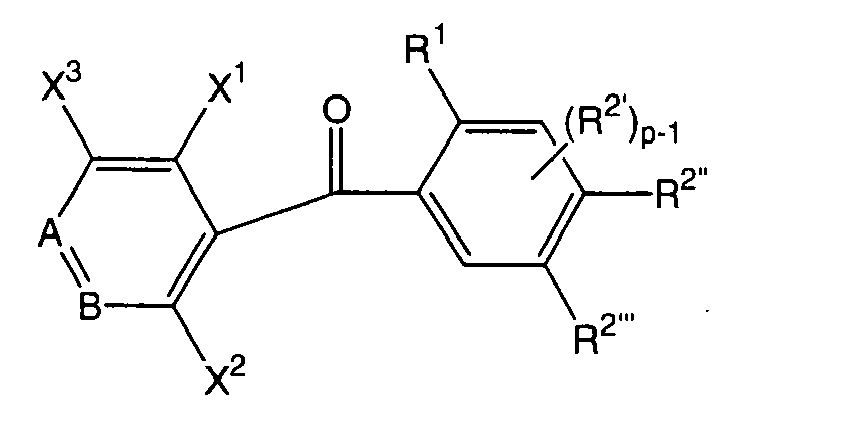
- The compound represented by the above formula (I') may be a compound wherein A is -CH= and B is -N= i.e. a compound represented by the formula (I'-1):


- Among compounds represented by the above formula (I'-1), it is preferred to use at least one compound selected from the group consisting of 3-(2,3,4-trimethoxy-6-methylbenzoyl)-4-bromo-5-chloro-2-methoxypyridine (Compound No. 1), 3-(2,3,4-trimethoxy-6-methylbenzoyl)-5-chloro-4-ethyl-2-methoxypyridine (Compound No. 2), 3-(4,5-dimethoxy-2-methylbenzoyl)-4,5-dichloro-2-methoxypyridine (Compound No. 3), 3-(5-ethoxy-4-methoxy-2-methylbenzoyl)-4,5-dichloro-2-methoxypyridine (Compound No. 4), 3-(2,3,4-trimethoxy-6-methylbenzoyl)-4-bromo-5-chloro-2-ethoxypyridine (Compound No. 5), 3-(2,3,4-trimethoxy-6-methylbenzoyl)-5-chloro-2-ethoxy-4-methylpyridine (Compound No. 6), 3-(2,3,4-trimethoxy-6-methylbenzoyl)-5-bromo-4-chloro-2-ethoxypyridine (Compound No. 7), 3-(2,3,4-trimethoxy-6-methylbenzoyl)-4-chloro-5-iodo-2-methoxypyridine (Compound No. 8), 3-(2,3,4-trimethoxy-6-methylbenzoyl)-5-iodo-2,4-dimethoxypyridine (Compound No. 9), 3-(2,3,4-trimethoxy-6-methylbenzoyl)-5-chloro-2-methoxy-4-methylthiopyridine (Compound No. 10), 3-(2,3,4-trimethoxy-6-methylbenzoyl)-5-chloro-2,4-dimethoxypyridine (Compound No. 11), 3-(2,3,4-trimethoxy-6-methylbenzoyl)-4,5-dibromo-2-methoxypyridine (Compound No. 12), 3-(2,3,4-trimethoxy-6-methylbenzoyl)-4-bromo-2-methoxy-5-methylpyridine (Compound No. 13), 3-(2,3,4-trimethoxy-6-methylbenzoyl)-5-bromo-4-trifluoromethyl-2-methoxypyridine (Compound No. 14), 3-(2,3,4-trimethoxy-6-methylbenzoyl)-4,5-dichloro-2-methoxypyridine (Compound No. 15), 3-(2,3,4-trimethoxy-6-methylbenzoyl)-2,4-dichloro-5-methylpyridine (Compound No. 16), 3-(2,3,4-trimethoxy-6-methylbenzoyl)-2,4-dichloro-5-iodopyridine (Compound No. 17), 3-(2,3,4-trimethoxy-6-methylbenzoyl)-2-fluoro-4-iodo-5-methylpyridine (Compound No. 18), 3-(2,3,4-trimethoxy-6-methylbenzoyl)-2-fluoro-4,5-dimethylpyridine (Compound No. 19), 3-(2,3,4-trimethoxy-6-methylbenzoyl)-2-methoxy-4,5-dimethylpyridine (Compounds No. 20), 3-(2-ethoxy-3,4-dimethoxy-6-methylbenzoyl)-2-ethoxy-4,5-dimethylpyridine (Compound No. 21), 3-(2,3,4-trimethoxy-6-methylbenzoyl)-4,5-dimethyl-2-methylthiopyridine (Compound No. 22), 3-(2,3,4-trimethoxy-6-methylbenzoyl)-5-bromo-4-chloro-2-methoxypyridine (Compound No. 23), 3-(2,3,4-trimethoxy-6-methylbenzoyl)-4-chloro-2-methoxy-5-methylpyridine (Compound No. 24), 3-(2,3,4-trimethoxy-6-methylbenzoyl)-2-chloro-5-trifluoromethyl-4-methylpyridine (Compound No. 25), 3-(2,3,4-trimethoxy-6-methylbenzoyl)-5-trifluoromethyl-2-methoxy-4-methylpyridine (Compound No. 26), 3-(2,3,4-trimethoxy-6-methylbenzoyl)-2,4-dichloro-5-trifluoromethylpyridine (Compound No. 27), 3-(2,3,4-trimethoxy-6-methylbenzoyl)-4-chloro-5-trifluoromethyl-2-methoxypyridine (Compound No. 28), 3-(2,3,4-trimethoxy-6-methylbenzoyl)-5-chloro-4-ethynyl-2-methoxypyridine (Compound No. 29), 3-(2,3,4-trimethoxy-6-methylbenzoyl)-5-chloro-4-fluoromethyl-2-methoxypyridine (Compound No. 30), 3-(2,3,4-trimethoxy-6-methylbenzoyl)-5-bromo-4-fluoromethyl-2-methoxypyridine (Compound No. 31), 3-(2,3,4-trimethoxy-6-methylbenzoyl)-4-fluoromethyl-2-methoxy-5-methylpyridine (Compound No. 32), 3-(2,3,4-trimethoxy-6-methylbenzoyl)-5-chloro-4-difluoromethyl-2-methoxypyridine (Compound No. 33), 3-(2,3,4-trimethoxy-6-methylbenzoyl)-5-ethyl-4-trifluoromethyl-2-methoxypyridine (Compound No. 34), 3-(2,3,4-trimethoxy-6-methylbenzoyl)-5-chloro-2-methoxy-4-methylpyridine (Compound No. 35), 3-(2,3,4-trimethoxy-6-methylbenzoyl)-5-bromo-2-methoxy-4-methylpyridine (Compound No. 36), 3-(2,3,4-trimethoxy-6-methylbenzoyl)-4-trifluoromethyl-2-methoxy-5-methylpyridine (Compound No. 37) and 3-(4,5-dimethoxy-2-methylbenzoyl)-5-chloro-2-methoxy-4-methylpyridine (Compound No. 38).
- Among compounds represented by the above formula (I'-2), it is preferred to use at least one compound selected from the group consisting of 4-(2,3,4-trimethoxy-6-methylbenzoyl)-2,5-dichloro-3-trifluoromethylpyridine (Compound No. 39), 4-(2,3,4-trimethoxy-6-methylbenzoyl)-2-chloro-3-trifluoromethyl-5-methoxypyridine (Compound No. 40), 4-(2,3,4-trimethoxy-6-methylbenzoyl)-2-bromo-3-trifluoromethyl-5-methoxypyridine (Compound No. 41), 4-(2,3,4-trimethoxy-6-methylbenzoyl)-2,3,5-trichloropyridine (Compound No. 42), 4-(2,3,4-trimethoxy-6-methylbenzoyl)-3,5-dichloropyridine (Compound No. 43), 4-(2,3,4-trimethoxy-6-methylbenzoyl)-3-chloro-5-methoxypyridine (Compound No. 44), 4-(2,3,4-trimethoxy-6-methylbenzoyl)-2-bromo-3-chloro-5-methoxypyridine (Compound No. 45) and 4-(2,3,4-trimethoxy-6-methylbenzoyl)-3-bromo-5-methylpyridine
- The fungicidal composition of the present invention is useful particularly as an agricultural and horticultural fungicide. As the agricultural and horticultural fungicide, it is effective for controlling diseases such as blast, brown spot or sheath blight of rice (Oryza sativa, etc.); powdery mildew, scab, rust, snow mold, snow blight, loose smut, eye spot, leaf spot or glume blotch of cereals (Hordeum vulgare, Tricum aestivum, etc.); melanose or scab of citrus (Citrus spp., etc.); blossom blight, powdery mildew, Alternaria leaf spot or scab of apple (Malus pumila); scab or black spot of pear (Pyrus serotina, Pyrus ussuriensis, Pyrus communis); brown rot, scab or Phomopsis rot of peach (Prunus persica, etc.); anthracnose, ripe rot, powdery mildew or downy mildew of grape (Vitis vinifera spp., etc.); anthracnose or brown stem rot of Japanese persimmon (Diospyros kaki, etc.); anthracnose, powdery mildew, gummy stem blight or downy mildew of cucurbit (Cucumis melo, etc.); early blight, leaf mold or late blight of tomato (Lycopersicon esculentum); various Alternaria disease pathogens of cruciferous vegetables (Brassica sp., Raphanus sp., etc); late blight or early blight of potato (Solanum tuberosum); powdery mildew of strawberry (Fragaria, etc.); and gray mold or disease caused by Sclerotinia of various crops. It is particularly effective against powdery mildew of cereals and vegetables and blast of rice. Further, it is effective also for controlling soil diseases caused by plant pathogens such as Fusarium, Pythium, Rhizoctonia, Verticillium and Plasmodiophora.
- The plurality of the active ingredients constituting the fungicidal composition of the present invention are, in the same manner as conventional agricultural chemicals, mixed with various adjuvants and formulated into various formulations such as a dust, granules, water-dispersible granules, a wettable powder, a water-based suspension concentrate, an oil-based suspension concentrate, water soluble granules, an emulsifiable concentrate, a soluble concentrate, a paste, an aerosol and an ultra low-volume formulation. However, so long as the purpose of the present invention can be accomplished, any type of formulation which is commonly used in this field is applicable. Such adjuvants include solid carriers such as diatomaceous earth, slaked lime, calcium carbonate, talc, white carbon, kaoline, bentonite, a mixture of kaolinite and sericite, clay, sodium carbonate, sodium bicarbonate, mirabilite, zeolite and starch; solvents such as water, toluene, xylene, solvent naphtha, dioxane, acetone, isophorone, methyl isobutyl ketone, chlorobenzene, cyclohexane, dimethyl sulfoxide, dimethylformamide, dimethylacetamide, N-methyl-2-pyrrolidone and alcohol; anionic surfactants and spreaders such as a salt of fatty acid, a benzoate, an alkylsulfosuccinate, a dialkylsulfosuccinate, a polycarboxylate, a salt of alkylsulfuric acid ester, an alkyl sulfate, an alkylaryl sulfate, an alkyl diglycol ether sulfate, a salt of alcohol sulfuric acid ester, an alkyl sulfonate, an alkylaryl sulfonate, an aryl sulfonate, a lignin sulfonate, an alkyldiphenyl ether disulfonate, a polystyrene sulfonate, a salt of alkylphosphoric acid ester, an alkylaryl phosphate, a styrylaryl phosphate, a salt of polyoxyethylene alkyl ether sulfuric acid ester, a polyoxyethylene alkylaryl ether sulfate, a salt of polyoxyethylene alkylaryl ether sulfuric acid ester, a polyoxyethylene alkyl ether phosphate, a salt of polyoxyethylene alkylaryl phosphoric acid ester, and a salt of a condensate of naphthalene sulfonate with formalin; nonionic surfactants and spreaders such as a sorbitan fatty acid ester, a glycerin fatty acid ester, a fatty acid polyglyceride, a fatty acid alcohol polyglycol ether, acetylene glycol, acetylene alcohol, an oxyalkylene block polymer, a polyoxyethylene alkyl ether, a polyoxyethylene alkylaryl ether, a polyoxyethylene styrylaryl ether, a polyoxyethylene glycol alkyl ether, a polyoxyethylene fatty acid ester, a polyoxyethylene sorbitan fatty acid ester, a polyoxyethylene glycerin fatty acid ester, a polyoxyethylene hydrogenated castor oil, and a polyoxypropylene fatty acid ester; and vegetable and mineral oils such as olive oil, kapok oil, castor oil, palm oil, camellia oil, coconut oil, sesame oil, corn oil, rice bran oil, peanut oil, cottonseed oil, soybean oil, rapeseed oil, linseed oil, tung oil, and liquid paraffins. Such adjuvants may be selected from known components so long as the purpose of the present invention can thereby be accomplished. Further, various additives which are commonly used, such as a filler, a thickener, an anti-settling agent, an anti-freezing agent, a dispersion stabilizer, a phytotoxicity reducing agent, and an anti-mold agent, may also be employed. The blend ratio of the active ingredient components to the various adjuvants is usually from 0.005:99.995 to 95:5, preferably from 0.2:99.8 to 90:10. In the actual application of such a formulation, it may be used as it is, or may be diluted to a predetermined concentration with a diluent such as water, and various spreaders may be added thereto, as the case requires.
- A method for controlling plant diseases, which comprises applying the fungicidal composition of the present invention to agricultural and horticultural plants, is also included in the present invention. The concentration of the fungicidal composition of the present invention can not generally be defined, as it varies depending upon the crop plants to be treated, the application method, the type of the formulation, the dose, etc. However, it is applied in a concentration of the active ingredients being usually from 0.1 to 10,000 ppm, preferably from 1 to 2,000 ppm in the case of foliage treatment, and usually from 10 to 100,000 g/ha, preferably from 200 to 20,000 g/ha in the case of soil treatment.
- The formulation containing the fungicidal composition of the present invention or a diluted product thereof may be applied by an application method which is commonly used, such as spreading (spreading, spraying, misting, atomizing, grain diffusing or application on water surface), soil application (such as mixing or irrigation) or surface application (such as coating, dust coating or covering). Further, it may be applied also by so-called ultra low volume. In this method, the formulation may contain 100% of the active ingredient.
- In the fungicidal composition of the present invention, the appropriate mixing weight ratio of the benzoylpyridine derivative represented by the formula (I) or its salt to another fungicide is usually from 1:10,000 to 10,000:1, preferably from 1:1,000 to 1,000:1, more preferably from 1:200 to 200:1.
- Now, the present invention will be described in further detail with reference to Examples. However, it should be understood that the present invention is by no means restricted thereto.
-
- (a) 222 ml of n-butyllithium (1.57 mo/l hexane solution) was dropwise added at -20°C to a solution having 34.2 g (340 mmol) of diisopropylamine dissolved in 400 ml of tetrahydrofuran, followed by stirring for 1 hour. The solution was cooled to -78°C, and a solution having 32.0 g (330 mmol) of 2-fluoropyridine dissolved in 50 ml of tetrahydrofuran was added, followed by stirring for 4 hours to prepare 2-fluoro-3-pyridyllithium. Then, to this solution, a solution having 87.1 g (341 mmol) of iodine dissolved in 150 ml of tetrahydrofuran was added, followed by stirring for 1 hour. 200 ml of water was added to the mixture to terminate the reaction, and tetrahydrofuran was distilled off under reduced pressure. After extraction with ethyl ether, the organic layer was dried over sodium sulfate and subjected to filtration, and the solvent was distilled off under reduced pressure to obtain 67.4 g (crude yield: 92%) of crude 2-fluoro-3-iodopyridine.
1H-NMR(CDCl3, 400 MHz) : δ (ppm) = 6.91-6.88(m,1H), 8.08-8.12(m,2H) - (b) 189 ml of n-butyllithium (1.57 mol/l hexane solution) was dropwise added at -20°C to a solution having 30.2 g (302 mmol) of diisopropylamine dissolved in 380 ml of tetrahydrofuran, followed by stirring for 1 hour. The solution was cooled to -78°C, and a solution having 67.4 g (302 mmol) of crude 2-fluoro-3-iodopyridine obtained in Step (a) dissolved in 100 ml of tetrahydrofuran was added, followed by stirring for 1 hour, so that 2-fluoro-3-iodo-4-pyridyllithium formed at the initial stage was isomerized to 2-fluoro-4-iodo-3-pyridyllithium. 300 ml of water was added to the reaction mixture to terminate the reaction, and tetrahydrofuran was distilled off under reduced pressure. After extraction with ethyl ether, the organic layer was dried over sodium sulfate and subjected to filtration, and the solvent was distilled off under reduced pressure to obtain 59.3 g (crude yield: 89%) of crude 2-fluoro-4-iodopyridine.
1H-NMR(CDCl3, 400 MHz) : δ (ppm) = 7.33(d,1H, J = 2.8 Hz), 7.51(d,1H, J = 5.2 Hz), 7.88(dd,1H, J=5.2 Hz, 2.8 Hz) - (c) 500 ml of methanol was added to 59.4 g (253 mmol) of crude 2-fluoro-4-iodopyridine obtained in Step (b) so that it was dissolved in methanol, and 21.5 g (398 mmol) of sodium methoxide was added, followed by reflux with heating for 3 hours. 300 ml of water was added to terminate the reaction, and methanol was distilled off under reduced pressure. After extraction with ethyl ether, the organic layer was dried over sodium sulfate and subjected to filtration, and the solvent was distilled off under reduced pressure to obtain 56.7 g (crude yield: 91%) of crude 4-iodo-2-methoxypyridine. 1H-NMR(CDCl3, 400 MHz) : δ (ppm) = 3.86(s,3H), 7.12-7.16(m,2H), 7.79(d,1H, J = 5.6 Hz)
- (d) 50.6 ml (2 mol/l tetrahydrofuran solution) of isopropylmagnesium chloride was cooled with ice, and a solution having 19.8 g (84.3 mmol) of crude 4-iodo-2-methoxypyridine obtained in Step (c) dissolved in 80 ml of tetrahydrofuran was added, followed by stirring at 0°C for 1 hour and then at room temperature for 1 hour to prepare 2-methoxy-4-pyridylmagnesium chloride. Then, 16.9 g (127 mmol) of N-chlorosuccinimide was gradually added, followed by stirring at room temperature for 1 hour. 100 ml of water was added to terminate the reaction, and tetrahydrofuran was distilled off under reduced pressure. After extraction with ethyl ether, the organic layer was dried over sodium sulfate and subjected to filtration, and the solvent was distilled off under reduced pressure to obtain 11.0 g (crude yield: 91%) of crude 4-chloro-2-methoxypyridine.
1H-NMR(CDCl3, 400 MHz) : δ (ppm) = 3.91(s, 3H), 6.70(d, 1H, J = 2.0 Hz), 6.81(dd, 1H, J = 6.0 Hz, 2.0 Hz), 7.99(d,1H, J = 6.0 Hz) - (e) 10.0 g (69.9 mmol) of crude 4-chloro-2-methoxypyridine obtained in Step (d) was dissolved in 100 ml of dimethylformamide, and 37.2 g (279 mmol) of N-chlorosuccinimide was added, followed by stirring at room temperature for 12 hours. 400 ml of water was added to terminate the reaction, followed by extraction with ethyl ether. The organic layer was washed with a saturated sodium chloride solution, dried over sodium sulfate and subjected to filtration, and the solvent was distilled off under reduced pressure to obtain 9.10 g (crude yield: 73%) of crude 4,5-dichloro-2-methoxypyridine.
1H-NMR(CDCl3, 400 MHz) : δ (ppm) = 3.90(s, 3H), 6.85(s, 1H), 8.14(s, 1H) - (f) 15.1 ml of n-butyllithium (1.57 mol/l hexane solution) was dropwise added at -20°C to a solution having 2.40 g (23.7 mmol) of diisopropylamine dissolved in 30 ml of tetrahydrofuran, followed by stirring for 1 hour. The solution was cooled to -78°C, and a solution having 4.22 g (23.6 mmol) of 4,5-dichloro-2-methoxypyridine obtained in Step (e) dissolved in 20 ml of tetrahydrofuran was added, followed by stirring for 2 hours to prepare 4,5-dichloro-2-methoxy-3-pyridyllithium. Then, to this solution, a solution having 5.00 g (23.8 mmol) of 2,3,4-trimethoxy-6-methylbenzaldehyde dissolved in 20 ml of tetrahydrofuran was added, followed by stirring for 30 minutes. 50 ml of water was added to the mixture to terminate the reaction, and tetrahydrofuran was distilled off under reduced pressure. After extraction with ethyl ether, the organic layer was dried over sodium sulfate and subjected to filtration, and the solvent was distilled off under reduced pressure, followed by purification by silica gel column chromatography to obtain 4.66 g (yield: 51%) of (2,3,4-trimethoxy-6-methylphenyl)(4,5-dichloro-2-methoxy-3-pyridyl)methanol.
1H-NMR(CDCl3, 400 MHz) : δ (ppm) = 2.32(s, 3H), 3.52(s, 3H), 3.77(s, 3H), 3.82(s, 3H), 4.11(s, 3H), 5.32(d, 1H, J=10.0 Hz), 6.21(d, 1H, J=10.0 Hz), 6,55(s, 1H), 8.07(s, 1H) - (g) 13.8 g (159 mmol) of manganese dioxide was added to a solution having 4.66 g (12.0 mmol) of (2,3,4-trimethoxy-6-methylphenyl)(4,5-dichloro-2-methoxy-3-pyridyl)methanol obtained in Step (f) dissolved in 30 ml of toluene, followed by reflux with heating for 2 hours. After cooling to room temperature, manganese dioxide was removed by filtration on the pad of celite, and toluene was distilled off under reduced pressure, followed by purification by silica gel column chromatography to obtain 2.98 g (yield : 65%) of 3-(2,3,4-trimethoxy-6-methylbenzoyl)-4,5-dichloro-2-methoxypyridine.
1H-NMR(CDCl3, 400 MHz) : δ (ppm) = 2.46(s,3H), 3.45(s,3H), 3.74(s,3H), 3.90(s,3H), 4.00(s,3H), 6.55(s,1H), 8.13(s,1H) -
- (a) 26.5 ml of n-butyllithium (1.57 mol/l hexane solution) was dropwise added at -78°C to a solution having 4.02 g (39.8 mmol) of diisopropylamine dissolved in 70 ml of tetrahydrofuran, followed by stirring for 30 minutes. To this solution, a solution having 4.42 g (39.8 mmol) of 2-fluoro-5-methylpyridine dissolved in 18 ml of tetrahydrofuran was added, followed by stirring for 4 hours to prepare 2-fluoro-5-methyl-3-pyridyllithium. Then, to this solution, a solution having 10.1 g (39.8 mmol) of iodine dissolved in 27 ml of tetrahydrofuran was added, followed by stirring for 2 hours. 16 ml of water and 120 ml of a sodium thiosulfate aqueous solution were charged, followed by extraction with ethyl ether. The organic layer was dried over magnesium sulfate and subjected to filtration, the solvent was distilled off under reduced pressure, and the obtained crude product was purified by silica gel chromatography to obtain 3.15 g (yield: 33%) of 2-fluoro-3-iodo-5-methylpyridine.
1H-NMR(CDCl3, 400 MHz) : δ (ppm) = 2.27(s, 3H), 7.95(m, 2H) - (b) 8.90 ml (1.57 mol/l hexane solution) was dropwise added at -78°C to a solution having 1.34 g (13.3 mmol) of diisopropylamine dissolved in 27 ml of tetrahydrofuran, followed by stirring for 30 minutes. To this solution, a solution having 3.15 g (13.3 mmol) of 2-fluoro-3-iodo-5-methylpyridine obtained in Step (a) dissolved in 5 ml of tetrahydrofuran was added, followed by stirring for 1 hour, so that 2-fluoro-3-iodo-5-methyl-4-pyridyllithium formed at the initial stage was isomerized to 2-fluoro-4-iodo-5-methyl-3-pyridyllithium. To the reaction mixture, a solution having 2.79 g (13.3 mmol) of 2,3,4-trimethoxy-6-methylbenzaldehyde dissolved in 5 ml of tetrahydrofuran was added, followed by stirring for 2 hours. After the temperature was increased to room temperature, 50 ml of water was added, followed by extraction with ethyl ether. The organic layer was dried over magnesium sulfate and subjected to filtration, the solvent was distilled off under reduced pressure, and the obtained crude product was purified by silica gel chromatography to obtain 4.45 g (yield: 75%) of (2,3,4-trimethoxy-6-methylphenyl)(2-fluoro-4-iodo-5-methyl-3-pyridyl)methanol.
1H-NMR(CDCl3, 400 MHz) : δ(ppm) = 2.21(s, 3H), 2.42(s, 3H), 3.72(s, 3H), 3.79(s, 3H), 3.81(s, 3H), 4.97(d, 1H, J = 10.0 Hz), 6.08(d, 1H, J = 10.0 Hz), .46(s, H), .86(s, H) - (c) 17.3 g (0.18 mol) of manganese dioxide was added to a solution having 4.35 g (9.70 mmol) of (2,3,4-trimethoxy-6-methylphenyl)(2-fluoro-4-iodo-5-methyl-3-pyridyl)methanol obtained in Step (b) dissolved in 130 ml of toluene, followed by reflux with heating for 2 hours. After cooling to room temperature, manganese dioxide was removed by filtration on the pad of celite, and toluene was distilled off under reduced pressure, followed by purification by silica gel chromatography to obtain 2.80 g (yield: 65%) of 3-(2,3,4-trimethoxy-6-methylbenzoyl)-2-fluoro-4-iodo-5-methylpyridine (Compound No. 18, melting point 140 to 141°C).
1H-NMR(CDCl3, 00 MHz) : δ (ppm) = 2.41(s, H), .50(s, H), 3.42(s, 3H), 3.90(s, 3H), 3.74(s, 3H), 6.57(s, 1H), 7.94(s, 1H) - (d) 1.50 g (3.37 mmol) of 3-(2,3,4-trimethoxy-6-methylbenzoyl)-2-fluoro-4-iodo-5-methylpyridine obtained in Step (c), 1.40 g (10.1 mmol) of potassium carbonate, 0.39 g (0.34 mmol) of tetrakis(triphenylphosphine)palladium, 15 ml of dioxane and 0.42 g (1.67 mmol) of 50% trimethylboroxin were mixed, followed by reflux with heating for 6 hours. After cooling to room temperature, filtration on the pad of celite and washing with ethyl acetate and tetrahydrofuran were carried out, the solvent was distilled off under reduced pressure, and the obtained crude product was purified by silica gel chromatography to obtain 0.79 g (yield: 70%) of 3-(2,3,4-trimethoxy-6-methylbenzoyl)-2-fluoro-4,5-dimethylpyridine (Compound No. 19).
1H-NMR(CDCl3, 00 MHz) : δ (ppm) = 2.28(s, 3H), 2.32(s, 3H), 2.42(s, 3H), 3.35(s, 3H), 3.74(s, 3H), 3.90(s, 3H), 6.57(s, 1H), 7.94(s, 1H) - (e) A solution having 0.06 g (1.5 mmol) of 60% sodium hydride dissolved in 1 ml of methanol, was dropwise added to a solution having 0.20 g (0.60 mmol) of 3-(2,3,4-trimethoxy-6-methylbenzoyl)-2-fluoro-4,5-dimethylpyridine obtained in Step (d) dissolved in 2.5 ml of methanol, followed by reflux with heating for 16 hours. After cooling to room temperature, 5 ml of water was added, and diluted hydrochloric acid was added to bring the solution weakly acidic. After extraction with ethyl ether, washing with a sodium chloride solution was carried out, and the organic layer was dried over magnesium sulfate and subjected to filtration, the solvent was distilled off under reduced pressure, and the obtained crude product was purified by silica gel chromatography to obtain 89.0 mg (yield: 43%) of 3-(2,3,4-trimethoxy-6-methylbenzoyl)-2-methoxy-4,5-dimethylpyridine.
1H-NMR(CDCl3, 400 MHz) : δ (ppm) = 2.19(s, 3H), 2.21(s, 3H), 2.39(s, 3H), 3.24(s, 3H), 3.70(s, 3H), 3.74(s, 3H), 3.87(s, 3H), 6.53(s, 1H), 7.87(s, 1H) -
- (a) 5.76 g (40.1 mmol) of 4-chloro-2-methoxypyridine was dissolved in 20 ml of dimethylformamide, and a dimethylformamide (20 ml) solution of 8.01 g of N-bromosuccinimide (98%, 44.1 mmol) was dropwise added over a period of 30 minutes. After stirring at room temperature for 2 days, an unreacted material was confirmed, and thus 2.85 g of N-bromosuccinimide (98%, 16 mmol) was further added, followed by stirring at room temperature further for 3 days. The reaction mixture was poured into 250 ml of water, followed by extraction with ethyl ether (100 ml each) three times. The organic layer was washed with water (100 ml), a sodium thiosulfate aqueous solution (100 ml) and then a saturated sodium chloride solution (100 ml), dried over magnesium sulfate and subjected to filtration, and the solvent was distilled off under reduced pressure. The obtained crude product was purified by silica gel chromatography to obtain 7.10 g (yield: 80%) of 5-bromo-4-chloro-2-methoxypyridine.
1H-NMR(CDCl3, 400MHz): δ (ppm) =3.91 (s, 3H), 6. 89 (s,1H), 8.28(s,1H) - (b) 18.3 ml of n-butyllithium (1.57 mol/l hexane solution, 27 mmol) was dropwise added at 0°C to a solution having 3.84 g (27 mmol) of 2,2,6,6-tetramethylpiperidine dissolved in 36 ml of tetrahydrofuran under an argon stream, followed by stirring at 0°C for 30 minutes. The obtained solution was cooled to -78°C, and a solution having 6.10 g (27 mmol) of 5-bromo-4-chloro-2-methoxypyridine dissolved in 24 ml of tetrahydrofuran was added, followed by stirring at the same temperature for 2 hours to prepare 5-bromo-4-chloro-2-methoxy-3-pyridyllithium. Then, a solution having 5.50 g (26 mmol) of 2,3,4-trimethoxy-6-methylbenzaldehyde dissolved in 24 ml of tetrahydrofuran was added, followed by stirring at the same temperature for 1 hour. To the reaction mixture, 37 ml of a saturated ammonium chloride aqueous solution and then 150 ml of water were added, and the temperature was increased to room temperature, followed by extraction with ethyl acetate (150 ml each) three times. The organic layer was washed with a saturated sodium chloride solution (100 ml), dried over magnesium sulfate and subjected to filtration, and the solvent was distilled off under reduced pressure. The obtained crude product was purified by silica gel chromatography to obtain 6.53 g (yield: 56%) of (2,3,4-trimethoxy-6-methylphenyl)(5-bromo-4-chloro-2-methoxy-3-pyridyl)methanol.
1H-NMR(CDCl3, 400MHz): δ (ppm) = 2.33 (s,3H), 3.54(s,3H), 3.79(s,3H), 3.84(s,3H), 3.98(s,3H), 5.32(d,1H J=9.6Hz), 6.23(d,1H J=9.6Hz), 6.49(s,1H), 8.21(s,1H) - 4.55 g of manganese dioxide (88%, 46 mmol) was added to a solution having 2.21 g (5.1 mmol) of (2,3,4-trimethoxy-6-methylphenyl)(5-bromo-4-chloro-2-methoxy-3-pyridyl)methanol dissolved in 70 ml of toluene, followed by reflux with heating for 1 hour. 4.55 g of manganese dioxide (88%, 46 mmol) was further added, followed by reflux with heating for 1 hours. The reaction mixture was cooled to room temperature, manganese dioxide was removed by filtration on the pad of celite, and toluene was distilled off under reduced pressure. The obtained crude product was purified by silica gel chromatography to obtain 1.90 g (yield: 87%) of 3-(2,3,4-trimethoxy-6-methylbenzoyl)-5-bromo-4-chloro-2-methoxypyridine (melting point 84 to 87°C).
1H-NMR(CDCl3, 400MHz): δ (ppm)=2.48(s,3H), 3.45(s,3H), 3.75(s,3H), 3.87(s,3H), 3.91(s,3H), 6.57(s,1H), 8.27(s,1H) -
- (a) 9.2 g (69 mmol) of N-chlorosuccinimide was charged to a N,N-dimethylformamide (DMF) 15 ml solution of 8.0 g (65 mmol) of 2-methoxy-4-methylpyridine, followed by stirring for 18 hours. Water was added to the reaction solution, and the aqueous layer was extracted with diethyl ether. The organic layer was washed with a saturated sodium chloride solution, dried over anhydrous sodium sulfate and subjected to filtration, and the solvent was distilled off under reduced pressure. The crude product was purified by silica gel column chromatography to obtain 8.5 g (yield: 82%) of 5-chloro-2-methoxy-4-methylpyridine (melting point 32 to 33°C).
1HNMR(CDCl3, 300 MHz): δ 2.32(s, 3H), 3.89(s, 3H), 6.62(s, 1H), 8.05(s, 1H) - (b) 20.2 g (114 mmol) of N-bromosuccinimide was charged to a N,N-dimethylformamide (DMF) 15 ml solution of 7.2 g (46 mmol) of 5-chloro-2-methoxy-4-methylpyridine, followed by stirring at 50°C for 20 hours. A diluted sodium thiosulfate aqueous solution was added to the reaction solution, and the aqueous layer was extracted with diethyl ether. The organic layer was washed with a saturated sodium chloride solution, dried over anhydrous sodium sulfate and subjected to filtration on the pad of a silica gel cake, and the solvent was distilled off under reduced pressure to obtain 10.6 g (yield: 97%) of 3-bromo-5-chloro-2-methoxy-4-methylpyridine (melting point: 44 to 45°C) .
1HNMR(CDCl3, 300 MHz) : δ 2.51(s, 3H), 3.98(s, 3H), 8.01(s, 1H) - (c) 4 ml of tetrahydrofuran and 0.62 ml (4.4 mmol) of triethylamine were added to 2.2 ml (4.4 mmol) of isopropylmagnesium chloride (2.0 mol/l tetrahydrofuran solution), the mixture was cooled to 0°C, and a solution having 1.0 g (4.2 mmol) of 3-bromo-5-chloro-2-methoxy-4-methylpyridine dissolved in 5 ml of tetrahydrofuran was dropwise added, followed by stirring for 3 hours to prepare 5-chloro-2-methoxy-4-methyl-3-pyridylmagnesium chloride. A solution having 0.89 g (4.2 mmol) of 2,3,4-trimethoxy-6-methylbenzaldehyde dissolved in 5 ml of tetrahydrofuran was dropwise added to the reaction solution, followed by stirring for 1 hour, and then the temperature was increased to room temperature, followed by stirring further for 1 hour. Water was added to the reaction solution to terminate the reaction, followed by extraction with ethyl acetate. The organic layer was washed with a saturated sodium chloride solution, dried over anhydrous magnesium sulfate and subjected to filtration, and the solvent was distilled off under reduced pressure. The crude product was purified by silica gel column chromatography to obtain 1.1 g (yield: 70%) of (2,3,4-trimethoxy-6-methylphenyl)(5-chloro-2-methoxy-4-methyl-3-pyridyl)methanol (pale yellow oily substance).
1HNMR(CDCl3, 300 MHz): δ 2.26(s, 3H), 2.27(s, 3H), 3.54(s, 3H), 3.80(s, 3H), 3.84(s, 3H), 3.94(s, 3H), 5.32(d, 1H, J = 9.0 Hz), 6.12(d, 1H, J = 9.0 Hz), 6.47(s, 1H), 8.02(s, 1H) - (d) 4 g of active manganese dioxide was added to a toluene 15 ml solution of 0.64 g (1.7 mmol) of (2,3,4-trimethoxy-6-methylphenyl)(5-chloro-2-methoxy-4-methyl-3-pyridyl)methanol, followed by stirring under reflux with heating for 1 hour. The reaction solution was subjected to filtration on the pad of celite, and the solvent was distilled off under reduced pressure to obtain 0.57 g (yield: 90%) of 3-(2,3,4-trimethoxy-6-methylbenzoyl)-5-chloro-2-methoxy-4-methylpyridine (melting point 94.5 to 95.5°C).
1HNMR(CDCl3, 00 MHz): δ 2.31(s, 3H), 2.40(s, 3H), 3.30(s, 3H), 3.73(s, 3H), 3.74(s, 3H), 3.88(s, 3H), 6.54(s, 1H), 8.06(s, 1H) -
- (a) A solution having 5.05 g (27.8 mmol) of 2-chloro-4-trifluoromethylpyridine and 3.59 g (66.5 mmol) of sodium methoxide dissolved in 40 ml of methanol was stirred under reflux with heating for 4 hours. Water was added to terminate the reaction, followed by extraction with diethyl ether. The organic layer was dried over anhydrous sodium sulfate and subjected to filtration on the pad of a silica gel cake. The solvent was distilled off under reduced pressure to obtain 4.19 g (yield: 85%) of 4-trifluoromethyl-2-methoxypyridine.
1H-NMR(CDCl3, 400 MHz) : δ (ppm) = 3.96(s, 3H), 6.95(s, 1H), 7.05(d, 1H, J = 5.2 Hz), 8.29(d, 1H, J = 5.2 Hz) - (b) 4.00 ml (78.1 mmol) of bromine was dropwise added to a solution having 8.21 g (46.4 mmol) of 4-trifluoromethyl-2-methoxypyridine obtained in Step (a) and 7.98 g (97.3 mmol) of sodium acetate dissolved in 15 ml of acetic acid, followed by stirring for 4 days. A potassium hydroxide aqueous solution was added to terminate the reaction, followed by extraction with diethyl ether. The organic layer was dried over anhydrous sodium sulfate and subjected to filtration on the pad of a silica gel cake. The solvent was distilled off under reduced pressure to obtain 5.81 g of a mixture of 5-bromo-4-trifluoromethyl-2-methoxypyridine and the starting material 4-trifluoromethyl-2-methoxypyridine (molar ratio 55:45).
1H-NMR(CDCl3, 400 MHz) : δ (ppm) = 3.94(s, 3H), 7.03(s, 1H), 8.37(s, 1H) - (c) 17.1 ml of n-butyllithium (1.57 mol/l hexane solution) was dropwise added at 0°C to a solution having 3.80 ml (27.1 mmol) of diisopropylamine dissolved in 50 ml of tetrahydrofuran, followed by stirring for 30 minutes. The solution was cooled to -78°C, and a solution having 5.81 g of the mixture of 5-bromo-4-trifluoromethyl-2-methoxypyridine and 4-trifluoromethyl-2-methoxypyridine (molar ratio 55:45) obtained in Step (c) dissolved in 10 ml of tetrahydrofuran was added, followed by stirring for 45 minutes to prepare a mixture of 5-bromo-4-trifluoromethyl-2-methoxy-3-pyridyllithium and 4-trifluoromethyl-2-methoxy-3-pyridyllithium. A solution having 5.51 g (26.2 mmol) of 2,3,4-trimethoxy-6-methylbenzaldehyde dissolved in 15 ml of tetrahydrofuran was added, followed by stirring for 1 hour. Water was added to the mixture to terminate the reaction, and tetrahydrofuran was distilled off under reduced pressure. After extraction with ethyl acetate, the organic layer was dried over anhydrous sodium sulfate and subjected to filtration, and the solvent was distilled off under reduced pressure. The crude product was purified by silica gel column chromatography to obtain 5.02 g of (2,3,4-trimethoxy-6-methylphenyl)(5-bromo-4-trifluoromethyl-2-methoxy-3-pyridyl)methanol.
1H-NMR(CDCl3, 400 MHz) : δ (ppm) = 2.35(s, 3H), 3.29(s, 3H), 3.74(s, 3H), 3.82(s, 3H), 3.92(s, 3H), 4.87(d, 1H, J = 10.8 Hz), 6.21(d, 1H, J = 10.8 Hz), 6.51(s, 1H), 8.31(s, 1H) - (d) 20.0 g (230 mmol) of manganese dioxide was added to a solution having 4.80 g (10.3 mmol) of (2,3,4-trimethoxy-6-methylphenyl)(5-bromo-4-trifluoromethyl-2-methoxy-3-pyridyl)methanol obtained in Step (c) dissolved in 110 ml of toluene, followed by stirring under reflux with heating for 1 hour. After cooling to room temperature, the mixture was subjected to filtration on the pad of celite and the solvent was distilled off under reduced pressure. The crude product was purified by silica gel column chromatography to obtain 3.93 g (yield: 82%) of 3-(2,3,4-trimethoxy-6-methylbenzoyl)-5-bromo-4-trifluoromethyl-2-methoxypyridine (Compound No. 31). 1H-NMR(CDCl3, 400 MHz) : δ (ppm) = 2.57(s, 3H), 3.36(s, 3H), 3.75(s, 3H), 3.86(s, 3H), 3.93(s, 3H), 6.59(s, 1H), 8.38(s, 1H)
- (e) 3.80 ml (3.80 mmol) of dimethylzinc (1.0 mol/l hexane solution) was dropwise added at 0°C to a solution having 0.60 g (1.29 mmol) of 3-(2,3,4-trimethoxy-6-methylbenzoyl)-5-bromo-4-trifluoromethyl-2-methoxypyridine obtained in Step (d) and 0.10 g (0.09 mmol) of tetrakis(triphenylphosphine)palladium dissolved in 10 ml of tetrahydrofuran, and the temperature was increased naturally, followed by stirring at room temperature for 8 days. Water was added to terminate the reaction, and tetrahydrofuran was distilled off under reduced pressure. After extraction with ethyl acetate, the organic layer was dried over anhydrous sodium sulfate and subjected to filtration, and the solvent was distilled off under reduced pressure. The crude product was purified by silica gel column chromatography to obtain 0.50 g (yield: 96%) of 3-(2,3,4-trimethoxy-6-methylbenzoyl)-4-trifluoromethyl-2-methoxy-5-methylpyridine.
1H-NMR(CDCl3, 00 MHz) : δ (ppm) = 2.41(s, 3H), 2.56(s, 3H), 3.29(s, 3H), 3.74(s, 3H), 3.83(s, 3H), 3.91(s, 3H), 6.58(s, 1H), 8.05(s, 1H) -
- (a) 17 ml (25 mmol) of n-butyllithium (1.5 mol/l hexane solution) was dropwise added at 0°C to a solution having 3.6 ml (25 mmol) of diisopropylamine dissolved in 60 ml of diethyl ether, followed by stirring for 45 minutes. The solution was cooled to -78°C, and a solution having 6.0 g (24 mmol) of 2,3,6-trichloro-5-trifluoromethylpyridine dissolved in 8 ml of diethyl ether was added, followed by stirring for 25 minutes to prepare 2,3,6-trichloro-5-trifluoromethyl-4-pyridyllithium, and then a solution having 5.0 g (24 mmol) of 2,3,4-trimethoxy-6-methylbenzaldehyde dissolved in 12 ml of toluene was added, followed by stirring for 1 hour. 30 ml of water was added to the mixture to terminate the reaction, and the aqueous layer was extracted with ethyl acetate. Then, the organic layer was dried over anhydrous sodium sulfate and subjected to filtration, and the solvent was distilled off under reduced pressure to obtain (2,3,4-trimethoxy-6-methylphenyl)(2,3,6-trichloro-5-trifluoromethyl-4-pyridyl)methanol (melting point 131 to 135°C).
- (b) 2.7 ml (19 mmol) of triethylamine and 0.9 g of 5% palladium carbon were added to a solution having 2,3,4-trimethoxy-6-methylphenyl)(2,3,6-trichloro-5-trifluoromethyl-4-pyridyl)methanol obtained in Step (a) dissolved in 200 ml of methanol, followed by stirring under a hydrogen atmosphere for 14 hours. The mixture was subjected to filtration, 30 ml of water was added, and methanol was distilled off under reduced pressure. After extraction with ethyl acetate, the organic layer was dried over anhydrous sodium sulfate and subjected to filtration, and the solvent was distilled off under reduced pressure. The crude product was purified by silica gel column chromatography to obtain 2.38 g (yield: 24%) of (2,3,4-trimethoxy-6-methylphenyl)(2,5-dichloro-3-trifluoromethyl-4-pyridyl)methanol (melting point 162 to 165°C).
- (c) 14 g of manganese dioxide was added to a solution having 3.5 g (8.2 mmol) of (2,3,4-trimethoxy-6-methylphenyl)(2,5-dichloro-3-trifluoromethyl-4-pyridyl)methanol obtained in Step (b) dissolved in 100 ml of toluene, followed by stirring under reflux with heating for 6 hours. The mixture was cooled and then subjected to filtration, and toluene was distilled off under reduced pressure. The crude product was purified by silica gel column chromatography to obtain 3.1 g (yield: 89%) of 4-(2,3,4-trimethoxy-6-methylbenzoyl)-2,5-dichloro-3-trifluoromethylpyridine (melting point 106 to 109°C).
-
- (a) 70.0 ml (106 mmol) of n-butyllithium (1.5 mol/l hexane solution) was dropwise added at 0°C to a diethyl ether 120 ml solution of 15.0 ml (107 mmol) of diisopropylamine, followed by stirring for 1 hour. The solution was cooled to -78°C, and a diethyl ether 10 ml solution of 22.1 g (102 mmol) of 2,3-dichloro-5-trifluoromethylpyridine was added, followed by stirring for 30 minutes to prepare 2,3-dichloro-5-trifluoromethyl-4-pyridyllithium, and then a toluene 40 ml solution of 21.0 g (100 mmol) of 2,3,4-trimethoxy-6-methylbenzaldehyde was added, followed by stirring for 2 hours. 30 ml of water was added to the mixture to terminate the reaction, and the aqueous layer was extracted with ethyl acetate. Then, the organic layer was dried over anhydrous sodium sulfate and subjected to filtration, and the solvent was distilled off under reduced pressure. The crude product was purified by silica gel column chromatography to obtain 24.8 g (yield: 58%) of (2,3,4-trimethoxy-6-methylphenyl)(2,3-dichloro-5-trifluoromethyl-4-pyridyl)methanol (melting point 95 to 98°C).
- (b) 2.1 g of 5% palladium carbon was added to a methanol 200 ml solution of 24.8 g (58.1 mmol) of (2,3,4-trimethoxy-6-methylphenyl)(2,3-dichloro-5-trifluoromethyl-4-pyridyl)methanol obtained in Step (a) and 9.50 ml (68.2 mmol) of triethylamine, followed by stirring under hydrogen atmosphere for 4 hours. The mixture was subjected to filtration, 50 ml of water was added, and methanol was distilled off under reduced pressure. The aqueous layer was extracted with ethyl acetate, and the organic layer was dried over anhydrous sodium sulfate and subjected to filtration, and the solvent was distilled off under reduced pressure. The crude product was purified by silica gel column chromatography to obtain 15.9 g (yield: 70%) of (2,3,4-trimethoxy-6-methylphenyl)(3-chloro-5-trifluoromethyl-4-pyridyl)methanol (melting point: 102 to 105°C).
- (c) 45 g of manganese dioxide was added to a toluene 220 ml solution of 15.9 g (40.6 mmol) of (2,3,4-trimethoxy-6-methylphenyl)(3-chloro-5-trifluoromethyl-4-pyridyl)methanol obtained in Step (b), followed by stirring under reflux with heating for 2 hours. The mixture was subjected to filtration, and the solvent was distilled off under reduced pressure to obtain 14.9 g (yield: 94%) of 4-(2,3,4-trimethoxy-6-methylbenzoyl)-3-chloro-5-trifluoromethylpyridine.
- (d) 16.4 g (304 mmol) of sodium methoxide was added to a toluene 150 ml solution of 18.5 g (47.5 mmol) of 4-(2,3,4-trimethoxy-6-methylbenzoyl)-3-chloro-5-trifluoromethylpyridine obtained in Step (c) and 16.6 ml (95.4 mmol) of hexamethylphosphorous triamide, followed by stirring under reflux with heating for 30 minutes. Water was added to terminate the reaction, and the aqueous layer was extracted with ethyl acetate. Then, the organic layer was dried over anhydrous sodium sulfate and subjected to filtration, and the solvent was distilled off under reduced pressure. The crude product was purified by silica gel column chromatography to obtain 11.7 g (yield: 64%) of 4-(2,3,4-trimethoxy-6-methylbenzoyl)-3-methoxy-5-trifluoromethylpyridine (melting point: 103 to 106°C).
- (e) 6.1 g (28 mmol) of m-chloroperbenzoic acid (m-CPBA) was added at 0°C to a chloroform 100 ml solution of 5.6 g (15 mmol) of 4-(2,3,4-trimethoxy-6-methylbenzoyl)-3-methoxy-5-trifluoromethylpyridine (Compound No. 122), followed by stirring at room temperature for 18 hours. The reaction solution was washed with a sodium hydroxide aqueous solution, and the solvent was distilled off under reduced pressure to obtain 5.8 g (yield: 99%) of 4-(2,3,4-trimethoxy-6-methylbenzoyl)-3-methoxy-5-trifluoromethylpyridine-N-oxide (melting point 128 to 134°C).
- (f) 1.8 ml (19 mmol) of phosphorus oxychloride was added at 0°C to 4 ml of toluene and 8 ml of dimethylformamide, followed by stirring for 10 minutes, and then 4.0 g (10 mmol) of 4-(2,3,4-trimethoxy-6-methylbenzoyl)-3-methoxy-5-trifluoromethylpyridine-N-oxide was added, followed by stirring for 20 minutes. After stirring at room temperature for 2 hours, the reaction solution was charged into ice water to terminate the reaction. The aqueous layer was extracted with ethyl acetate, and then the organic layer was dried over anhydrous sodium sulfate and subjected to filtration, and the solvent was distilled off under reduced pressure. The crude product was purified by silica gel column chromatography to obtain 3.57 g (yield: 85%) of 4-(2,3,4-trimethoxy-6-methylbenzoyl)-2-chloro-3-trifluoromethyl-5-methoxypyridine (melting point 117 to 119°C).
-
- (a) 45.6 g (217 mmol) of 2,3,4-trimethoxy-6-methylbenzaldehyde was dissolved in 130 ml of dimethyl sulfoxide, and an aqueous solution (50 ml) of 5.2 g (44 mmol) of sodium dihydrogen phosphate was dropwise added over a period of 20 minutes. Then, an aqueous solution (180 ml) of 28 g (305 mmol) of sodium chlorite was dropwise added over a period of 3 hours, followed by stirring for 2 hours. A saturated sodium hydrogencarbonate aqueous solution was added until no bubbling occurred, followed by stirring for 1 hour. Then, the reaction solution was washed with 50 ml of ethyl acetate twice, and concentrated hydrochloric acid was added to make the aqueous layer acidic, followed by extraction with ethyl acetate. The organic layer was washed with a saturated sodium chloride solution, dried over anhydrous sodium sulfate and subjected to filtration, and the solvent was distilled off under reduced pressure. The obtained crystals were washed with hexane to obtain 45.6 g (yield: 93%) of 2,3,4-trimethoxy-6-methylbenzoic acid (melting point 95 to 97°C).
1HNMR: δ 2.56(s, 3H), 3.86(s, 3H), 3.91(s, 3H), 4.03(s, 3H), 6.60(s, 1H) - (b-1) 6.8 ml (13.6 mmol) of isopropylmagnesium chloride (2M tetrahydrofuran solution) was cooled to 0°C, and a solution having 1.6 g (6.6 mmol) of 3-bromo-5-chloro-2-methoxy-4-methylpyridine dissolved in 5 ml of tetrahydrofuran was dropwise added, followed by stirring at the same temperature for 3 hours to prepare 5-chloro-2-methoxy-4-methyl-3-pyridylmagnesium chloride. The reaction solution was cooled to -78°C, and a solution having 1.2 g (13.3 mmol) of copper(I) cyanide and 1.15 g (27.1 mmol) of lithium chloride dissolved in 15 ml of tetrahydrofuran was dropwise added to prepare a 5-chloro-2-methoxy-4-methyl-3-pyridylcopper reagent. Separately, 3.2 g (14.3 mmol) of 2,3,4-trimethoxy-6-methylbenzoic acid prepared in Step (a) was subjected to reflux with heating in 7 ml of thionyl chloride for 3 hours, and the surplus thionyl chloride was distilled off under reduced pressure to prepare 2,3,4-trimethoxy-6-methylbenzoyl chloride, which was dissolved in 7 ml of tetrahydrofuran. The solution thus prepared was dropwise added at -78°C to the above prepared pyridylcopper reagent, followed by stirring for 1 hour, and the temperature was increased to room temperature, followed by stirring further for 2 hours. Water and ammonia water were added to the reaction solution to terminate the reaction, followed by extraction with ethyl acetate. The organic layer was dried over anhydrous magnesium sulfate and subjected to filtration, and the solvent was distilled off under reduced pressure. The crude product was purified by silica gel column chromatography to obtain 2.6 g (yield: 57%) of 3-(2,3,4-trimethoxy-6-methylbenzoyl)-5-chloro-2-methoxy-4-methylpyridine (melting point 85 to 88°C), and the compound was identified by 1HNMR.
- (b-2) The same reaction as in Step (b-1) was carried out that 11 ml (11.0 mmol) of an isopropylmagnesium chloride 1M tetrahydrofuran solution and 2.5 g (10.6 mmol) of 3-bromo-5-chloro-2-methoxy-4-methylpyridine were used, except that 1.25 g (1.1 mmol) of tetrakistriphenylphosphine palladium was used instead of the tetrahydrofuran solution of copper(I) cyanide and lithium chloride, and that 2,3,4-trimethoxy-6-methylbenzoyl chloride prepared from 2.4 g (10.6 mmol) of 2,3,4-trimethoxy-6-methylbenzoic acid and 5 ml of thionyl chloride was dropwise added at 0°C over a period of 2 hours, followed by stirring at the same temperature for 15 hours to obtain 1.7 g (yield: 43%) of 3-(2,3,4-trimethoxy-6-methylbenzoyl)-5-chloro-2-methoxy-4-methylpyridine, and the compound was identified by 1HNMR.
- (b-3) The same operation as in Step (b-2) was carried out except that 22 ml (22.0 mmol) of an isopropylmagnesium chloride 0.5M tetrahydrofuran solution was used instead of the isopropylmagnesium chloride 1M tetrahydrofuran solution, and 1.14 g (11.5 mmol) of copper chloride was used instead of tetrakistriphenylphosphine palladium to obtain 1.7 g (yield: 43%) of 3-(2,3,4-trimethoxy-6-methylbenzoyl)-5-chloro-2-methoxy-4-methylpyridine, and the compound was identified by 1HNMR.
-
- (a) A solution having 5.0 g (19 mmol) of 2-bromo-3,4,5-trimethoxytoluene dissolved in 50 ml of diethyl ether was cooled to -78°C, and 15 ml (24 mmol) of n-butyllithium (1.6M hexane solution) was dropwise added, followed by stirring for 1.5 hours to form 2,3,4-trimethoxy-6-methyl-2-phenyllithium, and then 4.9 ml (43 mmol) of trimethyl borate was dropwise added, followed by stirring further for 1 hour. Diluted sulfuric acid was added to terminate the reaction, followed by stirring for 30 minutes, and water was further added. The aqueous layer was extracted with ethyl acetate, and the organic layer was washed with a saturated sodium chloride solution, dried over anhydrous magnesium sulfate and subjected to filtration, and the solvent was distilled off under reduced pressure to obtain 3.26 g (yield: 75%) of 2,3,4-trimethoxy-6-methylphenylboronic acid (melting point 99 to 102°C).
1HNMR: δ 2.52(s, 3H), 3.83(s, 3H), 3.88(s, 3H), 3.94(s, 3H), 6.56(s, 1H) - (b) 1.0 g (4.3 mmol) of 3-bromo-5-chloro-2-methoxy-4-methylpyridine, 1.2 g (5.4 mmol) of 2,3,4-trimethoxy-6-methylphenylboronic acid, 1.8 g (13 mmol) of potassium carbonate, 46 mg (0.26 mmol) of palladium chloride, 147 mg (0.52 mmol) of tricyclohexylphosphine and 40 ml of tetrahydrofuran were put in a 200 ml autoclave, and carbon monoxide gas was injected to a pressure of 10 atm, followed by stirring at 120°C for 20 hours. The reaction solution was subjected to filtration on the pad of celite, water was added, and tetrahydrofuran was distilled off under reduced pressure. The aqueous solution was extracted with ethyl acetate, the organic layer was dried over anhydrous magnesium sulfate and subjected to filtration, and the solvent was distilled off under reduced pressure. The crude product was purified by silica gel column chromatography to obtain 0.31 g (yield: 20%) of 3-(2,3,4-trimethoxy-6-methylbenzoyl)-5-chloro-2-methoxy-4-methylpyridine (melting point 92 to 94°C), and the compound was identified by 1HNMR.
-
- (a) Into a 500 ml four-necked flask equipped with a stirrer, a condenser, a thermometer and a nitrogen balloon, 5.4 g (222 mmol) of magnesium and 95 ml of tetrahydrofuran were charged, and 17.3 g (220 mmol) of isopropyl chloride was dropwise added while keeping the temperature in the system at 40°C, followed by stirring overnight. Then, while keeping the temperature in the system at 0°C or below, a tetrahydrofuran 95 ml solution of 47.3 g (200 mmol) of 3-bromo-5-chloro-2-methoxy-4-methylpyridine was dropwise added, followed by stirring for 3 hours, and the reaction solution was dropwise added to dry ice.
The reaction solution was poured into 300 ml of water, the organic layer was separated out, and a hydrochloric acid solution was dropwise added to the aqueous layer to make it acidic, followed by extraction with diethyl ether. The solvent was distilled off under reduced pressure to obtain 26 g (yield: 65%) of 5-chloro-2-methoxy-4-methylnicotinic acid (melting point 127 to 129°C). - (b) Into a 50 ml four-necked flask equipped with a stirred, a condenser, a thermometer and a nitrogen balloon, 1.0 g (4.96 mmol) of 5-chloro-2-methoxy-4-methylnicotinic acid, 0.9 g (4.94 mmol) of 3,4,5-trimethoxytoluene, 20 ml of 1,2-dichloroethane and 7.1 g (50.0 mmol) of phosphorus pentoxide were charged, followed by stirring under reflux for 1 hour.
- The reaction solution was charged into 50 ml of water, and a sodium hydroxide aqueous solution was added to make the reaction solution alkaline, the aqueous layer was separated out, and the solvent was distilled off under reduced pressure. 5 ml of hexane was added to the obtained residue, and the precipitated crystals were subjected to filtration to obtain 0.4 g (yield: 22%) of a desired product.
- Into a 20 ml recovery flask equipped with a reflux condenser, 1.0 g (5.0 mmol) of 5-chloro-2-methoxy-4-methylnicotinic acid, 10 g of 1,2-dichloroethane and 0.62 g (5.0 mmol) of oxalyl chloride were charged, followed by stirring at 25°C for 20 minutes, and the mixture was heated at from 60°C to 65°C for 2 hours. After the reaction mixture was cooled to 25°C, 0.80 g (4.4 mmol) of 3,4,5-trimethoxytoluene and 0.70 g (5.2 mmol) of anhydrous aluminum chloride were added to the reaction mixture, followed by stirring at 25°C for 3 hours.
- Water and ethyl acetate were added to the reaction mixture, followed by extraction and liquid-liquid separation, and then the organic layer was dried over sodium sulfate and the solvent was distilled off under reduced pressure. n-Hexane was added to the precipitated solid, followed by filtration and drying to obtain 0.66 g (yield: 36.1%) of a desired product.
-
- (a) 10 ml of thionyl chloride was added to 6.0 g (26.6 mmol) of 2,3,4-trimethoxy-6-methylbenzoic acid, followed by stirring under reflux with heating for 4 hours, and the surplus thionyl chloride was distilled off under reduced pressure. 20 ml of toluene, 8 ml of acetonitrile and 3.1 g (34.5 mmol) of copper(I) cyanide were added, followed by stirring under reflux with heating for 16 hours. After cooling to room temperature, the reaction solution was subjected to filtration on the pad of celite, and the solvent was distilled off under reduced pressure. The crude product was purified by silica gel column chromatography to obtain 2.8 g (yield: 45%) of 2,3,4-trimethoxy-6-methylbenzoyl cyanide.
1HNMR: δ 2.44(s, 3H), 3.85 (s, 3H), 3. 95 (s, 3H), 4.14 (s, 3H), 6.53 (s, 1H) - (b) A solution having 1.9 g (8.0 mmol) of 2,3,4-trimethoxy-6-methylbenzoyl cyanide dissolved in 20 ml of tetrahydrofuran was cooled to -10°C, and 0.32 g (0.91 mmol) of iron(III) acetylacetonate were added, followed by stirring for 20 minutes. In another reactor, 4 ml of tetrahydrofuran was added to 4.1 ml (8.2 mmol) of an isopropylmagnesium chloride 2M tetrahydrofuran solution and the mixture was cooled to 0°C, and a solution having 1.0 g (4.2 mmol) of 3-bromo-5-chloro-2-methoxy-4-methylpyridine dissolved in 5 ml of tetrahydrofuran was dropwise added, followed by stirring for 3 hours to form 5-chloro-2-methoxy-4-methyl-3-pyridylmagnesium chloride. The pyridylmagnesium chloride solution thus prepared was dropwise added to the above prepared 2,3,4-trimethoxy-6-methylbenzoyl cyanide/iron mixed solution, followed by stirring for 3 hours. A 10% ammonium chloride aqueous solution was added to the reaction solution to terminate the reaction, followed by extraction with ethyl acetate. The organic layer was washed with a saturated sodium chloride solution, dried over anhydrous magnesium sulfate and subjected to filtration, and the solvent was distilled off under reduced pressure. The crude product was purified by silica gel column chromatography to obtain 1.7 g (yield: 58%) of a desired product.
-
- (a) Into a 2L four-necked flask equipped a stirrer, a thermometer and a gas introduction tube (inlet), 324 g (3.00 mol) of 2-amino-4-methylpyridine and 485 g of methanol were charged and mixed for dissolution, and while keeping the temperature in the system at from 10 to 30°C, 361.4 g (9.90 mol) of hydrogen chloride gas was introduced over a period of one and a half hours.
- Then, in a 2L four-necked flask equipped with a stirrer, a thermometer, a dropping funnel and an introduction tube (outlet) equipped with a bubble counter having a gas generation apparatus and a diazotization apparatus connected, 414 g (6.00 mol) of sodium nitrite, 211 g (6.60 mol) of methanol and 454 g of water were mixed, and 812.4 g (3.15 mol) of a 38% sulfuric acid aqueous solution was dropwise added over a period of 5 hours while keeping the temperature in the system at from 20 to 30°C.
- In the methyl nitrite generation apparatus, simultaneously with dropwise addition of the 38% sulfuric acid aqueous solution, methyl nitrite gas in an equivalent amount was generated and introduced to the diazotization apparatus through the bubble counter.
- Further, for diazotization, the reaction apparatus was cooled with water so that the temperature in the system would be kept at from 20 to 30°C.
- After completion of the introduction of the methyl nitrite gas, stirring was carried out at the same temperature for 13 hours and the reaction was completed.
- After methanol was distilled off under reduced pressure, 648 g of water was charged, and 518 g of a 40% sodium hydroxide aqueous solution was dropwise added at 30°C or below to adjust the pH in the system to 12.
- The formed oil was extracted with 910 g of diethyl ether, the aqueous layer was separated out, and the solvent was distilled off under reduced pressure to obtain 375.3 g of an oil. The oil (crude product) had a composition comprising 70.7% (yield: 69.5%) of 2-chloro-4-methylpyridine, 26.6% (yield: 27.2%) of 2-methoxy-4-methylpyridine and 2.6% of 2-amino-4-methylpyridine.
- (b) Into a 2L four-necked flask equipped with a stirrer, a thermometer, a condenser and a dropping funnel, 356 g of methanol was charged, and 237.6 g (4.4 mol) of sodium methoxide was charged with stirring while keeping the temperature at 50°C or below. Then, while keeping the temperature in the system at from 60 to 70°C, 375.3 g of crude 2-chloro-4-methylpyridine (70.7%, 2.2 mol) obtained in the above Step was dropwise added over a period of 3 hours.
- After completion of the dropwise addition, reflux with heating was carried out for 3 hours while distilling methanol off (the amount of methanol distilled off over 3 hours was 120 g).
- After completion of the reaction, methanol remaining in the system was distilled off under reduced pressure, and 750 g of water was charged, so that the inorganic salt was dissolved.
- The formed oil was extracted with 1,050 g of diethyl ether, the aqueous layer was separated out, and the solvent was distilled off under reduced pressure to obtain 370 g of an oil (crude product). The purity of the obtained 2-methoxy-4-methylpyridine was 95% (two step yield from 2-amino-4-methylpyridine: 95%).
- Preparation of 5-chloro-4-methyl-2-methoxy-nicotinic acid (a) Preparation of a mixture of 4,4-dicyano-3-methyl-3-butenal-dimethylacetal and 1,1-dicyano-4-methoxy-2-methyl-1,3-butadiene
- 2.28 g (37 mmol) of acetic acid was added to a toluene 100 ml solution of 3.15 g (37 mmol) of piperidine, followed by stirring at room temperature for 1 hour, and a toluene 20 ml solution of 49.3 g (373 mmol) of acetylacetaldehyde dimethyl acetal was added. Further, a toluene 30 ml solution of 24.65 g (373 mmol) of malononitrile was slowly added over a period of 20 minutes, followed by stirring at room temperature for 5 days. The reaction mixture was washed with 50 ml of water and dried over magnesium sulfate, and the solvent was distilled off under reduced pressure to obtain 69.35 g of a mixture of 4,4-dicyano-3-methyl-3-butenoldimethylacetal and 1,1-dicyano-4-methoxy-2-methyl-1,3-butadiene.
- (a) 69.35 g of the mixture of 4,4-dicyano-3-methyl-3-butenal-dimethylacetal and 1,1-dicyano-4-methoxy-2-methyl-1,3-butadiene obtained in Step (a) was slowly added to 113 g of concentrated sulfuric acid over a period of 3 hours so that the temperature would not exceed 30°C. After stirring at room temperature for 20 minutes, the temperature was increased to 50°C, and stirring was carried out at the same temperature for 2 hours. After the reaction mixture was left to stand to cool, it was slowly poured into water ice (500 ml), the obtained crystals were collected by filtration and the crystals were washed with 100 ml of water. The crystals were air-dried for 1 week and further dried at 70°C under reduced pressure for 8 hours to obtain 34.2 g (two step yield: 68%) of crude crystals of 3-cyano-4-methylpyridone. 1H-NMR(400MHz, DMSO-d6): δ (ppm) 2.35(s,3H), 6.29(d,J=6.4Hz,1H), 7.64(d,J=6.4Hz,1H)
- 14 g (104 mmol) of 3-cyano-4-methylpyridone was slowly added to a mixture of 6.52 g (31.3 mmol) of phosphorus pentachloride and 30 ml (48 g, 313 mmol) of phosphorus oxychloride, followed by stirring at room temperature for 70 minutes and then under reflux with heating for 2 hours. After the reaction mixture was left to stand to cool, it was poured into ice water (400 ml) so that the surplus reagent was decomposed, followed by extraction with 100 ml of dichloromethane three times. The dichloromethane solution was washed with 100 ml of a saturated sodium chloride solution and dried over magnesium sulfate, and the solvent was distilled off under reduced pressure to obtain 15.1 g of crude crystals of 2-chloro-3-cyano-4-methylpyridine. 1H-NMR(400MHz, DMSO-d6) : δ (ppm) 2.86(s,3H), 7.89(d,J=5.6Hz,1H), 8.86(d,J=5.6Hz,1H)
- 15.1 g of the crude crystals of 2-chloro-3-cyano-4-methylpyridine obtained in (c) was dissolved in 150 ml of anhydrous methanol, and 24.9 g (129 mmol) of a methanol solution of 28% sodium methoxide was added, followed by stirring at room temperature for 2 days. The reaction mixture was poured into 200 ml of a saturated sodium chloride solution, followed by extraction with 100 ml of ethyl acetate three times. The ethyl acetate solution was dried over magnesium sulfate and subjected to filtration through a celite/silica gel column, and the column was sufficiently washed with ethyl acetate. The filtrate and the washing liquid were put together, and the solvent was distilled off under reduced pressure to obtain 14.04 g of crude crystals of 3-cyano-4-methyl-2-methoxypyridine.
1H-NMR(400MHz, CDCl3): δ (ppm) 2.51(s,3H), 4.03(s,3H), 6.84(d,J=5.2Hz,1H), 8.18(d,J=5.2 Hz,1H) - 14.04 g (95 mmol) of 3-cyano-4-methyl-2-methoxypyridine obtained in (d) was dissolved in 100 ml of dimethylformamide, and 25.4 g (190 mmol) of N-chlorosuccinimide was added, followed by stirring at room temperature for 3 days. The progress of the reaction was confirmed by thin layer chromatography and as a result, the material was confirmed to remain, and thus stirring was carried out at 50°C for 22 hours and then at 60°C for 22 hours. After the reaction mixture was left to stand to cool, it was poured into 300 ml of water, followed by extraction with 100 ml of ethyl acetate three times. The ethyl acetate solution was washed with 150 ml of water twice and then 100 ml of a saturated sodium chloride solution in this order, and dried over magnesium sulfate, and the solvent was distilled off under reduced pressure. The obtained residue was purified by means of a silica gel column to obtain 13.68 g (three step yield: 79%) of 5-chloro-3-cyano-4-methyl-2-methoxypyridine. 1H-NMR(400MHz, CDCl3): δ (ppm) 2.56(s,3H), 4.03(s,3H), 8.23(s,1H)
- 2.47 g (13.5 mmol) of 5-chloro-3-cyano-4-methyl-2-methoxypyridine was dissolved in 50 ml of anhydrous dichloromethane, the solution was cooled to -78°C, and 20.3 ml (20.3 mmol) of a toluene solution of 1M diisobutylammonium hydride was dropwise added slowly. After stirring at -78°C for two and a half hours, the temperature was gradually increased to room temperature, and stirring was carried out at the same temperature for three days. The obtained solution was cooled in an ice bath, and 30 ml of water was slowly added to terminate the reaction. The reaction mixture was poured into 150 ml of 1N hydrochloric acid, followed by extraction with 100 ml of dichloromethane twice. The dichloromethane solution was washed with 100 ml of a saturated sodium chloride solution and dried over magnesium sulfate, and the solvent was distilled off under reduced pressure to obtain crude 5-chloro-3-formyl-4-methyl-2-methoxypyridine.
1H-NMR(400MHz, CDCl3): δ (ppm) 2.65(s,3H), 4.03(s,3H), 8.25(s,1H), 10.48(s,1H) - Crude 5-chloro-3-formyl-4-methyl-2-methoxypyridine obtained in (f) was dissolved in 14 ml of dimethyl sulfoxide, 5.7 ml of an aqueous solution of 0.33 g (2.7 mmol) of sodium dihydrogenphosphate, and 20 ml of an aqueous solution of 2.16 g of sodium chlorite (79%, 18.9 mmol) was further dropwise added slowly over a period of 3 hours. The obtained mixture was stirred at room temperature for 5 days, and 50 ml of a sodium bicarbonate aqueous solution was added, followed by stirring overnight. The obtained solution was washed with 50 ml of ethyl acetate twice, and concentrated hydrochloric acid was added to make the aqueous layer acidic, followed by extraction with 70 ml of ethyl acetate three times. The ethyl acetate solution was washed with 50 ml of a saturated sodium chloride solution and dried over magnesium sulfate, and the solvent was distilled off under reduced pressure to obtain crude crystals. The crude crystals were dissolved in 50 ml of ethyl acetate again, followed by back extraction with 50 ml of a saturated sodium bicarbonate aqueous solution twice, and concentrated hydrochloric acid was added to make the aqueous layer acidic, followed by extraction with 70 ml of ethyl acetate three times. The ethyl acetate solution was washed with 50 ml of a saturated sodium chloride solution and dried over magnesium sulfate, and the solvent was distilled off under reduced pressure to obtain white crystals. The crystals were washed with 50 ml of hexane and air-dried to obtain 0.55 g (two step yield: 20%) of 5-chloro-4-methyl-2-methoxy-nicotinic acid.
1H-NMR(400MHz, CDCl3): δ (ppm) 2.46(s,3H), 3.99(s,3H), 8.16(s,1H) - Now, Test Examples for the present invention will be described. However, it should be understood that the present invention is by no means restricted to such specific Examples.
- Wheat (cultivar: Norin-61-go) was cultivated in a plastic pot having a diameter of 7.5 cm, and when it reached 1.5-leaf stage, 10 ml of a chemical solution having each test compound adjusted to a prescribed concentration, was applied by a spray gun in an amount of 200L/ha. After the chemical solution dried, conidia of Erysiphe graminis were dusted and inoculated and maintained in a constant temperature chamber at 20°C. From 6 to 8 days after the inoculation, the area of sporulation was investigated, and the disease rate was determined in accordance with the following formula, and the results are shown in Tables 1 to 53. The average lesion area in the non-treated plot was determined in the same manner as for the treated plot except that water was applied by a spray gun instead of the chemical solution.

- a: average lesion area in the treated plot
- b: average lesion area in the non-treated plot
- Theoretical values were calculated in accordance with the Colby's formula. The fungicidal composition of the present invention has a synergistic effect regarding the test on preventive effect against wheat powdery mildew, when the experimental value is lower than the theoretical value. Theoretical values by the Colby's formula in such cases are shown in brackets in Tables 1 to 53.
TABLE 1 Dose of Fenpropimorph Dose of Compound No. 23 12.5g/ha 6.3g/ha 3.1g/ha 0g/ha 100g/ha 5 (64) 10 (80) 80 80 50g/ha 20 (80) 60 (100) 65 (100) 100 25g/ha 60 (80) 80 (100) 100 100 0g/ha 80 100 100 TABLE 2 Dose of Fenpropimorph Dose of Compound No. 35 6.3g/ha 3.1g/ha 1.6g/ha 0g/ha 100g/ha 0 (1.5) 0 (2.3) 2 (6.8) 15 0g/ha 10 15 45 TABLE 3 Dose of Fenpropimorph Dose of Compound No. 39 12.5g/ha 6.3g/ha 3.1g/ha 0g/ha 100g/ha 10 (28) 7.5 (48) 30 (48) 80 0g/ha 35 60 60 TABLE 4 Dose of Fenpropimorph Dose of Compound No. 40 6.3g/ha 3.1g/ha 1.6g/ha 0g/ha 100g/ha 2.5 (4.5) 2.5 (6.7) 5.0 (6.7) 15.0 50g/ha 0 (13.5) 2.5 (20.2) 17.5 (20.2) 45.0 25g/ha 2.5 (30) 5.0 (45) 45.0 100 0g/ha 30.0 45.0 45.0 TABLE 5 Dose of Kresoxim-Methyl Dose of Compound No. 23 12.5g/ha 6.3g/ha 3.1g/ha 0g/ha 100g/ha 0 (4) 5.0 15.0 (5) 5.0 50g/ha 2.5 (12) 7.5 (15) 7.5 (15) 15.0 25g/ha 0 (24) 10.0 (30) 20.0 (30) 30.0 0g/ha 80.0 100 100 TABLE 6 Dose of Kresoxim-Methyl Dose of Compound No. 35 6.3g/ha 3.1g/ha 1.6g/ha 0g/ha 100g/ha 0 (1) 0 (1.5) 0 (4.5) 10 50g/ha 5 5 2 (6.8) 15 0g/ha 10 15 45 TABLE 7 Dose of Kresoxim-Methyl Dose of Compound No. 39 12.5g/ha 6.3g/ha 3.1g/ha 0g/ha 100g/ha 0 (1.7) 0 (3.0) 2.5 (3.0) 5.0 50g/ha 0 (5.2) 2.5 (9.0) 2.5 (9.0) 15.0 25g/ha 0 (10.5) 5.0 (18.0) 30.0 30.0 0g/ha 35.0 60.0 60.0 TABLE 8 Dose of Kresoxim-Methyl Dose of Compound No. 40 6.3g/ha 3.1g/ha 1.6g/ha 0g/ha 100g/ha 0 (4.5) 0 (6.7) 0 (6.7) 15.0 50g/ha 0 (9.7) 5.0 (14.6) 5.0 (14.6) 32.5 25g/ha 0 (9.7) 7.5 (14.6) 15.0 32.5 0g/ha 30.0 45.0 45.0 TABLE 9 Dose of Spiroxamine Dose of Compound No. 23 12.5g/ha 6.3g/ha 3.1g/ha 0g/ha 100g/ha 0 (26.0) 7.5 (32.5) 35.0 32.5 50g/ha 15.0 (36.0) 52.5 80.0 (45.0) 45.0 25g/ha 52.5 (80.0) 80.0 (100) 80 (100) 100 0g/ha 80.0 100 100 TABLE 10 Dose of Spiroxamine Dose of Compound No. 35 6.3g/ha 3.1g/ha 1.6g/ha 0g/ha 100g/ha 0(2) 0 (3) 2(9) 20 50g/ha 0 (6) 5 (9) 10 (27) 60 25g/ha 5 (8) 10 (12) 30 (36) 80 0g/ha 10 15 45 TABLE 11 Dose of Spiroxamine Dose of Compound No. 39 12.5g/ha 6.3g/ha 3.1g/ha 0g/ha 100g/ha 0 (11.3) 0 (19.5) 0 (19.5) 32.5 50g/ha 0 (15.7) 15.0 (27.0) 15.0 (27.0) 45.0 25g/ha 2.5 (35) 15.0 (60.0) 20.0 (60.0) 100 0g/ha 35.0 60.0 60.0 TABLE 12 Dose of Spiroxamine Dose of Compound No. 40 6.3g/ha 3.1g/ha 1.6g/ha 0g/ha 100g/ha 0 (5.2) 0 (7.8) 2.5 (7.8) 17.5 50g/ha 0 (24.0) 17.5 (36.0) 20.0 (36.0) 80.0 25g/ha 0 (30.0) 7.5 (45.0) 35.0 (45.0) 100 0g/ha 30.0 45.0 45.0 TABLE 13 Dose of Epoxiconazole Dose of Compound No. 23 12.5g/ha 6.3g/ha 3.1g/ha 0g/ha 3.1g/ha 35 (36) 20 (60) 45 (60) 60 1.6g/ha 55 (60) 35 (100) 60 (100) 100 0g/ha 60 100 100 TABLE 14 Dose of Epoxiconazole Dose of Compound No. 35 6.3g/ha 3.1g/ha 1.6g/ha 0g/ha 6.3g/ha 0 (4.5) 0 (6.8) 10 (20.3) 45 3.1g/ha 0 (10) 15 30 (45) 100 1.6g/ha 2 (10) 10 (15) 20(45) 100 0g/ha 10 15 45 TABLE 15 Dose of Epoxiconazole Dose of Compound No. 39 12.5g/ha 6.3g/ha 3.1g/ha 0g/ha 6.3g/ha 0 (1.5) 0 (3.2) 15.0 5.0 3.1g/ha 2.5 (18.0) 15.0 (39.0) 20.0 (48.0) 60.0 1.6g/ha 7.5 (30.0) 20.0 (65.0) 65.0 (80.0) 100 0g/ha 30.0 65.0 80.0 TABLE 16 Dose of Epoxiconazole Dose of Compound No. 40 6.3g/ha 3.1g/ha 1.6g/ha 0g/ha 6.3g/ha 2.5 (30.0) 2.5 (45.0) 30.0 (45.0) 100 3.1g/ha 7.5 (30.0) 60.0 45.0 100 0g/ha 30.0 45.0 45.0 TABLE 17 Dose of Tebuconazole Dose of Compound No. 23 12.5g/ha 6.3g/ha 3.1g/ha 0g/ha 12.5g/ha 15.0 (48.0) 30.0 (80.0) 55.0 (80.0) 80.0 6.3g/ha 55.0 (60.0) 35.0 (100) 52.5 (100) 100 3.1g/ha 45.0 (60.0) 65.0 (100) 80.0 (100) 100 0g/ha 60.0 100 100 TABLE 18 Dose of Tebuconazole Dose of Compound No. 35 6.3g/ha 1.6g/ha 0g/ha 12.5g/ha 0 (4.5) 20 (20.3) 45 6.3g/ha 0 (6) 30 60 3.1g/ha 5 (8) 30 (36) 80 0g/ha 10 45 TABLE 19 Dose of Tebuconazole Dose of Compound No. 39 12.5g/ha 6.3g/ha 3.1g/ha 0g/ha 12.5g/ha 5.0 (24.0) 5.0 (52.0) 45.0 (64.0) 80.0 6.3g/ha 5.0 (30.0) 7.5 (65.0) 7.5 (80.0) 100 3.1g/ha 5.0 (30.0) 10.0 (65.0) 20.0 (80.0) 100 0g/ha 30.0 65.0 80.0 TABLE 20 Dose of Tebuconazole Dose of Compound No. 40 6.3g/ha 3.1g/ha 0g/ha 12.5g/ha 15 (24) 30 (36) 80 6.3g/ha 20 (24) 30 (36) 80 0g/ha 30 45 TABLE 21 Dose of Quinoxyfen Dose of Compound No. 23 12.5g/ha 6.3g/ha 3.1g/ha 0g/ha 6.3g/ha 2.5 (10.5) 15.0 (17.5) 17.5 17.5 1.6g/ha 5.0 (48.0) 65.0 (80.0) 55.0 (80.0) 80.0 0g/ha 60.0 100 100 TABLE 22 Dose of Quinoxyfen Dose of Compound No. 35 6.3g/ha 3.1g/ha 1.6g/ha 0g/ha 6.3g/ha 0 (0.5) 0 (1.1) 0 (1.4) 2.4 3.1g/ha 2.4 2.4 (3.2) 0 (4.3) 7.3 1.6g/ha 2.4 (8.6) 0 (19.4) 0 (25.9) 44.1 0g/ha 19.6 44.1 58.8 TABLE 23 Dose of Quinoxyfen Dose of Compound No. 39 12.5g/ha 6.3g/ha 3.1g/ha 0g/ha 6.3g/ha 0 (5.2) 2.5 (11.3) 2.5 (14) 17.5 3.1g/ha 2.5 (6) 7.5 (13.0) 20.0 20.0 1.6g/ha 5.0 (24) 5.0 (52.0) 35.0 (64.0) 80.0 0g/ha 30.0 65.0 80.0 TABLE 24 Dose of Quinoxyfen Dose of Compound No. 40 6.3g/ha 3.1g/ha 1.6g/ha 0g/ha 6.3g/ha 0 (9.0) 2.5 (13.5) 5.0 (13.5) 30.0 3.1g/ha 0 (9.0) 5.0 (13.5) 10.0 (13.5) 30.0 1.6g/ha 2.5 (18.0) 20.0 (27.0) 20.0 (27.0) 60.0 0g/ha 30.0 45.0 45.0 TABLE 25 Dose of Metrafenone Dose of Compound No. 35 6.3g/ha 3.1g/ha 1.6g/ha 0g/ha 12.5g/ha 17.5 (36.0) 20.0 (60.0) 45.0 (60.0) 60.0 6.3g/ha 20.0 (48.0) 35.0 (80.0) 45.0(80.0) 80.0 3.1g/ha 32.5 (60.0) 35.0 (100) 80.0 (100) 100 0g/ha 60.0 100 100 TABLE 26 Dose of Propiconazole Dose of Compound No. 23 6.3g/ha 3.1g/ha 0g/ha 6.3g/ha 0 (1) 0 (6) 20 3.1g/ha 0 (5) 10 (30) 100 0g/ha 5 30 TABLE 27 Dose of Propiconazole Dose of Compound No. 35 6.3g/ha 3.1g/ha 1.6g/ha 0g/ha 12.5g/ha 0 (0.8) 0 (2.2) 0 (7.0) 11.6 6.3g/ha 6.7 4.2(11.5) 9.1 (36.8) 60.7 3.1g/ha 9.0 11.6 (19.0) 46.0 (60.7) 100 0g/ha 6.7 19.0 60.7 TABLE 28 Dose of Propiconazole Dose of Compound No. 39 6.3g/ha 3.1g/ha 0g/ha 6.3g/ha 0 (3.5) 0 (3.5) 20.0 3.1g/ha 0 (17.5) 2.5 (17.5) 100 0g/ha 17.5 17.5 TABLE 29 Dose of Propiconazole Dose of Compound No. 40 3.1g/ha 1.6g/ha 0g/ha 6.3g/ha 0 (4) 0 (1) 20 3.1g/ha 0 (20) 7.5 100 0g/ha 20 5 TABLE 30 Dose of Triadimenol Dose of Compound No. 23 6.3g/ha 3.1g/ha 0g/ha 6.3g/ha 0 (27.0) 0 (45.0) 45.0 3.1g/ha 5.0 (39.0) 7.5 (65.0) 65.0 0g/ha 60.0 100 TABLE 31 Dose of Triadimenol Dose of Compound No. 35 6.3g/ha 3.1g/ha 1.6g/ha 0g/ha 12.5g/ha 0 (1.3) 0 (3.6) 0 (11.5) 19.0 6.3g/ha 6.7 4.2 (10.6) 6.7 (33.9) 55.8 0g/ha 6.7 19 60.7 TABLE 32 Dose of Triadimenol Dose of Compound No. 39 6.3g/ha 3.1g/ha 0g/ha 6.3g/ha 5 (13.5) 2.5 (29.3) 45.0 3.1g/ha 30.0 17.5 (42.3) 65.0 0g/ha 30.0 65.0 TABLE 33 Dose of Triadimenol Dose of Compound No. 40 3.1g/ha 1.6g/ha 0g/ha 6.3g/ha 0 (9) 5 (20.3) 45 3.1g/ha 0 (13) 15 (29.3) 65 0g/ha 20 45 TABLE 34 Dose of Cyproconazole Dose of Compound No. 23 6.3g/ha 3.1g/ha 0g/ha 6.3g/ha 0 (0.75) 0 (4.5) 15 3.1g/ha 0 (4) 10 (24) 80 0g/ha 5 30 TABLE 35 Dose of Cyproconazole Dose of Compound No. 35 6.3g/ha 3.1g/ha 1.6g/ha 0g/ha 12.5g/ha 0 (0.38) 0 (1.5) 0 (12.0) 15.0 6.3g/ha 0 (1.6) 5.0 (6.5) 7.5 (5.2) 65.0 3.1g/ha 2.5 (2.5) 10.0 (10.0) 20.0 (80.0) 100 0g/ha 2.5 10.0 80.0 TABLE 36 Dose of Cyproconazole Dose of Compound No. 39 6.3g/ha 3.1g/ha 0g/ha 6.3g/ha 0 (2.6) 0 (2.6) 15.0 3.1g/ha 0 (14.0) 10.0 (14.0) 80.0 0g/ha 17.5 17.5 TABLE 37 Dose of Cyproconazole Dose of Compound No. 40 3.1g/ha 1.6g/ha 0g/ha 6.3g/ha 0 (3.0) 0 (0.8) 15.0 3.1g/ha 0 (16.0) 2.5 (4.0) 80.0 0g/ha 20.0 5.0 TABLE 38 Dose of Fluquinconazole Dose of Compound No. 23 6.3g/ha 3.1g/ha 0g/ha 200g/ha 5.0 (4.5) 5.0 (7.5) 7.5 100g/ha 5.0 (6.0) 7.5 (10.0) 10.0 50g/ha 5.0 (18.0) 10.0 (30.0) 30.0 0g/ha 60.0 100 TABLE 39 Dose of Fluquinconazole Dose of Compound No. 35 6.3g/ha 3.1g/ha 1.6g/ha 0g/ha 400g/ha 0 (0.06) 2.5 0 (2.0) 2.5 200g/ha 0 (0.2) 2.5 2.5 (6.0) 7.5 100g/ha 0 (0.5) 0 (2.0) 2.5 (16.0) 20.0 0g/ha 2.5 10.0 80.0 TABLE 40 Dose of Fluquinconazole Dose of Compound No. 39 6.3g/ha 3.1g/ha 0g/ha 200g/ha 0 (2.2) 7.5 7.5 100g/ha 2.5 (3) 5.0 (6.5) 10.0 50g/ha 5.0 (9.0) 2.5 (19.5) 30.0 0g/ha 30.0 65.0 TABLE 41 Dose of Fluquinconazole Dose of Compound No. 40 3.1g/ha 1.6g/ha 0g/ha 50g/ha 0 (6.0) 10.0 (13.5) 30.0 0g/ha 20.0 45.0 TABLE 42 Dose of Fenpropidin Dose of Compound No. 23 6.3g/ha 3.1g/ha 0g/ha 50g/ha 5.0 (36.0) 7.5 (60.0) 60.0 25g/ha 5.0 (48.0) 80.0 80.0 12.5g/ha 65.0 35.0 (100) 100 0g/ha 60.0 100 TABLE 43 Dose of Fenpropidin Dose of Compound No. 35 3.1g/ha 1.6g/ha 0g/ha 50g/ha 2.5 (3.0) 2.5 (9.0) 30.0 25g/ha 2.5 (6.0) 7.5 (18.0) 60.0 12.5g/ha 2.5 (6.0) 7.5 (18.0) 60.0 0g/ha 10.0 30.0 TABLE 44 Dose of Fenpropidin Dose of Compound No. 39 6.3g/ha 3.1g/ha 0g/ha 50g/ha 7.5 (18.0) 5.0 (39.0) 60.0 25g/ha 20.0 (24.0) 30.0 (52.0) 80.0 12.5g/ha 20.0 (30.0) 45.0 (65.0) 100 0g/ha 30.0 65.0 TABLE 45 Dose of Fenpropidin Dose of Compound No. 40 3.1g/ha 1.6g/ha 0g/ha 50g/ha 0 (12.0) 5.0 (27.0) 60.0 25g/ha 15.0 (16.0) 2.5 (36.0) 80.0 12.5g/ha 17.5 (20.0) 7.5 (45.0) 100 0g/ha 20.0 45.0 TABLE 46 Dose of Metconazole Dose of Compound No. 23 12.5g/ha 6.3g/ha 3.1g/ha 0g/ha 6.3g/ha 0 (0.2) 0 (1.4) 7.3 4.9 3.1g/ha 0 (0.9) 0 (5.8) 4.9 (6.2) 19.6 0g/ha 4.9 29.4 31.8 TABLE 47 Dose of Metconazole Dose of Compound No. 35 6.3g/ha 3.1g/ha 1.6g/ha 0g/ha 6.3g/ha 0 (1.0) 0 (2.2) 2.4 (2.9) 4.9 3.1g/ha 0 (3.8) 4.9 (8.6) 7.5 (11.5) 19.6 1.6g/ha 14.7(8.6) 17.1 (19.4) 44.1 44.1 0g/ha 19.6 44.1 58.8 TABLE 48 Dose of Metconazole Dose of Compound No. 39 6.3g/ha 3.1g/ha 1.6g/ha 0g/ha 3.1g/ha 4.9 4.9 (8.6) 7.3 (11.5) 19.6 1.6g/ha 2.4 (8.6) 4.9 (19.4) 7.3 (25.9) 44.1 0g/ha 19.6 44.1 58.8 TABLE 49 Dose of Metconazole Dose of Compound No. 40 6.3g/ha 3.1g/ha 0g/ha 6.3g/ha 0 (0.7) 0 (0.8) 4.9 1.6g/ha 0 (6.4) 4.9 (7.5) 44.1 0g/ha 14.7 17.1 TABLE 50 Dose of Tetraconazole Dose of Compound No. 23 6.3g/ha 3.1g/ha 0g/ha 6.3g/ha 0 (1.75) 5.0 (10.5) 35.0 3.1g/ha 2.5 (4.0) 7.5 (24.0) 80.0 0g/ha 5.0 30.0 TABLE 51 Dose of Tetraconazole Dose of Compound No. 35 3.1g/ha 1.6g/ha 0g/ha 6.3g/ha 0 (10.5) 0 (21.0) 35.0 3.1g/ha 0(24.0) 5.0(48.0) 80.0 0g/ha 30.0 60.0 TABLE 52 Dose of Tetraconazole Dose of Compound No. 39 6.3g/ha 3.1g/ha 0g/ha 6.3g/ha 0(6.1) 2.5 (6.1) 35.0 3.1g/ha 2.5 (14.0) 7.5 (14.0) 80.0 0g/ha 17.5 17.5 TABLE 53 Dose of Tetraconazole Dose of Compound No. 40 3.1g/ha 1.6g/ha 0g/ha 6.3g/ha 0 (3.5) 0 (1.8) 35.0 3.1g/ha 0 (16.0) 15.0 (4.0) 80.0 0g/ha 20.0 5.0 - Cucumber (cultivar: Suyo) was cultivated in a plastic pot having a diameter of 7.5 cm, and when it reached 1.5-leaf stage, 10 ml of a chemical solution having the compound of the present invention adjusted to a prescribed concentration, was applied by a spray gun. After the chemical solution dried, a suspension of conidia of Sphaerotheca cucurbitae was sprayed and inoculated and maintained in a constant temperature chamber at 20°C. From 6 to 11 days after the inoculation, the area of sporulation was investigated, and the disease rate was determined in the same manner as in Test Example 3, and the results are shown in Tables 54 to 96. The average lesion area in the non-treated plot was determined in the same manner as for the treated plot except that water was applied by a spray gun instead of the chemical solution.
- Further, theoretical values by the Colby's formula are shown in brackets in Tables 54 to 96.
TABLE 54 Triflumizole concentration Compound No. 23 concentration 8ppm 4ppm 2ppm 0ppm 31ppm 0 (2.0) 0(2.1) 0 (2.4) 2.4 16ppm 54.3 (57.9) 64.2 64.2 (69.1) 69.1 0ppm 83.9 88.9 100 TABLE 55 Triflumizole concentration Compound No. 35 concentration 4ppm 2ppm 1ppm 0ppm 31ppm 0 (14.3) 0 (16.1) 0 (17.7) 17.7 16ppm 12.6 (57.3) 70.8 45.5 (70.8) 70.8 0ppm 80.9 91.0 100 TABLE 56 Triflumizole concentration Compound No. 39 concentration 16ppm 8ppm 4ppm 0ppm 16ppm 0 (6.0) 7.5 7.5 (24) 30.0 8ppm 5 (16.0) 17.5 (24.0) 45.0 (64.0) 80.0 0ppm 20.0 30.0 80.0 TABLE 57 Triflumizole concentration Compound No. 40 concentration 4ppm 2ppm 1ppm 0ppm 16ppm 35.4 (57.9) 49.4 (64.8) 34.5 (69.1) 69.1 8ppm 49.7 (74.5) 74.1 (83.3) 83.9 (88.9) 88.9 0ppm 83.9 93.8 100 TABLE 58 Mepanipyrim concentration Compound No. 23 concentration 8ppm 0ppm 16ppm 39.5 (41.4) 49.4 8ppm 59.2 (83.9) 100 4ppm 74.1 (83.9) 100 0ppm 83.9 TABLE 59 Mepanipyrim concentration Compound No. 35 concentration 4ppm 2ppm 1ppm 0ppm 16ppm 40.4 (61.3) 60.7 (69.0) 60.7 (75.8) 75.8 8ppm 25.3 (80.9) 100 96.1 (100) 100 4ppm 55.6 (77.7) 85.9 (87.5) 91.0 (96.1) 96.1 0ppm 80.9 91.0 100 TABLE 60 Mepanipyrim concentration Compound No. 39 concentration 16ppm 4ppm 0ppm 16ppm 7.5 (16.0) 45.0 (64.0) 80.0 8ppm 2.5 (20.0) 60.0 (80.0) 100 4ppm 17.5 (20.0) 60.0 (80.0) 100 0ppm 20.0 80.0 TABLE 61 Mepanipyrim concentration Compound No. 40 concentration 4ppm 0ppm 16ppm 14.8 (41.4) 49.4 8ppm 64.2 (83.9) 100 0ppm 83.9 TABLE 62 Iminoctadine albesilate concentration Compound No. 23 concentration 2ppm 0ppm 8ppm 79.0 (83.9) 83.9 0ppm 100 TABLE 63 Iminoctadine albesilate concentration Compound No. 35 concentration 4ppm 4ppm 2ppm 2ppm 1ppm 1ppm 0ppm 0ppm 16ppm 2.5 (28.6) 15.1 (32.1) 22.8 (35.3) 35.3 8ppm 7.6 (49.1) 55.6 25.3 (60.7) 60.7 4ppm 7.6 (69.5) 70.8 (78.2) 91.0 (85.9) 85.9 0ppm 80.9 91.0 100 TABLE 64 Iminoctadine albesilate concentration Compound No. 39 concentration 16ppm 8ppm 4ppm 0ppm 16ppm 2.5 (6.0) 7.5 (9.0) 10.0 (24.0) 30.0 8ppm 2.5 (9.0) 7.5 (13.5) 30.0 (36.0) 45.0 0ppm 20.0 30.0 80.0 TABLE 65 Iminoctadine albesilate concentration Compound No. 40 concentration 4ppm 2ppm 1ppm 0ppm 16ppm 7.4 (41.4) 19.7 (46.3) 44.4 (49.4) 49.4 4ppm 74.1 (78.6) 83.9 (87.9) 88.9 (93.8) 93.8 0ppm 83.9 93.8 100 TABLE 66 Oxpoconazole fumarate concentration Compound No. 35 concentration 4ppm 2ppm 1ppm 0ppm 31ppm 5.1(36.8) 20.2 (41.4) 35.4 (45.5) 45.5 16ppm 45.5 (80.9) 75.8 (91.0) 100 100 TABLE 67 Oxpoconazole fumarate concentration Compound No. 39 concentration 16ppm 8ppm 4ppm 0ppm 31ppm 0 (6.0) 7.5(9) 7.5 (24.0) 30.0 16ppm 0 (12.0) 30.0 45.0 (48.0) 60.0 8ppm 2.5 (16.0) 17.5 (24.0) 60.0 (64.0) 80.0 0ppm 20.0 30.0 80.0 TABLE 68 Azoxystrobin concentration Compound No. 23 concentration 16ppm 0ppm 63ppm 8.4 (30.7) 100 31ppm 10.9 (30.7) 100 0ppm 30.7 TABLE 69 Azoxystrobin concentration Compound No. 35 concentration 4ppm 2ppm 1ppm 0ppm 63ppm 9.3 (11.7) 65.7 80.4 100 31ppm 21.6 31.4 (52.8) 31.4 (64.6) 80.4 0ppm 11.7 65.7 80.4 TABLE 70 Azoxystrobin concentration Compound No. 39 concentration 16ppm 8ppm 4ppm 0ppm 125ppm 5.0 (20.0) 45.0 80.0 100 63ppm 7.5 (20.0) 45.0 45.0 (80.0) 100 31ppm 5.0 (20.0) 20.0 (30.0) 60.0 (80.0) 100 0ppm 20.0 30.0 80.0 TABLE 71 Azoxystrobin concentration Compound No. 40 concentration 2ppm 1ppm 0ppm 63ppm 60.4 (80.2) 100 100 0ppm 80.2 100 TABLE 72 Polyoxins concentration Compound No. 23 concentration 16ppm 8ppm 4ppm 0ppm 125ppm 3.4 (18.5) 10.9 (27.4) 30.7 (36.4) 60.4 63ppm 5.9 (30.7) 20.8 (45.5) 30.7 (60.4) 100 31ppm 5.9 (30.7) 20.8 (45.5) 60.4 100 0ppm 30.7 45.5 60.4 TABLE 73 Polyoxins concentration Compound No. 35 concentration 4ppm 2ppm 1ppm 0ppm 125ppm 0 (2.5) 4.4 (14.2) 11.7 (17.3) 21.6 63ppm 16.7 31.4 31.4 (37.0) 46.1 31ppm 16.7 31.4 (52.8) 60.8 (64.6) 80.4 0ppm 11.7 65.7 80.4 TABLE 74 Polyoxins concentration Compound No. 39 concentration 16ppm 8ppm 4ppm 0ppm 125ppm 2.5 (6.0) 10.0 30.0 30.0 63ppm 2.5 (9.0) 20.0 45.0 45.0 31ppm 7.5 (16.0) 20.0 (24.0) 45.0 (64.0) 80.0 0ppm 20.0 30.0 80.0 TABLE 75 Polyoxins concentration Compound No. 40 concentration 4ppm 2ppm 1ppm 0ppm 125ppm 10.8 (18.5) 45.5 (48.4) 45.5 (60.4) 60.4 63ppm 30.7 30.7 (80.2) 45.5 (100) 100 31ppm 35.6 45.5 (80.2) 80.2 (100) 100 0ppm 30.7 80.2 100 TABLE 76 Cyazofamid concentration Compound No. 23 concentration 16ppm 8ppm 4ppm 0ppm 125ppm 18.3 (30.7) 45.5 80.2 100 63ppm 8.4 (30.7) 30.7 (45.5) 45.5 (60.4) 100 31ppm 10.9 (30.7) 30.7 (45.5) 60.4 100 0ppm 30.7 45.5 60.4 TABLE 77 Cyazofamid concentration Compound No. 35 concentration 4ppm 2ppm 1ppm 0ppm 125ppm 9.3 (9.4) 31.4 (52.8) 46.1 (64.6) 80.4 63ppm 11.7 46.1 (65.7) 80.4 100 0ppm 11.7 65.7 80.4 TABLE 78 Cyazofamid concentration Compound No. 39 concentration 16ppm 8ppm 4ppm 0ppm 125ppm 0 (20) 20 (30) 80 100 63ppm 5 (20) 65 100 100 31ppm 0 (20) 45 60 (80) 100 0ppm 20 30 80 TABLE 79 Cyazofamid concentration Compound No. 40 concentration 2ppm 1ppm 0ppm 125ppm 100 65.4 (100) 100 63ppm 45.5 (80.2) 80.2 (100) 100 0ppm 80.2 100 TABLE 80 Chlorothalonil concentration Compound No. 23 concentration 16ppm 4ppm 0ppm 125ppm 8.4 (30.7) 65.4 100 63ppm 18.3 (30.7) 80.2 100 31ppm 20.8 (30.7) 45.5 (60.4) 100 0ppm 30.7 60.4 TABLE 81 Chlorothalonil concentration Compound No. 35 concentration 2ppm 1ppm 0ppm 125ppm 65.7 46.1 (80.4) 100 63ppm 55.9 55.9 (64.6) 80.4 31ppm 36.3 (52.8) 31.4 (64.6) 80.4 0ppm 65.7 80.4 TABLE 82 Chlorothalonil concentration Compound No. 39 concentration 16ppm 8ppm 4ppm 0ppm 125ppm 2.5 (12.0) 30.0 30.0 (48.0) 60.0 63ppm 2.5 (16.0) 20.0 (24.0) 30.0 (64.0) 80.0 31ppm 5.0 (16.0) 20.0 (24.0) 45.0 (64.0) 80.0 0ppm 20.0 30.0 80.0 TABLE 83 Chlorothalonil concentration Compound No. 40 concentration 4ppm 2ppm 1ppm 0ppm 125ppm 8.4 (30.7) 20.8 (80.2) 65.4 (100) 100 63ppm 45.5 45.5 (80.2) 100 100 31ppm 30.7 60.4 (80.2) 60.4 100 0ppm 30.7 80.2 100 TABLE 84 Imibenconazole concentration Compound No. 23 concentration 16ppm 0ppm 8ppm 20.8 (30.7) 100 4ppm 20.8 (30.7) 100 0ppm 30.7 TABLE 85 Imibenconazole concentration Compound No. 35 concentration 16ppm 0ppm 16ppm 31.4 (52.8) 65.7 4ppm 31.4 (64.6) 80.4 0ppm 80.4 TABLE 86 Imibenconazole concentration Compound No. 39 concentration 16ppm 4ppm 0ppm 16ppm 5.0 (12.0) 30.0 60.0 8ppm 2.5 (20.0) 45.0 (80.0) 100 4ppm 2.5 (20.0) 65.0 (80.0) 100 0ppm 20.0 80.0 TABLE 87 Imibenconazole concentration Compound No. 40 concentration 2ppm 1ppm 0ppm 16ppm 35.6 (64.3) 60.4 (80.2) 80.2 8ppm 60.4 (80.2) 80.2 (100) 100 0ppm 80.2 100 TABLE 88 Tebuconazole concentration Compound No. 23 concentration 8ppm 4ppm 0ppm 4ppm 1.8 (5.0) 12.4 (40.3) 71.0 2ppm 3.6 (4.0) 1.8 (32.3) 56.8 0ppm 7.1 56.8 TABLE 89 Tebuconazole concentration Compound No. 35 concentration 2ppm 1ppm 0ppm 4ppm 24.6 39.1 (40.3) 71.0 2ppm 7.1 (8.1) 32.0 (32.3) 56.8 0ppm 14.2 56.8 TABLE 90 Tebuconazole concentration Compound No. 39 concentration 8ppm 4ppm 0ppm 4ppm 1.8 (10.1) 3.6 (22.7) 71.0 2ppm 3.6 (8.1) 24.9 (18.2) 56.8 0ppm 14.2 32.0 TABLE 91 Tebuconazole concentration Compound No. 40 concentration 2ppm 1ppm 0ppm 4ppm 7.1 (30.2) 37.3 (50.4) 71.0 0ppm 42.6 71.0 TABLE 92 Tetraconazole concentration Compound No. 23 concentration 4ppm 0ppm 4ppm 21.3 (32.3) 56.8 2ppm 14.2 (32.3) 56.8 0ppm 56.8 TABLE 93 Tetraconazole concentration Compound No. 35 concentration 2ppm 1ppm 0ppm 4ppm 14.2 14.2 (32.3) 56.8 2ppm 7.1 (8.1) 32.0 (32.3) 56.8 0ppm 14.2 56.8 TABLE 94 Tetraconazole concentration Compound No. 39 concentration 8ppm 4ppm 0ppm 4ppm 1.8 (8.1) 39.1 56.8 2ppm 1.8 (8.1) 5.3 (18.2) 56.8 0ppm 14.2 32.0 TABLE 95 Tetraconazole concentration Compound No. 40 concentration 2ppm 1ppm 0ppm 4ppm 14.2 (24.2) 5.3 (40.3) 56.8 2ppm 21.3 (24.2) 12.4 (40.3) 56.8 0ppm 42.6 71.0 TABLE 96 Oxpoconazole concentration Compound No. 23 concentration 16ppm 8ppm 4ppm 0ppm 8ppm 0 (1.1) 4.9 (8.8) 19.8 (35.2) 44.5 0ppm 2.4 19.8 79.2 - Now, Formulation Examples of the present invention will be described below. However, the blend ratio, type of formulation or the like of the present invention is by no means restricted to the following Examples.
FORMULATION EXAMPLE 1 (a) Kaolin 78 parts by weight (b) Condensate of β-naphthalenesulfonic acid sodium salt with formalin 2 parts by weight (c) Polyoxyethylene alkylaryl sulfate 5 parts by weight (d) Hydrated amorphous silicon dioxide 15 parts by weight - A mixture of the above components, the compound of the formula (I) and Epoxiconazole are mixed in a weight ratio of 8:1:1 to obtain a wettable powder.
FORMULATION EXAMPLE 2 (a) Compound of the formula (I) 0.5 part by weight (b) Epoxiconazole 0.5 part by weight (c) Bentonite 20 parts by weight (d) Kaolin 74 parts by weight (e) Sodium lignin sulfonate 5 parts by weight - An appropriate amount of water for granulation is added to the above components and mixed, and the mixture is granulated to obtain granules.
FORMULATION EXAMPLE 3 (a) Compound of the present invention 2 parts by weight (b) Epoxiconazole 3 parts by weight (c) Talc 95 parts by weight - The above components are uniformly mixed to obtain a dust.
Claims (11)
- A fungicidal composition containing as active ingredients (a) a benzoylpyridine derivative represented by the formula (I) or its salt:

- The fungicidal composition according to Claim 1, wherein the fungicide (b) is at least one member selected from the group consisting of Kresoxim-Methyl, Azoxystrobin, Metominofen, Trifloxystrobin, Picoxystrobin, Oryzastrobin, Dimoxystrobin, Fluoxastrobin, Epoxiconazole, Triflumizole, Oxpoconazole fumarate, Tebuconazole, Imibenconazole, Tetraconazole, Triadimefon, Bitertanol, Etaconazole, Propiconazole, Penconazole, Flusilazole, Myclobutanil, Cyproconazole, Hexaconazole, Furconazole-cis, Prochloraz, Metconazole, Sipconazole, Prothioconazole, Simeconazole, Tricyclazole, Probenazole, Fluquinconazole, Triadimenol, Fenpropimorph, Spiroxamine, Mepanipyrim, Pyrimethanil, Cyprodinil, Iminoctadine, Chlorothalonil, Fthalide, Quintozene, Cyazofamid, Benomyl, Thiophanate-Methyl, Carbendazim, Polyoxins, Fluazinam, Quinomethionate, Maneb, Zineb, Mancozeb, Polycarbamate, Metiram, Propineb, Cymoxanil, Metalaxyl, Metalaxyl M, Oxadixyl, Ofurace, Benalaxyl, Furalaxyl, Cyprofuram, Dichlofluanid, Cupric hydroxide, Oxine Copper, Hymexazol, Fosetyl-Al, Tolcofos-Methyl, S-benzyl O,O-diisopropylphosphorothioate, O-ethyl S,S-diphenylphosphorodithioate, aluminum ethyl hydrogen phosphonate, Captan, Captafol, Folpet, Procymidone, Iprodione, Vinclozolin, Flutolanil, Mepronil, Zoxamid, Tiadinil, Triforine, Pyrifenox, Fenarimol, Flutriafol, Fenpropidine, Fentin Hydroxide, Fentin Acetate, Pencycuron, Dimethomorph, Flumorph, Diethofencarb, Fludioxonil, Fenpiclonil, Famoxadone, Ethaboxam, Silthiopham, Iprovalicarb, Benthiavalicarb, Fenamidone, Fenhexamid, Flusulfamid, Cyflufenamid, Fenoxanil, Isoprothiolane, Pyroquilon, Diclomezine, Quinoxyfen, Propamocarb Hydrochloride, Spiroxamine, Chloropicrin, Dazomet, Metam-sodium, Nicobifen, Metrafenone, Diclocymet and Proquinazid.
- The fungicidal composition according to Claim 1, wherein fungicide (b) is at least one member selected from the group consisting of a strobilurin compound, an azole compound, a morpholine compound, a pyrimidinamine compound, a guanidine compound, an organic chlorine compound, an imidazole compound, an antibiotic, a piperidine compound and a benzophenone compound.
- The fungicidal composition according to Claim 3, wherein the fungicide (b) is at least one member selected from the group consisting of Kresoxim-Methyl, Azoxystrobin, Epoxiconazole, Triflumizole, Oxpoconazole fumarate, Tebuconazole, Imibenconazole, Tetraconazole, Cyproconazole, Metconazole, Fluquinconazole, Triadimenol, Fenpropimorph, Spiroxamine, Mepanipyrim, Iminoctadine, Chlorothalonil, Cyazofamid, Polyoxins, Fenpropidine and Metrafenone.
- The fungicidal composition according to Claim 1, wherein the benzoylpyridine derivative is a compound represented by the formula (I'):

- The fungicidal composition according to Claim 5, wherein the benzoylpyridine derivative is a compound represented by the formula (I'-1):

- The fungicidal composition according to Claim 6, wherein the benzoylpyridine derivative is at least one member selected from the group consisting of 3-(2,3,4-trimethoxy-6-methylbenzoyl)-4-bromo-5-chloro-2-methoxypyridine, 3-(2,3,4-trimethoxy-6-methylbenzoyl)-5-chloro-4-ethyl-2-methoxypyridine, 3-(4,5-dimethoxy-2-methylbenzoyl)-4,5-dichloro-2-methoxypyridine, 3-(5-ethoxy-4-methoxy-2-methylbenzoyl)-4,5-dichloro-2-methoxypyridine, 3-(2,3,4-trimethoxy-6-methylbenzoyl)-4-bromo-5-chloro-2-ethoxypyridine, 3-(2,3,4-trimethoxy-6-methylbenzoyl)-5-chloro-2-ethoxy-4-methylpyridine, 3-(2,3,4-trimethoxy-6-methylbenzoyl)-5-bromo-4-chloro-2-ethoxypyridine, 3-(2,3,4-trimethoxy-6-methylbenzoyl)-4-chloro-5-iodo-2-methoxypyridine, 3-(2,3,4-trimethoxy-6-methylbenzoyl)-5-iodo-2,4-dimethoxypyridine, 3-(2,3,4-trimethoxy-6-methylbenzoyl)-5-chloro-2-methoxy-4-methylthiopyridine, 3-(2,3,4-trimethoxy-6-methylbenzoyl)-5-chloro-2,4-dimethoxypyridine, 3-(2,3,4-trimethoxy-6-methylbenzoyl)-4,5-dibromo-2-methoxypyridine, 3-(2,3,4-trimethoxy-6-methylbenzoyl)-4-bromo-2-methoxy-5-methylpyridine, 3-(2,3,4-trimethoxy-6-methylbenzoyl)-5-bromo-4-trifluoromethyl-2-methoxypyridine, 3-(2,3,4-trimethoxy-6-methylbenzoyl)-4,5-dichloro-2-methoxypyridine, 3-(2,3,4-trimethoxy-6-methylbenzoyl)-2,4-dichloro-5-methylpyridine, 3-(2,3,4-trimethoxy-6-methylbenzoyl)-2,4-dichloro-5-iodopyridine, 3-(2,3,4-trimethoxy-6-methylbenzoyl)-2-fluoro-4-iodo-5-methylpyridine, 3-(2,3,4-trimethoxy-6-methylbenzoyl)-2-fluoro-4,5-dimethylpyridine, 3-(2,3,4-trimethoxy-6-methylbenzoyl)-2-methoxy-4,5-dimethylpyridine, 3-(2-ethoxy-3,4-dimethoxy-6-methylbenzoyl)-2-ethoxy-4,5-dimethylpyridine, 3-(2,3,4-trimethoxy-6-methylbenzoyl)-4,5-dimethyl-2-methylthiopyridine, 3-(2,3,4-trimethoxy-6-methylbenzoyl)-5-bromo-4-chloro-2-methoxypyridine, 3-(2,3,4-trimethoxy-6-methylbenzoyl)-4-chloro-2-methoxy-5-methylpyridine, 3-(2,3,4-trimethoxy-6-methylbenzoyl)-2-chloro-5-trifluoromethyl-4-methylpyridine, 3-(2,3,4-trimethoxy-6-methylbenzoyl)-5-trifluoromethyl-2-methoxy-4-methylpyridine, 3-(2,3,4-trimethoxy-6-methylbenzoyl)-2,4-dichloro-5-trifluoromethylpyridine, 3-(2,3,4-trimethoxy-6-methylbenzoyl)-4-chloro-5-trifluoromethyl-2-methoxypyridine, 3-(2,3,4-trimethoxy-6-methylbenzoyl)-5-chloro-4-ethinyl-2-methoxypyridine, 3-(2,3,4-trimethoxy-6-methylbenzoyl)-5-chloro-4-fluoromethyl-2-methoxypyridine, 3-(2,3,4-trimethoxy-6-methylbenzoyl)-5-bromo-4-fluoromethyl-2-methoxypyridine, 3-(2,3,4-trimethoxy-6-methylbenzoyl)-4-fluoromethyl-2-methoxy-5-methylpyridine, 3-(2,3,4-trimethoxy-6-methylbenzoyl)-5-chloro-4-difluoromethyl-2-methoxypyridine, 3-(2,3,4-trimethoxy-6-methylbenzoyl)-5-ethyl-4-trifluoromethyl-2-methoxypyridine, 3-(2,3,4-trimethoxy-6-methylbenzoyl)-5-chloro-2-methoxy-4-methylpyridine, 3-(2,3,4-trimethoxy-6-methylbenzoyl)-5-bromo-2-methoxy-4-methylpyridine, 3-(2,3,4-trimethoxy-6-methylbenzoyl)-4-trifluoromethyl-2-methoxy-5-methylpyridine and 3-(4,5-dimethoxy-2-methylbenzoyl)-5-chloro-2-methoxy-4-methylpyridine.
- The fungicidal composition according to Claim 5, wherein the benzoylpyridine derivative is a compound represented by the formula (I'-2):

- The fungicidal composition according to Claim 8, wherein the benzoylpyridine derivative is at least one compound selected from the group consisting of 4-(2,3,4-trimethoxy-6-methylbenzoyl)-2,5-dichloro-3-trifluoromethylpyridine, 4-(2,3,4-trimethoxy-6-methylbenzoyl)-2-chloro-3-trifluoromethyl-5-methoxypyridine, 4-(2,3,4-trimethoxy-6-methylbenzoyl)-2-bromo-3-trifluoromethyl-5-methoxypyridine, 4-(2,3,4-trimethoxy-6-methylbenzoyl)-2,3,5-trichloropyridine, 4-(2,3,4-trimethoxy-6-methylbenzoyl)-3,5-dichloropyridine, 4-(2,3,4-trimethoxy-6-methylbenzoyl)-3-chloro-5-methoxypyridine, 4-(2,3,4-trimethoxy-6-methylbenzoyl)-2-bromo-3-chloro-5-methoxypyridine and 4-(2,3,4-trimethoxy-6-methylbenzoyl)-3-bromo-5-methylpyridine).
- The fungicidal composition according to Claim 1, wherein the mixing weight ratio of the benzoylpyridine derivative or its salt (a) to the fungicide (b) is from 1:10,000 to 10,000:1.
- A method for controlling plant diseases, which comprises applying the fungicidal composition as defined in any one of Claims 1 to 10 to plants.
Priority Applications (2)
| Application Number | Priority Date | Filing Date | Title |
|---|---|---|---|
| PL04793257T PL1679003T3 (en) | 2003-10-31 | 2004-10-29 | Bactericide composition and method of controlling plant disease |
| EP20110001597 EP2338335A1 (en) | 2003-10-31 | 2004-10-29 | Preparation of fungicidal benzoylpyridine derivatives |
Applications Claiming Priority (4)
| Application Number | Priority Date | Filing Date | Title |
|---|---|---|---|
| JP2003371863 | 2003-10-31 | ||
| JP2004006355 | 2004-01-14 | ||
| JP2004210174 | 2004-07-16 | ||
| PCT/JP2004/016156 WO2005041663A1 (en) | 2003-10-31 | 2004-10-29 | Bactericide composition and method of controlling plant disease |
Related Child Applications (1)
| Application Number | Title | Priority Date | Filing Date |
|---|---|---|---|
| EP20110001597 Division-Into EP2338335A1 (en) | 2003-10-31 | 2004-10-29 | Preparation of fungicidal benzoylpyridine derivatives |
Publications (3)
| Publication Number | Publication Date |
|---|---|
| EP1679003A1 true EP1679003A1 (en) | 2006-07-12 |
| EP1679003A4 EP1679003A4 (en) | 2011-06-15 |
| EP1679003B1 EP1679003B1 (en) | 2015-04-15 |
Family
ID=34557015
Family Applications (2)
| Application Number | Title | Priority Date | Filing Date |
|---|---|---|---|
| EP04793257.9A Expired - Lifetime EP1679003B1 (en) | 2003-10-31 | 2004-10-29 | Bactericide composition and method of controlling plant disease |
| EP20110001597 Ceased EP2338335A1 (en) | 2003-10-31 | 2004-10-29 | Preparation of fungicidal benzoylpyridine derivatives |
Family Applications After (1)
| Application Number | Title | Priority Date | Filing Date |
|---|---|---|---|
| EP20110001597 Ceased EP2338335A1 (en) | 2003-10-31 | 2004-10-29 | Preparation of fungicidal benzoylpyridine derivatives |
Country Status (14)
| Country | Link |
|---|---|
| US (6) | US20060194849A1 (en) |
| EP (2) | EP1679003B1 (en) |
| JP (4) | JP5341962B2 (en) |
| KR (2) | KR101163242B1 (en) |
| CN (3) | CN103478142B (en) |
| AU (4) | AU2004285363B2 (en) |
| BR (1) | BRPI0415555B1 (en) |
| DK (1) | DK1679003T3 (en) |
| ES (1) | ES2535705T3 (en) |
| HU (1) | HUE025041T2 (en) |
| IL (2) | IL175266A (en) |
| PL (1) | PL1679003T3 (en) |
| PT (1) | PT1679003E (en) |
| WO (1) | WO2005041663A1 (en) |
Cited By (9)
| Publication number | Priority date | Publication date | Assignee | Title |
|---|---|---|---|---|
| WO2010002026A3 (en) * | 2008-07-03 | 2010-10-21 | Ishihara Sangyo Kaisha, Ltd. | Fungicidal composition and method for controlling plant diseases |
| WO2012165266A1 (en) * | 2011-05-27 | 2012-12-06 | Ishihara Sangyo Kaisha, Ltd. | Method for controlling plant diseases |
| WO2013008604A1 (en) * | 2011-07-08 | 2013-01-17 | Ishihara Sangyo Kaisha, Ltd. | Fungicidal composition and method for controlling plant diseases |
| WO2012161235A3 (en) * | 2011-05-24 | 2013-04-04 | Ishihara Sangyo Kaisha, Ltd. | Fungicidal composition and method for controlling plant diseases |
| WO2013187526A1 (en) * | 2012-06-13 | 2013-12-19 | Ishihara Sangyo Kaisha, Ltd. | Fungicidal composition and method for controlling plant diseases |
| AU2013202516B2 (en) * | 2008-07-03 | 2014-01-23 | Ishihara Sangyo Kaisha, Ltd. | Fungicidal composition and method for controlling plant diseases |
| WO2016194741A1 (en) * | 2015-05-29 | 2016-12-08 | 石原産業株式会社 | Fungicidal composition and method for controlling plant diseases |
| CN106857040A (en) * | 2016-12-28 | 2017-06-20 | 江西中医药大学 | A kind of prevention and controls and composition for cape jasmine leaf blight disease |
| US9901097B2 (en) | 2011-09-26 | 2018-02-27 | Nippon Soda Co., Ltd. | Agricultural and horticultural fungicidal composition |
Families Citing this family (12)
| Publication number | Priority date | Publication date | Assignee | Title |
|---|---|---|---|---|
| PL1679003T3 (en) * | 2003-10-31 | 2015-09-30 | Ishihara Sangyo Kaisha | Bactericide composition and method of controlling plant disease |
| TW200726765A (en) | 2005-06-17 | 2007-07-16 | Bristol Myers Squibb Co | Triazolopyridine cannabinoid receptor 1 antagonists |
| WO2008004596A1 (en) | 2006-07-05 | 2008-01-10 | Ishihara Sangyo Kaisha, Ltd. | Antibacterial composition and method for control of plant disease |
| CN103858883B (en) * | 2011-04-27 | 2016-01-20 | 陕西汤普森生物科技有限公司 | A kind of composition pesticide containing ZEN 90160 and amide-type |
| CN103314983B (en) * | 2012-03-23 | 2016-06-08 | 陕西韦尔奇作物保护有限公司 | A kind of bactericidal composition containing azoxystrobin |
| AR092355A1 (en) * | 2012-07-24 | 2015-04-15 | Dow Agrosciences Llc | FLUOROPICOLINOYL FLUORURES AND PROCESSES FOR THEIR PREPARATION |
| CN103355303A (en) * | 2013-07-23 | 2013-10-23 | 江苏省绿盾植保农药实验有限公司 | Bactericidal composition containing picoxystrobin and amino-oligosaccharin, usage and application thereof |
| CN105076143A (en) * | 2014-05-21 | 2015-11-25 | 深圳诺普信农化股份有限公司 | Sterilization composition |
| CN106614621A (en) * | 2016-12-28 | 2017-05-10 | 联保作物科技有限公司 | Sterilization composition |
| CN107295874A (en) * | 2017-06-30 | 2017-10-27 | 安徽起林芦笋种植有限公司 | A kind of disease prevention method of the root of asparagus |
| CN110452234B (en) * | 2019-08-29 | 2022-09-23 | 贵州大学 | A kind of derivative of Schiff base containing trifluoromethylpyridinedicarboxamide and application thereof |
| CN112441967B (en) * | 2020-11-18 | 2024-10-29 | 南北兄弟药业投资有限公司 | Preparation method of methoxybenzene intermediate |
Family Cites Families (34)
| Publication number | Priority date | Publication date | Assignee | Title |
|---|---|---|---|---|
| US4028464A (en) * | 1973-09-17 | 1977-06-07 | The O. M. Scott & Sons Company | Fungicide compositions for the control of snowmold |
| CH614709A5 (en) * | 1975-09-25 | 1979-12-14 | Ciba Geigy Ag | |
| DE2862437D1 (en) * | 1977-12-20 | 1984-09-27 | Ici Plc | Insecticidal formulations and process for their preparation |
| JPS5671007A (en) * | 1979-11-16 | 1981-06-13 | Hodogaya Chem Co Ltd | Agent for controlling noxious life in soil |
| ATE7295T1 (en) * | 1980-01-16 | 1984-05-15 | Lacer, S.A. | 2-HALO-PYRIDINES, THEIR PREPARATION AND PHARMACEUTICAL COMPOSITIONS. |
| JPS5883673A (en) * | 1981-11-10 | 1983-05-19 | Yamamoto Kagaku Gosei Kk | Color developing diketopyridine compound |
| JPS61283225A (en) * | 1985-06-10 | 1986-12-13 | Nec Corp | Decoder for error correction code |
| DE3682711D1 (en) * | 1985-06-18 | 1992-01-16 | Ici Plc | HETEROCYCLIC COMPOUNDS TO BE USED AS FUNGICIDES. |
| JPH0615542B2 (en) * | 1986-07-22 | 1994-03-02 | 吉富製薬株式会社 | Pyrazolopyridine compound |
| DE3641793A1 (en) * | 1986-12-06 | 1988-06-16 | Basf Ag | METHOD FOR PRODUCING ALKYL-SUBSTITUTED AROMATIC KETONES |
| US5223524A (en) * | 1989-04-19 | 1993-06-29 | Janssen Pharmaceutica N.V. | Synergistic compositions containing propiconazole and tebuconazole |
| GB8908794D0 (en) | 1989-04-19 | 1989-06-07 | Janssen Pharmaceutica Nv | Synergistic compositions containing propiconazole and tebuconazole |
| US5962731A (en) * | 1992-04-22 | 1999-10-05 | Ligand Pharmaceuticals Incorporated | Compounds having selective activity for retinoid X receptors, and means for modulation of processes mediated by retinoid X receptors |
| CN1035464C (en) * | 1993-02-12 | 1997-07-23 | 江苏省激素研究所 | Weeding composition |
| DE4313867A1 (en) * | 1993-04-28 | 1994-11-03 | Bayer Ag | Fungicidal active ingredient combinations |
| US5565413A (en) * | 1994-12-06 | 1996-10-15 | Zeneca Limited | Substituted pyridyl phenyl ketone herbicides |
| US5571443A (en) * | 1994-12-30 | 1996-11-05 | Buckman Laboratories International, Inc. | Synergistic combination of 2-(thiocyanomethylthio)benzothiazole and thiophanate compounds useful as fungicides |
| GB9718366D0 (en) * | 1997-08-29 | 1997-11-05 | Ciba Geigy Ag | Novel combinations |
| US6413973B1 (en) * | 1997-12-01 | 2002-07-02 | Syngenta Crop Protection, Inc. | Fungicidal combinations comprising quinazolinone |
| AU3285499A (en) * | 1998-02-13 | 1999-08-30 | G.D. Searle & Co. | Substituted pyridines useful for inhibiting cholesteryl ester transfer protein activity |
| WO2000021121A1 (en) * | 1998-10-05 | 2000-04-13 | Seiko Epson Corporation | Semiconductor device and method for producing the same |
| UA70345C2 (en) * | 1998-11-19 | 2004-10-15 | Басф Акцієнгезелльшафт | Fungicidal mixture |
| JP2003501448A (en) * | 1999-06-14 | 2003-01-14 | シンジェンタ パーティシペーションズ アクチェンゲゼルシャフト | Combined fungicide |
| JP4608140B2 (en) * | 2000-07-05 | 2011-01-05 | 石原産業株式会社 | Benzoylpyridine derivatives or salts thereof, fungicides containing them as active ingredients, methods for producing them, and intermediates for producing them |
| AR029289A1 (en) * | 2000-07-05 | 2003-06-18 | Ishihara Sangyo Kaisha | DERIVED FROM BENZOILPIRIDINE OR ITS SALT, FUNGICIDE THAT CONTAINS IT AS AN ACTIVE INGREDIENT, ITS PRODUCTION AND INTERMEDIARY PROCESS TO PRODUCE IT |
| US6462339B1 (en) * | 2000-09-20 | 2002-10-08 | Cabot Corporation | Method for quantifying the texture homogeneity of a polycrystalline material |
| FR2821718B1 (en) * | 2001-03-08 | 2003-06-13 | Aventis Cropscience Sa | NOVEL FUNGICIDAL COMPOSITIONS BASED ON PYRIDYLMETHYLBENZAMIDE AND IMIDAZOLINE OR OXAZOLIDINE DERIVATIVES |
| US20030021644A1 (en) * | 2001-07-26 | 2003-01-30 | Ruey-Zon Chen | Retractable bench assembly for drilling machine |
| JP4758042B2 (en) * | 2001-09-21 | 2011-08-24 | クミアイ化学工業株式会社 | Agricultural and horticultural fungicide composition and strobilurin fungicide |
| BR0308831A (en) * | 2002-04-05 | 2005-01-25 | Basf Ag | Fungicidal Mixture, Process to Combat Noxious Fungi, and Fungicidal Agent |
| US20060089390A1 (en) * | 2002-10-31 | 2006-04-27 | Ishihara Sangyo Kaisha, Ltd. | 3-benzoyl-2,4,5-substituted pyridine derivatives or salts thereof and bactericides containing the same |
| JP2004168757A (en) * | 2002-10-31 | 2004-06-17 | Ishihara Sangyo Kaisha Ltd | 3-benzoyl-2, 4, 5-substituted pyridine derivative or its salt, and bactericide containing the same |
| PL1679003T3 (en) | 2003-10-31 | 2015-09-30 | Ishihara Sangyo Kaisha | Bactericide composition and method of controlling plant disease |
| JP4918215B2 (en) * | 2003-10-31 | 2012-04-18 | 石原産業株式会社 | Disinfectant composition and method for controlling plant diseases |
-
2004
- 2004-10-29 PL PL04793257T patent/PL1679003T3/en unknown
- 2004-10-29 HU HUE04793257A patent/HUE025041T2/en unknown
- 2004-10-29 PT PT47932579T patent/PT1679003E/en unknown
- 2004-10-29 AU AU2004285363A patent/AU2004285363B2/en not_active Expired
- 2004-10-29 KR KR1020067008250A patent/KR101163242B1/en not_active Expired - Lifetime
- 2004-10-29 EP EP04793257.9A patent/EP1679003B1/en not_active Expired - Lifetime
- 2004-10-29 EP EP20110001597 patent/EP2338335A1/en not_active Ceased
- 2004-10-29 ES ES04793257.9T patent/ES2535705T3/en not_active Expired - Lifetime
- 2004-10-29 DK DK04793257.9T patent/DK1679003T3/en active
- 2004-10-29 CN CN201310421201.4A patent/CN103478142B/en not_active Expired - Lifetime
- 2004-10-29 BR BRPI0415555A patent/BRPI0415555B1/en active IP Right Grant
- 2004-10-29 CN CN2010101767807A patent/CN101822253B/en not_active Expired - Lifetime
- 2004-10-29 KR KR1020097017671A patent/KR101128194B1/en not_active Expired - Lifetime
- 2004-10-29 WO PCT/JP2004/016156 patent/WO2005041663A1/en not_active Ceased
- 2004-10-29 CN CN201110066529XA patent/CN102165961B/en not_active Expired - Lifetime
-
2006
- 2006-04-27 IL IL175266A patent/IL175266A/en active IP Right Grant
- 2006-05-01 US US11/414,401 patent/US20060194849A1/en not_active Abandoned
-
2008
- 2008-04-06 IL IL190635A patent/IL190635A/en active IP Right Grant
-
2009
- 2009-05-29 US US12/474,837 patent/US8653277B2/en not_active Expired - Lifetime
- 2009-06-25 AU AU2009202568A patent/AU2009202568B2/en not_active Expired
- 2009-09-01 AU AU2009212886A patent/AU2009212886B2/en not_active Expired
-
2011
- 2011-04-29 AU AU2011201943A patent/AU2011201943B2/en not_active Expired
- 2011-05-26 US US13/116,615 patent/US8609150B2/en not_active Expired - Fee Related
- 2011-05-26 US US13/116,640 patent/US8653113B2/en not_active Expired - Fee Related
- 2011-08-08 JP JP2011173410A patent/JP5341962B2/en not_active Expired - Lifetime
- 2011-08-08 JP JP2011173427A patent/JP5450526B2/en not_active Expired - Lifetime
- 2011-08-08 JP JP2011173417A patent/JP5341963B2/en not_active Expired - Lifetime
-
2013
- 2013-07-18 JP JP2013149746A patent/JP5639230B2/en not_active Expired - Lifetime
- 2013-12-20 US US14/136,614 patent/US9655362B2/en not_active Expired - Lifetime
-
2017
- 2017-03-17 US US15/462,217 patent/US20170188579A1/en not_active Abandoned
Cited By (24)
| Publication number | Priority date | Publication date | Assignee | Title |
|---|---|---|---|---|
| CN102083317B (en) * | 2008-07-03 | 2014-12-10 | 石原产业株式会社 | Fungicidal compositions and methods for controlling plant diseases |
| US8962661B2 (en) | 2008-07-03 | 2015-02-24 | Ishihara Sangyo Kaisha, Ltd. | Fungicidal composition and method for controlling plant diseases |
| EP2529627A1 (en) * | 2008-07-03 | 2012-12-05 | Ishihara Sangyo Kaisha, Ltd. | Fungicidal composition and method for controlling plant diseases |
| AU2009266746B2 (en) * | 2008-07-03 | 2014-01-23 | Ishihara Sangyo Kaisha, Ltd. | Fungicidal composition and method for controlling plant diseases |
| US10136643B2 (en) | 2008-07-03 | 2018-11-27 | Ishihara Sangyo Kaisha, Ltd. | Fungicidal composition and method for controlling plant diseases |
| US9474281B2 (en) | 2008-07-03 | 2016-10-25 | Ishihara Sangyo Kaisha, Ltd. | Fungicidal composition and method for controlling plant diseases |
| WO2010002026A3 (en) * | 2008-07-03 | 2010-10-21 | Ishihara Sangyo Kaisha, Ltd. | Fungicidal composition and method for controlling plant diseases |
| AU2013202516B2 (en) * | 2008-07-03 | 2014-01-23 | Ishihara Sangyo Kaisha, Ltd. | Fungicidal composition and method for controlling plant diseases |
| CN102083317A (en) * | 2008-07-03 | 2011-06-01 | 石原产业株式会社 | Fungicidal compositions and methods for controlling plant diseases |
| RU2507746C2 (en) * | 2008-07-03 | 2014-02-27 | Исихара Сангио Кайся, Лтд. | Fungicide composition and plant disease control method |
| AU2013202503B2 (en) * | 2008-07-03 | 2014-01-23 | Ishihara Sangyo Kaisha, Ltd. | Fungicidal composition and method for controlling plant diseases |
| WO2012161235A3 (en) * | 2011-05-24 | 2013-04-04 | Ishihara Sangyo Kaisha, Ltd. | Fungicidal composition and method for controlling plant diseases |
| WO2012165266A1 (en) * | 2011-05-27 | 2012-12-06 | Ishihara Sangyo Kaisha, Ltd. | Method for controlling plant diseases |
| RU2580681C2 (en) * | 2011-05-27 | 2016-04-10 | Исихара Сангио Кайся, Лтд. | Method of controlling plant diseases |
| CN103732066A (en) * | 2011-07-08 | 2014-04-16 | 石原产业株式会社 | Fungicidal composition and method for controlling plant diseases |
| CN103732066B (en) * | 2011-07-08 | 2016-03-30 | 石原产业株式会社 | For Fungicidal composition and the method for controlling plant diseases |
| WO2013008604A1 (en) * | 2011-07-08 | 2013-01-17 | Ishihara Sangyo Kaisha, Ltd. | Fungicidal composition and method for controlling plant diseases |
| US10015964B2 (en) | 2011-07-08 | 2018-07-10 | Ishihara Sangyo Kaisha, Ltd. | Fungicidal composition and method for controlling plant diseases |
| US9901097B2 (en) | 2011-09-26 | 2018-02-27 | Nippon Soda Co., Ltd. | Agricultural and horticultural fungicidal composition |
| WO2013187526A1 (en) * | 2012-06-13 | 2013-12-19 | Ishihara Sangyo Kaisha, Ltd. | Fungicidal composition and method for controlling plant diseases |
| WO2016194741A1 (en) * | 2015-05-29 | 2016-12-08 | 石原産業株式会社 | Fungicidal composition and method for controlling plant diseases |
| US10172357B2 (en) | 2015-05-29 | 2019-01-08 | Ishihara Sangyo Kaisha, Ltd. | Fungicidal composition and method for controlling plant diseases |
| AU2016273776B2 (en) * | 2015-05-29 | 2020-09-24 | Ishihara Sangyo Kaisha, Ltd. | Fungicidal composition and method for controlling plant diseases |
| CN106857040A (en) * | 2016-12-28 | 2017-06-20 | 江西中医药大学 | A kind of prevention and controls and composition for cape jasmine leaf blight disease |
Also Published As
Similar Documents
| Publication | Publication Date | Title |
|---|---|---|
| US9655362B2 (en) | Fungicidal composition and method for controlling plant diseases | |
| AU2001269456A1 (en) | Benzoylpyridine derivative or its salt, fungicide containing it as an active ingredient, its production process and intermediate for producing it | |
| WO2002002527A1 (en) | Benzoylpyridine derivative or its salt, fungicide containing it as an active ingredient, its production process and intermediate for producing it | |
| CN101215260B (en) | Method for preparing benzoylpyridine derivatices and salt thereof | |
| AU2012216657B2 (en) | Bactericide composition and method of controlling plant disease | |
| JP4918215B2 (en) | Disinfectant composition and method for controlling plant diseases |
Legal Events
| Date | Code | Title | Description |
|---|---|---|---|
| PUAI | Public reference made under article 153(3) epc to a published international application that has entered the european phase |
Free format text: ORIGINAL CODE: 0009012 |
|
| 17P | Request for examination filed |
Effective date: 20060407 |
|
| AK | Designated contracting states |
Kind code of ref document: A1 Designated state(s): AT BE BG CH CY CZ DE DK EE ES FI FR GB GR HU IE IT LI LU MC NL PL PT RO SE SI SK TR |
|
| AX | Request for extension of the european patent |
Extension state: AL HR LT LV MK |
|
| A4 | Supplementary search report drawn up and despatched |
Effective date: 20110518 |
|
| 17Q | First examination report despatched |
Effective date: 20111219 |
|
| GRAP | Despatch of communication of intention to grant a patent |
Free format text: ORIGINAL CODE: EPIDOSNIGR1 |
|
| INTG | Intention to grant announced |
Effective date: 20140930 |
|
| GRAP | Despatch of communication of intention to grant a patent |
Free format text: ORIGINAL CODE: EPIDOSNIGR1 |
|
| GRAS | Grant fee paid |
Free format text: ORIGINAL CODE: EPIDOSNIGR3 |
|
| INTG | Intention to grant announced |
Effective date: 20150209 |
|
| GRAA | (expected) grant |
Free format text: ORIGINAL CODE: 0009210 |
|
| AK | Designated contracting states |
Kind code of ref document: B1 Designated state(s): AT BE BG CH CY CZ DE DK EE ES FI FR GB GR HU IE IT LI LU MC NL PL PT RO SE SI SK TR |
|
| AX | Request for extension of the european patent |
Extension state: AL HR LT LV MK |
|
| REG | Reference to a national code |
Ref country code: GB Ref legal event code: FG4D Ref country code: CH Ref legal event code: EP |
|
| REG | Reference to a national code |
Ref country code: IE Ref legal event code: FG4D |
|
| REG | Reference to a national code |
Ref country code: DK Ref legal event code: T3 Effective date: 20150507 |
|
| REG | Reference to a national code |
Ref country code: ES Ref legal event code: FG2A Ref document number: 2535705 Country of ref document: ES Kind code of ref document: T3 Effective date: 20150514 |
|
| REG | Reference to a national code |
Ref country code: AT Ref legal event code: REF Ref document number: 721419 Country of ref document: AT Kind code of ref document: T Effective date: 20150515 |
|
| REG | Reference to a national code |
Ref country code: NL Ref legal event code: T3 |
|
| REG | Reference to a national code |
Ref country code: DE Ref legal event code: R096 Ref document number: 602004047014 Country of ref document: DE Effective date: 20150528 |
|
| REG | Reference to a national code |
Ref country code: RO Ref legal event code: EPE |
|
| REG | Reference to a national code |
Ref country code: SE Ref legal event code: TRGR |
|
| REG | Reference to a national code |
Ref country code: PT Ref legal event code: SC4A Free format text: AVAILABILITY OF NATIONAL TRANSLATION Effective date: 20150528 |
|
| REG | Reference to a national code |
Ref country code: LT Ref legal event code: MG9D |
|
| REG | Reference to a national code |
Ref country code: PL Ref legal event code: T3 |
|
| REG | Reference to a national code |
Ref country code: FR Ref legal event code: PLFP Year of fee payment: 12 |
|
| PG25 | Lapsed in a contracting state [announced via postgrant information from national office to epo] |
Ref country code: FI Free format text: LAPSE BECAUSE OF FAILURE TO SUBMIT A TRANSLATION OF THE DESCRIPTION OR TO PAY THE FEE WITHIN THE PRESCRIBED TIME-LIMIT Effective date: 20150415 |
|
| REG | Reference to a national code |
Ref country code: SK Ref legal event code: T3 Ref document number: E 19040 Country of ref document: SK |
|
| PG25 | Lapsed in a contracting state [announced via postgrant information from national office to epo] |
Ref country code: GR Free format text: LAPSE BECAUSE OF FAILURE TO SUBMIT A TRANSLATION OF THE DESCRIPTION OR TO PAY THE FEE WITHIN THE PRESCRIBED TIME-LIMIT Effective date: 20150716 |
|
| REG | Reference to a national code |
Ref country code: DE Ref legal event code: R097 Ref document number: 602004047014 Country of ref document: DE |
|
| REG | Reference to a national code |
Ref country code: HU Ref legal event code: AG4A Ref document number: E025041 Country of ref document: HU |
|
| PG25 | Lapsed in a contracting state [announced via postgrant information from national office to epo] |
Ref country code: EE Free format text: LAPSE BECAUSE OF FAILURE TO SUBMIT A TRANSLATION OF THE DESCRIPTION OR TO PAY THE FEE WITHIN THE PRESCRIBED TIME-LIMIT Effective date: 20150415 |
|
| PLBE | No opposition filed within time limit |
Free format text: ORIGINAL CODE: 0009261 |
|
| STAA | Information on the status of an ep patent application or granted ep patent |
Free format text: STATUS: NO OPPOSITION FILED WITHIN TIME LIMIT |
|
| 26N | No opposition filed |
Effective date: 20160118 |
|
| PG25 | Lapsed in a contracting state [announced via postgrant information from national office to epo] |
Ref country code: SI Free format text: LAPSE BECAUSE OF FAILURE TO SUBMIT A TRANSLATION OF THE DESCRIPTION OR TO PAY THE FEE WITHIN THE PRESCRIBED TIME-LIMIT Effective date: 20150415 |
|
| REG | Reference to a national code |
Ref country code: CH Ref legal event code: PL |
|
| PG25 | Lapsed in a contracting state [announced via postgrant information from national office to epo] |
Ref country code: MC Free format text: LAPSE BECAUSE OF FAILURE TO SUBMIT A TRANSLATION OF THE DESCRIPTION OR TO PAY THE FEE WITHIN THE PRESCRIBED TIME-LIMIT Effective date: 20150415 |
|
| PG25 | Lapsed in a contracting state [announced via postgrant information from national office to epo] |
Ref country code: LI Free format text: LAPSE BECAUSE OF NON-PAYMENT OF DUE FEES Effective date: 20151031 Ref country code: CH Free format text: LAPSE BECAUSE OF NON-PAYMENT OF DUE FEES Effective date: 20151031 |
|
| REG | Reference to a national code |
Ref country code: AT Ref legal event code: UEP Ref document number: 721419 Country of ref document: AT Kind code of ref document: T Effective date: 20150415 |
|
| REG | Reference to a national code |
Ref country code: FR Ref legal event code: PLFP Year of fee payment: 13 |
|
| PG25 | Lapsed in a contracting state [announced via postgrant information from national office to epo] |
Ref country code: BG Free format text: LAPSE BECAUSE OF FAILURE TO SUBMIT A TRANSLATION OF THE DESCRIPTION OR TO PAY THE FEE WITHIN THE PRESCRIBED TIME-LIMIT Effective date: 20150415 |
|
| PG25 | Lapsed in a contracting state [announced via postgrant information from national office to epo] |
Ref country code: CY Free format text: LAPSE BECAUSE OF FAILURE TO SUBMIT A TRANSLATION OF THE DESCRIPTION OR TO PAY THE FEE WITHIN THE PRESCRIBED TIME-LIMIT Effective date: 20150415 |
|
| REG | Reference to a national code |
Ref country code: FR Ref legal event code: PLFP Year of fee payment: 14 |
|
| REG | Reference to a national code |
Ref country code: FR Ref legal event code: PLFP Year of fee payment: 15 |
|
| PGFP | Annual fee paid to national office [announced via postgrant information from national office to epo] |
Ref country code: NL Payment date: 20231019 Year of fee payment: 20 |
|
| PGFP | Annual fee paid to national office [announced via postgrant information from national office to epo] |
Ref country code: LU Payment date: 20231019 Year of fee payment: 20 |
|
| PGFP | Annual fee paid to national office [announced via postgrant information from national office to epo] |
Ref country code: SK Payment date: 20231025 Year of fee payment: 20 |
|
| PGFP | Annual fee paid to national office [announced via postgrant information from national office to epo] |
Ref country code: GB Payment date: 20231020 Year of fee payment: 20 |
|
| PGFP | Annual fee paid to national office [announced via postgrant information from national office to epo] |
Ref country code: ES Payment date: 20231222 Year of fee payment: 20 |
|
| PGFP | Annual fee paid to national office [announced via postgrant information from national office to epo] |
Ref country code: TR Payment date: 20231027 Year of fee payment: 20 Ref country code: SE Payment date: 20231019 Year of fee payment: 20 Ref country code: RO Payment date: 20231019 Year of fee payment: 20 Ref country code: PT Payment date: 20231019 Year of fee payment: 20 Ref country code: IT Payment date: 20231026 Year of fee payment: 20 Ref country code: IE Payment date: 20231023 Year of fee payment: 20 Ref country code: HU Payment date: 20231024 Year of fee payment: 20 Ref country code: FR Payment date: 20231023 Year of fee payment: 20 Ref country code: DK Payment date: 20231024 Year of fee payment: 20 Ref country code: DE Payment date: 20231020 Year of fee payment: 20 Ref country code: CZ Payment date: 20231023 Year of fee payment: 20 Ref country code: AT Payment date: 20231020 Year of fee payment: 20 |
|
| PGFP | Annual fee paid to national office [announced via postgrant information from national office to epo] |
Ref country code: PL Payment date: 20231020 Year of fee payment: 20 Ref country code: BE Payment date: 20231019 Year of fee payment: 20 |
|
| REG | Reference to a national code |
Ref country code: DE Ref legal event code: R071 Ref document number: 602004047014 Country of ref document: DE |
|
| REG | Reference to a national code |
Ref country code: NL Ref legal event code: MK Effective date: 20241028 |
|
| REG | Reference to a national code |
Ref country code: DK Ref legal event code: EUP Expiry date: 20241029 |
|
| REG | Reference to a national code |
Ref country code: GB Ref legal event code: PE20 Expiry date: 20241028 Ref country code: SK Ref legal event code: MK4A Ref document number: E 19040 Country of ref document: SK Expiry date: 20241029 |
|
| REG | Reference to a national code |
Ref country code: SE Ref legal event code: EUG |
|
| REG | Reference to a national code |
Ref country code: IE Ref legal event code: MK9A |
|
| REG | Reference to a national code |
Ref country code: ES Ref legal event code: FD2A Effective date: 20241205 |
|
| PG25 | Lapsed in a contracting state [announced via postgrant information from national office to epo] |
Ref country code: PT Free format text: LAPSE BECAUSE OF EXPIRATION OF PROTECTION Effective date: 20241107 |
|
| REG | Reference to a national code |
Ref country code: BE Ref legal event code: MK Effective date: 20241029 |
|
| REG | Reference to a national code |
Ref country code: AT Ref legal event code: MK07 Ref document number: 721419 Country of ref document: AT Kind code of ref document: T Effective date: 20241029 |
|
| PG25 | Lapsed in a contracting state [announced via postgrant information from national office to epo] |
Ref country code: PT Free format text: LAPSE BECAUSE OF EXPIRATION OF PROTECTION Effective date: 20241107 |
|
| PG25 | Lapsed in a contracting state [announced via postgrant information from national office to epo] |
Ref country code: GB Free format text: LAPSE BECAUSE OF EXPIRATION OF PROTECTION Effective date: 20241028 |
|
| PG25 | Lapsed in a contracting state [announced via postgrant information from national office to epo] |
Ref country code: IE Free format text: LAPSE BECAUSE OF EXPIRATION OF PROTECTION Effective date: 20241029 Ref country code: CZ Free format text: LAPSE BECAUSE OF EXPIRATION OF PROTECTION Effective date: 20241029 |
|
| PG25 | Lapsed in a contracting state [announced via postgrant information from national office to epo] |
Ref country code: SK Free format text: LAPSE BECAUSE OF EXPIRATION OF PROTECTION Effective date: 20241029 |
|
| PG25 | Lapsed in a contracting state [announced via postgrant information from national office to epo] |
Ref country code: ES Free format text: LAPSE BECAUSE OF EXPIRATION OF PROTECTION Effective date: 20241030 |
|
| PG25 | Lapsed in a contracting state [announced via postgrant information from national office to epo] |
Ref country code: SK Free format text: LAPSE BECAUSE OF EXPIRATION OF PROTECTION Effective date: 20241029 Ref country code: IE Free format text: LAPSE BECAUSE OF EXPIRATION OF PROTECTION Effective date: 20241029 Ref country code: GB Free format text: LAPSE BECAUSE OF EXPIRATION OF PROTECTION Effective date: 20241028 Ref country code: ES Free format text: LAPSE BECAUSE OF EXPIRATION OF PROTECTION Effective date: 20241030 Ref country code: CZ Free format text: LAPSE BECAUSE OF EXPIRATION OF PROTECTION Effective date: 20241029 |