EP1676905A1 - Method of purifying alcoholic liquor and purification apparatus - Google Patents
Method of purifying alcoholic liquor and purification apparatus Download PDFInfo
- Publication number
- EP1676905A1 EP1676905A1 EP04773165A EP04773165A EP1676905A1 EP 1676905 A1 EP1676905 A1 EP 1676905A1 EP 04773165 A EP04773165 A EP 04773165A EP 04773165 A EP04773165 A EP 04773165A EP 1676905 A1 EP1676905 A1 EP 1676905A1
- Authority
- EP
- European Patent Office
- Prior art keywords
- exchange resin
- alcoholic liquors
- anion exchange
- basic anion
- liquors
- Prior art date
- Legal status (The legal status is an assumption and is not a legal conclusion. Google has not performed a legal analysis and makes no representation as to the accuracy of the status listed.)
- Withdrawn
Links
Images
Classifications
-
- C—CHEMISTRY; METALLURGY
- C12—BIOCHEMISTRY; BEER; SPIRITS; WINE; VINEGAR; MICROBIOLOGY; ENZYMOLOGY; MUTATION OR GENETIC ENGINEERING
- C12H—PASTEURISATION, STERILISATION, PRESERVATION, PURIFICATION, CLARIFICATION OR AGEING OF ALCOHOLIC BEVERAGES; METHODS FOR ALTERING THE ALCOHOL CONTENT OF FERMENTED SOLUTIONS OR ALCOHOLIC BEVERAGES
- C12H1/00—Pasteurisation, sterilisation, preservation, purification, clarification, or ageing of alcoholic beverages
-
- C—CHEMISTRY; METALLURGY
- C12—BIOCHEMISTRY; BEER; SPIRITS; WINE; VINEGAR; MICROBIOLOGY; ENZYMOLOGY; MUTATION OR GENETIC ENGINEERING
- C12H—PASTEURISATION, STERILISATION, PRESERVATION, PURIFICATION, CLARIFICATION OR AGEING OF ALCOHOLIC BEVERAGES; METHODS FOR ALTERING THE ALCOHOL CONTENT OF FERMENTED SOLUTIONS OR ALCOHOLIC BEVERAGES
- C12H1/00—Pasteurisation, sterilisation, preservation, purification, clarification, or ageing of alcoholic beverages
- C12H1/02—Pasteurisation, sterilisation, preservation, purification, clarification, or ageing of alcoholic beverages combined with removal of precipitate or added materials, e.g. adsorption material
- C12H1/04—Pasteurisation, sterilisation, preservation, purification, clarification, or ageing of alcoholic beverages combined with removal of precipitate or added materials, e.g. adsorption material with the aid of ion-exchange material or inert clarification material, e.g. adsorption material
- C12H1/0432—Pasteurisation, sterilisation, preservation, purification, clarification, or ageing of alcoholic beverages combined with removal of precipitate or added materials, e.g. adsorption material with the aid of ion-exchange material or inert clarification material, e.g. adsorption material with the aid of ion-exchange material
-
- C—CHEMISTRY; METALLURGY
- C12—BIOCHEMISTRY; BEER; SPIRITS; WINE; VINEGAR; MICROBIOLOGY; ENZYMOLOGY; MUTATION OR GENETIC ENGINEERING
- C12H—PASTEURISATION, STERILISATION, PRESERVATION, PURIFICATION, CLARIFICATION OR AGEING OF ALCOHOLIC BEVERAGES; METHODS FOR ALTERING THE ALCOHOL CONTENT OF FERMENTED SOLUTIONS OR ALCOHOLIC BEVERAGES
- C12H1/00—Pasteurisation, sterilisation, preservation, purification, clarification, or ageing of alcoholic beverages
- C12H1/02—Pasteurisation, sterilisation, preservation, purification, clarification, or ageing of alcoholic beverages combined with removal of precipitate or added materials, e.g. adsorption material
- C12H1/04—Pasteurisation, sterilisation, preservation, purification, clarification, or ageing of alcoholic beverages combined with removal of precipitate or added materials, e.g. adsorption material with the aid of ion-exchange material or inert clarification material, e.g. adsorption material
-
- C—CHEMISTRY; METALLURGY
- C12—BIOCHEMISTRY; BEER; SPIRITS; WINE; VINEGAR; MICROBIOLOGY; ENZYMOLOGY; MUTATION OR GENETIC ENGINEERING
- C12H—PASTEURISATION, STERILISATION, PRESERVATION, PURIFICATION, CLARIFICATION OR AGEING OF ALCOHOLIC BEVERAGES; METHODS FOR ALTERING THE ALCOHOL CONTENT OF FERMENTED SOLUTIONS OR ALCOHOLIC BEVERAGES
- C12H1/00—Pasteurisation, sterilisation, preservation, purification, clarification, or ageing of alcoholic beverages
- C12H1/12—Pasteurisation, sterilisation, preservation, purification, clarification, or ageing of alcoholic beverages without precipitation
- C12H1/14—Pasteurisation, sterilisation, preservation, purification, clarification, or ageing of alcoholic beverages without precipitation with non-precipitating compounds, e.g. sulfiting; Sequestration, e.g. with chelate-producing compounds
Definitions
- the present invention relates to a method and an apparatus for purifying alcoholic liquors such as brewed alcoholic liquors and distilled alcoholic liquors as prepared starting from grains.
- the invention relates to a method and an apparatus for purifying distilled alcoholic liquors starting from grains.
- aldehydes and inorganic salts are contained in addition to an alcohol as the major component.
- aldehydes and inorganic salts are preferably removed by purification.
- purification apparatus of shochu Japanese spirits
- ion exchange resin as a purification apparatus for removing aldehydes and inorganic salts from the alcoholic liquors.
- a purification apparatus of shochu composed of an aldehyde removal device using an HSO 3 type strongly basic anion exchange resin and a desalting device which is provided in the subsequent stage to the subject aldehyde removal device and which uses a mixed bed containing of an H type strongly acidic cation exchange resin and an OH type strongly basic anion exchange resin (for example, see JP36-12194B).
- this purification apparatus of shochu it is possible to obtain shochu having a light flavor upon removal of a hot taste, an astringent taste and a bitter taste while slightly retaining a fragrance.
- the invention relates to a method and a purification apparatus for purifying alcoholic liquors which are capable of effectively removing aldehydes and inorganic salts from alcoholic liquors such as brewed alcoholic liquors and distilled alcoholic liquors, while strongly retaining a peculiar fragrance or retaining a manneristic flavor.
- the invention is concerned with a method for purifying alcoholic liquors, in which after passing alcoholic liquors through an HSO 3 type strongly basic anion exchange resin layer, or after adding an HSO 3 salt to alcoholic liquors; the alcoholic liquors are passed through a mixed bed layer containing of an H type strongly acidic cation exchange resin and a free base type weakly basic anion exchange resin, or the alcoholic liquors are successively passed through an H type strongly acidic cation exchange resin layer and a free base type weakly basic anion exchange resin layer.
- the invention is concerned with a purification apparatus of alcoholic liquors, comprising an ion exchange device for passing alcoholic liquors through an HSO 3 type strongly basic anion exchange resin layer, or an HSO 3 salt addition device for adding an HSO 3 salt to alcoholic liquors; and an ion exchange device for passing the alcoholic liquors through a mixed bed layer containing of an H type strongly acidic cation exchange resin and a free base type weakly basic anion exchange resin, or an ion exchange device for successively passing the alcoholic liquors through an H type strongly acidic cation exchange resin layer and a free base type weakly basic anion exchange resin layer, in this order.
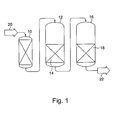
- Fig. 1 is a flow chart to show one example of the purification apparatus of alcoholic liquors according to an embodiment of the invention.
- the alcoholic liquors are passed through a mixed bed layer containing of an H type strongly acidic cation exchange resin and a free base type weakly basic anion exchange resin.
- the alcoholic liquors after passing alcoholic liquors through an HSO 3 type strongly basic anion exchange resin layer, the alcoholic liquors are successively passed through an H type strongly acidic cation exchange resin layer and a free base type weakly basic anion exchange resin layer.
- the alcoholic liquors are passed through a mixed bed layer containing of an H type strongly acidic cation exchange resin and a free base type weakly basic anion exchange resin.
- the alcoholic liquors are successively passed through an H type strongly acidic cation exchange resin layer and a free base type weakly basic anion exchange resin layer.
- the alcoholic liquors are distilled alcoholic liquors.
- the purification apparatus is provided with an ion exchange device for passing alcoholic liquors through an HSO 3 type strongly basic anion exchange resin layer and an ion exchange device for passing the alcoholic liquors through a mixed bed layer containing of an H type strongly acidic cation exchange resin and a free base type weakly basic anion exchange resin in this order.
- the purification apparatus is provided with an ion exchange device for passing alcoholic liquors through an HSO 3 type strongly basic anion exchange resin layer and an ion exchange device for successively passing the alcoholic liquors through an H type strongly acidic cation exchange resin layer and a free base type weakly basic anion exchange resin layer in this order.
- the purification apparatus is provided with an HSO 3 salt addition device for adding an HSO 3 salt to alcoholic liquors and an ion exchange device for passing the alcoholic liquors through a mixed bed layer containing of an H type strongly acidic cation exchange resin and a free base type weakly basic anion exchange resin in this order.
- the purification apparatus is provided with an HSO 3 salt addition device for adding an HSO 3 salt to alcoholic liquors and an ion exchange device for successively passing the alcoholic liquors through an H type strongly acidic cation exchange resin layer and a free base type weakly basic anion exchange resin layer in this order.
- the alcoholic liquors are distilled alcoholic liquors.
- a free base type weakly basic anion exchange resin is used in place of the conventional OH type strongly basic anion exchange resin. According to this way, in the present embodiment, the amount of retention of a fragrance component and a flavor component in the alcoholic liquors after the purification can be increased as compared with the conventional art, whereby it becomes possible to effectively remove aldehydes and inorganic salts while retaining individuality of the alcoholic liquors as much as possible.
- the rate of decomposition or removal of esters as the fragrance component is lowered so that the fragrance strongly remains in the treated liquids.
- the rate of removal of the flavor component such as organic acids is suppressed so that the manneristic flavor remains.
- the fragrance and flavor are affected by the incorporation of trace components or the presence or absence of a masking component, this thought is pure speculation.
- alcoholic liquors are passed through an HSO 3 type (sulfurous acid type) strongly basic anion exchange resin layer, or an HSO 3 salt such as NaHSO 3 is added to alcoholic liquors.
- HSO 3 type strongly basic anion exchange resin layer is more preferable in view of the matter that an ion load in the desalting step as the subsequent stage is low.
- HSO 3 type strongly basic anion exchange resin There is no particular limitation regarding the kind of the HSO 3 type strongly basic anion exchange resin.
- materials resulting from conversion of AMBERLITE (a registered trademark, hereinafter the same) IRA400, IRA402, IRA404, IRA900 and IRA904, DIAION(a registered trademark, hereinafter the same) SA10A, SA20A, PA308, and PA408, and the like into an HSO 3 type can be used.
- alcoholic liquors are passed through a mixed bed layer containing of an H type strongly acidic cation exchange resin and a free base type weakly basic anion exchange resin, or alcoholic liquors are successively passed through an H type strongly acidic cation exchange resin layer and a free base type weakly basic anion exchange resin layer.
- the passing of the alcoholic liquors through a mixed bed layer of the both resins is more preferable in view of the matter that the rate of removal of salts is stable.
- the kind of the H type strongly acidic cation exchange resin for example, AMBERLITE IRA120B, IRA124, 200CT and 252, DIAION SK1B, SK112, PK212 and RP216, and the like can be used.
- the free base type weakly basic anion exchange resin styrene based or acrylic free base type weakly basic anion exchange resins can be suitably used.
- the treated liquids whose fragrance is thin and whose feel on the tongue is closed to the stock liquids are obtained
- acrylic resins when acrylic resins are used, treated liquids whose fragrance is closed to the stock liquids and whose feel on the tongue is free from a stimulus.
- the ion exchange range may be chosen depending upon the purpose of purification.
- the kind of the free base type weakly basic anion exchange resin for example, AMBERLITE IRA96SB (styrene based) and IRA67 (acrylic), DIAION WA10 (acrylic) and WA20A (styrene based) , and the like can be used.
- a volume ratio of the H type strongly acidic cation exchange resin to the free base type weakly basic anion exchange resin is from about 1/1 to 1/4 (provided that the volume ratio is a ratio in which the strongly acidic cation exchange resin is based on the Na type, and the weakly basic anion exchange resin is based on the free base type).
- the alcoholic liquors may be successively passed through two ion exchange devices each having the respective resin or may be passed through one ion exchange device containing therein the both resin layers as separated from each other.
- the liquid-passing temperature at which the alcoholic liquors are passed through the respective ion exchange resin layer is in the range of from -10 to 40°C.
- the liquid-passing temperature is lower than -10°C, since the liquids are frozen or the viscosity of the liquid increases, it becomes impossible to efficiently achieve the contact of the alcoholic liquors with the resin so that the removal performance of aldehydes or inorganic salts is lowered.
- the liquid-passing temperature exceeds 40°C, there may be the case where evaporation or modification of the fragrance component occurs, and therefore, such is not preferable.
- the liquid-passing rate at which the alcoholic liquors are passed through the respective ion exchange resin layer is in the range of from 0.1 to 50 in terms of SV based on the whole resin amount.
- the liquid-passing rate is less than 0.1 in terms of SV, there may be the case where the amount of the treated liquids per unit time becomes low.
- the liquid-passing rate exceeds 50 in terms of SV, there may be the case where it becomes impossible to efficiently achieve the contact of the alcoholic liquors with the resin so that the removal performance of aldehydes or inorganic salts is lowered.
- the present embodiment is suitable for the purification of distilled alcoholic liquors rather than brewed alcoholic liquors containing a large amount of amino acids.
- alcoholic liquors resulting from brewing of a grain raw material which has been purified to such extent that it does not substantially contain a nitrogen component, such as ginjo sake (high-quality sake) have become available. In these cases, it is thought that even when the purification according to the present embodiment is carried out, there is no problem depending upon the flavor as required.
- examples of grain raw materials of the alcoholic liquors include barley, sweet potato, rice, sake lees, soba, unrefined sugar, sesame seed, Japanese chestnut, kaoliang, and the like.
- Fig. 1 is a flow chart to show one example of the purification apparatus of alcoholic liquors according to the present embodiment.
- 10 stands for a filter
- 12 stands for an ion exchange device (aldehyde removal device) provided with a single bed layer 14 of an HSO 3 type strongly basic anion exchange resin
- 16 stands for an ion exchange device (desalting device) provided with a mixed bed layer 18 containing of an H type strongly acidic cation exchange resin and a free base type weakly basic anion exchange resin.
- the purification apparatus of the present example is to obtain treated liquids 22 from which aldehydes and inorganic salts have been removed by successively passing the stock liquids 20 of alcoholic liquors through, the filter 10, the aldehyde removal device 12 and the desalting device 16.
- the stock liquids of awamori were treated under the same conditions as in Example 1, except for using 40 mL of a free base type acrylic weakly basic anion exchange resin (AMBERLITE IRA67) in place of 40 mL of the free base type styrene based weakly basic anion exchange resin (AMBERLITE IRA96SB).
- ABERLITE IRA67 a free base type acrylic weakly basic anion exchange resin
- AMBERLITE IRA96SB free base type styrene based weakly basic anion exchange resin
- the stock liquids of awamori were treated under the same conditions as in Example 1, except for using 40 mL of an OH type styrene based strongly basic anion exchange resin (AMBERLITE IRA402BL) in place of 40 mL of the free base type styrene based weakly basic anion exchange resin (AMBERLITE IRA96SB).
- ABERLITE IRA402BL an OH type styrene based strongly basic anion exchange resin
- ABERLITE IRA96SB free base type styrene based weakly basic anion exchange resin
Landscapes
- Chemical & Material Sciences (AREA)
- Organic Chemistry (AREA)
- Engineering & Computer Science (AREA)
- General Health & Medical Sciences (AREA)
- Life Sciences & Earth Sciences (AREA)
- Biochemistry (AREA)
- Bioinformatics & Cheminformatics (AREA)
- General Engineering & Computer Science (AREA)
- Health & Medical Sciences (AREA)
- Genetics & Genomics (AREA)
- Food Science & Technology (AREA)
- Wood Science & Technology (AREA)
- Zoology (AREA)
- Alcoholic Beverages (AREA)
- Distillation Of Fermentation Liquor, Processing Of Alcohols, Vinegar And Beer (AREA)
- Non-Alcoholic Beverages (AREA)
Abstract
Description
- The present invention relates to a method and an apparatus for purifying alcoholic liquors such as brewed alcoholic liquors and distilled alcoholic liquors as prepared starting from grains. In particular, the invention relates to a method and an apparatus for purifying distilled alcoholic liquors starting from grains.
- In alcoholic liquors, fragrance components, flavor components, dye components, mineral components, aldehydes, inorganic salts, and the like are contained in addition to an alcohol as the major component. Of these, aldehydes and inorganic salts are preferably removed by purification. There have hitherto been known purification apparatus of shochu (Japanese spirits) using an ion exchange resin as a purification apparatus for removing aldehydes and inorganic salts from the alcoholic liquors. In particular, there is widely used a purification apparatus of shochu composed of an aldehyde removal device using an HSO3 type strongly basic anion exchange resin and a desalting device which is provided in the subsequent stage to the subject aldehyde removal device and which uses a mixed bed containing of an H type strongly acidic cation exchange resin and an OH type strongly basic anion exchange resin (for example, see JP36-12194B). According to this purification apparatus of shochu, it is possible to obtain shochu having a light flavor upon removal of a hot taste, an astringent taste and a bitter taste while slightly retaining a fragrance.
- Recently, as various kinds of real shochu have appeared on the market, the number of a person who likes real shochu having a characteristic fragrance or flavor has increased. However, since the purification apparatus of shochu as described in the above-mentioned JP36-12194B has high performance of removing a fragrance component and a flavor component, it was not substantially used for the purification of shochu which strongly retains a fragrance or retains a manneristic flavor. This is because in the case of using a desalting device using a mixed bed containing of an H type strongly acidic cation exchange resin and an OH type strongly basic anion exchange resin, the majority of esters which are the fragrance component, such as ethyl acetate, and organic acids which are a kind of components for determining the flavor are removed at the time of removing inorganic salts.
- For that reason, in the case of obtaining shochu which strongly retains a fragrance or retains a manneristic flavor by using the conventional apparatus as described in JP36-12194B, for the purpose of lowering the removal performance of esters and organic acids, the contact time of alcoholic liquors with the ion exchange resin layers of the aldehyde removal device and the desalting device was shortened, or alcoholic liquors which had been subjected to the aldehyde removal treatment and the desalting treatment were mixed with stock liquids which had not been subjected to these treatments. However, in these methods, there was the case where the removal of aldehydes or inorganic salts is insufficient.
- The invention relates to a method and a purification apparatus for purifying alcoholic liquors which are capable of effectively removing aldehydes and inorganic salts from alcoholic liquors such as brewed alcoholic liquors and distilled alcoholic liquors, while strongly retaining a peculiar fragrance or retaining a manneristic flavor.
- The invention is concerned with a method for purifying alcoholic liquors, in which after passing alcoholic liquors through an HSO3 type strongly basic anion exchange resin layer, or after adding an HSO3 salt to alcoholic liquors; the alcoholic liquors are passed through a mixed bed layer containing of an H type strongly acidic cation exchange resin and a free base type weakly basic anion exchange resin, or the alcoholic liquors are successively passed through an H type strongly acidic cation exchange resin layer and a free base type weakly basic anion exchange resin layer.
- Also, the invention is concerned with a purification apparatus of alcoholic liquors, comprising an ion exchange device for passing alcoholic liquors through an HSO3 type strongly basic anion exchange resin layer, or an HSO3 salt addition device for adding an HSO3 salt to alcoholic liquors; and an ion exchange device for passing the alcoholic liquors through a mixed bed layer containing of an H type strongly acidic cation exchange resin and a free base type weakly basic anion exchange resin, or an ion exchange device for successively passing the alcoholic liquors through an H type strongly acidic cation exchange resin layer and a free base type weakly basic anion exchange resin layer, in this order.
- According to the invention, it is possible to remove aldehydes and inorganic salts from the stock liquids of alcoholic liquors while strongly retaining a fragrance of the stock liquids of alcoholic liquor or retaining a peculiar and manneristic flavor.
- [Fig. 1] Fig. 1 is a flow chart to show one example of the purification apparatus of alcoholic liquors according to an embodiment of the invention.
- An embodiment of the invention will be hereunder described.
- In a method for purifying alcoholic liquors according to the present embodiment, after passing alcoholic liquors through an HSO3 type strongly basic anion exchange resin layer, the alcoholic liquors are passed through a mixed bed layer containing of an H type strongly acidic cation exchange resin and a free base type weakly basic anion exchange resin.
- Also, in a method for purifying alcoholic liquors according to the present embodiment, after passing alcoholic liquors through an HSO3 type strongly basic anion exchange resin layer, the alcoholic liquors are successively passed through an H type strongly acidic cation exchange resin layer and a free base type weakly basic anion exchange resin layer.
- Also, in a method for purifying alcoholic liquors according to the present embodiment, after adding an HSO3 salt to alcoholic liquors, the alcoholic liquors are passed through a mixed bed layer containing of an H type strongly acidic cation exchange resin and a free base type weakly basic anion exchange resin.
- Also, in a method for purifying alcoholic liquors according to the present embodiment, after adding an HSO3 salt to alcoholic liquors, the alcoholic liquors are successively passed through an H type strongly acidic cation exchange resin layer and a free base type weakly basic anion exchange resin layer.
- Also, in the method for purifying alcoholic liquors, it is preferable that the alcoholic liquors are distilled alcoholic liquors.
- Also, in a purification apparatus of alcoholic liquors according to the present embodiment, the purification apparatus is provided with an ion exchange device for passing alcoholic liquors through an HSO3 type strongly basic anion exchange resin layer and an ion exchange device for passing the alcoholic liquors through a mixed bed layer containing of an H type strongly acidic cation exchange resin and a free base type weakly basic anion exchange resin in this order.
- Also, in a purification apparatus of alcoholic liquors according to the present embodiment, the purification apparatus is provided with an ion exchange device for passing alcoholic liquors through an HSO3 type strongly basic anion exchange resin layer and an ion exchange device for successively passing the alcoholic liquors through an H type strongly acidic cation exchange resin layer and a free base type weakly basic anion exchange resin layer in this order.
- Also, in a purification apparatus of alcoholic liquors according to the present embodiment, the purification apparatus is provided with an HSO3 salt addition device for adding an HSO3 salt to alcoholic liquors and an ion exchange device for passing the alcoholic liquors through a mixed bed layer containing of an H type strongly acidic cation exchange resin and a free base type weakly basic anion exchange resin in this order.
- Also, in a purification apparatus of alcoholic liquors according to the present embodiment, the purification apparatus is provided with an HSO3 salt addition device for adding an HSO3 salt to alcoholic liquors and an ion exchange device for successively passing the alcoholic liquors through an H type strongly acidic cation exchange resin layer and a free base type weakly basic anion exchange resin layer in this order.
- Also, in the purification apparatus of alcohol liquors, it is preferable that the alcoholic liquors are distilled alcoholic liquors.
- In the present embodiment, as the anion exchange resin for desalting in the subsequent stage, a free base type weakly basic anion exchange resin is used in place of the conventional OH type strongly basic anion exchange resin. According to this way, in the present embodiment, the amount of retention of a fragrance component and a flavor component in the alcoholic liquors after the purification can be increased as compared with the conventional art, whereby it becomes possible to effectively remove aldehydes and inorganic salts while retaining individuality of the alcoholic liquors as much as possible.
- That is, in the present embodiment, it is thought that by changing the anion exchange resin for desalting from a strongly basic anion exchange resin to a weakly basic anion exchange resin, the rate of decomposition or removal of esters as the fragrance component is lowered so that the fragrance strongly remains in the treated liquids. Similarly, it is thought that by lowering the basicity of the anion exchange resin, the rate of removal of the flavor component such as organic acids is suppressed so that the manneristic flavor remains. However, since the fragrance and flavor are affected by the incorporation of trace components or the presence or absence of a masking component, this thought is pure speculation.
- The present embodiment will be hereunder described in more detail. In the present embodiment, in the aldehyde removal step as the preceding stage, alcoholic liquors are passed through an HSO3 type (sulfurous acid type) strongly basic anion exchange resin layer, or an HSO3 salt such as NaHSO3 is added to alcoholic liquors. In this case, as compared with the addition of an HSO3 salt to the alcoholic liquors, passing of the alcoholic liquors through an HSO3 type strongly basic anion exchange resin layer is more preferable in view of the matter that an ion load in the desalting step as the subsequent stage is low. There is no particular limitation regarding the kind of the HSO3 type strongly basic anion exchange resin. For example, materials resulting from conversion of AMBERLITE (a registered trademark, hereinafter the same) IRA400, IRA402, IRA404, IRA900 and IRA904, DIAION(a registered trademark, hereinafter the same) SA10A, SA20A, PA308, and PA408, and the like into an HSO3 type can be used.
- In the present embodiment, in the desalt step as the subsequent stage, alcoholic liquors are passed through a mixed bed layer containing of an H type strongly acidic cation exchange resin and a free base type weakly basic anion exchange resin, or alcoholic liquors are successively passed through an H type strongly acidic cation exchange resin layer and a free base type weakly basic anion exchange resin layer. In this case, as compared with successive passing of the alcoholic liquors through the both resin layers, the passing of the alcoholic liquors through a mixed bed layer of the both resins is more preferable in view of the matter that the rate of removal of salts is stable. There is no particular limitation regarding the kind of the H type strongly acidic cation exchange resin. For example, AMBERLITE IRA120B, IRA124, 200CT and 252, DIAION SK1B, SK112, PK212 and RP216, and the like can be used.
- Furthermore, as the free base type weakly basic anion exchange resin, styrene based or acrylic free base type weakly basic anion exchange resins can be suitably used. In this case, when styrene based resins are used, the treated liquids whose fragrance is thin and whose feel on the tongue is closed to the stock liquids are obtained, whereas when acrylic resins are used, treated liquids whose fragrance is closed to the stock liquids and whose feel on the tongue is free from a stimulus. Thus, the ion exchange range may be chosen depending upon the purpose of purification. There is no particular limitation regarding the kind of the free base type weakly basic anion exchange resin. For example, AMBERLITE IRA96SB (styrene based) and IRA67 (acrylic), DIAION WA10 (acrylic) and WA20A (styrene based) , and the like can be used.
- In the desalting step as the subsequent stage, it is suitable that a volume ratio of the H type strongly acidic cation exchange resin to the free base type weakly basic anion exchange resin is from about 1/1 to 1/4 (provided that the volume ratio is a ratio in which the strongly acidic cation exchange resin is based on the Na type, and the weakly basic anion exchange resin is based on the free base type). Furthermore, in the case of successively passing alcoholic liquors through an H type strongly acidic cation exchange resin layer and a free base type weakly basic anion exchange resin layer, the alcoholic liquors may be successively passed through two ion exchange devices each having the respective resin or may be passed through one ion exchange device containing therein the both resin layers as separated from each other.
- In the present embodiment, it is desired that the liquid-passing temperature at which the alcoholic liquors are passed through the respective ion exchange resin layer (an HSO3 type strongly basic anion exchange resin layer; a mixed bed layer containing of an H type strongly acidic cation exchange resin and a free base type weakly basic anion exchange resin; or an H type strongly acidic cation exchange resin layer and a free base type weakly basic anion exchange resin layer, hereinafter the same) is in the range of from -10 to 40°C. Depending upon the alcohol concentration, there may be the case where when the liquid-passing temperature is lower than -10°C, since the liquids are frozen or the viscosity of the liquid increases, it becomes impossible to efficiently achieve the contact of the alcoholic liquors with the resin so that the removal performance of aldehydes or inorganic salts is lowered. When the liquid-passing temperature exceeds 40°C, there may be the case where evaporation or modification of the fragrance component occurs, and therefore, such is not preferable.
- Furthermore, in the present embodiment, it is preferable that the liquid-passing rate at which the alcoholic liquors are passed through the respective ion exchange resin layer is in the range of from 0.1 to 50 in terms of SV based on the whole resin amount. When the liquid-passing rate is less than 0.1 in terms of SV, there may be the case where the amount of the treated liquids per unit time becomes low. When the liquid-passing rate exceeds 50 in terms of SV, there may be the case where it becomes impossible to efficiently achieve the contact of the alcoholic liquors with the resin so that the removal performance of aldehydes or inorganic salts is lowered.
- According to the present embodiment, though aldehydes and inorganic salts are mainly removed from the stock liquids, amino acids are further removed. Accordingly, the present embodiment is suitable for the purification of distilled alcoholic liquors rather than brewed alcoholic liquors containing a large amount of amino acids. However, in recent years, alcoholic liquors resulting from brewing of a grain raw material which has been purified to such extent that it does not substantially contain a nitrogen component, such as ginjo sake (high-quality sake), have become available. In these cases, it is thought that even when the purification according to the present embodiment is carried out, there is no problem depending upon the flavor as required. Incidentally, examples of grain raw materials of the alcoholic liquors include barley, sweet potato, rice, sake lees, soba, unrefined sugar, sesame seed, Japanese chestnut, kaoliang, and the like.
- Fig. 1 is a flow chart to show one example of the purification apparatus of alcoholic liquors according to the present embodiment. In Fig. 1, 10 stands for a filter; 12 stands for an ion exchange device (aldehyde removal device) provided with a
single bed layer 14 of an HSO3 type strongly basic anion exchange resin; and 16 stands for an ion exchange device (desalting device) provided with amixed bed layer 18 containing of an H type strongly acidic cation exchange resin and a free base type weakly basic anion exchange resin. The purification apparatus of the present example is to obtain treatedliquids 22 from which aldehydes and inorganic salts have been removed by successively passing thestock liquids 20 of alcoholic liquors through, thefilter 10, thealdehyde removal device 12 and thedesalting device 16. - In the light of the above, according to the present embodiment, it is possible to remove aldehydes and inorganic salts from the stock liquids of alcoholic liquors while strongly retaining a fragrance of the stock liquids of alcoholic liquors or retaining a peculiar and manneristic flavor.
- The invention will be hereunder described in more detail with reference to the following Examples. However, it should be construed that the invention is not limited by these Examples whatever.
- After passing stock liquids of awamori (rice brandy) produced in Okinawa, which are shochu distilled from rice, through 60 mL of an HSO3 type strongly basic anion exchange resin layer (prepared by converting AMBERLITE IRA404 into an HSO3 type by passing an NaHSO3 solution therethrough), 1, 500 mL of the stock liquids were passed through a mixed bed layer containing of 20 mL of an H type strongly acidic cation exchange resin (AMBERLITE IR120B) and 40 mL of a free base type styrene based weakly basic anion exchange resin (AMBERLITE IRA96SB) at a liquid-passing temperature of 20°C and at a liquid-passing rate 300 mL/hr (SV =7.5 based on the anion exchange resin of the desalting column) . The results of analysis and organoleptic evaluation of the stock liquids and the treated liquids are shown in Table 1. Incidentally, in the organoleptic evaluation, the fragrance and feel on the tongue were evaluated by an organoleptic test by six panels.
- The stock liquids of awamori were treated under the same conditions as in Example 1, except for using 40 mL of a free base type acrylic weakly basic anion exchange resin (AMBERLITE IRA67) in place of 40 mL of the free base type styrene based weakly basic anion exchange resin (AMBERLITE IRA96SB). The results of analysis and organoleptic evaluation of the treated liquids are shown in Table 1.
- The stock liquids of awamori were treated under the same conditions as in Example 1, except for using 40 mL of an OH type styrene based strongly basic anion exchange resin (AMBERLITE IRA402BL) in place of 40 mL of the free base type styrene based weakly basic anion exchange resin (AMBERLITE IRA96SB). The results of analysis and organoleptic evaluation of the treated liquids are shown in Table 1.
-
Table 1 Stock liquids of awamori Example 1 Example 2 Comparative Example 1 Alcohol concentration (%) 30 30 30 30 pH 7.3 6.15 6.20 6.34 Electrical conductivity (µS/cm) 71.3 0.4 0.4 0.4 Aldehyde concentration (mg/L) 22 <1 <1 <1 Ethyl acetate (mg/L) concentration (mg/L) 110 80 110 <30 Fragrance Fragrance like fruits Thin fragrance Fragrance like fruits Odorless Feel on the tongue Stimulant Stimulant Non-stimulant Non-stimulant (Note) With respect to the fragrance and feel on the tongue, the organoleptic evaluation by six panels was carried out. - Stock liquids of imo-shochu produced in Kagoshima, which are spirits distilled from sweet potatoes, were treated under the same conditions as in Example 1, except for using the stock liquids of imo-shochu produced in Kagoshima in place of the stock liquids of awamori produced in Okinawa, which are shochu distilled from rice. The results of analysis and organoleptic evaluation of the stock liquids and the treated liquids are shown in Table 2.
- The stock liquids of imo-shochu produced in Kagoshima were treated under the same conditions as in Example 3, except for using 40 mL of a free base type acrylic weakly basic anion exchange resin (AMBERLITE IRA67) in place of 40 mL of the free base type styrene based weakly basic anion exchange resin (AMBERLITE IRA96SB). The results of analysis and organoleptic evaluation of the treated liquids are shown in Table 2.
- The stock liquids of imo-shochu produced in Kagoshima were treated under the same conditions as in Example 3, except for using 40 mL of an OH type styrene based strongly basic anion exchange resin (AMBERLITE IRA402BL) in place of 40 mL of the free base type styrene based weakly basic anion exchange resin (AMBERLITE IRA96SB). The results of analysis and organoleptic evaluation of the treated liquids are shown in Table 2.
-
Table 2 Stock liquids of imo-shochu Example 3 Example 4 Comparative Example 2 Alcohol concentration (%) 25 25 25 25 pH 4.79 6.15 6.20 6.34 Electrical conductivity (µs/cm) 20.7 0.5 0.5 0.5 Aldehyde concentration (mg/L) 17 <1 <1 <1 Ethyl acetate concentration (mg/L) 100 60 100 <30 Fragrance Fragrance of steamed sweet potatoes Thin fragrance Fragrance of steamed sweet potatoes Odorless Feel on the tongue Stimulant Stimulant Non-stimulant Non-stimulant (Note) With respect to the fragrance and feel on the tongue, the organoleptic evaluation by six panels was carried out. - From the results of the present experiments, it is noted that according to Examples 1 to 4 using a free base type weakly basic anion exchange resin as the anion exchange resin for desalting, aldehydes and conductive salts can be removed likewise the conventional art (Comparative Examples 1 and 2) using an OH type strongly basic anion exchange resin as the anion exchange resin for desalting; and that the treatment can be carried out while retaining the characteristics of the stock liquids such as fragrance and feel on the tongue as compared with the conventional art (Comparative Examples 1 and 2). In addition, from the results of.the present experiments, it is noted that in the case of using a free base type styrene based weakly basic anion exchange resin as the anion exchange resin for desalting (Examples 1 and 3), treated liquids which are thin in the fragrance and which are closed to the stock liquids with respect to the feel on the tongue is obtained; and that in the case of using a free base type acrylic weakly basic anion exchange resin as the anion exchange resin for desalting (Examples 2 and 4), treated liquids which are closed to the stock liquids in the fragrance and which are free from a stimulus with respect to the feel on the tongue is obtained.
Claims (4)
- A method for purifying alcoholic liquors, wherein
after passing alcoholic liquors through an HSO3 type strongly basic anion exchange resin layer, or after adding an HSO3 salt to alcoholic liquors; the alcoholic liquors are passed through a mixed bed layer containing of an H type strongly acidic cation exchange resin and a free base type weakly basic anion exchange resin, or the alcoholic liquors are successively passed through an H type strongly acidic cation exchange resin layer and a free base type weakly basic anion exchange resin layer. - The method for purifying alcoholic liquors according to claim 1, wherein
the alcoholic liquors are distilled alcoholic liquors. - A purification apparatus of alcoholic liquors, comprising an ion exchange device for passing alcoholic liquors through an HSO3 type strongly basic anion exchange resin layer, or an HSO3 salt addition device for adding an HSO3 salt to alcoholic liquors; and an ion exchange device for passing the alcoholic liquors through a mixed bed layer containing of an H type strongly acidic cation exchange resin and a free base type weakly basic anion exchange resin, or an ion exchange device for successively passing the alcoholic liquors through an H type strongly acidic cation exchange resin layer and a free base type weakly basic anion exchange resin layer, in this order.
- The purification apparatus of alcoholic liquors according to claim 3, wherein
the alcoholic liquors are distilled alcoholic liquors.
Applications Claiming Priority (2)
| Application Number | Priority Date | Filing Date | Title |
|---|---|---|---|
| JP2003338505A JP4440591B2 (en) | 2003-09-29 | 2003-09-29 | Method and apparatus for purifying distilled liquor |
| PCT/JP2004/013506 WO2005030921A1 (en) | 2003-09-29 | 2004-09-16 | Method of purifying alcoholic liquor and purification apparatus |
Publications (2)
| Publication Number | Publication Date |
|---|---|
| EP1676905A1 true EP1676905A1 (en) | 2006-07-05 |
| EP1676905A4 EP1676905A4 (en) | 2009-08-05 |
Family
ID=34386158
Family Applications (1)
| Application Number | Title | Priority Date | Filing Date |
|---|---|---|---|
| EP04773165A Withdrawn EP1676905A4 (en) | 2003-09-29 | 2004-09-16 | Method of purifying alcoholic liquor and purification apparatus |
Country Status (6)
| Country | Link |
|---|---|
| US (1) | US7326349B2 (en) |
| EP (1) | EP1676905A4 (en) |
| JP (1) | JP4440591B2 (en) |
| KR (1) | KR101124642B1 (en) |
| CN (1) | CN100529046C (en) |
| WO (1) | WO2005030921A1 (en) |
Families Citing this family (12)
| Publication number | Priority date | Publication date | Assignee | Title |
|---|---|---|---|---|
| JP4584178B2 (en) * | 2006-04-12 | 2010-11-17 | オルガノ株式会社 | Liquor purification method |
| JP5068630B2 (en) * | 2007-11-15 | 2012-11-07 | オルガノ株式会社 | Method for removing aldehyde compound from alcohol-containing solution and brewed sake purified by the method |
| JP5235091B2 (en) * | 2008-04-07 | 2013-07-10 | オルガノ株式会社 | Method and apparatus for removing aldehyde compound from alcohol-containing liquid |
| JP6404574B2 (en) * | 2014-02-14 | 2018-10-10 | オルガノ株式会社 | Method and apparatus for purifying distilled liquor |
| WO2015164414A1 (en) * | 2014-04-21 | 2015-10-29 | Regents Of The University Of Minnesota | Methods of making modified alcohol containing products |
| JP6718309B2 (en) * | 2016-05-26 | 2020-07-08 | オルガノ株式会社 | Method for purifying alcohol-containing liquid and apparatus for purifying alcohol-containing liquid |
| WO2019064107A1 (en) * | 2017-09-26 | 2019-04-04 | Sabic Global Technologies B.V. | Process for aldehyde removal from alcohols by treatment with bisulphite |
| WO2020081518A1 (en) * | 2018-10-15 | 2020-04-23 | Nitto Denko Corporation | Methods for reducing purine levels in fluid mixtures |
| CN109182062A (en) * | 2018-11-09 | 2019-01-11 | 湖北工业大学 | It is a kind of for improving the purification medium and its purification method of Maotai-flavor former wine quality |
| CN109182050A (en) * | 2018-11-09 | 2019-01-11 | 湖北工业大学 | A method of reducing distilled spirit with sesame flavour bitter taste |
| WO2021050263A1 (en) * | 2019-09-12 | 2021-03-18 | Coors Brewing Company | METHOD AND SYSTEM OF BEER SHELF LIFE EXTENSION BY pH NEUTRALIZATION |
| DK4244328T3 (en) | 2020-11-14 | 2025-10-13 | Mark Anthony Int Srl | METHODS FOR STERILIZATION OF FERMENTED BEVERAGES |
Family Cites Families (3)
| Publication number | Priority date | Publication date | Assignee | Title |
|---|---|---|---|---|
| JPS3612194B1 (en) * | 1959-11-06 | 1961-07-31 | ||
| DE60136814D1 (en) * | 2000-07-11 | 2009-01-15 | Sapporo Breweries | METHOD FOR PRODUCING AN ALCOHOLIC BEVERAGE ON MALZBASIS |
| US7008652B2 (en) * | 2002-06-14 | 2006-03-07 | Brown-Forman Corporation | Method for production of a flavorless malt base |
-
2003
- 2003-09-29 JP JP2003338505A patent/JP4440591B2/en not_active Expired - Lifetime
-
2004
- 2004-09-16 EP EP04773165A patent/EP1676905A4/en not_active Withdrawn
- 2004-09-16 KR KR1020067005578A patent/KR101124642B1/en not_active Expired - Fee Related
- 2004-09-16 WO PCT/JP2004/013506 patent/WO2005030921A1/en not_active Ceased
- 2004-09-16 US US10/573,906 patent/US7326349B2/en not_active Expired - Lifetime
- 2004-09-16 CN CNB2004800281692A patent/CN100529046C/en not_active Expired - Lifetime
Also Published As
| Publication number | Publication date |
|---|---|
| US20060292262A1 (en) | 2006-12-28 |
| KR20060099510A (en) | 2006-09-19 |
| KR101124642B1 (en) | 2012-03-19 |
| CN100529046C (en) | 2009-08-19 |
| CN1860216A (en) | 2006-11-08 |
| EP1676905A4 (en) | 2009-08-05 |
| JP2005102554A (en) | 2005-04-21 |
| JP4440591B2 (en) | 2010-03-24 |
| WO2005030921A1 (en) | 2005-04-07 |
| US7326349B2 (en) | 2008-02-05 |
Similar Documents
| Publication | Publication Date | Title |
|---|---|---|
| US7326349B2 (en) | Method and apparatus for purifying alcoholic liquors | |
| CA2135305C (en) | Apparatus and method for removing compounds from a solution | |
| US3437491A (en) | Two-stage sequential ion exchange treatment for wine improvement | |
| US20100098819A1 (en) | Apparatus and method for isolating and/or eliminating at least one solute from a solution | |
| US5071664A (en) | Method of removing sulfites from standard wine | |
| US5618573A (en) | Production of vodka by supercooling technology | |
| CA1304027C (en) | Decharacterization of base wine and its use in preparation of flavored beverages | |
| EP1831344B1 (en) | Process for making purified beverage products | |
| JPS6024696B2 (en) | Method for producing citrus fruit drinks | |
| RU2041940C1 (en) | Method for production of vodka | |
| US2520189A (en) | Processing alcholic beverage distillates | |
| KR100251829B1 (en) | Method of Producing Functional Alcholic Liquors Containing Extract from Green Tea | |
| KR20000072393A (en) | Method for Preparation of Spirits Added With Plum | |
| JP4358525B2 (en) | Liquor purification method | |
| JP4584178B2 (en) | Liquor purification method | |
| US20060134302A1 (en) | Vodka and a process for the production of vodka | |
| RU2148631C1 (en) | Method of vodka production | |
| JPH0462714B2 (en) | ||
| RU2095406C1 (en) | Method for producing vodka "ufimskaya khlebnaya" | |
| SU924098A1 (en) | METHOD OF LIGHTING AND STABILIZING WINE 1 | |
| Norman | Juice enhancement by ion exchange and adsorbent technologies | |
| JPH0312862B2 (en) | ||
| JPH06327459A (en) | Production of fruit-admixed wine | |
| JPS6371193A (en) | Purification method for glucose solution or thick malt syrup | |
| TH55494A (en) | High-quality fruit juice beverages have a longer shelf life, and this is due to the methods used in their production. |
Legal Events
| Date | Code | Title | Description |
|---|---|---|---|
| PUAI | Public reference made under article 153(3) epc to a published international application that has entered the european phase |
Free format text: ORIGINAL CODE: 0009012 |
|
| 17P | Request for examination filed |
Effective date: 20060426 |
|
| AK | Designated contracting states |
Kind code of ref document: A1 Designated state(s): FR GB |
|
| DAX | Request for extension of the european patent (deleted) | ||
| RBV | Designated contracting states (corrected) |
Designated state(s): FR GB |
|
| A4 | Supplementary search report drawn up and despatched |
Effective date: 20090706 |
|
| 17Q | First examination report despatched |
Effective date: 20111109 |
|
| GRAP | Despatch of communication of intention to grant a patent |
Free format text: ORIGINAL CODE: EPIDOSNIGR1 |
|
| INTG | Intention to grant announced |
Effective date: 20130718 |
|
| STAA | Information on the status of an ep patent application or granted ep patent |
Free format text: STATUS: THE APPLICATION IS DEEMED TO BE WITHDRAWN |
|
| 18D | Application deemed to be withdrawn |
Effective date: 20140325 |