EP1676519A1 - Cleaning tool - Google Patents
Cleaning tool Download PDFInfo
- Publication number
- EP1676519A1 EP1676519A1 EP20050257506 EP05257506A EP1676519A1 EP 1676519 A1 EP1676519 A1 EP 1676519A1 EP 20050257506 EP20050257506 EP 20050257506 EP 05257506 A EP05257506 A EP 05257506A EP 1676519 A1 EP1676519 A1 EP 1676519A1
- Authority
- EP
- European Patent Office
- Prior art keywords
- antigenicity
- cleaning tool
- base material
- reducing component
- fibrous base
- Prior art date
- Legal status (The legal status is an assumption and is not a legal conclusion. Google has not performed a legal analysis and makes no representation as to the accuracy of the status listed.)
- Granted
Links
Images


Classifications
-
- B—PERFORMING OPERATIONS; TRANSPORTING
- B32—LAYERED PRODUCTS
- B32B—LAYERED PRODUCTS, i.e. PRODUCTS BUILT-UP OF STRATA OF FLAT OR NON-FLAT, e.g. CELLULAR OR HONEYCOMB, FORM
- B32B5/00—Layered products characterised by the non- homogeneity or physical structure, i.e. comprising a fibrous, filamentary, particulate or foam layer; Layered products characterised by having a layer differing constitutionally or physically in different parts
- B32B5/22—Layered products characterised by the non- homogeneity or physical structure, i.e. comprising a fibrous, filamentary, particulate or foam layer; Layered products characterised by having a layer differing constitutionally or physically in different parts characterised by the presence of two or more layers which are next to each other and are fibrous, filamentary, formed of particles or foamed
- B32B5/24—Layered products characterised by the non- homogeneity or physical structure, i.e. comprising a fibrous, filamentary, particulate or foam layer; Layered products characterised by having a layer differing constitutionally or physically in different parts characterised by the presence of two or more layers which are next to each other and are fibrous, filamentary, formed of particles or foamed one layer being a fibrous or filamentary layer
- B32B5/26—Layered products characterised by the non- homogeneity or physical structure, i.e. comprising a fibrous, filamentary, particulate or foam layer; Layered products characterised by having a layer differing constitutionally or physically in different parts characterised by the presence of two or more layers which are next to each other and are fibrous, filamentary, formed of particles or foamed one layer being a fibrous or filamentary layer another layer next to it also being fibrous or filamentary
-
- A—HUMAN NECESSITIES
- A47—FURNITURE; DOMESTIC ARTICLES OR APPLIANCES; COFFEE MILLS; SPICE MILLS; SUCTION CLEANERS IN GENERAL
- A47L—DOMESTIC WASHING OR CLEANING; SUCTION CLEANERS IN GENERAL
- A47L13/00—Implements for cleaning floors, carpets, furniture, walls, or wall coverings
- A47L13/10—Scrubbing; Scouring; Cleaning; Polishing
- A47L13/40—Cleaning implements actuated by electrostatic attraction; Devices for cleaning same; Magnetic cleaning implements
-
- A—HUMAN NECESSITIES
- A01—AGRICULTURE; FORESTRY; ANIMAL HUSBANDRY; HUNTING; TRAPPING; FISHING
- A01N—PRESERVATION OF BODIES OF HUMANS OR ANIMALS OR PLANTS OR PARTS THEREOF; BIOCIDES, e.g. AS DISINFECTANTS, AS PESTICIDES OR AS HERBICIDES; PEST REPELLANTS OR ATTRACTANTS; PLANT GROWTH REGULATORS
- A01N25/00—Biocides, pest repellants or attractants, or plant growth regulators, characterised by their forms, or by their non-active ingredients or by their methods of application, e.g. seed treatment or sequential application; Substances for reducing the noxious effect of the active ingredients to organisms other than pests
- A01N25/34—Shaped forms, e.g. sheets, not provided for in any other sub-group of this main group
-
- A—HUMAN NECESSITIES
- A47—FURNITURE; DOMESTIC ARTICLES OR APPLIANCES; COFFEE MILLS; SPICE MILLS; SUCTION CLEANERS IN GENERAL
- A47L—DOMESTIC WASHING OR CLEANING; SUCTION CLEANERS IN GENERAL
- A47L13/00—Implements for cleaning floors, carpets, furniture, walls, or wall coverings
-
- A—HUMAN NECESSITIES
- A47—FURNITURE; DOMESTIC ARTICLES OR APPLIANCES; COFFEE MILLS; SPICE MILLS; SUCTION CLEANERS IN GENERAL
- A47L—DOMESTIC WASHING OR CLEANING; SUCTION CLEANERS IN GENERAL
- A47L13/00—Implements for cleaning floors, carpets, furniture, walls, or wall coverings
- A47L13/10—Scrubbing; Scouring; Cleaning; Polishing
- A47L13/16—Cloths; Pads; Sponges
-
- A—HUMAN NECESSITIES
- A47—FURNITURE; DOMESTIC ARTICLES OR APPLIANCES; COFFEE MILLS; SPICE MILLS; SUCTION CLEANERS IN GENERAL
- A47L—DOMESTIC WASHING OR CLEANING; SUCTION CLEANERS IN GENERAL
- A47L13/00—Implements for cleaning floors, carpets, furniture, walls, or wall coverings
- A47L13/10—Scrubbing; Scouring; Cleaning; Polishing
- A47L13/16—Cloths; Pads; Sponges
- A47L13/17—Cloths; Pads; Sponges containing cleaning agents
-
- A—HUMAN NECESSITIES
- A47—FURNITURE; DOMESTIC ARTICLES OR APPLIANCES; COFFEE MILLS; SPICE MILLS; SUCTION CLEANERS IN GENERAL
- A47L—DOMESTIC WASHING OR CLEANING; SUCTION CLEANERS IN GENERAL
- A47L13/00—Implements for cleaning floors, carpets, furniture, walls, or wall coverings
- A47L13/10—Scrubbing; Scouring; Cleaning; Polishing
- A47L13/20—Mops
-
- A—HUMAN NECESSITIES
- A47—FURNITURE; DOMESTIC ARTICLES OR APPLIANCES; COFFEE MILLS; SPICE MILLS; SUCTION CLEANERS IN GENERAL
- A47L—DOMESTIC WASHING OR CLEANING; SUCTION CLEANERS IN GENERAL
- A47L13/00—Implements for cleaning floors, carpets, furniture, walls, or wall coverings
- A47L13/10—Scrubbing; Scouring; Cleaning; Polishing
- A47L13/38—Other dusting implements
-
- A—HUMAN NECESSITIES
- A61—MEDICAL OR VETERINARY SCIENCE; HYGIENE
- A61L—METHODS OR APPARATUS FOR STERILISING MATERIALS OR OBJECTS IN GENERAL; DISINFECTION, STERILISATION OR DEODORISATION OF AIR; CHEMICAL ASPECTS OF BANDAGES, DRESSINGS, ABSORBENT PADS OR SURGICAL ARTICLES; MATERIALS FOR BANDAGES, DRESSINGS, ABSORBENT PADS OR SURGICAL ARTICLES
- A61L2/00—Disinfection or sterilisation of materials or objects, in general; Accessories therefor
- A61L2/16—Disinfection or sterilisation of materials or objects, in general; Accessories therefor using chemical substances
- A61L2/18—Liquid substances
-
- B—PERFORMING OPERATIONS; TRANSPORTING
- B32—LAYERED PRODUCTS
- B32B—LAYERED PRODUCTS, i.e. PRODUCTS BUILT-UP OF STRATA OF FLAT OR NON-FLAT, e.g. CELLULAR OR HONEYCOMB, FORM
- B32B3/00—Layered products comprising a layer with external or internal discontinuities or unevennesses, or a layer of non-planar shape; Layered products comprising a layer having particular features of form
- B32B3/02—Layered products comprising a layer with external or internal discontinuities or unevennesses, or a layer of non-planar shape; Layered products comprising a layer having particular features of form characterised by features of form at particular places, e.g. in edge regions
- B32B3/08—Layered products comprising a layer with external or internal discontinuities or unevennesses, or a layer of non-planar shape; Layered products comprising a layer having particular features of form characterised by features of form at particular places, e.g. in edge regions characterised by added members at particular parts
- B32B3/085—Layered products comprising a layer with external or internal discontinuities or unevennesses, or a layer of non-planar shape; Layered products comprising a layer having particular features of form characterised by features of form at particular places, e.g. in edge regions characterised by added members at particular parts spaced apart pieces on the surface of a layer
-
- B—PERFORMING OPERATIONS; TRANSPORTING
- B32—LAYERED PRODUCTS
- B32B—LAYERED PRODUCTS, i.e. PRODUCTS BUILT-UP OF STRATA OF FLAT OR NON-FLAT, e.g. CELLULAR OR HONEYCOMB, FORM
- B32B3/00—Layered products comprising a layer with external or internal discontinuities or unevennesses, or a layer of non-planar shape; Layered products comprising a layer having particular features of form
- B32B3/26—Layered products comprising a layer with external or internal discontinuities or unevennesses, or a layer of non-planar shape; Layered products comprising a layer having particular features of form characterised by a particular shape of the outline of the cross-section of a continuous layer; characterised by a layer with cavities or internal voids ; characterised by an apertured layer
- B32B3/263—Layered products comprising a layer with external or internal discontinuities or unevennesses, or a layer of non-planar shape; Layered products comprising a layer having particular features of form characterised by a particular shape of the outline of the cross-section of a continuous layer; characterised by a layer with cavities or internal voids ; characterised by an apertured layer characterised by a layer having non-uniform thickness
-
- B—PERFORMING OPERATIONS; TRANSPORTING
- B32—LAYERED PRODUCTS
- B32B—LAYERED PRODUCTS, i.e. PRODUCTS BUILT-UP OF STRATA OF FLAT OR NON-FLAT, e.g. CELLULAR OR HONEYCOMB, FORM
- B32B5/00—Layered products characterised by the non- homogeneity or physical structure, i.e. comprising a fibrous, filamentary, particulate or foam layer; Layered products characterised by having a layer differing constitutionally or physically in different parts
- B32B5/02—Layered products characterised by the non- homogeneity or physical structure, i.e. comprising a fibrous, filamentary, particulate or foam layer; Layered products characterised by having a layer differing constitutionally or physically in different parts characterised by structural features of a fibrous or filamentary layer
- B32B5/06—Layered products characterised by the non- homogeneity or physical structure, i.e. comprising a fibrous, filamentary, particulate or foam layer; Layered products characterised by having a layer differing constitutionally or physically in different parts characterised by structural features of a fibrous or filamentary layer characterised by a fibrous or filamentary layer mechanically connected, e.g. by needling to another layer, e.g. of fibres, of paper
-
- B—PERFORMING OPERATIONS; TRANSPORTING
- B32—LAYERED PRODUCTS
- B32B—LAYERED PRODUCTS, i.e. PRODUCTS BUILT-UP OF STRATA OF FLAT OR NON-FLAT, e.g. CELLULAR OR HONEYCOMB, FORM
- B32B7/00—Layered products characterised by the relation between layers; Layered products characterised by the relative orientation of features between layers, or by the relative values of a measurable parameter between layers, i.e. products comprising layers having different physical, chemical or physicochemical properties; Layered products characterised by the interconnection of layers
- B32B7/04—Interconnection of layers
- B32B7/12—Interconnection of layers using interposed adhesives or interposed materials with bonding properties
-
- C—CHEMISTRY; METALLURGY
- C11—ANIMAL OR VEGETABLE OILS, FATS, FATTY SUBSTANCES OR WAXES; FATTY ACIDS THEREFROM; DETERGENTS; CANDLES
- C11D—DETERGENT COMPOSITIONS; USE OF SINGLE SUBSTANCES AS DETERGENTS; SOAP OR SOAP-MAKING; RESIN SOAPS; RECOVERY OF GLYCEROL
- C11D17/00—Detergent materials or soaps characterised by their shape or physical properties
- C11D17/04—Detergent materials or soaps characterised by their shape or physical properties combined with or containing other objects
- C11D17/049—Cleaning or scouring pads; Wipes
-
- C—CHEMISTRY; METALLURGY
- C11—ANIMAL OR VEGETABLE OILS, FATS, FATTY SUBSTANCES OR WAXES; FATTY ACIDS THEREFROM; DETERGENTS; CANDLES
- C11D—DETERGENT COMPOSITIONS; USE OF SINGLE SUBSTANCES AS DETERGENTS; SOAP OR SOAP-MAKING; RESIN SOAPS; RECOVERY OF GLYCEROL
- C11D3/00—Other compounding ingredients of detergent compositions covered in group C11D1/00
- C11D3/16—Organic compounds
- C11D3/38—Products with no well-defined composition, e.g. natural products
- C11D3/382—Vegetable products, e.g. soya meal, wood flour, sawdust
-
- C—CHEMISTRY; METALLURGY
- C11—ANIMAL OR VEGETABLE OILS, FATS, FATTY SUBSTANCES OR WAXES; FATTY ACIDS THEREFROM; DETERGENTS; CANDLES
- C11D—DETERGENT COMPOSITIONS; USE OF SINGLE SUBSTANCES AS DETERGENTS; SOAP OR SOAP-MAKING; RESIN SOAPS; RECOVERY OF GLYCEROL
- C11D3/00—Other compounding ingredients of detergent compositions covered in group C11D1/00
- C11D3/48—Medical, disinfecting agents, disinfecting, antibacterial, germicidal or antimicrobial compositions
-
- D—TEXTILES; PAPER
- D06—TREATMENT OF TEXTILES OR THE LIKE; LAUNDERING; FLEXIBLE MATERIALS NOT OTHERWISE PROVIDED FOR
- D06M—TREATMENT, NOT PROVIDED FOR ELSEWHERE IN CLASS D06, OF FIBRES, THREADS, YARNS, FABRICS, FEATHERS OR FIBROUS GOODS MADE FROM SUCH MATERIALS
- D06M10/00—Physical treatment of fibres, threads, yarns, fabrics or fibrous goods made from such materials, e.g. by ultrasonic waves, corona discharge, irradiation, electric currents or magnetic fields; Physical treatment combined with treatment with chemical compounds or elements
-
- D—TEXTILES; PAPER
- D06—TREATMENT OF TEXTILES OR THE LIKE; LAUNDERING; FLEXIBLE MATERIALS NOT OTHERWISE PROVIDED FOR
- D06M—TREATMENT, NOT PROVIDED FOR ELSEWHERE IN CLASS D06, OF FIBRES, THREADS, YARNS, FABRICS, FEATHERS OR FIBROUS GOODS MADE FROM SUCH MATERIALS
- D06M10/00—Physical treatment of fibres, threads, yarns, fabrics or fibrous goods made from such materials, e.g. by ultrasonic waves, corona discharge, irradiation, electric currents or magnetic fields; Physical treatment combined with treatment with chemical compounds or elements
- D06M10/04—Physical treatment combined with treatment with chemical compounds or elements
- D06M10/08—Organic compounds
-
- D—TEXTILES; PAPER
- D06—TREATMENT OF TEXTILES OR THE LIKE; LAUNDERING; FLEXIBLE MATERIALS NOT OTHERWISE PROVIDED FOR
- D06M—TREATMENT, NOT PROVIDED FOR ELSEWHERE IN CLASS D06, OF FIBRES, THREADS, YARNS, FABRICS, FEATHERS OR FIBROUS GOODS MADE FROM SUCH MATERIALS
- D06M13/00—Treating fibres, threads, yarns, fabrics or fibrous goods made from such materials, with non-macromolecular organic compounds; Such treatment combined with mechanical treatment
- D06M13/10—Treating fibres, threads, yarns, fabrics or fibrous goods made from such materials, with non-macromolecular organic compounds; Such treatment combined with mechanical treatment with compounds containing oxygen
- D06M13/224—Esters of carboxylic acids; Esters of carbonic acid
-
- D—TEXTILES; PAPER
- D06—TREATMENT OF TEXTILES OR THE LIKE; LAUNDERING; FLEXIBLE MATERIALS NOT OTHERWISE PROVIDED FOR
- D06M—TREATMENT, NOT PROVIDED FOR ELSEWHERE IN CLASS D06, OF FIBRES, THREADS, YARNS, FABRICS, FEATHERS OR FIBROUS GOODS MADE FROM SUCH MATERIALS
- D06M13/00—Treating fibres, threads, yarns, fabrics or fibrous goods made from such materials, with non-macromolecular organic compounds; Such treatment combined with mechanical treatment
- D06M13/10—Treating fibres, threads, yarns, fabrics or fibrous goods made from such materials, with non-macromolecular organic compounds; Such treatment combined with mechanical treatment with compounds containing oxygen
- D06M13/224—Esters of carboxylic acids; Esters of carbonic acid
- D06M13/238—Tannins, e.g. gallotannic acids
-
- D—TEXTILES; PAPER
- D06—TREATMENT OF TEXTILES OR THE LIKE; LAUNDERING; FLEXIBLE MATERIALS NOT OTHERWISE PROVIDED FOR
- D06M—TREATMENT, NOT PROVIDED FOR ELSEWHERE IN CLASS D06, OF FIBRES, THREADS, YARNS, FABRICS, FEATHERS OR FIBROUS GOODS MADE FROM SUCH MATERIALS
- D06M23/00—Treatment of fibres, threads, yarns, fabrics or fibrous goods made from such materials, characterised by the process
- D06M23/06—Processes in which the treating agent is dispersed in a gas, e.g. aerosols
-
- D—TEXTILES; PAPER
- D06—TREATMENT OF TEXTILES OR THE LIKE; LAUNDERING; FLEXIBLE MATERIALS NOT OTHERWISE PROVIDED FOR
- D06M—TREATMENT, NOT PROVIDED FOR ELSEWHERE IN CLASS D06, OF FIBRES, THREADS, YARNS, FABRICS, FEATHERS OR FIBROUS GOODS MADE FROM SUCH MATERIALS
- D06M23/00—Treatment of fibres, threads, yarns, fabrics or fibrous goods made from such materials, characterised by the process
- D06M23/10—Processes in which the treating agent is dissolved or dispersed in organic solvents; Processes for the recovery of organic solvents thereof
-
- B—PERFORMING OPERATIONS; TRANSPORTING
- B32—LAYERED PRODUCTS
- B32B—LAYERED PRODUCTS, i.e. PRODUCTS BUILT-UP OF STRATA OF FLAT OR NON-FLAT, e.g. CELLULAR OR HONEYCOMB, FORM
- B32B2250/00—Layers arrangement
- B32B2250/20—All layers being fibrous or filamentary
-
- B—PERFORMING OPERATIONS; TRANSPORTING
- B32—LAYERED PRODUCTS
- B32B—LAYERED PRODUCTS, i.e. PRODUCTS BUILT-UP OF STRATA OF FLAT OR NON-FLAT, e.g. CELLULAR OR HONEYCOMB, FORM
- B32B2432/00—Cleaning articles, e.g. mops or wipes
-
- Y—GENERAL TAGGING OF NEW TECHNOLOGICAL DEVELOPMENTS; GENERAL TAGGING OF CROSS-SECTIONAL TECHNOLOGIES SPANNING OVER SEVERAL SECTIONS OF THE IPC; TECHNICAL SUBJECTS COVERED BY FORMER USPC CROSS-REFERENCE ART COLLECTIONS [XRACs] AND DIGESTS
- Y10—TECHNICAL SUBJECTS COVERED BY FORMER USPC
- Y10T—TECHNICAL SUBJECTS COVERED BY FORMER US CLASSIFICATION
- Y10T442/00—Fabric [woven, knitted, or nonwoven textile or cloth, etc.]
- Y10T442/20—Coated or impregnated woven, knit, or nonwoven fabric which is not [a] associated with another preformed layer or fiber layer or, [b] with respect to woven and knit, characterized, respectively, by a particular or differential weave or knit, wherein the coating or impregnation is neither a foamed material nor a free metal or alloy layer
- Y10T442/2525—Coating or impregnation functions biologically [e.g., insect repellent, antiseptic, insecticide, bactericide, etc.]
-
- Y—GENERAL TAGGING OF NEW TECHNOLOGICAL DEVELOPMENTS; GENERAL TAGGING OF CROSS-SECTIONAL TECHNOLOGIES SPANNING OVER SEVERAL SECTIONS OF THE IPC; TECHNICAL SUBJECTS COVERED BY FORMER USPC CROSS-REFERENCE ART COLLECTIONS [XRACs] AND DIGESTS
- Y10—TECHNICAL SUBJECTS COVERED BY FORMER USPC
- Y10T—TECHNICAL SUBJECTS COVERED BY FORMER US CLASSIFICATION
- Y10T442/00—Fabric [woven, knitted, or nonwoven textile or cloth, etc.]
- Y10T442/60—Nonwoven fabric [i.e., nonwoven strand or fiber material]
- Y10T442/659—Including an additional nonwoven fabric
-
- Y—GENERAL TAGGING OF NEW TECHNOLOGICAL DEVELOPMENTS; GENERAL TAGGING OF CROSS-SECTIONAL TECHNOLOGIES SPANNING OVER SEVERAL SECTIONS OF THE IPC; TECHNICAL SUBJECTS COVERED BY FORMER USPC CROSS-REFERENCE ART COLLECTIONS [XRACs] AND DIGESTS
- Y10—TECHNICAL SUBJECTS COVERED BY FORMER USPC
- Y10T—TECHNICAL SUBJECTS COVERED BY FORMER US CLASSIFICATION
- Y10T442/00—Fabric [woven, knitted, or nonwoven textile or cloth, etc.]
- Y10T442/60—Nonwoven fabric [i.e., nonwoven strand or fiber material]
- Y10T442/659—Including an additional nonwoven fabric
- Y10T442/671—Multiple nonwoven fabric layers composed of the same polymeric strand or fiber material
-
- Y—GENERAL TAGGING OF NEW TECHNOLOGICAL DEVELOPMENTS; GENERAL TAGGING OF CROSS-SECTIONAL TECHNOLOGIES SPANNING OVER SEVERAL SECTIONS OF THE IPC; TECHNICAL SUBJECTS COVERED BY FORMER USPC CROSS-REFERENCE ART COLLECTIONS [XRACs] AND DIGESTS
- Y10—TECHNICAL SUBJECTS COVERED BY FORMER USPC
- Y10T—TECHNICAL SUBJECTS COVERED BY FORMER US CLASSIFICATION
- Y10T442/00—Fabric [woven, knitted, or nonwoven textile or cloth, etc.]
- Y10T442/60—Nonwoven fabric [i.e., nonwoven strand or fiber material]
- Y10T442/69—Autogenously bonded nonwoven fabric
- Y10T442/692—Containing at least two chemically different strand or fiber materials
-
- Y—GENERAL TAGGING OF NEW TECHNOLOGICAL DEVELOPMENTS; GENERAL TAGGING OF CROSS-SECTIONAL TECHNOLOGIES SPANNING OVER SEVERAL SECTIONS OF THE IPC; TECHNICAL SUBJECTS COVERED BY FORMER USPC CROSS-REFERENCE ART COLLECTIONS [XRACs] AND DIGESTS
- Y10—TECHNICAL SUBJECTS COVERED BY FORMER USPC
- Y10T—TECHNICAL SUBJECTS COVERED BY FORMER US CLASSIFICATION
- Y10T442/00—Fabric [woven, knitted, or nonwoven textile or cloth, etc.]
- Y10T442/60—Nonwoven fabric [i.e., nonwoven strand or fiber material]
- Y10T442/697—Containing at least two chemically different strand or fiber materials
Definitions
- the present invention relates to an indoor cleaning tool equipped with a fibrous base material, more specifically, to a cleaning tool that can reduce the antigenicity of allergy inducing substances.
- allergens of which already approximately 200 types have been identified to date. Mites, mite carcasses, pet hair, and pollen are typical examples thereof. These allergens can provoke various allergic symptoms through contact with or entry into the body.
- Patent Document 1 As an agent for reducing antigenicity of allergy inducing substances described above, allergen-inactivating agents prepared from at least one plant selected from the Oleaceae, for example, Olea europaea or Ligustrum obtusifolium, have been disclosed.
- Patent Document 2 also, as the agents that can be sprayed or applied in an aqueous state onto tatami floor mats, carpets and floors, allergen-reducing agents including an aqueous solution containing aluminum sulfate and sodium sulfate as the active components have been disclosed.
- Patent Document 3 As the cleaning tools for removing indoor dust and dirt using static electricity, there have also been disclosed cleaning tools for adsorbing and collecting indoor dust and dirt using non-woven fabric constituted of olefinic extra-fine fibers formed into an electret to store static electricity therein.
- Patent Document 4 cleaning cloths that have a high capacity to adsorb and collect indoor dust and dirt, which is elevating charge generated upon cleaning (wiping), by combining fibrous materials of different triboelectric series have been also disclosed.
- allergens adhere to the cleaning tool during cleaning and remain thereon as they are for a long period.
- the reduction of the antigenicity of allergens held on the cleaning tool would also be required.
- Patent Documents 1 and 2 are for use of spraying or applying them directly to places which can be in contact with the body, such as on tatami floor mats, carpets, floors and clothes. This makes it necessary to wipe away the agent or to remove it with a vacuum cleaner after application, resulting in a burden on the user.
- no easy method has been researched for eliminating allergy inducing substances on floors and furniture which are cleaned most frequently.
- the object to be cleaned becomes wet, and therefore it requires time to dry it.
- no research has been done on reducing antigenicity of allergy inducing substances contained in dust and dirt collected on the cleaning tools such as mops having fibrous base materials.
- Patent Documents 3 and 4 no research has been performed on the cleaning tool considering the compatibility between the above-described capability of collecting dirt and dust, of the prevention from leaving the wiping mark on the object to be cleaned, and capability of both adsorption and the impregnation of the antigenicity-reducing component.
- the present invention has been made in view of the above-described problems, aiming at providing a cleaning tool capable of adsorbing and collecting dust or dirt without leaving the wiping mark on the object to be cleaned, and further reducing the antigenicity of allergy inducing substance adhering to the cleaning tool.
- the present inventors have diligently researched to solve the above-described problems and have discovered that the problems can be solved by using fibers having electrostatic charge properties for the fibrous base material of the cleaning tool and by applying an antigenicity-reducing component to the fibrous base material, thus achieving the present invention. More specifically, the present invention provides the following.
- a first aspect of the present invention is a cleaning tool for indoor wiping including: an electrostatic fibrous base material charged electrostatically at least during use; in which the electrostatic fibrous base material has an antigenicity-reducing component which reduces antigenicity of allergy-inducing matter.
- the cleaning tool according to the invention is equipped with a dry fibrous base material with an electrostatic charge property so as to be capable of collecting dirt and dust without leaving any wiping marks. Accordingly, this cleaning tool can be used for such objects as TV sets and glassware on which consumers desire that no wiping marks remaine. Furthermore, since an antigenicity-reducing component is applied to the cleaning tool, allergy inducing substances which have adhered to the cleaning tool can be reduced. Moreover, the antigenicity-reducing components can be easily applied to the fibrous base material, and when respective components are applied in limited quantities, it is possible to prevent the transition of the antigenicity-reducing components from the fibrous base material side to the object side to be cleaned while using the cleaning tool.
- a second aspect of the present invention is a cleaning tool as in the first aspect of the present invention in which the fibrous material is a fiber processed with electret treatment.
- the cleaning tool can always adsorb and collect dirt and dust so as to be capable of reducing the antigenicity of allergy inducing substances in removing the dirt and dust without leaving wiping marks. Furthermore, since the electrical charge is not transferred to the allergy inducing substance, it hardly falls away so as to be easily captured on the cleaning tool. Therefore, even the cleaning tool which has adsorbed and collected allergy inducing substances but is still usable can be safely kept in house.
- a third aspect of the present invention is a cleaning tool as in the first aspect of the present invention in which the electrostatic fibrous base material is a combination of two or more types of fiber having different triboelectric series.
- a fourth aspect of the present invention is a cleaning tool as in the first to third aspects of the present invention in which a fibrous material constituting the electrostatic fibrous base material is hydrophobic.
- fiber composition is hydrophobic, the charge state thereof can be maintained for a long period of time.
- a fifth aspect of the present invention is a cleaning tool as in the first to fourth aspects of the present invention in which the antigenicity-reducing component is provided in a state of a solution into which the antigenicity-reducing component is dissolved.
- the antigenicity-reducing component is applied as diluents diluted in water or ethanol to the fibrous base material such that it can be applied uniformly to the fibers. Accordingly, a reaction when the antigenicity-reducing component is contacted with the allergy inducing substances contained in the wiped-off dirt and dust can be efficiently carried out.
- a reaction when the antigenicity-reducing component is contacted with the allergy inducing substances contained in the wiped-off dirt and dust can be efficiently carried out.
- a sixth aspect of the present invention is a cleaning tool as in the first to fifth aspects of the present invention in which the antigenicity-reducing component is a plant extract component.
- the antigenicity-reducing component to be used is of a plant origin so as to be highly physiologically safe to the human body.
- a seventh aspect of the present invention is a cleaning tool as in the first to sixth aspects of the present invention in which the antigenicity-reducing component is an extract from an olea or ligustrum plant extracted by using water or an organic solvent.
- extracts of olea or ligustrum plants in water or in an organic solvent are so excellent in the antigenicity-reducing activity that they can reduce the antigenicity even by the application of smaller amounts thereof.
- some types of conventional plant-derived antigenicity-reducing components per se have color, thus it causes such problems as coloring of the fibrous base material when applied thereto.
- the olive extract itself is yellow to yellowish brown in color, it becomes almost transparent when diluted and applied to the fibrous base material, and thus this enables preventing coloring of the base materials.
- An eighth aspect of the present invention is a cleaning tool as in the first to seventh aspects of the present invention in which the antigenicity-reducing component is oleuropein.
- Oleuropein used in this embodiment is a phenolic iridoid glycoside contained in the above-described Oleaceae plants (such as Olea europaea or Ligustrum obtusifolium) in large quantities.
- This Iridoid glycoside has a formyl group and a hydroxyl group, which are thought to exert the antigenicity-reducing action through the binding thereof with an amino group contained in the allergen protein.
- a ninth aspect of the present invention is a cleaning tool as in the seventh or eighth aspects of the present invention in which the electrostatic fibrous base material is white.
- the olive extract and oleuropein described above have little coloring, there is no problem with the fibrous base material being colored.
- white fibrous base materials can be used similarly as before, dust and dirt adhering to the base materials can be easily seen.
- a tenth aspect of the present invention is a cleaning tool as in the first to ninth aspects of the present invention in which the antigenicity-reducing component is provided 0.001 percent or more by weight and 10 percent or less by weight per 100 percent weight portion of the electrostatic fibrous material.
- an adequate antigenicity-reducing effect can be obtained by applying the antigenicity-reducing component in such a very small amount as no less than 0.001 percent by weight relative to the entire fibrous base material. Furthermore, when the amount of the antigenicity-reducing component exceeds 10 percent by weight, the stability over time thereof becomes poor.
- a cleaning tool can be provided which is capable of reducing the antigenicity of allergy inducing substances adhering to the cleaning tool and leaving no wiping marks on the object to be cleaned after wiping off dirt and dust therefrom.
- the "antigenicity-reducing component" used in the present invention reduces the antigenicity of allergy inducing substance to suppress allergic symptoms, preferably being the component of a plant-origin.
- the allergy inducing substance includes inhaled allergens such as mites, house dust, animal, fungi and insects, in addition to cedar pollen and oryza pollen.
- Such antigenicity-reducing components are not particularly limited, including the above-described olive extracts, privet extracts, and extracts of pomegranate, neem, persimmon, tea, bamboo, perilla, peppermint, Japanese Hinoki cypress (Chamaecyparis obtusa), Hiba arborvitae (Thujopsis dolabrata), eucalyptus, tea tree, etc.
- Examples of extracted compounds include tannic acid, gallic acid, etc.
- the antigenicity-reducing component preferably includes an olive extract.
- the "olive extract” in the present invention includes extracts of the olea or ligustrum plants in water or an organic solvent.
- the antigenicity-reducing component is preferably oleuropein. Oleuropein is an iridoid glycoside having a formyl group and a hydroxyl group. These groups are thought to bind with the amino groups contained in the allergen protein so as to reduce the antigenicity thereof.
- the olive extract as described in Patent Document 1 above can be used.
- tannic acid is thought to reduce antigenicity by binding the hydroxyl groups in polyphenol bonding thereof with the amino group and the peptide section of the allergen protein.
- the antigenicity-reducing component described above may be applied usually in a state of a solution containing an active ingredient such as oleuropein and an extract thereof (hereinafter referred to as antigenicity-reducing agent).
- an active ingredient such as oleuropein and an extract thereof (hereinafter referred to as antigenicity-reducing agent).
- the olive extract described above is an example of an antigenicity-reducing agent, which can be used as a solution containing ethanol and water besides oleuropein.
- ingredients other than the above-described antigenicity-reducing components can also be applied to the cleaning tool of the present invention as long as they do not significantly alter the characteristics of the cleaning tool.
- Such ingredients may be applied to the cleaning tool either mixed together with or applied separately from the antigenicity-reducing agent.
- a supplement may be added to the antigenicity-reducing agent to enhance the reactivity thereof.
- the supplement are hygroscopic compositions including alkaline earth metal salts, etc.
- lubricants, surfactants and like may be added to facilitate the adhesion of the antigenicity-reducing agent to the fibrous base materials.
- the static electricity-generating type cleaning tool is an indoor cleaning tool equipped with a substantially moisture-free fibrous base material, and it is not particularly limited so long as the cleaning tool generates static electricity by friction between fibrous base material and a wiped surface, and friction among fibers.
- any fibers which have been conventionally used in the non-woven fabric and clothing can be used, but they are preferably synthetic fibers.
- synthetic fibers those of polyethylene terephthalate, polyethylene, polypropylene, polyvinyl chloride, polytetrafluoroethylene, polystyrene, nylon and such can be used.
- natural fibers wool and such can be used.
- both fibers having a charge property showing minus-polarity and fibers having a charge property showing positive polarity are alternately arranged.
- dust and dirt can be adsorbed and collected without relying on the polarity thereof.
- static electricity can be efficiently generated by frictions among fibers themselves even without frictions between fibers and the wiped surface of an object.
- non-woven fabric spun-bonded non-woven fabric, melt-blown non-woven fabric and spun-laced non-woven fabric are preferably used.
- Figs. 1 and 2 show an example of a cleaning tool.
- Fig. 1 is a perspective view of the cleaning tool
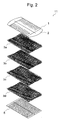
- Fig. 2 is an exploded perspective view of the cleaning sheet from in Fig. 1.
- this cleaning tool 10 is of a so-called "handy-type," including a cleaning sheet 11 corresponding to the fibrous base material of the present invention and a handle 12.
- the handle 12 is appropriately interchangeable.
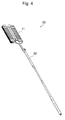
- a handle 22 as shown in Fig. 4 can be mounted to allow the cleaning tool in Fig. 1 to be used for cleaning high places or narrow places that are difficult to reach.
- the cleaning sheet 11 is formed from the following layers, starting in sequence from top to bottom: a protective sheet 1 formed from non-woven fabric cut into multiple strips; a base sheet 2 also formed from non-woven fabric cut into multiple strips; a first fiber bundle 3a formed from fiber tow; a second fiber bundle 3b formed from fiber tow; a third fiber bundle 3c formed from fiber tow; a fourth fiber bundle 3d formed from fiber tow; and a strip sheet 5 in which multiple strips are formed.
- the first fiber bundle 3a, the second fiber bundle 3b, the third fiber bundle 3c and the fourth fiber bundle 3d constitute the brush section of the present invention.
- this brush section provides more effective cleaning.
- the "brush section” is a section that performs the primary cleaning function in the cleaning tool according to the present invention, may be referred to either a portion or a whole of the fibrous base material.
- the protective sheet 1, the base material sheet 2, the first fiber bundle 3a, the second fiber bundle 3b, the third fiber bundle 3c, the fourth fiber bundle 3d and the strip sheet 5 are all bonded together at the uni-layer-bonding line 6.
- the bonding lines 7 only the protective sheet 1, the base material sheet 2, the first fiber bundle 3a and the second fiber bundle 3b are bonded.
- the antigenicity-reducing component is preferably applied only to the brush section including the first fiber bundle 3a, the second fiber bundle 3b, the third fiber bundle 3c and the fourth fiber bundle 3d.
- Fig. 5 shows another example of a cleaning tool in the form of a floor-type cleaning tool 30 suitable for cleaning floors.
- a cleaning sheet 31 corresponding to the fibrous base material of the present invention is wrapped around a panel at an end 32a of a handle 32 for use.
- Projections 33 made from tows are formed on the front and back of the cleaning sheet 31, facilitating the cleaning places, such as grooves, that would be difficult to clean with a flat tool.
- the cleaning sheet 31 is able to collect dust and like by the static electricity force.
- Methods for applying the antigenicity-reducing component to the cleaning tool described above include the method of spraying or roller-coating the antigenicity-reducing component onto the fibrous base material, the immersion method and the like, but are not restricted to them.
- the antigenicity-reducing component when it is applied, it may be applied as a dilute solution in water or in an organic solvent because an amount of the antigenicity-reducing component to be applied is extremely small. In this case, the solvent of the dilute solution of the antigenicity-reducing component evaporates after the application thereof, resulting in a manufacturing of a cleaning tool applied with the antigenicity-reducing component.
- the antigenicity-reducing component is applied in an amount of preferably no less than 0.001 percent by weight and no more than 10 percent by weight, more preferably no less than 0.002 percent by weight and no more than 1 percent by weight, relative to the entire fibrous base material.
- the antigenicity-reducing component When the antigenicity-reducing component is less than 0.001 percent by weight, the antigenicity-reducing rate against the collected dust becomes undesirably insufficient, while, when the antigenicity-reducing component exceeds 10 percent by weight, it becomes undesirably poor in stability over time thereof and also costly.
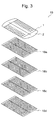
- FIG. 3 shows an exploded perspective view of a cleaning sheet according to a second embodiment of this invention. As shown in Fig.
- a cleaning sheet 15 is formed from the following layers, starting in sequence from top to bottom: a protective sheet 1 formed from non-woven fabric cut into multiple strips; a base sheet 2 also formed from non-woven fabric cut into multiple strips; a first fiber bundle 16a also formed from non-woven fabric cut into multiple strips; a second fiber bundle 16b; a third fiber bundle 16c; and a fourth fiber bundle 16d.
- Fibers used in non-woven fabrics are preferably those of olefins, most suitably polypropylene in particular.
- the fiber diameter is preferably that of an extra-fine type, not less than 0.1 ⁇ m and not more than 10 ⁇ m.
- Non-woven fabrics are preferably melt-blown non-woven fabric and spun-bonded non-woven fabric, and the specific weight per unit area thereof is preferably not less than 10 g/m 2 and not more than 100 g/m 2
- Electret-forming treatment which means making a base material electrically charged and polarized semi-permanently, can be performed on fibers in the long fibrous state, non-woven fabrics and cleaning tools after the manufacture thereof by a conventional method known in the art.
- Methods for applying the electric charge include a method for polarizing a sample with the direct current high voltage, the method for ionizing the atmosphere by applying the direct current high voltage to a needle electrode and applying ions to fibers, and the method for charging fibers by a positive discharge.
- Tannic acid (from Wako Pure Chemical Industries, Ltd.) was dissolved in water and ethanol so as to prepare a 15% tannic acid solution.
- the two types of antigenicity-reducing agents described above were mixed and stirred in the proportions shown in Table 1 to prepare the preparation samples 1 - 3 of the antigenicity-reducing component dilute solutions.
- the preparation sample 4 is a case when only water was used as a control Table 1 Combined amount of antigenicity-reducing component in dilute solution (unit: % by weight) Name Sample Antigenicity-reducing component Water Solution added with no antigenicity-reducing component Preparation sample 4 - 100 Tannic acid composition Preparation sample 1 1 99 Preparation sample 2 10 90 Oleuropein composition Preparation sample 3 100 90
- the above-described preparation samples 1 through 3 of the antigenicity-reducing component dilute solution and the preparation sample 4 (a solution (water) added with no antigenicity-reducing component) were sprayed onto the cleaning tool shown in Fig. 1 (hereinafter referred to as the "handy-type"), and onto the cleaning tool shown in Fig. 4 (hereinafter referred to as the "floor-type").
- These cleaning tools used herein were of a static electricity-generating type.
- 3 of fiber tows including the polyethylene/polypropylene side-by-side fibers and a single fiber tow including the nylon fiber were piled to prepare the fiber bundles (3a, 3b, 3c and 3d in Fig. 2).
- the antigenicity-reducing component dilute solution was applied so as to become 5 percent by weight thereof relative to the entire fibrous base material (the sheet 11 in Fig. 1).
- the aforementioned dilute solution was applied so as to become 7.5 percent by weight thereof relative to the entire fibrous base material (the sheet 31 in Fig. 5). Evaluation
- Floor-type Dust containing approximately 0.05 g of mite allergens (Dermatophagoides), and approximately 0.01 g of cedar pollen were dispersed on a floor panel approximately 30 cm x 30 cm, respectively, and wiped away with the floor-type cleaning tool. The allergens were extracted from this cleaning tool with an extraction fluid and quantified using the ELISA method, respectively.
- the ELISA (enzyme-linked immunosorbent assay) method is a type of EIA (enzyme immunoassay) to quantify a substance (antigen or antibody) utilizing a color development by an enzyme linked to antigen or antibody taking place in antigen-antibody reactions.
- the ELISA method is a sandwich method in which a substance to be detected (allergen) is quantified by sequentially using two types of antibodies as if sandwiching the antigen.
- the present invention can be preferably used as an indoor cleaning tool equipped with fibrous base materials.
Landscapes
- Engineering & Computer Science (AREA)
- Chemical & Material Sciences (AREA)
- Life Sciences & Earth Sciences (AREA)
- Textile Engineering (AREA)
- Wood Science & Technology (AREA)
- Health & Medical Sciences (AREA)
- Chemical Kinetics & Catalysis (AREA)
- General Health & Medical Sciences (AREA)
- Oil, Petroleum & Natural Gas (AREA)
- Organic Chemistry (AREA)
- Dispersion Chemistry (AREA)
- General Chemical & Material Sciences (AREA)
- Epidemiology (AREA)
- Veterinary Medicine (AREA)
- Public Health (AREA)
- Animal Behavior & Ethology (AREA)
- Dentistry (AREA)
- Environmental Sciences (AREA)
- Agronomy & Crop Science (AREA)
- Zoology (AREA)
- Pest Control & Pesticides (AREA)
- Toxicology (AREA)
- Plant Pathology (AREA)
- Cleaning Implements For Floors, Carpets, Furniture, Walls, And The Like (AREA)
- Treatments For Attaching Organic Compounds To Fibrous Goods (AREA)
- Detergent Compositions (AREA)
- Filters For Electric Vacuum Cleaners (AREA)
Abstract
Description
- This application is based on and claims the benefit of priority from Japanese Patent Application No. 2004-381391, filed on 28 December 2004, the content of which is incorporated herein by reference.
- The present invention relates to an indoor cleaning tool equipped with a fibrous base material, more specifically, to a cleaning tool that can reduce the antigenicity of allergy inducing substances.
- In recent years, there has been a steady increase in the number of people afflicted with allergic diseases such as allergic rhinitis and bronchial asthma. The substances that provoke these allergic diseases are referred to as allergens, of which already approximately 200 types have been identified to date. Mites, mite carcasses, pet hair, and pollen are typical examples thereof. These allergens can provoke various allergic symptoms through contact with or entry into the body.
- In these cases, using chemicals or the like to kill the mites and the like that provoke allergies does not provide a complete solution since the mite carcasses also have antigenicity. Thus, the alleviation of allergic symptoms or the prevention of a new sensitization to allergens requires either a complete removal of allergens from the living space or a reduction of the antigenicity of allergy inducing substances by denaturing allergens thereof.
- In Japanese Patent Application Laid-open Publication No. 2003-55122 (hereinafter Patent Document 1), as an agent for reducing antigenicity of allergy inducing substances described above, allergen-inactivating agents prepared from at least one plant selected from the Oleaceae, for example, Olea europaea or Ligustrum obtusifolium, have been disclosed. In Japanese Patent Application Laid-open Publication No. 2003-334240 (hereinafter Patent Document 2), also, as the agents that can be sprayed or applied in an aqueous state onto tatami floor mats, carpets and floors, allergen-reducing agents including an aqueous solution containing aluminum sulfate and sodium sulfate as the active components have been disclosed.
- Furthermore, in Japanese Patent Application Laid-open Publication No. H5-305049 (hereinafter Patent Document 3), as the cleaning tools for removing indoor dust and dirt using static electricity, there have also been disclosed cleaning tools for adsorbing and collecting indoor dust and dirt using non-woven fabric constituted of olefinic extra-fine fibers formed into an electret to store static electricity therein. In Japanese Patent Application Laid-open Publication No. 2004-65731 (hereinafter Patent Document 4) cleaning cloths that have a high capacity to adsorb and collect indoor dust and dirt, which is elevating charge generated upon cleaning (wiping), by combining fibrous materials of different triboelectric series have been also disclosed.
- In cleaning tools such as dusters, mops and wipers used to remove indoor dust and dirt, allergens adhere to the cleaning tool during cleaning and remain thereon as they are for a long period. As described above, for the alleviation of allergic symptoms or for the prevention of a new sensitization to allergens, the reduction of the antigenicity of allergens held on the cleaning tool would also be required.
- However, the agents of the above-described
Patent Documents 1 and 2 are for use of spraying or applying them directly to places which can be in contact with the body, such as on tatami floor mats, carpets, floors and clothes. This makes it necessary to wipe away the agent or to remove it with a vacuum cleaner after application, resulting in a burden on the user. However, no easy method has been researched for eliminating allergy inducing substances on floors and furniture which are cleaned most frequently. Also, in the conventional methods, the object to be cleaned becomes wet, and therefore it requires time to dry it. Furthermore, no research has been done on reducing antigenicity of allergy inducing substances contained in dust and dirt collected on the cleaning tools such as mops having fibrous base materials. - In particular, as the indoor cleaning tools, dry tools equipped with disposable and replaceable fibrous base materials in sheet or brush form which contain essentially no moisture have been well-received in the market. For such cleaning tools, it is required to be capable of adsorbing and collecting dirt and dust leaving no wiping mark on the object to be cleaned, and adsorb the antigenicity-reducing component to the surface of the fibrous base material or impregnate that surface with the component.
- With regard to this, in Patent Documents 3 and 4, no research has been performed on the cleaning tool considering the compatibility between the above-described capability of collecting dirt and dust, of the prevention from leaving the wiping mark on the object to be cleaned, and capability of both adsorption and the impregnation of the antigenicity-reducing component.
- The present invention has been made in view of the above-described problems, aiming at providing a cleaning tool capable of adsorbing and collecting dust or dirt without leaving the wiping mark on the object to be cleaned, and further reducing the antigenicity of allergy inducing substance adhering to the cleaning tool.
- The present inventors have diligently researched to solve the above-described problems and have discovered that the problems can be solved by using fibers having electrostatic charge properties for the fibrous base material of the cleaning tool and by applying an antigenicity-reducing component to the fibrous base material, thus achieving the present invention. More specifically, the present invention provides the following.
- A first aspect of the present invention is a cleaning tool for indoor wiping including: an electrostatic fibrous base material charged electrostatically at least during use; in which the electrostatic fibrous base material has an antigenicity-reducing component which reduces antigenicity of allergy-inducing matter.
- The cleaning tool according to the invention is equipped with a dry fibrous base material with an electrostatic charge property so as to be capable of collecting dirt and dust without leaving any wiping marks. Accordingly, this cleaning tool can be used for such objects as TV sets and glassware on which consumers desire that no wiping marks remaine. Furthermore, since an antigenicity-reducing component is applied to the cleaning tool, allergy inducing substances which have adhered to the cleaning tool can be reduced. Moreover, the antigenicity-reducing components can be easily applied to the fibrous base material, and when respective components are applied in limited quantities, it is possible to prevent the transition of the antigenicity-reducing components from the fibrous base material side to the object side to be cleaned while using the cleaning tool.
- A second aspect of the present invention is a cleaning tool as in the first aspect of the present invention in which the fibrous material is a fiber processed with electret treatment.
- In this embodiment, since a charge by electret-forming treatment is utilized, the charge can be maintained semi-permanently requiring no friction of the cleaning tool with an object to be cleaned. In this invention, "electret treatment" means making base material electrically charged and polarized semi-permanently. Accordingly, the cleaning tool can always adsorb and collect dirt and dust so as to be capable of reducing the antigenicity of allergy inducing substances in removing the dirt and dust without leaving wiping marks. Furthermore, since the electrical charge is not transferred to the allergy inducing substance, it hardly falls away so as to be easily captured on the cleaning tool. Therefore, even the cleaning tool which has adsorbed and collected allergy inducing substances but is still usable can be safely kept in house.
- A third aspect of the present invention is a cleaning tool as in the first aspect of the present invention in which the electrostatic fibrous base material is a combination of two or more types of fiber having different triboelectric series.
- In this embodiment, because of the combination of fibers of different triboelectrc series, static electricity can be easily generated by the friction among fibers such that no friction is required between an object to be cleaned. Furthermore, even dirt and dust charged either positively or negatively can be adsorbed and collected to the fibers so as to enable the efficient absorption of allergy inducing substances
- A fourth aspect of the present invention is a cleaning tool as in the first to third aspects of the present invention in which a fibrous material constituting the electrostatic fibrous base material is hydrophobic.
- According to this embodiment, since fiber composition is hydrophobic, the charge state thereof can be maintained for a long period of time.
- A fifth aspect of the present invention is a cleaning tool as in the first to fourth aspects of the present invention in which the antigenicity-reducing component is provided in a state of a solution into which the antigenicity-reducing component is dissolved.
- According to this embodiment, the antigenicity-reducing component is applied as diluents diluted in water or ethanol to the fibrous base material such that it can be applied uniformly to the fibers. Accordingly, a reaction when the antigenicity-reducing component is contacted with the allergy inducing substances contained in the wiped-off dirt and dust can be efficiently carried out. In this case, it is possible to supplement a dilute solution with surfactants allowing to easily stick to the fibers and binder components such as organic macromolecular substances allowing to be readily fixed to the fibers.
- A sixth aspect of the present invention is a cleaning tool as in the first to fifth aspects of the present invention in which the antigenicity-reducing component is a plant extract component.
- According to this embodiment, the antigenicity-reducing component to be used is of a plant origin so as to be highly physiologically safe to the human body.
- A seventh aspect of the present invention is a cleaning tool as in the first to sixth aspects of the present invention in which the antigenicity-reducing component is an extract from an olea or ligustrum plant extracted by using water or an organic solvent.
- According to this embodiment, extracts of olea or ligustrum plants in water or in an organic solvent (hereinafter referred to as olive extracts) are so excellent in the antigenicity-reducing activity that they can reduce the antigenicity even by the application of smaller amounts thereof. Also, some types of conventional plant-derived antigenicity-reducing components per se have color, thus it causes such problems as coloring of the fibrous base material when applied thereto. However, since the olive extract itself is yellow to yellowish brown in color, it becomes almost transparent when diluted and applied to the fibrous base material, and thus this enables preventing coloring of the base materials.
- An eighth aspect of the present invention is a cleaning tool as in the first to seventh aspects of the present invention in which the antigenicity-reducing component is oleuropein.
- Oleuropein used in this embodiment is a phenolic iridoid glycoside contained in the above-described Oleaceae plants (such as Olea europaea or Ligustrum obtusifolium) in large quantities. This Iridoid glycoside has a formyl group and a hydroxyl group, which are thought to exert the antigenicity-reducing action through the binding thereof with an amino group contained in the allergen protein.
- A ninth aspect of the present invention is a cleaning tool as in the seventh or eighth aspects of the present invention in which the electrostatic fibrous base material is white.
- According to this embodiment, since the olive extract and oleuropein described above have little coloring, there is no problem with the fibrous base material being colored. As a result, since white fibrous base materials can be used similarly as before, dust and dirt adhering to the base materials can be easily seen.
- A tenth aspect of the present invention is a cleaning tool as in the first to ninth aspects of the present invention in which the antigenicity-reducing component is provided 0.001 percent or more by weight and 10 percent or less by weight per 100 percent weight portion of the electrostatic fibrous material.
- According to this embodiment, an adequate antigenicity-reducing effect can be obtained by applying the antigenicity-reducing component in such a very small amount as no less than 0.001 percent by weight relative to the entire fibrous base material. Furthermore, when the amount of the antigenicity-reducing component exceeds 10 percent by weight, the stability over time thereof becomes poor.
- According to the present invention, a cleaning tool can be provided which is capable of reducing the antigenicity of allergy inducing substances adhering to the cleaning tool and leaving no wiping marks on the object to be cleaned after wiping off dirt and dust therefrom.
-
- Fig. 1 shows a perspective drawing showing an example of a cleaning tool according to the present invention.
- Fig. 2 shows an exploded perspective drawing of the fibrous base material in Fig. 1.
- Fig. 3 shows an exploded perspective drawing of the fibrous base material according to the second embodiment of the present invention.
- Fig. 4 shows a perspective drawing showing another example of a cleaning tool according to the present invention.
- Fig. 5 shows a perspective drawing showing yet another example of a cleaning tool according to the present invention.
- In the following, the best mode for carrying out the present invention will be explained.
- The "antigenicity-reducing component" used in the present invention reduces the antigenicity of allergy inducing substance to suppress allergic symptoms, preferably being the component of a plant-origin. Herein, the allergy inducing substance (allergen) includes inhaled allergens such as mites, house dust, animal, fungi and insects, in addition to cedar pollen and oryza pollen.
- Such antigenicity-reducing components are not particularly limited, including the above-described olive extracts, privet extracts, and extracts of pomegranate, neem, persimmon, tea, bamboo, perilla, peppermint, Japanese Hinoki cypress (Chamaecyparis obtusa), Hiba arborvitae (Thujopsis dolabrata), eucalyptus, tea tree, etc. Examples of extracted compounds include tannic acid, gallic acid, etc. Other examples include: high-molecular compounds having a side chain of linear macromolecular repeating units including monovalent or higher phenol groups such as poly (para-vinyl phenol); high-molecular compounds having monovalent phenol groups such as dioxybenzoic acid polymer as the repeating unit, bivalent or higher benzene sulfonates having a polyoxyethylene chain and/or an ethylene chain such as disodium lauryl diphenyl ether disulfonate in its molecule; and/or bivalent or higher sulfates having a polyoxyethylene chain and/or an ethylene chain in its molecule; and/or bivalent or higher hydrosulfate having polyoxyethylene chain and/or ethylene chain in its molecule, alcohols having a terpenoid skeleton; hydroxy benzoates such as 2,5-dihydroxy benzoic acid; aromatic hydroxy compounds; carbonates of alkaline metals; alum; lauryl benzene sulfonates; lauryl sulfates; polyoxyethylene lauryl ether sulfates; phosphates; zinc sulfate and/or lead acetate; etc.
- Of the components described above, the antigenicity-reducing component preferably includes an olive extract. The "olive extract" in the present invention includes extracts of the olea or ligustrum plants in water or an organic solvent. Also, the antigenicity-reducing component is preferably oleuropein. Oleuropein is an iridoid glycoside having a formyl group and a hydroxyl group. These groups are thought to bind with the amino groups contained in the allergen protein so as to reduce the antigenicity thereof. Specifically, the olive extract as described in Patent Document 1 above can be used.
- Also, tannic acid is thought to reduce antigenicity by binding the hydroxyl groups in polyphenol bonding thereof with the amino group and the peptide section of the allergen protein.
- The antigenicity-reducing component described above may be applied usually in a state of a solution containing an active ingredient such as oleuropein and an extract thereof (hereinafter referred to as antigenicity-reducing agent). The olive extract described above is an example of an antigenicity-reducing agent, which can be used as a solution containing ethanol and water besides oleuropein.
- Various ingredients other than the above-described antigenicity-reducing components can also be applied to the cleaning tool of the present invention as long as they do not significantly alter the characteristics of the cleaning tool. Such ingredients may be applied to the cleaning tool either mixed together with or applied separately from the antigenicity-reducing agent. For example, a supplement may be added to the antigenicity-reducing agent to enhance the reactivity thereof. Examples of the supplement are hygroscopic compositions including alkaline earth metal salts, etc. Further, lubricants, surfactants and like may be added to facilitate the adhesion of the antigenicity-reducing agent to the fibrous base materials.
- Next, a cleaning tool to which is applied the above-described antigenicity-reducing component will be explained. The static electricity-generating type cleaning tool is an indoor cleaning tool equipped with a substantially moisture-free fibrous base material, and it is not particularly limited so long as the cleaning tool generates static electricity by friction between fibrous base material and a wiped surface, and friction among fibers.
- As the fibers used in the cleaning tool, any fibers which have been conventionally used in the non-woven fabric and clothing can be used, but they are preferably synthetic fibers. As the synthetic fibers, those of polyethylene terephthalate, polyethylene, polypropylene, polyvinyl chloride, polytetrafluoroethylene, polystyrene, nylon and such can be used. As the natural fibers, wool and such can be used.
- Furthermore, a combination of the above-described fibers can be used. When fibers are combined for use, both fibers having a charge property showing minus-polarity and fibers having a charge property showing positive polarity are alternately arranged. Thus, using fibers with opposite polarities alternately, dust and dirt can be adsorbed and collected without relying on the polarity thereof. Furthermore, static electricity can be efficiently generated by frictions among fibers themselves even without frictions between fibers and the wiped surface of an object.
- In this case, for efficiently generating/maintaining static electricity, it is preferable to make fibers as hydrophobic as possible.
- As the non-woven fabric, spun-bonded non-woven fabric, melt-blown non-woven fabric and spun-laced non-woven fabric are preferably used. Examples of cleaning tools
- Figs. 1 and 2 show an example of a cleaning tool. Fig. 1 is a perspective view of the cleaning tool, while Fig. 2 is an exploded perspective view of the cleaning sheet from in Fig. 1. As shown in Fig. 1, this
cleaning tool 10 is of a so-called "handy-type," including acleaning sheet 11 corresponding to the fibrous base material of the present invention and ahandle 12. Thehandle 12 is appropriately interchangeable. For example, ahandle 22 as shown in Fig. 4 can be mounted to allow the cleaning tool in Fig. 1 to be used for cleaning high places or narrow places that are difficult to reach. - As shown in Fig. 2, the
cleaning sheet 11 is formed from the following layers, starting in sequence from top to bottom: a protective sheet 1 formed from non-woven fabric cut into multiple strips; abase sheet 2 also formed from non-woven fabric cut into multiple strips; afirst fiber bundle 3a formed from fiber tow; asecond fiber bundle 3b formed from fiber tow; athird fiber bundle 3c formed from fiber tow; afourth fiber bundle 3d formed from fiber tow; and astrip sheet 5 in which multiple strips are formed. In this embodiment, thefirst fiber bundle 3a, thesecond fiber bundle 3b, thethird fiber bundle 3c and thefourth fiber bundle 3d constitute the brush section of the present invention. Thus, this brush section provides more effective cleaning. Since the antigenicity-reducing component need only be applied to this brush section, it can be applied more efficiently. Herein, the "brush section" is a section that performs the primary cleaning function in the cleaning tool according to the present invention, may be referred to either a portion or a whole of the fibrous base material. Of the respective layers, the protective sheet 1, thebase material sheet 2, thefirst fiber bundle 3a, thesecond fiber bundle 3b, thethird fiber bundle 3c, thefourth fiber bundle 3d and thestrip sheet 5 are all bonded together at the uni-layer-bonding line 6. At thebonding lines 7, only the protective sheet 1, thebase material sheet 2, thefirst fiber bundle 3a and thesecond fiber bundle 3b are bonded. As a result, a holdingspace 13 is formed between the protective sheet 1 and thebase material sheet 2, allowing thehandle 12 to be inserted and fixed. In such "handy-type"cleaning tools first fiber bundle 3a, thesecond fiber bundle 3b, thethird fiber bundle 3c and thefourth fiber bundle 3d. - Fig. 5 shows another example of a cleaning tool in the form of a floor-
type cleaning tool 30 suitable for cleaning floors. As shown in Fig. 5, in thiscleaning tool 30, acleaning sheet 31 corresponding to the fibrous base material of the present invention is wrapped around a panel at anend 32a of ahandle 32 for use.Projections 33 made from tows are formed on the front and back of thecleaning sheet 31, facilitating the cleaning places, such as grooves, that would be difficult to clean with a flat tool. By simply placing thecleaning tool 30 in contact with a floor or the like, thecleaning sheet 31 is able to collect dust and like by the static electricity force. In such a "floor-type"cleaning tool 30, it would be preferable to apply the antigenicity-reducing component to theentire cleaning sheet 31. - Methods for applying the antigenicity-reducing component to the cleaning tool described above include the method of spraying or roller-coating the antigenicity-reducing component onto the fibrous base material, the immersion method and the like, but are not restricted to them. Furthermore, when the antigenicity-reducing component is applied, it may be applied as a dilute solution in water or in an organic solvent because an amount of the antigenicity-reducing component to be applied is extremely small. In this case, the solvent of the dilute solution of the antigenicity-reducing component evaporates after the application thereof, resulting in a manufacturing of a cleaning tool applied with the antigenicity-reducing component.
- The antigenicity-reducing component is applied in an amount of preferably no less than 0.001 percent by weight and no more than 10 percent by weight, more preferably no less than 0.002 percent by weight and no more than 1 percent by weight, relative to the entire fibrous base material.
- When the antigenicity-reducing component is less than 0.001 percent by weight, the antigenicity-reducing rate against the collected dust becomes undesirably insufficient, while, when the antigenicity-reducing component exceeds 10 percent by weight, it becomes undesirably poor in stability over time thereof and also costly.
- An electret-forming treated type cleaning tool is manufactured by using the fibrous base material formed from the laminated non-woven fabrics cut into strips and making that base material into an "electret" ,which makes a base material electrically charged and polarized semi-permanently. Fig. 3 shows an exploded perspective view of a cleaning sheet according to a second embodiment of this invention. As shown in Fig. 3, a
cleaning sheet 15 is formed from the following layers, starting in sequence from top to bottom: a protective sheet 1 formed from non-woven fabric cut into multiple strips; abase sheet 2 also formed from non-woven fabric cut into multiple strips; afirst fiber bundle 16a also formed from non-woven fabric cut into multiple strips; asecond fiber bundle 16b; athird fiber bundle 16c; and afourth fiber bundle 16d. - Fibers used in non-woven fabrics are preferably those of olefins, most suitably polypropylene in particular. The fiber diameter is preferably that of an extra-fine type, not less than 0.1 µm and not more than 10 µm.
- Non-woven fabrics are preferably melt-blown non-woven fabric and spun-bonded non-woven fabric, and the specific weight per unit area thereof is preferably not less than 10 g/m2 and not more than 100 g/m2 Electret-forming treatment, which means making a base material electrically charged and polarized semi-permanently, can be performed on fibers in the long fibrous state, non-woven fabrics and cleaning tools after the manufacture thereof by a conventional method known in the art. Methods for applying the electric charge include a method for polarizing a sample with the direct current high voltage, the method for ionizing the atmosphere by applying the direct current high voltage to a needle electrode and applying ions to fibers, and the method for charging fibers by a positive discharge.
- In the following, the present invention will be explained in further detail with reference to examples and comparative examples, but it is not restricted to these examples described below.
- After the leaves of the olive plant were extracted with water based on the third composition embodiment in Patent Document 1 (20 g of fresh olive leaves placed in 100 g of water, disintegrated in a mixer, then filtered using a filter paper to obtain a filtrate), ethanol was added to prepare a 0.6% oleuropein solution.
- Tannic acid (from Wako Pure Chemical Industries, Ltd.) was dissolved in water and ethanol so as to prepare a 15% tannic acid solution.
- The two types of antigenicity-reducing agents described above were mixed and stirred in the proportions shown in Table 1 to prepare the preparation samples 1 - 3 of the antigenicity-reducing component dilute solutions. The preparation sample 4 is a case when only water was used as a control
Table 1 Combined amount of antigenicity-reducing component in dilute solution (unit: % by weight) Name Sample Antigenicity-reducing component Water Solution added with no antigenicity-reducing component Preparation sample 4 - 100 Tannic acid composition Preparation sample 1 1 99 Preparation sample 210 90 Oleuropein composition Preparation sample 3 100 90 - Next, the above-described preparation samples 1 through 3 of the antigenicity-reducing component dilute solution and the preparation sample 4 (a solution (water) added with no antigenicity-reducing component) were sprayed onto the cleaning tool shown in Fig. 1 (hereinafter referred to as the "handy-type"), and onto the cleaning tool shown in Fig. 4 (hereinafter referred to as the "floor-type"). These cleaning tools used herein were of a static electricity-generating type. First, 3 of fiber tows including the polyethylene/polypropylene side-by-side fibers and a single fiber tow including the nylon fiber were piled to prepare the fiber bundles (3a, 3b, 3c and 3d in Fig. 2). These fiber bundles and the non-woven fabric (the
strip sheet 5 in Fig. 2) were bonded together to manufacture the cleaning tool. For each of the floor-type and handy-type, cleaning tools of Examples 1 through 3 (applied with the preparation samples 1 through 3) and that of a first comparative example (applied with the preparation sample 4) were obtained. - For the handy-type tools, the antigenicity-reducing component dilute solution was applied so as to become 5 percent by weight thereof relative to the entire fibrous base material (the
sheet 11 in Fig. 1). For the floor-type tools, the aforementioned dilute solution was applied so as to become 7.5 percent by weight thereof relative to the entire fibrous base material (thesheet 31 in Fig. 5). Evaluation - Cleaning tools according to Examples 1, 2 and 3 as well as the comparative example 1 were evaluated for the antigenicity-reducing performance on cedar pollen and dust mites (Dermatophagoides) using the procedure described below. The results are shown in Tables 2 and 3. The "reduction rates" in the Tables are the values determined as "100 - 100 x (ELISA allergen amount from a cleaning tool applied with antigenicity-reducing agent) / (ELISA allergen amount from a cleaning tool applied with no antigenicity-reducing agent). The symbols in The tables indicate the following reduction rates:
- gr: good reduction rate (50% or more)
- ir: inferior reduction rate (10 - 50%)
- br: bad reduction rate (0 - 10%)
- Handy-type: Dust containing approximately 0.05 g of mite allergens (Dermatophagoides) and approximately 0.01 g of cedar pollen were placed in a glass bottle having a diameter of 9 cm and a height of 17 cm, respectively, and, after the bottle was capped, the dust and cedar pollen were dispersed throughout the internal wall of the bottle, respectively. The top was removed and the handy-type cleaning tool was used to wipe away the dust and cedar pollen, respectively. The allergens were extracted from this cleaning tool with an extraction fluid, and quantified using the ELISA method.
- Floor-type: Dust containing approximately 0.05 g of mite allergens (Dermatophagoides), and approximately 0.01 g of cedar pollen were dispersed on a floor panel approximately 30 cm x 30 cm, respectively, and wiped away with the floor-type cleaning tool. The allergens were extracted from this cleaning tool with an extraction fluid and quantified using the ELISA method, respectively.
- In this case, a phosphate buffer (pH 7) was used as the extraction fluid. The ELISA (enzyme-linked immunosorbent assay) method is a type of EIA (enzyme immunoassay) to quantify a substance (antigen or antibody) utilizing a color development by an enzyme linked to antigen or antibody taking place in antigen-antibody reactions. In this case, the ELISA method is a sandwich method in which a substance to be detected (allergen) is quantified by sequentially using two types of antibodies as if sandwiching the antigen.
Table 2 Cedar pollen antigenicity reduction rate Test sample Reduction rate Handy-type Floor-type Comparative example 1 br br Example 1 ir ir Example 2 gr gr Example 3 gr gr Table 3 Mite antigenicity reduction rate Reduction rate Test sample Handy-type Floor-type Comparative example 1 br br Example 1 br ir Example 2 gr gr Example 3 gr gr - From the results in Tables 2 and 3, it was confirmed that the floor-type cleaning tool showed the antigenicity-reducing effect with either one of the antigenicity-reducing components. In the handy-type cleaning tool of Example 1, however, the antigenicity-reducing component was applied in smaller amounts such that the effect was insufficient.
- Heating test: For the cleaning tools in Examples 2 and 3, the only fibrous base material was placed in a paper container and packaged in the case of the handy-type cleaning tools, and packaged with film in a pillow-shape in the case of the floor-type cleaning tool. The packages were left standing indoors away from direct light in thermostatic chambers at 40°C and at 50°C, respectively. Right after the initiation of the test, and after one month, allergens were measured using the same method as in the Evaluation 1.
- Light irradiation test: Fibrous base materials from both the handy-type and floor-type cleaning tools were not packaged, and were left standing as the sheets themselves under a xenon lamp weather meter for the equivalent of one month and six months under sunlight. Allergens were measured using the same method as in the Evaluation 1.
- Results are shown in Table 4, with the reduction rates and symbols in the table indicating the same things as in Tables 2 and 3. For both the cleaning tools of Examples 2 and 3, the reduction effect was maintained after exposure to heat for one month. The reduction effect was also maintained after exposure to the light irradiation.
Table 4 Mite antigenicity reduction rate Example 2 Example 3 Condition Elapsed time Handy-type Floor-type Handy-type Floor-type Immediately after application 0 days gr gr gr gr Room Temperature One month gr gr gr gr 40°C One month gr gr gr gr 50°C One month gr gr gr gr Light irradiation One month equivalent gr gr gr gr Light irradiation Six months equivalent gr - gr - - While preferred embodiments of the present invention have been described and illustrated above, it is to be understood that they are exemplary of the invention and are not to be considered to be limiting. Additions, omissions, substitutions, and other modifications can be made thereto without departing from the spirit or scope of the present invention. Accordingly, the invention is not to be considered to be limited by the foregoing description and is only limited by the scope of the appended claims.
- The present invention can be preferably used as an indoor cleaning tool equipped with fibrous base materials.
Claims (10)
- A cleaning tool for indoor wiping comprising:an electrostatic fibrous base material charged electrostatically at least during use;wherein the electrostatic fibrous base material has an antigenicity-reducing component which reduces antigenicity of allergy-inducing substance.
- The cleaning tool according to claim 1, wherein the electrostatic fibrous base material is a fiber processed with electret treatment.
- The cleaning tool according to claim 1, wherein the electrostatic fibrous base material is a combination of two or more types of fiber having different triboelectric series.
- The cleaning tool according to claims 1 to 3, wherein a fibrous material constituting the electrostatic fibrous base material is hydrophobic.
- The cleaning tool according to claims 1 to 4, wherein the antigenicity-reducing component is provided in a state of a solution into which the antigenicity-reducing component is dissolved.
- The cleaning tool according to claims 1 to 5, wherein the antigenicity-reducing component is a plant extract component.
- The cleaning tool according to claims 1 to 6, wherein the antigenicity-reducing component is an extract from an olea or ligustrum plant extracted by using water or an organic solvent.
- The cleaning tool according to claims 1 to 7, wherein the antigenicity-reducing component is oleuropein.
- The cleaning tool according to claim 7 or 8, wherein the electrostatic fibrous base material is white.
- The cleaning tool according to claims 1 to 9, wherein the antigenicity-reducing component is provided 0.001 percent or more by weight and 10 percent or less by weight per 100 percent weight portion of the electrostatic fibrous material.
Applications Claiming Priority (1)
| Application Number | Priority Date | Filing Date | Title |
|---|---|---|---|
| JP2004381391A JP4822704B2 (en) | 2004-12-28 | 2004-12-28 | Cleaning tool |
Publications (2)
| Publication Number | Publication Date |
|---|---|
| EP1676519A1 true EP1676519A1 (en) | 2006-07-05 |
| EP1676519B1 EP1676519B1 (en) | 2008-10-15 |
Family
ID=36102198
Family Applications (1)
| Application Number | Title | Priority Date | Filing Date |
|---|---|---|---|
| EP20050257506 Expired - Lifetime EP1676519B1 (en) | 2004-12-28 | 2005-12-06 | Cleaning tool |
Country Status (9)
| Country | Link |
|---|---|
| US (1) | US7745354B2 (en) |
| EP (1) | EP1676519B1 (en) |
| JP (1) | JP4822704B2 (en) |
| KR (1) | KR101208844B1 (en) |
| CN (1) | CN1989892A (en) |
| AT (1) | ATE410950T1 (en) |
| CA (1) | CA2529993C (en) |
| DE (1) | DE602005010379D1 (en) |
| ES (1) | ES2315813T3 (en) |
Cited By (2)
| Publication number | Priority date | Publication date | Assignee | Title |
|---|---|---|---|---|
| WO2009119861A1 (en) | 2008-03-25 | 2009-10-01 | Fujifilm Corporation | Hazardous substance-removing material |
| US8359699B2 (en) | 2007-03-05 | 2013-01-29 | Uni-Charm Corporation | Cleaning tool and cleaning element |
Families Citing this family (22)
| Publication number | Priority date | Publication date | Assignee | Title |
|---|---|---|---|---|
| US9192269B2 (en) | 2006-12-15 | 2015-11-24 | Omachron Intellectual Property Inc. | Surface cleaning apparatus |
| JP2008214501A (en) * | 2007-03-05 | 2008-09-18 | Japan Ecologia Co Ltd | House-dust mite allergen-reducing agent |
| WO2008112959A2 (en) * | 2007-03-14 | 2008-09-18 | Donald Varner | A compound water-wiper and pet hair/ fur removal apparatus and method |
| US7976639B2 (en) * | 2007-08-17 | 2011-07-12 | S.C. Johnson & Son, Inc. | Method for determining the percentage of allergens picked up from a surface |
| DE102008008576A1 (en) * | 2008-02-11 | 2009-08-20 | Carl Freudenberg Kg | Electrostatic dust collector |
| US8752232B2 (en) * | 2009-02-13 | 2014-06-17 | Kao Corporation | Cleaning sheet |
| US8578564B2 (en) * | 2009-11-05 | 2013-11-12 | The Procter & Gamble Company | Handle for removable cleaning implement |
| USD685151S1 (en) * | 2010-04-06 | 2013-06-25 | The Procter & Gamble Company | Handle for holding a cleaning device |
| USD674979S1 (en) * | 2010-08-11 | 2013-01-22 | The Procter & Gamble Company | Telescoping handle |
| KR20120140003A (en) * | 2011-06-20 | 2012-12-28 | 쓰리엠 이노베이티브 프로퍼티즈 캄파니 | Multilayered nonwoven fabric with anti-allergic effect |
| US9032584B1 (en) | 2012-10-10 | 2015-05-19 | Casey McAvoy | Handheld cleaning tool kit |
| TW201524416A (en) * | 2013-12-26 | 2015-07-01 | Oimo Ind Co Ltd | Bathroom scouring pad and brush handle free of hand touch |
| US11458515B2 (en) * | 2017-01-26 | 2022-10-04 | Unger Marketing International, Llc | Cleaning devices for cleaning of difficult to reach locations |
| US11006738B2 (en) | 2017-01-26 | 2021-05-18 | Unger Marketing International, Llc | Cleaning devices having selectively flexible or rigid handles |
| US20180325254A1 (en) * | 2017-05-09 | 2018-11-15 | Kanako Hayashi | Disposable hairbrush liner |
| USD905366S1 (en) * | 2018-01-05 | 2020-12-15 | The Procter & Gamble Company | Handle for holding a cleaning device |
| JP7275021B2 (en) * | 2019-03-08 | 2023-05-17 | ユニ・チャーム株式会社 | cleaning sheet |
| USD1046353S1 (en) * | 2022-03-22 | 2024-10-08 | Michael Clare | Golf glove drying device |
| USD1072405S1 (en) | 2023-01-30 | 2025-04-22 | Unger Marketing International, Llc | Squeegee tool having a fixed blade |
| USD1063271S1 (en) * | 2023-05-15 | 2025-02-18 | Kangduole Co., Ltd. | Handle for a cleaning article |
| USD1089919S1 (en) * | 2023-11-07 | 2025-08-19 | Daniel Noriega | Flexible duster handle |
| CN121375428B (en) * | 2025-11-19 | 2026-07-28 | 上海交通大学 | Vehicle window with window-separating water/fog removing function and using method thereof |
Citations (5)
| Publication number | Priority date | Publication date | Assignee | Title |
|---|---|---|---|---|
| JPH05305049A (en) | 1992-05-01 | 1993-11-19 | Duskin Co Ltd | Cleaning tool |
| JP2003055122A (en) | 2001-08-07 | 2003-02-26 | Shinto Fine Co Ltd | Antiallergic composition and method for inactivating allergen |
| JP2003334240A (en) | 2002-05-20 | 2003-11-25 | Sekisui Chem Co Ltd | Allergen reducing agent and method of using the same |
| US20040007251A1 (en) * | 2002-07-10 | 2004-01-15 | Kimberly-Clark Worldwide, Inc. | Cleaners for the control and removal of allergens |
| JP2004065731A (en) | 2002-08-08 | 2004-03-04 | Toray Ind Inc | Wipe cloth |
Family Cites Families (24)
| Publication number | Priority date | Publication date | Assignee | Title |
|---|---|---|---|---|
| JPS56125022A (en) * | 1981-01-30 | 1981-10-01 | Tamurakoma & Co Ltd | Production of dust adsorbing tool |
| US4977142A (en) * | 1984-07-11 | 1990-12-11 | University Of Sydney | Antiallergenic agent |
| JPS6144821A (en) * | 1984-07-11 | 1986-03-04 | ユニヴア−シテイ・オブ・シドニ− | Anti-allergenic |
| US4874659A (en) * | 1984-10-24 | 1989-10-17 | Toray Industries | Electret fiber sheet and method of producing same |
| JPH0966014A (en) | 1995-09-01 | 1997-03-11 | Lion Corp | Wiping tool for cleaning |
| JPH09164101A (en) | 1995-10-13 | 1997-06-24 | Dainippon Jochugiku Co Ltd | Cleaning items |
| JP3208306B2 (en) | 1995-11-17 | 2001-09-10 | ユニ・チャーム株式会社 | Disposable wiping tools |
| JPH1075924A (en) * | 1996-09-06 | 1998-03-24 | Duskin Co Ltd | Mite-proof cleaning tools |
| JP3611431B2 (en) | 1997-09-26 | 2005-01-19 | ユニ・チャーム株式会社 | Fiber sheet impregnated with cleaning composition and cleaning composition |
| JP3100578B2 (en) | 1997-12-16 | 2000-10-16 | ユニ・チャーム株式会社 | Cleaning article and method for manufacturing the same |
| JPH11267079A (en) | 1998-03-25 | 1999-10-05 | Uni Charm Corp | Multi-layer cleaning articles |
| JP2000102492A (en) | 1998-09-30 | 2000-04-11 | Uni Charm Corp | Recyclable biodegradable fiber sheet impregnated with cleaning composition or cleaning composition with which recyclable biodegradable fiber sheet is impregnated and their use method |
| US6494921B1 (en) * | 2000-02-10 | 2002-12-17 | M. Catherine Bennett | Method of removing particulate debris, especially dust mite fecal material from fabric articles in a conventional clothes dryer |
| AU772029B2 (en) * | 2000-03-08 | 2004-04-08 | Sumika Enviro-Science Co., Ltd. | Method for denaturing allergens |
| CN1184922C (en) | 2000-07-10 | 2005-01-19 | 尤妮佳股份有限公司 | Cleaning article |
| US6550639B2 (en) * | 2000-12-05 | 2003-04-22 | S.C. Johnson & Son, Inc. | Triboelectric system |
| JP4804685B2 (en) | 2000-12-22 | 2011-11-02 | 積水化学工業株式会社 | Cleaning sheet for tatami mat |
| JP4083978B2 (en) | 2000-12-27 | 2008-04-30 | ユニ・チャーム株式会社 | Cleaning goods |
| IL152340A (en) | 2001-02-23 | 2007-12-03 | Yoshinori Tanaka | Cleaning article |
| JP4342120B2 (en) | 2001-04-27 | 2009-10-14 | 住化エンビロサイエンス株式会社 | Anti-allergen composition and method for inactivating allergen |
| FR2830195B1 (en) * | 2001-10-03 | 2004-10-22 | Sederma Sa | COSMETIC AND DERMOPHARMACEUTICAL COMPOSITIONS FOR SKINS WITH ACNE TREND |
| JP3983204B2 (en) | 2002-07-03 | 2007-09-26 | 花王株式会社 | Wipe sheet |
| US20050000050A1 (en) * | 2003-06-18 | 2005-01-06 | Nhoconnections, Inc. | Apparatus and method for cleaning surfaces |
| JP2005290331A (en) * | 2004-04-06 | 2005-10-20 | Shinto Fine Co Ltd | Antiallergenic composition and method for deactivating allergen |
-
2004
- 2004-12-28 JP JP2004381391A patent/JP4822704B2/en not_active Expired - Fee Related
-
2005
- 2005-12-06 EP EP20050257506 patent/EP1676519B1/en not_active Expired - Lifetime
- 2005-12-06 AT AT05257506T patent/ATE410950T1/en not_active IP Right Cessation
- 2005-12-06 ES ES05257506T patent/ES2315813T3/en not_active Expired - Lifetime
- 2005-12-06 DE DE200560010379 patent/DE602005010379D1/en not_active Expired - Lifetime
- 2005-12-08 KR KR1020050119158A patent/KR101208844B1/en not_active Expired - Fee Related
- 2005-12-13 CA CA 2529993 patent/CA2529993C/en not_active Expired - Fee Related
- 2005-12-15 US US11/300,268 patent/US7745354B2/en not_active Expired - Fee Related
- 2005-12-28 CN CNA2005101377877A patent/CN1989892A/en active Pending
Patent Citations (5)
| Publication number | Priority date | Publication date | Assignee | Title |
|---|---|---|---|---|
| JPH05305049A (en) | 1992-05-01 | 1993-11-19 | Duskin Co Ltd | Cleaning tool |
| JP2003055122A (en) | 2001-08-07 | 2003-02-26 | Shinto Fine Co Ltd | Antiallergic composition and method for inactivating allergen |
| JP2003334240A (en) | 2002-05-20 | 2003-11-25 | Sekisui Chem Co Ltd | Allergen reducing agent and method of using the same |
| US20040007251A1 (en) * | 2002-07-10 | 2004-01-15 | Kimberly-Clark Worldwide, Inc. | Cleaners for the control and removal of allergens |
| JP2004065731A (en) | 2002-08-08 | 2004-03-04 | Toray Ind Inc | Wipe cloth |
Non-Patent Citations (3)
| Title |
|---|
| PATENT ABSTRACTS OF JAPAN vol. 018, no. 111 (C - 1170) 23 February 1994 (1994-02-23) * |
| PATENT ABSTRACTS OF JAPAN vol. 2003, no. 06 3 June 2003 (2003-06-03) * |
| PATENT ABSTRACTS OF JAPAN vol. 2003, no. 12 5 December 2003 (2003-12-05) * |
Cited By (3)
| Publication number | Priority date | Publication date | Assignee | Title |
|---|---|---|---|---|
| US8359699B2 (en) | 2007-03-05 | 2013-01-29 | Uni-Charm Corporation | Cleaning tool and cleaning element |
| WO2009119861A1 (en) | 2008-03-25 | 2009-10-01 | Fujifilm Corporation | Hazardous substance-removing material |
| EP2303450A4 (en) * | 2008-03-25 | 2011-08-03 | Fujifilm Corp | Hazardous substance-removing material |
Also Published As
| Publication number | Publication date |
|---|---|
| US7745354B2 (en) | 2010-06-29 |
| JP2006181293A (en) | 2006-07-13 |
| KR101208844B1 (en) | 2012-12-05 |
| KR20060076194A (en) | 2006-07-04 |
| CA2529993A1 (en) | 2006-06-28 |
| ATE410950T1 (en) | 2008-10-15 |
| EP1676519B1 (en) | 2008-10-15 |
| ES2315813T3 (en) | 2009-04-01 |
| CN1989892A (en) | 2007-07-04 |
| US20060137116A1 (en) | 2006-06-29 |
| JP4822704B2 (en) | 2011-11-24 |
| DE602005010379D1 (en) | 2008-11-27 |
| CA2529993C (en) | 2011-08-16 |
Similar Documents
| Publication | Publication Date | Title |
|---|---|---|
| CA2529993C (en) | Cleaning tool for indoor wiping | |
| EP1785082B1 (en) | Cleaning tool | |
| EP1803383B1 (en) | Cleaning tool | |
| JP2014520216A (en) | Multilayer nonwoven fabric with antiallergic effect | |
| JP4660179B2 (en) | Cleaning tool | |
| JP5281065B2 (en) | Cleaning tool | |
| MXPA05014188A (en) | Cleaning tool | |
| JP4573640B2 (en) | Cleaning tool | |
| CN101014695B (en) | Cleaning implement | |
| WO2006028273A1 (en) | Cleaning implement | |
| HK1104200A (en) | Cleaning tool | |
| WO2006028280A1 (en) | Cleaning implement |
Legal Events
| Date | Code | Title | Description |
|---|---|---|---|
| PUAI | Public reference made under article 153(3) epc to a published international application that has entered the european phase |
Free format text: ORIGINAL CODE: 0009012 |
|
| AK | Designated contracting states |
Kind code of ref document: A1 Designated state(s): AT BE BG CH CY CZ DE DK EE ES FI FR GB GR HU IE IS IT LI LT LU LV MC NL PL PT RO SE SI SK TR |
|
| AX | Request for extension of the european patent |
Extension state: AL BA HR MK YU |
|
| 17P | Request for examination filed |
Effective date: 20060927 |
|
| 17Q | First examination report despatched |
Effective date: 20061124 |
|
| AKX | Designation fees paid |
Designated state(s): AT BE BG CH CY CZ DE DK EE ES FI FR GB GR HU IE IS IT LI LT LU LV MC NL PL PT RO SE SI SK TR |
|
| GRAP | Despatch of communication of intention to grant a patent |
Free format text: ORIGINAL CODE: EPIDOSNIGR1 |
|
| GRAC | Information related to communication of intention to grant a patent modified |
Free format text: ORIGINAL CODE: EPIDOSCIGR1 |
|
| GRAS | Grant fee paid |
Free format text: ORIGINAL CODE: EPIDOSNIGR3 |
|
| GRAA | (expected) grant |
Free format text: ORIGINAL CODE: 0009210 |
|
| AK | Designated contracting states |
Kind code of ref document: B1 Designated state(s): AT BE BG CH CY CZ DE DK EE ES FI FR GB GR HU IE IS IT LI LT LU LV MC NL PL PT RO SE SI SK TR |
|
| REG | Reference to a national code |
Ref country code: GB Ref legal event code: FG4D Ref country code: CH Ref legal event code: EP |
|
| REG | Reference to a national code |
Ref country code: IE Ref legal event code: FG4D |
|
| REF | Corresponds to: |
Ref document number: 602005010379 Country of ref document: DE Date of ref document: 20081127 Kind code of ref document: P |
|
| REG | Reference to a national code |
Ref country code: ES Ref legal event code: FG2A Ref document number: 2315813 Country of ref document: ES Kind code of ref document: T3 |
|
| PG25 | Lapsed in a contracting state [announced via postgrant information from national office to epo] |
Ref country code: BG Free format text: LAPSE BECAUSE OF FAILURE TO SUBMIT A TRANSLATION OF THE DESCRIPTION OR TO PAY THE FEE WITHIN THE PRESCRIBED TIME-LIMIT Effective date: 20090115 Ref country code: AT Free format text: LAPSE BECAUSE OF FAILURE TO SUBMIT A TRANSLATION OF THE DESCRIPTION OR TO PAY THE FEE WITHIN THE PRESCRIBED TIME-LIMIT Effective date: 20081015 Ref country code: LT Free format text: LAPSE BECAUSE OF FAILURE TO SUBMIT A TRANSLATION OF THE DESCRIPTION OR TO PAY THE FEE WITHIN THE PRESCRIBED TIME-LIMIT Effective date: 20081015 |
|
| PG25 | Lapsed in a contracting state [announced via postgrant information from national office to epo] |
Ref country code: PT Free format text: LAPSE BECAUSE OF FAILURE TO SUBMIT A TRANSLATION OF THE DESCRIPTION OR TO PAY THE FEE WITHIN THE PRESCRIBED TIME-LIMIT Effective date: 20090316 Ref country code: PL Free format text: LAPSE BECAUSE OF FAILURE TO SUBMIT A TRANSLATION OF THE DESCRIPTION OR TO PAY THE FEE WITHIN THE PRESCRIBED TIME-LIMIT Effective date: 20081015 Ref country code: LV Free format text: LAPSE BECAUSE OF FAILURE TO SUBMIT A TRANSLATION OF THE DESCRIPTION OR TO PAY THE FEE WITHIN THE PRESCRIBED TIME-LIMIT Effective date: 20081015 Ref country code: IS Free format text: LAPSE BECAUSE OF FAILURE TO SUBMIT A TRANSLATION OF THE DESCRIPTION OR TO PAY THE FEE WITHIN THE PRESCRIBED TIME-LIMIT Effective date: 20090215 Ref country code: FI Free format text: LAPSE BECAUSE OF FAILURE TO SUBMIT A TRANSLATION OF THE DESCRIPTION OR TO PAY THE FEE WITHIN THE PRESCRIBED TIME-LIMIT Effective date: 20081015 Ref country code: SI Free format text: LAPSE BECAUSE OF FAILURE TO SUBMIT A TRANSLATION OF THE DESCRIPTION OR TO PAY THE FEE WITHIN THE PRESCRIBED TIME-LIMIT Effective date: 20081015 |
|
| PG25 | Lapsed in a contracting state [announced via postgrant information from national office to epo] |
Ref country code: MC Free format text: LAPSE BECAUSE OF NON-PAYMENT OF DUE FEES Effective date: 20081231 Ref country code: EE Free format text: LAPSE BECAUSE OF FAILURE TO SUBMIT A TRANSLATION OF THE DESCRIPTION OR TO PAY THE FEE WITHIN THE PRESCRIBED TIME-LIMIT Effective date: 20081015 Ref country code: RO Free format text: LAPSE BECAUSE OF FAILURE TO SUBMIT A TRANSLATION OF THE DESCRIPTION OR TO PAY THE FEE WITHIN THE PRESCRIBED TIME-LIMIT Effective date: 20081015 Ref country code: DK Free format text: LAPSE BECAUSE OF FAILURE TO SUBMIT A TRANSLATION OF THE DESCRIPTION OR TO PAY THE FEE WITHIN THE PRESCRIBED TIME-LIMIT Effective date: 20081015 |
|
| PLBE | No opposition filed within time limit |
Free format text: ORIGINAL CODE: 0009261 |
|
| STAA | Information on the status of an ep patent application or granted ep patent |
Free format text: STATUS: NO OPPOSITION FILED WITHIN TIME LIMIT |
|
| PG25 | Lapsed in a contracting state [announced via postgrant information from national office to epo] |
Ref country code: CZ Free format text: LAPSE BECAUSE OF FAILURE TO SUBMIT A TRANSLATION OF THE DESCRIPTION OR TO PAY THE FEE WITHIN THE PRESCRIBED TIME-LIMIT Effective date: 20081015 Ref country code: SE Free format text: LAPSE BECAUSE OF FAILURE TO SUBMIT A TRANSLATION OF THE DESCRIPTION OR TO PAY THE FEE WITHIN THE PRESCRIBED TIME-LIMIT Effective date: 20090115 |
|
| REG | Reference to a national code |
Ref country code: IE Ref legal event code: MM4A |
|
| 26N | No opposition filed |
Effective date: 20090716 |
|
| PG25 | Lapsed in a contracting state [announced via postgrant information from national office to epo] |
Ref country code: SK Free format text: LAPSE BECAUSE OF FAILURE TO SUBMIT A TRANSLATION OF THE DESCRIPTION OR TO PAY THE FEE WITHIN THE PRESCRIBED TIME-LIMIT Effective date: 20081015 |
|
| PG25 | Lapsed in a contracting state [announced via postgrant information from national office to epo] |
Ref country code: IE Free format text: LAPSE BECAUSE OF NON-PAYMENT OF DUE FEES Effective date: 20081206 |
|
| PG25 | Lapsed in a contracting state [announced via postgrant information from national office to epo] |
Ref country code: CY Free format text: LAPSE BECAUSE OF FAILURE TO SUBMIT A TRANSLATION OF THE DESCRIPTION OR TO PAY THE FEE WITHIN THE PRESCRIBED TIME-LIMIT Effective date: 20081015 Ref country code: HU Free format text: LAPSE BECAUSE OF FAILURE TO SUBMIT A TRANSLATION OF THE DESCRIPTION OR TO PAY THE FEE WITHIN THE PRESCRIBED TIME-LIMIT Effective date: 20090416 Ref country code: LU Free format text: LAPSE BECAUSE OF NON-PAYMENT OF DUE FEES Effective date: 20081206 |
|
| REG | Reference to a national code |
Ref country code: CH Ref legal event code: PL |
|
| PG25 | Lapsed in a contracting state [announced via postgrant information from national office to epo] |
Ref country code: TR Free format text: LAPSE BECAUSE OF FAILURE TO SUBMIT A TRANSLATION OF THE DESCRIPTION OR TO PAY THE FEE WITHIN THE PRESCRIBED TIME-LIMIT Effective date: 20081015 |
|
| PG25 | Lapsed in a contracting state [announced via postgrant information from national office to epo] |
Ref country code: LI Free format text: LAPSE BECAUSE OF NON-PAYMENT OF DUE FEES Effective date: 20091231 Ref country code: GR Free format text: LAPSE BECAUSE OF FAILURE TO SUBMIT A TRANSLATION OF THE DESCRIPTION OR TO PAY THE FEE WITHIN THE PRESCRIBED TIME-LIMIT Effective date: 20090116 Ref country code: CH Free format text: LAPSE BECAUSE OF NON-PAYMENT OF DUE FEES Effective date: 20091231 |
|
| PGFP | Annual fee paid to national office [announced via postgrant information from national office to epo] |
Ref country code: GB Payment date: 20141203 Year of fee payment: 10 Ref country code: DE Payment date: 20141202 Year of fee payment: 10 Ref country code: ES Payment date: 20141111 Year of fee payment: 10 |
|
| PGFP | Annual fee paid to national office [announced via postgrant information from national office to epo] |
Ref country code: FR Payment date: 20141208 Year of fee payment: 10 Ref country code: NL Payment date: 20141108 Year of fee payment: 10 |
|
| PGFP | Annual fee paid to national office [announced via postgrant information from national office to epo] |
Ref country code: IT Payment date: 20141126 Year of fee payment: 10 |
|
| PGFP | Annual fee paid to national office [announced via postgrant information from national office to epo] |
Ref country code: BE Payment date: 20141211 Year of fee payment: 10 |
|
| PG25 | Lapsed in a contracting state [announced via postgrant information from national office to epo] |
Ref country code: BE Free format text: LAPSE BECAUSE OF NON-PAYMENT OF DUE FEES Effective date: 20151231 |
|
| REG | Reference to a national code |
Ref country code: DE Ref legal event code: R119 Ref document number: 602005010379 Country of ref document: DE |
|
| GBPC | Gb: european patent ceased through non-payment of renewal fee |
Effective date: 20151206 |
|
| REG | Reference to a national code |
Ref country code: NL Ref legal event code: MM Effective date: 20160101 |
|
| REG | Reference to a national code |
Ref country code: FR Ref legal event code: ST Effective date: 20160831 |
|
| PG25 | Lapsed in a contracting state [announced via postgrant information from national office to epo] |
Ref country code: GB Free format text: LAPSE BECAUSE OF NON-PAYMENT OF DUE FEES Effective date: 20151206 Ref country code: DE Free format text: LAPSE BECAUSE OF NON-PAYMENT OF DUE FEES Effective date: 20160701 Ref country code: NL Free format text: LAPSE BECAUSE OF NON-PAYMENT OF DUE FEES Effective date: 20160101 |
|
| PG25 | Lapsed in a contracting state [announced via postgrant information from national office to epo] |
Ref country code: FR Free format text: LAPSE BECAUSE OF NON-PAYMENT OF DUE FEES Effective date: 20151231 |
|
| PG25 | Lapsed in a contracting state [announced via postgrant information from national office to epo] |
Ref country code: IT Free format text: LAPSE BECAUSE OF NON-PAYMENT OF DUE FEES Effective date: 20151206 |
|
| PG25 | Lapsed in a contracting state [announced via postgrant information from national office to epo] |
Ref country code: ES Free format text: LAPSE BECAUSE OF NON-PAYMENT OF DUE FEES Effective date: 20151207 |
|
| REG | Reference to a national code |
Ref country code: ES Ref legal event code: FD2A Effective date: 20180704 |