EP1675201A2 - Proton conductor, polymer electrolyte comprising the same and fuel cell employing the polymer electrolyte - Google Patents
Proton conductor, polymer electrolyte comprising the same and fuel cell employing the polymer electrolyte Download PDFInfo
- Publication number
- EP1675201A2 EP1675201A2 EP05257976A EP05257976A EP1675201A2 EP 1675201 A2 EP1675201 A2 EP 1675201A2 EP 05257976 A EP05257976 A EP 05257976A EP 05257976 A EP05257976 A EP 05257976A EP 1675201 A2 EP1675201 A2 EP 1675201A2
- Authority
- EP
- European Patent Office
- Prior art keywords
- polymer electrolyte
- proton conductor
- fuel cell
- proton
- polymer
- Prior art date
- Legal status (The legal status is an assumption and is not a legal conclusion. Google has not performed a legal analysis and makes no representation as to the accuracy of the status listed.)
- Granted
Links
Images


Classifications
-
- H—ELECTRICITY
- H01—ELECTRIC ELEMENTS
- H01M—PROCESSES OR MEANS, e.g. BATTERIES, FOR THE DIRECT CONVERSION OF CHEMICAL ENERGY INTO ELECTRICAL ENERGY
- H01M8/00—Fuel cells; Manufacture thereof
- H01M8/10—Fuel cells with solid electrolytes
- H01M8/1016—Fuel cells with solid electrolytes characterised by the electrolyte material
- H01M8/1018—Polymeric electrolyte materials
- H01M8/1069—Polymeric electrolyte materials characterised by the manufacturing processes
- H01M8/1086—After-treatment of the membrane other than by polymerisation
- H01M8/1088—Chemical modification, e.g. sulfonation
-
- H—ELECTRICITY
- H01—ELECTRIC ELEMENTS
- H01M—PROCESSES OR MEANS, e.g. BATTERIES, FOR THE DIRECT CONVERSION OF CHEMICAL ENERGY INTO ELECTRICAL ENERGY
- H01M8/00—Fuel cells; Manufacture thereof
- H01M8/10—Fuel cells with solid electrolytes
-
- H—ELECTRICITY
- H01—ELECTRIC ELEMENTS
- H01M—PROCESSES OR MEANS, e.g. BATTERIES, FOR THE DIRECT CONVERSION OF CHEMICAL ENERGY INTO ELECTRICAL ENERGY
- H01M8/00—Fuel cells; Manufacture thereof
- H01M8/10—Fuel cells with solid electrolytes
- H01M8/1016—Fuel cells with solid electrolytes characterised by the electrolyte material
- H01M8/1018—Polymeric electrolyte materials
- H01M8/102—Polymeric electrolyte materials characterised by the chemical structure of the main chain of the ion-conducting polymer
- H01M8/1023—Polymeric electrolyte materials characterised by the chemical structure of the main chain of the ion-conducting polymer having only carbon, e.g. polyarylenes, polystyrenes or polybutadiene-styrenes
-
- H—ELECTRICITY
- H01—ELECTRIC ELEMENTS
- H01M—PROCESSES OR MEANS, e.g. BATTERIES, FOR THE DIRECT CONVERSION OF CHEMICAL ENERGY INTO ELECTRICAL ENERGY
- H01M8/00—Fuel cells; Manufacture thereof
- H01M8/10—Fuel cells with solid electrolytes
- H01M8/1016—Fuel cells with solid electrolytes characterised by the electrolyte material
- H01M8/1018—Polymeric electrolyte materials
- H01M8/1039—Polymeric electrolyte materials halogenated, e.g. sulfonated polyvinylidene fluorides
-
- H—ELECTRICITY
- H01—ELECTRIC ELEMENTS
- H01M—PROCESSES OR MEANS, e.g. BATTERIES, FOR THE DIRECT CONVERSION OF CHEMICAL ENERGY INTO ELECTRICAL ENERGY
- H01M8/00—Fuel cells; Manufacture thereof
- H01M8/10—Fuel cells with solid electrolytes
- H01M8/1016—Fuel cells with solid electrolytes characterised by the electrolyte material
- H01M8/1018—Polymeric electrolyte materials
- H01M8/1041—Polymer electrolyte composites, mixtures or blends
- H01M8/1046—Mixtures of at least one polymer and at least one additive
- H01M8/1048—Ion-conducting additives, e.g. ion-conducting particles, heteropolyacids, metal phosphate or polybenzimidazole with phosphoric acid
-
- H—ELECTRICITY
- H01—ELECTRIC ELEMENTS
- H01M—PROCESSES OR MEANS, e.g. BATTERIES, FOR THE DIRECT CONVERSION OF CHEMICAL ENERGY INTO ELECTRICAL ENERGY
- H01M8/00—Fuel cells; Manufacture thereof
- H01M8/04—Auxiliary arrangements, e.g. for control of pressure or for circulation of fluids
- H01M8/04291—Arrangements for managing water in solid electrolyte fuel cell systems
-
- H—ELECTRICITY
- H01—ELECTRIC ELEMENTS
- H01M—PROCESSES OR MEANS, e.g. BATTERIES, FOR THE DIRECT CONVERSION OF CHEMICAL ENERGY INTO ELECTRICAL ENERGY
- H01M8/00—Fuel cells; Manufacture thereof
- H01M8/10—Fuel cells with solid electrolytes
- H01M8/1009—Fuel cells with solid electrolytes with one of the reactants being liquid, solid or liquid-charged
- H01M8/1011—Direct alcohol fuel cells [DAFC], e.g. direct methanol fuel cells [DMFC]
-
- Y—GENERAL TAGGING OF NEW TECHNOLOGICAL DEVELOPMENTS; GENERAL TAGGING OF CROSS-SECTIONAL TECHNOLOGIES SPANNING OVER SEVERAL SECTIONS OF THE IPC; TECHNICAL SUBJECTS COVERED BY FORMER USPC CROSS-REFERENCE ART COLLECTIONS [XRACs] AND DIGESTS
- Y02—TECHNOLOGIES OR APPLICATIONS FOR MITIGATION OR ADAPTATION AGAINST CLIMATE CHANGE
- Y02E—REDUCTION OF GREENHOUSE GAS [GHG] EMISSIONS, RELATED TO ENERGY GENERATION, TRANSMISSION OR DISTRIBUTION
- Y02E60/00—Enabling technologies; Technologies with a potential or indirect contribution to GHG emissions mitigation
- Y02E60/30—Hydrogen technology
- Y02E60/50—Fuel cells
-
- Y—GENERAL TAGGING OF NEW TECHNOLOGICAL DEVELOPMENTS; GENERAL TAGGING OF CROSS-SECTIONAL TECHNOLOGIES SPANNING OVER SEVERAL SECTIONS OF THE IPC; TECHNICAL SUBJECTS COVERED BY FORMER USPC CROSS-REFERENCE ART COLLECTIONS [XRACs] AND DIGESTS
- Y02—TECHNOLOGIES OR APPLICATIONS FOR MITIGATION OR ADAPTATION AGAINST CLIMATE CHANGE
- Y02P—CLIMATE CHANGE MITIGATION TECHNOLOGIES IN THE PRODUCTION OR PROCESSING OF GOODS
- Y02P70/00—Climate change mitigation technologies in the production process for final industrial or consumer products
- Y02P70/50—Manufacturing or production processes characterised by the final manufactured product
Definitions
- the present invention relates to a proton conductor, a polymer electrolyte comprising the same and a fuel cell employing the polymer electrolyte, and more particularly, to a proton conductor having sufficient ionic conductivity under high temperatures and no-humidifying conditions, a polymer electrolyte comprising the same and a fuel cell employing the polymer electrolyte.
- Fuel cells can be classified into polymer electrolyte membrane fuel cells (PEMFCs), phosphoric acid fuel cells (PAFCs), molten carbonate fuel cells (MCFCs), solid oxide fuel cells (SOFCs), and other kinds depending on the electrolyte type.
- PEMFCs polymer electrolyte membrane fuel cells
- PAFCs phosphoric acid fuel cells
- MCFCs molten carbonate fuel cells
- SOFCs solid oxide fuel cells
- the basic PEMFC includes an anode (fuel electrode), a cathode (oxidizing agent electrode), and a polymer electrolyte membrane interposed between the anode and the cathode.
- the anode includes a catalyst layer for promoting the oxidation of a fuel and the cathode includes a catalyst layer for promoting the reduction of an oxidizing agent.
- Examples of the fuel supplied to the anode include hydrogen, a hydrogen-containing gas, a mixture of methanol vapor and water vapor, an aqueous methanol solution, etc.
- Examples of the oxidizing agent supplied to the cathode include oxygen, an oxygen-containing gas and air.
- a fuel is oxidized to produce protons and electrons.
- the protons migrate to the cathode through an electrolyte membrane and the electrons migrate to an external circuit (load) through a conductive wire (or current collector).
- the migrated protons react with the electrons, which are supplied from the external circuit through another conductive wire (or current collector), and oxygen to produce water.
- the migration of electrons to the cathode via the external circuit from the anode generates electric power.
- the polymer electrolyte membrane acts as an ionic conductor for the migration of protons from the anode to the cathode and also as a separator for preventing mechanical contact between the anode and the cathode.
- the polymer electrolyte membrane requires sufficient ionic conductivity, electrochemical safety, high mechanical strength, and thermal stability at an operating temperature and should be easily thin-layered.
- the polymer electrolyte membrane is generally composed of a sulfonated perfluorinated polymer having fluorinated alkylene in the backbone and fluorinated vinylether side chains with sulfonic acid at its terminal, such as Nafion manufactured by Dupont.
- a polymer electrolyte membrane contains a proper amount of water, and thus, has sufficient ionic conductivity.
- this polymer electrolyte membrane has a seriously lowered ionic conductivity at operating temperatures of 100°C or higher due to a loss of moisture by evaporation, and thus, it does not act as an electrolyte membrane.
- Conventional the PEMFCs have been operated at 100°C or lower, for example, at about 80°C.
- the present invention provides a proton conductor capable of substituting water or H 3 PO 4 and having sufficient high temperature stability and sufficient ionic conductivity under high temperatures and no-humidifying conditions, a polymer electrolyte including the same, a method of preparing the polymer electrolyte, a membrane and electrode assembly (MEA) having an improved performance by employing the polymer electrolyte, and a fuel cell employing the MEA.
- a proton conductor capable of substituting water or H 3 PO 4 and having sufficient high temperature stability and sufficient ionic conductivity under high temperatures and no-humidifying conditions
- a polymer electrolyte including the same
- a method of preparing the polymer electrolyte including the same
- MEA membrane and electrode assembly
- a proton conductor having a hydroxy group at a terminal end and an ether-based functional group at an ⁇ -carbon position.
- a polymer electrolyte including: a proton conductor having a hydroxy group at a terminal end and an ether-based functional group at an ⁇ -carbon position; and a conducting polymer matrix.
- a method of preparing a polymer electrolyte including: pretreating a polymer matrix; and impregnating a proton conductor having a hydroxy group at a terminal end and an ether-based functional group at an ⁇ -carbon position into the pretreated polymer matrix to obtain the polymer electrolyte.
- a fuel cell including a cathode, an anode, and the polymer electrolyte described above, interposed between the cathode and the anode.
- At least one of the cathode and the anode includes a proton conductor having a hydroxy group at a terminal end and an ether-based functional group at an ⁇ -carbon position.
- Nafion or a polymer matrix containing a sulfonyl group is used as a proton source and a compound having a high boiling point and having a terminal group capable of forming hydrogen bonds, i.e. hydroxy group to improve high temperatures stability is used as a charge carrier.
- the proton conductor has a hydroxy group at a terminal end and an ether-based functional group at an a -carbon position.
- the proton conductor includes compounds which have a hydroxy group at a terminal to form hydrogen bonds and have a boiling point of 300°C or higher, and preferably 300 to 400°C.
- evaporation causes a loss of an ionic conducting property
- the proton conductor of the present invention maintains a proton conducting property even at 100°C or higher to improve a performance of an MEA.
- H 3 P0 4 when used as the proton conductor, H 3 P0 4 anions are adsorbed on the surface of a catalyst, such as Pt, to deteriorate a performance of an MEA, whereas the proton conductor of the present invention does not generate anions to prevent said problem.
- Examples of the compound having the structure described above include 4,7,10,13-tetraoxatetradecane-1,2-diol represented by Formula (1) (hereinafter referred to as "TOTD-diol”), 1,4-anhydroerythritol represented by Formula (2), 2-hydroxymethyl-12-crown-4 represented by Formula (3), glycerol formal represented by Formula (4) and poly(ethylene glycol) methyl ether represented by Formula (5): where n is a number of 1 to 10.
- the boiling point of the compound represented by Formula (1) is 300°C; the flash point of the compound represented by Formula (2) is 230°F; that of the compound represented by Formula (3) is 115°C/0.04 mmHg, and that of the compound represented by Formula (4) is 192 to 193°C; and the vapour pressure of the compound represented by Formula (5) is 0.05 mm Hg (20°C).
- the number average molecular weight of the poly(ethylene glycol) methyl ether is preferably 100 to 1000, particularly about 350.
- the proton conductor used in the present invention is preferably TOTD-diol represented by Formula (1), which has a strong intermolecular force due to the hydrogen bonding, and thus has a higher temperature stability at a low atmospheric pressure.
- a polymer matrix is pretreated.
- This pretreatment is a process for removing impurities in a conducting polymer membrane and activating a cation exchange site.
- Such a pretreatment can be carried out, for example, by washing the conducting polymer membrane with H 2 O 2 , immersing the washed conducting polymer membrane in diluted aqueous H 2 SO 4 solution for a predetermined time, and washing the resultant with deionized water and drying it.
- Nafion or a polymer membrane having a sulfonyl group or phosphoryl group is used as the polymer matrix.
- Nafion is a perfluorocarbon sulfonic acid cation exchange resin.
- polysulfone, perfluorocarboxylic acid, styrene-vinyl benzene sulfonic acid, etc. can be used as the polymer matrix.
- the polymer matrix pretreated in this way is put into a container containing a proton conductor, such as TOTD-diol represented by Formula (1) to obtain a polymer electrolyte having the proton conductor impregnated into the polymer matrix.
- a proton conductor such as TOTD-diol represented by Formula (1)
- the proton conductor can be let alone at 70 to 90°C before impregnating the proton conductor into the polymer matrix. This additional operation leads to a reduction in the impregnation time, uniform impregnation and an increase in the impregnated amount of the proton conductor, thereby improving ionic conductivity.
- the obtained polymer electrolyte has a structure having the proton conductor, which has a hydroxy group at a terminal end and an ether-based functional group at an ⁇ -carbon position, impregnated into the conducting polymer matrix.
- the content of the proton conductor is preferably 10 to 300 parts by weight based on 100 parts by weight of the polymer matrix. When the content of the proton conductor is less than 10 parts by weight, the proton conducting property is poor. When the content of the proton conductor is greater than 300 parts by weight, the mechanical strength of a membrane is poor.
- An operation mechanism of the polymer electrolyte of the present invention is as follows.
- Nafion or a sulfonated polymer is used as the polymer matrix
- a SO 3 H group of the polymer matrix is used as a proton source
- the proton conductor such as TOTD-diol represented by Formula (1), is used as a proton carrier instead of water.
- the polymer electrolyte of the present invention uses the proton conductor of the present invention, it operates by a vehicle mechanism.
- the vehicle mechanism protons do not migrate by hopping between functional groups (sulfonyl groups), but are solvated by and migrate together in a liquid having excellent mobility, i.e. water or other solvents. This mechanism provides an electrolyte with superior proton conductivity.
- the polymer electrolyte of the present embodiment is used as a polymer electrolyte membrane of a fuel cell and is interposed between a cathode and an anode to form an MEA.
- the cathode and anode include a gas diffusion layer and a catalyst layer.
- the catalyst layer includes a metal catalyst to promote the relevant reactions (oxidation of hydrogen and reduction of oxygen).
- the catalyst layer includes at least one catalyst selected from the group consisting of Pt, Ru, Os, a Pt-Ru alloy, a Pt-Os alloy, a Pt-Pd alloy and a Pt-M alloy (M is at least one transition metal selected from the group consisting of Ga, Ti, V, Cr, Mn, Fe, Co, Ni, Cu and Zn).
- the catalyst layer includes at least one catalyst selected from the group consisting of Pt, Ru, Os, a Pt-Ru alloy, a Pt-Os alloy, a Pt-Pd alloy, a Pt-Co alloy and a Pt-Ni alloy.
- the metal catalyst generally sits on a support.
- the support may be carbon, such as acetylene black or graphite, or inorganic particulates, such as alumina, silica.
- a noble metal catalyst on a support it is commercially available and may also be prepared by impregnating the noble metal into the support.
- the gas diffusion layer may be made of a carbon paper or carbon cloth, but is not limited thereto.
- the gas diffusion layer supports an electrode of a fuel cell and diffuses a reaction gas into the catalyst layer.
- the gas diffusion layer is made of a carbon paper or carbon cloth which is water-repelling treated with a fluorine-based resin such as polytetrafluoroethylene since it can prevent the lowering of the gas diffusion efficiency due to water produced when operating the fuel cell.
- the electrodes can further include a microporous layer between the gas diffusion layer and the catalyst layer in order to further enhance the gas diffusion effect.
- the microporous layer is formed by applying a composition including a conducting material, such as carbon powder, carbon black, activated carbon or acetylene black, a binder, such as polytetrafluoroethylene, and, if necessary, an ionomer to the gas diffusion layer or the catalyst layer.
- a fuel cell includes an MEA including electrodes disposed at both sides of the polymer electrolyte membrane; at least one electricity generation part which includes separators disposed at both sides of the MEA and generates electricity through the electrochemical reaction of hydrogen and oxygen; a fuel supply part for supplying a hydrogen containing fuel to the electricity generation part; and an oxygen supply part for supplying oxygen to the electricity generation part.
- Separators are disposed at both sides of the MEA to form at least one electricity generation part by supplying both fuel and oxygen to the catalyst layer to generate electricity through the electrochemical reaction of hydrogen and oxygen.
- the electricity generation part is in the form of a stack.
- FIG. 1 is an exploded perspective view of such a stack.
- a stack 1 includes a MEA 10 including the polymer electrolyte membrane of the present invention and separators 20 disposed at both sides of the MEA 10.
- the electricity generation part includes the polymer electrolyte membrane, electrodes disposed at both sides of the polymer electrolyte membrane, and bipolar plates and generates electricity through the reaction of hydrogen and oxygen.
- the fuel supply part supplies a hydrogen-containing fuel to the electricity generation part and the oxygen supply part supplies oxygen to the electricity-generation part.
- the fuel cell of the present invention may be a phosphoric acid fuel cell (PAFC), a polymer electrolyte membrane fuel cell (PEMFC), or an alkaline fuel cell, and preferably a PAFC or a PEMFC.
- PAFC phosphoric acid fuel cell
- PEMFC polymer electrolyte membrane fuel cell
- alkaline fuel cell preferably a PAFC or a PEMFC.
- Nafion 117 (available from Dupont) was cut into a proper size and washed with a 3 vol% H 2 O 2 aqueous solution at 80°C for 1 hr. Then, a Na ion of functional group (-SO 3 Na) of Nafion 117 was substituted by a proton using a 0.5 M H 2 SO 4 solution at 80°C for 1 hr.
- the substituted Nafion 117 was washed with distilled water. Then, the washed film was dried at 105°C for 3 hrs and stored in a dry room.
- the obtained Nafion films were put into three containers containing TOTD-diol represented by Formula (1), deionized water and H 3 P0 4 , respectively, and said materials were impregnated into the Nafion 117 at 60°C for 1 hr to obtain polymer electrolytes.
- the content of the proton conductors in the polymer electrolytes was determined by measuring the weight of the polymer electrolytes after impregnating for 1 hr.
- the impregnated amount of TOTD-diol is greatest.
- the impregnated amount of water was roughly 3 times greater than that of TOTD-diol.
- Nafion 117 (available from Dupont) was cut into a proper size and washed with a 3 vol% H 2 O 2 solution at 80°C for 1 hr. Then, a Na ion of functional group (-S0 3 Na) of Nafion 117 was substituted by a proton using a 0.5 M H 2 SO 4 solution at 80°C for 1 hr.
- the substituted Nafion 117 was washed with distilled water. Then, the washed film was dried at 105°C for 3 hrs and stored in a dry room.
- a container containing TOTD-diol represented by Formula (1) was let alone at 80°C for 1 hr.
- the Nafion 117 film obtained above was put into the container to impregnate TOTD-diol thereinto, thereby obtaining a polymer electrolyte.
- a MEA including the electrode and the polymer electrolyte, and a fuel cell including the MEA were fabricated.
- a polymer electrolyte membrane, an MEA and a fuel cell were fabricated in the same manner as in Example 1, except that water substituted TOTD-diol represented by Formula (1).
- a polymer electrolyte membrane, an MEA and a fuel cell were fabricated in the same manner as in Example 1, except that an 85% H 3 PO 4 aqueous solution substituted TOTD-diol represented by Formula (1).
- the proton conductivities of the polymer electrolyte membranes prepared in Example 1 and Comparative Examples 1 and 2 was measured at about 0% relative humidity in atmospheric air while raising the temperature from 20 to 120°C and the results are illustrated in FIG. 4.
- the Nafion having water impregnated thereinto has the highest proton conductivity, but its proton conductivity decreases with temperature, which indicates its instability at higher temperatures.
- the Nafion having TOTD-diol impregnated thereinto has a proton conductivity that increases with temperature and its proton conductivity is higher than that of the Nafion having water impregnated thereinto at 70°C or higher. It can be seen from the results that TOTD-diol has a sufficient proton conducting property and thermal stability.
- the present invention provides a proton conductor having a hydroxy group at a terminal end and an ether-based functional group at an a -carbon position.
- the proton conductor can be used as a charge carrier instead of water or H 3 PO 4 to provide a polymer electrolyte operable at 110°C or higher, having thermal stability and sufficient proton conductivity under high temperatures and no-humidifying conditions.
- the polymer electrolyte can be used to prepare an MEA that can operate under high temperatures and no-humidifying conditions and eliminate the need for moisture control to achieve simplicity, high efficiency and a longer lifespan of a system.
Landscapes
- Chemical & Material Sciences (AREA)
- Engineering & Computer Science (AREA)
- Manufacturing & Machinery (AREA)
- General Chemical & Material Sciences (AREA)
- Sustainable Energy (AREA)
- Life Sciences & Earth Sciences (AREA)
- Chemical Kinetics & Catalysis (AREA)
- Electrochemistry (AREA)
- Sustainable Development (AREA)
- Crystallography & Structural Chemistry (AREA)
- Composite Materials (AREA)
- Fuel Cell (AREA)
- Conductive Materials (AREA)
- Inert Electrodes (AREA)
- Organic Low-Molecular-Weight Compounds And Preparation Thereof (AREA)
- Compositions Of Macromolecular Compounds (AREA)
Abstract
Description
- The present invention relates to a proton conductor, a polymer electrolyte comprising the same and a fuel cell employing the polymer electrolyte, and more particularly, to a proton conductor having sufficient ionic conductivity under high temperatures and no-humidifying conditions, a polymer electrolyte comprising the same and a fuel cell employing the polymer electrolyte.
- Fuel cells can be classified into polymer electrolyte membrane fuel cells (PEMFCs), phosphoric acid fuel cells (PAFCs), molten carbonate fuel cells (MCFCs), solid oxide fuel cells (SOFCs), and other kinds depending on the electrolyte type. The working temperature of the fuel cells and constituent materials therefor vary depending on the electrolyte type.
- The basic PEMFC includes an anode (fuel electrode), a cathode (oxidizing agent electrode), and a polymer electrolyte membrane interposed between the anode and the cathode. The anode includes a catalyst layer for promoting the oxidation of a fuel and the cathode includes a catalyst layer for promoting the reduction of an oxidizing agent.
- Examples of the fuel supplied to the anode include hydrogen, a hydrogen-containing gas, a mixture of methanol vapor and water vapor, an aqueous methanol solution, etc. Examples of the oxidizing agent supplied to the cathode include oxygen, an oxygen-containing gas and air.
- On the anode of the PEMFC, a fuel is oxidized to produce protons and electrons. The protons migrate to the cathode through an electrolyte membrane and the electrons migrate to an external circuit (load) through a conductive wire (or current collector). On the cathode of the PEMFC, the migrated protons react with the electrons, which are supplied from the external circuit through another conductive wire (or current collector), and oxygen to produce water. Here, the migration of electrons to the cathode via the external circuit from the anode generates electric power.
- In the PEMFC, the polymer electrolyte membrane acts as an ionic conductor for the migration of protons from the anode to the cathode and also as a separator for preventing mechanical contact between the anode and the cathode. Thus, the polymer electrolyte membrane requires sufficient ionic conductivity, electrochemical safety, high mechanical strength, and thermal stability at an operating temperature and should be easily thin-layered.
- The polymer electrolyte membrane is generally composed of a sulfonated perfluorinated polymer having fluorinated alkylene in the backbone and fluorinated vinylether side chains with sulfonic acid at its terminal, such as Nafion manufactured by Dupont. Such a polymer electrolyte membrane contains a proper amount of water, and thus, has sufficient ionic conductivity.
- However, this polymer electrolyte membrane has a seriously lowered ionic conductivity at operating temperatures of 100°C or higher due to a loss of moisture by evaporation, and thus, it does not act as an electrolyte membrane. Thus, it is virtually impossible to operate the PEMFC using the polymer electrolyte membrane under atmospheric pressure at 100°C or higher. Conventional the PEMFCs have been operated at 100°C or lower, for example, at about 80°C.
- To raise the operating temperature of the PEMFC to 100°C or higher, a method providing the PEMFC with a humidification apparatus, a method operating the PEMFC under a pressurized condition and a method using a polymer electrolyte without requiring humidification, etc. have been proposed.
- When the PEMFC was operated under a pressurized condition, the boiling point of water increases, and thus the operating temperature can be raised. However, an application of a pressurizing system or a provision of a humidification apparatus increases the size and weight of the PEMFC and reduces the overall efficiency of the power generating system. Thus, to broaden the range of utilization of the PEMFC, demands to a "no-humidifying polymer electrolyte membrane", i.e., a polymer electrolyte membrane having sufficient ionic conductivity even at no-humidifying conditions are increasing.
- In conventional fuel cells, proton conduction generally occurs by water and H3P04.
- However, such a fuel cell loses an ion conducting function due to the evaporation of water and has a poor performance of a membrane and electrode assembly (MEA) due to the adsorption of H3P04 anions to a metal catalyst, such as Pt, under high temperatures and no-humidifying conditions.
- The present invention provides a proton conductor capable of substituting water or H3PO4 and having sufficient high temperature stability and sufficient ionic conductivity under high temperatures and no-humidifying conditions, a polymer electrolyte including the same, a method of preparing the polymer electrolyte, a membrane and electrode assembly (MEA) having an improved performance by employing the polymer electrolyte, and a fuel cell employing the MEA.
- According to an aspect of the present invention, there is provided a proton conductor having a hydroxy group at a terminal end and an ether-based functional group at an α -carbon position.
- According to another aspect of the present invention, there is provided a polymer electrolyte including: a proton conductor having a hydroxy group at a terminal end and an ether-based functional group at an α -carbon position; and a conducting polymer matrix.
- According to another aspect of the present invention, there is provided a method of preparing a polymer electrolyte, the method including: pretreating a polymer matrix; and impregnating a proton conductor having a hydroxy group at a terminal end and an ether-based functional group at an α -carbon position into the pretreated polymer matrix to obtain the polymer electrolyte.
- According to another aspect of the present invention, there is provided a fuel cell including a cathode, an anode, and the polymer electrolyte described above, interposed between the cathode and the anode.
- At least one of the cathode and the anode includes a proton conductor having a hydroxy group at a terminal end and an ether-based functional group at an α -carbon position.
- The above and other features and advantages of the present invention will become more apparent by describing in detail exemplary embodiments thereof with reference to the attached drawings in which:
- FIG. 1 is an exploded perspective view of a fuel cell stack according to an embodiment of the present invention;
- FIG. 2 is the nuclear magnetic resonance (NMR) spectrum of a compound represented by Formula (1) obtained in Synthesis Example 1 of the present invention;
- FIG. 3 illustrates the impregnated amount of a proton conductor in a polymer electrolyte obtained in Reference Example 1 of the present invention;
- FIG. 4 illustrates the proton conductivity of polymer electrolyte membranes prepared in Example 1 of the present invention and Comparative Examples 1 and 2, measured at no-humidifying conditions in atmospheric air while raising the temperature from 20 to 110°C; and
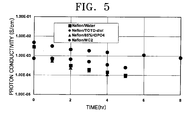
- FIG. 5 illustrates the proton conductivity of polymer electrolyte membranes prepared in Example 1 of the present invention and Comparative Examples 1 and 2, measured at no-humidifying conditions and 110°C in atmospheric air with the passage of time.
- Hereinafter, embodiments of the present invention will be described in more detail.
- In the present invention, Nafion or a polymer matrix containing a sulfonyl group is used as a proton source and a compound having a high boiling point and having a terminal group capable of forming hydrogen bonds, i.e. hydroxy group to improve high temperatures stability is used as a charge carrier.
- The proton conductor has a hydroxy group at a terminal end and an ether-based functional group at an a -carbon position. The proton conductor includes compounds which have a hydroxy group at a terminal to form hydrogen bonds and have a boiling point of 300°C or higher, and preferably 300 to 400°C. When water is used as a proton conductor under high temperatures and no-humidifying conditions, evaporation causes a loss of an ionic conducting property, whereas the proton conductor of the present invention maintains a proton conducting property even at 100°C or higher to improve a performance of an MEA. Further, when H3P04 is used as the proton conductor, H3P04 anions are adsorbed on the surface of a catalyst, such as Pt, to deteriorate a performance of an MEA, whereas the proton conductor of the present invention does not generate anions to prevent said problem.
- Examples of the compound having the structure described above include 4,7,10,13-tetraoxatetradecane-1,2-diol represented by Formula (1) (hereinafter referred to as "TOTD-diol"), 1,4-anhydroerythritol represented by Formula (2), 2-hydroxymethyl-12-crown-4 represented by Formula (3), glycerol formal represented by Formula (4) and poly(ethylene glycol) methyl ether represented by Formula (5):


- The boiling point of the compound represented by Formula (1) is 300°C; the flash point of the compound represented by Formula (2) is 230°F; that of the compound represented by Formula (3) is 115°C/0.04 mmHg, and that of the compound represented by Formula (4) is 192 to 193°C; and the vapour pressure of the compound represented by Formula (5) is 0.05 mm Hg (20°C).
- The number average molecular weight of the poly(ethylene glycol) methyl ether is preferably 100 to 1000, particularly about 350.
- The proton conductor used in the present invention is preferably TOTD-diol represented by Formula (1), which has a strong intermolecular force due to the hydrogen bonding, and thus has a higher temperature stability at a low atmospheric pressure.
- A method of preparing a polymer electrolyte according to an embodiment of the present invention will now be described in more detail.
- First, a polymer matrix is pretreated. This pretreatment is a process for removing impurities in a conducting polymer membrane and activating a cation exchange site. Such a pretreatment can be carried out, for example, by washing the conducting polymer membrane with H2O2, immersing the washed conducting polymer membrane in diluted aqueous H2SO4 solution for a predetermined time, and washing the resultant with deionized water and drying it.
- Nafion or a polymer membrane having a sulfonyl group or phosphoryl group is used as the polymer matrix. Nafion is a perfluorocarbon sulfonic acid cation exchange resin. In addition, polysulfone, perfluorocarboxylic acid, styrene-vinyl benzene sulfonic acid, etc. can be used as the polymer matrix.
- The polymer matrix pretreated in this way is put into a container containing a proton conductor, such as TOTD-diol represented by Formula (1) to obtain a polymer electrolyte having the proton conductor impregnated into the polymer matrix.
- The proton conductor can be let alone at 70 to 90°C before impregnating the proton conductor into the polymer matrix. This additional operation leads to a reduction in the impregnation time, uniform impregnation and an increase in the impregnated amount of the proton conductor, thereby improving ionic conductivity.
- The obtained polymer electrolyte has a structure having the proton conductor, which has a hydroxy group at a terminal end and an ether-based functional group at an α -carbon position, impregnated into the conducting polymer matrix. The content of the proton conductor is preferably 10 to 300 parts by weight based on 100 parts by weight of the polymer matrix. When the content of the proton conductor is less than 10 parts by weight, the proton conducting property is poor. When the content of the proton conductor is greater than 300 parts by weight, the mechanical strength of a membrane is poor.
- An operation mechanism of the polymer electrolyte of the present invention is as follows.
- Nafion or a sulfonated polymer is used as the polymer matrix, a SO3H group of the polymer matrix is used as a proton source, and the proton conductor, such as TOTD-diol represented by Formula (1), is used as a proton carrier instead of water.
- When the polymer electrolyte of the present invention uses the proton conductor of the present invention, it operates by a vehicle mechanism. According to the vehicle mechanism, protons do not migrate by hopping between functional groups (sulfonyl groups), but are solvated by and migrate together in a liquid having excellent mobility, i.e. water or other solvents. This mechanism provides an electrolyte with superior proton conductivity.
- The polymer electrolyte of the present embodiment is used as a polymer electrolyte membrane of a fuel cell and is interposed between a cathode and an anode to form an MEA.
- The cathode and anode include a gas diffusion layer and a catalyst layer. The catalyst layer includes a metal catalyst to promote the relevant reactions (oxidation of hydrogen and reduction of oxygen). Preferably, the catalyst layer includes at least one catalyst selected from the group consisting of Pt, Ru, Os, a Pt-Ru alloy, a Pt-Os alloy, a Pt-Pd alloy and a Pt-M alloy (M is at least one transition metal selected from the group consisting of Ga, Ti, V, Cr, Mn, Fe, Co, Ni, Cu and Zn). More preferably, the catalyst layer includes at least one catalyst selected from the group consisting of Pt, Ru, Os, a Pt-Ru alloy, a Pt-Os alloy, a Pt-Pd alloy, a Pt-Co alloy and a Pt-Ni alloy.
- The metal catalyst generally sits on a support. The support may be carbon, such as acetylene black or graphite, or inorganic particulates, such as alumina, silica. When a noble metal catalyst on a support is used, it is commercially available and may also be prepared by impregnating the noble metal into the support.
- The gas diffusion layer may be made of a carbon paper or carbon cloth, but is not limited thereto. The gas diffusion layer supports an electrode of a fuel cell and diffuses a reaction gas into the catalyst layer. Preferably, the gas diffusion layer is made of a carbon paper or carbon cloth which is water-repelling treated with a fluorine-based resin such as polytetrafluoroethylene since it can prevent the lowering of the gas diffusion efficiency due to water produced when operating the fuel cell.
- The electrodes can further include a microporous layer between the gas diffusion layer and the catalyst layer in order to further enhance the gas diffusion effect. The microporous layer is formed by applying a composition including a conducting material, such as carbon powder, carbon black, activated carbon or acetylene black, a binder, such as polytetrafluoroethylene, and, if necessary, an ionomer to the gas diffusion layer or the catalyst layer.
- A fuel cell according to another embodiment of the present invention includes an MEA including electrodes disposed at both sides of the polymer electrolyte membrane; at least one electricity generation part which includes separators disposed at both sides of the MEA and generates electricity through the electrochemical reaction of hydrogen and oxygen; a fuel supply part for supplying a hydrogen containing fuel to the electricity generation part; and an oxygen supply part for supplying oxygen to the electricity generation part.
- Separators are disposed at both sides of the MEA to form at least one electricity generation part by supplying both fuel and oxygen to the catalyst layer to generate electricity through the electrochemical reaction of hydrogen and oxygen. The electricity generation part is in the form of a stack.
- FIG. 1 is an exploded perspective view of such a stack. Referring to FIG. 1, a
stack 1 includes aMEA 10 including the polymer electrolyte membrane of the present invention andseparators 20 disposed at both sides of theMEA 10. - The electricity generation part includes the polymer electrolyte membrane, electrodes disposed at both sides of the polymer electrolyte membrane, and bipolar plates and generates electricity through the reaction of hydrogen and oxygen.
- The fuel supply part supplies a hydrogen-containing fuel to the electricity generation part and the oxygen supply part supplies oxygen to the electricity-generation part.
- The fuel cell of the present invention may be a phosphoric acid fuel cell (PAFC), a polymer electrolyte membrane fuel cell (PEMFC), or an alkaline fuel cell, and preferably a PAFC or a PEMFC.
- The present invention will now be described in greater detail with reference to the following examples. The following examples are for illustrative purposes only and are not intended to limit the scope of the invention.
-


- 1) Synthesis of Compound (A)
65 g of triethyleneglycol monoethyl ether and 42 g of methane sulfonyl chloride were dissolved in 400 ml of THF in an ice bath, and then 52 g of triethylamine was added thereto and reacted for 24 hrs. Once the reaction was completed, the product was dissolved in 300 ml of chloroform and washed with a small amount of a saturated NaCl solution. The resultant was separated into an aqueous layer and an organic layer. The solvent of the organic layer solvent was removed with an evaporator to obtain 59 g of a pale yellow liquid. - 2) Synthesis of Compound (B)
36 g of Solketal and 6.7 g of NaH were dissolved in 400 ml of 1,4-dioxane, and then 58 g of the Compound (A) obtained above was slowly added thereto and reacted for 18 hrs. The resulting salt was removed and the solvent was evaporated. Then, the resulting product was fractional distilled in vacuum to obtain 32 g of Compound (B) in a colorless liquid state. - 3) Synthesis of Compound (C)
31 g of the Compound (B) and 10 ml of a saturated HCI aqueous solution were dissolved in 100 ml of THF and stirred for 18 hrs. The reaction mixture was neutralized with a diluted NaOH solution to pH 5-6. Then, the resulting product was fractional distilled in vacuum to obtain 19 g of a colorless compound represented by Formula (1).
The structure of the obtained compound could be identified through NMR spectrum of FIG. 1. - Nafion 117 (available from Dupont) was cut into a proper size and washed with a 3 vol% H2O2 aqueous solution at 80°C for 1 hr. Then, a Na ion of functional group (-SO3Na) of Nafion 117 was substituted by a proton using a 0.5 M H2SO4 solution at 80°C for 1 hr.
- The substituted Nafion 117 was washed with distilled water. Then, the washed film was dried at 105°C for 3 hrs and stored in a dry room.
- The obtained Nafion films were put into three containers containing TOTD-diol represented by Formula (1), deionized water and H3P04, respectively, and said materials were impregnated into the Nafion 117 at 60°C for 1 hr to obtain polymer electrolytes. The content of the proton conductors in the polymer electrolytes was determined by measuring the weight of the polymer electrolytes after impregnating for 1 hr.
- The content of the proton conductors in the polymer electrolytes was investigated and the results are illustrated in FIG. 3.
- Referring to FIG. 3, the impregnated amount of TOTD-diol is greatest. When the weight is converted into a mole fraction, the impregnated amount of water was roughly 3 times greater than that of TOTD-diol.
- Nafion 117 (available from Dupont) was cut into a proper size and washed with a 3 vol% H2O2 solution at 80°C for 1 hr. Then, a Na ion of functional group (-S03Na) of Nafion 117 was substituted by a proton using a 0.5 M H2SO4 solution at 80°C for 1 hr.
- The substituted Nafion 117 was washed with distilled water. Then, the washed film was dried at 105°C for 3 hrs and stored in a dry room.
- A container containing TOTD-diol represented by Formula (1) was let alone at 80°C for 1 hr. Next, the Nafion 117 film obtained above was put into the container to impregnate TOTD-diol thereinto, thereby obtaining a polymer electrolyte.
- In the meantime, a 99.99% Pt plate was used as an electrode.
- A MEA including the electrode and the polymer electrolyte, and a fuel cell including the MEA were fabricated.
- A polymer electrolyte membrane, an MEA and a fuel cell were fabricated in the same manner as in Example 1, except that water substituted TOTD-diol represented by Formula (1).
- A polymer electrolyte membrane, an MEA and a fuel cell were fabricated in the same manner as in Example 1, except that an 85% H3PO4 aqueous solution substituted TOTD-diol represented by Formula (1).
- The proton conductivities of the polymer electrolyte membranes prepared in Example 1 and Comparative Examples 1 and 2 was measured at about 0% relative humidity in atmospheric air while raising the temperature from 20 to 120°C and the results are illustrated in FIG. 4.
- Referring to FIG. 4, at lower temperatures, the Nafion having water impregnated thereinto has the highest proton conductivity, but its proton conductivity decreases with temperature, which indicates its instability at higher temperatures.
- Meanwhile, the Nafion having TOTD-diol impregnated thereinto has a proton conductivity that increases with temperature and its proton conductivity is higher than that of the Nafion having water impregnated thereinto at 70°C or higher. It can be seen from the results that TOTD-diol has a sufficient proton conducting property and thermal stability.
- In addition, the proton conductivity of the polymer electrolyte membranes prepared in Example 1 and Comparative Examples 1 and 2 was measured at no-humidifying conditions and 110°C in atmospheric air and the results are illustrated in FIG. 5.
- Referring to FIG. 5, water and H3P04 lose their proton conducting property due to evaporation at high temperatures, whereas TOTD-diol has a superior stability at a higher temperature and proton conducting property over a board range of temperature.
- The present invention provides a proton conductor having a hydroxy group at a terminal end and an ether-based functional group at an a -carbon position. The proton conductor can be used as a charge carrier instead of water or H3PO4 to provide a polymer electrolyte operable at 110°C or higher, having thermal stability and sufficient proton conductivity under high temperatures and no-humidifying conditions. The polymer electrolyte can be used to prepare an MEA that can operate under high temperatures and no-humidifying conditions and eliminate the need for moisture control to achieve simplicity, high efficiency and a longer lifespan of a system.
Claims (14)
- A proton conductor having a hydroxy group at a terminal end and an ether-based functional group at an a -carbon position.
- The proton conductor according to claim 1, which is at least one compound selected from 4,7,10,13-tetraoxatetradecane-1,2-diol, 1,4-anhydroerythritol, 2-hydroxymethyl-12-crown-4, glycerol formal and poly(ethylene glycol) methyl ether.
- The proton conductor according to claim 2, which is 2,4,7,10,13-tetraoxatetradecane-1,2-diol.
- The proton conductor according to any of claims 1 to 3, having a boiling point of 300°C or higher.
- A polymer electrolyte comprising: a proton conductor having a hydroxy group at a terminal end and an ether-based functional group at an α -carbon position; and a conducting polymer matrix.
- The polymer electrolyte according to claim 5, wherein the proton conductor is at least one compound selected from 4,7,10,13-tetraoxatetradecane-1,2-diol, 1,4-anhydroerythritol, 2-hydroxymethyl-12-crown-4, glycerol formal and poly(ethylene glycol) methyl ether.
- The polymer electrolyte according to claim 6, wherein the proton conductor is 4,7,10,13-tetraoxatetradecane-1,2-diol.
- The polymer electrolyte according to any of claims 5 to 7, wherein the polymer matrix comprises Nafion.
- The polymer electrolyte according to any of claims 5 to 8, wherein the proton conductor is 10 to 300 parts by weight based on 100 parts by weight of the polymer matrix.
- A method of preparing the polymer electrolyte according to any one of claims 5-9, comprising:pretreating a polymer matrix; andimpregnating a proton conductor having a hydroxy group at a terminal end and an ether-based functional group at an α -carbon position into the pretreated polymer matrix to obtain the polymer electrolyte.
- The method according to claim 10, wherein the pretreating of a polymer matrix is carried out by washing the polymer matrix with an aqueous H2O2 solution, immersing it in an aqueous H2S04 solution for a predetermined time, and then washing the resultant with deionized water and drying.
- A fuel cell comprising a cathode, an anode, and the polymer electrolyte according to any one of claims 5-9 interposed between the cathode and the anode.
- The fuel cell according to claim 12, wherein at least one of the cathode and the anode comprises a proton conductor having a hydroxy group at a terminal end and an ether-based functional group at an a -carbon position.
- The fuel cell according to claim 13, wherein the proton conductor is at least one compound selected from 4,7,10,13-tetraoxatetradecane-1,2-diol, 1,4-anhydroerythritol, 2-hydroxymethyl-12-crown-4, glycerol formal and poly(ethylene glycol) methyl ether.
Applications Claiming Priority (1)
| Application Number | Priority Date | Filing Date | Title |
|---|---|---|---|
| KR1020040112237A KR100657939B1 (en) | 2004-12-24 | 2004-12-24 | Proton conductors, polymer electrolytes containing them and fuel cells employing them |
Publications (3)
| Publication Number | Publication Date |
|---|---|
| EP1675201A2 true EP1675201A2 (en) | 2006-06-28 |
| EP1675201A3 EP1675201A3 (en) | 2008-12-03 |
| EP1675201B1 EP1675201B1 (en) | 2010-09-15 |
Family
ID=36169139
Family Applications (1)
| Application Number | Title | Priority Date | Filing Date |
|---|---|---|---|
| EP05257976A Expired - Lifetime EP1675201B1 (en) | 2004-12-24 | 2005-12-22 | Proton conductor, polymer electrolyte comprising the same and fuel cell employing the polymer electrolyte |
Country Status (6)
| Country | Link |
|---|---|
| US (1) | US7758986B2 (en) |
| EP (1) | EP1675201B1 (en) |
| JP (1) | JP4658793B2 (en) |
| KR (1) | KR100657939B1 (en) |
| CN (1) | CN1978535B (en) |
| DE (1) | DE602005023575D1 (en) |
Families Citing this family (3)
| Publication number | Priority date | Publication date | Assignee | Title |
|---|---|---|---|---|
| US10749200B2 (en) * | 2016-04-22 | 2020-08-18 | National University Corporation Nagoya University | Non-humidified proton-conductive membrane, method for producing the same, and fuel cell |
| KR101864710B1 (en) * | 2016-06-28 | 2018-06-07 | 한국과학기술연구원 | Crown ether-inclusive electrolyte for redox flow batteries and method of manufacturing the same |
| CN116253817B (en) * | 2023-03-13 | 2024-09-13 | 浙江聚合储能科技有限公司 | Fluorine ion exchange membrane and preparation method thereof |
Family Cites Families (19)
| Publication number | Priority date | Publication date | Assignee | Title |
|---|---|---|---|---|
| US5047563A (en) | 1987-09-10 | 1991-09-10 | Miles Inc. | Chiral crown ethers |
| JPH06251782A (en) * | 1993-02-26 | 1994-09-09 | Asahi Chem Ind Co Ltd | Manufacture of joined body of membrane having high electric conductivity with electrode |
| JPH0765624A (en) | 1993-08-30 | 1995-03-10 | Tonen Corp | Proton conductive thin film electrolyte |
| US6025061A (en) | 1998-04-23 | 2000-02-15 | Hna Holdings, Inc. | Sheets formed from polyesters including isosorbide |
| JP3103888B2 (en) | 1998-09-14 | 2000-10-30 | 工業技術院長 | High temperature region proton conductive thin film using organic / inorganic composite material and method for producing the same |
| KR100298802B1 (en) | 1999-06-28 | 2001-09-22 | 김순택 | Crosslinking Agents Useful for Enhancing Performance of Solid Polymer Electrolytes and Crosslinked Solid Polymer Electrolytes Employing the Same |
| JP4539896B2 (en) | 1999-09-17 | 2010-09-08 | 独立行政法人産業技術総合研究所 | Proton conductive membrane, method for producing the same, and fuel cell using the same |
| US6261434B1 (en) | 1999-10-19 | 2001-07-17 | Kemet Electronics Corporation | Differential anodization process for electrolytic capacitor anode bodies |
| JP4042285B2 (en) | 2000-02-23 | 2008-02-06 | トヨタ自動車株式会社 | Solid polymer electrolyte membrane and method for producing the same |
| KR20030096244A (en) * | 2001-01-19 | 2003-12-24 | 소니 가부시키가이샤 | Proton conductor film and method for preparation thereof, and fuel cell having proton conductor film and method for manufacturing the cell |
| US6689501B2 (en) | 2001-05-25 | 2004-02-10 | Ballard Power Systems Inc. | Composite ion exchange membrane for use in a fuel cell |
| JP2003100348A (en) | 2001-09-21 | 2003-04-04 | Nippon Shokubai Co Ltd | Composite polymer electrolyte and electrochemical device using the same |
| JP2003242834A (en) | 2001-12-11 | 2003-08-29 | Sony Corp | Proton conductor and single ion conductor, and methods for producing them |
| US6995223B2 (en) * | 2001-12-20 | 2006-02-07 | Agfa-Gevaert | 3,4-alkylenedioxy-thiophene copolymers |
| JP4127002B2 (en) | 2001-12-26 | 2008-07-30 | 東ソー株式会社 | Polymer electrolyte membrane, membrane-electrode assembly for polymer electrolyte fuel cell, and polymer electrolyte fuel cell |
| JP4289058B2 (en) | 2002-10-15 | 2009-07-01 | 住友化学株式会社 | Block copolymer and use thereof |
| JP2004199879A (en) | 2002-12-16 | 2004-07-15 | Toppan Printing Co Ltd | Ion conductor |
| JP4696441B2 (en) | 2003-01-31 | 2011-06-08 | 住友化学株式会社 | Polymer electrolyte membrane and use thereof |
| KR100508639B1 (en) * | 2003-06-04 | 2005-08-17 | 주식회사 협진아이엔씨 | Non-aqueous polymer electrolyte membrane and fuel cell using the same |
-
2004
- 2004-12-24 KR KR1020040112237A patent/KR100657939B1/en not_active Expired - Lifetime
-
2005
- 2005-12-06 CN CN2005101297374A patent/CN1978535B/en not_active Expired - Lifetime
- 2005-12-20 US US11/311,690 patent/US7758986B2/en active Active
- 2005-12-22 DE DE602005023575T patent/DE602005023575D1/en not_active Expired - Lifetime
- 2005-12-22 JP JP2005370711A patent/JP4658793B2/en not_active Expired - Lifetime
- 2005-12-22 EP EP05257976A patent/EP1675201B1/en not_active Expired - Lifetime
Also Published As
| Publication number | Publication date |
|---|---|
| JP4658793B2 (en) | 2011-03-23 |
| CN1978535B (en) | 2011-06-29 |
| JP2006185920A (en) | 2006-07-13 |
| US7758986B2 (en) | 2010-07-20 |
| KR20060073816A (en) | 2006-06-29 |
| EP1675201A3 (en) | 2008-12-03 |
| DE602005023575D1 (en) | 2010-10-28 |
| EP1675201B1 (en) | 2010-09-15 |
| KR100657939B1 (en) | 2006-12-14 |
| US20060141317A1 (en) | 2006-06-29 |
| CN1978535A (en) | 2007-06-13 |
Similar Documents
| Publication | Publication Date | Title |
|---|---|---|
| JP3795920B2 (en) | Organic fuel cell | |
| Fu et al. | Synthesis and characterization of sulfonated polysulfone membranes for direct methanol fuel cells | |
| KR100493171B1 (en) | Composite elecrolyte membrane and fuel cell employing the same | |
| EP2481114A1 (en) | Electrochemical devices based on multiple junction ionic conductive membranes | |
| KR20180060811A (en) | Membrane electrode assembly, fuel cell comprising the same and manufacturing method thereof | |
| US8512912B2 (en) | Membrane-electrode unit for direct methanol fuel cells (DMFC) | |
| KR100657918B1 (en) | Polymer electrolyte and fuel cell using same | |
| JP2007107003A (en) | Ion conductive cross-linked copolymer, polymer electrolyte membrane, membrane electrode assembly, and fuel cell | |
| US20070196714A1 (en) | Polymer membrane, method of preparing the same and fuel cell employing the same | |
| JP4795676B2 (en) | Polymer electrolyte membrane for high temperature non-humidified fuel cell and fuel cell | |
| KR100868802B1 (en) | Composite Polymer Electrolyte Membrane, Manufacturing Method Thereof and Fuel Cell Employing the Electrolyte Membrane | |
| EP1675201B1 (en) | Proton conductor, polymer electrolyte comprising the same and fuel cell employing the polymer electrolyte | |
| JP2011171301A (en) | Direct oxidation fuel cell | |
| KR102188833B1 (en) | Membrane electrode assembly, manufacturing method of membrane electrode assembly and fuel cell | |
| Qiao et al. | Life test of DMFC using poly (ethylene glycol) bis (carboxymethyl) ether plasticized PVA/PAMPS proton-conducting semi-IPNs | |
| US7846981B2 (en) | Polymer electrolytic membrane, and fuel cell employing the same | |
| JP4664683B2 (en) | Membrane-electrode assembly and fuel cell thereof | |
| KR100535952B1 (en) | Proton-conducting polymer, polymer membrane comprising the polymer, method for maufacturing the same, and fuel cell using the same | |
| KR100696460B1 (en) | Hydrogen ion conductive polymer | |
| KR20150138103A (en) | Electrode for fuel cell, membrane electrode assembly comprising the same and fuel cell comprising the membrane electrode assembly | |
| KR100942426B1 (en) | Nanocomposite Electrolyte Membranes Containing Hydrogen Ion Conductive Minerals | |
| KR20180018106A (en) | Polymer electrolyte membrane, membrane electrode assembly comprising the same and fuel cell comprising the membrane electrode assembly | |
| JP2005135725A (en) | Liquid fuel cell and assembled battery including the same |
Legal Events
| Date | Code | Title | Description |
|---|---|---|---|
| PUAI | Public reference made under article 153(3) epc to a published international application that has entered the european phase |
Free format text: ORIGINAL CODE: 0009012 |
|
| 17P | Request for examination filed |
Effective date: 20060118 |
|
| AK | Designated contracting states |
Kind code of ref document: A2 Designated state(s): AT BE BG CH CY CZ DE DK EE ES FI FR GB GR HU IE IS IT LI LT LU LV MC NL PL PT RO SE SI SK TR |
|
| AX | Request for extension of the european patent |
Extension state: AL BA HR MK YU |
|
| PUAL | Search report despatched |
Free format text: ORIGINAL CODE: 0009013 |
|
| AK | Designated contracting states |
Kind code of ref document: A3 Designated state(s): AT BE BG CH CY CZ DE DK EE ES FI FR GB GR HU IE IS IT LI LT LU LV MC NL PL PT RO SE SI SK TR |
|
| AX | Request for extension of the european patent |
Extension state: AL BA HR MK YU |
|
| AKX | Designation fees paid |
Designated state(s): DE FR GB |
|
| 17Q | First examination report despatched |
Effective date: 20090724 |
|
| GRAP | Despatch of communication of intention to grant a patent |
Free format text: ORIGINAL CODE: EPIDOSNIGR1 |
|
| RIN1 | Information on inventor provided before grant (corrected) |
Inventor name: CHO, MYUNG-DONG Inventor name: SUN, HEE-YOUNG Inventor name: LEE, MYUNG-JIN |
|
| GRAS | Grant fee paid |
Free format text: ORIGINAL CODE: EPIDOSNIGR3 |
|
| GRAA | (expected) grant |
Free format text: ORIGINAL CODE: 0009210 |
|
| AK | Designated contracting states |
Kind code of ref document: B1 Designated state(s): DE FR GB |
|
| REG | Reference to a national code |
Ref country code: GB Ref legal event code: FG4D |
|
| REF | Corresponds to: |
Ref document number: 602005023575 Country of ref document: DE Date of ref document: 20101028 Kind code of ref document: P |
|
| PLBE | No opposition filed within time limit |
Free format text: ORIGINAL CODE: 0009261 |
|
| STAA | Information on the status of an ep patent application or granted ep patent |
Free format text: STATUS: NO OPPOSITION FILED WITHIN TIME LIMIT |
|
| 26N | No opposition filed |
Effective date: 20110616 |
|
| REG | Reference to a national code |
Ref country code: DE Ref legal event code: R097 Ref document number: 602005023575 Country of ref document: DE Effective date: 20110616 |
|
| REG | Reference to a national code |
Ref country code: FR Ref legal event code: PLFP Year of fee payment: 11 |
|
| REG | Reference to a national code |
Ref country code: FR Ref legal event code: PLFP Year of fee payment: 12 |
|
| PGFP | Annual fee paid to national office [announced via postgrant information from national office to epo] |
Ref country code: GB Payment date: 20161221 Year of fee payment: 12 Ref country code: FR Payment date: 20161128 Year of fee payment: 12 |
|
| GBPC | Gb: european patent ceased through non-payment of renewal fee |
Effective date: 20171222 |
|
| REG | Reference to a national code |
Ref country code: FR Ref legal event code: ST Effective date: 20180831 |
|
| PG25 | Lapsed in a contracting state [announced via postgrant information from national office to epo] |
Ref country code: FR Free format text: LAPSE BECAUSE OF NON-PAYMENT OF DUE FEES Effective date: 20180102 |
|
| PG25 | Lapsed in a contracting state [announced via postgrant information from national office to epo] |
Ref country code: GB Free format text: LAPSE BECAUSE OF NON-PAYMENT OF DUE FEES Effective date: 20171222 |
|
| P01 | Opt-out of the competence of the unified patent court (upc) registered |
Effective date: 20230528 |
|
| PGFP | Annual fee paid to national office [announced via postgrant information from national office to epo] |
Ref country code: DE Payment date: 20241126 Year of fee payment: 20 |
|
| REG | Reference to a national code |
Ref country code: DE Ref legal event code: R071 Ref document number: 602005023575 Country of ref document: DE |