EP1674718A1 - Internal combustion engine storage-volume fuel injection system - Google Patents
Internal combustion engine storage-volume fuel injection system Download PDFInfo
- Publication number
- EP1674718A1 EP1674718A1 EP04425945A EP04425945A EP1674718A1 EP 1674718 A1 EP1674718 A1 EP 1674718A1 EP 04425945 A EP04425945 A EP 04425945A EP 04425945 A EP04425945 A EP 04425945A EP 1674718 A1 EP1674718 A1 EP 1674718A1
- Authority
- EP
- European Patent Office
- Prior art keywords
- fuel
- pumping element
- solenoid valve
- injection system
- pump
- Prior art date
- Legal status (The legal status is an assumption and is not a legal conclusion. Google has not performed a legal analysis and makes no representation as to the accuracy of the status listed.)
- Granted
Links
Images
Classifications
-
- F—MECHANICAL ENGINEERING; LIGHTING; HEATING; WEAPONS; BLASTING
- F02—COMBUSTION ENGINES; HOT-GAS OR COMBUSTION-PRODUCT ENGINE PLANTS
- F02M—SUPPLYING COMBUSTION ENGINES IN GENERAL WITH COMBUSTIBLE MIXTURES OR CONSTITUENTS THEREOF
- F02M63/00—Other fuel-injection apparatus having pertinent characteristics not provided for in groups F02M39/00 - F02M57/00 or F02M67/00; Details, component parts, or accessories of fuel-injection apparatus, not provided for in, or of interest apart from, the apparatus of groups F02M39/00 - F02M61/00 or F02M67/00; Combination of fuel pump with other devices, e.g. lubricating oil pump
- F02M63/02—Fuel-injection apparatus having several injectors fed by a common pumping element, or having several pumping elements feeding a common injector; Fuel-injection apparatus having provisions for cutting-out pumps, pumping elements, or injectors; Fuel-injection apparatus having provisions for variably interconnecting pumping elements and injectors alternatively
- F02M63/0225—Fuel-injection apparatus having a common rail feeding several injectors ; Means for varying pressure in common rails; Pumps feeding common rails
-
- F—MECHANICAL ENGINEERING; LIGHTING; HEATING; WEAPONS; BLASTING
- F02—COMBUSTION ENGINES; HOT-GAS OR COMBUSTION-PRODUCT ENGINE PLANTS
- F02D—CONTROLLING COMBUSTION ENGINES
- F02D41/00—Electrical control of supply of combustible mixture or its constituents
- F02D41/30—Controlling fuel injection
- F02D41/38—Controlling fuel injection of the high pressure type
- F02D41/3809—Common rail control systems
- F02D41/3836—Controlling the fuel pressure
- F02D41/3845—Controlling the fuel pressure by controlling the flow into the common rail, e.g. the amount of fuel pumped
-
- F—MECHANICAL ENGINEERING; LIGHTING; HEATING; WEAPONS; BLASTING
- F02—COMBUSTION ENGINES; HOT-GAS OR COMBUSTION-PRODUCT ENGINE PLANTS
- F02M—SUPPLYING COMBUSTION ENGINES IN GENERAL WITH COMBUSTIBLE MIXTURES OR CONSTITUENTS THEREOF
- F02M59/00—Pumps specially adapted for fuel-injection and not provided for in groups F02M39/00 -F02M57/00, e.g. rotary cylinder-block type of pumps
- F02M59/20—Varying fuel delivery in quantity or timing
- F02M59/34—Varying fuel delivery in quantity or timing by throttling of passages to pumping elements or of overflow passages, e.g. throttling by means of a pressure-controlled sliding valve having liquid stop or abutment
-
- F—MECHANICAL ENGINEERING; LIGHTING; HEATING; WEAPONS; BLASTING
- F02—COMBUSTION ENGINES; HOT-GAS OR COMBUSTION-PRODUCT ENGINE PLANTS
- F02M—SUPPLYING COMBUSTION ENGINES IN GENERAL WITH COMBUSTIBLE MIXTURES OR CONSTITUENTS THEREOF
- F02M59/00—Pumps specially adapted for fuel-injection and not provided for in groups F02M39/00 -F02M57/00, e.g. rotary cylinder-block type of pumps
- F02M59/20—Varying fuel delivery in quantity or timing
- F02M59/36—Varying fuel delivery in quantity or timing by variably-timed valves controlling fuel passages to pumping elements or overflow passages
- F02M59/366—Valves being actuated electrically
Definitions
- the present invention relates to an internal combustion engine storage-volume fuel injection system.
- Modern internal combustion engine fuel injection systems normally comprise a pump for supplying high-pressure fuel to a common rail having a given fuel storage volume and for supplying a number of engine cylinder injectors.
- the pump comprises at least one reciprocating pumping element performing each time an intake stroke and a compression or delivery stroke.
- the fuel must be brought to extremely high pressure, e.g. in the region of 1600 bars in maximum engine load conditions.
- Current regulations governing pollution by engine exhaust gas require that the fuel feed pressure to the injectors be reproducible as accurately as possible with respect to the electronic central control unit map.
- Pressure fluctuations, in the common rail, with respect to the set pressure can be limited if the volume of the common rail is over order of magnitude of the fuel quantity drawn by each injector per combustion cycle.
- Such a common rail is invariably bulky and therefore difficult to accommodate on the engine.
- each pumping element has an instantaneous flow, the maximum value of which is less than the maximum value of each injector, so that, during each injection, only part of the injected fuel, about 20%, is normally supplied by the pump, the rest being supplied by the common rail.
- Systems of this sort therefore have the drawback of necessarily requiring a common rail of suitable size.
- the pump operates permanently at the maximum flow rate, while the bypass solenoid valves simply provides for draining the surplus pumped fuel, in excess of that drawn by the injectors, into the tank, thus dissipating heat.
- the flow control device comprises an on-off solenoid valve along the intake conduit of the pumping element, the maximum instantaneous flow of which is greater than the maximum flow of each injector, and the solenoid valve is controlled by a chopper control unit synchronously with the intake stroke.
- the chopper control unit provides for pulse-width-modulation (PWM) control of the on-off solenoid valve with a pumping element intake start instant and end instant, so as to control the fuel volume fed into the compression chamber by modulating both the instant the solenoid valve opens and the instant it closes.
- PWM pulse-width-modulation
- the invention also relates to a high-pressure pump for pumping fuel to a storage volume supplying a number of fuel injectors, as claimed in Claim 10.
- the invention also relates to a method of controlling the fuel pressure in a storage volume for a number of fuel injectors, as claimed in Claim 12.
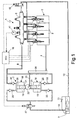
- Number 1 in Figure 1 indicates as a whole a common-rail fuel injection system for an internal combustion, e.g. diesel, engine 2 comprising a number of, e.g. four, cylinders 3, which cooperate with corresponding pistons (not shown) for rotating a drive shaft 4.
- an internal combustion e.g. diesel
- engine 2 comprising a number of, e.g. four, cylinders 3, which cooperate with corresponding pistons (not shown) for rotating a drive shaft 4.
- Injection system 1 comprises a number of electrically controlled injectors 5 associated with and for injecting high-pressure fuel into cylinders 3. Injectors 5 are connected to a storage volume having a given volume for one or more injectors 5.
- the storage volume is defined by a common rail 6, to which injectors 5 are all connected, and which is supplied by a high-pressure pump, indicated as a whole by 7, with high-pressure fuel along a high-pressure delivery conduit 8.
- the storage volume may also be distributed in the pump delivery conduit 8 to injectors 5.
- High-pressure pump 7 is in turn supplied by a low-pressure pump, e.g. a motor-driven pump 9, along a low-pressure fuel intake conduit 10.
- Motor-driven pump 9 is normally located in the fuel tank 11, to which a surplus-fuel drain conduit 12 of injection system 1 is connected. Drain conduit 12 drains into tank 11 both the surplus fuel drained by injectors 5, and any surplus fuel drained by common rail 6 when pressure exceeds that defined by a solenoid regulating valve 15.
- a regulating device comprising at least one on-off solenoid valve 27 is located between motor-driven pump 9 and high-pressure pump 7.
- the fuel in tank 11 is at atmospheric pressure.
- motor-driven pump 9 compresses the fuel to a low pressure, e.g. of around 2-3 bars; and high-pressure pump 7 compresses the incoming fuel from intake conduit 10 to supply high-pressure fuel, e.g. of about 1600 bars, along delivery conduit 8 to common rail 6.
- Each injector 5 is activated to inject corresponding cylinder 3 with a variable amount of fuel, i.e. ranging between a minimum and maximum value, under the control of an electronic control unit 16, which may be defined by the central microprocessor control unit of engine 2.
- Control unit 16 receives signals indicating the operating conditions of engine 2, such as the accelerator pedal position and the speed of drive shaft 4, which are detected by corresponding sensors, and the fuel pressure in common rail 6 as detected by a pressure sensor 17. Control unit 16 processes the incoming signals by means of a special program to control when and for how long individual injectors 5 are to operate, as well as solenoid regulating valve 15.
- High-pressure pump 7 comprises one or more reciprocating pumping elements 18, each defined by a cylinder 19 having a compression chamber 20, in which a piston 21 slides.
- Compression chamber 20 communicates with intake conduit 10 via an intake valve 25, and communicates with delivery conduit 8 via a delivery valve 30.
- Piston 21 is activated, by cam means 22 fitted to a shaft 23, to perform a reciprocating sinusoidal movement comprising an intake stroke and a compression or delivery stroke, as explained in detail later on.
- shaft 23 is connected to the drive shaft 4 by a transmission device 26, so that a compression stroke is performed for each injection by injectors 5 into respective cylinders 3.
- Shaft 23 may be defined by a shaft for also operating other devices of engine 2.
- pump 7 normally comprises a number of pumping elements 18, which may be activated by a common cam.
- pump 7 comprises two diametrically opposite pumping elements 18 activated by a common cam 22.
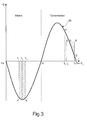
- the x axis shows the intake stroke Ps-Pi and the compression stroke Pi-Ps of a pumping element 18.
- the speed of pumping element 18 is shown by a sinusoidal curve 24, which therefore also represents the instantaneous flow Q of pumping element 18 in the absence of on-off solenoid valve 27.
- the area subtended by curve 24 therefore represents the maximum fuel intake/delivery volume for each pump stroke.
- Operation of an injector 5 for each injection into respective cylinder 3 is represented by a rectangle I 0 ABI 1 , the base of which on the x axis is a segment between a start point I 0 and an end point I 1 , and the height of which indicates the instantaneous flow (here assumed constant) of injector 5.
- the area of rectangle I 0 ABI 1 therefore represents the volume of fuel delivered by injector 5 at the injection stage, and which varies both in duration, by varying the position of points I 0 and I 1 , and by varying the instantaneous flow of the injector, i.e. the height of rectangle I 0 ABI 1 , e.g. by varying the fuel pressure in common rail 6.
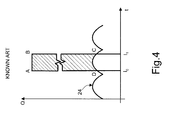
- the volume of fuel I 0 DCI 1 delivered by the pump during injection is only a fraction, e.g. about 20%, of the maximum flow of injector 5, so that, in maximum load conditions of engine 2, the rest ABCD, i.e. the other 80% of the fuel volume to be injected, must be supplied by common rail 6.
- the volume of common rail 6 must therefore be considerable to avoid an excessive fall in pressure of the fuel inside it during each injection. 80% of the fuel must therefore be supplied to common rail 6 by further deliveries by pumping elements 18 in the time lapse between the end of the preceding injection and the start of the one shown in Figure 4, in which the pump, for example, comprises three pumping elements 18 operating continually at the maximum flow rate.
- the maximum instantaneous flow of pumping element 18 is greater than the maximum flow of each injector 5, and may advantageously be over 150%, e.g. may range between 150% and 250%, of the maximum flow of injector 5.
- the compression stroke Pi-Ps of pumping element 18 is performed synchronously with injection by injector 5.
- On-off solenoid valve 27 in turn is chopper-controlled by control unit 16, advantageously by means of corresponding software.
- control unit 16 controls on-off solenoid valve 27 between an opening, i.e. intake start, instant T 2 , and a closing, i.e. intake end, instant T 3 .
- control unit 16 controls solenoid valve 27 by a Pulse Width Modulation (PWM) logic signal and at a frequency related to the speed of shaft 23 of pump 7.
- PWM Pulse Width Modulation
- on-off solenoid valve 27 feeds into compression chamber 20, in the interval T 2 -T 3 , a predetermined volume T 2 T 3 NP of fuel - where area T 2 T 3 NP is equivalent to area T 0 HPs in Figure 3 - which varies as a function of both the width and time location of interval T 2 -T 3 , and is proportional to the head produced by motor-driven pump 9.
- both the vapour and liquid fuel phases are present in compression chamber 20.
- delivery valve 30 remains closed, on account of the compressibility of the fuel vapour introduced previously, and opens at instant To, when the vapour phase is no longer present and the liquid phase fuel pressure exceeds the fuel pressure in delivery conduit 8.
- Pump 7 therefore only delivers during portion T 0 -T 1 of the compression stroke of each pumping element 18. Since the work performed by pumping element 18 to compress the vapour in the initial portion of compression stroke Pi-T 0 is negligible, pump 7 dissipates very little energy.
- the volume T 2 T 3 NP of fuel introduced during the intake stroke by solenoid valve 27 therefore unequivocally defines delivery start instant To, and is selected as a function of the operating conditions of engine 2, i.e. the flow demanded by injectors 5.
- Control unit 16 therefore chopper-modulates delivery of pumping elements 18, and controls opening of solenoid valve 27 by modulating both intake start instant T 2 and intake end instant T 3 , so as to supply compression chamber 20 with a volume of fluid (area T 2 T 3 NP in Figure 3) unequivocally defining delivery start instant To.
- the volume of fluid supplied to delivery conduit 8 (area T 0 HT 1 in Figure 3) is therefore just slightly greater than the fuel to be injected by injector 5 in the corresponding injection (area I 0 ABI 1 in Figure 3).
- Common rail 6 therefore only has to supply a minimum amount of fuel (area DBC in Figure 3) during injection, so that, despite the small storage volume of common rail 6, the pressure in it remains more or less constant.
- common rail 6 may be made small or even of the same volume as high-pressure conduit 8, since the fuel drawn from the common rail is almost totally and simultaneously replaced during the same injection.
- opening and closing instants T 2 and T 3 of solenoid valve 27 correspond to two intermediate points in the intake stroke of pumping element 18, and may advantageously be barycentric with respect to an instant T 4 , in which pumping element 18 is at maximum speed and the depression in chamber 20 is therefore maximum.
- Instant T 0 corresponds to an intermediate point in the compression stroke of pumping element 18, which is slightly in advance of injection start instant I 0 , so that area T 0 HDAI 0 substantially equals area DBC.
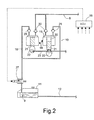
- the two pumping elements 18 are arranged in line and activated by two cams 22 fixed in diametrically opposite positions to shaft 23; and on-off solenoid valve 27 is again fitted to a portion 31 of intake conduit 10 common to both pumping elements.
- the injection system described above therefore provides for a method of controlling the fuel pressure in storage volume 6, whereby fuel is supplied by at least one reciprocating pumping element 18 performing a compression stroke, the control method being characterized by comprising the steps of:
- common rail 6 may be made very small or even eliminated, with obvious benefits as regards layout of the injection system in the engine compartment.
- each pumping element 18 of pump 7 may be provided with its own on-off solenoid valve 27 on the relative intake conduit; interval T 2 -T 3 may be located anywhere within intake stroke Ps-Pi; on-off solenoid valve 27 may be integrated with pump 7, which in turn may even be defined by one pumping element 18; and pump 7 may even be defined by a pump with three or more radial pumping elements, and be used in other than four-cylinder engines.
Landscapes
- Engineering & Computer Science (AREA)
- Chemical & Material Sciences (AREA)
- Combustion & Propulsion (AREA)
- Mechanical Engineering (AREA)
- General Engineering & Computer Science (AREA)
- Fuel-Injection Apparatus (AREA)
- Electrical Control Of Air Or Fuel Supplied To Internal-Combustion Engine (AREA)
- Combined Controls Of Internal Combustion Engines (AREA)
- Supply Devices, Intensifiers, Converters, And Telemotors (AREA)
Abstract

Description
- The present invention relates to an internal combustion engine storage-volume fuel injection system.
- Modern internal combustion engine fuel injection systems normally comprise a pump for supplying high-pressure fuel to a common rail having a given fuel storage volume and for supplying a number of engine cylinder injectors. The pump comprises at least one reciprocating pumping element performing each time an intake stroke and a compression or delivery stroke.
- As is known, for it to be atomized properly, the fuel must be brought to extremely high pressure, e.g. in the region of 1600 bars in maximum engine load conditions. Current regulations governing pollution by engine exhaust gas require that the fuel feed pressure to the injectors be reproducible as accurately as possible with respect to the electronic central control unit map. Pressure fluctuations, in the common rail, with respect to the set pressure can be limited if the volume of the common rail is over order of magnitude of the fuel quantity drawn by each injector per combustion cycle. Such a common rail, however, is invariably bulky and therefore difficult to accommodate on the engine.
- To control pressure in the common rail as mapped in the central control unit, it has been proposed to fit, along the pump delivery conduit to the common rail, a bypass solenoid valve controlled by an electronic unit as a function of various engine operating parameters. It has also been proposed to operate the pumping element by means of cam operating synchronously with each injector.
- In known systems of this sort, each pumping element has an instantaneous flow, the maximum value of which is less than the maximum value of each injector, so that, during each injection, only part of the injected fuel, about 20%, is normally supplied by the pump, the rest being supplied by the common rail. Systems of this sort therefore have the drawback of necessarily requiring a common rail of suitable size. Moreover, the pump operates permanently at the maximum flow rate, while the bypass solenoid valves simply provides for draining the surplus pumped fuel, in excess of that drawn by the injectors, into the tank, thus dissipating heat.
- It is an object of the invention to provide a fuel injection system, which is highly reliable and eliminates the drawbacks of known systems by optimizing performance and minimizing the fuel storage volume between the pump and injectors.
- According to the present invention, there is provided an internal combustion engine fuel injection system as claimed in
Claim 1. More specifically, the flow control device comprises an on-off solenoid valve along the intake conduit of the pumping element, the maximum instantaneous flow of which is greater than the maximum flow of each injector, and the solenoid valve is controlled by a chopper control unit synchronously with the intake stroke. - The chopper control unit provides for pulse-width-modulation (PWM) control of the on-off solenoid valve with a pumping element intake start instant and end instant, so as to control the fuel volume fed into the compression chamber by modulating both the instant the solenoid valve opens and the instant it closes.
- The invention also relates to a high-pressure pump for pumping fuel to a storage volume supplying a number of fuel injectors, as claimed in
Claim 10. - The invention also relates to a method of controlling the fuel pressure in a storage volume for a number of fuel injectors, as claimed in
Claim 12. - A number of preferred, non-limiting embodiments of the invention will be described by way of example with reference to the accompanying drawings, in which:
- Figure 1 shows a diagram of a common-rail fuel injection system in accordance with the present invention;
- Figure 2 shows a detail of a variation of the injection system according to the invention;
- Figure 3 shows an operating graph of the injection system in Figures 1 and 2;
- Figure 4 shows an operating graph of a known injection system.
-
Number 1 in Figure 1 indicates as a whole a common-rail fuel injection system for an internal combustion, e.g. diesel,engine 2 comprising a number of, e.g. four,cylinders 3, which cooperate with corresponding pistons (not shown) for rotating a drive shaft 4. -
Injection system 1 comprises a number of electrically controlled injectors 5 associated with and for injecting high-pressure fuel intocylinders 3. Injectors 5 are connected to a storage volume having a given volume for one or more injectors 5. - In the Figure 1 embodiment, the storage volume is defined by a
common rail 6, to which injectors 5 are all connected, and which is supplied by a high-pressure pump, indicated as a whole by 7, with high-pressure fuel along a high-pressure delivery conduit 8. The storage volume may also be distributed in the pump delivery conduit 8 to injectors 5. - High-
pressure pump 7 is in turn supplied by a low-pressure pump, e.g. a motor-drivenpump 9, along a low-pressurefuel intake conduit 10. Motor-drivenpump 9 is normally located in thefuel tank 11, to which a surplus-fuel drain conduit 12 ofinjection system 1 is connected.Drain conduit 12 drains intotank 11 both the surplus fuel drained by injectors 5, and any surplus fuel drained bycommon rail 6 when pressure exceeds that defined by asolenoid regulating valve 15. To control the delivery ofpump 7, a regulating device comprising at least one on-offsolenoid valve 27 is located between motor-drivenpump 9 and high-pressure pump 7. - The fuel in
tank 11 is at atmospheric pressure. In actual use, motor-drivenpump 9 compresses the fuel to a low pressure, e.g. of around 2-3 bars; and high-pressure pump 7 compresses the incoming fuel fromintake conduit 10 to supply high-pressure fuel, e.g. of about 1600 bars, along delivery conduit 8 tocommon rail 6. Each injector 5 is activated to injectcorresponding cylinder 3 with a variable amount of fuel, i.e. ranging between a minimum and maximum value, under the control of anelectronic control unit 16, which may be defined by the central microprocessor control unit ofengine 2. -
Control unit 16 receives signals indicating the operating conditions ofengine 2, such as the accelerator pedal position and the speed of drive shaft 4, which are detected by corresponding sensors, and the fuel pressure incommon rail 6 as detected by apressure sensor 17.Control unit 16 processes the incoming signals by means of a special program to control when and for how long individual injectors 5 are to operate, as well assolenoid regulating valve 15. - High-
pressure pump 7 comprises one or morereciprocating pumping elements 18, each defined by acylinder 19 having acompression chamber 20, in which apiston 21 slides.Compression chamber 20 communicates withintake conduit 10 via anintake valve 25, and communicates with delivery conduit 8 via adelivery valve 30. Piston 21 is activated, bycam means 22 fitted to ashaft 23, to perform a reciprocating sinusoidal movement comprising an intake stroke and a compression or delivery stroke, as explained in detail later on. - In the Figure 1 example, i.e. of a
pump 7 with twopumping elements 18 controlled by acam 22, and with a compression stroke by eachpumping element 18 for each revolution ofshaft 23 ofpump 7,shaft 23 is connected to the drive shaft 4 by atransmission device 26, so that a compression stroke is performed for each injection by injectors 5 intorespective cylinders 3. In a four-stroke engine 2, therefore, the rotation speed ofshaft 23 ofpump 7 equals the rotation speed of shaft 4 of engine 2 (transmission ratio = 1). Shaft 23 may be defined by a shaft for also operating other devices ofengine 2. - In engines with four or more cylinders,
pump 7 normally comprises a number ofpumping elements 18, which may be activated by a common cam. In the Figure 1 embodiment,pump 7 comprises two diametricallyopposite pumping elements 18 activated by acommon cam 22. - In the Figure 3 graph, the x axis shows the intake stroke Ps-Pi and the compression stroke Pi-Ps of a
pumping element 18. The speed ofpumping element 18 is shown by asinusoidal curve 24, which therefore also represents the instantaneous flow Q ofpumping element 18 in the absence of on-offsolenoid valve 27. The area subtended bycurve 24 therefore represents the maximum fuel intake/delivery volume for each pump stroke. - Operation of an injector 5 for each injection into
respective cylinder 3 is represented by a rectangle I0ABI1, the base of which on the x axis is a segment between a start point I0 and an end point I1, and the height of which indicates the instantaneous flow (here assumed constant) of injector 5. The area of rectangle I0ABI1 therefore represents the volume of fuel delivered by injector 5 at the injection stage, and which varies both in duration, by varying the position of points I0 and I1, and by varying the instantaneous flow of the injector, i.e. the height of rectangle I0ABI1, e.g. by varying the fuel pressure incommon rail 6. - In known technology, as shown in the Figure 4 graph, the volume of fuel I0DCI1 delivered by the pump during injection is only a fraction, e.g. about 20%, of the maximum flow of injector 5, so that, in maximum load conditions of
engine 2, the rest ABCD, i.e. the other 80% of the fuel volume to be injected, must be supplied bycommon rail 6. The volume ofcommon rail 6 must therefore be considerable to avoid an excessive fall in pressure of the fuel inside it during each injection. 80% of the fuel must therefore be supplied tocommon rail 6 by further deliveries bypumping elements 18 in the time lapse between the end of the preceding injection and the start of the one shown in Figure 4, in which the pump, for example, comprises threepumping elements 18 operating continually at the maximum flow rate. - According to the invention, the maximum instantaneous flow of pumping
element 18 is greater than the maximum flow of each injector 5, and may advantageously be over 150%, e.g. may range between 150% and 250%, of the maximum flow of injector 5. - The compression stroke Pi-Ps of
pumping element 18 is performed synchronously with injection by injector 5. On-offsolenoid valve 27 in turn is chopper-controlled bycontrol unit 16, advantageously by means of corresponding software. During the intake stroke Ps-Pi,control unit 16 controls on-offsolenoid valve 27 between an opening, i.e. intake start, instant T2, and a closing, i.e. intake end, instant T3. More specifically,control unit 16controls solenoid valve 27 by a Pulse Width Modulation (PWM) logic signal and at a frequency related to the speed ofshaft 23 ofpump 7. During intake stroke Ps-Pi, on-offsolenoid valve 27 feeds intocompression chamber 20, in the interval T2-T3, a predetermined volume T2T3NP of fuel - where area T2T3NP is equivalent to area T0HPs in Figure 3 - which varies as a function of both the width and time location of interval T2-T3, and is proportional to the head produced by motor-drivenpump 9. - As soon as
suction valve 25 is closed by its spring to end suction stroke Ps-Pi, both the vapour and liquid fuel phases are present incompression chamber 20. During the first portion Pi-T0 of compression stroke Pi-Ps,delivery valve 30 remains closed, on account of the compressibility of the fuel vapour introduced previously, and opens at instant To, when the vapour phase is no longer present and the liquid phase fuel pressure exceeds the fuel pressure in delivery conduit 8. -
Pump 7 therefore only delivers during portion T0-T1 of the compression stroke of eachpumping element 18. Since the work performed by pumpingelement 18 to compress the vapour in the initial portion of compression stroke Pi-T0 is negligible,pump 7 dissipates very little energy. The volume T2T3NP of fuel introduced during the intake stroke bysolenoid valve 27 therefore unequivocally defines delivery start instant To, and is selected as a function of the operating conditions ofengine 2, i.e. the flow demanded by injectors 5. -
Control unit 16 therefore chopper-modulates delivery ofpumping elements 18, and controls opening ofsolenoid valve 27 by modulating both intake start instant T2 and intake end instant T3, so as to supplycompression chamber 20 with a volume of fluid (area T2T3NP in Figure 3) unequivocally defining delivery start instant To. The volume of fluid supplied to delivery conduit 8 (area T0HT1 in Figure 3) is therefore just slightly greater than the fuel to be injected by injector 5 in the corresponding injection (area I0ABI1 in Figure 3).Common rail 6 therefore only has to supply a minimum amount of fuel (area DBC in Figure 3) during injection, so that, despite the small storage volume ofcommon rail 6, the pressure in it remains more or less constant. As such,common rail 6 may be made small or even of the same volume as high-pressure conduit 8, since the fuel drawn from the common rail is almost totally and simultaneously replaced during the same injection. - More specifically, opening and closing instants T2 and T3 of
solenoid valve 27 correspond to two intermediate points in the intake stroke of pumpingelement 18, and may advantageously be barycentric with respect to an instant T4, in whichpumping element 18 is at maximum speed and the depression inchamber 20 is therefore maximum. Instant T0, on the other hand, corresponds to an intermediate point in the compression stroke of pumpingelement 18, which is slightly in advance of injection start instant I0, so that area T0HDAI0 substantially equals area DBC. - In the Figure 2 embodiment, the two
pumping elements 18 are arranged in line and activated by twocams 22 fixed in diametrically opposite positions toshaft 23; and on-offsolenoid valve 27 is again fitted to a portion 31 ofintake conduit 10 common to both pumping elements. - The injection system described above therefore provides for a method of controlling the fuel pressure in
storage volume 6, whereby fuel is supplied by at least onereciprocating pumping element 18 performing a compression stroke, the control method being characterized by comprising the steps of: - providing a
pumping element 18 with a maximum instantaneous flow greater than the maximum instantaneous flow of an injection by each injector 5; - providing an on-off
solenoid valve 27 along anintake conduit 10 of said pumpingelement 18; - activating the
pumping element 18 synchronously with said injection; and - controlling said on-off
solenoid valve 27 during the intake stroke of thepumping element 18, so as to supply a predetermined fuel volume unequivocally defining the delivery start instant To. - The amount of fuel supplied by
common rail 6 to each injector 5 at each injection is thus reduced. - The advantages, as compared with known systems, of the injection system according to the invention will be clear from the foregoing description. In particular,
common rail 6 may be made very small or even eliminated, with obvious benefits as regards layout of the injection system in the engine compartment. - Clearly, further changes may be made to the injection system described with reference to Figures 1 and 2, without, however, departing from the scope of the accompanying Claims. For example, each pumping
element 18 ofpump 7 may be provided with its own on-offsolenoid valve 27 on the relative intake conduit; interval T2-T3 may be located anywhere within intake stroke Ps-Pi; on-offsolenoid valve 27 may be integrated withpump 7, which in turn may even be defined by onepumping element 18; and pump 7 may even be defined by a pump with three or more radial pumping elements, and be used in other than four-cylinder engines.
Claims (12)
- A storage-volume fuel injection system for an internal combustion engine having a number of cylinders (3), the injection system comprising a pump (7) for supplying high-pressure fuel to a storage volume (6), and a number of injectors (5) supplied by said storage volume (6) and each activated to perform an injection of pressurized fuel into a corresponding cylinder (3) of the engine (2); said injection having a maximum pressurized fuel flow depending on the operating conditions of the engine (2); said pump (7) comprising at least one reciprocating pumping element (18) performing an intake stroke (Ps-Pi) and a compression stroke (Pi-Ps) for each of said injections; and a control device (27) being provided to vary the quantity of fuel supplied by said pump (7) to the storage volume (6); characterized in that said pumping element (18) has a maximum instantaneous flow greater than the maximum flow of each of said injectors (5); said control device comprising an on-off solenoid valve (27) located along the intake conduit (10) of said pumping element (18); and said on-off solenoid valve (27) being controlled by a chopper control unit (16) synchronously with said intake stroke (Ps-Pi).
- An injection system as claimed in Claim 1, characterized in that said on-off solenoid valve (27) is pulse width modulation (PWM) controlled by said chopper control unit (16) to introduce into the compression chamber (20) of said pumping element (18) a fuel volume unequivocally defined, for a predetermined rotation speed of said pump (7), by an opening instant (T2) and a closing instant (T3) of said on-off solenoid valve (27) during said intake stroke (Ps-Pi).
- An injection system as claimed in Claim 2, characterized in that said fuel volume unequivocally defines the delivery start instant (T0) in said compression stroke (Pi-Ps); said fuel volume being selected as a function of operating conditions of the engine (2); and the end of intake instant (T1) coinciding with the end (Ps) of said compression stroke (Pi-Ps).
- An injection system as claimed in Claim 3, characterized in that delivery is substantially simultaneous with said injection.
- An injection system as claimed in Claim 3 or 4, characterized in that the maximum instantaneous flow of said pumping element (18) is at least 150% of said maximum flow of the injector (5).
- An injection system as claimed in one of the foregoing Claims, characterized in that said pump (7) comprises at least two pumping elements (18), each having a compression chamber (20) communicating with a common intake conduit (10, 31); said on-off solenoid valve (27) being located along said intake conduit (10, 31).
- An injection system as claimed in Claim 6, characterized in that said pumping elements (18) are coaxial and opposite, and are activated by a common cam (22).
- An injection system as claimed in Claim 6, characterized in that said pumping elements (18) are parallel, and are activated by two corresponding cams (22).
- An injection system as claimed in Claim 7 or 8, characterized in that each pumping element (18) is associated with a corresponding on-off solenoid valve (27); each of said on-off solenoid valves (27) being located along the intake conduit of the relative pumping element (18).
- A high-pressure pump for supplying fuel to a storage volume (6) for supplying a number of fuel injectors (5), said pump (7) comprising at least one reciprocating pumping element (18) performing an intake stroke (Ps-Pi) and a compression stroke (Pi-Ps); said pumping element (18) having a compression chamber (20) communicating with an intake conduit (10) and a delivery conduit (8); and an on-off solenoid valve (27) being provided along said intake conduit (10) to control the amount of fuel introduced into the compression chamber (20) of said pumping element (18); characterized in that said pumping element (18) has a maximum instantaneous flow greater than the maximum flow of each of said injectors (5); said on-off solenoid valve (27) being controlled to unequivocally define the fuel volume introduced into said compression chamber (20), and consequently the delivery start instant (T0) of said pumping element (18).
- A high-pressure pump as claimed in Claim 10, characterized in that said on-off solenoid valve (27) is pulse width modulation (PWM) controlled having a start opening instant (T2) and an end closing instant (T3); said on-off solenoid valve (27) being controlled synchronously with said injection.
- A method of controlling the fuel pressure in a storage volume (6) for at least one fuel injector (5) of an internal combustion engine (2), wherein fuel is supplied to the storage volume (6) by at least one reciprocating pumping element (18) performing an intake stroke (Ps-Pi) and a compression stroke (Pi-Ps), characterized by comprising the steps of:- providing a pumping element (18) having a flow greater than the maximum flow of said injector (5);- providing an on-off solenoid valve (27) along an intake conduit (10) of said pumping element (18);- activating said pumping element (18) synchronously with each of said injections; and- controlling said on-off solenoid valve (27) to modulate the fuel volume introduced into the pumping compression chamber (20) during the intake stroke, and consequently the delivery start instant (T0) of said pumping element (18).
Priority Applications (6)
| Application Number | Priority Date | Filing Date | Title |
|---|---|---|---|
| ES04425945T ES2282837T3 (en) | 2004-12-23 | 2004-12-23 | A FUEL INJECTION SYSTEM WITH STORAGE VOLUME FOR AN INTERNAL COMBUSTION ENGINE. |
| DE602004005356T DE602004005356T2 (en) | 2004-12-23 | 2004-12-23 | Accumulator injection system for an internal combustion engine |
| EP04425945A EP1674718B1 (en) | 2004-12-23 | 2004-12-23 | Internal combustion engine storage-volume fuel injection system |
| AT04425945T ATE356930T1 (en) | 2004-12-23 | 2004-12-23 | STORAGE INJECTION SYSTEM FOR AN INTERNAL COMBUSTION ENGINE |
| US11/111,744 US7228844B2 (en) | 2004-12-23 | 2005-04-22 | Internal combustion engine storage-volume fuel injection system |
| JP2005132403A JP4624846B2 (en) | 2004-12-23 | 2005-04-28 | Volumetric fuel injection system for internal combustion engines |
Applications Claiming Priority (1)
| Application Number | Priority Date | Filing Date | Title |
|---|---|---|---|
| EP04425945A EP1674718B1 (en) | 2004-12-23 | 2004-12-23 | Internal combustion engine storage-volume fuel injection system |
Publications (2)
| Publication Number | Publication Date |
|---|---|
| EP1674718A1 true EP1674718A1 (en) | 2006-06-28 |
| EP1674718B1 EP1674718B1 (en) | 2007-03-14 |
Family
ID=34932956
Family Applications (1)
| Application Number | Title | Priority Date | Filing Date |
|---|---|---|---|
| EP04425945A Expired - Lifetime EP1674718B1 (en) | 2004-12-23 | 2004-12-23 | Internal combustion engine storage-volume fuel injection system |
Country Status (6)
| Country | Link |
|---|---|
| US (1) | US7228844B2 (en) |
| EP (1) | EP1674718B1 (en) |
| JP (1) | JP4624846B2 (en) |
| AT (1) | ATE356930T1 (en) |
| DE (1) | DE602004005356T2 (en) |
| ES (1) | ES2282837T3 (en) |
Cited By (5)
| Publication number | Priority date | Publication date | Assignee | Title |
|---|---|---|---|---|
| EP1923565A1 (en) * | 2006-11-16 | 2008-05-21 | C.R.F. Societa Consortile per Azioni | Improvement to a fuel-injection system for an internal-combustion engine |
| WO2008128841A3 (en) * | 2007-04-18 | 2009-01-08 | Continental Automotive Gmbh | Method and device for regulating a pressure in a high-pressure accumulator of an injection system of an internal combustion engine |
| EP2042720A1 (en) * | 2007-09-26 | 2009-04-01 | Magneti Marelli Powertrain S.p.A. | Control method of a direct injection system of the common rail type provided with a high-pressure fuel pump |
| WO2009073131A3 (en) * | 2007-11-30 | 2009-07-23 | Caterpillar Inc | Synchronizing common rail pumping events with engine operation |
| EP1930582A3 (en) * | 2006-11-30 | 2011-09-07 | Mitsubishi Heavy Industries, Ltd. | Fuel injection apparatus for engines and method of operating the apparatus |
Families Citing this family (8)
| Publication number | Priority date | Publication date | Assignee | Title |
|---|---|---|---|---|
| ATE394592T1 (en) * | 2004-11-12 | 2008-05-15 | Fiat Ricerche | A BATTERY VOLUME FUEL INJECTION SYSTEM FOR AN INTERNAL COMBUSTION ENGINE |
| DE602007004729D1 (en) * | 2007-09-11 | 2010-03-25 | Fiat Ricerche | Fuel injection device with a variable flow rate high pressure fuel pump |
| DE102008043237A1 (en) * | 2008-10-28 | 2010-04-29 | Robert Bosch Gmbh | High-pressure fuel pump for an internal combustion engine |
| JP5582052B2 (en) * | 2011-02-08 | 2014-09-03 | 株式会社デンソー | Fuel injection system, fuel injection control device, and computer program |
| US9989026B2 (en) * | 2012-02-17 | 2018-06-05 | Ford Global Technologies, Llc | Fuel pump with quiet rotating suction valve |
| US9753443B2 (en) | 2014-04-21 | 2017-09-05 | Synerject Llc | Solenoid systems and methods for detecting length of travel |
| US9997287B2 (en) | 2014-06-06 | 2018-06-12 | Synerject Llc | Electromagnetic solenoids having controlled reluctance |
| CN107076127B (en) | 2014-06-09 | 2019-11-12 | 新尼杰特公司 | Method and apparatus for cooling solenoid coil of solenoid pump |
Citations (5)
| Publication number | Priority date | Publication date | Assignee | Title |
|---|---|---|---|---|
| EP1219827A1 (en) * | 2000-12-29 | 2002-07-03 | C.R.F. Società Consortile per Azioni | Fuel injection system for internal combustion engines, with a high pressure pump having a shaped cam |
| EP1241338A2 (en) * | 2001-03-15 | 2002-09-18 | Hitachi, Ltd. | Fuel supply system |
| EP1382827A2 (en) * | 2002-07-16 | 2004-01-21 | C.R.F. Società Consortile per Azioni | Method of controlling the fuel injection pressure of an internal combustion engine common rail injection system |
| DE10345154A1 (en) * | 2002-09-30 | 2004-04-22 | Denso Corp., Kariya | High pressure fuel pump for an internal combustion engine |
| EP1469190A1 (en) * | 2003-04-15 | 2004-10-20 | Denso Corporation | High-pressure fuel supplying apparatus |
Family Cites Families (9)
| Publication number | Priority date | Publication date | Assignee | Title |
|---|---|---|---|---|
| DE19612412B4 (en) * | 1996-03-28 | 2006-07-06 | Siemens Ag | Control for a pressurized fluid supply system, in particular for the high pressure in a fuel injection system |
| US5676114A (en) * | 1996-07-25 | 1997-10-14 | Cummins Engine Company, Inc. | Needle controlled fuel system with cyclic pressure generation |
| JP3855389B2 (en) * | 1997-08-29 | 2006-12-06 | いすゞ自動車株式会社 | Engine fuel injection control device |
| DE10010945B4 (en) * | 2000-03-06 | 2004-07-22 | Robert Bosch Gmbh | Pump for supplying a fuel injection system and a hydraulic valve control for internal combustion engines |
| IT1320684B1 (en) * | 2000-10-03 | 2003-12-10 | Fiat Ricerche | FLOW RATE CONTROL DEVICE OF A HIGH PRESSURE PUMP IN A COMMON COLLECTOR INJECTION SYSTEM OF A FUEL |
| ITTO20001227A1 (en) * | 2000-12-29 | 2002-06-29 | Fiat Ricerche | COMMON MANIFOLD INJECTION SYSTEM FOR AN INTERNAL COMBUSTION ENGINE, WITH A FUEL PRE-DOSING DEVICE. |
| DE10218021A1 (en) * | 2002-04-23 | 2003-11-06 | Bosch Gmbh Robert | Fuel injection device for an internal combustion engine |
| JP4123952B2 (en) * | 2003-02-06 | 2008-07-23 | トヨタ自動車株式会社 | Fuel supply system for internal combustion engine |
| JP4164021B2 (en) * | 2003-12-12 | 2008-10-08 | 株式会社日立製作所 | Engine high-pressure fuel pump controller |
-
2004
- 2004-12-23 ES ES04425945T patent/ES2282837T3/en not_active Expired - Lifetime
- 2004-12-23 EP EP04425945A patent/EP1674718B1/en not_active Expired - Lifetime
- 2004-12-23 AT AT04425945T patent/ATE356930T1/en not_active IP Right Cessation
- 2004-12-23 DE DE602004005356T patent/DE602004005356T2/en not_active Expired - Lifetime
-
2005
- 2005-04-22 US US11/111,744 patent/US7228844B2/en not_active Expired - Lifetime
- 2005-04-28 JP JP2005132403A patent/JP4624846B2/en not_active Expired - Lifetime
Patent Citations (5)
| Publication number | Priority date | Publication date | Assignee | Title |
|---|---|---|---|---|
| EP1219827A1 (en) * | 2000-12-29 | 2002-07-03 | C.R.F. Società Consortile per Azioni | Fuel injection system for internal combustion engines, with a high pressure pump having a shaped cam |
| EP1241338A2 (en) * | 2001-03-15 | 2002-09-18 | Hitachi, Ltd. | Fuel supply system |
| EP1382827A2 (en) * | 2002-07-16 | 2004-01-21 | C.R.F. Società Consortile per Azioni | Method of controlling the fuel injection pressure of an internal combustion engine common rail injection system |
| DE10345154A1 (en) * | 2002-09-30 | 2004-04-22 | Denso Corp., Kariya | High pressure fuel pump for an internal combustion engine |
| EP1469190A1 (en) * | 2003-04-15 | 2004-10-20 | Denso Corporation | High-pressure fuel supplying apparatus |
Cited By (11)
| Publication number | Priority date | Publication date | Assignee | Title |
|---|---|---|---|---|
| EP1923565A1 (en) * | 2006-11-16 | 2008-05-21 | C.R.F. Societa Consortile per Azioni | Improvement to a fuel-injection system for an internal-combustion engine |
| US7380541B1 (en) | 2006-11-16 | 2008-06-03 | C.R.F. Societa Consortile Per Azioni | Fuel-injection system for an internal-combustion engine |
| EP1930582A3 (en) * | 2006-11-30 | 2011-09-07 | Mitsubishi Heavy Industries, Ltd. | Fuel injection apparatus for engines and method of operating the apparatus |
| WO2008128841A3 (en) * | 2007-04-18 | 2009-01-08 | Continental Automotive Gmbh | Method and device for regulating a pressure in a high-pressure accumulator of an injection system of an internal combustion engine |
| EP2042720A1 (en) * | 2007-09-26 | 2009-04-01 | Magneti Marelli Powertrain S.p.A. | Control method of a direct injection system of the common rail type provided with a high-pressure fuel pump |
| US7789068B2 (en) | 2007-09-26 | 2010-09-07 | Magneti Marelli Powertrain S.P.A. | Control method of a direct injection system of the common rail type provided with a high-pressure fuel pump |
| CN101440765B (en) * | 2007-09-26 | 2013-03-20 | 玛涅蒂玛瑞利动力系公开有限公司 | Control method of a direct injection system of the common rail type provided with a high-pressure fuel pump |
| WO2009073131A3 (en) * | 2007-11-30 | 2009-07-23 | Caterpillar Inc | Synchronizing common rail pumping events with engine operation |
| US7690353B2 (en) | 2007-11-30 | 2010-04-06 | Caterpillar Inc. | Synchronizing common rail pumping events with engine operation |
| CN101878364A (en) * | 2007-11-30 | 2010-11-03 | 卡特彼勒公司 | Synchronize common rail pumping events with engine operation |
| CN101878364B (en) * | 2007-11-30 | 2012-11-28 | 卡特彼勒公司 | Synchronizing common rail pumping events with engine operation |
Also Published As
| Publication number | Publication date |
|---|---|
| EP1674718B1 (en) | 2007-03-14 |
| US7228844B2 (en) | 2007-06-12 |
| DE602004005356T2 (en) | 2007-11-29 |
| ES2282837T3 (en) | 2007-10-16 |
| DE602004005356D1 (en) | 2007-04-26 |
| ATE356930T1 (en) | 2007-04-15 |
| US20060137658A1 (en) | 2006-06-29 |
| JP2006177337A (en) | 2006-07-06 |
| JP4624846B2 (en) | 2011-02-02 |
Similar Documents
| Publication | Publication Date | Title |
|---|---|---|
| EP1612394B1 (en) | Fuel injection system for an internal combustion engine with common rail | |
| US4633837A (en) | Method for controlling fuel injection in internal combustion engines and fuel injection system for performing the method | |
| JP5044611B2 (en) | Fuel injection system with high-pressure variable discharge pump | |
| US6971370B2 (en) | Common rail type fuel injection system | |
| US6668800B2 (en) | Internal combustion engine fuel injection system | |
| EP1674718B1 (en) | Internal combustion engine storage-volume fuel injection system | |
| EP1612402B1 (en) | A high-pressure variable-flow-rate pump for a fuel-injection system | |
| US7980223B2 (en) | Accumulation-volume fuel injection system for an internal-combustion engine | |
| JP2003214301A (en) | Method for operating an internal combustion engine, computer program and open-loop and / or closed-loop control device, and internal-combustion engine | |
| JP4275646B2 (en) | High pressure pump for fuel injection system with flow regulator | |
| EP1865193B1 (en) | Fuel injection system for an internal combustion engine | |
| EP1612407A1 (en) | Fuel pressure regulating system for an internal combustion engine | |
| JP4329755B2 (en) | High pressure fuel pump for internal combustion engine |
Legal Events
| Date | Code | Title | Description |
|---|---|---|---|
| PUAI | Public reference made under article 153(3) epc to a published international application that has entered the european phase |
Free format text: ORIGINAL CODE: 0009012 |
|
| AK | Designated contracting states |
Kind code of ref document: A1 Designated state(s): AT BE BG CH CY CZ DE DK EE ES FI FR GB GR HU IE IS IT LI LT LU MC NL PL PT RO SE SI SK TR |
|
| AX | Request for extension of the european patent |
Extension state: AL BA HR LV MK YU |
|
| 17P | Request for examination filed |
Effective date: 20060531 |
|
| GRAP | Despatch of communication of intention to grant a patent |
Free format text: ORIGINAL CODE: EPIDOSNIGR1 |
|
| GRAS | Grant fee paid |
Free format text: ORIGINAL CODE: EPIDOSNIGR3 |
|
| RIN1 | Information on inventor provided before grant (corrected) |
Inventor name: RICCO, RAFFAELE Inventor name: LEPORE, DOMENICO Inventor name: DE MATTHAEIS, SISTO LUIGI Inventor name: RICCO, MARIO |
|
| GRAA | (expected) grant |
Free format text: ORIGINAL CODE: 0009210 |
|
| AKX | Designation fees paid |
Designated state(s): AT BE BG CH CY CZ DE DK EE ES FI FR GB GR HU IE IS IT LI LT LU MC NL PL PT RO SE SI SK TR |
|
| AK | Designated contracting states |
Kind code of ref document: B1 Designated state(s): AT BE BG CH CY CZ DE DK EE ES FI FR GB GR HU IE IS IT LI LT LU MC NL PL PT RO SE SI SK TR |
|
| PG25 | Lapsed in a contracting state [announced via postgrant information from national office to epo] |
Ref country code: PL Free format text: LAPSE BECAUSE OF FAILURE TO SUBMIT A TRANSLATION OF THE DESCRIPTION OR TO PAY THE FEE WITHIN THE PRESCRIBED TIME-LIMIT Effective date: 20070314 Ref country code: NL Free format text: LAPSE BECAUSE OF FAILURE TO SUBMIT A TRANSLATION OF THE DESCRIPTION OR TO PAY THE FEE WITHIN THE PRESCRIBED TIME-LIMIT Effective date: 20070314 Ref country code: SI Free format text: LAPSE BECAUSE OF FAILURE TO SUBMIT A TRANSLATION OF THE DESCRIPTION OR TO PAY THE FEE WITHIN THE PRESCRIBED TIME-LIMIT Effective date: 20070314 Ref country code: LI Free format text: LAPSE BECAUSE OF FAILURE TO SUBMIT A TRANSLATION OF THE DESCRIPTION OR TO PAY THE FEE WITHIN THE PRESCRIBED TIME-LIMIT Effective date: 20070314 Ref country code: FI Free format text: LAPSE BECAUSE OF FAILURE TO SUBMIT A TRANSLATION OF THE DESCRIPTION OR TO PAY THE FEE WITHIN THE PRESCRIBED TIME-LIMIT Effective date: 20070314 Ref country code: AT Free format text: LAPSE BECAUSE OF FAILURE TO SUBMIT A TRANSLATION OF THE DESCRIPTION OR TO PAY THE FEE WITHIN THE PRESCRIBED TIME-LIMIT Effective date: 20070314 Ref country code: BE Free format text: LAPSE BECAUSE OF FAILURE TO SUBMIT A TRANSLATION OF THE DESCRIPTION OR TO PAY THE FEE WITHIN THE PRESCRIBED TIME-LIMIT Effective date: 20070314 Ref country code: CH Free format text: LAPSE BECAUSE OF FAILURE TO SUBMIT A TRANSLATION OF THE DESCRIPTION OR TO PAY THE FEE WITHIN THE PRESCRIBED TIME-LIMIT Effective date: 20070314 |
|
| REG | Reference to a national code |
Ref country code: GB Ref legal event code: FG4D |
|
| REG | Reference to a national code |
Ref country code: CH Ref legal event code: EP |
|
| REF | Corresponds to: |
Ref document number: 602004005356 Country of ref document: DE Date of ref document: 20070426 Kind code of ref document: P |
|
| REG | Reference to a national code |
Ref country code: IE Ref legal event code: FG4D |
|
| REG | Reference to a national code |
Ref country code: SE Ref legal event code: TRGR |
|
| PG25 | Lapsed in a contracting state [announced via postgrant information from national office to epo] |
Ref country code: IS Free format text: LAPSE BECAUSE OF FAILURE TO SUBMIT A TRANSLATION OF THE DESCRIPTION OR TO PAY THE FEE WITHIN THE PRESCRIBED TIME-LIMIT Effective date: 20070714 |
|
| PG25 | Lapsed in a contracting state [announced via postgrant information from national office to epo] |
Ref country code: PT Free format text: LAPSE BECAUSE OF FAILURE TO SUBMIT A TRANSLATION OF THE DESCRIPTION OR TO PAY THE FEE WITHIN THE PRESCRIBED TIME-LIMIT Effective date: 20070814 |
|
| ET | Fr: translation filed | ||
| NLV1 | Nl: lapsed or annulled due to failure to fulfill the requirements of art. 29p and 29m of the patents act | ||
| REG | Reference to a national code |
Ref country code: CH Ref legal event code: PL |
|
| REG | Reference to a national code |
Ref country code: ES Ref legal event code: FG2A Ref document number: 2282837 Country of ref document: ES Kind code of ref document: T3 |
|
| PG25 | Lapsed in a contracting state [announced via postgrant information from national office to epo] |
Ref country code: SK Free format text: LAPSE BECAUSE OF FAILURE TO SUBMIT A TRANSLATION OF THE DESCRIPTION OR TO PAY THE FEE WITHIN THE PRESCRIBED TIME-LIMIT Effective date: 20070314 |
|
| PG25 | Lapsed in a contracting state [announced via postgrant information from national office to epo] |
Ref country code: CZ Free format text: LAPSE BECAUSE OF FAILURE TO SUBMIT A TRANSLATION OF THE DESCRIPTION OR TO PAY THE FEE WITHIN THE PRESCRIBED TIME-LIMIT Effective date: 20070314 Ref country code: RO Free format text: LAPSE BECAUSE OF FAILURE TO SUBMIT A TRANSLATION OF THE DESCRIPTION OR TO PAY THE FEE WITHIN THE PRESCRIBED TIME-LIMIT Effective date: 20070314 |
|
| PLBE | No opposition filed within time limit |
Free format text: ORIGINAL CODE: 0009261 |
|
| STAA | Information on the status of an ep patent application or granted ep patent |
Free format text: STATUS: NO OPPOSITION FILED WITHIN TIME LIMIT |
|
| PG25 | Lapsed in a contracting state [announced via postgrant information from national office to epo] |
Ref country code: DK Free format text: LAPSE BECAUSE OF FAILURE TO SUBMIT A TRANSLATION OF THE DESCRIPTION OR TO PAY THE FEE WITHIN THE PRESCRIBED TIME-LIMIT Effective date: 20070314 |
|
| 26N | No opposition filed |
Effective date: 20071217 |
|
| PG25 | Lapsed in a contracting state [announced via postgrant information from national office to epo] |
Ref country code: LT Free format text: LAPSE BECAUSE OF FAILURE TO SUBMIT A TRANSLATION OF THE DESCRIPTION OR TO PAY THE FEE WITHIN THE PRESCRIBED TIME-LIMIT Effective date: 20070314 |
|
| PG25 | Lapsed in a contracting state [announced via postgrant information from national office to epo] |
Ref country code: GR Free format text: LAPSE BECAUSE OF FAILURE TO SUBMIT A TRANSLATION OF THE DESCRIPTION OR TO PAY THE FEE WITHIN THE PRESCRIBED TIME-LIMIT Effective date: 20070615 |
|
| PG25 | Lapsed in a contracting state [announced via postgrant information from national office to epo] |
Ref country code: MC Free format text: LAPSE BECAUSE OF NON-PAYMENT OF DUE FEES Effective date: 20071231 |
|
| PG25 | Lapsed in a contracting state [announced via postgrant information from national office to epo] |
Ref country code: IE Free format text: LAPSE BECAUSE OF NON-PAYMENT OF DUE FEES Effective date: 20071224 |
|
| PG25 | Lapsed in a contracting state [announced via postgrant information from national office to epo] |
Ref country code: EE Free format text: LAPSE BECAUSE OF FAILURE TO SUBMIT A TRANSLATION OF THE DESCRIPTION OR TO PAY THE FEE WITHIN THE PRESCRIBED TIME-LIMIT Effective date: 20070314 |
|
| PG25 | Lapsed in a contracting state [announced via postgrant information from national office to epo] |
Ref country code: CY Free format text: LAPSE BECAUSE OF FAILURE TO SUBMIT A TRANSLATION OF THE DESCRIPTION OR TO PAY THE FEE WITHIN THE PRESCRIBED TIME-LIMIT Effective date: 20070314 |
|
| PG25 | Lapsed in a contracting state [announced via postgrant information from national office to epo] |
Ref country code: BG Free format text: LAPSE BECAUSE OF FAILURE TO SUBMIT A TRANSLATION OF THE DESCRIPTION OR TO PAY THE FEE WITHIN THE PRESCRIBED TIME-LIMIT Effective date: 20070614 Ref country code: LU Free format text: LAPSE BECAUSE OF NON-PAYMENT OF DUE FEES Effective date: 20071223 |
|
| PG25 | Lapsed in a contracting state [announced via postgrant information from national office to epo] |
Ref country code: HU Free format text: LAPSE BECAUSE OF FAILURE TO SUBMIT A TRANSLATION OF THE DESCRIPTION OR TO PAY THE FEE WITHIN THE PRESCRIBED TIME-LIMIT Effective date: 20070915 Ref country code: TR Free format text: LAPSE BECAUSE OF FAILURE TO SUBMIT A TRANSLATION OF THE DESCRIPTION OR TO PAY THE FEE WITHIN THE PRESCRIBED TIME-LIMIT Effective date: 20070314 |
|
| REG | Reference to a national code |
Ref country code: FR Ref legal event code: PLFP Year of fee payment: 12 |
|
| REG | Reference to a national code |
Ref country code: FR Ref legal event code: PLFP Year of fee payment: 13 |
|
| REG | Reference to a national code |
Ref country code: FR Ref legal event code: PLFP Year of fee payment: 14 |
|
| PGFP | Annual fee paid to national office [announced via postgrant information from national office to epo] |
Ref country code: GB Payment date: 20231121 Year of fee payment: 20 |
|
| PGFP | Annual fee paid to national office [announced via postgrant information from national office to epo] |
Ref country code: SE Payment date: 20231121 Year of fee payment: 20 Ref country code: FR Payment date: 20231122 Year of fee payment: 20 Ref country code: DE Payment date: 20231121 Year of fee payment: 20 |
|
| PGFP | Annual fee paid to national office [announced via postgrant information from national office to epo] |
Ref country code: ES Payment date: 20240102 Year of fee payment: 20 |
|
| REG | Reference to a national code |
Ref country code: DE Ref legal event code: R071 Ref document number: 602004005356 Country of ref document: DE |
|
| REG | Reference to a national code |
Ref country code: ES Ref legal event code: FD2A Effective date: 20250103 |
|
| REG | Reference to a national code |
Ref country code: GB Ref legal event code: PE20 Expiry date: 20241222 |
|
| PG25 | Lapsed in a contracting state [announced via postgrant information from national office to epo] |
Ref country code: GB Free format text: LAPSE BECAUSE OF EXPIRATION OF PROTECTION Effective date: 20241222 |
|
| PG25 | Lapsed in a contracting state [announced via postgrant information from national office to epo] |
Ref country code: ES Free format text: LAPSE BECAUSE OF EXPIRATION OF PROTECTION Effective date: 20241224 |
|
| REG | Reference to a national code |
Ref country code: SE Ref legal event code: EUG |
|
| PG25 | Lapsed in a contracting state [announced via postgrant information from national office to epo] |
Ref country code: GB Free format text: LAPSE BECAUSE OF EXPIRATION OF PROTECTION Effective date: 20241222 Ref country code: ES Free format text: LAPSE BECAUSE OF EXPIRATION OF PROTECTION Effective date: 20241224 |
|
| PGFP | Annual fee paid to national office [announced via postgrant information from national office to epo] |
Ref country code: IT Payment date: 20231121 Year of fee payment: 20 |