EP1670684B1 - Mobile sicherheitseinheit - Google Patents
Mobile sicherheitseinheit Download PDFInfo
- Publication number
- EP1670684B1 EP1670684B1 EP04765852.1A EP04765852A EP1670684B1 EP 1670684 B1 EP1670684 B1 EP 1670684B1 EP 04765852 A EP04765852 A EP 04765852A EP 1670684 B1 EP1670684 B1 EP 1670684B1
- Authority
- EP
- European Patent Office
- Prior art keywords
- screening
- item
- area
- personal
- enclosure
- Prior art date
- Legal status (The legal status is an assumption and is not a legal conclusion. Google has not performed a legal analysis and makes no representation as to the accuracy of the status listed.)
- Expired - Lifetime
Links
Images




Classifications
-
- B—PERFORMING OPERATIONS; TRANSPORTING
- B64—AIRCRAFT; AVIATION; COSMONAUTICS
- B64F—GROUND OR AIRCRAFT-CARRIER-DECK INSTALLATIONS SPECIALLY ADAPTED FOR USE IN CONNECTION WITH AIRCRAFT; DESIGNING, MANUFACTURING, ASSEMBLING, CLEANING, MAINTAINING OR REPAIRING AIRCRAFT, NOT OTHERWISE PROVIDED FOR; HANDLING, TRANSPORTING, TESTING OR INSPECTING AIRCRAFT COMPONENTS, NOT OTHERWISE PROVIDED FOR
- B64F1/00—Ground or aircraft-carrier-deck installations
- B64F1/30—Ground or aircraft-carrier-deck installations for embarking or disembarking passengers
-
- B—PERFORMING OPERATIONS; TRANSPORTING
- B64—AIRCRAFT; AVIATION; COSMONAUTICS
- B64F—GROUND OR AIRCRAFT-CARRIER-DECK INSTALLATIONS SPECIALLY ADAPTED FOR USE IN CONNECTION WITH AIRCRAFT; DESIGNING, MANUFACTURING, ASSEMBLING, CLEANING, MAINTAINING OR REPAIRING AIRCRAFT, NOT OTHERWISE PROVIDED FOR; HANDLING, TRANSPORTING, TESTING OR INSPECTING AIRCRAFT COMPONENTS, NOT OTHERWISE PROVIDED FOR
- B64F1/00—Ground or aircraft-carrier-deck installations
- B64F1/36—Other airport installations
Definitions
- the present invention provides a mobile security checkpoint configuration that processes people efficiently, improves public satisfaction, and provides improved security.
- Security measures allow the public to continue to live normal lives in an increasingly dangerous world. Because of the increasing dangers, security precautions are becoming common aspects of modern life. For example, security checkpoints at airports and other public locations provide increased safety to the public through the screening, location, and collection of harmful items, thereby helping to prevent the presence of these harmful items in the public locations. In exchange for this increased safety, the public trades inconvenience and a loss of privacy.
- a security checkpoint typically employs expensive screening equipment, such as an x-ray device, a walk through metal detector (WTMD), and/or a handheld metal detector (HHMD).
- WTMD walk through metal detector
- HHMD handheld metal detector
- the security checkpoints increasingly include more precise versions of the screening devices and new types of equipment (such as a chemical trace detection device that detects the presences of contraband chemicals on a person or item).
- the staffing of the security checkpoint may also have high costs, since the checkpoint must be adequately staffed as needed for safety and desired checkpoint throughput.
- the checkpoints should minimize the costs to the public.
- Various performance measures quantify these costs to the public. For instance, the delay time associated with a checkpoint may be measured, and the security checkpoint may be modified to minimize the delays.
- An ingress/egress control system for controlling passenger flow into and out of an airport concourse is disclosed for example in WO 02/29744 A .
- US 4,457,554 A discloses a method and a vehicle for dispatching air passengers between the arrival at an arrival zone and boarding the aircraft, with check-in, baggage checking and transport from the arrival zone to the aircraft waiting at the ramp.
- the conventional checkpoint may not process the public with optimal efficiency.
- the public is frequently dissatisfied with the conventional security checkpoint configurations. Even if the delays associated with a checkpoint are minimal, the checkpoint may cause public dissatisfaction for unnecessary delays and for the perception of unnecessary delays.
- these checkpoints often need to be configured to process a large number of people in a relatively short period. For example, a large number of passengers may need to board a ship in a short time at a seaport. Similarly, a public venue may need to process and admit a large number of people before the start of an event, such as a music concert or sport contest. If the security checkpoints are too small or understaffed, excessive delays may result in processing the large number of people, causing public dissatisfaction. For example, excessive delays at the public venues may cause ticket- holders to miss all or part of an event. Thus, the security checkpoints at these locations, despite their infrequent use, often need to be configured and staffed to process a large number of people in a short time period. The checkpoint consequently needs to be sufficiently staffed and include sufficient equipment to achieve the desired throughput, further increasing the costs for the checkpoints.
- checkpoints that are used more frequently face wildly fluctuating demand levels. For instance, significantly larger numbers of people travel through the airport (and thus must pass through the checkpoints) at certain days (such as holidays) or seasons (such as summer travel to ocean resorts). Thus, excessive lines and delays may occur at these checkpoints during these periods of high demand. Configuring the checkpoint to meet the higher checkpoint demand during these period results in increased costs, as described above.
- the present invention provides a mobile security checkpoint as claimed in claim 1.
- the security checkpoint has an item screening area and a personal screening area.
- the equipment in the item and personal screening areas are selected as needed for the security checkpoint.
- the checkpoint may be configured as needed to fit within the transport.
- the MSU separates flagged individuals for further searching, apart from their possessions and other people. These identified people are led to a secure, enclosed area, hereafter referred to as a wanding station.
- the wanding station is an area physically separated from personal and item screening areas. This design comfortably contains dirty people (e. g., those that raise an alarm when passing through a metal detector) and prevents these people from interacting with other people or retrieving their items until completion of the personal screening.
- the present invention has the benefit of lessening the chance of a security breech by containing people within the enclosed wanding station until they are cleared.
- the present invention has the further benefit of controlling the flow of traffic through the checkpoint and, thus, lessening the above described, undesired mingling at the security checkpoint. In this way, the present invention has the added benefit of lessening delays to most people (those not selected for further searching) by allowing them to quickly pass through the checkpoint without waiting for the additional screening of others.
- the wanding station is a unique physical structure for separating and holding people during the additional screenings. Ropes between stanchions or other movable barriers may form the wanding station.
- the wanding station is constructed using glass (or another strong, visually transparent substance) and metallic (such as aluminum or steel) posts so that people may be securely enclosed in the wanding station but still have a direct line of sight to personal items being screened at another location on an x-ray belt.
- the size of the wanding station may vary according to the needs of the checkpoint, provided that the wanding station has sufficient room for the additional screening.
- the wanding station is dimensioned to provide adequate space within the wanding station for two people to be screened by security personnel at the same time.
- the security checkpoint module may close to prevent more people from entering the wanding station.
- a preferred embodiment of the wanding station includes an entry area in which people form an entry queue to the wanding station. This design increases passenger throughput through the checkpoint by increasing the number of the people separated toward the wanding station before impeding the throughput the personal screening area.
- the entry area (or neck) is designed to hold two passengers.
- Another embodiment of the present invention provides a security checkpoint configuration that uses specific positioning and dimensions of the security equipment to improve the throughput of the checkpoint.
- the MSU is designed to ensure that the people that do not cause an alarm, who comprise a majority of people passing through the security checkpoint, can quickly and easily proceed from a walkthrough metal detector straight through to the x-ray machine, obtain their bags from the rollers and proceed with minimal delay.
- the walk through metal detector is positioned close to an x-ray unit.
- the mobile security unit of the present invention is also preferably configured so that people leaving the wanding station can easily obtain their items without delaying others. Specifically, a person exits the wanding station after an alarm is cleared and move directly to retrieve her items.
- a roller extension to the x-ray machine may be employed to provide the additional length as needed to prevent the people from having to walk upstream, against the flow of other people.
- a mobile security unit (MSU) 100 having a transport 200 configured to move a security checkpoint 300, as schematically depicted in FIG. 1 .
- the MSU 100 may then be moved as needed to meet security demand or to store the security checkpoint, as described above.
- one or more of the MSUs 100 may be moved to a location having a temporary security demand and removed after the demand abates.
- the MSU 100 may then be placed into storage during a period of inactivity. In this way, delicate screening equipment on the MSU 100 may be protected during periods of inactivity.
- the MSU 100 may be repositioned to another location of greater security demand.
- the security checkpoint assets may be distributed between different locations in an efficient manner.
- the costs for security may be shared between different locations.
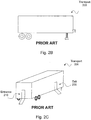
- the transport 200 may be some type movable structure for carrying the security screening equipment. Because some of the screening devices are typically large and heavy objects, the transport 200 is typically a movable trailer that can be towed by a trailer, truck, bus or other sort of mechanized vehicle. As depicted in FIGS. 2B and 2C , the transport 200 generally includes an enclosure around the security checkpoint 300 to protect the security equipment from environmental factors.
- the enclosed transport 200 housing the security checkpoint 300 may include an entrance 210 and an exit 220.
- the MSU 100 may be positioned so that people must pass enter the entrance 210 and pass through though the security checkpoint 300, before exiting MSU 100 via the exit 220 positioned within a secure enclosure (not illustrated).
- the entrance 210 and the exit 220 may include some type of ramp or stairs assembly, as suggested in FIG. 2C , to assist people with ingress to and egress from the MSU 100.
- the entrance 210 and exit 220 may also be configured as needed to provide desired levels of handicap access. For instance, the entrance 210 may be ramp or elevator of sufficient width to provide wheelchair access.
- the transport 200 may include some type of extension 230 to expand the space for the security checkpoint within the enclosure.
- FIG 2D depicts include a fold-down extension 300 that opens up the interior of the transport 200.
- FIG. 2E depicts a nested structure or an accordion-type extension 300 that expands the interior of the transport 200.
- the transport may include some type of climate control system (heat and/or air conditioning) if desired to improve the performance of screening equipment.
- the transport may be configured, to the extent allowed by state and federal rules, as needed to accommodate the needs of the security checkpoint.
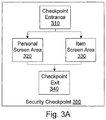
- FIG. 3A schematically depicts a security checkpoint 300
- people enter via a checkpoint entrance 310 where they generally prepare for screening before entering a personal screening area 320.
- the people also place any baggage and items into an item screen area 330.
- the people After completion of the personal and item screens, the people recollect their items and leave the security checkpoint through a checkpoint exit 340.
- a person enters the security checkpoint entrance 310.
- only people having a ticket are allowed to enter the security checkpoint 300.
- one aspect of the checkpoint entrance 310 may be an examination of tickets.
- the checkpoint entrance 310 may further include gates, doors or other structures to prevent people from bypassing the MSU 100.
- people prepare for personal and item screening, described below. For instance, people in the security checkpoint entrance 310 prepare for screening in the personal screen area 320 by removing keys, coins, jewelry, cell phones or other metallic objects that may interfere with security examinations.
- people in the security entrance 310 prepare for item screening in item screening area 330 by placing items into the item screening area 330 and by identifying special items, such a laptop computer or camera equipment, that require separate searching.
- a person is screened by some type of rapid scanning device, such as a walk through metal detector (WTMD).
- WTMD walk through metal detector
- Certain people activate an alarm, thereby requiring resolution of the personal screen alarm.
- Increasing the sensitivity of the personal screening device increases the percentage of people that activate the alarm.
- a personal screen alarm is resolved before the person can leave the checkpoint 300.
- the person causing the alarm may return to the checkpoint entrance 310, remove one or more items, and re-enter the personal screen area 320 to repeat the screening.
- security workers may close the personal screening area 320 and perform other screening tests as needed to resolve the alarm.
- the security workers may use a hand-held metal detector ("HHMD”) or other screening techniques (such as a frisk) to identify objects causing the alarm.
- HHMD hand-held metal detector
- these processes delay other people waiting to enter the personal screening area 320.
- a person initiates the item screening in item screening area 330 by placing an item into the item screening area 330.
- the item is then screened using known technology.
- the item screening uses some type of x-ray device that allows security officials to see into the item. If the x-ray device produces an alarm, then the alarm must be resolved through more detailed screening before that item is allowed through the security checkpoint. After the item screening alarm is resolved or if the item did not produce an item screening alarm, the item may be cleared and the item screening ends.
- the resolving of the item screen alarm in the item screening area generally entails a more thorough examination of the item, as necessary for the security checkpoint of interest. For instance, in an airport, security officials may test the item for presence of prohibited chemicals. If needed, the security officials may also manually search the item to identify the cause for the alarm. It should be appreciated that other security tasks or combinations of tasks may be incorporated as well. Also, the extent of the manual search may vary according to the results of the x-ray. Specifically, the manual search may vary depending on whether a restricted item is seen during screening.
- the screening of a person's items in area 330 and screening of the person in area 320 occur concurrently to expedite the security process.
- the item screening in area 330 and personal screening in area 320 may be interrelated so that tasks in one of the areas cannot begin until the completion of a task in the other area.
- delays in both areas 320 and 330 may occur with a person causing a security alarm in the personal screening area 320.
- more extensive screens (such as a manual search) of an item in area 330 generally cannot begin without the presence of the owner.
- delays may occur in the item screen area 330 if the owner is detained in the personal screen area 320.
- the checkpoint exit 340 may further include gate, doors, or other structures to prevent people from entering the checkpoint 300 from the exit 340.
- This configuration 300 depicted in FIG. 3A may have several deficiencies, including potentially mixing people who pass and fail the personal screening and allowing people to access items in the item screen area before completing a personal screen. Thus, a potential security risk arises in which a person may stow contraband on to cleared people or baggage. Also, the configuration of the security checkpoint 300 may cause delays because additional searching of people in the personal screen area 320 prevent others from entering the area and potentially delays item screening in area 330.
- the present invention may include an improved security checkpoint 301 schematically depicted in FIG. 3B .
- the improved security checkpoint 301 directs people to enter a checkpoint module entrance 310 where they generally prepare for personal and item screening in areas 320 and 330, respectively, and then leave the checkpoint through the checkpoint exit 340, as described above.
- screening devices and tests used in the areas 320 and 330 may vary as needed for security checkpoint 300 and the improved security checkpoint 301, and such changes are anticipated by and easily incorporated into the present invention.
- the improved security checkpoint 301 includes a wanding station 350 to address the deficiencies in the security checkpoint module 300.
- the wanding station 350 is separate from the personal screen area 320 and the item screen area 330. Specifically, people selected for a further search in the personal screening area 320 (i. e., those activating an alarm by a metal detector) are directed toward the wanding station 350. In this way, the improved security checkpoint 301 avoids the problems associated with a chaotic screening process. Furthermore, because the additional screening occurs in the wanding station 350, away from the personal screening area 320, other people passing through the personal screen area 320 are not significantly affected by the additional screening.
- HHMD hand-held metal detector
- the wanding station 350 may be any type of enclosed area designated for further personal screening within the MSU 100.
- the wanding station 350 is a structure constructed according to the needs and resources present at the security checkpoint.
- the screening devices present in the MSU 100 i. e., the above described WTMD and the x-ray machine
- the wanding station 350 may be an enclosure defined by stanchions connected by ropes, chains, or retractable tape.
- Security workers in the wanding station help to ensure that a person cannot leave the wanding station 350 until cleared.
- the wanding station may be positioned externally from the MSU 100. For instance, people specified by the various screen devices people or otherwise selected for additional screening may be escorted out of the MSU 100 into the wanding area 350 located in a separate secure area. Additional security screening may then occur in the wanding area 350, as suggested above.
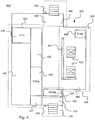
- the exemplary MSU 400 includes a wanding station 450 enclosed in glass or other sturdy materials constructed within the transport extension 230, as described above.
- the exemplary MSU 400 includes an x-ray machine 430, an x-ray roller extension 432, a small item scanner 454, a Walk-Through-Metal Detectors (WTMD) 420, an Electronic Trace Detection (ETD) machine 434, and the wanding station 450. It should be appreciated that any type or combination screening devices may be used in the MSU 100, according to the security needs.
- WTMD Walk-Through-Metal Detectors
- ETD Electronic Trace Detection
- the exemplary MSU 400 may use six security workers for efficient operation, including: (1) an entrance monitor; (2) a WTMD operator stationed on the exit side of the WTMD 420; (3) an x-ray Operator stationed at the x-ray monitor station 430; (4) two Wand Operators stationed inside the wanding station 450; (5) a Bag Searcher and ETD Operator stationed behind the ETD station 434; and (6) an exit monitor.
- six security workers for efficient operation, including: (1) an entrance monitor; (2) a WTMD operator stationed on the exit side of the WTMD 420; (3) an x-ray Operator stationed at the x-ray monitor station 430; (4) two Wand Operators stationed inside the wanding station 450; (5) a Bag Searcher and ETD Operator stationed behind the ETD station 434; and (6) an exit monitor.
- the wanding area 450 (corresponding to above described wanding area 350) is defined by a structure 451 that may be formed using the frame elements 446 form a skeleton for securing the wanding station walls 445.
- the wanding area 450 is also depicted with wanding substations 453 and an entry area 452.
- the exemplary MSU may be configured to improve its efficiency.
- the WTMD 420 should be positioned in relation to the x-ray device 430 so that provide most people (i. e., those not selected for further screening in the wanding station 450) a direct, straight wallcway to proceed directly to collect their items at the end of the x-ray lane 430.
- the x-ray lanes 430 may have extenders 432 so that people leaving the wanding station 450 may proceed directly to their items without traveling upstream, against the flow of other people, to recover the items from the item screen area 330.
- the extenders 432 may be a set of rollers, a moving conveyer belt, or some other type of known structure for receiving items from the x-ray 430 and transporting these items to a desired location, generally near the exit to the wanding station 450.
- efficiency of checkpoint is improved because the composure bottleneck is dispersed along the entire length of the extenders 432.
- the wanding station 450 may be dimensioned as allowed in the MSU 400. Also, the wanding station 450 may be dimensioned as needed for the security checkpoint. For example, detailed modeling and simulations may be used to determine a wanding station size and capacity as needed achieve adequate throughput through the MSU 400.
- FIG. 4 depicts a wanding station 450 having two substations 453 for simultaneously screening two people. The substations 453 are depicted as wanding footpads that guide people to proper positions for screening in the wanding station 450. It should be appreciated that the wanding station 450 may be any other size as needed for a particular security checkpoint 300.
- the wanding station 450 may be shaped and dimensioned according to the available space within the transport 200. Furthermore, the size of the wanding station 450 (and the corresponding capacity) may be modified according to the desired throughput of the security checkpoint module.
- the wanding station 450 When the wanding station 450 is filled to capacity, the MSU 400 closes until the completion of the screening of at least one of the substations 453. Otherwise, a person causing an alarm in the personal screening area 420 has nowhere to go and becomes a potential security risk.
- the wanding station 450 may further include an entry area (or neck) 452 in which passengers form a queue for entering the wanding station 450, as depicted in FIG. 4 .
- the neck 252 may be sized to hold two people, thus doubling the number of people in wanding station 450 before necessitating closing the MSU 400.
- the wanding station 450 is optimally sized according to space limitations and capacity needs of the checkpoint. As a result, additional security test equipment to improve the efficiency and/or thoroughness of the screening may be positioned within or outside of the wanding station.
- FIG. 4 depicts a small-item scanner machine 454 positioned within the wanding station 440.
- the small item scanner 454 allows security workers to screen small personal items, such as shoes and coats, relatively quickly. This screening functionality speeds the screening of a person spends in the Wanding Station 450 by having personal items scanned concurrently with other personal screenings.
- FIG. 5 depicts a structure 451 for forming the wanding station 450 in accordance with a preferred embodiment of the present invention.
- the wanding station 450 is formed using frame elements 456 adapted to secure wanding station walls 455.
- the frame elements 456 may be any type of structure that is strong enough to reliably secure the wanding station walls 455.
- the frame elements 456 may be metal beams or tubes to which the wanding station walls 455 are fastened.
- the frame elements 456 are secured to one another to form a strong structure for containing people during the additional personal screening.
- the wanding station walls 455 may be any type of substantially planar structure that combines with frame elements 241 to form the desired enclosure structure.
- the wanding station walls 455 may be wood, metal, or plastic boards fastened to the frame elements 456.
- the wanding station walls 455 are substantially clear to allow people in the wanding station 450 to observe the item screening area 430. In this way, people in the wanding station 450 can track their items and alert security officials if an item is mistakenly claimed or stolen.
- a see-through wanding station 450 also allows security workers to observe events within the wanding station 450 and to act as needed for security purposes.
- the wanding station walls 455 may be constructed from glass, a clear plastic (such as Plexiglas@), or other substantially transparent substance.
- FIG. 5 depicts the structure 451 of the wanding station 450 from a side view.
- the frame elements 446 form a skeleton for securing the wanding station walls 445.
- the frame elements 446 and the wanding walls 445 are positioned as needed to form a structure 451 of desired dimensions and to form the components of the wanding area 450, such as the above-described neck area 452.
Landscapes
- Engineering & Computer Science (AREA)
- Mechanical Engineering (AREA)
- Aviation & Aerospace Engineering (AREA)
- Analysing Materials By The Use Of Radiation (AREA)
- Alarm Systems (AREA)
- Road Signs Or Road Markings (AREA)
- Burglar Alarm Systems (AREA)
Claims (13)
- Mobiler Sicherheits-Kontrollpunkt, umfassend:eine Transportvorrichtung (200); undwenigstens ein Kontrollpunkt- bzw. Checkpoint-Modul (300), welches auf der Transportvorrichtung (200) enthalten ist, wobei das Modul (300) umfasst:einen Überprüfungsbereich (330) für Gegenstände, beinhaltend einen Eingabebereich, welcher einen Gegenstand erhält, welcher durch eine Person abgelegt ist, eine Überprüfungsvorrichtung für Gegenstände, welche den Gegenstand überprüft, und einen Ausgabebereich, welcher den Gegenstand an die Person nach einer Vollendung wenigstens der ersten einer ersten und zweiten Überprüfung der Person retourniert,einen Überprüfungsbereich (320) für Personen, welcher benachbart zu dem Überprüfungsbereich (330) für Gegenstände positioniert ist, wobei die Person den Überprüfungsbereich für Personen nach einem Ablegen des Gegenstands in dem Eingabebereich betritt, wobei der Überprüfungsbereich für Personen eine Überprüfungsvorrichtung für Personen beinhaltet, welche eine erste Überprüfung der Person durchführt, um zu bestimmen, ob eine zweite Überprüfung der Person durchzuführen ist, wobei die Person den Überprüfungsbereich für Personen verlässt und den Gegenstand von dem Ausgabebereich in einem im Wesentlichen geraden Pfad wiederum aufnimmt, wenn die zweite Überprüfung der Person nicht durchgeführt wird,eine Ummantelung bzw. ein Gehäuse (350), wobei die Ummantelung physisch von dem Überprüfungsbereich für Gegenstände und dem Überprüfungsbereich für Personen getrennt ist, wobei die Person den Überprüfungsbereich für Personen verlässt und in die Ummantelung eintritt, wenn die erste Überprüfung der Person ein Erfordernis anzeigt, eine zweite Überprüfung der Person durchzuführen, wobei die zweite Überprüfung der Person in der Ummantelung stattfindet,wobei die Ummantelung (350) einen Eingang und einen Ausgang beinhaltet, wobei der Eingang nahe zu dem Überprüfungsbereich für Personen positioniert ist, wobei der Ausgang nahe zu dem Ausgabebereich in dem Überprüfungsbereich für Gegenstände positioniert ist, so dass Personen in der Ummantelung getrennt von ihren Gegenständen überprüft werden,dadurch gekennzeichnet, dass die Ummantelung (350) im Wesentlichen klare bzw. durchsichtige Wände aufweist, um einer Person in der Ummantelung zu erlauben, den Überprüfungsbereich für Gegenstände zu beobachten und ihre Gegenstände zu verfolgen.
- Mobiler Sicherheits-Kontrollpunkt nach Anspruch 1, wobei der Überprüfungsbereich (330) für Gegenstände eine Verlängerung (432) umfasst, welche die Überprüfungsvorrichtung für Gegenstände und den Ausgabebereich verbindet.
- Mobiler Sicherheits-Kontrollpunkt nach Anspruch 1, wobei die Ummantelung eine im Wesentlichen transparente planare Oberfläche umfasst.
- Mobiler Sicherheits-Kontrollpunkt nach Anspruch 1, wobei die Ummantelung einen Eingangsbereich (452) umfasst, in welchem sich eine Schlange bilden kann, wenn die Ummantelung voll ist.
- Mobiler Sicherheits-Kontrollpunkt nach Anspruch 1, darüber hinaus umfassend eine Überprüfungsvorrichtung (454) für kleine Gegenstände, welche bei der zweiten Überprüfung der Person unterstützt.
- Mobiler Sicherheits-Kontrollpunkt nach Anspruch 1, wobei die Ummantelung darüber hinaus eine Wanding- bzw. Handüberprüfungs-Fußanzeige (453) umfasst, welche die Person zu einer entsprechenden Position für die zweite Überprüfung der Person führt.
- Mobiler Sicherheits-Kontrollpunkt nach Anspruch 1, wobei die Ummantelung durch eine Wand umfassende Stützträger (456) und planare Wandeinheiten (455) umgeben ist, welche an den Stützträgern festgelegt sind.
- Mobiler Sicherheits-Kontrollpunkt nach Anspruch 4, wobei der Eingangsbereich adaptiert ist, um zu erlauben, dass sich zwei Personen der Schlange anschließen, bevor der Eintrittsbereich gefüllt ist.
- Mobiler Sicherheits-Kontrollpunkt nach Anspruch 1, wobei ein Ausgang (340) zu der Ummantelung positioniert ist, um der Person zu erlauben, die Ummantelung zu verlassen und Gegenstände von der Überprüfungsvorrichtung für Gegenstände einzusammeln, ohne sich stromaufwärts gegen andere Personen zu bewegen.
- Mobiler Sicherheits-Kontrollpunkt nach Anspruch 9, wobei die Überprüfungsvorrichtung für Gegenstände eine Verlängerung (432) beinhaltet, welche den Gegenstand, welcher die Überprüfungsvorrichtung für Gegenstände verlässt, nahe zu dem Ausgang der Ummantelung positioniert.
- Mobiler Sicherheits-Kontrollpunkt nach Anspruch 1, wobei die Überprüfungsvorrichtung für Gegenstände (330), die Überprüfungsvorrichtung (320) für Personen und die Ummantelung derart konfiguriert sind, dass, wenn die Überprüfungsvorrichtung für Personen nicht einen Alarm erzeugt, die Person den Gegenstand in die Überprüfungsvorrichtung (430) für Gegenstände anordnen, durch die Überprüfungsvorrichtung (420) für Personen hindurchtreten und den Gegenstand von der Überprüfungsvorrichtung für Gegenstände in einem im Wesentlichen geraden Weg wieder aufnehmen kann.
- Mobiler Sicherheits-Kontrollpunkt nach Anspruch 1, wobei die Ummantelung für ein gleichzeitiges Überprüfen von zwei Personen konfiguriert ist.
- Mobiler Sicherheits-Kontrollpunkt nach Anspruch 1, darüber hinaus umfassend einen Eingang (310) in die Transportvorrichtung (200), wobei der Eintritt konfiguriert ist, um Personen zu der Überprüfungsvorrichtung (420) für Personen zu leiten.
Applications Claiming Priority (2)
| Application Number | Priority Date | Filing Date | Title |
|---|---|---|---|
| US10/679,509 US7102512B2 (en) | 2003-10-07 | 2003-10-07 | Mobile security unit |
| PCT/EP2004/011160 WO2005039979A1 (en) | 2003-10-07 | 2004-10-06 | Mobile security unit |
Publications (2)
| Publication Number | Publication Date |
|---|---|
| EP1670684A1 EP1670684A1 (de) | 2006-06-21 |
| EP1670684B1 true EP1670684B1 (de) | 2016-12-07 |
Family
ID=34394169
Family Applications (1)
| Application Number | Title | Priority Date | Filing Date |
|---|---|---|---|
| EP04765852.1A Expired - Lifetime EP1670684B1 (de) | 2003-10-07 | 2004-10-06 | Mobile sicherheitseinheit |
Country Status (4)
| Country | Link |
|---|---|
| US (1) | US7102512B2 (de) |
| EP (1) | EP1670684B1 (de) |
| CA (1) | CA2541461C (de) |
| WO (1) | WO2005039979A1 (de) |
Families Citing this family (22)
| Publication number | Priority date | Publication date | Assignee | Title |
|---|---|---|---|---|
| DE102004043158A1 (de) * | 2004-09-03 | 2006-03-23 | Smiths Heimann Gmbh | Transportable Kontrollstation zur Überprüfung von Personen und Gepäck |
| US7762025B2 (en) * | 2004-11-19 | 2010-07-27 | Modular Security Systems, Inc. | Containerized access control system |
| RU2460098C2 (ru) | 2007-01-15 | 2012-08-27 | Рапискан Системз, Инк. | Системы обнаружения |
| US7823338B2 (en) * | 2007-04-10 | 2010-11-02 | Modular Security Systems, Inc. | Modular access control system |
| US20090322866A1 (en) * | 2007-04-19 | 2009-12-31 | General Electric Company | Security checkpoint systems and methods |
| US20080266165A1 (en) * | 2007-04-27 | 2008-10-30 | Robert Patrick Daly | System for deployment of a millimeter wave concealed object detection system |
| US7856915B1 (en) | 2007-05-07 | 2010-12-28 | The United States Of America As Represented By The Secretary Of The Navy | Blast mitigating mobile self-contained networked checkpoint |
| US7789258B1 (en) | 2007-05-07 | 2010-09-07 | The United States Of America As Represented By The Secretary Of The Navy | Mobile self-contained networked checkpoint |
| WO2009148637A1 (en) * | 2008-02-14 | 2009-12-10 | Brijot Imaging Systems, Inc. | Millimeter wave concealed object detection system using portal deployment |
| US9116513B2 (en) * | 2008-03-28 | 2015-08-25 | Securitypoint Holdings, Inc. | Methods and systems for efficient security screening |
| US20100207760A1 (en) * | 2008-10-02 | 2010-08-19 | Stomski Gerald D | Mobile vehicle screening (mvs) |
| US8731137B2 (en) * | 2010-02-26 | 2014-05-20 | Rapiscan Systems, Inc. | Integrated portable checkpoint system |
| CN102750767B (zh) * | 2012-07-20 | 2015-03-11 | 神华集团有限责任公司 | 门禁设备 |
| AU2013221920B2 (en) | 2012-08-27 | 2014-10-23 | Accenture Global Services Limited | Virtual access control |
| KR20160130482A (ko) | 2014-03-07 | 2016-11-11 | 라피스캔 시스템스, 인코포레이티드 | 초광대역 검출기 |
| US11280898B2 (en) | 2014-03-07 | 2022-03-22 | Rapiscan Systems, Inc. | Radar-based baggage and parcel inspection systems |
| JP2017537399A (ja) | 2014-11-25 | 2017-12-14 | ラピスカン システムズ、インコーポレイテッド | インテリジェントセキュリティ管理システム |
| US10345479B2 (en) | 2015-09-16 | 2019-07-09 | Rapiscan Systems, Inc. | Portable X-ray scanner |
| GB2563757A (en) * | 2016-01-19 | 2018-12-26 | Rapiscan Systems Inc | Integrated security inspection system |
| DE102017200313B4 (de) | 2017-01-10 | 2022-09-22 | Hartmann Spezialkarosserien Gmbh | Einrichtung zur Sicherheitskontrolle |
| US11538584B2 (en) * | 2020-05-13 | 2022-12-27 | Michael C Castle | Autobot security portal and mobile sanitizer |
| US20240394820A1 (en) * | 2023-05-25 | 2024-11-28 | The Government of the United States of America, as represented by the Secretary of Homeland Security | Modular screening apparatus and method |
Family Cites Families (15)
| Publication number | Priority date | Publication date | Assignee | Title |
|---|---|---|---|---|
| EP0050643B1 (de) * | 1980-04-25 | 1985-01-30 | E.A.A. Economical-Airport-Architecturconsulting Gmbh | Verfahren zur abfertigung von fluggästen, hierfür geeignete flughafenanlage und hierfür geeignetes fahrzeug |
| US4586441A (en) * | 1982-06-08 | 1986-05-06 | Related Energy & Security Systems, Inc. | Security system for selectively allowing passage from a non-secure region to a secure region |
| CH669685A5 (en) * | 1986-02-27 | 1989-03-31 | Kriton Security Ag | Security access system for building e.g. in airport, rail station - uses anti-chamber incorporating security checking devices and room detention room at side of anti-chamber |
| ES2210313T3 (es) * | 1994-09-26 | 2004-07-01 | Steris, Inc. | Tratamiento alcalino del acero inoxidable. |
| US6057761A (en) * | 1997-01-21 | 2000-05-02 | Spatial Dynamics, Ltd. | Security system and method |
| US6724304B2 (en) * | 1998-10-20 | 2004-04-20 | Georal International Ltd. | Security entrance system |
| US6312812B1 (en) * | 1998-12-01 | 2001-11-06 | Ppg Industries Ohio, Inc. | Coated metal substrates and methods for preparing and inhibiting corrosion of the same |
| US6232280B1 (en) * | 1999-05-12 | 2001-05-15 | Steris Corporation | Cleaning product with analyzable and stable surfactant |
| US6387858B1 (en) * | 2000-03-31 | 2002-05-14 | Steris Inc. | Safe transport gel for treating medical instruments |
| US6507278B1 (en) * | 2000-06-28 | 2003-01-14 | Adt Security Services, Inc. | Ingress/egress control system for airport concourses and other access controlled areas |
| EP1264289A4 (de) * | 2000-10-04 | 2006-03-29 | Adt Security Services Inc | Eingangs-ausgangssteuerungssystem für flughafenhallen und andere bereiche |
| US6484650B1 (en) * | 2001-12-06 | 2002-11-26 | Gerald D. Stomski | Automated security chambers for queues |
| US20030213184A1 (en) * | 2002-05-19 | 2003-11-20 | Hunt Harry Summer | Multiple search booths at airports and transportation terminals |
| US6972693B2 (en) * | 2003-05-19 | 2005-12-06 | Brown Betty J | Vehicle security inspection system |
| CN100445767C (zh) * | 2003-07-08 | 2008-12-24 | 通用电气家园保护有限公司 | 安全检查站 |
-
2003
- 2003-10-07 US US10/679,509 patent/US7102512B2/en not_active Expired - Lifetime
-
2004
- 2004-10-06 EP EP04765852.1A patent/EP1670684B1/de not_active Expired - Lifetime
- 2004-10-06 WO PCT/EP2004/011160 patent/WO2005039979A1/en not_active Ceased
- 2004-10-06 CA CA002541461A patent/CA2541461C/en not_active Expired - Fee Related
Also Published As
| Publication number | Publication date |
|---|---|
| CA2541461A1 (en) | 2005-05-06 |
| US20050074086A1 (en) | 2005-04-07 |
| EP1670684A1 (de) | 2006-06-21 |
| CA2541461C (en) | 2009-06-02 |
| US7102512B2 (en) | 2006-09-05 |
| WO2005039979A1 (en) | 2005-05-06 |
Similar Documents
| Publication | Publication Date | Title |
|---|---|---|
| US7102512B2 (en) | Mobile security unit | |
| US6972693B2 (en) | Vehicle security inspection system | |
| CN1993269B (zh) | 用于对人员和行李进行检验的移动式检查站 | |
| DE602004004807T2 (de) | Gepäcküberprüfungssystem | |
| US6952163B2 (en) | Combined systems user interface for centralized monitoring of a screening checkpoint for passengers and baggage | |
| US8031903B2 (en) | Networked security system | |
| US7317390B2 (en) | Screening checkpoint for passengers and baggage | |
| EP1999496A2 (de) | Verifizierungs- und screeningsystem | |
| EP2390845A1 (de) | Kontrollpunktvorrichtung zur Verwaltung des Zugangs zu Kontrollbereichen | |
| US20040190757A1 (en) | Integrated passenger management system | |
| US20080023631A1 (en) | Detector System for traffic lanes | |
| US4137567A (en) | System for passenger and luggage processing at commercial airports | |
| US7106192B2 (en) | Security checkpoint | |
| JP3317111B2 (ja) | 手荷物自動処理装置 | |
| CA2520040C (en) | Security checkpoint | |
| US20060081782A1 (en) | Remote detector system | |
| EP2390844A1 (de) | Verfahren und System zur Verwaltung des Zugangs zu Kontrollbereichen | |
| HK1092116B (en) | Mobile security unit | |
| HK1092116A (en) | Mobile security unit | |
| EP2179924A1 (de) | Sicherheitskontrollpunkt | |
| HK1142304A (en) | Security checkpoint | |
| HK1153565A (en) | Security checkpoint | |
| Jenkins | A primer on airport security | |
| Snyder et al. | Designing airport security checkpoints of the future | |
| Sample et al. | High tech aviation security program in Africa-a model for technology transfer |
Legal Events
| Date | Code | Title | Description |
|---|---|---|---|
| PUAI | Public reference made under article 153(3) epc to a published international application that has entered the european phase |
Free format text: ORIGINAL CODE: 0009012 |
|
| 17P | Request for examination filed |
Effective date: 20060421 |
|
| AK | Designated contracting states |
Kind code of ref document: A1 Designated state(s): AT BE BG CH CY CZ DE DK EE ES FI FR GB GR HU IE IT LI LU MC NL PL PT RO SE SI SK TR |
|
| DAX | Request for extension of the european patent (deleted) | ||
| REG | Reference to a national code |
Ref country code: HK Ref legal event code: DE Ref document number: 1092116 Country of ref document: HK |
|
| 17Q | First examination report despatched |
Effective date: 20070504 |
|
| RAP1 | Party data changed (applicant data changed or rights of an application transferred) |
Owner name: ACCENTURE GLOBAL SERVICES LIMITED |
|
| REG | Reference to a national code |
Ref country code: DE Ref legal event code: R079 Ref document number: 602004050451 Country of ref document: DE Free format text: PREVIOUS MAIN CLASS: B64F0001360000 Ipc: B64F0001300000 |
|
| GRAP | Despatch of communication of intention to grant a patent |
Free format text: ORIGINAL CODE: EPIDOSNIGR1 |
|
| RIC1 | Information provided on ipc code assigned before grant |
Ipc: B64F 1/36 20060101ALI20160524BHEP Ipc: B64F 1/30 20060101AFI20160524BHEP |
|
| INTG | Intention to grant announced |
Effective date: 20160630 |
|
| GRAS | Grant fee paid |
Free format text: ORIGINAL CODE: EPIDOSNIGR3 |
|
| GRAA | (expected) grant |
Free format text: ORIGINAL CODE: 0009210 |
|
| AK | Designated contracting states |
Kind code of ref document: B1 Designated state(s): AT BE BG CH CY CZ DE DK EE ES FI FR GB GR HU IE IT LI LU MC NL PL PT RO SE SI SK TR |
|
| REG | Reference to a national code |
Ref country code: GB Ref legal event code: FG4D |
|
| REG | Reference to a national code |
Ref country code: CH Ref legal event code: EP Ref country code: AT Ref legal event code: REF Ref document number: 851447 Country of ref document: AT Kind code of ref document: T Effective date: 20161215 |
|
| REG | Reference to a national code |
Ref country code: IE Ref legal event code: FG4D |
|
| REG | Reference to a national code |
Ref country code: DE Ref legal event code: R096 Ref document number: 602004050451 Country of ref document: DE |
|
| REG | Reference to a national code |
Ref country code: NL Ref legal event code: MP Effective date: 20161207 |
|
| PG25 | Lapsed in a contracting state [announced via postgrant information from national office to epo] |
Ref country code: GR Free format text: LAPSE BECAUSE OF FAILURE TO SUBMIT A TRANSLATION OF THE DESCRIPTION OR TO PAY THE FEE WITHIN THE PRESCRIBED TIME-LIMIT Effective date: 20170308 Ref country code: SE Free format text: LAPSE BECAUSE OF FAILURE TO SUBMIT A TRANSLATION OF THE DESCRIPTION OR TO PAY THE FEE WITHIN THE PRESCRIBED TIME-LIMIT Effective date: 20161207 |
|
| REG | Reference to a national code |
Ref country code: AT Ref legal event code: MK05 Ref document number: 851447 Country of ref document: AT Kind code of ref document: T Effective date: 20161207 |
|
| PG25 | Lapsed in a contracting state [announced via postgrant information from national office to epo] |
Ref country code: FI Free format text: LAPSE BECAUSE OF FAILURE TO SUBMIT A TRANSLATION OF THE DESCRIPTION OR TO PAY THE FEE WITHIN THE PRESCRIBED TIME-LIMIT Effective date: 20161207 Ref country code: ES Free format text: LAPSE BECAUSE OF FAILURE TO SUBMIT A TRANSLATION OF THE DESCRIPTION OR TO PAY THE FEE WITHIN THE PRESCRIBED TIME-LIMIT Effective date: 20161207 |
|
| PG25 | Lapsed in a contracting state [announced via postgrant information from national office to epo] |
Ref country code: NL Free format text: LAPSE BECAUSE OF FAILURE TO SUBMIT A TRANSLATION OF THE DESCRIPTION OR TO PAY THE FEE WITHIN THE PRESCRIBED TIME-LIMIT Effective date: 20161207 |
|
| PG25 | Lapsed in a contracting state [announced via postgrant information from national office to epo] |
Ref country code: EE Free format text: LAPSE BECAUSE OF FAILURE TO SUBMIT A TRANSLATION OF THE DESCRIPTION OR TO PAY THE FEE WITHIN THE PRESCRIBED TIME-LIMIT Effective date: 20161207 Ref country code: RO Free format text: LAPSE BECAUSE OF FAILURE TO SUBMIT A TRANSLATION OF THE DESCRIPTION OR TO PAY THE FEE WITHIN THE PRESCRIBED TIME-LIMIT Effective date: 20161207 Ref country code: SK Free format text: LAPSE BECAUSE OF FAILURE TO SUBMIT A TRANSLATION OF THE DESCRIPTION OR TO PAY THE FEE WITHIN THE PRESCRIBED TIME-LIMIT Effective date: 20161207 Ref country code: CZ Free format text: LAPSE BECAUSE OF FAILURE TO SUBMIT A TRANSLATION OF THE DESCRIPTION OR TO PAY THE FEE WITHIN THE PRESCRIBED TIME-LIMIT Effective date: 20161207 |
|
| PG25 | Lapsed in a contracting state [announced via postgrant information from national office to epo] |
Ref country code: IT Free format text: LAPSE BECAUSE OF FAILURE TO SUBMIT A TRANSLATION OF THE DESCRIPTION OR TO PAY THE FEE WITHIN THE PRESCRIBED TIME-LIMIT Effective date: 20161207 Ref country code: PT Free format text: LAPSE BECAUSE OF FAILURE TO SUBMIT A TRANSLATION OF THE DESCRIPTION OR TO PAY THE FEE WITHIN THE PRESCRIBED TIME-LIMIT Effective date: 20170407 Ref country code: BE Free format text: LAPSE BECAUSE OF FAILURE TO SUBMIT A TRANSLATION OF THE DESCRIPTION OR TO PAY THE FEE WITHIN THE PRESCRIBED TIME-LIMIT Effective date: 20161207 Ref country code: BG Free format text: LAPSE BECAUSE OF FAILURE TO SUBMIT A TRANSLATION OF THE DESCRIPTION OR TO PAY THE FEE WITHIN THE PRESCRIBED TIME-LIMIT Effective date: 20170307 Ref country code: AT Free format text: LAPSE BECAUSE OF FAILURE TO SUBMIT A TRANSLATION OF THE DESCRIPTION OR TO PAY THE FEE WITHIN THE PRESCRIBED TIME-LIMIT Effective date: 20161207 Ref country code: PL Free format text: LAPSE BECAUSE OF FAILURE TO SUBMIT A TRANSLATION OF THE DESCRIPTION OR TO PAY THE FEE WITHIN THE PRESCRIBED TIME-LIMIT Effective date: 20161207 |
|
| REG | Reference to a national code |
Ref country code: DE Ref legal event code: R097 Ref document number: 602004050451 Country of ref document: DE |
|
| REG | Reference to a national code |
Ref country code: FR Ref legal event code: PLFP Year of fee payment: 14 |
|
| PLBE | No opposition filed within time limit |
Free format text: ORIGINAL CODE: 0009261 |
|
| STAA | Information on the status of an ep patent application or granted ep patent |
Free format text: STATUS: NO OPPOSITION FILED WITHIN TIME LIMIT |
|
| 26N | No opposition filed |
Effective date: 20170908 |
|
| PG25 | Lapsed in a contracting state [announced via postgrant information from national office to epo] |
Ref country code: DK Free format text: LAPSE BECAUSE OF FAILURE TO SUBMIT A TRANSLATION OF THE DESCRIPTION OR TO PAY THE FEE WITHIN THE PRESCRIBED TIME-LIMIT Effective date: 20161207 Ref country code: SI Free format text: LAPSE BECAUSE OF FAILURE TO SUBMIT A TRANSLATION OF THE DESCRIPTION OR TO PAY THE FEE WITHIN THE PRESCRIBED TIME-LIMIT Effective date: 20161207 |
|
| REG | Reference to a national code |
Ref country code: HK Ref legal event code: GR Ref document number: 1092116 Country of ref document: HK |
|
| PG25 | Lapsed in a contracting state [announced via postgrant information from national office to epo] |
Ref country code: MC Free format text: LAPSE BECAUSE OF FAILURE TO SUBMIT A TRANSLATION OF THE DESCRIPTION OR TO PAY THE FEE WITHIN THE PRESCRIBED TIME-LIMIT Effective date: 20161207 |
|
| REG | Reference to a national code |
Ref country code: CH Ref legal event code: PL |
|
| PG25 | Lapsed in a contracting state [announced via postgrant information from national office to epo] |
Ref country code: LI Free format text: LAPSE BECAUSE OF NON-PAYMENT OF DUE FEES Effective date: 20171031 Ref country code: CH Free format text: LAPSE BECAUSE OF NON-PAYMENT OF DUE FEES Effective date: 20171031 Ref country code: LU Free format text: LAPSE BECAUSE OF NON-PAYMENT OF DUE FEES Effective date: 20171006 |
|
| REG | Reference to a national code |
Ref country code: FR Ref legal event code: PLFP Year of fee payment: 15 |
|
| PG25 | Lapsed in a contracting state [announced via postgrant information from national office to epo] |
Ref country code: HU Free format text: LAPSE BECAUSE OF FAILURE TO SUBMIT A TRANSLATION OF THE DESCRIPTION OR TO PAY THE FEE WITHIN THE PRESCRIBED TIME-LIMIT; INVALID AB INITIO Effective date: 20041006 |
|
| PG25 | Lapsed in a contracting state [announced via postgrant information from national office to epo] |
Ref country code: CY Free format text: LAPSE BECAUSE OF NON-PAYMENT OF DUE FEES Effective date: 20161207 |
|
| PG25 | Lapsed in a contracting state [announced via postgrant information from national office to epo] |
Ref country code: TR Free format text: LAPSE BECAUSE OF FAILURE TO SUBMIT A TRANSLATION OF THE DESCRIPTION OR TO PAY THE FEE WITHIN THE PRESCRIBED TIME-LIMIT Effective date: 20161207 |
|
| PGFP | Annual fee paid to national office [announced via postgrant information from national office to epo] |
Ref country code: FR Payment date: 20210913 Year of fee payment: 18 |
|
| PGFP | Annual fee paid to national office [announced via postgrant information from national office to epo] |
Ref country code: GB Payment date: 20210901 Year of fee payment: 18 |
|
| PGFP | Annual fee paid to national office [announced via postgrant information from national office to epo] |
Ref country code: DE Payment date: 20210831 Year of fee payment: 18 |
|
| REG | Reference to a national code |
Ref country code: DE Ref legal event code: R119 Ref document number: 602004050451 Country of ref document: DE |
|
| GBPC | Gb: european patent ceased through non-payment of renewal fee |
Effective date: 20221006 |
|
| P01 | Opt-out of the competence of the unified patent court (upc) registered |
Effective date: 20230524 |
|
| PG25 | Lapsed in a contracting state [announced via postgrant information from national office to epo] |
Ref country code: FR Free format text: LAPSE BECAUSE OF NON-PAYMENT OF DUE FEES Effective date: 20221031 Ref country code: DE Free format text: LAPSE BECAUSE OF NON-PAYMENT OF DUE FEES Effective date: 20230503 |
|
| PG25 | Lapsed in a contracting state [announced via postgrant information from national office to epo] |
Ref country code: GB Free format text: LAPSE BECAUSE OF NON-PAYMENT OF DUE FEES Effective date: 20221006 |
|
| PGFP | Annual fee paid to national office [announced via postgrant information from national office to epo] |
Ref country code: IE Payment date: 20230912 Year of fee payment: 20 |
|
| REG | Reference to a national code |
Ref country code: IE Ref legal event code: MK9A |
|
| PG25 | Lapsed in a contracting state [announced via postgrant information from national office to epo] |
Ref country code: IE Free format text: LAPSE BECAUSE OF EXPIRATION OF PROTECTION Effective date: 20241006 |
|
| PG25 | Lapsed in a contracting state [announced via postgrant information from national office to epo] |
Ref country code: IE Free format text: LAPSE BECAUSE OF EXPIRATION OF PROTECTION Effective date: 20241006 |