EP1669942A1 - Automated transaction control method, device and program - Google Patents
Automated transaction control method, device and program Download PDFInfo
- Publication number
- EP1669942A1 EP1669942A1 EP05252682A EP05252682A EP1669942A1 EP 1669942 A1 EP1669942 A1 EP 1669942A1 EP 05252682 A EP05252682 A EP 05252682A EP 05252682 A EP05252682 A EP 05252682A EP 1669942 A1 EP1669942 A1 EP 1669942A1
- Authority
- EP
- European Patent Office
- Prior art keywords
- authentication
- biometrics
- transaction
- automated transaction
- automated
- Prior art date
- Legal status (The legal status is an assumption and is not a legal conclusion. Google has not performed a legal analysis and makes no representation as to the accuracy of the status listed.)
- Withdrawn
Links
Images



Classifications
-
- G—PHYSICS
- G07—CHECKING-DEVICES
- G07F—COIN-FREED OR LIKE APPARATUS
- G07F19/00—Complete banking systems; Coded card-freed arrangements adapted for dispensing or receiving monies or the like and posting such transactions to existing accounts, e.g. automatic teller machines
- G07F19/20—Automatic teller machines [ATMs]
- G07F19/201—Accessories of ATMs
-
- G—PHYSICS
- G07—CHECKING-DEVICES
- G07F—COIN-FREED OR LIKE APPARATUS
- G07F19/00—Complete banking systems; Coded card-freed arrangements adapted for dispensing or receiving monies or the like and posting such transactions to existing accounts, e.g. automatic teller machines
-
- G—PHYSICS
- G06—COMPUTING OR CALCULATING; COUNTING
- G06F—ELECTRIC DIGITAL DATA PROCESSING
- G06F21/00—Security arrangements for protecting computers, components thereof, programs or data against unauthorised activity
- G06F21/30—Authentication, i.e. establishing the identity or authorisation of security principals
- G06F21/31—User authentication
-
- G—PHYSICS
- G06—COMPUTING OR CALCULATING; COUNTING
- G06F—ELECTRIC DIGITAL DATA PROCESSING
- G06F21/00—Security arrangements for protecting computers, components thereof, programs or data against unauthorised activity
- G06F21/30—Authentication, i.e. establishing the identity or authorisation of security principals
- G06F21/31—User authentication
- G06F21/32—User authentication using biometric data, e.g. fingerprints, iris scans or voiceprints
-
- G—PHYSICS
- G06—COMPUTING OR CALCULATING; COUNTING
- G06Q—INFORMATION AND COMMUNICATION TECHNOLOGY [ICT] SPECIALLY ADAPTED FOR ADMINISTRATIVE, COMMERCIAL, FINANCIAL, MANAGERIAL OR SUPERVISORY PURPOSES; SYSTEMS OR METHODS SPECIALLY ADAPTED FOR ADMINISTRATIVE, COMMERCIAL, FINANCIAL, MANAGERIAL OR SUPERVISORY PURPOSES, NOT OTHERWISE PROVIDED FOR
- G06Q20/00—Payment architectures, schemes or protocols
- G06Q20/08—Payment architectures
- G06Q20/10—Payment architectures specially adapted for electronic funds transfer [EFT] systems; specially adapted for home banking systems
-
- G—PHYSICS
- G06—COMPUTING OR CALCULATING; COUNTING
- G06Q—INFORMATION AND COMMUNICATION TECHNOLOGY [ICT] SPECIALLY ADAPTED FOR ADMINISTRATIVE, COMMERCIAL, FINANCIAL, MANAGERIAL OR SUPERVISORY PURPOSES; SYSTEMS OR METHODS SPECIALLY ADAPTED FOR ADMINISTRATIVE, COMMERCIAL, FINANCIAL, MANAGERIAL OR SUPERVISORY PURPOSES, NOT OTHERWISE PROVIDED FOR
- G06Q20/00—Payment architectures, schemes or protocols
- G06Q20/30—Payment architectures, schemes or protocols characterised by the use of specific devices or networks
- G06Q20/34—Payment architectures, schemes or protocols characterised by the use of specific devices or networks using cards, e.g. integrated circuit [IC] cards or magnetic cards
- G06Q20/341—Active cards, i.e. cards including their own processing means, e.g. including an IC or chip
-
- G—PHYSICS
- G06—COMPUTING OR CALCULATING; COUNTING
- G06Q—INFORMATION AND COMMUNICATION TECHNOLOGY [ICT] SPECIALLY ADAPTED FOR ADMINISTRATIVE, COMMERCIAL, FINANCIAL, MANAGERIAL OR SUPERVISORY PURPOSES; SYSTEMS OR METHODS SPECIALLY ADAPTED FOR ADMINISTRATIVE, COMMERCIAL, FINANCIAL, MANAGERIAL OR SUPERVISORY PURPOSES, NOT OTHERWISE PROVIDED FOR
- G06Q20/00—Payment architectures, schemes or protocols
- G06Q20/38—Payment protocols; Details thereof
- G06Q20/40—Authorisation, e.g. identification of payer or payee, verification of customer or shop credentials; Review and approval of payers, e.g. check credit lines or negative lists
-
- G—PHYSICS
- G06—COMPUTING OR CALCULATING; COUNTING
- G06Q—INFORMATION AND COMMUNICATION TECHNOLOGY [ICT] SPECIALLY ADAPTED FOR ADMINISTRATIVE, COMMERCIAL, FINANCIAL, MANAGERIAL OR SUPERVISORY PURPOSES; SYSTEMS OR METHODS SPECIALLY ADAPTED FOR ADMINISTRATIVE, COMMERCIAL, FINANCIAL, MANAGERIAL OR SUPERVISORY PURPOSES, NOT OTHERWISE PROVIDED FOR
- G06Q20/00—Payment architectures, schemes or protocols
- G06Q20/38—Payment protocols; Details thereof
- G06Q20/40—Authorisation, e.g. identification of payer or payee, verification of customer or shop credentials; Review and approval of payers, e.g. check credit lines or negative lists
- G06Q20/401—Transaction verification
- G06Q20/4014—Identity check for transactions
- G06Q20/40145—Biometric identity checks
-
- G—PHYSICS
- G07—CHECKING-DEVICES
- G07C—TIME OR ATTENDANCE REGISTERS; REGISTERING OR INDICATING THE WORKING OF MACHINES; GENERATING RANDOM NUMBERS; VOTING OR LOTTERY APPARATUS; ARRANGEMENTS, SYSTEMS OR APPARATUS FOR CHECKING NOT PROVIDED FOR ELSEWHERE
- G07C9/00—Individual registration on entry or exit
- G07C9/20—Individual registration on entry or exit involving the use of a pass
- G07C9/22—Individual registration on entry or exit involving the use of a pass in combination with an identity check of the pass holder
- G07C9/23—Individual registration on entry or exit involving the use of a pass in combination with an identity check of the pass holder by means of a password
-
- G—PHYSICS
- G07—CHECKING-DEVICES
- G07C—TIME OR ATTENDANCE REGISTERS; REGISTERING OR INDICATING THE WORKING OF MACHINES; GENERATING RANDOM NUMBERS; VOTING OR LOTTERY APPARATUS; ARRANGEMENTS, SYSTEMS OR APPARATUS FOR CHECKING NOT PROVIDED FOR ELSEWHERE
- G07C9/00—Individual registration on entry or exit
- G07C9/20—Individual registration on entry or exit involving the use of a pass
- G07C9/22—Individual registration on entry or exit involving the use of a pass in combination with an identity check of the pass holder
- G07C9/25—Individual registration on entry or exit involving the use of a pass in combination with an identity check of the pass holder using biometric data, e.g. fingerprints, iris scans or voice recognition
- G07C9/257—Individual registration on entry or exit involving the use of a pass in combination with an identity check of the pass holder using biometric data, e.g. fingerprints, iris scans or voice recognition electronically
-
- G—PHYSICS
- G07—CHECKING-DEVICES
- G07C—TIME OR ATTENDANCE REGISTERS; REGISTERING OR INDICATING THE WORKING OF MACHINES; GENERATING RANDOM NUMBERS; VOTING OR LOTTERY APPARATUS; ARRANGEMENTS, SYSTEMS OR APPARATUS FOR CHECKING NOT PROVIDED FOR ELSEWHERE
- G07C9/00—Individual registration on entry or exit
- G07C9/30—Individual registration on entry or exit not involving the use of a pass
- G07C9/32—Individual registration on entry or exit not involving the use of a pass in combination with an identity check
- G07C9/33—Individual registration on entry or exit not involving the use of a pass in combination with an identity check by means of a password
-
- G—PHYSICS
- G07—CHECKING-DEVICES
- G07C—TIME OR ATTENDANCE REGISTERS; REGISTERING OR INDICATING THE WORKING OF MACHINES; GENERATING RANDOM NUMBERS; VOTING OR LOTTERY APPARATUS; ARRANGEMENTS, SYSTEMS OR APPARATUS FOR CHECKING NOT PROVIDED FOR ELSEWHERE
- G07C9/00—Individual registration on entry or exit
- G07C9/30—Individual registration on entry or exit not involving the use of a pass
- G07C9/32—Individual registration on entry or exit not involving the use of a pass in combination with an identity check
- G07C9/37—Individual registration on entry or exit not involving the use of a pass in combination with an identity check using biometric data, e.g. fingerprints, iris scans or voice recognition
-
- G—PHYSICS
- G07—CHECKING-DEVICES
- G07F—COIN-FREED OR LIKE APPARATUS
- G07F19/00—Complete banking systems; Coded card-freed arrangements adapted for dispensing or receiving monies or the like and posting such transactions to existing accounts, e.g. automatic teller machines
- G07F19/20—Automatic teller machines [ATMs]
-
- G—PHYSICS
- G07—CHECKING-DEVICES
- G07F—COIN-FREED OR LIKE APPARATUS
- G07F7/00—Mechanisms actuated by objects other than coins to free or to actuate vending, hiring, coin or paper currency dispensing or refunding apparatus
- G07F7/08—Mechanisms actuated by objects other than coins to free or to actuate vending, hiring, coin or paper currency dispensing or refunding apparatus by coded identity card or credit card or other personal identification means
- G07F7/10—Mechanisms actuated by objects other than coins to free or to actuate vending, hiring, coin or paper currency dispensing or refunding apparatus by coded identity card or credit card or other personal identification means together with a coded signal, e.g. in the form of personal identification information, like personal identification number [PIN] or biometric data
- G07F7/1008—Active credit-cards provided with means to personalise their use, e.g. with PIN-introduction/comparison system
-
- G—PHYSICS
- G06—COMPUTING OR CALCULATING; COUNTING
- G06F—ELECTRIC DIGITAL DATA PROCESSING
- G06F2221/00—Indexing scheme relating to security arrangements for protecting computers, components thereof, programs or data against unauthorised activity
- G06F2221/21—Indexing scheme relating to G06F21/00 and subgroups addressing additional information or applications relating to security arrangements for protecting computers, components thereof, programs or data against unauthorised activity
- G06F2221/2101—Auditing as a secondary aspect
-
- G—PHYSICS
- G06—COMPUTING OR CALCULATING; COUNTING
- G06F—ELECTRIC DIGITAL DATA PROCESSING
- G06F2221/00—Indexing scheme relating to security arrangements for protecting computers, components thereof, programs or data against unauthorised activity
- G06F2221/21—Indexing scheme relating to G06F21/00 and subgroups addressing additional information or applications relating to security arrangements for protecting computers, components thereof, programs or data against unauthorised activity
- G06F2221/2105—Dual mode as a secondary aspect
Definitions
- This invention relates to an automated transaction control method, automated transaction device, and a program (e.g. stored on a storage medium) to verify input data obtained from a user against individual data on a storage device held by the user in order to perform automated transactions, and in particular to such a method, device and program which utilize a biometric authentication unit to read biometric information of the user, and verify the information against registered biometric information.
- a program e.g. stored on a storage medium
- Automated transaction machines which are operated by users are in wide use. Such automated transaction machines include automated cash dispensers, automated deposit/withdrawal machines, and automated balance transfer machines for financial transactions, as well as automated ticket dispensers and automated certification document dispensers.
- Such automated transaction machines are operated by users to perform deposit/withdrawal, cash transfer, document issuing, and other transactions. Hence from the standpoint of prevention of illicit operations, it is essential that such automated transaction machines perform identity verification (below, "individual authentication") of users.
- identity verification hereinafter, "individual authentication”
- a card on which is recorded individual information is issued to each user, and when performing the automated transaction, a card password number (PIN) or other individual data is read and is compared with data input by the user.
- PIN card password number
- the human body has various biometrics (properties enabling identification of an individual), such as fingerprints, the retinas of the eyes, facial characteristics, and blood vessels. Advances in biometric technology in recent years have led to the proposal of various devices for identification of biometrics to perform an automated transaction (see Japanese Patent Laid-open No. 2003-256912) .
- blood vessel patterns in the palms and fingers or palm-prints constitute a comparatively large amount of individual characteristic data, and so are appropriate to ensure reliability of individual authentication.
- blood vessel (vein) patterns remain unchanged throughout life from infancy, and are regarded as being completely unique, and so are well-suited to individual authentication.
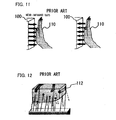
- Fig. 11 through Fig. 14 explain conventional palm authentication techniques.
- the user places the palm of the hand 110 into proximity with an image capture device 100.
- the image capture device 100 emits near-infrared rays, which are incident on the palm of the hand 110.
- the image capture device 100 uses a sensor to capture near-infrared rays reflected from the palm of the hand 110.
- hemoglobin in the red corpuscles flowing in the veins 112 has lost oxygen.
- This hemoglobin absorbs near-infrared rays at wavelengths near 760 nanometers. Consequently when near-infrared rays are made incident on the palm of a hand, reflection is reduced only in the areas in which there are veins, and the intensity of the reflected near-infrared rays can be used to identify the positions of veins.
- the user first uses the image capture device 100 of Fig. 11 to register vein image data of the palm of his own hand in a server or on a card (storage medium). Then, in order to perform an automated transaction, the user employs the image capture device 100 of Fig. 10 to read the vein image data of his own hand.
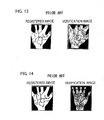
- the automated transaction is performed by comparing the patterns of veins in the registered vein image retrieved using the user's ID recorded on a card and in the vein verification image thus read. For example, on comparing the vein patterns in the registered image and a verification image as in Fig. 13, the individual is confirmed to be the individual in question. On the other hand, upon comparison of the vein patterns in a registered image and in a verification image as in Fig. 14, the individual is not authenticated, i.e. his/her identity cannot be confirmed (see for example Japanese Patent Laid-open No. 2004-062826).
- Such a biometrics unit captures an image of a living body and extracts characteristic data of the living body, it is necessary to consider the physical condition of a user, such as influences of seasonal changes and activity, and momentary changes. That is, in order to authenticate accurately, it is necessary to set a stringent threshold value of a degree of similarity between characteristic data of the living body as registered and detected characteristic data of the living body presented for authentication. However, it can happen that the characteristic data of the living body varies from that registered according to the physical condition of the user when wishing to be authenticated. For example, in the above method of authentication by vein image, it may occur that the extracted image differs from that registered according to the user's pulse, etc.
- An automated transaction device of this invention reads individual data from a storage device (storage medium) of a user, verifies the read data against input individual data, and performs automated transactions.
- the automated transaction device has a reading unit which reads the storage device of said user; a biometrics unit which verifies registered biometric characteristic data obtained directly or indirectly from the storage device against said biometric characteristic data detected from a body of the user, and performs individual authentication; and a control unit which performs automated transactions according to the authentication result of the biometrics unit.
- the control unit performs non-biometric authentication in which individual data on the storage device is verified against input individual data, and executes an automated transaction, when the biometric authentication result by the biometrics unit is not satisfactory.
- An automated transaction control method of this invention has the steps of: verifying biometric characteristic data registered as individual data on a storage device against biometric characteristic data detected from the body using a biometrics unit, and performing biometric authentication; executing an automated transaction based on the biometric authentication when the result of said biometric authentication is satisfactory; and verifying individual data on the storage device against input individual data, performing non-biometric authentication for individual authentication, and executing an automated transaction when the result of the biometric authentication is not satisfactory.
- a program of this invention which may be stored on a computer readable storage medium, causes a computer to execute the steps of: verifying biometric characteristic data registered as individual data on a storage device or on a server against biometric characteristic data detected from the body of a user using a biometrics unit, and performing biometric authentication; executing an automated transaction based on the biometric authentication when the result of the biometric authentication is satisfactory; and verifying individual data on the storage device against input individual data, performing non-biometric authentication for individual authentication, and executing an automated transaction when the result of the biometric authentication is not satisfactory.
- control unit causes conditions of a transaction based on the biometric authentication to be different from conditions of a transaction based on non-biometric authentication in which verification against the individual data is performed.
- control unit retries biometric authentication when the verification result of biometric authentication by the biometrics unit is not satisfactory, and switches to the non-biometric authentication when the number of retries exceeds a preset number of retries.
- said storage device e.g., IC card
- said storage device records a preset number of retries as a permitted number of authentication NG (No Good) attempts; the control unit reads the preset number from the storage device, judges whether a current number of authentication NG attempts has exceeded the preset number, and switches to the non-biometric authentication when the number of authentication NG attempts has exceeded the preset number.
- control unit may urge re-registration of the user's biometric information by means of a guidance screen of the automated transaction device, when the number of authentication NG attempts exceeds the preset number.
- the user's biometric data may be registered on the storage device (called “storage media” in the claims) itself, or on a server, in which case individual data on the storage device may be used to access the server.
- control unit may set a withdrawal amount limit for a transaction based on biometric authentication to be different from the withdrawal amount limit for a transaction based on non-biometric authentication in which only verification of individual data such as a PIN is performed.
- the control unit may restrict the range of transactions allowed based on non-biometric authentication, in comparison with the range of transactions allowed based on biometric authentication.
- the biometric unit preferably has an image capture device which captures an image of a body part of the user and an authentication unit which extracts the biometric characteristic data from the captured image, verifies the extracted biometric characteristic data against the registered biometric characteristic data of the user, and performs individual authentication.
- control unit has a middleware program which starts the biometric unit and, upon judging that the biometric authentication result is not satisfactory, executes non-biometric authentication, and a transaction processing program which controls an automated transaction mechanism to perform automated transaction operations according to the authentication result.
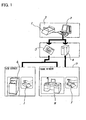
- Fig. 1 shows the configuration of an automated transaction system of one embodiment of the invention
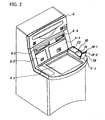
- Fig. 2 is an external view of the automated transaction device of Fig. 1
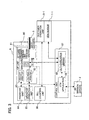
- Fig. 3 shows the configuration of the automated transaction device of Fig. 2.
- Fig. 1 shows an automated deposit/withdrawal system of a financial institution as the automated transaction system; as the biometrics authentication device, an example of a palm vein authentication device is shown.
- the palm image capture device 1 explained in Fig. 4 and a branch office terminal (for example, a personal computer) 3 connected thereto.
- a user requesting vein pattern authentication places his hand over the palm image capture device (hereafter the "image capture device") 1.
- the image capture device 1 reads the palm, and blood vessel image extraction processing is performed by the terminal 3 to extract the vein pattern, which is registered as vein data in the terminal 3.
- This vein data is stored in a storage portion 4a of a database server 4 connected to the terminal 3, or in an individual card (for example, an IC card) 5 carried by the user.
- the server 4 is connected to a service area terminal 8 in the service area 7 of the financial institution, and the service area terminal 8 is connected to the image capture device 1.
- the user places his hand over the image capture device 1 provided in the service area 7 in order to perform financial transaction.
- the image capture device 1 reads the palm, and the vein pattern is extracted by the blood vessel image extraction processing of the service area terminal 8.
- the service area terminal 8 verifies the vein pattern as vein data against the vein data registered in the database server 4 by means of the verification processing, and authenticates the individual.
- the server 4 is connected to an ATM (automated cash deposit/withdrawal machine) 6 of the financial institution; the ATM 6 can be used in transactions based on vein authentication.
- the ATM 6 In order to make a withdrawal or perform some other financial transaction using the ATM 6, the user holds his hand over the image capture device 1-1 provided in the ATM 6. The image capture device 1-1 reads the palm of the hand.
- the ATM 6 extracts the vein pattern (blood vessel image), and verifies this as vein data against the vein data registered in the IC card 5 carried by the user (or present in the database server 4), to authenticate the individual.
- Fig. 2 and Fig. 3 show the configuration of the ATM (automated transaction machine) 6 of Fig. 1.
- the ATM 6 has, on the front face thereof, a card insertion/ejection aperture 6-4; a bankbook insertion/ejection aperture 6-5; a paper currency insertion/dispensing aperture 6-3; a coin insertion/dispensing aperture 6-2; and a customer operation panel 6-1 for operation and display.
- the image capture device 1-1 is provided on the side of the customer operation panel 6-1.
- the sensor unit 18 explained in Fig. 4 is mounted on the forward side of the main unit 10 of the image capture device 1-1.
- On the forward portion (on the user side) of the sensor unit 18 is provided a front guide 14.
- the front guide 14 comprises a sheet of synthetic resin, transparent or substantially transparent.
- the cross-sectional shape of the front guide 14 has a vertical body and, in the top portion, a horizontal portion 14-1 to support the wrist.
- a depression 14-2 is formed continuously in the center of the horizontal portion 14-1, to facilitate positioning of the wrist.
- the sensor unit 18 of the main unit 10 faces rearward and is inclined upward, and a flat portion 22 is provided therebehind.
- the ATM 1 has a CIP (Card Reader Printer) unit 60 having a card insertion/ejection aperture 6-4; a bankbook unit 64 having a bankbook insertion/ejection aperture 6-5; a paper currency/coin counter unit 66 having a paper currency insertion/dispensing aperture 6-3 and a coin insertion/dispensing aperture 6-2; an attendant operation unit 65; a control unit 67; a customer operation panel (UOP) 6-1 for operation and display; and an image capture device (vein sensor) 1-1.
- CIP Card Reader Printer
- the CIP unit 60 has an IC card reader/writer 60 which reads and writes the magnetic stripe and IC chip of an IC card 5; a receipt printer 63 which records transactions on a receipt; and a journal printer 62 which prints the history of transactions on journal forms.
- the bankbook unit 64 records transactions on pages of a bankbook, and when necessary turns the pages.
- the attendant operation portion 65 displays the state and performs operations upon occurrence of a fault or during inspections by operation of an attendant.
- the paper currency/coin counting unit 66 validates, counts, and stores inserted paper currency and coins, and counts and dispenses paper currency and coins in the required quantities.
- the control unit 67 communicates with the server 4, and has an ATM application (program) 68 which controls ATM operation and an authentication library (authentication processing program) 69 for biometrics authentication processing.
- a portion of this ATM application 68 acts in concert with the authentication library 69 to control biometrics authentication guidance screens of the UOP (customer operation panel) 6-1.
- the ATM application 68 has a function which compares the password data (individual data) on the magnetic stripe of the IC card 5 with the password data input from the UOP 6-1, to authenticate the individual.
- Fig. 4 is a block diagram of the biometrics authentication processing of an embodiment of the invention
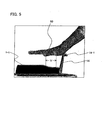
- Fig. 5 is a side view of the image capture device 1-1 of Fig. 4
- Fig. 6 explains the detected blood vessel image in Fig. 4
- Fig. 7 explains the verification processing in Fig. 4.
- the palm image capture device 1-1 of Fig. 1 has a sensor unit 18 mounted substantially in the center of the main unit 10.
- a front guide 14 is provided in the forward portion (on the user side) of the sensor unit 18.
- the front guide 14 comprises a sheet of synthetic resin, transparent or substantially transparent.
- the front guide 14 serves the purposes of guiding the hand of the user in the front and of supporting the wrist. Hence the front guide 14 provides guidance to the user to guide and support the wrist above the sensor unit 18. As a result, the attitude of the palm of the hand, that is, the position, inclination, and size over the sensor unit 18 can be controlled.
- the cross-sectional shape of the front guide 14 has a vertical body and, in the top portion, a horizontal portion 14-1 to support the wrist.
- a depression 14-2 is formed continuously in the center of the horizontal portion 14-1, to facilitate positioning of the wrist.
- the sensor unit 18 is provided with an infrared sensor (CMOS sensor) and focusing lens 16 and a distance sensor 15 in the center; on the periphery thereof are provided a plurality of near-infrared light emission elements (LEDs) 12.
- CMOS sensor infrared sensor
- LEDs near-infrared light emission elements
- near-infrared light emission elements 12 are provided at eight places on the periphery, to emit near-infrared rays upwards.
- the readable region V of this sensor unit 18 is regulated by the relation between the sensor, focusing lens, and near-infrared light emission region. Hence the position and height of the front guide 14 are set such that the supported wrist is positioned in the readable region V.
- the palm has maximum area, and moreover is flat, so that when the palm is subjected to image capture in the image capture region V of the sensor unit 18, an accurate vein pattern which can be used in registration and verification is obtained.
- the distance from the sensor unit 18 to the palm is within a prescribed range, a sharp and focused image is obtained by the sensor 16 of the sensor unit 18.
- the authentication library (authentication program) 69 of the control unit 67 of the ATM 1 connected to the image capture device 1 executes a series of verification processing 30 to 46.
- the control unit 67 of the ATM 1 has, for example, a CPU, various types of memory, interface circuitry, and other circuits necessary for data processing.
- the CPU executes the series of verification processing 30 to 46.
- Distance/hand outline detection processing 30 receives the distance from the image capture device 1-1 measured by the distance sensor 15, judges whether the palm or other object is at a distance within a prescribed range from the sensor unit 18, and detects the outline of the hand from the image captured by the sensor unit 18; and judges whether the image can be used in registration and verification processing based on the detected outline. For example, a judgment is made as to whether the palm appears sufficiently in the image.
- Guidance message output processing 32 outputs to the UOP 6-1 of the ATM 6 a message guiding the palm to the left or right, forward or backward, upward or downward, when the distance measured by the distance sensor 15 indicates that the hand is outside the image capture range, and when hand outline detection processing 30 indicates that the image cannot be used in registration and verification processing. By this means, the hand of the user is guided into position over the image capture device 1-1.
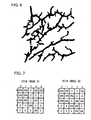
- Blood vessel image extraction processing 34 extracts a vein image from the image of the hand when hand outline detection processing 30 judges that an image has been captured with the hand held correctly. That is, as explained in Fig. 10 and Fig. 11, grayscale data of the image of the palm such as that of Fig. 7 is obtained through differences in reflectivity.
- the vein pattern image is an image like that shown in Fig. 6; the data is grayscale data such as that in Fig. 7.
- Registered blood vessel image search processing 46 searches a storage portion (IC chip memory) of the IC card 5 shown in Fig. 3 for three registered blood vessel image data sets R1, R2, R3 corresponding to the individual ID (account number). As shown in Fig. 7, verification processing 44 compares the blood vessel image data N1 detected by the blood vessel image detection processing 34 with the registered blood vessel image data N2 (R1, R2, R3), performs verification processing, and outputs a verification result to the ATM application 68.
- IC chip memory IC chip memory
- biometrics reader device image capture device 1-1
- authentication program 69 In order to install such a biometrics authentication system, the biometrics reader device (image capture device) 1-1 and the authentication program 69 must be installed in the automated transaction machine 6.
- Fig. 8 shows the configuration of an ATM program of one embodiment of the invention
- Fig. 9 shows the transaction processing flow by a program configured as in Fig. 8.
- Fig. 8 shows the program configuration of the control unit 67 of the ATM 6 that a vein sensor 1-1 is equipped and moreover an authentication program 69 is installed as shown in Fig.3.
- middleware programs 70, 72 are positioned between an ATM application 68 which performs transaction processing and the IC card firmware 61a of the IC card reader/writer 60.
- the middleware program 70 queries the authentication program 69 and determines the automated transaction method in response to the start of a transaction by the ATM application 68.
- the middleware program 70 has an IO server/SP portion 84, which functions as a server and supervisor of the IC card firmware program 61a; a CL/IC card RW portion 82, which functions as a client of the IC card reader/writer; and a middle control portion 80, connected to the CL/IC card RW portion, and which initializes the authentication program 69.
- This middle control portion 80 exchanges data with the ATM application 68, and controls the application screen portion 72.
- the authentication program 69 has an IC card library 96, which reads biometrics data in the IC card 5 using the IC card reader/writer 61; an image capture engine 90, which controls image capture by the vein sensor 1-1; a verification engine 92, which performs the above-described verification processing 44 of Fig. 4; and an authentication library 94, which causes the IC card reader library 96 to execute the above-described registered blood vessel search processing 46 of Fig. 4, and also causes the image capture engine 90 to execute the above-described distance/hand outline detection processing 30 and blood vessel extraction processing 34 of Fig. 4.
- This authentication library 94 is initialized by the middle control portion 80, initiates authentication processing, and returns a verification result.
- the number of authentication NG attempts is provided on the card, and if biometrics authentication retries exceed a prescribed number, this number of authentication NG attempts is incremented. And if biometrics authentication is satisfactory, the number of authentication NG attempts is decremented, and if the number of authentication NG attempts exceeds a preset number, a transition is made to a conventional transaction without performing biometrics authentication. Consequently even if biometrics authentication happens to end in an NG result, recovery from this state is possible and biometrics authentication can again be performed; moreover, if the number of authentication NG attempts equals or exceeds a preset number, the user is prompted to re-register, so that changes with time or similar in the physical condition of the user can be accommodated.
- the withdrawal amount limit in a transaction based on biometrics authentication is made greater than the withdrawal amount limit of a conventional transaction (with authentication using a password), the withdrawal transaction can be modified according to the degree of security. And when a biometrics authentication result is NG, damages due to illicit acts are reduced even in the case of a conventional transaction.
- this embodiment is realized using middleware, realization is possible without changes to the preexisting ATM application 68.
- Fig. 10 shows the flow of other transaction processing by a program configured as in Fig. 8.
- the number of authentication NG attempts is recorded on the card, and if the stipulated number of biometrics authentication retries are exceeded, this number of authentication NG attempts is incremented. If biometrics authentication is satisfactory, the number of authentication NG attempts is decremented. And if the number of authentication NG attempts is equal to or greater than a preset number, a transition is made to a conventional transaction without performing biometrics authentication. Hence even if biometrics authentication happens to end in an NG result, recovery from this state is possible and biometrics authentication can again be performed. Moreover, if the number of authentication NG attempts equals or exceeds a preset number, the user is prompted to re-register, so that changes with time or similar in the physical condition of the user can be accommodated.
- this embodiment is realized using middleware, realization is possible without changes to the preexisting ATM application 68.
- biometrics authentication was explained for the case of authentication using vein patterns in the palm of the hand; but application to other biometrics authentication, such as vein patterns in the fingers, palm-prints, or other features of the palm of the hand, as well as to fingerprints, facial features, and similar is also possible.
- other biometrics authentication such as vein patterns in the fingers, palm-prints, or other features of the palm of the hand, as well as to fingerprints, facial features, and similar is also possible.
- automated equipment for financial operations was explained, but application to automated ticket issuing equipment, automated vending equipment, and to automated machines and computers in other areas, as well as to door opening/closing equipment in place of keys, and to other equipment where individual authentication is required, is also possible.
- the middle control portion 80 starts the authentication program 69 and controls biometrics authentication and traditional transactions; but execution by the ATM application and an authentication program is also possible.
- cards are not limited to IC cards, and other recording media may be used; authentication in conventional transactions is not limited to passwords, but can use other non-biometrics authentication means such as seals, signatures, or similar.
Landscapes
- Engineering & Computer Science (AREA)
- Business, Economics & Management (AREA)
- Physics & Mathematics (AREA)
- General Physics & Mathematics (AREA)
- Accounting & Taxation (AREA)
- Theoretical Computer Science (AREA)
- Finance (AREA)
- Computer Security & Cryptography (AREA)
- Strategic Management (AREA)
- General Business, Economics & Management (AREA)
- Software Systems (AREA)
- Computer Hardware Design (AREA)
- Human Computer Interaction (AREA)
- General Engineering & Computer Science (AREA)
- Microelectronics & Electronic Packaging (AREA)
- Computer Networks & Wireless Communication (AREA)
- Development Economics (AREA)
- Economics (AREA)
- Financial Or Insurance-Related Operations Such As Payment And Settlement (AREA)
- Measurement Of The Respiration, Hearing Ability, Form, And Blood Characteristics Of Living Organisms (AREA)
- Collating Specific Patterns (AREA)
Abstract
Description
- This invention relates to an automated transaction control method, automated transaction device, and a program (e.g. stored on a storage medium) to verify input data obtained from a user against individual data on a storage device held by the user in order to perform automated transactions, and in particular to such a method, device and program which utilize a biometric authentication unit to read biometric information of the user, and verify the information against registered biometric information.
- Automated transaction machines which are operated by users are in wide use. Such automated transaction machines include automated cash dispensers, automated deposit/withdrawal machines, and automated balance transfer machines for financial transactions, as well as automated ticket dispensers and automated certification document dispensers.
- Such automated transaction machines are operated by users to perform deposit/withdrawal, cash transfer, document issuing, and other transactions. Hence from the standpoint of prevention of illicit operations, it is essential that such automated transaction machines perform identity verification (below, "individual authentication") of users. In the individual authentication methods of automated transaction machines used in the prior art, a card on which is recorded individual information is issued to each user, and when performing the automated transaction, a card password number (PIN) or other individual data is read and is compared with data input by the user.
- Through advances in computer technology in recent years, such password-based individual authentication methods, which are specific to users, entail the use of simple strings of numbers which can be easily analyzed, and so from the standpoint of preventing illicit operations have become unsatisfactory. Hence various biometric-based authentication technologies utilizing biometric characteristics have been proposed for use in an automated transaction.
- The human body has various biometrics (properties enabling identification of an individual), such as fingerprints, the retinas of the eyes, facial characteristics, and blood vessels. Advances in biometric technology in recent years have led to the proposal of various devices for identification of biometrics to perform an automated transaction (see Japanese Patent Laid-open No. 2003-256912) .
- For example, blood vessel patterns in the palms and fingers or palm-prints constitute a comparatively large amount of individual characteristic data, and so are appropriate to ensure reliability of individual authentication. In particular, blood vessel (vein) patterns remain unchanged throughout life from infancy, and are regarded as being completely unique, and so are well-suited to individual authentication. Fig. 11 through Fig. 14 explain conventional palm authentication techniques. As shown in Fig. 11, at the time of registration or authentication, the user places the palm of the
hand 110 into proximity with animage capture device 100. Theimage capture device 100 emits near-infrared rays, which are incident on the palm of thehand 110. Theimage capture device 100 uses a sensor to capture near-infrared rays reflected from the palm of thehand 110. - As shown in Fig. 12, hemoglobin in the red corpuscles flowing in the
veins 112 has lost oxygen. This hemoglobin (reduced hemoglobin) absorbs near-infrared rays at wavelengths near 760 nanometers. Consequently when near-infrared rays are made incident on the palm of a hand, reflection is reduced only in the areas in which there are veins, and the intensity of the reflected near-infrared rays can be used to identify the positions of veins. - As shown in Fig. 11, the user first uses the
image capture device 100 of Fig. 11 to register vein image data of the palm of his own hand in a server or on a card (storage medium). Then, in order to perform an automated transaction, the user employs theimage capture device 100 of Fig. 10 to read the vein image data of his own hand. - The automated transaction is performed by comparing the patterns of veins in the registered vein image retrieved using the user's ID recorded on a card and in the vein verification image thus read. For example, on comparing the vein patterns in the registered image and a verification image as in Fig. 13, the individual is confirmed to be the individual in question. On the other hand, upon comparison of the vein patterns in a registered image and in a verification image as in Fig. 14, the individual is not authenticated, i.e. his/her identity cannot be confirmed (see for example Japanese Patent Laid-open No. 2004-062826).
- Since such a biometrics unit captures an image of a living body and extracts characteristic data of the living body, it is necessary to consider the physical condition of a user, such as influences of seasonal changes and activity, and momentary changes. That is, in order to authenticate accurately, it is necessary to set a stringent threshold value of a degree of similarity between characteristic data of the living body as registered and detected characteristic data of the living body presented for authentication. However, it can happen that the characteristic data of the living body varies from that registered according to the physical condition of the user when wishing to be authenticated. For example, in the above method of authentication by vein image, it may occur that the extracted image differs from that registered according to the user's pulse, etc.
- In a prior art method, the transaction is halted when authentication is not successful even after multiple authentication attempts have been made. Thus, a worse service is provided to the user, since a genuine user cannot always perform a transaction depending on their physical condition.
- Furthermore, there is a conflict between the need for high accuracy authentication (since high security is a sales point), and the need to avoid frequent denial of service to genuine users (since this makes users feel that it is not convenient to use biometric authentication). Consequently, there is resistance to a wide spread of automated transaction machines employing biometric authentication.
- There is consequently a need to improve the service to users provided by an automated transaction device in which biometric authentication functions are installed.
- There is also a need to improve the service for the user while maintaining an authentication accuracy of the biometric authentication functions.
- Furthermore, there is a need to provide service to the user whilst taking account of the physical condition of the user, in an automated transaction device having biometric authentication functions.
- An automated transaction device of this invention reads individual data from a storage device (storage medium) of a user, verifies the read data against input individual data, and performs automated transactions. The automated transaction device has a reading unit which reads the storage device of said user; a biometrics unit which verifies registered biometric characteristic data obtained directly or indirectly from the storage device against said biometric characteristic data detected from a body of the user, and performs individual authentication; and a control unit which performs automated transactions according to the authentication result of the biometrics unit. The control unit performs non-biometric authentication in which individual data on the storage device is verified against input individual data, and executes an automated transaction, when the biometric authentication result by the biometrics unit is not satisfactory.
- An automated transaction control method of this invention has the steps of: verifying biometric characteristic data registered as individual data on a storage device against biometric characteristic data detected from the body using a biometrics unit, and performing biometric authentication; executing an automated transaction based on the biometric authentication when the result of said biometric authentication is satisfactory; and verifying individual data on the storage device against input individual data, performing non-biometric authentication for individual authentication, and executing an automated transaction when the result of the biometric authentication is not satisfactory.
- A program of this invention, which may be stored on a computer readable storage medium, causes a computer to execute the steps of: verifying biometric characteristic data registered as individual data on a storage device or on a server against biometric characteristic data detected from the body of a user using a biometrics unit, and performing biometric authentication; executing an automated transaction based on the biometric authentication when the result of the biometric authentication is satisfactory; and verifying individual data on the storage device against input individual data, performing non-biometric authentication for individual authentication, and executing an automated transaction when the result of the biometric authentication is not satisfactory.
- Preferably, the control unit causes conditions of a transaction based on the biometric authentication to be different from conditions of a transaction based on non-biometric authentication in which verification against the individual data is performed.
- Preferably also, the control unit retries biometric authentication when the verification result of biometric authentication by the biometrics unit is not satisfactory, and switches to the non-biometric authentication when the number of retries exceeds a preset number of retries.
- Further preferably, said storage device (e.g., IC card), records a preset number of retries as a permitted number of authentication NG (No Good) attempts; the control unit reads the preset number from the storage device, judges whether a current number of authentication NG attempts has exceeded the preset number, and switches to the non-biometric authentication when the number of authentication NG attempts has exceeded the preset number.
- In this case, the control unit may urge re-registration of the user's biometric information by means of a guidance screen of the automated transaction device, when the number of authentication NG attempts exceeds the preset number.
- The user's biometric data may be registered on the storage device (called "storage media" in the claims) itself, or on a server, in which case individual data on the storage device may be used to access the server.
- As an example of different conditions on a transaction, the control unit may set a withdrawal amount limit for a transaction based on biometric authentication to be different from the withdrawal amount limit for a transaction based on non-biometric authentication in which only verification of individual data such as a PIN is performed.
- The control unit may restrict the range of transactions allowed based on non-biometric authentication, in comparison with the range of transactions allowed based on biometric authentication.
- The biometric unit preferably has an image capture device which captures an image of a body part of the user and an authentication unit which extracts the biometric characteristic data from the captured image, verifies the extracted biometric characteristic data against the registered biometric characteristic data of the user, and performs individual authentication.
- In this case, preferably, the control unit has a middleware program which starts the biometric unit and, upon judging that the biometric authentication result is not satisfactory, executes non-biometric authentication, and a transaction processing program which controls an automated transaction mechanism to perform automated transaction operations according to the authentication result.
- Reference will now be made, by way of example only, to the accompanying drawings in which:
- Fig. 1 shows the configuration of an automated transaction system of one embodiment of the invention;
- Fig. 2 is a perspective view of the ATM of Fig. 1;
- Fig. 3 is a block diagram of the ATM of Fig. 1;
- Fig. 4 is a functional block diagram of the biometric information verification processing of Fig. 3;
- Fig. 5 is a side view showing the relation between the sensor of Fig. 4 and the palm of the hand;
- Fig. 6 explains the blood vessel image of Fig. 4;
- Fig. 7 explains the blood vessel image data of Fig. 4;
- Fig. 8 shows the program configuration of the control unit in one embodiment of the invention;
- Fig. 9 is a transaction processing flow diagram of the program configuration of Fig. 8;
- Fig. 10 is another transaction processing flow diagram of the program configuration of Fig. 8;
- Fig. 11 explains a conventional palm image capture device;
- Fig. 12 explains the principle of a conventional palm image capture device;
- Fig. 13 shows explanation diagram of conventional palm authentication technology; and,
- Fig. 14 shows another explanation diagram of conventional palm authentication technology.
- Below, embodiments of the invention are explained, in the order of an automated transaction system, biometric authentication processing, an automated transaction control method, and other embodiments.
- Fig. 1 shows the configuration of an automated transaction system of one embodiment of the invention, Fig. 2 is an external view of the automated transaction device of Fig. 1, and Fig. 3 shows the configuration of the automated transaction device of Fig. 2.
- Fig. 1 shows an automated deposit/withdrawal system of a financial institution as the automated transaction system; as the biometrics authentication device, an example of a palm vein authentication device is shown. In the
service area 2 of the financial institution are provided the palmimage capture device 1 explained in Fig. 4 and a branch office terminal (for example, a personal computer) 3 connected thereto. A user requesting vein pattern authentication places his hand over the palm image capture device (hereafter the "image capture device") 1. Theimage capture device 1 reads the palm, and blood vessel image extraction processing is performed by theterminal 3 to extract the vein pattern, which is registered as vein data in theterminal 3. - This vein data is stored in a storage portion 4a of a
database server 4 connected to theterminal 3, or in an individual card (for example, an IC card) 5 carried by the user. Theserver 4 is connected to aservice area terminal 8 in theservice area 7 of the financial institution, and theservice area terminal 8 is connected to theimage capture device 1. - The user places his hand over the
image capture device 1 provided in theservice area 7 in order to perform financial transaction. Theimage capture device 1 reads the palm, and the vein pattern is extracted by the blood vessel image extraction processing of theservice area terminal 8. Theservice area terminal 8 verifies the vein pattern as vein data against the vein data registered in thedatabase server 4 by means of the verification processing, and authenticates the individual. - The
server 4 is connected to an ATM (automated cash deposit/withdrawal machine) 6 of the financial institution; theATM 6 can be used in transactions based on vein authentication. In order to make a withdrawal or perform some other financial transaction using theATM 6, the user holds his hand over the image capture device 1-1 provided in theATM 6. The image capture device 1-1 reads the palm of the hand. Similarly to theservice area terminal 8, theATM 6 extracts the vein pattern (blood vessel image), and verifies this as vein data against the vein data registered in theIC card 5 carried by the user (or present in the database server 4), to authenticate the individual. - Fig. 2 and Fig. 3 show the configuration of the ATM (automated transaction machine) 6 of Fig. 1. As shown in Fig. 2, the
ATM 6 has, on the front face thereof, a card insertion/ejection aperture 6-4; a bankbook insertion/ejection aperture 6-5; a paper currency insertion/dispensing aperture 6-3; a coin insertion/dispensing aperture 6-2; and a customer operation panel 6-1 for operation and display. - In this example, the image capture device 1-1 is provided on the side of the customer operation panel 6-1. The
sensor unit 18 explained in Fig. 4 is mounted on the forward side of themain unit 10 of the image capture device 1-1. On the forward portion (on the user side) of thesensor unit 18 is provided afront guide 14. Thefront guide 14 comprises a sheet of synthetic resin, transparent or substantially transparent. In order to serve the purposes of guiding the hand of the user in the front and of supporting the wrist, the cross-sectional shape of thefront guide 14 has a vertical body and, in the top portion, a horizontal portion 14-1 to support the wrist. A depression 14-2 is formed continuously in the center of the horizontal portion 14-1, to facilitate positioning of the wrist. - Further, the
sensor unit 18 of themain unit 10 faces rearward and is inclined upward, and a flat portion 22 is provided therebehind. - As shown in Fig. 3, the
ATM 1 has a CIP (Card Reader Printer)unit 60 having a card insertion/ejection aperture 6-4; abankbook unit 64 having a bankbook insertion/ejection aperture 6-5; a paper currency/coin counter unit 66 having a paper currency insertion/dispensing aperture 6-3 and a coin insertion/dispensing aperture 6-2; anattendant operation unit 65; acontrol unit 67; a customer operation panel (UOP) 6-1 for operation and display; and an image capture device (vein sensor) 1-1. - The
CIP unit 60 has an IC card reader/writer 60 which reads and writes the magnetic stripe and IC chip of anIC card 5; areceipt printer 63 which records transactions on a receipt; and ajournal printer 62 which prints the history of transactions on journal forms. - The
bankbook unit 64 records transactions on pages of a bankbook, and when necessary turns the pages. Theattendant operation portion 65 displays the state and performs operations upon occurrence of a fault or during inspections by operation of an attendant. The paper currency/coin counting unit 66 validates, counts, and stores inserted paper currency and coins, and counts and dispenses paper currency and coins in the required quantities. - The
control unit 67 communicates with theserver 4, and has an ATM application (program) 68 which controls ATM operation and an authentication library (authentication processing program) 69 for biometrics authentication processing. A portion of thisATM application 68 acts in concert with theauthentication library 69 to control biometrics authentication guidance screens of the UOP (customer operation panel) 6-1. TheATM application 68 has a function which compares the password data (individual data) on the magnetic stripe of theIC card 5 with the password data input from the UOP 6-1, to authenticate the individual. - Fig. 4 is a block diagram of the biometrics authentication processing of an embodiment of the invention, Fig. 5 is a side view of the image capture device 1-1 of Fig. 4, Fig. 6 explains the detected blood vessel image in Fig. 4, and Fig. 7 explains the verification processing in Fig. 4.
- As shown in Fig. 4, the palm image capture device 1-1 of Fig. 1 has a
sensor unit 18 mounted substantially in the center of themain unit 10. Afront guide 14 is provided in the forward portion (on the user side) of thesensor unit 18. Thefront guide 14 comprises a sheet of synthetic resin, transparent or substantially transparent. - The
front guide 14 serves the purposes of guiding the hand of the user in the front and of supporting the wrist. Hence thefront guide 14 provides guidance to the user to guide and support the wrist above thesensor unit 18. As a result, the attitude of the palm of the hand, that is, the position, inclination, and size over thesensor unit 18 can be controlled. The cross-sectional shape of thefront guide 14 has a vertical body and, in the top portion, a horizontal portion 14-1 to support the wrist. A depression 14-2 is formed continuously in the center of the horizontal portion 14-1, to facilitate positioning of the wrist. - The
sensor unit 18 is provided with an infrared sensor (CMOS sensor) and focusinglens 16 and adistance sensor 15 in the center; on the periphery thereof are provided a plurality of near-infrared light emission elements (LEDs) 12. For example, near-infraredlight emission elements 12 are provided at eight places on the periphery, to emit near-infrared rays upwards. - The readable region V of this
sensor unit 18 is regulated by the relation between the sensor, focusing lens, and near-infrared light emission region. Hence the position and height of thefront guide 14 are set such that the supported wrist is positioned in the readable region V. - As shown in Fig. 5, when the
hand 50 is extended with palm flat, the palm has maximum area, and moreover is flat, so that when the palm is subjected to image capture in the image capture region V of thesensor unit 18, an accurate vein pattern which can be used in registration and verification is obtained. As shown in Fig. 5, when the distance from thesensor unit 18 to the palm is within a prescribed range, a sharp and focused image is obtained by thesensor 16 of thesensor unit 18. - Hence as shown in Fig. 4, when the
front guide 14 supports thewrist 52 above thesensor unit 18, the user's hand can be guided and supported so that the position, inclination and height of the palm above thesensor unit 18 are made precise with respect to the image capture range of thesensor unit 18. - Returning to Fig. 4, the authentication library (authentication program) 69 of the
control unit 67 of theATM 1 connected to theimage capture device 1 executes a series ofverification processing 30 to 46. Thecontrol unit 67 of theATM 1 has, for example, a CPU, various types of memory, interface circuitry, and other circuits necessary for data processing. The CPU executes the series ofverification processing 30 to 46. - Distance/hand
outline detection processing 30 receives the distance from the image capture device 1-1 measured by thedistance sensor 15, judges whether the palm or other object is at a distance within a prescribed range from thesensor unit 18, and detects the outline of the hand from the image captured by thesensor unit 18; and judges whether the image can be used in registration and verification processing based on the detected outline. For example, a judgment is made as to whether the palm appears sufficiently in the image. - Guidance
message output processing 32 outputs to the UOP 6-1 of the ATM 6 a message guiding the palm to the left or right, forward or backward, upward or downward, when the distance measured by thedistance sensor 15 indicates that the hand is outside the image capture range, and when handoutline detection processing 30 indicates that the image cannot be used in registration and verification processing. By this means, the hand of the user is guided into position over the image capture device 1-1. - Blood vessel
image extraction processing 34 extracts a vein image from the image of the hand when handoutline detection processing 30 judges that an image has been captured with the hand held correctly. That is, as explained in Fig. 10 and Fig. 11, grayscale data of the image of the palm such as that of Fig. 7 is obtained through differences in reflectivity. The vein pattern image is an image like that shown in Fig. 6; the data is grayscale data such as that in Fig. 7. - Registered blood vessel
image search processing 46 searches a storage portion (IC chip memory) of theIC card 5 shown in Fig. 3 for three registered blood vessel image data sets R1, R2, R3 corresponding to the individual ID (account number). As shown in Fig. 7,verification processing 44 compares the blood vessel image data N1 detected by the blood vesselimage detection processing 34 with the registered blood vessel image data N2 (R1, R2, R3), performs verification processing, and outputs a verification result to theATM application 68. - In order to install such a biometrics authentication system, the biometrics reader device (image capture device) 1-1 and the
authentication program 69 must be installed in theautomated transaction machine 6. - Fig. 8 shows the configuration of an ATM program of one embodiment of the invention, and Fig. 9 shows the transaction processing flow by a program configured as in Fig. 8.
- Fig. 8 shows the program configuration of the
control unit 67 of theATM 6 that a vein sensor 1-1 is equipped and moreover anauthentication program 69 is installed as shown in Fig.3. As shown in Fig. 8,middleware programs ATM application 68 which performs transaction processing and theIC card firmware 61a of the IC card reader/writer 60. Themiddleware program 70 queries theauthentication program 69 and determines the automated transaction method in response to the start of a transaction by theATM application 68. - That is, the
middleware program 70 has an IO server/SP portion 84, which functions as a server and supervisor of the ICcard firmware program 61a; a CL/ICcard RW portion 82, which functions as a client of the IC card reader/writer; and amiddle control portion 80, connected to the CL/IC card RW portion, and which initializes theauthentication program 69. Thismiddle control portion 80 exchanges data with theATM application 68, and controls theapplication screen portion 72. - On the other hand, the
authentication program 69 has anIC card library 96, which reads biometrics data in theIC card 5 using the IC card reader/writer 61; animage capture engine 90, which controls image capture by the vein sensor 1-1; averification engine 92, which performs the above-describedverification processing 44 of Fig. 4; and anauthentication library 94, which causes the ICcard reader library 96 to execute the above-described registered bloodvessel search processing 46 of Fig. 4, and also causes theimage capture engine 90 to execute the above-described distance/handoutline detection processing 30 and bloodvessel extraction processing 34 of Fig. 4. Thisauthentication library 94 is initialized by themiddle control portion 80, initiates authentication processing, and returns a verification result. - Transaction processing by the programs of Fig. 8 is explained using the flow diagram of Fig. 9.
- (S10) Upon detecting touching of the screen of the UOP 6-1, the
ATM application 68 initiates a transaction. - (S12) Upon initiating a transaction, the
ATM application 68 displays a transaction type selection screen on the UOP 6-1. The user inputs the transaction type from the UOP 6-1. - (S14) Upon judging that a withdrawal-type transaction (withdrawal, cash transfer) has been selected, the
ATM application 68 displays a card insertion screen on the UOP 6-1. When the user inserts anIC card 5 into the insertion aperture 6-4, the IC card reader/writer 61 reads the data on the magnetic stripe of theIC card 5. This data comprises the account number of the user and a number of biometrics authentication NG attempts, described below. The number of biometrics authentication NG attempts is the number of times that the authentication result has been NG even when biometrics authentication was attempted a plurality of times. - (S16) The
ATM application 68 receives the number of authentication NG attempts recorded on theIC card 5 from the IC card reader/writer 61, and judges whether this number of authentication NG attempts is equal to or greater than a preset number. For example, the preset number may be five times. If the number of authentication NG attempts is equal to or greater than the preset number, a transaction based on biometrics authentication is judged to be not possible, and processing proceeds to step S28. - (S18) On the other hand, if the number of authentication NG attempts is not equal to or greater than the preset number, the
ATM application 68 begins biometrics authentication by instructing themiddle control portion 80 to begin authentication. As a result, themiddle control portion 80 causes theAPL screen portion 72 to display a biometrics authentication screen on the UOP 6-1. Then, in order to read biometrics information and perform authentication, themiddle control portion 80 receives the account number read by theATM application 68 from the magnetic stripe of anIC card 5 from the IC card reader/writer 61 through insertion of the IC card, and sends the account number to theIC card library 96.
Themiddle control portion 80 also initializes theauthentication library 94, and queries the state. TheIC card library 96 reads registered blood vessel image data for the account number on theIC card 5 from theIC card firmware 61a, via the CL/ICcard RW portion 82 and the 10 server/SP 84 (see Fig. 4). Also, theauthentication library 94, having been started, causes theimage capture engine 90 to execute image acquisition operation by the vein sensor 1-1, including the above-described distance/handoutline detection processing 30 and blood vesselimage extraction processing 34 of Fig. 4. Theauthentication library 94 then sends the extracted blood vessel image obtained from the image capture by the vein sensor 1-1 and the registered blood vessel image to theverification engine 92, and causes verification processing to be performed. Themiddle control portion 80 is notified of each of the states of progress of theauthentication library 94, and themiddle control portion 80 causes theAPL screen portion 72 to display states of progress (reading, verifying, verification result) on the UOP 6-1. - (S20) When the
middle control portion 80 receives notification that a verification result is unsatisfactory (NG) from theauthentication library 94, themiddle control portion 80 increments the number of retries by "1". Then, themiddle control portion 80 judges whether the number of retries has exceeded the preset number of retries (for example, 3) (retry over). If the number of retries has not exceeded the preset number of retries, processing returns to step S18. If on the other hand the number of retries has exceeded the preset number of retries, a transaction based on biometrics authentication is judged to be not possible, and processing advances to step S26. - (S22) The
middle control portion 80 receives notification that the verification result is satisfactory (OK) within the preset number of retries from theauthentication library 94, themiddle control portion 80 decrements the number of authentication NG attempts on theIC card 5 by "1". Of course, when the number of authentication NG attempts recorded on theIC card 5 is "0", decrement processing is not performed. Themiddle control portion 80 notifies normal authentication to theATM application 68. As a result, theATM application 68 displays the monetary amount input/confirmation screen on the UOP 6-1 to prompt for input of a monetary amount, as normal transaction processing after authentication. At this time, security is maintained, so that the withdrawal amount limit can be raised above the withdrawal amount limit of normal transactions, as described in step S32 below. TheATM application 68 checks whether the monetary amount input by the user is within the withdrawal amount limit. - (S24) When the user performs an operation to confirm the amount, the
ATM application 68 communicates with a computer (host), and displays a screen to this effect on the UOP 6-1. Processing then advances to step S34. - (S26) If on the other hand in step S20 the
middle control portion 80 judges that the number of retries has been exceeded, the number of authentication NG attempts recorded on theIC card 5 is incremented. - (S28) If in steps S16 or S20 it is judged that a transaction based on biometrics authentication is not possible, the
middle control portion 80 judges, using setting information for the user, whether to make a transition to a conventional transaction. If no transition is made, that is, if settings stipulate interruption, theAPL screen portion 72 displays an interruption screen on the UOP 6-1, and an interrupt response is returned to theATM application 68. The ATM application advances to step S34. - (S30) In step S28, if settings do not stipulate interruption, the
middle control portion 80 responds a conventional transaction response to theATM application 68. TheATM application 68 performs automated transaction processing using a conventional password. That is, a password input screen is displayed, a password number is input and is verified against the password number corresponding to the account number of theIC card 5. And if the verification result is satisfactory, processing advances to step S32. If on the other hand the verification result is unsatisfactory, the user is prompted to retry password number input, verification is performed. And if the verification result is unsatisfactory even when the number of retries reaches a prescribed number, a screen indicating the transaction is not possible is displayed, and processing advances to step S34. - (S32) The
ATM application 68 displays a monetary amount input/confirmation screen on the UOP 6-1 in order to prompt for input of a monetary amount, in normal transaction processing following authentication. In this case, in consideration of the fact that security has not been maintained, the withdrawal amount limit is lowered below the withdrawal amount limit of a transaction based on biometrics authentication, as explained in step S22. TheATM application 68 checks that the monetary amount input by the user is within the withdrawal amount limit. Processing then advances to step S24. - (S34) When a monetary amount is input, and the response from the host received by computer communication is satisfactory, withdrawal from the account, transfer of funds into the account, or transfer of funds to another account is performed, the number of authentication NG attempts is written to the
IC card 5, and a receipt is returned. At this time, if in step S16 the number of authentication NG attempts was equal to or greater than the preset number, themiddle control portion 80 displays on the UOP 6-1 a guidance screen prompting re-registration of biometrics authentication information. By this means, re-registration by the individual is possible, and automated transactions based on biometrics authentication can be resumed. - Thus in an automated transaction device having biometric authentication functions, even when biometrics authentication is unsuccessful, a transition is made to a conventional transaction based on password authentication using an IC card, so that transaction processing which accommodates changes in the physical condition of the user is possible even while maintaining the accuracy of biometric authentication, contributing to improved convenience to the user.
- Further, the number of authentication NG attempts is provided on the card, and if biometrics authentication retries exceed a prescribed number, this number of authentication NG attempts is incremented. And if biometrics authentication is satisfactory, the number of authentication NG attempts is decremented, and if the number of authentication NG attempts exceeds a preset number, a transition is made to a conventional transaction without performing biometrics authentication. Consequently even if biometrics authentication happens to end in an NG result, recovery from this state is possible and biometrics authentication can again be performed; moreover, if the number of authentication NG attempts equals or exceeds a preset number, the user is prompted to re-register, so that changes with time or similar in the physical condition of the user can be accommodated.
- Moreover, because the withdrawal amount limit in a transaction based on biometrics authentication is made greater than the withdrawal amount limit of a conventional transaction (with authentication using a password), the withdrawal transaction can be modified according to the degree of security. And when a biometrics authentication result is NG, damages due to illicit acts are reduced even in the case of a conventional transaction.
- Moreover, because this embodiment is realized using middleware, realization is possible without changes to the
preexisting ATM application 68. - Fig. 10 shows the flow of other transaction processing by a program configured as in Fig. 8.
- (S40) Similarly to step S10, the
ATM application 68, upon detecting touching of the screen of the UOP 6-1, initiates a transaction. - (S42) Similarly to step S12, on starting a transaction the
ATM application 68 displays a transaction type selection screen on the UOP 6-1. The user inputs the transaction type from the UOP 6-1. - (S44) Similarly to step S14, upon judging that a withdrawal-type transaction (withdrawal, cash transfer) has been selected, the
ATM application 68 displays a card insertion screen on the UOP 6-1. When the user inserts anIC card 5 into the insertion aperture 6-4, the IC card reader/writer 61 reads the data on the magnetic stripe of theIC card 5. This data comprises the account number of the user and a number of biometrics authentication NG attempts, described above. - (S46) Similarly to step S16, the
ATM application 68 receives the number of authentication NG attempts recorded on theIC card 5 from the IC card reader/writer 61, and judges whether this number of authentication NG attempts is equal to or greater than a preset number. For example, the preset number may be five times. If the number of authentication NG attempts is equal to or greater than the preset number, a transaction based on biometric authentication is judged to be not possible, and processing proceeds to step S58. - (S48) On the other hand, if the number of authentication NG attempts is not equal to or greater than the preset number, similarly to step S18, the
ATM application 68 begins biometrics authentication by instructing themiddle control portion 80 to begin authentication. As a result, themiddle control portion 80 causes theAPL screen portion 72 to display a biometrics authentication screen on the UOP 6-1. Then, in order to read biometrics information and perform authentication, themiddle control portion 80 receives the account number read by theATM application 68 from the magnetic stripe of anIC card 5 from the IC card reader/writer 61 through insertion of the IC card, and sends the account number to theIC card library 96. TheIC card library 96 reads registered blood vessel image data for the account number on theIC card 5 from theIC card firmware 61a, via the CL/ICcard RW portion 82 and the 10 server/SP 84 (see Fig. 4). Also, theauthentication library 94, having been started, causes theimage capture engine 90 to execute image acquisition operation by the vein sensor 1-1, including the above-described distance/handoutline detection processing 30 and blood vesselimage extraction processing 34 of Fig. 4. Theauthentication library 94 then sends the extracted blood vessel image obtained from image capture by the vein sensor 1-1 and the registered blood vessel image to theverification engine 92, and causes verification processing to be performed. Themiddle control portion 80 is notified of each of the states of progress of theauthentication library 94, and themiddle control portion 80 causes theAPL screen portion 72 to display states of progress (reading, verifying, verification result) on the UOP 6-1. - (S50) The
middle control portion 80 receives notification that a verification result is unsatisfactory (NG) from theauthentication library 94, themiddle control portion 80 increments the number of retries by "1". Then, themiddle control portion 80 judges whether the number of retries has exceeded the preset number of retries (for example, 3) (retry over). If the number of retries has not exceeded the preset number of retries, processing returns to step S48. If on the other hand the number of retries has exceeded the preset number of retries, a transaction based on biometrics authentication is judged to be not possible, and processing advances to step S56. - (S52) The
middle control portion 80 receives notification that the verification result is satisfactory (OK) within the preset number of retries from theauthentication library 94, then themiddle control portion 80 decrements the number of authentication NG attempts on theIC card 5 by "1". Of course, when the number of authentication NG attempts recorded on theIC card 5 is "0", decrement processing is not performed. Themiddle control portion 80 notifies normal end of the authentication to theATM application 68. TheATM application 68 displays the monetary amount input/confirmation screen on the UOP 6-1 to prompt for input of a monetary amount, as normal transaction processing after authentication. At this time, security is maintained, so that the withdrawal amount limit can be raised above the withdrawal amount limit of normal transactions. TheATM application 68 checks whether the monetary amount input by the user is within the withdrawal amount limit. - (S54) When the user performs an operation to confirm the amount, the
ATM application 68 communicates with a computer (host), and displays a screen to this effect on the UOP 6-1. Processing then advances to step S64. - (S56) If on the other hand in step S50 the
middle control portion 80 judges that the number of retries has been exceeded, the number of authentication NG attempts recorded on theIC card 5 is incremented. - (S58) If in steps S46 or S50 it is judged that a transaction based on biometrics authentication is not possible, the
middle control portion 80 judges, using setting information for the user, whether to make a transition to a conventional transaction. If no transition is made, that is, if settings stipulate interruption, theAPL screen portion 72 displays an interruption screen on the UOP 6-1, and an interrupt response is returned to theATM application 68. TheATM application 68 advances to step S54. - (S60) In step S58, if settings do not stipulate interruption, the
middle control portion 80 returns a conventional transaction response to theATM application 68. TheATM application 68 performs a degraded automated transaction processing using a conventional password. That is, as a degraded automated transaction, for example, balance confirmation is performed. - (S62) That is, a password input screen is displayed, the password number is input and is verified against the password number corresponding to the account number of the
IC card 5. And if the verification result is satisfactory, balance confirmation processing is initiated, and processing proceeds to step S54. If on the other hand the verification result is unsatisfactory, the user is prompted to retry password number input, verification is performed. And if the verification result is unsatisfactory even when the number of retries has reached a prescribed number, a screen is displayed indicating that the transaction is not possible, and processing advances to step S64. - (S64) When a monetary amount is input, and the response from the host received by computer communication is satisfactory, withdrawal from the account, transfer of funds into the account, or transfer of funds to another account is performed, the number of authentication NG attempts is written to the
IC card 5, and a receipt is returned. At this time, if in step S46 the number of authentication NG attempts was equal to or greater than the preset number, themiddle control portion 80 displays on the UOP 6-1 a guidance screen prompting re-registration of biometric authentication information. By this means, re-registration by the individual is possible, and automated transactions based on biometric authentication can be resumed. - Hence in an automated transaction device having biometric authentication functions, a transition can be made to conventional transactions based on password authentication using an IC card even when biometrics authentication is unsuccessful, so that transactions which take into account changes in the physical condition of the user become possible even while maintaining the authentication accuracy of biometric authentication, contributing to improved convenience for the user.
- Further, the number of authentication NG attempts is recorded on the card, and if the stipulated number of biometrics authentication retries are exceeded, this number of authentication NG attempts is incremented. If biometrics authentication is satisfactory, the number of authentication NG attempts is decremented. And if the number of authentication NG attempts is equal to or greater than a preset number, a transition is made to a conventional transaction without performing biometrics authentication. Hence even if biometrics authentication happens to end in an NG result, recovery from this state is possible and biometrics authentication can again be performed. Moreover, if the number of authentication NG attempts equals or exceeds a preset number, the user is prompted to re-register, so that changes with time or similar in the physical condition of the user can be accommodated.
- Moreover, because the range of conventional transactions (with authentication using a password) is limited compared with transactions based on biometrics authentication, transactions requiring authentication can be performed according to the degree of security, and when a biometrics authentication result is NG, damages due to illicit acts are reduced even in the case of a conventional transaction.
- Moreover, because this embodiment is realized using middleware, realization is possible without changes to the
preexisting ATM application 68. - In the above-described embodiments, biometrics authentication was explained for the case of authentication using vein patterns in the palm of the hand; but application to other biometrics authentication, such as vein patterns in the fingers, palm-prints, or other features of the palm of the hand, as well as to fingerprints, facial features, and similar is also possible. Moreover, the case of automated equipment for financial operations was explained, but application to automated ticket issuing equipment, automated vending equipment, and to automated machines and computers in other areas, as well as to door opening/closing equipment in place of keys, and to other equipment where individual authentication is required, is also possible.
- Similarly, the
middle control portion 80 starts theauthentication program 69 and controls biometrics authentication and traditional transactions; but execution by the ATM application and an authentication program is also possible. - Moreover, cards are not limited to IC cards, and other recording media may be used; authentication in conventional transactions is not limited to passwords, but can use other non-biometrics authentication means such as seals, signatures, or similar.
- In the above, embodiments of the invention have been explained; but the invention can be variously modified within the scope of the invention, and these modifications are not excluded from the scope of the invention.
- In an automated transaction device having biometrics authentication functions, a transition can be made to conventional transactions based on non-biometrics authentication using a card held by the user even when biometrics authentication is unsuccessful. So transactions which take into account changes in the physical condition of the user become possible even while maintaining the authentication accuracy of biometric authentication, contributing to improved convenience for the user.
Claims (20)
- An automated transaction device, which reads individual data from storage media of a user, verifies the data against input individual data, and performs automated transactions, comprising:a media reading unit which reads storage media of said user;a biometrics unit which verifies registered biometrics characteristic data according to the individual data of said storage media against said biometrics characteristic data detected from a body of said user, and performs individual authentication; anda control unit which performs automated transactions according to the authentication result of said biometrics unit,wherein said control unit performs non-biometrics authentication in which individual data of said storage media is verified against input individual data, and executes an automated transaction, when the biometrics authentication result by said biometrics unit is not satisfactory.
- The automated transaction device according to Claim 1, wherein said control unit causes conditions of a transaction based on said biometrics authentication to be different from conditions of a transaction based on non-biometrics authentication in which verification against said individual data is performed.
- The automated transaction device according to Claim 1 or 2 wherein said control unit retries said biometrics authentication when the verification result of biometrics authentication by said biometrics unit is not satisfactory, and transits to said non-biometrics authentication when the number of retries exceeds a preset number of retries.
- The automated transaction device according to Claim 3, wherein said control unit records, on said storage media, the number of retry over that the number of retries have exceeded said preset number of retries as a number of authentication NG attempts, reads the number of authentication NG from said storage media, judges whether said number of authentication NG attempts has exceeded a preset number of NG attempts, and transits to said non-biometrics authentication when said number of authentication NG attempts has exceeded the preset number of NG attempts.
- The automated transaction device according to Claim 4, wherein said control unit urges re-registration of said biometrics authentication by means of a guidance screen of said automated transaction device when said number of authentication NG attempts exceeds the preset number of NG attempts.
- The automated transaction device according to Claim 2, wherein said control unit causes withdrawal amount limit for a transaction based on said biometrics authentication to be different from the withdrawal amount limit for a transaction based on non-biometrics authentication in which verification of said individual data is performed.
- The automated transaction device according to Claim 2, wherein said control unit limits range of transactions based on said non-biometrics authentication beyond the range of transactions based on said biometrics authentication.
- The automated transaction device of any preceding claim , wherein said biometrics unit comprises:an image capture device which captures an image of said body; andan authentication unit which extracts said biometrics characteristic data from said captured images, verifies said extracted biometrics characteristic data against said registered biometrics characteristic data on said storage media, and performs individual authentication.
- The automated transaction device of any preceding claim , wherein said control unit has:a middleware program which starts said biometrics unit and, upon judging that said biometrics authentication result is not satisfactory, executes said non-biometrics authentication; anda transaction processing program which controls an automated transaction mechanism to perform automated transaction operations according to said authentication result.
- An automated transaction control method, comprising the steps of:verifying biometrics characteristic data registered for individual data on a storage media against said biometrics characteristic data detected from a body using a biometrics unit, and performing biometrics authentication;executing an automated transaction based on said biometrics authentication when the result of said biometrics authentication is satisfactory,; andverifying individual data of said storage media against input individual data, performing non-biometrics authentication for individual authentication, and executing an automated transaction when the result of said biometrics authentication is not satisfactory.
- The automated transaction control method according to Claim 10, further comprising a step of causing conditions of a transaction based on said biometrics authentication to be different from the conditions of a transaction based on non-biometrics authentication in which verification against said individual data is performed.
- The automated transaction control method according to Claim 10 or 11, further comprising:a step, when the verification result of biometrics authentication by said biometrics unit is not satisfactory, of retrying said biometrics authentication; anda step of transiting to said non-biometrics authentication when the number of retry is equal or greater than preset number of retries.
- The automated transaction control method according to Claim 12, further comprising the steps of:recording on said recording media, as the number of authentication NG attempts, the number of retry over which said number of retries has exceeded said preset number;reading the number of authentication NG attempts from said storage media;judging whether said number of authentication NG attempts exceeds a preset number of NG attempts; andtransiting to said non-biometrics authentication when said number of authentication NG attempts exceeds the preset number of NG attempts.
- The automated transaction control method according to Claim 13, further comprising a step, when said number of authentication NG attempts exceeds the preset number of NG attempts, of urging re-registration of said biometrics authentication by means of a guidance screen.
- The automated transaction control method according to Claim 11, wherein said step of causing transaction conditions to be different comprises a step of causing the withdrawal amount limit of a transaction based on said biometrics authentication to be different from the withdrawal amount limit of a transaction based on non-biometrics authentication in which verification of said individual data is performed.
- The automated transaction control method according to Claim 11, wherein said step of causing transaction conditions to be different comprises a step of limiting the range of transactions based on said non-biometrics authentication, beyond the range of transactions based on said biometrics authentication.
- The automated transaction control method of any of claim 10-16 , wherein said biometrics authentication step is executed by an image capture device which captures images of said body, and by an authentication unit which extracts said biometrics characteristic data from said captured images, verifies said biometrics characteristic data against said registered biometrics characteristic data on said storage media, and performs individual authentication.
- The automated transaction control method cf any of claims 10-17 , further comprising the steps of:starting said biometrics unit with a middleware program;executing said non-biometrics authentication with a transaction processing program when said biometric authentication result is judged to be not satisfactory with said middleware program; andcontrolling an automated transaction mechanism which executes said automated transaction operation according to said authentication result with said transaction processing program.
- A computer program which, when executed on a computer, causes the computer to perform the steps of:verifying biometrics characteristic data registered for individual data on a storage media against said biometrics characteristic data detected from a body of an user using a biometrics unit, and performing biometrics authentication;executing an automated transaction based on said biometrics authentication when the result of said biometrics authentication is satisfactory; andverifying individual data on said storage media against input individual data, performing non-biometrics authentication for individual authentication, and executing an automated transaction when the result of said biometric authentication is not satisfactory.
- The computer program according to Claim 19, causing the computer to perform a further step of causing conditions of a transaction based on said biometrics authentication to be different from conditions of a transaction based on non-biometrics authentication in which verification against said individual data is performed.
Applications Claiming Priority (1)
| Application Number | Priority Date | Filing Date | Title |
|---|---|---|---|
| JP2004357487A JP4640932B2 (en) | 2004-12-10 | 2004-12-10 | Automatic transaction control method, automatic transaction apparatus and program thereof |
Publications (1)
| Publication Number | Publication Date |
|---|---|
| EP1669942A1 true EP1669942A1 (en) | 2006-06-14 |
Family
ID=35811767
Family Applications (1)
| Application Number | Title | Priority Date | Filing Date |
|---|---|---|---|
| EP05252682A Withdrawn EP1669942A1 (en) | 2004-12-10 | 2005-04-28 | Automated transaction control method, device and program |
Country Status (5)
| Country | Link |
|---|---|
| US (1) | US20060143117A1 (en) |
| EP (1) | EP1669942A1 (en) |
| JP (1) | JP4640932B2 (en) |
| KR (1) | KR100709537B1 (en) |
| CN (1) | CN1785121A (en) |
Cited By (2)
| Publication number | Priority date | Publication date | Assignee | Title |
|---|---|---|---|---|
| EP1873675A2 (en) | 2006-06-29 | 2008-01-02 | Fujitsu Limited | Biometric authentication method and system |
| EP1947611A2 (en) | 2007-01-17 | 2008-07-23 | Hitachi, Ltd. | Settlement terminal and IC card |
Families Citing this family (36)
| Publication number | Priority date | Publication date | Assignee | Title |
|---|---|---|---|---|
| HK1045741A1 (en) | 1998-12-23 | 2002-12-06 | Jpmorgan Chase Bank | System and method for integrating trading operations including the generation, processing and tracking of and trade documents |
| US8793160B2 (en) | 1999-12-07 | 2014-07-29 | Steve Sorem | System and method for processing transactions |
| US7831467B1 (en) | 2000-10-17 | 2010-11-09 | Jpmorgan Chase Bank, N.A. | Method and system for retaining customer loyalty |
| US8849716B1 (en) | 2001-04-20 | 2014-09-30 | Jpmorgan Chase Bank, N.A. | System and method for preventing identity theft or misuse by restricting access |
| WO2002099598A2 (en) | 2001-06-07 | 2002-12-12 | First Usa Bank, N.A. | System and method for rapid updating of credit information |
| US7266839B2 (en) | 2001-07-12 | 2007-09-04 | J P Morgan Chase Bank | System and method for providing discriminated content to network users |
| US8020754B2 (en) | 2001-08-13 | 2011-09-20 | Jpmorgan Chase Bank, N.A. | System and method for funding a collective account by use of an electronic tag |
| US7987501B2 (en) | 2001-12-04 | 2011-07-26 | Jpmorgan Chase Bank, N.A. | System and method for single session sign-on |
| US20040122736A1 (en) | 2002-10-11 | 2004-06-24 | Bank One, Delaware, N.A. | System and method for granting promotional rewards to credit account holders |
| US8301493B2 (en) | 2002-11-05 | 2012-10-30 | Jpmorgan Chase Bank, N.A. | System and method for providing incentives to consumers to share information |
| US8306907B2 (en) | 2003-05-30 | 2012-11-06 | Jpmorgan Chase Bank N.A. | System and method for offering risk-based interest rates in a credit instrument |
| US8175908B1 (en) | 2003-09-04 | 2012-05-08 | Jpmorgan Chase Bank, N.A. | Systems and methods for constructing and utilizing a merchant database derived from customer purchase transactions data |
| JP4640933B2 (en) * | 2004-12-10 | 2011-03-02 | 富士通株式会社 | Automatic transaction control method, automatic transaction apparatus and program thereof |
| US7401731B1 (en) | 2005-05-27 | 2008-07-22 | Jpmorgan Chase Bank, Na | Method and system for implementing a card product with multiple customized relationships |
| US7925578B1 (en) | 2005-08-26 | 2011-04-12 | Jpmorgan Chase Bank, N.A. | Systems and methods for performing scoring optimization |
| JP4937607B2 (en) * | 2006-03-14 | 2012-05-23 | 富士通株式会社 | Biometric authentication method and biometric authentication device |
| US7644042B2 (en) * | 2006-06-30 | 2010-01-05 | Amazon Technologies, Inc. | Managing transaction accounts |
| US8639800B2 (en) * | 2007-02-16 | 2014-01-28 | Forescout Technologies, Inc. | Method and device for determining network device status |
| JP4882794B2 (en) * | 2007-02-26 | 2012-02-22 | ソニー株式会社 | Image determination apparatus, image determination method, and program |
| EP2169585A4 (en) * | 2007-07-11 | 2012-06-06 | Fujitsu Ltd | USER AUTHENTICATION EVALUATION DEVICE, USER AUTHENTICATION EVALUATION SYSTEM, USER AUTHENTICATION EVALUATION PROGRAM, AND USER AUTHENTICATION EVALUATION METHOD |
| US8622308B1 (en) | 2007-12-31 | 2014-01-07 | Jpmorgan Chase Bank, N.A. | System and method for processing transactions using a multi-account transactions device |
| JP5286019B2 (en) * | 2008-10-08 | 2013-09-11 | 株式会社日立製作所 | Semiconductor device, biometric authentication method, biometric authentication system, and portable terminal |
| JP2010113458A (en) * | 2008-11-05 | 2010-05-20 | Konica Minolta Business Technologies Inc | Program, image processing system, and image processing apparatus |
| US20100161488A1 (en) * | 2008-12-22 | 2010-06-24 | Paul Michael Evans | Methods and systems for biometric verification |
| US20110087611A1 (en) * | 2009-10-14 | 2011-04-14 | Shyam Chetal | Biometric identification and authentication system for financial accounts |
| US9152960B2 (en) | 2010-04-01 | 2015-10-06 | Shyam Chetal | Biometric identification and authentication system |
| US8554631B1 (en) | 2010-07-02 | 2013-10-08 | Jpmorgan Chase Bank, N.A. | Method and system for determining point of sale authorization |
| JP5564414B2 (en) * | 2010-12-22 | 2014-07-30 | 日立オムロンターミナルソリューションズ株式会社 | Biometric authentication system and biometric authentication method |
| US20130282576A1 (en) * | 2012-04-24 | 2013-10-24 | Timothy Kinsey | Banking Security Feature |
| US9058626B1 (en) | 2013-11-13 | 2015-06-16 | Jpmorgan Chase Bank, N.A. | System and method for financial services device usage |
| CN105069509A (en) * | 2015-08-05 | 2015-11-18 | 上海古鳌电子科技股份有限公司 | Transaction processing system and processing method |
| CN106652119B (en) * | 2016-11-01 | 2019-02-22 | 深圳市纽贝尔电子有限公司 | Dynamic password management system |
| CN110766842B (en) * | 2019-10-28 | 2020-12-25 | 广州云从博衍智能科技有限公司 | Passing equipment control method and device, machine readable medium and equipment |
| CA3131545A1 (en) * | 2019-11-14 | 2021-05-20 | Kshitij DIGHE | A vein pattern based system for card usage by card owners and their beneficiaries. |
| CN113095831A (en) * | 2019-12-23 | 2021-07-09 | 阿尔派株式会社 | Electronic device, method for determining authentication method, and program for determining authentication method |
| US11962615B2 (en) * | 2021-07-23 | 2024-04-16 | Bank Of America Corporation | Information security system and method for denial-of-service detection |
Citations (4)
| Publication number | Priority date | Publication date | Assignee | Title |
|---|---|---|---|---|
| US20020188473A1 (en) * | 2001-06-12 | 2002-12-12 | Jackson W. Charles | Method and system for healthcare management |
| US20030005336A1 (en) * | 2001-06-28 | 2003-01-02 | Poo Teng Pin | Portable device having biometrics-based authentication capabilities |
| US20030093697A1 (en) * | 2001-11-13 | 2003-05-15 | Lin Wen Chi | Method for preventing unauthorized persons from entering and using a computer facility |
| FR2854270A1 (en) * | 2003-04-28 | 2004-10-29 | Sagem | Computer system access control method allows person to access computer system when he or she is identified by measurement of at least two characteristics, otherwise the person is refused access to system |
Family Cites Families (23)
| Publication number | Priority date | Publication date | Assignee | Title |
|---|---|---|---|---|
| JPH0413734Y2 (en) * | 1986-02-27 | 1992-03-30 | ||
| US6182892B1 (en) * | 1998-03-25 | 2001-02-06 | Compaq Computer Corporation | Smart card with fingerprint image pass-through |
| KR100332497B1 (en) * | 2000-03-06 | 2002-04-15 | 구홍식 | A card approval method for overall financial information using a fingerprinter information |
| EP1132797A3 (en) * | 2000-03-08 | 2005-11-23 | Aurora Wireless Technologies, Ltd. | Method for securing user identification in on-line transaction systems |
| JP2001351047A (en) * | 2000-06-09 | 2001-12-21 | Akesesu:Kk | Personal authentication method |
| KR20010025234A (en) * | 2000-11-09 | 2001-04-06 | 김진삼 | A certification method of credit of a financing card based on fingerprint and a certification system thereof |
| JP4221909B2 (en) * | 2001-03-27 | 2009-02-12 | 沖電気工業株式会社 | Automatic transaction apparatus and automatic transaction system |
| JP3825273B2 (en) * | 2001-04-09 | 2006-09-27 | 日本電信電話株式会社 | Vehicle security system, vehicle and security center |
| JP2003006168A (en) * | 2001-06-25 | 2003-01-10 | Ntt Docomo Inc | Mobile terminal authentication method and mobile terminal |
| JP2003067744A (en) * | 2001-08-24 | 2003-03-07 | Toshiba Corp | Personal authentication device and personal authentication method |
| JP2003296800A (en) * | 2002-04-05 | 2003-10-17 | Hitachi Building Systems Co Ltd | Personal authentication device |
| US20030208439A1 (en) * | 2002-05-03 | 2003-11-06 | Rast Rodger H. | Automated soft limit control of electronic transaction accounts |
| KR100542596B1 (en) * | 2003-01-27 | 2006-01-20 | 종 해 김 | Bank ATM and Card Payment Inquiry User ID Authentication System and Method |
| KR100542595B1 (en) * | 2003-02-03 | 2006-01-20 | 종 해 김 | Credit card and cash card security system |
| US20040158526A1 (en) * | 2003-02-06 | 2004-08-12 | David Bogart Dort | Contingency network access for accounts or information |
| KR20040072765A (en) * | 2003-02-10 | 2004-08-19 | 종 해 김 | The method and system for providing value added network service for the security of the credit card. |
| KR20040098725A (en) * | 2003-05-15 | 2004-11-26 | (주)동광알파 | Method for opening the door-lock apparatus by authentication keys |
| US7272728B2 (en) * | 2004-06-14 | 2007-09-18 | Iovation, Inc. | Network security and fraud detection system and method |
| JP4515850B2 (en) * | 2004-07-30 | 2010-08-04 | 富士通株式会社 | Biometric device guidance screen control method, biometric device and program thereof |
| JP4640933B2 (en) * | 2004-12-10 | 2011-03-02 | 富士通株式会社 | Automatic transaction control method, automatic transaction apparatus and program thereof |
| US20060212407A1 (en) * | 2005-03-17 | 2006-09-21 | Lyon Dennis B | User authentication and secure transaction system |
| US7779456B2 (en) * | 2005-04-27 | 2010-08-17 | Gary M Dennis | System and method for enhanced protection and control over the use of identity |
| US20070244778A1 (en) * | 2006-03-28 | 2007-10-18 | Moneynow Network, Inc. | System and method for cash distribution and management |
-
2004
- 2004-12-10 JP JP2004357487A patent/JP4640932B2/en not_active Expired - Lifetime
-
2005
- 2005-04-28 EP EP05252682A patent/EP1669942A1/en not_active Withdrawn
- 2005-05-04 US US11/121,085 patent/US20060143117A1/en not_active Abandoned
- 2005-05-20 CN CNA2005100721275A patent/CN1785121A/en active Pending
- 2005-05-20 KR KR1020050042474A patent/KR100709537B1/en not_active Expired - Fee Related
Patent Citations (4)
| Publication number | Priority date | Publication date | Assignee | Title |
|---|---|---|---|---|
| US20020188473A1 (en) * | 2001-06-12 | 2002-12-12 | Jackson W. Charles | Method and system for healthcare management |
| US20030005336A1 (en) * | 2001-06-28 | 2003-01-02 | Poo Teng Pin | Portable device having biometrics-based authentication capabilities |
| US20030093697A1 (en) * | 2001-11-13 | 2003-05-15 | Lin Wen Chi | Method for preventing unauthorized persons from entering and using a computer facility |
| FR2854270A1 (en) * | 2003-04-28 | 2004-10-29 | Sagem | Computer system access control method allows person to access computer system when he or she is identified by measurement of at least two characteristics, otherwise the person is refused access to system |
Cited By (5)
| Publication number | Priority date | Publication date | Assignee | Title |
|---|---|---|---|---|
| EP1873675A2 (en) | 2006-06-29 | 2008-01-02 | Fujitsu Limited | Biometric authentication method and system |
| EP1873675A3 (en) * | 2006-06-29 | 2008-10-22 | Fujitsu Limited | Biometric authentication method and system |
| US7885433B2 (en) | 2006-06-29 | 2011-02-08 | Fujitsu Limited | Biometrics authentication method and biometrics authentication system |
| EP1947611A2 (en) | 2007-01-17 | 2008-07-23 | Hitachi, Ltd. | Settlement terminal and IC card |
| EP1947611A3 (en) * | 2007-01-17 | 2008-08-27 | Hitachi, Ltd. | Settlement terminal and IC card |
Also Published As
| Publication number | Publication date |
|---|---|
| KR20060065450A (en) | 2006-06-14 |
| KR100709537B1 (en) | 2007-04-20 |
| CN1785121A (en) | 2006-06-14 |
| JP2006164087A (en) | 2006-06-22 |
| JP4640932B2 (en) | 2011-03-02 |
| US20060143117A1 (en) | 2006-06-29 |
Similar Documents
| Publication | Publication Date | Title |
|---|---|---|
| US20060143117A1 (en) | Automated transaction control method, automated transaction device, and storage medium stored program for same | |
| EP1646013A2 (en) | Individual authentication method, individual authentication device, and program for same | |
| US7742626B2 (en) | Biometrics system and biometrics method | |
| KR100727862B1 (en) | A recording medium containing a method of controlling an induction screen of a biometric device, a biometric device, and a program thereof | |
| EP1739592B1 (en) | Biometric authentication and blood vessel image reading device | |
| EP1679666B1 (en) | Renewal method and renewal apparatus for a medium having biometric authentication functions | |
| CN1900980B (en) | Biometrics authentication method and biometrics authentication device, method of modification of authorization details for a biometrics authentication device | |
| JP4711701B2 (en) | Biometric authentication device authentication method and biometric authentication device | |
| KR100779477B1 (en) | Automated transaction control method, automated transaction device, and storage medium stored program for same | |
| EP1612716B1 (en) | User interface for image input in a biometric authentication device; corresponding biometric authentication device, method and program | |
| EP1696358A1 (en) | Method of registration of authorized agent information for a biometrics authentication device, authentication method for a biometrics authentication device, and biometrics authentication device |
Legal Events
| Date | Code | Title | Description |
|---|---|---|---|
| PUAI | Public reference made under article 153(3) epc to a published international application that has entered the european phase |
Free format text: ORIGINAL CODE: 0009012 |
|
| AK | Designated contracting states |
Kind code of ref document: A1 Designated state(s): AT BE BG CH CY CZ DE DK EE ES FI FR GB GR HU IE IS IT LI LT LU MC NL PL PT RO SE SI SK TR |
|
| AX | Request for extension of the european patent |
Extension state: AL BA HR LV MK YU |
|
| 17P | Request for examination filed |
Effective date: 20060626 |
|
| AKX | Designation fees paid |
Designated state(s): ES GB |
|
| REG | Reference to a national code |
Ref country code: DE Ref legal event code: 8566 |
|
| STAA | Information on the status of an ep patent application or granted ep patent |
Free format text: STATUS: THE APPLICATION IS DEEMED TO BE WITHDRAWN |
|
| 18D | Application deemed to be withdrawn |
Effective date: 20091103 |