EP1669239A2 - Safety seat tether system - Google Patents
Safety seat tether system Download PDFInfo
- Publication number
- EP1669239A2 EP1669239A2 EP05026510A EP05026510A EP1669239A2 EP 1669239 A2 EP1669239 A2 EP 1669239A2 EP 05026510 A EP05026510 A EP 05026510A EP 05026510 A EP05026510 A EP 05026510A EP 1669239 A2 EP1669239 A2 EP 1669239A2
- Authority
- EP
- European Patent Office
- Prior art keywords
- tether
- guide
- seat
- seat back
- top end
- Prior art date
- Legal status (The legal status is an assumption and is not a legal conclusion. Google has not performed a legal analysis and makes no representation as to the accuracy of the status listed.)
- Withdrawn
Links
- 230000007704 transition Effects 0.000 claims description 11
- 238000000034 method Methods 0.000 claims description 9
- 238000003780 insertion Methods 0.000 claims description 2
- 230000037431 insertion Effects 0.000 claims description 2
- 241000237519 Bivalvia Species 0.000 claims 13
- 235000020639 clam Nutrition 0.000 claims 13
- 238000002845 discoloration Methods 0.000 description 2
- 238000007373 indentation Methods 0.000 description 1
- 239000000463 material Substances 0.000 description 1
- 239000002184 metal Substances 0.000 description 1
- 238000012986 modification Methods 0.000 description 1
- 230000004048 modification Effects 0.000 description 1
Images



Classifications
-
- B—PERFORMING OPERATIONS; TRANSPORTING
- B60—VEHICLES IN GENERAL
- B60N—SEATS SPECIALLY ADAPTED FOR VEHICLES; VEHICLE PASSENGER ACCOMMODATION NOT OTHERWISE PROVIDED FOR
- B60N2/00—Seats specially adapted for vehicles; Arrangement or mounting of seats in vehicles
- B60N2/68—Seat frames
- B60N2/688—Particular seat belt attachment and guiding
-
- B—PERFORMING OPERATIONS; TRANSPORTING
- B60—VEHICLES IN GENERAL
- B60N—SEATS SPECIALLY ADAPTED FOR VEHICLES; VEHICLE PASSENGER ACCOMMODATION NOT OTHERWISE PROVIDED FOR
- B60N2/00—Seats specially adapted for vehicles; Arrangement or mounting of seats in vehicles
- B60N2/24—Seats specially adapted for vehicles; Arrangement or mounting of seats in vehicles for particular purposes or particular vehicles
- B60N2/26—Seats specially adapted for vehicles; Arrangement or mounting of seats in vehicles for particular purposes or particular vehicles for children
- B60N2/28—Seats readily mountable on, and dismountable from, existing seats or other parts of the vehicle
- B60N2/2803—Adaptations for seat belts
- B60N2/2806—Adaptations for seat belts for securing the child seat to the vehicle
- B60N2/2809—Adaptations for seat belts for securing the child seat to the vehicle with additional tether connected to the top of the child seat and passing above the top of the back-rest
-
- B—PERFORMING OPERATIONS; TRANSPORTING
- B60—VEHICLES IN GENERAL
- B60R—VEHICLES, VEHICLE FITTINGS, OR VEHICLE PARTS, NOT OTHERWISE PROVIDED FOR
- B60R22/00—Safety belts or body harnesses in vehicles
- B60R22/18—Anchoring devices
- B60R2022/1818—Belt guides
-
- B—PERFORMING OPERATIONS; TRANSPORTING
- B60—VEHICLES IN GENERAL
- B60R—VEHICLES, VEHICLE FITTINGS, OR VEHICLE PARTS, NOT OTHERWISE PROVIDED FOR
- B60R22/00—Safety belts or body harnesses in vehicles
- B60R22/18—Anchoring devices
- B60R22/26—Anchoring devices secured to the seat
Definitions
- the present invention relates generally to the field of safety restraint systems.
- the invention provides systems and methods for guiding a safety seat tether.
- safety seats such as child booster seats
- a tether to secure the safety seat to the vehicle or to the car seat on which the safety seat is positioned.
- a tether is typically provided to extend from the back of the safety seat to a latch behind the car seat.
- the tether may be tensioned to prevent substantial movement of the safety seat. The tension of the tether can cause the tether to deform the upholstery or the cushioning of the car seat, resulting in an undesirable seat appearance.
- the disclosed embodiments of the present invention provide systems and methods for guiding a safety seat tether to prevent or limit deformation or decoloration of the car seat.
- the guide includes at least one seat back attachment for securing the guide to a seat back, the seat back having a top end, and at least one tether bar adapted to guide a tether around the top end, the tether bars being supported at least in part by the seat back attachments.
- the at least one seat back attachment includes at least one insert adapted to be inserted into a headrest sleeve of the seat back.
- the at least one insert may include two inserts adapted to be inserted into two corresponding sleeves of the seat back.
- the at least one tether bar includes at least two bars being spaced apart.
- the at least one tether bar includes a contact surface that contacts the tether, the surface being disposed sufficiently away from the seat back so as to prevent pressure contact of the tether with at least a front surface of the seat back.
- the contact surface may be contoured to guide the tether around the top end without substantial contact with the top end.
- the contact surface is contoured to guide the tether to prevent substantial contact with a backside of the seat back.
- the seat back attachments and the at least one tether bar are integrally formed.
- the seat back attachments and the at least one bar may form a substantially continuous rod.
- the rod includes bends to form transitions between two or more segments of the continuous rod. At least one of the segments may be either a seat back attachment or a tether bar. At least one of the segments may be a transition segment positioned between the at least one tether bar and one of another tether bar and a seat back attachment.
- the rod may include two end segments each forming a seat back attachment; three central segments, each forming a tether bar; and one or more transition segments, each transition segment joining a central segment with at least one of another central segment and an end segment.
- the rod is formed of a hollow tube.
- a guide for a safety seat tether includes means for guiding a tether around a top end of a seat back and means for securing the means for guiding to the seat back.
- the invention in another aspect, includes a safety seat tether guide system.
- the system includes a seat back for a vehicle seat, the vehicle seat being adapted to accommodate a safety seat, the seat back having a top end.
- the system also includes a tether guide, the tether guide including at least one seat back attachment for securing the guide to the seat back and at least one tether bar adapted to guide a tether around the top end of the seat back.
- the at least one tether bar extends substantially parallel to the top end and is supported at least in part by the seat back attachments.
- the invention in another aspect, includes a guide for a safety seat tether.
- the guide includes a seat attachment having two legs for insertion into headrest sleeves positioned at a top end of a back of the seat, and a plurality of tether bars supported by the two legs and adapted to guide a tether around the top end of the seat back so as to prevent substantial contact of the tether with the top end.
- Another aspect of the invention includes a method of tethering a safety seat positioned against a seat back.
- the method includes guiding a tether of the safety seat around a top end of the seat back by passing the tether over one or more tether bars, the tether bars extending substantially parallel to the top end and being supported at least in part by one or more seat back attachments.
- the method also includes securing a free end of the tether to a tether latch.
- a method of securing a child safety seat to a car seat includes the steps of attaching one end of a tether to a back of the child safety seat, securing tether bars to a top end of a back of the car seat by means of attachments inserted into headrest sleeves of the car seat, guiding the tether around the top end of the care seat back by passing the tether over one or more tether bars, and securing another end of the tether to a tether latch.
- the tether bars are positioned above the top end such as to prevent the tether from contacting the top end when the child safety seat is secured.
- the tethering system 100 includes a car seat 110 having a seat back 111.
- the seat back 111 has a top end 112 adapted to accommodate at least one headrest.
- the seat back 111 has a front surface 113a and a back surface 113b (most clearly seen in Figure 2C).
- the top end 112 of the seat back 111 is provided with headrest sleeves 114 to receive headrest inserts therein.
- the car seat 110 may be any seat in a vehicle, such as a rear seat or a middle row seat, as is commonly found in many minivans.
- the car seat 110 is adapted to accommodate thereupon a safety seat (shown in Figure 2C), such as a child safety seat or a toddler booster seat, for example.
- the tethering system 100 also includes a tether guide 200 adapted to guide a tether around at least the top end 112 of the seat back 111.
- the illustrated tether guide 200 includes tether bars 204a-c positioned to guide a tether around the top end 112 of the seat back 111.
- the tether guide 200 includes two or more tether bars 204 spaced apart.
- the tether bars 204 are positioned to guide a tether so as to prevent substantial contact between the tether and the seat back 111, particularly the top end 112.
- the tether guide 200 is provided with three tether bars 204a-c positioned substantially parallel to the top end 112 of the seat back 111.
- the tether bars 204a-c are supported by seat back attachments 202a-b, which secure the tether guide 200 to the seat back 111.
- the seat back attachments 202a-b are formed as inserts adapted to be inserted into the headrest sleeve 114.
- two inserts are provided to be inserted into two corresponding headrest sleeves of the seat back 111.
- transitional segments such as transitional segments 208a-c, are provided between the tether bars 204a-c and either a seat back attachment 202a-b or another tether bar 204a-c.
- the transitional segments 208a-c may be substantially perpendicular to the tether bars 204a-c.
- the tether guide 200 may be formed in a variety of configurations.
- the seat back attachments and the at least one tether bar may be integrally formed.
- the tether guide 200 is formed as a single continuous rod having various segments.
- the continuous rod may be formed of a variety of materials, such as a hollow metal tube.
- the segments include two end segments each forming a seat back attachment.
- the tether bars are formed by three central segments. Transitional segments are provided to allow the seat back attachments to support the tether bars. Accordingly, the transitional segments are positioned between a tether bar and either another tether bar or a seat back attachment.
- the tether guide 200 includes bends, such as bend 206, in the continuous rod to form transitions between segments of the continuous rod.
- bend 206 forms a transition between the tether bar 204c and the transitional segment 208a. Similar bends are provided to form a transitions between the various other segments of the continuous rod.
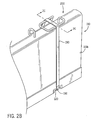
- FIGs 2A-C illustrate the use of the tether guide 200 to secure a safety seat 180 (not shown in Figure 2A for purposes of clarity).
- the safety seat 180 is positioned on the car seat 110 and may be mounted on a seat base 182.
- the safety seat 180 includes a tether 190 extending from a tethering point 184 on the safety seat 180.
- the tether 190 is guided around the tether bars 204a-c of the tether guide 200.
- the positioning of the tether bars 204a-c allows the tether 190 to be guided so as to prevent substantial contact between the tether 190 and the top end 112 of the seat back.
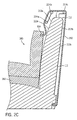
- the tether guide 200 may be effective to prevent pressure contact of the tether 190 with at least an upper portion of the front surface 113a of the seat back 111. Further, depending upon the exact design and shape of the back surface 113b of the seat back 111, the tether guide 200 may be effective to prevent pressure contact of the tether 190 with the back surface 113b of the seat back 111 or with at least an upper portion of the back surface 113b. As non-limiting examples, the upper portion of the front surface 113a and back surface 113b are shown in Figure 2C at 213a and 213b respectively.
- pressure contact is used to indicate significant contact with the front or back surfaces 113a and 113b respectively such that removal of the tether would reveal an indentation or discoloration of the front or back surfaces 113a, 113b caused by the force of the tether 190 against the front or back surfaces 113a, 113b.
- a free end of the tether 190 is provided with a hook 192 adapted to engage a tether latch, such as a bar 120, positioned on the back of the car seat 110 (or alternately to a floor mounted support of the vehicle).
- FIGS 3-5 illustrate tether guides according to additional embodiments of the invention.
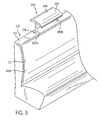
- a tether guide 300 is provided with seat back attachments 302a-b and a tether bar 304 with a contact surface 306 for the tether.
- the contact surface 306 is contoured and disposed sufficiently away from the seat back 111 so as to guide the tether around the top end 112 of the car seat 110 without substantial contact with the top end 112, as well as without pressure contact with at least an upper portion of the front and back surfaces 113a, 113b (see Figure 2C) of the seat back 111.
- a tether guide 400 is provided with seat back attachments 402a-b and tether bars 404a-c. Unlike the embodiment of Figures 1-2C, the tether guide 400 is not configured as a continuous bar, but rather includes two transitional segments 408 branching from each seat back attachments 402a-b. The tether bars 404a-c extend from the end of each transitional bar 408 and from the intersection of the transitional bar 408 and the seat back attachment 402.
- the tether bar 500 includes a single seat back attachment 502 adapted to engage a seat back having a single headrest sleeve.
- the seat back attachment 502 is preferably provided with a rectangular cross-section to prevent rotational movement.
- the embodiments of the present invention provide a convenient way of guiding a seat back tether without substantially deformation or discoloration of the seat.
Landscapes
- Engineering & Computer Science (AREA)
- Aviation & Aerospace Engineering (AREA)
- Transportation (AREA)
- Mechanical Engineering (AREA)
- Health & Medical Sciences (AREA)
- Child & Adolescent Psychology (AREA)
- General Health & Medical Sciences (AREA)
- Seats For Vehicles (AREA)
Abstract
Description
- The present invention relates generally to the field of safety restraint systems. In particular, the invention provides systems and methods for guiding a safety seat tether.
- In conventional systems, safety seats, such as child booster seats, are provided with a tether to secure the safety seat to the vehicle or to the car seat on which the safety seat is positioned. In this regard, a tether is typically provided to extend from the back of the safety seat to a latch behind the car seat. The tether may be tensioned to prevent substantial movement of the safety seat. The tension of the tether can cause the tether to deform the upholstery or the cushioning of the car seat, resulting in an undesirable seat appearance.
- The disclosed embodiments of the present invention provide systems and methods for guiding a safety seat tether to prevent or limit deformation or decoloration of the car seat.
- One aspect of the invention relates to a guide for a safety seat tether. The guide includes at least one seat back attachment for securing the guide to a seat back, the seat back having a top end, and at least one tether bar adapted to guide a tether around the top end, the tether bars being supported at least in part by the seat back attachments.
- In a particular embodiment, the at least one seat back attachment includes at least one insert adapted to be inserted into a headrest sleeve of the seat back. The at least one insert may include two inserts adapted to be inserted into two corresponding sleeves of the seat back.
- In a particular embodiment, the at least one tether bar includes at least two bars being spaced apart.
- In another embodiment, the at least one tether bar includes a contact surface that contacts the tether, the surface being disposed sufficiently away from the seat back so as to prevent pressure contact of the tether with at least a front surface of the seat back. The contact surface may be contoured to guide the tether around the top end without substantial contact with the top end. In another embodiment, the contact surface is contoured to guide the tether to prevent substantial contact with a backside of the seat back.
- In a particular embodiment, the seat back attachments and the at least one tether bar are integrally formed. The seat back attachments and the at least one bar may form a substantially continuous rod. In one embodiment, the rod includes bends to form transitions between two or more segments of the continuous rod. At least one of the segments may be either a seat back attachment or a tether bar. At least one of the segments may be a transition segment positioned between the at least one tether bar and one of another tether bar and a seat back attachment.
- The rod may include two end segments each forming a seat back attachment; three central segments, each forming a tether bar; and one or more transition segments, each transition segment joining a central segment with at least one of another central segment and an end segment. In one embodiment, the rod is formed of a hollow tube.
- In another aspect of the invention, a guide for a safety seat tether includes means for guiding a tether around a top end of a seat back and means for securing the means for guiding to the seat back.
- In another aspect, the invention includes a safety seat tether guide system. The system includes a seat back for a vehicle seat, the vehicle seat being adapted to accommodate a safety seat, the seat back having a top end. The system also includes a tether guide, the tether guide including at least one seat back attachment for securing the guide to the seat back and at least one tether bar adapted to guide a tether around the top end of the seat back. The at least one tether bar extends substantially parallel to the top end and is supported at least in part by the seat back attachments.
- In another aspect, the invention includes a guide for a safety seat tether. The guide includes a seat attachment having two legs for insertion into headrest sleeves positioned at a top end of a back of the seat, and a plurality of tether bars supported by the two legs and adapted to guide a tether around the top end of the seat back so as to prevent substantial contact of the tether with the top end.
- Another aspect of the invention includes a method of tethering a safety seat positioned against a seat back. The method includes guiding a tether of the safety seat around a top end of the seat back by passing the tether over one or more tether bars, the tether bars extending substantially parallel to the top end and being supported at least in part by one or more seat back attachments. The method also includes securing a free end of the tether to a tether latch.
- In another aspect of the invention, a method of securing a child safety seat to a car seat includes the steps of attaching one end of a tether to a back of the child safety seat, securing tether bars to a top end of a back of the car seat by means of attachments inserted into headrest sleeves of the car seat, guiding the tether around the top end of the care seat back by passing the tether over one or more tether bars, and securing another end of the tether to a tether latch. The tether bars are positioned above the top end such as to prevent the tether from contacting the top end when the child safety seat is secured.
-
- Figure 1 is a perspective view of an embodiment of a safety seat tethering system according to the present invention.
- Figure 2A is a front perspective view of the system of Figure 1 with an exemplary tether.
- Figure 2B is a rear perspective view of the system of Figure 2A.
- Figure 2C is a cross-section side view of the system of Figures 2A and 2B.
- Figure 3 is a perspective view of another embodiment of a safety seat tethering system according to the present invention.
- Figure 4 illustrates a tether guide according to another embodiment of the invention.
- Figure 5 illustrates a tether guide according to still another embodiment of the invention.
- Referring to Figure 1, a perspective view of an embodiment of a system for tethering of a safety seat is illustrated. The
tethering system 100 includes acar seat 110 having a seat back 111. Theseat back 111 has atop end 112 adapted to accommodate at least one headrest. Theseat back 111 has afront surface 113a and aback surface 113b (most clearly seen in Figure 2C). Thetop end 112 of theseat back 111 is provided withheadrest sleeves 114 to receive headrest inserts therein. Thecar seat 110 may be any seat in a vehicle, such as a rear seat or a middle row seat, as is commonly found in many minivans. Thecar seat 110 is adapted to accommodate thereupon a safety seat (shown in Figure 2C), such as a child safety seat or a toddler booster seat, for example. - The
tethering system 100 also includes atether guide 200 adapted to guide a tether around at least thetop end 112 of the seat back 111. In this regard, the illustratedtether guide 200 includestether bars 204a-c positioned to guide a tether around thetop end 112 of the seat back 111. In a particular embodiment, thetether guide 200 includes two or more tether bars 204 spaced apart. In this regard, the tether bars 204 are positioned to guide a tether so as to prevent substantial contact between the tether and the seat back 111, particularly thetop end 112. In the illustrated embodiment, thetether guide 200 is provided with threetether bars 204a-c positioned substantially parallel to thetop end 112 of the seat back 111. - The
tether bars 204a-c are supported byseat back attachments 202a-b, which secure thetether guide 200 to theseat back 111. In the illustrated embodiment, the seat backattachments 202a-b are formed as inserts adapted to be inserted into theheadrest sleeve 114. In the particular embodiment of Figure 1, two inserts are provided to be inserted into two corresponding headrest sleeves of the seat back 111. - To support the
tether bars 202a-c, transitional segments, such astransitional segments 208a-c, are provided between thetether bars 204a-c and either aseat back attachment 202a-b or anothertether bar 204a-c. In this regard, thetransitional segments 208a-c may be substantially perpendicular to thetether bars 204a-c. - The
tether guide 200 may be formed in a variety of configurations. For example, the seat back attachments and the at least one tether bar may be integrally formed. In the particular embodiment illustrated in Figure 1, thetether guide 200 is formed as a single continuous rod having various segments. The continuous rod may be formed of a variety of materials, such as a hollow metal tube. The segments include two end segments each forming a seat back attachment. The tether bars are formed by three central segments. Transitional segments are provided to allow the seat back attachments to support the tether bars. Accordingly, the transitional segments are positioned between a tether bar and either another tether bar or a seat back attachment. - The
tether guide 200 includes bends, such asbend 206, in the continuous rod to form transitions between segments of the continuous rod. For example, thebend 206 forms a transition between thetether bar 204c and thetransitional segment 208a. Similar bends are provided to form a transitions between the various other segments of the continuous rod. - Figures 2A-C illustrate the use of the
tether guide 200 to secure a safety seat 180 (not shown in Figure 2A for purposes of clarity). Thesafety seat 180 is positioned on thecar seat 110 and may be mounted on aseat base 182. Thesafety seat 180 includes atether 190 extending from atethering point 184 on thesafety seat 180. In securing thesafety seat 180 to the vehicle or thecar seat 110, thetether 190 is guided around thetether bars 204a-c of thetether guide 200. The positioning of thetether bars 204a-c allows thetether 190 to be guided so as to prevent substantial contact between thetether 190 and thetop end 112 of the seat back. Moreover, depending upon the design of thesafety seat 180 and the exact position of thetether point 184, thetether guide 200 may be effective to prevent pressure contact of thetether 190 with at least an upper portion of thefront surface 113a of the seat back 111. Further, depending upon the exact design and shape of theback surface 113b of the seat back 111, thetether guide 200 may be effective to prevent pressure contact of thetether 190 with theback surface 113b of the seat back 111 or with at least an upper portion of theback surface 113b. As non-limiting examples, the upper portion of thefront surface 113a and backsurface 113b are shown in Figure 2C at 213a and 213b respectively. The term "pressure contact" is used to indicate significant contact with the front orback surfaces back surfaces tether 190 against the front orback surfaces tether 190 is provided with ahook 192 adapted to engage a tether latch, such as abar 120, positioned on the back of the car seat 110 (or alternately to a floor mounted support of the vehicle). - Figures 3-5 illustrate tether guides according to additional embodiments of the invention. First, with reference to Figure 3, a
tether guide 300 is provided with seat backattachments 302a-b and atether bar 304 with acontact surface 306 for the tether. Thecontact surface 306 is contoured and disposed sufficiently away from the seat back 111 so as to guide the tether around thetop end 112 of thecar seat 110 without substantial contact with thetop end 112, as well as without pressure contact with at least an upper portion of the front andback surfaces - Referring now to Figure 4, a
tether guide 400 is provided with seat backattachments 402a-b andtether bars 404a-c. Unlike the embodiment of Figures 1-2C, thetether guide 400 is not configured as a continuous bar, but rather includes twotransitional segments 408 branching from each seat backattachments 402a-b. The tether bars 404a-c extend from the end of eachtransitional bar 408 and from the intersection of thetransitional bar 408 and the seat back attachment 402. - Referring now to Figure 5, a
tether guide 500 similar to thetether guide 400 of Figure 4 is provided. Thetether bar 500 includes a single seat backattachment 502 adapted to engage a seat back having a single headrest sleeve. The seat backattachment 502 is preferably provided with a rectangular cross-section to prevent rotational movement. - Thus, the embodiments of the present invention provide a convenient way of guiding a seat back tether without substantially deformation or discoloration of the seat.
- While the exemplary embodiments illustrated in the Figures and described above are presently preferred, it should be understood that these embodiments are offered by way of example only. Other embodiments may include, for example, different techniques for performing the same operations. The invention is not limited to a particular embodiment, but extends to various modifications, combinations, and permutations that nevertheless fall within the scope and spirit of the appended claims.
Claims (27)
- A guide (200,300,400,500) for a safety seat tether, comprising:at least one seat back attachment (202,302,402,502) for securing the guide to a seat back (111), the seat back having a top end (112) ; andat least one tether bar (204) adapted to guide a tether (190) around the top end without substantial contact with the top end, the at least one tether bar being supported at least in part by the at least one seat back attachment.
- The guide according to claim 1, wherein the at least one seat back attachment includes at least one insert adapted to be inserted into a headrest sleeve (114) of the seat back.
- The guide according to any one of clams 1 and 2, wherein the at least one insert includes two inserts adapted to be inserted into two corresponding headrest sleeves of the seat back.
- The guide according to any one of clams 1 and 2, wherein the at least one tether bar includes at least two tether bars being spaced apart from one another.
- The guide according to any one of clams 1 to 3, wherein the at least one tether bar includes a contact surface (306) that contacts the tether, said surface being disposed sufficiently away from the seat back so as to prevent pressure contact of said tether with at least an upper portion (213a) of a front surface (113a) of said seat back.
- The guide according to claim 5, wherein the contact surface is contoured to guide the tether to prevent substantial contact with the back surface of the seat back.
- The guide according to any one of clams 5 and 6, wherein the contact surface is contoured to guide the tether so as to prevent pressure contact with at least an upper portion of a back surface of the seat back .
- The guide according to any one of clams 1 to 7, wherein the at least one seat back attachment and the at least one tether bar are integrally formed.
- The guide according to any one of clams 1 to 4, wherein the at least one seat back attachment and the at least one bar form a substantially continuous rod.
- The guide according to claim 9, wherein the rod includes bends (206) to form transitions between two or more segments of the continuous rod.
- The guide of claim 10, wherein at least one of the segments is either a seat back attachment or a tether bar.
- The guide according to clams 10 and 1 l, wherein at least one of the segments is a transition segment positioned between said at least one tether bar and one of another tether bar and a seat back attachment.
- The guide according to any one of clams 9 to 12, wherein the rod includes:two end segments each forming a seat back attachment;three central segments, each forming a tether bar; andone or more transition segments, each transition segment joining a central segment with at least one of another central segment and an end segment.
- The guide according to any one of clams 9 to 13, wherein the rod is formed of a hollow tube.
- A guide for a safety seat tether, comprising:means for guiding a tether around a top end of a seat back without substantial contact with the top end; andmeans for securing the means for guiding to the seat back.
- The guide of claim 15, wherein said guiding means prevents pressure contact of said tether with at least an upper portion of a front and back surface of the seat back when said guide is in use.
- A safety seat tether guide system, comprising:a vehicle seat (110) having a seat back with a top end , the vehicle seat being adapted to accommodate a safety seat (180), ; anda tether guide, the tether guide comprising:at least one seat back attachment for securing the guide to the seat back; andat least one tether bar adapted to guide a tether around the top end of the seat back without substantial contact with the top end, the at least one tether bar extending substantially parallel to the top end and being supported at least in part by the at least one seat back attachment.
- The system according to claim 17, wherein the seat back includes at least one headrest sleeve, said at least one attachment being adapted to be inserted in said at least one headrest sleeve.
- The system according to any one of clams 17 and 18, further comprising:a tether latch adapted to secure a free end of a tether.
- The system according to claim 19, wherein the tether latch is a tether rod (120) adapted to receive a hook (192) on the free end of the tether.
- The system according to any one of clams 19 and 20, wherein the tether rod is positioned on a back side of the seat back, a front side of the seat back being opposite the back side and being adapted to receive the safety seat therein.
- A guide for a safety seat tether, comprising:a seat attachment having two legs for insertion into headrest sleeves positioned at a top end of a back of said seat; anda plurality of tether bars supported by said two legs and adapted to guide a tether around the top end of the seat back so as to prevent substantial contact of said tether with said top end.
- The guide according to claim 22, wherein said plurality of tether bars are adapted to prevent pressure contact of said tether with at least an upper portion of a front and back surface of said seat.
- The guide according to any one of clams 22 and 23, wherein said plurality of tether bars includes at least three tether bars.
- The guide according to any one of clams 22 to 24, wherein said three tether bars are oriented parallel to one another.
- A method of tethering a safety seat positioned against a seat back, comprising:securing one end of a tether to said safety seat;guiding the tether around a top end of the seat back without contacting said top end; andsecuring the another end of the tether to a tether latch.
- A method of securing a child safety seat to a car seat comprising the steps of:attaching one end of a tether to a back of the child safety seat;securing a tether guide to a top end of a back of the car seat by means of attachments inserted into headrest sleeves of said car seat;guiding the tether around the top end of the car seat back without contacting said top end when the child safety seat is secured by passing the tether over said tether guide; andsecuring the other end of said tether to a tether latch.
Applications Claiming Priority (1)
| Application Number | Priority Date | Filing Date | Title |
|---|---|---|---|
| US11/005,483 US7165809B2 (en) | 2004-12-07 | 2004-12-07 | Safety seat tether system |
Publications (2)
| Publication Number | Publication Date |
|---|---|
| EP1669239A2 true EP1669239A2 (en) | 2006-06-14 |
| EP1669239A3 EP1669239A3 (en) | 2010-03-03 |
Family
ID=36097347
Family Applications (1)
| Application Number | Title | Priority Date | Filing Date |
|---|---|---|---|
| EP05026510A Withdrawn EP1669239A3 (en) | 2004-12-07 | 2005-12-05 | Safety seat tether system |
Country Status (3)
| Country | Link |
|---|---|
| US (1) | US7165809B2 (en) |
| EP (1) | EP1669239A3 (en) |
| JP (1) | JP4303233B2 (en) |
Cited By (2)
| Publication number | Priority date | Publication date | Assignee | Title |
|---|---|---|---|---|
| FR2971209A1 (en) * | 2011-02-04 | 2012-08-10 | Peugeot Citroen Automobiles Sa | Protective part for seat of motor vehicle, has protective metal tube to protect seat from contact of seat belt, where seat belt is positioned on protective tube to maintain child safety seat in place |
| US20140368015A1 (en) * | 2012-01-04 | 2014-12-18 | Johnson Controls Components Gmbh & Co. Kg | Device for guiding a seat belt on a seat having an integrated seat belt |
Families Citing this family (7)
| Publication number | Priority date | Publication date | Assignee | Title |
|---|---|---|---|---|
| US7441823B2 (en) * | 2006-02-22 | 2008-10-28 | Honda Motor Co., Ltd. | Tether routing apparatus and method of using same |
| NL1032908C2 (en) * | 2006-11-21 | 2008-05-22 | Maxi Miliaan Bv | Children's vehicle seat. |
| DE102014219160A1 (en) * | 2014-09-23 | 2016-03-24 | Volkswagen Aktiengesellschaft | Fastening arrangement in a vehicle |
| US9333921B1 (en) * | 2014-12-18 | 2016-05-10 | FourLane, LLC | Seat-mounted rack assembly |
| JP6867262B2 (en) * | 2017-09-26 | 2021-04-28 | 株式会社タチエス | Vehicle seat |
| DE102017223553B4 (en) * | 2017-12-21 | 2025-05-28 | Bayerische Motoren Werke Aktiengesellschaft | Fastening device for a child seat in a motor vehicle and motor vehicle with such a fastening device |
| US20250206214A1 (en) * | 2023-12-22 | 2025-06-26 | Nissan North America, Inc. | Tether structure |
Citations (1)
| Publication number | Priority date | Publication date | Assignee | Title |
|---|---|---|---|---|
| EP1393966A2 (en) | 2002-08-29 | 2004-03-03 | Honda Giken Kogyo Kabushiki Kaisha | Child seat mounting structure |
Family Cites Families (11)
| Publication number | Priority date | Publication date | Assignee | Title |
|---|---|---|---|---|
| US4215900A (en) | 1978-02-10 | 1980-08-05 | Joseph Coult | Child's safety seat for vehicles |
| US4664443A (en) | 1985-11-08 | 1987-05-12 | Casale Rudy J | Automobile convertible seat |
| DE4230879C2 (en) | 1991-09-30 | 2000-10-19 | Volkswagen Ag | Child seat arrangement with a child seat that can be placed on a vehicle seat |
| US6267441B1 (en) | 1995-03-20 | 2001-07-31 | Armando Otero | Child vehicle safety seat |
| US5791614A (en) * | 1996-04-15 | 1998-08-11 | Chrysler Corporation | Head rest mounted hanger |
| JP3760752B2 (en) * | 2000-10-02 | 2006-03-29 | マツダ株式会社 | Vehicle child seat fixing structure |
| JP2002225601A (en) * | 2001-01-31 | 2002-08-14 | Mazda Motor Corp | Vehicle child seat support structure |
| US6601914B1 (en) * | 2001-05-30 | 2003-08-05 | Bernard J. Seastrom | Supporting apparatus for articles |
| JP3964670B2 (en) | 2001-12-26 | 2007-08-22 | 富士重工業株式会社 | Automotive seat device |
| DE10213655C1 (en) | 2002-03-27 | 2003-07-24 | Faurecia Autositze Gmbh & Co | Child seat fixing device for automobile passenger seat using tubular holder fitted to seat backrest in place of headrest |
| JP3868878B2 (en) * | 2002-09-27 | 2007-01-17 | 本田技研工業株式会社 | Vehicle seat with headrest for child seat mounting |
-
2004
- 2004-12-07 US US11/005,483 patent/US7165809B2/en not_active Expired - Fee Related
-
2005
- 2005-11-30 JP JP2005345494A patent/JP4303233B2/en not_active Expired - Fee Related
- 2005-12-05 EP EP05026510A patent/EP1669239A3/en not_active Withdrawn
Patent Citations (1)
| Publication number | Priority date | Publication date | Assignee | Title |
|---|---|---|---|---|
| EP1393966A2 (en) | 2002-08-29 | 2004-03-03 | Honda Giken Kogyo Kabushiki Kaisha | Child seat mounting structure |
Cited By (3)
| Publication number | Priority date | Publication date | Assignee | Title |
|---|---|---|---|---|
| FR2971209A1 (en) * | 2011-02-04 | 2012-08-10 | Peugeot Citroen Automobiles Sa | Protective part for seat of motor vehicle, has protective metal tube to protect seat from contact of seat belt, where seat belt is positioned on protective tube to maintain child safety seat in place |
| US20140368015A1 (en) * | 2012-01-04 | 2014-12-18 | Johnson Controls Components Gmbh & Co. Kg | Device for guiding a seat belt on a seat having an integrated seat belt |
| US9308849B2 (en) * | 2012-01-04 | 2016-04-12 | Johnson Controls Components GmbH & Co.KG | Device for guiding a seat belt on a seat having an integrated seat belt |
Also Published As
| Publication number | Publication date |
|---|---|
| JP4303233B2 (en) | 2009-07-29 |
| EP1669239A3 (en) | 2010-03-03 |
| JP2006160249A (en) | 2006-06-22 |
| US20060138850A1 (en) | 2006-06-29 |
| US7165809B2 (en) | 2007-01-23 |
Similar Documents
| Publication | Publication Date | Title |
|---|---|---|
| JP3656512B2 (en) | child seat | |
| JP5491100B2 (en) | Seat cover mounting clip, seat pad and manufacturing method thereof | |
| CN103112378B (en) | Headrest features | |
| CN100526117C (en) | Seat sliding apparatus for vehicles | |
| US20010013716A1 (en) | Vehicle seat construction | |
| JP6852582B2 (en) | Vehicle seat | |
| DE60111474D1 (en) | Backrest frame for a vehicle seat | |
| EP1669239A2 (en) | Safety seat tether system | |
| CN104780812A (en) | Vehicle seat | |
| CN104936822A (en) | Vehicle seat | |
| US20080030055A1 (en) | Child car seat incorporating means of guiding the lap strap | |
| JP2011162059A (en) | Vehicle seat | |
| JP5082490B2 (en) | Vehicle seat | |
| JP2002059767A (en) | Seat device for vehicle | |
| CN110271467B (en) | Seat device for vehicle | |
| JP2005280528A (en) | Headrest | |
| KR0138786Y1 (en) | Headrest Fixer for Car Seat | |
| JP5397205B2 (en) | Headrest assembly structure | |
| EP1741593A1 (en) | Child vehicle seat | |
| JPH1016707A (en) | Headrest and seat belt height adjustment mechanism for vehicle seats | |
| KR0136423Y1 (en) | Car headrest rotating device | |
| JP2001138784A (en) | Child seat fixing device | |
| JP2005145167A (en) | Seat belt device in automobile | |
| KR20110100886A (en) | Headrest shifter | |
| JP4987505B2 (en) | Vehicle seat |
Legal Events
| Date | Code | Title | Description |
|---|---|---|---|
| PUAI | Public reference made under article 153(3) epc to a published international application that has entered the european phase |
Free format text: ORIGINAL CODE: 0009012 |
|
| 17P | Request for examination filed |
Effective date: 20051205 |
|
| AK | Designated contracting states |
Kind code of ref document: A2 Designated state(s): AT BE BG CH CY CZ DE DK EE ES FI FR GB GR HU IE IS IT LI LT LU LV MC NL PL PT RO SE SI SK TR |
|
| AX | Request for extension of the european patent |
Extension state: AL BA HR MK YU |
|
| PUAL | Search report despatched |
Free format text: ORIGINAL CODE: 0009013 |
|
| AK | Designated contracting states |
Kind code of ref document: A3 Designated state(s): AT BE BG CH CY CZ DE DK EE ES FI FR GB GR HU IE IS IT LI LT LU LV MC NL PL PT RO SE SI SK TR |
|
| AX | Request for extension of the european patent |
Extension state: AL BA HR MK YU |
|
| 17Q | First examination report despatched |
Effective date: 20100907 |
|
| AKX | Designation fees paid |
Designated state(s): DE FR GB |
|
| STAA | Information on the status of an ep patent application or granted ep patent |
Free format text: STATUS: THE APPLICATION IS DEEMED TO BE WITHDRAWN |
|
| 18D | Application deemed to be withdrawn |
Effective date: 20110118 |