EP1667461A2 - Verfahren, Vorrichtung und Rechnerprogramm zur Blockcodierung eines Datenflusses, insbesondere Videodaten - Google Patents
Verfahren, Vorrichtung und Rechnerprogramm zur Blockcodierung eines Datenflusses, insbesondere Videodaten Download PDFInfo
- Publication number
- EP1667461A2 EP1667461A2 EP05110313A EP05110313A EP1667461A2 EP 1667461 A2 EP1667461 A2 EP 1667461A2 EP 05110313 A EP05110313 A EP 05110313A EP 05110313 A EP05110313 A EP 05110313A EP 1667461 A2 EP1667461 A2 EP 1667461A2
- Authority
- EP
- European Patent Office
- Prior art keywords
- data
- block
- module
- data blocks
- compressed
- Prior art date
- Legal status (The legal status is an assumption and is not a legal conclusion. Google has not performed a legal analysis and makes no representation as to the accuracy of the status listed.)
- Withdrawn
Links
- 238000000034 method Methods 0.000 title claims abstract description 43
- 238000004590 computer program Methods 0.000 title claims description 4
- 238000013139 quantization Methods 0.000 claims abstract description 45
- 238000007906 compression Methods 0.000 claims abstract description 10
- 230000006835 compression Effects 0.000 claims abstract description 10
- 230000006870 function Effects 0.000 claims description 26
- 230000004048 modification Effects 0.000 claims description 7
- 238000012986 modification Methods 0.000 claims description 7
- 238000001514 detection method Methods 0.000 claims description 5
- 238000011144 upstream manufacturing Methods 0.000 claims description 4
- 238000009877 rendering Methods 0.000 claims 2
- 238000011156 evaluation Methods 0.000 claims 1
- 230000033001 locomotion Effects 0.000 description 8
- 230000002123 temporal effect Effects 0.000 description 6
- 239000013598 vector Substances 0.000 description 6
- 238000004422 calculation algorithm Methods 0.000 description 4
- 238000004364 calculation method Methods 0.000 description 4
- 230000000007 visual effect Effects 0.000 description 4
- 230000008569 process Effects 0.000 description 3
- 238000005265 energy consumption Methods 0.000 description 2
- 230000009467 reduction Effects 0.000 description 2
- 230000009466 transformation Effects 0.000 description 2
- 230000005540 biological transmission Effects 0.000 description 1
- 238000013144 data compression Methods 0.000 description 1
- 230000006866 deterioration Effects 0.000 description 1
- 238000010586 diagram Methods 0.000 description 1
- 230000000694 effects Effects 0.000 description 1
- 230000001131 transforming effect Effects 0.000 description 1
Images


Classifications
-
- H—ELECTRICITY
- H04—ELECTRIC COMMUNICATION TECHNIQUE
- H04N—PICTORIAL COMMUNICATION, e.g. TELEVISION
- H04N19/00—Methods or arrangements for coding, decoding, compressing or decompressing digital video signals
- H04N19/10—Methods or arrangements for coding, decoding, compressing or decompressing digital video signals using adaptive coding
- H04N19/102—Methods or arrangements for coding, decoding, compressing or decompressing digital video signals using adaptive coding characterised by the element, parameter or selection affected or controlled by the adaptive coding
- H04N19/124—Quantisation
-
- H—ELECTRICITY
- H04—ELECTRIC COMMUNICATION TECHNIQUE
- H04N—PICTORIAL COMMUNICATION, e.g. TELEVISION
- H04N19/00—Methods or arrangements for coding, decoding, compressing or decompressing digital video signals
- H04N19/10—Methods or arrangements for coding, decoding, compressing or decompressing digital video signals using adaptive coding
- H04N19/134—Methods or arrangements for coding, decoding, compressing or decompressing digital video signals using adaptive coding characterised by the element, parameter or criterion affecting or controlling the adaptive coding
- H04N19/136—Incoming video signal characteristics or properties
- H04N19/137—Motion inside a coding unit, e.g. average field, frame or block difference
-
- H—ELECTRICITY
- H04—ELECTRIC COMMUNICATION TECHNIQUE
- H04N—PICTORIAL COMMUNICATION, e.g. TELEVISION
- H04N19/00—Methods or arrangements for coding, decoding, compressing or decompressing digital video signals
- H04N19/10—Methods or arrangements for coding, decoding, compressing or decompressing digital video signals using adaptive coding
- H04N19/134—Methods or arrangements for coding, decoding, compressing or decompressing digital video signals using adaptive coding characterised by the element, parameter or criterion affecting or controlling the adaptive coding
- H04N19/136—Incoming video signal characteristics or properties
- H04N19/14—Coding unit complexity, e.g. amount of activity or edge presence estimation
-
- H—ELECTRICITY
- H04—ELECTRIC COMMUNICATION TECHNIQUE
- H04N—PICTORIAL COMMUNICATION, e.g. TELEVISION
- H04N19/00—Methods or arrangements for coding, decoding, compressing or decompressing digital video signals
- H04N19/10—Methods or arrangements for coding, decoding, compressing or decompressing digital video signals using adaptive coding
- H04N19/169—Methods or arrangements for coding, decoding, compressing or decompressing digital video signals using adaptive coding characterised by the coding unit, i.e. the structural portion or semantic portion of the video signal being the object or the subject of the adaptive coding
- H04N19/17—Methods or arrangements for coding, decoding, compressing or decompressing digital video signals using adaptive coding characterised by the coding unit, i.e. the structural portion or semantic portion of the video signal being the object or the subject of the adaptive coding the unit being an image region, e.g. an object
- H04N19/176—Methods or arrangements for coding, decoding, compressing or decompressing digital video signals using adaptive coding characterised by the coding unit, i.e. the structural portion or semantic portion of the video signal being the object or the subject of the adaptive coding the unit being an image region, e.g. an object the region being a block, e.g. a macroblock
-
- H—ELECTRICITY
- H04—ELECTRIC COMMUNICATION TECHNIQUE
- H04N—PICTORIAL COMMUNICATION, e.g. TELEVISION
- H04N19/00—Methods or arrangements for coding, decoding, compressing or decompressing digital video signals
- H04N19/10—Methods or arrangements for coding, decoding, compressing or decompressing digital video signals using adaptive coding
- H04N19/189—Methods or arrangements for coding, decoding, compressing or decompressing digital video signals using adaptive coding characterised by the adaptation method, adaptation tool or adaptation type used for the adaptive coding
- H04N19/192—Methods or arrangements for coding, decoding, compressing or decompressing digital video signals using adaptive coding characterised by the adaptation method, adaptation tool or adaptation type used for the adaptive coding the adaptation method, adaptation tool or adaptation type being iterative or recursive
- H04N19/194—Methods or arrangements for coding, decoding, compressing or decompressing digital video signals using adaptive coding characterised by the adaptation method, adaptation tool or adaptation type used for the adaptive coding the adaptation method, adaptation tool or adaptation type being iterative or recursive involving only two passes
-
- H—ELECTRICITY
- H04—ELECTRIC COMMUNICATION TECHNIQUE
- H04N—PICTORIAL COMMUNICATION, e.g. TELEVISION
- H04N19/00—Methods or arrangements for coding, decoding, compressing or decompressing digital video signals
- H04N19/44—Decoders specially adapted therefor, e.g. video decoders which are asymmetric with respect to the encoder
- H04N19/45—Decoders specially adapted therefor, e.g. video decoders which are asymmetric with respect to the encoder performing compensation of the inverse transform mismatch, e.g. Inverse Discrete Cosine Transform [IDCT] mismatch
-
- H—ELECTRICITY
- H04—ELECTRIC COMMUNICATION TECHNIQUE
- H04N—PICTORIAL COMMUNICATION, e.g. TELEVISION
- H04N19/00—Methods or arrangements for coding, decoding, compressing or decompressing digital video signals
- H04N19/60—Methods or arrangements for coding, decoding, compressing or decompressing digital video signals using transform coding
- H04N19/61—Methods or arrangements for coding, decoding, compressing or decompressing digital video signals using transform coding in combination with predictive coding
Definitions
- the present invention relates to methods and devices for block coding of data, in particular flows of image and video data, via operations of compression which make use of the discrete cosine transform (DCT).
- DCT discrete cosine transform
- the standards of compression based upon DCT include, by way of example, the standards MPEG-1, MPEG-2, MPEG-4 and H.263.
- the MPEG-4 standard contains an extended set of data-compression procedures. In order to achieve different goals, said procedures are divided into sets with progressively increasing capacities, referred to as "profiles". Within each profile, the admissible range of parameters is governed through "levels". Hence, an implementation of a certain given coding apparatus is specified through a given profile and a given level.
- the MPEG-4 standard enables reduction of the redundancy in the image of a sequence, transforming the data in an appropriate way.
- Application of an orthonormal transform enables concentration of the energy of the signal in the low-frequency coefficients, the information associated to which will be appropriately reduced to adapt to the channel.
- the correlation of the image is present between pixels that are locally adjacent in the image and between frames that are close to one another in time. For this reason, the MPEG-4 standard enables three different kinds of frames, designated by the letters I, P, and B.
- the frames I are coded without any temporal reference. They require a large number of bits, but enable reconstruction of the quality of the image and have a random access to the sequence.
- the reconstructed images of type I are used as references for reconstruction of the images that follow in the sequence.
- the frames P (Inter) are coded using the temporal correlation with the preceding frames of type I or P.
- the coding device estimates the movement that has occurred between two frames and sends corresponding motion vectors to the decoding device.
- the residual information given by the difference between the original image and the information shown obtained from the anchor frame, contains the data that cannot be estimated through motion vectors.
- the frames of type B are coded using the temporal correlation with the preceding and following frames of type I or P. Since two possible references are available, the coding device can choose the direction that is less costly in terms of dimensions of the compressed data. Since both the preceding images and the following images are used, the transmission and the temporal order must be modified so as to have all the information necessary for reconstructing the two-directional predicted frames.
- the profile referred to as "simple" used by the MPEG-4 standard makes use of only frames of type I and P.
- coding of the predicted frames can cause a mismatch between the coding device and the decoding device.
- the coding device In order to code a frame of such a type, the coding device must in fact store the preceding frame to be used for the temporal prediction. Consequently, both the coding device and the decoding device reconstruct the current frame, which is used as reference for the future images.
- the coding device and the decoding device would require having available exactly the same set of reconstructed data in order to reconstruct correctly the decoded image and thus prevent occurrence of the so-called mismatch error between the two images reconstructed at the encoder end and at the decoder end. In practice, minimal differences between the two images are, however, acceptable.
- the MPEG-4 standard defines statistically the maximum amount of variation between two images.
- the difference between the coding device and the decoding device may be due only to the modules that execute the discrete cosine transform (DCT) and the inverse discrete cosine transform (IDCT). In fact, it is the result on the individual block that can vary between different codings.
- DCT discrete cosine transform
- IDCT inverse discrete cosine transform
- the MPEG-4 standard provides only limits of tolerated error, as may be evinced from Annex A of the ISO/IEC 14496-2 recommendation, "Coding of audio - visual objects - Part 2: Visual", pp. 253-254, Third edition: 2003.
- the mismatch occurs when the coding device and the decoding device obtain different outputs from the IDCT block. Two different cases may arise:
- Figure 1 represents a working diagram of a coding and decoding method that involves a compression via DCT.
- the reference number 100 consequently designates a coding device, which comprises a block 120 representing a DCT operation and a block 130 representing a quantization operation with a certain quantization step QP.
- Said blocks 120 and 130 receive at input a noncompressed-data flow I, divided into blocks B, and return compressed blocks DB at output, which, via coding operations not represented in detail in Figure 1, which involve, for example, the use of Huffman tables, are then coded in an output compressed-data flow O.
- CB designates a current block, i.e., the block that is processed at a given instant by the coding device 100, and that, in the case shown, is assumed as containing non-zero coefficients.
- Present in the coding device 100 is a branch that fetches the compressed-data flow O and executes a set of inverse operations, i.e., an inverse quantization operation in a block 190 and an IDCT operation in a block 195, in order to obtain reconstructed blocks RB to be used in the reconstruction of the frames.
- a set of inverse operations i.e., an inverse quantization operation in a block 190 and an IDCT operation in a block 195, in order to obtain reconstructed blocks RB to be used in the reconstruction of the frames.
- the reference 100' thus designates a decoding device, which receives at input the compressed-data flow O and carries out thereon an inverse-quantization operation represented by a block 190' and an IDCT operation in a block 195', to supply reconstructed blocks RB' in a decompressed-data flow I'.
- Figure 1 shows the case where the block RB reconstructed by the coding device 100 and the block RB' reconstructed by the decoding device 100' are different on account of implementation of different procedures at the coding device 100 and at the decoding device 100'.
- the block RB reconstructed by the coding device 100 is a zero block, i.e., all its coefficients are zero.
- the MPEG-4 standard strongly recommends avoidance of such a case, i.e., the case where the IDCT of the coding device supplies a zero block, whilst the output of the coding device itself supplies a non-zero block (section "Mismatch control” (7.4.4.5) of the ISO/IEC 14496-2 recommendation, “Coding of audio - visual objects - Part 2: Visual", pp. 253-254, Third edition: 2003).
- the effects are not visible, since the margins defined are sufficient to guarantee negligible differences between the frames reconstructed at the coding-device end. However, in particular situations, the results of the mismatch may be very evident.
- prediction data with small errors are sent to the decoding device.
- These data can be reconstructed as zero data by the IDCT in the coding device, whereas they are reconstructed as non-zero data by another type of IDCT implementation at the decoding device.
- the same data are present at the coding device in the next image, the same mismatch occurs between the coding device and the decoding device. The errors accumulate in the same points, and the reconstructed images soon diverge.
- the object of the present invention is to solve a drawback of the above sort and to propose a solution that will enable intervention on the mismatch error.
- the present invention also regards a corresponding coding device, as well as a computer-program product that can be loaded into the memory of at least one computer and comprises portions of software code for implementing the aforesaid method.
- a computer-program product is understood as being equivalent to reference to a computer-readable medium containing instructions for controlling a computer system in order to coordinate execution of the method according to the invention.
- Reference to "at least one computer” is intended to highlight the possibility for the present invention to be implemented in a distributed and/or modular way.
- a block-coding method and a corresponding device for block coding of data envisage detecting in the coding step whether a block currently being coded is liable to generate a mismatch error, and, if so, modifying said current block so as to eliminate the mismatch error.
- the first embodiment which contemplates, that is, zeroizing the coefficients of the block before coding, substantially envisages verifying, after the IDCT at the encoder end, whether a zero block is reconstructed from a block that contains some non-zero DCT coefficients. If this occurs, the coding device is configured for forcing to zero a block in terms of Huffman coding.
- Figure 2 shows a coding device that implements said first embodiment.
- FIG. 2 Represented, then, in Figure 2 is a coding device, designated as a whole by the reference number 200, which receives at input the noncompressed-data flow I.
- Said noncompressed-data flow I is sent at input to a motion-estimator block 210, which generates at output motion vectors VM.
- the noncompressed-data flow I is sent in parallel to one of the inputs of an adder 212 to be added to the output of a frame memory 280.
- Said frame memory 280 has the function of storing the preceding frame to be used for the operations of temporal prediction together with the motion vectors VM.
- the sum obtained from the adder 212 is sent at input to a transformation module 220, which carries out the DCT.
- the output of the transformation module 220 is supplied to a quantization module 230, which applies a quantization according to a quantization parameter QP, which is supplied by a rate-control module 270.
- the rate-control module 270 operates on the basis of the input signal, i.e., the noncompressed-data flow I, and of the output signal, i.e., a compressed-data flow O, of the coding device 200, which the module 270 receives at two appropriate inputs of its own.
- the signal, constituted by the compressed blocks DB, is sent to an inverse-quantization module 290 and to an IDCT module 295, in order to obtain decompressed frames O' to be supplied to the frame memory 280, after being added to the output of the frame memory 280 in an appropriate adder 214.
- the output of the quantization module 230 is likewise sent to the output of the coding device 200 through an AC/DC prediction module 235 and a variable-length-coding (VLC) module 240, which adopts VLC techniques and Huffman coding to produce a coded data flow with a good statistical efficiency of compression.
- VLC variable-length-coding
- the output of the VLC module 240 is sent to a multiplexer 250, together with the motion vectors VM.
- Set downstream of the multiplexer 250 is a buffer 260, which supplies at output the compressed-data flow O.
- mismatch-control module 1000 detects the blocks RB reconstructed by the IDCT module 295 and modifies the compressed blocks DB upstream of the coding performed in the AC/DC prediction module 235 and in the VLC module 240, via the operation of zeroizing the DCT coefficients of said compressed blocks DB to be coded, should a zero block be reconstructed from a block containing non-zero DCT coefficients.
- the use of said procedure in the mismatch-control module 1000 imposes some constraints upon implementation of the H/W coding device.
- the data after the quantization performed in the quantization module 230, the data must wait for the results of the inverse quantization and of the IDCT in the blocks 290 and 295 to ensure that there will not be any mismatch.
- a second embodiment of the method proposed overcomes the drawback of having to wait for the results of the inverse quantizations and of the IDCT before coding via the Huffman table, as well as the deterioration in the PSNR values.
- Said second embodiment prevents the mismatch error without requiring any checks on the reconstructed block downstream of the IDCT, since it is based upon the analysis of the SAD (Sum of Absolute Differences) function and the quantizer values of the current block at the coding-device end. Said information is available at the coding-device end because the motion-estimation procedure calculates it in order to identify the motion vectors.
- SAD Sud of Absolute Differences
- a general approach to the mismatch error is provided, which is irrespective of the implementation of particular proprietary algorithmic procedures, for example, of a forward DCT, forward quantization, and inverse quantization type.
- Described in the second part is, instead, the treatment of the specific case of the implementation of the MPEG-4-coding procedure.
- the errors due to the finite-precision arithmetic will not be taken into consideration in a first-order approximation.
- said errors will be considered and a final solution to the problem will be provided.
- E the block energy
- MismatchWarning() corresponding to the modification operations can have two possible embodiments that envisage the operations either of:
- the first solution is simple to implement and, moreover, the blocks that follow can be turned off, with a consequent lower energy consumption.
- the index b indicates the block B that is each time examined as regards SAD and QP values, i.e., the current block CB.
- dct_b, iq_b, recon_b and VLC represent variables corresponding to application of DCTs, quantizations, inverse quantizations and VLC coding to the blocks B at input, in_b , or at output, out_b .
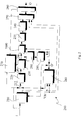
- FIG 3 shows a possible implementation, in a coding device 300, of the second solution for controlling mismatch described above, with the strategy of incrementation of the quantization step QP.
- the modules having functions similar to the ones already described with reference to Figure 2 are designated by the same reference numbers.
- a mismatch-control block 1100 is inserted so as to receive from the motion estimator 210 at one input thereof macroblocks MB derived from the noncompressed-data flow I, and at another input thereof values S of the corresponding SAD function; at a third input, the mismatch-control block 1100 receives the value of the quantization step QP applied in the compression of the current macroblock from the rate-control module 270.
- the mismatch-control module 1100 supplies a macroblock to be coded MB' to the adder 212, and a minimum quantizer value Qmin to the rate-control module 270.
- MismatchWarning() fixes the minimum value of the quantization step QP in order to increase the PSNR. Consequently, the procedure can, for example, be represented, in terms of program instructions in pseudocode, also as:
- the direct DCT, the quantization, the inverse quantization, and the inverse DCT can be avoided, with a lower energy consumption.
Landscapes
- Engineering & Computer Science (AREA)
- Multimedia (AREA)
- Signal Processing (AREA)
- Physics & Mathematics (AREA)
- Discrete Mathematics (AREA)
- General Physics & Mathematics (AREA)
- Compression Or Coding Systems Of Tv Signals (AREA)
- Compression, Expansion, Code Conversion, And Decoders (AREA)
Applications Claiming Priority (1)
| Application Number | Priority Date | Filing Date | Title |
|---|---|---|---|
| IT000764A ITTO20040764A1 (it) | 2004-11-05 | 2004-11-05 | Procedimento per codificare a blocchi un flusso di dati, in particolare dati video, relativo, relativo dispositivo e prodotto informatico. |
Publications (2)
| Publication Number | Publication Date |
|---|---|
| EP1667461A2 true EP1667461A2 (de) | 2006-06-07 |
| EP1667461A3 EP1667461A3 (de) | 2010-12-01 |
Family
ID=36201524
Family Applications (1)
| Application Number | Title | Priority Date | Filing Date |
|---|---|---|---|
| EP05110313A Withdrawn EP1667461A3 (de) | 2004-11-05 | 2005-11-03 | Verfahren, Vorrichtung und Rechnerprogramm zur Blockcodierung eines Datenflusses, insbesondere Videodaten |
Country Status (3)
| Country | Link |
|---|---|
| US (1) | US7974483B2 (de) |
| EP (1) | EP1667461A3 (de) |
| IT (1) | ITTO20040764A1 (de) |
Families Citing this family (9)
| Publication number | Priority date | Publication date | Assignee | Title |
|---|---|---|---|---|
| US20070162531A1 (en) * | 2006-01-12 | 2007-07-12 | Bhaskar Kota | Flow transform for integrated circuit design and simulation having combined data flow, control flow, and memory flow views |
| US8121189B2 (en) * | 2007-09-20 | 2012-02-21 | Microsoft Corporation | Video decoding using created reference pictures |
| US9848209B2 (en) * | 2008-04-02 | 2017-12-19 | Microsoft Technology Licensing, Llc | Adaptive error detection for MPEG-2 error concealment |
| US9924184B2 (en) | 2008-06-30 | 2018-03-20 | Microsoft Technology Licensing, Llc | Error detection, protection and recovery for video decoding |
| US9788018B2 (en) * | 2008-06-30 | 2017-10-10 | Microsoft Technology Licensing, Llc | Error concealment techniques in video decoding |
| US20100065343A1 (en) * | 2008-09-18 | 2010-03-18 | Chien-Liang Liu | Fingertip Touch Pen |
| US9131241B2 (en) * | 2008-11-25 | 2015-09-08 | Microsoft Technology Licensing, Llc | Adjusting hardware acceleration for video playback based on error detection |
| US8340510B2 (en) | 2009-07-17 | 2012-12-25 | Microsoft Corporation | Implementing channel start and file seek for decoder |
| EP2485488B1 (de) * | 2011-02-02 | 2017-04-12 | Nagravision S.A. | Mediendekodierer und Dekodierverfahren zur Ermöglichung der Verfolgung des Mediendekodierers |
Citations (1)
| Publication number | Priority date | Publication date | Assignee | Title |
|---|---|---|---|---|
| US6215425B1 (en) * | 1992-02-19 | 2001-04-10 | Netergy Networks, Inc. | Deblocking filter for encoder/decoder arrangement and method with divergence reduction |
Family Cites Families (4)
| Publication number | Priority date | Publication date | Assignee | Title |
|---|---|---|---|---|
| JPH05276500A (ja) * | 1991-07-19 | 1993-10-22 | Sony Corp | 動画像符号化及び復号化装置 |
| US5604502A (en) * | 1994-03-21 | 1997-02-18 | Lucent Technologies Inc. | Motion video compression system with inverse discrete cosine transform mismatch control |
| US6275527B1 (en) * | 1998-01-14 | 2001-08-14 | Conexant Systems, Inc. | Pre-quantization in motion compensated video coding |
| JP3960451B2 (ja) * | 2000-03-06 | 2007-08-15 | Kddi株式会社 | シーン特性検出型動画像符号化装置 |
-
2004
- 2004-11-05 IT IT000764A patent/ITTO20040764A1/it unknown
-
2005
- 2005-11-03 EP EP05110313A patent/EP1667461A3/de not_active Withdrawn
- 2005-11-04 US US11/267,077 patent/US7974483B2/en active Active
Patent Citations (1)
| Publication number | Priority date | Publication date | Assignee | Title |
|---|---|---|---|---|
| US6215425B1 (en) * | 1992-02-19 | 2001-04-10 | Netergy Networks, Inc. | Deblocking filter for encoder/decoder arrangement and method with divergence reduction |
Also Published As
| Publication number | Publication date |
|---|---|
| US20060098732A1 (en) | 2006-05-11 |
| ITTO20040764A1 (it) | 2005-02-05 |
| US7974483B2 (en) | 2011-07-05 |
| EP1667461A3 (de) | 2010-12-01 |
Similar Documents
| Publication | Publication Date | Title |
|---|---|---|
| US8175404B2 (en) | Method and device for estimating image quality of compressed images and/or video sequences | |
| Lengwehasatit et al. | Scalable variable complexity approximate forward DCT | |
| US20050053288A1 (en) | Bitstream-controlled post-processing filtering | |
| Xin et al. | Converting DCT coefficients to H. 264/AVC transform coefficients | |
| US8000393B2 (en) | Video encoding apparatus and video encoding method | |
| EP2373049A1 (de) | Videoqualitätsmessung | |
| EP0577350B1 (de) | Vorrichtung zur Kodierung und Dekodierung von Bildsignalen mit adaptivem Filter zur Randverhaltensverbesserung | |
| PL173287B1 (pl) | Sposób i urządzenie do przetwarzania zespołu współczynników transformaty reprezentujących sygnał obrazu ruchomego | |
| US11394958B2 (en) | Image encoding device, image decoding device and program | |
| KR20060060000A (ko) | 비디오 엔코딩 및 디코딩 방법들 및 장치들 | |
| US20170041605A1 (en) | Video encoding device and video encoding method | |
| US7974483B2 (en) | Method and corresponding device for block coding data | |
| KR20030086076A (ko) | 블록킹 효과를 제거하기 위한 필터링 방법 및 그 장치 | |
| US6859815B2 (en) | Approximate inverse discrete cosine transform for scalable computation complexity video and still image decoding | |
| US20040028127A1 (en) | Method and apparatus for reducing computational complexity in video encoders | |
| Lee et al. | A CU-level rate and distortion estimation scheme for RDO of hardware-friendly HEVC encoders using low-complexity integer DCTs | |
| US10104389B2 (en) | Apparatus, method and non-transitory medium storing program for encoding moving picture | |
| US20070147505A1 (en) | Processing a compressed video signal | |
| US20190089955A1 (en) | Image encoding method, and image encoder and image decoder using same | |
| US9131246B2 (en) | Detecting artifacts in quantization noise in images compresses using discrete cosine transforms | |
| US20130329792A1 (en) | Method and device for optimizing the compression of a video stream | |
| EP1819171A2 (de) | Informationsverarbeitungsvorrichtung | |
| US6278737B1 (en) | Reversible coding system for interlaced scanned moving pictures | |
| US20080107183A1 (en) | Method and apparatus for detecting zero coefficients | |
| US20150365701A1 (en) | Method for encoding and decoding image block, encoder and decoder |
Legal Events
| Date | Code | Title | Description |
|---|---|---|---|
| PUAI | Public reference made under article 153(3) epc to a published international application that has entered the european phase |
Free format text: ORIGINAL CODE: 0009012 |
|
| AK | Designated contracting states |
Kind code of ref document: A2 Designated state(s): AT BE BG CH CY CZ DE DK EE ES FI FR GB GR HU IE IS IT LI LT LU LV MC NL PL PT RO SE SI SK TR |
|
| AX | Request for extension of the european patent |
Extension state: AL BA HR MK YU |
|
| RAP1 | Party data changed (applicant data changed or rights of an application transferred) |
Owner name: STMICROELECTRONICS SRL |
|
| PUAL | Search report despatched |
Free format text: ORIGINAL CODE: 0009013 |
|
| AK | Designated contracting states |
Kind code of ref document: A3 Designated state(s): AT BE BG CH CY CZ DE DK EE ES FI FR GB GR HU IE IS IT LI LT LU LV MC NL PL PT RO SE SI SK TR |
|
| AX | Request for extension of the european patent |
Extension state: AL BA HR MK YU |
|
| 17P | Request for examination filed |
Effective date: 20110531 |
|
| AKX | Designation fees paid |
Designated state(s): DE FR GB IT |
|
| 17Q | First examination report despatched |
Effective date: 20110719 |
|
| RAP1 | Party data changed (applicant data changed or rights of an application transferred) |
Owner name: STMICROELECTRONICS SRL |
|
| GRAP | Despatch of communication of intention to grant a patent |
Free format text: ORIGINAL CODE: EPIDOSNIGR1 |
|
| STAA | Information on the status of an ep patent application or granted ep patent |
Free format text: STATUS: THE APPLICATION IS DEEMED TO BE WITHDRAWN |
|
| 18D | Application deemed to be withdrawn |
Effective date: 20130409 |