EP1666440A1 - Method for producing aromatic unsaturated compound - Google Patents
Method for producing aromatic unsaturated compound Download PDFInfo
- Publication number
- EP1666440A1 EP1666440A1 EP04772557A EP04772557A EP1666440A1 EP 1666440 A1 EP1666440 A1 EP 1666440A1 EP 04772557 A EP04772557 A EP 04772557A EP 04772557 A EP04772557 A EP 04772557A EP 1666440 A1 EP1666440 A1 EP 1666440A1
- Authority
- EP
- European Patent Office
- Prior art keywords
- compound
- formula
- acid
- methyl
- acrylate
- Prior art date
- Legal status (The legal status is an assumption and is not a legal conclusion. Google has not performed a legal analysis and makes no representation as to the accuracy of the status listed.)
- Granted
Links
- 0 *[n]1c2ccccc2cc1 Chemical compound *[n]1c2ccccc2cc1 0.000 description 2
Classifications
-
- C—CHEMISTRY; METALLURGY
- C07—ORGANIC CHEMISTRY
- C07D—HETEROCYCLIC COMPOUNDS
- C07D209/00—Heterocyclic compounds containing five-membered rings, condensed with other rings, with one nitrogen atom as the only ring hetero atom
- C07D209/02—Heterocyclic compounds containing five-membered rings, condensed with other rings, with one nitrogen atom as the only ring hetero atom condensed with one carbocyclic ring
- C07D209/04—Indoles; Hydrogenated indoles
- C07D209/10—Indoles; Hydrogenated indoles with substituted hydrocarbon radicals attached to carbon atoms of the hetero ring
- C07D209/18—Radicals substituted by carbon atoms having three bonds to hetero atoms with at the most one bond to halogen, e.g. ester or nitrile radicals
- C07D209/24—Radicals substituted by carbon atoms having three bonds to hetero atoms with at the most one bond to halogen, e.g. ester or nitrile radicals with an alkyl or cycloalkyl radical attached to the ring nitrogen atom
-
- C—CHEMISTRY; METALLURGY
- C07—ORGANIC CHEMISTRY
- C07B—GENERAL METHODS OF ORGANIC CHEMISTRY; APPARATUS THEREFOR
- C07B37/00—Reactions without formation or introduction of functional groups containing hetero atoms, involving either the formation of a carbon-to-carbon bond between two carbon atoms not directly linked already or the disconnection of two directly linked carbon atoms
- C07B37/04—Substitution
-
- C—CHEMISTRY; METALLURGY
- C07—ORGANIC CHEMISTRY
- C07C—ACYCLIC OR CARBOCYCLIC COMPOUNDS
- C07C67/00—Preparation of carboxylic acid esters
- C07C67/30—Preparation of carboxylic acid esters by modifying the acid moiety of the ester, such modification not being an introduction of an ester group
- C07C67/333—Preparation of carboxylic acid esters by modifying the acid moiety of the ester, such modification not being an introduction of an ester group by isomerisation; by change of size of the carbon skeleton
- C07C67/343—Preparation of carboxylic acid esters by modifying the acid moiety of the ester, such modification not being an introduction of an ester group by isomerisation; by change of size of the carbon skeleton by increase in the number of carbon atoms
-
- C—CHEMISTRY; METALLURGY
- C07—ORGANIC CHEMISTRY
- C07D—HETEROCYCLIC COMPOUNDS
- C07D209/00—Heterocyclic compounds containing five-membered rings, condensed with other rings, with one nitrogen atom as the only ring hetero atom
- C07D209/02—Heterocyclic compounds containing five-membered rings, condensed with other rings, with one nitrogen atom as the only ring hetero atom condensed with one carbocyclic ring
- C07D209/04—Indoles; Hydrogenated indoles
- C07D209/08—Indoles; Hydrogenated indoles with only hydrogen atoms or radicals containing only hydrogen and carbon atoms, directly attached to carbon atoms of the hetero ring
-
- C—CHEMISTRY; METALLURGY
- C07—ORGANIC CHEMISTRY
- C07D—HETEROCYCLIC COMPOUNDS
- C07D209/00—Heterocyclic compounds containing five-membered rings, condensed with other rings, with one nitrogen atom as the only ring hetero atom
- C07D209/02—Heterocyclic compounds containing five-membered rings, condensed with other rings, with one nitrogen atom as the only ring hetero atom condensed with one carbocyclic ring
- C07D209/04—Indoles; Hydrogenated indoles
- C07D209/10—Indoles; Hydrogenated indoles with substituted hydrocarbon radicals attached to carbon atoms of the hetero ring
-
- C—CHEMISTRY; METALLURGY
- C07—ORGANIC CHEMISTRY
- C07D—HETEROCYCLIC COMPOUNDS
- C07D209/00—Heterocyclic compounds containing five-membered rings, condensed with other rings, with one nitrogen atom as the only ring hetero atom
- C07D209/02—Heterocyclic compounds containing five-membered rings, condensed with other rings, with one nitrogen atom as the only ring hetero atom condensed with one carbocyclic ring
- C07D209/04—Indoles; Hydrogenated indoles
- C07D209/10—Indoles; Hydrogenated indoles with substituted hydrocarbon radicals attached to carbon atoms of the hetero ring
- C07D209/12—Radicals substituted by oxygen atoms
-
- C—CHEMISTRY; METALLURGY
- C07—ORGANIC CHEMISTRY
- C07D—HETEROCYCLIC COMPOUNDS
- C07D209/00—Heterocyclic compounds containing five-membered rings, condensed with other rings, with one nitrogen atom as the only ring hetero atom
- C07D209/02—Heterocyclic compounds containing five-membered rings, condensed with other rings, with one nitrogen atom as the only ring hetero atom condensed with one carbocyclic ring
- C07D209/04—Indoles; Hydrogenated indoles
- C07D209/10—Indoles; Hydrogenated indoles with substituted hydrocarbon radicals attached to carbon atoms of the hetero ring
- C07D209/18—Radicals substituted by carbon atoms having three bonds to hetero atoms with at the most one bond to halogen, e.g. ester or nitrile radicals
Definitions
- the present invention relates to a process for producing an aromatic unsaturated compound.
- aromatic unsaturated compound of the formula (4) wherein Ar represents an optionally substituted aromatic group or an optionally substituted heteroaromatic group, and Y represents an electron withdrawing group (hereinafter, abbreviated as aromatic unsaturated compound (4)) is useful as, for example, a synthetic intermediate of medical and agricultural chemicals or the like.
- aromatic unsaturated compound (4) is useful as, for example, a synthetic intermediate of medical and agricultural chemicals or the like.
- a compound of the following formula (7) is known as a synthetic intermediate of fluvastatin useful as a hyperlipidemia drug as described also in, for example, WO 01/92223.
- an aromatic unsaturated compound (4) there is known, for example, a process reacting an aromatic halide with an acrylic acid compound such as acrylic acid and the like in the presence of a palladium catalyst and a base (for example, WO 01/92223), however, an aromatic halide manifesting high load on environments is required to be used as a raw material, and additionally, a hydrogen halide is by-produced together with progress of the reaction.
- a hydrogen halide is by-produced together with progress of the reaction.
- the above-mentioned hydrogen halide is required to be neutralized with a base, it is not necessarily a reaction of high atom economy from the standpoint of raw material.
- the process (a) is not necessarily advantageous from the standpoint of operation and equipments since oxygen is used and accordingly the process is required to be performed under the reaction condition not higher than the explosion limit.
- the process (b) is disadvantageous from the standpoint of cost since a palladium complex in an amount equal to or more than the theoretical amount is used though it is a method of higher atom economy from the standpoint of raw material.
- post treatment of the palladium complex after the reaction is troublesome, further, the yield is low. That is, it is not necessarily an advantageous method from the standpoint of industrial production.
- the present inventors have intensively studied for developing a process for producing the above-mentioned aromatic unsaturated compound (4) with higher atom economy and more advantageously from industrial standpoint using a compound of the above-mentioned formula (1) as a raw material and resultantly found that the object of the instant application can be attained by reacting a compound of the above-mentioned formula (1) with a compound of the formula (2) wherein Y represents an electron withdrawing group, and Z represents a lower alkoxy group, or with a compound of the formula (3) wherein, Y and Z have the same meanings as defined above, in the presence of an acid such as hydrochloric acid and the like, or a compound capable of generating a mineral acid by its hydrolysis such as phosphorus oxychloride and the like, leading to completion of the present invention.
- the present invention includes the following inventions.
- Ar represents an optionally substituted aromatic group or an optionally substituted heteroaromatic group.
- aromatic group examples include phenyl, naphthyl, anthryl, phenanthryl, tetrahydronaphthyl, 9,10-dihydroanthryl, acenaphthenyl and the like.
- heteroaromatic group examples include aromatic groups containing hetero atom(s) such as a nitrogen atom, oxygen atom, sulfur atom and the like as constituent atom(s) of an aromatic ring, and specific examples thereof include indolyl, benzofuryl, benzothienyl, benzothiazolyl, benzooxazolyl, pyrrolyl, furyl, thienyldibenzofuryl, dibenzothienyl, 2,3-dihydroindolyl, 2,3-dihydrobenzofuryl and the like. Indolyl group is preferred as the heteroaromatic group.
- Such aromatic groups or heteroaromatic groups may be substituted with substituent(s), and examples of the substituent include alkyls, usually, alkyls having 1 to 6 carbon atoms such as methyl, ethyl, n-propyl, isopropyl, n-butyl, isobutyl, sec-butyl, tert-butyl, n-pentyl, isopentyl, n-hexyl and the like, preferably, lower alkyls having 1 to 4 carbon atoms; lower alkoxys usually having 1 to 4 carbon atoms such as methoxy, ethoxy, n-propoxy, isopropoxy, n-butoxy, isobutoxy, sec-butoxy, tert-butoxy and the like; hydroxyl group; hydroxyl groups protected with a protective group represented by -OR x ; aminos; aminos protected with a protective group represented by -NHR y or -NR y 2 ; hal
- Examples of the protective group on a hydroxyl group represented by R x include alkanoyls such as acetyl and the like; alkoxyalkyls such as methoxymethyl and the like; aralkyls such as benzyl and the like; alkylenes such as methylene, dimethylmethylene and the like, and examples of hydroxyl groups protected with such a protective group represented by -OR x include acetyloxy, methoxymethoxy, benzyloxy, methylenedioxy, dimethylmethylenedioxy and the like.
- Examples of the protective group on amino represented by R y include the above-mentioned alkanoyls; aralkyls such as benzyl and the like; aralkyloxyalkyls such as benzyloxymethl and the like; dialkoxyalkyls such as dimethoxymethyl and the like; sulfonyls such as benzenesulfonyl, p-toluenesulfonyl, methanesulfonyl and the like, and examples of aminos protected with such a protective group represented by -NHR y or -NR y 2 include acetylamino, dibenzylamino, dibenzyloxymethylamino, dimethoxymethylamino, benzenesulfonylamino, p-toluenesulfonylamino, methanesulfonyl amino and the like.
- the number of such substituents is not particularly limited, however, aromatic groups substituted with two or more electron donating substituents are preferable, and aromatic groups substituted with three or more electron donating substituents are more preferable, from the standpoint of reaction speed.
- the number of such substituents is not particularly limited, however, heteroaromatic groups substituted with at least one electron donating substituents are preferable, from the standpoint of reaction speed.
- the electron donating substituent herein referred to indicates an alkyl, lower alkoxy having 1 to 4 carbon atoms, hydroxyl group, hydroxyl group protected with a protective group represented by -OR x , amino, or amino protected with a protective group represented by -NHR y or -NR y 2 , among the above-mentioned substituents.
- compounds in which the heteroaromatic group is an indolyl group are important since they are synthetic raw materials of indole compounds such as, for example, fluvastatin and the like useful as a hyperlipidemia drug (e.g., JPH02-46031-B, WO01/92223, and the like), and examples of such compounds in which the heteroaromatic group is an indolyl group include compounds of the formula (5) wherein, R 1 represents a phenyl optionally substituted with halogen(s), or represents hydrogen or alkyl, and R 2 represents an alkyl, or represents a phenyl optionally substituted with halogen(s).
- the phenyl optionally substituted with halogen(s) includes the same moieties as described above, and examples of the alkyl include alkyls having 1 to 6 carbon atoms such as methyl, ethyl, n-propyl, isopropyl, n-butyl, isobutyl, sec-butyl, tert-butyl, n-hexyl and the like.
- Examples of such compounds (1) include benzene, naphthalene, dimethoxybenzene, 1,3,5-trimethoxybenzene, 1,2,3-trimethoxybenzene, 2,6-dimethoxyphenol, 2-methoxyaniline, 4-methoxyaniline, 2-methoxyacetanilide, 4-methoxyacetanilide, 2-acetylaminophenol, 4-acetylaminophenol, catechol, resorcinol, hydroquinone, 4-tert-butylcatechol, capsaicin, 2-methyl-1H-indole, 2-methyl-1-methyl-1H-indole, 2-methyl-1-isopropyl-1H-indole, 2-methyl-1-phenyl-1H-indole, 2-ethyl-1H-indole, 2-ethyl-1-methyl-1H-indole, 2-ethyl-1-phenyl-1H-indole, 2-phenyl-1H-indole
- ком ⁇ онент (1) commercially available compounds may be used, and those produced according to known methods may also be used.
- a compound in which the aromatic group is an indolyl group can be produced according to known methods such as, for example, Tetrahedron Letters, 26 , 2155 (1985) and the like.
- Y represents an electron withdrawing group
- Z represents a lower alkoxy
- Examples of the electron withdrawing group include alkoxycarbonyl, aryloxycarbonyl, aralkyloxycarbonyl, acyl, cyano and the like.
- Examples of the alkoxycarbony include alkoxycarbonyls having 2 to 9 carbon atoms such as methoxycarbonyl, ethoxycarbonyl, n-propoxycarbonyl, isopropoxycarbonyl, n-butoxycarbonyl, isobutoxycarbonyl, tert-butoxycarbonyl, n-hexyloxycarbonyl, n-octyloxycarbonyloxy and the like.
- aryloxycarbonyl examples include aryloxycarbonyls having 7 to 13 carbon atoms such as phenoxycarbonyl, and the like
- aralkyloxycarbonyl examples include aralkyloxycarbonyls having 8 to 14 carbon atoms such as benzyloxycarbonyl, and the like
- acyl examples include aliphatic acyls having 2 to 9 carbon atoms such as acetyl, propionyl and the like; aromatic acyls having 7 to 13 carbon atoms such as benzoyl, and the like.
- lower alkoxy examples include alkoxys having 1 to 6 carbon atoms such as methoxy, ethoxy, n-propoxy, isopropoxy, n-butoxy, isobutoxy, sec-butoxy, tert-butoxy, n-pentyloxy, n-hexyloxy and the like, and preferable are alkoxys having 1 to 4 carbon atoms.
- Examples of such compounds (2) include methyl 3-methoxyacrylate, ethyl 3-methoxyacrylate, n-propyl 3-methoxyacrylate, isopropyl 3-methoxyacrylate, n-butyl 3-methoxyacrylate, isobutyl 3-methoxyacrylate, sec-butyl 3-methoxyacrylate, tert-butyl 3-methoxyacrylate, phenyl 3-methoxyacrylate, benzyl 3-methoxyacrylate, methyl 3-ethoxyacrylate, ethyl 3-ethoxyacrylate, n-propyl 3-ethoxyacrylate, isopropyl 3-ethoxyacrylate, n-butyl 3-ethoxyacrylate, isobutyl 3-ethoxyacrylate, sec-butyl 3-ethoxyacrylate, tert-butyl 3-ethoxyacrylate, phenyl 3-ethoxyacrylate, benzyl 3-ethoxyacrylate, methyl 3-isopropoxyacrylate,
- trans isomer and cis isomer exists, and any one of them may be used or any mixture of them may be used in the present invention.
- Examples of the compound (3) include methyl 3,3-dimethoxypropionate, ethyl 3,3-dimethoxypropionate, n-propyl 3,3-dimethoxypropionate, isopropyl 3,3-dimethoxypropionate, n-butyl 3,3-dimethoxypropionate, isobutyl 3,3-dimethoxypropionate, sec-butyl 3,3-dimethoxypropionate, tert-butyl 3,3-dimethoxypropionate, phenyl 3,3-dimethoxypropionate, benzyl 3,3-dimethoxypropionate, methyl 3,3-diethoxypropionate, ethyl 3,3-diethoxypropionate, n-propyl 3,3-diethoxypropionate, isopropyl 3,3-diethoxypropionate, n-butyl 3,3-diethoxypropionate, isobutyl 3,3-diethoxypropionate,
- the amount used of the compound (2) or compound (3) is usually 1 to 5 mol, preferably 1 to 3 mol in total based on 1 mol of the compound (1).
- the acid examples include sulfuric acid; hydrochloric acid; hydrogen halides such as hydrogen bromide and the like; perhalogenic acids such as perchloric acid; sulfonic acids such as methanesulfonic acid, benzenesulfonic acid, p-toluenesulfonic acid, trifluoromethanesulfonic acid and the like; perfluorocarboxylic acids such as trifluoroacetic acid and the like; aprotic acids such as boron trifluoride, aluminum chloride, aluminum bromide, zinc chloride, zinc bromide, tin chloride, titanium tetrachloride and the like; acidic ion exchange resins and the like, and preferable are hydrogen halides.
- aprotic acid complexes of aprotic acids such as, for example, a boron trifluoride•tetrahydrofuran complex and the like may also be used.
- acids having a pKa of 2.5 or less are preferred, and acids having a pKa of 1.5 or less are more preferred.
- Examples of the compound capable of generating a mineral acid by hydrolysis include phosphorus oxyhalides such as phosphorus oxychloride, phosphorus oxybromide and the like; phosphorus halides such as phosphorus trichloride, phosphorus tribromide, phosphorus pentachloride and the like; thionyl halides such as thionyl chloride and the like; sulfuryl halides such as sulfuryl chloride, and the like, and preferable are phosphorus oxyhalides.
- phosphorus oxyhalides such as phosphorus oxychloride, phosphorus oxybromide and the like
- phosphorus halides such as phosphorus trichloride, phosphorus tribromide, phosphorus pentachloride and the like
- thionyl halides such as thionyl chloride and the like
- sulfuryl halides such as sulfuryl chloride, and the like, and preferable are phosphorus oxy
- a compound (1) may be reacted with a compound (2) or a compound (3) in the presence of an acid, or a compound (1) may be reacted with a compound (2) or a compound (3) in the presence of a MAGH compound. Alternatively, a compound (1) may also be reacted with a compound (2) or a compound (3) in the presence of an acid and MAGH compound.
- an acid or MAGH compound may be added to a mixture of a compound (1) and a compound (2) or a compound (3), or a compound (2) or a compound (3) may be added to a mixture of a compound (1) and an acid or MAGH compound.
- the amount used of an acid or MAGH compound is usually 0.001 mol or more, preferably 0.01 mol or more in total based on 1 mol of the compound (1), the upper limit thereof is not particularly set, and in the case of liquid under reaction conditions, it may be used in excess amount for acting also as a solvent, and the amount is practically 5 mol or less, preferably 3 mol or less from the standpoint of post treatment and economy.
- the reaction is performed usually in the presence of a solvent
- the solvent include nitrile-based solvents such as acetonitrile, propionitrile and the like, carboxylic acid-based solvents such as formic acid, acetic acid and the like, halogenated hydrocarbon-based solvents such as dichloromethane, chloroform and the like, ether-based solvents such as tetrahydrofuran and the like, ester-based solvents such as ethyl acetate and the like, alcohol-based solvents such as methanol, ethanol, isopropanol and the like, water, and the like, which may be single solvent or mixed solvent, and preferable are carboxylic acid-based solvents and nitrile-based solvents, and more preferable are carboxylic acid-based solvents, and among them, acetic acid is particularly preferable.
- the amount used of such solvents is not particularly limited. As described above, when the above-mentioned acid or MAGH compound is liquid under reaction conditions,
- the intended aromatic unsaturated compound (4) can be obtained by reacting a compound (1) with a compound (2) or compound (3) in the presence of an acid or MAGH compound.
- the aromatic unsaturated compound (4) can be obtained with better yield by carrying out the reaction in the coexistence of water.
- the amount used of water when the reaction is carried out in the coexistence of water is usually 0.1 mol or more based on 1 mol of the compound (1), and though its upper limit is not particularly limited, it is practically 50 mol or less, preferably 10 mol or less.
- the reaction temperature is usually -20 to 80°C.
- the intended aromatic unsaturated compound (4) can be taken out by, for example, filtration treatment, after mixing the reaction liquid with water.
- the aromatic unsaturated compound (4) precipitates as crystals in the reaction liquid.
- the aromatic unsaturated compound (4) may be taken out directly by filtration treatment of the reaction liquid, or by filtration treatment after mixing the reaction liquid and water.
- the compound (4) may also be taken out, for example, by adding water and water-insoluble organic solvent such as toluene, ethyl acetate, methyl t-butyl ether, methyl isobutyl ketone and the like to the reaction liquid, extracting the mixture, and concentrating the resulting organic layer.
- the obtained aromatic unsaturated compound (4) may further be purified by conventional purification means such as, for example, recrystallization, column chromatography and the like.
- aromatic unsaturated compound (4) examples include methyl 3-(2,4,6-trimethoxyphenyl)acrylate, methyl 3-(2,3,4-trimethoxyphenyl)acrylate, methyl 3-(3-hydroxy-2,4-dimethoxyphenyl)acrylate, methyl 3-(3,4-dihydroxyphenyl)acrylate, ethyl 3-(2,4,6-trimethoxyphenyl)acrylate, ethyl 3-(2,3,4-trimethoxyphenyl)acrylate, ethyl 3-(3-hydroxy-2,4-dimethoxyphenyl)acrylate, ethyl 3-(3,4-dihydroxyphenyl)acrylate, n-propyl 3-(2,4,6-trimethoxyphenyl)acrylate, n-propyl 3-(2,4,6-trimethoxyphenyl)acrylate, n-propyl 3-(2,4,6-trimethoxyphenyl)acrylate, n-propyl 3-(2,4,
- the magnesium sulfate was filtrated, then, the resulting filtrate was concentrated, to obtain a concentrated residue containing trans-4-[3-(4-fluorophenyl)-1-isopropyl-1H-indol-2-yl]-3-buten-2-one.
- the concentrated residue was purified by silica gel chromatography (developing liquid: n-heptane/ethyl acetate: 4/1) to obtain 0.72 g of trans-4-[3-(4-fluorophenyl)-1-isopropyl-1H-indol-2-yl]-3-buten-2-one (yellow solid). Yield: 52%.
- the sampled liquid was concentrated under reduced pressure, and the resulting concentration residue was dissolved in chloroform-d, and 1 H-NMR spectrum was measured to find that the above-mentioned concentrated residue contained trans-4-[3-(4-fluorophenyl)-1-isopropyl-1H-indol-2-yl]-3-buten-2-one and the raw material, 3-(4-fluorophenyl)-1-isopropyl-1H-indole and that the content ratio thereof (trans-4-[3-(4-fluorophenyl)-1-isopropyl-1H-indol-2-yl]-3-buten-2-one/3-(4-fluorophenyl)-1-isopropyl-1H-indole (calculated from NMR integral value)) was 1/2.7.
- the method of the present invention is a method of higher atom economy capable of producing an aromatic unsaturated compound which can be derived into medical and agricultural chemicals and the like without using an aromatic halide manifesting high load on environments as a raw material and without by-producing a hydrogen halide needing neutralization. Further, the method of the present invention is more advantageous also from industrial standpoint since a transition metal which is expensive and requires complicated post treatment is not used.
Landscapes
- Chemical & Material Sciences (AREA)
- Organic Chemistry (AREA)
- Chemical Kinetics & Catalysis (AREA)
- Indole Compounds (AREA)
- Organic Low-Molecular-Weight Compounds And Preparation Thereof (AREA)
- Low-Molecular Organic Synthesis Reactions Using Catalysts (AREA)
- Pyridine Compounds (AREA)
Abstract
Description
- The present invention relates to a process for producing an aromatic unsaturated compound.
- An aromatic unsaturated compound of the formula (4)

is useful as, for example, a synthetic intermediate of medical and agricultural chemicals or the like. For example, a compound of the following formula (7)
- Compounds of the following formulae (8) and (9) are compounds being developed as an arteriosclerosis remedy as described also in JPH09-202775-A and JPH07-206842-A, respectively.

- As a process for producing such an aromatic unsaturated compound (4), there is known, for example, a process reacting an aromatic halide with an acrylic acid compound such as acrylic acid and the like in the presence of a palladium catalyst and a base (for example, WO 01/92223), however, an aromatic halide manifesting high load on environments is required to be used as a raw material, and additionally, a hydrogen halide is by-produced together with progress of the reaction. In addition, since the above-mentioned hydrogen halide is required to be neutralized with a base, it is not necessarily a reaction of high atom economy from the standpoint of raw material.
- On the other hand, as a process of higher atom economy, there is a process using a compound of the formula (1)
Ar-―H (1)
wherein, Ar is as defined above,
as a raw material and reacting it with an acrylic acid compound. For example, there are suggested (a) a process using a ruthenium catalyst and a palladium catalyst and reacting in the presence of oxygen (for example, J. Am. Chem. Soc., 125, 1467 (2003), J. Am. Chem. Soc., 123, 337 (2001)), (b) a process using a palladium complex in an amount equal to or more than the theoretical amount (for example, J. Org. Chem., 46, 851 (1981), Heterocycles, 22, 1493 (1984)), and the like. - However, the process (a) is not necessarily advantageous from the standpoint of operation and equipments since oxygen is used and accordingly the process is required to be performed under the reaction condition not higher than the explosion limit. The process (b) is disadvantageous from the standpoint of cost since a palladium complex in an amount equal to or more than the theoretical amount is used though it is a method of higher atom economy from the standpoint of raw material. In addition, post treatment of the palladium complex after the reaction is troublesome, further, the yield is low. That is, it is not necessarily an advantageous method from the standpoint of industrial production.
- As a process for producing a compound having an indole ring, there is known a process protecting a nitrogen atom constituting an indole ring with a benzenesulfonyl group, then, reacting it with an acrylic acid compound in the presence of a palladium catalyst (for example, Synthesis, 236 (1984)). This process, however, is a reaction limited to a compound in which a nitrogen atom constituting an indole ring is protected with a benzenesulfonyl group, and additionally, needs a use in excess amount of a relatively expensive re-oxidizer such as, for example, silver acetate and the like for obtaining an intended object in good yield.
- Under such conditions, the present inventors have intensively studied for developing a process for producing the above-mentioned aromatic unsaturated compound (4) with higher atom economy and more advantageously from industrial standpoint using a compound of the above-mentioned formula (1) as a raw material and resultantly found that the object of the instant application can be attained by reacting a compound of the above-mentioned formula (1) with a compound of the formula (2)

or with a compound of the formula (3)
in the presence of an acid such as hydrochloric acid and the like, or a compound capable of generating a mineral acid by its hydrolysis such as phosphorus oxychloride and the like, leading to completion of the present invention. - That is, the present invention includes the following inventions.
- <1>A process for producing an aromatic unsaturated compound of the formula (4)
which comprises reacting (a) a compound of the formula (1) with (b) a compound of the formula (2) or a compound of the formula (3) in the presence of (c) an acid or a compound which generates a mineral acid by its hydrolysis. - <2> The process according to <1>, wherein the reaction is conducted in the co-presence of water.
- <3> The process according to <1> or <2>, wherein (c) an acid or a compound which generates a mineral acid by its hydrolysis is hydrogen halide.
- <4> The process according to <1> or <2>, wherein (c) an acid or a compound which generates a mineral acid by its hydrolysis is phosphorus oxyhalide, phosphorus halide, thionyl halide or sulfuryl halide.
- <5>The process according to any of <1> to <4>, wherein the reaction is conducted in acetic acid.
- <6> The process according to any of <1> to <5>, wherein Ar in the formulae (1) and (4) is an aromatic group or a heteroaromatic group which may be substituted by at least one group selected from the group consisting of a lower alkyl, a lower alkoxyl, a hydroxyl, -ORx, an amino, -NHRy, -NRy 2, halogen and a phenyl optionally substituted by halogen(s),
wherein Rx represents a protective group of hydroxyl and Ry represents a protective group of amino. - <7> The process according to any of <1> to <6>, wherein Ar in the formulae (1) and (4) is an optionally substituted phenyl.
- <8> The process according to any of <1> to <6>, wherein Ar in the formulae (1) and (4) is an optionally substituted indolyl.
- <9> The process according to any of <1> to <6> or <8>, wherein the compound of the formula (1) is a compound of the formula (5)

the compound of the formula (4) is a compound of the formula (6)
- In the formula of a compound of the formula (1)
Ar-―H (1)
hereinafter abbreviated as compound (1), Ar represents an optionally substituted aromatic group or an optionally substituted heteroaromatic group. - Examples of the aromatic group include phenyl, naphthyl, anthryl, phenanthryl, tetrahydronaphthyl, 9,10-dihydroanthryl, acenaphthenyl and the like. Examples of the heteroaromatic group include aromatic groups containing hetero atom(s) such as a nitrogen atom, oxygen atom, sulfur atom and the like as constituent atom(s) of an aromatic ring, and specific examples thereof include indolyl, benzofuryl, benzothienyl, benzothiazolyl, benzooxazolyl, pyrrolyl, furyl, thienyldibenzofuryl, dibenzothienyl, 2,3-dihydroindolyl, 2,3-dihydrobenzofuryl and the like. Indolyl group is preferred as the heteroaromatic group.
- Such aromatic groups or heteroaromatic groups may be substituted with substituent(s), and examples of the substituent include alkyls, usually, alkyls having 1 to 6 carbon atoms such as methyl, ethyl, n-propyl, isopropyl, n-butyl, isobutyl, sec-butyl, tert-butyl, n-pentyl, isopentyl, n-hexyl and the like, preferably, lower alkyls having 1 to 4 carbon atoms; lower alkoxys usually having 1 to 4 carbon atoms such as methoxy, ethoxy, n-propoxy, isopropoxy, n-butoxy, isobutoxy, sec-butoxy, tert-butoxy and the like; hydroxyl group; hydroxyl groups protected with a protective group represented by -ORx; aminos; aminos protected with a protective group represented by -NHRy or -NRy 2; halogens such as fluorine, chlorine, bromine, iodine and the like; phenyls optionally substituted with a halogen such as phenyl, 4-chlorophenyl, 4-fluorophenyl, and the like. Examples of the protective group on a hydroxyl group represented by Rx include alkanoyls such as acetyl and the like; alkoxyalkyls such as methoxymethyl and the like; aralkyls such as benzyl and the like; alkylenes such as methylene, dimethylmethylene and the like, and examples of hydroxyl groups protected with such a protective group represented by -ORx include acetyloxy, methoxymethoxy, benzyloxy, methylenedioxy, dimethylmethylenedioxy and the like. Examples of the protective group on amino represented by Ry include the above-mentioned alkanoyls; aralkyls such as benzyl and the like; aralkyloxyalkyls such as benzyloxymethl and the like; dialkoxyalkyls such as dimethoxymethyl and the like; sulfonyls such as benzenesulfonyl, p-toluenesulfonyl, methanesulfonyl and the like, and examples of aminos protected with such a protective group represented by -NHRy or -NRy 2 include acetylamino, dibenzylamino, dibenzyloxymethylamino, dimethoxymethylamino, benzenesulfonylamino, p-toluenesulfonylamino, methanesulfonyl amino and the like.
- In the case of aromatic groups substituted with such a substituent, the number of such substituents is not particularly limited, however, aromatic groups substituted with two or more electron donating substituents are preferable, and aromatic groups substituted with three or more electron donating substituents are more preferable, from the standpoint of reaction speed. Also in the case of heteroaromatic groups substituted with a substituent, the number of such substituents is not particularly limited, however, heteroaromatic groups substituted with at least one electron donating substituents are preferable, from the standpoint of reaction speed. The electron donating substituent herein referred to indicates an alkyl, lower alkoxy having 1 to 4 carbon atoms, hydroxyl group, hydroxyl group protected with a protective group represented by -ORx, amino, or amino protected with a protective group represented by -NHRy or -NRy 2, among the above-mentioned substituents.
- Among such compounds (1), compounds in which the heteroaromatic group is an indolyl group are important since they are synthetic raw materials of indole compounds such as, for example, fluvastatin and the like useful as a hyperlipidemia drug (e.g., JPH02-46031-B, WO01/92223, and the like), and examples of such compounds in which the heteroaromatic group is an indolyl group include compounds of the formula (5)

- In the above-mentioned formula (5), the phenyl optionally substituted with halogen(s) includes the same moieties as described above, and examples of the alkyl include alkyls having 1 to 6 carbon atoms such as methyl, ethyl, n-propyl, isopropyl, n-butyl, isobutyl, sec-butyl, tert-butyl, n-hexyl and the like.
- Examples of such compounds (1) include benzene, naphthalene, dimethoxybenzene, 1,3,5-trimethoxybenzene, 1,2,3-trimethoxybenzene, 2,6-dimethoxyphenol, 2-methoxyaniline, 4-methoxyaniline, 2-methoxyacetanilide, 4-methoxyacetanilide, 2-acetylaminophenol, 4-acetylaminophenol, catechol, resorcinol, hydroquinone, 4-tert-butylcatechol, capsaicin, 2-methyl-1H-indole, 2-methyl-1-methyl-1H-indole, 2-methyl-1-isopropyl-1H-indole, 2-methyl-1-phenyl-1H-indole, 2-ethyl-1H-indole, 2-ethyl-1-methyl-1H-indole, 2-ethyl-1-phenyl-1H-indole, 2-phenyl-1H-indole, 2-phenyl-1-methyl-1H-indole, 2-phenyl-1-phenyl-1H-indole, 3-methyl-1H-indole, 3-methyl-1-methyl-1H-indole, 3-methyl-1-isopropyl-1H-indole, 3-methyl-1-phenyl-1H-indole, 3-ethyl-1H-indole, 3-ethyl-1-methyl-1H-indole, 3-ethyl-1-phenyl-1H-indole, 3-phenyl-1H-indole, 3-phenyl-1-methyl-1H-indole, 3-phenyl-1-phenyl-1H-indole, 3-(4-fluorophenyl)-1-isopropyl-1H-indole, and the like.
- As such compounds (1), commercially available compounds may be used, and those produced according to known methods may also be used. For example, a compound in which the aromatic group is an indolyl group can be produced according to known methods such as, for example, Tetrahedron Letters, 26, 2155 (1985) and the like.
- In a compound of the formula (2)


- Examples of the electron withdrawing group include alkoxycarbonyl, aryloxycarbonyl, aralkyloxycarbonyl, acyl, cyano and the like. Examples of the alkoxycarbony include alkoxycarbonyls having 2 to 9 carbon atoms such as methoxycarbonyl, ethoxycarbonyl, n-propoxycarbonyl, isopropoxycarbonyl, n-butoxycarbonyl, isobutoxycarbonyl, tert-butoxycarbonyl, n-hexyloxycarbonyl, n-octyloxycarbonyloxy and the like. Examples of the aryloxycarbonyl include aryloxycarbonyls having 7 to 13 carbon atoms such as phenoxycarbonyl, and the like, and examples of the aralkyloxycarbonyl include aralkyloxycarbonyls having 8 to 14 carbon atoms such as benzyloxycarbonyl, and the like. Examples of the acyl include aliphatic acyls having 2 to 9 carbon atoms such as acetyl, propionyl and the like; aromatic acyls having 7 to 13 carbon atoms such as benzoyl, and the like. Examples of the lower alkoxy include alkoxys having 1 to 6 carbon atoms such as methoxy, ethoxy, n-propoxy, isopropoxy, n-butoxy, isobutoxy, sec-butoxy, tert-butoxy, n-pentyloxy, n-hexyloxy and the like, and preferable are alkoxys having 1 to 4 carbon atoms.
- Examples of such compounds (2) include methyl 3-methoxyacrylate, ethyl 3-methoxyacrylate, n-propyl 3-methoxyacrylate, isopropyl 3-methoxyacrylate, n-butyl 3-methoxyacrylate, isobutyl 3-methoxyacrylate, sec-butyl 3-methoxyacrylate, tert-butyl 3-methoxyacrylate, phenyl 3-methoxyacrylate, benzyl 3-methoxyacrylate, methyl 3-ethoxyacrylate, ethyl 3-ethoxyacrylate, n-propyl 3-ethoxyacrylate, isopropyl 3-ethoxyacrylate, n-butyl 3-ethoxyacrylate, isobutyl 3-ethoxyacrylate, sec-butyl 3-ethoxyacrylate, tert-butyl 3-ethoxyacrylate, phenyl 3-ethoxyacrylate, benzyl 3-ethoxyacrylate, methyl 3-isopropoxyacrylate, ethyl 3-isopropoxyacrylate, n-propyl 3-isopropoxyacrylate, isopropyl 3-isopropoxyacrylate, n-butyl 3-isopropoxyacrylate, isobutyl 3-isopropoxyacrylate, sec-butyl 3-isopropoxyacrylate, tert-butyl 3-isopropoxyacrylate, phenyl 3-isopropoxyacrylate, benzyl 3-isopropoxyacrylate, methyl 3-n-butoxyacrylate, ethyl 3-n-butoxyacrylate, n-propyl 3-n-butoxyacrylate, isopropyl 3-n-butoxyacrylate, n-butyl 3-n-butoxyacrylate, isobutyl 3-n-butoxyacrylate, sec-butyl 3-n-butoxyacrylate, tert-butyl 3-n-butoxyacrylate, phenyl 3-n-butoxyacrylate, benzyl 3-n-butoxyacrylate, methyl 3-tert-butoxyacrylate, ethyl 3-tert-butoxyacrylate, n-propyl 3-tert-butoxyacrylate, isopropyl 3-tert-butoxyacrylate, n-butyl 3-tert-butoxyacrylate, isobutyl 3-n-butoxyacrylate, sec-butyl 3-tert-butoxyacrylate, tert-butyl 3-tert-butoxyacrylate, phenyl 3-tert-butoxyacrylate, benzyl 3-tert-butoxyacrylate, 3-methoxyacrylonitrile, 3-ethoxyacrylonitrile, 3-isopropoxyacrylonitrile, 3-n-butoxyacrylonitrile, 3-tert-butoxyacrylonitrile, 4-methoxy-3-buten-2-one, 4-ethoxy-3-buten-2-one, 3-methoxy-1-phenylpropenone and the like.
- In the compound (2), a trans isomer and cis isomer exists, and any one of them may be used or any mixture of them may be used in the present invention.
- Examples of the compound (3) include methyl 3,3-dimethoxypropionate, ethyl 3,3-dimethoxypropionate, n-propyl 3,3-dimethoxypropionate, isopropyl 3,3-dimethoxypropionate, n-butyl 3,3-dimethoxypropionate, isobutyl 3,3-dimethoxypropionate, sec-butyl 3,3-dimethoxypropionate, tert-butyl 3,3-dimethoxypropionate, phenyl 3,3-dimethoxypropionate, benzyl 3,3-dimethoxypropionate, methyl 3,3-diethoxypropionate, ethyl 3,3-diethoxypropionate, n-propyl 3,3-diethoxypropionate, isopropyl 3,3-diethoxypropionate, n-butyl 3,3-diethoxypropionate, isobutyl 3,3-diethoxypropionate, sec-butyl 3,3-diethoxypropionate, tert-butyl 3,3-diethoxypropionate, phenyl 3,3-diethoxypropionate, benzyl 3,3-diethoxypropionate, methyl 3,3-diisopropoxypropionate, ethyl 3,3-diisopropoxypropionate, n-propyl 3,3-diisopropoxypropionate, isopropyl 3,3-diisopropoxypropionate, n-butyl 3,3-diisopropoxypropionate, isobutyl 3,3-diisopropoxypropionate, sec-butyl 3,3-diisopropoxypropionate, tert-butyl 3,3-diisopropoxypropionate, phenyl 3,3-diisopropoxypropionate, benzyl 3,3-diisopropoxypropionate, methyl 3,3-di(n-butoxy)propionate, ethyl 3,3-di(n-butoxy)propionate, n-propyl 3,3-di(n-butoxy)propionate, isopropyl 3,3-di(n-butoxy)propionate, n-butyl 3,3-di(n-butoxy)propionate, isobutyl 3,3-di(n-butoxy)propionate, sec-butyl 3,3-di(n-butoxy)propionate, tert-butyl 3,3-di(n-butoxy)propionate, phenyl 3,3-di(n-butoxy)propionate, benzyl 3,3-di(n-butoxy)propionate, methyl 3,3-di(tert-butoxy)propionate, ethyl 3,3-di(tert-butoxy)propionate, n-propyl 3,3-di(tert-butoxy)propionate, isopropyl 3,3-di(tert-butoxy)propionate, n-butyl 3,3-di(tert-butoxy)propionate, isobutyl 3,3-di(tert-butoxy)propionate, sec-butyl 3,3-di(tert-butoxy)propionate, tert-butyl 3,3-di(tert-butoxy)propionate, phenyl 3,3-di(tert-butoxy)propionate, benzyl 3,3-di(tert-butoxy)propionate, 3,3-dimethoxypropionitrile, 3,3-diethoxypropionitrile, 3,3-diisopropoxypropionitrile, 3,3-di(n-butoxy)propionitrile, 3,3-di(tert-butoxy)propionitrile, 1,1-dimethoxy-3-butanone, 1,1-diethoxy-3-butanone, 3,3-dimethoxy-1-phenylpropan-1-one, and the like.
- As such compounds (2) and compounds (3), commercially available compounds may be used, and those produced according to known method, such as JPS61-45974-B, JPS58-26855-A and the like may also be used.
- The amount used of the compound (2) or compound (3) is usually 1 to 5 mol, preferably 1 to 3 mol in total based on 1 mol of the compound (1).
- Examples of the acid include sulfuric acid; hydrochloric acid; hydrogen halides such as hydrogen bromide and the like; perhalogenic acids such as perchloric acid; sulfonic acids such as methanesulfonic acid, benzenesulfonic acid, p-toluenesulfonic acid, trifluoromethanesulfonic acid and the like; perfluorocarboxylic acids such as trifluoroacetic acid and the like; aprotic acids such as boron trifluoride, aluminum chloride, aluminum bromide, zinc chloride, zinc bromide, tin chloride, titanium tetrachloride and the like; acidic ion exchange resins and the like, and preferable are hydrogen halides. As the aprotic acid, complexes of aprotic acids such as, for example, a boron trifluoride•tetrahydrofuran complex and the like may also be used. In the method of the present invention, when the acid to be used is a protonic acid, acids having a pKa of 2.5 or less are preferred, and acids having a pKa of 1.5 or less are more preferred.
- Examples of the compound capable of generating a mineral acid by hydrolysis (hereinafter, may be referred to as MAGH compound) include phosphorus oxyhalides such as phosphorus oxychloride, phosphorus oxybromide and the like; phosphorus halides such as phosphorus trichloride, phosphorus tribromide, phosphorus pentachloride and the like; thionyl halides such as thionyl chloride and the like; sulfuryl halides such as sulfuryl chloride, and the like, and preferable are phosphorus oxyhalides.
- A compound (1) may be reacted with a compound (2) or a compound (3) in the presence of an acid, or a compound (1) may be reacted with a compound (2) or a compound (3) in the presence of a MAGH compound. Alternatively, a compound (1) may also be reacted with a compound (2) or a compound (3) in the presence of an acid and MAGH compound.
- The mixing order of them is not particularly limited, and for example, an acid or MAGH compound may be added to a mixture of a compound (1) and a compound (2) or a compound (3), or a compound (2) or a compound (3) may be added to a mixture of a compound (1) and an acid or MAGH compound.
- The amount used of an acid or MAGH compound is usually 0.001 mol or more, preferably 0.01 mol or more in total based on 1 mol of the compound (1), the upper limit thereof is not particularly set, and in the case of liquid under reaction conditions, it may be used in excess amount for acting also as a solvent, and the amount is practically 5 mol or less, preferably 3 mol or less from the standpoint of post treatment and economy.
- The reaction is performed usually in the presence of a solvent, and examples of the solvent include nitrile-based solvents such as acetonitrile, propionitrile and the like, carboxylic acid-based solvents such as formic acid, acetic acid and the like, halogenated hydrocarbon-based solvents such as dichloromethane, chloroform and the like, ether-based solvents such as tetrahydrofuran and the like, ester-based solvents such as ethyl acetate and the like, alcohol-based solvents such as methanol, ethanol, isopropanol and the like, water, and the like, which may be single solvent or mixed solvent, and preferable are carboxylic acid-based solvents and nitrile-based solvents, and more preferable are carboxylic acid-based solvents, and among them, acetic acid is particularly preferable. The amount used of such solvents is not particularly limited. As described above, when the above-mentioned acid or MAGH compound is liquid under reaction conditions, such an acid or MAGH compound may be used as a solvent.
- The intended aromatic unsaturated compound (4) can be obtained by reacting a compound (1) with a compound (2) or compound (3) in the presence of an acid or MAGH compound. The aromatic unsaturated compound (4) can be obtained with better yield by carrying out the reaction in the coexistence of water.
- The amount used of water when the reaction is carried out in the coexistence of water is usually 0.1 mol or more based on 1 mol of the compound (1), and though its upper limit is not particularly limited, it is practically 50 mol or less, preferably 10 mol or less.
- The reaction temperature is usually -20 to 80°C.
- After completion of the reaction, the intended aromatic unsaturated compound (4) can be taken out by, for example, filtration treatment, after mixing the reaction liquid with water. In a certain case, the aromatic unsaturated compound (4) precipitates as crystals in the reaction liquid. In such a case, the aromatic unsaturated compound (4), may be taken out directly by filtration treatment of the reaction liquid, or by filtration treatment after mixing the reaction liquid and water. Alternatively, the compound (4) may also be taken out, for example, by adding water and water-insoluble organic solvent such as toluene, ethyl acetate, methyl t-butyl ether, methyl isobutyl ketone and the like to the reaction liquid, extracting the mixture, and concentrating the resulting organic layer. The obtained aromatic unsaturated compound (4) may further be purified by conventional purification means such as, for example, recrystallization, column chromatography and the like.
- Examples of thus obtained aromatic unsaturated compound (4) include methyl 3-(2,4,6-trimethoxyphenyl)acrylate, methyl 3-(2,3,4-trimethoxyphenyl)acrylate, methyl 3-(3-hydroxy-2,4-dimethoxyphenyl)acrylate, methyl 3-(3,4-dihydroxyphenyl)acrylate, ethyl 3-(2,4,6-trimethoxyphenyl)acrylate, ethyl 3-(2,3,4-trimethoxyphenyl)acrylate, ethyl 3-(3-hydroxy-2,4-dimethoxyphenyl)acrylate, ethyl 3-(3,4-dihydroxyphenyl)acrylate, n-propyl 3-(2,4,6-trimethoxyphenyl)acrylate, n-propyl 3-(2,3,4-trimethoxyphenyl)acrylate, n-propyl 3-(3-hydroxy-2,4-dimethoxyphenyl)acrylate, n-propyl 3-(3,4-dihydroxyphenyl)acrylate, isopropyl 3-(2,4,6-trimethoxyphenyl)acrylate, isopropyl 3-(2,3,4-trimethoxyphenyl)acrylate, isopropyl 3-(3-hydroxy-2,4-dimethoxyphenyl)acrylate, isopropyl 3-(3,4-dihydroxyphenyl)acrylate, n-butyl 3-(2,4,6-trimethoxyphenyl)acrylate, n-butyl 3-(2,3,4-trimethoxyphenyl)acrylate, n-butyl 3-(3-hydroxy-2,4-dimethoxyphenyl)acrylate, n-butyl 3-(3,4-dihydroxyphenyl)acrylate, isobutyl 3-(2,4,6-trimethoxyphenyl)acrylate, isobutyl 3-(2,3,4-trimethoxyphenyl)acrylate, isobutyl 3-(3-hydroxy-2,4-dimethoxyphenyl)acrylate, isobutyl 3-(3,4-dihydroxyphenyl)acrylate, phenyl 3-(2,4,6-trimethoxyphenyl)acrylate, phenyl 3-(2,3,4-trimethoxyphenyl)acrylate, phenyl 3-(3-hydroxy-2,4-dimethoxyphenyl)acrylate, phenyl 3-(3,4-dihydroxyphenyl)acrylate, benzyl 3-(2,4,6-trimethoxyphenyl)acrylate, benzyl 3-(2,3,4-trimethoxyphenyl)acrylate, benzyl 3-(3-hydroxy-2,4-dimethoxyphenyl)acrylate, benzyl 3-(3,4-dihydroxyphenyl)acrylate, 3-(2,4,6-trimethoxyphenyl)acrylonitrile, 3-(2,3,4-trimethoxyphenyl)acrylonitrile, 3-(3-hydroxy-2,4-dimethoxyphenyl)acrylonitrile, 3-(3,4-dihydroxyphenyl)acrylonitrile, 4-(2,4,6-trimethoxyphenyl)-3-buten-2-one, 4-(2,3,4-trimethoxyphenyl)-3-buten-2-one, 4-(3-hydroxy-2,4-dimethoxyphenyl)-3-buten-2-one, 4-(3,4-dihydroxyphenyl)-3-buten-2-one, 3-(2,3,4-trimethoxyphenyl)-1-phenylpropenone, 3-(3-hydroxy-2,4-dimethoxyphenyl)-1-phenylpropenone, 3-(3,4-dihydroxyphenyl)-1-phenylpropenone, methyl 3-[3-(4-fluorophenyl)-1-isopropyl-1H-indol-2-yl]acrylate, ethyl 3-[3-(4-fluorophenyl)-1-isopropyl-1H-indol-2-yl]acrylate, n-propyl 3-[3-(4-fluorophenyl)-1-isopropyl-1H-indol-2-yl]acrylate, isopropyl 3-[3-(4-fluorophenyl)-1-isopropyl-1H-indol-2-yl]acrylate, n-butyl 3-[3-(4-fluorophenyl)-1-isopropyl-1H-indol-2-yl]acrylate, isobutyl 3-[3-(4-fluorophenyl)-1-isopropyl-1H-indol-2-yl]acrylate, tert-butyl 3-[3-(4-fluorophenyl)-1-isopropyl-1H-indol-2-yl]acrylate, phenyl 3-[3-(4-fluorophenyl)-1-isopropyl-1H-indol-2-yl]acrylate, benzyl 3-[3-(4-fluorophenyl)-1-isopropyl-1H-indol-2-yl]acrylate, 3-[3-(4-fluorophenyl)-1-isopropyl-1H-indol-2-yl]acrylonitrile, methyl 3-(1-methyl-2-phenyl-1H-indol-3-yl)acrylate, ethyl 3-(1-methyl-2-phenyl-1H-indol-3-yl)acrylate, n-propyl 3-(1-methyl-2-phenyl-1H-indol-3-yl)acrylate, isopropyl 3-(1-methyl-2-phenyl-1H-indol-3-yl)acrylate, n-butyl 3-(1-methyl-2-phenyl-1H-indol-3-yl)acrylate, isobutyl 3-(1-methyl-2-phenyl-1H-indol-3-yl)acrylate, tert-butyl 3-(1-methyl-2-phenyl-1H-indol-3-yl)acrylate, phenyl 3-(1-methyl-2-phenyl-1H-indol-3-yl)acrylate, benzyl 3-(1-methyl-2-phenyl-1H-indol-3-yl)acrylate, 3-(1-methyl-2-phenyl-1H-indol-3-yl)acrylonitrile, 4-[3-(4-fluorophenyl)-1-isopropyl-1H-indol-2-yl]-3-buten-2-one, 4-(1-methyl-2-phenyl-1H-indol-3-yl)-3-buten-2-one, 3-[3-(4-fluorophenyl)-1-isopropyl-1H-indol-2-yl]-1-phenylpropenone, 3-(1-methyl-2-phenyl-1H-indol-3-yl)-1-phenylpropenone, and the like.
- In this reaction, both when a trans isomer is used and when a cis isomer is used as the compound (2), there are usually obtained a trans isomer of an aromatic unsaturated compound (4) or a trans-cis isomer mixture of an aromatic unsaturated compound (4) containing mainly a trans isomer.
- Of such aromatic unsaturated compounds (4), compounds having a 3-(4-fluorophenyl)indolyl group in its molecule represented by, for example, the following formula (7) and the like can be converted into fluvastatin useful as a hyperlipidemia drug according to, for example, a method of WO 01/92223.
- The present invention will be illustrated further in detail by the following examples, but the scope of the invention is not limited to these examples.
- 1.01 g of 3-(4-fluorophenyl)-1-isopropyl-1H-indole, 0.92 g of methyl 3,3-dimethoxypropionate, 0.72 mL of 90 wt% aqueous acetic acid (containing 4 mmol of water) and 6 mL of glacial acetic acid were mixed, then, 0.33 g of phosphorus oxychloride was added dropwise into the mixture at an inner temperature of 25°C, the added mixture was stirred for 9 hours at the same temperature to cause a reaction. After completion of the reaction, 16 mL of water was added dropwise into the reaction liquid, and the precipitated crystals were filtrated. The crystals were washed with 20 vol% aqueous methanol, then, dried to obtain 1.25 g of methyl trans-3-[3-(4-fluorophenyl)-1-isopropyl-1H-indol-2-yl]acrylate (yellow solid). Yield: 93%.
1H-NMR (d/ppm, CDCl3, 400 MHz)
1.70 (6H, d, J=7 Hz), 3.76 (3H, s), 4.95 (1H, m), 5.96 (1H, d, J=16 Hz), 7.50 (1H, d, J=8 Hz), 7.57 (1H, d, J=8 Hz), 7.08 to 7.40 (6H, m), 7.82 (1H, d, J=16 Hz) - 1.04 g of 1-methyl-2-phenyl-1H-indol, 0.64 g of methyl trans-3-methoxyacrylate, 94.5 mg of water and 6 mL of glacial acetic acid were mixed, 124 mg of phosphorus oxychloride was added into the mixture at an inner temperature of 25°C, the added mixture was stirred for 7 hours at the same temperature to cause a reaction. After completion of the reaction, 30 mL of water was added dropwise into the reaction liquid, 50 mL of ethyl acetate was added and extraction treatment was conducted, and the resulting organic layer was subjected to concentration treatment. The resultant concentrated residue was purified by flash chromatography, to obtain 1.11 g of methyl trans-3-(1-methyl-2-phenyl-1H-indol-3-yl)acrylate (yellow solid). Yield: 76%.
1H-NMR (d/ppm, CDCl3, 400 MHz)
3.64 (3H, s), 3.74 (3H, s), 6.46 (1H, d, J=16 Hz), 7.29 to 7.55 (9H, m), 7.72 (1H, d, J=16 Hz) - 1.68 g of 1,3,5-trimethoxybenzene, 2.32 g of methyl trans-3-methoxyacrylate, 0.18 g of water and 6 mL of glacial acetic acid were mixed, 164 mg of phosphorus oxychloride was added into the mixture at an inner temperature of 25°C , the added mixture was stirred for 3 hours at the same temperature to cause a reaction. After completion of the reaction, 36 mL of water was added dropwise into the reaction liquid, and the precipitated crystals were filtrated. The crystals were washed with 20 vol% of aqueous methanol, then, dried to obtain 2.28 g of methyl trans-3-(2,4,6-trimethoxyphenyl)acrylate (white solid). Yield:91%.
1H-NMR (d/ppm, CDCl3, 400 MHz)
3.79 (3H, s), 3.85 (3H, s), 3.87 (6H, s), 6.12 (2H, s), 6.76 (1H, d, J=16 Hz), 8.08 (1H, d, J=16 Hz) - 1.7 g of 1,3,5-trimethoxybenzene, 1.68 g of methyl 3,3-dimethoxypropionate and 12 mL of glacial acetic acid were mixed, 313 mg of 35 wt% hydrochloric acid was added into the mixture at an inner temperature of 25°C, the added mixture was stirred for 1 hour at the same temperature to cause a reaction. After completion of the reaction, 36 mL of water was added dropwise into the reaction liquid, and the precipitated crystals were filtrated. The crystals were washed with 20 vol% of aqueous methanol, then, dried to obtain 2.46 g of methyl trans-3-(2,4,6-trimethoxyphenyl)acrylate (white solid). Yield: 98%.
- 1.68 g of 1,2,3-trimethoxybenzene, 1.34 g of methyl trans-3-methoxyacrylate and 6 mL of glacial acetic acid were mixed, 313 mg of 35 wt% hydrochloric acid was added into the mixture at an inner temperature of 25°C, the added mixture was stirred for 16 hours at the same temperature to cause a reaction. After completion of the reaction, 30 mL of water and 50 mL of ethyl acetate were added into the reaction liquid, and extraction treatment was conducted. The resultant organic layer was washed with water, then, concentrated, and the resultant concentrated residue was purified by silica gel column chromatography (developing liquid: n-heptane/ethyl acetate = 6/1 to 5/1), to obtain 0.63 g of methyl trans-3-(2,3,4-trimethoxyphenyl)acrylate (white solid). 0.92 g of the raw material 1,2,3-trimethoxybenzene was recovered. The yield of methyl 3-(2,3,4-trimethoxyphenyl)acrylate based on the converted 1,2,3-trimethoxybenzene was 55%.
1H-NMR (d/ppm, CDCl3, 400 MHz)
3.80 (3H, s), 3.88 (3H, s), 3.89 (3H, s), 3.92 (3H, s), 6.42 (1H, d, J=16 Hz), 6.69 (1H, d, J=9 Hz), 7.26 (1H, d, J=9 Hz), 7.88 (1H, d, J=16 Hz) - The reaction and post treatment were conducted in the same manner as in Example 5 except that 1.54 g of 2,6-dimethoxyphenol was used instead of 1.68 g of 1,2,3-trimethoxybenzene, to obtain 0.76 g of methyl trans-3-(3-hydroxy-2,4-dimethoxyphenyl)acrylate (white solid). Yield: 32%.
1H-NMR (d/ppm, CDCl3, 400 MHz)
3.80 (3H, s), 3.91 (3H, s), 3.93 (3H, s), 5.58 (1H, s), 6.45 (1H, d, J=16 Hz), 6.67 (1H, d, J=9 Hz), 7.07 (1H, d, J=9 Hz), 7.87 (1H, d, J=16 Hz) - Into a solution prepared by dissolving 0.63 g of 3-(4-fluorophenyl)-1-isopropyl-1H-indole in 3 mL of dichloromethane was added dropwise 0.77 g of phosphorus oxychloride at an inner temperature of 0 to 10°C , then, 0.92 g of trans-3-methoxyacrylonitrile was added dropwise. Then, the mixture was stirred overnight at room temperature to cause a reaction, further, the mixture was reacted for 6 hours at the reflux temperature. After completion of the reaction, the reaction liquid was added into 100 mL of 5 wt% aqueous sodium hydrogen carbonate, and extracted with ethyl acetate three times. The resulting organic layers were combined and washed with water, then, dried with anhydrous magnesium sulfate. The magnesium sulfate was filtrated off, and the resulting filtrate was concentrated to obtain a concentrated residue containing 3-[3-(4-fluorophenyl)-1-isopropyl-1H-indol-2-yl]acrylonitrile (trans-cis isomer mixture containing mainly trans isomer). The resulting concentrated residue was purified by silica gel column chromatography (developing liquid: n-heptane/ethyl acetate: 10/1 to 5/1) to obtain 0.34 g of trans-3-[3-(4-fluorophenyl)-1-isopropyl-1H-indol-2-yl]acrylonitrile (yellow solid). Yield: 45%
1H-NMR (d/ppm, CDCl3, 400 MHz)
1.70 (6H, d, J=7 Hz), 4.85 (1H, m), 5.35 (1H, d, J=16 Hz), 7.09 to 7.46 (7H, m), 7.55 (1H, d, J=8 Hz), 7.48 (1H, d, J=16 Hz) - 0.62 g of 3-(4-fluorophenyl)-1-isopropyl-1H-indole, 0.57 g of methyl trans-3-methoxyacrylate, 46 mg of water and 6.4 mL of glacial acetic acid were mixed, then, 66 mg of phosphorus oxychloride was added dropwise into the mixture at an inner temperature of 25°C, the added mixture was stirred for 21 hours at the same temperature to cause a reaction. After completion of the reaction, the same post treatment was conducted as in Example 1 to obtain 0.65 g of methyl trans-3-[3-(4-fluorophenyl)-1-isopropyl-1H-indol-2-yl]acrylate (yellow solid). Yield: 79%.
- The reaction and post treatment were conducted in the same manner as in Example 8 except that the amount of phosphorus oxychloride was 164 mg and the reaction time was 9 hours, to obtain 0.79 g of methyl trans-3-[3-(4-fluorophenyl)-1-isopropyl-1H-indol-2-yl]acrylate (yellow solid). Yield: 96%.
- The reaction and post treatment were conducted in the same manner as in Example 8 except that acids shown in Table 1 were used instead of phosphorus oxychloride, the amount of glacial acetic acid was 6 mL and conditions shown in Table 1 were used, to obtain methyl trans-3-[3-(4-fluorophenyl)-1-isopropyl-1H-indol-2-yl]acrylate (yellow solid). The results are shown in Table 1.
Table 1 Example Acid (mg) Water Reaction time Yield 10 99 wt% sulfuric acid (156) 46mg 15Hr 59% 11 35 wt% hydrochloric acid (166) 108mg (water in hydrochloric acid) 15Hr 94% 12 p-toluenesulfonic acid monohydrate (302) 56mg (containing 10 mg of crystal water) 15Hr 74% 13 47 wt% aqueous hydrobromic acid (274) 145mg water in aqueous hydrobromic acid 5Hr 90% - 0.31 g of 3-(4-fluorophenyl)-1-isopropyl-1H-indole, 0.28 g of methyl trans-3-methoxyacrylate, 36 mg of water and 6 mL of acetonitrile were mixed, then, 164 mg of phosphorus oxychloride was added dropwise into the mixture at an inner temperature of 25°C, the added mixture was stirred for 22 hours at the same temperature to cause a reaction. After completion of the reaction, the same post treatment was conducted as in Example 1 to obtain 0.21 g of methyl trans-3-[3-(4-fluorophenyl)-1-isopropyl-1H-indol-2-yl]acrylate (yellow solid). Yield: 51%.
- 2.53 g of 3-(4-fluorophenyl)-1-isopropyl-1H-indole, 2.32 g of methyl trans-3-methoxyacrylate, 0.3 g of water and 15 mL of acetonitrile were mixed, then, 2.51 g of phosphorus oxychloride was added dropwise into the mixture at an inner temperature of 25°C, the added mixture was stirred for 19 hours at the same temperature to cause a reaction. After completion of the reaction, the same post treatment was conducted as in Example 1 to obtain 2.17 g of methyl trans-3-[3-(4-fluorophenyl)-1-isopropyl-1H-indol-2-yl]acrylate (yellow solid). Yield: 65%.
- The reaction and post treatment were conducted in the same manner as in Example 14 except that the use amounts of phosphorus oxychloride and water were as shown in Table 2 and the reaction time was 18. hours, to obtain methyl trans-3-[3-(4-fluorophenyl)-1-isopropyl-1H-indol-2-yl] acrylate (yellow solid). The results are shown in Table 2.
Table 2 Example Use amount ot phosphorus oxychloride (mg) Use amount of water (mg) Yield 16 242 44 56% 17 398 44 75% 18 348 0 32% - The reaction and post treatment were conducted in the same manner as in Example 14 except that acids shown in Table 3 were used instead of phosphorus oxychloride and the reaction time was 19 hours, to obtain methyl trans-3-[3-(4-fluorophenyl)-1-isopropyl-1H-indol-2-yl]acrylate (yellow solid). The results are shown in Table 3.
Table 3 Example Acid (mg) Yield 19 boron trifluoride•tetrahydrofuran complex (348) 27% 20 99 wt% sulfuric acid (119) 39% - 1.27 g of 3-(4-fluorophenyl)-1-isopropyl-1H-indole, 1.16 g of methyl trans-3-methoxyacrylate and 12 mL of glacial acetic acid were mixed, then, 797 mg of 30 wt% hydrogen bromide/acetic acid solution was added dropwise into the mixture at an inner temperature of 25°C, the mixture was stirred for 5 hours at the same temperature to cause a reaction. After completion of the reaction, the same post treatment was conducted as in Example 1 to obtain 0.15 g of methyl trans-3-[3-(4-fluorophenyl)-1-isopropyl-1H-indol-2-yl]acrylate (yellow solid). Yield: 8%.
- 1.27 g of 3-(4-fluorophenyl)-1-isopropyl-1H-indole, 1.32 g of 1,1-dimethoxy-3-butanone and 6 mL of formic acid were mixed, then, 0.78 g of 30 wt% hydrogen bromide/acetic acid solution was added into the mixture at room temperature, the added mixture was stirred for 19 hours at the same temperature to cause a reaction. After completion of the reaction, 50 mL of ethyl acetate and 20 mL of water were added and extraction treatment was conducted, the resulting organic layers were washed with water, then, dried with anhydrous magnesium sulfate. The magnesium sulfate was filtrated, then, the resulting filtrate was concentrated, to obtain a concentrated residue containing trans-4-[3-(4-fluorophenyl)-1-isopropyl-1H-indol-2-yl]-3-buten-2-one. The concentrated residue was purified by silica gel chromatography (developing liquid: n-heptane/ethyl acetate: 4/1) to obtain 0.72 g of trans-4-[3-(4-fluorophenyl)-1-isopropyl-1H-indol-2-yl]-3-buten-2-one (yellow solid). Yield: 52%. 0.18 g of the raw material 3-(4-fluorophenyl)-1-isopropyl-1H-indole were recovered together.
1H-NMR (d/ppm, CDCl3, 400 MHz)
1.71 (6H, d, J=7 Hz), 2.23 (3H, s), 4.94 (1H, m), 6.29 (1H, d, J=16 Hz), 7.09 to 7.40 (6H, m), 7.49 (1H, J=8 Hz), 7.51 (1H, J=8 Hz), 7.66 (1H, d, J=16 Hz) - 1.27 g of 3-(4-fluorophenyl)-1-isopropyl-1H-indole, 1.32 g of 1,1-dimethoxy-3-butanone and 6 mL of acetic acid were mixed, then, 260 mg of 35 wt% hydrochloric acid was added into the mixture at room temperature, the added mixture was stirred for 18 hours at the same temperature to cause a reaction. After completion of the reaction, two drops of the reaction liquid were sampled. The sampled liquid was concentrated under reduced pressure, and the resulting concentration residue was dissolved in chloroform-d, and 1H-NMR spectrum was measured to find that the above-mentioned concentrated residue contained trans-4-[3-(4-fluorophenyl)-1-isopropyl-1H-indol-2-yl]-3-buten-2-one and the raw material, 3-(4-fluorophenyl)-1-isopropyl-1H-indole and that the content ratio thereof (trans-4-[3-(4-fluorophenyl)-1-isopropyl-1H-indol-2-yl]-3-buten-2-one/3-(4-fluorophenyl)-1-isopropyl-1H-indole (calculated from NMR integral value)) was 1/2.7.
- 2.07 g of 1-methyl-2-phenyl-1H-indole, 1.32 g of 1,1-dimethoxy-3-butanone and 12 mL of acetic acid were mixed, then, 313 mg of 35 wt% hydrochloric acid was added into the mixture at room temperature, the added mixture was stirred for about 14 hours at the same temperature to cause a reaction. At a time point about 10 minutes after starting of stirring and reaction, blue solid precipitated to render stirring difficult. Therefore, 8 mL of acetic acid was added. After completion of the reaction, 60 mL of water was added dropwise, and the precipitated crystals were filtrated. The crystals were washed with 10 vol% methanol/water, then, dried to obtain 2.44g of trans-4-[1-methyl-2-phenyl-1H-indol-3-yl]-3-buten-2-one (blue green solid). Yield: 89%.
1H-NMR (d/ppm, CDCl3, 400 MHz)
2.24 (3H, s), 3.65 (3H, s), 6.83 (1H, d, J=16 Hz), 7.30 to 7.43 (5H, m), 7.52 to 7.59 (4H, m), 8.02 (1H, J=8 Hz) - The method of the present invention is a method of higher atom economy capable of producing an aromatic unsaturated compound which can be derived into medical and agricultural chemicals and the like without using an aromatic halide manifesting high load on environments as a raw material and without by-producing a hydrogen halide needing neutralization. Further, the method of the present invention is more advantageous also from industrial standpoint since a transition metal which is expensive and requires complicated post treatment is not used.
Claims (9)
- A process for producing an aromatic unsaturated compound of the formula (4)

which comprises reacting(a) a compound of the formula (1)
Ar-―H (1)
wherein Ar has the same meaning as defined above with(b) a compound of the formula (2)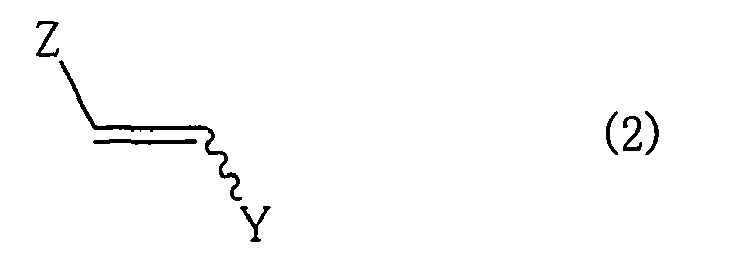
a compound of the formula (3) (c) an acid or a compound which generates a mineral acid by its hydrolysis.
 - The process according to Claim 1, wherein the reaction is conducted in the co-presence of water.
- The process according to Claim 1, wherein (c) an acid or a compound which generates a mineral acid by its hydrolysis is hydrogen halide.
- The process according to Claim 1, wherein (c) an acid or a compound which generates a mineral acid by its hydrolysis is phosphorus oxyhalide, phosphorus halide, thionyl halide or sulfuryl halide.
- The process according to Claim 1, wherein the reaction is conducted in acetic acid.
- The process according to Claim 1, wherein Ar in the formulae (1) and (4) is an aromatic group or a heteroaromatic group which may be substituted by at least one group selected from the group consisting of a lower alkyl, a lower alkoxyl, a hydroxyl, -ORx, an amino, -NHRy, -NRy 2, halogen and a phenyl optionally substituted by halogen(s),
wherein Rx represents a protective group of hydroxyl and Ry represents a protective group of amino. - The process according to Claim 1, wherein Ar in the formulae (1) and (4) is an optionally substituted phenyl.
- The process according to Claim 1, wherein Ar in the formulae (1) and (4) is an optionally substituted indolyl.
- The process according to Claim 1, wherein the compound of the formula (1) is a compound of the formula (5)

the compound of the formula (4) is a compound of the formula (6)
Applications Claiming Priority (3)
| Application Number | Priority Date | Filing Date | Title |
|---|---|---|---|
| JP2003209042 | 2003-08-27 | ||
| JP2003384566A JP4269902B2 (en) | 2003-08-27 | 2003-11-14 | Method for producing aromatic unsaturated compound |
| PCT/JP2004/012601 WO2005021465A1 (en) | 2003-08-27 | 2004-08-25 | Method for producing aromatic unsaturated compound |
Publications (3)
| Publication Number | Publication Date |
|---|---|
| EP1666440A1 true EP1666440A1 (en) | 2006-06-07 |
| EP1666440A4 EP1666440A4 (en) | 2007-07-18 |
| EP1666440B1 EP1666440B1 (en) | 2014-01-22 |
Family
ID=34277376
Family Applications (1)
| Application Number | Title | Priority Date | Filing Date |
|---|---|---|---|
| EP04772557.7A Expired - Lifetime EP1666440B1 (en) | 2003-08-27 | 2004-08-25 | Method for producing aromatic unsaturated compound |
Country Status (6)
| Country | Link |
|---|---|
| US (2) | US7700642B2 (en) |
| EP (1) | EP1666440B1 (en) |
| JP (1) | JP4269902B2 (en) |
| KR (1) | KR101109942B1 (en) |
| ES (1) | ES2445332T3 (en) |
| WO (1) | WO2005021465A1 (en) |
Families Citing this family (5)
| Publication number | Priority date | Publication date | Assignee | Title |
|---|---|---|---|---|
| JP4269902B2 (en) * | 2003-08-27 | 2009-05-27 | 住友化学株式会社 | Method for producing aromatic unsaturated compound |
| US7994357B2 (en) * | 2009-04-03 | 2011-08-09 | Naturewise Biotech & Medicals Corporation | Cinamic compounds and derivatives therefrom for the inhibition of histone deacetylase |
| JP6649263B2 (en) * | 2014-10-10 | 2020-02-19 | 株式会社エーピーアイ コーポレーション | Method for purifying statins |
| WO2019131544A1 (en) * | 2017-12-25 | 2019-07-04 | 三井化学株式会社 | Indole-based compound, method for producing said compound, and use thereof |
| JP7036671B2 (en) * | 2018-05-31 | 2022-03-15 | 三井化学株式会社 | Plastic container and composition for forming plastic container |
Family Cites Families (12)
| Publication number | Priority date | Publication date | Assignee | Title |
|---|---|---|---|---|
| US5118853A (en) * | 1988-10-13 | 1992-06-02 | Sandoz Ltd. | Processes for the synthesis of 3-disubstituted aminoacroleins |
| EP0512352B1 (en) * | 1991-05-09 | 1996-03-27 | F. Hoffmann-La Roche Ag | Substituted carboxylic acid derivatives |
| JPH0672957A (en) * | 1992-08-25 | 1994-03-15 | Nippon Bayeragrochem Kk | Production of trans-beta-substituted acrylic ester derivative |
| JP3750248B2 (en) * | 1997-01-31 | 2006-03-01 | 宇部興産株式会社 | Method for producing an acrylate ester having a substituent at the 3-position |
| DK0909751T3 (en) * | 1997-10-16 | 2002-05-13 | Sankyo Co | Process for the preparation of cinnamic acid esters |
| JP3786528B2 (en) * | 1997-10-16 | 2006-06-14 | 三共アグロ株式会社 | Process for producing cinnamic acid esters |
| JP2001081057A (en) * | 1999-09-09 | 2001-03-27 | Sumitomo Chem Co Ltd | Method for producing aromatic alkenes |
| CN1217930C (en) * | 2000-05-26 | 2005-09-07 | 西巴特殊化学品控股有限公司 | Process for preparation of indole derivatives and intermediates of the process |
| JP2005508320A (en) * | 2001-09-18 | 2005-03-31 | オンコノバ・セラピューティックス・インコーポレーテッド | Process for the preparation of 1,5-diaryl-3-substituted pyrazoles |
| JP4151350B2 (en) | 2002-08-13 | 2008-09-17 | 宇部興産株式会社 | Method for producing 3,4-dihydro-4-substituted-6,7-methylenedioxycoumarin |
| JP4269902B2 (en) * | 2003-08-27 | 2009-05-27 | 住友化学株式会社 | Method for producing aromatic unsaturated compound |
| CA2449182C (en) * | 2003-11-12 | 2008-02-26 | Phoenix Contact Gmbh & Co. Kg | Electrical connector |
-
2003
- 2003-11-14 JP JP2003384566A patent/JP4269902B2/en not_active Expired - Fee Related
-
2004
- 2004-08-25 US US10/569,486 patent/US7700642B2/en not_active Expired - Fee Related
- 2004-08-25 KR KR1020067003787A patent/KR101109942B1/en not_active Expired - Fee Related
- 2004-08-25 EP EP04772557.7A patent/EP1666440B1/en not_active Expired - Lifetime
- 2004-08-25 WO PCT/JP2004/012601 patent/WO2005021465A1/en not_active Ceased
- 2004-08-25 ES ES04772557.7T patent/ES2445332T3/en not_active Expired - Lifetime
-
2008
- 2008-12-30 US US12/346,494 patent/US7939674B2/en not_active Expired - Fee Related
Also Published As
| Publication number | Publication date |
|---|---|
| US7700642B2 (en) | 2010-04-20 |
| JP2005097227A (en) | 2005-04-14 |
| EP1666440B1 (en) | 2014-01-22 |
| KR20070000387A (en) | 2007-01-02 |
| US7939674B2 (en) | 2011-05-10 |
| US20090111999A1 (en) | 2009-04-30 |
| US20080221337A1 (en) | 2008-09-11 |
| WO2005021465A1 (en) | 2005-03-10 |
| JP4269902B2 (en) | 2009-05-27 |
| KR101109942B1 (en) | 2012-02-15 |
| ES2445332T3 (en) | 2014-03-03 |
| EP1666440A4 (en) | 2007-07-18 |
Similar Documents
| Publication | Publication Date | Title |
|---|---|---|
| JP7344518B2 (en) | Method for producing Vilsmeier reagent | |
| US7939674B2 (en) | Process for producing an aromatic unsaturated compound | |
| CN105693554B (en) | The preparation method of alanine derivatives | |
| CN113072436A (en) | Preparation method of benzyl aryl ether | |
| KR101726116B1 (en) | Asymmetric synthesis of a substituted pyrrolidine-2-carboxamide | |
| KR20060136357A (en) | Method for producing aromatic unsaturated compound | |
| EP3318550B1 (en) | Method for preparing a benzoic acid amide compound | |
| CN102127061B (en) | One prepares improving one's methods of fluoro-3, the 4-dihydro-2 H-1-benzopyran-2-epoxy ethanes of 6- | |
| CN100404479C (en) | Process for the preparation of aromatic unsaturated compounds | |
| CN115722266B (en) | Azacarbene-amino-ruthenium catalyst, and preparation method and application thereof | |
| KR101006737B1 (en) | Method for preparing 2-sulfonyliminoindolin using a copper catalyst | |
| Liu et al. | 4-(Nitro)-diphenylammonium triflate (NDPAT) catalysed esterification of carboxylic acids with alcohols | |
| JP4374088B2 (en) | Novel 4,4-difluorobenzazepine ketal derivative and method for producing 4,4-difluorobenzazepin-5-one derivative via the same | |
| JP4968602B2 (en) | Method for producing benzamide derivative | |
| JP5142241B2 (en) | Method for producing nicotinic acid ester compound | |
| CN118496141A (en) | Synthesis method of pyrrole alkoxy benzoate compound | |
| JPH0470294B2 (en) | ||
| KR910003636B1 (en) | Process for the preparation of benzophenon oxime compounds | |
| KR100230900B1 (en) | Pyrrolidine derivatives and preparation methods thereof | |
| EP0313740A2 (en) | N-phenyl-2,2,6,6-tetrahalocyclohexaneimine and processes for preparing 2,2,6,6-tetrahalocyclohexaneimine derivative and 2,6-dihaloaniline derivative | |
| KR20030055304A (en) | Process for the preparation of protected 1-(1-aminoalkyl)-oxiranes | |
| CN1629149A (en) | A kind of phase transfer catalyzed method for synthesizing α, β-epoxy ketone compound | |
| JPH0519540B2 (en) | ||
| KR20010034123A (en) | Process for the preparation of 3-methyl-2-oxoindoline | |
| KR20030062614A (en) | New manufacturing process of dihydrocarbostyril derivatives |
Legal Events
| Date | Code | Title | Description |
|---|---|---|---|
| PUAI | Public reference made under article 153(3) epc to a published international application that has entered the european phase |
Free format text: ORIGINAL CODE: 0009012 |
|
| 17P | Request for examination filed |
Effective date: 20060322 |
|
| AK | Designated contracting states |
Kind code of ref document: A1 Designated state(s): AT BE BG CH CY CZ DE DK EE ES FI FR GB GR HU IE IT LI LU MC NL PL PT RO SE SI SK TR |
|
| DAX | Request for extension of the european patent (deleted) | ||
| RIN1 | Information on inventor provided before grant (corrected) |
Inventor name: WANG, WEIQI Inventor name: IKEMOTO, TETSUYA |
|
| A4 | Supplementary search report drawn up and despatched |
Effective date: 20070620 |
|
| RIC1 | Information provided on ipc code assigned before grant |
Ipc: C07B 37/04 20060101AFI20050314BHEP Ipc: C07D 209/10 20060101ALI20070614BHEP Ipc: C07C 67/343 20060101ALI20070614BHEP Ipc: C07C 69/734 20060101ALI20070614BHEP Ipc: C07D 209/24 20060101ALI20070614BHEP |
|
| 17Q | First examination report despatched |
Effective date: 20090529 |
|
| REG | Reference to a national code |
Ref country code: DE Ref legal event code: R079 Ref document number: 602004044325 Country of ref document: DE Free format text: PREVIOUS MAIN CLASS: C07B0037040000 Ipc: C07D0209080000 |
|
| GRAP | Despatch of communication of intention to grant a patent |
Free format text: ORIGINAL CODE: EPIDOSNIGR1 |
|
| INTG | Intention to grant announced |
Effective date: 20130822 |
|
| RIC1 | Information provided on ipc code assigned before grant |
Ipc: C07B 37/04 20060101ALI20130812BHEP Ipc: C07D 209/18 20060101ALI20130812BHEP Ipc: C07D 209/08 20060101AFI20130812BHEP Ipc: C07D 209/24 20060101ALI20130812BHEP Ipc: C07D 209/10 20060101ALI20130812BHEP Ipc: C07C 69/734 20060101ALI20130812BHEP Ipc: C07D 209/12 20060101ALI20130812BHEP Ipc: C07C 67/343 20060101ALI20130812BHEP |
|
| GRAS | Grant fee paid |
Free format text: ORIGINAL CODE: EPIDOSNIGR3 |
|
| GRAA | (expected) grant |
Free format text: ORIGINAL CODE: 0009210 |
|
| AK | Designated contracting states |
Kind code of ref document: B1 Designated state(s): AT BE BG CH CY CZ DE DK EE ES FI FR GB GR HU IE IT LI LU MC NL PL PT RO SE SI SK TR |
|
| REG | Reference to a national code |
Ref country code: GB Ref legal event code: FG4D |
|
| REG | Reference to a national code |
Ref country code: CH Ref legal event code: NV Representative=s name: BOHEST AG, CH Ref country code: CH Ref legal event code: EP |
|
| REG | Reference to a national code |
Ref country code: AT Ref legal event code: REF Ref document number: 650737 Country of ref document: AT Kind code of ref document: T Effective date: 20140215 |
|
| REG | Reference to a national code |
Ref country code: IE Ref legal event code: FG4D |
|
| REG | Reference to a national code |
Ref country code: ES Ref legal event code: FG2A Ref document number: 2445332 Country of ref document: ES Kind code of ref document: T3 Effective date: 20140303 |
|
| REG | Reference to a national code |
Ref country code: DE Ref legal event code: R096 Ref document number: 602004044325 Country of ref document: DE Effective date: 20140306 |
|
| REG | Reference to a national code |
Ref country code: NL Ref legal event code: T3 |
|
| REG | Reference to a national code |
Ref country code: AT Ref legal event code: MK05 Ref document number: 650737 Country of ref document: AT Kind code of ref document: T Effective date: 20140122 |
|
| REG | Reference to a national code |
Ref country code: CH Ref legal event code: PCAR Free format text: NEW ADDRESS: HOLBEINSTRASSE 36-38, 4051 BASEL (CH) |
|
| PG25 | Lapsed in a contracting state [announced via postgrant information from national office to epo] |
Ref country code: AT Free format text: LAPSE BECAUSE OF FAILURE TO SUBMIT A TRANSLATION OF THE DESCRIPTION OR TO PAY THE FEE WITHIN THE PRESCRIBED TIME-LIMIT Effective date: 20140122 Ref country code: SE Free format text: LAPSE BECAUSE OF FAILURE TO SUBMIT A TRANSLATION OF THE DESCRIPTION OR TO PAY THE FEE WITHIN THE PRESCRIBED TIME-LIMIT Effective date: 20140122 Ref country code: CY Free format text: LAPSE BECAUSE OF FAILURE TO SUBMIT A TRANSLATION OF THE DESCRIPTION OR TO PAY THE FEE WITHIN THE PRESCRIBED TIME-LIMIT Effective date: 20140122 Ref country code: FI Free format text: LAPSE BECAUSE OF FAILURE TO SUBMIT A TRANSLATION OF THE DESCRIPTION OR TO PAY THE FEE WITHIN THE PRESCRIBED TIME-LIMIT Effective date: 20140122 Ref country code: PT Free format text: LAPSE BECAUSE OF FAILURE TO SUBMIT A TRANSLATION OF THE DESCRIPTION OR TO PAY THE FEE WITHIN THE PRESCRIBED TIME-LIMIT Effective date: 20140522 |
|
| PG25 | Lapsed in a contracting state [announced via postgrant information from national office to epo] |
Ref country code: BE Free format text: LAPSE BECAUSE OF FAILURE TO SUBMIT A TRANSLATION OF THE DESCRIPTION OR TO PAY THE FEE WITHIN THE PRESCRIBED TIME-LIMIT Effective date: 20140122 |
|
| REG | Reference to a national code |
Ref country code: DE Ref legal event code: R097 Ref document number: 602004044325 Country of ref document: DE |
|
| PG25 | Lapsed in a contracting state [announced via postgrant information from national office to epo] |
Ref country code: CZ Free format text: LAPSE BECAUSE OF FAILURE TO SUBMIT A TRANSLATION OF THE DESCRIPTION OR TO PAY THE FEE WITHIN THE PRESCRIBED TIME-LIMIT Effective date: 20140122 Ref country code: DK Free format text: LAPSE BECAUSE OF FAILURE TO SUBMIT A TRANSLATION OF THE DESCRIPTION OR TO PAY THE FEE WITHIN THE PRESCRIBED TIME-LIMIT Effective date: 20140122 Ref country code: RO Free format text: LAPSE BECAUSE OF FAILURE TO SUBMIT A TRANSLATION OF THE DESCRIPTION OR TO PAY THE FEE WITHIN THE PRESCRIBED TIME-LIMIT Effective date: 20140122 Ref country code: EE Free format text: LAPSE BECAUSE OF FAILURE TO SUBMIT A TRANSLATION OF THE DESCRIPTION OR TO PAY THE FEE WITHIN THE PRESCRIBED TIME-LIMIT Effective date: 20140122 |
|
| PG25 | Lapsed in a contracting state [announced via postgrant information from national office to epo] |
Ref country code: SK Free format text: LAPSE BECAUSE OF FAILURE TO SUBMIT A TRANSLATION OF THE DESCRIPTION OR TO PAY THE FEE WITHIN THE PRESCRIBED TIME-LIMIT Effective date: 20140122 Ref country code: PL Free format text: LAPSE BECAUSE OF FAILURE TO SUBMIT A TRANSLATION OF THE DESCRIPTION OR TO PAY THE FEE WITHIN THE PRESCRIBED TIME-LIMIT Effective date: 20140122 |
|
| PLBE | No opposition filed within time limit |
Free format text: ORIGINAL CODE: 0009261 |
|
| STAA | Information on the status of an ep patent application or granted ep patent |
Free format text: STATUS: NO OPPOSITION FILED WITHIN TIME LIMIT |
|
| 26N | No opposition filed |
Effective date: 20141023 |
|
| REG | Reference to a national code |
Ref country code: DE Ref legal event code: R097 Ref document number: 602004044325 Country of ref document: DE Effective date: 20141023 |
|
| PG25 | Lapsed in a contracting state [announced via postgrant information from national office to epo] |
Ref country code: LU Free format text: LAPSE BECAUSE OF FAILURE TO SUBMIT A TRANSLATION OF THE DESCRIPTION OR TO PAY THE FEE WITHIN THE PRESCRIBED TIME-LIMIT Effective date: 20140825 Ref country code: MC Free format text: LAPSE BECAUSE OF FAILURE TO SUBMIT A TRANSLATION OF THE DESCRIPTION OR TO PAY THE FEE WITHIN THE PRESCRIBED TIME-LIMIT Effective date: 20140122 |
|
| PG25 | Lapsed in a contracting state [announced via postgrant information from national office to epo] |
Ref country code: SI Free format text: LAPSE BECAUSE OF FAILURE TO SUBMIT A TRANSLATION OF THE DESCRIPTION OR TO PAY THE FEE WITHIN THE PRESCRIBED TIME-LIMIT Effective date: 20140122 |
|
| REG | Reference to a national code |
Ref country code: FR Ref legal event code: PLFP Year of fee payment: 12 |
|
| PGFP | Annual fee paid to national office [announced via postgrant information from national office to epo] |
Ref country code: NL Payment date: 20150809 Year of fee payment: 12 |
|
| PGFP | Annual fee paid to national office [announced via postgrant information from national office to epo] |
Ref country code: IE Payment date: 20150810 Year of fee payment: 12 Ref country code: CH Payment date: 20150811 Year of fee payment: 12 Ref country code: DE Payment date: 20150818 Year of fee payment: 12 Ref country code: ES Payment date: 20150713 Year of fee payment: 12 Ref country code: GB Payment date: 20150819 Year of fee payment: 12 |
|
| PGFP | Annual fee paid to national office [announced via postgrant information from national office to epo] |
Ref country code: FR Payment date: 20150629 Year of fee payment: 12 |
|
| PGFP | Annual fee paid to national office [announced via postgrant information from national office to epo] |
Ref country code: IT Payment date: 20150827 Year of fee payment: 12 |
|
| PG25 | Lapsed in a contracting state [announced via postgrant information from national office to epo] |
Ref country code: BG Free format text: LAPSE BECAUSE OF FAILURE TO SUBMIT A TRANSLATION OF THE DESCRIPTION OR TO PAY THE FEE WITHIN THE PRESCRIBED TIME-LIMIT Effective date: 20140122 |
|
| PG25 | Lapsed in a contracting state [announced via postgrant information from national office to epo] |
Ref country code: GR Free format text: LAPSE BECAUSE OF FAILURE TO SUBMIT A TRANSLATION OF THE DESCRIPTION OR TO PAY THE FEE WITHIN THE PRESCRIBED TIME-LIMIT Effective date: 20140423 |
|
| PG25 | Lapsed in a contracting state [announced via postgrant information from national office to epo] |
Ref country code: HU Free format text: LAPSE BECAUSE OF FAILURE TO SUBMIT A TRANSLATION OF THE DESCRIPTION OR TO PAY THE FEE WITHIN THE PRESCRIBED TIME-LIMIT; INVALID AB INITIO Effective date: 20040825 Ref country code: TR Free format text: LAPSE BECAUSE OF FAILURE TO SUBMIT A TRANSLATION OF THE DESCRIPTION OR TO PAY THE FEE WITHIN THE PRESCRIBED TIME-LIMIT Effective date: 20140122 |
|
| REG | Reference to a national code |
Ref country code: DE Ref legal event code: R119 Ref document number: 602004044325 Country of ref document: DE |
|
| REG | Reference to a national code |
Ref country code: CH Ref legal event code: PL |
|
| REG | Reference to a national code |
Ref country code: NL Ref legal event code: MM Effective date: 20160901 |
|
| GBPC | Gb: european patent ceased through non-payment of renewal fee |
Effective date: 20160825 |
|
| PG25 | Lapsed in a contracting state [announced via postgrant information from national office to epo] |
Ref country code: CH Free format text: LAPSE BECAUSE OF NON-PAYMENT OF DUE FEES Effective date: 20160831 Ref country code: LI Free format text: LAPSE BECAUSE OF NON-PAYMENT OF DUE FEES Effective date: 20160831 |
|
| REG | Reference to a national code |
Ref country code: FR Ref legal event code: ST Effective date: 20170428 |
|
| REG | Reference to a national code |
Ref country code: IE Ref legal event code: MM4A |
|
| PG25 | Lapsed in a contracting state [announced via postgrant information from national office to epo] |
Ref country code: NL Free format text: LAPSE BECAUSE OF NON-PAYMENT OF DUE FEES Effective date: 20160901 |
|
| PG25 | Lapsed in a contracting state [announced via postgrant information from national office to epo] |
Ref country code: IE Free format text: LAPSE BECAUSE OF NON-PAYMENT OF DUE FEES Effective date: 20160825 Ref country code: FR Free format text: LAPSE BECAUSE OF NON-PAYMENT OF DUE FEES Effective date: 20160831 Ref country code: GB Free format text: LAPSE BECAUSE OF NON-PAYMENT OF DUE FEES Effective date: 20160825 Ref country code: DE Free format text: LAPSE BECAUSE OF NON-PAYMENT OF DUE FEES Effective date: 20170301 |
|
| PG25 | Lapsed in a contracting state [announced via postgrant information from national office to epo] |
Ref country code: IT Free format text: LAPSE BECAUSE OF NON-PAYMENT OF DUE FEES Effective date: 20160825 |
|
| PG25 | Lapsed in a contracting state [announced via postgrant information from national office to epo] |
Ref country code: ES Free format text: LAPSE BECAUSE OF NON-PAYMENT OF DUE FEES Effective date: 20160826 |
|
| REG | Reference to a national code |
Ref country code: ES Ref legal event code: FD2A Effective date: 20181128 |