EP1665645B1 - Mobil-ad-hoc-netzwerk (manet) zur bereitstellung von konnektivitätsverbesserungsmerkmalen und diesbezügliche verfahren - Google Patents
Mobil-ad-hoc-netzwerk (manet) zur bereitstellung von konnektivitätsverbesserungsmerkmalen und diesbezügliche verfahren Download PDFInfo
- Publication number
- EP1665645B1 EP1665645B1 EP04782831A EP04782831A EP1665645B1 EP 1665645 B1 EP1665645 B1 EP 1665645B1 EP 04782831 A EP04782831 A EP 04782831A EP 04782831 A EP04782831 A EP 04782831A EP 1665645 B1 EP1665645 B1 EP 1665645B1
- Authority
- EP
- European Patent Office
- Prior art keywords
- qos
- protocol layer
- threshold
- wireless communications
- communications device
- Prior art date
- Legal status (The legal status is an assumption and is not a legal conclusion. Google has not performed a legal analysis and makes no representation as to the accuracy of the status listed.)
- Expired - Lifetime
Links
Images

Classifications
-
- H—ELECTRICITY
- H04—ELECTRIC COMMUNICATION TECHNIQUE
- H04W—WIRELESS COMMUNICATION NETWORKS
- H04W52/00—Power management, e.g. Transmission Power Control [TPC] or power classes
- H04W52/04—Transmission power control [TPC]
- H04W52/38—TPC being performed in particular situations
- H04W52/46—TPC being performed in particular situations in multi-hop networks, e.g. wireless relay networks
-
- H—ELECTRICITY
- H04—ELECTRIC COMMUNICATION TECHNIQUE
- H04L—TRANSMISSION OF DIGITAL INFORMATION, e.g. TELEGRAPHIC COMMUNICATION
- H04L12/00—Data switching networks
- H04L12/28—Data switching networks characterised by path configuration, e.g. LAN [Local Area Networks] or WAN [Wide Area Networks]
-
- H—ELECTRICITY
- H04—ELECTRIC COMMUNICATION TECHNIQUE
- H04J—MULTIPLEX COMMUNICATION
- H04J3/00—Time-division multiplex systems
- H04J3/24—Time-division multiplex systems in which the allocation is indicated by an address the different channels being transmitted sequentially
- H04J3/26—Time-division multiplex systems in which the allocation is indicated by an address the different channels being transmitted sequentially in which the information and the address are simultaneously transmitted
-
- H—ELECTRICITY
- H04—ELECTRIC COMMUNICATION TECHNIQUE
- H04L—TRANSMISSION OF DIGITAL INFORMATION, e.g. TELEGRAPHIC COMMUNICATION
- H04L45/00—Routing or path finding of packets in data switching networks
-
- H—ELECTRICITY
- H04—ELECTRIC COMMUNICATION TECHNIQUE
- H04L—TRANSMISSION OF DIGITAL INFORMATION, e.g. TELEGRAPHIC COMMUNICATION
- H04L45/00—Routing or path finding of packets in data switching networks
- H04L45/12—Shortest path evaluation
- H04L45/123—Evaluation of link metrics
-
- H—ELECTRICITY
- H04—ELECTRIC COMMUNICATION TECHNIQUE
- H04L—TRANSMISSION OF DIGITAL INFORMATION, e.g. TELEGRAPHIC COMMUNICATION
- H04L45/00—Routing or path finding of packets in data switching networks
- H04L45/302—Route determination based on requested QoS
-
- H—ELECTRICITY
- H04—ELECTRIC COMMUNICATION TECHNIQUE
- H04W—WIRELESS COMMUNICATION NETWORKS
- H04W40/00—Communication routing or communication path finding
- H04W40/02—Communication route or path selection, e.g. power-based or shortest path routing
-
- H—ELECTRICITY
- H04—ELECTRIC COMMUNICATION TECHNIQUE
- H04W—WIRELESS COMMUNICATION NETWORKS
- H04W40/00—Communication routing or communication path finding
- H04W40/02—Communication route or path selection, e.g. power-based or shortest path routing
- H04W40/12—Communication route or path selection, e.g. power-based or shortest path routing based on transmission quality or channel quality
-
- H—ELECTRICITY
- H04—ELECTRIC COMMUNICATION TECHNIQUE
- H04W—WIRELESS COMMUNICATION NETWORKS
- H04W52/00—Power management, e.g. Transmission Power Control [TPC] or power classes
- H04W52/04—Transmission power control [TPC]
-
- H—ELECTRICITY
- H04—ELECTRIC COMMUNICATION TECHNIQUE
- H04W—WIRELESS COMMUNICATION NETWORKS
- H04W84/00—Network topologies
- H04W84/18—Self-organising networks, e.g. ad-hoc networks or sensor networks
-
- H—ELECTRICITY
- H04—ELECTRIC COMMUNICATION TECHNIQUE
- H04L—TRANSMISSION OF DIGITAL INFORMATION, e.g. TELEGRAPHIC COMMUNICATION
- H04L12/00—Data switching networks
- H04L12/02—Details
- H04L12/16—Arrangements for providing special services to substations
- H04L12/18—Arrangements for providing special services to substations for broadcast or conference, e.g. multicast
- H04L12/1863—Arrangements for providing special services to substations for broadcast or conference, e.g. multicast comprising mechanisms for improved reliability, e.g. status reports
- H04L12/1868—Measures taken after transmission, e.g. acknowledgments
-
- H—ELECTRICITY
- H04—ELECTRIC COMMUNICATION TECHNIQUE
- H04W—WIRELESS COMMUNICATION NETWORKS
- H04W40/00—Communication routing or communication path finding
- H04W40/02—Communication route or path selection, e.g. power-based or shortest path routing
- H04W40/04—Communication route or path selection, e.g. power-based or shortest path routing based on wireless node resources
- H04W40/08—Communication route or path selection, e.g. power-based or shortest path routing based on wireless node resources based on transmission power
-
- Y—GENERAL TAGGING OF NEW TECHNOLOGICAL DEVELOPMENTS; GENERAL TAGGING OF CROSS-SECTIONAL TECHNOLOGIES SPANNING OVER SEVERAL SECTIONS OF THE IPC; TECHNICAL SUBJECTS COVERED BY FORMER USPC CROSS-REFERENCE ART COLLECTIONS [XRACs] AND DIGESTS
- Y02—TECHNOLOGIES OR APPLICATIONS FOR MITIGATION OR ADAPTATION AGAINST CLIMATE CHANGE
- Y02D—CLIMATE CHANGE MITIGATION TECHNOLOGIES IN INFORMATION AND COMMUNICATION TECHNOLOGIES [ICT], I.E. INFORMATION AND COMMUNICATION TECHNOLOGIES AIMING AT THE REDUCTION OF THEIR OWN ENERGY USE
- Y02D30/00—Reducing energy consumption in communication networks
- Y02D30/70—Reducing energy consumption in communication networks in wireless communication networks
Definitions
- MANETs mobile ad hoc networks
- cellular networks or satellite networks the most distinctive feature of MANETS is the lack of any fixed infrastructure.
- the network is formed of mobile (and potentially stationary) nodes, and is created on the fly as the nodes communicate with each other. The network does not depend on a particular node and dynamically adjusts as some nodes join or others leave the network.
- MANET In a hostile environment where a fixed communication infrastructure is unreliable or unavailable, such as in a battle field or in a natural disaster area struck by earthquake or hurricane, a MANET can be quickly deployed to provide much needed communications. While the military is still a major driving force behind the development of these networks, ad hoc networks are quickly finding new applications in civilian or commercial areas. MANETs will allow people and applications to exchange data in the field or in a class room without using any network structure except that which they create by simply turning on their computers or PDAs.
- nodes must self-organize and reconfigure as they move, join or leave the network. All nodes are essentially the same, and there is no natural hierarchy or central controller in the network. All functions have to be distributed among the nodes. Nodes are often powered by batteries and have limited communication and computation capabilities. Also, the bandwidth of the system is usually limited. The distance between two nodes often exceeds the radio transmission range, and a transmission may have to be relayed by other nodes before reaching its destination. Consequently, a MANET network typically has a multi-hop topology, and this topology changes as the nodes move around.
- the MANET working group of the Internet Engineering Task Force has been actively evaluating and standardizing routing protocols, including multicasting protocols. Because the network topology changes arbitrarily as the nodes move, information is subject to becoming obsolete, and different nodes often have different views of the network, both in time (information may be outdated at some nodes but current at others) and in space (a node may only know the network topology in its neighborhood and not far away from itself).
- a routing protocol needs to adapt to frequent topology changes, possibly with less than accurate information. Because of these unique requirements, routing in these networks is very different than in others. Gathering fresh information about the entire network is often costly and impractical. Some routing protocols are reactive (i.e., on-demand) protocols. That is, they collect routing information only when necessary and only to destinations to which they need routes, and do not maintain unused routes. In this way the routing overhead may be reduced compared to pro-active protocols, which maintain optimal routes to all destinations at all time.
- Ad Hoc on Demand Distance Vector (AODV), Dynamic Source Routing (DSR) and Temporally Ordered Routing Algorithm (TORA) are representatives of reactive routing protocols presented at the MANET working group.
- a proactive routing protocol is found in Clausen et al. entitled "Optimized Link State Routing Protocol," Internet Engineering Task Force (IETF) MANET Working Group, Internet Draft, October 31, 2001 .
- Examples of other various routing protocols include Destination Sequenced Distance-Vector (DSDV) routing which is disclosed in U.S. Patent No. 5,412,654 to Perkins , and the Zone Routing Protocol (ZRP) which is disclosed in U.S. Patent No. 6,304,556 to Haas .
- DSDV Destination Sequenced Distance-Vector
- ZRP Zone Routing Protocol
- ZRP is a hybrid protocol using both proactive and reactive approaches.
- QoS routing in MANETs is gaining interest.
- a protocol needs not only to find a route but also to identify and/or secure the resources along the route.
- nodes must negotiate with each other to manage the resources required for QoS routes. This is further complicated by frequent topology changes. Due to these constraints, QoS routing is more demanding than best-effort or minimum-hop routing.
- QoS routing approaches are set forth by Chenxi Zhu in the publication entitled “Medium Access Control and Quality-of-Service Routing for Mobile Ad Hoc Networks," 2001 , and by M. Mirhakkak et al. in the publication entitled “Dynamic Quality-of-Service for Mobile Ad Hoc Networks," MITRE Corp., 2000 .
- Zhu discusses establishing bandwidth guaranteed QoS routes in small networks whose topologies change at a low to medium rate.
- Mirhakkak et al. are concerned with resource reservation requests that specify a range of QoS values while the network makes a commitment to provide service within this range.
- Document US 2002/0013856 A1 discloses a routing approach for a mobile ad-hoc network.
- the approach of disclosed therein includes using various cost metrics for a computer network. Among these are measures of interference over time to neighbor nodes of a first node of the computer network per data bit transmitted on a communication link used by the first node. Further disclosed using cost metric as a measure of the quality of a wireless communication link within the computer network.
- Local routing information maintained by a first node of a computer network may be used to determine whether alternate paths exist to a neighbor node of the first node, using a sequence of one or more links other than a candidate link through the computer network and compute a link quality of the candidate link. Then, if no alternate path exists to the neighbor node, or the link quality of the candidate link exceeds a defined threshold value, the candidate link may be accepted.
- Document US 2003/0161268 A1 discloses a cross-layer integration of functions on several protocol layers of the network into a single unified mechanism by means of integrated optimization of a single objective function with respect to connection parameters on at least three protocol layers: the network layer, the link layer and the physical layer. Other layers can be also used, for instance the three lowest levels can be optimized in combination with an adaptive application on the application layer.
- the unified approach partially or completely eliminates the need for a layered representation. Instead of having several separate optimization algorithms executing more or less independently on the different protocol layers, a single unified optimization is performed. Connections are preferably determined by integrated optimization of a given objective function with respect to connection parameters on at least three protocol layers within the network.
- SCR Synchronous Collision Resolution
- NSR Node State Routing
- a MANET may include a plurality of mobile nodes each including a wireless communications device and a controller connected thereto operating in accordance with a multi-layer protocol hierarchy. More particularly, the controller may, at an upper protocol layer, establish a quality-of-service (QoS) threshold. Further, at at least one intermediate protocol layer below the upper protocol layer, the controller may select at least one route for transmitting data to at least one destination mobile node based upon the QoS threshold, and determine whether a QoS metric for the selected route falls below the QoS threshold.
- QoS quality-of-service
- the controller may cooperate with the wireless communications device to determine the QoS metric for the at least one selected route, and transmit data to the at least one destination mobile node via the at least one selected route.
- the controller may also cooperate with the wireless communications device at the lower protocol layer to adjust signal transmission power based upon a determination that the QoS metric has fallen below the QoS threshold.
- the controller may further cooperate with the wireless communications device at the lower protocol layer to adjust signal transmission gain in a desired direction based upon a determination that the QoS metric has fallen below the QoS threshold.
- the wireless communications device may provide an adjustable signal (i.e., antenna) transmission pattern.
- the controller may also cooperate with the wireless communications device to adjust the signal transmission pattern based upon a determination that the QoS metric has fallen below the QoS threshold.
- the controller may advantageously adjust its signal range (i.e., by adjusting its transmission power) to incorporate more mobile nodes, or provide greater connectivity to nodes already within its signal range. Moreover, such adjustments may also advantageously be used to adjust signal range so that the controller is not causing interference with an adjacent mobile node or nodes in the network.
- the controller may encode data prior to transmission.
- the controller may thus adjust the amount of encoding it performs based upon a determination that the QoS metric has fallen below the QoS threshold, which may also be used to improve connectivity and/or reduce interference between nodes.
- the controller may cooperate with the wireless communications device to modulate the data using a first modulation technique if the QoS metric is greater than or equal to the QoS threshold, and otherwise using a second modulation technique. That is, the controller may switch between modulation techniques to increase signal connectivity or reduce interference as network topology changes to maintain the QoS threshold.
- the controller may cooperate with the wireless communications device to transmit data at a data rate.
- the controller may also cooperate with the wireless communications device to adjust the data rate based upon a determination that the QoS metric has fallen below the QoS threshold, again providing enhanced connectivity or reduced interference as necessary.
- the upper protocol layer may be an application layer.
- the at least one intermediate protocol layer may include one or more of a session layer, a transport layer, a network layer, and a radio transport layer.
- the lower protocol layer may be a physical layer.
- the QoS threshold may be based upon at least one of available bandwidth, error rate, end-to-end delay, end-to-end delay variation (i.e., jitter), hop count, expected path durability, and priority, for example.
- a method aspect of the invention is for operating a mobile node in a MANET, such as the one described briefly above, in accordance with a multi-layer protocol hierarchy.
- the method may include, at an upper protocol layer, establishing a quality-of-service (QoS) threshold. Furthermore, at at least one intermediate protocol layer below the upper protocol layer, at least one route may be selected for transmitting data to at least one destination mobile node based upon the QoS threshold, and it may also be determined whether a QoS metric for the selected route falls below the QoS threshold.
- QoS quality-of-service
- the method may also include using the wireless communications device to determine the QoS metric for the at least one selected route, causing the wireless communications device to transmit data to the at least one destination mobile node via the at least one selected route.
- the wireless communications device may also be caused to adjust signal transmission power at this layer based upon a determination that the QoS metric has fallen below the QoS threshold.
- the method may further include causing the wireless communications device to adjust signal transmission gain in a desired direction and/or a signal transmission pattern based upon a determination that the QoS metric has fallen below the QoS threshold.
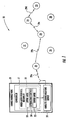
- a MANET 20 in accordance with the present invention illustratively includes a plurality of mobile nodes 21-28.
- the mobile node 21 functions as a source node, while the mobile node 25 functions as a destination node with which the source node seeks to communicate.
- the nodes 21-28 may be any suitable type of mobile device capable of communicating within a MANET such as computers, personal data assistants (PDAs), etc., including a wireless communications device 30, for example, and other devices which will be appreciated by those of skill in the art.
- PDAs personal data assistants
- wireless communications device 30 for example, and other devices which will be appreciated by those of skill in the art.
- certain of the nodes 21-28 may optionally be connected to a fixed communication infrastructure in some applications, if desired.
- the source mobile node 21 further illustratively includes a controller 31, the operation of which will be described below.
- the controller 31 may be implemented using microprocessors, memory, software, etc., as will be appreciated by those of skill in the art.
- the wireless communications device 30 may include wireless modems, wireless local area network (LAN) devices, cellular telephone devices, etc., as well as an associated antenna(s), as illustratively shown.
- LAN wireless local area network
- cellular telephone devices etc.
- an associated antenna(s) as illustratively shown.
- one or more phased array antennas may be used, as will be_appreciated by those skilled in the art.
- the mobile nodes 23-28 also preferably include suitable wireless communications devices/controllers as well, which are not shown in FIG. 1 for clarity of illustration.
- One function that the controller 31 performs is to establish one or more routes between the source mobile node 21 and the destination mobile node 25 for transferring data therebetween.
- a single route is illustratively shown in the exemplary embodiment that passes through mobile nodes 22-24 and includes wireless communications links 29a-29d. It should be noted that while only a single route is shown for clarity of illustration, any number of routes may be used in accordance with the present invention.
- MANET routes may include any number of intermediate nodes therein depending upon network size and proximity between the nodes, for example.
- Each intermediate node along a route is typically referred to as a "hop,” thus routes passing through multiple intermediate nodes are sometimes referred to as "multi-hop" routes.
- hop routes passing through multiple intermediate nodes
- multi-hop routes passing through multiple intermediate nodes
- controller 31 establishes routes will depend upon the particular MANET routing protocol being implemented in the MANET 20. As noted above, this may be done using proactive protocols that keep routing information continuously up to date, reactive protocols which discover routes on-demand when there is a need to send data to the destination node 22, or by a combination thereof. Any suitable MANET protocols may be used in accordance with the present invention to establish routes, such as those previously discussed above, for example.
- OSI open system interconnection
- the OSI is a network protocol hierarchy which includes seven different control layers, namely (from highest to lowest) the application layer, presentation layer, session layer, transport layer, network layer, data link layer, and physical layer.
- control is passed from one layer to the next at an originating node or terminal starting at the application layer and proceeding to the physical layer.
- the data is then sent across the network, and when it reaches the destination terminal/node, it is processed in reverse order back up the hierarchy (i.e., from the physical layer to the application layer).
- data corresponding to each particular layer is typically organized in protocol data units (PDUs) referred to as packets at the network level.
- PDUs protocol data units
- the controller 31 similarly operates in accordance with a multi-layer protocol hierarchy 32 to provide an integrated framework for QoS operations.
- the multi-layer protocol hierarchy includes an upper protocol layer 33, one or more intermediate protocol layers 34, and a lower protocol layer 35 over which complementary QoS operations are performed to provide enhanced QoS functionality.
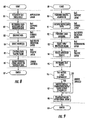
- the controller 31 may, at an application layer 36', establish a quality-of-service (QoS) threshold for data transfer across the MANET 20 (Block 81 ). More particularly, the application layer 36' is preferably the layer at which the data to be transmitted is created or processed.
- QoS quality-of-service
- the QoS threshold (or type of service, TOS) will vary depending upon the particular application that is being run at this upper layer. For example, time sensitive data, such as video or audio data, may require a greater QoS threshold to maintain the integrity thereof than text data files.
- time sensitive data such as video or audio data
- QoS threshold may be defined by the total end-to-end delay that can be tolerated for data transmissions.
- QoS parameters may be used in accordance with the present invention for defining a QoS threshold. For example, such parameters may include one or more of available bandwidth, error rate, end-to-end delay variation, hop count, expected path durability, priority, etc., as will be appreciated by those skilled in the art.
- the controller 31 determines whether to require data reception acknowledgements based upon the QoS threshold and mode, at Block 82. That is, in some circumstances it will be desirable to have receiving mobile nodes acknowledge (“Ack") receipt of transmitted data, and/or inform the source mobile node 21 when correct receipt of the data cannot be acknowledged (“Nack”), as will be appreciated by those skilled in the art.
- the QoS support layer 37' may conceptually be thought of as a session and/or transport layer with respect to the OSI model, as illustratively shown in FIG. 2 .
- Data packet reception acknowledgement may be particularly useful, for example, when the source mobile node 21 needs to perform a "reliable" multicast operation to adjacent nodes.
- the source mobile node 21 may need to send updated network topology information or other control data to the other nodes in its cluster.
- the source mobile node 21 can request that these nodes acknowledge receipt of this important data.
- data acknowledgements can be used in many other circumstances as needed based upon the importance of the data and the overhead that will be required for the extra Ack/Nack transmissions.
- the controller 31 may determine whether to admit traffic from other mobile nodes based upon respective QoS route requests received therefrom and an internal QoS metric for the source node 21. That is, the controller 31 essentially determines what type of traffic that it can presently support based upon its own QoS requirements/resources and those of other mobile nodes requesting access to the resources of the source node 21.
- the internal QoS metric may include one or more of available power, available bandwidth, recent error rate, and recent delay.
- the admission control operations are shown as being performed in a block 47' separate from the QoS support layer 37' in FIG. 2 . However, some or all of these operations may be performed by the same controller or processor at the QoS support layer 37' (although they could be performed by separate processors and at other layers as well). Further details regarding such admission control operations are provided in co-pending U.S. Application Serial No. 10/134,173 filed April 29, 2002 and assigned to the present Assignee .
- the controller 31 encodes data from the application layer 36' for transmission to the destination mobile node (or nodes) 25, at Block 83.
- data packets received from other mobile nodes to be used by the controller 31 of the application layer 36' may also be decoded at the QoS packet coding layer 38' as well as using a complementary decoding algorithm to the encoding algorithm used by a sending mobile node.
- One particularly advantageous coding approach is for the controller 31 to encode data using a forward error correction (FEC) algorithm to generate error correction data for the data based upon the QoS threshold. Moreover, the controller 31 may also select a plurality of routes for transmitting data to the destination mobile node 25. In such case, the controller 31 may advantageously interleave the error correction data and the data packets to be transmitted and distribute the interleaved data across the plurality of selected routes, at Block 91.
- FEC forward error correction
- the MANET By performing FEC and distributing the interleaved data across a plurality of routes, the MANET thus allows corrupted data packets to be corrected even when one of the routes is lost, allowing transmission to continue while a new route is established, if necessary. Moreover, the additional amount of data associated with the FEC encoding may be spread across the plurality of routes, thus mitigating the increased bandwidth requirements. Further details regarding the FEC/interleaving operations that may be performed at the QoS packet coding layer 38' are provided in co-pending U.S. Application Serial No. 10/369,313 filed February 19, 2003 and assigned to the present assigne.
- Route selection may be performed at a QoS route selection layer 39' below the QoS coding layer 38', at Block 84.
- the controller 31 causes QoS route requests to be sent to adjacent mobile nodes to discover potential routes to a desired destination mobile node (or nodes). Route confirmations are then returned to the source mobile node 21 which include an indication or metric of what QoS level(s) the route can support or provide. A list of available routes may then be stored in a routing table 45', from which the controller 31 selects a desired route(s) based upon a routing algorithm.
- the controller 31 may optionally perform load-leveling at the QoS route selection layer 39' on outgoing data based upon the QoS threshold and an energy usage level (i.e., power) required to transmit the outgoing data.
- an energy usage level i.e., power
- load-leveling operations are provided in a co-pending application entitled LOAD LEVELING IN MOBILE AD-HOC NETWORKS TO SUPPORT END-TO-END DELAY REDUCTION, QoS AND ENERGY LEVELLING, attorney docket no. GCSD-1470 (51336).
- the controller 31 preferably selects between a unicast communications mode and a multicast communications mode, at Block 93. More particularly, the controller 31 may dictate at the application layer 36' the particular type of communications mode to be selected at the QoS forwarding layer 40' for a given application (e.g., reliable multicast communications for cluster leader node broadcasts).
- a particular communications mode may not necessarily be specified at the application layer 36'.
- the controller 31 may determine which communications mode is appropriate based upon the QoS threshold. Of course, this determination may also take into account other factors, such as availability of particular wireless communications device 30 resources, whether a particular type of transmission is likely to cause unintended interference with other mobile nodes, etc. In particular, even if a particular communications mode has been specified at the application layer 36', the controller may determine at the QoS forwarding layer 40' that based upon one or more of the above-noted factors a different communications mode should be used.
- the controller 31 preferably controls data traffic flow and may also manage its data queue(s) to maintain the QoS threshold, at Block 85.
- the above-noted QoS route requests may have respective traffic flow identifiers and second QoS thresholds or ceilings associated therewith.
- the controller 31 may advantageously police admitted traffic based upon respective traffic flow identifiers to ensure that the admitted traffic does not exceed respective second QoS thresholds, at Block 94. Further details regarding such traffic policing is provided in co-pending U.S. Application Serial No. 10/134,714 filed April 29, 2002 assigned to the present Assignee.
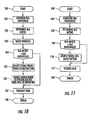
- the controller 31 cooperates with the wireless communications device 30 to transmit data to the destination mobile node 25 via the selected route(s) based upon the commands/data provided from the higher layers, as will be appreciated by those skilled in the art, thus concluding the method illustrated in FIG. 8 (Block 87 ).
- the controller 31 may advantageously cooperate with the wireless communications device 30 to transmit the data based upon the particular communications mode selected. That is, various signal transmission characteristics may be adjusted or tailored depending upon the particular type of communications mode that is being used, as well as QoS metrics for the selected route(s), at Blocks 95-98, thus concluding the method illustrated in FIG. 9 (Block 99 ). Adjustment of signal transmission and reception characteristics will be discussed further below.
- the lower protocol layers of the hierarchy 32' preferably include a radio adaptation layer 42' below the QoS traffic layer 41' , a media access (MAC) layer 43' below the radio adaptation layer, and a physical (PHY) layer 44' below the MAC layer.
- the radio adaptation layer 42' provides an interface between the upper protocol layers and the MAC and PHY layers, the latter of which is where the controller 31 physically interfaces with the wireless communications device 30.
- other layers may be included within the hierarchy 32' as well, such as a link layer, for example, and that certain of the functions described herein may be implemented at different layers in certain embodiments.
- the controller 31 preferably cooperates with the wireless communications device 30 to determine a QoS metric for the selected route(s), at Block 95 , which may be used to determine whether any QoS adjustments need to be made, or whether communications are simply no longer possible over the route.
- QoS metrics are not only used for maintaining a QoS for an established route, but they are also typically used for route discovery and selection, which is illustratively shown in FIG. 2 by the operational block 46'.
- the block 46' is shown separate from the radio adaptation layer 42' for clarity of illustration, the operations illustrated therein may in fact be performed at the radio adaptation layer (or other layers).
- the controller 31 at the QoS route selection layer 39' may determine if the QoS metric falls below the QoS threshold, at Block 96. If it does, at the physical layer 44', the controller 31 may cooperate with the wireless communications device 30 to adjust one or more signal characteristics to improve the QoS metric, at Block 97 .
- a first example is when the QoS metric indicates that signal connectivity to a desired mobile node, such as a next mobile node along a selected route, has diminished to an undesirable level (e.g., below the QoS threshold).
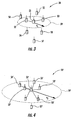
- the source mobile node transmits over an area 59' defined by the radius r 1 .
- the controller 31 cooperates with the wireless communications device 30 at the PHY layer 44' to increase signal transmission power, as illustratively shown in FIG. 4 .
- the determination of reduced signal connectivity can be made based upon one or more QoS factors, such as error rate, received signal strength, etc., as will be appreciated by those skilled in the art.
- the transmission area 59' of the MANET 50' is now defined by a circle with a radius r 2 greater than the radius r 1 .
- the source mobile node 51 had initially been communicating with the mobile node 54 and it moves out of range (as in FIG. 3 )
- increasing the signal transmission power causes this node to be within the transmission area 59'.
- the opposite approach may be taken to avoid causing interference to adjacent neighboring mobile nodes unintentionally.
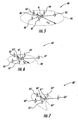
- the MANET 60 shown in FIG. 5 which illustratively includes a source mobile node 61 and a neighboring mobile node 62 that are interfering with one another.
- a transmission from the source mobile node 61 to a mobile node 63-67 causes unintended interference at the mobile node 62.
- the controller 31 may determine that the mobile node 61 and 62 these two nodes are interfering with one another and decrease its signal transmission power accordingly.
- its signal transmission area 68 is reduced from the circle defined by the radius r 11 ( FIG. 5 ) to a smaller circle defined by a radius r 21 ( FIG. 6 ), which no longer causes interference to the mobile node 62'.
- the signal transmission antenna pattern (or beam shape) has been changed to exclude the mobile node 62" from the transmission area 68", as illustratively shown.
- Another similar technique is to adjust signal transmission gain in a desired direction, which also effects the transmission area, as will be appreciated by those skilled in the art.
- the controller 31 may also advantageously adjust the signal transmission range to incorporate more mobile nodes. This may be particularly beneficial when additional routes are needed, or when new nodes join a cluster or groups of nodes, for example.
- Signal characteristics may optionally be adjusted as well to provide improved QoS, at Block 106.
- the error coding being performed may be changed, as will be appreciated by those skilled in the art.
- the controller 31 may cooperate with the wireless communications device 30 to modulate data using a first modulation technique if the QoS metric is greater than or equal to the QoS threshold, and otherwise using a second modulation technique.
- suitable modulation techniques may include TDMA, CDMA, FDMA, and SDMA, as well as others. Transmission is then performed in accordance with the adjusted signal characteristics, at Block 107, thus concluding the illustrated method (Block 108 ).
- controller 31 cooperates with the wireless communications device 30 to transmit data at a desired data rate.
- the controller 31 may also cooperate with the wireless communications device 30 to adjust the data rate as necessary based upon the available QoS, as will be appreciated by those skilled in the art.
- a destination mobile node may determine that the QoS metric for a route over which it is receiving data has fallen below the QoS threshold set at the application layer 36' (which could be provided by the source mobile node, agreed upon by both nodes, or independently established).
- the controller 31 can adjust overall signal reception gain and/or a signal reception pattern, for example, as similarly described above, to reduce interference caused by the interfering mobile node when receiving data, at Blocks 110' and 111' ( FIG. 11 ).
- the wireless communications device 30 may also operate over a plurality of channels, illustratively represented by MAC/PHY columns 47a'-47c' in FIG. 2 .
- the controller 31 may cooperate with the wireless communications device 30 to scout or monitor one or more other available physical channels when a QoS level of the selected route falls below the QoS threshold. Further details on such channel monitoring and selection are provided in U.S. Application Serial No. 10/134,862 filed April 29, 2002 and assigned to the present Assignee, which is hereby incorporated herein in its entirety by reference.
- the columns 47a'-47c' could correspond to other physical layer settings or "knobs" as well, such as modulation type, communications mode type, etc.
- the protocol hierarchy of the present invention provides a QoS framework for efficiently and conveniently organizing cooperating QoS operations to provide enhanced QoS.
- the present invention provides a total and integrated framework that allows component-based development for particular application and use scenarios. Further, it also provides for the use of traffic state (e.g., utilization, residual capacity, number of hops, transit delays, etc.) to aid in the production of multiple alternative source-to-destination packet routes.
- traffic state e.g., utilization, residual capacity, number of hops, transit delays, etc.
- the radio adaptation layer 42' may advantageously allow the use of multiple radio interfaces (e.g., different radio types, interfaces, physical channels, etc.). Further, the present invention also provides QoS-driven PHY layer adaptation to improve coverage, decrease interference, increase the number of neighboring nodes reached, and improve reliability. Additionally, data packets may be coded at the upper protocol layers to provide greater error correction, etc., as needed, and multiple routes may also advantageously be used to provide greater reliability and throughput, as well as lessening end-to-end delay.
- multiple radio interfaces e.g., different radio types, interfaces, physical channels, etc.
- the present invention also provides QoS-driven PHY layer adaptation to improve coverage, decrease interference, increase the number of neighboring nodes reached, and improve reliability. Additionally, data packets may be coded at the upper protocol layers to provide greater error correction, etc., as needed, and multiple routes may also advantageously be used to provide greater reliability and throughput, as well as lessening end-to-end delay.
Landscapes
- Engineering & Computer Science (AREA)
- Computer Networks & Wireless Communication (AREA)
- Signal Processing (AREA)
- Computer Hardware Design (AREA)
- Mobile Radio Communication Systems (AREA)
- Data Exchanges In Wide-Area Networks (AREA)
- Small-Scale Networks (AREA)
- Communication Control (AREA)
Claims (10)
- Mobiles Ad-hoc-Netzwerk (20), im Folgenden als "MANET" bezeichnet, aufweisend:eine Vielzahl von mobilen Knoten (21 - 28), von denen jeder eine drahtlose Kommunikationsvorrichtung (30) und eine damit verbundene Steuereinrichtung (31) aufweist;wobei die Steuereinrichtung (31) dazu eingerichtet ist, gemäß einer Mehrschichtprotokollhierarchie (32') zu arbeiten, und zwar uman einer oberen Protokollschicht (36') dazu eingerichtet zu sein, einen Dienstgüte-, QoS, Schwellwert zu erstellen;an zumindest einer Zwischen-Protokollschicht (40') unterhalb der oberen Protokollschicht (36') dazu eingerichtet zu sein, zumindest eine Route zum Übertragen von Daten zu zumindest einem mobilen Zielknoten (25) auszuwählen, und zwar beruhend auf dem QoS-Schwellwert, und zu bestimmen, ob eine QoS-Metrik für die ausgewählte Route unter den QoS-Schwellwert fällt; undan einer unteren Protokollschicht (41') unterhalb der zumindest einen Zwischen-Protokollschicht (40') dazu ausgestaltet zu sein,dadurch gekennzeichnet, dass dazu eingerichtet zu sein, den QoS-Schwellwert an der oberen Protokollschicht (36') zu erstellen, umfasst, dazu eingerichtet zu sein, den QoS-Schwellwert aus einer Vielzahl von verschiedenen möglichen QoS-Schwellwerten auszuwählen, und zwar beruhend auf einer Art von gegebenen Daten, die zu zumindest einem Zielknoten zu übertragen sind.
mit der drahtlosen Kommunikationsvorrichtung (30) zu kooperieren, um die QoS-Metrik für die zumindest eine ausgewählte Route zu bestimmen,
Daten über die zumindest eine ausgewählte Route zu dem zumindest einen mobilen Zielknoten (25) zu übertragen, und
eine Signalübertragungsleistung beruhend auf einer Bestimmung, dass die QoS-Metrik unter den QoS-Schwellwert gefallen ist, anzupassen; - MANET (20) nach Anspruch 1, bei dem an der unteren Protokollschicht (41') die Steuereinrichtung (31) auch dazu ausgestaltet ist, mit der drahtlosen Kommunikationsvorrichtung (30) zu kommunizieren, um eine Signalübertragungsverstärkung in einer gewünschten Richtung anzupassen, und zwar beruhend auf einer Bestimmung, dass die QoS-Metrik unter den QoS-Schwellwert gefallen ist.
- MANET (20) nach Anspruch 1, bei dem die drahtlose Kommunikationsvorrichtung (30) ein anpassbares Signalübertragungsmuster bereitstellt; und bei dem an der unteren Protokollschicht (41') die Steuereinrichtung (31) auch dazu ausgestaltet ist, mit der drahtlosen Kommunikationsvorrichtung (30') zu kommunizieren, um das Signalübertragungsmuster anzupassen, und zwar beruhend auf einer Bestimmung, dass die QoS-Metrik unter den QoS-Schwellwert gefallen ist.
- MANET (20) nach Anspruch 1, bei dem an der zumindest einen Zwischen-Protokollschicht (40') die Steuereinrichtung (31) dazu ausgestaltet ist, Daten vor der Übertragung zu kodieren; und bei dem die Steuereinrichtung (31) auch ein Maß der Fehlerkorrekturkodierung anpasst, und zwar beruhend auf einer Bestimmung, dass die QoS-Metrik unter den QoS-Schwellwert gefallen ist.
- MANET (20) nach Anspruch 1, bei dem an der unteren Protokollschicht (41') die Steuereinrichtung (31) dazu ausgestaltet ist, mit der drahtlosen Kommunikationsvorrichtung (30) zu kommunizieren, um die Daten zu modulieren, und zwar unter Verwendung einer ersten Modulationstechnik, falls die QoS-Metrik höher oder gleich dem QoS-Schwellwert ist, und ansonsten unter Verwendung einer zweiten Modulationstechnik.
- Verfahren zum Betreiben eines mobilen Knotens in einem mobilen Ad-hoc-Netzwerk (20), im Folgenden als "MANET" bezeichnet, aufweisend eine Vielzahl von mobilen Knoten (21 - 28), und zwar gemäß einer Mehrschichtprotokollhierarchie (32'), wobei der mobile Knoten eine drahtlose Kommunikationsvorrichtung (30) aufweist, wobei das Verfahren aufweist:an einer oberen Protokollschicht (36'), Erstellen eines Dienstgüte-, QoS, Schwellwert;an zumindest einer Zwischen-Protokollschicht (39') unterhalb der oberen Protokollschicht (36'), Auswählen zumindest einer Route zum Übertragen von Daten zu zumindest einem mobilen Zielknoten (25), und zwar beruhend auf dem QoS-Schwellwert, und Bestimmen, ob eine QoS-Metrik für die ausgewählte Route unter den QoS-Schwellwert fällt; undan einer unteren Protokollschicht (41') unterhalb der zumindest einen Zwischen-Protokollschicht (39'),Verwenden der drahtlosen Kommunikationsvorrichtung (30), um die QoS-Metrik für die zumindest eine ausgewählte Route zu bestimmen,Bewirken, dass die drahtlose Kommunikationsvorrichtung (30) eine Signalübertragungsleistung beruhend auf einer Bestimmung, dass die QoS-Metrik unter den QoS-Schwellwert gefallen ist, anpasst, undBewirken, dass die drahtlose Kommunikationsvorrichtung (30) Daten über die zumindest eine ausgewählte Route zu dem zumindest einen mobilen Zielknoten (25) überträgt;dadurch gekennzeichnet, dass das Aufstellen des QoS-Schwellwerts an der oberen Protokollschicht (36') ein Auswählen des QoS-Schwellwerts aus einer Vielzahl von verschiedenen möglichen QoS-Schwellwerten aufweist, und zwar beruhend auf einer Art von gegebenen Daten, die zu zumindest einem Zielknoten zu übertragen sind.
- Verfahren nach Anspruch 6, ferner aufweisend, an der unteren Protokollschicht (41'), ein Bewirken, dass die drahtlose Kommunikationsvorrichtung auch eine Signalübertragungsverstärkung in einer gewünschten Richtung anpasst, und zwar beruhend auf einer Bestimmung, dass die QoS-Metrik unter den QoS-Schwellwert gefallen ist.
- Verfahren nach Anspruch 6, bei dem die drahtlosen Kommunikationsvorrichtung (30) ein anpassbares Signalübertragungsmuster bereitstellt; und ferner aufweisend, an der unteren Protokollschicht (41'), ein Bewirken, dass die drahtlose Kommunikationsvorrichtung (30) auch das Signalübertragungsmuster anpasst, und zwar beruhend auf einer Bestimmung, dass die QoS-Metrik unter den QoS-Schwellwert gefallen ist.
- Verfahren nach Anspruch 6, ferner aufweisend, an der zumindest einen Zwischen-Protokollschicht (39'), ein Kodieren von Daten vor der Übertragung; und ein Einstellen eines Maßes der Kodierung beruhend auf einer Bestimmung, dass die QoS-Metrik unter den QoS-Schwellwert gefallen ist.
- Verfahren nach Anspruch 6, ferner aufweisend, an der unteren Protokollschicht (41'), ein Bewirken, dass die drahtlose Kommunikationsvorrichtung (30) die Daten moduliert, und zwar unter Verwendung einer ersten Modulationstechnik, falls die QoS-Metrik höher oder gleich dem QoS-Schwellwert ist, und ansonsten unter Verwendung einer zweiten Modulationstechnik.
Applications Claiming Priority (2)
| Application Number | Priority Date | Filing Date | Title |
|---|---|---|---|
| US10/658,360 US7085290B2 (en) | 2003-09-09 | 2003-09-09 | Mobile ad hoc network (MANET) providing connectivity enhancement features and related methods |
| PCT/US2004/028415 WO2005027262A2 (en) | 2003-09-09 | 2004-09-01 | Mobile ad hoc network providing connectivity enhancement features |
Publications (3)
| Publication Number | Publication Date |
|---|---|
| EP1665645A2 EP1665645A2 (de) | 2006-06-07 |
| EP1665645A4 EP1665645A4 (de) | 2010-08-04 |
| EP1665645B1 true EP1665645B1 (de) | 2012-02-01 |
Family
ID=34226768
Family Applications (1)
| Application Number | Title | Priority Date | Filing Date |
|---|---|---|---|
| EP04782831A Expired - Lifetime EP1665645B1 (de) | 2003-09-09 | 2004-09-01 | Mobil-ad-hoc-netzwerk (manet) zur bereitstellung von konnektivitätsverbesserungsmerkmalen und diesbezügliche verfahren |
Country Status (8)
| Country | Link |
|---|---|
| US (1) | US7085290B2 (de) |
| EP (1) | EP1665645B1 (de) |
| JP (1) | JP2007505565A (de) |
| KR (1) | KR100673866B1 (de) |
| CN (1) | CN1856960A (de) |
| CA (1) | CA2538042A1 (de) |
| TW (1) | TWI251410B (de) |
| WO (1) | WO2005027262A2 (de) |
Families Citing this family (70)
| Publication number | Priority date | Publication date | Assignee | Title |
|---|---|---|---|---|
| US7142866B2 (en) * | 2003-09-09 | 2006-11-28 | Harris Corporation | Load leveling in mobile ad-hoc networks to support end-to-end delay reduction, QoS and energy leveling |
| US7394826B2 (en) * | 2003-09-09 | 2008-07-01 | Harris Corporation | Mobile ad hoc network (MANET) providing quality-of-service (QoS) based unicast and multicast features |
| FR2860361A1 (fr) * | 2003-09-25 | 2005-04-01 | France Telecom | Procede de regulation de la puissance de transmission au sein d'un reseau de communication sans fil |
| US7925206B2 (en) * | 2003-12-10 | 2011-04-12 | The Boeing Company | Systems and methods for providing adaptive wireless connectivity |
| US7822428B1 (en) | 2004-03-01 | 2010-10-26 | Adobe Systems Incorporated | Mobile rich media information system |
| US7478158B1 (en) * | 2004-03-01 | 2009-01-13 | Adobe Systems Incorporated | Bandwidth management system |
| US7706782B1 (en) | 2004-03-01 | 2010-04-27 | Adobe Systems Incorporated | System and method for developing information for a wireless information system |
| BRPI0508325A (pt) * | 2004-03-02 | 2007-07-24 | Matsushita Electric Industrial Co Ltd | sistemas para prover serviço e de equilìbrio de carga, e método para prover serviço em uma rede de área local sem fio, e, métodos para o wap decidir qual cn usar, para realizar o equilìbrio de carga em uma rede de área local sem fio, para acomodar variações em uma topologia de rede sem fio, para compensar variações na latência em uma rede sem fio, para alterar a semántica funcional de nìvel local enquanto mantém as semánticas funcionais de sistema amplo de uma rede sem fio, e para determinar a topologia de uma rede sem fio |
| US8737920B2 (en) | 2004-11-10 | 2014-05-27 | Interdigital Technology Corporation | Method and apparatus for managing wireless communication network radio resources |
| US7583593B2 (en) * | 2004-12-01 | 2009-09-01 | Cisco Technology, Inc. | System and methods for detecting network failure |
| US7697459B2 (en) * | 2005-01-05 | 2010-04-13 | Intel Corporation | Methods and apparatus for identifying a distance-vector route associated with a wireless mesh network |
| US7990888B2 (en) * | 2005-03-04 | 2011-08-02 | Cisco Technology, Inc. | System and methods for network reachability detection |
| US20060215577A1 (en) * | 2005-03-22 | 2006-09-28 | Guichard James N | System and methods for identifying network path performance |
| US8295173B2 (en) * | 2005-07-01 | 2012-10-23 | Telefonaktiebolaget Lm Ericsson (Publ) | End-to-end considerate link control and routing in a multihop network |
| US8631136B2 (en) * | 2005-10-26 | 2014-01-14 | At&T Intellectual Property I, L.P. | Methods, systems, and computer programs for optimizing network performance |
| US8243603B2 (en) * | 2005-12-07 | 2012-08-14 | Motorola Solutions, Inc. | Method and system for improving a wireless communication route |
| US7983174B1 (en) | 2005-12-19 | 2011-07-19 | Cisco Technology, Inc. | Method and apparatus for diagnosing a fault in a network path |
| US7912934B1 (en) | 2006-01-09 | 2011-03-22 | Cisco Technology, Inc. | Methods and apparatus for scheduling network probes |
| US20080159142A1 (en) * | 2006-12-29 | 2008-07-03 | Lucent Technologies Inc. | Link access delay aware routing over mobile ad hoc networks (manets) |
| US8050707B2 (en) * | 2007-02-02 | 2011-11-01 | Dell Products L.P. | Method for selecting a priority for wireless technologies via graphical representation |
| US20090303888A1 (en) * | 2007-05-03 | 2009-12-10 | Honeywell International Inc. | Method and system for optimizing wireless networks through feedback and adaptation |
| US8111627B2 (en) * | 2007-06-29 | 2012-02-07 | Cisco Technology, Inc. | Discovering configured tunnels between nodes on a path in a data communications network |
| CN101355718B (zh) * | 2007-07-25 | 2012-04-04 | 华为技术有限公司 | 网络侧发起的二次激活流程处理方法和装置 |
| US8537789B2 (en) * | 2007-08-01 | 2013-09-17 | Harris Corporation | Mobile ad-hoc network providing communication latency reduction features and related methods |
| US7855997B2 (en) * | 2007-08-01 | 2010-12-21 | Harris Corporation | Long range scheduling for directional antenna manet networks |
| US8155093B2 (en) * | 2007-08-01 | 2012-04-10 | Harris Corporation | Mobile ad-hoc network providing desired link delay offset without guard times and related methods |
| US20090046598A1 (en) * | 2007-08-17 | 2009-02-19 | Qualcomm Incorporated | System and method for acquiring or distributing information related to one or more alternate ad hoc service providers |
| US9398453B2 (en) * | 2007-08-17 | 2016-07-19 | Qualcomm Incorporated | Ad hoc service provider's ability to provide service for a wireless network |
| US9392445B2 (en) * | 2007-08-17 | 2016-07-12 | Qualcomm Incorporated | Handoff at an ad-hoc mobile service provider |
| US20090073943A1 (en) * | 2007-08-17 | 2009-03-19 | Qualcomm Incorporated | Heterogeneous wireless ad hoc network |
| US8200270B2 (en) * | 2007-08-20 | 2012-06-12 | Honeywell International Inc. | Method for adusting power at a node |
| US7965671B2 (en) * | 2007-10-01 | 2011-06-21 | Powerwave Cognition, Inc. | Dynamic channel sharing using bandwidth metrics |
| US20090122753A1 (en) * | 2007-10-01 | 2009-05-14 | Hughes Timothy J | Dynamic data link segmentation and reassembly |
| US7801153B2 (en) * | 2007-10-01 | 2010-09-21 | Powerwave Cognition, Inc. | Communication scheduling of network nodes using fair access and weighting techniques |
| US7899483B2 (en) * | 2007-10-08 | 2011-03-01 | Honeywell International Inc. | Method and system for performing distributed outer loop power control in wireless communication networks |
| KR101345139B1 (ko) * | 2007-10-12 | 2013-12-26 | 한국과학기술원 | 애드 혹 네트워크에서의 패킷 전송 경로 설정 방법 및 이를이용한 네트워크 장치 |
| US8811265B2 (en) * | 2007-10-19 | 2014-08-19 | Honeywell International Inc. | Ad-hoc secure communication networking based on formation flight technology |
| US9264126B2 (en) * | 2007-10-19 | 2016-02-16 | Honeywell International Inc. | Method to establish and maintain an aircraft ad-hoc communication network |
| US8570990B2 (en) * | 2007-12-04 | 2013-10-29 | Honeywell International Inc. | Travel characteristics-based ad-hoc communication network algorithm selection |
| US9467221B2 (en) | 2008-02-04 | 2016-10-11 | Honeywell International Inc. | Use of alternate communication networks to complement an ad-hoc mobile node to mobile node communication network |
| JP5202989B2 (ja) * | 2008-02-27 | 2013-06-05 | 日本電気通信システム株式会社 | 無線通信ネットワーク、無線通信装置、通信選択方法、情報配信プログラムおよび記録媒体 |
| US8107387B2 (en) * | 2008-03-25 | 2012-01-31 | Honeywell International Inc. | Method to operate a wireless network having a predictable and stable performance |
| US8009648B2 (en) | 2008-05-08 | 2011-08-30 | Harris Corporation | Mobile ad hoc network with isosynchronous communications and related methods |
| CN101884233B (zh) | 2008-05-15 | 2013-06-12 | 松下电器产业株式会社 | 无线中继装置及无线中继方法 |
| CN101286944B (zh) * | 2008-05-19 | 2012-05-30 | 中国科学院计算技术研究所 | 一种路由协作网络系统及其工作方法 |
| US8190147B2 (en) * | 2008-06-20 | 2012-05-29 | Honeywell International Inc. | Internetworking air-to-air network and wireless network |
| US8195118B2 (en) | 2008-07-15 | 2012-06-05 | Linear Signal, Inc. | Apparatus, system, and method for integrated phase shifting and amplitude control of phased array signals |
| JP5133200B2 (ja) * | 2008-10-28 | 2013-01-30 | 京セラ株式会社 | 無線通信システム、無線端末及び通信制御方法 |
| JP2010239369A (ja) * | 2009-03-31 | 2010-10-21 | Nec Corp | 通信ネットワークにおける通信装置およびその通信制御方法 |
| US9179367B2 (en) * | 2009-05-26 | 2015-11-03 | Qualcomm Incorporated | Maximizing service provider utility in a heterogeneous wireless ad-hoc network |
| US8872719B2 (en) | 2009-11-09 | 2014-10-28 | Linear Signal, Inc. | Apparatus, system, and method for integrated modular phased array tile configuration |
| US8295280B2 (en) * | 2009-12-21 | 2012-10-23 | Manipal Institute Of Technology | Multi-service adaptable routing protocol for wireless sensor networks |
| US10145882B2 (en) * | 2010-09-24 | 2018-12-04 | Infineon Technologies Ag | Sensor self-diagnostics using multiple signal paths |
| US9346441B2 (en) * | 2010-09-24 | 2016-05-24 | Infineon Technologies Ag | Sensor self-diagnostics using multiple signal paths |
| US9167463B2 (en) * | 2011-09-02 | 2015-10-20 | Telcordia Technologies, Inc. | Communication node operable to estimate faults in an ad hoc network and method of performing the same |
| US9173111B2 (en) | 2011-12-28 | 2015-10-27 | Silver Spring Networks, Inc. | System and method for convergence and automatic disabling of access points in a wireless mesh network |
| US9380620B2 (en) * | 2012-01-13 | 2016-06-28 | Qualcomm Incorporated | Methods and apparatus relating to connection and/or session establishment decisions |
| US9510292B2 (en) * | 2012-03-13 | 2016-11-29 | Qualcomm Incorporated | Limiting wireless discovery range |
| US8942120B2 (en) * | 2012-05-24 | 2015-01-27 | Mitsubishi Electric Research Laboratories, Inc. | Reputation-based routing and error-correction coding in ad hoc networks |
| US9166663B2 (en) * | 2012-12-14 | 2015-10-20 | Futurewei Technologies, Inc. | System and method for open-loop MIMO communications in a SCMA communications system |
| US10015720B2 (en) | 2014-03-14 | 2018-07-03 | GoTenna, Inc. | System and method for digital communication between computing devices |
| US20150293708A1 (en) * | 2014-04-11 | 2015-10-15 | Netapp, Inc. | Connectivity-Aware Storage Controller Load Balancing |
| US10834160B2 (en) * | 2014-05-04 | 2020-11-10 | Valens Semiconductor Ltd. | Admission control while maintaining latency variations of existing sessions within their limits |
| CN105634675B (zh) * | 2016-01-13 | 2020-05-19 | 中磊电子(苏州)有限公司 | 一种传输速率的控制方法及无线局域网装置 |
| US10944669B1 (en) | 2018-02-09 | 2021-03-09 | GoTenna, Inc. | System and method for efficient network-wide broadcast in a multi-hop wireless network using packet echos |
| US10813169B2 (en) | 2018-03-22 | 2020-10-20 | GoTenna, Inc. | Mesh network deployment kit |
| US11082324B2 (en) | 2018-07-27 | 2021-08-03 | goTenna Inc. | Vine: zero-control routing using data packet inspection for wireless mesh networks |
| WO2020185707A1 (en) | 2019-03-08 | 2020-09-17 | goTenna Inc. | Method for utilization-based traffic throttling in a wireless mesh network |
| US11317275B2 (en) * | 2020-07-27 | 2022-04-26 | Dish Wireless L.L.C. | 5G and satellite parallel service |
| WO2022040962A1 (en) | 2020-08-26 | 2022-03-03 | Qualcomm Incorporated | Transmission coverage techniques |
Family Cites Families (38)
| Publication number | Priority date | Publication date | Assignee | Title |
|---|---|---|---|---|
| US5581703A (en) | 1993-06-29 | 1996-12-03 | International Business Machines Corporation | Method and apparatus for reserving system resources to assure quality of service |
| US5412654A (en) | 1994-01-10 | 1995-05-02 | International Business Machines Corporation | Highly dynamic destination-sequenced destination vector routing for mobile computers |
| US5884174A (en) | 1996-06-07 | 1999-03-16 | Lucent Technologies Inc. | Call admission control for wireless networks |
| US5987011A (en) | 1996-08-30 | 1999-11-16 | Chai-Keong Toh | Routing method for Ad-Hoc mobile networks |
| US6335927B1 (en) | 1996-11-18 | 2002-01-01 | Mci Communications Corporation | System and method for providing requested quality of service in a hybrid network |
| US6396814B1 (en) | 1997-09-12 | 2002-05-28 | Kabushiki Kaisha Toshiba | Network construction method and communication system for communicating between different groups via representative device of each group |
| US6377548B1 (en) | 1997-10-14 | 2002-04-23 | Lucent Technologies Inc. | Method for admitting new connections based on measured quantities in a multiple access system for communications networks |
| US6216006B1 (en) | 1997-10-31 | 2001-04-10 | Motorola, Inc. | Method for an admission control function for a wireless data network |
| FI114132B (fi) | 1998-01-28 | 2004-08-13 | Nokia Corp | Tiedonsiirron laatutason tukeminen langattomassa tiedonsiirrossa |
| AUPP375498A0 (en) * | 1998-05-29 | 1998-06-18 | Small, David | A method for creating a network positioning system (NPS) |
| US6189033B1 (en) | 1998-07-16 | 2001-02-13 | Hewlett-Packard Company | Method and system for providing performance guarantees for a data service system of a data access network system |
| US6304556B1 (en) | 1998-08-24 | 2001-10-16 | Cornell Research Foundation, Inc. | Routing and mobility management protocols for ad-hoc networks |
| AU774602B2 (en) | 1998-12-23 | 2004-07-01 | Nokia Inc. | A unified routing scheme for ad-hoc internetworking |
| CA2257319C (en) | 1998-12-30 | 2006-03-14 | Northern Telecom Limited | Dynamic radio link adaptation |
| US6522628B1 (en) | 1999-03-01 | 2003-02-18 | Cisco Technology, Inc. | Method and system for managing transmission resources in a wireless communication network |
| US6629151B1 (en) * | 1999-03-18 | 2003-09-30 | Microsoft Corporation | Method and system for querying the dynamic aspects of wireless connection |
| US6449588B1 (en) | 1999-06-02 | 2002-09-10 | Accenture Llp | Customer-driven QOS in hybrid communication system |
| US6621795B1 (en) * | 1999-10-12 | 2003-09-16 | Verizon Corporate Services Group Inc. | Band manager for use in multiple-channel networks |
| US6349091B1 (en) | 1999-11-12 | 2002-02-19 | Itt Manufacturing Enterprises, Inc. | Method and apparatus for controlling communication links between network nodes to reduce communication protocol overhead traffic |
| US6385174B1 (en) | 1999-11-12 | 2002-05-07 | Itt Manufacturing Enterprises, Inc. | Method and apparatus for transmission of node link status messages throughout a network with reduced communication protocol overhead traffic |
| US6535498B1 (en) | 1999-12-06 | 2003-03-18 | Telefonaktiebolaget Lm Ericsson (Publ) | Route updating in ad-hoc networks |
| US6751200B1 (en) * | 1999-12-06 | 2004-06-15 | Telefonaktiebolaget Lm Ericsson (Publ) | Route discovery based piconet forming |
| US6456599B1 (en) | 2000-02-07 | 2002-09-24 | Verizon Corporate Services Group Inc. | Distribution of potential neighbor information through an ad hoc network |
| WO2001058237A2 (en) | 2000-02-12 | 2001-08-16 | Hrl Laboratories, Llc | Scalable unidirectional routing for mobile ad-hoc networks |
| US6473467B1 (en) | 2000-03-22 | 2002-10-29 | Qualcomm Incorporated | Method and apparatus for measuring reporting channel state information in a high efficiency, high performance communications system |
| US6829222B2 (en) | 2000-04-25 | 2004-12-07 | Board Of Regents The University Of Texas System | Clusterhead selection in wireless ad hoc networks |
| US6832249B2 (en) * | 2000-05-19 | 2004-12-14 | Intellectual Ventures Patent Holdings Iii, Llc | Globally accessible computer network-based broadband communication system with user-controllable quality of information delivery and flow priority |
| JP4170566B2 (ja) | 2000-07-06 | 2008-10-22 | インターナショナル・ビジネス・マシーンズ・コーポレーション | 通信方法、無線アドホックネットワーク、通信端末、およびブルートゥース端末 |
| US6493759B1 (en) | 2000-07-24 | 2002-12-10 | Bbnt Solutions Llc | Cluster head resignation to improve routing in mobile communication systems |
| USH2051H1 (en) | 2000-09-29 | 2002-11-05 | Opuswave Networks, Inc. | System and method for providing multiple quality of service classes |
| US6894991B2 (en) | 2000-11-30 | 2005-05-17 | Verizon Laboratories Inc. | Integrated method for performing scheduling, routing and access control in a computer network |
| US6826387B1 (en) * | 2000-11-30 | 2004-11-30 | Palmsource, Inc. | Efficient service registration for legacy applications in a bluetooth environment |
| US7120681B2 (en) | 2001-01-30 | 2006-10-10 | International Business Machines Corporation | Cluster control in network systems |
| EP1386432A4 (de) * | 2001-03-21 | 2009-07-15 | John A Stine | Zugriffs- und routingprotokoll für ad-ho-netzwerke unter verwendung synchroner kollisionsauflösung und knotenzustandsverteilung |
| US6807158B2 (en) | 2001-08-07 | 2004-10-19 | Hrl Laboratories, Llc | Method and apparatus for determining position and trajectory of gateways to optimize performance in hybrid non-terrestrial-terrestrial multi-hop mobile networks |
| US8406127B2 (en) | 2001-10-09 | 2013-03-26 | Lockheed Martin Corporation | Precedence-based routing/re-routing |
| US7339897B2 (en) * | 2002-02-22 | 2008-03-04 | Telefonaktiebolaget Lm Ericsson (Publ) | Cross-layer integrated collision free path routing |
| US6847678B2 (en) * | 2002-04-25 | 2005-01-25 | Raytheon Company | Adaptive air interface waveform |
-
2003
- 2003-09-09 US US10/658,360 patent/US7085290B2/en not_active Expired - Lifetime
-
2004
- 2004-09-01 JP JP2006526163A patent/JP2007505565A/ja not_active Withdrawn
- 2004-09-01 WO PCT/US2004/028415 patent/WO2005027262A2/en not_active Ceased
- 2004-09-01 CN CNA2004800272053A patent/CN1856960A/zh active Pending
- 2004-09-01 CA CA002538042A patent/CA2538042A1/en not_active Abandoned
- 2004-09-01 EP EP04782831A patent/EP1665645B1/de not_active Expired - Lifetime
- 2004-09-01 KR KR1020067004805A patent/KR100673866B1/ko not_active Expired - Fee Related
- 2004-09-09 TW TW093127341A patent/TWI251410B/zh not_active IP Right Cessation
Non-Patent Citations (1)
| Title |
|---|
| XIAO H ET AL: "A FLEXIBLE QUALITY OF SERVICE MODEL FOR MOBILE AD-HOC NETWORKS", VTC 2000-SPRING. 2000 IEEE 51ST. VEHICULAR TECHNOLOGY CONFERENCE PROCEEDINGS. TOKYO, JAPAN, MAY 15-18, 2000; [IEEE VEHICULAR TECHNOLGY CONFERENCE], NEW YORK, NY : IEEE, US, vol. CONF. 51, 15 May 2000 (2000-05-15), pages 445 - 449, XP000970658, ISBN: 978-0-7803-5719-8 * |
Also Published As
| Publication number | Publication date |
|---|---|
| WO2005027262A2 (en) | 2005-03-24 |
| TWI251410B (en) | 2006-03-11 |
| US20050053005A1 (en) | 2005-03-10 |
| CA2538042A1 (en) | 2005-03-24 |
| JP2007505565A (ja) | 2007-03-08 |
| WO2005027262A3 (en) | 2005-07-14 |
| CN1856960A (zh) | 2006-11-01 |
| EP1665645A2 (de) | 2006-06-07 |
| EP1665645A4 (de) | 2010-08-04 |
| KR100673866B1 (ko) | 2007-01-25 |
| US7085290B2 (en) | 2006-08-01 |
| TW200520453A (en) | 2005-06-16 |
| KR20060087548A (ko) | 2006-08-02 |
Similar Documents
| Publication | Publication Date | Title |
|---|---|---|
| EP1665645B1 (de) | Mobil-ad-hoc-netzwerk (manet) zur bereitstellung von konnektivitätsverbesserungsmerkmalen und diesbezügliche verfahren | |
| EP1665636B1 (de) | Mobile-ad-hoc-Netzwerk (manet) zur Bereitstellung von Störungsverringerungsmerkmalen und diesbezügliche verfahren | |
| EP1665646B1 (de) | Mobil-ad-hoc-netzwerk (manet) mit protokollhierarchie für dienstqualität (qos) und diesbezügliche verfahren | |
| US7394826B2 (en) | Mobile ad hoc network (MANET) providing quality-of-service (QoS) based unicast and multicast features | |
| EP1698117B1 (de) | Verfahren und system zum effizienten routen in ad-hoc-netzwerken | |
| EP1698116B1 (de) | Verfahren und system zum routen von verkehr in ad-hoc-netzwerken | |
| US6940832B2 (en) | Routing method for mobile infrastructureless network | |
| Shah et al. | Energy aware routing and data funneling in sensor networks | |
| Wu | Routing and Broadcasting in Hybrid Ad Hoc and Sensor Networks Franc¸ ois Ingelrest, David Simplot-Ryl, and Ivan Stojmenovic | |
| HK1093127B (en) | Method and system for efficient routing in ad hoc networks |
Legal Events
| Date | Code | Title | Description |
|---|---|---|---|
| PUAI | Public reference made under article 153(3) epc to a published international application that has entered the european phase |
Free format text: ORIGINAL CODE: 0009012 |
|
| 17P | Request for examination filed |
Effective date: 20060322 |
|
| AK | Designated contracting states |
Kind code of ref document: A2 Designated state(s): DE FI FR GB IT SE |
|
| DAX | Request for extension of the european patent (deleted) | ||
| RBV | Designated contracting states (corrected) |
Designated state(s): DE FI FR GB IT SE |
|
| A4 | Supplementary search report drawn up and despatched |
Effective date: 20100702 |
|
| 17Q | First examination report despatched |
Effective date: 20101028 |
|
| REG | Reference to a national code |
Ref country code: DE Ref legal event code: R079 Ref document number: 602004036380 Country of ref document: DE Free format text: PREVIOUS MAIN CLASS: H04L0012280000 Ipc: H04L0012560000 |
|
| GRAP | Despatch of communication of intention to grant a patent |
Free format text: ORIGINAL CODE: EPIDOSNIGR1 |
|
| RIC1 | Information provided on ipc code assigned before grant |
Ipc: H04L 12/56 20060101AFI20110810BHEP |
|
| GRAS | Grant fee paid |
Free format text: ORIGINAL CODE: EPIDOSNIGR3 |
|
| GRAA | (expected) grant |
Free format text: ORIGINAL CODE: 0009210 |
|
| AK | Designated contracting states |
Kind code of ref document: B1 Designated state(s): DE FI FR GB IT SE |
|
| REG | Reference to a national code |
Ref country code: GB Ref legal event code: FG4D |
|
| REG | Reference to a national code |
Ref country code: SE Ref legal event code: TRGR |
|
| REG | Reference to a national code |
Ref country code: DE Ref legal event code: R096 Ref document number: 602004036380 Country of ref document: DE Effective date: 20120329 |
|
| PGFP | Annual fee paid to national office [announced via postgrant information from national office to epo] |
Ref country code: FI Payment date: 20120927 Year of fee payment: 9 Ref country code: SE Payment date: 20120927 Year of fee payment: 9 |
|
| PLBE | No opposition filed within time limit |
Free format text: ORIGINAL CODE: 0009261 |
|
| STAA | Information on the status of an ep patent application or granted ep patent |
Free format text: STATUS: NO OPPOSITION FILED WITHIN TIME LIMIT |
|
| PGFP | Annual fee paid to national office [announced via postgrant information from national office to epo] |
Ref country code: IT Payment date: 20120921 Year of fee payment: 9 |
|
| 26N | No opposition filed |
Effective date: 20121105 |
|
| REG | Reference to a national code |
Ref country code: DE Ref legal event code: R097 Ref document number: 602004036380 Country of ref document: DE Effective date: 20121105 |
|
| REG | Reference to a national code |
Ref country code: SE Ref legal event code: EUG |
|
| PG25 | Lapsed in a contracting state [announced via postgrant information from national office to epo] |
Ref country code: SE Free format text: LAPSE BECAUSE OF NON-PAYMENT OF DUE FEES Effective date: 20130902 Ref country code: FI Free format text: LAPSE BECAUSE OF NON-PAYMENT OF DUE FEES Effective date: 20130901 |
|
| PG25 | Lapsed in a contracting state [announced via postgrant information from national office to epo] |
Ref country code: IT Free format text: LAPSE BECAUSE OF NON-PAYMENT OF DUE FEES Effective date: 20130901 |
|
| PGFP | Annual fee paid to national office [announced via postgrant information from national office to epo] |
Ref country code: GB Payment date: 20140929 Year of fee payment: 11 |
|
| GBPC | Gb: european patent ceased through non-payment of renewal fee |
Effective date: 20150901 |
|
| PG25 | Lapsed in a contracting state [announced via postgrant information from national office to epo] |
Ref country code: GB Free format text: LAPSE BECAUSE OF NON-PAYMENT OF DUE FEES Effective date: 20150901 |
|
| REG | Reference to a national code |
Ref country code: FR Ref legal event code: PLFP Year of fee payment: 13 |
|
| REG | Reference to a national code |
Ref country code: FR Ref legal event code: PLFP Year of fee payment: 14 |
|
| REG | Reference to a national code |
Ref country code: FR Ref legal event code: PLFP Year of fee payment: 15 |
|
| PGFP | Annual fee paid to national office [announced via postgrant information from national office to epo] |
Ref country code: FR Payment date: 20190925 Year of fee payment: 16 |
|
| PGFP | Annual fee paid to national office [announced via postgrant information from national office to epo] |
Ref country code: DE Payment date: 20200918 Year of fee payment: 17 |
|
| PG25 | Lapsed in a contracting state [announced via postgrant information from national office to epo] |
Ref country code: FR Free format text: LAPSE BECAUSE OF NON-PAYMENT OF DUE FEES Effective date: 20200930 |
|
| REG | Reference to a national code |
Ref country code: DE Ref legal event code: R119 Ref document number: 602004036380 Country of ref document: DE |
|
| PG25 | Lapsed in a contracting state [announced via postgrant information from national office to epo] |
Ref country code: DE Free format text: LAPSE BECAUSE OF NON-PAYMENT OF DUE FEES Effective date: 20220401 |