EP1662019B1 - Verfahren zur Herstellung von defektfreien beschichteten Titanlegierungen - Google Patents
Verfahren zur Herstellung von defektfreien beschichteten Titanlegierungen Download PDFInfo
- Publication number
- EP1662019B1 EP1662019B1 EP05255509A EP05255509A EP1662019B1 EP 1662019 B1 EP1662019 B1 EP 1662019B1 EP 05255509 A EP05255509 A EP 05255509A EP 05255509 A EP05255509 A EP 05255509A EP 1662019 B1 EP1662019 B1 EP 1662019B1
- Authority
- EP
- European Patent Office
- Prior art keywords
- heating
- transus
- temperature
- equilibrium
- essentially
- Prior art date
- Legal status (The legal status is an assumption and is not a legal conclusion. Google has not performed a legal analysis and makes no representation as to the accuracy of the status listed.)
- Expired - Lifetime
Links
Images
Classifications
-
- C—CHEMISTRY; METALLURGY
- C22—METALLURGY; FERROUS OR NON-FERROUS ALLOYS; TREATMENT OF ALLOYS OR NON-FERROUS METALS
- C22F—CHANGING THE PHYSICAL STRUCTURE OF NON-FERROUS METALS AND NON-FERROUS ALLOYS
- C22F1/00—Changing the physical structure of non-ferrous metals or alloys by heat treatment or by hot or cold working
- C22F1/16—Changing the physical structure of non-ferrous metals or alloys by heat treatment or by hot or cold working of other metals or alloys based thereon
- C22F1/18—High-melting or refractory metals or alloys based thereon
- C22F1/183—High-melting or refractory metals or alloys based thereon of titanium or alloys based thereon
-
- C—CHEMISTRY; METALLURGY
- C23—COATING METALLIC MATERIAL; COATING MATERIAL WITH METALLIC MATERIAL; CHEMICAL SURFACE TREATMENT; DIFFUSION TREATMENT OF METALLIC MATERIAL; COATING BY VACUUM EVAPORATION, BY SPUTTERING, BY ION IMPLANTATION OR BY CHEMICAL VAPOUR DEPOSITION, IN GENERAL; INHIBITING CORROSION OF METALLIC MATERIAL OR INCRUSTATION IN GENERAL
- C23C—COATING METALLIC MATERIAL; COATING MATERIAL WITH METALLIC MATERIAL; SURFACE TREATMENT OF METALLIC MATERIAL BY DIFFUSION INTO THE SURFACE, BY CHEMICAL CONVERSION OR SUBSTITUTION; COATING BY VACUUM EVAPORATION, BY SPUTTERING, BY ION IMPLANTATION OR BY CHEMICAL VAPOUR DEPOSITION, IN GENERAL
- C23C14/00—Coating by vacuum evaporation, by sputtering or by ion implantation of the coating forming material
- C23C14/06—Coating by vacuum evaporation, by sputtering or by ion implantation of the coating forming material characterised by the coating material
- C23C14/14—Metallic material, boron or silicon
- C23C14/16—Metallic material, boron or silicon on metallic substrates or on substrates of boron or silicon
-
- C—CHEMISTRY; METALLURGY
- C23—COATING METALLIC MATERIAL; COATING MATERIAL WITH METALLIC MATERIAL; CHEMICAL SURFACE TREATMENT; DIFFUSION TREATMENT OF METALLIC MATERIAL; COATING BY VACUUM EVAPORATION, BY SPUTTERING, BY ION IMPLANTATION OR BY CHEMICAL VAPOUR DEPOSITION, IN GENERAL; INHIBITING CORROSION OF METALLIC MATERIAL OR INCRUSTATION IN GENERAL
- C23C—COATING METALLIC MATERIAL; COATING MATERIAL WITH METALLIC MATERIAL; SURFACE TREATMENT OF METALLIC MATERIAL BY DIFFUSION INTO THE SURFACE, BY CHEMICAL CONVERSION OR SUBSTITUTION; COATING BY VACUUM EVAPORATION, BY SPUTTERING, BY ION IMPLANTATION OR BY CHEMICAL VAPOUR DEPOSITION, IN GENERAL
- C23C14/00—Coating by vacuum evaporation, by sputtering or by ion implantation of the coating forming material
- C23C14/58—After-treatment
- C23C14/5806—Thermal treatment
-
- Y—GENERAL TAGGING OF NEW TECHNOLOGICAL DEVELOPMENTS; GENERAL TAGGING OF CROSS-SECTIONAL TECHNOLOGIES SPANNING OVER SEVERAL SECTIONS OF THE IPC; TECHNICAL SUBJECTS COVERED BY FORMER USPC CROSS-REFERENCE ART COLLECTIONS [XRACs] AND DIGESTS
- Y10—TECHNICAL SUBJECTS COVERED BY FORMER USPC
- Y10T—TECHNICAL SUBJECTS COVERED BY FORMER US CLASSIFICATION
- Y10T428/00—Stock material or miscellaneous articles
- Y10T428/12—All metal or with adjacent metals
- Y10T428/12493—Composite; i.e., plural, adjacent, spatially distinct metal components [e.g., layers, joint, etc.]
- Y10T428/12771—Transition metal-base component
- Y10T428/12806—Refractory [Group IVB, VB, or VIB] metal-base component
Definitions
- the invention relates to deposition of Ti-based materials. More particularly, the invention relates to addressing deposition defects.
- EBPVD electron beam physical vapor deposition
- Such techniques may be used in the aerospace industry for the repair or remanufacture of damaged or worn parts such as gas turbine engine components (e.g., blades, vanes, seals, and the like).
- Deposition defects potentially compromise the condensate integrity.
- One group of such defects arises when a droplet of material is spattered onto the substrate or the accumulating condensate.
- the melt pool may contain additives not intended to vaporize and accumulate in the condensate.
- U.S. Patent No. 5,474,809 discloses use of refractory elements in the melt pool.
- One aspect of the invention provides a method for treating a deposited titanium-base material from an initial condition to a treated condition as set out in claim 1.
- the material is heated from a first temperature to a second temperature.
- the first temperature is below an equilibrium ⁇ transus.
- the second temperature is above the equilibrium ⁇ transus.
- the heating includes a portion at a rate in excess of 5°C/s.
- the material is cooled from the second temperature to a third temperature below the equilibrium ⁇ transus.
- the heating may be to a peak at least 10°C above a non-equilibrium ⁇ transus.
- the material may be above the equilibrium ⁇ transus for a brief period (e.g., no more than 2.0 seconds).
- the heating and cooling may have sufficient rates to maintain a characteristic grain size of at least a matrix of the material below 100 ⁇ m.
- the heating may be to a peak 10-50°C above a non-equilibrium ⁇ transus.
- the material may be above the equilibrium ⁇ transus for a very brief period (e.g., no more than 1.0 seconds).
- the heating may be to 1-30°C above the equilibrium ⁇ transus for a somewhat longer period (e.g., 1.0-5.0 seconds).
- the cooling may be sufficiently rapid to limit ⁇ growth to a characteristic size smaller than 100 ⁇ m.
- One group of materials consist in largest weight parts of titanium, aluminum, and vanadium.
- An exemplary material thickness may be at least 2.0mm (e.g., for relatively thick structural and repair material, contrasted with thinner coatings).
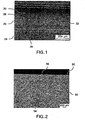
- FIG. 1 shows a condensate 20 accumulated atop a surface 22 of a substrate 24.
- Exemplary condensate thickness may be from less than 0.2mm (e.g., for thin coatings) to in excess of 2mm (at least locally - e.g., for structural condensates such as certain repairs).
- the condensate has a first defect 26 triggered by a spattered molybdenum droplet 28 that landed atop the surface 22.
- Exemplary droplet sizes are 30-500 ⁇ m (measured as a characteristic (mean/median/mode) transverse dimension).
- the defect comprises a trunk 30 extending from the droplet 28 toward the condensate surface (not shown).
- a second defect 32 is shown and may have been triggered by a droplet below the cut surface of the view.
- the exemplary deposition is of nominal Ti-6Al-4V condensate atop a like substrate.
- Alternate depositions may include Ti-6Al-2Sn-4Zr-2Mo and Ti-8Al-1Mo-1V.
- the deposition may be from a melted ingot at least partially through a pool containing one or more refractory or other elements which may be essentially non-consumed during deposition (e.g., a pool formed from a 30%Mo-70%Zr mixture). Accordingly, the droplets may tend to have composition similar to the surface layers of the pool. In the absence of the non-consumed pool additive, the droplet 28 might have a similar composition to the ingot yet still produce similar defects. Many droplets in systems using an Mo-containing pool would have Mo concentrations of at least 10% by weight; others at least 20%. This may be somewhat less than the Mo percentage of the non-expending pool material to reflect possible dilution by deposition material elements in the pool.
- the substrate 28 has an ⁇ - ⁇ microstructure of medium to coarse grains (e.g., 10-40 ⁇ m characteristic grain size (e.g., mean) or about ASTM 10.5-6.5).
- An exemplary 10-20% by weight of the substrate is ⁇ phase with the remainder essentially ⁇ phase.
- the condensate matrix (away from the defects) also has an ⁇ - ⁇ microstructure but of very fine grains (e.g., acicular ⁇ grains of 5-10 ⁇ m in length and 2-5 ⁇ m in thickness, lengthwise oriented along the condensate growth/deposition direction).
- the trunk size will depend, in substantial part, upon the droplet size. Exemplary trunk diameters are from about 20 ⁇ m to about 50 ⁇ m. However, much larger trunks are possible.
- the trunks have a columnar ⁇ - ⁇ microstructure.
- This microstructure may have a characteristic grain size several times greater than that in the matrix and the grains may be elongated in the direction of accumulation (i.e., away from the substrate).
- the grain discontinuity at the trunk-matrix interface and the particular alignment of trunk grains may cause structural weaknesses affecting, inter alia, ductility, fracture toughness, fatigue resistance, fretting fatigue resistance, corrosion resistance, wear resistance, crack nucleation resistance, and the like.
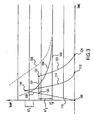
- FIG. 2 shows a condensate 50 after healing.
- the substrate is not shown.
- the condensate surface 52 is, however, shown.
- a defect within the condensate had been caused by a droplet 54.
- the resultant trunk had propagated all the way to the surface forming a bulge 56.
- the healed condensate shows essentially no remaining artifacts of the defect other than the original droplet 54 and bulge 56.
- the trunk has been microstructurally integrated with the condensate matrix as a fine ⁇ equiaxed microstructure (e.g., grain size of 10-100 ⁇ m ( ⁇ ASTM 10.5-3.5)).
- laminar variations in chemistry or microstructure may be diminished or eliminated, thereby increasing the isotropy of the condensate mechanical properties.
- the bulge 56 may be removed (e.g., during a subsequent surface machining).
- the healing permits the workpiece (e.g., a blade, vane, seal, or the like) to be operated at ambient temperature (e.g., 0-40°C) and/or at elevated temperatures (e.g., above 250°C, such as in the range of 300-500°C) essentially without increased chances of failure.
- the workpiece is initially at room temperature (condition/location 100) on the temperature against time plot of FIG. 3.
- FIG. 3 further shows a line 102 representing the equilibrium ⁇ transus (T e ⁇ ) as well as curves 104 and 106 of non-equilibrium ⁇ transus temperatures for the condensate and substrate, respectively (specific to the microstructural and thermal history of this Example 1).
- the equilibrium ⁇ transus temperature is a function of chemistry only. Because the exemplary condensate and substrate have the same chemistry, they share the same equilibrium ⁇ transus temperature (e.g., 960-1010°C for Ti-6Al-4V).
- the non-equilibrium ⁇ transus temperature is a function of composition, grain size/morphology, and heating rate. The smaller the grains, the lower the transus temperature. The more rapid the heating rate, the higher the transus temperature. At very slow heating rates, the equilibrium transus temperature equals the non-equilibrium transus temperature. Given very fine condensate grains, medium to coarse substrate grains, and a heating rate of approximately 100°C/sec, it is estimated that the difference between the non-equilibrium ⁇ transus of the two structures is about 100°C.
- the workpiece is heated 109 moderately above the condensate non-equilibrium ⁇ transus (condition/location 110).
- This heating may be under vacuum or in an inert atmosphere.
- This heating is advantageously rapid (e.g., occurring at a rate of 5-100°C/s or greater) so as to prevent excessive grain growth.
- Excessive grain growth e.g., above 150 ⁇ m ( ⁇ ASTM 2.5) or even 100 ⁇ m ( ⁇ ASTM 3.5), depending upon the application) is disadvantageous because it excessively reduces structural properties including one or more of ductility, fracture toughness, fatigue resistance, fretting fatigue resistance, corrosion resistance, wear resistance, crack nucleation resistance, and the like.
- the heating reaches a peak of ⁇ T 1 above the condensate non-equilibrium ⁇ transus of approximately 10-50°C.
- the heating substantially converts the condensate microstructure to ⁇ .
- the upper limit on ⁇ T 1 will reflect the microstructural/thermal history and is advantageously sufficiently low to avoid excessive ⁇ grain growth (in view of time considerations discussed below).
- the lower limit is advantageously high enough to provide essentially complete transition to the ⁇ phase ( ⁇ + ⁇ to ⁇ ).
- the substrate may be essentially unaffected.
- the workpiece is rapidly cooled 111 back to room temperature (condition/location 112).
- This heating may be under the same vacuum or atmosphere as the first stage.
- metastable martensite may accumulate in the condensate and the substrate.
- the cooling is advantageously sufficiently rapid to further limit ⁇ grain growth.
- the rapid heating and cooling maintain the condensate above its equilibrium ⁇ transus for a time interval sufficiently brief to avoid the excessive ⁇ grain growth noted above while providing the ⁇ phase transition.
- An exemplary time interval above the equilibrium ⁇ transus is 1.0 seconds or less.
- This microstructure is characterized by preservation of the boundaries of the prior ⁇ grains with ⁇ (e.g., in needle- or platelet-like form) in a ⁇ matrix within such boundaries.
- the rapid heating and cooling may provide a sufficiently short time at elevated temperature (in view of the magnitude of such temperature) to greatly limit oxidation even if the procedure is performed in an ambient atmosphere rather than under vacuum or an inert atmosphere.
- elevated temperature in view of the magnitude of such temperature
- An optional third stage involves annealing/aging by heating the workpiece to an annealing temperature (e.g., in the vicinity of 500-600°C for the exemplary Ti alloy).
- the exemplary annealing/aging is for a period of 1-24 hours and is effective to eliminate the martensite but without producing ⁇ grain growth. This may leave the condensate as essentially fine grain ⁇ (e.g., broadly smaller than 150 ⁇ m, more narrowly smaller than 100 ⁇ m, and preferably smaller than 50 ⁇ m ( ⁇ ASTM 2.5, 3.5, and 5.5, respectively)) plus the droplets and leaves the substrate as essentially medium to coarse grain ⁇ - ⁇ .
- the cooling of the second stage may be sufficiently slow to avoid martensite formation, in which case it is particularly appropriate to omit the aging/annealing.
- the initial heating stage 119 is similarly rapid but to a temperature above the equilibrium ⁇ transus but below the condensate non-equilibrium ⁇ transus.
- the resulting condition/location 120 may be at a temperature of ⁇ T 2 above the equilibrium ⁇ transus (e.g., by 10-30°C).
- the upper limit on this range is advantageously effective to avoid excessive ⁇ grain growth.
- the lower limit on this range is advantageously high enough to provide essentially complete transition to the ⁇ phase ( ⁇ + ⁇ to ⁇ ).
- the substrate may be essentially unaffected.
- the workpiece is maintained 121 at such a temperature for a moderate time interval (e.g., of about two seconds, more broadly 1.5-4.0 seconds or 1.0-5.0 seconds) to achieve a condition/location 122. It is during this time interval that the condensate microstructure changes to fine ⁇ as in condition/location 110. Thereafter, a rapid cooling 123 may transition the workpiece to a condition/location 124 similar to 112 and may, in turn, be followed by a similar annealing/aging if appropriate or desired.
- a moderate time interval e.g., of about two seconds, more broadly 1.5-4.0 seconds or 1.0-5.0 seconds
- the heating and cooling may be performed by a variety of techniques.
- One family of rapid heating techniques provides highly local heating (exemplary such techniques include induction heating, laser heating, electron beam heating, and the like). Such heating facilitates heating of the condensate with less substantial heating of the substrate, thereby minimizing any structural effects on the substrate.
- the desired heating depth may be controlled in view of the coating thickness by means including frequency control of induction heating, beam intensity of laser or electron beam heating, and the like. With some implementations of such heating, the heating may progress across the condensate (e.g., by moving or reorienting the workpiece relative to the heating source). Direct electrical resistance heating may be used to more generally heat the workpiece.
- the exemplary rapid cooling may be performed by forced cooling with an inert gas (especially when the heating is performed under vacuum), forced air cooling, liquid quench (e.g., in oil or water), and the like.
Landscapes
- Chemical & Material Sciences (AREA)
- Organic Chemistry (AREA)
- Engineering & Computer Science (AREA)
- Materials Engineering (AREA)
- Mechanical Engineering (AREA)
- Metallurgy (AREA)
- Physics & Mathematics (AREA)
- Thermal Sciences (AREA)
- Chemical Kinetics & Catalysis (AREA)
- Crystallography & Structural Chemistry (AREA)
- Turbine Rotor Nozzle Sealing (AREA)
- Solid-Phase Diffusion Into Metallic Material Surfaces (AREA)
- Battery Electrode And Active Subsutance (AREA)
- Chemically Coating (AREA)
- Physical Vapour Deposition (AREA)
- Materials For Medical Uses (AREA)
- Dental Preparations (AREA)
- Heat Treatments In General, Especially Conveying And Cooling (AREA)
- Inorganic Compounds Of Heavy Metals (AREA)
Claims (30)
- Verfahren zur Behandlung eines abgeschiedenen Materials auf Titan-Basis von einem Ausgangszustand, der eine Mehrzahl von Fehlern mit Körpern mit einer Mikrostruktur, die sich von einer Mikrostruktur einer Matrix des Materials unterscheidet, zu einem behandelten Zustand, in dem die Mikrostruktur der Körper im Wesentlichen in die Mikrostruktur der Matrix integriert wurde, aufweisend:Erhitzen von einer ersten Temperatur auf eine zweite Temperatur, wobei die erste Temperatur unter einem Gleichgewichts-β-Übergang ist, die zweite Temperatur über dem Gleichgewichts-β-Übergang ist, und das Erhitzen einen Abschnitt mit einer Geschwindigkeit über 5°C/s umfasst; undAbkühlen von der zweiten Temperatur auf eine dritte Temperatur unter dem Gleichgewichts-β-Übergang.
- Verfahren nach Anspruch 1, bei dem:das Erhitzen auf ein Maximum mindestens 10°C über einem Nicht-Gleichgewichts-β-Übergang erfolgt; unddas Material sich für eine Dauer von nicht mehr als 2,0 s über dem Gleichgewichts-β-Übergang befindet.
- Verfahren nach Anspruch 1 oder 2, bei dem:das Erhitzen und das Abkühlen ausreichende Geschwindigkeiten haben, um eine charakteristische Korngröße mindestens einer Matrix des Materials von kleiner als 100 µm beizubehalten.
- Verfahren nach irgendeinem vorangehenden Anspruch, bei dem:das Erhitzen auf ein Maximum 10 bis 50°C über einem Nicht-Gleichgewichtsp-Übergang erfolgt; unddas Material sich für eine Dauer von nicht mehr als 1,0 s über dem Gleichgewichts-β-Übergang befindet.
- Verfahren nach irgendeinem vorangehenden Anspruch, bei dem:das Erhitzen für eine Dauer von 1,0 bis 5,0 s 1 bis 30°C über dem Gleichgewichts-β-Übergang erfolgt; unddas Abkühlen ausreichend schnell ist, um das β-Wachstum auf eine charakteristische Größe von kleiner als 100 µm zu begrenzen.
- Verfahren nach irgendeinem vorangehenden Anspruch, bei dem:das Material zu den größten Gewichtsteilen aus Titan, Aluminium und Vanadium besteht; unddas Material eine maximale Dicke von mindestens 2,0 mm hat.
- Verfahren nach irgendeinem vorangehenden Anspruch, bei dem:das Material sich auf einem Substrat auf Titan-Basis befindet; unddas Erhitzen eine Mikrostruktur eines Hauptteils des Substrats im Wesentlichen unbeeinflusst lässt.
- Verfahren nach irgendeinem vorangehenden Anspruch, bei dem:das Erhitzen ausgewählt wird aus der Gruppe, die aus direktem Widerstandserhitzen, Induktionserhitzen, Elektronenstrahl-Erhitzen und Kombinationen davon besteht.
- Verfahren nach irgendeinem vorangehenden Anspruch, außerdem aufweisend:Abscheiden des Materials auf einem Substrat auf Titan-Basis.
- Verfahren nach Anspruch 9, bei dem:das Abscheiden eine physikalische Elektronenstrahl-Dampfabscheidung aufweist.
- Verfahren nach Anspruch 9 oder 10, bei dem:das Material und das Substrat im Wesentlichen aus einer Legierung aus 5 bis 7 Gew.-% Aluminium, 3 bis 5 Gew.-% Vanadium, Rest Titan, mit weniger als 3 Gew.-% anderen Komponenten, bestehen.
- Verfahren nach irgendeinem vorangehenden Anspruch, außerdem aufweisend:einen Temper- und Alterungsschritt.
- Verfahren nach Anspruch 12, außerdem aufweisend:Halten des Materials bei einer Temperatur von 500 bis 660°C.
- Verfahren nach irgendeinem vorangehenden Anspruch, das zum Reparieren eines Gasturbinenmaschinen-Bauteils mit einem Substrat auf Titan-Basis verwendet wird.
- Verfahren nach Anspruch 14, außerdem aufweisend:Betreiben des reparierten Bauteils bei einer Temperatur über 250°C.
- Verfahren nach irgendeinem vorangehenden Anspruch, bei dem in dem behandelten Zustand eine laminare Abweichung in mindestens einer ersten Legierungskomponente geringer ist als in dem Ausgangszustand.
- Verfahren nach Anspruch 1, bei dem in dem Ausgangszustand die Matrix eine erste nominelle Chemie und eine erste charakteristische Korngröße und eine erste charakteristische Kornstruktur hat, und der Körper im Wesentlichen dieselbe Chemie wie die Matrix, aber eine größere zweite charakteristische Korngröße und eine weniger äquiaxiale zweite Kornstruktur hat.
- Verfahren nach Anspruch 17, bei dem in dem Ausgangszustand das Material eine Mehrzahl von Spritzern in der Matrix hat und mit:einem Tröpfchen mit einem höheren Gehalt an hochschmelzenden Verunreinigungen als die Matrix; undwobei sich die Körper von den Tröpfchen erstrecken.
- Verfahren nach Anspruch 17 oder 18, bei dem das Erhitzen und Abkühlen ausreichend schnell ist, um eine α-β-Mikrostruktur des Materials in eine im Wesentlichen β-transformierte Mikrostruktur umzuwandeln, die optional metastabilen Martensit enthält und die eine charakteristische Korngröße von kleiner als 100 µm hat.
- Verfahren nach Anspruch 17, 18 oder 19, bei dem:die erste nominelle Chemie im Wesentlichen Ti-6AI-4V ist;die zweite nominelle Chemie im Wesentlichen Ti-6AI-4V ist; unddas Material sich oben auf einem Substrat aus im Wesentlichen Ti-6Al-4V befindet.
- Verfahren nach Anspruch 18, bei dem:mindestens einige der Spritzer außerdem durch eine ihren Körpern benachbarte Porosität gekennzeichnet sind; undmindestens etwas von der Porosität ausgeheilt wird.
- Verfahren nach Anspruch 18, bei dem:die Tröpfchen mindestens 10 Gew.-% eines schwerschmelzenden Metalls oder einer Kombination schwerschmelzender Metalle aufweisen.
- Verfahren nach irgendeinem der Ansprüche 17 bis 22, außerdem aufweisend:einen Temper-/Alterungsschritt, der wirksam ist, den Martensit im Wesentlichen zu beseitigen.
- Verfahren nach irgendeinem der Ansprüche 17 bis 23, bei dem:das Material ein Reparaturmaterial auf einem Turbinenmaschinen-Bauteil ist.
- Bauteil, das nach dem Verfahren irgendeines vorangehenden Anspruchs behandelt wurde, wobei das Bauteil hat:ein metallisches Substrat auf Ti-Basis; undein Kondensat auf Ti-Basis oben auf dem Substrat und mit:einer Oberfläche;einer Mehrzahl eingebetteter Tröpfchen unter der Oberfläche;Bereichen unmittelbar zwischen den Tröpfchen und der Oberfläche,gekennzeichnet durcheine im Wesentlichen β-transformierte Mikrostruktur einer charakteristischen Korngröße unter 100 µm.
- Bauteil nach Anspruch 25, bei dem:mindestens einige der Tröpfchen mindestens 200 µm unter der Oberfläche sind.
- Bauteil nach Anspruch 25 oder 26, bei dem:mindestens einige der Tröpfchen mindestens 20 µm in der charakteristischen Querabmessung haben.
- Bauteil nach Anspruch 25, 26 oder 27, bei dem:mindestens einige der Tröpfchen mindestens 20 Gew.-% Mo aufweisen.
- Bauteil nach irgendeinem der Ansprüche 25 bis 28, bei dem:das Substrat und das Kondensat jeweils im Wesentlichen aus Ti-6Al-4V bestehen.
- Bauteil nach irgendeinem der Ansprüche 25 bis 29, das eines der Bauteile Gasturbinenmaschinen-Kompressorlaufschaufel, Gebläseschaufel bzw. Bläserschaufel, Scheibe, Trommelrotor, Lagergehäuse, Leitschaufel und Dichtungselement ist.
Applications Claiming Priority (1)
| Application Number | Priority Date | Filing Date | Title |
|---|---|---|---|
| US10/991,604 US20060105194A1 (en) | 2004-11-17 | 2004-11-17 | Defect healing of deposited titanium alloys |
Publications (2)
| Publication Number | Publication Date |
|---|---|
| EP1662019A1 EP1662019A1 (de) | 2006-05-31 |
| EP1662019B1 true EP1662019B1 (de) | 2008-07-16 |
Family
ID=35953858
Family Applications (1)
| Application Number | Title | Priority Date | Filing Date |
|---|---|---|---|
| EP05255509A Expired - Lifetime EP1662019B1 (de) | 2004-11-17 | 2005-09-08 | Verfahren zur Herstellung von defektfreien beschichteten Titanlegierungen |
Country Status (8)
| Country | Link |
|---|---|
| US (1) | US20060105194A1 (de) |
| EP (1) | EP1662019B1 (de) |
| CN (1) | CN1776000A (de) |
| AT (1) | ATE401429T1 (de) |
| DE (1) | DE602005008169D1 (de) |
| MX (1) | MXPA05012417A (de) |
| SG (1) | SG122960A1 (de) |
| UA (1) | UA79864C2 (de) |
Families Citing this family (2)
| Publication number | Priority date | Publication date | Assignee | Title |
|---|---|---|---|---|
| JP5522106B2 (ja) * | 2011-03-31 | 2014-06-18 | アイシン・エィ・ダブリュ株式会社 | 鋼製歯車およびその製造方法 |
| JP5522105B2 (ja) * | 2011-03-31 | 2014-06-18 | アイシン・エィ・ダブリュ株式会社 | 鋼製歯車およびその製造方法 |
Family Cites Families (4)
| Publication number | Priority date | Publication date | Assignee | Title |
|---|---|---|---|---|
| US5879760A (en) * | 1992-11-05 | 1999-03-09 | The United States Of America As Represented By The Secretary Of The Air Force | Titanium aluminide articles having improved high temperature resistance |
| US5474809A (en) * | 1994-12-27 | 1995-12-12 | General Electric Company | Evaporation method |
| US6626228B1 (en) * | 1998-08-24 | 2003-09-30 | General Electric Company | Turbine component repair system and method of using thereof |
| US6190473B1 (en) * | 1999-08-12 | 2001-02-20 | The Boenig Company | Titanium alloy having enhanced notch toughness and method of producing same |
-
2004
- 2004-11-17 US US10/991,604 patent/US20060105194A1/en not_active Abandoned
-
2005
- 2005-09-08 DE DE602005008169T patent/DE602005008169D1/de not_active Expired - Lifetime
- 2005-09-08 AT AT05255509T patent/ATE401429T1/de not_active IP Right Cessation
- 2005-09-08 EP EP05255509A patent/EP1662019B1/de not_active Expired - Lifetime
- 2005-09-23 UA UAA200509015A patent/UA79864C2/uk unknown
- 2005-11-14 SG SG200508453A patent/SG122960A1/en unknown
- 2005-11-17 MX MXPA05012417A patent/MXPA05012417A/es not_active Application Discontinuation
- 2005-11-17 CN CN200510125479.2A patent/CN1776000A/zh active Pending
Also Published As
| Publication number | Publication date |
|---|---|
| UA79864C2 (en) | 2007-07-25 |
| SG122960A1 (en) | 2006-06-29 |
| US20060105194A1 (en) | 2006-05-18 |
| ATE401429T1 (de) | 2008-08-15 |
| CN1776000A (zh) | 2006-05-24 |
| EP1662019A1 (de) | 2006-05-31 |
| DE602005008169D1 (de) | 2008-08-28 |
| MXPA05012417A (es) | 2006-05-19 |
Similar Documents
| Publication | Publication Date | Title |
|---|---|---|
| CA1244327A (en) | Method for heat treating cast titanium articles to improve their mechanical properties | |
| US6659332B2 (en) | Directionally solidified article with weld repair | |
| EP2145969A1 (de) | Metallische Beschichtung mit wirtschaftlicher Oxidation und Ermüdungsbeständigkeit | |
| US6689487B2 (en) | Thermal barrier coating | |
| US20190299288A1 (en) | METHOD FOR PRODUCING A COMPONENT FROM A GRADED TiAl ALLOY AND COMPONENT PRODUCED THEREFROM | |
| US6277500B1 (en) | Gas turbine component | |
| JP2017522449A (ja) | チタン合金及びその製造方法 | |
| EP1897966A2 (de) | Verfahren zur Herstellung einer Verschleissschutzbeschichtung | |
| EP1905953A2 (de) | Verformungsarme Polierung von beschichteten Titanteilen | |
| CA2391197C (en) | Heat treatment of titanium-alloy article having martensitic structure | |
| US8221841B2 (en) | Pre-coating burnishing of erosion coated parts | |
| EP3708694A1 (de) | Laserinduzierte, feinkörnige gamma-phasen-oberfläche für nicocraiy-beschichtungen vor der keramischen beschichtung | |
| US20200080183A1 (en) | Treatment processes for superalloy articles and related articles | |
| GB2536981A (en) | Method for joining high temperature materials and articles made therewith | |
| US6284691B1 (en) | Yttria-stabilized zirconia feed material | |
| US8252376B2 (en) | Method for restoring the microstructure of a textured article and for refurbishing a gas turbine blade or vane | |
| EP1662019B1 (de) | Verfahren zur Herstellung von defektfreien beschichteten Titanlegierungen | |
| JP2005298973A (ja) | ニッケル基超合金、組成、物品、およびガスタービンエンジンブレード | |
| GB2440334A (en) | A method of controlling the microstructure of a metal | |
| US6719853B2 (en) | Method for restoring the microstructure of a textured article and for refurbishing a gas turbine blade or vane | |
| DE10254210A1 (de) | Stabilisierter Zirconiumdioxid-Wärmesperrenüberzug mit Hafnium (IV)-oxid | |
| US5540792A (en) | Components based on intermetallic phases of the system titanium-aluminum and process for producing such components | |
| EP1813691A1 (de) | Verfahren zur Wärmebehandlung von Titanaluminid | |
| JP2638327B2 (ja) | 高耐摩耗チタン合金製部品 | |
| CN106834992B (zh) | TiAl合金铸件及其处理工艺 |
Legal Events
| Date | Code | Title | Description |
|---|---|---|---|
| PUAI | Public reference made under article 153(3) epc to a published international application that has entered the european phase |
Free format text: ORIGINAL CODE: 0009012 |
|
| AK | Designated contracting states |
Kind code of ref document: A1 Designated state(s): AT BE BG CH CY CZ DE DK EE ES FI FR GB GR HU IE IS IT LI LT LU LV MC NL PL PT RO SE SI SK TR |
|
| AX | Request for extension of the european patent |
Extension state: AL BA HR MK YU |
|
| 17P | Request for examination filed |
Effective date: 20061128 |
|
| 17Q | First examination report despatched |
Effective date: 20070103 |
|
| AKX | Designation fees paid |
Designated state(s): AT BE BG CH CY CZ DE DK EE ES FI FR GB GR HU IE IS IT LI LT LU LV MC NL PL PT RO SE SI SK TR |
|
| GRAP | Despatch of communication of intention to grant a patent |
Free format text: ORIGINAL CODE: EPIDOSNIGR1 |
|
| GRAS | Grant fee paid |
Free format text: ORIGINAL CODE: EPIDOSNIGR3 |
|
| GRAA | (expected) grant |
Free format text: ORIGINAL CODE: 0009210 |
|
| AK | Designated contracting states |
Kind code of ref document: B1 Designated state(s): AT BE BG CH CY CZ DE DK EE ES FI FR GB GR HU IE IS IT LI LT LU LV MC NL PL PT RO SE SI SK TR |
|
| REG | Reference to a national code |
Ref country code: GB Ref legal event code: FG4D |
|
| REG | Reference to a national code |
Ref country code: CH Ref legal event code: EP |
|
| REF | Corresponds to: |
Ref document number: 602005008169 Country of ref document: DE Date of ref document: 20080828 Kind code of ref document: P |
|
| REG | Reference to a national code |
Ref country code: IE Ref legal event code: FG4D |
|
| NLV1 | Nl: lapsed or annulled due to failure to fulfill the requirements of art. 29p and 29m of the patents act | ||
| PG25 | Lapsed in a contracting state [announced via postgrant information from national office to epo] |
Ref country code: IS Free format text: LAPSE BECAUSE OF FAILURE TO SUBMIT A TRANSLATION OF THE DESCRIPTION OR TO PAY THE FEE WITHIN THE PRESCRIBED TIME-LIMIT Effective date: 20081116 Ref country code: LT Free format text: LAPSE BECAUSE OF FAILURE TO SUBMIT A TRANSLATION OF THE DESCRIPTION OR TO PAY THE FEE WITHIN THE PRESCRIBED TIME-LIMIT Effective date: 20080716 Ref country code: NL Free format text: LAPSE BECAUSE OF FAILURE TO SUBMIT A TRANSLATION OF THE DESCRIPTION OR TO PAY THE FEE WITHIN THE PRESCRIBED TIME-LIMIT Effective date: 20080716 |
|
| PG25 | Lapsed in a contracting state [announced via postgrant information from national office to epo] |
Ref country code: PT Free format text: LAPSE BECAUSE OF FAILURE TO SUBMIT A TRANSLATION OF THE DESCRIPTION OR TO PAY THE FEE WITHIN THE PRESCRIBED TIME-LIMIT Effective date: 20081216 Ref country code: BG Free format text: LAPSE BECAUSE OF FAILURE TO SUBMIT A TRANSLATION OF THE DESCRIPTION OR TO PAY THE FEE WITHIN THE PRESCRIBED TIME-LIMIT Effective date: 20081016 Ref country code: SI Free format text: LAPSE BECAUSE OF FAILURE TO SUBMIT A TRANSLATION OF THE DESCRIPTION OR TO PAY THE FEE WITHIN THE PRESCRIBED TIME-LIMIT Effective date: 20080716 Ref country code: ES Free format text: LAPSE BECAUSE OF FAILURE TO SUBMIT A TRANSLATION OF THE DESCRIPTION OR TO PAY THE FEE WITHIN THE PRESCRIBED TIME-LIMIT Effective date: 20081027 Ref country code: AT Free format text: LAPSE BECAUSE OF FAILURE TO SUBMIT A TRANSLATION OF THE DESCRIPTION OR TO PAY THE FEE WITHIN THE PRESCRIBED TIME-LIMIT Effective date: 20080716 Ref country code: FI Free format text: LAPSE BECAUSE OF FAILURE TO SUBMIT A TRANSLATION OF THE DESCRIPTION OR TO PAY THE FEE WITHIN THE PRESCRIBED TIME-LIMIT Effective date: 20080716 Ref country code: LV Free format text: LAPSE BECAUSE OF FAILURE TO SUBMIT A TRANSLATION OF THE DESCRIPTION OR TO PAY THE FEE WITHIN THE PRESCRIBED TIME-LIMIT Effective date: 20080716 |
|
| PG25 | Lapsed in a contracting state [announced via postgrant information from national office to epo] |
Ref country code: BE Free format text: LAPSE BECAUSE OF FAILURE TO SUBMIT A TRANSLATION OF THE DESCRIPTION OR TO PAY THE FEE WITHIN THE PRESCRIBED TIME-LIMIT Effective date: 20080716 |
|
| PG25 | Lapsed in a contracting state [announced via postgrant information from national office to epo] |
Ref country code: MC Free format text: LAPSE BECAUSE OF NON-PAYMENT OF DUE FEES Effective date: 20080930 Ref country code: EE Free format text: LAPSE BECAUSE OF FAILURE TO SUBMIT A TRANSLATION OF THE DESCRIPTION OR TO PAY THE FEE WITHIN THE PRESCRIBED TIME-LIMIT Effective date: 20080716 Ref country code: DK Free format text: LAPSE BECAUSE OF FAILURE TO SUBMIT A TRANSLATION OF THE DESCRIPTION OR TO PAY THE FEE WITHIN THE PRESCRIBED TIME-LIMIT Effective date: 20080716 |
|
| PLBE | No opposition filed within time limit |
Free format text: ORIGINAL CODE: 0009261 |
|
| STAA | Information on the status of an ep patent application or granted ep patent |
Free format text: STATUS: NO OPPOSITION FILED WITHIN TIME LIMIT |
|
| PG25 | Lapsed in a contracting state [announced via postgrant information from national office to epo] |
Ref country code: SK Free format text: LAPSE BECAUSE OF FAILURE TO SUBMIT A TRANSLATION OF THE DESCRIPTION OR TO PAY THE FEE WITHIN THE PRESCRIBED TIME-LIMIT Effective date: 20080716 Ref country code: RO Free format text: LAPSE BECAUSE OF FAILURE TO SUBMIT A TRANSLATION OF THE DESCRIPTION OR TO PAY THE FEE WITHIN THE PRESCRIBED TIME-LIMIT Effective date: 20080716 Ref country code: CZ Free format text: LAPSE BECAUSE OF FAILURE TO SUBMIT A TRANSLATION OF THE DESCRIPTION OR TO PAY THE FEE WITHIN THE PRESCRIBED TIME-LIMIT Effective date: 20080716 |
|
| 26N | No opposition filed |
Effective date: 20090417 |
|
| REG | Reference to a national code |
Ref country code: FR Ref legal event code: ST Effective date: 20090529 |
|
| PG25 | Lapsed in a contracting state [announced via postgrant information from national office to epo] |
Ref country code: IE Free format text: LAPSE BECAUSE OF NON-PAYMENT OF DUE FEES Effective date: 20080908 |
|
| PG25 | Lapsed in a contracting state [announced via postgrant information from national office to epo] |
Ref country code: IT Free format text: LAPSE BECAUSE OF FAILURE TO SUBMIT A TRANSLATION OF THE DESCRIPTION OR TO PAY THE FEE WITHIN THE PRESCRIBED TIME-LIMIT Effective date: 20080716 |
|
| PG25 | Lapsed in a contracting state [announced via postgrant information from national office to epo] |
Ref country code: FR Free format text: LAPSE BECAUSE OF NON-PAYMENT OF DUE FEES Effective date: 20080930 |
|
| PG25 | Lapsed in a contracting state [announced via postgrant information from national office to epo] |
Ref country code: SE Free format text: LAPSE BECAUSE OF FAILURE TO SUBMIT A TRANSLATION OF THE DESCRIPTION OR TO PAY THE FEE WITHIN THE PRESCRIBED TIME-LIMIT Effective date: 20081016 |
|
| REG | Reference to a national code |
Ref country code: CH Ref legal event code: PL |
|
| PG25 | Lapsed in a contracting state [announced via postgrant information from national office to epo] |
Ref country code: PL Free format text: LAPSE BECAUSE OF FAILURE TO SUBMIT A TRANSLATION OF THE DESCRIPTION OR TO PAY THE FEE WITHIN THE PRESCRIBED TIME-LIMIT Effective date: 20080716 |
|
| PG25 | Lapsed in a contracting state [announced via postgrant information from national office to epo] |
Ref country code: LU Free format text: LAPSE BECAUSE OF NON-PAYMENT OF DUE FEES Effective date: 20080908 Ref country code: HU Free format text: LAPSE BECAUSE OF FAILURE TO SUBMIT A TRANSLATION OF THE DESCRIPTION OR TO PAY THE FEE WITHIN THE PRESCRIBED TIME-LIMIT Effective date: 20090117 Ref country code: CY Free format text: LAPSE BECAUSE OF FAILURE TO SUBMIT A TRANSLATION OF THE DESCRIPTION OR TO PAY THE FEE WITHIN THE PRESCRIBED TIME-LIMIT Effective date: 20080716 |
|
| PG25 | Lapsed in a contracting state [announced via postgrant information from national office to epo] |
Ref country code: TR Free format text: LAPSE BECAUSE OF FAILURE TO SUBMIT A TRANSLATION OF THE DESCRIPTION OR TO PAY THE FEE WITHIN THE PRESCRIBED TIME-LIMIT Effective date: 20080716 |
|
| PG25 | Lapsed in a contracting state [announced via postgrant information from national office to epo] |
Ref country code: GR Free format text: LAPSE BECAUSE OF FAILURE TO SUBMIT A TRANSLATION OF THE DESCRIPTION OR TO PAY THE FEE WITHIN THE PRESCRIBED TIME-LIMIT Effective date: 20081017 Ref country code: CH Free format text: LAPSE BECAUSE OF NON-PAYMENT OF DUE FEES Effective date: 20090930 Ref country code: LI Free format text: LAPSE BECAUSE OF NON-PAYMENT OF DUE FEES Effective date: 20090930 |
|
| PGFP | Annual fee paid to national office [announced via postgrant information from national office to epo] |
Ref country code: GB Payment date: 20160825 Year of fee payment: 12 Ref country code: DE Payment date: 20160823 Year of fee payment: 12 |
|
| REG | Reference to a national code |
Ref country code: DE Ref legal event code: R082 Ref document number: 602005008169 Country of ref document: DE Representative=s name: SCHMITT-NILSON SCHRAUD WAIBEL WOHLFROM PATENTA, DE |
|
| REG | Reference to a national code |
Ref country code: DE Ref legal event code: R082 Ref document number: 602005008169 Country of ref document: DE Representative=s name: SCHMITT-NILSON SCHRAUD WAIBEL WOHLFROM PATENTA, DE Ref country code: DE Ref legal event code: R081 Ref document number: 602005008169 Country of ref document: DE Owner name: UNITED TECHNOLOGIES CORP. (N.D.GES.D. STAATES , US Free format text: FORMER OWNER: UNITED TECHNOLOGIES CORPORATION, HARTFORD, CONN., US |
|
| REG | Reference to a national code |
Ref country code: DE Ref legal event code: R119 Ref document number: 602005008169 Country of ref document: DE |
|
| GBPC | Gb: european patent ceased through non-payment of renewal fee |
Effective date: 20170908 |
|
| PG25 | Lapsed in a contracting state [announced via postgrant information from national office to epo] |
Ref country code: DE Free format text: LAPSE BECAUSE OF NON-PAYMENT OF DUE FEES Effective date: 20180404 Ref country code: GB Free format text: LAPSE BECAUSE OF NON-PAYMENT OF DUE FEES Effective date: 20170908 |