EP1661486A2 - Verbesserungen am Entwurf von Zahnbürsten - Google Patents
Verbesserungen am Entwurf von Zahnbürsten Download PDFInfo
- Publication number
- EP1661486A2 EP1661486A2 EP05106549A EP05106549A EP1661486A2 EP 1661486 A2 EP1661486 A2 EP 1661486A2 EP 05106549 A EP05106549 A EP 05106549A EP 05106549 A EP05106549 A EP 05106549A EP 1661486 A2 EP1661486 A2 EP 1661486A2
- Authority
- EP
- European Patent Office
- Prior art keywords
- brush
- handle
- extension
- toothbrush
- toothbrush according
- Prior art date
- Legal status (The legal status is an assumption and is not a legal conclusion. Google has not performed a legal analysis and makes no representation as to the accuracy of the status listed.)
- Withdrawn
Links
Images


Classifications
-
- A—HUMAN NECESSITIES
- A46—BRUSHWARE
- A46B—BRUSHES
- A46B5/00—Brush bodies; Handles integral with brushware
- A46B5/0004—Additional brush head
- A46B5/0016—Brushes with heads on opposite sides or ends of a handle not intended for simultaneous use
-
- A—HUMAN NECESSITIES
- A46—BRUSHWARE
- A46B—BRUSHES
- A46B5/00—Brush bodies; Handles integral with brushware
-
- A—HUMAN NECESSITIES
- A46—BRUSHWARE
- A46B—BRUSHES
- A46B2200/00—Brushes characterized by their functions, uses or applications
- A46B2200/10—For human or animal care
- A46B2200/1066—Toothbrush for cleaning the teeth or dentures
-
- A—HUMAN NECESSITIES
- A46—BRUSHWARE
- A46B—BRUSHES
- A46B9/00—Arrangements of the bristles in the brush body
- A46B9/06—Arrangement of mixed bristles or tufts of bristles, e.g. wire, fibre, rubber
Definitions
- This invention relates to a new geometry for the design of toothbrushes.
- Tooth loss occurs either as a result of tooth decay or as a result of gum disease. 90% of tooth loss is currently due to gum disease.
- Gum disease is as a process whereby plaque (a mixture of food debris, bacteria and several other constituents) collects on the tooth surface, adjacent to the gum margin. Over a period of time, if not effectively removed, this plaque undermines the tissue attachment of the tooth to the body.
- plaque a mixture of food debris, bacteria and several other constituents
- patent specification US3934298 describes a toothbrush, one end of which has a normal brush-head; whilst the other end has a brush-head with a pointed shape for cleaning inter-proximal surfaces. This however does not address the problem of cleaning the lingual tooth surfaces.
- This invention arose in the course of a careful study in situ of the anatomical arrangement of the mouth cavity and in particular of the areas proven clinically to be poorly accessed by conventional brushing.
- a toothbrush comprising a handle and a brush carried by a relatively narrow extension at one end of the handle, the extension being arranged at an angle of between about 95° and 150° to an axis of the handle so that the brush is offset laterally by a distance of at least 20mms from the handle to facilitate access to lingual surfaces of the user's teeth.
- the brush referred to above preferably has a flat working plane; i.e. the ends of at least some of the bristles terminate at an imaginary flat or slightly rounded plane rather than being formed into a point as would be appropriate had the brush been intended for inter-dental cleaning.
- this brush may have a small portion formed from stiff rubbery filaments which are slightly longer than adjoining filaments of the brush. These stiff rubbery filaments can help to dislodge softer newly formed calcified deposits of plaque.
- the dimension of this brush-head in the direction of the extension is also of some importance and should preferably be between 5 mms and 20 mms. It is best for this dimension to be less than 15 mms, since this latter dimension allows for effective cleaning of the difficult to access lingual surfaces of the upper and lower dental arches. This dimension reflects the clinical length of the tooth structure present in the oral cavity.
- the extension to the handle should not be so long as to cause difficulty of manipulation or to be obstructed, as is a conventional toothbrush, by the anatomical position of the opposing arch. For that reason a length of less than 70mms is preferred. However, it needs to have sufficient length to allow the brush-head to clear the incisal tips of the incisal region it is cleaning. Lengths between 25 and 50mms are considered to be suitable, preferably between 35 and 50 mms.
- the brush can be steered to any desired lingual tooth surface by rotating the brush around the aforementioned axis using the thumb and forefinger acting on a part of the handle adjacent the extension.
- This feature contrasts with existing designs of curved toothbrushes which assume, wrongly, that it is necessary for the brush head to be in line with the axis of the handle.
- toothbrush handles have a curved shape and therefore may not have a clearly defined axis of symmetry.
- the term "axis" as used in this specification is to be construed as referring to a median line passing through the handle or that part of it which is held in the hand when in use.
- the handle and the extension are made as one moulded component.
- the extension is removable so that it can be replaced when the brush is worn. Where two brushes are included, as discussed below, they could both be replaceable.
- a second brush is preferably included at the opposite end of the handle and this can be more conventional in size and shape.
- the length of the handle needs to be sufficiently long to allow that brush which is not currently in use to be held clear of the user's hand. However it must not be so long as to be unwieldy.
- a range of between 55 and 250 mms is considered suitable. For an adult a range from 120 to 200 mms and preferably 140 to 180 would be appropriate; whereas for a child a range from 55 to 130 mms and preferably 80 to 150 mms would be more suitable.
- the illustrated toothbrush comprises a handle 1, of length L1, having an axis X - X; and an extension 2 of length L2 having an axis Y - Y.
- the handle and the extension are formed as a single moulding of synthetic plastics material.
- the handle is of generally rectangular cross-section and is enlarged and contoured at 1A to form a thumb grip.
- a lower part 1B is of rounded, elliptical, almost circular, cross-section for a purpose to be explained later.
- the extension 2 is of considerably reduced width compared with the handle, this being best seen on Fig 2. It is of circular cross-section and its axis Y - Y forms an angle ⁇ of about 135 degrees with the axis X - X.
- the upper end (as viewed in figs 1 and 2) of the handle carries a conventional brush 3 having parallel bristles extending perpendicularly to the axis X - X and terminating in a flat working surface 3A for cleaning the buccal surfaces (the surfaces facing the cheeks and lips) of the teeth.
- the free end of the extension 2 carries a second brush 4, much smaller than the brush 3, which is displaced by a distance L3 from the axis X-X. It is formed from parallel bristles extending perpendicularly to the axis Y -Y and terminating in a flat working surface 4A for cleaning the lingual surfaces.
- the brush 3 is of elliptical cross-section having a major axis L5 (as measured in the direction of axis Y - Y) of about 10mms and a perpendicular minor axis of about 8mms.
- the dimension L5 is of importance because, for effective brushing, it has been found that it should not be substantially greater than 25 mms, and should preferably be slightly less than 12 mms.
- the length of the brush should ideally be smaller than the conventional brush length to allow for more effective access of the lingual surfaces of the mouth it is attempting to clean.
- Fig 3 shows the toothbrush in use cleaning the lingual surfaces of the lower incisors 5.
- the upper incisors are shown at 6, gums at 7, tongue at 8 and upper and lower lips at 9 and 10 respectively.
- the working surface 4A of the brush 4 can be used approximately parallel to the tooth surface while the handle 1 is comfortably held at a near-horizontal position where movement is not obstructed by contact with the user's lips or nose. At all times only the relatively narrow extension 2 need enter beyond the user's lips and this allows it to be easily and comfortably received inside the mouth.
- the user grips the near-cylindrical part 1B of the handle and, by rotating the latter about its axis X - X can steer the brush 4 to any desired lingual or palatal tooth surface whilst still holding the handle at a comfortable angle similar to that shown on Fig 3.
- This action is made possible because the whole of the brush 4 is offset from the axis X - X by a distance L3, as shown on Fig 1, which is at least 20mms; and because the angle ⁇ is within the range of between about 95° and 150°; this range of angles allowing sufficient "bend" for the brush to engage the tooth surfaces correctly but not so great as to cause the handle to be obstructed by hard and soft tissue of the rest of the face.
- Brushing is performed using a reciprocating movement in the direction Y - Y.
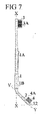
- the toothbrush is shown resting on a horizontal surface 11, typically the bottom of a beaker used to store the brush. It will be seen that the extension 2 has a rounded nodule 12 at its free end which makes contact with the surface 11, and which has a length L4 ensuring that the brush 4 is kept well clear of any bacterial matter on that surface.
- Figs 4 and 5 show a different toothbrush and parts similar to those of Figs 1 and 2 are denoted with identical reference numerals.
- the handle is slightly curved as shown whilst still generally following the line of the axis X - X.
- this embodiment has recesses 1C lying at 90 degrees to the thumb-grip 1A. These recesses allow the small brush head 4 to be comfortably held between finger and thumb.
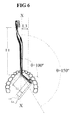
- Fig 6 illustrates a third embodiment of the invention which has a shape slightly different to that of Figs 4 and 5 but which operates in an equivalent way.
- Fig 6 shows how, the angle of the extension, and the distance L3 are selected to allow the brush to be used effectively to remove plaque from the lingual surface of lower teeth on one side of the mouth, and how, by rotating the brush about its axis X-X, it can equally well be used on the other side as shown in broken lines, without changing the angle at which the handle is held. Angles of rotation in-between the two illustrated extremes are appropriate for cleaning the incisors.
- the extension in the third embodiment also supports, in addition to brush 4, a plurality of rubbery filaments 4A.
- the filaments which are made from a synthetics plastic rubberised compound and are longer than the bristles of brush 4, aid to dislodge early calcified deposits of plaque.
- This filament brush feature is thought to be particularly effective for smokers. So as to maintain the functionality provided by the small head of extension 2 the brush 4 has a smaller area than in the previous embodiments so as to accommodate the addition of the filaments 4A.
Landscapes
- Brushes (AREA)
Priority Applications (2)
| Application Number | Priority Date | Filing Date | Title |
|---|---|---|---|
| EP05106549A EP1661486A3 (de) | 2004-10-22 | 2005-07-15 | Verbesserungen am Entwurf von Zahnbürsten |
| PCT/GB2005/050187 WO2006043114A2 (en) | 2004-10-22 | 2005-10-18 | Improvements in the design of toothbrushes |
Applications Claiming Priority (3)
| Application Number | Priority Date | Filing Date | Title |
|---|---|---|---|
| GB0423423A GB0423423D0 (en) | 2004-10-22 | 2004-10-22 | Improvements in the design of toothbrushes |
| EP05102888A EP1649776A3 (de) | 2004-10-22 | 2005-04-12 | Verbesserungen am Entwurf von Zahnbürsten |
| EP05106549A EP1661486A3 (de) | 2004-10-22 | 2005-07-15 | Verbesserungen am Entwurf von Zahnbürsten |
Publications (2)
| Publication Number | Publication Date |
|---|---|
| EP1661486A2 true EP1661486A2 (de) | 2006-05-31 |
| EP1661486A3 EP1661486A3 (de) | 2006-08-23 |
Family
ID=36046190
Family Applications (1)
| Application Number | Title | Priority Date | Filing Date |
|---|---|---|---|
| EP05106549A Withdrawn EP1661486A3 (de) | 2004-10-22 | 2005-07-15 | Verbesserungen am Entwurf von Zahnbürsten |
Country Status (2)
| Country | Link |
|---|---|
| EP (1) | EP1661486A3 (de) |
| WO (1) | WO2006043114A2 (de) |
Citations (7)
| Publication number | Priority date | Publication date | Assignee | Title |
|---|---|---|---|---|
| US1132326A (en) | 1913-10-14 | 1915-03-16 | Joseph Ferdinand Fouyer | Tooth-brush. |
| US2084873A (en) | 1935-12-18 | 1937-06-22 | Louis J Strause | Tooth brush |
| US2668308A (en) | 1950-04-03 | 1954-02-09 | Pauline Grossman | Nonslip handle for tooth or denture brushes |
| US3934298A (en) | 1974-04-23 | 1976-01-27 | Kim James S H | Toothbrush |
| US4150457A (en) | 1977-09-26 | 1979-04-24 | Larson David F | Toothbrush |
| US4796325A (en) | 1987-10-29 | 1989-01-10 | Issar Bortman | Angularly adjustable double headed toothbrush |
| US5315730A (en) | 1990-09-13 | 1994-05-31 | Il Pyung Kim | Toothbrush device |
Family Cites Families (5)
| Publication number | Priority date | Publication date | Assignee | Title |
|---|---|---|---|---|
| IT8221455U1 (it) * | 1982-04-05 | 1983-10-05 | Massari B | Spazzolino da denti con manico anatomico |
| US4672706A (en) * | 1985-12-27 | 1987-06-16 | Stratford Laboratories | Toothbrush |
| MY109803A (en) * | 1990-08-13 | 1997-07-31 | Kao Corp | Toothbrush using such apparatus |
| US5604951A (en) * | 1994-12-30 | 1997-02-25 | Shipp; Anthony D. | Prophy toothbrush |
| US5535474A (en) * | 1995-03-23 | 1996-07-16 | Salazar; Alfred | Brush for cleaning and polishing teeth while stimulating gums |
-
2005
- 2005-07-15 EP EP05106549A patent/EP1661486A3/de not_active Withdrawn
- 2005-10-18 WO PCT/GB2005/050187 patent/WO2006043114A2/en not_active Ceased
Patent Citations (7)
| Publication number | Priority date | Publication date | Assignee | Title |
|---|---|---|---|---|
| US1132326A (en) | 1913-10-14 | 1915-03-16 | Joseph Ferdinand Fouyer | Tooth-brush. |
| US2084873A (en) | 1935-12-18 | 1937-06-22 | Louis J Strause | Tooth brush |
| US2668308A (en) | 1950-04-03 | 1954-02-09 | Pauline Grossman | Nonslip handle for tooth or denture brushes |
| US3934298A (en) | 1974-04-23 | 1976-01-27 | Kim James S H | Toothbrush |
| US4150457A (en) | 1977-09-26 | 1979-04-24 | Larson David F | Toothbrush |
| US4796325A (en) | 1987-10-29 | 1989-01-10 | Issar Bortman | Angularly adjustable double headed toothbrush |
| US5315730A (en) | 1990-09-13 | 1994-05-31 | Il Pyung Kim | Toothbrush device |
Also Published As
| Publication number | Publication date |
|---|---|
| EP1661486A3 (de) | 2006-08-23 |
| WO2006043114A3 (en) | 2006-10-19 |
| WO2006043114A2 (en) | 2006-04-27 |
Similar Documents
| Publication | Publication Date | Title |
|---|---|---|
| CN106859009B (zh) | 牙刷 | |
| US20040255416A1 (en) | Toothbrush with tongue cleaning member | |
| EP2512289B1 (de) | Zahnbürste mit reinigungselementen, deren anordnung eine geschlossene schleife bildet | |
| US6438786B2 (en) | Toothbrush with longitudinal bristle reinforcement | |
| US8863345B2 (en) | Oral care implement having a closed-loop arrangement of cleaning elements | |
| CN102405004A (zh) | 牙齿清洁装置 | |
| AU2001283456A1 (en) | Toothbrush with longitudinal bristle reinforcement | |
| KR102569015B1 (ko) | 복합 기능을 갖는 구강 관리 칫솔 | |
| JP2004500140A (ja) | 舌側歯ブラシおよびそれを作成する方法 | |
| US20130333134A1 (en) | Toothbrush Head and Ergonomic Toothbrush Handle | |
| CN101309613A (zh) | 牙刷 | |
| JP7349324B2 (ja) | 液状歯磨き剤塗布ブラシ | |
| KR100922289B1 (ko) | 기능성 칫솔 | |
| WO2006043114A2 (en) | Improvements in the design of toothbrushes | |
| EP1649776A2 (de) | Verbesserungen am Entwurf von Zahnbürsten | |
| US20100101031A1 (en) | Toothbrush | |
| CN202233752U (zh) | 一种新型牙刷 | |
| WO2022003337A1 (en) | Device for the cleaning of mesial and distal surfaces of teeth and fixed prosthesis | |
| US20010044981A1 (en) | Oral brush | |
| KR102616822B1 (ko) | 펜 그립형 칫솔 | |
| US20140283321A1 (en) | Toothbrush | |
| EP0042459B1 (de) | Zahnbürste mit einer verbesserten Erreichbarkeit des Bereiches zwischen den Zähnen und des zahnfleischfreien Randes | |
| WO2025170487A1 (ru) | Зубная щётка | |
| AU2014200385B2 (en) | Toothbrush having a closed-loop arrangement of cleaning elements | |
| KR20220072165A (ko) | 기능성 칫솔 |
Legal Events
| Date | Code | Title | Description |
|---|---|---|---|
| PUAI | Public reference made under article 153(3) epc to a published international application that has entered the european phase |
Free format text: ORIGINAL CODE: 0009012 |
|
| AK | Designated contracting states |
Kind code of ref document: A2 Designated state(s): AT BE BG CH CY CZ DE DK EE ES FI FR GB GR HU IE IS IT LI LT LU LV MC NL PL PT RO SE SI SK TR |
|
| AX | Request for extension of the european patent |
Extension state: AL BA HR MK YU |
|
| PUAL | Search report despatched |
Free format text: ORIGINAL CODE: 0009013 |
|
| AK | Designated contracting states |
Kind code of ref document: A3 Designated state(s): AT BE BG CH CY CZ DE DK EE ES FI FR GB GR HU IE IS IT LI LT LU LV MC NL PL PT RO SE SI SK TR |
|
| AX | Request for extension of the european patent |
Extension state: AL BA HR MK YU |
|
| AKX | Designation fees paid | ||
| REG | Reference to a national code |
Ref country code: DE Ref legal event code: 8566 |
|
| STAA | Information on the status of an ep patent application or granted ep patent |
Free format text: STATUS: THE APPLICATION IS DEEMED TO BE WITHDRAWN |
|
| 18D | Application deemed to be withdrawn |
Effective date: 20070224 |