EP1659349A1 - Refrigeration or cooling system - Google Patents
Refrigeration or cooling system Download PDFInfo
- Publication number
- EP1659349A1 EP1659349A1 EP04078319A EP04078319A EP1659349A1 EP 1659349 A1 EP1659349 A1 EP 1659349A1 EP 04078319 A EP04078319 A EP 04078319A EP 04078319 A EP04078319 A EP 04078319A EP 1659349 A1 EP1659349 A1 EP 1659349A1
- Authority
- EP
- European Patent Office
- Prior art keywords
- radiation
- heat
- fit
- energy
- refrigeration
- Prior art date
- Legal status (The legal status is an assumption and is not a legal conclusion. Google has not performed a legal analysis and makes no representation as to the accuracy of the status listed.)
- Withdrawn
Links
- 238000005057 refrigeration Methods 0.000 title claims abstract description 23
- 238000001816 cooling Methods 0.000 title claims abstract description 17
- 230000005855 radiation Effects 0.000 claims abstract description 80
- 238000010521 absorption reaction Methods 0.000 claims abstract description 7
- 230000005670 electromagnetic radiation Effects 0.000 claims description 3
- LPLLVINFLBSFRP-UHFFFAOYSA-N 2-methylamino-1-phenylpropan-1-one Chemical compound CNC(C)C(=O)C1=CC=CC=C1 LPLLVINFLBSFRP-UHFFFAOYSA-N 0.000 claims description 2
- 240000003023 Cosmos bipinnatus Species 0.000 claims description 2
- 235000005956 Cosmos caudatus Nutrition 0.000 claims description 2
- 239000003507 refrigerant Substances 0.000 description 21
- 239000007788 liquid Substances 0.000 description 15
- 239000002826 coolant Substances 0.000 description 8
- 238000009835 boiling Methods 0.000 description 5
- 230000000694 effects Effects 0.000 description 5
- 239000012530 fluid Substances 0.000 description 5
- 238000000034 method Methods 0.000 description 5
- 230000008569 process Effects 0.000 description 5
- 239000007787 solid Substances 0.000 description 5
- XLYOFNOQVPJJNP-UHFFFAOYSA-N water Substances O XLYOFNOQVPJJNP-UHFFFAOYSA-N 0.000 description 5
- 230000006835 compression Effects 0.000 description 4
- 238000007906 compression Methods 0.000 description 4
- QGZKDVFQNNGYKY-UHFFFAOYSA-N Ammonia Chemical compound N QGZKDVFQNNGYKY-UHFFFAOYSA-N 0.000 description 3
- 230000008859 change Effects 0.000 description 3
- 238000001704 evaporation Methods 0.000 description 3
- 239000007789 gas Substances 0.000 description 3
- 230000006872 improvement Effects 0.000 description 3
- 238000004519 manufacturing process Methods 0.000 description 3
- LVGUZGTVOIAKKC-UHFFFAOYSA-N 1,1,1,2-tetrafluoroethane Chemical compound FCC(F)(F)F LVGUZGTVOIAKKC-UHFFFAOYSA-N 0.000 description 2
- ATUOYWHBWRKTHZ-UHFFFAOYSA-N Propane Chemical compound CCC ATUOYWHBWRKTHZ-UHFFFAOYSA-N 0.000 description 2
- 230000007613 environmental effect Effects 0.000 description 2
- 230000008020 evaporation Effects 0.000 description 2
- 230000005484 gravity Effects 0.000 description 2
- 238000010438 heat treatment Methods 0.000 description 2
- 239000000463 material Substances 0.000 description 2
- 229910052751 metal Inorganic materials 0.000 description 2
- 239000002184 metal Substances 0.000 description 2
- 230000005457 Black-body radiation Effects 0.000 description 1
- RYGMFSIKBFXOCR-UHFFFAOYSA-N Copper Chemical compound [Cu] RYGMFSIKBFXOCR-UHFFFAOYSA-N 0.000 description 1
- CBENFWSGALASAD-UHFFFAOYSA-N Ozone Chemical compound [O-][O+]=O CBENFWSGALASAD-UHFFFAOYSA-N 0.000 description 1
- 229920005372 Plexiglas® Polymers 0.000 description 1
- 238000004378 air conditioning Methods 0.000 description 1
- 229910052782 aluminium Inorganic materials 0.000 description 1
- XAGFODPZIPBFFR-UHFFFAOYSA-N aluminium Chemical compound [Al] XAGFODPZIPBFFR-UHFFFAOYSA-N 0.000 description 1
- 229910021529 ammonia Inorganic materials 0.000 description 1
- 230000008901 benefit Effects 0.000 description 1
- 230000003139 buffering effect Effects 0.000 description 1
- 239000001273 butane Substances 0.000 description 1
- 239000004020 conductor Substances 0.000 description 1
- 238000010276 construction Methods 0.000 description 1
- 229910052802 copper Inorganic materials 0.000 description 1
- 239000010949 copper Substances 0.000 description 1
- 230000008878 coupling Effects 0.000 description 1
- 238000010168 coupling process Methods 0.000 description 1
- 238000005859 coupling reaction Methods 0.000 description 1
- 238000001514 detection method Methods 0.000 description 1
- 230000002349 favourable effect Effects 0.000 description 1
- 239000011888 foil Substances 0.000 description 1
- 238000007710 freezing Methods 0.000 description 1
- 230000008014 freezing Effects 0.000 description 1
- 239000011521 glass Substances 0.000 description 1
- 238000002329 infrared spectrum Methods 0.000 description 1
- 239000012212 insulator Substances 0.000 description 1
- 230000007246 mechanism Effects 0.000 description 1
- 150000002739 metals Chemical class 0.000 description 1
- 230000005486 microgravity Effects 0.000 description 1
- IJDNQMDRQITEOD-UHFFFAOYSA-N n-butane Chemical compound CCCC IJDNQMDRQITEOD-UHFFFAOYSA-N 0.000 description 1
- OFBQJSOFQDEBGM-UHFFFAOYSA-N n-pentane Natural products CCCCC OFBQJSOFQDEBGM-UHFFFAOYSA-N 0.000 description 1
- 239000002245 particle Substances 0.000 description 1
- 239000002985 plastic film Substances 0.000 description 1
- 239000004926 polymethyl methacrylate Substances 0.000 description 1
- 239000003755 preservative agent Substances 0.000 description 1
- 230000002335 preservative effect Effects 0.000 description 1
- 239000001294 propane Substances 0.000 description 1
- 239000000126 substance Substances 0.000 description 1
- 230000035900 sweating Effects 0.000 description 1
- 238000001429 visible spectrum Methods 0.000 description 1
- 238000010792 warming Methods 0.000 description 1
Images


Classifications
-
- F—MECHANICAL ENGINEERING; LIGHTING; HEATING; WEAPONS; BLASTING
- F25—REFRIGERATION OR COOLING; COMBINED HEATING AND REFRIGERATION SYSTEMS; HEAT PUMP SYSTEMS; MANUFACTURE OR STORAGE OF ICE; LIQUEFACTION SOLIDIFICATION OF GASES
- F25B—REFRIGERATION MACHINES, PLANTS OR SYSTEMS; COMBINED HEATING AND REFRIGERATION SYSTEMS; HEAT PUMP SYSTEMS
- F25B23/00—Machines, plants or systems, with a single mode of operation not covered by groups F25B1/00 - F25B21/00, e.g. using selective radiation effect
- F25B23/003—Machines, plants or systems, with a single mode of operation not covered by groups F25B1/00 - F25B21/00, e.g. using selective radiation effect using selective radiation effect
-
- F—MECHANICAL ENGINEERING; LIGHTING; HEATING; WEAPONS; BLASTING
- F25—REFRIGERATION OR COOLING; COMBINED HEATING AND REFRIGERATION SYSTEMS; HEAT PUMP SYSTEMS; MANUFACTURE OR STORAGE OF ICE; LIQUEFACTION SOLIDIFICATION OF GASES
- F25B—REFRIGERATION MACHINES, PLANTS OR SYSTEMS; COMBINED HEATING AND REFRIGERATION SYSTEMS; HEAT PUMP SYSTEMS
- F25B25/00—Machines, plants or systems, using a combination of modes of operation covered by two or more of the groups F25B1/00 - F25B23/00
-
- F—MECHANICAL ENGINEERING; LIGHTING; HEATING; WEAPONS; BLASTING
- F25—REFRIGERATION OR COOLING; COMBINED HEATING AND REFRIGERATION SYSTEMS; HEAT PUMP SYSTEMS; MANUFACTURE OR STORAGE OF ICE; LIQUEFACTION SOLIDIFICATION OF GASES
- F25B—REFRIGERATION MACHINES, PLANTS OR SYSTEMS; COMBINED HEATING AND REFRIGERATION SYSTEMS; HEAT PUMP SYSTEMS
- F25B40/00—Subcoolers, desuperheaters or superheaters
- F25B40/02—Subcoolers
Definitions
- the invention refers to a refrigeration or cooling system, comprising absorption means fit to absorb heat inside a room and emission means fit to emit the absorbed heat outside said room.
- Refrigeration may be understood as a process of cooling or freezing e.g. for preservative purposes.
- Refrigeration or cooling systems comprising absorption means fit to absorb heat inside a room and emission means fit to emit the absorbed heat outside said room are generally known.
- refrigerators are used to produce the required cooling effect by taking in heat at low temperatures and rejecting it at temperatures somewhat above that of the natural cooling agent, which is generally water or air.
- the function of a refrigerating machine therefore, is to take in heat at a low temperature and reject it at a higher one, using external energy to drive the process.
- a refrigerator is effectively a heat pump, a heat engine running in reverse.
- Most refrigerators qualify as phase change heat pumps. They convert a refrigerant from gas to liquid and back again by compression in a refrigeration cycle.
- any endothermic process could be used provided it is balanced by an exothermic in another physical location so that it can operate in a cycle. For example, absorption of gaseous ammonia into water is used in most gas absorption refrigerators.
- a standard refrigeration or cooling system employs a liquid with a low boiling point to transfer heat from cooler space to a warmer space; generally in a refrigeration application. It is the most common heat pump used in domestic refrigerators, and heat pumps are also used in air conditioning systems to transfer heat from the outside of a building to the inside or vice versa depending upon a valve position.
- the liquid requires energy (called latent heat) to evaporate, and it drains that energy from its surroundings in the form of heat (in the same way that sweating cools the body). When the vapor condenses again, it releases the energy, again in the form of heat.
- the pump operates a cycle where the refrigerant repeatedly changes state from liquid to vapor and back to liquid, the process being known as a refrigeration cycle.
- the refrigerant is condensed to release heat in one part of the cycle and is boiled (or evaporated) to absorb heat in another part of the cycle.
- the liquid now used is usually HFC-134a (1,2,2,2-tetrafluoroethane), but other substances such as liquid ammonia, or occasionally the less corrosive but flammable propane or butane can also be used.
- phase change heat pump uses an electric motor to drive a mechanical compressor.
- the compressor does not create a cooling effect directly.
- the cooling effect is created when the refrigerant boils and absorbs heat from the cooled space through a heat exchanger.
- the cycle can be divided into two parts, viz. the liquefaction stage and the evaporation stage.
- the first part of the cycle causes refrigerant vapor to be recycled into its liquid form by extracting heat from a comparatively high temperature vapor.
- the compressor compresses a relatively low-pressure and low-temperature refrigerant vapor drawn from the evaporator coil.
- the vapor is pushed into a heat exchanger known as a condenser located in a higher temperature heat sink that is located outside of the space being cooled. In the condenser, heat is removed from the refrigerant so that it condenses to a liquid state.
- the second part of the cycle begins after the liquid refrigerant leaves the condenser as a relatively warm, high-pressure liquid and passes through a refrigerant metering device into the cooling coil or evaporator on the low-pressure side of the system.
- the compressor pumps the refrigerant out of the evaporator at a rate sufficient to cause the pressure and temperature of the refrigerant to drop well below its boiling point as it moves through an interior heat exchanger coil known as the evaporator.
- This boiling liquid refrigerant absorbs heat energy from the interior space through the walls of this evaporator.
- the system is designed to completely evaporate liquid refrigerant into a low-pressure vapor within the interior coil before it returns to the compressor to repeat the cycle.
- the four essential components of the mechanical refrigeration cycle for a phase change heat pump are a compressor, an evaporator (at the system's warm side, the room or space to be cooled), a refrigerant metering device and a condenser (at the system's cold side). These four components must be selected or matched for the application and to each other in order for the system to work well and efficiently. None of these parts produce a refrigeration effect. Boiling (or rapidly evaporating) refrigerant absorbs heat and creates the benefit of refrigeration. The refrigeration cycle allows a small amount of refrigerant to be cycled and recycled for decades of use.
- heat transfer may occur by any of the mechanisms conduction, convection, and radiation.
- Conduction is the most common means of heat transfer in a solid. On a microscopic scale, conduction occurs as hot, rapidly moving or vibrating atoms and molecules interact with neighboring atoms and molecules, transferring some of their energy (heat) to these neighboring atoms.
- Convection is usually the dominant form of heat transfer in liquids and gases.
- heat transfer occurs by the movement of hot or cold portions of the fluid. For example, when water is heated on a stove, hot water from the bottom of the pan rises, heating the water at the top of the pan.
- Two types of convection are commonly distinguished, free convection, in which gravity and buoyancy forces drive the fluid movement, and forced convection, where a fan, stirrer, or other means is used to move the fluid.
- Buoyant convection is due to the effects of gravity, and absent in microgravity environments.
- Radiation is a means of heat transfer. Radiative heat transfer is the only form of heat transfer that can occur in the absence of any form of medium and as such is the only means of heat transfer through a vacuum.
- Thermal radiation is a direct result of the movements of atoms and molecules in a material. Since these atoms and molecules are composed of charged particles (protons and electrons), their movements result in the emission of electromagnetic radiation, which carries energy away from the surface. At the same time, the surface is constantly bombarded by radiation from the surroundings, resulting in the transfer of energy to the surface. Since the amount of emitted radiation increases with increasing temperature, a net transfer of energy from higher temperatures to lower temperatures results.
- Hotter objects-a campfire is around 700 K, for instance-transfer heat in the visible spectrum or beyond. Whenever EM radiation is emitted and then absorbed, heat is transferred. This principle is used in e.g. microwave ovens.
- a main aim of the refrigeration or cooling system comprising emission means for emitting absorbed heat outside the room to be cooled, is that those emission means comprise radiation means, fit to emit at least a substantial part of the absorbed heat by radiation, achieving an impressive improvement of the refrigeration capacity.
- the innovative radiation means may be either the sole heat emission means, replacing the prior art's convection based condenser(s) or may be added to the (e.g. existing) emission means, i.e. the convection based condenser(s).
- the radiation heat emitted may serve either to condense the relevant refrigerant or to sub cool the refrigerant at a constant pressure defined by the condensing process.
- switching or control means may installed, fit to enable (switch on) said radiation means if the net value of the amount of energy of the heat to be emitted and the amount of energy of incoming radiation received (absorbed) by said radiation means from any (external) radiation source (e.g. by sun radiation) is positive.
- the control means may disable (switch off) said radiation means if the net value of the amount of energy of the heat to be emitted by said radiation means and the amount of energy of incoming radiation received by said radiation means from any (external) radiation source is negative.
- the control means may be fit to switch on the radiation means if they effectively radiate the heat to the outer space and to switch off the radiation means if they cannot effectively radiate the heat to the outer space, due to the reception of incoming heat radiation, e.g. originated by the sun.
- the control means may be fit to be set at first points of time to enable said radiation means (i.e. to connect them to the system's heat emission side) and/or at second points of time to disable them.
- the control means may be fit to measure or value (e.g. by heat or light radiation detection) the amount of energy of incoming radiation received by said radiation means from any (external) radiation source.
- the control means may preferably be fit to enable said radiation means at sunset and/or to disable said radiation means at sunrise.
- the radiation means may be used for the production of cold during nightly hours by means of radiation exchange with the (extraterrestrial) space.
- the cold produced in that way may be used for refrigerated or frozen storage facilities ("cold stores") which could additionally be used for the buffering of the produced cold too.
- cold stores refrigerated or frozen storage facilities
- a very favorable and relevant aspect is that the "night radiator", by coupling to the condensor side of the refrigeration system, can operate at a relatively high temperature, which improves the amount of radiation emitted and reduces the losses due to convective heating by the environment, e.g. the environmental air.
- the radiation ⁇ 5,7 . 10-8 W/m 2 .K 4 and ⁇ the emission coefficient of the night radiator.
- T 1 resp. To are the absolute temperatures of the radiating and the receiving object.
- the gain of a night radiator depends, at one side, on the radiation properties of the radiator and the degree of cloudiness, and, at the other side, on the night radiator's temperature. This temperature depends on the cold production and convective warming by the environment.
- FIG. 1 shows an embodiment of a refrigeration or cooling system, comprising absorption means, in the form of an evaporator 1 within the room to be cooled (e.g. cold store), which is fit to absorb heat inside that room.
- the evaporator 1 is connected, via a compressor 2 with first emission means, in the form of a condensor 3 which is fit to emit at least part of the absorbed heat outside the room to be cooled.
- the circuit moreover, comprises an expansion valve 4, fit to expand the refrigerant fluid, circulating through the circuit.
- the (electromagnetic) energy radiator preferably comprises a heat exchanger part 7 and the proper (EM) radiator 8.
- Heat exchange between the second circuit's coolant and the exchanger part 7 is based on convection, while heat exchange between the exchanger part 7 and the radiator 8 is based on conduction, when both (solid) parts are brought in tight connection. In that way, a substantial part of the heat, originated from the condenser 1, will be transmitted to the exchanger part 7 and the radiation part 8, which is able, due to its EM radiation properties to radiate its heat energy radiation to the extraterrestrial space.
- the second coolant circuit will be driven -at least during the night, when the sun does not emit energy to the radiator 8- by a pump 6, which is controlled by a control unit 9 which may either be controlled by setting the pump's on/off time or by means of a sensor 10, which is able to detect sunset and sunrise: between sunset and sunrise the pump 9 may be switched on and between sunrise and sunset switched off.
- a control unit 9 which may either be controlled by setting the pump's on/off time or by means of a sensor 10, which is able to detect sunset and sunrise: between sunset and sunrise the pump 9 may be switched on and between sunrise and sunset switched off.
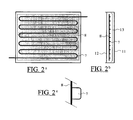
- FIG. 2a, 2b and 2c show an exemplary embodiment of the exchanger 7 and radiator 8, which are fit to emit a substantial part of the system's heat by radiation.
- FIG. 2a shows a schematic front view
- FIG. 2b a cross-sectional view
- FIG. 2c a detail of the cross-section.
- the second circuit's coolant flows through the exchanger part 7 which may be formed, as the Figs. 2 show, by a long, folded tube which is firmly connected to -or even integrated with- the proper radiator 8.
- the radiator 8 may have the shape of a plate, preferably comprising a black or at least optically black (for e.g. IR) surface, thus maximizing its radiation performance.
- the coolant's heat will be transmitted to the radiator 8 by convection and/or conduction and radiated by its radiation surface to the extraterrestrial space, as long as, during the night, there in no or less incoming radiation (especially sun light).
- the improve the radiator's performance it may be placed in a thermally isolated casing 11 and covered, at the radiation side, by thermally isolated Plexiglas or glass sheet 12, to prevent that thermal energy may be exchanged with the radiator's direct environment, e.g. the environmental air, which would influence the radiator's efficiency negatively.
- the casing 11 may comprise a radiation reflector 13, at the radiator's back side, e.g. made by Aluminum foil.
- FIG. 3 shows schematically the artist's impression of an alternative construction of the radiator.
- the radiation part 8 may be made of rather thin metal of plastic sheet material.
Landscapes
- Engineering & Computer Science (AREA)
- Physics & Mathematics (AREA)
- Mechanical Engineering (AREA)
- Thermal Sciences (AREA)
- General Engineering & Computer Science (AREA)
- Health & Medical Sciences (AREA)
- Toxicology (AREA)
- Devices That Are Associated With Refrigeration Equipment (AREA)
Abstract
Refrigeration or cooling system, comprising absorption means (1) fit to absorb heat inside a room and emission means fit to emit the absorbed heat outside said room. The emission means comprise radiation means (8), fit to emit at least a substantial part of said heat by radiation e.g. to the extraterrestrial space. Control means (9) fit may enable/disable the radiation means between sunset and sunrise.
Description
- The invention refers to a refrigeration or cooling system, comprising absorption means fit to absorb heat inside a room and emission means fit to emit the absorbed heat outside said room. Refrigeration may be understood as a process of cooling or freezing e.g. for preservative purposes.
- Refrigeration or cooling systems, comprising absorption means fit to absorb heat inside a room and emission means fit to emit the absorbed heat outside said room are generally known.
- Where temperatures below that of any available natural cooling agent are required, refrigerators are used to produce the required cooling effect by taking in heat at low temperatures and rejecting it at temperatures somewhat above that of the natural cooling agent, which is generally water or air. The function of a refrigerating machine, therefore, is to take in heat at a low temperature and reject it at a higher one, using external energy to drive the process. A refrigerator is effectively a heat pump, a heat engine running in reverse. Most refrigerators qualify as phase change heat pumps. They convert a refrigerant from gas to liquid and back again by compression in a refrigeration cycle. In principle, any endothermic process could be used provided it is balanced by an exothermic in another physical location so that it can operate in a cycle. For example, absorption of gaseous ammonia into water is used in most gas absorption refrigerators.
- A standard refrigeration or cooling system employs a liquid with a low boiling point to transfer heat from cooler space to a warmer space; generally in a refrigeration application. It is the most common heat pump used in domestic refrigerators, and heat pumps are also used in air conditioning systems to transfer heat from the outside of a building to the inside or vice versa depending upon a valve position.
- It employs a liquid, known as a refrigerant which has a low boiling point. The liquid requires energy (called latent heat) to evaporate, and it drains that energy from its surroundings in the form of heat (in the same way that sweating cools the body). When the vapor condenses again, it releases the energy, again in the form of heat.
- The pump operates a cycle where the refrigerant repeatedly changes state from liquid to vapor and back to liquid, the process being known as a refrigeration cycle. The refrigerant is condensed to release heat in one part of the cycle and is boiled (or evaporated) to absorb heat in another part of the cycle.
- Since the 1930s the liquid has typically been Freon (CFC), but its use has been discontinued because of damage that it does to the ozone layer if released into the atmosphere. The liquid now used is usually HFC-134a (1,2,2,2-tetrafluoroethane), but other substances such as liquid ammonia, or occasionally the less corrosive but flammable propane or butane can also be used.
- The most common form of phase change heat pump uses an electric motor to drive a mechanical compressor. The compressor does not create a cooling effect directly. The cooling effect is created when the refrigerant boils and absorbs heat from the cooled space through a heat exchanger. The cycle can be divided into two parts, viz. the liquefaction stage and the evaporation stage.
- The first part of the cycle, the liquefaction stage, causes refrigerant vapor to be recycled into its liquid form by extracting heat from a comparatively high temperature vapor. The compressor compresses a relatively low-pressure and low-temperature refrigerant vapor drawn from the evaporator coil. During compression, the refrigerant vapor is heated by compression itself (PV = RT) and the work of compression to create a high-temperature and high-pressure vapor. Then the vapor is pushed into a heat exchanger known as a condenser located in a higher temperature heat sink that is located outside of the space being cooled. In the condenser, heat is removed from the refrigerant so that it condenses to a liquid state.
- The second part of the cycle, the evaporation stage, begins after the liquid refrigerant leaves the condenser as a relatively warm, high-pressure liquid and passes through a refrigerant metering device into the cooling coil or evaporator on the low-pressure side of the system. The compressor pumps the refrigerant out of the evaporator at a rate sufficient to cause the pressure and temperature of the refrigerant to drop well below its boiling point as it moves through an interior heat exchanger coil known as the evaporator. This boiling liquid refrigerant absorbs heat energy from the interior space through the walls of this evaporator. The system is designed to completely evaporate liquid refrigerant into a low-pressure vapor within the interior coil before it returns to the compressor to repeat the cycle.
- The four essential components of the mechanical refrigeration cycle for a phase change heat pump are a compressor, an evaporator (at the system's warm side, the room or space to be cooled), a refrigerant metering device and a condenser (at the system's cold side). These four components must be selected or matched for the application and to each other in order for the system to work well and efficiently. None of these parts produce a refrigeration effect. Boiling (or rapidly evaporating) refrigerant absorbs heat and creates the benefit of refrigeration. The refrigeration cycle allows a small amount of refrigerant to be cycled and recycled for decades of use.
- Both at the system's warm side and at the system's cold side heat has to be transferred, viz. at the warm side from the "cold room" to the evaporator, and from the condensor to its environment, outside the "cold room", either indoors or outdoors (especially in e.g. industrial systems).
- In general, heat transfer may occur by any of the mechanisms conduction, convection, and radiation. Conduction is the most common means of heat transfer in a solid. On a microscopic scale, conduction occurs as hot, rapidly moving or vibrating atoms and molecules interact with neighboring atoms and molecules, transferring some of their energy (heat) to these neighboring atoms.
- In insulators the heat current is carried almost entirely by phonon vibrations. The "electron fluid" of a conductive metallic solid conducts nearly all of the heat current through the solid. (Phonon currents are still there, but carry less than 1% of the energy.) Electrons also conduct electric current through conductive solids, and the thermal and electrical conductivities of most metals have about the same ratio. A good electrical conductor, such as copper, usually also conducts heat well.
- Convection is usually the dominant form of heat transfer in liquids and gases. In convection, heat transfer occurs by the movement of hot or cold portions of the fluid. For example, when water is heated on a stove, hot water from the bottom of the pan rises, heating the water at the top of the pan. Two types of convection are commonly distinguished, free convection, in which gravity and buoyancy forces drive the fluid movement, and forced convection, where a fan, stirrer, or other means is used to move the fluid. Buoyant convection is due to the effects of gravity, and absent in microgravity environments.
- Radiation is a means of heat transfer. Radiative heat transfer is the only form of heat transfer that can occur in the absence of any form of medium and as such is the only means of heat transfer through a vacuum. Thermal radiation is a direct result of the movements of atoms and molecules in a material. Since these atoms and molecules are composed of charged particles (protons and electrons), their movements result in the emission of electromagnetic radiation, which carries energy away from the surface. At the same time, the surface is constantly bombarded by radiation from the surroundings, resulting in the transfer of energy to the surface. Since the amount of emitted radiation increases with increasing temperature, a net transfer of energy from higher temperatures to lower temperatures results. For room temperature objects (~300 K), the majority of photons emitted (and involved in radiative heat transfer) are in the infrared spectrum, but this is by no means the only frequency range involved in radiation. The frequencies emitted are partially related to black-body radiation. Hotter objects-a campfire is around 700 K, for instance-transfer heat in the visible spectrum or beyond. Whenever EM radiation is emitted and then absorbed, heat is transferred. This principle is used in e.g. microwave ovens.
- In prior-art refrigeration or cooling systems the dominant form of heat transfer from the condensor to its environment is convection, either free or forced convection.
- Below an improvement of the capacity of a refrigeration or cooling system will be presented.
- A main aim of the refrigeration or cooling system, comprising emission means for emitting absorbed heat outside the room to be cooled, is that those emission means comprise radiation means, fit to emit at least a substantial part of the absorbed heat by radiation, achieving an impressive improvement of the refrigeration capacity. The innovative radiation means may be either the sole heat emission means, replacing the prior art's convection based condenser(s) or may be added to the (e.g. existing) emission means, i.e. the convection based condenser(s). The radiation heat emitted may serve either to condense the relevant refrigerant or to sub cool the refrigerant at a constant pressure defined by the condensing process.
- Using radiation means for the emission of heat, increases the performance of the relevant refrigeration or cooling system drastically due to the fact that for the "production of cold" use can be made of the heat/cold capacity of the extraterrestrial space (the cosmos), viz. by means of electromagnetic radiation to the extraterrestrial space.
- Thermal radiation is closely related with the "black body" theory, to which theory may be linked to e.g. http://en.wikipedia.org/wiki/Black_body
- Depending on the demand cycles for cold, switching or control means may installed, fit to enable (switch on) said radiation means if the net value of the amount of energy of the heat to be emitted and the amount of energy of incoming radiation received (absorbed) by said radiation means from any (external) radiation source (e.g. by sun radiation) is positive. Inversely or additionally, the control means may disable (switch off) said radiation means if the net value of the amount of energy of the heat to be emitted by said radiation means and the amount of energy of incoming radiation received by said radiation means from any (external) radiation source is negative. The control means may be fit to switch on the radiation means if they effectively radiate the heat to the outer space and to switch off the radiation means if they cannot effectively radiate the heat to the outer space, due to the reception of incoming heat radiation, e.g. originated by the sun.
- The control means may be fit to be set at first points of time to enable said radiation means (i.e. to connect them to the system's heat emission side) and/or at second points of time to disable them. Alternatively the control means may be fit to measure or value (e.g. by heat or light radiation detection) the amount of energy of incoming radiation received by said radiation means from any (external) radiation source. As the sun is to be considered as the main source for incoming (heat and light) radiation from the extraterrestrial space, the control means may preferably be fit to enable said radiation means at sunset and/or to disable said radiation means at sunrise.
- The radiation means, e.g. comprising an optically black radiation surface, may be used for the production of cold during nightly hours by means of radiation exchange with the (extraterrestrial) space. The cold produced in that way may be used for refrigerated or frozen storage facilities ("cold stores") which could additionally be used for the buffering of the produced cold too. A very favorable and relevant aspect is that the "night radiator", by coupling to the condensor side of the refrigeration system, can operate at a relatively high temperature, which improves the amount of radiation emitted and reduces the losses due to convective heating by the environment, e.g. the environmental air.
- Nightly radiation to an unclouded star heaven is given by the standard radiation laws and is equal to

- In this equitation the radiation σ = 5,7 . 10-8 W/m2.K4 and ε the emission coefficient of the night radiator. T1 resp. To are the absolute temperatures of the radiating and the receiving object. A (optically) black radiator having a temperature of 20 °C the maximum radiation is 420 Watt/m2. The gain of a night radiator depends, at one side, on the radiation properties of the radiator and the degree of cloudiness, and, at the other side, on the night radiator's temperature. This temperature depends on the cold production and convective warming by the environment.
- Below an exemplary embodiment of a refrigeration or cooling system presented above will be discussed, including an embodiment of a radiating heat emitter, co-operating with the remaining system parts.
- FIG. 1 shows an embodiment of a refrigeration or cooling system, comprising absorption means, in the form of an
evaporator 1 within the room to be cooled (e.g. cold store), which is fit to absorb heat inside that room. Theevaporator 1 is connected, via a compressor 2 with first emission means, in the form of acondensor 3 which is fit to emit at least part of the absorbed heat outside the room to be cooled. The circuit, moreover, comprises an expansion valve 4, fit to expand the refrigerant fluid, circulating through the circuit. As stated above, a impressive improvement of the system's refrigeration capacity can be performed by adding, via anextra heat exchanger 5 and a second coolant circuit, radiation means which are fit to emit at least a substantial part of said heat by radiation (contrary to the convection based heat exchange of thecondenser 3. - The (electromagnetic) energy radiator preferably comprises a
heat exchanger part 7 and the proper (EM)radiator 8. Heat exchange between the second circuit's coolant and theexchanger part 7 is based on convection, while heat exchange between theexchanger part 7 and theradiator 8 is based on conduction, when both (solid) parts are brought in tight connection. In that way, a substantial part of the heat, originated from thecondenser 1, will be transmitted to theexchanger part 7 and theradiation part 8, which is able, due to its EM radiation properties to radiate its heat energy radiation to the extraterrestrial space. - The second coolant circuit will be driven -at least during the night, when the sun does not emit energy to the radiator 8- by a pump 6, which is controlled by a control unit 9 which may either be controlled by setting the pump's on/off time or by means of a
sensor 10, which is able to detect sunset and sunrise: between sunset and sunrise the pump 9 may be switched on and between sunrise and sunset switched off. - Figs. 2a, 2b and 2c show an exemplary embodiment of the
exchanger 7 andradiator 8, which are fit to emit a substantial part of the system's heat by radiation. FIG. 2a shows a schematic front view, FIG. 2b a cross-sectional view and FIG. 2c a detail of the cross-section. The second circuit's coolant flows through theexchanger part 7 which may be formed, as the Figs. 2 show, by a long, folded tube which is firmly connected to -or even integrated with- theproper radiator 8. Theradiator 8 may have the shape of a plate, preferably comprising a black or at least optically black (for e.g. IR) surface, thus maximizing its radiation performance. - The coolant's heat will be transmitted to the
radiator 8 by convection and/or conduction and radiated by its radiation surface to the extraterrestrial space, as long as, during the night, there in no or less incoming radiation (especially sun light). - The improve the radiator's performance, it may be placed in a thermally isolated
casing 11 and covered, at the radiation side, by thermally isolated Plexiglas orglass sheet 12, to prevent that thermal energy may be exchanged with the radiator's direct environment, e.g. the environmental air, which would influence the radiator's efficiency negatively. Moreover, to improve the radiator's efficiency, thecasing 11 may comprise aradiation reflector 13, at the radiator's back side, e.g. made by Aluminum foil. - FIG. 3 shows schematically the artist's impression of an alternative construction of the radiator. In this embodiment the
radiation part 8 may be made of rather thin metal of plastic sheet material. Firmly connected to it, or integrated with it, arehollow members 7 which are connected with the second circuit's coolant.
Claims (8)
- Refrigeration or cooling system, comprising absorption means (1) fit to absorb heat inside a room and emission means fit to emit the absorbed heat outside said room, said emission means comprising radiation means (8), fit to emit at least a substantial part of said heat by radiation.
- System according to claim 1, said radiation means being fit for emission the relevant heat by electromagnetic radiation.
- System according to claim 1, said radiation means being fit for emission the relevant heat by radiation to the extraterrestrial space or the cosmos.
- System according to claim 1, comprising control means (9) fit to enable said radiation means if the net value of the amount of energy of the heat to be emitted by said radiation means and the amount of energy of incoming radiation received or absorbed by said radiation means from any radiation source is positive.
- System according to claim 1, comprising control means (9) fit to disable said radiation means if the net value of the amount of energy of the heat to be emitted by said radiation means and the amount of energy of incoming radiation received or absorbed by said radiation means from any radiation source is negative.
- System according to claim 4 or 5 respectively, said control means being fit to be set at first points of time to enable said radiation means or to be set at second points of time to disable said radiation means.
- System according to claim 4 or 5, comprising means (10) for measuring or valuing the amount of energy of incoming radiation received or absorbed by said radiation means from any radiation source.
- System according to claim 6 or 7, said control means being fit to enable said radiation means at sunset or to disable said radiation means at sunrise.
Priority Applications (2)
| Application Number | Priority Date | Filing Date | Title |
|---|---|---|---|
| EP04078319A EP1659349A1 (en) | 2004-11-22 | 2004-12-07 | Refrigeration or cooling system |
| PCT/NL2005/000806 WO2006054897A1 (en) | 2004-11-22 | 2005-11-22 | Refrigeration or cooling system |
Applications Claiming Priority (2)
| Application Number | Priority Date | Filing Date | Title |
|---|---|---|---|
| EP04078183 | 2004-11-22 | ||
| EP04078319A EP1659349A1 (en) | 2004-11-22 | 2004-12-07 | Refrigeration or cooling system |
Publications (1)
| Publication Number | Publication Date |
|---|---|
| EP1659349A1 true EP1659349A1 (en) | 2006-05-24 |
Family
ID=35841740
Family Applications (1)
| Application Number | Title | Priority Date | Filing Date |
|---|---|---|---|
| EP04078319A Withdrawn EP1659349A1 (en) | 2004-11-22 | 2004-12-07 | Refrigeration or cooling system |
Country Status (2)
| Country | Link |
|---|---|
| EP (1) | EP1659349A1 (en) |
| WO (1) | WO2006054897A1 (en) |
Cited By (2)
| Publication number | Priority date | Publication date | Assignee | Title |
|---|---|---|---|---|
| IT202200002102A1 (en) * | 2022-02-07 | 2023-08-07 | Roberto Battiston | Radiative cooling system |
| EP4241025A4 (en) * | 2020-11-09 | 2024-07-03 | Photon Vault LLC | Multi-temperature heat collection system |
Citations (22)
| Publication number | Priority date | Publication date | Assignee | Title |
|---|---|---|---|---|
| GB244059A (en) * | 1924-12-02 | 1926-07-15 | Societe Anonyme Pour L'exploitation Des Procedes Maurice Leblanc-Vickers | |
| US2289809A (en) * | 1940-07-30 | 1942-07-14 | Servel Inc | Refrigeration |
| US2342211A (en) * | 1941-10-17 | 1944-02-22 | Honeywell Regulator Co | Utilization of natural heating and cooling effects |
| US3043112A (en) * | 1959-02-09 | 1962-07-10 | Commw Scient Ind Res Org | Method and means for producing refrigeration by selective radiation |
| US3266258A (en) * | 1964-04-14 | 1966-08-16 | Le T I Cholodilnoi Promy | Method of increasing a vapour compressing refrigerating machine cooling effect |
| US3310102A (en) * | 1962-12-27 | 1967-03-21 | Centre Nat Rech Scient | Devices for lowering the temperature of a body by heat radiation therefrom |
| FR2306409A1 (en) * | 1975-04-02 | 1976-10-29 | Missenard Quint Ets | Heating or air conditioning system - has solar energy collectors with liq. storage vessel and heat pump |
| JPS5310159A (en) * | 1976-07-15 | 1978-01-30 | Kajima Corp | Heat pump type hot and cold heat source system |
| DE2744618A1 (en) * | 1976-10-04 | 1978-04-06 | Cerca | HEATING AND / OR COOLING ARRANGEMENT |
| FR2408866A1 (en) * | 1977-11-15 | 1979-06-08 | Teta Sa | Solar space heating or cooling system control - involves regulating water flow through heat or cold collectors to keep collector outlet temp. near to preset temp. |
| US4242873A (en) * | 1979-06-22 | 1981-01-06 | Kajima Kensetsu Kabushiki Kaisha | Heat pump type heating and cooling source system |
| US4249386A (en) * | 1978-06-16 | 1981-02-10 | Smith Otto J | Apparatus for providing radiative heat rejection from a working fluid used in a Rankine cycle type system |
| US4257399A (en) * | 1978-11-13 | 1981-03-24 | Shonerd David E | Hydro-solar system for heating and cooling |
| US4302942A (en) * | 1976-04-29 | 1981-12-01 | The University Of Melbourne | Solar boosted heat pump |
| US4378908A (en) * | 1979-12-10 | 1983-04-05 | Wood Robert A | Reversible solar assisted heat pump |
| DE3200460A1 (en) * | 1982-01-09 | 1983-07-21 | Alfred Prof. Dr. 5100 Aachen Boettcher | High-power radiation cooler |
| US4420947A (en) * | 1981-07-10 | 1983-12-20 | System Homes Company, Ltd. | Heat pump air conditioning system |
| WO1985000447A1 (en) * | 1983-07-12 | 1985-01-31 | Carway Eugene V Iii | Solar thermal heating and air conditioning system and method |
| US4571952A (en) * | 1981-04-01 | 1986-02-25 | Rheem Manufacturing Company | Solar and convection assisted heat pump system |
| US4798056A (en) * | 1980-02-11 | 1989-01-17 | Sigma Research, Inc. | Direct expansion solar collector-heat pump system |
| JPH08285330A (en) * | 1995-04-10 | 1996-11-01 | Ohbayashi Corp | Outdoor apparatus of heat pump using air as heat source |
| JP2001330278A (en) * | 2000-05-25 | 2001-11-30 | Mitsubishi Chemical Engineering Corp | Radiant cooling method |
-
2004
- 2004-12-07 EP EP04078319A patent/EP1659349A1/en not_active Withdrawn
-
2005
- 2005-11-22 WO PCT/NL2005/000806 patent/WO2006054897A1/en not_active Ceased
Patent Citations (22)
| Publication number | Priority date | Publication date | Assignee | Title |
|---|---|---|---|---|
| GB244059A (en) * | 1924-12-02 | 1926-07-15 | Societe Anonyme Pour L'exploitation Des Procedes Maurice Leblanc-Vickers | |
| US2289809A (en) * | 1940-07-30 | 1942-07-14 | Servel Inc | Refrigeration |
| US2342211A (en) * | 1941-10-17 | 1944-02-22 | Honeywell Regulator Co | Utilization of natural heating and cooling effects |
| US3043112A (en) * | 1959-02-09 | 1962-07-10 | Commw Scient Ind Res Org | Method and means for producing refrigeration by selective radiation |
| US3310102A (en) * | 1962-12-27 | 1967-03-21 | Centre Nat Rech Scient | Devices for lowering the temperature of a body by heat radiation therefrom |
| US3266258A (en) * | 1964-04-14 | 1966-08-16 | Le T I Cholodilnoi Promy | Method of increasing a vapour compressing refrigerating machine cooling effect |
| FR2306409A1 (en) * | 1975-04-02 | 1976-10-29 | Missenard Quint Ets | Heating or air conditioning system - has solar energy collectors with liq. storage vessel and heat pump |
| US4302942A (en) * | 1976-04-29 | 1981-12-01 | The University Of Melbourne | Solar boosted heat pump |
| JPS5310159A (en) * | 1976-07-15 | 1978-01-30 | Kajima Corp | Heat pump type hot and cold heat source system |
| DE2744618A1 (en) * | 1976-10-04 | 1978-04-06 | Cerca | HEATING AND / OR COOLING ARRANGEMENT |
| FR2408866A1 (en) * | 1977-11-15 | 1979-06-08 | Teta Sa | Solar space heating or cooling system control - involves regulating water flow through heat or cold collectors to keep collector outlet temp. near to preset temp. |
| US4249386A (en) * | 1978-06-16 | 1981-02-10 | Smith Otto J | Apparatus for providing radiative heat rejection from a working fluid used in a Rankine cycle type system |
| US4257399A (en) * | 1978-11-13 | 1981-03-24 | Shonerd David E | Hydro-solar system for heating and cooling |
| US4242873A (en) * | 1979-06-22 | 1981-01-06 | Kajima Kensetsu Kabushiki Kaisha | Heat pump type heating and cooling source system |
| US4378908A (en) * | 1979-12-10 | 1983-04-05 | Wood Robert A | Reversible solar assisted heat pump |
| US4798056A (en) * | 1980-02-11 | 1989-01-17 | Sigma Research, Inc. | Direct expansion solar collector-heat pump system |
| US4571952A (en) * | 1981-04-01 | 1986-02-25 | Rheem Manufacturing Company | Solar and convection assisted heat pump system |
| US4420947A (en) * | 1981-07-10 | 1983-12-20 | System Homes Company, Ltd. | Heat pump air conditioning system |
| DE3200460A1 (en) * | 1982-01-09 | 1983-07-21 | Alfred Prof. Dr. 5100 Aachen Boettcher | High-power radiation cooler |
| WO1985000447A1 (en) * | 1983-07-12 | 1985-01-31 | Carway Eugene V Iii | Solar thermal heating and air conditioning system and method |
| JPH08285330A (en) * | 1995-04-10 | 1996-11-01 | Ohbayashi Corp | Outdoor apparatus of heat pump using air as heat source |
| JP2001330278A (en) * | 2000-05-25 | 2001-11-30 | Mitsubishi Chemical Engineering Corp | Radiant cooling method |
Non-Patent Citations (4)
| Title |
|---|
| MEIR M G ET AL: "A study of a polymer-based radiative cooling system", SOLAR ENERGY, PERGAMON PRESS. OXFORD, GB, vol. 73, no. 6, December 2002 (2002-12-01), pages 403 - 417, XP004421964, ISSN: 0038-092X * |
| PATENT ABSTRACTS OF JAPAN vol. 002, no. 050 (M - 015) 10 April 1978 (1978-04-10) * |
| PATENT ABSTRACTS OF JAPAN vol. 1997, no. 03 31 March 1997 (1997-03-31) * |
| PATENT ABSTRACTS OF JAPAN vol. 2002, no. 03 3 April 2002 (2002-04-03) * |
Cited By (2)
| Publication number | Priority date | Publication date | Assignee | Title |
|---|---|---|---|---|
| EP4241025A4 (en) * | 2020-11-09 | 2024-07-03 | Photon Vault LLC | Multi-temperature heat collection system |
| IT202200002102A1 (en) * | 2022-02-07 | 2023-08-07 | Roberto Battiston | Radiative cooling system |
Also Published As
| Publication number | Publication date |
|---|---|
| WO2006054897A1 (en) | 2006-05-26 |
Similar Documents
| Publication | Publication Date | Title |
|---|---|---|
| Yerdesh et al. | Numerical simulation on solar collector and cascade heat pump combi water heating systems in Kazakhstan climates | |
| CN106574803B (en) | Air conditioning device with at least one heat pipe, in particular a thermosiphon | |
| CA2710478C (en) | Defrost system and method for a subcritical cascade r-744 refrigeration system | |
| CN102395840A (en) | Freezer-refrigerator and cooling storage unit | |
| US6418729B1 (en) | Domestic refrigerator with peltier effect, heat accumulators and evaporative thermosyphons | |
| Wantha | Experimental investigation of the influence of thermoelectric subcooler on the performance of R134a refrigeration systems | |
| US4362025A (en) | Solar powered refrigeration apparatus | |
| WO2006054897A1 (en) | Refrigeration or cooling system | |
| CN201897275U (en) | Energy-saving cabinet air conditioner | |
| JP2010249444A (en) | Freezer refrigerator | |
| JP2004324902A (en) | Freezer refrigerator | |
| RU2511922C1 (en) | Thermoelectric cooling unit | |
| WO2009128093A1 (en) | Hot and cold storage | |
| KR20200084238A (en) | A cooling system without an outdoor unit combining a freezer and an air conditioner | |
| KR102095882B1 (en) | heating and cooling system of building using an electric apparatus | |
| Varghese et al. | Heat recovery system in domestic refrigerator | |
| Kim et al. | Characteristics of R134a/R410a cascade heat pump and optimization | |
| Duband | Double stage helium sorption coolers | |
| Babu et al. | Design and Analysis of Different Materials to Increase the Performance of Ac Condenser | |
| Mahesh et al. | Performance analysis of cascade refrigeration system with alternate refrigerants | |
| US20170160006A1 (en) | Thermal exchange refrigeration system | |
| JP4020930B2 (en) | Refrigerator | |
| Ribeiro | A novel vapor-compression refrigeration loop for high ambient temperatures | |
| JP2014163533A (en) | Refrigeration equipment | |
| RU2447377C1 (en) | Refrigerating plant |
Legal Events
| Date | Code | Title | Description |
|---|---|---|---|
| PUAI | Public reference made under article 153(3) epc to a published international application that has entered the european phase |
Free format text: ORIGINAL CODE: 0009012 |
|
| AK | Designated contracting states |
Kind code of ref document: A1 Designated state(s): AT BE BG CH CY CZ DE DK EE ES FI FR GB GR HU IE IS IT LI LT LU MC NL PL PT RO SE SI SK TR |
|
| AX | Request for extension of the european patent |
Extension state: AL BA HR LV MK YU |
|
| AKX | Designation fees paid | ||
| REG | Reference to a national code |
Ref country code: DE Ref legal event code: 8566 |
|
| STAA | Information on the status of an ep patent application or granted ep patent |
Free format text: STATUS: THE APPLICATION IS DEEMED TO BE WITHDRAWN |
|
| 18D | Application deemed to be withdrawn |
Effective date: 20061125 |