EP1658522B1 - Fehlertolerantes progressivglasdesign - Google Patents
Fehlertolerantes progressivglasdesign Download PDFInfo
- Publication number
- EP1658522B1 EP1658522B1 EP04764215A EP04764215A EP1658522B1 EP 1658522 B1 EP1658522 B1 EP 1658522B1 EP 04764215 A EP04764215 A EP 04764215A EP 04764215 A EP04764215 A EP 04764215A EP 1658522 B1 EP1658522 B1 EP 1658522B1
- Authority
- EP
- European Patent Office
- Prior art keywords
- dpt
- spectacle lens
- reference point
- value
- progressive spectacle
- Prior art date
- Legal status (The legal status is an assumption and is not a legal conclusion. Google has not performed a legal analysis and makes no representation as to the accuracy of the status listed.)
- Expired - Lifetime
Links
- 230000000750 progressive effect Effects 0.000 title claims abstract description 68
- 239000011521 glass Substances 0.000 title abstract description 13
- 238000013461 design Methods 0.000 title description 2
- 238000004519 manufacturing process Methods 0.000 claims abstract description 17
- 238000000034 method Methods 0.000 claims abstract description 15
- 238000007792 addition Methods 0.000 description 39
- 210000001747 pupil Anatomy 0.000 description 26
- 208000014733 refractive error Diseases 0.000 description 26
- 230000000694 effects Effects 0.000 description 25
- 230000004304 visual acuity Effects 0.000 description 17
- 238000009826 distribution Methods 0.000 description 14
- 230000006870 function Effects 0.000 description 13
- 230000009467 reduction Effects 0.000 description 10
- 238000005457 optimization Methods 0.000 description 8
- 238000012634 optical imaging Methods 0.000 description 6
- 230000004075 alteration Effects 0.000 description 5
- 230000004308 accommodation Effects 0.000 description 4
- 201000009310 astigmatism Diseases 0.000 description 4
- 230000007423 decrease Effects 0.000 description 4
- 230000000007 visual effect Effects 0.000 description 3
- 206010027646 Miosis Diseases 0.000 description 2
- 238000012937 correction Methods 0.000 description 2
- 238000005520 cutting process Methods 0.000 description 2
- 230000004438 eyesight Effects 0.000 description 2
- 208000001491 myopia Diseases 0.000 description 2
- IYLGZMTXKJYONK-ACLXAEORSA-N (12s,15r)-15-hydroxy-11,16-dioxo-15,20-dihydrosenecionan-12-yl acetate Chemical compound O1C(=O)[C@](CC)(O)C[C@@H](C)[C@](C)(OC(C)=O)C(=O)OCC2=CCN3[C@H]2[C@H]1CC3 IYLGZMTXKJYONK-ACLXAEORSA-N 0.000 description 1
- 230000002350 accommodative effect Effects 0.000 description 1
- 230000009471 action Effects 0.000 description 1
- 230000008901 benefit Effects 0.000 description 1
- 230000001419 dependent effect Effects 0.000 description 1
- 210000003128 head Anatomy 0.000 description 1
- 238000011835 investigation Methods 0.000 description 1
- 238000005259 measurement Methods 0.000 description 1
- 230000008450 motivation Effects 0.000 description 1
- 230000003287 optical effect Effects 0.000 description 1
- 230000008569 process Effects 0.000 description 1
- IYLGZMTXKJYONK-UHFFFAOYSA-N ruwenine Natural products O1C(=O)C(CC)(O)CC(C)C(C)(OC(C)=O)C(=O)OCC2=CCN3C2C1CC3 IYLGZMTXKJYONK-UHFFFAOYSA-N 0.000 description 1
- 230000035945 sensitivity Effects 0.000 description 1
- 230000001953 sensory effect Effects 0.000 description 1
- 238000012360 testing method Methods 0.000 description 1
- 210000000689 upper leg Anatomy 0.000 description 1
Images






Classifications
-
- G—PHYSICS
- G02—OPTICS
- G02C—SPECTACLES; SUNGLASSES OR GOGGLES INSOFAR AS THEY HAVE THE SAME FEATURES AS SPECTACLES; CONTACT LENSES
- G02C7/00—Optical parts
- G02C7/02—Lenses; Lens systems ; Methods of designing lenses
- G02C7/06—Lenses; Lens systems ; Methods of designing lenses bifocal; multifocal ; progressive
- G02C7/061—Spectacle lenses with progressively varying focal power
-
- G—PHYSICS
- G02—OPTICS
- G02C—SPECTACLES; SUNGLASSES OR GOGGLES INSOFAR AS THEY HAVE THE SAME FEATURES AS SPECTACLES; CONTACT LENSES
- G02C7/00—Optical parts
- G02C7/02—Lenses; Lens systems ; Methods of designing lenses
- G02C7/024—Methods of designing ophthalmic lenses
- G02C7/027—Methods of designing ophthalmic lenses considering wearer's parameters
Definitions
- the invention relates to a method for producing a progressive spectacle lens.
- Progressive lenses are characterized by the fact that they have a region for looking into the distance, called a femoral region, and a region for near vision, called the proximity region, which are interconnected by a so-called progression zone.
- the effect of the spectacle lens increases from the value of the femoral reference point B F located at the far end to the value of the near reference point B N along a tortuous line called the main line.
- the difference in effect between distance and near reference point is called addition.
- the distance range in the upper and the near range in the lower region is arranged in the position of use of the spectacle lens.
- Such progressive spectacle lenses are well known in the art, with only an example of the international patent application WO 01/81981 Rodenstock GmbH, Kunststoff, is referenced.
- such progressive spectacle lenses also have, in addition to the aforementioned distance and near reference point, a prism reference and a centering point.
- the distance, near and prism reference point and center point are the common names used in the EN standard ISO 13666.
- the Fembezugstician B F is the Remote action, ie the spherical and / or cylindrical effect of the spectacle lens achieved.
- the near reference point B N the proximity, ie the effect plus addition, is achieved.
- the prismatic effect ie the prescribed prism and thickness reduction prism, is achieved.
- the centering point B Z is used for centering the spectacle lens and thus represents that point which determines the location of the spectacle lens relative to the eye.
- a progressive spectacle lens is usually centered in front of the eye so that in normal head and body position the spectacle lens in so-called zero viewing direction (ie horizontal view) is positioned in front of the eye, that the centering point is in front of the pupil center of the eye.
- the zero point here is the so-called glass horizontal H, the spatial position and direction of which is usually determined by permanent markings, which are typically located 17 mm apart from the main meridian.
- the center of the glass which in most cases (not pre-centered glasses) is the geometric center of the surface of the un-edged glass.
- the glass center coincides with the prism reference point.
- the human eye has only a small aperture, which varies between 2 and 7 mm. But since the human eye itself already has larger errors of higher order, the human visual system has superimposed a "sensory aperture" on the physical one. This phenomenon, known as the Stiles-Crawford effect, is caused by the fact that the pegs - like light guides - are aligned with the center of the pupil and thus are much more sensitive to rays coming from there. This results in an effective pupil opening of only 2 to 5 mm.
- the object of the invention is to provide a method for producing a progressive spectacle lens, which regularly leads to a progressive spectacle lens taking into account the typical order and production process, which has improved optical imaging properties for the ordering customer and in particular less sensitive to refractive errors, in particular positive refractive errors, is.
- the negative target refractive error is between 0.08 and 0.12 dpt.
- the calculation of the progressive spectacle lens thus does not start from the order value of the mean use value at the distance reference point B F , but from a so-called calculation value which has a negative desired refraction deviation from the order value.
- the order value of the mean use value prescribed to the wearer is not set at the distance reference point B F , but a deviating calculation value, which is reduced by a predetermined desired refraction deviation from the order value.
- the calculation and optimization step thus takes place on the basis of or on the basis of an average use value in the distance reference point B F , which does not correspond to the prescribed mean use value.
- the calculation value based on the refractive power in the use position at the remote reference point B F of the progressive spectacle lens is lowered by a predetermined, negative desired refraction deviation between 0.03 dpt and 0.2 dpt.
- a calculation value of the average use value which is nominally associated with the ordering wearer with a predetermined negative refractive error of predetermined size.
- the refractive index distribution which is assumed in the calculation and optimization step, can be such as in WO 01/81981 be.
- the step of calculating the progressive spectacle lens takes place below Consideration of a computation addition, which is increased by at least the amount of the negative target refraction deviation in the focal reference point compared to the order addition.
- the mean use value (or the refractive power in the use position) in the near reference point B N which is assumed in the calculation and optimization step, for example, equal to the prescribed or average utility value in the near reference point B N.
- the calculation addition underlying the calculation step is increased at least by the amount by which the effect at the distance reference point was nominally lowered.
- the calculation step of the progressive spectacle lens is based on (calculation) refractive powers in the use position, which differ from the prescribed (order) values at both the far and near reference points.
- refractive powers in the use position which differ from the prescribed (order) values at both the far and near reference points.
- the step of calculating the progressive spectacle lens is performed taking into account a predetermined target refraction error on the main line as a function of the y-coordinate along a vertical section of the spectacle lens.
- the calculation of the progressive spectacle lens takes into account a predetermined desired refractive error along the main line or the main meridian of the spectacle lens, wherein the desired refraction error is a function of y (ie the vertical or elevation axis).
- the predetermined desired refraction error is preferably set such that a negative desired refraction deviation with respect to the corresponding order value results in the far reference point for the calculation value of the mean use value and a positive desired refraction deviation of the calculation value with respect to the corresponding order value in the near reference point.
- the step of calculating the progressive spectacle lens preferably takes place in such a way that the average useful value of the spectacle lens produced increases as little as possible in the case of a horizontal deflection in the far field.
- the average useful value of the produced spectacle lens at the distance from the remote reference point increases by less than 0.25 D, preferably less than 0.15 D, with respect to the average use value at the distance reference point.
- the calculation step can be carried out in such a way that the far range is reduced by at most 5%, preferably by at most 3%, when superimposed with an (additional) refractive error (for example due to manufacturing variations) of +0.2 dpt.
- the invention can be applied in particular to a progressive spectacle lens with a remote part, a near part and a progression zone, wherein the progressive spectacle lens is designed such that its calculation takes into account a calculation value of the mean use value in the femtosecond point, the calculation value being opposite a predetermined order value of the mean use value in the Fembezugstician a negative Sollrefr relieichung between 0.03 dpt and has 0.2 dpt.
- the negative refractive error is between 0.08 and 0.12 dpt.
- the progressive spectacle lens is designed such that its calculation takes place taking account of a calculation addition, which is increased at least by the amount of the negative desired refraction deviation in the femtosecond point from the order addition.
- the invention can be applied in particular to a progressive spectacle lens with a femoral part, a near part and a progression zone, wherein the progressive spectacle lens is designed in such a way that the femur area overlaps with a refractive error of +0.2 dpt by at most 5%, preferably at most 3% is reduced.
- the calculation and optimization step of the progressive spectacle lens is based on calculation values for the mean use value at the distance reference point and near reference point, which in each case differ specifically from the corresponding order values or prescribed values.
- the calculation value for the refractive power in the position of use at the distance reference point is reduced by a predetermined negative desired refraction deviation relative to the respective order value, and the computation assignment based on the computation based on the prescribed addition (order addition) is increased by at least the same amount.
- the calculation addition is even increased in such a way compared to the order addition that a positive desired refraction deviation of the refractive power in the position of use in the near reference point against the corresponding order refractive index of the calculation of the progressive spectacle lens is taken as the basis.
- the calculation and optimization of the progressive spectacle lens is based on calculation values of the mean use value at the distance and near reference points which differ from the prescribed order values, surprisingly according to this preferred method according to the invention, a progressive spectacle lens is obtained which regularly improves optical performance Has properties for the wearer glasses and in particular a lower sensitivity to small additional refraction deviations.
- the invention is based, on the one hand, on the knowledge known per se that the refractive power in the position of use (or the mean use value) of a progressive spectacle lens depends on the pupil opening of the seeing eye. This principled relationship is illustrated by way of example in Tables 1 to 3.
- Table 1 shows the refractive power in the position of use at the distance reference point B F , center point B Z and near reference point B N for the addition Add 1.0, 2.0 and 3.0 dpt and the spherical effects Sph -4.0, -1.0, 2.0 and 5.0 D with infinitely small pupil opening for a conventional progressive spectacle lens.
- the spherical effect Sph is constant in the rows of the table and the additions Add in the columns of the table.
- Table 2 shows the refractive power in the use position in the given reference points for the additions Add 1.0, 2.0 and 3.0 dpt and the spherical effects Sph -1.0 and 2.0 dpt at a pupil opening of 3.5 mm.
- Table 3 finally shows the refractive power in the use position in the above-mentioned reference points for the additions 1.0, 2.0 and 3.0 and the spherical effects Sph of -4.0, -1.0, 2.0 and 5.0 a pupil opening of 6 mm.
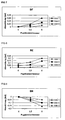
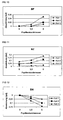
- Figs. 7 to 12 show the deviation of the refractive power in the position of use as a function of the pupil diameter of the sighting eye for different additions in the respective reference points specified for a given spherical effect.
- Figs. 7 to 9 is the spherical effect - 1.0 dpt and the specified additions Add - as shown in the respective insets is -1, 2 and 3 dpt.
- Fig. 7 shows the dependence of the deviation of the refractive power in the position of use from the pupil diameter at the distance reference point B F , Fig. 8 in the center point B Z and Fig. 9 in the near reference point B N.
- the Figs. 10 to 12 correspond to the respective Figs. 7 to 9 in all corresponding values, except for the spherical effect, which in the Figs. 10 to 12 each is +2.0 dpt.
- the invention meets in accordance with a particularly preferred embodiment of the manufacturing method according to the invention characterized in that in the calculation process of the progressive spectacle lens a negative Target refraction deviation at the femoral reference point and a positive target refraction deviation at the near reference point are introduced.
- a negative Target refraction deviation at the femoral reference point and a positive target refraction deviation at the near reference point are introduced.
- the invention is further based on the finding that positive refraction errors (fog) have a much more critical effect on the optical imaging properties than negative refractive errors.
- positive refraction errors fig
- the depth of field decreases sharply as the pupil opening increases.
- the invention is aware of the finding that positive errors are not only more critical, but also occur more frequently.
- the reason for this is in particular the refraction determination for the determination of the recipe or order values.
- the determination of the refraction is usually carried out in a room with a distance of 5 to 6 m from the eye.
- the fact that the visual sample is not at infinity but at finite distance results in a positive refraction error of about 0.15 to 0.2 dpt.
- a complete refraction determination involves testing for infinity, this is often or usually not done, and thus this error persists.
- a progressive spectacle lens can be produced which nominally has a negative refractive error at the distance reference point and a positive refraction error at the near reference point.
- the refractive power increase or decrease is taken into account as the pupil opening increases and, on the other hand, the design becomes less sensitive to small refraction deviations.
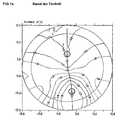
- FIG. 1a shows the refractive index distribution and FIG. 2a the astigmatism distribution of a conventional progressive spectacle lens in each position of use.
- the spectacle lens is a progressive spectacle lens of Rodenstock GmbH, which is marketed under the brand name Multigressiv ILT.
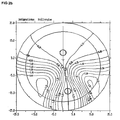
- Figures 1b and 2 B Accordingly, a preferred spectacle lens according to the invention with modified refractive power distribution and superimposed negative and positive desired refractive errors in the Reference points.
- the remote reference point which in Fig. 1b indicated by an upper circle on the tortuous main line, introduced a negative target refraction deviation of 0.1 dpt.
- the calculation addition has been increased by 0.1 d compared to the order addition.
- the near reference point is indicated by a lower circle on the main line.
- Both the conventional and the spectacle lens according to the invention have a spherical (order) distance effect of 0.50 D and a (order) addition of 2.00 D.
- FIG. 1b It can be seen that the refractive power in the females reference point in comparison to the conventional spectacle lens according to FIG. 1a is smaller. As in FIG. 2b is shown, the slightly higher addition in the invention causes a slightly narrower Progression Scheme compared to the conventional spectacle lens according to FIG. 1 a. This disadvantage can not be prevented.
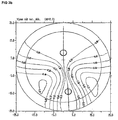
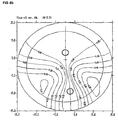
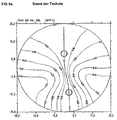
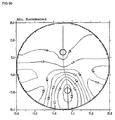
- FIGS. 3a (Conventional eyeglass lens) and 3b (preferred eyeglass lens according to the invention) each show the distribution of the relative visual acuity reduction by the aberrations (astigmatic deviation and refraction deviation) of FIG FIGS. 1 and 2 shown progressive lenses.
- the relative visual acuity reduction of a spectacle wearer indicates how much the visual acuity of a spectacle wearer is reduced by the aberrations (astigmatic errors and refractive errors) of the spectacle lens.
- the isoline in the FIGS. 3a to 5b with, for example, 0.9 means that the visual acuity is reduced to 90% of the initial visual acuity of the spectacle wearer.
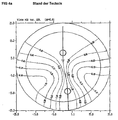
- FIGS. 4a and 4b each show the distribution of relative visual acuity reduction when an additional negative refractive error of -0.2 dpt Figs. 3 shown progressive spectacle lenses occurs. There are practically no differences to the optimal correction according to Figures 3 to recognize. Due to the existing residual accommodation capacity, these errors can be compensated.
- FIGS. 5a and 5b in each case show the distribution of relative visual acuity reduction when an additional positive refractive error of +0.2 dpt Figs. 3 shown progressive spectacle lenses occurs.
- FIG. 5b shows how insensitive the spectacle lens according to the invention is to small positive refractive error. While in the conventional spectacle lens of FIG. 5a the distance range is significantly reduced, this remains almost unchanged in the spectacle lens according to the invention.
- the far range is defined here as the area within a semicircle with a radius of 20 mm about a point which is 4 mm below the centering point (shown in FIG. 5 through a cross), and above a horizontal that passes through that point and whose relative visual acuity is more than 0.9 dpt.
- the introduced desired refraction overlay should move between 0.03 and 0.2 dpt, preferably between 0.08 and 0.12 dpt, at the far reference point.
- FIGS. 6a . b and c show the arrowheads, the mean surface refractive power and the surface astigmatism of the previously described preferred spectacle lens according to the invention.
- Table 1 ⁇ / b> Add / Sph 1.0 2.0 3.0 BF BZ BN BF BZ BN BF BZ BN - 4 -4.01 -4.01 -3.00 -4.01 -3.96 -2.01 -4.0 -3,93 -1.01 -1 -1 -1 -0.01 -1.02 -0.97 0.99 -1.01 -0.93 1.98 2 1.99 2.0 2.99 1.99 2.04 3.99 2.0 2.08 4.99 5 4.98 4.99 6.0 4.99 5.04 6.99 5.0 5.08 7.99 Add / Sph 1.0 2.0 3.0 BF BZ BN BF BZ BN BF BZ BN -1 -1.0 -0.99 -0.02 -1.0 -0.94 0.96 -0.98 -0.88 1.93 2 2.0 2.01 2.97
Landscapes
- Health & Medical Sciences (AREA)
- Ophthalmology & Optometry (AREA)
- Physics & Mathematics (AREA)
- General Health & Medical Sciences (AREA)
- General Physics & Mathematics (AREA)
- Optics & Photonics (AREA)
- Eyeglasses (AREA)
Applications Claiming Priority (2)
| Application Number | Priority Date | Filing Date | Title |
|---|---|---|---|
| DE10339948A DE10339948A1 (de) | 2003-08-29 | 2003-08-29 | Fehlertolerantes Progressivglasdesign |
| PCT/EP2004/009227 WO2005029160A1 (de) | 2003-08-29 | 2004-08-17 | Fehlertolerantes progressivglasdesign |
Publications (2)
| Publication Number | Publication Date |
|---|---|
| EP1658522A1 EP1658522A1 (de) | 2006-05-24 |
| EP1658522B1 true EP1658522B1 (de) | 2008-06-25 |
Family
ID=34352744
Family Applications (1)
| Application Number | Title | Priority Date | Filing Date |
|---|---|---|---|
| EP04764215A Expired - Lifetime EP1658522B1 (de) | 2003-08-29 | 2004-08-17 | Fehlertolerantes progressivglasdesign |
Country Status (6)
| Country | Link |
|---|---|
| US (1) | US7771047B2 (enExample) |
| EP (1) | EP1658522B1 (enExample) |
| JP (1) | JP4708344B2 (enExample) |
| DE (2) | DE10339948A1 (enExample) |
| ES (1) | ES2308220T3 (enExample) |
| WO (1) | WO2005029160A1 (enExample) |
Cited By (1)
| Publication number | Priority date | Publication date | Assignee | Title |
|---|---|---|---|---|
| DE102021000451A1 (de) | 2021-01-29 | 2022-08-04 | Rodenstock Gmbh | System und Verfahren fur die Bestelleingangsverarbeitung und Fertigung von Brillengläsern |
Families Citing this family (3)
| Publication number | Priority date | Publication date | Assignee | Title |
|---|---|---|---|---|
| WO2008089995A1 (de) | 2007-01-25 | 2008-07-31 | Rodenstock Gmbh | Verfahren zur berechnung eines brillenglases mit variabler lage der bezugspunkte |
| US8356896B2 (en) | 2007-01-25 | 2013-01-22 | Rodenstock Gmbh | Method for determining far and near reference points |
| JP5989317B2 (ja) * | 2011-09-29 | 2016-09-07 | イーエイチエス レンズ フィリピン インク | 累進屈折力レンズ、その製造方法、およびその設計方法 |
Family Cites Families (7)
| Publication number | Priority date | Publication date | Assignee | Title |
|---|---|---|---|---|
| FR2770000B1 (fr) * | 1997-10-16 | 1999-12-31 | Essilor Int | Lentille ophtalmique multifocale |
| ATE438880T1 (de) * | 1999-02-12 | 2009-08-15 | Hoya Corp | Brille und ihre herstellung |
| KR100635182B1 (ko) * | 1999-04-13 | 2006-10-17 | 호야 가부시키가이샤 | 누진 굴절력 안경 렌즈 및 그 설계 방법 |
| AUPQ065599A0 (en) * | 1999-05-31 | 1999-06-24 | Sola International Holdings Ltd | Progressive lens |
| DE50114292D1 (de) * | 2000-01-17 | 2008-10-16 | Rodenstock Gmbh | Gläsern |
| AU2001273857B9 (en) * | 2000-04-25 | 2005-07-07 | Rodenstock Gmbh | Progressive spectacle glass |
| JP4618656B2 (ja) * | 2000-05-10 | 2011-01-26 | 株式会社ニコン・エシロール | 累進多焦点レンズシリーズ |
-
2003
- 2003-08-29 DE DE10339948A patent/DE10339948A1/de not_active Ceased
-
2004
- 2004-08-17 EP EP04764215A patent/EP1658522B1/de not_active Expired - Lifetime
- 2004-08-17 WO PCT/EP2004/009227 patent/WO2005029160A1/de not_active Ceased
- 2004-08-17 ES ES04764215T patent/ES2308220T3/es not_active Expired - Lifetime
- 2004-08-17 JP JP2006524293A patent/JP4708344B2/ja not_active Expired - Lifetime
- 2004-08-17 DE DE502004007448T patent/DE502004007448D1/de not_active Expired - Lifetime
- 2004-08-17 US US10/569,952 patent/US7771047B2/en not_active Expired - Lifetime
Cited By (2)
| Publication number | Priority date | Publication date | Assignee | Title |
|---|---|---|---|---|
| DE102021000451A1 (de) | 2021-01-29 | 2022-08-04 | Rodenstock Gmbh | System und Verfahren fur die Bestelleingangsverarbeitung und Fertigung von Brillengläsern |
| WO2022161944A1 (de) | 2021-01-29 | 2022-08-04 | Rodenstock Gmbh | System und verfahren für die bestelleingangsverarbeitung und fertigung von brillengläsern |
Also Published As
| Publication number | Publication date |
|---|---|
| DE502004007448D1 (de) | 2008-08-07 |
| WO2005029160A1 (de) | 2005-03-31 |
| US7771047B2 (en) | 2010-08-10 |
| ES2308220T3 (es) | 2008-12-01 |
| US20070109496A1 (en) | 2007-05-17 |
| JP2007504485A (ja) | 2007-03-01 |
| DE10339948A1 (de) | 2005-04-28 |
| JP4708344B2 (ja) | 2011-06-22 |
| EP1658522A1 (de) | 2006-05-24 |
Similar Documents
| Publication | Publication Date | Title |
|---|---|---|
| EP1277079B1 (de) | Verfahren zum berechnen eines progressiven brillenglases sowie verahren zur herstellung eines derartigen brillenglases | |
| EP0347917B1 (de) | Brillenglas mit einem sich änderndem Brechungsindex | |
| EP2115527B1 (de) | Verfahren zur optimierung eines brillenglases | |
| EP0300415B1 (de) | Brillenglas mit astigmatischer Wirkung | |
| EP0969309B1 (de) | Serie progressiver Brillengläser | |
| EP2564262B1 (de) | Verfahren zur berechnung eines brillenglases mit blickwinkelabhängigen verordnungsdaten | |
| DE8104023U1 (de) | Brillenglas mit zunehmender brennpunktverstaerkung | |
| DE102012102743B4 (de) | Verfahren zum Auslegen eines Brillenglases und Brillenglas | |
| EP2767862B1 (de) | Verordnungs- und individualisierungsabhängige anpassung der objektabstandsfunktion an veränderte objektabstände für die nähe und/oder ferne | |
| EP3598213A1 (de) | Gleitsicht-brillenglas mit räumlich variierendem brechungsindex | |
| DE3822376A1 (de) | Ophthalmische gleitlinse | |
| EP3814828B1 (de) | Computerimplementiertes verfahren, datenverarbeitungssystem zum erzeugen eines zieldesigns sowie computerprogramm, speichermedium mit instruktionen zum erzeugen eines zieldesigns, verfahren zum bereitstellen eines brillenglases, speichermedium mit einer numerischen darstellung eines brillenglases und verfahren zum herstellen eines brillenglases | |
| WO2013164223A2 (de) | Verfahren und vorrichtung zur herstellung einer doppelsichtscheibe für eine arbeitsschutzbrille | |
| EP1277075B1 (de) | Progressives brillenglas mit geringen vergrösserungsunterschieden | |
| EP1570309B1 (de) | Verfahren zur herstellung eines brillenglaspaares | |
| EP1277076B1 (de) | Progressives brillenglas | |
| EP1658522A1 (de) | Fehlertolerantes progressivglasdesign | |
| WO2024223632A1 (de) | Reduktion der progression von myopie mit angepasstem wirkungsbereich | |
| EP1415189B1 (de) | Progressives brillenglas für grosse und mittlere objektentfernungen | |
| EP1561148B1 (de) | Doppelprogressives brillenglas | |
| EP1894056B1 (de) | Serie von brillengläsern, verfahren zur herstellung | |
| DE102017000777A1 (de) | Verfahren zur Berücksichtigung unterschiedlicher prismatischer Korrekturen in der Ferne und der Nähe | |
| DE4238067C3 (de) | Gruppe von progressiven Brillengläsern | |
| DE1572847C (de) | Ophthalmische Linse mit progressiv sich ändernder Brechkraft | |
| WO2025061559A1 (de) | Brillenglas für ein head-mounted display, head-mounted display sowie verfahren zum entwerfen und herstellen eines brillenglases |
Legal Events
| Date | Code | Title | Description |
|---|---|---|---|
| PUAI | Public reference made under article 153(3) epc to a published international application that has entered the european phase |
Free format text: ORIGINAL CODE: 0009012 |
|
| 17P | Request for examination filed |
Effective date: 20060316 |
|
| AK | Designated contracting states |
Kind code of ref document: A1 Designated state(s): DE ES FR GB IT |
|
| DAX | Request for extension of the european patent (deleted) | ||
| RBV | Designated contracting states (corrected) |
Designated state(s): DE ES FR GB IT |
|
| RIN1 | Information on inventor provided before grant (corrected) |
Inventor name: SCHWARZ, ILKA Inventor name: MUELLER, WERNER Inventor name: ZIMMERMANN, MARTIN Inventor name: WELK, ANDREA Inventor name: ESSER, GREGOR Inventor name: SCHMID, KERSTIN Inventor name: ALTHEIMER, HELMUT Inventor name: NIKOLAUS, WINFRIED Inventor name: BROSIG, JOCHEN Inventor name: AWRATH, NORBERT Inventor name: SCHMID, LEONHARD |
|
| RIN1 | Information on inventor provided before grant (corrected) |
Inventor name: SCHMID, KERSTIN Inventor name: SCHMID, LEONHARD Inventor name: AWRATH, NORBERT Inventor name: MUELLER, WERNER Inventor name: NIKOLAUS, WINFRIED Inventor name: ALTHEIMER, HELMUT Inventor name: ZIMMERMANN, MARTIN Inventor name: WELK, ANDREA Inventor name: SCHWARZ, ILKA Inventor name: BROSIG, JOCHEN Inventor name: ESSER, GREGOR |
|
| GRAP | Despatch of communication of intention to grant a patent |
Free format text: ORIGINAL CODE: EPIDOSNIGR1 |
|
| GRAS | Grant fee paid |
Free format text: ORIGINAL CODE: EPIDOSNIGR3 |
|
| GRAA | (expected) grant |
Free format text: ORIGINAL CODE: 0009210 |
|
| AK | Designated contracting states |
Kind code of ref document: B1 Designated state(s): DE ES FR GB IT |
|
| REG | Reference to a national code |
Ref country code: GB Ref legal event code: FG4D Free format text: NOT ENGLISH |
|
| REF | Corresponds to: |
Ref document number: 502004007448 Country of ref document: DE Date of ref document: 20080807 Kind code of ref document: P |
|
| REG | Reference to a national code |
Ref country code: ES Ref legal event code: FG2A Ref document number: 2308220 Country of ref document: ES Kind code of ref document: T3 |
|
| PLBE | No opposition filed within time limit |
Free format text: ORIGINAL CODE: 0009261 |
|
| STAA | Information on the status of an ep patent application or granted ep patent |
Free format text: STATUS: NO OPPOSITION FILED WITHIN TIME LIMIT |
|
| 26N | No opposition filed |
Effective date: 20090326 |
|
| REG | Reference to a national code |
Ref country code: FR Ref legal event code: GC Effective date: 20110929 |
|
| REG | Reference to a national code |
Ref country code: GB Ref legal event code: 732E Free format text: REGISTERED BETWEEN 20111013 AND 20111019 |
|
| REG | Reference to a national code |
Ref country code: DE Ref legal event code: R081 Ref document number: 502004007448 Country of ref document: DE Owner name: RODENSTOCK GMBH, DE Free format text: FORMER OWNER: RODENSTOCK GMBH, 80469 MUENCHEN, DE Effective date: 20120822 Ref country code: DE Ref legal event code: R081 Ref document number: 502004007448 Country of ref document: DE Owner name: RODENSTOCK GMBH, DE Free format text: FORMER OWNER: RODENSTOCK GMBH, 80687 MUENCHEN, DE Effective date: 20120822 |
|
| REG | Reference to a national code |
Ref country code: FR Ref legal event code: GC Effective date: 20140904 |
|
| REG | Reference to a national code |
Ref country code: FR Ref legal event code: PLFP Year of fee payment: 13 |
|
| REG | Reference to a national code |
Ref country code: FR Ref legal event code: PLFP Year of fee payment: 14 |
|
| REG | Reference to a national code |
Ref country code: FR Ref legal event code: PLFP Year of fee payment: 15 |
|
| PGFP | Annual fee paid to national office [announced via postgrant information from national office to epo] |
Ref country code: IT Payment date: 20230831 Year of fee payment: 20 Ref country code: GB Payment date: 20230824 Year of fee payment: 20 Ref country code: ES Payment date: 20230918 Year of fee payment: 20 |
|
| PGFP | Annual fee paid to national office [announced via postgrant information from national office to epo] |
Ref country code: FR Payment date: 20230821 Year of fee payment: 20 Ref country code: DE Payment date: 20230823 Year of fee payment: 20 |
|
| REG | Reference to a national code |
Ref country code: DE Ref legal event code: R071 Ref document number: 502004007448 Country of ref document: DE |
|
| REG | Reference to a national code |
Ref country code: ES Ref legal event code: FD2A Effective date: 20240826 |
|
| REG | Reference to a national code |
Ref country code: GB Ref legal event code: PE20 Expiry date: 20240816 |
|
| PG25 | Lapsed in a contracting state [announced via postgrant information from national office to epo] |
Ref country code: GB Free format text: LAPSE BECAUSE OF EXPIRATION OF PROTECTION Effective date: 20240816 |
|
| PG25 | Lapsed in a contracting state [announced via postgrant information from national office to epo] |
Ref country code: ES Free format text: LAPSE BECAUSE OF EXPIRATION OF PROTECTION Effective date: 20240818 |
|
| PG25 | Lapsed in a contracting state [announced via postgrant information from national office to epo] |
Ref country code: GB Free format text: LAPSE BECAUSE OF EXPIRATION OF PROTECTION Effective date: 20240816 Ref country code: ES Free format text: LAPSE BECAUSE OF EXPIRATION OF PROTECTION Effective date: 20240818 |