EP1655843A1 - Decoder and method for decoding low-density parity-check (LDPC) code - Google Patents
Decoder and method for decoding low-density parity-check (LDPC) code Download PDFInfo
- Publication number
- EP1655843A1 EP1655843A1 EP05107528A EP05107528A EP1655843A1 EP 1655843 A1 EP1655843 A1 EP 1655843A1 EP 05107528 A EP05107528 A EP 05107528A EP 05107528 A EP05107528 A EP 05107528A EP 1655843 A1 EP1655843 A1 EP 1655843A1
- Authority
- EP
- European Patent Office
- Prior art keywords
- parity
- received data
- check matrix
- parity check
- errors
- Prior art date
- Legal status (The legal status is an assumption and is not a legal conclusion. Google has not performed a legal analysis and makes no representation as to the accuracy of the status listed.)
- Granted
Links
- 238000000034 method Methods 0.000 title claims description 12
- 239000011159 matrix material Substances 0.000 claims abstract description 51
- 238000010586 diagram Methods 0.000 description 6
- 230000003247 decreasing effect Effects 0.000 description 2
- 230000006870 function Effects 0.000 description 2
- 238000006243 chemical reaction Methods 0.000 description 1
- 238000004891 communication Methods 0.000 description 1
- 238000012937 correction Methods 0.000 description 1
- 238000013500 data storage Methods 0.000 description 1
- 238000005516 engineering process Methods 0.000 description 1
- 230000005055 memory storage Effects 0.000 description 1
- 238000012545 processing Methods 0.000 description 1
- 238000012546 transfer Methods 0.000 description 1
Images

Classifications
-
- H—ELECTRICITY
- H03—ELECTRONIC CIRCUITRY
- H03M—CODING; DECODING; CODE CONVERSION IN GENERAL
- H03M13/00—Coding, decoding or code conversion, for error detection or error correction; Coding theory basic assumptions; Coding bounds; Error probability evaluation methods; Channel models; Simulation or testing of codes
- H03M13/03—Error detection or forward error correction by redundancy in data representation, i.e. code words containing more digits than the source words
- H03M13/05—Error detection or forward error correction by redundancy in data representation, i.e. code words containing more digits than the source words using block codes, i.e. a predetermined number of check bits joined to a predetermined number of information bits
- H03M13/11—Error detection or forward error correction by redundancy in data representation, i.e. code words containing more digits than the source words using block codes, i.e. a predetermined number of check bits joined to a predetermined number of information bits using multiple parity bits
-
- H—ELECTRICITY
- H03—ELECTRONIC CIRCUITRY
- H03M—CODING; DECODING; CODE CONVERSION IN GENERAL
- H03M13/00—Coding, decoding or code conversion, for error detection or error correction; Coding theory basic assumptions; Coding bounds; Error probability evaluation methods; Channel models; Simulation or testing of codes
- H03M13/03—Error detection or forward error correction by redundancy in data representation, i.e. code words containing more digits than the source words
- H03M13/05—Error detection or forward error correction by redundancy in data representation, i.e. code words containing more digits than the source words using block codes, i.e. a predetermined number of check bits joined to a predetermined number of information bits
- H03M13/11—Error detection or forward error correction by redundancy in data representation, i.e. code words containing more digits than the source words using block codes, i.e. a predetermined number of check bits joined to a predetermined number of information bits using multiple parity bits
- H03M13/1102—Codes on graphs and decoding on graphs, e.g. low-density parity check [LDPC] codes
- H03M13/1105—Decoding
- H03M13/1111—Soft-decision decoding, e.g. by means of message passing or belief propagation algorithms
-
- H—ELECTRICITY
- H03—ELECTRONIC CIRCUITRY
- H03M—CODING; DECODING; CODE CONVERSION IN GENERAL
- H03M13/00—Coding, decoding or code conversion, for error detection or error correction; Coding theory basic assumptions; Coding bounds; Error probability evaluation methods; Channel models; Simulation or testing of codes
- H03M13/03—Error detection or forward error correction by redundancy in data representation, i.e. code words containing more digits than the source words
- H03M13/05—Error detection or forward error correction by redundancy in data representation, i.e. code words containing more digits than the source words using block codes, i.e. a predetermined number of check bits joined to a predetermined number of information bits
- H03M13/13—Linear codes
- H03M13/19—Single error correction without using particular properties of the cyclic codes, e.g. Hamming codes, extended or generalised Hamming codes
-
- H—ELECTRICITY
- H03—ELECTRONIC CIRCUITRY
- H03M—CODING; DECODING; CODE CONVERSION IN GENERAL
- H03M13/00—Coding, decoding or code conversion, for error detection or error correction; Coding theory basic assumptions; Coding bounds; Error probability evaluation methods; Channel models; Simulation or testing of codes
- H03M13/37—Decoding methods or techniques, not specific to the particular type of coding provided for in groups H03M13/03 - H03M13/35
- H03M13/3738—Decoding methods or techniques, not specific to the particular type of coding provided for in groups H03M13/03 - H03M13/35 with judging correct decoding
Definitions
- the present invention relates to a decoder for decoding a low-density parity-check code and a method for doing the same.
- a low-density parity-check code (hereinafter referred to as LDPC code) has recently been noted as an error checking and correcting code.
- Message-passing algorithm is known as a technology for decoding an LDPC code (see, for example, Andrew J. Blanksby and Chris J. Howland, "A 690-mW 1-Gb/s 1024-b, Rate-1/2 Low-Density Parity-Check Code Decoder", IEEE Journal of Solid-State Circuits, Vol. 37, No. 3, March 2002, pp. 404-412.
- a bit update for each row of a check matrix (parity check matrix) for an LDPC code and a parity update for each column thereof are repeated in order to decode the LDPC code.
- the above LDPC code is very strong. If, however, it is decoded repeatedly, the number of errors may increase or decrease in intermediate results obtained from the decoding. If, in particular, the number of uncorrectable errors caused in the intermediate results is graphed, it may increase or decrease with a large amplitude. If an LDPC code is determined as an uncorrectable one after its decoding is repeated a given number of times, a result of the decoding is likely to be output when the above amplitude is high, or when the number of errors increases.
- the present invention has been developed in consideration of the above situation, and its object is to provide a decoder for decoding a low-density parity-check code, which is capable of reducing the number of error bits included in uncorrectable errors, and a method for doing the same.
- a low-density parity-check code decoder comprising storage means for when received data is decoded using a given parity check matrix, storing a value "not zero" included in a vector obtained by multiplying the parity check matrix and the received data as the number of parity errors, and storing hard-decision result information corresponding to the number of parity errors, and output means for when it is determined that the received data is uncorrectable after the received data is decoded a given number of times, outputting hard-decision result information corresponding to the smallest number of parity errors, which is included in the number of parity errors stored in the storage means, as a decoding result.
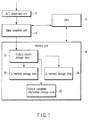
- FIG. 1 is a block diagram showing a low-density parity-check (LDPC) code decoding system to which an LDPC code decoder according to a first embodiment of the present invention is applied.
- LDPC low-density parity-check
- the LDPC code decoding system comprises an A/D conversion unit 12 which converts received analog data into digital data, a data reception unit 14 which receives the digital data and outputs channel data, a memory unit 18 which stores the received data and the like, and a central processing unit (CPU) 16 serving as a controller which controls the LDPC code decoding system.
- the memory unit 18 includes an output channel data storage area 20 which stores output channel information, q and p memory storage areas 22 and 24 which copy and store arbitrary data stored in the storage area 20, and an output candidate information storage area 26 which stores the number whose value is "1" in a vector obtained by multiplying the received data by a parity check matrix, as the number of parity errors and then stores hard-decision result information corresponding to the number of parity errors.
- FIG. 2 is a schematic diagram showing a parity check matrix H of an LDPC code, to which the LDPC code decoder according to the first embodiment of the present invention is applied.
- each of rows of the parity check matrix H can be considered to be one parity check equation.
- the parity check equation corresponding to the i-th row of the parity check matrix H is called an i-th parity check equation.
- the N-bit LDPC code has to satisfy all parity check equations in the parity check matrix H, namely, the first to the M-th parity check equations therein.
- r i,j is obtained by transferring parity information (reliability information) q i,j' , which corresponds to the bits (except the j-th bit) of the I-th row in the parity check matrix H, from a parity node to a bit node
- r i,j is bit information (reliability information) indicating the reliability of the j-th bit x j of the i-th row in the parity check matrix H
- r i,j indicates not the probability that the bit x j is "0" or "1" but a logarithm of the probability, the logarith
- q i , j is obtained by transferring bit information (reliability information) r i' , j , which corresponds to the bits (except the i-th bit) of the j-th row in the parity check matrix H, from a bit node to a parity node
- q i , j is parity information (reliability information) indicating the reliability of the j-th bit x j of the i-th row in the parity check matrix H
- q i,j is used as q i,j' for the bit update given by the above equation (1).
- Pj is a logarithm of the probability (initial probability) that when an LDPC code is output through a communication channel, the j-th bit x j in the LDPC code is "1" or "0", and Pj coincides with the initial value of q i , j corresponding to the bits of "1" in the parity check matrix H; N(j) is a set of bit positions of "1" in the j-th column in the parity check matrix H; N(j) ⁇ i is N(j) except the i-th bit; i' ⁇ N(j) ⁇ i is an arbitrary one of the bit positions included in N(j) except the i-th bit; and r i' , j is bit information (reliability information) indicating the reliability of the j-th bit x j of the I-th row in the parity check matrix H, and r i , j in the above equation (1) is used for r i' , j .
- the CPU 16 decodes received data in step S1.
- the parity check matrix H expressed by the equation (3) is multiplied by the following expression as received data to be decoded: ( 0 0 0 0 0 0 0 0 0 0 0 0 0 0 0 0 0 0 0 0 1 1 )
- the following expression is obtained: ( 0 0 1 1 0 0 0 0 1 1 1 0 0 0 0 0 ) Since the lowest two elements in the expression (4) are "1", the expression (4) is multiplied by the equation (3) indicative of the parity check matrix H.
- the expression (5) is output as the vector.
- the number of values "1” is stored in the output candidate information storage area 26 of the memory unit 18 as the number of parity errors (output candidate information) by the CPU 16 in step S2. Since the expression (5) includes four values "1", the number of parity errors is stored as "4" in the storage area 26. Hard-decision result information (e.g., data of "0” and "1") corresponding to the number of parity errors is also stored therein.
- step S3 the CPU 16 determines whether the decoding has been performed a given number of times. If the decoding has not yet been done, it is repeated a given number of times (assume here that "4", "10”, “14”, “20”, “17” and “41" are stored as the number of parity errors. Information about the number of repetitions of decoding is stored in advance in the output candidate information storage area 26 and referred to by the CPU 16 when the need arises.
- the CPU 16 determines that the decoding has been performed a given number of times in step S3, it determines the smallest number of parity errors stored in the storage area 26 in step S4. Since "4", "10”, “14”, “20”, “17” and “41” are stored as the number of parity errors, the smallest one is "4".
- the CPU 16 reads out hard-decision result information corresponding to the number of parity errors, which is determined as the smallest one, and outputs it as decoding result data.
- Value "1" which is “not zero” is stored and the smallest one of the stores values is used. In addition to this, value "0" which is “zero” can be stored and the largest one of the stored values can be used.
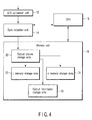
- FIG. 4 is a block diagram showing an LDPC code decoding system to which an LDPC code decoder according to a second embodiment of the present invention is applied.
- a memory unit 18 includes an output information storage area 28 corresponding to the output candidate information storage area 26 of the first embodiment.
- the storage area 28 stores not all result data (hard-decision result information corresponding to the number of parity errors) but only the smallest number of parity errors together with its corresponding hard-decision result information. Old result data is then overwritten and erased.
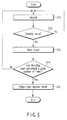
- a CPU 16 decodes received data in step S10 and determines whether the number of parity errors is the smallest or not as result data in step S11. Referring to the number of parity errors stored in the output information storage area 28 of the memory unit 18, the CPU 16 determines whether the number of parity errors is smaller. If the CPU 16 determines in step S12 that the number of parity errors is the smallest, new result data is stored in place of the stored result data in step S13. Then, the CPU 16 determines whether the data is decoded a given number of times in step S14. If the decoding is performed a given number of times, the CPU 16 reads hard-decision result information corresponding to the number of parity errors stored in the output information storage area 28 in step S15 and outputs it as a decoding result.
- the storage area of the memory unit 18 can be decreased in size and the output time of the decoding result can be shortened.
Landscapes
- Physics & Mathematics (AREA)
- Probability & Statistics with Applications (AREA)
- Engineering & Computer Science (AREA)
- Theoretical Computer Science (AREA)
- Error Detection And Correction (AREA)
- Detection And Correction Of Errors (AREA)
- Detection And Prevention Of Errors In Transmission (AREA)
Abstract
Description
- The present invention relates to a decoder for decoding a low-density parity-check code and a method for doing the same.
- A low-density parity-check code (hereinafter referred to as LDPC code) has recently been noted as an error checking and correcting code. Message-passing algorithm is known as a technology for decoding an LDPC code (see, for example, Andrew J. Blanksby and Chris J. Howland, "A 690-mW 1-Gb/s 1024-b, Rate-1/2 Low-Density Parity-Check Code Decoder", IEEE Journal of Solid-State Circuits, Vol. 37, No. 3, March 2002, pp. 404-412. In the message-passing algorithm, a bit update for each row of a check matrix (parity check matrix) for an LDPC code and a parity update for each column thereof are repeated in order to decode the LDPC code.
- The above LDPC code is very strong. If, however, it is decoded repeatedly, the number of errors may increase or decrease in intermediate results obtained from the decoding. If, in particular, the number of uncorrectable errors caused in the intermediate results is graphed, it may increase or decrease with a large amplitude. If an LDPC code is determined as an uncorrectable one after its decoding is repeated a given number of times, a result of the decoding is likely to be output when the above amplitude is high, or when the number of errors increases.
- The present invention has been developed in consideration of the above situation, and its object is to provide a decoder for decoding a low-density parity-check code, which is capable of reducing the number of error bits included in uncorrectable errors, and a method for doing the same.
- According to an aspect of the present invention, there is provided a low-density parity-check code decoder comprising storage means for when received data is decoded using a given parity check matrix, storing a value "not zero" included in a vector obtained by multiplying the parity check matrix and the received data as the number of parity errors, and storing hard-decision result information corresponding to the number of parity errors, and output means for when it is determined that the received data is uncorrectable after the received data is decoded a given number of times, outputting hard-decision result information corresponding to the smallest number of parity errors, which is included in the number of parity errors stored in the storage means, as a decoding result.
- In the above-described low-density parity-check code decoder, when received data is decoded using a given parity check matrix, a value "1" included in the vector obtained by multiplying the parity check matrix and the received data is stored as the number of parity errors and hard-decision result information corresponding to the number of parity errors is stored. When it is determined that the received data is uncorrectable after the received data is decoded a given number of times, the smallest number of parity errors is specified, and its corresponding hard-decision result information is read out and output as a decoding result. Thus, when it is determined that the received data is uncorrectable, the hard-decision result information corresponding to the smallest number of parity errors can be output as a decoding result.
- When a low-density parity-check code is decoded and determined as an uncorrectable one, not a bit determination result but a determination result obtained when the number of parity errors is the smallest is output, with the result that the average number of error bits in the code can be reduced.
- This summary of the invention does not necessarily describe all necessary features so that the invention may also be a sub-combination of these described features.
- The invention can be more fully understood from the following detailed description when taken in conjunction with the accompanying drawings, in which:
- FIG. 1 is a block diagram showing a low-density parity-check code decoding system to which a low-density parity-check code decoder according to a first embodiment of the present invention is applied;
- FIG. 2 is a schematic diagram showing a parity check matrix of a low-density parity-check code, to which the low-density parity-check code decoder according to the first embodiment of the present invention is applied;
- FIG. 3 is a flowchart explaining a method for decoding a low-density parity-check code according to the first embodiment of the present invention;
- FIG. 4 is a block diagram showing a low-density parity-check code decoding system to which a low-density parity-check code decoder according to a second embodiment of the present invention is applied; and
- FIG. 5 is a flowchart explaining a method for decoding a low-density parity-check code according to the second embodiment of the present invention.
- Embodiments of the present invention will be described with reference to the accompanying drawings.
- FIG. 1 is a block diagram showing a low-density parity-check (LDPC) code decoding system to which an LDPC code decoder according to a first embodiment of the present invention is applied.
- The LDPC code decoding system comprises an A/
D conversion unit 12 which converts received analog data into digital data, adata reception unit 14 which receives the digital data and outputs channel data, amemory unit 18 which stores the received data and the like, and a central processing unit (CPU) 16 serving as a controller which controls the LDPC code decoding system. Thememory unit 18 includes an output channeldata storage area 20 which stores output channel information, q and pmemory storage areas storage area 20, and an output candidate information storage area 26 which stores the number whose value is "1" in a vector obtained by multiplying the received data by a parity check matrix, as the number of parity errors and then stores hard-decision result information corresponding to the number of parity errors. - FIG. 2 is a schematic diagram showing a parity check matrix H of an LDPC code, to which the LDPC code decoder according to the first embodiment of the present invention is applied.
- The parity check matrix H is based on the premise that the LDPC code is N (= sm) bits. The j-th (j = 1, 2, ..., N) bit of the LDPC code is represented by xj. As is known, each of rows of the parity check matrix H can be considered to be one parity check equation. The parity check equation corresponding to the i-th row of the parity check matrix H is called an i-th parity check equation. The N-bit LDPC code has to satisfy all parity check equations in the parity check matrix H, namely, the first to the M-th parity check equations therein.
- In order to decode an LDPC code by the message-passing algorithm, generally, a bit update and a parity update need to be repeated.
- The bit update is usually expressed by the following equation:

where
ri,j is obtained by transferring parity information (reliability information) qi,j', which corresponds to the bits (except the j-th bit) of the I-th row in the parity check matrix H, from a parity node to a bit node, ri,j is bit information (reliability information) indicating the reliability of the j-th bit xj of the i-th row in the parity check matrix H, and ri,j indicates not the probability that the bit xj is "0" or "1" but a logarithm of the probability, the logarithm being used to allow multiplication and division to be replaced with addition and subtraction;
M(i) is a set of bit positions of "1" in the i-th row in the parity check matrix H;
M(i)\j is M(i) except the j-th bit;
j' ∈ M(i)\j is an arbitrary one of the bit positions included in M(i) except the j-th bit;
qi,j' is parity information (reliability information) indicating the reliability of the j-th bit xj' of the i-th row in the parity check matrix H, and qi,j' indicates not the probability that bit xj' is "0" or "1" but a logarithm of the probability;
sgn(qi,j') is a code of qi,j', this code is represented by the most significant bit MSB of qi,j', sgn(qi,j') = -1 and MSB(qi,j') = 1 when qi,j' is negative, and sgn(qi,j') = +1 and MSB(qi,j') = 0 when qi,j' is not negative, namely, zero or positive; and
Ψ ( ) is the function of a probability operation (hereinafter referred to as Ψ function). - The parity update is expressed by the following equation:

where
qi,j is obtained by transferring bit information (reliability information) ri',j, which corresponds to the bits (except the i-th bit) of the j-th row in the parity check matrix H, from a bit node to a parity node, qi,j is parity information (reliability information) indicating the reliability of the j-th bit xj of the i-th row in the parity check matrix H, and qi,j is used as qi,j' for the bit update given by the above equation (1). - Pj is a logarithm of the probability (initial probability) that when an LDPC code is output through a communication channel, the j-th bit xj in the LDPC code is "1" or "0", and Pj coincides with the initial value of qi,j corresponding to the bits of "1" in the parity check matrix H;
N(j) is a set of bit positions of "1" in the j-th column in the parity check matrix H;
N(j)\ i is N(j) except the i-th bit;
i' ∈ N(j)\ i is an arbitrary one of the bit positions included in N(j) except the i-th bit; and
ri',j is bit information (reliability information) indicating the reliability of the j-th bit xj of the I-th row in the parity check matrix H, and ri,j in the above equation (1) is used for ri',j. - A method for decoding an LDPC code according to the first embodiment will be described with reference to the flowchart shown in FIG. 3.
- For example, the parity check matrix H is expressed by the following equation:

- The
CPU 16 decodes received data in step S1. The parity check matrix H expressed by the equation (3) is multiplied by the following expression as received data to be decoded:

memory unit 18 as the number of parity errors (output candidate information) by theCPU 16 in step S2. Since the expression (5) includes four values "1", the number of parity errors is stored as "4" in the storage area 26. Hard-decision result information (e.g., data of "0" and "1") corresponding to the number of parity errors is also stored therein. - In step S3, the
CPU 16 determines whether the decoding has been performed a given number of times. If the decoding has not yet been done, it is repeated a given number of times (assume here that "4", "10", "14", "20", "17" and "41" are stored as the number of parity errors. Information about the number of repetitions of decoding is stored in advance in the output candidate information storage area 26 and referred to by theCPU 16 when the need arises. - After the
CPU 16 determines that the decoding has been performed a given number of times in step S3, it determines the smallest number of parity errors stored in the storage area 26 in step S4. Since "4", "10", "14", "20", "17" and "41" are stored as the number of parity errors, the smallest one is "4". TheCPU 16 reads out hard-decision result information corresponding to the number of parity errors, which is determined as the smallest one, and outputs it as decoding result data. - As described above, even when an LDPC code is decoded a given number of times and determined as an uncorrectable one, a bit determination result is not output as it is, but a determination result (hard-decision result information) obtained when the number of parity errors is the smallest is output, with the result that the average number of error bits in the code can be reduced. In other words, even though an uncorrectable error occurs, the average error rate included therein can be reduced. Consequently, in a system requiring a data transfer speed not lower than a fixed speed, relatively-low-error data such as video data and voice data is transferred and an error to be recognized by a user can be decreased. In a junction code system in which outer codes exist outside an LDPC code decoder, the outer codes can increase correction probability.
- Value "1" which is "not zero" is stored and the smallest one of the stores values is used. In addition to this, value "0" which is "zero" can be stored and the largest one of the stored values can be used.
- FIG. 4 is a block diagram showing an LDPC code decoding system to which an LDPC code decoder according to a second embodiment of the present invention is applied.
- Assume in the second embodiment that a
memory unit 18 includes an outputinformation storage area 28 corresponding to the output candidate information storage area 26 of the first embodiment. Thestorage area 28 stores not all result data (hard-decision result information corresponding to the number of parity errors) but only the smallest number of parity errors together with its corresponding hard-decision result information. Old result data is then overwritten and erased. - A method for decoding an LDPC code according to the second embodiment will be described with reference to the flowchart shown in FIG. 5.
- A
CPU 16 decodes received data in step S10 and determines whether the number of parity errors is the smallest or not as result data in step S11. Referring to the number of parity errors stored in the outputinformation storage area 28 of thememory unit 18, theCPU 16 determines whether the number of parity errors is smaller. If theCPU 16 determines in step S12 that the number of parity errors is the smallest, new result data is stored in place of the stored result data in step S13. Then, theCPU 16 determines whether the data is decoded a given number of times in step S14. If the decoding is performed a given number of times, theCPU 16 reads hard-decision result information corresponding to the number of parity errors stored in the outputinformation storage area 28 in step S15 and outputs it as a decoding result. - As described above, not all result data need to be stored. Therefore, the storage area of the
memory unit 18 can be decreased in size and the output time of the decoding result can be shortened.
Claims (10)
- A low-density parity-check code decoder characterized by comprising:storage means (18) for when received data is decoded using a given parity check matrix, storing a value "not zero" included in a vector obtained by multiplying the parity check matrix and the received data as the number of parity errors, and storing hard-decision result information corresponding to the number of parity errors; andoutput means (16) for when it is determined that the received data is uncorrectable after the received data is decoded a given number of times, outputting hard-decision result information corresponding to the smallest number of parity errors, which is included in the number of parity errors stored in the storage means, as a decoding result.
- A low-density parity-check code decoder characterized by comprising:storage means (18) for when received data is decoded using a given parity check matrix, storing a value "not zero", which is included in a vector obtained by multiplying the parity check matrix and the received data, as the number of parity errors and when it is determined that the number of parity errors is the smallest in the stored number of parity errors, storing the smallest number of parity errors and hard-decision result information corresponding thereto as hard decision result information in place of the stored number of parity errors and hard-decision result information corresponding thereto; andoutput means (16) for when it is determined that the received data is uncorrectable after the received data is decoded a given number of times, outputting the hard-decision result information, which is read out of the storage means, as a decoding result.
- The low-density parity-check code decoder according to claim 1, characterized in that when the parity check matrix and the received data are multiplexed, a value of the vector is "1" if the number of values "1" included in rows of the parity check matrix is odd, and a value of the vector is "0" if the number of values "1" included in the rows of the parity check matrix is even.
- The low-density parity-check code decoder according to claim 2, characterized in that when the parity check matrix and the received data are multiplexed, a value of the vector is "1" if the number of values "1" included in rows of the parity check matrix is odd, and a value of the vector is "0" if the number of values "1" included in the rows of the parity check matrix is even.
- A low-density parity-check code decoder characterized by comprising:storage means (18) for when received data is decoded using a given parity check matrix, storing a value "zero" which is included in a vector obtained by multiplying the parity check matrix and the received data; andoutput means (16) for when it is determined that the received data is uncorrectable after the received data is decoded a given number of times, outputting the largest one of values from, which are stored in the storage means, as a decoding result.
- A method for decoding a low-density parity-check code, characterized by comprising:a step of, when received data is decoded using a given parity check matrix, storing a value "not zero" included in a vector obtained by multiplying the parity check matrix and the received data as the number of parity errors, and storing hard-decision result information corresponding to the number of parity errors; anda step of, when it is determined that the received data is uncorrectable after the received data is decoded a given number of times, outputting hard-decision result information corresponding to the smallest number of parity errors, which is included in the number of parity errors stored in the storage means, as a decoding result.
- A method for decoding a low-density parity-check code, characterized by comprising:a step of, when received data is decoded using a given parity check matrix, storing a value "not zero", which is included in a vector obtained by multiplying the parity check matrix and the received data, as the number of parity errors, and when it is determined that the number of parity errors is the smallest in the stored number of parity errors, storing the smallest number of parity errors and hard-decision result information corresponding thereto as hard decision result information in place of the stored number of parity errors and hard-decision result information corresponding thereto; anda step of, when it is determined that the received data is uncorrectable after the received data is decoded a given number of times, outputting the hard-decision result information, which is read out of the storage means, as a decoding result.
- The method according to claim 5, characterized in that when the parity check matrix and the received data are multiplexed, a value of the vector is "1" if the number of values "1" included in rows of the parity check matrix is odd, and a value of the vector is "0" if the number of values "1" included in the rows of the parity check matrix is even.
- The method according to claim 6, characterized in that when the parity check matrix and the received data are multiplexed, a value of the vector is "1" if the number of values "1" included in rows of the parity check matrix is odd, and a value of the vector is "0" if the number of values "1" included in the rows of the parity check matrix is even.
- A method for decoding a low-density parity-check code, characterized by comprising:a step of, when received data is decoded using a given parity check matrix, storing a value "zero" which is included in a vector obtained by multiplying the parity check matrix and the received data; anda step of, when it is determined that the received data is uncorrectable after the received data is decoded a given number of times, outputting the largest one of values from, which are stored in the storage means, as a decoding result.
Applications Claiming Priority (1)
| Application Number | Priority Date | Filing Date | Title |
|---|---|---|---|
| JP2004324382A JP4551740B2 (en) | 2004-11-08 | 2004-11-08 | Low density parity check code decoder and method |
Publications (3)
| Publication Number | Publication Date |
|---|---|
| EP1655843A1 true EP1655843A1 (en) | 2006-05-10 |
| EP1655843B1 EP1655843B1 (en) | 2007-05-30 |
| EP1655843B8 EP1655843B8 (en) | 2007-10-10 |
Family
ID=35115746
Family Applications (1)
| Application Number | Title | Priority Date | Filing Date |
|---|---|---|---|
| EP05107528A Expired - Lifetime EP1655843B8 (en) | 2004-11-08 | 2005-08-16 | Decoder and method for decoding low-density parity-check (LDPC) code |
Country Status (7)
| Country | Link |
|---|---|
| US (1) | US7434135B2 (en) |
| EP (1) | EP1655843B8 (en) |
| JP (1) | JP4551740B2 (en) |
| KR (1) | KR100757769B1 (en) |
| CN (1) | CN1773866A (en) |
| DE (1) | DE602005001254T2 (en) |
| TW (1) | TWI286001B (en) |
Cited By (2)
| Publication number | Priority date | Publication date | Assignee | Title |
|---|---|---|---|---|
| WO2011091845A1 (en) * | 2010-01-27 | 2011-08-04 | Telefonaktiebolaget Lm Ericsson (Publ) | Error floor reduction in iteratively decoded fec codes |
| EP2161840A3 (en) * | 2008-09-03 | 2012-05-09 | Newtec Cy N.V. | Estimating transmission signal quality |
Families Citing this family (10)
| Publication number | Priority date | Publication date | Assignee | Title |
|---|---|---|---|---|
| KR100729824B1 (en) * | 2005-11-03 | 2007-06-18 | 주식회사 칼라짚미디어 | Image code generating apparatus and method thereof and image code decoding apparatus and method thereof |
| US7644339B2 (en) * | 2006-10-02 | 2010-01-05 | Broadcom Corporation | Overlapping sub-matrix based LDPC (low density parity check) decoder |
| US8196010B1 (en) | 2007-08-17 | 2012-06-05 | Marvell International, Ltd. | Generic encoder for low-density parity-check (LDPC) codes |
| KR101541040B1 (en) * | 2010-03-12 | 2015-08-03 | 엘에스아이 코포레이션 | Ldpc erasure decoding for flash memories |
| US8856431B2 (en) | 2012-08-02 | 2014-10-07 | Lsi Corporation | Mixed granularity higher-level redundancy for non-volatile memory |
| KR102081588B1 (en) | 2013-08-08 | 2020-02-26 | 삼성전자 주식회사 | the method of ECC decoder operation and the memory controller including it |
| EP2922209A1 (en) * | 2014-03-20 | 2015-09-23 | Technische Universität Kaiserslautern | Soft decision decoding of linear block codes |
| CN106847342B (en) * | 2016-03-28 | 2020-05-29 | 威盛电子股份有限公司 | Nonvolatile memory device and method for detecting empty page |
| JP6856761B2 (en) * | 2017-09-20 | 2021-04-14 | 富士フイルム株式会社 | Focus control method for the image pickup device, the image pickup device body, and the image pickup device |
| JP7038910B2 (en) * | 2019-06-13 | 2022-03-18 | 三菱電機株式会社 | Decoding device, control circuit and storage medium |
Citations (1)
| Publication number | Priority date | Publication date | Assignee | Title |
|---|---|---|---|---|
| US20040140915A1 (en) * | 2000-11-06 | 2004-07-22 | Broadcom Corporation | Method and apparatus for iterative decoding |
Family Cites Families (29)
| Publication number | Priority date | Publication date | Assignee | Title |
|---|---|---|---|---|
| JPS6248126A (en) * | 1985-08-27 | 1987-03-02 | Nec Corp | Error correcting coding and decoding device |
| JP3239795B2 (en) * | 1997-04-23 | 2001-12-17 | 三菱電機株式会社 | Error correction decoding device and error correction decoding method |
| US20030203435A1 (en) * | 1998-04-30 | 2003-10-30 | Genentech, Inc. | Secreted and transmembrane polypeptides and nucleic acids encoding the same |
| US6848069B1 (en) * | 1999-08-10 | 2005-01-25 | Intel Corporation | Iterative decoding process |
| US6810502B2 (en) * | 2000-01-28 | 2004-10-26 | Conexant Systems, Inc. | Iteractive decoder employing multiple external code error checks to lower the error floor |
| US6888897B1 (en) * | 2000-04-27 | 2005-05-03 | Marvell International Ltd. | Multi-mode iterative detector |
| CA2348941C (en) * | 2000-05-26 | 2008-03-18 | Stewart N. Crozier | Method and system for high-spread high-distance interleaving for turbo-codes |
| US6865708B2 (en) * | 2000-08-23 | 2005-03-08 | Wang Xiao-An | Hybrid early-termination methods and output selection procedure for iterative turbo decoders |
| JP4389373B2 (en) * | 2000-10-11 | 2009-12-24 | ソニー株式会社 | Decoder for iterative decoding of binary cyclic code |
| US6633856B2 (en) * | 2001-06-15 | 2003-10-14 | Flarion Technologies, Inc. | Methods and apparatus for decoding LDPC codes |
| KR100891782B1 (en) * | 2002-06-11 | 2009-04-07 | 삼성전자주식회사 | Apparatus and method for forward error correction in high speed data transmission system |
| JP2005520469A (en) * | 2002-07-03 | 2005-07-07 | ヒューズ・エレクトロニクス・コーポレーション | Bit labeling for amplitude phase shift constellation used by low density parity check (LDPC) codes |
| US7266750B1 (en) * | 2002-07-10 | 2007-09-04 | Maxtor Corporation | Error recovery strategies for iterative decoders |
| US7178080B2 (en) * | 2002-08-15 | 2007-02-13 | Texas Instruments Incorporated | Hardware-efficient low density parity check code for digital communications |
| JP3815557B2 (en) * | 2002-08-27 | 2006-08-30 | ソニー株式会社 | Encoding apparatus, encoding method, decoding apparatus, and decoding method |
| JP2004104686A (en) | 2002-09-12 | 2004-04-02 | Sony Corp | Code analysis method and code analysis device, and decoding method and decoding device |
| KR20040036460A (en) * | 2002-10-26 | 2004-04-30 | 삼성전자주식회사 | LDPC decoding apparatus and method |
| US7058873B2 (en) * | 2002-11-07 | 2006-06-06 | Carnegie Mellon University | Encoding method using a low density parity check code with a column weight of two |
| AU2003278536A1 (en) * | 2002-11-27 | 2004-06-18 | Koninklijke Philips Electronics N.V. | Running minimum message passing ldpc decoding |
| US7653858B2 (en) * | 2002-12-20 | 2010-01-26 | Nokia Corporation | Low complexity decoding schemes for single-parity-check (SPC) based concatenated codes |
| KR100502608B1 (en) * | 2002-12-24 | 2005-07-20 | 한국전자통신연구원 | A Simplified Massage-Passing Decoder for Low-Density Parity-Check Codes |
| US7296216B2 (en) * | 2003-01-23 | 2007-11-13 | Broadcom Corporation | Stopping and/or reducing oscillations in low density parity check (LDPC) decoding |
| JP2004246754A (en) * | 2003-02-17 | 2004-09-02 | Renesas Technology Corp | Semiconductor memory and its controller |
| JP3892872B2 (en) * | 2003-03-31 | 2007-03-14 | 富士通株式会社 | Turbo decoder |
| KR100996029B1 (en) * | 2003-04-29 | 2010-11-22 | 삼성전자주식회사 | Apparatus and method for encoding low density parity check code |
| US7237174B2 (en) * | 2003-09-04 | 2007-06-26 | The Directv Group, Inc. | Method and system for providing short block length low density parity check (LDPC) codes in support of broadband satellite applications |
| US7174495B2 (en) * | 2003-12-19 | 2007-02-06 | Emmanuel Boutillon | LDPC decoder, corresponding method, system and computer program |
| US7243287B2 (en) * | 2004-05-03 | 2007-07-10 | Broadcom Corporation | Decoding LDPC (Low Density Parity Check) code and graphs using multiplication (or addition in log-domain) on both sides of bipartite graph |
| US7251770B2 (en) * | 2004-06-28 | 2007-07-31 | Telefonaktiebolaget Lm Ericsson (Publ) | Method and apparatus for decoding of turbo encoded data in a communication system |
-
2004
- 2004-11-08 JP JP2004324382A patent/JP4551740B2/en not_active Expired - Fee Related
-
2005
- 2005-08-16 DE DE602005001254T patent/DE602005001254T2/en not_active Expired - Fee Related
- 2005-08-16 EP EP05107528A patent/EP1655843B8/en not_active Expired - Lifetime
- 2005-08-16 TW TW094127796A patent/TWI286001B/en not_active IP Right Cessation
- 2005-09-01 US US11/216,108 patent/US7434135B2/en not_active Expired - Fee Related
- 2005-09-01 KR KR1020050081207A patent/KR100757769B1/en not_active Expired - Fee Related
- 2005-09-02 CN CNA2005100998184A patent/CN1773866A/en active Pending
Patent Citations (1)
| Publication number | Priority date | Publication date | Assignee | Title |
|---|---|---|---|---|
| US20040140915A1 (en) * | 2000-11-06 | 2004-07-22 | Broadcom Corporation | Method and apparatus for iterative decoding |
Non-Patent Citations (3)
| Title |
|---|
| AHMED A ET AL: "Performance analysis of the adaptive parity check matrix based soft-decision decoding algorithm", PROC., IEEE ASIMOLAR CONFERENCE ON SIGNALS, SYSTEMS AND COMPUTERS, PACIFIC GROVE, CA, USA, 7 November 2004 (2004-11-07), pages 1995 - 1999, XP010781178, ISBN: 0-7803-8622-1 * |
| FOSSORIER M P C: "Iterative reliability-based decoding of low-density parity check codes", IEEE JOURNAL ON SELECTED AREAS IN COMMUNICATIONS, IEEE SERVICE CENTER, PISCATAWAY, NJ, US, vol. 19, no. 5, May 2001 (2001-05-01), pages 908 - 917, XP001101010, ISSN: 0733-8716 * |
| REID A C ET AL: "Convergence and errors in turbo-decoding", IEEE TRANSACTIONS ON COMMUNICATIONS, vol. 49, no. 12, December 2001 (2001-12-01), pages 2045 - 2051, XP002313756, ISSN: 0090-6778 * |
Cited By (3)
| Publication number | Priority date | Publication date | Assignee | Title |
|---|---|---|---|---|
| EP2161840A3 (en) * | 2008-09-03 | 2012-05-09 | Newtec Cy N.V. | Estimating transmission signal quality |
| WO2011091845A1 (en) * | 2010-01-27 | 2011-08-04 | Telefonaktiebolaget Lm Ericsson (Publ) | Error floor reduction in iteratively decoded fec codes |
| US8732564B2 (en) | 2010-01-27 | 2014-05-20 | Telefonaktiebolaget L M Ericsson (Publ) | Error floor reduction in iteratively decoded FEC codes |
Also Published As
| Publication number | Publication date |
|---|---|
| JP4551740B2 (en) | 2010-09-29 |
| KR20060050924A (en) | 2006-05-19 |
| DE602005001254T2 (en) | 2008-01-24 |
| EP1655843B1 (en) | 2007-05-30 |
| CN1773866A (en) | 2006-05-17 |
| KR100757769B1 (en) | 2007-09-12 |
| TW200629742A (en) | 2006-08-16 |
| JP2006135813A (en) | 2006-05-25 |
| TWI286001B (en) | 2007-08-21 |
| US7434135B2 (en) | 2008-10-07 |
| US20060123315A1 (en) | 2006-06-08 |
| EP1655843B8 (en) | 2007-10-10 |
| DE602005001254D1 (en) | 2007-07-12 |
Similar Documents
| Publication | Publication Date | Title |
|---|---|---|
| US8572465B2 (en) | Nonvolatile semiconductor memory system having first and second error correction units | |
| US11108407B1 (en) | Performance of a bit flipping (BF) decoder of an error correction system | |
| US11321175B2 (en) | Soft chip-kill recovery for multiple wordlines failure | |
| US8650457B1 (en) | Methods and systems for reconfigurable LDPC decoders | |
| US20190068219A1 (en) | Bit-flipping decoder for g-ldpc codes with syndrome-decoding for component codes | |
| US20200044668A1 (en) | Method for ldpc decoding, ldpc decoder and storage device | |
| US20050204272A1 (en) | Decoding apparatus and method and information processing apparatus and method | |
| US8132080B2 (en) | Communication apparatus and decoding method | |
| US7434135B2 (en) | Decoder and method for decoding low-density parity-check code | |
| US9515680B2 (en) | Fast mapping method for layered min-sum decoding of LDPC codes, | |
| US20170288698A1 (en) | Power saving for bit flipping decoding algorithm in ldpc decoder | |
| US9088302B2 (en) | Low-density parity-check code decoder and decoding method | |
| US20190028117A1 (en) | Low-complexity ldpc encoder | |
| US20170331500A1 (en) | System and method for parallel decoding of codewords sharing common data | |
| US7818650B2 (en) | Channel encoding apparatus and method | |
| US20070162821A1 (en) | Parity check matrix, method of generating parity check matrix, encoding method and error correction apparatus | |
| US20170222659A1 (en) | Power improvement for ldpc | |
| TWI769001B (en) | Method for selecting decoding strategy for data storage system | |
| US20100125769A1 (en) | Parity-check-code decoder and recording controller | |
| US20030229842A1 (en) | Method for calculating syndrome polynomial in decoding error correction codes | |
| US12531654B2 (en) | Apparatus and method for low density parity check code decoding | |
| TWI769002B (en) | A device for selecting a decoding strategy for a data storage system | |
| CN112838872B (en) | LDPC code decoding method, decoder and receiver for satellite navigation | |
| US8001452B2 (en) | Methods and apparatus for soft decision decoding using reliability values based on a log base two function | |
| US8589364B2 (en) | System and method having optimal, systematic q-ary codes for correcting all asymmetric and symmetric errors of limited magnitude |
Legal Events
| Date | Code | Title | Description |
|---|---|---|---|
| PUAI | Public reference made under article 153(3) epc to a published international application that has entered the european phase |
Free format text: ORIGINAL CODE: 0009012 |
|
| 17P | Request for examination filed |
Effective date: 20050817 |
|
| AK | Designated contracting states |
Kind code of ref document: A1 Designated state(s): AT BE BG CH CY CZ DE DK EE ES FI FR GB GR HU IE IS IT LI LT LU LV MC NL PL PT RO SE SI SK TR |
|
| AX | Request for extension of the european patent |
Extension state: AL BA HR MK YU |
|
| 17Q | First examination report despatched |
Effective date: 20060628 |
|
| GRAP | Despatch of communication of intention to grant a patent |
Free format text: ORIGINAL CODE: EPIDOSNIGR1 |
|
| AKX | Designation fees paid |
Designated state(s): DE FR GB |
|
| GRAS | Grant fee paid |
Free format text: ORIGINAL CODE: EPIDOSNIGR3 |
|
| GRAA | (expected) grant |
Free format text: ORIGINAL CODE: 0009210 |
|
| AK | Designated contracting states |
Kind code of ref document: B1 Designated state(s): DE FR GB |
|
| REG | Reference to a national code |
Ref country code: GB Ref legal event code: FG4D |
|
| REF | Corresponds to: |
Ref document number: 602005001254 Country of ref document: DE Date of ref document: 20070712 Kind code of ref document: P |
|
| ET | Fr: translation filed | ||
| PLBE | No opposition filed within time limit |
Free format text: ORIGINAL CODE: 0009261 |
|
| STAA | Information on the status of an ep patent application or granted ep patent |
Free format text: STATUS: NO OPPOSITION FILED WITHIN TIME LIMIT |
|
| 26N | No opposition filed |
Effective date: 20080303 |
|
| PGFP | Annual fee paid to national office [announced via postgrant information from national office to epo] |
Ref country code: DE Payment date: 20080829 Year of fee payment: 4 |
|
| PGFP | Annual fee paid to national office [announced via postgrant information from national office to epo] |
Ref country code: FR Payment date: 20080818 Year of fee payment: 4 |
|
| GBPC | Gb: european patent ceased through non-payment of renewal fee |
Effective date: 20090816 |
|
| REG | Reference to a national code |
Ref country code: FR Ref legal event code: ST Effective date: 20100430 |
|
| PG25 | Lapsed in a contracting state [announced via postgrant information from national office to epo] |
Ref country code: FR Free format text: LAPSE BECAUSE OF NON-PAYMENT OF DUE FEES Effective date: 20090831 Ref country code: DE Free format text: LAPSE BECAUSE OF NON-PAYMENT OF DUE FEES Effective date: 20100302 |
|
| PG25 | Lapsed in a contracting state [announced via postgrant information from national office to epo] |
Ref country code: GB Free format text: LAPSE BECAUSE OF NON-PAYMENT OF DUE FEES Effective date: 20070530 |