EP1653486A1 - PROCESS FOR PRODUCING Ge-ADDED Nb sb 3 /sb Al BASE SUPERCONDUCTING WIRE MATERIAL - Google Patents
PROCESS FOR PRODUCING Ge-ADDED Nb sb 3 /sb Al BASE SUPERCONDUCTING WIRE MATERIAL Download PDFInfo
- Publication number
- EP1653486A1 EP1653486A1 EP04747811A EP04747811A EP1653486A1 EP 1653486 A1 EP1653486 A1 EP 1653486A1 EP 04747811 A EP04747811 A EP 04747811A EP 04747811 A EP04747811 A EP 04747811A EP 1653486 A1 EP1653486 A1 EP 1653486A1
- Authority
- EP
- European Patent Office
- Prior art keywords
- added
- core
- wire
- superconducting wire
- producing
- Prior art date
- Legal status (The legal status is an assumption and is not a legal conclusion. Google has not performed a legal analysis and makes no representation as to the accuracy of the status listed.)
- Withdrawn
Links
Images

Classifications
-
- H—ELECTRICITY
- H10—SEMICONDUCTOR DEVICES; ELECTRIC SOLID-STATE DEVICES NOT OTHERWISE PROVIDED FOR
- H10N—ELECTRIC SOLID-STATE DEVICES NOT OTHERWISE PROVIDED FOR
- H10N60/00—Superconducting devices
- H10N60/01—Manufacture or treatment
- H10N60/0184—Manufacture or treatment of devices comprising intermetallic compounds of type A-15, e.g. Nb3Sn
-
- Y—GENERAL TAGGING OF NEW TECHNOLOGICAL DEVELOPMENTS; GENERAL TAGGING OF CROSS-SECTIONAL TECHNOLOGIES SPANNING OVER SEVERAL SECTIONS OF THE IPC; TECHNICAL SUBJECTS COVERED BY FORMER USPC CROSS-REFERENCE ART COLLECTIONS [XRACs] AND DIGESTS
- Y10—TECHNICAL SUBJECTS COVERED BY FORMER USPC
- Y10T—TECHNICAL SUBJECTS COVERED BY FORMER US CLASSIFICATION
- Y10T29/00—Metal working
- Y10T29/49—Method of mechanical manufacture
- Y10T29/49002—Electrical device making
- Y10T29/49014—Superconductor
-
- Y—GENERAL TAGGING OF NEW TECHNOLOGICAL DEVELOPMENTS; GENERAL TAGGING OF CROSS-SECTIONAL TECHNOLOGIES SPANNING OVER SEVERAL SECTIONS OF THE IPC; TECHNICAL SUBJECTS COVERED BY FORMER USPC CROSS-REFERENCE ART COLLECTIONS [XRACs] AND DIGESTS
- Y10—TECHNICAL SUBJECTS COVERED BY FORMER USPC
- Y10T—TECHNICAL SUBJECTS COVERED BY FORMER US CLASSIFICATION
- Y10T29/00—Metal working
- Y10T29/49—Method of mechanical manufacture
- Y10T29/49002—Electrical device making
- Y10T29/49117—Conductor or circuit manufacturing
Definitions
- the present invention relates to a method of producing a Ge-added Nb 3 Al-based superconducting wire.
- heat treatment is conducted at low temperature so as to prevent crystal particles from becoming bulky, while a diffusing pair of Nb and Al alloy, namely the size of alloy core is reduced as small as possible, for example, less than or equal to 1 ⁇ m to destabilize ⁇ phase which is an intermediate compound, in order to improve the stoichiometry of an A15 phase which is a superconducting phase.
- crystal particles are prevented from becoming bulky through short retention at an elevated temperature at which the A15 phase of stoichiometric composition is stable, followed by quenching if necessary. Also in this approach, it is preferred to reduce the size of the diffusing pair of Nb and Al. This allows Nb and A1 to react in a very short time.
- the size of the diffusing pair of Nb and Al should be as small as possible.
- Nb-Al-Ge composite material workability is very poor, and it is very difficult to incorporate a diffusing pair of fine Nb and Al alloy in a precursor wire.
- An Al-dissolved material containing an amount of Ge required to sufficiently improve characteristics exhibits a typical eutectic structure, and is so difficult to be processed that a small work may cause a crack.
- the present invention was devised in consideration of the above circumstance, and it is an object of the present invention to provide a method of producing a Ge-added Nb 3 Al-based superconducting wire capable of realizing a practical Ge-added Nb 3 Al-based superconducting wire for use in strong magnetic fields having high critical current density and transport current in magnetic field regions of 21T or higher.
- the present invention provides a method of producing a Ge-added Nb 3 A1-based superconducting wire comprising the steps of preparing a composite multi-core wire in which a plurality of A1 alloy cores containing 15 at% to 40 at% of Ge are arranged in Nb matrix at a core diameter of 2 ⁇ m to 20 ⁇ m; heating for at least five hours at a temperature ranging from 1300°C to 1600°C; and additionally heating at a temperature ranging from 650°C to 900°C.
- the method of producing a Ge-added Nb 3 Al-based superconducting wire of the present invention is based on an opposite idea to the conventional idea that the core diameter of Al alloy core, namely the size of diffusing pair is increased, and heat treatment is conducted at a relatively high temperature for a long time.
- the A15 phase which is a superconducting phase is atomically ordered and the intensity of critical current density becomes 300A/mm 2 at 4.2K and 21T, and 265A/mm 2 at 22T.
- the high cooling speed is not always necessary so that it is possible to increase cross section area of a wire relatively easily and thus is able to obtain high transport current. Additionally, since quenching is no longer necessary, it becomes possible to employ "wind&react method" which is a practical production method of coil in which heating is conducted after winding a precursor wire in coil form.
- Ge concentration in Al alloy is specified in the range of 15 at% to 40 at%.
- concentration of Ge falls within this range, high magnetic field characteristic and critical temperature of the Nb 3 Al-based superconducting wire are improved, and a balance in hardness is achieved between Al alloy core and Nb which is critical in wire-drawing process.
- Core diameter of Al alloy core is in the range of 2 ⁇ m to 20 ⁇ m. This is because if the core diameter is less than 2 ⁇ m, the critical current density decreases, while if the core diameter is more than 20 ⁇ m, volume of tetragonal compound increases due to heat treatment and critical current density decreases.
- the temperature of heat treatment ranges from 1300°C to 1600°C. At temperatures less than 1300°C, stoichiometry of the A15 phase which is a superconducting phase significantly decreases, whereas at temperatures more than 1600°C, crystal particles become bulky due to long-time heat treatment so that critical current density on the side of low magnetic field significantly decreases.
- the heat treatment time is at least five hours. This is for achieving homogenization of the A15 phase.
- the temperature range for additional heat treatment is from 650°C to 900°C. This temperature range provides atomic ordering of the A15 phase.
- a Nb pipe having an outer diameter of 20 mm and an inner diameter of 18 mm was charged with Al powders and Ge powers in an atomic ratio of 3:1, and a composite material having an outer diameter of about 4.2 mm was prepared using a groove roller and a cassette roller dice. Seven pieces of the composite material were inserted into 7-core Nb rod, and subjected to wire-drawing to about 0.87 mm in outer diameter. Vickers hardness of the Nb matrix and the Al-Ge alloy core at this time were respectively 110 kgf/mm 2 and 105 kgf/mm 2 , so that balance in hardness was achieved.
- Fig. 1 is a photograph of a cross section of the elongated composite multi-core wire.
- This composite multi-core wire was subjected to rolling to obtain a plurality of tapes in which a core diameter of Al-Ge alloy core falls within the range of about 1 ⁇ m to 8 ⁇ m.
- the resultant tape was subjected to heat treatment at 1400°C for 1 to 10 hours.
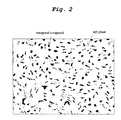
- a fine structure shown in Fig. 2 was formed in a traverse section. The window width was 0.24 mm.
- EDX measurement and X-ray diffraction measurement revealed that the white part in Fig. 2 was an A15 superconducting phase and the black part was a tetragonal compound phase.
- a critical temperature T c directly after heating the tape having a core diameter of Al-Ge alloy core of about 8 ⁇ m at 1400°C for 7 hours was 17.7 K, and formation of superconducting phase was observed. As a result of additional heating of the tape at 800°C for 10 hours, T c was rose to 18.1 K. This may be ascribed to improvement in atomic order of crystals of the A15 phase.
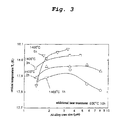
- Fig. 3 is a graph showing dependency of T c on Al-Ge alloy core diameter in the tapes after additional heating. As can be see from Fig. 3, in order to raise T c , it is necessary to select the core diameter of Al-Ge alloy core at 2 ⁇ m or more. Furthermore, Fig. 3 shows that the heat treatment time should be at least five hours.
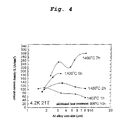
- Fig. 4 is a graph showing dependency of critical current density J c on core diameter. As can be seen from Fig. 4, in order to obtain excellent J c as well as T c , it is necessary to select the core diameter of Al-Ge alloy core at 2 ⁇ m or more, and the heat treatment time should be at least five hours.
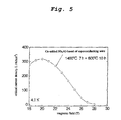
- Fig. 5 is a graph showing dependency of of J c on magnetic field of the tape having subjected to heat treatment at 1400°C for 7 hours followed by additional heat treatment at 800°C for 10 hours and having a core diameter of Al-Ge alloy core of 8 ⁇ m.
- J c was 300A/mm 2 at 4.2 K and 21T, and 265A/mm 2 at 22T.
- the temperature of heat treatment was 1200°C, about 30A/mm 2 at most was obtained even at 17T, and on the further higher magnetic fields, the characteristics were much deteriorated.
- Example 2 a composite multi-core wire having an outer diameter of about 2 mm, the number of Al-Ge alloy core of 7x241x15 and a core diameter of Al-Ge alloy core of about 4 ⁇ m was prepared.
- This composite multi-core wire was subjected to heat treatment at 1400°C for 7 hours, followed by additional heat treatment at 800°C for 10 hours. As a result, a critical current at 21T exceeded 300A.
- a Ge-added Nb 3 Al-based superconducting wire produced by the method of producing a Ge-added Nb 3 Al-based superconducting wire of the present invention exhibits high critical current density and high transport current in high magnetic field region of 21T or higher, making it possible to realize a magnet generating such a high magnetic filed that can never be achieved in conventional techniques. Stronger magnetic field of NMR magnet will be promoted. Stronger magnetic field of a multi-purpose high magnetic field magnet for physical property and the multi-purpose high magnetic field magnet with compact size will be promoted.
Landscapes
- Engineering & Computer Science (AREA)
- Manufacturing & Machinery (AREA)
- Superconductors And Manufacturing Methods Therefor (AREA)
Abstract
Description
- The present invention relates to a method of producing a Ge-added Nb3Al-based superconducting wire.
- Great expectations have risen for application of a Ge-added Nb3Al-based superconducting wire as a wire which can be used in strong magnetic fields of 21T or higher because it has higher upper critical magnetic field than practically used Nb3Sn superconducting wires.
- As to production method of a Ge-added Nb3Al-based superconducting wire, it is general to directly diffuse Nb together with Al or Al alloy, and high critical magnetic field can be obtained by simply heating at elevated temperatures. However, such heat treatment at elevated temperatures makes resultant crystal particles bulky, and critical current density practically required cannot be realized. Furthermore, since a practical strong magnetic field magnet is requested to realize high transport current from the view point of protection from quenching or the like, a practical wire should essentially have not only high critical current density but also high transport current.
- For improving characteristics of a Ge-added Nb3Al-based superconducting wire, two approaches have been proposed heretofore.
- In the first approach, heat treatment is conducted at low temperature so as to prevent crystal particles from becoming bulky, while a diffusing pair of Nb and Al alloy, namely the size of alloy core is reduced as small as possible, for example, less than or equal to 1 µm to destabilize σ phase which is an intermediate compound, in order to improve the stoichiometry of an A15 phase which is a superconducting phase.
- In the second approach, crystal particles are prevented from becoming bulky through short retention at an elevated temperature at which the A15 phase of stoichiometric composition is stable, followed by quenching if necessary. Also in this approach, it is preferred to reduce the size of the diffusing pair of Nb and Al. This allows Nb and A1 to react in a very short time.
- As described above, in the conventional techniques, it is believed that the size of the diffusing pair of Nb and Al should be as small as possible.
- However, workability of Nb-Al-Ge composite material is very poor, and it is very difficult to incorporate a diffusing pair of fine Nb and Al alloy in a precursor wire. An Al-dissolved material containing an amount of Ge required to sufficiently improve characteristics exhibits a typical eutectic structure, and is so difficult to be processed that a small work may cause a crack.
- Therefore, it is the current state of the art that manufacture of a practical wire is difficult in the conventional approach of reducing the size of the diffusing pair of Nb and Al alloy.
- The present invention was devised in consideration of the above circumstance, and it is an object of the present invention to provide a method of producing a Ge-added Nb3Al-based superconducting wire capable of realizing a practical Ge-added Nb3Al-based superconducting wire for use in strong magnetic fields having high critical current density and transport current in magnetic field regions of 21T or higher.
-
- Fig. 1 is a photograph of a cross section of a composite multi-core wire produced in Example 1;
- Fig. 2 is a photograph of a traverse section of a tape produced in Example 1 after heat treatment;
- Fig. 3 is a graph showing dependency of critical temperature Tc on core diameter of Al-Ge alloy in Example 1;
- Fig. 4 is a graphs showing dependency of critical current density Jc on core diameter of Al-Ge alloy in Example 1; and
- Fig. 5 is a graph showing dependency of critical current density Jc on magnetic field in Example 1.
- In order to solve the above problems, the present invention provides a method of producing a Ge-added Nb3A1-based superconducting wire comprising the steps of preparing a composite multi-core wire in which a plurality of A1 alloy cores containing 15 at% to 40 at% of Ge are arranged in Nb matrix at a core diameter of 2 µm to 20 µm; heating for at least five hours at a temperature ranging from 1300°C to 1600°C; and additionally heating at a temperature ranging from 650°C to 900°C.
- The method of producing a Ge-added Nb3Al-based superconducting wire of the present invention is based on an opposite idea to the conventional idea that the core diameter of Al alloy core, namely the size of diffusing pair is increased, and heat treatment is conducted at a relatively high temperature for a long time.
- Heretofore, it has been considered that heat treatment at not less than 1300°C for a retention time of at least five hours makes crystal particles bulky, making it difficult to obtain high critical current density. When the core diameter in Nb matrix of the Al alloy core containing 15 at% to 40 at% of Ge was increased in the range of 2 µm and 20 µm, and heat treatment was conducted in the temperature range of 1300°C to 1600°C with a retention time of at least five hours, it was proved to be possible to stably obtain a peak effect that critical current density significantly increases in high magnetic field region of 21T or higher, and a Ge-added Nb3Al-based superconducting wire specialized in high magnetic current density was obtained. And by additionally heating at a temperature ranging from 650°C to 900°C after heating at a temperature ranging from 1300°C to 1600°C with a retention time of at least five hours, the A15 phase which is a superconducting phase is atomically ordered and the intensity of critical current density becomes 300A/mm2 at 4.2K and 21T, and 265A/mm2 at 22T. These values are much larger than values for Nb3Sn superconducting wires now practically available.
- Furthermore, in the method of producing a Ge-added Nb3Al-based superconducting wire according to the present invention, the high cooling speed is not always necessary so that it is possible to increase cross section area of a wire relatively easily and thus is able to obtain high transport current. Additionally, since quenching is no longer necessary, it becomes possible to employ "wind&react method" which is a practical production method of coil in which heating is conducted after winding a precursor wire in coil form.
- In the method of producing a Ge-added Nb3Al-based superconducting wire according to the present invention, Ge concentration in Al alloy is specified in the range of 15 at% to 40 at%. When concentration of Ge falls within this range, high magnetic field characteristic and critical temperature of the Nb3Al-based superconducting wire are improved, and a balance in hardness is achieved between Al alloy core and Nb which is critical in wire-drawing process.
- Core diameter of Al alloy core is in the range of 2 µm to 20 µm. This is because if the core diameter is less than 2 µm, the critical current density decreases, while if the core diameter is more than 20 µm, volume of tetragonal compound increases due to heat treatment and critical current density decreases.
- The temperature of heat treatment ranges from 1300°C to 1600°C. At temperatures less than 1300°C, stoichiometry of the A15 phase which is a superconducting phase significantly decreases, whereas at temperatures more than 1600°C, crystal particles become bulky due to long-time heat treatment so that critical current density on the side of low magnetic field significantly decreases.
- The heat treatment time is at least five hours. This is for achieving homogenization of the A15 phase.
- The temperature range for additional heat treatment is from 650°C to 900°C. This temperature range provides atomic ordering of the A15 phase.
- According to the method of producing a Ge-added Nb3Al-based superconducting wire of the present invention, it is possible to realize a practical Ge-added Nb3Al-based superconducting wire for strong magnetic fields having high critical current density and transport current in magnetic field regions of 21T or higher.
- In the following, the method of producing a Ge-added Nb3Al-based superconducting wire of the present invention will be explained in more detail by way of examples.
- A Nb pipe having an outer diameter of 20 mm and an inner diameter of 18 mm was charged with Al powders and Ge powers in an atomic ratio of 3:1, and a composite material having an outer diameter of about 4.2 mm was prepared using a groove roller and a cassette roller dice. Seven pieces of the composite material were inserted into 7-core Nb rod, and subjected to wire-drawing to about 0.87 mm in outer diameter. Vickers hardness of the Nb matrix and the Al-Ge alloy core at this time were respectively 110 kgf/mm2 and 105 kgf/mm2, so that balance in hardness was achieved. Then, 241 of the composite wire were inserted into a Nb pipe having an outer diameter of 20 mm and an inner diameter of 16 mm and the composite material wire was drawn to finally obtain an elongated composite multi-core wire having Nb/Al-Ge diffusion pairs in which an outer diameter is 0.87 mmφ, the number of Al-Ge alloy core is 7x241, a core diameter of Al-Ge alloy core is about 8 µm. Fig. 1 is a photograph of a cross section of the elongated composite multi-core wire.
- This composite multi-core wire was subjected to rolling to obtain a plurality of tapes in which a core diameter of Al-Ge alloy core falls within the range of about 1 µm to 8 µm. Next the resultant tape was subjected to heat treatment at 1400°C for 1 to 10 hours. A fine structure shown in Fig. 2 was formed in a traverse section. The window width was 0.24 mm. EDX measurement and X-ray diffraction measurement revealed that the white part in Fig. 2 was an A15 superconducting phase and the black part was a tetragonal compound phase.
- A critical temperature Tc directly after heating the tape having a core diameter of Al-Ge alloy core of about 8 µm at 1400°C for 7 hours was 17.7 K, and formation of superconducting phase was observed. As a result of additional heating of the tape at 800°C for 10 hours, Tc was rose to 18.1 K. This may be ascribed to improvement in atomic order of crystals of the A15 phase.
- Fig. 3 is a graph showing dependency of Tc on Al-Ge alloy core diameter in the tapes after additional heating. As can be see from Fig. 3, in order to raise Tc, it is necessary to select the core diameter of Al-Ge alloy core at 2 µm or more. Furthermore, Fig. 3 shows that the heat treatment time should be at least five hours.
- Fig. 4 is a graph showing dependency of critical current density Jc on core diameter. As can be seen from Fig. 4, in order to obtain excellent Jc as well as Tc, it is necessary to select the core diameter of Al-Ge alloy core at 2 µm or more, and the heat treatment time should be at least five hours.
- Fig. 5 is a graph showing dependency of of Jc on magnetic field of the tape having subjected to heat treatment at 1400°C for 7 hours followed by additional heat treatment at 800°C for 10 hours and having a core diameter of Al-Ge alloy core of 8 µm. A peak effect that Jc is larger on the high magnetic field side was observed. Jc was 300A/mm2 at 4.2 K and 21T, and 265A/mm2 at 22T. When the temperature of heat treatment was 1200°C, about 30A/mm2 at most was obtained even at 17T, and on the further higher magnetic fields, the characteristics were much deteriorated.
- As is the same with Example 1, a composite multi-core wire having an outer diameter of about 2 mm, the number of Al-Ge alloy core of 7x241x15 and a core diameter of Al-Ge alloy core of about 4 µm was prepared. This composite multi-core wire was subjected to heat treatment at 1400°C for 7 hours, followed by additional heat treatment at 800°C for 10 hours. As a result, a critical current at 21T exceeded 300A.
- From the Examples 1 and 2, it was confirmed that a Ge-added Nb3Al-based superconducting wire exhibiting not only high critical current density but also high critical current can be prepared.
- Of course, the present invention is not limited to examples as described above. It goes without saying that as to the details, various forms are acceptable.
- A Ge-added Nb3Al-based superconducting wire produced by the method of producing a Ge-added Nb3Al-based superconducting wire of the present invention exhibits high critical current density and high transport current in high magnetic field region of 21T or higher, making it possible to realize a magnet generating such a high magnetic filed that can never be achieved in conventional techniques. Stronger magnetic field of NMR magnet will be promoted. Stronger magnetic field of a multi-purpose high magnetic field magnet for physical property and the multi-purpose high magnetic field magnet with compact size will be promoted.
Claims (1)
- A method of producing a Ge-added Nb3Al-based superconducting wire comprising the steps of preparing a composite multi-core wire in which a plurality of Al alloy wires containing 15 at% to 40 at% of Ge are arranged in Nb matrix at a core diameter of 2 µm to 20 µm; heating for at least five hours at a temperature ranging from 1300°C to 1600°C; and additionally heating at a temperature ranging from 650°C to 900°C.
Applications Claiming Priority (2)
| Application Number | Priority Date | Filing Date | Title |
|---|---|---|---|
| JP2003274858A JP4078420B2 (en) | 2003-07-15 | 2003-07-15 | Method for producing Ge-doped Nb3Al-based superconducting wire |
| PCT/JP2004/010422 WO2005006354A1 (en) | 2003-07-15 | 2004-07-15 | PROCESS FOR PRODUCING Ge-ADDED Nb3Al BASE SUPERCONDUCTING WIRE MATERIAL |
Publications (2)
| Publication Number | Publication Date |
|---|---|
| EP1653486A1 true EP1653486A1 (en) | 2006-05-03 |
| EP1653486A4 EP1653486A4 (en) | 2008-05-28 |
Family
ID=34056094
Family Applications (1)
| Application Number | Title | Priority Date | Filing Date |
|---|---|---|---|
| EP04747811A Withdrawn EP1653486A4 (en) | 2003-07-15 | 2004-07-15 | PROCESS FOR PRODUCING SUPERBONDUCTING CABLE MATERIAL BASED ON NB SB 3 / SB AL ADDITIONED BY GE |
Country Status (4)
| Country | Link |
|---|---|
| US (1) | US7354486B2 (en) |
| EP (1) | EP1653486A4 (en) |
| JP (1) | JP4078420B2 (en) |
| WO (1) | WO2005006354A1 (en) |
Families Citing this family (1)
| Publication number | Priority date | Publication date | Assignee | Title |
|---|---|---|---|---|
| JP4442469B2 (en) * | 2005-02-28 | 2010-03-31 | 日立電線株式会社 | Method for producing Nb3Sn superconducting wire |
Family Cites Families (12)
| Publication number | Priority date | Publication date | Assignee | Title |
|---|---|---|---|---|
| US3713898A (en) * | 1971-04-26 | 1973-01-30 | Atomic Energy Commission | PROCESS FOR PREPARING HIGH-TRANSITION-TEMPERATURE SUPERCONDUCTORS IN THE Nb-Al-Ge SYSTEM |
| US3694274A (en) * | 1971-04-26 | 1972-09-26 | Atomic Energy Commission | High-transition-temperature superconductors in the nb-al-ge system |
| FR2250205B1 (en) * | 1973-11-02 | 1976-10-22 | Siemens Ag | |
| US4223434A (en) * | 1979-02-01 | 1980-09-23 | The United States Of America As Represented By The United States Department Of Energy | Method of manufacturing a niobium-aluminum-germanium superconductive material |
| JP2693255B2 (en) | 1990-05-11 | 1997-12-24 | 日立電線株式会社 | Nb (Bottom 3) Method and apparatus for manufacturing Al-based superconducting wire |
| JPH06111645A (en) | 1992-09-29 | 1994-04-22 | Kobe Steel Ltd | Method for manufacturing Nb3 Al superconductor |
| JP3428271B2 (en) * | 1996-01-29 | 2003-07-22 | 日立電線株式会社 | Nb3Al-based superconducting wire and method for producing the same |
| US6372054B1 (en) * | 1999-06-04 | 2002-04-16 | Japan As Represented By Director General Of National Research Institute For Metals | Process for producing ultrafine multifilamentary Nb3(A1,Ge) or Nb3(A1,Si) superconducting wire |
| JP3577506B2 (en) * | 1999-11-09 | 2004-10-13 | 独立行政法人物質・材料研究機構 | Cu-added Nb3Al ultrafine multi-core superconducting wire and method for producing the same |
| JP3588628B2 (en) * | 2000-04-06 | 2004-11-17 | 独立行政法人物質・材料研究機構 | Method for producing Nb3Al ultrafine multicore superconducting wire |
| JP3588629B2 (en) | 2000-05-26 | 2004-11-17 | 独立行政法人物質・材料研究機構 | Method for producing Nb3Al superconducting multifilamentary wire |
| JP4402815B2 (en) | 2000-07-18 | 2010-01-20 | 独立行政法人物質・材料研究機構 | Nb3Al superconducting multi-core wire and manufacturing method thereof |
-
2003
- 2003-07-15 JP JP2003274858A patent/JP4078420B2/en not_active Expired - Lifetime
-
2004
- 2004-07-15 US US10/564,482 patent/US7354486B2/en not_active Expired - Fee Related
- 2004-07-15 WO PCT/JP2004/010422 patent/WO2005006354A1/en not_active Ceased
- 2004-07-15 EP EP04747811A patent/EP1653486A4/en not_active Withdrawn
Also Published As
| Publication number | Publication date |
|---|---|
| JP4078420B2 (en) | 2008-04-23 |
| EP1653486A4 (en) | 2008-05-28 |
| US7354486B2 (en) | 2008-04-08 |
| JP2005038719A (en) | 2005-02-10 |
| WO2005006354A1 (en) | 2005-01-20 |
| US20060180246A1 (en) | 2006-08-17 |
Similar Documents
| Publication | Publication Date | Title |
|---|---|---|
| Tachikawa et al. | Composite‐processed Nb3Sn with titanium addition to the matrix | |
| US4224087A (en) | Method for producing Nb3 Sn superconductor | |
| TWI707962B (en) | Stabilizer for superconductor, superconductive wire, and superconductive coil | |
| CN108603251B (en) | Superconducting wire and superconducting coil | |
| JP5438531B2 (en) | Manufacturing method of Nb3Sn superconducting wire and Nb3Sn superconducting wire | |
| JP3851593B2 (en) | Bronze material for Nb3Sn superconducting wire, composite material for superconducting wire using the same, and superconducting wire | |
| US4323402A (en) | Method for producing superconducting Nb3 Sn wires | |
| US20020037816A1 (en) | Process for the production of Nb3A1 extra-fine multifilamentary superconducting wire | |
| JPS5823110A (en) | Manufacturing method of Nb↓3Sn composite superconductor | |
| US4385942A (en) | Method for producing Nb3 Sn superconductors | |
| US7354486B2 (en) | Process for producing Ge-added Nb3Al base superconducting wire material | |
| US4367102A (en) | Method for the manufacture of a superconductor containing an intermetallic compounds | |
| US5504984A (en) | Methods of manufacturing Nb3 Al superconducting wire and coil | |
| US4341572A (en) | Method for producing Nb3 Sn superconductors | |
| JP2017188339A (en) | Superconductive stabilization material, superconductive wire and superconductive coil | |
| EP1780812A2 (en) | Internal diffusion process Nb3Sn superconducting wire | |
| JP4402815B2 (en) | Nb3Al superconducting multi-core wire and manufacturing method thereof | |
| US6810276B1 (en) | Method to reduce magnetization in high current density superconductors formed by reaction of multi-component elements in filamentary composite superconductors | |
| JP3754522B2 (en) | Nb (3) Sn superconducting wire | |
| EP1898431A1 (en) | Nb3Sn SUPERCONDUCTING WIRE, PROCESS FOR PRODUCING THE SAME, AND SINGLE-CORE COMPOSITE WIRE USED IN PRODUCTION OF Nb3Sn SUPERCONDUCTING WIRE | |
| JP3866969B2 (en) | Manufacturing method of Nb (3) Sn superconducting wire | |
| JP3692657B2 (en) | Oxide superconducting wire | |
| JP4815596B2 (en) | Nb3Sn superconducting wire, manufacturing method thereof, and single-core composite wire used for manufacturing Nb3Sn superconducting wire | |
| JP3046828B2 (en) | Nb Lower 3 Method for Manufacturing Sn Composite Superconductor | |
| JP2008192352A (en) | Nb3Sn SUPERCONDUCTING WIRE ROD, AND PRECURSOR FOR THE SAME |
Legal Events
| Date | Code | Title | Description |
|---|---|---|---|
| PUAI | Public reference made under article 153(3) epc to a published international application that has entered the european phase |
Free format text: ORIGINAL CODE: 0009012 |
|
| 17P | Request for examination filed |
Effective date: 20060214 |
|
| AK | Designated contracting states |
Kind code of ref document: A1 Designated state(s): DE FI FR |
|
| DAX | Request for extension of the european patent (deleted) | ||
| RBV | Designated contracting states (corrected) |
Designated state(s): DE FI FR |
|
| A4 | Supplementary search report drawn up and despatched |
Effective date: 20080429 |
|
| RIC1 | Information provided on ipc code assigned before grant |
Ipc: H01L 39/24 20060101AFI20080423BHEP |
|
| 17Q | First examination report despatched |
Effective date: 20080825 |
|
| STAA | Information on the status of an ep patent application or granted ep patent |
Free format text: STATUS: THE APPLICATION IS DEEMED TO BE WITHDRAWN |
|
| 18D | Application deemed to be withdrawn |
Effective date: 20090106 |