EP1650906A1 - Method for the dynamic management of resources in telecommunication systems, based on quality of service and type of service - Google Patents
Method for the dynamic management of resources in telecommunication systems, based on quality of service and type of service Download PDFInfo
- Publication number
- EP1650906A1 EP1650906A1 EP04736753A EP04736753A EP1650906A1 EP 1650906 A1 EP1650906 A1 EP 1650906A1 EP 04736753 A EP04736753 A EP 04736753A EP 04736753 A EP04736753 A EP 04736753A EP 1650906 A1 EP1650906 A1 EP 1650906A1
- Authority
- EP
- European Patent Office
- Prior art keywords
- cells
- type
- max
- service
- node
- Prior art date
- Legal status (The legal status is an assumption and is not a legal conclusion. Google has not performed a legal analysis and makes no representation as to the accuracy of the status listed.)
- Withdrawn
Links
- 238000000034 method Methods 0.000 title claims description 30
- 238000004891 communication Methods 0.000 claims abstract description 12
- 238000000605 extraction Methods 0.000 claims abstract description 3
- 238000003780 insertion Methods 0.000 claims abstract description 3
- 230000037431 insertion Effects 0.000 claims abstract description 3
- 238000012986 modification Methods 0.000 claims 1
- 230000004048 modification Effects 0.000 claims 1
- 210000004027 cell Anatomy 0.000 description 113
- 230000005540 biological transmission Effects 0.000 description 6
- 210000003771 C cell Anatomy 0.000 description 1
- 210000003719 b-lymphocyte Anatomy 0.000 description 1
Images

Classifications
-
- H—ELECTRICITY
- H04—ELECTRIC COMMUNICATION TECHNIQUE
- H04L—TRANSMISSION OF DIGITAL INFORMATION, e.g. TELEGRAPHIC COMMUNICATION
- H04L47/00—Traffic control in data switching networks
- H04L47/70—Admission control; Resource allocation
- H04L47/80—Actions related to the user profile or the type of traffic
-
- H—ELECTRICITY
- H04—ELECTRIC COMMUNICATION TECHNIQUE
- H04L—TRANSMISSION OF DIGITAL INFORMATION, e.g. TELEGRAPHIC COMMUNICATION
- H04L47/00—Traffic control in data switching networks
- H04L47/70—Admission control; Resource allocation
- H04L47/80—Actions related to the user profile or the type of traffic
- H04L47/805—QOS or priority aware
-
- H—ELECTRICITY
- H04—ELECTRIC COMMUNICATION TECHNIQUE
- H04L—TRANSMISSION OF DIGITAL INFORMATION, e.g. TELEGRAPHIC COMMUNICATION
- H04L12/00—Data switching networks
- H04L12/54—Store-and-forward switching systems
- H04L12/56—Packet switching systems
-
- H—ELECTRICITY
- H04—ELECTRIC COMMUNICATION TECHNIQUE
- H04L—TRANSMISSION OF DIGITAL INFORMATION, e.g. TELEGRAPHIC COMMUNICATION
- H04L47/00—Traffic control in data switching networks
- H04L47/10—Flow control; Congestion control
- H04L47/15—Flow control; Congestion control in relation to multipoint traffic
-
- H—ELECTRICITY
- H04—ELECTRIC COMMUNICATION TECHNIQUE
- H04L—TRANSMISSION OF DIGITAL INFORMATION, e.g. TELEGRAPHIC COMMUNICATION
- H04L47/00—Traffic control in data switching networks
- H04L47/10—Flow control; Congestion control
- H04L47/24—Traffic characterised by specific attributes, e.g. priority or QoS
-
- H—ELECTRICITY
- H04—ELECTRIC COMMUNICATION TECHNIQUE
- H04L—TRANSMISSION OF DIGITAL INFORMATION, e.g. TELEGRAPHIC COMMUNICATION
- H04L47/00—Traffic control in data switching networks
- H04L47/50—Queue scheduling
-
- H—ELECTRICITY
- H04—ELECTRIC COMMUNICATION TECHNIQUE
- H04L—TRANSMISSION OF DIGITAL INFORMATION, e.g. TELEGRAPHIC COMMUNICATION
- H04L47/00—Traffic control in data switching networks
- H04L47/50—Queue scheduling
- H04L47/52—Queue scheduling by attributing bandwidth to queues
-
- H—ELECTRICITY
- H04—ELECTRIC COMMUNICATION TECHNIQUE
- H04L—TRANSMISSION OF DIGITAL INFORMATION, e.g. TELEGRAPHIC COMMUNICATION
- H04L47/00—Traffic control in data switching networks
- H04L47/50—Queue scheduling
- H04L47/52—Queue scheduling by attributing bandwidth to queues
- H04L47/522—Dynamic queue service slot or variable bandwidth allocation
-
- H—ELECTRICITY
- H04—ELECTRIC COMMUNICATION TECHNIQUE
- H04L—TRANSMISSION OF DIGITAL INFORMATION, e.g. TELEGRAPHIC COMMUNICATION
- H04L47/00—Traffic control in data switching networks
- H04L47/50—Queue scheduling
- H04L47/56—Queue scheduling implementing delay-aware scheduling
- H04L47/564—Attaching a deadline to packets, e.g. earliest due date first
- H04L47/566—Deadline varies as a function of time spent in the queue
-
- H—ELECTRICITY
- H04—ELECTRIC COMMUNICATION TECHNIQUE
- H04L—TRANSMISSION OF DIGITAL INFORMATION, e.g. TELEGRAPHIC COMMUNICATION
- H04L47/00—Traffic control in data switching networks
- H04L47/50—Queue scheduling
- H04L47/62—Queue scheduling characterised by scheduling criteria
- H04L47/624—Altering the ordering of packets in an individual queue
-
- H—ELECTRICITY
- H04—ELECTRIC COMMUNICATION TECHNIQUE
- H04L—TRANSMISSION OF DIGITAL INFORMATION, e.g. TELEGRAPHIC COMMUNICATION
- H04L47/00—Traffic control in data switching networks
- H04L47/50—Queue scheduling
- H04L47/62—Queue scheduling characterised by scheduling criteria
- H04L47/625—Queue scheduling characterised by scheduling criteria for service slots or service orders
- H04L47/626—Queue scheduling characterised by scheduling criteria for service slots or service orders channel conditions
-
- H—ELECTRICITY
- H04—ELECTRIC COMMUNICATION TECHNIQUE
- H04L—TRANSMISSION OF DIGITAL INFORMATION, e.g. TELEGRAPHIC COMMUNICATION
- H04L47/00—Traffic control in data switching networks
- H04L47/70—Admission control; Resource allocation
-
- H—ELECTRICITY
- H04—ELECTRIC COMMUNICATION TECHNIQUE
- H04L—TRANSMISSION OF DIGITAL INFORMATION, e.g. TELEGRAPHIC COMMUNICATION
- H04L47/00—Traffic control in data switching networks
- H04L47/70—Admission control; Resource allocation
- H04L47/72—Admission control; Resource allocation using reservation actions during connection setup
- H04L47/724—Admission control; Resource allocation using reservation actions during connection setup at intermediate nodes, e.g. resource reservation protocol [RSVP]
-
- H—ELECTRICITY
- H04—ELECTRIC COMMUNICATION TECHNIQUE
- H04L—TRANSMISSION OF DIGITAL INFORMATION, e.g. TELEGRAPHIC COMMUNICATION
- H04L47/00—Traffic control in data switching networks
- H04L47/70—Admission control; Resource allocation
- H04L47/76—Admission control; Resource allocation using dynamic resource allocation, e.g. in-call renegotiation requested by the user or requested by the network in response to changing network conditions
- H04L47/762—Admission control; Resource allocation using dynamic resource allocation, e.g. in-call renegotiation requested by the user or requested by the network in response to changing network conditions triggered by the network
Definitions
- the present invention refers to a method for the dynamic management of resources in telecommunication systems based on quality of service and type of services, and is orientated to a multiuser system of digital transmission of data multipoint to multipoint.
- the methods chosen for carrying out storage of packets waiting to be transmitted later on are specified.
- the invention permits dynamic management of resources among all the nodes (or user equipment) and to prioritise, both in the transmission of packets and in the storage of those packets waiting to be transmitted, permitting different configurations of that storage, in such a way that, in the event of a memory queue that is full, it can be decided to queue a new packet taking into account the priority, the seniority or both parameters of the already stored packets.
- cell is used as a self-contained logic unit to which can be associated a destination, a packet, a seniority, in other words the time it has been in a queue waiting to be transmitted, and a priority bearing in mind moreover the type of service to which the packet belongs.
- the procedure of the invention is advantageous since it permits greater control over access to queues having maximums, shared maximums and those which can be accessed by priority and seniority in an optimized way. These characteristics make it possible to use the priority information in each cell permitting queuing to be carried out by using this information, with which support can be provided for different applications with different bandwidth needs. Also, the procedure of the invention permits each remote user to have a quantity of cells reserved for it, a quantity of cells for sharing with a group of users, and a quantity of cells which it shares with all users. Finally, said configuration of maximums of cells is dynamically adjusted in order to be adapted to the needs of the communication.
- the invention consists of a method for the dynamic management of resources in telecommunication systems based on quality of service and type of services, in which there exists a plurality of user nodes communicated by means of links with different latency and bandwidth requirements, with a cell being a self-contained unit with a priority, a destination, a seniority and an associated packet; and a queue being an ordered set of cells.
- the procedure is characterized in that the source node manages the traffic and the resources towards the destination nodes, it distributes the resources dynamically among the destination nodes, and it reserves a memory capacity in its queues depending on the class of service and the quality of service that are demanded; and because one or more different configurations are used for insertion and extraction of cells of the ordered queues.
- the source node manages the quality of service of each destination node and selectively reserves a number of cells for itself, it shares a number of cells with a group of destination nodes, it shares a number of cells with all the destination nodes, or it carries out several of these actions at the same time.
- the source node manages the type of service associated with each packet, and configures the quality of service of each destination node which is selectively different for each destination node and different from the configuration in the opposite direction of transmission in a two-way communication between the destination and the source node, and it adjusts that quality of service dynamically.
- the source node configures the number of destination nodes and the number of cells and selectively modifies that configuration during the management process, or it keeps it fixed during the process, and said source node selectively uses the information relating to the priority, the number of cells used by each destination node or both in order to decide on the following destination node.
- the invention provides for different queue management configurations based on different aspects selected from among:
- the procedure of the invention defines four global maximums: a maximum of cells of the system (MAX), a maximum of cells of a first type (MAX_A), a maximum of cells of a second type (MAX_B), a maximum of cells of a third type (MAX_C) and a maximum of cells of the set of the second and third type (MAX_B_C).
- MAX is equal to the sum of MAX_A and MAX_B_C, that a cell of the first type is available when the number of free cells of the first type is less than MAX_A, that a cell of the second type is available when the number of free cells of the second type is less than MAX_B, and the number of free cells of the second type plus the number of free cells of the third type is less than MAX_B_C, that a cell of the third type is available when the number of free cells of the third type is less than MAX_C and the number of free cells of the second type plus the number of free cells of the third type is less than MAX_B_C, and that any of the maximums MAX_A, MAX_B or MAX_C can be zero provided that MAX_A and MAX_B_C are not zero at the same time.
- the procedure describes two maximums for each destination node (MAX_A_NODE, MAX_B_NODE), these maximums being different for each node and being able to have values greater than or equal to zero and the possibility is selectively indicated of the use of cells of the third type (USE_C) and the non-use of said cells of the third type (NOT_USE_C).
- the procedure is also characterized by certain values and certain relations among these values, such as MAX_A_NODE is the maximum number of cells of the first type which a certain destination node can have; MAX_B_NODE is the maximum number of cells of the second type which this node can have, always provided there remain cells of the second type available; that the sum of the MAX_A_NODE of all the destination nodes has to be less than or equal to MAX_A, that the sum of the MAX_B_NODE of all the destination nodes can be greater than MAX_B; and that a node with the possibility of using cells of the third type (USE_C) can use cells of the third type always provided there are cells of this type available.
- MAX_A_NODE is the maximum number of cells of the first type which a certain destination node can have
- MAX_B_NODE is the maximum number of cells of the second type which this node can have, always provided there remain cells of the second type available
- the procedure is also characterized in that, by using the configuration of maximums per node and global maximums, CBR traffic is guaranteed using the MAX_A_NODE, VBR traffic using the MAX_B_NODE, and UBR traffic using the USE_C or NOT_USE_C,
- the procedure provides for the dynamic adjustment of the defined values, in such a way that the global and local maximums vary dynamically in order to be adjusted to the variations in the configuration of the destination nodes, to the bandwidth required by the applications, to the conditions of the channel used in the communication, and to the quality of service required by the applications or types of traffic which the applications require, such as CBR, VBR or UBR.
- the main advantage of the invention is the greater control over access to the packet queues.
- Each user can use cells from different queues and have certain usable maximums of cells, individual and shared among sets of users.
- the configuration of the maximums of cells can be dynamically modified in order to be adjusted to changes in the channel or to the needs of the communication applications.
- a digital transmission system of data, multipoint to multipoint, two-way is presented in which one user node communicates with various user nodes by means of a series of links.
- the packets are stored in cells prior to being transmitted.
- FIG 1 In figure 1 in which some nodes (1), (2), (3), (4) and (5) are any of the user nodes of the system, and a node (1) communicates with the rest of the nodes by means of a series of links (6), (7), (8) and (9).
- the procedure of the invention provides for certain global maximums, which were described in the section on description of the invention, and which are indicated below along with the values established for this example of embodiment: a maximum of cells of the first type (MAX_A) equal to 15, a maximum of cells of the second type (MAX_B) equal to 5, a joint maximum of cells of the second type plus the third type (MAX_B_C) equal to 32, and a maximum of cells of the third type (MAX_C) equal to 30.
- the first type of cell is referred to as type A, the second type B and the third type C.
- the transmitter node (1) has a link configured with node (2) with CBR traffic (6), in other words, with traffic with a constant bandwidth and it is necessary to reserve a fixed number of cells which are always available for storing packets waiting to be sent from node (1) to node (2).
- the procedure defines two maximums for each destination node (MAX_A_NODE). So, node (2) has a MAX_A_NODE_2 equal to ten. This maximum has been set taking into account the bandwidth of the application with CBR traffic and taking into account the current conditions of the channel, and in this example of embodiment it is concluded that CBR traffic will be able to be supported with ten cells.
- a queue of cells is used for storing the traffic waiting to be transmitted from node (1) to node (2) and is administrated using a storage configuration based on seniority and priority, which was described in the section on description of the invention.
- the transmitter node (1) has the link configured with the node (3) with VBR traffic (7), in other words, with traffic with variable bandwidth in such a way that a maximum number of cells MAX_B_NODE_3 equal to five can be reserved for it, being able to share three of those five cells with node (4), in accordance with the maximums in this example of embodiment.
- the queue of packets waiting to be transmitted from node (1) to node (3) is administrated with a seniority configuration.
- the transmitter node (1) has the link configured with the node (4) with VBR traffic (6), assigning a MAX_B_NODE_4 equal to three. But, access to the link from node (1) to node (4) is also granted to those of the third type (C) in order to be able to support UBR traffic, in other words, traffic with an undefined bandwidth, being limited in this example of embodiment to values between 0 and 30 cells.
- the queue of packets waiting to be transmitted from node (1) to node (4) is administrated with a configuration by seniority.
- link (9) from node (1) to node (5) only has access to the cells of the third type (C), with the storage configuration used in this communication being by novelty and priority.
- the following table provides a summary of the arrangement of links and cells according to the example of embodiment. This configuration can be dynamically modified in time in order to follow the communication needs and changes in the communications channel.
- Type of traffic Maximum type A cells
- Maximum type B cells Possibility of use of type C cells Possibility of storage in queues Link (6)
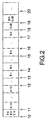
- node (1) has to transmit a packet for node (2), with which a cell of the first type (A) is used for storing it, so that there remain 9 cells of the first type (A) available for transmissions to node (2), though there are a total of 14 cells of the first type (A) free altogether. If, at a certain instant (12), node (1) has now used 10 cells of the first type (A) and a new packet arrives for being stored destined for node (2), the information on the priority of the new packet will be examined using, for example, the field which indicates the type of traffic, in order to decide whether an already stored packet is to be eliminated in order to incorporate the new one or whether the new packet is to be eliminated.
- a search will be made among all the cells of the queue of packets towards node (2) to see whether any of the cells contains a packet of lower priority than the new packet. If there exist packets with lower priority, the packet of the cell which has spent least time in the queue and which has the lowest priority along all the cells will be eliminated.
- node (1) has to transmit a packet to node (3), with which a cell of the second type (B) will be used for storing it, with 4 cells of type B remaining available to node (3).
- a cell has to be stored for node (4), with which a cell of type B will be used, with just 3 cells of the second type (B) remaining available to node (3) and 2 cells of the second type (B) available to node (4), though node (4) can use all the cells of the third type (C) that are free.
- nodes (3) and (4) are sharing a number of cells taking into account that they have a variable bandwidth and they do not always need to have a fixed number of cells available to them. It has to be borne in mind that, if the type of application for the user node (4) or user node (3) changes requires a fixed bandwidth, cells of the first type (A) can be assigned to it in order to absorb that traffic.
- packets for user nodes (4) and (3) continue to be stored, in such a way that at the instant (15) all the cells of type B are being used, for example, user node (4) has used 3 cells of the second type and user node (3) has used 2 cells of the second type, and then it is necessary to store a packet for user node (4) with storage configuration by seniority at the instant (16), with which that packet is eliminated due to there being no free cells of the second type (B) available.
Landscapes
- Engineering & Computer Science (AREA)
- Computer Networks & Wireless Communication (AREA)
- Signal Processing (AREA)
- Data Exchanges In Wide-Area Networks (AREA)
- Telephonic Communication Services (AREA)
Applications Claiming Priority (2)
| Application Number | Priority Date | Filing Date | Title |
|---|---|---|---|
| ES200301663A ES2229917B1 (es) | 2003-07-15 | 2003-07-15 | Procedimiento de gestion dinamica de recursos de sitemas de telecomunicaciones en funcion de la calidad de servicio y del tipo de servicio. |
| PCT/ES2004/000271 WO2005008972A1 (es) | 2003-07-15 | 2004-06-14 | Procedimiento de gestión dinámica de recursos de sistemas de telecomunicaciones en función de la calidad de servicio y del tipo de servicio |
Publications (1)
| Publication Number | Publication Date |
|---|---|
| EP1650906A1 true EP1650906A1 (en) | 2006-04-26 |
Family
ID=34072907
Family Applications (1)
| Application Number | Title | Priority Date | Filing Date |
|---|---|---|---|
| EP04736753A Withdrawn EP1650906A1 (en) | 2003-07-15 | 2004-06-14 | Method for the dynamic management of resources in telecommunication systems, based on quality of service and type of service |
Country Status (14)
| Country | Link |
|---|---|
| US (1) | US20060171319A1 (enExample) |
| EP (1) | EP1650906A1 (enExample) |
| JP (1) | JP2007535192A (enExample) |
| KR (1) | KR20070009963A (enExample) |
| CN (1) | CN1853382A (enExample) |
| AU (1) | AU2004301230A1 (enExample) |
| BR (1) | BRPI0412653A (enExample) |
| CA (1) | CA2532465A1 (enExample) |
| EA (1) | EA008956B1 (enExample) |
| ES (1) | ES2229917B1 (enExample) |
| IL (1) | IL173155A0 (enExample) |
| MX (1) | MXPA06000527A (enExample) |
| TW (1) | TWI295129B (enExample) |
| WO (1) | WO2005008972A1 (enExample) |
Families Citing this family (6)
| Publication number | Priority date | Publication date | Assignee | Title |
|---|---|---|---|---|
| FR2905046B1 (fr) * | 2006-08-16 | 2009-01-09 | Ipanema Technologies Sa | Procede d'optimisation du transfert d'informations dans un reseau de telecommunication |
| CN101009655B (zh) * | 2007-02-05 | 2011-04-20 | 华为技术有限公司 | 流量调度方法及装置 |
| US8650294B2 (en) * | 2007-12-17 | 2014-02-11 | Telefonaktiebolaget L M Ericsson (Publ) | Method and arrangement for network QoS |
| CN101686177B (zh) * | 2008-09-26 | 2012-05-23 | 华为技术有限公司 | 多业务传送网的动态带宽分配方法、设备及系统 |
| KR101590288B1 (ko) * | 2012-01-31 | 2016-01-29 | 지티이 (유에스에이) 인크. | 전송 독립 방식으로 체감 품질을 관리하기 위한 방법 및 시스템 |
| CN110875838B (zh) * | 2018-09-03 | 2022-10-18 | 中移(杭州)信息技术有限公司 | 一种资源部署方法、装置和存储介质 |
Family Cites Families (16)
| Publication number | Priority date | Publication date | Assignee | Title |
|---|---|---|---|---|
| EP0845181A4 (en) * | 1995-07-19 | 2001-07-18 | Fujitsu Network Communications | CONNECTION SEQUENCE PLANNING |
| US5909427A (en) * | 1995-07-19 | 1999-06-01 | Fujitsu Network Communications, Inc. | Redundant switch system and method of operation |
| US5757771A (en) * | 1995-11-14 | 1998-05-26 | Yurie Systems, Inc. | Queue management to serve variable and constant bit rate traffic at multiple quality of service levels in a ATM switch |
| JP3011154B2 (ja) * | 1997-10-15 | 2000-02-21 | 日本電気株式会社 | Atmスイッチ |
| FI104603B (fi) * | 1997-11-04 | 2000-02-29 | Nokia Networks Oy | Puskurinhallinta |
| US6091709A (en) * | 1997-11-25 | 2000-07-18 | International Business Machines Corporation | Quality of service management for packet switched networks |
| US6522628B1 (en) * | 1999-03-01 | 2003-02-18 | Cisco Technology, Inc. | Method and system for managing transmission resources in a wireless communication network |
| US6546017B1 (en) * | 1999-03-05 | 2003-04-08 | Cisco Technology, Inc. | Technique for supporting tiers of traffic priority levels in a packet-switched network |
| SE514313C2 (sv) * | 1999-04-07 | 2001-02-12 | Telia Ab | Förbättringar av, eller med avseende på, datapaketförmedling |
| CA2291835A1 (en) * | 1999-12-06 | 2001-06-06 | Nortel Networks Corporation | Load adaptive buffer management in packet networks |
| JP3732989B2 (ja) * | 2000-01-12 | 2006-01-11 | 富士通株式会社 | パケットスイッチ装置及びスケジューリング制御方法 |
| US7123622B2 (en) * | 2000-04-13 | 2006-10-17 | International Business Machines Corporation | Method and system for network processor scheduling based on service levels |
| US7002980B1 (en) * | 2000-12-19 | 2006-02-21 | Chiaro Networks, Ltd. | System and method for router queue and congestion management |
| US20030120795A1 (en) * | 2001-12-20 | 2003-06-26 | Marnetics Ltd. | Method for capacity enhancement of packet switched networks |
| US20030147349A1 (en) * | 2002-02-01 | 2003-08-07 | Burns Daniel J. | Communications systems and methods utilizing a device that performs per-service queuing |
| US20030174650A1 (en) * | 2002-03-15 | 2003-09-18 | Broadcom Corporation | Weighted fair queuing (WFQ) shaper |
-
2003
- 2003-07-15 ES ES200301663A patent/ES2229917B1/es not_active Expired - Fee Related
-
2004
- 2004-06-14 JP JP2006519938A patent/JP2007535192A/ja active Pending
- 2004-06-14 EA EA200600253A patent/EA008956B1/ru not_active IP Right Cessation
- 2004-06-14 BR BRPI0412653-0A patent/BRPI0412653A/pt not_active IP Right Cessation
- 2004-06-14 AU AU2004301230A patent/AU2004301230A1/en not_active Abandoned
- 2004-06-14 CN CNA2004800265948A patent/CN1853382A/zh active Pending
- 2004-06-14 MX MXPA06000527A patent/MXPA06000527A/es active IP Right Grant
- 2004-06-14 EP EP04736753A patent/EP1650906A1/en not_active Withdrawn
- 2004-06-14 KR KR1020067001060A patent/KR20070009963A/ko not_active Ceased
- 2004-06-14 WO PCT/ES2004/000271 patent/WO2005008972A1/es not_active Ceased
- 2004-06-14 CA CA002532465A patent/CA2532465A1/en not_active Abandoned
- 2004-07-08 TW TW093120503A patent/TWI295129B/zh not_active IP Right Cessation
-
2006
- 2006-01-13 US US11/332,490 patent/US20060171319A1/en not_active Abandoned
- 2006-01-15 IL IL173155A patent/IL173155A0/en unknown
Non-Patent Citations (1)
| Title |
|---|
| See references of WO2005008972A1 * |
Also Published As
| Publication number | Publication date |
|---|---|
| KR20070009963A (ko) | 2007-01-19 |
| IL173155A0 (en) | 2006-06-11 |
| CA2532465A1 (en) | 2005-01-27 |
| CN1853382A (zh) | 2006-10-25 |
| US20060171319A1 (en) | 2006-08-03 |
| EA008956B1 (ru) | 2007-10-26 |
| MXPA06000527A (es) | 2006-03-30 |
| TWI295129B (en) | 2008-03-21 |
| ES2229917B1 (es) | 2006-07-01 |
| JP2007535192A (ja) | 2007-11-29 |
| AU2004301230A1 (en) | 2005-01-27 |
| EA200600253A1 (ru) | 2006-08-25 |
| BRPI0412653A (pt) | 2006-09-26 |
| ES2229917A1 (es) | 2005-04-16 |
| WO2005008972A1 (es) | 2005-01-27 |
| TW200507547A (en) | 2005-02-16 |
Similar Documents
| Publication | Publication Date | Title |
|---|---|---|
| JP2981095B2 (ja) | 通信装置 | |
| US6539025B1 (en) | Priority arbitration for point-to-point and multipoint transmission | |
| EP0961522B1 (en) | Novel method and apparatus for traffic shaping in a broadband fiber-based access system | |
| CA2043600C (en) | Serving constant bit rate traffic in a broadband data switch | |
| JPH0846590A (ja) | データ伝送システム | |
| JPH10341235A (ja) | 帯域制御方法および帯域制御方式 | |
| KR100452952B1 (ko) | 비동기 전송방식 네트워크에서 데이터 셀 전송 스케줄링 방법 | |
| AU2003211615B2 (en) | Data transmission method for a multi-user, multipoint-to-multipoint digital data transmission system | |
| EP1111851A2 (en) | A scheduler system for scheduling the distribution of ATM cells | |
| US6865156B2 (en) | Bandwidth control method, cell receiving apparatus, and traffic control system | |
| US7012929B2 (en) | System and method for assigning time slots in communication system and network-side apparatus used therefor | |
| US20060171319A1 (en) | Method for the dynamic management of resources in telecommunication systems, based on quality of service and type of service | |
| JPH10136023A (ja) | パケット通信方法 | |
| JP2003124953A (ja) | リング型ネットワークシステム | |
| HK1091972A (en) | Method for the dynamic management of resources in telecommunication systems, based on quality of service and type of service | |
| Karlsson | Capacity reservation in ATM networks | |
| US7130267B1 (en) | System and method for allocating bandwidth in a network node | |
| US6697328B1 (en) | Process for optimizing load distribution between connection sections of data package transmission systems | |
| JP2005244290A (ja) | 優先パケットの遅延を最小化するシェーピング装置 | |
| JP3159961B2 (ja) | セル受信側装置及びトラヒック制御システム | |
| Hossain et al. | Fuzzy-logic-based cell scheduling for input-buffered ATM switches | |
| EP1111854A2 (en) | Minium and maximum modes for the transmission of ATM data cells through network channel banks in a communications system | |
| JP2006074550A (ja) | 分散型フレーム読出スケジューリング回路及び方法 | |
| WO1997004542A2 (en) | Multipoint-to-point arbitration in a network switch | |
| EP1111852A2 (en) | Stackplane backpressure mechanism for regulating flows of ATM data cells |
Legal Events
| Date | Code | Title | Description |
|---|---|---|---|
| PUAI | Public reference made under article 153(3) epc to a published international application that has entered the european phase |
Free format text: ORIGINAL CODE: 0009012 |
|
| 17P | Request for examination filed |
Effective date: 20060215 |
|
| AK | Designated contracting states |
Kind code of ref document: A1 Designated state(s): AT BE BG CH CY CZ DE DK EE ES FI FR GB GR HU IE IT LI LU MC NL PL PT RO SE SI SK TR |
|
| RIN1 | Information on inventor provided before grant (corrected) |
Inventor name: BLASCO CLARET, JORGE, VICENTE Inventor name: RIVEIRO INSUA, JUAN CARLOS Inventor name: RUIZ LOPEZ, DAVID Inventor name: GOMEZ MART NEZ, FELICIANO Inventor name: CARRERAS ARENY, JUDIT Inventor name: PUIGCERVER CALBO, MIGUEL |
|
| DAX | Request for extension of the european patent (deleted) | ||
| REG | Reference to a national code |
Ref country code: HK Ref legal event code: DE Ref document number: 1091972 Country of ref document: HK |
|
| STAA | Information on the status of an ep patent application or granted ep patent |
Free format text: STATUS: THE APPLICATION HAS BEEN WITHDRAWN |
|
| 18W | Application withdrawn |
Effective date: 20090727 |
|
| REG | Reference to a national code |
Ref country code: HK Ref legal event code: WD Ref document number: 1091972 Country of ref document: HK |