EP1649090B1 - Verbesserungen bei verbundstoffen und -körpern - Google Patents
Verbesserungen bei verbundstoffen und -körpern Download PDFInfo
- Publication number
- EP1649090B1 EP1649090B1 EP04723637A EP04723637A EP1649090B1 EP 1649090 B1 EP1649090 B1 EP 1649090B1 EP 04723637 A EP04723637 A EP 04723637A EP 04723637 A EP04723637 A EP 04723637A EP 1649090 B1 EP1649090 B1 EP 1649090B1
- Authority
- EP
- European Patent Office
- Prior art keywords
- component
- composite
- components
- helix
- diameter
- Prior art date
- Legal status (The legal status is an assumption and is not a legal conclusion. Google has not performed a legal analysis and makes no representation as to the accuracy of the status listed.)
- Expired - Lifetime
Links
- 239000002131 composite material Substances 0.000 title claims abstract description 106
- 238000004519 manufacturing process Methods 0.000 claims abstract description 13
- 239000000306 component Substances 0.000 claims description 323
- 239000000463 material Substances 0.000 claims description 82
- 239000008358 core component Substances 0.000 claims description 43
- 238000000034 method Methods 0.000 claims description 18
- 238000006073 displacement reaction Methods 0.000 claims description 14
- 230000007423 decrease Effects 0.000 claims description 11
- 239000011159 matrix material Substances 0.000 claims description 11
- 239000000835 fiber Substances 0.000 claims description 9
- 230000003247 decreasing effect Effects 0.000 claims description 4
- 238000009987 spinning Methods 0.000 claims description 3
- 239000007787 solid Substances 0.000 claims description 2
- 230000000153 supplemental effect Effects 0.000 claims description 2
- 230000000694 effects Effects 0.000 abstract description 7
- 239000002245 particle Substances 0.000 description 8
- 239000004753 textile Substances 0.000 description 7
- KPUWHANPEXNPJT-UHFFFAOYSA-N disiloxane Chemical class [SiH3]O[SiH3] KPUWHANPEXNPJT-UHFFFAOYSA-N 0.000 description 6
- 238000010521 absorption reaction Methods 0.000 description 4
- 239000004744 fabric Substances 0.000 description 4
- 239000006260 foam Substances 0.000 description 4
- 230000009467 reduction Effects 0.000 description 4
- 244000043261 Hevea brasiliensis Species 0.000 description 3
- 229920005830 Polyurethane Foam Polymers 0.000 description 3
- 238000013016 damping Methods 0.000 description 3
- 238000001125 extrusion Methods 0.000 description 3
- 238000007373 indentation Methods 0.000 description 3
- 229920003052 natural elastomer Polymers 0.000 description 3
- 229920001194 natural rubber Polymers 0.000 description 3
- 239000011496 polyurethane foam Substances 0.000 description 3
- 230000008569 process Effects 0.000 description 3
- 229920002379 silicone rubber Polymers 0.000 description 3
- OKTJSMMVPCPJKN-UHFFFAOYSA-N Carbon Chemical compound [C] OKTJSMMVPCPJKN-UHFFFAOYSA-N 0.000 description 2
- 229920000271 Kevlar® Polymers 0.000 description 2
- 239000004944 Liquid Silicone Rubber Substances 0.000 description 2
- 229920000459 Nitrile rubber Polymers 0.000 description 2
- 229910052799 carbon Inorganic materials 0.000 description 2
- 230000006835 compression Effects 0.000 description 2
- 238000007906 compression Methods 0.000 description 2
- 238000010276 construction Methods 0.000 description 2
- 239000013536 elastomeric material Substances 0.000 description 2
- 239000003365 glass fiber Substances 0.000 description 2
- 239000004761 kevlar Substances 0.000 description 2
- 238000002844 melting Methods 0.000 description 2
- 230000008018 melting Effects 0.000 description 2
- 238000012856 packing Methods 0.000 description 2
- 229920000139 polyethylene terephthalate Polymers 0.000 description 2
- 239000002861 polymer material Substances 0.000 description 2
- 238000000926 separation method Methods 0.000 description 2
- 230000035939 shock Effects 0.000 description 2
- 239000011800 void material Substances 0.000 description 2
- 238000004804 winding Methods 0.000 description 2
- 229920000742 Cotton Polymers 0.000 description 1
- 239000004677 Nylon Substances 0.000 description 1
- 239000004952 Polyamide Substances 0.000 description 1
- 239000011149 active material Substances 0.000 description 1
- 229920003235 aromatic polyamide Polymers 0.000 description 1
- 230000009286 beneficial effect Effects 0.000 description 1
- 239000012620 biological material Substances 0.000 description 1
- 230000015572 biosynthetic process Effects 0.000 description 1
- 238000009954 braiding Methods 0.000 description 1
- 239000013590 bulk material Substances 0.000 description 1
- 238000005056 compaction Methods 0.000 description 1
- 239000000109 continuous material Substances 0.000 description 1
- 238000004132 cross linking Methods 0.000 description 1
- 239000002305 electric material Substances 0.000 description 1
- 239000000945 filler Substances 0.000 description 1
- 238000009940 knitting Methods 0.000 description 1
- 239000002184 metal Substances 0.000 description 1
- 239000000203 mixture Substances 0.000 description 1
- 238000000465 moulding Methods 0.000 description 1
- 229920001778 nylon Polymers 0.000 description 1
- 229920001281 polyalkylene Polymers 0.000 description 1
- 229920002647 polyamide Polymers 0.000 description 1
- 229920000728 polyester Polymers 0.000 description 1
- 238000005245 sintering Methods 0.000 description 1
- 230000007704 transition Effects 0.000 description 1
Images

Classifications
-
- D—TEXTILES; PAPER
- D02—YARNS; MECHANICAL FINISHING OF YARNS OR ROPES; WARPING OR BEAMING
- D02G—CRIMPING OR CURLING FIBRES, FILAMENTS, THREADS, OR YARNS; YARNS OR THREADS
- D02G3/00—Yarns or threads, e.g. fancy yarns; Processes or apparatus for the production thereof, not otherwise provided for
- D02G3/22—Yarns or threads characterised by constructional features, e.g. blending, filament/fibre
- D02G3/38—Threads in which fibres, filaments, or yarns are wound with other yarns or filaments, e.g. wrap yarns, i.e. strands of filaments or staple fibres are wrapped by a helically wound binder yarn
-
- B—PERFORMING OPERATIONS; TRANSPORTING
- B32—LAYERED PRODUCTS
- B32B—LAYERED PRODUCTS, i.e. PRODUCTS BUILT-UP OF STRATA OF FLAT OR NON-FLAT, e.g. CELLULAR OR HONEYCOMB, FORM
- B32B3/00—Layered products comprising a layer with external or internal discontinuities or unevennesses, or a layer of non-planar shape; Layered products comprising a layer having particular features of form
-
- B—PERFORMING OPERATIONS; TRANSPORTING
- B32—LAYERED PRODUCTS
- B32B—LAYERED PRODUCTS, i.e. PRODUCTS BUILT-UP OF STRATA OF FLAT OR NON-FLAT, e.g. CELLULAR OR HONEYCOMB, FORM
- B32B1/00—Layered products having a non-planar shape
- B32B1/08—Tubular products
-
- D—TEXTILES; PAPER
- D02—YARNS; MECHANICAL FINISHING OF YARNS OR ROPES; WARPING OR BEAMING
- D02G—CRIMPING OR CURLING FIBRES, FILAMENTS, THREADS, OR YARNS; YARNS OR THREADS
- D02G3/00—Yarns or threads, e.g. fancy yarns; Processes or apparatus for the production thereof, not otherwise provided for
- D02G3/22—Yarns or threads characterised by constructional features, e.g. blending, filament/fibre
-
- D—TEXTILES; PAPER
- D02—YARNS; MECHANICAL FINISHING OF YARNS OR ROPES; WARPING OR BEAMING
- D02G—CRIMPING OR CURLING FIBRES, FILAMENTS, THREADS, OR YARNS; YARNS OR THREADS
- D02G3/00—Yarns or threads, e.g. fancy yarns; Processes or apparatus for the production thereof, not otherwise provided for
- D02G3/22—Yarns or threads characterised by constructional features, e.g. blending, filament/fibre
- D02G3/24—Bulked yarns or threads, e.g. formed from staple fibre components with different relaxation characteristics
-
- B—PERFORMING OPERATIONS; TRANSPORTING
- B32—LAYERED PRODUCTS
- B32B—LAYERED PRODUCTS, i.e. PRODUCTS BUILT-UP OF STRATA OF FLAT OR NON-FLAT, e.g. CELLULAR OR HONEYCOMB, FORM
- B32B2250/00—Layers arrangement
- B32B2250/02—2 layers
-
- B—PERFORMING OPERATIONS; TRANSPORTING
- B32—LAYERED PRODUCTS
- B32B—LAYERED PRODUCTS, i.e. PRODUCTS BUILT-UP OF STRATA OF FLAT OR NON-FLAT, e.g. CELLULAR OR HONEYCOMB, FORM
- B32B2307/00—Properties of the layers or laminate
- B32B2307/50—Properties of the layers or laminate having particular mechanical properties
-
- B—PERFORMING OPERATIONS; TRANSPORTING
- B32—LAYERED PRODUCTS
- B32B—LAYERED PRODUCTS, i.e. PRODUCTS BUILT-UP OF STRATA OF FLAT OR NON-FLAT, e.g. CELLULAR OR HONEYCOMB, FORM
- B32B2457/00—Electrical equipment
-
- B—PERFORMING OPERATIONS; TRANSPORTING
- B32—LAYERED PRODUCTS
- B32B—LAYERED PRODUCTS, i.e. PRODUCTS BUILT-UP OF STRATA OF FLAT OR NON-FLAT, e.g. CELLULAR OR HONEYCOMB, FORM
- B32B2535/00—Medical equipment, e.g. bandage, prostheses or catheter
-
- B—PERFORMING OPERATIONS; TRANSPORTING
- B32—LAYERED PRODUCTS
- B32B—LAYERED PRODUCTS, i.e. PRODUCTS BUILT-UP OF STRATA OF FLAT OR NON-FLAT, e.g. CELLULAR OR HONEYCOMB, FORM
- B32B2571/00—Protective equipment
- B32B2571/02—Protective equipment defensive, e.g. armour plates or anti-ballistic clothing
-
- B—PERFORMING OPERATIONS; TRANSPORTING
- B32—LAYERED PRODUCTS
- B32B—LAYERED PRODUCTS, i.e. PRODUCTS BUILT-UP OF STRATA OF FLAT OR NON-FLAT, e.g. CELLULAR OR HONEYCOMB, FORM
- B32B2605/00—Vehicles
- B32B2605/08—Cars
-
- B—PERFORMING OPERATIONS; TRANSPORTING
- B32—LAYERED PRODUCTS
- B32B—LAYERED PRODUCTS, i.e. PRODUCTS BUILT-UP OF STRATA OF FLAT OR NON-FLAT, e.g. CELLULAR OR HONEYCOMB, FORM
- B32B2605/00—Vehicles
- B32B2605/18—Aircraft
-
- Y—GENERAL TAGGING OF NEW TECHNOLOGICAL DEVELOPMENTS; GENERAL TAGGING OF CROSS-SECTIONAL TECHNOLOGIES SPANNING OVER SEVERAL SECTIONS OF THE IPC; TECHNICAL SUBJECTS COVERED BY FORMER USPC CROSS-REFERENCE ART COLLECTIONS [XRACs] AND DIGESTS
- Y10—TECHNICAL SUBJECTS COVERED BY FORMER USPC
- Y10T—TECHNICAL SUBJECTS COVERED BY FORMER US CLASSIFICATION
- Y10T428/00—Stock material or miscellaneous articles
- Y10T428/24—Structurally defined web or sheet [e.g., overall dimension, etc.]
- Y10T428/24942—Structurally defined web or sheet [e.g., overall dimension, etc.] including components having same physical characteristic in differing degree
-
- Y—GENERAL TAGGING OF NEW TECHNOLOGICAL DEVELOPMENTS; GENERAL TAGGING OF CROSS-SECTIONAL TECHNOLOGIES SPANNING OVER SEVERAL SECTIONS OF THE IPC; TECHNICAL SUBJECTS COVERED BY FORMER USPC CROSS-REFERENCE ART COLLECTIONS [XRACs] AND DIGESTS
- Y10—TECHNICAL SUBJECTS COVERED BY FORMER USPC
- Y10T—TECHNICAL SUBJECTS COVERED BY FORMER US CLASSIFICATION
- Y10T428/00—Stock material or miscellaneous articles
- Y10T428/29—Coated or structually defined flake, particle, cell, strand, strand portion, rod, filament, macroscopic fiber or mass thereof
- Y10T428/2913—Rod, strand, filament or fiber
- Y10T428/2929—Bicomponent, conjugate, composite or collateral fibers or filaments [i.e., coextruded sheath-core or side-by-side type]
-
- Y—GENERAL TAGGING OF NEW TECHNOLOGICAL DEVELOPMENTS; GENERAL TAGGING OF CROSS-SECTIONAL TECHNOLOGIES SPANNING OVER SEVERAL SECTIONS OF THE IPC; TECHNICAL SUBJECTS COVERED BY FORMER USPC CROSS-REFERENCE ART COLLECTIONS [XRACs] AND DIGESTS
- Y10—TECHNICAL SUBJECTS COVERED BY FORMER USPC
- Y10T—TECHNICAL SUBJECTS COVERED BY FORMER US CLASSIFICATION
- Y10T428/00—Stock material or miscellaneous articles
- Y10T428/29—Coated or structually defined flake, particle, cell, strand, strand portion, rod, filament, macroscopic fiber or mass thereof
- Y10T428/2913—Rod, strand, filament or fiber
- Y10T428/2933—Coated or with bond, impregnation or core
-
- Y—GENERAL TAGGING OF NEW TECHNOLOGICAL DEVELOPMENTS; GENERAL TAGGING OF CROSS-SECTIONAL TECHNOLOGIES SPANNING OVER SEVERAL SECTIONS OF THE IPC; TECHNICAL SUBJECTS COVERED BY FORMER USPC CROSS-REFERENCE ART COLLECTIONS [XRACs] AND DIGESTS
- Y10—TECHNICAL SUBJECTS COVERED BY FORMER USPC
- Y10T—TECHNICAL SUBJECTS COVERED BY FORMER US CLASSIFICATION
- Y10T428/00—Stock material or miscellaneous articles
- Y10T428/29—Coated or structually defined flake, particle, cell, strand, strand portion, rod, filament, macroscopic fiber or mass thereof
- Y10T428/2913—Rod, strand, filament or fiber
- Y10T428/2933—Coated or with bond, impregnation or core
- Y10T428/2936—Wound or wrapped core or coating [i.e., spiral or helical]
-
- Y—GENERAL TAGGING OF NEW TECHNOLOGICAL DEVELOPMENTS; GENERAL TAGGING OF CROSS-SECTIONAL TECHNOLOGIES SPANNING OVER SEVERAL SECTIONS OF THE IPC; TECHNICAL SUBJECTS COVERED BY FORMER USPC CROSS-REFERENCE ART COLLECTIONS [XRACs] AND DIGESTS
- Y10—TECHNICAL SUBJECTS COVERED BY FORMER USPC
- Y10T—TECHNICAL SUBJECTS COVERED BY FORMER US CLASSIFICATION
- Y10T442/00—Fabric [woven, knitted, or nonwoven textile or cloth, etc.]
- Y10T442/60—Nonwoven fabric [i.e., nonwoven strand or fiber material]
- Y10T442/637—Including strand or fiber material which is a monofilament composed of two or more polymeric materials in physically distinct relationship [e.g., sheath-core, side-by-side, islands-in-sea, fibrils-in-matrix, etc.] or composed of physical blend of chemically different polymeric materials or a physical blend of a polymeric material and a filler material
Definitions
- This invention is concerned with improvements in & relating to composite materials and structures, particularly those with auxetic properties (i.e. with a negative or effectively negative Poisson's ratio), methods of producing auxetic composite materials and applications for auxetic composite materials.
- auxetic materials expand perpendicular to an axis about which they are stretched. This gives such materials a variety of useful properties.
- Existing auxetic materials and the techniques for their production face significant problems in producing auxetic materials in a reliable manner and/or on a scale suitable for industrialisation. Additionally such prior art materials are formed from a single material and thus have restricted properties as a result.
- the present invention aims to address problems with prior art materials and their production techniques.
- the present invention has amongst its aims the provision of improved auxetic composite materials, methods of manufacturing auxetic composite materials and applications for auxetic composite materials. Methods of manufacturing are envisioned that aim to be appropriate for industrial scale production or fabrication at a wide range of scales.
- the present invention has amongst its aims the provision of auxetic composite materials and methods for producing such materials which are reliable in their structure and properties and which would offer a greater range of material properties and uses
- a composite component having a negative effective Poisson's ratio the composite component including a first component and a second component, the first component having a higher modulus of elasticity than the second component, the first component and the second component extending longitudinally relative to an axis, the first component provided around the second component in a helical manner, variation in the tensile or compressive load on the first component causing variation in the diameter of the helix the first component follows, the variation in the diameter of the helix of the first component causing the second component to take on the form of a helix and/or causing the diameter of the helix of the second component to vary, the diameter of the second component helix increasing as the first component helix decreases in diameter, the diameter of the second component helix decreasing as the first component helix increases in diameter.
- the first aspect of the invention may include any of the features, options or possibilities set out elsewhere in this document and particularly from amongst the following.
- the composite component and/or a structure produced there from may have any negative value of Poisson's ratio.
- the system may have a Poisson's ratio of between 0 and -5.
- a Poisson's ratio of between -3 and -4 may particularly be provided.
- the first component may be a fibre, rod or hollow tube particularly of a relatively high modulus material.
- the first component may be formed of carbon fibre, glass fibre, polyaramids(e.g. Kevlar TM), polyamides (e.g. nylon), polyesters, polyalkylenes, polyethyleneterepthalate(PET), metal wire, cotton or other material.
- the materials from which the first component is formed may be natural or man made, inorganic or organic.
- the first component may be sealed with a cured film, for example a cured siloxane film. In the event that the first component is a hollow tube, the tube may contain additional materials.
- the second component may be a fibre, rod or hollow tube, particularly consisting of an intermediate or a low modulus material.
- the material is preferably capable of deformation without fracture.
- the second component may be formed of siloxane, liquid silicone rubber, natural rubber, nitrile rubber or any other elastomeric material whether natural or man-made.
- the tube may contain additional materials.
- the additional materials may or may not be auxetic.
- the additional materials may have different properties to the tubing.
- the first component may have a diameter that is between 0.01 and 1 times the diameter of the second component.
- the first component may be between 0.001 and 1 times the cross-sectional area of the second component.
- the first component and / or second component may be formed of a continuous material.
- the first component and / or second component are elongate.
- the first component and/or second component may be at least a hundred times as long as their maximum cross-sectional dimension or extent.
- the axis may be provided at the centre of a composite component consisting of a first component and second component.
- the axis may be provided between two or more components.
- the axis may be provided through a core component, particularly the centre of a core component, around which one or more first components and/or second components are provided.
- the wrapping of the first component around the second component may be provided in the form of a covering or winding.
- the wrapping of the first component around the second component may be in the form of a spiral or a helix.
- the spiral or helix may have a constant pitch along the second component. The pitch may be between zero degrees and ninety degrees relative to the axis.
- the second component may be linear with the first component wrapped around it.
- the second component may also be wrapped around the first component.
- the second component may be in the form of a spiral or a helix.
- the pitch of the first component spiral or helix may be the same as the pitch of the second component spiral or helix.
- the variation in the tensile or compressive load on the first component may be a variation in the load applied along or parallel to the axis.
- the variation in the load may be an increase in the load.
- the variation in the load may be a decrease in the load.
- the first component may have the load increased from zero to a load value to cause the variation, or may have the load reduced from a first value to a second lower value to cause the variation.
- the load may be applied at the ends of the first component and / or may be introduced at an intermediate location.
- the radial position of the second component may be measured perpendicular to the axis.
- the variation in radial position is an increase in the displacement of at least a part of the second component relative to the axis when the load is varied, the variation particularly being an increase when the load is a tensile load and a decrease when the load is a compressive load.
- the variation in radial position is a decrease in the displacement of at least a part of the second component from the axis when the load is varied, the variation particularly being a decrease when the load is a tensile load and an increase when the load is a compressive load.
- the position of some parts of the second component may not feature a displacement increase when the load is varied.
- a structure includes at least a pair of composite components, each composite component including a first component and a second component.
- the pair of composite components may be arranged adjacent to one another or in contact with one another. Contact may be between the first elements of the composite components and/or between the second components of the composite components.
- Two or more composite components may be arranged around a core component. The first and/or second components of the composite component may be provided adjacent to or in contact with the core component.
- a bulk structure may be formed from repeats of a unit comprising multiple composite components.
- a core element may be provided between composite components and/or between units formed of multiple composite components.
- a core component may be provided at the core of a unit with two or more composite components provided around the core component. The composite components may be evenly spaced around the core component. Each composite component may be provided adjacent to, or in contact with other core components.
- a bulk structure may be formed from repeats of a unit comprising multiple composite components and multiple core components.
- a bulk structure may be provided by each composite component being provided adjacent to or in contact with two or more other composite components.
- a planar or sheet type bulk structure may be provided by providing alongside one another repeats of a unit formed of a first composite component, with a further composite component to either side.
- a core component may be provided between composite components in such a structure.
- each unit is adjacent to or contacts two other units.
- a bulk structure may be provided by each composite component being provided adjacent to or in contact with four other composite components.
- the bulk structure may be formed of units comprising four composite components, particularly provided around a single core component. Preferably each unit is adjacent to or contacts four or eight other units.
- a bulk structure may be provided by each composite component being provided adjacent to or in contact with five other composite components.
- the bulk structure may be formed of units comprising five composite components, particularly provided around a single core component.
- each unit is provided adjacent to or in contact with five other units.
- a bulk structure may be formed by each composite component being provided adjacent to or in contact with six other composite components.
- the bulk structure may be formed of units comprising six composite components.
- a core element may be provided between the six composite components.
- the six composite components may be even spaced around the core element.
- each unit is provided adjacent to or in contact with six other units.
- Adjacent composite components including those with in units and bulk structures, may be provided with first components that are wrapped around the second component in opposite directions to one another.
- a structure is provided formed of a first composite component and a further composite component, the first composite component has a first component wrapped around the second component in one direction and the further composite component has a first component wrapped around the second component in the other direction.
- the first composite component has a first component wrapped around the second component in one direction
- the further composite component has a first component wrapped around the second component in the other direction.
- at least one of the composite components is wrapped clockwise and at least one of the composite components is wrapped anti-clockwise, ideally so that two composite components opposite each other are the mirror image of each other.
- a core element may be provided between the two or more composite components.
- a structure is provided formed of two or more of composite components, two or more, or even all, of the composite components having a first component which is wrapped around the second component in identical orientations such that they are not mirror images.
- a core element may be provided between the two or more composite components.
- the structure may be provided with one or more core components, particularly core components provided between at least two composite components.
- the core component may be a fibre.
- the core component may be solid or hollow.
- the hollow core components may contain additional materials or be filled with additional materials.
- the core components and/or additional materials may be formed from a further auxetic material.
- the first component and / or the second component may be discrete from the core element. All three components may be discrete from one another. It is preferred that the first and second components are provided so that there is no movement of the components over each other.
- the core component may also be provided within the composite structure such that no movement of the core component over the first and/or second components occurs.
- the structure may include one or more matrix components.
- the matrix components may be, or may include siloxane foams, polyurethane foams or other such materials.
- the matrix components are in contact with all the composite components, or at least the first component and / or the second component.
- the matrix component may be deformed by the variation in the tensile or compressive load on the first component and/or may resist the movement of the second component caused by load variation.
- the matrix component may encourage the return of the second component to the radial position it occupied prior to load variation.
- the matrix component may amplify the negative Poisson's ratio, or auxetic effect, of the structure and/or material.
- an increase in the tensile load or a reduction in the compressive load causes the first components to become more linear and the second components to become less linear.
- a reduction in the tensile load or an increase in the compressive load causes the first components to become less linear and the second components to become more linear.
- the structure may be energy absorbing, for instance suitable for impact absorption and / or acoustic absorption applications.
- the structures may be formed or woven into car parts, sports equipment, aerospace components, moulded components, Piezo-electric materials, textiles, fabrics and the like.
- the structures may be formed or woven into automotive bumpers, automotive interiors, automotive and aerospace tyres, tubing for flight suits, body armour, biomaterials for prostheses or other medical uses, padding, damping materials for electronic devices, including hand-held devices, personal computers, communications equipment, cameras and the like.
- the structures may also be effective in applications relating to strain loads where the intent is to support heavy objects or forces across a wide surface area.
- the composite structures may be formed or woven into webbings, belts and straps, textiles, fabrics, for tyre carcass construction, etc.
- a method for producing a composite having a negative effective Poisson's ratio comprising forming a first component; forming a second component; wherein the modulus of elasticity of the first component is greater than the modulus of elasticity of the second component; applying the first component around the second component in a helical manner, variation in the tensile or compressive load on the first component causing variation in the diameter of the helix the first component follows, the variation in the diameter of the helix of the first component causing the second component to take on the form of a helix and/or causing the diameter of the helix of the second component to vary, the diameter of the second component helix increasing as the first component helix decreases in diameter, the diameter of the second component helix decreasing as the first component helix increases in diameter.
- the second aspect of the invention may include any of the features upon options or possibilities set out elsewhere in this document and particularly from the following:
- the first component and / or the second component and/or core component may be extruded or pultruded, e.g. by a die with or without tension,
- the first component and / or the second component and / or core component may be formed by a spinnerette or similar spiral winding/covering device.
- the second component may be stretched whilst the first component is wrapped around the second component.
- the first component and / or the second component may be formed and then applied, for instance wrapped.
- the first component may be applied around the second component as it is formed.
- the first component and the second component may form a composite component.
- Two or more composite components may be bundled together.
- the composite components may be bundled together to form a structure, for instance by packing them around one or more core elements.
- the method may include a matrix providing or not a void filling step for the one or more components.
- the voids may be filled with fibres and / or bulk material or matrix.
- Siloxane foams, polyurethane foams, liquid silicone rubbers, natural rubber and other synthetic or natural materials may be used to form the matrix or act as void fillers.
- the first component and the second component, or composite components made therefrom, or structures or bundles made therefrom, may be woven to produce structure or may be introduced to a moulding process to form bulk structures.
- This invention is aimed at providing improved structures & production techniques for auxetic materials, as well as improved auxetic materials themselves. It should be noted that where the term materials is used, it is taken that this includes textiles and fabrics amongst other possibilities.
- auxetic materials are materials having a negative actual or effective Poisson ratio. That is to say, when a tensile load is applied to an auxetic material to stretch it along a first axis it expands along a second axis perpendicular to that first axis. Materials are also auxetic if a compressive load is applied along the axis of a material and the compression results in a reduction in width along a second axis perpendicular to that first axis. This is contrary to the behaviour of most materials which exhibit a positive Poisson ratio. A material's Poisson ratio is determined by the ratio of the contractile transverse strain relative to the tensile longitudinal strain.
- Synthetic auxetic materials were first produced in the late 1980's by mechanical deformation of open cell polymeric foams. Subsequent techniques have aimed to produce honeycomb style polymeric materials or materials formed by particles linked by fibrils.
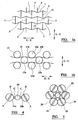
- FIG. 1a An example of a honeycomb style auxetic polymer material is illustrated in Figure 1a .
- Applying a tensile load along axis X-X causes stems 1 and 3 to move apart. However, this movement cause the stems 5 and 7 to straighten and thus increase the separation of stems 9 and 11. The result is an increase in the extent of the material along axis Y-Y which is perpendicular to axis X-X.
- FIG. 1b An example of a particle & fibril based auxetic polymer material is shown in Figure 1b .
- This provides a series of particles 13 which are linked by fibrils 15.
- the fibrils 15 are generally produced from the same material as the particles 13 by the extrusion and/or subsequent spinning process. Again, moving particles 13a and 13b apart along axis X-X causes the fibrils 15a, 15b to straighten and hence increase the separation of particles 13c and 13d.
- Such materials have been produced using compaction and sintering stages, or as detailed in WO-00/53830 , by partially melting and then extruding the single polymeric material.
- auxetic materials have been suggested, with quite varying form and level of negative Poisson ratio.
- the production method is complicated and generally suited to producing only very small amounts of auxetic material of questionable consistency.
- the nature of the process, surface melting and extrusion to form the material from a single material results in an auxetic material which is far less even in structure and properties than is implied in the schematic representations thereof in the prior art and Figures 1a and 1b of this document. Cross-linking of particles, incomplete fibril structures, non-discrete particles and other problems are encountered. Substantial difficulties also exist in turning such prior art auxetic material samples into useful shapes or forms.
- the present invention seeks to address these issues and provide an auxetic material which is relatively easy to produce, is consistent in its structure and properties, has an appreciable and controllable negative Poisson ratio and can readily be used to form more complex and useful forms.
- the auxetic material of the present invention is in effect a composite component made up of a number of components. Here it is illustrated in a partially strained state. Contrary to prior art auxetic materials the present material is formed of a number of separate components and potentially of separate components having different material form or properties.
- a core component 20 Running through the centre is a core component 20.
- This core component 20 is generally linear in configuration and provides the core for a composite structure.
- the core component 20 also defines an axis of the structure, X-X.
- To either side of the core component 20 are first components 22a, 22b.
- the first components 22a, 22b are provided in conjunction with second components 24a, 24b.
- the first component 22 is wrapped around the second component 24 in a spiralling manner. That is to say, the first component 22 contacts a different part of the circumference of the second component 24 as progress is made along the components 22, 24.
- the first component 22 at least, has an extent of displacement relative to the axis X-X which varies with position along the axis X-X.
- the displacement is greater than at location 26.
- the extent of displacement of the other first component 22b relative to the axis X-X is of the same extent for the same position 26, 28 etc along axis X-X, but the direction of displacement may be in the opposite direction relative to the axis X-X.
- parts 32 of the first component 22b are close to one another and parts 30 of the first component 22b are relatively far apart. This is achieved by wrapping the first components 22a, 22b around the second components 24a, 24b in opposing directions.
- both the first component 22 and second component 24 have a displacement relative to the axis X-X which varies with position along the axis X-X.
- the overall composite component thus provides through openings 34 of a given size.
- the overall form can be seen in the schematic cross-sectional view, viewed along axis X-X, of Figure 4 .
- the first component 22 starts at point A and advances up and over the second component 24 to point B, before descending the other, inside of the second component 24 to point C.
- Figure 3 if a tensile load is applied, parallel to axis X-X, to the first components 22 of the composite component then that load straightens the first components 22 from their helical configuration to a straighter or even straight configuration.
- the core component 20 still occupies the centre of the composite component and the first component 22 is still wrapped around the second component 24.
- the straightening of the first components 22 has led to an increase in the diameter of the helix formed by the second components 24.
- the level of displacement of the second component 24 away from the axis X-X has the net effect of considerably increasing the overall extent of the composite component along axis Y-Y.
- the size of the openings 34 also significantly increases.
- a functioning composite component could be provided using a linear second component 24 and wrapped, displacement varying along the length, first component 22. This form is not illustrated in the Figures. In this case, the application of the tensile load would again straighten the first components 22 and hence cause the second components 24 to move from linear to helical form. Again an increase in the extent perpendicular to the direction of the tensile load occurs.
- first components 22 and second components 24 are illustrated in Figures 2, 3 and 4 , a wide variety of different sizes are possible, both in absolute terms and in terms of the relative sizes of the different components to one another.
- the core component 20 is itself a further auxetic component or structure, but may also be an elastomeric rod of intermediate or low modulus. It is desirable that the core component be capable of deformation without fracture. Suitable materials include siloxane, liquid silicone rubber, natural rubber, nitrile rubber or any other elastomeric material whether natural or man-made.
- the tube may contain additional materials that may or may not be auxetic, and the additional materials may have different properties to the tube.
- the first components are desirably of high modulus of elasticity, for instance carbon fibre, kevlar, glass fibre, or wire.
- the second components are again desirably elastomeric in nature. A very wide range of materials can be employed, however, dependant on the desired properties, application and scale of the resultant composite structure. Further possibilities are outlined later in this document.
- the composite component of Figures 2, 3 and 4 is in effect a structure from which larger structures or articles can be formed.
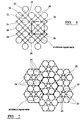
- FIG 5 an alternative structure is illustrated in cross-sectional end view.
- the structure is an expanded version of the structure illustrated above in the Figure 2, 3 and 4 form of the invention and uses similar principals.
- the structure again features a central core component 20, but is provided with six second components 24 evenly positioned around the perimeter of the core component 20.
- Each of the second components 24 is provided with a first component 22 wrapped around it.
- the extent of the displacement of the first component from the axis running along the centre of the structure is the same for each of the first components at the same position along the axis.
- the direction of the displacement for each component is radially away from the axis.
- application of a tensile load causes expansion in all directions radially away from the core component 20.
- a similar arrangement may be constructed using more or less than six first and second component combinations.
- each core component 20 is surrounded by four first components 22 and four second components 24, these being wrapped around one another to give the previously described combinations.
- the four combinations are evenly positioned around the core component 20.
- each core element 20 is surrounded by six first component 22 and second component 24 combinations. Again the six combinations are evenly positioned around the core component 20 and provide a close-packed arrangement as a result. Similar arrangements may be constructed using more or less than six first and second component combinations.
- auxetic structure is assembled from a number of components it is highly suited to mass production using variations on existing equipment designs that are relatively simple to implement. For instance, it would be possible to extrude the core component and use spinerettes to create the first component and second component combinations. The number of first component and second component combinations for the desired form can then be assembled around the core component. Assembly of multiple combinations provided in this way gives the desired bulk structure.
- first and second components it is possible to include supplemental materials.
- the auxetic properties of the structure are supplemented by filling the voids in the structure with siloxane foam, polyurethane foam or other low modulus of elasticity materials. Further components or elastomeric rods can be included in the voids. The introduction of such materials to the formed product is also possible using industrial scale processes.
- Figure 2, 3 , and 4 forms of the invention describe a structure that is strained to increase its extent perpendicular to the axis of strain. It is perfectly possible for the material to be pre-strained or pre-tensioned and exhibit its auxetic properties when the strain / tension is released and/or when compression is applied.
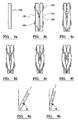
- FIG. 8a to f an experimental structure according to the present invention is provided.
- the structure is formed of two of the composite components 100 illustrated in Figure 8a .
- Two composite components 100 are provided in proximity with one another and each include a second component 104 that has a first component 102 wound around it.
- the first components 102 are wound in opposing directions.
- Such a structure is shown in Figure 8b unstrained.
- Macro rods and fibres can be used to form bulk composite structures suitable for a variety of uses.
- various organic polymeric, inorganic polymeric or inorganic structures may be used to achieve molecular size auxetic materials.
- auxetic composites and structures provided by the present invention offer a wide variety of beneficial properties.
- such structures may offer enhanced shear modulus, fracture toughness, piezoelectric properties, indentation resistance, thermal shock resistance, impact absorption, wear resistance and energy absorption over conventional materials.
- Usefully auxetic composites and structures according to the present invention may provide both impact and acoustic absorbing properties in a single material. There is also potential for these structures to display anisotropic effects where properties are different in axial and radial directions.
- auxetic structures of the present invention are particularly useful in the context of textiles due to their synclastic ability (the ability to form curves in two directions pointing in the same way). This makes such textiles particularly well fitting to other items they contact. This is true of both non-clothing, for instance crash helmet linings, and clothing type applications, for instance, comfortable body armour or clothing straps and / or belts.
- the materials in the present invention also offer benefits in terms of their suitability for protecting hand held electronic devices, mobile phones, cameras, videos and the like e.g. for vibration, acoustic damping, or indentation resistance etc.
Landscapes
- Engineering & Computer Science (AREA)
- Mechanical Engineering (AREA)
- Textile Engineering (AREA)
- Laminated Bodies (AREA)
- Reinforced Plastic Materials (AREA)
- Moulding By Coating Moulds (AREA)
- Yarns And Mechanical Finishing Of Yarns Or Ropes (AREA)
- Vibration Dampers (AREA)
- Superconductors And Manufacturing Methods Therefor (AREA)
- Compositions Of Macromolecular Compounds (AREA)
- Transition And Organic Metals Composition Catalysts For Addition Polymerization (AREA)
Claims (19)
- Verbundkomponente (100), die ein negatives Poisson-Verhältnis hat, wobei die Verbundkomponente eine erste Komponente (22; 102) und eine zweite Komponente (24; 104) umfasst; die erste Komponente (22; 102) einen höheren Elastizitätsmodul als die zweite Komponente (24; 104) hat; die erste Komponente (22; 102) und die zweite Komponente (24; 104) sich longitudinal bezüglich einer Achse erstrecken; die erste Komponente (22; 102) in helikaler Art um die zweite Komponente (24; 104) angeordnet ist; eine Variation bei der Zug- oder Drucklast auf die erste Komponente (22; 102) eine Variation im Durchmesser der Helix, welcher die erste Komponente (22; 102) folgt, verursacht; die Variation im Durchmesser der Helix der ersten Komponente (22; 102) bewirkt, dass die zweite Komponente (24; 104) die Form einer Helix annimmt, und/oder bewirkt, dass der Durchmesser der Helix der zweiten Komponente (24; 104) variiert; der Durchmesser der Helix der zweiten Komponente zunimmt, wenn die Helix der ersten Komponente im Durchmesser abnimmt; der Durchmesser der Helix der zweiten Komponente abnimmt, wenn die Helix der ersten Komponente im Durchmesser zunimmt.
- Verbundkomponente (100) nach Anspruch 1, in der die erste Komponente (22; 102) durch Auftragen und/oder Wickeln und/oder Beschichten und/oder Spinnen um die zweite Komponente (24; 104) angeordnet ist.
- Verbundkomponente (100) nach einem vorangehenden Anspruch, in der die erste Komponente (22; 102) eine Faser, ein Stab oder ein Hohlrohr aus einem Material mit relativ hohem Modul ist und die zweite Komponente (24; 104) eine Faser, ein Stab oder ein Hohlrohr aus einem Material mit mittlerem oder niedrigem Modul im Vergleich zu dem Material der ersten Komponente ist.
- Verbundkomponente (100) nach einem vorangehenden Anspruch, in dem die Achse durch eine Kernkomponente (20) bereitgestellt ist.
- Verbundkomponente (100) nach einem vorangehenden Anspruch, wobei die Variation in radialer Position eine Zunahme bei der Verschiebung wenigstens eines Teils der zweiten Komponente (24; 104) relativ zu der Achse, wenn die Last variiert wird, ist, wobei die Variation eine Zunahme ist, wenn die Last eine Zuglast ist, und eine Abnahme ist, wenn die Last eine Drucklast ist.
- Verbundkomponente (100) nach einem vorangehenden Anspruch, bei der die Variation in radialer Position eine Abnahme bei der Verschiebung wenigstens eines Teils der zweiten Komponente (24; 104) von der Achse ist, wenn die Last variiert wird, wobei die Variation eine Abnahme ist, wenn die Last eine Zuglast ist, und eine Zunahme ist, wenn die Last eine Drucklast ist.
- Struktur, die 2 oder mehr Verbundkomponenten (100) angeordnet nach einem der Ansprüche 1 bis 6 umfasst.
- Struktur nach Anspruch 7, wobei die Struktur wenigstens ein Paar von Verbundkomponenten (100) umfasst, wobei jede Verbundkomponente eine erste Komponente (22; 102) und eine zweite Komponente (24; 104) umfasst, wobei das Paar von Verbundkomponenten (100) angrenzend aneinander oder in Kontakt miteinander angeordnet ist.
- Struktur nach Anspruch 7 oder Anspruch 8, wobei die Struktur aus Wiederholungen einer Einheit, die mehrere Verbundkomponenten (100) umfasst, gebildet ist.
- Struktur nach einem der Ansprüche 7 bis 9, wobei die Struktur dadurch bereitgestellt wird, dass jede Verbundkomponente (100) benachbart mit oder in Kontakt mit 2 oder mehr anderen Verbundkomponenten (100) angeordnet ist, um so eine planare Struktur oder eine Struktur vom Folientyp zu bilden.
- Struktur nach einem der Ansprüche 7 bis 10, wobei die Struktur dadurch bereitgestellt wird, dass jede Verbundkomponente (100) benachbart oder in Kontakt mit 4 oder mehr anderen Verbundkomponenten (100) angeordnet wird.
- Struktur nach einem der Ansprüche 7 bis 11, in der benachbarte Verbundkomponenten (100) mit ersten Komponenten (22; 102) versehen sind, die in zueinander entgegengesetzten Richtungen um die zweite Komponente (24; 104) gewickelt sind.
- Struktur nach einem der Ansprüche 7 bis 12, wobei die Struktur mit einer oder mehreren Kernkomponenten (20) ausgestattet ist.
- Struktur nach Anspruch 13, in der die Kernkomponente (20) eine Faser ist und/oder fest oder hohl ist.
- Struktur nach Anspruch 13 oder 14, in der ein zusätzliches Material oder mehrere zusätzliche Materialien angeordnet ist/sind, so dass es eine begrenzte Bewegung oder keine Bewegung der ersten Komponenten (22; 102), zweiten Komponenten (24; 104) und Kernkomponenten (20) übereinander gibt.
- Struktur nach einem der Ansprüche 7 bis 15, in der die Struktur eine Matrixkomponente oder mehrere Matrixkomponenten umfasst.
- Struktur nach Anspruch 16, in der die Matrixkomponente der Bewegung der zweiten Komponente (24; 104), die durch eine Lastvariation verursacht wird, standhält und/oder die Rückkehr der zweiten Komponente (24; 104) zu der radialen Position, die sie vor Lastvariation besetzt hat, fördert.
- Struktur nach einem der Ansprüche 7 bis 17, in der die Struktur energieabsorbierend, z.B. schlagabsorbierend und/oder schallabsorbierend ist.
- Verfahren zur Herstellung einer Verbundkomponente (100), die ein negatives Poisson-Verhältnis hat, wobei das Verfahren umfasst: Bilden einer ersten Komponente (22; 102); Bilden einer zweiten Komponente (24; 104); wobei der Elastizitätsmodul der ersten Komponente (22; 102) größer ist als der Elastizitätsmodul der zweiten Komponente (24; 104); Auftragen der ersten Komponente (22; 102) um die zweite Komponente (24; 104) in helikaler Art, wobei eine Variation in der Zug- oder Drucklast auf die erste Komponente (22; 102) eine Variation im Durchmesser der Helix, welcher die erste Komponente (22; 102) folgt, bewirkt, die Variation im Durchmesser der Helix der ersten Komponente (22; 102) bewirkt, dass die zweite Komponente (24; 104) die Form einer Helix annimmt und/oder bewirkt, dass der Durchmesser der Helix der zweiten Komponente (24; 104) variiert; der Durchmesser der Helix der zweiten Komponente zunimmt, wenn die Helix der ersten Komponente im Durchmesser abnimmt, der Durchmesser der Helix der zweiten Komponente abnimmt, wenn die Helix der ersten Komponente im Durchmesser zunimmt.
Applications Claiming Priority (2)
| Application Number | Priority Date | Filing Date | Title |
|---|---|---|---|
| GBGB0307330.1A GB0307330D0 (en) | 2003-03-29 | 2003-03-29 | Improvements in and relating to composite materials and structures |
| PCT/GB2004/001320 WO2004088015A1 (en) | 2003-03-29 | 2004-03-26 | Improvements in and relating to composite materials and structures |
Publications (2)
| Publication Number | Publication Date |
|---|---|
| EP1649090A1 EP1649090A1 (de) | 2006-04-26 |
| EP1649090B1 true EP1649090B1 (de) | 2009-07-08 |
Family
ID=9955828
Family Applications (1)
| Application Number | Title | Priority Date | Filing Date |
|---|---|---|---|
| EP04723637A Expired - Lifetime EP1649090B1 (de) | 2003-03-29 | 2004-03-26 | Verbesserungen bei verbundstoffen und -körpern |
Country Status (11)
| Country | Link |
|---|---|
| US (3) | US20070031667A1 (de) |
| EP (1) | EP1649090B1 (de) |
| JP (1) | JP4536058B2 (de) |
| KR (1) | KR101059917B1 (de) |
| CN (1) | CN1768176B (de) |
| AT (1) | ATE435935T1 (de) |
| CA (1) | CA2520687C (de) |
| DE (1) | DE602004021936D1 (de) |
| GB (1) | GB0307330D0 (de) |
| RU (1) | RU2338820C2 (de) |
| WO (1) | WO2004088015A1 (de) |
Families Citing this family (66)
| Publication number | Priority date | Publication date | Assignee | Title |
|---|---|---|---|---|
| GB0418759D0 (en) * | 2004-08-23 | 2004-09-22 | Auxetix Ltd | Uses of auxetic fibres |
| WO2007046069A1 (en) * | 2005-10-21 | 2007-04-26 | The Procter & Gamble Company | Absorbent article comprising auxetic materials |
| DE102005060293A1 (de) * | 2005-12-16 | 2007-07-05 | Continental Aktiengesellschaft | Verwendung auxetischer Materiallen in Kautschukprodukten, Kautschukmischungen und Cordmaterialien |
| GB0604583D0 (en) * | 2006-03-08 | 2006-04-19 | Dow Corning | Impregnated flexible sheet material |
| GB0608462D0 (en) * | 2006-04-28 | 2006-06-07 | Auxetix Ltd | Detection system |
| GB0610272D0 (en) * | 2006-05-24 | 2006-07-05 | Auxetic Technologies Ltd | A composite material |
| US8652602B1 (en) * | 2007-02-28 | 2014-02-18 | William Jacob Spenner Dolla | Rotational expansion auxetic structures |
| US8432057B2 (en) * | 2007-05-01 | 2013-04-30 | Pliant Energy Systems Llc | Pliant or compliant elements for harnessing the forces of moving fluid to transport fluid or generate electricity |
| WO2009002479A1 (en) | 2007-06-21 | 2008-12-31 | University Of Massachusetts | Auxetic fabric structures and related fabrication methods |
| GB0804487D0 (en) | 2008-03-11 | 2008-04-16 | Terram Ltd | Cellular structures |
| US20090235814A1 (en) * | 2008-03-24 | 2009-09-24 | Cashin Arthur H | Mobile Reconfigurable Barricade |
| US20090235507A1 (en) * | 2008-03-24 | 2009-09-24 | Arthur Henry Cashin | Method Of Repairing A Ballistics Barrier |
| US20090235813A1 (en) * | 2008-03-24 | 2009-09-24 | Arthur Henry Cashin | Ballistics Barrier |
| US20090250675A1 (en) * | 2008-03-24 | 2009-10-08 | Arthur Henry Cashin | Vehicle Barrier |
| US8453730B2 (en) * | 2008-05-23 | 2013-06-04 | Schlumberger Technology Corporation | System and method for improving operational characteristics |
| GB0818523D0 (en) * | 2008-10-09 | 2008-11-19 | Univ Exeter | Fibrous assembly |
| US8225729B2 (en) | 2008-12-16 | 2012-07-24 | Kimberly-Clark Worldwide, Inc. | Three-dimensional wiping substrate and method therefor |
| US7858055B2 (en) * | 2008-12-18 | 2010-12-28 | Kimberly-Clark Worldwide, Inc. | Moisture sensitive auxetic material |
| WO2010125397A1 (en) * | 2009-05-01 | 2010-11-04 | Global Composites Group | Auxetic knitted fabric |
| KR101779631B1 (ko) | 2009-12-30 | 2017-09-18 | 쓰리엠 이노베이티브 프로퍼티즈 컴파니 | 팽창 메시를 제조하는 방법 |
| AU2010343219B2 (en) | 2009-12-30 | 2014-02-20 | 3M Innovative Properties Company | Molded auxetic mesh |
| US8967147B2 (en) | 2009-12-30 | 2015-03-03 | 3M Innovative Properties Company | Filtering face-piece respirator having an auxetic mesh in the mask body |
| US8609220B2 (en) * | 2010-04-08 | 2013-12-17 | Compagnie Generale Des Etablissements Michelin | Shear compliant hexagonal meso-structures having high shear strength and high shear strain |
| US9631171B2 (en) | 2010-11-22 | 2017-04-25 | The Regents Of The University Of California | Microstructure biomaterials and fabrication methods therefor |
| GB201019796D0 (en) | 2010-11-23 | 2011-01-05 | Univ Exeter The | Auxetic material articles |
| CN103384957B (zh) * | 2011-01-10 | 2017-09-08 | 本亚明·彼得罗·菲拉尔多 | 用于例如为推进产生波状运动和用于利用运动流体的能量的机构 |
| GB201109949D0 (en) | 2011-06-14 | 2011-07-27 | Dow Corning | Pressure material |
| GB2493007B (en) | 2011-07-21 | 2017-08-30 | Fiberweb Holdings Ltd | Confinement structures for particulate fill materials |
| CN103361811B (zh) * | 2012-06-26 | 2016-03-30 | 香港理工大学 | 一种负泊松比纱线结构及其制造方法 |
| US9241808B2 (en) | 2012-08-27 | 2016-01-26 | Anthony Sabatino | Auxetic prosthetic implant |
| US12070100B2 (en) | 2012-08-31 | 2024-08-27 | Under Armour, Inc. | Laminate panel with auxetic layer |
| US9538798B2 (en) | 2012-08-31 | 2017-01-10 | Under Armour, Inc. | Articles of apparel including auxetic materials |
| US11839253B2 (en) | 2012-08-31 | 2023-12-12 | Under Armour, Inc. | Article of apparel including fabric having auxetic structure |
| US10426226B2 (en) | 2012-08-31 | 2019-10-01 | Under Armour, Inc. | Footwear upper with dynamic and lock-out regions |
| US9629397B2 (en) | 2012-08-31 | 2017-04-25 | Under Armour, Inc. | Articles of apparel including auxetic materials |
| US9936755B2 (en) | 2012-08-31 | 2018-04-10 | Under Armour, Inc. | Articles of apparel with auxetic fabric |
| US9194662B1 (en) * | 2013-03-15 | 2015-11-24 | Peter D. Poulsen | Article for dispersing energy of a blast or impact |
| CA2907048A1 (en) * | 2013-03-15 | 2014-09-25 | President And Fellows Of Harvard College | Low porosity auxetic sheet |
| US10980316B2 (en) | 2013-08-07 | 2021-04-20 | Asics Corporation | Shoes |
| USD777452S1 (en) | 2014-01-17 | 2017-01-31 | Under Armour, Inc. | Textile substrate with overlay |
| USD774783S1 (en) | 2014-01-29 | 2016-12-27 | Under Armour, Inc. | Elastic textile |
| EP3096368B1 (de) * | 2015-05-22 | 2017-08-30 | Sanko Tekstil Isletmeleri San. Ve Tic. A.S. | Verbundfadenstruktur |
| US10655288B2 (en) * | 2016-02-23 | 2020-05-19 | Nv Bekaert Sa | Energy absorption assembly |
| US10508373B2 (en) * | 2016-05-13 | 2019-12-17 | Nike, Inc. | Embroidered article |
| US11209022B2 (en) | 2016-06-30 | 2021-12-28 | Pliant Energy Systems Llc | Vehicle with traveling wave thrust module apparatuses, methods and systems |
| US10519926B2 (en) | 2016-06-30 | 2019-12-31 | Pliant Energy Systems Llc | Traveling wave propeller, pump and generator apparatuses, methods and systems |
| US11795900B2 (en) | 2016-06-30 | 2023-10-24 | Pliant Energy Systems Llc | Vehicle with traveling wave thrust module apparatuses, methods and systems |
| US10190570B1 (en) | 2016-06-30 | 2019-01-29 | Pliant Energy Systems Llc | Traveling wave propeller, pump and generator apparatuses, methods and systems |
| US10098409B1 (en) | 2017-05-25 | 2018-10-16 | Nike, Inc. | Pre-tensioned article and method of making |
| ES2924523T3 (es) * | 2017-12-01 | 2022-10-07 | Airbus Operations Sl | Estructura auxética deformable y procedimiento de fabricación |
| US11291305B2 (en) | 2017-12-05 | 2022-04-05 | Steelcase Inc. | Compliant backrest |
| USD869872S1 (en) | 2017-12-05 | 2019-12-17 | Steelcase Inc. | Chair |
| USD870479S1 (en) | 2017-12-05 | 2019-12-24 | Steelcase Inc. | Chair |
| US10813463B2 (en) | 2017-12-05 | 2020-10-27 | Steelcase Inc. | Compliant backrest |
| USD869890S1 (en) | 2017-12-05 | 2019-12-17 | Steelcase Inc. | Chairback |
| USD869889S1 (en) | 2017-12-05 | 2019-12-17 | Steelcase Inc. | Chairback |
| CN108166122A (zh) * | 2018-02-08 | 2018-06-15 | 湖北枫树线业有限公司 | 具有拉伸膨胀性能的单复丝双股缝纫线及其制造方法 |
| CN108456960A (zh) * | 2018-02-08 | 2018-08-28 | 湖北枫树线业有限公司 | 具有拉伸膨胀性能的全复丝双股缝纫线及其制造方法 |
| CN109808468A (zh) * | 2019-03-04 | 2019-05-28 | 南京航空航天大学 | 一种基于负泊松比结构的车门防撞梁及其优化方法 |
| DE102019107256A1 (de) * | 2019-03-21 | 2020-09-24 | Ofa Bamberg Gmbh | Strumpf |
| USD907383S1 (en) | 2019-05-31 | 2021-01-12 | Steelcase Inc. | Chair with upholstered back |
| USD907935S1 (en) | 2019-05-31 | 2021-01-19 | Steelcase Inc. | Chair |
| CN111016334B (zh) * | 2019-10-25 | 2021-01-01 | 青岛理工大学 | 抗爆抗冲击多级异质纤维预制体复合材料及其制备方法 |
| KR20240038096A (ko) * | 2021-08-05 | 2024-03-22 | 더블유. 엘. 고어 앤드 어소시에이트스, 인코포레이티드 | 해조류 부착근의 포획 및 부착을 촉진하는 복합 재료 |
| CN114103277B (zh) * | 2021-09-27 | 2023-08-29 | 福建省晋江市华宇织造有限公司 | 一种具有防护膝盖结构的负泊松比网布 |
| US12582896B2 (en) * | 2022-04-18 | 2026-03-24 | Ibrahim M. Alarifi | Shin guard made of auxetic material and unit structure thereof |
Family Cites Families (24)
| Publication number | Priority date | Publication date | Assignee | Title |
|---|---|---|---|---|
| US2448782A (en) * | 1945-05-14 | 1948-09-07 | Archibald H Davis | Composite strand and fabric |
| US3631667A (en) * | 1967-08-29 | 1972-01-04 | Owens Corning Fiberglass Corp | Method of making reinforcement for tires |
| US3625809A (en) * | 1970-02-24 | 1971-12-07 | Owens Corning Fiberglass Corp | Filament blend products |
| DE2447715C3 (de) * | 1974-10-07 | 1978-09-07 | Hoechst Ag, 6000 Frankfurt | Vorgarn und Verfahren zu dessen Herstellung |
| US4155394A (en) * | 1977-08-29 | 1979-05-22 | The Goodyear Tire & Rubber Company | Tire cord composite and pneumatic tire |
| US4809493A (en) * | 1985-11-01 | 1989-03-07 | Kuraray Company Limited | Water-absorbing shrinkable yarn |
| US4668557A (en) * | 1986-07-18 | 1987-05-26 | The University Of Iowa Research Foundation | Polyhedron cell structure and method of making same |
| JPH0250084A (ja) | 1988-05-27 | 1990-02-20 | Takumi Hayasaka | 多段式熱交換機 |
| US5092727A (en) | 1988-12-16 | 1992-03-03 | The B. F. Goodrich Company | Braided composite threaded member |
| GB2235650A (en) | 1989-07-14 | 1991-03-13 | Nat Res Dev | Curvable core layers |
| GB8916231D0 (en) * | 1989-07-14 | 1989-08-31 | Evans Kenneth E | Polymeric materials |
| US5429869A (en) * | 1993-02-26 | 1995-07-04 | W. L. Gore & Associates, Inc. | Composition of expanded polytetrafluoroethylene and similar polymers and method for producing same |
| EP0820858B1 (de) | 1996-07-22 | 2000-11-02 | Hexcel Corporation | Wabenförmige Kernmaterialien mit partikelförmiger Verstärkung |
| JPH10134102A (ja) * | 1996-10-30 | 1998-05-22 | Toyota Central Res & Dev Lab Inc | 所望のポアソン比を有する複合材料の製造方法 |
| UA61089C2 (uk) * | 1996-11-08 | 2003-11-17 | Хантсмен Ай Сі Ай Кемікалз, Ллс | Спосіб одержання жорстких та еластичних пінополіуретанових матеріалів |
| US6460588B1 (en) * | 1997-09-26 | 2002-10-08 | The Goodyear Tire & Rubber Company | Pen reinforcement for rubber composites |
| GB9723140D0 (en) * | 1997-11-04 | 1998-01-07 | British Nuclear Fuels Plc | Improvements in and relating to material separations |
| GB9905145D0 (en) * | 1999-03-06 | 1999-04-28 | Bolton Inst Higher Education | Auxetic materials |
| CN1266916A (zh) * | 1999-03-10 | 2000-09-20 | 叶齐炎 | 包捻纱及包捻并纱倍捻锭子 |
| CN1273288A (zh) * | 1999-05-09 | 2000-11-15 | 叶齐炎 | 包捻纱及并纱包捻倍捻锭子 |
| ATE427333T1 (de) | 2000-08-21 | 2009-04-15 | Massachusetts Inst Technology | Zusamensetzung enthaltend iptycen-polymere mit grossem freiem innenvolumen |
| GB0608462D0 (en) * | 2006-04-28 | 2006-06-07 | Auxetix Ltd | Detection system |
| US8225729B2 (en) * | 2008-12-16 | 2012-07-24 | Kimberly-Clark Worldwide, Inc. | Three-dimensional wiping substrate and method therefor |
| US7858055B2 (en) * | 2008-12-18 | 2010-12-28 | Kimberly-Clark Worldwide, Inc. | Moisture sensitive auxetic material |
-
2003
- 2003-03-29 GB GBGB0307330.1A patent/GB0307330D0/en not_active Ceased
-
2004
- 2004-03-26 JP JP2006506034A patent/JP4536058B2/ja not_active Expired - Fee Related
- 2004-03-26 EP EP04723637A patent/EP1649090B1/de not_active Expired - Lifetime
- 2004-03-26 AT AT04723637T patent/ATE435935T1/de not_active IP Right Cessation
- 2004-03-26 KR KR1020057018305A patent/KR101059917B1/ko not_active Expired - Fee Related
- 2004-03-26 WO PCT/GB2004/001320 patent/WO2004088015A1/en not_active Ceased
- 2004-03-26 US US10/551,316 patent/US20070031667A1/en not_active Abandoned
- 2004-03-26 CN CN2004800088426A patent/CN1768176B/zh not_active Expired - Fee Related
- 2004-03-26 RU RU2005131202/12A patent/RU2338820C2/ru not_active IP Right Cessation
- 2004-03-26 CA CA2520687A patent/CA2520687C/en not_active Expired - Fee Related
- 2004-03-26 DE DE602004021936T patent/DE602004021936D1/de not_active Expired - Lifetime
-
2009
- 2009-05-18 US US12/467,966 patent/US8916262B2/en not_active Expired - Lifetime
-
2014
- 2014-10-24 US US14/523,606 patent/US20150298421A1/en not_active Abandoned
Also Published As
| Publication number | Publication date |
|---|---|
| CN1768176A (zh) | 2006-05-03 |
| JP4536058B2 (ja) | 2010-09-01 |
| RU2338820C2 (ru) | 2008-11-20 |
| US20150298421A1 (en) | 2015-10-22 |
| US20090239049A1 (en) | 2009-09-24 |
| US20070031667A1 (en) | 2007-02-08 |
| US8916262B2 (en) | 2014-12-23 |
| KR101059917B1 (ko) | 2011-08-29 |
| DE602004021936D1 (de) | 2009-08-20 |
| GB0307330D0 (en) | 2003-05-07 |
| RU2005131202A (ru) | 2007-05-20 |
| CA2520687A1 (en) | 2004-10-14 |
| JP2006525443A (ja) | 2006-11-09 |
| KR20060009826A (ko) | 2006-02-01 |
| EP1649090A1 (de) | 2006-04-26 |
| CN1768176B (zh) | 2012-06-27 |
| ATE435935T1 (de) | 2009-07-15 |
| CA2520687C (en) | 2012-05-22 |
| WO2004088015A1 (en) | 2004-10-14 |
Similar Documents
| Publication | Publication Date | Title |
|---|---|---|
| EP1649090B1 (de) | Verbesserungen bei verbundstoffen und -körpern | |
| Ge et al. | A finite element analysis of a 3D auxetic textile structure for composite reinforcement | |
| EP1786962B1 (de) | Verwendungen auxetischer fasern | |
| Zhou et al. | Auxetic composites made of 3D textile structure and polyurethane foam | |
| Sloan et al. | The helical auxetic yarn–a novel structure for composites and textiles; geometry, manufacture and mechanical properties | |
| Kabir et al. | Characterization of 3D printed auxetic sinusoidal patterns/nylon composite fabrics | |
| Subramani et al. | Development and characterization of novel auxetic structures based on re-entrant hexagon design produced from braided composites | |
| Chen et al. | Mechanical modeling of an auxetic tubular braided structure: Experimental and numerical analyses | |
| WO2010146347A1 (en) | Auxetic material | |
| US10301769B2 (en) | Stretchable fiber-based composite-material | |
| Chang et al. | 3D fabrics with negative Poisson’s ratio: a review | |
| EP2875945A1 (de) | Genähtes kohlenfaserbasismaterial und feuchtes prepreg damit | |
| Arshad et al. | 3D woven auxetic composites using onloom shaped reinforcement | |
| Khan et al. | Use of auxetic material for impact/ballistic applications | |
| Lam et al. | Comparison of different thermoplastic cellular textile composites on their energy absorption capacity | |
| Khan et al. | Auxetic yarn: fundamentals, influencing parameters, application areas and challenges | |
| Stankovic | Compression hysteresis of fibrous systems | |
| Hu et al. | Fibers for Auxetic Applications | |
| Zheng et al. | Numerical modeling of friction effects on the ballistic impact response of single-ply tri-axial braided fabric | |
| Wei et al. | Research on the Impact Resistance and Mechanism Analysis of 3D-Printed Honeycomb-Like Structured Elastomer | |
| Das | AUXETIC TEXTILE MATERIALS | |
| Zhou | Study of 3D auxetic textile reinforced composites | |
| Nawab | Tehseen Ullah, Sheraz Ahmad and | |
| Lam et al. | Polymeric cellular textile composites for energy absorption | |
| Goud | Auxetic textiles |
Legal Events
| Date | Code | Title | Description |
|---|---|---|---|
| PUAI | Public reference made under article 153(3) epc to a published international application that has entered the european phase |
Free format text: ORIGINAL CODE: 0009012 |
|
| 17P | Request for examination filed |
Effective date: 20050919 |
|
| AK | Designated contracting states |
Kind code of ref document: A1 Designated state(s): AT BE BG CH CY CZ DE DK EE ES FI FR GB GR HU IE IT LI LU MC NL PL PT RO SE SI SK TR |
|
| DAX | Request for extension of the european patent (deleted) | ||
| GRAP | Despatch of communication of intention to grant a patent |
Free format text: ORIGINAL CODE: EPIDOSNIGR1 |
|
| GRAS | Grant fee paid |
Free format text: ORIGINAL CODE: EPIDOSNIGR3 |
|
| GRAA | (expected) grant |
Free format text: ORIGINAL CODE: 0009210 |
|
| AK | Designated contracting states |
Kind code of ref document: B1 Designated state(s): AT BE BG CH CY CZ DE DK EE ES FI FR GB GR HU IE IT LI LU MC NL PL PT RO SE SI SK TR |
|
| REG | Reference to a national code |
Ref country code: GB Ref legal event code: FG4D |
|
| REG | Reference to a national code |
Ref country code: CH Ref legal event code: EP |
|
| REG | Reference to a national code |
Ref country code: IE Ref legal event code: FG4D |
|
| REF | Corresponds to: |
Ref document number: 602004021936 Country of ref document: DE Date of ref document: 20090820 Kind code of ref document: P |
|
| PG25 | Lapsed in a contracting state [announced via postgrant information from national office to epo] |
Ref country code: SI Free format text: LAPSE BECAUSE OF FAILURE TO SUBMIT A TRANSLATION OF THE DESCRIPTION OR TO PAY THE FEE WITHIN THE PRESCRIBED TIME-LIMIT Effective date: 20090708 |
|
| NLV1 | Nl: lapsed or annulled due to failure to fulfill the requirements of art. 29p and 29m of the patents act | ||
| PG25 | Lapsed in a contracting state [announced via postgrant information from national office to epo] |
Ref country code: AT Free format text: LAPSE BECAUSE OF FAILURE TO SUBMIT A TRANSLATION OF THE DESCRIPTION OR TO PAY THE FEE WITHIN THE PRESCRIBED TIME-LIMIT Effective date: 20090708 Ref country code: FI Free format text: LAPSE BECAUSE OF FAILURE TO SUBMIT A TRANSLATION OF THE DESCRIPTION OR TO PAY THE FEE WITHIN THE PRESCRIBED TIME-LIMIT Effective date: 20090708 Ref country code: ES Free format text: LAPSE BECAUSE OF FAILURE TO SUBMIT A TRANSLATION OF THE DESCRIPTION OR TO PAY THE FEE WITHIN THE PRESCRIBED TIME-LIMIT Effective date: 20091019 |
|
| PG25 | Lapsed in a contracting state [announced via postgrant information from national office to epo] |
Ref country code: NL Free format text: LAPSE BECAUSE OF FAILURE TO SUBMIT A TRANSLATION OF THE DESCRIPTION OR TO PAY THE FEE WITHIN THE PRESCRIBED TIME-LIMIT Effective date: 20090708 Ref country code: PL Free format text: LAPSE BECAUSE OF FAILURE TO SUBMIT A TRANSLATION OF THE DESCRIPTION OR TO PAY THE FEE WITHIN THE PRESCRIBED TIME-LIMIT Effective date: 20090708 |
|
| PG25 | Lapsed in a contracting state [announced via postgrant information from national office to epo] |
Ref country code: BG Free format text: LAPSE BECAUSE OF FAILURE TO SUBMIT A TRANSLATION OF THE DESCRIPTION OR TO PAY THE FEE WITHIN THE PRESCRIBED TIME-LIMIT Effective date: 20091008 Ref country code: PT Free format text: LAPSE BECAUSE OF FAILURE TO SUBMIT A TRANSLATION OF THE DESCRIPTION OR TO PAY THE FEE WITHIN THE PRESCRIBED TIME-LIMIT Effective date: 20091109 |
|
| PG25 | Lapsed in a contracting state [announced via postgrant information from national office to epo] |
Ref country code: RO Free format text: LAPSE BECAUSE OF FAILURE TO SUBMIT A TRANSLATION OF THE DESCRIPTION OR TO PAY THE FEE WITHIN THE PRESCRIBED TIME-LIMIT Effective date: 20090708 Ref country code: CZ Free format text: LAPSE BECAUSE OF FAILURE TO SUBMIT A TRANSLATION OF THE DESCRIPTION OR TO PAY THE FEE WITHIN THE PRESCRIBED TIME-LIMIT Effective date: 20090708 Ref country code: DK Free format text: LAPSE BECAUSE OF FAILURE TO SUBMIT A TRANSLATION OF THE DESCRIPTION OR TO PAY THE FEE WITHIN THE PRESCRIBED TIME-LIMIT Effective date: 20090708 Ref country code: EE Free format text: LAPSE BECAUSE OF FAILURE TO SUBMIT A TRANSLATION OF THE DESCRIPTION OR TO PAY THE FEE WITHIN THE PRESCRIBED TIME-LIMIT Effective date: 20090708 |
|
| PLBE | No opposition filed within time limit |
Free format text: ORIGINAL CODE: 0009261 |
|
| STAA | Information on the status of an ep patent application or granted ep patent |
Free format text: STATUS: NO OPPOSITION FILED WITHIN TIME LIMIT |
|
| PG25 | Lapsed in a contracting state [announced via postgrant information from national office to epo] |
Ref country code: SK Free format text: LAPSE BECAUSE OF FAILURE TO SUBMIT A TRANSLATION OF THE DESCRIPTION OR TO PAY THE FEE WITHIN THE PRESCRIBED TIME-LIMIT Effective date: 20090708 Ref country code: BE Free format text: LAPSE BECAUSE OF FAILURE TO SUBMIT A TRANSLATION OF THE DESCRIPTION OR TO PAY THE FEE WITHIN THE PRESCRIBED TIME-LIMIT Effective date: 20090708 |
|
| 26N | No opposition filed |
Effective date: 20100409 |
|
| PG25 | Lapsed in a contracting state [announced via postgrant information from national office to epo] |
Ref country code: MC Free format text: LAPSE BECAUSE OF NON-PAYMENT OF DUE FEES Effective date: 20100331 Ref country code: GR Free format text: LAPSE BECAUSE OF FAILURE TO SUBMIT A TRANSLATION OF THE DESCRIPTION OR TO PAY THE FEE WITHIN THE PRESCRIBED TIME-LIMIT Effective date: 20091009 |
|
| REG | Reference to a national code |
Ref country code: CH Ref legal event code: PL |
|
| PG25 | Lapsed in a contracting state [announced via postgrant information from national office to epo] |
Ref country code: IE Free format text: LAPSE BECAUSE OF NON-PAYMENT OF DUE FEES Effective date: 20100326 |
|
| PG25 | Lapsed in a contracting state [announced via postgrant information from national office to epo] |
Ref country code: CH Free format text: LAPSE BECAUSE OF NON-PAYMENT OF DUE FEES Effective date: 20100331 Ref country code: LI Free format text: LAPSE BECAUSE OF NON-PAYMENT OF DUE FEES Effective date: 20100331 |
|
| PG25 | Lapsed in a contracting state [announced via postgrant information from national office to epo] |
Ref country code: IT Free format text: LAPSE BECAUSE OF FAILURE TO SUBMIT A TRANSLATION OF THE DESCRIPTION OR TO PAY THE FEE WITHIN THE PRESCRIBED TIME-LIMIT Effective date: 20090708 |
|
| PG25 | Lapsed in a contracting state [announced via postgrant information from national office to epo] |
Ref country code: CY Free format text: LAPSE BECAUSE OF FAILURE TO SUBMIT A TRANSLATION OF THE DESCRIPTION OR TO PAY THE FEE WITHIN THE PRESCRIBED TIME-LIMIT Effective date: 20090708 |
|
| PG25 | Lapsed in a contracting state [announced via postgrant information from national office to epo] |
Ref country code: HU Free format text: LAPSE BECAUSE OF FAILURE TO SUBMIT A TRANSLATION OF THE DESCRIPTION OR TO PAY THE FEE WITHIN THE PRESCRIBED TIME-LIMIT Effective date: 20100109 Ref country code: LU Free format text: LAPSE BECAUSE OF NON-PAYMENT OF DUE FEES Effective date: 20100326 Ref country code: SE Free format text: LAPSE BECAUSE OF FAILURE TO SUBMIT A TRANSLATION OF THE DESCRIPTION OR TO PAY THE FEE WITHIN THE PRESCRIBED TIME-LIMIT Effective date: 20090708 |
|
| PG25 | Lapsed in a contracting state [announced via postgrant information from national office to epo] |
Ref country code: TR Free format text: LAPSE BECAUSE OF FAILURE TO SUBMIT A TRANSLATION OF THE DESCRIPTION OR TO PAY THE FEE WITHIN THE PRESCRIBED TIME-LIMIT Effective date: 20090708 |
|
| REG | Reference to a national code |
Ref country code: FR Ref legal event code: PLFP Year of fee payment: 13 |
|
| REG | Reference to a national code |
Ref country code: FR Ref legal event code: PLFP Year of fee payment: 14 |
|
| REG | Reference to a national code |
Ref country code: FR Ref legal event code: PLFP Year of fee payment: 15 |
|
| REG | Reference to a national code |
Ref country code: DE Ref legal event code: R082 Ref document number: 602004021936 Country of ref document: DE Representative=s name: KRAUS & WEISERT PATENTANWAELTE PARTGMBB, DE Ref country code: DE Ref legal event code: R081 Ref document number: 602004021936 Country of ref document: DE Owner name: ADVANCED FABRIC TECHNOLOGIES LLC, THE WOODLAND, US Free format text: FORMER OWNER: DOW CORNING LTD., SOUTH GLAMORGAN, WALES, GB |
|
| REG | Reference to a national code |
Ref country code: GB Ref legal event code: 732E Free format text: REGISTERED BETWEEN 20180913 AND 20180919 |
|
| REG | Reference to a national code |
Ref country code: FR Ref legal event code: TP Owner name: ADVANCED FABRIC TECHNOLOGIES, LLC, US Effective date: 20181105 |
|
| PGFP | Annual fee paid to national office [announced via postgrant information from national office to epo] |
Ref country code: FR Payment date: 20190927 Year of fee payment: 16 |
|
| PGFP | Annual fee paid to national office [announced via postgrant information from national office to epo] |
Ref country code: GB Payment date: 20190927 Year of fee payment: 16 |
|
| PGFP | Annual fee paid to national office [announced via postgrant information from national office to epo] |
Ref country code: DE Payment date: 20190927 Year of fee payment: 16 |
|
| REG | Reference to a national code |
Ref country code: DE Ref legal event code: R119 Ref document number: 602004021936 Country of ref document: DE |
|
| PG25 | Lapsed in a contracting state [announced via postgrant information from national office to epo] |
Ref country code: FR Free format text: LAPSE BECAUSE OF NON-PAYMENT OF DUE FEES Effective date: 20200331 Ref country code: DE Free format text: LAPSE BECAUSE OF NON-PAYMENT OF DUE FEES Effective date: 20201001 |
|
| GBPC | Gb: european patent ceased through non-payment of renewal fee |
Effective date: 20200326 |
|
| PG25 | Lapsed in a contracting state [announced via postgrant information from national office to epo] |
Ref country code: GB Free format text: LAPSE BECAUSE OF NON-PAYMENT OF DUE FEES Effective date: 20200326 |