EP1634474B1 - Verfahren, system, netzwerkentität und endbenutzer-endgerät zur steuerung einer weiterreichung eines zellularen endgeräts - Google Patents
Verfahren, system, netzwerkentität und endbenutzer-endgerät zur steuerung einer weiterreichung eines zellularen endgeräts Download PDFInfo
- Publication number
- EP1634474B1 EP1634474B1 EP03730279A EP03730279A EP1634474B1 EP 1634474 B1 EP1634474 B1 EP 1634474B1 EP 03730279 A EP03730279 A EP 03730279A EP 03730279 A EP03730279 A EP 03730279A EP 1634474 B1 EP1634474 B1 EP 1634474B1
- Authority
- EP
- European Patent Office
- Prior art keywords
- handover
- data communication
- domain
- service
- communication domain
- Prior art date
- Legal status (The legal status is an assumption and is not a legal conclusion. Google has not performed a legal analysis and makes no representation as to the accuracy of the status listed.)
- Expired - Lifetime
Links
- 238000000034 method Methods 0.000 title claims abstract description 79
- 230000001413 cellular effect Effects 0.000 title claims description 55
- 238000004891 communication Methods 0.000 claims abstract description 127
- 230000006854 communication Effects 0.000 claims abstract description 127
- 238000005259 measurement Methods 0.000 claims abstract description 50
- 230000011664 signaling Effects 0.000 claims abstract description 26
- 238000010295 mobile communication Methods 0.000 claims abstract description 6
- 230000008569 process Effects 0.000 claims description 20
- 230000007175 bidirectional communication Effects 0.000 claims description 17
- 238000012790 confirmation Methods 0.000 claims description 6
- 230000008054 signal transmission Effects 0.000 claims description 4
- 238000004590 computer program Methods 0.000 claims 5
- 230000005540 biological transmission Effects 0.000 abstract description 56
- 230000003993 interaction Effects 0.000 description 9
- 238000012545 processing Methods 0.000 description 7
- 230000008901 benefit Effects 0.000 description 6
- 238000010586 diagram Methods 0.000 description 6
- 230000007812 deficiency Effects 0.000 description 4
- 230000003068 static effect Effects 0.000 description 4
- 230000000694 effects Effects 0.000 description 3
- 238000005516 engineering process Methods 0.000 description 3
- 230000009286 beneficial effect Effects 0.000 description 2
- 230000014509 gene expression Effects 0.000 description 2
- 238000009940 knitting Methods 0.000 description 2
- 238000007726 management method Methods 0.000 description 2
- 238000012986 modification Methods 0.000 description 2
- 230000004048 modification Effects 0.000 description 2
- 238000004364 calculation method Methods 0.000 description 1
- 238000006243 chemical reaction Methods 0.000 description 1
- 230000009977 dual effect Effects 0.000 description 1
- 230000006870 function Effects 0.000 description 1
- 230000002452 interceptive effect Effects 0.000 description 1
- MYWUZJCMWCOHBA-VIFPVBQESA-N methamphetamine Chemical compound CN[C@@H](C)CC1=CC=CC=C1 MYWUZJCMWCOHBA-VIFPVBQESA-N 0.000 description 1
- 230000006855 networking Effects 0.000 description 1
- 230000005236 sound signal Effects 0.000 description 1
- 230000001360 synchronised effect Effects 0.000 description 1
Images





Classifications
-
- H—ELECTRICITY
- H04—ELECTRIC COMMUNICATION TECHNIQUE
- H04H—BROADCAST COMMUNICATION
- H04H20/00—Arrangements for broadcast or for distribution combined with broadcast
- H04H20/26—Arrangements for switching distribution systems
-
- H—ELECTRICITY
- H04—ELECTRIC COMMUNICATION TECHNIQUE
- H04H—BROADCAST COMMUNICATION
- H04H20/00—Arrangements for broadcast or for distribution combined with broadcast
- H04H20/20—Arrangements for broadcast or distribution of identical information via plural systems
- H04H20/24—Arrangements for distribution of identical information via broadcast system and non-broadcast system
-
- H—ELECTRICITY
- H04—ELECTRIC COMMUNICATION TECHNIQUE
- H04W—WIRELESS COMMUNICATION NETWORKS
- H04W36/00—Hand-off or reselection arrangements
- H04W36/0005—Control or signalling for completing the hand-off
- H04W36/0007—Control or signalling for completing the hand-off for multicast or broadcast services, e.g. MBMS
-
- H—ELECTRICITY
- H04—ELECTRIC COMMUNICATION TECHNIQUE
- H04W—WIRELESS COMMUNICATION NETWORKS
- H04W36/00—Hand-off or reselection arrangements
- H04W36/14—Reselecting a network or an air interface
- H04W36/144—Reselecting a network or an air interface over a different radio air interface technology
-
- H—ELECTRICITY
- H04—ELECTRIC COMMUNICATION TECHNIQUE
- H04W—WIRELESS COMMUNICATION NETWORKS
- H04W36/00—Hand-off or reselection arrangements
- H04W36/16—Performing reselection for specific purposes
- H04W36/22—Performing reselection for specific purposes for handling the traffic
-
- H—ELECTRICITY
- H04—ELECTRIC COMMUNICATION TECHNIQUE
- H04W—WIRELESS COMMUNICATION NETWORKS
- H04W4/00—Services specially adapted for wireless communication networks; Facilities therefor
- H04W4/06—Selective distribution of broadcast services, e.g. multimedia broadcast multicast service [MBMS]; Services to user groups; One-way selective calling services
Definitions
- the invention relates in general to handover in data network systems.
- the invention relates to a partial handover.
- a patent publication WO 03/045079 A1 discloses a meth od and system for performing multicast broadcast handover in a wireless data network are disclosed.
- Each cell broadcasts administrative announcements over a logical channel to mobile terminals.
- the announcements indicate which multicast broadcasts are available in specified cells, as well as connection information for each cell.
- the mobile terminals may tune to a multicast broadcast as defined by the administrative announcements. While tuned to the multicast, the mobile terminal continues to receive administrative announcements. As the broadcast fades out or is otherwise interrupted, the mobile terminal can retune to the same multicast broadcast in another cell, based on the cell connection information included in the previously received administrative announcements.
- a method, a system, a network element and a end-user terminal for controlling a handover of the terminal between a digital generally bi-directional communications service and a digital generally unidirectional communications service comprising:
- the one of the domains is perhaps generally delivering one (generally unidirectional downlink mode) and the partial handover, where the downlink data of the bi-directional network, is perhaps applied in the handover.
- the handover is partial.
- the service related to the downlink of the generally bi-directional domain e.g. the 3G UMTS (Universal Mobile Telephone System) domain is moved to the generally unidirectional domain, e.g. the digital broadcast data communication domain.
- the service of the unidirectional data communications domain is handed over to the downlink of the bi-directional data communications domain.
- the downlink may perhaps refer to the generally unidirectional data signal communications also, in addition to the downlink of the generally bi-directional data signal communications.
- FIG. 1 shows an embodiment of two network systems where the partial handover is applicable.
- the example of Fig. 1 shows End User Terminal (EUT) 1 being capable of operating under two network systems. It will be understood that other networks or systems may exist or used depending terminal capabilities and available networks.
- a generally bi-directional system such as a UTRAN system has a generally bi-directional network entity (BNE) 4 such as Radio Network Controller (RNC).
- BNE network entity
- RNC Radio Network Controller
- Radio Base Station(s) (BS) 2 with coverage shown as hexagonal areas of respective BS 2 are coupled to BNE 4 providing radio air interface between the EUT 1 and the BS 2.
- BNE 4 Radio Base Station(s)
- a data channel between the BNE and EUT can be established and the EUT 1 can have IP data based services via BNE 4 such as RNC and BS 2.
- the EUT 1 can receive data based services at least partly via the downlink.
- there can be controlling and measuring activities such as signals between the BNE 4, BS 2 and EUT 1.
- the partial handover procedure can be measured and controlled, for example by utilising at least partly the activities therebetween.
- BNE can have also means for data communication with a backbone network.
- the service which EUT 1 obtains via BNE 4
- a system of Fig. 1 providing generally unidirectional transmission such as a DVB system has a network entity providing generally unidirectional transmission (UNE) 3 such as a headend (HE) in some examples.
- UNE generally unidirectional transmission
- HE headend
- IP over DVB-T is applied in the system.
- BNE 4 contains a protocol converter 10 for communicating with UNE 3 via a link 11.
- the link 11 can be arranged via the backbone networks to the digital broadband network and further to UNE 3.
- the link 11 can convey the control and measurement data information relating to the partial handover between BNE 4 and UNE 3.
- the link 11 can also convey the data service, for example, if it does not exist in the network system to which the service is handed over.
- UNE 3 of the network providing unidirectional transmission such as a DVB network contains also the protocol converter 10 for adapting the data communication with BNE 4.
- the systems of the Fig.1 can have the conversion in the backbone networks, if, for example, the communication is via the backbone networks between the system.
- EUT 1 can receive data service transmitted from UNE 3, for example, by IP over DVB-T.
- UNE 3 has an antenna for transmitting/broadcasting data establishing a broadcast cell, and physical dimensions in the Fig. 1 may not correspond.
- the Fig. 1 is mainly to depict functionality, operations and structures of the system.
- an example of an embodiment of handover procedure occurs from the generally bi-directional domain to the domain providing generally unidirectional transmission.
- An example of an embodiment handover procedure occurs from UTRAN domain to IPDC domain.
- an example of an embodiment of handover procedure occurs from the domain providing generally unidirectional data transmission to the generally bi-directional data domain.
- An example of an embodiment handover procedure occurs from IPDC domain to UTRAN domain.
- Some embodiments of the invention apply basically two handover scenarios.
- the scenarios are not limited to the examples given but can be modified. In the following more embodied examples for these handovers are provided.
- Some embodiments of a handover from the generally bi-directional domain to the domain providing generally unidirectional transmission are Some embodiments of a handover from the generally bi-directional domain to the domain providing generally unidirectional transmission.
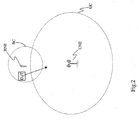
- Fig. 2 depicts a handover where end user terminal moves from bi-directional cell such as UTRAN cell to a cell providing unidirectional transmission such as IPDC cell and service is handed over and transferred to the unidirectional based transmission.
- bi-directional cell such as UTRAN cell
- IPDC cell unidirectional transmission
- an example of the partial handover from the cellular mobile data communication domain to the broadband data communication domain is provided.
- Approximate physical cell areas or domains are shown in the Fig. 2 as cells: unidirectional cell (UC) and bi-directional cell (BC).
- Cells (UC) and (BC) are neighbouring and overlap. This aids in knitting the hybrid system by co-operating the partial inter-system handover between the cells of different systems.
- the example of Fig. 3 depicts some further embodiments of the handover scenarios from the bi-directional domain such as UTRAN to the domain providing unidirectional transmission such as IPDC.
- the bi-directional network such as UTRAN network has many bi-directional cells (BC)s.
- the BCs can be situated at the same coverage area than the unidirectional cells (BC)s such as IPDC cells.
- the cells can overlap, for example, because they can operate at different radio frequencies or use e.g. different coding or time division.
- the example of Fig. 3 enables that the partial handover between the bi-directional domain and the unidirectional domain can take place at the same coverage area.
- this provides other attractive handover basis than just a geographic coverage reason. For example, an economic reason that data delivery would be cheaper in other system than in the currently applied one.
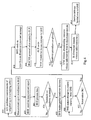
- Fig. 4 depicts in a form of a flow chart a method for controlling a partial handover from the generally bi-directional domain such as UTRAN to the unidirectional domain such as IPDC.
- the EUT is under the coverage of bi-directional cell (BC) such as UTRAN cell, and within the transmission of the BNE of, e.g. UTRAN.
- the EUT is under coverage of the UTRAN network containing many cells.
- EUT performs measurements of the neighbour or overlapping cell providing unidirectional transmission (UC) such as DVB-T cell. The measurement can relate to downlink radio signals of either or both the bi-directional domain and the unidirectional domain.
- UC unidirectional transmission
- the measurements could be performed during compressed frames in UTRA FDD (frequency division duplex) mode. Based on the performed measurement the EUT is able to create a measurement report about the neighbour or overlapping unidirectional cell (UC), for example about a broadcast cell, for the partial handover procedure.
- UC unidirectional cell
- the measurement report is transferred to the BNE such as the RNC
- the measurement report contains information on UTRA and IPDC handover procedure situation in respect to the physical location of the EUT in the hybrid network, and conveys this information to RNC.
- BNE receives the measurements report. Preferably, via UTRAN BS.
- BNE process data content of the report for deciding on a need for the partial handover.
- a step 404 there is being processed whether a threshold for launching the partial handover process is exceeded. If there is not enough need, for example, the connection remains stable in the applied bi-directional domain such as the UTRAN and no other reasons for the partial handover pops up, the process returns to step 400.
- the measurement of the EUT is ongoing process as well as the processing of the measurement report.
- the exemplary beginning may be replaced by separately running two processes of: 1) providing the measurement data by the EUT and 2) processing the measurement data by the BNE. If the threshold for the partial handover is reached, BNE makes the partial handover decision in step 405.
- BNE performs an attempt to reserve capacity from the generally unidirectional domain such as IPDC in step 406.
- the reservation relates (only) to downlink data communication capacity of DVB-T cell or DVB-T network since they are principally unidirectional delivery means.
- data communication via the link 11 takes place between BNE and UNE for exchanging information on the service transmission resources.
- step 407 there is being checked whether the reservation attempt succeeds.
- BNE controls the step 407 maintaining quite centralized management for the partial handover. If there are deficiencies, the process returns back to attempting the reservation further to step 406. If there is being detected that enough resources of the unidirectional domain such as IPDC exists, the resources are reserved by BNE from the unidirectional domain.
- the BNE sends an Inter-System Handover Command message to the unidirectional system in step 408.
- the message carries a piggybacked Partial IPDC Handover Command.
- This contains information required to set up and carry connection to bi-directional cell or network.
- a certain protocol such as IPDC RR protocol in the EUT takes control in step 409.
- the protocol launches the EUT to sends a message such as a IPDC Handover Access Message to UNE in step 410.
- this is sent via return channel of IPDC system such as UTRAN.
- step 411 there is being checked whether the partial handover procedure can be considered completed.
- the BNE e.g.
- the RNC maintains the hierarchy for controlling the process based on the adjutants unidirectional network, UNE and EUT. If there seem to be deficiencies the process can flexibly return to carry on these or they may be called one by one.
- UNE initiates downlink resource release from bi-directional domain in step 412.
- the bi-directional domain releases the radio connection related to the handover service in step 413.
- UTRAN releases the downlink of the connection related to handed over service. If there is a need for, for example, a control and the uplink of the bi-directional domain remains stable, it can be optionally maintained.
- the service delivery to EUT is handed over to the UNE in step 414.
- the unidirectional transmission such as IPDC transmission can continue, for example, broadcasting the service, which was delivered to the EUT via the downlink of the bi-directional domain.
- the other remaining services may continue normally in UTRAN. This procedure may focus the partial handover to a dedicated service only if this is considered necessary.
- the handover can be considered the partial handover because the downlink of the generally bi-directional transmission (e.g. UTRAN transmission) is handed over to the generally unidirectional transmission (e.g. IPDC).
- the service delivered via the downlink of UTRAN can be moved to IPDC transmission bearing in mind that the IPDC is principally aimed for the delivery of services to the EUT.
- the broadband data communication domain provides the EUT with larger cells than the cellular mobile data communication.
- IPDC generally unidirectional transmission
- UTRAN generally bi-directional domain
- Fig. 5 depicts a handover where EUT moves from a generally unidirectional cell to a generally bi-directional cell and a service is handed over and transferred to the bi-directional based downlink transmission.
- EUT moves from a generally unidirectional cell to a generally bi-directional cell and a service is handed over and transferred to the bi-directional based downlink transmission.
- an example of the partial handover from the broadband data communication domain to the cellular mobile data communication domain is provided.
- Approximate physical area or domains are shown in the Fig. 5 as cells (UC) and (BC).
- Cells (UC) and (BC) are neighbouring and overlap. This aid in knitting the hybrid system by co-operating the partial inter-system handover between the cells of different systems.
- the example of Fig. 6 depicts a further embodiment of the handover from the domain providing generally unidirectional transmission to the generally bi-directional domain.
- the bi-directional network has many bi-directional cells (BC)s.
- the UTRAN network has many UTRAN cells.
- the BCs can be situated at the same coverage area than the unidirectional cells (UC)s.
- the cells can overlap because they can operate at different radio frequencies, apply different coding or time division.
- the example of Fig. 6 enables that the partial handover between the generally bi-directional domain such as UTRAN and the generally unidirectional domain such as IPDC can take place at the same coverage area.
- this provides other attractive handover basis than just a geographic coverage reason. For example, an economic reason that data delivery would be cheaper in other system than in the currently applied one.
- Fig. 7 depicts in a form of a flow chart a method for controlling a partial handover from the domain providing generally unidirectional communications such as the IPDC to the domain providing generally bi-directional communications such as the UTRAN.
- the EUT is under the coverage of the cell providing generally unidirectional transmission (UC), which is an example of a broadband cell such as IPDC cell. So the EUT can perhaps be under within the transmission of the UNE of, e.g. IPDC.
- the EUT is under coverage of IPDC network containing many broadcast cells.
- EUT performs measurements of neighbouring or overlapping cell(s) providing generally bi-directional transmission. In various embodiments, the measurement can relate to downlink radio signals of UTRAN.
- these measurements can be performed flexibly since the radio interface of the unidirectional domain e.g. IPDC and the bi-directional domain, e.g. UTRAN are different from each other, and the systems do not effectively interfere each other. Based on the performed measurement the EUT is able to create a measurement report about the neighbouring or overlapping bi-directional cell(s) (BC) for the partial handover procedure.
- the unidirectional domain e.g. IPDC and the bi-directional domain, e.g. UTRAN are different from each other, and the systems do not effectively interfere each other.
- the EUT is able to create a measurement report about the neighbouring or overlapping bi-directional cell(s) (BC) for the partial handover procedure.
- the measurement report is transferred from EUT to HE.
- EUT reports the measurements to the UNE.
- this is sent via return channel of DVB-T system such as UTRAN.
- the measurement report contains information on UTRAN and IPDC handover procedure situation in respect of the physical location of the EUT in the hybrid network, and conveys this information to UNE.
- radio signal strengths in the data communication between EUT with UNE and/or with UTRAN For example, radio signal strengths in the data communication between EUT with UNE and/or with UTRAN.
- UNE receives the measurement report.
- the measurement report is conveyed via UTRAN.
- UNE process data content of the report for deciding on a need for the partial handover.
- step 704 there is being processed whether a threshold for launching the partial handover process is exceeded. If there is not enough need (for example, the connection remains stable in the applied IPDC based service delivery and/or no other reasons for the partial handover pops up), the process returns to step 700.
- the measurement of EUT data reception is preferably an ongoing process as well as the processing of the measurement report.
- the exemplary beginning may be replaced by separately running two processes of providing the measurement data by EUT and processing the measurement data by UNE/BNE. If the threshold for the partial handover is reached, UNE makes the partial handover decision in step 705.
- HE after receiving the measurement report from EUT in IPDC mode, preferably including UTRAN measurements, and IPDC measurements and after making a handover decision, HE initiates resource reservation from UTRAN RNC in step 706.
- HE performs the attempt to reserve capacity from UTRAN.
- the reservation relates (only) to downlink data communication capacity of UTRAN cell or UTRAN network since IPDC has principally unidirectional service delivery. For example, data communication via the link 11 takes place between RNC and HE for exchanging information on the service transmission resources.
- step 707 there is being checked whether the reservation attempt succeeds.
- HE controls the step 707 maintaining quite centralized management for the partial handover.
- UNE sends a message such as an Inter-System Handover Command message to the bi-directonal system such as the UTRAN system in step 708.
- the message carries a piggybacked UMTS Handover to UTRAN from IPDC Command message. This contains information required to set up and carry connection to UTRAN cell or network.
- EUT completes the handover procedure with a handover to UTRAN Complete message which is transmitted to BNE in step 709. In step 710 there is being checked whether the partial handover procedure can be considered completed.
- UNE maintains the hierarchy for controlling the process based on the adjutants BNE and EUT. If there seem to be deficiencies, the process can flexibly return to carry on these tasks or they may be called one by one.
- BNE initiates resource release from the generally unidirectional domain in step 711.
- the unidirectional domain releases the radio connection related to the handover service in step 712.
- IPDC releases the broadcast connection related to the handed over service.
- the service delivery to EUT is handed over to BNE in step 713.
- the bi-directional domain such as the UTRAN can continue transmitting the service, which was delivered to the EUT via the broadband transmission of the generally unidirectional domain.
- the examples of some handover procedures can be applied for a service handover from a non-UTRAN system, for example IPDC, to UTRAN.
- a non-UTRAN system for example IPDC
- IPDC IP-to-nguclear broadband data communication domain
- dual or several mode EUT receives the UTRAN neighbour cell parameters on GSM System Information messages. This is not so critical in UTRAN example, since there is a connection via UTRAN all the time active and there is no need for this.
- the embodied handover can also be considered the partial handover in such a way that it is related to the service transmitted by generally unidirectional transmission and the downlink of the generally bi-directional transmission.
- the handover can be considered the partial handover because service transmitted via typically unidirectional broadband transmission is handed over to the downlink data transmission of the bi-directional transmission.
- benefits for a handover from the broadband data communication domain to the cellular mobile data communication domain can be that the service can still be within the reach of the user of the EUT. For example, the coverage of the broadband data communication can be weakened or even about the be lost, and the cellular mobile data communication domain could still provide the coverage and applicable connection. Generally this kind of scenario enables IPDC based service to follow the end user everywhere, where there exists the hybrid system, seamlessly.
- Another benefit in an embodiment may be to make a handover decision to the generally bi-directional domain if the QoS or C/I is not good enough in the cell providing generally unidirectional trasnmisssion and if there is room in the bi-directional domain for delivering the service. If this is the case, the service will be transferred/handed over to the downlink of the generally bi-directional domain, e.g. downlink of UTRAN.
- Fig. 8 depicts in a form of a signalling diagram messages and signals between EUT, the bi-directional domain such as UTRAN, BNE, and UNE such as IPDC HE when performing handover from the bi-directional domain to the unidirectional domain.
- the signal communication relating to an embodied scenario about partial handover procedure can begin with the measurement report signalling.
- the EUT sends the measurement report signal(s) to the bi-directional domain.
- UTRAN RNC receives the measurement report from EUT.
- the measurement report signalling applied wireless cellular mobile data communications.
- the BNE of, e.g.
- the UTRAN initiates the resource reservation process for the handover and the BNE sends resource reservation signalling.
- the resource reservation signalling is preferably send to UNE (e.g. IPDC BS) and, in some embodiments via MSC of the cellular mobile network.
- UNE acknowledge the reservation request by sending acknowledgement signalling to the bi-directional network, preferably UTRAN via MSC.
- the data communication between the bi-directional network and UNE can take place via the link 11 of Fig. 1 .
- the UNE may also send negative acknowledgement in case there is not enough resources for the service delivery in the IPDC.
- the bi-directional domain realises that the unidirectional domain has enough available data delivery resources for handing over the service, which is delivered via the bi-directional network, to be broadcast via, e.g. IPDC.
- the bi-directional network sends the handover command to EUT.
- the handover command relates only for a service and for that only the downlink of the bi-directional network.
- the broadcasting IPDC can offer the principally unidirectional service delivery. Also all other traffic may continue on the bi-directional network despite the handover.
- EUT completes the handover procedure for the downlink and for a certain service.
- FIG 9 shows a static status when the handover has been made and the service is coming from IPDC. It should be noted that that any other traffic may continue on UTRAN despite the handover has been performed.
- the service delivery to EUT is from IPDC, preferably via a certain applicable HE.
- the example of figure 10 depicts in a form of a signalling diagram messages and signals between EUT, UNE and the bi-directional domain when performing handover of a service from the unidirectional domain to the bi-directional domain.
- the signal communication relating to an embodied partial handover procedure can begin with the measurement report signalling.
- EUT sends the measurement report signal(s) to UNE.
- the signalling connection between EUT and the bi-directional domain is functionally active principally all the time.
- EUT can transmit the signalling to UNE, for example, via UTRAN return channel.
- UNE receives the report signalling and initiates the resource reservation for the partial handover from the bi-directional domain.
- UNE sends the resource reservation signalling to the bi-directional domain, preferably, via MSC.
- UTRAN RNC receives the signalling.
- the bi-directional domain checks for the available resource.
- the bi-directional network sends an acknowledgement to UNE if there is enough available resource for the partial handover.
- the acknowledgement is preferably sent via MSC.
- the UTRAN may also send negative acknowledgement in case there is not enough resources for the service delivery in the UTRAN.
- UNE receives the acknowledgement and obtains the confirmation to proceed with the handover.
- UNE sends the handover command to EUT.
- the handover command launches the EUT to move to a different system i.e.
- the handover command is preferably wirelessly broadcast to EUT via DVB-T transmission.
- EUT completes the handover for the downlink and for a certain service.
- the partial handover enables to drop UNE (such as IPDC BS) off completely if this can be seen necessary.
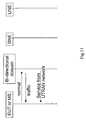
- FIG 11 shows a static status when the handover has been made and the service is coming from the downlink of the bi-directional network such as 3G. It should be noted that any other traffic may continue on the bi-directional network despite the handover has been performed. Thus, there can be some data communication between EUT and the bi-directional network.
- the service delivery to EUT is from UTRAN, preferably via a certain applicable cell.
- UNE may be dropped off completely, thereby saving some delivery resources.
- EUT End User Terminal
- Fig. 12 may be used in any/all of the above example(s).
- EUT comprises a processing unit CPU, a broadband receiver part or alternatively referred to as a multi-carrier signal receiver part or IP over DVB-T receiver part, which can receive, for example, a multi-carrier broadband signal such as DVB-T signal, and a user interface (UI).
- the broadband receiver part and UI are coupled with CPU.
- UI comprises a display and a keyboard to enable a user to use the receiver.
- UI comprises a microphone and a speaker for receiving and producing audio signals.
- UI may also comprise voice recognition (not shown).
- EUT has also a cellular mobile transceiver which is also coupled with CPU.
- CPU comprises a microprocessor (not shown), memory and possibly software SW (not shown).
- SW can be stored in the memory.
- the microprocessor controls, on the basis of SW, the operation of the receiver, such as receiving of service either via the cellular mobile transceiver or via the broadband receiver, reception and transmission of the handover related signals/messages, processing of the handover confirmation, establishing the measurement report, measuring the signalling connection between EUT and UTRAN, measuring the signalling connection from IPDC to EUT.
- the operations are described in the examples of Fig. 1 - 11 .
- hardware comprises means for receiving of service either via the cellular mobile transceiver or via the broadband receiver, means for receiving and transmitting the handover related signals/messages, means for processing the handover confirmation, means for establishing the measurement report, means for measuring the signalling connection between EUT and the bi-directional domain, means for measuring the signalling connection from the unidirectional domain to EUT.
- EUT is a wireless terminal being capable of receiving wireless multi-carrier signal transmission (typically broadcast) of the digital broadband communication domain, and also receiving and the downlink wireless signal transmission of the cellular mobile communication domain.
- EUT can wirelessly transmit signal to the cellular mobile communication domain.
- EUT can be a hand-held device which the user can comfortably carry or care.
- EUT can be a cellular mobile phone which comprises the broadband receiver part for receiving DVB-T broadband transmission.
- EUT may possibly interact with UNE via cellular mobile based UTRAN.
- the mobile phone can advantageously, receive UTRAN based service via the downlink of the cell.
- Some embodiments of the invention provide a method, a system, a network element and a end-user terminal for providing a handover between a generally unidirectional service delivered by the digital broadband data communication domain and a generally bi-directional service by the cellular mobile data communication domain.
- the digital broadband data communication domain can be a broadcast network such as IP (Internet Protocol) over DVB (Digital Video Broadcasting) network, in further examples IP over DVB-T (Terrestrial DVB) or alternatively a IPDC (IP Datacast).
- IP Internet Protocol
- DVB-T Digital Video Broadcasting
- IPDC IP Datacast
- the downlink of the 3G or like can be the unidirectional broadband communications in some embodiments.
- the cellular mobile data communication network can, preferably, be the 3G (The Third Generation for Mobile Communication) network, in further examples UTRAN.
- the digital broadband network can be other unidirectional cellular network which can broadcast digital data information or a service which is unidirectionally served to the terminal.
- the preferred embodiments apply measurement signalling structure of the Inter-system handover of UMTS to control the handover.
- the measurements of the cell is extended to contain digital broadband communication domain cells such as IP over DVB cells, as well as apply these cells to perform the handover.
- digital broadband communication domain cells such as IP over DVB cells, as well as apply these cells to perform the handover.
- the fact that one of the network is principally delivering one (unidirectional) leads to a partial handover where the downlink data of the bi-directional network is applied in the handover.
- the handover is partial.
- the service related to the downlink of the generally bi-directional domain e.g.
- the 3G UMTS (Universal Mobile Telephone System) domain is moved to the generally unidirectional domain, e.g. the digital broadband data communication domain.
- the generally unidirectional domain e.g. the digital broadband data communication domain
- the generally bi-directional domain e.g. cellular mobile data communication domain
- the service of the unidirectional data communications domain is handed over to the downlink of the bi-directional data communications domain.
- the digital unidirectional data communications domain perhaps offers a high bandwidth broadband transmission channel wherein delivery is typically broadcast, multicast, or alternatively unicast.
- the high bandwidth transmission channel can offer a user of such system various services.
- IP data over DVB network is applied offering applicable data transmission principles.
- IP data over a Terrestrial Digital Video Broadcasting (DVB-T) network is applied.
- DVD-T Terrestrial Digital Video Broadcasting
- transmission of IPDC may refer to a broadcast, multicast, or unicast, and data can include but is not limited to, IP protocol-encoded data.
- Network of DVB-T system contains cells that participate to the handover procedure with the cells of the other system.
- the appliance of the digital broadband data communication domain as a co-operative system boosts the benefits of the invention such as economy.
- DVB-T offers an effective and cheap way to distribute data
- the embodiments of the invention benefit this by mending the broadband domain within the reach of the UMTS domain.
- the digital broadband communication domain transmits a wireless multi-carrier signal adapted to, i.e. DVB-T.
- a broadcast mode of 3G and/or GPRS can serve and operate as the unidirectional broadband data communications domain as well.
- IPDC IP Datacast
- DVB-T unidirectional data communication over digital broadcast networks.
- IPDC can be implemented by sending IP over for example DVB-T radio technology.
- IPDC can be implemented by using several different radio technologies like DVB-T, DVB-S, DVB-X, DAB, ISDB-T, ATSC, DRM, FM, etc.
- IPDC can be implemented as well using a broadcast mode of 3G and/or GPRS.
- IPDC is not limited to the example of broadcasting such as DVB but may relate to other applicable broadband or broadcast network being perhaps capable of basically unidirectional data communications.
- the downlink may perhaps refer to unidirectional data signal transmission.
- the bi-directional domain such as the cellular mobile data communications offers a two-way data communication channel with sometimes, but necessary always, a bit more limited rate to transfers data.
- IP data has been applicable in the cellular mobile domain, and, preferably UTRAN is applied in the embodied invention.
- UTRAN WCDMA network offers an applicable solution.
- a nature of such systems is that they contain and are based on cells.
- the embodied invention apply measurement signalling structure of such system such as the Inter-system handover of UMTS (Universal Mobile Telephone System) to control the handover between the broadband domain network.
- UMTS Universal Mobile Telephone System
- the broadband domain has the history of focusing functionally to unidirectionally deliver data to the End User Terminal (EUT), it is beneficial to focus on the downlink data communication of the cellular mobile data communication.
- this can be referred to as the partial handover because in respect of the handed over service it relates to the downlink of data communication of the cellular mobile data communication such as the downlink of UMTS.
- the two-way data communication can be beneficially applied to control and deliver the handover procedure with the cellular mobile data communication domain.
- the cellular mobile data communication domain transmits wireless signal.
- the generally bi-directional network can have the bi-directional network element (BNE).
- the embodied invention uses native network level signalling enabling application independent handover from/to cellular mobile data domain such as the 3G or UMTS network to/from digital broadband network such as IPDC network.
- native network level signalling enabling application independent handover from/to cellular mobile data domain such as the 3G or UMTS network to/from digital broadband network such as IPDC network.
- a hybrid network systems typically contains at least two different network systems, and it is highly important, in order to get more benefit of the hybrid solution, that they co-operate.
- An example of the hybrid network system can be the digital broadband network such as DVB-T network containing IPDC feature and a 3G network such as WCDMA based UTRAN.
- the channel system model can, for example be based on the following examples.
- two channels are perhaps established between the service provider and the user: for example, broadcast channel and interaction channel.
- a unidirectional cell also alternatively referred to as a digital broadband cell or broadcast cell.
- the broadcast cell can be a geographical area that is covered with DVB-T signal by means of one or more transmitters each radiating at least one particular transport stream on a certain frequency. Sometimes, a particular transport stream on only one frequency is applied in the unidirectional cell (UC).
- the broadcast cell may in addition contain repeaters. Two neighbouring broadcast cells may have an intersection.
- the cell_id that is used to uniquely identify a cell can be unique within each original_network_id.
- the broadcast cell may have sub-cells having different operation frequencies.
- the broadcast cell contains a Transport Stream (TS) delivering one or more services to the receiver.
- TS Transport Stream
- the headend (HE) equipment provides means for broadcasting the transport stream within the broadcast cell.
- the headend may deliver the TS in other broadcasting environment such as cable and satellite.
- an operator of the broadcast network operates the headend.
- the headend can be referred to as a broadcast Base Station (BS) or IPDC BS.
- the heandend can be an example of the unidirectional network entity (UNE).
- UNE can be a networking element of the generally unidirecitonal network.
- the handover can be referred to as handoff. It should be noted that both expressions can be contained in within the ramifications and scope.
- the appropriate principle is to have the co-operation of such systems by a partial handover between the networks.
- the Inter-system based handover is applied, where a handover is made from a mobile cellular system employing, for example, WCDMA to a broadband cellular system, employing, for example, DVB-T or vice versa.
- the handover is partial in such a way that with respect to the generally bi-directional based data communications network the downlink data is principally applied in the handover.
- the handover is partial.
- the service related to the downlink of UTRAN is moved to the IPDC network.
- the service of the unidirectional domain is handed over to the downlink of the bi-directional domain. This is because of the historical principally delivery (unidirectional) nature of the digital unidirectional networks.
- the handover is as well applicable in case of intra- and intersystem handover from/to GSM / GSM EDGE / GPRS networks.
- the exemplary handover processes does not necessary take place in DVB, but, for example, the above identified networks can be used.
- the new or current handover service domain is unidirectional and the other bi-directional.
- the intra system handover or the like can be applied.
- the MSC is capable of communicating with RNS-A (Radio network system of UMTS) and BSS-B (base station system of GSM). Perhaps it may be the actual system does not need to be changed but the service can still be handed over between the generally unidirectional transmission mode and the generally bi-directional transmission mode.
- the downlink can be handed over to the equivalent unit than BS or HE.
- the type of intersystem handover can be applied. For example, this perhaps changes traffic from MSC-A to MSC-B at the same time.
- the intra handover from, e.g. UMTS to IPDC (and vice versa)
- similar procedure of the partial handover can be done in inter-system handover procedure.
Landscapes
- Engineering & Computer Science (AREA)
- Signal Processing (AREA)
- Mobile Radio Communication Systems (AREA)
Claims (22)
- Verfahren zur Steuerung eines Handovers eines Endgerätes zwischen einem digitalen, hauptsächlich bidirektionalen Kommunikationsdienst (BC) und einem digitalen, hauptsächlich unidirektionalen Broadcast-Kommunikationsdienst (UC), mit den Schritten:Lauschen (400, 700) nach verfügbaren Downlink-Funksignalen,Wählen (404, 704) zwischen den verfügbaren Downlink-Funksignalen gemäß einem vorbestimmten Kriterium, gekennzeichnet durchWechseln (414, 713) zu einem anderen verfügbaren Downlink-Funksignal, um den Handover zumindest teilweise derart durchzuführen, dass der Handover eingerichtet ist, um zwischen dem Downlink des digitalen, hauptsächlich bidirektionalen Kommunikationsdienst und dem Broadcast-Kommunikationsdienst errichtet zu werden.
- Verfahren gemäß Anspruch 1, wobei der Wechselschritt ein Empfangen (402, 408, 409, 702, 708, 709) eines teilweisen Handover-Befehls umfasst.
- Verfahren gemäß Anspruch 2, wobei das Endgerät (EUT) angepasst ist, um nach dem Downlink-Funksignal zu lauschen, und um einen Bericht über ein Lauschergebnis an ein den Handover entscheidendes Netzwerkelement (BNE, UNE) zu senden (401, 701).
- Verfahren gemäß Anspruch 1, wobei das Verfahren ein Durchführen des Dienst-Handovers aus einer digitalen Broadcast-Datenkommunikations-Domäne in eine zellulare Mobil-Datenkommunikations-Domäne oder umgekehrt umfasst.
- Verfahren gemäß Anspruch 1, wobei das Verfahren ein Wählen des Downlink-Funksignals durch eine Mess-Signalisierungs-Struktur eines Inter-System-Handovers bei UMTS für den Handover zwischen den Diensten umfasst.
- Verfahren gemäß Anspruch 1, wobei der Handover einen bestimmten Dienst derart betrifft, dass jeder andere über Netzwerke der Dienste übertragene Dienst für das Endgerät immer noch benutzbar bleibt.
- Verfahren gemäß Anspruch 1, wobei in dem Verfahren der Handover-Vorgang angepasst ist, um eine der Netzwerkebene eigene Signalisierung für einen von einer Anwendung unabhängigen Handover zwischen den Diensten zu verwenden.
- Verfahren gemäß Anspruch 1, wobei die Dienste angepasst sind, um zu Domänen mit einem hybriden Netzwerksystem zu gehören, das zumindest zwei funktionsgemäß verschiedene Netzwerksysteme enthält.
- Verfahren gemäß Anspruch 1, wobei das Verfahren ferner den Schritt des Fortführens des Empfangens eines unidirektionalen Kommunikationsdienstes in einem anderen Zellengebiet von der in einem ersten Zellengebiet empfangenen aktuellen Downlink-Kommunikation aufweist.
- Verfahren gemäß Anspruch 1, wobei der digitale, hauptsächlich unidirektionale Kommunikationsdienst zu einer Domäne mit DVB-T-Zellen gehört, die ein DVB-T-Netzwerk errichten.
- Verfahren gemäß Anspruch 1, wobei der digitale, hauptsächlich unidirektionale Kommunikationsdienst eine drahtlose Signal-Übertragung mehrerer Betreiber aufweist.
- Verfahren gemäß Anspruch 1, wobei die Dienste zu Domänen mit Zellen von zellularen Drahtlos-Netzwerken gehören und das Endgerät angepasst ist, um mit den Domänen drahtlos zu kommunizieren.
- Computerprogramm mit Computerprogrammcode, der einen Computer veranlasst, die Verfahrensschritte aus Anspruch 1 auszuführen, wenn das Programm auf dem Computer ausgeführt wird.
- Computerprogramm gemäß Anspruch 13, das auf einem computerlesbaren Datenträger ausgestaltet ist.
- Computerprogrammprodukt, ausgestaltet als ein Datenträger, der ein von einem Computer ausführbares Programm auf sich trägt, mit einer Computerprogrammcodeeinrichtung, die angepasst ist, um die Verfahrensschritte aus Anspruch 1 durchzuführen, wenn das Programm auf einem Computer ausgeführt wird.
- Verfahren zum Durchführen eines Handovers eines Dienstes von einer zellularen Mobil-Datenkommunikations-Domäne (BC) zu einer digitalen Broadcast-Datenkommunikations-Domäne (UC), wobei das Verfahren aufweist:Messen (400) empfangener Funksignale der Domänen bei einem Endgerät (EUT), Senden (401) eines Messberichtes der empfangenen Funksignale an die zellulare Mobil-Datenkommunikations-Domäne,Reservieren (406, 407) von Ressourcen der digitalen Broadcast-Datenkommunikations-Domäne durch Kommunizieren zwischen der zellularen Datenkommunikations-Domäne und der digitalen Broadcast-Datenkommunikations-Domäne,Senden (408, 409) eines Handover-Befehls an das Endgerät von der zellularen Mobil-Datenkommunikations-Domäne, undSenden (410) einer Bestätigung von dem Endgerät an die digitale Broadcast-Datenkommunikations-Domäne, um den über die zellulare Mobil-Datenkommunikations-Domäne ausgelieferten Dienst zu der digitalen Broadcast-Datenkommunikations-Domäne umzuziehen, dadurch gekennzeichnet, dass der Handover einen teilweisen Handover derart aufweist, dass Signale und Dienste, die einen Downlink der zellularen Mobil-Datenkommunikations-Domäne betreffen, eingerichtet sind, um an die digitale Broadcast-Datenkommunikations-Domäne abgegeben zu werden.
- Verfahren gemäß Anspruch 16, ferner mit dem Schritt des Kommunizierens derart, dass die zellulare Mobil-Datenkommunikations-Domäne Ressourcen von der digitalen Broadcast-Datenkommunikations-Domäne anfordert, und
Erhalten einer Rückmeldung über verfügbare Ressourcen der digitalen Broadcast-Datenkommunikations-Domäne an der zellularen Datenkommunikations-Domäne. - Verfahren zum Durchführen eines Handovers eines Dienstes von einer digitalen Broadcast-Datenkommunikations-Domäne (UC) zu einer zellularen Mobil-Datenkommunikations-Domäne (BC), wobei das Verfahren aufweist:Messen (701) empfangener Funksignale der Domänen bei einem Endgerät (EUT),Senden (701) eines Messberichtes der empfangenen Funksignale an die digitale Broadcast-Datenkommunikations-Domäne,Reservieren (706, 707) von Ressourcen der zellularen Mobil-Datenkommunikations-Domäne durch Kommunizieren zwischen der digitalen Broadcast-Datenkommunikations-Domäne und der zellularen Mobil-Datenkommunikations-Domäne,Senden (708) eines Handover-Befehls an das Endgerät von der digitalen Broadcast-Datenkommunikations-Domäne,Senden (709) einer Bestätigung von dem Endgerät an die zellulare Mobil-Datenkommunikations-Domäne, um den über die digitale Broadcast-Datenkommunikations-Domäne ausgelieferten Dienst zu der zellularen Mobil-Datenkommunikations-Domäne umzuziehen, dadurch gekennzeichnet, dass der Handover einen teilweisen Handover derart aufweist, dass Signale und Dienste, die die digitale Broadcast-Datenkommunikations-Domäne betreffen, eingerichtet sind, um an einen Downlink der zellularen Mobil-Datenkommunikations-Domäne abgegeben zu werden.
- Verfahren gemäß Anspruch 18, ferner mit dem Schritt des Kommunizierens derart, dass die digitale Broadcast-Datenkommunikations-Domäne Ressourcen von der zellularen Mobil-Kommunikations-Domäne anfordert, und
Erhalten einer Rückmeldung über verfügbare Ressourcen der zellularen Mobil-Kommunikations-Domäne an der digitalen Broadcast-Datenkommunikations-Domäne. - System zur Steuerung eines Handovers eines Endgerätes (EUT, MS, 1) zwischen einem digitalen, hauptsächlich bidirektionalen Kommunikationsdienst (BC) und einem digitalen, hauptsächlich unidirektionalen Kommunikationsdienst (UC), mit:einer Einrichtung zum Lauschen nach verfügbaren Downlink-Funksignalen,einer Einrichtung zur Wahl zwischen den verfügbaren Downlink-Funksignalen gemäß einem vorbestimmten Kriterium, gekennzeichnet durcheine Einrichtung zum Wechsel zu einem anderem verfügbaren Downlink-Funksignal, um den Handover zumindest teilweise derart durchzuführen, dass der Handover eingerichtet ist, um zwischen dem Downlink des digitalen, hauptsächlich bidirektionalen Kommunikationsdienst und dem Broadcast-Kommunikationsdienst errichtet zu werden.
- Benutzer-Endgerät (EUT, MS, 1) zur Anpassung eines Handovers des Endgerätes zwischen einem digitalen, hauptsächlich bidirektionalen Kommunikationsdienst (BC) und einem digitalen, hauptsächlich unidirektionalen Broadcast-Kommunikationsdienst (UC), mit:einem Empfänger zur Messung verfügbarer Downlink-Funksignale,einem Sendeempfänger zur Übertragung der Messungen, gekennzeichnet dadurch, dassder Empfänger ferner eingerichtet ist, um einen Handover-Befehl zum Wechseln zu einem anderen verfügbaren Downlink-Funksignal zu empfangen, unddass der Sendeempfänger ferner eingerichtet ist, um eine Bestätigung zu übertragen, um den Handover zumindest teilweise derart durchzuführen, dass der Handover eingerichtet ist, um zwischen dem Downlink des digitalen, hauptsächlich bidirektionalen Kommunikationsdienstes und dem Broadcast-Kommunikationsdienst errichtet zu werden.
- Netzwerk-Einheit (BNE, UNE, 2) zur Steuerung eines Handovers eines Dienstes zwischen einer digitalen, hauptsächlich bidirektionalen Kommunikations-Domäne (BC) und einer digitalen, hauptsächlich unidirektionalen Broadcast-Kommunikations-Domäne (UC), mit:einer Einrichtung zum Empfangen einer Messung von verfügbaren Downlink-Funksignalen,einer Einrichtung zur Wahl zwischen den verfügbaren Funksignalen gemäß einem vorbestimmten Kriterium, undeiner Einrichtung zum Wechseln zu einem anderen verfügbaren Downlink-Funksignal, um den Handover zumindest teilweise derart durchzuführen, dass der Handover eingerichtet ist, um zwischen dem Downlink des digitalen, hauptsächlich bidirektionalen Kommunikationsdienstes und dem Broadcast-Kommunikationsdienst errichtet zu werden.
Applications Claiming Priority (1)
| Application Number | Priority Date | Filing Date | Title |
|---|---|---|---|
| PCT/FI2003/000478 WO2004112417A1 (en) | 2003-06-13 | 2003-06-13 | Method, system, network entity, and end-user terminal for controlling a handover of a cellular terminal |
Publications (2)
| Publication Number | Publication Date |
|---|---|
| EP1634474A1 EP1634474A1 (de) | 2006-03-15 |
| EP1634474B1 true EP1634474B1 (de) | 2009-05-06 |
Family
ID=33547876
Family Applications (1)
| Application Number | Title | Priority Date | Filing Date |
|---|---|---|---|
| EP03730279A Expired - Lifetime EP1634474B1 (de) | 2003-06-13 | 2003-06-13 | Verfahren, system, netzwerkentität und endbenutzer-endgerät zur steuerung einer weiterreichung eines zellularen endgeräts |
Country Status (7)
| Country | Link |
|---|---|
| US (1) | US8095137B2 (de) |
| EP (1) | EP1634474B1 (de) |
| CN (1) | CN1788513B (de) |
| AT (1) | ATE431058T1 (de) |
| AU (1) | AU2003240913A1 (de) |
| DE (1) | DE60327561D1 (de) |
| WO (1) | WO2004112417A1 (de) |
Families Citing this family (25)
| Publication number | Priority date | Publication date | Assignee | Title |
|---|---|---|---|---|
| US7567806B2 (en) * | 2004-02-27 | 2009-07-28 | Nokia Corporation | Method and system to improve handover between mobile video networks and cells |
| US7986954B1 (en) | 2004-06-25 | 2011-07-26 | Nortel Networks Limited | Wireless communication network having a broadcast system for information distribution |
| CN100455098C (zh) * | 2005-01-10 | 2009-01-21 | 中兴通讯股份有限公司 | 一种无线综合接入网结构及其方法 |
| WO2007081175A1 (en) * | 2006-01-12 | 2007-07-19 | Samsung Electronics Co., Ltd. | Method and apparatus for supporting a handover using an interactive channel in a dvb-h cbms system |
| KR100856274B1 (ko) | 2006-01-12 | 2008-09-03 | 삼성전자주식회사 | 휴대형 디지털 비디오 방송 방통융합 서비스 시스템에서인터렉티브 채널을 이용한 핸드오버를 지원하기 위한 방법및 장치 |
| KR20070108324A (ko) * | 2006-02-09 | 2007-11-09 | 삼성전자주식회사 | 휴대형 디지털 비디오 방송 방통융합 서비스 시스템에서핸드오버 방법 및 장치 |
| US8086234B2 (en) * | 2006-04-28 | 2011-12-27 | Freescale Semiconductor, Inc. | Broadcast handoff between communication networks |
| KR20070109800A (ko) * | 2006-05-09 | 2007-11-15 | 삼성전자주식회사 | 디지털 방송 시스템에서 서비스 연속성을 보장하는 로밍방법 및 장치 |
| KR100739804B1 (ko) | 2006-05-11 | 2007-07-13 | 삼성전자주식회사 | 데이터 통신의 QoS 보장 방법 및 장치 |
| US20080039078A1 (en) * | 2006-05-18 | 2008-02-14 | Samsung Electronics Co., Ltd. | Method and apparatus for transmitting and receiving electronic service guide for roaming user in a digital broadcasting system |
| KR101419287B1 (ko) | 2006-07-07 | 2014-07-14 | 삼성전자주식회사 | Ipdc 서비스를 제공하는 장치 및 방법 및 ipdc서비스를 처리하는 장치 및 방법 |
| KR101359687B1 (ko) | 2006-11-15 | 2014-02-17 | 한국과학기술원 | 광대역 무선통신 시스템에서 부분적인 핸드오버를 수행하기위한 장치 및 방법 |
| KR100957390B1 (ko) * | 2007-01-19 | 2010-05-11 | 삼성전자주식회사 | 디지털 방송 시스템에서 핸드오버 및 로밍을 지원하기 위한이동성 정보의 송수신 방법 및 장치 |
| CN101232709B (zh) * | 2007-01-23 | 2012-12-19 | 华为技术有限公司 | 数字视频手持广播中的主动切换系统、方法及切换服务器 |
| US9998956B2 (en) * | 2007-02-12 | 2018-06-12 | Sigram Schindler Beteiligungsgesellschaft Mbh | Managed handover process |
| KR20090003809A (ko) * | 2007-07-03 | 2009-01-12 | 삼성전자주식회사 | 복수개의 망을 이용한 방송 정보 재생 방법 및 장치 |
| EP2040492A1 (de) | 2007-09-18 | 2009-03-25 | Thomson Licensing | Zugangsnetzwerkweiterleitung für ein mobiles Fernsehsystem |
| CN101159980B (zh) * | 2007-10-26 | 2010-06-16 | 中兴通讯股份有限公司 | 移动多媒体业务在广播网络和交互式网络间切换的方法 |
| FR2945401A1 (fr) * | 2009-05-05 | 2010-11-12 | Alcatel Lucent | Procede de transfert de lien de communication radio entre un terminal mobile et un reseau de diffusion, et un reseau cellulaire de radiocommunication |
| CN102422676A (zh) * | 2009-05-08 | 2012-04-18 | 交互数字专利控股公司 | 使用仅下行链路无线网络进行的移动性管理 |
| DE102010040589A1 (de) | 2009-09-11 | 2011-04-14 | Electronics And Telecommunications Research Institute | Verfahren zur Übergabe zwischen einem Kommunikationsnetz und einem Rundfunknetz zur Bereitstellung von Rundfunkinhalt, Kommunikationsnetz-Übergabesteuergerät, und Rundfunknetz-Übergabesteuergerät |
| CN102572385B (zh) * | 2010-12-07 | 2015-09-16 | 中国电信股份有限公司 | 视频信号的传输方法、无线视频服务器及视频监控系统 |
| CN102905306B (zh) * | 2011-07-27 | 2016-09-14 | 华为技术有限公司 | 小区切换方法、基站设备和用户设备 |
| CN104918209B (zh) * | 2015-06-17 | 2018-07-24 | 上海斐讯数据通信技术有限公司 | 移动终端及其通信方法 |
| US10098043B2 (en) | 2017-02-24 | 2018-10-09 | Verizon Patent And Licensing Inc. | System and method for handover management for wireless device |
Family Cites Families (10)
| Publication number | Priority date | Publication date | Assignee | Title |
|---|---|---|---|---|
| US5854985A (en) * | 1993-12-15 | 1998-12-29 | Spectrum Information Technologies, Inc. | Adaptive omni-modal radio apparatus and methods |
| US6038449A (en) * | 1996-11-20 | 2000-03-14 | Telefonaktiebolaget L M Ericsson | Method and apparatus for inter-exchange hand-off taking into account the service capabilities of the candidate cell |
| US6314082B1 (en) * | 1997-11-17 | 2001-11-06 | Telefonaktiebolaget Lm Ericsson (Publ) | Broadcast network selection techniques for radiocommunication systems |
| GB9900970D0 (en) | 1999-01-15 | 1999-03-10 | British Telecomm | Communications network |
| DE19957642C2 (de) * | 1999-11-30 | 2002-03-28 | Bosch Gmbh Robert | Verfahren zur Übertragung von Daten mittels Funkübertragungssystemen zwischen Sende-/Empfangsstationen und Rechner zur Zuordnung von Funkübertragungssystemen für eine Übertragung von Daten zwischen Sende-/Empfangsstationen |
| US6438117B1 (en) * | 2000-01-07 | 2002-08-20 | Qualcomm Incorporated | Base station synchronization for handover in a hybrid GSM/CDMA network |
| CN1656840A (zh) * | 2000-07-03 | 2005-08-17 | 艾利森电话股份有限公司 | 用于在电路交换环境和分组交换环境之间执行切换的系统和方法 |
| US8068832B2 (en) | 2001-11-19 | 2011-11-29 | Nokia Corporation | Multicast session handover |
| US6768726B2 (en) * | 2002-08-06 | 2004-07-27 | Motorola, Inc. | Method and apparatus for effecting a seamless handoff between IP connections |
| US20050070287A1 (en) * | 2003-09-26 | 2005-03-31 | Interdigital Technology Corporation | Method for soft/softer handover for wireless communication systems |
-
2003
- 2003-06-13 EP EP03730279A patent/EP1634474B1/de not_active Expired - Lifetime
- 2003-06-13 AT AT03730279T patent/ATE431058T1/de not_active IP Right Cessation
- 2003-06-13 CN CN038266245A patent/CN1788513B/zh not_active Expired - Fee Related
- 2003-06-13 DE DE60327561T patent/DE60327561D1/de not_active Expired - Lifetime
- 2003-06-13 WO PCT/FI2003/000478 patent/WO2004112417A1/en not_active Ceased
- 2003-06-13 US US10/560,079 patent/US8095137B2/en not_active Expired - Fee Related
- 2003-06-13 AU AU2003240913A patent/AU2003240913A1/en not_active Abandoned
Also Published As
| Publication number | Publication date |
|---|---|
| WO2004112417A1 (en) | 2004-12-23 |
| US8095137B2 (en) | 2012-01-10 |
| EP1634474A1 (de) | 2006-03-15 |
| AU2003240913A1 (en) | 2005-01-04 |
| US20060234708A1 (en) | 2006-10-19 |
| ATE431058T1 (de) | 2009-05-15 |
| CN1788513B (zh) | 2010-05-05 |
| DE60327561D1 (de) | 2009-06-18 |
| CN1788513A (zh) | 2006-06-14 |
Similar Documents
| Publication | Publication Date | Title |
|---|---|---|
| EP1634474B1 (de) | Verfahren, system, netzwerkentität und endbenutzer-endgerät zur steuerung einer weiterreichung eines zellularen endgeräts | |
| KR100724900B1 (ko) | 멀티미디어 브로드캐스트/멀티캐스트 서비스 시스템에서 주파수 계층 수렴을 사용하는 단말기를 위한 하드 핸드오버 방법 및 장치 | |
| KR101514425B1 (ko) | Mbms 서비스 송신 방식의 전환 방법, 장치 및 사용자 장비 | |
| EP1622316B1 (de) | Verfahren und Vorrichtung zur Auswahl einer Frequenzschicht für ein Teilnehmerendgerät in verbundenen Zustand in einem MBMS Mobilkommunikationssystem | |
| US20070183358A1 (en) | Distributed architecture and methods for broadcast/multicast service | |
| US20140050138A1 (en) | Method and apparatus for handing over device | |
| CN101674531B (zh) | 递交服务至目标基站的方法、目标基站以及移动装置 | |
| WO2005088874A1 (en) | Apparatus and method for deploying efficient broadcast multicast services in a wireless network,system using the same and message structure therefor | |
| US7440425B2 (en) | Apparatus and method for reducing paging channel loading for broadcast multicast services in a wireless network | |
| CN101304560B (zh) | 一种无线广播多播系统及方法 | |
| US20100284291A1 (en) | Mobility management with downlink-only wireless networks | |
| US20050073990A1 (en) | System and method of providing BCMCS service at a handoff in a mobile communication system | |
| US8040841B2 (en) | Wireless communication system, wireless terminal and wireless base station | |
| US20240023142A1 (en) | Methods and apparatus to update mrb configuration by common multicast signaling for mbs multicast reception in rrc inactive state | |
| KR100606015B1 (ko) | 무선 통신 시스템에서 트래픽 채널을 통한 이동국 등록시스템 및 방법 | |
| EP3300552B1 (de) | Netzwerkknoten zum verbindungsmangement and verfahren dafür | |
| KR20050071494A (ko) | 무선 통신 단말 및 무선 통신 방법 | |
| KR100728826B1 (ko) | 셀룰라 단말의 핸드오버를 제어하는 방법, 시스템,네트워크 개체, 및 최종 사용자 단말 | |
| CN100508644C (zh) | 一种实现承载合并的方法和系统 | |
| CN100512051C (zh) | 一种用于减小无线网络中广播多播业务的寻呼信道负载的装置和方法 | |
| KR101012007B1 (ko) | 광대역 무선 통신시스템에서 인접 기지국 신호를스캐닝하기 위한 방법 및 장치 | |
| US20230413380A1 (en) | Methods and apparatus to set mrb configuration for ue to receive mbs multicast in rrc inactive state | |
| KR101447725B1 (ko) | 통신망과 방송망간의 중앙 집중 제어 기반 핸드오버 제어 장치 및 방법 | |
| WO2010048870A1 (zh) | 一种多载波传输的方法和网络设备及网络系统 | |
| AU2004269789B8 (en) | Apparatus and method for reducing paging channel loading for broadcast multicast services in a wireless network |
Legal Events
| Date | Code | Title | Description |
|---|---|---|---|
| PUAI | Public reference made under article 153(3) epc to a published international application that has entered the european phase |
Free format text: ORIGINAL CODE: 0009012 |
|
| 17P | Request for examination filed |
Effective date: 20051124 |
|
| AK | Designated contracting states |
Kind code of ref document: A1 Designated state(s): AT BE BG CH CY CZ DE DK EE ES FI FR GB GR HU IE IT LI LU MC NL PT RO SE SI SK TR |
|
| DAX | Request for extension of the european patent (deleted) | ||
| 17Q | First examination report despatched |
Effective date: 20071120 |
|
| GRAP | Despatch of communication of intention to grant a patent |
Free format text: ORIGINAL CODE: EPIDOSNIGR1 |
|
| GRAS | Grant fee paid |
Free format text: ORIGINAL CODE: EPIDOSNIGR3 |
|
| GRAA | (expected) grant |
Free format text: ORIGINAL CODE: 0009210 |
|
| AK | Designated contracting states |
Kind code of ref document: B1 Designated state(s): AT BE BG CH CY CZ DE DK EE ES FI FR GB GR HU IE IT LI LU MC NL PT RO SE SI SK TR |
|
| REG | Reference to a national code |
Ref country code: GB Ref legal event code: FG4D |
|
| REG | Reference to a national code |
Ref country code: CH Ref legal event code: EP |
|
| REG | Reference to a national code |
Ref country code: IE Ref legal event code: FG4D |
|
| REF | Corresponds to: |
Ref document number: 60327561 Country of ref document: DE Date of ref document: 20090618 Kind code of ref document: P |
|
| PG25 | Lapsed in a contracting state [announced via postgrant information from national office to epo] |
Ref country code: AT Free format text: LAPSE BECAUSE OF FAILURE TO SUBMIT A TRANSLATION OF THE DESCRIPTION OR TO PAY THE FEE WITHIN THE PRESCRIBED TIME-LIMIT Effective date: 20090506 Ref country code: ES Free format text: LAPSE BECAUSE OF FAILURE TO SUBMIT A TRANSLATION OF THE DESCRIPTION OR TO PAY THE FEE WITHIN THE PRESCRIBED TIME-LIMIT Effective date: 20090817 Ref country code: FI Free format text: LAPSE BECAUSE OF FAILURE TO SUBMIT A TRANSLATION OF THE DESCRIPTION OR TO PAY THE FEE WITHIN THE PRESCRIBED TIME-LIMIT Effective date: 20090506 Ref country code: PT Free format text: LAPSE BECAUSE OF FAILURE TO SUBMIT A TRANSLATION OF THE DESCRIPTION OR TO PAY THE FEE WITHIN THE PRESCRIBED TIME-LIMIT Effective date: 20090906 |
|
| PG25 | Lapsed in a contracting state [announced via postgrant information from national office to epo] |
Ref country code: SE Free format text: LAPSE BECAUSE OF FAILURE TO SUBMIT A TRANSLATION OF THE DESCRIPTION OR TO PAY THE FEE WITHIN THE PRESCRIBED TIME-LIMIT Effective date: 20090806 Ref country code: SI Free format text: LAPSE BECAUSE OF FAILURE TO SUBMIT A TRANSLATION OF THE DESCRIPTION OR TO PAY THE FEE WITHIN THE PRESCRIBED TIME-LIMIT Effective date: 20090506 |
|
| PG25 | Lapsed in a contracting state [announced via postgrant information from national office to epo] |
Ref country code: MC Free format text: LAPSE BECAUSE OF NON-PAYMENT OF DUE FEES Effective date: 20090630 Ref country code: DK Free format text: LAPSE BECAUSE OF FAILURE TO SUBMIT A TRANSLATION OF THE DESCRIPTION OR TO PAY THE FEE WITHIN THE PRESCRIBED TIME-LIMIT Effective date: 20090506 Ref country code: EE Free format text: LAPSE BECAUSE OF FAILURE TO SUBMIT A TRANSLATION OF THE DESCRIPTION OR TO PAY THE FEE WITHIN THE PRESCRIBED TIME-LIMIT Effective date: 20090506 Ref country code: RO Free format text: LAPSE BECAUSE OF FAILURE TO SUBMIT A TRANSLATION OF THE DESCRIPTION OR TO PAY THE FEE WITHIN THE PRESCRIBED TIME-LIMIT Effective date: 20090506 Ref country code: CZ Free format text: LAPSE BECAUSE OF FAILURE TO SUBMIT A TRANSLATION OF THE DESCRIPTION OR TO PAY THE FEE WITHIN THE PRESCRIBED TIME-LIMIT Effective date: 20090506 |
|
| REG | Reference to a national code |
Ref country code: CH Ref legal event code: PL |
|
| PG25 | Lapsed in a contracting state [announced via postgrant information from national office to epo] |
Ref country code: SK Free format text: LAPSE BECAUSE OF FAILURE TO SUBMIT A TRANSLATION OF THE DESCRIPTION OR TO PAY THE FEE WITHIN THE PRESCRIBED TIME-LIMIT Effective date: 20090506 Ref country code: BE Free format text: LAPSE BECAUSE OF FAILURE TO SUBMIT A TRANSLATION OF THE DESCRIPTION OR TO PAY THE FEE WITHIN THE PRESCRIBED TIME-LIMIT Effective date: 20090506 |
|
| PLBE | No opposition filed within time limit |
Free format text: ORIGINAL CODE: 0009261 |
|
| STAA | Information on the status of an ep patent application or granted ep patent |
Free format text: STATUS: NO OPPOSITION FILED WITHIN TIME LIMIT |
|
| PG25 | Lapsed in a contracting state [announced via postgrant information from national office to epo] |
Ref country code: BG Free format text: LAPSE BECAUSE OF FAILURE TO SUBMIT A TRANSLATION OF THE DESCRIPTION OR TO PAY THE FEE WITHIN THE PRESCRIBED TIME-LIMIT Effective date: 20090806 |
|
| REG | Reference to a national code |
Ref country code: IE Ref legal event code: MM4A |
|
| 26N | No opposition filed |
Effective date: 20100209 |
|
| PG25 | Lapsed in a contracting state [announced via postgrant information from national office to epo] |
Ref country code: CH Free format text: LAPSE BECAUSE OF NON-PAYMENT OF DUE FEES Effective date: 20090630 Ref country code: LI Free format text: LAPSE BECAUSE OF NON-PAYMENT OF DUE FEES Effective date: 20090630 Ref country code: IE Free format text: LAPSE BECAUSE OF NON-PAYMENT OF DUE FEES Effective date: 20090613 |
|
| PG25 | Lapsed in a contracting state [announced via postgrant information from national office to epo] |
Ref country code: GR Free format text: LAPSE BECAUSE OF FAILURE TO SUBMIT A TRANSLATION OF THE DESCRIPTION OR TO PAY THE FEE WITHIN THE PRESCRIBED TIME-LIMIT Effective date: 20090807 |
|
| PG25 | Lapsed in a contracting state [announced via postgrant information from national office to epo] |
Ref country code: LU Free format text: LAPSE BECAUSE OF NON-PAYMENT OF DUE FEES Effective date: 20090613 |
|
| PG25 | Lapsed in a contracting state [announced via postgrant information from national office to epo] |
Ref country code: HU Free format text: LAPSE BECAUSE OF FAILURE TO SUBMIT A TRANSLATION OF THE DESCRIPTION OR TO PAY THE FEE WITHIN THE PRESCRIBED TIME-LIMIT Effective date: 20091107 |
|
| PG25 | Lapsed in a contracting state [announced via postgrant information from national office to epo] |
Ref country code: TR Free format text: LAPSE BECAUSE OF FAILURE TO SUBMIT A TRANSLATION OF THE DESCRIPTION OR TO PAY THE FEE WITHIN THE PRESCRIBED TIME-LIMIT Effective date: 20090506 |
|
| PG25 | Lapsed in a contracting state [announced via postgrant information from national office to epo] |
Ref country code: CY Free format text: LAPSE BECAUSE OF FAILURE TO SUBMIT A TRANSLATION OF THE DESCRIPTION OR TO PAY THE FEE WITHIN THE PRESCRIBED TIME-LIMIT Effective date: 20090506 |
|
| PGFP | Annual fee paid to national office [announced via postgrant information from national office to epo] |
Ref country code: IT Payment date: 20110620 Year of fee payment: 9 |
|
| PGFP | Annual fee paid to national office [announced via postgrant information from national office to epo] |
Ref country code: NL Payment date: 20120614 Year of fee payment: 10 |
|
| PGFP | Annual fee paid to national office [announced via postgrant information from national office to epo] |
Ref country code: GB Payment date: 20120613 Year of fee payment: 10 Ref country code: FR Payment date: 20120619 Year of fee payment: 10 |
|
| PG25 | Lapsed in a contracting state [announced via postgrant information from national office to epo] |
Ref country code: IT Free format text: LAPSE BECAUSE OF NON-PAYMENT OF DUE FEES Effective date: 20120613 |
|
| REG | Reference to a national code |
Ref country code: NL Ref legal event code: V1 Effective date: 20140101 |
|
| GBPC | Gb: european patent ceased through non-payment of renewal fee |
Effective date: 20130613 |
|
| REG | Reference to a national code |
Ref country code: FR Ref legal event code: ST Effective date: 20140228 |
|
| PG25 | Lapsed in a contracting state [announced via postgrant information from national office to epo] |
Ref country code: GB Free format text: LAPSE BECAUSE OF NON-PAYMENT OF DUE FEES Effective date: 20130613 Ref country code: NL Free format text: LAPSE BECAUSE OF NON-PAYMENT OF DUE FEES Effective date: 20140101 |
|
| PG25 | Lapsed in a contracting state [announced via postgrant information from national office to epo] |
Ref country code: FR Free format text: LAPSE BECAUSE OF NON-PAYMENT OF DUE FEES Effective date: 20130701 |
|
| REG | Reference to a national code |
Ref country code: DE Ref legal event code: R081 Ref document number: 60327561 Country of ref document: DE Owner name: NOKIA TECHNOLOGIES OY, FI Free format text: FORMER OWNER: NOKIA CORP., 02610 ESPOO, FI |
|
| PGFP | Annual fee paid to national office [announced via postgrant information from national office to epo] |
Ref country code: DE Payment date: 20180530 Year of fee payment: 16 |
|
| REG | Reference to a national code |
Ref country code: DE Ref legal event code: R119 Ref document number: 60327561 Country of ref document: DE |
|
| PG25 | Lapsed in a contracting state [announced via postgrant information from national office to epo] |
Ref country code: DE Free format text: LAPSE BECAUSE OF NON-PAYMENT OF DUE FEES Effective date: 20200101 |