EP1632948A1 - Informationsspeichermedium, Aufzeichnungsverfahren, Wiedergabeverfahren, Aufzeichnungsgerät und Wiedergabegerät. - Google Patents
Informationsspeichermedium, Aufzeichnungsverfahren, Wiedergabeverfahren, Aufzeichnungsgerät und Wiedergabegerät. Download PDFInfo
- Publication number
- EP1632948A1 EP1632948A1 EP20050107726 EP05107726A EP1632948A1 EP 1632948 A1 EP1632948 A1 EP 1632948A1 EP 20050107726 EP20050107726 EP 20050107726 EP 05107726 A EP05107726 A EP 05107726A EP 1632948 A1 EP1632948 A1 EP 1632948A1
- Authority
- EP
- European Patent Office
- Prior art keywords
- information
- data
- unit
- esobu
- playback
- Prior art date
- Legal status (The legal status is an assumption and is not a legal conclusion. Google has not performed a legal analysis and makes no representation as to the accuracy of the status listed.)
- Withdrawn
Links
- 238000000034 method Methods 0.000 title claims description 173
- 230000008569 process Effects 0.000 description 147
- 238000007726 management method Methods 0.000 description 43
- WOERBKLLTSWFBY-UHFFFAOYSA-M dihydrogen phosphate;tetramethylazanium Chemical compound C[N+](C)(C)C.OP(O)([O-])=O WOERBKLLTSWFBY-UHFFFAOYSA-M 0.000 description 30
- 102100028630 Cytoskeleton-associated protein 2 Human genes 0.000 description 28
- 101000766848 Homo sapiens Cytoskeleton-associated protein 2 Proteins 0.000 description 28
- 238000012546 transfer Methods 0.000 description 25
- 230000004481 post-translational protein modification Effects 0.000 description 22
- 230000011218 segmentation Effects 0.000 description 22
- 238000001824 photoionisation detection Methods 0.000 description 20
- 229920006261 self reinforced polyphenylene Polymers 0.000 description 17
- 208000031212 Autoimmune polyendocrinopathy Diseases 0.000 description 9
- 230000008859 change Effects 0.000 description 6
- 238000012937 correction Methods 0.000 description 6
- 239000003550 marker Substances 0.000 description 6
- 230000005236 sound signal Effects 0.000 description 6
- 239000000470 constituent Substances 0.000 description 4
- 238000005070 sampling Methods 0.000 description 4
- GMYRVMSXMHEDTL-UHFFFAOYSA-M 1,1'-diethyl-2,2'-cyanine iodide Chemical compound [I-].C1=CC2=CC=CC=C2N(CC)C1=CC1=CC=C(C=CC=C2)C2=[N+]1CC GMYRVMSXMHEDTL-UHFFFAOYSA-M 0.000 description 3
- 101000969688 Homo sapiens Macrophage-expressed gene 1 protein Proteins 0.000 description 3
- 102100021285 Macrophage-expressed gene 1 protein Human genes 0.000 description 3
- 230000006870 function Effects 0.000 description 3
- 230000003287 optical effect Effects 0.000 description 3
- 238000002360 preparation method Methods 0.000 description 3
- 208000035900 Autoimmune polyendocrinopathy type 1 Diseases 0.000 description 2
- 208000022106 Autoimmune polyendocrinopathy type 2 Diseases 0.000 description 2
- 208000029468 Autoimmune polyendocrinopathy type 3 Diseases 0.000 description 2
- 201000009771 autoimmune polyendocrine syndrome type 1 Diseases 0.000 description 2
- 230000006835 compression Effects 0.000 description 2
- 238000007906 compression Methods 0.000 description 2
- 238000013523 data management Methods 0.000 description 2
- 238000010586 diagram Methods 0.000 description 2
- 238000000605 extraction Methods 0.000 description 2
- 238000012545 processing Methods 0.000 description 2
- 230000001360 synchronised effect Effects 0.000 description 2
- 101100102516 Clonostachys rogersoniana vern gene Proteins 0.000 description 1
- UVJQIYZYQQKIAC-UHFFFAOYSA-N [amino(ethylsulfanyl)methylidene]-[4-(trifluoromethyl)phenyl]azanium;chloride Chemical compound Cl.CCSC(N)=NC1=CC=C(C(F)(F)F)C=C1 UVJQIYZYQQKIAC-UHFFFAOYSA-N 0.000 description 1
- 230000002238 attenuated effect Effects 0.000 description 1
- 238000004364 calculation method Methods 0.000 description 1
- 230000002301 combined effect Effects 0.000 description 1
- 238000001514 detection method Methods 0.000 description 1
- 230000009977 dual effect Effects 0.000 description 1
- 230000000694 effects Effects 0.000 description 1
- 230000005764 inhibitory process Effects 0.000 description 1
- 238000002156 mixing Methods 0.000 description 1
- 230000004048 modification Effects 0.000 description 1
- 238000012986 modification Methods 0.000 description 1
- 238000012856 packing Methods 0.000 description 1
- 229920006291 polyimido sulfide Polymers 0.000 description 1
- 238000011057 process analytical technology Methods 0.000 description 1
- 230000004044 response Effects 0.000 description 1
- 239000013598 vector Substances 0.000 description 1
Images




















Classifications
-
- G—PHYSICS
- G11—INFORMATION STORAGE
- G11B—INFORMATION STORAGE BASED ON RELATIVE MOVEMENT BETWEEN RECORD CARRIER AND TRANSDUCER
- G11B27/00—Editing; Indexing; Addressing; Timing or synchronising; Monitoring; Measuring tape travel
- G11B27/10—Indexing; Addressing; Timing or synchronising; Measuring tape travel
- G11B27/102—Programmed access in sequence to addressed parts of tracks of operating record carriers
- G11B27/105—Programmed access in sequence to addressed parts of tracks of operating record carriers of operating discs
-
- G—PHYSICS
- G11—INFORMATION STORAGE
- G11B—INFORMATION STORAGE BASED ON RELATIVE MOVEMENT BETWEEN RECORD CARRIER AND TRANSDUCER
- G11B7/00—Recording or reproducing by optical means, e.g. recording using a thermal beam of optical radiation by modifying optical properties or the physical structure, reproducing using an optical beam at lower power by sensing optical properties; Record carriers therefor
- G11B7/007—Arrangement of the information on the record carrier, e.g. form of tracks, actual track shape, e.g. wobbled, or cross-section, e.g. v-shaped; Sequential information structures, e.g. sectoring or header formats within a track
-
- G—PHYSICS
- G11—INFORMATION STORAGE
- G11B—INFORMATION STORAGE BASED ON RELATIVE MOVEMENT BETWEEN RECORD CARRIER AND TRANSDUCER
- G11B20/00—Signal processing not specific to the method of recording or reproducing; Circuits therefor
- G11B20/10—Digital recording or reproducing
-
- G—PHYSICS
- G11—INFORMATION STORAGE
- G11B—INFORMATION STORAGE BASED ON RELATIVE MOVEMENT BETWEEN RECORD CARRIER AND TRANSDUCER
- G11B27/00—Editing; Indexing; Addressing; Timing or synchronising; Monitoring; Measuring tape travel
- G11B27/10—Indexing; Addressing; Timing or synchronising; Measuring tape travel
- G11B27/19—Indexing; Addressing; Timing or synchronising; Measuring tape travel by using information detectable on the record carrier
- G11B27/28—Indexing; Addressing; Timing or synchronising; Measuring tape travel by using information detectable on the record carrier by using information signals recorded by the same method as the main recording
- G11B27/30—Indexing; Addressing; Timing or synchronising; Measuring tape travel by using information detectable on the record carrier by using information signals recorded by the same method as the main recording on the same track as the main recording
- G11B27/3027—Indexing; Addressing; Timing or synchronising; Measuring tape travel by using information detectable on the record carrier by using information signals recorded by the same method as the main recording on the same track as the main recording used signal is digitally coded
-
- G—PHYSICS
- G11—INFORMATION STORAGE
- G11B—INFORMATION STORAGE BASED ON RELATIVE MOVEMENT BETWEEN RECORD CARRIER AND TRANSDUCER
- G11B2220/00—Record carriers by type
- G11B2220/20—Disc-shaped record carriers
- G11B2220/21—Disc-shaped record carriers characterised in that the disc is of read-only, rewritable, or recordable type
- G11B2220/215—Recordable discs
- G11B2220/216—Rewritable discs
-
- G—PHYSICS
- G11—INFORMATION STORAGE
- G11B—INFORMATION STORAGE BASED ON RELATIVE MOVEMENT BETWEEN RECORD CARRIER AND TRANSDUCER
- G11B2220/00—Record carriers by type
- G11B2220/20—Disc-shaped record carriers
- G11B2220/25—Disc-shaped record carriers characterised in that the disc is based on a specific recording technology
- G11B2220/2537—Optical discs
- G11B2220/2562—DVDs [digital versatile discs]; Digital video discs; MMCDs; HDCDs
- G11B2220/2575—DVD-RAMs
Definitions
- the present invention relates to an information storage medium (or data structure), an information recording/playback method, and an information recording/playback apparatus, which are suited to record/play back a digital stream signal used in a digital TV broadcast or the like.
- DVB Digital Video Broadcasting
- ATSC Advanced Television Systems Committee
- ARIB Association of Radio Industries and Businesses
- the video format is MPEG2
- the resolutions are 1152*1440i, 1080*1920(i, p), 1035*1920, 720*1280, (576, 480)*(720, 544, 480, 352), and (288, 240)*352
- the frame frequencies are 30 Hz and 25 Hz
- the audio format includes MPEG-1 audio and MPEG-2 Audio
- the sampling frequencies are 32 kHz, 44.1 kHz, and 48 kHz.
- the video format is MPEG2
- the resolutions are 1080*1920(i, p), 720*1280p, 480*704(i, p), and 480*640(i, p)
- the frame frequencies are 23.976 Hz, 24 Hz, 29.97 Hz, 30 Hz, 59.94 Hz, and 60 Hz
- the audio format includes MPEG1 Audio Layer 1 & 2 (DirecTV) and AC3 Layer 1 & 2 (Primstar), and the sampling frequencies are 48 kHz, 44.1 kHz, and 32 kHz.
- the video format is MPEG2
- the resolutions are 1080i, 720p, 480i, and 480p
- the frame rates are 29.97 Hz and 59.94 Hz
- the audio format includes AAC (MPEG-2 Advanced Audio Coding)
- the sampling frequencies are 48 kHz, 44.1 kHz, 32 kHz, 24 kHz, 22.05 kHz, and 16 kHz.
- streams to be decoded by the apparatus side have many different variations for respective areas, and if all these variations are supported, the recording/playback apparatus (e.g., a DVD recorder) becomes considerably heavy (or complicated). As a result, the apparatus cost increases.
- the recording/playback apparatus e.g., a DVD recorder
- PATS information associated with the reception time of a digital stream signal
- management information of a storage medium is configured to include a flag bit (PATS_SS) indicating the validity/invalidity of information (PATS) associated with the reception time of a digital stream signal, information (ESOB_DCNI) associated with discontinuity of the digital stream signal, or information (SOBU_SH_EXIST_Flag) associated with the sequence header.
- PATS_SS flag bit
- ESOB_DCNI information associated with discontinuity of the digital stream signal
- SOBU_SH_EXIST_Flag information associated with the sequence header.
- a playback process according to the accuracy of the information (PATS) associated with the reception time of a digital stream signal can be made. Also, even when a sequence header (SH) has been changed, playback is allowed.
- An MPEG-TS scheme as a basic format common to broadcast schemes which broadcast (distribute) compressed moving picture data such as digital TV broadcast, broadcast that uses a wired network such as the Internet or the like, and so on is divided into a packet management data field and payload.
- the payload includes data to be played back in a scrambled state.
- a PAT Program Association Table
- PMT Program Map Table
- SI Service Information
- various kinds of management information are generated using the PMT and SI (SDT: Service Description Table
- EIT Event Information Table
- BAT Bouquet Association Table).
- the contents to be played back include MPEG video data, Dolby AC3 audio data, MPEG audio data, data broadcast data, and the like. Also, the contents include information required upon playback (e.g., PAT, PMT, SI, and the like) although they are not directly related to the contents to be played back.
- PAT includes the PID (Packet Identification) of the FMT for each program, and the PMT records the PIDs of video data and audio data.
- a normal playback sequence of an STB is as follows. That is, when the user determines a program based on EPG information, the PAT is loaded at the start time of the target program. The PID of a PMT, which belongs to the desired program, is determined on the basis of that data, and the target PMT is read out in accordance with that PID. Then, the PIDs of video and audio packets to be played back, which are included in the PMT, are determined. Video and audio attributes are read out based on the PMT and SI and are set in respective decoders. The video and audio data are extracted and played back in accordance with their PIDs. Note that the PAT, PMT, SI, and the like are transmitted at intervals of several 100 ms since they are also used during playback.
- DVB Digital Video Broadcasting
- ATSC Advanced Television Systems Committee
- ARIB Association of Radio Industries and Businesses
- ESTR_FI management information for a digital broadcast is changed for each broadcast station (or each broadcast scheme)
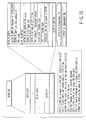
- ESTR_FI_SRP information exists, and its structure is a file name of ESTR_FI: ESTR_FI_FN, update date information of the ESTR_FI file: ESTR_FI_LAST_MOD_TM, an ESTR_FI file size: ESTR_FI_SZ, AP_FORMAT_1 as broadcast scheme information, country code, packet type, and the number of pieces of SOBI, as shown in FIG. 10.
- the update date information is also set in the ESTR_FI file. When ESTR_FI is changed upon editing, that value is updated.
- ESTR_FI ESTR_FI file name
- HR_SFInn.IFO file Name: HR_STMnn.IFO of an STMAP
- the ESTR_FI file (HR_SFIxx.IFO) has the same configuration as that of normal ESTR_FI. Furthermore, in case of a cognizable stream (TYPE A: STRA), a TMAP can be generated on the PTM base. However, in case of a non-cognizable stream (when data cannot be descrambled or when data of a scheme different from the assumed broadcast station is input) (TYPE B: STRB), the TMAP may be generated on a reception time (PATS) base in place of PTM base. However, since the PATS is not a playback time, special playback or the like cannot be accurately made, but it can be roughly made.
- PATS reception time
- PATS_SS includes a value indicating the accuracy of the PATS.
- the PATS includes 4 bytes or is a dummy in some cases.
- multi-view broadcasting As one feature of digital broadcasting, for example, multi-view broadcasting is known.
- multi-view broadcasting a plurality of video data are broadcasted at the same time (by time sharing), and the user can play back one of these video data of his or her choice.
- the user can select one of a plurality of contents according to his or her desire.
- a recorder receives, as one TS, streams X, Y, and Z as multi-view broadcast and stream U as rain attenuation broadcast
- the control must be made to allow the user to select and play back a required stream upon playback, and to freely switch among streams using a key.
- grouping information GPI
- a DVD recorder normally has TMAPI as EVOB management information.
- This information is used to divide EVOB/ESOB for each EVOBU/ESOBU and to implement playback, special playback, and the like for that unit, and a maximum of one information is required per 0.5s. For this reason, if the disc size increases in the future or a compression method with high compression efficiency is adopted, the number of pieces of TMAPI increases, and complicated management is required when an edit process or the like is made.
- TMAPI is stored in IFO, management data in other non-related fields must be moved or rewritten every time TMAPI is changed, resulting in poor efficiency. In order to improve such situation, TMAPI is recorded in an independent field.
- a video recorder may have unique functions which are not described in the DVD format depending on the manufacturers and models, and may be differentiated from other manufacturers. In this case, manufacturer unique information must be embedded in object data.
- MNFI Manufacturing's Information
- data in a DVD disc include a volume/file structure information area that stores a file system, and a data area that actually records data files.
- the file system includes information indicating the recording locations of files.
- the data area is divided into areas that record general computer data, and an area that records AV data.
- the AV data recording area includes an AV data management information area that stores a VMG file used to manage AV data, a VR object group recording area that records object data (EVOBS) files (VRO files) complying with the video recording standard, and a recording area that records stream object data (ESOBS: Extended Stream Object Set) files (SRO files) which record objects (ESOBS) compatible to digital broadcast.
- VMG file used to manage AV data
- VRO files VR object group recording area that records object data (EVOBS) files
- EOBS Extended Stream Object Set
- SRO files stream object data which record objects (ESOBS) compatible to digital broadcast.
- a DVD_HDVR directory records a VMG file used to manage data, VRO files as object files for analog recording of analog broadcast data, line-in data, and the like, and an SRO file as a digital broadcast object.
- the SRO file records an SOBS (Stream Object Set).
- management data is recorded in the VMG file common to VR, and undergoes control common to VR.
- the management data is linked for each cell, and the playback location is designated for each playback time. This management data is called VR_MANEGER.IFO.
- each ESOBU includes one or more ESOB data.
- Each ESOB corresponds to, e.g., one program.
- the ESOB includes one or more ESOBUs (Extended Stream object units), each of which corresponds to object data for a given time interval (which changes depending on the value of ESOBU_PB_TM_RNG) or one or more GOP data.
- ESOBUs Extended Stream object units
- Each of which corresponds to object data for a given time interval (which changes depending on the value of ESOBU_PB_TM_RNG) or one or more GOP data.
- the transfer rate When the transfer rate is low, one GOP data cannot often be sent within 1s (1 second) (VR can freely set the data unit configuration since it adopts internal encoding, but digital broadcast cannot specify the next incoming data since encoding is done by a broadcast station).
- the transfer rate may be high, and I-picture data may be sent frequently.
- the ESOBU is delimited frequently, and ESOBU management information increases accordingly, thus ballooning the whole management information. For this reason, it is appropriate to delimit ESOBUs by a given time interval (a minimum limitation is to delimit ESOBUs by picture data except for the last ESOBU of the ESOB: the delimitation unit corresponds to a picture unit (e.g., for each sec)) determined by a total video recording time or by one or more GOP data.
- the ESOBUs are delimited at time intervals indicated by SOBU_PATS_TM_RNG. There are two types of SOBU_PATS_TM_RNG: designated in seconds or by a 27-MHz count value.
- Each packet group includes a packet group header and (170) TS packets.
- the arrival time of each TS packet can be expressed by a PAT (Packet Arrival Time: 4 bytes) which is allocated before each TS packet.
- the arrival times of TS packets must be linearly counted up until a video recording end time to have a video recording start time as 0 (or a predetermined value). For this reason, when a plurality of programs are recorded all at once during video recording or in case of an edited program or the like, a system time counter suffers discontinuity (STC discontinuity). In this case, STC adjustment is required. Even in such case, the transfer time must be linearly increased.
- a method of executing processes using an internal counter (90a in an embodiment shown in FIG. 43) which is free from STC transfer (changeover), and a method of dividing an ESOB upon changeover are available.
- the count interval of the internal counter must be synchronized with that of the STC which corresponds to the interval between neighboring PCR fetch timings in a playback synchronized state.
- a packet group can include a maximum of two ESOBs. That is, packet groups need not be aligned for respective ESOBs.
- a packet group header sets a sync pattern at the head of a packet group, and includes PKT_GRP_GI, copy management information CCI (Copy Control Information), FIRST_PATS_EXT, and MNI (manufacturer's information).
- PKT_GRP_GI copy management information
- CCI Copy Control Information
- FIRST_PATS_EXT FIRST_PATS_EXT
- MNI manufacturer's information
- the PKT_GRP_GI includes PKT_GRP_TY: a packet group type (1: MPEG-TS), VERSION: a DVD BOOK version number, PKT_GRP_SS: status information of the packet group, Valid_PKT_Ns: the number of valid packets in the packet group, and FIRST_PATS_EXT: the upper 2 bytes of the PATS for the first packet.
- PKT_GRP_TY a packet group type (1: MPEG-TS)
- VERSION a DVD BOOK version number
- PKT_GRP_SS status information of the packet group
- Valid_PKT_Ns the number of valid packets in the packet group
- FIRST_PATS_EXT the upper 2 bytes of the PATS for the first packet.
- APS is an abbreviation for "Analog Protection System", and the embodiment of the present invention assumes Macrovision.
- the MNFI includes MNF_ID and MNF_DATA.
- the MNF_ID is a value representing each manufacturer.
- the MNF_DATA after the MNF_ID is a data field which can be freely set for each corporation.
- FIRST_PATS_EXT (FIG. 41) corresponds to the upper 2 bytes of the arrival time of the packet at the head of the packet group, and the remaining 4 bytes are assigned before each packet. In this manner, the playback process with an accurate time is allowed.
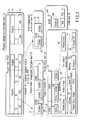
- FIG. 5 is a view for explaining a practical example of resume mark information (DISC_RSM_MRKI) in disc 100 shown in FIG. 1.
- DISC_RSM_MRKI is configured to include, as resume information, program chain number PCGN, program number PGN, cell number CN, mark information MRK_PT, the PID of target video data to be resumed, resume mark update date MRK_TM, and the like.
- FIG. 6 is a view for explaining a practical example of extended disc representative picture information (EX_DISC_REP_PICI).
- EX_DISC_REP_PICI is configured to include, as disc representative picture information, program chain number PCGN, program number PGN, cell number CN, representative picture information PIC_PT, the PID of target video data, the playback time and/or playback end time of the representative picture, representative picture update (creation) date information PIC_CL_TM, and the like.
- the management information will be described below with reference to FIGS. 3 to 37.
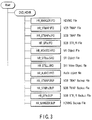
- the HDVR directory stores HR_MANGER.IFO as a DVD management information file, VRO files as analog video object files, and an SRO file that supports digital broadcast.
- HR_MANGER.IFO a DVD management information file
- VRO files as analog video object files
- SRO file that supports digital broadcast.
- ESTR_FIT Extended Stream File Information table
- EX_PL_SPRT (FIG. 7) is a search pointer to each playlist, and also includes PL_RSM_MRKI, which is set with a resume marker (marker indicating the playback location upon pausing playback) for each playlist. As information used to restart playback, this PL_RSM_MRKI is set to include a cell number, playback start PTM, and date information of MRK_TM indicating the date of creation of that marker.
- update date information of a VTMAPT as a TMAP (Time Map) for Video Recording (VR) for self recording/playback and that of an STMAPT as a TMAP for Stream Recording (SR) for digital broadcast recording are described. This value is compared with update date information described in each TMAPT file. If these values match, it is determined that they have consistency, and the processing is executed. Management information of stream data is saved in the VMG file, as shown in FIG. 3, and stream data are managed on the same level as VR data.
- the ESTR_FIT includes ESTR_FITI (ESTR_FIT information), one or more ESTR_FI_SRPs, and one or more pieces of ESTR_FI (Extended Stream File Information) indicated by these SRPs.
- the ESTR_FITI includes the total number of pieces of ESTR_FI, and the end address of this table.
- Each ESTR_FI includes ESTR_FI_GI (ESTR_FI General Information), one or more ESOBI_SRPs (Extended Stream Object Information Search Pointers), and one or more pieces of ESOBI (ESOB Information) which are as many as the SRPs and are indicated by their values.
- FIG. 12 is a view for explaining an example of the configuration of ESOBI_GI included in the ESOBI shown in FIG. 11.
- the ESOBI_GI includes various kinds of information shown in FIG. 12 in the order listed in FIG. 12.
- FIG. 13 shows the contents of various kinds of information shown in FIG. 12.
- the ESOBI includes ESOBI_GI, ESOBI_ESI# corresponding to ESOB_V_ESI (Extended Video Elementary Information) and/or ESOB_A_ESI (Extended Audio Elementary Information), ESOB_DCNI (Discontinuity Information), ESOB_PASTI (Packet Arrival Time Information), ESOB_SMLI (Extended Seamless Information), ESOB_AGAPI (ESOB Audio GAP Information), ESOB_TMAP (ESOB Time Map), and ESOB_ES_GPI (ESOB_ES Group Information).
- ESOBI_GI ESOBI_GI
- ESOBI_ESI# corresponding to ESOB_V_ESI (Extended Video Elementary Information) and/or ESOB_A_ESI (Extended Audio Elementary Information)
- ESOB_DCNI Discontinuity Information
- ESOB_PASTI Packet Arrival Time Information
- ESOB_SMLI Extended Seamless Information
- ESOB_AGAPI ESOB Audio GAP Information
- ESOB_ES_Ns ESOB_V_ES_Ns
- ESOB_A_ES_Ns ESOB_TMAP_Ns
- ESOB _ E S _ N s ESOB _ V _ E S _ N s + ESOB _ A _ E S _ N s
- ESOB _ V _ E S _ N s ESOB _ V _ E S _ N s
- ESOB _ A _ E S _ N s ESOB _ A _ E S _ N s ⁇ E S _ TMAP _ N s
- a region number indicates Japan (ARIB) when it is 00; U.S.A. (ATSC) when it is 01; and Europe (DVB) when it is 02.
- ARIB Japan
- ATSC U.S.A.
- DVB Europe
- ESOB_ESI is classified into three types (ESOB_V_EST in FIG. 15, ESOB_A_ESI in FIG. 16, and ESOB_OTHER_ESI in FIG. 17).
- ESOB_ES_PID the PID of an ES
- STREAM_TYPE STREAM type indicated in the PMT
- STREAM_CONTENT STREAM_CONTENT value indicated by the component descriptor
- COMPONENT_TYPE the value of COMPONENT_TYPE indicated by the component descriptor
- COMPONENT_TAG the value of COMPONENT_TAG indicated by the component descriptor
- CP_CTL_INFO are common to these three different types of ESOB_ESI.
- V_ATTR is added to V_ESI (FIG. 15).
- the A_ESI (FIG. 16) further includes SIMULCAST_GP_TAG (a gap value of audio frames at the beginning of multi-view broadcast), AUDIO_ATTR (audio attribute values), LANG_CODE (first audio language code), and LANG_CODE2 (second audio language code).
- the OTHER_ESI further includes DAT_COMP_ID (data contents encoding identifier) and AD_DAT_COMP_IFO (Additional data Component Info).
- the CP_CTL_INFO (FIG. 18) is stored in CPI of ESOBI_GI, ESOB_V_ESI, ESOB_A_ESI, and a Packet Group Header.
- the CPI of ESOBI_GI makes the overall copy control, that of ESI makes copy control of each ES, and copy control of each Packet Group is made based on CPI of the Packet Group Header.
- the CPI values of the ESI are used in preference to those of ESOBI_GI, and the CPI of the Packet Header Group is assigned top priority. These CPI values are set based on a digital copy control descriptor, content-use descriptor, and the like.
- the ESOB_DCNI (Discontinue Information) in FIG. 19 includes DCNI_GI and CNT_SEGI#1 to CNT_SEGI#n.
- the DCNI_GI includes information indicating the number of pieces of CNT_SEGI.
- Each CNT_SEGI includes CNT_SEG_SZ (CNT_SEG size: the number of packet groups), and CNT_SEG_PKT_POS (the number of packets of the first CNT_SEG in a packet group). These pieces of information indicate the SCR disconnect positions.
- ESOB_PATSI (FIG. 20) includes ESOB_PATSI_GI and PATS_WRAPI#1 to PATS_WRAPI#K.
- the ESOB_PATSI_GI includes information indicating the number of pieces of PATS_WRAPI.
- Each PATS_WRAPI indicates the wrap-around position information of the PATS, and includes a packet group number and a packet number in the packet group.
- the ESOB_TMAP includes ESOB_TMAP_GI and one or more pieces of ES_TMAPI.
- ES_TMAPI includes ES_PID (the PID of a target ES of this TMAP: there are two description methods of the PID: a method of describing the PID using 13-bit real data, and a method of describing the order in the PMT), ADR_OFS (logical address from the head of an ESOB file to the head of this ES), ES_S_PTM (start PTM), ES_E_PTM (end PTM), ES_ESOBU_ENT_Ns (the number of ESOBU_ENTs), LAST_ESOBU_E_PKT_POS (position of the last ESOBU in a packet group), and STMAP_N (the number of a TMAP in the STMAPT, which belongs to this ES: this number may be omitted when the STMAPTs are recorded in independent areas for each STR_FI or when STMAPs are recorded in turn). An STMAPT is recorded in an independent area (independent file).
- the STMAPT includes STMAPTI, one or more
- Each STMAP_SRP includes address information of STMAPI as an element of each STMAPT, and each STMAPI includes a required number of pieces of ETMAPI_GI and a required number of ESOBU_ENTs.
- the ETMAPI_GI includes ESOBU_ENT_Ns (the number of entries). Note that garbage data may be inserted among ESOBU_ENTs.
- ESOB_S_PATS/ESOB_E_PATS arrival times of the first/last packet
- TM_OFS a difference time from the TM range of the first ESOBU; not available in some cases.
- the edit process is made for respective ESOBUs, and adjustment is made using the PATS start/end time (CELLI).
- TMAPI information can be prevented from becoming extremely large by setting ESOBU/EVOBU_PB_TM_RNG even when a video recording time increases. However, since the time interval between neighboring entries is broadened, it is more likely to disturb smooth double-speed playback and the like.
- ESOBU/EVOBU intervals when the TM_RNG value is available, a time interval indicated by this value is set as a maximum interval, and when a GOP division exists ahead of this time interval, ESOBUs can be delimited there. On the other hand, if a sequence header (SH) and I-PIC exist, ESOBUs can be delimited at the head of the SH.
- SH sequence header
- I-PIC I-PIC
- EX_M_AVFIT includes EX_M_AVFI, which includes a plurality of pieces of EVOBI as management information for respective EVOBs as many as the number of EVOBs.
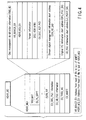
- the EVOBI includes EVOB_TMAPI used to manage the TMAP of the EVOB, as shown in FIG. 8.
- the EVOB_TMAPI stores EVOB_TMAP_GI.
- the EVOB_TMAP_GI records general information used to manage the VTMAPT as an independent file.
- the EVOB_TMAP_GI includes the total number (EVOBU_ENT_Ns) of entries (EVOBU_ENT) stored in the EVOBU of interest, an offset value (TM_OFS) of the time of the head of the EVOBU of interest, the start address (ADR_OFS) of the EVOBU of interest, EVOBL_PB_TM_RNG that determines the time interval of entries of the EVOBU of interest, the TMAP number (EX_VTMAP_N: which may be omitted if the TMAP number is determined to have one-to-one correspondence from the head of the EVOB) in the VTMAP file, the size (EVOB_SZ) of the EVOB of interest, and the like.
- the EVOB_TMAP_GI allows to recognize information of the EVOB without reading out the TMAP file, since the TMAPs are stored in independent files. Especially, the start address (ADR_OFS), EVOB_SZ, and EVOBU_ENT_Ns allow to determine the data size to be read out from disc 100, the work RAM size to be assured, and the like before loading the TMAP file main body, thus facilitating the read preparation.
- the VTMAPT (FIG. 25) includes VTMAPTI, VTMAP_SRPT, and VTMAP#1 to VTMAP#n.
- the VTMAPTI (FIG. 26) includes VMG_ID (the same value as VMG_ID located at the head of VMGI), VTMAPT_EA (the end address of the VTMAP), VERN (version information of the TMAP), IFO_LAST_MOD_TM (update date information of the TMAPT; the same value as HR_MANGR.IFO), and VTMAP_SRPNs (the total number of pieces of search information).
- the VTMAP_SRPT includes one or more VTMAP_SRPs (search information of each VTMAP).
- each VTMAP_SRP includes VTMAP_SA (the start address of the VTMAP) and EVOBU_ENT__Ns (the total number of EVOBU_ENTs).
- the VTMAP includes one or more EVOBU_ENTs (corresponding to the EVOBU_ENT# in FIG. 27).
- the ESOBU_ENT includes 1st_Ref_PIC_SZ (end address information of the first reference picture (I-picture or the like) in the entry from the head of the ESOBU, which is expressed by LBs), ESOBU_PB_TM (the playback time of the ESOBU indicated by the number of fields), ESOBU_SZ (ESOBU size expressed by the number of packet groups that belong to the ESOBU), ESOBU_S_PKT_POS (the position of a packet which is expressed by the number of packets from the head of a packet group and stores the first packet of the ESOBU), ESOBU_SH_EXIST_Flag (sequence header (SH) information), and the like.
- 1st_Ref_PIC_SZ end address information of the first reference picture (I-picture or the like) in the entry from the head of the ESOBU, which is expressed by LBs
- ESOBU_PB_TM the playback time of the ESOBU indicated by the number of fields
- SH information There are two types of SH information.
- the first type of SH information corresponds to a case wherein flag ESOBU_SH_EXIST_FLAG indicating the existence of an SH in the ESOBU is available, as shown in FIG. 31.
- the second type of SH information corresponds to a case wherein flag ESOB_SH_I_EXIST_FLAG indicating the existence of an SH between the head of the ESOBU and I-PIC, and flag ESOBU_SH_EXIST_FLAG indicating the existence of an SH in the ESOBU (or the existence of an SH between I-PIC to the end of ESOBU) are available, as shown in FIG. 32.
- the first type of SH information is adopted when the SH is constant in a program (in the ESOB) or when the ESOBU is delimited so that the ESOBU always starts from the SH. In this way, playback can be made using the SH in the ESOBU.
- the second type of SH information is adopted when the SH changes frequently, or when the SH is not always located at the head of the ESOBU.
- an SH can be set by reading out the previous ESOBU (normally, the immediately preceding ESOBU; however, in some cases, an ESOBU two or more ahead of the current ESOBU may be used) including the SH, thus allowing playback.
- an ESOBU corresponding to a target time is calculated by accumulating PB_TM data, and the playback start PTM is converted into the number of fields from the head of that ESOBU.
- the first packet becomes a packet corresponding to the value of ESOBU_S_PKT_POS, and this address is accessed.
- each ESOBU_ENT (example 1 of FIG. 33) on the PATS base can be configured by AT_ESOBU_SZ and AT_ESOBU_S_PKT_POS.
- the AT_ESOBU_S_PKT_POS indicates the first packet position of the ESOBU by the number of packets.
- each ESOBU_ENT (example 2 of FIG. 33) on the PATS base can be configured by AT_ESOBU_SZ.
- AT_ESOBU_S_PKT_POS and AT_ESOBU_E_PKT_POS are fixed to zero.
- ESOB_TMAP_GI (FIG. 24) describes ADR_OFS, ESOB_SZ, and ESOB_E_PKT_POS as values associated with those of the entire ESOB.
- TMAPI for each ES, ES_TMAPI (FIG.
- ES_S_ADR_OFS an address value (the number of packet groups) from the head of an ESOB to the first ESOBU of the ES of interest
- ES_S_ADR_OFS an address value (the number of packet groups) from the last ESOBU of the ES of interest to the end of the ESOBU
- ES_LAST_SOBU_PKT_POS the number of packets up to the last packet in a packet group of the last ESOBU
- ES_ESOBU_ENT_Ns the total number of ESOBU_ENTs
- the default PID of the ES of interest there are two description methods of the PID: a method of describing the PID using 13-bit real data, and a method of describing the order in the PMT), and the like, as the values of the entire ES_TMAP.
- ESOBU_ENT (FIGS. 30 to 33) in each STMAPI describes ESOBU_S_PKT_POS (or AT_ESOBU_S_PKT_POS) and ESOBU_SZ (or AT_ESOBU_SZ) as values which belong to the ESOBU.
- ESOBU_SZ ESOBU_SZ
- FIGS. 24 and 33 show the actual structures of the TMAP and ESOBU on the PATS base.
- the ESOB_SZ (FIG. 24) indicates the number of packet groups from a packet group to which the first packet of the ESOB belongs to a packet group to which the last packet of the ESOB belongs.
- the AT_ESOBU_SZ (FIG. 33) is the number of packet groups from the first packet group of the ESOBU to the last packet group of the ESOBU.
- the AT_ESOBU_S_PKT_POS (FIG. 33) represents the difference between the divisions of the ESOBU and packet group using the number of packets.
- the time information is expressed by PATs to have ESOB_S_PATS as the ESOB start time, and ESOB_E_PATS as the end time, since it is on the PATS base.
- the ESOB_E_PATS is the PATS (arrival start time) of the last packet of the last packet group, but is not the last reception end time.
- the edit process is done for respective ESOBUs, and the playback start time (CELL_S_PATS of CELLI) is designated. Since the edit process is done for respective ESOBUs, each ESOB_S_PATS always matches the head of the ESOBU. Note that the accuracy of the PATS is indicated by PATS_SS.
- TM_OFS represents an actual difference between the first PATS of an ESOB and a TM (time) range designated by TM_RNG using a 27-MHz count value. Note that an example without this value may be available.
- ESOBU_S_PKT_POS When the processing is performed in the packet group unit, since the division of each ESOBU matches that of each packet group, the ESOBU_S_PKT_POS can be omitted. Also, ESOBU_S_PKT_POS and ESOBU_E_PKT_POS are fixed to zero.
- the ESOB stores ESOB_ES_GPI (Group Information) to support multi-view broadcasting, rain attenuation broadcasting, and multi-program simultaneous video recording.
- ESOB_ES_GPI Group Information
- That GPI includes ESOB_GPI_GI, GPI_SRPs, and GPI.
- Each GPI_SRP stores GPI_SA (the start address of the GPI).
- Each GPI includes CPI_GI and ES_PISs.
- EX_PGC information (FIG. 34) as playback information has the same format as a normal VR format, and ORG_EX_PGC information is automatically generated by an apparatus upon video recording and is set in the order of video recording.
- UD_EX_PGC information is generated according to a playback order which is freely added by the user, and is called a playlist.
- EX_PG information (FIG. 35) saves update date information of this EX_PG. This information can identify when this EX_PG was edited.
- a program name as text information uses PRM_TXT, and an IT_TXT field saves other kinds of information (director name, leading actor name,...) to save other kinds of text information.
- This EX_PGI is set with an SRP number of the IT_TXT field which saves these kinds of information to establish a link.
- a PG number is set in IT_TXT data. Note that the EX_PG number is an absolute number from the beginning of recording on this disc, and is an index number which remains unchanged even after other EX_PGs are deleted.
- the EX_PG includes RSM_MRKI to provide a resume marker (a marker indicating the playback position upon interrupting playback) for each program.
- a resume marker a marker indicating the playback position upon interrupting playback
- an EX_CELL number, playback start PTM, and date information indicating the date of creation of that marker are set. This information is used as title resume.
- the EX_PGI is set with the SRP number of MNFI, and an EX_PG number can also be set in the MNFI information. In this way, links can be set with data in the MNFI information.
- an ESOB type (STRA_CELL, STRB_CELL) is added to the conventional VR cell type, and an ESOB number, start time, end time, and GP number to be played back can be designated.
- the start and end times can be expressed by either the playback time (in case of PTM base) or PATS time (in case of PATS base).
- time is designated by a playback time: real time upon playback, the same access method as in the conventional VR is allowed. Since the user can designate using a playback time, a user's desire can be perfectly reflected. However, this method can be adopted only when the stream contents can be sufficiently cognizable. If the contents cannot be sufficiently cognizable, a time must be designated using a transfer time unit.
- playback cannot always be started from the head of I-picture data. If a frame at the playback start position is not that of I-picture, decoding starts from the immediately preceding I-picture, and display starts when the target frame is decoded. In this way, a picture can be presented to the user as if playback were started from the designated frame.
- a method of setting the PID (there are two description methods of the PID: a method of describing the PID using 13-bit real data, and a method of describing the order in the PMT; or the PID may be a component tag value) of a representative one of streams to be played back, and a method of setting the ID of a component group in case of multi-view TV or the like are available.
- unique ID numbers are assigned to EX_PG and EX_CELL data, so that EX_PG and EX_CELL data can be designated using numbers which remain unchanged even when middle EX_PG and EX_CELL data are deleted.
- the EX_CELL is set with the ESTR_FILE number and ESOB_SRP number. Furthermore, the EX_CELL includes EPI (Entry Point Information) corresponding to each chapter (FIG. 37). There are two types of EPI for each cell type, i.e., a total of eight types of EPI.
- M_CELL_EPI_TY_A includes EPI_TY (EPI type information), and a PTM to which an EP is assigned.
- M_CELL_EPI_TY_B also includes PRM_TXTI (text information) and REP_PIC_PTM (thumbnail pointer).
- S_CELL_EPI_TY_A includes EPI_TY (EPI type information), and an S_EVOB_ENT number to which an EP is assigned.
- S_CELL_EPI_TY_B also includes PRM_TXTI (text information).
- STR_A_CELL_EPI_TY_A (ESOB TYPE A) includes EPI_TY (EPI type information), a PTM to which an EP is assigned, and a PID (or group number) of an ES.
- STR_A_CELL_EPI_TY_B also includes PRM_TXTI (text information) and REP_PIC_PTM (thumbnail pointer).
- STR_B_CELL_EPI_TY_A (ESOB TYPE B) includes EPI_TY (EPI type information), a PATS to which an EP is assigned, and a PID to which that ES is assigned.
- STR_B_CELL_EPI_TY_B also includes PRM_TXTI (text information) and REP_PIC_PTM (thumbnail pointer).
- FIG. 43 is a block diagram for explaining an example of the apparatus which records and plays back AV information (digital TV broadcast program or the like) on an information storage medium (optical disc, hard disc, or the like) using the data structure according to the embodiment of the present invention.
- the recorder/player comprises an MPU unit, display unit, decoder unit, encoder unit, TV tuner unit, STC (System Time Counter) unit, D-PRO unit, temporary storage unit, disc drive unit, key input unit, V-mixing unit, frame memory unit, TV D/A unit, terrestrial digital tuner unit, 1394 I/F unit, Ethernet I/F unit, remote controller receiver, STB unit (BS digital tuner or the like), emergency broadcast detection unit, and HDD unit.
- This arrangement is configured by adding the functions of a streamer to a recordable/reproducible DVD recorder.
- the encoder unit includes an A/D unit, video encode unit, audio encode unit, SP encode unit, formatter unit, and buffer memory unit.
- the decoder unit includes a demultiplexer, video decode unit, SP decode unit, audio decode unit, TS packet transfer unit, V-PRO unit, and audio D/A unit. Furthermore, an antenna for receiving digital broadcasts is connected to the STB unit. Note that the STC unit is configured to count on a 27-MHz base.
- the flow of signals upon recording is as follows. That is, TS packet data received by the STB unit (or terrestrial digital tuner) are packed into packet groups by the formatter unit and the packet groups are saved on a work area. When the saved packet groups reach a predetermined size, they are recorded on the disc. PATS internal counter 90a is connected to this formatter unit 90. The arrival time of each TS packet is counted by PATS counter 90a, and that count value is appended to the head of each TS packet when the packet is buffered. This counter 90a can perform fine adjustment of count intervals by SCR values, but never loads the SCR values unlike STC 102. As the operations to be executed at that time, upon reception of TS packets, a group is formed every 170 packets, and a packet group header is generated.
- An analog signal input from the terrestrial tuner or line input is converted into a digital signal by the A/D unit. That digital signal is input to respective encoder units. That is, a video signal is input to the video encode unit, an audio signal is input to the audio encode unit, and text data of, e.g., teletext broadcasting is input to an SP encode unit.
- the video signal is compressed by MPEG
- the audio signal is compressed by AC3 or MPEG audio
- the text data is compressed by runlength coding.
- Each encoder unit (for VR) packs compressed data to form 2048-byte packets and inputs them to the formatter unit.
- the formatter unit packs and multiplexes the packets as a program stream, and sends it to the D-PRO unit.
- the D-PRO unit forms ECC blocks for every 16 logical blocks, appends error correction data to them, and records the ECC packets on the disc via the disc drive unit.
- the formatter unit When the disc drive unit is busy due to seek, track jump, and the like, data are stored in an HDD buffer unit, and wait until the disc drive unit is ready. Furthermore, the formatter unit generates each segmentation information during video recording, and periodically sends it to the MPU unit (GOP head interrupt or the like).
- the segmentation information includes the number of packs of an EVOBU (ESOBU), the end address of 1-picture data from the head of the EVOBU (ESOBU), the playback time of the EVOBU (ESOBU), and the like.
- the MPU unit determines the type of input data (i.e., VR or SR data) (based on Cell TYPE), and sets that type in the decoder unit before playback.
- SR data the MPU unit determines the PID to be played back based on EX_CELLI to be played back, determines the PIDs of items (video, audio, and the like) to be played back based on a PMT, and sets them in the decoder unit.
- the demultiplexer sends TS packets to the respective decode units based on the PIDs.
- the TS packets are sent to the TS packet transfer unit, and are transmitted to the STB unit (1394 I/F unit) in the form of TS packets in accordance with the arrival time.
- the respective decode units execute decoding, and decoded data are converted into an analog signal by the D/A unit, thus displaying data on the TV.
- the demultiplexer sends data to the respective decode units according to the fixed IDs.
- the respective decode units execute decoding, and decoded data are converted into an analog signal by the D/A unit, thus displaying data on the TV.
- this medium has management area 130 and data area 131.
- Data is separately recorded on the data area as a plurality of object data (ESOB), and each object data includes a group of data units (ESOBU).
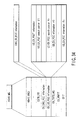
- One data unit (ESOBU) includes packet groups each of which is formed by converting an MPEG-TS compatible digital broadcast signal into TS packets and packing a plurality of packets (see FIGS. 1 and 33).
- EX_PGC information EX_PGC information
- This EX_PGC information includes EX_CELL information (EX_CI).
- management area 130 has information used to manage object data (ESOB).
- the apparatus shown in FIG. 43 can make stream recording on medium 100 (100a) with the above data structure in addition to video recording.
- MPU unit 80 in order to extract program map table PMT and service information SI from a TS packet stream, MPU unit 80 has a service information extraction unit (not shown; firmware that forms management data generation unit 80B). Also, MPU unit 80 has an attribute information generation unit (not shown; firmware that forms management data generation unit 80B) that generates attribute information (PCR pack number, PCR_LB count number, and the like) on the basis of information extracted by this service information extraction unit.
- the flow of signals upon recording are, for example, as follows. That is, TS packet data received by the STB unit (or terrestrial digital tuner) are packed into packet groups by the formatter unit and the packet groups are saved on a work area (buffer memory unit 91). When the saved packet groups reach a predetermined size (when they are saved for one or an integer multiple of CDA size), they are recorded on the disc. As the operations to be executed at that time, upon reception of TS packets, a group is formed every 170 packets, and a packet group header is generated.
- an analog signal input from the terrestrial tuner or line input is converted into a digital signal by the A/D unit. That digital signal is input to respective encoder units. That is, a video signal is input to the video encode unit, an audio signal is input to the audio encode unit, and text data of, e.g., teletext broadcasting is input to an SP encode unit (not shown).
- the video signal is compressed by MPEG
- the audio signal is compressed by AC3 or MPEG audio
- the text data is compressed by runlength coding.
- Each encoder unit packs compressed data (or segments into blocks) to form 2048-byte packets (or blocks) and inputs them to the formatter unit.
- the formatter unit multiplexes the packets (or blocks), and sends them to the D-PRO unit.
- the D-PRO unit forms ECC blocks for every 16 or 32 packets (16 or 32 blocks), appends error correction data to them, and records the packets (or blocks) on the disc via the disc drive unit.
- the formatter unit When the disc drive unit is busy due to seek, track jump, and the like, data are stored in an HDD buffer unit until the disc drive unit is ready. Furthermore, the formatter unit generates segmentation information during video recording, and periodically sends it to the MPU unit (GOP head interrupt or the like).
- the segmentation information includes the number of packs (or the number of LBs) of EVOBU (ESOBU), the end address of I-picture data from the head of EVOBU (ESOBU), the playback time of EVOBU (ESOBU), and the like.
- TS packet data received by the STB unit are converted into packet groups by the formatter unit, and are saved in the work RAM.
- data saved in the work RAM reach a predetermined size (when they are saved for one or an integer multiple of CDA size), they are recorded on the disc.
- the MPU unit determines the type of input data (i.e., VR or SR data) (based on cell type), and sets that type in the decoder unit before playback.
- the MPU unit determines the PID to be played back based on cell information CI to be played back, determines the PIDs of items (video, audio, and the like) to be played back based on a PMT, and sets them in the decoder unit.
- the demultiplexer sends TS packets to the respective decode units based on the PIDs.
- the TS packets are sent to the TS packet transfer unit, and are transmitted to the STB unit (1394 I/F) in the form of TS packets in accordance with the arrival time.
- the respective decode units execute decoding, and decoded data are converted into an analog signal by the D/A unit, thus displaying data on the TV.
- the demultiplexer sends data to the respective decode units according to the fixed IDs.
- the respective decode units execute decoding, and decoded data are converted into an analog signal by the D/A unit, thus displaying data on the TV.
- pack data read out from the disc are interpreted by the demultiplexer. Packs that store TS packets are sent to the TS packet transfer unit, and are then sent to the decoders, thus playing back data.
- pack data are transferred to the STB unit (or are transmitted to an external apparatus such as a digital TV or the like)
- the TS packet transfer unit transfers only TS packets at the same time intervals as they arrived.
- the STB unit decodes the TS packets to generate an AV signal, which is displayed on the TV via the video encoder unit in the streamer.
- An MPEG-TS scheme as a basic format common to broadcast schemes which broadcast (distribute) compressed moving picture data such as digital TV broadcasts, broadcasts that uses a wired network such as the Internet or the like, and so on is divided into a packet management data field and payload.
- the payload includes data to be played back in a scrambled state.
- a PAT Program Association Table
- PMT Program Map Table
- SI Service Information
- various kinds of management information can be generated using the PMT and SI (SDT: Service Description Table
- EIT Event Information Table
- BAT Bouquet Association Table).
- the contents to be played back include MPEG video data, Dolby AC3(R) audio data, MPEG audio data, data broadcast data, and the like.
- the contents include information (program information and the like) such as PAT, PMT, SI, and the like required upon playback although they are not directly related to the contents to be played back.
- PAT includes the PID (Packet Identification) of the PMT for each program, and the PMT records the PIDs of video data and audio data.
- a normal playback sequence of the STB is as follows. That is, when the user determines a program based on EPG information, the PAT is loaded at the start time of the target program. The PID of a PMT, which belongs to the desired program, is determined on the basis of that data, and the target PMT is read out in accordance with that PID. Then, the PIDs of video and audio packets to be played back, which are included in the PMT, are determined. Video and audio attributes are read out based on the PMT and SI and are set in respective decoders. The video and audio data are extracted and played back in accordance with their PIDs. Note that the PAT, PMT, SI, and the like are transmitted at intervals of several 100 ms since they are also used during playback.
- TS packet data received by the STB unit are converted into packet groups by the formatter unit, and are saved in the work RAM.
- data saved in the work RAM reach a predetermined size, they are recorded on the disc.
- a group is formed every 170 packets, and a packet group header is generated.
- An analog signal input from the terrestrial tuner or line input is converted into a digital signal by the A/D unit. That digital signal is input to respective encoder units. That is, a video signal is input to the video encode unit, an audio signal is input to the audio encode unit, and text data of, e.g., teletext broadcasting is input to an SP encode unit.
- the video signal is compressed by MPEG
- the audio signal is compressed by AC3 or MPEG audio
- the text data is compressed by runlength coding.
- Each encoder unit (for VR) packs compressed data to form 2048-byte packets and inputs them to the formatter unit.
- the formatter unit packs and multiplexes the packets, and sends them to the D-PRO unit.
- the D-PRO unit forms ECC blocks for every 16 or 32 packs, appends error correction data to them, and records the ECC packets on the disc via the disc drive unit.
- ECC blocks for every 16 or 32 packs, appends error correction data to them, and records the ECC packets on the disc via the disc drive unit.
- data are stored in an HDD buffer unit until the disc drive unit is ready.
- the formatter unit generates segmentation information during video recording, and periodically sends it to the MPU unit (GOP head interrupt or the like).
- the segmentation information includes the number of packs of EVOBU (ESOBU), the end address of I-picture data from the head of EVOBU (ESOBU), the playback time of EVOBU (ESOBU), and the like.
- the MPU unit determines the type of input data (i.e., VR or SR data) (based on Cell TYPE), and sets that type in the decoder unit before playback.
- SR data the MPU unit determines the PID to be played back based on CELLI to be played back, determines the PIDs of items (video, audio, and the like) to be played back based on a PMT, and sets them in the decoder unit.
- the demultiplexer sends TS packets to the respective decode units based on the PIDs.
- the TS packets are sent to the TS packet transfer unit, and are transmitted to the STB unit (1394 I/F unit) in the form of TS packets in accordance with the arrival time.
- the respective decode units execute decoding, and decoded data are converted into an analog signal by the D/A unit, thus displaying data on the TV.
- the demultiplexer sends data to the respective decode units according to the fixed IDs.
- the respective decode units execute decoding, and decoded data are converted into an analog signal by the D/A unit, thus displaying data on the TV.
- the D-PRO unit forms ECC groups by combining every 16 packs, appends ECC data to each group, and sends them to the disc drive unit.
- the D-PRO unit transfers the ECC groups to the temporary storage unit and waits until the disc drive unit is ready to record data.
- the D-PRO unit starts recording.
- the temporary storage unit a large-capacity memory is assumed since it must hold recording data for several minutes or longer by high-speed access.
- a microcomputer can make high-speed read/write access to the D-PRO unit via a dedicated microcomputer bus, so as to read/write the file management area and the like.
- pack data read out from the disc are interpreted by the demultiplexer. Packs that store TS packets are sent to the TS packet transfer unit, and are then sent to the decoders, thus playing back data.
- pack data are transferred to the STB unit (or are transmitted to an external apparatus: a digital TV or the like)
- the TS packet transfer unit transfers only TS packets at the same time intervals as they arrived.
- the STB unit makes decoding to generate an AV signal, which is displayed on the TV via the video encoder unit in the streamer.
- FIG. 44 is a flowchart (overall operation process flow) for explaining an example of the overall operation of the apparatus shown in FIG. 43.
- data processes include five different processes, i.e., a video recording process, playback process, data transfer process (a digital output process to the STB or the like), program setting process, and edit process, as shown in FIG. 44.
- MPU unit 80 makes initial settings (upon factory shipment or after user's settings) (step ST10). MPU unit 80 also makes display settings (step ST12) and waits for a user's operation. If the user has made a key input from key input unit 103 or remote controller 103a (step ST14), MPU unit 80 interprets the contents of that key input (step ST16). The following five data processes are executed as needed in accordance with this input key interpretation result.
- a program setting process starts (step ST20). If the key input is a key operation made to start video recording, a video recording process starts (step ST22). If the key input is a key operation made to start playback, a playback process starts (step ST24). If the key input is a key input made to output digital data to the STB, a digital output process starts (step ST26). If the key input is a key operation of an edit process, the edit process starts (step ST28).
- steps ST20 to ST28 are parallelly executed as needed for respective tasks.
- the process for outputting digital data to the STB (ST26) is parallelly executed during the playback process (ST24).
- a new program setting process (ST20) can be parallelly executed during the video recording process (ST22) which is not timer program recording.
- the playback process (ST24) and digital output process (ST26) can be parallelly executed during the video recording process (ST22).
- the disc edit process (step ST28) can be executed during video recording on the HDD.
- FIG. 45 is a flowchart (edit operation process flow) for explaining an example of the edit process (ST28).
- the flow branches to one of four processes (one of A to D) (step ST280) in accordance with the edit contents.
- step ST280 Upon completion of one of an entry point edit process (step ST282A), copy/move process (step ST282B), delete process (step ST282C), and playlist generation process (step ST282D), the program update date by this edit process is set in respective pieces of management information (EX_PGI, EX_IT_TXT, EX_MNFI) (step ST284).
- this program update date (FIG. 32) may be set.
- the edit times/time (EDIT_TIME) of the EVOBI and/or ESOBI can be set in ESOB_EDIT_TIME (not shown) or the like.
- this program update date (FIG. 32) may be set.
- the manufacturer ID of the apparatus that has made the operation in one of steps ST282A to ST282D may be set in editor ID (LAST_MNF_ID) 13326 in FIG. 32. Every time one of the PGI, CI, and ESOB (or EVOB) has been changed, this editor ID can be set (or updated) to the ID information of the apparatus used at that time.
- FIGS. 46 and 47 are flowcharts for explaining an example of the video recording operation of the apparatus in FIG. 43. Data processes upon stream recording are as follows.
- MPEG-TS packet data received by the STB unit are converted into packet groups by the formatter unit, and the packet groups are saved in the work RAM.
- data stored in the work RAM reach a predetermined size (for one or an integer multiple of CDA size), they are recorded on the disc.
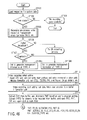
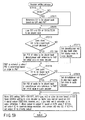
- FIG. 50 is a flowchart (PKT_GRP_GI setting process) for explaining an example of the packet group general information setting process (ST1340) shown in FIG. 49.
- the PKT_GRP_GI setting process will be described below with reference to FIG. 50.
- the data processes upon video recording are as follows (see FIGS. 46, 47, and 51).
- the D-PRO unit forms ECC groups by combining every 16 packs, appends ECC data to each group, and sends them to the disc drive unit.
- the D-PRO unit transfers the ECC groups to the temporary storage unit and waits until the disc drive unit is ready to record.
- the D-PRO unit starts recording.
- the temporary storage unit a large-capacity memory is assumed since it must hold recording data for several minutes or longer by high-speed access.
- a microcomputer can make read/write access to the D-PRO unit via a dedicated microcomputer bus, so as to read/write the file management area and the like.
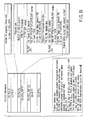
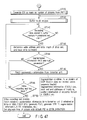
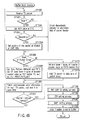
- FIG. 51 shows the ESOB_ESI setting process.
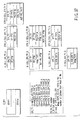
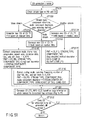
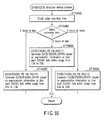
- FIGS. 52 to 55 shows the STR_FI process.
- the GPI setting process is as shown in FIG. 53, and it will be described below.
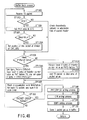
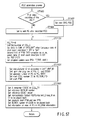
- the CP_CTL_IFO setting process will be described below with reference to FIG. 56.
- the data processes upon playback are executed as follows (see FIGS. 58 to 64).
- the decoder setting process will be described below with reference to FIG. 59.
- the cell playback process is executed as follows (see FIG. 60).
- the buffer data decoder transfer process will be described below with reference to FIG. 61.
- the GP switching process is executed, as shown in FIG. 62.
- FIG. 64 is a flowchart for explaining the SKIP operation.
- the skip process can be executed as follows.
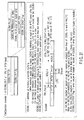
- FIG. 65 is a view for explaining the contents of an ESOBU (type A).
- the ESOBU of type A can be defined, for example, as follows.
- ESOBU of type B can be defined as follows.
- An ESOBU is defined as a set of packets which have arrived within a predetermined time period as arrival times (PATS).
- the present invention is not limited to the aforementioned embodiments, and various modifications may be made on the basis of techniques available at that time without departing from the scope of the invention when it is practiced at present or in the future.
- the respective embodiments may be combined as needed as much as possible, and combined effects can be obtained in such case.
- the embodiments include inventions of various stages, and various inventions can be extracted by appropriately combining a plurality of required constituent elements disclosed in this application. For example, even when some required constituent elements are omitted from all the required constituent elements disclosed in the embodiments, if the problems to be solved can be solved, and the effects of the present invention can be obtained, an arrangement from which those required constituent elements are omitted can be extracted as an invention.
Landscapes
- Engineering & Computer Science (AREA)
- Signal Processing (AREA)
- Signal Processing For Digital Recording And Reproducing (AREA)
- Television Signal Processing For Recording (AREA)
- Management Or Editing Of Information On Record Carriers (AREA)
Applications Claiming Priority (1)
| Application Number | Priority Date | Filing Date | Title |
|---|---|---|---|
| JP2004254900A JP2006073095A (ja) | 2004-09-01 | 2004-09-01 | 情報記録媒体、情報記録方法、情報再生方法、情報記録装置、情報再生装置 |
Publications (1)
| Publication Number | Publication Date |
|---|---|
| EP1632948A1 true EP1632948A1 (de) | 2006-03-08 |
Family
ID=35427669
Family Applications (1)
| Application Number | Title | Priority Date | Filing Date |
|---|---|---|---|
| EP20050107726 Withdrawn EP1632948A1 (de) | 2004-09-01 | 2005-08-23 | Informationsspeichermedium, Aufzeichnungsverfahren, Wiedergabeverfahren, Aufzeichnungsgerät und Wiedergabegerät. |
Country Status (6)
| Country | Link |
|---|---|
| US (2) | US20060062136A1 (de) |
| EP (1) | EP1632948A1 (de) |
| JP (1) | JP2006073095A (de) |
| KR (1) | KR100647509B1 (de) |
| CN (1) | CN100416692C (de) |
| TW (1) | TW200623075A (de) |
Cited By (1)
| Publication number | Priority date | Publication date | Assignee | Title |
|---|---|---|---|---|
| EP1898419A1 (de) * | 2006-09-05 | 2008-03-12 | Kabushiki Kaisha Toshiba | Aufzeichnungsmedium, Aufzeichnungsverfahren und Wiedergabeverfahren für digitale Datenströme |
Families Citing this family (9)
| Publication number | Priority date | Publication date | Assignee | Title |
|---|---|---|---|---|
| EP2428168B1 (de) | 2003-06-17 | 2014-09-17 | Covidien LP | Chirurgische Klammervorrichtung |
| US7494039B2 (en) * | 2003-06-17 | 2009-02-24 | Tyco Healthcare Group Lp | Surgical stapling device |
| US7780055B2 (en) * | 2005-04-06 | 2010-08-24 | Tyco Healthcare Group Lp | Loading unit having drive assembly locking mechanism |
| JP2007235847A (ja) * | 2006-03-03 | 2007-09-13 | Nec Corp | 番組予約再生判別システム、番組予約再生判別方法、そのプログラムおよびプログラム記録媒体 |
| JP4763589B2 (ja) * | 2006-12-18 | 2011-08-31 | 株式会社日立製作所 | 再生装置、および、その再生方法 |
| TWI399656B (zh) * | 2009-07-24 | 2013-06-21 | Vivotek Inc | Audio and video data processing methods |
| JP2012109014A (ja) * | 2011-12-26 | 2012-06-07 | Toshiba Corp | エントリポイントを用いた再生方法およびこの方法を用いる記録再生装置 |
| CN102831913B (zh) * | 2012-08-31 | 2015-06-10 | 杭州士兰微电子股份有限公司 | 导航信息系统及相应的视频对象单元再现的方法 |
| CN103035275B (zh) * | 2012-12-05 | 2016-03-30 | 杭州士兰微电子股份有限公司 | 一种文件的导航方法及系统 |
Citations (4)
| Publication number | Priority date | Publication date | Assignee | Title |
|---|---|---|---|---|
| EP1150504A2 (de) * | 2000-04-26 | 2001-10-31 | Sony Corporation | Vorrichtung, Verfahren und Datenträger zur Aufzeichnung und Wiedergabe von Audio- und Videosignalen |
| JP2002084479A (ja) | 1999-10-05 | 2002-03-22 | Matsushita Electric Ind Co Ltd | 放送番組とともに放送局の識別情報を記録媒体に記録する記録装置、記録された番組の再生装置等 |
| EP1486980A1 (de) * | 2003-06-05 | 2004-12-15 | Kabushiki Kaisha Toshiba | Informationsaufnahmemedium, Informationsaufnahmeverfahren, Informationsaufnahmeanlage, Informationswiedergabeverfahren und Informationswiedergabeanlage |
| EP1553768A2 (de) * | 2004-01-08 | 2005-07-13 | Kabushiki Kaisha Toshiba | Informationsaufnahmemedium, Informationsaufnahmeverfahren, Informationswiedergabeverfahren, Informationsaufnahmegerät, und Informationswiedergabegerät. |
Family Cites Families (8)
| Publication number | Priority date | Publication date | Assignee | Title |
|---|---|---|---|---|
| KR100407494B1 (ko) * | 1999-10-29 | 2003-12-01 | 엘지전자 주식회사 | 스트림 사양정보의 기록 및 이의 제공방법 |
| JP4304796B2 (ja) * | 1999-11-30 | 2009-07-29 | ソニー株式会社 | ダビング装置 |
| JP3558983B2 (ja) * | 2000-12-19 | 2004-08-25 | 株式会社東芝 | デジタル放送の記録再生装置 |
| WO2002056314A1 (en) * | 2001-01-16 | 2002-07-18 | Matsushita Electric Industrial Co., Ltd. | Information recording apparatus and method |
| JP3607627B2 (ja) * | 2001-02-26 | 2005-01-05 | 株式会社東芝 | アスペクト比情報の整合処理機能付き情報録再装置および方法 |
| JP3897584B2 (ja) * | 2001-12-05 | 2007-03-28 | 三菱電機株式会社 | デジタル映像信号記録再生装置及び再生装置、並びに、デジタル映像信号記録再生方法及び再生方法 |
| US7298966B2 (en) * | 2002-04-16 | 2007-11-20 | Matsushita Electric Industrial Co., Ltd. | Recording device, recording method, and computer-readable program |
| JP2004357275A (ja) * | 2003-05-07 | 2004-12-16 | Nec Corp | 映像記録装置、記録媒体、映像記録方法及びプログラム |
-
2004
- 2004-09-01 JP JP2004254900A patent/JP2006073095A/ja active Pending
-
2005
- 2005-08-23 EP EP20050107726 patent/EP1632948A1/de not_active Withdrawn
- 2005-08-30 TW TW094129784A patent/TW200623075A/zh unknown
- 2005-08-31 US US11/214,945 patent/US20060062136A1/en not_active Abandoned
- 2005-09-01 KR KR20050081472A patent/KR100647509B1/ko not_active Expired - Fee Related
- 2005-09-01 CN CNB2005100939862A patent/CN100416692C/zh not_active Expired - Fee Related
-
2006
- 2006-11-25 US US11/563,180 patent/US20070092227A1/en not_active Abandoned
Patent Citations (4)
| Publication number | Priority date | Publication date | Assignee | Title |
|---|---|---|---|---|
| JP2002084479A (ja) | 1999-10-05 | 2002-03-22 | Matsushita Electric Ind Co Ltd | 放送番組とともに放送局の識別情報を記録媒体に記録する記録装置、記録された番組の再生装置等 |
| EP1150504A2 (de) * | 2000-04-26 | 2001-10-31 | Sony Corporation | Vorrichtung, Verfahren und Datenträger zur Aufzeichnung und Wiedergabe von Audio- und Videosignalen |
| EP1486980A1 (de) * | 2003-06-05 | 2004-12-15 | Kabushiki Kaisha Toshiba | Informationsaufnahmemedium, Informationsaufnahmeverfahren, Informationsaufnahmeanlage, Informationswiedergabeverfahren und Informationswiedergabeanlage |
| EP1553768A2 (de) * | 2004-01-08 | 2005-07-13 | Kabushiki Kaisha Toshiba | Informationsaufnahmemedium, Informationsaufnahmeverfahren, Informationswiedergabeverfahren, Informationsaufnahmegerät, und Informationswiedergabegerät. |
Non-Patent Citations (1)
| Title |
|---|
| PATENT ABSTRACTS OF JAPAN vol. 2002, no. 07 3 July 2002 (2002-07-03) * |
Cited By (1)
| Publication number | Priority date | Publication date | Assignee | Title |
|---|---|---|---|---|
| EP1898419A1 (de) * | 2006-09-05 | 2008-03-12 | Kabushiki Kaisha Toshiba | Aufzeichnungsmedium, Aufzeichnungsverfahren und Wiedergabeverfahren für digitale Datenströme |
Also Published As
| Publication number | Publication date |
|---|---|
| US20070092227A1 (en) | 2007-04-26 |
| CN1758362A (zh) | 2006-04-12 |
| CN100416692C (zh) | 2008-09-03 |
| JP2006073095A (ja) | 2006-03-16 |
| KR20060050948A (ko) | 2006-05-19 |
| KR100647509B1 (ko) | 2006-11-23 |
| US20060062136A1 (en) | 2006-03-23 |
| TW200623075A (en) | 2006-07-01 |
Similar Documents
| Publication | Publication Date | Title |
|---|---|---|
| US8391683B2 (en) | Information recording medium, information recording method, information playback method, information recording apparatus, and information playback apparatus | |
| US20130315564A1 (en) | Information storage medium, information recording method, information playback method, information recording apparatus, and information playback apparatus | |
| US20130315563A1 (en) | Information storage medium, information recording method, information playback method, information recording apparatus, and information playback apparatus | |
| EP1965386A1 (de) | Flag, das signalisiert, ob ein MPEG Stream Object SOBU kein Referenzbild beinhaltet. | |
| US8467656B2 (en) | Information storage medium, information recording method, information playback method, information recording apparatus, and information playback apparatus | |
| EP1675126B1 (de) | Medium zur Speicherung von Informationen, Methode zur Aufzeichnung von Informationen, Methode zur Wiedergabe von Informationen, Gerät zur Aufzeichnung von Informationen und Gerät zur Wiedergabe von Informationen | |
| EP1632948A1 (de) | Informationsspeichermedium, Aufzeichnungsverfahren, Wiedergabeverfahren, Aufzeichnungsgerät und Wiedergabegerät. | |
| US20070092212A1 (en) | Information storage medium, information recording method, information playback method, information recording apparatus, and information playback apparatus | |
| US20060204219A1 (en) | Information storage medium, information recording method, information playback method, information recording apparatus and information playback apparatus | |
| EP1898419A1 (de) | Aufzeichnungsmedium, Aufzeichnungsverfahren und Wiedergabeverfahren für digitale Datenströme | |
| JP4970588B2 (ja) | 情報再生方法および情報再生装置 |
Legal Events
| Date | Code | Title | Description |
|---|---|---|---|
| PUAI | Public reference made under article 153(3) epc to a published international application that has entered the european phase |
Free format text: ORIGINAL CODE: 0009012 |
|
| 17P | Request for examination filed |
Effective date: 20050824 |
|
| AK | Designated contracting states |
Kind code of ref document: A1 Designated state(s): AT BE BG CH CY CZ DE DK EE ES FI FR GB GR HU IE IS IT LI LT LU LV MC NL PL PT RO SE SI SK TR |
|
| AX | Request for extension of the european patent |
Extension state: AL BA HR MK YU |
|
| AKX | Designation fees paid |
Designated state(s): DE FR GB |
|
| STAA | Information on the status of an ep patent application or granted ep patent |
Free format text: STATUS: THE APPLICATION IS DEEMED TO BE WITHDRAWN |
|
| 18D | Application deemed to be withdrawn |
Effective date: 20100302 |