EP1632834B1 - Méthode de contrôle d'accès à un programme d'application - Google Patents
Méthode de contrôle d'accès à un programme d'application Download PDFInfo
- Publication number
- EP1632834B1 EP1632834B1 EP05104691A EP05104691A EP1632834B1 EP 1632834 B1 EP1632834 B1 EP 1632834B1 EP 05104691 A EP05104691 A EP 05104691A EP 05104691 A EP05104691 A EP 05104691A EP 1632834 B1 EP1632834 B1 EP 1632834B1
- Authority
- EP
- European Patent Office
- Prior art keywords
- time
- computer
- user
- application program
- time window
- Prior art date
- Legal status (The legal status is an assumption and is not a legal conclusion. Google has not performed a legal analysis and makes no representation as to the accuracy of the status listed.)
- Expired - Lifetime
Links
Images

Classifications
-
- G—PHYSICS
- G06—COMPUTING OR CALCULATING; COUNTING
- G06F—ELECTRIC DIGITAL DATA PROCESSING
- G06F21/00—Security arrangements for protecting computers, components thereof, programs or data against unauthorised activity
- G06F21/10—Protecting distributed programs or content, e.g. vending or licensing of copyrighted material ; Digital rights management [DRM]
- G06F21/12—Protecting executable software
- G06F21/121—Restricting unauthorised execution of programs
Definitions
- the invention relates to the control of access to a running on a computer or computer network application program.
- ASP Application Service Providing
- ASP solutions Another disadvantage of the ASP solutions is that data must be transmitted over the Internet and stored at the service provider on the server. Especially for confidential and sensitive data such as financial data, internal company data, etc., the ASP model therefore raises significant security problems on. Although these can be solved by appropriate encrypted data transmission between provider server and user client, but this increases the effort and the usability of the application affected.
- access control systems are known in which access by means of a time control to a fixed time, for example, three months is limited. After this time, access to the application program is blocked.
- the EP 0 818 748 A2 describes a software management method in which according to a use of the software, a counter value is counted down and at the end of a predetermined time credit the program flow is interrupted. The time credit can then be recharged.
- time counter is always activated when the program is open, regardless of whether and how often the user actually uses it. In office life, where programs are typically open for hours, but only a fraction of that time is actually used, this can lead to less user-friendly time-access control.
- Another object of the invention is to propose an access control method that is user-friendly and does not affect the operability of the other application to the computer.
- Yet another object of the present invention is to propose an appreciation procedure for the access control method, which on the one hand provides a high level of security for the user and on the other hand prevents circumventing the access control.
- the object is achieved by a method for controlling access to a running on a computer or computer network computer program comprising the steps of starting the application program, initialization of a time window process, which may have the states “open” and “closed”, after opening the time window this automatically returns to the "closed” state upon expiration of a specified unit of time, detecting a user event on the application program and detecting what state the time window process is in, and if the state of the time window process is "open", execution of the user event, and if the state of the time window process is "closed”, checking if a time credit associated with the application program exceeds a predetermined threshold, and if so, putting the time window process open and running the user event, and if not, non-execution of the user event event.
- the access control is thus dependent on usage controlled by the expiration time of the application program and does not require transmission of data from an external server computer. Since only certain user operations are designated as access-restricted operations and other operations can be performed further, upon expiration of the access right, the user does not feel that the computer has "crashed", so that the usage control is user-friendly. Preferably, the expiry of the time credit can be displayed on the screen of the computer.
- a keyboard input or a mouse click or the like is considered a user event
- operating system control processes such as a Windows Paint command are regarded as control events and thus not as a user event.
- the duration of the time window may preferably be 1 minute. However, other time periods, such as 10 seconds, 30 seconds, 2 minutes or 10 minutes, are also possible within the scope of the invention.
- the step of initializing the time window process preferably comprises setting the state to "closed".
- a message is preferably issued to the user with the request to replenish the time credit.
- a manual deactivation of the application program is of course also possible.
- a time credit revaluation procedure comprising the steps of detecting a hardware identification of the computer, detecting a user revaluation request, generating an encrypted revaluation request signal including the hardware identification, and the user revaluation request Sending the encrypted upgrade request signal to a revalidation station, receiving and decrypting an encrypted revaluation signal including a revalidation amount, and hardware identification, verifying that the received and decrypted hardware identifier matches that of the local computer, and revaluing the time credit corresponding to the revaluation amount includes.
- a unique identifier is stored on an access-protected memory unit of the local computer, wherein it is checked in each revaluation process whether the identifier is already stored.
- misuse of the revaluation process by repeatedly using the revaluation signal can be prevented.
- the hardware identification may be, for example, a unique CPU or hard disk identifier of the local computer.
- the invention further proposes a computer program product comprising a computer-readable program code which, when executed on a computer, executes the access control method according to the invention.
- a computer system with a loaded computer program which executes the method steps of the access control method according to the invention when the computer program expires.
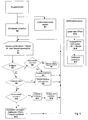
- Fig. 1 shows a schematic flow diagram of an embodiment of the method according to the invention for controlling the access to an application program running on a computer or a computer network.
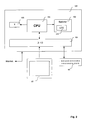
- the computer may be a general-purpose computer, as illustrated schematically in FIG. 2, for example.
- the computer 100 includes a central control unit (CPU) 104, a memory device 102 that may include both random access memory and read-only memory such as a hard disk or the like, and an I / O interface 101.
- the interface connects to input devices such as a keyboard 90, a mouse (not shown), voice input devices, or the like, as well as output devices such as a display 80.
- the computer 100 also connects to the Internet via the I / O interface or other communication networks.
- the computer 100 has a time control system 105 and a LOG memory 103, which is access-protected, for storing (later explained) revaluation identifiers.
- the invention is not limited to the configuration shown in FIG. 2, but is applicable to a variety of computer systems and networks having one or more CPUs.
- the invention serves to control access to an application program running on such a computer.
- This can be any program, such as a CAD program, a word processing program, an accounting program, and so on.
- the time window process is started in method step S1.
- the time window process knows two states, namely that the time window is "open” and "closed". If the time window is opened in the time window process, a counting process takes place over a defined period of time, which keeps open the time window for this predetermined time duration of, for example, 1 minute, 30 seconds, 2 minutes, etc., and closes again after the time has expired.
- the time window process is in Figure 1 on the right Side illustrated, wherein the time window is opened in step S15, then remains open for a predetermined period of time, for example, 1 minute in step S16 and is automatically closed in step S17 after the expiration time.
- step S2 the time window process is initialized, i. For example, the time window is closed.
- step S3 the access control system waits for a user event "B" or a control event "S".
- a user event is user input via, for example, the keyboard, mouse, voice control, or the like.
- Control events are control commands to the operating system or the operating system without user intervention.
- step S5 If a control event "S" occurs in the program flow, the timing system remains unaffected except when the end of the program is desired (step S5). In this case, the time window is closed and the program is terminated.
- step S8 If a user event "B” occurs, then it is detected in step S8 whether the time window process is in the "open” state, i.e., in the state "open”. if the time window is open. If so, the event is allowed and executed (step S9).
- step S10 If no time window is open, it is checked in step S10 whether a time credit is present. If this is not the case, then in step S11 the user is informed thereof and the user event is not executed (step S12).
- the credit is reduced by the time duration of the time window (in this example case 1 minute), the time window is opened and the user event is executed in method step S13.
- the time duration of the time window in this example case 1 minute
- Timing method Another advantage of the timing method is that when the time credit expires, only user events are inhibited and it is still possible to move the cursor over the screen, for example, or to terminate the program properly. As a result, when the time credit expires, the user does not feel that the computer has "crashed".
- the solution according to the invention is therefore characterized by a high level of user-friendliness.
- access to the application program can thus be controlled as a function of the time credit without affecting other applications of the computer and without having to transfer data from an external system, for example a server.
- the application program is automatically deactivated if no access-restricted user events are detected for a fixed period of time, for example five minutes.
- virtual access limited user events are generated at regular intervals when the application program performs a longer task, such as a calculation, which does not User intervention required. This ensures that program usage is properly deducted from time credit without user intervention.
- the current time credit and / or the state of the time window process is continuously displayed on the screen.
- a color code can be provided which indicates the state of the time window process.
- the display of a clock symbol for example, can be displayed in red when the time window is open and the time is subtracted from the time credit.
- FIG. 3 shows a schematic flow diagram of an embodiment of an upgrade procedure of the access control method according to the invention.
- a hardware identification for example a unique CPU or hard disk number of the computer system, on which the application program runs, is detected in method step S20.
- a user revaluation request is detected, for example the extension of the usage time by 20 hours.
- An encrypted request code is generated from the hardware ID and the user upgrade request and sent as an upgrade request signal to a revalidation site, for example the software manufacturer (step S22).
- the latter checks the revaluation request of the user or customer, for example, clears the amount of money for the additional 20 hours of use of the program from a designated account and in turn generates an encrypted response code containing the user's hardware ID and the time credit in encrypted form.
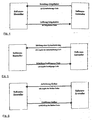
- the process of ordering and delivering the time credit is illustrated schematically in FIG. 4.
- step S24 in FIG. 3 the revaluation signal is decrypted and subsequently in step S25 the decrypted hardware ID is compared with the local hardware ID of the user system. If both identification numbers do not match, then the revaluation can not be made. This will ensure that the revaluation credit is due only to User who has made the request and from whose account the revaluation is debited.
- a unique identifier of this revaluation process is generated and stored in an access-secured LOG memory area 103 (FIG. 2) of the user computer.
- the revaluation ID already exists in the LOG memory. If this is the case (for example, because the user wanted to use the same upgrade signal twice), the revaluation in step S28 is denied. If the newly generated unique identifier is not found in the LOG memory, in step S29 the time credit of the user of the application program is revalued in accordance with the revaluation amount.
- the time credit is limited to the PC on which the time request code was created.
- a system change function may be provided, which is shown schematically in Fig. 5.
- a system change code a system change is encrypted to the upgrade point, i. for example, transmitted to the software manufacturer. This checks the request and sends a confirmation code that allows the user to transfer the time credit to a new PC with new hardware ID.
- time credit also services to the application program such as a hotline service.
- the user generates a hotline code via a "Create hotline code" function of access control.
- This code is generated, the customer will be deprived of the time credit by a contractually agreed value.
- the user can then contact the application support (hotline) of the software manufacturer and notifies the hotline code. This will be checked by the software manufacturer and the hotline service will be granted upon successful examination.
- Access to an application program can be controlled to the minute or second accuracy according to the actual active use of the program and billed using the time credit.
- a program that is only open or not actively used does not burden the time credit.
- no access to the Internet is required, as a result of which the availability of the program application does not depend on the availability of the Internet connection. Dangers of viruses or the like can be excluded.
- Access control to the application program does not affect the operability of the operating system or other application programs of the computer.
- a secure evaluation procedure of the time credit enables a safe usage billing of the program usage over longer periods of time.
Landscapes
- Engineering & Computer Science (AREA)
- Software Systems (AREA)
- Theoretical Computer Science (AREA)
- Computer Security & Cryptography (AREA)
- Multimedia (AREA)
- Computer Hardware Design (AREA)
- Physics & Mathematics (AREA)
- General Engineering & Computer Science (AREA)
- General Physics & Mathematics (AREA)
- Technology Law (AREA)
- Storage Device Security (AREA)
- Data Exchanges In Wide-Area Networks (AREA)
- Circuits Of Receivers In General (AREA)
Claims (18)
- Procédé pour commander l'accès à un programme d'application se déroulant sur un ordinateur ou un réseau d'ordinateur, comportant les étapes de :- démarrage du programme d'application,- initialisation d'un processus de fenêtre temporelle, lequel processus peut comprendre les états « ouvert » et « fermé », où après l'ouverture de la fenêtre temporelle celle-ci, après le déroulement d'une unité de temps définie, revient automatiquement dans l'état « fermé »,- enregistrement d'un événement utilisateur sur le programme d'application et enregistrement de l'état dans lequel se trouve le processus de fenêtre temporelle,- lorsque l'état du processus de fenêtre temporelle est « ouvert », exécution de l'événement utilisateur,- lorsque l'état du processus de fenêtre est « fermé », vérification si un crédit de temps associé au programme d'application est supérieur à une valeur seuil définie,- si c'est le cas, modification du processus de fenêtre temporelle pour passer dans l'état « ouvert » et exécution de l'événement utilisateur,- si ce n'est pas le cas, non exécution de l'événement utilisateur.
- Procédé selon la revendication 1, dans lequel les événements utilisateur sont une entrée au clavier ou un clic de souris par l'utilisateur.
- Procédé selon la revendication 1 ou 2, dans lequel les instructions de commande du système d'exploitation ne sont pas des événements utilisateur.
- Procédé selon l'une des revendications 1 à 3, dans lequel l'unité de temps définie de l'état « ouvert » de la fenêtre temporelle est d'une minute.
- Procédé selon l'une des revendications 1 à 4, dans lequel l'étape d'initialisation du processus de fenêtre temporelle comprend l'établissement de la fenêtre temporelle dans l'état de début « fermé ».
- Procédé selon l'une des revendications 1 à 5, comprenant l'étape de procédé de communication et d'invitation de l'utilisateur à remplir le crédit de temps une fois qu'il a été enregistré que le crédit de temps associé au programme d'application ne dépasse pas la valeur seuil définie.
- Procédé selon l'une des revendications 1 à 6, dans lequel la valeur seuil définie du crédit de temps est nulle.
- Procédé selon l'une des revendications 1 à 7, comprenant l'étape de procédé de simulation d'un événement utilisateur dans le cas d'un déroulement de programme du programme d'application plus long sans intervention utilisateur.
- Procédé selon l'une des revendications 1 à 8, dans lequel le programme d'application peut être désactivé de façon manuelle.
- Procédé selon l'une des revendications 1 à 8, comportant l'étape de désactivation automatique du programme d'application lorsque pour un intervalle de temps défini il n'a pas été enregistré d'événements utilisateur limités en accès.
- Procédé selon l'une des revendications 1 à 10, dans lequel le crédit de temps et/ou l'état du processus de fenêtre temporelle est affiché sur l'écran.
- Procédé selon l'une des revendications 1 à 11, comportant la procédure de valorisation du crédit de temps comprenant les étapes de :- enregistrement d'une identification en rapport avec le matériel de l'ordinateur ou du réseau d'ordinateur,- enregistrement d'une requête de valorisation utilisateur,- génération d'un signal de requête de valorisation crypté contenant l'identification en rapport avec le matériel et la requête de valorisation utilisateur,- envoi du signal de requête de valorisation crypté à un point de valorisation,- réception et décryptage d'un signal de valorisation crypté contenant une quantité de valorisation ainsi qu'une identification en rapport avec le matériel,- vérification pour déterminer si l'identification en rapport avec le matériel reçue et décryptée concorde avec l'identification en rapport avec le matériel de l'ordinateur, et- valorisation du crédit de temps en correspondance avec la quantité de valorisation.
- Procédé selon la revendication 12, dans lequel l'étape de valorisation du crédit de temps comprend l'étape d'extraction de la mémoire d'un identificateur sans équivoque de l'opération de valorisation sur une unité de mémoire protégée en accès et de vérification de l'unité de mémoire pour vérifier si cet identificateur sans équivoque est déjà stocké ou non.
- Procédé selon la revendication 12 ou 13, dans lequel l'identification en rapport avec le matériel est un identificateur de la CPU ou du disque dur de l'ordinateur.
- Procédé selon l'une des revendications 1 à 14, lequel comprend l'enregistrement et l'actualisation de plusieurs crédits de temps pour plusieurs utilisateurs sur un ordinateur individuel ou un réseau d'ordinateur.
- Procédé selon l'une des revendications 1 à 15, dans lequel le crédit de temps est utilisé également pour la facturation de services d'assistance en ligne.
- Produit de programme ordinateur contenant un code de programme lisible par ordinateur, lequel, lorsque le programme est déroulé sur un ordinateur, exécute les étapes de procédé selon l'une des revendications 1 à 16.
- Système ordinateur (100) comportant une unité de traitement centrale (104), une mémoire de travail (102), une mémoire morte (102), un dispositif d'affichage (80) ainsi qu'un moyen d'entrée (90), dans lequel un programme d'ordinateur est chargé dans la mémoire de travail, lequel comprend des codes de programme lisibles par ordinateur qui, lorsque le programme est déroulé sur l'ordinateur, exécutent les étapes de procédé selon l'une des revendications 1 à 16.
Priority Applications (1)
| Application Number | Priority Date | Filing Date | Title |
|---|---|---|---|
| EP05104691A EP1632834B1 (fr) | 2004-09-01 | 2005-05-31 | Méthode de contrôle d'accès à un programme d'application |
Applications Claiming Priority (2)
| Application Number | Priority Date | Filing Date | Title |
|---|---|---|---|
| EP04020791 | 2004-09-01 | ||
| EP05104691A EP1632834B1 (fr) | 2004-09-01 | 2005-05-31 | Méthode de contrôle d'accès à un programme d'application |
Publications (3)
| Publication Number | Publication Date |
|---|---|
| EP1632834A2 EP1632834A2 (fr) | 2006-03-08 |
| EP1632834A3 EP1632834A3 (fr) | 2006-05-24 |
| EP1632834B1 true EP1632834B1 (fr) | 2007-11-07 |
Family
ID=34926388
Family Applications (1)
| Application Number | Title | Priority Date | Filing Date |
|---|---|---|---|
| EP05104691A Expired - Lifetime EP1632834B1 (fr) | 2004-09-01 | 2005-05-31 | Méthode de contrôle d'accès à un programme d'application |
Country Status (3)
| Country | Link |
|---|---|
| EP (1) | EP1632834B1 (fr) |
| AT (1) | ATE377800T1 (fr) |
| DE (1) | DE502005001865D1 (fr) |
Families Citing this family (2)
| Publication number | Priority date | Publication date | Assignee | Title |
|---|---|---|---|---|
| US20020019814A1 (en) * | 2001-03-01 | 2002-02-14 | Krishnamurthy Ganesan | Specifying rights in a digital rights license according to events |
| CN109525552B (zh) * | 2018-10-11 | 2021-08-31 | 平安科技(深圳)有限公司 | 动态码同步进程扩容方法、动态码生成器及存储介质 |
Family Cites Families (7)
| Publication number | Priority date | Publication date | Assignee | Title |
|---|---|---|---|---|
| US4658093A (en) * | 1983-07-11 | 1987-04-14 | Hellman Martin E | Software distribution system |
| JP2810033B2 (ja) * | 1996-07-08 | 1998-10-15 | 村越 弘昌 | 稼働管理システム及び稼働管理方法 |
| CA2313839A1 (fr) * | 1999-07-27 | 2001-01-27 | Lucent Technologies Inc. | Methode de controle de l'usage d'une version executable d'une copie de demonstration d'un logiciel d'evaluation |
| US20020120726A1 (en) * | 2001-02-23 | 2002-08-29 | Microsoft Corporation | Method and system for providing a software license via the telephone |
| US20020144124A1 (en) * | 2001-03-12 | 2002-10-03 | Remer Eric B. | Method and apparatus to monitor use of a program |
| GB2378529A (en) * | 2001-05-09 | 2003-02-12 | Sysmedia Ltd | Pay per use software |
| WO2003038570A2 (fr) * | 2001-10-30 | 2003-05-08 | International Business Machines Corporation | Procede et systeme informatiques permettant de reguler l'utilisation de produits a codage numerique |
-
2005
- 2005-05-31 AT AT05104691T patent/ATE377800T1/de active
- 2005-05-31 EP EP05104691A patent/EP1632834B1/fr not_active Expired - Lifetime
- 2005-05-31 DE DE502005001865T patent/DE502005001865D1/de not_active Expired - Lifetime
Also Published As
| Publication number | Publication date |
|---|---|
| DE502005001865D1 (de) | 2007-12-20 |
| ATE377800T1 (de) | 2007-11-15 |
| EP1632834A3 (fr) | 2006-05-24 |
| EP1632834A2 (fr) | 2006-03-08 |
Similar Documents
| Publication | Publication Date | Title |
|---|---|---|
| EP3563279B1 (fr) | Procédé et ordinateur de protection cryptographique de communication de commande dans et/ou d'accès de service à des systèmes it, en particulier en rapport avec le diagnostic et la configuration dans un système d'automatisation, de commande ou de contrôle | |
| EP0689170B1 (fr) | Procédé d'adaption du fichier de données entre une machine à affranchir et un centre de données | |
| EP2255516B1 (fr) | Procédé permettant une personnalisation temporaire d'un dispositif de communication | |
| DE10296511T5 (de) | Verfahren und Einrichtung zum Überwachen der Benutzung eines Programms | |
| WO2008095866A2 (fr) | Procédé pour autoriser l'accès à au moins un élément d'automatisation d'une installation technique | |
| DE102008046639A1 (de) | Serversystem und Verfahren zur Bereitstellung mindestens einer Leistung | |
| DE60212969T2 (de) | Verfahren und vorrichtung zum verfolgen des status eines betriebsmittels in einem system zur verwaltung der benutzung der betriebsmittel | |
| CH705781A1 (de) | Benutzerrechteverwaltung und Zugangskontrollsystem mit Zeitbeschränkung. | |
| DE10255730A1 (de) | Kraftstoff-Zapfstation | |
| EP3825880B1 (fr) | Remise à zéro protégée d'un appareil ido | |
| DE112013002539T5 (de) | Validierung mobiler Einheiten | |
| WO2006125404A1 (fr) | Procede pour regler un appareil de terrain electrique | |
| EP1632834B1 (fr) | Méthode de contrôle d'accès à un programme d'application | |
| DE102012220767A1 (de) | Verfahren und Vorrichtungen zum Installieren von Gebäudesteuerungssoftware | |
| EP1010052B1 (fr) | Procede de commande de distribution et d'utilisation de produits logiciels dans le cas d'ordinateurs relies au reseau | |
| DE102015101523A1 (de) | Verfahren zur Berechtigungsverwaltung in einer Anordnung mit mehreren Rechensystemen | |
| EP2742495B1 (fr) | Machine à laver et procédé de gestion d'une machine à laver | |
| EP3902759A1 (fr) | Procédé et dispositif de mise en service d'une installation de transport de personnes | |
| EP1035706A2 (fr) | Procedé pour connecter au moins deux segments d' un réseau a un côntroleur d' accès par le moyen d' un identificateur d' usager | |
| EP4022404B1 (fr) | Système et procédé d'administration de composants d'entraînement | |
| EP4455919A1 (fr) | Contrôle d'une communication d'un dispositif dans une architecture sans confiance | |
| EP1685471A1 (fr) | Periode individuelle de validite pour mot de passe, nip et phrase passe | |
| DE60205176T2 (de) | Vorrichtung und Verfahren zur Benutzerauthentisierung | |
| DE102011111698A1 (de) | Verfahren zum Log-in an einem Computersystem sowie Computerprogramm zum Ablauf auf einem Computersystem | |
| EP4624234A1 (fr) | Procédure de documentation des opérations effectuées à une station de recharge |
Legal Events
| Date | Code | Title | Description |
|---|---|---|---|
| PUAI | Public reference made under article 153(3) epc to a published international application that has entered the european phase |
Free format text: ORIGINAL CODE: 0009012 |
|
| AK | Designated contracting states |
Kind code of ref document: A2 Designated state(s): AT BE BG CH CY CZ DE DK EE ES FI FR GB GR HU IE IS IT LI LT LU MC NL PL PT RO SE SI SK TR |
|
| AX | Request for extension of the european patent |
Extension state: AL BA HR LV MK YU |
|
| PUAL | Search report despatched |
Free format text: ORIGINAL CODE: 0009013 |
|
| AK | Designated contracting states |
Kind code of ref document: A3 Designated state(s): AT BE BG CH CY CZ DE DK EE ES FI FR GB GR HU IE IS IT LI LT LU MC NL PL PT RO SE SI SK TR |
|
| AX | Request for extension of the european patent |
Extension state: AL BA HR LV MK YU |
|
| 17P | Request for examination filed |
Effective date: 20060517 |
|
| RIC1 | Information provided on ipc code assigned before grant |
Ipc: G06F 21/22 20060101AFI20060727BHEP |
|
| AKX | Designation fees paid |
Designated state(s): AT BE BG CH CY CZ DE DK EE ES FI FR GB GR HU IE IS IT LI LT LU MC NL PL PT RO SE SI SK TR |
|
| GRAP | Despatch of communication of intention to grant a patent |
Free format text: ORIGINAL CODE: EPIDOSNIGR1 |
|
| GRAS | Grant fee paid |
Free format text: ORIGINAL CODE: EPIDOSNIGR3 |
|
| GRAA | (expected) grant |
Free format text: ORIGINAL CODE: 0009210 |
|
| AK | Designated contracting states |
Kind code of ref document: B1 Designated state(s): AT BE BG CH CY CZ DE DK EE ES FI FR GB GR HU IE IS IT LI LT LU MC NL PL PT RO SE SI SK TR |
|
| REG | Reference to a national code |
Ref country code: GB Ref legal event code: FG4D Free format text: NOT ENGLISH |
|
| REG | Reference to a national code |
Ref country code: IE Ref legal event code: FG4D Free format text: LANGUAGE OF EP DOCUMENT: GERMAN |
|
| REG | Reference to a national code |
Ref country code: CH Ref legal event code: NV Representative=s name: SCHMAUDER & PARTNER AG PATENTANWALTSBUERO Ref country code: CH Ref legal event code: EP |
|
| REF | Corresponds to: |
Ref document number: 502005001865 Country of ref document: DE Date of ref document: 20071220 Kind code of ref document: P |
|
| GBT | Gb: translation of ep patent filed (gb section 77(6)(a)/1977) |
Effective date: 20080111 |
|
| PG25 | Lapsed in a contracting state [announced via postgrant information from national office to epo] |
Ref country code: NL Free format text: LAPSE BECAUSE OF FAILURE TO SUBMIT A TRANSLATION OF THE DESCRIPTION OR TO PAY THE FEE WITHIN THE PRESCRIBED TIME-LIMIT Effective date: 20071107 Ref country code: SE Free format text: LAPSE BECAUSE OF FAILURE TO SUBMIT A TRANSLATION OF THE DESCRIPTION OR TO PAY THE FEE WITHIN THE PRESCRIBED TIME-LIMIT Effective date: 20080207 Ref country code: ES Free format text: LAPSE BECAUSE OF FAILURE TO SUBMIT A TRANSLATION OF THE DESCRIPTION OR TO PAY THE FEE WITHIN THE PRESCRIBED TIME-LIMIT Effective date: 20080218 |
|
| NLV1 | Nl: lapsed or annulled due to failure to fulfill the requirements of art. 29p and 29m of the patents act | ||
| PG25 | Lapsed in a contracting state [announced via postgrant information from national office to epo] |
Ref country code: LT Free format text: LAPSE BECAUSE OF FAILURE TO SUBMIT A TRANSLATION OF THE DESCRIPTION OR TO PAY THE FEE WITHIN THE PRESCRIBED TIME-LIMIT Effective date: 20071107 Ref country code: BG Free format text: LAPSE BECAUSE OF FAILURE TO SUBMIT A TRANSLATION OF THE DESCRIPTION OR TO PAY THE FEE WITHIN THE PRESCRIBED TIME-LIMIT Effective date: 20080207 Ref country code: PL Free format text: LAPSE BECAUSE OF FAILURE TO SUBMIT A TRANSLATION OF THE DESCRIPTION OR TO PAY THE FEE WITHIN THE PRESCRIBED TIME-LIMIT Effective date: 20071107 Ref country code: IS Free format text: LAPSE BECAUSE OF FAILURE TO SUBMIT A TRANSLATION OF THE DESCRIPTION OR TO PAY THE FEE WITHIN THE PRESCRIBED TIME-LIMIT Effective date: 20080307 Ref country code: SI Free format text: LAPSE BECAUSE OF FAILURE TO SUBMIT A TRANSLATION OF THE DESCRIPTION OR TO PAY THE FEE WITHIN THE PRESCRIBED TIME-LIMIT Effective date: 20071107 |
|
| ET | Fr: translation filed | ||
| PG25 | Lapsed in a contracting state [announced via postgrant information from national office to epo] |
Ref country code: DK Free format text: LAPSE BECAUSE OF FAILURE TO SUBMIT A TRANSLATION OF THE DESCRIPTION OR TO PAY THE FEE WITHIN THE PRESCRIBED TIME-LIMIT Effective date: 20071107 Ref country code: CZ Free format text: LAPSE BECAUSE OF FAILURE TO SUBMIT A TRANSLATION OF THE DESCRIPTION OR TO PAY THE FEE WITHIN THE PRESCRIBED TIME-LIMIT Effective date: 20071107 |
|
| PG25 | Lapsed in a contracting state [announced via postgrant information from national office to epo] |
Ref country code: SK Free format text: LAPSE BECAUSE OF FAILURE TO SUBMIT A TRANSLATION OF THE DESCRIPTION OR TO PAY THE FEE WITHIN THE PRESCRIBED TIME-LIMIT Effective date: 20071107 Ref country code: RO Free format text: LAPSE BECAUSE OF FAILURE TO SUBMIT A TRANSLATION OF THE DESCRIPTION OR TO PAY THE FEE WITHIN THE PRESCRIBED TIME-LIMIT Effective date: 20071107 |
|
| PLBE | No opposition filed within time limit |
Free format text: ORIGINAL CODE: 0009261 |
|
| STAA | Information on the status of an ep patent application or granted ep patent |
Free format text: STATUS: NO OPPOSITION FILED WITHIN TIME LIMIT |
|
| PG25 | Lapsed in a contracting state [announced via postgrant information from national office to epo] |
Ref country code: PT Free format text: LAPSE BECAUSE OF FAILURE TO SUBMIT A TRANSLATION OF THE DESCRIPTION OR TO PAY THE FEE WITHIN THE PRESCRIBED TIME-LIMIT Effective date: 20080407 |
|
| 26N | No opposition filed |
Effective date: 20080808 |
|
| PG25 | Lapsed in a contracting state [announced via postgrant information from national office to epo] |
Ref country code: MC Free format text: LAPSE BECAUSE OF NON-PAYMENT OF DUE FEES Effective date: 20080531 |
|
| PG25 | Lapsed in a contracting state [announced via postgrant information from national office to epo] |
Ref country code: GR Free format text: LAPSE BECAUSE OF FAILURE TO SUBMIT A TRANSLATION OF THE DESCRIPTION OR TO PAY THE FEE WITHIN THE PRESCRIBED TIME-LIMIT Effective date: 20080208 |
|
| PG25 | Lapsed in a contracting state [announced via postgrant information from national office to epo] |
Ref country code: FI Free format text: LAPSE BECAUSE OF FAILURE TO SUBMIT A TRANSLATION OF THE DESCRIPTION OR TO PAY THE FEE WITHIN THE PRESCRIBED TIME-LIMIT Effective date: 20071107 |
|
| PG25 | Lapsed in a contracting state [announced via postgrant information from national office to epo] |
Ref country code: EE Free format text: LAPSE BECAUSE OF FAILURE TO SUBMIT A TRANSLATION OF THE DESCRIPTION OR TO PAY THE FEE WITHIN THE PRESCRIBED TIME-LIMIT Effective date: 20071107 |
|
| PG25 | Lapsed in a contracting state [announced via postgrant information from national office to epo] |
Ref country code: CY Free format text: LAPSE BECAUSE OF FAILURE TO SUBMIT A TRANSLATION OF THE DESCRIPTION OR TO PAY THE FEE WITHIN THE PRESCRIBED TIME-LIMIT Effective date: 20071107 |
|
| REG | Reference to a national code |
Ref country code: CH Ref legal event code: PCAR Free format text: SCHMAUDER & PARTNER AG PATENT- UND MARKENANWAELTE VSP;ZWAENGIWEG 7;8038 ZUERICH (CH) |
|
| PG25 | Lapsed in a contracting state [announced via postgrant information from national office to epo] |
Ref country code: LU Free format text: LAPSE BECAUSE OF NON-PAYMENT OF DUE FEES Effective date: 20080531 Ref country code: HU Free format text: LAPSE BECAUSE OF FAILURE TO SUBMIT A TRANSLATION OF THE DESCRIPTION OR TO PAY THE FEE WITHIN THE PRESCRIBED TIME-LIMIT Effective date: 20080508 |
|
| PG25 | Lapsed in a contracting state [announced via postgrant information from national office to epo] |
Ref country code: TR Free format text: LAPSE BECAUSE OF FAILURE TO SUBMIT A TRANSLATION OF THE DESCRIPTION OR TO PAY THE FEE WITHIN THE PRESCRIBED TIME-LIMIT Effective date: 20071107 |
|
| PG25 | Lapsed in a contracting state [announced via postgrant information from national office to epo] |
Ref country code: IT Free format text: LAPSE BECAUSE OF NON-PAYMENT OF DUE FEES Effective date: 20080531 |
|
| REG | Reference to a national code |
Ref country code: FR Ref legal event code: PLFP Year of fee payment: 12 |
|
| REG | Reference to a national code |
Ref country code: FR Ref legal event code: PLFP Year of fee payment: 13 |
|
| REG | Reference to a national code |
Ref country code: FR Ref legal event code: PLFP Year of fee payment: 14 |
|
| P01 | Opt-out of the competence of the unified patent court (upc) registered |
Effective date: 20230522 |
|
| PGFP | Annual fee paid to national office [announced via postgrant information from national office to epo] |
Ref country code: IE Payment date: 20240517 Year of fee payment: 20 |
|
| PGFP | Annual fee paid to national office [announced via postgrant information from national office to epo] |
Ref country code: GB Payment date: 20240522 Year of fee payment: 20 |
|
| PGFP | Annual fee paid to national office [announced via postgrant information from national office to epo] |
Ref country code: DE Payment date: 20240529 Year of fee payment: 20 |
|
| PGFP | Annual fee paid to national office [announced via postgrant information from national office to epo] |
Ref country code: CH Payment date: 20240602 Year of fee payment: 20 |
|
| PGFP | Annual fee paid to national office [announced via postgrant information from national office to epo] |
Ref country code: AT Payment date: 20240517 Year of fee payment: 20 |
|
| PGFP | Annual fee paid to national office [announced via postgrant information from national office to epo] |
Ref country code: FR Payment date: 20240522 Year of fee payment: 20 |
|
| PGFP | Annual fee paid to national office [announced via postgrant information from national office to epo] |
Ref country code: BE Payment date: 20240521 Year of fee payment: 20 |
|
| REG | Reference to a national code |
Ref country code: DE Ref legal event code: R071 Ref document number: 502005001865 Country of ref document: DE |
|
| REG | Reference to a national code |
Ref country code: CH Ref legal event code: PL |
|
| REG | Reference to a national code |
Ref country code: GB Ref legal event code: PE20 Expiry date: 20250530 |
|
| REG | Reference to a national code |
Ref country code: IE Ref legal event code: MK9A |
|
| PG25 | Lapsed in a contracting state [announced via postgrant information from national office to epo] |
Ref country code: GB Free format text: LAPSE BECAUSE OF EXPIRATION OF PROTECTION Effective date: 20250530 |
|
| REG | Reference to a national code |
Ref country code: AT Ref legal event code: MK07 Ref document number: 377800 Country of ref document: AT Kind code of ref document: T Effective date: 20250531 |
|
| REG | Reference to a national code |
Ref country code: BE Ref legal event code: MK Effective date: 20250531 |
|
| PG25 | Lapsed in a contracting state [announced via postgrant information from national office to epo] |
Ref country code: IE Free format text: LAPSE BECAUSE OF EXPIRATION OF PROTECTION Effective date: 20250531 |