EP1632523A1 - Pasty heat-expandable filler composition and method of sound insulation by filling closed section of car body member - Google Patents
Pasty heat-expandable filler composition and method of sound insulation by filling closed section of car body member Download PDFInfo
- Publication number
- EP1632523A1 EP1632523A1 EP04735799A EP04735799A EP1632523A1 EP 1632523 A1 EP1632523 A1 EP 1632523A1 EP 04735799 A EP04735799 A EP 04735799A EP 04735799 A EP04735799 A EP 04735799A EP 1632523 A1 EP1632523 A1 EP 1632523A1
- Authority
- EP
- European Patent Office
- Prior art keywords
- injection composition
- weight
- blowing
- composition
- damming
- Prior art date
- Legal status (The legal status is an assumption and is not a legal conclusion. Google has not performed a legal analysis and makes no representation as to the accuracy of the status listed.)
- Granted
Links
- 239000000203 mixture Substances 0.000 title claims abstract description 192
- 238000000034 method Methods 0.000 title claims abstract description 19
- 238000009413 insulation Methods 0.000 title claims abstract description 12
- 238000011049 filling Methods 0.000 title description 5
- 239000000945 filler Substances 0.000 title description 3
- 235000011837 pasties Nutrition 0.000 title 1
- 238000002347 injection Methods 0.000 claims abstract description 141
- 239000007924 injection Substances 0.000 claims abstract description 141
- 238000007664 blowing Methods 0.000 claims abstract description 51
- 229920001971 elastomer Polymers 0.000 claims abstract description 50
- 239000005060 rubber Substances 0.000 claims abstract description 50
- 229920000647 polyepoxide Polymers 0.000 claims abstract description 39
- 239000003822 epoxy resin Substances 0.000 claims abstract description 38
- 239000003795 chemical substances by application Substances 0.000 claims abstract description 32
- 239000004014 plasticizer Substances 0.000 claims abstract description 30
- 229920005992 thermoplastic resin Polymers 0.000 claims abstract description 25
- 239000003431 cross linking reagent Substances 0.000 claims abstract description 19
- 239000004604 Blowing Agent Substances 0.000 claims abstract description 16
- 238000010438 heat treatment Methods 0.000 claims abstract description 15
- 238000007665 sagging Methods 0.000 claims abstract description 13
- 238000004519 manufacturing process Methods 0.000 claims abstract description 7
- 238000003466 welding Methods 0.000 claims abstract description 7
- 238000001879 gelation Methods 0.000 claims description 25
- 239000000463 material Substances 0.000 claims description 17
- 238000004070 electrodeposition Methods 0.000 claims description 14
- 239000011248 coating agent Substances 0.000 claims description 11
- 238000000576 coating method Methods 0.000 claims description 11
- 238000005187 foaming Methods 0.000 abstract description 9
- 238000000465 moulding Methods 0.000 abstract 1
- 238000001723 curing Methods 0.000 description 30
- 230000000052 comparative effect Effects 0.000 description 12
- 239000006260 foam Substances 0.000 description 11
- VTYYLEPIZMXCLO-UHFFFAOYSA-L Calcium carbonate Chemical compound [Ca+2].[O-]C([O-])=O VTYYLEPIZMXCLO-UHFFFAOYSA-L 0.000 description 10
- LNEPOXFFQSENCJ-UHFFFAOYSA-N haloperidol Chemical compound C1CC(O)(C=2C=CC(Cl)=CC=2)CCN1CCCC(=O)C1=CC=C(F)C=C1 LNEPOXFFQSENCJ-UHFFFAOYSA-N 0.000 description 10
- 229920005989 resin Polymers 0.000 description 10
- 230000007423 decrease Effects 0.000 description 9
- 239000011347 resin Substances 0.000 description 9
- -1 ketone peroxides Chemical class 0.000 description 8
- 239000011324 bead Substances 0.000 description 7
- IISBACLAFKSPIT-UHFFFAOYSA-N bisphenol A Chemical compound C=1C=C(O)C=CC=1C(C)(C)C1=CC=C(O)C=C1 IISBACLAFKSPIT-UHFFFAOYSA-N 0.000 description 6
- 230000006399 behavior Effects 0.000 description 5
- 229910000019 calcium carbonate Inorganic materials 0.000 description 5
- 230000000694 effects Effects 0.000 description 5
- 229920003048 styrene butadiene rubber Polymers 0.000 description 5
- 229920000459 Nitrile rubber Polymers 0.000 description 4
- 239000005062 Polybutadiene Substances 0.000 description 4
- VYPSYNLAJGMNEJ-UHFFFAOYSA-N Silicium dioxide Chemical compound O=[Si]=O VYPSYNLAJGMNEJ-UHFFFAOYSA-N 0.000 description 4
- 239000002174 Styrene-butadiene Substances 0.000 description 4
- 229920001577 copolymer Polymers 0.000 description 4
- GYZLOYUZLJXAJU-UHFFFAOYSA-N diglycidyl ether Chemical compound C1OC1COCC1CO1 GYZLOYUZLJXAJU-UHFFFAOYSA-N 0.000 description 4
- 238000009472 formulation Methods 0.000 description 4
- 239000011256 inorganic filler Substances 0.000 description 4
- 229910003475 inorganic filler Inorganic materials 0.000 description 4
- 238000012423 maintenance Methods 0.000 description 4
- 229920002857 polybutadiene Polymers 0.000 description 4
- 229910019142 PO4 Inorganic materials 0.000 description 3
- 239000000654 additive Substances 0.000 description 3
- 125000001931 aliphatic group Chemical group 0.000 description 3
- 230000015572 biosynthetic process Effects 0.000 description 3
- 239000006229 carbon black Substances 0.000 description 3
- 238000004132 cross linking Methods 0.000 description 3
- QGBSISYHAICWAH-UHFFFAOYSA-N dicyandiamide Chemical compound NC(N)=NC#N QGBSISYHAICWAH-UHFFFAOYSA-N 0.000 description 3
- HBGGXOJOCNVPFY-UHFFFAOYSA-N diisononyl phthalate Chemical compound CC(C)CCCCCCOC(=O)C1=CC=CC=C1C(=O)OCCCCCCC(C)C HBGGXOJOCNVPFY-UHFFFAOYSA-N 0.000 description 3
- 229920003049 isoprene rubber Polymers 0.000 description 3
- 239000007788 liquid Substances 0.000 description 3
- 229910052751 metal Inorganic materials 0.000 description 3
- 239000002184 metal Substances 0.000 description 3
- 235000021317 phosphate Nutrition 0.000 description 3
- 239000000049 pigment Substances 0.000 description 3
- 239000013008 thixotropic agent Substances 0.000 description 3
- MYRTYDVEIRVNKP-UHFFFAOYSA-N 1,2-Divinylbenzene Chemical compound C=CC1=CC=CC=C1C=C MYRTYDVEIRVNKP-UHFFFAOYSA-N 0.000 description 2
- 239000004925 Acrylic resin Substances 0.000 description 2
- 229920000178 Acrylic resin Polymers 0.000 description 2
- 239000004156 Azodicarbonamide Substances 0.000 description 2
- 229930185605 Bisphenol Natural products 0.000 description 2
- IRIAEXORFWYRCZ-UHFFFAOYSA-N Butylbenzyl phthalate Chemical compound CCCCOC(=O)C1=CC=CC=C1C(=O)OCC1=CC=CC=C1 IRIAEXORFWYRCZ-UHFFFAOYSA-N 0.000 description 2
- SOGAXMICEFXMKE-UHFFFAOYSA-N Butylmethacrylate Chemical compound CCCCOC(=O)C(C)=C SOGAXMICEFXMKE-UHFFFAOYSA-N 0.000 description 2
- OYPRJOBELJOOCE-UHFFFAOYSA-N Calcium Chemical compound [Ca] OYPRJOBELJOOCE-UHFFFAOYSA-N 0.000 description 2
- 102100035474 DNA polymerase kappa Human genes 0.000 description 2
- 101710108091 DNA polymerase kappa Proteins 0.000 description 2
- LYCAIKOWRPUZTN-UHFFFAOYSA-N Ethylene glycol Chemical compound OCCO LYCAIKOWRPUZTN-UHFFFAOYSA-N 0.000 description 2
- BAPJBEWLBFYGME-UHFFFAOYSA-N Methyl acrylate Chemical compound COC(=O)C=C BAPJBEWLBFYGME-UHFFFAOYSA-N 0.000 description 2
- 229920000297 Rayon Polymers 0.000 description 2
- XSQUKJJJFZCRTK-UHFFFAOYSA-N Urea Chemical compound NC(N)=O XSQUKJJJFZCRTK-UHFFFAOYSA-N 0.000 description 2
- 229920000122 acrylonitrile butadiene styrene Polymers 0.000 description 2
- 229920001893 acrylonitrile styrene Polymers 0.000 description 2
- 230000000996 additive effect Effects 0.000 description 2
- 125000005250 alkyl acrylate group Chemical group 0.000 description 2
- 238000004458 analytical method Methods 0.000 description 2
- XOZUGNYVDXMRKW-AATRIKPKSA-N azodicarbonamide Chemical compound NC(=O)\N=N\C(N)=O XOZUGNYVDXMRKW-AATRIKPKSA-N 0.000 description 2
- 235000019399 azodicarbonamide Nutrition 0.000 description 2
- BJQHLKABXJIVAM-UHFFFAOYSA-N bis(2-ethylhexyl) phthalate Chemical compound CCCCC(CC)COC(=O)C1=CC=CC=C1C(=O)OCC(CC)CCCC BJQHLKABXJIVAM-UHFFFAOYSA-N 0.000 description 2
- PXKLMJQFEQBVLD-UHFFFAOYSA-N bisphenol F Chemical compound C1=CC(O)=CC=C1CC1=CC=C(O)C=C1 PXKLMJQFEQBVLD-UHFFFAOYSA-N 0.000 description 2
- 229910052791 calcium Inorganic materials 0.000 description 2
- 239000011575 calcium Substances 0.000 description 2
- BRPQOXSCLDDYGP-UHFFFAOYSA-N calcium oxide Chemical compound [O-2].[Ca+2] BRPQOXSCLDDYGP-UHFFFAOYSA-N 0.000 description 2
- 239000000292 calcium oxide Substances 0.000 description 2
- ODINCKMPIJJUCX-UHFFFAOYSA-N calcium oxide Inorganic materials [Ca]=O ODINCKMPIJJUCX-UHFFFAOYSA-N 0.000 description 2
- 239000004202 carbamide Substances 0.000 description 2
- 239000007795 chemical reaction product Substances 0.000 description 2
- 229920003244 diene elastomer Polymers 0.000 description 2
- JQCXWCOOWVGKMT-UHFFFAOYSA-N diheptyl phthalate Chemical compound CCCCCCCOC(=O)C1=CC=CC=C1C(=O)OCCCCCCC JQCXWCOOWVGKMT-UHFFFAOYSA-N 0.000 description 2
- 150000002118 epoxides Chemical class 0.000 description 2
- 150000002148 esters Chemical class 0.000 description 2
- 239000000499 gel Substances 0.000 description 2
- 238000005259 measurement Methods 0.000 description 2
- 239000002245 particle Substances 0.000 description 2
- NBIIXXVUZAFLBC-UHFFFAOYSA-K phosphate Chemical compound [O-]P([O-])([O-])=O NBIIXXVUZAFLBC-UHFFFAOYSA-K 0.000 description 2
- 239000010452 phosphate Substances 0.000 description 2
- 239000000843 powder Substances 0.000 description 2
- 238000002360 preparation method Methods 0.000 description 2
- SCUZVMOVTVSBLE-UHFFFAOYSA-N prop-2-enenitrile;styrene Chemical compound C=CC#N.C=CC1=CC=CC=C1 SCUZVMOVTVSBLE-UHFFFAOYSA-N 0.000 description 2
- YJTKZCDBKVTVBY-UHFFFAOYSA-N 1,3-Diphenylbenzene Chemical class C1=CC=CC=C1C1=CC=CC(C=2C=CC=CC=2)=C1 YJTKZCDBKVTVBY-UHFFFAOYSA-N 0.000 description 1
- GOXQRTZXKQZDDN-UHFFFAOYSA-N 2-Ethylhexyl acrylate Chemical compound CCCCC(CC)COC(=O)C=C GOXQRTZXKQZDDN-UHFFFAOYSA-N 0.000 description 1
- XFDQLDNQZFOAFK-UHFFFAOYSA-N 2-benzoyloxyethyl benzoate Chemical compound C=1C=CC=CC=1C(=O)OCCOC(=O)C1=CC=CC=C1 XFDQLDNQZFOAFK-UHFFFAOYSA-N 0.000 description 1
- YTWBFUCJVWKCCK-UHFFFAOYSA-N 2-heptadecyl-1h-imidazole Chemical compound CCCCCCCCCCCCCCCCCC1=NC=CN1 YTWBFUCJVWKCCK-UHFFFAOYSA-N 0.000 description 1
- UPMLOUAZCHDJJD-UHFFFAOYSA-N 4,4'-Diphenylmethane Diisocyanate Chemical compound C1=CC(N=C=O)=CC=C1CC1=CC=C(N=C=O)C=C1 UPMLOUAZCHDJJD-UHFFFAOYSA-N 0.000 description 1
- GZVHEAJQGPRDLQ-UHFFFAOYSA-N 6-phenyl-1,3,5-triazine-2,4-diamine Chemical compound NC1=NC(N)=NC(C=2C=CC=CC=2)=N1 GZVHEAJQGPRDLQ-UHFFFAOYSA-N 0.000 description 1
- 229920002126 Acrylic acid copolymer Polymers 0.000 description 1
- LCFVJGUPQDGYKZ-UHFFFAOYSA-N Bisphenol A diglycidyl ether Chemical compound C=1C=C(OCC2OC2)C=CC=1C(C)(C)C(C=C1)=CC=C1OCC1CO1 LCFVJGUPQDGYKZ-UHFFFAOYSA-N 0.000 description 1
- GOJCZVPJCKEBQV-UHFFFAOYSA-N Butyl phthalyl butylglycolate Chemical compound CCCCOC(=O)COC(=O)C1=CC=CC=C1C(=O)OCCCC GOJCZVPJCKEBQV-UHFFFAOYSA-N 0.000 description 1
- MQJKPEGWNLWLTK-UHFFFAOYSA-N Dapsone Chemical compound C1=CC(N)=CC=C1S(=O)(=O)C1=CC=C(N)C=C1 MQJKPEGWNLWLTK-UHFFFAOYSA-N 0.000 description 1
- ZVFDTKUVRCTHQE-UHFFFAOYSA-N Diisodecyl phthalate Chemical compound CC(C)CCCCCCCOC(=O)C1=CC=CC=C1C(=O)OCCCCCCCC(C)C ZVFDTKUVRCTHQE-UHFFFAOYSA-N 0.000 description 1
- MWRWFPQBGSZWNV-UHFFFAOYSA-N Dinitrosopentamethylenetetramine Chemical compound C1N2CN(N=O)CN1CN(N=O)C2 MWRWFPQBGSZWNV-UHFFFAOYSA-N 0.000 description 1
- 239000004593 Epoxy Substances 0.000 description 1
- JIGUQPWFLRLWPJ-UHFFFAOYSA-N Ethyl acrylate Chemical compound CCOC(=O)C=C JIGUQPWFLRLWPJ-UHFFFAOYSA-N 0.000 description 1
- JOYRKODLDBILNP-UHFFFAOYSA-N Ethyl urethane Chemical compound CCOC(N)=O JOYRKODLDBILNP-UHFFFAOYSA-N 0.000 description 1
- 244000043261 Hevea brasiliensis Species 0.000 description 1
- 229920009204 Methacrylate-butadiene-styrene Polymers 0.000 description 1
- VVQNEPGJFQJSBK-UHFFFAOYSA-N Methyl methacrylate Chemical compound COC(=O)C(C)=C VVQNEPGJFQJSBK-UHFFFAOYSA-N 0.000 description 1
- QSBINWBNXWAVAK-PSXMRANNSA-N PE-NMe(16:0/16:0) Chemical compound CCCCCCCCCCCCCCCC(=O)OC[C@H](COP(O)(=O)OCCNC)OC(=O)CCCCCCCCCCCCCCC QSBINWBNXWAVAK-PSXMRANNSA-N 0.000 description 1
- 229920003171 Poly (ethylene oxide) Polymers 0.000 description 1
- 229920005830 Polyurethane Foam Polymers 0.000 description 1
- 239000004902 Softening Agent Substances 0.000 description 1
- 229910000831 Steel Inorganic materials 0.000 description 1
- NINIDFKCEFEMDL-UHFFFAOYSA-N Sulfur Chemical compound [S] NINIDFKCEFEMDL-UHFFFAOYSA-N 0.000 description 1
- YSMRWXYRXBRSND-UHFFFAOYSA-N TOTP Chemical compound CC1=CC=CC=C1OP(=O)(OC=1C(=CC=CC=1)C)OC1=CC=CC=C1C YSMRWXYRXBRSND-UHFFFAOYSA-N 0.000 description 1
- GWEVSGVZZGPLCZ-UHFFFAOYSA-N Titan oxide Chemical compound O=[Ti]=O GWEVSGVZZGPLCZ-UHFFFAOYSA-N 0.000 description 1
- BZHJMEDXRYGGRV-UHFFFAOYSA-N Vinyl chloride Chemical compound ClC=C BZHJMEDXRYGGRV-UHFFFAOYSA-N 0.000 description 1
- NIXOWILDQLNWCW-UHFFFAOYSA-N acrylic acid group Chemical group C(C=C)(=O)O NIXOWILDQLNWCW-UHFFFAOYSA-N 0.000 description 1
- XECAHXYUAAWDEL-UHFFFAOYSA-N acrylonitrile butadiene styrene Chemical compound C=CC=C.C=CC#N.C=CC1=CC=CC=C1 XECAHXYUAAWDEL-UHFFFAOYSA-N 0.000 description 1
- 239000004676 acrylonitrile butadiene styrene Substances 0.000 description 1
- 229920001898 acrylonitrile–EPDM–styrene Polymers 0.000 description 1
- 230000002411 adverse Effects 0.000 description 1
- 125000002723 alicyclic group Chemical group 0.000 description 1
- 125000002947 alkylene group Chemical group 0.000 description 1
- CEGOLXSVJUTHNZ-UHFFFAOYSA-K aluminium tristearate Chemical compound [Al+3].CCCCCCCCCCCCCCCCCC([O-])=O.CCCCCCCCCCCCCCCCCC([O-])=O.CCCCCCCCCCCCCCCCCC([O-])=O CEGOLXSVJUTHNZ-UHFFFAOYSA-K 0.000 description 1
- 229940063655 aluminum stearate Drugs 0.000 description 1
- 125000003118 aryl group Chemical group 0.000 description 1
- 239000000440 bentonite Substances 0.000 description 1
- 229910000278 bentonite Inorganic materials 0.000 description 1
- SVPXDRXYRYOSEX-UHFFFAOYSA-N bentoquatam Chemical compound O.O=[Si]=O.O=[Al]O[Al]=O SVPXDRXYRYOSEX-UHFFFAOYSA-N 0.000 description 1
- 235000010290 biphenyl Nutrition 0.000 description 1
- 239000004305 biphenyl Substances 0.000 description 1
- 125000006267 biphenyl group Chemical class 0.000 description 1
- ZFMQKOWCDKKBIF-UHFFFAOYSA-N bis(3,5-difluorophenyl)phosphane Chemical compound FC1=CC(F)=CC(PC=2C=C(F)C=C(F)C=2)=C1 ZFMQKOWCDKKBIF-UHFFFAOYSA-N 0.000 description 1
- CQEYYJKEWSMYFG-UHFFFAOYSA-N butyl acrylate Chemical compound CCCCOC(=O)C=C CQEYYJKEWSMYFG-UHFFFAOYSA-N 0.000 description 1
- 150000001735 carboxylic acids Chemical class 0.000 description 1
- 210000004027 cell Anatomy 0.000 description 1
- 239000004927 clay Substances 0.000 description 1
- 229910052570 clay Inorganic materials 0.000 description 1
- 238000013329 compounding Methods 0.000 description 1
- 239000011243 crosslinked material Substances 0.000 description 1
- 230000003247 decreasing effect Effects 0.000 description 1
- 238000005238 degreasing Methods 0.000 description 1
- 239000012024 dehydrating agents Substances 0.000 description 1
- HCQHIEGYGGJLJU-UHFFFAOYSA-N didecyl hexanedioate Chemical compound CCCCCCCCCCOC(=O)CCCCC(=O)OCCCCCCCCCC HCQHIEGYGGJLJU-UHFFFAOYSA-N 0.000 description 1
- 238000000113 differential scanning calorimetry Methods 0.000 description 1
- 125000005442 diisocyanate group Chemical group 0.000 description 1
- DROMNWUQASBTFM-UHFFFAOYSA-N dinonyl benzene-1,2-dicarboxylate Chemical compound CCCCCCCCCOC(=O)C1=CC=CC=C1C(=O)OCCCCCCCCC DROMNWUQASBTFM-UHFFFAOYSA-N 0.000 description 1
- MIMDHDXOBDPUQW-UHFFFAOYSA-N dioctyl decanedioate Chemical compound CCCCCCCCOC(=O)CCCCCCCCC(=O)OCCCCCCCC MIMDHDXOBDPUQW-UHFFFAOYSA-N 0.000 description 1
- 238000007599 discharging Methods 0.000 description 1
- QQVHEQUEHCEAKS-UHFFFAOYSA-N diundecyl benzene-1,2-dicarboxylate Chemical compound CCCCCCCCCCCOC(=O)C1=CC=CC=C1C(=O)OCCCCCCCCCCC QQVHEQUEHCEAKS-UHFFFAOYSA-N 0.000 description 1
- GMSCBRSQMRDRCD-UHFFFAOYSA-N dodecyl 2-methylprop-2-enoate Chemical compound CCCCCCCCCCCCOC(=O)C(C)=C GMSCBRSQMRDRCD-UHFFFAOYSA-N 0.000 description 1
- 229940052296 esters of benzoic acid for local anesthesia Drugs 0.000 description 1
- SUPCQIBBMFXVTL-UHFFFAOYSA-N ethyl 2-methylprop-2-enoate Chemical compound CCOC(=O)C(C)=C SUPCQIBBMFXVTL-UHFFFAOYSA-N 0.000 description 1
- 239000010881 fly ash Substances 0.000 description 1
- 210000000497 foam cell Anatomy 0.000 description 1
- 229910021485 fumed silica Inorganic materials 0.000 description 1
- 125000003055 glycidyl group Chemical group C(C1CO1)* 0.000 description 1
- 239000004845 glycidylamine epoxy resin Substances 0.000 description 1
- 238000013007 heat curing Methods 0.000 description 1
- 150000002429 hydrazines Chemical class 0.000 description 1
- 229930195733 hydrocarbon Natural products 0.000 description 1
- 150000002430 hydrocarbons Chemical class 0.000 description 1
- 150000002432 hydroperoxides Chemical class 0.000 description 1
- WGCNASOHLSPBMP-UHFFFAOYSA-N hydroxyacetaldehyde Natural products OCC=O WGCNASOHLSPBMP-UHFFFAOYSA-N 0.000 description 1
- 150000002460 imidazoles Chemical class 0.000 description 1
- 239000001023 inorganic pigment Substances 0.000 description 1
- 229940079865 intestinal antiinfectives imidazole derivative Drugs 0.000 description 1
- 238000011835 investigation Methods 0.000 description 1
- 229920000554 ionomer Polymers 0.000 description 1
- 230000001050 lubricating effect Effects 0.000 description 1
- 230000014759 maintenance of location Effects 0.000 description 1
- 150000007974 melamines Chemical class 0.000 description 1
- 239000010445 mica Substances 0.000 description 1
- 229910052618 mica group Inorganic materials 0.000 description 1
- 239000000178 monomer Substances 0.000 description 1
- 229920003052 natural elastomer Polymers 0.000 description 1
- 229920001194 natural rubber Polymers 0.000 description 1
- 150000002832 nitroso derivatives Chemical class 0.000 description 1
- HMZGPNHSPWNGEP-UHFFFAOYSA-N octadecyl 2-methylprop-2-enoate Chemical compound CCCCCCCCCCCCCCCCCCOC(=O)C(C)=C HMZGPNHSPWNGEP-UHFFFAOYSA-N 0.000 description 1
- 239000003921 oil Substances 0.000 description 1
- 150000001451 organic peroxides Chemical class 0.000 description 1
- PNJWIWWMYCMZRO-UHFFFAOYSA-N pent‐4‐en‐2‐one Natural products CC(=O)CC=C PNJWIWWMYCMZRO-UHFFFAOYSA-N 0.000 description 1
- 150000002978 peroxides Chemical class 0.000 description 1
- 125000005634 peroxydicarbonate group Chemical group 0.000 description 1
- ZUOUZKKEUPVFJK-UHFFFAOYSA-N phenylbenzene Natural products C1=CC=CC=C1C1=CC=CC=C1 ZUOUZKKEUPVFJK-UHFFFAOYSA-N 0.000 description 1
- VWSUVZVPDQDVRT-UHFFFAOYSA-N phenylperoxybenzene Chemical class C=1C=CC=CC=1OOC1=CC=CC=C1 VWSUVZVPDQDVRT-UHFFFAOYSA-N 0.000 description 1
- 150000003013 phosphoric acid derivatives Chemical class 0.000 description 1
- 125000005498 phthalate group Chemical class 0.000 description 1
- 239000010665 pine oil Substances 0.000 description 1
- 229920001225 polyester resin Polymers 0.000 description 1
- 239000004645 polyester resin Substances 0.000 description 1
- 229920001522 polyglycol ester Polymers 0.000 description 1
- 229920000642 polymer Polymers 0.000 description 1
- 229920001451 polypropylene glycol Polymers 0.000 description 1
- 229920000909 polytetrahydrofuran Polymers 0.000 description 1
- 239000011496 polyurethane foam Substances 0.000 description 1
- 229920005749 polyurethane resin Polymers 0.000 description 1
- 239000010734 process oil Substances 0.000 description 1
- 238000011160 research Methods 0.000 description 1
- 229920006395 saturated elastomer Polymers 0.000 description 1
- 229910002027 silica gel Inorganic materials 0.000 description 1
- 239000000741 silica gel Substances 0.000 description 1
- 239000000377 silicon dioxide Substances 0.000 description 1
- 239000000344 soap Substances 0.000 description 1
- 239000010959 steel Substances 0.000 description 1
- 239000000758 substrate Substances 0.000 description 1
- 150000005846 sugar alcohols Polymers 0.000 description 1
- 229910052717 sulfur Inorganic materials 0.000 description 1
- 239000011593 sulfur Substances 0.000 description 1
- 230000008961 swelling Effects 0.000 description 1
- 239000000454 talc Substances 0.000 description 1
- 229910052623 talc Inorganic materials 0.000 description 1
- GJBRNHKUVLOCEB-UHFFFAOYSA-N tert-butyl benzenecarboperoxoate Chemical compound CC(C)(C)OOC(=O)C1=CC=CC=C1 GJBRNHKUVLOCEB-UHFFFAOYSA-N 0.000 description 1
- 238000001029 thermal curing Methods 0.000 description 1
- OGIDPMRJRNCKJF-UHFFFAOYSA-N titanium oxide Inorganic materials [Ti]=O OGIDPMRJRNCKJF-UHFFFAOYSA-N 0.000 description 1
- DVKJHBMWWAPEIU-UHFFFAOYSA-N toluene 2,4-diisocyanate Chemical compound CC1=CC=C(N=C=O)C=C1N=C=O DVKJHBMWWAPEIU-UHFFFAOYSA-N 0.000 description 1
- STCOOQWBFONSKY-UHFFFAOYSA-N tributyl phosphate Chemical compound CCCCOP(=O)(OCCCC)OCCCC STCOOQWBFONSKY-UHFFFAOYSA-N 0.000 description 1
Images

Classifications
-
- B—PERFORMING OPERATIONS; TRANSPORTING
- B62—LAND VEHICLES FOR TRAVELLING OTHERWISE THAN ON RAILS
- B62D—MOTOR VEHICLES; TRAILERS
- B62D29/00—Superstructures, understructures, or sub-units thereof, characterised by the material thereof
- B62D29/001—Superstructures, understructures, or sub-units thereof, characterised by the material thereof characterised by combining metal and synthetic material
- B62D29/002—Superstructures, understructures, or sub-units thereof, characterised by the material thereof characterised by combining metal and synthetic material a foamable synthetic material or metal being added in situ
-
- C—CHEMISTRY; METALLURGY
- C08—ORGANIC MACROMOLECULAR COMPOUNDS; THEIR PREPARATION OR CHEMICAL WORKING-UP; COMPOSITIONS BASED THEREON
- C08J—WORKING-UP; GENERAL PROCESSES OF COMPOUNDING; AFTER-TREATMENT NOT COVERED BY SUBCLASSES C08B, C08C, C08F, C08G or C08H
- C08J9/00—Working-up of macromolecular substances to porous or cellular articles or materials; After-treatment thereof
- C08J9/04—Working-up of macromolecular substances to porous or cellular articles or materials; After-treatment thereof using blowing gases generated by a previously added blowing agent
- C08J9/06—Working-up of macromolecular substances to porous or cellular articles or materials; After-treatment thereof using blowing gases generated by a previously added blowing agent by a chemical blowing agent
-
- B—PERFORMING OPERATIONS; TRANSPORTING
- B62—LAND VEHICLES FOR TRAVELLING OTHERWISE THAN ON RAILS
- B62D—MOTOR VEHICLES; TRAILERS
- B62D25/00—Superstructure or monocoque structure sub-units; Parts or details thereof not otherwise provided for
-
- C—CHEMISTRY; METALLURGY
- C08—ORGANIC MACROMOLECULAR COMPOUNDS; THEIR PREPARATION OR CHEMICAL WORKING-UP; COMPOSITIONS BASED THEREON
- C08J—WORKING-UP; GENERAL PROCESSES OF COMPOUNDING; AFTER-TREATMENT NOT COVERED BY SUBCLASSES C08B, C08C, C08F, C08G or C08H
- C08J9/00—Working-up of macromolecular substances to porous or cellular articles or materials; After-treatment thereof
- C08J9/0061—Working-up of macromolecular substances to porous or cellular articles or materials; After-treatment thereof characterized by the use of several polymeric components
-
- C—CHEMISTRY; METALLURGY
- C08—ORGANIC MACROMOLECULAR COMPOUNDS; THEIR PREPARATION OR CHEMICAL WORKING-UP; COMPOSITIONS BASED THEREON
- C08L—COMPOSITIONS OF MACROMOLECULAR COMPOUNDS
- C08L21/00—Compositions of unspecified rubbers
-
- C—CHEMISTRY; METALLURGY
- C08—ORGANIC MACROMOLECULAR COMPOUNDS; THEIR PREPARATION OR CHEMICAL WORKING-UP; COMPOSITIONS BASED THEREON
- C08J—WORKING-UP; GENERAL PROCESSES OF COMPOUNDING; AFTER-TREATMENT NOT COVERED BY SUBCLASSES C08B, C08C, C08F, C08G or C08H
- C08J2321/00—Characterised by the use of unspecified rubbers
-
- C—CHEMISTRY; METALLURGY
- C08—ORGANIC MACROMOLECULAR COMPOUNDS; THEIR PREPARATION OR CHEMICAL WORKING-UP; COMPOSITIONS BASED THEREON
- C08J—WORKING-UP; GENERAL PROCESSES OF COMPOUNDING; AFTER-TREATMENT NOT COVERED BY SUBCLASSES C08B, C08C, C08F, C08G or C08H
- C08J2363/00—Characterised by the use of epoxy resins; Derivatives of epoxy resins
-
- C—CHEMISTRY; METALLURGY
- C08—ORGANIC MACROMOLECULAR COMPOUNDS; THEIR PREPARATION OR CHEMICAL WORKING-UP; COMPOSITIONS BASED THEREON
- C08J—WORKING-UP; GENERAL PROCESSES OF COMPOUNDING; AFTER-TREATMENT NOT COVERED BY SUBCLASSES C08B, C08C, C08F, C08G or C08H
- C08J2421/00—Characterised by the use of unspecified rubbers
-
- C—CHEMISTRY; METALLURGY
- C08—ORGANIC MACROMOLECULAR COMPOUNDS; THEIR PREPARATION OR CHEMICAL WORKING-UP; COMPOSITIONS BASED THEREON
- C08J—WORKING-UP; GENERAL PROCESSES OF COMPOUNDING; AFTER-TREATMENT NOT COVERED BY SUBCLASSES C08B, C08C, C08F, C08G or C08H
- C08J2463/00—Characterised by the use of epoxy resins; Derivatives of epoxy resins
Definitions
- the present invention relates to a paste form heat-blowing injection composition and a method for injecting and soundproofing a closed section of an automobile body part.
- the present invention relates to a method for injecting an insulation wall of a body part having a closed section frame for shutting out wind noise during driving of an automobile, and an automatic injecting type paste form heat-blowing injection composition used for forming an insulation wall in the above method.
- the present invention relates to an automatic injecting type paste form heat-curable damming injection composition which prevents the sag of the heat-blowing injection composition during the heat-blowing of said composition to form the insulation wall.
- a windshield pillar A pillar
- a center pillar B pillar
- a rear pillar C pillar
- a wheel arch tire housing
- a side sill a side sill
- the closed section of such a part is usually filled with a foam for shutting out noises (an insulation wall).
- a prefoamed polyurethane foam is crammed into the closed section of an automobile body part by hands, or a shaped material of a heat-blowing injection composition is adhered to the inside surface of the closed section and then thermally foamed in a baking step.
- a prefoamed polyurethane foam is crammed into the closed section of an automobile body part by hands, or a shaped material of a heat-blowing injection composition is adhered to the inside surface of the closed section and then thermally foamed in a baking step.
- an automatic injecting type paste form heat-blowing injection composition was developed.
- a composition which has an anti-stringy property during application, prevents sagging during thermal blowing and is foamed at a high expansion ratio
- a composition which comprises a liquid rubber (for decreasing a viscosity and imparting adherence to an oil-surface steel plate), an unvulcanized rubber (for increasing an expansion ratio by virtue of the high retention of expansion gas), a curing agent and a curing accelerator, a softening agent (for lubricating rubber particles), a blowing agent and a blowing aid, a flake-form inorganic filler (for preventing sag and improving an anti-stringy property), and a thixotropic agent (for preventing sag) (see JP-B-3017571).
- composition disclosed in this patent specification is applied in the form of beads at specified sites of a panel and then cured in a foamed state by heating in a baking oven in a subsequent step of electrodeposition coating.
- the cured material exhibits good performances of soundproofing and shutting out wind noise.
- An object of the present invention is to provide an automatic injecting type paste form heat-blowing injection composition with a high blowing performance, which is in superior to the conventional injection compositions, and which has an anti-stringy property during application and can prevent sag during thermal blowing.
- Another object of the present invention is to provide a method for injecting and soundproofing a closed section of an automobile body part, which has a large closed sectional area and thus cannot be completely injected with a conventional paste form heat-blowing injection composition, for example, a B pillar which is substantially vertically held and has a large closed section.
- a conventional paste form heat-blowing injection composition for example, a B pillar which is substantially vertically held and has a large closed section.
- a further object of the present invention is to provide a paste form heat-curable damming injection composition which is suitably used as a damming material in the method of injecting and soundproofing a closed section of an automobile body part according to the present invention.
- a paste form composition having a sufficient viscosity for maintaining an applied shape can be obtained when an epoxy resin as a thermally curable material and a latent curing agent thereof, and also a blowing agent are compounding in a composition comprising a partially crosslinked rubber, an unvulcanized rubber, a plasticizer, a thermoplastic resin and a crosslinking agent, and that such a paste form composition can be automatically applied, in particular, the partially crosslinked rubber contributes to an anti-stringy property during application, a film is formed by the thermal swelling of the plasticizer and the thermoplastic resin and the thermal crosslinking of the unvulcanized rubber with the crosslinking, and the thermal curing of the epoxy resin contributes to the toughness of the film and also the formation of foam cells.
- the conventional composition uses a flake-form inorganic filler such as mica or talc to improve the anti-stringy property of the composition.
- a flake-form inorganic filler such as mica or talc
- the use of the flake-form inorganic filler may deteriorate the discharging and blowing properties of the composition.
- the automatic injecting type paste form heat-blowing injection composition of the present invention can achieve the desired soundproofing effect, but the present inventors made further investigations and found the following:
- the injection composition is applied to the pillar, in particular, a part of the pillar having a relatively large cross sectional area
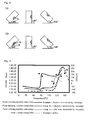
- the injection composition 1 of the present invention or the conventional injection composition is applied in the form of two rows of beads as shown in Fig. 1 (1), and then heated and foamed, the composition tends to sag and flow in the step of thermal blowing and form a foam 2 as shown in Fig. 1 (2) with insufficient injecting.
- an automatic injecting type paste form heat-curable damming injection composition 3 is applied in the form of beads at a suitable position shown in Fig. 1 (2) to prevent such sagging of the paste form heat-blowing injection composition and then the paste form heat-blowing injection composition 1 is heated and foamed, a cured damming material 4 is formed and prevents the sagging of the injection composition so that a foam 5 shown in Fig. 1 (2), that is, an insulation wall is formed.
- the composition of the damming injection composition 3 should be designed such that the damming injection composition 3 cures to gel prior to the occurrence of sagging of the injection composition 1 during heating and blowing of the injection composition and the gelled damming injection composition has shape maintenance for withstanding the pressure of the injection composition which sags and flows during thermal blowing.
- the present invention has been completed based on the above findings.
- the present invention provides:
- a partially crosslinked rubber used in the present invention means a diene rubber which is partially crosslinked or cured with a crosslinking agent such as divinylbenzene or sulfur.
- a crosslinking agent such as divinylbenzene or sulfur.
- the diene rubber include acrylonitrile-isoprene copolymer rubber (NIR), acrylonitrile-butadiene copolymer rubber (NBR), styrenebutadiene copolymer rubber (SBR), butadiene rubber (BR), isoprene rubber (IR), etc.
- NIR acrylonitrile-isoprene copolymer rubber
- NBR acrylonitrile-butadiene copolymer rubber
- SBR styrenebutadiene copolymer rubber
- BR butadiene rubber
- IR isoprene rubber
- the use of the partially crosslinked rubber can improve an anti-stringy property when the composition containing no flake-form inorganic filler is applied.
- unvulcanized rubber examples include NIR, NBR, SBR, BR, IR, natural rubber, etc.
- crosslinking agent used in the paste form heat-blowing injection composition of the present invention any conventional crosslinking agent can be used as long as it is activated by heating and crosslinks a rubber.
- the crosslinking agent are organic peroxides (e.g. ketone peroxides, peroxyketals, hydroperoxides, dialkyl peroxides, phenyl peroxides, peroxyesters, peroxydicarbonates, etc.). These crosslinking agents may be used independently or as a mixture of two or more of them depending on heating conditions or desired properties of crosslinked materials.
- a plasticizer used in the present invention may be any plasticizer that can swell or dissolve the partially crosslinked rubber, the unvulcanized rubber and a thermplastic resin which will be explained below.
- plasticizer examples include phthalates such as di(2-ethylhexyl) phthalate, butylbenzyl phthalate, dinonyl phthalate, diisononyl phthalate, diisodecyl phthalate, diundecyl phthalate, diheptyl phthalate, butylphthalylbutyl glycolate, etc.; esters of aliphatic dibasic carboxylic acids such as dioctyl adipate, didecyl adipate, dioctyl sebacate, etc.; polyglycol esters of benzoic acid such as polyoxyethylene glycol dipenzoate, polyoxypropylene glycol dibenzoate, etc.; phosphates such as tributyl phosphate, tricresyl phosphate, etc.; hydrocarbons such as alkyl-substituted diphenyl, alkyl-substituted terphenyl, partially hydrogenated al
- thermoplastic resin used in the present invention is a resin which is present in the form of particles at room temperature and can be made swellable and soluble in the plasticizer above when heated.
- plasticizer include acrylic resins such as polymers of alkyl acrylates (e.g. methyl acrylate, ethyl acrylate, butyl acrylate, 2-ethylhexyl acrylate, etc.) or alkyl methacrylate (e.g.
- MBS resins methyl methacrylate-butadiene-styrene copolymer
- AAS resins acrylonitrile-styrene-specific rubber cop
- thermoplastic resin and the plasticizer may be used in amounts such that the composition has a gelation start temperature of 90°C or less and a viscosity after gelation of at least 100,000 Pa.s at a gelling temperature.
- An epoxy resin used in the present invention may be any epoxy resin that is used in this art field.
- Specific examples of the epoxy resin include glycidyl ether epoxy resins, glycidyl ester epoxy resins, glycidyl amine epoxy resins, linear aliphatic epoxide epoxy resins, alicyclic epoxide epoxy resins, their modified derivatives such as rubber-modified epoxy resins, for example, reaction products of bisphenol epoxy resins (e.g.
- diglycidyl ethers of bisphenol A, bisphenol F or bisphenol AD diglycidyl ethers of alkylene oxide adducts of bisphenol A, etc.
- urethane-modified epoxy resins for example, reaction products of OH-containing epoxy resins (e.g. diglycidyl ether of bisphenol A, diglycidyl ether of aliphatic polyhydric alcohol, etc.) with urethane prepolymers having terminal NCO groups which are prepared by reacting polytetramethylene ether glycol (having a molecular weight of 500 to 5,000) and an excess amount of diisocyanates (e.g. tolylene diisocyanate, diphenylmethane diisocyanate, etc.), thiokol-modified epoxy resins, and so on.
- OH-containing epoxy resins e.g. diglycidyl ether of bisphenol A, diglycidyl ether of aliphatic polyhydric alcohol, etc.
- epoxy resins may be used independently or as a mixture of two or more of them.
- a latent curing agent used in the present invention may be any conventional curing agent that exhibits a curing function by heating and can be activated usually at a temperature between 80 to 250°C.
- Specific examples of the latent curing agent include dicyandiamide, 4,4'-diaminodiphenylsulfone, imidazole derivatives (e.g. 2-n-heptadecylimidazole, etc.), isophthalic dihydrazide, N,N-dialkylurea derivatives, N,N-dialkylthiourea derivatives, melamine derivatives, etc.
- These curing agents may be used independently or as a mixture of two or more of them depending on curing conditions or their properties.
- a blowing agent used in the paste form heat-blowing injection composition of the present invention may be any blowing agent that is decomposed by heating to generate gas.
- the blowing agent include azo compounds (e.g. azodicarbonamide, etc.), nitroso compounds (e.g. N,N'-dinitrosopentamethylenetetramine, etc.), hydrazine compounds (e.g. diphenylsulfone-3,3'-disulfohydrazide, etc.), and so on.
- These blowing agents may be used independently or as a mixture of two or more of them preferably in combination with blowing aids (e.g. urea, etc.).
- the automatic injecting type paste form heat-blowing injection composition according to the present invention contains a partially crosslinked rubber, an unvulcanized rubber, a crosslinking agent, a plasticizer, a thermoplastic resin, an epoxy resin and a latent curing agent thereof, and a blowing agent and optionally a blowing aid.
- the paste injection composition preferably has a viscosity of 30 to 500 Pa.s (at 20°C and a shear rate of 430 sec -1 ), and its blowing temperature is preferably adjusted at least 100°C, more preferably 110 to 140°C.
- the paste injection composition of the present invention may optionally contain conventional additives such as thixtropic agent (e.g. organic bentonite, fumed silica, aluminum stearate, metal soap, caster oil derivatives, etc.), fillers (e.g. heavy calcium carbonate, surface-treated calcium carbonate, clay, silica, resin powder, fly ash, etc.), pigments (e.g. carbon black, titanium oxide, other inorganic pigments, etc.), dehydrating agents (e.g. calcium oxide, powder silica gel, etc.), and so on in suitable amounts.
- thixtropic agent e.g. organic bentonite, fumed silica, aluminum stearate, metal soap, caster oil derivatives, etc.
- fillers e.g. heavy calcium carbonate, surface-treated calcium carbonate, clay, silica, resin powder, fly ash, etc.
- pigments e.g. carbon black, titanium oxide, other inorganic pigments, etc.
- dehydrating agents e.g
- a preferable formulation of the paste injection composition of the present invention are as follows (% is "a % by weight” based on the weight of the whole composition):
- paste injection composition Preferable formulation of paste injection composition:
- the amount of the partially crosslinked rubber is less than 1%, the anti-stringy property of the composition may not be improved.
- the amount of the partially crosslinked rubber exceeds 10%, a discharge property deteriorates and an expansion ratio tends to decrease.
- an expansion ratio of the composition may be insufficient.
- the amount of the unvulcanized rubber exceeds 10%, it may be difficult to achieve sufficient discharge and/or anti-stringy properties.
- the amount of the plasticizer is less than 30%, the production of the composition is difficult, and a discharge property of the composition deteriorate.
- amount of the plasticizer exceeds 50%, the liberated plasticizer tends to bleed out after curing to cause the shrinkage of the foam.
- the amount of the thermoplastic resin is less than 1%, the formation of a film may be insufficient, and a sufficient expansion ratio may not be attained.
- the amount of the thermoplastic resin exceeds 15%, the viscosity stability of the composition tends to greatly deteriorate so that the discharge property deteriorate.
- the amount of the epoxy resin exceeds 10%, the elongation of the cured material of the composition tends to decrease so that the expansion ratio decreases, and the injecting property deteriorates.
- the lower limit of the amount of the epoxy resin may not be particularly limited, but it is usually 0.5%.
- the amount of the epoxy resin is less than 0.5%, the adhesion of the composition to a metal surface may tend to decrease.
- the foam of the cured material of the composition tends to shrink when the composition is cured at a temperature of 180°C or higher.
- the amount of the latent curing agent exceeds 5%, the effect of the latent curing agent on the curing of the epoxy resin may saturate.
- the lower limit of the amount of the latent curing agent may not be particularly limited, but it is usually 0.05%.
- the amount of the latent curing agent is less than 0.05%, the epoxy resin may be insufficiently cured.
- the amount of the crosslinking agent exceeds 5%, the adhesion of the composition tends to decrease, and such an amount of the crosslinking agent is excessive since the crosslinking degree of the unvulcanized rubber is already saturated at an amount of 5% or less of the crosslinking agent.
- the lower limit of the amount of the crosslinking agent may not be particularly limited, but it is usually 0.01%.
- the amount of the crosslinking agent is less than 0.01%, the formation of a film may be insufficient, and a sufficient expansion ratio may not be attained.
- the expansion ratio may be insufficient.
- the amount of the blowing agent exceeds 10%, open cells tend to form or the composition may insufficiently be adhered to a substrate because of excessive blowing.
- the automatic injecting type paste form heat-curable damming injection composition of the present invention (hereinafter simply referred to as "paste damming injection composition”) has a preferred formulation described below, and a viscosity of 30 to 500 Pa.s (at 20°C and a shear rate of 430 sec -1 ), its gelation starting temperature is 90°C or less, and it has a viscosity after gelation of 100,000 Pa.s (at a gelation temperature).
- paste damming injection composition Preferable formulation of paste damming injection composition:
- Partially crosslinked rubber 1 - 15%, preferably 4 - 10% Plasticizer 20 - 40%, preferable 25 - 35%
- Thermoplastic resin 5 - 20% preferably 8 - 15% Epoxy resin 10% or less, preferably 0.5 - 10%, more preferably 1 - 6% Latent curing agent 5% or less, preferably 0.1 - 5%, more preferably 1 - 3%
- the amount of the partially crosslinked rubber is less than 1%, the anti-stringy property and also the maintenance of a shape may be insufficient.
- the amount of the partially crosslinked rubber exceeds 15%, a discharge property of the composition tends to deteriorate.
- the amount of the plasticizer is less than 20%, the production of the composition is difficult, and a discharge property of the composition is insufficient.
- amount of the plasticizer exceeds 40%, the composition may sag so that the shape of the applied composition may not be maintained.
- the viscosity of the damming injection composition during gelation tends to decrease so that the damming injection composition cannot resist against the blowing pressure of the foam.
- the amount of the thermoplastic resin is less than 5%, the viscosity of the damming injection composition during gelation is low so that the damming injection composition cannot resist against the pressure of the sagging paste injection composition and thus the closed section of the automobile body part is insufficiently filled.
- the amount of the thermoplastic resin exceeds 20%, the viscosity stability of the damming injection composition tends to greatly deteriorate so that the discharge property may be adversely affected.
- the amount of the epoxy resin exceeds 10%, the viscosity stability of the composition tends to decrease.
- the lower limit of the amount of the epoxy resin may not be particularly limited, but it is usually 0.5%.
- the amount of the epoxy resin is less than 0.5%, the adhesion of the composition to a metal surface may decrease.
- the amount of the latent curing agent exceeds 5%, the effect of the latent curing agent on the curing of the epoxy resin may not be further improved, while the viscosity stability of the damming injectgion composition tends to deteriorate.
- the lower limit of the amount of the latent curing agent may not be particularly limited, but it is usually 0.1%. When the amount of the latent curing agent is less than 0.1%, the epoxy resin may be insufficiently cured.
- the injecting and soundproofing method of the present invention may be carried out in the following procedures:
- the paste injection composition of the present invention is automatically applied to a respective surface site of the automobile body part preferably with a robot system in the form of a single or multiple beads (or bands).
- An applied amount of the paste injection composition may be determined depending on the cross sectional area of the closed section, and is usually from 0.1 to 10 cc per square centimeter (cm 2 ) of the cross sectional area.
- the paste damming injection composition is applied in adjacent to the paste injection composition, or at a distance from the paste injection composition, for example, a distance of 0 to 100 mm, in an amount of 0.05 to 5 cc per square centimeter (cm 2 ) of the cross sectional area.
- the paste damming injection composition is also preferably automatically applied.
- the automobile body parts are assembled by spot welding, and then passed through the pretreatment steps and the electrodeposition coating step.
- the paste injection composition and the paste damming injection composition are uncured, they are have good resistance to shower and do not fly about, dissolve or drop off in the phosphate treating liquid or the electrodeposition coating liquid, since they have good shape maintenance properties.
- the assembled automobile body parts are heated under the baking conditions in the electrodeposition oven in the electrodeposition coating step usually at a temperature of 140 to 220°C for 10 to 60 minutes.
- the heat-blowing of the paste injection composition and the heat-curing of the paste damming injection composition begin and gradually proceed.
- the paste damming injection composition begins to gel at a temperature lower than 100°C at which the blowing of the paste injection composition begins, and the gelled damming injection composition has a very high viscosity of, for example, 100,000 Pa.s or larger. Therefore, the gelled damming injection composition can prevent the sagging of the paste injection composition, if the latter sags.
- the paste injection composition forms a foam having a good expansion ratio of 3 to 30 (an insulation wall).
- Table 1 The components shown in Table 1 were stirred and mixed with a planetary mixer for 30 minutes and then defoamed under reduced pressure for 30 minutes to obtain a paste damming injection composition.
- the viscosity of the resulting composition (at 20°C and a shear rate of 430 sec 1 ) is also shown in Table 1.
- the paste injection composition and the paste damming injection compositions were subjected to a gelation behavior analysis (paste damming injection compositions) by dynamic viscoelasticity measurement, or a foaming behavior analysis (paste injection composition) by differential scanning calorimetry. The results are shown in Fig. 4.
- the gelation of the paste damming injection composition of Example 1 finished earlier (gelation start temperature: 77.8°C, gelation finish temperature: 86.9°C). Furthermore, the paste damming injection composition of Example 1 had a very high viscosity (125,000 Pa.s) at the finish of gelation. Therefore, the gelled material of the paste damming injection composition of Example 1 was hardly deformed by the foaming pressure of the paste injection composition so that the former could effectively dam the flow of the latter.
- the paste damming injection composition of Comparative Example 1 had substantially the same gelation start temperature (81.9°C) and the gelation finish temperature (87°C) as those of the paste damming injection composition of Example 1, it had the lower viscosity at the finish of gelation (29,700 Pa.s). Accordingly, the gelled material of the paste damming injection composition of Comparative Example 1 was deformed by the foaming pressure of the paste injection composition so that the former could not dam the flow of the latter.
- the paste damming injection composition of Comparative Example 2 had a sufficiently high viscosity (101,000 Pa.s) at the finish of gelation, it had a high gelation start temperature (111.9°C) and a high gelation finish temperature (133°C). Thus, the gelation could not be completed before the start of foaming of the paste injection composition and the paste damming injection composition of Comparative Example 2 was deformed by the foaming pressure of the paste injection composition.
- a paste injection composition of the present invention when used, a closed section of an automobile body part, which has a large cross sectional area and thus cannot be completely filled with a conventional paste form heat-blowing injection composition, but a paste injection composition of the present invention, can be completely filled since the sagging of the paste injection composition is effectively prevented during heating and foaming of the paste injection composition by the use of the paste damming injection composition.
Landscapes
- Chemical & Material Sciences (AREA)
- Engineering & Computer Science (AREA)
- Organic Chemistry (AREA)
- Polymers & Plastics (AREA)
- Health & Medical Sciences (AREA)
- Chemical Kinetics & Catalysis (AREA)
- Medicinal Chemistry (AREA)
- Transportation (AREA)
- Combustion & Propulsion (AREA)
- Materials Engineering (AREA)
- Mechanical Engineering (AREA)
- Architecture (AREA)
- Structural Engineering (AREA)
- General Chemical & Material Sciences (AREA)
- Compositions Of Macromolecular Compounds (AREA)
- Manufacture Of Porous Articles, And Recovery And Treatment Of Waste Products (AREA)
- Body Structure For Vehicles (AREA)
- Vehicle Interior And Exterior Ornaments, Soundproofing, And Insulation (AREA)
Abstract
Description
- The present invention relates to a paste form heat-blowing injection composition and a method for injecting and soundproofing a closed section of an automobile body part. In particular, the present invention relates to a method for injecting an insulation wall of a body part having a closed section frame for shutting out wind noise during driving of an automobile, and an automatic injecting type paste form heat-blowing injection composition used for forming an insulation wall in the above method. Furthermore, the present invention relates to an automatic injecting type paste form heat-curable damming injection composition which prevents the sag of the heat-blowing injection composition during the heat-blowing of said composition to form the insulation wall.
- Among automobile body parts having a closed section frame, a windshield pillar (A pillar), a center pillar (B pillar), a rear pillar (C pillar), a wheel arch (tire housing) and a side sill may cause wind noise. Therefore, the closed section of such a part is usually filled with a foam for shutting out noises (an insulation wall).
- For example, a prefoamed polyurethane foam is crammed into the closed section of an automobile body part by hands, or a shaped material of a heat-blowing injection composition is adhered to the inside surface of the closed section and then thermally foamed in a baking step. However, neither of these processes can be automated.
- Then, as a injection composition suitable for an automated injecting process, an automatic injecting type paste form heat-blowing injection composition was developed. For example, as a injection composition which has an anti-stringy property during application, prevents sagging during thermal blowing and is foamed at a high expansion ratio, a composition is proposed, which comprises a liquid rubber (for decreasing a viscosity and imparting adherence to an oil-surface steel plate), an unvulcanized rubber (for increasing an expansion ratio by virtue of the high retention of expansion gas), a curing agent and a curing accelerator, a softening agent (for lubricating rubber particles), a blowing agent and a blowing aid, a flake-form inorganic filler (for preventing sag and improving an anti-stringy property), and a thixotropic agent (for preventing sag) (see JP-B-3017571). The composition disclosed in this patent specification is applied in the form of beads at specified sites of a panel and then cured in a foamed state by heating in a baking oven in a subsequent step of electrodeposition coating. The cured material exhibits good performances of soundproofing and shutting out wind noise.
- An object of the present invention is to provide an automatic injecting type paste form heat-blowing injection composition with a high blowing performance, which is in superior to the conventional injection compositions, and which has an anti-stringy property during application and can prevent sag during thermal blowing.
- Another object of the present invention is to provide a method for injecting and soundproofing a closed section of an automobile body part, which has a large closed sectional area and thus cannot be completely injected with a conventional paste form heat-blowing injection composition, for example, a B pillar which is substantially vertically held and has a large closed section.
- A further object of the present invention is to provide a paste form heat-curable damming injection composition which is suitably used as a damming material in the method of injecting and soundproofing a closed section of an automobile body part according to the present invention.
- To achieve the above objects, the present inventions have made extensive researches. As a result, it has been found that a paste form composition having a sufficient viscosity for maintaining an applied shape (shape-maintenance) can be obtained when an epoxy resin as a thermally curable material and a latent curing agent thereof, and also a blowing agent are compounding in a composition comprising a partially crosslinked rubber, an unvulcanized rubber, a plasticizer, a thermoplastic resin and a crosslinking agent, and that such a paste form composition can be automatically applied, in particular, the partially crosslinked rubber contributes to an anti-stringy property during application, a film is formed by the thermal swelling of the plasticizer and the thermoplastic resin and the thermal crosslinking of the unvulcanized rubber with the crosslinking, and the thermal curing of the epoxy resin contributes to the toughness of the film and also the formation of foam cells.
- The conventional composition uses a flake-form inorganic filler such as mica or talc to improve the anti-stringy property of the composition. However, the use of the flake-form inorganic filler may deteriorate the discharging and blowing properties of the composition.
- The automatic injecting type paste form heat-blowing injection composition of the present invention can achieve the desired soundproofing effect, but the present inventors made further investigations and found the following:
- In a case where the injection composition is applied to the pillar, in particular, a part of the pillar having a relatively large cross sectional area, when the
injection composition 1 of the present invention or the conventional injection composition is applied in the form of two rows of beads as shown in Fig. 1 (1), and then heated and foamed, the composition tends to sag and flow in the step of thermal blowing and form afoam 2 as shown in Fig. 1 (2) with insufficient injecting. - When an automatic injecting type paste form heat-curable
damming injection composition 3 is applied in the form of beads at a suitable position shown in Fig. 1 (2) to prevent such sagging of the paste form heat-blowing injection composition and then the paste form heat-blowinginjection composition 1 is heated and foamed, a cured dammingmaterial 4 is formed and prevents the sagging of the injection composition so that afoam 5 shown in Fig. 1 (2), that is, an insulation wall is formed. - To prevent the sagging and the flowing of the injection composition as described above, the composition of the
damming injection composition 3 should be designed such that thedamming injection composition 3 cures to gel prior to the occurrence of sagging of theinjection composition 1 during heating and blowing of the injection composition and the gelled damming injection composition has shape maintenance for withstanding the pressure of the injection composition which sags and flows during thermal blowing. - The present invention has been completed based on the above findings.
- Accordingly, the present invention provides:
- (1) an automatic injecting type paste form heat-blowing injection composition comprising a partially crosslinked rubber, an unvulcanized rubber, a crosslinking agent, a plasticizer, a thermoplastic resin, an epoxy resin and a latent curing agent thereof, and a blowing agent, which composition preferably has a viscosity of 30 to 500 Pa.s (at 20°C) and a blowing start temperature of at least 100°C;
- (2) a method for injecting and soundproofing a closed section of an automobile body part comprising the steps of:
- applying an automatic injecting type paste form heat-blowing injection composition to a closed section of an automobile body part having a closed section frame, which is press molded in a body welding step of an automobile manufacturing line, prior to the assembling of the body part,
- carrying the automobile body part applied with the heat-blowing injection composition to a pretreatment and electrodeposition coating step, and
- heating and blowing the injection composition under baking conditions in an electrodeposition oven in an electrodeposition coating step to inject the closed section with an insulation wall made of the foamed material of the injection composition,
wherein an automatic injecting type paste form heat-curable damming injection composition, which preferably comprises a partially crosslinked rubber, a plasticizer, a thermoplastic resin, and optionally an epoxy resin and a latent curing agent thereof and has a viscosity of 30 to 500 Pa.s (at 20°C), a gelation start temperature of 90°C or less and a viscosity after gelation of at least 100,000 Pa.s, is applied in adjacent to the paste form heat-blowing injection composition or at a distance from the injection composition, thereby the sagging of the injection composition is prevented by the gelled damming injection composition when the insulation wall formed from the injection composition insufficiently fill the closed section because of the sagging of the injection composition during heating and blowing;
and
- (3) an automatic injecting type paste form heat-curable damming injection composition comprising a partially crosslinked rubber, a plasticizer, a thermoplastic resin, and optionally an epoxy resin and a latent curing agent thereof.
-
- Fig. 1 schematically explains the soundproofing effect achieved by the use of a paste form damming injection composition according to the present invention in the case of a member having a large cross sectional area.
- Fig. 2 is a schematic perspective view of a member used in Example 1 and Comparative Examples 1 and 2 with showing sizes.
- Fig. 3 schematically shows the angles of inclination of the member used in Example 1 and Comparative Examples 1 and 2, and the application position of a paste form damming injection composition according to the present invention.
- Fig. 4 is a graph showing the gelation behavior according to dynamic viscoelastic measurement and the foaming behavior according to DSC of the paste form injection composition and the paste form damming injection composition used in Example 1 and Comparative Examples 1 and 2.
- A partially crosslinked rubber used in the present invention means a diene rubber which is partially crosslinked or cured with a crosslinking agent such as divinylbenzene or sulfur. Examples of the diene rubber include acrylonitrile-isoprene copolymer rubber (NIR), acrylonitrile-butadiene copolymer rubber (NBR), styrenebutadiene copolymer rubber (SBR), butadiene rubber (BR), isoprene rubber (IR), etc. The partially crosslinked rubber includes reclaimed rubber which has been desulfurized.
- The use of the partially crosslinked rubber can improve an anti-stringy property when the composition containing no flake-form inorganic filler is applied.
- Examples of the unvulcanized rubber include NIR, NBR, SBR, BR, IR, natural rubber, etc.
- As a crosslinking agent used in the paste form heat-blowing injection composition of the present invention, any conventional crosslinking agent can be used as long as it is activated by heating and crosslinks a rubber. Preferable examples of the crosslinking agent are organic peroxides (e.g. ketone peroxides, peroxyketals, hydroperoxides, dialkyl peroxides, phenyl peroxides, peroxyesters, peroxydicarbonates, etc.). These crosslinking agents may be used independently or as a mixture of two or more of them depending on heating conditions or desired properties of crosslinked materials.
- A plasticizer used in the present invention may be any plasticizer that can swell or dissolve the partially crosslinked rubber, the unvulcanized rubber and a thermplastic resin which will be explained below.
- Specific examples of the plasticizer include phthalates such as di(2-ethylhexyl) phthalate, butylbenzyl phthalate, dinonyl phthalate, diisononyl phthalate, diisodecyl phthalate, diundecyl phthalate, diheptyl phthalate, butylphthalylbutyl glycolate, etc.; esters of aliphatic dibasic carboxylic acids such as dioctyl adipate, didecyl adipate, dioctyl sebacate, etc.; polyglycol esters of benzoic acid such as polyoxyethylene glycol dipenzoate, polyoxypropylene glycol dibenzoate, etc.; phosphates such as tributyl phosphate, tricresyl phosphate, etc.; hydrocarbons such as alkyl-substituted diphenyl, alkyl-substituted terphenyl, partially hydrogenated alkyl-terphenyl, aromatic process oil, pine oil, etc.
- A thermoplastic resin used in the present invention is a resin which is present in the form of particles at room temperature and can be made swellable and soluble in the plasticizer above when heated. Specific examples of the plasticizer include acrylic resins such as polymers of alkyl acrylates (e.g. methyl acrylate, ethyl acrylate, butyl acrylate, 2-ethylhexyl acrylate, etc.) or alkyl methacrylate (e.g. methyl methacrylate, ethyl methacrylate, butyl methacrylate, lauryl methacrylate, stearyl methacrylate, etc.), or copolymers of alkyl acrylate or alkyl methacrylate with other acrylic monomers; MBS resins (methyl methacrylate-butadiene-styrene copolymer); ionomers; AAS resins (acrylonitrile-styrene-specific rubber copolymer); AES resins (acrylonitrile-EPDM-styrene copolymer), AS resins (acrylonitrile-styrene copolymer); ABS resins (acrylonitrile-butadiene-styrene copolymer); polyurethane resins; polyester resins; and the like. These resins may be used independently or as a mixture of two or more of them in combination with the plasticizer. Particularly in the case of a paste form heat-curable damming injection composition, the thermoplastic resin and the plasticizer may used in amounts such that the composition has a gelation start temperature of 90°C or less and a viscosity after gelation of at least 100,000 Pa.s at a gelling temperature.
- An epoxy resin used in the present invention may be any epoxy resin that is used in this art field. Specific examples of the epoxy resin include glycidyl ether epoxy resins, glycidyl ester epoxy resins, glycidyl amine epoxy resins, linear aliphatic epoxide epoxy resins, alicyclic epoxide epoxy resins, their modified derivatives such as rubber-modified epoxy resins, for example, reaction products of bisphenol epoxy resins (e.g. diglycidyl ethers of bisphenol A, bisphenol F or bisphenol AD, diglycidyl ethers of alkylene oxide adducts of bisphenol A, etc.) with butadiene-acrylonitrile-(meth)acrylic acid copolymer, urethane-modified epoxy resins, for example, reaction products of OH-containing epoxy resins (e.g. diglycidyl ether of bisphenol A, diglycidyl ether of aliphatic polyhydric alcohol, etc.) with urethane prepolymers having terminal NCO groups which are prepared by reacting polytetramethylene ether glycol (having a molecular weight of 500 to 5,000) and an excess amount of diisocyanates (e.g. tolylene diisocyanate, diphenylmethane diisocyanate, etc.), thiokol-modified epoxy resins, and so on.
- These epoxy resins may be used independently or as a mixture of two or more of them.
- A latent curing agent used in the present invention may be any conventional curing agent that exhibits a curing function by heating and can be activated usually at a temperature between 80 to 250°C. Specific examples of the latent curing agent include dicyandiamide, 4,4'-diaminodiphenylsulfone, imidazole derivatives (e.g. 2-n-heptadecylimidazole, etc.), isophthalic dihydrazide, N,N-dialkylurea derivatives, N,N-dialkylthiourea derivatives, melamine derivatives, etc. These curing agents may be used independently or as a mixture of two or more of them depending on curing conditions or their properties.
- A blowing agent used in the paste form heat-blowing injection composition of the present invention may be any blowing agent that is decomposed by heating to generate gas. Specific examples of the blowing agent include azo compounds (e.g. azodicarbonamide, etc.), nitroso compounds (e.g. N,N'-dinitrosopentamethylenetetramine, etc.), hydrazine compounds (e.g. diphenylsulfone-3,3'-disulfohydrazide, etc.), and so on. These blowing agents may be used independently or as a mixture of two or more of them preferably in combination with blowing aids (e.g. urea, etc.).
- The automatic injecting type paste form heat-blowing injection composition according to the present invention (hereinafter simply referred to as "paste injection composition") contains a partially crosslinked rubber, an unvulcanized rubber, a crosslinking agent, a plasticizer, a thermoplastic resin, an epoxy resin and a latent curing agent thereof, and a blowing agent and optionally a blowing aid. The paste injection composition preferably has a viscosity of 30 to 500 Pa.s (at 20°C and a shear rate of 430 sec-1), and its blowing temperature is preferably adjusted at least 100°C, more preferably 110 to 140°C.
- The paste injection composition of the present invention may optionally contain conventional additives such as thixtropic agent (e.g. organic bentonite, fumed silica, aluminum stearate, metal soap, caster oil derivatives, etc.), fillers (e.g. heavy calcium carbonate, surface-treated calcium carbonate, clay, silica, resin powder, fly ash, etc.), pigments (e.g. carbon black, titanium oxide, other inorganic pigments, etc.), dehydrating agents (e.g. calcium oxide, powder silica gel, etc.), and so on in suitable amounts.
- A preferable formulation of the paste injection composition of the present invention are as follows (% is "a % by weight" based on the weight of the whole composition):
-
Partially crosslinked rubber 1 - 10%, preferably 3 - 7% Unvulcanized rubber 1 - 10%, preferably 3 - 7% Crosslinking agent 0.01 - 5%, preferably 0.02 - 0.6% Plasticizer 30 - 50%, preferable 30 - 40% Thermoplastic resin 1 - 15%, preferably 4 - 12% Epoxy resin 0.5 - 10%, preferably 1 - 7% Latent curing agent 0.05 - 5%, preferably 0.1 - 3% Blowing agent 1 - 10%, preferably 2 - 7% Additive(s) 25 - 45%, preferably 30- 40% - When the amount of the partially crosslinked rubber is less than 1%, the anti-stringy property of the composition may not be improved. When the amount of the partially crosslinked rubber exceeds 10%, a discharge property deteriorates and an expansion ratio tends to decrease.
- When the amount of the unvulcanized rubber is less than 1%, an expansion ratio of the composition may be insufficient. When the amount of the unvulcanized rubber exceeds 10%, it may be difficult to achieve sufficient discharge and/or anti-stringy properties.
- When the amount of the plasticizer is less than 30%, the production of the composition is difficult, and a discharge property of the composition deteriorate. When amount of the plasticizer exceeds 50%, the liberated plasticizer tends to bleed out after curing to cause the shrinkage of the foam.
- When the amount of the thermoplastic resin is less than 1%, the formation of a film may be insufficient, and a sufficient expansion ratio may not be attained. When the amount of the thermoplastic resin exceeds 15%, the viscosity stability of the composition tends to greatly deteriorate so that the discharge property deteriorate.
- When the amount of the epoxy resin exceeds 10%, the elongation of the cured material of the composition tends to decrease so that the expansion ratio decreases, and the injecting property deteriorates. The lower limit of the amount of the epoxy resin may not be particularly limited, but it is usually 0.5%. When the amount of the epoxy resin is less than 0.5%, the adhesion of the composition to a metal surface may tend to decrease. In addition, the foam of the cured material of the composition tends to shrink when the composition is cured at a temperature of 180°C or higher.
- When the amount of the latent curing agent exceeds 5%, the effect of the latent curing agent on the curing of the epoxy resin may saturate. The lower limit of the amount of the latent curing agent may not be particularly limited, but it is usually 0.05%. When the amount of the latent curing agent is less than 0.05%, the epoxy resin may be insufficiently cured.
- When the amount of the crosslinking agent exceeds 5%, the adhesion of the composition tends to decrease, and such an amount of the crosslinking agent is excessive since the crosslinking degree of the unvulcanized rubber is already saturated at an amount of 5% or less of the crosslinking agent. The lower limit of the amount of the crosslinking agent may not be particularly limited, but it is usually 0.01%. When the amount of the crosslinking agent is less than 0.01%, the formation of a film may be insufficient, and a sufficient expansion ratio may not be attained.
- When the amount of the blowing agent is less than 1%, the expansion ratio may be insufficient. When the amount of the blowing agent exceeds 10%, open cells tend to form or the composition may insufficiently be adhered to a substrate because of excessive blowing.
- The automatic injecting type paste form heat-curable damming injection composition of the present invention (hereinafter simply referred to as "paste damming injection composition") has a preferred formulation described below, and a viscosity of 30 to 500 Pa.s (at 20°C and a shear rate of 430 sec-1), its gelation starting temperature is 90°C or less, and it has a viscosity after gelation of 100,000 Pa.s (at a gelation temperature).
-
Partially crosslinked rubber 1 - 15%, preferably 4 - 10% Plasticizer 20 - 40%, preferable 25 - 35% Thermoplastic resin 5 - 20%, preferably 8 - 15 % Epoxy resin 10% or less, preferably 0.5 - 10%, more preferably 1 - 6% Latent curing agent 5% or less, preferably 0.1 - 5%, more preferably 1 - 3% Additive(s) 40 - 60%, preferably 45- 55% - When the amount of the partially crosslinked rubber is less than 1%, the anti-stringy property and also the maintenance of a shape may be insufficient. When the amount of the partially crosslinked rubber exceeds 15%, a discharge property of the composition tends to deteriorate.
- When the amount of the plasticizer is less than 20%, the production of the composition is difficult, and a discharge property of the composition is insufficient. When amount of the plasticizer exceeds 40%, the composition may sag so that the shape of the applied composition may not be maintained. In addition, as the relative amount of the thermoplastic resin decreases, the viscosity of the damming injection composition during gelation tends to decrease so that the damming injection composition cannot resist against the blowing pressure of the foam.
- When the amount of the thermoplastic resin is less than 5%, the viscosity of the damming injection composition during gelation is low so that the damming injection composition cannot resist against the pressure of the sagging paste injection composition and thus the closed section of the automobile body part is insufficiently filled. When the amount of the thermoplastic resin exceeds 20%, the viscosity stability of the damming injection composition tends to greatly deteriorate so that the discharge property may be adversely affected.
- When the amount of the epoxy resin exceeds 10%, the viscosity stability of the composition tends to decrease. The lower limit of the amount of the epoxy resin may not be particularly limited, but it is usually 0.5%. When the amount of the epoxy resin is less than 0.5%, the adhesion of the composition to a metal surface may decrease.
- When the amount of the latent curing agent exceeds 5%, the effect of the latent curing agent on the curing of the epoxy resin may not be further improved, while the viscosity stability of the damming injectgion composition tends to deteriorate. The lower limit of the amount of the latent curing agent may not be particularly limited, but it is usually 0.1%. When the amount of the latent curing agent is less than 0.1%, the epoxy resin may be insufficiently cured.
- Hereinafter, a method for injecting and soundproofing a closed section of an automobile body part with a paste injection composition and a paste damming injection composition according to the present invention will be explained.
- In the automobile manufacturing line [body welding step -> pretreatment steps (showering -> degreasing -> showering -> phosphate treatment -> showering) -> electrodeposition coating steps (showering -> electrodeposition coating -> showering -> baking in an electrodeposition oven) -> various coating steps (assembly steps), the injecting and soundproofing method of the present invention may be carried out in the following procedures:
- Firstly, before welding of automobile parts (A pillar, B pillar, C pillar, a wheel arch (tire housing), a side sill, etc.), which are press molded in the body welding step and have closed sectional structures, the paste injection composition of the present invention is automatically applied to a respective surface site of the automobile body part preferably with a robot system in the form of a single or multiple beads (or bands). An applied amount of the paste injection composition may be determined depending on the cross sectional area of the closed section, and is usually from 0.1 to 10 cc per square centimeter (cm2) of the cross sectional area.
- Next, the paste damming injection composition is applied in adjacent to the paste injection composition, or at a distance from the paste injection composition, for example, a distance of 0 to 100 mm, in an amount of 0.05 to 5 cc per square centimeter (cm2) of the cross sectional area. The paste damming injection composition is also preferably automatically applied.
- After the application of the respective compositions, the automobile body parts are assembled by spot welding, and then passed through the pretreatment steps and the electrodeposition coating step. In these steps, although the paste injection composition and the paste damming injection composition are uncured, they are have good resistance to shower and do not fly about, dissolve or drop off in the phosphate treating liquid or the electrodeposition coating liquid, since they have good shape maintenance properties. Then, the assembled automobile body parts are heated under the baking conditions in the electrodeposition oven in the electrodeposition coating step usually at a temperature of 140 to 220°C for 10 to 60 minutes.
- In this heating step, the heat-blowing of the paste injection composition and the heat-curing of the paste damming injection composition begin and gradually proceed. The paste damming injection composition begins to gel at a temperature lower than 100°C at which the blowing of the paste injection composition begins, and the gelled damming injection composition has a very high viscosity of, for example, 100,000 Pa.s or larger. Therefore, the gelled damming injection composition can prevent the sagging of the paste injection composition, if the latter sags. As shown in Fig. 1 (2), the paste injection composition forms a foam having a good expansion ratio of 3 to 30 (an insulation wall).
- The present invention will be illustrated by the following examples and comparative examples.
- The following components were stirred and mixed with a planetary mixer for 30 minutes and then defoamed under reduced pressure for 30 minutes to obtain a paste injection composition having a viscosity of 80 Pa.s (at 20°C and a shear rate of 430 sec-1). That is, the expansion ratio of this composition was set at 10 times.
Component PBW Partially crosslinked rubber (SBR: "Nipol 1009" available from Zeon Corporation) 5 Unvulcanized rubber (BR: "130 B" available from Ube Industries Ltd.) 5 Plasticizer (DINP) 36 Thermoplastic resin (Acrylic resin: "LP-3102" available from Mitsubishi Rayon Co., Ltd.) 8 Epoxy resin (bisphenyl A type: "Epikoat 828" available from Japan Epoxy 5 Resin Co., Ltd.) Latent curing agent (dicyandiamide:benzoguanamine = 1:1 by weight) 1.9 Blowing agent (azodicarbonamide) 4 Blowing aid (urea) 2 Thixotropic agent (surface-treated calcium carbonate "Viscolite SV" available from Shiraishi Calcium Kaisha Ltd.) 8 Heavy calcium carbonate ("JUTAN 300 M" available from Bihoku Funka Kogyo Co., Ltd.) 23 Pigment (carbon black) 2 Crosslinking agent (peroxyester "Perbutyl Z" available from NOF Corporation) 0.1 Total 100 PBW: Parts by weight - The components shown in Table 1 were stirred and mixed with a planetary mixer for 30 minutes and then defoamed under reduced pressure for 30 minutes to obtain a paste damming injection composition. The viscosity of the resulting composition (at 20°C and a shear rate of 430 sec1) is also shown in Table 1.
Table 1 Ex. Comp. Ex. 1 1 2 Partially crosslinked rubber (SBR: "Nipol 1009" available from Zeon Corporation) 6 6 6 6 6 Plasticizer (DINP) 30 35 30 Thermoplastic resin ("LP-3102" available from Mitsubishi Rayon Co., Ltd.) 12 7 -- Epoxy resin ("Epikoat 828" available from Japan Epoxy Resin Co., Ltd.) 2 2 2 Latent curing agent (dicyandiamide) 2 2 2 Vinyl chloride resin ("PSH-180" available from Kaneka Corporation) -- -- 12 Thixotropic agent ("HAKUENKA CC" available from Shiraishi Calcium Kaisha Ltd.) 4 10 4 Calcium carbonate ("JUTAN 300 M" available from Bihoku Funka 42.9 36.9 42.9 Kogyo Co., Ltd.) Pigment (carbon black) 0.1 0.1 0.1 Dehydrating agent (calcium oxide) 1 1 1 Total 100 100 100 Viscosity (20°C, a shear rate: 430 sec-1) 80 70 80 -
i) The paste injection composition A in an amount of 30 cc or 45 cc was applied in the bead form along a line on the bottom of a member having a shape shown in Fig. 2 and sizes of W = 38 mm, H = 35 mm and L = 150 mm without using any damming material. Then, the member was heated at 160°C for 20 minutes with maintaining the member at an angle of inclination of 45 degrees, 90 degrees or 135 degrees as shown in Fig. 3 (1). At these three angles, the foam completely filled the member in full. When the cross sectional area of the member is moderate, the paste injection composition alone can achieve the desired soundproofing effect.
ii) The paste injection composition A in an amount shown in Table 2 was applied in the bead form along a line on the bottom of a member having a relatively large cross sectional area having a shape shown in Fig. 2 and sizes: W = 50 mm, H = 40 mm and L = 300 mm, and then the paste damming injection composition prepared in Step (2) above in an amount of 10 cc each was applied at a position shown in Fig. 3 (2) in the bead form along a line. Thereafter, the member was heated under the same heating conditions with maintaining the member at same angles of inclination as above i). The filling states of the foam formed from the injection composition are reported in Table 2. In Table 2, "Y" means the complete filling, and "N" means that the filling is incomplete as shown in Fig. 1 (1) in the case of using no damming material, or that the paste injection composition A and the paste damming injection composition B had substantially the same curing rates so that the uncured paste damming injection composition flows as the paste injection composition sags, thus, the filling was incomplete.Table 2 Angle (deg.) Amount applied (cc) Without damming material With damming material Ex. Comp. Ex. 1 1 2 45 30 Y Y -- -- 45 Y Y 90 30 N Y N N 45 N Y Y Y 135 30 N Y -- -- 45 N Y
iii) A member shown in Fig. 2 having sizes of W = 60 mm, H = 50 mm and L = 300 mm and thus a larger cross sectional area was treated in the same was as in ii) above. The results are reported in Table 3.Table 3 Angle (deg.) Amount applied (cc) Without damming material With damming material Ex. Comp. Ex. 1 1 2 45 30 N Y -- -- 45 Y Y 90 30 N N N N 45 N Y N N 135 30 N N -- -- 45 N Y - The paste injection composition and the paste damming injection compositions (Example 1 and Comparative Examples 1 an 2) were subjected to a gelation behavior analysis (paste damming injection compositions) by dynamic viscoelasticity measurement, or a foaming behavior analysis (paste injection composition) by differential scanning calorimetry. The results are shown in Fig. 4.
- According to the results in Fig. 4, the paste injection composition started to foam around 120°C, while the gelation behaviors of the paste damming injection compositions of Example 1 and Comparative Examples 1 and 2 were as follows:
- In comparison with the paste damming injection compositions of Comparative Examples, the gelation of the paste damming injection composition of Example 1 finished earlier (gelation start temperature: 77.8°C, gelation finish temperature: 86.9°C). Furthermore, the paste damming injection composition of Example 1 had a very high viscosity (125,000 Pa.s) at the finish of gelation. Therefore, the gelled material of the paste damming injection composition of Example 1 was hardly deformed by the foaming pressure of the paste injection composition so that the former could effectively dam the flow of the latter.
- In contrast, although the paste damming injection composition of Comparative Example 1 had substantially the same gelation start temperature (81.9°C) and the gelation finish temperature (87°C) as those of the paste damming injection composition of Example 1, it had the lower viscosity at the finish of gelation (29,700 Pa.s). Accordingly, the gelled material of the paste damming injection composition of Comparative Example 1 was deformed by the foaming pressure of the paste injection composition so that the former could not dam the flow of the latter. Although the paste damming injection composition of Comparative Example 2 had a sufficiently high viscosity (101,000 Pa.s) at the finish of gelation, it had a high gelation start temperature (111.9°C) and a high gelation finish temperature (133°C). Thus, the gelation could not be completed before the start of foaming of the paste injection composition and the paste damming injection composition of Comparative Example 2 was deformed by the foaming pressure of the paste injection composition.
- According to the present invention described above, when the paste damming injection composition of the present invention is used, a closed section of an automobile body part, which has a large cross sectional area and thus cannot be completely filled with a conventional paste form heat-blowing injection composition, but a paste injection composition of the present invention, can be completely filled since the sagging of the paste injection composition is effectively prevented during heating and foaming of the paste injection composition by the use of the paste damming injection composition.
Claims (10)
- An automatic injecting type paste form heat-blowing injection composition comprising a partially crosslinked rubber, an unvulcanized rubber, a crosslinking agent, a plasticizer, a thermoplastic resin, an epoxy resin and a latent curing agent thereof, and a blowing agent.
- The paste form heat-blowing injection composition according to claim 1, which comprises, based on the whole weight of the composition, 1 to 10% by weight of the partially crosslinked rubber, 1 to 10% by weight of the unvulcanized rubber, 0.01 to 5% by weight of the crosslinking agent, 30 to 50% by weight of the plasticizer, 1 to 15% by weight of the thermoplastic resin, 0.5 to 10% by weight of the epoxy resin, 0.05 to 5% by weight of the latent curing agent, and 1 to 10% by weight of the blowing agent, and which has a viscosity of 30 to 500 Pa.s (at 20°C) and a blowing start temperature of at least 100°C.
- A method for injecting and soundproofing a closed section of an automobile body part comprising the steps of:applying an automatic injecting type paste form heat-blowing injection composition to a closed section of an automobile body part having a closed section frame, which is press molded in a body welding step of an automobile manufacturing line, prior to the assembling of the body part,carrying the automobile body part applied with the heat-blowing injection composition to a pretreatment and electrodeposition coating step, andheating and blowing the injection composition under baking conditions in an electrodeposition oven in an electrodeposition coating step to fill the closed section with an insulation wall made of the foamed material of the injection composition,
wherein an automatic injecting type paste form heat-curable damming injection composition is applied in adjacent to the paste form heat-blowing injection composition or at a distance from the injection composition, thereby the sagging of the injection composition is prevented by the gelled damming injection composition when the insulation wall formed from the injection composition insufficiently fill the closed section because of the sagging of the heat-blowing injection composition during heating and blowing. - The method according to claim 3, wherein said automatic injecting type paste form heat-curable damming injection composition comprises a partially crosslinked rubber, a plasticizer, a thermoplastic resin, and optionally an epoxy resin and a latent curing agent thereof.
- The method according to claim 3 or 4, wherein said automobile body part having a closed section frame is an A pillar, an B pillar, a C pillar, a wheel arch (tire housing) or a side sill.
- The method according to any one of claims 3 to 5,
wherein said automatic injecting type paste form heat-blowing injection composition is an paste form heat-blowing injection composition claimed in claim 1 or 2. - The method according to any one of claims 4 to 6,
wherein said paste form heat-curable damming injection composition comprises, based on the whole weight of the composition, 1 to 15% by weight of the partially crosslinked rubber, 20 to 40% by weight of the plasticizer, 5 to 20% by weight of the thermoplastic resin, 10% by weight or less of the epoxy resin and 5% by weight or less of the latent curing agent thereof, and which has a viscosity of 30 to 500 Pa.s (at 20°C). - An automatic injecting type paste form heat-curable damming injection composition comprising a partially crosslinked rubber, a plasticizer, a thermoplastic resin, and optionally an epoxy resin and a latent curing agent thereof.
- The paste form heat-curable damming injection composition according to claim 8, which comprises, based on the whole weight of the composition, 1 to 15% by weight of the partially crosslinked rubber, 20 to 40% by weight of the plasticizer, 5 to 20% by weight of the thermoplastic resin, 10% by weight or less of the epoxy resin and 5% by weight or less of the latent curing agent thereof, and which has a viscosity of 30 to 500 Pa.s (at 20°C), a gelation start temperature of 90°C or less and a viscosity after gelation of at least 100,000 Pa.s.
- A filled and soundproofed structure comprising an automobile body part having a closed section frame, which is filled and soundproofed by the method according to any one of claims 3 to 7.
Applications Claiming Priority (2)
| Application Number | Priority Date | Filing Date | Title |
|---|---|---|---|
| JP2003159706 | 2003-06-04 | ||
| PCT/JP2004/007997 WO2004108807A1 (en) | 2003-06-04 | 2004-06-02 | Pasty heat-expandable filler composition and method of sound insulation by filling closed section of car body member |
Publications (3)
| Publication Number | Publication Date |
|---|---|
| EP1632523A1 true EP1632523A1 (en) | 2006-03-08 |
| EP1632523A4 EP1632523A4 (en) | 2008-02-27 |
| EP1632523B1 EP1632523B1 (en) | 2012-07-18 |
Family
ID=33508531
Family Applications (1)
| Application Number | Title | Priority Date | Filing Date |
|---|---|---|---|
| EP04735799A Expired - Lifetime EP1632523B1 (en) | 2003-06-04 | 2004-06-02 | Pasty heat-expandable filler composition and method of sound insulation by filling closed section of car body member |
Country Status (8)
| Country | Link |
|---|---|
| US (2) | US20060142403A1 (en) |
| EP (1) | EP1632523B1 (en) |
| JP (1) | JP4675235B2 (en) |
| KR (1) | KR101052659B1 (en) |
| CN (1) | CN1802406B (en) |
| CA (1) | CA2526512C (en) |
| ES (1) | ES2388526T3 (en) |
| WO (1) | WO2004108807A1 (en) |
Cited By (1)
| Publication number | Priority date | Publication date | Assignee | Title |
|---|---|---|---|---|
| EP3281970A1 (en) | 2016-08-08 | 2018-02-14 | Sika Technology Ag | Pumpable and thermally expandable filler compositions |
Families Citing this family (14)
| Publication number | Priority date | Publication date | Assignee | Title |
|---|---|---|---|---|
| DE102005053697A1 (en) * | 2005-11-10 | 2007-05-24 | Wacker Chemie Ag | Foamable composition for producing foamed plastics |
| KR100826834B1 (en) | 2008-02-04 | 2008-05-02 | 김영동 | Manufacturing method of noise prevention composition and flooring method of noise prevention using the same |
| US8246872B2 (en) * | 2008-12-22 | 2012-08-21 | The Gates Corporation | Method for making composite article with expandable elastomer in compression |
| EP2393869A1 (en) * | 2009-02-09 | 2011-12-14 | Huntsman Advanced Materials (Switzerland) GmbH | Powder coating composition |
| JP5965101B2 (en) * | 2010-12-27 | 2016-08-03 | サンスター技研株式会社 | Paste heating foam filler |
| JP6566827B2 (en) * | 2015-10-06 | 2019-08-28 | トヨタ自動車九州株式会社 | Foaming filler coating method, foaming filler coating apparatus, and foaming filler |
| MX2021010052A (en) * | 2019-02-22 | 2021-09-21 | Jfe Steel Corp | PARTS OF ABSORPTION OF ENERGY OF RESISTANCE TO SHOCKS FOR AUTOMOBILE. |
| JP7026088B2 (en) * | 2019-02-22 | 2022-02-25 | Jfeスチール株式会社 | Collision energy absorbing parts for automobiles |
| JP7231495B2 (en) * | 2019-06-17 | 2023-03-01 | 株式会社ミツバ | Blade rubber, wiper blade and method for producing blade rubber |
| JP7212648B2 (en) | 2020-06-17 | 2023-01-25 | Jfeスチール株式会社 | Collision energy absorption parts for automobiles |
| JP7122449B1 (en) | 2021-05-25 | 2022-08-19 | サンスター技研株式会社 | Curable composition and method for producing curable composition |
| WO2022249282A1 (en) * | 2021-05-25 | 2022-12-01 | サンスター技研株式会社 | Curable composition and method for producing curable composition |
| JP7489556B1 (en) * | 2022-11-01 | 2024-05-23 | サンスター技研株式会社 | One-component curable composition |
| WO2024220296A1 (en) * | 2023-04-20 | 2024-10-24 | Henkel Ag & Co. Kgaa | Pumpable expandable sealant useful in vehicles |
Family Cites Families (13)
| Publication number | Priority date | Publication date | Assignee | Title |
|---|---|---|---|---|
| JPS6262882A (en) * | 1985-09-13 | 1987-03-19 | Toyota Motor Corp | Low-temperature vulcanizable and highly expandable sealer |
| JPS6340624A (en) | 1987-07-23 | 1988-02-22 | Toyo Seikan Kaisha Ltd | Manufacture of can shell with bead |
| US4898630A (en) * | 1987-11-18 | 1990-02-06 | Toyota Jidosha Kabushiki | Thermosetting highly foaming sealer and method of using it |
| JPH0823017B2 (en) * | 1987-11-20 | 1996-03-06 | 古河電気工業株式会社 | Flame resistant non-drying putty composition |
| JPH0772233B2 (en) | 1991-02-19 | 1995-08-02 | 日本ゼオン株式会社 | Epoxy resin type foamable composition |
| JPH0681598B2 (en) | 1991-05-29 | 1994-10-19 | 工業技術院長 | Method for producing glucose by saccharification of starch |
| JP3017571B2 (en) | 1991-09-04 | 2000-03-13 | トヨタ自動車株式会社 | Paste type heating foam filler for automatic application |
| JPH05263053A (en) * | 1992-03-18 | 1993-10-12 | Sunstar Eng Inc | Mastic adhesive |
| US5578671A (en) * | 1994-12-30 | 1996-11-26 | Minnesota Mining And Manufacturing Company | Intumescent putty |
| JP3954119B2 (en) * | 1995-01-21 | 2007-08-08 | イイダ産業株式会社 | Heated foam filling reinforcement and closed cross-section structural member reinforcement structure using the same heated foam filling reinforcement |
| US5931474A (en) * | 1997-02-24 | 1999-08-03 | Raychem Corporation | Cavity sealing article and method |
| JP3528499B2 (en) * | 1997-02-25 | 2004-05-17 | 東海ゴム工業株式会社 | Foam material for filling structure for vehicle and structure for vehicle filled with foam |
| JP6831105B2 (en) | 2017-04-20 | 2021-02-17 | アイリスオーヤマ株式会社 | Board with decorative rim |
-
2004
- 2004-06-02 ES ES04735799T patent/ES2388526T3/en not_active Expired - Lifetime
- 2004-06-02 KR KR1020057023025A patent/KR101052659B1/en not_active Expired - Fee Related
- 2004-06-02 EP EP04735799A patent/EP1632523B1/en not_active Expired - Lifetime
- 2004-06-02 JP JP2005506818A patent/JP4675235B2/en not_active Expired - Fee Related
- 2004-06-02 US US10/559,477 patent/US20060142403A1/en not_active Abandoned
- 2004-06-02 CA CA2526512A patent/CA2526512C/en not_active Expired - Fee Related
- 2004-06-02 CN CN2004800155986A patent/CN1802406B/en not_active Expired - Fee Related
- 2004-06-02 WO PCT/JP2004/007997 patent/WO2004108807A1/en not_active Ceased
-
2010
- 2010-03-11 US US12/659,507 patent/US9045161B2/en not_active Expired - Fee Related
Non-Patent Citations (2)
| Title |
|---|
| No further relevant documents disclosed * |
| See also references of WO2004108807A1 * |
Cited By (3)
| Publication number | Priority date | Publication date | Assignee | Title |
|---|---|---|---|---|
| EP3281970A1 (en) | 2016-08-08 | 2018-02-14 | Sika Technology Ag | Pumpable and thermally expandable filler compositions |
| EP3536738A1 (en) | 2016-08-08 | 2019-09-11 | Sika Technology Ag | Pumpable and thermally expandable filler compositions |
| US10836881B2 (en) | 2016-08-08 | 2020-11-17 | Sika Technology Ag | Pumpable and thermally expandable filler compositions |
Also Published As
| Publication number | Publication date |
|---|---|
| CA2526512C (en) | 2013-01-22 |
| EP1632523B1 (en) | 2012-07-18 |
| KR101052659B1 (en) | 2011-07-28 |
| US9045161B2 (en) | 2015-06-02 |
| CA2526512A1 (en) | 2004-12-16 |
| JP4675235B2 (en) | 2011-04-20 |
| WO2004108807A1 (en) | 2004-12-16 |
| EP1632523A4 (en) | 2008-02-27 |
| US20060142403A1 (en) | 2006-06-29 |
| ES2388526T3 (en) | 2012-10-16 |
| JPWO2004108807A1 (en) | 2006-07-20 |
| US20100187116A1 (en) | 2010-07-29 |
| KR20060016795A (en) | 2006-02-22 |
| CN1802406A (en) | 2006-07-12 |
| CN1802406B (en) | 2010-09-01 |
Similar Documents
| Publication | Publication Date | Title |
|---|---|---|
| US9045161B2 (en) | Paste form heat-blowing injection composition and method for injecting and soundproofing closed section of automobile body member | |
| EP3487915B1 (en) | Thermally expandable materials comprising an epoxy-functional polymer | |
| US7736743B2 (en) | Heat curable, thermally expandable composition with high degree of expansion | |
| JPH1160900A (en) | Epoxy resin composition for reinforcing vehicle body and method of reinforcing vehicle body | |
| EP2084215B1 (en) | Ductile structural foams | |
| US20040266898A1 (en) | Expandable material | |
| KR20010011778A (en) | Expandable reinforcement pad for automative panel | |
| US20150013880A1 (en) | Room temperature for crosslinked foam | |
| JP5965101B2 (en) | Paste heating foam filler | |
| US20060160932A1 (en) | Heat activated sealants and foamed materials | |
| DE102006048739A1 (en) | Foamable composition useful for reinforcing and/or stiffening structural members e.g. stiffening thin-walled building components, comprises epoxy resins; curatives; blowing agents; and polyesters | |
| JP2020147692A (en) | Vinyl chloride-based plastisol composition | |
| EP3414281B1 (en) | Thermoplastic formulation with improved adhesion | |
| JP4251414B2 (en) | Undercoat agent for noise prevention | |
| JPH10139981A (en) | Epoxy resin composition for vehicle body reinforcement, vehicle body reinforcement structure and vehicle body reinforcement method | |
| EP1985651B2 (en) | Filling Foam Composition, Foam Filling Member, and Filling Foam | |
| JPH1180598A (en) | Undercoat agent for noise prevention | |
| CN114096603B (en) | Thermal expandable compositions containing endothermic blowing agents | |
| JPH1095869A (en) | Crosslinked foam for vehicle body reinforcement and method of reinforcing vehicle body using this foam | |
| JP2000239431A (en) | Foamable filler composition and method of reinforcing vehicle body | |
| EP4240801B1 (en) | Anti-flutter adhesive composition | |
| JPH11349717A (en) | Vibration damping resin foam and method for producing the same | |
| JP2000085618A (en) | Foam filler and method for improving rigidity of box-shaped member | |
| JPH10287825A (en) | Undercoat agent for noise prevention, undercoat film, and undercoat method |
Legal Events
| Date | Code | Title | Description |
|---|---|---|---|
| PUAI | Public reference made under article 153(3) epc to a published international application that has entered the european phase |
Free format text: ORIGINAL CODE: 0009012 |
|
| 17P | Request for examination filed |
Effective date: 20051125 |
|
| AK | Designated contracting states |
Kind code of ref document: A1 Designated state(s): AT BE BG CH CY CZ DE DK EE ES FI FR GB GR HU IE IT LI LU MC NL PL PT RO SE SI SK TR |
|
| DAX | Request for extension of the european patent (deleted) | ||
| A4 | Supplementary search report drawn up and despatched |
Effective date: 20080124 |
|
| 17Q | First examination report despatched |
Effective date: 20100721 |
|
| GRAP | Despatch of communication of intention to grant a patent |
Free format text: ORIGINAL CODE: EPIDOSNIGR1 |
|
| GRAS | Grant fee paid |
Free format text: ORIGINAL CODE: EPIDOSNIGR3 |
|
| GRAA | (expected) grant |
Free format text: ORIGINAL CODE: 0009210 |
|
| AK | Designated contracting states |
Kind code of ref document: B1 Designated state(s): AT BE BG CH CY CZ DE DK EE ES FI FR GB GR HU IE IT LI LU MC NL PL PT RO SE SI SK TR |
|
| REG | Reference to a national code |
Ref country code: GB Ref legal event code: FG4D |
|
| REG | Reference to a national code |
Ref country code: CH Ref legal event code: EP |
|
| REG | Reference to a national code |
Ref country code: IE Ref legal event code: FG4D Ref country code: AT Ref legal event code: REF Ref document number: 567014 Country of ref document: AT Kind code of ref document: T Effective date: 20120815 |
|
| REG | Reference to a national code |
Ref country code: DE Ref legal event code: R096 Ref document number: 602004038590 Country of ref document: DE Effective date: 20120913 |
|
| REG | Reference to a national code |
Ref country code: ES Ref legal event code: FG2A Ref document number: 2388526 Country of ref document: ES Kind code of ref document: T3 Effective date: 20121016 |
|
| REG | Reference to a national code |
Ref country code: NL Ref legal event code: VDEP Effective date: 20120718 |
|
| REG | Reference to a national code |
Ref country code: AT Ref legal event code: MK05 Ref document number: 567014 Country of ref document: AT Kind code of ref document: T Effective date: 20120718 |
|
| PG25 | Lapsed in a contracting state [announced via postgrant information from national office to epo] |
Ref country code: BE Free format text: LAPSE BECAUSE OF FAILURE TO SUBMIT A TRANSLATION OF THE DESCRIPTION OR TO PAY THE FEE WITHIN THE PRESCRIBED TIME-LIMIT Effective date: 20120718 Ref country code: CY Free format text: LAPSE BECAUSE OF FAILURE TO SUBMIT A TRANSLATION OF THE DESCRIPTION OR TO PAY THE FEE WITHIN THE PRESCRIBED TIME-LIMIT Effective date: 20120718 Ref country code: AT Free format text: LAPSE BECAUSE OF FAILURE TO SUBMIT A TRANSLATION OF THE DESCRIPTION OR TO PAY THE FEE WITHIN THE PRESCRIBED TIME-LIMIT Effective date: 20120718 Ref country code: FI Free format text: LAPSE BECAUSE OF FAILURE TO SUBMIT A TRANSLATION OF THE DESCRIPTION OR TO PAY THE FEE WITHIN THE PRESCRIBED TIME-LIMIT Effective date: 20120718 |
|
| PG25 | Lapsed in a contracting state [announced via postgrant information from national office to epo] |
Ref country code: PL Free format text: LAPSE BECAUSE OF FAILURE TO SUBMIT A TRANSLATION OF THE DESCRIPTION OR TO PAY THE FEE WITHIN THE PRESCRIBED TIME-LIMIT Effective date: 20120718 Ref country code: SI Free format text: LAPSE BECAUSE OF FAILURE TO SUBMIT A TRANSLATION OF THE DESCRIPTION OR TO PAY THE FEE WITHIN THE PRESCRIBED TIME-LIMIT Effective date: 20120718 Ref country code: PT Free format text: LAPSE BECAUSE OF FAILURE TO SUBMIT A TRANSLATION OF THE DESCRIPTION OR TO PAY THE FEE WITHIN THE PRESCRIBED TIME-LIMIT Effective date: 20121119 Ref country code: SE Free format text: LAPSE BECAUSE OF FAILURE TO SUBMIT A TRANSLATION OF THE DESCRIPTION OR TO PAY THE FEE WITHIN THE PRESCRIBED TIME-LIMIT Effective date: 20120718 Ref country code: GR Free format text: LAPSE BECAUSE OF FAILURE TO SUBMIT A TRANSLATION OF THE DESCRIPTION OR TO PAY THE FEE WITHIN THE PRESCRIBED TIME-LIMIT Effective date: 20121019 |
|
| PG25 | Lapsed in a contracting state [announced via postgrant information from national office to epo] |
Ref country code: NL Free format text: LAPSE BECAUSE OF FAILURE TO SUBMIT A TRANSLATION OF THE DESCRIPTION OR TO PAY THE FEE WITHIN THE PRESCRIBED TIME-LIMIT Effective date: 20120718 |
|
| PG25 | Lapsed in a contracting state [announced via postgrant information from national office to epo] |
Ref country code: CZ Free format text: LAPSE BECAUSE OF FAILURE TO SUBMIT A TRANSLATION OF THE DESCRIPTION OR TO PAY THE FEE WITHIN THE PRESCRIBED TIME-LIMIT Effective date: 20120718 Ref country code: DK Free format text: LAPSE BECAUSE OF FAILURE TO SUBMIT A TRANSLATION OF THE DESCRIPTION OR TO PAY THE FEE WITHIN THE PRESCRIBED TIME-LIMIT Effective date: 20120718 Ref country code: RO Free format text: LAPSE BECAUSE OF FAILURE TO SUBMIT A TRANSLATION OF THE DESCRIPTION OR TO PAY THE FEE WITHIN THE PRESCRIBED TIME-LIMIT Effective date: 20120718 Ref country code: EE Free format text: LAPSE BECAUSE OF FAILURE TO SUBMIT A TRANSLATION OF THE DESCRIPTION OR TO PAY THE FEE WITHIN THE PRESCRIBED TIME-LIMIT Effective date: 20120718 |
|
| PLBE | No opposition filed within time limit |
Free format text: ORIGINAL CODE: 0009261 |
|
| STAA | Information on the status of an ep patent application or granted ep patent |
Free format text: STATUS: NO OPPOSITION FILED WITHIN TIME LIMIT |
|
| PG25 | Lapsed in a contracting state [announced via postgrant information from national office to epo] |
Ref country code: IT Free format text: LAPSE BECAUSE OF FAILURE TO SUBMIT A TRANSLATION OF THE DESCRIPTION OR TO PAY THE FEE WITHIN THE PRESCRIBED TIME-LIMIT Effective date: 20120718 Ref country code: SK Free format text: LAPSE BECAUSE OF FAILURE TO SUBMIT A TRANSLATION OF THE DESCRIPTION OR TO PAY THE FEE WITHIN THE PRESCRIBED TIME-LIMIT Effective date: 20120718 |
|
| 26N | No opposition filed |
Effective date: 20130419 |
|
| PG25 | Lapsed in a contracting state [announced via postgrant information from national office to epo] |
Ref country code: BG Free format text: LAPSE BECAUSE OF FAILURE TO SUBMIT A TRANSLATION OF THE DESCRIPTION OR TO PAY THE FEE WITHIN THE PRESCRIBED TIME-LIMIT Effective date: 20121018 |
|
| REG | Reference to a national code |
Ref country code: DE Ref legal event code: R097 Ref document number: 602004038590 Country of ref document: DE Effective date: 20130419 |
|
| PG25 | Lapsed in a contracting state [announced via postgrant information from national office to epo] |
Ref country code: MC Free format text: LAPSE BECAUSE OF FAILURE TO SUBMIT A TRANSLATION OF THE DESCRIPTION OR TO PAY THE FEE WITHIN THE PRESCRIBED TIME-LIMIT Effective date: 20120718 |
|
| REG | Reference to a national code |
Ref country code: CH Ref legal event code: PL |
|
| REG | Reference to a national code |
Ref country code: IE Ref legal event code: MM4A |
|
| PG25 | Lapsed in a contracting state [announced via postgrant information from national office to epo] |
Ref country code: IE Free format text: LAPSE BECAUSE OF NON-PAYMENT OF DUE FEES Effective date: 20130602 Ref country code: LI Free format text: LAPSE BECAUSE OF NON-PAYMENT OF DUE FEES Effective date: 20130630 Ref country code: CH Free format text: LAPSE BECAUSE OF NON-PAYMENT OF DUE FEES Effective date: 20130630 |
|
| PG25 | Lapsed in a contracting state [announced via postgrant information from national office to epo] |
Ref country code: TR Free format text: LAPSE BECAUSE OF FAILURE TO SUBMIT A TRANSLATION OF THE DESCRIPTION OR TO PAY THE FEE WITHIN THE PRESCRIBED TIME-LIMIT Effective date: 20120718 |
|
| PG25 | Lapsed in a contracting state [announced via postgrant information from national office to epo] |
Ref country code: LU Free format text: LAPSE BECAUSE OF NON-PAYMENT OF DUE FEES Effective date: 20130602 Ref country code: HU Free format text: LAPSE BECAUSE OF FAILURE TO SUBMIT A TRANSLATION OF THE DESCRIPTION OR TO PAY THE FEE WITHIN THE PRESCRIBED TIME-LIMIT; INVALID AB INITIO Effective date: 20040602 |
|
| REG | Reference to a national code |
Ref country code: FR Ref legal event code: PLFP Year of fee payment: 13 |
|
| REG | Reference to a national code |
Ref country code: FR Ref legal event code: PLFP Year of fee payment: 14 |
|
| PGFP | Annual fee paid to national office [announced via postgrant information from national office to epo] |
Ref country code: DE Payment date: 20170509 Year of fee payment: 14 Ref country code: FR Payment date: 20170518 Year of fee payment: 14 Ref country code: GB Payment date: 20170622 Year of fee payment: 14 |
|
| PGFP | Annual fee paid to national office [announced via postgrant information from national office to epo] |
Ref country code: ES Payment date: 20170703 Year of fee payment: 14 |
|
| REG | Reference to a national code |
Ref country code: DE Ref legal event code: R119 Ref document number: 602004038590 Country of ref document: DE |
|
| GBPC | Gb: european patent ceased through non-payment of renewal fee |
Effective date: 20180602 |
|
| PG25 | Lapsed in a contracting state [announced via postgrant information from national office to epo] |
Ref country code: FR Free format text: LAPSE BECAUSE OF NON-PAYMENT OF DUE FEES Effective date: 20180630 Ref country code: DE Free format text: LAPSE BECAUSE OF NON-PAYMENT OF DUE FEES Effective date: 20190101 Ref country code: GB Free format text: LAPSE BECAUSE OF NON-PAYMENT OF DUE FEES Effective date: 20180602 |
|
| REG | Reference to a national code |
Ref country code: ES Ref legal event code: FD2A Effective date: 20190916 |
|
| PG25 | Lapsed in a contracting state [announced via postgrant information from national office to epo] |
Ref country code: ES Free format text: LAPSE BECAUSE OF NON-PAYMENT OF DUE FEES Effective date: 20180603 |