EP1631973B1 - Magnetic core with cooling capabilities and method for its producing - Google Patents
Magnetic core with cooling capabilities and method for its producing Download PDFInfo
- Publication number
- EP1631973B1 EP1631973B1 EP04741775A EP04741775A EP1631973B1 EP 1631973 B1 EP1631973 B1 EP 1631973B1 EP 04741775 A EP04741775 A EP 04741775A EP 04741775 A EP04741775 A EP 04741775A EP 1631973 B1 EP1631973 B1 EP 1631973B1
- Authority
- EP
- European Patent Office
- Prior art keywords
- core
- heat
- powder
- magnetic
- magnetic core
- Prior art date
- Legal status (The legal status is an assumption and is not a legal conclusion. Google has not performed a legal analysis and makes no representation as to the accuracy of the status listed.)
- Expired - Lifetime
Links
Images


Classifications
-
- H—ELECTRICITY
- H01—ELECTRIC ELEMENTS
- H01F—MAGNETS; INDUCTANCES; TRANSFORMERS; SELECTION OF MATERIALS FOR THEIR MAGNETIC PROPERTIES
- H01F27/00—Details of transformers or inductances, in general
- H01F27/08—Cooling; Ventilating
- H01F27/085—Cooling by ambient air
-
- H—ELECTRICITY
- H01—ELECTRIC ELEMENTS
- H01F—MAGNETS; INDUCTANCES; TRANSFORMERS; SELECTION OF MATERIALS FOR THEIR MAGNETIC PROPERTIES
- H01F13/00—Apparatus or processes for magnetising or demagnetising
- H01F13/003—Methods and devices for magnetising permanent magnets
-
- H—ELECTRICITY
- H01—ELECTRIC ELEMENTS
- H01F—MAGNETS; INDUCTANCES; TRANSFORMERS; SELECTION OF MATERIALS FOR THEIR MAGNETIC PROPERTIES
- H01F27/00—Details of transformers or inductances, in general
- H01F27/08—Cooling; Ventilating
- H01F27/22—Cooling by heat conduction through solid or powdered fillings
-
- H—ELECTRICITY
- H01—ELECTRIC ELEMENTS
- H01F—MAGNETS; INDUCTANCES; TRANSFORMERS; SELECTION OF MATERIALS FOR THEIR MAGNETIC PROPERTIES
- H01F27/00—Details of transformers or inductances, in general
- H01F27/24—Magnetic cores
- H01F27/255—Magnetic cores made from particles
-
- H—ELECTRICITY
- H01—ELECTRIC ELEMENTS
- H01F—MAGNETS; INDUCTANCES; TRANSFORMERS; SELECTION OF MATERIALS FOR THEIR MAGNETIC PROPERTIES
- H01F17/00—Fixed inductances of the signal type
- H01F17/04—Fixed inductances of the signal type with magnetic core
- H01F17/043—Fixed inductances of the signal type with magnetic core with two, usually identical or nearly identical parts enclosing completely the coil (pot cores)
-
- H—ELECTRICITY
- H01—ELECTRIC ELEMENTS
- H01F—MAGNETS; INDUCTANCES; TRANSFORMERS; SELECTION OF MATERIALS FOR THEIR MAGNETIC PROPERTIES
- H01F37/00—Fixed inductances not covered by group H01F17/00
Definitions
- the present invention relates to magnetic cores having enhanced self-cooling capabilities and, in particular to magnetic cores comprising special elements for dissipating the heat internally produced.
- Magnetic cores as component of impedances, coils and transformers, are used in a number of electrical and electronic applications.
- magnetic cores are used in the manufacturing of impedances, chokes, and transformers in many power or signal processing circuits for the purposes of impedance matching, frequency filtering, as energy tanks in voltage converters, for power factor correction and in numberless other cases.
- US-A-5,768,113 discloses a high power and high voltage power supply is capable of charging one or more capacitors to high voltage.
- the power supply includes a current rectifier circuit for connecting to an AC source, a voltage step-up circuit including at least one controllable electronic switch and a voltage step-up transformer including a primary winding electrically connected to the electronic switch, and a control device for controlling the electronic switch.
- the power supply is organized to chop the current flowing through the primary winding in such a manner as to enable a high voltage to be taken from across the terminal to at least one secondary winding of the transformer.
- the step-up circuit is of a non-resonant type.
- the transformer core has heat dissipation features permanently fixed to its outer surface.
- Magnetic coils and the associated cores are generally present in EMC filters, and in most noise-suppression filters. Due to their comparative bulk, Magnetic component contribute heavily to the size and cost of such filtering devices.
- magnetic cores In many cases, and in particular in medium and high frequency applications with moderate or high core losses, it is customary to produce magnetic cores from magnetic metallic powders, typically iron or permalloy powders, or other magnetic powders, by a process of pressing a mixture of magnetic powder and an adequate binding and insulating phase, into a die of the desired form. The powder and the binding phase are compacted together by the action of heat and pressure into a solid core having the desired shape.
- magnetic metallic powders typically iron or permalloy powders, or other magnetic powders
- magnetic cores can be produced by magnetic powder alone, by a sintering process.
- magnetic cores are cast at lower temperature and pressure, by adopting an appropriate resin binder, for example a two-component hardening compound, another chemically curable resin, or a low-temperature curing resin.
- an appropriate resin binder for example a two-component hardening compound, another chemically curable resin, or a low-temperature curing resin.
- Other magnetic core types comprise laminated cores, mostly employed for applications at mains frequency, and ceramic ferrite cores.
- the internally produced heat must however be transferred to the outside to avoid that the temperature exceeds the thermal limit of the coil insulation or the Curie point of the magnetic material. Due to the finite core heat-transfer capability, core losses are often a major limiting factor in the power rating of a magnetic component.
- Magnetic cores 10 are usually manufactured in a variety of shapes, some of which are represented on figure 1. Core shapes are generally designed with the aim of simplifying coil winding and/or of using the magnetic material in the most efficient way. The designer tries therefore to place the magnetic material in high flux zones, and regards regions of magnetic material in which the flux is sensibly lower then average as an unnecessary waste.
- the known cores 10 represented on figure 1 are an example of this way of designing. While these cores use a minimal amount of magnetic material, the outer surface available for the heat exchange is necessarily very low. These cores are therefore easily overheated, because the heat dissipation of the core losses is very inefficient in this design. As a consequence, in many applications where core losses are moderate or high, the core dimensioning factor will be the power dissipation rather than the maximum available magnetic flux.
- An object of the present invention is to provide a magnetic core in which the heat losses are efficiently transferred to the outside, and therefore a magnetic core allowing the construction of more compact, more powerful coils and magnetic components.
- a further object of the present invention is to provide a filter, and a coil therefore, exhibiting smaller size and lower cost.
- the shape of the core is chosen in order to enhance heat dissipation.
- the outer surface of the core 10 is equipped with fin-like structures in order to increase heat dissipation.
- Figures 2a and 2b represent an example of an E-core 10 provided with a series of heat fins 40 on the other surface.
- the heat fins 40 are integrally realized together with the core 10, by appropriately shaping the die or the mould in which the metal powder is pressed or cast.
- the magnetic material in the heat fins 40 may play little or no role as far as the magnetic circuit is concerned, yet the fins 40 significantly improve heat convection and radiation from the core 10 to the outside.
- the cores of figure 2a will often lead, in presence of core losses, to a more compact and economical construction than the known cores 10 of the figure 1.
- This invention is limited to powder cores, but the fins 40 could equally be added to ferrite cores, or to laminated cores, or to magnetic elements of other magnetic materials with which radiating fins can be integrally realized.
- the same heat-dissipating fins 40 are realized on the outer surface of a pot-shaped core 10. It is clear that similar variant embodiments are also possible for any other usual core shape, for example for C-cores, ring, flat, drum or rod cores, and for all variations and combinations thereof.
- the present invention should not be limited to the provision of parallel fins as described in the above non-limitative examples, but comprises as well other geometrical structures like ribs, slots, protrusions, nooks, combs, fingers, and in general any shape providing cavities and protrusions for increasing the available external surface of the core and the heat dissipation therefrom.
- the magnetic core according to the invention comprises heat-conductive inserts 50, permanently attached to or inserted in the core 10, for conducting and dissipating the heat generated in the core 10 as a consequence of the magnetic losses therein.
- heat conductive inserts 50 can for example be realized from pre-punched metal sheets, inserted in the die or in the mould before the magnetic powder is added and which become then permanently incorporated in the powder core.
- the protruding part of the metal inserts 50 acts as radiating fins, thus increasing the heat dissipation from the core 10.
- the metal inserts 50 can be inserted and integrated in the core 10 after the constitution of the core 10, for example by gluing, pressing, screwing, or by any other assembly technique.
- the shape of the sheets will be chosen in order to achieve a large contact area with the core material, and the sheet orientation and thickness will be adapted in order to minimize the induced eddy currents.
- the sheets may be realized of high thermal conductivity material, like aluminium or copper.
- thermoelectric insert 50 consists of metal rods or of metal wires or of a metallic mesh.
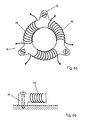
- Figures 6a and 6b represent an alternative embodiment of the present invention according to which a ring core 10 comprises metallic bushes 90 for fixing the wound core 10 to a heat sink.
- the metallic bushes 90 are permanently inserted in the core 10, and produce three ear pads, by which the core 10 can conveniently be mounted on the heat sink. The internally generated heat flows therefore from the core 10 through the bushes 90 to the heat sink, by thermal conduction.
- This embodiment of the present invention lends itself to several variants, in which the cylindrical bushes 90 are replaced by other mounting and heat-conduction inserts, like for example metallic profiles or fixation plaques.
- a pot core 10, on which a winding 20 is realized has permanently inserted a heat pipe 80.
- the heat pipe 80 is in thermal contact with the core 10, and comprises an internal conduit (not represented) partially filled with a volatile liquid, for example water in a low-pressure tight chamber.
- the heat contact between the heat pipe 80 and the core 10 can be enhanced for example by providing a series of ribs on the former (not represented).
- the volatile liquid continuously evaporates in the part of the heat pipe 80 in contact with the hot core 10 and condensates in the cold outer part thermally connected with the large radiator 81. From the cold end of the pipe 80 the liquid drips back to the core in a continuous cycle.
- the heat transfer along the heat pipe 80 comprises the four following processes, all taking place in a continuous cycle:
- the heat pipe 80 can be permanently integrated in the core 10 during its fabrication, or permanently mounted to it in a further fabrication phase.
- the radiator 81 could be substituted by a heat sink.
- the heat pipe 80 provides efficient conduction of the heat to the heat sink.
- one or more conductors are wound around one of the magnetic cores described above, and the resulting coil is incorporated in a filter circuit, for example a power filter for electromagnetic compatibility, or another sort of filter or noise-suppression circuit.
- a filter circuit for example a power filter for electromagnetic compatibility, or another sort of filter or noise-suppression circuit.
- the coil so produced thanks to its small size and high loss tolerance is particularly suitable for such filtering applications, particularly for EMC filters at mains voltage.
- the coil thus fashioned may comprise multiple windings, for example in the case of a filter for a multiphase power system.
- the present invention also provides longitudinal coils and current-compensated coils with improved cooling capability.
Landscapes
- Engineering & Computer Science (AREA)
- Power Engineering (AREA)
- Coils Or Transformers For Communication (AREA)
- Powder Metallurgy (AREA)
- Molds, Cores, And Manufacturing Methods Thereof (AREA)
- Soft Magnetic Materials (AREA)
- Cooling Or The Like Of Electrical Apparatus (AREA)
Abstract
Description
- The present invention relates to magnetic cores having enhanced self-cooling capabilities and, in particular to magnetic cores comprising special elements for dissipating the heat internally produced.
- Magnetic cores, as component of impedances, coils and transformers, are used in a number of electrical and electronic applications. In particular magnetic cores are used in the manufacturing of impedances, chokes, and transformers in many power or signal processing circuits for the purposes of impedance matching, frequency filtering, as energy tanks in voltage converters, for power factor correction and in numberless other cases.
- More particularly, applications of magnetic cores in the construction of longitudinal coils and current-compensated coils are described in patent applications
EP-A2-0 682 395 andEP-A2-1 096634 (closest prior art), in the name of the applicant. -
US-A-5,768,113 discloses a high power and high voltage power supply is capable of charging one or more capacitors to high voltage. The power supply includes a current rectifier circuit for connecting to an AC source, a voltage step-up circuit including at least one controllable electronic switch and a voltage step-up transformer including a primary winding electrically connected to the electronic switch, and a control device for controlling the electronic switch. The power supply is organized to chop the current flowing through the primary winding in such a manner as to enable a high voltage to be taken from across the terminal to at least one secondary winding of the transformer. The step-up circuit is of a non-resonant type. The transformer core has heat dissipation features permanently fixed to its outer surface. - Magnetic coils and the associated cores are generally present in EMC filters, and in most noise-suppression filters. Due to their comparative bulk, Magnetic component contribute heavily to the size and cost of such filtering devices.
- In many cases, and in particular in medium and high frequency applications with moderate or high core losses, it is customary to produce magnetic cores from magnetic metallic powders, typically iron or permalloy powders, or other magnetic powders, by a process of pressing a mixture of magnetic powder and an adequate binding and insulating phase, into a die of the desired form. The powder and the binding phase are compacted together by the action of heat and pressure into a solid core having the desired shape.
- Alternatively magnetic cores can be produced by magnetic powder alone, by a sintering process.
- In a further alternative process magnetic cores are cast at lower temperature and pressure, by adopting an appropriate resin binder, for example a two-component hardening compound, another chemically curable resin, or a low-temperature curing resin.
- Other magnetic core types comprise laminated cores, mostly employed for applications at mains frequency, and ceramic ferrite cores.
- In all these cases the problem arises of transferring the heat losses in the core to the outside of the coil. Core losses arise from hysteresis and eddy currents and are of course unavoidable, whenever the core is subject to a time-variable magnetic flux. In some cases, and particularly in filters, mains filters and EMC filters, core losses are a desired characteristic of the magnetic component, since dissipating unwanted portions of the signal in the core may reduce the load on resistive elements of the circuit.
- Such shortcomings of the known core coils reflect in corresponding limitations of EMC filters and noise filters comprising those coils.
- The internally produced heat must however be transferred to the outside to avoid that the temperature exceeds the thermal limit of the coil insulation or the Curie point of the magnetic material. Due to the finite core heat-transfer capability, core losses are often a major limiting factor in the power rating of a magnetic component.
-
Magnetic cores 10 are usually manufactured in a variety of shapes, some of which are represented on figure 1. Core shapes are generally designed with the aim of simplifying coil winding and/or of using the magnetic material in the most efficient way. The designer tries therefore to place the magnetic material in high flux zones, and regards regions of magnetic material in which the flux is sensibly lower then average as an unnecessary waste. - The
known cores 10 represented on figure 1 are an example of this way of designing. While these cores use a minimal amount of magnetic material, the outer surface available for the heat exchange is necessarily very low. These cores are therefore easily overheated, because the heat dissipation of the core losses is very inefficient in this design. As a consequence, in many applications where core losses are moderate or high, the core dimensioning factor will be the power dissipation rather than the maximum available magnetic flux. - When such magnetic cores are employed in the manufacturing of a filter, for example an EMC-filter or a mains filter for noise disturbance suppression, the large size of the magnetic elements contribute to the size and cost of the final device.
- An object of the present invention is to provide a magnetic core in which the heat losses are efficiently transferred to the outside, and therefore a magnetic core allowing the construction of more compact, more powerful coils and magnetic components.
- A further object of the present invention is to provide a filter, and a coil therefore, exhibiting smaller size and lower cost.
- Such object is attained by the coil, the core and the circuit having the characteristics of the claims 1-7 in the corresponding categories. The core is produced by a method according to claims 1-10.
- The invention will be better understood with the aid of the description of an embodiment given by way of example and illustrated by the figures, in which:
- Fig. 1
- represent a series of views of magnetic cores according to the prior art.
- Fig. 2a, b
- represent a magnetic core according to a first embodiment of the present invention.
- Fig. 3
- represents a magnetic core according to a second embodiment of the present invention.
- Fig. 4a,b
- represent a variant embodiment of the first embodiment of figures 2a and 2b and
- Fig. 5, 6a,b
- represent further embodiments.
- According to a first embodiment of the invention, the shape of the core is chosen in order to enhance heat dissipation.
- According to a first embodiment of the invention, the outer surface of the
core 10 is equipped with fin-like structures in order to increase heat dissipation. Figures 2a and 2b represent an example of anE-core 10 provided with a series ofheat fins 40 on the other surface. Theheat fins 40 are integrally realized together with thecore 10, by appropriately shaping the die or the mould in which the metal powder is pressed or cast. - The magnetic material in the heat fins 40 may play little or no role as far as the magnetic circuit is concerned, yet the
fins 40 significantly improve heat convection and radiation from thecore 10 to the outside. The cores of figure 2a will often lead, in presence of core losses, to a more compact and economical construction than the knowncores 10 of the figure 1. - This invention is limited to powder cores, but the
fins 40 could equally be added to ferrite cores, or to laminated cores, or to magnetic elements of other magnetic materials with which radiating fins can be integrally realized. - According to a variant of this first embodiment of the invention, represented on figures 4a and 4b, the same heat-
dissipating fins 40 are realized on the outer surface of a pot-shaped core 10. It is clear that similar variant embodiments are also possible for any other usual core shape, for example for C-cores, ring, flat, drum or rod cores, and for all variations and combinations thereof. - It is also to be understood that the present invention should not be limited to the provision of parallel fins as described in the above non-limitative examples, but comprises as well other geometrical structures like ribs, slots, protrusions, nooks, combs, fingers, and in general any shape providing cavities and protrusions for increasing the available external surface of the core and the heat dissipation therefrom.
- According to a second embodiment of the present invention, and with reference now to figure 3, the magnetic core according to the invention comprises heat-
conductive inserts 50, permanently attached to or inserted in thecore 10, for conducting and dissipating the heat generated in thecore 10 as a consequence of the magnetic losses therein. Such heatconductive inserts 50 can for example be realized from pre-punched metal sheets, inserted in the die or in the mould before the magnetic powder is added and which become then permanently incorporated in the powder core. The protruding part of themetal inserts 50 acts as radiating fins, thus increasing the heat dissipation from thecore 10. - Alternatively the metal inserts 50 can be inserted and integrated in the core 10 after the constitution of the core 10, for example by gluing, pressing, screwing, or by any other assembly technique.
- Preferably the shape of the sheets will be chosen in order to achieve a large contact area with the core material, and the sheet orientation and thickness will be adapted in order to minimize the induced eddy currents. In this case the sheets may be realized of high thermal conductivity material, like aluminium or copper.
- Other alternative variants of this embodiment are also possible, in which the heat-
conductive insert 50 consists of metal rods or of metal wires or of a metallic mesh. - Figures 6a and 6b represent an alternative embodiment of the present invention according to which a
ring core 10 comprisesmetallic bushes 90 for fixing thewound core 10 to a heat sink. Themetallic bushes 90 are permanently inserted in thecore 10, and produce three ear pads, by which thecore 10 can conveniently be mounted on the heat sink. The internally generated heat flows therefore from the core 10 through thebushes 90 to the heat sink, by thermal conduction. - This embodiment of the present invention lends itself to several variants, in which the
cylindrical bushes 90 are replaced by other mounting and heat-conduction inserts, like for example metallic profiles or fixation plaques. - According to another embodiment, described with reference to figure 5, a
pot core 10, on which a winding 20 is realized, has permanently inserted aheat pipe 80. Theheat pipe 80 is in thermal contact with thecore 10, and comprises an internal conduit (not represented) partially filled with a volatile liquid, for example water in a low-pressure tight chamber. The heat contact between theheat pipe 80 and the core 10 can be enhanced for example by providing a series of ribs on the former (not represented). - The volatile liquid continuously evaporates in the part of the
heat pipe 80 in contact with thehot core 10 and condensates in the cold outer part thermally connected with thelarge radiator 81. From the cold end of thepipe 80 the liquid drips back to the core in a continuous cycle. - In other words, the heat transfer along the
heat pipe 80 comprises the four following processes, all taking place in a continuous cycle: - 1. (evaporation) the liquid evaporates in the hot end of the
heat pipe 80, inside thecore 10, thereby subtracting from the core 10 a latent evaporation heat; - 2. (vapour transfer) the hot vapour fills the cavity in the
heat pipe 80 and reaches the cold end, transporting the heat subtracted from the core in the evaporation phase; - 3. (condensation) the vapour condensates on the cold end of the
heat pipe 80, connected with theradiator 81. The heat subtracted from thecore 10 is delivered to theradiator 81 as condensation latent heat; - 4. (liquid transfer) the condensate return, usually by gravity, to the hot end of the
heat pipe 80 in thecore 10, wherein a new evaporation takes place. - In this way large heat transfers can be achieved from the
hot core 10 to thecolder radiator 81. - Also in the case of this embodiment the
heat pipe 80 can be permanently integrated in the core 10 during its fabrication, or permanently mounted to it in a further fabrication phase. - In an alternative non represented variant of this embodiment, the
radiator 81 could be substituted by a heat sink. In this case theheat pipe 80 provides efficient conduction of the heat to the heat sink. - In a variant of the present invention, one or more conductors are wound around one of the magnetic cores described above, and the resulting coil is incorporated in a filter circuit, for example a power filter for electromagnetic compatibility, or another sort of filter or noise-suppression circuit. The coil so produced, thanks to its small size and high loss tolerance is particularly suitable for such filtering applications, particularly for EMC filters at mains voltage.
- According to the necessity, the coil thus fashioned may comprise multiple windings, for example in the case of a filter for a multiphase power system. The present invention also provides longitudinal coils and current-compensated coils with improved cooling capability.
-
- 10
- Core
- 20
- Winding coil
- 40
- Heat fin, fin
- 50
- Heat-conductive insert
- 80
- Heat-pipe
- 81
- Radiator
- 90
- Metallic bushes
Claims (10)
- Magnetic core (10) for a power electromagnetic compatibility filter, wherein said core (10) consists of a metal powder,
characterized in that
the core (10) comprises an outer surface and has heat dissipation features (40, 80, 81, 90) integrally formed with said powder core (10) or heat conductive inserts (50) permanently incorporated in said powder core (10) for increasing the heat dissipation there from. - The magnetic core (10) of claim 1, wherein said dissipation features increase said outer surface of the core (10) and comprise at least one of the following shapes: ribs, protrusions, fins (40), fingers, slots, nooks and combs or any shape providing cavities and protrusions.
- The magnetic core (10) of claim 1, wherein said heat conductive inserts (50) comprises pre-punched material, metal rods, metal wires or a metallic mesh.
- The magnetic core of claim 1, wherein said heat dissipating features protrude to the outside of said core (10) for dissipating heat by convection and radiation.
- An inductive electric component, comprising at least a magnetic core (10) according to one of the preceding claims.
- A power filter for electromagnetic compatibility, comprising an inductive component according to claim 5.
- The power filter of claim 6, wherein said filter is adapted for filtering a noise superimposed to a mains supply line.
- Method for producing a magnetic core (10) for a power electromagnetic compatibility filter according to any of the claims 1 to 4, wherein said core (10) consists of a metal powder, the method comprising the steps of• providing a die or mould;• adding metal powder and• pressing or casting the metal powder, whereby the method is characterized in the steps of• appropriately shaping the die or the mould in the form of heat dissipation features (40, 50, 80, 81, 90) or inserting in the die or mould heat conductive inserts (50) and• integrally forming said heat dissipation features (40, 50, 80, 81, 90) with said powder core (10) or permanently incorporating said heat conductive inserts (50) in said powder core (10) in the step of pressing or casting the metal powder.
- Method according to claim 8, comprising the step of shaping the die or mould in the form of ribs, protrusions, fins (40), fingers, slots, nooks and combs or any shape providing cavities and protrusions.
- Method according to claim 8, comprising the step of realizing said heat conductive inserts (50) from pre-punched material, of metal rods, of metal wires or of a metallic mesh.
Priority Applications (1)
| Application Number | Priority Date | Filing Date | Title |
|---|---|---|---|
| EP04741775A EP1631973B1 (en) | 2003-06-10 | 2004-06-10 | Magnetic core with cooling capabilities and method for its producing |
Applications Claiming Priority (3)
| Application Number | Priority Date | Filing Date | Title |
|---|---|---|---|
| EP03101688 | 2003-06-10 | ||
| EP04741775A EP1631973B1 (en) | 2003-06-10 | 2004-06-10 | Magnetic core with cooling capabilities and method for its producing |
| PCT/EP2004/051085 WO2004112064A1 (en) | 2003-06-10 | 2004-06-10 | Magnetic core and device with cooling capabilities |
Publications (2)
| Publication Number | Publication Date |
|---|---|
| EP1631973A1 EP1631973A1 (en) | 2006-03-08 |
| EP1631973B1 true EP1631973B1 (en) | 2007-11-07 |
Family
ID=33547698
Family Applications (1)
| Application Number | Title | Priority Date | Filing Date |
|---|---|---|---|
| EP04741775A Expired - Lifetime EP1631973B1 (en) | 2003-06-10 | 2004-06-10 | Magnetic core with cooling capabilities and method for its producing |
Country Status (4)
| Country | Link |
|---|---|
| EP (1) | EP1631973B1 (en) |
| AT (1) | ATE377834T1 (en) |
| DE (1) | DE602004009924T2 (en) |
| WO (1) | WO2004112064A1 (en) |
Cited By (1)
| Publication number | Priority date | Publication date | Assignee | Title |
|---|---|---|---|---|
| EP4390989A4 (en) * | 2021-09-29 | 2024-12-04 | Mitsubishi Heavy Industries Thermal Systems, Ltd. | REACTOR |
Families Citing this family (5)
| Publication number | Priority date | Publication date | Assignee | Title |
|---|---|---|---|---|
| EP2463871B1 (en) * | 2010-12-07 | 2017-06-14 | ABB Schweiz AG | Amorphous transformer core |
| ES2530055T3 (en) | 2011-02-16 | 2015-02-26 | Abb Technology Ag | Cooling system for dry transformers |
| JP6460329B2 (en) * | 2015-02-27 | 2019-01-30 | 株式会社オートネットワーク技術研究所 | Reactor |
| FR3045923B1 (en) * | 2015-12-17 | 2021-05-07 | Commissariat Energie Atomique | MONOLITHIC INDUCTANCE CORES INTEGRATING A THERMAL DRAIN |
| FR3045921B1 (en) * | 2015-12-17 | 2019-07-12 | Commissariat A L'energie Atomique Et Aux Energies Alternatives | INDUCTANCE CIRCUIT INCORPORATING A PASSIVE THERMAL MANAGEMENT FUNCTION |
Family Cites Families (4)
| Publication number | Priority date | Publication date | Assignee | Title |
|---|---|---|---|---|
| JPS6194310A (en) * | 1984-10-15 | 1986-05-13 | Kansai Electric Power Co Inc:The | Iron core cooling unit for electric apparatus |
| FR2740631B1 (en) * | 1995-10-31 | 1998-01-16 | Eurofeedback Sa | HIGH VOLTAGE AND HIGH POWER SUPPLY |
| JPH10163022A (en) * | 1996-12-03 | 1998-06-19 | Minebea Co Ltd | Laminated assembly with increased heat dissipation area |
| EP1096634B1 (en) * | 1999-10-29 | 2007-05-02 | Schaffner Emv Ag | Use of a three phase mains filter with neutral |
-
2004
- 2004-06-10 EP EP04741775A patent/EP1631973B1/en not_active Expired - Lifetime
- 2004-06-10 WO PCT/EP2004/051085 patent/WO2004112064A1/en not_active Ceased
- 2004-06-10 DE DE602004009924T patent/DE602004009924T2/en not_active Expired - Lifetime
- 2004-06-10 AT AT04741775T patent/ATE377834T1/en not_active IP Right Cessation
Cited By (1)
| Publication number | Priority date | Publication date | Assignee | Title |
|---|---|---|---|---|
| EP4390989A4 (en) * | 2021-09-29 | 2024-12-04 | Mitsubishi Heavy Industries Thermal Systems, Ltd. | REACTOR |
Also Published As
| Publication number | Publication date |
|---|---|
| ATE377834T1 (en) | 2007-11-15 |
| EP1631973A1 (en) | 2006-03-08 |
| DE602004009924T2 (en) | 2008-08-28 |
| DE602004009924D1 (en) | 2007-12-20 |
| WO2004112064A1 (en) | 2004-12-23 |
Similar Documents
| Publication | Publication Date | Title |
|---|---|---|
| US7911308B2 (en) | Low thermal impedance conduction cooled magnetics | |
| CN105706196B (en) | Electromagnetic induction device | |
| EP2989645B1 (en) | Thermal management system for smc inductors | |
| TWI379329B (en) | Transformer structure | |
| WO2009042232A1 (en) | Thermally enhanced magnetic transformer | |
| CN103003896A (en) | Reactor and coil components | |
| US7142085B2 (en) | Insulation and integrated heat sink for high frequency, low output voltage toroidal inductors and transformers | |
| EP2929551A2 (en) | Transformer assembly | |
| CN101447280B (en) | Choke coils for electronic devices | |
| US20230014778A1 (en) | Magnetic component structure with thermal conductive filler | |
| EP1631973B1 (en) | Magnetic core with cooling capabilities and method for its producing | |
| US3179908A (en) | Heat exchange means for electromagnetic devices | |
| JP6393212B2 (en) | Power converter | |
| JPH11288819A (en) | Transformers and reactors | |
| US11778773B2 (en) | Choke structure with water cooling | |
| JPS6161525B2 (en) | ||
| CN108475575B (en) | Electronic device comprising at least one inductor comprising a passive thermal management device | |
| EP4254445A1 (en) | Power magnetic component | |
| CN218768948U (en) | Magnetic element shell | |
| JP2007235054A (en) | Heat sink, choke coil with heat sink, and manufacturing method | |
| JP4775108B2 (en) | Power electronics | |
| CN214336486U (en) | Single-phase conjugate reactor and three-phase conjugate reactor | |
| JP6221927B2 (en) | Reactor | |
| AU738507B2 (en) | Inductance arrangement | |
| CN224036192U (en) | Electromagnetic device with improved cooling |
Legal Events
| Date | Code | Title | Description |
|---|---|---|---|
| PUAI | Public reference made under article 153(3) epc to a published international application that has entered the european phase |
Free format text: ORIGINAL CODE: 0009012 |
|
| 17P | Request for examination filed |
Effective date: 20051208 |
|
| AK | Designated contracting states |
Kind code of ref document: A1 Designated state(s): AT BE BG CH CY CZ DE DK EE ES FI FR GB GR HU IE IT LI LU MC NL PL PT RO SE SI SK TR |
|
| DAX | Request for extension of the european patent (deleted) | ||
| 17Q | First examination report despatched |
Effective date: 20061002 |
|
| RIN1 | Information on inventor provided before grant (corrected) |
Inventor name: KULL, PETER Inventor name: SIPPOLA, MIKA MATTI |
|
| GRAP | Despatch of communication of intention to grant a patent |
Free format text: ORIGINAL CODE: EPIDOSNIGR1 |
|
| RIC1 | Information provided on ipc code assigned before grant |
Ipc: H01F 41/02 20060101ALI20070710BHEP Ipc: H02J 3/18 20060101ALI20070710BHEP Ipc: H01F 27/22 20060101AFI20070710BHEP Ipc: H01F 27/24 20060101ALI20070710BHEP |
|
| RTI1 | Title (correction) |
Free format text: MAGNETIC CORE WITH COOLING CAPABILITIES AND METHOD FOR ITS PRODUCING |
|
| GRAS | Grant fee paid |
Free format text: ORIGINAL CODE: EPIDOSNIGR3 |
|
| GRAA | (expected) grant |
Free format text: ORIGINAL CODE: 0009210 |
|
| AK | Designated contracting states |
Kind code of ref document: B1 Designated state(s): AT BE BG CH CY CZ DE DK EE ES FI FR GB GR HU IE IT LI LU MC NL PL PT RO SE SI SK TR |
|
| REG | Reference to a national code |
Ref country code: GB Ref legal event code: FG4D |
|
| REG | Reference to a national code |
Ref country code: IE Ref legal event code: FG4D |
|
| REG | Reference to a national code |
Ref country code: CH Ref legal event code: EP |
|
| REF | Corresponds to: |
Ref document number: 602004009924 Country of ref document: DE Date of ref document: 20071220 Kind code of ref document: P |
|
| PG25 | Lapsed in a contracting state [announced via postgrant information from national office to epo] |
Ref country code: ES Free format text: LAPSE BECAUSE OF FAILURE TO SUBMIT A TRANSLATION OF THE DESCRIPTION OR TO PAY THE FEE WITHIN THE PRESCRIBED TIME-LIMIT Effective date: 20080218 Ref country code: NL Free format text: LAPSE BECAUSE OF FAILURE TO SUBMIT A TRANSLATION OF THE DESCRIPTION OR TO PAY THE FEE WITHIN THE PRESCRIBED TIME-LIMIT Effective date: 20071107 Ref country code: SE Free format text: LAPSE BECAUSE OF FAILURE TO SUBMIT A TRANSLATION OF THE DESCRIPTION OR TO PAY THE FEE WITHIN THE PRESCRIBED TIME-LIMIT Effective date: 20080207 Ref country code: LI Free format text: LAPSE BECAUSE OF FAILURE TO SUBMIT A TRANSLATION OF THE DESCRIPTION OR TO PAY THE FEE WITHIN THE PRESCRIBED TIME-LIMIT Effective date: 20071107 Ref country code: CH Free format text: LAPSE BECAUSE OF FAILURE TO SUBMIT A TRANSLATION OF THE DESCRIPTION OR TO PAY THE FEE WITHIN THE PRESCRIBED TIME-LIMIT Effective date: 20071107 |
|
| NLV1 | Nl: lapsed or annulled due to failure to fulfill the requirements of art. 29p and 29m of the patents act | ||
| PG25 | Lapsed in a contracting state [announced via postgrant information from national office to epo] |
Ref country code: SI Free format text: LAPSE BECAUSE OF FAILURE TO SUBMIT A TRANSLATION OF THE DESCRIPTION OR TO PAY THE FEE WITHIN THE PRESCRIBED TIME-LIMIT Effective date: 20071107 Ref country code: PL Free format text: LAPSE BECAUSE OF FAILURE TO SUBMIT A TRANSLATION OF THE DESCRIPTION OR TO PAY THE FEE WITHIN THE PRESCRIBED TIME-LIMIT Effective date: 20071107 Ref country code: BG Free format text: LAPSE BECAUSE OF FAILURE TO SUBMIT A TRANSLATION OF THE DESCRIPTION OR TO PAY THE FEE WITHIN THE PRESCRIBED TIME-LIMIT Effective date: 20080207 |
|
| REG | Reference to a national code |
Ref country code: CH Ref legal event code: PL |
|
| PG25 | Lapsed in a contracting state [announced via postgrant information from national office to epo] |
Ref country code: AT Free format text: LAPSE BECAUSE OF FAILURE TO SUBMIT A TRANSLATION OF THE DESCRIPTION OR TO PAY THE FEE WITHIN THE PRESCRIBED TIME-LIMIT Effective date: 20071107 |
|
| PG25 | Lapsed in a contracting state [announced via postgrant information from national office to epo] |
Ref country code: DK Free format text: LAPSE BECAUSE OF FAILURE TO SUBMIT A TRANSLATION OF THE DESCRIPTION OR TO PAY THE FEE WITHIN THE PRESCRIBED TIME-LIMIT Effective date: 20071107 Ref country code: CZ Free format text: LAPSE BECAUSE OF FAILURE TO SUBMIT A TRANSLATION OF THE DESCRIPTION OR TO PAY THE FEE WITHIN THE PRESCRIBED TIME-LIMIT Effective date: 20071107 |
|
| EN | Fr: translation not filed | ||
| PG25 | Lapsed in a contracting state [announced via postgrant information from national office to epo] |
Ref country code: RO Free format text: LAPSE BECAUSE OF FAILURE TO SUBMIT A TRANSLATION OF THE DESCRIPTION OR TO PAY THE FEE WITHIN THE PRESCRIBED TIME-LIMIT Effective date: 20071107 Ref country code: BE Free format text: LAPSE BECAUSE OF FAILURE TO SUBMIT A TRANSLATION OF THE DESCRIPTION OR TO PAY THE FEE WITHIN THE PRESCRIBED TIME-LIMIT Effective date: 20071107 Ref country code: SK Free format text: LAPSE BECAUSE OF FAILURE TO SUBMIT A TRANSLATION OF THE DESCRIPTION OR TO PAY THE FEE WITHIN THE PRESCRIBED TIME-LIMIT Effective date: 20071107 |
|
| PLBE | No opposition filed within time limit |
Free format text: ORIGINAL CODE: 0009261 |
|
| STAA | Information on the status of an ep patent application or granted ep patent |
Free format text: STATUS: NO OPPOSITION FILED WITHIN TIME LIMIT |
|
| PG25 | Lapsed in a contracting state [announced via postgrant information from national office to epo] |
Ref country code: PT Free format text: LAPSE BECAUSE OF FAILURE TO SUBMIT A TRANSLATION OF THE DESCRIPTION OR TO PAY THE FEE WITHIN THE PRESCRIBED TIME-LIMIT Effective date: 20080407 |
|
| 26N | No opposition filed |
Effective date: 20080808 |
|
| PG25 | Lapsed in a contracting state [announced via postgrant information from national office to epo] |
Ref country code: FR Free format text: LAPSE BECAUSE OF FAILURE TO SUBMIT A TRANSLATION OF THE DESCRIPTION OR TO PAY THE FEE WITHIN THE PRESCRIBED TIME-LIMIT Effective date: 20080822 |
|
| PG25 | Lapsed in a contracting state [announced via postgrant information from national office to epo] |
Ref country code: MC Free format text: LAPSE BECAUSE OF NON-PAYMENT OF DUE FEES Effective date: 20080630 Ref country code: GR Free format text: LAPSE BECAUSE OF FAILURE TO SUBMIT A TRANSLATION OF THE DESCRIPTION OR TO PAY THE FEE WITHIN THE PRESCRIBED TIME-LIMIT Effective date: 20080208 |
|
| GBPC | Gb: european patent ceased through non-payment of renewal fee |
Effective date: 20080610 |
|
| PG25 | Lapsed in a contracting state [announced via postgrant information from national office to epo] |
Ref country code: FI Free format text: LAPSE BECAUSE OF FAILURE TO SUBMIT A TRANSLATION OF THE DESCRIPTION OR TO PAY THE FEE WITHIN THE PRESCRIBED TIME-LIMIT Effective date: 20071107 |
|
| PG25 | Lapsed in a contracting state [announced via postgrant information from national office to epo] |
Ref country code: IE Free format text: LAPSE BECAUSE OF NON-PAYMENT OF DUE FEES Effective date: 20080610 Ref country code: EE Free format text: LAPSE BECAUSE OF FAILURE TO SUBMIT A TRANSLATION OF THE DESCRIPTION OR TO PAY THE FEE WITHIN THE PRESCRIBED TIME-LIMIT Effective date: 20071107 |
|
| PG25 | Lapsed in a contracting state [announced via postgrant information from national office to epo] |
Ref country code: GB Free format text: LAPSE BECAUSE OF NON-PAYMENT OF DUE FEES Effective date: 20080610 |
|
| PG25 | Lapsed in a contracting state [announced via postgrant information from national office to epo] |
Ref country code: CY Free format text: LAPSE BECAUSE OF FAILURE TO SUBMIT A TRANSLATION OF THE DESCRIPTION OR TO PAY THE FEE WITHIN THE PRESCRIBED TIME-LIMIT Effective date: 20071107 |
|
| PG25 | Lapsed in a contracting state [announced via postgrant information from national office to epo] |
Ref country code: HU Free format text: LAPSE BECAUSE OF FAILURE TO SUBMIT A TRANSLATION OF THE DESCRIPTION OR TO PAY THE FEE WITHIN THE PRESCRIBED TIME-LIMIT Effective date: 20080508 Ref country code: LU Free format text: LAPSE BECAUSE OF NON-PAYMENT OF DUE FEES Effective date: 20080610 |
|
| PG25 | Lapsed in a contracting state [announced via postgrant information from national office to epo] |
Ref country code: TR Free format text: LAPSE BECAUSE OF FAILURE TO SUBMIT A TRANSLATION OF THE DESCRIPTION OR TO PAY THE FEE WITHIN THE PRESCRIBED TIME-LIMIT Effective date: 20071107 |
|
| PG25 | Lapsed in a contracting state [announced via postgrant information from national office to epo] |
Ref country code: IT Free format text: LAPSE BECAUSE OF NON-PAYMENT OF DUE FEES Effective date: 20080630 |
|
| PGFP | Annual fee paid to national office [announced via postgrant information from national office to epo] |
Ref country code: DE Payment date: 20150619 Year of fee payment: 12 |
|
| REG | Reference to a national code |
Ref country code: DE Ref legal event code: R119 Ref document number: 602004009924 Country of ref document: DE |
|
| PG25 | Lapsed in a contracting state [announced via postgrant information from national office to epo] |
Ref country code: DE Free format text: LAPSE BECAUSE OF NON-PAYMENT OF DUE FEES Effective date: 20170103 |