EP1631372B1 - Ein tensid und ein cotensid umfassende mischung - Google Patents
Ein tensid und ein cotensid umfassende mischung Download PDFInfo
- Publication number
- EP1631372B1 EP1631372B1 EP04739297A EP04739297A EP1631372B1 EP 1631372 B1 EP1631372 B1 EP 1631372B1 EP 04739297 A EP04739297 A EP 04739297A EP 04739297 A EP04739297 A EP 04739297A EP 1631372 B1 EP1631372 B1 EP 1631372B1
- Authority
- EP
- European Patent Office
- Prior art keywords
- oxide
- methyl
- mixture
- substituents
- ethylene oxide
- Prior art date
- Legal status (The legal status is an assumption and is not a legal conclusion. Google has not performed a legal analysis and makes no representation as to the accuracy of the status listed.)
- Expired - Lifetime
Links
- 239000000203 mixture Substances 0.000 title claims abstract description 92
- 239000004094 surface-active agent Substances 0.000 title claims abstract description 73
- 239000004064 cosurfactant Substances 0.000 title claims description 42
- 229920000642 polymer Polymers 0.000 claims abstract description 18
- IAYPIBMASNFSPL-UHFFFAOYSA-N Ethylene oxide Chemical compound C1CO1 IAYPIBMASNFSPL-UHFFFAOYSA-N 0.000 claims description 55
- -1 substituents hydrogen Chemical class 0.000 claims description 45
- GOOHAUXETOMSMM-UHFFFAOYSA-N Propylene oxide Chemical compound CC1CO1 GOOHAUXETOMSMM-UHFFFAOYSA-N 0.000 claims description 41
- 239000004530 micro-emulsion Substances 0.000 claims description 39
- 239000003921 oil Substances 0.000 claims description 24
- 238000002360 preparation method Methods 0.000 claims description 22
- XLYOFNOQVPJJNP-UHFFFAOYSA-N water Substances O XLYOFNOQVPJJNP-UHFFFAOYSA-N 0.000 claims description 22
- 239000002537 cosmetic Substances 0.000 claims description 17
- 239000001257 hydrogen Substances 0.000 claims description 17
- 229910052739 hydrogen Inorganic materials 0.000 claims description 17
- 125000000217 alkyl group Chemical group 0.000 claims description 16
- 125000004432 carbon atom Chemical group C* 0.000 claims description 16
- 239000000839 emulsion Substances 0.000 claims description 16
- 125000001424 substituent group Chemical group 0.000 claims description 14
- 125000001997 phenyl group Chemical group [H]C1=C([H])C([H])=C(*)C([H])=C1[H] 0.000 claims description 13
- 125000001495 ethyl group Chemical group [H]C([H])([H])C([H])([H])* 0.000 claims description 12
- 125000002496 methyl group Chemical group [H]C([H])([H])* 0.000 claims description 12
- LFQSCWFLJHTTHZ-UHFFFAOYSA-N Ethanol Chemical compound CCO LFQSCWFLJHTTHZ-UHFFFAOYSA-N 0.000 claims description 11
- 239000000654 additive Substances 0.000 claims description 11
- 238000009472 formulation Methods 0.000 claims description 10
- 125000001449 isopropyl group Chemical group [H]C([H])([H])C([H])(*)C([H])([H])[H] 0.000 claims description 10
- 125000002347 octyl group Chemical group [H]C([*])([H])C([H])([H])C([H])([H])C([H])([H])C([H])([H])C([H])([H])C([H])([H])C([H])([H])[H] 0.000 claims description 10
- 125000004123 n-propyl group Chemical group [H]C([H])([H])C([H])([H])C([H])([H])* 0.000 claims description 9
- 125000003118 aryl group Chemical group 0.000 claims description 8
- 229910052751 metal Inorganic materials 0.000 claims description 8
- 239000002184 metal Substances 0.000 claims description 8
- 239000000178 monomer Substances 0.000 claims description 8
- 238000004140 cleaning Methods 0.000 claims description 7
- 125000000753 cycloalkyl group Chemical group 0.000 claims description 7
- 239000003599 detergent Substances 0.000 claims description 6
- 239000010985 leather Substances 0.000 claims description 6
- 239000004753 textile Substances 0.000 claims description 6
- 239000000853 adhesive Substances 0.000 claims description 5
- 230000001070 adhesive effect Effects 0.000 claims description 5
- 238000000576 coating method Methods 0.000 claims description 5
- 238000000034 method Methods 0.000 claims description 5
- 229910052760 oxygen Inorganic materials 0.000 claims description 5
- 230000000087 stabilizing effect Effects 0.000 claims description 5
- 229910052717 sulfur Inorganic materials 0.000 claims description 5
- 230000000475 sunscreen effect Effects 0.000 claims description 5
- 239000000516 sunscreening agent Substances 0.000 claims description 5
- AAMHBRRZYSORSH-UHFFFAOYSA-N 2-octyloxirane Chemical compound CCCCCCCCC1CO1 AAMHBRRZYSORSH-UHFFFAOYSA-N 0.000 claims description 4
- SYURNNNQIFDVCA-UHFFFAOYSA-N 2-propyloxirane Chemical compound CCCC1CO1 SYURNNNQIFDVCA-UHFFFAOYSA-N 0.000 claims description 4
- AWMVMTVKBNGEAK-UHFFFAOYSA-N Styrene oxide Chemical compound C1OC1C1=CC=CC=C1 AWMVMTVKBNGEAK-UHFFFAOYSA-N 0.000 claims description 4
- 238000005238 degreasing Methods 0.000 claims description 4
- 235000013305 food Nutrition 0.000 claims description 4
- 125000002887 hydroxy group Chemical group [H]O* 0.000 claims description 4
- 125000002924 primary amino group Chemical group [H]N([H])* 0.000 claims description 4
- RBACIKXCRWGCBB-UHFFFAOYSA-N 1,2-Epoxybutane Chemical compound CCC1CO1 RBACIKXCRWGCBB-UHFFFAOYSA-N 0.000 claims description 3
- GELKGHVAFRCJNA-UHFFFAOYSA-N 2,2-Dimethyloxirane Chemical compound CC1(C)CO1 GELKGHVAFRCJNA-UHFFFAOYSA-N 0.000 claims description 3
- 230000000996 additive effect Effects 0.000 claims description 3
- 239000011248 coating agent Substances 0.000 claims description 3
- 239000003995 emulsifying agent Substances 0.000 claims description 3
- 239000006260 foam Substances 0.000 claims description 3
- 239000003906 humectant Substances 0.000 claims description 3
- 239000003973 paint Substances 0.000 claims description 3
- 125000001436 propyl group Chemical group [H]C([*])([H])C([H])([H])C([H])([H])[H] 0.000 claims description 3
- 239000002453 shampoo Substances 0.000 claims description 3
- 239000000080 wetting agent Substances 0.000 claims description 3
- 238000007720 emulsion polymerization reaction Methods 0.000 claims description 2
- 238000000855 fermentation Methods 0.000 claims description 2
- 230000004151 fermentation Effects 0.000 claims description 2
- 239000000835 fiber Substances 0.000 claims description 2
- 239000004615 ingredient Substances 0.000 claims description 2
- 229910052500 inorganic mineral Inorganic materials 0.000 claims description 2
- 239000011707 mineral Substances 0.000 claims description 2
- 238000006552 photochemical reaction Methods 0.000 claims description 2
- 239000012429 reaction media Substances 0.000 claims description 2
- 125000004435 hydrogen atom Chemical class [H]* 0.000 claims 6
- QMMOXUPEWRXHJS-UHFFFAOYSA-N pentene-2 Natural products CCC=CC QMMOXUPEWRXHJS-UHFFFAOYSA-N 0.000 claims 6
- QMMOXUPEWRXHJS-HYXAFXHYSA-N (z)-pent-2-ene Chemical compound CC\C=C/C QMMOXUPEWRXHJS-HYXAFXHYSA-N 0.000 claims 2
- ZQDPJFUHLCOCRG-UHFFFAOYSA-N 3-hexene Chemical compound CCC=CCC ZQDPJFUHLCOCRG-UHFFFAOYSA-N 0.000 claims 2
- DNIAPMSPPWPWGF-GSVOUGTGSA-N (R)-(-)-Propylene glycol Chemical compound C[C@@H](O)CO DNIAPMSPPWPWGF-GSVOUGTGSA-N 0.000 claims 1
- 125000000467 secondary amino group Chemical class [H]N([*:1])[*:2] 0.000 claims 1
- 125000003396 thiol group Chemical class [H]S* 0.000 claims 1
- 239000012071 phase Substances 0.000 description 27
- CIWBSHSKHKDKBQ-JLAZNSOCSA-N Ascorbic acid Chemical compound OC[C@H](O)[C@H]1OC(=O)C(O)=C1O CIWBSHSKHKDKBQ-JLAZNSOCSA-N 0.000 description 22
- 150000001298 alcohols Chemical class 0.000 description 19
- 239000004435 Oxo alcohol Substances 0.000 description 17
- WYURNTSHIVDZCO-UHFFFAOYSA-N Tetrahydrofuran Chemical compound C1CCOC1 WYURNTSHIVDZCO-UHFFFAOYSA-N 0.000 description 17
- 239000000047 product Substances 0.000 description 14
- CSCPPACGZOOCGX-UHFFFAOYSA-N Acetone Chemical compound CC(C)=O CSCPPACGZOOCGX-UHFFFAOYSA-N 0.000 description 12
- 125000002947 alkylene group Chemical group 0.000 description 12
- 239000003795 chemical substances by application Substances 0.000 description 11
- 229920001400 block copolymer Polymers 0.000 description 10
- 238000006243 chemical reaction Methods 0.000 description 10
- 238000009826 distribution Methods 0.000 description 10
- ZWEHNKRNPOVVGH-UHFFFAOYSA-N 2-Butanone Chemical compound CCC(C)=O ZWEHNKRNPOVVGH-UHFFFAOYSA-N 0.000 description 9
- 229960005070 ascorbic acid Drugs 0.000 description 9
- 150000001875 compounds Chemical class 0.000 description 9
- 150000003839 salts Chemical class 0.000 description 9
- FPIPGXGPPPQFEQ-OVSJKPMPSA-N all-trans-retinol Chemical compound OC\C=C(/C)\C=C\C=C(/C)\C=C\C1=C(C)CCCC1(C)C FPIPGXGPPPQFEQ-OVSJKPMPSA-N 0.000 description 8
- 239000003963 antioxidant agent Substances 0.000 description 8
- 235000006708 antioxidants Nutrition 0.000 description 8
- 239000003054 catalyst Substances 0.000 description 8
- 235000014113 dietary fatty acids Nutrition 0.000 description 8
- 239000000194 fatty acid Substances 0.000 description 8
- 229930195729 fatty acid Natural products 0.000 description 8
- 239000007858 starting material Substances 0.000 description 8
- 239000000126 substance Substances 0.000 description 8
- FMRHJJZUHUTGKE-UHFFFAOYSA-N Ethylhexyl salicylate Chemical compound CCCCC(CC)COC(=O)C1=CC=CC=C1O FMRHJJZUHUTGKE-UHFFFAOYSA-N 0.000 description 7
- 239000002211 L-ascorbic acid Substances 0.000 description 7
- 235000000069 L-ascorbic acid Nutrition 0.000 description 7
- 150000001336 alkenes Chemical class 0.000 description 7
- 150000004665 fatty acids Chemical class 0.000 description 7
- 150000002431 hydrogen Chemical class 0.000 description 7
- 239000002736 nonionic surfactant Substances 0.000 description 7
- VXNZUUAINFGPBY-UHFFFAOYSA-N 1-Butene Chemical compound CCC=C VXNZUUAINFGPBY-UHFFFAOYSA-N 0.000 description 6
- IJGRMHOSHXDMSA-UHFFFAOYSA-N Atomic nitrogen Chemical compound N#N IJGRMHOSHXDMSA-UHFFFAOYSA-N 0.000 description 6
- 150000002191 fatty alcohols Chemical class 0.000 description 6
- 238000005984 hydrogenation reaction Methods 0.000 description 6
- ALYNCZNDIQEVRV-UHFFFAOYSA-N 4-aminobenzoic acid Chemical compound NC1=CC=C(C(O)=O)C=C1 ALYNCZNDIQEVRV-UHFFFAOYSA-N 0.000 description 5
- UFHFLCQGNIYNRP-UHFFFAOYSA-N Hydrogen Chemical compound [H][H] UFHFLCQGNIYNRP-UHFFFAOYSA-N 0.000 description 5
- ISWSIDIOOBJBQZ-UHFFFAOYSA-N Phenol Chemical compound OC1=CC=CC=C1 ISWSIDIOOBJBQZ-UHFFFAOYSA-N 0.000 description 5
- 229920003171 Poly (ethylene oxide) Polymers 0.000 description 5
- 229910052783 alkali metal Inorganic materials 0.000 description 5
- DIOQZVSQGTUSAI-UHFFFAOYSA-N decane Chemical compound CCCCCCCCCC DIOQZVSQGTUSAI-UHFFFAOYSA-N 0.000 description 5
- 239000000499 gel Substances 0.000 description 5
- JSPLKZUTYZBBKA-UHFFFAOYSA-N trioxidane Chemical compound OOO JSPLKZUTYZBBKA-UHFFFAOYSA-N 0.000 description 5
- FPIPGXGPPPQFEQ-UHFFFAOYSA-N 13-cis retinol Natural products OCC=C(C)C=CC=C(C)C=CC1=C(C)CCCC1(C)C FPIPGXGPPPQFEQ-UHFFFAOYSA-N 0.000 description 4
- XMVBHZBLHNOQON-UHFFFAOYSA-N 2-butyl-1-octanol Chemical compound CCCCCCC(CO)CCCC XMVBHZBLHNOQON-UHFFFAOYSA-N 0.000 description 4
- YIWUKEYIRIRTPP-UHFFFAOYSA-N 2-ethylhexan-1-ol Chemical compound CCCCC(CC)CO YIWUKEYIRIRTPP-UHFFFAOYSA-N 0.000 description 4
- 239000002253 acid Substances 0.000 description 4
- SHGAZHPCJJPHSC-YCNIQYBTSA-N all-trans-retinoic acid Chemical compound OC(=O)\C=C(/C)\C=C\C=C(/C)\C=C\C1=C(C)CCCC1(C)C SHGAZHPCJJPHSC-YCNIQYBTSA-N 0.000 description 4
- 239000003945 anionic surfactant Substances 0.000 description 4
- DTDMYWXTWWFLGJ-UHFFFAOYSA-N decan-4-ol Chemical compound CCCCCCC(O)CCC DTDMYWXTWWFLGJ-UHFFFAOYSA-N 0.000 description 4
- 239000000975 dye Substances 0.000 description 4
- 150000002148 esters Chemical class 0.000 description 4
- XLYOFNOQVPJJNP-UHFFFAOYSA-M hydroxide Chemical compound [OH-] XLYOFNOQVPJJNP-UHFFFAOYSA-M 0.000 description 4
- 238000004519 manufacturing process Methods 0.000 description 4
- 229910052757 nitrogen Inorganic materials 0.000 description 4
- 230000003647 oxidation Effects 0.000 description 4
- 238000007254 oxidation reaction Methods 0.000 description 4
- 239000012188 paraffin wax Substances 0.000 description 4
- 229930002330 retinoic acid Natural products 0.000 description 4
- JNYAEWCLZODPBN-JGWLITMVSA-N (2r,3r,4s)-2-[(1r)-1,2-dihydroxyethyl]oxolane-3,4-diol Chemical compound OC[C@@H](O)[C@H]1OC[C@H](O)[C@H]1O JNYAEWCLZODPBN-JGWLITMVSA-N 0.000 description 3
- XFRVVPUIAFSTFO-UHFFFAOYSA-N 1-Tridecanol Chemical compound CCCCCCCCCCCCCO XFRVVPUIAFSTFO-UHFFFAOYSA-N 0.000 description 3
- WSSJONWNBBTCMG-UHFFFAOYSA-N 2-hydroxybenzoic acid (3,3,5-trimethylcyclohexyl) ester Chemical compound C1C(C)(C)CC(C)CC1OC(=O)C1=CC=CC=C1O WSSJONWNBBTCMG-UHFFFAOYSA-N 0.000 description 3
- NLZUEZXRPGMBCV-UHFFFAOYSA-N Butylhydroxytoluene Chemical compound CC1=CC(C(C)(C)C)=C(O)C(C(C)(C)C)=C1 NLZUEZXRPGMBCV-UHFFFAOYSA-N 0.000 description 3
- 229920001661 Chitosan Polymers 0.000 description 3
- RTZKZFJDLAIYFH-UHFFFAOYSA-N Diethyl ether Chemical compound CCOCC RTZKZFJDLAIYFH-UHFFFAOYSA-N 0.000 description 3
- 239000004743 Polypropylene Substances 0.000 description 3
- 239000004480 active ingredient Substances 0.000 description 3
- 150000001299 aldehydes Chemical class 0.000 description 3
- 238000005882 aldol condensation reaction Methods 0.000 description 3
- 125000002723 alicyclic group Chemical group 0.000 description 3
- 125000001931 aliphatic group Chemical group 0.000 description 3
- 150000001340 alkali metals Chemical class 0.000 description 3
- 235000010323 ascorbic acid Nutrition 0.000 description 3
- 239000011668 ascorbic acid Substances 0.000 description 3
- 239000002585 base Substances 0.000 description 3
- IAQRGUVFOMOMEM-UHFFFAOYSA-N butene Natural products CC=CC IAQRGUVFOMOMEM-UHFFFAOYSA-N 0.000 description 3
- 230000000052 comparative effect Effects 0.000 description 3
- 238000001816 cooling Methods 0.000 description 3
- 239000006071 cream Substances 0.000 description 3
- 238000007872 degassing Methods 0.000 description 3
- 235000013870 dimethyl polysiloxane Nutrition 0.000 description 3
- 239000003792 electrolyte Substances 0.000 description 3
- 239000003925 fat Substances 0.000 description 3
- 239000003205 fragrance Substances 0.000 description 3
- 238000007037 hydroformylation reaction Methods 0.000 description 3
- 230000002209 hydrophobic effect Effects 0.000 description 3
- 239000002563 ionic surfactant Substances 0.000 description 3
- 239000000463 material Substances 0.000 description 3
- 244000005700 microbiome Species 0.000 description 3
- 229920000435 poly(dimethylsiloxane) Polymers 0.000 description 3
- 229920001155 polypropylene Polymers 0.000 description 3
- 229920001451 polypropylene glycol Polymers 0.000 description 3
- 229910052700 potassium Inorganic materials 0.000 description 3
- LPNYRYFBWFDTMA-UHFFFAOYSA-N potassium tert-butoxide Chemical compound [K+].CC(C)(C)[O-] LPNYRYFBWFDTMA-UHFFFAOYSA-N 0.000 description 3
- 239000003755 preservative agent Substances 0.000 description 3
- YLQLIQIAXYRMDL-UHFFFAOYSA-N propylheptyl alcohol Chemical compound CCCCCC(CO)CCC YLQLIQIAXYRMDL-UHFFFAOYSA-N 0.000 description 3
- 235000020945 retinal Nutrition 0.000 description 3
- 239000011604 retinal Substances 0.000 description 3
- 150000004492 retinoid derivatives Chemical group 0.000 description 3
- 239000011734 sodium Substances 0.000 description 3
- 229910052708 sodium Inorganic materials 0.000 description 3
- 150000003573 thiols Chemical class 0.000 description 3
- 238000013022 venting Methods 0.000 description 3
- NCYCYZXNIZJOKI-UHFFFAOYSA-N vitamin A aldehyde Natural products O=CC=C(C)C=CC=C(C)C=CC1=C(C)CCCC1(C)C NCYCYZXNIZJOKI-UHFFFAOYSA-N 0.000 description 3
- 239000001993 wax Substances 0.000 description 3
- GVJHHUAWPYXKBD-IEOSBIPESA-N α-tocopherol Chemical compound OC1=C(C)C(C)=C2O[C@@](CCC[C@H](C)CCC[C@H](C)CCCC(C)C)(C)CCC2=C1C GVJHHUAWPYXKBD-IEOSBIPESA-N 0.000 description 3
- NMRPBPVERJPACX-UHFFFAOYSA-N (3S)-octan-3-ol Natural products CCCCCC(O)CC NMRPBPVERJPACX-UHFFFAOYSA-N 0.000 description 2
- KBPLFHHGFOOTCA-UHFFFAOYSA-N 1-Octanol Chemical compound CCCCCCCCO KBPLFHHGFOOTCA-UHFFFAOYSA-N 0.000 description 2
- VBICKXHEKHSIBG-UHFFFAOYSA-N 1-monostearoylglycerol Chemical compound CCCCCCCCCCCCCCCCCC(=O)OCC(O)CO VBICKXHEKHSIBG-UHFFFAOYSA-N 0.000 description 2
- LALVCWMSKLEQMK-UHFFFAOYSA-N 1-phenyl-3-(4-propan-2-ylphenyl)propane-1,3-dione Chemical compound C1=CC(C(C)C)=CC=C1C(=O)CC(=O)C1=CC=CC=C1 LALVCWMSKLEQMK-UHFFFAOYSA-N 0.000 description 2
- WHQOKFZWSDOTQP-UHFFFAOYSA-N 2,3-dihydroxypropyl 4-aminobenzoate Chemical compound NC1=CC=C(C(=O)OCC(O)CO)C=C1 WHQOKFZWSDOTQP-UHFFFAOYSA-N 0.000 description 2
- NFIDBGJMFKNGGQ-UHFFFAOYSA-N 2-(2-methylpropyl)phenol Chemical compound CC(C)CC1=CC=CC=C1O NFIDBGJMFKNGGQ-UHFFFAOYSA-N 0.000 description 2
- NFAOATPOYUWEHM-UHFFFAOYSA-N 2-(6-methylheptyl)phenol Chemical compound CC(C)CCCCCC1=CC=CC=C1O NFAOATPOYUWEHM-UHFFFAOYSA-N 0.000 description 2
- VSXIZXFGQGKZQG-UHFFFAOYSA-N 2-cyano-3,3-diphenylprop-2-enoic acid Chemical compound C=1C=CC=CC=1C(=C(C#N)C(=O)O)C1=CC=CC=C1 VSXIZXFGQGKZQG-UHFFFAOYSA-N 0.000 description 2
- OSCJHTSDLYVCQC-UHFFFAOYSA-N 2-ethylhexyl 4-[[4-[4-(tert-butylcarbamoyl)anilino]-6-[4-(2-ethylhexoxycarbonyl)anilino]-1,3,5-triazin-2-yl]amino]benzoate Chemical compound C1=CC(C(=O)OCC(CC)CCCC)=CC=C1NC1=NC(NC=2C=CC(=CC=2)C(=O)NC(C)(C)C)=NC(NC=2C=CC(=CC=2)C(=O)OCC(CC)CCCC)=N1 OSCJHTSDLYVCQC-UHFFFAOYSA-N 0.000 description 2
- PLLBRTOLHQQAQQ-UHFFFAOYSA-N 8-methylnonan-1-ol Chemical compound CC(C)CCCCCCCO PLLBRTOLHQQAQQ-UHFFFAOYSA-N 0.000 description 2
- 239000004322 Butylated hydroxytoluene Substances 0.000 description 2
- XFXPMWWXUTWYJX-UHFFFAOYSA-N Cyanide Chemical compound N#[C-] XFXPMWWXUTWYJX-UHFFFAOYSA-N 0.000 description 2
- CIWBSHSKHKDKBQ-MVHIGOERSA-N D-ascorbic acid Chemical compound OC[C@@H](O)[C@@H]1OC(=O)C(O)=C1O CIWBSHSKHKDKBQ-MVHIGOERSA-N 0.000 description 2
- CIWBSHSKHKDKBQ-DUZGATOHSA-N D-isoascorbic acid Chemical compound OC[C@@H](O)[C@H]1OC(=O)C(O)=C1O CIWBSHSKHKDKBQ-DUZGATOHSA-N 0.000 description 2
- LYCAIKOWRPUZTN-UHFFFAOYSA-N Ethylene glycol Chemical compound OCCO LYCAIKOWRPUZTN-UHFFFAOYSA-N 0.000 description 2
- PEDCQBHIVMGVHV-UHFFFAOYSA-N Glycerine Chemical compound OCC(O)CO PEDCQBHIVMGVHV-UHFFFAOYSA-N 0.000 description 2
- DGAQECJNVWCQMB-PUAWFVPOSA-M Ilexoside XXIX Chemical compound C[C@@H]1CC[C@@]2(CC[C@@]3(C(=CC[C@H]4[C@]3(CC[C@@H]5[C@@]4(CC[C@@H](C5(C)C)OS(=O)(=O)[O-])C)C)[C@@H]2[C@]1(C)O)C)C(=O)O[C@H]6[C@@H]([C@H]([C@@H]([C@H](O6)CO)O)O)O.[Na+] DGAQECJNVWCQMB-PUAWFVPOSA-M 0.000 description 2
- 239000002841 Lewis acid Substances 0.000 description 2
- CSNNHWWHGAXBCP-UHFFFAOYSA-L Magnesium sulfate Chemical compound [Mg+2].[O-][S+2]([O-])([O-])[O-] CSNNHWWHGAXBCP-UHFFFAOYSA-L 0.000 description 2
- AMQJEAYHLZJPGS-UHFFFAOYSA-N N-Pentanol Chemical compound CCCCCO AMQJEAYHLZJPGS-UHFFFAOYSA-N 0.000 description 2
- WYWZRNAHINYAEF-UHFFFAOYSA-N Padimate O Chemical compound CCCCC(CC)COC(=O)C1=CC=C(N(C)C)C=C1 WYWZRNAHINYAEF-UHFFFAOYSA-N 0.000 description 2
- 239000004698 Polyethylene Substances 0.000 description 2
- ZLMJMSJWJFRBEC-UHFFFAOYSA-N Potassium Chemical compound [K] ZLMJMSJWJFRBEC-UHFFFAOYSA-N 0.000 description 2
- QQONPFPTGQHPMA-UHFFFAOYSA-N Propene Chemical compound CC=C QQONPFPTGQHPMA-UHFFFAOYSA-N 0.000 description 2
- VYGQUTWHTHXGQB-FFHKNEKCSA-N Retinol Palmitate Chemical compound CCCCCCCCCCCCCCCC(=O)OC\C=C(/C)\C=C\C=C(/C)\C=C\C1=C(C)CCCC1(C)C VYGQUTWHTHXGQB-FFHKNEKCSA-N 0.000 description 2
- GWEVSGVZZGPLCZ-UHFFFAOYSA-N Titan oxide Chemical compound O=[Ti]=O GWEVSGVZZGPLCZ-UHFFFAOYSA-N 0.000 description 2
- GSEJCLTVZPLZKY-UHFFFAOYSA-N Triethanolamine Chemical class OCCN(CCO)CCO GSEJCLTVZPLZKY-UHFFFAOYSA-N 0.000 description 2
- XLOMVQKBTHCTTD-UHFFFAOYSA-N Zinc monoxide Chemical compound [Zn]=O XLOMVQKBTHCTTD-UHFFFAOYSA-N 0.000 description 2
- 150000008044 alkali metal hydroxides Chemical class 0.000 description 2
- 239000011717 all-trans-retinol Substances 0.000 description 2
- 235000019169 all-trans-retinol Nutrition 0.000 description 2
- 229940087168 alpha tocopherol Drugs 0.000 description 2
- 229960004050 aminobenzoic acid Drugs 0.000 description 2
- 230000003078 antioxidant effect Effects 0.000 description 2
- XNEFYCZVKIDDMS-UHFFFAOYSA-N avobenzone Chemical compound C1=CC(OC)=CC=C1C(=O)CC(=O)C1=CC=C(C(C)(C)C)C=C1 XNEFYCZVKIDDMS-UHFFFAOYSA-N 0.000 description 2
- OGBUMNBNEWYMNJ-UHFFFAOYSA-N batilol Chemical class CCCCCCCCCCCCCCCCCCOCC(O)CO OGBUMNBNEWYMNJ-UHFFFAOYSA-N 0.000 description 2
- WPYMKLBDIGXBTP-UHFFFAOYSA-N benzoic acid Chemical compound OC(=O)C1=CC=CC=C1 WPYMKLBDIGXBTP-UHFFFAOYSA-N 0.000 description 2
- 239000003139 biocide Substances 0.000 description 2
- 230000000035 biogenic effect Effects 0.000 description 2
- WXNRYSGJLQFHBR-UHFFFAOYSA-N bis(2,4-dihydroxyphenyl)methanone Chemical compound OC1=CC(O)=CC=C1C(=O)C1=CC=C(O)C=C1O WXNRYSGJLQFHBR-UHFFFAOYSA-N 0.000 description 2
- FQUNFJULCYSSOP-UHFFFAOYSA-N bisoctrizole Chemical compound N1=C2C=CC=CC2=NN1C1=CC(C(C)(C)CC(C)(C)C)=CC(CC=2C(=C(C=C(C=2)C(C)(C)CC(C)(C)C)N2N=C3C=CC=CC3=N2)O)=C1O FQUNFJULCYSSOP-UHFFFAOYSA-N 0.000 description 2
- 235000010354 butylated hydroxytoluene Nutrition 0.000 description 2
- 229940095259 butylated hydroxytoluene Drugs 0.000 description 2
- 229940073669 ceteareth 20 Drugs 0.000 description 2
- 239000007957 coemulsifier Substances 0.000 description 2
- 239000012043 crude product Substances 0.000 description 2
- MWKFXSUHUHTGQN-UHFFFAOYSA-N decan-1-ol Chemical compound CCCCCCCCCCO MWKFXSUHUHTGQN-UHFFFAOYSA-N 0.000 description 2
- 230000000249 desinfective effect Effects 0.000 description 2
- GDVKFRBCXAPAQJ-UHFFFAOYSA-A dialuminum;hexamagnesium;carbonate;hexadecahydroxide Chemical compound [OH-].[OH-].[OH-].[OH-].[OH-].[OH-].[OH-].[OH-].[OH-].[OH-].[OH-].[OH-].[OH-].[OH-].[OH-].[OH-].[Mg+2].[Mg+2].[Mg+2].[Mg+2].[Mg+2].[Mg+2].[Al+3].[Al+3].[O-]C([O-])=O GDVKFRBCXAPAQJ-UHFFFAOYSA-A 0.000 description 2
- OGQYPPBGSLZBEG-UHFFFAOYSA-N dimethyl(dioctadecyl)azanium Chemical compound CCCCCCCCCCCCCCCCCC[N+](C)(C)CCCCCCCCCCCCCCCCCC OGQYPPBGSLZBEG-UHFFFAOYSA-N 0.000 description 2
- LQZZUXJYWNFBMV-UHFFFAOYSA-N dodecan-1-ol Chemical compound CCCCCCCCCCCCO LQZZUXJYWNFBMV-UHFFFAOYSA-N 0.000 description 2
- UVCJGUGAGLDPAA-UHFFFAOYSA-N ensulizole Chemical compound N1C2=CC(S(=O)(=O)O)=CC=C2N=C1C1=CC=CC=C1 UVCJGUGAGLDPAA-UHFFFAOYSA-N 0.000 description 2
- 235000010350 erythorbic acid Nutrition 0.000 description 2
- 235000013861 fat-free Nutrition 0.000 description 2
- 125000005456 glyceride group Chemical group 0.000 description 2
- 229940075529 glyceryl stearate Drugs 0.000 description 2
- FVDRFBGMOWJEOR-UHFFFAOYSA-N hexadecan-2-ol Chemical compound CCCCCCCCCCCCCCC(C)O FVDRFBGMOWJEOR-UHFFFAOYSA-N 0.000 description 2
- LPTIRUACFKQDHZ-UHFFFAOYSA-N hexadecyl sulfate;hydron Chemical compound CCCCCCCCCCCCCCCCOS(O)(=O)=O LPTIRUACFKQDHZ-UHFFFAOYSA-N 0.000 description 2
- 229910001701 hydrotalcite Inorganic materials 0.000 description 2
- 229960001545 hydrotalcite Drugs 0.000 description 2
- 229940026239 isoascorbic acid Drugs 0.000 description 2
- 150000007517 lewis acids Chemical class 0.000 description 2
- 239000007788 liquid Substances 0.000 description 2
- 239000006210 lotion Substances 0.000 description 2
- MJVGBKJNTFCUJM-UHFFFAOYSA-N mexenone Chemical compound OC1=CC(OC)=CC=C1C(=O)C1=CC=C(C)C=C1 MJVGBKJNTFCUJM-UHFFFAOYSA-N 0.000 description 2
- 239000004200 microcrystalline wax Substances 0.000 description 2
- 230000003020 moisturizing effect Effects 0.000 description 2
- ZWRUINPWMLAQRD-UHFFFAOYSA-N nonan-1-ol Chemical compound CCCCCCCCCO ZWRUINPWMLAQRD-UHFFFAOYSA-N 0.000 description 2
- WWZKQHOCKIZLMA-UHFFFAOYSA-N octanoic acid Chemical compound CCCCCCCC(O)=O WWZKQHOCKIZLMA-UHFFFAOYSA-N 0.000 description 2
- 239000006072 paste Substances 0.000 description 2
- REIUXOLGHVXAEO-UHFFFAOYSA-N pentadecan-1-ol Chemical compound CCCCCCCCCCCCCCCO REIUXOLGHVXAEO-UHFFFAOYSA-N 0.000 description 2
- HGBOYTHUEUWSSQ-UHFFFAOYSA-N pentanal Chemical compound CCCCC=O HGBOYTHUEUWSSQ-UHFFFAOYSA-N 0.000 description 2
- 239000000825 pharmaceutical preparation Substances 0.000 description 2
- 238000010587 phase diagram Methods 0.000 description 2
- 229920001983 poloxamer Polymers 0.000 description 2
- 229920001921 poly-methyl-phenyl-siloxane Polymers 0.000 description 2
- 229920000573 polyethylene Polymers 0.000 description 2
- 229920000036 polyvinylpyrrolidone Polymers 0.000 description 2
- 239000001267 polyvinylpyrrolidone Substances 0.000 description 2
- 235000013855 polyvinylpyrrolidone Nutrition 0.000 description 2
- 239000011591 potassium Substances 0.000 description 2
- 150000003254 radicals Chemical class 0.000 description 2
- 230000002207 retinal effect Effects 0.000 description 2
- 229960003471 retinol Drugs 0.000 description 2
- 235000020944 retinol Nutrition 0.000 description 2
- 239000011607 retinol Substances 0.000 description 2
- QGNJRVVDBSJHIZ-QHLGVNSISA-N retinyl acetate Chemical compound CC(=O)OC\C=C(/C)\C=C\C=C(/C)\C=C\C1=C(C)CCCC1(C)C QGNJRVVDBSJHIZ-QHLGVNSISA-N 0.000 description 2
- 150000003333 secondary alcohols Chemical class 0.000 description 2
- 229920002545 silicone oil Polymers 0.000 description 2
- GEHJYWRUCIMESM-UHFFFAOYSA-L sodium sulfite Chemical compound [Na+].[Na+].[O-]S([O-])=O GEHJYWRUCIMESM-UHFFFAOYSA-L 0.000 description 2
- PPASLZSBLFJQEF-RXSVEWSESA-M sodium-L-ascorbate Chemical compound [Na+].OC[C@H](O)[C@H]1OC(=O)C(O)=C1[O-] PPASLZSBLFJQEF-RXSVEWSESA-M 0.000 description 2
- 239000011755 sodium-L-ascorbate Substances 0.000 description 2
- 235000019187 sodium-L-ascorbate Nutrition 0.000 description 2
- 239000003381 stabilizer Substances 0.000 description 2
- CXVGEDCSTKKODG-UHFFFAOYSA-N sulisobenzone Chemical compound C1=C(S(O)(=O)=O)C(OC)=CC(O)=C1C(=O)C1=CC=CC=C1 CXVGEDCSTKKODG-UHFFFAOYSA-N 0.000 description 2
- HLZKNKRTKFSKGZ-UHFFFAOYSA-N tetradecan-1-ol Chemical compound CCCCCCCCCCCCCCO HLZKNKRTKFSKGZ-UHFFFAOYSA-N 0.000 description 2
- 239000002562 thickening agent Substances 0.000 description 2
- CWERGRDVMFNCDR-UHFFFAOYSA-N thioglycolic acid Chemical compound OC(=O)CS CWERGRDVMFNCDR-UHFFFAOYSA-N 0.000 description 2
- UMGDCJDMYOKAJW-UHFFFAOYSA-N thiourea Chemical compound NC(N)=S UMGDCJDMYOKAJW-UHFFFAOYSA-N 0.000 description 2
- 229960000984 tocofersolan Drugs 0.000 description 2
- 229960001727 tretinoin Drugs 0.000 description 2
- 150000003626 triacylglycerols Chemical class 0.000 description 2
- 229920000428 triblock copolymer Polymers 0.000 description 2
- 238000005406 washing Methods 0.000 description 2
- 238000009736 wetting Methods 0.000 description 2
- 239000002076 α-tocopherol Substances 0.000 description 2
- 235000004835 α-tocopherol Nutrition 0.000 description 2
- QIJRTFXNRTXDIP-UHFFFAOYSA-N (1-carboxy-2-sulfanylethyl)azanium;chloride;hydrate Chemical compound O.Cl.SCC(N)C(O)=O QIJRTFXNRTXDIP-UHFFFAOYSA-N 0.000 description 1
- GYHBVFXTNRPFEU-UHFFFAOYSA-N (2-hydroxy-4-methoxyphenyl)-(2-hydroxyphenyl)methanone;(2-hydroxy-4-methoxyphenyl)-phenylmethanone Chemical compound OC1=CC(OC)=CC=C1C(=O)C1=CC=CC=C1.OC1=CC(OC)=CC=C1C(=O)C1=CC=CC=C1.OC1=CC(OC)=CC=C1C(=O)C1=CC=CC=C1O GYHBVFXTNRPFEU-UHFFFAOYSA-N 0.000 description 1
- YKNCPXOFSKBINA-UHFFFAOYSA-N (2-hydroxy-4-methoxyphenyl)-phenylmethanone Chemical compound OC1=CC(OC)=CC=C1C(=O)C1=CC=CC=C1.OC1=CC(OC)=CC=C1C(=O)C1=CC=CC=C1 YKNCPXOFSKBINA-UHFFFAOYSA-N 0.000 description 1
- FSJVVVCZSRCTBM-RXSVEWSESA-N (2S)-2-[(2R)-3,4-dihydroxy-5-oxo-2H-furan-2-yl]-2-hydroxyethanolate 2-hydroxyethyl(trimethyl)azanium Chemical compound C[N+](C)(C)CCO.O[C@@H](C[O-])[C@H]1OC(=O)C(O)=C1O FSJVVVCZSRCTBM-RXSVEWSESA-N 0.000 description 1
- OIQXFRANQVWXJF-ACCUITESSA-N (2e)-2-benzylidene-4,7,7-trimethylbicyclo[2.2.1]heptan-3-one Chemical compound CC1(C)C2CCC1(C)C(=O)\C2=C\C1=CC=CC=C1 OIQXFRANQVWXJF-ACCUITESSA-N 0.000 description 1
- DYIOSHGVFJTOAR-JGWLITMVSA-N (2r,3r,4s,5r)-6-sulfanylhexane-1,2,3,4,5-pentol Chemical compound OC[C@@H](O)[C@@H](O)[C@H](O)[C@@H](O)CS DYIOSHGVFJTOAR-JGWLITMVSA-N 0.000 description 1
- PHIQHXFUZVPYII-ZCFIWIBFSA-N (R)-carnitine Chemical compound C[N+](C)(C)C[C@H](O)CC([O-])=O PHIQHXFUZVPYII-ZCFIWIBFSA-N 0.000 description 1
- JYEUMXHLPRZUAT-UHFFFAOYSA-N 1,2,3-triazine Chemical compound C1=CN=NN=C1 JYEUMXHLPRZUAT-UHFFFAOYSA-N 0.000 description 1
- LDVVTQMJQSCDMK-UHFFFAOYSA-N 1,3-dihydroxypropan-2-yl formate Chemical compound OCC(CO)OC=O LDVVTQMJQSCDMK-UHFFFAOYSA-N 0.000 description 1
- 125000001140 1,4-phenylene group Chemical group [H]C1=C([H])C([*:2])=C([H])C([H])=C1[*:1] 0.000 description 1
- KBKGPMDADJLBEM-UHFFFAOYSA-N 1-(4-pentylphenyl)ethanone Chemical compound CCCCCC1=CC=C(C(C)=O)C=C1 KBKGPMDADJLBEM-UHFFFAOYSA-N 0.000 description 1
- WECGLUPZRHILCT-GSNKCQISSA-N 1-linoleoyl-sn-glycerol Chemical compound CCCCC\C=C/C\C=C/CCCCCCCC(=O)OC[C@@H](O)CO WECGLUPZRHILCT-GSNKCQISSA-N 0.000 description 1
- NQDZCRSUOVPTII-UHFFFAOYSA-N 10-methylundecan-1-ol Chemical compound CC(C)CCCCCCCCCO NQDZCRSUOVPTII-UHFFFAOYSA-N 0.000 description 1
- XUJLWPFSUCHPQL-UHFFFAOYSA-N 11-methyldodecan-1-ol Chemical compound CC(C)CCCCCCCCCCO XUJLWPFSUCHPQL-UHFFFAOYSA-N 0.000 description 1
- OUFCBJZGDJFSIK-UHFFFAOYSA-N 11-methyldodecanal Chemical compound CC(C)CCCCCCCCCC=O OUFCBJZGDJFSIK-UHFFFAOYSA-N 0.000 description 1
- ZXUOFCUEFQCKKH-UHFFFAOYSA-N 12-methyltridecan-1-ol Chemical compound CC(C)CCCCCCCCCCCO ZXUOFCUEFQCKKH-UHFFFAOYSA-N 0.000 description 1
- FDAZSZUYCOPJED-UHFFFAOYSA-N 13-methyltetradecan-1-ol Chemical compound CC(C)CCCCCCCCCCCCO FDAZSZUYCOPJED-UHFFFAOYSA-N 0.000 description 1
- ATVKWBAMWLLBPS-UHFFFAOYSA-N 1h-benzimidazole-4,6-disulfonic acid Chemical compound OS(=O)(=O)C1=CC(S(O)(=O)=O)=C2N=CNC2=C1 ATVKWBAMWLLBPS-UHFFFAOYSA-N 0.000 description 1
- STMRWVUTGPZZER-UHFFFAOYSA-N 2,3-bis(2-methylpropyl)phenol Chemical compound CC(C)CC1=CC=CC(O)=C1CC(C)C STMRWVUTGPZZER-UHFFFAOYSA-N 0.000 description 1
- SKDGWNHUETZZCS-UHFFFAOYSA-N 2,3-ditert-butylphenol Chemical compound CC(C)(C)C1=CC=CC(O)=C1C(C)(C)C SKDGWNHUETZZCS-UHFFFAOYSA-N 0.000 description 1
- NNAVBEAARXTLEG-UHFFFAOYSA-N 2-(10-methylundecyl)phenol Chemical compound CC(C)CCCCCCCCCC1=CC=CC=C1O NNAVBEAARXTLEG-UHFFFAOYSA-N 0.000 description 1
- KAWVQDRRFHLAPC-UHFFFAOYSA-N 2-(2,3-dimethoxyphenyl)-2-oxoacetic acid Chemical compound COC1=CC=CC(C(=O)C(O)=O)=C1OC KAWVQDRRFHLAPC-UHFFFAOYSA-N 0.000 description 1
- FLPJVCMIKUWSDR-UHFFFAOYSA-N 2-(4-formylphenoxy)acetamide Chemical compound NC(=O)COC1=CC=C(C=O)C=C1 FLPJVCMIKUWSDR-UHFFFAOYSA-N 0.000 description 1
- UZVAZDQMPUOHKP-UHFFFAOYSA-N 2-(7-methyloctyl)phenol Chemical compound CC(C)CCCCCCC1=CC=CC=C1O UZVAZDQMPUOHKP-UHFFFAOYSA-N 0.000 description 1
- HZAXFHJVJLSVMW-UHFFFAOYSA-N 2-Aminoethan-1-ol Chemical compound NCCO HZAXFHJVJLSVMW-UHFFFAOYSA-N 0.000 description 1
- ACUZDYFTRHEKOS-SNVBAGLBSA-N 2-Decanol Natural products CCCCCCCC[C@@H](C)O ACUZDYFTRHEKOS-SNVBAGLBSA-N 0.000 description 1
- OBETXYAYXDNJHR-UHFFFAOYSA-N 2-Ethylhexanoic acid Chemical compound CCCCC(CC)C(O)=O OBETXYAYXDNJHR-UHFFFAOYSA-N 0.000 description 1
- OIQXFRANQVWXJF-UHFFFAOYSA-N 2-benzylidene-4,7,7-trimethylbicyclo[2.2.1]heptan-3-one Chemical compound CC1(C)C2CCC1(C)C(=O)C2=CC1=CC=CC=C1 OIQXFRANQVWXJF-UHFFFAOYSA-N 0.000 description 1
- LGYNIFWIKSEESD-UHFFFAOYSA-N 2-ethylhexanal Chemical compound CCCCC(CC)C=O LGYNIFWIKSEESD-UHFFFAOYSA-N 0.000 description 1
- JGUMTYWKIBJSTN-UHFFFAOYSA-N 2-ethylhexyl 4-[[4,6-bis[4-(2-ethylhexoxycarbonyl)anilino]-1,3,5-triazin-2-yl]amino]benzoate Chemical compound C1=CC(C(=O)OCC(CC)CCCC)=CC=C1NC1=NC(NC=2C=CC(=CC=2)C(=O)OCC(CC)CCCC)=NC(NC=2C=CC(=CC=2)C(=O)OCC(CC)CCCC)=N1 JGUMTYWKIBJSTN-UHFFFAOYSA-N 0.000 description 1
- QOUMHLWGOBMLJH-UHFFFAOYSA-N 2-methyl-3,4-bis(2-methylpropyl)phenol Chemical compound CC(C)CC1=CC=C(O)C(C)=C1CC(C)C QOUMHLWGOBMLJH-UHFFFAOYSA-N 0.000 description 1
- UUPLEDUDCGCPCY-UHFFFAOYSA-N 2-methyl-3-(2-methylpropyl)phenol Chemical compound CC(C)CC1=CC=CC(O)=C1C UUPLEDUDCGCPCY-UHFFFAOYSA-N 0.000 description 1
- LEACJMVNYZDSKR-UHFFFAOYSA-N 2-octyldodecan-1-ol Chemical compound CCCCCCCCCCC(CO)CCCCCCCC LEACJMVNYZDSKR-UHFFFAOYSA-N 0.000 description 1
- WJQOZHYUIDYNHM-UHFFFAOYSA-N 2-tert-Butylphenol Chemical compound CC(C)(C)C1=CC=CC=C1O WJQOZHYUIDYNHM-UHFFFAOYSA-N 0.000 description 1
- MVISDPZXCUWKFV-UHFFFAOYSA-N 3-benzoyl-5-(diethylamino)-2-hexyl-4-hydroxybenzoic acid Chemical compound CCCCCCC1=C(C(O)=O)C=C(N(CC)CC)C(O)=C1C(=O)C1=CC=CC=C1 MVISDPZXCUWKFV-UHFFFAOYSA-N 0.000 description 1
- MIHQWNKDHBLQEZ-UHFFFAOYSA-N 3-tert-butyl-2-methylphenol Chemical compound CC1=C(O)C=CC=C1C(C)(C)C MIHQWNKDHBLQEZ-UHFFFAOYSA-N 0.000 description 1
- HEOCBCNFKCOKBX-UHFFFAOYSA-N 4,7,7-trimethyl-2-[(4-methylphenyl)methylidene]bicyclo[2.2.1]heptan-3-one Chemical compound C1=CC(C)=CC=C1C=C1C(=O)C2(C)CCC1C2(C)C HEOCBCNFKCOKBX-UHFFFAOYSA-N 0.000 description 1
- HBTAOSGHCXUEKI-UHFFFAOYSA-N 4-chloro-n,n-dimethyl-3-nitrobenzenesulfonamide Chemical compound CN(C)S(=O)(=O)C1=CC=C(Cl)C([N+]([O-])=O)=C1 HBTAOSGHCXUEKI-UHFFFAOYSA-N 0.000 description 1
- HIQIXEFWDLTDED-UHFFFAOYSA-N 4-hydroxy-1-piperidin-4-ylpyrrolidin-2-one Chemical compound O=C1CC(O)CN1C1CCNCC1 HIQIXEFWDLTDED-UHFFFAOYSA-N 0.000 description 1
- FJKROLUGYXJWQN-UHFFFAOYSA-M 4-hydroxybenzoate Chemical compound OC1=CC=C(C([O-])=O)C=C1 FJKROLUGYXJWQN-UHFFFAOYSA-M 0.000 description 1
- 125000002528 4-isopropyl benzyl group Chemical group [H]C1=C([H])C(=C([H])C([H])=C1C([H])([H])*)C([H])(C([H])([H])[H])C([H])([H])[H] 0.000 description 1
- 125000004172 4-methoxyphenyl group Chemical group [H]C1=C([H])C(OC([H])([H])[H])=C([H])C([H])=C1* 0.000 description 1
- VVZCFQPOPYXQBM-UHFFFAOYSA-N 6-amino-3-methyl-6-propan-2-ylcyclohexa-2,4-diene-1-carboxylic acid Chemical class CC(C)C1(N)C=CC(C)=CC1C(O)=O VVZCFQPOPYXQBM-UHFFFAOYSA-N 0.000 description 1
- BWDBEAQIHAEVLV-UHFFFAOYSA-N 6-methylheptan-1-ol Chemical compound CC(C)CCCCCO BWDBEAQIHAEVLV-UHFFFAOYSA-N 0.000 description 1
- QDTDKYHPHANITQ-UHFFFAOYSA-N 7-methyloctan-1-ol Chemical compound CC(C)CCCCCCO QDTDKYHPHANITQ-UHFFFAOYSA-N 0.000 description 1
- JTKHUJNVHQWSAY-UHFFFAOYSA-N 9-methyldecan-1-ol Chemical compound CC(C)CCCCCCCCO JTKHUJNVHQWSAY-UHFFFAOYSA-N 0.000 description 1
- NIXOWILDQLNWCW-UHFFFAOYSA-N Acrylic acid Chemical class OC(=O)C=C NIXOWILDQLNWCW-UHFFFAOYSA-N 0.000 description 1
- 241000251468 Actinopterygii Species 0.000 description 1
- 229920001817 Agar Polymers 0.000 description 1
- 239000005711 Benzoic acid Substances 0.000 description 1
- WKBOTKDWSSQWDR-UHFFFAOYSA-N Bromine atom Chemical compound [Br] WKBOTKDWSSQWDR-UHFFFAOYSA-N 0.000 description 1
- 239000004255 Butylated hydroxyanisole Substances 0.000 description 1
- OKTJSMMVPCPJKN-UHFFFAOYSA-N Carbon Chemical compound [C] OKTJSMMVPCPJKN-UHFFFAOYSA-N 0.000 description 1
- 229920002134 Carboxymethyl cellulose Polymers 0.000 description 1
- ZAMOUSCENKQFHK-UHFFFAOYSA-N Chlorine atom Chemical compound [Cl] ZAMOUSCENKQFHK-UHFFFAOYSA-N 0.000 description 1
- XMSXQFUHVRWGNA-UHFFFAOYSA-N Decamethylcyclopentasiloxane Chemical compound C[Si]1(C)O[Si](C)(C)O[Si](C)(C)O[Si](C)(C)O[Si](C)(C)O1 XMSXQFUHVRWGNA-UHFFFAOYSA-N 0.000 description 1
- 241000196324 Embryophyta Species 0.000 description 1
- 108090000790 Enzymes Proteins 0.000 description 1
- 102000004190 Enzymes Human genes 0.000 description 1
- VGGSQFUCUMXWEO-UHFFFAOYSA-N Ethene Chemical compound C=C VGGSQFUCUMXWEO-UHFFFAOYSA-N 0.000 description 1
- FPVVYTCTZKCSOJ-UHFFFAOYSA-N Ethylene glycol distearate Chemical compound CCCCCCCCCCCCCCCCCC(=O)OCCOC(=O)CCCCCCCCCCCCCCCCC FPVVYTCTZKCSOJ-UHFFFAOYSA-N 0.000 description 1
- WSFSSNUMVMOOMR-UHFFFAOYSA-N Formaldehyde Chemical compound O=C WSFSSNUMVMOOMR-UHFFFAOYSA-N 0.000 description 1
- 241000206672 Gelidium Species 0.000 description 1
- 229920000028 Gradient copolymer Polymers 0.000 description 1
- MHAJPDPJQMAIIY-UHFFFAOYSA-N Hydrogen peroxide Chemical compound OO MHAJPDPJQMAIIY-UHFFFAOYSA-N 0.000 description 1
- 229920000663 Hydroxyethyl cellulose Polymers 0.000 description 1
- 239000004354 Hydroxyethyl cellulose Substances 0.000 description 1
- SHGAZHPCJJPHSC-NUEINMDLSA-N Isotretinoin Chemical compound OC(=O)C=C(C)/C=C/C=C(C)C=CC1=C(C)CCCC1(C)C SHGAZHPCJJPHSC-NUEINMDLSA-N 0.000 description 1
- QAQJMLQRFWZOBN-LAUBAEHRSA-N L-ascorbyl-6-palmitate Chemical compound CCCCCCCCCCCCCCCC(=O)OC[C@H](O)[C@H]1OC(=O)C(O)=C1O QAQJMLQRFWZOBN-LAUBAEHRSA-N 0.000 description 1
- 239000011786 L-ascorbyl-6-palmitate Substances 0.000 description 1
- 239000004166 Lanolin Substances 0.000 description 1
- WHXSMMKQMYFTQS-UHFFFAOYSA-N Lithium Chemical compound [Li] WHXSMMKQMYFTQS-UHFFFAOYSA-N 0.000 description 1
- FYYHWMGAXLPEAU-UHFFFAOYSA-N Magnesium Chemical compound [Mg] FYYHWMGAXLPEAU-UHFFFAOYSA-N 0.000 description 1
- XQVWYOYUZDUNRW-UHFFFAOYSA-N N-Phenyl-1-naphthylamine Chemical compound C=1C=CC2=CC=CC=C2C=1NC1=CC=CC=C1 XQVWYOYUZDUNRW-UHFFFAOYSA-N 0.000 description 1
- 239000005662 Paraffin oil Substances 0.000 description 1
- 229920002004 Pluronic® R Polymers 0.000 description 1
- 229920002367 Polyisobutene Polymers 0.000 description 1
- 239000004372 Polyvinyl alcohol Substances 0.000 description 1
- 108010009736 Protein Hydrolysates Proteins 0.000 description 1
- NCYCYZXNIZJOKI-OVSJKPMPSA-N Retinaldehyde Chemical compound O=C\C=C(/C)\C=C\C=C(/C)\C=C\C1=C(C)CCCC1(C)C NCYCYZXNIZJOKI-OVSJKPMPSA-N 0.000 description 1
- DWAQJAXMDSEUJJ-UHFFFAOYSA-M Sodium bisulfite Chemical compound [Na+].OS([O-])=O DWAQJAXMDSEUJJ-UHFFFAOYSA-M 0.000 description 1
- 229920002125 Sokalan® Polymers 0.000 description 1
- 235000021355 Stearic acid Nutrition 0.000 description 1
- ULUAUXLGCMPNKK-UHFFFAOYSA-N Sulfobutanedioic acid Chemical class OC(=O)CC(C(O)=O)S(O)(=O)=O ULUAUXLGCMPNKK-UHFFFAOYSA-N 0.000 description 1
- HVWGGPRWKSHASF-UHFFFAOYSA-N Sulfuric acid, monooctadecyl ester Chemical compound CCCCCCCCCCCCCCCCCCOS(O)(=O)=O HVWGGPRWKSHASF-UHFFFAOYSA-N 0.000 description 1
- 241000384110 Tylos Species 0.000 description 1
- 239000004904 UV filter Substances 0.000 description 1
- 238000006887 Ullmann reaction Methods 0.000 description 1
- XSQUKJJJFZCRTK-UHFFFAOYSA-N Urea Natural products NC(N)=O XSQUKJJJFZCRTK-UHFFFAOYSA-N 0.000 description 1
- ROUVVBLYVOSGLH-UHFFFAOYSA-N [Na].COC1=CC=C(C(=O)C(O)=O)C=C1OC Chemical compound [Na].COC1=CC=C(C(=O)C(O)=O)C=C1OC ROUVVBLYVOSGLH-UHFFFAOYSA-N 0.000 description 1
- 238000010521 absorption reaction Methods 0.000 description 1
- 239000000443 aerosol Substances 0.000 description 1
- 235000010419 agar Nutrition 0.000 description 1
- 230000001476 alcoholic effect Effects 0.000 description 1
- 238000006668 aldol addition reaction Methods 0.000 description 1
- 229920000615 alginic acid Polymers 0.000 description 1
- 235000010443 alginic acid Nutrition 0.000 description 1
- 150000001335 aliphatic alkanes Chemical class 0.000 description 1
- 229910052784 alkaline earth metal Inorganic materials 0.000 description 1
- 238000005904 alkaline hydrolysis reaction Methods 0.000 description 1
- 150000008051 alkyl sulfates Chemical class 0.000 description 1
- 229930002945 all-trans-retinaldehyde Natural products 0.000 description 1
- 229940100609 all-trans-retinol Drugs 0.000 description 1
- 229910052782 aluminium Inorganic materials 0.000 description 1
- XAGFODPZIPBFFR-UHFFFAOYSA-N aluminium Chemical compound [Al] XAGFODPZIPBFFR-UHFFFAOYSA-N 0.000 description 1
- 229940063655 aluminum stearate Drugs 0.000 description 1
- 150000001412 amines Chemical class 0.000 description 1
- 229940024606 amino acid Drugs 0.000 description 1
- 235000001014 amino acid Nutrition 0.000 description 1
- 150000001413 amino acids Chemical class 0.000 description 1
- 125000003277 amino group Chemical group 0.000 description 1
- 150000003863 ammonium salts Chemical class 0.000 description 1
- 239000002280 amphoteric surfactant Substances 0.000 description 1
- 125000000129 anionic group Chemical group 0.000 description 1
- 239000008346 aqueous phase Substances 0.000 description 1
- BTFJIXJJCSYFAL-UHFFFAOYSA-N arachidyl alcohol Natural products CCCCCCCCCCCCCCCCCCCCO BTFJIXJJCSYFAL-UHFFFAOYSA-N 0.000 description 1
- 229940072107 ascorbate Drugs 0.000 description 1
- 235000010385 ascorbyl palmitate Nutrition 0.000 description 1
- 235000013871 bee wax Nutrition 0.000 description 1
- 239000012166 beeswax Substances 0.000 description 1
- 235000010233 benzoic acid Nutrition 0.000 description 1
- GDTBXPJZTBHREO-UHFFFAOYSA-N bromine Substances BrBr GDTBXPJZTBHREO-UHFFFAOYSA-N 0.000 description 1
- 229910052794 bromium Inorganic materials 0.000 description 1
- 229950003621 butoxylate Drugs 0.000 description 1
- MQWDTXAOPTYTLC-UHFFFAOYSA-N butyl 1-(3-cyano-3,3-diphenylpropyl)-4-phenylpiperidine-4-carboxylate Chemical compound C1CC(C(=O)OCCCC)(C=2C=CC=CC=2)CCN1CCC(C#N)(C=1C=CC=CC=1)C1=CC=CC=C1 MQWDTXAOPTYTLC-UHFFFAOYSA-N 0.000 description 1
- 235000019282 butylated hydroxyanisole Nutrition 0.000 description 1
- 229940043253 butylated hydroxyanisole Drugs 0.000 description 1
- CZBZUDVBLSSABA-UHFFFAOYSA-N butylated hydroxyanisole Chemical compound COC1=CC=C(O)C(C(C)(C)C)=C1.COC1=CC=C(O)C=C1C(C)(C)C CZBZUDVBLSSABA-UHFFFAOYSA-N 0.000 description 1
- BLORRZQTHNGFTI-ZZMNMWMASA-L calcium-L-ascorbate Chemical compound [Ca+2].OC[C@H](O)[C@H]1OC(=O)C(O)=C1[O-].OC[C@H](O)[C@H]1OC(=O)C(O)=C1[O-] BLORRZQTHNGFTI-ZZMNMWMASA-L 0.000 description 1
- 239000002967 calcium-L-ascorbate Substances 0.000 description 1
- 235000005937 calcium-L-ascorbate Nutrition 0.000 description 1
- SHZIWNPUGXLXDT-UHFFFAOYSA-N caproic acid ethyl ester Natural products CCCCCC(=O)OCC SHZIWNPUGXLXDT-UHFFFAOYSA-N 0.000 description 1
- 229910052799 carbon Inorganic materials 0.000 description 1
- 125000002915 carbonyl group Chemical group [*:2]C([*:1])=O 0.000 description 1
- 239000001768 carboxy methyl cellulose Substances 0.000 description 1
- 235000010948 carboxy methyl cellulose Nutrition 0.000 description 1
- 150000001735 carboxylic acids Chemical class 0.000 description 1
- 239000008112 carboxymethyl-cellulose Substances 0.000 description 1
- 125000002091 cationic group Chemical group 0.000 description 1
- 150000001768 cations Chemical class 0.000 description 1
- 239000001913 cellulose Substances 0.000 description 1
- 229920002678 cellulose Polymers 0.000 description 1
- 229940081733 cetearyl alcohol Drugs 0.000 description 1
- 229940074979 cetyl palmitate Drugs 0.000 description 1
- 229940080284 cetyl sulfate Drugs 0.000 description 1
- 239000000460 chlorine Substances 0.000 description 1
- 229910052801 chlorine Inorganic materials 0.000 description 1
- 239000000306 component Substances 0.000 description 1
- 238000009833 condensation Methods 0.000 description 1
- 230000005494 condensation Effects 0.000 description 1
- 239000007859 condensation product Substances 0.000 description 1
- 238000010276 construction Methods 0.000 description 1
- 229920001577 copolymer Polymers 0.000 description 1
- 150000001896 cresols Chemical class 0.000 description 1
- HPXRVTGHNJAIIH-UHFFFAOYSA-N cyclohexanol Chemical compound OC1CCCCC1 HPXRVTGHNJAIIH-UHFFFAOYSA-N 0.000 description 1
- 229940086555 cyclomethicone Drugs 0.000 description 1
- 229960001305 cysteine hydrochloride Drugs 0.000 description 1
- GVJHHUAWPYXKBD-UHFFFAOYSA-N d-alpha-tocopherol Natural products OC1=C(C)C(C)=C2OC(CCCC(C)CCCC(C)CCCC(C)C)(C)CCC2=C1C GVJHHUAWPYXKBD-UHFFFAOYSA-N 0.000 description 1
- ACUZDYFTRHEKOS-UHFFFAOYSA-N decan-2-ol Chemical compound CCCCCCCCC(C)O ACUZDYFTRHEKOS-UHFFFAOYSA-N 0.000 description 1
- 239000000645 desinfectant Substances 0.000 description 1
- ZBCBWPMODOFKDW-UHFFFAOYSA-N diethanolamine Chemical compound OCCNCCO ZBCBWPMODOFKDW-UHFFFAOYSA-N 0.000 description 1
- VUWPIBNKJSEYIN-UHFFFAOYSA-N diethyl 2-benzylidenepropanedioate Chemical compound CCOC(=O)C(C(=O)OCC)=CC1=CC=CC=C1 VUWPIBNKJSEYIN-UHFFFAOYSA-N 0.000 description 1
- 229940031578 diisopropyl adipate Drugs 0.000 description 1
- 229940008099 dimethicone Drugs 0.000 description 1
- 239000004205 dimethyl polysiloxane Substances 0.000 description 1
- 125000001303 disiloxanyl group Chemical group [H][Si]([*])([H])O[Si]([H])([H])[H] 0.000 description 1
- LNGNZSMIUVQZOX-UHFFFAOYSA-L disodium;dioxido(sulfanylidene)-$l^{4}-sulfane Chemical compound [Na+].[Na+].[O-]S([O-])=S LNGNZSMIUVQZOX-UHFFFAOYSA-L 0.000 description 1
- 238000006073 displacement reaction Methods 0.000 description 1
- XSWSEQPWKOWORN-UHFFFAOYSA-N dodecan-2-ol Chemical compound CCCCCCCCCCC(C)O XSWSEQPWKOWORN-UHFFFAOYSA-N 0.000 description 1
- 239000003814 drug Substances 0.000 description 1
- 230000000694 effects Effects 0.000 description 1
- 230000007613 environmental effect Effects 0.000 description 1
- 238000006735 epoxidation reaction Methods 0.000 description 1
- BEFDCLMNVWHSGT-UHFFFAOYSA-N ethenylcyclopentane Chemical compound C=CC1CCCC1 BEFDCLMNVWHSGT-UHFFFAOYSA-N 0.000 description 1
- QUPDWYMUPZLYJZ-UHFFFAOYSA-N ethyl Chemical compound C[CH2] QUPDWYMUPZLYJZ-UHFFFAOYSA-N 0.000 description 1
- 125000004494 ethyl ester group Chemical group 0.000 description 1
- 239000000284 extract Substances 0.000 description 1
- 238000005189 flocculation Methods 0.000 description 1
- 230000016615 flocculation Effects 0.000 description 1
- 239000012530 fluid Substances 0.000 description 1
- 239000008098 formaldehyde solution Substances 0.000 description 1
- 125000004395 glucoside group Chemical group 0.000 description 1
- 150000004676 glycans Chemical class 0.000 description 1
- 235000011187 glycerol Nutrition 0.000 description 1
- 230000026030 halogenation Effects 0.000 description 1
- 238000005658 halogenation reaction Methods 0.000 description 1
- UBHWBODXJBSFLH-UHFFFAOYSA-N hexadecan-1-ol;octadecan-1-ol Chemical compound CCCCCCCCCCCCCCCCO.CCCCCCCCCCCCCCCCCCO UBHWBODXJBSFLH-UHFFFAOYSA-N 0.000 description 1
- PXDJXZJSCPSGGI-UHFFFAOYSA-N hexadecanoic acid hexadecyl ester Natural products CCCCCCCCCCCCCCCCOC(=O)CCCCCCCCCCCCCCC PXDJXZJSCPSGGI-UHFFFAOYSA-N 0.000 description 1
- 229930195733 hydrocarbon Natural products 0.000 description 1
- 150000002430 hydrocarbons Chemical class 0.000 description 1
- 239000000416 hydrocolloid Substances 0.000 description 1
- 229920006007 hydrogenated polyisobutylene Polymers 0.000 description 1
- 230000007062 hydrolysis Effects 0.000 description 1
- 238000006460 hydrolysis reaction Methods 0.000 description 1
- 239000008309 hydrophilic cream Substances 0.000 description 1
- WGCNASOHLSPBMP-UHFFFAOYSA-N hydroxyacetaldehyde Natural products OCC=O WGCNASOHLSPBMP-UHFFFAOYSA-N 0.000 description 1
- 235000019447 hydroxyethyl cellulose Nutrition 0.000 description 1
- 239000003999 initiator Substances 0.000 description 1
- 229940074928 isopropyl myristate Drugs 0.000 description 1
- 229960005280 isotretinoin Drugs 0.000 description 1
- 239000004922 lacquer Substances 0.000 description 1
- 235000019388 lanolin Nutrition 0.000 description 1
- 229940039717 lanolin Drugs 0.000 description 1
- 239000007934 lip balm Substances 0.000 description 1
- 239000008308 lipophilic cream Substances 0.000 description 1
- 239000007791 liquid phase Substances 0.000 description 1
- 229910052744 lithium Inorganic materials 0.000 description 1
- 239000011777 magnesium Substances 0.000 description 1
- 229910052749 magnesium Inorganic materials 0.000 description 1
- 229910052943 magnesium sulfate Inorganic materials 0.000 description 1
- 235000019341 magnesium sulphate Nutrition 0.000 description 1
- JZMJDSHXVKJFKW-UHFFFAOYSA-M methyl sulfate(1-) Chemical compound COS([O-])(=O)=O JZMJDSHXVKJFKW-UHFFFAOYSA-M 0.000 description 1
- 239000002855 microbicide agent Substances 0.000 description 1
- 235000019808 microcrystalline wax Nutrition 0.000 description 1
- 235000010755 mineral Nutrition 0.000 description 1
- 239000002480 mineral oil Substances 0.000 description 1
- 235000010446 mineral oil Nutrition 0.000 description 1
- 238000002156 mixing Methods 0.000 description 1
- PJUIMOJAAPLTRJ-UHFFFAOYSA-N monothioglycerol Chemical compound OCC(O)CS PJUIMOJAAPLTRJ-UHFFFAOYSA-N 0.000 description 1
- 239000002324 mouth wash Substances 0.000 description 1
- 125000004433 nitrogen atom Chemical group N* 0.000 description 1
- QIQXTHQIDYTFRH-UHFFFAOYSA-N octadecanoic acid Chemical compound CCCCCCCCCCCCCCCCCC(O)=O QIQXTHQIDYTFRH-UHFFFAOYSA-N 0.000 description 1
- OQCDKBAXFALNLD-UHFFFAOYSA-N octadecanoic acid Natural products CCCCCCCC(C)CCCCCCCCC(O)=O OQCDKBAXFALNLD-UHFFFAOYSA-N 0.000 description 1
- JRZJOMJEPLMPRA-UHFFFAOYSA-N olefin Natural products CCCCCCCC=C JRZJOMJEPLMPRA-UHFFFAOYSA-N 0.000 description 1
- 238000006384 oligomerization reaction Methods 0.000 description 1
- 239000012074 organic phase Substances 0.000 description 1
- 239000007800 oxidant agent Substances 0.000 description 1
- 230000001590 oxidative effect Effects 0.000 description 1
- 238000005949 ozonolysis reaction Methods 0.000 description 1
- 235000011837 pasties Nutrition 0.000 description 1
- 239000000575 pesticide Substances 0.000 description 1
- 238000005191 phase separation Methods 0.000 description 1
- 150000003014 phosphoric acid esters Chemical class 0.000 description 1
- 239000000049 pigment Substances 0.000 description 1
- 229920000058 polyacrylate Polymers 0.000 description 1
- 229920000223 polyglycerol Polymers 0.000 description 1
- 229920000151 polyglycol Polymers 0.000 description 1
- 239000010695 polyglycol Substances 0.000 description 1
- 238000006116 polymerization reaction Methods 0.000 description 1
- 229920001282 polysaccharide Polymers 0.000 description 1
- 239000005017 polysaccharide Substances 0.000 description 1
- 229920001296 polysiloxane Polymers 0.000 description 1
- 229920000136 polysorbate Polymers 0.000 description 1
- 229920002451 polyvinyl alcohol Polymers 0.000 description 1
- 235000019275 potassium ascorbate Nutrition 0.000 description 1
- CONVKSGEGAVTMB-RXSVEWSESA-M potassium-L-ascorbate Chemical compound [K+].OC[C@H](O)[C@H]1OC(=O)C(O)=C1[O-] CONVKSGEGAVTMB-RXSVEWSESA-M 0.000 description 1
- 239000011725 potassium-L-ascorbate Substances 0.000 description 1
- 235000019153 potassium-L-ascorbate Nutrition 0.000 description 1
- 239000000843 powder Substances 0.000 description 1
- 108090000765 processed proteins & peptides Proteins 0.000 description 1
- 239000003531 protein hydrolysate Substances 0.000 description 1
- 229920005604 random copolymer Polymers 0.000 description 1
- 229960000342 retinol acetate Drugs 0.000 description 1
- 235000019173 retinyl acetate Nutrition 0.000 description 1
- 239000011770 retinyl acetate Substances 0.000 description 1
- 229940108325 retinyl palmitate Drugs 0.000 description 1
- 235000019172 retinyl palmitate Nutrition 0.000 description 1
- 239000011769 retinyl palmitate Substances 0.000 description 1
- XWGJFPHUCFXLBL-UHFFFAOYSA-M rongalite Chemical compound [Na+].OCS([O-])=O XWGJFPHUCFXLBL-UHFFFAOYSA-M 0.000 description 1
- 229940071089 sarcosinate Drugs 0.000 description 1
- 229920006395 saturated elastomer Polymers 0.000 description 1
- 150000003335 secondary amines Chemical class 0.000 description 1
- 239000000344 soap Substances 0.000 description 1
- 229940001607 sodium bisulfite Drugs 0.000 description 1
- HRZFUMHJMZEROT-UHFFFAOYSA-L sodium disulfite Chemical compound [Na+].[Na+].[O-]S(=O)S([O-])(=O)=O HRZFUMHJMZEROT-UHFFFAOYSA-L 0.000 description 1
- 235000010267 sodium hydrogen sulphite Nutrition 0.000 description 1
- 229940001584 sodium metabisulfite Drugs 0.000 description 1
- 235000010262 sodium metabisulphite Nutrition 0.000 description 1
- URLJMZWTXZTZRR-UHFFFAOYSA-N sodium myristyl sulfate Chemical compound CCCCCCCCCCCCCCOS(O)(=O)=O URLJMZWTXZTZRR-UHFFFAOYSA-N 0.000 description 1
- 229950005425 sodium myristyl sulfate Drugs 0.000 description 1
- 159000000000 sodium salts Chemical class 0.000 description 1
- 229940001482 sodium sulfite Drugs 0.000 description 1
- 235000010265 sodium sulphite Nutrition 0.000 description 1
- 239000007787 solid Substances 0.000 description 1
- 238000005063 solubilization Methods 0.000 description 1
- 230000007928 solubilization Effects 0.000 description 1
- 239000000243 solution Substances 0.000 description 1
- 210000002023 somite Anatomy 0.000 description 1
- 235000010199 sorbic acid Nutrition 0.000 description 1
- 239000004334 sorbic acid Substances 0.000 description 1
- 229940075582 sorbic acid Drugs 0.000 description 1
- 239000007921 spray Substances 0.000 description 1
- 230000006641 stabilisation Effects 0.000 description 1
- 238000011105 stabilization Methods 0.000 description 1
- 239000008117 stearic acid Substances 0.000 description 1
- 238000003756 stirring Methods 0.000 description 1
- 230000001180 sulfating effect Effects 0.000 description 1
- 230000002195 synergetic effect Effects 0.000 description 1
- 239000003760 tallow Substances 0.000 description 1
- 125000000999 tert-butyl group Chemical group [H]C([H])([H])C(*)(C([H])([H])[H])C([H])([H])[H] 0.000 description 1
- BRGJIIMZXMWMCC-UHFFFAOYSA-N tetradecan-2-ol Chemical compound CCCCCCCCCCCCC(C)O BRGJIIMZXMWMCC-UHFFFAOYSA-N 0.000 description 1
- 230000008719 thickening Effects 0.000 description 1
- 150000007970 thio esters Chemical class 0.000 description 1
- 229940035024 thioglycerol Drugs 0.000 description 1
- 239000004408 titanium dioxide Substances 0.000 description 1
- 239000000606 toothpaste Substances 0.000 description 1
- LOIYMIARKYCTBW-OWOJBTEDSA-N trans-urocanic acid Chemical compound OC(=O)\C=C\C1=CNC=N1 LOIYMIARKYCTBW-OWOJBTEDSA-N 0.000 description 1
- IMNIMPAHZVJRPE-UHFFFAOYSA-N triethylenediamine Chemical compound C1CN2CCN1CC2 IMNIMPAHZVJRPE-UHFFFAOYSA-N 0.000 description 1
- 238000005829 trimerization reaction Methods 0.000 description 1
- 125000000026 trimethylsilyl group Chemical group [H]C([H])([H])[Si]([*])(C([H])([H])[H])C([H])([H])[H] 0.000 description 1
- UEVAMYPIMMOEFW-UHFFFAOYSA-N trolamine salicylate Chemical compound OCCN(CCO)CCO.OC(=O)C1=CC=CC=C1O UEVAMYPIMMOEFW-UHFFFAOYSA-N 0.000 description 1
- KJIOQYGWTQBHNH-UHFFFAOYSA-N undecanol Chemical compound CCCCCCCCCCCO KJIOQYGWTQBHNH-UHFFFAOYSA-N 0.000 description 1
- LOIYMIARKYCTBW-UHFFFAOYSA-N urocanic acid Chemical compound OC(=O)C=CC1=CNC=N1 LOIYMIARKYCTBW-UHFFFAOYSA-N 0.000 description 1
- 229940099259 vaseline Drugs 0.000 description 1
- 239000003981 vehicle Substances 0.000 description 1
- 229940088594 vitamin Drugs 0.000 description 1
- 229930003231 vitamin Natural products 0.000 description 1
- 235000013343 vitamin Nutrition 0.000 description 1
- 239000011782 vitamin Substances 0.000 description 1
- 150000004370 vitamin A ester derivatives Chemical class 0.000 description 1
- 150000003722 vitamin derivatives Chemical class 0.000 description 1
- 239000002351 wastewater Substances 0.000 description 1
- 238000010626 work up procedure Methods 0.000 description 1
- 239000000230 xanthan gum Substances 0.000 description 1
- 229920001285 xanthan gum Polymers 0.000 description 1
- 235000010493 xanthan gum Nutrition 0.000 description 1
- 229940082509 xanthan gum Drugs 0.000 description 1
- 239000011787 zinc oxide Substances 0.000 description 1
- XOOUIPVCVHRTMJ-UHFFFAOYSA-L zinc stearate Chemical compound [Zn+2].CCCCCCCCCCCCCCCCCC([O-])=O.CCCCCCCCCCCCCCCCCC([O-])=O XOOUIPVCVHRTMJ-UHFFFAOYSA-L 0.000 description 1
- 239000004711 α-olefin Substances 0.000 description 1
- 125000001020 α-tocopherol group Chemical group 0.000 description 1
Images

Classifications
-
- C—CHEMISTRY; METALLURGY
- C11—ANIMAL OR VEGETABLE OILS, FATS, FATTY SUBSTANCES OR WAXES; FATTY ACIDS THEREFROM; DETERGENTS; CANDLES
- C11D—DETERGENT COMPOSITIONS; USE OF SINGLE SUBSTANCES AS DETERGENTS; SOAP OR SOAP-MAKING; RESIN SOAPS; RECOVERY OF GLYCEROL
- C11D17/00—Detergent materials or soaps characterised by their shape or physical properties
- C11D17/0008—Detergent materials or soaps characterised by their shape or physical properties aqueous liquid non soap compositions
- C11D17/0017—Multi-phase liquid compositions
- C11D17/0021—Aqueous microemulsions
-
- A—HUMAN NECESSITIES
- A61—MEDICAL OR VETERINARY SCIENCE; HYGIENE
- A61K—PREPARATIONS FOR MEDICAL, DENTAL OR TOILETRY PURPOSES
- A61K8/00—Cosmetics or similar toiletry preparations
- A61K8/02—Cosmetics or similar toiletry preparations characterised by special physical form
- A61K8/04—Dispersions; Emulsions
- A61K8/06—Emulsions
- A61K8/068—Microemulsions
-
- A—HUMAN NECESSITIES
- A61—MEDICAL OR VETERINARY SCIENCE; HYGIENE
- A61Q—SPECIFIC USE OF COSMETICS OR SIMILAR TOILETRY PREPARATIONS
- A61Q13/00—Formulations or additives for perfume preparations
-
- A—HUMAN NECESSITIES
- A61—MEDICAL OR VETERINARY SCIENCE; HYGIENE
- A61Q—SPECIFIC USE OF COSMETICS OR SIMILAR TOILETRY PREPARATIONS
- A61Q17/00—Barrier preparations; Preparations brought into direct contact with the skin for affording protection against external influences, e.g. sunlight, X-rays or other harmful rays, corrosive materials, bacteria or insect stings
- A61Q17/04—Topical preparations for affording protection against sunlight or other radiation; Topical sun tanning preparations
-
- A—HUMAN NECESSITIES
- A61—MEDICAL OR VETERINARY SCIENCE; HYGIENE
- A61Q—SPECIFIC USE OF COSMETICS OR SIMILAR TOILETRY PREPARATIONS
- A61Q19/00—Preparations for care of the skin
-
- A—HUMAN NECESSITIES
- A61—MEDICAL OR VETERINARY SCIENCE; HYGIENE
- A61Q—SPECIFIC USE OF COSMETICS OR SIMILAR TOILETRY PREPARATIONS
- A61Q19/00—Preparations for care of the skin
- A61Q19/10—Washing or bathing preparations
-
- A—HUMAN NECESSITIES
- A61—MEDICAL OR VETERINARY SCIENCE; HYGIENE
- A61Q—SPECIFIC USE OF COSMETICS OR SIMILAR TOILETRY PREPARATIONS
- A61Q5/00—Preparations for care of the hair
- A61Q5/02—Preparations for cleaning the hair
-
- C—CHEMISTRY; METALLURGY
- C09—DYES; PAINTS; POLISHES; NATURAL RESINS; ADHESIVES; COMPOSITIONS NOT OTHERWISE PROVIDED FOR; APPLICATIONS OF MATERIALS NOT OTHERWISE PROVIDED FOR
- C09K—MATERIALS FOR MISCELLANEOUS APPLICATIONS, NOT PROVIDED FOR ELSEWHERE
- C09K23/00—Use of substances as emulsifying, wetting, dispersing, or foam-producing agents
- C09K23/017—Mixtures of compounds
-
- C—CHEMISTRY; METALLURGY
- C11—ANIMAL OR VEGETABLE OILS, FATS, FATTY SUBSTANCES OR WAXES; FATTY ACIDS THEREFROM; DETERGENTS; CANDLES
- C11D—DETERGENT COMPOSITIONS; USE OF SINGLE SUBSTANCES AS DETERGENTS; SOAP OR SOAP-MAKING; RESIN SOAPS; RECOVERY OF GLYCEROL
- C11D3/00—Other compounding ingredients of detergent compositions covered in group C11D1/00
- C11D3/16—Organic compounds
- C11D3/37—Polymers
- C11D3/3788—Graft polymers
Definitions
- the invention relates to a mixture comprising a surfactant and a cosurfactant, a use of a mixture for stabilizing emulsions, a process for producing an amphiphilic polymer, a microemulsion containing a surfactant and a cosurfactant, a use of a mixture or a microemulsion and washing , Cleaning, disinfecting, wetting, coating, adhesive, leather degreasing, moisturizing or textile treatment agent or pharmaceutical, crop protection or cosmetic formulation, in particular sunscreen, skin care or hair styling agents, shower gels, shampoos, bath additives or fragrance oils.
- Surfactants are substances that lower the interfacial tension between immiscible liquid phases, a polar phase, often water, and a non-polar, organic phase, thus increasing their mutual solubility.
- Surfactants have a characteristic structure and have at least one hydrophilic and one hydrophobic structural unit. This structure is also called amphiphilic.
- Surfactants are ecologically particularly relevant substances whose environmental compatibility must be ensured. In addition to a good degradability of surfactant residues in wastewater, it is therefore particularly important to reduce the amounts of surfactant used as possible without affecting their effectiveness, that is to increase the efficiency of the surfactants.
- As surfactant efficiency is usually referred to the amount of surfactant that is needed to achieve a certain effect, for example, to solubilize the proportion of nonpolar phase in the polar phase or vice versa or to reduce the surface tension as low as possible concentration as much as possible ,
- Conventional conventional emulsions can contain oil and water phases in very different volumes. They have a continuous and a disperse phase which is present as very small globules stabilized by surfactant occupancy in the continuous phase. Depending on the nature of the continuous phase, one speaks of oil-in-water or water-in-oil emulsions. Ideally, these emulsions are kinetically stable, ie, they also remain for a long time, but not indefinitely. Especially with temperature fluctuations, they can tend to phase separation by settling, creaming, thickening or flocculation.
- microemulsions are thermodynamically stable, fluid, optically clear formulations of two immiscible liquids, such as oil and water.
- Microemulsions arise when a surfactant, or more commonly a mixture of a surfactant and a cosurfactant, lowers the oil / water interfacial tension to extremely low values often in the range of -10 -3 to 10 -9 , preferably 10 -4 to 10 -6 N / m , so that the two insoluble phases alone remain dispersed by the thermal movement.
- Microemulsions often have bicontinuous structures with equilibrium ranges, so-called sub-phases of the order of 100 to 1000 angstroms (cf. Advanced Materials, 2000, 12, No. 23, pages 1751 ff. ).
- Bicontinuous microemulsions contain two phases, a water and an oil phase, in the form of extended juxtaposed and intertwined domains, at the interface of which stabilizing surfactant surfactants are enriched in a monomolecular layer.
- Bicontinuous microemulsions form very easily, usually because of the very low interfacial tension, spontaneously when the individual components, water, oil and a suitable surfactant system, are mixed. Since the domains have only very small dimensions in the order of nanometers in at least one dimension, the microemulsions appear visually transparent and, depending on the surfactant system used, are thermodynamically, ie indefinitely, stable in a certain temperature range.
- the microemulsions contain special amphiphiles, that is, surface-active agents, and in their aqueous phase are often dissolved electrolytes and optionally other auxiliaries. Electrolytes are added especially when the amphiphiles are partly or exclusively ionic surfactants.
- the described block copolymers have the particular disadvantage that they are obtainable by production processes which are suitable for the laboratory scale, but not for large-scale use.
- the cited document refers to the manufacturing process on the DE-A 196 34 477 in which the polymerization is described using alkali metal organyls, that is, a production method unsuitable for industrial use.
- Surfactants are known, selected from the group of non-ionic alkylene oxides, alkyl and aryl polyethylene oxides, polyethylene oxide-polypropylene oxide block copolymers and sorbitan polyethylene oxide molecules.
- the polypropylene oxides may correspond with the Pluronic ® from BASF SE marks the polyethylene oxide-polypropylene oxide-polyethylene oxide triblock copolymers are or be of the inverse type, ie reversed polypropylene oxide-polyethylene-polypropylene tri-block copolymers (Pluronic-R ®).
- surfactants of the Pluronic ® type are always triblock copolymers, that is, they always comprise three alkylene oxide blocks.
- the US-A 5,045,311 describes microemulsions for crop protection, containing phosphoric acid esters and / or thioesters as the active component and besides a non-ionic surfactant, preferably a block copolymer having a molecular weight between 1000 and 10,000 and a further cosurfactant.
- the nonionic surfactant is preferably a block copolymer of polyethylene oxide and polypropylene oxide, an alkylphenol polyglycol ether or an ethoxylated fatty alcohol.
- an increase in the efficiency of surfactants in bicontinuous microemulsions should be achieved.
- the structural unit A'-Y is a hydrophobic component of the cosurfactant, specifically a monofunctional unbranched or branched alcohol or thiol radical derived from the group of C 1 to C 60 alkyl, cycloalkyl, aryl or aralkyl alcohols or thiols , Preference is given to branched or unbranched alcohols or thiols having 8 to 30 carbon atoms per alcohol or thiol radical.
- starter alcohols A'-OH may in principle also be used as all shorter-chain aliphatic monohydroxy alcohols having 1 to 5 carbon atoms per molecule, monofunctional aliphatic alcohols having 6 to 18 carbon atoms per molecule are preferred, particularly preferably monofunctional aliphatic alcohols having 8 to 15 carbon atoms per molecule Molekühl.
- Particularly suitable alcohols according to the invention are octanol, 2-ethylhexanol, nonanol, decanol, undecanol, dodecanol, 2-butyloctanol, tridecanol, tetradecanol, pentadecanol, isooctanol, iso-nonanol, iso-decanol, iso-undecanol, iso-dodecanol, iso Tridecanol, iso-tetradecanol, iso-pentadecanol preferably iso-decanol, 2-propylheptanol, tridecanol, i-soTredecanol or mixtures of C 13 - to C 15 alcohols or mixtures of 2-propylheptanol with structurally C 10 alcohols.
- Oxo alcohols as are usually obtained by hydroformylation of linear or branched olefins of 4 to 29 carbon, which can be prepared, for example, by oligomerization of ethene, propene, 1-butene, isomeric butene mixtures or mixtures of the abovementioned alkenes, or of alcohols derived from olefins having from 5 to 30 carbon atoms either by ozonolysis and subsequent reduction or by epoxidation and subsequent hydrolysis or by halogenation with chlorine or bromine and subsequent alkaline hydrolysis.
- the alcohols used according to the invention as starter compound may be Guerbet alcohols, in particular ethylhexanol, propylheptanol, butyloctanol. Therefore, in a particular preferred embodiment, the present invention also relates to a process wherein the initiator compound is a Guerbet allcohol.
- the alcohols used as starter compound may also be mixtures of different isomers.
- mixtures may be derived from the abovementioned alcohols or obtained during their preparation, for example, crude products and individual fractions, such as those incurred in the distillative workup of the crude products.
- suitable mixtures are so-called oxo oils or oxo-oil fractions, as obtained regularly in the preparation of oxo alcohols.
- the starting alcohol A'-OH used is an alcohol mixture which is obtained by trimerization of butene and subsequent hydroformylation and hydrogenation and is referred to as tridecanol N.
- propylheptanol can be obtained from valeraldehyde by aldol condensation and subsequent hydrogenation.
- the preparation of valeraldehyde and the corresponding isomers by hydroformylation of butene such as in US 4,287,370 ; Beilstein E IV 1, 32 68 .
- the subsequent aldol condensation is described, for example, in US Pat US 5,434,313 in Römpp, Chemie Lexikon, 9th edition, keyword "Aldol addition", page 91 ,
- the hydrogenation of the aldol condensation product follows general hydrogenation conditions.
- 2-propylheptanol can be prepared by condensation of 1-pentanol (as a mixture of the corresponding methylbutanols-1) in the presence of KOH at elevated temperatures, see, for example Marcel Guerbet, CR Acad Sci Paris 128, 511, 1002 (1899). Furthermore, it is up Römpp, Chemie Lexikon, 9th edition, Georg Thieme Verlag Stuttgart , and the quotes mentioned there as well Tetrahedron, Vol. 23, pages 1723 to 1733 to point out.
- alcohols are also suitable which arise from an addition of acetone to aldehydes with subsequent hydrogenation, as in DE-A 100 35 617 described.
- paraffin oxidation products which are essentially secondary alcohols (for example C 12/14 paraffin mixtures or C 10 to C 16 paraffin mixtures).
- Suitable alcohols are also, for example, secondary alcohols obtained by acid addition of water to olefins or by free-radical or other oxidation of olefins.
- Suitable starter alcohols A'-OH are alicyclic and aromatic hydroxy compounds, preferably compounds of the formulas wherein R 5 , R 6 and R 7 independently of one another represent hydrogen or C 1 -C 30 -alkyl.
- Preferred alicyclic and aromatic hydroxy compounds are cyclohexanol, phenol, the cresol isomers, isobutylphenol, isobutylcresol, diisobutylphenol, diisobutylcresol, tert-butylphenol, tert-butylcresol, di-tert-butylphenol, di-tert-butylcresol, isooctylphenol, isooctylphenol , Isononylphenol, Donsononylphenol, Isododecylphenol, Düsododecylphenol and mixtures thereof.
- the hydrophobic moiety A is preferably one or more of the following monomers: propene oxide, 1-butene oxide, 2,3-butene oxide, 2-methyl-1,2-propene oxide (isobutene oxide), 1-pentenoxide, 2,3-pentenoxide, 2 Methyl 1,2-butene oxide, 3-methyl-1,2-butene oxide, 2,3-hexeneoxide, 3,4-hexeneoxide, 2-methyl-1,2-pentenoxide, 2-ethyl-1,2-butenoxide, 3-methyl-1,2-pentenoxide, 4-methyl-1,2- pentenoxide, decene oxide, 4-methyl-1,2-pentenoxide, styrene oxide or mixtures thereof.
- These preferably also include mixtures obtainable by oxidation of industrially available olefin streams which may contain further olefins and / or inerts (alkanes) not covered by the abovementioned various alkylene oxides and / or by the oxidation.
- the running number m which denotes the number of repeating structural units A, preferably assumes a value in the range from 50 to 250, in particular from 60 to 160.
- the structural unit X containing an amino group can be incorporated as a branch point in the amphiphilic polymer.
- the structural unit [B] n is a hydrophilic component of the cosurfactant formed from repeating ethylene oxide or ethylene oxide / propylene oxide units.
- B is a monomeric subunit based on ethylene oxide or on a mixture of ethylene oxide (EO) and propylene oxide (PO).
- the structural unit [B] n may be a random copolymer, a gradient copolymer, an alternating or a block copolymer of EO and PO.
- the polymer structure may comprise a single hydrophilic component [B] n or, via the branch point on the nitrogen atom, two hydrophilic components [B] n .
- the running number n which denotes the number of repeating structural units B, preferably assumes a value in the range between 50 and 300.
- B may be an ethylene oxide / propylene oxide mixture with 0 to 50% propylene oxide, preferably with 5 to 20% propylene oxide.
- the mixture according to the invention comprises, in addition to the cosurfactants described above, a surfactant.
- a surfactant This may also be a mixture of surfactants.
- any surfactant from any of the known surfactant groups, in particular ionic or nonionic surfactants, or else mixtures of ionic or nonionic surfactants can be used.
- suitable examples are, for example, all conventional detergent surfactants or food-approved surfactants, such as Tweens® or Spans®.
- suitable are nonionic, anionic, cationic, amphoteric surfactants; in particular polymer surfactants, peptide surfactants, silicone surfactants, amino acid-based surfactants, sugar surfactants, fat-based surfactants, gemini surfactants, amine oxides, amidoamine oxides, alkyl betaines, ether carboxylates, amphoacetates, alkyl sulfates or sulfosuccinates.
- the proportion of cosurfactant, based on the surfactant is preferably in the range from 0.01 to 99.99%, in particular between 1 and 50%, particularly preferably between 5 and 25%.
- Suitable anionic surfactants are, for example, fatty alcohol sulfates of fatty alcohols having 8 to 22, preferably 10 to 18 carbon atoms, for example C 9 - to C 11 -alcohol sulfates, C 12 - to C 13 -alcohol sulfates, cetyl sulfate, myristyl sulfate, palmitylsulfate, stearyl sulfate and tallow fatty alcohol sulfate.
- Suitable anionic surfactants are sulfated ethoxylated C 8 - to C 22 -alcohols (alkyl ether sulfates) or their soluble salts.
- Compounds of this type are prepared, for example, by first alkoxylating a C 8 - to C 22 -, preferably a C 10 - to C 18 -alcohol, for example a fatty alcohol, and then sulfating the alkoxylation product.
- Ethylene oxide is preferably used for the alkoxylation, 2 to 50, preferably 3 to 20, mol of ethylene oxide being used per mole of fatty alcohol.
- the alkoxylation of the alcohols can also be carried out with propylene oxide alone and optionally butylene oxide.
- alkoxylated C 8 - to C 22 -alcohols which contain ethylene oxide and propylene oxide or ethylene oxide and butylene oxide.
- the alkoxylated C 8 - or C 22 -alcohols may contain the ethylene oxide, propylene oxide and butylene oxide units in the form of blocks or in random distribution.
- alkanesulfonates such as C 8 - to C 24 -, preferably C 10 - to C 18 -alkanesulfonates and soaps, such as Na or K salts of C 8 - to C 24 carboxylic acids.
- N-acylsarcosinates having aliphatic saturated or unsaturated C 8 - to C 25 -acyl radicals, preferably C 10 - to C 20 -acyl radicals, for example N-oleoyl sarcosinate.
- mixtures according to the invention can contain C 10 to C 13 linear and / or slightly branched alkylbenzenesulfonates (LAS).
- LAS slightly branched alkylbenzenesulfonates
- the anionic surfactants are added to the mixture, preferably in the form of salts.
- Suitable cations in these salts are alkali metal salts such as sodium, potassium and lithium and ammonium salts such as hydroxyethylammonium, di (hydroxyethyl) ammonium and tri (hydroxyethyl) ammonium salts.
- Particularly suitable nonionic surfactants are alkyl alkoxylates or mixtures of alkyl alkoxylates, as described, for example, in US Pat DE-A 102 43 363 . DE-A 102 43 361 . DE-A 102 43 360 . DE-A 102 43 365 . DE-A 102 43 366 . DE-A 102 43 362 or in DE-A 43 25 237 are described.
- Alkoxyliemngs are by reaction of alkanols with alkylene oxides in the presence of alkoxylation catalysts or mixtures of alkoxylation products.
- Particularly suitable starter alcohols are the so-called Guerbet alcohols, in particular ethylhexanol, propylheptanol and butyloctanol. Particularly preferred is propylheptanol.
- Preferred alkylene oxides are propylene oxide and ethylene oxide, wherein alkyl alkoxylates with direct attachment of a preferably short Poylypropylenoxidblocks to the starter alcohol, such as those in DE-A 102 43 365 are particularly preferred because of their low residual alcohol content and their good biodegradability.
- Alkoxylation bases can be used, for example, alkali metal hydroxides or alkali metal alcoholates, but also Lewis acids, such as BF 3, SbCl 5, SnCl 4 x 2H 2 0, BF 3 x H 3 BO 4, or BF3 dietherate.
- Particularly suitable alkoxylation catalysts are double hydroxide clays such as hydrotalcite, which may in particular be modified with additives, as in DE-A 43 25 237 described.
- alkoxylation catalyst Depending on the choice of the alkoxylation catalyst, specific properties of the alkoxylates result, in particular with regard to the distribution of the degree of alkoxylation. Thus, when using the latter double hydroxide clays alkoxylation products are obtained with a narrow molecular weight distribution or homolog distribution, which are particularly suitable for use in the mixtures according to the invention with cosurfactants.
- DMC double metal cyanide
- the process according to the invention is based on industrially available starting materials which lead to the desired cosurfactant structures by reactions that can be carried out in an industrially simple manner.
- Alkoxylation bases can be used, for example, alkali metal hydroxides or alkali metal alcoholates, but also Lewis acids, such as BF 3, SbCl 5, SnCl 4 x 2H 2 0, BF 3 x H 3 BO 4, or BF3 dietherate.
- Particularly suitable alkoxylation catalysts are double hydroxide clays such as hydrotalcite, which may in particular be modified with additives, as in DE-A 43 25 237 described.
- alkoxylation catalyst Depending on the choice of the alkoxylation catalyst, specific properties of the alkoxylates result, in particular with regard to the distribution of the degree of alkoxylation. Thus, when using the latter double hydroxide clays, alkoxylation products having a narrow molecular weight distribution or homolog distribution are obtained which are particularly suitable as cosurfactants for use in the mixtures according to the invention.
- the invention also provides the use of a mixture comprising a surfactant and a cosurfactant described above for stabilizing emulsions, in particular oil / water emulsions, water / oil emulsions, microemulsions or multiple emulsions such as oil / water / oil emulsions or water / oil / water emulsions.
- stabilization means that the addition of cosurfactants increases the efficiency of surfactants, that is, allows the solubilization of a defined oil / water mixture under defined conditions with a lower amount of surfactant.
- cosurfactants described above are particularly preferably suitable for stabilizing microemulsions, that is to say for shifting the so-called X point, which represents the lowest concentration of surfactant at a given temperature, from the thermodynamic state of the microemulsion, that is, the monophase state in macroscopic consideration , occurs at lower surfactant concentrations.
- the mixtures according to the invention can basically be used in all areas in which emulsions play a role, for example in the in DE-A 101 18 480 Areas of application for mixtures comprising a surfactant and an AB block copolymer as an additive (cosurfactant) which additionally contain additives whose efficiency can be increased by the surfactant / additive system: for example as plant fortification, growth or pesticides, products with microbicidal agents, Products with positive or negative microorganisms, in particular with a content of enzymes, cleaning and / or care products for household and commercial purposes, disinfectants, hair, body care or cleaning preparations, vehicle cleaning, care and / or preservatives , Textile treatment agents, leather and / or fur care products, as paints, lacquers, pharmaceuticals, construction auxiliaries, toothpastes or mouthwashes.
- additives whose efficiency can be increased by the surfactant / additive system: for example as plant fortification, growth or pesticides, products with microbicidal agents
- the microemulsion is basically not restricted with regard to the surfactant or surfactant mixture that can be used. Preferred surfactants are described above.
- the microemulsion contains a polar phase, typically water, as well as a non-polar phase, typically one or more hydrocarbons.
- microemulsion comprising a cosurfactant wherein A'-Y is an aliphatic, alicyclic, aromatic or aliphatic-aromatic, monohydroxyalcohol or thiol radical having 8 to 30 carbon atoms per molecule.
- the microemulsion preferably comprises a cosurfactant whose structural unit A consists of one or more of the following monomers: propylene oxide, n-butylene oxide, i-butylene oxide, n-Pentenoxid, decene oxide, styrene oxide or a mixture of oxides of technically available Raffinatströme is formed.
- a cosurfactant whose structural unit A consists of one or more of the following monomers: propylene oxide, n-butylene oxide, i-butylene oxide, n-Pentenoxid, decene oxide, styrene oxide or a mixture of oxides of technically available Raffinatströme is formed.
- the running number m has a value in the range from 50 to 250, in particular from 60 to 160.
- the running number n assumes a value in the range from 50 to 300.
- cosurfactants forming the microemulsion B is preferably an ethylene oxide / propylene oxide mixture with 0 to 50%, more preferably with 5 to 20% propylene oxide.
- mixtures according to the invention are optimally suitable for the absorption and release of hydrophobes, in particular the use as detergents, emulsifiers, foam regulators, wetting agents for hard surfaces or as reaction medium for organic, inorganic, bioorganic or photochemical reactions.
- the invention also provides washing, cleaning, disinfecting, wetting, coating, adhesive, leather degreasing, moisturizing or textile treatment agents or pharmaceutical, food, crop protection or cosmetic formulation, in particular sunscreen, skin care or hair styling agents , shower gels, shampoos, bath additives or fragrance oils containing, in addition to customary ingredients, a mixture comprising a surfactant and a cosurfactant as described above or a microemulsion comprising a surfactant and a cosurfactant.
- compositions according to the invention in preparations for use in cosmetics, pharmaceutics and in the food industry, containing at least one retinoid, at least one water-soluble antioxidant and at least one oil-soluble oxidant, as described in the German patent application not previously published DE 102 337 40.3 are described, the disclosure of which is hereby fully incorporated into the present patent application.
- cosmetic and dermatological or pharmaceutical preparations which are usually based on a carrier which contains at least one oil phase. Accordingly, oils, creams, pastes or fat-free gels or preferably emulsions come into consideration.
- the said preparations contain per part by weight of retinoid at least one part by weight of one or more water-soluble antioxidants and 0.1 to 100 parts by weight of one or more oil-soluble antioxidants, wherein the content of one or more water-soluble antioxidants in the range of 0.05 to 0.8 wt. %, based on the total amount of the preparations.
- retinoids is meant vitamin A alcohol (retinol) and its derivatives such as vitamin A aldehyde (retinal), vitamin A acid (retinoic acid) and vitamin A esters such as retinyl acetate and retinyl palmitate.
- retinoic acid encompasses both all-trans retinoic acid and 13-cis retinoic acid.
- retinol and retinal include the all-trans compounds.
- the preferred retinoid used for the preparations according to the invention is all-trans-retinol.
- antioxidants i.a. Ascorbic acid, sodium sulfite, sodium metabisulfite, sodium bisulfite, sodium thiosulfite, sodium formaldehyde sulfoxylate, isoascorbic acid, thioglycerol, thiosorbitol, thiourea, thioglycolic acid, cysteine hydrochloride, 1,4-diazobicyclo (2,2,2) octane or mixtures thereof.
- Ascorbic acid sodium sulfite, sodium metabisulfite, sodium bisulfite, sodium thiosulfite, sodium formaldehyde sulfoxylate, isoascorbic acid, thioglycerol, thiosorbitol, thiourea, thioglycolic acid, cysteine hydrochloride, 1,4-diazobicyclo (2,2,2) octane or mixtures thereof.
- Preferred water-soluble antioxidants are ascorbic acid (L-ascorbic acid) and isoascorbic acid (D-ascorbic acid), more preferably L-ascorbic acid.
- the particularly preferred L-ascorbic acid may be the free acid but also its salts.
- salts of L-ascorbic acid are alkali metal or alkaline earth metal salts of L-ascorbic acid, such as sodium L-ascorbate, potassium L-ascorbate or calcium L-ascorbate, but also salts of L-ascorbic acid with an organic A-amine compound, such as choline ascorbate or L-carnitine ascorbate.
- free L-ascorbic acid or sodium L-ascorbate is used. The same applies to the use of D-ascorbic acid.
- antioxidants i.a. butylated hydroxytoluene (BHT), ascorbyl palmitate, butylated hydroxyanisole, ⁇ -tocopherol, phenyl- ⁇ -naphthylamine or mixtures thereof.
- Preferred oil-soluble antioxidant is ⁇ -tocopherol, which may be both (R, R, R) and (all-rac) - ⁇ -tocopherol.
- the cosmetic or pharmaceutical preparations are conventional auxiliaries, for example co-emulsifiers, fats and waxes, stabilizers, thickeners, biogenic agents, film formers, fragrances, dyes, pearlescing agents, preservatives, pigments, electrolytes (for example magnesium sulfate) and pH regulators ,
- Suitable coemulsifiers are preferably known W / O and also O / W emulsifiers, such as polyglycerol esters, sorbitan esters or partially esterified glycerides.
- Typical examples of fats are glycerides; beeswax, paraffin wax or microwax, if appropriate in combination with hydrophilic waxes, may be mentioned as waxes.
- Suitable thickeners are, for example, crosslinked polyacrylic acids and their derivatives, polysaccharides, in particular xanthan gum, guar-guar, agar-agar, alginates and tyloses, carboxymethylcellulose and hydroxyethylcellulose, furthermore fatty alcohols, monoglycerides and fatty acids, polyacrylates, polyvinyl alcohol and polyvinylpyrrolidone.
- Biogenic active ingredients include, for example, puff extract, protein hydrolysates and vitamin complexes.
- Typical film formers are, for example, hydrocolloids such as chitosan, microcrystalline chitosan or quaternized chitosan, polyvinylpyrrolidone, vinylpyrrolidone-vinyl acetate copolymers, polymers of the acrylic acid series, quaternary cellulose derivatives and similar compounds.
- Suitable preservatives are, for example, formaldehyde solution, p-hydroxybenzoate or sorbic acid.
- Suitable pearlescing agents are, for example, glycol distearic acid esters, such as ethylene glycol distearate, but also fatty acids and fatty acid monoglycol esters.
- Dyes which may be used are the substances which are suitable and approved for cosmetic purposes, as compiled, for example, in the publication "Kosmetician Anlagenrbesch" of the Dye Commission of the Irish Kla Chemie, Weinheim 1984. These dyes are usually used in concentrations of 0.001 to 0.1 wt .-%, based on the total mixture.
- the mixtures according to the invention can also be advantageously used in cosmetic or dermatological preparations containing at least one UV filter, particularly preferably in cosmetic or dermatological preparations containing as UV-B filter 2,4,6-trianilino-p- (carbo-2 ').
- UV-B filter 2,4,6-trianilino-p- (carbo-2 ') ethyl-hexyl-1'-oxi) -1,3,5-triazine marketed by BASF AG under the tradename Uvinul® T150 and as UV-A filter N, N-diethylamino-hydroxybenzoyl-n-hexylbenzoate , which is marketed by BASF AG under the trade name Uvinul® A Plus.
- mixtures according to the invention can be present particularly advantageously in cosmetic or dermatological preparations, as described in the German patent application, which has not been prepublished DE 102 00 400 7885.8 which is hereby incorporated in full in the disclosure of the present patent application.
- the sunscreen-containing cosmetic and dermatological preparations are generally based on a carrier which contains at least one oil phase. Accordingly, oils, oil-in-water and water-in-oil emulsions, creams and pastes, lip balm sticks or fat-free gels are contemplated.
- sunscreen preparations may accordingly be in liquid, pasty or solid form, for example as water-in-oil creams, oil-in-water creams and lotions, aerosol foam creams, gels, oils, fatty sticks, powders, sprays or alcoholic watery lotions.
- Typical oil components in cosmetics include, for example, paraffin oil, glyceryl stearate, isopropyl myristate, diisopropyl adipate, cetylstearyl 2-ethylhexanoate, hydrogenated polyisobutene, vaseline, caprylic / capric triglycerides, microcrystalline wax, lanolin and stearic acid and silicone oils.
- Suitable silicone oils are, for example, linear polydimethylsiloxanes, poly (methylphenylsiloxanes), cyclic siloxanes and mixtures thereof.
- the number average molecular weight of the polydimethylsiloxanes and poly (methylphenylsiloxanes) is preferably in a range of about 1,000 to 150,000 g / mol.
- Cyclic siloxanes preferably have 4- to 8-membered rings.
- Suitable cyclic siloxanes are commercially available, for example, under the name of cyclomethicone.
- amphiphilic polymer was prepared by reacting C 13 oxo alcohol with 100 moles of butylene oxide / mole C 13 -oxoalcohol, in two stages and then reacting with 164 moles of ethylene oxide / mole C 13 -oxoalcohol as described below:
- the displacement of the X-point that is, the minimum concentration of surfactant at a given temperature is shown, starting from the for the reference system water / n-decane and a given surfactant (Lutensol® ON50 BASF AG), the water and the n Dekan phase are completely miscible and a thermodynamically stable microemulsion is formed.
- the abscissa shows the concentration of the surfactant Lutensol® ON50, in the figure with c surfactant, in% by weight and on the ordinate the temperature in ° C.
- Excerpts from the respective phase diagrams (“fish" phase diagrams) are for the mentioned reference system water / n-decane 1: 1 and the said surfactant Lutensol® ON50 under I for comparison, ie without addition of a cosurfactant and under II for the Example of use according to the invention with addition of the cosurfactant described above under Preparation example, in a concentration of 10%, based on the surfactant shown.
- the illustration shows that the X-point shifted from 22.5% surfactant in the comparative example to 15% surfactant in the inventive example with cosurfactant addition.
- cosurfactant * for the preparation of cosmetic or dermatological preparations was a cosurfactant, the analog stage I from the preparation described above by reacting C13 oxo alcohol with 22 moles of butylene oxide / mol C13 oxo alcohol and subsequent reaction analog stage III of the above preparation example, but notwithstanding thereto a total of 48 moles of alkylene oxide, of which 0.95% of ethylene oxide and 0.05% of propylene oxide, was obtained.
- This amphiphilic polymer is referred to as cosurfactant * in the table below.
- composition of phases A and B for Example 1 is shown in the following table:
- phase Wt .-% INCI A 5.0 Glyceryl Stearate, Ceteareth-20, Ceteareth-12, Cetearyl Alcohol, Cetyl Palmitate 1.0 Ceteareth-20 5.0 Caprylic / Capric Triglycerides 5.0 Mineral oil 1.0 octyldodecanol 1.0 Ethylhexyl triazone (Uvinul® T150) 0.6 cosurfactant * B 5.0 glycerin ad 100 Aqua demin.
- a microemulsion was obtained which was stable at room temperature, sprayable, and had a dynamic viscosity of less than 50 mPa.s.
- the amount of cosurfactant * was lowered to 0.4% by weight. No stable microemulsion was obtained.
- the amount of surfactant (the first two components of phase A in the table of Example 1) was lowered from 6% by weight to 4% by weight. No stable microemulsion was obtained.
Landscapes
- Health & Medical Sciences (AREA)
- Life Sciences & Earth Sciences (AREA)
- Chemical & Material Sciences (AREA)
- Animal Behavior & Ethology (AREA)
- General Health & Medical Sciences (AREA)
- Public Health (AREA)
- Veterinary Medicine (AREA)
- Dermatology (AREA)
- Engineering & Computer Science (AREA)
- Organic Chemistry (AREA)
- Oil, Petroleum & Natural Gas (AREA)
- Wood Science & Technology (AREA)
- Chemical Kinetics & Catalysis (AREA)
- Dispersion Chemistry (AREA)
- Birds (AREA)
- Epidemiology (AREA)
- Materials Engineering (AREA)
- Emulsifying, Dispersing, Foam-Producing Or Wetting Agents (AREA)
- Cosmetics (AREA)
- Materials For Medical Uses (AREA)
- Colloid Chemistry (AREA)
- Detergent Compositions (AREA)
- Polyethers (AREA)
Description
- Die Erfindung betrifft eine Mischung, umfassend ein Tensid und ein Cotensid, eine Verwendung einer Mischung zum Stabilisieren von Emulsionen, ein Verfahren zur Herstellung eines amphiphilen Polymers, eine Mikroemulsion, enthaltend ein Tensid und ein Cotensid, eine Verwendung einer Mischung oder einer Mikroemulsion sowie Wasch-, Reinigungs-, Desinfektions-, Netz-, Beschichtungs-, Klebe-, Lederentfettungs-, Feuchthalte- oder Textilbehandlungsmittel oder pharmazeutische, Pflanzenschutz- oder kosmetische Formulierung, insbesondere Sonnenschutz-, Hautpflege- oder Haarstylingmittel, Duschgele, Shampoos, Badezusätze oder Duftöle.
- Tenside sind Substanzen, die die Grenzflächenspannung zwischen miteinander nicht mischbaren flüssigen Phasen, einer polaren Phase, häufig Wasser und einer unpolaren, organischen Phase herabsetzen und somit ihre gegenseitige Löslichkeit erhöhen. Tenside verfügen über einen charakteristischen Aufbau und weisen mindestens eine hydrophile und eine hydrophobe Struktureinheit auf. Dieser Aufbau wird auch als amphiphil bezeichnet.
- Tenside sind ökologisch besonders relevante Stoffe, deren Umweltverträglichkeit sichergestellt werden muss. Neben einer guten Abbaubarkeit von Tensidrückständen in Abwässern ist es daher besonders wichtig, die eingesetzten Tensidmengen möglichst ohne Beeinträchtigung ihrer Wirksamkeit herabzusetzen, das heißt die Effizienz der Tenside zu steigern. Als Tensideffizienz wird dabei üblicherweise die Menge an Tensid bezeichnet, die benötigt wird, um einen bestimmten Effekt zu erzielen, zum Beispiel um den Anteil unpolarer Phase in der polaren Phase bzw. umgekehrt zu solubilisieren oder um die Obeflächenspannung bei möglichst niedriger Konzentration möglichst stark zu verringern.
- Übliche konventionelle Emulsionen können Öl- und Wasserphase in sehr unterschiedlichen Volumenanteilen enthalten. Sie haben eine kontinuierliche und eine disperse Phase, die als sehr kleine, durch Belegung mit Tensiden stabilisierte Kügelchen in der kontinuierlichen Phase vorliegt. Je nach der Natur der kontinuierlichen Phase spricht man von Öl-in-Wasser-oder Wasser-in-Öl-Emulsionen. Diese Emulsionen sind im Idealfall kinetisch stabil, d. h. sie bleiben auch längere Zeit, aber nicht unbegrenzt, erhalten. Insbesondere bei Temperaturschwankungen können sie zur Phasentrennung durch Absitzen, Aufrahmen, Verdicken oder Flocken neigen.
- Sogenannte Mikroemulsionen sind thermodynamisch stabile, fluide, optisch klare Formulierungen zweier nicht mischbarer Flüssigkeiten, wie Öl und Wasser. Mikroemulsionen entstehen, wenn ein Tensid, oder häufiger eine Mischung aus einem Tensid und einem Cotensid die Grenzflächenspannung Öl/Wasser auf extrem niedrige Werte häufig im Bereich -10-3 bis 10-9, bevorzugt 10-4 bis 10-6 N/m absenkt, so dass durch die thermische Bewegung homogen die beiden unlöslichen Phasen allein dispergiert bleiben. Mikroemulsionen weisen häufig bikontinuierliche Strukturen auf mit Gleichgewichtsbereichen, sogenannten Sub-Phasen in der Größenordnung von 100 bis 1000 Angström (vgl. Advanced Materials, 2000, 12, Nr. 23, Seiten 1751 ff.).
- Bikontinuierliche Mikroemulsionen enthalten zwei Phasen, eine Wasser- und eine Ölphase, in Form von ausgedehnten nebeneinanderliegenden und ineinander verschlungenen Domänen, an deren Grenzfläche stabilisierende grenzflächenaktive Tenside in einer monomolekularen Schicht angereichert sind. Bikontinuierliche Mikroemulsionen bilden sich sehr leicht, in der Regel wegen der sehr niedrigen Grenzflächenspannung spontan, wenn die Einzelkomponenten, Wasser, Öl und ein geeignetes grenzflächenaktives System, vermischt werden. Da die Domänen in mindestens einer Dimension nur sehr geringe Ausdehnungen in der Größenordnung von Nanometern haben, erscheinen die Mikroemulsionen visuell transparent und sind je nach dem eingesetzten grenzflächenaktiven System in einem bestimmten Temperaturbereich thermodynamisch, das heißt zeitlich unbegrenzt, stabil.
- Bikontinuierliche Mikroemulsionen sind zum Beispiel in dem Artikel "Mikroemulsionen - eine wissenschaftliche und anwendungstechnische Fundgrube?" von H.-F. Eicke in SÖFW-Journal 118 (1992), Seiten 311 bis 314, beschrieben.
- Zum Erreichen der erforderlichen niedrigen Grenzflächenspannung an den Phasengrenzen enthalten die Mikroemulsionen spezielle Amphiphile, das heißt grenzflächenaktive Mittel, und in ihrer wässrigen Phase häufig gelöste Elektrolyte und gegebenenfalls weitere Hilfsstoffe. Elektrolyte werden vor allem dann zugesetzt, wenn die Amphiphile zum Teil oder ausschließlich ionische Tenside sind.
- Aus
DE-A 198 39 054 ist es bekannt, die Effizienz von Tensiden durch Zugabe von Additiven zu steigern, wobei als Additive AB-Blockcopolymere mit einem wasserlöslichen Block A und einem wasserunlöslichen Block B eingesetzt werden. Die Blöcke A und B können dabei Molekulargewichte zwischen 500 und 60.000 g/mol annehmen. Als Block A wird bevorzugt ein Polyethylenoxid-Block eingesetzt, allgemein jedoch alle wasserlöslichen Blöcke, die in Verbindung mit Block B ein Amphiphil bilden. Für den Block B werden Polymerisate eines einzigen Monomers oder eines Monomerengemisches beschrieben. - Die beschriebenen Blockcopolymere haben jedoch insbesondere den Nachteil, dass sie nach Herstellungsverfahren erhältlich sind, die für den Labormaßstab, nicht jedoch für den großtechnischen Einsatz geeignet sind. Die genannte Druckschrift verweist zum Herstellungsverfahren auf die
DE-A 196 34 477 , worin die Polymerisation unter Verwendung von Alkalimetallorganylen beschrieben wird, das heißt eine für den großtechnischen Einsatz ungeeignete Herstellungsmethode. - Aus
US-B1 6,506,485 sind oberflächenaktive Substanzen bekannt, ausgewählt aus der Gruppe nicht-ionischer Alkylethylenoxide, Alkyl- und Arylpolyethylenoxide, Polyethylenoxid-Polypropylenoxid-Blockcopolymere und Sorbitanpolyethylenoxidmolekülen. Die Polypropylenoxide können den Pluronic®Marken der BASF SE entsprechen, die Polyethylenoxid-Polypropylenoxid-Polyethylenoxid-Triblockcopolymere sind oder vom inversen Typ sein, d.h. reversed Polypropylenoxid-Polyethylenoxid-Polypropylenoxid-Triblockcopolymere (Pluronic-R®). Tenside vom Pluronic®-Typ sind jedoch stets Triblockcopolymere, d.h. sie umfassen stets drei Alkylenoxid-Blöcke. - Die
US-A 5,045,311 beschreibt Mikroemulsionen für den Pflanzenschutz, enthaltend Phosphorsäureester und/oder -thioester als aktive Komponente und daneben eine nicht-ionische oberflächenaktive Substanz, vorzugsweise ein Blockcopolymer mit einem Molekulargewicht zwischen 1000 und 10000 sowie eine weitere oberflächenaktive Substanz ("cosurfactant"). Die nicht-ionische oberflächenaktive Substanz ist bevorzugt ein Blockcopolymer aus Polyethylenoxid und Polypropylenoxid, ein Alkylphenolpolyglykolether oder ein ethoxylierter Fettalkohol. - Es war demgegenüber Aufgabe der Erfindung, Substanzen zur Verfügung zu stellen, die als Cotenside zur Steigerung der Effizienz von Tensiden in Emulsionen, insbesondere in Mikroemulsionen, einsetzbar sind, und die in wirtschaftlich vorteilhafter Weise, auf der Basis von großtechnischen Ausgangssubstanzen sowie auf großtechnisch realisierbaren Umsetzungswegen erhalten werden können. Insbesondere soll eine Steigerung der Effizienz von Tensiden in bikontinuierlichen Mikroemulsionen erreicht werden.
- Die Lösung besteht in einer Mischung, enthaltend ein Tensid und ein Cotensid, die dadurch gekennzeichnet ist, dass man als Cotensid ein amphiphiles Polymer mit der allgemeinen Strukturformel

- A'
- ein unverzweigter oder verzweigter Alkyl-, Cycloalkyl-, Aryl- oder Aralkylrest mit 8 bis 60 C-Atomen,
- Y
- O oder S,
- A
- eine Struktureinheit mit der Formel
- R1, R2, R3 und R4
- unabhängig voneinander die Substituenten Wasserstoff, Methyl, Ethyl, n-Propyl, iso-Propyl, Oktyl- oder Phenyl sind, mit der Ein- schränkung, dass höchstens drei der Substituenten R1, R2, R3 und R4 Wasserstoff sind,
- m
- eine Laufzahl im Bereich von 10 bis 300,
- X
- eine Struktureinheit mit der Formel
- R1, R2, R3 und R4
- unabhängig voneinander jeweils Wasserstoff, Methyl, Ethyl, n- Propyl, iso-Propyl, Oktyl oder Phenyl sind,
- B
- eine monomere Untereinheit basierend auf Ethylenoxid oder einer Mischung aus Ethylenoxid und Propylenoxid,
- n
- eine Laufzahl im Bereich von 20 bis 500 und
- Die allgemeine Strukturformel umfasst somit sowohl lineare Strukturen, wenn q = 0 ist, als auch in y-Form verzweigte Strukturen, wenn q = 1 ist.
- Die Struktureinheit A'-Y ist ein hydrophober Bauteil des Cotensids, und zwar ein monofunktioneller unverzweigter oder verzweigter Alkohol- oder Thiolrest, abgeleitet aus der Gruppe der C1- bis C60-Alkyl-, Cycloalkyl-, Aryl- oder Aralkylalkohole oder -thiole. Bevorzugt sind verzweigte oder unverzweigte Alkohole oder -thiole, mit 8 bis 30 C-Atomen pro Alkohol- oder Thiolrest.
- Obwohl als Starter-Alkohole A'-OH grundsätzlich auch alle kürzerkettigen aliphatischen Monohydroxyalkohole mit 1 bis 5 Kohlenstoffatomen pro Molekül eingesetzt werden können, sind monofunktionelle aliphatische Alkohole mit 6 bis 18 Kohlenstoffatomen pro Molekül bevorzugt, besonders bevorzugt monofunktionelle aliphatische Alkohole mit 8 bis 15 Kohlenstoffatomen pro Molekühl.
- Erfindungsgemäß geeignete Alkohole sind insbesondere Octanol, 2-Ethylhexanol, Nonanol, Decanol, Undecanol, Dodecanol, 2-Butyloctanol, Tridecanol, Tetradecanol, Pentadecanol, iso-Octanol, iso-Nonanol, iso-Decanol, iso-Undecanol, iso-Dodecanol, iso-Tridecanol, iso-Tetradecanol, iso-Pentadecanol bevorzugt iso-Decanol, 2-Propylheptanol, Tridecanol, i-soTredecanol oder Gemische aus C13- bis C15-Alkoholen oder Gemische von 2-Propylheptanol mit strukturisomeren C10-Alkoholen. Oxoalkohole, wie sie üblicherweise durch Hydroformulierung von linearen oder verzweigten Olefinen mit 4 bis 29 Kohlenstoff, die zum Beispiel durch Oligomerisierung von Ethen, Propen, 1-Buten, isomeren Buten-Gemischen oder aus Gemischen der zuvor genannten Alkene hergestellt werden können, erhalten werden, oder von Alkoholen, wie sie ausgehend von Olefinen mit 5 bis 30 Kohlenstoffatomen entweder durch Ozonolyse und nachfolgende Reduktion oder durch Epoxidierung und nachfolgende Hydrolyse oder durch Halogenierung mit Chlor oder Brom und nachfolgende alkalische Hydrolyse erhalten werden, ableiten.
- Beispielsweise kann es sich bei den erfindungsgemäß als Starterverbindung eingesetzten Alkoholen um Guerbet-Alkohole handeln, insbesondere Ethylhexanol, Propylheptanol, Butyloctanol. Daher betrifft die vorliegende Erfindung auch in einer besondere bevorzugten Ausführungsform ein Verfahren, wobei die Starterverbindung ein Guerbet-Allcohol ist.
- Bei den als Starterverbindung eingesetzten Alkoholen kann es sich auch um Gemische verschiedener Isomere handeln.
- Diese Gemische können sich aus den vorgenannten Alkoholen ableiten oder bei deren Herstellung anfallen, beispielsweise Rohprodukte und einzelne Fraktionen, wie sie bei der destillativen Aufarbeitung der Rohprodukte anfallen. Beispiele für geeignete Gemische sind sogenannte Oxoöle oder Oxoölfraktionen, wie sie bei der Herstellung von Oxoalkoholen regelmäßig anfallen.
- Vorteilhaft kann als Starteralkohol A'-OH ein Alkoholgemisch eingesetzt werden, das durch Trimerisierung von Buten und anschließende Hydroformylierung und Hydrierung erhalten und als Tridecanol N bezeichnet wird.
- Propylheptanol beispielsweise kann ausgehend von Valeraldehyd durch Aldolkondensation und nachfolgende Hydrierung erhalten werden. Die Herstellung von Valeraldehyd und den entsprechenden Isomeren erfolgt durch Hydroformylierung von Buten, wie beispielsweise in
US 4,287,370 ; Beilstein E IV 1, 32 68, Ullmanns Encyclopedia of Industrial Chemistry, 5. Auflage, Band A1, Seiten 323 und 328 f beschrieben. Die nachfolgende Aldolkondensation ist beispielsweise beschrieben inUS 5,434,313 in Römpp, Chemie Lexikon, 9. Auflage, Stichwort "Aldol-Addition", Seite 91. Die Hydrierung des Aldolkondensationsproduktes folgt allgemeinen Hydrierbedingungen. - Des weiteren kann 2-Propylheptanol durch Kondensation von 1- Pentanol (als Mischung der entsprechenden Methylbutanole-1) in Gegenwart von KOH bei erhöhten Temperaturen hergestellt werden, siehe zum Beispiel Marcel Guerbet, C.R. Acad Sci Paris 128, 511, 1002 (1899). Des weiteren ist auf Römpp, Chemie Lexikon, 9. Auflage, Georg Thieme Verlag Stuttgart, und die dort genannten Zitate sowie Tetrahedron, Vol. 23, Seiten 1723 bis 1733, hinzuweisen.
- Weiterhin sind auch Alkohole geeignet, die aus einer Addition von Aceton an Aldehyde mit nachfolgender Hydrierung entstehen, wie in
DE-A 100 35 617 beschrieben. Geeignet sind auch Paraffin-Oxdidationsprodukte, die im wesentlichen sekundäre Alkohole darstellen (zum Beispiel von C12/14-Paraffin-Gemischen oder C10- bis C16-Paraffin-Gemischen). Geeignete Alkohole sind auch zum Beispiel sekundäre Alkohole, die man durch saure Addition von Wasser an Olefine oder durch radikalische oder sonstige Oxidation von Olefinen erhält. - Nach den oben beschriebenen Verfahren sind auch eine Vielzahl von Handelsprodukten erhältlich, die häufig als Isomerenmischungen vorliegen und preiswert zur Verfügung stehen. Beispielsweise genannt seien das Produkt der Umsetzung von 2-Ethylhexanal mit Aceton oder Methylethylketon und abschließender Hydrierung, das Produkt der Umsetzung von C13/15-Aldehyd mit Aceton oder Methylethylketon, das Produkt der Umsetzung eines Isomerengemisches unterschiedlicher C13-Aldehyde, von sogenanntem iso-Tridecanal mit Aceton oder Methylethylketon. Beispiele für Starter-Alkohole, die durch Addition von Wasser am α-Olefinen erhältlich sind, sind 2-Decanol, 2-Dodecanol, 2-Tetradecanol oder 2-Hexadecanol.
- Als Starter-Alkohole A'-OH eignen sich weiterhin alicyclische und aromatische Hydroxyverbindungen, vorzugsweise Verbindungen der Formeln

R5, R6 und R7 unabhängig voneinander für Wasserstoff oder C1-C30-Alkyl stehen. - Bevorzugte alicyclische und aromatische Hydroxyverbindungen sind Cyclohexanol, Phenol, die Kresol-Isomere, Isobutylphenol, Isobutylkresol, Düsobutylphenol, Düsobutylkresol, tert.-Butylphenol, tert.-Butylkresol, Di-tert.-butylphenol, Di-tert.-butylkresol, Isooctylphenol, Düsooctylphenol, Isononylphenol, Düsononylphenol, Isododecylphenol, Düsododecylphenol und Mischungen davon.
- Die hydrophobe Struktureinheit A ist bevorzugt aus einem oder mehreren der nachfolgenden Monomere: Propenoxid, 1-Butenoxid, 2,3-Butenoxid, 2-Methyl-1,2-propenoxid (Isobutenoxid), 1-Pentenoxid, 2,3-Pentenoxid, 2-Methyl-1,2-butenoxid, 3-Methyl-1,2-butenoxid, 2,3-Hexenoxid, 3,4-Hexenoxid, 2-Methyl-1,2-pentenoxid, 2-Ethyl-1,2-butenoxid, 3-Methyl-1,2-pentenoxid, 4-Methyl-1,2-pentenoxid, Decenoxid, 4-Methyl-1,2-pentenoxid, Styroloxid oder aus Gemischen hiervon gebildet. Dazu zählen vorzugsweise auch durch Oxidation großtechnisch zugänglicher Olefinströme erhältliche Gemische, die weitere von den zuvor genannten verschiedene Alkylenoxide und/oder von der Oxidation nicht erfasste Olefine und/oder Inerte (Alkane) enthalten können.
- Die Laufzahl m, die die Anzahl der sich wiederholenden Struktureinheiten A bezeichnet, nimmt bevorzugt einen Wert im Bereich von 50 bis 250, insbesondere von 60 bis 160, an.
- Die Struktureinheit X, enthaltend eine Aminogruppe, kann als Verzweigungsstelle in das amphiphile Polymer eingebaut werden.
- Die Struktureinheit [B]n ist ein hydrophiler Bauteil des Cotensids, gebildet aus sich sich wiederholenden Ethylenoxid- oder Ethylenoxid-/Propylenoxid-Einheiten. Dabei ist B eine monomere Untereinheit, basierend auf Ethylenoxid oder auf einer Mischung aus Ethylenoxid (EO) und Propylenoxid (PO). Die Struktureinheit [B]n kann ein statistisches Copolymer, ein Gradientcopolymer, ein alternierendes oder ein Blockcopolymer aus EO und PO sein.
- Die Polymerstruktur kann ein einziges hydrophiles Bauteil [B]n oder aber, über die Verzweigungsstelle am Stickstoffatom, zwei hydrophile Bauteile [B]n umfassen.
- Die Laufzahl n, die die Anzahl der sich wiederholenden Struktureinheiten B bezeichnet, nimmt bevorzugt einen Wert im Bereich zwischen 50 und 300 an.
- Vorteilhaft kann B eine Ethylenoxid-/Propylenoxid-Mischung mit 0 bis 50 % Propylenoxid, vorzugsweise mit 5 bis 20 % Propylenoxid sein.
- Die erfindungsgemäße Mischung umfasst neben den vorstehend beschriebenen Co-Tensiden ein Tensid. Dabei kann es sich auch um eine Mischung von Tensiden handeln. Grundsätzlich kann jedes Tensid, aus jeder der bekannten Tensid-Gruppen, insbesondere ionische oder nichtionische Tenside, oder auch Mischungen von ionischen oder nicht-ionischen Tensiden eingesetzt werden.
- Geeignet sind, je nach Einsatzgebiet der erfindungsgemäßen Mischungen, beispielsweise alle klassischen Reiniger-Tenside, oder lebensmittel-zugelassene Tenside, wie Tweens® oder Spans®. Von den Tensidklassen her sind geeignet nicht-ionische, anionische, kationische, amphotere Tenside; insbesondere auch Polymertenside, Peptidtenside, Silikontenside, aminosäurebasierte Tenside, Zuckertenside, fettbasierte Tenside, Geminitenside, Aminoxide, Amidoaminoxide, Alkylbetaine, Ethercarboxylate, Ampho-Acetate, Alkylsulfate oder Sulfosuccinate.
- Der Anteil des Cotensids, bezogen auf das Tensid, liegt bevorzugt im Bereich von 0,01 bis 99,99%, insbesondere zwischen 1 und 50 %, besonders bevorzugt zwischen 5 und 25 %.
- Geeignete anionische Tenside sind beispielsweise Fettalkoholsulfate von Fettalkoholen mit 8 bis 22, vorzugsweise 10 bis 18 Kohlenstoffatomen, zum Beispiel C9- bis C11-Alkoholsulfate, C12- bis C13-Allcoholsulfate, Cetylsulfat, Myristylsulfat, Palmitylsulfat, Stearylsulfat und Talgfettalkoholsulfat.
- Weitere geeignete anionische Tenside sind sulfatierte ethoxylierte C8- bis C22-Alkohole (Alkylethersulfate) bzw. deren lösliche Salze. Verbindungen dieser Art werden beispielsweise dadurch hergestellt, das man zunächst einen C8- bis C22-, vorzugsweise einen C10- bis C18-Alkohol, zum Beispiel einen Fettalkohol, alkoxyliert und das Alkoxylierungsprodukt anschließend sulfatiert. Für die Alkoxylierung verwendet man vorzugsweise Ethylenoxid, wobei man pro Mol Fettalkohol 2 bis 50, vorzugsweise 3 bis 20 mol Ethylenoxid einsetzt. Die Alkoxylierung der Alkohole kann jedoch auch mit Propylenoxid allein und gegebenenfalls Butylenoxid durchgeführt werden. Geeignet sind außerdem solche alkoxylierte C8- bis C22-Alkohole, die Ethylenoxid und Propylenoxid oder Ethylenoxid und Butylenoxid enthalten. Die alkoxylierten C8- oder bis C22-Alkohole können die Ethylenoxid-, Propylenoxid-und butylenoxideinheiten in Form von Blöcken oder in statistischer Verteilung enthalten.
- Geeignet sind auch Alkansulfonate, wie C8- bis C24-, vorzugsweise C10- bis C18-Alkansulfonate sowie Seifen, wie Na oder K-Salze von C8- bis C24-Carbonsäuren.
- Weitere geeignete anionische Tenside sind N-Acylsarkosinate mit aliphatischen gesättigten oder ungesättigten C8- bis C25-Acylresten, vorzugsweise C10- bis C20-Acylresten, zum Beispiel N-Oleoylsarkosinat.
- Weiterhin können die erfindungsgemäßen Mischungen C10- bis C13-lineare und/oder -leicht verzweigte Alkylbenzolsulfonate (LAS) enthalten.
- Die anionischen Tenside werden der Mischung, vorzugsweise in Form von Salzen zugegeben. Geeignete Kationen in diesen Salzen sind Alkalimetallsalze wie Natrium, Kalium und Lithium und Ammoniumsalze wie zum Beispiel Hydroxyethylammonium-, Di(hydroxyethyl)ammonium- und Tri(hydroxyethyl)ammoniumsalze.
- Geeignete nichtionische Tenside sind insbesondere:
- alkoxylierte C8- bis C22-Alkohole wie Fettalkoholalkoxylate oder Oxoalkoholalkoxylate. Diese können mit Ethylenoxid, Propylenoxid und/oder Butylenoxid alkoxyliert sein. Als Tenside einsetzbar sind hierbei sämtliche alkoxylierten Alkohole, die mindestens zwei Moleküle eines der vorstehend genannten Alkylenoxide addiert enthalten. Hierbei kommen Blockpolymerisate von Ethylenoxid, Propylenoxid und/oder Butylenoxid in Betracht oder Anlagerungsprodukte, die die genannten Alkylenoxide in statistischer Verteilung enthalten. Die nichtionischen Tenside enthalten pro Mol Alkohol im allgemeinen 2 bis 50, vorzugsweise 3 bis 20 Mol mindestens eines Alkylenoxids. Vorzugsweise enthalten diese als Alkylenoxid Ethylenoxid. Die Alkohole haben vorzugsweise 10 bis 18 Kohlenstoffatome. Je nach Art des bei der Herstellung verwendeten Alkoxylierungskatalysators weisen die Alkoxylate eine breite oder enge Alkylenoxid-Homologenverteilung auf;
- Alkylphenolalkoxylate wie Alkylphenolethoxylate mit C6- bis C14-Akylketten und 5 bis 30 Alkylenoxideinheiten;
- Alkylpolyglucoside mit 8 bis 22, vorzugsweise 10 bis 18 Kohlenstoffatomen in der Alkylkette und im allgemeinen 1 bis 20, vorzugsweise 1,1 bis 5 Glucosideinheiten Sorbitanalkanoate, auch alkoxyliert;
- N-Albylglucamide, Fettsäurealkoxylate, Fettsäureaminalkoxylate, Fettsäureamidalkoxylate, Fettsäurealkanolamidalkoxylate, alkoxyliert, Blockcopolymere aus Ethylenoxid, Propylenoxid und/oder Butylenoxid, Polyisobuten-Ethoxylate, Polyisobuten-Maleinsäureanhydrid-Derivate, Monoglyceride, auch alkoxyliert sowie Bisglyceride.
- Besonders geeignete nichtionische Tenside sind Alkylalkoxylate oder Gemische von Alkylalkoxylaten, wie sie beispielsweise in
DE-A 102 43 363 ,DE-A 102 43 361 ,DE-A 102 43 360 ,DE-A 102 43 365 ,DE-A 102 43 366 ,DE-A 102 43 362 oder inDE-A 43 25 237 beschrieben sind. Hierbei handelt es sich um Alkoxyliemngsprodukte, die durch Umsetzung von Alkanolen mit Alkylenoxiden in Gegenwart von Alkoxylierungskatalysatoren erhalten wurden oder um Gemische von Alkoxylierungsprodukten. Besonders geeignete Starteralkohole sind die sogenannten Guerbet-Alkohole, insbesondere Ehtylhexanol, Propylheptanol und Butyloktanol. Besonders bevorzugt ist Propylheptanol. Bevorzugte Alkylenoxide sind Propylenoxid und Ethylenoxid, wobei Alkylalkoxylate mit direkter Anbindung eines bevorzugt kurzen Poylypropylenoxidblocks an den Starteralkohol, wie sie beispielsweise inDE-A 102 43 365 beschrieben sind, insbesondere aufgrund ihres geringen Restalkoholgehalts und ihrer guten biologischen Abbaubarkeit bevorzugt sind. - Als Alkoxylierungskatalysatoren können Basen eingesetzt werden, beispielsweise Alkalihydroxide oder Alkalialkoholate, jedoch auch Lewis-Säuren, beispielsweise BF3, SbCl5, SnCl4 x 2H20, BF3 x H3BO4, oder BF3-Dietherat. Besonders geeignete Alkoxylierungskatalysatoren sind Doppelhydroxid-Tone wie Hydrotalkit, die insbesondere mit Additiven modifiziert sein können, wie in
DE-A 43 25 237 beschrieben. - Je nach Wahl des Alkoxylierungskatalysators resultieren jeweils spezifische Eigenschaften der Alkoxylate, insbesondere bezüglich der Verteilung des Alkoxylierungsgrades. So werden bei Verwendung der letztgenannten Doppelhydroxid-Tone Alkoxylierungsprodukte mit einer engen Molekulargewichtsverteilung bzw. Homologenverteilung erhalten, die für den Einsatz in den erfindungsgemäßen Mischungen mit Cotensiden besonders geeignet sind.
- Die vorstehend beschriebenen vorteilhaften Eigenschaften, insbesondere bezüglich des Alkoxylierungsgrades, werden auch durch Einsatz von Doppelmetallcyanitd (DMC)-Verbindungen erreicht, wie sie beispielsweise in
DE-A 102 43 361 als Alkoxylierungskatalysatoren beschrieben sind. - Gegenstand der Erfindung ist auch ein Verfahren zur Herstellung eines amphiphilen Polymers mit der allgemeinen Strukturformel (I)


- die terminale OH-Gruppe unmittelbar mit Ethylenoxid oder einer Mischung aus Ethylenoxid und Propylenoxid oder
- die terminale OH-Gruppe zunächst zu einem primären oder sekundären Amin und anschließend mit Ethylenoxid oder einer Mischung aus Ethylenoxid und Propylenoxid umsetzt.
- Das erfindungsgemäße Verfahren basiert auf großtechnisch zugänglichen Ausgangsstoffen, die durch großtechnisch einfach realisierbare Umsetzungen zu den gewünschten Cotensid-Strukturen führen.
- Als Alkoxylierungskatalysatoren können Basen eingesetzt werden, beispielsweise Alkalihydroxide oder Alkalialkoholate, jedoch auch Lewis-Säuren, beispielsweise BF3, SbCl5, SnCl4 x 2H20, BF3 x H3BO4, oder BF3-Dietherat. Besonders geeignete Alkoxylierungskatalysatoren sind Doppelhydroxid-Tone wie Hydrotalkit, die insbesondere mit Additiven modifiziert sein können, wie in
DE-A 43 25 237 beschrieben. - Je nach Wahl des Alkoxylierungskatalysators resultieren jeweils spezifische Eigenschaften der Alkoxylate, insbesondere bezüglich der Verteilung des Alkoxylierungsgrades. So werden bei Verwendung der letztgenannten Doppelhydroxid-Tone Alkoxylierungsprodukte mit einer engen Molekulargewichtsverteilung bzw. Homologenverteilung erhalten, die für den Einsatz in den erfindungsgemäBen Mischungen als Cotensiden besonders geeignet sind.
- Die vorstehend beschriebenen vorteilhaften Eigenschaften, insbesondere bezüglich des Alkoxylierungsgrades, werden auch durch Einsatz von Doppelmetallcyanid (DMC)-Verbindungen erreicht, wie sie beispielsweise in
DE-A 102 43 361 als Alkoxylierungskatalysatoren beschrieben sind. - Gegenstand der Erfindung ist auch die Verwendung einer Mischung, umfassend ein Tensid und ein vorstehend beschriebenes Cotensid zum Stabilisieren von Emulsionen, insbesondere von Öl/Wasser-Emulsionen, Wasser/Öl-Emulsionen, Mikroemulsionen oder multiplen Emulsionen wie Öl/Wasser/Öl-Emulsionen oder Wasser/Öl/Wasser-Emulsionen. Stabilisieren bedeutet im vorliegenden Zusammenhang, dass durch Zusatz von Cotensiden die Effizienz von Tensiden gesteigert wird, das heißt die Solubilisierung eines definierten Öl/Wasser-Gemisches unter definierten Bedingungen mit einer geringeren Menge an Tensid ermöglicht wird.
- Besonders bevorzugt eignen sich die vorstehend beschriebenen Cotenside zur Stabilisierung von Mikroemulsionen, das heißt zur Verschiebung des sogenannten X-Punktes, der die niedrigste Konzentration an Tensid bei gegebener Temperatur darstellt, ab der der thermodynamische Zustand der Mikroemulsion, das heißt der in makroskopischer Betrachtung einphasige Zustand, eintritt, zu niedrigeren Tensidkonzentrationen.
- Die erfindungsgemäßen Mischungen sind grundsätzlich in allen Bereichen einsetzbar, in denen Emulsionen eine Rolle spielen, beispielsweise in den in
DE-A 101 18 480 aufgeführten Anwendungsbereichen für Mischungen umfassend ein Tensid und ein AB-Blockcopolymerisat als Additiv (Cotensid), die daneben Zusatzstoffe enthalten, deren Effizienz durch das Tensid/Additivsystem gesteigert werden kann: Beispielsweise als Pflanzenstärkungs-, -wuchs- oder Pflanzenschutzmittel, Produkte mit mikrobioziden Wirkstoffen, Produkte mit positiv oder negativ wirkenden Mikroorganismen, insbesondere mit einem Gehalt an Enzymen, Reinigungs- und/oder Pflegemittel für den Haushalt und für gewerbliche Zwecke, Desinfektionsmittel, Haar-, Körperpflege- oder Reinigungsmittel, Fahrzeugreinigungs-, -pflege- und/oder -konservierungsmittel, Textilbehandlungsmittel, Leder- und/oder Pelzpflegemittel, als Farben, Lacke, Arzneimittel, Bauhilfsstoffe, Zahnpasten oder Mundspülmittel.
Synergistische Effekte, wie sie inDE-A 101 18 480 für das System Tensid/AB-Blockcopolymerisat in Verbindung mit zusätzlichen Bioziden, Mikroorganismen und/oder beliebigen anderen Wirkstoffen beschrieben sind, werden entsprechend für Systeme enthaltend die erfindungsgemäßen Mischungen umfassend ein Tensid und ein Cotensid sowie entsprechende Zusatzstoffe, insbesondere Biozide, Mikroorganismen und/oder beliebige andere Wirkstoffe, erreicht. - Gegenstand der Erfindung ist auch eine Mikroemulsion, enthaltend ein Tensid und ein Cotensid, die dadurch gekennzeichnet ist, dass man als Cotensid ein amphiphiles Polymer mit der allgemeinen Strukturformel

- A'
- ein unverzweigter oder verzweigter Alkyl-, Cycloalkyl- Aryl- oder Aralkylrest mit 8 bis 60 C-Atomen,
- Y
- O oder S,
- A
- eine Struktureinheit mit der Formel
- R1, R2, R3 und R4
- unabhängig voneinander die Substituenten
- Wasserstoff, Methyl, Ethyl, n-Propyl, iso-Propyl, Oktyl oder Phenyl sind, mit der Einschränkung, dass mindestens zwei und höchstens drei der Substituenten R1, R2, R3 und R4 Wasserstoff sind,
- X
- m eine Laufzahl im Bereich von 10 bis 300, eine Struktureinheit mit der Formel

- R1, R2, R3 und R4
- unabhängig voneinander die Substituenten
- Wasserstoff, Methyl, Ethyl, n-Propyl, iso-Propyl, Oktyl oder Phenyl sind,
q = 0 oder q = 1, - B
- ein monomere Untereinheit basierend auf Ethylenoxid oder einer Mischung aus E- thylenoxid und Propylenoxid,
- n
- eine Laufzahl im Bereich von 20 bis 500 und
- Die Mikroemulsion ist grundsätzlich nicht eingeschränkt bezüglich des einsetzbaren Tensids oder Tensidgemisches. Bevorzugte Tenside sind vorstehend beschrieben.
- Neben einem Tensid und einem wie oben definierten Cotensid enthält die Mikroemulsion ein polare Phase, in der Regel Wasser, sowie eine unpolare Phase, in der Regel einen oder mehrere Kohlenwasserstoffe.
- Bevorzugt ist eine Mikroemulsion, umfassend ein Cotensid, worin A'-Y ein aliphatischer, alicyclischer, aromatischer oder aliphatisch-aromatischer, Monohydroxyalkohol- oder Thiolrest mit 8 bis 30 Kohlenstoffatomen pro Molekül ist.
- Vorzugsweise umfasst die Mikroemulsion ein Cotensid, dessen Struktureinheit A aus einem oder mehreren der nachfolgenden Monomere: Propylenoxid, n-Butylenoxid, i-Butylenoxid, n-Pentenoxid, Decenoxid, Styroloxid oder aus einer Mischung aus Oxiden technisch verfügbarer Raffinatströme gebildet ist.
- Vorzugsweise nimmt in den die Mikroemulsion bildenden Cotensiden die Laufzahl m einen Wert im Bereich von 50 bis 250, insbesondere von 60 bis 160, an.
- Weiter bevorzugt nimmt in den die Mikroemulsion bildenden Cotensiden die Laufzahl n einen Wert im Bereich von 50 bis 300 an.
- In den die Mikroemulsion bildenden Cotensiden ist B bevorzugt eine Ethylenoxid-/Propylenoxid-Mischung mit 0 bis 50 %, besonders bevorzugt mit 5 bis 20 % Propylenoxid.
- Die erfindungsgemäßen Mischungen sind optimal geeignet für die Aufnahme und Abgabe von Hydrophoben, insbesondere die Verwendung als Waschmittel, Emulgator, Schaumregulierer, Netzmittel für harte Oberflächen oder als Reaktionsmedium für organische, anorganische, bioorganische oder photochemische Reaktionen.
- Bevorzugt ist die Verwendung in Waschmitteln, Tensidformulierungen zur Reinigung harter Oberflächen, Feuchthaltemitteln, kosmetischen, pharmazeutischen und Pflanzenschutzformulierungen, Lacken, Beschichtungsmitteln, Klebstoffen, Lederentfettungsmitteln, Formulierungen für die Textilindustrie, Faserverarbeitung, Metallverarbeitung, Lebensmittelindustrie, Wasserbehandlung, Papierindustrie, Fermentation, Mineralverarbeitung, Brandschutz oder in Emulsionspolymerisationen.
- Gegenstand der Erfindung sind auch Wasch-, Reinigungs-, Desinfektions-, Netz-, Beschichtungs-, Klebe-, Lederentfettungs-, Feuchthalte- oder Textilbehandlungsmittel oder pharmazeutische, Lebensmittel-, Pflanzenschutz- oder kosmetische Formulierung, insbesondere Sonnenschutz-, Hautpflege- oder Haarstylingmittel, Duschgele, Shampoos, Badezusätze oder Duftöle, enthaltend neben üblichen Inhaltsstoffen eine Mischung umfassend ein Tensid und ein wie vorstehend beschriebenes Cotensid oder eine Mikroemulsion umfassend ein Tensid und ein Cotensid.
- Besonders geeignet ist der Einsatz der erfindungsgemäßen Mischungen in Zubereitungen für die Verwendung in der Kosmetik, Pharmazie sowie im Nahrungsmittelbereich, enthaltend mindestens ein Retinoid, mindestens ein wasserlösliches Antioxidans und mindestens ein öllösliches Oxidans, wie sie in der nicht vorveröffentlichten deutschen Patentanmeldung
DE 102 337 40.3 beschrieben sind, deren Offenbarungsgehalt hiermit voll umfänglich in die vorliegende Patentanmeldung einbezogen wird. Hierbei handelt es sich um kosmetische sowie dermatologische oder pharmazeutische Zubereitungen, die in der Regel auf der Basis eines Trägers aufgebaut sind, der mindestens eine Ölphase enthält. Demgemäß kommen Öle, Cremes, Pasten oder fettfreie Gele oder bevorzugt Emulsionen in Betracht. - Die genannten Zubereitungen enthalten pro Gewichtsteil Retinoid mindestens ein Gewichtsteil eines oder mehrerer wasserlöslicher Antioxidantien und 0,1 bis 100 Gewichtsteile eines oder mehrerer öllöslicher Antioxidantien, wobei der Gehalt an einem oder mehreren wasserlöslichen Antioxidantien im Bereich von 0,05 bis 0,8 Gew.-% liegt, bezogen auf die Gesamtmenge der Zubereitungen.
- Unter Retinoiden sind Vitamin A Alkohol (Retinol) und seine Derivate wie Vitamin A Aldehyd (Retinal), Vitamin A Säure (Retinsäure) und Vitamin A Ester wie Retinylacetat und Retinylpalmitat gemeint. Der Begriff Retinsäure umfasst dabei sowohl all-trans Retinsäure als auch 13-cis Retinsäure. Die Begriffe Retinol und Retinal umfassen beovzrugt die all-trans Verbindungen. Als bevorzugtes Retinoid verwendet man für die erfindungsgemäßen Zubereitungen all-trans-Retinol.
- Als wasserlösliche Antioxidantien sind u.a. Ascorbinsäure, Natriumsulfit, Natriummetabisulfit, Natriumbisulfit, Natriumthiosulfit, Natriumformaldehydsulfoxylat, Isoascorbinsäure, Thioglycerin, Thiosorbit, Thioharnstoff, Thioglykolsäure, Cysteinhydrochlorid, 1,4-Diazobicyclo-(2,2,2)-oktan oder Mischungen davon gemeint.
- Bevorzugte wasserlösliche Antioxidantien sind Ascorbinsäure (L-Ascorbinsäure) und Isoascorbinsäure (D-Ascorbinsäure), besonders bevorzugt L-Ascorbinsäure.
- Bei der besonders bevorzugt verwendeten L-Ascorbinsäure kann es sich um die freie Säure aber auch um deren Salze handeln. Beispiele für Salze der L-Ascorbinsäure sind Alkali-oder Erdalkalimetallsalze der L-Ascorbinsäure wie Natrium-L-ascorbat, Kalium-L-ascorbat oder Calcium-L-ascorbat, aber auch Salze der L-Ascorbinsäure mit einer organischen A-minverbindung wie Cholinascorbat oder L-Carnitinascorbat. Ganz besonders bevorzugt verwendet man die freie L-Ascorbinsäure oder Natrium-L-ascorbat. Entsprechendes gilt für die Verwendung von D-Ascorbinsäure.
- Als öllösliche Antioxidantien sind u.a. butyliertes Hydroxytoluol (BHT), Ascorbylpalmitat, butyliertes Hydroxyanisol, α-Tocopherol, Phenyl-α-naphthylamin oder Mischungen davon gemeint.
- Bevorzugtes öllösliches Antioxidans ist α-Tocopherol, wobei es sich dabei sowohl um (R,R,R)- als auch um (all-rac)-α-Tocopherol handeln kann.
- Zu den kosmetischen oder pharmazeutischen Zubereitungen kommen übliche Hilfsstoffe in Betracht, beispielsweise Co-Emulgatoren, Fette und Wachse, Stabilisatoren, Verdickungsmittel, biogene Wirkstoffe, Filmbildner, Duftstoffe, Farbstoffe, Perlglanzmittel, Konservierungsmittel, Pigmente, Elektrolyte (zum Beispiel Magnesiumsulfat) und pH-Regulatoren. Als Co-Emulgatoren kommen vorzugsweise bekannte W/O- und daneben auch O/W-Emulgatoren wie etwa Polyglycerinester, Sorbitanester oder teilveresterte Glyceride in Betracht. Typische Beispiele für Fette sind Glyceride; als Wachse sind unter anderem Bienenwachs, Paraffinwachs oder Mikrowachs gegebenenfalls in Kombination mit hydrophilen Wachsen zu nennen. Als Stabilisatoren können Metallsalze von Fettsäuren wie zum Beispiel Magnesium-, Aluminium- und/oder Zinkstearat eingesetzt werden. Geeignete Verdickungsmittel sind beispielsweise vernetzte Polyacrylsäuren und deren Derivate, Polysaccha ride, insbesondere Xanthan-Gum, Guar-Guar, Agar-Agar, Alginate und Tylosen, Carboxymethylcellulose und Hydroxyethylcellulose, ferner Fettalkohole, Monoglyceride und Fettsäuren, Polyacrylate, Polyvinylalkohol und Polyvinylpyrrolidon. Unter biogenen Wirkstoffen sind beispielsweise Pffanzenextrakte, Eiweißhydrolysate und Vitaminkomplexe zu verstehen. Gebräuchliche Filmbildner sind beispielsweise Hydrocolloide wie Chitosan, mikrokristallines Chitosan oder quaterniertes Chitosan, Polyvinylpyrrolidon, Vinylpyrrolidon-Vinylacetat-Copolymerisate, Polymere der Acrylsäurereihe, quaternäre Cellulose-Derivate und ähnliche Verbindungen. Als Konservietungsmittel eignen sich beispielsweise Formaldehydlösung, p-Hydroxybenzoat oder Sorbinsäure. Als Perlglanzmittel kommen beispielsweise Glycoldistearinsäureester wie Ethylenglycoldistearat, aber auch Fettsäuren und Fettsäuremonoglycolester in Betracht. Als Farbstoffe können die für kosmetische Zwecke geeigneten und zugelassenen Substanzen verwendet werden, wie sie beispielsweise in der Publikation "Kosmetische Färbemittel" der Farbstoffkomission der Deutschen Forschungsgemeinschaft, veröffentlicht im Verlag Chemie, Weinheim 1984, zusammengestellt sind. Diese Farbstoffe werden üblicherweise in Konzentrationen von 0,001 bis 0,1 Gew.-%, bezogen auf die gesamte Mischung, eingesetzt.
- Die erindungsgemäBen Mischungen können auch vorteilhaft in kosmetischen oder dermatologischen Zubereitungen eingesetzt werden, enthaltend mindestens einen UV-Filter, besonders bevorzugt in kosmetischen oder dermatologischen Zubereitungen enthaltend als UV-B-Filter 2,4,6-Trianilino-p-(carbo-2'-ethyl-hexyl-1'-oxi)-1,3,5-triazin, das von der BASF AG unter der Warenbezeichnung Uvinul® T150 vermarktet wird und als UV-A-Filter N,N-Diethylamino-hydroxybenzoyl-n-hexylbenzoat, das von der BASF AG unter der Warenbezeichnung Uvinul® A Plus vermarktet wird.
- Besonders vorteilhaft können die erfindungsgemäßen Mischungen in kosmetischen oder dermatologischen Zubereitungen enthalten sein, wie sie in der nicht vorveröffentlichten deutschen Patentanmeldung
DE 102 00 400 7885.8 beschrieben sind, die hiermit voll umfänglich in den Offenbarungsgehalt der vorliegenden Patentanmeldung einbezogen wird. - In der genannten Patentanmeldung wird eine Kombination aus Uvinul® T150, Uvinul® A Plus zusammen mit Zinkoxid und/oder Titandioxid beschrieben, wobei zusätzlich UV-A-und UV-B-Filtersubstanzen aus der nachfolgenden Tabelle enthalten sein können:
Nr. Stoff CAS-Nr.
(= Säure)1 4-Aminobenzoesäure 150-13-0 2 3-(4'Trimethylammonium-benzylidenboman-2-on-methylsulfat 52793-97-2 3 3,3,5-Trimethyl-cyclohexyl-salicylat (Homosalatum) 118-56-9 4 2-Hydroxy-4-methoxy-benzophenon (Oxybenzonum) 131-57-7 5 2-Phenylbenzimidazol-5-sulfonsäure und ihre Kalium-, Natrium-
u. Triethanolaminsalze27503-81-7 6 3,3'-(1,4-Phenylendimethin)-bis (7,7-dimethyl-2-oxobicyclo[2.2.1]heptan-1-methansulfon- 90457-82-2 7 4-Bis(polyethoxy)amino-benzoesäurepolyethoxyethylester 113010-52-9 8 4-Dimethylamino-benzoesäure-2-ethylhexylester 21245-02-3 9 Salicylsäure-2-ethylhexylester 118-60-5 10 4-Methoxy-zimtsäure-2-isoamylester 71617-10-2 11 4-Methoxy-zimtsäure-2-ethylhexylester 5466-77-3 12 2-Hydroxy-4-methoxy-benzophenon-5-sulfon-(Sulisobenzonum) und das Natriumsalz 4065-45-6 13 3-(4'-Methyl)benzyliden-bornan-2-on 36861-47-9 14 3-Benzylidenbornan-2-on 15087-24-8 15 1-(4'-Isopropylphenyl)-3-phenylpropan-1,3-dion 63250-25-9 16 4-Isopropylbenzylsalicylat 94134-93-7 17 3-Imidazol-4-yl-acrylsäure und ihr Ethylester 104-98-3 18 2-Cyano-3,3-diphenylacrylsäureethylester 5232-99-5 19 2-Cyano-3,3-diphenylacrylsäure-2'-ethylhexylester 6197-30-4 20 Menthyl-o-aminobenzoate oder: 5-Methyl-2-(1-methylethyl)-2-aminobenzoate 134-09-8 21 Glyceryl p-aminobenzoat oder: 4-Aminobenzoesäure-1-glyceryl-ester 136-44-7 22 2,2'-Dihydroxy-4-methoxybenzophenon (Dioxybenzone) 131-53-3 23 2-Hydroxy-4-methoxy-4-methylbenzophenon (Mexonon) 1641-17-4 24 Triethanolamin Salicylat 2174-16-5 25 Dimethoxyphenylglyoxalsäure oder: 3,4-dimethoxy-phenyl-glyoxal-saures Natrium 4732-70-1 26 3-(4'-Sulfo)benzyliden-bornan-2-on und seine Salze 56039-58-8 27 4-tert.-Butyl-4'-methoxy-dibenzoylmethan 70356-09-1 28 2,2',4,4'-Tetrahydroxybenzophenon 131-55-5 29 Benzoesäure-4,4'-[[6-[[4-[[(1,1-dimethylethyl)amino] carbonyl]phenyl]amino]-1,3,5-triazin-2,4-diyl]diimino]bis-,bis(2-ethylhexyl)ester 154702-15-5 30 2-(2H-Benzotriazol-2-yl)-4-methyl-6-[2-methyl-3-[1,3,3,3-tetramethyl-1-1[(trimethylsilyl)oxy]disiloxanyl]propyl]-phenol 155633-54-8 31 Dimethicon-diethylbenzalmalonat 207574-74-1 32 Bis[2-hydroxy-5-tert.-octyl-3-(benzotriazol-2-yl)phenyl]methan (Bisoctyltriazon) 103597-45-1 33 1H-Benzimidazol-4,6-disulfonsäure, 2,2'-(1,4-phenylen)bis-, Di-Natriumsalz (Benzimidazylat) 180898-37-7 34 Phenol, 2,2'-[6-(4-methoxyphenyl)-1,3,5-triazin-2,4-diyl]bis[5-[(2-ethylhexal)oxyl)] (Aniso Triazin) 187393-00-6 - Die Lichtschutzmittel enthaltenden kosmetischen und dermatologischen Zubereitungen sind in der Regel auf der Basis eines Trägers, der mindestens eine Ölphase enthält. Demgemäß kommen Öle, Öl-in-Wasser- und Wasser-in-Öl-Emulsionen, Cremes und Pasten, Lippenschutzstiftmassen oder fettfreie Gele in Betracht.
- Solche Sonnenschutzpräparate können demgemäß in flüssiger, pastöser oder fester Form vorliegen, beispielsweise als Wasser-in-Öl-Cremes, Öl-in-Wasser-Cremes und -Lotionen, Aerosol-Schaumcremes, Gele, Öle, Fettstifte, Puder, Sprays oder alkoholisch-wässrige Lotionen.
- Übliche Ölkomponenten in der Kosmetik sind beispielsweise Paraffinöl, Glycerylstearat, Isopropylmyristat, Düsopropyladipat, 2-Ethylhexansäurecetylstearylester, hydriertes Polyisobuten, Vaseline, Caprylsäure/Caprinsäure-Triglyceride, mikrokristallines Wachs, Lanolin und Stearinsäure sowie Siliconöle.
- Geeignete Siliconöle sind zum Beilspiel lineare Polydimethylsiloxane, Poly(methylphenylsiloxane), cyclische Siloxane und Mischungen davon. Das zahlenmittlere Molekulargewicht der Polydimethylsiloxane und Poly(methylphenylsiloxane) liegt vorzugsweise in einem Bereich von etwa 1000 bis 150000 g/mol. Bevorzugt cyclische Siloxane weisen 4- bis 8-gliedrige Ringe auf. Geeignete cyclische Siloxane sind zum Beispiel unter der Bezeichung Cyclomethicon kommerziell erhältlich.
- Es wurde ein amphiphiles Polymer durch Umsetzung von C13-Oxoakohol mit 100 Mol Butylenoxid/Mol C13-Oxoalkohol, in zwei Stufen und anschließende Umsetzung mit 164 Mol Ethylenoxid/Mol C13-Oxoalkohol wie nachstehend beschrieben hergestellt:
- 50 g C13-Oxoalkohol und 0,9 g Kalium-tert.-butylat wurden in einem 21 Metallreaktor vorgelegt und anschließend dreimal mit jeweils 5 bar Stickstoff inertisiert. Der Reaktorinhalt wurde auf 140°C erhitzt und anschließend 396 g Butylenoxid zudosiert. Es wurde bis zur Druckkonstanz nachgerührt. Nach dem Abkühlen und Entspannen des Reaktors und Entgasen am Rotationsverdampfer bei 80°C und 3 bis mbar wurden 445,5 g eines C13-Oxoalkohols erhalten, der mit 22 Äquivalenten Butylenoxid/Mol alkoxyliert war.
- 446 g C13-Oxoalkoholbutoxylat aus Stufe I und 3,7 g Kalium-tert.-butylat wurden in einem 3,5 1 Metallreaktor vorgelegt und anschließend dreimal mit jeweils 5 bar Stickstoff inertisiert. Der Reaktorinhalt wurde auf 140°C erhitzt und anschließend 1404 g Butylenoxid zudosiert. Es wurde bis zur Druckkonstanz nachgerührt. Nach dem Abkühlen und Entspannen des Reaktores und Entgasen am Rotationsverdampfer bei 80°C und 3 bis 4 mbar wurden 1847,3 g eines C13-Oxoalkohols erhalten, der mit 100 Äquivalenten Butylenoxid/Mol alkoxyliert war.
- 196 g des C13-Oxoalkohol-Polybutoxylates aus Stufe II und 0,9 g Kalium-tert.-butylat wurden in einem 2 l Metallreaktor vorgelegt und anschließend dreimal mit jeweils 5 bar Stickstoff inertisiert. Der Reaktorinhalt wurde auf 120°C erhitzt und anschließend 190 g Ethylenoxid zudosiert. Es wurde bis zur Druckkonstanz nachgerührt. Nach dem Abkühlen und Entspannen des Reaktors und Entgasen am Rotationsverdampfer bei 80°C und 3 bis 4 mbar wurde ein Produkt mit folgender Zusammensetzung erhalten:

- A'-O
- ein C13-Oxoalkohol,
- A
- eine Struktureinheit der Formel
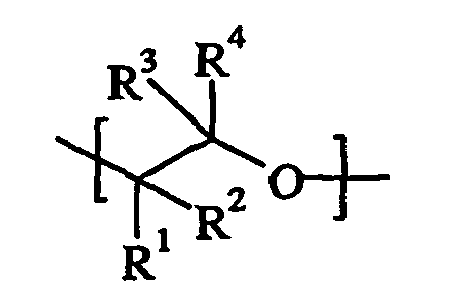
- X
- eine Struktureinheit der Formel

- B
- eine monomere Untereinheit basierend auf Ethylenoxid ist.
- In der nachfolgenden Figur ist die Verschiebung des X-Punktes, das heißt der Mindestkonzentration an Tensid bei gegebener Temperatur dargestellt, ab der für das Referenzsystem Wasser/n-Dekan und ein gegebenes Tensid (Lutensol® ON50 der BASF AG) die Wasser und die n-Dekan-Phase vollständig mischbar sind und eine thermodynamisch stabile Mikroemulsion entsteht.
- In der anliegenden Figur ist auf der Abszisse die Konzentration des Tensids Lutensol® ON50, in der Figur mit cTensid, in Gew.-% und auf der Ordinate die Temperatur in °C dargestellt. Ausschnitte aus den jeweiligen Phasendiagrammen ("Fisch"-Phasen-Diagramme) sind für das genannte Referenzsystem Wasser/n-Dekan 1 : 1 und das genannte Tensid Lutensol® ON50 unter I zum Vergleich, das heißt ohne Zusatz eines Cotensids und unter II für das erfindungsgemäße Anwendungsbeispiel mit Zusatz des vorstehend unter Herstellungsbeispiel beschriebenen Cotensids, in einer Konzentration von 10 %, bezogen auf das Tensid, dargestellt. Die Darstellung zeigt, dass sich der X-Punkt von 22,5 % Tensid im Vergleichsbeispiel zu 15 % Tensid im erfindungsgemäßen Beispiel mit Cotensid-Zusatz verschob.
- Zur Herstellung von kosmetischen oder dermatologischen Zubereitungen eingesetzt wurde ein Cotensid, das analog Stufe I aus dem vorstehend beschriebenen Herstellungsbeispiel durch Umsetzung von C13-Oxoalkohol mit 22 Mol Butylenoxid/Mol C13-Oxoalkohol und anschließende Umsetzung analog Stufe III des vorstehenden Herstellungsbeispiels, jedoch abweichend hiervon mit insgesamt 48 Mol Alkylenoxid, davon 0,95 % Ethylenoxid und 0,05 % Propylenoxid, erhalten wurde. Dieses amphiphile Polymer wird in der nachfolgenden Tabelle als Cotensid * bezeichnet.
- Es wurden Emulsionen für kosmetische oder dermatologische Anwendungen nach folgender allgemeiner Vorschrift hergestellt:
- Die jeweiligen Phasen A (ölhaltig) und B (wässrig) wurden getrennt auf ca. 85°C erwärmt. Phase A wurde langsam gerührt und Phase B in Phase A eingerührt, wobei die Mischtemperatur auf über 80°C gehalten wurde. Unter langsamem Rühren wurde auf Raumtemperatur abgekühlt.
- Die Zusammensetzung der Phasen A und B für Beispiel 1 ist in der nachfolgenden Tabelle aufgeführt:
-
Phase Gew.-% INCI A 5,0 Glyceryl Stearate, Ceteareth-20, Ceteareth-12, Cetearyl Alcohol, Cetyl Palmitate 1,0 Ceteareth-20 5,0 Caprylic/Capric Triglyceride 5,0 Mineral Oil 1,0 Octyldodecanol 1,0 Ethylhexyl Triazone (Uvinul® T150) 0,6 Cotensid* B 5,0 Glyzerin ad 100 Aqua demin. - Es wurde eine Mikroemulsion erhalten, die bei Raumtemperatur stabil war, sprühbar war und eine dynamische Viskosität von unter 50 mPa.s aufwies.
- Die Menge an Cotensid* wurde auf 0,4 Gew.-% abgesenkt. Es wurde keine stabile Mikroemulsion erhalten.
- Die Menge an Tensid (die ersten beiden Komponenten aus Phase A in der zu Beispiel 1 aufgeführten Tabelle) wurde von 6 Gew.-% auf 4 Gew.-% abgesenkt. Es wurde keine stabile Mikroemulsion erhalten.


Es wurde überraschend gefunden, dass sich amphiphile Polymere mit der oben definierten Struktur besonders gut als Cotenside eignen, indem sie die Effizienz von Tensiden steigern und dabei aus großtechnischen und somit preiswert zugänglichen Stoffen auf großtechnischen Umsetzungswegen erhältlich sind. Die erfindungsgemäßen amphiphilen Polymere sind in der Regel technische Gemische aus Substanzen mit einer mehr oder weniger breiten Molekulargewichtsverteilung.

| OH-Zahl: | 13 mg KOH/g (Theorie: 10 mg KOH/g) |
| Basenzahl: | 0,4 mg KOH/g |
Claims (17)
- Mischung, enthaltend ein Tensid und ein Cotensid, dadurch gekennzeichnet, dass man als Cotensid ein amphiphiles Polymer mit der allgemeinen Strukturformel
 A' ein unverzweigter oder verzweigter Alkyl- Cycloalkyl-, Aryl- oder Aralkylrest mit 8 bis 60 C-Atomen,Y S oder O,A eine Struktureinheit mit der Formel
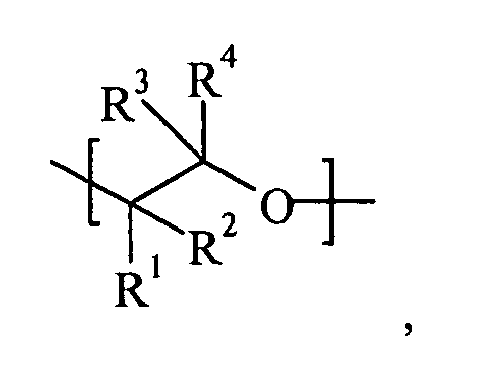 R1, R2, R3 und R4 unabhängig voneinander die Substituenten Wasserstoff, Methyl, Ethyl, n-Propyl, iso-Propyl, Oktyl- oder Phenyl sind, mit der Einschränkung, dass höchstens drei der Substituenten R1, R2, R3 und R4 Wasserstoff sind,m eine Laufzahl im Bereich von 10 bis 300,X eine Struktureinheit mit der Formel
 R1, R2, R3 und R4 unabhängig voneinander jeweils Wasserstoff, Methyl, Ethyl, n- Propyl, iso-Propyl, Oktyl oder Phenyl sind,q = 0 oder q = 1,B eine monomere Untereinheit basierend auf Ethylenoxid oder eine Mischung aus Ethylenoxid und Propylenoxid,n eine Laufzahl im Bereich von 20 bis 500 undp=q+ 1 ist.
 - Mischung nach Anspruch 1, dadurch gekennzeichnet, dass A'-Y ein monofunktioneller unverzweigter oder verzweigter Alkohol- oder Thiolrest mit 8 bis 30 Kohlenstoffatomen pro Molekül ist.
- Mischung nach einem der Ansprüche 1 oder 2, dadurch gekennzeichnet, dass die Struktureinheit A aus einem oder mehreren der nachfolgenden Monomere: Propenoxid, 1-Butenoxid, 2,3-Butenoxid, 2-Methyl-1,2-propenoxid (Isobutenoxid), 1-Petnenoxid, 2,3-Pentenoxid 2-Methyl-1,2-butenoxid, 3-Methyl-1,2-butenoxid, 2,3-Hexenoxid 3,4-Hexenoxid, 2-Methyl-1,2-pentenoxid, 2-Ethyl-1,2-butenoxid, 3-Methyl-1,2-Pentenoxid, Decenoxid, 4-Methyl-1,2-pentenoxid, Styroloxid oder aus einer Mischung aus Oxiden technisch verfügbarer Raffinatströme gebildet ist.
- Mischung nach einem der Ansprüche 1 bis 3, dadurch gekennzeichnet, dass die Laufzahl m einen Wert im Bereich von 50 bis 250, bevorzugt von 60 bis 160, annimmt.
- Mischung nach einem der Ansprüche 1 bis 4, dadurch gekennzeichnet, dass die Laufzahl n einen Wert im Bereich zwischen 50 und 300 annimmt.
- Mischung nach einem der Ansprüche 1 bis 5, dadurch gekennzeichnet, dass B eine Ethylenoxid-/Propylenoxid-Mischung mit 0 bis 50 %, bevorzugt 5 bis 20 % Propylenoxid ist.
- Verfahren zur Herstellung eines amphiphilen Polymers mit der allgemeinen Strukturformel (I)
 A' ein unverzweigter oder verzweigter Alkyl- Cycloalkyl-, Aryl- oder Aralkylrest mit 8 bis 60 C-Atomen,Y S oder O,A eine Struktureinheit mit der Formel
 R1, R2, R3 und R4 unabhängig voneinander die SubstituentenWasserstoff, Methyl, Ethyl, n-Propyl, iso-Propyl, Oktyl- oder Phenyl sind, mit der Einschränkung, dass höchstens drei der Substituenten R1, R2, R3 und R4 Wasserstoff sind,m eine Laufzahl im Bereich von 10 bis 300,X eine Struktureinheit mit der Formel
 R1, R2, R3 und R4 unabhängig voneinander jeweilsWasserstoff, Methyl, Ethyl, n-Propyl, iso-Propyl, Oktyl oder Phenyl sind,
q = 0 oder q = 1,B eine monomere Untereinheit basierend auf Ethylenoxid oder eine Mischung aus Ethylenoxid und Propylenoxid,n eine Laufzahl im Bereich von 20 bis 500 undp=q+ 1 ist,
dadurch gekennzeichnet, dass man einen unverzweigten oder verzweigten Monohydroxyalkyl-, -aryl- oder -aralkylalkohol A'-OH oder ein entsprechendes Thiol A'-SH mit einem die Struktureinheit - die terminale OH-Gruppe unmittelbar mit Ethylenoxid oder einer Mischung aus Ethylenoxid und Propylenoxid oder- die terminale OH-Gruppe zunächst zu einem primären oder sekundären Amin und anschließend mit Ethylenoxid oder einer Mischung aus Ethylenoxid und Propylenoxid umsetzt.
 - Verwendung einer Mischung nach einem der Ansprüche 1 bis 6 zum Stabilisieren von Emulsionen, bevorzugt von Mikroemulsionen.
- Mikroemulsion, enthaltend ein Tensid und Cotensid, dadurch gekennzeichnet, dass man als Cotensid ein amphiphiles Polymer mit der allgemeinen Strukturformel
 A' ein unverzweigter oder verzweigter Alkyl-, Cycloalkyl-, Aryl oder Aralkylrest mit 8 bis 60 C-Atomen,Y S oder O,A eine Struktureinheit mit der Formel
 R1, R2, R3 und R4 unabhängig voneinander die Substituenten Wasserstoff, Methyl, Ethyl, Propyl, Oktyl oder Phenyl sind, mit der Einschränkung, das mindestens zwei und höchstens drei der Substituenten R1, R2, R3 und R4 Wasserstoff sind,m eine Laufzahl im Bereich von 10 bis 300,X eine Struktureinheit mit der Formel
 R1, R2, R3 und R4 unabhängig voneinander die SubstituentenWasserstoff, Methyl, Ethyl, Propyl, Oktyl oder Phenyl sind,
q = 0 oder q = 1,B eine monomere Untereinheit basierend auf Ethylenoxid oder einer Mischung aus Ethylenoxid und Propylenoxid,n eine Laufzahl im Bereich von 20 bis 500 undp = q + 1 ist. - Mikroemulsion nach Anspruch 9, dadurch gekennzeichnet, dass A'-Y ein monofunktioneller unverzweigter oder verzweigter aliphatischer Alkohol oder Thiolrest mit 8 bis 30 Kohlenstoffatomen pro Molekül ist.
- Mikroemulsion nach Anspruch 9 oder 10, dadurch gekennzeichnet, dass die Struktureinheit A aus einem oder mehreren der nachfolgenden Monomere: Propenoxid, 1-Butenoxid, 2,3-Butenoxid, 2-Methyl-1,2-propenoxid (Isobutenoxid), 1-Petnenoxid, 2,3-Pentenoxid 2-Methyl-1,2-butenoxid, 3-Methyl-1,2-butenoxid, 2,3-Hexenoxid 3,4-Hexenoxid, 2-Methyl-1,2-pentenoxid, 2-Ethyl-1,2-butenoxid, 3-Methyl-1,2-Pentenoxid, 4-Methyl-1,2-pentenoxid, Decenoxid, Styroloxid oder aus einer Mischung aus Oxiden technisch verfügbarer Raffinatströme gebildet ist.
- Mikroemulsion nach einem der Ansprüche 9 bis 11, dadurch gekennzeichnet, dass die Laufzahl m einen Wert im Bereich von 50 bis 250, bevorzugt von 60 bis 160, annimmt.
- Mikroemulsion nach einem der Ansprüche 9 bis 12, dadurch gekennzeichnet, dass die Laufzahl n einen Wert im Bereich zwischen 50 und 300 annimmt.
- Mikroemulsion nach einem der Ansprüche 9 bis 13, dadurch gekennzeichnet, dass B eine Ethylenoxid-/Propylenoxid-Mischung mit 0 bis 50 %, bevorzugt mit 5 bis 20 % Propylenoxid ist.
- Verwendung einer Mischung nach einem der Ansprüche 1 bis 6 oder einer Mikroemulsion nach einem der Ansprüche 9 bis 14 als Waschmittel, Emulgator, Schaumregulierer, Netzmittel für harte Oberflächen oder als Reaktionsmedium für organische, anorganische, bioorganische oder photochemische Reaktionen.
- Verwendung nach Anspruch 15 in Waschmitteln, Tensidformulierungen zur Reinigung harter Oberflächen, Feuchthaltemitteln, kosmetischen, pharmazeutischen und Pflanzenschutzformulierungen, Lacken, Beschichtungsmitteln, Klebstoffen, Lederentfettungsmitteln, Formulierungen für die Textilindustrie, Faserverarbeitung, Metallverarbeitung, Lebensmittelindustrie, Wasserbehandlung, Papierindustrie, Fermentation, Mineralverarbeitung, Brandschutz oder in Emulsionspolymerisationen.
- Wasch-, Reinigungs-, Netz-, Beschichtungs-, Klebe-, Lederentfettungs-, Feuchtehalte-oder Textilbehandlungsmittel oder pharmazeutische, Pflanzenschutz- oder kosmetische Formulierung, insbesondere Sonnenschutz-, Hautpflege- oder Haarstylingmittel, Duschgele, Shampoos, Badezusätze oder Duftöle, enthaltend neben üblichen Inhaltsstoffen eine Mischung nach einem der Ansprüche 1 bis 6 oder eine Mikroemulsion nach einem der Ansprüche 9 bis 14.
Applications Claiming Priority (2)
| Application Number | Priority Date | Filing Date | Title |
|---|---|---|---|
| DE10323178A DE10323178A1 (de) | 2003-05-22 | 2003-05-22 | Mischung, umfassend ein Tensid und ein Cotensid |
| PCT/EP2004/005518 WO2004103542A1 (de) | 2003-05-22 | 2004-05-21 | Mischung, umfassend ein tensid und ein cotensid |
Publications (2)
| Publication Number | Publication Date |
|---|---|
| EP1631372A1 EP1631372A1 (de) | 2006-03-08 |
| EP1631372B1 true EP1631372B1 (de) | 2010-05-05 |
Family
ID=33441155
Family Applications (1)
| Application Number | Title | Priority Date | Filing Date |
|---|---|---|---|
| EP04739297A Expired - Lifetime EP1631372B1 (de) | 2003-05-22 | 2004-05-21 | Ein tensid und ein cotensid umfassende mischung |
Country Status (6)
| Country | Link |
|---|---|
| US (1) | US7727948B2 (de) |
| EP (1) | EP1631372B1 (de) |
| JP (1) | JP2007534779A (de) |
| AT (1) | ATE466654T1 (de) |
| DE (2) | DE10323178A1 (de) |
| WO (1) | WO2004103542A1 (de) |
Families Citing this family (17)
| Publication number | Priority date | Publication date | Assignee | Title |
|---|---|---|---|---|
| US7402554B2 (en) | 2003-02-28 | 2008-07-22 | The Procter & Gamble Company | Foam-generating kit containing a foam-generating dispenser and a composition containing a high level of surfactant |
| DE102005049765A1 (de) * | 2005-10-18 | 2007-04-19 | Forschungszentrum Jülich GmbH | Verfahren zur Effizienzsteigerung von Tensiden, zur Aufweitung des Temperaturfensters, zur Unterdrückung lamellarer Mesophasen in Mikroemulsionen mittels Additiven, sowie Mikroemulsionen |
| GB0614353D0 (en) * | 2006-07-20 | 2006-08-30 | Oraldent Ltd | Oral compositions, their preparation and use |
| JP5311842B2 (ja) * | 2008-02-20 | 2013-10-09 | 株式会社マンダム | クレンジング化粧料並びにその製造方法 |
| US8993502B2 (en) * | 2008-02-21 | 2015-03-31 | S. C. Johnson & Son, Inc. | Cleaning composition having high self-adhesion to a vertical hard surface and providing residual benefits |
| US9410111B2 (en) | 2008-02-21 | 2016-08-09 | S.C. Johnson & Son, Inc. | Cleaning composition that provides residual benefits |
| US9481854B2 (en) | 2008-02-21 | 2016-11-01 | S. C. Johnson & Son, Inc. | Cleaning composition that provides residual benefits |
| US8980813B2 (en) | 2008-02-21 | 2015-03-17 | S. C. Johnson & Son, Inc. | Cleaning composition having high self-adhesion on a vertical hard surface and providing residual benefits |
| JP4834775B2 (ja) * | 2010-03-04 | 2011-12-14 | 株式会社 資生堂 | 日焼け止め用組成物 |
| DE102011015191A1 (de) * | 2011-03-25 | 2012-09-27 | Henkel Ag & Co. Kgaa | Verfahren zur Herrstellung eines konditionierten Reinigungsmittels |
| FR3018683B1 (fr) * | 2014-03-21 | 2016-03-04 | Gattefosse Holding | Dispositif consommable anhydre destine a la preparation extemporanee d'une composition cosmetique monodose |
| SG11201700484SA (en) * | 2014-08-08 | 2017-02-27 | Shenzhen Hightide Biopharmaceutical Ltd | Liquid formulation compositions, medicament delivery devices, and methods of preparation and use thereof |
| US10196591B2 (en) | 2015-07-10 | 2019-02-05 | S. C. Johnson & Sons, Inc. | Gel cleaning composition |
| US10358625B2 (en) | 2015-07-17 | 2019-07-23 | S. C. Johnson & Son, Inc. | Non-corrosive cleaning composition |
| US10000728B2 (en) | 2015-07-17 | 2018-06-19 | S. C. Johnson & Son, Inc. | Cleaning composition with propellant |
| US10723978B2 (en) * | 2015-08-27 | 2020-07-28 | S. C. Johnson & Son, Inc. | Cleaning gel with glycine betaine ester and nonionic surfactant mixture |
| CN116057130B (zh) * | 2020-07-13 | 2024-05-28 | 艾德凡斯化学公司 | 用于油墨、涂料和胶粘剂的支链氨基酸表面活性剂 |
Family Cites Families (9)
| Publication number | Priority date | Publication date | Assignee | Title |
|---|---|---|---|---|
| HU199234B (en) * | 1987-05-18 | 1990-02-28 | Chinoin Gyogyszer Es Vegyeszet | Microemulsion composition comprising phosphoric acid ester or thiophosphoric acid ester as active ingredient |
| US4954338A (en) * | 1987-08-05 | 1990-09-04 | Rohm And Haas Company | Microbicidal microemulsion |
| US5932630A (en) * | 1996-05-02 | 1999-08-03 | Xerox Corporation | Ink compositions |
| DE19634477C2 (de) | 1996-06-05 | 2002-10-17 | Forschungszentrum Juelich Gmbh | Verfahren zur Herstellung von hydrophob-hydrophilen AB-Blockcopolymeren und AB-Blockcopolymer |
| US6133218A (en) * | 1997-07-29 | 2000-10-17 | Basf Corporation | Aqueous based solvent free cleaner compositions containing two nonionic surfactants |
| DE19839054A1 (de) | 1998-08-28 | 2000-03-02 | Forschungszentrum Juelich Gmbh | Verfahren zur Effizienzsteigerung von Tensiden bei simultaner Unterdrückung lamellarer Mesophasen sowie Tenside, welchen ein Additiv beigefügt ist |
| US6506485B1 (en) * | 2000-04-13 | 2003-01-14 | Board Of Trustees Of Michigan State University | Silica foam compositions |
| DE10117500A1 (de) * | 2001-04-07 | 2002-10-17 | Cognis Deutschland Gmbh | Reinigungstücher zur Haarpflege |
| FR2830773B1 (fr) * | 2001-10-11 | 2004-07-23 | Oreal | Utilisation de copolymeres amphiphiles pour stabiliser des dispersions de composes organiques insolubles filtrant le rayonnement uv, dispersions stabilisees par ces copolymeres et compositions cosmetiques les contenant |
-
2003
- 2003-05-22 DE DE10323178A patent/DE10323178A1/de not_active Withdrawn
-
2004
- 2004-05-21 JP JP2006529898A patent/JP2007534779A/ja active Pending
- 2004-05-21 DE DE502004011131T patent/DE502004011131D1/de not_active Expired - Lifetime
- 2004-05-21 AT AT04739297T patent/ATE466654T1/de not_active IP Right Cessation
- 2004-05-21 EP EP04739297A patent/EP1631372B1/de not_active Expired - Lifetime
- 2004-05-21 WO PCT/EP2004/005518 patent/WO2004103542A1/de not_active Ceased
- 2004-05-21 US US10/557,600 patent/US7727948B2/en not_active Expired - Fee Related
Also Published As
| Publication number | Publication date |
|---|---|
| DE502004011131D1 (de) | 2010-06-17 |
| DE10323178A1 (de) | 2004-12-09 |
| US7727948B2 (en) | 2010-06-01 |
| ATE466654T1 (de) | 2010-05-15 |
| US20070060495A1 (en) | 2007-03-15 |
| EP1631372A1 (de) | 2006-03-08 |
| WO2004103542A1 (de) | 2004-12-02 |
| JP2007534779A (ja) | 2007-11-29 |
Similar Documents
| Publication | Publication Date | Title |
|---|---|---|
| EP1631372B1 (de) | Ein tensid und ein cotensid umfassende mischung | |
| CN103929962B (zh) | 包含活性成分、油和离子液体的组合物 | |
| EP2164453B1 (de) | Kosmetische zubereitungen enthaltend kohlenwasserstoffe | |
| DE10035930A1 (de) | Feinemulsionen | |
| JPH06192065A (ja) | ポリグリセリン脂肪酸エステル混合物、これを含む浴用剤、該混合物の製造法、および該混合物から成る化粧、医薬または化学工業の調剤中の乳化剤、可溶化剤、分散剤および湿潤剤ならびに過脂肪剤 | |
| EP2455157A1 (de) | Lösungsvermittler für kosmetische Zubereitungen | |
| DE19505100A1 (de) | Alk(en)yldicarbonsäurebisester, deren Verwendung sowie Verfahren zu deren Herstellung | |
| EP3204365A1 (de) | Langkettige mono- und diester des 2,5-di(hydroxymethyl)tetrahydrofurans, deren herstellung und verwendung | |
| DE19737737A1 (de) | Sonnenschutzmittel | |
| CN1933810A (zh) | 基于偏甘油酯和季戊四醇酯的蜡混合物 | |
| EP1629076B1 (de) | Ein tensid und ein cotensid umfassende mischung | |
| DE19856555A1 (de) | Ölbäder | |
| EP2810640A1 (de) | Ester von Oligohydroxycarbonsäuren und deren Verwendung | |
| DE19703087C2 (de) | Verwendung von PIT-Emulsionen | |
| DE19916211C2 (de) | Kosmetische und/oder pharmazeutische Zubereitungen | |
| EP2206489A1 (de) | Fließfähige Emulsionskonzentrate | |
| EP2810935A1 (de) | Sulfatierte Ester von Oligohydroxycarbonsäuren und deren Verwendung | |
| EP2262822B1 (de) | Alkyl- und/oder alkenylether von alkyl- und/oder alkenyl(poly)glycosiden und ihre verwendung | |
| EP1412068B1 (de) | Emulgator-gemisch | |
| DE19815090A1 (de) | Kosmetische Mittel | |
| WO1998019783A2 (de) | Geminitenside | |
| DE19727030A1 (de) | Alkyl- und/oder Alkenyloligoglykosidsiliconether | |
| EP1660030B1 (de) | Mischung bestehend aus einem uv-a- und einem uv-b-filter | |
| DE19810012A1 (de) | Kosmetische und/oder pharmazeutische Zubereitungen | |
| EP3645496A1 (de) | Alkoxylierung von hydroxysäuren |
Legal Events
| Date | Code | Title | Description |
|---|---|---|---|
| PUAI | Public reference made under article 153(3) epc to a published international application that has entered the european phase |
Free format text: ORIGINAL CODE: 0009012 |
|
| 17P | Request for examination filed |
Effective date: 20051222 |
|
| AK | Designated contracting states |
Kind code of ref document: A1 Designated state(s): AT BE BG CH CY CZ DE DK EE ES FI FR GB GR HU IE IT LI LU MC NL PL PT RO SE SI SK TR |
|
| RIN1 | Information on inventor provided before grant (corrected) |
Inventor name: DYLLICK-BRENZINGER, RAINER Inventor name: MOCK-KNOBLAUCH, CORDULA Inventor name: WAGNER, NORBERT Inventor name: VOELKEL, LUDWIG Inventor name: OETTER, GUENTER Inventor name: SCHROEDER, JOERG Inventor name: STEINMETZ, BERNHARD Inventor name: PETROVIC, SUSANNE |
|
| DAX | Request for extension of the european patent (deleted) | ||
| 17Q | First examination report despatched |
Effective date: 20060428 |
|
| RAP1 | Party data changed (applicant data changed or rights of an application transferred) |
Owner name: BASF SE |
|
| GRAP | Despatch of communication of intention to grant a patent |
Free format text: ORIGINAL CODE: EPIDOSNIGR1 |
|
| GRAS | Grant fee paid |
Free format text: ORIGINAL CODE: EPIDOSNIGR3 |
|
| GRAA | (expected) grant |
Free format text: ORIGINAL CODE: 0009210 |
|
| AK | Designated contracting states |
Kind code of ref document: B1 Designated state(s): AT BE BG CH CY CZ DE DK EE ES FI FR GB GR HU IE IT LI LU MC NL PL PT RO SE SI SK TR |
|
| REG | Reference to a national code |
Ref country code: GB Ref legal event code: FG4D Free format text: NOT ENGLISH |
|
| REG | Reference to a national code |
Ref country code: CH Ref legal event code: EP |
|
| REG | Reference to a national code |
Ref country code: IE Ref legal event code: FG4D Free format text: LANGUAGE OF EP DOCUMENT: GERMAN |
|
| REF | Corresponds to: |
Ref document number: 502004011131 Country of ref document: DE Date of ref document: 20100617 Kind code of ref document: P |
|
| REG | Reference to a national code |
Ref country code: NL Ref legal event code: VDEP Effective date: 20100505 |
|
| PG25 | Lapsed in a contracting state [announced via postgrant information from national office to epo] |
Ref country code: SE Free format text: LAPSE BECAUSE OF FAILURE TO SUBMIT A TRANSLATION OF THE DESCRIPTION OR TO PAY THE FEE WITHIN THE PRESCRIBED TIME-LIMIT Effective date: 20100505 Ref country code: NL Free format text: LAPSE BECAUSE OF FAILURE TO SUBMIT A TRANSLATION OF THE DESCRIPTION OR TO PAY THE FEE WITHIN THE PRESCRIBED TIME-LIMIT Effective date: 20100505 Ref country code: ES Free format text: LAPSE BECAUSE OF FAILURE TO SUBMIT A TRANSLATION OF THE DESCRIPTION OR TO PAY THE FEE WITHIN THE PRESCRIBED TIME-LIMIT Effective date: 20100816 |
|
| BERE | Be: lapsed |
Owner name: BASF SE Effective date: 20100531 |
|
| PG25 | Lapsed in a contracting state [announced via postgrant information from national office to epo] |
Ref country code: SI Free format text: LAPSE BECAUSE OF FAILURE TO SUBMIT A TRANSLATION OF THE DESCRIPTION OR TO PAY THE FEE WITHIN THE PRESCRIBED TIME-LIMIT Effective date: 20100505 Ref country code: FI Free format text: LAPSE BECAUSE OF FAILURE TO SUBMIT A TRANSLATION OF THE DESCRIPTION OR TO PAY THE FEE WITHIN THE PRESCRIBED TIME-LIMIT Effective date: 20100505 |
|
| REG | Reference to a national code |
Ref country code: IE Ref legal event code: FD4D |
|
| PG25 | Lapsed in a contracting state [announced via postgrant information from national office to epo] |
Ref country code: GR Free format text: LAPSE BECAUSE OF FAILURE TO SUBMIT A TRANSLATION OF THE DESCRIPTION OR TO PAY THE FEE WITHIN THE PRESCRIBED TIME-LIMIT Effective date: 20100806 Ref country code: MC Free format text: LAPSE BECAUSE OF NON-PAYMENT OF DUE FEES Effective date: 20100531 Ref country code: CY Free format text: LAPSE BECAUSE OF FAILURE TO SUBMIT A TRANSLATION OF THE DESCRIPTION OR TO PAY THE FEE WITHIN THE PRESCRIBED TIME-LIMIT Effective date: 20100505 Ref country code: PL Free format text: LAPSE BECAUSE OF FAILURE TO SUBMIT A TRANSLATION OF THE DESCRIPTION OR TO PAY THE FEE WITHIN THE PRESCRIBED TIME-LIMIT Effective date: 20100505 |
|
| REG | Reference to a national code |
Ref country code: CH Ref legal event code: PL |
|
| PG25 | Lapsed in a contracting state [announced via postgrant information from national office to epo] |
Ref country code: PT Free format text: LAPSE BECAUSE OF FAILURE TO SUBMIT A TRANSLATION OF THE DESCRIPTION OR TO PAY THE FEE WITHIN THE PRESCRIBED TIME-LIMIT Effective date: 20100906 Ref country code: IE Free format text: LAPSE BECAUSE OF FAILURE TO SUBMIT A TRANSLATION OF THE DESCRIPTION OR TO PAY THE FEE WITHIN THE PRESCRIBED TIME-LIMIT Effective date: 20100505 Ref country code: DK Free format text: LAPSE BECAUSE OF FAILURE TO SUBMIT A TRANSLATION OF THE DESCRIPTION OR TO PAY THE FEE WITHIN THE PRESCRIBED TIME-LIMIT Effective date: 20100505 Ref country code: EE Free format text: LAPSE BECAUSE OF FAILURE TO SUBMIT A TRANSLATION OF THE DESCRIPTION OR TO PAY THE FEE WITHIN THE PRESCRIBED TIME-LIMIT Effective date: 20100505 |
|
| PG25 | Lapsed in a contracting state [announced via postgrant information from national office to epo] |
Ref country code: SK Free format text: LAPSE BECAUSE OF FAILURE TO SUBMIT A TRANSLATION OF THE DESCRIPTION OR TO PAY THE FEE WITHIN THE PRESCRIBED TIME-LIMIT Effective date: 20100505 Ref country code: LI Free format text: LAPSE BECAUSE OF NON-PAYMENT OF DUE FEES Effective date: 20100531 Ref country code: CZ Free format text: LAPSE BECAUSE OF FAILURE TO SUBMIT A TRANSLATION OF THE DESCRIPTION OR TO PAY THE FEE WITHIN THE PRESCRIBED TIME-LIMIT Effective date: 20100505 Ref country code: CH Free format text: LAPSE BECAUSE OF NON-PAYMENT OF DUE FEES Effective date: 20100531 Ref country code: RO Free format text: LAPSE BECAUSE OF FAILURE TO SUBMIT A TRANSLATION OF THE DESCRIPTION OR TO PAY THE FEE WITHIN THE PRESCRIBED TIME-LIMIT Effective date: 20100505 |
|
| PLBE | No opposition filed within time limit |
Free format text: ORIGINAL CODE: 0009261 |
|
| STAA | Information on the status of an ep patent application or granted ep patent |
Free format text: STATUS: NO OPPOSITION FILED WITHIN TIME LIMIT |
|
| PG25 | Lapsed in a contracting state [announced via postgrant information from national office to epo] |
Ref country code: BE Free format text: LAPSE BECAUSE OF NON-PAYMENT OF DUE FEES Effective date: 20100531 |
|
| 26N | No opposition filed |
Effective date: 20110208 |
|
| REG | Reference to a national code |
Ref country code: DE Ref legal event code: R097 Ref document number: 502004011131 Country of ref document: DE Effective date: 20110207 |
|
| PG25 | Lapsed in a contracting state [announced via postgrant information from national office to epo] |
Ref country code: AT Free format text: LAPSE BECAUSE OF NON-PAYMENT OF DUE FEES Effective date: 20100521 |
|
| PG25 | Lapsed in a contracting state [announced via postgrant information from national office to epo] |
Ref country code: HU Free format text: LAPSE BECAUSE OF FAILURE TO SUBMIT A TRANSLATION OF THE DESCRIPTION OR TO PAY THE FEE WITHIN THE PRESCRIBED TIME-LIMIT Effective date: 20101106 Ref country code: BG Free format text: LAPSE BECAUSE OF FAILURE TO SUBMIT A TRANSLATION OF THE DESCRIPTION OR TO PAY THE FEE WITHIN THE PRESCRIBED TIME-LIMIT Effective date: 20100505 Ref country code: LU Free format text: LAPSE BECAUSE OF NON-PAYMENT OF DUE FEES Effective date: 20100521 |
|
| PG25 | Lapsed in a contracting state [announced via postgrant information from national office to epo] |
Ref country code: TR Free format text: LAPSE BECAUSE OF FAILURE TO SUBMIT A TRANSLATION OF THE DESCRIPTION OR TO PAY THE FEE WITHIN THE PRESCRIBED TIME-LIMIT Effective date: 20100505 |
|
| PG25 | Lapsed in a contracting state [announced via postgrant information from national office to epo] |
Ref country code: BG Free format text: LAPSE BECAUSE OF FAILURE TO SUBMIT A TRANSLATION OF THE DESCRIPTION OR TO PAY THE FEE WITHIN THE PRESCRIBED TIME-LIMIT Effective date: 20100805 |
|
| PGFP | Annual fee paid to national office [announced via postgrant information from national office to epo] |
Ref country code: GB Payment date: 20140530 Year of fee payment: 11 |
|
| PGFP | Annual fee paid to national office [announced via postgrant information from national office to epo] |
Ref country code: IT Payment date: 20140527 Year of fee payment: 11 |
|
| PGFP | Annual fee paid to national office [announced via postgrant information from national office to epo] |
Ref country code: DE Payment date: 20140731 Year of fee payment: 11 |
|
| PGFP | Annual fee paid to national office [announced via postgrant information from national office to epo] |
Ref country code: FR Payment date: 20140530 Year of fee payment: 11 |
|
| REG | Reference to a national code |
Ref country code: DE Ref legal event code: R119 Ref document number: 502004011131 Country of ref document: DE |
|
| GBPC | Gb: european patent ceased through non-payment of renewal fee |
Effective date: 20150521 |
|
| PG25 | Lapsed in a contracting state [announced via postgrant information from national office to epo] |
Ref country code: IT Free format text: LAPSE BECAUSE OF NON-PAYMENT OF DUE FEES Effective date: 20150521 |
|
| REG | Reference to a national code |
Ref country code: FR Ref legal event code: ST Effective date: 20160129 |
|
| PG25 | Lapsed in a contracting state [announced via postgrant information from national office to epo] |
Ref country code: DE Free format text: LAPSE BECAUSE OF NON-PAYMENT OF DUE FEES Effective date: 20151201 Ref country code: GB Free format text: LAPSE BECAUSE OF NON-PAYMENT OF DUE FEES Effective date: 20150521 |
|
| PG25 | Lapsed in a contracting state [announced via postgrant information from national office to epo] |
Ref country code: FR Free format text: LAPSE BECAUSE OF NON-PAYMENT OF DUE FEES Effective date: 20150601 |