EP1628432A1 - A multiplexing scheme for unicast and broadcast/multicast traffic - Google Patents
A multiplexing scheme for unicast and broadcast/multicast traffic Download PDFInfo
- Publication number
- EP1628432A1 EP1628432A1 EP05255121A EP05255121A EP1628432A1 EP 1628432 A1 EP1628432 A1 EP 1628432A1 EP 05255121 A EP05255121 A EP 05255121A EP 05255121 A EP05255121 A EP 05255121A EP 1628432 A1 EP1628432 A1 EP 1628432A1
- Authority
- EP
- European Patent Office
- Prior art keywords
- slot
- subpackets
- time slot
- subpacket
- cell
- Prior art date
- Legal status (The legal status is an assumption and is not a legal conclusion. Google has not performed a legal analysis and makes no representation as to the accuracy of the status listed.)
- Granted
Links
- 238000000034 method Methods 0.000 claims abstract description 19
- 230000005540 biological transmission Effects 0.000 claims description 53
- 230000001131 transforming effect Effects 0.000 claims description 3
- 101100365087 Arabidopsis thaliana SCRA gene Proteins 0.000 description 9
- 230000015654 memory Effects 0.000 description 5
- 101100438139 Vulpes vulpes CABYR gene Proteins 0.000 description 4
- 230000008901 benefit Effects 0.000 description 3
- 102100022907 Acrosin-binding protein Human genes 0.000 description 2
- 101000756551 Homo sapiens Acrosin-binding protein Proteins 0.000 description 2
- 230000003044 adaptive effect Effects 0.000 description 2
- 238000013459 approach Methods 0.000 description 2
- 238000011161 development Methods 0.000 description 2
- 238000012986 modification Methods 0.000 description 2
- 230000004048 modification Effects 0.000 description 2
- 241001421757 Arcas Species 0.000 description 1
- 101100310674 Tenebrio molitor SP23 gene Proteins 0.000 description 1
- 201000003639 autosomal recessive cerebellar ataxia Diseases 0.000 description 1
- 238000004891 communication Methods 0.000 description 1
- 239000002131 composite material Substances 0.000 description 1
- 238000010276 construction Methods 0.000 description 1
- 230000007423 decrease Effects 0.000 description 1
- 238000013461 design Methods 0.000 description 1
- 230000000694 effects Effects 0.000 description 1
- 238000005516 engineering process Methods 0.000 description 1
- 230000003287 optical effect Effects 0.000 description 1
- 238000011084 recovery Methods 0.000 description 1
- 239000004065 semiconductor Substances 0.000 description 1
- 230000003068 static effect Effects 0.000 description 1
Images


Classifications
-
- H—ELECTRICITY
- H04—ELECTRIC COMMUNICATION TECHNIQUE
- H04L—TRANSMISSION OF DIGITAL INFORMATION, e.g. TELEGRAPHIC COMMUNICATION
- H04L1/00—Arrangements for detecting or preventing errors in the information received
- H04L1/12—Arrangements for detecting or preventing errors in the information received by using return channel
- H04L1/16—Arrangements for detecting or preventing errors in the information received by using return channel in which the return channel carries supervisory signals, e.g. repetition request signals
- H04L1/18—Automatic repetition systems, e.g. Van Duuren systems
-
- H—ELECTRICITY
- H04—ELECTRIC COMMUNICATION TECHNIQUE
- H04L—TRANSMISSION OF DIGITAL INFORMATION, e.g. TELEGRAPHIC COMMUNICATION
- H04L1/00—Arrangements for detecting or preventing errors in the information received
- H04L1/12—Arrangements for detecting or preventing errors in the information received by using return channel
- H04L1/16—Arrangements for detecting or preventing errors in the information received by using return channel in which the return channel carries supervisory signals, e.g. repetition request signals
- H04L1/18—Automatic repetition systems, e.g. Van Duuren systems
- H04L1/1812—Hybrid protocols; Hybrid automatic repeat request [HARQ]
- H04L1/1816—Hybrid protocols; Hybrid automatic repeat request [HARQ] with retransmission of the same, encoded, message
-
- H—ELECTRICITY
- H04—ELECTRIC COMMUNICATION TECHNIQUE
- H04L—TRANSMISSION OF DIGITAL INFORMATION, e.g. TELEGRAPHIC COMMUNICATION
- H04L1/00—Arrangements for detecting or preventing errors in the information received
- H04L1/004—Arrangements for detecting or preventing errors in the information received by using forward error control
- H04L1/0056—Systems characterized by the type of code used
- H04L1/0064—Concatenated codes
- H04L1/0065—Serial concatenated codes
-
- H—ELECTRICITY
- H04—ELECTRIC COMMUNICATION TECHNIQUE
- H04L—TRANSMISSION OF DIGITAL INFORMATION, e.g. TELEGRAPHIC COMMUNICATION
- H04L1/00—Arrangements for detecting or preventing errors in the information received
- H04L1/004—Arrangements for detecting or preventing errors in the information received by using forward error control
- H04L1/0056—Systems characterized by the type of code used
- H04L1/0064—Concatenated codes
- H04L1/0066—Parallel concatenated codes
-
- H—ELECTRICITY
- H04—ELECTRIC COMMUNICATION TECHNIQUE
- H04L—TRANSMISSION OF DIGITAL INFORMATION, e.g. TELEGRAPHIC COMMUNICATION
- H04L1/00—Arrangements for detecting or preventing errors in the information received
- H04L1/0078—Avoidance of errors by organising the transmitted data in a format specifically designed to deal with errors, e.g. location
- H04L1/0083—Formatting with frames or packets; Protocol or part of protocol for error control
-
- H—ELECTRICITY
- H04—ELECTRIC COMMUNICATION TECHNIQUE
- H04W—WIRELESS COMMUNICATION NETWORKS
- H04W4/00—Services specially adapted for wireless communication networks; Facilities therefor
- H04W4/06—Selective distribution of broadcast services, e.g. multimedia broadcast multicast service [MBMS]; Services to user groups; One-way selective calling services
-
- H—ELECTRICITY
- H04—ELECTRIC COMMUNICATION TECHNIQUE
- H04W—WIRELESS COMMUNICATION NETWORKS
- H04W72/00—Local resource management
- H04W72/30—Resource management for broadcast services
Definitions
- This invention relates generally to telecommunications, and more particularly, to wireless communications.
- a scheduler selects a user for transmission at a given time and adaptive modulation and coding is used to select an appropriate transport format (modulation and coding) for current channel conditions seen by the user. Due to errors in channel quality estimates, a relatively high level of frame errors may occur in the transmissions performed at a given rate (transport format). Hybrid ARQ has been employed to recover from transmission errors without significant loss in throughput.
- FIG. 1 An example of hybrid ARQ operation for the 1xEV-DO system is shown in Figure 1.
- the hybrid ARQ transmissions use a 4-slot interlacing structure, i.e. the hybrid ARQ retransmissions for an original transmission in slot n happens in slots (n+4), (n+8), and so on.
- a total of 4 interlaces are available for transmission to a single user or for transmissions to different users.
- a new or first data transmission occurs in slot 2 on interlace 2.
- the transmission is unsuccessfully received and the receiver sends back a negative acknowledgement signal (NACK).
- NACK indicates to the transmitter that the transmission was not properly received, causing the transmitter to retransmit the same data in slot 6 (again on interlace 2).
- the receiver combines the retransmitted data with the previously received first transmission, and based on the two pieces of data, the transmission is successfully decoded.
- the process of retransmitting and combining may be repeated until the data is successfully received (early termination, as indicated by an ACK) or a fixed number of attempts have been made.
- the receiver sends back an acknowledgement signal (ACK).
- ACK acknowledgement signal
- the transmitter then starts another new transmission on interlace 2 in slot 10.
- the transmissions happens in parallel on other interlaces, such as 1, 3 and 4.
- broadcast/multicast data blocks are addressed to more than one receiver or mobile station.
- the data blocks are addressed to all the mobiles in the system, whereas in a multicast transmission, the data blocks are addressed to a subset of mobiles in the system.
- no feedback is required from the mobile stations.
- the data blocks are transmitted on a predetermined number of slots, i.e. there is no early termination due to hybrid ARQ ACK feedback.
- a stylized representation of a wireless system capable of broadcast data packet transmission is shown in Figure 2.
- the broadcast data packet contains information from one or more broadcast streams carrying broadcast programs.
- two layers of channel coding are used to provide robustness against errors.
- the first layer of coding also called outer code is performed using well-known Reed-Solomon code.
- the Reed-Solomon code adds some redundancy to the data.
- the Reed-Solomon coded block is then segmented into smaller data blocks for Turbo coding.
- a number of subpackets e.g., SP1-SP3 from the same data block are created at the output of the Turbo coding.
- the data block can be recovered from any one of the received subpackets (SP1-SP3) as long as the coding rate is smaller than 1.
- Table 1 shows data rates for a 3072 bit data block transmitted within one, two or three slots (subpackets). A subpacket is transmitted within a slot of duration 1.67ms. The received subpackets at the mobile receiver are used to recover the data block. The data blocks are then reassembled to form the broadcast packet.
- the broadcast and unicast traffic in the 1xEV-DO system is multiplexed on an interlace-by-interlace basis.
- interlace 1 is used for broadcast traffic.
- the broadcast data block is transmitted in three subpackets (SP1, SP2 and SP3) on three slots i.e. slot # 1, 5 and 9 from the entire system, i.e., all of the base stations in the system. Therefore, the mobile station can potentially receive and combine signals from multiple base stations.
- the mobile station also combines SP1, SP2 and SP3 transmissions in order to recover the broadcast data block.
- the SP2 and SP3 transmissions contain additional redundancy for broadcast data block recovery.
- the interlace-based multiplexing approach used in the prior art poses problems when different broadcast data rates are used by different base stations in different cells in the system.
- the use of different data rates in different cells may be the case in a system deployment where the cell sizes are different. This, for example, can be the case, for a downtown area surrounded by suburbs and rural arcas.
- the cell size in densely populated areas is smaller in order to provide more cell sites to accommodate the larger amounts of traffic.
- the smaller cells deployments can in general support higher data rates because of the smaller path loss due to relatively shorter distance between the base station and the mobile station.
- the larger cells have, in general, larger path loss and therefore cannot support very high data rates.
- An example of cell layout showing three sets of cells is stylistically shown in Figure 4.
- a set of 7 center cells is labeled as set A.
- a first and second ring of cells around set A are labeled as set B and set C, respectively.
- FIG. 5 An example of broadcast transmissions at different data rates in different sets of cells is shown in Figure 5.
- set A transmits only SP 1 of the broadcast data block, achieving the highest transmission data rate.
- Set B transmits both SP1 and SP2 of the broadcast data block therefore achieving half the data rate of set A rate.
- set C achieves one-third rate of set A because the broadcast data block is transmitted in three subpackets.
- SP2 and SP3 contain additional redundancy. Therefore, if a transmission can be decoded using a smaller number of subpackets, the achieved information data rate is higher.
- Each of the interlaces carries a broadcast data block consisting of one, two or three subpackets.
- sets A, B and C transmit the broadcast data block in one, two and three subpackets, respectively.
- the fourth interlace is used for the unicast traffic.
- set C slots 1, 2, 3, 5, 6, 7, 9, 10, 11 are used for the broadcast traffic while slots 4, 8 and 12 in interlace #4 are used for the unicast traffic.
- SPij denoted the jth subpacket from the ith data block.
- SP21 represents the first subpacket from the second data block.
- the subpackets transmitted from multiple cells at the same time with the same subpacket number can potentially be soft combined at the receiver to assist in decoding the data packet.
- SP11, SP21 and SP31 are transmitted from all the three sets of cells A-C at the same time, and, therefore, these subpackets received from all the cells are combined at the receiver.
- SP12, SP22, and SP32 are transmitted from cell set B and cell set C. Therefore, these subpackets are soft combined from cell set B and cell set C.
- cell set A may potentially be transmitting unicast traffic during slots 5, 6 and 7 when SP12, SP22 and SP32 are transmitted from cell set B and cell set C. Therefore, transmissions from cell set A potentially interfere with transmissions from cell set B and cell set C.
- SP13, SP23, and SP33 are transmitted from cell set C only. Therefore, these subpackets potentially get interference from both cell set A and cell set B.
- slots 9, 10 and 11 are not used for broadcast traffic because the broadcast data blocks are transmitted in two subpackets only. Therefore, these free slots can potentially be considered for transmission of other information, such as unicast traffic.
- the unicast traffic uses hybrid ARQ and potentially requires multiple retransmission attempts. For example, if a unicast data block transmission is started in slot#9, the retransmission needs to happen in slot#13, but slot#13 belonging to interlace#1 is reserved for a broadcast data block transmission. Therefore, a retransmission cannot be performed for unicast traffic.
- the present invention is directed to overcoming, or at least reducing, the effects of, one or more of the problems set forth above.
- a method for coordinating transmissions within a first and second cell.
- the method comprises transforming a first block of broadcast information into first and second subpackets; transmitting the first subpacket within the first and second cells during a first time slot; and transmitting the second subpacket within the second cell during a second time slot.
- a second block of the broadcast information is transformed into third and fourth subpackets, the third subpacket is transmitted within the first and second cells during an n+1time slot, and the fourth subpacket is transmitted within the second cell during an n+2 time slot.
- a method for receiving broadcast transmissions from a first and second cell. The method comprises receiving a first subpacket from the first and second cells during a first time slot; receiving a second subpacket from the second cell during a second time slot; and combining the first subpackets received from the first and second cells.
- a third subpacket is received from the first and second cells during an n+1 time slot.
- a fourth subpacket is received from the second cell during an n+2 time slot.
- the third subpackets received from the first and second cells are combined.
- a first subpacket of unicast information is received from the first cell during the second time slot, and a retransmission of the first subpacket of unicast information is received from the first cell during the n+2 time slot.
- the present invention presents a new multiplexing scheme for unicast and broadcast traffic.
- the multiplexing scheme of the instant invention overcomes the scheduling restrictions in the prior art to allow use of HARQ transmissions and retransmissions of unicast data during slots that would otherwise be unused by broadcast operations.
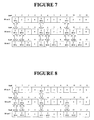
- FIG. 7 One example of data block transmission according to one aspect of the current invention is illustrated in Figure 7.
- cell sets A, B and C use data rates of 1843.2, 921.6 and 614.4 Kb/s, respectively.
- these three data rates are achieved by transmitting one, two and three subpackets (slots) for a data block of size 3072 bits. Therefore, cell sets A, B and C transmit one, two and three subpackets (slots), respectively, for each data block.
- the subpackets from a given data block are transmitted contiguously. For example, subpacets SP11, SP12 and SP13 from data block number 1 are transmitted in slot 1, 2 and 3 respectively from cell set C.
- SP11 and SP12 are transmitted from cell set B in slots 1 and 2, respectively.
- Cell set A transmits only subpacket SP11 in slot number 1.
- a receiver that receives the SP11 subpacket from at least one cell in more than one of the cell sets A, B and C may combine the SP11 subpackets to correct for transmission errors. It should be appreciated that if the receiver receives subpacket SP11 from all three of the cell sets A, B and C, then all three of the received subpackets may be combined, whereas if the receiver receives subpacket SP11 from only two of the cell sets A, B and C, then the two received subpackets may be combined.
- the SP12 subpacket may be combined from cell set B and cell set C.
- the same number of soft combinings of the subpackets can be performed as in the prior art scheme; however, the slots not used for broadcast in cells using relatively higher data rates can now be used for unicast traffic without scheduling restrictions. That is, using the illustrated multiplexing scheme allows conventional HARQ transmissions and retransmissions of unicast data during the unused time slots of the higher speed cells.
- the slots 3, 7 and 11, which belong to interlace 3 are free from broadcast traffic, and may be used for unicast traffic requiring hybrid ARQ retransmissions. That is, in cell set B, slots 3, 7 and 11 will always be free for transmissions and retransmissions. In other terms, interlace 3 in cell set B will always be available for unicast traffic.
- interlaces 2 and 3 are both free in cell set A.
- One advantage of the present invention is it makes complete interlaces available rather than some slots within an interlace. In other words, the present invention minimizes the number of interlaces allocated for broadcast traffic in a given set of cells. Unicast traffic can be carried over an interlace without any scheduling and retransmission restrictions because any number of retransmissions can be performed within that interlace. For example, assuming that two retransmissions are permitted, then the first transmission may occur in slot 2, while the two subsequent retransmissions may occur in slots 6 and 10.
- the first transmission may occur in slot 2
- the first two subsequent retransmissions may occur in slots 6 and 10
- the third retransmission may take place in slot 14. In this manner, any number of retransmissions may be permitted.
- the subpackets received from multiple cells can be combined in any of a variety of ways.
- OFDM Orthogonal Frequency Division Multiplexing
- FFT Fast Fourier Transform
- the received signal from each of the RAKE fingers may be combined.
- a RAKE finger may be used to track and demodulate a signal received from one cell. Therefore, the number of available RAKE fingers limits the maximum number of cells from which the subpackets can be combined.
- An equalizer can also be employed for decoding signals received from multiple cells.
- cell set C requires only two interlaces for transmission at the lowest data rate of 614.4 Kb/s.
- the subpackets SP11 and SP12 are transmitted contiguously in slots 1 and 2 in cell set C.
- the third subpacket from the first block, i.e., SP13 is transmitted subsequently in slot 6.
- the first subpacket from the second data block SP21 is transmitted in slot 5. Therefore, the third subpacket from the first data block SP13 is transmitted after first subpacket from the second data block SP21, i.e., an out-of-order transmission of subpackets.
- control units may include a microprocessor, a microcontroller, a digital signal processor, a processor card (including one or more microprocessors or controllers), or other control or computing devices as well as executable instructions contained within one or more storage devices.
- the storage devices may include one or more machine-readable storage media for storing data and instructions.
- the storage media may include different forms of memory including semiconductor memory devices such as dynamic or static random access memories (DRAMs or SRAMs), erasable and programmable read-only memories (EPROMs), electrically erasable and programmable read-only memories (EEPROMs) and flash memories; magnetic disks such as fixed, floppy, removable disks; other magnetic media including tape; and optical media such as compact disks (CDs) or digital video disks (DVDs).
- DRAMs or SRAMs dynamic or static random access memories
- EPROMs erasable and programmable read-only memories
- EEPROMs electrically erasable and programmable read-only memories
- flash memories such as fixed, floppy, removable disks
- CDs compact disks
- DVDs digital video disks
Landscapes
- Engineering & Computer Science (AREA)
- Computer Networks & Wireless Communication (AREA)
- Signal Processing (AREA)
- Multimedia (AREA)
- Mobile Radio Communication Systems (AREA)
- Small-Scale Networks (AREA)
Abstract
Description
- This invention relates generally to telecommunications, and more particularly, to wireless communications.
- In the field of wireless data systems, a number of well-known standards, such as 1x-EV-DO, 1xEV-DV as well as the High Speed Downlink Packet Access (HSDPA) specification in the Universal Mobile Telecommunication System (UMTS) standard, have been employed. Newer technologies such as fast scheduling, adaptive modulation and coding (AMC) and hybrid ARQ (HARQ) have also been introduced to improve overall system capacity. However, application of the above-mentioned techniques has been limited to transmitting data blocks for unicast traffic, i.e. a data block addressed to a single mobile station. In general, a scheduler selects a user for transmission at a given time and adaptive modulation and coding is used to select an appropriate transport format (modulation and coding) for current channel conditions seen by the user. Due to errors in channel quality estimates, a relatively high level of frame errors may occur in the transmissions performed at a given rate (transport format). Hybrid ARQ has been employed to recover from transmission errors without significant loss in throughput.
- An example of hybrid ARQ operation for the 1xEV-DO system is shown in Figure 1. The hybrid ARQ transmissions use a 4-slot interlacing structure, i.e. the hybrid ARQ retransmissions for an original transmission in slot n happens in slots (n+4), (n+8), and so on. A total of 4 interlaces are available for transmission to a single user or for transmissions to different users. In the example shown in Figure 1, a new or first data transmission occurs in
slot 2 oninterlace 2. In the exemplary scenario illustrated in Figure 1, the transmission is unsuccessfully received and the receiver sends back a negative acknowledgement signal (NACK). The NACK indicates to the transmitter that the transmission was not properly received, causing the transmitter to retransmit the same data in slot 6 (again on interlace 2). The receiver combines the retransmitted data with the previously received first transmission, and based on the two pieces of data, the transmission is successfully decoded. Those skilled in the art will appreciate that the process of retransmitting and combining may be repeated until the data is successfully received (early termination, as indicated by an ACK) or a fixed number of attempts have been made. Once the data is properly received, the receiver sends back an acknowledgement signal (ACK). The transmitter then starts another new transmission oninterlace 2 inslot 10. Similarly, the transmissions happens in parallel on other interlaces, such as 1, 3 and 4. - Unlike unicast traffic, broadcast/multicast data blocks are addressed to more than one receiver or mobile station. In a broadcast transmission, the data blocks are addressed to all the mobiles in the system, whereas in a multicast transmission, the data blocks are addressed to a subset of mobiles in the system. In general, no feedback is required from the mobile stations. Generally, in both multicast and broadcast transmissions, the data blocks are transmitted on a predetermined number of slots, i.e. there is no early termination due to hybrid ARQ ACK feedback.
- A stylized representation of a wireless system capable of broadcast data packet transmission is shown in Figure 2. The broadcast data packet contains information from one or more broadcast streams carrying broadcast programs. In general, two layers of channel coding are used to provide robustness against errors. The first layer of coding also called outer code is performed using well-known Reed-Solomon code. The Reed-Solomon code adds some redundancy to the data. The Reed-Solomon coded block is then segmented into smaller data blocks for Turbo coding. A number of subpackets (e.g., SP1-SP3) from the same data block are created at the output of the Turbo coding. In general, the data block can be recovered from any one of the received subpackets (SP1-SP3) as long as the coding rate is smaller than 1. Table 1 shows data rates for a 3072 bit data block transmitted within one, two or three slots (subpackets). A subpacket is transmitted within a slot of duration 1.67ms. The received subpackets at the mobile receiver are used to recover the data block. The data blocks are then reassembled to form the broadcast packet.
Table I Number of subpackets (slots) transmission Data Rate 1 1843.2Kb/ s 2 921.6Kb/ s 3 614.4Kb/s - The broadcast and unicast traffic in the 1xEV-DO system is multiplexed on an interlace-by-interlace basis. In the example shown in Figure 3,
interlace 1 is used for broadcast traffic. The broadcast data block is transmitted in three subpackets (SP1, SP2 and SP3) on three slots i.e.slot # - The interlace-based multiplexing approach used in the prior art poses problems when different broadcast data rates are used by different base stations in different cells in the system. The use of different data rates in different cells may be the case in a system deployment where the cell sizes are different. This, for example, can be the case, for a downtown area surrounded by suburbs and rural arcas. The cell size in densely populated areas is smaller in order to provide more cell sites to accommodate the larger amounts of traffic. However, as the population density decreases in the surrounding suburbs and rural areas, the effective cell sizes increases. The smaller cells deployments can in general support higher data rates because of the smaller path loss due to relatively shorter distance between the base station and the mobile station. The larger cells have, in general, larger path loss and therefore cannot support very high data rates. An example of cell layout showing three sets of cells is stylistically shown in Figure 4. A set of 7 center cells is labeled as set A. A first and second ring of cells around set A are labeled as set B and set C, respectively.
- An example of broadcast transmissions at different data rates in different sets of cells is shown in Figure 5. In this example, set A transmits only
SP 1 of the broadcast data block, achieving the highest transmission data rate. Set B transmits both SP1 and SP2 of the broadcast data block therefore achieving half the data rate of set A rate. Similarly, set C achieves one-third rate of set A because the broadcast data block is transmitted in three subpackets. Note that SP2 and SP3 contain additional redundancy. Therefore, if a transmission can be decoded using a smaller number of subpackets, the achieved information data rate is higher. - An example of a broadcast transmission over three interlaces is shown in Figure 6. Each of the interlaces carries a broadcast data block consisting of one, two or three subpackets. In this example, sets A, B and C transmit the broadcast data block in one, two and three subpackets, respectively. The fourth interlace is used for the unicast traffic. In set C,
slots slots interlace # 4 are used for the unicast traffic. In Figure 6, SPij denoted the jth subpacket from the ith data block. For example, SP21 represents the first subpacket from the second data block. The subpackets transmitted from multiple cells at the same time with the same subpacket number can potentially be soft combined at the receiver to assist in decoding the data packet. In Figure 6, SP11, SP21 and SP31 are transmitted from all the three sets of cells A-C at the same time, and, therefore, these subpackets received from all the cells are combined at the receiver. Similarly, SP12, SP22, and SP32 are transmitted from cell set B and cell set C. Therefore, these subpackets are soft combined from cell set B and cell set C. On the other hand cell set A may potentially be transmitting unicast traffic duringslots - In cell set B,
slots slot# 9, the retransmission needs to happen in slot#13, but slot#13 belonging to interlace#1 is reserved for a broadcast data block transmission. Therefore, a retransmission cannot be performed for unicast traffic. Similarly, in cell set A,slots slots - The present invention is directed to overcoming, or at least reducing, the effects of, one or more of the problems set forth above.
- In one embodiment of the present invention, a method is provided for coordinating transmissions within a first and second cell. The method comprises transforming a first block of broadcast information into first and second subpackets; transmitting the first subpacket within the first and second cells during a first time slot; and transmitting the second subpacket within the second cell during a second time slot. A second block of the broadcast information is transformed into third and fourth subpackets, the third subpacket is transmitted within the first and second cells during an n+1time slot, and the fourth subpacket is transmitted within the second cell during an n+2 time slot.
- In another embodiment of the present invention, a method is provided for receiving broadcast transmissions from a first and second cell. The method comprises receiving a first subpacket from the first and second cells during a first time slot; receiving a second subpacket from the second cell during a second time slot; and combining the first subpackets received from the first and second cells. A third subpacket is received from the first and second cells during an n+1 time slot. A fourth subpacket is received from the second cell during an n+2 time slot. The third subpackets received from the first and second cells are combined. A first subpacket of unicast information is received from the first cell during the second time slot, and a retransmission of the first subpacket of unicast information is received from the first cell during the n+2 time slot.
- The invention may be understood by reference to the following description taken in conjunction with the accompanying drawings, in which like reference numerais identify like elements, and in which:
- Figure 1 illustrates a stylized representation of hybrid ARQ operation for a 1xEV-DO system;
- Figure 2 illustrates a stylized representation of a wireless system capable of broadcast data packet transmission;
- Figure 3 illustrates one scheme for multiplexing broadcast and unicast traffic in the 1xEV-DO system on an interlace-by-interlace basis;
- Figure 4 illustrates an examplary cell layout showing three sets of cells, each transmitting at different rates;
- Figure 5 illustrates an exemplary embodiment of a multiplexing scheme for broadcast transmissions at different data rates in different sets of cells;
- Figure 6 illustrates an exemplary embodiment of a broadcast transmission over three interlaces;
- Figure 7 stylistically illustrates an exemplary embodiment of a data block transmission according to one aspect of the current invention; and
- Figure 8 stylistically illustrates an alternative exemplary embodiment of a data block transmission according to one aspect of the current invention.
- While the invention is susceptible to various modifications and alternative forms, specific embodiments thereof have been shown by way of example in the drawings and are herein described in detail. It should be understood, however, that the description herein of specific embodiments is not intended to limit the invention to the particular forms disclosed, but on the contrary, the intention is to cover all modifications, equivalents, and alternatives falling within the spirit and scope of the invention as defined by the appended claims.
- Illustrative embodiments of the invention are described below. In the interest of clarity, not all features of an actual implementation are described in this specification. It will of course be appreciated that in the development of any such actual embodiment, numerous implementation-specific decisions may be made to achieve the developers' specific goals, such as compliance with system-related and business-related constraints, which may vary from one implementation to another. Moreover, it will be appreciated that such a development effort might be complex and time-consuming, but would nevertheless be a routine undertaking for those of ordinary skill in the art having the benefit of this disclosure.
- The present invention presents a new multiplexing scheme for unicast and broadcast traffic. Generally, the multiplexing scheme of the instant invention overcomes the scheduling restrictions in the prior art to allow use of HARQ transmissions and retransmissions of unicast data during slots that would otherwise be unused by broadcast operations.
- One example of data block transmission according to one aspect of the current invention is illustrated in Figure 7. In the illustrated embodiment, it is assumed that cell sets A, B and C use data rates of 1843.2, 921.6 and 614.4 Kb/s, respectively. As given in Table 1, these three data rates are achieved by transmitting one, two and three subpackets (slots) for a data block of size 3072 bits. Therefore, cell sets A, B and C transmit one, two and three subpackets (slots), respectively, for each data block. In one embodiment of the instant invention, the subpackets from a given data block are transmitted contiguously. For example, subpacets SP11, SP12 and SP13 from
data block number 1 are transmitted inslot slots slot number 1. A receiver that receives the SP11 subpacket from at least one cell in more than one of the cell sets A, B and C may combine the SP11 subpackets to correct for transmission errors. It should be appreciated that if the receiver receives subpacket SP11 from all three of the cell sets A, B and C, then all three of the received subpackets may be combined, whereas if the receiver receives subpacket SP11 from only two of the cell sets A, B and C, then the two received subpackets may be combined. - Similarly, the SP12 subpacket may be combined from cell set B and cell set C. It should be noted that in the illustrated embodiment of the instant inention, the same number of soft combinings of the subpackets can be performed as in the prior art scheme; however, the slots not used for broadcast in cells using relatively higher data rates can now be used for unicast traffic without scheduling restrictions. That is, using the illustrated multiplexing scheme allows conventional HARQ transmissions and retransmissions of unicast data during the unused time slots of the higher speed cells. For example in cell set B, the
slots interlace 3, are free from broadcast traffic, and may be used for unicast traffic requiring hybrid ARQ retransmissions. That is, in cell set B,slots interlace 3 in cell set B will always be available for unicast traffic. - Similarly, interlaces 2 and 3 are both free in cell set A. One advantage of the present invention is it makes complete interlaces available rather than some slots within an interlace. In other words, the present invention minimizes the number of interlaces allocated for broadcast traffic in a given set of cells. Unicast traffic can be carried over an interlace without any scheduling and retransmission restrictions because any number of retransmissions can be performed within that interlace. For example, assuming that two retransmissions are permitted, then the first transmission may occur in
slot 2, while the two subsequent retransmissions may occur inslots slot 2, while the first two subsequent retransmissions may occur inslots - Those skilled in the art will appreciate that the subpackets received from multiple cells can be combined in any of a variety of ways. When an Orthogonal Frequency Division Multiplexing (OFDM) technique is used for subpacket transmission, an FFT (Fast Fourier Transform) operation may be performed on the composite signal received from each of the cells. Therefore, the signal combining happens as part of the OFDM demodulation. Alternatively, in the case of CDMA using a RAKE receiver, the received signal from each of the RAKE fingers may be combined. A RAKE finger may be used to track and demodulate a signal received from one cell. Therefore, the number of available RAKE fingers limits the maximum number of cells from which the subpackets can be combined. An equalizer can also be employed for decoding signals received from multiple cells.
- Turning now to Figure 8, an alternative multiplexing scheme is stylistically illustrated. In this exemplary embodiment, cell set C requires only two interlaces for transmission at the lowest data rate of 614.4 Kb/s. The subpackets SP11 and SP12 are transmitted contiguously in
slots slot 6. The first subpacket from the second data block SP21 is transmitted inslot 5. Therefore, the third subpacket from the first data block SP13 is transmitted after first subpacket from the second data block SP21, i.e., an out-of-order transmission of subpackets. This out-of-order transmission allows combining of SP21 across cell sets A, B and C while requiring only one interlace for broadcast traffic in cell set A. In prior art multiplexing schemes, two interlaces would have been blocked by the broadcast traffic in the whole system (cell set A, B and C). The number of soft combinings allowed by the present invention is the same as in the prior art - Those skilled in the art will appreciate that the various system layers, routines, or modules illustrated in the various embodiments herein may be executable control units. The control units may include a microprocessor, a microcontroller, a digital signal processor, a processor card (including one or more microprocessors or controllers), or other control or computing devices as well as executable instructions contained within one or more storage devices. The storage devices may include one or more machine-readable storage media for storing data and instructions. The storage media may include different forms of memory including semiconductor memory devices such as dynamic or static random access memories (DRAMs or SRAMs), erasable and programmable read-only memories (EPROMs), electrically erasable and programmable read-only memories (EEPROMs) and flash memories; magnetic disks such as fixed, floppy, removable disks; other magnetic media including tape; and optical media such as compact disks (CDs) or digital video disks (DVDs). Instructions that make up the various software layers, routines, or modules in the various systems may be stored in respective storage devices. The instructions, when executed by a respective control unit, cause the corresponding system to perform programmed acts.
- The particular embodiments disclosed above are illustrative only, as the invention may be modified and practiced in different but equivalent manners apparent to those skilled in the art having the benefit of the teachings herein. Furthermore, no limitations are intended to the details of construction or design herein shown, other than as described in the claims below. It is therefore evident that the particular embodiments disclosed above may be altered or modified and all such variations are considered within the scope and spirit of the invention. Accordingly, the protection sought herein is as set forth in the claims below.
Claims (8)
- A method for coordinating transmissions within a first and second cell using an n-slot interlacing structure, the method comprising:transforming a first block of broadcast information into first and second subpackets;transmitting the first subpacket within the first and second cells during a first time slot;transmitting the second subpacket within the second cell during a second time slot;transforming a second block of the broadcast information into third and fourth subpackets;transmitting the third subpacket within the first and second cells during an n+1time slot; andtransmitting the fourth subpacket within the second cell during an n+2 time slot.
- A method, as set forth in claim 1, further comprising:transmitting unicast information within the first cell during the second time slot; andretransmitting the unicast information within the first cell during the n+2 time slot.
- A method, as set forth in claim 2, wherein retransmitting the unicast information within the first cell during the n+2 time slot occurs in response to receiving a negative acknowledgement signal with respect transmitting unicast information within the first cell during the second time slot.
- A method, as set forth in claim 2, further comprising terminating retransmission of the unicast information with the first cell during the n+2 slot in response to receiving an acknowledgement signal with respect transmitting unicast information within the first cell during the second time slot.
- A method for receiving broadcast transmissions from a first and second cell using an n-slot interlacing structure, the method comprising:receiving a first subpacket from the first and second cells during a first time slot;receiving a second subpacket from the second cell during a second time slot;combining the first subpackets received from the first and second cells;receiving a third subpacket from the first and second cells during an n+1time slot;receiving a fourth subpacket from the second cell during an n+2 time slot;combining the third subpackets received from the first and second cells;receiving a first subpacket of unicast information from the first cell during the second time slot; andreceiving a retransmission of the first subpacket of unicast information from the first cell during the n+2 time slot.
- A method for coordinating transmissions within a first and second cell using an n-slot interlacing structure, the method comprising:forming a plurality of first and second subpackets from a plurality of blocks of broadcast information;periodically transmitting one of the first subpackets within the first and second cells during a first common time slot in each n-slot interlacing structure;periodically transmitting one of the second subpackets within the second cell during a second common time slot in each n-slot interlacing structure;transmitting unicast information in at least a portion of the slots in each n-slot structure that are free from transmissions of the first and second subpackets.
- A method, as set forth in claim 6, wherein transmitting unicast information in at least a portion of the slots in each n-slot structure that are free from transmissions of the first and second subpackets further comprises:forming a plurality of subpackets from the unicast information; andtransmitting the unicast subpackets within the first cell during the second common time slot in each n-slot interlacing structure.
- A method, as set forth in claim 7, wherein transmitting the unicast subpackets within the first cell during the second common time slot in each n-slot interlacing structure is terminated in response to receiving an acknowledgement signal.
Applications Claiming Priority (1)
| Application Number | Priority Date | Filing Date | Title |
|---|---|---|---|
| US10/923,501 US20060039344A1 (en) | 2004-08-20 | 2004-08-20 | Multiplexing scheme for unicast and broadcast/multicast traffic |
Publications (2)
| Publication Number | Publication Date |
|---|---|
| EP1628432A1 true EP1628432A1 (en) | 2006-02-22 |
| EP1628432B1 EP1628432B1 (en) | 2009-03-18 |
Family
ID=35134150
Family Applications (1)
| Application Number | Title | Priority Date | Filing Date |
|---|---|---|---|
| EP05255121A Expired - Lifetime EP1628432B1 (en) | 2004-08-20 | 2005-08-18 | A multiplexing scheme for unicast and broadcast/multicast traffic |
Country Status (6)
| Country | Link |
|---|---|
| US (2) | US20060039344A1 (en) |
| EP (1) | EP1628432B1 (en) |
| JP (1) | JP2006060822A (en) |
| KR (1) | KR20060053180A (en) |
| CN (1) | CN1738233A (en) |
| DE (1) | DE602005013328D1 (en) |
Families Citing this family (68)
| Publication number | Priority date | Publication date | Assignee | Title |
|---|---|---|---|---|
| US9130810B2 (en) * | 2000-09-13 | 2015-09-08 | Qualcomm Incorporated | OFDM communications methods and apparatus |
| US7295509B2 (en) | 2000-09-13 | 2007-11-13 | Qualcomm, Incorporated | Signaling method in an OFDM multiple access system |
| US9137822B2 (en) | 2004-07-21 | 2015-09-15 | Qualcomm Incorporated | Efficient signaling over access channel |
| US9148256B2 (en) * | 2004-07-21 | 2015-09-29 | Qualcomm Incorporated | Performance based rank prediction for MIMO design |
| US20060050676A1 (en) * | 2004-09-09 | 2006-03-09 | Nextel Communications, Inc. | System and method for a hybrid 1xEV-DO forward link |
| CN101027882B (en) * | 2004-09-24 | 2012-12-12 | 高通股份有限公司 | Method and device for communication in systems employing different transmission protocols |
| KR101111515B1 (en) * | 2005-02-02 | 2014-05-07 | 엘지전자 주식회사 | Method for Transmitting and Receiving Data |
| US20060203794A1 (en) * | 2005-03-10 | 2006-09-14 | Qualcomm Incorporated | Systems and methods for beamforming in multi-input multi-output communication systems |
| US9246560B2 (en) * | 2005-03-10 | 2016-01-26 | Qualcomm Incorporated | Systems and methods for beamforming and rate control in a multi-input multi-output communication systems |
| US9154211B2 (en) * | 2005-03-11 | 2015-10-06 | Qualcomm Incorporated | Systems and methods for beamforming feedback in multi antenna communication systems |
| US8446892B2 (en) * | 2005-03-16 | 2013-05-21 | Qualcomm Incorporated | Channel structures for a quasi-orthogonal multiple-access communication system |
| US9520972B2 (en) * | 2005-03-17 | 2016-12-13 | Qualcomm Incorporated | Pilot signal transmission for an orthogonal frequency division wireless communication system |
| US9461859B2 (en) * | 2005-03-17 | 2016-10-04 | Qualcomm Incorporated | Pilot signal transmission for an orthogonal frequency division wireless communication system |
| US20090213950A1 (en) * | 2005-03-17 | 2009-08-27 | Qualcomm Incorporated | Pilot signal transmission for an orthogonal frequency division wireless communication system |
| US9143305B2 (en) * | 2005-03-17 | 2015-09-22 | Qualcomm Incorporated | Pilot signal transmission for an orthogonal frequency division wireless communication system |
| US9184870B2 (en) | 2005-04-01 | 2015-11-10 | Qualcomm Incorporated | Systems and methods for control channel signaling |
| US9036538B2 (en) | 2005-04-19 | 2015-05-19 | Qualcomm Incorporated | Frequency hopping design for single carrier FDMA systems |
| US9408220B2 (en) | 2005-04-19 | 2016-08-02 | Qualcomm Incorporated | Channel quality reporting for adaptive sectorization |
| US8611284B2 (en) * | 2005-05-31 | 2013-12-17 | Qualcomm Incorporated | Use of supplemental assignments to decrement resources |
| US8565194B2 (en) | 2005-10-27 | 2013-10-22 | Qualcomm Incorporated | Puncturing signaling channel for a wireless communication system |
| US8879511B2 (en) | 2005-10-27 | 2014-11-04 | Qualcomm Incorporated | Assignment acknowledgement for a wireless communication system |
| US8462859B2 (en) * | 2005-06-01 | 2013-06-11 | Qualcomm Incorporated | Sphere decoding apparatus |
| US8599945B2 (en) | 2005-06-16 | 2013-12-03 | Qualcomm Incorporated | Robust rank prediction for a MIMO system |
| US9179319B2 (en) * | 2005-06-16 | 2015-11-03 | Qualcomm Incorporated | Adaptive sectorization in cellular systems |
| US8885628B2 (en) | 2005-08-08 | 2014-11-11 | Qualcomm Incorporated | Code division multiplexing in a single-carrier frequency division multiple access system |
| US20070041457A1 (en) | 2005-08-22 | 2007-02-22 | Tamer Kadous | Method and apparatus for providing antenna diversity in a wireless communication system |
| US9209956B2 (en) * | 2005-08-22 | 2015-12-08 | Qualcomm Incorporated | Segment sensitive scheduling |
| US8644292B2 (en) * | 2005-08-24 | 2014-02-04 | Qualcomm Incorporated | Varied transmission time intervals for wireless communication system |
| US20070047495A1 (en) * | 2005-08-29 | 2007-03-01 | Qualcomm Incorporated | Reverse link soft handoff in a wireless multiple-access communication system |
| US9136974B2 (en) * | 2005-08-30 | 2015-09-15 | Qualcomm Incorporated | Precoding and SDMA support |
| US8582509B2 (en) | 2005-10-27 | 2013-11-12 | Qualcomm Incorporated | Scalable frequency band operation in wireless communication systems |
| US9172453B2 (en) * | 2005-10-27 | 2015-10-27 | Qualcomm Incorporated | Method and apparatus for pre-coding frequency division duplexing system |
| US9225488B2 (en) | 2005-10-27 | 2015-12-29 | Qualcomm Incorporated | Shared signaling channel |
| US8045512B2 (en) | 2005-10-27 | 2011-10-25 | Qualcomm Incorporated | Scalable frequency band operation in wireless communication systems |
| US9225416B2 (en) * | 2005-10-27 | 2015-12-29 | Qualcomm Incorporated | Varied signaling channels for a reverse link in a wireless communication system |
| US9210651B2 (en) | 2005-10-27 | 2015-12-08 | Qualcomm Incorporated | Method and apparatus for bootstraping information in a communication system |
| US9088384B2 (en) | 2005-10-27 | 2015-07-21 | Qualcomm Incorporated | Pilot symbol transmission in wireless communication systems |
| US8477684B2 (en) | 2005-10-27 | 2013-07-02 | Qualcomm Incorporated | Acknowledgement of control messages in a wireless communication system |
| US9144060B2 (en) * | 2005-10-27 | 2015-09-22 | Qualcomm Incorporated | Resource allocation for shared signaling channels |
| US8693405B2 (en) | 2005-10-27 | 2014-04-08 | Qualcomm Incorporated | SDMA resource management |
| US8175021B2 (en) | 2005-11-04 | 2012-05-08 | Texas Instruments Incorporated | Method for transmission of unicast control in broadcast/multicast transmission time intervals |
| US8582548B2 (en) * | 2005-11-18 | 2013-11-12 | Qualcomm Incorporated | Frequency division multiple access schemes for wireless communication |
| US8831607B2 (en) * | 2006-01-05 | 2014-09-09 | Qualcomm Incorporated | Reverse link other sector communication |
| JP4783179B2 (en) * | 2006-03-07 | 2011-09-28 | 株式会社日立製作所 | Area management system |
| US7839776B2 (en) * | 2006-03-21 | 2010-11-23 | Alcatel-Lucent Usa Inc. | Detecting a reverse rate indicator channel |
| CN101056151B (en) * | 2006-04-10 | 2010-09-08 | 中国科学院上海微系统与信息技术研究所 | Multicast Unicast Compatible Orthogonal Frequency Division Time Division Multiplexing Transmitter, Receiver and Method |
| US20080019373A1 (en) * | 2006-07-20 | 2008-01-24 | Motorola, Inc. | System and method for scheduling data transmissions |
| US20080025241A1 (en) * | 2006-07-28 | 2008-01-31 | Naga Bhushan | Method and apparatus for broadcast multicast service in an ultra mobile broadband network |
| US8014331B2 (en) * | 2006-07-28 | 2011-09-06 | Qualcomm Incorporated | Method and apparatus for using a MAC protocol for broadcast |
| EP2052571B1 (en) * | 2006-08-18 | 2018-10-10 | LG Electronics Inc. | Broadcast and multicast services (bcmcs) for orthogonal frequency division multiplexing (ofdm)-based mobile broadband wireless cellular systems |
| WO2008031198A1 (en) * | 2006-09-11 | 2008-03-20 | Nortel Networks Limited | System and method for spatial multiplexing -based ofdm broadcast/multicast transmission |
| CN101163260B (en) * | 2006-10-14 | 2011-04-13 | 华为技术有限公司 | System, apparatus and method for controlling load variation |
| US8259773B2 (en) * | 2006-10-31 | 2012-09-04 | Alcatel Lucent | Method and apparatus for multiplexing code division multiple access and single carrier frequency division multiple access transmissions |
| KR100926941B1 (en) * | 2007-01-05 | 2009-11-17 | 삼성전자주식회사 | Apparatus and method for multicast and broadcast service in broadband wireless communication system |
| CN101370239B (en) | 2007-08-15 | 2011-09-28 | 上海贝尔阿尔卡特股份有限公司 | Handover method and customer equipment |
| CN100508487C (en) * | 2007-08-17 | 2009-07-01 | 中国科学院计算技术研究所 | A data scheduling method applied to broadband wireless network |
| US20090103635A1 (en) * | 2007-10-17 | 2009-04-23 | Peshala Vishvajith Pahalawatta | System and method of unequal error protection with hybrid arq/fec for video streaming over wireless local area networks |
| CN101978617B (en) * | 2008-02-01 | 2014-05-07 | 苹果公司 | Systems and methods for spatial multiplexing based multi-antenna broadcast/multicast transmission |
| JP4814350B2 (en) * | 2009-02-18 | 2011-11-16 | 株式会社日立製作所 | Area management system |
| US20100232384A1 (en) * | 2009-03-13 | 2010-09-16 | Qualcomm Incorporated | Channel estimation based upon user specific and common reference signals |
| US8897256B2 (en) * | 2009-04-07 | 2014-11-25 | Qualcomm Incorporated | Methods and apparatus for providing broadcast content over a unicast channel |
| US8488619B2 (en) * | 2009-06-09 | 2013-07-16 | Alcatel Lucent | Allocating interlace multiplex pairs for multicast services |
| CN101938712A (en) * | 2009-06-30 | 2011-01-05 | 中兴通讯股份有限公司 | Multiplexing method and device for multiple services in long term evolution system |
| CN102065523B (en) * | 2009-11-18 | 2014-03-12 | 华为技术有限公司 | Method for transmitting information according to target coding rate and base station |
| GB2493328B (en) * | 2011-07-08 | 2015-12-23 | Sca Ipla Holdings Inc | Mobile communications network, mobile communicatons device, relay node and method |
| TWI482448B (en) * | 2012-04-09 | 2015-04-21 | Mitac Int Corp | Method for broadcasting traffic message |
| WO2015103746A1 (en) * | 2014-01-08 | 2015-07-16 | Qualcomm Incorporated | Small mbsfn enhancement |
| US11792813B2 (en) * | 2021-04-01 | 2023-10-17 | Qualcomm Incorporated | Retransmission of semi-persistent scheduled group common downlink signaling |
Citations (3)
| Publication number | Priority date | Publication date | Assignee | Title |
|---|---|---|---|---|
| US5309503A (en) * | 1991-12-06 | 1994-05-03 | Motorola, Inc. | Dynamic channel assignment in a communication system |
| US20030012174A1 (en) * | 2001-03-23 | 2003-01-16 | Paul Bender | Time multiplexed transmission scheme for a spread spectrum communication system |
| WO2004049652A1 (en) * | 2002-11-26 | 2004-06-10 | Qualcomm Incorporated | Preamble detection and data rate control in a umts system |
Family Cites Families (8)
| Publication number | Priority date | Publication date | Assignee | Title |
|---|---|---|---|---|
| US20020020211A1 (en) * | 1996-12-23 | 2002-02-21 | Abb Patent Gmbh | Method for testing a completely or partially assembled combustion engine |
| US6011786A (en) * | 1997-06-06 | 2000-01-04 | Ericsson Inc. | Systems and methods for control channel communication in cellular radiotelephone systems |
| US7245594B1 (en) * | 2000-05-12 | 2007-07-17 | Qualcomm Incorporated | Method and apparatus for fast closed-loop rate adaptation in a high rate packet data transmission |
| US20050207505A1 (en) * | 2001-12-06 | 2005-09-22 | Ismail Lakkis | Systems and methods for recovering bandwidth in a wireless communication network |
| US8165619B2 (en) * | 2002-10-02 | 2012-04-24 | Qualcomm Incorporated | Power allocation for power control bits in a cellular network |
| US7181666B2 (en) * | 2003-04-29 | 2007-02-20 | Qualcomm, Incorporated | Method, apparatus, and system for user-multiplexing in multiple access systems with retransmission |
| US7206598B2 (en) * | 2003-07-25 | 2007-04-17 | Qualcomm Incorporated | Method and apparatus for a control channel power allocation in a communication system |
| US8908496B2 (en) * | 2003-09-09 | 2014-12-09 | Qualcomm Incorporated | Incremental redundancy transmission in a MIMO communication system |
-
2004
- 2004-08-20 US US10/923,501 patent/US20060039344A1/en not_active Abandoned
-
2005
- 2005-08-18 EP EP05255121A patent/EP1628432B1/en not_active Expired - Lifetime
- 2005-08-18 DE DE602005013328T patent/DE602005013328D1/en not_active Expired - Fee Related
- 2005-08-19 CN CNA2005100926453A patent/CN1738233A/en active Pending
- 2005-08-19 KR KR1020050076439A patent/KR20060053180A/en not_active Withdrawn
- 2005-08-19 JP JP2005238369A patent/JP2006060822A/en not_active Withdrawn
-
2007
- 2007-10-01 US US11/906,309 patent/US7577128B2/en active Active
Patent Citations (3)
| Publication number | Priority date | Publication date | Assignee | Title |
|---|---|---|---|---|
| US5309503A (en) * | 1991-12-06 | 1994-05-03 | Motorola, Inc. | Dynamic channel assignment in a communication system |
| US20030012174A1 (en) * | 2001-03-23 | 2003-01-16 | Paul Bender | Time multiplexed transmission scheme for a spread spectrum communication system |
| WO2004049652A1 (en) * | 2002-11-26 | 2004-06-10 | Qualcomm Incorporated | Preamble detection and data rate control in a umts system |
Non-Patent Citations (1)
| Title |
|---|
| QI BI ET AL: "Performance analysis of 3G-1X EVDO high data rate system", WIRELESS COMMUNICATIONS AND NETWORKING CONFERENCE, 2002. WCNC2002. 2002 IEEE, PISCATAWAY, NJ, USA,IEEE, vol. 1, 17 March 2002 (2002-03-17), pages 389 - 395, XP010585797, ISBN: 0-7803-7376-6 * |
Also Published As
| Publication number | Publication date |
|---|---|
| CN1738233A (en) | 2006-02-22 |
| US20080095140A1 (en) | 2008-04-24 |
| US20060039344A1 (en) | 2006-02-23 |
| KR20060053180A (en) | 2006-05-19 |
| US7577128B2 (en) | 2009-08-18 |
| EP1628432B1 (en) | 2009-03-18 |
| DE602005013328D1 (en) | 2009-04-30 |
| JP2006060822A (en) | 2006-03-02 |
Similar Documents
| Publication | Publication Date | Title |
|---|---|---|
| EP1628432B1 (en) | A multiplexing scheme for unicast and broadcast/multicast traffic | |
| US7564827B2 (en) | Adaptive hybrid retransmission method for wireless communications | |
| RU2369983C2 (en) | Method and device for generation of control information for packet data | |
| US10200995B2 (en) | Apparatus and method for performing resource allocation and communication in a wireless communication system, and system using same | |
| US8780812B2 (en) | Apparatus and method for asynchronous and adaptive hybrid ARQ scheme in a wireless network | |
| RU2381635C2 (en) | Division of allocation of direct and return communication line in wireless communication systems with several carriers | |
| US8934441B2 (en) | Channel allocations in a communications system | |
| US20030153276A1 (en) | Transport block set transmission using hybrid automatic repeat request | |
| CN101242248A (en) | Method and apparatus for reverse acknowledgment/non-acknowledgement transmission of forward control channel | |
| CN102932101A (en) | Multicarrier mobile communication system | |
| EP1596550B1 (en) | Peak-to-average power ratio control | |
| US20060251015A1 (en) | System and method for dynamic allocation of ARQ feedback in a multi-carrier wireless network | |
| US7697618B2 (en) | Multiplexing scheme for an orthogonal frequency division multiplexing system | |
| KR100797459B1 (en) | Data transmission method in hybrid automatic retransmission request system | |
| WO2009045046A2 (en) | A method for transmitting/receiving ack/nak signal in an ofdm communication system | |
| Luo et al. | Packet size dependent link adaptation for wireless packet data | |
| ExamineriGeor eEn | AND BROADCAST/MULTICAST TRAFFIC Us ‘PATENT DOCUMENTS | |
| HK1173280B (en) | A base station and a method | |
| HK1171878B (en) | A user equipment and a base station | |
| HK1074690B (en) | Transport block set transmission using hybird automatic repeat request |
Legal Events
| Date | Code | Title | Description |
|---|---|---|---|
| PUAI | Public reference made under article 153(3) epc to a published international application that has entered the european phase |
Free format text: ORIGINAL CODE: 0009012 |
|
| 17P | Request for examination filed |
Effective date: 20050902 |
|
| AK | Designated contracting states |
Kind code of ref document: A1 Designated state(s): AT BE BG CH CY CZ DE DK EE ES FI FR GB GR HU IE IS IT LI LT LU LV MC NL PL PT RO SE SI SK TR |
|
| AX | Request for extension of the european patent |
Extension state: AL BA HR MK YU |
|
| AKX | Designation fees paid |
Designated state(s): DE FR GB |
|
| GRAP | Despatch of communication of intention to grant a patent |
Free format text: ORIGINAL CODE: EPIDOSNIGR1 |
|
| GRAS | Grant fee paid |
Free format text: ORIGINAL CODE: EPIDOSNIGR3 |
|
| GRAA | (expected) grant |
Free format text: ORIGINAL CODE: 0009210 |
|
| AK | Designated contracting states |
Kind code of ref document: B1 Designated state(s): DE FR GB |
|
| REG | Reference to a national code |
Ref country code: GB Ref legal event code: FG4D |
|
| REF | Corresponds to: |
Ref document number: 602005013328 Country of ref document: DE Date of ref document: 20090430 Kind code of ref document: P |
|
| RAP4 | Party data changed (patent owner data changed or rights of a patent transferred) |
Owner name: LUCENT TECHNOLOGIES INC. |
|
| PLBE | No opposition filed within time limit |
Free format text: ORIGINAL CODE: 0009261 |
|
| STAA | Information on the status of an ep patent application or granted ep patent |
Free format text: STATUS: NO OPPOSITION FILED WITHIN TIME LIMIT |
|
| 26N | No opposition filed |
Effective date: 20091221 |
|
| GBPC | Gb: european patent ceased through non-payment of renewal fee |
Effective date: 20090818 |
|
| REG | Reference to a national code |
Ref country code: FR Ref legal event code: ST Effective date: 20100430 |
|
| PG25 | Lapsed in a contracting state [announced via postgrant information from national office to epo] |
Ref country code: DE Free format text: LAPSE BECAUSE OF NON-PAYMENT OF DUE FEES Effective date: 20100302 Ref country code: FR Free format text: LAPSE BECAUSE OF NON-PAYMENT OF DUE FEES Effective date: 20090831 |
|
| PG25 | Lapsed in a contracting state [announced via postgrant information from national office to epo] |
Ref country code: GB Free format text: LAPSE BECAUSE OF NON-PAYMENT OF DUE FEES Effective date: 20090818 |