EP1626052A1 - Process for production of phosphine-borane complexes - Google Patents
Process for production of phosphine-borane complexes Download PDFInfo
- Publication number
- EP1626052A1 EP1626052A1 EP04733647A EP04733647A EP1626052A1 EP 1626052 A1 EP1626052 A1 EP 1626052A1 EP 04733647 A EP04733647 A EP 04733647A EP 04733647 A EP04733647 A EP 04733647A EP 1626052 A1 EP1626052 A1 EP 1626052A1
- Authority
- EP
- European Patent Office
- Prior art keywords
- optionally substituted
- borane
- groups
- group
- process according
- Prior art date
- Legal status (The legal status is an assumption and is not a legal conclusion. Google has not performed a legal analysis and makes no representation as to the accuracy of the status listed.)
- Granted
Links
- 238000000034 method Methods 0.000 title claims abstract description 33
- PKPBCVSCCPTDIU-UHFFFAOYSA-N B.P Chemical class B.P PKPBCVSCCPTDIU-UHFFFAOYSA-N 0.000 title abstract description 7
- 238000004519 manufacturing process Methods 0.000 title abstract description 4
- UORVGPXVDQYIDP-UHFFFAOYSA-N borane Chemical compound B UORVGPXVDQYIDP-UHFFFAOYSA-N 0.000 claims abstract description 23
- 150000001875 compounds Chemical class 0.000 claims abstract description 23
- 125000005843 halogen group Chemical group 0.000 claims abstract description 16
- 125000003107 substituted aryl group Chemical group 0.000 claims abstract description 15
- 150000003839 salts Chemical class 0.000 claims abstract description 13
- 229910000085 borane Inorganic materials 0.000 claims abstract description 12
- 125000000547 substituted alkyl group Chemical group 0.000 claims abstract description 12
- 239000003153 chemical reaction reagent Substances 0.000 claims abstract description 11
- 125000000623 heterocyclic group Chemical group 0.000 claims abstract description 11
- 125000004437 phosphorous atom Chemical group 0.000 claims abstract description 11
- 125000005346 substituted cycloalkyl group Chemical group 0.000 claims abstract description 11
- 125000004435 hydrogen atom Chemical group [H]* 0.000 claims abstract description 10
- 239000002904 solvent Substances 0.000 claims abstract description 7
- 229910052698 phosphorus Inorganic materials 0.000 claims abstract description 6
- 125000003282 alkyl amino group Chemical group 0.000 claims description 12
- 125000000217 alkyl group Chemical group 0.000 claims description 12
- UWTDFICHZKXYAC-UHFFFAOYSA-N boron;oxolane Chemical group [B].C1CCOC1 UWTDFICHZKXYAC-UHFFFAOYSA-N 0.000 claims description 12
- BWJRMVLPCQPWGR-UHFFFAOYSA-N boron;phosphane Chemical compound [B].P BWJRMVLPCQPWGR-UHFFFAOYSA-N 0.000 claims description 11
- 125000003545 alkoxy group Chemical group 0.000 claims description 6
- 125000000753 cycloalkyl group Chemical group 0.000 claims description 6
- 125000001997 phenyl group Chemical group [H]C1=C([H])C([H])=C(*)C([H])=C1[H] 0.000 claims description 5
- -1 lithium aluminum hydride Chemical compound 0.000 description 71
- HEDRZPFGACZZDS-MICDWDOJSA-N Trichloro(2H)methane Chemical compound [2H]C(Cl)(Cl)Cl HEDRZPFGACZZDS-MICDWDOJSA-N 0.000 description 62
- YXFVVABEGXRONW-UHFFFAOYSA-N Toluene Chemical compound CC1=CC=CC=C1 YXFVVABEGXRONW-UHFFFAOYSA-N 0.000 description 54
- WYURNTSHIVDZCO-UHFFFAOYSA-N Tetrahydrofuran Chemical compound C1CCOC1 WYURNTSHIVDZCO-UHFFFAOYSA-N 0.000 description 24
- 238000006243 chemical reaction Methods 0.000 description 18
- VLKZOEOYAKHREP-UHFFFAOYSA-N n-Hexane Chemical compound CCCCCC VLKZOEOYAKHREP-UHFFFAOYSA-N 0.000 description 17
- 125000001424 substituent group Chemical group 0.000 description 14
- 239000000203 mixture Substances 0.000 description 13
- NBIIXXVUZAFLBC-UHFFFAOYSA-N Phosphoric acid Chemical compound OP(O)(O)=O NBIIXXVUZAFLBC-UHFFFAOYSA-N 0.000 description 12
- YLQBMQCUIZJEEH-UHFFFAOYSA-N tetrahydrofuran Natural products C=1C=COC=1 YLQBMQCUIZJEEH-UHFFFAOYSA-N 0.000 description 12
- 238000005160 1H NMR spectroscopy Methods 0.000 description 10
- 238000004679 31P NMR spectroscopy Methods 0.000 description 10
- CZDYPVPMEAXLPK-UHFFFAOYSA-N tetramethylsilane Chemical compound C[Si](C)(C)C CZDYPVPMEAXLPK-UHFFFAOYSA-N 0.000 description 10
- XLYOFNOQVPJJNP-UHFFFAOYSA-N water Substances O XLYOFNOQVPJJNP-UHFFFAOYSA-N 0.000 description 9
- UIIMBOGNXHQVGW-UHFFFAOYSA-M Sodium bicarbonate Chemical compound [Na+].OC([O-])=O UIIMBOGNXHQVGW-UHFFFAOYSA-M 0.000 description 8
- FAPWRFPIFSIZLT-UHFFFAOYSA-M Sodium chloride Chemical compound [Na+].[Cl-] FAPWRFPIFSIZLT-UHFFFAOYSA-M 0.000 description 8
- 125000005115 alkyl carbamoyl group Chemical group 0.000 description 8
- 239000012044 organic layer Substances 0.000 description 8
- 239000000843 powder Substances 0.000 description 8
- 238000001644 13C nuclear magnetic resonance spectroscopy Methods 0.000 description 7
- ZCYVEMRRCGMTRW-UHFFFAOYSA-N 7553-56-2 Chemical compound [I] ZCYVEMRRCGMTRW-UHFFFAOYSA-N 0.000 description 7
- 239000012300 argon atmosphere Substances 0.000 description 7
- 239000011630 iodine Substances 0.000 description 7
- 229910052740 iodine Inorganic materials 0.000 description 7
- 239000011541 reaction mixture Substances 0.000 description 7
- UHOVQNZJYSORNB-UHFFFAOYSA-N Benzene Chemical compound C1=CC=CC=C1 UHOVQNZJYSORNB-UHFFFAOYSA-N 0.000 description 6
- 239000000126 substance Substances 0.000 description 6
- 239000000725 suspension Substances 0.000 description 6
- FYYHWMGAXLPEAU-UHFFFAOYSA-N Magnesium Chemical compound [Mg] FYYHWMGAXLPEAU-UHFFFAOYSA-N 0.000 description 5
- VYPSYNLAJGMNEJ-UHFFFAOYSA-N Silicium dioxide Chemical compound O=[Si]=O VYPSYNLAJGMNEJ-UHFFFAOYSA-N 0.000 description 5
- 239000011777 magnesium Substances 0.000 description 5
- 229910052749 magnesium Inorganic materials 0.000 description 5
- 239000000741 silica gel Substances 0.000 description 5
- 229910002027 silica gel Inorganic materials 0.000 description 5
- IJGRMHOSHXDMSA-UHFFFAOYSA-N Atomic nitrogen Chemical compound N#N IJGRMHOSHXDMSA-UHFFFAOYSA-N 0.000 description 4
- CSNNHWWHGAXBCP-UHFFFAOYSA-L Magnesium sulfate Chemical class [Mg+2].[O-][S+2]([O-])([O-])[O-] CSNNHWWHGAXBCP-UHFFFAOYSA-L 0.000 description 4
- KDLHZDBZIXYQEI-UHFFFAOYSA-N Palladium Chemical compound [Pd] KDLHZDBZIXYQEI-UHFFFAOYSA-N 0.000 description 4
- XYFCBTPGUUZFHI-UHFFFAOYSA-N Phosphine Chemical compound P XYFCBTPGUUZFHI-UHFFFAOYSA-N 0.000 description 4
- 150000004945 aromatic hydrocarbons Chemical class 0.000 description 4
- LXCYSACZTOKNNS-UHFFFAOYSA-N diethoxy(oxo)phosphanium Chemical compound CCO[P+](=O)OCC LXCYSACZTOKNNS-UHFFFAOYSA-N 0.000 description 4
- 239000010410 layer Substances 0.000 description 4
- 239000012280 lithium aluminium hydride Substances 0.000 description 4
- AUONHKJOIZSQGR-UHFFFAOYSA-N oxophosphane Chemical compound P=O AUONHKJOIZSQGR-UHFFFAOYSA-N 0.000 description 4
- 238000010898 silica gel chromatography Methods 0.000 description 4
- 229910000030 sodium bicarbonate Inorganic materials 0.000 description 4
- 239000011780 sodium chloride Substances 0.000 description 4
- 125000004169 (C1-C6) alkyl group Chemical group 0.000 description 3
- PAAZPARNPHGIKF-UHFFFAOYSA-N 1,2-dibromoethane Chemical compound BrCCBr PAAZPARNPHGIKF-UHFFFAOYSA-N 0.000 description 3
- QTBSBXVTEAMEQO-UHFFFAOYSA-N Acetic acid Chemical compound CC(O)=O QTBSBXVTEAMEQO-UHFFFAOYSA-N 0.000 description 3
- WEVYAHXRMPXWCK-UHFFFAOYSA-N Acetonitrile Chemical compound CC#N WEVYAHXRMPXWCK-UHFFFAOYSA-N 0.000 description 3
- WKBOTKDWSSQWDR-UHFFFAOYSA-N Bromine atom Chemical compound [Br] WKBOTKDWSSQWDR-UHFFFAOYSA-N 0.000 description 3
- ZAMOUSCENKQFHK-UHFFFAOYSA-N Chlorine atom Chemical compound [Cl] ZAMOUSCENKQFHK-UHFFFAOYSA-N 0.000 description 3
- YMWUJEATGCHHMB-UHFFFAOYSA-N Dichloromethane Chemical compound ClCCl YMWUJEATGCHHMB-UHFFFAOYSA-N 0.000 description 3
- RTZKZFJDLAIYFH-UHFFFAOYSA-N Diethyl ether Chemical compound CCOCC RTZKZFJDLAIYFH-UHFFFAOYSA-N 0.000 description 3
- PXGOKWXKJXAPGV-UHFFFAOYSA-N Fluorine Chemical compound FF PXGOKWXKJXAPGV-UHFFFAOYSA-N 0.000 description 3
- MUBZPKHOEPUJKR-UHFFFAOYSA-N Oxalic acid Chemical compound OC(=O)C(O)=O MUBZPKHOEPUJKR-UHFFFAOYSA-N 0.000 description 3
- OFBQJSOFQDEBGM-UHFFFAOYSA-N Pentane Chemical compound CCCCC OFBQJSOFQDEBGM-UHFFFAOYSA-N 0.000 description 3
- ZMANZCXQSJIPKH-UHFFFAOYSA-N Triethylamine Chemical compound CCN(CC)CC ZMANZCXQSJIPKH-UHFFFAOYSA-N 0.000 description 3
- 230000015572 biosynthetic process Effects 0.000 description 3
- GDTBXPJZTBHREO-UHFFFAOYSA-N bromine Substances BrBr GDTBXPJZTBHREO-UHFFFAOYSA-N 0.000 description 3
- 229910052794 bromium Inorganic materials 0.000 description 3
- 125000003178 carboxy group Chemical group [H]OC(*)=O 0.000 description 3
- 239000000460 chlorine Substances 0.000 description 3
- 229910052801 chlorine Inorganic materials 0.000 description 3
- KRKNYBCHXYNGOX-UHFFFAOYSA-N citric acid Chemical compound OC(=O)CC(O)(C(O)=O)CC(O)=O KRKNYBCHXYNGOX-UHFFFAOYSA-N 0.000 description 3
- 239000000706 filtrate Substances 0.000 description 3
- 239000011737 fluorine Substances 0.000 description 3
- 229910052731 fluorine Inorganic materials 0.000 description 3
- 239000003960 organic solvent Substances 0.000 description 3
- 150000002903 organophosphorus compounds Chemical class 0.000 description 3
- 238000003786 synthesis reaction Methods 0.000 description 3
- QKZWXPLBVCKXNQ-UHFFFAOYSA-N (2-methoxyphenyl)-[2-[(2-methoxyphenyl)-phenylphosphanyl]ethyl]-phenylphosphane Chemical compound COC1=CC=CC=C1P(C=1C=CC=CC=1)CCP(C=1C(=CC=CC=1)OC)C1=CC=CC=C1 QKZWXPLBVCKXNQ-UHFFFAOYSA-N 0.000 description 2
- GKZIPAQOHJQRTP-UHFFFAOYSA-N (2-methoxyphenyl)methyl-[2-[(2-methoxyphenyl)methyl-phenylphosphanyl]ethyl]-phenylphosphane Chemical compound COC1=CC=CC=C1CP(C=1C=CC=CC=1)CCP(C=1C=CC=CC=1)CC1=CC=CC=C1OC GKZIPAQOHJQRTP-UHFFFAOYSA-N 0.000 description 2
- 125000004191 (C1-C6) alkoxy group Chemical group 0.000 description 2
- 125000004454 (C1-C6) alkoxycarbonyl group Chemical group 0.000 description 2
- 125000004916 (C1-C6) alkylcarbonyl group Chemical group 0.000 description 2
- 0 *P1(CCCC1)=O Chemical compound *P1(CCCC1)=O 0.000 description 2
- YQTCQNIPQMJNTI-UHFFFAOYSA-N 2,2-dimethylpropan-1-one Chemical group CC(C)(C)[C]=O YQTCQNIPQMJNTI-UHFFFAOYSA-N 0.000 description 2
- HZAXFHJVJLSVMW-UHFFFAOYSA-N 2-Aminoethan-1-ol Chemical compound NCCO HZAXFHJVJLSVMW-UHFFFAOYSA-N 0.000 description 2
- QGZKDVFQNNGYKY-UHFFFAOYSA-N Ammonia Chemical compound N QGZKDVFQNNGYKY-UHFFFAOYSA-N 0.000 description 2
- 125000000041 C6-C10 aryl group Chemical group 0.000 description 2
- HEDRZPFGACZZDS-UHFFFAOYSA-N Chloroform Chemical compound ClC(Cl)Cl HEDRZPFGACZZDS-UHFFFAOYSA-N 0.000 description 2
- ZAFNJMIOTHYJRJ-UHFFFAOYSA-N Diisopropyl ether Chemical compound CC(C)OC(C)C ZAFNJMIOTHYJRJ-UHFFFAOYSA-N 0.000 description 2
- XTHFKEDIFFGKHM-UHFFFAOYSA-N Dimethoxyethane Chemical compound COCCOC XTHFKEDIFFGKHM-UHFFFAOYSA-N 0.000 description 2
- VZCYOOQTPOCHFL-OWOJBTEDSA-N Fumaric acid Chemical compound OC(=O)\C=C\C(O)=O VZCYOOQTPOCHFL-OWOJBTEDSA-N 0.000 description 2
- VEXZGXHMUGYJMC-UHFFFAOYSA-N Hydrochloric acid Chemical compound Cl VEXZGXHMUGYJMC-UHFFFAOYSA-N 0.000 description 2
- AFVFQIVMOAPDHO-UHFFFAOYSA-N Methanesulfonic acid Chemical compound CS(O)(=O)=O AFVFQIVMOAPDHO-UHFFFAOYSA-N 0.000 description 2
- IMNFDUFMRHMDMM-UHFFFAOYSA-N N-Heptane Chemical compound CCCCCCC IMNFDUFMRHMDMM-UHFFFAOYSA-N 0.000 description 2
- 238000005481 NMR spectroscopy Methods 0.000 description 2
- PXHVJJICTQNCMI-UHFFFAOYSA-N Nickel Chemical compound [Ni] PXHVJJICTQNCMI-UHFFFAOYSA-N 0.000 description 2
- JUJWROOIHBZHMG-UHFFFAOYSA-N Pyridine Chemical compound C1=CC=NC=C1 JUJWROOIHBZHMG-UHFFFAOYSA-N 0.000 description 2
- QAOWNCQODCNURD-UHFFFAOYSA-N Sulfuric acid Chemical compound OS(O)(=O)=O QAOWNCQODCNURD-UHFFFAOYSA-N 0.000 description 2
- DTQVDTLACAAQTR-UHFFFAOYSA-N Trifluoroacetic acid Chemical compound OC(=O)C(F)(F)F DTQVDTLACAAQTR-UHFFFAOYSA-N 0.000 description 2
- 125000002777 acetyl group Chemical group [H]C([H])([H])C(*)=O 0.000 description 2
- 125000004453 alkoxycarbonyl group Chemical group 0.000 description 2
- 125000004448 alkyl carbonyl group Chemical group 0.000 description 2
- 229910021529 ammonia Inorganic materials 0.000 description 2
- 125000003118 aryl group Chemical group 0.000 description 2
- ZHIPXAFNKGZMSC-UHFFFAOYSA-N bis(4-methylphenyl)-oxophosphanium Chemical compound C1=CC(C)=CC=C1[P+](=O)C1=CC=C(C)C=C1 ZHIPXAFNKGZMSC-UHFFFAOYSA-N 0.000 description 2
- MCQRPQCQMGVWIQ-UHFFFAOYSA-N boron;methylsulfanylmethane Chemical compound [B].CSC MCQRPQCQMGVWIQ-UHFFFAOYSA-N 0.000 description 2
- 125000000484 butyl group Chemical group [H]C([*])([H])C([H])([H])C([H])([H])C([H])([H])[H] 0.000 description 2
- 125000004744 butyloxycarbonyl group Chemical group 0.000 description 2
- 125000004063 butyryl group Chemical group O=C([*])C([H])([H])C([H])([H])C([H])([H])[H] 0.000 description 2
- MVPPADPHJFYWMZ-UHFFFAOYSA-N chlorobenzene Chemical compound ClC1=CC=CC=C1 MVPPADPHJFYWMZ-UHFFFAOYSA-N 0.000 description 2
- 125000004093 cyano group Chemical group *C#N 0.000 description 2
- 125000004122 cyclic group Chemical group 0.000 description 2
- ZUOUZKKEUPVFJK-UHFFFAOYSA-N diphenyl Chemical compound C1=CC=CC=C1C1=CC=CC=C1 ZUOUZKKEUPVFJK-UHFFFAOYSA-N 0.000 description 2
- 150000002170 ethers Chemical class 0.000 description 2
- 125000003754 ethoxycarbonyl group Chemical group C(=O)(OCC)* 0.000 description 2
- 125000001495 ethyl group Chemical group [H]C([H])([H])C([H])([H])* 0.000 description 2
- 125000002485 formyl group Chemical group [H]C(*)=O 0.000 description 2
- 150000008282 halocarbons Chemical class 0.000 description 2
- 125000004051 hexyl group Chemical group [H]C([H])([H])C([H])([H])C([H])([H])C([H])([H])C([H])([H])C([H])([H])* 0.000 description 2
- 125000005935 hexyloxycarbonyl group Chemical group 0.000 description 2
- 125000002887 hydroxy group Chemical group [H]O* 0.000 description 2
- 125000000959 isobutyl group Chemical group [H]C([H])([H])C([H])(C([H])([H])[H])C([H])([H])* 0.000 description 2
- 125000005929 isobutyloxycarbonyl group Chemical group [H]C([H])([H])C([H])(C([H])([H])[H])C([H])([H])OC(*)=O 0.000 description 2
- 125000001449 isopropyl group Chemical group [H]C([H])([H])C([H])(*)C([H])([H])[H] 0.000 description 2
- 125000005928 isopropyloxycarbonyl group Chemical group [H]C([H])([H])C([H])(OC(*)=O)C([H])([H])[H] 0.000 description 2
- 239000003446 ligand Substances 0.000 description 2
- BDAGIHXWWSANSR-UHFFFAOYSA-N methanoic acid Natural products OC=O BDAGIHXWWSANSR-UHFFFAOYSA-N 0.000 description 2
- 125000001160 methoxycarbonyl group Chemical group [H]C([H])([H])OC(*)=O 0.000 description 2
- 125000002496 methyl group Chemical group [H]C([H])([H])* 0.000 description 2
- 125000000449 nitro group Chemical group [O-][N+](*)=O 0.000 description 2
- 229910052757 nitrogen Inorganic materials 0.000 description 2
- 125000000018 nitroso group Chemical group N(=O)* 0.000 description 2
- 229910052763 palladium Inorganic materials 0.000 description 2
- 125000001147 pentyl group Chemical group C(CCCC)* 0.000 description 2
- 125000001148 pentyloxycarbonyl group Chemical group 0.000 description 2
- 150000003003 phosphines Chemical class 0.000 description 2
- 229910000073 phosphorus hydride Inorganic materials 0.000 description 2
- 125000001501 propionyl group Chemical group O=C([*])C([H])([H])C([H])([H])[H] 0.000 description 2
- 125000001436 propyl group Chemical group [H]C([*])([H])C([H])([H])C([H])([H])[H] 0.000 description 2
- 125000004742 propyloxycarbonyl group Chemical group 0.000 description 2
- 125000002914 sec-butyl group Chemical group [H]C([H])([H])C([H])([H])C([H])(*)C([H])([H])[H] 0.000 description 2
- 125000005930 sec-butyloxycarbonyl group Chemical group [H]C([H])([H])C([H])([H])C([H])(OC(*)=O)C([H])([H])[H] 0.000 description 2
- 239000007858 starting material Substances 0.000 description 2
- 238000001308 synthesis method Methods 0.000 description 2
- 125000000999 tert-butyl group Chemical group [H]C([H])([H])C(*)(C([H])([H])[H])C([H])([H])[H] 0.000 description 2
- 125000005931 tert-butyloxycarbonyl group Chemical group [H]C([H])([H])C(OC(*)=O)(C([H])([H])[H])C([H])([H])[H] 0.000 description 2
- VZGDMQKNWNREIO-UHFFFAOYSA-N tetrachloromethane Chemical compound ClC(Cl)(Cl)Cl VZGDMQKNWNREIO-UHFFFAOYSA-N 0.000 description 2
- JOXIMZWYDAKGHI-UHFFFAOYSA-N toluene-4-sulfonic acid Chemical compound CC1=CC=C(S(O)(=O)=O)C=C1 JOXIMZWYDAKGHI-UHFFFAOYSA-N 0.000 description 2
- VZCYOOQTPOCHFL-UHFFFAOYSA-N trans-butenedioic acid Natural products OC(=O)C=CC(O)=O VZCYOOQTPOCHFL-UHFFFAOYSA-N 0.000 description 2
- GETQZCLCWQTVFV-UHFFFAOYSA-N trimethylamine Chemical compound CN(C)C GETQZCLCWQTVFV-UHFFFAOYSA-N 0.000 description 2
- 125000003774 valeryl group Chemical group O=C([*])C([H])([H])C([H])([H])C([H])([H])C([H])([H])[H] 0.000 description 2
- 125000005913 (C3-C6) cycloalkyl group Chemical group 0.000 description 1
- BJEPYKJPYRNKOW-REOHCLBHSA-N (S)-malic acid Chemical compound OC(=O)[C@@H](O)CC(O)=O BJEPYKJPYRNKOW-REOHCLBHSA-N 0.000 description 1
- WSLDOOZREJYCGB-UHFFFAOYSA-N 1,2-Dichloroethane Chemical compound ClCCCl WSLDOOZREJYCGB-UHFFFAOYSA-N 0.000 description 1
- RYHBNJHYFVUHQT-UHFFFAOYSA-N 1,4-Dioxane Chemical compound C1COCCO1 RYHBNJHYFVUHQT-UHFFFAOYSA-N 0.000 description 1
- ZBTMRBYMKUEVEU-UHFFFAOYSA-N 1-bromo-4-methylbenzene Chemical compound CC1=CC=C(Br)C=C1 ZBTMRBYMKUEVEU-UHFFFAOYSA-N 0.000 description 1
- WGOBPPNNYVSJTE-UHFFFAOYSA-N 1-diphenylphosphanylpropan-2-yl(diphenyl)phosphane Chemical compound C=1C=CC=CC=1P(C=1C=CC=CC=1)C(C)CP(C=1C=CC=CC=1)C1=CC=CC=C1 WGOBPPNNYVSJTE-UHFFFAOYSA-N 0.000 description 1
- WILMTQKUPOOLFE-UHFFFAOYSA-N 1-methoxy-4-(4-methoxyphenyl)phosphonoylbenzene Chemical compound C1=CC(OC)=CC=C1P(=O)C1=CC=C(OC)C=C1 WILMTQKUPOOLFE-UHFFFAOYSA-N 0.000 description 1
- 125000001637 1-naphthyl group Chemical group [H]C1=C([H])C([H])=C2C(*)=C([H])C([H])=C([H])C2=C1[H] 0.000 description 1
- 125000004214 1-pyrrolidinyl group Chemical group [H]C1([H])N(*)C([H])([H])C([H])([H])C1([H])[H] 0.000 description 1
- 125000001462 1-pyrrolyl group Chemical group [*]N1C([H])=C([H])C([H])=C1[H] 0.000 description 1
- 125000004206 2,2,2-trifluoroethyl group Chemical group [H]C([H])(*)C(F)(F)F 0.000 description 1
- OISVCGZHLKNMSJ-UHFFFAOYSA-N 2,6-Lutidine Substances CC1=CC=CC(C)=N1 OISVCGZHLKNMSJ-UHFFFAOYSA-N 0.000 description 1
- APSMUYYLXZULMS-UHFFFAOYSA-N 2-bromonaphthalene Chemical compound C1=CC=CC2=CC(Br)=CC=C21 APSMUYYLXZULMS-UHFFFAOYSA-N 0.000 description 1
- 125000002941 2-furyl group Chemical group O1C([*])=C([H])C([H])=C1[H] 0.000 description 1
- BSKHPKMHTQYZBB-UHFFFAOYSA-N 2-methylpyridine Chemical compound CC1=CC=CC=N1 BSKHPKMHTQYZBB-UHFFFAOYSA-N 0.000 description 1
- 125000004105 2-pyridyl group Chemical group N1=C([*])C([H])=C([H])C([H])=C1[H] 0.000 description 1
- 125000004485 2-pyrrolidinyl group Chemical group [H]N1C([H])([H])C([H])([H])C([H])([H])C1([H])* 0.000 description 1
- 125000000389 2-pyrrolyl group Chemical group [H]N1C([*])=C([H])C([H])=C1[H] 0.000 description 1
- BMYNFMYTOJXKLE-UHFFFAOYSA-N 3-azaniumyl-2-hydroxypropanoate Chemical compound NCC(O)C(O)=O BMYNFMYTOJXKLE-UHFFFAOYSA-N 0.000 description 1
- 125000003682 3-furyl group Chemical group O1C([H])=C([*])C([H])=C1[H] 0.000 description 1
- 125000003349 3-pyridyl group Chemical group N1=C([H])C([*])=C([H])C([H])=C1[H] 0.000 description 1
- 125000004575 3-pyrrolidinyl group Chemical group [H]N1C([H])([H])C([H])([H])C([H])(*)C1([H])[H] 0.000 description 1
- 125000001397 3-pyrrolyl group Chemical group [H]N1C([H])=C([*])C([H])=C1[H] 0.000 description 1
- OSWFIVFLDKOXQC-UHFFFAOYSA-N 4-(3-methoxyphenyl)aniline Chemical compound COC1=CC=CC(C=2C=CC(N)=CC=2)=C1 OSWFIVFLDKOXQC-UHFFFAOYSA-N 0.000 description 1
- CTYPJIUQROQJBG-UHFFFAOYSA-N 4-diphenylphosphanylpentan-2-yl(diphenyl)phosphane Chemical compound C=1C=CC=CC=1P(C=1C=CC=CC=1)C(C)CC(C)P(C=1C=CC=CC=1)C1=CC=CC=C1 CTYPJIUQROQJBG-UHFFFAOYSA-N 0.000 description 1
- 125000000339 4-pyridyl group Chemical group N1=C([H])C([H])=C([*])C([H])=C1[H] 0.000 description 1
- RKLVWHIHYXVTMM-UHFFFAOYSA-N B.C1CCCCC1PC1CCCCC1 Chemical compound B.C1CCCCC1PC1CCCCC1 RKLVWHIHYXVTMM-UHFFFAOYSA-N 0.000 description 1
- UIJXXPIXCGZTIR-UHFFFAOYSA-N B.COc1ccc(Pc2ccc(OC)cc2)cc1 Chemical compound B.COc1ccc(Pc2ccc(OC)cc2)cc1 UIJXXPIXCGZTIR-UHFFFAOYSA-N 0.000 description 1
- FFRIIICISLAFIS-UHFFFAOYSA-N B.Cc1ccc(Pc2ccc(C)cc2)cc1 Chemical compound B.Cc1ccc(Pc2ccc(C)cc2)cc1 FFRIIICISLAFIS-UHFFFAOYSA-N 0.000 description 1
- OYPRJOBELJOOCE-UHFFFAOYSA-N Calcium Chemical compound [Ca] OYPRJOBELJOOCE-UHFFFAOYSA-N 0.000 description 1
- XDTMQSROBMDMFD-UHFFFAOYSA-N Cyclohexane Chemical compound C1CCCCC1 XDTMQSROBMDMFD-UHFFFAOYSA-N 0.000 description 1
- FEWJPZIEWOKRBE-JCYAYHJZSA-N Dextrotartaric acid Chemical compound OC(=O)[C@H](O)[C@@H](O)C(O)=O FEWJPZIEWOKRBE-JCYAYHJZSA-N 0.000 description 1
- XBPCUCUWBYBCDP-UHFFFAOYSA-N Dicyclohexylamine Chemical compound C1CCCCC1NC1CCCCC1 XBPCUCUWBYBCDP-UHFFFAOYSA-N 0.000 description 1
- YFPJFKYCVYXDJK-UHFFFAOYSA-N Diphenylphosphine oxide Chemical compound C=1C=CC=CC=1[P+](=O)C1=CC=CC=C1 YFPJFKYCVYXDJK-UHFFFAOYSA-N 0.000 description 1
- DGAQECJNVWCQMB-PUAWFVPOSA-M Ilexoside XXIX Chemical compound C[C@@H]1CC[C@@]2(CC[C@@]3(C(=CC[C@H]4[C@]3(CC[C@@H]5[C@@]4(CC[C@@H](C5(C)C)OS(=O)(=O)[O-])C)C)[C@@H]2[C@]1(C)O)C)C(=O)O[C@H]6[C@@H]([C@H]([C@@H]([C@H](O6)CO)O)O)O.[Na+] DGAQECJNVWCQMB-PUAWFVPOSA-M 0.000 description 1
- SJRJJKPEHAURKC-UHFFFAOYSA-N N-methylmorpholine Substances CN1CCOCC1 SJRJJKPEHAURKC-UHFFFAOYSA-N 0.000 description 1
- GRYLNZFGIOXLOG-UHFFFAOYSA-N Nitric acid Chemical compound O[N+]([O-])=O GRYLNZFGIOXLOG-UHFFFAOYSA-N 0.000 description 1
- ZLMJMSJWJFRBEC-UHFFFAOYSA-N Potassium Chemical compound [K] ZLMJMSJWJFRBEC-UHFFFAOYSA-N 0.000 description 1
- OFOBLEOULBTSOW-UHFFFAOYSA-N Propanedioic acid Natural products OC(=O)CC(O)=O OFOBLEOULBTSOW-UHFFFAOYSA-N 0.000 description 1
- KJTLSVCANCCWHF-UHFFFAOYSA-N Ruthenium Chemical compound [Ru] KJTLSVCANCCWHF-UHFFFAOYSA-N 0.000 description 1
- KDYFGRWQOYBRFD-UHFFFAOYSA-N Succinic acid Natural products OC(=O)CCC(O)=O KDYFGRWQOYBRFD-UHFFFAOYSA-N 0.000 description 1
- FEWJPZIEWOKRBE-UHFFFAOYSA-N Tartaric acid Natural products [H+].[H+].[O-]C(=O)C(O)C(O)C([O-])=O FEWJPZIEWOKRBE-UHFFFAOYSA-N 0.000 description 1
- GSEJCLTVZPLZKY-UHFFFAOYSA-N Triethanolamine Chemical compound OCCN(CCO)CCO GSEJCLTVZPLZKY-UHFFFAOYSA-N 0.000 description 1
- 230000002378 acidificating effect Effects 0.000 description 1
- 229910052783 alkali metal Inorganic materials 0.000 description 1
- 150000001340 alkali metals Chemical class 0.000 description 1
- 229910052784 alkaline earth metal Inorganic materials 0.000 description 1
- 150000001342 alkaline earth metals Chemical class 0.000 description 1
- BJEPYKJPYRNKOW-UHFFFAOYSA-N alpha-hydroxysuccinic acid Natural products OC(=O)C(O)CC(O)=O BJEPYKJPYRNKOW-UHFFFAOYSA-N 0.000 description 1
- 229910000147 aluminium phosphate Inorganic materials 0.000 description 1
- 150000001412 amines Chemical class 0.000 description 1
- 238000011914 asymmetric synthesis Methods 0.000 description 1
- JUHORIMYRDESRB-UHFFFAOYSA-N benzathine Chemical compound C=1C=CC=CC=1CNCCNCC1=CC=CC=C1 JUHORIMYRDESRB-UHFFFAOYSA-N 0.000 description 1
- SRSXLGNVWSONIS-UHFFFAOYSA-N benzenesulfonic acid Chemical compound OS(=O)(=O)C1=CC=CC=C1 SRSXLGNVWSONIS-UHFFFAOYSA-N 0.000 description 1
- 229940092714 benzenesulfonic acid Drugs 0.000 description 1
- 239000004305 biphenyl Substances 0.000 description 1
- 235000010290 biphenyl Nutrition 0.000 description 1
- PVYPHUYXKVVURH-UHFFFAOYSA-N boron;2-methylpropan-2-amine Chemical compound [B].CC(C)(C)N PVYPHUYXKVVURH-UHFFFAOYSA-N 0.000 description 1
- LRNNYBXLESRLOS-UHFFFAOYSA-N boron;diphenylphosphane Chemical compound [B].C=1C=CC=CC=1PC1=CC=CC=C1 LRNNYBXLESRLOS-UHFFFAOYSA-N 0.000 description 1
- YJROYUJAFGZMJA-UHFFFAOYSA-N boron;morpholine Chemical compound [B].C1COCCN1 YJROYUJAFGZMJA-UHFFFAOYSA-N 0.000 description 1
- KHYAFFAGZNCWPT-UHFFFAOYSA-N boron;n,n-diethylaniline Chemical compound [B].CCN(CC)C1=CC=CC=C1 KHYAFFAGZNCWPT-UHFFFAOYSA-N 0.000 description 1
- VEWFZHAHZPVQES-UHFFFAOYSA-N boron;n,n-diethylethanamine Chemical compound [B].CCN(CC)CC VEWFZHAHZPVQES-UHFFFAOYSA-N 0.000 description 1
- LRJRPHROCLHMHK-UHFFFAOYSA-N boron;n,n-dimethylmethanamine Chemical compound [B].CN(C)C LRJRPHROCLHMHK-UHFFFAOYSA-N 0.000 description 1
- RJTANRZEWTUVMA-UHFFFAOYSA-N boron;n-methylmethanamine Chemical compound [B].CNC RJTANRZEWTUVMA-UHFFFAOYSA-N 0.000 description 1
- XYWGMXHWFVLTHI-UHFFFAOYSA-N boron;piperazine Chemical compound [B].C1CNCCN1 XYWGMXHWFVLTHI-UHFFFAOYSA-N 0.000 description 1
- NNTOJPXOCKCMKR-UHFFFAOYSA-N boron;pyridine Chemical compound [B].C1=CC=NC=C1 NNTOJPXOCKCMKR-UHFFFAOYSA-N 0.000 description 1
- AQNQQHJNRPDOQV-UHFFFAOYSA-N bromocyclohexane Chemical compound BrC1CCCCC1 AQNQQHJNRPDOQV-UHFFFAOYSA-N 0.000 description 1
- 239000001273 butane Substances 0.000 description 1
- KDYFGRWQOYBRFD-NUQCWPJISA-N butanedioic acid Chemical compound O[14C](=O)CC[14C](O)=O KDYFGRWQOYBRFD-NUQCWPJISA-N 0.000 description 1
- 239000011575 calcium Substances 0.000 description 1
- 229910052791 calcium Inorganic materials 0.000 description 1
- 239000003054 catalyst Substances 0.000 description 1
- VYLVYHXQOHJDJL-UHFFFAOYSA-K cerium trichloride Chemical compound Cl[Ce](Cl)Cl VYLVYHXQOHJDJL-UHFFFAOYSA-K 0.000 description 1
- 239000003638 chemical reducing agent Substances 0.000 description 1
- 125000004218 chloromethyl group Chemical group [H]C([H])(Cl)* 0.000 description 1
- USJRLGNYCQWLPF-UHFFFAOYSA-N chlorophosphane Chemical compound ClP USJRLGNYCQWLPF-UHFFFAOYSA-N 0.000 description 1
- 238000004587 chromatography analysis Methods 0.000 description 1
- 238000007796 conventional method Methods 0.000 description 1
- 125000001995 cyclobutyl group Chemical group [H]C1([H])C([H])([H])C([H])(*)C1([H])[H] 0.000 description 1
- 125000000113 cyclohexyl group Chemical group [H]C1([H])C([H])([H])C([H])([H])C([H])(*)C([H])([H])C1([H])[H] 0.000 description 1
- 125000001559 cyclopropyl group Chemical group [H]C1([H])C([H])([H])C1([H])* 0.000 description 1
- 125000004772 dichloromethyl group Chemical group [H]C(Cl)(Cl)* 0.000 description 1
- HJPHBJYOODQSLK-UHFFFAOYSA-N dicyclohexyl(oxo)phosphanium Chemical compound C1CCCCC1[P+](=O)C1CCCCC1 HJPHBJYOODQSLK-UHFFFAOYSA-N 0.000 description 1
- ZBCBWPMODOFKDW-UHFFFAOYSA-N diethanolamine Chemical compound OCCNCCO ZBCBWPMODOFKDW-UHFFFAOYSA-N 0.000 description 1
- FAFYLCKQPJOORN-UHFFFAOYSA-N diethylborane Chemical compound CCBCC FAFYLCKQPJOORN-UHFFFAOYSA-N 0.000 description 1
- 125000001028 difluoromethyl group Chemical group [H]C(F)(F)* 0.000 description 1
- 238000004821 distillation Methods 0.000 description 1
- 125000004216 fluoromethyl group Chemical group [H]C([H])(F)* 0.000 description 1
- 235000019253 formic acid Nutrition 0.000 description 1
- 239000001530 fumaric acid Substances 0.000 description 1
- 235000011087 fumaric acid Nutrition 0.000 description 1
- 125000005842 heteroatom Chemical group 0.000 description 1
- 229930195733 hydrocarbon Natural products 0.000 description 1
- 150000002430 hydrocarbons Chemical class 0.000 description 1
- 125000002636 imidazolinyl group Chemical group 0.000 description 1
- 150000007529 inorganic bases Chemical class 0.000 description 1
- 239000000543 intermediate Substances 0.000 description 1
- 229910052741 iridium Inorganic materials 0.000 description 1
- GKOZUEZYRPOHIO-UHFFFAOYSA-N iridium atom Chemical compound [Ir] GKOZUEZYRPOHIO-UHFFFAOYSA-N 0.000 description 1
- 229910052943 magnesium sulfate Inorganic materials 0.000 description 1
- 235000019341 magnesium sulphate Nutrition 0.000 description 1
- VZCYOOQTPOCHFL-UPHRSURJSA-N maleic acid Chemical compound OC(=O)\C=C/C(O)=O VZCYOOQTPOCHFL-UPHRSURJSA-N 0.000 description 1
- 239000011976 maleic acid Substances 0.000 description 1
- 239000001630 malic acid Substances 0.000 description 1
- 235000011090 malic acid Nutrition 0.000 description 1
- 229940098779 methanesulfonic acid Drugs 0.000 description 1
- OIRDBPQYVWXNSJ-UHFFFAOYSA-N methyl trifluoromethansulfonate Chemical compound COS(=O)(=O)C(F)(F)F OIRDBPQYVWXNSJ-UHFFFAOYSA-N 0.000 description 1
- 150000007522 mineralic acids Chemical class 0.000 description 1
- 239000012046 mixed solvent Substances 0.000 description 1
- IJDNQMDRQITEOD-UHFFFAOYSA-N n-butane Chemical compound CCCC IJDNQMDRQITEOD-UHFFFAOYSA-N 0.000 description 1
- 229910052759 nickel Inorganic materials 0.000 description 1
- 229910017604 nitric acid Inorganic materials 0.000 description 1
- 150000002825 nitriles Chemical class 0.000 description 1
- 150000007524 organic acids Chemical class 0.000 description 1
- 235000005985 organic acids Nutrition 0.000 description 1
- 150000007530 organic bases Chemical class 0.000 description 1
- 235000006408 oxalic acid Nutrition 0.000 description 1
- 230000000704 physical effect Effects 0.000 description 1
- 229910052700 potassium Inorganic materials 0.000 description 1
- 239000011591 potassium Substances 0.000 description 1
- 239000000047 product Substances 0.000 description 1
- FVSKHRXBFJPNKK-UHFFFAOYSA-N propionitrile Chemical compound CCC#N FVSKHRXBFJPNKK-UHFFFAOYSA-N 0.000 description 1
- 238000000746 purification Methods 0.000 description 1
- UMJSCPRVCHMLSP-UHFFFAOYSA-N pyridine Natural products COC1=CC=CN=C1 UMJSCPRVCHMLSP-UHFFFAOYSA-N 0.000 description 1
- 125000004528 pyrimidin-5-yl group Chemical group N1=CN=CC(=C1)* 0.000 description 1
- 125000001422 pyrrolinyl group Chemical group 0.000 description 1
- 230000035484 reaction time Effects 0.000 description 1
- 238000001953 recrystallisation Methods 0.000 description 1
- 229910052703 rhodium Inorganic materials 0.000 description 1
- 239000010948 rhodium Substances 0.000 description 1
- MHOVAHRLVXNVSD-UHFFFAOYSA-N rhodium atom Chemical compound [Rh] MHOVAHRLVXNVSD-UHFFFAOYSA-N 0.000 description 1
- 229910052707 ruthenium Inorganic materials 0.000 description 1
- 238000000926 separation method Methods 0.000 description 1
- 229910052708 sodium Inorganic materials 0.000 description 1
- 239000011734 sodium Substances 0.000 description 1
- 239000012279 sodium borohydride Substances 0.000 description 1
- 229910000033 sodium borohydride Inorganic materials 0.000 description 1
- 239000011975 tartaric acid Substances 0.000 description 1
- 235000002906 tartaric acid Nutrition 0.000 description 1
- 229910052723 transition metal Inorganic materials 0.000 description 1
- 150000003624 transition metals Chemical class 0.000 description 1
- 125000003866 trichloromethyl group Chemical group ClC(Cl)(Cl)* 0.000 description 1
- 125000002023 trifluoromethyl group Chemical group FC(F)(F)* 0.000 description 1
Classifications
-
- C—CHEMISTRY; METALLURGY
- C07—ORGANIC CHEMISTRY
- C07F—ACYCLIC, CARBOCYCLIC OR HETEROCYCLIC COMPOUNDS CONTAINING ELEMENTS OTHER THAN CARBON, HYDROGEN, HALOGEN, OXYGEN, NITROGEN, SULFUR, SELENIUM OR TELLURIUM
- C07F9/00—Compounds containing elements of Groups 5 or 15 of the Periodic Table
- C07F9/02—Phosphorus compounds
- C07F9/28—Phosphorus compounds with one or more P—C bonds
- C07F9/50—Organo-phosphines
-
- C—CHEMISTRY; METALLURGY
- C07—ORGANIC CHEMISTRY
- C07F—ACYCLIC, CARBOCYCLIC OR HETEROCYCLIC COMPOUNDS CONTAINING ELEMENTS OTHER THAN CARBON, HYDROGEN, HALOGEN, OXYGEN, NITROGEN, SULFUR, SELENIUM OR TELLURIUM
- C07F9/00—Compounds containing elements of Groups 5 or 15 of the Periodic Table
- C07F9/02—Phosphorus compounds
- C07F9/28—Phosphorus compounds with one or more P—C bonds
- C07F9/50—Organo-phosphines
- C07F9/5045—Complexes or chelates of phosphines with metallic compounds or metals
-
- C—CHEMISTRY; METALLURGY
- C07—ORGANIC CHEMISTRY
- C07F—ACYCLIC, CARBOCYCLIC OR HETEROCYCLIC COMPOUNDS CONTAINING ELEMENTS OTHER THAN CARBON, HYDROGEN, HALOGEN, OXYGEN, NITROGEN, SULFUR, SELENIUM OR TELLURIUM
- C07F5/00—Compounds containing elements of Groups 3 or 13 of the Periodic Table
- C07F5/02—Boron compounds
Definitions
- the present invention relates to a process for the production of phosphine-borane complexes.
- Phosphine-borane complexes are compounds which are generally not decomposed in air or water, but easily converted into phosphines by release of borane with an amine and therefore have been used for synthesis of many organic phosphorus compounds as the equivalent to phosphines.
- DIPAMP 1,2-bis[(o-anisyl)phenylphosphino]ethane
- the present inventors have studied processes for producing phosphine-borane complexes to be used for synthesis of organic phosphorus compounds, intensively, and have found that, when the reaction of a compound represented by the formula (II): wherein R 1 , R 2 , and R 3 are the same or different and independently represent a hydrogen atom, a halogen atom, an optionally substituted alkyl group, an optionally substituted cycloalkyl group, an optionally substituted aryl group, or an optionally substituted heterocyclic group with the proviso that R 1 and R 2 together with the adjacent phosphorus atom may form a 4- to 6-membered ring (hereinafter, abbreviated as compound (II) in some cases), or a salt thereof is carried out for the first time in a solvent in the presence of a borane reagent, a phosphine-borane complex represented by the formula (I): wherein each symbol is as defined above (hereinafter, abbreviated as
- the present invention relates to:
- R 1 , R 2 , and R 3 are the same or different and independently represent a hydrogen atom, a halogen atom, an optionally substituted alkyl group, an optionally substituted cycloalkyl group, or an optionally substituted aryl group.
- halogen atom represented by R 1 , R 2 , and R 3 includes fluorine, chlorine, bromine, and iodine.
- the alkyl group of the "optionally substituted alkyl group" represented by R 1 , R 2 , and R 3 includes lower alkyl groups (e.g. C 1-6 alkyl groups such as methyl, ethyl, propyl, isopropyl, butyl, isobutyl, sec-butyl, tert-butyl, pentyl, hexyl, and the like).
- lower alkyl groups e.g. C 1-6 alkyl groups such as methyl, ethyl, propyl, isopropyl, butyl, isobutyl, sec-butyl, tert-butyl, pentyl, hexyl, and the like).
- substituent of the alkyl examples include (1) nitro, (2) nitroso, (3) cyano, (4) hydroxy, (5) lower alkoxy groups (e.g. C 1-6 alkoxy groups such as methoxy, ethoxy, propoxy, isopropoxy, butoxy, isobutoxy, sec-butoxy, tert-butoxy, pentoxy, hexyloxy, and the like), (6) formyl, (7) lower alkylcarbonyl groups (e.g.
- C 1-6 alkyl-carbonyl groups such as acetyl, propionyl, butyryl, isobutyryl, valeryl, isovaleryl, pivaloyl, and the like), (8) lower alkoxycarbonyl groups (e.g.
- C 1-6 alkoxy-carbonyl groups such as methoxycarbonyl, ethoxycarbonyl, propoxycarbonyl, isopropoxycarbonyl, butoxycarbonyl, isobutoxycarbonyl, sec-butoxycarbonyl, tert-butoxycarbonyl, pentoxycarbonyl, hexyloxycarbonyl, and the like), (9) carboxyl, (10) N-mono-lower alkylcarbamoyl groups (e.g.
- N-mono C 1-6 alkylcarbamoyl groups such as N-methylcarbamoyl, N-ethylcarbamoyl, N-propylcarbamoyl, N-isopropylcarbamoyl, N-butylcarbamoyl, N-isobutylcarbamoyl, N-tert-butylcarbamoyl, and the like), (11) N,N-di-lower alkylcarbamoyl groups (e.g.
- N,N-di-C 1-6 alkylcarbamoyl groups such as N,N-dimethylcarbamoyl, N,N-diethylcarbamoyl, N,N-dipropylcarbamoyl, N,N-diisopropylcarbamoyl, N-ethyl-N-methylcarbamoyl, and the like), (12) halogen atoms (e.g. fluorine, chlorine, bromine, and iodine), (13) mono-lower alkylamino groups (e.g.
- di-lower alkylamino groups such as dimethylamino, diethylamino, dipropylamino, diisopropylamino, dibutylamino, N-ethyl-N-methylamino, and the like. They may have 1 to 3 substituents selected from these groups at any possible positions.
- the cycloalkyl group of the "optionally substituted cycloalkyl group" represented by R 1 , R 2 , and R 3 includes lower cycloalkyl groups (e.g. C 3-6 cycloalkyl groups such as cyclopropyl, cyclobutyl, cyclohexyl, and the like).
- the substituent of the "cycloalkyl” includes the same substituents and the same number as those exemplified with respect to the above substituent of the "optionally substituted alkyl group".
- the aryl group of the "optionally substituted aryl group" represented by R 1 , R 2 , and R 3 include C 6-10 aryl groups such as phenyl, 1-naphthyl, and 2-naphthy and the like, and ring-assembled aromatic hydrocarbons such as biphenyl, naphthyl-phenyl, and the like.
- substituent of the "aryl group” examples include (1) nitro, (2) nitroso, (3) cyano, (4) hydroxy, (5) lower alkyl groups (e.g. C 1-6 alkyl groups such as methyl, ethyl, propyl, isopropyl, butyl, isobutyl, sec-butyl, tert-butyl, pentyl, hexyl, and the like), (6) lower alkoxy groups (e.g.
- C 1-6 alkoxy groups such as methoxy, ethoxy, propoxy, isopropoxy, butoxy, isobutoxy, sec-butoxy, tert-butoxy, pentoxy, hexyloxy, and the like), (7) formyl, (8) lower alkylcarbonyl groups (e.g. C 1-6 alkyl-carbonyl groups such as acetyl, propionyl, butyryl, isobutyryl, valeryl, isovaleryl, pivaloyl, and the like), (9) lower alkoxycarbonyl groups (e.g.
- C 1-6 alkoxy-carbonyl groups such as methoxycarbonyl, ethoxycarbonyl, propoxycarbonyl, isopropoxycarbonyl, butoxycarbonyl, isobutoxycarbonyl, sec-butoxycarbonyl, tert-butoxycarbonyl, pentoxycarbonyl, hexyloxycarbonyl, and the like), (10) carboxyl, (11) N-mono-lower alkylcarbamoyl groups (e.g.
- N-mono-C 1-6 alkylcarbamoyl groups such as N-methylcarbamoyl, N-ethylcarbamoyl, N-propylcarbamoyl, N-isopropylcarbamoyl, N-butylcarbamoyl, N-isobutylcarbamoyl, N-tert-butylcarbamoyl, and the like), (12) N,N-di-lower alkylcarbamoyl groups (e.g.
- N,N-di-C 1-6 alkylcarbamoyl groups such as N,N-dimethylcarbamoyl, N,N-diethylcarbamoyl, N,N-dipropylcarbamoyl, N,N-diisopropylcarbamoyl, N-ethyl-N-methylcarbamoyl, and the like), (13) halogen atoms (e.g. fluorine, chlorine, bromine, and iodine), (14) mono-lower alkylamino groups (e.g.
- mono-C 1-6 alkylamino groups such as methylamino, ethylamino, propylamino, isopropylamino, butylamino, isobutylamino, sec-butylamino, tert-butylamino, pentylamino, hexylamino, and the like), (15) di-lower alkylamino groups (e.g.
- di-C 1-6 alkylamino groups such as dimethylamino, diethylamino, dipropylamino, diisopropylamino, dibutylamino, N-ethyl-N-methylamino, and the like
- halogeno-lower alkyl groups e.g. halogeno-C 1-6 alkyl groups such as fluoromethyl, difluoromethyl, trifluoromethyl, 2,2,2-trifluoroethyl, chloromethyl, dichloromethyl, trichloromethyl, and the like. They may have 1 to 5 substituents selected from these groups at any possible positions.
- the heterocyclic group of the "optionally substituted heterocyclic group" represented by R 1 , R 2 , and R 3 includes 1-pyrrolyl, 2-pyrrolyl, 3-pyrrolyl, 1-imidazolyl, 2-imidazolyl, 4-imidazolyl, 5-imidazolyl, 1-pyrrolidinyl, 2-pyrrolidinyl, 3-pyrrolidinyl, pyrrolinyl, 1-imidazolidinyl, 2-imidazolidinyl, 3-imidazolidinyl, 4-imidazolidinyl, imidazolinyl, 2-pyridyl, 3-pyridyl, 4-pyridyl, pyradinyl, 2-pyrimidinyl 4-pyrimidinyl, 5-pyrimidinyl, 1-piperidyl, 2-piperidyl, 3-piperidyl, 4-piperidyl, 2-oxazolyl, 4-oxazolyl, 5-oxazolyl, 2-furyl, 3-furyl
- the substituent of the "heterocyclic group” include the same substituents and the same number as those exemplified with respect to the above substituent of the "optionally substituted aryl group”.
- the compound (II) includes, for example, that having a structure represented by the following formula: wherein the ring A, the ring B, and the ring C may have a substituent; and R 3 is as defined above.
- the substituent of the above exemplified ring include the same substituent and the same number as those exemplified with respect to the above substituent of the "optionally substituted aryl group".
- R 1 and R 2 are the same or different and independently represent an optionally substituted alkyl group, an optionally substituted cycloalkyl group, or an optionally substituted aryl group.
- lower alkyl groups, lower cycloalkyl groups, or optionally substituted C 6-10 aryl groups are more preferable.
- phenyl groups optionally substituted with 1 to 5 lower alkyl groups, lower alkoxy groups, halogen atoms, mono-lower alkylamino or di-lower alkylamino groups are preferable.
- phenyl groups optionally substituted with 1 to 3 lower alkyl groups, lower alkoxy groups, halogen atoms, mono-lower alkylamino or di-lower alkylamino groups are more preferable,
- a hydrogen atom is preferable for R 3 .
- salts of the compound (I) and the compound (II) include salts with inorganic acids (e.g. hydrochloric acid, hydrobromic acid, nitric acid, sulfuric acid, phosphoric acid, and the like), and salts with organic acids (e.g. formic acid, acetic acid, trifluoroacetic acid, fumaric acid, oxalic acid, tartaric acid, maleic acid, citric acid, succinic acid, malic acid, methanesulfonic acid, benzenesulfonic acid, p-toluenesulfonic acid, and the like).
- inorganic acids e.g. hydrochloric acid, hydrobromic acid, nitric acid, sulfuric acid, phosphoric acid, and the like
- organic acids e.g. formic acid, acetic acid, trifluoroacetic acid, fumaric acid, oxalic acid, tartaric acid, maleic acid, citric acid, succinic acid, mal
- the compounds (I) and (II) have acidic groups such as carboxyl groups and the like, salts with inorganic bases (e.g. alkali metals or alkaline earth metals such as sodium, potassium, calcium, magnesium, and the like, and ammonia) or with organic bases (e.g. trimethylamine, triethylamine, pyridine, picoline, ethanolamine, diethanolamine, triethanolamine, dicyclohexylamine, N,N'-dibenzylethylenediamine, and the like) can be used.
- inorganic bases e.g. alkali metals or alkaline earth metals such as sodium, potassium, calcium, magnesium, and the like, and ammonia
- organic bases e.g. trimethylamine, triethylamine, pyridine, picoline, ethanolamine, diethanolamine, triethanolamine, dicyclohexylamine, N,N'-dibenzylethylenediamine, and the like
- borane-tetrahydrofuran complex examples include borane-tetrahydrofuran complex, borane-dimethylsulfide complex, borane-amine complexes (e.g. borane-ammonia complex, borane-tert-butylamine complex, borane-dimethylamine complex, borane-triethylamine complex, borane-trimethylamine complex, borane-4-ethylmorpholine complex, borane-2,6-lutidine complex, borane-morpholine complex, borane-4-methylmorpholine complex, borane-4-phenylmorpholine complex, borane-piperazine complex, borane-pyridine complex, borane-N,N-diethylaniline complex, borane-N,N-diisopropylaniline complex, and the like), and the like. Among them, borane-tetrahydrofuran complex is preferable.
- the process of the present invention is the reaction of the compound (II) or a salt thereof and a borane reagent in a solvent to obtain the compound (I) or a salt thereof.
- the amount of the borane reagent to be used is about 0.5 to 10 moles, preferably about 3 to 5 moles relative to 1 mole of the compound (II).
- the above-mentioned reaction can be carried out in an inert organic solvent or in an inert water-containing organic solvent.
- organic solvent include hydrocarbons (e.g. hexane, pentane, cyclohexane, and the like), aromatic hydrocarbons (e.g. toluene, benzene, chlorobenzene, and the like), ethers (e.g. diisopropyl ether, diethyl ether, tetrahydrofuran, 1,4-dioxane, 1,2-dimethoxyethane, and the like), halogenated hydrocarbons (e.g.
- solvents may be used alone or in form of a mixed solvent.
- the solvents include aromatic hydrocarbons, ethers, and halogenated hydrocarbons. Further preferable examples include aromatic hydrocarbons (toluene and benzene).
- the reaction temperature in the reaction is about 0 to 40°C, preferably about 20 to 30°C.
- the borane reagent is added to the reaction over 0 hour or longer, preferably about 0.5 hour or longer, further preferably about 2 hours or longer. Usually, the addition is completed within about 5 hours.
- the reaction time of the reaction is about 0.5 to 24 hours, preferably about 1 to 5 hours.
- the product produced can be isolated from a reaction mixture according to a conventional method and easily purified by a separation means such as recrystallization, distillation, chromatography, and the like.
- bromocyclohexane 50.00 g, 2.00 equivalents was added to a solution of magnesium (7.05 g, 1.93 equivalents) and a slight amount of iodine in tetrahydrofuran (70 mL) at 38 to 43°C, and the mixture was stirred at 5°C for 1 hour. Then, after addition of diethyl phosphite (20.70 g, 0.15 mol) at 5°C, the mixture was stirred at 5°C for 2 hours. Water (50 mL) was added thereto at 5°C, followed by further addition of 6 M-HCl (50 mL) and toluene (70 mL), and the resulting mixture was separated into layers.
- Phosphine-borane complexes useful as production intermediates of phosphine ligands e.g. 1,2-bis[(o-anisyl)phenylphosphino]ethane (DIPAMP); 1,2-bis(diphenylphosphino)propane (PROPHOS); 2,3-bis(diphenylphosphiono)butane (CHIRAPHOS); 2,4-bis(diphenylphosphino)pentane (BDPP) and the like
- DIPAMP 1,2-bis[(o-anisyl)phenylphosphino]ethane
- PROPHOS 1,2-bis(diphenylphosphino)propane
- CHIRAPHOS 2,3-bis(diphenylphosphiono)butane
- BDPP 2,4-bis(diphenylphosphino)pentane
- transition metals e.g. ruthenium, iridium, palladium, nickel, r
Landscapes
- Chemical & Material Sciences (AREA)
- Organic Chemistry (AREA)
- Health & Medical Sciences (AREA)
- Life Sciences & Earth Sciences (AREA)
- Biochemistry (AREA)
- General Health & Medical Sciences (AREA)
- Molecular Biology (AREA)
- Organic Low-Molecular-Weight Compounds And Preparation Thereof (AREA)
Abstract

Description
- The present invention relates to a process for the production of phosphine-borane complexes.
- Phosphine-borane complexes are compounds which are generally not decomposed in air or water, but easily converted into phosphines by release of borane with an amine and therefore have been used for synthesis of many organic phosphorus compounds as the equivalent to phosphines. For example, the following reaction scheme of a synthesis method of 1,2-bis[(o-anisyl)phenylphosphino]ethane (DIPAMP) as a ligand useful for an asymmetric reduction is described in Heteroatom Chemistry, No.3, p. 563-575, 1992.

- Also, Tetrahedron Letters, No. 40. p. 201-204, 1999 reports that triarylphosphines are synthesized by reaction with aryltriflate in the presence of a palladium catalyst.

- As processes for producing phosphine-borane complexes the following processed are reported:
- 1) a method for obtaining a phosphine-borane complex by reaction of a phosphine oxide in the presence of cerium chloride, sodium borohydride, and lithium aluminum hydride (Journal of the American Chemical Society, No. 107, p. 5301-5303, 1985);
- 2) a method for obtaining a phosphine-borane complex by reaction of a phosphine oxide in the presence of methyltriflate, lithium aluminum hydride, and a borane-tetrahydrofuran complex (Organic Letters, No. 3, p. 87-90, 2001);
- 3) a method for obtaining a phosphine-borane complex by reaction of a phosphine as a starting material with a borane-tetrahydrofuran complex (Angewandte Chemie International Edition, No. 18, p. 781-782, 1979);
- 4) a method for obtaining a phosphine-borane complex by reaction of a chlorophosphine as a starting material with lithium aluminum hydride and a borane-tetrahydrofuran complex (Journal of the American Chemical Society, No. 112, p. 5244-5252, 1990);
- 5) a method for obtaining a phosphine-borane complex by reaction of a phosphine oxide in the presence of diethylborane (Chemische Berichte, No. 120, p. 1117-1123, 1987); and
- 6) a method for obtaining a phosphine-borane complex by reaction of a cyclic phosphine oxide in the presence of a borane-dimethylsulfide complex (Journal of the Chemical Society, Perkin Transactions 1, p. 4451-4455, 2000).
- Since trivalent organic phosphorus compounds liable to be oxidized and unstable are used as reaction reagents in the above-mentioned methods 3) and 4), and lithium aluminum hydride is used as a reducing agent in the above-mentioned 1), 2) and 4), respectively, the purification becomes complicated and there is a problem in the safety. In the synthesis method of 5), it is difficult to selectively obtain only the phosphine-borane complex and, in the case of the method 6), only a synthesis example of the cyclic phosphine-borane complex is reported.
- The present inventors have studied processes for producing phosphine-borane complexes to be used for synthesis of organic phosphorus compounds, intensively, and have found that, when the reaction of a compound represented by the formula (II):

wherein R1, R2, and R3 are the same or different and independently represent a hydrogen atom, a halogen atom, an optionally substituted alkyl group, an optionally substituted cycloalkyl group, an optionally substituted aryl group, or an optionally substituted heterocyclic group with the proviso that R1 and R2 together with the adjacent phosphorus atom may form a 4- to 6-membered ring (hereinafter, abbreviated as compound (II) in some cases), or a salt thereof is carried out for the first time in a solvent in the presence of a borane reagent, a phosphine-borane complex represented by the formula (I):
wherein each symbol is as defined above (hereinafter, abbreviated as compound (I) in some cases), or a salt thereof is obtained in a high yield under mild conditions. The present invention has been completed based on the finding. - That is, the present invention relates to:
- (1) A process producing a phosphine-borane complex represented by the formula:

wherein R1, R2, and R3 are the same or different and independently represent a hydrogen atom, a halogen atom, an optionally substituted alkyl group, an optionally substituted cycloalkyl group, an optionally substituted aryl group, or an optionally substituted heterocyclic group, with the proviso that R1 and R2 together with the adjacent phosphorus atom may form a 4- to 6-membered ring, or a salt thereof, which comprises converting a compound represented by the formula:
wherein each symbol is as defined above, or a salt thereof in a solvent in the presence of a borane reagent; - (2) The process according to the above (1), wherein R3 is a hydrogen atom;
- (3) The process according to the above (2), wherein R1 and R2 together with the adjacent phosphorus atom form a 5-membered ring;
- (4) The process according to the above (1), wherein R1 and R2 are the same or different and independently represent a hydrogen atom, a halogen atom, an optionally substituted alkyl group, an optionally substituted cycloalkyl group, an optionally substituted aryl group, or an optionally substituted heterocyclic group with a proviso that R1 and R2 together with the adjacent phosphorus atom may form a 4- to 6-membered ring; and R3 represents a halogen atom, an optionally substituted alkyl group, an optionally substituted cycloalkyl group, an optionally substituted aryl group, or an optionally substituted heterocyclic group;
- (5) The process according to the above (4), wherein R1 and R2 together with adjacent phosphorus atom form a 4-or 6-membered ring;
- (6) The process according to the above (2) or (4), wherein R1 and R2 are the same or different and independently represent an optionally substituted aryl group;
- (7) The process according to the above (6), wherein R1 and R2 are the same or different and independently represent a phenyl optionally substituted with 1 to 5 lower alkyl groups, lower alkoxy groups, halogen atoms, mono-lower alkylamino groups, or di-lower alkylamino groups;
- (8) The process according to the above (2) or (4), wherein R1 and R2 are the same or different and independently represent a lower alkyl group or a lower cycloalkyl group;
- (9) The process according to the above (1), wherein the borane reagent is a borane-tetrahydrofuran complex; and the like.
- In the above formula, R1, R2, and R3 are the same or different and independently represent a hydrogen atom, a halogen atom, an optionally substituted alkyl group, an optionally substituted cycloalkyl group, or an optionally substituted aryl group.
- The "halogen atom" represented by R1, R2, and R3 includes fluorine, chlorine, bromine, and iodine.
- The alkyl group of the "optionally substituted alkyl group" represented by R1, R2, and R3 includes lower alkyl groups (e.g. C1-6 alkyl groups such as methyl, ethyl, propyl, isopropyl, butyl, isobutyl, sec-butyl, tert-butyl, pentyl, hexyl, and the like).
- Examples of the substituent of the alkyl include (1) nitro, (2) nitroso, (3) cyano, (4) hydroxy, (5) lower alkoxy groups (e.g. C1-6 alkoxy groups such as methoxy, ethoxy, propoxy, isopropoxy, butoxy, isobutoxy, sec-butoxy, tert-butoxy, pentoxy, hexyloxy, and the like), (6) formyl, (7) lower alkylcarbonyl groups (e.g. C1-6 alkyl-carbonyl groups such as acetyl, propionyl, butyryl, isobutyryl, valeryl, isovaleryl, pivaloyl, and the like), (8) lower alkoxycarbonyl groups (e.g. C1-6 alkoxy-carbonyl groups such as methoxycarbonyl, ethoxycarbonyl, propoxycarbonyl, isopropoxycarbonyl, butoxycarbonyl, isobutoxycarbonyl, sec-butoxycarbonyl, tert-butoxycarbonyl, pentoxycarbonyl, hexyloxycarbonyl, and the like), (9) carboxyl, (10) N-mono-lower alkylcarbamoyl groups (e.g. N-mono C1-6 alkylcarbamoyl groups such as N-methylcarbamoyl, N-ethylcarbamoyl, N-propylcarbamoyl, N-isopropylcarbamoyl, N-butylcarbamoyl, N-isobutylcarbamoyl, N-tert-butylcarbamoyl, and the like), (11) N,N-di-lower alkylcarbamoyl groups (e.g. N,N-di-C1-6 alkylcarbamoyl groups such as N,N-dimethylcarbamoyl, N,N-diethylcarbamoyl, N,N-dipropylcarbamoyl, N,N-diisopropylcarbamoyl, N-ethyl-N-methylcarbamoyl, and the like), (12) halogen atoms (e.g. fluorine, chlorine, bromine, and iodine), (13) mono-lower alkylamino groups (e.g. mono-C1-6 alkylamino groups such as methylamino, ethylamino, propylamino, isopropylamino, butylamino, isobutylamino, sec-butylamino, tert-butylamino, pentylamino, hexylamino, and the like), and (14) di-lower alkylamino groups (e.g. di-C1-6 alkylamino groups such as dimethylamino, diethylamino, dipropylamino, diisopropylamino, dibutylamino, N-ethyl-N-methylamino, and the like). They may have 1 to 3 substituents selected from these groups at any possible positions.
- The cycloalkyl group of the "optionally substituted cycloalkyl group" represented by R1, R2, and R3 includes lower cycloalkyl groups (e.g. C3-6 cycloalkyl groups such as cyclopropyl, cyclobutyl, cyclohexyl, and the like).
- The substituent of the "cycloalkyl" includes the same substituents and the same number as those exemplified with respect to the above substituent of the "optionally substituted alkyl group".
- The aryl group of the "optionally substituted aryl group" represented by R1, R2, and R3 include C6-10 aryl groups such as phenyl, 1-naphthyl, and 2-naphthy and the like, and ring-assembled aromatic hydrocarbons such as biphenyl, naphthyl-phenyl, and the like.
- Examples of the substituent of the "aryl group" include (1) nitro, (2) nitroso, (3) cyano, (4) hydroxy, (5) lower alkyl groups (e.g. C1-6 alkyl groups such as methyl, ethyl, propyl, isopropyl, butyl, isobutyl, sec-butyl, tert-butyl, pentyl, hexyl, and the like), (6) lower alkoxy groups (e.g. C1-6 alkoxy groups such as methoxy, ethoxy, propoxy, isopropoxy, butoxy, isobutoxy, sec-butoxy, tert-butoxy, pentoxy, hexyloxy, and the like), (7) formyl, (8) lower alkylcarbonyl groups (e.g. C1-6 alkyl-carbonyl groups such as acetyl, propionyl, butyryl, isobutyryl, valeryl, isovaleryl, pivaloyl, and the like), (9) lower alkoxycarbonyl groups (e.g. C1-6 alkoxy-carbonyl groups such as methoxycarbonyl, ethoxycarbonyl, propoxycarbonyl, isopropoxycarbonyl, butoxycarbonyl, isobutoxycarbonyl, sec-butoxycarbonyl, tert-butoxycarbonyl, pentoxycarbonyl, hexyloxycarbonyl, and the like), (10) carboxyl, (11) N-mono-lower alkylcarbamoyl groups (e.g. N-mono-C1-6 alkylcarbamoyl groups such as N-methylcarbamoyl, N-ethylcarbamoyl, N-propylcarbamoyl, N-isopropylcarbamoyl, N-butylcarbamoyl, N-isobutylcarbamoyl, N-tert-butylcarbamoyl, and the like), (12) N,N-di-lower alkylcarbamoyl groups (e.g. N,N-di-C1-6 alkylcarbamoyl groups such as N,N-dimethylcarbamoyl, N,N-diethylcarbamoyl, N,N-dipropylcarbamoyl, N,N-diisopropylcarbamoyl, N-ethyl-N-methylcarbamoyl, and the like), (13) halogen atoms (e.g. fluorine, chlorine, bromine, and iodine), (14) mono-lower alkylamino groups (e.g. mono-C1-6 alkylamino groups such as methylamino, ethylamino, propylamino, isopropylamino, butylamino, isobutylamino, sec-butylamino, tert-butylamino, pentylamino, hexylamino, and the like), (15) di-lower alkylamino groups (e.g. di-C1-6 alkylamino groups such as dimethylamino, diethylamino, dipropylamino, diisopropylamino, dibutylamino, N-ethyl-N-methylamino, and the like), and (16) halogeno-lower alkyl groups (e.g. halogeno-C1-6 alkyl groups such as fluoromethyl, difluoromethyl, trifluoromethyl, 2,2,2-trifluoroethyl, chloromethyl, dichloromethyl, trichloromethyl, and the like). They may have 1 to 5 substituents selected from these groups at any possible positions.
- The heterocyclic group of the "optionally substituted heterocyclic group" represented by R1, R2, and R3 includes 1-pyrrolyl, 2-pyrrolyl, 3-pyrrolyl, 1-imidazolyl, 2-imidazolyl, 4-imidazolyl, 5-imidazolyl, 1-pyrrolidinyl, 2-pyrrolidinyl, 3-pyrrolidinyl, pyrrolinyl, 1-imidazolidinyl, 2-imidazolidinyl, 3-imidazolidinyl, 4-imidazolidinyl, imidazolinyl, 2-pyridyl, 3-pyridyl, 4-pyridyl, pyradinyl, 2-pyrimidinyl 4-pyrimidinyl, 5-pyrimidinyl, 1-piperidyl, 2-piperidyl, 3-piperidyl, 4-piperidyl, 2-oxazolyl, 4-oxazolyl, 5-oxazolyl, 2-furyl, 3-furyl, 2-pyranyl, 3-pyranyl, 4-pyranyl, 5-pyranyl, 6-pyranyl, 1,3-dioxolan-2-yl, 1,3-dioxolan-4-yl, 1,4-dioxolan-2-yl, 1,4-dioxolan-3-yl, and the like.
- The substituent of the "heterocyclic group" include the same substituents and the same number as those exemplified with respect to the above substituent of the "optionally substituted aryl group".
- When R1 and R2 together with the adjacent phosphorus atom form a 4- to 6-membered ring, the compound (II) includes, for example, that having a structure represented by the following formula:

wherein the ring A, the ring B, and the ring C may have a substituent; and R3 is as defined above. The substituent of the above exemplified ring include the same substituent and the same number as those exemplified with respect to the above substituent of the "optionally substituted aryl group". - Preferably, R1 and R2 are the same or different and independently represent an optionally substituted alkyl group, an optionally substituted cycloalkyl group, or an optionally substituted aryl group.
- Among them, lower alkyl groups, lower cycloalkyl groups, or optionally substituted C6-10 aryl groups are more preferable. In particular, phenyl groups optionally substituted with 1 to 5 lower alkyl groups, lower alkoxy groups, halogen atoms, mono-lower alkylamino or di-lower alkylamino groups are preferable. Specifically, phenyl groups optionally substituted with 1 to 3 lower alkyl groups, lower alkoxy groups, halogen atoms, mono-lower alkylamino or di-lower alkylamino groups are more preferable,
- A hydrogen atom is preferable for R3.
- Examples of the salts of the compound (I) and the compound (II) include salts with inorganic acids (e.g. hydrochloric acid, hydrobromic acid, nitric acid, sulfuric acid, phosphoric acid, and the like), and salts with organic acids (e.g. formic acid, acetic acid, trifluoroacetic acid, fumaric acid, oxalic acid, tartaric acid, maleic acid, citric acid, succinic acid, malic acid, methanesulfonic acid, benzenesulfonic acid, p-toluenesulfonic acid, and the like). In the case the compounds (I) and (II) have acidic groups such as carboxyl groups and the like, salts with inorganic bases (e.g. alkali metals or alkaline earth metals such as sodium, potassium, calcium, magnesium, and the like, and ammonia) or with organic bases (e.g. trimethylamine, triethylamine, pyridine, picoline, ethanolamine, diethanolamine, triethanolamine, dicyclohexylamine, N,N'-dibenzylethylenediamine, and the like) can be used.
- Examples of the "borane reagent" to be used in the present invention include borane-tetrahydrofuran complex, borane-dimethylsulfide complex, borane-amine complexes (e.g. borane-ammonia complex, borane-tert-butylamine complex, borane-dimethylamine complex, borane-triethylamine complex, borane-trimethylamine complex, borane-4-ethylmorpholine complex, borane-2,6-lutidine complex, borane-morpholine complex, borane-4-methylmorpholine complex, borane-4-phenylmorpholine complex, borane-piperazine complex, borane-pyridine complex, borane-N,N-diethylaniline complex, borane-N,N-diisopropylaniline complex, and the like), and the like. Among them, borane-tetrahydrofuran complex is preferable.
- The process of the present invention is the reaction of the compound (II) or a salt thereof and a borane reagent in a solvent to obtain the compound (I) or a salt thereof.
- The amount of the borane reagent to be used is about 0.5 to 10 moles, preferably about 3 to 5 moles relative to 1 mole of the compound (II).
- The above-mentioned reaction can be carried out in an inert organic solvent or in an inert water-containing organic solvent. Examples of the organic solvent include hydrocarbons (e.g. hexane, pentane, cyclohexane, and the like), aromatic hydrocarbons (e.g. toluene, benzene, chlorobenzene, and the like), ethers (e.g. diisopropyl ether, diethyl ether, tetrahydrofuran, 1,4-dioxane, 1,2-dimethoxyethane, and the like), halogenated hydrocarbons (e.g. chloroform, dichloromethane, 1,2-dichloroethane, carbon tetrachloride, and the like), nitriles (e.g. acetonitrile, propionitrile, and the like), and the like. These solvents may be used alone or in form of a mixed solvent. Preferable examples of the solvents include aromatic hydrocarbons, ethers, and halogenated hydrocarbons. Further preferable examples include aromatic hydrocarbons (toluene and benzene).
- The reaction temperature in the reaction is about 0 to 40°C, preferably about 20 to 30°C. The borane reagent is added to the reaction over 0 hour or longer, preferably about 0.5 hour or longer, further preferably about 2 hours or longer. Usually, the addition is completed within about 5 hours. The reaction time of the reaction is about 0.5 to 24 hours, preferably about 1 to 5 hours.
- The product produced can be isolated from a reaction mixture according to a conventional method and easily purified by a separation means such as recrystallization, distillation, chromatography, and the like.
- Hereinafter, the present invention will be illustrated more in detail with reference to examples and reference examples. However, the present invention is not limited thereto. In the examples, the following apparatuses were employed for measuring respective physical properties. 1H Nuclear magnetic resonance spectrometer (1H-NMR): DPX300 (manufactured by Bruker): and an internal standard substance: tetramethylsilane. 13C-nuclear magnetic resonance spectrometer (13C-NMR): DPX300 (manufactured by Bruker): and an internal standard substance: CDCl3. 31P-Nuclear resonance spectrometer (31P-NMR): DPX300 (manufactured by Bruker), an external standard substance: an aqueous 85% H3PO4 solution.
-

- In a stream of nitrogen, a solution of magnesium (58.41 g, 3.48 equivalents), a slight amount of iodine and 1,2-dibromoethane in tetrahydrofuran (400 mL) was stirred at room temperature for 1 hour. After addition of a solution of p-bromotoluene (411.11 g, 3.48 equivalents) in tetrahydrofuran (2000 mL) at 22°C, the mixture was stirred at 40°C for 1 hour. Then, after addition of a solution of diethyl phosphite (94.76 g, 0.69 mol) in tetrahydrofuran (160 mL) at 20°C, the mixture was stirred at 24°C for 30 minutes. 6M-HCl (320 mL) was added thereto at 4°C, followed by further addition of water (320 mL) and toluene (1000 mL), and the resulting mixture was stirred at a room temperature for 30 minutes. The reaction mixture was separated into layers, and the organic layer was successively washed with water (320 mL), an aqueous 5% NaHCO3 solution (320 mL) and an aqueous 5% NaCl solution (320 mL). The organic layer was filtered under reduced pressure, and the filtrate was concentrated under reduced pressure. The residue was recrystallized from n-hexane and dried (under reduced pressure at 40°C) to obtain the titled compound (87.12 g, white powder). The yield was 54.8%.
1H-NMR (300 MHz, CDCl3, TMS) δ: 2.39 (s, 6H), 7.27-7.30 (m, 4H), 7.54 (s, 1 H), 7.57 (s, 1 H), 7.59 (s, 1 H), 7.61 (s, 1 H), 8.03 (d, 1 H, JH-P = 477.6 Hz).
13C-NMR (75 MHz, CDCl3, CDCl3) δ: 23.01, 129.16, 130.53, 130.85, 131.02, 131.99, 132.15, 144.38, 144.41.
31P-NMR (121 MHz, CDCl3, 85% H3PO4) δ: 22.67 (dquint, JH-P = 477.6 Hz, JHCC-P = 13.3 Hz). -

- Under an argon atmosphere, a solution of magnesium (2.94 g, 2.00 equivalents), a slight amount of iodine and 1,2-dibromoethane in tetrahydrofuran (60 mL) was stirred at a room temperature for 1 hour. After addition of a solution of 2-bromonaphthalene (25.00 g, 2.00 equivalent) in tetrahydrofuran (20 mL) at 27°C, the mixture was stirred at 40°C for 45 minutes. Then, after addition of a solution of diethyl phosphite (9.77 g, 0.06 mol) in tetrahydrofuran (10 mL) at -9°C, the mixture was stirred at 2°C for 3 hours. Further, water (20 mL) was added thereto at -5°C, followed by further addition of toluene (60 mL) and 6M-HCl (20 mL). The resulting mixture was separated into layers, and the organic layer obtained was successively washed with an aqueous 5% NaHCO3 solution and an aqueous 5% NaCl solution. The organic layer was dried over dehydrated magnesium sulfate and then spontaneously filtered, and the filtrate obtained was concentrated under reduced pressure. The residue was recrystallized from isopropyl ether/n-hexane and dried (under reduced pressure at 40°C) to obtain the titled compound (9.621g, white powder). The yield was 53.0%.
1H-NMR (300 MHz, CDCl3, TMS) δ: 7.49-7.64 (m, 6.5H), 7.86-7.95 (m, 6H), 8.40 (d, 2H, J = 15.7 Hz), 9.15 (0.5H).
13C-NMR (75 MHz, CDCl3, CDCl3) δ: 125.07, 125.23, 127.13, 127.76, 127.93, 128.41, 128.81, 128.96, 132.43, 132.62, 132.82, 132.96, 135.05.
31P-NMR (121 MHz, CDCl3, 85% H3PO4) δ: 22.99 (dquint, JH-P = 481.0 Hz, JHCC-P = 13.4 Hz). -

- Under an argon atmosphere, bromocyclohexane (50.00 g, 2.00 equivalents) was added to a solution of magnesium (7.05 g, 1.93 equivalents) and a slight amount of iodine in tetrahydrofuran (70 mL) at 38 to 43°C, and the mixture was stirred at 5°C for 1 hour. Then, after addition of diethyl phosphite (20.70 g, 0.15 mol) at 5°C, the mixture was stirred at 5°C for 2 hours. Water (50 mL) was added thereto at 5°C, followed by further addition of 6 M-HCl (50 mL) and toluene (70 mL), and the resulting mixture was separated into layers. The organic layer obtained was successively washed with water, an aqueous 5% NaHCO3 solution and an aqueous 5% NaCl solution, and the organic layer was dried over dehydrated magnesium sulfate and then spontaneously filtered. The filtrate was concentrated under reduced pressure. The residue was recrystallized from heptane and dried (under reduced pressure at 40°C) to obtain the titled compound (10.5 g, white powder). The yield was 37.6%.
1H-NMR (300 MHz, CDCl3, TMS) δ: 1.25-1.98 (m, 22H), 6.28 (d, 1 H, JH-P = 433.6 Hz).
31P-NMR (121 MHz, CDCl3, 85% H3PO4) δ: 50.07 (d, JH-P = 433.5 Hz). -

- In a stream of nitrogen, a solution of magnesium (19.45 g, 4.00 equivalents), a slight amount of iodine and 1,2-dibromoethane in tetrahydrofuran (140 mL) was stirred at room temperature for 30 minutes. After addition of a solution of 1-boromo-4-methoxybenzene (151.47 g, 4.00 equivalents) in tetrahydrofuran (650 mL) at 25 to 30°C, the mixture was stirred at 40°C for 1 hour. Then, a solution of diethyl phosphite (27.71 g, 0.20 mol) in tetrahydrofuran (60 mL) was added thereto at 25 to 30°C. Further 6M-HCl (110 mL) was added thereto at 0 to 5°C, followed by further addition of water (110 mL) and toluene (110 mL). The reaction mixture was separated into layers and the organic layer obtained was successively washed with water (110 mL), an aqueous 5% NaHCO3 solution (110 mL) and an aqueous 5% NaCl solution (110 mL). The organic layer was dried over magnesium sulfate (25 g) and concentrated under reduced pressure. The residue was recrystallized from n-hexane and dried (in reduced pressure at 40°C) to obtain the titled compound (15.71 g, white powder). The yield was 30.0%. 1H-NMR (300 MHz, CDCl3, TMS) δ: 3.85 (s, 6H), 6.98 (d, 2H, J = 2.1 Hz), 7.01 (d, 2H, J = 2.1 Hz), 7.57 (s, 1 H), 7.60 (s, 1 H), 7.62 (s, 1 H), 7.65 (s, 1 H), 8.03 (d, 1 H, JH-P = 477 Hz).
13C-NMR (75 MHz, CDCl3, CDCl3) δ: 55.31, 114.29, 114.28, 122.27, 123.70, 132.51, 132.68, 162.87.
31P-NMR (121 MHz, CDCl3, 85% H3PO4) δ: 21.19 (dq, JH-P = 477 Hz, JH-CCP = 13 Hz). -

- Under an argon atmosphere, 2 mL of toluene and 1 mL of tetrahydrofuran were added to diphenylphosphine oxide (0.4078 g, 2.0 mmol) at a room temperature (25°C) and the mixture was stirred to obtain a suspension. Then, to the suspension was added 1.02 mol/L of a borane-tetrahydrofuran complex (6 mL, 3.06 equivalents). After the reaction solution was concentrated under reduced pressure, the residue was dissolved in toluene and purified by silica gel column chromatography (silica gel 25 g, toluene) and the desired fraction was concentrated under reduced pressure. The residue was recrystallized from n-hexane and dried (under reduced pressure at 40°C) to obtain the titled compound (0.2982 g, transparent oil). The yield was 70.3%. 1H-NMR (300 MHz, CDCl3, TMS) δ: 0.51-1.75 (m, 3 H), 6.31 (dq, 1 H, JH-P = 378.7 Hz, J = 7.0 Hz), 7.42-7.52 (m, 6H), 7.64-7.71 (m, 4H).
13C-NMR (75 MHz, CDCl3, CDCl3) δ: 125.50, 126.26, 128.66, 128.80, 131.28, 131.31, 132.54, 132.67.
31P-NMR (121 MHz, CDCl3, 85% H3PO4) δ: 0.69-1.69 (m), 3.83-4.83 (m) -

- Under argon atmosphere, 32 mL of toluene was added to bis(p-tolyl)phosphine oxide synthesized in Reference Example 1 (7.11 g, 30.9 mmol) at a room temperature (25°C) and the mixture was stirred to obtain a suspension. Then, to the suspension was added 1.02 mol/L of a borane-tetrahydrofuran complex (100 mL, 3.30 equivalents). After the reaction mixture was concentrated under reduced pressure, the residue was dissolved in toluene and purified by silica gel column chromatography (silica gel 25 g, toluene) and the desired fraction was concentrated under reduced pressure. The residue was recrystallized from n-hexane and dried (under reduced pressure at 40°C) to obtain the titled compound (6.44 g, white powder). The yield was 91.4%.
1H-NMR (300 MHz, CDCl3, TMS) δ: 0.45-1.65 (m, 3 H), 2.37 (s, 6H), 6.24 (dq, 1 H, JH-P = 377.5 Hz, J = 6.6 Hz), 7.22-7.25 (m, 4H), 7.49-7.56 (m, 4H).
31P-NMR (121 MHz, CDCl3, 85% H3PO4) δ: -1.43- -0.18 (m), 1.81-3.00 (m). -

- Under an argon atmosphere, 4 mL of toluene was added to dinaphthylphosphine oxide synthesized in Reference Example 2 (0.6061 g, 2.00 mmol) at a room temperature (25°C) and the mixture was stirred to obtain a suspension. Then, to the suspension was added 1.02 mol/L of a borane-tetrahydrofuran complex (5 mL, 2.55 equivalents). The reaction mixture was purified by silica gel column chromatography (silica gel 15 g, toluene) and the desired fraction was concentrated under reduced pressure. The residue was dried (under reduced pressure at 40°C) to obtain the titled compound (0.4577 g, white powder). The yield was 76.2%.
1H-NMR (300 MHz, CDCl3, TMS) δ: 0.60-1.85 (m, 3 H), 6.56 (dq, 1 H, JH-P= 378.7 Hz, J = 6.9 Hz), 7.52-8.31 (m, 14H).
13C-NMR (75 MHz, CDCl3, CDCl3) δ: 124.40, 125.16, 128.53, 129.22, 129.31, 129.61, 129.96, 130.30, 130.43, 134.20, 134.36, 135.91, 135.94, 135.99, 136.14.
31P-NMR (121 MHz, CDCl3, 85% H3PO4) δ: 1.10-2.21 (m), 3.92-4.95 (m). -
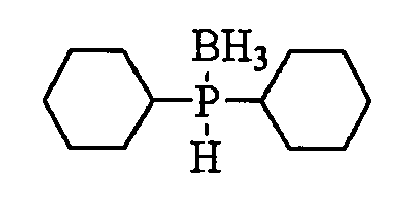
- Under an argon atmosphere, 1 mL of toluene was added to dicyclohexylphosphine oxide synthesized in Reference Example 3 (0.1106 g, 0.50 mmol) at a room temperature (25°C) to obtain a solution. Then, to the solution was added 1.02 mol/L of a borane-tetrahydrofuran complex (1.5 mL, 3.06 equivalents). The reaction mixture was concentrated under reduced pressure. The residue was dissolved in toluene and then purified by silica gel column chromatography (silica gel 10 g, toluene), and the desired fraction was concentrated under reduced pressure. The residue was recrystallized from n-hexane and dried (under reduced pressure at 40°C) to obtain the titled compound (0.05 g, white powder). The yield was 4.3%.
1H-NMR (300 MHz, CDCl3, TMS) δ: 0.25-0.95 (m, 3 H), 1.27-1.90 (m, 22H), 4.13 (dq, 1 H, JH-P = 351.1 Hz, J = 4.7 Hz).
31P-NMR (121 MHz, CDCl3, 85% H3PO4) δ: 16.20-17.54 (m), 18.98-20.31 (m). -
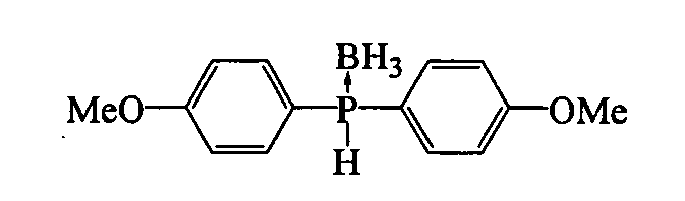
- Under an argon atmosphere, 80 mL of toluene was added to di(p-methoxyphenyl)phosphine oxide synthesized in Reference Example 4 (13.11 g, 0.17 mmol) at a room temperature (25°C) to obtain a solution. Then, to the solution was added 1.02 mol/L of a borane-tetrahydrofuran complex (165 mL, 3.30 equivalents) was added over 2 hours. After addition of silica gel (20 g), the reaction mixture was filtered and concentrated under reduced pressure. The resulting residue was recrystallized from n-hexane and dried (under reduced pressure at 40°C) to obtain the titled compound (11.1 g, white powder). The yield was 85%.
1H-NMR (300 MHz, CDCl3, TMS) δ: 0.26-1.65 (m, 3 H), 3.83 (s, 6H), 6.26 (dm, 1 H, JH-P = 378 Hz), 6.94 (s, 1 H), 6.95 (s, 1 H), 6.96 (s, 1 H), 6.97 (s, 1 H), 7.55 (s, 1 H), 7.57 (s, 1 H), 7.58 (s, 1 H), 7.61 (s, 1 H).
13C-NMR (75 MHz, CDCl3, CDCl3) δ: 55.30, 114.59, 114.74, 116.84, 117.67, 134.43, 134.57, 162.23.
31P-NMR (121 MHz, CDCl3, 85% H3PO4) δ: -4.5-(-3.2) (m), - 1.6-0.4 (m). - Phosphine-borane complexes useful as production intermediates of phosphine ligands (e.g. 1,2-bis[(o-anisyl)phenylphosphino]ethane (DIPAMP); 1,2-bis(diphenylphosphino)propane (PROPHOS); 2,3-bis(diphenylphosphiono)butane (CHIRAPHOS); 2,4-bis(diphenylphosphino)pentane (BDPP) and the like) which can form complexes with transition metals (e.g. ruthenium, iridium, palladium, nickel, rhodium and the like) which can be used in asymmetric synthesis reactions, can be produced in a high yield under mild conditions according to the process of the present invention.
Claims (9)
- A process producing a phosphine-borane complex represented by the formula:

wherein R1, R2, and R3 are the same or different and independently represent a hydrogen atom, a halogen atom, an optionally substituted alkyl group, an optionally substituted cycloalkyl group, an optionally substituted aryl group, or an optionally substituted heterocyclic group, with the proviso that R1 and R2 together with the adjacent phosphorus atom may form a 4- to 6-membered ring, or a salt thereof, which comprises converting a compound represented by the formula:
wherein each symbol is as defined above, or a salt thereof in a solvent in the presence of a borane reagent. - The process according to claim 1, wherein R3 is a hydrogen atom.
- The process according to claim 2, wherein R1 and R2 together with the adjacent phosphorus atom form a 5-membered ring.
- The process according to claim 1, wherein R1 and R2 are the same or different and independently represent a hydrogen atom, a halogen atom, an optionally substituted alkyl group, an optionally substituted cycloalkyl group, an optionally substituted aryl group, or an optionally substituted heterocyclic group with a proviso that R1 and R2 together with the adjacent phosphorus atom may form a 4-to 6-membered ring; and R3 represents a halogen atom, an optionally substituted alkyl group, an optionally substituted cycloalkyl group, an optionally substituted aryl group, or an optionally substituted heterocyclic group.
- The process according to claim 4, wherein R1 and R2 together with adjacent phosphorus atom form a 4- or 6-membered ring.
- The process according to claim 2 or 4, wherein R1 and R2 are the same or different and independently represent an optionally substituted aryl group.
- The process according to claim 6, wherein R1 and R2 are the same or different and independently represent a phenyl optionally substituted with 1 to 5 lower alkyl groups, lower alkoxy groups, halogen atoms, mono-lower alkylamino groups, or di-lower alkylamino groups.
- The process according to claim 2 or 4, wherein R1 and R2 are the same or different and independently represent a lower alkyl group or a lower cycloalkyl group.
- The process according to claim 1, wherein the borane reagent is a borane-tetrahydrofuran complex.
Applications Claiming Priority (2)
| Application Number | Priority Date | Filing Date | Title |
|---|---|---|---|
| JP2003140671 | 2003-05-19 | ||
| PCT/JP2004/007032 WO2004101580A1 (en) | 2003-05-19 | 2004-05-18 | Process for production of phosphine-borane complexes |
Publications (3)
| Publication Number | Publication Date |
|---|---|
| EP1626052A1 true EP1626052A1 (en) | 2006-02-15 |
| EP1626052A4 EP1626052A4 (en) | 2009-01-07 |
| EP1626052B1 EP1626052B1 (en) | 2012-01-04 |
Family
ID=33447399
Family Applications (1)
| Application Number | Title | Priority Date | Filing Date |
|---|---|---|---|
| EP04733647A Expired - Lifetime EP1626052B1 (en) | 2003-05-19 | 2004-05-18 | Process for production of phosphine-borane complexes |
Country Status (9)
| Country | Link |
|---|---|
| US (1) | US7541498B2 (en) |
| EP (1) | EP1626052B1 (en) |
| KR (1) | KR101085803B1 (en) |
| CN (1) | CN100412079C (en) |
| AT (1) | ATE540046T1 (en) |
| CA (1) | CA2523980C (en) |
| ES (1) | ES2378542T3 (en) |
| PT (1) | PT1626052E (en) |
| WO (1) | WO2004101580A1 (en) |
Families Citing this family (2)
| Publication number | Priority date | Publication date | Assignee | Title |
|---|---|---|---|---|
| JP5252921B2 (en) | 2005-09-20 | 2013-07-31 | 武田薬品工業株式会社 | Diphosphine ligand and transition metal complex using the same |
| EP2832738A4 (en) * | 2012-03-28 | 2016-02-24 | Takeda Pharmaceutical | RHODIUM CATALYST AND PROCESS FOR PRODUCING AN AMINO COMPOUND |
Family Cites Families (3)
| Publication number | Priority date | Publication date | Assignee | Title |
|---|---|---|---|---|
| ATE438653T1 (en) | 2001-12-07 | 2009-08-15 | Takeda Pharmaceutical | METHOD FOR PRODUCING DIPHOSPHINE COMPOUNDS AND INTERMEDIATE PRODUCTS FOR THE METHOD |
| JP4198354B2 (en) | 2001-12-28 | 2008-12-17 | 関東化学株式会社 | Optically active diphosphine ligand |
| JP3566955B2 (en) | 2001-12-28 | 2004-09-15 | 関東化学株式会社 | Novel ruthenium complex and method for producing alcohol compound using the same as catalyst |
-
2004
- 2004-05-18 WO PCT/JP2004/007032 patent/WO2004101580A1/en not_active Ceased
- 2004-05-18 US US10/556,499 patent/US7541498B2/en not_active Expired - Fee Related
- 2004-05-18 PT PT04733647T patent/PT1626052E/en unknown
- 2004-05-18 ES ES04733647T patent/ES2378542T3/en not_active Expired - Lifetime
- 2004-05-18 AT AT04733647T patent/ATE540046T1/en active
- 2004-05-18 KR KR1020057021631A patent/KR101085803B1/en not_active Expired - Fee Related
- 2004-05-18 EP EP04733647A patent/EP1626052B1/en not_active Expired - Lifetime
- 2004-05-18 CA CA2523980A patent/CA2523980C/en not_active Expired - Fee Related
- 2004-05-18 CN CNB2004800129125A patent/CN100412079C/en not_active Expired - Fee Related
Non-Patent Citations (2)
| Title |
|---|
| See also references of WO2004101580A1 * |
| STANKEVIC M ET AL: "An expedient reduction of sec-phosphine oxides to sec-phosphine-boranes by BH3.SMe2" SYNLETT, no. 7, 20 May 2003 (2003-05-20), pages 1012-1016, XP008059417 ISSN: 0936-5214 * |
Also Published As
| Publication number | Publication date |
|---|---|
| ATE540046T1 (en) | 2012-01-15 |
| CA2523980C (en) | 2012-11-27 |
| CA2523980A1 (en) | 2004-11-25 |
| US20060199968A1 (en) | 2006-09-07 |
| KR101085803B1 (en) | 2011-11-22 |
| KR20060006966A (en) | 2006-01-20 |
| PT1626052E (en) | 2012-02-14 |
| US7541498B2 (en) | 2009-06-02 |
| ES2378542T3 (en) | 2012-04-13 |
| CN100412079C (en) | 2008-08-20 |
| CN1788011A (en) | 2006-06-14 |
| WO2004101580A1 (en) | 2004-11-25 |
| EP1626052A4 (en) | 2009-01-07 |
| EP1626052B1 (en) | 2012-01-04 |
Similar Documents
| Publication | Publication Date | Title |
|---|---|---|
| JP5043883B2 (en) | Method for producing diphosphine compound and production intermediate thereof | |
| EP3480204B1 (en) | Organic magnesium phosphide and method for producing same, organic magnesium phosphide complex and method for producing same, and method for producing organic phosphorus-containing compound using said phosphide | |
| KR19990063389A (en) | Method for preparing bisphosphine oxide and bisphosphonate compound | |
| EP1626052B1 (en) | Process for production of phosphine-borane complexes | |
| HU210940B (en) | Process for amidation of pyridines | |
| JP4754182B2 (en) | Method for producing phosphine-borane complex | |
| JP4756608B2 (en) | Process for producing α-aminophosphonate derivative | |
| EP0839819B1 (en) | Method of preparing optically active diphosphine ligands | |
| JP4409089B2 (en) | Preparation of phosphine ligand | |
| JP5536458B2 (en) | Process for producing 6-halogeno-3-arylpyridine derivatives | |
| JP5848201B2 (en) | Method for producing aryldichlorophosphine | |
| JP4489416B2 (en) | Transition metal complexes with diphosphine compounds as ligands | |
| EP1568701B1 (en) | Transition metal complex having diphosphine complex as ligand | |
| CN108467408A (en) | A kind of diaryl phosphorus compound and preparation method thereof with hydroxy phenyl functional group | |
| JP4523227B2 (en) | Method for producing diphosphine compound and production intermediate thereof | |
| CN117777198A (en) | A kind of triarylphosphine compound based on phosphofluorene structure and preparation method thereof | |
| JP2001247586A (en) | Allyl phosphonate compound and method for producing the same | |
| JP2019189569A (en) | Phosphine compound, crosslinked composition, and manufacturing method of aromatic amine compound |
Legal Events
| Date | Code | Title | Description |
|---|---|---|---|
| PUAI | Public reference made under article 153(3) epc to a published international application that has entered the european phase |
Free format text: ORIGINAL CODE: 0009012 |
|
| 17P | Request for examination filed |
Effective date: 20051111 |
|
| AK | Designated contracting states |
Kind code of ref document: A1 Designated state(s): AT BE BG CH CY CZ DE DK EE ES FI FR GB GR HU IE IT LI LU MC NL PL PT RO SE SI SK TR |
|
| DAX | Request for extension of the european patent (deleted) | ||
| A4 | Supplementary search report drawn up and despatched |
Effective date: 20081204 |
|
| RIC1 | Information provided on ipc code assigned before grant |
Ipc: C07F 9/50 20060101AFI20041130BHEP Ipc: C07F 5/02 20060101ALI20081128BHEP |
|
| 17Q | First examination report despatched |
Effective date: 20090302 |
|
| GRAP | Despatch of communication of intention to grant a patent |
Free format text: ORIGINAL CODE: EPIDOSNIGR1 |
|
| GRAS | Grant fee paid |
Free format text: ORIGINAL CODE: EPIDOSNIGR3 |
|
| GRAA | (expected) grant |
Free format text: ORIGINAL CODE: 0009210 |
|
| AK | Designated contracting states |
Kind code of ref document: B1 Designated state(s): AT BE BG CH CY CZ DE DK EE ES FI FR GB GR HU IE IT LI LU MC NL PL PT RO SE SI SK TR |
|
| REG | Reference to a national code |
Ref country code: GB Ref legal event code: FG4D |
|
| REG | Reference to a national code |
Ref country code: CH Ref legal event code: EP |
|
| REG | Reference to a national code |
Ref country code: AT Ref legal event code: REF Ref document number: 540046 Country of ref document: AT Kind code of ref document: T Effective date: 20120115 |
|
| REG | Reference to a national code |
Ref country code: CH Ref legal event code: NV Representative=s name: BOHEST AG |
|
| REG | Reference to a national code |
Ref country code: IE Ref legal event code: FG4D |
|
| REG | Reference to a national code |
Ref country code: PT Ref legal event code: SC4A Free format text: AVAILABILITY OF NATIONAL TRANSLATION Effective date: 20120206 |
|
| REG | Reference to a national code |
Ref country code: NL Ref legal event code: T3 |
|
| REG | Reference to a national code |
Ref country code: DE Ref legal event code: R096 Ref document number: 602004035975 Country of ref document: DE Effective date: 20120308 |
|
| REG | Reference to a national code |
Ref country code: ES Ref legal event code: FG2A Ref document number: 2378542 Country of ref document: ES Kind code of ref document: T3 Effective date: 20120413 |
|
| PG25 | Lapsed in a contracting state [announced via postgrant information from national office to epo] |
Ref country code: SI Free format text: LAPSE BECAUSE OF FAILURE TO SUBMIT A TRANSLATION OF THE DESCRIPTION OR TO PAY THE FEE WITHIN THE PRESCRIBED TIME-LIMIT Effective date: 20120104 |
|
| PG25 | Lapsed in a contracting state [announced via postgrant information from national office to epo] |
Ref country code: BE Free format text: LAPSE BECAUSE OF FAILURE TO SUBMIT A TRANSLATION OF THE DESCRIPTION OR TO PAY THE FEE WITHIN THE PRESCRIBED TIME-LIMIT Effective date: 20120104 Ref country code: BG Free format text: LAPSE BECAUSE OF FAILURE TO SUBMIT A TRANSLATION OF THE DESCRIPTION OR TO PAY THE FEE WITHIN THE PRESCRIBED TIME-LIMIT Effective date: 20120404 |
|
| PG25 | Lapsed in a contracting state [announced via postgrant information from national office to epo] |
Ref country code: GR Free format text: LAPSE BECAUSE OF FAILURE TO SUBMIT A TRANSLATION OF THE DESCRIPTION OR TO PAY THE FEE WITHIN THE PRESCRIBED TIME-LIMIT Effective date: 20120405 Ref country code: PL Free format text: LAPSE BECAUSE OF FAILURE TO SUBMIT A TRANSLATION OF THE DESCRIPTION OR TO PAY THE FEE WITHIN THE PRESCRIBED TIME-LIMIT Effective date: 20120104 Ref country code: FI Free format text: LAPSE BECAUSE OF FAILURE TO SUBMIT A TRANSLATION OF THE DESCRIPTION OR TO PAY THE FEE WITHIN THE PRESCRIBED TIME-LIMIT Effective date: 20120104 |
|
| PG25 | Lapsed in a contracting state [announced via postgrant information from national office to epo] |
Ref country code: CY Free format text: LAPSE BECAUSE OF FAILURE TO SUBMIT A TRANSLATION OF THE DESCRIPTION OR TO PAY THE FEE WITHIN THE PRESCRIBED TIME-LIMIT Effective date: 20120104 |
|
| PG25 | Lapsed in a contracting state [announced via postgrant information from national office to epo] |
Ref country code: RO Free format text: LAPSE BECAUSE OF FAILURE TO SUBMIT A TRANSLATION OF THE DESCRIPTION OR TO PAY THE FEE WITHIN THE PRESCRIBED TIME-LIMIT Effective date: 20120104 Ref country code: EE Free format text: LAPSE BECAUSE OF FAILURE TO SUBMIT A TRANSLATION OF THE DESCRIPTION OR TO PAY THE FEE WITHIN THE PRESCRIBED TIME-LIMIT Effective date: 20120104 Ref country code: DK Free format text: LAPSE BECAUSE OF FAILURE TO SUBMIT A TRANSLATION OF THE DESCRIPTION OR TO PAY THE FEE WITHIN THE PRESCRIBED TIME-LIMIT Effective date: 20120104 Ref country code: SE Free format text: LAPSE BECAUSE OF FAILURE TO SUBMIT A TRANSLATION OF THE DESCRIPTION OR TO PAY THE FEE WITHIN THE PRESCRIBED TIME-LIMIT Effective date: 20120104 Ref country code: CZ Free format text: LAPSE BECAUSE OF FAILURE TO SUBMIT A TRANSLATION OF THE DESCRIPTION OR TO PAY THE FEE WITHIN THE PRESCRIBED TIME-LIMIT Effective date: 20120104 |
|
| PLBE | No opposition filed within time limit |
Free format text: ORIGINAL CODE: 0009261 |
|
| STAA | Information on the status of an ep patent application or granted ep patent |
Free format text: STATUS: NO OPPOSITION FILED WITHIN TIME LIMIT |
|
| PG25 | Lapsed in a contracting state [announced via postgrant information from national office to epo] |
Ref country code: SK Free format text: LAPSE BECAUSE OF FAILURE TO SUBMIT A TRANSLATION OF THE DESCRIPTION OR TO PAY THE FEE WITHIN THE PRESCRIBED TIME-LIMIT Effective date: 20120104 |
|
| 26N | No opposition filed |
Effective date: 20121005 |
|
| PG25 | Lapsed in a contracting state [announced via postgrant information from national office to epo] |
Ref country code: MC Free format text: LAPSE BECAUSE OF NON-PAYMENT OF DUE FEES Effective date: 20120531 |
|
| REG | Reference to a national code |
Ref country code: DE Ref legal event code: R097 Ref document number: 602004035975 Country of ref document: DE Effective date: 20121005 |
|
| REG | Reference to a national code |
Ref country code: IE Ref legal event code: MM4A |
|
| PG25 | Lapsed in a contracting state [announced via postgrant information from national office to epo] |
Ref country code: IE Free format text: LAPSE BECAUSE OF NON-PAYMENT OF DUE FEES Effective date: 20120518 |
|
| PG25 | Lapsed in a contracting state [announced via postgrant information from national office to epo] |
Ref country code: TR Free format text: LAPSE BECAUSE OF FAILURE TO SUBMIT A TRANSLATION OF THE DESCRIPTION OR TO PAY THE FEE WITHIN THE PRESCRIBED TIME-LIMIT Effective date: 20120104 |
|
| PG25 | Lapsed in a contracting state [announced via postgrant information from national office to epo] |
Ref country code: LU Free format text: LAPSE BECAUSE OF NON-PAYMENT OF DUE FEES Effective date: 20120518 |
|
| REG | Reference to a national code |
Ref country code: CH Ref legal event code: PCAR Free format text: NEW ADDRESS: HOLBEINSTRASSE 36-38, 4051 BASEL (CH) |
|
| PG25 | Lapsed in a contracting state [announced via postgrant information from national office to epo] |
Ref country code: HU Free format text: LAPSE BECAUSE OF FAILURE TO SUBMIT A TRANSLATION OF THE DESCRIPTION OR TO PAY THE FEE WITHIN THE PRESCRIBED TIME-LIMIT Effective date: 20040518 |
|
| REG | Reference to a national code |
Ref country code: FR Ref legal event code: PLFP Year of fee payment: 13 |
|
| REG | Reference to a national code |
Ref country code: FR Ref legal event code: PLFP Year of fee payment: 14 |
|
| REG | Reference to a national code |
Ref country code: FR Ref legal event code: PLFP Year of fee payment: 15 |
|
| PGFP | Annual fee paid to national office [announced via postgrant information from national office to epo] |
Ref country code: GB Payment date: 20180329 Year of fee payment: 15 |
|
| PGFP | Annual fee paid to national office [announced via postgrant information from national office to epo] |
Ref country code: NL Payment date: 20180412 Year of fee payment: 15 |
|
| PGFP | Annual fee paid to national office [announced via postgrant information from national office to epo] |
Ref country code: DE Payment date: 20180508 Year of fee payment: 15 Ref country code: PT Payment date: 20180516 Year of fee payment: 15 Ref country code: CH Payment date: 20180516 Year of fee payment: 15 Ref country code: ES Payment date: 20180605 Year of fee payment: 15 |
|
| PGFP | Annual fee paid to national office [announced via postgrant information from national office to epo] |
Ref country code: FR Payment date: 20180412 Year of fee payment: 15 Ref country code: IT Payment date: 20180522 Year of fee payment: 15 Ref country code: AT Payment date: 20180426 Year of fee payment: 15 |
|
| REG | Reference to a national code |
Ref country code: DE Ref legal event code: R119 Ref document number: 602004035975 Country of ref document: DE |
|
| REG | Reference to a national code |
Ref country code: CH Ref legal event code: PL |
|
| REG | Reference to a national code |
Ref country code: NL Ref legal event code: MM Effective date: 20190601 |
|
| REG | Reference to a national code |
Ref country code: AT Ref legal event code: MM01 Ref document number: 540046 Country of ref document: AT Kind code of ref document: T Effective date: 20190518 |
|
| GBPC | Gb: european patent ceased through non-payment of renewal fee |
Effective date: 20190518 |
|
| PG25 | Lapsed in a contracting state [announced via postgrant information from national office to epo] |
Ref country code: PT Free format text: LAPSE BECAUSE OF NON-PAYMENT OF DUE FEES Effective date: 20191118 Ref country code: LI Free format text: LAPSE BECAUSE OF NON-PAYMENT OF DUE FEES Effective date: 20190531 Ref country code: CH Free format text: LAPSE BECAUSE OF NON-PAYMENT OF DUE FEES Effective date: 20190531 Ref country code: AT Free format text: LAPSE BECAUSE OF NON-PAYMENT OF DUE FEES Effective date: 20190518 |
|
| PG25 | Lapsed in a contracting state [announced via postgrant information from national office to epo] |
Ref country code: IT Free format text: LAPSE BECAUSE OF NON-PAYMENT OF DUE FEES Effective date: 20190518 Ref country code: NL Free format text: LAPSE BECAUSE OF NON-PAYMENT OF DUE FEES Effective date: 20190601 Ref country code: DE Free format text: LAPSE BECAUSE OF NON-PAYMENT OF DUE FEES Effective date: 20191203 Ref country code: GB Free format text: LAPSE BECAUSE OF NON-PAYMENT OF DUE FEES Effective date: 20190518 |
|
| PG25 | Lapsed in a contracting state [announced via postgrant information from national office to epo] |
Ref country code: FR Free format text: LAPSE BECAUSE OF NON-PAYMENT OF DUE FEES Effective date: 20190531 |
|
| REG | Reference to a national code |
Ref country code: ES Ref legal event code: FD2A Effective date: 20200928 |
|
| PG25 | Lapsed in a contracting state [announced via postgrant information from national office to epo] |
Ref country code: ES Free format text: LAPSE BECAUSE OF NON-PAYMENT OF DUE FEES Effective date: 20190519 |