EP1623631A1 - Aerated food products containing hydrophobin - Google Patents
Aerated food products containing hydrophobin Download PDFInfo
- Publication number
- EP1623631A1 EP1623631A1 EP05076480A EP05076480A EP1623631A1 EP 1623631 A1 EP1623631 A1 EP 1623631A1 EP 05076480 A EP05076480 A EP 05076480A EP 05076480 A EP05076480 A EP 05076480A EP 1623631 A1 EP1623631 A1 EP 1623631A1
- Authority
- EP
- European Patent Office
- Prior art keywords
- hydrophobin
- food product
- aerated
- foam
- aerated food
- Prior art date
- Legal status (The legal status is an assumption and is not a legal conclusion. Google has not performed a legal analysis and makes no representation as to the accuracy of the status listed.)
- Granted
Links
Images




Classifications
-
- A—HUMAN NECESSITIES
- A23—FOODS OR FOODSTUFFS; TREATMENT THEREOF, NOT COVERED BY OTHER CLASSES
- A23G—COCOA; COCOA PRODUCTS, e.g. CHOCOLATE; SUBSTITUTES FOR COCOA OR COCOA PRODUCTS; CONFECTIONERY; CHEWING GUM; ICE-CREAM; PREPARATION THEREOF
- A23G9/00—Frozen sweets, e.g. ice confectionery, ice-cream; Mixtures therefor
- A23G9/32—Frozen sweets, e.g. ice confectionery, ice-cream; Mixtures therefor characterised by the composition containing organic or inorganic compounds
- A23G9/38—Frozen sweets, e.g. ice confectionery, ice-cream; Mixtures therefor characterised by the composition containing organic or inorganic compounds containing peptides or proteins
-
- A—HUMAN NECESSITIES
- A23—FOODS OR FOODSTUFFS; TREATMENT THEREOF, NOT COVERED BY OTHER CLASSES
- A23C—DAIRY PRODUCTS, e.g. MILK, BUTTER OR CHEESE; MILK OR CHEESE SUBSTITUTES; PREPARATION THEREOF
- A23C11/00—Milk substitutes, e.g. coffee whitener compositions
- A23C11/02—Milk substitutes, e.g. coffee whitener compositions containing at least one non-milk component as source of fats or proteins
- A23C11/06—Milk substitutes, e.g. coffee whitener compositions containing at least one non-milk component as source of fats or proteins containing non-milk proteins
- A23C11/065—Microbial proteins, inactivated yeast or animal proteins
-
- A—HUMAN NECESSITIES
- A23—FOODS OR FOODSTUFFS; TREATMENT THEREOF, NOT COVERED BY OTHER CLASSES
- A23C—DAIRY PRODUCTS, e.g. MILK, BUTTER OR CHEESE; MILK OR CHEESE SUBSTITUTES; PREPARATION THEREOF
- A23C13/00—Cream; Cream preparations; Making thereof
- A23C13/12—Cream preparations
-
- A—HUMAN NECESSITIES
- A23—FOODS OR FOODSTUFFS; TREATMENT THEREOF, NOT COVERED BY OTHER CLASSES
- A23C—DAIRY PRODUCTS, e.g. MILK, BUTTER OR CHEESE; MILK OR CHEESE SUBSTITUTES; PREPARATION THEREOF
- A23C9/00—Milk preparations; Milk powder or milk powder preparations
- A23C9/152—Milk preparations; Milk powder or milk powder preparations containing additives
- A23C9/1526—Amino acids; Peptides; Protein hydrolysates; Nucleic acids; Derivatives thereof
-
- A—HUMAN NECESSITIES
- A23—FOODS OR FOODSTUFFS; TREATMENT THEREOF, NOT COVERED BY OTHER CLASSES
- A23C—DAIRY PRODUCTS, e.g. MILK, BUTTER OR CHEESE; MILK OR CHEESE SUBSTITUTES; PREPARATION THEREOF
- A23C9/00—Milk preparations; Milk powder or milk powder preparations
- A23C9/152—Milk preparations; Milk powder or milk powder preparations containing additives
- A23C9/154—Milk preparations; Milk powder or milk powder preparations containing additives containing thickening substances, eggs or cereal preparations; Milk gels
- A23C9/1544—Non-acidified gels, e.g. custards, creams, desserts, puddings, shakes or foams, containing eggs or thickening or gelling agents other than sugar; Milk products containing natural or microbial polysaccharides, e.g. cellulose or cellulose derivatives; Milk products containing nutrient fibres
-
- A—HUMAN NECESSITIES
- A23—FOODS OR FOODSTUFFS; TREATMENT THEREOF, NOT COVERED BY OTHER CLASSES
- A23G—COCOA; COCOA PRODUCTS, e.g. CHOCOLATE; SUBSTITUTES FOR COCOA OR COCOA PRODUCTS; CONFECTIONERY; CHEWING GUM; ICE-CREAM; PREPARATION THEREOF
- A23G3/00—Sweetmeats; Confectionery; Marzipan; Coated or filled products
- A23G3/34—Sweetmeats, confectionery or marzipan; Processes for the preparation thereof
- A23G3/36—Sweetmeats, confectionery or marzipan; Processes for the preparation thereof characterised by the composition containing organic or inorganic compounds
- A23G3/44—Sweetmeats, confectionery or marzipan; Processes for the preparation thereof characterised by the composition containing organic or inorganic compounds containing peptides or proteins
-
- A—HUMAN NECESSITIES
- A23—FOODS OR FOODSTUFFS; TREATMENT THEREOF, NOT COVERED BY OTHER CLASSES
- A23G—COCOA; COCOA PRODUCTS, e.g. CHOCOLATE; SUBSTITUTES FOR COCOA OR COCOA PRODUCTS; CONFECTIONERY; CHEWING GUM; ICE-CREAM; PREPARATION THEREOF
- A23G9/00—Frozen sweets, e.g. ice confectionery, ice-cream; Mixtures therefor
- A23G9/44—Frozen sweets, e.g. ice confectionery, ice-cream; Mixtures therefor characterised by shape, structure or physical form
- A23G9/46—Aerated, foamed, cellular or porous products
-
- A—HUMAN NECESSITIES
- A23—FOODS OR FOODSTUFFS; TREATMENT THEREOF, NOT COVERED BY OTHER CLASSES
- A23L—FOODS, FOODSTUFFS OR NON-ALCOHOLIC BEVERAGES, NOT OTHERWISE PROVIDED FOR; PREPARATION OR TREATMENT THEREOF
- A23L2/00—Non-alcoholic beverages; Dry compositions or concentrates therefor; Preparation or treatment thereof
- A23L2/52—Adding ingredients
- A23L2/54—Mixing with gases
-
- A—HUMAN NECESSITIES
- A23—FOODS OR FOODSTUFFS; TREATMENT THEREOF, NOT COVERED BY OTHER CLASSES
- A23L—FOODS, FOODSTUFFS OR NON-ALCOHOLIC BEVERAGES, NOT OTHERWISE PROVIDED FOR; PREPARATION OR TREATMENT THEREOF
- A23L2/00—Non-alcoholic beverages; Dry compositions or concentrates therefor; Preparation or treatment thereof
- A23L2/52—Adding ingredients
- A23L2/66—Proteins
-
- A—HUMAN NECESSITIES
- A23—FOODS OR FOODSTUFFS; TREATMENT THEREOF, NOT COVERED BY OTHER CLASSES
- A23L—FOODS, FOODSTUFFS OR NON-ALCOHOLIC BEVERAGES, NOT OTHERWISE PROVIDED FOR; PREPARATION OR TREATMENT THEREOF
- A23L33/00—Modifying nutritive qualities of foods; Dietetic products; Preparation or treatment thereof
- A23L33/10—Modifying nutritive qualities of foods; Dietetic products; Preparation or treatment thereof using additives
- A23L33/17—Amino acids, peptides or proteins
- A23L33/195—Proteins from microorganisms
-
- A—HUMAN NECESSITIES
- A23—FOODS OR FOODSTUFFS; TREATMENT THEREOF, NOT COVERED BY OTHER CLASSES
- A23C—DAIRY PRODUCTS, e.g. MILK, BUTTER OR CHEESE; MILK OR CHEESE SUBSTITUTES; PREPARATION THEREOF
- A23C2210/00—Physical treatment of dairy products
- A23C2210/30—Whipping, foaming, frothing or aerating dairy products
-
- A—HUMAN NECESSITIES
- A23—FOODS OR FOODSTUFFS; TREATMENT THEREOF, NOT COVERED BY OTHER CLASSES
- A23V—INDEXING SCHEME RELATING TO FOODS, FOODSTUFFS OR NON-ALCOHOLIC BEVERAGES AND LACTIC OR PROPIONIC ACID BACTERIA USED IN FOODSTUFFS OR FOOD PREPARATION
- A23V2002/00—Food compositions, function of food ingredients or processes for food or foodstuffs
Definitions
- the present invention relates to aerated food products that include hydrophobins.
- a wide variety of food products contain introduced gas, such as air, nitrogen and/or carbon dioxide.
- Such foods include frozen and chilled food products, for example ice cream and mousses.
- Two key considerations arise in the production and storage of aerated food products, namely the ability to incorporate gas into the product during manufacture (foamability) and the subsequent stability of the gas bubbles during storage (foam stability).
- a number of additives are included in aerated food products to assist in the creation and maintenance of foam. These include proteins such as sodium caseinate and whey, which are highly foamable, and biopolymers, such as carrageenans, guar gum, locust bean gum, pectins, alginates, xanthan, gellan, gelatin and mixtures thereof, which are good stabilisers.
- stabilisers used in the art can often maintain the total foam volume, they are poor at inhibiting the coarsening of the foam microstructure, i.e. increase in gas bubble size by processes such as disproportionation and coalescence. Further, many of the ingredients used to stabilise the gas phase in aerated food products need to be added at fairly high levels which can have deleterious textural and/or calorific consequences.
- hydrophobins a class of proteins found in fungi, termed hydrophobins, combine high foamability and good foam stabilisation properties.
- hydrophobins have been found to provide both excellent foam volume stability and inhibition of coarsening. Further, the levels of hydrophobin required to achieve excellent product stability are relatively low. It will therefore be possible to replace some or all of the conventional ingredients used to form and stabilise aerated food products with smaller amounts of hydrophobin.
- the present invention provides an aerated food product comprising a hydrophobin.
- the present invention provides an aerated food product in which the air phase is at least partially stabilised with hydrophobin.
- the present invention provides an aerated food product comprising hydrophobin in which the hydrophobin is associated with the air phase.
- hydrophobin is a class II hydrophobin.
- the hydrophobin is present in an amount of at least 0.001 wt%, more preferably at least 0.01 wt%.
- the present invention provides a composition for producing an aerated food product of the invention, which composition comprises hydrophobin, preferably hydrophobin in isolated form, together with at least one of the remaining ingredients of the food product.
- the composition comprises all the remaining ingredients of the food product.
- the present invention provides a dry composition for producing an aerated food product of the invention, which composition comprises hydrophobin, preferably hydrophobin in isolated form, together with at least one of the remaining non-liquid ingredients of the food product.
- the composition comprises all the remaining non-liquid ingredients of the food product.
- the present invention further provides the use of a hydrophobin in a method of inhibiting bubble coarsening in an aerated food product.
- the present invention provides a method of inhibiting bubble coarsening in an aerated food product which method comprises adding hydrophobin to the food product prior to and/or during aeration of the product.
- the present invention also provides the use of a hydrophobin in a method of stabilising a foam in an aerated food product.
- the present invention also provides a method of stabilising a foam in an aerated food product which method comprises adding hydrophobin to the food product prior to and/or during aeration of the product.
- the present invention further provides the use of a hydrophobin in a method of improving shape retention and/or rigidity in an aerated food product.
- the present invention provides a method of improving shape retention and/or rigidity in an aerated food product which method comprises adding hydrophobin to the food product prior to and/or during aeration of the product.
- Hydrophobins are a well-defined class of proteins (Wessels, 1997, Adv. Microb. Physio. 38: 1-45; Wosten, 2001, Annu Rev. Microbiol. 55: 625-646) capable of self-assembly at a hydrophobic/hydrophilic interface, and having a conserved sequence: where X represents any amino acid, and n and m independently represent an integer. Typically, a hydrophobin has a length of up to 125 amino acids. The cysteine residues (C) in the conserved sequence are part of disulphide bridges.
- hydrophobin has a wider meaning to include functionally equivalent proteins still displaying the characteristic of self-assembly at a hydrophobic-hydrophilic interface resulting in a protein film, such as proteins comprising the sequence: or parts thereof still displaying the characteristic of self-assembly at a hydrophobic-hydrophilic interface resulting in a protein film.
- self-assembly can be detected by adsorbing the protein to Teflon and using Circular Dichroism to establish the presence of a secondary structure (in general, ⁇ -helix) (De Vocht et al., 1998, Biophys. J. 74: 2059-68).
- a film can be established by incubating a Teflon sheet in the protein solution followed by at least three washes with water or buffer (Wosten et al., 1994, Embo. J. 13: 5848-54).
- the protein film can be visualised by any suitable method, such as labeling with a fluorescent marker or by the use of fluorescent antibodies, as is well established in the art.
- m and n typically have values ranging from 0 to 2000, but more usually m and n in total are less than 100 or 200.
- the definition of hydrophobin in the context of the present invention includes fusion proteins of a hydrophobin and another polypeptide as well as conjugates of hydrophobin and other molecules such as polysaccharides.
- Hydrophobins identified to date are generally classed as either class I or class II. Both types have been identified in fungi as secreted proteins that self-assemble at hydrophobilic interfaces into amphipathic films. Assemblages of class I hydrophobins are relatively insoluble whereas those of class II hydrophobins readily dissolve in a variety of solvents.
- Hydrophobin-like proteins have also been identified in filamentous bacteria, such as Actinomycete and Steptomyces sp. (WO01/74864). These bacterial proteins, by contrast to fungal hydrophobins, form only up to one disulphide bridge since they have only two cysteine residues. Such proteins are an example of functional equivalents to hydrophobins having the consensus sequences shown in SEQ ID Nos. 1 and 2, and are within the scope of the present invention.
- the hydrophobins can be obtained by extraction from native sources, such as filamentous fungi, by any suitable process.
- hydrophobins can be obtained by culturing filamentous fungi that secrete the hydrophobin into the growth medium or by extraction from fungal mycelia with 60% ethanol. It is particularly preferred to isolate hydrophobins from host organisms that naturally secrete hydrophobins.
- Preferred hosts are hyphomycetes (e.g. Trichoderma), basidiomycetes and ascomycetes.
- Particularly preferred hosts are food grade organisms, such as Cryphonectria parasitica which secretes a hydrophobin termed cryparin (MacCabe and Van Alfen, 1999, App. Environ. Microbiol 65: 5431-5435).
- hydrophobins can be obtained by the use of recombinant technology.
- host cells typically micro-organisms
- the hydrophobins can then be isolated and used in accordance with the present invention.
- Techniques for introducing nucleic acid constructs encoding hydrophobins into host cells are well known in the art. More than 34 genes coding for hydrophobins have been cloned, from over 16 fungal species (see for example WO96/41882 which gives the sequence of hydrophobins identified in Agaricus bisporus; and Wosten, 2001, Annu Rev. Microbiol. 55: 625-646).
- Recombinant technology can also be used to modify hydrophobin sequences or synthesise novel hydrophobins having desired/improved properties.
- an appropriate host cell or organism is transformed by a nucleic acid construct that encodes the desired hydrophobin.
- the nucleotide sequence coding for the polypeptide can be inserted into a suitable expression vector encoding the necessary elements for transcription and translation and in such a manner that they will be expressed under appropriate conditions (e.g. in proper orientation and correct reading frame and with appropriate targeting and expression sequences).
- suitable expression vector encoding the necessary elements for transcription and translation and in such a manner that they will be expressed under appropriate conditions (e.g. in proper orientation and correct reading frame and with appropriate targeting and expression sequences).
- a number of expression systems may be used to express the polypeptide coding sequence. These include, but are not limited to, bacteria, fungi (including yeast), insect cell systems, plant cell culture systems and plants all transformed with the appropriate expression vectors. Preferred hosts are those that are considered food grade -'generally regarded as safe' (GRAS).
- Suitable fungal species include yeasts such as (but not limited to) those of the genera Saccharomyces, Kluyveromyces, Pichia, Hansenula, Candida, Schizo saccharomyces and the like, and filamentous species such as (but not limited to) those of the genera Aspergillus, Trichoderma, Mucor, Neurospora, Fusarium and the like.
- hydrophobins are preferably at least 80% identical at the amino acid level to a hydrophobin identified in nature, more preferably at least 95% or 100% identical.
- hydrophobins possessing this high level of identity to a hydrophobin that naturally occurs are also embraced within the term "hydrophobins”.
- Hydrophobins can be purified from culture media or cellular extracts by, for example, the procedure described in WO01/57076 which involves adsorbing the hydrophobin present in a hydrophobin-containing solution to surface and then contacting the surface with a surfactant, such as Tween 20, to elute the hydrophobin from the surface.
- a surfactant such as Tween 20
- Aerated food products of the invention typically fall into one of four groups - hot, ambient, chilled or frozen.
- the term "food” includes beverages.
- Hot food products include beverages such as cappuccino coffee.
- Ambient aerated food products include whipped cream, marshmallows and bakery products, e.g. bread.
- Chilled aerated food products include whipped cream, mousses and beverages such as beer, milk shakes and smoothies.
- Frozen aerated food products include frozen confections such as ice cream, milk ice, frozen yoghurt, sherbet, slushes, frozen custard, water ice, sorbet, granitas and frozen purees.
- the aerated food product is an aerated confectionery product.
- %overrun means that gas has been intentionally incorporated into the product, such as by mechanical means.
- the gas can be any food-grade gas such as air, nitrogen or carbon dioxide.
- the extent of aeration is typically defined in terms of "overrun". In the context of the present invention, %overrun is defined in volume terms as: ( ( volume of the final aerated product - volume of the mix ) / volume of the mix ) ⁇ 100
- the amount of overrun present in the product will vary depending on the desired product characteristics.
- the level of overrun in ice cream is typically from about 70 to 100%, and in confectionery such as mousses the overrun can be as high as 200 to 250 wt%, whereas the overrun in water ices is from 25 to 30%.
- the level of overrun in some chilled products, ambient products and hot products can be lower, but generally over 10%, e.g. the level of overrun in milkshakes is typically from 10 to 40 wt%.
- the amount of hydrophobin present in the product will generally vary depending on the product formulation and volume of the air phase. Typically, the product will contain at least 0.001 wt%, hydrophobin, more preferably at least 0.005 or 0.01 wt%. Typically the product will contain less than 1 wt% hydrophobin.
- the hydrophobin may be from a single source or a plurality of sources e.g. the hydrophobin can a mixture of two or more different hydrophobin polypeptides.
- hydrophobin is a class II hydrophobin.
- compositions for producing an aerated food product of the invention which composition comprises a hydrophobin.
- compositions include liquid premixes, for example premixes used in the production of frozen confectionery products, and dry mixes, for example powders, to which an aqueous liquid, such as milk or water, is added prior to or during aeration.
- compositions include liquid premixes, for example premixes used in the production of frozen confectionery products, and dry mixes, for example powders, to which an aqueous liquid, such as milk or water, is added prior to or during aeration.
- liquid premixes for example premixes used in the production of frozen confectionery products
- dry mixes for example powders, to which an aqueous liquid, such as milk or water, is added prior to or during aeration.
- compositions for producing a frozen food product of the invention will comprise other ingredients, in addition to the hydrophobin, which are normally included in the food product, e.g. sugar, fat, emulsifiers, flavourings etc.
- the compositions may include all of the remaining ingredients required to make the food product such that the composition is ready to be processed, i.e. aerated, to form an aerated food product of the invention.
- Dry compositions for producing an aerated food product of the invention will also comprise other ingredients, in addition to the hydrophobin, which are normally included in the food product, e.g. sugar, fat, emulsifiers, flavourings etc.
- the compositions may include all of the remaining non-liquid ingredients required to make the food product such that all that the user need only add an aqueous liquid, such as water or milk, and the composition is ready to be processed to form an aerated food product of the invention.
- These dry compositions examples of which include powders and granules, can be designed for both industrial and retail use, and benefit from reduced bulk and longer shelf life.
- the hydrophobin is added in a form and in an amount such that it is available to stabilise the air phase.
- added we mean that the hydrophobin is deliberately introduced into the food product for the purpose of taking advantage of its foam stabilising properties. Consequently, where food ingredients are present or added that contain fungal contaminants, which may contain hydrophobin polypeptides, this does not constitute adding hydrophobin within the context of the present invention.
- the hydrophobin is added to the food product in a form such it is capable of self-assembly at an air-liquid surface.
- the hydrophobin is added to the food product or compositions of the invention in an isolated form, typically at least partially purified, such as at least 10% pure, based on weight of solids.
- an isolated form we mean that the hydrophobin is not added as part of a naturally-occurring organism, such as a mushroom, which naturally expresses hydrophobins. Instead, the hydrophobin will typically either have been extracted from a naturally-occurring source or obtained by recombinant expression in a host organism.
- the hydrophobin is added to the food product in monomeric, dimeric and/or oligomeric (i.e. consisting of 10 monomeric units or fewer) form.
- monomeric, dimeric and/or oligomeric i.e. consisting of 10 monomeric units or fewer
- at least 50 wt% of the added hydrophobin is in at least one of these forms, more preferably at least 75, 80, 85 or 90 wt%.
- the hydrophobin will typically undergo assembly at the air/liquid interface and therefore the amount of monomer, dimer and oligomer would be expected to decrease.
- the hydrophobin is added to the aerated food product or compositions of the invention in an isolated form, typically at least partially purified.
- the added hydrophobin can be used to stabilise the air phase in an aerated food product, generally by inhibiting bubble coarsening, i.e. hydrophobins have been found not only to stabilise foam volume but also the size of the bubbles within the foam.
- Trichoderma reesei hydrophobin II (HFB II) was compared to that of the widely used, foamable, dairy protein sodium caseinate (DMV International, the Netherlands. 88-90% protein, 1.5% fat and 6% moisture) and skimmed milk (United Milk, UK. 33-36% protein, 0.8% fat, 3.7% moisture).
- HFBII was obtained from VTT Biotechnology, Finland (purified from Trichoderma reesei essentially as described in WO00/58342 and Linder et al., 2001, Biomacromolecules 2: 511-517).
- Table 1 shows the concentrations of the protein solutions that were prepared.
- the dairy protein solutions were prepared using a magnetic stirrer and the protein was sprinkled into the water at room temperature. The solution was then heated to 60°C, held for 5 minutes and then cooled to 5°C.
- the HFB II solutions were prepared by using a Sonicor ultrasonic bath model SC-42 (Sonicor Instrument Corp). The HFB II was added either as an aliquot or dry powder which was sonicated for between 30 seconds to 1 minute at room temperature until all of the HFB was dispersed and a clear liquid obtained. This solution was also cooled to 5°C before aeration.
- Foams were produced by shearing each solution for up to a maximum of 10 minutes in a cooled (2°C) cylindrical, vertically mounted, jacketed stainless steel vessel with internal proportions of 105 mm height and diameter 72 mm.
- the lid of the vessel fills 54% of the internal volume leaving 46% (180 ml) for the sample.
- the rotor used to shear the sample consists of a rectangular impeller of the correct proportions to scrape the surface edge of the container as it rotates (dimensions 72 mm x 41.5mm). Also attached to the rotor are two semi-circular (60 mm diameter) high-shear blades positioned at a 45° angle to the rectangular attachment.
- Figure 1 shows the overruns obtained for the sodium caseinate, SMP and HFB II.
- hydrophobin is at least as foamable as sodium caseinate and SMP, with a lower concentration needed to generate a similar overrun.
- hydrophobin has similar foamability to sodium caseinate in a more complex system including sugar, and optionally guar.
- the stability of these foams was measured by monitoring samples contained in 250 ml measuring cylinders and recording serum level and foam height over time at room temperature.
- the liquid in the foams drain over time, leading to two separate and distinct layers: a foam on top, and aqueous solution below.
- a foam on top and aqueous solution below.
- the stability of the foam phase that is the point of interest here.
- the volume of foam is taken as the entire volume of the system, i.e. both air (foam) phase and liquid phase irrespective of whether they have separated into two distinct layers.
- the value of overrun therefore gives a quantitative indication of the stability of the foam to typical break down mechanisms such as coalescence (with themselves and the atmosphere) and disproportionation.
- Proteins were dispersed in water alone and in the presence of both 20% sucrose and 20% sucrose + 1% guar gum. Table 3 shows the samples that were prepared. Whey powder (Avonol 600 - 30 wt% protein, 3.5 wt% moisture, 2.5 wt% fat, 7 wt% ash and 53 wt% lactose) was obtained from Glanvia, Ireland.
- the dairy protein solutions were prepared using a magnetic stirrer and the protein was sprinkled into the water at room temperature. The solution was then heated to 60°C, held for 5 minutes and then cooled to 5°C.
- the HFB II solutions were prepared by using a Sonicor ultrasonic bath model SC-42 (Sonicor Instrument Corp). The HFB II was added either as an aliquot or dry powder which was sonicated for between 30 seconds to 1 minute at room temperature until all of the HFB was dispersed and a clear liquid obtained. This solution was also cooled to 5°C before aeration.
- HFB II HFB II
- sucrose or sucrose guar solution either as an aliquot or a dry powder.
- Initial mixing was carried out on a magnetic stirrer followed by 30 seconds in the ultrasonic bath. Foams were produced as described in Example 1, except that different shear terms were used so as to generate in each case about 100% overrun.
- the microstructure of the hydrophobin foam was visualised by Low Temperature Scanning Electron Microscopy (LTSEM).
- LTSEM Low Temperature Scanning Electron Microscopy
- the foam sample was first cut at +5°C and plunged into liquid nitrogen.
- the sample was left at -80°C on dry ice prior SEM sample preparation.
- a sample section was cut carefully because of its very fragile structure.
- This section approximately 6mmx6mmx10mm in size, was mounted on a sample holder using a compound: OCT TM on the point of freezing (supplied by Agar Scientific).
- OCT TM on the point of freezing
- the sample including the holder is plunged into liquid nitrogen slush and transferred to a low temperature preparation chamber: Oxford Inst. CT1500HF.
- the chamber is under vacuum, approximately 10 -4 - 10 -5 mbar.
- the sample is kept at a temperature below -110°C on a cold stage.
- the sample is fractured inside the chamber using a scalpel blade and coated with gold using argon plasma This process also takes place under vacuum with an applied pressure of 10 -1 millibars and current of 5 milliamps for 30 seconds.
- the sample is then transferred to a conventional Scanning Electron Microscope (JSM 5600), fitted with an Oxford Instruments cold stage at a temperature of -150°C.
- JSM 5600 Scanning Electron Microscope
- Foam produced using hydrophobin remained stable over a long time period in all three systems tested (water, + sucrose, + sucrose and guar) - see Figure 2.
- Foams produced from sodium caseinate, skimmed milk powder, and whey protein are all very unstable compared to foam produced using hydrophobin (see Figure 3A). Further, higher concentrations of skimmed milk powder and whey protein solutions are required to attain an initial overrun of 100% than the concentration needed for hydrophobin.
- hydrophobin can be used at a low concentration to create significant amounts of foam which remain very stable relative to other commonly used proteins.
- the data show that the foam that is created with 0.1 % HFB II is more stable that those produced by the other proteins tested. All the foams drain over time (which can be reduced by the addition of thickeners), but the bubbles for the hydrophobin foams still remain stable, i.e. the foam system still retains the air (overrun).
- the bubbles present in foams made with hydrophobin remain stable to bubble coarsening at chill temperatures for at least 2 weeks (see Figure 4 which shows SEM micrographs demonstrating that bubble size is substantially unchanged after 2 weeks).
- hydrophobin improves the stability of foams in terms of both foam volume and bubble size. It should be noted that the fractures observed on the surface of the bubbles are believed to be artefacts of the SEM preparation procedure.
- Example 3 Measurement of surface viscosity and elasticity using surface rheometry
- the instrument was used in the normalised resonance mode, using a 13 mm diameter du Nouy ring at the surface of the liquid in a 46 mm diameter sample dish.
- the ring oscillates on the sample surface, and a high-resolution displacement sensor is used to monitor strain amplitude over the range +/- 1°.
- the runs were time sweeps, with the starting frequency at 3 Hz, and starting amplitude at 10,000 ⁇ Radians, and measurements taken at room temperature.
- the test duration was set at 36,000 seconds, with 240 data points gathered during that time.
- the physical parameters of interest are G' (storage modulus) and G" (loss modulus) as a function of time, which give an indication of the viscoelasticity of the adsorbed surface layer.
- Protein samples were diluted with water to the required concentration.
- the surface rheology measurements are made relative to pure water, which was measured prior to measurement of the protein solutions.
- the surface rheology data is shown in Figures 5 and 6.
- G' and G" increase gradually over time, before a rapid increase in both is observed. In the examples shown, the values increase to such an extent that they go beyond the measuring capabilities of the experimental set up. Even at very low concentrations (less than 0.001 wt%), the values for G' and G" reach values far in excess of the proteins used as comparisons: whey protein and sodium caseinate.
- hydrophobin stabilises foams effectively by forming very strong viscoelastic surface layers around the bubbles. These lead to good stability against typical foam destabilising mechanisms such as coalescence and disproportionation.
- whey protein and sodium caseinate foams are both less stable that hydrophobin foams, since the surface layers do not exhibit G' and G" values as high as hydrophobin at comparable solution concentrations.
- hydrophobins can be used to inhibit bubble coarsening in an aerated food product, for example by inhibiting or reducing disproportionation and/or coalescence.
- hydrophobins can be used to stabilise foams in an aerated food product. Further, given that hydrophobins inhibit bubble coarsening, it will be possible to improve shape retention and rigidity of aerated products.
- Aerated frozen products were prepared using 3 types of protein:
- Table 4 Details of the materials used are summarised in Table 4 and the formulations from which each of the aerated frozen products was prepared are shown in Table 5.
- Table 4. Materials used Ingredient Composition Supplier Sodium caseinate 88-90% protein, 1.5% fat, 6% moisture DMV International, The Netherlands. Skimmed milk powder 33-36% protein, 0.8% fat, 3.7% moisture United Milk, UK. Hydrophobin type II (HFB II) Purified from Trichoderma reesei essentially as described in WO00/58342 and Linder et al, 2001, Biomacromolecules 2: 511-517). VTT Biotechnology, Finland. Refined Coconut Oil Van den Bergh Foods, Limited Sucrose Tate and Lyle, UK. Table 5.
- HFB II Hydrophobin type II
- Formulations used Mix A Mix B Mix C Ingredient Concentration / wt% Sodium caseinate 2.0 - - - - Skimmed milk powder - - 11.42 - - HFB II - - - - 0.2 Coconut Oil 5.0 5.0 5.0 Sucrose 25.0 20.0 25.0 Water 68.0 63.58 69.8
- the relatively slow stirring at the start for Mixes A and B allowed for cooling of the mix and generation of some viscosity (via ice formation and incorporation) prior to aeration using higher shear.
- a short time at high speed incorporated the air and then the speed was stepped down to allow the samples to reach at least -5°C.
- the microstructure of each products was visualised using Low Temperature Scanning Electron Microscopy (LTSEM).
- LTSEM Low Temperature Scanning Electron Microscopy
- the sample was cooled to -80 °C on dry ice and a sample section cut.
- This section approximately 5mmx5mmx10mm in size, was mounted on a sample holder using a Tissue Tek : OCT TM compound (PVA 11%, Carbowax 5% and 85% non-reactive components).
- the sample including the holder was plunged into liquid nitrogen slush and transferred to a low temperature preparation chamber: Oxford Instrument CT1500HF .
- the chamber is under vacuum, approximately 10 -4 bar, and the sample is warmed up to -90 °C.
- Ice is slowly etched to reveal surface details not caused by the ice itself, so water is removed at this temperature under constant vacuum for 60 to 90 seconds.
- the sample is cooled to -110°C ending up the sublimation, and coated with gold using argon plasma. This process also takes place under vacuum with an applied pressure of 10 -1 millibars and current of 6 milliamps for 45 seconds.
- the sample is then transferred to a conventional Scanning Electron Microscope (JSM 5600), fitted with an Oxford Instruments cold stage at a temperature of -160°C.
- JSM 5600 Scanning Electron Microscope
- SEM Scanning Electron Microscopy
- Samples of frozen product were placed on a metal grid at room temperature (20°C). Differences in the way the products melted, notably shape retention and foam stability, were observed as a function of time.
Landscapes
- Life Sciences & Earth Sciences (AREA)
- Chemical & Material Sciences (AREA)
- Engineering & Computer Science (AREA)
- Food Science & Technology (AREA)
- Polymers & Plastics (AREA)
- Health & Medical Sciences (AREA)
- Proteomics, Peptides & Aminoacids (AREA)
- Nutrition Science (AREA)
- Mycology (AREA)
- Inorganic Chemistry (AREA)
- Biochemistry (AREA)
- Microbiology (AREA)
- Molecular Biology (AREA)
- Dispersion Chemistry (AREA)
- Zoology (AREA)
- Confectionery (AREA)
- General Preparation And Processing Of Foods (AREA)
- Freezing, Cooling And Drying Of Foods (AREA)
- Alcoholic Beverages (AREA)
- Emulsifying, Dispersing, Foam-Producing Or Wetting Agents (AREA)
- Seasonings (AREA)
- Food Preservation Except Freezing, Refrigeration, And Drying (AREA)
- Fats And Perfumes (AREA)
- Dairy Products (AREA)
Abstract
Description
- The present invention relates to aerated food products that include hydrophobins.
- A wide variety of food products contain introduced gas, such as air, nitrogen and/or carbon dioxide. Such foods include frozen and chilled food products, for example ice cream and mousses. Two key considerations arise in the production and storage of aerated food products, namely the ability to incorporate gas into the product during manufacture (foamability) and the subsequent stability of the gas bubbles during storage (foam stability). A number of additives are included in aerated food products to assist in the creation and maintenance of foam. These include proteins such as sodium caseinate and whey, which are highly foamable, and biopolymers, such as carrageenans, guar gum, locust bean gum, pectins, alginates, xanthan, gellan, gelatin and mixtures thereof, which are good stabilisers. However, although stabilisers used in the art can often maintain the total foam volume, they are poor at inhibiting the coarsening of the foam microstructure, i.e. increase in gas bubble size by processes such as disproportionation and coalescence. Further, many of the ingredients used to stabilise the gas phase in aerated food products need to be added at fairly high levels which can have deleterious textural and/or calorific consequences.
- We have found that a class of proteins found in fungi, termed hydrophobins, combine high foamability and good foam stabilisation properties. In particular, hydrophobins have been found to provide both excellent foam volume stability and inhibition of coarsening. Further, the levels of hydrophobin required to achieve excellent product stability are relatively low. It will therefore be possible to replace some or all of the conventional ingredients used to form and stabilise aerated food products with smaller amounts of hydrophobin.
- Accordingly, the present invention provides an aerated food product comprising a hydrophobin. In a related aspect, the present invention provides an aerated food product in which the air phase is at least partially stabilised with hydrophobin. In another related aspect, the present invention provides an aerated food product comprising hydrophobin in which the hydrophobin is associated with the air phase.
- Preferably the hydrophobin is a class II hydrophobin.
- In a preferred embodiment, the hydrophobin is present in an amount of at least 0.001 wt%, more preferably at least 0.01 wt%.
- In a related aspect, the present invention provides a composition for producing an aerated food product of the invention, which composition comprises hydrophobin, preferably hydrophobin in isolated form, together with at least one of the remaining ingredients of the food product. Preferably the composition comprises all the remaining ingredients of the food product.
- In a related embodiment, the present invention provides a dry composition for producing an aerated food product of the invention, which composition comprises hydrophobin, preferably hydrophobin in isolated form, together with at least one of the remaining non-liquid ingredients of the food product. Preferably the composition comprises all the remaining non-liquid ingredients of the food product.
- The present invention further provides the use of a hydrophobin in a method of inhibiting bubble coarsening in an aerated food product.
- In a related aspect the present invention provides a method of inhibiting bubble coarsening in an aerated food product which method comprises adding hydrophobin to the food product prior to and/or during aeration of the product.
- The present invention also provides the use of a hydrophobin in a method of stabilising a foam in an aerated food product.
- In a related aspect the present invention also provides a method of stabilising a foam in an aerated food product which method comprises adding hydrophobin to the food product prior to and/or during aeration of the product.
- The present invention further provides the use of a hydrophobin in a method of improving shape retention and/or rigidity in an aerated food product.
- In a related aspect the present invention provides a method of improving shape retention and/or rigidity in an aerated food product which method comprises adding hydrophobin to the food product prior to and/or during aeration of the product.
- Unless defined otherwise, all technical and scientific terms used herein have the same meaning as commonly understood by one of ordinary skill in the art (e.g. in chilled confectionery/frozen confectionery manufacture, chemistry and biotechnology). Definitions and descriptions of various terms and techniques used in chilled/frozen confectionery manufacture are found in Ice Cream, 4th Edition, Arbuckle (1986), Van Nostrand Reinhold Company, New York, NY. Standard techniques used for molecular and biochemical methods can be found in Sambrook et al., Molecular Cloning: A Laboratory Manual, 3rd ed. (2001) Cold Spring Harbor Laboratory Press, Cold Spring Harbor, N.Y. and Ausubel et al., Short Protocols in Molecular Biology (1999) 4th Ed, John Wiley & Sons, Inc. - and the full version entitled Current Protocols in Molecular Biology).
- Hydrophobins are a well-defined class of proteins (Wessels, 1997, Adv. Microb. Physio. 38: 1-45; Wosten, 2001, Annu Rev. Microbiol. 55: 625-646) capable of self-assembly at a hydrophobic/hydrophilic interface, and having a conserved sequence:

where X represents any amino acid, and n and m independently represent an integer. Typically, a hydrophobin has a length of up to 125 amino acids. The cysteine residues (C) in the conserved sequence are part of disulphide bridges. In the context of the present invention, the term hydrophobin has a wider meaning to include functionally equivalent proteins still displaying the characteristic of self-assembly at a hydrophobic-hydrophilic interface resulting in a protein film, such as proteins comprising the sequence:or parts thereof still displaying the characteristic of self-assembly at a hydrophobic-hydrophilic interface resulting in a protein film. In accordance with the definition of the present invention, self-assembly can be detected by adsorbing the protein to Teflon and using Circular Dichroism to establish the presence of a secondary structure (in general, α-helix) (De Vocht et al., 1998, Biophys. J. 74: 2059-68).
- The formation of a film can be established by incubating a Teflon sheet in the protein solution followed by at least three washes with water or buffer (Wosten et al., 1994, Embo. J. 13: 5848-54). The protein film can be visualised by any suitable method, such as labeling with a fluorescent marker or by the use of fluorescent antibodies, as is well established in the art. m and n typically have values ranging from 0 to 2000, but more usually m and n in total are less than 100 or 200. The definition of hydrophobin in the context of the present invention includes fusion proteins of a hydrophobin and another polypeptide as well as conjugates of hydrophobin and other molecules such as polysaccharides.
- Hydrophobins identified to date are generally classed as either class I or class II. Both types have been identified in fungi as secreted proteins that self-assemble at hydrophobilic interfaces into amphipathic films. Assemblages of class I hydrophobins are relatively insoluble whereas those of class II hydrophobins readily dissolve in a variety of solvents.
- Hydrophobin-like proteins have also been identified in filamentous bacteria, such as Actinomycete and Steptomyces sp. (WO01/74864). These bacterial proteins, by contrast to fungal hydrophobins, form only up to one disulphide bridge since they have only two cysteine residues. Such proteins are an example of functional equivalents to hydrophobins having the consensus sequences shown in SEQ ID Nos. 1 and 2, and are within the scope of the present invention.
- The hydrophobins can be obtained by extraction from native sources, such as filamentous fungi, by any suitable process. For example, hydrophobins can be obtained by culturing filamentous fungi that secrete the hydrophobin into the growth medium or by extraction from fungal mycelia with 60% ethanol. It is particularly preferred to isolate hydrophobins from host organisms that naturally secrete hydrophobins. Preferred hosts are hyphomycetes (e.g. Trichoderma), basidiomycetes and ascomycetes. Particularly preferred hosts are food grade organisms, such as Cryphonectria parasitica which secretes a hydrophobin termed cryparin (MacCabe and Van Alfen, 1999, App. Environ. Microbiol 65: 5431-5435).
- Alternatively, hydrophobins can be obtained by the use of recombinant technology. For example host cells, typically micro-organisms, may be modified to express hydrophobins and the hydrophobins can then be isolated and used in accordance with the present invention. Techniques for introducing nucleic acid constructs encoding hydrophobins into host cells are well known in the art. More than 34 genes coding for hydrophobins have been cloned, from over 16 fungal species (see for example WO96/41882 which gives the sequence of hydrophobins identified in Agaricus bisporus; and Wosten, 2001, Annu Rev. Microbiol. 55: 625-646). Recombinant technology can also be used to modify hydrophobin sequences or synthesise novel hydrophobins having desired/improved properties.
- Typically, an appropriate host cell or organism is transformed by a nucleic acid construct that encodes the desired hydrophobin. The nucleotide sequence coding for the polypeptide can be inserted into a suitable expression vector encoding the necessary elements for transcription and translation and in such a manner that they will be expressed under appropriate conditions (e.g. in proper orientation and correct reading frame and with appropriate targeting and expression sequences). The methods required to construct these expression vectors are well known to those skilled in the art.
- A number of expression systems may be used to express the polypeptide coding sequence. These include, but are not limited to, bacteria, fungi (including yeast), insect cell systems, plant cell culture systems and plants all transformed with the appropriate expression vectors. Preferred hosts are those that are considered food grade -'generally regarded as safe' (GRAS).
- Suitable fungal species, include yeasts such as (but not limited to) those of the genera Saccharomyces, Kluyveromyces, Pichia, Hansenula, Candida, Schizo saccharomyces and the like, and filamentous species such as (but not limited to) those of the genera Aspergillus, Trichoderma, Mucor, Neurospora, Fusarium and the like.
- The sequences encoding the hydrophobins are preferably at least 80% identical at the amino acid level to a hydrophobin identified in nature, more preferably at least 95% or 100% identical. However, persons skilled in the art may make conservative substitutions or other amino acid changes that do not reduce the biological activity of the hydrophobin. For the purpose of the invention these hydrophobins possessing this high level of identity to a hydrophobin that naturally occurs are also embraced within the term "hydrophobins".
- Hydrophobins can be purified from culture media or cellular extracts by, for example, the procedure described in WO01/57076 which involves adsorbing the hydrophobin present in a hydrophobin-containing solution to surface and then contacting the surface with a surfactant, such as
Tween 20, to elute the hydrophobin from the surface. See also Collen et al., 2002, Biochim Biophys Acta. 1569: 139-50; Calonje et al., 2002, Can. J. Microbiol. 48: 1030-4; Askolin et al., 2001, Appl Microbiol Biotechnol. 57: 124-30; and De Vries et al., 1999, Eur J Biochem. 262: 377-85. - Aerated food products of the invention typically fall into one of four groups - hot, ambient, chilled or frozen. The term "food" includes beverages. Hot food products include beverages such as cappuccino coffee. Ambient aerated food products include whipped cream, marshmallows and bakery products, e.g. bread. Chilled aerated food products include whipped cream, mousses and beverages such as beer, milk shakes and smoothies. Frozen aerated food products include frozen confections such as ice cream, milk ice, frozen yoghurt, sherbet, slushes, frozen custard, water ice, sorbet, granitas and frozen purees.
- Preferably the aerated food product is an aerated confectionery product.
- The term "aerated" means that gas has been intentionally incorporated into the product, such as by mechanical means. The gas can be any food-grade gas such as air, nitrogen or carbon dioxide. The extent of aeration is typically defined in terms of "overrun". In the context of the present invention, %overrun is defined in volume terms as:

- The amount of overrun present in the product will vary depending on the desired product characteristics. For example, the level of overrun in ice cream is typically from about 70 to 100%, and in confectionery such as mousses the overrun can be as high as 200 to 250 wt%, whereas the overrun in water ices is from 25 to 30%. The level of overrun in some chilled products, ambient products and hot products can be lower, but generally over 10%, e.g. the level of overrun in milkshakes is typically from 10 to 40 wt%.
- The amount of hydrophobin present in the product will generally vary depending on the product formulation and volume of the air phase. Typically, the product will contain at least 0.001 wt%, hydrophobin, more preferably at least 0.005 or 0.01 wt%. Typically the product will contain less than 1 wt% hydrophobin. The hydrophobin may be from a single source or a plurality of sources e.g. the hydrophobin can a mixture of two or more different hydrophobin polypeptides.
- Preferably the hydrophobin is a class II hydrophobin.
- The present invention also encompasses compositions for producing an aerated food product of the invention, which composition comprises a hydrophobin. Such compositions include liquid premixes, for example premixes used in the production of frozen confectionery products, and dry mixes, for example powders, to which an aqueous liquid, such as milk or water, is added prior to or during aeration.
- Such compositions include liquid premixes, for example premixes used in the production of frozen confectionery products, and dry mixes, for example powders, to which an aqueous liquid, such as milk or water, is added prior to or during aeration.
- The compositions for producing a frozen food product of the invention, will comprise other ingredients, in addition to the hydrophobin, which are normally included in the food product, e.g. sugar, fat, emulsifiers, flavourings etc. The compositions may include all of the remaining ingredients required to make the food product such that the composition is ready to be processed, i.e. aerated, to form an aerated food product of the invention.
- Dry compositions for producing an aerated food product of the invention will also comprise other ingredients, in addition to the hydrophobin, which are normally included in the food product, e.g. sugar, fat, emulsifiers, flavourings etc. The compositions may include all of the remaining non-liquid ingredients required to make the food product such that all that the user need only add an aqueous liquid, such as water or milk, and the composition is ready to be processed to form an aerated food product of the invention. These dry compositions, examples of which include powders and granules, can be designed for both industrial and retail use, and benefit from reduced bulk and longer shelf life.
- The hydrophobin is added in a form and in an amount such that it is available to stabilise the air phase. By the term "added", we mean that the hydrophobin is deliberately introduced into the food product for the purpose of taking advantage of its foam stabilising properties. Consequently, where food ingredients are present or added that contain fungal contaminants, which may contain hydrophobin polypeptides, this does not constitute adding hydrophobin within the context of the present invention.
- Typically, the hydrophobin is added to the food product in a form such it is capable of self-assembly at an air-liquid surface.
- Typically, the hydrophobin is added to the food product or compositions of the invention in an isolated form, typically at least partially purified, such as at least 10% pure, based on weight of solids. By "added in isolated form", we mean that the hydrophobin is not added as part of a naturally-occurring organism, such as a mushroom, which naturally expresses hydrophobins. Instead, the hydrophobin will typically either have been extracted from a naturally-occurring source or obtained by recombinant expression in a host organism.
- In one embodiment, the hydrophobin is added to the food product in monomeric, dimeric and/or oligomeric (i.e. consisting of 10 monomeric units or fewer) form. Preferably at least 50 wt% of the added hydrophobin is in at least one of these forms, more preferably at least 75, 80, 85 or 90 wt%. Once added, the hydrophobin will typically undergo assembly at the air/liquid interface and therefore the amount of monomer, dimer and oligomer would be expected to decrease.
- In one embodiment, the hydrophobin is added to the aerated food product or compositions of the invention in an isolated form, typically at least partially purified.
- The added hydrophobin can be used to stabilise the air phase in an aerated food product, generally by inhibiting bubble coarsening, i.e. hydrophobins have been found not only to stabilise foam volume but also the size of the bubbles within the foam.
- The present invention will now be described further with reference to the following examples which are illustrative only and non-limiting.
-
- Figure 1 is a graph showing overrun as a function of protein concentration of hydrophobin, sodium caseinate and skimmed milk powder in water
- Figure 2 is a graph showing the foam stability of 0.1 wt% Hydrophobin expressed as overrun. Foam stability is shown for hydrophobin in (1) water (2) a 20 wt% sucrose solution and (3) a solution of 20 wt% sucrose and 1 wt% guar gum.
- Figure 3a is a graph comparing the foam stability of 0.1 wt% Hydrophobin in water with aqueous solutions of 2 wt% sodium caseinate, 2.86 wt% skimmed milk powder (equivalent to about 1 wt% protein) and 6.67 wt% whey protein (equivalent to about 2 wt% protein). The foams produced using hydrophobin are considerably more stable than those from conventional proteins.
- Figure 3b is a graph comparing the foam stability of 0.1 wt% Hydrophobin and 2 wt% sodium caseinate in 20 wt % sucrose solution. The foam produced using hydrophobin is considerably more stable than that from 2% sodium caseinate.
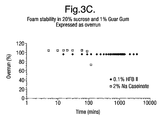
- Figure 3c is a graph comparing the foam stability of 0.1 wt% Hydrophobin and 2 wt% sodium caseinate in a solution of 20 wt % sucrose and 1 wt% guar gum.
The foam produced using hydrophobin is considerably more stable than that from 2% sodium caseinate. - Figure 4 is a scanning electron micrograph of an aerated food product of the invention after (A) 1 day and (B) 2 weeks at chill temperature.
- Figure 5 is a graph showing the interfacial rheological properies (G' and G") of the air/water interface in the presence of hydrophobin. It should be noted that the values increase to such an extent that they go beyond the capability of the instrument.
- Figure 6 is a graph showing the interfacial elasticity (G') at the air/water interface of 0.00035 wt% hydrophobin in comparison with 0.0007 wt% sodium caseinate and whey protein. Although the hydrophobin reading goes off scale, the result show that the interfacial elasticity of hydrophobin is significantly higher than those formed by convention proteins.
- Figure 7 is a diagram showing shear regimes for the aerated frozen products.
- Figure 8 is a scanning electron micrograph of product microstructures - fresh and after abuse (Magnification x100)
- Figure 9 is a scanning electron micrograph of product microstructures - fresh and after abuse (Magnification x300)
- The foamability of Trichoderma reesei hydrophobin II (HFB II) was compared to that of the widely used, foamable, dairy protein sodium caseinate (DMV International, the Netherlands. 88-90% protein, 1.5% fat and 6% moisture) and skimmed milk (United Milk, UK. 33-36% protein, 0.8% fat, 3.7% moisture). HFBII was obtained from VTT Biotechnology, Finland (purified from Trichoderma reesei essentially as described in WO00/58342 and Linder et al., 2001, Biomacromolecules 2: 511-517).
- The table below shows the concentrations of the protein solutions that were prepared.
Table 1 - Solutions prepared Protein source Concentration wt% Shear time (seconds) HFB II ex T. Reesei 0.05 600 HFB II ex T. Reesei 0.08 600 HFB II ex T. Reesei 0.1 600 Sodium caseinate 0.1 600 Sodium caseinate 0.5 300 Sodium caseinate 1 120 Sodium caseinate 2 60 SMP 0.29 600 SMP 1.43 345 SMP 2.86 165 SMP 5.71 60 - The dairy protein solutions were prepared using a magnetic stirrer and the protein was sprinkled into the water at room temperature. The solution was then heated to 60°C, held for 5 minutes and then cooled to 5°C. The HFB II solutions were prepared by using a Sonicor ultrasonic bath model SC-42 (Sonicor Instrument Corp). The HFB II was added either as an aliquot or dry powder which was sonicated for between 30 seconds to 1 minute at room temperature until all of the HFB was dispersed and a clear liquid obtained. This solution was also cooled to 5°C before aeration.
- Foams were produced by shearing each solution for up to a maximum of 10 minutes in a cooled (2°C) cylindrical, vertically mounted, jacketed stainless steel vessel with internal proportions of 105 mm height and diameter 72 mm. The lid of the vessel fills 54% of the internal volume leaving 46% (180 ml) for the sample. The rotor used to shear the sample consists of a rectangular impeller of the correct proportions to scrape the surface edge of the container as it rotates (dimensions 72 mm x 41.5mm). Also attached to the rotor are two semi-circular (60 mm diameter) high-shear blades positioned at a 45° angle to the rectangular attachment.
- 80 ml of solution was poured into the vessel, enough to cover half the rotor, and the lid secured. The solution was then sheared at 1250 rpm for the aforementioned period (table 1). The aerated solution was then immediately poured into a measuring cylinder, thus giving a measure of overrun by volume. Foamability refers to the volume of foam is stated in terms of percentage "overrun", and based on the definition by Arbuckle (ibid).

- Figure 1 shows the overruns obtained for the sodium caseinate, SMP and HFB II.
- These results show that hydrophobin is at least as foamable as sodium caseinate and SMP, with a lower concentration needed to generate a similar overrun.
- Sodium caseinate and HFB II were also aerated in the presence of 20% sucrose (Tate and Lyle) and 20% sucrose + 0.5% guar gum (Willy Benecke, Germany. 78% gum, 14% moisture, 7% protein, 4% acid insoluble residue, 1% fat and 1% ash). In the case of sodium caseinate with sucrose the dry powders were combined and then slowly added to the water at room temperature that was being mixed on a magnetic stirrer. The solution was then heated to 60°C, held for 5 minutes and then cooled to 5°C. When guar gum was present the guar was added to the solution first with half of the sucrose at room temperature. This solution was then heated to 80°C and held for 5 minutes before being cooled to 60°C. At this point the sodium caseinate was added with the rest of the sucrose. Stirring was continued at the temperature for 30 minutes before cooling to 5°C. In the case of HFB II, it was added separately to a cooled sucrose or sucrose guar solution either as an aliquot or a dry powder. Initial mixing was carried out on a magnetic stirrer followed by 30 seconds in the ultrasonic bath. Table 2 shows the solutions prepared.
- These solutions were aerated for 10 minutes as described in section (a) and the overrun obtained by volume in a measuring cylinder. Table 2 shows the overrun obtained for each sample.
Table 2 Sample Protein concentration (% w/w) Average overrun % 0.1% NA Cas + sucrose 0.1 78.75 0.1% NA Cas+ sucrose+0.5% guar gum 0.1 70 0.1% NA Cas+ sucrose+1% guar gum 0.1 55 0.1% HFB+sucrose 0.1 75 0.1% HFB + sucrose+0.5% guar gum 0.1 83 0.1 % HFB + sucrose+1% guar gum 0.1 96 - These results show that hydrophobin has similar foamability to sodium caseinate in a more complex system including sugar, and optionally guar.
- The stability of an HFB II foam was compared to some commonly used dairy proteins: whey, skimmed milk powder and sodium caseinate. After production, foams were poured into a measuring cylinder to assess their stability in terms of foam volume as a function of time. The volume of foam is stated in terms of percentage "overrun", and based on the definition by Arbuckle (ibid).

- The stability of these foams was measured by monitoring samples contained in 250 ml measuring cylinders and recording serum level and foam height over time at room temperature. The liquid in the foams drain over time, leading to two separate and distinct layers: a foam on top, and aqueous solution below. This is because the aqueous phase does not contain a significant amount of, or any, viscosifiers. However, it is the stability of the foam phase that is the point of interest here. For the calculation of overrun, the volume of foam is taken as the entire volume of the system, i.e. both air (foam) phase and liquid phase irrespective of whether they have separated into two distinct layers. The value of overrun therefore gives a quantitative indication of the stability of the foam to typical break down mechanisms such as coalescence (with themselves and the atmosphere) and disproportionation.
- Proteins were dispersed in water alone and in the presence of both 20% sucrose and 20% sucrose + 1% guar gum. Table 3 shows the samples that were prepared. Whey powder (Avonol 600 - 30 wt% protein, 3.5 wt% moisture, 2.5 wt% fat, 7 wt% ash and 53 wt% lactose) was obtained from Glanvia, Ireland.
Table 3 Protein source Protein concentration Shear time (seconds) HFB II 0.1 600 HFB II + 20% sucrose 0.1 600 HFB II + 20% sucrose and 1% guar gum 0.1 600 Sodium caseinate 2 60 Sodium caseinate + 20 % sucrose 2 60 Sodium caseinate + 20% sucrose and 1 % guar gum 2 60 Skimmed milk powder 2.86 165 Whey powder 6.67 45 - The dairy protein solutions were prepared using a magnetic stirrer and the protein was sprinkled into the water at room temperature. The solution was then heated to 60°C, held for 5 minutes and then cooled to 5°C. The HFB II solutions were prepared by using a Sonicor ultrasonic bath model SC-42 (Sonicor Instrument Corp). The HFB II was added either as an aliquot or dry powder which was sonicated for between 30 seconds to 1 minute at room temperature until all of the HFB was dispersed and a clear liquid obtained. This solution was also cooled to 5°C before aeration.
- When 20% sucrose and 20% sucrose + 0.5% guar were present the preparation was slightly different. In the case of sodium caseinate with sucrose the dry powders were combined and then sprinkled into the water at room temperature which was being mixed on a magnetic stirrer. The solution was then heated to 60°C, held for 5 minutes and then cooled to 5°C. When guar gum was present the guar was added to the solution first with half of the sucrose at room temperature. This solution was then heated to 80°C and held for 5 minutes before being cooled to 60°C. At this point the sodium caseinate was added with the rest of the sucrose, stirring was continued at the temperature for 30 minutes before cooling to 5°C. In the case of HFB II, it was added separately to a cooled sucrose or sucrose guar solution either as an aliquot or a dry powder. Initial mixing was carried out on a magnetic stirrer followed by 30 seconds in the ultrasonic bath. Foams were produced as described in Example 1, except that different shear terms were used so as to generate in each case about 100% overrun.
- The microstructure of the hydrophobin foam was visualised by Low Temperature Scanning Electron Microscopy (LTSEM). The foam sample was first cut at +5°C and plunged into liquid nitrogen. The sample was left at -80°C on dry ice prior SEM sample preparation. A sample section was cut carefully because of its very fragile structure. This section, approximately 6mmx6mmx10mm in size, was mounted on a sample holder using a compound: OCT ™ on the point of freezing (supplied by Agar Scientific). The sample including the holder is plunged into liquid nitrogen slush and transferred to a low temperature preparation chamber: Oxford Inst. CT1500HF. The chamber is under vacuum, approximately 10-4 - 10-5 mbar. The sample is kept at a temperature below -110°C on a cold stage. The sample is fractured inside the chamber using a scalpel blade and coated with gold using argon plasma This process also takes place under vacuum with an applied pressure of 10-1 millibars and current of 5 milliamps for 30 seconds. The sample is then transferred to a conventional Scanning Electron Microscope (JSM 5600), fitted with an Oxford Instruments cold stage at a temperature of -150°C. The sample is examined and areas of interest captured via digital image acquisition software.
- Foam produced using hydrophobin remained stable over a long time period in all three systems tested (water, + sucrose, + sucrose and guar) - see Figure 2.
- Foams produced from sodium caseinate, skimmed milk powder, and whey protein are all very unstable compared to foam produced using hydrophobin (see Figure 3A). Further, higher concentrations of skimmed milk powder and whey protein solutions are required to attain an initial overrun of 100% than the concentration needed for hydrophobin.
- Foams produced using hydrophobin remaining very stable for a considerable period of time (2 weeks) whereas foams produced using sodium caseinate were stable for under 20 mins in the presence of sucrose (Figure 3b) and under about 2 hours in the presence of the sucrose and guar gum (Figure 3c).
- Therefore, hydrophobin can be used at a low concentration to create significant amounts of foam which remain very stable relative to other commonly used proteins.
- In summary, the data show that the foam that is created with 0.1 % HFB II is more stable that those produced by the other proteins tested. All the foams drain over time (which can be reduced by the addition of thickeners), but the bubbles for the hydrophobin foams still remain stable, i.e. the foam system still retains the air (overrun). In addition, we have found that the bubbles present in foams made with hydrophobin remain stable to bubble coarsening at chill temperatures for at least 2 weeks (see Figure 4 which shows SEM micrographs demonstrating that bubble size is substantially unchanged after 2 weeks). Hence, hydrophobin improves the stability of foams in terms of both foam volume and bubble size. It should be noted that the fractures observed on the surface of the bubbles are believed to be artefacts of the SEM preparation procedure.
- A Camtel CIR-100 interfacial rheometer (Camtel Instruments Limited, Royston, Herts, UK), was used to measure the surface viscosity and elasticity. Such data give an indication of how well an adsorbed molecule will stabilise a foam.
- The instrument was used in the normalised resonance mode, using a 13 mm diameter du Nouy ring at the surface of the liquid in a 46 mm diameter sample dish. The ring oscillates on the sample surface, and a high-resolution displacement sensor is used to monitor strain amplitude over the range +/- 1°.
- Each run was carried out using the same experimental conditions. The runs were time sweeps, with the starting frequency at 3 Hz, and starting amplitude at 10,000 µRadians, and measurements taken at room temperature. The test duration was set at 36,000 seconds, with 240 data points gathered during that time. The physical parameters of interest are G' (storage modulus) and G" (loss modulus) as a function of time, which give an indication of the viscoelasticity of the adsorbed surface layer.
- Protein samples were diluted with water to the required concentration. The surface rheology measurements are made relative to pure water, which was measured prior to measurement of the protein solutions.
- The surface rheology data is shown in Figures 5 and 6. For the hydrophobin protein, G' and G" increase gradually over time, before a rapid increase in both is observed. In the examples shown, the values increase to such an extent that they go beyond the measuring capabilities of the experimental set up. Even at very low concentrations (less than 0.001 wt%), the values for G' and G" reach values far in excess of the proteins used as comparisons: whey protein and sodium caseinate.
- It can be concluded from these data that hydrophobin stabilises foams effectively by forming very strong viscoelastic surface layers around the bubbles. These lead to good stability against typical foam destabilising mechanisms such as coalescence and disproportionation. We believe that whey protein and sodium caseinate foams are both less stable that hydrophobin foams, since the surface layers do not exhibit G' and G" values as high as hydrophobin at comparable solution concentrations.
- Accordingly, hydrophobins can be used to inhibit bubble coarsening in an aerated food product, for example by inhibiting or reducing disproportionation and/or coalescence. Similarly, hydrophobins can be used to stabilise foams in an aerated food product. Further, given that hydrophobins inhibit bubble coarsening, it will be possible to improve shape retention and rigidity of aerated products.
- Aerated frozen products were prepared using 3 types of protein:
- A: Sodium Caseinate (Na Cas)
- B: Skimmed Milk Powder (SMP)
- C: Hydrophobin (HFBII) from Trichoderma Reesei
- Microstructural and physical properties of the products were compared, both before and after temperature abuse regimes.
- Details of the materials used are summarised in Table 4 and the formulations from which each of the aerated frozen products was prepared are shown in Table 5.
Table 4. Materials used Ingredient Composition Supplier Sodium caseinate 88-90% protein, 1.5% fat, 6% moisture DMV International, The Netherlands. Skimmed milk powder 33-36% protein, 0.8% fat, 3.7% moisture United Milk, UK. Hydrophobin type II (HFB II) Purified from Trichoderma reesei essentially as described in WO00/58342 and Linder et al, 2001, Biomacromolecules 2: 511-517). VTT Biotechnology, Finland. Refined Coconut Oil Van den Bergh Foods, Limited Sucrose Tate and Lyle, UK. Table 5. Formulations used Mix A Mix B Mix C Ingredient Concentration / wt% Sodium caseinate 2.0 - - - - Skimmed milk powder - - 11.42 - - HFB II - - - - 0.2 Coconut Oil 5.0 5.0 5.0 Sucrose 25.0 20.0 25.0 Water 68.0 63.58 69.8 - All mixes were made in 100 g batches. For Mixes A and B (containing sodium caseinate and skimmed milk powder, respectively), the protein was combined with the sucrose and dispersed into cold water using a magnetic stirrer. The solution was then heat to 60°C with stirring and held for 5 minutes before being cooled to 40°C. Molten coconut fat was then added and the aqueous mix immediately sonicated (Branson Sonifer with 6.4 mm tapered tip) for 3 minutes at 70% amplitude with the tip well immersed in the solution. The emulsion was then cooled rapidly in a -10°C water bath until the solution temperature was 5°C, to crystallise the fat droplets. The mixes were stored at 5°C until further use.
- For Mix C (containing HFB II), the sucrose was first dispersed into cold water with stirring. Then, half of the required concentration of HFB II was added to this as an aliquot. The solution was then gently sonicated in a sonic bath for 30 seconds to fully disperse the HFB II. This solution was then stirred on a magnetic stirrer and heated to 40°C. Before the molten fat was added the solution was again sonicated in a sonic bath for 30 seconds. The molten fat was then added and the mix was emulsified and cooled as described for Mixes A and B. A further aliquot of HFB II was then added to this cold solution to bring the HFB II concentration up to 0.2%. The first 0.1 % of HFB II was for emulsifying and stabilising the fat. The second addition of HFB II would provide adequate excess HFBII to provide good aeration and foam stability.
- Particle size analysis on the chill emulsions was performed using a Malvern Mastersizer 2000.
- Following this methodology, we were able to make emulsions with small fat droplets. A summary of oil droplet sizes measured are shown in Table 6.
Table 6. Emulsion particle size as measured using the Malvern Mastersizer 2000 Mix Fat droplet diameter D(3,2) / µm A (Na Cas) 0.4 B (SMP) 0.25 C (HFB II) 1.88 - 80 ml of mix was sheared and frozen simultaneously in the vessel described in Example 1. In essence an aerated and frozen prototype is produced as follows: The mix inside the enclosed container is mixed with an impeller at a high shear rate in order to incorporate air. Simultaneously, the coolant flows around the container jacket to cool and freeze the mix. The impeller also scrapes the inside wall, removing the ice that forms there and incorporating this into the rest of the mix. High shear is used to initially aerated the mix, and then the shear rate is slowed in order to allow better cooling and freezing. The shear regimes used for each mix are graphically presented in Figure 7.
- For the freezing and aeration step with Mixes A and B (containing sodium caseinate and skimmed milk powder, respectively) the coolant (set at -18°C) was set to circulate from Time = 0 minutes. The relatively slow stirring at the start for Mixes A and B allowed for cooling of the mix and generation of some viscosity (via ice formation and incorporation) prior to aeration using higher shear. A short time at high speed incorporated the air and then the speed was stepped down to allow the samples to reach at least -5°C.
- For Mix C (containing HFB II) the pot was chilled to about 5°C and the sample added and the high shear for aerated started. The coolant (set at -18°C) was not switched to circulate on until 9 minutes due to the increased time required to generate 100% overrun. Once the coolant was switched on to circulate (at 9 minutes), the same shear-cooling pattern as previous (for A and B) was adopted.
- At the end of the process, overrun was measured and samples (approximately 15 g) were placed into small pots. Each product was cooled further for 10 minutes in a freezer set at -80°C before being stored at -20°C.
- All aerated frozen products were stored under two temperature regimes:
- (a) -20°C. Subsequent analysis was made within one week of production and we deem this as "fresh" product.
- (b) Temperature abused samples were subject to storage at -10°C for 1 or 2 weeks, and then subsequently stored at -20°C before analysis.
- Final products were analysed as follows:
- Overrun of freshly made product
- SEM analysis on fresh and temperature abused product
- Melting behaviour on fresh and temperature abused product
- The overrun for each of the products is summarised in Table 8. All of the mixes were aeratable and incorporated significant amounts of air.
- The microstructure of each products was visualised using Low Temperature Scanning Electron Microscopy (LTSEM). The sample was cooled to -80 °C on dry ice and a sample section cut. This section, approximately 5mmx5mmx10mm in size, was mounted on a sample holder using a Tissue Tek : OCT ™ compound (
PVA 11%,Carbowax 5% and 85% non-reactive components). The sample including the holder was plunged into liquid nitrogen slush and transferred to a low temperature preparation chamber: Oxford Instrument CT1500HF . The chamber is under vacuum, approximately 10-4 bar, and the sample is warmed up to -90 °C. Ice is slowly etched to reveal surface details not caused by the ice itself, so water is removed at this temperature under constant vacuum for 60 to 90 seconds. Once etched, the sample is cooled to -110°C ending up the sublimation, and coated with gold using argon plasma. This process also takes place under vacuum with an applied pressure of 10-1 millibars and current of 6 milliamps for 45 seconds. The sample is then transferred to a conventional Scanning Electron Microscope (JSM 5600), fitted with an Oxford Instruments cold stage at a temperature of -160°C. The sample is examined and areas of interest captured via digital image acquisition software. - Scanning Electron Microscopy (SEM) was used to examine the microstructure of the fresh and temperature abused frozen products. Representative images can be seen in Figures 8 and 9 at different magnifications.
- After temperature abuse the SEM images clearly show that the HFB II containing product (from Mix C) has retained its original microstructure, i.e. there is little apparent air bubble coarsening. This is the case after 1 and 2 weeks storage at -10°C. However, the prototypes containing Na Cas and SMP (from Mix A and B, respectively) show very severe coarsening of the gas structure under temperature abused at -10°C after just one week.
- Overall, it is clear that the frozen product made containing HFBII shows much greater stability to temperature abuse than the frozen product made using sodium caseinate or skim milk powder. HFBII has an influence on air bubble stability.
- Samples of frozen product were placed on a metal grid at room temperature (20°C). Differences in the way the products melted, notably shape retention and foam stability, were observed as a function of time.
- These microstructural differences (stable foam and stable ice) had some impact on the melting behavior of the frozen product. The aerated frozen sample made from Mix C (containing HFBII) retained its shape better on melting, compared to the product made with sodium caseinate or skimmed milk powder (i.e. Mixes A and B, respectively).
- As the ice melted and formed water, it flowed through the melting grid. However, for the product with HFBII, much of the foam also remained on the grid with some stable drops of foam observed beneath - neither of these characteristics was observed with the conventional proteins (sodium caseinate and skimmed milk powder). This illustrates the differences in the foam stability between each of the proteins used.
- Clear differences in texture between the three samples could also be observed after one week storage at -10°C (i.e. temperature abused samples). On handling the product made using sodium caseinate (A) and skimmed milk powder (B), these were noticed to have a very soft and very flaky texture, which was difficult to cleanly remove from the silicon paper used to line the sample pot. The product made using HFBII (C), on the other hand, was very firm and released from the silicon paper lining the sample pot very cleanly. In other words, the product prepared using HFBII shows much greater stability to temperature abuse on both a microscopic and macroscopic scale than product prepared using sodium caseinate or skim milk powder.
- The various features and embodiments of the present invention, referred to in individual sections above apply, as appropriate, to other sections, mutatis mutandis. Consequently features specified in one section may be combined with features specified in other sections, as appropriate.
- All publications mentioned in the above specification are herein incorporated by reference. Various modifications and variations of the described methods and products of the invention will be apparent to those skilled in the art without departing from the scope of the invention. Although the invention has been described in connection with specific preferred embodiments, it should be understood that the invention as claimed should not be unduly limited to such specific embodiments. Indeed, various modifications of the described modes for carrying out the invention which are apparent to those skilled in the relevant fields are intended to be within the scope of the following claims.
| Sample | Shear time at 1200rpm | Overrun | End product temperature |
| min | % | °C | |
| A (Na Cas) | 1 | 103 | -5.3 |
| B (SMP) | 1 | 98 | -8 |
| B (SMP) | 1 | 94 | -5.6 |
| C (HFB II) | 10 | 75 | -5 |
Claims (13)
- An aerated food product comprising at least 0.001 wt% hydrophobin.
- An aerated food product according to claim 1 comprising at least 0.01 wt% hydrophobin.
- An aerated food product comprising hydrophobin in isolated form.
- An aerated food product according to claim 3 comprising at least 0.001 wt% hydrophobin.
- An aerated food product according to any one of the preceding claims wherein the hydrophobin is a class II hydrophobin.
- An aerated food product according to any one of the preceding claims which is a frozen food product.
- An aerated food product according to any one of claims 1 to 5 which is a chilled food product.
- An aerated food product according to any one of the preceding claims which is an aerated confectionery product.
- A composition for producing an aerated food product according to any one of the preceding claims, which composition comprises hydrophobin in isolated form together with the remaining ingredients of the food product.
- A dry composition for producing an aerated food product according to any one of claims 1 to 8, which composition comprises hydrophobin in isolated form together with the remaining non-liquid ingredients of the food product.
- Use of a hydrophobin in a method of inhibiting bubble coarsening in an aerated food product.
- Use of a hydrophobin in a method of stabilising a foam in an aerated food product.
- Use of a hydrophobin in a method of improving shape retention and/or rigidity in an aerated food product.
Priority Applications (1)
| Application Number | Priority Date | Filing Date | Title |
|---|---|---|---|
| EP05076480A EP1623631B1 (en) | 2004-07-27 | 2005-06-27 | Aerated food products containing hydrophobin |
Applications Claiming Priority (3)
| Application Number | Priority Date | Filing Date | Title |
|---|---|---|---|
| EP04254483 | 2004-07-27 | ||
| EP05251282 | 2005-03-03 | ||
| EP05076480A EP1623631B1 (en) | 2004-07-27 | 2005-06-27 | Aerated food products containing hydrophobin |
Publications (2)
| Publication Number | Publication Date |
|---|---|
| EP1623631A1 true EP1623631A1 (en) | 2006-02-08 |
| EP1623631B1 EP1623631B1 (en) | 2007-04-11 |
Family
ID=34979982
Family Applications (3)
| Application Number | Title | Priority Date | Filing Date |
|---|---|---|---|
| EP05759652A Withdrawn EP1773139A1 (en) | 2004-07-27 | 2005-06-27 | Aerated food products containing hydrophobin |
| EP05772178A Withdrawn EP1819242A1 (en) | 2004-07-27 | 2005-06-27 | Aerated food products containing hydrophobin |
| EP05076480A Expired - Lifetime EP1623631B1 (en) | 2004-07-27 | 2005-06-27 | Aerated food products containing hydrophobin |
Family Applications Before (2)
| Application Number | Title | Priority Date | Filing Date |
|---|---|---|---|
| EP05759652A Withdrawn EP1773139A1 (en) | 2004-07-27 | 2005-06-27 | Aerated food products containing hydrophobin |
| EP05772178A Withdrawn EP1819242A1 (en) | 2004-07-27 | 2005-06-27 | Aerated food products containing hydrophobin |
Country Status (15)
| Country | Link |
|---|---|
| US (4) | US8206770B2 (en) |
| EP (3) | EP1773139A1 (en) |
| JP (4) | JP4723581B2 (en) |
| CN (2) | CN101039596B (en) |
| AT (2) | ATE390855T1 (en) |
| AU (2) | AU2005266664B2 (en) |
| BR (2) | BRPI0513613B1 (en) |
| CA (2) | CA2575325C (en) |
| DE (2) | DE602005000861T2 (en) |
| ES (1) | ES2285631T3 (en) |
| IL (2) | IL180671A (en) |
| MX (2) | MX2007000978A (en) |
| MY (1) | MY143590A (en) |
| NZ (2) | NZ552893A (en) |
| WO (2) | WO2006010426A1 (en) |
Cited By (25)
| Publication number | Priority date | Publication date | Assignee | Title |
|---|---|---|---|---|
| WO2007039066A1 (en) * | 2005-09-23 | 2007-04-12 | Unilever Plc | Process for producing a frozen aerated composition |
| WO2007039064A1 (en) * | 2005-09-23 | 2007-04-12 | Unilever Plc | Aerated products with reduced creaming |
| WO2007087967A1 (en) * | 2006-01-31 | 2007-08-09 | Unilever Plc | Aerated product |
| WO2007087968A1 (en) * | 2006-01-31 | 2007-08-09 | Unilever Plc | Aerated compositions comprising hydrophobin |
| EP1938697A1 (en) * | 2006-12-20 | 2008-07-02 | Unilever Plc | Aerated food products and method for producing them |
| WO2008116715A1 (en) * | 2007-03-26 | 2008-10-02 | Unilever N.V. | Aerated food products being warm or having been heated up and methods for producing them |
| WO2008116733A1 (en) * | 2007-03-26 | 2008-10-02 | Unilever N.V. | Aerated food products being warm containing soluble and/or insoluble solids and methods for producing them |
| AU2007237303B2 (en) * | 2006-12-20 | 2009-04-09 | Unilever Plc | Aerated food products and methods for producing them |
| EP2052628A1 (en) | 2007-10-25 | 2009-04-29 | Unilever PLC | Aerated fat-continuous products |
| WO2010034708A1 (en) * | 2008-09-23 | 2010-04-01 | Unilever Plc | A polynucleotide expression cassette |
| EP2266406A1 (en) | 2009-06-02 | 2010-12-29 | Unilever Plc, A Company Registered In England And Wales under company no. 41424 of Unilever House | Aerated baked products |
| WO2011015504A2 (en) | 2009-08-07 | 2011-02-10 | Unilever Plc | Aerated products |
| WO2011039188A1 (en) * | 2009-10-02 | 2011-04-07 | Unilever Plc | Product comprising hydrophobin |
| WO2011157497A1 (en) * | 2010-06-17 | 2011-12-22 | Unilever Plc | Oral care compositions |
| WO2012052335A1 (en) * | 2010-10-20 | 2012-04-26 | Unilever Plc | Foaming agents comprising hydrophobin |
| EP2505077A1 (en) * | 2006-10-17 | 2012-10-03 | Unilever N.V. | Edible foam product for the treatment or prevention of obesity |
| WO2013174585A1 (en) * | 2012-05-24 | 2013-11-28 | Unilever N.V. | Aerated oil containing sucrose fatty acid ester and hydrophobin |
| US20140044853A1 (en) * | 2011-06-22 | 2014-02-13 | Vitamin Milk Products Co., Ltd. | Freeze tolerant cream and method for producing same |
| WO2015067495A1 (en) * | 2013-11-07 | 2015-05-14 | Unilever N.V. | Process for manufacturing an aerated food product |
| WO2015124447A1 (en) * | 2014-02-18 | 2015-08-27 | Unilever Plc | Stabilized aerated confection containing hydrophobin |
| CN110463762A (en) * | 2018-05-10 | 2019-11-19 | 内蒙古伊利实业集团股份有限公司 | A kind of fast defoaming infant formula milk powder and production method thereof |
| US11272726B2 (en) * | 2019-02-27 | 2022-03-15 | The Fynder Group, Inc. | Food materials comprising filamentous fungal particles and membrane bioreactor design |
| US11297866B2 (en) | 2017-08-30 | 2022-04-12 | The Fynder Group, Inc. | Bioreactor system for the cultivation of filamentous fungal biomass |
| US11414815B2 (en) | 2019-06-18 | 2022-08-16 | The Fynder Group, Inc. | Fungal textile materials and leather analogs |
| US11505779B2 (en) | 2016-03-01 | 2022-11-22 | The Fynder Group, Inc. | Filamentous fungal biomats, methods of their production and methods of their use |
Families Citing this family (33)
| Publication number | Priority date | Publication date | Assignee | Title |
|---|---|---|---|---|
| CA2575325C (en) * | 2004-07-27 | 2013-11-12 | Unilever Plc | Frozen food products containing hydrophobin |
| EA014384B1 (en) * | 2005-04-01 | 2010-10-29 | Басф Акциенгезелльшафт | Drilling fluid containing hydrophobin |
| DE102005033002A1 (en) * | 2005-07-14 | 2007-01-18 | Basf Ag | Aqueous monomer emulsions containing hydrophobin |
| ES2317579T3 (en) * | 2005-09-23 | 2009-04-16 | Unilever N.V. | AIR LOW PH PRODUCTS. |
| ATE394935T1 (en) * | 2005-12-21 | 2008-05-15 | Unilever Nv | FROZEN VENTED SWEETS |
| ES2374320T3 (en) * | 2006-08-15 | 2012-02-15 | Basf Se | PROCEDURE FOR THE PRODUCTION OF FREE FLOW DRY HYDROPHOBINE PREPARATIONS. |
| RU2009118467A (en) * | 2006-10-17 | 2010-11-27 | Юнилевер Н.В. (Nl) | FOOD COMPOSITION CONTAINING GAS BUBBLES AND METHOD FOR PREPARING IT |
| US20100186420A1 (en) * | 2006-10-17 | 2010-07-29 | Mark John Berry | Frozen aerated food product comprising surface-active fibres |
| EP1961308A1 (en) * | 2007-02-21 | 2008-08-27 | Nestec S.A. | Nutritionally balanced frozen dessert |
| US20100291630A1 (en) * | 2007-10-18 | 2010-11-18 | Andrew Richard Cox | Method for producing a foaming agent |
| RU2010137869A (en) | 2008-02-14 | 2012-03-20 | Басф Се (De) | APPLICATION OF HYDROPHOBINES TO PREVENT THE FORMATION OF ICE ON SURFACES |
| US20100112139A1 (en) * | 2008-03-28 | 2010-05-06 | Conopco, Inc., D/B/A Unilever | Foaming Agents Comprising Hydrophobin |
| JP2012505645A (en) * | 2008-10-16 | 2012-03-08 | ユニリーバー・ナームローゼ・ベンノートシヤープ | Hydrophobin solution containing defoamer |
| ES2395224T3 (en) | 2008-12-16 | 2013-02-11 | Unilever Nv | Procedure to extract hydrophobin from a solution |
| US8357420B2 (en) | 2009-05-29 | 2013-01-22 | Conopco, Inc. | Oil-in-water emulsion |
| US8394444B2 (en) | 2009-05-29 | 2013-03-12 | Conopco, Inc. | Oil-in-water emulsion |
| FI20095638A0 (en) * | 2009-06-09 | 2009-06-09 | Valtion Teknillinen | Hydrophobins for dispersing active substances |
| WO2011101457A1 (en) | 2010-02-18 | 2011-08-25 | B.R.A.I.N. Biotechnology Research And Information Network Ag | Chimeric surface active proteins |
| EP2371844A1 (en) | 2010-03-25 | 2011-10-05 | B.R.A.I.N. Biotechnology Research and Information Network AG | Chimeric surface active proteins |
| EA023709B1 (en) * | 2010-10-04 | 2016-07-29 | Унилевер Н.В. | Method for producing an edible gas hydrate |
| CN103491799B (en) * | 2011-02-02 | 2015-04-29 | 荷兰联合利华有限公司 | aerated food |
| ITMI20111079A1 (en) * | 2011-06-15 | 2012-12-16 | Antonino Gambino | FOOD PRODUCT IN THE ICE CREAM EMULSION, METHOD AND APPARATUS FOR ITS PRODUCTION |
| JP5377690B2 (en) * | 2012-02-10 | 2013-12-25 | 森永乳業株式会社 | Ice confectionery, frozen confection provided with the same, and method for producing them |
| US20130303631A1 (en) | 2012-05-11 | 2013-11-14 | Conopco, Inc., D/B/A Unilever | Environmentally Friendly and Aerated Topical Benefit Composition |
| EP2695527A1 (en) | 2012-08-08 | 2014-02-12 | Unilever N.V. | Aerated oil-in-water emulsion composition containing egg yolk fraction and hydrophobin |
| US20140050836A1 (en) | 2012-08-14 | 2014-02-20 | Conopco, Inc., D/B/A Unilever | Stabilized Aerated Frozen Confection Containing Hydrophobin |
| JP5365945B1 (en) * | 2012-09-11 | 2013-12-11 | 三重県 | Process evaluation method for air-containing foods |
| EP2745702A1 (en) | 2012-12-21 | 2014-06-25 | Unilever N.V. | Aerated compositions containing ground pulse seed and hydrophobin |
| CA2995438A1 (en) | 2014-08-19 | 2016-02-25 | The University Court Of The University Of Edinburgh | Synthetic multiphase systems |
| CN110072397B (en) * | 2016-12-13 | 2023-03-10 | 联合利华知识产权控股有限公司 | aerated food |
| WO2018108453A1 (en) * | 2016-12-13 | 2018-06-21 | Unilever Plc | Aerated food products |
| AR124735A1 (en) * | 2021-01-31 | 2023-04-26 | The Fynder Group Inc | COLLOIDAL FOOD PRODUCTS INCLUDING PARTICLES OF FILAMENTOUS FUNGI |
| EP4508984A1 (en) * | 2023-08-16 | 2025-02-19 | Unilever IP Holdings B.V. | Non-dairy frozen confection |
Citations (6)
| Publication number | Priority date | Publication date | Assignee | Title |
|---|---|---|---|---|
| US4627983A (en) * | 1981-11-05 | 1986-12-09 | Hoechst Aktiengesellschaft | Functional protein hydrolyzates, a process for their preparation, use of these protein hydrolyzates as a food additive, and foods containing these protein hydrolyzated |
| WO1996041882A1 (en) * | 1995-06-12 | 1996-12-27 | Proefstation Voor De Champignoncultuur | Hydrophobins from edible fungi, genes, nucleotide sequences and dna-fragments encoding for said hydrophobins, and expression thereof |
| DE29715519U1 (en) * | 1997-08-29 | 1997-11-13 | Kettner, Jürgen, 31234 Edemissen | Milk desserts made from thick milk and egg whites |
| US6096867A (en) * | 1996-07-06 | 2000-08-01 | Good Humor-Breyers Ice Cream, Division Of Conopco, Inc. | Frozen food product |
| EP1327390A1 (en) * | 2001-12-04 | 2003-07-16 | Quest International B.V. | Method of manufacturing an aerated carbohydrate containing food product |
| KR20040018844A (en) * | 2002-08-27 | 2004-03-04 | 대한민국 (경북대학교총장) | Isolation and purification of hydrophobin protein from Tricholoma matsutake including useful tradition filamentous fungi, its gene sequence and a composition containing the same |
Family Cites Families (26)
| Publication number | Priority date | Publication date | Assignee | Title |
|---|---|---|---|---|
| JPS505596A (en) * | 1973-05-16 | 1975-01-21 | ||
| IE44072B1 (en) | 1976-02-18 | 1981-08-12 | Pfizer | Novel food compositions containing microbial proteins |
| JPS591463B2 (en) * | 1976-07-01 | 1984-01-12 | 鐘淵化学工業株式会社 | Foaming composition |
| US4627963A (en) * | 1984-02-29 | 1986-12-09 | Lad Technology, Inc. | Heat activated dispenser and method of dispensing a vapor therefrom |
| JPH0616676B2 (en) * | 1985-06-20 | 1994-03-09 | 新田ゼラチン株式会社 | Multicellular frozen dessert material |
| US4874627A (en) * | 1988-06-14 | 1989-10-17 | Nouevelle Ice Cream Corporation | Non-fat dairy compositions |
| DK0426211T3 (en) | 1989-09-29 | 1994-01-31 | Unilever Plc | Nutrient product containing dried lysophospholipoprotein |
| JPH03164156A (en) | 1989-11-22 | 1991-07-16 | Nakano Vinegar Co Ltd | Frozen food and production thereof |
| US5084295A (en) * | 1990-02-02 | 1992-01-28 | The Procter & Gamble Company | Process for making low calorie fat-containing frozen dessert products having smooth, creamy, nongritty mouthfeel |
| DE69106261T2 (en) * | 1990-07-30 | 1995-05-24 | Unilever Nv | Whipped cream based on a liquid oil. |
| US5215777A (en) | 1991-05-16 | 1993-06-01 | Ault Foods Limited | Process for producing low or non fat ice cream |
| GB2315661B (en) * | 1996-07-26 | 2000-05-03 | Unilever Plc | Frozen food product |
| GB9801420D0 (en) * | 1998-01-22 | 1998-03-18 | Unilever Plc | Frozen food product |
| FI104390B (en) | 1998-04-17 | 2000-01-14 | Panimolaboratorio Bryggerilabo | Method for determining a beverage overflow factor |
| US20030148400A1 (en) * | 1998-04-17 | 2003-08-07 | Auli Haikara | Method for determining a gushing factor for a beverage |
| KR100819187B1 (en) | 1999-03-25 | 2008-04-04 | 발티온 테크닐리넨 투트키무스케스쿠스 | Protein distribution method |
| FI108863B (en) * | 1999-08-20 | 2002-04-15 | Valtion Teknillinen | Improved biotechnology production process |
| GB0002661D0 (en) | 2000-02-04 | 2000-03-29 | Biomade B V | Method of stabilizing a hydrophobin-containing solution and a method of coating a surface with a hydrophobin |
| GB0007770D0 (en) | 2000-03-30 | 2000-05-17 | Biomade B V | Protein capable of self-assembly at a hydrophobic hydrophillic interface, method of coating a surface, method of stabilizing a dispersion, method of stabilizi |
| FI120310B (en) * | 2001-02-13 | 2009-09-15 | Valtion Teknillinen | An improved method for producing secreted proteins in fungi |
| US6635300B2 (en) * | 2001-03-09 | 2003-10-21 | Good-Humor-Breyers Ice Cream, Division Of Conopco, Inc. | Aerated frozen product |
| GB0110954D0 (en) * | 2001-05-04 | 2001-06-27 | Marlow Foods Ltd | Edible fungi |
| MXPA04001502A (en) * | 2001-08-17 | 2004-05-14 | Nestle Sa | Frozen confectionery. |
| FR2833490B1 (en) | 2001-12-14 | 2004-12-10 | Oreal | COSMETIC USE OF AT LEAST ONE HYDROPHOBIN FOR THE TREATMENT OF KERATINIC MATERIALS AND COMPOSITIONS IMPLEMENTED |
| DE112004002757T5 (en) | 2004-02-24 | 2007-02-08 | Advanced Technology Products, Inc. | Method and apparatus for removing excess coating material from a honeycomb body |
| CA2575325C (en) * | 2004-07-27 | 2013-11-12 | Unilever Plc | Frozen food products containing hydrophobin |
-
2005
- 2005-06-27 CA CA2575325A patent/CA2575325C/en not_active Expired - Fee Related
- 2005-06-27 CN CN2005800322108A patent/CN101039596B/en not_active Expired - Fee Related
- 2005-06-27 JP JP2007522939A patent/JP4723581B2/en not_active Expired - Fee Related
- 2005-06-27 BR BRPI0513613-0A patent/BRPI0513613B1/en not_active IP Right Cessation
- 2005-06-27 DE DE602005000861T patent/DE602005000861T2/en not_active Expired - Lifetime
- 2005-06-27 WO PCT/EP2005/006997 patent/WO2006010426A1/en not_active Ceased
- 2005-06-27 JP JP2007522938A patent/JP4709216B2/en not_active Expired - Fee Related
- 2005-06-27 EP EP05759652A patent/EP1773139A1/en not_active Withdrawn
- 2005-06-27 EP EP05772178A patent/EP1819242A1/en not_active Withdrawn
- 2005-06-27 DE DE602005005743T patent/DE602005005743T2/en not_active Expired - Lifetime
- 2005-06-27 BR BRPI0513602A patent/BRPI0513602B1/en not_active IP Right Cessation
- 2005-06-27 ES ES05076480T patent/ES2285631T3/en not_active Expired - Lifetime
- 2005-06-27 US US11/168,214 patent/US8206770B2/en not_active Expired - Fee Related
- 2005-06-27 MX MX2007000978A patent/MX2007000978A/en active IP Right Grant
- 2005-06-27 AT AT05076481T patent/ATE390855T1/en not_active IP Right Cessation
- 2005-06-27 MX MX2007000977A patent/MX2007000977A/en active IP Right Grant
- 2005-06-27 AU AU2005266664A patent/AU2005266664B2/en not_active Ceased
- 2005-06-27 CN CN2005800322165A patent/CN101026968B/en not_active Expired - Fee Related
- 2005-06-27 WO PCT/EP2005/006996 patent/WO2006010425A1/en not_active Ceased
- 2005-06-27 NZ NZ552893A patent/NZ552893A/en not_active IP Right Cessation
- 2005-06-27 CA CA2575319A patent/CA2575319C/en not_active Expired - Fee Related
- 2005-06-27 AU AU2005266665A patent/AU2005266665B2/en not_active Ceased
- 2005-06-27 US US11/168,209 patent/US8216624B2/en not_active Expired - Fee Related
- 2005-06-27 NZ NZ552894A patent/NZ552894A/en not_active IP Right Cessation
- 2005-06-27 EP EP05076480A patent/EP1623631B1/en not_active Expired - Lifetime
- 2005-06-27 AT AT05076480T patent/ATE358996T1/en not_active IP Right Cessation
- 2005-07-05 MY MYPI20053070A patent/MY143590A/en unknown
-
2007
- 2007-01-11 IL IL180671A patent/IL180671A/en not_active IP Right Cessation
- 2007-01-11 IL IL180670A patent/IL180670A/en not_active IP Right Cessation
-
2010
- 2010-12-03 JP JP2010270565A patent/JP2011041583A/en active Pending
- 2010-12-03 JP JP2010270566A patent/JP5175326B2/en not_active Expired - Fee Related
-
2012
- 2012-05-21 US US13/476,710 patent/US20130071529A1/en not_active Abandoned
- 2012-05-21 US US13/476,600 patent/US20130071539A1/en not_active Abandoned
Patent Citations (6)
| Publication number | Priority date | Publication date | Assignee | Title |
|---|---|---|---|---|
| US4627983A (en) * | 1981-11-05 | 1986-12-09 | Hoechst Aktiengesellschaft | Functional protein hydrolyzates, a process for their preparation, use of these protein hydrolyzates as a food additive, and foods containing these protein hydrolyzated |
| WO1996041882A1 (en) * | 1995-06-12 | 1996-12-27 | Proefstation Voor De Champignoncultuur | Hydrophobins from edible fungi, genes, nucleotide sequences and dna-fragments encoding for said hydrophobins, and expression thereof |
| US6096867A (en) * | 1996-07-06 | 2000-08-01 | Good Humor-Breyers Ice Cream, Division Of Conopco, Inc. | Frozen food product |
| DE29715519U1 (en) * | 1997-08-29 | 1997-11-13 | Kettner, Jürgen, 31234 Edemissen | Milk desserts made from thick milk and egg whites |
| EP1327390A1 (en) * | 2001-12-04 | 2003-07-16 | Quest International B.V. | Method of manufacturing an aerated carbohydrate containing food product |
| KR20040018844A (en) * | 2002-08-27 | 2004-03-04 | 대한민국 (경북대학교총장) | Isolation and purification of hydrophobin protein from Tricholoma matsutake including useful tradition filamentous fungi, its gene sequence and a composition containing the same |
Non-Patent Citations (2)
| Title |
|---|
| DATABASE WPI Section Ch Week 200444, Derwent World Patents Index; Class B04, AN 2004-465457, XP002313777 * |
| SCHOLMEIJER K ET AL: "FUNGAL HYDROPHOBINS IN MEDICAL AND TECHNICAL APPLICATIONS", APPLIED MICROBIOLOGY AND BIOTECHNOLOGY, SPRINGER VERLAG, BERLIN, DE, vol. 56, no. 1/2, July 2001 (2001-07-01), pages 1 - 8, XP001120015, ISSN: 0175-7598 * |
Cited By (44)
| Publication number | Priority date | Publication date | Assignee | Title |
|---|---|---|---|---|
| US9005690B2 (en) | 2005-09-23 | 2015-04-14 | Conopco, Inc. | Aerated products with reduced creaming |
| WO2007039064A1 (en) * | 2005-09-23 | 2007-04-12 | Unilever Plc | Aerated products with reduced creaming |
| WO2007039066A1 (en) * | 2005-09-23 | 2007-04-12 | Unilever Plc | Process for producing a frozen aerated composition |
| WO2007087967A1 (en) * | 2006-01-31 | 2007-08-09 | Unilever Plc | Aerated product |
| WO2007087968A1 (en) * | 2006-01-31 | 2007-08-09 | Unilever Plc | Aerated compositions comprising hydrophobin |
| EP2505077A1 (en) * | 2006-10-17 | 2012-10-03 | Unilever N.V. | Edible foam product for the treatment or prevention of obesity |
| AU2007237303B9 (en) * | 2006-12-20 | 2009-09-24 | Unilever Plc | Aerated food products and methods for producing them |
| AU2007237303B2 (en) * | 2006-12-20 | 2009-04-09 | Unilever Plc | Aerated food products and methods for producing them |
| EP1938697A1 (en) * | 2006-12-20 | 2008-07-02 | Unilever Plc | Aerated food products and method for producing them |
| WO2008116733A1 (en) * | 2007-03-26 | 2008-10-02 | Unilever N.V. | Aerated food products being warm containing soluble and/or insoluble solids and methods for producing them |
| WO2008116715A1 (en) * | 2007-03-26 | 2008-10-02 | Unilever N.V. | Aerated food products being warm or having been heated up and methods for producing them |
| CN101652076B (en) * | 2007-03-26 | 2013-06-12 | 荷兰联合利华有限公司 | Aerated food products being warm containing soluble and/or insoluble solids and methods for producing them |
| EP2052628A1 (en) | 2007-10-25 | 2009-04-29 | Unilever PLC | Aerated fat-continuous products |
| RU2476127C2 (en) * | 2007-10-25 | 2013-02-27 | Унилевер Н.В. | Aerated products with uninterrupted fat phase |
| WO2010034708A1 (en) * | 2008-09-23 | 2010-04-01 | Unilever Plc | A polynucleotide expression cassette |
| AU2010202201B2 (en) * | 2009-06-02 | 2011-11-24 | Unilever Plc | Aerated baked products |
| EP2266404A1 (en) | 2009-06-02 | 2010-12-29 | Unilever Plc, A Company Registered In England And Wales under company no. 41424 of Unilever House | Baked products |
| EP2266406A1 (en) | 2009-06-02 | 2010-12-29 | Unilever Plc, A Company Registered In England And Wales under company no. 41424 of Unilever House | Aerated baked products |
| WO2011015504A3 (en) * | 2009-08-07 | 2011-04-07 | Unilever Plc | Aerated products |
| WO2011015504A2 (en) | 2009-08-07 | 2011-02-10 | Unilever Plc | Aerated products |
| WO2011039188A1 (en) * | 2009-10-02 | 2011-04-07 | Unilever Plc | Product comprising hydrophobin |
| WO2011157497A1 (en) * | 2010-06-17 | 2011-12-22 | Unilever Plc | Oral care compositions |
| CN103153086A (en) * | 2010-10-20 | 2013-06-12 | 荷兰联合利华有限公司 | Foaming agent containing hydrophobin |
| AU2011319559B2 (en) * | 2010-10-20 | 2015-02-19 | Unilever Plc | Foaming agents comprising hydrophobin |
| WO2012052335A1 (en) * | 2010-10-20 | 2012-04-26 | Unilever Plc | Foaming agents comprising hydrophobin |
| EA025285B1 (en) * | 2010-10-20 | 2016-12-30 | Унилевер Н.В. | Foaming agent comprising hydrophobin |
| US20140044853A1 (en) * | 2011-06-22 | 2014-02-13 | Vitamin Milk Products Co., Ltd. | Freeze tolerant cream and method for producing same |
| WO2013174585A1 (en) * | 2012-05-24 | 2013-11-28 | Unilever N.V. | Aerated oil containing sucrose fatty acid ester and hydrophobin |
| WO2015067495A1 (en) * | 2013-11-07 | 2015-05-14 | Unilever N.V. | Process for manufacturing an aerated food product |
| WO2015124447A1 (en) * | 2014-02-18 | 2015-08-27 | Unilever Plc | Stabilized aerated confection containing hydrophobin |
| US12157880B2 (en) | 2016-03-01 | 2024-12-03 | The Fynder Group, Inc. | Filamentous fungal biomats, methods of their production and methods of their use |
| US11505779B2 (en) | 2016-03-01 | 2022-11-22 | The Fynder Group, Inc. | Filamentous fungal biomats, methods of their production and methods of their use |
| US11464251B2 (en) | 2017-08-30 | 2022-10-11 | The Fynder Group, Inc. | Edible foodstuffs and bio reactor design |
| US11297866B2 (en) | 2017-08-30 | 2022-04-12 | The Fynder Group, Inc. | Bioreactor system for the cultivation of filamentous fungal biomass |
| CN110463762A (en) * | 2018-05-10 | 2019-11-19 | 内蒙古伊利实业集团股份有限公司 | A kind of fast defoaming infant formula milk powder and production method thereof |
| US11478007B2 (en) | 2019-02-27 | 2022-10-25 | The Fynder Group, Inc. | Food materials comprising filamentous fungal particles and membrane bioreactor design |
| US11432575B2 (en) | 2019-02-27 | 2022-09-06 | The Fynder Group, Inc. | Food materials comprising filamentous fungal particles and membrane bioreactor design |
| US11272726B2 (en) * | 2019-02-27 | 2022-03-15 | The Fynder Group, Inc. | Food materials comprising filamentous fungal particles and membrane bioreactor design |
| US12415983B2 (en) | 2019-02-27 | 2025-09-16 | The Fynder Group, Inc. | Food materials comprising filamentous fungal particles and membrane bioreactor design |
| US11447913B2 (en) | 2019-06-18 | 2022-09-20 | The Fynder Group, Inc. | Fungal textile materials and leather analogs |
| US11427957B2 (en) | 2019-06-18 | 2022-08-30 | The Fynder Group, Inc. | Fungal textile materials and leather analogs |
| US11414815B2 (en) | 2019-06-18 | 2022-08-16 | The Fynder Group, Inc. | Fungal textile materials and leather analogs |
| US11649586B2 (en) | 2019-06-18 | 2023-05-16 | The Fynder Group, Inc. | Fungal textile materials and leather analogs |
| US11718954B2 (en) | 2019-06-18 | 2023-08-08 | The Fynder Group, Inc. | Fungal textile materials and leather analogs |
Also Published As
Similar Documents
| Publication | Publication Date | Title |
|---|---|---|
| EP1623631B1 (en) | Aerated food products containing hydrophobin | |
| EP1926389B1 (en) | Low ph aerated products | |
| EP1926399B1 (en) | Process for producing a frozen aerated composition | |
| EP1938697B1 (en) | Aerated food products and method for producing them | |
| EP1621084B1 (en) | Aerated food products containing hydrophobin | |
| HK1116996B (en) | Low ph aerated products | |
| HK1116997B (en) | Process for producing a frozen aerated composition |
Legal Events
| Date | Code | Title | Description |
|---|---|---|---|
| PUAI | Public reference made under article 153(3) epc to a published international application that has entered the european phase |
Free format text: ORIGINAL CODE: 0009012 |
|
| 17P | Request for examination filed |
Effective date: 20050912 |
|
| AK | Designated contracting states |
Kind code of ref document: A1 Designated state(s): AT BE BG CH CY CZ DE DK EE ES FI FR GB GR HU IE IS IT LI LT LU MC NL PL PT RO SE SI SK TR |
|
| RAP1 | Party data changed (applicant data changed or rights of an application transferred) |
Owner name: UNILEVER PLC Owner name: UNILEVER N.V. |
|
| GRAP | Despatch of communication of intention to grant a patent |
Free format text: ORIGINAL CODE: EPIDOSNIGR1 |
|
| AKX | Designation fees paid |
Designated state(s): AT BE BG CH CY CZ DE DK EE ES FI FR GB GR HU IE IS IT LI LT LU MC NL PL PT RO SE SI SK TR |
|
| GRAS | Grant fee paid |
Free format text: ORIGINAL CODE: EPIDOSNIGR3 |
|
| GRAA | (expected) grant |
Free format text: ORIGINAL CODE: 0009210 |
|
| AK | Designated contracting states |
Kind code of ref document: B1 Designated state(s): AT BE BG CH CY CZ DE DK EE ES FI FR GB GR HU IE IS IT LI LT LU MC NL PL PT RO SE SI SK TR |
|
| PG25 | Lapsed in a contracting state [announced via postgrant information from national office to epo] |
Ref country code: CH Free format text: LAPSE BECAUSE OF FAILURE TO SUBMIT A TRANSLATION OF THE DESCRIPTION OR TO PAY THE FEE WITHIN THE PRESCRIBED TIME-LIMIT Effective date: 20070411 Ref country code: SI Free format text: LAPSE BECAUSE OF FAILURE TO SUBMIT A TRANSLATION OF THE DESCRIPTION OR TO PAY THE FEE WITHIN THE PRESCRIBED TIME-LIMIT Effective date: 20070411 Ref country code: FI Free format text: LAPSE BECAUSE OF FAILURE TO SUBMIT A TRANSLATION OF THE DESCRIPTION OR TO PAY THE FEE WITHIN THE PRESCRIBED TIME-LIMIT Effective date: 20070411 Ref country code: LI Free format text: LAPSE BECAUSE OF FAILURE TO SUBMIT A TRANSLATION OF THE DESCRIPTION OR TO PAY THE FEE WITHIN THE PRESCRIBED TIME-LIMIT Effective date: 20070411 |
|
| REG | Reference to a national code |
Ref country code: GB Ref legal event code: FG4D |
|
| REG | Reference to a national code |
Ref country code: CH Ref legal event code: EP |
|
| REG | Reference to a national code |
Ref country code: IE Ref legal event code: FG4D |
|
| REF | Corresponds to: |
Ref document number: 602005000861 Country of ref document: DE Date of ref document: 20070524 Kind code of ref document: P |
|
| PG25 | Lapsed in a contracting state [announced via postgrant information from national office to epo] |
Ref country code: SE Free format text: LAPSE BECAUSE OF FAILURE TO SUBMIT A TRANSLATION OF THE DESCRIPTION OR TO PAY THE FEE WITHIN THE PRESCRIBED TIME-LIMIT Effective date: 20070711 |
|
| PG25 | Lapsed in a contracting state [announced via postgrant information from national office to epo] |
Ref country code: IS Free format text: LAPSE BECAUSE OF FAILURE TO SUBMIT A TRANSLATION OF THE DESCRIPTION OR TO PAY THE FEE WITHIN THE PRESCRIBED TIME-LIMIT Effective date: 20070811 |
|
| PG25 | Lapsed in a contracting state [announced via postgrant information from national office to epo] |
Ref country code: PT Free format text: LAPSE BECAUSE OF FAILURE TO SUBMIT A TRANSLATION OF THE DESCRIPTION OR TO PAY THE FEE WITHIN THE PRESCRIBED TIME-LIMIT Effective date: 20070911 |
|
| ET | Fr: translation filed | ||
| REG | Reference to a national code |
Ref country code: CH Ref legal event code: PL |
|
| REG | Reference to a national code |
Ref country code: ES Ref legal event code: FG2A Ref document number: 2285631 Country of ref document: ES Kind code of ref document: T3 |
|
| PG25 | Lapsed in a contracting state [announced via postgrant information from national office to epo] |
Ref country code: AT Free format text: LAPSE BECAUSE OF FAILURE TO SUBMIT A TRANSLATION OF THE DESCRIPTION OR TO PAY THE FEE WITHIN THE PRESCRIBED TIME-LIMIT Effective date: 20070411 Ref country code: PL Free format text: LAPSE BECAUSE OF FAILURE TO SUBMIT A TRANSLATION OF THE DESCRIPTION OR TO PAY THE FEE WITHIN THE PRESCRIBED TIME-LIMIT Effective date: 20070411 |
|
| PG25 | Lapsed in a contracting state [announced via postgrant information from national office to epo] |
Ref country code: BG Free format text: LAPSE BECAUSE OF FAILURE TO SUBMIT A TRANSLATION OF THE DESCRIPTION OR TO PAY THE FEE WITHIN THE PRESCRIBED TIME-LIMIT Effective date: 20070711 Ref country code: DK Free format text: LAPSE BECAUSE OF FAILURE TO SUBMIT A TRANSLATION OF THE DESCRIPTION OR TO PAY THE FEE WITHIN THE PRESCRIBED TIME-LIMIT Effective date: 20070411 Ref country code: MC Free format text: LAPSE BECAUSE OF NON-PAYMENT OF DUE FEES Effective date: 20070630 Ref country code: CZ Free format text: LAPSE BECAUSE OF FAILURE TO SUBMIT A TRANSLATION OF THE DESCRIPTION OR TO PAY THE FEE WITHIN THE PRESCRIBED TIME-LIMIT Effective date: 20070411 |
|
| PLBE | No opposition filed within time limit |
Free format text: ORIGINAL CODE: 0009261 |
|
| STAA | Information on the status of an ep patent application or granted ep patent |
Free format text: STATUS: NO OPPOSITION FILED WITHIN TIME LIMIT |
|
| PG25 | Lapsed in a contracting state [announced via postgrant information from national office to epo] |
Ref country code: SK Free format text: LAPSE BECAUSE OF FAILURE TO SUBMIT A TRANSLATION OF THE DESCRIPTION OR TO PAY THE FEE WITHIN THE PRESCRIBED TIME-LIMIT Effective date: 20070411 Ref country code: LT Free format text: LAPSE BECAUSE OF FAILURE TO SUBMIT A TRANSLATION OF THE DESCRIPTION OR TO PAY THE FEE WITHIN THE PRESCRIBED TIME-LIMIT Effective date: 20070411 |
|
| 26N | No opposition filed |
Effective date: 20080114 |
|
| PG25 | Lapsed in a contracting state [announced via postgrant information from national office to epo] |
Ref country code: GR Free format text: LAPSE BECAUSE OF FAILURE TO SUBMIT A TRANSLATION OF THE DESCRIPTION OR TO PAY THE FEE WITHIN THE PRESCRIBED TIME-LIMIT Effective date: 20070712 |
|
| PG25 | Lapsed in a contracting state [announced via postgrant information from national office to epo] |
Ref country code: RO Free format text: LAPSE BECAUSE OF FAILURE TO SUBMIT A TRANSLATION OF THE DESCRIPTION OR TO PAY THE FEE WITHIN THE PRESCRIBED TIME-LIMIT Effective date: 20070411 Ref country code: IE Free format text: LAPSE BECAUSE OF NON-PAYMENT OF DUE FEES Effective date: 20070627 |
|
| PG25 | Lapsed in a contracting state [announced via postgrant information from national office to epo] |
Ref country code: EE Free format text: LAPSE BECAUSE OF FAILURE TO SUBMIT A TRANSLATION OF THE DESCRIPTION OR TO PAY THE FEE WITHIN THE PRESCRIBED TIME-LIMIT Effective date: 20070411 |
|
| PG25 | Lapsed in a contracting state [announced via postgrant information from national office to epo] |
Ref country code: CY Free format text: LAPSE BECAUSE OF FAILURE TO SUBMIT A TRANSLATION OF THE DESCRIPTION OR TO PAY THE FEE WITHIN THE PRESCRIBED TIME-LIMIT Effective date: 20070411 |
|
| PG25 | Lapsed in a contracting state [announced via postgrant information from national office to epo] |
Ref country code: LU Free format text: LAPSE BECAUSE OF NON-PAYMENT OF DUE FEES Effective date: 20070627 |
|
| PG25 | Lapsed in a contracting state [announced via postgrant information from national office to epo] |
Ref country code: TR Free format text: LAPSE BECAUSE OF FAILURE TO SUBMIT A TRANSLATION OF THE DESCRIPTION OR TO PAY THE FEE WITHIN THE PRESCRIBED TIME-LIMIT Effective date: 20070411 Ref country code: HU Free format text: LAPSE BECAUSE OF FAILURE TO SUBMIT A TRANSLATION OF THE DESCRIPTION OR TO PAY THE FEE WITHIN THE PRESCRIBED TIME-LIMIT Effective date: 20071012 |
|
| PGFP | Annual fee paid to national office [announced via postgrant information from national office to epo] |
Ref country code: BE Payment date: 20130627 Year of fee payment: 9 |
|
| REG | Reference to a national code |
Ref country code: FR Ref legal event code: PLFP Year of fee payment: 12 |
|
| PGFP | Annual fee paid to national office [announced via postgrant information from national office to epo] |
Ref country code: ES Payment date: 20160614 Year of fee payment: 12 |
|
| PGFP | Annual fee paid to national office [announced via postgrant information from national office to epo] |
Ref country code: NL Payment date: 20160620 Year of fee payment: 12 |
|
| PGFP | Annual fee paid to national office [announced via postgrant information from national office to epo] |
Ref country code: IT Payment date: 20160627 Year of fee payment: 12 |
|
| REG | Reference to a national code |
Ref country code: FR Ref legal event code: PLFP Year of fee payment: 13 |
|
| PG25 | Lapsed in a contracting state [announced via postgrant information from national office to epo] |
Ref country code: BE Free format text: LAPSE BECAUSE OF NON-PAYMENT OF DUE FEES Effective date: 20140630 |
|
| REG | Reference to a national code |
Ref country code: NL Ref legal event code: MM Effective date: 20170701 |
|
| PG25 | Lapsed in a contracting state [announced via postgrant information from national office to epo] |
Ref country code: NL Free format text: LAPSE BECAUSE OF NON-PAYMENT OF DUE FEES Effective date: 20170701 |
|
| PG25 | Lapsed in a contracting state [announced via postgrant information from national office to epo] |
Ref country code: IT Free format text: LAPSE BECAUSE OF NON-PAYMENT OF DUE FEES Effective date: 20170627 |
|
| REG | Reference to a national code |
Ref country code: FR Ref legal event code: PLFP Year of fee payment: 14 |
|
| REG | Reference to a national code |
Ref country code: ES Ref legal event code: FD2A Effective date: 20181112 |
|
| PG25 | Lapsed in a contracting state [announced via postgrant information from national office to epo] |
Ref country code: ES Free format text: LAPSE BECAUSE OF NON-PAYMENT OF DUE FEES Effective date: 20170628 |
|
| REG | Reference to a national code |
Ref country code: DE Ref legal event code: R082 Ref document number: 602005000861 Country of ref document: DE Representative=s name: LEDERER & KELLER PATENTANWAELTE PARTNERSCHAFT , DE Ref country code: DE Ref legal event code: R081 Ref document number: 602005000861 Country of ref document: DE Owner name: UNILEVER IP HOLDINGS B.V., NL Free format text: FORMER OWNER: UNILEVER N.V., ROTTERDAM, NL |
|
| PGFP | Annual fee paid to national office [announced via postgrant information from national office to epo] |
Ref country code: FR Payment date: 20210622 Year of fee payment: 17 Ref country code: DE Payment date: 20210618 Year of fee payment: 17 |
|
| PGFP | Annual fee paid to national office [announced via postgrant information from national office to epo] |
Ref country code: GB Payment date: 20210625 Year of fee payment: 17 |
|
| REG | Reference to a national code |
Ref country code: GB Ref legal event code: 732E Free format text: REGISTERED BETWEEN 20220106 AND 20220112 |
|
| REG | Reference to a national code |
Ref country code: DE Ref legal event code: R119 Ref document number: 602005000861 Country of ref document: DE |
|
| GBPC | Gb: european patent ceased through non-payment of renewal fee |
Effective date: 20220627 |
|
| PG25 | Lapsed in a contracting state [announced via postgrant information from national office to epo] |
Ref country code: FR Free format text: LAPSE BECAUSE OF NON-PAYMENT OF DUE FEES Effective date: 20220630 |
|
| PG25 | Lapsed in a contracting state [announced via postgrant information from national office to epo] |
Ref country code: GB Free format text: LAPSE BECAUSE OF NON-PAYMENT OF DUE FEES Effective date: 20220627 Ref country code: DE Free format text: LAPSE BECAUSE OF NON-PAYMENT OF DUE FEES Effective date: 20230103 |