EP1617288A1 - Photosensitive composition and lithographic printing plate precursor - Google Patents
Photosensitive composition and lithographic printing plate precursor Download PDFInfo
- Publication number
- EP1617288A1 EP1617288A1 EP05015446A EP05015446A EP1617288A1 EP 1617288 A1 EP1617288 A1 EP 1617288A1 EP 05015446 A EP05015446 A EP 05015446A EP 05015446 A EP05015446 A EP 05015446A EP 1617288 A1 EP1617288 A1 EP 1617288A1
- Authority
- EP
- European Patent Office
- Prior art keywords
- group
- compound
- ring
- photosensitive composition
- substituted
- Prior art date
- Legal status (The legal status is an assumption and is not a legal conclusion. Google has not performed a legal analysis and makes no representation as to the accuracy of the status listed.)
- Withdrawn
Links
- 239000000203 mixture Substances 0.000 title claims abstract description 76
- 238000007639 printing Methods 0.000 title claims description 58
- 239000002243 precursor Substances 0.000 title claims description 26
- 150000001875 compounds Chemical class 0.000 claims abstract description 187
- 239000003999 initiator Substances 0.000 claims abstract description 33
- 239000002253 acid Substances 0.000 claims abstract description 21
- 239000000126 substance Substances 0.000 claims abstract description 19
- 238000006243 chemical reaction Methods 0.000 claims abstract description 18
- 230000000694 effects Effects 0.000 claims abstract description 17
- 230000008859 change Effects 0.000 claims abstract description 11
- 125000001424 substituent group Chemical group 0.000 claims description 69
- 125000003118 aryl group Chemical group 0.000 claims description 58
- 229920000642 polymer Polymers 0.000 claims description 29
- 230000001235 sensitizing effect Effects 0.000 claims description 26
- 239000011230 binding agent Substances 0.000 claims description 18
- 125000004435 hydrogen atom Chemical group [H]* 0.000 claims description 17
- 229910052717 sulfur Inorganic materials 0.000 claims description 12
- 125000004434 sulfur atom Chemical group 0.000 claims description 7
- 238000010521 absorption reaction Methods 0.000 claims description 5
- 125000004430 oxygen atom Chemical group O* 0.000 claims description 4
- 125000000623 heterocyclic group Chemical group 0.000 claims description 3
- 229920002635 polyurethane Polymers 0.000 claims description 2
- 239000004814 polyurethane Substances 0.000 claims description 2
- -1 salt compound Chemical class 0.000 description 208
- 239000010410 layer Substances 0.000 description 63
- 239000000975 dye Substances 0.000 description 43
- 125000000217 alkyl group Chemical group 0.000 description 37
- 238000000034 method Methods 0.000 description 34
- 150000003254 radicals Chemical class 0.000 description 34
- 239000000463 material Substances 0.000 description 33
- 230000035945 sensitivity Effects 0.000 description 31
- XLYOFNOQVPJJNP-UHFFFAOYSA-N water Substances O XLYOFNOQVPJJNP-UHFFFAOYSA-N 0.000 description 31
- 125000001931 aliphatic group Chemical group 0.000 description 30
- OKKJLVBELUTLKV-UHFFFAOYSA-N methanol Natural products OC OKKJLVBELUTLKV-UHFFFAOYSA-N 0.000 description 28
- 125000000547 substituted alkyl group Chemical group 0.000 description 28
- 229910052782 aluminium Inorganic materials 0.000 description 25
- XAGFODPZIPBFFR-UHFFFAOYSA-N aluminium Chemical compound [Al] XAGFODPZIPBFFR-UHFFFAOYSA-N 0.000 description 25
- 239000002585 base Substances 0.000 description 22
- 230000015572 biosynthetic process Effects 0.000 description 22
- 239000000243 solution Substances 0.000 description 22
- 125000004429 atom Chemical group 0.000 description 18
- 238000003786 synthesis reaction Methods 0.000 description 17
- 229910052799 carbon Inorganic materials 0.000 description 15
- 238000011161 development Methods 0.000 description 15
- 125000003107 substituted aryl group Chemical group 0.000 description 15
- 206010034972 Photosensitivity reaction Diseases 0.000 description 14
- 230000018109 developmental process Effects 0.000 description 14
- 229910052760 oxygen Inorganic materials 0.000 description 14
- 230000036211 photosensitivity Effects 0.000 description 14
- 125000003277 amino group Chemical group 0.000 description 13
- QVGXLLKOCUKJST-UHFFFAOYSA-N atomic oxygen Chemical compound [O] QVGXLLKOCUKJST-UHFFFAOYSA-N 0.000 description 13
- 238000004519 manufacturing process Methods 0.000 description 13
- 239000001301 oxygen Substances 0.000 description 13
- 239000004065 semiconductor Substances 0.000 description 13
- 238000011282 treatment Methods 0.000 description 13
- 229910052721 tungsten Inorganic materials 0.000 description 13
- WFDIJRYMOXRFFG-UHFFFAOYSA-N Acetic anhydride Chemical compound CC(=O)OC(C)=O WFDIJRYMOXRFFG-UHFFFAOYSA-N 0.000 description 12
- HEMHJVSKTPXQMS-UHFFFAOYSA-M Sodium hydroxide Chemical compound [OH-].[Na+] HEMHJVSKTPXQMS-UHFFFAOYSA-M 0.000 description 12
- 125000003342 alkenyl group Chemical group 0.000 description 12
- 125000000304 alkynyl group Chemical group 0.000 description 12
- 150000001721 carbon Chemical group 0.000 description 12
- 125000004432 carbon atom Chemical group C* 0.000 description 12
- 125000004122 cyclic group Chemical group 0.000 description 12
- 239000011241 protective layer Substances 0.000 description 12
- 229920005989 resin Polymers 0.000 description 11
- 239000011347 resin Substances 0.000 description 11
- IJGRMHOSHXDMSA-UHFFFAOYSA-N Atomic nitrogen Chemical compound N#N IJGRMHOSHXDMSA-UHFFFAOYSA-N 0.000 description 10
- FBPFZTCFMRRESA-FSIIMWSLSA-N D-Glucitol Natural products OC[C@H](O)[C@H](O)[C@@H](O)[C@H](O)CO FBPFZTCFMRRESA-FSIIMWSLSA-N 0.000 description 10
- 229920001577 copolymer Polymers 0.000 description 10
- 239000013078 crystal Substances 0.000 description 10
- 150000002148 esters Chemical class 0.000 description 10
- 230000000977 initiatory effect Effects 0.000 description 10
- 239000000976 ink Substances 0.000 description 10
- 239000000178 monomer Substances 0.000 description 10
- 239000000600 sorbitol Substances 0.000 description 10
- KWYUFKZDYYNOTN-UHFFFAOYSA-M Potassium hydroxide Chemical compound [OH-].[K+] KWYUFKZDYYNOTN-UHFFFAOYSA-M 0.000 description 9
- ZMANZCXQSJIPKH-UHFFFAOYSA-N Triethylamine Chemical compound CCN(CC)CC ZMANZCXQSJIPKH-UHFFFAOYSA-N 0.000 description 9
- 239000000654 additive Substances 0.000 description 9
- 125000002915 carbonyl group Chemical group [*:2]C([*:1])=O 0.000 description 9
- 125000001997 phenyl group Chemical group [H]C1=C([H])C([H])=C(*)C([H])=C1[H] 0.000 description 9
- 125000001476 phosphono group Chemical group [H]OP(*)(=O)O[H] 0.000 description 9
- 239000004372 Polyvinyl alcohol Substances 0.000 description 8
- 125000002252 acyl group Chemical group 0.000 description 8
- 238000000576 coating method Methods 0.000 description 8
- 125000002887 hydroxy group Chemical group [H]O* 0.000 description 8
- 229920002451 polyvinyl alcohol Polymers 0.000 description 8
- 238000007788 roughening Methods 0.000 description 8
- UFWIBTONFRDIAS-UHFFFAOYSA-N Naphthalene Chemical group C1=CC=CC2=CC=CC=C21 UFWIBTONFRDIAS-UHFFFAOYSA-N 0.000 description 7
- 230000009471 action Effects 0.000 description 7
- 150000001408 amides Chemical class 0.000 description 7
- 125000003178 carboxy group Chemical group [H]OC(*)=O 0.000 description 7
- 150000001732 carboxylic acid derivatives Chemical class 0.000 description 7
- 239000011248 coating agent Substances 0.000 description 7
- 229910052757 nitrogen Inorganic materials 0.000 description 7
- 125000001820 oxy group Chemical group [*:1]O[*:2] 0.000 description 7
- 125000000394 phosphonato group Chemical group [O-]P([O-])(*)=O 0.000 description 7
- 125000002943 quinolinyl group Chemical group N1=C(C=CC2=CC=CC=C12)* 0.000 description 7
- 125000005017 substituted alkenyl group Chemical group 0.000 description 7
- 125000000475 sulfinyl group Chemical group [*:2]S([*:1])=O 0.000 description 7
- 125000004149 thio group Chemical group *S* 0.000 description 7
- ZWEHNKRNPOVVGH-UHFFFAOYSA-N 2-Butanone Chemical compound CCC(C)=O ZWEHNKRNPOVVGH-UHFFFAOYSA-N 0.000 description 6
- 125000003903 2-propenyl group Chemical group [H]C([*])([H])C([H])=C([H])[H] 0.000 description 6
- CIFFBTOJCKSRJY-UHFFFAOYSA-N 3α,4,7,7α-tetrahydro-1h-isoindole-1,3(2h)-dione Chemical compound C1C=CCC2C(=O)NC(=O)C21 CIFFBTOJCKSRJY-UHFFFAOYSA-N 0.000 description 6
- FXHOOIRPVKKKFG-UHFFFAOYSA-N N,N-Dimethylacetamide Chemical compound CN(C)C(C)=O FXHOOIRPVKKKFG-UHFFFAOYSA-N 0.000 description 6
- 239000004115 Sodium Silicate Substances 0.000 description 6
- YXFVVABEGXRONW-UHFFFAOYSA-N Toluene Chemical compound CC1=CC=CC=C1 YXFVVABEGXRONW-UHFFFAOYSA-N 0.000 description 6
- 230000001070 adhesive effect Effects 0.000 description 6
- 239000003513 alkali Substances 0.000 description 6
- 125000002947 alkylene group Chemical group 0.000 description 6
- QGZKDVFQNNGYKY-UHFFFAOYSA-O ammonium group Chemical group [NH4+] QGZKDVFQNNGYKY-UHFFFAOYSA-O 0.000 description 6
- 150000001768 cations Chemical class 0.000 description 6
- 238000005516 engineering process Methods 0.000 description 6
- 239000000706 filtrate Substances 0.000 description 6
- 238000005755 formation reaction Methods 0.000 description 6
- 238000010438 heat treatment Methods 0.000 description 6
- 229910052739 hydrogen Inorganic materials 0.000 description 6
- 239000000049 pigment Substances 0.000 description 6
- 238000006116 polymerization reaction Methods 0.000 description 6
- NTHWMYGWWRZVTN-UHFFFAOYSA-N sodium silicate Chemical compound [Na+].[Na+].[O-][Si]([O-])=O NTHWMYGWWRZVTN-UHFFFAOYSA-N 0.000 description 6
- 229910052911 sodium silicate Inorganic materials 0.000 description 6
- 239000007787 solid Substances 0.000 description 6
- 238000003860 storage Methods 0.000 description 6
- 125000004426 substituted alkynyl group Chemical group 0.000 description 6
- KZNICNPSHKQLFF-UHFFFAOYSA-N succinimide Chemical compound O=C1CCC(=O)N1 KZNICNPSHKQLFF-UHFFFAOYSA-N 0.000 description 6
- 125000000472 sulfonyl group Chemical group *S(*)(=O)=O 0.000 description 6
- 238000012360 testing method Methods 0.000 description 6
- 125000000391 vinyl group Chemical group [H]C([*])=C([H])[H] 0.000 description 6
- 229910052727 yttrium Inorganic materials 0.000 description 6
- CFMZSMGAMPBRBE-UHFFFAOYSA-N 2-hydroxyisoindole-1,3-dione Chemical compound C1=CC=C2C(=O)N(O)C(=O)C2=C1 CFMZSMGAMPBRBE-UHFFFAOYSA-N 0.000 description 5
- FBPFZTCFMRRESA-JGWLITMVSA-N D-glucitol Chemical compound OC[C@H](O)[C@@H](O)[C@H](O)[C@H](O)CO FBPFZTCFMRRESA-JGWLITMVSA-N 0.000 description 5
- 229910019142 PO4 Inorganic materials 0.000 description 5
- 238000002835 absorbance Methods 0.000 description 5
- 230000000996 additive effect Effects 0.000 description 5
- 238000002048 anodisation reaction Methods 0.000 description 5
- 125000005235 azinium group Chemical group 0.000 description 5
- 230000000903 blocking effect Effects 0.000 description 5
- 238000001816 cooling Methods 0.000 description 5
- 125000000113 cyclohexyl group Chemical group [H]C1([H])C([H])([H])C([H])([H])C([H])(*)C([H])([H])C1([H])[H] 0.000 description 5
- 125000001511 cyclopentyl group Chemical group [H]C1([H])C([H])([H])C([H])([H])C([H])(*)C1([H])[H] 0.000 description 5
- 238000007598 dipping method Methods 0.000 description 5
- 230000002708 enhancing effect Effects 0.000 description 5
- 125000002485 formyl group Chemical group [H]C(*)=O 0.000 description 5
- 239000001257 hydrogen Substances 0.000 description 5
- 230000001976 improved effect Effects 0.000 description 5
- 239000003112 inhibitor Substances 0.000 description 5
- 150000002500 ions Chemical class 0.000 description 5
- 229910052751 metal Inorganic materials 0.000 description 5
- 239000002184 metal Substances 0.000 description 5
- 239000003960 organic solvent Substances 0.000 description 5
- 239000000123 paper Substances 0.000 description 5
- 239000010452 phosphate Substances 0.000 description 5
- 238000012719 thermal polymerization Methods 0.000 description 5
- LDHQCZJRKDOVOX-UHFFFAOYSA-N trans-crotonic acid Natural products CC=CC(O)=O LDHQCZJRKDOVOX-UHFFFAOYSA-N 0.000 description 5
- CSCPPACGZOOCGX-UHFFFAOYSA-N Acetone Chemical compound CC(C)=O CSCPPACGZOOCGX-UHFFFAOYSA-N 0.000 description 4
- RTZKZFJDLAIYFH-UHFFFAOYSA-N Diethyl ether Chemical compound CCOCC RTZKZFJDLAIYFH-UHFFFAOYSA-N 0.000 description 4
- 239000004593 Epoxy Substances 0.000 description 4
- DGAQECJNVWCQMB-PUAWFVPOSA-M Ilexoside XXIX Chemical compound C[C@@H]1CC[C@@]2(CC[C@@]3(C(=CC[C@H]4[C@]3(CC[C@@H]5[C@@]4(CC[C@@H](C5(C)C)OS(=O)(=O)[O-])C)C)[C@@H]2[C@]1(C)O)C)C(=O)O[C@H]6[C@@H]([C@H]([C@@H]([C@H](O6)CO)O)O)O.[Na+] DGAQECJNVWCQMB-PUAWFVPOSA-M 0.000 description 4
- CERQOIWHTDAKMF-UHFFFAOYSA-N Methacrylic acid Chemical compound CC(=C)C(O)=O CERQOIWHTDAKMF-UHFFFAOYSA-N 0.000 description 4
- 229910018830 PO3H Inorganic materials 0.000 description 4
- OFOBLEOULBTSOW-UHFFFAOYSA-N Propanedioic acid Natural products OC(=O)CC(O)=O OFOBLEOULBTSOW-UHFFFAOYSA-N 0.000 description 4
- 206010070834 Sensitisation Diseases 0.000 description 4
- PPBRXRYQALVLMV-UHFFFAOYSA-N Styrene Chemical compound C=CC1=CC=CC=C1 PPBRXRYQALVLMV-UHFFFAOYSA-N 0.000 description 4
- NINIDFKCEFEMDL-UHFFFAOYSA-N Sulfur Chemical compound [S] NINIDFKCEFEMDL-UHFFFAOYSA-N 0.000 description 4
- QAOWNCQODCNURD-UHFFFAOYSA-N Sulfuric acid Chemical compound OS(O)(=O)=O QAOWNCQODCNURD-UHFFFAOYSA-N 0.000 description 4
- 125000004442 acylamino group Chemical group 0.000 description 4
- 125000004423 acyloxy group Chemical group 0.000 description 4
- 238000007259 addition reaction Methods 0.000 description 4
- 125000004453 alkoxycarbonyl group Chemical group 0.000 description 4
- 150000001450 anions Chemical group 0.000 description 4
- 239000007864 aqueous solution Substances 0.000 description 4
- 150000008365 aromatic ketones Chemical class 0.000 description 4
- 125000005161 aryl oxy carbonyl group Chemical group 0.000 description 4
- FZICDBOJOMQACG-UHFFFAOYSA-N benzo[h]isoquinoline Chemical group C1=NC=C2C3=CC=CC=C3C=CC2=C1 FZICDBOJOMQACG-UHFFFAOYSA-N 0.000 description 4
- WZJYKHNJTSNBHV-UHFFFAOYSA-N benzo[h]quinoline Chemical group C1=CN=C2C3=CC=CC=C3C=CC2=C1 WZJYKHNJTSNBHV-UHFFFAOYSA-N 0.000 description 4
- 239000007795 chemical reaction product Substances 0.000 description 4
- 239000003795 chemical substances by application Substances 0.000 description 4
- 239000003086 colorant Substances 0.000 description 4
- 125000001162 cycloheptenyl group Chemical group C1(=CCCCCC1)* 0.000 description 4
- 125000000582 cycloheptyl group Chemical group [H]C1([H])C([H])([H])C([H])([H])C([H])([H])C([H])(*)C([H])([H])C1([H])[H] 0.000 description 4
- MGNZXYYWBUKAII-UHFFFAOYSA-N cyclohexa-1,3-diene Chemical group C1CC=CC=C1 MGNZXYYWBUKAII-UHFFFAOYSA-N 0.000 description 4
- 125000000596 cyclohexenyl group Chemical group C1(=CCCCC1)* 0.000 description 4
- 125000000522 cyclooctenyl group Chemical group C1(=CCCCCCC1)* 0.000 description 4
- 125000000640 cyclooctyl group Chemical group [H]C1([H])C([H])([H])C([H])([H])C([H])([H])C([H])(*)C([H])([H])C([H])([H])C1([H])[H] 0.000 description 4
- 125000002433 cyclopentenyl group Chemical group C1(=CCCC1)* 0.000 description 4
- 238000011156 evaluation Methods 0.000 description 4
- 229910052736 halogen Inorganic materials 0.000 description 4
- 125000005843 halogen group Chemical group 0.000 description 4
- 125000005842 heteroatom Chemical group 0.000 description 4
- 230000003993 interaction Effects 0.000 description 4
- 239000007788 liquid Substances 0.000 description 4
- 239000011976 maleic acid Substances 0.000 description 4
- QSHDDOUJBYECFT-UHFFFAOYSA-N mercury Chemical compound [Hg] QSHDDOUJBYECFT-UHFFFAOYSA-N 0.000 description 4
- 229910052753 mercury Inorganic materials 0.000 description 4
- 125000002467 phosphate group Chemical group [H]OP(=O)(O[H])O[*] 0.000 description 4
- 125000005496 phosphonium group Chemical group 0.000 description 4
- 230000000704 physical effect Effects 0.000 description 4
- 230000008569 process Effects 0.000 description 4
- 238000012545 processing Methods 0.000 description 4
- 230000002829 reductive effect Effects 0.000 description 4
- 238000006894 reductive elimination reaction Methods 0.000 description 4
- 150000003839 salts Chemical class 0.000 description 4
- 229920006395 saturated elastomer Polymers 0.000 description 4
- 230000008313 sensitization Effects 0.000 description 4
- 125000003808 silyl group Chemical group [H][Si]([H])([H])[*] 0.000 description 4
- 239000011734 sodium Substances 0.000 description 4
- 229910052708 sodium Inorganic materials 0.000 description 4
- RWSOTUBLDIXVET-UHFFFAOYSA-O sulfonium group Chemical group [SH3+] RWSOTUBLDIXVET-UHFFFAOYSA-O 0.000 description 4
- 239000011593 sulfur Substances 0.000 description 4
- 238000004381 surface treatment Methods 0.000 description 4
- 125000002673 tetrahydropyranonyl group Chemical group O1C(C(CCC1)*)=O 0.000 description 4
- VZCYOOQTPOCHFL-UHFFFAOYSA-N trans-butenedioic acid Natural products OC(=O)C=CC(O)=O VZCYOOQTPOCHFL-UHFFFAOYSA-N 0.000 description 4
- 229920002554 vinyl polymer Polymers 0.000 description 4
- XEKOWRVHYACXOJ-UHFFFAOYSA-N Ethyl acetate Chemical compound CCOC(C)=O XEKOWRVHYACXOJ-UHFFFAOYSA-N 0.000 description 3
- JOYRKODLDBILNP-UHFFFAOYSA-N Ethyl urethane Chemical compound CCOC(N)=O JOYRKODLDBILNP-UHFFFAOYSA-N 0.000 description 3
- WSFSSNUMVMOOMR-UHFFFAOYSA-N Formaldehyde Chemical compound O=C WSFSSNUMVMOOMR-UHFFFAOYSA-N 0.000 description 3
- WMFOQBRAJBCJND-UHFFFAOYSA-M Lithium hydroxide Chemical compound [Li+].[OH-] WMFOQBRAJBCJND-UHFFFAOYSA-M 0.000 description 3
- PEEHTFAAVSWFBL-UHFFFAOYSA-N Maleimide Chemical compound O=C1NC(=O)C=C1 PEEHTFAAVSWFBL-UHFFFAOYSA-N 0.000 description 3
- ZMXDDKWLCZADIW-UHFFFAOYSA-N N,N-Dimethylformamide Chemical compound CN(C)C=O ZMXDDKWLCZADIW-UHFFFAOYSA-N 0.000 description 3
- 125000005118 N-alkylcarbamoyl group Chemical group 0.000 description 3
- GRYLNZFGIOXLOG-UHFFFAOYSA-N Nitric acid Chemical compound O[N+]([O-])=O GRYLNZFGIOXLOG-UHFFFAOYSA-N 0.000 description 3
- MUBZPKHOEPUJKR-UHFFFAOYSA-N Oxalic acid Chemical compound OC(=O)C(O)=O MUBZPKHOEPUJKR-UHFFFAOYSA-N 0.000 description 3
- 206010034960 Photophobia Diseases 0.000 description 3
- 239000004698 Polyethylene Substances 0.000 description 3
- 239000004793 Polystyrene Substances 0.000 description 3
- 229920002125 Sokalan® Polymers 0.000 description 3
- RTAQQCXQSZGOHL-UHFFFAOYSA-N Titanium Chemical compound [Ti] RTAQQCXQSZGOHL-UHFFFAOYSA-N 0.000 description 3
- 235000010724 Wisteria floribunda Nutrition 0.000 description 3
- 238000000862 absorption spectrum Methods 0.000 description 3
- 230000002378 acidificating effect Effects 0.000 description 3
- 125000000641 acridinyl group Chemical group C1(=CC=CC2=NC3=CC=CC=C3C=C12)* 0.000 description 3
- 150000001252 acrylic acid derivatives Chemical class 0.000 description 3
- 125000005035 acylthio group Chemical group 0.000 description 3
- 238000012644 addition polymerization Methods 0.000 description 3
- 230000032683 aging Effects 0.000 description 3
- 125000003545 alkoxy group Chemical group 0.000 description 3
- 125000004644 alkyl sulfinyl group Chemical group 0.000 description 3
- 125000004414 alkyl thio group Chemical group 0.000 description 3
- 150000001412 amines Chemical class 0.000 description 3
- 150000004056 anthraquinones Chemical class 0.000 description 3
- 125000005135 aryl sulfinyl group Chemical group 0.000 description 3
- 125000005110 aryl thio group Chemical group 0.000 description 3
- 125000004104 aryloxy group Chemical group 0.000 description 3
- 125000001797 benzyl group Chemical group [H]C1=C([H])C([H])=C(C([H])=C1[H])C([H])([H])* 0.000 description 3
- 125000003917 carbamoyl group Chemical group [H]N([H])C(*)=O 0.000 description 3
- 150000001733 carboxylic acid esters Chemical class 0.000 description 3
- 238000007385 chemical modification Methods 0.000 description 3
- 125000000490 cinnamyl group Chemical group C(C=CC1=CC=CC=C1)* 0.000 description 3
- 230000000052 comparative effect Effects 0.000 description 3
- 238000002425 crystallisation Methods 0.000 description 3
- 230000008025 crystallization Effects 0.000 description 3
- 238000001723 curing Methods 0.000 description 3
- 230000007423 decrease Effects 0.000 description 3
- 239000008151 electrolyte solution Substances 0.000 description 3
- 230000003028 elevating effect Effects 0.000 description 3
- 230000007062 hydrolysis Effects 0.000 description 3
- 238000006460 hydrolysis reaction Methods 0.000 description 3
- 230000001965 increasing effect Effects 0.000 description 3
- XEEYBQQBJWHFJM-UHFFFAOYSA-N iron Substances [Fe] XEEYBQQBJWHFJM-UHFFFAOYSA-N 0.000 description 3
- 125000002183 isoquinolinyl group Chemical group C1(=NC=CC2=CC=CC=C12)* 0.000 description 3
- 208000013469 light sensitivity Diseases 0.000 description 3
- 230000007246 mechanism Effects 0.000 description 3
- 229910021645 metal ion Inorganic materials 0.000 description 3
- LVHBHZANLOWSRM-UHFFFAOYSA-N methylenebutanedioic acid Natural products OC(=O)CC(=C)C(O)=O LVHBHZANLOWSRM-UHFFFAOYSA-N 0.000 description 3
- SNVLJLYUUXKWOJ-UHFFFAOYSA-N methylidenecarbene Chemical compound C=[C] SNVLJLYUUXKWOJ-UHFFFAOYSA-N 0.000 description 3
- 125000001624 naphthyl group Chemical group 0.000 description 3
- 229910017604 nitric acid Inorganic materials 0.000 description 3
- 150000001451 organic peroxides Chemical class 0.000 description 3
- 230000010355 oscillation Effects 0.000 description 3
- 238000007248 oxidative elimination reaction Methods 0.000 description 3
- RDOWQLZANAYVLL-UHFFFAOYSA-N phenanthridine Chemical group C1=CC=C2C3=CC=CC=C3C=NC2=C1 RDOWQLZANAYVLL-UHFFFAOYSA-N 0.000 description 3
- 229920002120 photoresistant polymer Polymers 0.000 description 3
- 208000017983 photosensitivity disease Diseases 0.000 description 3
- 231100000434 photosensitization Toxicity 0.000 description 3
- XKJCHHZQLQNZHY-UHFFFAOYSA-N phthalimide Chemical compound C1=CC=C2C(=O)NC(=O)C2=C1 XKJCHHZQLQNZHY-UHFFFAOYSA-N 0.000 description 3
- QQNAAOIGTOESQU-UHFFFAOYSA-N piperidine-2,4,6-trione Chemical compound O=C1CC(=O)NC(=O)C1 QQNAAOIGTOESQU-UHFFFAOYSA-N 0.000 description 3
- 239000002985 plastic film Substances 0.000 description 3
- 229920006255 plastic film Polymers 0.000 description 3
- 239000004014 plasticizer Substances 0.000 description 3
- 239000004584 polyacrylic acid Substances 0.000 description 3
- 238000001556 precipitation Methods 0.000 description 3
- 238000012552 review Methods 0.000 description 3
- 238000003756 stirring Methods 0.000 description 3
- 239000000758 substrate Substances 0.000 description 3
- 229960002317 succinimide Drugs 0.000 description 3
- 125000001273 sulfonato group Chemical group [O-]S(*)(=O)=O 0.000 description 3
- 239000004094 surface-active agent Substances 0.000 description 3
- 125000003396 thiol group Chemical group [H]S* 0.000 description 3
- 239000010936 titanium Substances 0.000 description 3
- 229910052719 titanium Inorganic materials 0.000 description 3
- 125000000026 trimethylsilyl group Chemical group [H]C([H])([H])[Si]([*])(C([H])([H])[H])C([H])([H])[H] 0.000 description 3
- 125000004973 1-butenyl group Chemical group C(=CCC)* 0.000 description 2
- 125000004972 1-butynyl group Chemical group [H]C([H])([H])C([H])([H])C#C* 0.000 description 2
- ARXJGSRGQADJSQ-UHFFFAOYSA-N 1-methoxypropan-2-ol Chemical compound COCC(C)O ARXJGSRGQADJSQ-UHFFFAOYSA-N 0.000 description 2
- 125000006017 1-propenyl group Chemical group 0.000 description 2
- 125000000530 1-propynyl group Chemical group [H]C([H])([H])C#C* 0.000 description 2
- INQDDHNZXOAFFD-UHFFFAOYSA-N 2-[2-(2-prop-2-enoyloxyethoxy)ethoxy]ethyl prop-2-enoate Chemical compound C=CC(=O)OCCOCCOCCOC(=O)C=C INQDDHNZXOAFFD-UHFFFAOYSA-N 0.000 description 2
- HCLJOFJIQIJXHS-UHFFFAOYSA-N 2-[2-[2-(2-prop-2-enoyloxyethoxy)ethoxy]ethoxy]ethyl prop-2-enoate Chemical compound C=CC(=O)OCCOCCOCCOCCOC(=O)C=C HCLJOFJIQIJXHS-UHFFFAOYSA-N 0.000 description 2
- TXBCBTDQIULDIA-UHFFFAOYSA-N 2-[[3-hydroxy-2,2-bis(hydroxymethyl)propoxy]methyl]-2-(hydroxymethyl)propane-1,3-diol Chemical compound OCC(CO)(CO)COCC(CO)(CO)CO TXBCBTDQIULDIA-UHFFFAOYSA-N 0.000 description 2
- 125000004974 2-butenyl group Chemical group C(C=CC)* 0.000 description 2
- KUDUQBURMYMBIJ-UHFFFAOYSA-N 2-prop-2-enoyloxyethyl prop-2-enoate Chemical compound C=CC(=O)OCCOC(=O)C=C KUDUQBURMYMBIJ-UHFFFAOYSA-N 0.000 description 2
- YEJRWHAVMIAJKC-UHFFFAOYSA-N 4-Butyrolactone Chemical compound O=C1CCCO1 YEJRWHAVMIAJKC-UHFFFAOYSA-N 0.000 description 2
- NIXOWILDQLNWCW-UHFFFAOYSA-M Acrylate Chemical compound [O-]C(=O)C=C NIXOWILDQLNWCW-UHFFFAOYSA-M 0.000 description 2
- 229910000980 Aluminium gallium arsenide Inorganic materials 0.000 description 2
- OKTJSMMVPCPJKN-UHFFFAOYSA-N Carbon Chemical compound [C] OKTJSMMVPCPJKN-UHFFFAOYSA-N 0.000 description 2
- 229940126062 Compound A Drugs 0.000 description 2
- RYGMFSIKBFXOCR-UHFFFAOYSA-N Copper Chemical compound [Cu] RYGMFSIKBFXOCR-UHFFFAOYSA-N 0.000 description 2
- XTHFKEDIFFGKHM-UHFFFAOYSA-N Dimethoxyethane Chemical compound COCCOC XTHFKEDIFFGKHM-UHFFFAOYSA-N 0.000 description 2
- IAZDPXIOMUYVGZ-UHFFFAOYSA-N Dimethylsulphoxide Chemical compound CS(C)=O IAZDPXIOMUYVGZ-UHFFFAOYSA-N 0.000 description 2
- LFQSCWFLJHTTHZ-UHFFFAOYSA-N Ethanol Chemical compound CCO LFQSCWFLJHTTHZ-UHFFFAOYSA-N 0.000 description 2
- IMROMDMJAWUWLK-UHFFFAOYSA-N Ethenol Chemical group OC=C IMROMDMJAWUWLK-UHFFFAOYSA-N 0.000 description 2
- NLDMNSXOCDLTTB-UHFFFAOYSA-N Heterophylliin A Natural products O1C2COC(=O)C3=CC(O)=C(O)C(O)=C3C3=C(O)C(O)=C(O)C=C3C(=O)OC2C(OC(=O)C=2C=C(O)C(O)=C(O)C=2)C(O)C1OC(=O)C1=CC(O)=C(O)C(O)=C1 NLDMNSXOCDLTTB-UHFFFAOYSA-N 0.000 description 2
- VEXZGXHMUGYJMC-UHFFFAOYSA-N Hydrochloric acid Chemical compound Cl VEXZGXHMUGYJMC-UHFFFAOYSA-N 0.000 description 2
- UFHFLCQGNIYNRP-UHFFFAOYSA-N Hydrogen Chemical compound [H][H] UFHFLCQGNIYNRP-UHFFFAOYSA-N 0.000 description 2
- QIGBRXMKCJKVMJ-UHFFFAOYSA-N Hydroquinone Chemical compound OC1=CC=C(O)C=C1 QIGBRXMKCJKVMJ-UHFFFAOYSA-N 0.000 description 2
- WTDHULULXKLSOZ-UHFFFAOYSA-N Hydroxylamine hydrochloride Chemical compound Cl.ON WTDHULULXKLSOZ-UHFFFAOYSA-N 0.000 description 2
- PXHVJJICTQNCMI-UHFFFAOYSA-N Nickel Chemical compound [Ni] PXHVJJICTQNCMI-UHFFFAOYSA-N 0.000 description 2
- 239000004677 Nylon Substances 0.000 description 2
- NBIIXXVUZAFLBC-UHFFFAOYSA-N Phosphoric acid Chemical compound OP(O)(O)=O NBIIXXVUZAFLBC-UHFFFAOYSA-N 0.000 description 2
- 239000004743 Polypropylene Substances 0.000 description 2
- 239000004111 Potassium silicate Substances 0.000 description 2
- 229910006069 SO3H Inorganic materials 0.000 description 2
- UIIMBOGNXHQVGW-UHFFFAOYSA-M Sodium bicarbonate Chemical group [Na+].OC([O-])=O UIIMBOGNXHQVGW-UHFFFAOYSA-M 0.000 description 2
- WYURNTSHIVDZCO-UHFFFAOYSA-N Tetrahydrofuran Chemical compound C1CCOC1 WYURNTSHIVDZCO-UHFFFAOYSA-N 0.000 description 2
- GWEVSGVZZGPLCZ-UHFFFAOYSA-N Titan oxide Chemical compound O=[Ti]=O GWEVSGVZZGPLCZ-UHFFFAOYSA-N 0.000 description 2
- QYKIQEUNHZKYBP-UHFFFAOYSA-N Vinyl ether Chemical compound C=COC=C QYKIQEUNHZKYBP-UHFFFAOYSA-N 0.000 description 2
- HCHKCACWOHOZIP-UHFFFAOYSA-N Zinc Chemical compound [Zn] HCHKCACWOHOZIP-UHFFFAOYSA-N 0.000 description 2
- DHKHKXVYLBGOIT-UHFFFAOYSA-N acetaldehyde Diethyl Acetal Natural products CCOC(C)OCC DHKHKXVYLBGOIT-UHFFFAOYSA-N 0.000 description 2
- 150000001241 acetals Chemical class 0.000 description 2
- YRKCREAYFQTBPV-UHFFFAOYSA-N acetylacetone Chemical compound CC(=O)CC(C)=O YRKCREAYFQTBPV-UHFFFAOYSA-N 0.000 description 2
- 125000005396 acrylic acid ester group Chemical group 0.000 description 2
- 239000012190 activator Substances 0.000 description 2
- 239000000853 adhesive Substances 0.000 description 2
- 125000004466 alkoxycarbonylamino group Chemical group 0.000 description 2
- 125000004390 alkyl sulfonyl group Chemical group 0.000 description 2
- 125000005332 alkyl sulfoxy group Chemical group 0.000 description 2
- 229910045601 alloy Inorganic materials 0.000 description 2
- 239000000956 alloy Substances 0.000 description 2
- PYKYMHQGRFAEBM-UHFFFAOYSA-N anthraquinone Natural products CCC(=O)c1c(O)c2C(=O)C3C(C=CC=C3O)C(=O)c2cc1CC(=O)OC PYKYMHQGRFAEBM-UHFFFAOYSA-N 0.000 description 2
- 125000005162 aryl oxy carbonyl amino group Chemical group 0.000 description 2
- 125000004391 aryl sulfonyl group Chemical group 0.000 description 2
- 230000006399 behavior Effects 0.000 description 2
- VDEUYMSGMPQMIK-UHFFFAOYSA-N benzhydroxamic acid Chemical compound ONC(=O)C1=CC=CC=C1 VDEUYMSGMPQMIK-UHFFFAOYSA-N 0.000 description 2
- ISAOCJYIOMOJEB-UHFFFAOYSA-N benzoin Chemical class C=1C=CC=CC=1C(O)C(=O)C1=CC=CC=C1 ISAOCJYIOMOJEB-UHFFFAOYSA-N 0.000 description 2
- PASDCCFISLVPSO-UHFFFAOYSA-N benzoyl chloride Chemical compound ClC(=O)C1=CC=CC=C1 PASDCCFISLVPSO-UHFFFAOYSA-N 0.000 description 2
- 230000008033 biological extinction Effects 0.000 description 2
- 230000005540 biological transmission Effects 0.000 description 2
- 125000006267 biphenyl group Chemical group 0.000 description 2
- 229910052797 bismuth Inorganic materials 0.000 description 2
- IISBACLAFKSPIT-UHFFFAOYSA-N bisphenol A Chemical compound C=1C=C(O)C=CC=1C(C)(C)C1=CC=C(O)C=C1 IISBACLAFKSPIT-UHFFFAOYSA-N 0.000 description 2
- 125000004799 bromophenyl group Chemical group 0.000 description 2
- GKRVGTLVYRYCFR-UHFFFAOYSA-N butane-1,4-diol;2-methylidenebutanedioic acid Chemical compound OCCCCO.OC(=O)CC(=C)C(O)=O.OC(=O)CC(=C)C(O)=O GKRVGTLVYRYCFR-UHFFFAOYSA-N 0.000 description 2
- 125000001951 carbamoylamino group Chemical group C(N)(=O)N* 0.000 description 2
- 125000002843 carboxylic acid group Chemical group 0.000 description 2
- 125000002091 cationic group Chemical group 0.000 description 2
- 229920002678 cellulose Polymers 0.000 description 2
- 235000010980 cellulose Nutrition 0.000 description 2
- 239000012986 chain transfer agent Substances 0.000 description 2
- 239000002738 chelating agent Substances 0.000 description 2
- 125000001309 chloro group Chemical group Cl* 0.000 description 2
- 125000000068 chlorophenyl group Chemical group 0.000 description 2
- 239000011651 chromium Substances 0.000 description 2
- 238000003776 cleavage reaction Methods 0.000 description 2
- 238000004040 coloring Methods 0.000 description 2
- JNGZXGGOCLZBFB-IVCQMTBJSA-N compound E Chemical compound N([C@@H](C)C(=O)N[C@@H]1C(N(C)C2=CC=CC=C2C(C=2C=CC=CC=2)=N1)=O)C(=O)CC1=CC(F)=CC(F)=C1 JNGZXGGOCLZBFB-IVCQMTBJSA-N 0.000 description 2
- 229910052802 copper Inorganic materials 0.000 description 2
- 239000010949 copper Substances 0.000 description 2
- 125000002592 cumenyl group Chemical group C1(=C(C=CC=C1)*)C(C)C 0.000 description 2
- 125000004093 cyano group Chemical group *C#N 0.000 description 2
- 125000006165 cyclic alkyl group Chemical group 0.000 description 2
- JHIVVAPYMSGYDF-UHFFFAOYSA-N cyclohexanone Chemical compound O=C1CCCCC1 JHIVVAPYMSGYDF-UHFFFAOYSA-N 0.000 description 2
- PESYEWKSBIWTAK-UHFFFAOYSA-N cyclopenta-1,3-diene;titanium(2+) Chemical class [Ti+2].C=1C=C[CH-]C=1.C=1C=C[CH-]C=1 PESYEWKSBIWTAK-UHFFFAOYSA-N 0.000 description 2
- 238000000354 decomposition reaction Methods 0.000 description 2
- SWXVUIWOUIDPGS-UHFFFAOYSA-N diacetone alcohol Chemical compound CC(=O)CC(C)(C)O SWXVUIWOUIDPGS-UHFFFAOYSA-N 0.000 description 2
- 239000012954 diazonium Substances 0.000 description 2
- 150000001989 diazonium salts Chemical class 0.000 description 2
- 235000014113 dietary fatty acids Nutrition 0.000 description 2
- 238000010494 dissociation reaction Methods 0.000 description 2
- 230000005593 dissociations Effects 0.000 description 2
- UKMSUNONTOPOIO-UHFFFAOYSA-N docosanoic acid Chemical compound CCCCCCCCCCCCCCCCCCCCCC(O)=O UKMSUNONTOPOIO-UHFFFAOYSA-N 0.000 description 2
- 238000001035 drying Methods 0.000 description 2
- 239000012776 electronic material Substances 0.000 description 2
- ZSWFCLXCOIISFI-UHFFFAOYSA-N endo-cyclopentadiene Natural products C1C=CC=C1 ZSWFCLXCOIISFI-UHFFFAOYSA-N 0.000 description 2
- 125000003700 epoxy group Chemical group 0.000 description 2
- LZCLXQDLBQLTDK-UHFFFAOYSA-N ethyl 2-hydroxypropanoate Chemical compound CCOC(=O)C(C)O LZCLXQDLBQLTDK-UHFFFAOYSA-N 0.000 description 2
- XLLIQLLCWZCATF-UHFFFAOYSA-N ethylene glycol monomethyl ether acetate Natural products COCCOC(C)=O XLLIQLLCWZCATF-UHFFFAOYSA-N 0.000 description 2
- 125000002534 ethynyl group Chemical group [H]C#C* 0.000 description 2
- 239000000194 fatty acid Substances 0.000 description 2
- 229930195729 fatty acid Natural products 0.000 description 2
- 150000004665 fatty acids Chemical class 0.000 description 2
- 229910052731 fluorine Inorganic materials 0.000 description 2
- 125000001207 fluorophenyl group Chemical group 0.000 description 2
- 239000007789 gas Substances 0.000 description 2
- 239000000499 gel Substances 0.000 description 2
- FVIZARNDLVOMSU-UHFFFAOYSA-N ginsenoside K Natural products C1CC(C2(CCC3C(C)(C)C(O)CCC3(C)C2CC2O)C)(C)C2C1C(C)(CCC=C(C)C)OC1OC(CO)C(O)C(O)C1O FVIZARNDLVOMSU-UHFFFAOYSA-N 0.000 description 2
- 230000002209 hydrophobic effect Effects 0.000 description 2
- 125000004464 hydroxyphenyl group Chemical group 0.000 description 2
- 238000003384 imaging method Methods 0.000 description 2
- 230000001939 inductive effect Effects 0.000 description 2
- 230000005764 inhibitory process Effects 0.000 description 2
- 229910052740 iodine Inorganic materials 0.000 description 2
- 229910052742 iron Inorganic materials 0.000 description 2
- 239000012948 isocyanate Substances 0.000 description 2
- IQPQWNKOIGAROB-UHFFFAOYSA-N isocyanate group Chemical group [N-]=C=O IQPQWNKOIGAROB-UHFFFAOYSA-N 0.000 description 2
- 150000002513 isocyanates Chemical class 0.000 description 2
- 125000005397 methacrylic acid ester group Chemical group 0.000 description 2
- 125000002496 methyl group Chemical group [H]C([H])([H])* 0.000 description 2
- 238000002156 mixing Methods 0.000 description 2
- 125000000449 nitro group Chemical group [O-][N+](*)=O 0.000 description 2
- 229920001778 nylon Polymers 0.000 description 2
- 125000000962 organic group Chemical group 0.000 description 2
- KJIFKLIQANRMOU-UHFFFAOYSA-N oxidanium;4-methylbenzenesulfonate Chemical compound O.CC1=CC=C(S(O)(=O)=O)C=C1 KJIFKLIQANRMOU-UHFFFAOYSA-N 0.000 description 2
- 125000004043 oxo group Chemical group O=* 0.000 description 2
- 239000003973 paint Substances 0.000 description 2
- 229920000728 polyester Polymers 0.000 description 2
- 229920000573 polyethylene Polymers 0.000 description 2
- 229920000139 polyethylene terephthalate Polymers 0.000 description 2
- 239000005020 polyethylene terephthalate Substances 0.000 description 2
- 229920001155 polypropylene Polymers 0.000 description 2
- 229920002223 polystyrene Polymers 0.000 description 2
- 229920000036 polyvinylpyrrolidone Polymers 0.000 description 2
- 239000001267 polyvinylpyrrolidone Substances 0.000 description 2
- 235000013855 polyvinylpyrrolidone Nutrition 0.000 description 2
- 229910052913 potassium silicate Inorganic materials 0.000 description 2
- LVTJOONKWUXEFR-FZRMHRINSA-N protoneodioscin Natural products O(C[C@@H](CC[C@]1(O)[C@H](C)[C@@H]2[C@]3(C)[C@H]([C@H]4[C@@H]([C@]5(C)C(=CC4)C[C@@H](O[C@@H]4[C@H](O[C@H]6[C@@H](O)[C@@H](O)[C@@H](O)[C@H](C)O6)[C@@H](O)[C@H](O[C@H]6[C@@H](O)[C@@H](O)[C@@H](O)[C@H](C)O6)[C@H](CO)O4)CC5)CC3)C[C@@H]2O1)C)[C@H]1[C@H](O)[C@H](O)[C@H](O)[C@@H](CO)O1 LVTJOONKWUXEFR-FZRMHRINSA-N 0.000 description 2
- BBEAQIROQSPTKN-UHFFFAOYSA-N pyrene Chemical compound C1=CC=C2C=CC3=CC=CC4=CC=C1C2=C43 BBEAQIROQSPTKN-UHFFFAOYSA-N 0.000 description 2
- WQGWDDDVZFFDIG-UHFFFAOYSA-N pyrogallol Chemical compound OC1=CC=CC(O)=C1O WQGWDDDVZFFDIG-UHFFFAOYSA-N 0.000 description 2
- 230000009467 reduction Effects 0.000 description 2
- 230000007017 scission Effects 0.000 description 2
- 239000002904 solvent Substances 0.000 description 2
- 150000005846 sugar alcohols Polymers 0.000 description 2
- 125000000020 sulfo group Chemical group O=S(=O)([*])O[H] 0.000 description 2
- 239000002344 surface layer Substances 0.000 description 2
- 150000003573 thiols Chemical class 0.000 description 2
- ANRHNWWPFJCPAZ-UHFFFAOYSA-M thionine Chemical compound [Cl-].C1=CC(N)=CC2=[S+]C3=CC(N)=CC=C3N=C21 ANRHNWWPFJCPAZ-UHFFFAOYSA-M 0.000 description 2
- OGIDPMRJRNCKJF-UHFFFAOYSA-N titanium oxide Inorganic materials [Ti]=O OGIDPMRJRNCKJF-UHFFFAOYSA-N 0.000 description 2
- 125000003944 tolyl group Chemical group 0.000 description 2
- 238000012546 transfer Methods 0.000 description 2
- 229920003169 water-soluble polymer Polymers 0.000 description 2
- 125000005023 xylyl group Chemical group 0.000 description 2
- 239000011701 zinc Substances 0.000 description 2
- 229910052725 zinc Inorganic materials 0.000 description 2
- PGSHZSDDBWTHDU-UHFFFAOYSA-N (3-oxobutan-2-ylideneamino) 4-methylbenzenesulfonate Chemical compound CC(=O)C(C)=NOS(=O)(=O)C1=CC=C(C)C=C1 PGSHZSDDBWTHDU-UHFFFAOYSA-N 0.000 description 1
- MRUDPRFGMHTPFJ-UHFFFAOYSA-N (3-oxobutan-2-ylideneamino) acetate Chemical compound CC(=O)ON=C(C)C(C)=O MRUDPRFGMHTPFJ-UHFFFAOYSA-N 0.000 description 1
- SKCKRZWCOYHBEC-UHFFFAOYSA-N (3-oxobutan-2-ylideneamino) benzoate Chemical compound CC(=O)C(C)=NOC(=O)C1=CC=CC=C1 SKCKRZWCOYHBEC-UHFFFAOYSA-N 0.000 description 1
- HQLZSJJJXHJANW-UHFFFAOYSA-N (3-oxopentan-2-ylideneamino) acetate Chemical compound CCC(=O)C(C)=NOC(C)=O HQLZSJJJXHJANW-UHFFFAOYSA-N 0.000 description 1
- OAKFFVBGTSPYEG-UHFFFAOYSA-N (4-prop-2-enoyloxycyclohexyl) prop-2-enoate Chemical compound C=CC(=O)OC1CCC(OC(=O)C=C)CC1 OAKFFVBGTSPYEG-UHFFFAOYSA-N 0.000 description 1
- VTESCYNPUGSWKG-UHFFFAOYSA-N (4-tert-butylphenyl)hydrazine;hydrochloride Chemical compound [Cl-].CC(C)(C)C1=CC=C(N[NH3+])C=C1 VTESCYNPUGSWKG-UHFFFAOYSA-N 0.000 description 1
- DNIAPMSPPWPWGF-GSVOUGTGSA-N (R)-(-)-Propylene glycol Chemical compound C[C@@H](O)CO DNIAPMSPPWPWGF-GSVOUGTGSA-N 0.000 description 1
- FGTUGLXGCCYKPJ-SPIKMXEPSA-N (Z)-but-2-enedioic acid 2-[2-(2-hydroxyethoxy)ethoxy]ethanol Chemical compound OC(=O)\C=C/C(O)=O.OC(=O)\C=C/C(O)=O.OCCOCCOCCO FGTUGLXGCCYKPJ-SPIKMXEPSA-N 0.000 description 1
- SORHAFXJCOXOIC-CCAGOZQPSA-N (z)-4-[2-[(z)-3-carboxyprop-2-enoyl]oxyethoxy]-4-oxobut-2-enoic acid Chemical compound OC(=O)\C=C/C(=O)OCCOC(=O)\C=C/C(O)=O SORHAFXJCOXOIC-CCAGOZQPSA-N 0.000 description 1
- MYWOJODOMFBVCB-UHFFFAOYSA-N 1,2,6-trimethylphenanthrene Chemical compound CC1=CC=C2C3=CC(C)=CC=C3C=CC2=C1C MYWOJODOMFBVCB-UHFFFAOYSA-N 0.000 description 1
- WSLDOOZREJYCGB-UHFFFAOYSA-N 1,2-Dichloroethane Chemical compound ClCCCl WSLDOOZREJYCGB-UHFFFAOYSA-N 0.000 description 1
- VDYWHVQKENANGY-UHFFFAOYSA-N 1,3-Butyleneglycol dimethacrylate Chemical compound CC(=C)C(=O)OC(C)CCOC(=O)C(C)=C VDYWHVQKENANGY-UHFFFAOYSA-N 0.000 description 1
- YHMYGUUIMTVXNW-UHFFFAOYSA-N 1,3-dihydrobenzimidazole-2-thione Chemical class C1=CC=C2NC(S)=NC2=C1 YHMYGUUIMTVXNW-UHFFFAOYSA-N 0.000 description 1
- AZQWKYJCGOJGHM-UHFFFAOYSA-N 1,4-benzoquinone Chemical compound O=C1C=CC(=O)C=C1 AZQWKYJCGOJGHM-UHFFFAOYSA-N 0.000 description 1
- OGBWMWKMTUSNKE-UHFFFAOYSA-N 1-(2-methylprop-2-enoyloxy)hexyl 2-methylprop-2-enoate Chemical compound CCCCCC(OC(=O)C(C)=C)OC(=O)C(C)=C OGBWMWKMTUSNKE-UHFFFAOYSA-N 0.000 description 1
- RPUJTMFKJTXSHW-UHFFFAOYSA-N 1-(methoxymethoxy)ethanol Chemical compound COCOC(C)O RPUJTMFKJTXSHW-UHFFFAOYSA-N 0.000 description 1
- RRQYJINTUHWNHW-UHFFFAOYSA-N 1-ethoxy-2-(2-ethoxyethoxy)ethane Chemical compound CCOCCOCCOCC RRQYJINTUHWNHW-UHFFFAOYSA-N 0.000 description 1
- JOLQKTGDSGKSKJ-UHFFFAOYSA-N 1-ethoxypropan-2-ol Chemical compound CCOCC(C)O JOLQKTGDSGKSKJ-UHFFFAOYSA-N 0.000 description 1
- LIPRQQHINVWJCH-UHFFFAOYSA-N 1-ethoxypropan-2-yl acetate Chemical compound CCOCC(C)OC(C)=O LIPRQQHINVWJCH-UHFFFAOYSA-N 0.000 description 1
- VOBUAPTXJKMNCT-UHFFFAOYSA-N 1-prop-2-enoyloxyhexyl prop-2-enoate Chemical compound CCCCCC(OC(=O)C=C)OC(=O)C=C VOBUAPTXJKMNCT-UHFFFAOYSA-N 0.000 description 1
- KGRVJHAUYBGFFP-UHFFFAOYSA-N 2,2'-Methylenebis(4-methyl-6-tert-butylphenol) Chemical compound CC(C)(C)C1=CC(C)=CC(CC=2C(=C(C=C(C)C=2)C(C)(C)C)O)=C1O KGRVJHAUYBGFFP-UHFFFAOYSA-N 0.000 description 1
- RNIPJYFZGXJSDD-UHFFFAOYSA-N 2,4,5-triphenyl-1h-imidazole Chemical class C1=CC=CC=C1C1=NC(C=2C=CC=CC=2)=C(C=2C=CC=CC=2)N1 RNIPJYFZGXJSDD-UHFFFAOYSA-N 0.000 description 1
- BQDBORJXHYJUIV-UHFFFAOYSA-N 2-(2-bromophenyl)-2-[2-(2-bromophenyl)-4,5-diphenylimidazol-2-yl]-4,5-diphenylimidazole Chemical compound BrC1=CC=CC=C1C1(C2(N=C(C(=N2)C=2C=CC=CC=2)C=2C=CC=CC=2)C=2C(=CC=CC=2)Br)N=C(C=2C=CC=CC=2)C(C=2C=CC=CC=2)=N1 BQDBORJXHYJUIV-UHFFFAOYSA-N 0.000 description 1
- MYSSRTPFZFYMLM-UHFFFAOYSA-N 2-(2-chlorophenyl)-2-[2-(2-chlorophenyl)-4,5-bis(3-methoxyphenyl)imidazol-2-yl]-4,5-bis(3-methoxyphenyl)imidazole Chemical compound COC1=CC=CC(C=2C(=NC(N=2)(C=2C(=CC=CC=2)Cl)C2(N=C(C(=N2)C=2C=C(OC)C=CC=2)C=2C=C(OC)C=CC=2)C=2C(=CC=CC=2)Cl)C=2C=C(OC)C=CC=2)=C1 MYSSRTPFZFYMLM-UHFFFAOYSA-N 0.000 description 1
- GBOJZXLCJZDBKO-UHFFFAOYSA-N 2-(2-chlorophenyl)-2-[2-(2-chlorophenyl)-4,5-diphenylimidazol-2-yl]-4,5-diphenylimidazole Chemical compound ClC1=CC=CC=C1C1(C2(N=C(C(=N2)C=2C=CC=CC=2)C=2C=CC=CC=2)C=2C(=CC=CC=2)Cl)N=C(C=2C=CC=CC=2)C(C=2C=CC=CC=2)=N1 GBOJZXLCJZDBKO-UHFFFAOYSA-N 0.000 description 1
- SMZOUWXMTYCWNB-UHFFFAOYSA-N 2-(2-methoxy-5-methylphenyl)ethanamine Chemical compound COC1=CC=C(C)C=C1CCN SMZOUWXMTYCWNB-UHFFFAOYSA-N 0.000 description 1
- SBASXUCJHJRPEV-UHFFFAOYSA-N 2-(2-methoxyethoxy)ethanol Chemical compound COCCOCCO SBASXUCJHJRPEV-UHFFFAOYSA-N 0.000 description 1
- GYQVIILSLSOFDA-UHFFFAOYSA-N 2-(2-methylphenyl)-2-[2-(2-methylphenyl)-4,5-diphenylimidazol-2-yl]-4,5-diphenylimidazole Chemical compound CC1=CC=CC=C1C1(C2(N=C(C(=N2)C=2C=CC=CC=2)C=2C=CC=CC=2)C=2C(=CC=CC=2)C)N=C(C=2C=CC=CC=2)C(C=2C=CC=CC=2)=N1 GYQVIILSLSOFDA-UHFFFAOYSA-N 0.000 description 1
- FNHQLSVILKHZNI-UHFFFAOYSA-N 2-(2-nitrophenyl)-2-[2-(2-nitrophenyl)-4,5-diphenylimidazol-2-yl]-4,5-diphenylimidazole Chemical compound [O-][N+](=O)C1=CC=CC=C1C1(C2(N=C(C(=N2)C=2C=CC=CC=2)C=2C=CC=CC=2)C=2C(=CC=CC=2)[N+]([O-])=O)N=C(C=2C=CC=CC=2)C(C=2C=CC=CC=2)=N1 FNHQLSVILKHZNI-UHFFFAOYSA-N 0.000 description 1
- JAHNSTQSQJOJLO-UHFFFAOYSA-N 2-(3-fluorophenyl)-1h-imidazole Chemical compound FC1=CC=CC(C=2NC=CN=2)=C1 JAHNSTQSQJOJLO-UHFFFAOYSA-N 0.000 description 1
- HZAXFHJVJLSVMW-UHFFFAOYSA-N 2-Aminoethan-1-ol Chemical compound NCCO HZAXFHJVJLSVMW-UHFFFAOYSA-N 0.000 description 1
- XNWFRZJHXBZDAG-UHFFFAOYSA-N 2-METHOXYETHANOL Chemical compound COCCO XNWFRZJHXBZDAG-UHFFFAOYSA-N 0.000 description 1
- NIXOWILDQLNWCW-UHFFFAOYSA-N 2-Propenoic acid Natural products OC(=O)C=C NIXOWILDQLNWCW-UHFFFAOYSA-N 0.000 description 1
- APJRQJNSYFWQJD-GGWOSOGESA-N 2-[(e)-but-2-enoyl]oxyethyl (e)-but-2-enoate Chemical compound C\C=C\C(=O)OCCOC(=O)\C=C\C APJRQJNSYFWQJD-GGWOSOGESA-N 0.000 description 1
- APJRQJNSYFWQJD-GLIMQPGKSA-N 2-[(z)-but-2-enoyl]oxyethyl (z)-but-2-enoate Chemical compound C\C=C/C(=O)OCCOC(=O)\C=C/C APJRQJNSYFWQJD-GLIMQPGKSA-N 0.000 description 1
- YJGHMLJGPSVSLF-UHFFFAOYSA-N 2-[2-(2-octanoyloxyethoxy)ethoxy]ethyl octanoate Chemical compound CCCCCCCC(=O)OCCOCCOCCOC(=O)CCCCCCC YJGHMLJGPSVSLF-UHFFFAOYSA-N 0.000 description 1
- HWSSEYVMGDIFMH-UHFFFAOYSA-N 2-[2-[2-(2-methylprop-2-enoyloxy)ethoxy]ethoxy]ethyl 2-methylprop-2-enoate Chemical compound CC(=C)C(=O)OCCOCCOCCOC(=O)C(C)=C HWSSEYVMGDIFMH-UHFFFAOYSA-N 0.000 description 1
- XZSHETPTCXWJQQ-UHFFFAOYSA-N 2-[4,5-diphenyl-2-[2-(trifluoromethyl)phenyl]imidazol-2-yl]-4,5-diphenyl-2-[2-(trifluoromethyl)phenyl]imidazole Chemical compound FC(F)(F)C1=CC=CC=C1C1(C2(N=C(C(=N2)C=2C=CC=CC=2)C=2C=CC=CC=2)C=2C(=CC=CC=2)C(F)(F)F)N=C(C=2C=CC=CC=2)C(C=2C=CC=CC=2)=N1 XZSHETPTCXWJQQ-UHFFFAOYSA-N 0.000 description 1
- VIYWVRIBDZTTMH-UHFFFAOYSA-N 2-[4-[2-[4-[2-(2-methylprop-2-enoyloxy)ethoxy]phenyl]propan-2-yl]phenoxy]ethyl 2-methylprop-2-enoate Chemical compound C1=CC(OCCOC(=O)C(=C)C)=CC=C1C(C)(C)C1=CC=C(OCCOC(=O)C(C)=C)C=C1 VIYWVRIBDZTTMH-UHFFFAOYSA-N 0.000 description 1
- POAOYUHQDCAZBD-UHFFFAOYSA-N 2-butoxyethanol Chemical compound CCCCOCCO POAOYUHQDCAZBD-UHFFFAOYSA-N 0.000 description 1
- NQBXSWAWVZHKBZ-UHFFFAOYSA-N 2-butoxyethyl acetate Chemical compound CCCCOCCOC(C)=O NQBXSWAWVZHKBZ-UHFFFAOYSA-N 0.000 description 1
- 125000000069 2-butynyl group Chemical group [H]C([H])([H])C#CC([H])([H])* 0.000 description 1
- 125000001340 2-chloroethyl group Chemical group [H]C([H])(Cl)C([H])([H])* 0.000 description 1
- ZNQVEEAIQZEUHB-UHFFFAOYSA-N 2-ethoxyethanol Chemical compound CCOCCO ZNQVEEAIQZEUHB-UHFFFAOYSA-N 0.000 description 1
- SVONRAPFKPVNKG-UHFFFAOYSA-N 2-ethoxyethyl acetate Chemical compound CCOCCOC(C)=O SVONRAPFKPVNKG-UHFFFAOYSA-N 0.000 description 1
- NLGDWWCZQDIASO-UHFFFAOYSA-N 2-hydroxy-1-(7-oxabicyclo[4.1.0]hepta-1,3,5-trien-2-yl)-2-phenylethanone Chemical class OC(C(=O)c1cccc2Oc12)c1ccccc1 NLGDWWCZQDIASO-UHFFFAOYSA-N 0.000 description 1
- TURITJIWSQEMDB-UHFFFAOYSA-N 2-methyl-n-[(2-methylprop-2-enoylamino)methyl]prop-2-enamide Chemical compound CC(=C)C(=O)NCNC(=O)C(C)=C TURITJIWSQEMDB-UHFFFAOYSA-N 0.000 description 1
- YBKWKURHPIBUEM-UHFFFAOYSA-N 2-methyl-n-[6-(2-methylprop-2-enoylamino)hexyl]prop-2-enamide Chemical compound CC(=C)C(=O)NCCCCCCNC(=O)C(C)=C YBKWKURHPIBUEM-UHFFFAOYSA-N 0.000 description 1
- 125000003229 2-methylhexyl group Chemical group [H]C([H])([H])C([H])([H])C([H])([H])C([H])([H])C([H])(C([H])([H])[H])C([H])([H])* 0.000 description 1
- GDHSRTFITZTMMP-UHFFFAOYSA-N 2-methylidenebutanedioic acid;propane-1,2-diol Chemical compound CC(O)CO.OC(=O)CC(=C)C(O)=O.OC(=O)CC(=C)C(O)=O GDHSRTFITZTMMP-UHFFFAOYSA-N 0.000 description 1
- 125000004135 2-norbornyl group Chemical group [H]C1([H])C([H])([H])C2([H])C([H])([H])C1([H])C([H])([H])C2([H])* 0.000 description 1
- QCDWFXQBSFUVSP-UHFFFAOYSA-N 2-phenoxyethanol Chemical compound OCCOC1=CC=CC=C1 QCDWFXQBSFUVSP-UHFFFAOYSA-N 0.000 description 1
- 125000000094 2-phenylethyl group Chemical group [H]C1=C([H])C([H])=C(C([H])=C1[H])C([H])([H])C([H])([H])* 0.000 description 1
- VFZKVQVQOMDJEG-UHFFFAOYSA-N 2-prop-2-enoyloxypropyl prop-2-enoate Chemical compound C=CC(=O)OC(C)COC(=O)C=C VFZKVQVQOMDJEG-UHFFFAOYSA-N 0.000 description 1
- HCGFUIQPSOCUHI-UHFFFAOYSA-N 2-propan-2-yloxyethanol Chemical compound CC(C)OCCO HCGFUIQPSOCUHI-UHFFFAOYSA-N 0.000 description 1
- 125000001494 2-propynyl group Chemical group [H]C#CC([H])([H])* 0.000 description 1
- HXIQYSLFEXIOAV-UHFFFAOYSA-N 2-tert-butyl-4-(5-tert-butyl-4-hydroxy-2-methylphenyl)sulfanyl-5-methylphenol Chemical compound CC1=CC(O)=C(C(C)(C)C)C=C1SC1=CC(C(C)(C)C)=C(O)C=C1C HXIQYSLFEXIOAV-UHFFFAOYSA-N 0.000 description 1
- KKAJSJJFBSOMGS-UHFFFAOYSA-N 3,6-diamino-10-methylacridinium chloride Chemical compound [Cl-].C1=C(N)C=C2[N+](C)=C(C=C(N)C=C3)C3=CC2=C1 KKAJSJJFBSOMGS-UHFFFAOYSA-N 0.000 description 1
- 125000000474 3-butynyl group Chemical group [H]C#CC([H])([H])C([H])([H])* 0.000 description 1
- JDFDHBSESGTDAL-UHFFFAOYSA-N 3-methoxypropan-1-ol Chemical compound COCCCO JDFDHBSESGTDAL-UHFFFAOYSA-N 0.000 description 1
- CCTFMNIEFHGTDU-UHFFFAOYSA-N 3-methoxypropyl acetate Chemical compound COCCCOC(C)=O CCTFMNIEFHGTDU-UHFFFAOYSA-N 0.000 description 1
- FQMIAEWUVYWVNB-UHFFFAOYSA-N 3-prop-2-enoyloxybutyl prop-2-enoate Chemical compound C=CC(=O)OC(C)CCOC(=O)C=C FQMIAEWUVYWVNB-UHFFFAOYSA-N 0.000 description 1
- JIGUICYYOYEXFS-UHFFFAOYSA-N 3-tert-butylbenzene-1,2-diol Chemical compound CC(C)(C)C1=CC=CC(O)=C1O JIGUICYYOYEXFS-UHFFFAOYSA-N 0.000 description 1
- URDOJQUSEUXVRP-UHFFFAOYSA-N 3-triethoxysilylpropyl 2-methylprop-2-enoate Chemical compound CCO[Si](OCC)(OCC)CCCOC(=O)C(C)=C URDOJQUSEUXVRP-UHFFFAOYSA-N 0.000 description 1
- LPUUYZVKCMCHLO-UHFFFAOYSA-N 4,5,6,7-tetrachloroisoindole-1,3-dione Chemical compound ClC1=C(Cl)C(Cl)=C2C(=O)NC(=O)C2=C1Cl LPUUYZVKCMCHLO-UHFFFAOYSA-N 0.000 description 1
- GXHIOZHDNIONPT-UHFFFAOYSA-N 4,5,6,7-tetrafluoroisoindole-1,3-dione Chemical compound FC1=C(F)C(F)=C2C(=O)NC(=O)C2=C1F GXHIOZHDNIONPT-UHFFFAOYSA-N 0.000 description 1
- XOJWAAUYNWGQAU-UHFFFAOYSA-N 4-(2-methylprop-2-enoyloxy)butyl 2-methylprop-2-enoate Chemical compound CC(=C)C(=O)OCCCCOC(=O)C(C)=C XOJWAAUYNWGQAU-UHFFFAOYSA-N 0.000 description 1
- KTZOPXAHXBBDBX-FCXRPNKRSA-N 4-[(e)-but-2-enoyl]oxybutyl (e)-but-2-enoate Chemical compound C\C=C\C(=O)OCCCCOC(=O)\C=C\C KTZOPXAHXBBDBX-FCXRPNKRSA-N 0.000 description 1
- DBCAQXHNJOFNGC-UHFFFAOYSA-N 4-bromo-1,1,1-trifluorobutane Chemical compound FC(F)(F)CCCBr DBCAQXHNJOFNGC-UHFFFAOYSA-N 0.000 description 1
- RKIDDEGICSMIJA-UHFFFAOYSA-N 4-chlorobenzoyl chloride Chemical compound ClC(=O)C1=CC=C(Cl)C=C1 RKIDDEGICSMIJA-UHFFFAOYSA-N 0.000 description 1
- JHWGFJBTMHEZME-UHFFFAOYSA-N 4-prop-2-enoyloxybutyl prop-2-enoate Chemical compound C=CC(=O)OCCCCOC(=O)C=C JHWGFJBTMHEZME-UHFFFAOYSA-N 0.000 description 1
- ZRDSGWXWQNSQAN-UHFFFAOYSA-N 6-diazo-n-phenylcyclohexa-2,4-dien-1-amine Chemical compound [N-]=[N+]=C1C=CC=CC1NC1=CC=CC=C1 ZRDSGWXWQNSQAN-UHFFFAOYSA-N 0.000 description 1
- ZCYVEMRRCGMTRW-UHFFFAOYSA-N 7553-56-2 Chemical group [I] ZCYVEMRRCGMTRW-UHFFFAOYSA-N 0.000 description 1
- LPEKGGXMPWTOCB-UHFFFAOYSA-N 8beta-(2,3-epoxy-2-methylbutyryloxy)-14-acetoxytithifolin Natural products COC(=O)C(C)O LPEKGGXMPWTOCB-UHFFFAOYSA-N 0.000 description 1
- 244000215068 Acacia senegal Species 0.000 description 1
- 229920002126 Acrylic acid copolymer Polymers 0.000 description 1
- 229910000838 Al alloy Inorganic materials 0.000 description 1
- VHUUQVKOLVNVRT-UHFFFAOYSA-N Ammonium hydroxide Chemical group [NH4+].[OH-] VHUUQVKOLVNVRT-UHFFFAOYSA-N 0.000 description 1
- 235000021357 Behenic acid Nutrition 0.000 description 1
- WKBOTKDWSSQWDR-UHFFFAOYSA-N Bromine atom Chemical group [Br] WKBOTKDWSSQWDR-UHFFFAOYSA-N 0.000 description 1
- NLZUEZXRPGMBCV-UHFFFAOYSA-N Butylhydroxytoluene Chemical compound CC1=CC(C(C)(C)C)=C(O)C(C(C)(C)C)=C1 NLZUEZXRPGMBCV-UHFFFAOYSA-N 0.000 description 1
- HGVONFNNDVYPOU-UHFFFAOYSA-N C1(C=CC=C1)[Ti](C1=C(C(=CC=C1F)N(CCCC)C(C(C)(C)C)=O)F)(C1=C(C(=CC=C1F)N(CCCC)C(C(C)(C)C)=O)F)C1C=CC=C1 Chemical compound C1(C=CC=C1)[Ti](C1=C(C(=CC=C1F)N(CCCC)C(C(C)(C)C)=O)F)(C1=C(C(=CC=C1F)N(CCCC)C(C(C)(C)C)=O)F)C1C=CC=C1 HGVONFNNDVYPOU-UHFFFAOYSA-N 0.000 description 1
- WEIZCBQGLPHHDE-UHFFFAOYSA-N CS(=O)(=O)Nc1ccc(F)c(c1F)[Ti](C1C=CC=C1)(C1C=CC=C1)c1c(F)ccc(NS(C)(=O)=O)c1F Chemical compound CS(=O)(=O)Nc1ccc(F)c(c1F)[Ti](C1C=CC=C1)(C1C=CC=C1)c1c(F)ccc(NS(C)(=O)=O)c1F WEIZCBQGLPHHDE-UHFFFAOYSA-N 0.000 description 1
- LAKGQRZUKPZJDH-GLIMQPGKSA-N C\C=C/C(=O)OCC(CO)(CO)COC(=O)\C=C/C Chemical compound C\C=C/C(=O)OCC(CO)(CO)COC(=O)\C=C/C LAKGQRZUKPZJDH-GLIMQPGKSA-N 0.000 description 1
- 229920001747 Cellulose diacetate Polymers 0.000 description 1
- DQEFEBPAPFSJLV-UHFFFAOYSA-N Cellulose propionate Chemical compound CCC(=O)OCC1OC(OC(=O)CC)C(OC(=O)CC)C(OC(=O)CC)C1OC1C(OC(=O)CC)C(OC(=O)CC)C(OC(=O)CC)C(COC(=O)CC)O1 DQEFEBPAPFSJLV-UHFFFAOYSA-N 0.000 description 1
- 229920002284 Cellulose triacetate Polymers 0.000 description 1
- VYZAMTAEIAYCRO-UHFFFAOYSA-N Chromium Chemical compound [Cr] VYZAMTAEIAYCRO-UHFFFAOYSA-N 0.000 description 1
- XDTMQSROBMDMFD-UHFFFAOYSA-N Cyclohexane Chemical compound C1CCCCC1 XDTMQSROBMDMFD-UHFFFAOYSA-N 0.000 description 1
- MQIUGAXCHLFZKX-UHFFFAOYSA-N Di-n-octyl phthalate Natural products CCCCCCCCOC(=O)C1=CC=CC=C1C(=O)OCCCCCCCC MQIUGAXCHLFZKX-UHFFFAOYSA-N 0.000 description 1
- PYGXAGIECVVIOZ-UHFFFAOYSA-N Dibutyl decanedioate Chemical compound CCCCOC(=O)CCCCCCCCC(=O)OCCCC PYGXAGIECVVIOZ-UHFFFAOYSA-N 0.000 description 1
- RWSOTUBLDIXVET-UHFFFAOYSA-N Dihydrogen sulfide Chemical class S RWSOTUBLDIXVET-UHFFFAOYSA-N 0.000 description 1
- ORAWFNKFUWGRJG-UHFFFAOYSA-N Docosanamide Chemical compound CCCCCCCCCCCCCCCCCCCCCC(N)=O ORAWFNKFUWGRJG-UHFFFAOYSA-N 0.000 description 1
- BRLQWZUYTZBJKN-UHFFFAOYSA-N Epichlorohydrin Chemical compound ClCC1CO1 BRLQWZUYTZBJKN-UHFFFAOYSA-N 0.000 description 1
- VGGSQFUCUMXWEO-UHFFFAOYSA-N Ethene Chemical compound C=C VGGSQFUCUMXWEO-UHFFFAOYSA-N 0.000 description 1
- JIGUQPWFLRLWPJ-UHFFFAOYSA-N Ethyl acrylate Chemical compound CCOC(=O)C=C JIGUQPWFLRLWPJ-UHFFFAOYSA-N 0.000 description 1
- 239000005977 Ethylene Substances 0.000 description 1
- IAYPIBMASNFSPL-UHFFFAOYSA-N Ethylene oxide Chemical group C1CO1 IAYPIBMASNFSPL-UHFFFAOYSA-N 0.000 description 1
- YCKRFDGAMUMZLT-UHFFFAOYSA-N Fluorine atom Chemical compound [F] YCKRFDGAMUMZLT-UHFFFAOYSA-N 0.000 description 1
- 229910000530 Gallium indium arsenide Inorganic materials 0.000 description 1
- 108010010803 Gelatin Proteins 0.000 description 1
- 229920000084 Gum arabic Polymers 0.000 description 1
- AVXURJPOCDRRFD-UHFFFAOYSA-N Hydroxylamine Chemical compound ON AVXURJPOCDRRFD-UHFFFAOYSA-N 0.000 description 1
- 229910003334 KNbO3 Inorganic materials 0.000 description 1
- FYYHWMGAXLPEAU-UHFFFAOYSA-N Magnesium Chemical compound [Mg] FYYHWMGAXLPEAU-UHFFFAOYSA-N 0.000 description 1
- VVQNEPGJFQJSBK-UHFFFAOYSA-N Methyl methacrylate Chemical compound COC(=O)C(C)=C VVQNEPGJFQJSBK-UHFFFAOYSA-N 0.000 description 1
- NPKSPKHJBVJUKB-UHFFFAOYSA-N N-phenylglycine Chemical class OC(=O)CNC1=CC=CC=C1 NPKSPKHJBVJUKB-UHFFFAOYSA-N 0.000 description 1
- 239000000020 Nitrocellulose Substances 0.000 description 1
- YDMUKYUKJKCOEE-SPIKMXEPSA-N OC(=O)\C=C/C(O)=O.OC(=O)\C=C/C(O)=O.OCC(CO)(CO)CO Chemical compound OC(=O)\C=C/C(O)=O.OC(=O)\C=C/C(O)=O.OCC(CO)(CO)CO YDMUKYUKJKCOEE-SPIKMXEPSA-N 0.000 description 1
- BEAWHIRRACSRDJ-UHFFFAOYSA-N OCC(CO)(CO)CO.OC(=O)CC(=C)C(O)=O.OC(=O)CC(=C)C(O)=O Chemical compound OCC(CO)(CO)CO.OC(=O)CC(=C)C(O)=O.OC(=O)CC(=C)C(O)=O BEAWHIRRACSRDJ-UHFFFAOYSA-N 0.000 description 1
- BPQQTUXANYXVAA-UHFFFAOYSA-N Orthosilicate Chemical compound [O-][Si]([O-])([O-])[O-] BPQQTUXANYXVAA-UHFFFAOYSA-N 0.000 description 1
- AMFGWXWBFGVCKG-UHFFFAOYSA-N Panavia opaque Chemical compound C1=CC(OCC(O)COC(=O)C(=C)C)=CC=C1C(C)(C)C1=CC=C(OCC(O)COC(=O)C(C)=C)C=C1 AMFGWXWBFGVCKG-UHFFFAOYSA-N 0.000 description 1
- 229920003171 Poly (ethylene oxide) Polymers 0.000 description 1
- 239000004721 Polyphenylene oxide Substances 0.000 description 1
- 229910007157 Si(OH)3 Inorganic materials 0.000 description 1
- XUIMIQQOPSSXEZ-UHFFFAOYSA-N Silicon Chemical compound [Si] XUIMIQQOPSSXEZ-UHFFFAOYSA-N 0.000 description 1
- 244000028419 Styrax benzoin Species 0.000 description 1
- 235000000126 Styrax benzoin Nutrition 0.000 description 1
- 235000008411 Sumatra benzointree Nutrition 0.000 description 1
- YSMRWXYRXBRSND-UHFFFAOYSA-N TOTP Chemical compound CC1=CC=CC=C1OP(=O)(OC=1C(=CC=CC=1)C)OC1=CC=CC=C1C YSMRWXYRXBRSND-UHFFFAOYSA-N 0.000 description 1
- BOTDANWDWHJENH-UHFFFAOYSA-N Tetraethyl orthosilicate Chemical compound CCO[Si](OCC)(OCC)OCC BOTDANWDWHJENH-UHFFFAOYSA-N 0.000 description 1
- ATJFFYVFTNAWJD-UHFFFAOYSA-N Tin Chemical group [Sn] ATJFFYVFTNAWJD-UHFFFAOYSA-N 0.000 description 1
- ZJCCRDAZUWHFQH-UHFFFAOYSA-N Trimethylolpropane Chemical compound CCC(CO)(CO)CO ZJCCRDAZUWHFQH-UHFFFAOYSA-N 0.000 description 1
- DAKWPKUUDNSNPN-UHFFFAOYSA-N Trimethylolpropane triacrylate Chemical compound C=CC(=O)OCC(CC)(COC(=O)C=C)COC(=O)C=C DAKWPKUUDNSNPN-UHFFFAOYSA-N 0.000 description 1
- OKKRPWIIYQTPQF-UHFFFAOYSA-N Trimethylolpropane trimethacrylate Chemical compound CC(=C)C(=O)OCC(CC)(COC(=O)C(C)=C)COC(=O)C(C)=C OKKRPWIIYQTPQF-UHFFFAOYSA-N 0.000 description 1
- SLGBZMMZGDRARJ-UHFFFAOYSA-N Triphenylene Natural products C1=CC=C2C3=CC=CC=C3C3=CC=CC=C3C2=C1 SLGBZMMZGDRARJ-UHFFFAOYSA-N 0.000 description 1
- 229910009372 YVO4 Inorganic materials 0.000 description 1
- DPQRMIPRAHPPNE-UHFFFAOYSA-N [(1-oxo-1-phenylpropan-2-ylidene)amino] acetate Chemical compound CC(=O)ON=C(C)C(=O)C1=CC=CC=C1 DPQRMIPRAHPPNE-UHFFFAOYSA-N 0.000 description 1
- ZNZDJSGUWLGTLA-UHFFFAOYSA-N [(1-oxo-1-phenylpropan-2-ylidene)amino] benzoate Chemical compound C=1C=CC=CC=1C(=O)C(C)=NOC(=O)C1=CC=CC=C1 ZNZDJSGUWLGTLA-UHFFFAOYSA-N 0.000 description 1
- NNLVGZFZQQXQNW-ADJNRHBOSA-N [(2r,3r,4s,5r,6s)-4,5-diacetyloxy-3-[(2s,3r,4s,5r,6r)-3,4,5-triacetyloxy-6-(acetyloxymethyl)oxan-2-yl]oxy-6-[(2r,3r,4s,5r,6s)-4,5,6-triacetyloxy-2-(acetyloxymethyl)oxan-3-yl]oxyoxan-2-yl]methyl acetate Chemical compound O([C@@H]1O[C@@H]([C@H]([C@H](OC(C)=O)[C@H]1OC(C)=O)O[C@H]1[C@@H]([C@@H](OC(C)=O)[C@H](OC(C)=O)[C@@H](COC(C)=O)O1)OC(C)=O)COC(=O)C)[C@@H]1[C@@H](COC(C)=O)O[C@@H](OC(C)=O)[C@H](OC(C)=O)[C@H]1OC(C)=O NNLVGZFZQQXQNW-ADJNRHBOSA-N 0.000 description 1
- FJWGYAHXMCUOOM-QHOUIDNNSA-N [(2s,3r,4s,5r,6r)-2-[(2r,3r,4s,5r,6s)-4,5-dinitrooxy-2-(nitrooxymethyl)-6-[(2r,3r,4s,5r,6s)-4,5,6-trinitrooxy-2-(nitrooxymethyl)oxan-3-yl]oxyoxan-3-yl]oxy-3,5-dinitrooxy-6-(nitrooxymethyl)oxan-4-yl] nitrate Chemical compound O([C@@H]1O[C@@H]([C@H]([C@H](O[N+]([O-])=O)[C@H]1O[N+]([O-])=O)O[C@H]1[C@@H]([C@@H](O[N+]([O-])=O)[C@H](O[N+]([O-])=O)[C@@H](CO[N+]([O-])=O)O1)O[N+]([O-])=O)CO[N+](=O)[O-])[C@@H]1[C@@H](CO[N+]([O-])=O)O[C@@H](O[N+]([O-])=O)[C@H](O[N+]([O-])=O)[C@H]1O[N+]([O-])=O FJWGYAHXMCUOOM-QHOUIDNNSA-N 0.000 description 1
- GQPVFBDWIUVLHG-UHFFFAOYSA-N [2,2-bis(hydroxymethyl)-3-(2-methylprop-2-enoyloxy)propyl] 2-methylprop-2-enoate Chemical compound CC(=C)C(=O)OCC(CO)(CO)COC(=O)C(C)=C GQPVFBDWIUVLHG-UHFFFAOYSA-N 0.000 description 1
- CQHKDHVZYZUZMJ-UHFFFAOYSA-N [2,2-bis(hydroxymethyl)-3-prop-2-enoyloxypropyl] prop-2-enoate Chemical compound C=CC(=O)OCC(CO)(CO)COC(=O)C=C CQHKDHVZYZUZMJ-UHFFFAOYSA-N 0.000 description 1
- ULQMPOIOSDXIGC-UHFFFAOYSA-N [2,2-dimethyl-3-(2-methylprop-2-enoyloxy)propyl] 2-methylprop-2-enoate Chemical compound CC(=C)C(=O)OCC(C)(C)COC(=O)C(C)=C ULQMPOIOSDXIGC-UHFFFAOYSA-N 0.000 description 1
- JUDXBRVLWDGRBC-UHFFFAOYSA-N [2-(hydroxymethyl)-3-(2-methylprop-2-enoyloxy)-2-(2-methylprop-2-enoyloxymethyl)propyl] 2-methylprop-2-enoate Chemical compound CC(=C)C(=O)OCC(CO)(COC(=O)C(C)=C)COC(=O)C(C)=C JUDXBRVLWDGRBC-UHFFFAOYSA-N 0.000 description 1
- HVVWZTWDBSEWIH-UHFFFAOYSA-N [2-(hydroxymethyl)-3-prop-2-enoyloxy-2-(prop-2-enoyloxymethyl)propyl] prop-2-enoate Chemical compound C=CC(=O)OCC(CO)(COC(=O)C=C)COC(=O)C=C HVVWZTWDBSEWIH-UHFFFAOYSA-N 0.000 description 1
- LAKGQRZUKPZJDH-GGWOSOGESA-N [2-[[(e)-but-2-enoyl]oxymethyl]-3-hydroxy-2-(hydroxymethyl)propyl] (e)-but-2-enoate Chemical compound C\C=C\C(=O)OCC(CO)(CO)COC(=O)\C=C\C LAKGQRZUKPZJDH-GGWOSOGESA-N 0.000 description 1
- HSZUHSXXAOWGQY-UHFFFAOYSA-N [2-methyl-3-prop-2-enoyloxy-2-(prop-2-enoyloxymethyl)propyl] prop-2-enoate Chemical compound C=CC(=O)OCC(C)(COC(=O)C=C)COC(=O)C=C HSZUHSXXAOWGQY-UHFFFAOYSA-N 0.000 description 1
- MPIAGWXWVAHQBB-UHFFFAOYSA-N [3-prop-2-enoyloxy-2-[[3-prop-2-enoyloxy-2,2-bis(prop-2-enoyloxymethyl)propoxy]methyl]-2-(prop-2-enoyloxymethyl)propyl] prop-2-enoate Chemical compound C=CC(=O)OCC(COC(=O)C=C)(COC(=O)C=C)COCC(COC(=O)C=C)(COC(=O)C=C)COC(=O)C=C MPIAGWXWVAHQBB-UHFFFAOYSA-N 0.000 description 1
- MAHXNHGMCSURBE-UHFFFAOYSA-N [4-[2-(dimethylamino)benzoyl]phenyl]-[2-(dimethylamino)phenyl]methanone Chemical compound CN(C)C1=CC=CC=C1C(=O)C1=CC=C(C(=O)C=2C(=CC=CC=2)N(C)C)C=C1 MAHXNHGMCSURBE-UHFFFAOYSA-N 0.000 description 1
- XQAXGZLFSSPBMK-UHFFFAOYSA-M [7-(dimethylamino)phenothiazin-3-ylidene]-dimethylazanium;chloride;trihydrate Chemical compound O.O.O.[Cl-].C1=CC(=[N+](C)C)C=C2SC3=CC(N(C)C)=CC=C3N=C21 XQAXGZLFSSPBMK-UHFFFAOYSA-M 0.000 description 1
- 239000000205 acacia gum Substances 0.000 description 1
- 235000010489 acacia gum Nutrition 0.000 description 1
- 125000004062 acenaphthenyl group Chemical group C1(CC2=CC=CC3=CC=CC1=C23)* 0.000 description 1
- 125000000738 acetamido group Chemical group [H]C([H])([H])C(=O)N([H])[*] 0.000 description 1
- 125000001539 acetonyl group Chemical group [H]C([H])([H])C(=O)C([H])([H])* 0.000 description 1
- 125000002777 acetyl group Chemical group [H]C([H])([H])C(*)=O 0.000 description 1
- 125000003668 acetyloxy group Chemical group [H]C([H])([H])C(=O)O[*] 0.000 description 1
- DPKHZNPWBDQZCN-UHFFFAOYSA-N acridine orange free base Chemical compound C1=CC(N(C)C)=CC2=NC3=CC(N(C)C)=CC=C3C=C21 DPKHZNPWBDQZCN-UHFFFAOYSA-N 0.000 description 1
- 150000001251 acridines Chemical class 0.000 description 1
- 229940023020 acriflavine Drugs 0.000 description 1
- 125000003647 acryloyl group Chemical group O=C([*])C([H])=C([H])[H] 0.000 description 1
- 229910052910 alkali metal silicate Inorganic materials 0.000 description 1
- 125000005370 alkoxysilyl group Chemical group 0.000 description 1
- 125000005138 alkoxysulfonyl group Chemical group 0.000 description 1
- 125000002820 allylidene group Chemical group [H]C(=[*])C([H])=C([H])[H] 0.000 description 1
- 125000005336 allyloxy group Chemical group 0.000 description 1
- 229910000147 aluminium phosphate Inorganic materials 0.000 description 1
- 125000003368 amide group Chemical group 0.000 description 1
- 125000004397 aminosulfonyl group Chemical group NS(=O)(=O)* 0.000 description 1
- QGZKDVFQNNGYKY-UHFFFAOYSA-N ammonia Chemical group N QGZKDVFQNNGYKY-UHFFFAOYSA-N 0.000 description 1
- 235000011114 ammonium hydroxide Nutrition 0.000 description 1
- 125000002490 anilino group Chemical group [H]N(*)C1=C([H])C([H])=C([H])C([H])=C1[H] 0.000 description 1
- 125000000129 anionic group Chemical group 0.000 description 1
- MXMOTZIXVICDSD-UHFFFAOYSA-N anisoyl chloride Chemical compound COC1=CC=C(C(Cl)=O)C=C1 MXMOTZIXVICDSD-UHFFFAOYSA-N 0.000 description 1
- 239000010407 anodic oxide Substances 0.000 description 1
- 125000005428 anthryl group Chemical group [H]C1=C([H])C([H])=C2C([H])=C3C(*)=C([H])C([H])=C([H])C3=C([H])C2=C1[H] 0.000 description 1
- 229910052787 antimony Inorganic materials 0.000 description 1
- 239000007900 aqueous suspension Substances 0.000 description 1
- 125000001204 arachidyl group Chemical group [H]C([*])([H])C([H])([H])C([H])([H])C([H])([H])C([H])([H])C([H])([H])C([H])([H])C([H])([H])C([H])([H])C([H])([H])C([H])([H])C([H])([H])C([H])([H])C([H])([H])C([H])([H])C([H])([H])C([H])([H])C([H])([H])C([H])([H])C([H])([H])[H] 0.000 description 1
- 229910052785 arsenic Inorganic materials 0.000 description 1
- 125000005142 aryl oxy sulfonyl group Chemical group 0.000 description 1
- 229940116226 behenic acid Drugs 0.000 description 1
- 230000008901 benefit Effects 0.000 description 1
- 125000000043 benzamido group Chemical group [H]N([*])C(=O)C1=C([H])C([H])=C([H])C([H])=C1[H] 0.000 description 1
- CIZVQWNPBGYCGK-UHFFFAOYSA-N benzenediazonium Chemical class N#[N+]C1=CC=CC=C1 CIZVQWNPBGYCGK-UHFFFAOYSA-N 0.000 description 1
- ZYGHJZDHTFUPRJ-UHFFFAOYSA-N benzo-alpha-pyrone Natural products C1=CC=C2OC(=O)C=CC2=C1 ZYGHJZDHTFUPRJ-UHFFFAOYSA-N 0.000 description 1
- 229960002130 benzoin Drugs 0.000 description 1
- RWCCWEUUXYIKHB-UHFFFAOYSA-N benzophenone Chemical group C=1C=CC=CC=1C(=O)C1=CC=CC=C1 RWCCWEUUXYIKHB-UHFFFAOYSA-N 0.000 description 1
- DZBUGLKDJFMEHC-UHFFFAOYSA-N benzoquinolinylidene Natural products C1=CC=CC2=CC3=CC=CC=C3N=C21 DZBUGLKDJFMEHC-UHFFFAOYSA-N 0.000 description 1
- 239000012964 benzotriazole Substances 0.000 description 1
- 125000003236 benzoyl group Chemical group [H]C1=C([H])C([H])=C(C([H])=C1[H])C(*)=O 0.000 description 1
- 125000001231 benzoyloxy group Chemical group C(C1=CC=CC=C1)(=O)O* 0.000 description 1
- AGEZXYOZHKGVCM-UHFFFAOYSA-N benzyl bromide Chemical compound BrCC1=CC=CC=C1 AGEZXYOZHKGVCM-UHFFFAOYSA-N 0.000 description 1
- 125000000051 benzyloxy group Chemical group [H]C1=C([H])C([H])=C(C([H])=C1[H])C([H])([H])O* 0.000 description 1
- 230000001588 bifunctional effect Effects 0.000 description 1
- 239000004305 biphenyl Substances 0.000 description 1
- NENAMKMSJOINIR-UHFFFAOYSA-N bis(2,4,4-trimethylpentan-2-yl) 4-[3,4-bis(2,4,4-trimethylpentan-2-ylperoxycarbonyl)benzoyl]benzene-1,2-dicarboperoxoate Chemical compound C1=C(C(=O)OOC(C)(C)CC(C)(C)C)C(C(=O)OOC(C)(C)CC(C)(C)C)=CC=C1C(=O)C1=CC=C(C(=O)OOC(C)(C)CC(C)(C)C)C(C(=O)OOC(C)(C)CC(C)(C)C)=C1 NENAMKMSJOINIR-UHFFFAOYSA-N 0.000 description 1
- BJQHLKABXJIVAM-UHFFFAOYSA-N bis(2-ethylhexyl) phthalate Chemical compound CCCCC(CC)COC(=O)C1=CC=CC=C1C(=O)OCC(CC)CCCC BJQHLKABXJIVAM-UHFFFAOYSA-N 0.000 description 1
- HSUIVCLOAAJSRE-UHFFFAOYSA-N bis(2-methoxyethyl) benzene-1,2-dicarboxylate Chemical compound COCCOC(=O)C1=CC=CC=C1C(=O)OCCOC HSUIVCLOAAJSRE-UHFFFAOYSA-N 0.000 description 1
- ITXCLKMRLHBUEP-UHFFFAOYSA-N bis(2-methylbutan-2-yl) 4-[3,4-bis(2-methylbutan-2-ylperoxycarbonyl)benzoyl]benzene-1,2-dicarboperoxoate Chemical compound C1=C(C(=O)OOC(C)(C)CC)C(C(=O)OOC(C)(C)CC)=CC=C1C(=O)C1=CC=C(C(=O)OOC(C)(C)CC)C(C(=O)OOC(C)(C)CC)=C1 ITXCLKMRLHBUEP-UHFFFAOYSA-N 0.000 description 1
- YGWAFVKXCAQAGJ-UHFFFAOYSA-N bis(2-methylpentan-2-yl) 4-[3,4-bis(2-methylpentan-2-ylperoxycarbonyl)benzoyl]benzene-1,2-dicarboperoxoate Chemical compound C1=C(C(=O)OOC(C)(C)CCC)C(C(=O)OOC(C)(C)CCC)=CC=C1C(=O)C1=CC=C(C(=O)OOC(C)(C)CCC)C(C(=O)OOC(C)(C)CCC)=C1 YGWAFVKXCAQAGJ-UHFFFAOYSA-N 0.000 description 1
- VRZQMDDQCTXMKG-UHFFFAOYSA-N bis(2-phenylpropan-2-yl) 4-[3,4-bis(2-phenylpropan-2-ylperoxycarbonyl)benzoyl]benzene-1,2-dicarboperoxoate Chemical compound C=1C=CC=CC=1C(C)(C)OOC(=O)C1=CC=C(C(=O)C=2C=C(C(C(=O)OOC(C)(C)C=3C=CC=CC=3)=CC=2)C(=O)OOC(C)(C)C=2C=CC=CC=2)C=C1C(=O)OOC(C)(C)C1=CC=CC=C1 VRZQMDDQCTXMKG-UHFFFAOYSA-N 0.000 description 1
- ZFMQKOWCDKKBIF-UHFFFAOYSA-N bis(3,5-difluorophenyl)phosphane Chemical compound FC1=CC(F)=CC(PC=2C=C(F)C=C(F)C=2)=C1 ZFMQKOWCDKKBIF-UHFFFAOYSA-N 0.000 description 1
- LZZMTLWFWQRJIS-UHFFFAOYSA-N bis[2-(4-propan-2-ylphenyl)propan-2-yl] 4-[3,4-bis[2-(4-propan-2-ylphenyl)propan-2-ylperoxycarbonyl]benzoyl]benzene-1,2-dicarboperoxoate Chemical compound C1=CC(C(C)C)=CC=C1C(C)(C)OOC(=O)C1=CC=C(C(=O)C=2C=C(C(C(=O)OOC(C)(C)C=3C=CC(=CC=3)C(C)C)=CC=2)C(=O)OOC(C)(C)C=2C=CC(=CC=2)C(C)C)C=C1C(=O)OOC(C)(C)C1=CC=C(C(C)C)C=C1 LZZMTLWFWQRJIS-UHFFFAOYSA-N 0.000 description 1
- JCXGWMGPZLAOME-UHFFFAOYSA-N bismuth atom Chemical compound [Bi] JCXGWMGPZLAOME-UHFFFAOYSA-N 0.000 description 1
- KGBXLFKZBHKPEV-UHFFFAOYSA-N boric acid Chemical compound OB(O)O KGBXLFKZBHKPEV-UHFFFAOYSA-N 0.000 description 1
- 239000004327 boric acid Substances 0.000 description 1
- 125000005997 bromomethyl group Chemical group 0.000 description 1
- 244000309464 bull Species 0.000 description 1
- OZQCLFIWZYVKKK-UHFFFAOYSA-N butane-1,3-diol 2-methylidenebutanedioic acid Chemical compound CC(O)CCO.OC(=O)CC(=C)C(O)=O.OC(=O)CC(=C)C(O)=O OZQCLFIWZYVKKK-UHFFFAOYSA-N 0.000 description 1
- 125000004106 butoxy group Chemical group [*]OC([H])([H])C([H])([H])C(C([H])([H])[H])([H])[H] 0.000 description 1
- 125000000484 butyl group Chemical group [H]C([*])([H])C([H])([H])C([H])([H])C([H])([H])[H] 0.000 description 1
- 239000006229 carbon black Substances 0.000 description 1
- 125000002579 carboxylato group Chemical group [O-]C(*)=O 0.000 description 1
- 238000010538 cationic polymerization reaction Methods 0.000 description 1
- 239000001913 cellulose Substances 0.000 description 1
- 229920006217 cellulose acetate butyrate Polymers 0.000 description 1
- 229920001727 cellulose butyrate Polymers 0.000 description 1
- 229920006218 cellulose propionate Polymers 0.000 description 1
- IGGNNTSKHNEHLL-UHFFFAOYSA-N cerium(3+);n-hydroxy-n-phenylnitrous amide Chemical compound [Ce+3].O=NN(O)C1=CC=CC=C1 IGGNNTSKHNEHLL-UHFFFAOYSA-N 0.000 description 1
- 238000003486 chemical etching Methods 0.000 description 1
- 238000001311 chemical methods and process Methods 0.000 description 1
- 239000003638 chemical reducing agent Substances 0.000 description 1
- 229910052801 chlorine Inorganic materials 0.000 description 1
- 229910001914 chlorine tetroxide Inorganic materials 0.000 description 1
- 125000004218 chloromethyl group Chemical group [H]C([H])(Cl)* 0.000 description 1
- KRVSOGSZCMJSLX-UHFFFAOYSA-L chromic acid Substances O[Cr](O)(=O)=O KRVSOGSZCMJSLX-UHFFFAOYSA-L 0.000 description 1
- 229910052804 chromium Inorganic materials 0.000 description 1
- 239000002131 composite material Substances 0.000 description 1
- 238000006482 condensation reaction Methods 0.000 description 1
- 238000010276 construction Methods 0.000 description 1
- 238000007334 copolymerization reaction Methods 0.000 description 1
- 235000001671 coumarin Nutrition 0.000 description 1
- 125000000332 coumarinyl group Chemical class O1C(=O)C(=CC2=CC=CC=C12)* 0.000 description 1
- 239000003431 cross linking reagent Substances 0.000 description 1
- LDHQCZJRKDOVOX-NSCUHMNNSA-N crotonic acid Chemical compound C\C=C\C(O)=O LDHQCZJRKDOVOX-NSCUHMNNSA-N 0.000 description 1
- 125000004802 cyanophenyl group Chemical group 0.000 description 1
- 125000004956 cyclohexylene group Chemical group 0.000 description 1
- 230000003247 decreasing effect Effects 0.000 description 1
- 125000002704 decyl group Chemical group [H]C([H])([H])C([H])([H])C([H])([H])C([H])([H])C([H])([H])C([H])([H])C([H])([H])C([H])([H])C([H])([H])C([H])([H])* 0.000 description 1
- 238000005238 degreasing Methods 0.000 description 1
- 238000000151 deposition Methods 0.000 description 1
- 230000008021 deposition Effects 0.000 description 1
- 230000000881 depressing effect Effects 0.000 description 1
- 238000013461 design Methods 0.000 description 1
- 230000006866 deterioration Effects 0.000 description 1
- 125000004386 diacrylate group Chemical group 0.000 description 1
- 125000005520 diaryliodonium group Chemical group 0.000 description 1
- IJGRMHOSHXDMSA-UHFFFAOYSA-O diazynium Chemical group [NH+]#N IJGRMHOSHXDMSA-UHFFFAOYSA-O 0.000 description 1
- PUFGCEQWYLJYNJ-UHFFFAOYSA-N didodecyl benzene-1,2-dicarboxylate Chemical compound CCCCCCCCCCCCOC(=O)C1=CC=CC=C1C(=O)OCCCCCCCCCCCC PUFGCEQWYLJYNJ-UHFFFAOYSA-N 0.000 description 1
- ZBCBWPMODOFKDW-UHFFFAOYSA-N diethanolamine Chemical compound OCCNCCO ZBCBWPMODOFKDW-UHFFFAOYSA-N 0.000 description 1
- 125000001664 diethylamino group Chemical group [H]C([H])([H])C([H])([H])N(*)C([H])([H])C([H])([H])[H] 0.000 description 1
- 229940019778 diethylene glycol diethyl ether Drugs 0.000 description 1
- XXJWXESWEXIICW-UHFFFAOYSA-N diethylene glycol monoethyl ether Chemical compound CCOCCOCCO XXJWXESWEXIICW-UHFFFAOYSA-N 0.000 description 1
- 229940075557 diethylene glycol monoethyl ether Drugs 0.000 description 1
- SBZXBUIDTXKZTM-UHFFFAOYSA-N diglyme Chemical compound COCCOCCOC SBZXBUIDTXKZTM-UHFFFAOYSA-N 0.000 description 1
- 239000000539 dimer Substances 0.000 description 1
- BJZIJOLEWHWTJO-UHFFFAOYSA-H dipotassium;hexafluorozirconium(2-) Chemical compound [F-].[F-].[F-].[F-].[F-].[F-].[K+].[K+].[Zr+4] BJZIJOLEWHWTJO-UHFFFAOYSA-H 0.000 description 1
- 239000006185 dispersion Substances 0.000 description 1
- 238000006073 displacement reaction Methods 0.000 description 1
- KGGOIDKBHYYNIC-UHFFFAOYSA-N ditert-butyl 4-[3,4-bis(tert-butylperoxycarbonyl)benzoyl]benzene-1,2-dicarboperoxoate Chemical compound C1=C(C(=O)OOC(C)(C)C)C(C(=O)OOC(C)(C)C)=CC=C1C(=O)C1=CC=C(C(=O)OOC(C)(C)C)C(C(=O)OOC(C)(C)C)=C1 KGGOIDKBHYYNIC-UHFFFAOYSA-N 0.000 description 1
- 125000003438 dodecyl group Chemical group [H]C([H])([H])C([H])([H])C([H])([H])C([H])([H])C([H])([H])C([H])([H])C([H])([H])C([H])([H])C([H])([H])C([H])([H])C([H])([H])C([H])([H])* 0.000 description 1
- ODQWQRRAPPTVAG-GZTJUZNOSA-N doxepin Chemical compound C1OC2=CC=CC=C2C(=C/CCN(C)C)/C2=CC=CC=C21 ODQWQRRAPPTVAG-GZTJUZNOSA-N 0.000 description 1
- 230000005611 electricity Effects 0.000 description 1
- 238000004070 electrodeposition Methods 0.000 description 1
- 230000007613 environmental effect Effects 0.000 description 1
- SEACYXSIPDVVMV-UHFFFAOYSA-L eosin Y Chemical compound [Na+].[Na+].[O-]C(=O)C1=CC=CC=C1C1=C2C=C(Br)C(=O)C(Br)=C2OC2=C(Br)C([O-])=C(Br)C=C21 SEACYXSIPDVVMV-UHFFFAOYSA-L 0.000 description 1
- 239000003822 epoxy resin Substances 0.000 description 1
- IINNWAYUJNWZRM-UHFFFAOYSA-L erythrosin B Chemical compound [Na+].[Na+].[O-]C(=O)C1=CC=CC=C1C1=C2C=C(I)C(=O)C(I)=C2OC2=C(I)C([O-])=C(I)C=C21 IINNWAYUJNWZRM-UHFFFAOYSA-L 0.000 description 1
- 229940011411 erythrosine Drugs 0.000 description 1
- 235000012732 erythrosine Nutrition 0.000 description 1
- 239000004174 erythrosine Substances 0.000 description 1
- DAOJMFXILKTYRL-UHFFFAOYSA-N ethane-1,2-diol;2-methylidenebutanedioic acid Chemical compound OCCO.OC(=O)CC(=C)C(O)=O.OC(=O)CC(=C)C(O)=O DAOJMFXILKTYRL-UHFFFAOYSA-N 0.000 description 1
- 150000002169 ethanolamines Chemical class 0.000 description 1
- 238000006266 etherification reaction Methods 0.000 description 1
- 125000001301 ethoxy group Chemical group [H]C([H])([H])C([H])([H])O* 0.000 description 1
- YDMWUMUNUXUYKT-UHFFFAOYSA-N ethyl [(1-oxo-1-phenylpropan-2-ylidene)amino] carbonate Chemical compound CCOC(=O)ON=C(C)C(=O)C1=CC=CC=C1 YDMWUMUNUXUYKT-UHFFFAOYSA-N 0.000 description 1
- UHESRSKEBRADOO-UHFFFAOYSA-N ethyl carbamate;prop-2-enoic acid Chemical class OC(=O)C=C.CCOC(N)=O UHESRSKEBRADOO-UHFFFAOYSA-N 0.000 description 1
- 125000001495 ethyl group Chemical group [H]C([H])([H])C([H])([H])* 0.000 description 1
- 229940116333 ethyl lactate Drugs 0.000 description 1
- HNPDNOZNULJJDL-UHFFFAOYSA-N ethyl n-ethenylcarbamate Chemical class CCOC(=O)NC=C HNPDNOZNULJJDL-UHFFFAOYSA-N 0.000 description 1
- JVICFMRAVNKDOE-UHFFFAOYSA-M ethyl violet Chemical compound [Cl-].C1=CC(N(CC)CC)=CC=C1C(C=1C=CC(=CC=1)N(CC)CC)=C1C=CC(=[N+](CC)CC)C=C1 JVICFMRAVNKDOE-UHFFFAOYSA-M 0.000 description 1
- 125000000031 ethylamino group Chemical group [H]C([H])([H])C([H])([H])N([H])[*] 0.000 description 1
- STVZJERGLQHEKB-UHFFFAOYSA-N ethylene glycol dimethacrylate Substances CC(=C)C(=O)OCCOC(=O)C(C)=C STVZJERGLQHEKB-UHFFFAOYSA-N 0.000 description 1
- 125000004705 ethylthio group Chemical group C(C)S* 0.000 description 1
- KTWOOEGAPBSYNW-UHFFFAOYSA-N ferrocene Chemical class [Fe+2].C=1C=C[CH-]C=1.C=1C=C[CH-]C=1 KTWOOEGAPBSYNW-UHFFFAOYSA-N 0.000 description 1
- GVEPBJHOBDJJJI-UHFFFAOYSA-N fluoranthrene Natural products C1=CC(C2=CC=CC=C22)=C3C2=CC=CC3=C1 GVEPBJHOBDJJJI-UHFFFAOYSA-N 0.000 description 1
- 125000003983 fluorenyl group Chemical group C1(=CC=CC=2C3=CC=CC=C3CC12)* 0.000 description 1
- GNBHRKFJIUUOQI-UHFFFAOYSA-N fluorescein Chemical compound O1C(=O)C2=CC=CC=C2C21C1=CC=C(O)C=C1OC1=CC(O)=CC=C21 GNBHRKFJIUUOQI-UHFFFAOYSA-N 0.000 description 1
- 239000011737 fluorine Substances 0.000 description 1
- 125000001153 fluoro group Chemical group F* 0.000 description 1
- 238000009472 formulation Methods 0.000 description 1
- 230000006870 function Effects 0.000 description 1
- 125000000524 functional group Chemical group 0.000 description 1
- AWJWCTOOIBYHON-UHFFFAOYSA-N furo[3,4-b]pyrazine-5,7-dione Chemical compound C1=CN=C2C(=O)OC(=O)C2=N1 AWJWCTOOIBYHON-UHFFFAOYSA-N 0.000 description 1
- 239000008273 gelatin Substances 0.000 description 1
- 229920000159 gelatin Polymers 0.000 description 1
- 235000019322 gelatine Nutrition 0.000 description 1
- 235000011852 gelatine desserts Nutrition 0.000 description 1
- 229920000591 gum Polymers 0.000 description 1
- 235000019382 gum benzoic Nutrition 0.000 description 1
- RBTKNAXYKSUFRK-UHFFFAOYSA-N heliogen blue Chemical compound [Cu].[N-]1C2=C(C=CC=C3)C3=C1N=C([N-]1)C3=CC=CC=C3C1=NC([N-]1)=C(C=CC=C3)C3=C1N=C([N-]1)C3=CC=CC=C3C1=N2 RBTKNAXYKSUFRK-UHFFFAOYSA-N 0.000 description 1
- 125000003187 heptyl group Chemical group [H]C([*])([H])C([H])([H])C([H])([H])C([H])([H])C([H])([H])C([H])([H])C([H])([H])[H] 0.000 description 1
- 125000004051 hexyl group Chemical group [H]C([H])([H])C([H])([H])C([H])([H])C([H])([H])C([H])([H])C([H])([H])* 0.000 description 1
- 125000003707 hexyloxy group Chemical group [H]C([H])([H])C([H])([H])C([H])([H])C([H])([H])C([H])([H])C([H])([H])O* 0.000 description 1
- 238000001093 holography Methods 0.000 description 1
- XMBWDFGMSWQBCA-UHFFFAOYSA-N hydrogen iodide Chemical class I XMBWDFGMSWQBCA-UHFFFAOYSA-N 0.000 description 1
- 230000005660 hydrophilic surface Effects 0.000 description 1
- 230000006872 improvement Effects 0.000 description 1
- 125000003454 indenyl group Chemical group C1(C=CC2=CC=CC=C12)* 0.000 description 1
- 230000002401 inhibitory effect Effects 0.000 description 1
- 239000011256 inorganic filler Substances 0.000 description 1
- 229910003475 inorganic filler Inorganic materials 0.000 description 1
- 229910010272 inorganic material Inorganic materials 0.000 description 1
- 239000011147 inorganic material Substances 0.000 description 1
- 239000001023 inorganic pigment Substances 0.000 description 1
- 238000007689 inspection Methods 0.000 description 1
- 239000011229 interlayer Substances 0.000 description 1
- 238000011835 investigation Methods 0.000 description 1
- INQOMBQAUSQDDS-UHFFFAOYSA-N iodomethane Chemical compound IC INQOMBQAUSQDDS-UHFFFAOYSA-N 0.000 description 1
- 125000000959 isobutyl group Chemical group [H]C([H])([H])C([H])(C([H])([H])[H])C([H])([H])* 0.000 description 1
- LDHQCZJRKDOVOX-IHWYPQMZSA-N isocrotonic acid Chemical compound C\C=C/C(O)=O LDHQCZJRKDOVOX-IHWYPQMZSA-N 0.000 description 1
- ZFSLODLOARCGLH-UHFFFAOYSA-N isocyanuric acid Chemical compound OC1=NC(O)=NC(O)=N1 ZFSLODLOARCGLH-UHFFFAOYSA-N 0.000 description 1
- 125000004491 isohexyl group Chemical group C(CCC(C)C)* 0.000 description 1
- 125000001972 isopentyl group Chemical group [H]C([H])([H])C([H])(C([H])([H])[H])C([H])([H])C([H])([H])* 0.000 description 1
- QQVIHTHCMHWDBS-UHFFFAOYSA-L isophthalate(2-) Chemical compound [O-]C(=O)C1=CC=CC(C([O-])=O)=C1 QQVIHTHCMHWDBS-UHFFFAOYSA-L 0.000 description 1
- 125000001449 isopropyl group Chemical group [H]C([H])([H])C([H])(*)C([H])([H])[H] 0.000 description 1
- 239000002655 kraft paper Substances 0.000 description 1
- 230000031700 light absorption Effects 0.000 description 1
- CDOSHBSSFJOMGT-UHFFFAOYSA-N linalool Chemical compound CC(C)=CCCC(C)(O)C=C CDOSHBSSFJOMGT-UHFFFAOYSA-N 0.000 description 1
- 238000011068 loading method Methods 0.000 description 1
- 229910052749 magnesium Inorganic materials 0.000 description 1
- 239000011777 magnesium Substances 0.000 description 1
- VZCYOOQTPOCHFL-UPHRSURJSA-N maleic acid Chemical compound OC(=O)\C=C/C(O)=O VZCYOOQTPOCHFL-UPHRSURJSA-N 0.000 description 1
- 239000011572 manganese Substances 0.000 description 1
- WPBNNNQJVZRUHP-UHFFFAOYSA-L manganese(2+);methyl n-[[2-(methoxycarbonylcarbamothioylamino)phenyl]carbamothioyl]carbamate;n-[2-(sulfidocarbothioylamino)ethyl]carbamodithioate Chemical compound [Mn+2].[S-]C(=S)NCCNC([S-])=S.COC(=O)NC(=S)NC1=CC=CC=C1NC(=S)NC(=O)OC WPBNNNQJVZRUHP-UHFFFAOYSA-L 0.000 description 1
- 238000010297 mechanical methods and process Methods 0.000 description 1
- DZVCFNFOPIZQKX-LTHRDKTGSA-M merocyanine Chemical compound [Na+].O=C1N(CCCC)C(=O)N(CCCC)C(=O)C1=C\C=C\C=C/1N(CCCS([O-])(=O)=O)C2=CC=CC=C2O\1 DZVCFNFOPIZQKX-LTHRDKTGSA-M 0.000 description 1
- 150000002734 metacrylic acid derivatives Chemical class 0.000 description 1
- 229910001507 metal halide Inorganic materials 0.000 description 1
- 150000005309 metal halides Chemical class 0.000 description 1
- 229910044991 metal oxide Inorganic materials 0.000 description 1
- 150000004706 metal oxides Chemical class 0.000 description 1
- 229920003145 methacrylic acid copolymer Polymers 0.000 description 1
- 229940117841 methacrylic acid copolymer Drugs 0.000 description 1
- VHRYZQNGTZXDNX-UHFFFAOYSA-N methacryloyl chloride Chemical compound CC(=C)C(Cl)=O VHRYZQNGTZXDNX-UHFFFAOYSA-N 0.000 description 1
- 125000005394 methallyl group Chemical group 0.000 description 1
- 125000000956 methoxy group Chemical group [H]C([H])([H])O* 0.000 description 1
- 125000001160 methoxycarbonyl group Chemical group [H]C([H])([H])OC(*)=O 0.000 description 1
- 125000004184 methoxymethyl group Chemical group [H]C([H])([H])OC([H])([H])* 0.000 description 1
- 229940057867 methyl lactate Drugs 0.000 description 1
- 125000000250 methylamino group Chemical group [H]N(*)C([H])([H])[H] 0.000 description 1
- 125000002816 methylsulfanyl group Chemical group [H]C([H])([H])S[*] 0.000 description 1
- 125000004092 methylthiomethyl group Chemical group [H]C([H])([H])SC([H])([H])* 0.000 description 1
- 229960000907 methylthioninium chloride Drugs 0.000 description 1
- 239000003094 microcapsule Substances 0.000 description 1
- 150000007522 mineralic acids Chemical class 0.000 description 1
- 125000004573 morpholin-4-yl group Chemical group N1(CCOCC1)* 0.000 description 1
- 125000006518 morpholino carbonyl group Chemical group [H]C1([H])OC([H])([H])C([H])([H])N(C(*)=O)C1([H])[H] 0.000 description 1
- LNOPIUAQISRISI-UHFFFAOYSA-N n'-hydroxy-2-propan-2-ylsulfonylethanimidamide Chemical compound CC(C)S(=O)(=O)CC(N)=NO LNOPIUAQISRISI-UHFFFAOYSA-N 0.000 description 1
- ZIUHHBKFKCYYJD-UHFFFAOYSA-N n,n'-methylenebisacrylamide Chemical compound C=CC(=O)NCNC(=O)C=C ZIUHHBKFKCYYJD-UHFFFAOYSA-N 0.000 description 1
- AJDUTMFFZHIJEM-UHFFFAOYSA-N n-(9,10-dioxoanthracen-1-yl)-4-[4-[[4-[4-[(9,10-dioxoanthracen-1-yl)carbamoyl]phenyl]phenyl]diazenyl]phenyl]benzamide Chemical compound O=C1C2=CC=CC=C2C(=O)C2=C1C=CC=C2NC(=O)C(C=C1)=CC=C1C(C=C1)=CC=C1N=NC(C=C1)=CC=C1C(C=C1)=CC=C1C(=O)NC1=CC=CC2=C1C(=O)C1=CC=CC=C1C2=O AJDUTMFFZHIJEM-UHFFFAOYSA-N 0.000 description 1
- YQCFXPARMSSRRK-UHFFFAOYSA-N n-[6-(prop-2-enoylamino)hexyl]prop-2-enamide Chemical compound C=CC(=O)NCCCCCCNC(=O)C=C YQCFXPARMSSRRK-UHFFFAOYSA-N 0.000 description 1
- SQDFHQJTAWCFIB-UHFFFAOYSA-N n-methylidenehydroxylamine Chemical compound ON=C SQDFHQJTAWCFIB-UHFFFAOYSA-N 0.000 description 1
- 125000005186 naphthyloxy group Chemical group C1(=CC=CC2=CC=CC=C12)O* 0.000 description 1
- SLCVBVWXLSEKPL-UHFFFAOYSA-N neopentyl glycol Chemical compound OCC(C)(C)CO SLCVBVWXLSEKPL-UHFFFAOYSA-N 0.000 description 1
- 125000001971 neopentyl group Chemical group [H]C([*])([H])C(C([H])([H])[H])(C([H])([H])[H])C([H])([H])[H] 0.000 description 1
- 230000007935 neutral effect Effects 0.000 description 1
- 229910052759 nickel Inorganic materials 0.000 description 1
- 229920001220 nitrocellulos Polymers 0.000 description 1
- 125000004433 nitrogen atom Chemical group N* 0.000 description 1
- 125000006501 nitrophenyl group Chemical group 0.000 description 1
- 125000001400 nonyl group Chemical group [H]C([*])([H])C([H])([H])C([H])([H])C([H])([H])C([H])([H])C([H])([H])C([H])([H])C([H])([H])C([H])([H])[H] 0.000 description 1
- 238000005935 nucleophilic addition reaction Methods 0.000 description 1
- 230000000269 nucleophilic effect Effects 0.000 description 1
- 125000002347 octyl group Chemical group [H]C([*])([H])C([H])([H])C([H])([H])C([H])([H])C([H])([H])C([H])([H])C([H])([H])C([H])([H])[H] 0.000 description 1
- 150000004010 onium ions Chemical class 0.000 description 1
- 150000007524 organic acids Chemical class 0.000 description 1
- 150000002894 organic compounds Chemical class 0.000 description 1
- 229920000620 organic polymer Polymers 0.000 description 1
- 235000006408 oxalic acid Nutrition 0.000 description 1
- 239000007800 oxidant agent Substances 0.000 description 1
- 230000003647 oxidation Effects 0.000 description 1
- 238000007254 oxidation reaction Methods 0.000 description 1
- 230000033116 oxidation-reduction process Effects 0.000 description 1
- 230000001590 oxidative effect Effects 0.000 description 1
- NWVVVBRKAWDGAB-UHFFFAOYSA-N p-methoxyphenol Chemical compound COC1=CC=C(O)C=C1 NWVVVBRKAWDGAB-UHFFFAOYSA-N 0.000 description 1
- 125000000913 palmityl group Chemical group [H]C([*])([H])C([H])([H])C([H])([H])C([H])([H])C([H])([H])C([H])([H])C([H])([H])C([H])([H])C([H])([H])C([H])([H])C([H])([H])C([H])([H])C([H])([H])C([H])([H])C([H])([H])C([H])([H])[H] 0.000 description 1
- 125000004115 pentoxy group Chemical group [*]OC([H])([H])C([H])([H])C([H])([H])C(C([H])([H])[H])([H])[H] 0.000 description 1
- 125000001147 pentyl group Chemical group C(CCCC)* 0.000 description 1
- PNJWIWWMYCMZRO-UHFFFAOYSA-N pent‐4‐en‐2‐one Natural products CC(=O)CC=C PNJWIWWMYCMZRO-UHFFFAOYSA-N 0.000 description 1
- VLTRZXGMWDSKGL-UHFFFAOYSA-M perchlorate Chemical compound [O-]Cl(=O)(=O)=O VLTRZXGMWDSKGL-UHFFFAOYSA-M 0.000 description 1
- 125000005010 perfluoroalkyl group Chemical group 0.000 description 1
- 230000000737 periodic effect Effects 0.000 description 1
- 230000035699 permeability Effects 0.000 description 1
- 150000002978 peroxides Chemical class 0.000 description 1
- 125000002080 perylenyl group Chemical group C1(=CC=C2C=CC=C3C4=CC=CC5=CC=CC(C1=C23)=C45)* 0.000 description 1
- CSHWQDPOILHKBI-UHFFFAOYSA-N peryrene Natural products C1=CC(C2=CC=CC=3C2=C2C=CC=3)=C3C2=CC=CC3=C1 CSHWQDPOILHKBI-UHFFFAOYSA-N 0.000 description 1
- 239000007793 ph indicator Substances 0.000 description 1
- 238000005191 phase separation Methods 0.000 description 1
- 125000005561 phenanthryl group Chemical group 0.000 description 1
- 125000000951 phenoxy group Chemical group [H]C1=C([H])C([H])=C(O*)C([H])=C1[H] 0.000 description 1
- 229960005323 phenoxyethanol Drugs 0.000 description 1
- WVDDGKGOMKODPV-ZQBYOMGUSA-N phenyl(114C)methanol Chemical compound O[14CH2]C1=CC=CC=C1 WVDDGKGOMKODPV-ZQBYOMGUSA-N 0.000 description 1
- 125000003356 phenylsulfanyl group Chemical group [*]SC1=C([H])C([H])=C([H])C([H])=C1[H] 0.000 description 1
- NBIIXXVUZAFLBC-UHFFFAOYSA-K phosphate Chemical compound [O-]P([O-])([O-])=O NBIIXXVUZAFLBC-UHFFFAOYSA-K 0.000 description 1
- 235000021317 phosphate Nutrition 0.000 description 1
- ABLZXFCXXLZCGV-UHFFFAOYSA-N phosphonic acid group Chemical group P(O)(O)=O ABLZXFCXXLZCGV-UHFFFAOYSA-N 0.000 description 1
- 150000003009 phosphonic acids Chemical class 0.000 description 1
- 229910052698 phosphorus Inorganic materials 0.000 description 1
- 230000000886 photobiology Effects 0.000 description 1
- 238000000016 photochemical curing Methods 0.000 description 1
- IEQIEDJGQAUEQZ-UHFFFAOYSA-N phthalocyanine Chemical compound N1C(N=C2C3=CC=CC=C3C(N=C3C4=CC=CC=C4C(=N4)N3)=N2)=C(C=CC=C2)C2=C1N=C1C2=CC=CC=C2C4=N1 IEQIEDJGQAUEQZ-UHFFFAOYSA-N 0.000 description 1
- 125000000587 piperidin-1-yl group Chemical group [H]C1([H])N(*)C([H])([H])C([H])([H])C([H])([H])C1([H])[H] 0.000 description 1
- 229920003023 plastic Polymers 0.000 description 1
- 239000004033 plastic Substances 0.000 description 1
- 229920000515 polycarbonate Polymers 0.000 description 1
- 239000004417 polycarbonate Substances 0.000 description 1
- 238000006068 polycondensation reaction Methods 0.000 description 1
- 229920000647 polyepoxide Polymers 0.000 description 1
- 229920006267 polyester film Polymers 0.000 description 1
- 229920000570 polyether Polymers 0.000 description 1
- 229920001228 polyisocyanate Polymers 0.000 description 1
- 239000005056 polyisocyanate Substances 0.000 description 1
- NNHHDJVEYQHLHG-UHFFFAOYSA-N potassium silicate Chemical compound [K+].[K+].[O-][Si]([O-])=O NNHHDJVEYQHLHG-UHFFFAOYSA-N 0.000 description 1
- 235000019353 potassium silicate Nutrition 0.000 description 1
- 125000002924 primary amino group Chemical group [H]N([H])* 0.000 description 1
- 125000002572 propoxy group Chemical group [*]OC([H])([H])C(C([H])([H])[H])([H])[H] 0.000 description 1
- 125000001436 propyl group Chemical group [H]C([*])([H])C([H])([H])C([H])([H])[H] 0.000 description 1
- LLHKCFNBLRBOGN-UHFFFAOYSA-N propylene glycol methyl ether acetate Chemical compound COCC(C)OC(C)=O LLHKCFNBLRBOGN-UHFFFAOYSA-N 0.000 description 1
- 239000008262 pumice Substances 0.000 description 1
- 229940079877 pyrogallol Drugs 0.000 description 1
- 125000002112 pyrrolidino group Chemical group [*]N1C([H])([H])C([H])([H])C([H])([H])C1([H])[H] 0.000 description 1
- 238000003847 radiation curing Methods 0.000 description 1
- 239000007870 radical polymerization initiator Substances 0.000 description 1
- 238000006479 redox reaction Methods 0.000 description 1
- 238000007670 refining Methods 0.000 description 1
- 238000010992 reflux Methods 0.000 description 1
- PYWVYCXTNDRMGF-UHFFFAOYSA-N rhodamine B Chemical compound [Cl-].C=12C=CC(=[N+](CC)CC)C=C2OC2=CC(N(CC)CC)=CC=C2C=1C1=CC=CC=C1C(O)=O PYWVYCXTNDRMGF-UHFFFAOYSA-N 0.000 description 1
- 229940043267 rhodamine b Drugs 0.000 description 1
- 239000010731 rolling oil Substances 0.000 description 1
- 238000007127 saponification reaction Methods 0.000 description 1
- 125000002914 sec-butyl group Chemical group [H]C([H])([H])C([H])([H])C([H])(*)C([H])([H])[H] 0.000 description 1
- 125000003548 sec-pentyl group Chemical group [H]C([H])([H])C([H])([H])C([H])([H])C([H])(*)C([H])([H])[H] 0.000 description 1
- 229910052711 selenium Inorganic materials 0.000 description 1
- 125000005624 silicic acid group Chemical class 0.000 description 1
- 229910052710 silicon Inorganic materials 0.000 description 1
- 239000010703 silicon Substances 0.000 description 1
- 235000012239 silicon dioxide Nutrition 0.000 description 1
- 150000003384 small molecules Chemical class 0.000 description 1
- 229910000030 sodium bicarbonate Inorganic materials 0.000 description 1
- 235000017557 sodium bicarbonate Nutrition 0.000 description 1
- 235000019795 sodium metasilicate Nutrition 0.000 description 1
- 238000010186 staining Methods 0.000 description 1
- 125000004079 stearyl group Chemical group [H]C([*])([H])C([H])([H])C([H])([H])C([H])([H])C([H])([H])C([H])([H])C([H])([H])C([H])([H])C([H])([H])C([H])([H])C([H])([H])C([H])([H])C([H])([H])C([H])([H])C([H])([H])C([H])([H])C([H])([H])C([H])([H])[H] 0.000 description 1
- 239000004575 stone Substances 0.000 description 1
- 238000005728 strengthening Methods 0.000 description 1
- 150000003455 sulfinic acids Chemical class 0.000 description 1
- 125000000542 sulfonic acid group Chemical group 0.000 description 1
- 230000003746 surface roughness Effects 0.000 description 1
- 230000008961 swelling Effects 0.000 description 1
- 229910052714 tellurium Inorganic materials 0.000 description 1
- 125000000999 tert-butyl group Chemical group [H]C([H])([H])C(*)(C([H])([H])[H])C([H])([H])[H] 0.000 description 1
- 125000001981 tert-butyldimethylsilyl group Chemical group [H]C([H])([H])[Si]([H])(C([H])([H])[H])[*]C(C([H])([H])[H])(C([H])([H])[H])C([H])([H])[H] 0.000 description 1
- YLQBMQCUIZJEEH-UHFFFAOYSA-N tetrahydrofuran Natural products C=1C=COC=1 YLQBMQCUIZJEEH-UHFFFAOYSA-N 0.000 description 1
- 238000005979 thermal decomposition reaction Methods 0.000 description 1
- 150000004897 thiazines Chemical class 0.000 description 1
- 230000008719 thickening Effects 0.000 description 1
- 125000000101 thioether group Chemical group 0.000 description 1
- 229910052718 tin Inorganic materials 0.000 description 1
- 229950003937 tolonium Drugs 0.000 description 1
- HNONEKILPDHFOL-UHFFFAOYSA-M tolonium chloride Chemical compound [Cl-].C1=C(C)C(N)=CC2=[S+]C3=CC(N(C)C)=CC=C3N=C21 HNONEKILPDHFOL-UHFFFAOYSA-M 0.000 description 1
- JOXIMZWYDAKGHI-UHFFFAOYSA-N toluene-4-sulfonic acid Chemical compound CC1=CC=C(S(O)(=O)=O)C=C1 JOXIMZWYDAKGHI-UHFFFAOYSA-N 0.000 description 1
- 125000005424 tosyloxy group Chemical group S(=O)(=O)(C1=CC=C(C)C=C1)O* 0.000 description 1
- 238000013519 translation Methods 0.000 description 1
- URAYPUMNDPQOKB-UHFFFAOYSA-N triacetin Chemical compound CC(=O)OCC(OC(C)=O)COC(C)=O URAYPUMNDPQOKB-UHFFFAOYSA-N 0.000 description 1
- 229960002622 triacetin Drugs 0.000 description 1
- 125000005369 trialkoxysilyl group Chemical group 0.000 description 1
- 125000005409 triarylsulfonium group Chemical group 0.000 description 1
- 125000002306 tributylsilyl group Chemical group C(CCC)[Si](CCCC)(CCCC)* 0.000 description 1
- 125000002889 tridecyl group Chemical group [H]C([*])([H])C([H])([H])C([H])([H])C([H])([H])C([H])([H])C([H])([H])C([H])([H])C([H])([H])C([H])([H])C([H])([H])C([H])([H])C([H])([H])C([H])([H])[H] 0.000 description 1
- 125000002023 trifluoromethyl group Chemical group FC(F)(F)* 0.000 description 1
- 239000013638 trimer Substances 0.000 description 1
- QXJQHYBHAIHNGG-UHFFFAOYSA-N trimethylolethane Chemical compound OCC(C)(CO)CO QXJQHYBHAIHNGG-UHFFFAOYSA-N 0.000 description 1
- 125000005580 triphenylene group Chemical group 0.000 description 1
- BIKXLKXABVUSMH-UHFFFAOYSA-N trizinc;diborate Chemical compound [Zn+2].[Zn+2].[Zn+2].[O-]B([O-])[O-].[O-]B([O-])[O-] BIKXLKXABVUSMH-UHFFFAOYSA-N 0.000 description 1
- WFKWXMTUELFFGS-UHFFFAOYSA-N tungsten Chemical compound [W] WFKWXMTUELFFGS-UHFFFAOYSA-N 0.000 description 1
- 239000010937 tungsten Substances 0.000 description 1
- 125000002948 undecyl group Chemical group [H]C([*])([H])C([H])([H])C([H])([H])C([H])([H])C([H])([H])C([H])([H])C([H])([H])C([H])([H])C([H])([H])C([H])([H])C([H])([H])[H] 0.000 description 1
- 150000003673 urethanes Chemical class 0.000 description 1
- ZTWTYVWXUKTLCP-UHFFFAOYSA-N vinylphosphonic acid Chemical compound OP(O)(=O)C=C ZTWTYVWXUKTLCP-UHFFFAOYSA-N 0.000 description 1
- 125000001834 xanthenyl group Chemical class C1=CC=CC=2OC3=CC=CC=C3C(C12)* 0.000 description 1
- 229910052724 xenon Inorganic materials 0.000 description 1
- FHNFHKCVQCLJFQ-UHFFFAOYSA-N xenon atom Chemical compound [Xe] FHNFHKCVQCLJFQ-UHFFFAOYSA-N 0.000 description 1
- 239000001043 yellow dye Substances 0.000 description 1
Classifications
-
- G—PHYSICS
- G03—PHOTOGRAPHY; CINEMATOGRAPHY; ANALOGOUS TECHNIQUES USING WAVES OTHER THAN OPTICAL WAVES; ELECTROGRAPHY; HOLOGRAPHY
- G03F—PHOTOMECHANICAL PRODUCTION OF TEXTURED OR PATTERNED SURFACES, e.g. FOR PRINTING, FOR PROCESSING OF SEMICONDUCTOR DEVICES; MATERIALS THEREFOR; ORIGINALS THEREFOR; APPARATUS SPECIALLY ADAPTED THEREFOR
- G03F7/00—Photomechanical, e.g. photolithographic, production of textured or patterned surfaces, e.g. printing surfaces; Materials therefor, e.g. comprising photoresists; Apparatus specially adapted therefor
- G03F7/004—Photosensitive materials
- G03F7/038—Macromolecular compounds which are rendered insoluble or differentially wettable
-
- G—PHYSICS
- G03—PHOTOGRAPHY; CINEMATOGRAPHY; ANALOGOUS TECHNIQUES USING WAVES OTHER THAN OPTICAL WAVES; ELECTROGRAPHY; HOLOGRAPHY
- G03F—PHOTOMECHANICAL PRODUCTION OF TEXTURED OR PATTERNED SURFACES, e.g. FOR PRINTING, FOR PROCESSING OF SEMICONDUCTOR DEVICES; MATERIALS THEREFOR; ORIGINALS THEREFOR; APPARATUS SPECIALLY ADAPTED THEREFOR
- G03F7/00—Photomechanical, e.g. photolithographic, production of textured or patterned surfaces, e.g. printing surfaces; Materials therefor, e.g. comprising photoresists; Apparatus specially adapted therefor
- G03F7/004—Photosensitive materials
- G03F7/0045—Photosensitive materials with organic non-macromolecular light-sensitive compounds not otherwise provided for, e.g. dissolution inhibitors
-
- G—PHYSICS
- G03—PHOTOGRAPHY; CINEMATOGRAPHY; ANALOGOUS TECHNIQUES USING WAVES OTHER THAN OPTICAL WAVES; ELECTROGRAPHY; HOLOGRAPHY
- G03F—PHOTOMECHANICAL PRODUCTION OF TEXTURED OR PATTERNED SURFACES, e.g. FOR PRINTING, FOR PROCESSING OF SEMICONDUCTOR DEVICES; MATERIALS THEREFOR; ORIGINALS THEREFOR; APPARATUS SPECIALLY ADAPTED THEREFOR
- G03F7/00—Photomechanical, e.g. photolithographic, production of textured or patterned surfaces, e.g. printing surfaces; Materials therefor, e.g. comprising photoresists; Apparatus specially adapted therefor
- G03F7/004—Photosensitive materials
- G03F7/027—Non-macromolecular photopolymerisable compounds having carbon-to-carbon double bonds, e.g. ethylenic compounds
- G03F7/028—Non-macromolecular photopolymerisable compounds having carbon-to-carbon double bonds, e.g. ethylenic compounds with photosensitivity-increasing substances, e.g. photoinitiators
- G03F7/029—Inorganic compounds; Onium compounds; Organic compounds having hetero atoms other than oxygen, nitrogen or sulfur
-
- G—PHYSICS
- G03—PHOTOGRAPHY; CINEMATOGRAPHY; ANALOGOUS TECHNIQUES USING WAVES OTHER THAN OPTICAL WAVES; ELECTROGRAPHY; HOLOGRAPHY
- G03F—PHOTOMECHANICAL PRODUCTION OF TEXTURED OR PATTERNED SURFACES, e.g. FOR PRINTING, FOR PROCESSING OF SEMICONDUCTOR DEVICES; MATERIALS THEREFOR; ORIGINALS THEREFOR; APPARATUS SPECIALLY ADAPTED THEREFOR
- G03F7/00—Photomechanical, e.g. photolithographic, production of textured or patterned surfaces, e.g. printing surfaces; Materials therefor, e.g. comprising photoresists; Apparatus specially adapted therefor
- G03F7/004—Photosensitive materials
- G03F7/027—Non-macromolecular photopolymerisable compounds having carbon-to-carbon double bonds, e.g. ethylenic compounds
- G03F7/028—Non-macromolecular photopolymerisable compounds having carbon-to-carbon double bonds, e.g. ethylenic compounds with photosensitivity-increasing substances, e.g. photoinitiators
- G03F7/031—Organic compounds not covered by group G03F7/029
Definitions
- the present invention relates to a photosensitive composition containing a novel photoinitiation system, in particular, a photoinitiation system with high sensitivity and excellent stability. Also, the present invention relates to a photopolymerizable composition particularly excellent as a material for lithographic printing plate precursors capable of plate-making by scan exposure based on digital signals.
- the present invention relates to a lithographic printing plate precursor having a photosensitive layer comprising the above-described photosensitive composition.
- a PS plate comprising a hydrophilic support having provided thereon a lipophilic photosensitive resin layer has been widely used as a lithographic printing plate.
- a printing plate precursor is subjected to mask exposure (plane exposure) through a lith film and then the non-image area is dissolved and removed, whereby a desired printing plate is obtained.
- a constitution such that a photopolymerizable composition having an excellent photosensitive speed is used for the ink-receptive photosensitive resin layer (hereinafter, referred to as a "photosensitive layer") formed on a hydrophilic support has been heretofore proposed and already put into market.
- the printing plate precursor having such a constitution enables simple and easy development and further assures preferred plate and printing performances such as excellent resolution, inking property, press life and scumming resistance.
- the above-described photopolymerizable composition fundamentally comprises an ethylenically unsaturated compound, a photopolymerization initiation system and a binder resin, and the image formation proceeds as follows.
- the photopolymerization initiation system absorbs light to produce an active radical and this induces addition polymerization of the ethylenically unsaturated compound, as a result, the photosensitive layer is insolubilized.
- a semiconductor laser using an InGaN-type material and being capable of continuous oscillation in the region from 350 to 450 nm has recently come into practical use.
- the scan exposure system using such a short-wave light source is advantageous in that the semiconductor laser can be produced at a low cost in view of its structure and an economical system can be established while ensuring a sufficiently high output.
- a photosensitive material having sensitivity in a short-wave region and in turn enabling operation under brighter safelight can be used.
- An object of the present invention is to provide a photosensitive composition which can give a lithographic printing plate precursor or the like for scan exposure having excellent workability, profitability and press life as well as compatibility with CTP system.
- an object of the present invention is to provide a photosensitive composition having high sensitivity to light at a wavelength over a wide range from 350 to 450 nm, which is suitable for a lithographic printing plate precursor or the like having high sensitivity to light at an oscillation wavelength of a short-wave semiconductor laser.
- Another object of the present invention is to provide a lithographic printing plate precursor having a photosensitive layer comprising the photosensitive composition.
- the present invention is as follows.
- the photosensitive composition comprising an N-oxyamide compound represented by formula (1) and a photopolymerization initiator of the present invention has sufficiently high sensitivity for scan exposure using a laser light source for example at a wavelength shorter than 450 nm and is useful in obtaining, for example, a lithographic printing plate precursor for scan exposure which is handleable even under bright safelight, excellent in workability, profitability, press life and the like, and compatible with CTP system.
- the photoinitiation system of the present invention comprises (i) an N-oxyamide compound having a specific structure represented by formula (1) and (ii) a photopolymerization initiator.
- the photopolymerization initiator (radical polymerization initiator is preferably used) used in the invention is described below.
- the photopolymerization initiator used in the invention is a compound undergoes chemical change through action of light or interaction with electronically-excited state of sensitizing dye to generate at least any one of a radical, acid and base.
- photopolymerization initiator those known in the field of art can be used without limitation. Specifically, a large number of the photopolymerization initiators are described, for example, in Bruce M. Monroe, Chemical Review, 93, 435 (1993), R.S. Davidson, Journal of Photochemistry and Photobiology A: Chemistry, 73, 81 (1993), J.P. Fouassier, Photoinitiated Polymerization-Theory and Applications , Rapra Review, Vol. 9, Report, Rapra Technology (1998) and M. Tsunooka et al., Prog. Polym. Sci. , 21, 1 (1996).
- Preferred examples of the photopolymerization initiator include (a) an aromatic ketone, (b) an aromatic onium salt compound, (c) an organic peroxide, (d) a hexaarylbiimidazole compound, (e) a ketoxime ester compound, (f) a borate compound, (g) an azinium compound, (h) a metallocene compound, (i) an active ester compound, and (j) a compound having a carbon-halogen bond.
- the aromatic ketone (a) preferably includes compounds having a benzophenone skeleton or a thioxantone skeleton described in J.P. Fouassier and J. F. Rabek, Radiation Curing in Polymer Science and Technology , pages 77 to 117 (1993).
- aromatic ketone (a) More preferred examples include ⁇ -thiobenzophenone compounds described in JP-B-47-6416, benzoin ether compounds described in JP-B-47-3981, ⁇ -substituted benzoin compounds described in JP-B-47-22326, benzoin derivatives described in JP-B-47-23664, aroylphophonic esters described in JP-A-57-30704, dialkoxybenzophenones described in JP-B-60-26483, benzoin ethers described in JP-B-60-26403 and JP-A-62-81345, ⁇ -aminobenzophenones described in JP-B-1-34242, U.S.
- Patent 4,318,791 and European Patent 284,561 p-di(dimethylaminobenzoyl)benzene described in JP-A-2-211452, thio-substituted aromatic ketones described in JP-A-61-194062, acylphosphinesulfides described in JP-B-2-9597, acylphosphines described in JP-B-2-9596, thioxantones described in JP-B-63-61950, and coumarins described in JP-B-59-42864.
- the aromatic onium salt compound (b) includes aromatic onium salts of elements of Groups V, VI and VII in the periodic table, specifically, N, P, As, Sb, Bi, O, S, Se or Te, and I.
- aromatic onium salts described in European Patent 104,143, U.S. Patent 4,837,124, JP-A-2-150848 and JP-A-2-296514, sulfonium salts described in European Patents 370,693, 233,567, 297,443, 297,442, 297,210 and 422,570, U.S.
- Patents 3,902,144, 4,933,377, 4,760,013, 4,734,444 and 2,833,827 diazonium salts (e.g., benzene diazonium salt that may have a substituent), diazonium salt resins (e.g., formaldehyde resin of diazodiphenylamine), N-alkoxypiridium salts (e.g., those described, for example, in U.S.
- the active species a radical or an acid is generated.
- the organic peroxide (c) includes almost all organic compounds having one or more oxygen-oxygen bonds in the molecules thereof, and preferred examples thereof include peroxide esters, for example, 3,3',4,4'-tetra(tert-butylperoxycarbonyl)benzophenone, 3,3',4,4'-tetra(tert-amylperoxycarbonyl)benzophenone, 3,3',4,4'-tetra(tert-hexylperoxycarbonyl)benzophenone, 3,3',4,4'-tetra(tert-octylperoxycarbonyl)benzophenone, 3,3',4,4'-tetra(cumylperoxycarbonyl)benzophenone, 3,3',4,4'-tetra(p-isopropylcumylperoxycarbonyl)benzophenone and di-tert-butyldiperoxy isophthalate.
- peroxide esters for example, 3,3',4,4'-t
- the hexaarylbiimidazole compound (d) includes, for example, lophine dimers described in JP-B-45-37377 and JP-B-44-86516, specifically, for example, 2,2'-bis(o-chlorophenyl)-4,4',5,5'-tetraphenylbiimidazole, 2,2'-bis(o-bromophenyl)-4,4',5,5'-tetraphenylbiimidazole, 2,2'-bis(o,p-dichlorophenyl)-4,4',5,5'-tetraphenylbiimidazole, 2,2'-bis(o-chlorophenyl)-4,4',5,5'-tetra(m-methoxyphenyl)biimidazole, 2,2'-bis(o,o'-dichlorophenyl)-4,4',5,5'-tetraphenylbiimidazole, 2,
- the ketoxime ester compound (e) includes, for example, 3-benzoyloxyiminobutan-2-one, 3-acetoxyiminobutan-2-one, 3-propyonyloxyiminobutan-2-one, 2-acetoxyiminopentan-3-one, 2-acetoxyimino-1-phenylpropan-1-one, 2-benzoyloxyimino-1-phenylpropan-1-one, 3-p-toluenesulfonyloxyiminobutan-2-one and 2-ethoxycarbonyloxyimino-1-phenylpropan-1-one,
- the borate compound (f) as other example of the photopolymerization initiator in the invention includes compounds described in U.S. Patents 3,567,453 and 4,343,891, European Patents 109,772 and 109,773.
- the azinium compound (g) as other example of the photopolymerization initiator includes compounds having N-O bond described in JP-A-63-138345, JP-A-63-142345, JP-A-63-142346, JP-A-63-143537 and JP-B-46-42363.
- the metallocene compound (h) as other example of the photopolymerization initiator includes titanocene compounds described in JP-A-59-152396, JP-A-61-151197, JP-A-63-41484, JP-A-2-249 and JP-A-2-4705, and iron-arene complexes described in JP-A-1-304453 and JP-A-1-152109.
- titanocene compound examples include dicyclopentadienyl-Ti-dichloride, dicyclopentadienyl-Ti-biphenyl, dicyclopentadienyl-Ti-bis-2,3,4,5,6-pentafluorophen-1-yl, dicyclopentadienyl-Ti-bis-2,3,5,6-tetrafluorophen-1-yl, dicyclopentadienyl-Ti-bis-2,4,6-trifluorophen-1-yl, dicyclopentadienyl-Ti-bis-2,6-difluorophen-1-yl, dicyclopentadienyl-Ti-bis-2,4-difluorophen-1-yl, dimethylcyclopentadienyl-Ti-bis-2,3,4,5,6-pentafluorophen-1-yl, dimethylcyclopentadienyl-Ti-bis-2,3,5,6-
- the active ester compound (i) includes, for example, nitrobenzyl ester compounds described in European Patents 290,750, 46,083, 156,153, 271,851 and 388,343, U.S. Patents 3,901,710 and 4,181,531, JP-A-60-198538 and JP-A-53-133022, iminosulfonate compounds described in European Patents 199,672, 84,515, 199,672, 44,115 and 101,122, U.S.
- the compound having a carbon-halogen bond (j) preferably includes, for example, compounds described in Wakabayashi et al., Bull. Chem. Soc. Japan , 42, 2924 (1969), compounds described in British Patent 1,388,492, compounds described in JP-A-53-133428, and compounds described in German Patent 3,337,024.
- the titanocene compound is particularly preferred in view of the improvement in sensitivity because it is apt to coordinate with the benzotriazole compound or sulfone compound described above to form the highly active species.
- the photopolymerization initiator can be subjected to various chemical modifications for further improving characteristics of the light-sensitive layer.
- a suitable method can be appropriately selected depending upon the designed performance of the light-sensitive material similar to the addition polymerizable compound described hereinafter and the sensitizing dye described hereinbefore.
- compatibility with the light-sensitive layer can be enhanced by using two or more photopolymerization initiators in combination.
- an increased amount of the photopolymerization initiator usually provides more advantages in view of light sensitivity.
- a sufficient light sensitivity can be obtained by using the photopolymerization initiator in an amount of from 0.5 to 80 parts by weight, preferably from 1 to 50 parts by weight, per 100 parts by weight of the component of the polymerizable composition.
- the amount of the photopolymerization initiator is preferably small.
- the photopolymerization initiator in combination with the sensitizing dye, a sufficient light sensitivity can be obtained even when the amount of the photopolymerization initiator is reduced to as small as 30 parts by weight or less, further 25 parts by weight or less, still further 20 parts by weight or less, per 100 parts by weight of the component of the polymerizable composition.
- One of the characteristic features of the photoinitiation system for use in the preferable embodiment of the present invention is to have excellent photosensitive property in the region of 350 to 450 nm.
- the photoinitiation system containing a titanocene compound for use in the preferable embodiment of the present invention is useful as a photopolymerizable composition for scan exposure and this is described, for example, JP-B-4-47680.
- the titanocene compound has absorption in the wavelength region of 350 to 450 nm and therefore, efficiently causes decomposition upon exposure with light in the short-wavelength region from 350 to 450 nm, but the titanocene compound does not show sufficiently high photosensitivity by itself.
- the present inventors have found that when an N-oxyamide compound having a specific structure is allowed to coexit with a photopolymerization initiator such as a titanocene compound, the photosensitivity of the photopolymerization initiator such as a titanocene compound can be enhanced.
- a photopolymerization initiator such as a titanocene compound
- the N-oxyamide compound of the present invention interacts with the photopolymerization initiator such as a titanocene compound upon exposure and decomposes to newly produce a radical and this contributes to the elevation of photosensitivity.
- a sensitizing dye for example having absorption in the wavelength region of 350 to 450 nm may be arbitrarily caused to coexist in the photoinitiation system of the present invention. In order to realize sufficiently high sensitivity for scan exposure, a sensitizing dye is preferably caused to coexist in the photoinitiation system.
- the N-oxyamide compound for use in the present invention is a compound represented by the following formula (1): (wherein X, Y and Z each independently represents a monovalent substituent, provided that X and Y, Y and Z or X and Z may combine with each other to form a ring).
- X in formula (1) include a hydrogen atom, an alkyl group, a substituted alkyl group, an aryl group, a substituted aryl group, an alkenyl group, a substituted alkenyl group, an alkynyl group, a substituted alkynyl group, a substituted carbonyl group, a substituted sulfinyl group and a substituted sulfonyl group.
- Z in formula (1) include a hydrogen atom, an alkyl group, a substituted alkyl group, an aryl group, a substituted aryl group, an alkenyl group, a substituted alkenyl group, an alkynyl group, a substituted alkynyl group, a substituted carbonyl group, a substituted sulfinyl group, a substituted sulfonyl group and a silyl group.
- Y in formula (1) include a hydrogen atom, an alkyl group, a substituted alkyl group, an aryl group, a substituted aryl group, an alkenyl group, a substituted alkenyl group, an alkynyl group, a substituted alkynyl group, a substituted carbonyl group, a substituted oxy group, a substituted thio group and a substituted amino group.
- the alkyl group includes a linear, branched or cyclic alkyl group having from 1 to 20 carbon atoms, and specific examples thereof include a methyl group, an ethyl group, a propyl group, a butyl group, a pentyl group, a hexyl group, a heptyl group, an octyl group, a nonyl group, a decyl group, an undecyl group, a dodecyl group, a tridecyl group, a hexadecyl group, an octadecyl group, an eicosyl group, an isopropyl group, an isobutyl group, a sec-butyl group, a tert-butyl group, an isopentyl group, a neopentyl group, a 1-methylbutyl group, an isohexyl group, a 2-ethylhexy
- the substituted alkyl group is a group constituted by the bonding of a substituent and an alkylene group.
- the substituent is a monovalent nonmetallic atom group (monovalent nonmetallic atomic group) excluding hydrogen, and preferred examples thereof include a halogen atom (e.g., -F, - Br, -Cl, -I), a hydroxyl group, an alkoxy group, an aryloxy group, a mercapto group, an alkylthio group, an arylthio group, an alkyldithio group, an aryldithio group, an amino group, an N-alkylamino group, an N,N-dialkylamino group, an N-arylamino group, an N,N-diarylamino group, an N-alkyl-N-arylamino group, an acyloxy group, a carbamoyloxy group, an N-alkylcarbamoyloxy group,
- alkyl group in these substituents include those described above; specific examples of the aryl group include a phenyl group, a biphenyl group, a naphthyl group, a tolyl group, a xylyl group, a mesityl group, a cumenyl group, a fluorophenyl group, a chlorophenyl group, a bromophenyl group, a chloromethylphenyl group, a hydroxyphenyl group, a methoxyphenyl group, an ethoxyphenyl group, a phenoxyphenyl group, an acetoxyphenyl group, a benzoyloxyphenyl group, a methylthiophenyl group, a phenylthiophenyl group, a methylaminophenyl group, a dimethylaminophenyl group, an acetylaminophenyl group, a carboxyphenyl group,
- acyl group examples include those where R 4 ' is a hydrogen atom or the above-described alkyl, aryl, alkenyl or alkynyl group.
- the alkylene group in the substituted alkyl group includes a divalent organic residue obtained by eliminating any one hydrogen atom on the above-described alkyl group having from I to 20 carbon atoms, and the alkylene group is preferably a linear alkylene group having from 1 to 12 carbon atoms, a branched alkylene group having from 3 to 12 carbon atoms or a cyclic alkylene group having from 5 to 10 carbon atoms.
- substituted alkyl group examples include a chloromethyl group, a bromomethyl group, a 2-chloroethyl group, a trifluoromethyl group, a methoxymethyl group, a methoxyethoxyethyl group, an allyloxymethyl group, a phenoxymethyl group, a methylthiomethyl group, a tolylthiomethyl group, an ethylaminoethyl group, a diethylaminopropyl group, a morpholinopropyl group, an acetyloxymethyl group, a benzoyloxymethyl group, an N-cyclohexylcarbamoyloxyethyl group, an N-phenylcarbamoyloxyethyl group, an acetylaminoethyl group, an N-methylbenzoylaminopropyl group, a 2-oxoethyl group, a 2-oxopropyl group
- the aryl group includes a condensed ring formed by 1 to 3 benzene rings and a condensed ring formed by a benzene ring and a 5-membered unsaturated ring.
- Specific examples thereof include a phenyl group, a naphthyl group, an anthryl group, a phenanthryl group, an indenyl group, an acenaphthenyl group and a fluorenyl group.
- the substituted aryl group is a group constituted by bonding a substituent to an aryl group and includes those described above as the aryl group in which a monovalent nonmetallic atom group excluding hydrogen is present as a substituent on the ring-forming carbon atom.
- Preferred examples of the substituent include the above-described alkyl group and substituted alkyl group and also include the substituents described above for the substituted alkyl group.
- the substituted aryl group include a biphenyl group, a tolyl group, a xylyl group, a mesityl group, a cumenyl group, a chlorophenyl group, a bromophenyl group, a fluorophenyl group, a chloromethylphenyl group, a trifluoromethylphenyl group, a hydroxyphenyl group, a methoxyphenyl group, a methoxyethoxyphenyl group, an allyloxyphenyl group, a phenoxyphenyl group, a methylthiophenyl group, a tolylthiophenyl group, a phenylthiophenyl group, an ethylaminophenyl group, a diethylaminophenyl group, a morpholinophenyl group, an acetyloxyphenyl group, a benzoyloxyphenyl group, an N-
- alkenyl group examples include a vinyl group, a 1-propenyl group, a 1-butenyl group, a cinnamyl group and a 2-chloro-1-ethenyl group
- alkynyl group examples include an ethynyl group, a 1-propynyl group, a 1-butynyl group and a trimethylsilylethynyl group.
- the substituted alkenyl group is a group constituted by replacing a hydrogen atom of the alkenyl group with a substituent.
- the substituent may be the above-described substituent for the substituted alkyl group, and the alkenyl group may be the above-described alkenyl group.
- the substituted alkynyl group is a group constituted by replacing a hydrogen atom of the alkynyl group with a substituent.
- the substituent may be the above-described substituent for the substituted alkyl group, and the alkynyl group may be the above-described alkynyl group.
- the halogen atom is preferably a fluorine atom, a chlorine atom, a bromine atom or an iodine atom.
- the substituted oxy group for example, a group represented by R 14 O- where R 14 is a monovalent nonmetallic atom group excluding hydrogen, may be used.
- Preferred examples of the substituted oxy group include an alkoxy group, an aryloxy group, an acyloxy group, a carbamoyloxy group, an N-alkylcarbamoyloxy group, an N-arylcarbamoyloxy group, an N,N-dialkylcarbamoyloxy group, an N,N-diarylcarbamoyloxy group, an N-alkyl-N-arylcarbamoyloxy group, an alkylsulfoxy group, an arylsulfoxy group, a phosphonoxy group and a phosphonatoxy group.
- alkyl group and aryl group in these groups include those described above as the alkyl group, substituted alkyl group, aryl group and substituted aryl group.
- the acyl group (R 15 CO-) in the acyloxy group include those where R 15 is the above-described alkyl group, substituted alkyl group, aryl group or substituted aryl group.
- substituted oxy groups more preferred are an alkoxy group, an aryloxy group, an acyloxy group and an arylsulfoxy group.
- the substituted oxy group include a methoxy group, an ethoxy group, a propyloxy group, an isopropyloxy group, a butyloxy group, a pentyloxy group, a hexyloxy group, a dodecyloxy group, a benzyloxy group, an allyloxy group, a phenethyloxy group, a carboxyethyloxy group, a methoxycarbonylethyloxy group, an ethoxycarbonylethyloxy group, a methoxyethoxy group, a phenoxyethoxy group, a methoxyethoxyethoxy group, an ethoxyethoxyethoxy group, a morpholinoethoxy group, a morpholinopropyloxy group, an allyloxyethoxyethoxy group, a phenoxy group, a tolyloxy group, a xylyloxy group, a me
- substituted thio group a group represented by R 16 S- where R 16 is a monovalent nonmetallic atom group excluding a hydrogen atom, may be used.
- Preferred examples of the substituted thio group include an alkylthio group, an arylthio group, an alkyldithio group, an aryldithio group and an acylthio group.
- Examples of the alkyl group and aryl group in these groups include those described above as the alkyl group, substituted alkyl group, aryl group and substituted aryl group.
- R 15 of the acyl group (R 15 CO-) in the acylthio group has the same meaning as above.
- substituted thio groups preferred are an alkylthio group and an arylthio group.
- Specific preferred examples of the substituted thio group include a methylthio group, an ethylthio group, a phenylthio group, an ethoxyethylthio group, a carboxyethylthio group and a methoxycarbonylthio group.
- R 17 NH- or (R 18 )(R 19 )N- where R 17 , R 18 and R 19 each is a monovalent nonmetallic atom group excluding a hydrogen atom, may be used.
- substituted amino group examples include an N-alkylamino group, an N,N-dialkylamino group, an N-arylamino group, an N,N-diarylamino group, an N-alkyl-N-arylamino group, an acylamino group, an N-alkylacylamino group, an N-arylacylamino group, a ureido group, an N'-alkylureido group, an N',N'-dialkylureido group, an N'-arylureido group, an N',N'-diarylureido group, an N'-alkyl-N'-arylureido group, an N-alkylureido group, an N-arylureido group, an N'-alkyl-N-alkylureido group, an N'-alkyl-N-arylureido group, an N-alkylureido group,
- alkyl group and aryl group in these groups include those described above as the alkyl group, substituted alkyl group, aryl group and substituted aryl group.
- R 15 of the acyl group (R 15 CO-) in the acylamino group, N-alkylacylamino group and N-arylacylamino group has the same meaning as above.
- substituted amino groups more preferred are an N-alkylamino group, an N,N-dialkylamino group, an N-arylamino group and an acylamino group.
- Specific preferred examples of the substituted amino group include a methylamino group, an ethylamino group, a diethylamino group, a morpholino group, a piperidino group, a pyrrolidino group, a phenylamino group, a benzoylamino group and an acetylamino group.
- substituted carbonyl group a group represented by R 20 -CO- where R 20 is a monovalent nonmetallic atom group
- Preferred examples of the substituted carbonyl group include a formyl group, an acyl group, a carboxyl group, an alkoxycarbonyl group, an aryloxycarbonyl group, a carbamoyl group, an N-alkylcarbamoyl group, an N,N-dialkylcarbamoyl group, an N-arylcarbamoyl group, an N,N-diarylcarbamoyl group and an N-alkyl-N-arylcarbamoyl group.
- Examples of the alkyl group and aryl group in these groups include those described above as the alkyl group, substituted alkyl group, aryl group and substituted aryl group above.
- substituents more preferred are a formyl group, an acyl group, a carboxyl group, an alkoxycarbonyl group, an aryloxycarbonyl group, a carbamoyl group, an N-alkylcarbamoyl group, an N',N-dialkylcarbamoyl group and an N-arylcarbamoyl group, and still more preferred are a formyl group, an acyl group, an alkoxycarbonyl group and an aryloxycarbonyl group.
- substituted carbonyl group examples include a formyl group, an acetyl group, a benzoyl group, a carboxyl group, a methoxycarbonyl group, an allyloxycarbonyl group, an N-methylcarbamoyl group, an N-phenylcarbamoyl group, an N,N-diethylcarbamoyl group and a morpholinocarbonyl group.
- R 21 -SO- where R 21 is a monovalent nonmetallic atom group may be used.
- Preferred examples thereof include an alkylsulfinyl group, an arylsulfinyl group, a sulfinamoyl group, an N-alkylsulfinamoyl group, an N,N-dialkylsulfinamoyl group, an N-arylsulfinamoyl group, an N,N-diarylsulfinamoyl group and an N-alkyl-N-arylsulfinamoyl group.
- alkyl group and aryl group in these groups include those described above as the alkyl group, substituted alkyl group, aryl group and substituted aryl group above.
- substituted sulfinyl groups more preferred are an alkylsulfinyl group and an arylsulfinyl group.
- specific examples of the substituted sulfinyl group include a hexylsulfinyl group, a benzylsulfinyl group and a tolylsulfinyl group.
- substituted sulfonyl group a group represented by R 25 -SO 2 - where R 25 is a monovalent nonmetallic atom group, may be used.
- Preferred examples thereof include an alkylsulfonyl group and an arylsulfonyl group.
- alkyl group and aryl group in these groups include those described above as the alkyl group, substituted alkyl group, aryl group and substituted aryl group.
- Specific examples of the substituted sulfonyl group include a butylsulfonyl group and a chlorophenylsulfonyl group.
- silyl group a group represented by (R 22 )(R 23 )(R 24 )Si- where R 22 , R 23 and R 24 each is a monovalent nonmetallic atom group, preferably the above-described alkyl group, substituted alkyl group, aryl group or substituted aryl group, may be used.
- R 22 , R 23 and R 24 each is a monovalent nonmetallic atom group, preferably the above-described alkyl group, substituted alkyl group, aryl group or substituted aryl group, may be used.
- Preferred Examples of the silyl group include a trimethylsilyl group, a tributylsilyl group, a tert-butyldimethylsilyl group and a dimethylphenylsilyl group.
- substituents each may further have a substituent, and specific examples thereof include the groups described as specific examples of X, Y and Z.
- X, Y and Z may combine with each other to form a cyclic structure.
- Examples of the cyclic structure formed when X and Y, Y and Z, or X and Z combine with each other include a saturated or unsaturated aliphatic ring.
- the aliphatic ring is preferably a 5-, 6-, 7- or 8-membered aliphatic ring formed in cooperation with the carbon atoms to which those substituents are bonded, more preferably a 5- or 6-membered aliphatic ring.
- a substituent may be present on the carbon atom constituting the ring (examples of the substituent include those described above as examples of the substituent in the substituted alkyl group), or a part of the ring-constituting carbons may be replaced with a heteroatom (e.g., oxygen, sulfur, nitrogen). Furthermore, a part of the aliphatic ring may form a part of an aromatic ring.
- a cyclopentane ring examples include a cyclopentane ring, a cyclohexane ring, a cycloheptane ring, a cyclooctane ring, a cyclo-1,3-dioxapentane ring, a cyclopentene ring, a cyclohexene ring, a cycloheptene ring, a cyclooctene ring, a cyclo-1,3-dioxapentene ring, a cyclo-1,3-dioxahexene ring, a cyclohexadiene ring, a beazocyclohexene ring, a benzocyclohexadiene ring, a tetrahydropyranone ring, maleimide, succinimide, phthalimide, 1,2,3,6-tetrahydrophthalimide, 1,2-cyclo
- Examples of the aromatic ring formed when X and Y, Y and Z, or X and Z combine with each other include a quinolinc ring, an isoquinolinc ring, an acridinc ring, a phenanthridinc ring, a benzoquinoline ring and a benzoisoquinoline ring.
- a quinolinc ring an isoquinolinc ring, an acridinc ring, a phenanthridinc ring, a benzoquinoline ring and a benzoisoquinoline ring.
- a quinoline ring is preferred.
- Such an aromatic ring may have a substituent on the carbon atom constituting the ring (examples of the substituent include the above-described substituents on the substituted alkyl group).
- these ring structures each may further have a substituent, and examples of the substituent include those described above as specific examples of X, Y and Z.
- the compound represented by formula (1) is preferably a compound represented by formula (2): wherein X', W and Z' each independently represents a monovalent substituent, and n represents an integer of 1 to 5.
- W in formula (2) include a hydrogen atom, a halogen atom, an alkyl group, a substituted alkyl group, an aryl group, a substituted aryl group, an alkenyl group, a substituted alkenyl group, an alkynyl group, a substituted alkynyl group, a substituted carbonyl group, a substituted sulfinyl group, a substituted sulfonyl group, a hydroxyl group, a substituted oxy group, a mercapto group, a substituted thio group, an amino group, a substituted amino group, a phosphono group, a substituted phosphono group, a phosphonato group, a substituted phosphonato group, a cyano group, a nitro group, a silyl group and a substituted onium group.
- alkyl group, substituted alkyl group, aryl group, substituted aryl group, alkenyl group, substituted alkenyl group, alkynyl group, substituted alkynyl group, substituted carbonyl group, substituted sulfinyl group, substituted sulfonyl group, substituted oxy group, substituted thio group, amino group and substituted amino group are the same as those for X, Y and Z above.
- the sulfonato group (SO 3 - ) means a conjugate base anion group of a sulfo group (-SO 3 H) and usually, this is preferably used together with a counter cation.
- the counter cation include generally known ions, that is, various oniums (e.g., ammoniums, sulfoniums, phosphoniums, iodoniums, aziniums) and metal ions (e.g., Na + , K + , Ca 2+ , Zn 2+ ).
- the substituted phosphono group means a phosphono group on which one or two hydroxy group is replaced by other organic oxo group.
- Preferred examples thereof include the above-described dialkylphosphono group, diarylphosphono group, alkylarylphosphono group, monoalkylphosphono group and monoarylphosphono group.
- a dialkylphosphono group and a diarylphosphono group are more preferred.
- Specific examples thereof include a diethylphosphono group, a dibutylphosphono group and a diphenylphosphono group.
- the phosphonato group (-PO 3 2- or -PO 3 H - ) means a conjugate base anion group derived from primary acid dissociation or secondary acid dissociation of a phosphono group (-PO 3 H 2 ) and usually, this is preferably used together with a counter cation.
- the counter cation include generally known ions, that is, various oniums (e.g., ammoniums, sulfoniums, phosphoniums, iodoniums, aziniums) and metal ions (e.g., Na + , K + , Ca 2+ , Zn 2+ ).
- the substituted phosphonato group is a conjugate base anion group resulting from replacing a hydroxy group of the above-described substituted phosphono group with one organic oxo group.
- Specific examples thereof include a conjugate base group of the monoalkylphosphono group (-PO 3 H(alkyl)) and a conjugate base group of the monoarylphosphono group (-PO 3 H(aryl)). Usually, this is preferably used together with a counter cation.
- Examples of the counter cation include generally known ions, that is, various oniums (e.g., ammoniums, sulfoniums, phosphoniums, iodoniums, aziniums) and metal ions (e.g., Na + , K + , Ca 2+ , Zn 2+ ).
- various oniums e.g., ammoniums, sulfoniums, phosphoniums, iodoniums, aziniums
- metal ions e.g., Na + , K + , Ca 2+ , Zn 2+ .
- Examples of the substituted onium group include ammoniums, sulfoniums, phosphoniums, iodoniums and aziniums, and examples of the counter anion include a conjugate base of carboxyl group, a sulfonato group, a phosphonato group, a substituted phosphonato group, Cl - , Br - , I - , BF 4 - , ClO 4 - and SbF 6 - .
- X', W and Z' may combine with each other to form a cyclic structure.
- Ws may be the same or different and may combine with each other to form a cyclic structure.
- Examples of the cyclic structure formed when X' and W, W and Z', X' and Z', or W and W combine with each other include a saturated or unsaturated aliphatic ring.
- the aliphatic ring is preferably a 5-, 6-, 7- or 8-membered aliphatic ring formed in cooperation with the carbon atoms to which those substituents are bonded, more preferably a 5- or 6-membered aliphatic ring.
- a substituent may be present on the carbon atom constituting the ring (examples of the substituent include those described above as examples of the substituent in the substituted alkyl group), or a part of the ring-constituting carbons may be replaced with a heteroatom (e.g., oxygen, sulfur, nitrogen). Furthermore, a part of the aliphatic ring may form a part of an aromatic ring.
- a cyclopentane ring examples include a cyclopentane ring, a cyclohexane ring, a cycloheptane ring, a cyclooctane ring, a cyclo-1,3-dioxapentane ring, a cyclopentene ring, a cyclohexene ring, a cycloheptene ring, a cyclooctene ring, a cyclo-1,3-dioxapentene ring, a cyclo-1,3-dioxahexene ring, a cyclohexadiene ring, a benzocyclohexene ring, a benzocyclohexadiene ring, a tetrahydropyranone ring, maleimide, succinimide, phthalimide, 1,2,3,6-tetrahydrophthalimide, 1,2-cyclo
- Examples of the aromatic ring formed when X' and W, W and Z', X' and Z', or W and W combine with each other include a quinoline ring, an isoquinoline ring, an acridine ring, a phenanthridine ring, a benzoquinoline ring and a benzoisoquinoline ring.
- a quinoline ring is preferred.
- Such an aromatic ring may have a substituent on the carbon atom constituting the ring (examples of the substituent include the above-described substituents on the substituted alkyl group).
- the compound represented by formula (1) is more preferably a compound represented by formula (3): wherein X", W' and Z" each independently represents a monovalent substituent, and n represents an integer of 1 to 5.
- X", W' and Z" may combine with each other to form a cyclic structure.
- W's may be the same or different and may combine with each other to form a cyclic structure.
- Examples of the cyclic structure formed when X" and W', W and Z", X" and Z", or W' and W' combine with each other include a saturated or unsaturated aliphatic ring.
- the aliphatic ring is preferably a 5-, 6-, 7- or 8-membered aliphatic ring formed in cooperation with the carbon atoms to which those substituents are bonded, more preferably a 5- or 6-membered aliphatic ring.
- a substituent may be present on the carbon atom constituting the ring (examples of the substituent include those described above as examples of the substituent in the substituted alkyl group), or a part of the ring-constituting carbons may be replaced with a heteroatom (e.g., oxygen, sulfur, nitrogen). Furthermore, a part of the aliphatic ring may form a part of an aromatic ring.
- a cyclopentane ring examples include a cyclopentane ring, a cyclohexane ring, a cycloheptane ring, a cyclooctane ring, a cyclo-1,3-dioxapentane ring, a cyclopentene ring, a cyclohexene ring, a cycloheptene ring, a cyclooctene ring, a cyclo-1,3-dioxapentene ring, a cyclo-1,3-dioxahexene ring, a cyclohexadiene ring, a benzocyclohexene ring, a benzocyclohexadiene ring, a tetrahydropyranone ring, maleimide, succinimide, phthalimide, 1,2,3,6-tetrahydrophthalimide, 1,2-cyclo
- Examples of the aromatic ring formed when X" and W, W' and Z", X" and Z", or W' and W' combine with each other include a quinoline ring, an isoquinoline ring, an acridine ring, a phenanthridine ring, a benzoquinoline ring and a benzoisoquinoline ring.
- a quinoline ring is preferred.
- Such an aromatic ring may have a substituent on the carbon atom constituting the ring (examples of the substituent include the above-described substituents on the substituted alkyl group).
- the compound represented by formula (1) is still more preferably a compound represented by formula (4) or (5): wherein W", W'", Z'" and Z"" each independently represents a monovalent substituent, and n represents an integer of 1 to 5.
- W" and Z"', or W'" and Z"" may combine with each other to form a cyclic structure.
- W"s or W'"s may be the same or different and may combine with each other to form a cyclic structure.
- Examples of the cyclic structure formed when W" and Z"', W'" and Z"", W" and W", or W'" and W'” combine with each other include a saturated or unsaturated aliphatic ring.
- the aliphatic ring is preferably a 5-, 6-, 7- or 8-membered aliphatic ring formed in cooperation with the carbon atoms to which those substituents are bonded, more preferably a 5- or 6-membered aliphatic ring.
- a substituent may be present on the carbon atom constituting the ring (examples of the substituent include those described above as examples of the substituent in the substituted alkyl group), or a part of the ring-constituting carbons may be replaced with a heteroatom (e.g., oxygen, sulfur, nitrogen). Furthermore, a part of the aliphatic ring may form a part of an aromatic ring.
- a cyclopentane ring examples include a cyclopentane ring, a cyclohexane ring, a cycloheptane ring, a cyclooctane ring, a cyclo-1,3-dioxapentane ring, a cyclopentene ring, a cyclohexene ring, a cycloheptene ring, a cyclooctene ring, a cyclo-1,3-dioxapentene ring, a cyclo-1,3-dioxahexene ring, a cyclohexadiene ring, a benzocyclohexene ring, a benzocyclohexadiene ring and a tetrahydropyranone ring.
- Examples of the aromatic ring formed when W" and Z"', W"' and Z"", W" and W", or W" and W"' combine with each other include a quinoline ring, an isoquinoline ring, an acridine ring, a phenanthridine ring, a benzoquinoline ring and a benzoisoquinoline ring.
- a quinoline ring is preferred.
- Such an aromatic ring may have a substituent on the carbon atom constituting the ring (examples of the substituent include the above-described substituents on the substituted alkyl group).
- A represents an aromatic or heterocyclic ring which may have a substituent
- R 1 , R 2 , R 3 , R 4 , R 5 , R 6 and R 7 each independently represents a hydrogen atom or a monovalent nonmetallic atom group, provided that at least one of R 2 , R 3 , R 4 , R 5 and R 6 is a substituent represented by -OR 8 (wherein R 8 independently represents a monovalent nonmetallic atom group), and n represents an integer of 1 to 6).
- N-oxyamide compound when used in combination with a urethane binder, a high effect of enhancing the press life is obtained.
- use in combination with polyurethane containing 10 weight% (mass%) or more of an aromatic group is preferred.
- the method therefor can be appropriately and arbitrarily selected in accordance with the designed performance of the photosensitive material.
- the amount of the N-oxyamide compound used is preferably larger in view of photosensitivity and when the composition is used as a material for the photosensitive layer of a lithographic printing plate precursor, the amount of the N-oxyamide compound used is preferably from 0.01 to 40 parts by weight, more preferably from 0.05 to 30 parts by weight, and most preferably from 1 to 10 parts by weight, per 100 parts by weight of the photosensitive layer components. Within this range, sufficiently high photosensitivity can be obtained.
- the titanocene compound which is preferably used as the photopolymerization initiator in the present invention may be any titanocene compound as long as it can generate an active species upon irradiation with light in the region of 350 to 450 nm, and known compounds described, for example, in JP-A-59-152396, JP-A-61-151197, JP-A-63-41484, JP-A-63-41484, JP-A-2-249, JP-A-2-291, JP-A-3-27393, JP-A-3-12403 and JP-A-6-41170 can be appropriately selected and used.
- titanocene compound examples include dicyclopentadienyl-Ti-dichlorida, dicyclopentadienyl-Ti-bis-phenyl, dicyclopentadienyl-Ti-bis-2,3,4,5,6-pentafluorophen-1-yl, dicyclopentadienyl-Ti-bis-2,3,5,6-tetrafluorophen-1-yl, dicyclopentadienyl-Ti-bis-2,4,6-trifluorophen-1-yl, dicyclopentadienyl-Ti-bis-2,6-difluorophen-1-yl, dicyclopentadienyl-Ti-bis-2,4-difluorophen-1-yl, dimethylcyclopentadienyl-Ti-bis-2,3,4,5,6-pentafluorophen-1-yl, dimethylcyclopentadienyl-Ti-bis-2,3,5,6-
- the method therefor can be appropriately and arbitrarily selected in accordance with the designed performance of the photosensitive material.
- the amount of the titanocene compound used is preferably larger in view of photosensitivity and when the composition is used as a material for the photosensitive layer of a lithographic printing plate precursor, the amount of the titanocene compound used is preferably from 0.5 to 80 parts by weight, more preferably from 1 to 50 parts by weight, per 100 parts by weight of the photosensitive layer components. Within this range, sufficiently high photosensitivity can be obtained.
- the titanocene compound itself has absorption for visible light in some cases and in use under yellow or white light
- the amount of the titanocene compound used is preferably smaller in view of fogging due to light in the vicinity of 500 nm, and the amount used is preferably 6 parts by weight or less, more preferably 1.9 parts by weight or less.
- the amount of the titanocene compound used is decreased to 4 parts by weight or less, satisfactory photosensitivity can be obtained.
- a sensitizing dye is preferably further used for the purpose of enhancing the photosensitivity. Preferred examples of the sensitizing dye are described below.
- Preferred examples of the sensitizing dye for use in the present invention include those having absorption at a wavelength in the region of 350 to 450 nm and belonging to the following compounds: polynuclear aromatics (e.g., pyrene, perylene, triphenylene), xanthenes (e.g., fluorescein, eosine, erythrosine, Rhodamine B, Rose Bengal), cyanines (e.g., thiacarbocyanine, oxacarbocyanine), merocyanines (e.g., merocyanine, carbomerocyanine), thiazines (e.g., thionine, methylene blue, toluidine blue), acridines (e.g., acridine orange, chloroflavin, acriflavine), anthraquinones (e.g., anthraquinone) and squaliums (e.g., squalium).
- sensitizing dye examples include the compounds represented by the following formulae (XIV) to (XVIII): (wherein A 1 represents a sulfur atom or NR 50 , R 50 represents an alkyl group or an aryl group, L 2 represents a nonmetallic atom group necessary for forming a basic nucleus of the dye in cooperation with the adjacent A 1 and the adjacent carbon atom, R 51 and R 52 each independently represents a hydrogen atom or a monovalent nonmetallic atom group, R 51 and R 52 may combine with each other to form an acidic nucleus of the dye, and W represents an oxygen atom or a sulfur atom).
- Preferred examples of the compound represented by formula (XV) include the followings: (wherein A 2 represents a sulfur atom or NR 59 , L 4 represents a nonmetallic atom group necessary for forming a basic nucleus of the dye in cooperation with the adjacent A 2 and the adjacent carbon atom, R 53 , R 54 , R 55 , R 56 , R 57 and R 58 each independently represents a monovalent nonmetallic atom group, and R 59 represents an alkyl group or an aryl group).
- Preferred examples of the compound represented by formula (XVI) include the followings: (wherein A 3 and A 4 each independently represents -S-, -NR 62 - or -NR 63 -, R 63 and R 64 each independently represents a substituted or unsubstituted alkyl group or a substituted or unsubstituted aryl group, L 5 and L 6 each independently represents a nonmetallic atom group necessary for forming a basic nucleus of the dye in cooperation with the adjacent A 3 or A 4 and the adjacent carbon atom, and R 60 and R 61 each independently represents a monovalent nonmetallic atom group or may combine with each other to form an aliphatic or aromatic ring).
- Preferred examples of the compound represented by formula (XVII) include the followings: (wherein R 66 represents an aromatic or heterocyclic ring which may have a substituent, A 5 represents an oxygen atom, a sulfur atom or -NR 67 -, R 64 , R 65 and R 67 each independently represents a hydrogen atom or a monovalent nonmetallic atom group, and R 67 and R 64 , or R 65 and R 67 may combine with each other to form an aliphatic or aromatic ring).
- Preferred examples of the compound represented by formula (XVIII) include the followings:
- the above-described sensitizing dye can be subjected to various chemical modifications so as to improve the properties of the photosensitive layer.
- an addition-polymerizable compound structure e.g., acryloyl group, methacryloyl group
- the strength of the exposed film can be increased or unnecessary precipitation of the dye from the exposed film can be prevented.
- a hydrophilic moiety an acid group or a polar group, such as carboxyl group or its ester, sulfonic group or its ester, and ethylene oxide group
- an ester-type hydrophilic group has a characteristic feature that in the photosensitive layer, excellent compatibility is assured by virtue of its relatively hydrophobic structure, whereas in the developer, the hydrophilicity increases because an acid group is produced due to hydrolysis.
- an appropriate substituent may be introduced so as to, for example, improve compatibility and inhibit crystallization in the photosensitive layer.
- an unsaturated bond such as aryl group and allyl group is sometimes very effective in improving the compatibility, or crystallization can be significantly inhibited when steric hindrance between dye ⁇ planes is introduced by a method such as introduction of a branched alkyl structure.
- the adhesion to an inorganic material such as metal or metal oxide can be enhanced by introducing a phosphonic acid group, an epoxy group, a trialkoxysilyl group or the like.
- formation of the sensitizing dye into a polymer or the like may also be used according to the purpose.
- the sensitizing dye such as structure, sole or combination use and amount added, can be appropriately selected in accordance with the designed performance of the final photosensitive material. For example, when two or more sensitizing dyes are used in combination, the compatibility in the photosensitive composition layer can be enhanced. In the selection of the sensitizing dye, the molar extinction coefficient at the oscillation wavelength of the light source used is an important factor in addition to the photosensitivity. When a dye having a large molar extinction coefficient is used, the amount of the dye added can be made to be relatively small and this is profitable and also advantageous in view of film properties of the photosensitive layer when the composition is used for a lithographic printing plate precursor.
- the photosensitivity and resolution of the photosensitive layer and the physical properties of the exposed film are greatly affected by the absorbance at the wavelength of the light source and therefore, the amount of the sensitizing dye added is appropriately selected by taking account of these properties. For example, when the absorbance is in a low region of 0.1 or less, the sensitivity decreases. Also, the resolution lowers by the effect of halation.
- the amount of the sensitizing dye added is preferably set such that the absorbance of the photosensitive layer becomes from 0.1 to 1.5, more preferably from 0.25 to 1. In the case of use as a lithographic printing plate, this is usually from 0.05 to 30 parts by weight, preferably from 0.1 to 20 parts by weight, more preferably from 0.2 to 10 parts by weight, per 100 parts by weight of the photosensitive layer components.
- the third essential component (iii) in the composition of the present invention is a compound which irreversibly changes in its physical or chemical property under the action of the active species produced upon photoreaction of the above-described photoinitiation system, and an arbitrary compound can be used as the component (iii) without limitation as long as it exhibits such a behavior.
- the compounds described above regarding the initiation system exhibit such a behavior by themselves in many cases.
- the properties of the component (iii), which are changed under the action of either a radical or an acid produced from the photoinitiation system include physical properties from the molecular aspect, such as absorption spectrum (color), chemical structure and polarizability, and physical properties from the material aspect, such as solubility, strength, refractive index, fluidity and adhesive property.
- the compound used as the component (iii) undergoes change in the absorption spectrum depending on the pH and an acid or base is generated from the initiation system, color tint only in the exposed area can be changed.
- a composition is useful as an image-forming material.
- image formation can be effected by inducing oxidation, reduction or the like under the action of a radical produced from the initiation system. Examples of such changes are disclosed in J. Am. Chem. Soc.. 108, 128 (1986), J. Imaging. Sci. , 30, 215 (1986), and Israel. J. Chem. , 25, 264 (1986).
- a photocurable resin or negative photopolymer can be formed.
- a radical polymerizable compound for example, a compound having an ethylenically unsaturated bond
- a cationic polymerizable compound for example, an epoxy compound, a vinyl ether compound and a methylol compound
- an anionic polymerizable compound for example, an epoxy compound
- an acid-decomposable compound as the component (iii) and combine it with a photoacid generator.
- a material which uses a polymer having a side or main chain decomposable under the action of an acid and which undergoes change in the solubility, hydrophilicity/hydrophobicity or the like by the effect of light is broadly used in practice as a photodecomposition-type photosensitive resin or a positive photopolymer. Specific examples thereof include those described in ACS. Symp. Ser. , 242, 11 (1984), JP-A-60-3625, U.S. Patents 5,102,771, 5,206,317 and 5,212,047, JP-A-4-26850, JP-A-3-1921731, JP-A-60-10247 and JP-A-62-40450.
- the component (iii) particularly useful for obtaining a high-sensitivity lithographic printing plate which is one of the objects of the present invention is an addition-polymerizable compound having an ethylenically unsaturated double bond, and this compound is described in detail below.
- the addition-polymerizable compound having at least one ethylenically unsaturated double bond which is a preferred component (iii) for use in the present invention, is selected from compounds having at least one, preferably two or more, terminal ethylenically unsaturated bond(s). These compounds are widely known in this industrial field and can be used in the present invention without any particular limitation. These compounds have a chemical mode such as a monomer, a prepolymer (namely, dimer, trimer or oligomer) or a mixture or copolymer thereof.
- Examples of the monomer or a copolymer thereof include an unsaturated carboxylic acid (e.g., acrylic acid, methacrylic acid, itaconic acid, crotonic acid, isocrotonic acid, maleic acid), and esters and amides thereof.
- unsaturated carboxylic acid e.g., acrylic acid, methacrylic acid, itaconic acid, crotonic acid, isocrotonic acid, maleic acid
- esters and amides thereof are preferred.
- an addition reaction product of an unsaturated carboxylic acid ester or amide having a nucleophilic substituent such as hydroxyl group, amino group or mercapto group with a monofunctional or polyfunctional isocyanate or epoxy, and a dehydrating condensation reaction product with a monofunctional or polyfunctional carboxylic acid may be suitably used.
- compounds resulting from replacing the unsaturated carboxylic acid of the above-described compounds with an unsaturated phosphonic acid, styrene, vinyl ether or the like may also be used.
- ester monomer of an aliphatic polyhydric alcohol compound with an unsaturated carboxylic acid include the followings.
- the acrylic acid ester include ethylene glycol diacrylate, triethylene glycol diacrylate, 1,3-butanediol diacrylate, tetramethylene glycol diacrylate, propylene glycol diacrylate, neopentyl glycol diacrylaxe, trimethylolpropane triacrylate, trimethylolpropane tri(acryloyloxypropyl) ether, trimethylolethane triacrylate, hexanediol diacrylate, 1,4-cyclohexanediol diacrylate, tetraethylene glycol diacrylate, pentaerythritol diacrylate, pentaerythritol triacrylate, pentaerythritol tetraacrylate, dipentaerytbritol diacrylate, dipentaerythritol hexa
- methacrylic acid ester examples include tetramethylene glycol dimethacrylate, triethylene glycol dimethacrylate, neopentyl glycol dimethacrylate, trimethylolpropane trimethacrylate, trimethylolethane trimetbacrylate, ethylene glycol dimethacrylate, 1,3-butanediol dimethacrylate, hexanediol dimethacrylate, pentaerythritol dimethacrylate, pentaerythritol trimethacrylate, pentaerythritol tetramethacrylate, dipentaerythritol dimethacrylate, dipentaerythritol hexamethacrylate, sorbitol trimethacrylate, sorbitol tetramethacrylate, bis[p-(3-methacryloxy-2-hydroxypropoxy)-phenyl]dimethylmethane and bis[p-
- Examples of the itaconic acid ester include ethylene glycol diitaconate, propylene glycol diitaconate, 1,3-butanediol diitaconate, 1,4-butanediol diitaconate, tetramethylene glycol diitaconate, pentaerythritol diitaconate and sorbitol tetraitaconate.
- crotonic acid ester examples include ethylene glycol dicrotonate, tetramethylene glycol dicrotonate, pentaerythritol dicrotonate and sorbitol tetradicrotonate.
- isocrotonic acid ester examples include ethylene glycol diisocrotonate, pentaerythritol diisocrotonate and sorbitol tetraisocrotonate.
- maleic acid ester examples include ethylene glycol dimaleate, triethylene glycol dimaleate, pentaerythritol dimaleate and sorbitol tetramaleate.
- ester which can be suitably used include aliphatic alcohol-based esters described in JP-B-46-27926, JP-B-51-47334 and JP-A-57-196231, those having an aromatic skeleton described in JP-A-59-5240, JP-A-59-5241 and JP-A-2-226149, and those containing an amino group described in JP-A-1-165613.
- ester monomers may also be used as a mixture thereof.
- amide monomer of an aliphatic polyvalent amine compound with an unsaturated carboxylic acid examples include methylenebisacrylamide, methylenebismethacrylamide, 1,6-hexamethylenebisacrylamide, 1,6-hexamethylenebismethacrylamide, diethylenetriaminetris-acrylamide, xylylenebisacrylamide and xylylenebismethacrylamide.
- amide-based monomer examples include those having a cyclohexylene structure described in JP-B-54-21726.
- a urethane-based addition-polymerizable compound produced by using an addition reaction of an isocyanate with a hydroxyl group is also preferred, and specific examples thereof include vinyl urethane compounds having two or more polymerizable vinyl groups within one molecule described in JP-B-48-41708, which are obtained by adding a vinyl monomer containing a hydroxyl group represented by the following formula (III) to a polyisocyanate compound having two or more isocyanate groups within one molecule.
- CH 2 C(R)COOCH 2 CH(R')OH (III) (wherein R and R' each represents H or CH 3 ).
- urethane acrylates described in JP-A-51-37193, JP-B-2-32293 and JP-B-2-16765, and urethane compounds having an ethylene oxide-type skeleton described in JP-B-58-49860, JP-B-56-17654, JP-B-62-39417 and JP-B-62-39418 are also suitably used.
- polyfunctional acrylates and methacrylates such as polyester acrylates described in JP-A-48-64183, JP-B-49-43191 and JP-B-52-30490 and epoxy acrylates obtained by reacting an epoxy resin with a (meth)acrylic acid.
- specific unsaturated compounds described in JP-B-46-43946, JP-B-1-40337 and JP-B-1-40336, and vinyl phosphonic acid-based compounds described in JP-A-2-25493 may be used.
- a structure containing a perfluoroalkyl group described in JP-A-61-22048 is suitably used.
- those described as a photocurable monomer or oligomer in Adhesion , Vol. 20, No. 7, pp. 300-308 (1984) may also be used.
- addition-polymerizable compound such as structure, sole or combination use and amount added
- these are selected from the following aspects.
- a structure having a larger unsaturated group content per molecule is preferred and in most cases, a bifunctional or greater polyfunctional compound is preferred.
- a trifunctional or greater polyfunctional compound is preferred.
- a method of controlling both photosensitivity and strength by using a combination of compounds differing in the functional number or in the polymerizable group for example, an acrylic acid ester, a methacrylic acid ester, a styrene-based compound and a vinyl ether-based compound
- a compound having a large molecular weight or a compound having high hydrophobicity is sometimes not preferred in view of development speed or precipitation in the developer, despite excellent photosensitization speed or film strength.
- the selection and use method of the addition-polymerizable compound are important factors also for compatibility and dispersibility with other components (e.g., binder polymer, initiator, colorant) in the photosensitive layer.
- the compatibility may be improved in some cases by using a low purity compound or using two or more compounds in combination.
- a specific structure may be selected for the purpose of improving the adhesion to the support, overcoat layer or the like.
- a larger ratio is advantageous in terms of sensitivity, but if excessively large, undesired phase separation may occur or there may arise a problem in view of production process due to tackiness of the photosensitive layer (for example, production failure ascribable to transfer or sticking of photosensitive material component), or a problem such as precipitation from the developer.
- the blending ratio of the addition-polymerizable compound is preferably from 5 to 80 weight%, more preferably from 25 to 75 weight%, based on all components in the composition.
- the addition-polymerizable compounds may be used individually or in combination of two or more thereof.
- an appropriate structure, formulation or amount added can be freely selected by taking account of the degree of polymerization inhibition due to oxygen, resolution, fogging, change in refractive index, surface tackiness and the like.
- a layer structure-coating method such as undercoat and overcoat can also be employed.
- the photosensitive composition preferably further contains a binder polymer.
- a linear organic high molecular polymer is preferred as the binder.
- This "linear organic high molecular polymer” may be any polymer.
- a water- or alkalescent water-soluble or swellable linear organic high molecular polymer enabling water development or alkalescent water development is preferably selected.
- the linear organic high molecular polymer is selected and used according to usage not only as a film-forming agent of the composition but also as a developer with the water, alkalescent water or organic solvent. For example, when a water-soluble organic high molecular polymer is used, water development can be performed.
- this linear organic high molecular polymer includes addition polymers having a carboxylic acid group in the side chain such as methacrylic acid copolymer, acrylic acid copolymer, itaconic acid copolymer, crotonic acid copolymer, maleic acid copolymer and partially esterified maleic acid copolymer described in JP-A-59-44615, JP-B-54-34327, JP-B-58-12577, JP-B-54-25957, JP-A-54-92723, JP-A-59-53836 and JP-A-59-71048.
- acidic cellulose derivatives similarly having a carboxylic acid group in the side chain may be used.
- those obtained by adding a cyclic acid anhydride to an addition polymer having a hydroxyl group are also useful.
- a copolymer of [benzyl (meth)acrylate/ (meth)acrylic acid/other addition polymerizable vinyl monomer, if desired] and a copolymer of [allyl (meth)acrylatel(meth)acrylic acid/other addition polymerizable vinyl monomer, if desired] are particularly preferred because of excellent balance in the film strength, sensitivity and developability.
- urethane-based binder polymer containing an acid group described in JP-B-7-12004, JP-B-7-120041, JP-B-7-120042, JP-B-8-12424, JP-A-63-287944, JP-A-63-287947, JP-A-1-271741 and Japanese Patent Application No. 10-116232 have very excellent strength and these are advantageous in view of press life and low exposure aptitude.
- the binder having an amide group described in JP-A-11-171907 is preferred because of good developability and excellent film strength.
- polyvinylpyrrolidone polyethylene oxide and the like are useful as the water-soluble linear organic polymer.
- an alcohol-soluble nylon and a polyether of 2,2-bis(4-hydroxyphenyl)propane with epichlorohydrin are also useful.
- Such a linear organic high molecular polymer can be mixed in an arbitrary amount in the entire composition. However, if the amount exceeds 90 weight%, an undesirable effect results in view of strength or the like of the image formed. The amount is preferably from 30 to 85 weight%.
- the ratio of the photopolymerizable compound having an ethylenically unsaturated double bond to the linear organic high molecular polymer is preferably from 1/9 to 7/3 (by weight).
- the binder polymer is substantially insoluble in water and soluble in alkali.
- use of an organic solvent which is preferably not used in the developer from the environmental concern can be avoided or limited to a very small amount.
- the acid value (acid content per 1 g of polymer, expressed by the chemical equivalent number) and molecular weight of the binder polymer are appropriately selected by taking account of the image strength and the developability.
- the binder polymer preferably has an acid value of 0.4 to 3.0 meq/g and a molecular weight of 3,000 to 500,000 in terms of the weight average molecular weight, more preferably an acid value of 0.6 to 2.0 meq/g and a molecular weight of 10,000 to 300,000.
- the photosensitive composition of the present invention may further appropriately contain other components suitable for use, production method and the like. Preferred additives are described below.
- the sensitivity can be further improved by using a certain kind of additive (hereinafter referred to as a "co-sensitizer").
- a certain kind of additive hereinafter referred to as a "co-sensitizer”
- the operation mechanism thereof is not clearly known but is considered to mostly rely on the following chemical process. That is, the co-sensitizer reacts with various intermediate active species (e.g., radical, peroxide, oxidant, reductant) generated in the process of photoreaction initiated by the light absorption of the above-described initiation system and subsequent addition polymerization reaction, to produce a new active radical.
- various intermediate active species e.g., radical, peroxide, oxidant, reductant
- Such compounds are roughly classified into (a) a compound which is reduced to produce an active radical, (b) a compound which is oxidized to produce an active radical and (c) a compound which react with a radical having low activity to convert it into a more highly active radical or act as a chain transfer agent.
- a common view is not present about which compound belongs to which type.
- An active radical is considered to be generated by the reductive cleavage of carbon-halogen bond.
- Specific examples of the compound which can be suitably used include trihalomethyl-s-triazines and trihalomethyloxadiazoles.
- An active radical is considered to be generated by the reductive cleavage of nitrogen-nitrogen bond.
- Specific examples of the compound which can be suitably used include hexaarylbiimidazoles.
- An active radical is considered to be generated by the reductive cleavage of oxygen-oxygen bond.
- Specific examples of the compound which can be suitably used include organic peroxides.
- An active radical is considered to be generated by the reductive cleavage of carbon-hetero bond or oxygen-nitrogen bond.
- Specific examples of the compound which can be suitably used include diaryliodonium salts, triarylsulfonium salts and N-alkoxypyridinium (azinium) salts.
- An active radical can be reductively produced.
- An active radical is considered to be generated by the oxidative cleavage of carbon-hetero bond.
- Specific examples of the compound which can be suitably used include triaryl alkylborates.
- An active radical is considered to be generated by the oxidative cleavage of C-3C bond on the carbon adjacent to nitrogen, where X is preferably a hydrogen atom, a carboxyl group, a trimethylsilyl group or a benzyl group.
- X is preferably a hydrogen atom, a carboxyl group, a trimethylsilyl group or a benzyl group.
- Specific examples of the compound include ethanolamines, N-phenylglycines and N-trimethylsilyhnethylanilines.
- An active radical is produced by the same action.
- a compound having an S-S bond is known to effect sensitization by the cleavage of S-S.
- An active radical is produced by the oxidative cleavage of carbonyl- ⁇ carbon bond.
- the compound in which the carbonyl is converted into an oxime ether also shows the similar action.
- Specific examples of the compound include 2-alkyl-1-[4-(alkylthio)phenyl]-2-morpholinopronone-1 and oxime ethers thereof obtained by the reaction with a hydroxyamine and subsequent etherification ofN-OH.
- An active radical is reductively produced.
- Specific examples of the compound include sodium arylsulfinate.
- compounds having SH, PH, SiH or GeH within the molecule can be used. These compounds donate hydrogen to a low activity radical species to produce a radical or are oxidized and deprotonized to produce a radical.
- Specific examples of the compound include 2-mercaptobenzimidazoles.
- co-sensitizer A large number of examples of the co-sensitizer are more specifically described, for example, in JP-A-9-236913 as an additive for improving sensitivity. Some of these are set forth below, but the present invention is not limited thereto.
- -TMS is a trimethylsilyl group.
- the co-sensitizer can be subjected to various chemical modifications so as to improve the properties of the photosensitive layer.
- methods such as binding to the sensitizing dye, activator, addition-polymerizable unsaturated compound or other parts, introduction of a hydrophilic moiety, introduction of a substituent for improving compatibility, inhibiting crystallization or improving adhesion, and formation of a polymer, may be used.
- co-sensitizers can be used individually or in combination of two or more thereof.
- the amount of the co-sensitizer used is from 0.05 to 100 parts by weight, preferably from 1 to 80 parts by weight, more preferably from 3 to 50 parts by weight, per 100 parts by weight of the compound having an ethylenically unsaturated double bond.
- a small amount of a thermal polymerization inhibitor is preferably added in addition to the above-described basic components, so as to prevent the polymerizable compound having an ethylenically unsaturated double bond from undergoing undesirable thermal polymerization during the production or storage of the photosensitive composition.
- thermal polymerization inhibitors examples include hydroquinone, p-methoxyphenol, di-tert-butyl-p-cresol, pyrogallol, tert-butylcatechol, benzoquinone, 4,4'-thiobis(3-methyl-6-tert-butylphenol), 2,2'-methylenebis(4-methyl-6 tert-butylphenol) and N-nitrosophenylhydroxyamine cerium(III) salt.
- the amount of the thermal polymerization inhibitor added is preferably from about 0.01 to about 5 weight%, based on the weight of the entire composition.
- a higher fatty acid derivative such as behenic acid or behenic acid amide may be added and allowed to localize on the photosensitive layer surface during drying after the coating.
- the amount of the higher fatty acid derivative added is preferably from about 0.5 to about 10 weight% based on the entire composition.
- a dye or a pigment may be added for the purpose of coloring the photosensitive layer.
- so-called plate inspection such as visibility of the printing plate after the plate-making or suitability for an image density meter can be improved.
- a pigment is preferably used as the coloring agent.
- Specific examples include, pigments such as phthalocyanine-based pigment, azo-based pigment, carbon black and titanium oxide, and dyes such as Ethyl Violet, Crystal Violet, azo-based dye, anthraquinone-based dye and cyanine-based dye.
- the amount of the dye or pigment added is preferably from about 0.5 to about 5 weight% based on the entire composition.
- additives may be further added, such as inorganic filler and plasticizer for improving the physical properties of the cured film, and oil-sensitizer capable of improving the inking property on the photosensitive layer surface.
- plasticizer examples include dioctyl phthalate, didodecyl phthalate, triethylene glycol dicaprylate, dimethyl glycol phthalate, tricresyl phosphate, dioctyl adipate, dibutyl sebacate and triacetylglycerol.
- the plasticizer can be added in an amount of 10 weight% or less based on the total weight of the compound having an ethylenically unsaturated double bond and the binder.
- a UV initiator for elevating the effect of heating and exposure after the development and thereby improving the film strength (press life) which will be described later.
- a heat crosslinking agent for elevating the effect of heating and exposure after the development and thereby improving the film strength (press life) which will be described later.
- an additive may be added or an interlayer may be provided.
- a compound showing a relatively strong interaction with the substrate such as compound having a diazonium structure or phosphone compound may be added or undercoated, whereby the adhesive property and the press life can be enhanced.
- a hydroplulic polymer such as polyacrylic acid or polysulfonic acid, the developability of non-image area is improved and resistance to staining can be improved.
- the composition is used after dissolving it in various organic solvents.
- the solvent used here include acetone, methyl ethyl ketone, cyclohexane, ethyl acetate, ethylene dichloride, tetrahydrofuran, toluene, ethylene glycol monomethyl ether, ethylene glycol monoethyl ether, ethylene glycol dimethyl ether, propylene glycol monomethyl ether, propylene glycol monoethyl ether, acetylacetone, cyclohexanone, diacetone alcohol, ethylene glycol monomethyl ether acetate, ethylene glycol ethyl ether acetate, ethylene glycol monoisopropyl ether, ethylene glycol monobutyl ether acetate, 3-methoxypropanol, methoxymethoxyethanol, diethylene glycol monomethyl ether, diethylene glycol monomethyl ether, diethylene glycol mono
- the coverage of the photosensitive layer on the support affects mainly the sensitivity and developability of photosensitive layer and the strength and press life of exposed layer and therefore, an appropriate coverage is preferably selected according to the use end. If the coverage is too small, press life is not sufficient, whereas if it is excessively large, the sensitivity decreases, as a result, not only the exposure but also the development processing disadvantageously take a longer time.
- the coverage is suitably, in terms of the weight after drying, from about 0.1 to about 10 g/m 2 , more preferably from 0.5 to 5 g/m 2 .
- the above-described photosensitive layer is preferably provided on a support having a hydrophilic surface.
- a hydrophilic support conventionally known hydrophilic supports used for lithographic printing plates can be used without any limitation.
- the support used is preferably a dimensionally stable plate-like material, such as paper, paper laminated with plastic (e.g., polyethylene, polypropylene, polystyrene), metal plate (e.g., aluminum, zinc, copper), plastic film (e.g., cellulose diacetate, cellulose triacetate, cellulose propionate, cellulose butyrate, cellulose acetate butyrate, cellulose nitrate, polyethylene terephthalate, polyethylene, polystyrene, polypropylene, polycarbonate, polyvinyl acetal), and paper or plastic film having laminated or vapor-deposited thereon the above-described metal.
- the surface of the support may be subjected to an appropriate known physical or chemical treatment for the purpose of imparting hydrophilicity, improving the strength or the like.
- paper preferred are paper, polyester film and aluminum plate.
- aluminum plate is preferred, because it has good dimensional stability, is relatively inexpensive and can provide a surface having excellent hydrophilicity and strength, if desired, by a surface treatment.
- a composite sheet comprising a polyethylene terephthalate film having bonded thereon an aluminum sheet described in JP-B-48-18327 is preferred.
- the aluminum plate is preferably a pure aluminum plate or an alloy plate mainly comprising aluminum and containing trace hetero-elements.
- a plastic film laminated or vapor-deposited with aluminum may also be used.
- the hetero-element contained in the aluminum alloy include silicon, iron, manganese, copper, magnesium, chromium, zinc, bismuth, nickel and titanium.
- the hetero-element content in the alloy is at most 10 weight%.
- the aluminum particularly preferred in the present invention is pure aluminum, but since perfect pure aluminum is difficult to produce in view of the refining technique, the aluminum may contain trace hetero-elements.
- the composition of the aluminum plate for use in the present invention is not specified and conventionally known aluminum plates in common use can be appropriately used.
- the thickness of the aluminum plate for use in the present invention is approximately from 0.1 to 0.6 mm, preferably from 0.15 to 0.4 mm, more preferably from 0.2 to 0.3 mm.
- the support is preferably subjected to a surface treatment such as surface roughening (graining), dipping in an aqueous solution of sodium silicate, potassium fluorozirconate or phosphate, or anodization.
- a surface treatment such as surface roughening (graining), dipping in an aqueous solution of sodium silicate, potassium fluorozirconate or phosphate, or anodization.
- the surface roughening treatment of the aluminum plate may be performed by various methods such as a method of mechanically roughening the surface, a method of electrochemically dissolving and roughening the surface or a method of selectively dissolving the surface by chemical means.
- Examples of the mechanical method which can be used include known methods such as ball graining, brush graining, blast graining and buff graining.
- Examples of the electrochemical surface roughing method include a method of performing the surface roughening in an electrolytic solution such as hydrochloric acid or nitric acid by passing an alternating current or a direct current. A combination of these two kinds of methods disclosed in JP-A-54-63902 may also be used.
- a degreasing treatment with a surfactant, an organic solvent, an alkaline aqueous solution or the like is performed in advance of the surface roughening of the aluminum plate.
- An aluminum plate which is surface-roughened and then dipped in an aqueous sodium silicate solution may also be preferably used.
- An aluminum plate subjected to an anodization treatment and then to a dipping treatment in an aqueous alkali metal silicate solution described in JP-B-47-5125 is suitably used.
- the anodization treatment is performed by passing a current using the aluminum plate as anode in an aqueous or non-aqueous electrolytic solution of an inorganic acid such as phosphoric acid, chromic acid, sulfuric acid or boric acid, an organic acid such as oxalic acid or sulfamic acid, or a salt thereof.
- These aqueous or non-aqueous electrolytic solutions may be used individually or in combination of two or more thereof.
- a surface treatment in which a support subjected to electrolytic graining is combined with the above-described anodization treatment and sodium silicate treatment, disclosed in JP-B-46-27481, JP-A-52-58602 and JP-A-52-30503, is also useful.
- a support subjected to mechanical roughening, chemical etching, electrolytic graining, anodization and sodium silicate treatment in this order, disclosed in JP-A-56-28893, is suitably used.
- a support which is subjected to, after these treatments, undercoating with a water-soluble resin such as polyvinylphosphonic acid, polymer or copolymer having a sulfonic acid group on the side chain, polyacrylic acid, water-soluble metal salt (e.g., zinc borate), yellow dye, amine salt or the like, is also suitably used.
- a water-soluble resin such as polyvinylphosphonic acid, polymer or copolymer having a sulfonic acid group on the side chain, polyacrylic acid, water-soluble metal salt (e.g., zinc borate), yellow dye, amine salt or the like, is also suitably used.
- a substrate subjected to a sol-gel treatment, where a functional group capable of undergoing an addition reaction by a radical is covalently bonded disclosed in JP-A-7-154983 may also be suitably used.
- a water-resistant hydrophilic layer as a surface layer on an arbitrary support.
- the surface layer include a layer comprising an inorganic pigment and a binder described in U.S. Patent 3,055,295 and JP-A-56-13168, a hydrophilic swelling layer described in JP-A-9-80744 and a sol-gel film comprising titanium oxide, polyvinyl alcohol and silicic acids described in JP-T-8-507727 (the term "JP-T” as used herein means a "published Japanese translation of a PCT patent application").
- the hydrophilization treatment is performed not only to render the support surface hydrophilic but also to prevent a harmful reaction of the photopolymerizable composition provided thereon and at the same time, to improve adhesive property of the photosensitive layer.
- a protective layer is preferably provided further on the photopolymerizable composition layer.
- the protective layer prevents low molecular compounds such as oxygen and basic substance present in air, which inhibit the image forming reaction generated upon exposure in the photosensitive layer, from permeating into the photosensitive layer and enables exposure in air. Accordingly, the properties required of the protective layer are to have low permeability to low molecular weight compounds such as oxygen, not to substantially inhibit the transmission of light used for exposure, to exhibit good adhesion to the photosensitive layer and to be easily removable in the development step after exposure.
- the material which can be used for the protective layer is suitably, for example, a water-soluble polymer compound having relatively excellent crystallinity.
- a water-soluble polymer compound having relatively excellent crystallinity.
- water-soluble polymers such as polyvinyl alcohol, polyvinylpyrrolidone, acidic celluloses, gelatin, gum arabic and polyacrylic acid are known.
- polyvinyl alcohol when polyvinyl alcohol is used as the main component, most excellent results can be obtained in view of fundamental properties such as oxygen blocking property and removability by development.
- the polyvinyl alcohol used for the protective layer may be partially replaced with an ester, an ether or an acetal as long as it contains an unsubstituted vinyl alcohol unit for giving necessary oxygen blocking property and water solubility. Similarly, a part may have another copolymerization component.
- the polyvinyl alcohol include those having a hydrolysis degree of 71 to 100 mol% and a molecular weight of 300 to 2,400 in terms of the weight average molecular weight.
- PVA-105 PVA-110, PVA-117, PVA-117H, PVA-120, PVA-124, PVA-124H, PVA-CS, PVA-CST, PVA-HC, PVA-203, PVA-204, PVA-205, PVA-210, PVA-217, PVA-220, PVA-224, PVA-217EE, PVA-217E, PVA-220E, PVA-224E, PVA-405, PVA-420, PVA-613 and L-8 produced by Kuraray Co., Ltd.
- the components (selection of PVA, use of additives), coated amount and the like of the protective layer are determined by taking account of the oxygen blocking property, development removability, fogging, adhesive property and scratch resistance.
- the oxygen blocking property becomes higher, which is advantageous in view of sensitivity.
- the oxygen blocking property is excessively elevated, there arise problems, for example, an unnecessary polymerization reaction takes place during the production or stock storage, or undesirable fogging or thickening of image lines is caused at the time of image exposure.
- the adhesion to the image area and scratch resistance are also very important in view of handling of the plate.
- the method for coating such a protective layer is described in detail, for example, in U.S. Patent 3,458,311 and JP-A-55-49729.
- a coloring agent e.g., water-soluble dye
- the aptitude for safelight can be enhanced without causing decrease in the sensitivity.
- a photosensitive material using the photosensitive composition of the present invention is used as an image-forming material
- an image is usually obtained by performing image exposure and then removing the unexposed area of the photosensitive layer with a developer.
- the developer preferred in using such a photosensitive composition for the production of a lithographic printing plate include a developer described in JP-B-57-7427.
- the developer is suitably an aqueous solution of an inorganic alkali agent such as sodium silicate, potassium silicate, sodium hydroxide, potassium hydroxide, lithium hydroxide, sodium tertiary phosphate, sodium secondary phosphate, ammonium tertiary phosphate, ammonium secondary phosphate, sodium metasilicate, sodium bicarbonate and aqueous ammonia, or an organic alkali agent such as monoethanolamine and diethanolamine.
- an alkali agent is added to give an alkali solution having a concentration of 0.1 to 10 weight%, preferably from 0.5 to 5 weight%.
- such an alkaline aqueous solution may contain a small amount of a surfactant or an organic solvent such as benzyl alcohol, 2-phenoxyethanol and 2-butoxyethanol. Examples thereof include those described in U.S. Patents 3,375,171 and 3,615,480.
- JP-A-50-26601, JP-A-58-54341, JP-B-56-39464 and JP-B-56-42860 are also excellent.
- the developer is preferably the developer described in JP-A-2002-202616, containing a nonionic compound represented by the following formula (IV) and having a pH of 11.5 to 12.8 and an electric conductivity of 3 to 30 mS/cm.
- a - W wherein A represents a hydrophobic organic group having logP of 1.5 or more as A-H, and W represents a nonionic hydrophilic organic group having logP of less than 1.0 as W-H.
- the nonionic compound represented by formula (IV) is effective to add the nonionic compound represented by formula (IV) in an amount of 0.1 to 15 weight%, preferably from 1.0 to 8.0 weight%, in the developer.
- the entire surface may also be heated, if desired, before or during the exposure or between the exposure and the development.
- This heating is advantageous in that the image formation reaction in the photosensitive layer is accelerated, the sensitivity and press life are enhanced, and the sensitivity is stabilized. Furthermore, for the purpose of improving the image strength and press life, it is also effective to subject the entire surface of the developed image to post-heating or exposure.
- the heating before the development is preferably performed under a mild condition of 150°C or less. When the heating temperature is 150°C or less, the problem of fogging in the non-image area does not arise.
- the heating after the development uses a very severe condition of usually from 200 to 500°C. When the temperature is 200°C or more, a sufficiently high effect of strengthening the image is obtained and when the temperature is 500°C or less, there arises no problem such as deterioration of support or thermal decomposition of image area.
- the wavelength of light source is preferably from 350 to 450 nm, and specifically, an InGaN-based semiconductor laser is preferred.
- the exposure mechanism may be any of internal drum system, external drum system and flat bed system.
- the photosensitive layer of the present invention can be made soluble in neutral or alkalescent water by using highly water-soluble components, and a lithographic printing plate having such a construction can be processed by a system of loading the plate on a printing press and then performing exposure-development on the press.
- the laser light source of 350 to 450 nm which is available and usable includes the followings.
- the gas laser includes an Ar ion laser (364 nm, 351 nm, from 10 mW to 1 W), a Kr ion laser (356 nm, 351 nm, from 10 mW to 1 W) and a He-Cd laser (441 nm, 325 nm, from 1 to 100 mW);
- the solid laser includes a combination of Nd:YAG (YVO 4 ) with SHG crystalx2 times (355 nm, from 5 mW to 1 W), and a combination of Cr:LiSAF with SHG crystal (430 nm, 10 mW);
- the semiconductor laser system includes a KNbO 3 ring resonator (430 nm, 30 mW), a combination of a wave guide-type wavelength conversion element with an AlGaAs or InGaAs semiconductor (from 380 to 450 nm, from 5 to 100 mW), a combination of a wave guide-type wavelength conversion element with an AlGaInP
- an AlGaInN semiconductor laser (commercially available InGaN system semiconductor laser, from 400 to 410 nm, from 5 to 30 mW) is preferred in view of wavelength properties and cost.
- the exposure mechanism includes an internal drum system, an external drum system and a flat bed system, and all of the above-described light sources excluding pulse lasers can be used as the light source.
- the following exposure devices are particularly preferred in view of relationship between the sensitivity of photosensitive material and the plate-making time:
- Equation (eq 1) is generally established among sensitivity X (J/cm 2 ) of photosensitive material, exposure area S (cm 2 ) of photosensitive material, power q (W) of one laser light source, number n of lasers, and entire exposure time t (s):
- X ⁇ S n ⁇ q ⁇ t
- the resolution (2,560 dpi) required of the actual printing plate, the plate size (A1/B1, sub-scanning length: 42 inch), the exposure condition of about 20 plates/hour and the photosensitive properties (photosensitive wavelength, sensitivity: about 0.1 mJ/cm 2 ) of the photosensitive composition for use in the present invention are substituted to the above-described equations, it can be understood that a combination of the photosensitive material of the present invention with a semiconductor laser multi-beam exposure system is preferred. Furthermore, when the operability, cost and the like are also taken account of, a combination with a semiconductor laser multi-beam exposure apparatus employing an external drum system is most preferred.
- the photosensitive composition of the present invention can be widely applied without limitation to those known as uses of photocurable resin, in addition to the lithographic printing plate for scan exposure.
- the photosensitive composition of the present invention when the photosensitive composition of the present invention is applied to a liquid photopolymerizable composition using, if desired, a cationic polymerizable compound in combination, a high-sensitivity material for stereolithography can be obtained.
- a hologram material may be provided by utilizing the change in the refractive index resulting from photopolymerization.
- application to various transfer materials e.g., peelable photosensitive material, toner developable photosensitive material
- the photosensitive composition of the present invention can be applied to photocuring of a microcapsule, production of an electronic material such as photoresist, or photocurable resin materials such as ink, paint and adhesive.
- N-hydroxyphthalimide was dissolved in 12.4 g of triethylamine and 80 ml of dimethylacetamide (DMAc), and the resulting solution was stirred under ice cooling. Thereto, 12.5 g of acetic anhydride was added dropwise through a dropping funnel over 3 minutes. After stirring at room temperature for 1 hour, the precipitated crystal was filtered, and the filtrate was washed twice with 50 ml of water and then washed once with 50 ml of methanol, as a result, 24.5 g of Compound A shown below could be obtained.
- DMAc dimethylacetamide
- the plate was desmutted by dipping it in an aqueous 30% H 2 SO 4 solution at 55°C for 2 minutes and after disposing a cathode on the grained surface in an aqueous 20% H 2 SO 4 solution at 33°C, the plate was anodized at a current density of 5 A/dm 2 for 50 seconds, as a result, the thickness of anodic oxide film was 2.7 g/m 2 .
- Support 1 This was designated as Support 1.
- Support 2 On Support 1 produced above, the following Undercoat Liquid Composition 2 for surface treatment was coated to give an Si coverage of about 0.001 g/m 2 , and dried at 100°C for 1 minute. This was designated as Support 2.
- Liquid Composition 2 Phosmer PE produced by Uni-Chemical Co., Ltd. 20 parts by weight Methanol 130 parts by weight Water 20 parts by weight Paratoluenesulfonic acid 5 parts by weight Tetraethoxysilane 50 parts by, weight 3-Methacryloxypropyltriethoxysilane 50 parts by weight
- the addition-polymerizable compound (A), binder polymer (B), sensitizer (D), photoinitiator (I) and additive (H) used in the coating solution for the photopolymerizable layer are shown below.
- an aqueous 3 weight% polyvinyl alcohol (saponification degree: 98 mol%, polymerization degree: 550) solution was coated to give a dry coated weight of 2 g/m 2 and dried at 100°C for 2 minutes.
- Exposure 1 (Photosensitive Layers 1 to 4, 6 and 7 and Comparative Photosensitive Layer 1)
- the lithographic printing plate precursors having Photosensitive Layers 1 to 4, 6 and 7 and Comparative Photosensitive Layer 1 each was subjected to scan exposure of a solid image or a halftone image of 1 to 99% (in steps of 1%) by using a violet LD (Violet-Boxer, manufactured by FFEI) at a wavelength of 405 nm with an exposure amount of 50 ⁇ J/cm 2 under the conditions of 4,000 dpi and 175 lines/inch.
- a violet LD Violet-Boxer, manufactured by FFEI
- Exposure 2 (Photosensitive Layer 5)
- the lithographic printing plate precursor having Photosensitive Layer 5 was subjected to scan exposure of a solid image or a halftone image of 1 to 99% (in steps of 1%) by using an FD-YAG laser (Plate Jet 4, manufactured by CSI Co., 532 nm) with an exposure amount of 100 ⁇ J/cm 2 under the conditions of 4,000 dpi and 175 lines/inch.
- FD-YAG laser Platinum Jet 4, manufactured by CSI Co., 532 nm
- a standard processing was performed in an automatic developing machine (LP-850P2, manufactured by Fuji Photo Film Co., Ltd.) where Developer 1 (or 2) and a finishing gum solution FP-2W (produced by Fuji Photo Film Co., Ltd.) were charged.
- the preheating condition was such that the peak temperature on the plate surface was 100°C.
- the developer temperature was 30°C, and the dipping time in developer was about 15 seconds.
- Developers 1 and 2 each had the following composition, the pH at 25°C was 11.5 (Developer 1) and 12.3 (Developer 2), and the electric conductivity was 5 mS/cm (Developer 1) and 17 mS/cm (Developer 2).
- the printing plates were exposed under respective conditions and immediately developed under the conditions shown in Tables 2 to 8, thereby forming an image.
- the area % of 50% halftone dot was measured by a halftone dot area measuring meter (manufactured by Gretag-Macbeth). As the numeral is larger, the sensitivity is higher.
- the halftone dot area was measured thoroughly in the same manner as in the evaluation of sensitivity except that the lithographic printing plate precursor was used after it was hermetically packaged in an aluminum kraft paper with inserting paper and left standing at 60°C for 4 days. Then the difference between the halftone dot area with standing at 60°C for 4 days and the halftone dot area without standing at 60°C for 4 days was measured, and the dot fluctuation ( ⁇ %) due to enforced aging was determined. As the absolute value of this numeral is smaller, the effect by the enforced aging is smaller, that is, the storage safety is higher.
Landscapes
- Physics & Mathematics (AREA)
- Spectroscopy & Molecular Physics (AREA)
- General Physics & Mathematics (AREA)
- Chemical & Material Sciences (AREA)
- Inorganic Chemistry (AREA)
- Materials For Photolithography (AREA)
- Photosensitive Polymer And Photoresist Processing (AREA)
- Pyrrole Compounds (AREA)
Abstract
Description
- The present invention relates to a photosensitive composition containing a novel photoinitiation system, in particular, a photoinitiation system with high sensitivity and excellent stability. Also, the present invention relates to a photopolymerizable composition particularly excellent as a material for lithographic printing plate precursors capable of plate-making by scan exposure based on digital signals.
- Furthermore, the present invention relates to a lithographic printing plate precursor having a photosensitive layer comprising the above-described photosensitive composition.
- Conventionally, a PS plate comprising a hydrophilic support having provided thereon a lipophilic photosensitive resin layer has been widely used as a lithographic printing plate. According to the usual plate-making method therefor, a printing plate precursor is subjected to mask exposure (plane exposure) through a lith film and then the non-image area is dissolved and removed, whereby a desired printing plate is obtained.
- In recent years, digitization technology of electronically processing, storing and outputting image information by using a computer has been widespread and various new methods for outputting an image, which can cope with this technology, have been used in practice. This tendency has brought about the demand for a computer-to-plate (CTP) technique of requiring no lith film but directly producing a printing plate by scanning highly directive light such as laser light according to digitized image information. As a result, it has become an important technical concern to obtain a printing plate precursor compatible with the plate-making by CTP.
- As one of the systems for obtaining a lithographic printing plate capable of scan exposure, a constitution such that a photopolymerizable composition having an excellent photosensitive speed is used for the ink-receptive photosensitive resin layer (hereinafter, referred to as a "photosensitive layer") formed on a hydrophilic support has been heretofore proposed and already put into market. The printing plate precursor having such a constitution enables simple and easy development and further assures preferred plate and printing performances such as excellent resolution, inking property, press life and scumming resistance.
- The above-described photopolymerizable composition fundamentally comprises an ethylenically unsaturated compound, a photopolymerization initiation system and a binder resin, and the image formation proceeds as follows. The photopolymerization initiation system absorbs light to produce an active radical and this induces addition polymerization of the ethylenically unsaturated compound, as a result, the photosensitive layer is insolubilized.
- In most of conventional proposals on the photopolymerizable composition capable of scan exposure, use of a photoinitiation system having excellent photosensitivity is disclosed. A large number of such systems are described, for example, in Bruce M. Monroe et al., Chemical Revue, Vol. 93, pp. 435-448 (1993) and R.S. Davidson, Journal of Photochemistry and Biology A: Chemistiy, Vol. 73, pp. 81-96 (1993).
- As for conventional CTP systems using a photopolymerizable composition comprising such an initiation system and employing a long-wavelength visible light source such as Ar laser (488 nm) and FD-YAG laser (532 nm), writing at a higher speed is demanded so as to elevate the productivity in the plate-making process. However, this requirement is not yet satisfied, because the output of light source or the sensitivity of photosensitive material is not sufficiently high.
- On the other hand, for example, a semiconductor laser using an InGaN-type material and being capable of continuous oscillation in the region from 350 to 450 nm has recently come into practical use. The scan exposure system using such a short-wave light source is advantageous in that the semiconductor laser can be produced at a low cost in view of its structure and an economical system can be established while ensuring a sufficiently high output. Furthermore, as compared with conventional systems using an FD-YAG or Ar laser, a photosensitive material having sensitivity in a short-wave region and in turn enabling operation under brighter safelight can be used.
- However, a photoinitiation system having sufficiently high sensitivity for scan exposure in a short-wavelength region of 350 to 450 nm is not yet known at present.
- The technique for obtaining a high-sensitivity photoinitiation system is still widely demanded in the imaging field (see, for example, JP-A-2000-258910, J.P. Faussier, "Photoinitiated Polymerization-Theory and Applications": Rapra Review, Vol. 9, Report, Rapra Technology (1998), and M. Tsunooka et al., Prog. Polym. Sci., 21, 1 (1996)) and is expected to be applicable to, for example, the image formation such as stereolithography, holography and color hard copy, the electronic material production field such as photoresist, and the usage for photocurable resin materials such as ink, paint and adhesive. In these industrial fields, it is demanded for inducing decomposition of the activator with good efficiency to find out a sensitizing dye excellent in light absorptivity and sensitization ability.
- An object of the present invention is to provide a photosensitive composition which can give a lithographic printing plate precursor or the like for scan exposure having excellent workability, profitability and press life as well as compatibility with CTP system. In particular, an object of the present invention is to provide a photosensitive composition having high sensitivity to light at a wavelength over a wide range from 350 to 450 nm, which is suitable for a lithographic printing plate precursor or the like having high sensitivity to light at an oscillation wavelength of a short-wave semiconductor laser.
- Another object of the present invention is to provide a lithographic printing plate precursor having a photosensitive layer comprising the photosensitive composition.
- As a result of intensive investigations to achieve the above-described objects, the present inventors have found that a novel photoinitiation system comprising an N-oxyamide compound having a specific structure and a photopolymerization initiator gives particularly high photosensitivity. The present invention has been accomplished based on this finding.
- That is, the present invention is as follows.
- (1) A photosensitive composition comprising:
- (i) at least one photopolymerization initiator,
- (ii) an N-oxyamide compound represented by formula (1), and
- (iii) a compound of undergoing a reaction by the effect of at least one of a radical and an acid to irreversibly change in its physical or chemical property,

- (2) The photosensitive composition as described in (1) above, wherein the compound of undergoing a reaction by the effect of at least one of a radical and an acid to irreversibly change in its physical or chemical property is a compound having an ethylenically unsaturated double bond.
- (3) A lithographic printing plate precursor comprising a photosensitive layer containing the photosensitive composition described in (1) above.
- The photosensitive composition comprising an N-oxyamide compound represented by formula (1) and a photopolymerization initiator of the present invention has sufficiently high sensitivity for scan exposure using a laser light source for example at a wavelength shorter than 450 nm and is useful in obtaining, for example, a lithographic printing plate precursor for scan exposure which is handleable even under bright safelight, excellent in workability, profitability, press life and the like, and compatible with CTP system.
- The embodiment of the present invention is described in detail below.
- The photoinitiation system of the present invention comprises (i) an N-oxyamide compound having a specific structure represented by formula (1) and (ii) a photopolymerization initiator.
- The photopolymerization initiator (radical polymerization initiator is preferably used) used in the invention is described below. The photopolymerization initiator used in the invention is a compound undergoes chemical change through action of light or interaction with electronically-excited state of sensitizing dye to generate at least any one of a radical, acid and base.
- As the photopolymerization initiator, those known in the field of art can be used without limitation. Specifically, a large number of the photopolymerization initiators are described, for example, in Bruce M. Monroe, Chemical Review, 93, 435 (1993), R.S. Davidson, Journal of Photochemistry and Photobiology A: Chemistry, 73, 81 (1993), J.P. Fouassier, Photoinitiated Polymerization-Theory and Applications, Rapra Review, Vol. 9, Report, Rapra Technology (1998) and M. Tsunooka et al., Prog. Polym. Sci., 21, 1 (1996). Further, a large number of compounds utilized in chemically amplified photoresists and photo-cation polymerization are described in Yuki Electronics Zairyo Kenkyukai, ed., Imaging-yo Yuki Zairyo, pages 187 to 192, Bun-Shin Publishing (1993). Moreover, compounds undergoing oxidatively or reductively cleavage of bond through interaction with electronically-excited state of sensitizing dye described, for example, in F.D. Saeva, Topics in Current Chemistry, 156, 59 (1990), G.G. Maslak, Topics in Current Chemistry, 168, 1 (1993), H.B. Shuster et al., JACS, 112, 6329 (1990) and I.D.F. Eaton et al., JACS, 102, 3298 (1980) are also known.
- Preferred examples of the photopolymerization initiator include (a) an aromatic ketone, (b) an aromatic onium salt compound, (c) an organic peroxide, (d) a hexaarylbiimidazole compound, (e) a ketoxime ester compound, (f) a borate compound, (g) an azinium compound, (h) a metallocene compound, (i) an active ester compound, and (j) a compound having a carbon-halogen bond.
- The aromatic ketone (a) preferably includes compounds having a benzophenone skeleton or a thioxantone skeleton described in J.P. Fouassier and J. F. Rabek, Radiation Curing in Polymer Science and Technology, pages 77 to 117 (1993). More preferred examples of the aromatic ketone (a) include α-thiobenzophenone compounds described in JP-B-47-6416, benzoin ether compounds described in JP-B-47-3981, α-substituted benzoin compounds described in JP-B-47-22326, benzoin derivatives described in JP-B-47-23664, aroylphophonic esters described in JP-A-57-30704, dialkoxybenzophenones described in JP-B-60-26483, benzoin ethers described in JP-B-60-26403 and JP-A-62-81345, α-aminobenzophenones described in JP-B-1-34242, U.S. Patent 4,318,791 and European Patent 284,561, p-di(dimethylaminobenzoyl)benzene described in JP-A-2-211452, thio-substituted aromatic ketones described in JP-A-61-194062, acylphosphinesulfides described in JP-B-2-9597, acylphosphines described in JP-B-2-9596, thioxantones described in JP-B-63-61950, and coumarins described in JP-B-59-42864.
- The aromatic onium salt compound (b) includes aromatic onium salts of elements of Groups V, VI and VII in the periodic table, specifically, N, P, As, Sb, Bi, O, S, Se or Te, and I. For example, iodonium salts described in European Patent 104,143, U.S. Patent 4,837,124, JP-A-2-150848 and JP-A-2-296514, sulfonium salts described in European Patents 370,693, 233,567, 297,443, 297,442, 297,210 and 422,570, U.S. Patents 3,902,144, 4,933,377, 4,760,013, 4,734,444 and 2,833,827, diazonium salts (e.g., benzene diazonium salt that may have a substituent), diazonium salt resins (e.g., formaldehyde resin of diazodiphenylamine), N-alkoxypiridium salts (e.g., those described, for example, in U.S. Patent 4,743,528, JP-A-63-138345, JP-A-63-142345, JP-A-63-142346 and JP-B-46-42363, specifically, e.g., 1-methoxy-4-phenylpyridinium tetrafluoroborate), and compounds described in JP-B-52-14727, JP-B-52-14728 and JP-B-52-14729 are preferably used. As the active species, a radical or an acid is generated.
- The organic peroxide (c) includes almost all organic compounds having one or more oxygen-oxygen bonds in the molecules thereof, and preferred examples thereof include peroxide esters, for example, 3,3',4,4'-tetra(tert-butylperoxycarbonyl)benzophenone, 3,3',4,4'-tetra(tert-amylperoxycarbonyl)benzophenone, 3,3',4,4'-tetra(tert-hexylperoxycarbonyl)benzophenone, 3,3',4,4'-tetra(tert-octylperoxycarbonyl)benzophenone, 3,3',4,4'-tetra(cumylperoxycarbonyl)benzophenone, 3,3',4,4'-tetra(p-isopropylcumylperoxycarbonyl)benzophenone and di-tert-butyldiperoxy isophthalate.
- The hexaarylbiimidazole compound (d) includes, for example, lophine dimers described in JP-B-45-37377 and JP-B-44-86516, specifically, for example, 2,2'-bis(o-chlorophenyl)-4,4',5,5'-tetraphenylbiimidazole, 2,2'-bis(o-bromophenyl)-4,4',5,5'-tetraphenylbiimidazole, 2,2'-bis(o,p-dichlorophenyl)-4,4',5,5'-tetraphenylbiimidazole, 2,2'-bis(o-chlorophenyl)-4,4',5,5'-tetra(m-methoxyphenyl)biimidazole, 2,2'-bis(o,o'-dichlorophenyl)-4,4',5,5'-tetraphenylbiimidazole, 2,2'-bis(o-nitrophenyl)-4,4',5,5'-tetraphenylbiimidazole, 2,2'-bis(o-methylphenyl)-4,4',5,5'-tetraphenylbiimidazole and 2,2'-bis(o-trifluoromethylphenyl)-4,4',5,5'-tetraphenylbiimidazole.
- The ketoxime ester compound (e) includes, for example, 3-benzoyloxyiminobutan-2-one, 3-acetoxyiminobutan-2-one, 3-propyonyloxyiminobutan-2-one, 2-acetoxyiminopentan-3-one, 2-acetoxyimino-1-phenylpropan-1-one, 2-benzoyloxyimino-1-phenylpropan-1-one, 3-p-toluenesulfonyloxyiminobutan-2-one and 2-ethoxycarbonyloxyimino-1-phenylpropan-1-one,
- The borate compound (f) as other example of the photopolymerization initiator in the invention includes compounds described in U.S. Patents 3,567,453 and 4,343,891, European Patents 109,772 and 109,773.
- The azinium compound (g) as other example of the photopolymerization initiator includes compounds having N-O bond described in JP-A-63-138345, JP-A-63-142345, JP-A-63-142346, JP-A-63-143537 and JP-B-46-42363.
- The metallocene compound (h) as other example of the photopolymerization initiator includes titanocene compounds described in JP-A-59-152396, JP-A-61-151197, JP-A-63-41484, JP-A-2-249 and JP-A-2-4705, and iron-arene complexes described in JP-A-1-304453 and JP-A-1-152109.
- Specific examples of the titanocene compound include dicyclopentadienyl-Ti-dichloride, dicyclopentadienyl-Ti-biphenyl, dicyclopentadienyl-Ti-bis-2,3,4,5,6-pentafluorophen-1-yl, dicyclopentadienyl-Ti-bis-2,3,5,6-tetrafluorophen-1-yl, dicyclopentadienyl-Ti-bis-2,4,6-trifluorophen-1-yl, dicyclopentadienyl-Ti-bis-2,6-difluorophen-1-yl, dicyclopentadienyl-Ti-bis-2,4-difluorophen-1-yl, dimethylcyclopentadienyl-Ti-bis-2,3,4,5,6-pentafluorophen-1-yl, dimethylcyclopentadienyl-Ti-bis-2,3,5,6-tetrafluorophen-1-yl, dimethylcyclopentadienyl-Ti-bis-2,4-difluorophen-1-yl, bis(cyclopentadienyl)bis[2,6-difluoro-3-(pyr-1-yl)phenyl]titanium, bis(cyclopentadienyl)bis[2,6-difluoro-3-(methylsulfonamido)phenyl]titanium and bis(cyclopentadienyl)bis[2,6-difluoro-3-(N-butylpivaloylamino)phenyl]titanium.
- The active ester compound (i) includes, for example, nitrobenzyl ester compounds described in European Patents 290,750, 46,083, 156,153, 271,851 and 388,343, U.S. Patents 3,901,710 and 4,181,531, JP-A-60-198538 and JP-A-53-133022, iminosulfonate compounds described in European Patents 199,672, 84,515, 199,672, 44,115 and 101,122, U.S. Patents 4,618,564, 4,371,605 and 4,431,774, JP-A-64-18143, JP-A-2-245756 and JP-A-4-365048, and compounds described in JP-B-62-6223, JP-B-63-14340 and JP-A-59-174831.
- The compound having a carbon-halogen bond (j) preferably includes, for example, compounds described in Wakabayashi et al., Bull. Chem. Soc. Japan, 42, 2924 (1969), compounds described in British Patent 1,388,492, compounds described in JP-A-53-133428, and compounds described in German Patent 3,337,024.
- Further, compounds described in F.C. Schaefer et al., J. Org. Chem.,29, 1527 (1964), compounds described in JP-A-62-58241 and compounds described in JP-A-5-281728 are exemplified. Moreover, compounds described in German Patent 2,641,100, compounds described in German Patent 3,333,450, compounds described in German Patent 3,021,590 and compounds described in German Patent 3,021,599 are exemplified.
- Specific preferred examples of the compounds (a) to (j) include those described below.


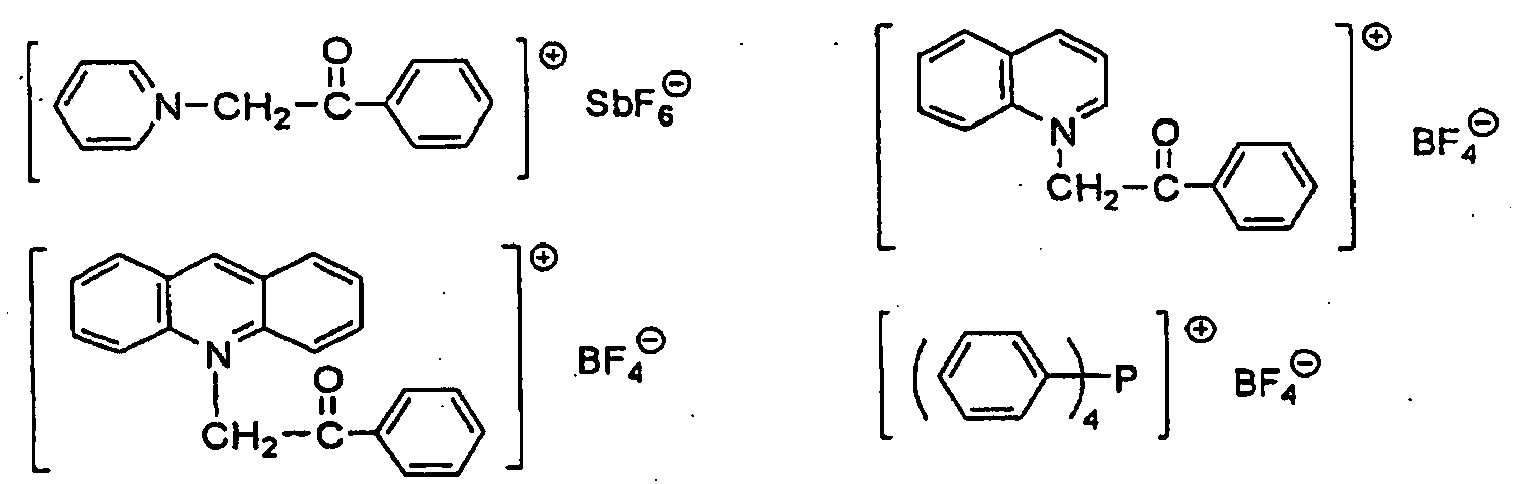


- Of the photopolymerization initiators, the titanocene compound is particularly preferred in view of the improvement in sensitivity because it is apt to coordinate with the benzotriazole compound or sulfone compound described above to form the highly active species.
- Like the foregoing sensitizing dye, the photopolymerization initiator can be subjected to various chemical modifications for further improving characteristics of the light-sensitive layer. There may be employed techniques, for example, connection to the sensitizing dye or to the addition polymerizable unsaturated compound or other radical-generating part, introduction of a hydrophilic moiety, introduction of a substituent for improving compatibility or depressing deposition of crystals, introduction of a substituent for improving adhesion property, and polymerization.
- Regarding the method of using the photopolymerization initiator, a suitable method can be appropriately selected depending upon the designed performance of the light-sensitive material similar to the addition polymerizable compound described hereinafter and the sensitizing dye described hereinbefore. For example, compatibility with the light-sensitive layer can be enhanced by using two or more photopolymerization initiators in combination.
- Regarding the amount of the photopolymerization initiator used, an increased amount of the photopolymerization initiator usually provides more advantages in view of light sensitivity. A sufficient light sensitivity can be obtained by using the photopolymerization initiator in an amount of from 0.5 to 80 parts by weight, preferably from 1 to 50 parts by weight, per 100 parts by weight of the component of the polymerizable composition. On the other hand, in consideration of the objects of the invention, the amount of the photopolymerization initiator is preferably small. By using the photopolymerization initiator in combination with the sensitizing dye, a sufficient light sensitivity can be obtained even when the amount of the photopolymerization initiator is reduced to as small as 30 parts by weight or less, further 25 parts by weight or less, still further 20 parts by weight or less, per 100 parts by weight of the component of the polymerizable composition.
- One of the characteristic features of the photoinitiation system for use in the preferable embodiment of the present invention is to have excellent photosensitive property in the region of 350 to 450 nm. The photoinitiation system containing a titanocene compound for use in the preferable embodiment of the present invention is useful as a photopolymerizable composition for scan exposure and this is described, for example, JP-B-4-47680. The titanocene compound has absorption in the wavelength region of 350 to 450 nm and therefore, efficiently causes decomposition upon exposure with light in the short-wavelength region from 350 to 450 nm, but the titanocene compound does not show sufficiently high photosensitivity by itself. The present inventors have found that when an N-oxyamide compound having a specific structure is allowed to coexit with a photopolymerization initiator such as a titanocene compound, the photosensitivity of the photopolymerization initiator such as a titanocene compound can be enhanced. The reasons therefor are not clearly known, but it is considered that the N-oxyamide compound of the present invention interacts with the photopolymerization initiator such as a titanocene compound upon exposure and decomposes to newly produce a radical and this contributes to the elevation of photosensitivity. Furthermore, a sensitizing dye for example having absorption in the wavelength region of 350 to 450 nm may be arbitrarily caused to coexist in the photoinitiation system of the present invention. In order to realize sufficiently high sensitivity for scan exposure, a sensitizing dye is preferably caused to coexist in the photoinitiation system.
- The N-oxyamide compound for use in the present invention is a compound represented by the following formula (1):

- Specific examples of X in formula (1) include a hydrogen atom, an alkyl group, a substituted alkyl group, an aryl group, a substituted aryl group, an alkenyl group, a substituted alkenyl group, an alkynyl group, a substituted alkynyl group, a substituted carbonyl group, a substituted sulfinyl group and a substituted sulfonyl group.
- Specific examples of Z in formula (1) include a hydrogen atom, an alkyl group, a substituted alkyl group, an aryl group, a substituted aryl group, an alkenyl group, a substituted alkenyl group, an alkynyl group, a substituted alkynyl group, a substituted carbonyl group, a substituted sulfinyl group, a substituted sulfonyl group and a silyl group.
- Specific examples of Y in formula (1) include a hydrogen atom, an alkyl group, a substituted alkyl group, an aryl group, a substituted aryl group, an alkenyl group, a substituted alkenyl group, an alkynyl group, a substituted alkynyl group, a substituted carbonyl group, a substituted oxy group, a substituted thio group and a substituted amino group.
- Specific examples of these substituents include the followings.
- The alkyl group includes a linear, branched or cyclic alkyl group having from 1 to 20 carbon atoms, and specific examples thereof include a methyl group, an ethyl group, a propyl group, a butyl group, a pentyl group, a hexyl group, a heptyl group, an octyl group, a nonyl group, a decyl group, an undecyl group, a dodecyl group, a tridecyl group, a hexadecyl group, an octadecyl group, an eicosyl group, an isopropyl group, an isobutyl group, a sec-butyl group, a tert-butyl group, an isopentyl group, a neopentyl group, a 1-methylbutyl group, an isohexyl group, a 2-ethylhexyl group, a 2-methylhexyl group, a cyclohexyl group, a cyclopentyl group and a 2-norbornyl group. Among these, preferred are a linear alkyl group having from 1 to 12 carbon atoms, a branched alkyl group having from 3 to 12 carbon atoms and a cyclic alkyl group having from 5 to 10 carbon atoms.
- The substituted alkyl group is a group constituted by the bonding of a substituent and an alkylene group. The substituent is a monovalent nonmetallic atom group (monovalent nonmetallic atomic group) excluding hydrogen, and preferred examples thereof include a halogen atom (e.g., -F, - Br, -Cl, -I), a hydroxyl group, an alkoxy group, an aryloxy group, a mercapto group, an alkylthio group, an arylthio group, an alkyldithio group, an aryldithio group, an amino group, an N-alkylamino group, an N,N-dialkylamino group, an N-arylamino group, an N,N-diarylamino group, an N-alkyl-N-arylamino group, an acyloxy group, a carbamoyloxy group, an N-alkylcarbamoyloxy group, an N-arylcarbamoyloxy goup, an N,N-dialkylcarbamoyloxy group, an N,N-diarylcarbamoyloxy group, an N-alkyl-N-arylcarbamoyloxy group, an alkylsulfoxy group, an arylsulfoxy group, an acylthio group, an acylamino group, an N-alkylacylamino group, an N-arylacylamino group, a ureido group, an N-alkylureido group, an N',N'-dialkylureido group, an N'-arylureido group, an N',N'-diarylureido group, an N'-alkyl-N'-arylureido group, an N-alkylureido group, an N-arylureido group, an N'-alkyl-N-allrylureido group, an N'-alkyl-N-arylureido group, an N',N'-dialkyl-N-alkylureido group, an N',N'-dialkyl-N-arylureido group, an N'-azyl-N-alkylureido group, an N'-aryl-N-arylureido group, an N',N'-diaryl-N-alkylureido group, an N',N'-diaryl-N-arylureido group, an N'-alkyl-N'-aryl-N-alkylureido group, an N'-alkyl-N'-aryl-N-arylureido group, an alkoxycarbonylamino group, an aryloxycarbonylamino group, an N-alkyl-N-alkoxycarbonylamino group, an N-alkyl-N-aryloxycarbonylamino group, an N-aryl-N-alkoxycarbonylamino group, an N-aryl-N-aryloxycarbonylamino group, a formyl group, an acyl group, a carboxyl group and a conjugate base group thereof (hereinafter referred to as a "carboxylato"), an alkoxycarbonyl group, an aryloxycarbonyl group, a carbamoyl group, an N-alkylcarbamoyl goup, an N,N-dialkylcarbamoyl group, an N-arylcarbamoyl group, an N,N-diarylcarbamoyl group, an N-alkyl-N-arylcarbamoyl group, an alkylsulfinyl group, an arylsulfinyl group, an alkylsulfonyl group, an arylsulfonyl group, a sulfo (-SO3H) group and a conjugate base group thereof (hereinafter referred to as a "sulfonato group"), an alkoxysulfonyl group, an aryloxysulfonyl group, a sulfinamoyl group, an N-alkylsulfinamoyl group, an N,N-dialkylsulfinamoyl group, an N-arylsulfinamoyl group, an N,N-diarylsulfinamoyl group, an N-alkyl-N-arylsulfinamoyl group, a sulfamoyl group, an N-alkylsulfamoyl group, an N,N-dialkylsulfamoyl group, an N-arylsulfamoyl group, an N,N-diarylsulfamoyl group, an N-alkyl-N-arylsulfamoyl group, an N-acylsulfamoyl group and a conjugate base group thereof, an N-alkylsulfonylsulfamoyl group (-SO2NHSO2(alkyl)) and a conjugate base group thereof, an N-arylsulfonylsulfamoyl group (-SO2NHSO2(allyl)) and a conjugate base group thereof, an N-alkylsulfonylcarbamoyl group (-CONHSO2(alkyl)) and a conjugate base group thereof, an N-arylsulfonylcarbamoyl group (-CONHSO2(allyl)) and a conjugate base group thereof, an alkoxysilyl group (-Si(O-alkyl)3), an aryloxysilyl group (-Si(O-aryl)3), a hydroxysilyl group (-Si(OH)3) and a conjugate base group thereof, a phosphono group (-PO3H2) and a conjugate base group thereof (hereinafter referred to as a "phosphonato goup"), a dialkylphosphono group (-PO3(alkyl)2), a diarylphosphono group (-PO3(aryl)2), an alkylarylphosphono group (-PO3(alkyl)(aryl)), a monoalkylphosphono group (-PO3H(alkyl)) and a conjugate base group thereof (hereinafter referred to as an "alkylphosphonato group"), a monoarylphosphono group (-PO3H(aryl)) and a conjugate base group thereof (hereinafter referred to as an "arylphosphonato group"), a phosphonoxy group (-OPO3H2) and a conjugate base group thereof (hereinafter referred to as a "phosphonatoxy group"), a dialkylphosphonoxy group (-OPO3(alkyl)2), a diarylphosphonoxy group (-OPO3(aryl)2), an alkylarylphosphonoxy group (-OPO3(alkyl)(aryl)), a monoalkylphosphonoxy group (-OPO3H(alkyl)) and a conjugate base group thereof (hereinafter referred to as an "alkylphosphonatoxy group"), a monoarylphosphonoxy group (-OPO3H(aryl)) and a conjugate base group thereof (hereinafter referred to as an "arylphosphonatoxy group"), a cyano group, a nitro group, an aryl group, an alkenyl group and an alkynyl group.
- Specific examples of the alkyl group in these substituents include those described above; specific examples of the aryl group include a phenyl group, a biphenyl group, a naphthyl group, a tolyl group, a xylyl group, a mesityl group, a cumenyl group, a fluorophenyl group, a chlorophenyl group, a bromophenyl group, a chloromethylphenyl group, a hydroxyphenyl group, a methoxyphenyl group, an ethoxyphenyl group, a phenoxyphenyl group, an acetoxyphenyl group, a benzoyloxyphenyl group, a methylthiophenyl group, a phenylthiophenyl group, a methylaminophenyl group, a dimethylaminophenyl group, an acetylaminophenyl group, a carboxyphenyl group, a methoxycarbonylphenyl group, an ethoxycarbonylphenyl group, a phenoxycarbonylphenyl group, an N-phenylcarbamoylphenyl group, a phenyl group, a nitrophenyl group, a cyanophenyl group, a sulfophenyl group, a sulfonatophenyl group, a phosphonophenyl group and phosphonatophenyl group; specific examples of the alkenyl group include a vinyl group, a 1-propenyl group, a 1-butenyl group, a cinnamyl group and a 2-chloro-1-ethenyl group; and specific examples of the alkynyl group include an ethynyl group, a 1-propynyl group, a 1-butynyl group, a trimethylsilylethynyl group and a phenylethynyl group.
- Examples of the acyl group (R4'CO-) include those where R4' is a hydrogen atom or the above-described alkyl, aryl, alkenyl or alkynyl group.
- The alkylene group in the substituted alkyl group includes a divalent organic residue obtained by eliminating any one hydrogen atom on the above-described alkyl group having from I to 20 carbon atoms, and the alkylene group is preferably a linear alkylene group having from 1 to 12 carbon atoms, a branched alkylene group having from 3 to 12 carbon atoms or a cyclic alkylene group having from 5 to 10 carbon atoms.
- Specific preferred examples of the substituted alkyl group include a chloromethyl group, a bromomethyl group, a 2-chloroethyl group, a trifluoromethyl group, a methoxymethyl group, a methoxyethoxyethyl group, an allyloxymethyl group, a phenoxymethyl group, a methylthiomethyl group, a tolylthiomethyl group, an ethylaminoethyl group, a diethylaminopropyl group, a morpholinopropyl group, an acetyloxymethyl group, a benzoyloxymethyl group, an N-cyclohexylcarbamoyloxyethyl group, an N-phenylcarbamoyloxyethyl group, an acetylaminoethyl group, an N-methylbenzoylaminopropyl group, a 2-oxoethyl group, a 2-oxopropyl group, a carboxypropyl group, a methoxycarbonylethyl group, a methoxycarbonylmethyl group, a methoxycarbonylbutyl group, an ethoxycarbonylmethyl group, a butoxycarbonylmethyl group, an allyloxycarbonylmethyl group, a benzyloxycarbonylmethyl group, a methoxycarbonylphenylmethyl group, a trichloromethylcarbonylmethyl group, an allyloxycarbonylbutyl group, a chlorophenoxycarbonylmethyl group, a carbamoylmethyl group, an N-methylcarbamoylethyl group, an N,N-dipropylcarbamoylmethyl group, an N-(methoxyphenyl)carbamoylethyl group, an N-methyl-N-(sulfophenyl)carbamoylmethyl group, a sulfopropyl group, a sulfobutyl group, a sulfonatobutyl group, a sulfamoylbutyl group, an N-ethylsulfamoylmethyl group, an N,N-dipropylsulfamoylpropyl group, an N-tolylsulfamoylpropyl group, an N-methyl-N-(phosphonophenyl)sulfamoyloctyl group, a phosphonobutyl group, a phosphonatohexyl group, a diethylphosphonobutyl group, a diphenylphosphonopmpyl group, a methylphosphonobutyl group, a methylphosphonatobutyl group, a tolylphosphonohexyl group, a tolylphosphonatohexyl group, a phosphonoxypropyl group, a phosphonatoxybutyl group, a benzyl group, a phenethyl group, an α-methylbenzyl group, a 1-methyl-1-phenylethyl group, a p-methylbenzyl group, a cinnamyl group, an allyl group, a 1-propenylmethyl group, a 2-butenyl group, a 2-methylallyl- group, a 2-methylpropenylmethyl group, a 2-propynyl group, a 2-butynyl group, a 3-butynyl group and the following groups:




- The aryl group includes a condensed ring formed by 1 to 3 benzene rings and a condensed ring formed by a benzene ring and a 5-membered unsaturated ring. Specific examples thereof include a phenyl group, a naphthyl group, an anthryl group, a phenanthryl group, an indenyl group, an acenaphthenyl group and a fluorenyl group. Among these, preferred are a phenyl group and a naphthyl group.
- The substituted aryl group is a group constituted by bonding a substituent to an aryl group and includes those described above as the aryl group in which a monovalent nonmetallic atom group excluding hydrogen is present as a substituent on the ring-forming carbon atom. Preferred examples of the substituent include the above-described alkyl group and substituted alkyl group and also include the substituents described above for the substituted alkyl group.
- Specific preferred examples of the substituted aryl group include a biphenyl group, a tolyl group, a xylyl group, a mesityl group, a cumenyl group, a chlorophenyl group, a bromophenyl group, a fluorophenyl group, a chloromethylphenyl group, a trifluoromethylphenyl group, a hydroxyphenyl group, a methoxyphenyl group, a methoxyethoxyphenyl group, an allyloxyphenyl group, a phenoxyphenyl group, a methylthiophenyl group, a tolylthiophenyl group, a phenylthiophenyl group, an ethylaminophenyl group, a diethylaminophenyl group, a morpholinophenyl group, an acetyloxyphenyl group, a benzoyloxyphenyl group, an N-cyclohexylcarbamoyloxyphenyl group, an N-phenylcarbamoyloxyphenyl group, an acetylaminophenyl group, an N-methylbenzoylaminophenyl group, a carboxyphenyl group, a methoxycarbonylphenyl group, an allyloxycarbonylphenyl group, a chlorophenoxycarbonylphenyl group, a carbamoylphenyl group, an N-methylcarbamoylphenyl group, an N,N-dipropylcarbamoylphenyl group, an N-(methoxyphenyl)carbamoylphenyl group, an N-methyl-N-(sulfophenyl)carbamoylphenyl group, a sulfophenyl group, a sulfonatophenyl group, a sulfamoylphenyl group, an N-ethylsulfamoylphenyl group, an N,N-dipropylsulfamoylphenyl group, an N-tolylsulfamoylphenyl group, an N-methyl-N-(phosphonophenyl)sulfamoylphenyl group, a phosphonophenyl group, a phosphonatophenyl group, a diethylphosphonophenyl group, a diphenylphosphonophenyl group, a methylphosphonophenyl group, a methylphosphonatophenyl group, a tolylphosphonophenyl group, a tolylphosphonatophenyl group, an allyl group, a 1-propenylmethyl group, a 2-butenyl group, a 2-methylallylphenyl group, a 2-methylpropenylphenyl group, a 2-propynylphenyl group, a 2-butynylphenyl group, a 3-butynylphenyl group, a tetrachlorophenyl group, a tetrabromophenyl group and a tetrafluorophenyl group.
- Examples of the alkenyl group include a vinyl group, a 1-propenyl group, a 1-butenyl group, a cinnamyl group and a 2-chloro-1-ethenyl group, and examples of the alkynyl group include an ethynyl group, a 1-propynyl group, a 1-butynyl group and a trimethylsilylethynyl group.
- The substituted alkenyl group is a group constituted by replacing a hydrogen atom of the alkenyl group with a substituent. The substituent may be the above-described substituent for the substituted alkyl group, and the alkenyl group may be the above-described alkenyl group. Preferred examples of the substituted alkenyl group include the following groups:


CH2=CH-CH=CH-CH2-, Cl-CH2CH=CHCH2-,

HS-CH2CH=CHCH2-.
- The substituted alkynyl group is a group constituted by replacing a hydrogen atom of the alkynyl group with a substituent. The substituent may be the above-described substituent for the substituted alkyl group, and the alkynyl group may be the above-described alkynyl group.
- The halogen atom is preferably a fluorine atom, a chlorine atom, a bromine atom or an iodine atom.
- As for the substituted oxy group, for example, a group represented by R14O- where R14 is a monovalent nonmetallic atom group excluding hydrogen, may be used. Preferred examples of the substituted oxy group include an alkoxy group, an aryloxy group, an acyloxy group, a carbamoyloxy group, an N-alkylcarbamoyloxy group, an N-arylcarbamoyloxy group, an N,N-dialkylcarbamoyloxy group, an N,N-diarylcarbamoyloxy group, an N-alkyl-N-arylcarbamoyloxy group, an alkylsulfoxy group, an arylsulfoxy group, a phosphonoxy group and a phosphonatoxy group. Examples of the alkyl group and aryl group in these groups include those described above as the alkyl group, substituted alkyl group, aryl group and substituted aryl group. The acyl group (R15CO-) in the acyloxy group include those where R15 is the above-described alkyl group, substituted alkyl group, aryl group or substituted aryl group. Among those substituted oxy groups, more preferred are an alkoxy group, an aryloxy group, an acyloxy group and an arylsulfoxy group.
- Specific preferred examples of the substituted oxy group include a methoxy group, an ethoxy group, a propyloxy group, an isopropyloxy group, a butyloxy group, a pentyloxy group, a hexyloxy group, a dodecyloxy group, a benzyloxy group, an allyloxy group, a phenethyloxy group, a carboxyethyloxy group, a methoxycarbonylethyloxy group, an ethoxycarbonylethyloxy group, a methoxyethoxy group, a phenoxyethoxy group, a methoxyethoxyethoxy group, an ethoxyethoxyethoxy group, a morpholinoethoxy group, a morpholinopropyloxy group, an allyloxyethoxyethoxy group, a phenoxy group, a tolyloxy group, a xylyloxy group, a mesityloxy group, a cumenyloxy group, a methoxyphenyloxy group, an ethoxyphenyloxy group, a chlorophenyloxy group, a bromophenyloxy group, an acetyloxy group, a benzoyloxy group, a naphthyloxy group, a phenylsulfonyloxy group, a phosphonoxy group and a phosphonatoxy group.
- As for the substituted thio group, a group represented by R16S- where R16 is a monovalent nonmetallic atom group excluding a hydrogen atom, may be used. Preferred examples of the substituted thio group include an alkylthio group, an arylthio group, an alkyldithio group, an aryldithio group and an acylthio group. Examples of the alkyl group and aryl group in these groups include those described above as the alkyl group, substituted alkyl group, aryl group and substituted aryl group. R15 of the acyl group (R15CO-) in the acylthio group has the same meaning as above. Among those substituted thio groups, preferred are an alkylthio group and an arylthio group. Specific preferred examples of the substituted thio group include a methylthio group, an ethylthio group, a phenylthio group, an ethoxyethylthio group, a carboxyethylthio group and a methoxycarbonylthio group.
- As for the substituted amino group, a group represented by R17NH- or (R18)(R19)N- where R17, R18 and R19 each is a monovalent nonmetallic atom group excluding a hydrogen atom, may be used. Preferred examples of the substituted amino group include an N-alkylamino group, an N,N-dialkylamino group, an N-arylamino group, an N,N-diarylamino group, an N-alkyl-N-arylamino group, an acylamino group, an N-alkylacylamino group, an N-arylacylamino group, a ureido group, an N'-alkylureido group, an N',N'-dialkylureido group, an N'-arylureido group, an N',N'-diarylureido group, an N'-alkyl-N'-arylureido group, an N-alkylureido group, an N-arylureido group, an N'-alkyl-N-alkylureido group, an N'-alkyl-N-arylureido group, an N',N'-dialkyl-N-alkylureido group, an N',N'-dialkyl-N-arylureido group, an N'-aryl-N-alkylureido group, an N'-aryl-N-arylureido group, an N',N'-diaryl-N-alkylureido group, an N',N'-diaryl-N-arylureido group, an N'-alkyl-N'-aryl-N-alkylureido group, an N'-alkyl-N'-aryl-N-arylureido group, an alkoxycarbonylamino group an aryloxycarbonylamino group, an N-alkyl-N-alkoxycarbonylamino group, an N-alkyl-N-aryloxycarbonylamino group, an N-aryl-N-alkoxycarbonylamino group and an N-aryl-N-aryloxycarbonylamino group. Examples of the alkyl group and aryl group in these groups include those described above as the alkyl group, substituted alkyl group, aryl group and substituted aryl group. R15 of the acyl group (R15CO-) in the acylamino group, N-alkylacylamino group and N-arylacylamino group has the same meaning as above.
- Among those substituted amino groups, more preferred are an N-alkylamino group, an N,N-dialkylamino group, an N-arylamino group and an acylamino group. Specific preferred examples of the substituted amino group include a methylamino group, an ethylamino group, a diethylamino group, a morpholino group, a piperidino group, a pyrrolidino group, a phenylamino group, a benzoylamino group and an acetylamino group.
- As for the substituted carbonyl group, a group represented by R20-CO- where R20 is a monovalent nonmetallic atom group, may be used. Preferred examples of the substituted carbonyl group include a formyl group, an acyl group, a carboxyl group, an alkoxycarbonyl group, an aryloxycarbonyl group, a carbamoyl group, an N-alkylcarbamoyl group, an N,N-dialkylcarbamoyl group, an N-arylcarbamoyl group, an N,N-diarylcarbamoyl group and an N-alkyl-N-arylcarbamoyl group. Examples of the alkyl group and aryl group in these groups include those described above as the alkyl group, substituted alkyl group, aryl group and substituted aryl group above.
- Among these substituents, more preferred are a formyl group, an acyl group, a carboxyl group, an alkoxycarbonyl group, an aryloxycarbonyl group, a carbamoyl group, an N-alkylcarbamoyl group, an N',N-dialkylcarbamoyl group and an N-arylcarbamoyl group, and still more preferred are a formyl group, an acyl group, an alkoxycarbonyl group and an aryloxycarbonyl group. Specific preferred examples of the substituted carbonyl group include a formyl group, an acetyl group, a benzoyl group, a carboxyl group, a methoxycarbonyl group, an allyloxycarbonyl group, an N-methylcarbamoyl group, an N-phenylcarbamoyl group, an N,N-diethylcarbamoyl group and a morpholinocarbonyl group.
- As for the substituted sulfinyl group, a group represented by R21-SO- where R21 is a monovalent nonmetallic atom group, may be used. Preferred examples thereof include an alkylsulfinyl group, an arylsulfinyl group, a sulfinamoyl group, an N-alkylsulfinamoyl group, an N,N-dialkylsulfinamoyl group, an N-arylsulfinamoyl group, an N,N-diarylsulfinamoyl group and an N-alkyl-N-arylsulfinamoyl group. Examples of the alkyl group and aryl group in these groups include those described above as the alkyl group, substituted alkyl group, aryl group and substituted aryl group above. Among the above-described substituted sulfinyl groups, more preferred are an alkylsulfinyl group and an arylsulfinyl group. Specific examples of the substituted sulfinyl group include a hexylsulfinyl group, a benzylsulfinyl group and a tolylsulfinyl group.
- As for the substituted sulfonyl group, a group represented by R25-SO2- where R25 is a monovalent nonmetallic atom group, may be used. Preferred examples thereof include an alkylsulfonyl group and an arylsulfonyl group. Examples of the alkyl group and aryl group in these groups include those described above as the alkyl group, substituted alkyl group, aryl group and substituted aryl group. Specific examples of the substituted sulfonyl group include a butylsulfonyl group and a chlorophenylsulfonyl group.
- As for the silyl group, a group represented by (R22)(R23)(R24)Si- where R22, R23 and R24 each is a monovalent nonmetallic atom group, preferably the above-described alkyl group, substituted alkyl group, aryl group or substituted aryl group, may be used. Preferred Examples of the silyl group include a trimethylsilyl group, a tributylsilyl group, a tert-butyldimethylsilyl group and a dimethylphenylsilyl group.
- These substituents each may further have a substituent, and specific examples thereof include the groups described as specific examples of X, Y and Z.
- X, Y and Z may combine with each other to form a cyclic structure.
- Examples of the cyclic structure formed when X and Y, Y and Z, or X and Z combine with each other include a saturated or unsaturated aliphatic ring. The aliphatic ring is preferably a 5-, 6-, 7- or 8-membered aliphatic ring formed in cooperation with the carbon atoms to which those substituents are bonded, more preferably a 5- or 6-membered aliphatic ring. In these aliphatic rings, a substituent may be present on the carbon atom constituting the ring (examples of the substituent include those described above as examples of the substituent in the substituted alkyl group), or a part of the ring-constituting carbons may be replaced with a heteroatom (e.g., oxygen, sulfur, nitrogen). Furthermore, a part of the aliphatic ring may form a part of an aromatic ring. Specific preferred examples thereof include a cyclopentane ring, a cyclohexane ring, a cycloheptane ring, a cyclooctane ring, a cyclo-1,3-dioxapentane ring, a cyclopentene ring, a cyclohexene ring, a cycloheptene ring, a cyclooctene ring, a cyclo-1,3-dioxapentene ring, a cyclo-1,3-dioxahexene ring, a cyclohexadiene ring, a beazocyclohexene ring, a benzocyclohexadiene ring, a tetrahydropyranone ring, maleimide, succinimide, phthalimide, 1,2,3,6-tetrahydrophthalimide, 1,2-cyclohexanedicarboxyimide, 2,4,6-piperidinetrione and 1,4,5,6,7,7-hexachloro-5-norbornene-2,3-dicarboxyimide.
- Examples of the aromatic ring formed when X and Y, Y and Z, or X and Z combine with each other include a quinolinc ring, an isoquinolinc ring, an acridinc ring, a phenanthridinc ring, a benzoquinoline ring and a benzoisoquinoline ring. Among these, a quinoline ring is preferred. Such an aromatic ring may have a substituent on the carbon atom constituting the ring (examples of the substituent include the above-described substituents on the substituted alkyl group).
- Furthermore, these ring structures each may further have a substituent, and examples of the substituent include those described above as specific examples of X, Y and Z.
- Specific examples of the compound represented by formula (1) for use in the present invention are set forth below, but the present invention is not limited thereto.


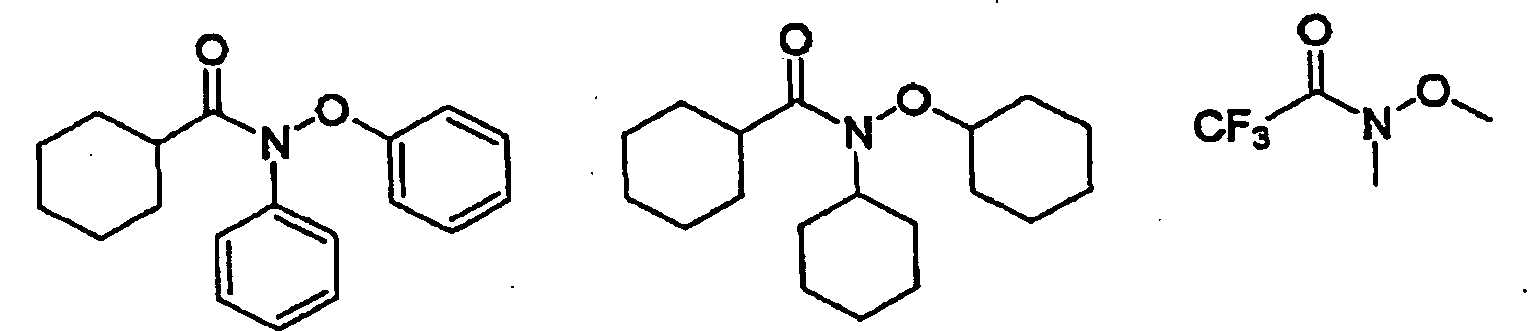


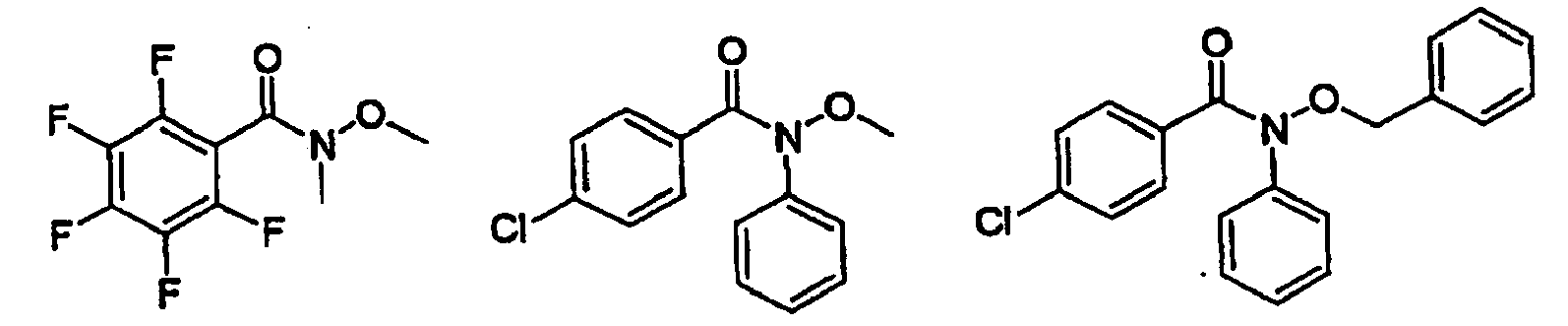


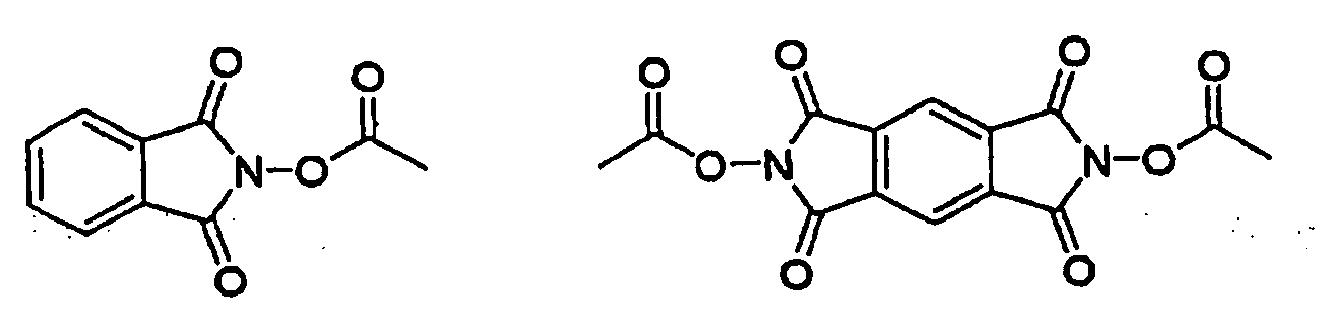


- From the standpoint of enhancing the sensitivity, the compound represented by formula (1) is preferably a compound represented by formula (2):

wherein X', W and Z' each independently represents a monovalent substituent, and n represents an integer of 1 to 5. - Specific examples of X' in formula (2) are the same as those of X above.
- Specific examples of Z' in formula (2) are the same as those of Z above.
- Specific examples of W in formula (2) include a hydrogen atom, a halogen atom, an alkyl group, a substituted alkyl group, an aryl group, a substituted aryl group, an alkenyl group, a substituted alkenyl group, an alkynyl group, a substituted alkynyl group, a substituted carbonyl group, a substituted sulfinyl group, a substituted sulfonyl group, a hydroxyl group, a substituted oxy group, a mercapto group, a substituted thio group, an amino group, a substituted amino group, a phosphono group, a substituted phosphono group, a phosphonato group, a substituted phosphonato group, a cyano group, a nitro group, a silyl group and a substituted onium group.
- In these specific examples of W, preferred examples of the alkyl group, substituted alkyl group, aryl group, substituted aryl group, alkenyl group, substituted alkenyl group, alkynyl group, substituted alkynyl group, substituted carbonyl group, substituted sulfinyl group, substituted sulfonyl group, substituted oxy group, substituted thio group, amino group and substituted amino group are the same as those for X, Y and Z above.
- The sulfonato group (SO3 -) means a conjugate base anion group of a sulfo group (-SO3H) and usually, this is preferably used together with a counter cation. Examples of the counter cation include generally known ions, that is, various oniums (e.g., ammoniums, sulfoniums, phosphoniums, iodoniums, aziniums) and metal ions (e.g., Na+, K+, Ca2+, Zn2+).
- The substituted phosphono group means a phosphono group on which one or two hydroxy group is replaced by other organic oxo group. Preferred examples thereof include the above-described dialkylphosphono group, diarylphosphono group, alkylarylphosphono group, monoalkylphosphono group and monoarylphosphono group. Among these, more preferred are a dialkylphosphono group and a diarylphosphono group. Specific examples thereof include a diethylphosphono group, a dibutylphosphono group and a diphenylphosphono group.
- The phosphonato group (-PO3 2- or -PO3H-) means a conjugate base anion group derived from primary acid dissociation or secondary acid dissociation of a phosphono group (-PO3H2) and usually, this is preferably used together with a counter cation. Examples of the counter cation include generally known ions, that is, various oniums (e.g., ammoniums, sulfoniums, phosphoniums, iodoniums, aziniums) and metal ions (e.g., Na+, K+, Ca2+, Zn2+).
- The substituted phosphonato group is a conjugate base anion group resulting from replacing a hydroxy group of the above-described substituted phosphono group with one organic oxo group. Specific examples thereof include a conjugate base group of the monoalkylphosphono group (-PO3H(alkyl)) and a conjugate base group of the monoarylphosphono group (-PO3H(aryl)). Usually, this is preferably used together with a counter cation. Examples of the counter cation include generally known ions, that is, various oniums (e.g., ammoniums, sulfoniums, phosphoniums, iodoniums, aziniums) and metal ions (e.g., Na+, K+, Ca2+, Zn2+).
- Examples of the substituted onium group include ammoniums, sulfoniums, phosphoniums, iodoniums and aziniums, and examples of the counter anion include a conjugate base of carboxyl group, a sulfonato group, a phosphonato group, a substituted phosphonato group, Cl-, Br-, I-, BF4 -, ClO4 - and SbF6 -.
- X', W and Z' may combine with each other to form a cyclic structure.
- When n is 2 or more, Ws may be the same or different and may combine with each other to form a cyclic structure.
- Examples of the cyclic structure formed when X' and W, W and Z', X' and Z', or W and W combine with each other include a saturated or unsaturated aliphatic ring. The aliphatic ring is preferably a 5-, 6-, 7- or 8-membered aliphatic ring formed in cooperation with the carbon atoms to which those substituents are bonded, more preferably a 5- or 6-membered aliphatic ring. In these aliphatic rings, a substituent may be present on the carbon atom constituting the ring (examples of the substituent include those described above as examples of the substituent in the substituted alkyl group), or a part of the ring-constituting carbons may be replaced with a heteroatom (e.g., oxygen, sulfur, nitrogen). Furthermore, a part of the aliphatic ring may form a part of an aromatic ring. Specific preferred examples thereof include a cyclopentane ring, a cyclohexane ring, a cycloheptane ring, a cyclooctane ring, a cyclo-1,3-dioxapentane ring, a cyclopentene ring, a cyclohexene ring, a cycloheptene ring, a cyclooctene ring, a cyclo-1,3-dioxapentene ring, a cyclo-1,3-dioxahexene ring, a cyclohexadiene ring, a benzocyclohexene ring, a benzocyclohexadiene ring, a tetrahydropyranone ring, maleimide, succinimide, phthalimide, 1,2,3,6-tetrahydrophthalimide, 1,2-cyclohexanedicarboxyimide, 2,4,6-piperidinetrione and 1,4,5,6,7,7-hexachloro-5-norbornene-2,3-dicarboxyimide.
- Examples of the aromatic ring formed when X' and W, W and Z', X' and Z', or W and W combine with each other include a quinoline ring, an isoquinoline ring, an acridine ring, a phenanthridine ring, a benzoquinoline ring and a benzoisoquinoline ring. Among these, a quinoline ring is preferred. Such an aromatic ring may have a substituent on the carbon atom constituting the ring (examples of the substituent include the above-described substituents on the substituted alkyl group).
- Specific examples of the compound represented by formula (2) are set forth below, but the present invention is not limited thereto.



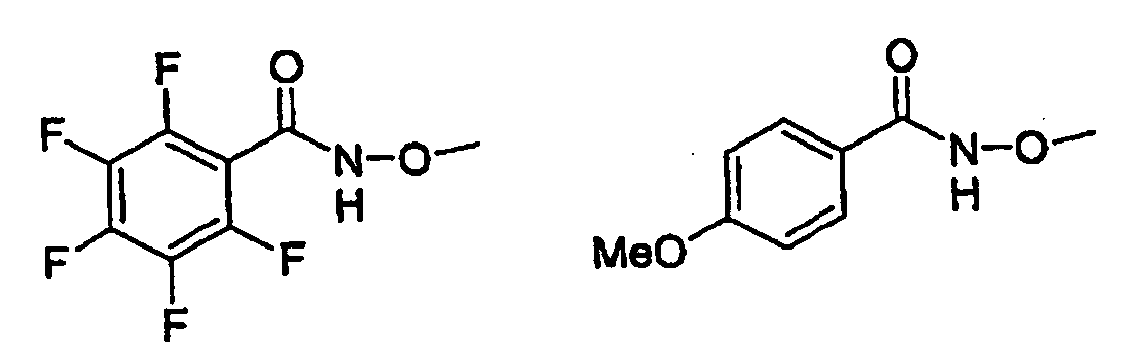


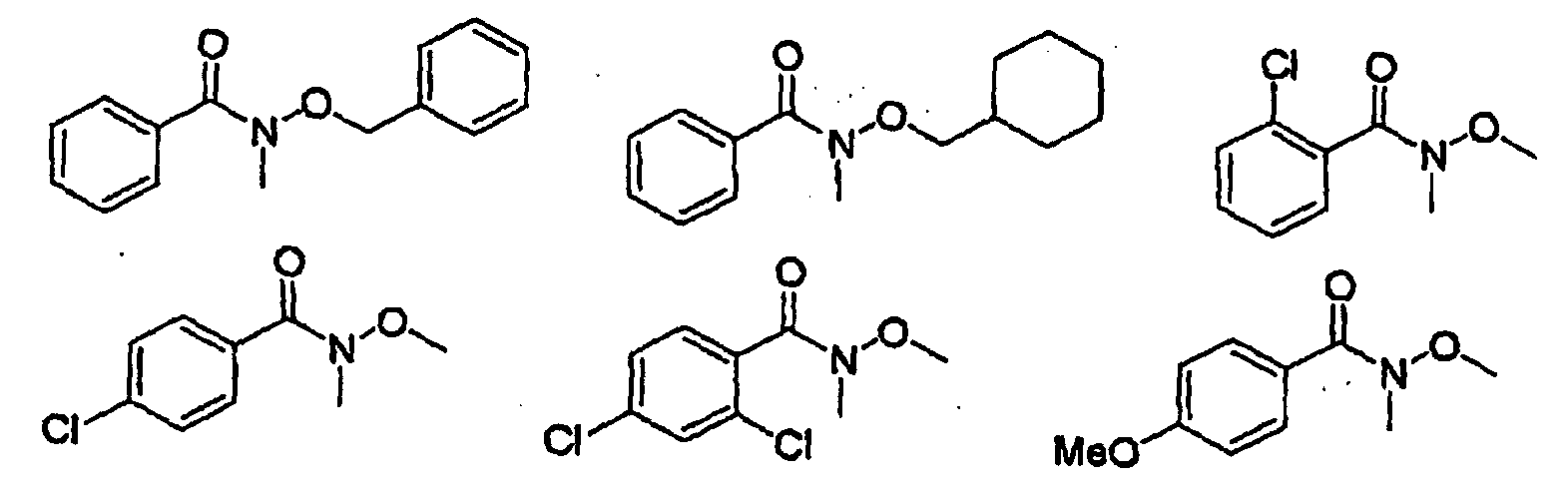


- From the standpoint of enhancing the interaction with the photopolymerization initiator such as a titanocene compound, the compound represented by formula (1) is more preferably a compound represented by formula (3):

wherein X", W' and Z" each independently represents a monovalent substituent, and n represents an integer of 1 to 5. - Specific examples of X" in formula (3) are the same as those of X above.
- Specific examples of Z" in formula (3) are the same as those of Z above.
- Specific examples of W' in formula (3) are the same as those of W above.
- X", W' and Z" may combine with each other to form a cyclic structure.
- When n is 2 or more, W's may be the same or different and may combine with each other to form a cyclic structure.
- Examples of the cyclic structure formed when X" and W', W and Z", X" and Z", or W' and W' combine with each other include a saturated or unsaturated aliphatic ring. The aliphatic ring is preferably a 5-, 6-, 7- or 8-membered aliphatic ring formed in cooperation with the carbon atoms to which those substituents are bonded, more preferably a 5- or 6-membered aliphatic ring. In these aliphatic rings, a substituent may be present on the carbon atom constituting the ring (examples of the substituent include those described above as examples of the substituent in the substituted alkyl group), or a part of the ring-constituting carbons may be replaced with a heteroatom (e.g., oxygen, sulfur, nitrogen). Furthermore, a part of the aliphatic ring may form a part of an aromatic ring. Specific preferred examples thereof include a cyclopentane ring, a cyclohexane ring, a cycloheptane ring, a cyclooctane ring, a cyclo-1,3-dioxapentane ring, a cyclopentene ring, a cyclohexene ring, a cycloheptene ring, a cyclooctene ring, a cyclo-1,3-dioxapentene ring, a cyclo-1,3-dioxahexene ring, a cyclohexadiene ring, a benzocyclohexene ring, a benzocyclohexadiene ring, a tetrahydropyranone ring, maleimide, succinimide, phthalimide, 1,2,3,6-tetrahydrophthalimide, 1,2-cyclohexanedicarboxyimide, 2,4,6-piperidinetrione and 1,4,5,6,7,7-hexachloro-5-norbornene-2,3-dicarboxyimide.
- Examples of the aromatic ring formed when X" and W, W' and Z", X" and Z", or W' and W' combine with each other include a quinoline ring, an isoquinoline ring, an acridine ring, a phenanthridine ring, a benzoquinoline ring and a benzoisoquinoline ring. Among these, a quinoline ring is preferred. Such an aromatic ring may have a substituent on the carbon atom constituting the ring (examples of the substituent include the above-described substituents on the substituted alkyl group).
- Specific examples of the compound represented by formula (3) are set forth below, but the present invention is not limited thereto.





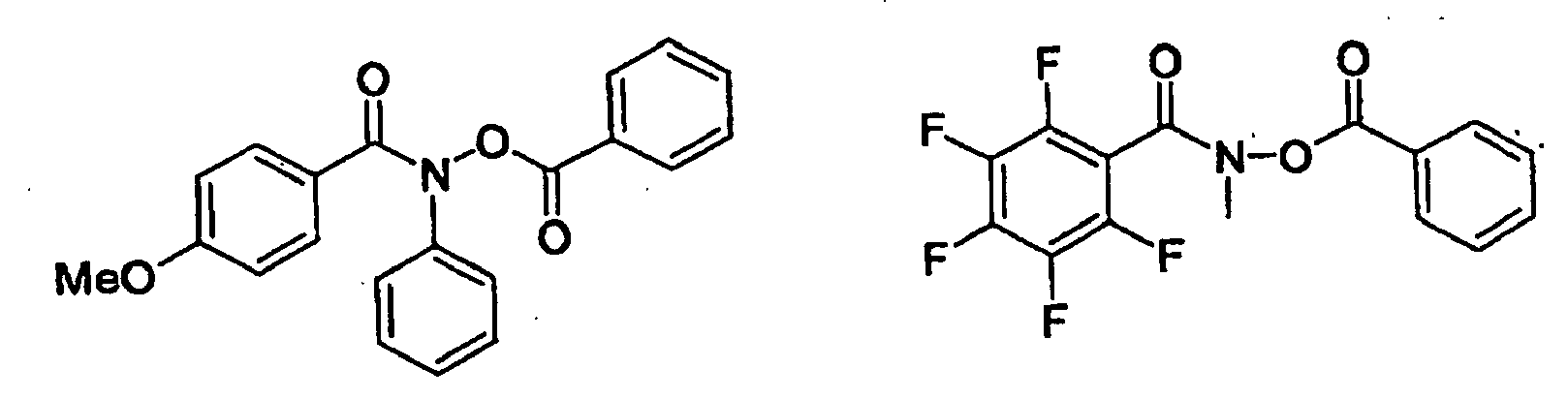


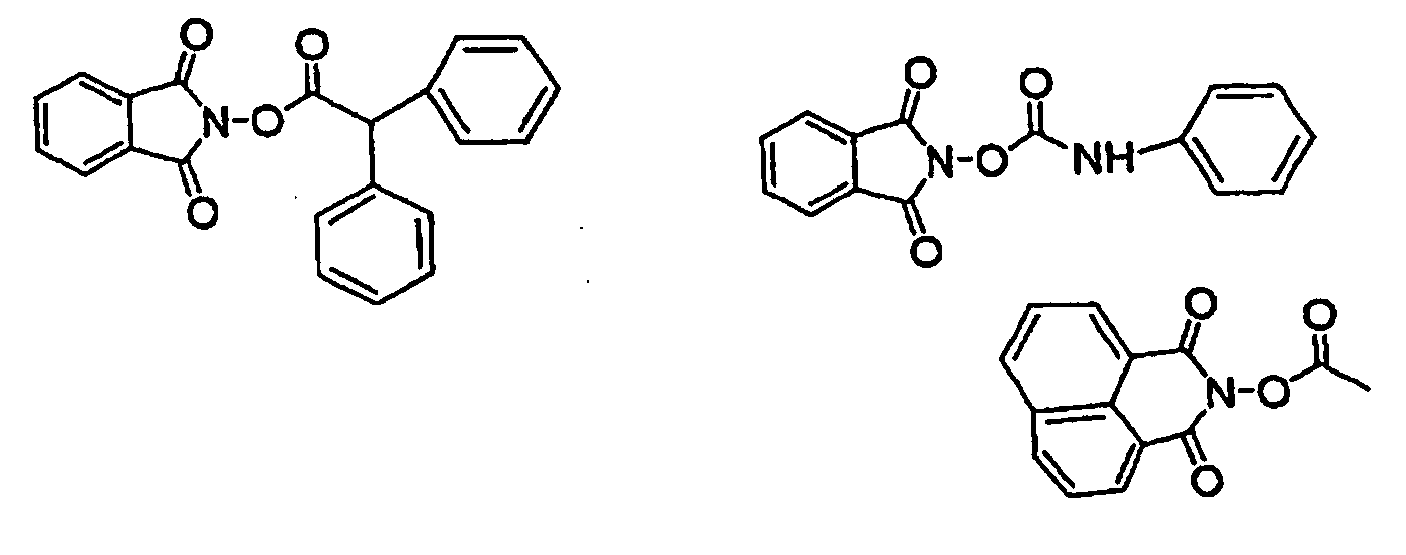
- From the standpoint of satisfying both sensitivity and stability in aging, the compound represented by formula (1) is still more preferably a compound represented by formula (4) or (5):


wherein W", W'", Z'" and Z"" each independently represents a monovalent substituent, and n represents an integer of 1 to 5. - Specific examples of Z'" and Z"" in formulae (4) and (5) are the same as those of Z above.
- Specific examples of W" and W'" in formulae (4) and (5) are the same as those of W above.
- W" and Z"', or W'" and Z"" may combine with each other to form a cyclic structure.
- When n is 2 or more, W"s or W'"s may be the same or different and may combine with each other to form a cyclic structure.
- Examples of the cyclic structure formed when W" and Z"', W'" and Z"", W" and W", or W'" and W'" combine with each other include a saturated or unsaturated aliphatic ring. The aliphatic ring is preferably a 5-, 6-, 7- or 8-membered aliphatic ring formed in cooperation with the carbon atoms to which those substituents are bonded, more preferably a 5- or 6-membered aliphatic ring. In these aliphatic rings, a substituent may be present on the carbon atom constituting the ring (examples of the substituent include those described above as examples of the substituent in the substituted alkyl group), or a part of the ring-constituting carbons may be replaced with a heteroatom (e.g., oxygen, sulfur, nitrogen). Furthermore, a part of the aliphatic ring may form a part of an aromatic ring. Specific preferred examples thereof include a cyclopentane ring, a cyclohexane ring, a cycloheptane ring, a cyclooctane ring, a cyclo-1,3-dioxapentane ring, a cyclopentene ring, a cyclohexene ring, a cycloheptene ring, a cyclooctene ring, a cyclo-1,3-dioxapentene ring, a cyclo-1,3-dioxahexene ring, a cyclohexadiene ring, a benzocyclohexene ring, a benzocyclohexadiene ring and a tetrahydropyranone ring.
- Examples of the aromatic ring formed when W" and Z"', W"' and Z"", W" and W", or W" and W"' combine with each other include a quinoline ring, an isoquinoline ring, an acridine ring, a phenanthridine ring, a benzoquinoline ring and a benzoisoquinoline ring. Among these, a quinoline ring is preferred. Such an aromatic ring may have a substituent on the carbon atom constituting the ring (examples of the substituent include the above-described substituents on the substituted alkyl group).
- Specific examples of the compounds represented by formulae (4) and (5) are set forth below, but the present invention is not limited thereto.





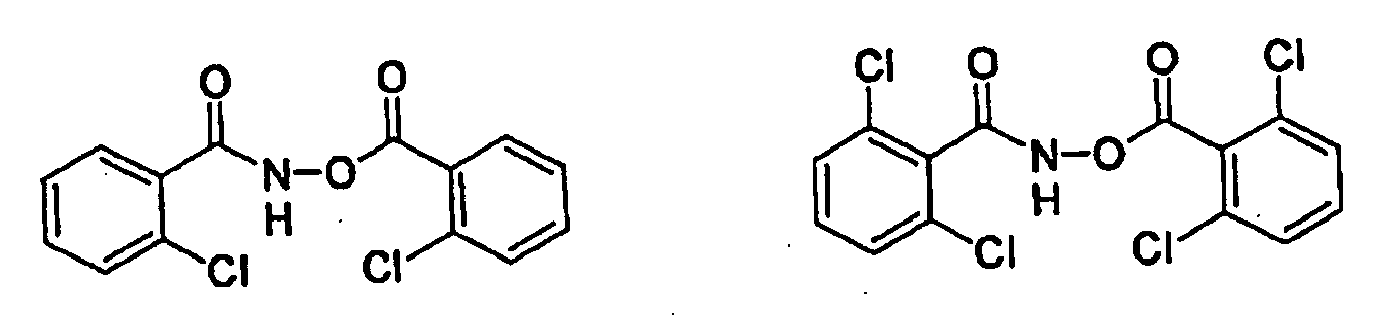


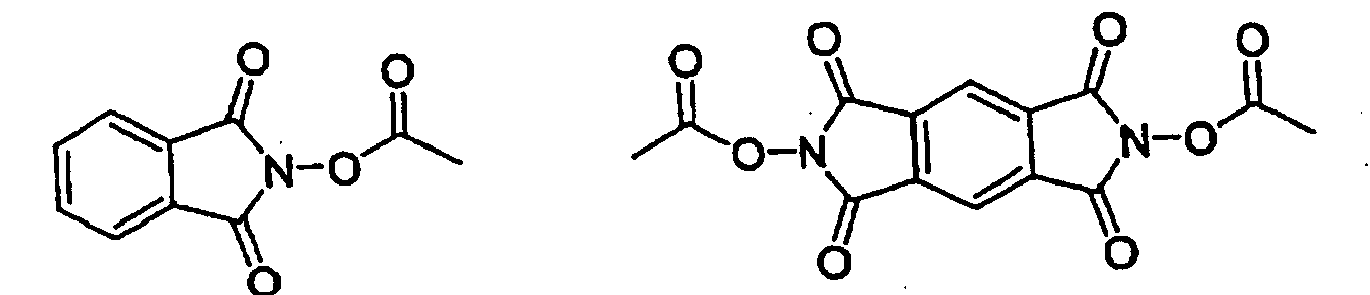


- When such an N-oxyamide compound is used in combination with the following co-sensitizer, the generated radical species efficiently reacts and the sensitization effect is elevated. In particular, use in combination with the following compound is preferred.

- Also, when such an N-oxyamide compound is used in combination with a specific dye (e.g., sensitizing dye represented by the following formula (XVIII)) described in JP-A-2001-100412 (Japanese Patent Application No. 11-280204), the initiation efficiency and sensitization effect are enhanced and this is preferred. In particular, use in combination with a specific dye represented by the following formula is more preferred.

- Furthermore, when such an N-oxyamide compound is used in combination with a urethane binder, a high effect of enhancing the press life is obtained. In particular, use in combination with polyurethane containing 10 weight% (mass%) or more of an aromatic group is preferred.
- In use of such an N-oxyamide compound, the method therefor can be appropriately and arbitrarily selected in accordance with the designed performance of the photosensitive material. Usually, the amount of the N-oxyamide compound used is preferably larger in view of photosensitivity and when the composition is used as a material for the photosensitive layer of a lithographic printing plate precursor, the amount of the N-oxyamide compound used is preferably from 0.01 to 40 parts by weight, more preferably from 0.05 to 30 parts by weight, and most preferably from 1 to 10 parts by weight, per 100 parts by weight of the photosensitive layer components. Within this range, sufficiently high photosensitivity can be obtained.
- The titanocene compound which is preferably used as the photopolymerization initiator in the present invention may be any titanocene compound as long as it can generate an active species upon irradiation with light in the region of 350 to 450 nm, and known compounds described, for example, in JP-A-59-152396, JP-A-61-151197, JP-A-63-41484, JP-A-63-41484, JP-A-2-249, JP-A-2-291, JP-A-3-27393, JP-A-3-12403 and JP-A-6-41170 can be appropriately selected and used.
- Specific examples of the titanocene compound include dicyclopentadienyl-Ti-dichlorida, dicyclopentadienyl-Ti-bis-phenyl, dicyclopentadienyl-Ti-bis-2,3,4,5,6-pentafluorophen-1-yl, dicyclopentadienyl-Ti-bis-2,3,5,6-tetrafluorophen-1-yl, dicyclopentadienyl-Ti-bis-2,4,6-trifluorophen-1-yl, dicyclopentadienyl-Ti-bis-2,6-difluorophen-1-yl, dicyclopentadienyl-Ti-bis-2,4-difluorophen-1-yl, dimethylcyclopentadienyl-Ti-bis-2,3,4,5,6-pentafluorophen-1-yl, dimethylcyclopentadienyl-Ti-bis-2,3,5,6-tetrafluorophen-1-yl, dimethylcyclopentadienyl-Ti-bis-2,4-difluorophen-1-yl, bis-(cyclopentadienyl)bis[2,6-difluoro-3-(pyr-1-yl)phenyl]titanium.
- In use of such a titanocene compound, similarly to the N-oxyamide compound, the method therefor can be appropriately and arbitrarily selected in accordance with the designed performance of the photosensitive material. For example, when two or more titanocene compounds are used in combination, compatibility with the photosensitive layer can be enhanced. Usually, the amount of the titanocene compound used is preferably larger in view of photosensitivity and when the composition is used as a material for the photosensitive layer of a lithographic printing plate precursor, the amount of the titanocene compound used is preferably from 0.5 to 80 parts by weight, more preferably from 1 to 50 parts by weight, per 100 parts by weight of the photosensitive layer components. Within this range, sufficiently high photosensitivity can be obtained. However, the titanocene compound itself has absorption for visible light in some cases and in use under yellow or white light, the amount of the titanocene compound used is preferably smaller in view of fogging due to light in the vicinity of 500 nm, and the amount used is preferably 6 parts by weight or less, more preferably 1.9 parts by weight or less. At the home appliance shop, even when the amount of the titanocene compound used is decreased to 4 parts by weight or less, satisfactory photosensitivity can be obtained.
- In the photoinitiation system of the present invention, a sensitizing dye is preferably further used for the purpose of enhancing the photosensitivity. Preferred examples of the sensitizing dye are described below.
- Preferred examples of the sensitizing dye for use in the present invention include those having absorption at a wavelength in the region of 350 to 450 nm and belonging to the following compounds: polynuclear aromatics (e.g., pyrene, perylene, triphenylene), xanthenes (e.g., fluorescein, eosine, erythrosine, Rhodamine B, Rose Bengal), cyanines (e.g., thiacarbocyanine, oxacarbocyanine), merocyanines (e.g., merocyanine, carbomerocyanine), thiazines (e.g., thionine, methylene blue, toluidine blue), acridines (e.g., acridine orange, chloroflavin, acriflavine), anthraquinones (e.g., anthraquinone) and squaliums (e.g., squalium).
- More preferred examples of the sensitizing dye include the compounds represented by the following formulae (XIV) to (XVIII):

- Specific preferred examples of the compound represented by formula (XIV) are set forth below.

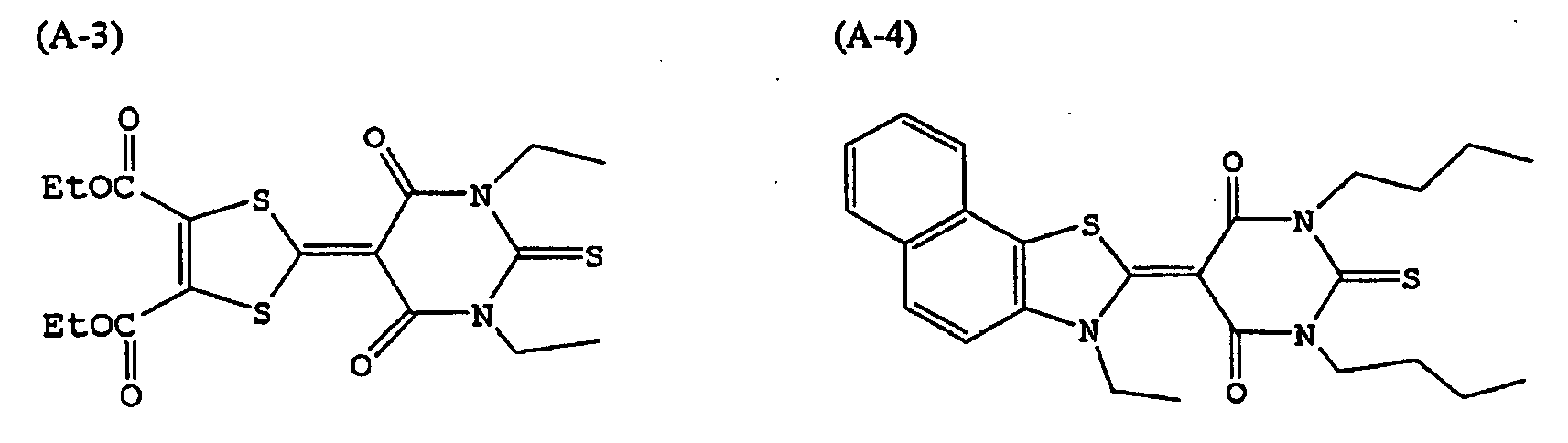


- Preferred examples of the compound represented by formula (XV) include the followings:


- Preferred examples of the compound represented by formula (XVI) include the followings:


- Preferred examples of the compound represented by formula (XVII) include the followings:


- Preferred examples of the compound represented by formula (XVIII) include the followings:


- In the case of using the composition of the present invention for a lithographic printing plate precursor, the above-described sensitizing dye can be subjected to various chemical modifications so as to improve the properties of the photosensitive layer. For example, when the sensitizing dye is bonded to an addition-polymerizable compound structure (e.g., acryloyl group, methacryloyl group) by a method such as covalent bonding, ion bonding and hydrogen bonding, the strength of the exposed film can be increased or unnecessary precipitation of the dye from the exposed film can be prevented.
- Also, in the case of producing a lithographic printing plate precursor by using the photosensitive composition of the present invention, introduction of a hydrophilic moiety (an acid group or a polar group, such as carboxyl group or its ester, sulfonic group or its ester, and ethylene oxide group) is effective for the purpose of enhancing the processing aptitude for an (alkali) aqueous developer, which is a preferred use mode of the photosensitive layer. Particularly, an ester-type hydrophilic group has a characteristic feature that in the photosensitive layer, excellent compatibility is assured by virtue of its relatively hydrophobic structure, whereas in the developer, the hydrophilicity increases because an acid group is produced due to hydrolysis. Other than these, an appropriate substituent may be introduced so as to, for example, improve compatibility and inhibit crystallization in the photosensitive layer. For example, in a certain photosensitive system, an unsaturated bond such as aryl group and allyl group is sometimes very effective in improving the compatibility, or crystallization can be significantly inhibited when steric hindrance between dye π planes is introduced by a method such as introduction of a branched alkyl structure. Also, the adhesion to an inorganic material such as metal or metal oxide can be enhanced by introducing a phosphonic acid group, an epoxy group, a trialkoxysilyl group or the like. In addition, formation of the sensitizing dye into a polymer or the like may also be used according to the purpose.
- Details on use of the sensitizing dye, such as structure, sole or combination use and amount added, can be appropriately selected in accordance with the designed performance of the final photosensitive material. For example, when two or more sensitizing dyes are used in combination, the compatibility in the photosensitive composition layer can be enhanced. In the selection of the sensitizing dye, the molar extinction coefficient at the oscillation wavelength of the light source used is an important factor in addition to the photosensitivity. When a dye having a large molar extinction coefficient is used, the amount of the dye added can be made to be relatively small and this is profitable and also advantageous in view of film properties of the photosensitive layer when the composition is used for a lithographic printing plate precursor. The photosensitivity and resolution of the photosensitive layer and the physical properties of the exposed film are greatly affected by the absorbance at the wavelength of the light source and therefore, the amount of the sensitizing dye added is appropriately selected by taking account of these properties. For example, when the absorbance is in a low region of 0.1 or less, the sensitivity decreases. Also, the resolution lowers by the effect of halation.
- However, for the purpose of curing a thick film of, for example, 5 µm or more, such low absorbance is sometimes rather effective in elevating the curing degree. When the absorbance is in a high region of 3 or more, light is mostly absorbed on the surface of the photosensitive layer, as a result, curing in the inner side does not proceed and in use as a printing plate, the film strength and the adhesion to substrate are not satisfied. In use as a lithographic printing plate where the photosensitive layer has a relatively small thickness, the amount of the sensitizing dye added is preferably set such that the absorbance of the photosensitive layer becomes from 0.1 to 1.5, more preferably from 0.25 to 1. In the case of use as a lithographic printing plate, this is usually from 0.05 to 30 parts by weight, preferably from 0.1 to 20 parts by weight, more preferably from 0.2 to 10 parts by weight, per 100 parts by weight of the photosensitive layer components.
- The third essential component (iii) in the composition of the present invention is a compound which irreversibly changes in its physical or chemical property under the action of the active species produced upon photoreaction of the above-described photoinitiation system, and an arbitrary compound can be used as the component (iii) without limitation as long as it exhibits such a behavior. For example, the compounds described above regarding the initiation system exhibit such a behavior by themselves in many cases. The properties of the component (iii), which are changed under the action of either a radical or an acid produced from the photoinitiation system, include physical properties from the molecular aspect, such as absorption spectrum (color), chemical structure and polarizability, and physical properties from the material aspect, such as solubility, strength, refractive index, fluidity and adhesive property.
- For example, when like a pH indicator, the compound used as the component (iii) undergoes change in the absorption spectrum depending on the pH and an acid or base is generated from the initiation system, color tint only in the exposed area can be changed. Such a composition is useful as an image-forming material. Similarly, when a compound of undergoing change in the absorption spectrum by oxidation-reduction or nucleophilic addition reaction is used as the component (iii), image formation can be effected by inducing oxidation, reduction or the like under the action of a radical produced from the initiation system. Examples of such changes are disclosed in J. Am. Chem. Soc.. 108, 128 (1986), J. Imaging. Sci., 30, 215 (1986), and Israel. J. Chem., 25, 264 (1986).
- Furthermore, when a compound capable of addition polymerization or polycondensation is used as the component (III) and combined with an initiation system, a photocurable resin or negative photopolymer can be formed.
- As for the component (iii), a radical polymerizable compound (for example, a compound having an ethylenically unsaturated bond), a cationic polymerizable compound (for example, an epoxy compound, a vinyl ether compound and a methylol compound) or an anionic polymerizable compound (for example, an epoxy compound) is used. These compounds are described, for example, in Photopolymer Handbook, the Conference of Photopolymer Science and Technology (compiler), Kogyo Chosakai Publishing, Inc. (1989), and Kobunshi (Polymer), 45, 786 (1996). Also, a composition in which a thiol compound is used as the component (iii) and combined with a photoradical generating system is well known.
- It is also effective to use an acid-decomposable compound as the component (iii) and combine it with a photoacid generator. For example, a material which uses a polymer having a side or main chain decomposable under the action of an acid and which undergoes change in the solubility, hydrophilicity/hydrophobicity or the like by the effect of light is broadly used in practice as a photodecomposition-type photosensitive resin or a positive photopolymer. Specific examples thereof include those described in ACS. Symp. Ser., 242, 11 (1984), JP-A-60-3625, U.S. Patents 5,102,771, 5,206,317 and 5,212,047, JP-A-4-26850, JP-A-3-1921731, JP-A-60-10247 and JP-A-62-40450.
- The component (iii) particularly useful for obtaining a high-sensitivity lithographic printing plate which is one of the objects of the present invention is an addition-polymerizable compound having an ethylenically unsaturated double bond, and this compound is described in detail below.
- The addition-polymerizable compound having at least one ethylenically unsaturated double bond, which is a preferred component (iii) for use in the present invention, is selected from compounds having at least one, preferably two or more, terminal ethylenically unsaturated bond(s). These compounds are widely known in this industrial field and can be used in the present invention without any particular limitation. These compounds have a chemical mode such as a monomer, a prepolymer (namely, dimer, trimer or oligomer) or a mixture or copolymer thereof. Examples of the monomer or a copolymer thereof include an unsaturated carboxylic acid (e.g., acrylic acid, methacrylic acid, itaconic acid, crotonic acid, isocrotonic acid, maleic acid), and esters and amides thereof. Among these, esters of an unsaturated carboxylic acid with an aliphatic polyhydric alcohol compound, and amides of an unsaturated carboxylic acid with an aliphatic polyvalent amine compound are preferred. Also, for example, an addition reaction product of an unsaturated carboxylic acid ester or amide having a nucleophilic substituent such as hydroxyl group, amino group or mercapto group with a monofunctional or polyfunctional isocyanate or epoxy, and a dehydrating condensation reaction product with a monofunctional or polyfunctional carboxylic acid, may be suitably used. Furthermore, an addition reaction product of an unsaturated carboxylic acid ester or amide having an electrophilic substituent such as isocyanate group or epoxy group with a monofunctional or polyfunctional alcohol, amine or thiol, and a displacement reaction product of an unsaturated carboxylic acid ester or amide having a disorptive substituent such as halogen group or tosyloxy group with a monofunctional or polyfunctional alcohol, amine or thiol, may also be suitably used. Other than these, compounds resulting from replacing the unsaturated carboxylic acid of the above-described compounds with an unsaturated phosphonic acid, styrene, vinyl ether or the like may also be used.
- Specific examples of the ester monomer of an aliphatic polyhydric alcohol compound with an unsaturated carboxylic acid include the followings. Examples of the acrylic acid ester include ethylene glycol diacrylate, triethylene glycol diacrylate, 1,3-butanediol diacrylate, tetramethylene glycol diacrylate, propylene glycol diacrylate, neopentyl glycol diacrylaxe, trimethylolpropane triacrylate, trimethylolpropane tri(acryloyloxypropyl) ether, trimethylolethane triacrylate, hexanediol diacrylate, 1,4-cyclohexanediol diacrylate, tetraethylene glycol diacrylate, pentaerythritol diacrylate, pentaerythritol triacrylate, pentaerythritol tetraacrylate, dipentaerytbritol diacrylate, dipentaerythritol hexaacrylate, sorbitol triacrylate, sorbitol tetraacrylate, sorbitol pentaacrylate, sorbitol hexaacrylate, tri(acryloyloxy-ethyl)isocyanurate and polyester acrylate oligomer.
- Examples of the methacrylic acid ester include tetramethylene glycol dimethacrylate, triethylene glycol dimethacrylate, neopentyl glycol dimethacrylate, trimethylolpropane trimethacrylate, trimethylolethane trimetbacrylate, ethylene glycol dimethacrylate, 1,3-butanediol dimethacrylate, hexanediol dimethacrylate, pentaerythritol dimethacrylate, pentaerythritol trimethacrylate, pentaerythritol tetramethacrylate, dipentaerythritol dimethacrylate, dipentaerythritol hexamethacrylate, sorbitol trimethacrylate, sorbitol tetramethacrylate, bis[p-(3-methacryloxy-2-hydroxypropoxy)-phenyl]dimethylmethane and bis[p-(methacryloxyethoxy)phenyl]dimethylmethane.
- Examples of the itaconic acid ester include ethylene glycol diitaconate, propylene glycol diitaconate, 1,3-butanediol diitaconate, 1,4-butanediol diitaconate, tetramethylene glycol diitaconate, pentaerythritol diitaconate and sorbitol tetraitaconate.
- Examples of the crotonic acid ester include ethylene glycol dicrotonate, tetramethylene glycol dicrotonate, pentaerythritol dicrotonate and sorbitol tetradicrotonate.
- Examples of the isocrotonic acid ester include ethylene glycol diisocrotonate, pentaerythritol diisocrotonate and sorbitol tetraisocrotonate.
- Examples of the maleic acid ester include ethylene glycol dimaleate, triethylene glycol dimaleate, pentaerythritol dimaleate and sorbitol tetramaleate.
- Other examples of the ester which can be suitably used include aliphatic alcohol-based esters described in JP-B-46-27926, JP-B-51-47334 and JP-A-57-196231, those having an aromatic skeleton described in JP-A-59-5240, JP-A-59-5241 and JP-A-2-226149, and those containing an amino group described in JP-A-1-165613.
- These ester monomers may also be used as a mixture thereof.
- Specific examples of the amide monomer of an aliphatic polyvalent amine compound with an unsaturated carboxylic acid include methylenebisacrylamide, methylenebismethacrylamide, 1,6-hexamethylenebisacrylamide, 1,6-hexamethylenebismethacrylamide, diethylenetriaminetris-acrylamide, xylylenebisacrylamide and xylylenebismethacrylamide.
- Other preferred examples of the amide-based monomer include those having a cyclohexylene structure described in JP-B-54-21726.
- A urethane-based addition-polymerizable compound produced by using an addition reaction of an isocyanate with a hydroxyl group is also preferred, and specific examples thereof include vinyl urethane compounds having two or more polymerizable vinyl groups within one molecule described in JP-B-48-41708, which are obtained by adding a vinyl monomer containing a hydroxyl group represented by the following formula (III) to a polyisocyanate compound having two or more isocyanate groups within one molecule.
CH2=C(R)COOCH2CH(R')OH (III)
(wherein R and R' each represents H or CH3). - In addition, urethane acrylates described in JP-A-51-37193, JP-B-2-32293 and JP-B-2-16765, and urethane compounds having an ethylene oxide-type skeleton described in JP-B-58-49860, JP-B-56-17654, JP-B-62-39417 and JP-B-62-39418 are also suitably used.
- Furthermore, when an addition-polymerizable compound having an amino or sulfide structure within the molecule described in JP-A-63-277653, JP-A-63-260909 and JP-A-1-105238 is used, a photopolymerizable composition having remarkably excellent photosensitization speed can be obtained.
- Other examples include polyfunctional acrylates and methacrylates such as polyester acrylates described in JP-A-48-64183, JP-B-49-43191 and JP-B-52-30490 and epoxy acrylates obtained by reacting an epoxy resin with a (meth)acrylic acid. Also, specific unsaturated compounds described in JP-B-46-43946, JP-B-1-40337 and JP-B-1-40336, and vinyl phosphonic acid-based compounds described in JP-A-2-25493 may be used. In some cases, a structure containing a perfluoroalkyl group described in JP-A-61-22048 is suitably used. Furthermore, those described as a photocurable monomer or oligomer in Adhesion, Vol. 20, No. 7, pp. 300-308 (1984) may also be used.
- Details on use of the addition-polymerizable compound, such as structure, sole or combination use and amount added, can be freely selected according to the performance designed for the final photosensitive material. For example, these are selected from the following aspects. In view of photosensitization speed, a structure having a larger unsaturated group content per molecule is preferred and in most cases, a bifunctional or greater polyfunctional compound is preferred. For increasing the strength of image area, namely, cured film, a trifunctional or greater polyfunctional compound is preferred. Also, a method of controlling both photosensitivity and strength by using a combination of compounds differing in the functional number or in the polymerizable group (for example, an acrylic acid ester, a methacrylic acid ester, a styrene-based compound and a vinyl ether-based compound) is effective. A compound having a large molecular weight or a compound having high hydrophobicity is sometimes not preferred in view of development speed or precipitation in the developer, despite excellent photosensitization speed or film strength. The selection and use method of the addition-polymerizable compound are important factors also for compatibility and dispersibility with other components (e.g., binder polymer, initiator, colorant) in the photosensitive layer. For example, the compatibility may be improved in some cases by using a low purity compound or using two or more compounds in combination. Also, a specific structure may be selected for the purpose of improving the adhesion to the support, overcoat layer or the like. With respect to the blending ratio of the addition-polymerizable compound in the photosensitive layer, a larger ratio is advantageous in terms of sensitivity, but if excessively large, undesired phase separation may occur or there may arise a problem in view of production process due to tackiness of the photosensitive layer (for example, production failure ascribable to transfer or sticking of photosensitive material component), or a problem such as precipitation from the developer. From these standpoints, in many cases, the blending ratio of the addition-polymerizable compound is preferably from 5 to 80 weight%, more preferably from 25 to 75 weight%, based on all components in the composition. The addition-polymerizable compounds may be used individually or in combination of two or more thereof. Other than these, as for the use method of the addition-polymerizable compound, an appropriate structure, formulation or amount added can be freely selected by taking account of the degree of polymerization inhibition due to oxygen, resolution, fogging, change in refractive index, surface tackiness and the like. Depending on the case, a layer structure-coating method such as undercoat and overcoat can also be employed.
- In the application to a lithographic printing plate which is a preferred embodiment of the present invention, the photosensitive composition preferably further contains a binder polymer. A linear organic high molecular polymer is preferred as the binder. This "linear organic high molecular polymer" may be any polymer. A water- or alkalescent water-soluble or swellable linear organic high molecular polymer enabling water development or alkalescent water development is preferably selected. The linear organic high molecular polymer is selected and used according to usage not only as a film-forming agent of the composition but also as a developer with the water, alkalescent water or organic solvent. For example, when a water-soluble organic high molecular polymer is used, water development can be performed. Examples of this linear organic high molecular polymer includes addition polymers having a carboxylic acid group in the side chain such as methacrylic acid copolymer, acrylic acid copolymer, itaconic acid copolymer, crotonic acid copolymer, maleic acid copolymer and partially esterified maleic acid copolymer described in JP-A-59-44615, JP-B-54-34327, JP-B-58-12577, JP-B-54-25957, JP-A-54-92723, JP-A-59-53836 and JP-A-59-71048. Furthermore, acidic cellulose derivatives similarly having a carboxylic acid group in the side chain may be used. In addition, those obtained by adding a cyclic acid anhydride to an addition polymer having a hydroxyl group are also useful.
- Among these, a copolymer of [benzyl (meth)acrylate/ (meth)acrylic acid/other addition polymerizable vinyl monomer, if desired] and a copolymer of [allyl (meth)acrylatel(meth)acrylic acid/other addition polymerizable vinyl monomer, if desired] are particularly preferred because of excellent balance in the film strength, sensitivity and developability.
- Furthermore, urethane-based binder polymer containing an acid group described in JP-B-7-12004, JP-B-7-120041, JP-B-7-120042, JP-B-8-12424, JP-A-63-287944, JP-A-63-287947, JP-A-1-271741 and Japanese Patent Application No. 10-116232 have very excellent strength and these are advantageous in view of press life and low exposure aptitude.
- Also, the binder having an amide group described in JP-A-11-171907 is preferred because of good developability and excellent film strength.
- Other than these, polyvinylpyrrolidone, polyethylene oxide and the like are useful as the water-soluble linear organic polymer. In order to increase the strength of the cured film, for example, an alcohol-soluble nylon and a polyether of 2,2-bis(4-hydroxyphenyl)propane with epichlorohydrin are also useful. Such a linear organic high molecular polymer can be mixed in an arbitrary amount in the entire composition. However, if the amount exceeds 90 weight%, an undesirable effect results in view of strength or the like of the image formed. The amount is preferably from 30 to 85 weight%. Also, the ratio of the photopolymerizable compound having an ethylenically unsaturated double bond to the linear organic high molecular polymer is preferably from 1/9 to 7/3 (by weight). In a preferred embodiment, the binder polymer is substantially insoluble in water and soluble in alkali. By using such a binder, use of an organic solvent which is preferably not used in the developer from the environmental concern can be avoided or limited to a very small amount. In such a case, the acid value (acid content per 1 g of polymer, expressed by the chemical equivalent number) and molecular weight of the binder polymer are appropriately selected by taking account of the image strength and the developability. The binder polymer preferably has an acid value of 0.4 to 3.0 meq/g and a molecular weight of 3,000 to 500,000 in terms of the weight average molecular weight, more preferably an acid value of 0.6 to 2.0 meq/g and a molecular weight of 10,000 to 300,000.
- The photosensitive composition of the present invention may further appropriately contain other components suitable for use, production method and the like. Preferred additives are described below.
- The sensitivity can be further improved by using a certain kind of additive (hereinafter referred to as a "co-sensitizer"). The operation mechanism thereof is not clearly known but is considered to mostly rely on the following chemical process. That is, the co-sensitizer reacts with various intermediate active species (e.g., radical, peroxide, oxidant, reductant) generated in the process of photoreaction initiated by the light absorption of the above-described initiation system and subsequent addition polymerization reaction, to produce a new active radical. Such compounds are roughly classified into (a) a compound which is reduced to produce an active radical, (b) a compound which is oxidized to produce an active radical and (c) a compound which react with a radical having low activity to convert it into a more highly active radical or act as a chain transfer agent. However, in many cases, a common view is not present about which compound belongs to which type.
- An active radical is considered to be generated by the reductive cleavage of carbon-halogen bond. Specific examples of the compound which can be suitably used include trihalomethyl-s-triazines and trihalomethyloxadiazoles.
- An active radical is considered to be generated by the reductive cleavage of nitrogen-nitrogen bond. Specific examples of the compound which can be suitably used include hexaarylbiimidazoles.
- An active radical is considered to be generated by the reductive cleavage of oxygen-oxygen bond. Specific examples of the compound which can be suitably used include organic peroxides.
- An active radical is considered to be generated by the reductive cleavage of carbon-hetero bond or oxygen-nitrogen bond. Specific examples of the compound which can be suitably used include diaryliodonium salts, triarylsulfonium salts and N-alkoxypyridinium (azinium) salts.
- An active radical can be reductively produced.
- An active radical is considered to be generated by the oxidative cleavage of carbon-hetero bond. Specific examples of the compound which can be suitably used include triaryl alkylborates.
- An active radical is considered to be generated by the oxidative cleavage of C-3C bond on the carbon adjacent to nitrogen, where X is preferably a hydrogen atom, a carboxyl group, a trimethylsilyl group or a benzyl group. Specific examples of the compound include ethanolamines, N-phenylglycines and N-trimethylsilyhnethylanilines.
- This is a compound in which the nitrogen atom of the above-described amines is replaced by a sulfur atom or a tin atom. An active radical is produced by the same action. Also, a compound having an S-S bond is known to effect sensitization by the cleavage of S-S.
- An active radical is produced by the oxidative cleavage of carbonyl-α carbon bond. The compound in which the carbonyl is converted into an oxime ether also shows the similar action. Specific examples of the compound include 2-alkyl-1-[4-(alkylthio)phenyl]-2-morpholinopronone-1 and oxime ethers thereof obtained by the reaction with a hydroxyamine and subsequent etherification ofN-OH.
- An active radical is reductively produced. Specific examples of the compound include sodium arylsulfinate.
- For example, compounds having SH, PH, SiH or GeH within the molecule can be used. These compounds donate hydrogen to a low activity radical species to produce a radical or are oxidized and deprotonized to produce a radical. Specific examples of the compound include 2-mercaptobenzimidazoles.
- A large number of examples of the co-sensitizer are more specifically described, for example, in JP-A-9-236913 as an additive for improving sensitivity. Some of these are set forth below, but the present invention is not limited thereto. In the following compounds, -TMS is a trimethylsilyl group.


- Similarly to the above-described sensitizing dye, the co-sensitizer can be subjected to various chemical modifications so as to improve the properties of the photosensitive layer. For example, methods such as binding to the sensitizing dye, activator, addition-polymerizable unsaturated compound or other parts, introduction of a hydrophilic moiety, introduction of a substituent for improving compatibility, inhibiting crystallization or improving adhesion, and formation of a polymer, may be used.
- These co-sensitizers can be used individually or in combination of two or more thereof. The amount of the co-sensitizer used is from 0.05 to 100 parts by weight, preferably from 1 to 80 parts by weight, more preferably from 3 to 50 parts by weight, per 100 parts by weight of the compound having an ethylenically unsaturated double bond.
- In the present invention, a small amount of a thermal polymerization inhibitor is preferably added in addition to the above-described basic components, so as to prevent the polymerizable compound having an ethylenically unsaturated double bond from undergoing undesirable thermal polymerization during the production or storage of the photosensitive composition. Examples of suitable thermal polymerization inhibitors include hydroquinone, p-methoxyphenol, di-tert-butyl-p-cresol, pyrogallol, tert-butylcatechol, benzoquinone, 4,4'-thiobis(3-methyl-6-tert-butylphenol), 2,2'-methylenebis(4-methyl-6 tert-butylphenol) and N-nitrosophenylhydroxyamine cerium(III) salt. The amount of the thermal polymerization inhibitor added is preferably from about 0.01 to about 5 weight%, based on the weight of the entire composition. If desired, in order to prevent polymerization inhibition by oxygen, a higher fatty acid derivative such as behenic acid or behenic acid amide may be added and allowed to localize on the photosensitive layer surface during drying after the coating. The amount of the higher fatty acid derivative added is preferably from about 0.5 to about 10 weight% based on the entire composition.
- Furthermore, a dye or a pigment may be added for the purpose of coloring the photosensitive layer. By such coloring, so-called plate inspection such as visibility of the printing plate after the plate-making or suitability for an image density meter can be improved. Since many dyes cause reduction in the sensitivity of photopolymerization-system photosensitive layer, a pigment is preferably used as the coloring agent. Specific examples include, pigments such as phthalocyanine-based pigment, azo-based pigment, carbon black and titanium oxide, and dyes such as Ethyl Violet, Crystal Violet, azo-based dye, anthraquinone-based dye and cyanine-based dye. The amount of the dye or pigment added is preferably from about 0.5 to about 5 weight% based on the entire composition.
- Other known additives may be further added, such as inorganic filler and plasticizer for improving the physical properties of the cured film, and oil-sensitizer capable of improving the inking property on the photosensitive layer surface.
- Examples of the plasticizer include dioctyl phthalate, didodecyl phthalate, triethylene glycol dicaprylate, dimethyl glycol phthalate, tricresyl phosphate, dioctyl adipate, dibutyl sebacate and triacetylglycerol. In the case of using a binder, the plasticizer can be added in an amount of 10 weight% or less based on the total weight of the compound having an ethylenically unsaturated double bond and the binder.
- Also, a UV initiator, a heat crosslinking agent and the like may be added for elevating the effect of heating and exposure after the development and thereby improving the film strength (press life) which will be described later.
- In addition, for improving the adhesion between the photosensitive layer and a support or elevating the developing and removing property of unexposed photo-sensitive layer, an additive may be added or an interlayer may be provided. For example, a compound showing a relatively strong interaction with the substrate, such as compound having a diazonium structure or phosphone compound may be added or undercoated, whereby the adhesive property and the press life can be enhanced. Also, by the addition or undercoating of a hydroplulic polymer such as polyacrylic acid or polysulfonic acid, the developability of non-image area is improved and resistance to staining can be improved.
- In the case of coating the photopolymerizable composition of the present invention on a support, the composition is used after dissolving it in various organic solvents. Examples of the solvent used here include acetone, methyl ethyl ketone, cyclohexane, ethyl acetate, ethylene dichloride, tetrahydrofuran, toluene, ethylene glycol monomethyl ether, ethylene glycol monoethyl ether, ethylene glycol dimethyl ether, propylene glycol monomethyl ether, propylene glycol monoethyl ether, acetylacetone, cyclohexanone, diacetone alcohol, ethylene glycol monomethyl ether acetate, ethylene glycol ethyl ether acetate, ethylene glycol monoisopropyl ether, ethylene glycol monobutyl ether acetate, 3-methoxypropanol, methoxymethoxyethanol, diethylene glycol monomethyl ether, diethylene glycol monoethyl ether, diethylene glycol dimethyl ether, diethylene glycol diethyl ether, propylene glycol monomethyl ether acetate, propylene glycol monoethyl ether acetate, 3-methoxypropyl acetate, N,N-dimethylformamide, dimethyl sulfoxide, γ-butyrolactone, methyl lactate and ethyl lactate. These solvents may be used individually or as a mixture. The concentration of solid content in the coating solution is suitably from 2 to 50 weight%.
- The coverage of the photosensitive layer on the support affects mainly the sensitivity and developability of photosensitive layer and the strength and press life of exposed layer and therefore, an appropriate coverage is preferably selected according to the use end. If the coverage is too small, press life is not sufficient, whereas if it is excessively large, the sensitivity decreases, as a result, not only the exposure but also the development processing disadvantageously take a longer time. In the case of a lithographic printing plate for scanning exposure, which is a main object of the present invention, the coverage is suitably, in terms of the weight after drying, from about 0.1 to about 10 g/m2, more preferably from 0.5 to 5 g/m2.
- In order to obtain a lithographic printing plate as a main object of the present invention, the above-described photosensitive layer is preferably provided on a support having a hydrophilic surface. As for the hydrophilic support, conventionally known hydrophilic supports used for lithographic printing plates can be used without any limitation. The support used is preferably a dimensionally stable plate-like material, such as paper, paper laminated with plastic (e.g., polyethylene, polypropylene, polystyrene), metal plate (e.g., aluminum, zinc, copper), plastic film (e.g., cellulose diacetate, cellulose triacetate, cellulose propionate, cellulose butyrate, cellulose acetate butyrate, cellulose nitrate, polyethylene terephthalate, polyethylene, polystyrene, polypropylene, polycarbonate, polyvinyl acetal), and paper or plastic film having laminated or vapor-deposited thereon the above-described metal. If desired, the surface of the support may be subjected to an appropriate known physical or chemical treatment for the purpose of imparting hydrophilicity, improving the strength or the like.
- Among these supports, preferred are paper, polyester film and aluminum plate. In particular, aluminum plate is preferred, because it has good dimensional stability, is relatively inexpensive and can provide a surface having excellent hydrophilicity and strength, if desired, by a surface treatment. Also, a composite sheet comprising a polyethylene terephthalate film having bonded thereon an aluminum sheet described in JP-B-48-18327 is preferred.
- The aluminum plate is preferably a pure aluminum plate or an alloy plate mainly comprising aluminum and containing trace hetero-elements. A plastic film laminated or vapor-deposited with aluminum may also be used. Examples of the hetero-element contained in the aluminum alloy include silicon, iron, manganese, copper, magnesium, chromium, zinc, bismuth, nickel and titanium. The hetero-element content in the alloy is at most 10 weight%. The aluminum particularly preferred in the present invention is pure aluminum, but since perfect pure aluminum is difficult to produce in view of the refining technique, the aluminum may contain trace hetero-elements. The composition of the aluminum plate for use in the present invention is not specified and conventionally known aluminum plates in common use can be appropriately used. The thickness of the aluminum plate for use in the present invention is approximately from 0.1 to 0.6 mm, preferably from 0.15 to 0.4 mm, more preferably from 0.2 to 0.3 mm.
- In the case of a support having a metal surface, particularly an aluminum surface, the support is preferably subjected to a surface treatment such as surface roughening (graining), dipping in an aqueous solution of sodium silicate, potassium fluorozirconate or phosphate, or anodization.
- The surface roughening treatment of the aluminum plate may be performed by various methods such as a method of mechanically roughening the surface, a method of electrochemically dissolving and roughening the surface or a method of selectively dissolving the surface by chemical means. Examples of the mechanical method which can be used include known methods such as ball graining, brush graining, blast graining and buff graining. Examples of the electrochemical surface roughing method include a method of performing the surface roughening in an electrolytic solution such as hydrochloric acid or nitric acid by passing an alternating current or a direct current. A combination of these two kinds of methods disclosed in JP-A-54-63902 may also be used. If desired, in order to remove rolling oil on the surface, a degreasing treatment with a surfactant, an organic solvent, an alkaline aqueous solution or the like is performed in advance of the surface roughening of the aluminum plate.
- An aluminum plate which is surface-roughened and then dipped in an aqueous sodium silicate solution may also be preferably used. An aluminum plate subjected to an anodization treatment and then to a dipping treatment in an aqueous alkali metal silicate solution described in JP-B-47-5125 is suitably used. The anodization treatment is performed by passing a current using the aluminum plate as anode in an aqueous or non-aqueous electrolytic solution of an inorganic acid such as phosphoric acid, chromic acid, sulfuric acid or boric acid, an organic acid such as oxalic acid or sulfamic acid, or a salt thereof. These aqueous or non-aqueous electrolytic solutions may be used individually or in combination of two or more thereof.
- The silicate electrodeposition method described in U.S. Patent 3,658,662 is also effective.
- Furthermore, a surface treatment in which a support subjected to electrolytic graining is combined with the above-described anodization treatment and sodium silicate treatment, disclosed in JP-B-46-27481, JP-A-52-58602 and JP-A-52-30503, is also useful.
- Also, a support subjected to mechanical roughening, chemical etching, electrolytic graining, anodization and sodium silicate treatment in this order, disclosed in JP-A-56-28893, is suitably used.
- A support which is subjected to, after these treatments, undercoating with a water-soluble resin such as polyvinylphosphonic acid, polymer or copolymer having a sulfonic acid group on the side chain, polyacrylic acid, water-soluble metal salt (e.g., zinc borate), yellow dye, amine salt or the like, is also suitably used.
- In addition, a substrate subjected to a sol-gel treatment, where a functional group capable of undergoing an addition reaction by a radical is covalently bonded, disclosed in JP-A-7-154983 may also be suitably used.
- Other preferred examples include those obtained by providing a water-resistant hydrophilic layer as a surface layer on an arbitrary support. Examples of the surface layer include a layer comprising an inorganic pigment and a binder described in U.S. Patent 3,055,295 and JP-A-56-13168, a hydrophilic swelling layer described in JP-A-9-80744 and a sol-gel film comprising titanium oxide, polyvinyl alcohol and silicic acids described in JP-T-8-507727 (the term "JP-T" as used herein means a "published Japanese translation of a PCT patent application").
- The hydrophilization treatment is performed not only to render the support surface hydrophilic but also to prevent a harmful reaction of the photopolymerizable composition provided thereon and at the same time, to improve adhesive property of the photosensitive layer.
- In the case of a lithographic printing plate for scan exposure as a preferred embodiment of the present invention, the exposure is generally performed in air and therefore, a protective layer is preferably provided further on the photopolymerizable composition layer. The protective layer prevents low molecular compounds such as oxygen and basic substance present in air, which inhibit the image forming reaction generated upon exposure in the photosensitive layer, from permeating into the photosensitive layer and enables exposure in air. Accordingly, the properties required of the protective layer are to have low permeability to low molecular weight compounds such as oxygen, not to substantially inhibit the transmission of light used for exposure, to exhibit good adhesion to the photosensitive layer and to be easily removable in the development step after exposure. Various designs have been made on the protective layer and are described in detail, for example, in U.S. Patent 3,458,311 and JP-A-55-49729. The material which can be used for the protective layer is suitably, for example, a water-soluble polymer compound having relatively excellent crystallinity. Specifically, water-soluble polymers such as polyvinyl alcohol, polyvinylpyrrolidone, acidic celluloses, gelatin, gum arabic and polyacrylic acid are known. Among these, when polyvinyl alcohol is used as the main component, most excellent results can be obtained in view of fundamental properties such as oxygen blocking property and removability by development.
- The polyvinyl alcohol used for the protective layer may be partially replaced with an ester, an ether or an acetal as long as it contains an unsubstituted vinyl alcohol unit for giving necessary oxygen blocking property and water solubility. Similarly, a part may have another copolymerization component. Examples of the polyvinyl alcohol include those having a hydrolysis degree of 71 to 100 mol% and a molecular weight of 300 to 2,400 in terms of the weight average molecular weight. Specific examples thereof include PVA-105, PVA-110, PVA-117, PVA-117H, PVA-120, PVA-124, PVA-124H, PVA-CS, PVA-CST, PVA-HC, PVA-203, PVA-204, PVA-205, PVA-210, PVA-217, PVA-220, PVA-224, PVA-217EE, PVA-217E, PVA-220E, PVA-224E, PVA-405, PVA-420, PVA-613 and L-8 produced by Kuraray Co., Ltd.
- The components (selection of PVA, use of additives), coated amount and the like of the protective layer are determined by taking account of the oxygen blocking property, development removability, fogging, adhesive property and scratch resistance. In general, as the hydrolysis degree of PVA used is higher (as the unsubstituted vinyl alcohol unit content in the protective layer is higher) and as the layer thickness is larger, the oxygen blocking property becomes higher, which is advantageous in view of sensitivity. However, if the oxygen blocking property is excessively elevated, there arise problems, for example, an unnecessary polymerization reaction takes place during the production or stock storage, or undesirable fogging or thickening of image lines is caused at the time of image exposure. The adhesion to the image area and scratch resistance are also very important in view of handling of the plate. The method for coating such a protective layer is described in detail, for example, in U.S. Patent 3,458,311 and JP-A-55-49729.
- Other functions may also be imparted to the protective layer. For example, when a coloring agent (e.g., water-soluble dye) ensuring excellent transmission of light at 350 nm to 450 nm used for exposure and being capable of efficiently absorbing light at 500 nm or more is added, the aptitude for safelight can be enhanced without causing decrease in the sensitivity.
- In the case where a photosensitive material using the photosensitive composition of the present invention is used as an image-forming material, an image is usually obtained by performing image exposure and then removing the unexposed area of the photosensitive layer with a developer. Examples of the developer preferred in using such a photosensitive composition for the production of a lithographic printing plate include a developer described in JP-B-57-7427. The developer is suitably an aqueous solution of an inorganic alkali agent such as sodium silicate, potassium silicate, sodium hydroxide, potassium hydroxide, lithium hydroxide, sodium tertiary phosphate, sodium secondary phosphate, ammonium tertiary phosphate, ammonium secondary phosphate, sodium metasilicate, sodium bicarbonate and aqueous ammonia, or an organic alkali agent such as monoethanolamine and diethanolamine. Such an alkali agent is added to give an alkali solution having a concentration of 0.1 to 10 weight%, preferably from 0.5 to 5 weight%.
- If desired, such an alkaline aqueous solution may contain a small amount of a surfactant or an organic solvent such as benzyl alcohol, 2-phenoxyethanol and 2-butoxyethanol. Examples thereof include those described in U.S. Patents 3,375,171 and 3,615,480.
- Furthermore, developers described in JP-A-50-26601, JP-A-58-54341, JP-B-56-39464 and JP-B-56-42860 are also excellent.
- In particular, the developer is preferably the developer described in JP-A-2002-202616, containing a nonionic compound represented by the following formula (IV) and having a pH of 11.5 to 12.8 and an electric conductivity of 3 to 30 mS/cm.

- This developer component is described in detail in JP-A-2002-202616 (paragraphs (0024) to (0067)).
- In the present invention, it is effective to add the nonionic compound represented by formula (IV) in an amount of 0.1 to 15 weight%, preferably from 1.0 to 8.0 weight%, in the developer.
- In the plate-making process of the lithographic printing plate of the present invention, the entire surface may also be heated, if desired, before or during the exposure or between the exposure and the development. This heating is advantageous in that the image formation reaction in the photosensitive layer is accelerated, the sensitivity and press life are enhanced, and the sensitivity is stabilized. Furthermore, for the purpose of improving the image strength and press life, it is also effective to subject the entire surface of the developed image to post-heating or exposure. Usually, the heating before the development is preferably performed under a mild condition of 150°C or less. When the heating temperature is 150°C or less, the problem of fogging in the non-image area does not arise. The heating after the development uses a very severe condition of usually from 200 to 500°C. When the temperature is 200°C or more, a sufficiently high effect of strengthening the image is obtained and when the temperature is 500°C or less, there arises no problem such as deterioration of support or thermal decomposition of image area.
- As for the method of exposing the lithographic printing plate for scan exposure of the present invention, known methods can be used without limitation. The wavelength of light source is preferably from 350 to 450 nm, and specifically, an InGaN-based semiconductor laser is preferred. The exposure mechanism may be any of internal drum system, external drum system and flat bed system. In addition, the photosensitive layer of the present invention can be made soluble in neutral or alkalescent water by using highly water-soluble components, and a lithographic printing plate having such a construction can be processed by a system of loading the plate on a printing press and then performing exposure-development on the press.
- The laser light source of 350 to 450 nm which is available and usable includes the followings.
- The gas laser includes an Ar ion laser (364 nm, 351 nm, from 10 mW to 1 W), a Kr ion laser (356 nm, 351 nm, from 10 mW to 1 W) and a He-Cd laser (441 nm, 325 nm, from 1 to 100 mW); the solid laser includes a combination of Nd:YAG (YVO4) with SHG crystalx2 times (355 nm, from 5 mW to 1 W), and a combination of Cr:LiSAF with SHG crystal (430 nm, 10 mW); the semiconductor laser system includes a KNbO3 ring resonator (430 nm, 30 mW), a combination of a wave guide-type wavelength conversion element with an AlGaAs or InGaAs semiconductor (from 380 to 450 nm, from 5 to 100 mW), a combination of a wave guide-type wavelength conversion element with an AlGaInP or AlGaAs semiconductor (from 300 to 350 nm, from 5 to 100 mW), and AlGaInN (from 350 to 450 nm, from 5 to 30 mW); and the pulse laser includes an N2 laser (337 nm, pulse: from 0.1 to 10 mJ), and XeF (351 nm, pulse: from 10 to 250 mJ).
- Among these light sources, an AlGaInN semiconductor laser (commercially available InGaN system semiconductor laser, from 400 to 410 nm, from 5 to 30 mW) is preferred in view of wavelength properties and cost.
- As for the exposure apparatus using a scan exposure system for lithographic printing plates, the exposure mechanism includes an internal drum system, an external drum system and a flat bed system, and all of the above-described light sources excluding pulse lasers can be used as the light source. In practice, the following exposure devices are particularly preferred in view of relationship between the sensitivity of photosensitive material and the plate-making time:
- a single beam exposure apparatus employing an internal drum system and using one gas or solid laser light source,
- a multi-beam exposure apparatus employing a flat bed system and using a number (10 or more) of semiconductor lasers, and
- a multi-beam exposure apparatus employing an external drum system and using a number (10 or more) of semiconductor lasers.
- In the above-described laser direct drawing-type lithographic printing plate, the following equation (eq 1) is generally established among sensitivity X (J/cm2) of photosensitive material, exposure area S (cm2) of photosensitive material, power q (W) of one laser light source, number n of lasers, and entire exposure time t (s):

- i) In the case of an internal drum (single beam) system, the following equation (eq 2) is generally established among rotation number f (radian/s) of laser, sub-scanning length Lx (cm) of photosensitive material, resolution Z (dot/cm), and entire exposure time t (s):

- ii) In the case of an external drum (multi-beam) system, the following equation (eq 3) is generally established among rotation number F (radian/s) of drum, sub-scanning length Lx (cm) of photosensitive material, resolution Z (dot/cm), entire exposure time t (s), and number (n) of beams:

- iii) In the case of a flat bed (multi-beam) system, the following equation (eq 4) is generally established among rotation number H (radian/s) of polygon mirror, sub-scanning length Lx (cm) of photosensitive material, resolution Z (dot/cm), entire exposure time t (s), and number (n) of beams:

- When the resolution (2,560 dpi) required of the actual printing plate, the plate size (A1/B1, sub-scanning length: 42 inch), the exposure condition of about 20 plates/hour and the photosensitive properties (photosensitive wavelength, sensitivity: about 0.1 mJ/cm2) of the photosensitive composition for use in the present invention are substituted to the above-described equations, it can be understood that a combination of the photosensitive material of the present invention with a semiconductor laser multi-beam exposure system is preferred. Furthermore, when the operability, cost and the like are also taken account of, a combination with a semiconductor laser multi-beam exposure apparatus employing an external drum system is most preferred.
- Other examples of the exposure light source which can be used for the photosensitive composition of the present invention include an ultrahigh-pressure mercury lamp, a high-pressure mercury lamp, a medium-pressure mercury lamp, a low-pressure mercury lamp, a chemical lamp, a carbon arc lamp, a xenon lamp, a metal halide lamp, various visible or ultraviolet laser lamps, a fluorescent lamp, a tungsten lamp and sunlight. The photosensitive composition of the present invention can be widely applied without limitation to those known as uses of photocurable resin, in addition to the lithographic printing plate for scan exposure. For example, when the photosensitive composition of the present invention is applied to a liquid photopolymerizable composition using, if desired, a cationic polymerizable compound in combination, a high-sensitivity material for stereolithography can be obtained. Also, a hologram material may be provided by utilizing the change in the refractive index resulting from photopolymerization. Furthermore, application to various transfer materials (e.g., peelable photosensitive material, toner developable photosensitive material) may be realized by utilizing the change in the surface viscosity resulting from photopolymerization. In addition, the photosensitive composition of the present invention can be applied to photocuring of a microcapsule, production of an electronic material such as photoresist, or photocurable resin materials such as ink, paint and adhesive.
- The present invention is described below by referring to Examples, but the present invention should not be construed as being limited to these Examples.
- First, 20.0 g of N-hydroxyphthalimide was dissolved in 12.4 g of triethylamine and 80 ml of dimethylacetamide (DMAc), and the resulting solution was stirred under ice cooling. Thereto, 12.5 g of acetic anhydride was added dropwise through a dropping funnel over 3 minutes. After stirring at room temperature for 1 hour, the precipitated crystal was filtered, and the filtrate was washed twice with 50 ml of water and then washed once with 50 ml of methanol, as a result, 24.5 g of Compound A shown below could be obtained.

- Compound B (28.5 g) shown below was obtained in the same manner as in Synthesis Example 1 except for using 17.2 g of benzoyl chloride in place of acetic anhydride.

- Compound C (26.3 g) shown below was obtained in the same manner as in Synthesis Example 1 except for using 12.8 g of methacrylic acid chloride in place of acetic anhydride.

- Compound D (38.3 g) shown below was obtained in the same manner as in Synthesis Example 1 except for using 21.5 g of p-methoxybenzoyl chloride in place of acetic anhydride.

- Compound E (30.2 g) shown below was obtained in the same manner as in Synthesis Example 1 except for using 36.9 g of tetrachlorophthalimide in place of N-hydroxyphthalimide.
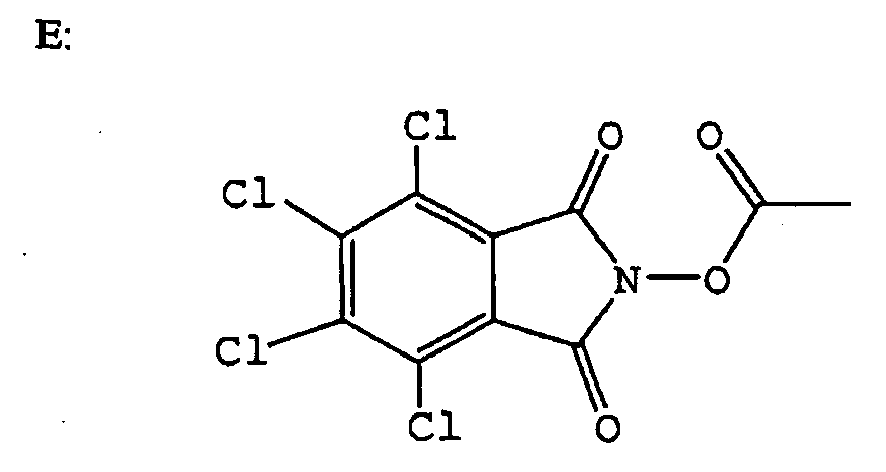
- Compound F (23.2 g) shown below was obtained in the same manner as in Synthesis Example 1 except for using 28.8 g of tetrafluorophthalimide in place of N-hydroxyphthalimide.

- First, 20.0 g of benzohydroxamic acid was dissolved in 14.8 g of triethylamine and 80 ml of DMAc, and the resulting solution was stirred under ice cooling. Thereto, 20.5 g of benzoyl chloride was added dropwise through a dropping funnel over 3 minutes. After stirring at room temperature for 1 hour, the precipitated crystal was filtered, and the filtrate was washed twice with 50 ml of water and then washed once with 50 ml of methanol, as a result, 33.4 g of Compound G shown below could be obtained.

- First, 9.9 g of hydroxylamine hydrochloride, 43.4 g of triethylamine, 30 ml of water and 15 ml of DMAc were stirred under ice cooling and thereto, 50.0 g of 4-chlorobenzoyl chloride was added dropwise through a dropping funnel over 3 minutes. After stirring at room temperature for I hour, the reaction solution was charged into 1,000 ml of water, the precipitated crystal was filtered, and the filtrate was washed twice with 50 ml of water and then washed once with 50 ml of methanol, as a result, 25.4 g of Compound H shown below could be obtained.

- First, 10.0 g of benzohydroxamic acid, 10.9 g of benzoylformic acid and 200 mg of p-toluenesulfonic acid monohydrate were dissolved in 100 ml of toluene, and the resulting solution was stirred for 6 hours under reflux with a Dien-Stark reaction tube while removing water. Subsequently, the reaction solution was distilled under reduced pressure, and the produced crystal was dissolved in acetone and charged in 100 ml of water. Thereafter, the precipitated crystal was filtered, and the filtrate was washed twice with 10 ml of water and then washed once with 10 ml of methanol, as a result, 5.4 g of Compound I shown below could be obtained.

- First, 10.0 g of N-hydroxyphthalimide, 10.5 g of benzyl bromide, 100 mg of KI and 2.5 g of NaOH were dissolved in 70 ml of DMAc and 70 ml of water, and the resulting solution was stirred at 80°C for 6 hours. After cooling the reaction solution to room temperature, the produced crystal was filtered, and the filtrate was washed twice with 30 ml of water and then washed once with 30 ml of methanol, as a result, 10.8 g of Compound J shown below could be obtained.

- First, 10.0 g of N-hydroxyphthalimide, 10.4 g of methyl iodide, 100 mg of KI and 2.5 g of NaOH were dissolved in 50 ml of DMAc and 50 ml of water, and the resulting solution was stirred at 80°C for 6 hours. After cooling the reaction solution to room temperature, the produced crystal was filtered, and the filtrate was washed twice with 30 ml of water and then washed once with 20 ml of methanol, as a result, 2.8 g of Compound K shown below could be obtained.

- N-Oxyamide Compound L having the following structure, produced by Aldrich, was used.

- The surface of a 0.3 mm-thick IS aluminum plate was grained by using a No. 8 nylon brush and a water suspension of 800-mesh pumice stone and then thoroughly washed with water. Subsequently, the aluminum plate was etched by dipping it in 10% sodium hydroxide solution at 70°C for 60 seconds, washed with running water, neutralized and cleaned with 20% HNO3 and then water washed. This plate was subjected to an electrolytic surface roughening treatment in an aqueous 1% nitric acid solution using an alternating current with a sinusoidal waveform at an anodic time electricity of 300 coulomb/dm2 under the condition of VA=12.7 V. The surface roughness was measured and found to be 0.45 µm (Ra indication). Thereafter, the plate was desmutted by dipping it in an aqueous 30% H2SO4 solution at 55°C for 2 minutes and after disposing a cathode on the grained surface in an aqueous 20% H2SO4 solution at 33°C, the plate was anodized at a current density of 5 A/dm2 for 50 seconds, as a result, the thickness of anodic oxide film was 2.7 g/m2. This was designated as Support 1.
- On Support 1 produced above, the following Undercoat Liquid Composition 2 for surface treatment was coated to give an Si coverage of about 0.001 g/m2, and dried at 100°C for 1 minute. This was designated as Support 2.
- The following components were mixed and stirred. After about 5 minutes, the generation of heat was observed. The reaction was allowed to proceed for 60 minutes and then, the content of the reaction vessel was transferred to another vessel. Thereto, 30,000 parts by weight of methanol was further added. The obtained composition was designated as Liquid Composition 2.
Phosmer PE produced by Uni-Chemical Co., Ltd. 20 parts by weight Methanol 130 parts by weight Water 20 parts by weight Paratoluenesulfonic acid 5 parts by weight Tetraethoxysilane 50 parts by, weight 3-Methacryloxypropyltriethoxysilane 50 parts by weight - On Support 1 produced above, a solution obtained by dissolving a methyl methacrylate/ethyl acrylate/sodium 2-acrylamide-2-methylpropanesulfonate copolymer (60/25/15 (by mol), molecular weight Mn: 30,000) in water/methanol (=5 g/95 g) was coated to give a coated amount of 3 mg/m2, and dried at 80°C for 30 seconds. This was designated as Support 3.
- On each of the thus-produced Supports 1 to 3, a photopolymerizable composition having the following composition was coated to give a dry coated weight shown in Table 1, and dried at 95°C to form a photopolymerizable layer.
-
Addition-polymerizable compound (A) shown in Table 1 Binder polymer (B) shown in Table 1 Sensitizer (D) 0.10 parts by weight Initiator (I) 0.05 parts by weight Additive (H) 0.25 parts by weight Fluorine-containing surfactant (Megafac F-177, produced by Dai-Nippon Ink & Chemicals, Inc.) 0.02 parts by weight Thermal polymerization inhibitor (N-nitrosohydroxylamine aluminum salt) 0.03 parts by weight Dispersion of ε-type copper phthalocyanine 0.2 parts by weight Methyl ethyl ketone 16.0 parts by weight Propylene glycol monomethyl ether 16.0 parts by weight N-Oxyamide compound of the present invention 0.10 parts by weight 
- The addition-polymerizable compound (A), binder polymer (B), sensitizer (D), photoinitiator (I) and additive (H) used in the coating solution for the photopolymerizable layer are shown below.


- On the photosensitive layer formed above, an aqueous 3 weight% polyvinyl alcohol (saponification degree: 98 mol%, polymerization degree: 550) solution was coated to give a dry coated weight of 2 g/m2 and dried at 100°C for 2 minutes.
- The lithographic printing plate precursors having Photosensitive Layers 1 to 4, 6 and 7 and Comparative Photosensitive Layer 1 each was subjected to scan exposure of a solid image or a halftone image of 1 to 99% (in steps of 1%) by using a violet LD (Violet-Boxer, manufactured by FFEI) at a wavelength of 405 nm with an exposure amount of 50 µJ/cm2 under the conditions of 4,000 dpi and 175 lines/inch.
- The lithographic printing plate precursor having Photosensitive Layer 5 was subjected to scan exposure of a solid image or a halftone image of 1 to 99% (in steps of 1%) by using an FD-YAG laser (Plate Jet 4, manufactured by CSI Co., 532 nm) with an exposure amount of 100 µJ/cm2 under the conditions of 4,000 dpi and 175 lines/inch.
- A standard processing was performed in an automatic developing machine (LP-850P2, manufactured by Fuji Photo Film Co., Ltd.) where Developer 1 (or 2) and a finishing gum solution FP-2W (produced by Fuji Photo Film Co., Ltd.) were charged. The preheating condition was such that the peak temperature on the plate surface was 100°C. The developer temperature was 30°C, and the dipping time in developer was about 15 seconds.
- Developers 1 and 2 each had the following composition, the pH at 25°C was 11.5 (Developer 1) and 12.3 (Developer 2), and the electric conductivity was 5 mS/cm (Developer 1) and 17 mS/cm (Developer 2).
-
Potassium hydroxide 0.15 g Polyoxyethylene phenyl ether (n=13) 5.0 g Chilest 400 (chelating agent) 0.1 g Water 94.75 g -
1 K-potassium silicate 2.5 g Potassium hydroxide 0.15 g Polyoxyethylene phenyl ether (n=13) 5.0 g Chilest 400 (chelating agent) 0.1 g Water 92.25 g - The sensitivity, storage stability, press life and antiscumming property of each of these lithographic printing plate precursors were evaluated by the following methods. The results are shown together in Tables 2 to 8.
- The printing plates were exposed under respective conditions and immediately developed under the conditions shown in Tables 2 to 8, thereby forming an image. At this time, the area % of 50% halftone dot was measured by a halftone dot area measuring meter (manufactured by Gretag-Macbeth). As the numeral is larger, the sensitivity is higher.
- Using a printing press R201 manufactured by Roland Co. and an ink GEOS-G(N) produced by Dai-Nippon Ink & Chemicals, Inc., the test was performed. The printed matter of solid image area was observed, and the press life was examined by the number of sheets when the image started thinning. As the numeral is larger, the press life is better.
- Using a printing press R201 manufactured by Roland Co. and an ink GEOS-G(N) produced by Dai-Nippon Ink & Chemicals, Inc., the test was performed. At the 5,000th sheet from the initiation of printing, the halftone part was wiped with a printing sponge impregnated with PS Plate Cleaner CL-2 produced by Fuji Photo Film Co., Ltd. to clean the ink on the plate surface. Thereafter, 10,000 sheets were printed and the presence or absence of plate slipping of dots on the printed matter was observed with an eye.
- Using a printing press R201 manufactured by Roland Co. and an ink GEOS-G(S) produced by Dai-Nippon Ink & Chemicals, Inc., the test was performed. The printed matter of non-image area (unexposed area) was observed and the scumming resistance was evaluated.
- The halftone dot area was measured thoroughly in the same manner as in the evaluation of sensitivity except that the lithographic printing plate precursor was used after it was hermetically packaged in an aluminum kraft paper with inserting paper and left standing at 60°C for 4 days. Then the difference between the halftone dot area with standing at 60°C for 4 days and the halftone dot area without standing at 60°C for 4 days was measured, and the dot fluctuation (Δ%) due to enforced aging was determined. As the absolute value of this numeral is smaller, the effect by the enforced aging is smaller, that is, the storage safety is higher.
- The results are shown in Tables 2 to 8.


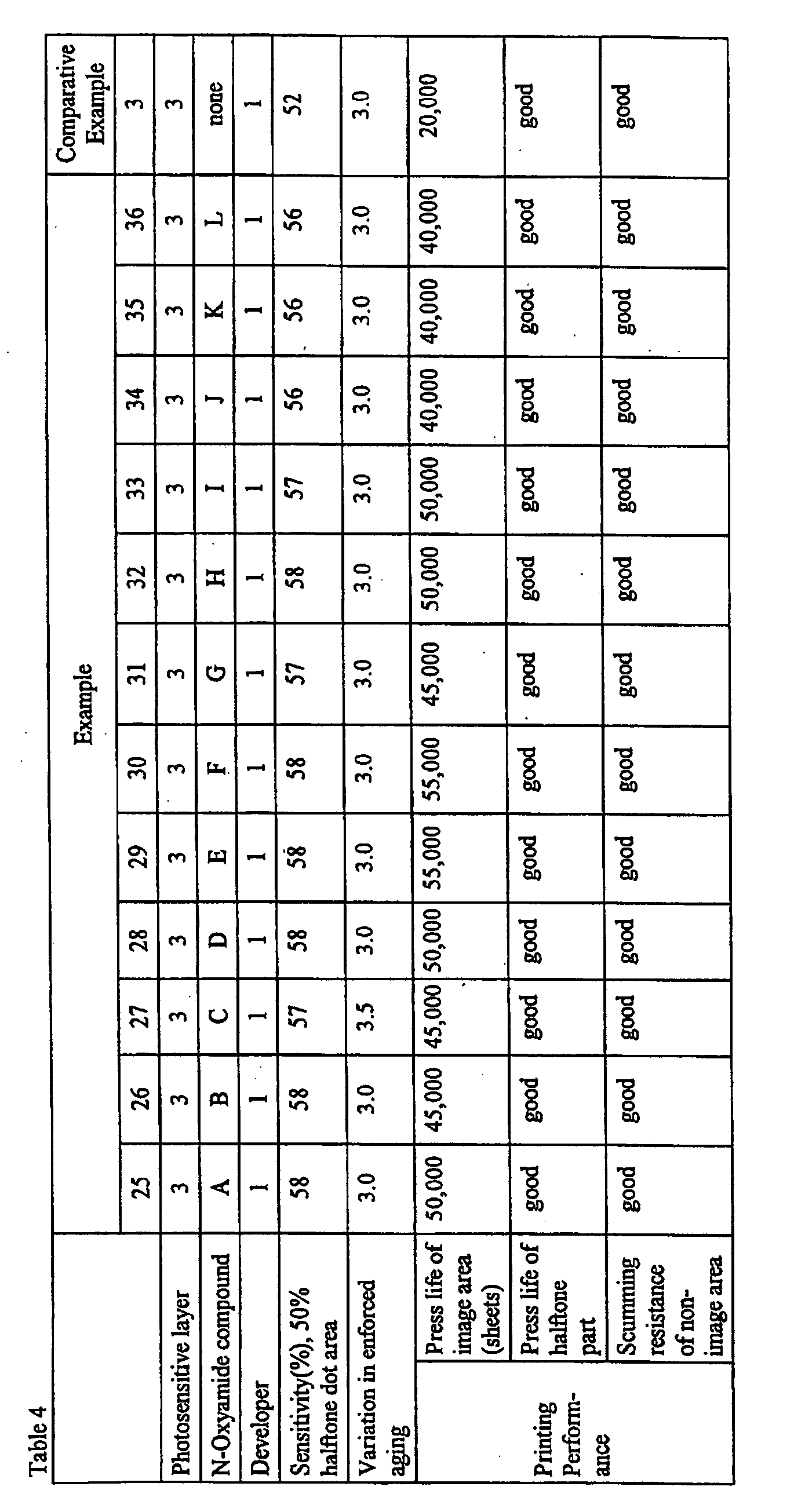


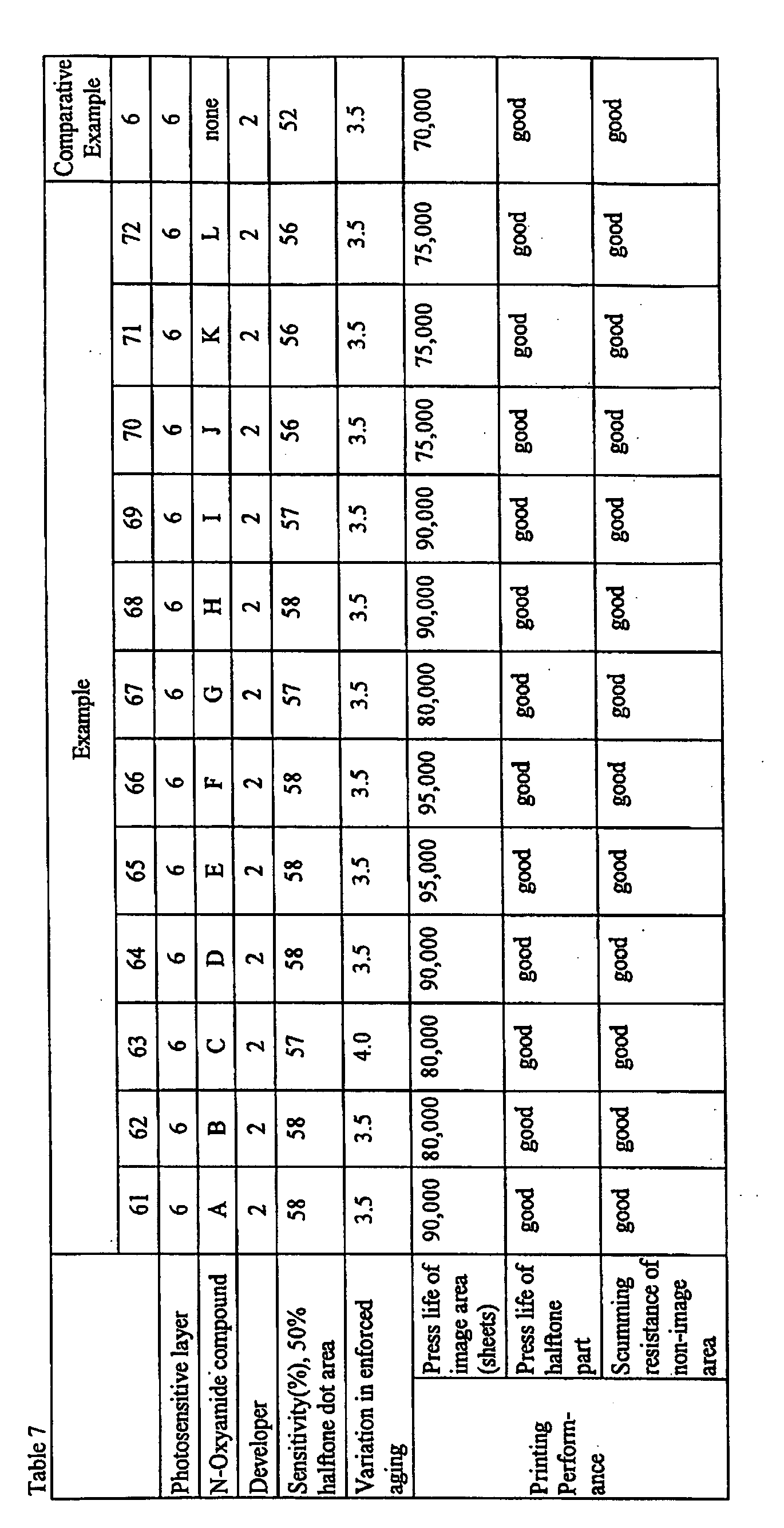

- As apparent from Tables 2 to 8, in lithographic printing plate precursors of Examples where an N-oxyamide compound as a characteristic feature of the present invention was added, both sensitivity and storage stability were assured, and the press life and scumming resistance were also satisfied. On the other hand, in lithographic printing plate precursors of Comparative Examples, a practically usable lithographic printing plate was not obtained.
- This application is based on Japanese Patent application JP 2004-208777, filed July 15, 2004, the entire content of which is hereby incorporated by reference, the same as if set forth at length.
Claims (13)
- A photosensitive composition comprising:at least one photopolymerization initiator;an N-oxyamide compound represented by formula (1); anda compound of undergoing a reaction by an effect of at least one of a radical and an acid to irreversibly change in its physical or chemical property,

- The photosensitive composition according to claim 1, wherein the compound of undergoing a reaction by an effect of at least one of a radical and an acid is a compound having an ethylenically unsaturated double bond.
- The photosensitive composition according to claim 1, wherein the compound represented by the formula (1) is represented by formula (2):

- The photosensitive composition according to claim 1, wherein the compound represented by the formula (1) is represented by formula (3):

- The photosensitive composition according to claim 1, wherein the compound represented by the formula (1) is represented by formula (4) or (5):


- The photosensitive composition according to claim 1, further comprising a compound represented by the following formula:

- The photosensitive composition according to claim 1, further comprising a compound represented by formula (XVIII):

- The photosensitive composition according to claim 1, further comprising a binder polymer.
- The photosensitive composition. according to claim 1, further comprising a polyurethane having 10 weight% or more of an aromatic group.
- The photosensitive composition according to claim 1, further comprising a sensitizing dye having absorption at a wavelength in a region of from 350 to 450 nm.
- A lithographic printing plate precursor comprising a photosensitive layer containing the photosensitive composition according to claim 1.
- The lithographic printing plate precursor according to claim 11, further comprising an overcoat layer.
- The lithographic printing plate precursor according to claim 11, wherein an amount of the N-oxyamide compound contained in the photosensitive layer is from 0.01 to 40 parts by weight, per 100 parts by weight of components of the photosensitive layer.
Applications Claiming Priority (1)
| Application Number | Priority Date | Filing Date | Title |
|---|---|---|---|
| JP2004208777A JP4431453B2 (en) | 2004-07-15 | 2004-07-15 | Photosensitive composition and planographic printing plate precursor |
Publications (1)
| Publication Number | Publication Date |
|---|---|
| EP1617288A1 true EP1617288A1 (en) | 2006-01-18 |
Family
ID=34937864
Family Applications (1)
| Application Number | Title | Priority Date | Filing Date |
|---|---|---|---|
| EP05015446A Withdrawn EP1617288A1 (en) | 2004-07-15 | 2005-07-15 | Photosensitive composition and lithographic printing plate precursor |
Country Status (3)
| Country | Link |
|---|---|
| US (1) | US20060024611A1 (en) |
| EP (1) | EP1617288A1 (en) |
| JP (1) | JP4431453B2 (en) |
Cited By (3)
| Publication number | Priority date | Publication date | Assignee | Title |
|---|---|---|---|---|
| WO2008104436A1 (en) * | 2007-03-01 | 2008-09-04 | Lamberti Spa | Hydroxamic esters as photoinitiators |
| WO2009037130A1 (en) * | 2007-09-17 | 2009-03-26 | Lamberti Spa | Photoinitiators for energy curing |
| TWI695847B (en) * | 2014-08-05 | 2020-06-11 | 日商日產化學工業股份有限公司 | Liquid crystal aligning agent, liquid crystal aligning film and liquid crystal display element |
Families Citing this family (3)
| Publication number | Priority date | Publication date | Assignee | Title |
|---|---|---|---|---|
| JP2008003584A (en) * | 2006-05-25 | 2008-01-10 | Fujifilm Corp | Planographic printing plate precursor and laminate of planographic printing plate precursor |
| JP5110278B2 (en) * | 2007-12-14 | 2012-12-26 | Jsr株式会社 | Radiation-sensitive resin composition, spacer and protective film for liquid crystal display element, and method for forming them |
| JP5109716B2 (en) * | 2008-02-28 | 2012-12-26 | Jsr株式会社 | Radiation-sensitive composition for forming colored layer, color filter, and color liquid crystal display element |
Citations (5)
| Publication number | Priority date | Publication date | Assignee | Title |
|---|---|---|---|---|
| US4371605A (en) * | 1980-12-09 | 1983-02-01 | E. I. Du Pont De Nemours And Company | Photopolymerizable compositions containing N-hydroxyamide and N-hydroxyimide sulfonates |
| US4885224A (en) * | 1986-10-14 | 1989-12-05 | Fuji Photo Film Co., Ltd. | Light-sensitive material containing silver halide, reducing agent, polymerizable compound and a decolorizable dye |
| US5576143A (en) * | 1991-12-03 | 1996-11-19 | Fuji Photo Film Co., Ltd. | Light-sensitive composition |
| EP0795789A1 (en) * | 1996-03-11 | 1997-09-17 | Fuji Photo Film Co., Ltd. | Negative type image recording material |
| EP1099691A1 (en) * | 1999-11-09 | 2001-05-16 | JSR Corporation | N-Sulfonyloxyimide compound and radiation-sensitive resin composition using the same |
Family Cites Families (12)
| Publication number | Priority date | Publication date | Assignee | Title |
|---|---|---|---|---|
| JP2547626B2 (en) * | 1988-10-07 | 1996-10-23 | 富士写真フイルム株式会社 | Method for producing monomer |
| US5141839A (en) * | 1991-03-27 | 1992-08-25 | Eastman Kodak Company | Lithographic printing plates having a radiation-sensitive layer comprising a photocrosslinkable polymer, a leuco dye, a photooxidant and a heteroaromatic amine n-oxide |
| JP2764769B2 (en) * | 1991-06-24 | 1998-06-11 | 富士写真フイルム株式会社 | Photopolymerizable composition |
| US5609992A (en) * | 1994-11-01 | 1997-03-11 | Fuji Photo Film Co., Ltd. | Photopolymerizable composition |
| JP3985359B2 (en) * | 1998-09-18 | 2007-10-03 | 住友化学株式会社 | Resist composition |
| JP4130030B2 (en) * | 1999-03-09 | 2008-08-06 | 富士フイルム株式会社 | Photosensitive composition and 1,3-dihydro-1-oxo-2H-indene derivative compound |
| US6335144B1 (en) * | 1999-04-27 | 2002-01-01 | Fuji Photo Film Co., Ltd. | Photopolymerizable composition for short wavelength semiconductor laser exposure |
| JP2001290275A (en) * | 2000-02-03 | 2001-10-19 | Fuji Photo Film Co Ltd | Positive photoresist composition |
| US6692897B2 (en) * | 2000-07-12 | 2004-02-17 | Fuji Photo Film Co., Ltd. | Positive resist composition |
| JP2003098674A (en) * | 2001-09-21 | 2003-04-04 | Fuji Photo Film Co Ltd | Photopolymerizable planographic printing plate |
| JP2003107697A (en) * | 2001-09-28 | 2003-04-09 | Fuji Photo Film Co Ltd | Photosensitive transfer material, photomask material, photomask and method for manufacturing the photomask |
| JP2004126050A (en) * | 2002-09-30 | 2004-04-22 | Fuji Photo Film Co Ltd | Lithographic printing original plate |
-
2004
- 2004-07-15 JP JP2004208777A patent/JP4431453B2/en not_active Expired - Fee Related
-
2005
- 2005-07-15 EP EP05015446A patent/EP1617288A1/en not_active Withdrawn
- 2005-07-15 US US11/181,857 patent/US20060024611A1/en not_active Abandoned
Patent Citations (5)
| Publication number | Priority date | Publication date | Assignee | Title |
|---|---|---|---|---|
| US4371605A (en) * | 1980-12-09 | 1983-02-01 | E. I. Du Pont De Nemours And Company | Photopolymerizable compositions containing N-hydroxyamide and N-hydroxyimide sulfonates |
| US4885224A (en) * | 1986-10-14 | 1989-12-05 | Fuji Photo Film Co., Ltd. | Light-sensitive material containing silver halide, reducing agent, polymerizable compound and a decolorizable dye |
| US5576143A (en) * | 1991-12-03 | 1996-11-19 | Fuji Photo Film Co., Ltd. | Light-sensitive composition |
| EP0795789A1 (en) * | 1996-03-11 | 1997-09-17 | Fuji Photo Film Co., Ltd. | Negative type image recording material |
| EP1099691A1 (en) * | 1999-11-09 | 2001-05-16 | JSR Corporation | N-Sulfonyloxyimide compound and radiation-sensitive resin composition using the same |
Cited By (5)
| Publication number | Priority date | Publication date | Assignee | Title |
|---|---|---|---|---|
| WO2008104436A1 (en) * | 2007-03-01 | 2008-09-04 | Lamberti Spa | Hydroxamic esters as photoinitiators |
| WO2009037130A1 (en) * | 2007-09-17 | 2009-03-26 | Lamberti Spa | Photoinitiators for energy curing |
| US20100196826A1 (en) * | 2007-09-17 | 2010-08-05 | Stefano Romagnano | Photoinitiators for Energy Curing |
| CN101802022B (en) * | 2007-09-17 | 2013-03-27 | 蓝宝迪有限公司 | Photoinitiators for energy curing |
| TWI695847B (en) * | 2014-08-05 | 2020-06-11 | 日商日產化學工業股份有限公司 | Liquid crystal aligning agent, liquid crystal aligning film and liquid crystal display element |
Also Published As
| Publication number | Publication date |
|---|---|
| JP2006030550A (en) | 2006-02-02 |
| US20060024611A1 (en) | 2006-02-02 |
| JP4431453B2 (en) | 2010-03-17 |
Similar Documents
| Publication | Publication Date | Title |
|---|---|---|
| JP4130030B2 (en) | Photosensitive composition and 1,3-dihydro-1-oxo-2H-indene derivative compound | |
| JP3925888B2 (en) | Photosensitive composition | |
| JP2007093866A (en) | Photosensitive composition and planographic printing plate precursor | |
| EP1471387B1 (en) | Photosensitive composition and compound used thereof | |
| JP4538351B2 (en) | Photosensitive composition | |
| US7169529B2 (en) | Compound, photosensitive composition, lithographic printing plate precursor, and method of forming image | |
| JP2003221517A (en) | Method for producing sensitized dye and photosensitive composition given by using the same | |
| EP0860741A1 (en) | Photopolymerizable composition | |
| JP3894263B2 (en) | Photosensitive composition | |
| JP4174176B2 (en) | Photosensitive composition and planographic printing original plate using the same | |
| US20060024611A1 (en) | Photosensitive composition and lithographic printing plate precursor | |
| JP2004302207A (en) | Photosensitive composition | |
| EP1564590A2 (en) | Photosensitive composition | |
| JP2005043724A (en) | Photopolymerizable planographic printing plate | |
| JP4452575B2 (en) | Photosensitive composition | |
| JP2004295012A (en) | Photosensitive composition | |
| JP4452572B2 (en) | Photosensitive composition and image recording method using the same | |
| EP1744212A2 (en) | Photosensitive composition | |
| JP2002348310A (en) | Photopolymerizable composition | |
| JP4740679B2 (en) | Photosensitive composition | |
| JP2005099256A (en) | Photosensitive composition and image recording material | |
| JP2004309977A (en) | Photosensitive composition and image forming material using the same | |
| JP2005309384A (en) | Photosensitive composition | |
| EP1701213A2 (en) | Photosensitive composition | |
| JP2004295011A (en) | Photosensitive composition |
Legal Events
| Date | Code | Title | Description |
|---|---|---|---|
| PUAI | Public reference made under article 153(3) epc to a published international application that has entered the european phase |
Free format text: ORIGINAL CODE: 0009012 |
|
| AK | Designated contracting states |
Kind code of ref document: A1 Designated state(s): AT BE BG CH CY CZ DE DK EE ES FI FR GB GR HU IE IS IT LI LT LU LV MC NL PL PT RO SE SI SK TR |
|
| AX | Request for extension of the european patent |
Extension state: AL BA HR MK YU |
|
| 17P | Request for examination filed |
Effective date: 20060718 |
|
| AKX | Designation fees paid |
Designated state(s): AT BE BG CH CY CZ DE DK EE ES FI FR GB GR HU IE IS IT LI LT LU LV MC NL PL PT RO SE SI SK TR |
|
| RAP1 | Party data changed (applicant data changed or rights of an application transferred) |
Owner name: FUJIFILM CORPORATION |
|
| 17Q | First examination report despatched |
Effective date: 20110413 |
|
| STAA | Information on the status of an ep patent application or granted ep patent |
Free format text: STATUS: THE APPLICATION IS DEEMED TO BE WITHDRAWN |
|
| 18D | Application deemed to be withdrawn |
Effective date: 20140201 |