EP1617145A2 - Cooling aft end of a combustion liner - Google Patents
Cooling aft end of a combustion liner Download PDFInfo
- Publication number
- EP1617145A2 EP1617145A2 EP05254276A EP05254276A EP1617145A2 EP 1617145 A2 EP1617145 A2 EP 1617145A2 EP 05254276 A EP05254276 A EP 05254276A EP 05254276 A EP05254276 A EP 05254276A EP 1617145 A2 EP1617145 A2 EP 1617145A2
- Authority
- EP
- European Patent Office
- Prior art keywords
- liner
- air
- transition region
- channels
- combustion
- Prior art date
- Legal status (The legal status is an assumption and is not a legal conclusion. Google has not performed a legal analysis and makes no representation as to the accuracy of the status listed.)
- Withdrawn
Links
Images

Classifications
-
- F—MECHANICAL ENGINEERING; LIGHTING; HEATING; WEAPONS; BLASTING
- F23—COMBUSTION APPARATUS; COMBUSTION PROCESSES
- F23R—GENERATING COMBUSTION PRODUCTS OF HIGH PRESSURE OR HIGH VELOCITY, e.g. GAS-TURBINE COMBUSTION CHAMBERS
- F23R3/00—Continuous combustion chambers using liquid or gaseous fuel
- F23R3/002—Wall structures
-
- F—MECHANICAL ENGINEERING; LIGHTING; HEATING; WEAPONS; BLASTING
- F23—COMBUSTION APPARATUS; COMBUSTION PROCESSES
- F23R—GENERATING COMBUSTION PRODUCTS OF HIGH PRESSURE OR HIGH VELOCITY, e.g. GAS-TURBINE COMBUSTION CHAMBERS
- F23R3/00—Continuous combustion chambers using liquid or gaseous fuel
- F23R3/02—Continuous combustion chambers using liquid or gaseous fuel characterised by the air-flow or gas-flow configuration
- F23R3/04—Air inlet arrangements
-
- F—MECHANICAL ENGINEERING; LIGHTING; HEATING; WEAPONS; BLASTING
- F23—COMBUSTION APPARATUS; COMBUSTION PROCESSES
- F23R—GENERATING COMBUSTION PRODUCTS OF HIGH PRESSURE OR HIGH VELOCITY, e.g. GAS-TURBINE COMBUSTION CHAMBERS
- F23R2900/00—Special features of, or arrangements for continuous combustion chambers; Combustion processes therefor
- F23R2900/03042—Film cooled combustion chamber walls or domes
-
- F—MECHANICAL ENGINEERING; LIGHTING; HEATING; WEAPONS; BLASTING
- F23—COMBUSTION APPARATUS; COMBUSTION PROCESSES
- F23R—GENERATING COMBUSTION PRODUCTS OF HIGH PRESSURE OR HIGH VELOCITY, e.g. GAS-TURBINE COMBUSTION CHAMBERS
- F23R2900/00—Special features of, or arrangements for continuous combustion chambers; Combustion processes therefor
- F23R2900/03043—Convection cooled combustion chamber walls with means for guiding the cooling air flow
Definitions
- This invention relates to internal cooling within a gas turbine engine; and more particularly, to apparatus providing better and more uniform cooling in a transition region between a combustion section and discharge section of the turbine.
- the apparatus which comprises a liner of an improved design, minimizes thermal stresses in the region, while increasing the effectiveness of cooling in the region, reduces the amount of cooling air required in this portion of the turbine. This allows more air to be directed the combustion section of the turbine which improves combustion of fuel and reduces emissions (NOx).
- a gas turbine engine has an air inlet section, a fuel combustion section, and an aft discharge section. There is a transition region between the combustion section of the turbine and the discharge section.
- a generally cylindrical liner is installed in this transition region and has openings formed therein through which cooling air is introduced into and flows through the liner to control the temperature in the transition region.
- the hot gas air temperature at the upstream, inlet portion of the liner (the outlet from the combustion section of the turbine), is on the order of 2800-3000°F.
- the target metal temperature is on the order of 1400-1550°F.
- the aft end of the liner is cooled by a plurality of uniform geometry cold side axial channels that flow air, at the turbine's compressor discharge temperature, over the liner's aft end. This produces convective cooling.
- a limitation with this geometry is that the resultant cooling has been found to be non-uniform with a substantial metal temperature gradient between one section of the liner and another. Overcoming this limitation has heretofore required increasing the quantity of cooling air flowed into passages of the liner in order to achieve an adequate level of cooling.
- the resulting increased airflow to and through the liner means that air which could otherwise be directed to the combustion section of the turbine, to aid in the combustion and reduce emissions, particularly NOx emissions, must instead be diverted to the aft end of the turbine to help keep the liner temperature within permissible bounds.
- the present invention is directed to an improved liner construction for enhancing the cooling in the transition region of a turbine engine between its combustion and discharge sections.
- the improvement of the invention comprises a liner having a plurality of airflow or cooling channels whose cross-section varies along the axial length of the liner. That is, the height of the channel decreases along the axial length of the liner from an air inlet to an air outlet of the liner's cooling channel. In one embodiment of the invention, the height of the channel is reduced by as much as approximately 60% from the inlet to the outlet end of each axial channel. Decreasing the height of the airflow channel in this way varies the cooling effect of air flowing through the channel in such a way as to result in more uniform metal temperatures. Importantly, this reduces thermal stresses, particularly at the aft, air outlet end of the liner.
- Optimizing the cooling of the aft end of the liner has significant advantages over current liner constructions.
- a particular advantage is that because of the improvement in cooling with the new liner, less air is required to flow through the liner to achieve desired liner metal temperatures; and, there is a balancing of the local velocity of air in the liner passage with the local temperature of the air.
- This provides a constant cooling heat flux along the length of the liner channel. As a result of this, there are reduced thermal gradients and thermal stresses within the liner.
- the reduced cooling air requirements also help prolong the service life of the liner due to reduced combustion reaction temperatures.
- the reduced airflow requirements allow more air to be directed to the combustion section of the turbine to improve combustion and reduce turbine emissions.
- a turbine engine is indicated generally 10 in Fig. 1.
- Engine 10 has a combustion section 12 where air drawn into the engine is combusted with a fuel.
- the engine further includes a discharge section 14.
- Hot gases from the combustion in section 12 flow from section 12 into section 14.
- the hot gas temperatures at the aft end of section 12, the inlet portion of region 16, is on the order of 2800°-3000°F.
- the liner metal temperature at the downstream, outlet portion of region 16 is preferably on the order of 1400°-1550°F.
- a liner 18 is provided through which cooling air is flowed. The cooling air serves to draw off heat from the liner and thereby significantly lower the liner metal temperature relative to that of the hot gases.
- Liner 18 has an associated compression-type seal 20, commonly referred to as a hula seal, mounted between a cover plate 22 (see Fig. 3) of the liner, and a portion of transition region 16.
- the cover plate is mounted on the liner to form a mounting surface for the compression seal and to form a portion of the axial airflow channels C.
- liner 18 has a plurality of axial channels formed with a plurality of axial raised sections or ribs 24 all of which extend over a portion of aft end of the liner.
- the cover plate 22 and ribs 24 together define the respective airflow channels C. These channels are parallel channels extending over a portion of aft end of liner 18. Cooling air is introduced into the channels through air inlet slots or openings 26 at the forward end of the channel. The air then flows into and through the channels C and exits the liner through openings 28 at an aft end 30 of the liner.
- the design of liner 18 is such as to minimize cooling air flow requirements, while still providing for sufficient heat transfer at aft end 30 of the liner, so to produce a uniform metal temperature along the liner. It will be understood by those skilled in the art that the combustion occurring within section 12 of the turbine results in a hot-side heat transfer coefficient and gas temperatures on an inner surface of liner 18. Outer surface (aft end) cooling of current design liners is now required so metal temperatures and thermal stresses to which the aft end of the liner is subjected remain within acceptable limits. Otherwise, damage to the liner resulting from excessive stress, temperature, or both, significantly shortens the useful life of the liner.
- Liner 18 of the present invention utilizes existing static pressure gradients occurring between the coolant outer side, and hot gas inner side, of the liner to affect cooling at the aft end of the liner. This is achieved by balancing the airflow velocity in liner channels C with the temperature of the air so to produce a constant cooling effect along the length of the channels and the liner.
- a prior art liner indicated generally 100, has a flow metering hole 102 extending across the forward end of the cover plate.
- the cross-section of the channel is constant along the entire length of the channel. This thickness is, for example, 0.045" (0.11cm).
- liner 18 of the present invention has a channel height which is substantially (approximately 45%) greater than the channel height of liner 100 at inlet 26 to the channel.
- this height steadily and uniformly decreases along the length of channel C so that, at the aft end of the channel, the channel height is substantially (approximately 55%) less than exit height of prior art liner 100.
- Liner 18 has, for example, an entrance channel height of 0.065" (0.16cm) and an exit height of, for example, 0.025" (0.06cm), so the height of the channel decreases by slightly more than 60% from the inlet end to the outlet end of the channel.
- Liner 18 therefore has the advantage of producing a more uniform axial thermal gradient, and reduced thermal stresses within the liner. This, in turn, results in an increased useful service life for the liner. As importantly, the requirement for cooling air to flow through the liner is now substantially reduced, and this air can be routed to combustion stage 12 of the turbine to improve combustion and reduce exhaust emissions, particularly NOx emissions.
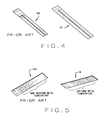
- Fig. 4 is a comparison of the respective backside heat transfer coefficients at the aft end of prior art liner 100 and liner 18 of the present invention based upon the results from the studies.
- Fig. 4 by uniformly reducing the height of channels C in liner 18 along the length of the liner, heat transfer characteristics are now more uniform, although of relatively the same magnitude as with liner 100.
- the reduced plenum feed required by liner 18 provides maximum cold-side coverage, and there are no areas of poor cooling.
- the aft end of liner 18 exhibits a significant reduction in thermal strain when compared with the aft end of liner 100.
- Fig. 5 represents the metal temperatures within prior art liner 100 and liner 18 of the present invention.
- the hot side of each liner is subject to a gas temperature of 2750°F.
- liner 18 exhibits more uniform metal temperatures than liner 100.
- the increase in metal temperature at the aft end of liner 18 is an acceptable performance condition for the typical thermal strains experienced at this end of the liner.
- liner 18 of the present invention in which the height of the liner uniformly tapers along the length of the liner, the level of thermal strain at the liner's aft end is acceptable. Again, this not only helps promote the service life of the liner but also allows a portion of the airflow that previously had to be directed through the liner to now be routed to combustion section 12 of the turbine to improve combustion and reduce emissions.
Landscapes
- Engineering & Computer Science (AREA)
- Chemical & Material Sciences (AREA)
- Combustion & Propulsion (AREA)
- Mechanical Engineering (AREA)
- General Engineering & Computer Science (AREA)
- Turbine Rotor Nozzle Sealing (AREA)
Applications Claiming Priority (1)
| Application Number | Priority Date | Filing Date | Title |
|---|---|---|---|
| US10/891,966 US20060010874A1 (en) | 2004-07-15 | 2004-07-15 | Cooling aft end of a combustion liner |
Publications (1)
| Publication Number | Publication Date |
|---|---|
| EP1617145A2 true EP1617145A2 (en) | 2006-01-18 |
Family
ID=35058824
Family Applications (1)
| Application Number | Title | Priority Date | Filing Date |
|---|---|---|---|
| EP05254276A Withdrawn EP1617145A2 (en) | 2004-07-15 | 2005-07-07 | Cooling aft end of a combustion liner |
Country Status (4)
| Country | Link |
|---|---|
| US (1) | US20060010874A1 (enExample) |
| EP (1) | EP1617145A2 (enExample) |
| JP (1) | JP2006029334A (enExample) |
| CN (1) | CN1721670A (enExample) |
Cited By (3)
| Publication number | Priority date | Publication date | Assignee | Title |
|---|---|---|---|---|
| EP2144003A3 (en) * | 2008-07-10 | 2014-02-12 | United Technologies Corporation | A combustion liner for a gas turbine engine |
| CN111853855A (zh) * | 2020-06-18 | 2020-10-30 | 中国航发湖南动力机械研究所 | 燃气涡轮发动机燃烧室 |
| DE102009026052B4 (de) | 2008-07-07 | 2022-11-17 | General Electric Co. | Kühleinrichtung für das hintere Ende eines Brennkammerübergangstücks und zugehöriges Verfahren |
Families Citing this family (10)
| Publication number | Priority date | Publication date | Assignee | Title |
|---|---|---|---|---|
| JP2008274774A (ja) * | 2007-04-25 | 2008-11-13 | Mitsubishi Heavy Ind Ltd | ガスタービン燃焼器およびガスタービン |
| JP4831835B2 (ja) * | 2007-09-25 | 2011-12-07 | 三菱重工業株式会社 | ガスタービン燃焼器 |
| US20090120093A1 (en) * | 2007-09-28 | 2009-05-14 | General Electric Company | Turbulated aft-end liner assembly and cooling method |
| US8544277B2 (en) * | 2007-09-28 | 2013-10-01 | General Electric Company | Turbulated aft-end liner assembly and cooling method |
| US8673234B2 (en) * | 2008-03-04 | 2014-03-18 | Aerojet Rocketdyne Of De, Inc. | Reactor vessel and liner |
| US8549861B2 (en) * | 2009-01-07 | 2013-10-08 | General Electric Company | Method and apparatus to enhance transition duct cooling in a gas turbine engine |
| US7926283B2 (en) * | 2009-02-26 | 2011-04-19 | General Electric Company | Gas turbine combustion system cooling arrangement |
| JP5281685B2 (ja) * | 2011-10-31 | 2013-09-04 | 三菱重工業株式会社 | ガスタービン燃焼器およびガスタービン |
| US11859818B2 (en) * | 2019-02-25 | 2024-01-02 | General Electric Company | Systems and methods for variable microchannel combustor liner cooling |
| CN113074387B (zh) * | 2021-04-29 | 2022-02-25 | 北京航空航天大学 | 一种带有桁架结构的再生冷却通道 |
Family Cites Families (6)
| Publication number | Priority date | Publication date | Assignee | Title |
|---|---|---|---|---|
| US3572031A (en) * | 1969-07-11 | 1971-03-23 | United Aircraft Corp | Variable area cooling passages for gas turbine burners |
| US3706203A (en) * | 1970-10-30 | 1972-12-19 | United Aircraft Corp | Wall structure for a gas turbine engine |
| US4719748A (en) * | 1985-05-14 | 1988-01-19 | General Electric Company | Impingement cooled transition duct |
| DE4222391C2 (de) * | 1992-07-08 | 1995-04-20 | Gutehoffnungshuette Man | Zylindrisches Brennkammergehäuse einer Gasturbine |
| US5724816A (en) * | 1996-04-10 | 1998-03-10 | General Electric Company | Combustor for a gas turbine with cooling structure |
| US7010921B2 (en) * | 2004-06-01 | 2006-03-14 | General Electric Company | Method and apparatus for cooling combustor liner and transition piece of a gas turbine |
-
2004
- 2004-07-15 US US10/891,966 patent/US20060010874A1/en not_active Abandoned
-
2005
- 2005-07-07 EP EP05254276A patent/EP1617145A2/en not_active Withdrawn
- 2005-07-14 JP JP2005205081A patent/JP2006029334A/ja not_active Withdrawn
- 2005-07-15 CN CNA2005100844379A patent/CN1721670A/zh active Pending
Cited By (3)
| Publication number | Priority date | Publication date | Assignee | Title |
|---|---|---|---|---|
| DE102009026052B4 (de) | 2008-07-07 | 2022-11-17 | General Electric Co. | Kühleinrichtung für das hintere Ende eines Brennkammerübergangstücks und zugehöriges Verfahren |
| EP2144003A3 (en) * | 2008-07-10 | 2014-02-12 | United Technologies Corporation | A combustion liner for a gas turbine engine |
| CN111853855A (zh) * | 2020-06-18 | 2020-10-30 | 中国航发湖南动力机械研究所 | 燃气涡轮发动机燃烧室 |
Also Published As
| Publication number | Publication date |
|---|---|
| US20060010874A1 (en) | 2006-01-19 |
| CN1721670A (zh) | 2006-01-18 |
| JP2006029334A (ja) | 2006-02-02 |
Similar Documents
| Publication | Publication Date | Title |
|---|---|---|
| US7010921B2 (en) | Method and apparatus for cooling combustor liner and transition piece of a gas turbine | |
| EP1617145A2 (en) | Cooling aft end of a combustion liner | |
| EP2211105A2 (en) | Turbulated combustor aft-end liner assembly and related cooling method | |
| US4805397A (en) | Combustion chamber structure for a turbojet engine | |
| JP4162855B2 (ja) | インペラの後部キャビティに冷却されたp3空気を導くタービンエンジン | |
| US8181443B2 (en) | Heat exchanger to cool turbine air cooling flow | |
| EP0284819B1 (en) | Gas turbine combustor transition duct forced convection cooling | |
| US20090120093A1 (en) | Turbulated aft-end liner assembly and cooling method | |
| US20110120135A1 (en) | Turbulated aft-end liner assembly and cooling method | |
| US20130152591A1 (en) | System of integrating baffles for enhanced cooling of cmc liners | |
| US20120269649A1 (en) | Turbine blade with improved trailing edge cooling | |
| US7581385B2 (en) | Metering sheet and iso-grid arrangement for a non axi-symmetric shaped cooling liner within a gas turbine engine exhaust duct | |
| KR20120091217A (ko) | 배기가스 터보차저의 터빈 케이싱 | |
| US20170059162A1 (en) | Internally cooled dilution hole bosses for gas turbine engine combustors | |
| EP2375160A2 (en) | Angled seal cooling system | |
| JP2018141460A (ja) | ファンケーシングおよびオイルクーラ用の取り付けブラケット | |
| US8413449B2 (en) | Gas turbine having an improved cooling architecture | |
| JPH08284688A (ja) | ガスタービンおよびガスタービン燃焼装置 | |
| JP2008309059A (ja) | タービンケーシングの冷却構造 | |
| US7036320B2 (en) | Gas turbine with stator shroud in the cavity beneath the chamber | |
| US20110214431A1 (en) | Turbine guide vane support for a gas turbine and method for operating a gas turbine | |
| US11085327B2 (en) | Mounting portion for an exhaust gas turbocharger, and exhaust gas turbocharger | |
| CN110017178B (zh) | 用于燃气涡轮的热气路径构件 | |
| CN120331906A (zh) | 一种涡轮导向器安装边保温结构 | |
| JPS62111132A (ja) | ガスタ−ビン燃焼器尾筒冷却構造 |
Legal Events
| Date | Code | Title | Description |
|---|---|---|---|
| PUAI | Public reference made under article 153(3) epc to a published international application that has entered the european phase |
Free format text: ORIGINAL CODE: 0009012 |
|
| AK | Designated contracting states |
Kind code of ref document: A2 Designated state(s): AT BE BG CH CY CZ DE DK EE ES FI FR GB GR HU IE IS IT LI LT LU LV MC NL PL PT RO SE SI SK TR |
|
| AX | Request for extension of the european patent |
Extension state: AL BA HR MK YU |
|
| STAA | Information on the status of an ep patent application or granted ep patent |
Free format text: STATUS: THE APPLICATION IS DEEMED TO BE WITHDRAWN |
|
| 18D | Application deemed to be withdrawn |
Effective date: 20100301 |