EP1616872A2 - Purification method for organometallic compounds and organometallic compounds obtained therefrom - Google Patents
Purification method for organometallic compounds and organometallic compounds obtained therefrom Download PDFInfo
- Publication number
- EP1616872A2 EP1616872A2 EP05253799A EP05253799A EP1616872A2 EP 1616872 A2 EP1616872 A2 EP 1616872A2 EP 05253799 A EP05253799 A EP 05253799A EP 05253799 A EP05253799 A EP 05253799A EP 1616872 A2 EP1616872 A2 EP 1616872A2
- Authority
- EP
- European Patent Office
- Prior art keywords
- organometallic compound
- compound
- purification
- trimethylaluminum
- organometallic
- Prior art date
- Legal status (The legal status is an assumption and is not a legal conclusion. Google has not performed a legal analysis and makes no representation as to the accuracy of the status listed.)
- Granted
Links
- 150000002902 organometallic compounds Chemical class 0.000 title claims abstract description 67
- 238000000746 purification Methods 0.000 title claims abstract description 30
- 238000000034 method Methods 0.000 title claims abstract description 26
- 239000012535 impurity Substances 0.000 claims abstract description 22
- 239000011261 inert gas Substances 0.000 claims abstract description 13
- 238000007664 blowing Methods 0.000 claims abstract description 5
- JLTRXTDYQLMHGR-UHFFFAOYSA-N trimethylaluminium Chemical compound C[Al](C)C JLTRXTDYQLMHGR-UHFFFAOYSA-N 0.000 claims description 27
- 150000001875 compounds Chemical class 0.000 claims description 13
- 239000004065 semiconductor Substances 0.000 claims description 12
- 150000003961 organosilicon compounds Chemical class 0.000 claims description 10
- 239000001307 helium Substances 0.000 claims description 8
- 229910052734 helium Inorganic materials 0.000 claims description 8
- SWQJXJOGLNCZEY-UHFFFAOYSA-N helium atom Chemical compound [He] SWQJXJOGLNCZEY-UHFFFAOYSA-N 0.000 claims description 8
- XCZXGTMEAKBVPV-UHFFFAOYSA-N trimethylgallium Chemical compound C[Ga](C)C XCZXGTMEAKBVPV-UHFFFAOYSA-N 0.000 claims description 5
- IBEFSUTVZWZJEL-UHFFFAOYSA-N trimethylindium Chemical compound C[In](C)C IBEFSUTVZWZJEL-UHFFFAOYSA-N 0.000 claims description 5
- XKRFYHLGVUSROY-UHFFFAOYSA-N Argon Chemical compound [Ar] XKRFYHLGVUSROY-UHFFFAOYSA-N 0.000 claims description 4
- IJGRMHOSHXDMSA-UHFFFAOYSA-N Atomic nitrogen Chemical compound N#N IJGRMHOSHXDMSA-UHFFFAOYSA-N 0.000 claims description 4
- 239000000463 material Substances 0.000 claims description 4
- 238000002360 preparation method Methods 0.000 claims description 3
- 229910052786 argon Inorganic materials 0.000 claims description 2
- 238000006243 chemical reaction Methods 0.000 claims description 2
- 239000001257 hydrogen Substances 0.000 claims description 2
- 229910052739 hydrogen Inorganic materials 0.000 claims description 2
- 239000000203 mixture Substances 0.000 claims description 2
- 229910052757 nitrogen Inorganic materials 0.000 claims description 2
- UFHFLCQGNIYNRP-UHFFFAOYSA-N Hydrogen Chemical compound [H][H] UFHFLCQGNIYNRP-UHFFFAOYSA-N 0.000 claims 1
- 229920001296 polysiloxane Polymers 0.000 abstract description 2
- 238000004821 distillation Methods 0.000 description 16
- 238000005259 measurement Methods 0.000 description 6
- 239000002904 solvent Substances 0.000 description 6
- 229910052751 metal Inorganic materials 0.000 description 5
- 239000002184 metal Substances 0.000 description 5
- 239000000126 substance Substances 0.000 description 5
- 230000000052 comparative effect Effects 0.000 description 4
- 150000002430 hydrocarbons Chemical class 0.000 description 4
- 238000004519 manufacturing process Methods 0.000 description 4
- 239000007789 gas Substances 0.000 description 3
- 239000007788 liquid Substances 0.000 description 3
- 238000010992 reflux Methods 0.000 description 3
- JBRZTFJDHDCESZ-UHFFFAOYSA-N AsGa Chemical compound [As]#[Ga] JBRZTFJDHDCESZ-UHFFFAOYSA-N 0.000 description 2
- 239000004215 Carbon black (E152) Substances 0.000 description 2
- 229910001218 Gallium arsenide Inorganic materials 0.000 description 2
- DGAQECJNVWCQMB-PUAWFVPOSA-M Ilexoside XXIX Chemical compound C[C@@H]1CC[C@@]2(CC[C@@]3(C(=CC[C@H]4[C@]3(CC[C@@H]5[C@@]4(CC[C@@H](C5(C)C)OS(=O)(=O)[O-])C)C)[C@@H]2[C@]1(C)O)C)C(=O)O[C@H]6[C@@H]([C@H]([C@@H]([C@H](O6)CO)O)O)O.[Na+] DGAQECJNVWCQMB-PUAWFVPOSA-M 0.000 description 2
- ZLMJMSJWJFRBEC-UHFFFAOYSA-N Potassium Chemical compound [K] ZLMJMSJWJFRBEC-UHFFFAOYSA-N 0.000 description 2
- 239000000654 additive Substances 0.000 description 2
- 230000000996 additive effect Effects 0.000 description 2
- 238000009835 boiling Methods 0.000 description 2
- 125000004432 carbon atom Chemical group C* 0.000 description 2
- DCFKHNIGBAHNSS-UHFFFAOYSA-N chloro(triethyl)silane Chemical compound CC[Si](Cl)(CC)CC DCFKHNIGBAHNSS-UHFFFAOYSA-N 0.000 description 2
- IJOOHPMOJXWVHK-UHFFFAOYSA-N chlorotrimethylsilane Chemical compound C[Si](C)(C)Cl IJOOHPMOJXWVHK-UHFFFAOYSA-N 0.000 description 2
- 238000001816 cooling Methods 0.000 description 2
- BYLOHCRAPOSXLY-UHFFFAOYSA-N dichloro(diethyl)silane Chemical compound CC[Si](Cl)(Cl)CC BYLOHCRAPOSXLY-UHFFFAOYSA-N 0.000 description 2
- 229930195733 hydrocarbon Natural products 0.000 description 2
- 150000002739 metals Chemical class 0.000 description 2
- 229910052700 potassium Inorganic materials 0.000 description 2
- 239000011591 potassium Substances 0.000 description 2
- 229910052710 silicon Inorganic materials 0.000 description 2
- 229910052708 sodium Inorganic materials 0.000 description 2
- 239000011734 sodium Substances 0.000 description 2
- 229910005540 GaP Inorganic materials 0.000 description 1
- GPXJNWSHGFTCBW-UHFFFAOYSA-N Indium phosphide Chemical compound [In]#P GPXJNWSHGFTCBW-UHFFFAOYSA-N 0.000 description 1
- XUIMIQQOPSSXEZ-UHFFFAOYSA-N Silicon Chemical compound [Si] XUIMIQQOPSSXEZ-UHFFFAOYSA-N 0.000 description 1
- USZGMDQWECZTIQ-UHFFFAOYSA-N [Mg](C1C=CC=C1)C1C=CC=C1 Chemical compound [Mg](C1C=CC=C1)C1C=CC=C1 USZGMDQWECZTIQ-UHFFFAOYSA-N 0.000 description 1
- SONNOUIBKXBPIL-UHFFFAOYSA-N [O-2].[Al+3].[Al+3].[Al+3] Chemical compound [O-2].[Al+3].[Al+3].[Al+3] SONNOUIBKXBPIL-UHFFFAOYSA-N 0.000 description 1
- XAGFODPZIPBFFR-UHFFFAOYSA-N aluminium Chemical compound [Al] XAGFODPZIPBFFR-UHFFFAOYSA-N 0.000 description 1
- QVGXLLKOCUKJST-UHFFFAOYSA-N atomic oxygen Chemical compound [O] QVGXLLKOCUKJST-UHFFFAOYSA-N 0.000 description 1
- 230000005587 bubbling Effects 0.000 description 1
- 229910052793 cadmium Inorganic materials 0.000 description 1
- 229910052791 calcium Inorganic materials 0.000 description 1
- PDNUHAXBKKDGAM-UHFFFAOYSA-N chloro-diethyl-methylsilane Chemical compound CC[Si](C)(Cl)CC PDNUHAXBKKDGAM-UHFFFAOYSA-N 0.000 description 1
- AVDUEHWPPXIAEB-UHFFFAOYSA-N chloro-ethyl-dimethylsilane Chemical compound CC[Si](C)(C)Cl AVDUEHWPPXIAEB-UHFFFAOYSA-N 0.000 description 1
- 229910052804 chromium Inorganic materials 0.000 description 1
- 229910052802 copper Inorganic materials 0.000 description 1
- FJWRGPWPIXAPBJ-UHFFFAOYSA-N diethyl(dimethyl)silane Chemical compound CC[Si](C)(C)CC FJWRGPWPIXAPBJ-UHFFFAOYSA-N 0.000 description 1
- HQWPLXHWEZZGKY-UHFFFAOYSA-N diethylzinc Chemical compound CC[Zn]CC HQWPLXHWEZZGKY-UHFFFAOYSA-N 0.000 description 1
- AXAZMDOAUQTMOW-UHFFFAOYSA-N dimethylzinc Chemical compound C[Zn]C AXAZMDOAUQTMOW-UHFFFAOYSA-N 0.000 description 1
- 238000004993 emission spectroscopy Methods 0.000 description 1
- 230000007613 environmental effect Effects 0.000 description 1
- UKAJDOBPPOAZSS-UHFFFAOYSA-N ethyl(trimethyl)silane Chemical compound CC[Si](C)(C)C UKAJDOBPPOAZSS-UHFFFAOYSA-N 0.000 description 1
- 238000000605 extraction Methods 0.000 description 1
- HZXMRANICFIONG-UHFFFAOYSA-N gallium phosphide Chemical compound [Ga]#P HZXMRANICFIONG-UHFFFAOYSA-N 0.000 description 1
- UPWPDUACHOATKO-UHFFFAOYSA-K gallium trichloride Chemical compound Cl[Ga](Cl)Cl UPWPDUACHOATKO-UHFFFAOYSA-K 0.000 description 1
- 125000004435 hydrogen atom Chemical class [H]* 0.000 description 1
- PSCMQHVBLHHWTO-UHFFFAOYSA-K indium(iii) chloride Chemical compound Cl[In](Cl)Cl PSCMQHVBLHHWTO-UHFFFAOYSA-K 0.000 description 1
- 238000009616 inductively coupled plasma Methods 0.000 description 1
- 238000011835 investigation Methods 0.000 description 1
- 229910052742 iron Inorganic materials 0.000 description 1
- 229910052749 magnesium Inorganic materials 0.000 description 1
- 239000011777 magnesium Substances 0.000 description 1
- PPWWEWQTQCZLMW-UHFFFAOYSA-N magnesium 5-methylcyclopenta-1,3-diene Chemical compound [Mg+2].C[C-]1C=CC=C1.C[C-]1C=CC=C1 PPWWEWQTQCZLMW-UHFFFAOYSA-N 0.000 description 1
- 229910052748 manganese Inorganic materials 0.000 description 1
- 239000005055 methyl trichlorosilane Substances 0.000 description 1
- JLUFWMXJHAVVNN-UHFFFAOYSA-N methyltrichlorosilane Chemical compound C[Si](Cl)(Cl)Cl JLUFWMXJHAVVNN-UHFFFAOYSA-N 0.000 description 1
- 230000003287 optical effect Effects 0.000 description 1
- 125000002524 organometallic group Chemical group 0.000 description 1
- 239000001301 oxygen Substances 0.000 description 1
- 229910052760 oxygen Inorganic materials 0.000 description 1
- 239000002994 raw material Substances 0.000 description 1
- 238000011084 recovery Methods 0.000 description 1
- 150000004756 silanes Chemical class 0.000 description 1
- 239000010703 silicon Substances 0.000 description 1
- FDNAPBUWERUEDA-UHFFFAOYSA-N silicon tetrachloride Chemical compound Cl[Si](Cl)(Cl)Cl FDNAPBUWERUEDA-UHFFFAOYSA-N 0.000 description 1
- 238000007711 solidification Methods 0.000 description 1
- 230000008023 solidification Effects 0.000 description 1
- 239000007858 starting material Substances 0.000 description 1
- VCZQFJFZMMALHB-UHFFFAOYSA-N tetraethylsilane Chemical compound CC[Si](CC)(CC)CC VCZQFJFZMMALHB-UHFFFAOYSA-N 0.000 description 1
- CZDYPVPMEAXLPK-UHFFFAOYSA-N tetramethylsilane Chemical compound C[Si](C)(C)C CZDYPVPMEAXLPK-UHFFFAOYSA-N 0.000 description 1
- ZOYFEXPFPVDYIS-UHFFFAOYSA-N trichloro(ethyl)silane Chemical compound CC[Si](Cl)(Cl)Cl ZOYFEXPFPVDYIS-UHFFFAOYSA-N 0.000 description 1
- -1 triethygallium Chemical compound 0.000 description 1
- JCSVHJQZTMYYFL-UHFFFAOYSA-N triethyl(methyl)silane Chemical compound CC[Si](C)(CC)CC JCSVHJQZTMYYFL-UHFFFAOYSA-N 0.000 description 1
- VOITXYVAKOUIBA-UHFFFAOYSA-N triethylaluminium Chemical compound CC[Al](CC)CC VOITXYVAKOUIBA-UHFFFAOYSA-N 0.000 description 1
- 239000005051 trimethylchlorosilane Substances 0.000 description 1
- XLYOFNOQVPJJNP-UHFFFAOYSA-N water Substances O XLYOFNOQVPJJNP-UHFFFAOYSA-N 0.000 description 1
- 229910052725 zinc Inorganic materials 0.000 description 1
Images
Classifications
-
- C—CHEMISTRY; METALLURGY
- C07—ORGANIC CHEMISTRY
- C07F—ACYCLIC, CARBOCYCLIC OR HETEROCYCLIC COMPOUNDS CONTAINING ELEMENTS OTHER THAN CARBON, HYDROGEN, HALOGEN, OXYGEN, NITROGEN, SULFUR, SELENIUM OR TELLURIUM
- C07F5/00—Compounds containing elements of Groups 3 or 13 of the Periodic Table
- C07F5/06—Aluminium compounds
-
- C—CHEMISTRY; METALLURGY
- C07—ORGANIC CHEMISTRY
- C07F—ACYCLIC, CARBOCYCLIC OR HETEROCYCLIC COMPOUNDS CONTAINING ELEMENTS OTHER THAN CARBON, HYDROGEN, HALOGEN, OXYGEN, NITROGEN, SULFUR, SELENIUM OR TELLURIUM
- C07F5/00—Compounds containing elements of Groups 3 or 13 of the Periodic Table
- C07F5/06—Aluminium compounds
- C07F5/061—Aluminium compounds with C-aluminium linkage
- C07F5/062—Al linked exclusively to C
Definitions
- This invention relates to a purification method for organometallic compounds, especially trimethylaluminum. More specifically, this invention is concerned with a method for lowering the concentration of an impurity, especially an organosilicon compound, which is contained in an organometallic compound such as trimethylaluminum effectively used for the production of a compound semiconductor and has a higher vapor pressure than the organometallic compound. This invention is also concerned with a purified organometallic compound obtained by the purification method.
- Compound semiconductor materials such as gallium arsenide, indium phosphide and gallium phosphide are well known materials having uses in electronics industry in such applications as microwave oscillators, semiconductor light-emitting diodes, lasers and infrared detectors.
- the quality of a compound semiconductor available from an epitaxial growth of an organometallic compound is significantly affected by impurities in the organometallic compound as a raw material. Therefor, high purity is required for the organometallic compound to obtain the compound semiconductor material with a high function.
- organometallic compounds used in the production of compound semiconductors include trimethylgallium, trimethylindium, and trimethylaluminum.
- trimethylgallium and trimethylindium are produced from gallium chloride and trimethylaluminum and from indium chloride and trimethylaluminum, respectively, and the purities of trimethylgallium and trimethylindium are considered to depend on the purity of trimethylaluminum as their starting material. It is, accordingly, the most important step in the production of these organometallic compounds to highly purify trimethylaluminum.
- the impurities in an organometallic compound to be purified include hydrocarbon compounds and in addition, organometallic compounds and metallic compounds containing metals different from the metal in the organometallic compound to be purified.
- these impurities those having higher or similar vapor pressures compared with the organometallic compound to be purified may form impurity inclusions in a compound semiconductor to be produced from the purified organometallic compound if they still remain even after the purification, and therefore, are considered to be particularly harmful.
- organosilicon components with Group IV metals contained therein are desired to be removed completely, because they lower electrical properties and optical properties of Group III-V compound semiconductors such as gallium arsenide if they are included in the compound semiconductors.
- the adduct purification processes and the processes involving distillation in contact with metallic sodium or metallic potassium are accompanied by many drawbacks in that, as they require the addition of a solvent and the chemical for the treatment to an organometallic compound to be pured, the purity of the solvent and chemical need to be made very high before their addition, the solvent and chemical have to be treated after use, the solvent and chemical is costly, and the handling of the solvent and chemical is dangerous.
- the purification processes involving cooling and solidification of organometallic compounds also have problems in that applicable organometallic compounds are limited and the removal of impurities is insufficient.
- a method of purifying an organometallic compound comprising distilling the organometallic compound for purification while blowing an inert gas through a vapor of the organometallic compound, thereby removing from the organometallic compound an impurity having a higher vapor pressure than the organometallic compound.
- the organometallic compound is preferably trimethylaluminum.
- the impurity may be an organosilicon compound having a higher vapor pressure than the organosilicon compound.
- the process of the present invention can bring about an industrial advantage that impurities of high vapor pressures in an organometallic compound can be removed easily at high efficiency. Further, an epitaxial growth of the highly-purified organometallic compound can produce a high-quality compound semiconductor.
- the method of purifying an organometallic compound according to the present invention comprises a method of purifying an organometallic compound comprising distilling the organometallic compound for purification while blowing an inert gas through a vapor of the organopolysiloxane, thereby removing from the organometallic compound an impurity having a higher vapor pressure than the organometallic compound.
- organometallic compound which is purified by the process include hydrocarbon-metal e.g.
- alkyl-metal compounds such as trimethylaluminum, trimethylgallium, triethygallium, triethylaluminum, trimethylindium, dimethylzinc, diethylzinc, bis(cyclopentadienyl)magnesium, and bis(methylcyclopentadienyl)magnesium.
- examples of the impurity --which is contained in the organometallic compound, has a high vapor pressure and is to be removed from the organometallic compound-- include organometallic compounds containing Ca, Cd, Cr, Cu, Fe, Mg, Mn, Si or Zn different from the metal in the organometallic compound to be purified, and low boiling point hydrocarbon compounds having 1 to 9 carbon atoms, especially organosilicon and silane compounds such as tetramethylsilane, trimethylchlorosilane, tetrachlorosilane, methyltrichlorosilane, ethyltrimethylsilane, dimethylethylchlorosilane, diethylmethylchlorosilane, dimethyldiethylsilane, ethyltrichlorosilane, triethylmethylsilane, diethyldichlorosilane, triethylchlorosilane, and tetraeth
- organosilicon compounds are included therein as a result of the change of metallic silicon containing in metallic aluminum into the organosilicon compounds through chemical reactions during the production steps of trimethylaluminum, and that these organosilicon components are generally contained in an amount of about 10 to 200 ppm in total in trimethylaluminum before their purification.
- concentration of such organosilicon components can we find be lowered to 1 ppm or less by the present process.
- concentration of the organosilicon components means the concentration of Si in the organosilicon compound as an impurity.
- impurities having low vapor pressures in the organometallic compounds such as metallic compounds, trialuminum oxide, high boiling point hydrocarbon components having 10 or more carbon atoms, and the like can also be removed by distillation.
- an inert gas Upon subjecting the organometallic compound to distillation purification, an inert gas is blown through a vapor of the organometallic compound.
- gases used as inert gases in the present invention include helium, argon, nitrogen, hydrogen, or a mixture thereof.
- the inert gases can be used either singly or in combination. They should be substantially free of oxygen and water, and if necessary may first be treated/purified to remove these.
- the blow rate of the inert gas can be 50% by volume or lower, preferably from 1 to 10% by volume based on the vapor of the organometallic compound.
- a blow rate lower than 1% by volume is not fully effective for the removal of impurities, while a blow rate higher than 50% by volume has a problem that the recovery rate of the organometallic compound may be lowered.
- the inert gas can be introduced at any place where the vapor of the organometallic compound exists, such as a still pot, column, purification tube or condenser.
- the inert gas can be introduced at any one of total reflux, pre-distillation, main distillation and post-distillation, or during the distillation. It is usually sufficient to conduct the distillation purification only once. The distillation purification may, however, be repeated several times as needed.
- Trimethylaluminum was purified in a similar manner as in Example 1 except that the concentration of organosilicon components in trimethylaluminum before the purification was 24.5 ppm and the blow rate of high-purity helium was set at 50 mL/min. As a result of measurement of the concentration of organosilicon components in trimethylaluminum after the purification, the concentration was found to be 0.2 ppm.
- Trimethylaluminum was purified in a similar manner as in Example 2 except that the concentration of organosilicon components in trimethylaluminum before the purification was 25.3 ppm. As a result of measurement of the concentration of organosilicon components in trimethylaluminum after the purification, the concentration was found to be 0.08 ppm.
- Trimethylaluminum was purified in a similar manner as in Example 1 except that high-purity helium was not blown. As a result of measurement of the concentration of organosilicon components in the trimethylaluminum after the purification, the concentration was found to be 9.4 ppm.
- Trimethylaluminum was purified in a similar manner as in Example 2 except that high-purity helium was not blown. As a result of measurement of the concentration of organosilicon components in trimethylaluminum after the purification, the concentration was found to be 0.7 ppm.
- Trimethylaluminum was purified in a similar manner as in Example 3 except that high-purity helium was not blown. As a result of measurement of the concentration of organosilicon components in trimethylaluminum after the purification, the concentration was found to be 0.4 ppm.
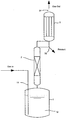
- Fig. 1 shows apparatus as used in the example processes, with vessel 1, distillation column 2 and reflux condenser 3.
- the gas is introduced into the vessel at inlet 11, e.g. bubbling up through the liquid 12 therein, passes through the vapour in the vessel and distillation column, and is vented together with impurities at the gas outlet 31 at the top of the condenser.
- Purified distillate organometallic compound
- Blow rate here is calculable on the total volume in the vessel 1 and column 2. Generally, the blow rate is relative to the volume of vapor, from the liquid, flowing from the distillation vessel.
Landscapes
- Chemical & Material Sciences (AREA)
- Organic Chemistry (AREA)
Abstract
distilling the organometallic compound for purification while blowing an inert gas through a vapor of the organopolysiloxane, thereby removing from the organometallic compound an impurity having a higher vapor pressure than the organometallic compound.
Description
- This invention relates to a purification method for organometallic compounds, especially trimethylaluminum. More specifically, this invention is concerned with a method for lowering the concentration of an impurity, especially an organosilicon compound, which is contained in an organometallic compound such as trimethylaluminum effectively used for the production of a compound semiconductor and has a higher vapor pressure than the organometallic compound. This invention is also concerned with a purified organometallic compound obtained by the purification method.
- Compound semiconductor materials such as gallium arsenide, indium phosphide and gallium phosphide are well known materials having uses in electronics industry in such applications as microwave oscillators, semiconductor light-emitting diodes, lasers and infrared detectors. The quality of a compound semiconductor available from an epitaxial growth of an organometallic compound is significantly affected by impurities in the organometallic compound as a raw material. Therefor, high purity is required for the organometallic compound to obtain the compound semiconductor material with a high function.
- Typical examples of organometallic compounds used in the production of compound semiconductors include trimethylgallium, trimethylindium, and trimethylaluminum. Among these, trimethylgallium and trimethylindium are produced from gallium chloride and trimethylaluminum and from indium chloride and trimethylaluminum, respectively, and the purities of trimethylgallium and trimethylindium are considered to depend on the purity of trimethylaluminum as their starting material. It is, accordingly, the most important step in the production of these organometallic compounds to highly purify trimethylaluminum.
- The impurities in an organometallic compound to be purified include hydrocarbon compounds and in addition, organometallic compounds and metallic compounds containing metals different from the metal in the organometallic compound to be purified. Among these impurities, those having higher or similar vapor pressures compared with the organometallic compound to be purified may form impurity inclusions in a compound semiconductor to be produced from the purified organometallic compound if they still remain even after the purification, and therefore, are considered to be particularly harmful.
- Among impurities having such high vapor pressures, organosilicon components with Group IV metals contained therein are desired to be removed completely, because they lower electrical properties and optical properties of Group III-V compound semiconductors such as gallium arsenide if they are included in the compound semiconductors.
- As processes for removing impurities having high vapor pressures, there have heretofore been reported adduct purification processes (JP-B 5-35154 and JP-A 62-185090), processes involving distillation in contact with metallic sodium or metallic potassium (JP-A 62-132888 and JP-A 8-12678), and processes for purifying liquid organometallic compounds by cooling and solidifying them (JP-A 2003-518007).
- However, the adduct purification processes and the processes involving distillation in contact with metallic sodium or metallic potassium are accompanied by many drawbacks in that, as they require the addition of a solvent and the chemical for the treatment to an organometallic compound to be pured, the purity of the solvent and chemical need to be made very high before their addition, the solvent and chemical have to be treated after use, the solvent and chemical is costly, and the handling of the solvent and chemical is dangerous. The purification processes involving cooling and solidification of organometallic compounds also have problems in that applicable organometallic compounds are limited and the removal of impurities is insufficient.
- It is an object of the present invention, therefore, to provide a purification method for an organometallic compound, which can industrially and easily remove impurities of high vapor pressures at high efficiency from the organometallic compound without practically requiring any additive and also to provide a purified organometallic compound obtained by the method.
- To achieve the above-described objects, the present inventors have proceeded with an extensive investigation. As a result, it has been found that blowing of an inert gas through a vapor of an organometallic compound during distillation purification thereof makes it possible to effectively remove impurities having higher vapor pressures than the organometallic compound and to achieve the above-described objects by an industrially easy process without using any additive, leading to the completion of the present invention.
- In one aspect of the present invention, there is thus provided a method of purifying an organometallic compound comprising distilling the organometallic compound for purification while blowing an inert gas through a vapor of the organometallic compound, thereby removing from the organometallic compound an impurity having a higher vapor pressure than the organometallic compound. The organometallic compound is preferably trimethylaluminum. The impurity may be an organosilicon compound having a higher vapor pressure than the organosilicon compound. In another aspect of the present invention, there is also provided an organometallic compound obtained by the above-described purification method and containing 1 ppm or lower of an organosilicon compound having a higher vapor pressure than the organosilicon compound.
- The process of the present invention can bring about an industrial advantage that impurities of high vapor pressures in an organometallic compound can be removed easily at high efficiency. Further, an epitaxial growth of the highly-purified organometallic compound can produce a high-quality compound semiconductor.
- The method of purifying an organometallic compound according to the present invention comprises a method of purifying an organometallic compound comprising distilling the organometallic compound for purification while blowing an inert gas through a vapor of the organopolysiloxane, thereby removing from the organometallic compound an impurity having a higher vapor pressure than the organometallic compound. Examples of the organometallic compound which is purified by the process include hydrocarbon-metal e.g. alkyl-metal compounds such as trimethylaluminum, trimethylgallium, triethygallium, triethylaluminum, trimethylindium, dimethylzinc, diethylzinc, bis(cyclopentadienyl)magnesium, and bis(methylcyclopentadienyl)magnesium.
- On the other hand, examples of the impurity --which is contained in the organometallic compound, has a high vapor pressure and is to be removed from the organometallic compound-- include organometallic compounds containing Ca, Cd, Cr, Cu, Fe, Mg, Mn, Si or Zn different from the metal in the organometallic compound to be purified, and low boiling point hydrocarbon compounds having 1 to 9 carbon atoms, especially organosilicon and silane compounds such as tetramethylsilane, trimethylchlorosilane, tetrachlorosilane, methyltrichlorosilane, ethyltrimethylsilane, dimethylethylchlorosilane, diethylmethylchlorosilane, dimethyldiethylsilane, ethyltrichlorosilane, triethylmethylsilane, diethyldichlorosilane, triethylchlorosilane, and tetraethylsilane.
- It is to be noted that in the case of trimethylaluminum, for example, such organosilicon compounds are included therein as a result of the change of metallic silicon containing in metallic aluminum into the organosilicon compounds through chemical reactions during the production steps of trimethylaluminum, and that these organosilicon components are generally contained in an amount of about 10 to 200 ppm in total in trimethylaluminum before their purification. The concentration of such organosilicon components can we find be lowered to 1 ppm or less by the present process. It is also to be noted that the term "the concentration of the organosilicon components" means the concentration of Si in the organosilicon compound as an impurity.
- Further, impurities having low vapor pressures in the organometallic compounds such as metallic compounds, trialuminum oxide, high boiling point hydrocarbon components having 10 or more carbon atoms, and the like can also be removed by distillation.
- Upon subjecting the organometallic compound to distillation purification, an inert gas is blown through a vapor of the organometallic compound. Examples of gases used as inert gases in the present invention include helium, argon, nitrogen, hydrogen, or a mixture thereof. The inert gases can be used either singly or in combination. They should be substantially free of oxygen and water, and if necessary may first be treated/purified to remove these.
- The blow rate of the inert gas can be 50% by volume or lower, preferably from 1 to 10% by volume based on the vapor of the organometallic compound. A blow rate lower than 1% by volume is not fully effective for the removal of impurities, while a blow rate higher than 50% by volume has a problem that the recovery rate of the organometallic compound may be lowered.
- The inert gas can be introduced at any place where the vapor of the organometallic compound exists, such as a still pot, column, purification tube or condenser. The inert gas can be introduced at any one of total reflux, pre-distillation, main distillation and post-distillation, or during the distillation. It is usually sufficient to conduct the distillation purification only once. The distillation purification may, however, be repeated several times as needed.
- Downstream use of the products directly or indirectly for preparation of compound semiconductors is a further aspect
- Examples and Comparative Examples of the invention are given below by way of illustration and not by way of limitation. It is to be noted that the concentration of organosilicon components in the organometallic compounds of the following Examples was determined based on the quantitation by inductively-coupled plasma emission spectrometry subsequent to their extraction in a hydrocarbon solvent.
- A 1,000-mL SUS vessel equipped with a reflux condenser and a 40-tray distillation column was fully purged with helium, and then trimethylaluminum (497 g) was charged in the vessel. While introducing high-purity helium at 100 mL/min, distillation purification was conducted at 127°C under environmental pressure to afford a main distillate (347 g). As a result of measurement of the concentration of organosilicon components, it was found that the concentration had been lowered to 0.7 ppm after the purification as opposed to 173 ppm before the purification.
- Trimethylaluminum was purified in a similar manner as in Example 1 except that the concentration of organosilicon components in trimethylaluminum before the purification was 24.5 ppm and the blow rate of high-purity helium was set at 50 mL/min. As a result of measurement of the concentration of organosilicon components in trimethylaluminum after the purification, the concentration was found to be 0.2 ppm.
- Trimethylaluminum was purified in a similar manner as in Example 2 except that the concentration of organosilicon components in trimethylaluminum before the purification was 25.3 ppm. As a result of measurement of the concentration of organosilicon components in trimethylaluminum after the purification, the concentration was found to be 0.08 ppm.
- Trimethylaluminum was purified in a similar manner as in Example 1 except that high-purity helium was not blown. As a result of measurement of the concentration of organosilicon components in the trimethylaluminum after the purification, the concentration was found to be 9.4 ppm.
- Trimethylaluminum was purified in a similar manner as in Example 2 except that high-purity helium was not blown. As a result of measurement of the concentration of organosilicon components in trimethylaluminum after the purification, the concentration was found to be 0.7 ppm.
- Trimethylaluminum was purified in a similar manner as in Example 3 except that high-purity helium was not blown. As a result of measurement of the concentration of organosilicon components in trimethylaluminum after the purification, the concentration was found to be 0.4 ppm.
- Fig. 1 shows apparatus as used in the example processes, with
vessel 1,distillation column 2 andreflux condenser 3. The gas is introduced into the vessel atinlet 11, e.g. bubbling up through the liquid 12 therein, passes through the vapour in the vessel and distillation column, and is vented together with impurities at thegas outlet 31 at the top of the condenser. Purified distillate (organometallic compound) is recoverable at theproduct outlet 32 at the foot of thecondenser 3 in the usual way. Blow rate here is calculable on the total volume in thevessel 1 andcolumn 2. Generally, the blow rate is relative to the volume of vapor, from the liquid, flowing from the distillation vessel.
Claims (7)
- A method of preparing or purifying an organometallic compound comprising
distilling the organometallic compound for purification while blowing an inert gas through a vapor of the organometallic compound, thereby removing from the organometallic compound an impurity having a higher vapor pressure than the organometallic compound. - The method of claim 1, wherein the organometallic compound is trimethylaluminum.
- The method of claim 1, wherein the impurity is an organosilicon compound having a higher vapor pressure than the organometallic compound.
- The method of claim 1, wherein the inert gas is helium, argon, nitrogen, hydrogen or a mixture thereof.
- The method of claim 1, wherein the blow rate of the inert gas is 50% by volume or lower based on the vapor of the organometallic compound.
- An organometallic compound obtained by the purification method of claim 1 and containing 1 ppm or lower of organosilicon compound having a higher vapor pressure than the organometallic compound.
- Preparation of an organometallic compound such as trimethylaluminium according to any one of claims 1 to 5, optionally followed by conversion to a related organometallic compound such as trimethylgallium or trimethylindium, followed by use in the preparation of a compound semiconductor material.
Applications Claiming Priority (1)
| Application Number | Priority Date | Filing Date | Title |
|---|---|---|---|
| JP2004180971A JP4488186B2 (en) | 2004-06-18 | 2004-06-18 | Method for purifying trimethylaluminum |
Publications (3)
| Publication Number | Publication Date |
|---|---|
| EP1616872A2 true EP1616872A2 (en) | 2006-01-18 |
| EP1616872A3 EP1616872A3 (en) | 2006-01-25 |
| EP1616872B1 EP1616872B1 (en) | 2010-06-09 |
Family
ID=35241161
Family Applications (1)
| Application Number | Title | Priority Date | Filing Date |
|---|---|---|---|
| EP05253799A Expired - Lifetime EP1616872B1 (en) | 2004-06-18 | 2005-06-20 | Purification method for organometallic compounds |
Country Status (7)
| Country | Link |
|---|---|
| US (1) | US7112691B2 (en) |
| EP (1) | EP1616872B1 (en) |
| JP (1) | JP4488186B2 (en) |
| KR (1) | KR100861207B1 (en) |
| CN (1) | CN1769289B (en) |
| DE (1) | DE602005021726D1 (en) |
| TW (1) | TW200602349A (en) |
Cited By (1)
| Publication number | Priority date | Publication date | Assignee | Title |
|---|---|---|---|---|
| GB2420118A (en) * | 2004-10-13 | 2006-05-17 | Sumitomo Chemical Co | A trimethylgallium and a method for producing the same |
Families Citing this family (5)
| Publication number | Priority date | Publication date | Assignee | Title |
|---|---|---|---|---|
| US7659414B2 (en) * | 2007-07-20 | 2010-02-09 | Rohm And Haas Company | Method of preparing organometallic compounds |
| EP2545973B1 (en) | 2011-07-13 | 2020-03-04 | Dow Global Technologies LLC | Organometallic compound purification by stripping step |
| EP2545972A1 (en) | 2011-07-13 | 2013-01-16 | Dow Global Technologies LLC | Organometallic compound purification by two steps distillation |
| EP2559682B1 (en) | 2011-08-15 | 2016-08-03 | Rohm and Haas Electronic Materials LLC | Organometallic compound preparation |
| EP2559681B1 (en) | 2011-08-15 | 2016-06-22 | Dow Global Technologies LLC | Organometallic compound preparation |
Family Cites Families (13)
| Publication number | Priority date | Publication date | Assignee | Title |
|---|---|---|---|---|
| DE3477668D1 (en) | 1983-02-09 | 1989-05-18 | Sumitomo Chemical Co | Process for producing high purity metallic compound |
| US4720561A (en) | 1984-03-26 | 1988-01-19 | The Secretary Of State For Defence In Her Britannic Majesty's Government Of The United Kingdom Of Great Britain And Northern Ireland | Preparation of metal alkyls |
| JPS62132888A (en) | 1985-12-03 | 1987-06-16 | Sumitomo Chem Co Ltd | Purification of organometallic compound |
| JPS62185090A (en) | 1986-02-10 | 1987-08-13 | Sumitomo Chem Co Ltd | Purification of alkylgallium |
| US4847399A (en) * | 1987-01-23 | 1989-07-11 | Morton Thiokol, Inc. | Process for preparing or purifying Group III-A organometallic compounds |
| JPH0535154A (en) | 1991-07-29 | 1993-02-12 | Ricoh Co Ltd | Image forming device |
| JP3215195B2 (en) * | 1992-11-09 | 2001-10-02 | 東ソー・ファインケム株式会社 | Purification method for organometallic compounds |
| JP3221237B2 (en) | 1994-06-30 | 2001-10-22 | 住友化学工業株式会社 | Purification method of organometallic compounds |
| JP2003518007A (en) | 1999-05-21 | 2003-06-03 | アクゾ ノーベル ナムローゼ フェンノートシャップ | Purification of organometallic compounds |
| GB0017968D0 (en) * | 2000-07-22 | 2000-09-13 | Epichem Ltd | An improved process and apparatus for the isolation of pure,or substantially pure,organometallic compounds |
| CN1345726A (en) * | 2000-09-30 | 2002-04-24 | 阿克佐诺贝尔公司 | Purification for organic metal compound |
| JP4150917B2 (en) * | 2003-06-19 | 2008-09-17 | 信越化学工業株式会社 | Method for purifying trimethylgallium |
| JP4054997B2 (en) * | 2003-06-19 | 2008-03-05 | 信越化学工業株式会社 | Method for producing high purity alkyl gallium |
-
2004
- 2004-06-18 JP JP2004180971A patent/JP4488186B2/en not_active Expired - Lifetime
-
2005
- 2005-06-17 TW TW094120282A patent/TW200602349A/en not_active IP Right Cessation
- 2005-06-17 US US11/154,534 patent/US7112691B2/en not_active Expired - Lifetime
- 2005-06-17 KR KR1020050052182A patent/KR100861207B1/en not_active Expired - Fee Related
- 2005-06-17 CN CN2005101132865A patent/CN1769289B/en not_active Expired - Fee Related
- 2005-06-20 DE DE602005021726T patent/DE602005021726D1/en not_active Expired - Lifetime
- 2005-06-20 EP EP05253799A patent/EP1616872B1/en not_active Expired - Lifetime
Cited By (2)
| Publication number | Priority date | Publication date | Assignee | Title |
|---|---|---|---|---|
| GB2420118A (en) * | 2004-10-13 | 2006-05-17 | Sumitomo Chemical Co | A trimethylgallium and a method for producing the same |
| GB2420118B (en) * | 2004-10-13 | 2006-12-13 | Sumitomo Chemical Co | A trimethylgallium, a method for producing the same and a gallium nitride thin film grown from the trimethylgallium |
Also Published As
| Publication number | Publication date |
|---|---|
| EP1616872B1 (en) | 2010-06-09 |
| US20050283015A1 (en) | 2005-12-22 |
| TW200602349A (en) | 2006-01-16 |
| TWI333954B (en) | 2010-12-01 |
| KR100861207B1 (en) | 2008-09-30 |
| DE602005021726D1 (en) | 2010-07-22 |
| JP4488186B2 (en) | 2010-06-23 |
| CN1769289A (en) | 2006-05-10 |
| KR20060048414A (en) | 2006-05-18 |
| CN1769289B (en) | 2010-12-15 |
| EP1616872A3 (en) | 2006-01-25 |
| US7112691B2 (en) | 2006-09-26 |
| JP2006001895A (en) | 2006-01-05 |
Similar Documents
| Publication | Publication Date | Title |
|---|---|---|
| EP1621542B1 (en) | Purification method of crude trimethylaluminum | |
| JP4465961B2 (en) | Method for producing disilicon hexachloride | |
| JP5442780B2 (en) | Purification method by distillation of chlorosilane | |
| JPWO2002012122A1 (en) | Method for producing disilicon hexachloride | |
| JP3880025B2 (en) | High-purity trimethylindium and synthesis method thereof | |
| EP1616872B1 (en) | Purification method for organometallic compounds | |
| US5288885A (en) | Purification of tri-alkyl compounds of Group 3a metals | |
| JP4784729B2 (en) | Method for producing trimethylgallium | |
| EP0083374B1 (en) | Novel process for producing silicon hydride | |
| US20030191333A1 (en) | Trialkylindium preparation | |
| JP5489155B2 (en) | Method for purifying trialkylaluminum | |
| JP3624437B2 (en) | Method for purifying organometallic compounds | |
| JP3221237B2 (en) | Purification method of organometallic compounds | |
| CN101258104B (en) | Purification method of nitrogen trifluoride | |
| JP6743326B1 (en) | Method for producing purified chlorosilanes | |
| JP2003128412A (en) | Method for purifying silicon tetrafluoride | |
| JP3986376B2 (en) | Method for producing silicon tetrafluoride | |
| JPS59116117A (en) | Novel manufacture of silicon hydride | |
| JP2023554569A (en) | Trialkylaluminum compound and method for producing trialkylaluminum | |
| JP2021100902A (en) | Purification method for high purity trichlorosilane | |
| JPH0733781A (en) | Method for purifying triisobutylaluminum | |
| JPS627621A (en) | Production of high-purity silane |
Legal Events
| Date | Code | Title | Description |
|---|---|---|---|
| PUAI | Public reference made under article 153(3) epc to a published international application that has entered the european phase |
Free format text: ORIGINAL CODE: 0009012 |
|
| PUAL | Search report despatched |
Free format text: ORIGINAL CODE: 0009013 |
|
| AK | Designated contracting states |
Kind code of ref document: A2 Designated state(s): AT BE BG CH CY CZ DE DK EE ES FI FR GB GR HU IE IS IT LI LT LU MC NL PL PT RO SE SI SK TR |
|
| AX | Request for extension of the european patent |
Extension state: AL BA HR LV MK YU |
|
| AK | Designated contracting states |
Kind code of ref document: A3 Designated state(s): AT BE BG CH CY CZ DE DK EE ES FI FR GB GR HU IE IS IT LI LT LU MC NL PL PT RO SE SI SK TR |
|
| AX | Request for extension of the european patent |
Extension state: AL BA HR LV MK YU |
|
| 17P | Request for examination filed |
Effective date: 20060504 |
|
| AKX | Designation fees paid |
Designated state(s): DE FR GB |
|
| 17Q | First examination report despatched |
Effective date: 20070703 |
|
| GRAP | Despatch of communication of intention to grant a patent |
Free format text: ORIGINAL CODE: EPIDOSNIGR1 |
|
| RTI1 | Title (correction) |
Free format text: PURIFICATION METHOD FOR ORGANOMETALLIC COMPOUNDS |
|
| GRAS | Grant fee paid |
Free format text: ORIGINAL CODE: EPIDOSNIGR3 |
|
| GRAA | (expected) grant |
Free format text: ORIGINAL CODE: 0009210 |
|
| RBV | Designated contracting states (corrected) |
Designated state(s): DE GB |
|
| AK | Designated contracting states |
Kind code of ref document: B1 Designated state(s): DE GB |
|
| REF | Corresponds to: |
Ref document number: 602005021726 Country of ref document: DE Date of ref document: 20100722 Kind code of ref document: P |
|
| PLBE | No opposition filed within time limit |
Free format text: ORIGINAL CODE: 0009261 |
|
| STAA | Information on the status of an ep patent application or granted ep patent |
Free format text: STATUS: NO OPPOSITION FILED WITHIN TIME LIMIT |
|
| 26N | No opposition filed |
Effective date: 20110310 |
|
| REG | Reference to a national code |
Ref country code: DE Ref legal event code: R097 Ref document number: 602005021726 Country of ref document: DE Effective date: 20110309 |
|
| PGFP | Annual fee paid to national office [announced via postgrant information from national office to epo] |
Ref country code: DE Payment date: 20130612 Year of fee payment: 9 |
|
| REG | Reference to a national code |
Ref country code: DE Ref legal event code: R119 Ref document number: 602005021726 Country of ref document: DE |
|
| REG | Reference to a national code |
Ref country code: DE Ref legal event code: R119 Ref document number: 602005021726 Country of ref document: DE Effective date: 20150101 |
|
| PG25 | Lapsed in a contracting state [announced via postgrant information from national office to epo] |
Ref country code: DE Free format text: LAPSE BECAUSE OF NON-PAYMENT OF DUE FEES Effective date: 20150101 |
|
| PGFP | Annual fee paid to national office [announced via postgrant information from national office to epo] |
Ref country code: GB Payment date: 20170614 Year of fee payment: 13 |
|
| GBPC | Gb: european patent ceased through non-payment of renewal fee |
Effective date: 20180620 |
|
| PG25 | Lapsed in a contracting state [announced via postgrant information from national office to epo] |
Ref country code: GB Free format text: LAPSE BECAUSE OF NON-PAYMENT OF DUE FEES Effective date: 20180620 |