EP1607818A1 - Vanne thermostatistique pour un circuit de refroidissement - Google Patents
Vanne thermostatistique pour un circuit de refroidissement Download PDFInfo
- Publication number
- EP1607818A1 EP1607818A1 EP04291443A EP04291443A EP1607818A1 EP 1607818 A1 EP1607818 A1 EP 1607818A1 EP 04291443 A EP04291443 A EP 04291443A EP 04291443 A EP04291443 A EP 04291443A EP 1607818 A1 EP1607818 A1 EP 1607818A1
- Authority
- EP
- European Patent Office
- Prior art keywords
- valve
- piston
- housing
- fluid
- thermostatic element
- Prior art date
- Legal status (The legal status is an assumption and is not a legal conclusion. Google has not performed a legal analysis and makes no representation as to the accuracy of the status listed.)
- Granted
Links
Images





Classifications
-
- F—MECHANICAL ENGINEERING; LIGHTING; HEATING; WEAPONS; BLASTING
- F01—MACHINES OR ENGINES IN GENERAL; ENGINE PLANTS IN GENERAL; STEAM ENGINES
- F01P—COOLING OF MACHINES OR ENGINES IN GENERAL; COOLING OF INTERNAL-COMBUSTION ENGINES
- F01P7/00—Controlling of coolant flow
- F01P7/14—Controlling of coolant flow the coolant being liquid
- F01P7/16—Controlling of coolant flow the coolant being liquid by thermostatic control
- F01P7/167—Controlling of coolant flow the coolant being liquid by thermostatic control by adjusting the pre-set temperature according to engine parameters, e.g. engine load, engine speed
-
- G—PHYSICS
- G05—CONTROLLING; REGULATING
- G05D—SYSTEMS FOR CONTROLLING OR REGULATING NON-ELECTRIC VARIABLES
- G05D23/00—Control of temperature
- G05D23/01—Control of temperature without auxiliary power
- G05D23/13—Control of temperature without auxiliary power by varying the mixing ratio of two fluids having different temperatures
- G05D23/1393—Control of temperature without auxiliary power by varying the mixing ratio of two fluids having different temperatures characterised by the use of electric means
-
- G—PHYSICS
- G05—CONTROLLING; REGULATING
- G05D—SYSTEMS FOR CONTROLLING OR REGULATING NON-ELECTRIC VARIABLES
- G05D23/00—Control of temperature
- G05D23/19—Control of temperature characterised by the use of electric means
- G05D23/1919—Control of temperature characterised by the use of electric means characterised by the type of controller
- G05D23/1921—Control of temperature characterised by the use of electric means characterised by the type of controller using a thermal motor
-
- F—MECHANICAL ENGINEERING; LIGHTING; HEATING; WEAPONS; BLASTING
- F01—MACHINES OR ENGINES IN GENERAL; ENGINE PLANTS IN GENERAL; STEAM ENGINES
- F01P—COOLING OF MACHINES OR ENGINES IN GENERAL; COOLING OF INTERNAL-COMBUSTION ENGINES
- F01P2070/00—Details
- F01P2070/04—Details using electrical heating elements
Definitions
- the present invention relates to a thermostatic valve comprising a thermostatic element with expandable material adapted to control the displacements of a control valve of the passage of a fluid through the valve.
- valves are used to distribute a fluid entering different channels according to the characteristics, especially of temperature, in which this incoming fluid is found.
- the free end of the piston of the thermostatic element is often rigidly connected to the regulating valve the flow of fluid in the valve, so that the valve gap relation to its seat is controlled by the evolution of the fluid temperature in which baths the thermostatic element.
- thermo-pressostatic arrangements intended to avoid too strong overpressure on the side of the valve opposite to that where the valve is connected to the piston of the thermostatic control element. These arrangements thus apply exclusively to valves with at least three fluid ports and equipped with two valves. Any pressure differences within the valve, caused by the simultaneous thermostatic control of the two flaps, are then corrected by a pressostatic regulation of one of the valves called “flap of bypass "or” short-circuit valve ", which consists in causing this valve in the opposite direction to that controlled by the dilation of the wax of the element thermostatic.
- the valves described in the aforementioned documents do not on the other hand, no planning to regulate an increase in fluid pressure around the thermostatic element.
- the object of the present invention is to propose a thermostatic valve which limits the risks of deterioration in case of excessive pressure rise fluid in the valve, on the side of the regulating valve where this valve is connected to the piston of the thermostatic element of the valve,
- the subject of the invention is a thermostatic valve for a cooling circuit, especially associated with a heat engine, having a main housing which forms an inlet for a fluid and least one outlet of this fluid, a valve movable relative to the housing and adapted to regulate the passage of fluid between the inlet port and the port of output, a valve receiving seat, fixed relative to the housing, and an element thermostatic body having a body which contains an expandable material and a piston movable relative to the body, this body being fixed relative to the housing, characterized in that it comprises a connecting piece between the valve and the piston, which connecting piece is integral with the valve and delimits a housing blind receiving piston, the bottom of the housing forming a stop for the piston when the pressure difference across the valve is lower to a predetermined value, thus kinematically binding the valve and the piston one to the other, while the housing wall forms a slippery contact surface with the piston when this pressure difference is greater than said value predetermined, thereby allowing the valve to move relative to the piston following the direction of movement of
- FIG. 1 shows a known thermostatic element referenced 1 and intended to be immersed in a fluid of variable temperature.
- the thermostatic element 1 essentially comprises a body 2, made of a material that is a good conductor of heat, for example metal, and a piston 3 in the form of a rod movable relative to the body 2.
- the body 2 internally delimits a receiving cavity in an expandable manner 4, generally wax, confined in a sealed manner by a membrane in elastomer 5 retained firmly relative to the body 2 by a cover 6.
- electric heating means 8 are provided. They come in the form a rigid envelope 9 passing right through the bottom of the body 2 opposite the cover 6 and partially dipping into the wax 4. Inside the envelope is housed a heating electric resistance of which only the pads 10 connection electric are visible in Figure 1A. We understand that when the resistance heating is supplied with current, the wax 4 expands and the piston 3 is moved.
- FIGS. 2 and 3 show a connection base electric 12.
- the base 12 is in the form of a single piece, obtained for example by molding a plastic material, of shape substantially tubular whose longitudinal axis is substantially coaxial with the axis longitudinal X-X of the thermostatic element 1 when the base is reported on this element.
- the free end of the envelope 9 form an annular collar 14 received in an annular groove 16 formed in the inner wall of the base 12. Between the collar and the base is interposed a seal seal 18 mounted in a compressed state.
- the seal 18 is traversed from one side by the pads 10 of electrical connection of the heating resistor housed in the casing 9, so that these pads are arranged in the inner volume V 12 of the base.
- the pads are positioned on either side of an inner support 20 formed by the base 12.
- the support 20 extends longitudinally along a diametrical plane of the base 12, connecting diametrically opposite inner wall portions, as shown in Figure 3.
- a groove 22 for receiving the electrical connection pads 10, the profile of these grooves 22 being adapted to retain the pads by complementarity of shapes.
- thermostatic valve 30 adapted for equipping a cooling circuit, in particular for a combustion engine of motor vehicle.
- This valve comprises a main housing 32 delimiting a orifice 33 at which is reported, tightly, a housing secondary 34.
- the housing 32 defines three conduits, referenced 36, 38 and 40.
- the secondary housing delimits a single conduit referenced 42.
- the conduit 36 corresponds to a cold water inlet intended for communicate, under certain conditions detailed below and through the orifice 33, with the conduit 42 which forms a cold water outlet towards a heat exchanger ; the conduit 38 forms meanwhile an oil inlet circulating in another lane of the cooling circuit and which communicates freely with the conduit 40 which forms an outlet for this oil.
- the valve 30 is equipped with means for regulating the flow of water passing from the inlet conduit 36 to the outlet conduit 42 through the orifice 33, in the form of a shut-off valve 44 associated with a corresponding seat 46.
- the valve 44 is adapted to move away from or approach the seat 46, so that when the valve is resting against its seat, the flow of fluid passing from the duct 36 to duct 42 is substantially zero and when the valve 44 is completely separated from the seat 46, the fluid supplying the conduit 36 passes virtually freely through the outlet duct 42.
- the valve 30 is equipped with the thermostatic element 1 on which is reported the base of connection 12.
- a major part of the body 2 of the element thermostatic 1 is placed in the flowing oil of the duct inlet 38 to the outlet duct 40, while the remainder of the body 2 is received in an orifice 47 formed in the wall of the housing 32 separating the water conduit 36 of the oil ducts 38 and 40.
- the cross section of the orifice 47 is substantially complementary to that of the body 2 and sealing means 48 arranged around the body 2 avoids any fluidic communication between the oil path and the waterway.
- a connector 50 is sealingly secured in an opening complementary 52 housing 32, which extends along the longitudinal axis X-X of the thermostatic element.
- the connector 50 In its part facing the outside of the housing, the connector 50 is provided with a cavity 54 for receiving a power plug electric.
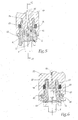
- the connector 50 caps the base of connection 12, as shown in more detail in FIGS. 5 and 6.
- the connector 50 forms a receiving housing 56 partial of the connection base 12, an annular seal 58 being interposed between the outer face of the base and the wall of the connector delimiting this accommodation.
- the connector 50 is equipped with several tabs flexible 60 hooking the base, distributed along its periphery. These tongues are adapted to engage a rigid annular insert 62, retained axially relative to the base in a peripheral groove corresponding 64 (see Figure 2) formed in the outer wall of the base.
- the connector 50 is traversed longitudinally by a pair of electrical conductors 66 which extend from the cavity 54 for receiving a power plug, up to housing 56 receiving the base, forming inside this housing adapted resilient conductive pins 68 to come into contact with the pads 10 of the heating resistor when the connector is attached to the base 12.
- the piston 3 of the thermostatic element 1 is connected to the valve 44 of the valve 30 via a connecting piece 70.
- the part 70 is linked in translation along the X-X axis with an inner ring 72 of the valve 44.
- the piece 70 is Forced into this crown. In this way, the piece 70 and the valve 44 are kinematically related to each other.
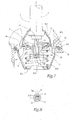
- the part 70 has a blind bore 74 coaxial with the axis XX, adapted to receive the rod forming the piston 3 of the thermostatic element 1.
- the free end of the piston is adapted to bear against the bottom 74 has the bore 74 so as to allow transmission between the piston and the connecting piece 70, a force along the axis XX and directed away from the body 2.
- the piston 3 has a flat portion 76 which defines with the wall 74 b of the bore 74 a free space referenced 78 extending to the free end of the piston.
- the contact between the piston 3 and the wall 74 b is provided sliding so that there is a degree of freedom in translation along the axis XX between the piston and the workpiece 70.
- the pressure differential exerted on the part 70 is able to cause its sliding relative to the piston, the latter guiding the movement of the piece 70.
- a clearance J is formed between the bottom of the bore 74 and the free end of the piston 3.
- the free space 78 formed in the flat part 76 allows then the free introduction of fluid into the game J thus formed and prevents the piece 70 is immobilized on the piston 3 in the configuration of Figure 7 by suction effect.
- the valve 30 also comprises a stirrup 80 which delimits the seat 46 and which rigidly connects the body 2 of the thermostatic element 1 to the main housing 32 of the valve.
- the stirrup 80 comprises an annular ring 80A which defines the seat 46, branches 80B which connect the body of the element thermostatic ring 80A, an annular flange 80C which is enclosed by sealed way between the housings 32 and 34, and 80D branches which form their free end of the support plane 80E for a return spring 82.
- This spring 82 is interposed between the valve 44 and the stirrup 80 so as to recall this valve on its seat 46.
- branches 80B Between each of the branches 80B, openings allow the passage of the fluid from the inlet duct 36 to the crown area 80A.
- the branches 80D define between them orifices allowing the passage of the fluid from the zone of the ring 80A to the outlet duct 40, when the valve 44 is spaced from the seat 46.
- the assembly of the valve 30 is as follows:
- the connector 50 is first secured to the housing 32 by being brought from outside the housing 32 in the opening 52.
- the watertight connection of the connector to the housing is for example obtained by gluing, by a force fitting or stapling.
- the thermostatic assembly formed of the thermostatic element 1 and the base 12 provided with the insert 62, equipped with the valve 44, the stirrup 80 and the spring 82.
- the connection base and the body 2 of the thermostatic element are introduced into the orifice 47 in a translation movement along the axis X-X, until the free ends of the branches 80B compress the sealing means 48.
- the tongues 60 then engage with the insert 62 of the base 12 and the pins 68 come into electrical contact with the studs 10.
- the secondary housing 34 is secured to the housing tightly main 32, thus blocking the flange 80C of the caliper 80.
- connection base before mounting it in the valve allows to have a set thermostatic pre-assembled easy to introduce in the housing 32, no additional connection operation not being necessary to retain or position the connection pads of the electric heating means vis-à-vis housing.
- insulation of the electrical parts of the assembly is achieved, at least in part, before mounting the assembly in the valve and can therefore be tested before assembly.
- the connector 50 cooperates with the base 12 to allow the power supply of the thermostatic element from the outside housing.
- the implementation of the connector is simple and allows, in one operation when mounting the pre-assembled assembly, to connect electrically connection pads held by the base, while ensuring total sealing of the base.
- valve 30 In operation, the valve 30 is traversed by an oil path which between the duct 38 and out the conduit 40, and by a waterway that between conduit 36 and which is susceptible, according to the conditions of operation of the valve, to exit through the conduit 40.
- the valve 30 is in the configuration shown in FIG. 4, that is to say with the valve 44 in sealed support on the seat 46.
- a source of electrical energy connected to the connector 50, via its cavity 54 for receiving a plug, can be ordered to power the heating resistor of the heating means 8 of the thermostatic element 1.
- the differential of pressure causes the drive to translate the workpiece 70, which then slides along the piston 3 by driving the valve 44, which puts in communication the conduits 36 and 42. Any damage to the water circuit resulting from overpressure is thus avoided thanks to the valve 30.
- valve 44 provides a thermopressostatic function, as shown in Figure 9.
- the flat 76 avoids at the same time the creation of a game J under pressure between the piece 70 and the piston 3 which could limit the freedom of sliding of the piece on long piston by a suction effect, and trapping fluid in the J game that could prevent the quick and complete return of the piston to the bottom of the bore 74 during the return of the valve 44 by the spring 82 once the differential pressure returns below the predetermined threshold value.
- FIG. 10 shows a variant of the valve 30, which essentially distinguishes the valve of Figure 4 by the shape of its housing 32. In fact, it forms in one piece at a time the ducts 36, 38, 40 and 42.
- the wall of the housing opposite the opening 52 has an opening 86 substantially coaxial with the opening 52.
- a cover 88 is further provided for sealing the opening 86 and mechanically retaining the flange 80C vis-à-vis the housing 32.
- FIGS. 11 to 14 show other valve variants, thermostats according to the invention, respectively referenced 130, 230, 330 and 430, the elements of these valves in common with those of the valve 30 of the FIG. 4 being referenced by the same number increased by 100 respectively, 200, 300 and 400.
- the valve 130 of Figure 11 is essentially distinguished from the valve 30 by the absence of electrical control of the thermostatic element 1. Also, the element 101 is only controlled by the temperature of the channel of fluid, especially oil, circulating in the conduits 138 and 140.
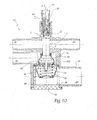
- the valve 230 of FIG. 12 essentially differs from the valve 30 by the absence of control of the thermostatic element 201 by the temperature fluid in which the body 202 of the element could bathe. In this way, displacements of the piston 203 are only controlled by the means of heating 208, that is to say electrically controlled from outside the valve. In addition, the mechanical retention of the connector 250 is exclusively ensured by the base 212, the connector is not secured to the housing 232.
- the valve 330 of FIG. 13 differs from the valve 30 of FIG. by the removal of oil entry and exit pipelines for the benefit of a second conduit 390 of water outlet, which communicates directly with the conduit 336, the body 302 of the thermostatic element 301 bathing in the flow of the fluid passing from conduit 336 to conduit 390.
- the element thermostatic is in this way controlled by the temperature of this fluid, as well than electrically from the connector 350.
- the valve 330 is for example used to distribute the flow of cooling water at the outlet of an engine thermal.
- the valve distributes this flow between, on the one hand, the conduit 342 intended to be connected to a cooling radiator, and, on the other hand, the conduit 390 which is intended to be connected to auxiliary heat exchangers, such as a fan heater cockpit heating or an oil / water heat exchanger. Assembly and Operation of the valve 330 are substantially similar to those described for the valve 30.
- the valve 430 of FIG. 14 essentially differs from the valve 330 by the absence of electrical control of its thermostatic element. Element 401 is controlled solely by the temperature of the water passing through the valve through the conduits 436 and 490.
- valves described above are in additionally possible, in particular by combining for the same valve construction or assembly details described for different valves:
- flats similar to the flat portion 76 of the piston 3 of the valve 30 may be provided for the pistons 103, 203, 303 and 403 of the valves 130, 230, 330 and 430.
- valve 30 of FIGS. 1 to 9 An unrepresented variant of the valve 30 of FIGS. 1 to 9 consists of realize the valve 44 and the piece 70 in one piece. More specifically, in this case, the connecting piece 70 is integral with an inner portion of the valve 44, these elements being made of a one-piece piece of metal or a synthetic material.
- This variant has the advantage of reducing the number of parts of the valve while the embodiment of Figures 1 to 9 allows to use a pre-existing valve whose inner ring 72 can serve as a zone for fitting, indifferently, the connecting piece 70, as described for the valve 30, or the body of a thermostatic element in other arrangements of known valves.
- the blind hole 74 defined in the connecting piece 70 does not have a cross section rigorously circular but oblong. More generally, the profile, in cross section, of this hole 74 can be sized to receive the piston 44 and to allow the sliding guide between the piston and the part 70, while providing, in one or more zones along its contour , a radial clearance between the piston and the wall 74b of the hole 74 so as to delimit between these elements a free space similar to the space 78, that is to say a space for fluid communication between the outlet of the hole 74 on the outside and the bottom 74a of the hole 74. in this case, the presence of the flat 76 along the piston 3 is no longer essential since this space prevents the suction effect or trapping fluid analogously at the flat 76, as explained above.
Landscapes
- Engineering & Computer Science (AREA)
- Physics & Mathematics (AREA)
- General Physics & Mathematics (AREA)
- Automation & Control Theory (AREA)
- Chemical & Material Sciences (AREA)
- Combustion & Propulsion (AREA)
- Mechanical Engineering (AREA)
- General Engineering & Computer Science (AREA)
- Temperature-Responsive Valves (AREA)
Abstract
Description
- la pièce de liaison est emmanchée à force dans une couronne intérieure du clapet ;
- la pièce de liaison est venue de matière avec une partie intérieure du clapet;
- elle comporte un ressort de rappel du clapet vers le siège, la valeur prédéterminée de pression étant fonction du réglage de ce ressort ;
- le piston et la pièce de liaison délimitent entre eux un espace fibre de communication entre le fond du logement borgne et le débouché de ce logement sur l'extérieur ;
- l'espace libre est délimité en partie par un méplat ménagé le long du piston ;
- elle comporte un étrier rigide qui délimite le siège de réception du clapet et qui est solidarisé d'une part au boítier principal et d'autre part au corps de l'élément thermostatique ;
- elle comporte un boítier secondaire relié de façon étanche au boítier principal au niveau d'un de ses orifices d'entrée ou de sortie, en enserrant une bride de solidarisation de l'étrier ;
- elle comporte un couvercle relié de façon étanche au boítier principal et adapté pour solidariser une bride de l'étrier au boítier principal ;
- le corps de l'élément thermostatique est disposé dans le boítier principal sur le trajet d'écoulement du fluide entre l'orifice d'entrée de ce fluide et au moins un des orifices de sortie de ce fluide ;
- le boítier principal délimite une voie de circulation d'un fluide autre que celui régulé par le clapet, le corps de l'élément thermostatique étant disposé dans le boítier principal sur le trajet de cet autre fluide ; et
- elle comporte à la fois des moyens de chauffage électrique, qui comprennent une enveloppe plongée au moins en partie dans la matière dilatable de l'élément thermostatique et une résistance chauffante logée dans l'enveloppe et adaptée pour être connectée à une alimentation électrique, et une embase rapportée de connexion électrique, adaptée pour positionner des plots de connexion électrique de la résistance chauffante et solidarisée de façon étanche à l'enveloppe de telle sorte que l'ensemble thermostatique, incluant l'élément thermostatique, les moyens de chauffage et l'embase de connexion électrique, est dans une configuration pré-assemblée dans laquelle cet ensemble est apte à être monté d'un seul tenant dans le boítier principal.
- la figure 1 est une vue schématique en coupe longitudinale d'un élément thermostatique classique, à comtrande électrique ;
- la figure 2 est une vue d'un élément thermostatique sur lequel, est rapportée une embase de connexion électrique, au niveau du détail cerclé II sur la figure 1 ;
- la figure 3 est une vue en plan selon la flèche III indiquée sur la figure 2 ;
- la figure 4 est une vue schématique en coupe longitudinale d'une vanne thermostatique selon l'invention, équipée de l'élément thermostatique et de l'embase de la figure 2 ;
- la figure 5 est une vue à plus grande échelle du détail cerclé V sur la figure 4 ;
- la figure 6 est une coupe prise selon le plan VI-VI indiqué sur la figure 5 ;
- la figure 7 est une vue à plus grande échelle du détail cerclé VII sur la figure 4 ;
- la figure 8 est une coupe selon le plan VIII-VIII indiqué sur la figure 7 ;
- la figure 9 est une vue analogue à la figure 7, la vanne étant représentée dans un état de fonctionnement différent ; et
- les figures 10 à 14 sont des vues analogues à la figure 4, représentant respectivement des variantes de la vanne thermostatique.
Claims (12)
- Vanne thermostatique pour un circuit de refroidissement, notamment associé à un moteur thermique, comportant un boítier principal (32 ; 132 ; 232. ; 332 ; 432) qui forme un orifice d'entrée (36 ; 136 ; 236 ; 336 ; 436) d'un fluide et au moins un orifice de sortie (33 ; 133 ; 233 ; 333 ; 433) de ce fluide, un clapet (44 ; 144 ; 244 ; 344 ; 444) mobile par rapport au boítier et adapté pour réguler le passage du fluide entre l'orifice d'entrée et l'orifice de sortie, un siège (46 ; 146 ; 246 ; 346 ; 446) de réception du clapet, fixe par rapport au boítier, et un élément thermostatique (1 ; 101 ; 201 ; 301 ; 401) pourvu d'un corps (2 ; 102 ; 202 ; 302 ; 402) qui contient une matière dilatable (4) et d'un piston (3 ; 103 ; 203 ; 303 ; 403) mobile par rapport au corps, ledit corps étant fixe par rapport au boítier, caractérisée en ce qu'elle comporte une pièce (70 ; 170 ; 270 ; 370 ; 470) de liaison entre le clapet (44 ; 144 ; 244 ; 344 ; 444) et le piston (3 ; 103 ; 203 ; 303 ; 403), laquelle pièce de liaison est solidaire du clapet et délimite un logement borgne (74) de réception du piston, le fond (74a) du logement formant une butée pour le piston lorsque la différence de pression de part et d'autre du clapet est inférieure à une valeur prédéterminée, liant ainsi cinématiquement le clapet et le piston l'un à l'autre, tandis que la paroi (74b) du logement forme une surface de contact glissant avec le piston lorsque cette différence de pression est supérieure à ladite valeur prédéterminée, permettant ainsi le déplacement du clapet par rapport au piston suivant la direction (X-X) de déplacement du piston.
- Vanne suivant la revendication 1, caractérisée en ce que ladite pièce de liaison (70 ; 170 ; 270 ; 370 ; 470) est emmanchée à force dans une couronne intérieure (72) du clapet (44 ; 144 ; 244 ; 344 ; 444).
- Vanne suivant la revendication 1, caractérisée en ce que ladite pièce de liaison est venue de matière avec une partie intérieure du clapet .
- Vanne suivant l'une quelconque des revendications précédentes, caractérisée en ce qu'elle comporte un ressort (82 ; 182 ; 282 ; 382 ; 482) de rappel du clapet (44 ; 144 ; 244 ; 344 ; 444) vers le siège (46 ; 146 ; 246 ; 346 ; 446), la valeur prédéterminée de pression étant fonction du réglage de ce ressort.
- Vanne suivant l'une quelconque des revendications précédentes, caractérisée en ce que le piston (3) et la pièce de liaison (70 ; 170 ; 270 ; 970 ; 470) délimitent entre eux un espace libre (78) de communication fluidique entre le fond (74a) du logement borgne (74) et le débouché de ce logement sur l'extérieur.
- Vanne suivant la revendication 5, caractérisée en ce que l'espace libre (78) est délimité en partie par un méplat (76) ménagé le long du piston (3).
- Vanne suivant l'une quelconque des revendications précédentes, caractérisée en ce qu'elle comporte un étrier rigide. (80 ; 180 ; 280 ; 380 ; 480) qui délimite le siège (46 ; 146 ; 246 ; 346 ; 446) de réception du clapet (44 ; 144 ; 244 ; 344 ; 444) et qui est solidarisé d'une part au boítier principal (32 ; 132 ; 232 ; 332 ; 432) et d'autre part au corps (2 ; 102 ; 202 ; 302 ; 402) de l'élément thermostatique (1 ; 101 ; 201 ; 301 ; 401).
- Vanne suivant la revendication 7, caractérisée en ce qu'elle comporte un boítier secondaire (34 ; 134 ; 234 ; 334 ; 434) relié de façon étanche au boítier principal au niveau d'un de ses orifices d'entrée ou de sortie (33 ; 133 ; 233 ; 333 ; 433), en enserrant une bride de solidarisation (80C) de l'étrier.
- Vanne suivant la revendication 7, caractérisée en ce qu'elle comporte un couvercle (88) relié de façon étanché au boítier principal (32) et adapté pour solidariser une bride (80C) de l'étrier (80) au boítier principal.
- Vanne suivant l'une quelconque des revendications précédentes, caractérisée en ce que le corps (302 ; 402) de l'élément thermostatique (301 ; 401) est disposé dans le boítier principal (332 ; 432) sur le trajet d'écoulement du fluide entre l'orifice d'entrée (336 ; 436) de ce fluide et au moins un des orifices de sortie (333 ; 433) de ce fluide.
- Vanne suivant l'une quelconque des revendications 1 à 9, caractérisée en ce que le boítier principal (32 ; 132 ; 232) délimite une voie de circulation d'un fluide autre que celui régulé par le clapet (44 ; 144 ; 244), le corps (2 ; 102 ; 202) de l'élément thermostatique (1 ; 101 ; 201) étant disposé dans le boítier principal sur le trajet de cet autre fluide.
- Vanne suivant l'une quelconque des revendications précédentes, caractérisée en ce qu'elle comporte à la fois des moyens (8) de chauffage électrique, qui comprennent une enveloppe (9 ; 209 ; 309) plongée au moins en partie dans la matière dilatable (4) de l'élément thermostatique (1 ; 201 ; 301) et une résistance chauffante logée dans l'enveloppe et adaptée peur être connectée à une alimentation électrique, et une embase rapportée (12 ; 212 ; 312) de connexion électrique, adaptée pour positionner des plots (10) de connexion électrique de la résistance chauffante et solidarisée de façon étanche à l'enveloppe de telle sorte que l'ensemble thermostattque, incluant l'élément thermostatique, les moyens de chauffage et l'embase de connexion électrique, est dans une configuration pré-assemblée dans laquelle cet ensemble est apte à être monté d'un seul tenant dans le boítier principal (32 ; 232 ; 332).
Priority Applications (2)
| Application Number | Priority Date | Filing Date | Title |
|---|---|---|---|
| DE602004004250T DE602004004250T2 (de) | 2004-06-09 | 2004-06-09 | Thermostatventil für einen Kühlmittelkreislauf |
| EP20040291443 EP1607818B1 (fr) | 2004-06-09 | 2004-06-09 | Vanne thermostatistique pour un circuit de refroidissement |
Applications Claiming Priority (1)
| Application Number | Priority Date | Filing Date | Title |
|---|---|---|---|
| EP20040291443 EP1607818B1 (fr) | 2004-06-09 | 2004-06-09 | Vanne thermostatistique pour un circuit de refroidissement |
Publications (2)
| Publication Number | Publication Date |
|---|---|
| EP1607818A1 true EP1607818A1 (fr) | 2005-12-21 |
| EP1607818B1 EP1607818B1 (fr) | 2007-01-10 |
Family
ID=34931161
Family Applications (1)
| Application Number | Title | Priority Date | Filing Date |
|---|---|---|---|
| EP20040291443 Expired - Lifetime EP1607818B1 (fr) | 2004-06-09 | 2004-06-09 | Vanne thermostatistique pour un circuit de refroidissement |
Country Status (2)
| Country | Link |
|---|---|
| EP (1) | EP1607818B1 (fr) |
| DE (1) | DE602004004250T2 (fr) |
Cited By (1)
| Publication number | Priority date | Publication date | Assignee | Title |
|---|---|---|---|---|
| JP2017133664A (ja) * | 2016-01-29 | 2017-08-03 | 日本サーモスタット株式会社 | 流量制御弁装置におけるリード線絶縁構造 |
Families Citing this family (6)
| Publication number | Priority date | Publication date | Assignee | Title |
|---|---|---|---|---|
| DE102013214117A1 (de) * | 2013-07-18 | 2015-01-22 | Bayerische Motoren Werke Aktiengesellschaft | Thermostat und Komponente eines Ölkreislaufs |
| DE102014219490A1 (de) * | 2014-09-25 | 2016-03-31 | Behr Thermot-Tronik Gmbh | Thermostatventil |
| DE102015213879A1 (de) * | 2015-07-23 | 2017-01-26 | Bayerische Motoren Werke Aktiengesellschaft | Brennkraftmaschine mit geteiltem Kühlsystem |
| DE102016202026A1 (de) | 2016-02-10 | 2017-08-10 | Mack & Schneider Gmbh | Ventileinrichtung |
| DE102018110983B3 (de) | 2018-05-08 | 2019-07-04 | Schaeffler Technologies AG & Co. KG | Steuerventil für ein Wärmemanagementmodul |
| CN111206981A (zh) | 2018-11-21 | 2020-05-29 | 福特全球技术公司 | 用于冷却散热器布置的控制阀 |
Citations (3)
| Publication number | Priority date | Publication date | Assignee | Title |
|---|---|---|---|---|
| FR2601719A1 (fr) * | 1986-07-21 | 1988-01-22 | Valeo | Dispositif pour limiter la perte de charge d'un circuit de refroidissement d'un moteur a combustion interne et circuit de refroidissement equipe d'un tel dispositif |
| US5482010A (en) * | 1993-07-19 | 1996-01-09 | Bayerische Motoren Werke Aktiengesellschaft | Cooling system for an internal-combustion engine of a motor vehicle with a thermostatic valve having an electrically heatable expansion element |
| EP0694681A1 (fr) * | 1994-07-26 | 1996-01-31 | Bayerische Motoren Werke Aktiengesellschaft | Vanne thermostatique pour le circuit de refroidissement d'un moteur à combustion interne |
-
2004
- 2004-06-09 DE DE602004004250T patent/DE602004004250T2/de not_active Expired - Fee Related
- 2004-06-09 EP EP20040291443 patent/EP1607818B1/fr not_active Expired - Lifetime
Patent Citations (3)
| Publication number | Priority date | Publication date | Assignee | Title |
|---|---|---|---|---|
| FR2601719A1 (fr) * | 1986-07-21 | 1988-01-22 | Valeo | Dispositif pour limiter la perte de charge d'un circuit de refroidissement d'un moteur a combustion interne et circuit de refroidissement equipe d'un tel dispositif |
| US5482010A (en) * | 1993-07-19 | 1996-01-09 | Bayerische Motoren Werke Aktiengesellschaft | Cooling system for an internal-combustion engine of a motor vehicle with a thermostatic valve having an electrically heatable expansion element |
| EP0694681A1 (fr) * | 1994-07-26 | 1996-01-31 | Bayerische Motoren Werke Aktiengesellschaft | Vanne thermostatique pour le circuit de refroidissement d'un moteur à combustion interne |
Cited By (1)
| Publication number | Priority date | Publication date | Assignee | Title |
|---|---|---|---|---|
| JP2017133664A (ja) * | 2016-01-29 | 2017-08-03 | 日本サーモスタット株式会社 | 流量制御弁装置におけるリード線絶縁構造 |
Also Published As
| Publication number | Publication date |
|---|---|
| DE602004004250D1 (de) | 2007-02-22 |
| DE602004004250T2 (de) | 2007-11-15 |
| EP1607818B1 (fr) | 2007-01-10 |
Similar Documents
| Publication | Publication Date | Title |
|---|---|---|
| FR2943148A1 (fr) | Cartouche chauffante pour un element thermostatique et procede de fabrication correspondant, ainsi que vanne thermostatique comportant une telle cartouche. | |
| WO2016046340A2 (fr) | Dispositif thermostatique de régulation de la circulation d'un fluide, ainsi que vanne thermostatique comprenant un tel dispositif | |
| EP3277542B1 (fr) | Ensemble pour le passage d'un harnais electrique dans une turbomachine | |
| FR2876763A1 (fr) | Vanne thermostatique pour un circuit de fluide, moteur thermique associe a un circuit de refroidissement comportant une telle vanne, et procede de fabrication d'une telle vanne | |
| WO2015104325A1 (fr) | Vanne thermostatique | |
| EP1607818B1 (fr) | Vanne thermostatistique pour un circuit de refroidissement | |
| WO2008093027A2 (fr) | Vanne thermostatique de regulation d'un fluide, circuit de liquide de refroidissement incorporant une telle vanne et procede de fabrication d'une telle vanne | |
| EP1132590A1 (fr) | Dispositif thermostatique à deux régimes de régulation commandés sélectivement | |
| EP1041256A1 (fr) | Dispositif thermostatique à deux régimes de régulation, à deux éléments thermostatiques | |
| FR2853710A1 (fr) | Ensemble thermostatique a commande electrique et vanne thermostatique equipee d'un tel ensemble | |
| EP1486843B1 (fr) | Vanne thermostatique pour un circuit de circulation de fluide et moteur thermique muni d'un circuit de refroidissement comportant une telle vanne | |
| FR3053387B1 (fr) | Carter de turbomachine | |
| WO2021151921A1 (fr) | Dispositif thermostatique pour réguler la circulation d'un fluide, ainsi que vanne thermostatique comprenant un tel dispositif | |
| EP1614873A2 (fr) | Vanne pour un circuit de circulation de fluide et circuit associé à un moteur comportant une telle vanne | |
| FR2853709A1 (fr) | Vanne thermostatique pour un circuit de refroidissement | |
| EP3830403A1 (fr) | Echangeur thermique pour turbomachine et procede de fabrication associe | |
| WO2016016210A1 (fr) | Vanne thermostatique a manchon | |
| EP3139015B1 (fr) | Boîtier de sortie d'eau | |
| WO2011010051A1 (fr) | Ensemble de chauffage pour une vanne thermostatique et procédé de fabrication correspondant, ainsi que vanne thermostatique comportant un tel ensemble | |
| FR2864151A1 (fr) | Boitier de sortie d'eau | |
| FR3137429A1 (fr) | Vanne thermostatique à manchon | |
| FR3087867A1 (fr) | Vanne de regulation d'un flux de fluide equipee d'un actionneur electrique et systeme comprenant une telle vanne | |
| WO2015032978A1 (fr) | Cartouche chauffante, element thermostatique comportant une telle cartouche, vanne thermostatique comprenant un tel element thermostatique, procede d'assemblage d'une telle cartouche dans une telle vanne | |
| FR3034162A1 (fr) | Dispositif thermostatique de regulation de la circulation d'un fluide, ainsi que vanne thermostatique comprenant un tel dispositif | |
| FR3143784A1 (fr) | Ensemble thermostatique, notamment cartouche thermostatique |
Legal Events
| Date | Code | Title | Description |
|---|---|---|---|
| PUAI | Public reference made under article 153(3) epc to a published international application that has entered the european phase |
Free format text: ORIGINAL CODE: 0009012 |
|
| AK | Designated contracting states |
Kind code of ref document: A1 Designated state(s): AT BE BG CH CY CZ DE DK EE ES FI FR GB GR HU IE IT LI LU MC NL PL PT RO SE SI SK TR |
|
| AX | Request for extension of the european patent |
Extension state: AL HR LT LV MK |
|
| 17P | Request for examination filed |
Effective date: 20060201 |
|
| RTI1 | Title (correction) |
Free format text: THERMOSTATIC VALVE FOR A COOLING CIRCUIT |
|
| GRAP | Despatch of communication of intention to grant a patent |
Free format text: ORIGINAL CODE: EPIDOSNIGR1 |
|
| AKX | Designation fees paid |
Designated state(s): AT BE BG CH CY CZ DE DK EE ES FI FR GB GR HU IE IT LI LU MC NL PL PT RO SE SI SK TR |
|
| GRAS | Grant fee paid |
Free format text: ORIGINAL CODE: EPIDOSNIGR3 |
|
| GRAA | (expected) grant |
Free format text: ORIGINAL CODE: 0009210 |
|
| AK | Designated contracting states |
Kind code of ref document: B1 Designated state(s): AT BE BG CH CY CZ DE DK EE ES FI FR GB GR HU IE IT LI LU MC NL PL PT RO SE SI SK TR |
|
| PG25 | Lapsed in a contracting state [announced via postgrant information from national office to epo] |
Ref country code: SI Free format text: LAPSE BECAUSE OF FAILURE TO SUBMIT A TRANSLATION OF THE DESCRIPTION OR TO PAY THE FEE WITHIN THE PRESCRIBED TIME-LIMIT Effective date: 20070110 Ref country code: PL Free format text: LAPSE BECAUSE OF FAILURE TO SUBMIT A TRANSLATION OF THE DESCRIPTION OR TO PAY THE FEE WITHIN THE PRESCRIBED TIME-LIMIT Effective date: 20070110 Ref country code: IE Free format text: LAPSE BECAUSE OF FAILURE TO SUBMIT A TRANSLATION OF THE DESCRIPTION OR TO PAY THE FEE WITHIN THE PRESCRIBED TIME-LIMIT Effective date: 20070110 Ref country code: DK Free format text: LAPSE BECAUSE OF FAILURE TO SUBMIT A TRANSLATION OF THE DESCRIPTION OR TO PAY THE FEE WITHIN THE PRESCRIBED TIME-LIMIT Effective date: 20070110 Ref country code: AT Free format text: LAPSE BECAUSE OF FAILURE TO SUBMIT A TRANSLATION OF THE DESCRIPTION OR TO PAY THE FEE WITHIN THE PRESCRIBED TIME-LIMIT Effective date: 20070110 Ref country code: FI Free format text: LAPSE BECAUSE OF FAILURE TO SUBMIT A TRANSLATION OF THE DESCRIPTION OR TO PAY THE FEE WITHIN THE PRESCRIBED TIME-LIMIT Effective date: 20070110 Ref country code: NL Free format text: LAPSE BECAUSE OF FAILURE TO SUBMIT A TRANSLATION OF THE DESCRIPTION OR TO PAY THE FEE WITHIN THE PRESCRIBED TIME-LIMIT Effective date: 20070110 |
|
| REG | Reference to a national code |
Ref country code: GB Ref legal event code: FG4D Free format text: NOT ENGLISH |
|
| REG | Reference to a national code |
Ref country code: IE Ref legal event code: FG4D Free format text: LANGUAGE OF EP DOCUMENT: FRENCH |
|
| REF | Corresponds to: |
Ref document number: 602004004250 Country of ref document: DE Date of ref document: 20070222 Kind code of ref document: P |
|
| PG25 | Lapsed in a contracting state [announced via postgrant information from national office to epo] |
Ref country code: SE Free format text: LAPSE BECAUSE OF FAILURE TO SUBMIT A TRANSLATION OF THE DESCRIPTION OR TO PAY THE FEE WITHIN THE PRESCRIBED TIME-LIMIT Effective date: 20070410 |
|
| PG25 | Lapsed in a contracting state [announced via postgrant information from national office to epo] |
Ref country code: BG Free format text: LAPSE BECAUSE OF FAILURE TO SUBMIT A TRANSLATION OF THE DESCRIPTION OR TO PAY THE FEE WITHIN THE PRESCRIBED TIME-LIMIT Effective date: 20070411 |
|
| PG25 | Lapsed in a contracting state [announced via postgrant information from national office to epo] |
Ref country code: ES Free format text: LAPSE BECAUSE OF FAILURE TO SUBMIT A TRANSLATION OF THE DESCRIPTION OR TO PAY THE FEE WITHIN THE PRESCRIBED TIME-LIMIT Effective date: 20070421 |
|
| PG25 | Lapsed in a contracting state [announced via postgrant information from national office to epo] |
Ref country code: PT Free format text: LAPSE BECAUSE OF FAILURE TO SUBMIT A TRANSLATION OF THE DESCRIPTION OR TO PAY THE FEE WITHIN THE PRESCRIBED TIME-LIMIT Effective date: 20070611 |
|
| NLV1 | Nl: lapsed or annulled due to failure to fulfill the requirements of art. 29p and 29m of the patents act | ||
| REG | Reference to a national code |
Ref country code: IE Ref legal event code: FD4D |
|
| PLBE | No opposition filed within time limit |
Free format text: ORIGINAL CODE: 0009261 |
|
| STAA | Information on the status of an ep patent application or granted ep patent |
Free format text: STATUS: NO OPPOSITION FILED WITHIN TIME LIMIT |
|
| PG25 | Lapsed in a contracting state [announced via postgrant information from national office to epo] |
Ref country code: SK Free format text: LAPSE BECAUSE OF FAILURE TO SUBMIT A TRANSLATION OF THE DESCRIPTION OR TO PAY THE FEE WITHIN THE PRESCRIBED TIME-LIMIT Effective date: 20070110 |
|
| 26N | No opposition filed |
Effective date: 20071011 |
|
| BERE | Be: lapsed |
Owner name: VERNET S.A. Effective date: 20070630 |
|
| PG25 | Lapsed in a contracting state [announced via postgrant information from national office to epo] |
Ref country code: RO Free format text: LAPSE BECAUSE OF FAILURE TO SUBMIT A TRANSLATION OF THE DESCRIPTION OR TO PAY THE FEE WITHIN THE PRESCRIBED TIME-LIMIT Effective date: 20070110 Ref country code: CZ Free format text: LAPSE BECAUSE OF FAILURE TO SUBMIT A TRANSLATION OF THE DESCRIPTION OR TO PAY THE FEE WITHIN THE PRESCRIBED TIME-LIMIT Effective date: 20070110 |
|
| PG25 | Lapsed in a contracting state [announced via postgrant information from national office to epo] |
Ref country code: MC Free format text: LAPSE BECAUSE OF NON-PAYMENT OF DUE FEES Effective date: 20070630 |
|
| PG25 | Lapsed in a contracting state [announced via postgrant information from national office to epo] |
Ref country code: BE Free format text: LAPSE BECAUSE OF NON-PAYMENT OF DUE FEES Effective date: 20070630 |
|
| PG25 | Lapsed in a contracting state [announced via postgrant information from national office to epo] |
Ref country code: GR Free format text: LAPSE BECAUSE OF FAILURE TO SUBMIT A TRANSLATION OF THE DESCRIPTION OR TO PAY THE FEE WITHIN THE PRESCRIBED TIME-LIMIT Effective date: 20070411 |
|
| PGFP | Annual fee paid to national office [announced via postgrant information from national office to epo] |
Ref country code: IT Payment date: 20080621 Year of fee payment: 5 |
|
| PGFP | Annual fee paid to national office [announced via postgrant information from national office to epo] |
Ref country code: DE Payment date: 20080613 Year of fee payment: 5 |
|
| PGFP | Annual fee paid to national office [announced via postgrant information from national office to epo] |
Ref country code: GB Payment date: 20080605 Year of fee payment: 5 |
|
| PG25 | Lapsed in a contracting state [announced via postgrant information from national office to epo] |
Ref country code: EE Free format text: LAPSE BECAUSE OF FAILURE TO SUBMIT A TRANSLATION OF THE DESCRIPTION OR TO PAY THE FEE WITHIN THE PRESCRIBED TIME-LIMIT Effective date: 20070110 |
|
| REG | Reference to a national code |
Ref country code: CH Ref legal event code: PL |
|
| PG25 | Lapsed in a contracting state [announced via postgrant information from national office to epo] |
Ref country code: LI Free format text: LAPSE BECAUSE OF NON-PAYMENT OF DUE FEES Effective date: 20080630 Ref country code: CH Free format text: LAPSE BECAUSE OF NON-PAYMENT OF DUE FEES Effective date: 20080630 |
|
| PG25 | Lapsed in a contracting state [announced via postgrant information from national office to epo] |
Ref country code: CY Free format text: LAPSE BECAUSE OF FAILURE TO SUBMIT A TRANSLATION OF THE DESCRIPTION OR TO PAY THE FEE WITHIN THE PRESCRIBED TIME-LIMIT Effective date: 20070110 |
|
| PG25 | Lapsed in a contracting state [announced via postgrant information from national office to epo] |
Ref country code: LU Free format text: LAPSE BECAUSE OF NON-PAYMENT OF DUE FEES Effective date: 20070609 |
|
| PG25 | Lapsed in a contracting state [announced via postgrant information from national office to epo] |
Ref country code: HU Free format text: LAPSE BECAUSE OF FAILURE TO SUBMIT A TRANSLATION OF THE DESCRIPTION OR TO PAY THE FEE WITHIN THE PRESCRIBED TIME-LIMIT Effective date: 20070711 Ref country code: TR Free format text: LAPSE BECAUSE OF FAILURE TO SUBMIT A TRANSLATION OF THE DESCRIPTION OR TO PAY THE FEE WITHIN THE PRESCRIBED TIME-LIMIT Effective date: 20070110 |
|
| GBPC | Gb: european patent ceased through non-payment of renewal fee |
Effective date: 20090609 |
|
| PG25 | Lapsed in a contracting state [announced via postgrant information from national office to epo] |
Ref country code: GB Free format text: LAPSE BECAUSE OF NON-PAYMENT OF DUE FEES Effective date: 20090609 |
|
| PG25 | Lapsed in a contracting state [announced via postgrant information from national office to epo] |
Ref country code: DE Free format text: LAPSE BECAUSE OF NON-PAYMENT OF DUE FEES Effective date: 20100101 |
|
| PG25 | Lapsed in a contracting state [announced via postgrant information from national office to epo] |
Ref country code: IT Free format text: LAPSE BECAUSE OF NON-PAYMENT OF DUE FEES Effective date: 20090609 |
|
| REG | Reference to a national code |
Ref country code: FR Ref legal event code: PLFP Year of fee payment: 13 |
|
| REG | Reference to a national code |
Ref country code: FR Ref legal event code: PLFP Year of fee payment: 14 |
|
| REG | Reference to a national code |
Ref country code: FR Ref legal event code: GC Effective date: 20171212 |
|
| REG | Reference to a national code |
Ref country code: FR Ref legal event code: PLFP Year of fee payment: 15 |
|
| PGFP | Annual fee paid to national office [announced via postgrant information from national office to epo] |
Ref country code: FR Payment date: 20190523 Year of fee payment: 16 |
|
| PG25 | Lapsed in a contracting state [announced via postgrant information from national office to epo] |
Ref country code: FR Free format text: LAPSE BECAUSE OF NON-PAYMENT OF DUE FEES Effective date: 20200630 |