EP1607472A1 - Aqueous liquid cleaning compositions - Google Patents
Aqueous liquid cleaning compositions Download PDFInfo
- Publication number
- EP1607472A1 EP1607472A1 EP04253646A EP04253646A EP1607472A1 EP 1607472 A1 EP1607472 A1 EP 1607472A1 EP 04253646 A EP04253646 A EP 04253646A EP 04253646 A EP04253646 A EP 04253646A EP 1607472 A1 EP1607472 A1 EP 1607472A1
- Authority
- EP
- European Patent Office
- Prior art keywords
- cleaning compositions
- cleaning
- surfactant
- carbon atoms
- composition
- Prior art date
- Legal status (The legal status is an assumption and is not a legal conclusion. Google has not performed a legal analysis and makes no representation as to the accuracy of the status listed.)
- Withdrawn
Links
- 239000000203 mixture Substances 0.000 title claims abstract description 107
- 238000004140 cleaning Methods 0.000 title claims abstract description 58
- 239000007788 liquid Substances 0.000 title claims abstract description 22
- 239000006260 foam Substances 0.000 claims abstract description 45
- 239000004094 surface-active agent Substances 0.000 claims abstract description 42
- 235000014113 dietary fatty acids Nutrition 0.000 claims abstract description 34
- 239000000194 fatty acid Substances 0.000 claims abstract description 34
- 229930195729 fatty acid Natural products 0.000 claims abstract description 34
- 150000004665 fatty acids Chemical class 0.000 claims abstract description 32
- 150000002430 hydrocarbons Chemical class 0.000 claims abstract description 26
- 229930195733 hydrocarbon Natural products 0.000 claims abstract description 24
- 239000004215 Carbon black (E152) Substances 0.000 claims abstract description 19
- KWIUHFFTVRNATP-UHFFFAOYSA-N Betaine Natural products C[N+](C)(C)CC([O-])=O KWIUHFFTVRNATP-UHFFFAOYSA-N 0.000 claims abstract description 14
- KWIUHFFTVRNATP-UHFFFAOYSA-O N,N,N-trimethylglycinium Chemical compound C[N+](C)(C)CC(O)=O KWIUHFFTVRNATP-UHFFFAOYSA-O 0.000 claims abstract description 14
- 229960003237 betaine Drugs 0.000 claims abstract description 14
- 239000002904 solvent Substances 0.000 claims abstract description 11
- 238000000034 method Methods 0.000 claims abstract description 8
- 230000008569 process Effects 0.000 claims abstract description 6
- 125000004432 carbon atom Chemical group C* 0.000 claims description 30
- 239000002736 nonionic surfactant Substances 0.000 claims description 23
- -1 aliphatic alcohols Chemical class 0.000 claims description 20
- IAYPIBMASNFSPL-UHFFFAOYSA-N Ethylene oxide Chemical compound C1CO1 IAYPIBMASNFSPL-UHFFFAOYSA-N 0.000 claims description 12
- 125000001931 aliphatic group Chemical group 0.000 claims description 12
- 229920006395 saturated elastomer Chemical group 0.000 claims description 6
- 125000006273 (C1-C3) alkyl group Chemical group 0.000 claims description 4
- 125000002947 alkylene group Chemical group 0.000 claims description 4
- 150000007942 carboxylates Chemical group 0.000 claims description 4
- 239000007859 condensation product Substances 0.000 claims description 4
- 125000002496 methyl group Chemical group [H]C([H])([H])* 0.000 claims description 4
- 229910052739 hydrogen Inorganic materials 0.000 claims description 3
- 239000001257 hydrogen Substances 0.000 claims description 3
- 125000004435 hydrogen atom Chemical group [H]* 0.000 claims description 3
- 125000001273 sulfonato group Chemical group [O-]S(*)(=O)=O 0.000 claims description 2
- 125000001183 hydrocarbyl group Chemical group 0.000 claims 3
- 125000000217 alkyl group Chemical group 0.000 description 12
- MHAJPDPJQMAIIY-UHFFFAOYSA-N Hydrogen peroxide Chemical compound OO MHAJPDPJQMAIIY-UHFFFAOYSA-N 0.000 description 10
- XLYOFNOQVPJJNP-UHFFFAOYSA-N water Substances O XLYOFNOQVPJJNP-UHFFFAOYSA-N 0.000 description 10
- HEMHJVSKTPXQMS-UHFFFAOYSA-M Sodium hydroxide Chemical compound [OH-].[Na+] HEMHJVSKTPXQMS-UHFFFAOYSA-M 0.000 description 9
- KRKNYBCHXYNGOX-UHFFFAOYSA-N citric acid Chemical compound OC(=O)CC(O)(C(O)=O)CC(O)=O KRKNYBCHXYNGOX-UHFFFAOYSA-N 0.000 description 9
- 150000001875 compounds Chemical class 0.000 description 8
- 230000009467 reduction Effects 0.000 description 8
- 239000000243 solution Substances 0.000 description 8
- 239000000758 substrate Substances 0.000 description 8
- 238000005187 foaming Methods 0.000 description 7
- 239000004615 ingredient Substances 0.000 description 7
- 239000003945 anionic surfactant Substances 0.000 description 6
- 239000010410 layer Substances 0.000 description 6
- 239000000463 material Substances 0.000 description 5
- LFQSCWFLJHTTHZ-UHFFFAOYSA-N Ethanol Chemical compound CCO LFQSCWFLJHTTHZ-UHFFFAOYSA-N 0.000 description 4
- 125000000129 anionic group Chemical group 0.000 description 4
- 239000002518 antifoaming agent Substances 0.000 description 4
- 239000003795 chemical substances by application Substances 0.000 description 4
- 150000003839 salts Chemical class 0.000 description 4
- 239000002689 soil Substances 0.000 description 4
- RZVAJINKPMORJF-UHFFFAOYSA-N Acetaminophen Chemical compound CC(=O)NC1=CC=C(O)C=C1 RZVAJINKPMORJF-UHFFFAOYSA-N 0.000 description 3
- 239000002280 amphoteric surfactant Substances 0.000 description 3
- 230000008901 benefit Effects 0.000 description 3
- 239000007844 bleaching agent Substances 0.000 description 3
- 238000009835 boiling Methods 0.000 description 3
- 239000003093 cationic surfactant Substances 0.000 description 3
- LYCAIKOWRPUZTN-UHFFFAOYSA-N ethylene glycol Natural products OCCO LYCAIKOWRPUZTN-UHFFFAOYSA-N 0.000 description 3
- 238000009472 formulation Methods 0.000 description 3
- 230000002209 hydrophobic effect Effects 0.000 description 3
- 239000003752 hydrotrope Substances 0.000 description 3
- WGCNASOHLSPBMP-UHFFFAOYSA-N hydroxyacetaldehyde Natural products OCC=O WGCNASOHLSPBMP-UHFFFAOYSA-N 0.000 description 3
- 239000000344 soap Substances 0.000 description 3
- 239000002562 thickening agent Substances 0.000 description 3
- OAYXUHPQHDHDDZ-UHFFFAOYSA-N 2-(2-butoxyethoxy)ethanol Chemical compound CCCCOCCOCCO OAYXUHPQHDHDDZ-UHFFFAOYSA-N 0.000 description 2
- CIWBSHSKHKDKBQ-JLAZNSOCSA-N Ascorbic acid Chemical compound OC[C@H](O)[C@H]1OC(=O)C(O)=C1O CIWBSHSKHKDKBQ-JLAZNSOCSA-N 0.000 description 2
- GOOHAUXETOMSMM-UHFFFAOYSA-N Propylene oxide Chemical compound CC1CO1 GOOHAUXETOMSMM-UHFFFAOYSA-N 0.000 description 2
- 239000002250 absorbent Substances 0.000 description 2
- 230000002745 absorbent Effects 0.000 description 2
- 239000002253 acid Substances 0.000 description 2
- 239000011230 binding agent Substances 0.000 description 2
- 229920002678 cellulose Polymers 0.000 description 2
- 239000001913 cellulose Substances 0.000 description 2
- 239000007795 chemical reaction product Substances 0.000 description 2
- 239000003638 chemical reducing agent Substances 0.000 description 2
- 229940096386 coconut alcohol Drugs 0.000 description 2
- 235000019864 coconut oil Nutrition 0.000 description 2
- 239000003240 coconut oil Substances 0.000 description 2
- 238000009833 condensation Methods 0.000 description 2
- 230000005494 condensation Effects 0.000 description 2
- 230000001419 dependent effect Effects 0.000 description 2
- MTHSVFCYNBDYFN-UHFFFAOYSA-N diethylene glycol Chemical compound OCCOCCO MTHSVFCYNBDYFN-UHFFFAOYSA-N 0.000 description 2
- 238000010790 dilution Methods 0.000 description 2
- 239000012895 dilution Substances 0.000 description 2
- 238000005516 engineering process Methods 0.000 description 2
- 150000002170 ethers Chemical class 0.000 description 2
- 239000004744 fabric Substances 0.000 description 2
- 150000002191 fatty alcohols Chemical class 0.000 description 2
- LNTHITQWFMADLM-UHFFFAOYSA-N gallic acid Chemical compound OC(=O)C1=CC(O)=C(O)C(O)=C1 LNTHITQWFMADLM-UHFFFAOYSA-N 0.000 description 2
- 150000002334 glycols Chemical class 0.000 description 2
- 125000002768 hydroxyalkyl group Chemical group 0.000 description 2
- 238000005470 impregnation Methods 0.000 description 2
- 239000012535 impurity Substances 0.000 description 2
- SUMDYPCJJOFFON-UHFFFAOYSA-N isethionic acid Chemical compound OCCS(O)(=O)=O SUMDYPCJJOFFON-UHFFFAOYSA-N 0.000 description 2
- DVEKCXOJTLDBFE-UHFFFAOYSA-N n-dodecyl-n,n-dimethylglycinate Chemical compound CCCCCCCCCCCC[N+](C)(C)CC([O-])=O DVEKCXOJTLDBFE-UHFFFAOYSA-N 0.000 description 2
- 239000002304 perfume Substances 0.000 description 2
- 150000002978 peroxides Chemical class 0.000 description 2
- 229920000642 polymer Polymers 0.000 description 2
- QUCDWLYKDRVKMI-UHFFFAOYSA-M sodium;3,4-dimethylbenzenesulfonate Chemical class [Na+].CC1=CC=C(S([O-])(=O)=O)C=C1C QUCDWLYKDRVKMI-UHFFFAOYSA-M 0.000 description 2
- 239000007787 solid Substances 0.000 description 2
- 239000007921 spray Substances 0.000 description 2
- 239000003760 tallow Substances 0.000 description 2
- 150000003505 terpenes Chemical class 0.000 description 2
- 150000003512 tertiary amines Chemical class 0.000 description 2
- 125000006733 (C6-C15) alkyl group Chemical group 0.000 description 1
- TUSDEZXZIZRFGC-UHFFFAOYSA-N 1-O-galloyl-3,6-(R)-HHDP-beta-D-glucose Natural products OC1C(O2)COC(=O)C3=CC(O)=C(O)C(O)=C3C3=C(O)C(O)=C(O)C=C3C(=O)OC1C(O)C2OC(=O)C1=CC(O)=C(O)C(O)=C1 TUSDEZXZIZRFGC-UHFFFAOYSA-N 0.000 description 1
- SIDULKZCBGMXJL-UHFFFAOYSA-N 1-dimethylphosphoryldodecane Chemical compound CCCCCCCCCCCCP(C)(C)=O SIDULKZCBGMXJL-UHFFFAOYSA-N 0.000 description 1
- KRUABTDBQQLWLS-UHFFFAOYSA-N 1-methylsulfinyltetradecane Chemical compound CCCCCCCCCCCCCCS(C)=O KRUABTDBQQLWLS-UHFFFAOYSA-N 0.000 description 1
- ZZXDRXVIRVJQBT-UHFFFAOYSA-N 2,3-dimethylbenzenesulfonic acid Chemical compound CC1=CC=CC(S(O)(=O)=O)=C1C ZZXDRXVIRVJQBT-UHFFFAOYSA-N 0.000 description 1
- LBLYYCQCTBFVLH-UHFFFAOYSA-N 2-Methylbenzenesulfonic acid Chemical compound CC1=CC=CC=C1S(O)(=O)=O LBLYYCQCTBFVLH-UHFFFAOYSA-N 0.000 description 1
- CVLHGLWXLDOELD-UHFFFAOYSA-N 4-(Propan-2-yl)benzenesulfonic acid Chemical class CC(C)C1=CC=C(S(O)(=O)=O)C=C1 CVLHGLWXLDOELD-UHFFFAOYSA-N 0.000 description 1
- GJCOSYZMQJWQCA-UHFFFAOYSA-N 9H-xanthene Chemical compound C1=CC=C2CC3=CC=CC=C3OC2=C1 GJCOSYZMQJWQCA-UHFFFAOYSA-N 0.000 description 1
- QGZKDVFQNNGYKY-UHFFFAOYSA-O Ammonium Chemical compound [NH4+] QGZKDVFQNNGYKY-UHFFFAOYSA-O 0.000 description 1
- LZZYPRNAOMGNLH-UHFFFAOYSA-M Cetrimonium bromide Chemical compound [Br-].CCCCCCCCCCCCCCCC[N+](C)(C)C LZZYPRNAOMGNLH-UHFFFAOYSA-M 0.000 description 1
- 229920000742 Cotton Polymers 0.000 description 1
- VGGSQFUCUMXWEO-UHFFFAOYSA-N Ethene Chemical compound C=C VGGSQFUCUMXWEO-UHFFFAOYSA-N 0.000 description 1
- 239000005977 Ethylene Substances 0.000 description 1
- PIICEJLVQHRZGT-UHFFFAOYSA-N Ethylenediamine Chemical compound NCCN PIICEJLVQHRZGT-UHFFFAOYSA-N 0.000 description 1
- 239000001263 FEMA 3042 Substances 0.000 description 1
- UFHFLCQGNIYNRP-UHFFFAOYSA-N Hydrogen Chemical compound [H][H] UFHFLCQGNIYNRP-UHFFFAOYSA-N 0.000 description 1
- DGAQECJNVWCQMB-PUAWFVPOSA-M Ilexoside XXIX Chemical compound C[C@@H]1CC[C@@]2(CC[C@@]3(C(=CC[C@H]4[C@]3(CC[C@@H]5[C@@]4(CC[C@@H](C5(C)C)OS(=O)(=O)[O-])C)C)[C@@H]2[C@]1(C)O)C)C(=O)O[C@H]6[C@@H]([C@H]([C@@H]([C@H](O6)CO)O)O)O.[Na+] DGAQECJNVWCQMB-PUAWFVPOSA-M 0.000 description 1
- 229920000881 Modified starch Polymers 0.000 description 1
- 239000004677 Nylon Substances 0.000 description 1
- LRBQNJMCXXYXIU-PPKXGCFTSA-N Penta-digallate-beta-D-glucose Natural products OC1=C(O)C(O)=CC(C(=O)OC=2C(=C(O)C=C(C=2)C(=O)OC[C@@H]2[C@H]([C@H](OC(=O)C=3C=C(OC(=O)C=4C=C(O)C(O)=C(O)C=4)C(O)=C(O)C=3)[C@@H](OC(=O)C=3C=C(OC(=O)C=4C=C(O)C(O)=C(O)C=4)C(O)=C(O)C=3)[C@H](OC(=O)C=3C=C(OC(=O)C=4C=C(O)C(O)=C(O)C=4)C(O)=C(O)C=3)O2)OC(=O)C=2C=C(OC(=O)C=3C=C(O)C(O)=C(O)C=3)C(O)=C(O)C=2)O)=C1 LRBQNJMCXXYXIU-PPKXGCFTSA-N 0.000 description 1
- ABLZXFCXXLZCGV-UHFFFAOYSA-N Phosphorous acid Chemical class OP(O)=O ABLZXFCXXLZCGV-UHFFFAOYSA-N 0.000 description 1
- 239000004743 Polypropylene Substances 0.000 description 1
- 229920001131 Pulp (paper) Polymers 0.000 description 1
- 229920000297 Rayon Polymers 0.000 description 1
- 230000010757 Reduction Activity Effects 0.000 description 1
- QAOWNCQODCNURD-UHFFFAOYSA-L Sulfate Chemical compound [O-]S([O-])(=O)=O QAOWNCQODCNURD-UHFFFAOYSA-L 0.000 description 1
- QAOWNCQODCNURD-UHFFFAOYSA-N Sulfuric acid Chemical compound OS(O)(=O)=O QAOWNCQODCNURD-UHFFFAOYSA-N 0.000 description 1
- 239000003082 abrasive agent Substances 0.000 description 1
- 239000006096 absorbing agent Substances 0.000 description 1
- 238000010521 absorption reaction Methods 0.000 description 1
- 150000007513 acids Chemical class 0.000 description 1
- 239000012190 activator Substances 0.000 description 1
- 238000013019 agitation Methods 0.000 description 1
- 150000001298 alcohols Chemical class 0.000 description 1
- 125000002723 alicyclic group Chemical group 0.000 description 1
- 150000007933 aliphatic carboxylic acids Chemical class 0.000 description 1
- 239000003513 alkali Substances 0.000 description 1
- 229910052783 alkali metal Inorganic materials 0.000 description 1
- 229910000288 alkali metal carbonate Inorganic materials 0.000 description 1
- 150000008041 alkali metal carbonates Chemical class 0.000 description 1
- 229910052910 alkali metal silicate Inorganic materials 0.000 description 1
- 150000001340 alkali metals Chemical class 0.000 description 1
- 125000002877 alkyl aryl group Chemical group 0.000 description 1
- 150000001412 amines Chemical class 0.000 description 1
- 239000003963 antioxidant agent Substances 0.000 description 1
- 235000006708 antioxidants Nutrition 0.000 description 1
- 150000001491 aromatic compounds Chemical class 0.000 description 1
- 125000003710 aryl alkyl group Chemical group 0.000 description 1
- 125000003118 aryl group Chemical group 0.000 description 1
- 235000010323 ascorbic acid Nutrition 0.000 description 1
- 229960005070 ascorbic acid Drugs 0.000 description 1
- 239000011668 ascorbic acid Substances 0.000 description 1
- JXLHNMVSKXFWAO-UHFFFAOYSA-N azane;7-fluoro-2,1,3-benzoxadiazole-4-sulfonic acid Chemical compound N.OS(=O)(=O)C1=CC=C(F)C2=NON=C12 JXLHNMVSKXFWAO-UHFFFAOYSA-N 0.000 description 1
- 238000004061 bleaching Methods 0.000 description 1
- 150000001720 carbohydrates Chemical class 0.000 description 1
- 238000009960 carding Methods 0.000 description 1
- 239000012876 carrier material Substances 0.000 description 1
- 125000002091 cationic group Chemical group 0.000 description 1
- 239000002738 chelating agent Substances 0.000 description 1
- 230000000052 comparative effect Effects 0.000 description 1
- 229920001577 copolymer Polymers 0.000 description 1
- 239000003599 detergent Substances 0.000 description 1
- 229940028356 diethylene glycol monobutyl ether Drugs 0.000 description 1
- PZPMGGMRWAFDAM-UHFFFAOYSA-N dioxetane;sulfuric acid Chemical class C1COO1.OS(O)(=O)=O PZPMGGMRWAFDAM-UHFFFAOYSA-N 0.000 description 1
- 230000008034 disappearance Effects 0.000 description 1
- SYELZBGXAIXKHU-UHFFFAOYSA-N dodecyldimethylamine N-oxide Chemical compound CCCCCCCCCCCC[N+](C)(C)[O-] SYELZBGXAIXKHU-UHFFFAOYSA-N 0.000 description 1
- 239000000975 dye Substances 0.000 description 1
- 230000000694 effects Effects 0.000 description 1
- 239000003995 emulsifying agent Substances 0.000 description 1
- RTZKZFJDLAIYFH-UHFFFAOYSA-N ether Substances CCOCC RTZKZFJDLAIYFH-UHFFFAOYSA-N 0.000 description 1
- 125000001033 ether group Chemical group 0.000 description 1
- 125000001495 ethyl group Chemical group [H]C([H])([H])C([H])([H])* 0.000 description 1
- 229940012017 ethylenediamine Drugs 0.000 description 1
- 238000001125 extrusion Methods 0.000 description 1
- 239000002657 fibrous material Substances 0.000 description 1
- 229940074391 gallic acid Drugs 0.000 description 1
- 235000004515 gallic acid Nutrition 0.000 description 1
- 229940083124 ganglion-blocking antiadrenergic secondary and tertiary amines Drugs 0.000 description 1
- 239000011521 glass Substances 0.000 description 1
- 125000003827 glycol group Chemical group 0.000 description 1
- 125000001165 hydrophobic group Chemical group 0.000 description 1
- 229910052816 inorganic phosphate Inorganic materials 0.000 description 1
- 229940045996 isethionic acid Drugs 0.000 description 1
- 238000004519 manufacturing process Methods 0.000 description 1
- 238000005259 measurement Methods 0.000 description 1
- 229910052751 metal Inorganic materials 0.000 description 1
- 239000002184 metal Substances 0.000 description 1
- 150000002739 metals Chemical class 0.000 description 1
- 125000000325 methylidene group Chemical group [H]C([H])=* 0.000 description 1
- 230000000813 microbial effect Effects 0.000 description 1
- 235000019426 modified starch Nutrition 0.000 description 1
- 239000000178 monomer Substances 0.000 description 1
- 229930003658 monoterpene Natural products 0.000 description 1
- 150000002773 monoterpene derivatives Chemical class 0.000 description 1
- 229920001206 natural gum Polymers 0.000 description 1
- 229920005615 natural polymer Polymers 0.000 description 1
- 229920001778 nylon Polymers 0.000 description 1
- 230000003287 optical effect Effects 0.000 description 1
- 239000003960 organic solvent Substances 0.000 description 1
- MPQXHAGKBWFSNV-UHFFFAOYSA-N oxidophosphanium Chemical group [PH3]=O MPQXHAGKBWFSNV-UHFFFAOYSA-N 0.000 description 1
- JCGNDDUYTRNOFT-UHFFFAOYSA-N oxolane-2,4-dione Chemical compound O=C1COC(=O)C1 JCGNDDUYTRNOFT-UHFFFAOYSA-N 0.000 description 1
- 239000002245 particle Substances 0.000 description 1
- 235000020030 perry Nutrition 0.000 description 1
- 239000003208 petroleum Substances 0.000 description 1
- 239000000049 pigment Substances 0.000 description 1
- 229920000141 poly(maleic anhydride) Polymers 0.000 description 1
- 229920005646 polycarboxylate Polymers 0.000 description 1
- 229920000728 polyester Polymers 0.000 description 1
- 229920000151 polyglycol Polymers 0.000 description 1
- 239000010695 polyglycol Substances 0.000 description 1
- 229920001444 polymaleic acid Polymers 0.000 description 1
- 229920000193 polymethacrylate Polymers 0.000 description 1
- 229920001155 polypropylene Polymers 0.000 description 1
- 229920001296 polysiloxane Polymers 0.000 description 1
- 150000003242 quaternary ammonium salts Chemical class 0.000 description 1
- 239000002516 radical scavenger Substances 0.000 description 1
- 239000002994 raw material Substances 0.000 description 1
- 229930195734 saturated hydrocarbon Natural products 0.000 description 1
- 229930004725 sesquiterpene Natural products 0.000 description 1
- 150000004354 sesquiterpene derivatives Chemical class 0.000 description 1
- 239000002453 shampoo Substances 0.000 description 1
- 230000011664 signaling Effects 0.000 description 1
- 239000002356 single layer Substances 0.000 description 1
- 229910052708 sodium Inorganic materials 0.000 description 1
- 239000011734 sodium Substances 0.000 description 1
- IWMMSZLFZZPTJY-UHFFFAOYSA-M sodium;3-(dodecylamino)propane-1-sulfonate Chemical compound [Na+].CCCCCCCCCCCCNCCCS([O-])(=O)=O IWMMSZLFZZPTJY-UHFFFAOYSA-M 0.000 description 1
- HWCHICTXVOMIIF-UHFFFAOYSA-M sodium;3-(dodecylamino)propanoate Chemical compound [Na+].CCCCCCCCCCCCNCCC([O-])=O HWCHICTXVOMIIF-UHFFFAOYSA-M 0.000 description 1
- 239000000126 substance Substances 0.000 description 1
- 150000003467 sulfuric acid derivatives Chemical class 0.000 description 1
- 229910021653 sulphate ion Inorganic materials 0.000 description 1
- 239000001117 sulphuric acid Substances 0.000 description 1
- 235000011149 sulphuric acid Nutrition 0.000 description 1
- 239000000375 suspending agent Substances 0.000 description 1
- 230000002195 synergetic effect Effects 0.000 description 1
- 229920001059 synthetic polymer Polymers 0.000 description 1
- LRBQNJMCXXYXIU-NRMVVENXSA-N tannic acid Chemical compound OC1=C(O)C(O)=CC(C(=O)OC=2C(=C(O)C=C(C=2)C(=O)OC[C@@H]2[C@H]([C@H](OC(=O)C=3C=C(OC(=O)C=4C=C(O)C(O)=C(O)C=4)C(O)=C(O)C=3)[C@@H](OC(=O)C=3C=C(OC(=O)C=4C=C(O)C(O)=C(O)C=4)C(O)=C(O)C=3)[C@@H](OC(=O)C=3C=C(OC(=O)C=4C=C(O)C(O)=C(O)C=4)C(O)=C(O)C=3)O2)OC(=O)C=2C=C(OC(=O)C=3C=C(O)C(O)=C(O)C=3)C(O)=C(O)C=2)O)=C1 LRBQNJMCXXYXIU-NRMVVENXSA-N 0.000 description 1
- 235000015523 tannic acid Nutrition 0.000 description 1
- 229920002258 tannic acid Polymers 0.000 description 1
- 229940033123 tannic acid Drugs 0.000 description 1
- 239000008399 tap water Substances 0.000 description 1
- 235000020679 tap water Nutrition 0.000 description 1
- 235000007586 terpenes Nutrition 0.000 description 1
- 229930003799 tocopherol Natural products 0.000 description 1
- 239000011732 tocopherol Substances 0.000 description 1
- 235000019149 tocopherols Nutrition 0.000 description 1
- 230000007704 transition Effects 0.000 description 1
- 235000013311 vegetables Nutrition 0.000 description 1
- 125000002348 vinylic group Chemical group 0.000 description 1
- 238000005406 washing Methods 0.000 description 1
- 238000005303 weighing Methods 0.000 description 1
- 229920001285 xanthan gum Polymers 0.000 description 1
- 239000002888 zwitterionic surfactant Substances 0.000 description 1
- QUEDXNHFTDJVIY-UHFFFAOYSA-N γ-tocopherol Chemical class OC1=C(C)C(C)=C2OC(CCCC(C)CCCC(C)CCCC(C)C)(C)CCC2=C1 QUEDXNHFTDJVIY-UHFFFAOYSA-N 0.000 description 1
Images
Classifications
-
- C—CHEMISTRY; METALLURGY
- C11—ANIMAL OR VEGETABLE OILS, FATS, FATTY SUBSTANCES OR WAXES; FATTY ACIDS THEREFROM; DETERGENTS; CANDLES
- C11D—DETERGENT COMPOSITIONS; USE OF SINGLE SUBSTANCES AS DETERGENTS; SOAP OR SOAP-MAKING; RESIN SOAPS; RECOVERY OF GLYCEROL
- C11D3/00—Other compounding ingredients of detergent compositions covered in group C11D1/00
- C11D3/0005—Other compounding ingredients characterised by their effect
- C11D3/0026—Low foaming or foam regulating compositions
-
- C—CHEMISTRY; METALLURGY
- C11—ANIMAL OR VEGETABLE OILS, FATS, FATTY SUBSTANCES OR WAXES; FATTY ACIDS THEREFROM; DETERGENTS; CANDLES
- C11D—DETERGENT COMPOSITIONS; USE OF SINGLE SUBSTANCES AS DETERGENTS; SOAP OR SOAP-MAKING; RESIN SOAPS; RECOVERY OF GLYCEROL
- C11D1/00—Detergent compositions based essentially on surface-active compounds; Use of these compounds as a detergent
- C11D1/88—Ampholytes; Electroneutral compounds
- C11D1/90—Betaines
-
- C—CHEMISTRY; METALLURGY
- C11—ANIMAL OR VEGETABLE OILS, FATS, FATTY SUBSTANCES OR WAXES; FATTY ACIDS THEREFROM; DETERGENTS; CANDLES
- C11D—DETERGENT COMPOSITIONS; USE OF SINGLE SUBSTANCES AS DETERGENTS; SOAP OR SOAP-MAKING; RESIN SOAPS; RECOVERY OF GLYCEROL
- C11D1/00—Detergent compositions based essentially on surface-active compounds; Use of these compounds as a detergent
- C11D1/88—Ampholytes; Electroneutral compounds
- C11D1/94—Mixtures with anionic, cationic or non-ionic compounds
-
- C—CHEMISTRY; METALLURGY
- C11—ANIMAL OR VEGETABLE OILS, FATS, FATTY SUBSTANCES OR WAXES; FATTY ACIDS THEREFROM; DETERGENTS; CANDLES
- C11D—DETERGENT COMPOSITIONS; USE OF SINGLE SUBSTANCES AS DETERGENTS; SOAP OR SOAP-MAKING; RESIN SOAPS; RECOVERY OF GLYCEROL
- C11D17/00—Detergent materials or soaps characterised by their shape or physical properties
- C11D17/04—Detergent materials or soaps characterised by their shape or physical properties combined with or containing other objects
- C11D17/049—Cleaning or scouring pads; Wipes
-
- C—CHEMISTRY; METALLURGY
- C11—ANIMAL OR VEGETABLE OILS, FATS, FATTY SUBSTANCES OR WAXES; FATTY ACIDS THEREFROM; DETERGENTS; CANDLES
- C11D—DETERGENT COMPOSITIONS; USE OF SINGLE SUBSTANCES AS DETERGENTS; SOAP OR SOAP-MAKING; RESIN SOAPS; RECOVERY OF GLYCEROL
- C11D3/00—Other compounding ingredients of detergent compositions covered in group C11D1/00
- C11D3/16—Organic compounds
- C11D3/18—Hydrocarbons
-
- C—CHEMISTRY; METALLURGY
- C11—ANIMAL OR VEGETABLE OILS, FATS, FATTY SUBSTANCES OR WAXES; FATTY ACIDS THEREFROM; DETERGENTS; CANDLES
- C11D—DETERGENT COMPOSITIONS; USE OF SINGLE SUBSTANCES AS DETERGENTS; SOAP OR SOAP-MAKING; RESIN SOAPS; RECOVERY OF GLYCEROL
- C11D3/00—Other compounding ingredients of detergent compositions covered in group C11D1/00
- C11D3/16—Organic compounds
- C11D3/20—Organic compounds containing oxygen
- C11D3/2075—Carboxylic acids-salts thereof
- C11D3/2079—Monocarboxylic acids-salts thereof
Definitions
- the present invention relates to aqueous liquid cleaning compositions. More particularly the invention relates to such compositions that are low foaming or of which the foam disappears quickly.
- Liquid cleaning compositions are well known in the art and are available in a wide variety of forms and formulations. They are the compositions of choice for cleaning hard surfaces, but may also be used for cleaning soft surfaces such as carpets, or laundry. They have in common that they generally contain a surfactant or surfactant mixture that usually comprises a sulphate or sulphonate anionic surfactant and/or a nonionic surfactant.
- a surfactant or surfactant mixture usually comprises a sulphate or sulphonate anionic surfactant and/or a nonionic surfactant.
- nonionic surfactants the ethoxylated aliphatic alcohols are clearly dominant.
- the anionic surfactants have good cleaning properties, whereas the nonionic surfactants have very good cleaning properties, but have a tendency to damage delicate polymeric surfaces.
- Specialist hard surface cleaning compositions such as hand dishwash compositions often contain amphoteric and/or zwitterionic surfactants, such as betaines, and specialist nonionic surfactants such as alkyl polyglycosides. Such surfactants generate rich foam.
- amphoteric and/or zwitterionic surfactants such as betaines
- specialist nonionic surfactants such as alkyl polyglycosides.
- Such surfactants generate rich foam.
- rich foam is desirable as it is perceived by consumers as signalling cleaning power, particularly for fatty soil, and conversely the disappearance of foam signals that the washing up liquid does not sufficiently clean any more.
- Betaines are used on a large scale in shampoos and body wash compositions because of their good cleaning properties and their ability to generate profuse foam.
- WO 99/63033 describes cleaning compositions comprising ethoxylated nonionic surfactants as a primary surfactant, preferably in an amount of 0.5-20%, and zwitterionic betaine surfactant as a secondary surfactant, preferably in an amount of 0.01-10%.
- the surfactant mixture in these compositions consists for 50% or more of ethoxylated nonionic surfactant.
- these compositions comprise as essential components peroxide bleach, e.g. hydrogen peroxide, and a sulphonated hydrotrope such as a toluene-, xylene- or cumene-sulphonic acid salt.
- compositions preferably comprise as a foam reducing agent a mixture of fatty acid and capped alkoxylated nonionic surfactant. They are useful for stain removal and bleaching of laundry and hard surfaces. These compositions have the disadvantage that the hydrotrope, which is required for stability reasons, adds raw material cost to the composition without contributing to the cleaning power.
- WO9918181 describes cleaning compositions having pH below 7, comprising hydrogen peroxide, a mixture of alkoxylated nonionic and betaine and/or amine oxide surfactants and a foam reducing system comprising fatty acid with capped alkoxylated nonionic surfactant and/or silicone antifoam.
- the foam reducing system is said to produce synergistic foam reduction, but this is not in any way shown or exemplified.
- EP080749 describes a combination of diethylene glycol monobutyl ether (butyl carbitol) and mono- or sesquiterpenes as essential ingredients in a system for foam control in liquid cleaning compositions, preferably in combination with a fatty acid soap.
- the compositions should contain at least 0.5%, but preferably at least 2% terpene and at least 0.5% of butyl carbitol and preferably 0.05-2% soap while 0.3% and 0.45% are exemplified.
- WO9318128 describes foam control systems for liquid cleaning compositions comprising saturated hydrocarbon and fatty acid or fatty acid soap.
- the amount of hydrocarbon is specified to be 0.2-10%, but preferably at least 0.5%.
- the amount of fatty acid is specified to be at least 0.2%, but from the examples it is clear that only 0.4% or more produces measurable foam reduction.
- the system is supposed to be suitable for compositions without a glycolether solvent, the compositions preferably contain 5% of such solvents.
- aqueous liquid cleaning compositions comprising zwitterionic betaine surfactant and optionally non-capped alkoxylated alcohol nonionic surfactant give excellent cleaning, even at low surfactant concentrations. They can be safely used on delicate polymer surfaces and they can be made low foaming by a combination of low amounts of fatty acid and hydrocarbon solvent.
- the invention provides aqueous liquid cleaning compositions comprising a zwitterionic betaine surfactant and optionally a non-capped alkoxylated alcohol nonionic surfactant and a foam reducing system comprising a fatty acid and a hydrocarbon solvent.
- the invention provides a process for cleaning hard surfaces comprising the step of applying to the surface a cleaning composition comprising a zwitterionic betaine surfactant and optionally a non-capped alkoxylated alcohol nonionic surfactant and a foam reducing system comprising a fatty acid and a hydrocarbon solvent, or a dilute solution of such composition.
- the invention provides ready-to-use premoistened (wet) wipes comprising a composition as described above.
- the cleaning compositions according to the invention comprise a surfactant or surfactant mixture and a foam reducing system and are characterised in that:
- R 1 is an aliphatic, saturated or unsaturated, linear or branched hydrocarbon chain, more preferably it contains up to 16 carbon atoms, most preferably 10-14 carbon atoms.
- R 2 and R 3 are both methyl.
- R 4 has 1-3 carbon atoms, most preferably R 4 is methylene.
- X is a carboxylate group.
- the total amount of surfactant in the composition is 0.5-5%, more preferably it is 1-4%.
- At least 25% of total surfactant in the composition is zwitterionic betaine, more preferably at least 30% or even 50%.
- the surfactant is the composition consists exclusively of zwitterionic betaine.
- surfactants may be used in the compositions in addition to the betaine surfactants. They can be chosen from a wide range of anionic, nonionic, cationic and amphoteric surfactants.
- a suitable class of anionic surfactants are water-soluble salts of organic sulphuric acid mono-esters and sulphonic acids having in the molecular structure a branched or straight chain alkyl group containing 8-22 C atoms or an alkylaryl group containing 6-20 C atoms in the alkyl part.
- anionic surfactants are water-soluble salts of:
- a suitable class of nonionic surfactants can be broadly described as compounds produced by the condensation of simple alkylene oxides, which are hydrophilic in nature, with an aliphatic or alkyl-aromatic hydrophobic compound having a reactive hydrogen atom.
- the length of the hydrophilic or polyoxyalkylene chain that is attached to any particular hydrophobic group can be readily adjusted to yield a compound having the desired balance between hydrophilic and hydrophobic elements. This enables the choice of nonionic surfactants with the right HLB.
- Particular examples include:
- nonionic surfactants are:
- a specific group of surfactants are the tertiary amines obtained by condensation of ethylene and/or propylene oxide with long chain aliphatic amines.
- the compounds behave like nonionic surfactants in alkaline medium and like cationic surfactants in acid medium.
- Suitable amphoteric surfactants are derivatives of aliphatic secondary and tertiary amines containing an alkyl group of 8 to 20 carbon atoms and an aliphatic group substituted by an anionic water-solubilising group, for instance sodium 3-dodecylamino-propionate, sodium 3-dodecylaminopropane-sulphonate and sodium N-2-hydroxy-dodecyl-N-methyltaurate.
- Suitable cationic surfactants can be found among quaternary ammonium salts having one or two alkyl or aralkyl groups of from 8 to 20 carbon atoms and two or three small aliphatic (e.g. methyl) groups, for instance cetyltrimethylammonium bromide.
- surfactants are compounds commonly used as surface-active agents given in the well-known textbooks: “Surface Active Agents” Vol.1, by Schwartz & Perry, Interscience 1949; “Surface Active Agents” Vol.2 by Schwartz, Perry & Berch, Interscience 1958; the current edition of “McCutcheon's Emulsifiers and Detergents” published by Manufacturing Confectioners Company; “Tenside-Taschenbuch", H. Stache, 2nd Edn., Carl Hauser Verlag, 1981.
- Preferred optional surfactants are nonionic surfactants, more particularly alkoxylated nonionic surfactants.
- Most preferred are the condensation products of aliphatic alcohols having from 8 to 22 carbon atoms in either straight or branched chain configuration with ethylene oxide, particularly 2-15 moles of ethylene oxide.
- these alkoxylated alkohols are non-capped i.e. the (poly)ethyleneoxy chain ends with the group: -CH 2 CH 2 OH.
- the amount of optional surfactant or surfactants is at most 80%, preferably at most 75%, more preferably at most 70% or even 50% of the total surfactant in the composition.
- the foam reducing system is required to prevent unduly large amounts of foam being produced during the cleaning operation.
- General purpose hard surface cleaning compositions are preferably low-foaming or produce foam which easily and quickly collapses, thereby eliminating the nuisance to the consumer of having to separately rinse or wipe away the foam.
- antifoam compounds also known as foam reducing agents
- foam reducing agents such as capped alkoxylated nonionic surfactants, hydrocarbons and branched chain alkanols as well as fatty acids are in themselves unable to sufficiently reduce foaming of the zwitterionic betaines.
- mixtures of a low amount of fatty acid and a low amount of hydrocarbon provide very efficient foam reducing systems.
- fatty acids are defined as monobasic aliphatic carboxylic acids having between 6 and 24 carbon atoms, more preferably 8-20 carbon atoms, even more preferably 10-18 carbon atoms.
- Suitable fatty acids and fatty acid mixtures are commercially available, e.g. under the brand name "Prifac” from Uniqema, Gouda, The Netherlands.
- good water-soluble fatty acids salts are comprised in the definition of fatty acid.
- Such salts particularly include alkalimetal, ammonium and amine salts.
- hydrocarbons are defined as aliphatic, alicyclic, araliphatic or aromatic compounds, or mixtures of such compounds, comprising only hydrogen and carbon atoms and having a boiling point, or boiling range, above 100°C. They preferably have a low odour or no odour and contain no other unsaturation than aromatic rings. Preferred hydrocarbons have boiling points between 120 and 350°C, more preferably between 150 and 300°C. More preferred are saturated aliphatic or alicyclic hydrocarbons. Suitable hydrocarbons can be found among terpenoids and paraffins. Paraffins are particularly suitable because of their low odour and are commercially available e.g. under the brand names "Isopar" from Exxon Mobile Corp and Shellsol from Shell Chemical Co.
- each of these two components of the foam reducing system is dependent on the amount of surfactant and particularly the amount of betaine in the cleaning composition.
- an amount of 0.05% of fatty acid and 0.05% of hydrocarbon will be required to provide antifoam activity at low betaine concentration e.g. below 1%.
- an amount of at least 0.10% fatty acid and 0.05% hydrocarbon is used to provide effective foam reduction activity over a wide range of betaine concentrations. More preferably the amount of fatty acid is at least 0.12%, even more preferably at least 0.15%. Also more preferably the amount of hydrocarbon is at least 0.07%, even more preferably at least 0.10% or even 0.15%.
- the ratio of fatty acid to hydrocarbon is preferably kept between 1:5 and 5:1, more preferably between 1:2 and 3:1. In general an amount of more than 1% of each does not provide any additional foam reduction benefit and preferably the amounts are kept below 0.5% for each of fatty acid and hydrocarbon, more preferably, at or below 0.3% or even below 0.25%
- the foam reducing system described above provides desired foam reduction in neat use of the cleaning compositions as well as when diluted with tap water as is generally used for cleaning large surfaces.
- compositions according to the invention may contain other components which are in themselves common ingredients for liquid cleaning compositions.
- One common ingredient is a polymeric thickening agent.
- the usual thickening agents known in the art are suitable for the purpose. Examples of such agents are well-known synthetic polymers, particularly poly(meth)acrylates, poly-(maleic acid) or -(maleic anhydride) derivatives, copolymers of these or of any of these with other well-known vinylic monomers.
- Other examples are well known natural or modified natural polymers such as cellulose derivatives, starch derivatives, natural gums, particularly vegetable and microbial gums.
- Particularly preferred are polymers that give a clear solution in the aqueous composition, such as xanthan and similar gums e.g. as commercially available under the brand name "Kelzan”.
- Polymeric thickening agents are used in amounts required to provide the desired viscosity profile, which is generally dependent upon the envisaged use of the compositions. Amounts of 0.001-5% of the total composition are generally suitable.
- a peroxide bleaching agent is a peroxide bleaching agent, with hydrogen peroxide being the most suitable example.
- Hydrogen peroxide is preferably used in an amount of 0.1-10% of the total composition, more preferably 0.5-5%.
- a suitable chelating agent for (transition) metals is preferably added as well.
- Such agents are well known in the art and a large variety of suitable compounds are marketed e.g. by Monsanto under the brand name "Dequest”.
- Still other optional ingredients include organic solvents, which may be hydrophobic solvents and/or hydrophilic solvents, such as C 1 - C 4 aliphatic alcohols and certain (poly)glycols and (poly)glycol ethers.
- organic solvents such as C 1 - C 4 aliphatic alcohols and certain (poly)glycols and (poly)glycol ethers.
- the aqueous solubility and hydrophilicity of (poly)glycols and (poly)glycol ethers strongly depends on the kind and amount of glycol group(s) and the kind of ether group and the large variety available can all be used in compositions according to the invention, depending on the particular purpose for which a composition will be used.
- (poly)glycol ethers do not contribute to the foam reduction system, and liquid cleaning compositions with less than 5% preferably less than 2% or even without glycol- or polyglycol ethers altogether are preferred embodiments of the present invention.
- Further optional ingredients may include bleach activators, soil suspending agents, radical scavengers and antioxidants (e.g. tannic acid, gallic acid and derivatives, ascorbic acid and derivatives, tocopherols), optical brighteners, UV absorbers, perfumes, pearlescent agents, solid abrasives, other solid particles such as encapsulates containing benefit agents, dyes, pigments, etc.
- bleach activators e.g. tannic acid, gallic acid and derivatives, ascorbic acid and derivatives, tocopherols
- antioxidants e.g. tannic acid, gallic acid and derivatives, ascorbic acid and derivatives, tocopherols
- optical brighteners e.g. tannic acid, gallic acid and derivatives, ascorbic acid and derivatives, tocopherols
- UV absorbers e.g. tannic acid, gallic acid and derivatives, ascorbic acid and derivatives, tocopherols
- UV absorbers e.g
- hydrotropes may be used, they generally do not serve a useful purpose in the compositions according to the invention and therefore are preferably only present in small amounts (e.g. below 0.1% or even 0.01%) if used at all and are preferably omitted entirely. Particularly, sulphonated hydrotropes are preferably absent. Also capped alkoxylated nonionic surfactants generally do not serve a useful purpose in the compositions according to the invention either as surfactant or as antifoam and are therefore preferably present in only small amounts (i.e. below 0.1%, preferably below 0.01% or even below 0.001%) if used at all and more preferably are absent entirely.
- compositions according to the invention preferably have pH between 1 and 10, more preferably between 2 and 8, most preferably at least 3.
- the invention also provides a process for cleaning hard surfaces comprising the step of applying a composition according to the invention to the surface to be cleaned and removing the soil or dirt present on the surface.
- a composition according to the invention is usefully applied to the surface with a wipe or cloth or other suitable implement.
- a cleaning operation involves applying the composition and removing the soil in one and the same swipe or swipes.
- Another advantageous way of applying the composition to the surface is as a spray from a bottle fitted with a trigger- or pump-spray or similar device.
- the composition may be applied neat i.e. without previous dilution with water other than water which may be already present in the moist wipe or cloth.
- the composition may be prediluted with water to obtain a cleaning solution which is thereafter applied to the soiled surface.
- Suitable dilution factors are between 1 (volume part of composition) to 20 (volume parts of cleaning solution) and 1 to 500, preferably between 1 to 50 and 1 to 300. Due to the low foaming characteristics of the compositions according to the invention such cleaning solutions may be left to dry on the cleaned surface without further rinsing.
- compositions may be applied to a porous carrier material such as a wipe or sponge to prepare a ready-to-use premoistened (i.e. wet) wipe or sponge which can be used for cleaning without any further addition of water being necessary.
- a porous carrier material such as a wipe or sponge to prepare a ready-to-use premoistened (i.e. wet) wipe or sponge which can be used for cleaning without any further addition of water being necessary.
- Wet wipes according to the invention comprise a flexible substrate made of one or more layers of woven or non-woven fibrous material impregnated with a composition according to the invention.
- Suitable substrates for wet wipes are well known in the art and include non-woven material with sufficient wet strength and liquid absorption capacity to contain a suitable amount of the liquid composition according to the invention and deliver it to the surface to be cleaned.
- the fibres may be from natural sources e.g. viscose or cellulose such as wood pulp or cotton, or synthetic origin such as polypropylene, polyester and nylon. Mixed fibres from different sources may be used in one layer of substrate.
- one or more polymeric binders can be added. Any binder material present should not be soluble in the liquid composition to such an extent that it causes the wipe to cause streaking on the cleaned surface.
- the fibres can be formed into webs using technologies generally known in the art such as carding, drylaid, wetlaid, airlaid and extrusion. Webs can be bonded using technologies known in the art such as needlepunch, stitchbond, hydro-entangling, chemical bonding, thermal bonding, spunbinding, spunlacing and meltblowing. A preferred method is spunlacing.
- the wipe may be a single layer structure or a multilayer structure formed from layers of materials of the above general type, which may be the same or different.
- the substrate be free from impurities that can be leached out by the liquid composition and can cause streaking on the wiped surface. If necessary, the substrate may be pre-washed prior to impregnation with the composition of the invention in order to remove such impurities.
- the wipe Prior to impregnation with the composition of the invention, the wipe typically has an average thickness ranging from 0.1 to 3.0mm, a maximum absorbency of from 1 to 20g/g (grams water per gram of wipe) and a baseweight of from 20 to 100 g/m 2 .
- the wipes are preferably impregnated with at least 0.5g liquid composition per g substrate dry weight, more preferably 1.0-4.0g liquid per g substrate, most preferably 1.0-2.0g liquid per g substrate.
- the wipes according to the invention may also comprise an additional non-fibrous layer of absorbent or liquid-carrying material such as a spongy layer or a layer of super absorbent material that is capable of releasing the liquid again under the application of pressure.
- an additional non-fibrous layer of absorbent or liquid-carrying material such as a spongy layer or a layer of super absorbent material that is capable of releasing the liquid again under the application of pressure.
- Example 1 is according to the invention
- examples 2 and 3 are comparative examples containing either fatty acid or hydrocarbon.
- 1 2 3
- Neodol 91-5TM 1.0% 1.0% 1.0% 1.0%
- Test amounts of 1 kg of each of the cleaning compositions were made by weighing the required amounts of Empigen BB, Neodol and about 90% of the required amount of demin water in a glass jar with a magnetic stirrer. To this was added the required amount of Isopar, Prifac or a premix of the two. The mixture was stirred and heated to about 80°C until the solution had cleared, and cooled back to 20°C. The pH was measured and adjusted to pH 4 with citric acid or NaOH, as required. Finally, the weight was made up to 1 kg by the addition of demin water.
Landscapes
- Chemical & Material Sciences (AREA)
- Life Sciences & Earth Sciences (AREA)
- Engineering & Computer Science (AREA)
- Chemical Kinetics & Catalysis (AREA)
- Oil, Petroleum & Natural Gas (AREA)
- Wood Science & Technology (AREA)
- Organic Chemistry (AREA)
- Health & Medical Sciences (AREA)
- Emergency Medicine (AREA)
- Detergent Compositions (AREA)
Abstract
The invention concerns aqueous liquid hard surface cleaning
compositions comprising a surfactant or surfactant mixture,
of which at least 20% consists of zwitterionic betaine, and
a foam reducing system comprising fatty acid and hydrocarbon
solvent
The invention further concerns a process for cleaning hard
surfaces comprising applying the composition to the surface
and concerns wet ready-to-use cleaning wipes comprising the
compositions.
Description
The present invention relates to aqueous liquid cleaning
compositions. More particularly the invention relates to
such compositions that are low foaming or of which the foam
disappears quickly.
Liquid cleaning compositions are well known in the art and
are available in a wide variety of forms and formulations.
They are the compositions of choice for cleaning hard
surfaces, but may also be used for cleaning soft surfaces
such as carpets, or laundry. They have in common that they
generally contain a surfactant or surfactant mixture that
usually comprises a sulphate or sulphonate anionic
surfactant and/or a nonionic surfactant. Among the nonionic
surfactants the ethoxylated aliphatic alcohols are clearly
dominant. The anionic surfactants have good cleaning
properties, whereas the nonionic surfactants have very good
cleaning properties, but have a tendency to damage delicate
polymeric surfaces.
Other kinds of surfactants than the two groups mentioned
above are used less frequently and, if used, often in
relatively minor proportions compared to the anionic and
nonionic surfactants mentioned above.
Specialist hard surface cleaning compositions such as hand
dishwash compositions often contain amphoteric and/or
zwitterionic surfactants, such as betaines, and specialist
nonionic surfactants such as alkyl polyglycosides. Such
surfactants generate rich foam. For hand dishwash purposes
rich foam is desirable as it is perceived by consumers as
signalling cleaning power, particularly for fatty soil, and
conversely the disappearance of foam signals that the
washing up liquid does not sufficiently clean any more.
However, for other surface cleaning tasks than hand dishwash
the consumer does not consider a large amount of foam
staying on the cleaned surface to be an advantage, because
it is perceived as a sign that too much cleaning liquid is
still present and that the surface needs to be rinsed. This
is another reason for using ethoxylated nonionic surfactants
in such compositions because they are generally low foaming.
Betaines are used on a large scale in shampoos and body wash
compositions because of their good cleaning properties and
their ability to generate profuse foam.
WO 99/63033 describes cleaning compositions comprising
ethoxylated nonionic surfactants as a primary surfactant,
preferably in an amount of 0.5-20%, and zwitterionic betaine
surfactant as a secondary surfactant, preferably in an
amount of 0.01-10%. Generally the surfactant mixture in
these compositions consists for 50% or more of ethoxylated
nonionic surfactant. Furthermore, these compositions
comprise as essential components peroxide bleach, e.g.
hydrogen peroxide, and a sulphonated hydrotrope such as a
toluene-, xylene- or cumene-sulphonic acid salt. They
preferably comprise as a foam reducing agent a mixture of
fatty acid and capped alkoxylated nonionic surfactant. They
are useful for stain removal and bleaching of laundry and
hard surfaces. These compositions have the disadvantage that
the hydrotrope, which is required for stability reasons,
adds raw material cost to the composition without
contributing to the cleaning power.
WO9918181 describes cleaning compositions having pH below 7,
comprising hydrogen peroxide, a mixture of alkoxylated
nonionic and betaine and/or amine oxide surfactants and a
foam reducing system comprising fatty acid with capped
alkoxylated nonionic surfactant and/or silicone antifoam.
The foam reducing system is said to produce synergistic foam
reduction, but this is not in any way shown or exemplified.
EP080749 describes a combination of diethylene glycol
monobutyl ether (butyl carbitol) and mono- or sesquiterpenes
as essential ingredients in a system for foam control in
liquid cleaning compositions, preferably in combination with
a fatty acid soap. The compositions should contain at least
0.5%, but preferably at least 2% terpene and at least 0.5%
of butyl carbitol and preferably 0.05-2% soap while 0.3% and
0.45% are exemplified.
WO9318128 describes foam control systems for liquid cleaning
compositions comprising saturated hydrocarbon and fatty acid
or fatty acid soap. The amount of hydrocarbon is specified
to be 0.2-10%, but preferably at least 0.5%. The amount of
fatty acid is specified to be at least 0.2%, but from the
examples it is clear that only 0.4% or more produces
measurable foam reduction. Furthermore, although the system
is supposed to be suitable for compositions without a
glycolether solvent, the compositions preferably contain 5%
of such solvents.
There still is a need for liquid cleaning compositions that
combine excellent cleaning with low damage on delicate
surfaces and low foaming, also without the use of
glycolether solvents.
It has now been found that aqueous liquid cleaning
compositions comprising zwitterionic betaine surfactant and
optionally non-capped alkoxylated alcohol nonionic
surfactant give excellent cleaning, even at low surfactant
concentrations. They can be safely used on delicate polymer
surfaces and they can be made low foaming by a combination
of low amounts of fatty acid and hydrocarbon solvent.
Thus, the invention provides aqueous liquid cleaning
compositions comprising a zwitterionic betaine surfactant
and optionally a non-capped alkoxylated alcohol nonionic
surfactant and a foam reducing system comprising a fatty
acid and a hydrocarbon solvent.
Furthermore, the invention provides a process for cleaning
hard surfaces comprising the step of applying to the surface
a cleaning composition comprising a zwitterionic betaine
surfactant and optionally a non-capped alkoxylated alcohol
nonionic surfactant and a foam reducing system comprising a
fatty acid and a hydrocarbon solvent, or a dilute solution
of such composition.
Additionally the invention provides ready-to-use premoistened
(wet) wipes comprising a composition as described
above.
All percentages mentioned herein are by weight unless
specified otherwise.
The cleaning compositions according to the invention
comprise a surfactant or surfactant mixture and a foam
reducing system and are characterised in that:
- R1 is an aliphatic, saturated or unsaturated, linear or branched hydrocarbon chain containing 8-20 carbon atoms or a group of the formula R5-CO-NH-(CH2)x wherein R5 is an aliphatic, saturated or unsaturated, linear or branched hydrocarbon chain containing 8-20 carbon atoms and x is an integer from 2 to 4;
- R2 is hydrogen or C1-C3 alkyl;
- R3 is C1-C3 alkyl;
- R4 is a linear alkylene group of up to 6 carbon atoms;
- X is a carboxylate or sulphonate group;
Preferably R1 is an aliphatic, saturated or unsaturated,
linear or branched hydrocarbon chain, more preferably it
contains up to 16 carbon atoms, most preferably 10-14 carbon
atoms.
Preferably R2 and R3 are both methyl.
Preferably R4 has 1-3 carbon atoms, most preferably R4 is methylene.
Preferably X is a carboxylate group.
Preferably R2 and R3 are both methyl.
Preferably R4 has 1-3 carbon atoms, most preferably R4 is methylene.
Preferably X is a carboxylate group.
Preferably the total amount of surfactant in the composition
is 0.5-5%, more preferably it is 1-4%.
Preferably at least 25% of total surfactant in the
composition is zwitterionic betaine, more preferably at
least 30% or even 50%. In one advantageous embodiment of the
invention the surfactant is the composition consists
exclusively of zwitterionic betaine.
Other surfactants may be used in the compositions in
addition to the betaine surfactants. They can be chosen from
a wide range of anionic, nonionic, cationic and amphoteric
surfactants.
A suitable class of anionic surfactants are water-soluble
salts of organic sulphuric acid mono-esters and sulphonic
acids having in the molecular structure a branched or
straight chain alkyl group containing 8-22 C atoms or an
alkylaryl group containing 6-20 C atoms in the alkyl part.
Examples of such anionic surfactants are water-soluble salts
of:
- long chain (i.e. 8-22 C-atom) alcohol sulphates (hereinafter referred to as PAS), especially those obtained by sulphating the fatty alcohols produced from tallow or coconut oil or the synthetic alcohols derived from petroleum;
- alkylbenzene-sulphonates, such as those in which the alkyl group contains from 6 to 20 carbon atoms;
- secondary alkane sulphonates.
Also suitable are the salts of:
- alkylglyceryl ether sulphates, especially of the ethers of fatty alcohols derived from tallow and coconut oil;
- fatty acid monoglyceride sulphates;
- sulphates of ethoxylated aliphatic alcohols containing 1-12 ethyleneoxy groups;
- alkylphenol ethyleneoxy-ether sulphates with from 1 to 8 ethyleneoxy units per molecule and in which the alkyl groups contain from 4 to 14 carbon atoms;
- the reaction product of fatty acids esterified with isethionic acid and neutralised with alkali.
A suitable class of nonionic surfactants can be broadly
described as compounds produced by the condensation of simple
alkylene oxides, which are hydrophilic in nature, with an
aliphatic or alkyl-aromatic hydrophobic compound having a
reactive hydrogen atom. The length of the hydrophilic or
polyoxyalkylene chain that is attached to any particular
hydrophobic group can be readily adjusted to yield a compound
having the desired balance between hydrophilic and
hydrophobic elements. This enables the choice of nonionic
surfactants with the right HLB. Particular examples include:
- the condensation products of aliphatic alcohols having from 8 to 22 carbon atoms in either straight or branched chain configuration with ethylene oxide, such as a coconut alcohol/ethylene oxide condensates having from 2 to 15 moles of ethylene oxide per mole of coconut alcohol;
- condensates of alkylphenols having C6-C15 alkyl groups with 5 to 25 moles of ethylene oxide per mole of alkylphenol;
- condensates of the reaction product of ethylene-diamine and propylene oxide with ethylene oxide, the condensates containing from 40 to 80% of ethyleneoxy groups by weight and having a molecular weight of from 5,000 to 11,000.
Other classes of nonionic surfactants are:
- alkyl-polyglycosides, which are condensation products of long chain aliphatic alcohols and saccharides;
- tertiary amine oxides of structure RRRN0, where one R is an alkyl group of 8 to 20 carbon atoms and the other R's are each alkyl or hydroxyalkyl groups of 1 to 3 carbon atoms, e.g. dimethyldodecylamine oxide;
- tertiary phosphine oxides of structure RRRP0, where one R is an alkyl group of 8 to 20 carbon atoms and the other R's are each alkyl or hydroxyalkyl groups of 1 to 3 carbon atoms, for instance dimethyl-dodecylphosphine oxide;
- dialkyl sulphoxides of structure RRSO where one R is an alkyl group of from 10 to 18 carbon atoms and the other is methyl or ethyl, for instance methyl-tetradecyl sulphoxide;
- fatty acid alkylolamides, such as the ethanol amides;
- alkylene oxide condensates of fatty acid alkylolamides;
- alkyl mercaptans.
A specific group of surfactants are the tertiary amines
obtained by condensation of ethylene and/or propylene oxide
with long chain aliphatic amines. The compounds behave like
nonionic surfactants in alkaline medium and like cationic
surfactants in acid medium.
Suitable amphoteric surfactants are derivatives of aliphatic
secondary and tertiary amines containing an alkyl group of 8
to 20 carbon atoms and an aliphatic group substituted by an
anionic water-solubilising group, for instance sodium 3-dodecylamino-propionate,
sodium 3-dodecylaminopropane-sulphonate
and sodium N-2-hydroxy-dodecyl-N-methyltaurate.
Examples of suitable cationic surfactants can be found among
quaternary ammonium salts having one or two alkyl or aralkyl
groups of from 8 to 20 carbon atoms and two or three small
aliphatic (e.g. methyl) groups, for instance
cetyltrimethylammonium bromide.
Further examples of suitable surfactants are compounds
commonly used as surface-active agents given in the well-known
textbooks: "Surface Active Agents" Vol.1, by
Schwartz & Perry, Interscience 1949; "Surface Active Agents"
Vol.2 by Schwartz, Perry & Berch, Interscience 1958; the
current edition of "McCutcheon's Emulsifiers and Detergents"
published by Manufacturing Confectioners Company; "Tenside-Taschenbuch",
H. Stache, 2nd Edn., Carl Hauser Verlag, 1981.
Preferred optional surfactants are nonionic surfactants,
more particularly alkoxylated nonionic surfactants. Most
preferred are the condensation products of aliphatic alcohols
having from 8 to 22 carbon atoms in either straight or
branched chain configuration with ethylene oxide,
particularly 2-15 moles of ethylene oxide. Preferably these
alkoxylated alkohols are non-capped i.e. the
(poly)ethyleneoxy chain ends with the group: -CH2CH2OH.
As outlined above, the amount of optional surfactant or
surfactants is at most 80%, preferably at most 75%, more
preferably at most 70% or even 50% of the total surfactant
in the composition.
The foam reducing system is required to prevent unduly large
amounts of foam being produced during the cleaning
operation. General purpose hard surface cleaning
compositions are preferably low-foaming or produce foam
which easily and quickly collapses, thereby eliminating the
nuisance to the consumer of having to separately rinse or
wipe away the foam.
It was found that well known antifoam compounds (also known
as foam reducing agents) such as capped alkoxylated nonionic
surfactants, hydrocarbons and branched chain alkanols as
well as fatty acids are in themselves unable to sufficiently
reduce foaming of the zwitterionic betaines.
However, mixtures of a low amount of fatty acid and a low
amount of hydrocarbon provide very efficient foam reducing
systems.
For the purposes of this invention fatty acids are defined
as monobasic aliphatic carboxylic acids having between 6 and
24 carbon atoms, more preferably 8-20 carbon atoms, even
more preferably 10-18 carbon atoms. Suitable fatty acids and
fatty acid mixtures are commercially available, e.g. under
the brand name "Prifac" from Uniqema, Gouda, The
Netherlands. For the purposes of this invention good water-soluble
fatty acids salts are comprised in the definition of
fatty acid. Such salts particularly include alkalimetal,
ammonium and amine salts.
Also for the purposes of this invention hydrocarbons are
defined as aliphatic, alicyclic, araliphatic or aromatic
compounds, or mixtures of such compounds, comprising only
hydrogen and carbon atoms and having a boiling point, or
boiling range, above 100°C. They preferably have a low odour
or no odour and contain no other unsaturation than aromatic
rings. Preferred hydrocarbons have boiling points between
120 and 350°C, more preferably between 150 and 300°C. More
preferred are saturated aliphatic or alicyclic hydrocarbons.
Suitable hydrocarbons can be found among terpenoids and
paraffins. Paraffins are particularly suitable because of
their low odour and are commercially available e.g. under
the brand names "Isopar" from Exxon Mobile Corp and Shellsol
from Shell Chemical Co.
The amount to be used of each of these two components of the
foam reducing system is dependent on the amount of
surfactant and particularly the amount of betaine in the
cleaning composition. In general an amount of 0.05% of fatty
acid and 0.05% of hydrocarbon will be required to provide
antifoam activity at low betaine concentration e.g. below
1%. Preferably an amount of at least 0.10% fatty acid and
0.05% hydrocarbon is used to provide effective foam
reduction activity over a wide range of betaine
concentrations. More preferably the amount of fatty acid is
at least 0.12%, even more preferably at least 0.15%. Also
more preferably the amount of hydrocarbon is at least 0.07%,
even more preferably at least 0.10% or even 0.15%. The ratio
of fatty acid to hydrocarbon is preferably kept between 1:5
and 5:1, more preferably between 1:2 and 3:1. In general an
amount of more than 1% of each does not provide any
additional foam reduction benefit and preferably the amounts
are kept below 0.5% for each of fatty acid and hydrocarbon,
more preferably, at or below 0.3% or even below 0.25%
The foam reducing system described above provides desired
foam reduction in neat use of the cleaning compositions as
well as when diluted with tap water as is generally used for
cleaning large surfaces.
In addition to the essential betaine surfactant, the
optional other surfactants and the essential foam reducing
system described above, the compositions according to the
invention may contain other components which are in
themselves common ingredients for liquid cleaning
compositions.
One common ingredient is a polymeric thickening agent. The
usual thickening agents known in the art are suitable for
the purpose. Examples of such agents are well-known
synthetic polymers, particularly poly(meth)acrylates, poly-(maleic
acid) or -(maleic anhydride) derivatives, copolymers
of these or of any of these with other well-known vinylic
monomers. Other examples are well known natural or modified
natural polymers such as cellulose derivatives, starch
derivatives, natural gums, particularly vegetable and
microbial gums. Particularly preferred are polymers that
give a clear solution in the aqueous composition, such as
xanthan and similar gums e.g. as commercially available
under the brand name "Kelzan".
Polymeric thickening agents are used in amounts required to
provide the desired viscosity profile, which is generally
dependent upon the envisaged use of the compositions.
Amounts of 0.001-5% of the total composition are generally
suitable.
Another common ingredient is a peroxide bleaching agent,
with hydrogen peroxide being the most suitable example.
Hydrogen peroxide is preferably used in an amount of 0.1-10%
of the total composition, more preferably 0.5-5%. When
hydrogen peroxide is present a suitable chelating agent for
(transition) metals is preferably added as well. Such agents
are well known in the art and a large variety of suitable
compounds are marketed e.g. by Monsanto under the brand name
"Dequest".
Other optional ingredients include well known builders such
as inorganic phosphates, organic phosphonates,
polycarboxylates, alkalimetal carbonates, and alkalimetal
silicates.
Still other optional ingredients include organic solvents,
which may be hydrophobic solvents and/or hydrophilic
solvents, such as C1 - C4 aliphatic alcohols and certain
(poly)glycols and (poly)glycol ethers. The aqueous
solubility and hydrophilicity of (poly)glycols and
(poly)glycol ethers strongly depends on the kind and amount
of glycol group(s) and the kind of ether group and the large
variety available can all be used in compositions according
to the invention, depending on the particular purpose for
which a composition will be used. However, (poly)glycol
ethers do not contribute to the foam reduction system, and
liquid cleaning compositions with less than 5% preferably
less than 2% or even without glycol- or polyglycol ethers
altogether are preferred embodiments of the present
invention.
Further optional ingredients may include bleach activators,
soil suspending agents, radical scavengers and antioxidants
(e.g. tannic acid, gallic acid and derivatives, ascorbic
acid and derivatives, tocopherols), optical brighteners, UV
absorbers, perfumes, pearlescent agents, solid abrasives,
other solid particles such as encapsulates containing
benefit agents, dyes, pigments, etc.
Although hydrotropes may be used, they generally do not
serve a useful purpose in the compositions according to the
invention and therefore are preferably only present in small
amounts (e.g. below 0.1% or even 0.01%) if used at all and
are preferably omitted entirely. Particularly, sulphonated
hydrotropes are preferably absent. Also capped alkoxylated
nonionic surfactants generally do not serve a useful purpose
in the compositions according to the invention either as
surfactant or as antifoam and are therefore preferably
present in only small amounts (i.e. below 0.1%, preferably
below 0.01% or even below 0.001%) if used at all and more
preferably are absent entirely.
The compositions according to the invention preferably have
pH between 1 and 10, more preferably between 2 and 8, most
preferably at least 3.
As outlined above the invention also provides a process for
cleaning hard surfaces comprising the step of applying a
composition according to the invention to the surface to be
cleaned and removing the soil or dirt present on the
surface. To this end the composition is usefully applied to
the surface with a wipe or cloth or other suitable
implement. Generally a cleaning operation involves applying
the composition and removing the soil in one and the same
swipe or swipes. Another advantageous way of applying the
composition to the surface is as a spray from a bottle
fitted with a trigger- or pump-spray or similar device.
In the process the composition may be applied neat i.e.
without previous dilution with water other than water which
may be already present in the moist wipe or cloth.
Alternatively, and particularly for large surfaces such as
floors or walls, the composition may be prediluted with
water to obtain a cleaning solution which is thereafter
applied to the soiled surface. Suitable dilution factors are
between 1 (volume part of composition) to 20 (volume parts
of cleaning solution) and 1 to 500, preferably between 1 to
50 and 1 to 300. Due to the low foaming characteristics of
the compositions according to the invention such cleaning
solutions may be left to dry on the cleaned surface without
further rinsing.
In one preferred embodiment of the invention the
compositions may be applied to a porous carrier material
such as a wipe or sponge to prepare a ready-to-use
premoistened (i.e. wet) wipe or sponge which can be used
for cleaning without any further addition of water being
necessary.
Wet wipes according to the invention comprise a flexible
substrate made of one or more layers of woven or non-woven
fibrous material impregnated with a composition according to
the invention.
Suitable substrates for wet wipes are well known in the art
and include non-woven material with sufficient wet strength
and liquid absorption capacity to contain a suitable amount
of the liquid composition according to the invention and
deliver it to the surface to be cleaned. The fibres may be
from natural sources e.g. viscose or cellulose such as wood
pulp or cotton, or synthetic origin such as polypropylene,
polyester and nylon. Mixed fibres from different sources may
be used in one layer of substrate.
Optionally, one or more polymeric binders can be added.
Any binder material present should not be soluble in the
liquid composition to such an extent that it causes the wipe
to cause streaking on the cleaned surface.
The fibres can be formed into webs using technologies
generally known in the art such as carding, drylaid,
wetlaid, airlaid and extrusion. Webs can be bonded using
technologies known in the art such as needlepunch,
stitchbond, hydro-entangling, chemical bonding, thermal
bonding, spunbinding, spunlacing and meltblowing. A
preferred method is spunlacing.
The wipe may be a single layer structure or a multilayer
structure formed from layers of materials of the above
general type, which may be the same or different.
It is important that the substrate be free from impurities
that can be leached out by the liquid composition and can
cause streaking on the wiped surface. If necessary, the
substrate may be pre-washed prior to impregnation with the
composition of the invention in order to remove such
impurities.
Prior to impregnation with the composition of the invention,
the wipe typically has an average thickness ranging from 0.1
to 3.0mm, a maximum absorbency of from 1 to 20g/g (grams
water per gram of wipe) and a baseweight of from 20 to 100
g/m2.
The wipes are preferably impregnated with at least 0.5g
liquid composition per g substrate dry weight, more
preferably 1.0-4.0g liquid per g substrate, most preferably
1.0-2.0g liquid per g substrate.
The wipes according to the invention may also comprise an
additional non-fibrous layer of absorbent or liquid-carrying
material such as a spongy layer or a layer of super
absorbent material that is capable of releasing the liquid
again under the application of pressure.
Cleaning compositions were prepared according to the
following formulations. Example 1 is according to the
invention, examples 2 and 3 are comparative examples
containing either fatty acid or hydrocarbon.
| 1 | 2 | 3 | |
| Empigen BB™ | 1.5% | 1.5% | 1.5% |
| Neodol 91-5™ | 1.0% | 1.0% | 1.0% |
| Prifac 7907™ | 0.2% | 0.2% | - |
| Isopar L | 0.2% | - | 0.2% |
| Citric acid/NaOH | .................................................... to pH 4 ........................................................ | ||
| Demin water | .................................................................. to 100% ............................................... |
Test amounts of 1 kg of each of the cleaning compositions
were made by weighing the required amounts of Empigen BB,
Neodol and about 90% of the required amount of demin water
in a glass jar with a magnetic stirrer. To this was added
the required amount of Isopar, Prifac or a premix of the
two. The mixture was stirred and heated to about 80°C until
the solution had cleared, and cooled back to 20°C. The pH was
measured and adjusted to pH 4 with citric acid or NaOH, as
required. Finally, the weight was made up to 1 kg by the
addition of demin water.
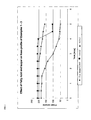
All three compositions provided excellent cleaning in neat
as well as dilute use. Foam volume was measured over time
for all three compositions under standard conditions
described below. The results are presented in Fig 1 and show
that whereas neither fatty acid nor hydrocarbon alone
produced any appreciable foam reduction for at least 4
minutes, the combination lead to foam collapse starting
after about 1.5 minutes to reach about one quarter of the
original volume after about 4 minutes.
Into a wide mouthed measuring cylinder 3g of the cleaning
composition is added and the volume is made up to 250ml with
Prenton water (26° French Hardness). The solution is well
mixed by giving it a small amount of agitation while taking
care that no foam is produced. The top is placed on the
cylinder and the solution is allowed to stand for 5 minutes.
The cylinder is fully inverted and righted 10 times to
produce the foam. Thereafter the top of the cylinder is
removed and the amount of foam is noted every 30 seconds
from time 0 to 5 minutes.
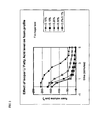
Cleaning compositions with varying mixtures of Prifac 7907
fatty acid and Isopar L hydrocarbon were made according to
the following formulations, using the procedure described
above:
| Example | 4 | a | b | c | d | e |
| Empigen BB | 1.00% | |||||
| Neodol 91-5 | 2.25% | |||||
| Perfume | 0.33% | |||||
| Citric acid/NaOH | to pH 7.5 | |||||
| Demin water | to 100% | |||||
| Prifac 7907 | 0.10 | 0.15 | 0.20 | 0.30 | 0.20 | |
| Isopar L | 0.10 | 0.15 | 0.20 | 0.30 | 0.10 |
Foam volume was measured over time for all five compositions
under standard conditions as described above. The results
are presented in Fig 2. They show good foam reduction for
all compositions. They also show that for this composition
higher amounts than 0.2% of both fatty acid and hydrocarbon
give little extra contribution to foam reduction.
Claims (10)
- Aqueous liquid cleaning compositions comprising a surfactant or surfactant mixture and a foam reducing system characterised in that:i) 0.1-10% of the total composition consists of the surfactant or surfactant mixture of which at least 20% consists of one or more zwitterionic betaines of the general formula:R1 is an aliphatic, saturated or unsaturated, linear or branched hydrocarbon chain containing 8-20 carbon atoms or a group of the formula R5-CO-NH-(CH2)x wherein R5 is an aliphatic, saturated or unsaturated, linear or branched hydrocarbon chain containing 8-20 carbon atoms and x is an integer from 2 to 4;R2 is hydrogen or C1-C3 alkyl;R3 is C1-C3 alkyl;R4 is a linear alkylene group of up to 6 carbon atoms;X is a carboxylate or sulphonate group;ii) the composition comprises a foam reducing system comprising a fatty acid and a hydrocarbon solvent.
- Cleaning compositions according to claim 1
characterised in that R1 is an aliphatic, saturated or unsaturated, linear or branched hydrocarbon chain containing up to 16 carbon atoms. - Cleaning compositions according to claims 1 or 2
characterised in that R2 and R3 are both methyl. - Cleaning compositions according to claims 1-3
characterised in that R4 has 1-3 carbon atoms and X is a carboxylate group. - Cleaning compositions according to claims 1-4 characterised in that at least 25% of total surfactant in the composition is zwitterionic betaine.
- Cleaning compositions according to claims 1-5 characterised in that they additionally comprise nonionic surfactant comprising non-capped condensation products of aliphatic alcohols having from 8 to 22 carbon atoms in either straight or branched chain configuration with ethylene oxide.
- Cleaning compositions according to claims 1-6 characterised in that the foam reducing system comprises at least 0.05% fatty acid and 0.05% hydrocarbon
- Cleaning compositions according to claim 7 characterised in that the foam reducing system comprises 0.1-2% fatty acid and 0.1-2% hydrocarbon in a ratio of between 1:5 and 5:1
- Process for cleaning hard surfaces comprising the step of applying to the hard surface a composition according any one of claims 1-8
- Wet ready-to-use cleaning wipes comprising a cleaning composition according to any one of claims 1-8.
Priority Applications (1)
| Application Number | Priority Date | Filing Date | Title |
|---|---|---|---|
| EP04253646A EP1607472A1 (en) | 2004-06-17 | 2004-06-17 | Aqueous liquid cleaning compositions |
Applications Claiming Priority (1)
| Application Number | Priority Date | Filing Date | Title |
|---|---|---|---|
| EP04253646A EP1607472A1 (en) | 2004-06-17 | 2004-06-17 | Aqueous liquid cleaning compositions |
Publications (1)
| Publication Number | Publication Date |
|---|---|
| EP1607472A1 true EP1607472A1 (en) | 2005-12-21 |
Family
ID=34930414
Family Applications (1)
| Application Number | Title | Priority Date | Filing Date |
|---|---|---|---|
| EP04253646A Withdrawn EP1607472A1 (en) | 2004-06-17 | 2004-06-17 | Aqueous liquid cleaning compositions |
Country Status (1)
| Country | Link |
|---|---|
| EP (1) | EP1607472A1 (en) |
Cited By (3)
| Publication number | Priority date | Publication date | Assignee | Title |
|---|---|---|---|---|
| WO2014154234A1 (en) * | 2013-03-25 | 2014-10-02 | Rhodia Operations | Fabric softener |
| US10138443B2 (en) | 2013-12-05 | 2018-11-27 | Rohm And Haas Company | Cleaning composition with rapid foam collapse |
| WO2019027375A1 (en) * | 2017-07-31 | 2019-02-07 | Kongchai Bunlue | A cleaning product |
Citations (5)
| Publication number | Priority date | Publication date | Assignee | Title |
|---|---|---|---|---|
| GB1099502A (en) * | 1964-07-10 | 1968-01-17 | Unilever Ltd | Improvements in or relating to detergent compositions |
| WO1993018128A1 (en) * | 1992-03-06 | 1993-09-16 | Unilever Plc | Low-foaming, liquid cleaning compositions |
| US5834413A (en) * | 1997-09-26 | 1998-11-10 | Colgate-Palmolive Co. | Liquid cleaning compositions |
| WO2000061710A2 (en) * | 1999-04-09 | 2000-10-19 | Colgate-Palmolive Company | Post foaming cleaning compositions |
| WO2003050226A1 (en) * | 2001-12-10 | 2003-06-19 | Colgate-Palmolive Company | Cleaning wipe |
-
2004
- 2004-06-17 EP EP04253646A patent/EP1607472A1/en not_active Withdrawn
Patent Citations (5)
| Publication number | Priority date | Publication date | Assignee | Title |
|---|---|---|---|---|
| GB1099502A (en) * | 1964-07-10 | 1968-01-17 | Unilever Ltd | Improvements in or relating to detergent compositions |
| WO1993018128A1 (en) * | 1992-03-06 | 1993-09-16 | Unilever Plc | Low-foaming, liquid cleaning compositions |
| US5834413A (en) * | 1997-09-26 | 1998-11-10 | Colgate-Palmolive Co. | Liquid cleaning compositions |
| WO2000061710A2 (en) * | 1999-04-09 | 2000-10-19 | Colgate-Palmolive Company | Post foaming cleaning compositions |
| WO2003050226A1 (en) * | 2001-12-10 | 2003-06-19 | Colgate-Palmolive Company | Cleaning wipe |
Cited By (5)
| Publication number | Priority date | Publication date | Assignee | Title |
|---|---|---|---|---|
| WO2014154234A1 (en) * | 2013-03-25 | 2014-10-02 | Rhodia Operations | Fabric softener |
| WO2014154654A1 (en) * | 2013-03-25 | 2014-10-02 | Rhodia Operations | Fabric softener |
| US9714400B2 (en) | 2013-03-25 | 2017-07-25 | Rhodia Operations | Fabric softener |
| US10138443B2 (en) | 2013-12-05 | 2018-11-27 | Rohm And Haas Company | Cleaning composition with rapid foam collapse |
| WO2019027375A1 (en) * | 2017-07-31 | 2019-02-07 | Kongchai Bunlue | A cleaning product |
Similar Documents
| Publication | Publication Date | Title |
|---|---|---|
| EP0666308B1 (en) | Multi-purpose liquid cleaning compositions | |
| AU2004206217B2 (en) | Liquid detergent composition and methods for using it | |
| US11339352B2 (en) | Antimicrobial hard surface cleaners comprising alkylpyrrolidones | |
| CA2599224A1 (en) | Detergent compositions with unique builder system for enhanced stain removal | |
| US11555164B2 (en) | Alkaline hard surface cleaners comprising alkylpyrrolidones | |
| EP0916719A2 (en) | Cleaning with short-chain surfactants | |
| AU2009248796A1 (en) | All-purpose cleaning compositions | |
| US20160120387A1 (en) | Hard surface premoistened wipes, cleaning implements and methods thereof | |
| US6037317A (en) | Aqueous cleaning compositions containing a 2-alkyl alkanol, H2 . O.sub2, an anionic and a low HLB nonionic | |
| US20170369817A1 (en) | Hard surface cleaning compositions | |
| WO2018237129A1 (en) | Solvent containing hard surface cleaning compositions | |
| JP2014098171A (en) | Liquid detergent composition | |
| US4921627A (en) | Detersive system and low foaming aqueous surfactant solutions containing a mono(C1-4 alkyl)-di(C6-20) alkylamine oxide compound | |
| US4938893A (en) | Detersive systems and low foaming aqueous surfactant solutions containing a mono (C1-4 alkyl)-di(C6-20 alkyl)-amine oxide compound | |
| JP2019048963A (en) | Liquid surface cleaning composition for hard surface | |
| EP1607472A1 (en) | Aqueous liquid cleaning compositions | |
| RU2650684C2 (en) | Detergent or cleaning agent means with improved foaming capacity at a high level of contamination | |
| EP1446470B1 (en) | Liquid abrasive cleaning compositions | |
| US6398820B1 (en) | Method for washing clothes, in particular working clothes | |
| CN113906125B (en) | Soluble cleaning tablets containing polyols or metal ion chlorides | |
| JP2002146390A (en) | Cleaning enhancer composition and cleaning composition | |
| JP2002060789A (en) | Detergent composition | |
| JP2006176663A (en) | Cleaning composition and cleaning method | |
| JP2006008951A (en) | Cleaning composition | |
| JP6144576B2 (en) | Cleaning composition for clothing |
Legal Events
| Date | Code | Title | Description |
|---|---|---|---|
| PUAI | Public reference made under article 153(3) epc to a published international application that has entered the european phase |
Free format text: ORIGINAL CODE: 0009012 |
|
| AK | Designated contracting states |
Kind code of ref document: A1 Designated state(s): AT BE BG CH CY CZ DE DK EE ES FI FR GB GR HU IE IT LI LU MC NL PL PT RO SE SI SK TR |
|
| AX | Request for extension of the european patent |
Extension state: AL HR LT LV MK |
|
| STAA | Information on the status of an ep patent application or granted ep patent |
Free format text: STATUS: THE APPLICATION HAS BEEN WITHDRAWN |
|
| 18W | Application withdrawn |
Effective date: 20051223 |