EP1605906B1 - Hair color application using cluster-modified water - Google Patents
Hair color application using cluster-modified water Download PDFInfo
- Publication number
- EP1605906B1 EP1605906B1 EP04719219A EP04719219A EP1605906B1 EP 1605906 B1 EP1605906 B1 EP 1605906B1 EP 04719219 A EP04719219 A EP 04719219A EP 04719219 A EP04719219 A EP 04719219A EP 1605906 B1 EP1605906 B1 EP 1605906B1
- Authority
- EP
- European Patent Office
- Prior art keywords
- water
- cluster
- hair
- modified
- fibers
- Prior art date
- Legal status (The legal status is an assumption and is not a legal conclusion. Google has not performed a legal analysis and makes no representation as to the accuracy of the status listed.)
- Expired - Lifetime
Links
- XLYOFNOQVPJJNP-UHFFFAOYSA-N water Substances O XLYOFNOQVPJJNP-UHFFFAOYSA-N 0.000 title claims description 201
- 229910001868 water Inorganic materials 0.000 title claims description 199
- 230000037308 hair color Effects 0.000 title claims description 44
- 238000000034 method Methods 0.000 claims description 39
- 239000000835 fiber Substances 0.000 claims description 35
- 238000002791 soaking Methods 0.000 claims description 20
- 238000004043 dyeing Methods 0.000 claims description 18
- 239000003086 colorant Substances 0.000 claims description 16
- 239000002453 shampoo Substances 0.000 claims description 11
- 230000002378 acidificating effect Effects 0.000 claims description 8
- 230000001965 increasing effect Effects 0.000 claims description 8
- 150000003839 salts Chemical class 0.000 claims description 8
- 230000002708 enhancing effect Effects 0.000 claims description 4
- 238000001035 drying Methods 0.000 claims description 2
- 239000000975 dye Substances 0.000 description 24
- 238000011282 treatment Methods 0.000 description 15
- 150000002500 ions Chemical class 0.000 description 14
- 239000000126 substance Substances 0.000 description 12
- 239000008399 tap water Substances 0.000 description 8
- 235000020679 tap water Nutrition 0.000 description 8
- 238000004040 coloring Methods 0.000 description 7
- 229910052739 hydrogen Inorganic materials 0.000 description 7
- 239000001257 hydrogen Substances 0.000 description 7
- 230000001590 oxidative effect Effects 0.000 description 7
- TWRXJAOTZQYOKJ-UHFFFAOYSA-L Magnesium chloride Chemical compound [Mg+2].[Cl-].[Cl-] TWRXJAOTZQYOKJ-UHFFFAOYSA-L 0.000 description 6
- 230000000694 effects Effects 0.000 description 6
- FGIUAXJPYTZDNR-UHFFFAOYSA-N potassium nitrate Chemical compound [K+].[O-][N+]([O-])=O FGIUAXJPYTZDNR-UHFFFAOYSA-N 0.000 description 6
- 230000008859 change Effects 0.000 description 5
- 239000000463 material Substances 0.000 description 5
- 230000008569 process Effects 0.000 description 5
- MHAJPDPJQMAIIY-UHFFFAOYSA-N Hydrogen peroxide Chemical compound OO MHAJPDPJQMAIIY-UHFFFAOYSA-N 0.000 description 4
- 150000001768 cations Chemical class 0.000 description 4
- 239000000203 mixture Substances 0.000 description 4
- 239000001024 permanent hair color Substances 0.000 description 4
- UXVMQQNJUSDDNG-UHFFFAOYSA-L Calcium chloride Chemical compound [Cl-].[Cl-].[Ca+2] UXVMQQNJUSDDNG-UHFFFAOYSA-L 0.000 description 3
- 239000007836 KH2PO4 Substances 0.000 description 3
- 239000007832 Na2SO4 Substances 0.000 description 3
- KWYUFKZDYYNOTN-UHFFFAOYSA-M Potassium hydroxide Chemical compound [OH-].[K+] KWYUFKZDYYNOTN-UHFFFAOYSA-M 0.000 description 3
- PMZURENOXWZQFD-UHFFFAOYSA-L Sodium Sulfate Chemical compound [Na+].[Na+].[O-]S([O-])(=O)=O PMZURENOXWZQFD-UHFFFAOYSA-L 0.000 description 3
- HEMHJVSKTPXQMS-UHFFFAOYSA-M Sodium hydroxide Chemical compound [OH-].[Na+] HEMHJVSKTPXQMS-UHFFFAOYSA-M 0.000 description 3
- 239000000980 acid dye Substances 0.000 description 3
- 150000001450 anions Chemical class 0.000 description 3
- 239000001110 calcium chloride Substances 0.000 description 3
- 229910001628 calcium chloride Inorganic materials 0.000 description 3
- 230000001143 conditioned effect Effects 0.000 description 3
- 230000003750 conditioning effect Effects 0.000 description 3
- 238000011156 evaluation Methods 0.000 description 3
- 239000000118 hair dye Substances 0.000 description 3
- -1 hydrogen ions Chemical class 0.000 description 3
- 230000006872 improvement Effects 0.000 description 3
- 229910001629 magnesium chloride Inorganic materials 0.000 description 3
- 229910000402 monopotassium phosphate Inorganic materials 0.000 description 3
- GNSKLFRGEWLPPA-UHFFFAOYSA-M potassium dihydrogen phosphate Chemical compound [K+].OP(O)([O-])=O GNSKLFRGEWLPPA-UHFFFAOYSA-M 0.000 description 3
- 229910052938 sodium sulfate Inorganic materials 0.000 description 3
- 230000000087 stabilizing effect Effects 0.000 description 3
- 238000005406 washing Methods 0.000 description 3
- UFHFLCQGNIYNRP-UHFFFAOYSA-N Hydrogen Chemical compound [H][H] UFHFLCQGNIYNRP-UHFFFAOYSA-N 0.000 description 2
- CSNNHWWHGAXBCP-UHFFFAOYSA-L Magnesium sulfate Chemical compound [Mg+2].[O-][S+2]([O-])([O-])[O-] CSNNHWWHGAXBCP-UHFFFAOYSA-L 0.000 description 2
- 229930182559 Natural dye Natural products 0.000 description 2
- SJEYSFABYSGQBG-UHFFFAOYSA-M Patent blue Chemical compound [Na+].C1=CC(N(CC)CC)=CC=C1C(C=1C(=CC(=CC=1)S([O-])(=O)=O)S([O-])(=O)=O)=C1C=CC(=[N+](CC)CC)C=C1 SJEYSFABYSGQBG-UHFFFAOYSA-M 0.000 description 2
- 238000002835 absorbance Methods 0.000 description 2
- 239000002253 acid Substances 0.000 description 2
- 239000007864 aqueous solution Substances 0.000 description 2
- QVGXLLKOCUKJST-UHFFFAOYSA-N atomic oxygen Chemical compound [O] QVGXLLKOCUKJST-UHFFFAOYSA-N 0.000 description 2
- 230000005923 long-lasting effect Effects 0.000 description 2
- 229910021645 metal ion Inorganic materials 0.000 description 2
- 239000000978 natural dye Substances 0.000 description 2
- 229910052760 oxygen Inorganic materials 0.000 description 2
- 239000001301 oxygen Substances 0.000 description 2
- 238000012545 processing Methods 0.000 description 2
- 230000009467 reduction Effects 0.000 description 2
- 239000000243 solution Substances 0.000 description 2
- 238000012360 testing method Methods 0.000 description 2
- 229940070527 tourmaline Drugs 0.000 description 2
- 229910052613 tourmaline Inorganic materials 0.000 description 2
- 239000011032 tourmaline Substances 0.000 description 2
- HSEYYGFJBLWFGD-UHFFFAOYSA-N 4-methylsulfanyl-2-[(2-methylsulfanylpyridine-3-carbonyl)amino]butanoic acid Chemical compound CSCCC(C(O)=O)NC(=O)C1=CC=CN=C1SC HSEYYGFJBLWFGD-UHFFFAOYSA-N 0.000 description 1
- ZUGAOYSWHHGDJY-UHFFFAOYSA-K 5-hydroxy-2,8,9-trioxa-1-aluminabicyclo[3.3.2]decane-3,7,10-trione Chemical compound [Al+3].[O-]C(=O)CC(O)(CC([O-])=O)C([O-])=O ZUGAOYSWHHGDJY-UHFFFAOYSA-K 0.000 description 1
- VHUUQVKOLVNVRT-UHFFFAOYSA-N Ammonium hydroxide Chemical compound [NH4+].[OH-] VHUUQVKOLVNVRT-UHFFFAOYSA-N 0.000 description 1
- VYZAMTAEIAYCRO-UHFFFAOYSA-N Chromium Chemical compound [Cr] VYZAMTAEIAYCRO-UHFFFAOYSA-N 0.000 description 1
- RYGMFSIKBFXOCR-UHFFFAOYSA-N Copper Chemical compound [Cu] RYGMFSIKBFXOCR-UHFFFAOYSA-N 0.000 description 1
- 241000233866 Fungi Species 0.000 description 1
- 206010019049 Hair texture abnormal Diseases 0.000 description 1
- FYYHWMGAXLPEAU-UHFFFAOYSA-N Magnesium Chemical compound [Mg] FYYHWMGAXLPEAU-UHFFFAOYSA-N 0.000 description 1
- VVQNEPGJFQJSBK-UHFFFAOYSA-N Methyl methacrylate Chemical compound COC(=O)C(C)=C VVQNEPGJFQJSBK-UHFFFAOYSA-N 0.000 description 1
- 229920005372 Plexiglas® Polymers 0.000 description 1
- 238000000692 Student's t-test Methods 0.000 description 1
- ATJFFYVFTNAWJD-UHFFFAOYSA-N Tin Chemical compound [Sn] ATJFFYVFTNAWJD-UHFFFAOYSA-N 0.000 description 1
- 238000005411 Van der Waals force Methods 0.000 description 1
- 238000011481 absorbance measurement Methods 0.000 description 1
- HDYRYUINDGQKMC-UHFFFAOYSA-M acetyloxyaluminum;dihydrate Chemical compound O.O.CC(=O)O[Al] HDYRYUINDGQKMC-UHFFFAOYSA-M 0.000 description 1
- CQPFMGBJSMSXLP-UHFFFAOYSA-M acid orange 7 Chemical compound [Na+].OC1=CC=C2C=CC=CC2=C1N=NC1=CC=C(S([O-])(=O)=O)C=C1 CQPFMGBJSMSXLP-UHFFFAOYSA-M 0.000 description 1
- 229910052782 aluminium Inorganic materials 0.000 description 1
- XAGFODPZIPBFFR-UHFFFAOYSA-N aluminium Chemical compound [Al] XAGFODPZIPBFFR-UHFFFAOYSA-N 0.000 description 1
- 229940009827 aluminum acetate Drugs 0.000 description 1
- 229940103272 aluminum potassium sulfate Drugs 0.000 description 1
- 239000000908 ammonium hydroxide Substances 0.000 description 1
- 238000004458 analytical method Methods 0.000 description 1
- 230000002547 anomalous effect Effects 0.000 description 1
- 125000003118 aryl group Chemical group 0.000 description 1
- 125000004429 atom Chemical group 0.000 description 1
- 230000015572 biosynthetic process Effects 0.000 description 1
- AXCZMVOFGPJBDE-UHFFFAOYSA-L calcium dihydroxide Chemical compound [OH-].[OH-].[Ca+2] AXCZMVOFGPJBDE-UHFFFAOYSA-L 0.000 description 1
- 239000000920 calcium hydroxide Substances 0.000 description 1
- 229910001861 calcium hydroxide Inorganic materials 0.000 description 1
- 239000000969 carrier Substances 0.000 description 1
- 239000003054 catalyst Substances 0.000 description 1
- 238000007385 chemical modification Methods 0.000 description 1
- 239000003638 chemical reducing agent Substances 0.000 description 1
- 229910052804 chromium Inorganic materials 0.000 description 1
- 239000011651 chromium Substances 0.000 description 1
- 150000001875 compounds Chemical class 0.000 description 1
- 238000006482 condensation reaction Methods 0.000 description 1
- 229910052802 copper Inorganic materials 0.000 description 1
- 239000010949 copper Substances 0.000 description 1
- 230000008878 coupling Effects 0.000 description 1
- 238000010168 coupling process Methods 0.000 description 1
- 238000005859 coupling reaction Methods 0.000 description 1
- 230000003247 decreasing effect Effects 0.000 description 1
- 239000008367 deionised water Substances 0.000 description 1
- 229910021641 deionized water Inorganic materials 0.000 description 1
- 239000001025 demi permanent hair color Substances 0.000 description 1
- 230000001419 dependent effect Effects 0.000 description 1
- 230000008021 deposition Effects 0.000 description 1
- 230000000368 destabilizing effect Effects 0.000 description 1
- LQJVOKWHGUAUHK-UHFFFAOYSA-L disodium 5-amino-4-hydroxy-3-phenyldiazenylnaphthalene-2,7-disulfonate Chemical compound [Na+].[Na+].OC1=C2C(N)=CC(S([O-])(=O)=O)=CC2=CC(S([O-])(=O)=O)=C1N=NC1=CC=CC=C1 LQJVOKWHGUAUHK-UHFFFAOYSA-L 0.000 description 1
- 239000012153 distilled water Substances 0.000 description 1
- 230000005686 electrostatic field Effects 0.000 description 1
- 230000003203 everyday effect Effects 0.000 description 1
- 238000002474 experimental method Methods 0.000 description 1
- 238000005562 fading Methods 0.000 description 1
- 239000011521 glass Substances 0.000 description 1
- 125000004435 hydrogen atom Chemical group [H]* 0.000 description 1
- 125000002887 hydroxy group Chemical group [H]O* 0.000 description 1
- 239000004615 ingredient Substances 0.000 description 1
- 239000011777 magnesium Substances 0.000 description 1
- 229910052749 magnesium Inorganic materials 0.000 description 1
- 229910052943 magnesium sulfate Inorganic materials 0.000 description 1
- 235000019341 magnesium sulphate Nutrition 0.000 description 1
- 230000014759 maintenance of location Effects 0.000 description 1
- 238000004519 manufacturing process Methods 0.000 description 1
- 238000005259 measurement Methods 0.000 description 1
- 230000004048 modification Effects 0.000 description 1
- 238000012986 modification Methods 0.000 description 1
- 125000004430 oxygen atom Chemical group O* 0.000 description 1
- 238000004806 packaging method and process Methods 0.000 description 1
- 238000007427 paired t-test Methods 0.000 description 1
- 150000002978 peroxides Chemical class 0.000 description 1
- 230000000704 physical effect Effects 0.000 description 1
- 230000010287 polarization Effects 0.000 description 1
- 238000006116 polymerization reaction Methods 0.000 description 1
- GRLPQNLYRHEGIJ-UHFFFAOYSA-J potassium aluminium sulfate Chemical compound [Al+3].[K+].[O-]S([O-])(=O)=O.[O-]S([O-])(=O)=O GRLPQNLYRHEGIJ-UHFFFAOYSA-J 0.000 description 1
- 238000005381 potential energy Methods 0.000 description 1
- XOFYZVNMUHMLCC-ZPOLXVRWSA-N prednisone Chemical compound O=C1C=C[C@]2(C)[C@H]3C(=O)C[C@](C)([C@@](CC4)(O)C(=O)CO)[C@@H]4[C@@H]3CCC2=C1 XOFYZVNMUHMLCC-ZPOLXVRWSA-N 0.000 description 1
- 238000002203 pretreatment Methods 0.000 description 1
- 238000009738 saturating Methods 0.000 description 1
- 239000001026 semi permanent hair color Substances 0.000 description 1
- 238000000926 separation method Methods 0.000 description 1
- 239000007921 spray Substances 0.000 description 1
- 238000005507 spraying Methods 0.000 description 1
- 238000003860 storage Methods 0.000 description 1
- 239000000979 synthetic dye Substances 0.000 description 1
- 238000012353 t test Methods 0.000 description 1
- 239000004753 textile Substances 0.000 description 1
- 229910052718 tin Inorganic materials 0.000 description 1
- 239000011135 tin Substances 0.000 description 1
- VXYADVIJALMOEQ-UHFFFAOYSA-K tris(lactato)aluminium Chemical compound CC(O)C(=O)O[Al](OC(=O)C(C)O)OC(=O)C(C)O VXYADVIJALMOEQ-UHFFFAOYSA-K 0.000 description 1
- 239000003643 water by type Substances 0.000 description 1
Images

Classifications
-
- A—HUMAN NECESSITIES
- A61—MEDICAL OR VETERINARY SCIENCE; HYGIENE
- A61K—PREPARATIONS FOR MEDICAL, DENTAL OR TOILETRY PURPOSES
- A61K8/00—Cosmetics or similar toiletry preparations
- A61K8/18—Cosmetics or similar toiletry preparations characterised by the composition
- A61K8/19—Cosmetics or similar toiletry preparations characterised by the composition containing inorganic ingredients
-
- A—HUMAN NECESSITIES
- A61—MEDICAL OR VETERINARY SCIENCE; HYGIENE
- A61Q—SPECIFIC USE OF COSMETICS OR SIMILAR TOILETRY PREPARATIONS
- A61Q5/00—Preparations for care of the hair
- A61Q5/06—Preparations for styling the hair, e.g. by temporary shaping or colouring
- A61Q5/065—Preparations for temporary colouring the hair, e.g. direct dyes
-
- A—HUMAN NECESSITIES
- A61—MEDICAL OR VETERINARY SCIENCE; HYGIENE
- A61Q—SPECIFIC USE OF COSMETICS OR SIMILAR TOILETRY PREPARATIONS
- A61Q5/00—Preparations for care of the hair
- A61Q5/10—Preparations for permanently dyeing the hair
-
- A—HUMAN NECESSITIES
- A61—MEDICAL OR VETERINARY SCIENCE; HYGIENE
- A61K—PREPARATIONS FOR MEDICAL, DENTAL OR TOILETRY PURPOSES
- A61K2800/00—Properties of cosmetic compositions or active ingredients thereof or formulation aids used therein and process related aspects
- A61K2800/80—Process related aspects concerning the preparation of the cosmetic composition or the storage or application thereof
- A61K2800/88—Two- or multipart kits
- A61K2800/884—Sequential application
Definitions
- the present invention relates to structured water and hair coloring systems for permanent, demi-permanent and semi-permanent hair color.
- the invention relates to the cluster-modified water and the ability to enhance color that is produced by dyeing the hair when clustered-modified water is included as part of the hair coloring application.
- the coloring of hair regardless of the reason is a process that must be applied correctly. In most cases, this means that the hair color is sharp and full from the first day of coloring. In addition, the consumer needs the hair color to last, at an absolute minimum of two weeks (i.e., colorfast). Thus, a dye must be colorfast to the everyday environmental exposure of hair, most notably shampooing, styling and sunlight. Colorfastness of a dye can vary widely. Therefore, dyes used in the coloring of hair are categorized as permanent, demi-permanent and semi-permanent. One of the most well known, and widely used coloring applications is the oxidative dyeing process.
- the dye composition is comprised of two main components: primary and coupler. Both components are low molecular weight, which enables them to penetrate the hair and be polymerized in the presence of a base and hydrogen peroxide, to form a final, larger molecular weight dye.
- the chemical polymerization process in the presence of the base and the peroxide is a coupling or a condensation reaction.
- the base is an alkaline material that can be, for example, ammonium hydroxide, sodium hydroxide, potassium hydroxide, and calcium hydroxide. It is well established that use of these materials can to some extent be damaging to the hair.
- cluster-modified water is capable of increasing the depth, intensity and durability of hair color, without the use of harsh chemicals.
- Cluster-modified water is anomalous to the specific chemical structure of commonly known regular water in that it contains three atoms, including two hydrogen and one oxygen, in a symmetrical triangular shape.
- the chemical structure may be simple, the water molecule as a whole is very complicated. Due to its chemical structure, water molecules exhibit partially positive and negative sites forming a dipole moment.
- cluster-modified water in the process of coloring hair has been surprisingly found to give color-treated hair a higher intensity of color than with the same given amount of colorant on hair color-trealed without cluster-modified water.
- the resulting color is more durable, and has a conditioned feel and lustrous look.
- the present invention provides a hair coloring system comprising a kit having at least one container of cluster modified water in addition to a hair coloring agent, and a shampoo (relates to a system of hair coloring) which enhances color intensity and conditions the color-treated hair with a simple application of cluster-modified water to the keratinous fiber.
- a hair coloring system comprises containers of at least one cluster-modified water, a hair coloring agent, and a shampoo.
- Another aspect of the present invention is to provide:
- a method of dyeing keratinous fibers comprising the steps of:
- Another embodiment of the invention is to provide according to the previous method, a method of enhancing the color of color treated hair.
- Another aspect of the invention is to provide:
- a method of dyeing keratinous fibers comprising the steps of:
- Another embodiment of the invention is to provide according to the previous method, a method of increasing the body and condition of dyed hair.
- Another aspect of the invention is to provide:
- a method of dyeing keratinous fibers comprising the steps of:
- the methods of the present invention include dyeing the keratinous fibers by soaking or saturating the hair with clustered-modified water.
- the hair is pre-soaked with the clustered-modified water for a period of time, before drying the hair.
- the normal hair-color treatment is applied using a hair coloring agent on the dry hair.
- the methods of the present invention also include steps for soaking the hair for a second time with the cluster-modified water for a given period of time. After the post-soaking, the hair is dried and can be styled as usual.
- the treatment of the hair by pre-soaking and post-soaking can be done individually or collectively as a treatment.
- any cluster-modified water for example, structured water and ionized water, can have all effect on the condition and coloration of the hair.
- the present invention includes a hair coloring composition comprising cluster-modified water, at least one mordanting salt and at least one semi-permanent synthetic and/or natural dye.
- the color of color-treated hair can be intensified, and that the body and conditioning of the hair that is color-treated with a hair coloring agent can be enhanced by pre-soaking and/or post-soaking the keratinous fibers with a cluster-modified water.
- the cluster modification of the water can be, for example, a reduction in the size of water molecule clusters or separation of water molecules into hydroxyl and hydrogen ions, as in ionized water, or an organized structuring of ionic clusters as in structured water.
- cluster-modified water includes, but is not limited to, ionized water, and structured water.
- the scope of the present invention includes any water in which the clusters of water molecules, per se, or clusters of ions contained within the water: are manipulated to modify the properties of the water.
- structured water as used in the present specification refers to structured water described in, for example, U.S. Patent Nos. 6,139,855 and 6,231,874 . Structured water is made by treating feed water.
- the feed water is an aqueous solution and has a C ( ⁇ S/cm) of, for example, about 350 to about 550 and a pH of, for example, about 5.0 to about 7.5.
- the aqueous solution can be deionized water, distilled water or tap water.
- the feed water solution is prepared with a cluster structure stabilizing ionic component of extremely small concentrations of cations and anions from materials such as for example, CaCl 2 , MgCl 2 , Na 2 SO 4 , KH 2 PO 4 , and KNO 3 .
- the range of concentrations of ions in the ionic component can be, for example, CaCl 2 in an amount of about 5.00 to 10.00 mg/100 ml of the feed water, MgCl 2 in an amount of about 1.00 to 10.00 mg/100 ml, Na 2 SO 4 in an amount of about 2.00 to 9.00 mg/100 ml, KH 2 PO 4 in an amount of about 0.20 to about 2.00 mg/100 ml, and KNO 3 in an amount of about 0.90 to 9.00 mg/100 ml.
- the ion content of the ionic component can be 11.00 mg/100 ml CaCl 2 , 4.20 mg/100 ml MgCl 2 , 5.00 mg/100 ml Na 2 SO 4 , 0.70 mg/100 ml KH 2 PO 4 , and 1.10 mg/100 ml KNO 3 .
- the feed water has, for example, a pH of about 6.0 to 6.4 and a C ( ⁇ S/cm) of about 470 to 520.
- the feed water can be optionally fed through a tourmaline filter at a flow rate of about 10 to 200 L/hour to reduce the surface tension of the feed water.
- a tourmaline filter suitable for lowering surface tension is described in U.S. Patent No. 5,770,089 , the contents of which are incorporated herein by reference.
- the desired feed water is prepared, it is processed in the structured water making device to make the structured water.
- the process of making structured water is described for example, in RO 88053 which describes a method for producing "B” or basic (S-type) water, and RO 88054 which discloses a method for making "A” or acid (I-type) water. Improvements in simultaneously making either of these types of water are further described in U.S. Patent No. 5,846,397 , the content of which is incorporated herein by reference.
- the structured water making device uses one or several serial structuring cells placed in a chemically inert parallelipipedic column made out of glass or plexiglass, for example.
- the polarization and energy needed for binding water molecules, by hydrogen and hydroxyl bridges, in polymolecular aggregates (i.e., clusters) with radicals (R m + stabilizing ions), is present as a result of the electrostatic field being about 80 to 120 V.
- polymolecular aggregates (i.e., clusters) with radicals (R k - stabilizing ions) are simultaneously formed to make I water, in a space for producing I water.
- the structured water of the present invention does not require special storage conditions or special packaging to protect it from destabilizing factors.
- the cluster structure of structured water is very stable. The potential energy of the system of cluster structures in structured water as a whole is minimized.
- Structured water contains electronegative and electropositive clusters of water molecules stabilized by ions. Each of these two types of clusters, present in water, is commonly referred to as “I water” and "S water”.
- I water contains electronegative clusters of water molecules stabilized by ions which can be characterized as being R m + R k - (H + ) n (H 2 O) l , where k»m
- S water contains electropositive clusters of water molecules stabilized by ions which can be characterized as being R k - R m + H n + (OH - ) p (H 2 O) l , where k ⁇ m.
- R m + ions mainly include, but are not limited to, Ca +2 , Mg +2 , Na + , K + cations
- R k - ions mainly include, but are not limited to, Cl - , H 2 PO 4 - , SO 4 -2 anions.
- the cluster structure of the structured water is very stable. While not wishing to be bound by any particular theory, it is believed that additional ions are introduced into the system of cluster structures by replacing the ion which stabilizes the structure with ions that have the same or similar ionic radius.
- Ionized water refers specifically to water that has been processed to separate the water molecule into its ions (i.e., H + , and OH - ) or processed with a water ionizer such as, for example, Ionice SDM-2000 Water Ionizer which is commercially available, to reduce the size of natural clusters of water molecules bonded by hydrogen bonding.
- the ionizer produces alkalinic water (e.g., pH of about 9 to 12) and acidic water (e.g., pH of about 2 to 6).
- any cluster-modified water can be used to pre-soak and/or post-soak the hair.
- the cluster-modified water can be sprayed onto the hair using a spray bottle or by any other means of application to saturate the hair.
- the amount of cluster-modified water used to saturate the hair will vary depending on the quantity of hair being soaked.
- the soaked hair is allowed to set for a period of time.
- the setting time is about 30 seconds to about 15 minutes, preferably 1 to 10 minutes, and more preferably 2 to 8 minutes.
- To dry the hair it can be blown dry with a hair dryer using low heat, medium airflow setting or towel dried. After soaking the hair a second time, the colored and post-soaked hair can be blown dry or towel dried, and styled as usual.
- S water is applied as a pre-soak to intensify the color of the hair.
- the color is slightly richer and/or warmer in tone without changing the level of color.
- Structured water such as I water is applied as a post-soak to improve the body and condition the hair.
- the improved body and condition is defined by an improved texture (i.e., softer), bounce and volume of the hair.
- the coloring agent can be a dye that is oxidative or non-oxidative.
- a natural non-oxidative hair dye is used and the cluster-modified water is combined with a mordanting salt to further enhance the color fastness.
- the natural dye is a coloring compound that is found within and/or derived from naturally occurring materials such as for example, but not limited to, plants, roots, spores, and fungi.
- the hair fiber is pre-soaked and/or post-soaked with a combination of the cluster-modified water and the mordanting salt.
- mordants are commonly known in the art and include, but are not limited to polyvalent metal ions.
- the mordant present in the cluster-modified water, chelates with the dye to form a large metal-dye complex.
- the combination of the mordanting salt and the cluster-modified water can be applied to the hair at any time, e.g., prior or after dyeing.
- a dye can more readily diffuse into the hair fiber because it is a relatively small sized molecule.
- the dye-mordant complex forms, it is much larger in size than the original dye molecule, and preferentially can remain inside the hair fiber. Surprisingly, this effect is found with the cluster-modified water of the present invention. While not wishing to be bound by any particular theory, it is believed that the formation of the dye-mordant complex is fortified by the ions that stabilize the cluster structures.
- the mordants are polyvalent metal ions (having a valence of at least 2), particularly cations such as magnesium, aluminum, chromium, copper, tin, and the like.
- specific mordants include, but are not limited to, aluminum potassium sulfate, aluminum ammonium sulfate, magnesium sulfate, aluminum citrate, aluminum lactate, and aluminum acetate, or mixtures thereof.
- the mordanting salts are present in an amount of about 0.1 to about 15.0 percent by weight of the composition; and preferably about 5 to 15 percent; and most preferably about 10 to 15 percent.
- any shampoo can be used to wash the hair.
- the present invention also includes methods of improving the condition of the hair, and enhancing the color of the hair that undergoes a color treatment. Further, the present invention can also be applied in a hair coloring system.
- the hair coloring system can be in the form of a kit that includes at least one container of cluster-modified water. In addition, the kit includes a hair coloring agent, and shampoo.
- a study to test the increased intensity of color on hair involves an evaluation of three samples of hair treated as follows: One sample (1Dc) is color treated with Aveda Full SpectrumTM Permanent Hair Color (red-orange R/O 135728; 20 volume catalyst; 30 minute application time), rinsed with tap water and blown dry. Hair is moistened with tap water before applying color treatment. A second sample (3Dc) is moistened with alkalinic ionic (OH - ) water for about 5 minutes, color treated, rinsed with tap water, conditioned with acidic (H + ) ionic water, and blown dry.
- 1Dc is color treated with Aveda Full SpectrumTM Permanent Hair Color (red-orange R/O 135728; 20 volume catalyst; 30 minute application time)
- Hair is moistened with tap water before applying color treatment.
- a second sample (3Dc) is moistened with alkalinic ionic (OH - ) water for about 5 minutes, color treated, rinsed with tap water, conditioned with acidic (H + ) i
- a third sample (5Dc) is moistened with alkalinic ionic (OH - ) water for about 5 minutes, blown dry, color treated, rinsed with tap water, and conditioned with acidic ionic (H + ) water.
- the 3Dc sample appears to have the darkest and most vibrant color of the three samples indicating that ionized water enriches the intensity of the color of color-treated hair.
- This example includes evaluation of cluster-modified, and specifically of I-water as a post-treatment. This study focuses solely on acid dyes; no oxidative systems are evaluated.
- All tresses are dyed using a red-orange (R/O) acid dye paste similar in hue to Example I. Dyes included in this paste are C.I. Acid Red 33 and C.I. Acid Orange 7. Paste is brushed into hair using applicator brush, and then placed in an oven for 20 minutes at 40°C. Hair tresses are then rinsed under warm running tap water until clear. I-water is evaluated as a post-treatment to hair coloration. Experiment is conducted on both unbleached and bleached Level 5 hair (light brown color on a scale of 1 to 10 with 1 being black and 10 being light blonde). Post-treatments are applied by spraying and subsequent combing. Samples are thoroughly blow-dried using high heat.
- R/O red-orange
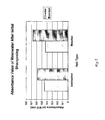
- Samples are evaluated for the following properties: color change after shampooing ( ⁇ E), and residual dye present in shampoo washwater, (absorbance measurements at 510 nm of water from tresses washed in a 5% solution of Aveda All SensitiveTM shampoo). Lower delta E values indicate less color change. Lower absorbance value indicates less residual dye in shampoo bath.
- Figures 1 and 2 respectively, illustrate the differences found between treatments.
- Half-head evaluations are performed on qualified test subjects. Activated water is applied to the left half of heads before, during or after standard hair color applications and tap water is used on the right half of heads in standard hair coloring procedures. Aveda Full SpectrumTM Permanent or Deposit Only hair color is used for all subjects. The average pH level of water with anion/alkaline rich clusters was 11. The average pH level of water with cation/acid rich clusters is 3. Subjects are evaluated for color intensity, and scored on a nine-point scale. For pre-color activated alkaline water/post-color activated acidic water hair color processing, mean score analyses with Statistica using the t-test for dependent samples at the 95% confidence interval, indicates a significantly more intense color in comparison to the hair using standard tap water color processing.
Landscapes
- Health & Medical Sciences (AREA)
- Life Sciences & Earth Sciences (AREA)
- Animal Behavior & Ethology (AREA)
- General Health & Medical Sciences (AREA)
- Public Health (AREA)
- Veterinary Medicine (AREA)
- Chemical & Material Sciences (AREA)
- Inorganic Chemistry (AREA)
- Birds (AREA)
- Epidemiology (AREA)
- Cosmetics (AREA)
- Coloring (AREA)
Description
- The present invention relates to structured water and hair coloring systems for permanent, demi-permanent and semi-permanent hair color. In particular, the invention relates to the cluster-modified water and the ability to enhance color that is produced by dyeing the hair when clustered-modified water is included as part of the hair coloring application.
- The coloring of hair regardless of the reason is a process that must be applied correctly. In most cases, this means that the hair color is sharp and full from the first day of coloring. In addition, the consumer needs the hair color to last, at an absolute minimum of two weeks (i.e., colorfast). Thus, a dye must be colorfast to the everyday environmental exposure of hair, most notably shampooing, styling and sunlight. Colorfastness of a dye can vary widely. Therefore, dyes used in the coloring of hair are categorized as permanent, demi-permanent and semi-permanent. One of the most well known, and widely used coloring applications is the oxidative dyeing process. In this process, the dye is placed on the hair, and allowed to penetrate the hair and become oxidized, most typically with hydrogen peroxide to produce the desired color in the hair. The dye composition is comprised of two main components: primary and coupler. Both components are low molecular weight, which enables them to penetrate the hair and be polymerized in the presence of a base and hydrogen peroxide, to form a final, larger molecular weight dye. The chemical polymerization process in the presence of the base and the peroxide is a coupling or a condensation reaction. The base is an alkaline material that can be, for example, ammonium hydroxide, sodium hydroxide, potassium hydroxide, and calcium hydroxide. It is well established that use of these materials can to some extent be damaging to the hair.
- In addition to dyes which provide permanent hair color, there are non-oxidative colorants which intentionally provide hair color that is more temporary. The fastness properties of these dyes are determined by ionic linkages, hydrogen bonding and van der Waals forces. These dyes are mostly used in the textile industry, where application procedures normally include the use of harsh chemicals and high temperatures. When used as hair dyes, however, the application of these dyes must be applied at much lower temperatures, and generally more mild conditions. Because of these compromises in application procedures, only a temporary coloring effect will be produced. Therefore, the color is expected to last only for several shampooing cycles. These types of dyes can be used either by themselves, or in conjunction with oxidative dyes to enhance vibrancy. To achieve good durability and/or permanent effect of hair coloring, harsh chemicals and conditions are necessary.
- Thus, there is a need to produce a hair color application that provides vibrant and healthy long-lasting color with minimal use of a harsh environment. It has now surprisingly been discovered that cluster-modified water is capable of increasing the depth, intensity and durability of hair color, without the use of harsh chemicals. Cluster-modified water is anomalous to the specific chemical structure of commonly known regular water in that it contains three atoms, including two hydrogen and one oxygen, in a symmetrical triangular shape. However, while the chemical structure may be simple, the water molecule as a whole is very complicated. Due to its chemical structure, water molecules exhibit partially positive and negative sites forming a dipole moment. These sites are the hydrogen atoms which form the positive sites, and the oxygen atom which forms the negative site (due to the two lone pairs of electrons associated with oxygen). As a result of the dipole moment formed by the positive and negative sites, the water molecule is capable of a phenomenon known as hydrogen bonding. Thus, water molecules have a tendency towards forming hydrogen bonds between each other and this causes the water molecules to aggregate in various sizes. Depending on the treatment applied to water different types of cluster-modified waters can be produced. Examples of treated, water, whereby ionic clusters contained within water are manipulated, are found in
U.S. Patent No. 6,139,855 and5,711,950 describing I and S structured water. - The use of cluster-modified water in the process of coloring hair has been surprisingly found to give color-treated hair a higher intensity of color than with the same given amount of colorant on hair color-trealed without cluster-modified water. In addition, the resulting color is more durable, and has a conditioned feel and lustrous look. These benefits are achieved with any type of cluster-modified water including electrically activated, magnetically clustered and any other structured water as a treatment in conjunction with any kind of hair color procedure. Previously, it has only been known o achieve these benefits with the use of harsh chemical typically used in hair coloring and other industries such as oxidizers, reducing agents, alkaline and acidic ingredients aromatic carriers and elevated temperatures and pressures. Clustered-water application can provide the same improvements to the final color, without the additional use of the above-listed materials and/or environments.
- The present invention provides a hair coloring system comprising a kit having at least one container of cluster modified water in addition to a hair coloring agent, and a shampoo (relates to a system of hair coloring) which enhances color intensity and conditions the color-treated hair with a simple application of cluster-modified water to the keratinous fiber. Most of the known procedures for increasing the depth and intensity of color, require opening the cuticle, and/or electro-chemical or chemical modification of the hair cuticle with the assistance of harsh chemicals. The present invention achieves these benefits based on the physical properties of less-aggregated water molecules, thus enabling the above-listed benefits to be obtained with decreased amounts of dye and harsh chemicals. Consequently, the system of the present invention is safer for the consumer to use, friendlier to the environment, and more economical to use. The hair coloring system comprises containers of at least one cluster-modified water, a hair coloring agent, and a shampoo.
- Methods to increase color deposition on hair, especially gray hair has long been researched and still are only known to be based on the use harsh chemicals. However, the present invention has surprisingly discovered that a method of using cluster-modified water such as ionized water or structured water, as a pre-treatment and/or a post-treatment to hair fibers that undergocs a dye or tint application with a hair coloring agent has been successful in accomplishing increased conditioning of the color-treated hair as well as enhanced color.
- Another aspect of the present invention is to provide:
- A method of dyeing keratinous fibers comprising the steps of:
- a) pre-soaking the fibers with cluster-modified water.
- b) removing the cluster-modified water from the fibers, and
- c) treating the fibers with a hair coloring agent.
- Another embodiment of the invention is to provide according to the previous method, a method of enhancing the color of color treated hair.
- Another aspect of the invention is to provide:
- A method of dyeing keratinous fibers comprising the steps of:
- a) treating the fibers by dyeing with a hair coloring agent: and
- b) after dyeing the fibers, post-soaking the fibers with cluster-modified water,
- Another embodiment of the invention is to provide according to the previous method, a method of increasing the body and condition of dyed hair.
- Another aspect of the invention is to provide:
- A method of dyeing keratinous fibers comprising the steps of:
- a) pre-soaking the libers with cluster-modified water;
- b) removing the cluster-modified water from the fibers:
- c) treating the fibers by dyeing with a hair coloring agent: and
- d) after dyeing the fibers, post-soaking the fibers with cluster-modified water.
- The methods of the present invention include dyeing the keratinous fibers by soaking or saturating the hair with clustered-modified water. The hair is pre-soaked with the clustered-modified water for a period of time, before drying the hair. The normal hair-color treatment is applied using a hair coloring agent on the dry hair. Following the hair coloring, the methods of the present invention also include steps for soaking the hair for a second time with the cluster-modified water for a given period of time. After the post-soaking, the hair is dried and can be styled as usual. The treatment of the hair by pre-soaking and post-soaking can be done individually or collectively as a treatment. Any cluster-modified water, for example, structured water and ionized water, can have all effect on the condition and coloration of the hair. In addition, the present invention includes a hair coloring composition comprising cluster-modified water, at least one mordanting salt and at least one semi-permanent synthetic and/or natural dye.
-
-
Figure 1 is a chart illustrating the effect of the present invention using I water on bleached and unbleached hair after repented washings (five) in causing an effect on color change after shampooing (ΔE), and consequently, improving the color fastness of hair dye and enhancing the hair color. -
Figure 2 is a chart depicting the absorbance value of washwater after initial shampooing on unbleached and bleached hair treated with 1 water and indicating an improvement in the color fastness and the enhancement of hair color. - It has now been discovered that the color of color-treated hair can be intensified, and that the body and conditioning of the hair that is color-treated with a hair coloring agent can be enhanced by pre-soaking and/or post-soaking the keratinous fibers with a cluster-modified water. The cluster modification of the water can be, for example, a reduction in the size of water molecule clusters or separation of water molecules into hydroxyl and hydrogen ions, as in ionized water, or an organized structuring of ionic clusters as in structured water. As used herein cluster-modified water includes, but is not limited to, ionized water, and structured water. Thus, the scope of the present invention includes any water in which the clusters of water molecules, per se, or clusters of ions contained within the water: are manipulated to modify the properties of the water. Specifically, structured water as used in the present specification refers to structured water described in, for example,
U.S. Patent Nos. 6,139,855 and6,231,874 . Structured water is made by treating feed water. - The feed water is an aqueous solution and has a C (µS/cm) of, for example, about 350 to about 550 and a pH of, for example, about 5.0 to about 7.5. The aqueous solution can be deionized water, distilled water or tap water. Specifically, the feed water solution is prepared with a cluster structure stabilizing ionic component of extremely small concentrations of cations and anions from materials such as for example, CaCl2, MgCl2, Na2SO4, KH2PO4, and KNO3. The range of concentrations of ions in the ionic component can be, for example, CaCl2 in an amount of about 5.00 to 10.00 mg/100 ml of the feed water, MgCl2 in an amount of about 1.00 to 10.00 mg/100 ml, Na2SO4 in an amount of about 2.00 to 9.00 mg/100 ml, KH2PO4 in an amount of about 0.20 to about 2.00 mg/100 ml, and KNO3 in an amount of about 0.90 to 9.00 mg/100 ml. For example, the ion content of the ionic component can be 11.00 mg/100 ml CaCl2, 4.20 mg/100 ml MgCl2, 5.00 mg/100 ml Na2SO4, 0.70 mg/100 ml KH2PO4, and 1.10 mg/100 ml KNO3. The feed water has, for example, a pH of about 6.0 to 6.4 and a C (µS/cm) of about 470 to 520. The feed water can be optionally fed through a tourmaline filter at a flow rate of about 10 to 200 L/hour to reduce the surface tension of the feed water. A tourmaline filter suitable for lowering surface tension is described in
U.S. Patent No. 5,770,089 , the contents of which are incorporated herein by reference. - After the desired feed water is prepared, it is processed in the structured water making device to make the structured water. The process of making structured water is described for example, in
RO 88053 RO 88054 U.S. Patent No. 5,846,397 , the content of which is incorporated herein by reference. The structured water making device uses one or several serial structuring cells placed in a chemically inert parallelipipedic column made out of glass or plexiglass, for example. In a space for generating or producing the S water, the polarization and energy needed for binding water molecules, by hydrogen and hydroxyl bridges, in polymolecular aggregates (i.e., clusters) with radicals (Rm + stabilizing ions), is present as a result of the electrostatic field being about 80 to 120 V. Similarly, polymolecular aggregates (i.e., clusters) with radicals (Rk - stabilizing ions) are simultaneously formed to make I water, in a space for producing I water. The structured water of the present invention does not require special storage conditions or special packaging to protect it from destabilizing factors. Further, the cluster structure of structured water is very stable. The potential energy of the system of cluster structures in structured water as a whole is minimized. - Structured water contains electronegative and electropositive clusters of water molecules stabilized by ions. Each of these two types of clusters, present in water, is commonly referred to as "I water" and "S water". On the one hand, I water contains electronegative clusters of water molecules stabilized by ions which can be characterized as being Rm + Rk - (H+)n(H2O)l, where k»m, and conversely, on the other hand, S water contains electropositive clusters of water molecules stabilized by ions which can be characterized as being Rk -Rm +Hn + (OH-)p(H2O)l, where k <<m. In each case of I water and S water, Rm + ions mainly include, but are not limited to, Ca+2, Mg+2, Na+, K+ cations, and R k- ions mainly include, but are not limited to, Cl-, H2PO4 -, SO4 -2 anions. The cluster structure of the structured water is very stable. While not wishing to be bound by any particular theory, it is believed that additional ions are introduced into the system of cluster structures by replacing the ion which stabilizes the structure with ions that have the same or similar ionic radius.
- Ionized water as used herein refers specifically to water that has been processed to separate the water molecule into its ions (i.e., H+, and OH-) or processed with a water ionizer such as, for example, Ionice SDM-2000 Water Ionizer which is commercially available, to reduce the size of natural clusters of water molecules bonded by hydrogen bonding. The ionizer produces alkalinic water (e.g., pH of about 9 to 12) and acidic water (e.g., pH of about 2 to 6).
- Any cluster-modified water can be used to pre-soak and/or post-soak the hair. When pre-soaking or post-soaking the hair, the cluster-modified water can be sprayed onto the hair using a spray bottle or by any other means of application to saturate the hair. The amount of cluster-modified water used to saturate the hair will vary depending on the quantity of hair being soaked. The soaked hair is allowed to set for a period of time. The setting time is about 30 seconds to about 15 minutes, preferably 1 to 10 minutes, and more preferably 2 to 8 minutes. To dry the hair, it can be blown dry with a hair dryer using low heat, medium airflow setting or towel dried. After soaking the hair a second time, the colored and post-soaked hair can be blown dry or towel dried, and styled as usual.
- Thus, preferably, for example, S water is applied as a pre-soak to intensify the color of the hair. The color is slightly richer and/or warmer in tone without changing the level of color. Structured water such as I water is applied as a post-soak to improve the body and condition the hair. The improved body and condition is defined by an improved texture (i.e., softer), bounce and volume of the hair. These conditions are similar to a conditioning treatment and are long lasting, for example, for at least one or two days. Increased color intensity lasts for several washings indicating an increased colorfastness. The term colorfastness means that the color treated hair exhibits a reduction in color fading after washing.
- Any dye or tint can be used with the present invention to color the hair permanently, semi-permanently, demi-permanently or temporarily. Thus, the coloring agent can be a dye that is oxidative or non-oxidative. However, in one embodiment of the present invention, a natural non-oxidative hair dye is used and the cluster-modified water is combined with a mordanting salt to further enhance the color fastness. The natural dye is a coloring compound that is found within and/or derived from naturally occurring materials such as for example, but not limited to, plants, roots, spores, and fungi. In this embodiment, the hair fiber is pre-soaked and/or post-soaked with a combination of the cluster-modified water and the mordanting salt. Many mordants are commonly known in the art and include, but are not limited to polyvalent metal ions. The mordant, present in the cluster-modified water, chelates with the dye to form a large metal-dye complex. The combination of the mordanting salt and the cluster-modified water can be applied to the hair at any time, e.g., prior or after dyeing. Before the complex is formed with the mordant, a dye can more readily diffuse into the hair fiber because it is a relatively small sized molecule. After the dye-mordant complex forms, it is much larger in size than the original dye molecule, and preferentially can remain inside the hair fiber. Surprisingly, this effect is found with the cluster-modified water of the present invention. While not wishing to be bound by any particular theory, it is believed that the formation of the dye-mordant complex is fortified by the ions that stabilize the cluster structures.
- The mordants are polyvalent metal ions (having a valence of at least 2), particularly cations such as magnesium, aluminum, chromium, copper, tin, and the like. Examples of specific mordants, include, but are not limited to, aluminum potassium sulfate, aluminum ammonium sulfate, magnesium sulfate, aluminum citrate, aluminum lactate, and aluminum acetate, or mixtures thereof. The mordanting salts are present in an amount of about 0.1 to about 15.0 percent by weight of the composition; and preferably about 5 to 15 percent; and most preferably about 10 to 15 percent.
- In addition, any shampoo can be used to wash the hair. The present invention also includes methods of improving the condition of the hair, and enhancing the color of the hair that undergoes a color treatment. Further, the present invention can also be applied in a hair coloring system. The hair coloring system can be in the form of a kit that includes at least one container of cluster-modified water. In addition, the kit includes a hair coloring agent, and shampoo.
- The following non-limiting examples illustrate the invention.
- A study to test the increased intensity of color on hair, involves an evaluation of three samples of hair treated as follows: One sample (1Dc) is color treated with Aveda Full Spectrum™ Permanent Hair Color (red-orange R/O 135728; 20 volume catalyst; 30 minute application time), rinsed with tap water and blown dry. Hair is moistened with tap water before applying color treatment. A second sample (3Dc) is moistened with alkalinic ionic (OH-) water for about 5 minutes, color treated, rinsed with tap water, conditioned with acidic (H+) ionic water, and blown dry. A third sample (5Dc) is moistened with alkalinic ionic (OH-) water for about 5 minutes, blown dry, color treated, rinsed with tap water, and conditioned with acidic ionic (H+) water. The 3Dc sample appears to have the darkest and most vibrant color of the three samples indicating that ionized water enriches the intensity of the color of color-treated hair.
- This example includes evaluation of cluster-modified, and specifically of I-water as a post-treatment. This study focuses solely on acid dyes; no oxidative systems are evaluated.
- All tresses are dyed using a red-orange (R/O) acid dye paste similar in hue to Example I. Dyes included in this paste are C.I. Acid Red 33 and C.I.
Acid Orange 7. Paste is brushed into hair using applicator brush, and then placed in an oven for 20 minutes at 40°C. Hair tresses are then rinsed under warm running tap water until clear. I-water is evaluated as a post-treatment to hair coloration. Experiment is conducted on both unbleached and bleachedLevel 5 hair (light brown color on a scale of 1 to 10 with 1 being black and 10 being light blonde). Post-treatments are applied by spraying and subsequent combing. Samples are thoroughly blow-dried using high heat. Samples are evaluated for the following properties: color change after shampooing (ΔE), and residual dye present in shampoo washwater, (absorbance measurements at 510 nm of water from tresses washed in a 5% solution of Aveda All Sensitive™ shampoo). Lower delta E values indicate less color change. Lower absorbance value indicates less residual dye in shampoo bath.Figures 1 and2 , respectively, illustrate the differences found between treatments. - In order to determine significance between treatments, paired t-tests, based on 95% confidence levels are performed on color change of hair after shampooing, over five shampoo treatments and residual dye in shampoo bath after initial shampooing. Significantly less color change (ΔE) is noted with I-water hair after initial shampooing for both bleached and unbleached hair. This difference continues to be significant after 5 shampooings for unbleached hair, indicative of superior color retention in I-water treated samples after shampooing. There is significantly less residual dye found in shampoo washwater for I-water post-treated samples after the initial shampooing, for both bleached and unbleached hair, meaning the I-water treated samples have superior washfastness than controls. The above measurements establish the benefits provided by I-water of the present invention; namely, improved washfastness and color stability (i.e., color fastness).
- Half-head evaluations are performed on qualified test subjects. Activated water is applied to the left half of heads before, during or after standard hair color applications and tap water is used on the right half of heads in standard hair coloring procedures. Aveda Full Spectrum™ Permanent or Deposit Only hair color is used for all subjects. The average pH level of water with anion/alkaline rich clusters was 11. The average pH level of water with cation/acid rich clusters is 3. Subjects are evaluated for color intensity, and scored on a nine-point scale. For pre-color activated alkaline water/post-color activated acidic water hair color processing, mean score analyses with Statistica using the t-test for dependent samples at the 95% confidence interval, indicates a significantly more intense color in comparison to the hair using standard tap water color processing.
Claims (20)
- A method of dyeing keratinous fibers comprising the steps of:a) pre-soaking the fibers with cluster-modified water,b) removing the cluster-modified water from the fibers, andc) treating the fibers with a hair coloring agent;wherein the cluster-modified water is ionized water or structured water.
- The method of claim 1 wherein the step of removing the cluster-modified water is done by drying the hair.
- The method of claim 1 or 2, wherein the cluster-modified water is structured water resulting from feed water, said feed water having a conductivity of about 350 to 550 and pH of about 5.0 to about 7.5.
- The method of anyone of claims 1 to 3 further comprising the step of combining the cluster-modified water with at least one mordanting salt.
- The method of claim 3 wherein the structured water comprises electronegative aggregates of water molecules forming I water or electropositive aggregates of water molecules forming S water.
- The method of claim 1 or 2, wherein the cluster-modified water is ionized water comprising alkalinic water or acidic water.
- A method of dyeing keratinous fibers comprising the steps of:a) treating the fibers by dyeing with a hair coloring agent; andb) after dyeing the fibers, post-soaking the fibers with cluster-modified water;wherein the cluster-modified water is ionized water or structured water.
- The method of claim 7 wherein the cluster-modified water is structured water resulting from feed water, said feed water having a conductivity of about 350 to 550 and pH of about 5.0 to about 7.5
- The method of claim 7 or 8 further comprising the step of combining the cluster-modified water with at least one mordanting salt.
- A method of dyeing keratinous fibers comprising the steps of:a) pre-soaking the fibers with cluster-modified water;b) removing the cluster-modified water from the fibers;c) treating the fibers by dyeing with a hair coloring agent; andd) after dyeing the fibers, post-soaking the fibers with cluster-modified water;wherein the cluster-modified water is ionized water or structured water.
- The method of claim 10 wherein the cluster-modified water is structured water resulting from feed water, said feed water having a conductivity of about 350 to 550 and pH of about 5.0 to about 7.5
- The method of claim 10 wherein the steps of pre-soaking and post-soaking the fibers further comprise the step of combining the cluster-modified water with at least one mordanting salt.
- The method of enhancing the color of color-treated hair comprising the steps of claim 1.
- The method of increasing the body and condition of dyed hair comprising the steps of claim 7.
- The method of claim 14 wherein the cluster-modified water is structured water of electronegative aggregates of water molecules forming I water.
- The method of claim 14 wherein the cluster-modified water is ionized water of acidic water.
- A hair coloring system comprising a kit having at least one container of cluster-modified water in addition to a hair coloring agent, and a shampoo, wherein the cluster-modified water is ionized water or structured water.
- The hair coloring system of claim 17 wherein the cluster-modified water is structured water resulting from feed water, said feed water having a conductivity of about 350 to 550 and pH of about 5.0 to about 7.5
- The hair coloring system of claim 17 wherein the cluster-modified water is ionized water, said ionized water being acidic or alkalinic.
- The hair coloring system of claim 17 wherein the structured water is electronegative aggregates of water molecules forming I water or electropositive aggregates of water molecules forming S water.
Applications Claiming Priority (3)
| Application Number | Priority Date | Filing Date | Title |
|---|---|---|---|
| US10/387,777 US6905523B2 (en) | 2003-03-13 | 2003-03-13 | Hair color application using cluster-modified water |
| US387777 | 2003-03-13 | ||
| PCT/US2004/007266 WO2004082423A2 (en) | 2003-03-13 | 2004-03-10 | Hair color application using cluster-modified water |
Publications (2)
| Publication Number | Publication Date |
|---|---|
| EP1605906A2 EP1605906A2 (en) | 2005-12-21 |
| EP1605906B1 true EP1605906B1 (en) | 2012-12-05 |
Family
ID=32961971
Family Applications (1)
| Application Number | Title | Priority Date | Filing Date |
|---|---|---|---|
| EP04719219A Expired - Lifetime EP1605906B1 (en) | 2003-03-13 | 2004-03-10 | Hair color application using cluster-modified water |
Country Status (7)
| Country | Link |
|---|---|
| US (1) | US6905523B2 (en) |
| EP (1) | EP1605906B1 (en) |
| JP (1) | JP2006520325A (en) |
| AU (1) | AU2004222380B2 (en) |
| CA (1) | CA2518689C (en) |
| ES (1) | ES2398461T3 (en) |
| WO (1) | WO2004082423A2 (en) |
Families Citing this family (21)
| Publication number | Priority date | Publication date | Assignee | Title |
|---|---|---|---|---|
| US6702949B2 (en) | 1997-10-24 | 2004-03-09 | Microdiffusion, Inc. | Diffuser/emulsifier for aquaculture applications |
| US7323198B2 (en) * | 2002-06-27 | 2008-01-29 | Color Access, Inc. | Antioxidants in clusters of structured water |
| US20070187327A1 (en) * | 2006-02-10 | 2007-08-16 | Liliana Sophie George | Mineral ions in structured water |
| US7550014B2 (en) | 2006-05-01 | 2009-06-23 | Advanced Cosmetic Technologies, Llc | Composition for dyeing keratin fibers and a method of dyeing hair using same |
| AU2007308840C1 (en) | 2006-10-25 | 2014-09-25 | Revalesio Corporation | Methods of therapeutic treatment of eyes and other human tissues using an oxygen-enriched solution |
| US8445546B2 (en) | 2006-10-25 | 2013-05-21 | Revalesio Corporation | Electrokinetically-altered fluids comprising charge-stabilized gas-containing nanostructures |
| US8784897B2 (en) | 2006-10-25 | 2014-07-22 | Revalesio Corporation | Methods of therapeutic treatment of eyes |
| US8609148B2 (en) | 2006-10-25 | 2013-12-17 | Revalesio Corporation | Methods of therapeutic treatment of eyes |
| WO2008115290A2 (en) | 2006-10-25 | 2008-09-25 | Revalesio Corporation | Methods of wound care and treatment |
| US8784898B2 (en) | 2006-10-25 | 2014-07-22 | Revalesio Corporation | Methods of wound care and treatment |
| EP2086668B1 (en) | 2006-10-25 | 2016-11-16 | Revalesio Corporation | Mixing device and method |
| US10125359B2 (en) | 2007-10-25 | 2018-11-13 | Revalesio Corporation | Compositions and methods for treating inflammation |
| US9745567B2 (en) | 2008-04-28 | 2017-08-29 | Revalesio Corporation | Compositions and methods for treating multiple sclerosis |
| US9523090B2 (en) | 2007-10-25 | 2016-12-20 | Revalesio Corporation | Compositions and methods for treating inflammation |
| US9034556B2 (en) * | 2007-12-21 | 2015-05-19 | Tokyo Ohka Kogyo Co., Ltd. | Compound and method of producing the same, acid generator, resist composition and method of forming resist pattern |
| US9566430B2 (en) | 2008-04-23 | 2017-02-14 | Elc Management Llc | Microcurrent-generating topical or cosmetic systems, and methods of making and using the same |
| BRPI0911757A2 (en) | 2008-05-01 | 2013-09-17 | Revalesio Corp | compositions and methods for treating digestive disorders. |
| US8815292B2 (en) | 2009-04-27 | 2014-08-26 | Revalesio Corporation | Compositions and methods for treating insulin resistance and diabetes mellitus |
| BR112012028540A2 (en) | 2010-05-07 | 2016-07-26 | Revalesio Corp | compositions and methods for improving physiological performance and recovery time |
| JP2013533320A (en) | 2010-08-12 | 2013-08-22 | レバレジオ コーポレイション | Compositions and methods for treating tauopathy |
| KR102837405B1 (en) | 2020-12-09 | 2025-07-23 | 이엘씨 매니지먼트 엘엘씨 | Fermented product from a structural water medium and a cosmetic composition containing the same |
Family Cites Families (11)
| Publication number | Priority date | Publication date | Assignee | Title |
|---|---|---|---|---|
| US5770089A (en) | 1989-10-03 | 1998-06-23 | Kubo; Tetsujiro | Water treatment method using tourmaline |
| US5711950A (en) | 1990-01-12 | 1998-01-27 | Lorenzen; Lee H. | Process for preparing microclustered water |
| JPH0638765B2 (en) * | 1990-10-11 | 1994-05-25 | 勝博 横田 | Cold permanent and hair dyeing method |
| RO109835B1 (en) | 1994-08-22 | 1996-03-29 | Ioan Manzatu | INSTALLATION AND PROCESS FOR THE OBTAINING OF STRUCTURED WATER I-ACTIVATED INHIBITOR AND S-ACTIVATED STIMULATOR |
| US6231874B1 (en) | 1998-03-13 | 2001-05-15 | Color Access, Inc. | Structured water for enhanced moisturization |
| US6139855A (en) | 1998-03-13 | 2000-10-31 | Color Access, Inc. | Structured water in cosmetic compositions |
| US6204139B1 (en) * | 1998-08-25 | 2001-03-20 | University Of Houston | Method for switching the properties of perovskite materials used in thin film resistors |
| JP2001342121A (en) * | 2000-03-30 | 2001-12-11 | Shiseido Co Ltd | Fixing agent of hair dye, hair dye and method for dyeing hair |
| DE10032752A1 (en) * | 2000-07-05 | 2002-01-31 | Wella Ag | Use of salts to improve the absorption behavior of anionic direct dyes |
| JP2002138024A (en) * | 2000-10-27 | 2002-05-14 | Riaru Kagaku Kk | Hair dyeing agent, hair dyeing set and hair dyeing method using the same |
| US6695888B2 (en) * | 2001-07-30 | 2004-02-24 | Unilever Home & Personal Care, Usa, Division Of Conopco, Inc. | Transition metal complexes as dye forming catalysts in hair coloring compositions |
-
2003
- 2003-03-13 US US10/387,777 patent/US6905523B2/en not_active Expired - Lifetime
-
2004
- 2004-03-10 AU AU2004222380A patent/AU2004222380B2/en not_active Expired
- 2004-03-10 CA CA2518689A patent/CA2518689C/en not_active Expired - Lifetime
- 2004-03-10 ES ES04719219T patent/ES2398461T3/en not_active Expired - Lifetime
- 2004-03-10 EP EP04719219A patent/EP1605906B1/en not_active Expired - Lifetime
- 2004-03-10 JP JP2006501226A patent/JP2006520325A/en active Pending
- 2004-03-10 WO PCT/US2004/007266 patent/WO2004082423A2/en not_active Ceased
Also Published As
| Publication number | Publication date |
|---|---|
| US6905523B2 (en) | 2005-06-14 |
| AU2004222380A1 (en) | 2004-09-30 |
| WO2004082423A3 (en) | 2004-12-29 |
| EP1605906A2 (en) | 2005-12-21 |
| AU2004222380B2 (en) | 2007-02-08 |
| CA2518689C (en) | 2011-09-13 |
| US20040177453A1 (en) | 2004-09-16 |
| JP2006520325A (en) | 2006-09-07 |
| ES2398461T3 (en) | 2013-03-19 |
| CA2518689A1 (en) | 2004-09-30 |
| WO2004082423A2 (en) | 2004-09-30 |
Similar Documents
| Publication | Publication Date | Title |
|---|---|---|
| US6905523B2 (en) | Hair color application using cluster-modified water | |
| US4027008A (en) | Hair bleaching composition containing water-soluble amino and quaternary ammonium polymers | |
| Uddin | Effects of different mordants on silk fabric dyed with onion outer skin extracts | |
| US3973574A (en) | Waving and straightening hair by producing metal chelates in the keratin of the hair | |
| US3986825A (en) | Hair coloring composition containing water-soluble amino and quaternary ammonium polymers | |
| CN102238932B (en) | Coloring of keratin fibers using a pretreatment agent comprising iron salts and a developer comprising hydrolyzable tannins | |
| JP2842621B2 (en) | Hair treatment composition for simultaneously applying permanent hair coloring and permanent waving or curly hair straightening and method of treating the same | |
| US4278659A (en) | Hair setting and bodying composition and method | |
| JP5726569B2 (en) | Hair dyeing method with three-component hair dye | |
| WO2002005768A1 (en) | Pretreatment agents for acidic hair dyes | |
| JP2010037283A (en) | Hair cosmetic composition | |
| JP2746558B2 (en) | Permanent reshaping method for keratin substances | |
| WO2013167350A2 (en) | A method of colouring keratinous fibers | |
| WO2021039321A1 (en) | Hair dyeing method | |
| EP1082087A1 (en) | Compositions and methods for removing the color from permanently dyed keratin fibers | |
| Zviak et al. | Hair bleaching | |
| KR0123072B1 (en) | Hair conditioner composition | |
| JPS62246510A (en) | Method of dyeing keratin fiber | |
| EP1704847B1 (en) | Cosmetic agents and methods of mirrorizing keratin fibres | |
| JP3647744B2 (en) | Dye remover | |
| JPH0648926A (en) | How to reduce scalp stains | |
| WO2025212874A1 (en) | Long lasting coloring systems comprising a catechol containing compound and a hair dye | |
| KR100507612B1 (en) | Color long lasting shampoo compositions | |
| JP2002363046A (en) | Acid hair dye | |
| CN121695047A (en) | Vegetable dye coloring agent and hair dye based on alcohol-water system and application method thereof |
Legal Events
| Date | Code | Title | Description |
|---|---|---|---|
| PUAI | Public reference made under article 153(3) epc to a published international application that has entered the european phase |
Free format text: ORIGINAL CODE: 0009012 |
|
| 17P | Request for examination filed |
Effective date: 20051013 |
|
| AK | Designated contracting states |
Kind code of ref document: A2 Designated state(s): AT BE BG CH CY CZ DE DK EE ES FI FR GB GR HU IE IT LI LU MC NL PL PT RO SE SI SK TR |
|
| AX | Request for extension of the european patent |
Extension state: AL LT LV MK |
|
| RIC1 | Information provided on ipc code assigned before grant |
Ipc: A61K 8/19 20060101ALI20060404BHEP Ipc: A61K 8/02 20060101ALI20060404BHEP Ipc: A61Q 5/10 20060101AFI20060404BHEP |
|
| DAX | Request for extension of the european patent (deleted) | ||
| REG | Reference to a national code |
Ref country code: DE Ref legal event code: R079 Ref document number: 602004040289 Country of ref document: DE Free format text: PREVIOUS MAIN CLASS: A61Q0005100000 Ipc: A61K0008020000 |
|
| RIC1 | Information provided on ipc code assigned before grant |
Ipc: A61K 8/02 20060101AFI20110920BHEP Ipc: A61Q 5/06 20060101ALI20110920BHEP Ipc: A61K 8/19 20060101ALI20110920BHEP Ipc: A61Q 5/10 20060101ALI20110920BHEP |
|
| RTI1 | Title (correction) |
Free format text: HAIR COLOR APPLICATION USING CLUSTER-MODIFIED WATER |
|
| GRAP | Despatch of communication of intention to grant a patent |
Free format text: ORIGINAL CODE: EPIDOSNIGR1 |
|
| GRAS | Grant fee paid |
Free format text: ORIGINAL CODE: EPIDOSNIGR3 |
|
| GRAA | (expected) grant |
Free format text: ORIGINAL CODE: 0009210 |
|
| AK | Designated contracting states |
Kind code of ref document: B1 Designated state(s): AT BE BG CH CY CZ DE DK EE ES FI FR GB GR HU IE IT LI LU MC NL PL PT RO SE SI SK TR |
|
| REG | Reference to a national code |
Ref country code: GB Ref legal event code: FG4D |
|
| REG | Reference to a national code |
Ref country code: CH Ref legal event code: EP |
|
| REG | Reference to a national code |
Ref country code: AT Ref legal event code: REF Ref document number: 586863 Country of ref document: AT Kind code of ref document: T Effective date: 20121215 |
|
| REG | Reference to a national code |
Ref country code: IE Ref legal event code: FG4D |
|
| REG | Reference to a national code |
Ref country code: DE Ref legal event code: R096 Ref document number: 602004040289 Country of ref document: DE Effective date: 20130131 |
|
| REG | Reference to a national code |
Ref country code: ES Ref legal event code: FG2A Ref document number: 2398461 Country of ref document: ES Kind code of ref document: T3 Effective date: 20130319 |
|
| REG | Reference to a national code |
Ref country code: AT Ref legal event code: MK05 Ref document number: 586863 Country of ref document: AT Kind code of ref document: T Effective date: 20121205 |
|
| PG25 | Lapsed in a contracting state [announced via postgrant information from national office to epo] |
Ref country code: SE Free format text: LAPSE BECAUSE OF FAILURE TO SUBMIT A TRANSLATION OF THE DESCRIPTION OR TO PAY THE FEE WITHIN THE PRESCRIBED TIME-LIMIT Effective date: 20121205 Ref country code: FI Free format text: LAPSE BECAUSE OF FAILURE TO SUBMIT A TRANSLATION OF THE DESCRIPTION OR TO PAY THE FEE WITHIN THE PRESCRIBED TIME-LIMIT Effective date: 20121205 |
|
| REG | Reference to a national code |
Ref country code: NL Ref legal event code: VDEP Effective date: 20121205 |
|
| PG25 | Lapsed in a contracting state [announced via postgrant information from national office to epo] |
Ref country code: PL Free format text: LAPSE BECAUSE OF FAILURE TO SUBMIT A TRANSLATION OF THE DESCRIPTION OR TO PAY THE FEE WITHIN THE PRESCRIBED TIME-LIMIT Effective date: 20121205 Ref country code: SI Free format text: LAPSE BECAUSE OF FAILURE TO SUBMIT A TRANSLATION OF THE DESCRIPTION OR TO PAY THE FEE WITHIN THE PRESCRIBED TIME-LIMIT Effective date: 20121205 Ref country code: CY Free format text: LAPSE BECAUSE OF FAILURE TO SUBMIT A TRANSLATION OF THE DESCRIPTION OR TO PAY THE FEE WITHIN THE PRESCRIBED TIME-LIMIT Effective date: 20121205 Ref country code: GR Free format text: LAPSE BECAUSE OF FAILURE TO SUBMIT A TRANSLATION OF THE DESCRIPTION OR TO PAY THE FEE WITHIN THE PRESCRIBED TIME-LIMIT Effective date: 20130306 |
|
| PG25 | Lapsed in a contracting state [announced via postgrant information from national office to epo] |
Ref country code: AT Free format text: LAPSE BECAUSE OF FAILURE TO SUBMIT A TRANSLATION OF THE DESCRIPTION OR TO PAY THE FEE WITHIN THE PRESCRIBED TIME-LIMIT Effective date: 20121205 |
|
| PG25 | Lapsed in a contracting state [announced via postgrant information from national office to epo] |
Ref country code: BG Free format text: LAPSE BECAUSE OF FAILURE TO SUBMIT A TRANSLATION OF THE DESCRIPTION OR TO PAY THE FEE WITHIN THE PRESCRIBED TIME-LIMIT Effective date: 20130305 Ref country code: BE Free format text: LAPSE BECAUSE OF FAILURE TO SUBMIT A TRANSLATION OF THE DESCRIPTION OR TO PAY THE FEE WITHIN THE PRESCRIBED TIME-LIMIT Effective date: 20121205 Ref country code: CZ Free format text: LAPSE BECAUSE OF FAILURE TO SUBMIT A TRANSLATION OF THE DESCRIPTION OR TO PAY THE FEE WITHIN THE PRESCRIBED TIME-LIMIT Effective date: 20121205 Ref country code: SK Free format text: LAPSE BECAUSE OF FAILURE TO SUBMIT A TRANSLATION OF THE DESCRIPTION OR TO PAY THE FEE WITHIN THE PRESCRIBED TIME-LIMIT Effective date: 20121205 Ref country code: EE Free format text: LAPSE BECAUSE OF FAILURE TO SUBMIT A TRANSLATION OF THE DESCRIPTION OR TO PAY THE FEE WITHIN THE PRESCRIBED TIME-LIMIT Effective date: 20121205 |
|
| PG25 | Lapsed in a contracting state [announced via postgrant information from national office to epo] |
Ref country code: NL Free format text: LAPSE BECAUSE OF FAILURE TO SUBMIT A TRANSLATION OF THE DESCRIPTION OR TO PAY THE FEE WITHIN THE PRESCRIBED TIME-LIMIT Effective date: 20121205 Ref country code: RO Free format text: LAPSE BECAUSE OF FAILURE TO SUBMIT A TRANSLATION OF THE DESCRIPTION OR TO PAY THE FEE WITHIN THE PRESCRIBED TIME-LIMIT Effective date: 20121205 Ref country code: PT Free format text: LAPSE BECAUSE OF FAILURE TO SUBMIT A TRANSLATION OF THE DESCRIPTION OR TO PAY THE FEE WITHIN THE PRESCRIBED TIME-LIMIT Effective date: 20130405 |
|
| PLBE | No opposition filed within time limit |
Free format text: ORIGINAL CODE: 0009261 |
|
| STAA | Information on the status of an ep patent application or granted ep patent |
Free format text: STATUS: NO OPPOSITION FILED WITHIN TIME LIMIT |
|
| PG25 | Lapsed in a contracting state [announced via postgrant information from national office to epo] |
Ref country code: DK Free format text: LAPSE BECAUSE OF FAILURE TO SUBMIT A TRANSLATION OF THE DESCRIPTION OR TO PAY THE FEE WITHIN THE PRESCRIBED TIME-LIMIT Effective date: 20121205 Ref country code: MC Free format text: LAPSE BECAUSE OF NON-PAYMENT OF DUE FEES Effective date: 20130331 |
|
| REG | Reference to a national code |
Ref country code: CH Ref legal event code: PL |
|
| 26N | No opposition filed |
Effective date: 20130906 |
|
| REG | Reference to a national code |
Ref country code: IE Ref legal event code: MM4A |
|
| REG | Reference to a national code |
Ref country code: DE Ref legal event code: R097 Ref document number: 602004040289 Country of ref document: DE Effective date: 20130906 |
|
| PG25 | Lapsed in a contracting state [announced via postgrant information from national office to epo] |
Ref country code: CH Free format text: LAPSE BECAUSE OF NON-PAYMENT OF DUE FEES Effective date: 20130331 Ref country code: IE Free format text: LAPSE BECAUSE OF NON-PAYMENT OF DUE FEES Effective date: 20130310 Ref country code: LI Free format text: LAPSE BECAUSE OF NON-PAYMENT OF DUE FEES Effective date: 20130331 |
|
| PG25 | Lapsed in a contracting state [announced via postgrant information from national office to epo] |
Ref country code: TR Free format text: LAPSE BECAUSE OF FAILURE TO SUBMIT A TRANSLATION OF THE DESCRIPTION OR TO PAY THE FEE WITHIN THE PRESCRIBED TIME-LIMIT Effective date: 20121205 |
|
| PG25 | Lapsed in a contracting state [announced via postgrant information from national office to epo] |
Ref country code: HU Free format text: LAPSE BECAUSE OF FAILURE TO SUBMIT A TRANSLATION OF THE DESCRIPTION OR TO PAY THE FEE WITHIN THE PRESCRIBED TIME-LIMIT; INVALID AB INITIO Effective date: 20040310 Ref country code: LU Free format text: LAPSE BECAUSE OF NON-PAYMENT OF DUE FEES Effective date: 20130310 |
|
| REG | Reference to a national code |
Ref country code: FR Ref legal event code: PLFP Year of fee payment: 13 |
|
| REG | Reference to a national code |
Ref country code: FR Ref legal event code: PLFP Year of fee payment: 14 |
|
| REG | Reference to a national code |
Ref country code: FR Ref legal event code: PLFP Year of fee payment: 15 |
|
| PGFP | Annual fee paid to national office [announced via postgrant information from national office to epo] |
Ref country code: FR Payment date: 20230222 Year of fee payment: 20 |
|
| PGFP | Annual fee paid to national office [announced via postgrant information from national office to epo] |
Ref country code: IT Payment date: 20230221 Year of fee payment: 20 Ref country code: GB Payment date: 20230222 Year of fee payment: 20 Ref country code: DE Payment date: 20230221 Year of fee payment: 20 |
|
| PGFP | Annual fee paid to national office [announced via postgrant information from national office to epo] |
Ref country code: ES Payment date: 20230403 Year of fee payment: 20 |
|
| REG | Reference to a national code |
Ref country code: DE Ref legal event code: R071 Ref document number: 602004040289 Country of ref document: DE |
|
| REG | Reference to a national code |
Ref country code: ES Ref legal event code: FD2A Effective date: 20240326 |
|
| REG | Reference to a national code |
Ref country code: GB Ref legal event code: PE20 Expiry date: 20240309 |
|
| PG25 | Lapsed in a contracting state [announced via postgrant information from national office to epo] |
Ref country code: ES Free format text: LAPSE BECAUSE OF EXPIRATION OF PROTECTION Effective date: 20240311 |
|
| PG25 | Lapsed in a contracting state [announced via postgrant information from national office to epo] |
Ref country code: ES Free format text: LAPSE BECAUSE OF EXPIRATION OF PROTECTION Effective date: 20240311 Ref country code: GB Free format text: LAPSE BECAUSE OF EXPIRATION OF PROTECTION Effective date: 20240309 |