EP1605365A1 - Method of diagnosing cochlear hydrops - Google Patents
Method of diagnosing cochlear hydrops Download PDFInfo
- Publication number
- EP1605365A1 EP1605365A1 EP05253430A EP05253430A EP1605365A1 EP 1605365 A1 EP1605365 A1 EP 1605365A1 EP 05253430 A EP05253430 A EP 05253430A EP 05253430 A EP05253430 A EP 05253430A EP 1605365 A1 EP1605365 A1 EP 1605365A1
- Authority
- EP
- European Patent Office
- Prior art keywords
- wave
- response
- pass
- meniere
- disease
- Prior art date
- Legal status (The legal status is an assumption and is not a legal conclusion. Google has not performed a legal analysis and makes no representation as to the accuracy of the status listed.)
- Withdrawn
Links
Images




Classifications
-
- A—HUMAN NECESSITIES
- A61—MEDICAL OR VETERINARY SCIENCE; HYGIENE
- A61B—DIAGNOSIS; SURGERY; IDENTIFICATION
- A61B5/00—Measuring for diagnostic purposes; Identification of persons
- A61B5/24—Detecting, measuring or recording bioelectric or biomagnetic signals of the body or parts thereof
- A61B5/316—Modalities, i.e. specific diagnostic methods
- A61B5/369—Electroencephalography [EEG]
- A61B5/377—Electroencephalography [EEG] using evoked responses
- A61B5/38—Acoustic or auditory stimuli
-
- A—HUMAN NECESSITIES
- A61—MEDICAL OR VETERINARY SCIENCE; HYGIENE
- A61B—DIAGNOSIS; SURGERY; IDENTIFICATION
- A61B5/00—Measuring for diagnostic purposes; Identification of persons
- A61B5/12—Audiometering
- A61B5/121—Audiometering evaluating hearing capacity
Definitions
- the subject invention provides an electrophysiological measure of the presence of cochlear hydrops in patients suspected of Meniere's disease.
- the major clinical diagnostic indicator of cochlear hydrops is hearing history. Cochlear hydrops is suspected if there is a fluctuating low-frequency hearing loss. Other popular older tests that have produced results of varying success are the glycerol test, the SP/AP (Summating Potential amplitude to compound Action Potential amplitude ratio) in electrocochleographic recordings, and, more recently, measures of cochlear traveling-wave velocities from derived-band Auditory Brainstem Responses (ABRs). Variations and combinations of these measures have also been investigated.
- glycerol test the SP/AP (Summating Potential amplitude to compound Action Potential amplitude ratio) in electrocochleographic recordings
- ABRs Auditory Brainstem Responses
- the present invention provides a procedure for diagnosing cochlear hydrops based, in part, on an analysis of the patient's auditory brainstem response (ABR) to stimuli.
- the patient's ABR to a broadband click stimulus is recorded.
- a plurality of masked ABR's are also recorded, wherein the stimulus is masked by high-pass noise with a plurality of high-pass cut-off frequencies.
- the latency difference between the wave V component in the unmasked click alone response and the undermasked wave V component of a low cut-off frequency high-pass response is then calculated. If an undermasked component is not present, the normal wave V component is used.
- the measured latency difference is combined with another measure, such as the wave V amplitude ratio.
- a distribution of the combined measure is then plotted for the population and a threshold established for diagnosing cochlear hydrops.
- the joint distribution of the individual measures may be used in situations where the individual measures are known to be independent.
- FIGS. 1A-1B illustrate derived-band ABRs for patients with normal hearing and Meniere's disease.
- FIGS. 2A-2D illustrate derived-band ABRs for a unilateral Meniere's disease patient.
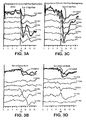
- FIGS. 3A-3D illustrate derived-band ABRs for a bilateral Meniere's disease patient.
- FIGS. 4A-4B illustrate undermasking in a Meniere's disease ear vs. a normal ear.
- FIG. 5 compares wave V latency delay of an unmasked response between a population with normal hearing and a population with Meniere's disease.
- FIGS. 6A-6B illustrate undermasking in a patient with normal hearing.
- FIG. 7 compares wave V latency delay of an undermasked component between a population with normal hearing and a population with Meniere's disease.
- the derived-band ABR approach consists of the simultaneous ipsilateral presentation of a broad-band click and high-pass filtered pink noise.
- a series of responses are recorded as the cut-off frequency of the high-pass noise is successively lowered from one run to the next in one octave steps (8.0, 4.0, 2.0, 1.0, 0.5 kHz).
- Successive subtraction of these high-pass masked responses results in a series of derived-band ABRs representing activity initiated from regions of the cochlea approximately one octave wide.
- the sound pressure level of the pink noise must be nearly equivalent to the peak equivalent sound pressure level of the click.
- the amount of pink noise required to mask an 82 dB p.e. SPL (peak-equivalent Sound Pressure Level) click is about 81 dB RMS SPL.
- the 500 Hz high-pass response is broader and the wave V latency is delayed in the normal-hearing subject. This is expected because most of the cochlea is masked and the response represents activity from below the 500 Hz region.
- wave V is not as broad and the latency is very short, comparable to the latency of wave V in the unmasked click alone and the higher high-pass responses. This is evidence that the activity from above the 500 Hz region has not been masked completely. Note that this "undermasking'' effect is clearly seen in all of the Meniere's disease patient's lower high pass responses. The noise levels for these two cases were the same and were sufficient to mask normal-hearing and pure cochlear hearing loss individuals.
- FIGs 2A-2D illustrate ABRs for a patient diagnosed with Meniere's disease (with symptoms consistent with the presence of cochlear hydrops) in the left ear.
- the high-pass responses for the left ear show the undermasking effect whereas the high-pass responses for the right ear (non-Meniere's non-cochlear hydrops) show the typical normal pattern.
- the wave V of the sum of the high-pass responses for the right ear without Meniere's disease is broad and its amplitude is relatively small.
- the amplitude ratio of the sum of the five high-pass noise masked responses to five times the unmasked click alone wave V amplitude is 0.903 for the Meniere's ear and 0.402 for the non-Meniere's ear.
- the latency delay between wave V of the unmasked click alone (point A) and wave V of the 500 Hz high-pass (point B) is minimal (less than 0.2 ms) for the ear with Meniere's disease ( Figure 2A ) and rather long (over 4 ms) in the ear without Meniere's disease ( Figure 2C ). Even in non-Meniere's subjects there can be an undermasked component, but its latency will still be longer than that seen in Meniere's disease ears with cochlear hydrops.
- Figures 2B and 2D compare the sum of the derived-band response to the click alone response for the ear with Meniere's and the non-Meniere's ear respectively.
- the sum is much smaller than the click alone response, whereas for the non-Meniere's ear, the sum is essentially equivalent to the click alone response.
- Figures 3A-3D illustrate an example of a patient diagnosed with bilateral Meniere's disease and cochlear hydrops. The undermasking pattern is evident for both ears. I hypothesize that this greater resistance to masking is a consequence of the changes in the mechanical properties of the basilar membrane induced by pressure exerted by the endolymphatic (cochlear) hydrops condition.
- Some useful measures or variants of these measures are: (1) the wave V amplitude ratio of the sum of the five high-pass masking responses (large heavy traces in Figure 2) to five times the unmasked click alone response, (2) the cross correlation between the response to the 500 Hz high-pass condition and the unmasked click alone response, (3) the latency difference between wave V of the unmasked click alone response and wave V of the 500 Hz high-pass response as determined by visual peak selection or by analyses of the peak in the cross-correlation function, and (4) the amplitude difference between the unmasked click alone response and the sum of the five derived-band responses.
- the presently preferred measure is measure (3) noted above.
- the early latency wave V peak was labeled as the undermasked wave V component. If this peak occurs, we use this early component in our measure. If it does not exist, then we use the longer latency normal wave V peak. In either case, the latency difference between the unmasked click alone response and the 500 Hz high-pass masked response is shorter in the Meniere's disease ears than in the non-Meniere's disease ears.
- Figures 4A-4B illustrate the undermasking phenomenon as evidenced by the latency delay between wave V in the unmasked click alone response and wave V in the 500 Hz high-pass response.
- Figure 4B presents the responses from a non-Meniere's disease ear.
- the latency delay is much shorter in the Meniere's disease ear.
- Figure 5 illustrates the results from 39 normal-hearing non-Meniere's disease ears and 20 Meniere's disease ears.
- the latency delay between wave V of the click alone response and wave V of the 500 Hz high-pass response is plotted on the x-axis and the cumulative percent is plotted on the y-axis.
- the wave V latency delay for the Meniere's disease ears is less than that for the non-Meniere's disease ears. Note the total separation between the distributions for the two populations tested: normal-hearing, non-Meniere's disease subjects and patients with Meniere's disease.
- Figures 6A-6B present the responses from a normal-hearing, non-pathologic subject.
- An experienced analyst can see wave V (filled circles) moving out in time, just as it should in a non-Meniere's disease ear. But even for a well trained analyst, the peak of wave V on the 500 Hz response may be difficult to distinguish. In fact, if we look more closely at the 500 Hz high-pass response, we can see a peak in the response for each of the subject's ears that is only slightly delayed from the peak of wave V in the unmasked click alone response (open circles).
- the level of masking chosen was based on an average.
- Figure 7 illustrates the results from 38 normal-hearing non-Meniere's disease ears and 20 Meniere's disease ears.
- the latency delay between wave V of the click alone response and the undermasked component of the 500 Hz high-pass response is plotted on the x-axis and the cumulative percent is plotted on the y-axis.
- the wave V latency delay just described due to the greater degree of undermasking observed in Meniere's disease with cochlear hydrops, the latency delay of the undermasked component for the Meniere's disease ears is less than that for the non-Meniere's disease ears.
- the latency, amplitude and correlation measures described above are to be used to assess the presence of cochlear hydrops in patients suspected of having Meniere's disease. However, because of similar clinical symptoms, there is often a need to first rule out the presence of an acoustic tumor.
- Use of the Stacked ABR methodology for acoustic tumor evaluation is the subject of U.S. Patent Nos. 6,080,112 and 6,264,616. This methodology uses the Stacked ABR amplitude measure to assess the presence of an acoustic tumor. To form the Stacked ABR, responses to clicks in the presence of high-pass masking noise at various cutoff frequencies must be collected.
- This invention will provide a possible way to assess the presence of cochlear hydrops that is much easier for the clinician to use consistently, efficiently, and, most importantly, correctly in the diagnosis of Meniere's disease.
- the advantages of the measures in this invention are (1) it is a non-invasive procedure, (2) it is a relatively comfortable procedure, (3) it may be more sensitive in detecting the presence of cochlear hydrops, (4) it is relatively rapid and inexpensive.
Landscapes
- Health & Medical Sciences (AREA)
- Life Sciences & Earth Sciences (AREA)
- Physics & Mathematics (AREA)
- Engineering & Computer Science (AREA)
- Heart & Thoracic Surgery (AREA)
- Surgery (AREA)
- Biophysics (AREA)
- Pathology (AREA)
- Audiology, Speech & Language Pathology (AREA)
- Biomedical Technology (AREA)
- Acoustics & Sound (AREA)
- Medical Informatics (AREA)
- Molecular Biology (AREA)
- Veterinary Medicine (AREA)
- Animal Behavior & Ethology (AREA)
- General Health & Medical Sciences (AREA)
- Public Health (AREA)
- Psychology (AREA)
- Psychiatry (AREA)
- Otolaryngology (AREA)
- Multimedia (AREA)
- Measurement Of The Respiration, Hearing Ability, Form, And Blood Characteristics Of Living Organisms (AREA)
Applications Claiming Priority (2)
| Application Number | Priority Date | Filing Date | Title |
|---|---|---|---|
| US10/863,559 US7223246B2 (en) | 2003-06-06 | 2004-06-07 | Diagnosis of the presence of cochlear hydrops using observed auditory brainstem responses |
| US863559 | 2004-06-07 |
Publications (1)
| Publication Number | Publication Date |
|---|---|
| EP1605365A1 true EP1605365A1 (en) | 2005-12-14 |
Family
ID=34941566
Family Applications (1)
| Application Number | Title | Priority Date | Filing Date |
|---|---|---|---|
| EP05253430A Withdrawn EP1605365A1 (en) | 2004-06-07 | 2005-06-03 | Method of diagnosing cochlear hydrops |
Country Status (3)
| Country | Link |
|---|---|
| US (1) | US7223246B2 (https=) |
| EP (1) | EP1605365A1 (https=) |
| JP (1) | JP4898148B2 (https=) |
Families Citing this family (32)
| Publication number | Priority date | Publication date | Assignee | Title |
|---|---|---|---|---|
| US6702949B2 (en) | 1997-10-24 | 2004-03-09 | Microdiffusion, Inc. | Diffuser/emulsifier for aquaculture applications |
| WO2006102711A1 (en) * | 2005-03-30 | 2006-10-05 | Eric Lindsay Lepage | Baseline otoacoustic (boa) test |
| KR100839109B1 (ko) * | 2006-09-20 | 2008-06-19 | [주]이어로직코리아 | 타각적 자동청력검사 방법 및 그 장치 |
| CA2667791A1 (en) | 2006-10-25 | 2008-05-02 | Revalesio Corporation | Methods of therapeutic treatment of eyes and other human tissues using an oxygen-enriched solution |
| EP2083876A4 (en) | 2006-10-25 | 2012-09-19 | Revalesio Corp | WOUND CARE AND TREATMENT METHOD |
| JP5306214B2 (ja) | 2006-10-25 | 2013-10-02 | リバルシオ コーポレイション | 混合装置 |
| US8784897B2 (en) | 2006-10-25 | 2014-07-22 | Revalesio Corporation | Methods of therapeutic treatment of eyes |
| US8445546B2 (en) | 2006-10-25 | 2013-05-21 | Revalesio Corporation | Electrokinetically-altered fluids comprising charge-stabilized gas-containing nanostructures |
| US8784898B2 (en) | 2006-10-25 | 2014-07-22 | Revalesio Corporation | Methods of wound care and treatment |
| US8609148B2 (en) | 2006-10-25 | 2013-12-17 | Revalesio Corporation | Methods of therapeutic treatment of eyes |
| US10125359B2 (en) | 2007-10-25 | 2018-11-13 | Revalesio Corporation | Compositions and methods for treating inflammation |
| US9745567B2 (en) | 2008-04-28 | 2017-08-29 | Revalesio Corporation | Compositions and methods for treating multiple sclerosis |
| US20090263495A1 (en) * | 2007-10-25 | 2009-10-22 | Revalesio Corporation | Bacteriostatic or bacteriocidal compositions and methods |
| US9523090B2 (en) | 2007-10-25 | 2016-12-20 | Revalesio Corporation | Compositions and methods for treating inflammation |
| CA2723215A1 (en) | 2008-05-01 | 2009-11-05 | Revalesio Corporation | Compositions and methods for treating digestive disorders |
| US8815292B2 (en) | 2009-04-27 | 2014-08-26 | Revalesio Corporation | Compositions and methods for treating insulin resistance and diabetes mellitus |
| EP2445397A4 (en) * | 2009-06-24 | 2015-05-06 | Univ Monash | NEURALANALYSESYSTEM |
| CN104983740A (zh) | 2010-05-07 | 2015-10-21 | 利发利希奥公司 | 用于增强生理性能和恢复时间的组合物和方法 |
| JP2013533320A (ja) | 2010-08-12 | 2013-08-22 | レバレジオ コーポレイション | タウオパチーを治療するための組成物および方法 |
| JP5603281B2 (ja) * | 2011-04-04 | 2014-10-08 | パナソニック株式会社 | 聴覚検査装置、方法およびコンピュータプログラム、補聴器調整システム |
| US10445846B2 (en) | 2011-04-14 | 2019-10-15 | Elwha Llc | Cost-effective resource apportionment technologies suitable for facilitating therapies |
| US10853819B2 (en) | 2011-04-14 | 2020-12-01 | Elwha Llc | Cost-effective resource apportionment technologies suitable for facilitating therapies |
| CN102217932B (zh) * | 2011-05-17 | 2013-04-03 | 上海理工大学 | 一种abr信号波峰检测的算法 |
| US8514067B2 (en) | 2011-08-16 | 2013-08-20 | Elwha Llc | Systematic distillation of status data relating to regimen compliance |
| US10552581B2 (en) | 2011-12-30 | 2020-02-04 | Elwha Llc | Evidence-based healthcare information management protocols |
| US10402927B2 (en) | 2011-12-30 | 2019-09-03 | Elwha Llc | Evidence-based healthcare information management protocols |
| US10340034B2 (en) | 2011-12-30 | 2019-07-02 | Elwha Llc | Evidence-based healthcare information management protocols |
| US10679309B2 (en) | 2011-12-30 | 2020-06-09 | Elwha Llc | Evidence-based healthcare information management protocols |
| US10559380B2 (en) | 2011-12-30 | 2020-02-11 | Elwha Llc | Evidence-based healthcare information management protocols |
| US10528913B2 (en) | 2011-12-30 | 2020-01-07 | Elwha Llc | Evidence-based healthcare information management protocols |
| US10475142B2 (en) | 2011-12-30 | 2019-11-12 | Elwha Llc | Evidence-based healthcare information management protocols |
| EP3733061A3 (en) * | 2020-06-16 | 2020-11-11 | Interacoustics A/S | Determination of cochlear hydrops based on recorded auditory electrophysiological responses |
Citations (1)
| Publication number | Priority date | Publication date | Assignee | Title |
|---|---|---|---|---|
| US6080112A (en) * | 1998-05-13 | 2000-06-27 | House Ear Institute | Acoustic tumor detection using stacked derived-band ABR amplitude |
Family Cites Families (1)
| Publication number | Priority date | Publication date | Assignee | Title |
|---|---|---|---|---|
| CA2451929A1 (en) * | 2003-12-23 | 2005-06-23 | University Technologies International Inc. | Detection of acoustic nerve tumors |
-
2004
- 2004-06-07 US US10/863,559 patent/US7223246B2/en not_active Expired - Fee Related
-
2005
- 2005-06-03 EP EP05253430A patent/EP1605365A1/en not_active Withdrawn
- 2005-06-06 JP JP2005165170A patent/JP4898148B2/ja not_active Expired - Fee Related
Patent Citations (2)
| Publication number | Priority date | Publication date | Assignee | Title |
|---|---|---|---|---|
| US6080112A (en) * | 1998-05-13 | 2000-06-27 | House Ear Institute | Acoustic tumor detection using stacked derived-band ABR amplitude |
| US6264616B1 (en) * | 1998-05-13 | 2001-07-24 | House Ear Institute | Acoustic tumor detection using stacked derived-band ABR amplitude |
Non-Patent Citations (4)
| Title |
|---|
| DON MANUEL; KWONG BETTY; TANAKA CHIEMI: "A diagnostic test for Ménière's Disease and Cochlear Hydrops: impaired high-pass noise masking of auditory brainstem responses", OTOLOGY & NEUROTOLOGY, vol. 26, no. 4, July 2005 (2005-07-01), pages 711 - 722, XP008052740 * |
| DONALDSON G S; RUTH R A: "Derived band auditory brain-stem response estimates of traveling wave velocity in humans. II. Subjects with noise-induced hearing loss and Meniere's disease", JOURNAL OF SPEECH AND HEARING RESEARCH, vol. 39, no. 3, June 1996 (1996-06-01), pages 534 - 545, XP008052794 * |
| HOEHMANN D ET AL: "THE HYDROPSFINDER: AN ELECTRONIC DEVICE FOR THE DIAGNOSIS OF ENDOLYMPHATIC HYDROPS", MEDICAL PROGRESS THROUGH TECHNOLOGY, SPRINGER VERLAG. BERLIN, DE, vol. 16, no. 4, 1 November 1990 (1990-11-01), pages 219 - 224, XP000229088, ISSN: 0047-6552 * |
| THORNTON A R D; FARRELL G; HAACKE N P: "A non-invasive, objective test of endolymphatic hydrops", ACTA OTO-LARYNGOLOGICA, SUPPLEMENT, no. 479, 1991, pages 35 - 43, XP008052796 * |
Also Published As
| Publication number | Publication date |
|---|---|
| JP4898148B2 (ja) | 2012-03-14 |
| JP2005349198A (ja) | 2005-12-22 |
| US7223246B2 (en) | 2007-05-29 |
| US20050273018A1 (en) | 2005-12-08 |
Similar Documents
| Publication | Publication Date | Title |
|---|---|---|
| US7223246B2 (en) | Diagnosis of the presence of cochlear hydrops using observed auditory brainstem responses | |
| Mishra et al. | Extended high-frequency hearing impairment despite a normal audiogram: Relation to early aging, speech-in-noise perception, cochlear function, and routine earphone use | |
| Hirsh et al. | Difference limen and recruitment | |
| Van Dun et al. | Estimating hearing thresholds in hearing-impaired adults through objective detection of cortical auditory evoked potentials | |
| Moore | Prevalence of dead regions in subjects with sensorineural hearing loss | |
| Picton et al. | Recording auditory brainstem responses from infants | |
| Van Maanen et al. | Normal multiple auditory steady-state response thresholds to air-conducted stimuli in infants | |
| JP2001231768A (ja) | 患者接続の判定能力を備えた聴力判定装置 | |
| JP2008539977A (ja) | 神経生理学的中枢聴覚処理評価システム及び方法 | |
| RU2402266C1 (ru) | Способ диагностики ретрокохлеарных и центральных слуховых нарушений | |
| Hancock et al. | The summating potential in human electrocochleography: Gaussian models and Fourier analysis | |
| Brotherton et al. | Earplug-induced changes in acoustic reflex thresholds suggest that increased subcortical neural gain may be necessary but not sufficient for the occurrence of tinnitus | |
| Mertes et al. | Concurrent measures of contralateral suppression of transient-evoked otoacoustic emissions and of auditory steady-state responses | |
| Kaf et al. | Examining the profile of noise-induced cochlear synaptopathy using iPhone health app data and cochlear and brainstem electrophysiological responses to fast clicks rates | |
| RU2374983C2 (ru) | Способ ранней расширенной аудиологической диагностики слуховых нарушений, обусловленных рассеянным склерозом | |
| Atcherson et al. | Auditory N1 component to gaps in continuous narrowband noises | |
| Thornton | The use of post-auricular muscle responses | |
| Hall et al. | Auditory brainstem response: recent developments in recording and analysis | |
| Mertes et al. | Contralateral noise effects on otoacoustic emissions and electrophysiologic responses in normal-hearing adults | |
| US20180263536A1 (en) | Changes in auditory evoked responses as simple, rapid biomarkers for blast injury and other traumatic brain injuries | |
| Don et al. | Interaural stacked auditory brainstem response measures for detecting small unilateral acoustic tumors | |
| Gentiletti-Faenze et al. | Evaluation of automatic identification algorithms for auditory brainstem response used in universal hearing loss screening | |
| Alhussaini et al. | Software application for auditory temporal resolution screening outside the clinic | |
| Wong | Assessing the correlation between hearing sensitivity and Quick Speech-in-Noise test (QuickSIN) performance: the role of extended high-frequency hearing and conventional frequency range hearing | |
| Essawy et al. | Speech in noise ability in patients with Central auditory processing disorders (CAPDs) |
Legal Events
| Date | Code | Title | Description |
|---|---|---|---|
| PUAI | Public reference made under article 153(3) epc to a published international application that has entered the european phase |
Free format text: ORIGINAL CODE: 0009012 |
|
| AK | Designated contracting states |
Kind code of ref document: A1 Designated state(s): AT BE BG CH CY CZ DE DK EE ES FI FR GB GR HU IE IS IT LI LT LU MC NL PL PT RO SE SI SK TR |
|
| AX | Request for extension of the european patent |
Extension state: AL BA HR LV MK YU |
|
| 17P | Request for examination filed |
Effective date: 20060612 |
|
| AKX | Designation fees paid |
Designated state(s): DE FR GB IT |
|
| STAA | Information on the status of an ep patent application or granted ep patent |
Free format text: STATUS: THE APPLICATION IS DEEMED TO BE WITHDRAWN |
|
| 18D | Application deemed to be withdrawn |
Effective date: 20110104 |